- Search Cartoons
- Comic Archive
-
Payne
Store



 Henry Payne RSS

Articles Blog
Payne: Turn up the volume — Sci-fi BMW iX is loud, lavish and ‘lectric
Posted by Talbot Payne on November 10, 2022
Pontiac — The new 2023 BMW iX is here. Call it BMW Tron.
For its first electric vehicle, BMW has created a dramatically different user experience. Where BMW has built its brand on sleek design and tight handling, iX takes its cues from Hollywood sci-fi movies. This is a vehicle out of Disney’s acclaimed, futuristic “Tron” flick.
Turn on a gas-powered BMW X5 40i and it growls like a hungry beast. BRAPPA! Turn on the iX M60 and you’re met with silence from the electric drivetrain. But that doesn’t mean it’s quiet. Instead, BMW contracted with Hollywood movie composer Hans Zimmer to create a unique interior soundtrack for iX.

A two-time Oscar winner, Zimmer’s credits include the soundtracks for such sci-fi blockbusters as “Dune” (Academy Award winner in March), “Inception” and “Interstellar.” So he seems particularly well-suited for the iX assignment.
See my iX M60 zip by on the road, and it’s whisper quiet. But inside, it’s a symphony of noise.
I activated EXPRESSIVE mode and the cabin exploded in a musical cacophony as if the string section of the Detroit Symphony Orchestra has just occupied the rear seat. ZZPPHVEVEVEVHHHH!!!
I lifted my right foot and the symphony went silent. Back on the throttle: ZZPPHVEVEVEVHHHH!!!

Enough. I poked EFFICIENT mode on the console screen and the car went deathly quiet. I squeezed the accelerator hard and heard nothing. Not even motor whine. “That’s eerie,” said my friend Tom.
I activated SPORT mode. WAURRRRGGHH!! went the speakers when I buried my right foot, launching the nearly three-ton beast to 60 mph in 3.3 seconds.
It’s crazy.
“This car is fun to drive,” smiled pal Caroline, who has owned Audi Qs and Bimmer Xs.
“Too gimmicky,” said Tom, who owns a Porsche Panamera.
Back in 2001, Bimmer did a similar radical makeover for the dawning electronics era, introducing a rotary dial-controlled infotainment screen and mold-breaking 7-series sedan courtesy of designer Chris Bangle. At the Detroit auto show, my father-in-law shook his head at iDrive’s complexity — and the exterior design was so polarizing it was nicknamed the “Bangle butt.”
But BMW’s boldness stood the test of time, capturing a new generation of buyers.

The iX is even more polarizing. The interior is a stark, austere departure from recent BMWs. Aside from the signature iDrive and volume control roller on the console (crafted from crystal along with the door-mounted seat controls), there are no control dials. Everything is haptic touch controls.
I found the Drive Mode controls — accessed via raised lettering on the floating-island console — particularly frustrating.
At dusk at a Woodward stoplight, a menacing Audi S5 rolled up next to me. Devil in a red dress. I was in EFFICIENT mode. I reached for the raised lettering in the darkness to access SPORT mode/launch control but couldn’t locate it. Dang. I poked at the screen trying to find the Modes. Dang.
The light turned green. EFFICIENT mode would have to do. I still blew the Audi A5’s doors off.
Putting a gob-smacking 811-pound feet of torque (260 more than a comparable X5 M50i, 100 more than a supercharged, V8-powered Dodge Challenger Demon) to asphalt via all four paws, the iX erupts off the line despite its 5,800-pound girth (450 more than the X5). It’s addictive.

With its big 105.2 kWh battery pack under the floorboards, adaptive air suspension and a sophisticated carbon fiber-reinforced, mixed-metal frame, this rhino in tennis shoes is surprisingly nimble for a mid-size ute that can seat four six-footers with ease. Through the S-turns of Oakland County lake country, iX bounded about happily — its instant torque always at the ready.
The innovative, hexagonal steering wheel — firm in SPORT mode — adds more security at speed, its squared-off construction allowing excellent instrument visibility like the Corvette C8’s square wheel.

But in this EV utility space, smooth electric torque is not exclusive to BMW. The Mustang Mach-E GT matches it. And the Rivian R1T. So too the Tesla Model Y Performance.
Where the Bimmer really wants to make its mark is as a tech showcase. This is an all-wheel-drive smartphone.
As with a smartphone, I only scratched the surface of what was available in a week behind the wheel. Years ago, after a month with my first Samsung smartphone, my son (who owned the same series) came home and unlocked features I had no idea existed. Each day in the iX was like that.

After my frustrations with accessing Drive modes, I discovered I could just talk to iX.
Hello, BMW. Set Drive Mode.
BMW’s Personal Assistant then switched the curved 14.9-inch infotainment display to beautifully crafted Drive mode pages. I tapped the one I wanted. With its ergonomically inferior touch controls, I increasingly used voice commands. Like a lot of luxe vehicles, the Bimmer wants to self-drive — but unlike other systems, iX is also aware of its surrounding environment even when driver-assist turns off.
Coasting toward another car, my iX M60 broke lightly — not harshly — just as a human would. Other gee-whiz functions included an electromagnetic, panoramic glass roof that could switch between opaque and non-opaque. You can take pictures of passengers inside the car. The iX has its own security camera, a polyurethane covering on the front grille that self-heals scratches … and so on.
Still, all this tech will not make up for EVs’ Achilles heel: range anxiety.
My M60 boasted 220 miles at (recommended) 80% charge, not enough to get to Charlevoix without stopping for electrons. An Electrify America charge stop adds half an hour — and when you arrive with just 11% of battery range? You better hope there’s a 240-volt charger to juice up overnight. Charging adds another hour to my 7-hour trip to hometown Charleston, W.Va.
The good news? The Bimmer’s nav system is on par with segment-standard Tesla. It plans your route complete with fast chargers — even locating restaurants/retail nearby. The bad news? Unlike Tesla’s multi-stall stables, third-party chargers from, say, EVGo, often are single units, meaning you’ll face delays if others are in line.
Like a sci-fi vehicle, iX is a big-budget blockbuster ($110K for my tester, $20K more than the X5 M50i) and wants to explore the frontier of electronics and EVs. Like a sci-fi flick, it’s more interested in entertainment than utility.
So have a seat in the iX theater. Turn up the volume and enjoy the show.
Next week: Who needs a truck? Towing a boat with a 2022 Ford Explorer SUV
2023 BMW iX
Vehicle type: Battery-powered, all-wheel-drive, five-passenger SUV
Price: $85,095, including $995 destination fee ($109,895 iX M60 as tested)
Powerplant: 105.2 kWh lithium-ion battery driving two, electric motors
Power: 516 horsepower, 564 pound-feet of torque (xDrive50); 610 horsepower, 811 pound-feet of torque (M60)
Transmission: Single-speed drive
Performance: 0-60 mph, 3.6 seconds (mfr.)
Weight: 5,800 pounds (as tested)
Fuel economy: EPA 78 MPGe; range, 324 miles (xDrive50); 280 miles (M60)
Report card
Highs: Hi-tech interior; explosive power
Lows: Polarizing exterior design, short battery range
Overall: 3 stars
Henry Payne is auto critic for The Detroit News. Find him at hpayne@detroitnews.com or Twitter @HenryEPayne.
Orange barrels: Detroit GP fixes the damn roads for 2023 race
Posted by Talbot Payne on November 8, 2022
Detroit — The Detroit Grand Prix is making a promise to the state of Michigan: it’s going to fix the damn roads.
At least the roads around the Detroit Renaissance Center, where the Chevrolet Detroit Grand Prix Presented by Lear is moving for June 2-4, 2023. The 1.7-mile track — its main, east-west corridors of Jefferson Avenue and Atwater Street choked with construction barrels — has begun to take shape and event organizers gave sponsors and media a fall preview of the track this week. It’s going to be quick.

“It’s a minor inconvenience rights now, but I can guarantee the citizens of Detroit these will be the smoothest roads in our city in about 2-3 weeks,” said Detroit GP President Bud Denker at a sponsor reception on the 72nd floor of the RenCen. “The Belle Isle track was 2.4 miles, the new track is just 1.7 miles. Belle Isle races were 70 laps. In downtown Detroit, cars will come around 100-plus times. That means more action, more things going on for the fans. It’s a nine-turn track with a straightaway as long as Indianapolis Motor Speedway’s main straight and you know how fast they go there.”
Don’t expect Indy’s 240-mph speeds, but expect IndyCars to hit 180 mph after taking a 90-degree left onto Jefferson from Rivard Street (Turn 2) and screaming westwards, past the RenCen, and into a 180-degree hairpin at Griswold. From there, IndyCars will plunge down to the waterfront, emerging on Atwater Street via an uphill S-turn that Denker calls “Monte Carlo” after the famed European street race.

“Just being on Jefferson is going to be a highlight. Going past the Joe Louis fist with a hairpin around it . . . is going to be a big talking point,” said two-time IndyCar champ and Penske team driver Josef Newgarden, who got a tour of the track Thursday. “It will be a quick street circuit, probably comparable to St. Petersburg where we start the season with 60-second laps.”
Jefferson is being paved because it must be billiard-table smooth to handle cars at that velocity carrying spine-crunching, 4,000-pounds of downforce. With 50% of ticket sales free, the straight should be packed with fans as the cars stream into the slow, 40 mph, 180-degree Griswold hairpin.

“Jefferson is going to be 5-6 lanes wide (for) 0.7 miles, which is quite a distance to get a tow on somebody into a 40-mph hairpin,” smiled Newgarden. “That provides an interesting opportunity for overtaking and defending.”
Moving from Belle Isle back downtown for the first time since 1991, the track is an ambitious re-imagining of one of IndyCar’s iconic races. Make that events.

“This is an event, not a race,” said Denker, who sees the GP as the centerpiece of a weekend where fans can enjoy racing (including support races from IMSA sportscar and Trans Am), attend concerts at Hart Plaza, drink in Detroit River views, dine at Campus Martius restaurants, shop along Woodward, even bring their boats to slips along the waterfront behind the Port Authority building (already booked for the weekend by a Canadian firm). A Chevrolet bridge will allow fans to cross the main straight to get back and forth from Hart Plaza to downtown businesses.
“My favorite thing about street circuits is it’s like going to a downtown music concert,” said Newgarden, who hails from Nashville, which has one of the series’ most successful street events. “There’s nothing better than going to a live race.”

While much of the track will be free to fans, there is money to be made selling suites to the east of the RenCen overlooking an IndyCar first: dual, parallel pit lanes.
“We couldn’t find a 1,000-feet stretch anywhere to put a pit lane. Those are the things you have to consider to build a track,” said Denker. “Instead, we’ve got a pit lane that’s 500 feet long — and on each side the drivers will pit. Some cars will pit to the left, some cars to the right, and at the end of pit lane they will come back together to go back on the race track. Never been done before. It’s an engineering marvel.”
Looking down from the RenCen’s southeast tower, the two concrete pads just laid by construction crews look like miniature, parallel landing strips at Detroit Metro Airport.
But when completed for racing next June, they will be a hive of activity. “Races are won or lost in the pit lane,” said Newgarden. “When I come in off the button, I’m going to have to remember which side of pit lane I’m on?”
Pity the driver who forgets.
Behind the pit lane will be 70 suites — 57 of them already spoken for — which dwarfs the 23 at the old Belle Isle venue. The suites are housed in a huge structure, imported from the PGA’s Phoenix Open golf tourney, which offers fans a front row seat on the furious pit activity — as well as a view of Franklin Street, where the checkered flag will be thrown.

One of those suites will be occupied by Huntington Bank, which recently located its Detroit headquarters downtown on Woodward. “We’ve been sponsoring this event for 10 years,” said Huntington regional president Eric Dietz, “and we’re really excited to see the race come back downtown, where our employees will be able to walk to the track.”
Huntington Bank is also sponsoring two Detroit neighborhoods with millions of dollars to be put into infrastructure and assisting the transport of families to the event. Each of Detroit’s nine districts will display a colorful pop-up IndyCar sculpture.
The sculptures are part of an artistic push by the GP that includes decorating the track with large murals from local artists.
“There is a community focus on how we designed the race circuit,” said Michael Montri, Penske Entertainment vice president. “The focus is to help revitalize the downtown as well as the neighborhoods.”
Under Penske Corporation ownership, IndyCar has transcended auto racing in the last two years as a cultural symbol. The Memorial Day weekend 2021 Indy 500 was America’s first mega-sporting event as a vaccinated population emerged from the pandemic — the race attracting more than 100,000 fans — to celebrate Helio Castroneves’ historic fourth 500 win. That was immediately followed by the Detroit GP — the first major race to go maskless, representing a return to normal after months of controversial government restrictions.

Denker hopes the 2023 Detroit Grand Prix will bring similar revival to a Detroit downtown that has suffered through the pandemic. Corporations went to remote workplaces with the resulting dirth of people downtown affecting restaurants and retail establishments.
“We are going to bring a lot of people down here from both sides of the border,” said Denker. “We have so much support from Windsor. Fans can come through (the) Windsor tunnel, turn right and park less than a half-mile away in the middle of the race track.”
Newgarden said he would love to be the first to win on the downtown track, though if he does he’ll miss getting dunked in the Belle Isle Fountain. Instead, Victory Circle will be right in front of the RenCen’s Wintergarden on the Detroit river.
“I don’t recommend jumping in the Detroit River,” laughed Denker to Newgarden. “We might never see you again with the river current.”
Henry Payne is auto critic for The Detroit News. Find him at hpayne@detroitnews.com or Twitter @HenryEPayne.
Payne: Road trippin’ in a Hertz Rent-a-Tesla
Posted by Talbot Payne on November 8, 2022
The Northern Neck, Virginia — Car rentals demand a lot of an automobile. We customers are jet-lagged and likely in a rush. We have an armful of luggage that needs to be stowed. We have no idea how to get to our destination, but need to get there on time no matter the distance. In short, the car must be as loyal a travel companion as a Sherpa up the face of Mt. Kilimanjaro.
So when Hertz announced late last year an order of 100,000 Tesla Model 3s on its way to making its fleet 20% electric, I was eager to put an EV rental through the paces. Sure, EVs boost Hertz’s image (it has also inked deals with GM and Polestar) coming out of COVID-induced bankruptcy, reduce fleet maintenance costs by 50%, and provide a ready destination for automaker EV production.
But are EVs ready for prime time as rental mules?
With a week’s notice that I would be traveling to remote, historic Stratford, Virginia, to meet my wife on a business trip, I rented a Model 3 from Reagan National Airport outside the nation’s capital.
Rentals aren’t cheap these days and my premium-class Model 3 was $161 a day, about $30 more than a comparably-sized Hyundai Elantra mainstream compact, but well below, say, a luxury gas-powered Cadillac XT5 SUV at $330. The Model 3’s twin Model Y SUV? About $100 a day more. Total Tesla bill after taxes and airport fees: $611 for three days.

Upon arrival in D.C. — landing into Reagan National from the north for a spectacular view of the Lincoln and Washington monuments — I accessed Hertz’s app so I could bypass the counter and go directly to the car. But the app wasn’t working, which was OK because I had questions for the agent.
Namely, would I need to return the Tesla fully fueled — er, fully charged?
Nope. I would just have to return it with at least 10% of charge. Otherwise, the cost of any Supercharger stops (at 31 cents per kWh, about double what Detroiters pay for home charging) was on Hertz.
Easy peasy. Meanwhile, my poor wife — renting separately for her longer stay in Virginia — waited for an hour in the Dollar Rental line for her Hyundai.

I stowed my bags in the trunk (with “frunk” room to spare) and awoke the sedan via a two-step process: 1) tap the B-pillar with a Tesla card to open the door, 2) once seated with foot on brake, tap the card on the console. I’ve owned a Model 3 for four years — and driven every other Tesla model — but for the Tesla uninitiated, there is a learning curve to adapt to the operating system. This is not your average vehicle with console gear shifter, rotary climate knobs and steering wheel-mounted cruise controls. Jump into a Hertz Elantra rental (or premium Cadillac or Infiniti) and it’ll be familiar in minutes.
With Tesla, everything is operated through the screen — or via shortcuts using twin rotary balls on the steering wheel. Even for the initiated, Model 3 requires some set-up. The process took me back to my first Tesla in 2018 and the excitement of learning a new system. But for the harried traveler, well, patience is required.

After synching my phone, I worked my way down Tesla’s menu of screen settings:Set mirrorsSet auto windshield wipersSet windows to close automatically on lock when you walk awaySet auto high beamsSet destination via voice activation (“Navigate to Stratford, Virginia”)Set Autopilot to Autosteer.
That’s right, Hertz features Tesla’s ambitious Autopilot self-driving system.
With instant torque from the rear-wheel-drive Tesla’s electric motor, I exited the airport and merged onto George Washington Parkway south with authority. Zot! Then I pulled down twice on the column shifter and the EV took over the driving, asking only that I keep a hand on the wheel for reassurance that I hadn’t nodded off.
Significantly, the rental was not equipped with Navigate on Autopilot — that is, no auto lane changes or auto exits when you reach your exit. Otherwise, my rental self-drove anywhere — on secondary roads or divided highways.
On Metro D.C.’s crowded roads, Autopilot was a welcome driving assistant as I navigated stop ‘n’ go traffic while checking on messages/email down Indian Head Highway.
My 190-mile round trip to Stratford Hall, home of Virginia’s famed Lee family (78 miles each way plus side trips), shouldn’t have required a charging station visit given the Model 3’s estimated 283 miles of range. But that doesn’t mean charging isn’t always at the back of your mind.
After all, I only got 68% of battery range for my trip — meaning my expected 283 miles of range was actually just 192. I was keen to know where the closest Tesla Superchargers were should I need a quick charge.
Reassuringly, there were two Superchargers in the rural Northern Neck (the closest just 15 miles from Stratford). This is Tesla’s secret sauce — a reliable, robust network. By contrast, the nation’s other large fast-charger networks — Electrify America and EV Go — had nothing in the Northern Neck, with their closest charger 40 miles away.

I used the Model 3 as a proper rental vehicle (not parking it for fear of range anxiety) over the weekend: running errands, visiting GW’s nearby birthplace, even letting a fellow Stratford Hall visitor take it for a test drive. He was impressed — thrilled by the car’s instant acceleration and self-driving capability on twisty backroads.
On my way back to the airport I detoured to a Northern Neck Supercharger station — located at a Sheetz gas station — for a 10-minute, peace-of-mind top-up gaining 75 miles of charge. A gas-powered car will take on 400 miles of range in three minutes — an indication of how far EVs have to go as road-trip mules.

The Tesla cost more to fuel than my wife’s gas-fired Hyundai, too. At 31 cents per kWh at the Supercharger, my EV was billed $20. The Hyundai’s fuel bill at $3.49 cent regular gas over a comparable 190 miles: about $18.
Tesla’s navi — Autopilot self-driving me through dense Sunday night traffic — led me back to Reagan National’s Hertz lot with time to spare before my flight. An attendant greeted me and I double-checked on the refueling cost.
“I charged at 31 cents per kWh at a Supercharger. Does that go on my bill?” I asked.
“No, you’re all set,” he smiled.
Henry Payne is auto critic for The Detroit News. Find him at hpayne@detroitnews.com or Twitter @HenryEPayne
Payne: The Lordstown Endurance marches to the beat of a different hub motor
Posted by Talbot Payne on November 3, 2022
Ann Arbor — Electric trucks these days are supercar wannabes. Go zero-60 mph in the GMC Hummer EV in three seconds! The Rivian R1T has neck-snapping torque! The Ford Lightning is quicker to 60 mph than a Ford Raptor! And so on.
The Lordstown Endurance pickup truck is different.
“How fast does the Endurance do 0-60 mph?” I asked chief engineer Darren Post who was riding riding shotgun as I stomped the Endurance’s accelerator on to West Huron River Drive northwest of Ann Arbor.
“About 6.3 seconds, but our clients want us to slow that down,” smiled Post. “They worry their drivers will drag-race.”

Unlike Hummer, Rivian, Lightning, and Tesla Cybertruck (0-60 mph in 3.0 seconds!), the Lordstown Endurance is singularly focused on commercial truck fleets — not wealthy motorheads at M1 Concourse race track. That means Endurance is obsessed with efficiency. Woodward drag racing? Not so much.
It also means Lordstown is synonymous with yet another novel electrified term for our auto lexicon. If Lightning pioneered the mega-frunk, Rivian the gear tunnel, and Hummer crab-walking, then Endurance wants you to know about hub motors.
“Fleet customers are interested in cost of ownership,” said Post. “If they can adopt technologies that will bring down significant operating and maintenance cost of a vehicle, then that becomes a significant advantage. They are aware of the complexity of a traditional EV powertrain that requires gear reduction (transmission), lubrication, various shafts and u-joints that need to be kept up.

“So, as we talked about hub motors at the corners without that extra hardware, it became very attractive to them.”
Peer underneath the Endurance and it doesn’t look like any other vehicle on the market.
Tesla simplified the auto interior; Lordstown has simplified the drivetrain. Gone are the gearbox and driveshafts and u-joints found on other automobiles, including EVs.
The Endurance is motivated by electric motors on each hub, the driveshaft space replaced by huge cables carrying current to each corner.
The arrangement is key to Lordstown’s pitch to commercial clients. Less parts, less maintenance. Indeed, even as I tested the Endurance, a semifinalist for Truck of the Year in my duties as a North American Car, Truck, and Utility of the Year juror, the Endurance is the only vehicle nominated that will not be sold to retail customers.
As its customers’ 0-60 mph concerns reflect, Endurance is not a vehicle gym-toned for performance — unlike EV pickup peers such as Rivian R1T and Ford F-150 Lightning. Endurance is a vehicle to be driven efficiently, within the lines — not pushing the boundaries of speed (the Lightning will do an insane 4.0 second 0-60 run) or off-road performance (dude, Rivian can go deep into America’s national parks with 34-inch Pirelli Scorpion All Terrain Plus off-road tires).
When asked if Rivian had looked at hub motors, Rivian engineer Kenneth Tsang replied matter-of-factly: “I can see where that fits Lordstown’s commercial model, but we are a brand focused on off-road enthusiasts.”

My time in the Endurance was spent in its natural habitat — urban Ann Arbor, navigating city streets and secondary roads. The same routes that say, a utility service truck, would take on daily rounds of less than 200 miles — which happens to be the $65K Endurance’s range, well shy of a $75K Rivian’s claimed 314 miles.
The Endurance was not unpleasant to drive, however. Far from it. With its smooth, instant torque, it felt like other EVs I’ve driven from Tesla to Hummer.
I flogged it harder, I’m sure, than any utility employee will be allowed. Lordstown stuffs its trucks with data monitors so owners can track their trucks — and it’s equipped with all-season tires to discourage off-road forays. This is not the Tesla Cybertruck.
Nor is it the F-150 Lightning.
The Lordstown and Ford products are the first mass-production pickups available in the commercial market. The startup vs. the legacy king of trucks. David vs. Goliath.
Lordstown is one of a rash of EV startups in the U.S. market that has taken hope from Tesla’s own David vs. Goliath success story. The Silicon Valley automaker reinvented the automobile with electrification and — just a decade after the introduction of its first mainstream product, the Model S — is the luxury sales leader in the U.S., beating out giants BMW, Mercedes and Lexus.
“As a startup, we can make decisions more quickly,” said Post, who came to Lordstown in 2019 after a 30-year career with GM as well as stints with two other startups. “We can take on new technologies without being hampered by standardized processes. And being a startup offers the chance to take a fresh look at what the customer’s need is and adopt technologies that could do things differently than the rest of the industry.”

Lordstown’s path will be formidable given the Detroit Three’s dominance of the commercial pickup market (F-series, Chevy Silverado/GMC Sierra, Ram) — and because all three automakers have EV trucks of their own in the pipeline.
Ford’s offering, the Lightning Pro, isn’t cheap at $55K as EV material costs have inflated its sticker from $40,000 just four months ago. But the Endurance’s sticker is even higher at $65,000.
For that cost, customers get not only extensive tracking data and hub motors, but a deep “frunk” (front trunk) so workers can carry gear without fear of its getting waterlogged in the 5’8” bed. The 4-wheel-drive truck will tow 8,000-pounds.
Post’s team has not yet published a range figure for towing, a task that has proven a challenge for EVs. A recent TFL Truck report, for example, found that Lightning went just 93 miles on a charge when towing 6,000 pounds.
“There will be degradation in towing,” said Post, but he says customers will typically use the vehicle on low-mileage routes. “They essentially leave a depot, do work at multiple sites, then return to the depot. We’ve done study of data and found the average route is under 100 miles, but may extend upwards to 150.”

Inside, Endurance boasts modern, digital instrument and infotainment displays. Interior materials are simple — cloth seats, plastic dash — as the pickup assumes interiors won’t be driven by country club valets like retail-oriented brands, but used as daily workplaced for service and construction workers.
At 6’5” and 235 pounds, my large frame fit easily in the interior, and access to the 5’8″ composite bed was excellent with Chevy Silverado-like corner bumper steps.

Lordstown’s access to the market has not been as easy. The pickup maker purchased GM’s former Lordstown manufacturing facility but ran into financial problems that led to the resignation of its CEO, Steve Burns, then a sale of the plant to Foxconn — the Taiwan-based electronics manufacturer that is itself a rookie at vehicle manufacturing.
The Endurance is Foxconn’s first vehicle project. Indeed, it will be the first contract assembly plant in North America — seeking to replicate the success of Magna Steyr in Austria that assembles European models like the Mercedes G-Class and Jaguar iPace.
“We work closely with (Foxconn) as would any company launching a new vehicle,” said Post. “We have targets to meet in terms of quality, and on a daily basis we are involved in the plant as we are work through launch issues. We have very good working relationship with the Foxconn team.”

In keeping with its creative engineering and manufacturing, Endurance’s design is also unique. You can’t miss it on the road with its bold, horizontal lines tracing the bodywork like etchings on a circuit board. Also unique to any EV (save the Nissan Leaf sedan), Endurance’s charge port is found smack in the middle of the front fascia.
The Endurance launches off the assembly line — at less than 6.5 seconds 0-60 mph — in late 2022.
2023 Lordstown Endurance
Vehicle type: Battery-powered, all-wheel-drive, five-passenger pickup truck
Price: $65,000
Powerplant: 109 kWh lithium-ion battery driving four, in-wheel hub motors
Power: 440 horsepower
Transmission: NA
Performance: 0-60 mph, 6.3 seconds (mftr.); payload, 1,050 pounds; towing, 8,000 pounds; top speed, 74 mph
Weight: 6,450 pounds
Fuel economy: EPA 65 MPGe; range, 200 miles
Report card
Highs: Hub-motor simplicity; unique design
Lows: Higher sticker, lower range than Ford F-150 Lightning Pro
Overall: 3 stars
Henry Payne is auto critic for The Detroit News. Find him at hpayne@detroitnews.com or Twitter @HenryEPayne.
Payne: Multi-state trek shows off Mazda CX-50’s multi-talents
Posted by Talbot Payne on November 3, 2022
Watkins Glen, New York — The original Watkins Glen race track was 6.6 miles of raw, open country road. After racers took the green flag downtown, they would climb steeply into the hills overlooking the stunning Seneca Lake valley — then madly plunge downhill to begin another lap through town. Man, those drivers had guts. While today’s Watkins Glen races are held on a smooth, enclosed 3.7-mile track nearby, the original course is marked as a historic public road.
It’s available for any visitor to drive. Which I did (repeatedly) in my 2023 Mazda CX-50.
The 256-horsepower, all-wheel-drive CX-50 is that rare SUV that can get you to your destination in comfort, then offer performance to enjoy the local landscape when you arrive. Heck, the CX-50 is a sci-fi cyborg compared to the ‘50s Allard J2 Cadillacs that used to conquer the Glen’s hills.

It’s this kind of versatility that has the Mazda and Kia Sportage at the top of my list for North American SUV of the Year.
As a juror for North American Car, Truck, and Utility of the Year, I’m weighing a semifinal list of 13 vehicles for best ute (along with 13 sedans for best car and three pickups for best truck). It’s a competitive group that includes a record eight electric vehicles: Audi Q4 e-tron, BMW iX xDrive M50i, Cadillac Lyriq, Genesis GV60, Kia EV6, Nissan Ariya, Rivian R1S and Volvo C40 Recharge.
But as much as I enjoy EVs (I’ve purchased two Tesla Model 3s in the last four years, and they’re the coolest toys I’ve owned), they aren’t ready for prime time as family wagons. Utes are about, well, utility. Utility infielder utility. Allow me to quote from Webster’s: “capable of serving as a substitute in various roles or positions.”
That is, vehicles that can do anything. And EVs just don’t do road trips well.

My mid-September trek to meet my race team at Watkins Glen’s SCCA Regionals is a good example. Leaving Thursday afternoon, I would need to arrive in time for dinner with my sons (arriving from Seattle and Newark) to discuss the weekend ahead. I mapped the 389-mile trip and Google suggested I take the northern, Canadian route around Lake Erie, arriving at the Glen after seven hours versus the 7.45-hour southern route via the Ohio Turnpike.
The 458-mile range CX-50 tester in my driveway would need to stop once for a five-minute fill-up. On the other hand, my Tesla’s nav system mapped an eight hour, 10 minute drive with two stops across Canada. When I reached Watkins Glen I would have 9% of battery charge left.
Did my hotel have a 240-volt charger? No. Was there a Tesla Supercharger in town? No. Would I dare take laps of Watkins Glen’s historic track without charging my battery? No.
Aw, the heck with it.

I just didn’t want to deal with EV inconveniences. Electrics are inferior road-trippers. A friend says we should all make the sacrifice of longer EV road trips in order to save the planet. But what about lost time with my kids? Or losing prep time for a race? Or losing sleep?
I took the gas-powered, 25 mpg, 2.5-liter turbo-4 Mazda. We had a ball together and I never had to worry about where — and for how long — my next fill-up would be.
The CX-50 is the more butch-looking twin of the CX-5 — long my benchmark as best compact SUV. Not only because of its BMW X3-like handling, but for its value. Starting at $28.8K, the base ute comes with all-wheel drive, emergency braking, blind-spot assist, rear cross-traffic alert, adaptive cruise control, lane-keep assist, auto high beams, auto wipers and a college counselor for your child (kidding about the last one).

Add the rockin’ 256-horse, 2.5-liter turbo-4 and standard features grow to leather heated seats, panoramic sunroof, head-up display and 20-inch wheels. Price? $43K. The comparable BMW x30i will set you back $52K while delivering 245 horses and 2 mpg less. Pinch me.
Charging up I-94 to the Bluewater Bridge, the CX-50 exhibits the same obsession with detail as the (much smaller inside) Mazda3 hot hatch. The six-speed tranny is buttery smooth, the turbo-4 torquey, the steering flawless.
That obsession with detail extends to the electronics.
Crossing into Canada, the speed limit sign in my head-up display didn’t change from mph to km/h like the Volvo XC90 I recently drove to the Great White North. No, it did something better.
It told me my speed in mph. So when the Canadian speed limit went from 100 km/h to 110 km/h, the sign changed from 62 mph to 68 mph. Brilliant, especially for metric-illiterate Yanks who just want to know how to keep their speed not more than, say, 5 mph over the legal limit.

The head-up display also showed the wireless Android Auto directions and indicated whether a car was in my blind spot. After the experience, I was pining for a head-up display in my Tesla.
I mentioned the Kia Sportage earlier as one of my Top 2 SUVs due to its own impressive interior appointments and standard features. Sportage can’t hold a candle to the Mazda’s handling, but it makes its case with a self-drive system nearly on par with Tesla and Cadillac.
On recent trips to northern Michigan, Sportage drove itself for long distances, allowing me to relax and even monitor messages on my phone. The CX-50 isn’t that good, maybe because Mazda thinks that you bought a Mazda because you enjoy driving (not being driven around).
That driver focus also informs Mazda’s rejection of a touchscreen infotainment system. Even Audi and BMW — which pioneered the remote, rotary dial controller — have succumbed to the touchscreen in this smartphone-obsessed world.

Mazda has stubbornly stuck with its remote controller, and it works beautifully for those willing to learn its methods. Its ergonomics are logical, and — once mastered — allow for less-distracted driving.
Over the country roads leading into Watkins Glen from the Niagara border crossing, the Mazda’s 320 pound-feet of torque came in handy — Whoosh! — in passing traffic on two-lane country roads. Once at Watkins Glen, however, the Mazda’s duties turned more utilitarian.

CX-50 comfortably fit me and my two boys — all six-plus footers — as well as bags of ice, groceries and other necessities. Another NACTOY SUV finalist, the Lexus RX, has two inches less rear legroom than the CX-50 while sporting a $52K sticker similar to the BMW X3.
After Sunday’s race, I contemplated the seven-hour drive back home by way of Canada. Scheduled arrival time: 1 a.m. thanks to a single gas stop. The compact SUV space is awash in flashy EVs this year. But they have some work to do to catch up with the fleet CX-50.
Next week: BMW iX
2023 Mazda CX-50
Vehicle type: Front-engine, all-wheel-drive, five-passenger SUV
Price: $28,825 base, including $1,225 destination fee ($43,170 Premium Plus as tested)
Power plant: 2.5-liter inline-4 cylinder; turbocharged, 2.5-liter inline-4
Power: 187 horsepower, 186 pound-feet of torque (2.5L); 256 horsepower (227 on regular gas), 310 pound-feet of torque (turbo-4)
Transmission: 6-speed automatic
Performance: 0-60 mph, 6.6 seconds (Car and Driver est.); towing capacity: 2,000 pounds (2.5L), 3,500 pounds (turbo-4)
Weight: 3,907 pounds as tested
Fuel economy: EPA 24 mpg city/30 mpg highway/27 mpg combined (2.5L); 23 mpg city/29 mpg highway/25 mpg combined (turbo-4)
Report card
Highs: Obsessive attention to detail; utility with performance capability
Lows: If you like sleek Mazda styling, opt for the CX-5; remote controller requires patience to learn
Overall: 4 stars
Henry Payne is auto critic for The Detroit News. Find him at hpayne@detroitnews.com or Twitter @HenryEPayne
Payne: Truck or treat — the Ford Raptor R is a howling, V8-powered hellion
Posted by Talbot Payne on November 1, 2022
Silver Lake State Park — In the Peanuts holiday classic “It’s The Great Pumpkin, Charlie Brown” Linus prepares for the appearance of the unseen title character. “On Halloween night, the Great Pumpkin rises out of his pumpkin patch and flies through the air with his bag of toys for all the children,” explains Lucy’s blanket-bearing brother to a skeptical Charlie Brown.
It’s Halloween, and Linus’s dream is real.
But you’ll find the Great Pumpkin, not at a pumpkin patch, but at Off-Road Vehicle Parks like the 450-acre Silver Lake sandbox here on Lake Michigan. It’s ruled by the Code Orange-colored Ford Raptor R super-truck. With 700 horsepower, 37-inch tires, and 13-inch suspension travel, this is a 6,200-pound jack-o’-lantern full of off-road treats.

It can even fly. Truck or treat!
Nailing the throttle, I crested a sand dune at 50 mph and the Great Pumpkin flew 40 feet through the air, sticking the landing with the poise of Norwegian ski jump gold medalist Marius Lindvik. Credit the sophisticated live-valve Fox shocks in Raptor’s bag that allow this hellion to tackle Silver Lake’s challenging landscape.
R’s prize toy is the howling, supercharged V-8 under the hood. Yes, the eight is back. Raptor invented the super-truck segment in 2010 with its snarling, 6.2-liter V-8. Under attack from Washington’s Fun Police, the V-8 has become something of an endangered species. Before EPA prudes robbed Dodge enthusiasts of the Hellcat engine, the second-generation, 2017 Raptor pickup sacrificed its V-8 for a twin-turbo V-6.

The 450-horse six-holer is a treat, but you could still hear the Raptor faithful grumbling over its turbo-muffled exhaust. Ford didn’t forget about them — especially after Ram debuted its own supercharged, 702-horse V-8 supertruck, the 2021 TRX (pronounced T-rex). Thanks to shrewd EV ‘n’ hybrid product planning to satisfy regulators, Ford has saved the Mustang V-8 — and now the Raptor as well.
Ford expects 25% of Raptor sales to be R-rated.
Appropriately, the Blue Oval’s $100,00 supercar and supertruck share the same supercharged, 5.2-liter block forged by the mad scientists at Ford Performance. In the wicked Mustang GT500, it makes 760 horsepower and 625 pound-feet of torque; in the Raptor R, 700 horses/640 torque. One optimized for the track, one for off-road.
GURGURGURUGUR! went the Raptor R’s V-8 as it strained against my left foot holding the brake in launch control. That’s right, launch control in the sand — just as GT500 uses launch control on a drag stirp. Release the brake, release the Kraken — er, Pumpkin.
BWWWAAAAGGGHHH! The R exploded forward, slinging sand from here to Muskegon. Since R is meant to dig out of sand, its mill is focused on low-end torque, thus the tweaked engine specs compared to the Mustang (R dwarfs the 2010 Raptor V-8’s 411 horse and 434 torque numbers).

In Baja mode, the rapid-fire, 10-speed transmission fed that twist to four, aired-down, bead-locked 37s that disappeared over steep dunes in a cloud of sound and speed.
This is what V-8s are made for and the supercharged 5.2 is addictive. I bounded from one dune to another, my right foot feeding the V-8 to hear that glorious sound. Armored with skid plates and 13-inch ground clearance, Raptor R is a sledgehammer looking for nails. Silver Lake can’t compete with California’s epic, 85,000-acre Borrego Desert State Park, where you can sustain Raptor’s 112 mph top speed for long stretches.
But Silver Lake’s harrowing hills offer plenty of Halloween thrills, from Sunset Hill’s punishing whoops to the scary-fast flats section where we hit 70 mph. I got goosebumps. I got 5.5 mpg.
That mileage doubles on road for 430-mile gas range to get you to Silver Lake.
Buy a GT500 and join, say, the Shelby American Auto Club so you can track it at Grattan Raceway outside Grand Rapids to learn its extraordinary bandwidth. Raptor owners have similar outlets like the Raptor Junkies group, which organizes weekend getaways to Silver Lake and southern California’s Borrego Springs and Baja Peninsula. Or just find friends with Broncos, Wranglers, side-by-sides and other off-road toys, and head to the park.
Like a line of armored tanks heading into battle, our media group of 10 Raptor Rs departed a Muskegon hotel at the crack of dawn for the Dunes in appalling October weather. I say dawn because the clock said 7:15. But I’m pretty sure the sun slept in, so black was the sky, so torrential the rain.

Rather than complain, Raptor R took the opportunity to show off its enormous bandwidth. Aside from its menacing, Code Orange running lights and three marker lamps (because this truck is 87-inches wide, for goodness’ sake), black hood dome and V-8 mill, the R sits on the same bones as the V-6 Raptor. Ginormous 37-inch tires, Baja-tested Fox shocks, luxurious cabin, multiple drive modes, 12-inch touchscreen and five-link rear suspension.
That suspension is a game-changer for the Generation 3 truck, offering on-road manners as impressive as the truck’s ferocious off-road, sand-eating appetite. We negotiated the 30-mile stretch of U.S. 31 from Muskegon to Silver Lake with ease, the Raptor R riding like a Navigator family SUV. Even the V-8’s roar could be muted in Quiet mode so we didn’t wake up every neighborhood along the way at 80 mph. You can also, ahem, select the loudest Baja mode, which comes with a warning from the lawyers to only be used off-road because it’s illegal otherwise — but the devils at Ford Performance let you access it anyway, haw.
The interior is state-of-the-art, with wireless smartphone connectivity, phone charger and adaptive cruse control that kept me spaced from the Raptor in front of me while I got familiar with the vehicle’s multiple drive modes and screen layouts. With more interior space than my living room, this is an easy vehicle to drive to work — or to remote ORV parks.

That long-distance talent is further enhanced by 8,700-pound towing capability so you can bring along an Airstream and stay the night on the shores of Lake Michigan. Though not as breathtaking as Sleeping Bear Dunes further up the coast, Silver Lake’s sandbox is a wonder to behold. And unlike Sleeping Bear, its 2,000 acres of sand is divided into pedestrian and ORV parks — supported (in season) by stores, restaurants, go-kart rides and WaveRunner/side-by-side rentals for the whole family.
As for this Dad, I’d be content to sit with Linus in the dunes waiting for the Great Pumpkin to fly by showing off its treats.
2023 Ford F-150 Raptor R
Vehicle type: Front engine, four-wheel-drive, four-door, five-passenger supertruck
Price: $109,145 including $1,695 destination fee
Powerplant: 5.2-liter supercharged V-8
Power: 700 horsepower, 640 pound-feet torque
Transmission: 10-speed automatic
Performance: 0-60 mph, (3.7 seconds, Car and Driver estimate); towing capacity, 8,700 pounds
Weight: 5,950 pounds
Fuel economy: EPA est. TBA, 10.7 mpg as tested (5.5 mpg on dunes); range, 430 miles as tested
Report card
Highs: Broad on-road/off-road bandwidth; oh, that V-8 roar
Lows: Need a ladder to get into; affordable to a few
Overall: 4 stars
Henry Payne is auto critic for The Detroit News. Find him at hpayne@detroitnews.com or Twitter @HenryEPayne.
Payne: RIP for ’23 — These vehicles are headed for the automotive graveyard
Posted by Talbot Payne on November 1, 2022
‘Tis the season for Halloween, ghouls, full moons — and burying the corpses of unpopular vehicles in the automotive graveyard.
While the 2023 model year birthed a modern record 47 new vehicles thanks to historic trends in electric vehicle development, start-up automakers and a thirst for trucks, segments like sedans and econoboxes were spooked by low demand. Wee cars like the Chevrolet Spark and Hyundai Accent breathed their last, while greyhounds like the Acura NSX, Ford GT and Lamborghini Aventador couldn’t outrun the hounds of hell.
The midnight hour is close at hand for these ’22 nameplates. May they Rest in Peace.

Acura ILX
Farewell ILX, hello Acura Integra.
Acura’s entry-level vehicle for the last 10 years, ILX was built on the ninth-generation Honda Civic’s bones. Though it received a significant exterior makeover in 2019, its tired drivetrain and lack of manual shifter failed to excite. The introduction of the 11th-gen Civic marked the rise from the grave of Acura’s famed Integra badge — and the final nail in the coffin for ILX.

Acura NSX
The original NSX wowed from 1991-2005 with its mid-engine thrills and endorsement from F1 legend Ayrton Senna. For its second-gen model, Acura crafted a hybrid supercar in the mold of the $825,000 Porsche 918 Hybrid, but for 1/5th the price.
Still, $160,000 was a pricey ticket for an Acura flagship and sales have been a disappointing 2,548 units over five years compared to 18,000 for the OG. For one last howl at the moon, the NSX is making 350 face-lifted Type S models with 600 horsepower.

Buick Encore
The wee Encore busted open the subcompact SUV segment way a decade ago. And yes, it came from Buick, the walking-dead octogenarian sedan brand of the ‘90s.
Encore (and big brother Enclave) led a brand SUV re-invention that made for one of the freshest lineups in the premium segment. Encore sales in 2019 boomed to more than 100,000 units (30% of brand sales). Naturally, autos keep getting bigger and Encore sales have been poached by its larger Encore GX sibling. A generation of cute utes (Honda HR-V, Mazda CX-30) owe their careers to Encore.

Chevrolet Spark
Another GM cute ute meets its maker. Introduced in 2013 as Americans emerged from the Great Recession, the spunky Spark sported a starting price of just $14,595. It was instantly recognizable with its big peepers and clever interior. Alas, with just 98 horsepower, it could be run over by semi-trucks when merging onto I-696.

Chevrolet Trax
Another wee GM SUV with a foot in the grave? Reports of the Trax’s death are premature.
The cute ute takes a one-year hiatus for the 2023 model year before returning to the bowtie brand’s lineup in ’24. Expect a new three-banger engine — and no all-wheel-drive as an option.

Ford GT
To celebrate the 50th anniversary of its historic 1966 Le Mans win, Ford went back to the world’s most famous 24-hour race with a new GT racer. No pressure.
To qualify, Ford had to “homologate” a production version of the car, and the GT was born, perhaps the most beautiful mid-engined supercar ever conceived. Its state-of-the-art carbon-fiber tub, F1-style aerodynamics, and 660-horse, twin-turbo V-6 meant a price tag starting at $500,000. Oh, yeah, and the race car won Le Mans.

Ford EcoSport
Brought in from India in 2018 to fill the entry-SUV void, EcoSport never gained traction as it lagged the segment in curb appeal. Meanwhile, the Blue Oval introduced the similarly-priced, 50-mpg hybrid Ford Maverick trucklet, which has been a wild success.

Honda Insight
The geeky Insight was the first hybrid in the market in 1999, but was quickly overshadowed by Miss Popularity, the Toyota Prius. The third-gen Insight was launched in 2019 but was overshadowed by its own CR-V Hybrid sibling in the more popular SUV segment.
The Civic-based Insight offered an impressive 48 mpg, but cold not outrun the Grim Reaper, who has it in for sedans.

Hyundai Accent
Another sedan victim. Despite its stylish looks, $17.7k asking price, and fun-to-drive attitude, the Accent will go the way of the dodo bird for ‘23.

Hyundai Ioniq
The Ioniq is a testimony to how quickly the industry is changing. The sub-brand — offering a trio of hybrid, plug-in hybrid and EV models — was introduced in 2017 to battle King Prius. But not only did the Ioniq lineup fail to gain traction, Prius sales tanked as well as hybrid SUVs took over.
EVs are all the rage now and the Ioniq badge has been resurrected for an EV lineup, beginning with the stylish Ioniq 5 (and Ioniq 6 to to follow).

Hyundai Veloster
The funky three-door hatchback has been shown the door. But don’t despair too much. Veloster was a treat — especially in asphalt-eating N performance trim — but its replacement, the four-door Elantra, is more stylish, more spacious and gets a fire-breathing N model, too.

Infiniti Q60
If sedans are under the gun, then their two-door siblings are even more endangered. The Q60 coupe was wicked looking with 400 horsepower in Red Sport 400 dress, but it failed to turn enough heads.

Lamborghini Aventador
When an Aventador swaggers down the road, everyone stops to stare.
The Kate Upton of the mid-engine supercar set, the Aventador has stunning looks and even more stunning audio from its screaming, 769-horse V-12 engine. Expect a successor with a hybrid drivetrain soon.

Lexus RX L
The brand’s perennial best-seller, the RX, gets a facelift and new interior for the 2023 model year. But the three-row RX L gets left behind.
Sharing the same wheelbase as RX, the RX L offered a third-row seat that was cramped compared to Kia Telluride and Ford Explorer competitors. Expect Lexus to offer a more thoughtful three-row SUV with a TX badge.

Mercedes-Benz A-class
Mercedes offered two sedans as appetizers for its sumptuous lineup, the A-Class and CLA250. Though the A220’s sticker of $35,000 undercut CLA, the latter was more stylish and more powerful. CLA lives on.

Nissan Rogue Sport
In SUV-crazed America, “tweener” compact SUVs like the Jeep Compass and Buick Ecnore GX have done well. But somehow Rogue Sport — a tweener between the subcompact Kicks and best-selling Rogue SUV — never stood out. Hit the showers, Sport.

Toyota Avalon
The only vehicles less popular than small sedans are big sedans. While Toyota’s RAV4 and Outlander SUVs sell like hotcakes, Avalon bows out after a 30-year run. Toyota is stubborn, though, and the hybrid, more luxurious Crown sedan will replace it. Good luck.

Volkswagen Passat
Another sedan victim, Passat has played second fiddle to Honda Accord and Toyota Camry in the midsize segment. V-dub isn’t giving up on sedans though, as the compact Jetta and gorgeous, full-size Arteon are still whistling past the automotive graveyard.
Henry Payne is auto critic for The Detroit News. Find him at hpayne@detroitnews.com or Twitter @HenryEPayne.
Payne: The mighty Ford F-150 Lightning’s kryptonite? A road trip
Posted by Talbot Payne on October 27, 2022
Gaylord — Sitting at my third fast-charger of the day in my 2022 Ford F-150 Lightning EV tester, I watched a gas-powered F-150 pull in front of me in Gaylord’s Meijer parking lot.
“Is that the new electric Ford truck?” the driver asked. “How far does it go?”
“I’m getting about 170 miles of range on this trip up I-75,” I answered. “How about you?”
“I’ve got the turbo-6 cylinder. I’m getting 600 miles and 22 mpg,” he responded. “I don’t think I’ll ever get one of those electrics.”
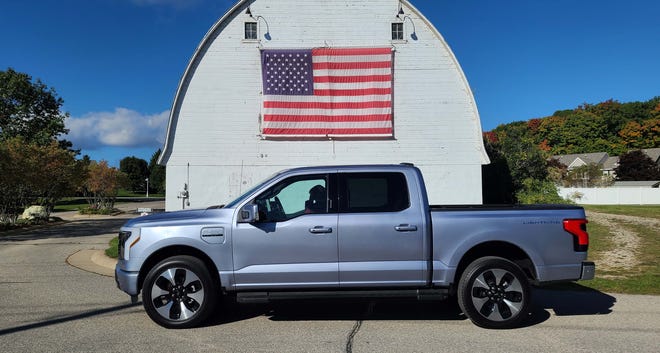
My Lightning is a great tool. But as my weekend road trip to Charlevoix indicates, it lacks the Swiss Army knife dexterity of its gas-powered peers.
The F-150 Lightning, of course, is the Blue Oval’s first electric pickup. With its neck-snapping 4.0-second 0-60 acceleration, palatial interior room, stump-pulling towing ability and bottomless front trunk storage, it may be the best EV value on the market starting at $53,769. Add panoramic roof, 22-inch aero wheels, leather, big screen, big battery, and my bling-tastic Platinum model cost an eye-rolling 94 grand.

And outside of the metropolitan eco-system where EVs thrive, Lightning’s wattage starts to dim — starting with its hauling ability.
I considered a tow trip to Charlevoix, where we have family and friends in regular need of furniture, boats, equipment. But a test by the boys at TFLTrucks.com found my 300 mile-range truck would only go (ahem) 95 miles with a 6,000-pound trailer out back. That’s not enough to go the 120 miles from the Electrify America fast charger in Bay City to the next EA station in Gaylord, for goodness’ sake. A comparable V8-powered pickup gets about 210 miles on a tow, according to TFL, with gas infrastructure everywhere. On to Plan B.

Mrs. Payne and I loaded the EV’s bed with two bed frames needed Up North. My favorite Lightning feature is its “frunk” — front trunk — a tool that petrol-powered Swiss Army knives lack due to the piston engine under the hood. After loading the bed out back, I loaded luggage for the trip — a suitcase and tennis bag — in the frunk. Lightning answers the age-old pickup question: How do I pack luggage and use the bed without compromising interior passenger space?
I charged to 100%, 320-mile range overnight on my 240-volt home charger, ran a coupla’ errands Friday morning, then hit the road for Charlevoix with 281 miles on tap.

The Lightning’s trip planner is quite good. “Navigate to Charlevoix, Michigan” I barked. Voice recognition correctly translated my West Virginia drawl, and the navi plotted my course — including a single, 25-minute stop at Gaylord’s fast charger 181 miles away. That plan would soon change.
Driving a 7’ wide x 6’ tall brick into the wind at 75 mph on a 45-degree October day is a recipe for electron guzzling. By Saginaw, the Lightning was getting just 60% of estimated range and it was becoming clear to the trip computer that we would not make it to Gaylord. My 281-mile range looked more like 168 miles.
The system rerouted me to the West Branch fast changer. Really? From prior EV trip experience, I knew that charger and it only had two stalls.
Like General Motors and Nissan systems, Ford’s Blue Cruise driver assist system allows hands-free driving on divided interstates. While Blue Cruise took the wheel, I went deep into the navigation screen to consider my options.

I tapped on the West Branch charging icon and combed through the charger specs. As I suspected, both chargers were occupied. If I fueled there, I could be waiting awhile. I decided to go to Electrify America’s Bay City charger instead — just on the other side of the Zilwaukee Bridge. I knew it well. Four charging stalls. In a Meijer parking lot off I-75. Convenient.
But when I arrived, technicians were working on two faulty chargers and the other pair were occupied by a Mustang Mach-E and Rivian R1T. I waited. After a few minutes, the Rivian pilot approached to let me know his charger wasn’t working either. He would be next in line for the remaining charger after the Mach-E finished.
Well, looked like I would be heading to the West Branch charger after all.

The station is squeezed into the back of a Ford dealer (no room for a trailer if I were towing). By the time I arrived, one charger had freed up while the other was occupied by a Nissan Leaf EV.
Though instructions indicated the charger was run by Greenlots, the Greenlots app was nowhere to be found on Google Play. Then I remembered reading that Shell Energy had purchased Greenlots. I found the Shell Energy app, which was buggy. After about 10 minutes, Lightning and charger finally communicated with one another.

Mrs. Payne and I took the opportunity to eat lunch in the cab — storing the shifter and folding down the console table (these Ford engineers are clever) — during the half hour the pickup charged from 29% to 80%. Then we were off again, encountering a pair of construction delays on I-75 that would set us back 45 minutes.
Which brought me to the Gaylord charger and the inquisitive driver in the gas-powered F-150.
Though I had traveled just 70 miles since Bay City, chargers are scarce in Charlevoix and so I wanted to top up. That’s something that in-car navi systems don’t tell you. Arrive at your destination with low battery and there may be no infrastructure to get you around town.

As I topped up for 15 minutes in Gaylord, I surveyed the EVs at the four EA charging stalls: my $93,000 Lightning, a $110K Hummer EV, $80,000 Rivian (the same R1T I’d seen in Bay City), a $57K Mustang Mach-E. EVs ain’t cheap.
With a full tank of electrons, it was time to have some fun through M-32’s twisties — the hills ablaze in fall colors. With its low center of gravity, all-wheel drive and 775-pound feet of torque, Lightning is surprisingly playful. I activated Sport mode and “Propulsion Sound” as a soundtrack for the fun ahead.
Coming onto a straightaway, two slugs loomed. ZOT! I buried the throttle and was by them with … well, Lightning speed.
I arrived in Charlevoix after 6 hours, 40 minutes for what’s normally a stop-free, 4-hour trip by gas-fired pickup. I had been delayed by 45 minutes of construction and nearly two hours of charging detours across three stations. Cost? About the same as filling with $3.50 gas.
I recalled my conversation with the Rivian driver in Gaylord. He said he hadn’t anticipated so many delays on his family trip to Mackinac Island. “Next time,” he said, “I’m bringing a different vehicle.”
Next week: 2022 Mazda CX-50
2022 Ford F-150 Lightning Platinum
Vehicle type: Battery-powered, all-wheel-drive five-passenger pickup
Price: $53,769, including $1,695 destination fee ($93,509 as tested)
Powerplant: 131 kWh lithium-ion battery with twin electric-motor drive
Power: 580 horsepower, 775 pound-feet torque
Transmission: Single-speed drive
Performance: 0-60 mph, 4.0 seconds (Car and Driver); payload, 2,235; towing, 10,000 pounds
Weight: 6,813 pounds
Fuel economy: EPA 70 MPGe range; 320 miles
Report card
Highs: Liquid-smooth acceleration; frunk and bed cargo storage
Lows: Range challenged; hands-free Blue Cruise system can be spotty
Overall: 3 stars
Henry Payne is auto critic for The Detroit News. Find him at hpayne@detroitnews.com or Twitter @HenryEPayne.
Revealed: 2023 Ford Escape updated with new face, more tech, ST-Line
Posted by Talbot Payne on October 27, 2022
Detroit — Introduced in 2020, the fourth-generation Ford Escape gets a refresh for the 2023 model year. But in the auto market’s most popular non-truck class, no refresh is minor.
Ford’s fourth best-selling vehicle — after the iconic F-150 pickup, F-series heavy duty pickups, and Explorer SUV — Ford’s compact SUV receives new model badging, new interior screens ‘n’ tech, and a revised exterior wardrobe.
You’ll know it by the reworked front end that pulls back from its predecessor’s low, Ford Focus-like grille for a broader mouth with the Blue Oval logo moved from hood to the mid-grille. The smiling, meshed grille is still in contrast with the design of the Bronco Sport, with which Escape has shared the segment since 2021.

“Escape is the perfect city vehicle with its flexible, modern architecture,” said Ford SUV marketing guru Craig Patterson.
To that end, Ford charged its European design studio to pen the Escape. With narrow streets and dense city centers, Europeans know a thing or two about urban vehicles (the Escape is badged as Kuga on the other side of the pond).

With Escape aimed at urban customers and Bronco Sport targeted at adventure types, Ford’s two-compact SUV strategy has paid off, expanding segment sales by nearly 70%. As a result, the Ford twins now sell upwards of 253,000 vehicles a year, good enough for fourth in segment in 2021 behind the Japanese Big Three of Toyota RAV4, Honda CR-V and Nissan Rogue.
The Escape/Bronco Sport tag team isn’t the only Ford lineup change that has affected Escape. With the demise of EcoSport for the ‘23 model year, Escape will now be Ford’s entry-level SUV at $28,995. Ford’s Maverick, built on the same platform as Escape/Bronco Sport, is the brand’s cheapest vehicle at $23,670.
While one of Escape’s chief competitors, the Honda CR-V, is ditching its base model for a $32,355 starting point, Escape will continue to offer a nicely-equipped standard model for under $30K. Powered by a 1.5-liter, 190-horse engine — one of four engine options for the SUV — the Base will feature standard blind-spot assist, an 8-or-13.2-inch center screen, and state-of-the-art SYNC 4 infotainment system featuring wireless Apple CarPlay and Android Auto (the CR-V only offers wireless CarPlay with its larger, 8-inch screen).

Then the Escape lineup really gets interesting.
Taking an off-ramp from alphanumeric naming convention, Escape is the first Blue Oval model to shelve its SE and SEL models for proper names. Say hello to the new Base, Escape Active, Plug-in, ST-Line and Platinum lineup.
Significantly, each trim (except hybrid models) offers the option of all-wheel-drive (a $1,500 upgrade) and the 13.2-inch screen, in addition to two tech packages. Most noteworthy is the all-new, sporty ST-Line trim.
A descendant of the brand’s iconic ST performance models, Ford expects ST-Line (starting at $33,835) to make up 50% of sales with its trendy, black-trimmed wardrobe, rocker-panel cladding, 18-inch wheels, flat-bottom steering wheel, rear skidplate, and rear spoiler. It will also option three drivetrains: 1.5-liter turbo-4, 2.0-liter turbo-4 and hybrid. An ST-Line Elite package stand out with an LED front mono-brow and 19-inch ebony wheels.

ST-Line replaces Escape’s similar, blacked-out SE Sport Hybrid trim which — at under $30,000 — aimed at selling electrified tech to the mainstream, meat ‘n’ potatoes Escape buyer. How times have changed. Though the hybrid made up about 15-20% of Escape sales, it is no longer the focus of Ford’s electrified strategy. Not with the F-150 Lightning and Mustang Mach-E EVs on the lot.
Those popular vehicles brought in lots of government emission credits — enough to let Escape off the hook as a compliance vehicle. For those who crave short-haul electric-only transportation and long range gas reliability, a fully-charged Plug-in Escape will offer 37 miles of battery-only range.
In hybrid mode, Escape will go a whopping 550 miles — 30 more than the longest range EV, the $170,000 Lucid Air Dream Range.

While the Escape mixes and matches its trims and powertrains, its signature features will remain — mostly.
Rear seat legroom is biggest in segment (and nearly as roomy as a Ford Expedition mega-ute) thanks to the seat’s talent at sliding backwards 6 inches on rails. It will also recline. Escape’s pioneering self-park feature (now found in other Fords, including the hulking F-150) is available — but Ford chose to ditch its kick-open rear hatch function. Customers just weren’t asking for it.

Ford is a segment tech leader and for 2023 it also offers standard 4G connectivity, digital in-screen owner’s manual, auto high-beams, and lane-keep assist. The Ford Co-Pilot360 tech package debuts Intersection Assist, which uses the front camera and radar sensors to help alert drivers to oncoming traffic while turning left.
Built at Louisville Assembly in Kentucky, the new Escape will be in showrooms early next year.
Henry Payne is auto critic for The Detroit News. Find him at hpayne@detroitnews.com or Twitter @HenryEPayne.
EV flagship: $300k-plus Celestiq seeks to redefine Cadillac as world luxury standard
Posted by Talbot Payne on October 22, 2022
Putting an exclamation point on its extreme makeover as an electric-vehicle brand, Cadillac unveiled on Monday its new flagship, the 2024 Celestiq sedan.
Slated for production in late 2023 with a $300,000-plus price tag in the same nose-bleed section as ultra-luxury coach-builds like the Rolls Royce Ghost, Celestiq seeks to re-establish Cadillac as the “standard of the world” for the 21st century with state-of-the-art, battery-powered tech.
First shown as a prototype in March 2020 alongside Cadillac’s first EV, the Lyriq crossover, Celestiq is a Lyriq on steroids. Sporting the brand’s new upright, disco-grille (Celestiq has 1,600 LEDs total), the sleek, all-wheel-drive chariot is draped over an Ultium battery platform and engorged with electronic wonders like a 55-inch touchscreen and quad-zone panoramic glass roof.

Hand-built in Warren’s Tech Center, the 2024 Celestiq will have a limited edition run — each model personalized to its premium buyer’s taste. Celestiq follows other Caddy flagships like the 1933 V16 Aerodynamic Coupe that defined pre-war style, the 1957 Eldorado Brougham that became a tail-fin period icon, and the athletic 2016 CT6 sedan that headlined the brand’s brief Blackwing-engine performance era.
Like CT6, Celestiq shows off Cadillac’s future on a car platform at a time when 7 of 10 new vehicles sold are SUVs. Cadillac’s best-known sport utility, the Escalade, would seem a natural canvas for the brand’s new direction — but with sci-fi tech and a price tag triple that of Escalade, Celestiq is a significant break from current Cadillac convention.
Despite massive investments since the turn of the century to bring the brand on par with Nurburgring-shredding athletes from BMW, Mercedes and Audi, Cadillac sales have lagged. Indeed, it has been another American luxury brand, Tesla, that successfully leap-frogged the German triumvirate with all-electric technology.

Cadillac, too, sees advances in electronics and battery power as an opportunity to remake itself as an electric brand.
“Celestiq is the purest expression of Cadillac, acknowledging our incredible history and driving us to a bolder and brighter future,” said Global Vice President Rory Harvey. “It is a completely bespoke work of automotive art, built around the most advanced and innovative technology that we have ever engineered.”
Just over a century from its founding in 1909, GM’s luxury division seeks to redefine a new century by drawing from Cadillac’s origins making high-style, high-tech, hand-built machines.
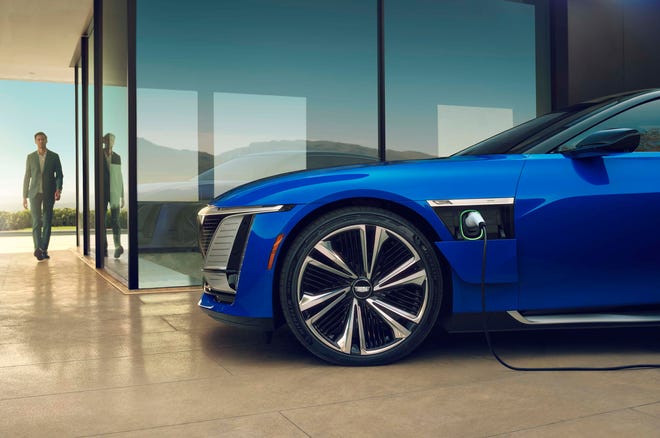
Courting comparison to the brand’s storied history, Celestiq’s long-hooded fastback is an unmistakable echo of the ‘33 Aerodynamic Coupe while its estimated charging time — 78 miles in 10 minutes — lags Escalade’s 450 miles in three minutes at a gas pump.
Like England’s Rolls and Bentley land yachts, each Celestiq will be individually commissioned so no two builds are alike. Via dealers, clients will create a vision tailored to their personal tastes.
“With an extremely low volume of hand-built vehicles to be offered globally each year, Celestiq will truly be a custom-commissioned one-of-one,” said Harvey. “Each client will experience a personalized journey to make their vehicle exactly the way they desire.”

Built on the Ultium battery platform and riding on a smooth air suspension, Celestiq will be powered by a 111-kWh battery pack and twin motors to achieve immediate, 640-pound feet of torque and 600 horsepower. Significantly, that is half the battery size of the 212.7 kWh GMC Hummer EV — the first GM vehicle built on Ultium and weighing nearly five tons.
Expect Celestiq to be lighter on its feet, though its estimated 3.8-second spring to 60 mph is shy of Hummer’s claimed 3.0 seconds. Celestiq range will be a Hummer-like 300 miles. That range will come slowly at super charger networks being built across the country with federal help. Ultium Charge 360 will help customers plan a trip by coordinating stops with 110,000 chargers across North America.
The sedan is stuffed with innovation including 115 3D printed parts, a technology that has seen accelerated use in low-volume cars. Following in the footsteps of CT6, Celestiq makes innovative use of die castings for structural rigidity and simplicity — the EV’s underbody is constructed from six large aluminum components.
For added maneuverability in charger parking lots as well as on road, Celestiq will feature rear-drive steering. Consistent with Lyriq and other EVs, Celestiq will be capable of one-pedal driving, using the electric motors as brakes to restore battery energy.
Or passengers can choose not to drive at all. Celestiq will be equipped with GM’s Ultra Cruise self-driving system. Building on the current Super Cruise system (that debuted in CT6) that allows hands-free driving on more than 200,000 miles of divided highways, Ultra Cruise will expand that capability to 2 million miles of highway and secondary roads.
“Celestiq continues the 120-year Cadillac history of leveraging the most advanced automotive technology in the service of luxury,” said development engineer Ken Althouse.
Inside Celestiq’s quiet blue interior, passengers will sit beneath a four-zone smart glass roof that utilizes “suspended particle device technology” so each passenger can control the amount of outside light they receive. If the quiet gets too eerie, then the pilot can dial up Cadillac-curated propulsion sounds while driving.
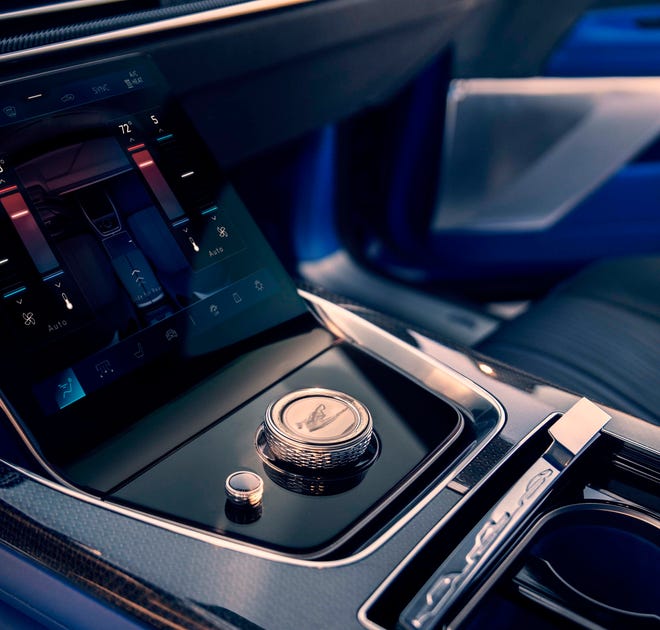
The interior will be bathed in ambient light (18 different lighting animations are on offer) complementing the car’s rich materials, jewel-like rotary screen controller, 41-speaker sound system, and enormous 55-inch screen that stretches from A-pillar to A-pillar.
The screen houses two separate displays under a single pane of glass — the passenger-side display enabling media-play, Internet capability, smartphone connectivity and more. Screens are governed by a Google Built-In operating system. Rear passengers get their own 12.6-inch, seatback-mounted displays.
Celestiqs will roll out of GM’s Warren Global Technical Center beginning in December of next year — the first production vehicle made there — thanks to an $81 million investment.
“Cadillac’s brand legacy was forged with hand-building the most advanced vehicles of their era,” said Roma. “We are returning to that tradition with Celestiq, creating a piece of automotive art.”
Henry Payne is auto critic for The Detroit News. Find him at hpayne@detroitnews.com or Twitter @HenryEPayne.
Heavy-duty trucks are fueling the EV transition. When will they get electrified?
Posted by Talbot Payne on October 20, 2022
The Detroit Three automakers are pushing toward an electrified future, but they’re not yet putting their gas and diesel-powered heavy-duty trucks on the back burner.
After all, the profitable sales of these fuel-guzzling vehicles are funding the expensive transition to electric vehicles, which promise zero emissions and freedom from high gas prices. General Motors Co., Ford Motor Co. and Stellantis NV over the last several weeks have revealed HD truck updates for next year, but don’t expect electrified versions of these beefy pickups anytime soon.

“This will be the dead last segment that it’s going to happen to because they are the most demanding and it would be the most taxing on the electrical system,” said Ivan Drury, director of insights for Edmunds.com Inc., a vehicle information website. The batteries needed to tow the thousands of pounds HD customers demand might be available, but they cost more and offer less range than gas and diesel powertrains.
Automakers “would probably like to be able to say that ‘we can offer 300 miles of range when you’re towing,’ and also there’s the cost,” said Sam Abuelsamid, principal research analyst leading Guidehouse Insights. “You can go buy a 50/60/$70,000 HD truck that’ll tow 15/20,000 pounds for 5-600 miles. Those trucks with those 200 kilowatt-hour batteries, one consistent aspect of those, they all cost $100,000.”

EV trucks versus HD trucks
The $110,595 Edition 1 Hummer EV pickup, for example, has a large 200-plus kilowatt-hour battery with a range of 329 miles, according to documents filed with the Environmental Protection Agency as previously reported by Car and Driver. The Hummer can tow up to 7,500 pounds.
On the Chevrolet side, the Silverado EV RST can tow 10,000 pounds and will cost $105,000. Chevy hasn’t released the kilowatt-hour capacity of the Silverado EV. By comparison, the recently revealed 2024 Silverado 2500 can tow up to 22,500 pounds when packaged with a 6.6-liter turbo-diesel V-8 engine. Chevrolet hasn’t released prices for the new Silverado HD.
During the January 2022 reveal of the electric Silverado, GM CEO Mary Barra said the automaker will electrify heavy-duty vehicles like light-duty vehicles by 2035: “These all-electric HD trucks will be engineered to deliver effortless heavy-duty hauling and towing, while offering customers amazing new features and range needed to get the toughest jobs done.”
Ford just upped the price of its 2023 electric F-150 Lightning Pro, geared toward commercial customers, by $5,000 to $51,974. A Lightning with a standard battery pack gets 98 kWh of capacity to go 240 miles on a charge. The Lightning with an extended-range pack with 131 kWh of capacity gets 320 miles on a charge. With an optional max trailer tow package, the Lightning can tow 10,000 pounds with the larger battery and 7,700 pounds with the standard size.
Ford hasn’t yet revealed pricing or towing capabilities on its recently revealed gas and diesel-powered 2023 Super Duty lineup, but the automaker is shooting for “unparalleled capability” on gooseneck towing, fifth-wheel towing, conventional towing, pintle hitch towing and payload capacity. The 2022 Super Duty can tow 21,000 pounds for conventional and 37,000 pounds for gooseneck.
At an event revealing the Super Duty earlier this month, Ford CEO Jim Farley told media as reported by the Automotive News: “If you’re pulling 10,000 pounds, an electric truck is not the right solution. And 95% of our customers tow more than 10,000 pounds. This is a really important segment for our country and it will probably go hydrogen fuel cell before it goes pure electric.”
Hydrogen fuel cells could be used to convert larger products like heavy-duty trucks to zero-emissions products since fuel cells offer longer range and the fuel-cell system is lighter than a battery, but the use of fuel cells would also require an infrastructure network of charging stations.
“For customers that want to tow, you could have fuel cell, but again, that is going to depend on the fueling infrastructure being there,” Abuelsamid said. “If the fueling infrastructure isn’t there, customers aren’t going to buy ’em, even if they can tow them long distances.”
Ram has teased an electrified version of its light-duty truck and said it will have a full portfolio of electrified vehicles in most segments by 2025 and all segments by 2030. The Stellantis NV truck brand in September announced it was adding a Rebel trim option to the 2023 Ram 2500 HD lineup. The truck’s maximum tow limit is 16,870 pounds.
What customers think
HD drivers will be tough to turn into EV buyers, Edmunds’ Drury says, because they are taking a risk on capability, which is a tough gamble for the commercial customers relying on their fleets to get the job done.
“With these consumers,” Drury said, “it’s still go with what you know.”
Fleet managers also look at the overall cost of ownership, so they will want to know that transitioning “is actually going to get the job done and save money,” he said. “And right now, I think that would be kind of a hard thing for a lot of them to even make pencil out.”

Ross Thomas, 80, and his wife Bonnie of East Jordan, Michigan, tow their camper with a V-8-powered, 2015 Ford F-250 that weighs 10,000 pounds. They live in the East Jordan City Tourist Park during the summer, then commute to warmer climates in Texas and Florida during the winter.
They make their estimated 20-hour, 1,300-mile journey getting 8 mpg with a 35-gallon gas tank — or a range of 280 miles between five-minute fill-ups.
Heavy-duty EV trucks are in their infancy with manufacturers like Bollinger making Class 3-6 chassis and GM not planning electrified HD versions of its pickups until the next decade.
“This is not an EV,” said GMC President Duncan Aldred when he introduced the all-new Sierra 2500 HD this month with its tried-and-true, 6.6-liter Duramax turbo-diesel V-8. “The Sierra Heavy Duty will become an EV in time, but it will be toward the end of the 2035 transition.”
Real-world experience with EV pickups is limited with new entries like the Ford F-150 Lightning and Rivian R1T first to market. But the towing capabilities of the Lightning are not encouraging to HD owners.
A recent tow test by truck test site TFLTrucks.com with a 6,000-pound trailer behind the Lightning found range degradation of 70% to just 95 miles — a problem for long-distance hauls. While diesel and gas engines also suffer range degradation when towing, they offer more reliable range and refueling infrastructure.
Ross Thomas typically gets about 280 miles of range with his V-8-powered F250 — and quick refueling. Drain a Lightning’s battery after 95 miles and it will take an hour to fill it full of electrons at a DC fast charger.
EV range limitations are an issue for Randy Hartman of Columbus, Ohio, too.
Hartman’s company, Winning Edge Series, offers trackside support for sportscar racers. For example, he used his 2011 Ram 3500 Dually HD Class 3 pickup to tow a pair of race cars 1,110 miles from Columbus to Road Atlanta Raceway in Braselton, Georgia, this October.
“It would have taken me forever to tow my 28-foot trailer over the mountains with an electric truck,” said Hartman, 63. His Ram is stuffed with a 7.2-liter diesel and gets 300 miles between fill-ups at 11 mpg.
Jeremy Ingram knows electric vehicles — his 386 Powersports in Rochester Hills is the exclusive Michigan dealer for Volcon EV motorbikes — but he prefers gas trucks to haul them to customers and sporting events.
“For the loads we carry we need gas,” said Ingram who owns a fleet of Ford, Ram, and Chevy HDs. “You know Michigan. You put a load on batteries — and then add the cold weather — and they will die in half the time.”
His brawny Ram 5500, Ford F-550, Chevy 4500 dually pickups, for example, do heavy lifting, including 15,000-pound flat beds that take multiple bikes to customers around the Midwest. They also do double duty — along with a GMC Sierra, Ford F-250, and Ford F-350 cube truck — in servicing customers with Ingram’s contracting firm, Ingram Roofing.
Ingram worries the short life of battery packs would also change his business model. “I don’t want to buy a fleet of electric trucks not knowing their lifespan,” he said, citing a 1996 diesel Ford F-350 he uses that’s still going strong. “I’d have to go to a lease fleet.”

For Michigan Asphalt Paving foreman Tim Davidson in Birmingham, it’s not the range — it’s the expense and logistics that are insurmountable obstacles to going electric.
His company serves a variety of paving needs in the Metro Detroit area with a herd of diesel-powered vehicles from dump trucks to Caterpillar track loaders to the semis that transport them. One of the vehicles in his fleet is a 1995 Ford F800 Class 6 truck (GVWR: 26,000 pounds) that is 27 years young and still hauling up to 45,000 pounds of aggregate daily.
“Electrics are a big waste of time and money,” said Davidson as he dug up a driveway with his Cat, then dumped it into the back of the hulking Ford. “Reliability is a real issue for me. What if I get stuck on the way to a job?”
His fleet is looked after by a diesel service company and his fuel is delivered to tanks on his property where he fills up every night. Building on-site electric capacity to power his trucks would be costly.
Bollinger Motors in Oak Park is the only manufacturer making a Class 4 electric truck (GVWR: 14,001-16,000 pounds). While assembling battery-powered trucks with 100-mile range to suit contractors like Michigan Asphalt, Bollinger is counting on the billions of dollars in the federal Inflation Reduction Act to help reduce the costs. Under the IRA, a Bollinger buyer would be eligible for a 30% tax credit up to $40,000.
“Commercial fleets need a cost-competitive alternative to traditional ICE (internal combustion engine) vehicles, and these credits, along with Bollinger’s aggressive efforts to deliver a quality product with a lower total cost of ownership, make EVs a more affordable and viable option than their ICE counterparts,” commercial sales director Ed Burke told Highways Today.
But for HD customers who need the dexterity of trucks for long and short hauls, EVs are a non-starter.
Payne: 2023 Honda CR-V Hybrid gets leaner, dials up the fun
Posted by Talbot Payne on October 20, 2022
Sisquoc, California — Amidst the rolling fields of wineries, bean and corn is Martin Marietta’s massive Sisquoc Asphalt plant on a lonely stretch of Foxen Canyon Road here. Lonely except for a steady stream of semis pulling dual-trailer trucks. Like oversized ants, they scurry to-and-from the plant every day filling up on asphalt mined and processed from an estimated 11 billion tons of deposits hidden across 38,000 acres of Santa Barbara County. The asphalt has paved the ribbons of road that allow vehicles access to the region’s bucolic wineries and scenic views.
Vehicles like my 2023 Honda CR-V tester.
With its instant 247 pound-feet of torque, my CR-V made quick work of the occasional 75-foot double-semi — the length of a tennis court — as I hustled to lunch at the nearby Zaca Mesa Winery. Leave it to Honda to make hybrids fun.

In fact, Honda doesn’t even call its hybrids “hybrids” anymore. The CR-V debuted a gas-electric powertrain in 2019 in the EX-L Hybrid and Hybrid Touring trims. Taking a page from Ford (another pretty good performance brand) for 2023, the CR-V hybrids get macho black trims and wheels — and Sport and Sport Touring badges.
Sure, the hybrid claims typically sippy 37 mpg, but I didn’t come anywhere close to that on my 130-mile lunch commute from Santa Barbara, passing double-semis, carving canyon roads and merging into highway traffic with authority. My Sport Touring model registered a real-world 28.8 mpg.

With all of its 247 foot-pounds of twin-electric-motor torque on tap at 2,000 RPM, the hybrid with its 2.5-liter powerplant is quick out of the chute for merging and for passing zones. Credit, too, goes to a so-called e-CVT transmission, which responded to my Size 15 lead foot with smooth power — complete with electronically-programmed “steps” to mimic the shifts of a traditional, multi-speed cog transmission.
The CR-V was no Mazda CX-5/CX-50. Mazda’s terrific-handling SUV is my benchmark for the class with its massive 310-torque turbo-4 and milky-smooth 6-speed tranny, but the sixth-gen CR-V is a nice step up from the last-gen ute.
Whether the bigger engine its a step up from the CR-V’s standard 1.5-liter turbo-4 is another question.
The turbo-4, of course, is the same engine found in Honda’s halo King Civic — slayer of the compact car segment — and benefits from similar CVT magic as the hybrid. Over Route 101 toward twisted Aliso Canyon Road, I repeatedly stomped the accelerator, and was always met by a silky response — no jerks, no lags — of electronically programmed “shifts” propelling CR-V just like Civic.
With governments threatening massive fines if automakers don’t go all in on EVs over the next decade, Honda decorates the CR-V with EV toys like regenerative paddles to get you in the mood for the transition to full battery power. With sales volume of 400,000 a year, the CR-V certainly has room for EV models, but don’t expect mass adoption anytime soon.
The turbo-4 starts at $32,355, with the hybrid Sport model upping the ante by $1,300. Higher EX-L and Sport Touring models add goodies like leather seats, heated steering wheel and wireless Apple CarPlay/Android Auto. Weigh the Honda against a competitive set of CX-5/CX-50, Ford Escape Hybrid Sport and Kia Sportage, and you’ll find sub-$40K automobiles loaded with tech — adaptive cruise control, blind-spot assist, auto braking — found on luxe vehicles costing 15 grand more.
If you’re not willing to cough up $40K, then take a look at Honda’s HR-V and Mazda’s CX-30. They are similarly equipped for 10 grand less — but with less compelling drivetrains.

Crucially, CR-V earns its keep in this elite group with a major styling upgrade for 2023 both inside and out. Once again, credit King Civic for inspiration.
CR-V’s busy, blingy styling was eye-catching a decade ago, but it’s grown jowly with age. Gen 6 takes the stage with a leaner, more timeless appearance, while keeping signature touches like the batwing rear taillights. The powerful shoulders are right off the Civic. The bold grille? Think Accord.
Inside, CR-V adopts Honda’s modern, horizontal design language with digital screens, honeycomb dash accent — before tending to much-needed housekeeping.

That where-the-heck-is-the-steering-column adjuster that seemed halfway inside the engine compartment on the 5th gen? It’s now a proper switch on the left side of the column. The space-efficient-but-hand-cramping trigger shifter? Gone, replaced by a proper shifter stalk.
Other welcome details remain.
CR-V set the bar for second-row seating last generation with doors that opened 90 degrees to the body. That gave easy ingress to roomy rear seats that would swallow six-footers with ease. The 90-degree doors are back, and the rear seat room is expanded to boot.

After lunch, I folded my big frame into the backseat to catch up on email. If only Delta coach were this comfortable. The rear seat even reclined.
CR-V’s goal is to be competent in everything without pushing the envelope on one thing. The Mazda is a sports car in ute clothing. Kia’s Sportage is on the cutting edge of tech with a hoodless, curved screen and Level 2 self-driving nearly on par with Cadillac Super Cruise.
The Honda won’t let you self-drive with your hands on your knees for long spells like Kia, but it maintained the lane so that I could, say, manage Sirius XM stations and read text messages when they came in over the wireless Android auto system.

Honda still offers an in-house navigation system (perhaps because an EV version will need it to navigate to chargers), but its smartphone connectivity makes it easy to hook up your phone by wire with the standard 7-inch screen — or wirelessly via the 9-inch upgrade. Worried about your phone running out of juice when navigating wirelessly? The Sport Touring model offers a big charging pad to maintain charge that worked even with my massive Samsung Galaxy S20 (which didn’t fit in the last-gen CR-V).
A lot of Hondas have driven over Sisquoc Asphalt’s product in Santa Barbara County over the years. Civic is an American icon, Accord stole Ford Taurus’s crown as best-selling sedan in 1989, and now the CR-V has become Honda’s best-selling U.S. model — one of the three top-selling non-pickups in the land along with the Nissan Rogue and Toyota RAV4.
With similar Hybrid ambitions, RAV4 is CR-V’s closest competitor. But the chunky RAV-4 takes its design cues from the off-roady Tacoma pickup. With its sleek styling and stylish interior, CR-V is a Civic on stilts.
When another asphalt truck looms, its accelerator pedal is eager to please.
Next week: Road trip! Ford F-150 Lightning EV
2023 Honda CR-VVehicle type: Front-engine, front- and all-wheel-drive, five-passenger compact SUV
Price: $32,355, including $1,245 destination fee ($39,845 Sport Touring model as tested)
Powerplant: 1.5-liter turbocharged, inline 4-cylinder; Hybrid 2.5-liter inline-4 mated to twin electric motors
Power: 190 horsepower, 179 pound-feet of torque (turbo-4); 204 horsepower, 247 pound-feet of torque (hybrid)
Transmission: Continuously variable automatic (CVT) in turbo-4; electronic CVT in hybrid
Performance: 0-60 mph, 7.9 seconds (Car and Driver). Towing: 1,500 pounds (turbo-4), 1,000 pounds (hybrid)
Weight: 3,926 pounds (AWD hybrid as tested)
Fuel economy: EPA, 27 mpg city/32 highway/29 combined (AWD turbo-4); 40 mpg city/34 highway/37 combined (hybrid)
Report card
Highs: Crisp styling; roomy interior
Lows: Real-world hybrid fuel economy shy of specs; no more sub-$30K entry model
Overall: 4 stars
Henry Payne is auto critic for The Detroit News. Find him at hpayne@detroitnews.com or Twitter @HenryEPayne.
EV flagship: $300k-plus Celestiq seeks to redefine Cadillac as world luxury standard
Posted by Talbot Payne on October 18, 2022
Putting an exclamation point on its extreme makeover as an electric-vehicle brand, Cadillac unveiled on Monday its new flagship, the 2024 Celestiq sedan.
Slated for production in late 2023 with a $300,000-plus price tag in the same nose-bleed section as ultra-luxury coach-builds like the Rolls Royce Ghost, Celestiq seeks to re-establish Cadillac as the “standard of the world” for the 21st century with state-of-the-art, battery-powered tech.
First shown as a prototype in March 2020 alongside Cadillac’s first EV, the Lyriq crossover, Celestiq is a Lyriq on steroids. Sporting the brand’s new upright, disco-grille (Celestiq has 1,600 LEDs total), the sleek, all-wheel-drive chariot is draped over an Ultium battery platform and engorged with electronic wonders like a 55-inch touchscreen and quad-zone panoramic glass roof.
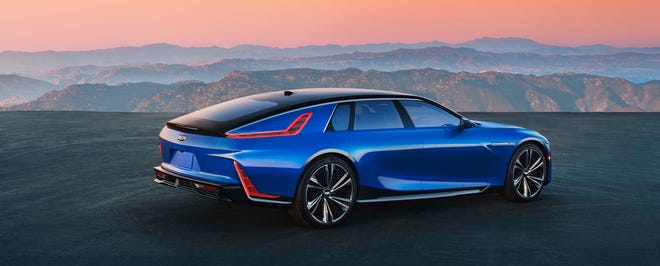
Hand-built in Warren’s Tech Center, the 2024 Celestiq will have a limited edition run — each model personalized to its premium buyer’s taste. Celestiq follows other Caddy flagships like the 1933 V16 Aerodynamic Coupe that defined pre-war style, the 1957 Eldorado Brougham that became a tail-fin period icon, and the athletic 2016 CT6 sedan that headlined the brand’s brief Blackwing-engine performance era.
Like CT6, Celestiq shows off Cadillac’s future on a car platform at a time when 7 of 10 new vehicles sold are SUVs. Cadillac’s best-known sport utility, the Escalade, would seem a natural canvas for the brand’s new direction — but with sci-fi tech and a price tag triple that of Escalade, Celestiq is a significant break from current Cadillac convention.
Despite massive investments since the turn of the century to bring the brand on par with Nurburgring-shredding athletes from BMW, Mercedes and Audi, Cadillac sales have lagged. Indeed, it has been another American luxury brand, Tesla, that successfully leap-frogged the German triumvirate with all-electric technology.
Cadillac, too, sees advances in electronics and battery power as an opportunity to remake itself as an electric brand.
“Celestiq is the purest expression of Cadillac, acknowledging our incredible history and driving us to a bolder and brighter future,” said Global Vice President Rory Harvey. “It is a completely bespoke work of automotive art, built around the most advanced and innovative technology that we have ever engineered.”
Just over a century from its founding in 1909, GM’s luxury division seeks to redefine a new century by drawing from Cadillac’s origins making high-style, high-tech, hand-built machines.
Courting comparison to the brand’s storied history, Celestiq’s long-hooded fastback is an unmistakable echo of the ‘33 Aerodynamic Coupe while its estimated charging time — 78 miles in 10 minutes — lags Escalade’s 450 miles in three minutes at a gas pump.
Like England’s Rolls and Bentley land yachts, each Celestiq will be individually commissioned so no two builds are alike. Via dealers, clients will create a vision tailored to their personal tastes.
“With an extremely low volume of hand-built vehicles to be offered globally each year, Celestiq will truly be a custom-commissioned one-of-one,” said Harvey. “Each client will experience a personalized journey to make their vehicle exactly the way they desire.”
Built on the Ultium battery platform and riding on a smooth air suspension, Celestiq will be powered by a 111-kWh battery pack and twin motors to achieve immediate, 640-pound feet of torque and 600 horsepower. Significantly, that is half the battery size of the 212.7 kWh GMC Hummer EV — the first GM vehicle built on Ultium and weighing nearly five tons.
Expect Celestiq to be lighter on its feet, though its estimated 3.8-second spring to 60 mph is shy of Hummer’s claimed 3.0 seconds. Celestiq range will be a Hummer-like 300 miles. That range will come slowly at super charger networks being built across the country with federal help. Ultium Charge 360 will help customers plan a trip by coordinating stops with 110,000 chargers across North America.
For added maneuverability in charger parking lots as well as on road, Celestiq will feature rear-drive steering. Consistent with Lyriq and other EVs, Celestiq will be capable of one-pedal driving, using the electric motors as brakes to restore battery energy.
Or passengers can choose not to drive at all. Celestiq will be equipped with GM’s Ultra Cruise self-driving system. Building on the current Super Cruise system (that debuted in CT6) that allows hands-free driving on more than 200,000 miles of divided highways, Ultra Cruise will expand that capability to 2 million miles of highway and secondary roads.
“Celestiq continues the 120-year Cadillac history of leveraging the most advanced automotive technology in the service of luxury,” said development engineer Ken Althouse.
Inside Celestiq’s quiet blue interior, passengers will sit beneath a four-zone smart glass roof that utilizes “suspended particle device technology” so each passenger can control the amount of outside light they receive. If the quiet gets too eerie, then the pilot can dial up Cadillac-curated propulsion sounds while driving.
The interior will be bathed in ambient light (18 different lighting animations are on offer) complementing the car’s rich materials, jewel-like rotary screen controller, 41-speaker sound system, and enormous 55-inch screen that stretches from A-pillar to A-pillar.
The screen houses two separate displays under a single pane of glass — the passenger-side display enabling media-play, Internet capability, smartphone connectivity and more. Screens are governed by a Google Built-In operating system. Rear passengers get their own 12.6-inch, seatback-mounted displays.
Celestiqs will roll out of GM’s Warren Global Technical Center beginning in December of next year — the first production vehicle made there — thanks to an $81 million investment.
“Cadillac’s brand legacy was forged with hand-building the most advanced vehicles of their era,” said Roma. “We are returning to that tradition with Celestiq, creating a piece of automotive art.”
Henry Payne is auto critic for The Detroit News. Find him at hpayne@detroitnews.com or Twitter @HenryEPayne.
Payne: L-yeah. Family-friendly Jeep Wagoneer L explores America’s frontier
Posted by Talbot Payne on October 13, 2022
Bridger, Montana — Out here in big sky country, the only things larger than the bison are pickup trucks and three-row SUVs. I pulled my 6,326-pound, 6-foot-6-inch Jeep Wagoner L off Route 86 next to a herd of bison grazing on the golden landscape behind a wire fence.
American bison, meet American SUV icon. The bison didn’t flinch. A rancher drove up next to my 2023 Jeep Wagoneer in his pickup.
“Howdy.”
“Howdy,” I replied. “I stopped to take some pictures. We don’t see many bison in Detroit.”
“No problem. Just stay this side of the fence . . . and the middle wire is hot.”

Good to know. I’ve been to the corner of Montana/Wyoming many times, but my family visit to this stunning landscape in 2001 will always be the most memorable. We saw bison, elk, grizzlies, bald eagles, you name it. But we didn’t see any Wagoneers.
Jeep’s famed SUV brand had been extinct since 1991, only to return last year — remade and ready for battle against the Chevy Tahoe and Ford Expedition. For its encore in 2023, Jeep has introduced the long-wheelbase version to compete against the Chevy Suburban and Expedition L.
As with bison and cattle, America’s vast interior are mega-SUVs’ natural habitat — the breed’s roomy seats, cargo space, high-tech interior and high seating perfect for long family road trips. At a whopping $87,000, my Wagoneer L is a lot more expensive than our ‘01 Hertz sedan family rental. But like a cruise ship to Alaska, it’s a first-class way to see Montana.

Since the original Wagoneer went away, the class has been dominated by GM’s quadfecta of Chevy Tahoe/Chevy Suburban/GMC Yukon/GMC Yukon XL. Both GM and Ford have evolved their mega-utes with mega-tech features. Crucially, both automakers have evolved these family vehicles beyond their pickup siblings with third-row seating plus independent rear suspensions to enhance ride quality.
A formidable class to break into, no? Wagoneer was born for this.
Along with its rich heritage (the Jeep brand is a global icon, which Wagoneer embraces with American flags tattooed on its flanks), Wagoneer is based on the Ram 1500, already acclaimed as the best-riding pickup in class, courtesy of its independent rear suspension.

The Wagoneer embraces this advantage by carving out a substantial third-row bench seat. I’m a 6-foot-5-inch ex-college basketball player and could sit behind myself in the second row. Easy headroom, easy legroom.
Pack up your family of four rugrats for a cross-country drive to Yellowstone and they’ll have plenty of real estate in back. You’ll have to set some rules so the kids can rotate seats. The second-row thrones offer Amazon Fire TV screens with all their favorite shows, for goodness’ sake.
The third row lacks screens but it’s hardly the basement. Each seat get its own USB port, a cubby that can hold small computer devices and (I love this) its own sunroof. So when the parents decide to close the panoramic roof, third-row coach-class passengers can still sun-worship if they choose.
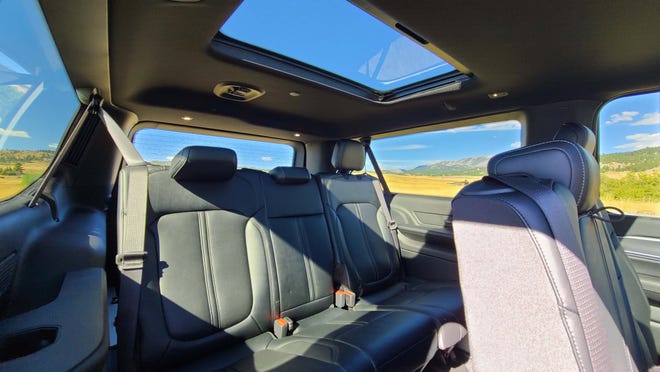
With this airline cabin of space, the cargo space in the standard Wagoneer could get tight. Thus the 2023 Wagoneer L. L for loooooong.
My tester added 7 inches of wheelbase and a foot of length to claim best-in-class, 44-cubic feet of cargo space behind the third row (up 16 cubic feet from the standard SUV). Like Suburban and Expedition MAX, Wagoneer L provides plenty of room for a family of six (and the rear two rows flatten, offering generous space when you need to move, say, a big-screen TV).

Wagoneer L is supersized — but with its coveted seven-slot grille, sculpted bod and new, black-trimmed Carbide model, it has instant cred.
That cred attracts both mainstream and luxury buyers alike. For the lux buyer, Jeep offers the Grand Wagoneer (which I reviewed separately last year) wearing more bling than Beyoncé at the Grammys.
Wagoneer swaggers into the mainstream class with standard leather seats. With up to three all-digital dash screens, head-up display, best-in-class Uconnect 5 infotainment, wireless Apple CarPlay/Android Auto, handsome switchgear (including jewel-like rotary shifter and push-button starter) and optional air suspension, the Jeep is a joy to captain.

For all its upscale tech, however, the Wagoneer Loooong can come up short.
Automakers like GM (Super Cruise) and Ford (Blue Cruise) these days are making long-distance driving easier with semi-autonomous systems. Once the domain of lux chariots like the Cadillac Escalade, they are now available in Suburban and Expedition models. Heck, I even drove a Kia Sportage — at $38K, half the cost of these mega-ute behemoths — hands-free from Gaylord to Detroit recently.
My $87K Wagoneer sported no such tech, its average, adaptive-cruise system offering only forward detection for a long highway journey.

Though when you get to your hotel, Wagoneer offers parallel-and perpendicular self-park — one of my favorite features for big utes where the rear C-pillar is in another ZIP code. Modern applications — such as the system in say, the Ford Explorer I recently drove — are fully autonomous, meticulously braking and steering backwards into your designated parking space.
Wagoneer bought the bargain system off the shelf. Parallel parking in Bozeman, the steering wheel spun around in front of me, but I had to closely monitor the rear-view camera while braking into the parking spot lest I run over the VW Jetta behind me like a buffalo flattening a squirrel.
Wagoneer L makes a bigger investment in its all-new, twin-turbo, 3.0-liter, inline-6 Hurricane engine that boasts 420 horses and swallowed slower two-lane traffic on rural roads like a whale ingesting krill. Hurricane complements off-road capability that is the brand’s signature. Determined to play with its Wrangler and Trailhawk kin, L comes with multiple drive modes like ROCK and a transfer case so you can shift into four-low, hike the floor to 10 inches off the ground, and keep going when the asphalt ends.

In the Rockies’ Crazy Mountain range, my crazy Wagoneer dodged cattle on dusty trials. Tell the kids to take a break from “Sonic the Hedgehog” on Fire TV and enjoy it.
They’ll also enjoy the ATVs you bring along — courtesy of the L’s 10,000 pound towing capacity — when you bring them back to Montana as teenagers. Just outside Yellowstone in Big Sky, you’ll find the formidable Buck Ridge trail that winds 15 miles to 9,000 feet for a breathtaking view of the mountains.
Park the Wagoneer, then charge up Buck Ridge’s scenic trails. And there’s no need to worry about crossing fences — or hot middle wires.
Next week: Road trip! Ford F-150 Lightning EV
2023 Jeep Wagoneer L
Vehicle type: Front engine, rear and all-wheel-drive, six-or-seven-passenger SUV
Price: $67,495, including $2,000 destination fee ($81,455 Series II and $87,000 Carbide AWD models as tested)
Powerplant: 3.0-liter, twin-turbo, inline-6 cylinder
Power: 420 horsepower, 468 pound-feet torque
Transmission: 8-speed automatic
Performance: 0-60 mph, NA; towing, 9,850 lbs.
Weight: 6,326 pounds (as tested)
Fuel economy: EPA est. mpg 17 city/24 highway/20 combined (RWD); 16 city/23 highway/19 combined (AWD)
Report card
Highs: Living room on wheels; healthy towing and AWD capability
Lows: Average self-park feature; no self-drive feature
Overall: 4 stars
Henry Payne is auto critic for The Detroit News. Find him at hpayne@detroitnews.com or Twitter @HenryEPayne.
Revealed: 2024 Chevy Trax gains style and features, drops price and a cylinder
Posted by Talbot Payne on October 12, 2022
Buying a new car is a difficult experience these days with inventory scarce and average sticker prices pushing $50,000. It’s tough to find a bargain. Chevrolet hopes to buck the trend with its all-new, 2024, entry-level Trax SUV.
The new model debuts at $21,4951 — nearly a grand less than the current model — while offering more room, more tech, more safety, more style.
Taking styling cues from bigger brothers Blazer and Trailblazer, Trax gets an extreme makeover on the exterior while also adding a Trailblazer-like ACTIV trim. A perennial segment cost leader, the new Trax addresses criticism that it has lacked room and technology features compared to competitors like Honda and Nissan.
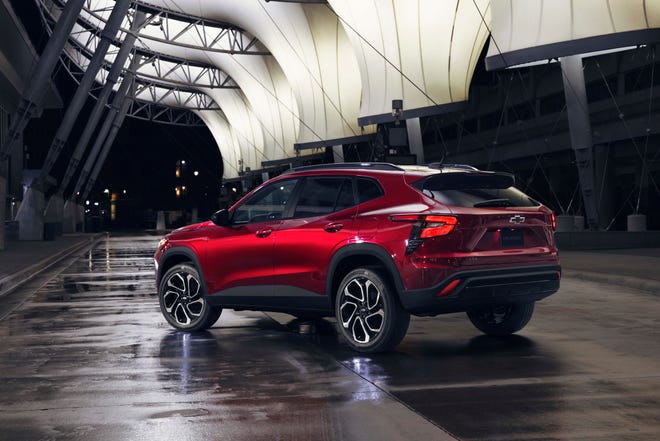
“The bold exterior and tech-forward interior design of the all-new Trax redefines what an entry-level vehicle can be,” said design chief Phil Zak. “It demonstrates that design doesn’t have to come at a premium.”
Reports of the Trax’s death after the 2022 model year proved premature. Trax continues as the brand’s entry vehicle in the preferred SUV segment, but Chevy also offers a starter Spark sedan at $14,595, one of the most affordable vehicles in autodom.
Along with the Buick Encore, Trax was a pioneer in the subcompact SUV segment in 2013, including a unique, flat-folding front seat that allowed passengers to use the entire length of the vehicle to carry oversize items like surfboards or lumber.
With its wheelbase stretched six inches longer than the outgoing model, the 2024 Trax gains significant interior room. Rear legroom grows by three inches — eclipsing the 37.7-inch rear legroom of the Honda HR-V, one of the segment’s roomiest rides. Cargo space increases by 12%, though it is still shy of the Honda.
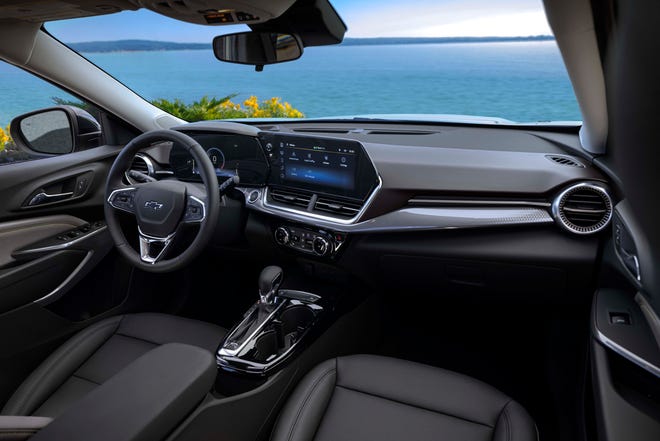
You get what you pay for, and Trax has traditionally undercut its rivals by skimping on standard equipment. The 2024 Trax won’t make adaptive cruise control standard, for example, while it is standard on the pricier HR-V and Mazda CX-30. But for the first time, the feature is available on Trax while the base LS model gains significant content.
Wireless Apple CarPlay and Android Auto for Google Maps navigation is now standard, as is push-button start and cruise control. Wireless smartphone apps have reduced the gap between mainstream and luxury cars, allowing riders to instantly transfer their phone’s navigation, contacts and text-messaging to their cars.
Other standard electronic advances in the Trax include an 8-inch touchscreen, automatic emergency braking, pedestrian braking, lane-keep assist, forward-collision alert and auto high beams.
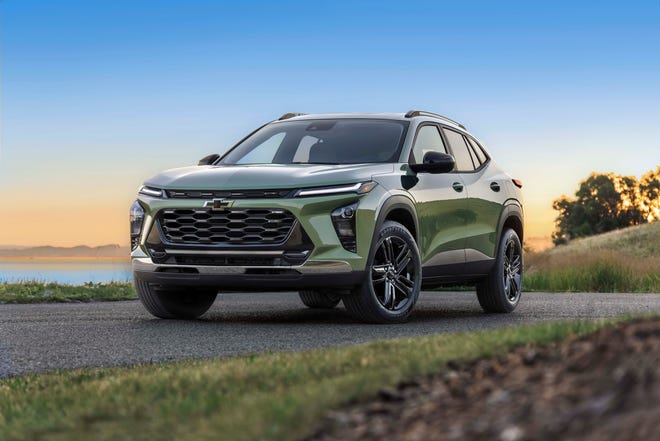
Work your way through the model lineup — 1RS, LT, 2RS — and Trax makes available more content like the aforementioned adaptive cruise control, blind-spot assist, sunroof, 11-inch touchscreen, 18-or-19 inch wheels. Step up to the loaded, adventure-styled ACTIV trim with heated front seats, heated steering wheel, heated outside mirrors, remote start, rear-seat USB ports and power-adjustable seats, and you’re paying the same $24,995 price as the stock HR-V.
Both interior and exterior designs follow upstream models. The infotainment screen is now higher in the driver’s view, forming a continuous dash sweep from the instrument display. The arrangement adds to an interior already praised by critics for its good visibility.
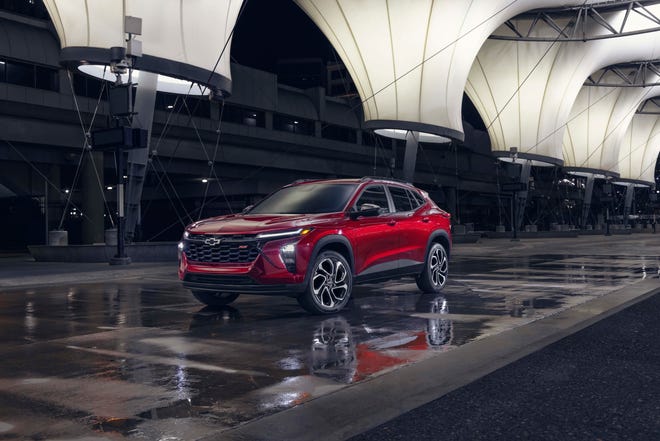
Reducing the price to compete with cost-leader Nissan Kicks also means reducing the number of cylinders and the Trax drops from a 155-horse, 1.3-liter turbo-4 cylinder engine to a mousey 138-horse, 1.2-liter turbo-3 powered by a six-speed automatic. Torque also drops from 177 to 163 pound feet, though the latter still trumps the HR-V’s 138 driven by a continuously-variable transmission.
The Trax’s new interior digs are wrapped in an upgraded exterior that drops 4 inches in height for a leaner, more athletic stance.
Gone is the blocky split grille, replaced by a more integrated shape anchored by thin, Blazer-like headlights. Each trim has unique grille and wheel design. The sporty-looking RS trims (1RS and 2RS) are particularly distinctive with black grilles and red RS badging.
Assembled in South Korea and Mexico, the 2024 Chevrolet Trax goes on sale in the spring of 2023.
2024 Chevy Trax pricing
LS — $21,4951RS — $23,195LT — $23,395 2RS — $24,995ACTIV — $24,995
Henry Payne is auto critic for The Detroit News. Find him at hpayne@detroitnews.com or Twitter @HenryEPayne.
Truck wars: GMC Sierra HD family gets beefier, techier, sexier
Posted by Talbot Payne on October 6, 2022
In the heavy duty pickup truck arms race, GMC has rolled out its latest weapon: the 2024 Sierra HD.
Surfing trends in these high-tech, high-performance times, the Sierra HD not only offers a raft of best-in-class claims but also sets a new bar for luxury. The mega-truck throws down the gauntlet on best-in-class towing, screen size, and trailering tech with 14 camera views and a slick feature that renders a gooseneck trailer invisible so the driver can monitor objects behind it.

Heavy duty capability commands big sticker prices and GMC’s premium brand claims 31% share of the over-$75,000 market. To sweeten the pot, Sierra is introducing two more premium models: the Denali Ultimate and AT4X.
The twin titans headline a lineup of that includes 2500HD and 3500HD models in Regular Cab, Extended Cab and Crew Cab configurations with dual-rear-wheel models — so-called duallys — available on the 3500HD. The trucks aim to satisfy customer demand for more diesel power, more interior technology, more stump-pulling capability across an expanded family of seven models.
“This truck elevates the HD segment with the introductions of the Denali Ultimate trim and will soon add the seriously off-road capable AT4X trim, further strengthening the dominance of the GMC truck portfolio,” said GMC vice president Duncan Aldred.
While GMC’s corporate parent, General Motors, is touting the transition of its brands to the Ultium battery platform in the next decade, Aldred said Sierra HD will be powered by diesel and gas technologies.
“This is not an EV,” said Aldred. “The Sierra Heavy Duty will become an EV in time, but it will be toward the end of the 2035 transition.”
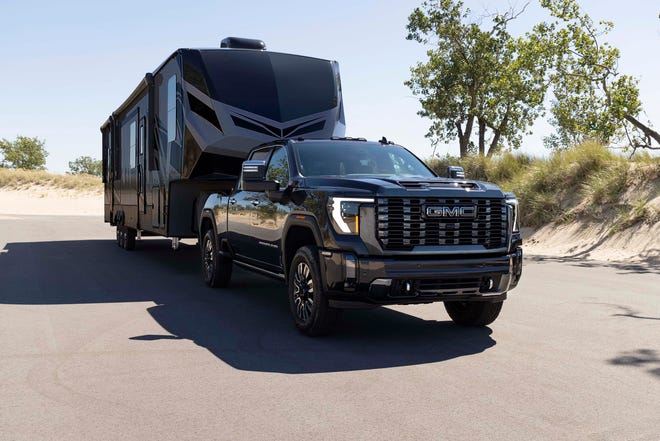
Towing tests from TFL Trucks with 6,000-pound trailers have shown range degradation of EV pickup trucks like the Ford Lightning of about 70% to less than 100 miles of range — a problem for long-distance hauls. While diesel and gas engines also suffer some range degradation, they offer better range and refueling infrastructure.
The Sierra will be powered by its tried-and-true, 6.6-liter Duramax turbo-diesel V-8 fed with more steroids to achieve an eye-popping 975 pound-feet- of torque — a 25% gain over the current model. Coupled with a 10-speed Allison transmission the Sierra HD makes 470 horsepower.
That added oomph will allow Sierra HD to clean-and-jerk a class best 21,900 pounds in 2500 HD Crew Cab trim. Spice the 3500HD, dually-rear-wheel pickup with a Duramax and it will tow 36,000 pounds. A 6.6-liter V-8 engine comes standard with 401 horsepower and 464 torque — and is now also paired with the Allision 10-speed for better power management.
While the Sierra HD flexes its muscle outside, passengers can travel in luxury inside.

The 2024 model — due on dealer lots early next year – gets major interior upgrades including 40 inches of digital dash screens. That expanse includes a best-in-class, 13.4-inch infotainment touchscreen.
Available touchscreen features include wireless Apple CarPlay and Android Auto connectivity and 14 camera views to better tow the 20,000-plus pounds out back.

While Sierra has long won raves for its premium styling and jaw-dropping rear MultiPro taigates, the towing ‘n’ tech upgrades are designed to close the gap to competitors from Ford and Ram.
“As good as they are, the (2022) Sierra 2500HD and 3500HD are outclassed by the Ford Super Duty and Ram HD,” writes Car and Driver of the current lineup. “The Sierra 2500 HD can tow up to 18,500 pounds and the 3500HD can haul up to 35,500 pounds, but those max ratings are eclipsed by rivals. What’s more, those competitors offer nicer interiors or more driver assists — or both.”
To address the latter concerns, Sierra HD also debuts new stitching and six new exterior colors (Titanium Rush Metallic, Sterling Metallic, Volcanic Red Tintcoat, Redwood Metallic, Meteorite Metallic and Downpour Metallic) while offering unique interior designs for the posh AT4X, Denali, and Denali Ultimate trims.
Denali is synonymous with GMC lux — accounting for 45% of HD sales — and the first-ever Denali Ultimate takes its refinement to the next level.
Standard with the Duramax under the hood, you’ll know the Denali Ultimate by its unique grille, Mount Denali fender badging, six-way, MultiPro tailgate, Alpine Umber interior, 16-way power seats, open-pore Paldao wood, power moonroof, 15-inch head-up display, and 12-speaker Bose audio system rolling along on 20-inch aluminum wheels with black accents.
“This truck could hold its own in the luxury sedan space,” smiled Aldred.
HD competitors have long headlined best-in-class tow ability, but — with the explosion in electronic gizmos over the last decade — best-in-class tech is also prized.

Sierra HD boasts the most trailer-assistance tech in class with a suite of available features designed to streamline the hitching-and-towing process. The headliner is an industry-first transparent trailer view for gooseneck trailoring so the driver can virtually “see through” the trailer.
Other features include blind-spot assist extended around the trailer, a warning if vehicle/trailer weight exceed its Gross Combined Weight Rating, and adaptive cruise control. Interestingly, the Sierra HD is not yet available with GM’s Super Cruise, hands-free drive assist.
For off-road enthusiasts who want to unhitch Sierra HD at the end of a long day of towing, there is the AT4X coming later in 2023. Armed with skid plates, meaty tires, and increased ground clearance, AT4X wants to play.
Assembled in Flint, Sierra HD’s pricing will be announced closer to the start of production.
Henry Payne is auto critic for The Detroit News. Find him at hpayne@detroitnews.com or Twitter @HenryEPayne.
Payne: S-class smackdown — Mercedes EQS EV vs. GLS SUV
Posted by Talbot Payne on October 6, 2022
Joliet, Illinois — Mercedes is the pinnacle of European luxury, and the S-class is the summit of Mercedes.
Big screens, big tech, big interior space — the S-class spares no expense to coddle its customers. For 2022, S-class offers a pair of models, the EQS 450 sedan and GLS 450, that try to capitalize on the latest trends in the U.S. luxury marketplace: electric cars and SUVs.
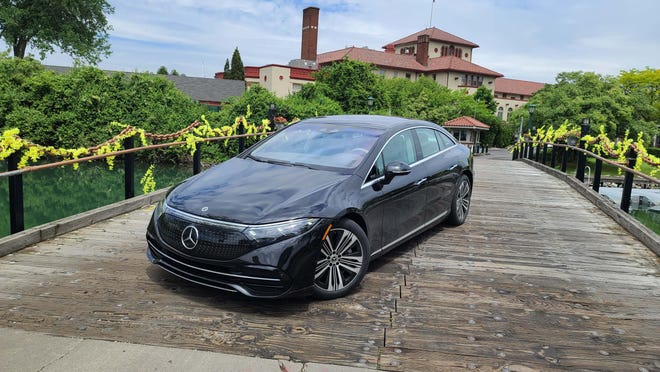
The EQS is a sleek showpiece of Mercedes technology with a screen the size of The Henry Ford’s IMAX theater and power delivery as smooth as water. But with limited range and two rows of seats, the $116,300 EQS indicates why EVs are a niche market compared to the market domination of three-row, gas-powered SUVs like the mighty, $94,230 GLS450.
With a big family weekend of racing, dining and sightseeing ahead in Chicago, Mrs. Payne and I loaded up the GLS 450. Stretched across a 123-inch wheelbase and measuring 17 feet long, the GLS is about the same size as its EQS EV sibling. But if I had an EQS in the garage, I would still want a GLS for road trips.
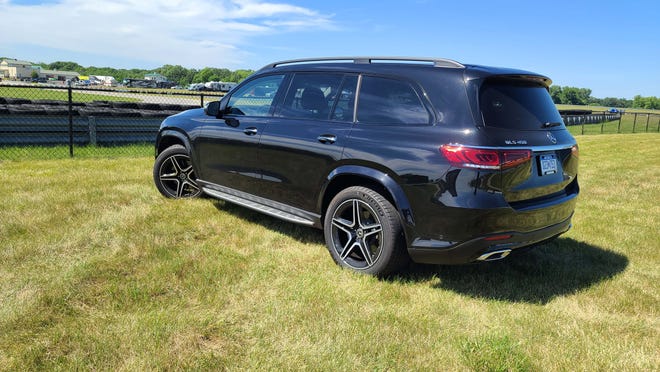
It’s not just that the Merc SUV offers a roomy third row essential for our six-person Payne family of three guys and their best gals. The GLS boasts 571 miles of highway range compared to the EQS’s 350 — and when your weekend itinerary includes a tight schedule, meeting four people at O’Hare airport and more than 800 miles of travel from Detroit to Joliet to downtown Chicago, you don’t want to be spending 30 minutes at chargers in Walmart parking lots to add 245 miles of electrons to the EQS (the EV’s 400-volt architecture can gain 70% of charge — about 245 miles — in a half hour).
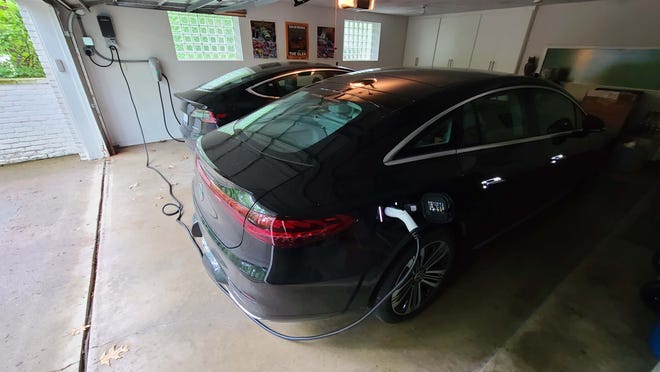
The GLS? I barely gave fuel a thought — filling it only once for five minutes on the way back to Detroit on I-94.
It’s popular these days to say: “Just wait until the federal government builds out a charging infrastructure.” Regardless of your confidence that the feds can efficiently build anything, the problem with EVs is more uncertainty than charger unavailability.
Weather and speed are big variables that make long trips in EVs a nervy affair. I traveled at 80 mph to O’Hare in the GLS — a speed that would have degraded EQS’s range by 20% (if experience in Tesla, Porsche and Hyundai EVs is any guide). There was also the threat of heavy downpours — Lake Michigan’s ecosystem is always unpredictable — which can cause 40% range loss in EVs.
Anticipating such challenges, my EQS tester is designed for efficiency with one of the cleanest skins in the industry. This thing is a bar of soap.
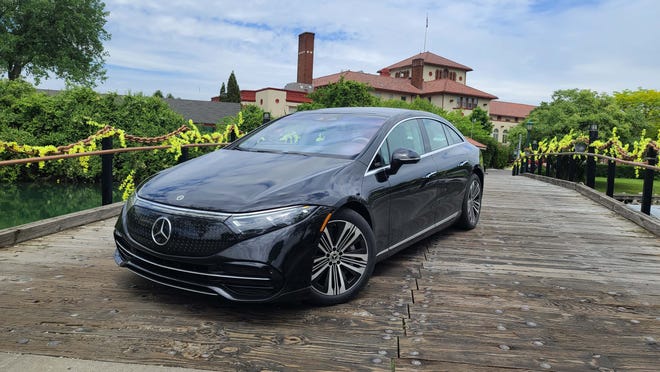
Its 0.20 drag coefficient bests the Tesla Model S and Lucid Air, but results in diminishing the design detail of its flamboyant, gas-powered predecessors. So determined was Merc to hit its drag coefficient target that it sacrificed its frunk — robbing the Merc of a feature prized by EV buyers.
GLS is no looker either with its big, boxy three-row SUV proportions. Yeah, there’s the signature muscular rear hips and the big star logo up front. But painted black, it melted into the schools of big SUVs on the road. My wife would consistently confuse it in the hotel parking lot for a BMW or big Infiniti SUV. Ouch.
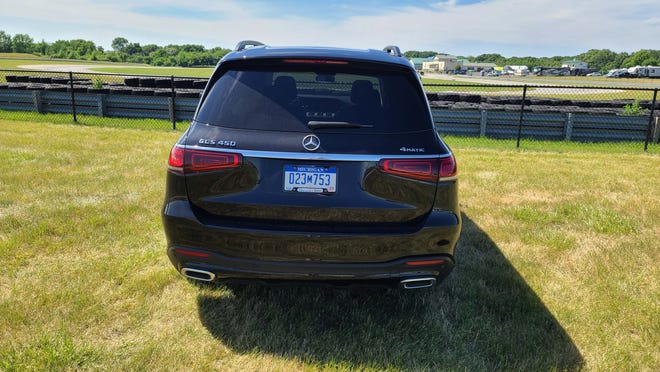
So despite carrying stiff price tags, my EQS and GLA testers were unassuming from the outside. The interiors are a different matter.
EQS sports a stunning 56-inch screen that is really three screens in one — 12.3-inch instrument display, 17.7-inch console display, and another 12.3-inch display for the passenger. The latter is a treat for occupants who want to control their own space. My son’s mother-in-law settled into a relaxing Metro Detroit journey by finding her favorite seat massage in the screen.
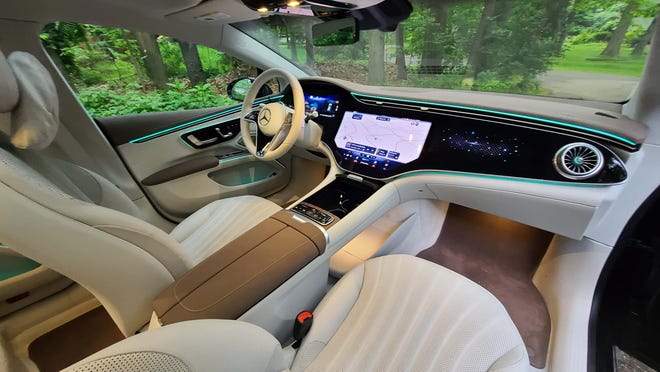
The GLS’s more familiar twin-dash screen can’t compete with the EQS in size and speed, but it is plenty useful as Merc has perfected a system of integrated graphics, swipe screens and steering-wheel mouse pads (yes, you read that right) so you can find just what you want in the system. The EQS also dazzled with Merc’s latest self-driving software — its lane-centering and auto-lane changing more Tesla-like than the GLS, which gave me some white hairs as I self-drove through Chicago on I-90.
Aft of the front thrones, however, the GLS was much more desirable than the EQS. The big ute not only fit my family of six comfortably for our trip into Chicago for dinner — but its second-row captain’s chairs were first-class seating, with the ability to adjust forward/back to accommodate the third-row behind.
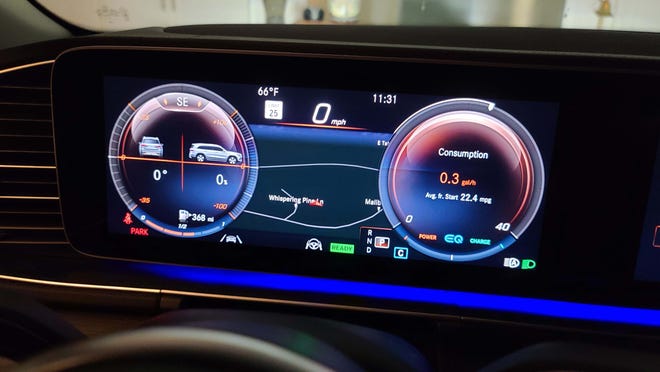
The EQS has rear-seat options, but they weren’t on my $116K tester, which featured utilitarian bench seats with standard-issue armrest and cupholders that folded down from the seatback.
Both EQS and GLS boast more than 300 horsepower, but the EQS comes on liquid smooth as we’ve come to expect from big EVs. But like its rear seat, the EQS complicates its claim to magic carpet smoothness with a rough ride over bumps. Crossing a Telegraph Road intersection, for example, EQS would bounce along — hitting the shock bump stops. Oof.
The GLS actually adopts an EQS gauge on its instrument display — to claim the green moral high ground with a 48-volt battery on board that smooths shifts from its 9-speed transmission. And its air suspension did yeoman’s work in smoothing the two-story-tall vehicle’s ride.
Autobahn Raceway, where my sons and I were competing in Lola sports racers, doubles as an auto country club (think a golf club but with a track in the middle) and allows members and guests to take their vehicles on the track at lunch hour.
I took the GLS on track to show the extended family around the course — in line behind a pace car and a who’s who of performance cars, including a Porsche 911, CT4-V Blackwing, BMW M3 and Corvette C8.
With SPORT mode engaged and air suspension managing the elephant’s girth, I had a blast squealing the tires and stomping the accelerator pedal out of turns. It’s an elephant in tennis shoes.
It’s also an elephant that doesn’t mind burning up fuel on such spontaneous activities — because gas infrastructure is always nearby. A similar track diversion in the EQS would have sucked valuable range, which would have made for another headache as we contemplated getting home on Sunday.
Buy the EQS to show off at the country club, buy the GLS if you need an all-around workhorse.
2022 Mercedes GLS450 4Matic
Vehicle type: All-wheel drive, seven-passenger SUV
Price: $78,900, including $1,050 destination charge ($94,230 as tested)
Powerplant: 3.0-liter turbocharged inline-6 cylinder
Power: 362 horsepower, 369 pound-feet of torque
Transmission: 9-speed automatic
Performance: 0-60 mph, 5.9 seconds (mfr.); towing capacity, 7,700 pounds
Weight: 5,412 pounds
Fuel economy: EPA 19 mpg city/23 highway/21 combined; Highway range, 570 miles
Report card
Highs: Seating for six, long-range utility
Lows: A gen behind EQS in some tech; boxy design
Overall: 4 stars
2022 Mercedes EQS 450+
Vehicle type: Battery-powered rear-wheel-drive, five-passenger sedan
Price: $105,450 including $1,050 destination fee ($116,304 450+ Premium as tested)
Powerplant: 107.8 kWh lithium-ion battery with rear electric-motor
Power: 329 horsepower, 417 pound-feet torque
Transmission: Single-speed direct drive
Performance: 0-60 mph, 5.8 seconds (mfr.); top speed, 130 mph
Weight: 5,597 pounds
Fuel economy: EPA 97 MPGe; range, 350 miles
Report card
Highs: Smooth ride; interior from the gods
Lows: Uninspired looks, jouncy suspension over bumps
Overall: 3 stars
Henry Payne is auto critic for The Detroit News. Find him at hpayne@detroitnews.com or Twitter @HenryEPayne
For new-car buyers in a tight market, the waiting is the hardest part
Posted by Talbot Payne on October 4, 2022
Detroit — Bruce Gorman of Livonia wanted a new 2022 Chevy Equinox. But when he took his aging, 2010 Chrysler Sebring into Serra Chevrolet on Telegraph for a trade-in last December, he was met by a surprise.“There was nothing on the lot,” the 66-year-old said. “They thought that Chevy might be building more by mid-February, so they said to check in the first of March.”
A couple of weeks later, his salesperson called to say that his car had arrived — and the $28,000 Equinox LT was blue after all.
“I love it. It has push-button start, auto-lock, auto-high beams, adaptive-cruise-control, and blind spot-assist,” said Gorman, ticking off some of the electronic advancements that have revolutionized autos in the decade since he bought his Sebring. “(The Chevy) is lacking heated front seats, though. They never got the chips for that.”
On the plus side, Gorman said Serra kept him informed every step of the way — honoring the Equinox’s sticker price, minus a discount for those missing seat-heating chips.
If you’re in the market for a new vehicle, Gorman’s story may sound all too familiar as inventory shortages have frustrated would-be buyers. In a post-COVID market with high demand, supply is constrained by the continuing semiconductor shortage and disruptions in countries like China and Malaysia, which are key component suppliers. Manufacturing states like Michigan are awash in new vehicles sitting on lots waiting for chips.
A modern vehicle may have 900 to 1,200 different semiconductor chips — distributed across 100 electronics modules — to run everything from heated seats to an engine’s fuel injection system. They vary in cost and functionality and are produced across a multi-national supply chain that can include Taiwan, Korea, the United States, China and Malaysia — the latter pair creating significant uncertainty with COVID shutdowns in the last two years. The rush to electronics-heavy EVs will likely only increase the demand for chips.
“Not all vehicles are treated equally. Manufacturers are prioritizing high-margin vehicles and EVs at a time that they are making big investments in battery plants,” said Sam Abuelsamid, principle auto analyst for Guidehouse Insights. “Automakers need the cash flow to do build these plants, so they are building the high-margin vehicles they need to get cash now to fund future EV investments.”
To complicate matters, the shortage comes as the federal government is forcing automakers to transition to costly electric vehicles. To pay for the transition, automakers are shrinking the number of affordable, sub-$30,000 cars they sell and emphasizing new, more expensive models of, for example, high-margin pickups. This perfect storm of factors ballooned the average sticker price in July to an all-time high of $48,000, according to Kelley Blue Book — up from an average of $38,000 just two years ago.
For example, CEO Jim Farley indicated in April that Ford Motor Co. is prioritizing its chip supply for Ford F-150 Lightning EV pickups, which can sell for more than $90,000.
Abuelsamid said chip supplies should start to return to normal in the middle of next year. But Intel CEO Pat Gelsinger told CNBC’s TechCheck in May not to expect an end to shortages until 2024.
Either way, that means more long waits for customers like Mary Schelske of Bloomfield Hills. Her three-year lease ran out on her 2019 Ford Edge in December, but her dealer, North Brothers Ford, had no ‘22 Edges to replace it with.
“They said they couldn’t get me a car until April,” she said. April turned into June. “I kept calling and they kept trying to find me a car. I thought about buying out the lease because the market value of cars has been rising, but Ford waived the lease mileage limit so I could keep driving my Edge until they found a new one.”
Her Edge arrived in June and North Brothers not only waived the extra miles on the old car but gave her the same lease price — $420 a month — on the new one.
Ford’s best-selling SUV, the Escape, is also in short supply. Like Schelske, Lucian Bela of West Bloomfield Township got an extension on his lease after it ended in March — extra mileage waived — until a new one arrived in July. But Anne Ryan, 71, of Grosse Pointe, took advantage of a buyout on her 2019 Escape lease.
With the market desperate for Escapes, Ryan began shopping used car sites like Carvana to see if she could get a sweet price if she bought out the lease on her Escape. Her Ford dealer went one step better, saving her the paperwork headaches by offering $6,000 toward her Escape trade-in. She took the deal, then used it to step up to Ford’s luxury division — leasing a Lincoln Corsair for about the same , three-year, $400-a-month price as her old Escape.
“I deserved it,” she said with a smile.
None of the customers The News talked with considered an EV for their new car, even as the industry is prioritizing those vehicles.
“An EV makes no sense for me,” Ryan said. “I have a business I travel to Up North. … The charging takes too long and there’s no infrastructure up there. My Corsair has 470 miles of range. I can nearly make the round trip on one tank.”
Though Ryan took immediate delivery on her Lincoln, luxury brands are not immune from the inventory crisis.
Carla and John Libbe’s Audi Q5 was hit by a deer on M-115 near Cadillac, totaling the car. Carla suffered a fractured sternum, caused by the air bag deployment. While she healed, they went to her dealer for a replacement.
But Audi Birmingham had nothing on the lot. The wait for a new Q5? Six months.
The Libbes decided to shop for a Range Rover Velar, one of the SUVs on the market that had caught Carla’s eye. But Range Rover supply was no better than Audi. “We would have to wait 6-8 months for new Velar due to the chip shortage,” John said.
They cast a wider Midwest net and found a Velar at Land Rover of Westside in Cleveland that had been abandoned by its would-be buyer. It was the exact trim Carla wanted for a price of $69,285; they picked it up in mid-February.
“We just got lucky,” said John.
Paul Waatti, industry analysis manager for AutoPacific, notes that nearly all automakers have scaled back production estimates, even the Volkswagen Group (which makes Carla’s former Audi Q5) and Toyota, the large global automakers.
“VW has called the dismal supply chain and chip shortage the ‘new normal,’” Waatti said. “Automakers continue to prioritize more profitable models like trucks and other high-volume segments at the upper end of the market but inventory will remain at historically low levels even for those vehicles.”
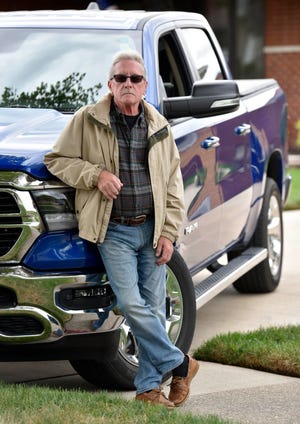
Take Steve Light of Sterling Heights, who recently shopped for a Ram pickup.
Light has leased four Ram 1500 Big Horns since 2013 without a hiccup, but when his current 36-month lease was up this year, he faced a wait of four to six weeks for a new one and a lease payment jumping from $340 a month to $450.
Concerned that the wait for a new truck would exceed six weeks — and aware his Big Horn model was trading in the used market for $38,000 — Light paid the $30,000 buyout on offer from the dealer when he signed the lease in 2019.
“The consumer suffers two-fold as not only is there limited inventory, but also many of the vehicles that are available are being marked up as dealers are trying to squeeze profit wherever they can to make up for fewer sales than normal,” analyst Waatti said. “That is affecting the used car market, as even those are flying off the shelf in record time with inflated prices.”
Cynasure Ross of Pontiac knows that first-hand. She purchased a used 2011 Hyundai Sonata Limited this summer. But it wasn’t easy.
Under a strict budget of $12,000, she had a hard time finding anything in Michigan that matched her desired trim. “Some listings had taken deposits the day after they were posted and before I could get to them,” she said.
She continued to cast a wide net beyond the state. After about 30 days of shopping, she located the Sonata she wanted — for the price she wanted — from Team Automotive in Ohio. She sent in her deposit, had the car inspected and delivered.
As chip delays continue, Giudehouse’s Abuelsamid recommends that buyers adapt: “If you need a new car to buy or lease, start planning ahead as early as you can so you are guaranteed to get it when you need it.”
Henry Payne is auto critic for The Detroit News. Find him at hpayne@detroitnews.com or Twitter @HenryEPayne.
Payne: Hot hatch Hyundai Kona N-line is more show than go
Posted by Talbot Payne on October 4, 2022
BMW makes an M-azing, M-asterful M3 sports sedan with gobs of horsepower, tires made from Superglue and a taut suspension. It’ll also cost you an M-azing 80 grand. For those who don’t need the full magilla, there’s the BMW M-line which offers M3-like style but without the nuclear power plant under the hood. M style without the M-egaprice.
The Hyundai Kona has decided to get in on the act.
Right next door in the alphabet, the Kona N offers a fire-spitting hot hatch with a loud 286 horsepower, stiff springs, $35K sticker price and N-grin launch control that’ll crush your spine into the seat on its way to 4.9-second zero-60 launches. Sound like fun? No?
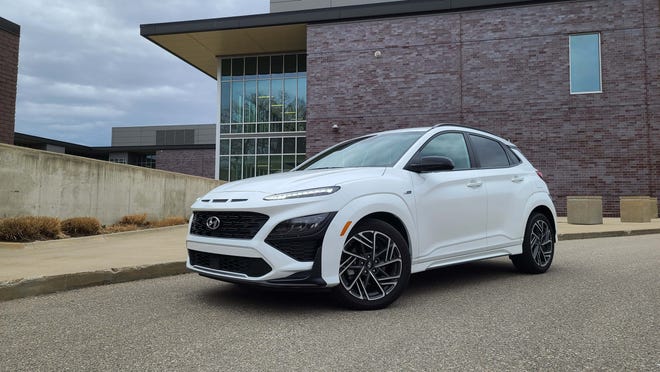
Then the Kona N-line might be your cup of Kia with all the N’s styling cues and just enough horsepower — 195 — to make it interesting. Heck, it almost fooled me when I picked my tester up at the airport on a cold April evening.
Lots of black mascara like the Kona N. Signature three-slot hood like the N. Rear diffuser, hot wheels, cladded rocker panels, red-trim and N-embossed sport seats. Just like the N. N-ice.
The N comparisons stop when you put your boot in it.
VROOOOM-NAHHHH, I don’t think so. Despite an upscale, dual-clutch transmission hooked up to the four-banger under the hood, the engine lacks urgency. I confined my enthusiastic driving to 90-degree turns where the N-line rotated nicely before setting off for … the autocross course? No, the grocery. There the Kona showed off its hatchback utility.

However, for a stiff $31K, the N-line made my mind wander to the $20,995 Elantra in the Hyundai aisle. You want affordable style?
At a whopping $10K south of Kona, the Elantra is a much more head-turning vehicle and is loaded with more modern amenities. I’m talkin’ standard wireless Apple CarPlay/Android Auto, blind-spot assist, and auto tranny. And Elantra has its own N-line for 2022 that uses the same turbo-4 as Kona N, and is $1,400 less than the Kona. Uh-oh.

They say Americans don’t like sedans, but the Elantra has significantly more rear legroom for basketball players like me, and that trunk — well, it’s not a hatchback but it will swallow plenty of groceries.
And don’t get me started on hot hatches like the VW Golf GTI, which starts at a similar price to the N-line and will run rings around it in the fun department while delivering better utility.

If SUV it must be, however, then Kona N-line is easy to learn with its tablet screen, useful knobs and digital displays. SPORT mode turns the instrument display red to match your blood temperature. All-wheel drive is a useful feature in the winter months, and the Elantra is just a front-wheel driver. And then there’s that 100,000-mile Hyundai drivetrain warranty, always comforting to buyers on a budget.
Hyundai has hardly been shy with designs. The Elantra and Tucson are unlike anything else on the market and the three-door Veloster has been a joyful addition to my favorite segment, the hot hatch.
Expect the Kona N-line to take over the lovable-if-quirky three-door Veloster’s mantle, given its more accessible four-door setup. That accessibility should mean better sales numbers for the Kona N as well, which in turn will lead more folks to the more accessible N-line. You can see where product planners are going with all this.

With its funky wardrobe, the N-line is worth a walkaround in the parking lot. The menacing slit running lights draw you in, then you notice the headlights at mid-fascia. The bulging fenders look like biceps honed in the gym. The twin tailpipes look like a double barrel shotgun out back. N-teresting.
And with the money you save getting 29 mpg in the 1.6-liter turbo-4 … well, one of these days you might be tempted by a full-blown N so you can go harass those smug BMW Ms.
2022 Hyundai Kona N-line
Vehicle type: All-wheel-drive five-passenger SUV
Price: $28,425, including $1,245 destination charge
Powerplant: 1.6-liter turbocharged inline-4 cylinder
Power: 195 horsepower, 195 pound-feet of torque
Transmission: 7-speed dual-clutch automatic
Performance: 0-60 mph, 7.3 seconds (Car and Driver); top speed, 130 mph
Weight: 3,287 pounds
Fuel economy: EPA 27 mpg city/32 highway/29 combined (AWD as tested)
Report card
Highs: Stylish looks, upscale interior
Lows: Engine lacks pep; lacks value compared to competitors
Overall: 3 stars
Henry Payne is auto critic for The Detroit News. Find him at hpayne@detroitnews.com or Twitter @HenryEPayne
Payne: Preview from the driver’s seat at American Speed Festival
Posted by Talbot Payne on October 4, 2022
Pontiac — Coming hard out of Champion Motor Speedway’s Turn 9 in third gear, I dance my 1966 Porsche 906E around the long Turn 10 sweeper. It’s test day for the Second Annual American Speed Festival at M1 Concourse, and come Saturday, hundreds of spectators will be lining the guardrails here when I will be on track again with other historic sports cars.
The fall auto shows just keep coming. On the heels of the Detroit auto show, Detroit 4fest and Concours d’ Elegance, the American Speed Festival comes to town Thursday through Sunday.

What makes ASF special is not just the opportunity to see some of the most historic race cars ever made — but the opportunity to see them at speed in their natural habitat: a race track. M1 is Metro Detroit’s premier enthusiast auto club with a 1.5-mile race track sharing 87 acres with private garages.
My 906E has been invited to the show along with dozens of other significant racers from NASCAR, IndyCar and sportscar racing — including Carroll Shelby’s legendary Cobras, which will be the featured marque this year celebrating Shelby America’s 60th anniversary. About two-dozen Cobras will be on display, including gems like the 1965 Cobra Daytona Coupe, 1964 Shelby Cobra 289 Hard Top Coupe, 1990 Shelby Aurora Can Am and the Cobra 289 used in the 2019 box office hit “Ford v Ferrari.” Shelby Club Parade Laps will take place from 11:55 a.m.-12:45 p.m. Saturday.

Other notables include Al Unser Jr.’s 1986 Lola T8600, his uncle Bobby Unser’s 1972 Olsonite Eagle, the turbine-engine 1968 STP Lotus, Alberto Ascori’s 1952 Ferrari 375, a 2004 Ferrari Enzo and a 2021 Ferrari Monza SP1. The Ferrari entries celebrate of 75 years of the Italian brand with Ferrari Club Parade Laps from 12:25–1:30 p.m. Friday.
There will also be a contingent of vintage go-kart racers and the V8-powered 1988 Fabcar IMSA prototype owned by David Nikolas, racer and owner of Pontiac’s Nikolas Motorsport.
On test day, I found myself sharing track time with the go-karts and the lightning-quick Fabcar. The latter was based on a Porsche 962 — then updated with a more modern rocker suspension and small-block Chevy V-8.
When Nikolas fired up his V-8 next to my mid-engine Porsche, the earth shook — and I couldn’t hear my 2.0-liter flat-6 engine even though it was directly behind my ears. A racing V-8 is a sight to see — and hear.
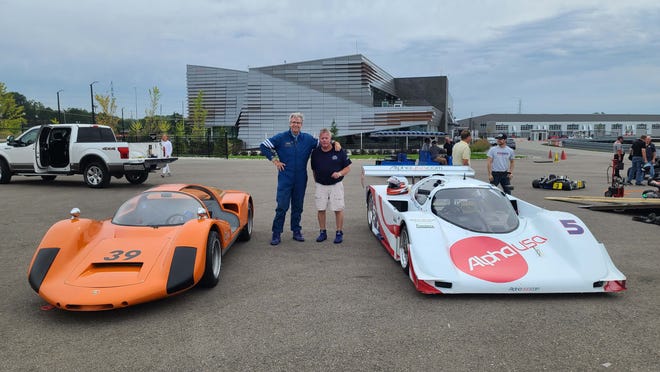
Each year, ASF awards a Master of Motorsports and this year’s headliner is legendary designer Peter Brock, who made his mark as a young Shelby America designer. A racing fanatic, Brock left General Motors in 1959 at the tender age of 21 to return to his native California. He was Shelby America’s first employee, and there he would design a stable of cars including the Shelby Daytona Cobra coupes that won the world sports car championship in 1965.
Brock will hold forth on his Shelby career Thursday and again Saturday at noon with driving ace David Hobbs. At noon Sunday, he’ll discuss his work on the Chevy Corvette and Brock Racing Enterprises — a racing design firm he started in 1965. Hobbs will also talk to Vintage Indy’s Mike Lashmett for Insiders’ Garage from noon-1 p.m. Friday.
Brock will receive his award at Saturday’s Checkered Flag Ball presented by McLaren Oakland. The event benefits M1’s philanthropic arm, the Checkered Flag Challenge, to address transportation challenges in Pontiac.
ASF kicks off Thursday with Drive & Dine, an intimate tour of Stahl’s private car collection followed by a sumptuous M1 dinner.
I get to take unleash my steed around M1’s track in the Endurance Sports Car class beginning Friday, when seven groups will be on display: Shelby/Cobra, Vintage Indy, Ferrari, Feature Race Cars, SuperCars, Endurance Sports Cars and Historic Go Karts. Track activities are from 9 a.m.-5 p.m. Friday and 8:30-4:30 p.m. Saturday.
On Friday evening, fans can hang around for the M1 Garage Reveal and enjoy rare tours of M1 garages from 6-9:30 p.m. — complete with hors d’ oeuvres.On Sunday, the track goes quiet (though guests can also take a ride in the right-hand seat of a hot car with a professional instructor) and a juried car show, Speed & Style Expo, takes the fore. Awards will be given in each car class plus an overall Best in Show honoree. The Art Expo showcases top automotive artists, including Nico Rousselet, Dave Chappel, Charles Maher, Alex Buchan, Steve Macy, John Baker, Robert Matthews, Garen Nicoghosian and Francois Bruere.
The weekend also includes live music by Vavoom, pedal/RC/slot cars for kids, food trucks and Carroll Shelby official licensed apparel.If you go
Tickets: $75 Friday/Saturday for 18 and older. Friday, 17 and under are free. Saturday ages 13-17 are $25 and 12 and under are free. Sunday is $50 for 18 and over and free for 17 and under. Tickets for the Drive & Dine Tour on Thursday are $200. Free parking is included with every ticket. Parking and shuttle buses are available at 2000 S. Opdyke Road.For more schedule details, go to: www.m1concourse.com/asf-overview.
Henry Payne is auto critic for The Detroit News. Find him at hpayne@detroitnews.com or Twitter @HenryEPayne.