- Search Cartoons
- Comic Archive
-
Payne
Store



 Henry Payne RSS

For new-car buyers in a tight market, the waiting is the hardest part
Posted by Talbot Payne on October 4, 2022
Detroit — Bruce Gorman of Livonia wanted a new 2022 Chevy Equinox. But when he took his aging, 2010 Chrysler Sebring into Serra Chevrolet on Telegraph for a trade-in last December, he was met by a surprise.“There was nothing on the lot,” the 66-year-old said. “They thought that Chevy might be building more by mid-February, so they said to check in the first of March.”
A couple of weeks later, his salesperson called to say that his car had arrived — and the $28,000 Equinox LT was blue after all.
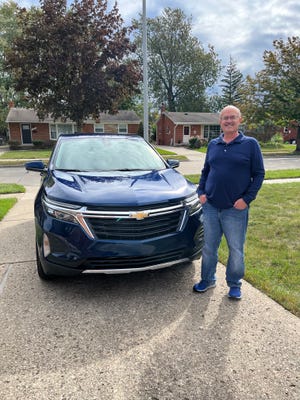
“I love it. It has push-button start, auto-lock, auto-high beams, adaptive-cruise-control, and blind spot-assist,” said Gorman, ticking off some of the electronic advancements that have revolutionized autos in the decade since he bought his Sebring. “(The Chevy) is lacking heated front seats, though. They never got the chips for that.”
On the plus side, Gorman said Serra kept him informed every step of the way — honoring the Equinox’s sticker price, minus a discount for those missing seat-heating chips.
If you’re in the market for a new vehicle, Gorman’s story may sound all too familiar as inventory shortages have frustrated would-be buyers. In a post-COVID market with high demand, supply is constrained by the continuing semiconductor shortage and disruptions in countries like China and Malaysia, which are key component suppliers. Manufacturing states like Michigan are awash in new vehicles sitting on lots waiting for chips.
A modern vehicle may have 900 to 1,200 different semiconductor chips — distributed across 100 electronics modules — to run everything from heated seats to an engine’s fuel injection system. They vary in cost and functionality and are produced across a multi-national supply chain that can include Taiwan, Korea, the United States, China and Malaysia — the latter pair creating significant uncertainty with COVID shutdowns in the last two years. The rush to electronics-heavy EVs will likely only increase the demand for chips.
“Not all vehicles are treated equally. Manufacturers are prioritizing high-margin vehicles and EVs at a time that they are making big investments in battery plants,” said Sam Abuelsamid, principle auto analyst for Guidehouse Insights. “Automakers need the cash flow to do build these plants, so they are building the high-margin vehicles they need to get cash now to fund future EV investments.”
To complicate matters, the shortage comes as the federal government is forcing automakers to transition to costly electric vehicles. To pay for the transition, automakers are shrinking the number of affordable, sub-$30,000 cars they sell and emphasizing new, more expensive models of, for example, high-margin pickups. This perfect storm of factors ballooned the average sticker price in July to an all-time high of $48,000, according to Kelley Blue Book — up from an average of $38,000 just two years ago.
For example, CEO Jim Farley indicated in April that Ford Motor Co. is prioritizing its chip supply for Ford F-150 Lightning EV pickups, which can sell for more than $90,000.
Abuelsamid said chip supplies should start to return to normal in the middle of next year. But Intel CEO Pat Gelsinger told CNBC’s TechCheck in May not to expect an end to shortages until 2024.
Either way, that means more long waits for customers like Mary Schelske of Bloomfield Hills. Her three-year lease ran out on her 2019 Ford Edge in December, but her dealer, North Brothers Ford, had no ‘22 Edges to replace it with.
“They said they couldn’t get me a car until April,” she said. April turned into June. “I kept calling and they kept trying to find me a car. I thought about buying out the lease because the market value of cars has been rising, but Ford waived the lease mileage limit so I could keep driving my Edge until they found a new one.”
Her Edge arrived in June and North Brothers not only waived the extra miles on the old car but gave her the same lease price — $420 a month — on the new one.
Ford’s best-selling SUV, the Escape, is also in short supply. Like Schelske, Lucian Bela of West Bloomfield Township got an extension on his lease after it ended in March — extra mileage waived — until a new one arrived in July. But Anne Ryan, 71, of Grosse Pointe, took advantage of a buyout on her 2019 Escape lease.
With the market desperate for Escapes, Ryan began shopping used car sites like Carvana to see if she could get a sweet price if she bought out the lease on her Escape. Her Ford dealer went one step better, saving her the paperwork headaches by offering $6,000 toward her Escape trade-in. She took the deal, then used it to step up to Ford’s luxury division — leasing a Lincoln Corsair for about the same , three-year, $400-a-month price as her old Escape.
“I deserved it,” she said with a smile.
None of the customers The News talked with considered an EV for their new car, even as the industry is prioritizing those vehicles.
“An EV makes no sense for me,” Ryan said. “I have a business I travel to Up North. … The charging takes too long and there’s no infrastructure up there. My Corsair has 470 miles of range. I can nearly make the round trip on one tank.”
Though Ryan took immediate delivery on her Lincoln, luxury brands are not immune from the inventory crisis.
Carla and John Libbe’s Audi Q5 was hit by a deer on M-115 near Cadillac, totaling the car. Carla suffered a fractured sternum, caused by the air bag deployment. While she healed, they went to her dealer for a replacement.
But Audi Birmingham had nothing on the lot. The wait for a new Q5? Six months.
The Libbes decided to shop for a Range Rover Velar, one of the SUVs on the market that had caught Carla’s eye. But Range Rover supply was no better than Audi. “We would have to wait 6-8 months for new Velar due to the chip shortage,” John said.
They cast a wider Midwest net and found a Velar at Land Rover of Westside in Cleveland that had been abandoned by its would-be buyer. It was the exact trim Carla wanted for a price of $69,285; they picked it up in mid-February.
“We just got lucky,” said John.
Paul Waatti, industry analysis manager for AutoPacific, notes that nearly all automakers have scaled back production estimates, even the Volkswagen Group (which makes Carla’s former Audi Q5) and Toyota, the large global automakers.
“VW has called the dismal supply chain and chip shortage the ‘new normal,’” Waatti said. “Automakers continue to prioritize more profitable models like trucks and other high-volume segments at the upper end of the market but inventory will remain at historically low levels even for those vehicles.”
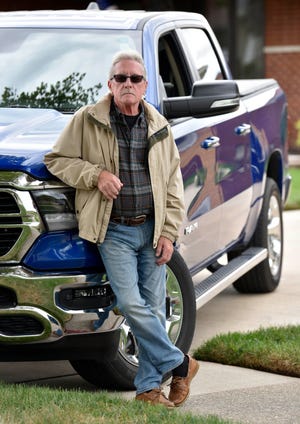
Take Steve Light of Sterling Heights, who recently shopped for a Ram pickup.
Light has leased four Ram 1500 Big Horns since 2013 without a hiccup, but when his current 36-month lease was up this year, he faced a wait of four to six weeks for a new one and a lease payment jumping from $340 a month to $450.
Concerned that the wait for a new truck would exceed six weeks — and aware his Big Horn model was trading in the used market for $38,000 — Light paid the $30,000 buyout on offer from the dealer when he signed the lease in 2019.
“The consumer suffers two-fold as not only is there limited inventory, but also many of the vehicles that are available are being marked up as dealers are trying to squeeze profit wherever they can to make up for fewer sales than normal,” analyst Waatti said. “That is affecting the used car market, as even those are flying off the shelf in record time with inflated prices.”
Cynasure Ross of Pontiac knows that first-hand. She purchased a used 2011 Hyundai Sonata Limited this summer. But it wasn’t easy.
Under a strict budget of $12,000, she had a hard time finding anything in Michigan that matched her desired trim. “Some listings had taken deposits the day after they were posted and before I could get to them,” she said.
She continued to cast a wide net beyond the state. After about 30 days of shopping, she located the Sonata she wanted — for the price she wanted — from Team Automotive in Ohio. She sent in her deposit, had the car inspected and delivered.
As chip delays continue, Giudehouse’s Abuelsamid recommends that buyers adapt: “If you need a new car to buy or lease, start planning ahead as early as you can so you are guaranteed to get it when you need it.”
Henry Payne is auto critic for The Detroit News. Find him at hpayne@detroitnews.com or Twitter @HenryEPayne.