- Search Cartoons
- Comic Archive
-
Payne
Store



 Henry Payne RSS

Orange barrels: Detroit GP fixes the damn roads for 2023 race
Posted by Talbot Payne on November 8, 2022
Detroit — The Detroit Grand Prix is making a promise to the state of Michigan: it’s going to fix the damn roads.
At least the roads around the Detroit Renaissance Center, where the Chevrolet Detroit Grand Prix Presented by Lear is moving for June 2-4, 2023. The 1.7-mile track — its main, east-west corridors of Jefferson Avenue and Atwater Street choked with construction barrels — has begun to take shape and event organizers gave sponsors and media a fall preview of the track this week. It’s going to be quick.

“It’s a minor inconvenience rights now, but I can guarantee the citizens of Detroit these will be the smoothest roads in our city in about 2-3 weeks,” said Detroit GP President Bud Denker at a sponsor reception on the 72nd floor of the RenCen. “The Belle Isle track was 2.4 miles, the new track is just 1.7 miles. Belle Isle races were 70 laps. In downtown Detroit, cars will come around 100-plus times. That means more action, more things going on for the fans. It’s a nine-turn track with a straightaway as long as Indianapolis Motor Speedway’s main straight and you know how fast they go there.”
Don’t expect Indy’s 240-mph speeds, but expect IndyCars to hit 180 mph after taking a 90-degree left onto Jefferson from Rivard Street (Turn 2) and screaming westwards, past the RenCen, and into a 180-degree hairpin at Griswold. From there, IndyCars will plunge down to the waterfront, emerging on Atwater Street via an uphill S-turn that Denker calls “Monte Carlo” after the famed European street race.

“Just being on Jefferson is going to be a highlight. Going past the Joe Louis fist with a hairpin around it . . . is going to be a big talking point,” said two-time IndyCar champ and Penske team driver Josef Newgarden, who got a tour of the track Thursday. “It will be a quick street circuit, probably comparable to St. Petersburg where we start the season with 60-second laps.”
Jefferson is being paved because it must be billiard-table smooth to handle cars at that velocity carrying spine-crunching, 4,000-pounds of downforce. With 50% of ticket sales free, the straight should be packed with fans as the cars stream into the slow, 40 mph, 180-degree Griswold hairpin.

“Jefferson is going to be 5-6 lanes wide (for) 0.7 miles, which is quite a distance to get a tow on somebody into a 40-mph hairpin,” smiled Newgarden. “That provides an interesting opportunity for overtaking and defending.”
Moving from Belle Isle back downtown for the first time since 1991, the track is an ambitious re-imagining of one of IndyCar’s iconic races. Make that events.

“This is an event, not a race,” said Denker, who sees the GP as the centerpiece of a weekend where fans can enjoy racing (including support races from IMSA sportscar and Trans Am), attend concerts at Hart Plaza, drink in Detroit River views, dine at Campus Martius restaurants, shop along Woodward, even bring their boats to slips along the waterfront behind the Port Authority building (already booked for the weekend by a Canadian firm). A Chevrolet bridge will allow fans to cross the main straight to get back and forth from Hart Plaza to downtown businesses.
“My favorite thing about street circuits is it’s like going to a downtown music concert,” said Newgarden, who hails from Nashville, which has one of the series’ most successful street events. “There’s nothing better than going to a live race.”
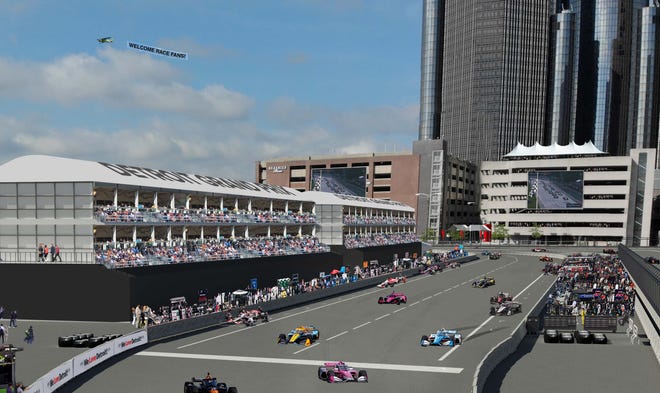
While much of the track will be free to fans, there is money to be made selling suites to the east of the RenCen overlooking an IndyCar first: dual, parallel pit lanes.
“We couldn’t find a 1,000-feet stretch anywhere to put a pit lane. Those are the things you have to consider to build a track,” said Denker. “Instead, we’ve got a pit lane that’s 500 feet long — and on each side the drivers will pit. Some cars will pit to the left, some cars to the right, and at the end of pit lane they will come back together to go back on the race track. Never been done before. It’s an engineering marvel.”
Looking down from the RenCen’s southeast tower, the two concrete pads just laid by construction crews look like miniature, parallel landing strips at Detroit Metro Airport.
But when completed for racing next June, they will be a hive of activity. “Races are won or lost in the pit lane,” said Newgarden. “When I come in off the button, I’m going to have to remember which side of pit lane I’m on?”
Pity the driver who forgets.
Behind the pit lane will be 70 suites — 57 of them already spoken for — which dwarfs the 23 at the old Belle Isle venue. The suites are housed in a huge structure, imported from the PGA’s Phoenix Open golf tourney, which offers fans a front row seat on the furious pit activity — as well as a view of Franklin Street, where the checkered flag will be thrown.

One of those suites will be occupied by Huntington Bank, which recently located its Detroit headquarters downtown on Woodward. “We’ve been sponsoring this event for 10 years,” said Huntington regional president Eric Dietz, “and we’re really excited to see the race come back downtown, where our employees will be able to walk to the track.”
Huntington Bank is also sponsoring two Detroit neighborhoods with millions of dollars to be put into infrastructure and assisting the transport of families to the event. Each of Detroit’s nine districts will display a colorful pop-up IndyCar sculpture.
The sculptures are part of an artistic push by the GP that includes decorating the track with large murals from local artists.
“There is a community focus on how we designed the race circuit,” said Michael Montri, Penske Entertainment vice president. “The focus is to help revitalize the downtown as well as the neighborhoods.”
Under Penske Corporation ownership, IndyCar has transcended auto racing in the last two years as a cultural symbol. The Memorial Day weekend 2021 Indy 500 was America’s first mega-sporting event as a vaccinated population emerged from the pandemic — the race attracting more than 100,000 fans — to celebrate Helio Castroneves’ historic fourth 500 win. That was immediately followed by the Detroit GP — the first major race to go maskless, representing a return to normal after months of controversial government restrictions.

Denker hopes the 2023 Detroit Grand Prix will bring similar revival to a Detroit downtown that has suffered through the pandemic. Corporations went to remote workplaces with the resulting dirth of people downtown affecting restaurants and retail establishments.
“We are going to bring a lot of people down here from both sides of the border,” said Denker. “We have so much support from Windsor. Fans can come through (the) Windsor tunnel, turn right and park less than a half-mile away in the middle of the race track.”
Newgarden said he would love to be the first to win on the downtown track, though if he does he’ll miss getting dunked in the Belle Isle Fountain. Instead, Victory Circle will be right in front of the RenCen’s Wintergarden on the Detroit river.
“I don’t recommend jumping in the Detroit River,” laughed Denker to Newgarden. “We might never see you again with the river current.”
Henry Payne is auto critic for The Detroit News. Find him at hpayne@detroitnews.com or Twitter @HenryEPayne.