- Search Cartoons
- Comic Archive
-
Payne
Store



 Henry Payne RSS

Articles
Life under the Big Top: Highlights of 30 years of the Detroit auto show
Posted by Talbot Payne on September 18, 2022
The Detroit auto show’s history dates to 1907, when it became an annual event. But organizers took it to another level in 1989 when the Detroit Auto Dealers Association renamed it the North American International Auto Show and moved it to chilly January.
The goal: to compete against the world’s biggest shows in Frankfurt, Tokyo, and Shanghai and burnish Detroit’s global automotive cred. NAIAS became an instant sensation, attracting each year’s first model reveals and the attention of thousands of international journalists.
“It got so big, it was the best show in the world,” said Jason Vines, who attended his first show with Chrysler in the early ’90s. “I’m sorry, Germany and Japan. The Detroit show was the place to go.”
Cobo Center (now named Huntington Place) was transformed into a massive exhibition space showcasing the world’s latest wheels, hottest Hollywood celebrities, and the biggest annual charity event in the world. At its height, NAIAS played host to 79 vehicle introductions (in 2004) and welcomed 5,500 media (2008) — followed by two public weeks attended by nearly 1 million visitors annually.

“All the auto manufacturers were there,” continued Vines, who ultimately became Chrysler communications boss and the ringmaster behind some of the show’s most memorable debuts. “The Detroit show was the international show. When they changed the name, I thought, come on, give me a break — the North American International Auto Show? But it really was the international show, period.”
As NAIAS reboots this year with new September dates following a COVID-induced hiatus of more than three years, the auto show format is in transition with manufacturers favoring remote backdrops and internet buzz to glitzy new model displays. The new show aims to fill that void with activations, outsized attractions, ride ‘n’ drives, and electric monster trucks. Here’s a look in the rearview mirror at some of the Detroit auto show-palooza’s greatest hits.
1992: Jeep shatters expectations
It was the stunt heard ‘round the world. With “Maximum Bob” Lutz, Chrysler’s vice chairman, at the wheel and Mayor Coleman Young riding shotgun, the Jeep Grand Cherokee drove down Jefferson under police escort and up Cobo’s north steps before smashing through the convention center’s glass windows.
Well, it was a little more sophisticated than that.

“The plate glass was fake, it was actually tempered glass that they had put in with explosive charges all around the perimeter,” recalled Lutz, now retired after a legendary career that also included executive stints at BMW AG, Ford Motor Co. and General Motors Corp., in an interview.
“There was a guy with a remote — and the moment he saw the front bumper of the Jeep Grand Cherokee an inch from the glass, he triggered the explosives so you had a shower of glass granules.”
Chrysler had concluded that shattering actual glass would have been too dangerous, with shards threatening not only bystanders but Jeep’s precious human cargo.
“It was designed to be safe, and it was a brilliant demonstration of how you can use a low-cost PR stunt to far more effect at a product introduction than you could ever get from conventional advertising,” Lutz said with a smile. “That stunt was on every TV station, every major news media in the U.S. — and around the world.”
There would actually be a sequel in 2006 when Jeep drove another new product — the ’07 Jeep Wrangler Rubicon — off its stand and through Cobo’s glass into the street.
1995: Minivan meets Kermit the Frog
Chrysler was determined to create buzz for its new minivans, the Town & Country, Dodge Grand Caravan and Plymouth Grand Voyager, which featured segment-first sliding doors on both sides and a two-zone climate-control system.

Enter Lutz again, this time hamming it up with Chairman Bob Eaton reading giant storybooks in Mr. Rogers-style sweaters — who were then interrupted by Kermit the Frog piloting a red Caravan over their heads and onto a fake pond’s lily pads, dousing onlookers with water.
“Our stunt matched our message,” recalled Vines. “Our new minivan was going to leapfrog the competition.”
2008: Ram ‘n’ cattle drive
If Jeep’s glass-shattering stunt put the Detroit show on the map, then the Ram cattle drive may be the most ambitious.
Some 120 longhorn steers were trailered in from Oklahoma to accompany the all-new Ram truck (and upstage the new Ford F-150, also introduced at the show that year). They were kept in a parking lot overnight, then escorted down Washington Boulevard by cowboys with a trio of pickups in the middle.

“This could be the greatest thing — or the worst thing I’ve ever done in my life,” recalled Vines, who helped orchestrate the stunt. Sure enough, the spectacle included unscripted activity.
“Some of the longhorns start humping each other,” Vines said, laughing. “And now Chrysler’s CEO was petrified. But event emcee Jim Press (then Chrysler’s marketing chief) was quick on his feet. He said: ‘Look at those big cows trying to get a good look at the new Ram pickup truck!’ The video went viral around the world.”
The celebs
As the event grew in prominence — supercharged by media coverage and a ritzy charity ball — it naturally attracted Hollywood and musical celebrities to Detroit.
The ’06 show featured comedian David Spade, who memorably introduced the new Dodge Caliber with a dig at another Dodge product: “anything is better than Neon.” Eva Longoria, star of TV’s “Desperate Housewives,” unveiled the Chrysler Imperial concept while Blink-182 drummer Travis Barker touted a Cadillac Escalade special edition.
In 2003, the Charity Preview was headlined by superstar (and DaimlerChrysler spokeswoman) Celine Dion, who belted her single “I Drove All Night.”

Country music star Toby Keith introduced the 2009 Ford F-150. GM brought in a who’s who of musical talent in 2008 — Mary J. Blige, Maroon 5 and Detroit’s own Kid Rock — to show off a stage-full of concept cars. Infiniti unveiled its Q50 sedan in 2013 with the help of acrobatic Cirque du Soleil performers. Other notables over the years included Hall & Oates and actor/singer Kevin Bacon.
PR guru Vines was particularly fond of the celebrities who lingered over the sheet metal: “I remember Pixar’s John Lasseter — the creator of the ‘Cars’ movie — he had a ball just walking around the floor with us. And Jay Leno, of course — he really loves cars.”
2006: Aspen blizzard
Chrysler’s first SUV, the Aspen, was introduced by a blizzard of artificial snow from the off-Broadway act Slava’s SnowShow. Paper flakes exploded from the stage, showering the hall in what Autoline’s John McElroy called “the greatest press conference of all time.”
Auto reveals
Glitter aside, sometimes the cars have been the stars at the auto show.

Dozens of memorable vehicles have sauntered across Cobo’s stage, including the Ford GT40 concept supercar (in 2002 and again in 2015), the stunning Cadillac ELR hybrid in 2013, revived Toyota Supra in 2019, New Beetle in 1999, and the outrageous Tomahawk concept motorcycle powered by the Dodge Viper’s V-10 engine (piloted by no less than then-Chrysler Group COO Wolfgang Bernhard in ‘03).

And then there was the bright yellow Corvette Z06 that GM President Mark Reuss unveiled at the 2014 show, its 625-horse, 6.2-liter supercharged V-8 shaking the Cobo rafters of any remaining Slava’s SnowShow flakes.

Reuss gave it a nickname on the spot: “The Big Nasty.”
Henry Payne is auto critic for The Detroit News. Find him at hpayne@detroitnews.com or Twitter @HenryEPayne.
The 2024 Ford Mustang cometh: What we think we know
Posted by Talbot Payne on September 8, 2022
A new Mustang is coming. Long live the V-8.
The seventh generation of Ford Motor Co.’s iconic muscle-car figures to be a headliner for the 2022 Detroit Auto Show when it debuts Sept. 14. And unlike its Dodge and Chevrolet segment competitors, expect the 2024 pony car to continue to feed gas-powered red meat to its legion of fans — including a howling, 5.0-liter V-8 option under the hood.
While the Chevrolet Camaro is due to sunset in 2024 (complete with Heritage Edition farewell package, according to press reports) and Dodge is waving goodbye to its gas-powered Challenger and Charger beasts (even the legendary V8-fired Hellcat) the same model year due to crippling government fines, Mustang will continue to fly the flag for the affordable pony car segment it created in 1964.

Mustang, one of Ford’s iconic vehicles along with the F-150 pickup and Bronco SUV, is the Blue Oval’s performance halo.
That performance has inspired a quiet, electric, Mustang Mach-E SUV, but the sports car will continue on its rib-rattling, piston-pounding ways. We know that not only from spy shots with quad tailpipes sprouting out the rear of the ‘Stang, but from Ford’s motorhead CEO himself.
“Mustang is the world’s best-selling sports car because there’s one for everyone — from an EcoBoost convertible to 5-liter V-8 GT fastback coupe,” said Jim Farley as he rallied the Mustang faithful ahead of the new coupe’s evening reveal Sept. 14. “Now it’s time to. . .welcome the next chapter in Mustang’s legacy.”
Farley’s remarks were accompanied by an audio clip of the V-8 mill.
That powerplant is likely to be based on the same 5.0-liter Coyote V-8 found in the current GT. That engine already felt the pinch of federal regulators for the 2022 model year when its output was reduced 10 horsepower to 450 ponies.
But without Camaro and Challenger coupes in the market, Mustang stands to pick up sales above the 52,414 units it sold in 2021. Challenger outsold Mustang in 2021 with 54,314 units on the strength of its iconic V-8 mating call, while Camaro sold 21,893 cars. Some Mustang customers may also gain from the Charger sedan’s (the only four-door in the segment) demise, which leaves 78,389 in sales on the table.
The so-called “Ecoboost,” turbocharged, 2.3-liter inline-four cylinder engine is also expected to carry over in entry-level Mustang models. Shared with Ford’s ferocious, European Focus RS, the 310 horsepower/350 torque engine also has been popular in the Mustang’s High Performance model. Both engines should be mated to a six-speed manual and 10-speed, automatic transmission.
Beyond the oily bits, expect the exterior to get an evolutionary update from the radical, sixth-generation car that remade the face of Mustang in 2015. Look to the interior for the biggest change in the new coupe.
Electronics are reshaping vehicle interiors, and the new Mustang is no different. It will likely get a bigger, more exotic instrument display and console touchscreen. Expect them to be run by Ford’s SYNC 4 system (which debuted in the Ford F-Series trucks) which brings more computing power and nifty features like wireless Apple CarPlay/Android Auto and split screen usability.
The new, 2024 Mustang likely will debut in just the Ecoboost and GT trims, with the former expected to start just below $30,000 in keeping with the brand’s affordable reputation that has made it the world’s best-selling sportscar across 144 countries. Past generations have primed enthusiasts to expect high-powered, higher-priced variants like the Shelby GT350 and GT500 (which can crest $80,000), not to mention stylish trims like the Bullitt and Mach 1. The first Mustang hybrid may be one of those special models.
Look for them at future Detroit Auto Shows.
Henry Payne is auto critic for The Detroit News. Find him at hpayne@detroitnews.com or Twitter @HenryEPayne.
Payne: Porsche Taycan GTS Sport Turismo. OMG Speedwagon.
Posted by Talbot Payne on September 8, 2022
Charlevoix — On a vacant country road south of this small north Michigan burg, I initiated launch control in my all-electric, Mamba Green, 2022 Taycan GTS Sport Turismo wagon by simultaneously flattening the brake and accelerator pedals. Just like a Porsche 911 sports car.
I released the brake, and the all-wheel-drive GTS exploded forward like a Cedar Point amusement ride, crushing my rib cage into the seatback. “GEE-SUS!” was the universal reaction of everyone I took for a ride. Just like a Porsche 911. Sixty mph went by in just 3.5 seconds before I entered an ess turn, Taycan hugging the road courtesy of a battery powertrain mounted low in the chassis. Just like the flat-six engine in a 911.
Coveted by Porsche-philes, Taycan sold over 9,000 units in the 2021 sales year. Just like a Porsche 911.
In a luxury EV market dominated by King Tesla, Porsche is the only brand to have made a significant dent. The Tesla Model 3, for example, outsold the #2 sedan in class, the Hyundai Ioniq Electric, 128,600 units to (ahem) 1,766 last year. The compact Model Y SUV outsold the Ford Mustang Mach-E: 172,700 to 27,140.
Taycan was the only vehicle to outsell Tesla in class: besting the Model S sedan by 9,419 units to 9,100.
The electric rocket also outsold Porsche’s gas-powered sedan, the Panamera, by 3:1. No doubt that’s because Taycan is the latest “It” thing from a fashionable brand. But I sense Taycan also has sex appeal that (the plenty capable) Panamera has struggled to achieve.
I’ve raced Porsches, owned Porsches, put the 911 on a pedestal as the best sports car on the planet. But I haven’t bonded with Panamera, the brand’s first sedan/wagon. Maybe because it looks like an overstuffed 911. Maybe because it’s powered by front-mounted, V-shaped engines (heresy!), not rear, horizontally-opposed, flat-cylinder engines. Maybe because of its cluttered center console.

By contrast, I’m smitten by Porsche’s second sedan/wagon entry because of its aforementioned attributes. Ask anyone who’s driven one. It’s the best handling EV on the market, period. My 911 pal Jon had to be pried out by 10 men.
Where Panamera always felt like it was trying (like the ungainly Cayenne SUV) to force sports car looks into a sedan wrapper, Taycan has its own design signature — while retaining Porsche’s crucial brand DNA.
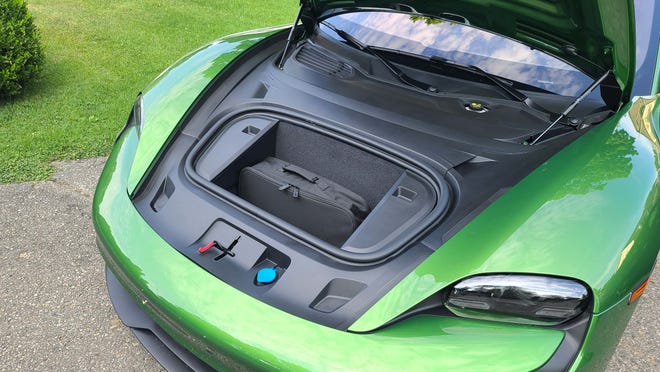
The styling is stunning. The front end is more sportscar-ish (no front engine) than Panamera, and framed by unique horizontal headlights. They make Taycan look lean, menacing. Out back, the wagon’s hatch tapers elegantly between Simba-like muscular hips, punctuated by a 911-inspired horizontal taillight spanning the rear deck. This vision sits on Porsche J1 skateboard chassis, making for a low center of gravity and thrilling cornering capabilities despite the car’s 5,200-pound girth — 500 pounds more than the comparable Panamera GTS Sport Turismo.
Necks swiveled wherever I went. At a Charlevoix cross walk, a family walked by before the dad finally stopped in his tracks, staring. GTS OMG.
The 590-horse GTS Sport Turismo is the sweet spot of Taycan beauty, performance and utility. Slotted between the Taycan sedan and insane 2.4-second-zero-60, 750-horse Turbo S, the GTS (like a 911 GTS) brings a more handling-focused package with sticky Pirelli P-Zero tires, tightened suspension and SPORT PLUS mode that makes a futuristic flat-6 sound (I could do without it. I love the 911’s glorious, flat-6 wail, but if you’re going electric, give me an electric motor shriek).
The wagon then adopts the hatchback from the Cross Turismo Taycan crossover — sans fender cladding for a sleek, simple aesthetic.
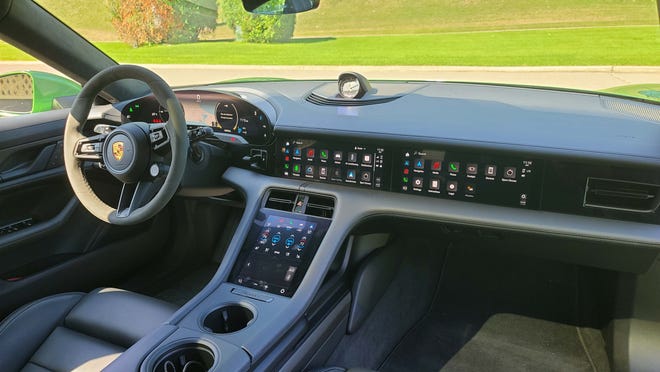
The spare elegance continues inside. Under a panoramic roof is a TV store of screens — not a button in sight. The dominate piece is the hoodless, curved boomerang-shaped instrument display. It’s as lovely as the first day I saw it at the Taycan’s 2019 Niagara Falls unveiling — though its novelty has worn off as other curved displays from Cadillac and Mercedes have come to market.

In Porsche tradition, the ignition is a button on the left dash (so you can fire up the beast as you jump into the driver’s seat like Le Mans racers of old). In fact, you only use the button to turn the car off with a loooong hold like a smartphone. Taycan comes to life automatically (with key in my pocket) as I step on the brake pedal.
Everything is simple. The electronic shifter has been reduced to a chicklet-sized toggle on the dash, freeing up the center console for a haptic touchscreen. Climate controls and charging info are accessed here — freeing the infotainment screens (there are two — one for driver, one for passenger) to do infotainment stuff like Sirius XM and Android Auto navigation.
Speaking of navigation, Taycan’s biggest shortcoming compared to Panamera is road trips.
Given its sales numbers, most Porsche sedan buyers apparently drive local. But hit the road to Charlevoix from my Oakland County domicile and Taycan is notably thin on self-driving tech. Herr Payne, zis ist ein Porsche. I am meant to be driven!
And then there’s the EV range issue. Panamera’s 400 miles of gas-powered range (enough to make the 500-mile round trip in a single stop) is a clear advantage (buy a Panamera E-Hybrid and that range extends to 464 miles).

After years of taking my Tesla Model 3 and other EVs north, I’ve settled on a two-stop strategy at Bay City and Gaylord fast chargers. Featuring a 800-volt platform (superior to a 400-volt Model 3 or Mach-E), Taycan should be able to charge at over 250 kilowatts at a 350 kW EA charger.
But I-75 EA chargers on this trip only let me charge at 115 kW, negating the $160K Porsche’s advantage. I sat at Bay City and Gaylord Meijer parking lots for 25 minutes each filling GTS to 80% of charge. Go joy riding in Charlevoix (guilty as charged) and you’ll need to go to, say, the local Ford dealer to charge on a 240-volt unit for a few hours. I like to pack a bicycle in the back of EV SUVs for the trip back to the charger — but the narrow (hey, you want those sexy Simba hips, dontcha?) Sport Turismo hatch requires I take off the bike’s front wheel.
Such are the compromises one makes for EVs.
So you can keep your Taycan caged in Metro Detroit for local commutes. Or you can explore this state’s glorious country roads testing the limits of this low slung, 626-torque rocket ship and its laugh-out-loud launch control capability.
Just like a 911.
2022 Porsche Taycan GTS Sport Turismo
Vehicle type: Battery-powered, all-wheel-drive four-passenger SUV
Price: $137,450, including $1,450 destination fee ($161,470 as tested)
Powerplant: 83.7 kWh lithium-ion battery with twin, electric-motor drive
Power: 590 horsepower, 626 pound-feet torque
Transmission: Single-speed direct drive/front axle and two-speed/rear axle
Performance: 0-60 mph, 3.5 seconds (mfr.); top speed, 155 mph
Weight: 5,152 pounds
Fuel economy: EPA MPGe 80 combined: range, 233 miles
Report card
Highs: Head-turning looks; electrifying performance
Lows: Lacks self-driving tech; road-trip charger blues
Overall: 4 stars
Henry Payne is auto critic for The Detroit News. Find him at hpayne@detroitnews.com or Twitter @HenryEPayne.
Payne: Five things about the 2024 Chevy Equinox EV
Posted by Talbot Payne on September 8, 2022
With the 2024 Chevrolet Equinox EV, General Motors Co. takes a significant fork in the road to the company’s electric future as governments from California to Washington state target gas engines for elimination over the next decade.
Until Chevy unveiled the Equinox EV — and its recent Blazer EV and Silverado EV siblings — the General had been content to pioneer electric vehicles in the niche EV space with green customer-targeted nameplates like the EV1, Volt and Bolt.

No longer. By committing its flagship SUV and truck badges to electric drivetrains, Chevy is signaling the elimination of its mainstream gas-engine lineup has begun.
“We are at a turning point where EVs will be the mainstream choice for the next generation of customers,” CEO Mary Barra said, “and Equinox EV will lead this charge for us.”
The gas-powered Equinox will continue to be offered alongside the EV, and its value will be a challenge to EV adoption. Expect rising government penalties to try and cripple gas-engine production (see Dodge’s cancellation of V6 and V8-powered Challenger/Chargers due to government fines), but Chevy is putting its own thumb on the scale to encourage EV adoption in the US market’s biggest segment.
Here are five things to watch for as Equinox EV comes to market one year from now:
1. $30,000
Chevy says that it will aggressively price the EV at close to $30,000 for its base, LT model (a sportier RS model will also be available). Add destination fee (as The Detroit News always does when listing vehicle prices) and an estimated $31,000 starting price would significantly undercut competitive compact EVs like the VW ID.4, Hyundai Ioniq 5, Toyota bZ4X, and Ford Mustang Mach-E by more than $10,000.
The EV would still sell for 4 grand north of the $27,695 gasoline-powered Equinox. But, include the federal government’s new, $7,500 EV subsidy, and the Equinox EV’s starting price is comparable to a $23,295, gas-powered, subcompact Chevy Trailblazer.
The subsidy is also important because it would allow Chevrolet to undercut its chief Japanese rivals — Toyota, Honda, and Nissan — which have long dominated the compact SUV class. The $43k Toyota bZ4X, for example, is made in Japan and does not qualify for the federal tax credit.
2. Charge it.
Undercutting the price of the gas Equinox is key because charging is EVs’ Kryponite. Buyers can put their savings into spending the $2,000 necessary to install a home charger (apartment dwellers are are at a greater disadvantage).
Equinox EV boasts 250-300 miles of range — up from the Bolt EUV’s 248 — but that is still a long way from the gas Equinox’s 420 mile range. Owners of mainstream compact SUVs — unlike luxury SUV buyers — tend to rely on one vehicle for local and distance travel.

“You will no longer have to stop at the gas station,” says Chevy VP Scott Bell. But you will have to stop at charging stations on a trip to, say, Madison, Wisconsin, to see U-M thump the Badgers. The 450-mile trip from St. Clair Shores would require one, five-minute stop in a gas Equinox — but two, 30-minute stops in a Equinox EV on a 150-kW fast charger.
3. Tech-tastic.
To make such road trips more relaxing, the Equinox EV is optioned — like the Bolt EUV — with Super Cruise, GM’s state-of-the-art driver-assist technology that allows hands-free driving on divided interstates.

Equinox EV also comes with regenerative braking pioneered on Bolt. Regenerative allows one-pedal driving that can bring the vehicle to a stop only using the accelerator pedal (with assist form a steering column-mounted paddle).
4. Design.
Equinox EV is different from its gas brother inside and out. The exterior dumps Chevy’s traditional split-grille design for a more Tron-like visage of thin LED light bars and dimpled surfacing. The digital interior is simpler, too. Where standard Equinox’s instrument and infotainment displays are compartmentalized, Equinox EV adopts a large, hoodless, 17.7-inch glass display stretching across the dash and housing both instrument and info displays.

The architecture is similar to interiors debuted on the Silverado EV and Blazer EV. Though the Equinox EV removes the engine from the under the front hood, don’t expect dimensions to change much inside. Chevy says passenger room is similar — while rear cargo volume actually shrinks (with rear seats folded) from 63.9 cubic feet to 57 cubic feet (which is about the same as the Bolt EUV).
That space is not recovered up front as the Equinox won’t feature a frunk (front trunk) like a Ford Mustang Mach-E.
5. All-wheel-drive.
What the Equinox will have up front (and in back ) are dual motors for all-wheel-drive — a popular feature on the gas Equinox. The Bolt only has front-wheel-drive.
The AWD system makes for a significant performance jump over the gas Equinox with horsepower increasing from 170 to 290 and torque jumping from 203 on the AWD gas Equinox to a massive 346 in the AWD electric. Even the standard, FWD Equinox EV sees gains over the gas mule with 210 horsepower and 242 pound-ft torque.
Just watch that your hot-rodding doesn’t drain the battery.
Henry Payne is auto critic for The Detroit News. Find him at hpayne@detroitnews.com or Twitter @HenryEPayne.
Payne: Genesis GV60 is stylish, sci-fi Tesla challenger — charging excepted
Posted by Talbot Payne on September 1, 2022
Bay City — I’m a car columnist, but you may find my electric car reviews sound increasingly like electronics reviews.
Payne, you write a lot about high-tech and charging.

I know, I know. When I reviewed the Tesla Model 3 back in 2018, I marveled at its acceleration and crisp handling. But the more EVs I drove, the more they all felt the same. The Mustang Mach-E, Hyundai Ioniq 5, Volkswagen ID.4. Torrid acceleration, smooth ride, low center of gravity in corners. Rinse, dry, repeat.
What continued to separate Tesla from the pack was technology and charging. Over-the-air updates, Autopilot driving, seamless charging stops, look-at-me-remote-driving-the-car-out-of-parking-space-with-my-smart-phone-for-goodness-sake.
I called the Model 3/Y smartphones on wheels. Everyone is playing catch up. Well, the 2023 Genesis GV60 has gotten darn close.

The top of the line in Hyundai Motor Group’s skateboard-chassis-based trilogy of Ioniq 5, Kia EV6, the premium GV60 EV wows in style, speed, technology — even surpassing the Tesla in build quality and the ability to remote parallel-park itself. No kidding.
But Genesis still badly lags in Tesla’s secret sauce: road-trip charging.
I took the GV60 on my favorite long loop test — a weekend with family in Charlevoix, 250 miles up north. Like my short-loop test to Hell and back it is Pure Michigan: unique towns for photography, great twisty roads for performance, interstate chill time to test infotainment and driver-assist features. The big add of the Charlevoix loop is I get to test electric-vehicle range and charging availability, and show off the car to the public and friends along the way.
Like a luxury car (or electronics device) the GV60 passed the style test with flying colors. Though I find all three Hyundai Group siblings to be uniquely premium in their looks, passersby definitely preferred the Genesis. The Hyundai Ioniq 5? Nice, but too boxy. The Kia EV6? Nice but too bulbous. The GV60? Just right.

“The Porsche Macan-like rear hatchback caught my eye,” said a middle-aged pal.
“I’ve got to ask, what kind of car is that? A new Audi? It’s really beautiful,” said a 20-something employee at a Taco Bell carryout window.
As those comments suggest, the Korean-assembled GV60 rejects Tesla’s Apple-simple design (there’s not even a proper frunk), for an elegant European-styled SUV with plenty of curves, signature split-headlights, and even a big grille. The grille is hardly necessary as EVs have no gas engine to cool, but Genesis apparently feels the need to link the car to gas-engine siblings like the GV70. An anthropomorphic face also makes a human connection.
To my cartoonist’s eye, the face looks like Stitch in Disney’s Lili & Stitch movie. Whatever your thoughts, it’s unique.
The design detail continues inside with a big, Mercedes-like digital screen stretching across the dash, crisp pages to flip through on the infotainment screen and floating console below like a Cadillac Lyriq. Unlike Tesla, there are upscale flourishes everywhere, with fat dials controlling everything from the screen to the side mirrors to the transmission.
But in operation, GV60 is one of the most Tesla-like vehicles I’ve tested. It wants to show off.

Roll up to a parallel parking space and my Genesis Sport not only would self-park, but it also gave me the option to step out of the car, stand on the curb and let the car park itself via key fob. The process is laborious as the car inches back and forth into a tight space — but it’s cool to witness.
It will also park in a perpendicular space and move out of a tight spot, all with remote operation. Tesla pioneered this drop-the-mike tech and Genesis has embraced it.
That autonomous habit extends to self-driving. It’s a feature available on other Hyundai products from the gas-powered Kia Sportage to the EV6 and Ioniq 5 — and I regret that Genesis doesn’t offer more capability. Think auto lane change that would put it on par with top-drawer luxury systems like Cadillac’s SmartCruise, Mercedes’ Intelligent Drive and Tesla’s Autopilot. Still, I came to rely on it as I drove long stretches of I-75 hands-free, the GV60 rarely nannying me to keep my hands on the wheel like my Model 3.
Self-driving at 80 mph is relaxing — but GV60’s charging issues filled the anxiety gap. The Hyundai Group says that it is developing a charger navigation system like Tesla, but for now drivers are on their own for navigating via an unreliable third-party charge network.
I’ve made this trip enough to know to ignore charge apps like ABRP and Chargeway that tell me to do a one-stopper via a West Branch charger. With a single charger, the West Branch unit could be out of order — or backed up with other vehicles. Better to use Electrify America chargers in Bay City and Gaylord — not just because they have multiple chargers, but also because weather can drain your battery.

Despite filing up to the recommended 80% of range (188 miles) to go 166 miles from Bay City to Charlevoix, I wouldn’t make it on a 90-degree day when battery range is just 70% (131 miles) of predicted range. So I stop twice — in Bay City and Gaylord — to be sure.
On my return trip, EA’s multiple charger options were crucial to getting home.
I entered Bay City with 50% of range. A quick, 7-minute fill-up on a 350 kW charger (a benefit of the Genesis’s fast, 800-volt platform) to 80% should have been enough to get me home with enough cushion to prepare for a 2 p.m. meeting.

But the Electrify America station had a surprise in store.
When I arrived, a Mustang Mach-E was on the 350 kW unit — its passengers asleep inside. I plugged into the second 350 kW unit. It was out of order.
Two, slower, 150 kW chargers left. I plugged into a 150. Also AWOL. Down to my last charger.
Fortunately, it worked. At 150 kW the charge to 80% took 20 minutes (plus 10 minutes wasted on out-of-order chargers), and then I was on my way. But not before I warned an arriving Mach-E owner that two chargers were out of order.
Awright, Payne, enough about high-tech and charging.

Leaving the Bay City charger with plenty of battery to get home, I put the Genesis in SPORT mode, nailed the accelerator and merged on the interstate with authority. EV60 will hit 60 mph in just 3.7 seconds — on par with a Tesla Model Y Performance, despite the Genesis weighing 400 pounds more.
Much of that added weight appears the result of better engineering for a quieter driving experience. Tesla still has the lead thanks to its charging network, but Genesis is a player to watch.
2023 Genesis GV60
Vehicle type: Battery-powered, all-wheel-drive five-passenger SUV
Price: $59,985, including $1,090 destination fee ($69,560 Performance AWD model as tested)
Powerplant: 77.4 kWh lithium-ion battery with dual electric-motors
Power: 429 horsepower, 516 pound-feet torque
Transmission: Single-speed direct drive
Performance: 0-60 mph, 3.7 seconds (mfr., AWD); towing, 2,300 pounds
Weight: 4,890 pounds
Fuel economy: EPA 90 MPGe; range, 235 miles
Report card
Highs: Standout looks, lotsa cool features to play with
Lows: Floaty handling; 800-volt platform not much benefit
Overall: 3 stars
Henry Payne is auto critic for The Detroit News. Find him at hpayne@detroitnews.com or Twitter @HenryEPayne.
Payne: The legendary Acura Integra is back but faces stiff competition
Posted by Talbot Payne on August 25, 2022
Yuba, Michigan — Nostalgia is a powerful thing. I want to see Michael Jordan go one-on-one with Steph Curry. I want to see Pete Sampras vs. Novak Djokovic on Wimbledon’s Centre Court. I want Mario Andretti vs. Josef Newgarden.
I want to drive the Acura Integra vs. the Cadillac CT4.
Wait, what? I can? After a long walk in the woods, Honda’s luxury brand has returned to its sporty roots and brought back its famed entry-level hellion for the compact luxury segment. But a lot has happened since 1989 when Integra debuted. Like my sports legends of yore, could Integra ever live up to the expectations? What the heck, let’s give it a shot.

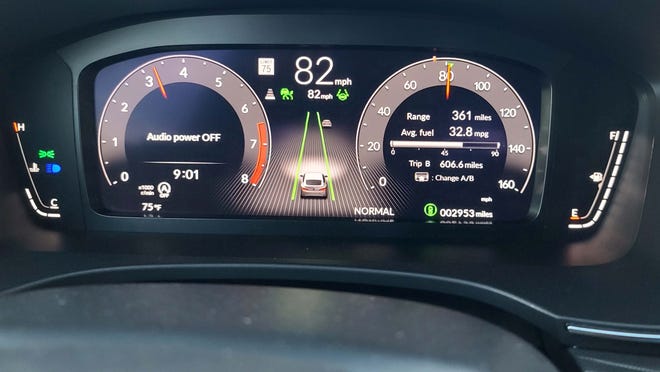
On adaptive cruise control talking with my wife via the Android Auto app (both alien, sci-fi technology to an ’89 Integra) heading north on U.S. 31 outside Yuba (just north of Acme somewhere in northern Michigan) a twisty country road loomed. I hung up the phone and hit the brakes hard — negating ACC — then downshifted the manual from 6th to 5th to 3rd.
BRAP! BRAP! BRAP! Each downshift was perfectly executed thanks to electronic rev matching (more tech alien to the ’89 generation). I rotated Integra beautifully, then smoothly put down power courtesy of the limited slip differential (no, they never heard of that in ’89 either). Handling, power, tech. The Integra is reborn, yes?
“No, it’s just not the same,” mused my friend Sean, who owned an ’89 Integra.
She remembers her Integra romance like it was yesterday. She loved the stylish pop-up headlights, airy greenhouse and raw, lightweight, 2,400-pound chassis that was easy to toss around.
The 2023 Integra is based on the Honda Civic (just like the original) but 1989 was a different Integra/Civic era. Sean’s Integra had an eager 1.6-liter fuel-injected mill that was followed by an 8,000-rpm VTEC engine in 1992 that won customer raves. I have an evolution of that engine in my manual 2006 Civic Si, and it’s a blast to row at 6,000 rpm — the variable cam screaming for more power all the way to redline. Packaged in the sexier Integra, it must have felt like a little bit of Honda’s Formula One racer DNA had been injected under the hood.
By contrast, the new 2023 Civic Si boasts a turbocharged 1.5-liter engine that has better low-end torque compared to its ancestor — but lacks its personality. The new Integra gets the Civic Si engine standard (not the Civic’s base 152-horse mill) putting out the same 200 horses as the Civic mated to a manual transmission. Just like the original Integra, but …
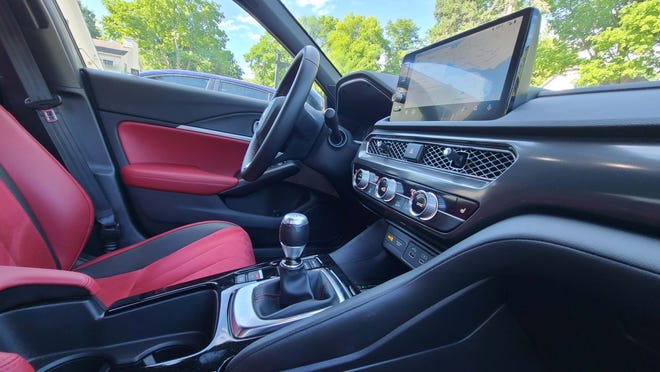
Sean immediately came to terms with the shifter (one of the best in the business this side of a Porsche Cayman) and its sporty rev-matching, but she missed the original Integra’s playfulness.
The new Integra is 700 pounds heavier, after all, and accessorized to the gunwales with sound-deadening materials, digital gauges, wireless smartphone apps, and standard four-doors compared to her ol’ Integra coupe.
It also conforms to the 21st century stylebook, which means a shallow greenhouse — the better to show off the big 18-inch satin wheels and sculpted side-and-rocker panel stampings. This new Integra has a gym-toned bod compared to the boxy builds of the ’80s and ’90s.

No matter. To Sean, the Integra had lost its original, carefree character. Nostalgia is a powerful thing. Thus the risk of bringing back a legend.
I know the feeling, having recently driven my first love — the 1984 Volkswagen Rabbit (aka Golf) GTI. Like the Integra of its day, my ol’ GTI was light, airy, technically unsophisticated, yet alive with a bratty exhaust note.
How far we have come in 40 years. And that’s a key marketing challenge for the 2023 Integra.
Today, we have entry-level luxury hellions unheard of in the ’90s. There’s the aforementioned whip-quick Cadillac CT4. And Mercedes CLA. And BMW 2-series. And Audi A4.

That’s a tough competitive brand set, and Acura competes with value, value, value. Load my sporty A-Spec-trimmed tester with all the goodies — head-up display, red-leather-Alcantara seats, 18-inch wheels — and it clocks in at $37,395, a whopping $7,200 grand south of a comparable Cadillac CT4 Sport at $44.6K.
Sure, the Caddy has rear-wheel drive, but the Integra has a stick. Nice.
But look in the rear-view mirror and the vehicles stalking my Integra are mainstream makes like the $35,390 Mazda3 Turbo and $39,385 VW Golf GTI — cars that are superior to Integra in performance, on par in tech.
Maybe it was always thus. A look back at enthusiast magazine Car and Driver’s 1992 archives finds Integra taking on seven other pocket rockets like the Eagle Talon TSi and VW Corrado in a comparison review.
“The Integra GS-R is not a hard-edged, seriously sporting car — its suspension is tailored for a forgiving ride, and the chassis delivers just 0.79 g of grip (both of which contributed to the car’s seventh-place showing around the racetrack),” wrote Car and Driver back then. “But, in typical Honda fashion, it does nearly everything well at a reasonable … price.”
Sounds like our Integra all right. It came in third overall.
I would rate it the same for the 2023 model. Get the hot-looking Integra because it wears better duds than a Civic Si, but it’s no hotter looking than the sculpted GTI or gorgeous Mazda3 hatches I’ve recently driven. Crucially, under the skin, Integra brings the same dynamics as the Civic Si: same 1.5-liter turbo-4, same electronics, same screens.
The Golf GTI and Mazda 3 bring similar value, only better. The Mazda3 boasts an interior on par with a Mercedes, for goodness sake. The Mazda3 also brings standard all-wheel drive (which will woo all-season Michiganians) and a blistering 250 horsepower and 310 pound-feet of torque that will out-drag the Integra to 60 mph by a half-second.
Enter Golf GTI, which goes to the top of the class with a sweet manual, 241 horses from a growly 2.0-liter turbo-4, and moves to match the athletic Integra. Want more? There’s the ridiculous, 310-horse, all-wheel-drive Golf R at $45K.
Which begs the question: Will we get more from Integra?
I’m betting yes — both to compete against the Golf R, as well as up-trim luxury cyborgs like the Audi RS3 and BMW M2 and Mercedes CLA AMG 45. We’ll see what else Acura has in its toybox.
In the meantime, the base Integra is finally back. It may not be at the top of its class, but it’s a welcome dose of nostalgia for the Acura club.
2023 Acura Integra
Vehicle type: Front-engine, front-wheel-drive, five-passenger sports sedan
Price: $33,895, including $1,095 destination fee ($37,395 as tested)
Powerplant: 1.5-liter turbo-4 cylinder
Power: 200 horsepower, 192 pound-feet of torque
Transmission: 6-speed manual or continuously-variable automatic
Performance: 0-60 mph, 7.0 seconds (Car and Driver). Top speed, 135 mph
Weight: 3,062 pounds
Fuel economy: EPA, 26 mpg city/36 highway/30 combined
Report card
Highs: Fun-to-drive hatchback; Acura value compared to other premium brands
Lows: Engine lacks Acura thrills; lacks value compared to other mainstream hot hatches
Overall: 3 stars
Henry Payne is auto critic for The Detroit News. Find him at hpayne@detroitnews.com or Twitter @HenryEPayne.
Class of ’96: The new Dream Cruise classics
Posted by Talbot Payne on August 22, 2022
Like a high school class reunion on wheels, the Woodward Dream Cruise celebrates not just our adolescent car fantasies, but decades of auto design.
Each year we honor the 26th reunion class in particular as new classics that can wear historic plates (in Michigan 26, not 25, is antique). For aging gracefully, the state rewards you with plates costing just $30 every decade provided you — class, listen closely — only exercise the vehicles sparingly. August excepted, of course, so that you can cruise your pride and joy anywhere you want and reminisce about 1996’s highlights: Braveheart’s Oscar, the Atlanta Olympics, the Colorado Avalanche’s Stanley Cup (boo, hiss).
Here are the highlights from the Class of ’96.

Dodge Viper SR II
Raw and rowdy, the 1992 Dodge Viper roadster was a sensation. The second-generation 1996 car refined the formula. Moving the leg-scalding exhaust pipes from the rocker panels to the rear of the car, SR II also gained a stiffer chassis and a GTS coupe model (to die for in blue with double-white stripes). Oh, and the earth-shaking, Lamborghini-tuned 8.0-liter V-10 RAM engine got a horsepower bump to 450 ponies.
GTS also has a more civilized interior that won’t bake you to a crisp, power windows, air bags and door handles to access it. Car and Driver clocked sub-4 second 0-60 sprints, making Viper one of the decade’s quickest cars.

Dodge Stealth
While Viper Part 2 was winning accolades, Dodge ended Stealth production the same year. Made in Japan alongside the similar, more popular Mitsubishi 3000GT, the fun sports cars shared a V-6 mill with a high-output, twin-turbocharged version pumping out 320 horses. Stealth came in multiple trims — and even optioned all-wheel drive. The Dodge got off on the wrong foot back in ’91 when it was scheduled as the Indy 500 pace car — then boycotted by the UAW because of its Japanese origin (a Viper prototype took its place). Rick Mears received a Stealth for winning the race anyway.

Chevy Corvette C4 Grand Sport
Chevy’s fourth-generation sports car ended its 1983-96 production run with a $43K performance Grand Sport — the first GS since the legendary ’63 race car piloted by Roger Penske (among others). Just 1,000 Grands were produced (810 coupes, 190 convertibles) dressed in Admiral Blue with a white stripe down the middle, 330 horsepower and signature twin red hash marks over the left front fender.

Chevy Camaro Z28 SS
This was the era of the sloped-nose, scalloped-headlight F-body Camaro (the chassis shared with sibling Firebird, though the Pontiac had retractable lights). The base ‘Maro offered two V-6 engines and a V-8 upgrade making 275 horsepower. For ’96, Chevy partnered with Street Legal Performance in New Jersey to produce the model line’s Alpha Dog: a ferocious, V8-powered Z28 SS that, for one year, united the legendary Z28 and SS badges.
It’s a rare bird for a lot of reasons (though it should be noted that its 305 ponies is, um, less than a 2023 Chevy Blazer RS). Just 2,263 Z28 SS models were built (264 of them convertibles) loaded with toys like Torsen differential and Hurst six-speed.
“When SLP received approval from Chevrolet in 1996 to offer the … Camaro Z28 model, it marked the re-introduction of the SS nameplate after a 24-year absence,” wrote SLP President Ed Hamburger in a press release. “The Camaro SS instantly became the new benchmark in affordable performance.”

Ford Mustang GT
After the 4th-gen ‘Stang debuted in 1994 with major chassis and styling revisions, the ’96 GT showcased a new 215-horse, single-overhead-cam 4.6-liter V-8, replacing the old nail, 30-year-old 5.0-liter pushrod V-8.

BMW Z3
Assembled in Greer, South Carolina, the Z3 roadster was the first BMW manufactured outside of Germany. First models were powered by a 1.9-liter 4-banger producing 130 horsepower, or about the same as a more affordable Mazda Miata.
Nevertheless, Z3 was hailed for its athletic handling and later models (including the inevitable Z3 M performance beast) would be available with more powerful inline-6 cylinder engines. It’s a topless sports car that can be enjoyed on Woodward or twisty M-32 Up North.

Lotus Elise
This legendary Brit was introduced in ’96, but didn’t wash up on our shores until 2005. Thanks to the sunset of federal safety regs 25 years after production, the original Elise is now legal here. What a treat it is.
You thought the Z3’s engine was small? Elise’s 1.8-liter 4-cylinder packs just 118 horsepower — but at just 1,600 pounds, the aluminum-frame Elise weighs the same as an IndyCar. With fiberglass body, sultry looks and no-frills interior, it became the best-selling Lotus ever.

Ford Taurus/Mercury Sable
America’s best-selling car at the time, the third-gen $18,000 Taurus (and sibling Sable) was introduced in ’96 in sedan and station wagon trims with different styling than its predecessors. Still aerodynamic, Taurus looked to stand apart by taking the company’s Blue Oval logo and making it a theme across the car — oval headlights, oval grille, even an oval rear window.
The interior was also reimagined with (naturally) an oval-shaped console with front bucket seats standard. The Payne family enjoyed their wagon (despite rust issues), but the design proved polarizing, and in 1997 Taurus lost its sales crown to the Toyota Camry.

Honda Civic
Though my favorite trim, the sporty manual Si, wouldn’t debut until 1999, the sixth-generation, 1996 Civic offered good bones to build on. It featured a sippy, 106-horse, 4-banger engine mated to a CVT transmission as well as an intuitive manual box.
Inside, Civic was roomy for its class, though its amenities pale to today’s electronics. Standard adaptive cruise control? Apple CarPlay and Android Auto? Backup camera? Fuhgeddaboudit. The base CX three-door hatchback not only lacked those basic features found on today’s compact, but it had no radio, no power steering, and came with with 13-inch wheels. Price? Just under 11 grand.

Nissan 300ZX
Maybe the best-looking Z outside of the original 1970 240Z — and the current, 2023 inspired by the same — the ’96 300ZX would be the last Z sold in the U.S. until 2002 as Nissan corporate struggled to find itself.
Powerful and athletic, 300ZX offered a 222-horse V-6 and a 300-horse, twin-turbo option with an adjustable suspension, depending on your mood. “It will be a black day when the last Nissan 300ZX is shipped to America,” wrote enthusiast publication Car and Driver when it named Z to its 10 Best Cars list.
Henry Payne is auto critic for The Detroit News. Find him at hpayne@detroitnews.com or Twitter @HenryEPayne.
Payne: 5 things about the loud, lurid, ‘lectric Dodge Charger Daytona
Posted by Talbot Payne on August 22, 2022
Pontiac — It’s That ’70s Show again with the federal government on the warpath to eliminate V-8s, gas-guzzlers and fun. But the fun-lovin’ Dodge brand wants to stay a step ahead of the killjoys.
“It’s like if they decided to ban cows — but 5% of the population is vegetarian and the rest still wanted beef. The meat industry would figure it out, they’d make Impossible Burgers and other stuff,” said Dodge CEO Tim Kuniskis in an interview ahead of the reveal of his brand’s first electric car. “Same for the auto industry, we’ll figure it out. We’ve seen this type of upheaval before in 1972, but this time we were warned the regulations were coming.”
Dodge is bringing a lot of meat to the EV table.

The ferocious, all-electric Charger Daytona SRT Concept is the first look at Dodge EVs that will replace the iconic V-8-powered Challenger and Charger muscle cars when they go extinct in 2024. With menacing, retro-1960s style, a V-8 soundtrack and a Banshee logo aft of the front fender where a Hellcat used to be, the Charger Daytona SRT intends to electrify the EV era.
“If the world is going (electric),” said Kuniskis, “then it’s got to look like a Dodge, sound like a Dodge and drive like a Dodge.”
Here are five notable things about the concept:
1) The sound. Yes, this EV makes noise. A lot of noise. The same insane, 126 decibels of V-8 sound as a 6.2-liter supercharged V-8 Hellcat engine. Dodge achieves this feat using a patented system called the Fratzonic Chambered Exhaust.
It’s basically a pipe organ hanging under the rear bumper that uses air and valves to create a sci-fi V-8 bellow. Under the Chrysler design dome in Auburn Hills before some media guests, Dodge revved the concept car like a Hellcat. BRAAAP, BRAAAP, BRAAAP.

“We worked for a long time to get that sound right, because we wanted a sound that was fresh, new and modern. We also wanted something that made you feel comfortable,” said Kuniskis. “The secret sauce in that sound — although it sounds like a new, modern thing — is it is (he knocks on the table) the firing order of a V-8 engine.”
Nail the throttle and Kuniskis says its multi-speed, electro-mechanical transmission – dubbed eRupt – will upshift like a V-8, too. How many shifts? “We’re still working on that. More than two.”
2) Daytona, Romberg & R-wing. Like Corvette Stingray or Porsche GTS, Charger Daytona is a special name in the Dodge lexicon. It’s not thrown around casually.
The brand’s first EV is called the Dodge Daytona in homage to the legendary, sleek, late 1960s NASCAR that dominated the sport as the first stock car to hit 200 mph (ultimately evolving into the 1970 Plymouth Superbird). Just 500 production versions were ordered (for homologation purposes) with copies selling for $1.5 million at auction today. Interestingly, the EV adopts an open-frame version of the brooding, horizontal grille of the standard ‘68 Charger – with the Daytona’s signature, sloped aerodynamic nosecone design slipped in behind the opening to suck the car to the ground – creating a low drag co-efficient that made the NASCAR so fast.

“The car we always wanted to redo was the 1968 Charger, arguably the most iconic muscle car ever,” said Kuniskis. “But that was going to be a brick. We were going to need a 150 kWh battery (which would cost) $15,000 . . . and that’s not going to be price competitive. So let’s put Gary Romberg’s nose on it. It’s got to look like a melted jelly bean to make the aero guys happy, but it’s got to look like a muscle car. So he built the wing over it so now it looks like a proper muscle car, but hidden in it.”

Dodge dubbed the design the R-wing after Romberg, the NASA-trained engineer brought over to work on Charger from Dodge’s then-aerospace division. Rear of the sleek nose, the coke-bottle body echoes the original with muscular hips and a fast back. The ’69 Charger Daytona’s high wing is conspicuously missing.
“Didn’t need it,” smiled Kuniskis.
3) It’s a hatchback. Past Chargers (including the winged Daytona) all came with rear trunks. But in the SUV age, Dodge is determined to offer its new halo car with a touch of ute utility. Thus a sportback found on other premium cars like the Audi A7 and Kia Stinger.
“People buy SUVs because they have a command-of-the-road, higher-seating position, all-weather capability, and increased utility,” said Kuniskis. “We can’t give you command of the road because I’m going to build a muscle car. . . but I’m gonna’ get a plus on its looks because its bad-ass, so I think I’m neutral there. And we’re going to the hatch. It’s huge. When that hatch goes up and the seats fold, you have SUV utility (back) there.”

The EV concept has bucket seats in the rear. It’s a concept thing. The real car will have a bench rear seat for proper fold-down cargo utility.
4) All-wheel-drive. The other piece of SUV utility that Charger Daytona brings is all-wheel-drive. Every version of the EV will have power at all four corners — a departure from past Chargers that were rear-wheel-drive, save the last-gen, AWD V-6 engine offering.
“I’m going to give you full-time AWD on all of my cars no matter what it is so I have all-weather capability,” said Dodge’s boss.

AWD capability means front and rear electric motors, which will help — not only in Michigan’s four seasons — but channel the massive torque coming from Charger Daytona’s big battery.
How much power? Kuniskis is mum. But expect it to be close to the 100 kWh found in the Tesla Model S Plaid or 93 kWh unit in the Porsche Taycan.
5) The 400/800 kWh skateboard. Sitting on an all-new skateboard battery platform with up to 800-volt, fast-charge capability like Taycan or Genesis GV60, the Charger EV won’t have an engine up front. Dodge designers use that space for the aerodynamic R-wing — not a frunk (front trunk) like Tesla or Taycan.

With the battery slung low for a low center of gravity and the aerodynamics working top-side, the big Dodge’s handling should impress.
The wild card is whether Dodge’s “Brotherhood of Muscle” will accept the manufactured V-8 sound and battery range limitations. At Roadkill Nights — the legal Woodward drag racing sponsored by Dodge over the weekend here — the faithful were skeptical, taking a wait-and-see attitude.

Whatever their opinion, the Charger Daytona will likely be the most talked about new EV this year. Just like this fun-lovin’ brand wanted.
Henry Payne is auto critic for The Detroit News. Find him at hpayne@detroitnews.com or Twitter @HenryEPayne.
Chevy wraps the Silverado ZR2 pickup in Bison armor
Posted by Talbot Payne on August 17, 2022
Bison are getting bigger.
Learning from little brother Chevy Colorado, the full-size Silverado pickup is gaining yet another rugged off-road trim: the ZR2 Bison that’s been popular on the midsize pickup since its 2019 model year introduction. Topping the Silverado Trail Boss and ZR2 off-road models, Bison takes the unique suspension, tires and style of the ZR2 — then straps on battle armor.
Chevy partnered with acclaimed aftermarket builder American Expedition Vehicles to equip Bison with rocker protection, unique skid plates and custom front bumper — continuing a partnership that began with the Colorado ZR2 Bison.
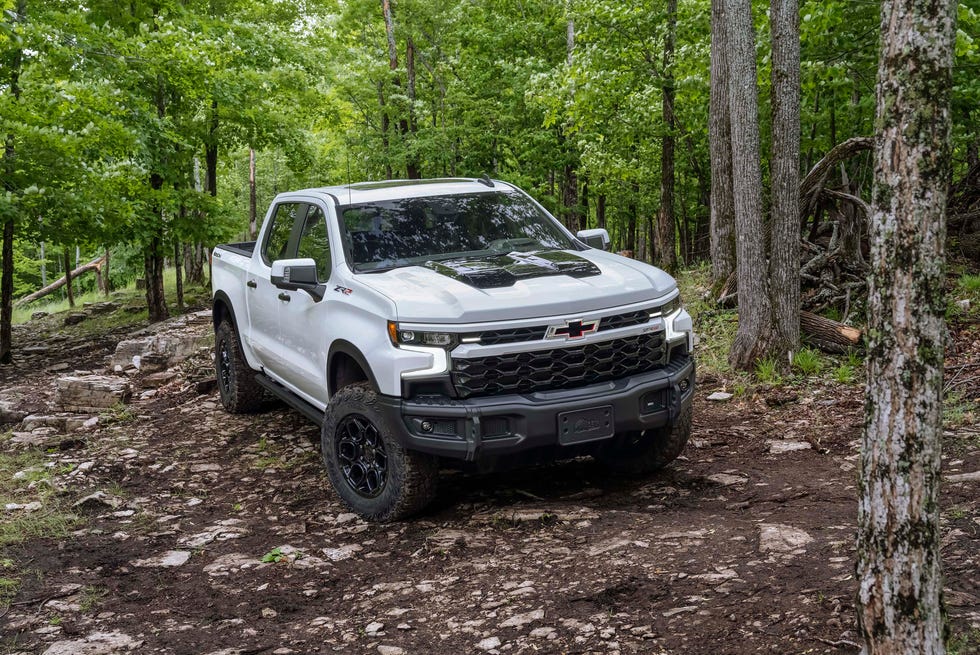
In other Silverado news for the 2023 model year, the pickup’s 3.0-liter, inline-6 cylinder turbo-diesel Duramax engine — though not available in the ZR2 or Bison — gets a 10% increase in grunt to 305 horsepower, with torque increasing 7.6% to 495 pound-feet.
“The Silverado ZR2 Bison is the ultimate half-ton truck for back country adventures,” said AEV CEO Dave Harriton. “It checks all the boxes — robust stamped steel bumpers, complete underbody protection, factory-tuned off-road suspension, and locking differentials front and rear.”
The midsize Colorado also pioneered the ZR2 off-road package that Silverado adopted in 2022. While the Silverado ZR2 did not reach for the super-truck heights of the Ford F-150 Raptor R and Ram 1500 TRX with a special engine, it made significant off-road upgrades like spool-valve Multimatic dampers and front/rear locking differentials to offer a broad bandwidth of low-speed canyon crawling and higher-speed trail runs. Silverado Bison starts with the ZR2 model’s 420-horse, 6.2-liter V-8 engine and off-road tools like Terrain Mode, which allows one-pedal driving.

The Bison elevates the ZR2 for the serious overlander. It also elevates the price to $78,490 (including destination fee) when the vehicle goes into production in early 2023.
The pickup adds another item to Silverado’s menu to feed the market’s insatiable appetite for trucks — a market the Detroit Three dominate. As manufacturers face an uncertain future of building electric vehicles, trucks like the ZR2 Bison add needed profit margin.
“Our most recent collaboration with AEV resulted in the much-acclaimed Colorado ZR2 Bison. We’re thrilled to team up again to bring customers Chevrolet’s next chapter of off-road dominance, this time on Silverado,” said Chevy VP Scott Bell.
Compared to the ‘22 Silverado ZR2, Bison improves the front approach angle to an estimated 32.5 degrees (compared to ZR2’s 31.8 degrees) and departure angle to an estimated 23.4 degrees (compared to 23.3 degrees), while still sharing the same 11.2-inch ground clearance.

To tackle tortuous terrain, front/rear bumpers are constructed of AEV-stamped, 3-millimeter-thick steel, then powdered and e-coated. Silverado Bison’s front bumper is winch-capable. The vehicle’s underbelly is protected by five unique hot-stamped boron steel skid plates to protect vulnerable components like differentials, transfer case and fuel tank.
Other standard items include steel rocker panel protection, three-piece steel front bumper with tow hooks, and gnarly 33-inch Goodyear Wrangler Territory tires.

You’ll know the Silverado ZR2 Bison by its body-color grille bar that bisects the prominent black grille just below the Chevy “flow tie.” Out back, the standard Multi-Flex tailgate gets a black matte finish.
In a nod to Chevy’s collaboration with AEV, there are little Easter eggs throughout the truck, like an AEV badge featured on the seat headrests and all-weather floor liners.

The Silverado’s Duramax diesel — available in the Custom Trail Boss, LT, RST, LT Trail Boss, LTZ and High Country models — gets its added punch from upgrades including revised steel pistons and new fuel injectors.
“These improvements to the popular diesel Duramax build on the already advanced design of the first-generation engine,” said John Barta, assistant chief engineer for diesels mills, to deliver to “customers outstanding fuel economy and quiet power.”
Like the V-8, it’s paired with GM’s 10-speed transmission and will be available by year’s end.
Henry Payne is auto critic for The Detroit News. Find him at hpayne@detroitnews.com or Twitter @HenryEPayne.
Six days of cruisin’: What to look for as the Woodward Dream Cruise kicks into high gear
Posted by Talbot Payne on August 17, 2022
Bloomfield Hills — Dream Cruise week started rolling Monday as cruisers were already lining Woodward Avenue with their hoods up and lawn chair legs down.
Culminating in the 27th official Woodward Dream Cruise on Saturday, the auto-palooza will have it all, from hot rods to Oscar Mayer hot dog cars and gas guzzling V8s to Dodge’s first electron-guzzling, electric muscle car. There will be car shows and car parades and Fords and Chevys. With Mother Nature promising sunny, low-80s, Pure Michigan days, an expected 1.5 million people and 40,000 classic cars will descend on a 16-mile stretch of southeast Michigan’s most famous street from Ferndale to Pontiac.

Tom Geloneck, 78, was at the corner of Square Lake and Woodward at 7:30 a.m. with the hood up on his gorgeous 1964 Pontiac Grand Prix stuffed with a three-carb, 427-cubic-inch V8 with four on the floor.
He and his St. Clair Shores posse have been cruisin’ since the inaugural 1995 event. Well, his pal Terry King, 71, of Chesterfield may have missed one.
“I missed 1996 because my daughter got married on that Saturday,” smiled the owner of a yellow 1973 Camaro Z28 with a wicked, 383-cube V-8 under the bonnet. “I don’t know how she thought that was a good weekend.”

A little over a mile north of Square Lake in Pontiac, Dodge has taken over the M1 Concourse Event Center to introduce “Speed Week” — a showcase for its new vehicle lineup.
Monday night, Stellantis NV’s performance brand announced plans to wind down production of two of the Cruise’s most revered muscle cars — the V8-powered Challenger coupe and Charger sedan — which will end production in late 2023. On Tuesday, the brand will roll out a new Hornet SUV, followed by Wednesday’s historic debut of Dodge’s first electric muscle car.
The Electric Age promises to be a controversial topic on the Woodward strip, where V8s are king.
“I’ll never own an EV,” said Martin Peters, 66, another member of the St. Clair Shores group who drove his V8-powered 1956 Chevy Nomad to Woodward on Monday. “I just bought a 2019 Ford Flex. If I bought a Ford Mustang, it wouldn’t be an electric Mach-E — it would be a real one with a V8 in it.”
Further down Woodward in a parking lot next to Royal Oak’s abandoned Art Van furniture store, Christina Kowalenko, 54, of Troy said electric cars leave her cold. “Our electric grid can’t handle what we have now,” said the car fan who has been coming to the Cruise since 1995. “They’re inconvenient to charge on the road, and it’s expensive to put a charging station in your house.”

More her speed is the striking red 1968 Dodge Dart GTS convertible she parked on Woodward. Daren Borza, 57, from Warren parked his topless ’69 Plymouth Barracuda next to Kowalenko’s steed.
A dealer of Mopar parts with Mancini Racing, Borza is intrigued by electric power but skeptical that EVs will be more than a niche vehicle even as governments try to regulate internal combustion engines out of existence over the next decade.
Speaking of regulation, the convertible pair were among the few Cruisers parked in Royal Oak — notorious among the Dream Cruise’s nine jurisdictions for its heavy-handed permitting during Cruise week. Come Saturday, the epicenter of the Cruise will be Memorial Park at 13 Mile and Woodward — its grassy lawn littered with car clubs.

But this Monday it is quiet — as is the dealership on its north flank, which will house Chevrolet’s latest cars and trucks on Saturday. As the Woodward traffic jam grows, Ford will set up shop Saturday in Royal Oak at Kruse & Muer at the corner of Woodward and Catalpa — filling the restaurant’s parking lot with its latest hardware. Ford has made news here in the past with Mustang dragsters and Bronco off-road racers, but this year is expected to bring a lower profile.
“We avoid Royal Oak,” said Chesterfield’s King, though he admits Cruisers in general are better-behaved since the early days. “One year I hooked up a hose to a donut shop in Royal Oak so cars could do burnouts. I felt a tap on the shoulder and a police officer said I better put the hose away unless I wanted to pay for new asphalt.”

When Dodge is done with its product unveils at M1, the car club will put on its own event Friday. The 2nd annual Woodward Dream Show Presented by Comerica Bank will show off the “best of the best” cruise cars, including the debut of a modified ’66 Lincoln Coupe by revered Detroit body-shop Mobsteel to celebrate the brand’s 100th birthday.
The 87-acre facility has become a focus of car enthusiasts since its opening in 2016. The Dream Show is an event within the Cruise event with live music, 1,000 shaded seats and free admission for kids.
The Dream Show boasts more than 600 jaw-dropping cars in 13 juried classes. In addition to the Mobsteel reveal, Dream Show attractions include rides around Champion Motor Speedway, a historic Hudson Hornet, 1970 Challenger Black Ghost, 50 copies of the 1932 Ford “Deuce” on its 90th anniversary, and 100 Corvettes.
If that’s not enough Corvettes for you, then come out to Woodward at 7 p.m. Wednesday, when more than 500 samples of Chevy’s iconic muscle car will roll out of Birmingham’s Doubletree Hotel parking lot and tour the strip for the Woodward Drive2EndHunger.
“It’s quite a sight. Over 500 Corvettes from all eight generations rolling down Woodward,” said Ken Lingenfelter of Lingenfelter Engineering, who helps sponsor the event.
Kicking off three days of Metro Detroit festivities, the Corvette gathering supports the Open Hands Food Pantry in Royal Oak — the terminus of Wednesday’s Corvette parade.
Official Dream Cruise events kick off Friday in Ferndale with a 5 p.m. ribbon cutting, Emergency Vehicle Show and Light ‘n’ Sirens Cruise. Ferndale is anchored by Mustang Alley, the Cruise’s largest car show featuring every generation of the iconic pony car — and its Mach-E EV stablemate.
Other community events along the strip include a Berkley classic car parade and Pontiac Classic Car Show in Pontiac on Friday, then a Saturday Ford Bronco Show in Pleasant Ridge. Find more information at the Dream Cruise’s official website: http://www.woodwarddreamcruise.com.
Henry Payne is auto critic for The Detroit News. Find him at hpayne@detroitnews.com or Twitter @HenryEPayne.
Roadkill Nights: Taylor defends Grudge Match crown, hot rods shine, pickups roar
Posted by Talbot Payne on August 17, 2022
Pontiac – Roadkill’s centerpiece Dodge Direct Connection Grudge Match was everything it was cracked up to with thrills, spills, and upsets.
But in the end, the favorite kept her crown for the second year in a row.
Defending champ Alex Taylor squared off against Westin Champlin is an intriguing showdown of opposites on Woodward Avenue. The diminutive lass from Arkansas versus the big “Redneck Science” driver from Kansas. Favorite versus underdog. 1955 Plymouth Savoy versus modern Dodge Challenger Hellcat. Tube-frame race car versus stock chassis with leather seats and AC. Shoulder-length hair might be the only thing the pair had in common.

But they put on a show for 40,000 fans that had descended on Detroit’s main street for a day of street legal racing in perfect drag racing conditions: an overcast, 65-degree August day that was hot enough for slicks to stick and cold enough for engines to breathe.
“To be able to come back and win was an intimidating task because I had a target on my back,” smiled Taylor, 25, afterwards. “To build a fast car like this in such a short time and win is a weight lifted off our shoulders.”

After taking practice runs earlier in the day, Taylor had to wait while the other eight competitors brawled for the opportunity to take on the queen. All nine racers had been given $10,000 and 30 days to build the race car of their choice as long as it was a Chrysler group product propelled by a 6.2-liter, supercharged Hellcat engine and 6-speed manual gearbox. The charismatic Champlin was a big underdog as he took on American Legends’ Tony Arme from Phoenix – the early favorite ina wicked-looking 1969 Barracuda complete with wheelie bar.
“Load up the nitrous!” yelled Champlin to his crew as he prepared for the shoot-out. Nitrous oxide boosted his horsepower from 1,000 to 1,250 – but the stress on the clutch meant that racers were careful on when to use it. Now was the time.
Champlin dusted Arme with a time of 5.35 seconds own the sticky southbound lanes at the corner of Woodward and South Boulevard.

Ricki Fernandez was next in his beautiful, red Dodge Viper – claimed to be the only Viper in the country with its stock, V-10 engine exchanged for a Hellcat V-8. No matter. The real Hellcat beat the Viper down the strip by a whisker, setting up the final match-up with Taylor.
“We made it a lot further than I thought we would,” roared Champlin as he emerged from his hellion.
The final would be no contest as Taylor’s Savoy hooked up immediately and rocketed down the 1/9 mile in just 5.09 seconds, leaving the Kansan behind at 5.6.
1,200-horsepower commuter coupe
In addition to the action on the track, the adjacent M1 Concourse infield showed off plenty of muscle car hardware in the Show ‘n’ Shine parade of cars.

Jake James, 33, drove his race-prepared, 2016 Challenger Scat Pak from Monroe – skinny front drag race tires and all – to take in the day’s festivities. And to support his man Champlin on the race course. James’ Leviathan Group does marketing for many of Roadkill’s YouTube racers.
James’ ride is no shrinking violet with turbo-boosted, 6.4 Hemi-V8. Cooled by a chiller located in the trunk, the Challenger makes a formidable 1,200 horsepower.
James recently tested at Milan Dragway – a legendary Michigan track dear to local racers’ hearts – that was recently left for dead. But under new ownership the track has been repaved and refurbished.
“It’s awesome,” said James.
Dragsters, Hellcats, hot rods … and pickups?
Dodge muscle cars are the stars at this weekend’s Woodward drag race-palooza, but sister-brand Ram is here for the first time with an off-road thrill-ride course to compliment the traditional, tire-squealing, rubber-burning Charger and Challenger Hellcat rides on M1 Concourse.

And why not? The Ram 1500 TRX (pronounced T-rex) is stuffed with same demonic, 700-horsepower-plus, 6.2-liter, supercharged V-8 as the as the muscle cars.
“The Ram ride might be better, because you get air,” said Nick Urhauser, 53, who came all the way from Chicago to see the spectacle with his son, Nicholas, 18.

The Ram ride hits two jumps – the second at about 40 mph that vaults the truck 30 feet down a dirt jump. The experience wowed young Urhauser, though he insists he’s still a car guy. Dad (a truck guy) has his eye on buying a TRX so that may change when Nicholas gets behind the wheel.
Judgin’ the Grudge
There was a lot of anticipation – and worry – before the Grudge Match as competitors agree that the course – and manual transmissions – were wildcards.
“The track is rough and peaked – with the peak sliding you into the right wall,” said Freddy Hernandez of the Tavarish YouTube Channel after a practice session down the Woodward’s southbound lanes. He was competing in a racer that is half-Dodge police car and half-pickup truck.

“The manual transmission is different, it’s unusual in a drag car these days,” said Herman Young of the Demonology YouTube Channel. “These high-horsepower engines are tough on clutch discs, and some competitors may limit their practice runs so they don’t blow up their clutch.”
Young competed in an ‘09 Dodge Challenger – hastily assembled starting with a raw, body-on-white along with build partner Jack Pennington.

“The track is rough and peaked — with the peak sliding you into the right wall,” said Freddy Hernandez of the Tavarish YouTube Channel after a practice session down the makeshift, 1/8-mile dragstrip in Woodward’s southbound lanes. He is competing in a racer that is half-Dodge police car and half-pickup truck.
“The manual transmission is different, it’s unusual in a drag car these days,” said Herman Young of the Demonology YouTube Channel. “These high-horsepower engines are tough on clutch discs, and some competitors may limit their practice runs so they don’t blow up their clutch.”

Young competed in a 2009 Dodge Challenger — hastily assembled starting with a raw, body-on-white along with build partner Jack Pennington.
Saturday fun day
That wasn’t an earthquake you felt this morning. It was dragsters on Woodward.
Roadkill Nights powered by Dodge kicked off at 11 a.m. with every Detroit motorhead’s dream: legal drag racing on public roads. Thousands of spectators gathered to watch 1,000-horsepower monsters dash down Detroit’s most storied street on a makeshift, 1/8-mile drag strip at the corner of Woodward and South Boulevard north of St. John’s hospital.

Shawn Fink, all the way from Casper, Wyoming in his bright orange,1955 Chevy Bel-Air drag racer staged as one of the first down the strip. The bright-orange beast sported a 526 cubic-inch, hemi-head Chevy engine under the hood. He recently won Sick Week in Florida, a tour of multiple Sunshine State dragways.
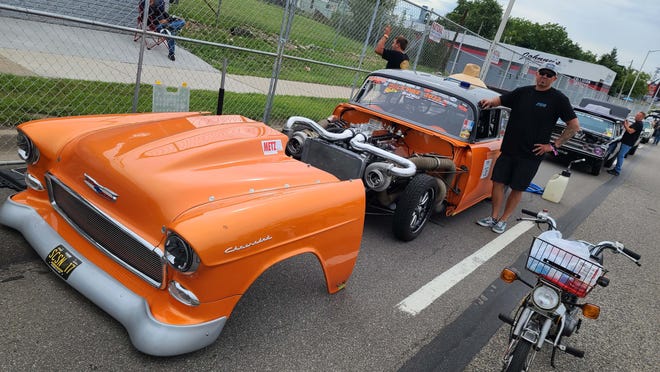
“We’re on the road a lot,” said Fink, flanked by his son who helps him crew. “You have to travel to a lot race tracks in street racing.”
When the fans weren’t enjoying Woodward drag races, they were pouring into adjacent M1 Concourse for thrill rides around Champion Motor Speedway in 700-horsepower Dodge Hellcats.

EVENT INFO
Where:
M1 Concourse, 164 South Blvd. West, Pontiac
When:
Saturday 10 a.m.-9 p.m.
Schedule:
10 a.m. — Gates open to the public, event begins
Photo opportunities as muscle/vintage/classic cars enter M1 Concourse
Roadkill Nights Powered by Dodge event activities begin — Dodge Challenger and Charger SRT Hellcat thrill and drift rides, dyno testing, and Ram TRX Thrill Ride Experience off-road course
11 a.m. — Drag racing begins with open qualifying session (all drag racing can be viewed via livestream at DodgeGarage.com,Dodge.com,Dodge and MotorTrend YouTube channels)
4:45 p.m. — Dodge Direct Connection Grudge Races begin
5:45 p.m. — Top Eight shootout driver announcements
6:15 p.m. — Opening ceremony
6:30 p.m. — Top Eight shootouts begin (Small Tire & Big Tire)
8:30 p.m. — Top Eight winners’ awards ceremony
9 p.m. — Event concludes

Henry Payne is auto critic for The Detroit News. Find him at hpayne@detroitnews.com or Twitter @HenryEPayne.
Roadkill Nights: Dragsters light up Woodward for a day of thrills
Posted by Talbot Payne on August 13, 2022
Pontiac – That wasn’t an earthquake you felt this morning. It was dragsters on Woodward.
Motor Trend presents Roadkill Nights powered by Dodge kicked off at 11 a.m. with every Detroit motorhead’s dream: legal drag racing on public roads. Thousands of spectators flocked to watch 1,000-horsepower monsters dash down Detroit’s most storied street on a makeshift, 1/8-mile drag strip at the corner of Woodward and South Boulevard north of St. John’s hospital.
Shawn Fink, all the way from Casper, Wyoming, in his bright orange 1955 Chevy Bel-Air drag racer staged as one of the first down the strip. The beast sports a 526-cubic-inch, hemi-head Chevy engine under the hood. He recently won Sick Week in Florida, a tour of multiple Sunshine State dragways.
“We’re on the road a lot,” said Fink, flanked by his son who helps him crew. “You have to travel to a lot race tracks in street racing.”
The events really kick into high gear late Saturday afternoon when the Dodge Direct Connection Grudge Races are held. A diverse group of seven hot rods – including a Dodge Viper, Dodge station wagon, and a police car – are entered, all bearing common supercharged, 6.2-liter Dodge crate V-8s and manual six-speed transmissions.
Entered by mod shops from Tavarish to Demonology to Corruptt Builds, they will be seeking to dethrone last year’s Grudge champ, Alex Taylor in a rusted 1955 Plymouth Savoy sleeper-mobile.
Taylor and her Hot Rod Garage team built the 1,000-horsepower dragster in just 27 days using a tube frame and the original Savoy top hat. Only the front bumper is not an original part. Well, that and the beastly drivetrain underneath which benefits from a 10% supercharger overdrive and nitrous oxide fuel to produce 1,000 horsepower.
Taylor’s keys to victory?
“Traction, weight, horsepower, and my drag racing experience,” said the 25-year old pro drag racer who pilots a ’68 Camaro in the Unlimited class for her day job. Taylor has been racing since she was a 15-year old in Arkansas.
When the fans aren’t enjoying Woodward drag races, they are pouring into the adjacent M1 Concourse for thrill rides around Champion Motor Speedway in 700-horsepower Dodge Hellcats.
EVENT INFO
Where:
M1 Concourse, 164 South Blvd. West, Pontiac
When:
Saturday 10 a.m.-9 p.m.
Schedule:
10 a.m. — Gates open to the public, event begins
Photo opportunities as muscle/vintage/classic cars enter M1 Concourse
Roadkill Nights Powered by Dodge event activities begin — Dodge Challenger and Charger SRT Hellcat thrill and drift rides, dyno testing, and Ram TRX Thrill Ride Experience off-road course
11 a.m. — Drag racing begins with open qualifying session (all drag racing can be viewed via livestream at DodgeGarage.com,Dodge.com,Dodge and MotorTrend YouTube channels)
4:45 p.m. — Dodge Direct Connection Grudge Races begin
5:45 p.m. — Top Eight shootout driver announcements
6:15 p.m. — Opening ceremony
6:30 p.m. — Top Eight shootouts begin (Small Tire & Big Tire)
8:30 p.m. — Top Eight winners’ awards ceremony
9 p.m. — Event concludes
Henry Payne is auto critic for The Detroit News. Find him at hpayne@detroitnews.com or Twitter @HenryEPayne.
Get ready to rumble: Roadkill Nights street-legal drag racing takes over Woodward Saturday
Posted by Talbot Payne on August 13, 2022
Pontiac — Get out the ear plugs, pack up the children and get ready to rumble.
Woodward will shut down at the intersection of South Boulevard here on Saturday as street legal racing takes over Metro Detroit’s most famous street for the seventh annual MotorTrend Presents Roadkill Nights Powered by Dodge. Some of the country’s top, street-legal drag racers will descend on a makeshift, 1/8-mile strip of southbound Woodward in two classes — Small Tire, Big Tire — with the top eight shooting it out for victory as twilight descends.
The racing is part of a day-long celebration of car culture as Roadkill also takes over the adjacent M1 Concourse car club for thrill rides, hot-rod and trick-truck displays, dyno engine testing, food trucks, simulators, merchandise galore, and live entertainment.

Among the highlights will be the second annual Dodge Direct Connection Grudge Race as competitors face off in drag machines made from Dodge’s specialty parts bin. Last year’s Grudge Race winner, Alex Taylor, will defend her title from a snarling field of mod builders, including Tavarish, Westen Champlin, the Throtl team, Christina Roki, Demonology, Corruptt Builds, Collete Davis and David Patterson.
The thrill rides allow families to ride shotgun with professional drivers as they melt the rubber off muscle cars around M1 Concourse’s Champion Motor Speedway — and on M1’s skid pad. Available vehicles include 700-horsepower Dodge Challenger and Charger SRT Hellcats, Challenger Hellcat Redeye, Durango SRT Hellcat, and 375-horse Challenger R/T Shaker.
If dirt is your thing, then you can climb into the right-hand seat of the 702-horse Ram 1500 TRX (pronounced T-rex) monster on a specially-made off-road course.
Roadkill MotorTrend TV personalities David Freiburger and Mike Finnegan will host the event along with Dodge Chief Donut Maker Preston Patterson, who won a one-year crown as the ultimate Dodge brand ambassador. Other motorhead celebs on hand include Steve Dulcich, David Newbern, Mike Cotten, Lucky Costa, Cristy Lee, Steve Magnante, and KJ Jones.
When not waiting in line for thrill rides (they get long), attendees can enter the Hellcat Simulators to digitally pilot the Dodge supercar down a quarter-mile of pixels.
“If you’ve ever dreamed of watching street-legal drag racing down Woodward Avenue, come to our event,” said MotorTrend Group revenue chief Eric Schwab. “Whether you’re a drag racer, car enthusiast or just looking for a fun day to spend with family, Roadkill Nights promises a dynamic experience.”
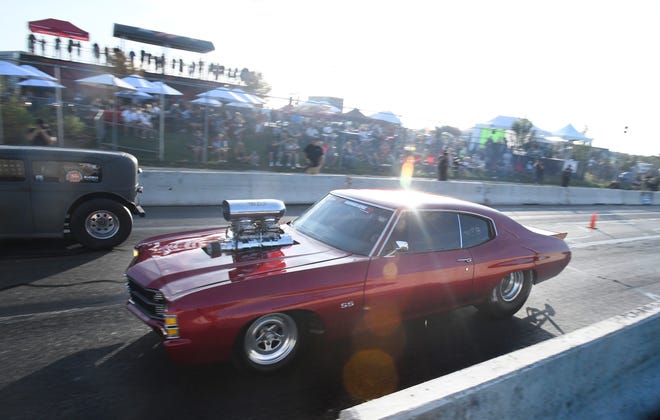
Drag racing likes cool temps (for better engine breathing) and dry conditions (for slick tire grip), and the mid-70s weather forecast delivers on half that promise. Rain, however, may be an unwelcome visitor late in the day according to Accuweather.
General admission tickets are $25, reserved seating is $60 for adult, $25 for children. Fans can also follow the action live at www.dodgegarage.com/roadkill-nights-2022 — or on social media channels with hashtags #RoadkillNights and #PoweredByDodge.
M1 Concourse, 164 South Blvd. West, Pontiac
When:
Saturday, Aug. 13, 10 a.m.-9 p.m.
Schedule:
10 a.m. — Gates open to the public, event begins
Photo opportunities as muscle/vintage/classic cars enter M1 Concourse
Roadkill Nights Powered by Dodge event activities begin — Dodge Challenger and Charger SRT Hellcat thrill and drift rides, dyno testing, and Ram TRX Thrill Ride Experience off-road course
11 a.m. — Drag racing begins with open qualifying session (all drag racing can be viewed via livestream at DodgeGarage.com,Dodge.com,Dodge and MotorTrend YouTube channels)
4:45 p.m. — Dodge Direct Connection Grudge Races begin
5:45 p.m. — Top Eight shootout driver announcements
6:15 p.m. — Opening ceremony
6:30 p.m. — Top Eight shootouts begin (Small Tire & Big Tire)
8:30 p.m. — Top Eight winners’ awards ceremony
9 p.m. — Event concludes
Henry Payne is auto critic for The Detroit News. Find him at hpayne@detroitnews.com or Twitter @HenryEPayne.
With video: ‘High and wide’ GMC Canyon gets remake, rugged AT4X model
Posted by Talbot Payne on August 13, 2022
Detroit — The GMC Canyon is hitting the trail in fresh duds for 2023.
General Motors’ premium midsize truck gains a longer wheelbase, new engine and more rugged attitude with an all-new, AT4X off-road trim. The upgrades mirror those found on its twin Chevy Colorado pickup (with which the Canyon shares a ladder-frame platform), but the Canyon steps up the swagger with more tools, more interior décor and a range-topping Denali tuxedo trim.

The Denali dresses up with a fancy chrome grille, 20-inch rims, and quilted seats for a night out at the country club. But it’s AT4X that really sets the tone for Canyon’s “high and wide” theme. The Canyon is wider, higher — and higher priced — than the previous model with the entry Elevation model starting at about $40,000 (compared to the previous generation’s $32,200) and the AT4X stickering at $63,350.
The previous generation Canyon’s off-road AT4 trim rode in the shadow of Colorado’s tree-chewing ZR2 off-roader that brought Multimatic shocks, twin-locking differentials and gnarly Goodyear Wrangler all-terrain rubber.
“GMC is flexing the might of our off-road muscle,” said GMC Global Vice President Duncan Aldred of the AT4X trim that first dressed the Sierra full-size pickup.

For 2023, AT4X catches up with Chevy’s ZR2 offering on all counts — then adds a standard front winch for when you get too deep in the mud. Integrated into the front bumper with a front bash and light bar, the COMEUP winch leads a comprehensive re-imagining of Canyon design. The grille is a departure from the traditional, chrome-framed GMC design — the grille integrating with bodywork and standard LED headlights to emphasize the pickup’s 37-degree approach angle.
So focused is Canyon on off-road that even Denali ditches its front air dam. Denali emphasizes off-road toughness with its high chin and front bash plate. The AT4X has three skid plates in all to complement its 10.7-inch lift.
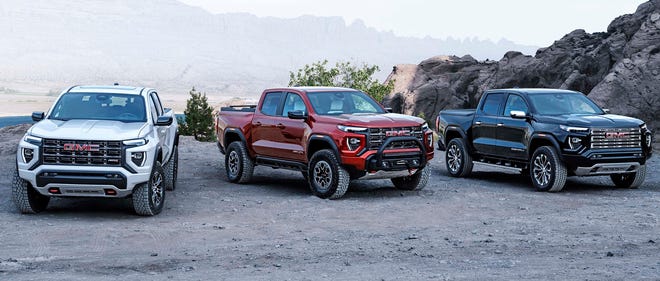
All four trims of Canyon — including the base Elevation and AT4 models — get a widened, 3.5-inch track over last year’s model for better off-road balance. The widened track is accentuated by big, blistered steel fenders on the Canyon for a muscular look. The fenders are highlighted by yellow lights — usually found on heavy-duty tow rigs — that allow drivers to better locate their fenders in the dark off road.
Vehicle width is complemented by Canyon’s 3.5-inch longer wheelbase to smooth the ride on-road.
“That extra length means that benefits the AT4X, with 33-inch all-terrain tires, to ride better on-road as well as off-road,” said Cory Taulbert, Canyon performance variant manager, at a media preview.

Like Colorado ZR2, the 33-inch Wrangler tires are augmented by Formula One-inspired Multimatic shocks that set AT4X apart. The capable suspension allows five dive modes: NORMAL, TOW/HAUL, OFF-ROAD, TERRAIN and BAJA. Terrain focuses on low-speed, one-pedal precision driving, while Baja armors the pickup for maximum off-road speed. To aid in extreme off-road conditions, the AT4X also offers up to 10 cameras, including self-cleaning, under-body lenses. Drivers benefit from a blizzard of off-road data, including g-force, altimeter and pitch/roll stats.
Ground clearance is standard on al trims at 9.6 inches with a further 1-inch lift for the AT4X on 33-inch tires. The regular AT4 trim gets 32s.

While off-road capability is the Canyon’s headliner, it also gets significant upgrades inside and out for daily chores. Bowing to customer preference, Canyon will only be available in Crew Cab with a 5.5-foot bed. An innovator in tailgate tech with the six-way Multi-Pro tailgate, GMC equips Canyon with a storage area in the rear tailgate that can be used for tools — even a cooler, complete with drain plug. The feature is shared with Colorado.
Befitting the truck’s off-road focus, a graphic of Telluride, Colorado’s peaked mountains and Moab, Utah’s sculpted sandstone is etched into the tailgate’s top.
Inside, Canyon addresses criticism that its interior design fell short of the Denali trim standards. “Therein lies our biggest complaint about the Canyon’s interior: even in Denali trim, it never feels like a premium environment,” wrote enthusiast magazine Car and Driver about the last-gen truck.

The new Canyon is a big step up. In addition to all-new 11-inch instrument cluster (8-inch on Elevation/AT4) and 11.3-inch infotainment digital displays that echo big brother GMC Sierra, Canyon gains a Google operating system, wireless Apple CarPlay/Android Auto, and premium dash-and-door materials. Head-up display and Bose audio come standard on AT4 trims.
Standard safety features include pedestrian detection, emergency braking and auto high beams. Additional packages include blind-spot assist and adaptive cruise control.
The rear seat did not benefit from the wheelbase’s 3.5-inch extension, so rear quarters remain tight for six-footers. But the interior gains a sunroof to let the sun shine in.
Propelling the new beast down the road is the same 2.7-liter turbo-4 found in the base GMC Sierra (as well as Colorado). The torquey turbo-4 has three configurations, with the AT4X boasting 310 horsepower and 430 pound-feet of torque. Some may miss last-gen’s diesel offering, though Taulbert says the turbo-4 actually producesd more torque.

“We applied complexity where it matters,” he said of the Canyon’s simplification of engines/cab while increasing available technology.
The GM pickup twins seek to raise the bar in a class where they are perennially No. 2 in sales behind the Toyota Tacoma. The ‘23 Canyon goes into production early next year with AT4X to follow in spring.
Henry Payne is auto critic for The Detroit News. Find him at hpayne@detroitnews.com or Twitter @HenryEPayne.
Payne: A Nissan Z worthy of the letter
Posted by Talbot Payne on August 11, 2022
Elmira — One of the first sports cars I rode shotgun in as a kid was the 1970 Datsun 240Z. On a race track. Red. Fat tires. Manual shifter. Inline 6-cylinder engine. Bubble headlights. Two-door fastback. Hood that went on forever. Ooooh, I loved that car. No generation of Z has measured up since.
Until now.
The redesigned seventh-generation Z sitting in my driveway is a stunner. Perhaps because it’s inspired by the original ’70. Red. Fat tires. Manual shifter. V-6 engine. Bubble headlights. Two-door fastback. Long hood. Like Mustang returning to its design roots with the fifth-gen 2005 pony car, the Z updates the original 240Z design for the 21st century. Since photos of the sleek “Z Proto” concept car first appeared in 2020, anticipation has run high, and the production car doesn’t disappoint. When I drove it north to Lake Charlevoix for a weekend, it turned heads wherever it went.
“Oh, I would definitely take that over the Supra,” said one male admirer, referring to Z’s Toyota arch-enemy and its polarizing nose.
“THAT is a gorgeous car,” said a female pal.
“Cool, looks like the original 240Z,” said a racing buddy.
Walk around the sleek coupe and it’s apparent why Nissan decided to call it simply Z. This is a car in search of its roots. “The original 240Z was built to bring the joy and excitement of sports car ownership,” says Nissan’s media materials. “That spirit and heritage continue today.”
Though it sits on the same ol’ chassis as the last-gen, Z reaches back to the lean looks of its famous ancestor. The design is simple, purposeful. The bubble headlight theme is repeated in the door handles and fuel door.
Nissan Z is more than a pretty dress.
Below decks is a modern interior strapped to a rocket of an engine. The old nail 3.7-liter V-6 has been tossed for a glorious twin-turbo, 3.0-liter mill putting out 400 horses and 350 pound feet of torque. That’s a gain of 20% and 30% respectively. Mmmm, Z-esty.

Pulling onto M-32 east of Elmira — my favorite northern, twisty road — I downshifted Z into third, then blitzed a series of S turns, emerging onto a short straightway with the six howling.
The twin turbos (assisted by a lightweight, carbon-fiber driveshaft) do their job, providing the engine with good low-end torque — but it doesn’t stop there. WHAP! The tach hits the 7,000 RPM redline before I can shift into fourth, pulling strong across the rev range. The V-6 roar encourages high revs even if it’s not as distinctive as other songbirds in its class: Camaro-Mustang-Corvette V8s, Supra inline-6, Porsche Cayman GTS flat-6.
Pushing hard along M-32, I’m aware this is a 3,536-pound sled. It lacks the knife-edge precision of the class standard, 3,200-pound Cayman GTS — but it also costs, ahem, $45K less. Handling is predictable with welcome push at the limit.
Returning home along M-32, a downpour swept in from Lake Michigan. Wet roads are tricky for rear-wheel-drive sports cars, but Z was unruffled. The electronics provided welcome stability even when I tried to fluster the car with excess throttle.
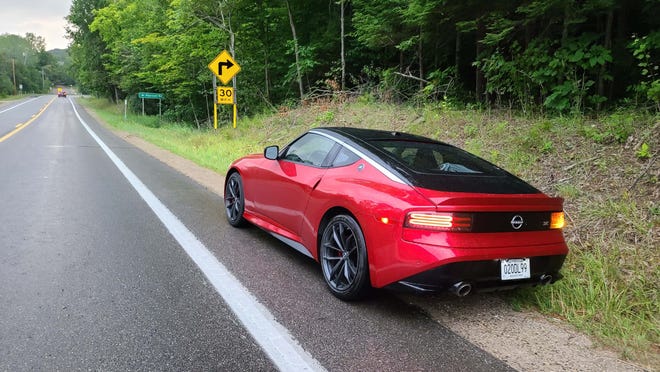
In dry conditions at M1 Concourse’s Champion Motor Speedway in Pontiac, Z’s neutral handling was an unexpected delight. It was poised through Turn 10’s difficult off-camber sweeper. But its Bridgestone Potenza S007 tires and brakes hold it back. Coming out of the Turn 5 hairpin onto the back straight, traction was limited, and after a few laps the brakes got squishy under hard braking.
Seems Nissan is holding something back for the rumored track-focused NISMO edition. Add Michigan Pilot Sport Cup 2s, Brembo brakes and stiffer shocks, and Z would make a fine track rat. For now, playful arch-rival Supra and Mustang Mach 1 (complete with adaptive dampers) have better track tools.

More problematic is my Performance model’s six-speed stick. In a coupe that loves to be rowed, the shifter felt rubbery, especially in crucial 3-to-4 shifts. Once again, Porsche sets the bar on manual shifters, but Z also pales next to an Acura Integra.
I’m a member of the #SaveTheManuals club, but in the case of the Z, the automatic with steering column-based paddle shifters is worth a look. On the plus side, the stick’s “S-Shift” button enabled rev-matching for flawless manual downshifts.
Not only does it sound bold, but S-Shift saves heel-and-toe shifting on busy tracks like M1. S-Shift is part of a unique set of carry-over controls from the last-gen Z like FORWARD/AFT buttons on the console side of the seat.

Clearing the squashed greenhouse on entry ain’t easy for us six-footers. That coupe looks cool on the outside, but inside it’s a pillbox with limited windshield space. Thank the mirror and front-facing camera behind it. C-pillar visibility? Fuhgeddaboudit. Happily, blind-spot assist is standard — in line with Nissan’s typically generous safety packages.
My reward, once folded inside, was a reworked interior with three dash-mounted classic analog pod gauges mixed with the latest digital display tech. I preferred the customizable SPORT setting that rotates the tachometer so the 7,000 RPM redline is in the 12 o’clock position.
The standard tech upgrades are good news for Z drivers who want to hit the road. On my long trip up I-75 to Charlevoix, Z’s standard adaptive cruise control (a rare feature for manuals) made for easy highway cruising. As did the seats — not a given in a class of sports car where heavily bolstered seats can eat your kidneys. My Performance model’s red leather and Alcantara seats (also available in blue) fit like a glove.
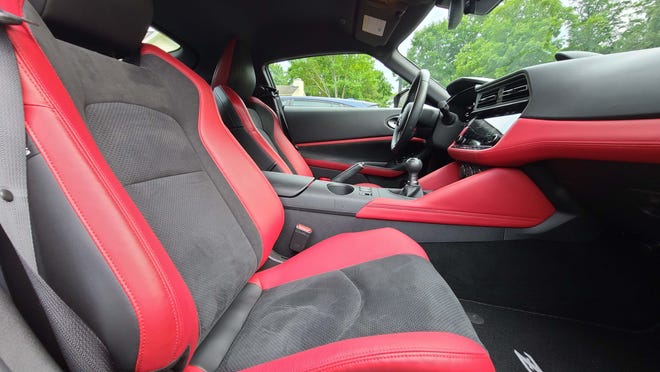
Some shoppers will regret the lack of a rear seat (which, even in cramped ’Stangs and Camaros welcome small passenger or luggage). But the rear hatchback is roomy and easily swallowed the baggage I needed for my trip north.
The rear of the car is as pleasing as the retro front with its twin pipes and blacked-out light bar punctuated by horizontal corner lights. That latter is another nod to the OG Datsun — and welcome improvement from the sixth-gen car’s awkward boomerang lights. Check out my lights, do they make me look fat? Coming and going, the Z-exy Nissan gets noticed. And at a price that puts it at the affordable end of the mid-level sports car segment.
That’s what attracted me to Z 50 years ago. Welcome back, Z.
2023 Nissan Z
Vehicle type: Front-engine, rear-wheel-drive sports car
Price: $41,015, including $1,025 destination fee ($53,610 Performance model as tested)
Powerplant: 3.0-liter, twin-turbo V-6
Power: 400 horsepower, 350 pound-feet of torque
Transmission: 6-speed manual (as tested), 9-speed automatic
Performance: 0-60 mph, 4.5 seconds (Car and Driver); top speed, 155 mph
Weight: 3,536 pounds (as tested)
Fuel economy: EPA, 18 mpg city/24 highway/20 combined
Report card
Highs: Striking looks; balanced handling
Lows: Lacks tires, brakes for track duty; porky chassis
Overall: 4 stars
Henry Payne is auto critic for The Detroit News. Find him at hpayne@detroitnews.com or Twitter @HenryEPayne.
EV vs. ICE: Road trip showdown in the electric Kia EV6 and best-selling Kia Sportage Hybrid
Posted by Talbot Payne on August 9, 2022
Bay City — Electric vehicles are the future, if they can break Americans’ love affair with gas cars.
Case in point is mainstream automaker Kia, which has one of the most aggressive plans to bring EVs to market. The Korean manufacturer plans 14 electric vehicles by 2027 to parallel its internal-combustion engine lineup. Their first vehicle in this strategy is the silky-smooth EV6 SUV, which shows the challenges ahead for EV adoption.

The Detroit News tested a $57,410 EV6 GT-Line against a comparable $38,000 Sportage Hybrid SX-Prestige, Kia’s best-selling ICE SUV. The pair are two of the most acclaimed new SUVs for 2022, with both in contention for North American Utility of the Year.
Featuring the brand’s cutting-edge tech ‘n’ style, the siblings share a lot — market segment, length, interior room, all-wheel-drive, South Korean assembly — except their drivetrains. The EV6 is driven by twin electric motors on an 800-volt battery platform, while the Sportage is powered by a 1.6-liter gas engine mated to a front electric motor.
The Detroit News took them on parallel, 500-mile road trips from Oakland County to Charlevoix and back. True to its electric promise, the EV6 proved smooth and more exhilarating to drive. But in addition to the $20k cost premium over the Sportage, buyers need to adjust their driving expectations depending on infrastructure and weather conditions.

The 520-mile gas range Sportage Hybrid required one fuel stop, whereas the 276-mile-range EV6 made six stops, including an emergency stop when warming temperatures started to degrade battery range. Used locally (and after a $2,000 investment in home charging hardware), the EV cost significantly less than the ICE to charge at home. But on the road trip, the Kias’ fueling costs were similar even with gas hovering near $5 a gallon — challenging EV advocates’ claims that high gas prices mark a turning point for EV adoption.
Trip planning
A common knock on EVs is that they lack infrastructure, but electricity access is actually easier than gasoline. What is difficult is figuring how long it takes to charge.
The Kia EV6 GT-Line can be refueled from your home (unlike a gas car), but will take 68 hours on a 110-volt wall socket to fill, according to Kia. Better to equip your garage with a 240-volt charger to speed full charge in 7 hours, 10 minutes. That increased speed comes at a premium. I purchased a $700 Juice Box charger, then paid an electrician another $1,600 to safely connect it to my house via copper wire.
Thus equipped, the EV6 was at 100% charge when it left my Oakland County abode for the trip north. By contrast, the Sportage filled at a local gas station for its full gas range. Given gasoline’s 125,000 BTUs per gallon of energy, it only took three minutes to fill the Sportage.
Are we there yet?
Given the ICE’s superior range, Sportage didn’t need to stop on the 260-mile trip north, making the trip in four hours. This despite the fact that Sportage fell short of its claimed, EPA-estimated 38 mpg. Traveling at a consistent 80 mph on I-75, the Kia registered 29 mpg.
The EV6, on the other hand, required planning given the uncertainties of battery range in heat and at speed. The good news is Kia has one of the most advanced systems in the industry with an 800-volt platform (similar to six-figure sleds like GMC Hummer EV and Porsche Taycan) capable of faster charging times than 400-volt platforms found on, say, the Cadillac Lyriq or Tesla Model 3. I consulted the popular ABRP app (A Batter Route Planner) for the best roads. ABRP suggested that I make two stops — at an Electrify America charger in Bay City for 6 minutes to charge from 42% to 63% and then again in West Branch at a Green Lots charger for 15 minutes to charge from 27% to 74%.

I arrived at the Bay City charger to find the 350 kWh charger was out of order. After a few minutes of dithering, I moved to a 150 kWh charger, which got me to 80% charge in 17 minutes all told.
The Electrify America outage was a concern, but at least I was assured EA (the country’s largest, non-Tesla fast charging network) had other chargers available. Not so my next, Greenlots stop in West Branch — run by a subsidiary of Shell oil company. The ABRP app showed only one charger available. Would it be out of service? Would there be a line?
I gave the Greenlots charger a go, though finding it was difficult. I eventually located it in the back lot of a Ford dealership. Ten minutes later and I was on my way. However, if I drove straight to Charlevoix, ABRP told me I would have just 10% of charge left in a town without a fast charger.
I made one last stop in Gaylord — at another EA charger — to ensure I had enough juice when I got to Charlevoix to do daily errands. All told, my trip north in the EV6 took six hours compared to the Sportage’s four. Of course, if EV trips to my family’s Charlevoix house became a habit, a garage charger there would be the best solution — but at a cost of another $2,000-plus.
How they drive
The EV6 wows with its smooth operation. No gear swaps, no buzzy four-banger engine. Just instant, smooth toque when you nail the accelerator pedal. EV6 also boasts cool features like single-pedal driving thanks to its twin electric motors. The electric’s 4,661 pounds is noticeable compare to the Sportage’s 3,896 pounds — a consequence of the big, 77.4 kWh battery that also inflates the EV’s sticker price.
Powertrain aside, the Kia siblings are very similar. They are instantly recognizable: the EV6 with its slanted, Porsche-like nose and the Sportage with boomerang-shaped LED running lights. Their sci-fi styling is complemented by cutting-edge interior electronics.
Both SUVs sport curved, 24-inch digital displays you would expect to find in a Mercedes, not a mainstream brand. EV6 carries the lux theme further with a floating island console like a Caddy Lyriq. Both Kias showcase configurable screens, rotary shifters and state-of-the-art driver assist programs.
I drove the EV6 and Sportage hands-free for significant portions of my I-75 trip. And when I arrived, I stepped out and self-parked both using buttons on the key fob. Remarkable.
The return home
Ahead of my trip back in the Sportage after an active weekend, I quickly topped up in Charlevoix. The 432 miles (the computer adjusted its range estimate for the lower mpg number) would get me back with room to spare.
As for my EV6 weekend journey, I recharged at the most convenient 240-volt charger overnight so that I would have enough charge for side trips to Petoskey and other coastal attractions. Located at a Ford dealer two miles out of town, the charger necessitated that I load a bicycle in the EV6’s roomy hatchback so I could return to the car the next morning and pick it up, fully-charged.
At the end of the weekend, I decided on a one-stop strategy back to Oakland County — recharging at Gaylord’s 350-volt Electrify America charger. It’s worth noting that the cost of filling the Sportage – even at $4.59 a gallon for regular gas — was roughly the same as the EV6 at 43 cents per kW. The Sportage cost 14 cents per mile, the EV6, 15 cents.
I arrived at Gaylord with 61% of battery and charged to 100% in 33 minutes. That was enough for 254 miles of range (like the Sportage, the car adjusted to real-life range) — with 40 miles of cushion for the 214-mile trip home.
Or so I thought.

As I drove south on I-75, the outside temperature warmed from 76 to 85 degrees and the battery began to guzzle electrons. Speed and weather are the biggest variables in battery range, and — even as I slowed from 80 to 70 mph — it became apparent I would not make it home.
I pulled off the interstate for a quick, 10-minute top-up of electrons to 203 miles (80% of battery capacity). I arrived home after five hours, compared to four in the Sportage.
Conclusions
The twin Kia experiment indicates the superiority of gas cars over the EV counterparts on road trips. Sportage is not just quicker to its destination than its EV6 peer, but more affordable. Even with the federal $7,500 EV tax credit, my EV6 tester would cost about $10,500 more than the Sportage.
Many folks who can afford $57k SUVs, will have a second car (a Sportage Hybrid?) in their garage for long trips — using the EV locally. In that case, the cost of EV6 fueling is considerably less — $1.64 per gallon (at Michigan’s average 17 cents per kWh hour electricity cost) compared to this summer’s $4.59 a gallon. Or 5 cents per mile versus 15.
Though it would take awhile to make up the EV6’s sticker premium plus installation cost of a 240-volt home charger.
Model specs:
2022 Kia EV6
Vehicle type: Battery-powered, rear and all-wheel-drive, five-passenger SUV
Price: $57,410, AWD, GT-Line as tested
Powerplant: 77.4 kWh lithium-ion battery with dual electric-motors
Power: 320 horsepower, 446 pound-feet torque
Transmission: Single-speed direct drive
Performance: 0-60 mph, 5.1 seconds (mftr, AWD); towing, 2,300 pounds
Weight: 4,661 pounds
Fuel economy: EPA 117 MPGe; range, 274 miles
2023 Kia Sportage Hybrid
Vehicle type: Front engine, all-wheel-drive, four-door, five-passenger, compact SUV
Price: $38,000 Hybrid SX-Prestige AWD as tested
Powerplant: 1.6-liter turbocharged, inline four mated to single front electric motor and 1.5 kWh lithium-ion battery pack
Power: 227 horsepower, 258 pound-feet torque
Transmission: 6-speed automatic
Performance: 0-60 mph, (8.0 sec., Car and Driver est.); towing, 2,000 pounds
Weight: 3,896 pounds
Fuel economy: EPA est. 38 city/38 highway/38 combined; range, 521 miles (29 mpg and 432 mile range as tested)
Henry Payne is auto critic for The Detroit News. Find him at hpayne@detroitnews.com or Twitter @HenryEPayne.
Payne: Kia EV6 spins heads with high style, tech — and price
Posted by Talbot Payne on August 4, 2022
Charlevoix — My friend Jamie wants an electric car — in particular, one with a hatchback so he can stow his bicycle for ride excursions. There are plenty of roomy EV hatches available, including the Ford Mustang Mach-E, Hyundai Ioniq 5, Tesla Model Y and Cadillac Lyriq. And the Kia EV6 that I just used to haul a bike here.
Electric chargers are scarce in Charlevoix, where my wife and I often visit family. The most convenient is a 240-volt charger at the LaFontaine Ford dealership on U.S. 31 south of town, which kindly allows me to charge overnight. Running low on juice in my $57,410, 2022 EV6 tester one summer weekend, I plugged into the charger for a six-hour feeding.
But how to get back and forth from our cottage 2.3 miles away? A bicycle, of course.
As with Hyundai’s similar Ioniq 5, the Kia EV6 has used its skateboard chassis to maximize interior room. That means expansive rear legroom of 39 inches — just 2.5 inches shy of a three-row Ford Expedition mega-ute, for goodness’ sake — and a cargo hatch that swallowed my bike easily with the second-row seats down.
The following morning, I pedaled 15 minutes to the dealership, unplugged the Kia, loaded in the bike and returned home for breakfast.
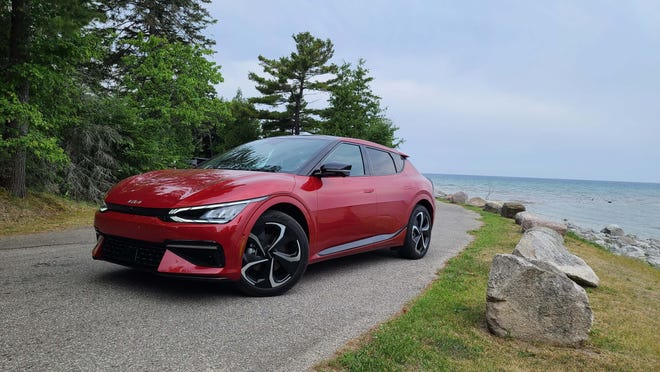
So the EV6 has the hatchback Jamie requires, but with the usual EV charging challenges. Which is why most EVs remain a niche product aimed at customers with multi-car garages and $50K-$80K burning a hole in their pockets.
Which begs another question from another friend, Ron: If I have $57K in my pocket, why would I spend it on a Kia and not on, say, a comparably equipped $64,990 Cadillac Lyriq or $60,090 XC40 Recharge Twin Ultimate? Or even the segment’s volume king, the $67K Tesla Model Y?
Based on folks I talked with, the Kia brand name is a big challenge. But this is an ambitious brand determined to wow … one vehicle at a time.
Take the Kia Stinger GT sportback, which offers style, power and handling for $55K — a whopping 20 grand below a comparable Audi S7. Or behold the Kia Telluride, a three-row SUV with the looks of a Caddy but a sticker price $5,000 below a comparable Ford Explorer. The sheer audacity of these handsome mainstream vehicles means they can’t be ignored.
So, too, the Kia EV6. I mean, just look at it.
“Oooooh, what kind of car is THAT?”
“Fancy, fancy.”
“Wow, look at these people in the swish car.”
Those comments came from passersby as I pulled up in front of a Charlevoix restaurant for a family night out. The EV6 looks like Porsche and Lexus had a baby with its sloped front end, sculpted rocker panels and a hippy, mono-light rear. You can fuss that the car looks overweight — but it turned heads wherever I went.

EV6 also likes to put on a show.
Like the Tesla Model Y, the Kia is loaded with tech tricks. On a narrow street, I held down the console camera button to engage the self-parallel-park feature. The SUV pulled past an open space, identified it, then stopped … waiting.
Well, Payne, do you want me to parallel park with you in the car or out of it?
Out of it. I put the shifter in PARK, exited the car, then held down the REVERSE button on the key fob and watched EV6 park itself. It also works in perpendicular parking garage spots. Oh, the kids will go wild over this stuff.
The Kia won’t come to you across a parking lot like Tesla’s Summon — but frankly, I’m not courageous enough to try that in my own Model 3. Speaking of Tesla, EV6 offers five regenerative modes (one-pedal driving, for you EV experts) via two paddles on the steering wheel (Tesla offers only two). I used them constantly.

Kia also offers the best driving-assist feature this side of the Silicon Valley automaker and Cadillac’s Super Cruise.
The EV6 self-drove for long portions of my I-75 trip north, the system allowing me to relax and eat lunch hands-free without constant nannying like other systems. Opt for this $6,000 feature on the $67K Tesla Model and it balloons the sticker to more than $73K. The system came standard on my $57K GT-line Kia.
EV6 also goes big with an 800-volt battery system (like the $100K Porsche Taycan and Hummer EV) that advertises faster charging than Tesla’s 400-volt system. My experience was a wash. If you can find an Electrify America 350 kW unit that is, ahem, working, the actual charging speed is only 230 kW, the same as Tesla.
Charging is quickest to 80% of range, after which it slows to a crawl like other batteries. On my way back to Detroit, I refueled in Gaylord for 33 minutes to 100% of charge (254 miles) to make it 215 miles to home. But as temps warmed to 85 degrees on my journey south, the car drank electrons and I had to make a second 10-minute stop in Bay City.
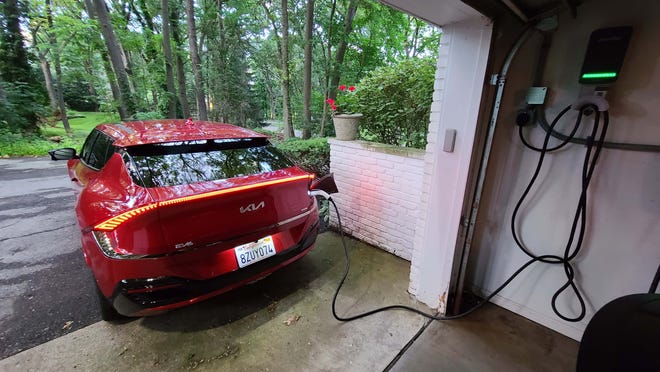
Kia-philes may not be as wowed by all this tech given that a loaded $38K Kia Sportage hybrid offers similar parking and driving assist (see my June review of the Sportage up I-75).
The EV separates itself from the Sportage with a gorgeous premium interior. Indeed, it was remarkably similar to the bling-tastic Caddy Lyriq I tested recently in Utah: floating island console with rotary shift knob. Storage tray on the floor below. Curved 24-inch display atop the dash (33 inches for Lyriq). It even outdid Caddy with a big head-up display. Was there a Kia mole in the Cadillac design studio?
All this tech distracts from the fact that the EV6 can’t handle with the Caddy — much less the sharper Model Y and Mach-E. The EV6 is a boulevard cruiser. But with a SPORT mode that armors the 4,600-pound EV for 4.5-second 0-60 mph dashes, the Kia takes full advantage of its instant 446 pound-feet of torque. That’s, ahem, 80 more than the gas-powered $55K hatchback Stinger’s powerful twin-turbo V-6.
Think of my EV6 GT-line as a silent Stinger GT for the EV set that will sell few copies in rural Charlevoix County. LaFontaine Ford has only sold a few Mach-Es here. Expect pickups to be the volume EV sellers Up North.
As I unplugged from the Ford charger, the dealership’s first F-150 Lightnings were rolling in. Huge frunk, 230-miles of range, 0-60 in 4.5 seconds.
Dealer orders are backed up for them.
2022 Kia EV6
Vehicle type: Battery-powered, rear- and all-wheel-drive five-passenger SUV
Price: $42,695, including $1,215 destination fee ($57,410, AWD, GT-Line as tested)
Powerplant: 55-77.4 kWh lithium-ion battery with rear or dual electric-motors (77.4 kWh as tested)
Power: 320 horsepower, 446 pound-feet torque (as tested)
Transmission: Single-speed direct drive
Performance: 0-60 mph, 5.1 seconds (mfr., AWD); towing, 2,300 pounds
Weight: 4,661 pounds
Fuel economy: EPA 117 MPGe; range, 232-310 miles (274 miles as tested for AWD GT-Line)
Report card
Highs: Striking, cool tech
Lows: Gets pricey; lacks useful frunk
Overall: 3 stars
Henry Payne is auto critic for The Detroit News. Find him at hpayne@detroitnews.com or Twitter @HenryEPayne.
How bonkers is demand for rugged SUVs? Even sporty Mazda is making a CX-50 Meridian dirt-kicker
Posted by Talbot Payne on August 4, 2022
The American consumer has gone wild for SUVs, especially rugged SUVs. In addition to dedicated dirt-kickers like Ford Broncos, Jeep Wranglers and Toyota 4Runners, brands are now equipping mainstream SUVs with off-road packages like Ford Explorer Timberline, Subaru Outback Wilderness, and Toyota RAV4 TRD.
How bonkers is off-road demand? Even ZOOM ZOOM performance carmaker Mazda is going all-in with an outdoors trim.

The Japanese manufacturer introduced the Meridian Edition this week, offering a rugged package of Falken all-terrain tires, roof platform and fashionable black hood to its compact CX-50 SUV.
The package builds on the successful, U.S.-made CX-50 which had already signaled Mazda’s new, off-road focus. Just as Ford recognized the off-road phenomenon and split its compact segment offerings in two — the suburban-focused Escape and outdoorsy Bronco Sport — so has Mazda expanded its compact SUV lineup beyond its best-selling, suburban CX-5 with the rugged CX-50.

Mazda is still defined by its wee Mazda MX-5 Miata sports car (Zoom! Zoom!) but the CX-50 Meridian Edition will be a new halo for the brand aimed at the 70% of the non-truck U.S. market that buys SUVs.
Produced in Huntsville, Alabama, with a starting price of $41,225, the CX-50 Meridian Edition is aimed at the market’s most adventurous customers. It’s an increasingly crowded market with the Ford Bronco Badlands, Subaru Forester Wilderness, Subaru Crosstrek Wilderness, Jeep Cherokee Trailhawk and others.
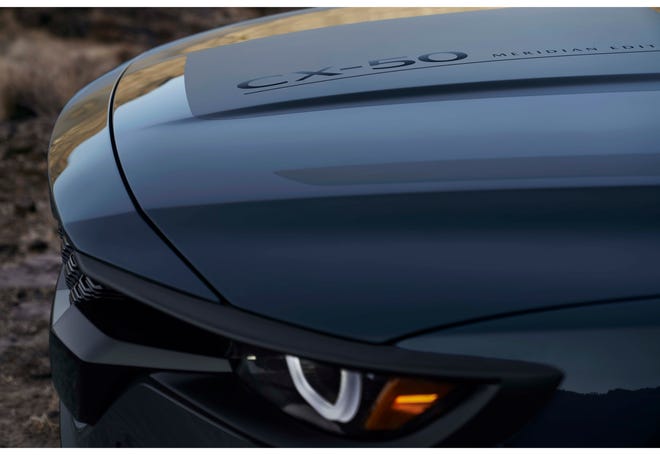
The Meridian model builds on the CX-50’s already macho upgrades over the stylish CX-5 with more fender cladding, more cargo room and 8.6-inch ground clearance.
Available standard with the CX-50’s upmarket, 256-horspower, 2.5-liter turbo-4 engine, the CX-50 Meridian wraps its all-terrain tires around black 18-inch alloy wheels. You’ll know Meridian by its new headlight garnish, matte-black hood graphic (the better to deflect sun glare) and side rocker panels (to ward off stones and other off-road projectiles). Meridian Edition will be dressed in fashionable Polymetal Gray or Zircon Sand exterior paint, with a Terracotta leather interior.

With 310 pound-feet of torque driving all four wheels, the 2.5-liter turbo will get customers to the outback in a hurry towing up to 3,500 pounds. Once off-road drivers can choose from four modes including Off-Road.
If the Meridian package isn’t enough, Mazda has more accessories on offer.
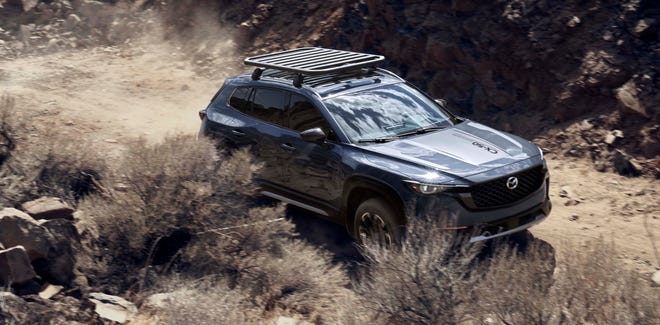
An Apex package adds roof-mounted black crossbars, a roof platform (for a tent) and front/rear splash guards. Or buyers who don’t want to pay full boat for the turbo-4 engine can opt for the Meridian Choice Package — available on the standard, 187-horse, 2.5-liter engine as well — which includes roof crossbars, roof platform, splash guards, side rocker garnish, headlight garnish and matte-black hood graphic.
The Meridian Edition is the latest offering in a blizzard of 10 CX-50 trims starting with the CX-50 S at $28,825. The Turbo Premium and Turbo Premium Plus are the SUV’s top trims, the latter starting at $43,575.
The CX-50’s slogan is “tough but powerful” as the SUV strives for a balance between Miata sportiness and SUV utility. With Meridian, the needle moves a little further towards tough.
Henry Payne is auto critic for The Detroit News. Find him at hpayne@detroitnews.com or Twitter @HenryEPayne.
Wee Ford Maverick gains big Tremor off-road capability
Posted by Talbot Payne on August 2, 2022
Maverick is bringing in a new Top Gun.
Ford’s entry-level, compact pickup truck will gain a Tremor off-road performance trim for the 2023 model year. The little dirt-kicker will be available on the XLT and Lariat trims with Maverick’s spunky, 250-horse turbo-4 engine and torque-vectoring, dual-rear clutch pack drivetrain standard — the same tools as the Bronco Sport Badlands with which Maverick shares a unibody chassis.
The Tremor trim was introduced on the F-series Super Duty trucks in 2019 and also is available on the full-size F-150 and mid-size Ranger trucks. You’ll know the Maverick Tremor by its signature orange tow hooks, Maverick bed graphic, and orange-trimmed wheels and grille. To better conquer off-road obstacles, Tremor gains a 1-inch lift and front skid plate.
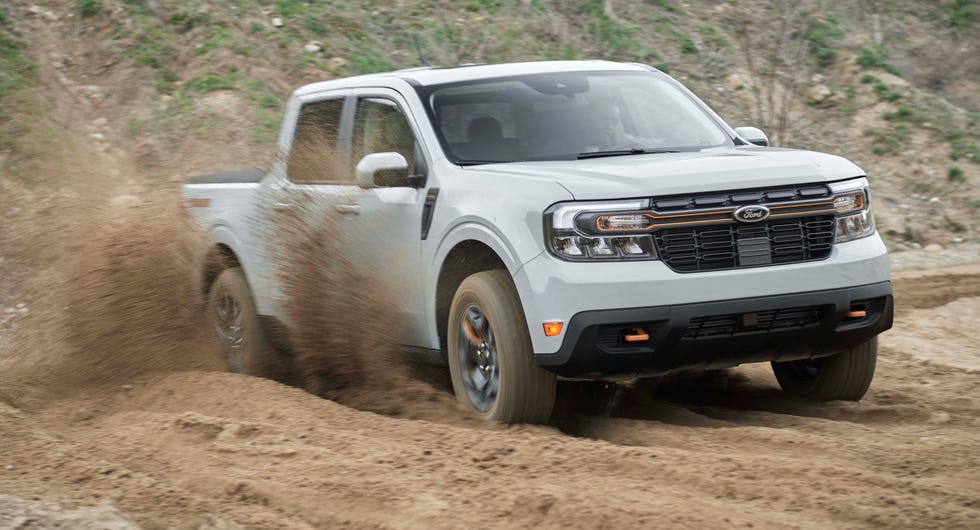
“Ranger, F-150 and Super Duty customers have embraced the unique capability found across our Tremor family of trucks,” said Ford truck marketing chief Todd Eckert. “Maverick Tremor delivers on this same promise with new features designed for off-roading.”
The wildly-successful Maverick starts at $22,470 and is Ford’s entry-level drug to its full truck lineup. The only Ford truck offering built on a unibody platform, Maverick has sold out for the 2022 model year as orders outstripped capacity. A segment-busting compact pickup, Maverick is one of the 20 fastest-selling vehicles in the U.S. market with 38,753 in sales through June (49% of those hybrid sales) — outstripping even Ford’s venerable mid-size Ranger pickup.
The $2,995 Tremor package goes above and beyond the FX4 off-road package offered for all-wheel-drive Mavericks equipped with the turbo-4 engine (the base, hybrid model is front-wheel-drive only). FX4 options underbody skid-plating, 17-inch rims wrapped with all-terrain tires, hill descent control, and Mud/Rut and Sand off-road drive modes.
Tremor brings those goodies plus an exclusive rear, twin-clutch rear-drive unit that is both lockable — and can throw nearly 100% torque to either wheel when necessary for more grip. The Tremor gains new shocks, heavy-duty transmission cooler, and upgraded half-shafts.
Maverick Tremor also offers Trail Control, which is a sort of low-speed cruise control that allows consistent acceleration and braking while the driver concentrates on navigating gnarly off-road terrain.
Inside, the Tremor gets Code Orange-stitching and seat graphic on black seats. The XLT has cloth seats while the Lariat features ActiveX vinyl. For an additional $1,495, customers can opt for the Tremor Appearance Package which adds Carbonized Gray-painted roof, mirror caps, and black graphics for the hood and lower body. If that’s not enough bling, then Ford offers 154 after-market accessories for Maverick.
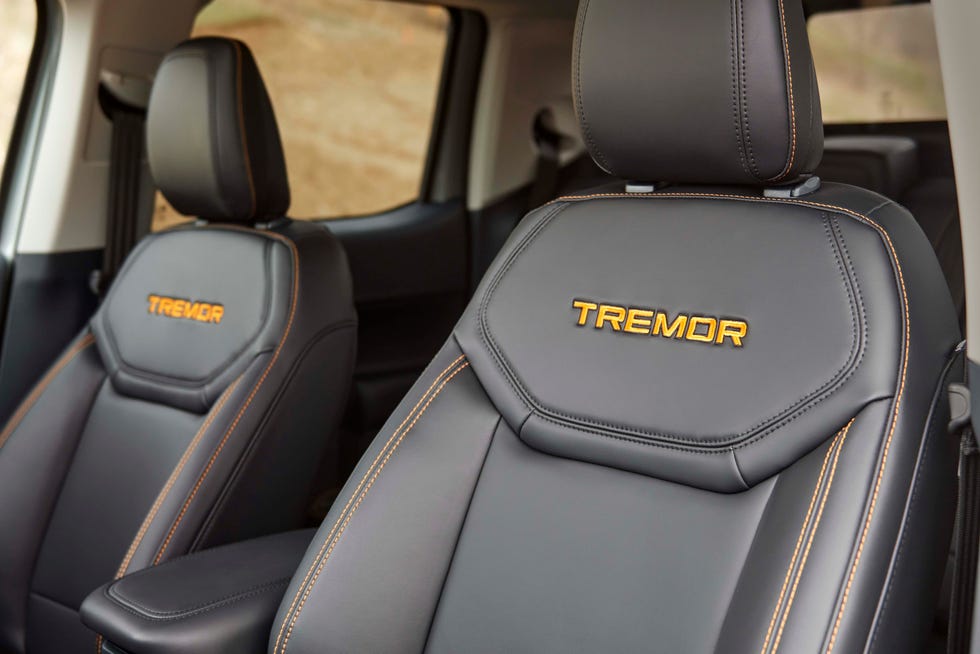
If you want to bring more toys to the trails, the Maverick Tremor puts its 277 pound-feet of torque to good use with a towing capacity of 2,000 pounds and payload rating of 1,200 pounds.
Maverick Tremor will be available for orders in September, and will go into production this fall as a 2023 model. The Maverick’s trim lineup now mirrors that of the Ranger, save for the high-performance Ranger Raptor coming to market next year. Maverick Tremor will fuel speculation that the trucklet will gain a high-flying Raptor version as well.
Henry Payne is auto critic for The Detroit News. Find him at hpayne@detroitnews.com or Twitter @HenryEPayne.
With video: All-new 2023 Chevy Colorado pickup boasts major interior, engine updates
Posted by Talbot Payne on July 30, 2022
The Chevrolet Colorado is getting an extreme makeover.
General Motors’ mainstream brand unveiled an all-new, 2023 model of its mid-size pickup truck that expands in length, interior tech, and model trims even as it shrinks its engine and bed options. Responding to America’s thirst for all things off-road, the Colorado lineup will add a rugged Trail Boss trim to its lineup of base Work Truck, LT, Z71, and ZR2 models.
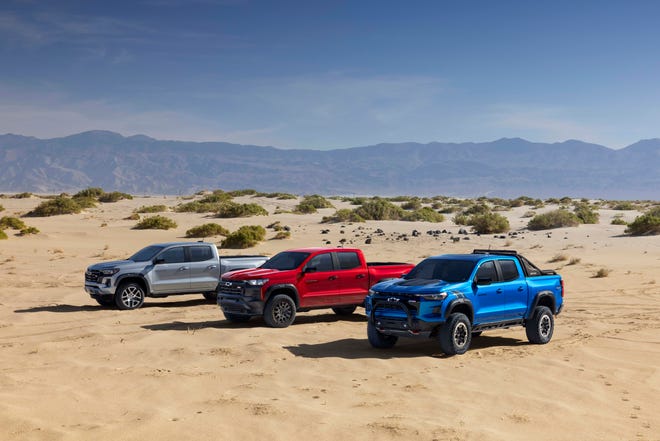
The Colorado is Chevy’s starter truck and the 2023 model benefits from hand me-downs from big brother, full-sized Silverado — most significantly the 2.7-liter turbo-4 engine that is now the core of the lineup as well as a modern, dash-mounted, 11.3-inch digital touchscreen. As GM pours capital into an uncertain, all-electric future, its gas-fueled truck lineup is key to profitability and the Colorado — like Silverado — is loaded with new trims and features that can goose sticker prices over $50,000.
“The all-new Colorado is enhanced in every way,” said Chevy vice president Scott Bell. “With its rugged and sporty styling, enhanced capability, new technology and customization options, it’s designed to do more for discerning customers.”
Those discerning customers embraced the last-generation Colorado’s crisp handling — a signature of Chevy trucks — as well as its tree-chewing ZR2 model. Customers also noted the truck’s dated, plastic interior and base engine offering, and fixing those shortcomings is high on the list of 2023 upgrades.
“While the interior is overrun with cheap plastics, and even the biggest cab size has a small back seat, the truck maintains a pleasant driving position and athletic handling,” noted auto enthusiast magazine Car and Driver of the outgoing model. “Colorado has a good enough resume to suit many pickup shoppers, but it lacks the qualifications to interest a wider audience.”
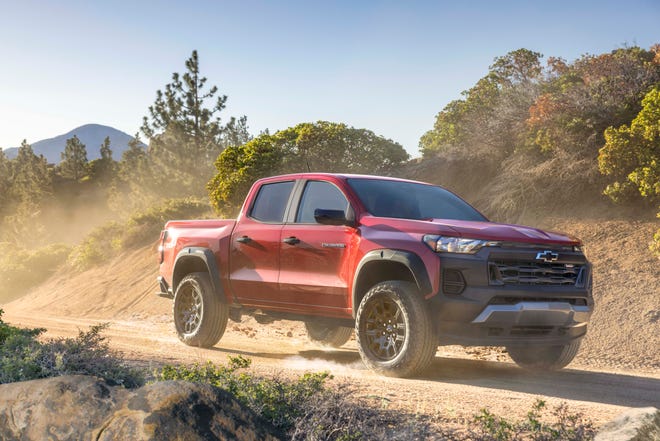
That wider audience has an array of choice in a segment that has expanded significantly since Colorado was introduced in 2015. There’s sister GMC Canyon as well as Ford Ranger, Jeep Gladiator, newly-redesigned Nissan Frontier and perennial sales-leader Toyota Tacoma. In addition to these ladder frame bruisers, the midsize segment has added unibody pickup like the Hyundai Santa Cruz and Honda Ridgeline. In 2021, the GM twins sold 97,133 units — second only to the Taco’s 252,520.
To stay ahead of the stampede, the ‘23 Colorado brings a significant interior makeover with standard, high-resolution, configurable, digital instrumentation alongside biggest-in-class infotainment screen. The setup mirrors a Silverado dash that itself was remade for the 2022 model year. The touchscreen upgrade includes a new Google-based software system that will make smartphone users feel right at home when using features like maps and music. The 2023 model will also offer a sunroof for the first time.
“Across all trims, the exterior’s presence and attitude is reflected in the interior, which is designed around the large center stack screen,” said design boss Phil Zak.
The Colorado sits atop a ladder frame redesigned for better interior space and dirt-chewing. Chief engineer Nick Katcherian said the truck gains 3.1 inches in wheelbase — some of which goes to increased rear legroom — as well as a front axle that has been moved forward for better approach angle.
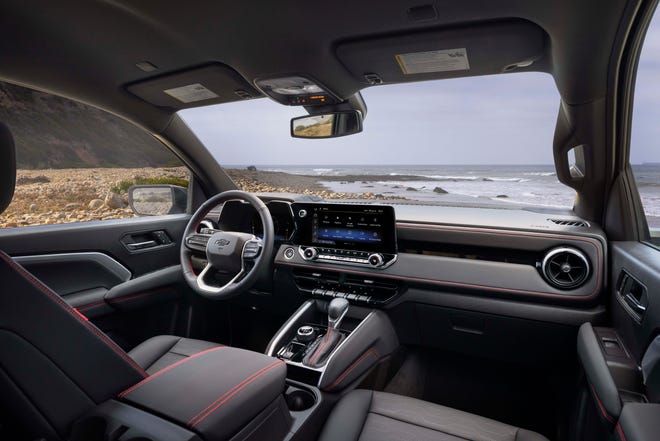
Behind the front bumper and aggressive blacked-out maw, the engine bay welcomes GM’s torque-rich 2.7-liter turbo, which is also used in the Silverado and Cadillac’s CT4 performance sedan. The turbo-4 has three different configurations in the new pickup and replaces the previous model’s base 2.5-liter 4-cylinder, as well as the 3.6-liter V-6 and 2.8-liter diesel. Truck buyers are fond of diesels, and the oil-burner will be missed.
The 2.7-liter will be offered in the Work Truck and LT models with 237 horsepower and 259 pound-feet of torque. In the off-road Z71 and Trail Boss models, it will produce 310 ponies and 390 pound-feet of torque, and in the range-topping ZR2, the four-banger will replace the 308-horse, 275-torque V-6 with 310 horses and 430 pound feet of torque (the same numbers as in the Silverado and GMC Sierra full-size pickups). Like the Silverado (and unlike the Cadillac’s 10-speed), the turbo-4 in the Colorado will be mated to an 8-speed transmission.
Unlike other brands, Chevy does not offer a hybrid variant — its electrification options are based on a separate, Ultium battery skateboard chassis. The Colorado is not yet offered on Ultium.
“The industry is not going to convert to EVs overnight,” said Bell. “We are going to stay true to our customers who want an internal-combustion-engine variant.”
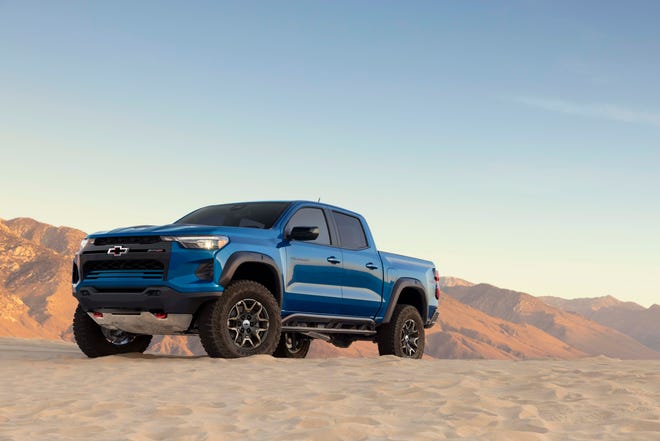
In addition to sporting the lineup’s most powerful engine, ZR2 is the most capable, from its twin-locking differentials to its Formula One-inspired Multimatic shocks (though its 6,000 towing capability trails the other trims’ 7,700 pounds). So you know that it’s the alpha male of the lineup, it comes equipped with a power dome hood, 33-inch all-terrain tires and wider stance.
ZR2’s personality has inspired ruggedness throughout the lineup. The truck features a class-best 10 camera views — including an underbody lens on Z71 and ZR2. The cameras compliment trailering tech pioneered on the Silverado like Hitch Guidance. Meeting customer demand for more custom options, Colorado’s off-road accessory portfolio has more than doubled from previous model years.
“The new Colorado is a lifestyle enabler,” said engineer Katcherian. “Because outdoor activities are a big part of our Colorado customers’ lifestyles, we’ve made the truck even more capable to support them.”
Offered for the first time on Colorado, the Trail Boss trim boasts 32-inch tires, a 2-inch suspension lift, and chassis widened 3 inches beyond the standard Work Truck and LT. But wait, there’s more: a special edition ZR2 Desert Boss model will be offered with 17-inch bead-lock wheels, light bar, and underbody camera standard.
Complementing Colorado’s mud-bathing and trailering ambitions, five drive modes are on offer, including Normal, Tow/Haul, Off-Road, Terrain and Baja. The truck’s new electric architecture also enables a suite of standard safety goodies such as forward collision alert, lane keep assist and automatic high-beam assist. Options include rear cross traffic braking and adaptive cruise control.
Running against the vehicle’s customization theme, Colorado will only be offered as a Crew Cab with a short, 5-foot 2-inch rear box. The long box option has been canned.
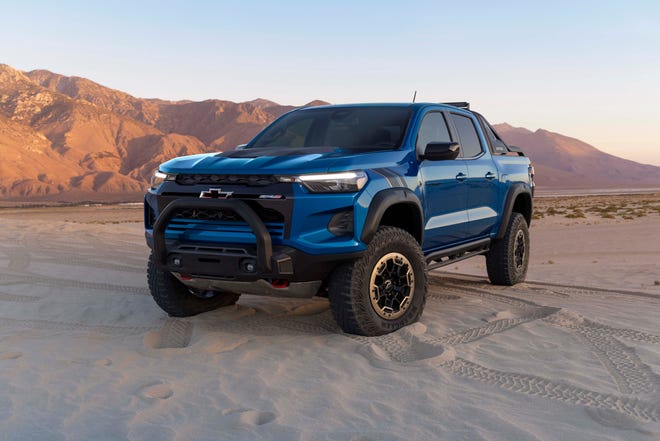
The pickup, however, does option a new Tailgate Storage Box (a narrow cargo space within the tailgate) that measures 45 inches wide and 4 inches deep. The tailgate also has a mid-level setting in order to carry longer items in the bed, and the bed featurs grooves for bicycle and motorcycle tires in the front wall.
Colorado rolls off the line in the first half of next year at Wentzville Assembly in Missouri. Pricing and more details to come.
Henry Payne is auto critic for The Detroit News. Find him at hpayne@detroitnews.com or Twitter @HenryEPayne.