Detroit — Downtown is gonna’ be fast ‘n’ furious next June.
The Chevrolet Detroit Grand Prix presented by Lear passed the baton from Belle Isle to Detroit’s streets Monday as the race returns to its Motor City roots next June 2-4 for the first time since 1991. Chevrolet President Mark Reuss, GP Chairman Bud Denker and Penske superstar driver Will Power — who won the last race on Belle Isle Sunday — held a news conference at the new finish line on Franklin Street just east of the Renaissance Center and gave the media its first tour of the new track, where speeds will hit 180 mph.
“I’m definitely going to miss the island,” said Power, flanked by his Penske teammate Josef Newgarden, who finished fourth on Sunday. “But it’s going to be great racing around the Renaissance Center and half of the track is going to be free to fans. This is my first glimpse of the track, and it’s got a lot of character.”
The 10-turn circuit’s biggest character is a 7/10s-of-a-mile long main straight (similar to the epic, main straightaway at Road America Raceway in Wisconsin) down Jefferson Avenue running east-to-west from Rivard Street to a 180-degree Turn One at Griswold. The swarm of 700-horsepower IndyCars will take the green flag on Jefferson, howl past the RenCen and The Fist monument, before climbing on the brakes into Griswold’s (legal, but just for the race) left-hand turn for the track’s best passing opportunity.
“The track is very three-dimensional,” Power said, describing the surprising amount of elevation change that takes racers off Jefferson after the Griswold hairpin for a plunge down Bates. After hanging a 90-degree left at Atwater (ignore the stop sign), the course climbs to Turns 5-6 — a tricky, blind, left-right sequence past Renaissance Drive West and the Detroit Marriott.
Then it’s back down the Atwater ramp, heading east along the Detroit riverfront with the RenCen’s Wintergarden as backdrop.
“I can’t wait to see car racing through the city again, including right past the GM headquarters,” said GM’s Reuss, who remembers attending the first Formula One race through the city streets in 1982 when he was a senior in high school. “We are returning the Detroit Grand Prix to its roots.”
Ripping past the RenCen’s southeast tower — GM’s HQ — race cars will then hang a quick left onto St. Antoine before immediately jogging right onto Franklin Street’s wide lanes, which will be flanked by IndyCar’s only dual pit lanes.
Racers will flash across the finish stripe, drafting one another with another excellent passing opportunity ahead at the corner of Franklin and Rivard. It will likely be a very busy intersection as cars will be merging back onto the track there from the twin pit lanes.
Then the field will climb up Rivard — across Woodbridge — to the final, off-camber, Turn 10 lefthander back onto East Jefferson Avenue. Getting the power down onto Jefferson will be key to a good run down to Turn One.
At 1.7 miles total, the new track is shorter than the original, 2.5-mile Formula One circuit (and the 2.35-mile Belle Isle track). That will mean quicker laps. Cadillac racing driver Renger Van Der Zande, who won the IMSA Weathertech sportscar race Saturday, told Autoweek he expects laps in the 1.10-minute range. The shorter length also promises better access to downtown, which has been reborn since the ’90s with restaurants, hotels and shops that offer attractions to fans beyond the competition on track.
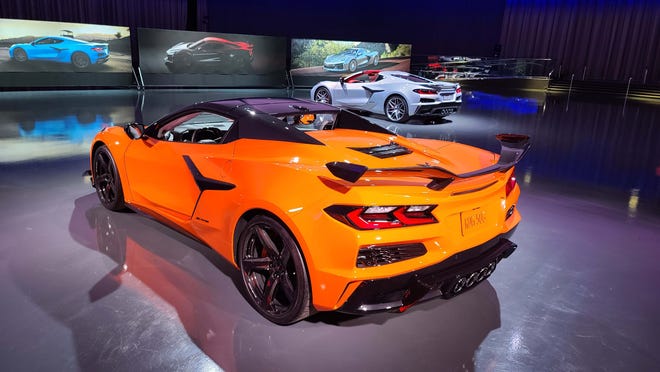
“It’s a whole different city now,” said Reuss, who was flanked by a trio of mid-engine Corvettes, including the 670-horsepower Z06 Detroit GP pace car. “We are seeing the rebirth of Detroit. We’ve put in a lot of money here . . . and into Factory Zero, and we’re going to grow the city.” GM’s president added that the Detroit Grand Prix investment would further boost a downtown that is now home to the Detroit Pistons, Red Wings, Tigers and Lions, as well as the headquarters to diverse companies like Quicken Loans and Shinola.
Organizers say that the wide sightline opportunities of the pit-lane, Atwater waterfront, and River East parking area should be ideal for corporate suites — while the wide Jefferson straightaway and grandstands will enable half of the race’s footprint to be open free to the public. Fans will also have open access to activation areas including Spirit Plaza, Hart Plaza and the Riverwalk, which will have feature music, food and games.
“We had an amazing year on Belle Isle with the biggest crowds we’ve seen in 13 years,” said GP Chairman Denker, who then looked ahead to 2023. “There are 12 cities in the world that have downtown racing. We are one of them now.”
Henry Payne is auto critic for The Detroit News. Find him at hpayne@detroitnews.com or Twitter @HenryEPayne.
Belle Isle — Cadillac Racing isn’t following the brand’s electric makeover just yet. Two weeks after the quiet Cadillac Lyriq — the first model in all-electric-by-2030 lineup — opened for customer orders, Cadillac will headline the Detroit Grand Prix with its window-rattling, V8-powered Cadillac DPi-V.R IMSA Weathertech sports car.
Don’t expect to see the Lyriq on Belle Isle. There will, however, be a fleet of high-performance, gas-fired V-series hellions at Cadillac’s customer display – including the all-new, 682-horsepower, 2023 Cadillac Escalade-V stuffed with a similar, growling V-8 mill as the race car on track.
The DPi-V.R and its production brethren give a glimpse at racing’s V8-powered, hybrid future when Cadillac Racing debuts its next-gen racer at IMSA’s Rolex 24 Hours of Daytona in January, 2023. The so-called GTP Hypercar will gain a rear-axle electric motor in an attempt to build a bridge to electrification. But the V-8 monster is more in line with the brand’s gas-powered, V-series performance models than the Lyriq EV.
Auto racing has long been a key piece of performance vehicle marketing. The paradox of Cadillac’s racing and consumer futures shines a light on the difficulties EVs face as they try to become more than a niche consumer market. Like 97% of the U.S. buying public that did not purchase an EV in 2021, endurance racing is a challenging environment for electric vehicles, where quick fuel stops, high speeds and long distances aren’t conducive to battery power.
“We are getting ready for the pivot to EVs. As you look at the Cadillac entries, we will be racing next year, (those) vehicles will also have an internal combustion engine and hybridization which will develop some electrification benefits to the vehicles during the race,” said GM’s U.S. vice president for motorsports, Jim Campbell, in an interview here before the race weekend kicks off. “That hybrid piece winds up being a pivot piece as well . . . as racing organizations around the world determine where electrification fits into their racing future.”
Interestingly, GM was a pioneer in hybrid drivetrains at the turn of the 21st century before shelving the technology in 2019 when the last Chevrolet Volt rolled off the assembly line. Like pure electrics, hybrids were once hailed as the future of transportation — in 2009, a consensus of auto executives in an IBM survey predicted 100% of sales would be hybrid by 2020 — but they only account for 5% of sales today.
“Over time, we’ll work with the series over when is the right time to put in another step in electrification,” said Campbell. “The hybrid is that interim step and they will be coming next year in GTP here in IMSA.”
The hybrid solution allows manufacturer-supported race series to check the electrification box while still giving race fans the visceral thrill of speed and sound they have craved for decades.
For now, the V-8 powered IMSA prototype class is the ideal ambassador for the brand’s halo performance cars — whether the Escalade-V super-ute or sedans like the 668-horse CT5-V Blackwing, armed with the same supercharged V-8 engine as the Escalade-V.
“The Blackwings — whether CT4-V or CT5-V or Escalade-V — they are going to be around for a period of time, and so we are going to leverage what we do on track with our V-8 to link what we do in our showroom,” said Campbell.
Driving home the connection, Cadillac DPi-V.R racer Renger Van Der Zande drove a CT5-V Blackwing to Belle Isle on May 16 after the IMSA Weathertech series’ Mid-Ohio stop to promote the Detroit IMSA race.
Van Der Zande’s rubber-burning exploits were captured for promotional video — very on brand for Caddy racing, if not the silent electric future. He ended his journey with a visit to GM’s technical center, where he met with engineers who are developing the 2023 race cars’ V-8 hybrid engine.
“I’m a race car driver and they want me to race those cars as fast as I can and win races. That’s the best marketing you can get,” said the flying Dutchman of his contract with Cadillac.
Win on Sunday, sell on Monday.
“When you win a race, it lifts the brand and good things happen,” said Campbell. “People put you on their shopping lists a little more quickly. So we want to be on their radar screen.”
The formula has worked for decades, going back to Cadillac’s first Le Mans race car in 1950. The formula has always been tied to engineering development, too — what Campbell calls “the tech transfer, people development aspect” — with GM using IMSA to develop its V-8 engines alongside other manufacturers like Ford, Acura and Porsche.
On the other side of the pond, European endurance racing featured diesel-powered prototypes when European governments declared diesel the future of mobility at the turn of the 21st century.
But now, as the global manufacturers adapt to battery-power mandates, the Detroit Grand Prix weekend suggests a divergence between racing and production drivetrains.
Manufacturers have struggled with marrying EVs and racing. Jaguar, for example, introduced its first electric vehicle, the I-Pace, alongside the Jaguar I-Pace eTrophy — an international race series that ran two seasons before being canceled in mid-2020.
“Jaguar Land Rover was keen to showcase . . . its ‘Destination Zero’ initiative that outlined developing battery electric vehicle technology through electric racing,” reported TheRace.com. “However, the I-Pace series struggled to make an impact in the motorsport industry with grids averaging 12 cars in its first campaign.”
Once billed as a Tesla-killer, the I-Pace has struggled with just 9,970 in U.S. sales in 2021, down 39% since 2019.
While GM’s racing programs (it also showcases the V8-powered Corvette in IMSA’s GTD class) continue to highlight its brands’ internal-combustion prowess, Campbell says that EVs will benefit from the high-level aerodynamic engineering that racing demands.
“In racing right now, the tools we use to prepare a race car — whether aero analysis, driver simulation, wind tunnel activity — all those principles and tools we’ve honed to the way we prepare for electrification,” he said. “We apply those tools to make the best aerodynamics and cooling decisions for EVs of the future.”
Henry Payne is auto critic for The Detroit News. Find him at hpayne@detroitnews.com or Twitter @HenryEPayne.
Holly Oaks — The skies dark overhead, I splashed through a muddy gulch in Michigan’s most challenging, Holly Oaks Off-Road-Vehicle park. ROARRRR! I charged up a muddy 20-degree incline, the 440-horsepower twin-turbo V-6 engine spinning all four wheels. GRONCH! The front bash plate cushioned the front bumper’s blow over the scarred turf. RRWAAAWWR! At the incline’s summit, I nail the throttle, spinning the 122.5-inch long wheelbase on a dime with Trail-Turn Assist.
I’m at the wheel of the 2022 Ford Expedition Timberline. You know, a family vehicle.
With underbody armor, 33-inch off-road tires and ladder frame similar to the Ford F-150 Tremor, Expedition is not your average family three-row hauler. This beast is as happy off-road as it is on-road. So when you head north on I-75 for the weekend, be sure to detour through Holly Oaks. The kiddies in the third-row will love it.
I’m not making this up. Bringing its Timberline trim — first seen on the Explorer SUV in 2021 (more on that later) — to the Expedition, Ford has created a three-row Frankenstein’s monster not unlike the 710-horsepower Dodge Durango Hellcat SUV. But where the Hellcat will drag race sports cars out of Woodward stoplights, Expedition Timberline can chew on trees with Broncos in Holly.
Where the Sedan Epoch brought us on-road performance cyborgs like Charger Hellcats and BMW Ms, the Era of Ute is bringing on and off-road muscle. No one is exploiting this more than Ford.
As SUVs exploded in population in the past decade, Ford transferred the ST performance badge from hot hatch hellions like the Focus and Fiesta to utes like the Ford Edge and Explorer SUV. That’s a stretch given SUVs’ inherent, top-heavy limitations. Though the badges have proven popular, no one is taking their Explorer ST to Waterford Raceway for a track day as Focus ST owners have done for years.
But take your SUV off-road? Now we’re talkin’.
Go to Holly Oaks or Flint ORV park or Silver Lake — and you’ll see plenty of Subaru Outbacks mixing it up with Broncos and Jeep Wranglers and Toyota TRDs. Ford’s Explorer Timberline — introduced late last year with upgrades like skid plates and all-terrain tires and a throaty 2.3-liter engine — fits this mode. I took it out on Holly Oaks muddy landscape and it knew its way around, the Mud and Ruts drive mode helping all four wheels churn through mud ‘n’ ruts ‘n’ water ‘n’ slop.
But slapping the Timberline badge on Expedition is a whole new level. You’ll pay for the privilege. Walking from the $47,530 three-row Explorer Timberline to my $80,255, three-row Expedition tester is more than a step — it’s a leap.
Timberline is now part of a forest of Expedition trim offerings beginning with the $54,315 XL STX followed by the XLT, XLT Max, Limited, Limited Max, King Ranch (pant, stop for breath) King Ranch Max, Platinum and Platinum Max. A new, more on-road oriented Stealth performance model joins Timberline for the 2022 model year.
Timberline is hardly the most expensive of the lot, with the Platinum edition earning its name with a price tag of nearly 88 grand when decked out with next-tech like hands-free BlueCruise highway drive assist. This is an SUV that plays with the big boys in the mega-ute, pickup-based segment that Detroit dominates. The Expedition Timberline has all the tools.
Like a Tremor pickup with a hatchback, Timberline sits on a rugged truck frame that shrugs off moguls like Hulk Hogan throwing Richard Simmons off his back. The 3.5-liter V-6, the most powerful engine in class with 510 pound-feet of torque, is also familiar to pickup buyers and rewards a heavy left foot with a throaty rebel yell. The aptly-named Goodyear Wrangler tires offer serious grip, ground clearance is a class-best 10.6 inches, and Trail Turn Assist (yes, the same feature pioneered by Bronco, for goodness sake) is magic in turning this ocean-liner on a dime.
But what is especially impressive about Expedition Timberline is how it loses none of its on-road charm.
The Ford F-150 Lightning complements its smooth, electric drivetrain with an independent rear suspension — eliminating “crow hop” for an easy turning radius in, say, a tight parking lot. Expedition went to IRS years ago.
Big footing around the charming town of Fenton, the big Timberline was silky smooth, negotiating tight turns, parking lots and U-turns with no hint of crow hop. That smoothness translated to the highway driving as well, where the suspension and quiet cabin absorbed the aggressive Wrangler tires with aplomb.
The IRS also pays dividends in the third row, where even giants like me are comfortable. The suspension allows for a proper seat well in back so my knees aren’t in my mouth. Nicer still is the second row, where I could easily sit behind myself.
In the front, I was a comfortable captain of my ship. Digital displays are everywhere (like an F-150), so you can choose the information you want to see. Ford was an infotainment pioneer years ago with its SYNC system — though not without serious teething pains. Those frustrations are in the rear-view mirror, and the system quickly paired my phone, then synced wirelessly to my Android’s Google maps for navigation.
Expedition Platinum’s semi-autonomous BlueCruise is a cool glimpse at the future, but Timberline’s good ol’ adaptive cruise did just fine, thanks very much — allowing me to relax at the wheel on I-75 while steering the freighter on my own.
And then there is towing. If you’re buying a Timberline to take the family on the road, my guess is you’ve got some toys you’d like to take with you. Motorbikes, side-by-sides, RZRs.
Ooooh, Polaris RZRs. The long-suffering Mrs. Payne and I recently did a RZR off-road adventure. Faces covered in dirt, we went places we could never find in a normal AWD vehicle. Waterfalls, rocky landscapes, deep forest wonders.
The Expedition will tow 9,300 pounds of toys, so when the road gets too gnarly for Timberline, just drop a RZR out the back and explore further.
Come to think of it — between the Timberline’s off-road prowess and the toys it can tow — that detour to Holly Oaks on the way up I-75 might take a while.
2022 Ford Expedition Timberline
Vehicle type: Front-engine, rear- and four-wheel-drive, 6-passenger SUV
Price: $71,490, including $1,695 destination charge ($80,255 as tested)
Warren — Buick is going all-electric, and a Wildcat will show the way.
General Motors’ premium brand Wednesday unveiled the gorgeous, low-slung Wildcat 2+2 coupe, an electric-vehicle concept that previews coming attractions from Buick as its lineup goes all-EV by 2030. Buick is the second GM brand to go all-electric following luxury sibling Cadillac.
While phasing out its current lineup of four gas-powered SUVs — the subcompact Encore, compact Encore GX and Envision, and three-row Enclave — Buck will resuscitate its Electra name as an EV badge, beginning with a new model in 2024. Expect a compact SUV like Cadillac’s electric Lyriq targeted at the premium market’s biggest segment.
“Electric vehicles suit the Buick brand. With our QuietTuning philosophy of a quiet cabin, smooth ride, and comfortable seats, we have made a quiet-ride experience,” said Buick marketing boss Rob Peterson at a Wildcat media sneak peek at GM’s Research and Development Center. “The industry is moving to where Buick has been.”
With the federal government forcing auto manufacturers to battery-power beginning with draconian regulations in 2026, GM has made a commitment to go fully-electric by 2035. China, Buick’s No. 1 market by sales volume (it is the fourth best-selling brand there), also figures prominently in the company’s plans as the Chinese government is also encouraging EVs with a target for battery-vehicle sales of 20% by 2025.
Though EVs have been in the US market for more than a decade, consumer acceptance has been low (just 3% of sales in 2021) with the exception of luxury-maker Tesla, which has become the darling of Wall Street investors.
GM has been eager to replicate Tesla’s success, but the Detroit automaker’s first EV, the much-hyped Chevrolet Bolt, has been a sales disappointment. GM hopes its premium brands will be more appealing to Tesla’s upscale demographic.
The Wildcat concept, said Peterson, is critical to Buick’s vision. Following in the footsteps of past Buick concepts like the 1953 Wildcat and 2016 Avista, Wildcat is a comprehensive remake of the brand’s design language, from logo to sheet-metal to interior. Like the Avista coupe concept that inspired recent production models, Wildcat is unlikely to make it to production.
“Buick’s quiet luxury theme is a good, basic fit with electrification. The EV characteristics line up well, and it allows them to recapture the Electra badge,” said veteran iSeeCars.com analyst Karl Brauer, who nonetheless sees big challenges for a Buick lineup defined by its Enclave and Encore utes. “A three-row, road-trip SUV doesn’t translate well into an EV, and the attraction for the Encore was how much value you got in a small SUV. The question with EVs is can you make them affordably?”
Look for Wildcat’s DNA in forthgoing EVs — as well as in current model design updates like the 2022 Enclave. The Enclave’s new, high-mounted front blade running lights are taken right off the Wildcat.
Wildcat remakes Buick’s three-shield logo with the first significant change since 1990. The logo’s outer circle is gone, allowing the shields to float above the Wildcat’s front waterline. Where gas-powered models feature a prominent shield grille, Wildcat’s front end is lower, more sportscar-like. Think the Kia EV6 or Tesla Model 3. Unlike the Model 3, however, the facia still contains a low-mounted, trapezoidal, grille-like element along the lower chin to create the semblance of a face.
Wildcat design manager Therese Pinazzo said buyers still want anthropomorphic features in their cars — even as EVs don’t need prominent grilles for air. “We don’t want to be faceless going into the EV era,” she said pointing out the light blade “eyes” and lower grille “mouth.”
Anthropomorphic features are also important to the Chinese market where buyers value da qi, or the element of “grand elegance.”
“Global design is incredibly important for this brand,” said designer Pinazzo. “Our Chinese design studio were also involved. It’s important to Chinese customers that the car have a face.”
The coupe’s shape is cab forward — the wheels pushed out to the edges of the chassis — taking advantage of GM’s skateboard battery platform to maximize interior space.
The simple, rounded flanks are also a stark contrast to Cadillac’s EV design language. In addition to having a more upright, angular stance, Lyriq’s design is more technical with a complicated lighting signature that dances to life as the driver approaches the car.
“The Cadillac design has a lot going on,” said Pinazzo. “With Buick, we are looking for subtle sophistication … for timeless beauty.”
Moving against its more organic shape, however, Electra EVs will each be assigned alphanumeric badging while Cadillac moves away from alphanumerics (CT4, XT4) to proper names like Lyriq and Celestiq. After less than two decades in the market, Buick will phase out its E-family of names — Encore, Envision, Enclave — that reintroduced customers to the brand. Almost forgotten as a geriatric sedan brand, Buick reigned its brand awareness with the Encore-Envision-Enclave SUVs and “That’s not a Buick” TV ads.
Buick sales grew 7.6% in 2021, the lineup’s best year to date. Meanwhile, the average buyer’s age continued to decrease, by two years. Pushing technology deemed important to younger-generation buyers, Buick’s EV brand transformation will include a more seamless connectivity experience, with features like remote key fob, Wi-Fi data and OnStar safety services standard on new cars.
Analyst Brauer said that going electric with low-volume brands like Cadillac and Buick is relatively low-risk, particularly since both brands have senior stigmas that electrification should help remedy. Still, he says, “there doesn’t seem to be enough customers for all the brands that say they are going all-EV this decade. That includes Jaguar, Alfa and Volvo.”
The Electra name was last seen on big Buick sedans from 1959-1990. A favorite of collectors, Electras are a favorite classic cruiser at the annual Woodward Dream Cruise. Wildcat’s interior tech is out of a sci-fi movie by comparison.
Wildcat concept is entered through a big opening — made possible by “semi-swing” doors paired with partial, gullwing roof openings. The idea, say designers, is to introduce a sense of space. The palatial interior embraces that latest, digital screen technology — anchored by a single screen stretching from the instrument display across the console. A smaller display on the doors is to display views from side camera mirrors.
“Getting inside will be a voyage of discovery,” said designer Pinazzo. “We want it to be a calming experience. The vehicle gets to know you like a Fitbit or an Apple watch. Biometrics and AI will recognize your behavioral patterns. … For example, if you are feeling anxious, sensors in the seats will sense your anxiety and dim the cabin lights, disperse aromatherapy scents, and activate massaging seats.”
Expect future Buicks to have the latest in driver-assist technology like GM’s forthcoming UltraCruise — the next evolution of a SuperCruise system that allows hands-free driving on divided highways, including automatic lane changes.
The Buick team gave no details on drivetrain technology, but expect the Buick to be quick. Production vehicles will sit on GM’s Ultium battery platform that already advertises 500 horsepower and dual-motor drive from the forthcoming Caddy Lyriq.
Henry Payne is auto critic for The Detroit News. Find him at hpayne@detroitnews.com or Twitter @HenryEPayne.
Detroit — One of my favorite SUV personalities is the Volvo XC40. Cleverly designed inside and out, unique looks, Android operating system, legroom, storage aplenty.
And now it has a pair of electric 2022 Recharge siblings. Though it’s gonna be tough to beat the 355-mile-range gas model. On a wintry April day in Detroit, I had to make a day’s round trip with my son, future daughter-in-law and wife to Charlevoix via Traverse City to check out a wedding venue. With its good rear legroom and clever amenities, I was eager to show the XC40 Recharge off to the clan — but with only 223 miles of electric range, Recharge would complicate our estimated 560-mile round trip.
If we recharged from 10-80% of battery life (charging over 80% gets reeeeeal slow) at fast chargers, we would have to make four charging stops of about 35 minutes each on a day with a demanding, tight schedule to meet florists, caterers, cake makers (yummm, I love weddings) and more. Fast-chargers were everywhere up I-75 from Meijer parking lots to Burger Kings, but I didn’t even bother to chart the course. It would be much too inconvenient.
So I took a good ol’ diesel Cadillac Escalade instead. Range: 440 miles. One five-minute fill-up, no worries.
The lesson? Buy the XC40 Recharge if you have a gas ute in the garage for long trips. Then use Recharge as your daily commuter, as most EV owners do.
Though it’s gonna’ be tough to beat the Polestar 2.
The Polestar 2, of course, is the first sedan from Volvo’s new electric brand and it’s a head-turner with a sleek bod, hatchback utility, big-screen interior and longer 270-mile range. Recharge boasts familiar Swedish XC40 styling cues with squared-off bod, floating back roof, boomerang tail-lamps, Thor’s-hammer headlights and Volvo badge ‘n’ stripe logo on the grille.
Well, where the grille used to be. With no need for air to feed a gas engine behind, the grille wears a face-covering over its mouth as if dressed for the pandemic. Awkward (especially since Sweden never mandated masks). Brands are still struggling with how to present their EV faces.
The mask-less Polestar gets a more appealing grille design to differentiate its EV brand. But for those who like Recharge’s higher seating position and familiar Volvo styling cues, XC40 will get the nod.
And for those who like the Polestar’s coupe-like looks, well … XC40 Recharge has a C40 Recharge twin with heavily tapered roof-line and C-clamp tail-lights like a Volvo sedan. Be warned: the fastback reduces rear-window visibility to a military pillbox. Both Recharge models offer unique, eye-catching 20-inch wheels.
The Recharges are quick. Sporting the same big-battery, all-wheel-drive system as the Polestar, our pals at Car and Driver recorded a hearty 4.3-second 0-60 dash — just shy of the more aerodynamic Polestar’s 4.1. ZOT! I shot out of a Detroit stoplight in the XC40 Recharge ahead of an unsuspecting Mustang. Lookit that shoebox go!
Just don’t overdo it into the next 90-degree corner. Despite the battery anchored low in their bellies, the Recharges have little interest in pulling side-Gs. Easy, hot foot.
The standard AWD does comes in handy when it, um, snows in Detroit — which it did on April 11. That didn’t happen when I lived in Virginia and dragged my sports cars out of the garage in March on summer tires. It’s different here in Michigan, and the Volvo was up to the task, sloshing along on I-96 as the blizzard blew.
Where Recharge really earns its love is inside. The interior is familiar Volvo, not sci-fi Polestar, but it shares the same Android operating system with a screen as intuitive to operate as my phone. The instrument screen is a digital beauty and the adaptive cruise control quite competent — at least when snow isn’t blinding it. The standard panoramic roof overhead is easy to operate — just swipe your finger along a pad in the direction you want it opened/closed.
Clever storage is everywhere — most impressively in the “fishbox” as the Swedes like to call it. That’s removable trash bin to us Yanks. It’s useful for storing sticky gum, gnawed lollipop sticks, and other trash you don’t want to be sticking in door pockets. Remove and empty when it fills. Why doesn’t every car have one?
Side pockets extend the length of the door, and a hidden hook flips out from the glove box to hang everything from plastic grocery bags to purses.
To complement the roomy (for a subcompact SUV) rear seats, passengers also get side-seat storage trays. The cargo hold has more flip-out grocery bag hangers, and a hidden subfloor where you can store that bulky cargo blind when not in use. More storage? This is an EV, so there’s a frunk where the engine used to be for the charge plug or a briefcase. My C40 Recharge tester also came dressed with a blue-felt interior trim to match the exterior. Stylin’ Swede.
Though it’s gonna be tough to beat $45,935.
That’s the price of a comparably equipped, turbo-4 powered XC40 gas model, which is a whopping $15K south of my $60K Recharge twins. The $7,500 federal tax credit will claw some of that back, but it’s a stiff premium to pay for a vehicle with limited metropolitan range.
For Volvo fans, XC40 and C40 Recharge will have some clear benefits. In addition to those clever features, the twin electric motors make for a silky-smooth driving experience — which, ahem, can be a bit choppy with the gas model’s multi-cog, eight-speed gearbox.
And Recharge offers an EV favorite feature: regenerative braking so you can one-pedal drive around town. It’s a tough market out there for EV adoption, but it helps having an outgoing Volvo Recharge personality.
2022 Volvo XC40 and C40 Recharge
Vehicle type: Battery-electric, all-wheel-drive, five-passenger SUV
Price: $52,795 base, including $1,095 destination fee ($60,090 XC40 Recharge Twin Ultimate, and $60,540 C40 Recharge Twin Ultimate as tested)
Powerplant: 75-kWh lithium-ion battery driving twin electric motors
Power: 402 horsepower, 486 pound-feet of torque
Transmission: Direct drive
Performance: 0-60 mph, 4.3 seconds (Car and Driver, XC40 Recharge); top speed: 113 mph
Weight: 4,791 pounds (XC40 Recharge as tested)
Fuel economy: 223-mile range
Report card
Highs: Clever interior; quick off the line
Lows: Limited driving range compared with competitors; $15K north of gas XC40
Overall: 3 stars
Henry Payne is auto critic for The Detroit News. Find him at hpayne@detroitnews.com or Twitter @HenryEPayne.
Monterey, California — Seventeen Mile Drive along the California coast is paved with testosterone.
The route is not only one of the most beautiful stretches of road in America, it’s also home to Pebble Beach Golf Links and high-priced homes with big garages and spectacular views of the Pacific. Cool cars and trucks come out to strut their stuff along the route despite the low 25 mph speed limit and $20 toll.
My ride? A green 503-horsepower 2022 BMW M4 convertible coupe. The sun is out and it’s time to go topless.
BMW’s M-performance hellions are the first to sport the brand’s huge, hood-to-chin twin kidneys. You can see them from space and they are the new BMW status symbol.
A white M3 (the sedan version of the two-door M4) looms in my mirror, its huge nostrils sniffing at the earth like an enraged bull. It’s intimidating even at 25 mph. I pull over at a beach overlook, and the M3 cruises by with a toot of the horn and a hearty “Like your car!” from its passengers. Further along the route an another topless M4 convertible — my mirror-image save for its blue paint scheme — rounds a bend. Thumbs-up exchanged. Members of the German tribe way out here on West Coast, USA.
BMW is at home as much here in California as it is in Deutschland, a testament to years of consistent brand management. Its status as top-luxe dog is under attack, however, from home-grown (now Texas ex-pat) electric-automaker Tesla. Muscular, expensive examples of the Model Y/ Model 3/Model S/Model X are everywhere along 17 Mile.
Tesla doesn’t make convertibles, though. And they don’t growl, either.
When 17 Mile ends, Route 1 begins — the coast’s legendary, twisted two-lane where sports cars come to play. It was a cool 50 degrees in the Bay area, but I cranked up the heat in the BMW’s cockpit and kept the convertible top down to hear the twin-turbocharged inline-6 howl.
No one mixes a smooth, inline-6 cocktail better than Bimmer. I first enjoyed it in the spine-tingling 8,000-rpm E46 M3 that once graced my car stable. To keep upping the power — and satisfy government regulators at the same time — BMW strapped on turbochargers in subsequent models. They have taken the edge off the beast’s howl. Caged further by sound-deadening materials, the engine can feel remote in the M3 sedan — a reason to get the droptop despite its greater weight. And lesser trunk. Beware suitcase travelers: stowing the roof takes up half your boot.
Like entering hyperspace, the BMW cockpit must be prepared for maximum performance.
1. Kick the monostable shifter into Manual mode to access paddle shifters.
2. Access the console M-mode button, which transforms the instrument display behind the wheel (and huge head-up display) into a race car-like tachometer. It’s one of my favorite features. With the tach hovering over the hood, I never have to take my eye off the road as I toggle between gears.
3. Thumb the M1 (or M2) steering preset on the steering wheel which I had programmed not only to turn up the engine volume, but to slam the car to the pavement, a quivering mass of muscle ready to burn up the tarmac.
I obliged M4’s base instincts.
WAAAAUUUGH! I buried the throttle and four all-wheel-drive hooves dug into the road, propelling the M4 into a series of twisties. As we galloped further south, traffic thinned — sandy beaches giving way to severe, rocky coastline. The M4’s 503 horses are titanic, too much for this tight road. Like other performance cars today, its limits can’t be reached unless taken to a race track.
M4’s little brother, the M2 (the natural heir to my 2001 M3 with similar wheelbase, weight and power) is the better corner-carver. Get it to push road limits and attend track days.
Still, the Monterey coast is the M4 convertible’s natural habitat, a place to show off its broad, touring-car talents. Though the M3 and M4 once defined the brand’s handling prowess, that is now left to M2. The open-air M4 is the brand’s showcase for technology, looks, power. It’s as comfortable sprinting along coastal Route 1 as it is turning heads on 17 Mile. Think of Traverse City’s lovely coastline in summer.
I picked up Mrs. Payne from our hotel and headed inland for lunch and sightseeing. Destination: Laguna Seca Raceway in the picturesque Laguna Valley.
My wife fawned over the orange interior. Bright interiors are the rage these days, and I’ve lounged in red seats from the $34,000 Mazda3 Turbo all the way to the blue $140,000 Aston Martin DBX. M4 orange was spectacular and comfortable, though the M4 is tight on the rear seat legroom for us 6-footers despite its wheelbase expansion beyond little brother M2.
My wife quickly synched her Apple CarPlay. BMW is also generous in synching the phone app directions to the driver instrument display, a rare feat. We set sail for the Laguna, the west coast’s most famous track, settling in for an easy drive on adaptive cruise-control during a busy Monterey lunch hour.
BMW is content with a standard Level 2 autonomous system — not pushing the envelope (for now) like Tesla and its ambitious Autopilot system. Tesla’s cutting-edge tech has wowed a new-gen of luxury buyers and helped establish its status above Bimmer in this high-tech state. Autopilot might have helped us as we approached one of California’s sudden four-lane traffic pile ups. The BMW’s system was unable to stop in time, and I had to take over to avoid the car in front of me as I slammed on the brakes.
We arrived at Laguna and I immediately headed to the legendary Corkscrew turn at the track’s summit. The view is spectacular and made for lovely pics of the green BMW against the painted-perfect blue sky.
Our visit coincided with a track day organized by On Track, and the event had attracted the cream of the performance crop: Lamborghini Huracan, Porsche 911 and Boxster, Tesla Model S, Mazda Miata. But I didn’t see any new M3s or M4 — only current M2s and older M3s.
Right on brand for the new M lineup.
2022 BMW M4 Competition Convertible
Vehicle type: Front-engine, all-wheel-drive, four-passenger sports car
Price: $87,295, including $995 destination fee ($104,295 as tested)
San Antonio — Ford birthed its electric vehicle program in late 2017. It’s no coincidence the date dovetailed with first deliveries of the Tesla Model 3.
The Silicon Valley startup had changed the electric game with its $40,000, 220-mile range electric sedan. Delivered less than two years since it was first introduced by CEO Elon Musk in April 2016 to an unprecedented 200,000-plus pre-orders, the Model 3 headlined a clean-energy portfolio that included home-battery energy storage and solar roof tiles.
Ford realized that it needed to change its own game to compete.
The result was Team Edison, a startup auto company within Ford to mimic Tesla. A little over four years later and with 200,000 pre-orders, Ford’s F-150 Lightning EV pickup truck headlines a new Ford Motor Co. business model offering electric vehicles as well as battery-powered energy solutions for the home, not unlike Elon Musk’s startup.
“Our competitor is Tesla,” Ford Vice President for global EVs Darren Palmer in an interview in San Antonio at the Lighting’s media test. “We see our brand to be an electric-vehicles and an electric-energy company.”
The Lightning is the result of a comprehensive process to re-imagine the pickup as a utility vehicle and a mobile generator in a fraught energy landscape.
“We worked like a startup because we were competing against startups,” said Palmer. “You could see EVs were really coming of age. We didn’t know what customers wanted, so the first thing we did was go out and see customers in California, Norway, China, Europe. Customers really opened our eyes to what we needed (and how) to make use of the new technology to do new things that customers had never seen before.”
New things like a front truck – “frunk” – that can hold two golf bags for a day on the Texas links. Or offer three days of generating power for the home during a California blackout.
The Lightning debuts at a time when one of its key markets, California, is facing energy shortages this summer as the state shuts down baseload generation in its transition to green energy sources. “Officials forecast a potential shortfall of 1,700-5,000 megawatts,” reported Reuters during the Lightning’s media rollout. “Supply gaps along those lines could leave between 1 million and 4 million people without power.”
Ford product experts used the opportunity to tout Lightning’s unique abilities to operate as an electric generator for about the same $10,000 price as a permanent, natural-gas generator.
“The Lightning can be used as an extended-range battery to power your home for three to 10 days,” said Ford Energy Services Business Manager Ryan O’Gorman. He demonstrated a home setup connecting the truck to a Ford Charge Station Pro wall charger and Home Integration System – consisting of a battery, power inverter and bi-directional electricity flow – that immediately kicks in if the grid goes dark.
He also touted cloud-based software that charges the Lightning during low-cost, off-peak hours – then transfers that cheap electricity back to the house during peak, high-cost evening hours. California officials predict annual electricity rate increases of 4-9% by 2025 as the state shutters natural gas and nuclear plants and planned solar farms are delayed. Texas, Ford’s biggest truck market, also suffered widespread power outages last year.
Tesla’s Powerwall pioneered the home-energy storage solution in 2015 – storing energy from roof solar panels to power homes during peak hours. Ford takes the idea a step further by integrating its truck in the system.
Ford’s Palmer credits Team Edison’s human-centric design focus for the company’s new direction.
“We were struggling to get going in electric vehicles in the right way,” he said. “We are an over 100-year old company, and as projects came forward they were being removed because they weren’t meeting profit targets. You use the principle of human-centric design when it’s not obvious what the future path is, when there is disruption.”
Employing a diverse staff in age and product backgrounds, Team Edison hit the road to ask customers what they wanted from EVs. They trotted the globe to meet customers. They focused on re-imagining company icons by developing the electric F-150 Lightning, Mustang Mach-E and E-Transit van.
For the F-150, they went to Texas, where 1-in-5 Ford pickups are sold.
“(F-150’s) the best-selling vehicle of any kind in America for decades. It could change people’s relationship w EVs if we get it right. But we didn’t know who wanted to buy this vehicle,” said Palmer. “So we made prototypes out of cardboard, we made up some brochures and we went to Texas.”
Accompanied by a human-centric design specialist – “essentially a psychologist,” said Palmer – Team Edison confronted a group of hardened Texas truck drivers. The team got the truckers’ attention with muscle-bound specs – 560 horsepower, 775 foot-pounds of torque, 10,000-pound towing – that embarrassed a gas-powered Raptor performance truck.
“Then we showed them the frunk and what the frunk could be,” said Palmer.
He recounted the story of one particularly prominent focus-group pickup owner who perked up when learning he could carry two bags of golf clubs in the frunk while also using the pickup bed for work.
“He stood up and said ‘I’m not leaving until I can put down a deposit.’ We estimated 18% wanted an e-pickup truck. Then we went to California and, you can imagine, we couldn’t get out of the room,” said Palmer.
Armed with customer demand, Team Edison constructed an all-new truck but that stayed true to what had made F-150 an essential tool to generations of truck buyers.
Aft of the A-pillar (and frunk) were F-150’s familiar aluminum body panels. The bed? “Deliberately identical, because customers said their accessories needed to fit and they needed over 2,000 pounds of payload,” said Ford’s EV boss.
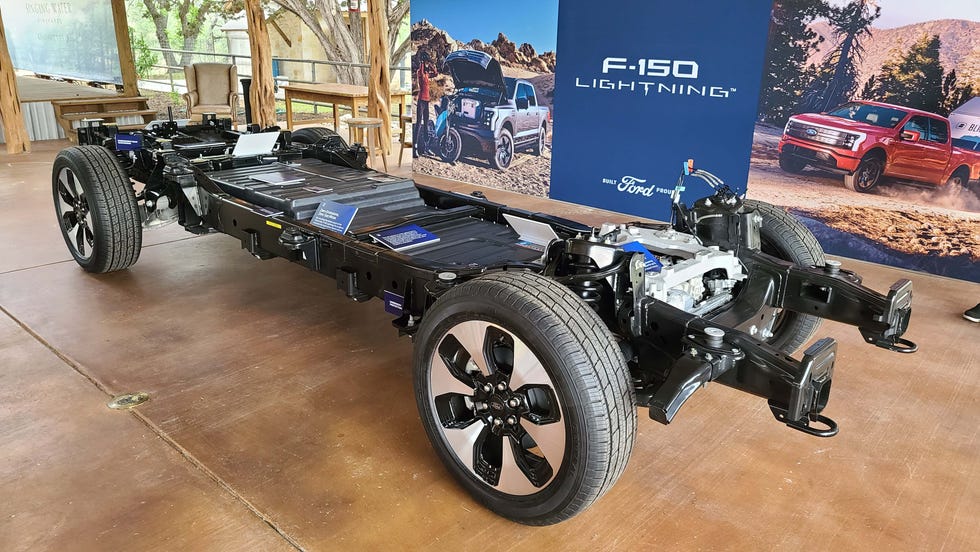
Below decks the F-150 body sits on familiar, ladder-frame chassis construction, yet with all-new wheels, gearbox, motors, battery, steering and brakes.
“It was designed to do what customers need … starting at $39,974,” said Palmer. “We wanted to take all the excuses away for electric. It’s a truck for everybody. (We are) shipping luxury and fleet models all together.”
Henry Payne is auto critic for The Detroit News. Find him at hpayne@detroitnews.com or Twitter @HenryEPayne.
Charlevoix — Like a Great Lakes passenger ship, the bow of my Cadillac Escalade cut through the fog of an April snow shower. Sure-footed, diesel-powered, on autopilot to our port of call.
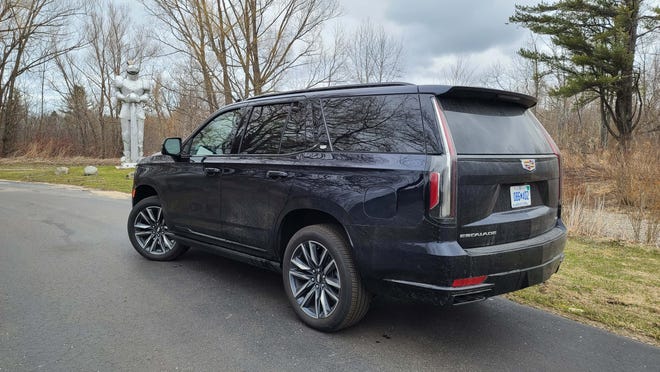
On a long round trip Up North to scope out my son’s summer wedding venue at Castle Farms, the Escalade showed why it is the King of Mega-utes. Parked in front of Castle Farm’s magnificent Queen’s Court turrets, the jet-black chariot bears the stuff of royalty: Cadillac family crest on the imposing chain-mail grille, big silver wheels like a knight’s shield, glowing front-and-rear horizontal running lamps like medieval torches.
My Sport model is equipped with black trim — in contrast to the Caddy’s signature chrome — which gives the great figure an added sense of menace. Behold, the Dark Knight.
Unlike knights of old, however, there is little clatter from the chassis. Once upon a time, you knew a diesel from its CLACKETY-CLACK-CLACK engine idle. Not Escalade. The Caddy’s twin-turbo, 3.0-liter inline-6 is the same as the new generation of Duramax diesels that power GM’s sibling Chevy Silverado and GMC Sierra trucks. It purrs like a resting lion.
My family descends from their seats, air suspension lowering the cab and running boards extending before their feet like a royal welcome.
Castle Farms was built by Sears president Albert Loeb in 1918 as a grand country estate on a 1,600-acre farm. The house echoes a European castle with turrets, grand hall and archways. It fell into disrepair over the course of the 20th century — a curious ruin like so many European castles. Successful Domino’s Pizza franchisee Richard Mueller and his wife Susan resurrected it as a passion project in 2000. Today it is a bustling tourist attraction complete with train rides, wine tastings, art collections and weddings.
Escalade, too, has resurrected the Cadillac brand.
In disrepair after an uninspired close to the 20th century, Caddy engineers did yeomen’s work to rebuild the brand as an athletic competitor to European performance makes with the CTS, ATS and V-series sedan hellions. But it’s the magnificent Escalade that has restored Cadillac’s luxury luster — paving the way for its transition to a regal, all-electric brand in the mold of 1950s Cadillac ocean liners.
That luxury is best demonstrated by Super Cruise, the semi-autonomous driver-assist system that leaves (most) driving to the car.
Along secondary roads, I drove hands-on — adaptive cruise control maintaining regulation speed since, ahem, my lead foot gets heavy in this nimble giant. But upon entering I-75, I toggled the additional lane-keep icon on my steering wheel and — like a robotic chauffeur — the Escalade took over the driving duties from me.
A green light signified I could remove my mitts from the wheel. No hands, no feet. I sipped Snapple, rested my hands on my knees and relaxed on my leather throne. Like a driving instructor with a novice driver, however, I still needed to be engaged.
The steering column-mounted infrared camera noticed me looking away from the road for too long while chatting with the alluring Mrs. Payne. That triggered a red light reminding me to pay attention.
North of Bay City, Super Cruise suddenly hit a blind spot. The green light disappeared, the Caddy wobbled — and I quickly took over, bridging the dead zone until the system re-acclimated.
No I-75 trip is complete without orange barrels, and Super Cruise asked that I take over in construction zones. Otherwise, the system worked confidently (Zilwaukee Bridge? No problem. Heavy Flint traffic? Piece of cake.) just like in 2017 when I drove from Memphis to Dallas. Only better.
Super Cruise’s newest trick is auto lane changes conducted with impressive accuracy. I have some experience with auto lane-changing from my Tesla Model 3’s Autopilot system. It’s sci-fi stuff, but the Tesla — driving along at, say, 80 mph, will balk as it encounters a slower car before passing on the left.
The Super Cruise robot chauffeur passes like a human. Seeing a slower car up ahead, my SUV didn’t wait to be slowed down. It put on the left turn signal, pulled left at 80 mph without breaking stride, passed traffic, then pulled immediately back into the right lane. What if a vehicle was to our left, you ask? Cadillac held station until it passed, then executed the passing maneuver. My 32-year-old son — no stranger to the hi-tech abilities of autos I test — gave it a try.
So good is Super Cruise you have to remind yourself to pay attention. There are the aforementioned dead zones and construction areas. Or, heaven forbid, a ladder dropped from a utility truck (yeah, that’s happened) that the system can’t see.
Exit the highway for a bathroom break, and the system will give up as it jumps the invisible geo-fence. Super Cruise has only mapped divided highways.
There are other super features on board.
Tesla launched the first salvo in the screen wars way back in 2012, and Escalade’s offering is three screens in one, spanning a 38-inch-wide, dash-mounted jumbotron. It’s a solution as practical as it is elegant. Whereas deeper console screens — think Tesla Model S or Ram 1500 — require the pilot to look down from the road, the Caddy system is always in your line of sight.
Useful is the left-side touchscreen, which allowed me to variously adjust the head-up display, check mileage or configure the instrument display. I chose to put the navigation route in the display in front of me while using the right console screen to show Sirius XM stations.
The Dark Knight earned high marks for practicality. The diesel engine returned a solid 28 mpg highway (compared with the available V-8’s 20). My wife, son and his bride-to-be traveled comfortably — especially my son, who fell ill from food poisoning on the return journey.
Long journeys and illness don’t pair well, but my son had three restful options: 1) lay the front seat flat, 2) lay the second- and third-row, right-hand seats flat to make a (hard) bed, or 3) curl up in the roomy, dark third-row bench seat (helped, in part, by a new compact independent rear suspension) with the panoramic roof shut.
He chose option three and got needed sleep on our way back home on I-75. Roomy, luxurious, imposing. Escalade is a castle on wheels.
2022 Cadillac Escalade Diesel
Vehicle type: Rear- or four-wheel-drive, seven-passenger SUV
Price: $77,490, including $1,295 destination charge ($110,585 4WD Sport as tested)
Powerplant: 3.0-liter turbo inline-6 diesel
Power: 277 horsepower, 460 pound-feet of torque
Transmission: 10-speed automatic
Performance: 0-60 mph, 7.8 seconds (Car and Driver); towing capacity, 7,800 pounds as tested
San Antonio, Texas — Ford F-150 trucks are Swiss Army knives. Their capabilities include trailer towing, mulch hauling, rock-crawling, stream-fording and drag-racing BMWs. They can also conquer the Baja 1000, host UM tailgate parties, offer mobile workspaces, provide first-class transit to the opera, and comfortably seat the Detroit Pistons’ starting lineup.
So offering an electric pickup option doesn’t seem like a stretch.
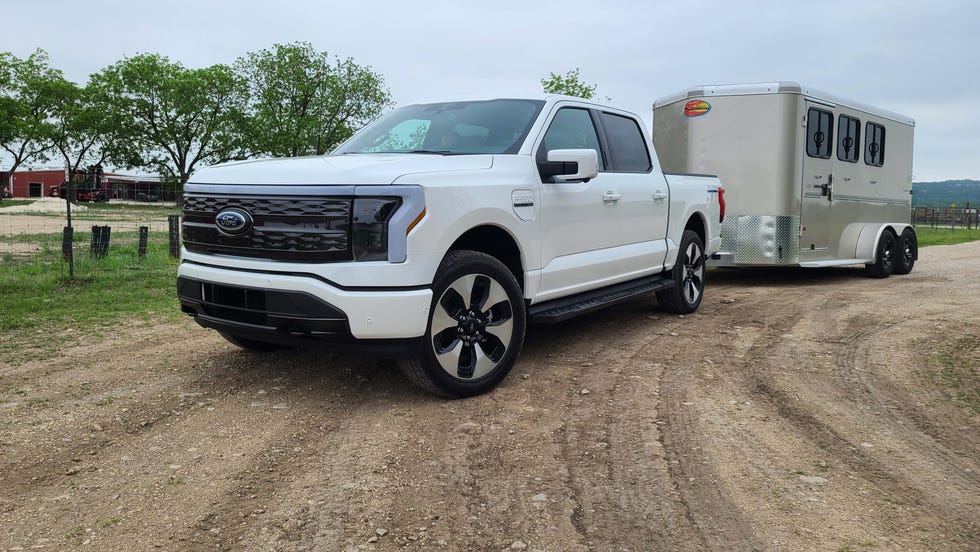
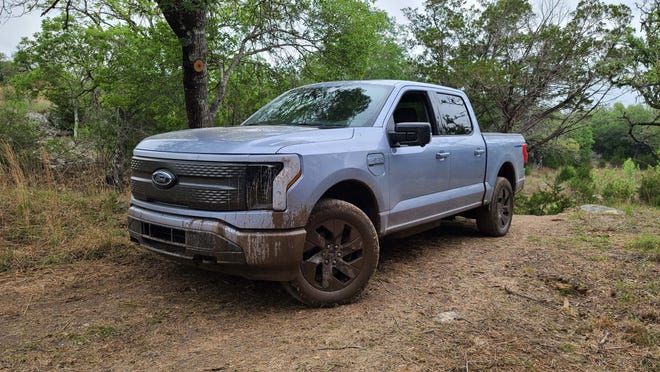
Like Raptor, hybrid, V-8 and Ecoboost models that have come before it, Ford Motor Co.’s F-150 Lightning EV is an impressive beast. Though its lack of towing range will limit its market, Lightning’s affordable price will tempt many to its electrified talents.
On a remote road in San Antonio ranch country, I set launch control in a Lightning Pro. Mat the brake, mat the accelerator pedal. The 6,500-pound truck let out a short GRUNT like a bull pawing the earth before a charge. I released the brake. To the moon, Alice!
The Lightning bolted forward, four wheels chirping as they channeled instant, 775 pound-feet of torque (ahem, 225 more than a $700,000 Ford GT supercar) to the pavement via twin electric motors. The thrust buried me in the vinyl seatback. With 98-kWh battery below decks, 50/50 weight distribution and independent rear suspension (IRS), the beast is stealthy and solid.
Sixty miles per hour blew by in just 5 seconds, quicker than a turbo-4-powered Mustang coupe. This in a base $45K pickup with utility that would put a comparably priced electric Mustang Mach-E SUV to shame.
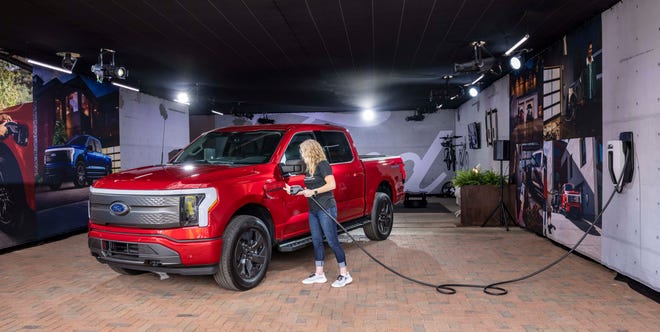
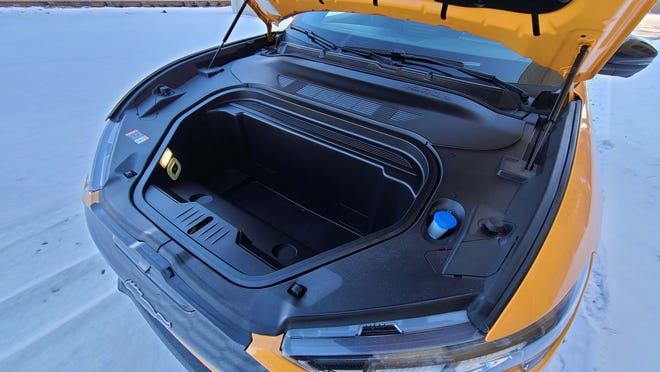
Press a button and the hood rises automatically (no finger-cramping, manual hood latch here) to reveal … space. With the engine gone, cargo room measures 14.1 cubic-feet, more than a Fiesta hatchback. It’s a pickup owner’s dream come true: SUV-like storage in front to complement a 5-foot-5-inch bed in back. My tester swallowed two carry-on bags, a briefcase and backpack. Two golf bags will also fit. The hood automatically closes just like a … what to call it?
A hatchfront? Front boot? Front trunk will do. Or “frunk” as Tesla popularized the term years ago. It’s Lightning’s signature feature.
Significantly, Lightning lacks F-150’s signature towing prowess. Capable of towing up to 7,700 pounds, the Pro’s 230-mile range is plenty for metro commutes — but when I asked the truck to travel from San Antonio to Detroit, it told me the 22-hour trip in a gas truck would require 33.5 hours by EV with 15 fast-charging stops totaling 7.5 hours.
Option the bigger battery in upper trims and its 320-mile range won’t do much better. Tow 5,000 pounds and range drops by two-thirds. Tow your camper to Yellowstone? Fuhgeddaboudit. For my Airstream-towing friends Chris and Tom, this is a deal-killer even as they marvel at Lightning’s Tesla-like performance.
This is no Tesla Cybertruck, however.
Where the radical Cybertruck aims to redefine pickup design, autonomy and speed — just as Model S3VY siblings remade their segments — Lightning is content to blend in. That’s a change from Ford’s other EV icon, the Mach-E, which aped Tesla’s Model Y specs ‘n’ screen to gain cred among compact EV buyers.
By contrast, Ford dominates the affordable full-size truck space — and Lightning is first to market. The F-150 Lightning, which Ford officially launched April 26, is the Dearborn automaker’s most important product in its bid to overtake Tesla as the EV market leader.
Happen upon a Lightning and it looks little different from an internal-combustion-engine F-150 (which are everywhere in Texas, where 1-in-5 F-series are sold). No bolt graphic on the front grille. No LIGHTNING stamped in the tailgate. You might notice its lack of tailpipe.
Heck, my favorite base Pro didn’t even have the horizontal front/rear LED lightbars found on XLT, Lariat and Platinum trims. Surely owners would like a little more visual pizzazz for their first EV truck?
Fortunately, Ford didn’t skimp on other details that have made F-150 America’s best-selling pickup.
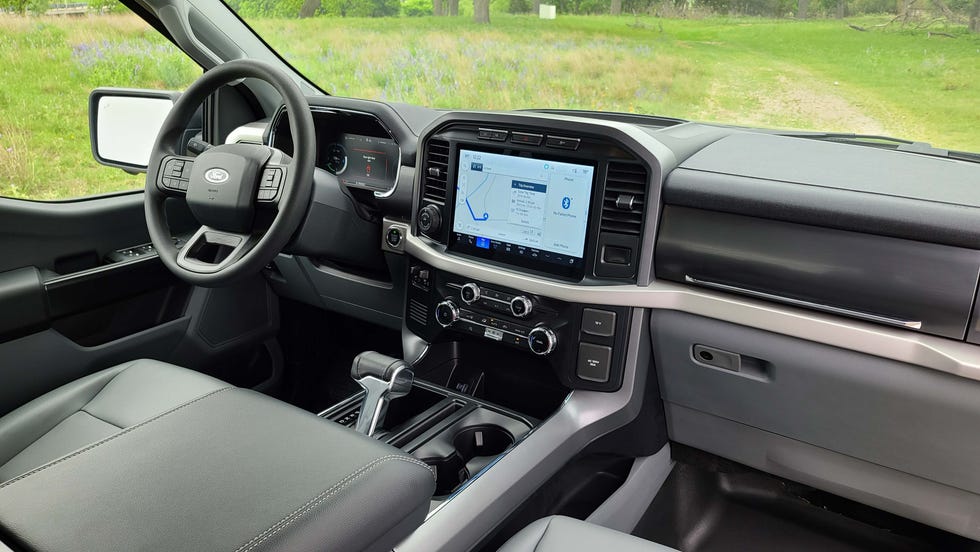
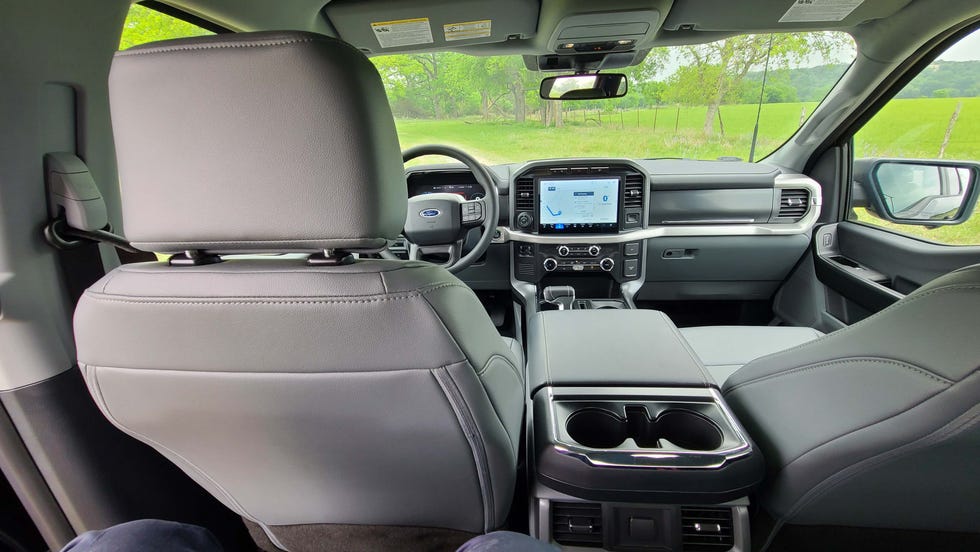
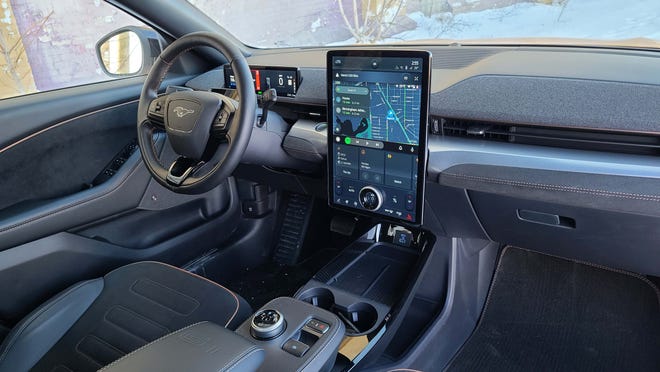
Think signature Ford windowsill dip for better visibility, roomy rear seats, commanding driver’s position, all-digital displays, 12-inch center touchscreen. With the touch of a button, the gearshift disappears, converting the console into a desktop workspace.
The Pro complements its Tesla-quick acceleration with coveted EV attributes like one-pedal driving and liquid-smooth, 7,700-pound towing ability. Even the F-150’s first independent rear suspension complements the unique EV experience by smoothing out bed flutter and eliminating that bane of pickups: crow-hop in tight turns.
Standard goodies include navi system, blind spot-assist, wireless Apple CarPlay/Android Auto, auto headlamps and drag strip parachute (kidding about the last one). Storage space abounds in the console, doors, the twin glove boxes. Out back, my truck bristled with four 110-volt plugs and one 240-volt plug (courtesy of the must-have, $1,070 Pro Power Onboard upgrade — more on that later) so I could run a rockin’ tailgate party off the truck’s battery — just bring jumbotron, fridge, cooker. The 240 plug will even recharge your buddy in a stranded Mach-E.
The market is flooded with $45K EV utes right now — none can hold a candle to this kind of utility. A $60K Volvo C40 Recharge in my driveway recently had the same 230-mile range and interior features, and would fit in the Ford’s frunk.
The Lightning’s unique attributes fade in upper trims.
With ICE models, walk up the trim ladder and you gain multiple engine options beyond the base F-150’s 3.3-liter V-6: twin-turbo 2.7-liter V-6; twin-turbo 3.6-liter V-6; 3.5-liter hybrid; 5.0-liter V-8. Not Lightning. Upper trims feature the same twin-motors, same IRS, same 775 torque (with horsepower boosted from 452 to 580).
I drove a $75K XLT with cloth seats and adaptive cruise control and a $94K Platinum with a Mach-E-like vertical 15.5-inch touchscreen. Rich Ford customers will buy them because they’re the it thing — but they pale in value to, say, a loaded, $68K F-150 Lariat Hybrid that can charge your tailgate party with the same box plugs. There’s plenty of electric pickup competition north of $80K, like Rivian R1T, GMC Hummer and (coming) Chevy Silverado EV.
Give me the affordable tool. F-150 has always excelled in tech, and my truck nerd friends will geek out on Pro Power Onboard. Wire it into your house like a generator and it’s a Google Nest on wheels.
Charge it overnight on off-peak rates, then power your house the next night during peak rates. When the power inevitably goes out — welcome to southeast Michigan — Lightning can power your home for days. Geeking out yet?
With some 200,000 orders in the books, Lightning’s $7,500 tax credit is already toast. Good. EVs need to stand on their own four feet, and my $45K Lightning Pro is a fine example of how they can.
The truck’s range and towing limitations are evidence of electric vehicles’ narrow appeal, but Lightning knows its niche in the lineup. It’s for those who want Tesla performance that’s Built Ford Tough. Call it a Swiss Army e-Knife.
Charities have struggled through two years of pandemic restrictions as popular, money-raising, live venues dried up with millions in potential donations lost. Auto industry events hosted by everything from the Detroit Auto Show to private collections are a backbone of charitable giving and spring 2022 is seeing a rebirth.
One of the most prolific is the Lingenfelter Collection in Brighton.
The sprawling collection of classic cars hosts about 60 charitable events a year for organizations like the American Cancer Society and The Pink Fund. The pandemic slammed on the brakes and its fund-raising efforts went from 60 to zero from 2020-2021. With the April 23 Spring Open House and this weekend’s Spring Cruise, the Collection is open and raising money again.
“Charities did a good job adapting during the pandemic, but you just can’t raise the kind of money virtually that you can in live events,” said Ken Lingenfelter, a car collector and CEO of Lingenfelter Engineering. He and his wife, Kristen, spearhead collection events.
“Our Spring Cruise this weekend alone will support the Covenant House in Detroit, Detroit Phoenix Center, Oakland County’s Haven Center, Lacasa Center in Livingston County, and four scholarships for Detroit Public Schools,” he said.
US News & World Report surveyed 163 national nonprofits that receive at least one grant from foundations that give $5 million or more annually and found that 58% of nonprofits reduced their services during the pandemic, 49% cut operational costs and 31% laid off employees.
The annual, back-tie Detroit Auto Show Charity Preview — generally acknowledged as the largest single-night fundraising event in the world — was shelved for two years. With ticket sales benefiting six children’s charities it raised more than $4 million annually pre-pandemic.
Michigan is not alone. The New York Auto Show’s annual charity event has not been held since 2019, including in April this year.
Lingenfelter’s Spring Cruise event Saturday starts at George Matick Chevrolet in Redford, where 300 Corvettes of all types and eras will gather. With a full police escort, they will then rumble 30 miles west on I-96 to the Brighton-based collection.
The 250-car toy store has a few eye-catching ‘Vettes of its own for attendees: a 1952 Chevrolet Corvair Motorama show car, ’55 Chevrolet Corvette Duntov Mule, and a new, mid-engine Corvette C8 that Lingenfelter Engineering co-developed with Cunningham Automotive to honor Corvette’s first Le Mans race entry in 1960. European exotics in the collection include Ferraris and a rare 2008 Lamborghini Reventon.
The event follows a successful Spring Open House in April that attracted 3,500 people and raised tens of thousands of dollars for the American Cancer Society. Both events had been dormant since 2019.
“The pandemic was really challenging,” said Chad Creekmore, senior executive director of the Michigan American Cancer Society. “We were able to be creative with virtual events, but we have been anxious to get back in person.”
The Michigan chapter typically raises more than $6 million a year from a variety of events, including Making Strides Against Breast Cancer, Relay for Life, Real Men Wear Pink, and the Detroit Select Golf Invitational at Oakland Hills. The Lingenfelter Collection’s spring event is the biggest auto-related fundraiser for the America Cancer Society in Michigan.
The first America Speed Festival at M1 Concourse in Pontiac last October ended the mega-auto fund-raiser drought with its sold-out Checkered Flag Ball. The event raised more than $100,000 to assist transportation-challenged Pontiac residents.
The Lingenfelter Collection opened its doors for the first time on March 19 with a charity fundraiser sponsored by the Detroit Athletic Club. The Detroit Auto Show’s Charity Preview is due to return Sept. 16 to Huntington Place, while the Detroit Grand Prix’s signature PwC Grand Prixmiere charity ball raising money for the Belle Isle Conservancy will kick off June 3.
Henry Payne is auto critic for The Detroit News. Find him at hpayne@detroitnews.com or Twitter @HenryEPayne.
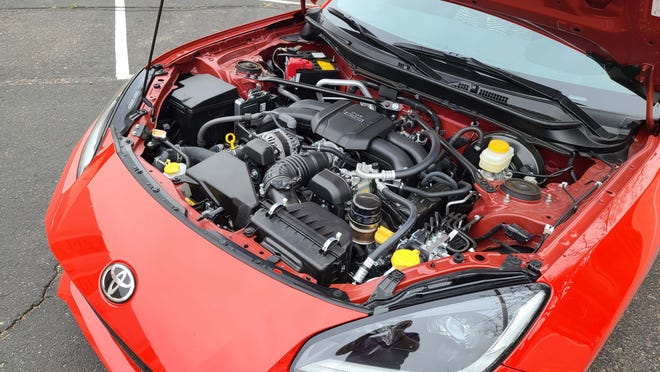
Cave Creek, Arizona — The new Toyota 86 has been renamed GR86. That’s pronounced GREAT-6.
I took it to the flowing turns, blind hills and uphill straightaways of Cave Creek, 50 miles northeast of Phoenix. It’s a sports car’s natural habitat and the ideal place to explore the significant upgrades Gazoo Racing (thus the GR prefix) has made to fix the flaws of this wonderful, affordable toy:
1) A bigger, 2.4-liter Boxer-4 cylinder engine for more torque out of the twisties.
2) Stickier, wider tires for more cornering confidence.
3) Racier, upscale design to make the $100K sports car crowd jealous.
Just be sure to get it with a manual.
My tester came with a six-speed automatic and I ached for the stick every day I had the car on a weekend visit to the Grand Canyon state. Automatics have understandably taken over the market, given their ease of use. But in a Stradivarius like the GR86, you want to be able to tune it yourself — not sit back and watch the sheet music play. Especially now that Toyota (and its sister Subaru BRZ) have the formula right.
I get to test lots of exotic sports cars — Porsche 911s, mid-engine Corvettes, Audi R8s — but there is nothing more satisfying than an entry-level sports car. It makes the joy of driving more accessible.
My young son coveted the original Toyota 86 (then called the Scion FR-S — remember Scion?) and its twin Subaru BRZ, when they were unveiled in 2014. He was so juiced that when a tester arrived in my Oakland County driveway in 2014, he jumped on a Southwest flight from Chicago to come see.
Low-slung, 200-horsepower, practical 2+2 seating, stick shift, rear-wheel drive. Alas, his balloon deflated when he stomped the gas pedal. The engine groaned, peak torque didn’t come until sundown, and — worse — it paled next to the high-revving, 197-horse 2006 VTEC Civic Si that we still had in the driveway. Sigh.
As the sage says, never buy a first-generation car. Wait until gen-2. This time, Subaru and Toyota nailed it.
All credit to Subaru, of course, which is the engineering lead on the Toyobaru. They swapped out the 2.0-liter flat-4 for a 2.4-liter flat-4. That means a healthy gain in power (228 ponies) but more importantly, a 33 pound-feet torque boost to 184. That’s nearly on par with the Civic Si’s 192.
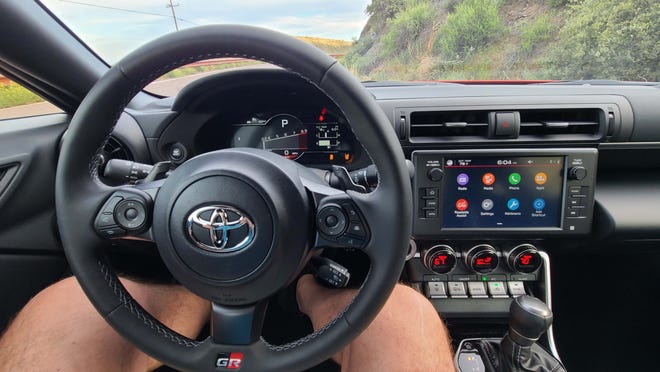
Reaching for the steering-wheel shift paddles to get my manual fix, I rowed the box in TRACK mode between 2nd and 3rd gears through Cave Creek’s twisties — taking advantage of GR86’s fatter torque curve, which arrives at a usable 3,700 rpm (vs. 6,600 RPM in the old car). Gazoo’s chefs have also sweetened the exhaust sound and I wound the flat-4 all the way to 7-grand.
The bigger flat-4 cylinder means GR86 loses none of its road-hugging goodness — the Toyobaru has one of the lowest center-of-gravity measurements in the industry as well as one of the lightest bods (2,833 pounds in Premium trim). Just for good measure, engineers also fortified the skeleton with high-strength steel, front cross members, a full-ring rear frame. My Premium edition was also shod with sticky Michelin Pilot Sport 4 shoes — a step up from the base Michelin Primacy H/P tires.
Let me recommend the $2,600 walk from the base GR86 to the $31,325 Premium model with those Sport 4 gummies wrapped around black 18-inch wheels and other goodies like heated leather seats, blind-spot assist and a Supra-like duckbill tail.
The latter is testament to the GR86’s significantly more mature look. Squint your eyes and it looks like the 2023 Nissan Z. And that’s saying something for a Toyota brand that can be hit or miss on design these days (seen a Prius lately?). GR86’s design is sleek, minimalist, timeless. It’s the looker of the Toyobaru twins.
“That’s an attractive car,” said Mrs. Payne, picking our GR86 out in a crowded parking lot. She’s not prone to gush. Leave that to me. From the aggressive front to the dramatic rocker panels to the rear duckbill, GR86 has looks to match its athleticism.
Dressed in killer red, the low-slung roller-skate got a lot of stares around Phoenix — a notorious cars ‘n’ coffee town. It also attracted challengers. An all-wheel-drive Tesla Model Y sidled up at a stoplight. Oh, I knew that wouldn’t go well.
I took the bait, stomped the pedal and rowed the oars for all they were worth. The Tesla disappeared into the distance.
The manual would have done a bit better. Toyota says the automatic is a half-second slower 0-60 mph. Sudden acceleration also exposes the auto’s biggest flaw: poor tip-in. I tested the GR86 right after a silky-smooth, six-speed automatic Mazda CX-30 (Mazda engineers are obsessive about this stuff) and GR86 felt like a bucking bronco by comparison.
The automatic’s biggest benefit is adaptive cruise control — which I use a lot in cop magnets like GR86 to keep my speeds at the posted limit. But I’d still opt for the manual — especially since Toyota equips it with a handbrake. Oh, joy.
The tandem are nicely paired in the center console of a redrawn interior. It’s spartan, but everything is in its place — except the curious decision to locate the cupholders inside the butterfly console bin. This is also where the USB is located for wired, Android Auto navigation.
Happily, door cupholders are within easy reach so I could navigate and slurp Snapple at the same time. Aft of the front seats, Toyobaru offers a rear bench too small for adults, but — like the 911’s 2+2 arrangement — they make welcome cargo space. Picking up Mrs. Payne at the airport, I stuffed her full-size bag and a second carry-on in the boot — then threw my carry-on and briefcase in the rear seats. Try that in an MX-5 Miata.
Miata is the class icon, but now that Gazoo has fixed the 86, it is the better all-around car with storage, room and looks to match its performance. Toyota offers a complimentary one-year track membership to the National Auto Sport Association so you can test the limits.
Preferably with a manual.
2022 Toyota GR86
Vehicle type: Front-engine, rear-wheel-drive, four-passenger sports car
Price: $28,725, including $1,025 destination fee ($33,250 as tested)
Detroit — Tyler Van Houten loved the acceleration, Yasmin Ponce wanted to save gas, and Jordan Khala’s 10-year-old said electric vehicles are da bomb.
EVs are the new, new thing in the automotive landscape, and Michigan residents are plugging into the growing market. Tesla made EVs cool a decade ago with neck-snapping acceleration and state-of-the-art electronics. Now, as other manufacturers try to recreate the Silicon Valley automaker’s success with their own battery-powered models, Michigan first adopters are branching out to their favorite brands and integrating EVs into their lifestyle.
EV adoption comes against the backdrop of historic government regulation of the auto industry as the EPA for the first time dictates the drivetrain technology automakers must use. But to these Michiganians, EVs offer a fresh take on personal transportation that’s been dominated for more than a century by the internal combustion engine.
The Detroit News drove across southeast Michigan talking with owners of Teslas, Mach-Es, ID.4s, Polestars, Bolts. From moms to motorheads and from Gen Y to Boomers, they shared why they went EV, how much it costs to charge, and whether they’ll ever go back to ICE.
“I love it. It’s everything I was looking for in an EV,” said Ford Mustang Mach-E owner Tyler Van Houten, 28, of Grand Rapids. “Driving a gas car feels clunky now. They’re slow to accelerate by comparison, and the EV is just a better driving experience. The best part of an EV is not having to visit a gas station.”
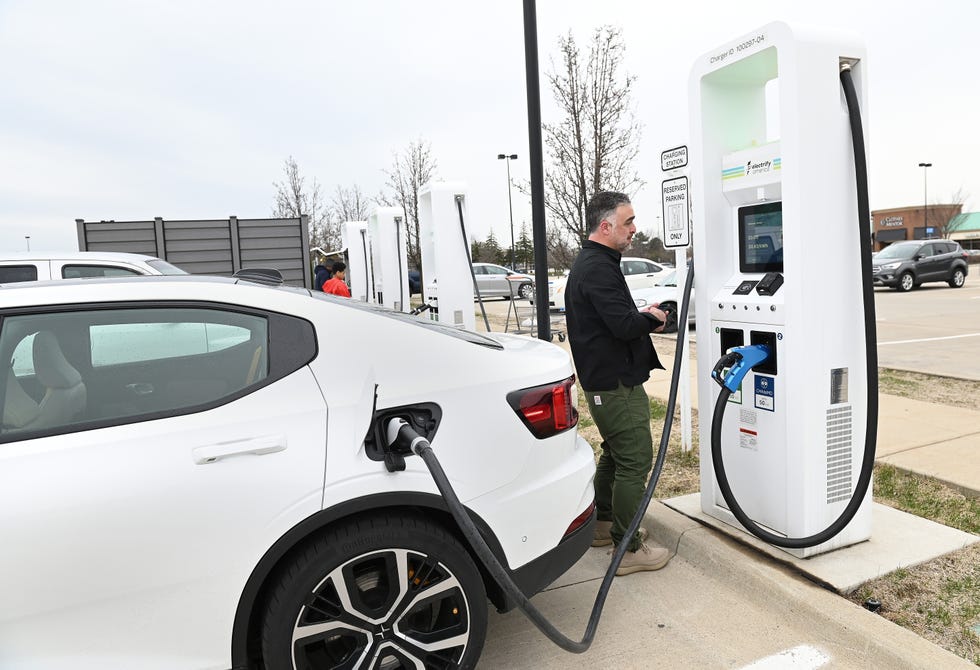
He does have to visit charging stations, though, like the Electrify America fast-charger in Novi when he is on the road. A mortgage loan officer, he was in town for a class and the EA charger in Walmart’s parking lot was the most convenient way to slake his steed’s thirst. His standard-range, 211-mile battery can charge from 10% to 80% in about 40 minutes after which the charging rate slows to a trickle.
“Filling up an EV is like filling a beer glass,” EV wags will tell you. It gets real slow at the end. Van Houten was the only EV at EA’s four stalls at 4:50 p.m. on a Friday but was soon joined by others leaving work for a quick charge. Typical of the Novi station, one of the stalls was out of order, frustrating drivers.
Van Houten has put a lot of miles on his ‘Stang over the last year, including road trips to St. Louis and Nashville. He initially looked at buying a Tesla, which has dominated EV sales with about 70% of the market in 2021, according to Cox Automotive. At 3% of market share, EVs are a small percentage of U.S. sales — 42% of those in California, according to the U.S. Department of Energy.
With the $7,500 federal tax credit capped at 200,000 in sales, Tesla buyers long ago lost access to the full credit. But with Ford EV sales in their infancy, Van Houten got the full $7,500 off his $51K sticker price. A past owner of an Explorer SUV, he also trusts the Ford brand.
“I thought the Mach-E had better build quality. Ford is a car company, not a tech company making a car,” he said. “I also felt Tesla’s dealer network was limited and I would get better service with the Mach-E.”
To feed the pony at his house, he installed a 240-volt (Level 2) charger for cheap fill-ups of about 17 cents per kWh. That number jumps to 43 cents a kWh at EA stations, America’s most robust, non-Tesla (Level 3) fast charger network. With a $4-a-month subscription, Van Houten’s rate drops to 31 cents.
Van Houten has found fast chargers difficult to come by on road trips. Without a proprietary network like Tesla, he struggled to charge at third-party chargers on his Grand Rapids-to-St. Louis trip. An EVGo charger was out of order, and he had to rely on a 240-volt charger to get enough juice to limp into the next EA station — resulting in long delays. All told, his trip from Grand Rapids to St. Louis — a 7-hour trip in a gas-fired chariot — took him 11 hours.
Most owners we talked with used their EVs for local commutes.
Yasmin Ponce, 32, of Royal Oak drives an electric Volkswagen ID.4 and puts a lot of miles on the odometer taking care of her family, including boys ages 3 and 6, across Metro Detroit. She’s already logged 8,000 miles since she bought the SUV last October.
Filling a V-8-powered Ram 1500 pickup with $3.30 a gallon gas at the time had put a dent in her purse. VW gives her two years of free charging at Electrify America stations — and she frequently charges at one of four stalls managed by Chargepoint next to Beacon Park in Detroit, the closest fast chargers to her Royal Oak apartment.
“High gas prices sold me on going electric,” she said at Beacon Park after paying $7.02 for 84 miles of range after 32 minutes of charging — about half the cost of fueling the Ram to go that distance. Chargepoint bills 20 cents a minute.
Like Van Houten, she liked the sleek lines of the Mustang Mach-E. But when she went shopping at Carvana, Ford shelves were empty. So she opted for a rear-wheel-drive, $46K ID.4 instead. The full $7,500 tax credit also was easy on her purse.
“I like that I can close the ID.4’s panoramic roof — unlike some other EVs — so that my boys can sleep in the back,” she said as her kids dozed behind her. “And I love the massage chairs.”
Apartment living is particularly challenging for EV ownership compared with homes where buyers can install 240-volt chargers. But for Ponce, the time spent charging at Beacon Park is welcome. “It fits in my day, and I take advantage of it for self-care as well,” she said with a smile. “I also meet people when there are events at the park, so there’s a sense of community.”
On a cold, snowy Monday afternoon in mid-April, she is the only Beacon Park user. EV owners are more likely to be found at indoor, Detroit parking lot chargers while working at, say, a Bedrock property.
It’s different in southeast Michigan’s more affluent suburbs where most EV owners live and where fast chargers are more plentiful.
At Tesla’s Livonia supercharger at I-96 and Middlebelt in Meijer’s parking lot, Jordan Khala, 41, charged his all-wheel-drive 2022 Tesla Model 3 Long Range to the 360-mile maximum. Five of the nine chargers are occupied at 1:30 p.m., snow accumulating on Tesla hoods.
It’s part of Khala’s routine. A financial adviser, he stops here twice a week for electrons before visiting clients around the Metro area. In addition to its cutting-edge technology — over-the-air-updates, Autopilot, Ludicrous acceleration — Tesla’s secret sauce is its vast charging network. Cars not only sync to it for trips — but at cheaper electric rates, too. Superchargers bill by the kWh, with rates anywhere from 12-to-33 cents around Michigan. A 250-mile fast charge over 50 minutes will typically cost about a third of the cost to fuel a comparable gas car.
Khala likes cars, and his 10-year-old son really likes Teslas.
“My 10-year-old said I had to get a Tesla,” he said, laughing. “He researched the Model 3, all the features. He really convinced me. So I rented one from Hertz for a week, and then ordered one. I like Autopilot — my son, of course, likes the whoopie cushion feature.”
He sold his Mercedes S-Class sedan, but still keeps a Ford Expedition XL for road trips. “The range of EVs is still too low for long trips,” he said. “So for now, I still have feet in both the EV and ICE camps.”
He hopes to install his own 240-volt charger at home so he can charge overnight, but — like so many goods these days amid supply chain issues — Tesla chargers are out of stock.
Tesla owners Sam Crudo and Ian Presses are going back to ICE.
Not because they haven’t enjoyed their EVs, but because other cars make more sense to them. Crudo, 60, of Shelby Township, is trading in his 2018 Model X SUV for a gas-fueled Lincoln Aviator.
“For now, EVs are metro cars,” he said. “The Tesla advertises 300 miles, but I have a heavy right foot and it doesn’t get that. When I travel up north, I don’t want to stop for 45 minutes each way to recharge. I want to fill up for gas in three minutes.”
He and his wife use her Ford Edge for long trips and have left the Tesla in the garage. She’s intrigued by the Mustang Mach-E but can’t make sense of the long-range charging issue, either.
Presses, 68, of Bloomfield Hills likes to get a new performance car every few years, and it’s time to give up his Model 3 Performance. Model 3s haven’t changed much since he bought his four years ago, and most new EVs are SUVs or pickup trucks like the Model Y and Mach-E or the GMC Hummer and Rivian R1T.
“Like in the movie ‘Casablanca,’ I’ll round up the usual suspects,” he smiled about the petrol-powered toys on his shortlist. “The Audi RS5, BMW M4, Alfa Giulia Quadrifoglio. Maybe a Porsche 718 Cayman.”
He hasn’t given up on EVs. The Tesla has cost him almost nothing to operate save the cost of a home charger, where he plugs in every night. But he was concerned about a battery-powered car whose general maintenance warranty expires after four years, and he’s been unimpressed by Tesla’s service. “They need to beef up the service with better human support,” he said.
Volvo’s electric brand, Polestar, produces a sleek sedan that is the closest competitor to the Model 3. The Polestar 2 caught the eye of Farmington Hills designer Alex Alexanian, 47.
While it doesn’t have the gob-smacking performance that Presses craves, the Polestar isn’t obsessed with interior minimalism like Tesla.
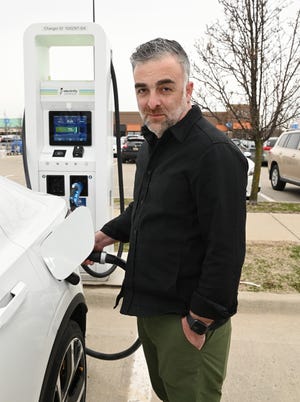
“I’m a big proponent of electrification. I’ve been waiting a long time for the right vehicles,” Alexanian said while his EV charged up at Electrify America’s Novi supercharger. “I test-drove the Polestar. The dealer had the specs I wanted. And it has the right kind of physical interface — it’s minimalist but with less reliance on the touchscreen than the Tesla.”
He’s been frustrated in getting a home charger — one electrician quoted him an outrageous $5,000 for installation. In the meantime, he’s dependent on Electrify America’s nearby Novi charger and other local stations to call on his metro clients. Like Ponce’s VW, Polestar gives Alexanian two years of free charging at Electrify America.
It’s a chance to spend time with his 11-year-old daughter, Maven, who thinks Dad’s new car is cool. “She likes it when I accelerate fast,” he said. “And she likes electric cars — she’s into the whole eco thing.”
When his family hits the road, however, they take a Toyota Sienna Hybrid minivan. “Range anxiety is real,” he said. “I just use the Polestar around town.”
Alex Janowski, 28, of Sterling Heights is restoring a 1998 Chevy S-10 pickup and keeps a 2011 Chevy Malibu for long trips to, say, the Upper Peninsula. But he’s found his ideal daily driver: a Chevy Bolt EV.
A metal trades worker for General Motors in Warren, he charges for free at work every day on a 240-volt charger. That adds up to a whopping $200 in fuel savings a month.
“I don’t have to pay for gas, I don’t have to pay for oil changes,” he said. “I like to work on cars, but it’s kind of nice not to have to work on my daily driver. My next car will definitely be another EV.”
Henry Payne is auto critic for The Detroit News. Find him at hpayne@detroitnews.com or Twitter @HenryEPayne.
Pontiac — I like Skittle-colored Mustangs. Red, blue, orange, yellow. Especially yellow. The bright color turns heads on Woodward Avenue, accentuates the muscular hips, stands out against the snow.
Snow? What kind of Mustangs like to be driven in snow?
The all-wheel-drive, all-electric, 600-torque, Mach-E kind. After a snowy, wintry day in southeast Michigan, I jumped in and headed for the nearest parking lot to do donuts. You’re never too old to feed your inner 16-year-old, and let’s be honest, we’ve all wanted to do Mustang donuts in rear-wheel-drive, V8-powered GT coupes since we got our driver’s license.
But on dry pavement, not snow. Not that I haven’t tried. I took a ferocious, green Bullitt V-8 out in a Detroit blizzard (do we have global warming yet?) a few years back and it wasn’t pleasant. Rear-wheel-drive, 480-horsepower and snowdrifts don’t play well together. I struggled to make it up grades, rear tires squirming, traction-control straining, heart beating.
When I found my favorite snowy parking lot, the pony car was hard to control. The rear slewed on cue, but the front tires didn’t bite. And if I had drifted into a snow drift? Heaven help me getting out. Not so my AWD yellow GT tester.
Seasonal weather is what performance SUVs are born for. A fellow motorhead bought a rear-wheel-drive, 505-horse twin-turbo V-6 Alfa Giulia Quadrifoglio hellion a few years ago — arguably the best-handling sedan on the planet — and traded it in a year later. Why, you ask? Because it was a fair-weather car. He bought a ferocious, AWD 505-horse twin-turbo V-6 Alfa Stelvio Quadrifoglio SUV instead so he could drive it year ’round.
I charged up to Pontiac in the Mach-E GT, its AWD system churning happily through snow and slush. Electric motors, as I’ve found on my Tesla Model 3, are efficient at handling slip and Mach-E was no different. Which is a good thing because the GT has gobs of grunt.
Arriving at a snowy parking lot, I buried the throttle and the ute spun like a top — all four corners spinning. With ground clearance to spare, I never bogged down in snowdrifts like the low, mean Mustang coupe.
Not that the Mach-E GT doesn’t look mean.
After having my fun in the snow, I got out and admired the stallion’s muscled lines. Is there a better-looking SUV? Signature Mustang taillights, coupe-like roof, muscular haunches, bowed rocker panels, phone-dial wheels, and capping it off — a wicked black face.
I know, I know, it’s just a plastic shield — an echo of the functional grilles that adorn its internal-combustion-engine brethren. But it works as a heritage piece so much better than the old plastic grilles on Tesla Model S sedans which, well — had no ICE heritage. Heritage matters, and that’s why the Mach-E is the best EV out there not named Tesla.
Where the Tesla brings authentic, shocking, electric performance to the table, Mach-E GT also knows exactly what it is: a pony car-inspired ute with brute power.
Embracing electrification, Mach-E puts more torque through its four claws than even an AWD F-150 Raptor. The power is slightly dulled by its sheer, battery-laden bulk — a porky 4,962 pounds. Floor the gas pedal (we need a new name. Juice pedal anyone?) on asphalt and the GT is not nearly as explosive as my 4,072-pound Model 3 Performance. Model 3 hits 60 in an eyeball-flattening 2.9 seconds, while the Mach-E takes another three-quarters of a second to get there.
No shame in that. It’s similar to the Model 3’s taller Model Y Performance SUV sibling, which has inherently worse aerodynamics and more pounds to carry. But once the ‘Stang EV is up to speed it is noticeably better than the Tesla at managing that weight.
A product of years of Mustang engineering, Mach-E GT is sharp and predictable at the limit where the Tesla feels numb and uncertain. That’s confidence-inducing in a sled this size. More precision is on tap in the summer months if you opt for Ford’s sticky Pirelli tires, but this being winter, all-seasons are preferred.
My speed-addled pal Rick, who has had a few muscle cars in his time, was also impressed by the GT’s looks, feel and interior moxie. Ford tore up the Mustang rulebook in the cabin — with good results: Mach-E GT brings Mustang heritage outside, sci-fi modern inside.
Rick’s biggest beef was the car’s girth.
That number contributes to his greatest worry: range. The GT has just 270 miles of it, and a sparse charging network if you want to leave Metro Detroit. He’ll stick with 3,700-pound, 288-mile-of-gas-range Mustang GT coupes, thank you very much.
But as a metro commuter, Mach-E GT is in its element, assuming you’ve installed a 240-volt charger in your garage.
I have two — one proprietary charger for my Tesla and another for other EVs I test (about a $3,400 total investment). After charging around Metro Detroit’s snowy tundra, I filled the ‘Stang from 84 miles of range back up to 229 overnight (the recommended 80% of capacity).
While Ford has tended to its heritage on the outside, it had the good sense to go with a minimalist, clean-sheet design inside. The interior is dominated by the 15.5-inch vertical console screen. A small information display is tucked behind the steering wheel.
Though Mach-E is inferior to Tesla in charging infrastructure, it one-ups the Silicon Valley maker with a more solid build, and wireless Apple CarPlay and Android Auto — meaning the GT seamlessly integrates your phone’s Google navi when you slip into the car. Google Maps can’t chart a long distance journey using the nearest Electric America chargers — whereas Tesla Autopilot has your back. But, ahem, surely Google is working on that?
Big screen, big presence, big yellow car. Like the ol’ Mustang Coupe, the Mach-E GT looks good in a loud wardrobe. All that’s missing is the loud exhaust note.
Under the cane in Unbridled mode, the GT pipes in a low, electronic gurgle. It’s OK, but there’s got to be more up Ford’s sleeve. May I suggest a deafening, 100-decibel gas engine-like soundtrack? Call it V-8 mode.
2022 Ford Mustang Mach-E GT
Vehicle type: Battery-powered, all-wheel-drive four-door SUV
Price: $61,00, including $1,100 destination charge ($63,885 as tested)
Powerplant: 88-kWh lithium-ion battery driving twin electric motors
Power: 480 horsepower, 600 pound-feet of torque
Transmission: Single-speed automatic
Performance: 0-60 mph, 3.8 seconds (mfr.); top speed, 124 mph
If you’ve got a Dodge Charger, you may want to keep a close eye on it.
The Charger takes the dubious prize as first among the Top 10 Most Stolen Cars in Michigan, according to the latest crime data from the National Insurance Crime Bureau. The Jeep Grand Cherokee and Ford F-150 are the second and third most-snatched. Detroit Three models dominated the list, with Chevy the most-stolen brand with five models in the Top 10.
Nationally, a car is stolen every 36 seconds with the F-150, Chevrolet Silverado and Honda Civic topping the charts. The statistics are compiled by the NICB in their annual “Hot Wheels” report with the latest data coming from 2020. Chargers were picked 755 times in Michigan with 583 Grand Cherokees stolen and 569 F-150 pickups.
“Auto thefts saw a dramatic increase in 2020 versus 2019 in part due to the pandemic, an economic downturn, law enforcement realignment, depleted social and schooling programs, and, in still too many cases, owner complacency,” said NICB president David Glawe. “No matter what kind of vehicle you have, take steps to protect your investment — lock your car and take your keys.”
Dodge’s Charger sedan and sister Challenger coupe have been red-hot properties in recent years as the “Brotherhood of Muscle” has seen strong sales in a muscle car-friendly market.
“Hellcat cars are particularly popular due to the high price of many key components, but Scat Pack, R/T and V-6 models are key targets of car thieves in several metropolitan areas around the country (including) Metro Detroit,” says the Dodge Forum, which also attributes high theft rates to the fact that the Charger does not have a steering lock system, making rollaway thefts easier.
The Ford F-150 is not just the best-selling vehicle in the country — driving demand for parts — but chip shortages are likely to continue to make the pickup a thief magnet, say experts.
Rounding out Michigan’s most-stolen vehicles are:
4. Chevrolet Malibu (562)
5. Chevrolet Silverado (558)
6. Ford Fusion (526)
7. Chevrolet Impala (514)
8. Chevrolet Equinox (407)
9. Chevrolet Trailblazer (381)
10. Ford Escape (356)
Michigan ranked 37th nationally with a theft rate of 192 thefts per 100,000 residents. Colorado led all states with a theft rate of 502, followed by California’s 475. In raw numbers of vehicles stolen, California lad by a big margin (187,094) over Texas (93,521) and Florida (44,940). Michigan ranked 13th in total thefts with 19,105.
Nationally, 4 of the 10 most stolen vehicles were Detroit Three pickup trucks, while Japanese sedans took the other top slots. The Ford F-150 topped the national list for the second year with 44,014 thefts, while the Civic was the most snatched sedan with 34,144 units gone missing.
Henry Payne is auto critic for The Detroit News. Find him at hpayne@detroitnews.com or Twitter @HenryEPayne.
General Motors Co. is electrifying its most iconic sports car, the Chevrolet Corvette, with plans for an electrified version followed by a fully electric model.
President Mark Reuss announced the news Monday in a LinkedIn post that GM “some time ago” moved the Corvette team into the electric vehicle space at the automaker’s Warren tech campus. The electrified version will be offered as early as next year, Reuss said. Names and additional details on the products will be released later, he added.
GM revealed its coming electric products a day before crosstown rival Ford Motor Co. is set to celebrate the launch of its electric F-150 Lightning on Tuesday, the same day GM releases its first-quarter earnings. Both automakers are investing billions to transition their fleets for an electric future and prove to Wall Street they have what it takes to compete with EV leader Tesla.
Electrifying the Corvette will mean not just being as good as the current gas-powered versions but better to attract sports car and EV enthusiasts alike, experts say. Chevrolet will look to win over new customers, and experts think these variants have that potential.
“This is definitely going to refresh Corvette’s image,” said Jessica Caldwell, executive director of insights for Edmunds.com Inc., a vehicle information website. “For a long time, it kind of has had an image of the more middle-age crisis type of vehicle.”
The Tesla Model S has shown “there is a bit of demand for a sleek, cool electric sports car,” Caldwell said.
An electrified Corvette will add to Chevrolet’s electric Silverado pickup, arriving next spring, and the Bolt EV and Bolt EUV, which are both back on the market after a mass recall of the products for battery fire risk. GM has also said it will offer electric Blazer and Equinox SUVs in 2023.
The model is named after Zora Arkus-Duntov, the legendary “godfather of the Corvette” who developed the first mid-engine Corvette prototype in 1960. The News reported the Zora version would come after the recently debuted 2023 Z06 and future ZR1 variants.
Since then, a fourth performance variant has been reported, called the E-Ray, that would follow the Z06 in 2023, slotting between the Z06 and ZR1. Traditionally, that model has been called the Grand Sport — a sort of cross between the standard Corvette and the track-focused Z06. Given the E-Ray’s ambitions as the first hybrid, all-wheel-drive Corvette, however, it gained a new name for the C8-generation car.
GM filed two trademarks applications to register “E-Ray” and “Corvette E-Ray” with the U.S. Patent and Trademark Office in 2015.
The electrified Corvette that Reuss referenced appears to be the E-Ray, which would follow on the Z06’s heels next year. GM Authority, Muscle Cars & Trucks, Motor Trend and numerous spy shot photos have reported the hybrid will mate a front motor to the same 6.2-liter, LT2 V-8 engine as found in the standard C8 Stingray. The combined horsepower of the engine and electric motor is expected to top 600 horsepower — well north of the base Stingray’s 495 horses.
The E-Ray will be the first AWD Corvette — similar in operation to the Acura brand’s mid-engine Acura NSX hybrid supercar. Introduced in 2016, the $171,495 NSX will be discontinued after this year. Expect the E-Ray to be less expensive.
“Where I get concerned about performance on a performance car is when you start making them weigh more,” said Karl Brauer, executive analyst for iseecars.com, a vehicle search site. “We saw in the NSX lot of this same philosophy that we’re about to see in the Corvette. And the NSX had very good numbers in terms of acceleration and track lap times, but it’s also a heavy vehicle. It’s still not pulling lap times like Porsche 911 GT3s.”
The Corvette’s mid-engine layout allows for the addition of an electric motor in front to drive the front wheels. When The News broke news of a mid-engine Corvette in 2016, sources said electrification was a key factor in moving the engine rearward so the sports car could take advantage of rapidly evolving hybrid-electric capabilities found in European supercars. The hybrid, mid-engine Ferrari SF90 Stradale, for example, makes 986 horsepower.
Beyond the current, C8 generation ‘Vette, rumors have swirled of an Ultium-based Corvette for some time. The 800-volt battery platform is used across many GM brands, from the 2022 GMC Hummer EV to the forthcoming 2023 Cadillac Lyriq. The Hummer launches from 0-60 mph in just 3.0 seconds (on par with the V8-powered Corvette Stingray ), so the Corvette EV’s acceleration should be staggering.
President Joe Biden has made repeated references to an electric Corvette after meetings with GM brass over the past two years.
“I’ve got a commitment from (GM CEO Mary Barra), when they make the first electric Corvette, I get to drive it,” Biden said last year. “You think I’m kidding, I’m not kidding.”
Chevrolet released a 30-second teaser video that appears to show a prototype of the “electrified” — read hybrid — Corvette that Reuss referenced in his LinkedIn post.
“We’ll outline the specifics on the level of electrification as we get closer to reveal,” Chevrolet spokesman Kevin Kelly said.
The video’s audio is a cryptic combination of a camouflaged sports car in snow and music overlay — but it appears to show a silent launch of a mid-engine Corvette consistent with a hybrid V8-powered car that can be operated in battery-only mode for up to 25-30 mph.
All four wheels are clearly spinning at launch, indicating all-wheel-drive with an electric motor in front driving the front tires. Also of note are the lime green brake calipers similar to how Porsche outfits the brakes on its hybrid vehicles.
Out back, four exhaust pipes — consistent with the current C8 Stingray’s four outboard-mounted, square exhaust tips — are clearly present. The car performs an extreme slide on snow consistent with the dexterity of an AWD system.
Crosstown rival Ford Motor Co. released the electrified version of its Mustang, the Mach-E, in late 2020. The vehicle has performed so well for the Dearborn automaker that its increasing production capacity for it.
Ford in December 2021 said it will use its entire Cuautitlan plant in Mexico for production of Mach-E. The company plans to increase production of Mach-E there starting in 2022 and expects to reach 200,000 units per year by 2023 for North America and Europe.
Ford last year posted its best-ever sales for full electric vehicles, second only to Tesla for 2021 with Mach-E sales coming in at 27,140.
Encinitas, California — Toyota pioneered the green auto segment 20 years ago with its egg-shaped Prius, expanding its customer base from Camry shoppers, Tacoma off-roaders and Supra speedsters to include hybrid tree-huggers.
These loyal green customers then watched over the last decade as Tesla stole Toyota’s green eco-mantle with the all-electric Model 3 and Model Y.
The faithful have finally been rewarded with the all-new 2023 Toyota bZ4X, the first all-electric Toyota built on a skateboard chassis. Just like a Tesla, but Toyota-fied.
Stepping on the gas (electric?) pedal, I surged out of a stoplight on Carlsbad Highway north of San Diego, leaving traffic behind. Tesla made macho acceleration an EV trademark — contrary to the snail-like Pious — and the bZ4X doesn’t disappoint. Liquid smooth and quiet as a beach breeze, the SUV is pleasant to drive around town devoid of a droning CVT transmission or gutteral V-6. Toggle the regen button (conveniently located right next to the rotary shifter) and you can one-pedal drive. Just like a Tesla.
But the top-drawer, Michigan-friendly all-wheel-driver’s 214 horsepower pales next to the AWD Model Y’s neck-snapping 384 ponies — good for 4.4 seconds 0-60. My Toyota arrives two seconds later.
That puts it at the back of the pack of Model Y pretenders (Tesla dominates the EV market with some 70% of sales) that have flooded the market, including the Subaru Solterra (which shares the bZ4X’s skateboard platform), Volkswagen ID.4, Hyundai Ioniq 5, Kia EV6, Volvo C40 and my favorite, Ford’s Mustang Mach-E.
Like the Camry sedan and RAV4 SUV, bZ4X’s game plan revolves around reliability and room. Vroom? Not so much. Unlike some automakers that have set dates for their all-EV future, Toyota recognizes EVs are a niche for now. You want thrills? Check out the all-new gas-fired GR86 sports car and twin-turbo V6 Tundra — also released this year.
Like its stablemates, bZ4X will turn you head. Borrowing design cues from an alphabet soup of sources — fascia from the Model X, flanks from Lexus NX, fender classing from RAV4, taillights from Prius — it poses a coherent, premium design statement. And that’s a good thing since bZ4X starts at $42K (on par with ID.4, Ioniq 5 and Co.), well north of a RAV4 hybrid.
Less appealing is its alphabet soup of a name: bZ4X. No worries, I speak Alphanumeric.
Translation: BZ is short for Beyond Zero (important to its righteous image, but a dubious claim of zero emissions since the SUV’s battery is mined from the world’s lithium deposits, then charged via America’s fossil-fuel-fired energy grid). Then things get really obtuse. The 4 stands for midsize vehicle (3 is for compact, 2 for subcompact, and so on). And X is for crossover.
Toyota turned RAV4 (Translation: Recreational Active Vehicle with 4-wheel-drive) into a winner, so who am I to judge?
A bigger issue is bZ4X’s mixed bag of tech beneath an appealing interior design package. I ogled the center console’s striking tidal wave of black trim cresting in a broad 12.3-inch screen, then barked: “Hey, Toyota! Take me to Boulders Resort, Scottsdale, Arizona.”
Confusion.
The Tesla would have understood my Southern accent, mapped the 504 miles to destination, and included charging stops on the way complete with restaurants and shops where Mrs. Payne and I could graze while the car slurped electrons. Not the Toyota.
I turned to the trusty touchscreen keypad and located Boulders, but my e-guide hadn’t a clue where fast chargers could be found along the way. Finding fueling stations is my job, apparently.
Toyota says that charging station updates are scheduled for future over-the-air updates (another Tesla innovation), but it will be tough sell to California greens desperate for something different than the six Teslas on their block. Toyota knows its target audience; six-figure households with a multi-car garage that have a Nowhere-Near-Zero Land Cruiser for when family road trips are required.
While competitors like Ioniq 5 boast quick-charging 800-volt platforms, Toyota has settled for a 355-volt platform that will fast-charge from 10-80% in a leisurely 60 minutes. Range puts it in the low end of the segment with 228 miles for my AWD XLE tester. That’s better than a standard-battery, AWD Mustang Mach-E’s 211 miles, but shy of an AWD Model Y’s 330 miles and 256 miles for a comparable Hyundai Ioniq 5. Don’t even think about towing something behind the Toyota.
Like Mach-E, bZ4X features a clever recessed, unshrouded instrument display behind the steering wheel because EVs don’t need big displays with RPM dials. Essentials like mph, speed limit, adaptive cruise indicator and auto high beams (the Toyota is typically loaded with standard safety features) are displayed in what is essentially a non-reflecting head-up display.
Unfortunately, it is, um, obstructed by the steering wheel. I had to lower the wheel into my lap, which compromised aggressive driving maneuvers. Again, Toyota knows its buyers: this is city cruiser, not a corner carver.
Ergonomic tics aside, the cabin is as comfortable as your sun porch.
Letting the sunshine in is a premium panoramic roof, a standard item that Tesla made a signature of the SUV class. Under the glass dome is a palatial rear-seat couch with Land Cruiser-like 47.1 inches of legroom — 10 more inches than a RAV4. My giraffe legs loved it, and they dig the heated rear seat option, too. Not to be left out, front passengers get heated/cooled seats — and a special space heater (like your sun porch in the winter) where the glove compartment used to be.
That’s right, bZ4X nixes the glove compartment — innovating on the passenger side just as it does the driver dash.
Expect more such breakthroughs as interior designers recognize the benefits of EVs that no longer have driveline tunnels through the middle of the cabin. BZ4X ditches the glove compartment because it has a bottomless center console into which you can drop air gauges, insurance cards — it’s so deep Toyota offers a top bin so you can segment it. Under the electronic shifter is more space for your purse, tissue box and small dog (I hear they’re all the rage these days).
The emphasis on space does not extend to a frunk, which is another Tesla-pioneered feature (for those counting, that’s liquid torque, OTA, pano roof, big screen, frunk) that Ford has embraced with the Mach-E and Lightning pickup. Mach-E was hell-bent on creating a Tesla clone to steal away Model 3/Y buyers. Toyota? Not so much. They’re content to make an approachable EV for brand loyalists.
They’ll give it a big tree-hugger hug.
2023 Toyota bZ4X
Vehicle type: Battery-powered, front- and all-wheel-drive four-door SUV
Price: $43,215, including $1,215 destination charge ($49,970 Limited FWD and $52,050 Limited AWD as tested)
Powerplant: 71.4/72.8 kWh lithium-ion battery driving single/twin electric motors
In a glimpse of its electric ambitions, Lincoln introduced the Star Concept vehicle Wednesday. With its sleek proportions, cabinet doors, and high-tech interior, the Star evokes classic show car concepts of Lincoln’s past.
But with its skateboard battery platform and promise of driver-assist systems, the Star is more a rolling penthouse suite than a traditional automobile.
The concept previews three new electric models by 2025, when Lincoln expects half of its global volume to be battery-powered. Currently, Lincoln doesn’t sell an electric vehicle in a US market segment that is about 3% of U.S. sales volume.
To signify the radical change in drivetrain philosophy, the Star introduces a new face of Lincoln with a digital, jewel-like light show across the front fascia where Lincoln’s arched, metal-lattice grille used to be. That arched grille was introduced on the 2017 Continental sedan which was discontinued just three years later as customers rushed to SUVs.
“As Lincoln enters the next chapter in our transition to a zero-emissions future, the Lincoln Star Concept will lead the way,” said Lincoln boss Joy Falotico. “It is an excellent example of how we are redefining luxury for the next generation as we work to transform the vehicle into a third space — a true place of sanctuary.”
The sleek exterior and front light show are reminiscent of competitor Cadillac’s Lyriq SUV, the GM luxury brand’s first electric EV that will go on sale next month as a 2023 model. Both Lyriq and Star feature edgy, minimalist designs with narrow greenhouses sitting over rear-wheel-drive battery platforms.
In addition to new lighting signatures front and rear (a laced, horizontal light spans the rear), the Star is distinguished by a electro-magnetic glass frunk (the front of the truck where the gas engine once resided) that is transparent when the vehicle is in motion — opaque when stopped to hide the contents below.
Building on the Quiet Flight theme embodied in Lincoln’s just-refreshed Navigator full-size SUV, the concept’s new design language emphasizes what the Ford luxury brand calls its core “tenets of beauty, human, gliding and sanctuary.” The Navigator and its SUV siblings helped lead Lincoln to its best global sales in 21 years — up 7% in 2021.
“Electrification is removing many traditional vehicle design constraints, allowing us to reimagine what a vehicle can be,” said Ford design chief Anthony Lo. “The Star is a study of experiences and themes that push the boundaries of Lincoln design.”
The new design canvas is most obvious inside with a spacious cabin undisrupted by a an ICE driveline. The flexible space could be used for multiple layouts. For example, the Star’s rear cargo space boasts a lounge mode that transforms into an outdoor seat for tailgate parties or enjoying an outdoor destination.
The Star Concept’s four seats are wrapped in digital displays, crystalline lighting, and backlit doors that would embarrass a First Class Delta cabin.
The cabin is run by the Lincoln Intelligence System, a digital assistant designed to connect to other vehicles and charging infrastructure — as well as provide drive and park-assist features. In a nod to a self-driving future with common electric drivetrains, Lincoln’s Star intro made little mention of driving dynamics or system power.
The emphasis is on a passenger sanctuary while in traffic or on a long trip.
Animated digital displays combine with light, smell and sound to create unique interior moods aimed at bringing “the romance of travel back in a uniquely Lincoln way.” Moods include:
– Coastal Morning: features gentle, oceanic sounds, a fragrance of sea mist, and the warm glow of the sun with dynamic lighting to replicate a stroll on the beach at sunrise
– Mindful Vitality: meant to re-energize the senses, with invigorating, upbeat audio, dynamic abstract artwork, soft, glowing lighting and a flowery fragrance.
– Evening Chill: mirrors dusk using a calming night soundtrack coordinated with night sky video and evergreen fragrance
The driver accesses drive modes via a floating console with a rotary shifter. Rear-seat passengers can recline in first class comfort with individual leg rests, curated storage for devices or slippers, and a fridge. A digital briefcase also provides safe storage, charging, and connectivity for digital devices.
Like the frunk, the A and D-pillars are transparent with a unique, 3D-printed metal latticework design. A panoramic roof bathes the interior in light.
The Star concept was introduced in Hollywood California where luxury EVs are all the rage and nearly half of the country’s EVs are sold.
“The Lincoln Star Concept has been a true labor of love for our team and provides us with a platform to test our design philosophy as we evolve our Quiet Flight DNA,” said Lincoln global design director Kemal Curic.
Henry Payne is auto critic for The Detroit News. Find him at hpayne@detroitnews.com or Twitter @HenryEPayne.
New York — The Big Apple’s auto show is a smaller bite this year as manufactures like Honda, BMW, GMC, Cadillac, Mercedes, Audi, Porsche and Mazda are missing. The main floor is a hybrid of legacy automakers, startups and shrubbery to fill in the empty spaces.
To draw you in, there’s eye candy like Elvis’s 1956 Lincoln Continental (to celebrate the brand’s 100th anniversary). Radwood is a show-within-a-show celebrating cars of the ’80s and ’90s, and there is New York’s signature display of exotics. My favorite? The jaw-dropping Ford GT, turning heads since 2015.
But our focus here is on the newest hardware, and they crave attention as shows reopen post-pandemic. New York state will ban the sale of new gas-powered cars sales by 2035, so there’s an emphasis on EVs here — but America is a vast, diverse market and there are drivetrains aplenty on offer. My Top 10 most significant new cars of the 2022 New York Auto Show:
Chevrolet Corvette Z06. The king is here. The first performance variant of the first mid-engine Corvette, the Z06 doesn’t disappoint. Like Simba on Pride Rock, Z06 introduces the Chevy display. Its flanks are swollen by air ducts to feed the V-8 monster within: the most powerful normally-aspirated production engine to date with 670 horsepower at 8,600 RPM. When Chevy fired it up on Wednesday, the whole place stopped in its tracks to listen.
Ford Bronco Raptor. Showgoers can get a ride in a Mustang Mach-E or F-150 Lightning, but Bronco Raptor looks like it could climb Mt. Everest. With expanded fenders engorged with yuge, 37-inch all-terrain tires, Raptor is so wide it needs three amber lights like a heavy-duty truck. Its twin-turbo V-6 engine spits out more than 400 horsepower, and its $68,500 price tag is just south of big brother F-150 Raptor.
Nissan Z. Like Ford, Nissan is going electric, but it’s not ditching its two-door legends on the way. Like the Mustang coupe, Nissan Z is an icon and gets remade for 2023 with sleek looks and a 400-horse twin-turbo V-6. The interior gains all the latest electronics since the Z’s last remake a decade ago. Catnip for enthusiasts: you can row that powerful engine with a six-speed manual.
Chevy Silverado RST EV. GMC didn’t make it to this year’s show, which will disappoint Hummer EV fans. They should check out the Silverado EV instead. Chevy’s first electric truck sits on the same Ultium battery platform as Hummer, also costs north of six figures, and boasts the same all-wheel-steer. Its 664 horsepower will get you to 60 mph in just 4.5 seconds and its 800-volt battery system can add 100 miles of range in 10 minutes at a fast charger.
Toyota GR Corolla. Gonna’ sell like hot cakes. The Corolla (finally) enters the hot hatch market with this muscle-bound, 300-horsepower, turbo-3 cylinder, all-wheel-drive, manual-shift-only hellion developed by Toyota’s Gazoo Racing arm. On display here is the special-trim Circuit model with big spoiler, domed hood, and dual limited-slip differentials. At night it probably slips out to New York streets to eat Priuses.
Kia Telluride. Kia hopes to attract upscale EV customers with its swoopy EV6 and sci-fi EV9 concept on display. If they are successful, it will be in no small part due to the Kia Telluride, the brand’s 2020 mega-hit that brought premium style to mainstream SUVs. Loaded with standard features and an exterior as elegant as a Caddy, the Telluride flew off shelves, hitting nearly triple-digit sales within its first two years of production. For its ’23 refresh, Kia doesn’t mess with success, but the interior gains bigger screens and the lineup grows to include more rugged X-Line and X-Pro trims.
VW ID.Buzz. The VW Microbus is back as the electric ID. Buzz (Buzz is the latest Bus, get it?). Riding on ’60s nostalgia, the $45k ID. Buzz is a three-row minivan with a longer wheelbase than the Atlas SUV (heck, it’s even longer, at 127.5 inches, than a Chevy Tahoe). It’s hard to believe it’ll fit in Europe’s narrow city streets. But the Germans will get it first later next year before it jumps the pond in 2024.
VinFast VF 8. EV startups stole the show with impressive debuts from INDI One, Deus Vayanne hypercar, and VinFast VF 8 and VF 9. But it’s the latter that are likeliest to make the biggest U.S. splash. The compact VF 8 and three-row VF 9 look ready for prime time with mature looks and big-screen interiors. They are also backed by big money from Vietnamese conglomerate Vingroup with an eye on building a North Carolina production facility. Ask about their plan to sell you the car, lease you the battery.
Alfa Tonale. Alfa wowed with the Tonale concept at the 2019 Los Angeles Auto Show, and the production version is finally here. The 2023 model carries through on the concept’s sleek looks, and Tonale should challenge the BMW X1 for best-handling subcompact luxury ute. Tonale also features best-in-class, 272-horsepower, thanks to twin electric motors mated to a 1.3-liter turbocharged engine. The entry-level ute is likely the last new, gas-powered Alfa model introduced before the brand goes all-electric in 2028.
Subaru Outback. Is it the display or the car? The Subie sits in the coolest stand in show — a throwback to the days when manufacturers built $5 million displays. The brand’s icon, Outback gets a cool facelift that matches its off-road vibe along with a second, cheaper, 2.5-liter Boxer-4 engine option.
Henry Payne is auto critic for The Detroit News. Find him at hpayne@detroitnews.com or Twitter @HenryEPayne.
New York — Shoot virtual zombies while driving through New York! Get a full battery replacement from your electric-vehicle manufacturer! Launch zero-60 in a face-flattening 1.9 seconds!
Auto shows in recent years have been launch pads for new EV companies including Lucid, Fisker, Byton, Qiantu and Rivian. This year’s New York International Auto Show is no different, showcasing three new EV players spanning the breadth of the auto market from the gaming-focused INDI EV’s SUV to the VinFast VF 9’s innovative battery subscription to the insane performance of the Deus Vayanne hypercar.
Whether another tech bubble or a genuine revolution, the sky-high valuations of electric vehicle makers are attracting more startups than the auto industry has seen in a century. Some, like China’s Byton and Qiantu, have yet to realize their promise in the U.S. market, where Lucid and Rivian have completed initial public offerings and started deliveries to customers.
Hoping to follow the latter examples, the three startups made a big splash at the New York show’s media day on Wednesday. Armed with industry-savvy personnel and mature partners, they hope to be the next big thing.
INDI EV. Short for Independent EV, the Los Angles-based startup showed off its INDI One here — a compact SUV starting at $45,000 and swimming in the same shark tank as other $45K utes like the Tesla Model Y, Ford Mustang Mach-E, Volkswagen ID.4, Toyota bZ4X, Subaru Solterra and so on. So what makes the INDI One different?
“Gaming,” says chief designer Andre Hudson.
At the 250,000-square-foot EV Test Track in Javits Convention Center, I was a passenger in the backseat of the INDI One — wearing a virtual reality helmet. While being chauffeured around the track, I played the first-person shooter game Z-Crew from Snail Games, adapted for use in the car (which in the VR looked like the interior of a military vehicle) with zombies coming at me from all directions. The ones I couldn’t shoot, the car ran over.
The INDI One performs this trick compliments of founder and Chinese entrepreneur Shi Hai, who also founded Snail Games. Three of its games have been adapted for use in the SUV with more to come. Processing power comes compliments of “the VIC” (Vehicle Integrated Computer), a Windows-based computer in the front of the car (visible beneath a transparent hood) running a state-of the-art Nvidia GeForce RTX 2080 graphics card.
The hood tease is meant to be reminiscent of gas-engine hood scoops — think the Shaker protruding from the Dodge Challenger Hemi V-8.
“The future auto standard is not going to be engine power, it’s going to be processing power,” says Hudson, a 25-year industry design veteran who has penned such notable cars as the Saturn Sky Roadster, 2011 Hyundai Sonata and Genesis G90. He adds that the INDI One will still have plenty of drivetrain power with 475 horsepower and standard all-wheel drive.
Doing a simple, clean sheet EV design on top of a skateboard chassis intrigued Hudson, but the real focus is inside, where the INDI One Premium trim ($69,000) boasts three big screens: one behind the wheel, and two 15-inch displays for driver and passenger. With the dedicated computer behind them, INDI One promises a mobile office where owners have a digital toolbox for work, programming and gaming.
INDI EV opened orders at the New York show with deliveries expected in the second quarter of 2023. Note to customers: the VR headsets only come with the Premium model.
VinFast. Backed by the Vietnamese industrial conglomerate Vingroup, VinFast is en route to fulfill its ambitious plans: bring four SUVs — VF and a North Carolina manufacturing plant to the U.S. in the next couple of years.
But it’s an unconventional route compared to previous, U.S.-bound Asian transplants. Whereas Hyundai and Toyota got a foothold in America with affordable, entry-level cars like Elantra and Corolla, VinFast will debut as an affordable luxury carmaker targeting powerful brands like BMW and Audi.
“We’re coming into the U.S. market focused on offering premium quality at a reasonable price, and with outstanding customer service,” said Deputy CEO of Global Marketing Emmanuel Bret. It’s a sector that Bret knows well as former managing director for BMW Norway.
“I saw the future when I was in Norway,” said Bret. “The majority of new cars there are EV, and we saw tremendous customer satisfaction with EVs. Ninety percent of owners said they would buy an EV again as their next car.” Norway has pushed the adoption of EVs by subsidizing 50% of sticker price by waiving import taxes and fees.
VinFast manufactured its first domestic car in 2019, a modified version of the BMW X5 SUV, and begins production on its three-row VF 9 and compact VF 8 later this year with planned delivery to the U.S. market in 2023. Emmanuel said the the company is exploring a U.S. IPO to finance its North Carolina manufacturing facility.
VinFast is highly visible at the New York show, with a large stand neighboring Toyota, Kia and Subaru. The VinFast VF 8 sports a twin-line graphic grille similar to a French Citroën — interrupted by a V for VinFast. Exterior styling is conventional, but the interior is right out of the Tesla design book with a single console screen running the car.
VinFast is targeting 30 dealerships in EV-crazed California by year’s end with more planned for the rest of the country. Like INDI EV, it will rely on home and third-party superchargers — announcing a partnership with Electrify America at the show.
The first hypercar to sport (ahem) 2,200 horsepower, the Vayanne is a carbon-fiber missile and also has 1,475 pound-feet of torque to go 0-60 mph in 1.9 seconds. Top speed? 248 mph. The Vayanne EV aims to eclipse the gaudy numbers put up by the 1,241-horse Rimac EV hypercar that debuted in New York in 2017 — and which Top Gear personality Jeremy Clarkson famously said “is faster than anything else I’ve ever driven by a huge, huge margin.”
Vayanne aims to be faster when production models arrive in 2025. “We are focused on delivering a new, vibrant driving experience for the EV segment,” deadpanned managing director Dierk Schroeder at the media unveiling.
The Austrian brand is a collaboration of two icons of speed: Italdesign and Williams Advanced Engineering — an offshoot of the Williams Formula One team that also supports Jaguar Formula E racing. With the battery located amidships like its mid-engine hypercar peers, the Vayanne has distinctive styling punctuated by its infinity symbol-shaped front and rear fascias.
With only 99 copies planned, its price will be as stratospheric as its top speed.
Henry Payne is auto critic for The Detroit News. Find him at hpayne@detroitnews.com or Twitter @HenryEPayne.
The 2022 Chevrolet Detroit Grand Pix presented by Lear will be the last IndyCar race on Belle Isle, and Miriam Wong’s poster design will commemorate it.
Wong won the annual Detroit GP poster contest Wednesday with a drawing of a family waving the checkered flag over a pair of screaming race cars.
“The poster tells a great story. It shows emotion, family, and the iconic Belle Isle Fountain,” Detroit GO chairman Bud Denker said. “And that waving checkered flag closes a chapter in our history. The next generation of spectators will be throwing a green flag for our downtown race.”
The annual poster has been a collector’s item since the first Formula One Detroit Grand Prix in 1982, and has continued on Belle Isle with the IndyCar calendar. For the 10th year, the winner was selected in a Grand Prix contest from designs created by students at the College for Creative Studies in Detroit.
A senior at CCS, Wong was joined by her mother and grandmother to celebrate her win. Wong is a first generation American born in Detroit with parents from Mexico and Canada. Her father has worked with General Motors for years, but she has never been to the Belle Isle race. That will change this year thanks to her historic poster.
“In my work, I like to portray inspiring, heartfelt moments,” said the illustration major, who wants to pursue a career creating artwork for publications. “I wanted the poster to focus on the community and family aspects of the event.”
Denker said that Wong’s artwork will be refined over the next few days for publication — and then produced in a limited run of official 2022 posters. They will be available in May for purchase online via the event’s official website, DetroitGP.com.
The Grand Prix will be held June 3-5 a week following the Indy 500 on Memorial Day weekend.
Henry Payne is auto critic for The Detroit News. Find him at hpayne@detroitnews.com or Twitter @HenryEPayne.



 Henry Payne RSS