New York — Hundai Motor Company’s first electric vehicle, the Hyundai Ioniq 5, pulled a hat trick at the 2022 World Car Awards, bringing home trophies for World Design, Electric and overall Car of the Year awards.
With global economies from Europe to China targeting the end of gas-fired automobiles, this year’s finalists were all EVs, with the Ioniq 5 beating out the Ford Mustang Mach-E and Kia EV6 for World Car.
New York Gov. Kathy Hochul kicked off the awards, promising that New York state will soon follow global economies in eliminating the internal combustion engine. “The assault on this planet will finally stop,” she said from Javits Convention Center on New York City’s west side. “In 2035, all new cars sold in New York will be electric.”
The Ioniq 5 has won praise for its innovative packaging as well as its sharp, sci-fi styling. The compact crossover with a longer wheelbase than Hyundai’s three-row Palisade SUV features a range of up to 303 miles on a full charge. With its big battery located below the passenger compartment, the Ioniq 5 opens up vast interior space for leg and cargo room.
Based on similar skateboard platforms, the Mach-E and EV6 are also the first all-electric efforts from their respective manufacturers.
Judged by some 100 journalists from across the globe, the World Car of the Year Awards traditionally kick of the New York show. Other winners this year include the electric Audi e-Tron GT for best performance car and the Mercedes EQS — both exotic, six-figure electric sedans.
In a nod to affordability — and to the embattled gas engine — the wee Toyota Yaris Cross (which is not sold in the U.S.) won for World Urban Car.
Henry Payne is auto critic for The Detroit News. Find him at hpayne@detroitnews.com or Twitter @HenryEPayne.
New York — Electric-vehicle startups are everywhere at the New York International Auto Show.
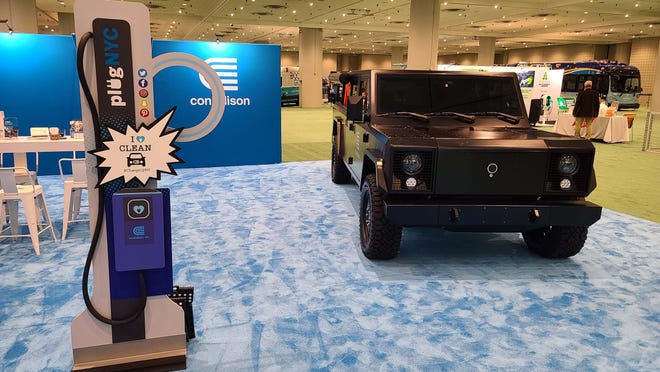
While VinFast, INDI EV, and Deus showed off new consumer vehicles, Oak Park-based Bollinger Motors announced it will build Class 3 trucks for New York’s Con Edison and showcased a prototype at the utility’s show display.
Bollinger shifted its business focus in January from consumer to commercial vehicles as large corporations seek to buttress their Environmental, Social Governance (ESG) goals by buying EVs for their fleets.
“We are committed to providing revolutionary, all-electric vehicles for fleet customers,” said Bollinger CEO Robert Bollinger, who founded the company in upstate New York in 2015 before moving to Metro Detroit. “I look forward to supporting innovative companies like New York Con Edison and growing our relationship with them as they seek to lead by example in pursuit of their sustainability objectives.”
Con Edison’s so-called Clean Energy Commitment plans an all-EV light-duty fleet by 2035. Bollinger Motors is key to that strategy with a Class 3 prototype based on a rugged, battery skateboard platform. A black prototype service vehicle is on display at the New York show through April 24. The utility plans to integrate similar vehicles into its Classes 3-6 fleet by 2024.
“Our all-electric platforms and chassis cabs offer a wide variety of commercial applications that are highly adaptable to the specific use cases and duty cycles that today’s commercial fleets require,” added Bollinger chief of commercial sales Frank Jenkins.
The Michigan-based startup’s announcement is the first significant commercial news after its January decision to cancel consumer orders for its distinctive, $125,000 B1 SUV and B2 pickup EVs. Bollinger had intended, like Ford and its F-150 Lightning EV, to pursue both personal and commercial applications. But for a startup like Bollinger, volume — and cash flow — are strongest in the commercial sector.
“We’ve been in development on the commercial front for quite some time. This has been growing and growing,” Bollinger told The News in January. “We’ve had large fleets looking at (our battery-powered platform). We just read the writing on the wall.”
Bollinger’s rear-drive battery platform — with good low-end torque and loads of cargo room — can be scaled to different wheelbases and battery sizes for use with heavy-duty utility vehicles, tow trucks and municipal buses.
Medium-duty Class 3-6 trucks are capable of gross vehicle weight ratings (GVWR) from 10,000-26,000 pounds — much more robust than, say, the Lightning or Chevy Silverado EVs that are targeted at Class 2 GVWR pickup applications (6,000-10,000 pounds) like Amazon delivery trucks. Electric Ford E-Transit and GM BrightDrop vans serve the Class 1 market (0-6,000 pounds GVWR).
Corporate and government ESG policies are driving fleet purchases — backed by the promise of government subsidies so they can build out needed charging infrastructure.
“(Commercial EV fleets) are where everything is going as far as regulations from states,” said Bollinger in January. “The expectation on the commercial side is really going to be the driver for the volume of vehicles turning electric.”
Henry Payne is auto critic for The Detroit News. Find him at hpayne@detroitnews.com or Twitter @HenryEPayne.
Joshua Tree National Park, California — At 4,200 feet above sea level here in the arid Mojave desert, not much survives. The landscape is raw, rocky, brown. Except for the enduring Joshua Tree. As if taken from the pages of a Dr. Seuss book, its hydra-like branches extend from the trunk — each topped by a head of sharp needles. Thanks to a deep root system and the ability to go months without water, the interloper is uniquely equipped to survive in this hostile environment.
Kind of like the 2022 Chevy Silverado ZR2 performance truck I’m driving.
Armed with fearless Goodyear Wrangler Territorial MT tires, Multimatic shocks, three bash plates, two-speed transfer case, twin-locking differentials and a relentless 6.2-liter V-8 engine, this stubborn pickup is remarkably well-suited for the rocky desert.
Amongst the green groves of Joshua trees, a media-piloted caravan of red, blue, sand, and white ZR2s added welcome color to the scorched landscape. A winding dirt road cut to extract gold from a solitary mine stretched out in front of us.
Transfer case on 4-wheel-drive high. Terrain mode selected. Wrangler tires aired down to 25 PSI. I nailed the throttle and the beast awoke. WAAAUUUGGHHHRGH!
I tested a GMC Hummer EV in similar Arizona desert terrain a few weeks before, its silent drivetrain creeping through Boulders ORV Park’s low brush. Hear the crunch of rocks below. The rustle of leaves. SSSHHHHH.
The ZR2’s V-8 is a different sensory experience. WAAAUUURGH! You want to keep your boot on it to hear its heavy metal beat. Carbon prohibitionists despise it, of course. It’s fun. Loud. Ban it.
But like Brian Johnson screaming “Hell’s Bells,” ZR2 sends goosebumps up my spine. Windows down. Sunroof open. I crested 65 mph on the open road, pushing through the cloud of dust created by the ZR2 in front of me, another link in our speeding truck train.
It’s an experience that Liana Prieto and her Dirt Days crew share with off-road customers in Joshua Tree and Salton Sea and the Baja Peninsula, home to some of the world’s greatest off-roading over thousands of acres of desert wilderness. Dirt-kickers welcome: super trucks, Wranglers, Broncos.
Before organizing trips like our ZR2 train for Chevrolet, she drove a Tesla Model S in LA. Then she experienced the joy of F-150 Raptor super trucks in the desert and she was addicted. Goodbye EV, hello 4WD.
The ZR2 is a latecomer to the performance truck game. Notably, it lacks the steroid-induced power (Ram TRX has a supercharged, 702-horse powerplant), width (Raptor is 86.6 inches wide) and tires (37s on Raptor) of its more ripped competitors.
Its 6.2-liter V-8 is not supercharged, but it’s a welcome voice in the choir. Raptor long ago abandoned its V-8 for a twin-turbo V-6. More torque, more applause from the Prohibitionists. But less enthusiasm from enthusiasts. Many Raptor owners held on to their gen-one V-8s, and Ford is expected to bring a supercharged V-8 back in the Raptor R.
GM felt the eight-holer’s 420 horses were enough for desert sprints and Michigan off-road parks like Holly Oaks and The Mounds. Chevy’s engineers have augmented it with a sport exhaust that’ll wake the neighbors on start-up — BRAPPPA! — and upshift with authority — BRAP! BRAP!
Like its competitors, the ZR2 has killer off-road shocks.
Sophisticated Multimatic shocks and 33-inch Goodyear Wrangler Territorial MT tires absorb the brutal washboard bumps and dips of the Joshua tree mining road like Kong shrugging off arrows. They are the same Formula One-inspired shocks pioneered by the midsize Colorado ZR2, which I punished on an off-road race course in 2017.
Truck expert and Muscle Cars & Trucks scribe Manny Katakis rates the supertruck segment this way: “I’d take the ZR2’s shocks, Raptor tires and TRX engine.”
The ZR2’s interior shines, too. Embarrassed by Ram’s upscale living quarters, ZR2 introduces an all-new dash for 2022 that brings rich 12.3-inch instrument cluster and 13.4-inch console digital displays. My driving experience was aided by comfortable bolstered seats, a head-up display the size of Oklahoma and wireless Apple CarPlay and Android Auto. The latter is a must for when you take the big dog for a run.
At about 5,500 pounds — 40% lighter than the $112,595 Hummer EV! — my $72,560 tester was easy to drive at high speeds even if it lacked Raptor’s insane 14-inch front/15-inch rear suspension travel (ZR2 clocks in at 9.6 inches front/10.6 rear). Chevy’s target is to make the ZR2 an all-around athlete with on-road manners, off-road macho (thus the Multimatics), 9,500-towing capability (thus the V-8) and low-speed rock crawling.
To achieve the latter, ZR2 is armed with a 32-degree approach angle, camera views and class-exclusive front-and-rear locking differentials (like little brother Colorado ZR2) compared to the high-speed focused Raptor and TRX’s rear-only lockers.
Tight canyon-crawling is usually the domain of narrow Wrangler Rubicons — but the Silverado defies the stereotype. Like 6’10” Kevin Durant, dude wants to shoot threes and dunk.
Climbing to reach Joshua’s high plains, I crawled through narrow rock canyons and scrambled up twisted canyons cut by rainy season floods. With lockers activated and one-pedal drive enabled (think one-pedal, Tesla regen driving), my mule crawled effortlessly over rock and mogul.
GRONCH! The front bash plate absorbed a quick descent. PFISHZZZ! A plant’s scraggly branches scraped along ZR2’s muscular shoulders. The sounds might make an owner cringe after laying out $70K for this chiseled truck — but the pickup is built for durability.
A robust top paint coat absorbed relentless branch “pinstriping” across all the trucks in our train. Bash plates are made of steel just like Silverado’s signature bed. And ZR2 innovates a three-piece bumper for cheaper repairs should any piece be damaged.
Washed and waxed after my adventure, ZR2 looked good as new.
Pickups are the new luxury. Basketballer Durant could comfortably lounge in the rear seats of my ZR2 condo. Out back, a six-way Multi-Flex tailgate rolls out steps for easy bed access (if you’re not spry enough to use the corner bumper steps).
Like a supercar, this supertruck must be taken off-road to be appreciated. So call up Dirt Days, or your Midwest pickup buddies. Then head to the Outback, put on U2’s “Joshua Tree” album, and turn up the V-8.
New York — Automakers say the future is electric, but the present is gas (if you can find it here for under $4 a gallon).
In addition to a flock of new electric vehicles on the floor and on its 250,000 square-foot test track, this year’s New York International Auto Show is headlined by updates of some of the most popular internal-combustion SUVs in the business, including the Subaru Outback, Kia Telluride, Hyundai Palisade, and Jeep Wagoneer and Grand Wagoneer.
The dashing utes are flagships of their respective brands and bring in big bucks to their manufacturers in a market where 99% of vehicles on the road are still powered by gas.
They are also in segments viewed as the least amenable to electrification — whether the adventure-focused Outback or the thirsty, family-focused Wagoneer. Popular with consumers, they are the focus of Washington efforts to bring down gas prices this week by waiving the ethanol mandate, even as federal agencies force adoption of the EVs that are the focus of the New York show.
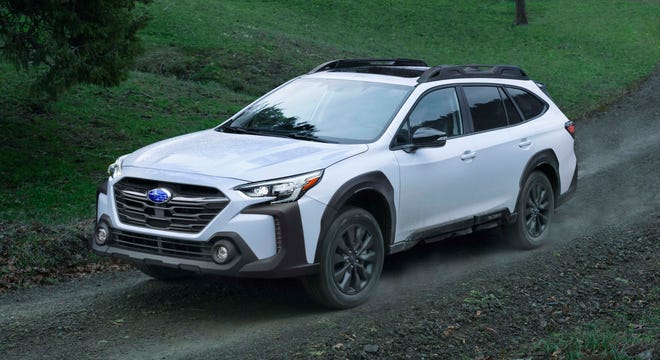
Subaru rolled out significant upgrades to its iconic Outback SUV with a redesigned fascia, increased engine options and more tech. Starting at $28,320, the Outback has led the industry surge into outdoor-focused SUVs followed by entrants like the Ford Bronco Sport and Mazda CX-50. Subaru’s perennial bestseller along with the Forester, Outback now comes in six models: Base, Premium, Onyx, Wilderness, Limited and Touring.
Not content to let segment newcomers poach on their territory, the all-wheel-drive Outback gets a facelift — including, no surprise, a bigger grille — and new fender cladding on all trims but the Wilderness.
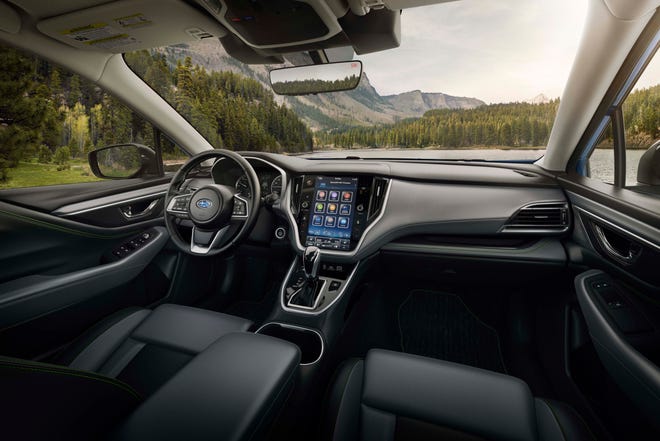
To keep up with the furious pace of electronics development, models receive wireless Apple CarPlay and Android Auto capability and an update to Subaru’s acclaimed EyeSight Driver Assist Technology that brings a suite of standard features like 4G WiFi, smartphone connectivity apps, adaptive cruise-control and limited autonomous driving capability. The top-shelf Touring model gets a new Wide-Angle Mono Camera for better safety detection of, for example, pedestrians and bicycles at an intersection.
Add blind-spot detection with lane-change assist, and Eye Sight will automatically steer to help avoid collision at speeds up to 50 mph. The popular, blacked-trimmed Onyx Edition — once available only with the premium, 2.4-liter, turbo-4 engine — gains a normally-aspirated 2.5-liter 4-banger to better manage those $4-a-gallon fill-ups.
Subaru has struggled with regulations pushing electrics and the Outback is a test case as to why. With its long range, 9-inch ground clearance and rugged capability, it offers superior, 600-mile overlanding capability for Subaru’s core customers – while stickering for 10 grand below the brand’s forthcoming, similarly-sized, 300-mile-range Solterra EV.
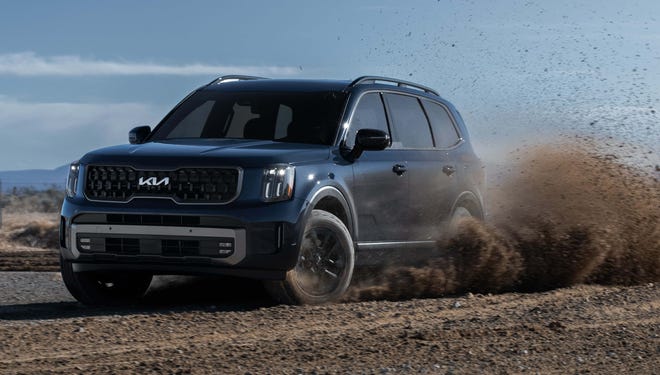
There are few SUVs hotter in the U.S. market than the Alabama-assembled Kia Telluride, which debuted in 2020 to rave reviews and customer hunger for its upscale looks and affordable price — cheaper than a comparable Ford Explorer by $8,000 in some cases and undercutting even perennial segment leader Toyota Highlander.
It quickly became the brand’s family halo, collecting an armful of industry awards, and attracting 75% new customers to the Korean brand. Tough act to follow.
The ’23 mid-cycle refresh treads lightly in upgrading the vehicle’s good looks. Even three-row utes aren’t immune from Americans’ thirst for the outdoors and the Telluride gains X-Line and X-Pro off-road trims — the latter featuring increased ride height and standard, low-profile all-terrain tires for where the asphalt ends.
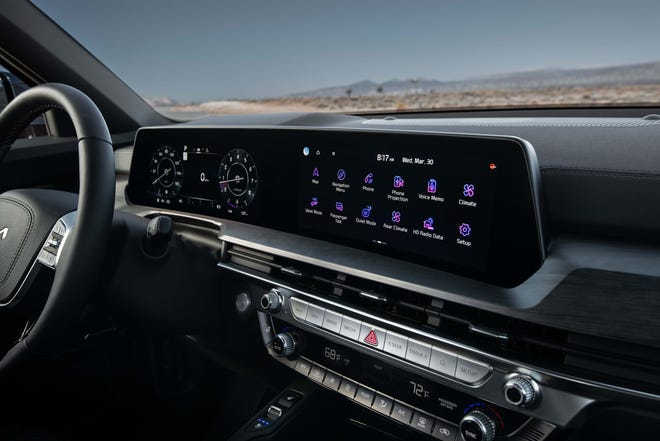
The Kia gains significant interior upgrades to complement its best-in-class space and clever innovations like a first-to-third-row speaker system. The interior is now available with luxurious dual curved 12.3-inch display screens — more likely to be found in lux vehicles costing tens of thousands of dollars more. In addition to a blizzard of standard safety features, Telluride offers clever tricks like Apple Watch and Samsung Galaxy smartwatch compatibility to remote-control interior climate, and stolen vehicle tracking-and-immobilization capability.
The Telluride’s 291-horse V-6 remains untouched, but its tow limit increases to 5,500 pounds with the X-Pro. Towing is a key reason automakers are nervous about going electric in large SUVs. Already inferior for long-range trips, EVs drink range when towing.
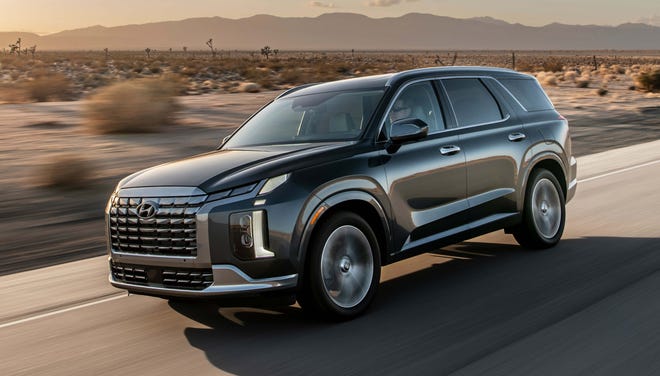
Hyundai makes its sister Palisade on the same platform as the Telluride and shares many of the same upgrades. The more metropolitan-themed Hyundai, however, does not go the all-terrain-model route.
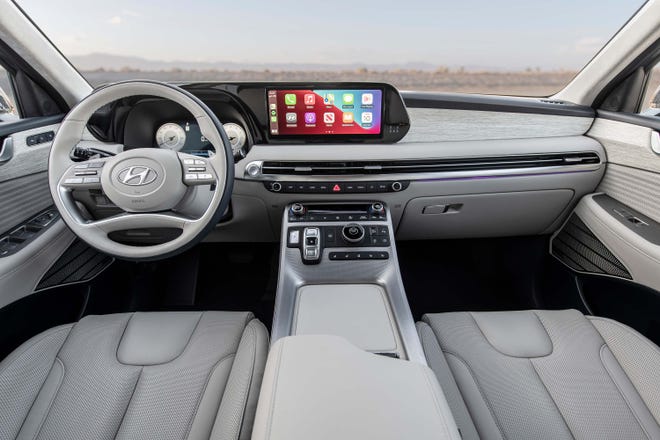
In addition to the big screens inside, the Palisade gets a more modest fascia compared to its polarizing 2020 mug. Rear passengers will appreciate the second-row armrest angle adjuster, third-row seats and in-car WiFi.
“More than ever, Palisade is the ultimate family vehicle for daily use and memory-making road trips,” said Hyundai North America VP for mobility Olabisi Boyle, touting the SUV’s new tow mode for easier hauling.
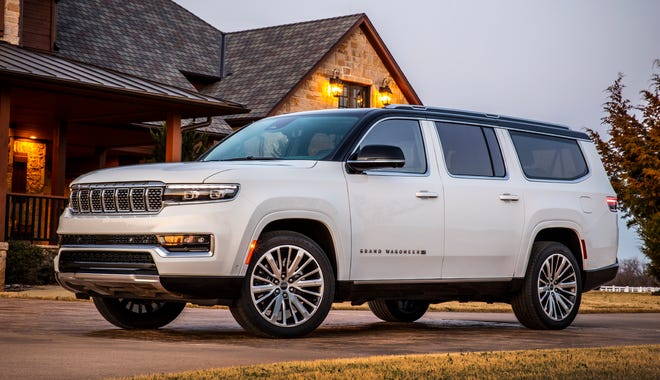
Towing is also a key ingredient of the Jeep Wagoneer L and Grand Wagoneer L — stretch versions of the truck-based, three-row SUVs to compete against segment leader Cadillac Escalade.
Despite the introduction of major competitors like the Wagoneer twins and the Lincoln Navigator, Escalade has maintained its edge in the segment — accounting for 60% of sales in Q1. The Wagoneer L twins gain 12 inches in overall length and 7 inches of wheelbase. The increased proportions also mean the Wagoneer L delivers best-in-class passenger volume at more than 179 cubic feet.
Towing a best-in-class 10,000 pounds, don’t expect the Wagoneers to go electric anytime soon. But in a nod to the feds’ coming, 2026 fuel economy rules, the huge Stellantis utes are the first vehicles to get the automaker’s Hurricane V-6. The twin-turbo mill is slated to replace the Wagoneer’s hemi V-8s with more power and fewer CO2 emissions frowned on by regulators.
Henry Payne is auto critic for The Detroit News. Find him at hpayne@detroitnews.com or Twitter @HenryEPayne.
New York — The New York Auto Show is back in the Big Apple. Though this year’s show more resembles a Big Cherry: smaller but with plenty of color.
There will be fewer manufacturers and vehicle debuts, but a rush of electric vehicle startups and a 250,000-square foot indoor test track on which to test them and their battery-powered peers. Canceled the last two years due to pandemic concerns, Gotham’s largest public event by attendance is navigating — not just a return to post-COVID normal — but major changes in how vehicles are powered and how manufacturers are unveiling them.
In 2019, the last show before the pandemic, there were some 20 new North American car and concept reveals, including significant models from Mercedes and Cadillac. This year, Merc and Caddy won’t even be at the show as luxury automakers (including BMW, Porsche and Audi) are focusing their marketing dollars elsewhere. Fewer than 10 new vehicle intros are expected at this week’s April 13-14 media days with headliners as likely to come from startups like Deus as from mainstream automakers like Kia.
Yet organizers say that public interest is strong given customers flush with cash and the buzz surrounding a flood of new autos. Organizers say the city’s lifting of mask and vaccine on businesses last month also helps.
“There has definitely been a shift in auto show debuts,” said the president of the Greater New York Automobile Dealers Association, Mark Scheinberg, who runs the country’s oldest auto show. “But the New York show is still a major consumer event. It’s an opportunity for people to come shop for new vehicles shown under one roof. Our advance ticket sales are neck-and-neck with 2019.”
With all the brand no-shows, New York presents an opportunity for startups trying to ride the wave of EV-mania.
Startup automaker Fisker stole the media show in Los Angeles, and Vietnam’s Vinfast hopes to do the same in New York. The electric-car company has been aggressive about the U.S. market, with plans for a North Carolina production facility and an IPO to finance it.
“It’s a chance for automakers like Vinfast to show a new product in front of a lot of people and media,” said Scheinberg. “They get respect showing alongside established auto manufacturers.”
Vinfast has promised four affordable SUVs for us Yankees called the VF6, VF7, VF8 and VF9. The compact VF6 was shown in Los Angeles, and the VF8 is expected to be on display in New York.
Southern California startup INDI EV will also join the big boys for a news conference on Wednesday to show off its first car, the INDI One — and to announce the opening of pre-orders. Starting at $45,000, the compact SUV is targeted at the Mustang Mach-E, VW ID.4 and Tesla Model Y.
Taking a page from the latter, INDI EV says that its INDI One will be a smartphone on wheels with a powerful, onboard computer to run a “portfolio of game engine technology, content development, global publishing, mobile platforms, SIM cards, hardware, and Virtual Reality products.”
If the INDI One promises a new era of processing power, then the Deus Vayanne promises good ol’ supercar power. The Austrian-based firm has partnered with the respected Italdesign shop and Williams Advanced Engineering, an offshoot of the famed Formula One team that has helped engineer Formula E electric race cars. Expect a low-slung missile with electrifying speed.
Mainstream manufactures will have will have a few major reveals of their own. Chrysler will a design concept for its first Airflow EV. Kia will unveil updates of its Niro and the wildly-popular three-row Telluride SUV, while Korean sibling Hyundai will show off a refreshed Palisade ute.
As if to emphasize the shift away from auto show reveals, GMC will not have an exhibit at the show and will tease its new Canyon pickup virtually this Thursday. Lincoln will have a floor display, but did a virtual tease of its first electric car ahead of the show on Monday.
Once a showcase for luxury automakers preening for deep Wall Street pockets, Gotham’s loss of big hitters like Mercedes, BMW, Maserati, Buick, Acura and Cadillac hurts. Other notable MIAs are Honda and Mazda, which once had prominent floor displays.
“There’s been so much uncertainty relative to COVID that automakers have struggled over how much to commit to auto shows,” said IHS Markit auto analyst Stephanie Brinley. “But there is a risk of disappointing consumers by not showing up. If buyers don’t see see their brand, then they might forget about you. For example, Mazda has a new CX-50 that will not be there, and Honda’s new HR-V will not be there.”
Consumers will have a chance to touch vehicles that they have only read about in Internet debuts: vehicles like the retro, electric VW ID.Buzz minivan, hulking Chevy Silverado and Ford Lightning EV pickups, wee Alfa Romeo Tonale SUV and insane Toyota GR Corolla hot hatch.
Showgoers won’t be limited to touching either.
The combination of fewer stands and a 90,000-square-foot expansion of the Javits Convention Center on the Hudson River leaves room for a 250,000-square-foot test track — nearly a quarter of the show space — for visitors to test drive EVs.
“They don’t have any emissions, so we can have them inside,” Scheinberg said with a smile. “There has been such a huge change in the products that are out there since before the pandemic. The world is seeing a seismic shift and electrification has just blossomed.”
The push in battery-powered cars comes as the federal government is forcing automakers to produce electric drivetrains. Automakers take hope from Tesla, which has blossomed as an EV-only brand — though EVs only made up 4.5% of U.S. sales in 2021, with Teslas purchased in California the largest group. Scheinberg says the New York show has pushed electrification for years with little impact, but he says this year feels different.
“All buyers saw in Super Bowl ads was EVs,” he said. “Now every manufacturer is in the game. That’s what has been missing.”
EVs available to ride include the Chevrolet Bolt, the INDI One, Kia EV6, Nissan Leaf, VinFast VF8, VW ID.4 EV, and Volvo XC 40 Recharge.
In addition to the EV test track, there will be outdoor test tracks for dirt-kickers like the Jeep Wrangler. Ford and Hyundai will have their own electric test tracks as part of their floor stands. Ford will likely offer rides in the Mustang Mach-E and Lightning. Hyundai has its new Ioniq 5 to show off.
Ford’s stand will also showcase the Ford GT supercar — still one of the most stunning chariots on the floor seven years after its introduction — in a new wardrobe. The 2022 Ford GT Holman Moody Heritage Edition pays tribute to Ford’s sweep of the podium at the 1966 24 Hours of Le Mans. The GT will be on display next to the original 1966 Holman Moody Ford GT40 MK II race car.
More eye candy will be on display in New York’s signature exotic car “bull ring,” where fans can ogle six-figure Lamborghinis, Porsches, Bugattis and other unobtainables. Not to be outdone, Lincoln will celebrate its 100th anniversary with a little bling. Alongside its new Navigator SUV will be Elvis Presley’s iconic 1956 Continental Mark II.
“We thought initial ticket sales might be soft,” said Scheinberg. “But the public senses it’s time to get out and do things again. Our research shows that 72% of show attendees are in the market for a car.”
The New York Auto Show will open its doors to the public April 15-24 after press days, April 13-14.
Henry Payne is auto critic for The Detroit News. Find him at hpayne@detroitnews.com or Twitter @HenryEPayne.
Phoenix — Enter the Chandler Fashion Mall southeast of Phoenix and a big, vertical advertisement stops you in your tracks with three white letters highlighted against a black background: WTF.
Step close and faint gray letters explain the acronym: WATTS TO FREEDOM.
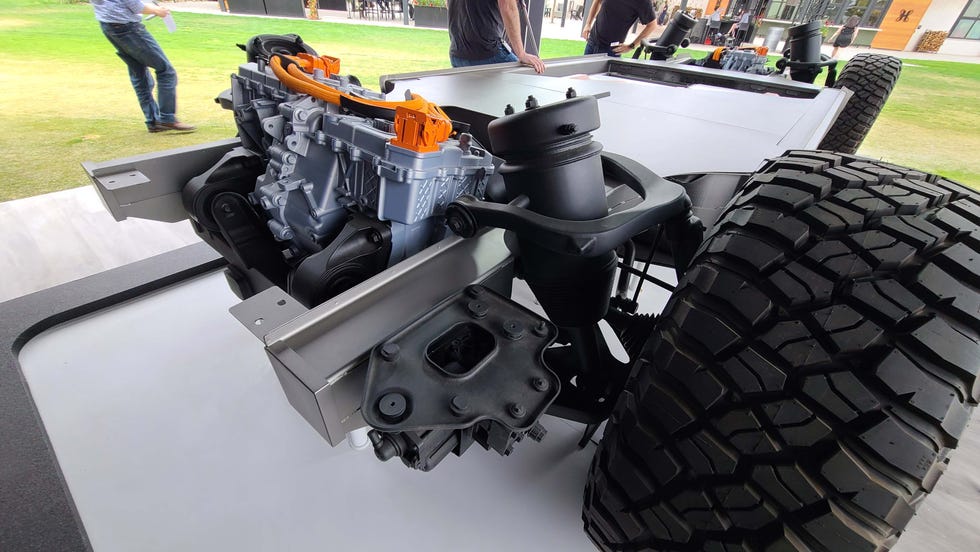
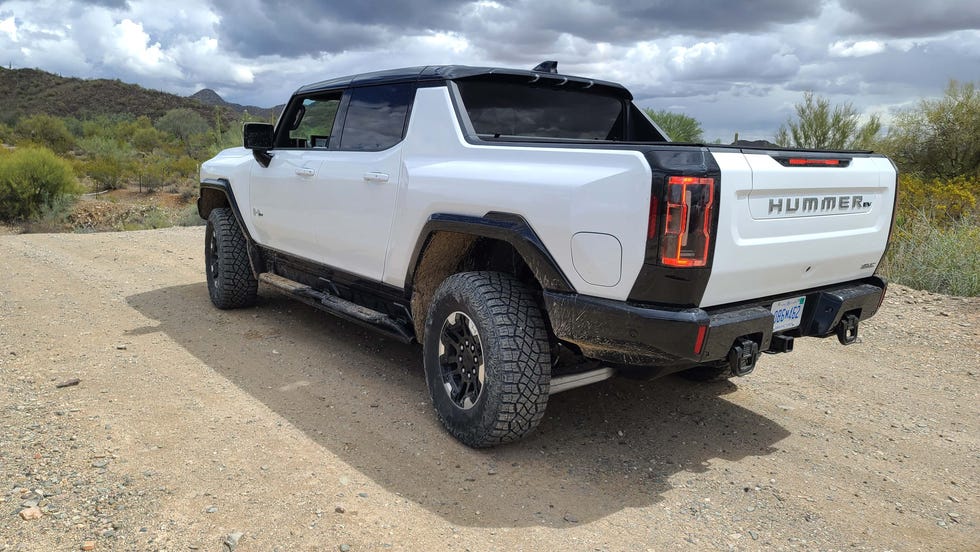
The GMC Hummer EV supertruck has landed. Imagine 205-kilowatt-hour battery, 1,000 horsepower, 9,000 pounds, 35-inch all-terrain tires. Three electric motors. All-wheel steering. Faster than a speeding bullet, more powerful than a locomotive, able to leap tall buildings in a single bound. WTF, indeed.
Strapped into my Hummer tester outside Phoenix, I tug the TRACTION CONTROL button on the dash twice and supertruck enters WATTS TO FREEDOM mode. My seat rumbles, the chassis crouches, the digital screen flashes ARMED. Launch control ready.
Flatten the brake pedal.
Flatten the accelerator pedal.
Release the brake.
The truck explodes forward like a rocket, crushing my body into the seatback. The horizon blurs. Three electric motors shriek. Four Goodyear Wrangler tires squawk in pain as they transfer instant, 1,200 pound-feet of torque into the pavement. I blow past 60 mph in just over 3 seconds on my way to the moon.
GM calls Hummer its moonshot — a warp-speed, 18-month development program to explore the electric performance frontier. Here on Earth, Arizona is a perfect market for Hummer, because like Superman, the electric supertruck needs lots of space to show off its other-worldly capabilities. Straight highways, off-road trails, beautiful vistas. Michigan fits the bill, too.
As I tell my friends with Corvette C8/Porsche 911/Ferrari 456 supercars, you can’t understand their incredible capabilities until you take them on track. The same is true of the growing class of supertrucks: Hummer, Rivian R1T, Ford F-150 Raptor, Ford Bronco Raptor, Ram TRX.
You can’t truly appreciate the Hummer EV until you take it off-pavement.
An hour north of Phoenix is Boulders ORV (Off-Road Vehicle) Park, similar to Holly Oaks ORV Park an hour up I-75 from Detroit. If you’re one of the 65,000 reservation holders for a Hummer, go straight to an ORV park after you pick it up from the dealer. And bring three friends. The Hummer experience begs to be shared.
As a rule of thumb, off-road trails are not friendly places for full-size pickups. Their tight confines, narrow trails, steep hills and sharp crowns make big trucks uncomfortable with their poor breakover angles and solid rear axles. Other supertrucks like the Ram TRX and F-150 Ratpor are built for high speed, wide-open spaces where their throaty engines and sensational sport shocks can really stretch their legs.
Consistent with its limited 329-mile range (I burned 178 miles of battery range on a 112-mile trip), Hummer is a hoot on nearby off-road parks.
Sure, its 80-plus inch width requires three amber lights by law (as do Raptors and TRX), but that width brings balance that complements its inherent EV athleticism. That 205 kWh of battery is a lot (is Hummer the only full-size pickup that weighs more than it tows?), but it’s below decks for a low center of gravity. Its electric drivetrain means no vulnerable gas tanks, mufflers or pigs (rear differential) protruding from its belly.
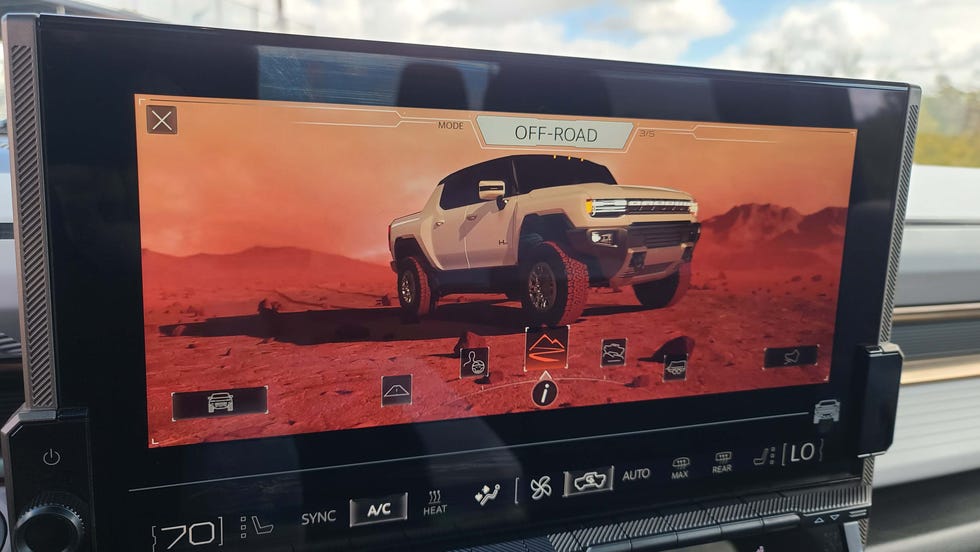
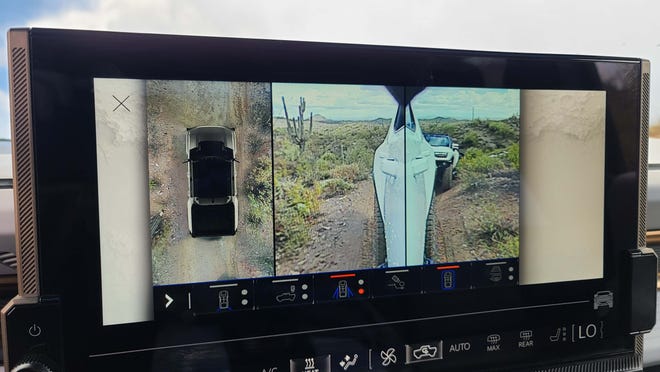
SMACK! I misjudge a ridge and bottom out. No worries, the armored beast shrugged it off. Starting with 10 inches of ground clearance, Hummer sports 9.5 inches of suspension travel in top trims, thanks to air suspension. Like something out of a Dr. Seuss book, the GMC’s EXTRACT MODE can ratchet itself 16 inches off the ground to clear obstacles. Or crouch to 6.5 inches for WTF sprints. Like a supercar, there are multiple performance modes to explore — and 18 camera angles for what you can’t see.
But my favorite tool is all-wheel steer — a feature previously found on supercars like the Porsche 911 for quicker track turn-in. Available beginning with the $89,995 2x trim, 4WS enables Hummer’s CRAB WALK mode. It’s a cool party trick, but 4WS’s more practical application is in navigating, say, tight turns through Boulders. I can’t wait to use it in the twisted canyons of Holly Oaks.
On-road, 4WS enables 37-degree, Chevy Spark-like turning circle for easy mobility around parking lots — another nemesis of full-sized trucks.
Such toys make Hummer nearly as much fun getting to an ORV park as playing there.
Where supercars must be mindful of weight lest they be slow on track, supertrucks suffer no such modesty. The GMC is loaded with gadgets that would make a supercar blush.
I self-drove to Boulders using Super Cruise. Look ma, no hands! GMC has hung huge screens across the dash like paintings in a boardroom. They are gorgeous and Hummer contracted with the Unreal game engine for state-of-the-art graphics and Google for navigation as easy as your smartphone.
Interior room is palatial, and you can go topless — just like a Wrangler or Bronco — by unlatching roof panels and stowing them in the frunk. Oh, your three friends are gonna’ love it. There are moonshot homages everywhere from Sea of Tranquility maps on the floormats to astronaut footprints on the dash.
The pickup bed out back is five feet long and punctuated by GMC’s signature six-way Multi-Pro tailgate so you can easily extract motor bikes — or just hang out with a cooler and drinks.
There are hiccups, to be sure.
The upright windshield means no head-up display option and lots of A-pillar wind noise when you hit 70 mph on the interstate. Long-distance trips might be daunting due to GM’s oversight in not incorporating Tesla-like navigation between third-party superchargers. I asked my Hummer to navigate to Seattle and it just plotted the route without detailed charging stops — something that has eliminated range anxiety for Teslarati.
Yeah, yeah, the Hummer EV smacks of GM groveling to atone for its sins. Hummer was pilloried at the turn of the century for its cigar-chewing, Arnold Schwarzenegger celebrity and Gulf War gas-swilling. “What would Jesus drive?” shouted the prudes. It’s no less decadent now with D.C. pols imploring us commoners to be more like Hollywood swells and buy an EV to avoid $5 a gallon gas. Let them eat Hummers!
But like Tesla’s Made-in-America Model S, Hummer EV is much more than another meme in the culture wars. It’s a serious leap in showing off EV performance. Take it to an off-road park and enjoy it for what is: an ambitious achievement accomplished in an impossibly short time to explore the tech frontier.
An achievement only an American truck brand could pull off. Moon shot landed.
The first electric vehicle on General Motors’ Ultium battery sled, it offered a huge canvas on which its team of engineers and designers could experiment with new technology. Its headliner features are well known. There’s Crabwalk mode, currently being showcased by celebrity basketball player LeBron James in national ads (and attracting celebrity buyers like actor Ashton Kutcher and chef Wolfgang Puck).
All-wheel-steer enables tight turning radiuses to get you out of trouble off-road — or in a Meijer parking lot. And Watts-to-Freedom mode will accelerate you to 60 mph in just 3 seconds.
But there is so much more. Here are eight more cool things in the supertruck’s toy box:
1) Moonshot. Vehicle development programs usually take four years. The Hummer program launched in March 2019 with the impossible goal of delivering a supertruck by the end of 2021. That’s 2½ years. The production team called it GMC’s “moonshot.” To commemorate the feat, the Hummer EV is littered with moon references.
A map of the Sea of Tranquility, where Neil Armstrong first stepped on the moon from the Apollo 11 Lunar Module on July 20, 1969, is found in numerous places, including the instrument display, available hood graphic, floor mats and Bose stereo door speakers. Astronaut footprints litter the dashboard. And an American flag is planted just above the C-pillars.
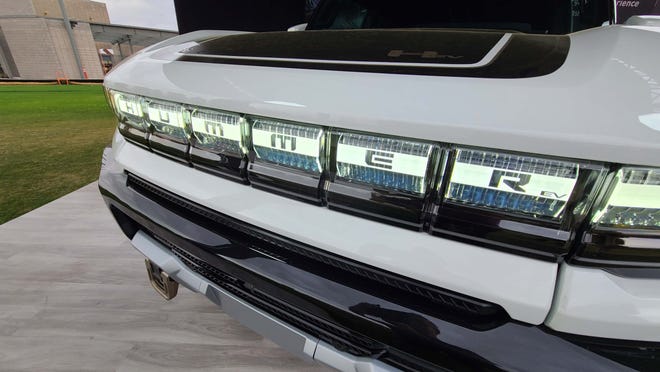
2) Light show. Signature LED running lights are nothing new, but the way Hummer does them is. The pickup lights up the six, H-U-M-M-E-R blocks on the front facia with a thin, white film made up of microscopic lenses that reflect the illumination from recessed LED lights. “When we saw the technology, we thought we had to make use of it,” said chief exterior designer Brian Malczewski, whose resume includes some other cool exteriors like the Corvette.
3) Go topless. An off-road-focused vehicle, Hummer gets you closer to nature with four removable roof panels. Blessedly lightweight, they are easily extracted with rotating latches — then easily stored in the front eTrunk (or frunk, as EV owners like to say). The rear window can also be automatically rolled down. Unlike the Jeep Wrangler, however, the front windshield does not flop down — and neither can you take the doors off.
4) Tri-wiper. That upright front windshield offered challenges for wiper coverage given the truck’s narrow greenhouse and expansive width (measuring 87.6 inches wide, the pickup requires three amber roof lights, typical of heavy-duty trucks). So the Hummer is outfitted with three blades.
5) Cameras. Like the mansion you’ll store the Hummer in, the EV gets lots of camera angles to monitor things. Eighteen camera views allow you to keep an eye on everything from the ground ahead to the rocks beneath, to the tires on each side.
6) Jacked. Thanks to its air suspension, Hummer has 9.5 inches of variable ride height. From 10 inches of ground clearance in Normal mode, the beast can crouch to 6.5 inches off the turf for insane, Watts-to-Freedom launches. Or it can be jacked up 16 inches in Extract mode when the off-road terrain gets really sketchy.
7) Unreal. GMC hired New York-based Perception, famous for its design work in Marvel films like “Iron Man” and “Black Panther,” to pen Hummer’s user experience in the instrument and infotainment displays. Using Epic’s Unreal game engine — a familiar tool in the gaming world — Perception designed rich graphics like the intro sequences to Terrain and Watts-to-Freedom modes.
8) The sound of silence. Hummer is an electric vehicle, but chief engineer Al Oppenheiser and team were determined that it come with enhanced sonic emotion (this is a guy who built the blood-curdling Camaro V-8, after all). So GMC partnered with Bose to create Vehicle Sound Enhancement (EVSE). Using the truck’s 14-speaker sound system, EVSE sends subtle, custom-designed propulsion sounds into the cabin with each drive mode — and also hides undesirable motor sounds. Normal mode is quiet, but select Terrain mode while off-roading, for example, and you get a low, rumbling soundtrack.
EVSE is most pronounced with Watts-to-Freedom. Various audio cues fill the cabin, including a mix of electric guitar riffs while the Bose subwoofer creates vibrations to prepare occupants for launch.
“The sense of sound is an important element,” said Oppenheiser. “We looked to Bose for expertise in helping balance the appropriate level of acoustic precision with driver input, yet not compromising the enjoyment of a near-silent EV experience.”
The Detroit Three automakers have abandoned small cars, but foreign manufacturers continue to embrace a compact market full of first-time buyers and enthusiasts.
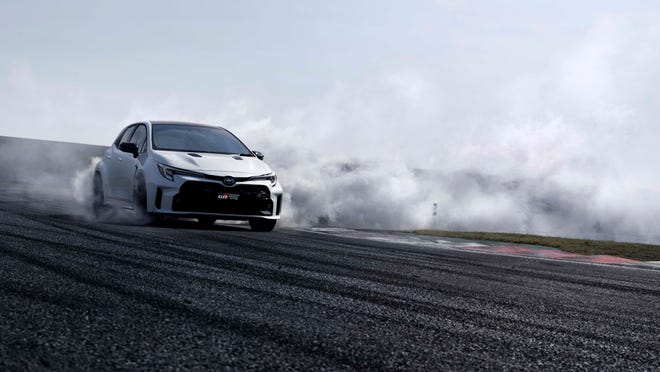
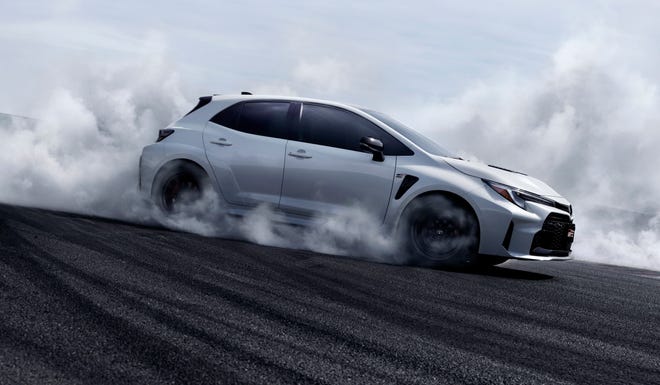
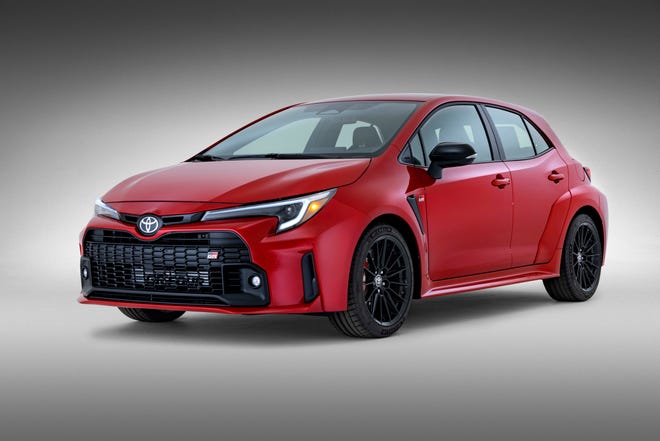
Toyota unveiled a U.S.-focused performance variant of its best-selling Corolla compact car Thursday night called the GR. That’s pronounced Grrrrr.
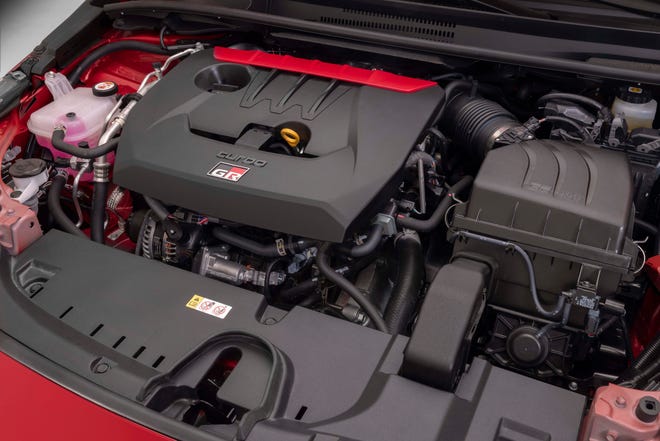
Based on Corolla’s hatchback model, the GR will feature aggressive styling and an insane, 300-horsepower, turbocharged 3-cylinder engine shared with the wee GR Yaris that has been setting European streets on fire.
Developed by the brand’s Gazoo Racing arm, the hot hatch joins other all-wheel-drive hellions in the compact performance space like the Subaru WRX and Mazda3 Turbo. Other rivals include front-drive pocket rockets including the Volkswagen Golf GTI and Jetta GLI, Honda STI and Type R, and Hyundai Elantra N.
Ford once competed in the segment with its raucous, front-wheel-drive Focus ST model and all-wheel-drive Focus RS. They have since retreated from U.S. shores along with the Focus sedan, which is still sold in Europe. The RS’s turbocharged, 2.3-liter turbo-4 lives on in the Mustang High Performance model.
Detroit brands have focused on the two-door, muscle-car segment with models like the Mustang, Dodge Challenger and Chevy Camaro to attract performance enthusiasts. Toyota has also flooded the sports car space with its affordable GR86 corner-carver (which also wears the Gazoo Racing (GR) badge) and the Corvette-fighting Supra.
The GR Corolla, however, marks a major expansion of Toyota’s ambitions in the car space. Like the mid-size Camry, the popular Corolla has been perennial best-seller in its segment — but Toyota has resisted the siren call to build performance variants like competitors Honda and Hyundai. Only more stylish trims like the Corolla XLE were offered, but with little change to the oily bits.
The GR Corolla changes all that.
Like Honda’s wildly successful Si and Type R models, the GR stuffs Corolla with an entirely new engine: the ferocious, 1.6-liter turbo-3 cylinder. King Kong in a suitcase, the small mill is the first three-holer in a class dominated by four-bangers. But its numbers are segment competitive with 300 horsepower and 273 pound-feet of torque.
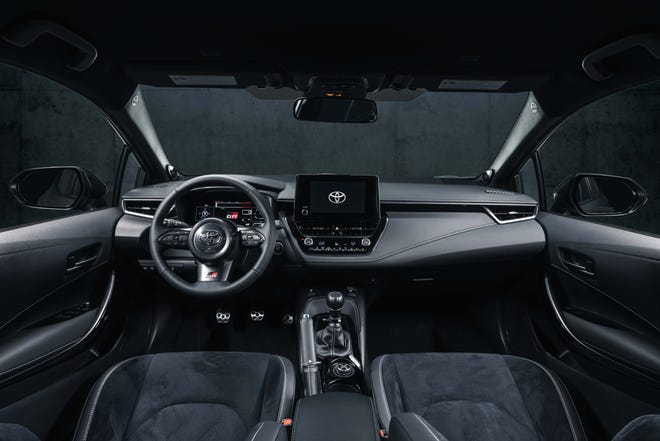
The GR Corolla will come with a manual transmission only, which will be catnip for enthusiasts. It will also come exclusively in all-wheel-drive — another big departure for a brand that has resisted four-wheel propulsion in its sedans. AWD is common in Toyota’s SUV and truck lineups.
Called GR Four, the AWD system will be configurable so that drivers can choose 70-30 torque split for better grip — or 50-50 for better track handing. A sophisticated McPherson front/double-wishbone rear suspension will help keep the pocket rocket planted.
The GR Corolla dovetails with Toyota president and chief motorhead Akio Toyoda’s ambitions to make his company more appealing to enthusiasts. Toyota is one of three manufacturers in NASCAR, it has won the prestigious 24 Hours of Le Mans endurance race four years running, and the GR is production proof of Gazoo Racing’s GT racing efforts at the 24 Hours of Nurburgring — with none other than President Toyoda at the heel.
GR Corolla has done extensive track testing at top Japanese circuits, including Fuji Speedway, Suzuka Formula One track, and Tsukuba.
GR will come in two trims — the Core and Circuit editions. The latter will be exclusive to the GR Corolla’s launch year and will come with significant enhancements like a swollen hood, suede seats, bigger rear spoiler, carbon-finer hood and dual limited-slip differentials.
Along with the pending, all-new, winged Civic Type-R, the muscled Circuit Edition should take some of the sting out of Subaru’s decision this year not to offer a WRX STI model.
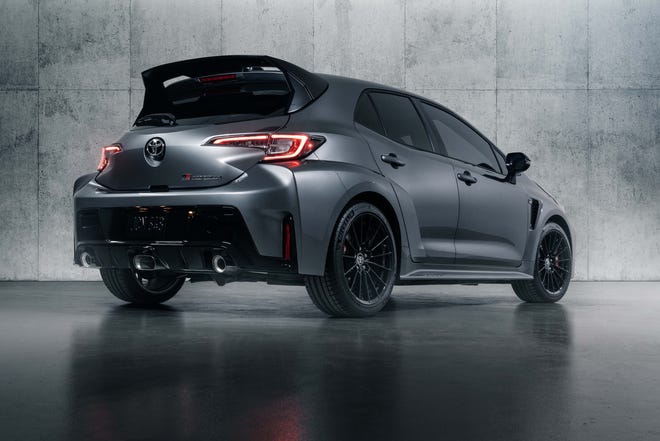
Both GR models will be easily distinguished from the standard Corolla with swollen fenders, aggressive front facias, and three exhaust pipes out the rear. The GR will come with fat, Michelin Pilot Sport 4 tires and beefy, 14-inch brake calipers to bring them to a stop.
Inside, GR Corolla will be nicely appointed with GR logo-tamped seats and digital displays — including an eight-inch infotainment touchscreen with wireless Apple CarPlay and Android Auto. True to the Toyota brand, the hot hatch will be loaded with standard safety features, including adaptive cruise control, blind-spot-assist, auto high beams and collision avoidance detection.
Manual-shift enthusiasts will be thrilled to hear a hand brake will be standard, as will hill-start control. A one-year membership in the National Auto Sport Association (NASA) will be offered with on-track driving instruction to learn the GR’s capabilities.
The new Toyota will be built at Gazoo Racing’s Motomachi, Japan, facility and will go on sale stateside later this year. Pricing will be announced closer to launch, but expect the GR to start around $30,000.
Henry Payne is auto critic for The Detroit News. Find him at hpayne@detroitnews.com or Twitter @HenryEPayne.
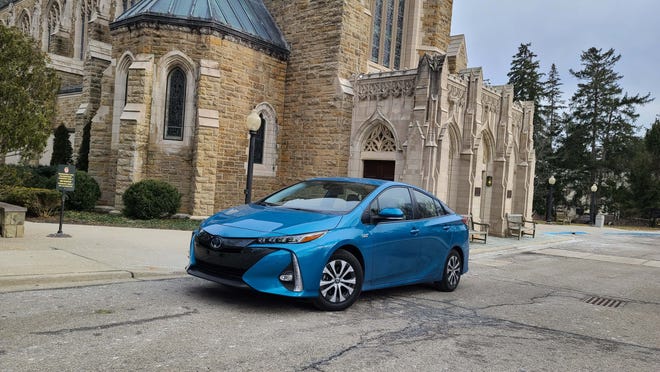
Southfield — Gas has jumped to an average of $4.25 a gallon here, and the Toyota Prius Prime plug-in is ready for prime time. I plugged it into my home 240-volt wall charger and filled my battery with 25 miles of charge in two hours at a cost of $1.50. When the battery was spent after a day chasing errands, the gas engine kicked in with another 640 miles of range at my disposal at 54 mpg. Enough to drive nonstop to New York City to visit my son if necessary.
The Toyota what? Prius? Dude, that’s so 15 minutes ago.
The last time gas hit $4 a gallon in 2008, the Prius hybrid was all the rage. Sales soared to 158,884 units a year on their way to a record 234,228 by 2013. All the cool kids had one. Leo DiCaprio, Cameron Diaz and Tom Hanks arrived at the Oscars in a Prius. Presidential candidate Barack Obama swaggered into Detroit and berated Detroit automakers for not making a Prius. So morally righteous were owners that the Japanese hatchback gained the nickname “Pious.”
Today, despite soaring gas prices, the Prius is all but forgotten despite the addition of a plug-in model in 2013. Green elites have moved on to other shiny toys. Pols shame Americans for not buying electric vehicles. Leo drives a Polestar 2 and Stephen Colbert brags he never has to visit the gas pump in his Tesla. Model 3 is the new Pious.
But for Americans tired of shelling out $60 each time they fill up their Toyota Camry, the Prius is an appealing bargain.
Indeed, my loaded, top-trim Limited tester clocked in at $35,000 — that magical, affordable number that Tesla’s Model 3 sedan once promised but never delivered. Of course, there is always a better value, and Prime is pricey compared to one of my all-time favorite Detroit fuel sippers: the $15,000 (in today’s dollars), 1995 Geo Metro three-cylinder that returned an impressive 47 mpg. It didn’t last.
Prime presents itself in a package as instantly recognizable as a Tesla: Angular profile, split-rear window, vertical running lights. That, and my tester was as bright blue as a newly-dyed Easter egg.
I flung it around Oakland County, the Prius’s compact, stiffened chassis much-improved over the first-gen’s pasta noodle.
But you won’t mistake it for a Tesla. I floored Pious out of a stoplight and the front-wheel-drive electric motor briefly woke up as if startled, then settled into a slow trot. When the gas engine kicks in, it drones on like John Kerry at a Davos climate change conference. Prime offers a POWER sport mode to complement NORMAL and ECO, but I couldn’t tell the difference.
Leave it in ECO because the real charm of this fuel sipper is its double life as a daily EV/640-mile gas burner. Today, greens tout EVs with 500-mile electric range — but that’s for a $140,000 Lucid Air. For that price, you can buy four Primes that go farther.
Plug-ins are a solution GM once believed was the Holy Grail. Embarrassed by Prius hybrid getting all that Oscars attention, the Volt plug-in promised 53 miles before the gas engine kicked in, and 420 miles total range. But Volt ultimately joined the Geo Metro on the scrap heap.
“Hybrids didn’t sell very well,” GM President Mark Reuss told Fox News in explaining the General’s decision to abandon plug-ins. “You’re still carrying two propulsion systems. That’s not very efficient.”
The slow-selling Bolt EV followed. Next up? The Model Y-beating Chevy Equinox EV.
Meanwhile, Prius Prime plug-in soldiers on.
As satisfying as its gas price-defying range is, however, it comes at a cost if you want quick, two-hour recharges. A 240-volt Juicebox charger plus installation could set you back $2,000 in a 1970s-vintage-house like mine.
Better to plug in to a standard 120-volt wall socket for 5 ½ hours every night. That’s because a comparably-equipped $25K Corolla compact hatchback also comes in Easter egg blue and also answers your gas budget woes with 35 mpg. Prius Prime, EPA tells us, gets a whopping 54 mpg. Let’s do the math. If you’re traveling an average of 15,000 miles year, that means Prime will save you a whopping $640 annually with petrol at $4.25 a gallon.
Here comes the “but” you’ve been waiting for.
Gas prices would have to continue at $4.25 a gallon for nearly 16 years before you would recoup the costs of your Prime premium over the Corolla. What if you only (improbably) used the Prime on electric charge? EPA says you’d get 113 MPGe and save $1,061 — in which case gas prices would have to continue at $4.25 a gallon for nine years before you would recoup the costs of your Prime premium over the Corolla. Qualify for the federal $4,500 tax credit and payback is in five years.
That’s a lotta math, which is why battery-powered vehicles remain a market niche. Last year, Prius only sold 60,000 units. Prius faithful enjoy a unique driving environment.
Prius beat Tesla to market by remodeling the vehicle dashboard. It removed the instrument display behind the steering wheel, then relocated it at the base of the windshield with digital graphics so you can watch the powertrain transition from electric to gas power. Redundantly, Prime offers a head-up display for 2022. I barely noticed it was there. The Toyota’s signature stubby, dash-mounted shifter frees up console space for a smartphone charging pad.
If it’s an Android smartphone like mine, however, it is useless for navigation on the Prime Limited’s big 12-inch screen, which doesn’t offer Android Auto. That’s a drag as disappointing as the Prius’s lethargic acceleration. Despite the promise of its Tesla-sized screen, Prime is half-hearted about tech. I craved Android Auto because the native nav system is stuck in the last century.
Toyota clearly understands customers want SUVs and it has equipped its best-selling RAV4 ute with a plug-in model featuring more power and electronic capability (yes, it has Apple CarPlay and Android Auto). I could see my little Prius smiling with fatherly pride in the driveway. It may not be as hip as it was 20 years ago, but it has spawned a new generation of plug-ins.
The bigger RAV4 Prime is a chip off the ol’ block with 94 MPGe and range of 20 miles on a charge. It has significantly better acceleration, too. But it’ll cost you, ahem, $49,000 for a loaded, top trim model. That’s a $13,000 premium over a comparable gas-powered RAV4. More math.
My guess is the average Toyota buyer is yelling: Drill, baby, drill!
Cuyama, California — What’s better than a Mazda in the compact SUV segment? Two Mazdas in the compact SUV segment.
Say hello to the CX-50, the more adventurous brother of the venerable CX-5.
The CX-5 has been my benchmark for the segment since the second-gen model hit it out of the park in 2017. Stylishly designed with the best handling this side of an Alfa Stelvio, CX-5 offered luxury appointments for the price of a Subaru. Its success as Mazda’s best-selling vehicle in the USA’s most-popular segment (over 3 million unit sales) opens the opportunity for CX-50 to explore the segment’s lifestyle-conscious overlander customer.
It’s a trail that Subaru blazed with its rugged all-wheel-drive, go-anywhere vibe and other brands (think Ford and its Bronco Sport, 2020 Detroit News Vehicle of the Year) are eager to follow. For CX-50, that means following fast.
The Maricopa Highway north of Santa Barbara boasts some of America’s most beautiful roads with glorious vistas and stunning destinations like the Carrizo Plains and Los Padres National Forest. Think the U.P. but with mountains.
So much fun is the CX-50 to drive that I was soon distracted from the view by Maricopa’s roller-coaster curves. Long sweepers, diving hairpins, writhing S turns. With little traffic, it’s a sports car haven.
Ahem, Payne, you’re driving an SUV.
That’s what Mazda has done to the ute. It’s taken the DNA of the Miata and Mazda3 performance cars and somehow translated it to high-riding SUVs — an SUV that rides 8.6 inches off the ground, for goodness’ sake. I must admit some skepticism when Mazda unveiled CX-50 last year tattooed with hip black fender cladding, wide stance and roof rails.
Such touches signal gravel road resilience — but often a softer ride tuned for off-road flexibility. Mazda has made its living as an asphalt fun machine, and I feared that might be compromised. Nope. As Mazda dynamics engineer and chief hot shoe Dave Coleman is quick to point out, you spend most of your time on road even if you’re escaping to the Outback. Cue CX-50’s slogan: “tough but powerful.” Zoom zoom.
CX-50’s meaty, weighted steering wheel immediately instills confidence. Despite a higher seating position than the Mazda 3, CX-50 shares the same sweet platform. With all-wheel drive and a mighty 310 pound-feet of torque at my disposal, the Premium Plus tester just ached to be flogged.
There’s no manual here like the Miata, but the 6-speed tranny is a model of smoothness. Jump on the accelerator out of a turn and the “tip-in” is buttery smooth — unlike many 9-speed gearboxes that hunt for the right gear. No bucking, no head twerking, just go.
Before long, my speedometer was registering Mazda3-like numbers as I floored the ute between corners. Grab the brakes and, with all-wheel-drive grip, the CX-50 rotated easily into apexes. Hey Coleman, thought of optioning Michelin Cup Sport tires?
Actually, an all-terrain tire will be optioned on high-profile 18-inch rims when the top-drawer Meridian trim debuts later this year. Gotta keep CX-50 on brand. That brand benefits from Mazda’s years of handling perfection. G-Vectoring Control (GVC to Mazda faithful) cleverly cuts engine torque to help handling — and Mazda’s elves have tweaked the formula for CX-50 with a unique OFF-ROAD mode.
Mimicking rally drivers who left-foot brake into corners to help transfer grip to the front wheels, GVC helped me keep CX-50 tidy as I smoked some off-road trails near Los Padres. Fun, but in more practical applications GVC will help the car settle when drivers misread a trail. That said, CX-50 can’t compete with Bronco Sport’s sensational dual rear clutch pack that makes the Ford a true off-road weapon.
Mazda figures if you’re that serious about off-roading, you’ll get a Bronco or Wrangler armored with skid plates, dual transfer case and plastic fenders so you don’t scratch the paint. CX-50 offers fore and aft cameras so you don’t drive off a cliff.
The latter comes in particularly handy if you want to trailer a dirt bike — or U-Haul a go-kart racer as I used to do with my kiddies. Three camera views are available, one of which keeps an eye on your trailer sides. The 2.5-liter turbo-4 will tow up to 3,500 pounds; the standard, 186-torque 4-banger can haul 2,000.
The latter is no stripper entry model.
Like CX-5, the base CX-50 is a bargain at $28,025. Standard everything that would cost thousands more on a luxe brand: all-wheel drive (Mazda SUVs are now standard AWD like Subies), blind-spot assist, adaptive cruise control, emergency braking, auto tranny, wireless Apple CarPlay and Android Auto.
A word about the latter. I love wireless tech, but Android Auto drains phone battery. Miles from anywhere in Los Padres National Forest, my phone ran out of juice, leaving me direction-less. Lesson: use the cord on long trips to keep your phone charged while navigating.
The roomy console is dominated by a nifty remote controller to operate the infotainment screen, but — true to Mazda’s obsession with detail — the screen automatically turns to a touchscreen when Android Auto is activated so you can use it like your phone.
Want more obsession? The rear doors open wide to 90 degrees for easier car-seat access — and the roof to store bikes and gear.
Mazda fans have rightly argued their steeds are as good looking as Bimmers, but the CX-50’s nod to off-road culture is a radical departure for a brand that has prized sleek lines.
Lower and wider than CX-5, CX-50 looks aggressive but extra bodywork is everywhere from the wheel arches (though the cladding is not as intrusive as on the smaller CX-30) to the rocker panels to the expansive grille. It won’t be everyone’s cup of tea, and the 50 blends into the SUV crowd more than the sculptured CX-5.
The interior, however, is premium goodness and now suitable for four, where the CX-5 has always been cramped in the rear seat. Credit a wheelbase stretched five inches, which adds generous cargo and rear seat room for big Americans.
Mazda seems to have figured us out with 322,756 sales last year — the most for the brand since ’94. Hungry for more, CX-50 is Made in ‘Bama on Mazda’s first U.S. line since the ol’ Ford joint venture days in Flat Rock.
Now it goes head-to-head with Ford’s Bronco Sport for my favorite compact SUV. Life is good in compact ute-land.
2023 Mazda CX-50
Vehicle type: Front-engine, all-wheel-drive, five-passenger SUV
Price: $ 28,025 base, including $1,225 destination ($41,170 Premium Plus as tested)
Power plant: 2.5-liter inline-4 cylinder; turbocharged 2.5-liter inline-4
Power: 187 horsepower, 186 pound-feet of torque (2.5L); 256 horsepower (227 on regular gas), 310 pound-feet of torque (turbo-4)
Mustang has the Shelby cobra snake. Now F-150 has the Rattler.
Ford introduced another weapon in Detroit’s Truck Wars on Tuesday with the all-new, 2023 F-150 Rattler. Appealing to customers’ insatiable appetite for all things outdoors, Rattler will be the entry-level, off-road model below the Tremor and the range-topping Raptor. The Rattler brings distinctive badging and standard four-wheel drive and all-terrain tires to conquer the dirt.
“Our new F-150 Rattler offers aspiring adventurers an off-road option with expressive looks and capability in one package,” said Ford truck marketing boss Todd Eckert. “This truck builds off the F-150 off-road legacy while allowing us to introduce new customers to the right blend of styling and value in the F-150 lineup.”
From Maverick to Ranger to Bronco to three F-150 off-road variants, Ford’s truck-based lineup spans a range from $21,000 to near-six figures.
Built off the XL series trim, the F-150 Rattler features the off-road FX4 package of skid plates, electronic rear-locking differential, hill descent control, and off-road shocks for traversing rough terrain.
Under the hood, the Rattler will option a buffet of Ford powertrains, including 2.7-liter V-6, 3.5-liter V-6, 5.0-liter V-8, and twin-turbo 3.5-liter turbo-V-6. Rugged all-terrain tires help put the power to the ground.
You’ll know the Rattler package by its dual-exhaust out back and unique Rattler sticker on the bed. The exterior is trimmed black with 18-inch aluminum wheels and a Rattler fender vent graphic. When the 2023 Rattler goes on sale this fall, it will come dressed in Agate Black, Antimatter Blue, Avalanche, Carbonized Gray, Iconic Silver, Oxford White, Rapid Red and Stone Gray.
Inside, there is more black, with Onyx cloth seats highlighted with bronze accents evoking a desert theme.
Henry Payne is auto critic for The Detroit News. Find him at hpayne@detroitnews.com or Twitter @HenryEPayne.
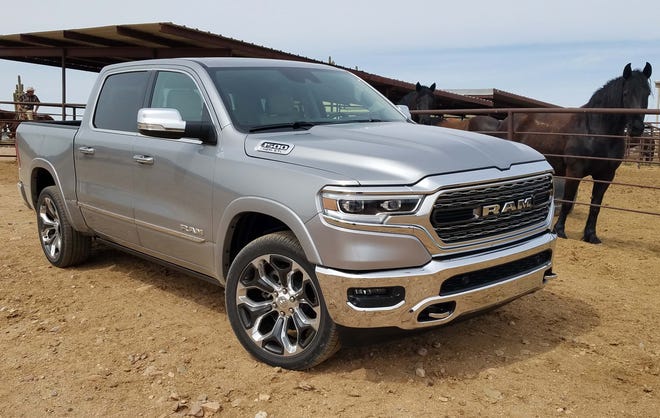
In a nod to the uncertain road ahead for electric-vehicle adoption, Stellantis announced an all-new internal-combustion engine line Friday, even as the automaker targets 50% EV sales in the U.S. by 2030. Called Hurricane, the high-performance, 3.0-liter, twin-turbo, inline-6 cylinder will replace V-8 powerplants for the company’s rear-wheel-drive-based platforms on which the profitable Ram pickup, Jeep SUVs and Dodge sedan lines are based.
Governments are pushing automakers toward battery-powered drivetrains, but consumer adoption has struggled at 3% market share due to issues with range, charging infrastructure and affordability. The Hurricane drivetrain ensures Stellantis will be able to meet draconian EPA emissions rules beginning in 2026 while testing the market with new EVs and satisfying customer demand for high-horsepower truck and car gas engines.
“Internal combustion engines still matter,” said Stellantis propulsion system chief Micky Bly in introducing the Hurricane. “There are not a lot of people talking about new ICE engines these days, but we have a need.”
That need focuses on the automaker’s crown jewels: Ram and Jeep as well as its iconic Dodge performance brand. Their signature models are RWD truck and truck-based SUV applications (Ram pickup, Jeep Grand Wagoneer, Jeep Grand Wagoneer) and large unibody SUVs and sedans (Jeep Grand Cherokee, Dodge Challenger, Dodge Charger, Dodge Durango). They boast high-performance V-8 engines with popular trims like TRX, SRT and Scat Pack — as well as standard models powered by the workhorse, normally-aspirated Pentastar V-6.
The V-8s, however, are in the crosshairs of EPA carbon-dioxide rules that are due to ramp up in 2026 and punish gas-guzzlers.
Hurricane is an old family name dating back to 1950s Willys inline-4 cylinder performance engines found in Jeepsters and stations wagons. The new, forced-induction, aluminum-block engine follows in those footsteps with inherently smooth, inline-6 architecture that, Bly said, will produce class-leading performance. A Standard Output version is capable of more than 400 horsepower and 450 pound-feet of torque, while a High Output six is optimized for performance and will be capable of more than 500 horsepower and 475 pound-feet of torque.
Those are performance numbers to rival a twin-turbo BMW M3 inline-6. The SO and HO feature class-leading 133 and 166 horsepower per liter, respectively, while reducing CO2 emissions by about 15%.
“Internal combustion engines will play a key role in our portfolio for years to come,” said Bly. “Hurricane is a no-compromise engine that delivers an important reduction in greenhouse gases without asking our customers to give up performance.”
The move away from V-8s was telegraphed by former Fiat Chrysler CEO Mike Manley, who told The Detroit News at the 2019 Detroit Auto Show: “The reality is those platforms and that technology we used does need to move on. They can’t exist as you get into the middle-2020s.”
The Hurricane promises more grunt than the 5.7-liter and 6.4-liter V-8s it will replace, but it will not use the signature “Hemi” cylinder construction that has been synonymous with Jeep-Ram-Dodge performance marketing.
Instead, Plasma Transfer Wire Arc — popularly known as “spray bore” — cylinder technology is the new buzzword for the I-6’s impressive numbers. The technology was pioneered by Ford in high-output Mustang GT350 and GT500 V-8 engines.
The Stellantis strategy echoes that of Ford’s 2.7-liter/3.0-liter, twin-turbo Ecoboost V-6 engines that debuted in 2015, as well as Toyota, which just replaced the Tundra pickup’s V-8 with a twin-turbo V-6. Ford’s twin-turbos now anchor the F-150 pickup lineup — replacing V8s while providing more power and efficiency.
“Ford has already been down this road,” said Autoweek Executive Editor Tom Murphy, who led Ward’s respected 10 Best Engines awards for years. “The Ecoboost V-6 has taken over the vast majority of F-150 sales. They’ve proved you don’t need a V-8.”
Still, Ford customers have bellyached about the lack of visceral V-8 appeal in the F-150 Raptor, and the brand is expected to put a V-8 into the forthcoming Raptor R.
While V-8s may still play a role in Stellantis’s future, Dodge is expected to focus on electrified muscle in the near future, beginning with a replacement for the outgoing, supercharged 6.2-liter Hellcat V-8.
“I think that electrification will certainly be part of the formula that says what is American muscle in the future,” Manley said back in 2019. “What it isn’t going to be is a V-8, supercharged, 700-horsepower engine.”
Autoweek’s Murphy speculates the Hurricane’s rear-drive application could open up the front axle for an electric motor to make electrified, plug-in versions of future Stellantis models. Stellantis says the Hurricane will also be the primary internal combustion powerplant using future, electrified STLA Large and STLA Frame platforms.
In addition to its Ram workhorses, Jeep and Dodge have stuffed V-8s under the hood of everything from the Wrangler 392 to the Dodge Durango Hellcat. Look for Hurricane variants — including with electrification — to replace them.
Expect brand announcements in the coming months detailing Hurricane applications, with the engines focused on the North American market with its high truck sales and lower-cost fuel and regulation. Hurricane makes less sense in overseas markets like Europe where Stellantis expects to be 100% electric by 2030 in a brutal regulatory environment. Expect the workhorse Pentastar V-6 and turbocharged, 2.0-liter I-4 (a close relative of the Hurricane) to anchor Wrangler and Cherokee models stateside.
“I wonder about Ram pickup trucks going electric” in North America, Murphy said. “Towing with an EV can be disappointing, especially if you’re towing 7,000-10,000 pounds. Ram is going to need gas engines to manage the migration to electrification.”
Stellantis’s Bly said that the Hurricane engines are capable of hybridization. The I-6 is already under production in Saltillo, Mexico, alongside the Hemi V-8 line. The Hurricane models are not just more fuel efficient; they are more efficient to assemble with the SO and HO engines sharing most parts. HO versions benefit from bigger intercoolers and turbochargers.
Henry Payne is auto critic for The Detroit News. Find him at hpayne@detroitnews.com or Twitter @HenryEPayne.
Streets of Willow Springs Raceway, California — When I was a kid, my buddies and I used to imagine the dream basketball player.
Sports car fans have played the same game with Porsche. What if you put the high-revving, 4.0-liter flat-6 engine from the 911 GT3 track weapon into the nimble mid-engine chassis of the Cayman?
Best player ever.
Ladies and gentlemen, the dream has been fulfilled. I give you the 2022 Cayman GT4 RS stuffed with the 911 GT3 engine. It puts an exclamation point at the end of an era — beginning in 2025, Caymans will be battery-powered.
Storming into Willow’s tricky double-apex Bowl turn, I’m at full throttle in fourth gear — the flat-6 wound out at 9,000 RPM, its spine-tingling aria tickling my eardrums like a Wagner opera. I stomp on the brakes across the first apex, the big 16-inch brakes grabbing, the Michelin Pilot Sport Cup 2 tires sticking. Dual-clutch transmission snaps off rapid-fire downshifts. Cayman drifts up the banking, then rotates left on a dime and I’m flat on the throttle again as the mid-engine chassis drifts beautifully across the apex and on to its next corner conquest.
Folks often ask: What is my favorite car? Were price no object, my stock answer is the $300,000 McLaren 720S. Its combination of beauty, mid-engine balance and twin-turbo V-8 is a visceral delight.
The Cayman checks all the same boxes for $143,000. Despite a lackluster design for its first-gen Cayman (and topless Cayman sibling), Porsche has evolved its entry-level, last-generation, gas-powered sports car into a pleasing shape to rival the 911 in timeless appeal.
I’ve been a mid-engine racer all my life, and the GT4 RS (rough German translation: RS stands for “racing fun”) fit me like a glove. Add an IMSA-like swan-neck wing and aggressive 19-inch wheels, and GT4 RS gets its sinister on.
The Detroit News was one of the first journalistic outlets to get behind the wheel of the GT4 RS (deliveries coming this summer). It was also my first taste of the Streets of Willow course.
So natural did the Cayman feel in my hands that within a lap I could give full attention to learning the course. The RS exhibited no excessive push, no rear grip issues, no transmission hiccups. I pointed it where I wanted to go and it followed. When I pushed too hard, the rear stepped out — and minimal steering pulled it back in. No drama, no gray hairs.
But like the McLaren 720S, it’s the engine that makes this car special. And makes purists nervous about the coming silent EV age.
I flogged the same mill last fall at Road Atlanta in the Porsche 911 GT3, its 500-horse 9,100 RPM redline an addictive drug. Porsche turns the engine around in the GT4 RS, adds different exhaust plumbing and extracts 493 horsepower.
I chased Patrick Long, Porsche hot shoe and one of the best sports car drivers in the world, in a 640-horsepower Turbo S. The S would squirt away under power, the GT4 hauling it back through the twisties. We turned ridiculous 1:20-minute laps — not far from the 911 GT3 track record. On the Nürburgring’s Nordschleife, the GT4 RS clocked a staggering 7:04-minute lap — just nine seconds slower than 911 GT3, and better than GT4 by 23.6 seconds.
You want to hear the engine’s siren song all day — it’s a reminder the flat-6 is the natural sound for the Cayman, unlike the much lamented turbo flat-4 that comes with the base Cayman. It makes a sound satisfying only to environmental agency nags.
Pity the flat-6 can’t be had until you lay out $100K for the GT4. The RS brings a $20K premium over the standard GT4.
I’ve been down the dream Porsche road before. Years ago, I bought Porsche’s entry-level 944 ($22,000 at the time, $55,000 in today’s dollars) — then stuffed it with the Porsche 968’s 3.0-liter, 237-horse mill, the most powerful 4-banger the Stuttgart brand made. Engine + conversion set me back 30 grand (in today’s dollars) for a total, inflation-adjusted cost of $85,000.
That’s a more accessible price, and — as it happens — is about the same cost as a new 495-horse V-8, mid-engine Corvette with track package at $85K — nearly half the GT3 RS price! Of course, Corvette’s 30,000 sales unit volume brings advantages over the Cayman’s 3,000-unit production.
That said, the 911 RS engine requires serious, expensive upgrades of the Cayman body. To feed the beast within, the rear windows have been remade as air intakes. The lower rocker panels are refashioned to let more air into the side intake. Front panels have been remade with carbon fiber, then punctured vents and airfoils to redirect air over the hood, through the wheel wells, to suck it to the ground.
It’s a barely disguised race car (in race livery it debuted with a dominating win at the Michelin Pilot Challenge GT4 race at Daytona in January), and its natural habitat is the track. Don’t buy it if you don’t track it. You’ll never know how good it is.
For those with $140K in their pocket, they may prefer the faster GT3 for $20K more. But for those seeking the dream of a 911 engine and Cayman handling, the GT4 RS is your athlete. It sets a high bar for the coming EV age.
2022 Porsche Cayman GT4 RS
Vehicle type: Mid-engine, rear-wheel-drive, two-passenger sports car
Price: $143,050, including $1,350 destination fee ($162,600 Racing Yellow and $195,190 Arctic Gray with Weissach package as tested)
Powerplant: 4.0-liter flat-6 cylinder
Power: 493 horsepower, 331 pound-feet of torque
Transmission: 7-speed automatic
Performance: 0-60 mph 3.2 sec. (mfr.); top speed, 196 mph
A housing contractor visited my house and immediately noted the 2022 Ford Maverick tester in the driveway. Area 51 Blue paint. Base model. Steely wheels.
“Wow. Is that the new little Ford pickup?!!”
My friend Scott loves Ford pickups. He’ll probably be buried in his F-150. He hopped in the Maverick and a smile grew across his face.
“I could use this around town. Save my F-150 for trips to the farm.”
He’ll have time to think about it — the Maverick is sold out until summer. Our 2021 Detroit News Vehicle of the Year, the compact pickup has been red-hot. When it was announced this summer, it attracted 100,000 reservations. It sold 4,140 units out of the gate in October. Fully 25% of buyers were millennials — twice the industry average for car models — the coveted entry-level demographic.
Which is encouraging since the Maverick is now Ford’s entry-level vehicle, taking over the spot the ubiquitous Focus and Fiesta used to fill — even as its current average monthly sales are below the Ecosport, Ford’s outgoing entry-level SUV. I spent a week with the Maverick this winter to dig deeper into what makes this compact so appealing, and to circle its shortcomings.
At $21K, the Maverick is still pricey for an entry-level car compared to the $17K Fiestas of yore, but it appears Ford has concluded that sub-$20,000 vehicles are money-losers in today’s highly regulated environment. Better to make margin on small SUVs (and pickups) and leave first-time buyers to the used market where they can find affordable pre-owned vehicles — then buy into factory warranties.
Maverick was easy on the eyes with each new day. The Area 51 Blue is attractive, as is the car’s trim (even the steel wheels, which have a retro charm). My pickup pals Scott and Jim were less impressed — they just saw cheap steelies.
They would likely jump to the XLT package for another $2,300 — gaining attractive 17-inch aluminum black wheels as well as cruise control, then adding blind-spot assist for another $540.
After which there is a $10,000 price gulf to, ahem, a Bronco Sport-like $34K to achieve the features Mrs. Payne finds essential in Michigan’s four seasons: all-wheel-drive, adaptive cruise control, heated seats. Such features only come with an upgrade to the more powerful 250-horse turbo-4 engine.
But if the base hybrid’s 42 mpg (50 mpg city!) and 580-mile range is what flips your switch, then the front-wheel-drive version it must be.
After an inch of snow, my base truck craaaaaaawled out of the driveway — automatic traction control is obsessive about controlling slip in front-wheel-drive configuration. Enough of that. I switched the nannies off and charged ahead, the FWD system doing its work with the engine weight over top of it (a base rear-wheel drive F-150, on the other hand, can be a little hairy with the unladen wheels in back).
When the roads are clear, Maverick is fun to ride. This is a tiny truck like the “good ol’ days” of wee Rangers (121-inch wheelbase vs. the 1990 Ranger’s 124 inches, though Maverick is 6 inches longer). But sitting on the same unibody chassis as the smooth-driving Escape (and Bronco Sport), it is on another plane in handling. You can really hustle Maverick through the corners.
That unibody also pays dividends inside with better interior headroom, front shoulder room and rear legroom than its bigger-boned 2021 Ranger midsize sibling. The interior puts the Ranger to shame with its modern tablet screen, molded plastic and sculpted door interiors that perfectly fit an upright Thermos (no rattling). My friend Jim marveled at the clever “winged” door arm rests.
The Maverick has made headlines with its DIY ethic (the bed features a QR code that links to a web page showing owners how to hack the wiring system, and you can hang your own 3D-printed device off its rear center console hook) and, sure enough, my truck buddies are Do-It-Yourselfers. They hope Ford follows through on littering its website with more DIY videos as the Maverick owner club grows.
Though lacking standard cruise control, the Maverick is equipped with Apple CarPlay and Android Auto connectivity, giving it excellent navigation capability. Buy a $100 Carlinkit adapter online and your phone will connect wirelessly, like in luxury vehicles costing thousands of dollars more.
With 1,500 pounds of payload capability and easy seating for four, the Maverick is everything you need for an urban pickup. Honey, I shrunk the F-150.
2022 Ford Maverick
Vehicle type: Front engine, front- and all-wheel-drive, five-passenger compact pickup
Price: $21,490, including $1,495 destination fee ($21,490 FWD XL Hybrid as tested)
Powerplant: Hybrid 2.5-liter 4-cylinder mated to electric motor; 2.0-liter turbocharged 4-cylinder
The auto industry’s worst-kept secret is out: the Porsche 718 Cayman/Boxster is going all-electric.
At its annual conference Friday, the German brand confirmed that its entry-level sports cars will maintain their mid-engine proportions for its 2025 model, but with a battery pack in front of the electric-motor-driven rear axle like the Mission E concept shown at the 2021 Los Angeles Auto Show. Porsche’s major announcement was the latest indication that the push towards electrification is not just focused on new nameplates — but is disrupting the lineups of iconic gas models as well.
The Porsche joins halo cars like the Dodge Challenger SRT Hellcat and Subaru WRX STI, as The Detroit News reported this week, that are transforming to battery-power — appealing to a new generation of buyers while risking the alienation of a customer base that has prized the vehicles’ rowdy engine songs. The Cayman/Boxter’s signature, flat-6 engine lets out a spin-tingling shriek at 9,000 RPM in the GT4 RS model — a markedly different experience than the silent power of Porsche’s first electric nameplate, the Taycan sedan.
The disruption has prompted analysts like iSeeCars’ Karl Brauer to warn of a second “Dark Age” of performance like the 1970s, when government regulations and high gas prices forced automakers to retreat from high-performance designs. But even as new government edicts are compelling an end to internal-combustion engines, automakers assure customers that next-gen electric cars will be better than ever.
“Our industry is experiencing what is probably the greatest transformation in its history,” said Oliver Blume, chairman of Porsche’s executive board. “We are stepping up our electric offensive with another model: By the middle of the decade, we want to offer our mid-engine 718 sports car exclusively in an all-electric form.”
The Volkswagen luxury unit will also offer a gas-electric hybrid version of the iconic 911. The manufacturer, whose parent is preparing an initial public offering of the brand, expects electric models to be just as profitable as combustion engine vehicles in about two to three years, according to Chief Financial Officer Lutz Meschke, Bloomberg News reported.
“We already achieved double digit profitability now for the Taycan and we are working hard to reach the same profitability as we already have for our combustion engine cars,” Meschke said during a call with reporters. “I am convinced that we will achieve this in a period of two to three years.”
Porsche plans for half of its sales to be battery-only or hybrid models by 2025, including a fully-electric version of the Macan SUV, before moving to 80% of sales that are exclusively powered by a battery by 2030. Keeping up profit margins at Porsche, VW’s most profitable brand next to Audi and Lamborghini, is key for the group to help finance the industry’s biggest shift to electric cars.
Volkswagen and its controlling shareholder, the billionaire Porsche-Piech family, are pushing ahead with a listing of Porsche even as global markets face major turmoil because of the war in Ukraine.
An IPO “could sharpen Porsche’s profile and boost its entrepreneurial options,” Meschke said in a statement. “At the same time, Volkswagen and Porsche will be able to benefit from joint synergies.”
The potential listing is estimated to value the sports car brand at as much as 85 billion euros ($96 billion), according to Bloomberg Intelligence. That compares with total market valuation of 96 billion euros of the entire Volkswagen group. The move would partly reverse a tumultuous takeover of Porsche more than a decade ago.
Henry Payne is auto critic for The Detroit News. Find him at hpayne@detroitnews.com or Twitter @HenryEPayne. Monica Raymunt of Bloomberg News contributed to this report.
Auto brands have largely teased their electric ambitions with new halo nameplates — the Cadillac Lyriq, Ford Mustang Mach-E, BMW iX — aimed at niche, green customers. But other brands are taking big risks by converting gas-powered halo models to electrification. The latest bombshell came from Subaru last week when the automaker announced it will not make its highly-anticipated WRX STI performance icon on its current Global Platform — saying it has been delayed for a future, likely-electrified platform.
The news about the WRX STI, which has defined Subaru’s off-road rally spirit as an all-wheel-drive, high-wing, high-horsepower hellion, comes on top of news that Dodge and Porsche will be going all-electric with their next-generation Challenger and Cayman sports cars, respectively. The moves risk alienating loyal owner bases that have prized roaring, internal-combustion V-8 and flat-6 engines.
“Subaru is focused on how our future performance cars should evolve to meet the needs of the changing marketplace and the regulations and requirements for greenhouse gasses,” the company said in a brief statement. “As part of that effort, Subaru is exploring opportunities for the next generation WRX STI, including electrification. In the meantime, a next generation internal combustion engine WRX STI will not be produced.”
The news was met with a storm of protest from customers.
“Have no desire for an EV STI,” said “STIag,” a longtime owner, in a typical post on IW STI Forum, a popular website dedicated to Subaru enthusiasts. “The niche of the STI is the culture, the personalization, the love. Sad day. RIP STI.”
Subaru’s news comes in the wake of Dodge’s announcement at the November Los Angeles Auto Show that it is ending production next year of its legendary, V8-powered Hellcat Challenger and Charger amid a transition to electrified EV, hybrid and plug-in drivetrains. The supercharged, 700-plus horsepower muscle cars have defined the brand in recent years, driving a boom in Dodge sales as Hellcat V-8s are stuffed into everything from two-door coupes to three-row SUVs.
Porsche’s mid-engine Boxster convertible and Cayman sports cars are also going all-electric, according to enthusiast publication Car and Driver. While Porsche has refused comment on the report, the magazine writes that the Boxster/Cayman design “was previewed by the Mission R concept car at the 2021 Munich auto show.” Porsche has touted the battery-powered Mission R as a prototype for a coming race program.
Cayman/Boxster sales have declined in the U.S. since 2016, when Porsche last bowed to emissions regulations by replacing its screaming flat-6 with a less-emotional turbo-4 cylinder.
Other manufacturers have been less eager to alter icons. Nissan, for example, is bringing to market an all-new twin-turbo V-6 Nissan Z for 2023, and Corvette’s coming Z06 performance model will boast a record 670 horsepower for a normally-aspirated gas engine.
Brands are taking a fresh look at their lineups in the face of historic efforts by governments — including in the U.S. — to dictate which drivetrains automakers use. Automakers have in the past produced a variety of alternatives to mainstay gas engines to balance regulations and consumer demand: diesel, hybrid, ethanol. Governments are now demanding zero-emission vehicles, narrowing the choice to electric and hydrogen power.
“We have seen this game before about 50 years ago,” said veteran iSeeCars auto analyst Karl Brauer. “In the 1970s, cars got more powerful before forces outside the industry — government regulations, gas prices — forced a fast decline in performance from 1975-1980. It feels sadly familiar again today.”
Last remade in 2015, the Subaru WRX STI had been eagerly awaited by fans as it promised gains from the brand’s capable Global Platform. Owner “CT Boost” at the STI forum was disappointed: “The truth of the matter is nobody besides the Left wants electric sports cars. They want to control everything we drive.”
Industry executives like Dodge boss Tim Kuniskis promise that — unlike the ’70s — the electric future will bring more capable chariots.
“People are really nervous about (electrification),” Kuniskis told The News last fall. “(But) power isn’t going away. We’re going to show a concept of our all-electric muscle car. We’re going to . . . redefine American muscle.”
Subaru, too, assured that the next WRX STI will be a revelation: “The STI brand represent(s) the zenith of Subaru’s performance vehicles exemplifying Subaru’s unique DNA and rally heritage. As we look to the future, we also look forward to incorporating the essence of STI into our next generation of vehicles.”
Some members of the STI forum were encouraged by Subaru’s evolution. “I am excited to see what Subaru will put together. For those who say you can’t make an EV or hybrid sports car — have you heard of Ferrari, Porsche, McLaren?” wrote “Hordeolum.” “Subaru looking forward, not backward.”
The company has also acknowledged the difficulties of incorporating high-cost, low-range batteries into an affordable brand catering to long-distance adventure seekers. Subaru, like most non-Tesla brands, has had little demand for EVs — but faces escalating U.S. fines beginning in 2026 if it doesn’t sell zero-emission vehicles. Its first EV, the Solterra, arrives this year as a joint-venture with Toyota to save costs.
“If we designed (a new STI) now, it would have a very limited shelf life,” Subaru spokesman Dominick Infante told Road & Track. “The regulations are changing so quickly that it kind of wouldn’t make any sense.”
It makes sense, said analyst Brauer, for some automakers to reconsider their performance lineups given the uncertain regulatory and gas price future.
“The answer is that sales to enthusiast brand die-hards will take a hit,” said Brauer. “But that’s a smaller hit than they are facing from government emissions penalties.”
Henry Payne is auto critic for The Detroit News. Find him at hpayne@detroitnews.com or Twitter @HenryEPayne.
You date them for their good looks, but you stay with them for their character.
The Buick Enclave has always been a looker, from its boat-bow rear window to its big front kisser and winged mustache. And for 2022, it gets even better looking with a bigger smile, bigger mustache, and — ooooh, sexy new eyebrows. Enclave has led the brand’s transformation over the past decade from tired sedans to hip SUVs by attracting moms again — not just grandmoms.
It’s like the women say in the ad: “That’s a Buick?”
But when it came to living with Enclave day-to-day, well, it had its problems. Am I right, ladies? There was that annoying engine START-STOP tick in the 2018 model that you couldn’t turn off. Like him snoring at night — HUNGGHNK! HUNGGGHNK! HUNGGHNK! — it would just drive you craaaazy after awhile. And then the lack of standard features … seriously? On a premium automobile? Adaptive cruise control wasn’t available until the top-trim Avenir package?
The good news is that Buick listened to you (now, that’s an admirable quality in a relationship). So for its 2022 mid-cycle refresh, Enclave owners can turn off the snoring — er, auto START/STOP — with a button located prominently at the top of the center console next to the infotainment screen. Hallelujah!
And starting at $45,920 with all-wheel drive (a must for Michigan winter), you get a boatload of standard features: lane-keep assist, forward collision alert, rear cross traffic alert, auto high beams, blind-spot assist and wireless Apple CarPlay and Android Auto.
That latter bit is satisfying — and not just for the convenience of getting into your car and having it wirelessly recognizing where you set your destination on your phone. Wireless smartphone apps also mean you don’t need to upcharge to a redundant car navigation system. For those who do prefer in-car systems, I’m happy to report the system in my loaded $60K Avenir top trim responded to my voice commands as accurately as a phone.
Adaptive cruise control is inexplicably still not standard on a road tripper like this — even with the $2,500 price hike over the ’21 model. But at least it’s available from the base $45K Essence trim. Mainstream competitors like the stylish AWD Kia Telluride and Mazda CX-9 offer it standard for less. Heck, even the Honda Civic comes standard with blind-spot assist and adaptive cruise for $23K.
I picked up my son up at the airport and he had no problem spotting the Enclave. This ute has presence. Expanding on its familiar good looks, Buick did some clever work for ‘22 with the wider, wing mustache and a smoldering “eyebrow” running light atop the grille.
That space used to be occupied by the headlights, but headlights have been moved, subtly, to the mid-fascia. The location is optimal for not annoying vehicles traveling in front of you with headlight glare — and it also echoes the Enclave’s attractive smaller sibling, the Envision.
Typical of the GM family of vehicles these days, Enclave’s chassis has spent quality time in the gym. The body is lean for its size — a couple hundred pounds lighter than a Lincoln Aviator — and the suspension well-tuned, with my Avenir model also benefiting from adaptive suspension. My son and I both drove it with verve through Oakland County’s lake country twisties, where the big bus was surprisingly nimble. It confidently hugged turns while the 310-horsepower V-6 roared happily under my cane.
Monostables can be difficult to learn (wait, which direction do I push it for REVERSE?), and the last-gen Enclave used a similar mechanism to the XT6. Once again, Buick apparently listened to customers who wanted something simpler — though, um, not everyone will be pleased by the replacement.
Buick has adopted a “trigger shifter” — common in Honda and Acura models — which saves console space like a monostable but requires learning (wait, which finger do I use to operate REVERSE?). My bet is folks would prefer a good ol’ column shifter if the idea is to save console space.
Save space the trigger does. There is room for a phone charger, cupholders and — underneath — a clever hideaway space for purses and other valuables. The console sits under one of the most elegantly designed dashes in the business. Tesla made big screens fashionable, and automakers are falling all over themselves to stuff jumbotrons into dashboards.
Enclave resists, integrating its modest eight-inch screen into the dash’s horizontal, wing-like theme. The design complements the cabin’s solitude and space. Enclave knows its customers prize interior room.
Marry the Buick and you get a big house sitting on an 204-inch-long foundation. Six-footers like my son and I could co-exist nicely in the second and third rows — if you can figure out how to get back there.
Seats are expensive, and Buick (along with its sibling Chevy Traverse) decided to save money by only enabling the right (curb-side) second-row seat with a “Smart Slide” option for easy third-row access. Tug on the captain’s chair side handle and the throne tumbles forward. It’s effortless, practical and doesn’t require removal of an anchored child car-seat.
That ease-of-entry was lacking on the ’18 model’s left side, however, and Buick decided to keep it that way for 2022. If you have a third-row ticket, you’ll need to flatten the second row seat, or crawl through the middle aisle, or climb through the back hatch if you’re really desperate.
Buick is betting that kids won’t mind. Especially since the third row is not only roomy, but offers two USB ports and dual square cupholders so you can store your fast-food drink — and French fries box.
With a panoramic roof overhead, the airy cabin made for easy, long drives around town — no matter which seat I occupied — on a busy weekend schedule. When the back two rows aren’t occupied, they can be stowed to open a cavernous 98 cubic feet of cargo space to transport furniture, Christmas trees and so on.
Enclave is a handsome beast of burden. And for 2022, it’s got a better disposition too.
2022 Buick Enclave
Vehicle type: Front-engine, front- and all-wheel-drive, seven-passenger SUV
Price: $43,920 base, including $1,195 destination ($60,540 Avenir AWD as tested)
Apocalypse Manufacturing looked at the four-wheel, off-road Ford Bronco beast and found it lacking.
Say hello to the Dark Horse, the world’s first six-wheel Bronco.
The Fort Lauderdale-based aftermarket shop announced production this week of the 6×6 beast, complete with pickup bed, 400 horsepower, 37-inch all-terrain tires and weather-resistant interior. Broncomania is in full swing after the Blue Oval introduced the production Bronco in 2021 and Dark Horse will square off against its natural enemy — the 6×6, Apocalypse-made, Jeep Gladiator-based Hellfire — as well as Jeep cyborgs like Hennessey’s 1,000-horsepower Gladiator stuffed with a Dodge Hellcat engine.
“This is such a nostalgic bring-back from Ford that as soon as we were able to get our hands on one, we knew exactly what we had to do and created the world’s first Bronco six-wheel drive truck,” said Apocalypse chief Joseph Ghattas, who notes the Dark Horse is a street-legal, everyday driver.
These aftermarket Frankensteins join a super-truck movement galvanized by Americans’ desire for everything SUV and truck. Not content to let aftermarket companies have all the fun, Detroit manufacturers have introduced their own super-freak models.
Ford, for example, has introduced a rowdy Raptor version of its Bronco SUV and Ranger pickup to join its iconic F-150 Raptor desert-runner. Ram makes the 702-horse TRX pickup. GMC boasts the crab-walking Hummer EV.
But the aftermarket aims to be one step ahead with insane creations to feed deep-pocketed customers.
A specialist in six-wheel vehicles, Apocalypse says its beasts are meant to “survive the end of times.” Or at least a zombie invasion. The company manufactures the Ram TRX-based Warlord and Jeep-based Doomsday/Hellfire/Sinister 6 models. The vehicles get lots of attention making starring appearances alongside Brad Pitt, Sandra Bullock and Channing Tatum in the current Hollywood film “The Lost City” — as well as two appearances on “Jay Leno’s Garage.”
The Dark Horse follows in their hoofprints. The ute arrives in the Apocalypse shop as a production, four-door, 4×4 Bronco powered by a 330-horse turbo V-6. The engine is pulled and given a steroid injection to 400 horsepower (or about the same grunt as Ford’s coming Bronco Raptor).
Then the Bronco chassis is put on the operating table. Its back is cut off, and the spine extended with steel and fiberglass to create a five-foot-long pickup bed. All told, the Bronco grows from 189 inches in length to 225. The beast is accessorized with 37-inch all-terrain rubber, 20-inch wheels, 4-inch lift, steel sidesteps and a removable, slant-back cover for the bed. Interestingly, there is only one spare tire on the tailgate, like a normal Bronc.
The real magic comes from the company’s patented middle tandem axle, delivering power to all six hooves. Special coil-over springs are added out back for on-road driving comfort when the vehicle is in rear, four-wheel-drive mode. When in its natural, off-road habitat — or on Mars — Dark Horse can be put into auto mode, which spins all six wheels with an onboard computer monitoring grip.
The interior gets a makeover too, with the seats wrapped in King Ranch-style, tan-and-black, marine-grade leather. Fortunately, the materials are weather resistant so you can strip Dark Horse of its doors and roof and enjoy the off-road rodeo.
Dark Horse joins more conventional, 4WD aftermarket Bronco kits like Roush’s Bronco R, which can be ordered through dealers, and adds more aggressive wheels and exhaust note. Or the Hennessey VelociRaptor 400 Bronco, which tattoos the bod with stripes while goosing the 2.7-liter V-6 engine with 411 horses and 603 pound-feet of torque.
Hennessey also builds Jeep aftermarket hellions like the Maximus Gladiator, which is stuffed with a 1,000-horse, supercharged Dodge Hellcat engine.
Build No. 1 for Dark Horse will go straight to Barrett Jackson for auction April 9. Auctions set the price for these specialty trucks. In an indication of where the 6×6 is headed (and Broncomania in general), a heavily-altered 4×4 Bronco from mod-shop SoFlo went for $220,000 earlier this year.
“The Dark Horse came out better then we could ever have dreamt,” said Ghattas. “In future builds, customers could expect to see a 700-plus horsepower from a supercharged V-8.”
Henry Payne is auto critic for The Detroit News. Find him at hpayne@detroitnews.com or Twitter @HenryEPayne.
And that’s a good thing, because the auto industry’s doormat wants you to know that things have changed. Recent Outlander and Outlander Sport models have been uninspired blue light specials, their interiors right out of a rental car catalogue, their tech and styling subpar.
The 2022 Outlander arrived in my driveway like a pinata at a birthday party. Head-turning outside, stuffed with treats inside. The grille was so outrageous I thought it might have been torn off a Chevy Silverado HD. Waterfall grille, mid-facia headlights, high-mounted running lights, more chrome than a Costco birthday cake has icing. The interior? Like no Mitsu I’d ever seen. Big leather accents, big digital screens, big three-row layout.
The Outlander is a compact-class SUV? Yes, but its attitude makes it seem a lot bigger.
Credit the Outlander’s transformation to Mitsubishi’s marriage to Nissan. I’m happy these two confused souls have found each other after some difficult years. Expect more of these unions as regulatory costs soar and governments force automakers to make expensive, small-volume EVs.
Outlander is the union’s first offspring and is loaded with Nissan DNA while retaining Mitsubishi’s more rouge-ish attitude. Speaking of Rogue, the Outlander is based on the same platform as Nissan’s own popular SUV. Just as the new architecture has infused Rogue with some delicious, caramel chocolate flavor, so has it produced the best Outlander yet.
The Outlander’s interior has been transformed with a tablet mounted high on the dash, bold horizontal lines, intuitive knob controls and generous console storage. Step up to my all-wheel-drive SEL Touring model and Cinderella really flaunts her new figure.
Quilted seats, head-up display, all-digital displays, automatic-sliding sunroof, standard three-row seating, seat memory, the works. Look more closely and Nissan Rogue-like touches are everywhere. Cool chiclet shifter. Large infotainment display, steering wheel-mounted controls, control knobs and more.
To set itself apart from its Nissan cousin, Outlander teases you with a combination of rugged attitude and homespun practicality. The latter is most obvious in Outlander’s claim as the only standard three-row SUV in its class.
My chicks have flown the nest, but parents know the value of a flexible interior. Arrive at the school pickup line and inevitably your kids will add more rugrats to the passenger list. The Outlander’s third-row seat room isn’t generous, but the chairs will do in a pinch. And they are easily accessed with a top-seat tab that collapses the second-row seats forward. My tall frame actually managed to fold in back there, so I know two kids will survive just fine. Carry just four passengers and I could easily sit behind myself in the second row.
The Outlander’s rugged attitude comes naturally for this rally-bred brand.
I come from the Pocket Rocket School of Mitsubishi when the company made snarling, all-wheel-drive, 300-horsepower Evo track assault vehicles. These bad boys spent their weekends hunting down Subaru STIs and Honda Civic Type Rs.
But Mitsu’s real claim to fame dates to the 1980s and its rugged, go-anywhere Pajero SUV.
The truck-frame Pajero won global fame for its record 12 wins at the brutal Mideast Dakar Rally (how brutal? One year it was canceled for fear of terrorism). Call it Mitsubishi’s Jeep Wrangler, though the model was curiously canceled in recent years.
In this Age of Ute, they’d be wise to bring it back as a brand halo. In a nod to its off-road history, Mitsu entered an Outlander in California’s Rebelle Rally last year to celebrate the 20th anniversary win of pioneering pilot Jutta Kleinschmidt’s at Dakar — the only woman to win the race. That’s a start.
Pajero’s spirit lives on in the production Outlander. And not just the aggressive exterior that looks like it wants to eat shrubbery for lunch.
All-wheel-drive optioned models like my tester come with unique off-road modes including NORMAL, ECO, TARMAC (Sport), GRAVEL and SNOW. This off-road personality is key to distinguishing Outlander from the crisp, volume-selling Rogue. Particularly when Outlander gets the same driver-assist systems (Rogue’s ProPilot Assist vs. MI-Pilot Assist in Outlander) as well as the same 181-horsepower, 2.5-liter four-cylinder engine.
My loaded SEL Touring model included goodies like all-wheel drive, wireless Apple CarPlay, hands-free power liftgate, adaptive cruise and panoramic sunroof for $38,590 — or, um, about the same price as a comparable Rogue Platinum model and the rockin’, corner-carvin’, best-in-class, 250-horsepower, $38,470, Soul Red Mazda CX-5.
Oh. That’s a tough sell for a value brand trying to get back in the game. But the good news, at least, is that Outlander’s got game.
2022 Mitsubishi Outlander
Vehicle type: Front-engine, front- and all-wheel-drive, seven-passenger compact SUV
Price: $27,290, including $1,245 destination fee ($38,590 SEL Touring as tested)
Powerplant: 2.5-liter 4 cylinder
Power: 181 horsepower, 181 pound-feet of torque
Transmission: continuously variable
Performance: 0-60 mph, 8.2 seconds (Car and Driver); Top speed, 120 mph
Phoenix — Preparing for a trip in the 2022 Lincoln Navigator is more like taking a cruise ship than an SUV.
This thing lives large.
My port of disembarkation: Phoenix, where I approached the Navigator with awe. Like a cruise-liner, my land yacht tester dominated the landscape with a huge, chromed bow, 22-inch turbine wheels and a running board that greeted me like a gangway. What, no anchor?
The ’22 refresh builds on the 2017 Navigator, which redefined Lincoln luxury and gave cruise patrons — er, mega-SUV fans — a serious competitor to the iconic Cadillac Escalade. Like Carnival Cruise lines vs. Royal Caribbean. Yeah, I know, Navigator invented the mega-ute segment nearly 25 years ago, and the current barge is the fourth-gen build.
But Cadillac Escalade had owned the segment since the early 2000s with its blingtastic Escalade. Navigator finally broke a champagne bottle in ’18 over a true Escalade fighter, rolling out the red carpet (literally) with its signature Lincoln Embrace welcome sequence, bold grille and a high-tech interior right out of a Wall Street board suite.
Necks snapped as it sailed by, buyers lined up with six-figure checks. Escalade responded with a dazzling remake of its own, and Jeep resurrected the lush Grand Wagoneer to get into the game. It’s a game the Detroit Three dominate.
Foreign automakers have translated their sedan success into unibody SUVs, but Detroit dominates the mega-ute segment. With a corner on the full-sized pickup market, Motown makers took their profitable filet-of-truck recipe and added lobster tail. Voila! — a land yacht that can tow your yacht.
Determined to stay on top, Lincoln took the ’22 Navigator back to dry dock for the latest state-of-the-art goodies.
The exterior has been upgraded with a bigger maw (it’s a law of nature, grilles must get bigger) and expressive rear taillights. Lincoln has led the pack in horizontal light signatures, and this one’s a beaut. Also fashionable these days are blacked-out packages, so naturally you can get your Navigator with black grille, wheels and roof.
But for my $115,410 luxury cruiser, I’m going all out with Chrome Caviar Dark Gray, Black Label trim with signature turbine wheels. I gave the bellman my bags and stepped into the luxe suite.
You can get a tan sitting in any of the three rows thanks to the standard Black Label panoramic roof. At 6’5” I sat comfortably in the third row (the seat collapsing forward with a pull of the seat tab). If there’s no one in the second row, the seat can be used as an ottoman.
Second-row passengers get heated/ventilated thrones with Amazon Fire-equipped video screens and seat massage — a segment first. I set my seat on “Lower Rolling” massage, then pushed the remote control to watch DreamWorks’ “Rio 2.” I’m just a big kid. Real kids will love it back here.
How’s the front row, you ask? Oh, you want to drive?
In a peek at the autonomous future, the Navigator Black Label features “Active Glide,” a semi-autonomous system available on select divided highways. Think Cadillac Super Cruise or Ford BlueCruise, which use similar hardware and highway mapping. Alas, Lincoln discourages using it from the back seat.
With a laser focused on your face in the driver’s seat to make sure you’re paying attention, you can drive hands-free. But once up front, I was hands-on. Unlike Escalade, which will soon unveil an asphalt-inhaling, supercharged V8-powered beast, Navigator has no ambitions to be an elephant in tennis shoes.
Adaptive shocks cushion shivers from the truck frame and the ocean liner cuts through the air with a 10-speed tranny mated to a 440-horse twin turbo V-6 in the engine room.
Cruise ships use tugboats to get them out of port, but Navigator is self-sufficient with Active Park Assist (pioneered by Ford years ago) that will self-drive you into — and out of — parking spots. Brilliant.
Still, Navigator was ungainly in Phoenix shopping plazas, where I generally parked on the perimeter to spare myself the headache of negotiating tight aisles.
Lincoln promises a battery-powered future by 2030, but that’s hard to square with its halo land yacht. Navigator is coveted as an Up North tow vehicle, or — if you’re in Arizona — an Out West tow vehicle to San Diego’s sandy beaches 350 miles away. It’ll tow up to 8,700 pounds for 470 miles, with gas stations everywhere should the tank run dry.
Enjoy the landscape outside — and the interior craftmanship inside.
If grilles must get bigger, so must interior screens. Navigator’s console touchscreen grows to 13.2 inches and features the latest SYNC 4 technology. That brings Amazon Alexa capability, but I preferred Google tech via a wireless Android Auto connection.
“Hey, Google” I barked, then instructed Google Maps as to my next port of call. Unlike other systems, Navigator also recognizes Google Maps in the digital instrument head-up and instrument displays so you can keep an eye on your route while using Lincoln’s native system to scroll through, for example, your favorite Sirius XM channels.
For new users, all this technology can be overwhelming — many buyers are not yet familiar with basic tech like adaptive cruise control. Let me recommend the Lincoln Showcase. True to a brand that aims to be a car concierge as much as a car builder (see Lincoln’s Hospitality service, which makes you a VIP at hotels and eateries), you can contact a rep to virtually walk you around the Navigator so you are as familiar with the land yacht as a cruise captain is with his vessel.
Many automakers have mistaken the opportunity to introduce smartphone-like features as a moment to eliminate hard-button controls. Not Lincoln. Navigator is intuitive to use with VOLUME, TUNE, MASSAGE and DRIVE MODE buttons nearby.
All of this is wrapped in lovely etched Khaya wood that stretches from A-pillar to A-pillar and up the center aisle. Cruising Arizona Route 202, I relaxed in the 30-way leather chairs. With adaptive cruise control set on 78 mph, I took my feet off the pedals and stretched my legs. Switching lanes, I eyed the blind-spot indicator in the side mirror without craning my neck. “Hey, Google,” I said. “Play ‘Where the Streets Have No Name’ by U2.”
The sun warmed my skin. I took a sip of my iced tea. Ah, I do love an ocean cruise.
2022 Lincoln Navigator
Vehicle type: Front-engine rear- or all-wheel-drive, seven-or-eight-passenger mega-SUV
Price: $78,405 base including $1,695 destination fee ($115,410 AWD, short-wheelbase Black Label as tested)
Powerplant: 3.5-liter twin-turbocharged V-6
Power: 440 horsepower, 510 pound-feet torque
Transmission: 10-speed automatic
Weight: 5,855 pounds (as tested)
Performance: 0-60 mph, 5.2 sec. (Car and Driver est.); 8,00-pound towing capacity (8,300 AWD as tested)



 Henry Payne RSS