- Search Cartoons
- Comic Archive
-
Payne
Store



 Henry Payne RSS

Articles
VW’s Microbus is reborn as the groovy, electric ID.Buzz. Here’s what it looks like
Posted by Talbot Payne on March 9, 2022
The bus is back. And it’s electric.
Volkswagen on Wednesday introduced the long-awaited successor to its iconic 1960s Microbus. Dubbed the ID.Buzz under the brand’s ID electric sub-brand, the V-dub promises to be the first all-electric minivan. VW showed the two-row European version of the Buzz, which will go on sale in the third quarter of this year, with a long-wheelbase, three-row model to follow stateside in 2024.

Aping the original, the 2024 VW Microbus will be hard to miss with its huge front VW logo, boxy shape, two-tone color scheme, sliding door, and short wheel overhangs. True to its hippie roots, it will be aimed at tree-huggers with an interior full of sustainable materials like non-animal leather and organic paint. Make that deep-pocketed tree-huggers, as the ID.Buzz is expected to sticker here at $45,000-$65,000 — or $10k over a comparable Chrysler Pacifica minivan.
The Buzz is the production realization of the ID.Buzz concept that turned heads at the 2017 Detroit Auto Show.


“The (Microbus) represents freedom and the democratization of mobility. With the ID.Buzz, we are transferring (that) DNA to the present day and thus into the era of electric mobility and sustainability,” said VW design boss Jozef Kaban.
ID.Buzz will join the ID.4 in the U.S. market — the vehicles are based on the same Modular Electric Drive battery platform, but the Buzz will be considerably bigger than the compact ID.4 SUV with a standard wheelbase of 117.6 inches — which is longer than the VW Atlas, the largest vehicle VW sells in the U.S.
The U.S.-bound, long-wheelbase model will stretch to 127.5 inches, which dwarfs a Pacifica and is even longer than a full-size Chevy Tahoe mega-ute. Cargo area also beats Tahoe at a whopping 138 cubic feet. The stretched wheelbase will also allow room for an optional, longer-range 111kWh battery.

ID.Buzz is also as tall as a Tahoe at 6’3” — or the height of Detroit Pistons starting guard Cory Joseph. But with its short overhangs, the V-dub’s total length is comparable to the compact VW Tiguan at 185 inches. Minivan rival Pacifica is 204 inches long.
The ID.4 EV, touted by Volkswagen as the most important car it has made since the Beetle as it transitions to an all-electric lineup, has been met by lukewarm media reviews and sales in the U.S.
Though likely to sell in smaller numbers than ID.4 given its lower-volume minivan segment, the groovy Buzz may be just the conversation starter VW needs to compete with Tesla, which has dominated the small EV sector. Microbus sold in the U.S. from 1950-1967 and became an icon of the counter-culture movement.
Drivers of the original sat on top of the front axle with their noses pressed to a windshield flush with the front bumper. To accommodate modern safety standards, that suicidal position has been moved back, but the Buzz still maintains the original cab-forward design.
The Microbus’s familiar, V-shaped “hood” graphic cups the VW logo. With its tiny gas engine hanging out the back, the Microbus boasted a cavernous interior (thus the bus moniker) and the ID.Buzz follows suit since its battery will be under the floorboards.
The standard 82 kWh battery promises 250 miles of range, the bigger 111 a healthy 357 miles.
Like ID.4 (and the ’60s Microbus), Buzz will be rear-wheel-drive with a 201-horse electric motor driving the rear axle and putting out 229 pound-feet of torque. Top speed? 90 mph compared the original’s 72.
While the petrol-powered original could fuel up in five minutes on a tank of gas, the ID.Buzz claims it can charge from 5%-to-80% on a DC fast charger in 30 minutes.

Inside the Buzz’s right-sliding side door (a second, left-side slider is optional), buyers will find a flexible interior. The three rows of seats can be removed to expand cargo room. The two-tiered front console offers storage — and can be moved between the second row seats when configured as captain’s chairs.
Buzz will come in 11 color options and four two-tone options featuring Lime Yellow, Starlight Blue, Energetic Orange or Bay Leaf Green below the character line and Candy White common on top.
The front cabin will be familiar to ID.4 consumers with a 10-inch tablet screen (12-incher optioned) running the latest VW infotainment system. Touch sliders — controversial on the ID.4 — control temperature and volume. Less controversial will be wireless Apple CarPlay and Android Auto, coveted by smartphone users. A steering-mounted stalk shifter with NEUTRAL, DRIVE and REVERSE positions controls the drivetrain.

True to its mission as a family hauler, the Buzz bristles with up to nine USB-C charging ports.
Complementing its exterior, two-tone flash, there will be four two-tone interior options as well. Candy White decorates the instrument panel and outer seatbacks while X-Blue, Orange, Yellow and Green color the dashboard, seats and upper door inserts.
An array of safety features come standard, including front brake assist, lane assist, and road sign display. Optional systems include adaptive cruise control, park assist and a surround camera view.
The ID.Buzz will be manufactured in Hanover, Germany. More details on price, performance, and options (like the California camper package, complete with tent, sink and stove) are expected closer to the 2024 sales date.

Henry Payne is auto critic for The Detroit News. Find him at hpayne@detroitnews.com or Twitter @HenryEPayne.
Another Baby Raptor is born: Rowdy Ranger version coming to U.S. in 2023
Posted by Talbot Payne on March 7, 2022
The Raptor nest now has two Baby Raptors.
Ford continues to expand its off-road performance lineup in the United States, with a Raptor version of the Ranger pickup coming in 2023 to go with the Bronco Raptor. Like Papa F-150 Raptor and sibling Bronco, Ranger Raptor will be powered by a ferocious, twin-turbo V-6 sitting on an armored chassis and Fox shocks — while the interior gains Ford’s state-of-the-art SYNC 4 technology so owners can wirelessly navigate to the outback on Apple CarPay or Android Auto.

Ranger Raptor has been sold overseas since 2019 with a less capable, 2.0-liter turbo-diesel engine. In a Tweet, Ford CEO and chief motorhead Jim Farley confirmed the long-rumored “Ranger & Ranger Raptor are both coming to the U.S. next year” after the truck made its European debut late last month.
In addition to its meatier mill, the ’23 Ranger Raptor will sit on a new Ranger architecture with upgraded tech. The Raptor tops the Ranger Tremor as Ford’s most-capable off-road midsize truck. While the Tremor competes against the Toyota Tacoma TRD Pro and Chevy Colorado ZR2, the Ranger Raptor will be aimed at the Jeep Gladiator Mojave, though the Raptor promises peerless power in segment.
Since its introduction as the first super truck in the full-size segment, the F-150 Raptor has been joined by the Ram 1500 TRX and GMC Hummer EV super trucks.
Ford had previously resisted bringing the Ranger Raptor to the U.S. market for fear of cannibalizing sales of the hugely popular F-150 Raptor, but with Ford’s transition to an all-SUV and truck brand (save the Mustang coupe and convertible), the gloves have come off with the Raptor sub-brand now gracing both the Bronco and Ranger models.

You’ll know it by Raptor’s signature “F-O-R-D” letters branded across the front grille, amber highlights, flared fenders, and twin tow hooks front and rear.
While Ford won’t have all the details sorted — pricing, tires, fuel economy, etc. — until closer to the Ranger Raptor’s launch next year, its specs are formidable. The numbers provided here are for the European models (first to arrive late this summer), but are likely similar to what we’ll see on this side of the pond.
The 3.0-liter, twin-turbo V-6 spits out 392 horsepower and 430 pound-feet feet of torque. To reduce turbo lag, the elves at Ford Performance developed a a race-bred anti-lag system (first developed on the twin-turbo V6-powered Ford GT supercar) that keeps the turbochargers spinning up after the driver backs off the throttle — enabling quicker acceleration.
The engine is mated to a 10-speed automatic transmission and will feature four exhaust modes: Quiet, Normal, Sport and — for those wide-open runs across Holly Oaks ORV Park — Baja.
“The 3.0-liter engine brings a different dynamic to the Ranger Raptor that will satisfy even the most hardcore performance enthusiast,” said chief performance engineer Dave Burn. “The acceleration and raw performance of the new powertrain leave you grinning from ear-to-ear.”
High speed, off-road runs are assisted by a hardened chassis, four-wheel-drive, refined suspension, and live-valve Fox shocks. The suspension offers seven selectable drive modes: Normal, Sport, Slippery, Rock crawl, Sand, Mud/Ruts and Baja.

The latter optimizes the Baby Raptor’s system for all-terrain attacks utilizing everything in its toolbox from transmission calibration to brake sensitivity to traction control.
“While Ranger Raptor was inspired by desert racers, it’s also a supremely capable overlanding vehicle,” Burn said.
For extreme rock crawling, Ranger Raptor gains locking differentials front and rear (the Ranger Tremor only has a rear locker) and Trail Control — a sort of low-speed, foot-free cruise control up to 20 mph.
The beast is armored with three bash plates underneath to protect the front radiator, steering arms, engine and 4WD transfer case from off-road abuse.

Muscular fender flares cover 17-inch wheels wrapped in big all‑terrain tires. While Ford does not specify tire make yet, European photos indicate 33-inch BFGoodrich K02 all-terrain knobbies. The body ripples with functional air vents to feed the beast under the hood. Out back, the bed is tattooed with the “Raptor” logo.
The current-gen Ranger was sped to the U.S. market in 2019 to take advantage of a surge in interest for midsize trucks. The vehicles was panned by critics for its dated interior and the new Ranger and Baby Raptor promise significant upgrades. Chief among them is Raptor’s 12-inch console screen and wireless smartphone connectivity — mirroring Papa F-150 and Bronco.
Raptor also gets a 12.4-inch digital instrument cluster and upgraded dash design. Raptor-exclusive Code Orange accents decorate the instrument panel and seat trim. A leather-heated steering wheel and paddle shifters complete the sporty look.

“We knew that customers would expect improved performance with the next-gen Ranger Raptor, but I’m not sure they’re really expecting the enormous leap we’ve made. It’s a seriously fun truck to drive and I think the raw performance is going to blow them away,” Burn said.
Ranger Raptor is due to arrive in Europe in late summer with U.S. sales sometime in 2023.
Autorama is back with hot rods, Zingers, Milan dragsters, Ridler wannabes
Posted by Talbot Payne on March 4, 2022
Detroit — The world’s most outrageous, chopped, channeled, dumped and decked hot rods are back.
Sidelined last year due to the pandemic, the 69th annual Meguiar’s Detroit Autorama returns to Huntington Place this weekend, Friday through Sunday. Headlining the 800 custom cars on display will be 30 competing for the prestigious Ridler Award as well as a 50th anniversary tribute to Chuck Miller’s Zingers creations and 20 race cars celebrating the reopening of Milan Raceway, Michigan’s only NHRA-sanctioned drag strip.
“It was heartbreaking to have to cancel the event last year,” said Autorama president Peter Toundas, whose Championship Auto Shows produces the event. “We are delighted to bring this Motor City tradition back. Detroit Autorama is the most revered hot rod custom car show in the country, and spotlights the important, historic role Detroit has played in the world of custom cars and hot rodding.”

With the relocation of the North American International Auto Show to September, Autorama is now the premier winter auto show in downtown Detroit. It roars back at a time when downtown is picking itself back up after pandemic restrictions. Autorama’s family-focused crowds may bring welcome appetites to struggling restaurants and retail stores around Campus Martius near the convention center.
The Ridler, sponsored by Meguiar’s, is the most coveted custom car award in the country. The bauble has been presented for 59 years to the most notable new custom car — shown for the first time anywhere. Competitors often spend millions to capture the prestigious $10,000 prize.
In 2020, the award went to a heavily modified black, 509-cubic inch V-8, 1963 Chevy two-door station wagon created by Minnesota’s Show Cars Automotive. Its slammed chassis was built in Washington state, its wheels crafted in California, and its interior screwed together in Alabama.
Marking the Ridler’s return will be its most prolific recipient, Chip Foose. Foose has won a record four Ridlers and turned his fame into a gig with the Motor Trend network’s “Overhaulin’” show. He will sign autographs from noon-6 p.m. Friday.
Another hot rod legend in the house will be Chuck Miller. Miller’s Fire Truck won the Ridler in 1968 and the New Boston resident went on to create such custom icons as the Red Baron, Bugs Buggy, and Sonic Cuda.
For the ’22 Autorama, Miller will be showing off his Zinger cars — grown-up version of the playful, 1/32-scale model toys sold by MPC in the 1970s. All six super-sized Zingers will be on display: VW Bug, Dune Buggy, Dragster, Dodge van, Corvette and semi-trailer.
“It’s the first time all six of them have been together in 35 years,” Miller said.
The models are essentially half-scale cars (1/5 scale in the case of the semi) stuffed with full-size, hot-rod engines. The result is, for example, the yellow VW Bug with a massive engine and headers sticking out of its roof. The engines were hollowed out for light-weighting so the hot rod caricatures were never driven (a human couldn’t fit in their half-scale cockpits anyway).
Miller also organizes the Cavalcade of Customs display at Autorama, featuring 10 of the wildest custom cars ever built. The favorite of all his children?
“I’m really proud of the Red Baron,” a smiling Miller said of his famed, “t-bucket” hot rod with its spiked German military helmet roof, side-mounted machine guns and swept exhaust. “It came about same as the Zingers. (Autorama founder) Bob Larivee came to me with (Revel’s) toy model and said: Can you build this for the 1969 Autorama? I said, sure, you don’t want to say no to Bob.”
Harold Bullock, who bought Milan Dragway with partner Perry Merlo after its bankruptcy last year, also will be on hand this weekend, keen to spread the word among the Autorama faithful.
“We have a big display of 20 race cars including motorcycles — we even have a dragster snowmobile,” Bullock said.
Racers from the TV show “Street Outlaws” will be there. Johnny “Quick” Kramer is bringing his orange Mustang and Brian “Chucky” Davis will feature his ferocious ’69 Camaro. In addition to fire-breathing V-8s, Milan expects more electric vehicles as Tesla has sparked interest with its 0-60 mph ability.

“EVs are coming. The Tesla Plaid will definitely catch people off guard because it’s just as fast as a Dodge Demon,” said Bullock. “Part of our plan is we’re going to have some EV races out there, too.”
As for the raceway’s opening this year, he said: “We hope to be going by May at Milan. We’re paving about half the racetrack and will have a smooth, hard surface for everyone to come back and make some record times.”
Autorama has often opened with a demonstration drag race down Jefferson Avenue. Not this year, though Bullock would have loved the opportunity. “I bet all 20 of (our guys) would volunteer for that,” he exclaimed.
There will be more celebrity cars and stars all weekend. This year’s Preservation Award Recipient is the 1984 Ridler winner: the Khrome Shop Special ’34 Ford Coupe. Ford fans will also enjoy the 90th Anniversary of the ’32 Ford Tribute Exhibit, featuring 12 significant models.

On Saturday, WWE Hall of Famer Sting and “Toymakerz” star David Ankin will sign autographs. Danny Koker and Kevin Mack from Counts Kustoms will be on hand for autographs Sunday.
But wait, there’s more. Lurking in the basement will be Autorama Extreme, displaying more than 200 traditional rods, customs and bikes inspired by the 1950s. A show within a show, it will include Rockabilly Bands plus the Miss Autorama Retro Pin Up Girl Contest Saturday.
Autorama schedule
For more information, go to www.autorama.com or call (248) 373-1700.
Henry Payne is auto critic for The Detroit News. Find him at hpayne@detroitnews.com or Twitter @HenryEPayne.
State of the Dis-Union: Traveling Across An America Split by Democratic Mandates
Posted by Talbot Payne on March 4, 2022
Carmel, California – This tourist town’s Ocean Avenue main street is lightly trafficked on a Monday morning despite 65-degree weather and bslue skies. COVID rules daily life here. A few, masked pedestrians walked the streets, home of some of northern Californian’s most beautiful beaches. Shops are plastered with signs requiring masks to enter. Store attendants bark at patrons to pull their masks over their noses. Store traffic is light.
A continent away in Naples, Florida and the central, 3rd Street shopping area is bustling with people. Pedestrians browse shops, jam restaurants, and masks are rarely seen. Despite similar weather and demographics, the two sunshine states are a world apart – one living in fear, the other free.
I have traveled extensively across the US in recent months and it’s a tale of two countries, red and blue, often living within miles of one another. Democratic policies – not the virus – have reshaped parts of America. Here are some examples of our State of dis-Union:
Oakland County, Michigan – Public schools like Conant Elementary are in session in Oakland County north of Detroit. Education is a ticket out of poverty, but due to Democratic Party COVID policies, the poor have gotten poorer.
Cross into Detroit and public schools like Edmonson Elementary School were shuttered for the month of January (including charter schools) for fear of COVID-19’s Omicron variant. Remote learning has been the COVID normal in Detroit.
Omicron’s symptoms are mild, say doctors, and the COVID-19 virus is of little mortal threat to children. Yet, the district consistently defaulted to remote learning in a district where some 80 percent of households are run by a single parent. The exception is Detroit private schools. University of Detroit private secondary school, for example, maintained in-class learning since the beginning of the epidemic.
Detroit – The Motor City is a ghost town on weekdays.
Despite the lack of state COVID mandates, Detroit is a Democratic bastion with local government and corporate mask mandates. A small crowd of 50 people attended the North American Car of the Year awards January 11th in the palatial Huntington Place Convention Center were forced to wear masks.
Corporations have mandated masks and encouraged employees to work from home, emptying out a downtown that was abuzz before the pandemic hit in 2020 with new bars and restaurants. Multiple eateries shuttered as their clientele disappeared. Parking garages are empty. Streets vacant.
Just 300 miles east in of Indianapolis, 68,000 partisans descended on Lucas Oil Arena in downtown Indianapolis on January 10 to cheer their respective Alabama and Georgia football teams in the national championship. Regardless of their differences, they enjoyed a mask-less indoor environment in the free state of Indiana. Crowds congregated in Indianapolis bars and restaurants after the game, enjoying the moment.
Toledo, Ohio – The Biden Administration is forcing an electric-vehicle overhaul of the American auto industry in the name of fighting what it calls the “climate crisis.” This despite lukewarm consumer demand. EVs make up just three percent of US sales – 80 percent of them Teslas.
I am one of those Tesla owners.
The Model 3 is quick, high-tech, ambitious. On a trip from Detroit to Charleston, West Virginia, the Tesla’s cutting-edge Autopilot system drove itself for large portions of I-75. But I also had to stop in Toledo to recharge for 30 minutes in a Meijer parking lot. All told, my 12-hour round trip took an extra 2 hours 20 minutes due to recharging stops. Compare that to a comparable, gas-powered car which could make the trip with two, 5-minute refuelings.
No wonder the only other EVs (despite over a dozen models on the market) I saw across three states were Teslas at superchargers. Yet, major automakers echo Democratic Party rhetoric that the planet is in crisis, that their autos are the cause, and that they must go all-electric. “Our pursuit of sustainability and climate equity remain. . . vital,” said General Motors CEO Mary Barra, introducing an electric Chevy pickup at this January’s Consumer Electronics Show.
Automakers concede that selling EVs is a challenge, but they are counting on governments to ban gas cars over the next decade and build a refueling infrastructure to rival gas stations.
Phoenix, Arizona – While America’s establishment media has always leaned left, the pandemic solidified its transition as a mouthpiece for the Democratic Party and government power. At the heart of this is the Associated Press which has morphed from a neutral journalistic institution to the US equivalent of TASS news agency.
Whether in the Arizona Republic or USA Today, AP is America’s ubiquitous national news source. As government propaganda, it shapes the news to favor Party narratives. AP’s coverage of the Black Lives Matter and Freedom Convoy protests exemplify how differently the wire service treated two civil liberties movements. AP heaped respect on the often-violent BLM movement as launching a “national reckoning on race” to further The Party narrative of “systemic racism.”
By contrast, AP in February, 2022 marginalized the peaceful, working-class Freedom Convoy as a vessel for “disinformation in Canada and simmering populist and right-wing anger.” AP downplayed Prime Minister Justin Trudeau’s disturbing declaration of martial law while casting the Convoy in its January 6th Party narrative as a divisive movement fueled by “Fox News personalities and conservatives like Trump.”
AP is not alone. Establishment outlets like Harvard’s Nieman Foundation, which claims a commitment to “elevating the standards of journalism,” aim to enforce Party doctrine through Big Tech social media platforms. Niemen on February 23 advocated for Facebook censorship of news contrary to The Party line on climate change.
“A ‘Toxic Ten’ of 10 websites — including Breitbart, Newsmax, and the Daily Wire — was responsible for nearly 70% of engagement on Facebook with climate denial content,” said Niemen, scolding Facebook for “failing to label many posts . . . most likely to publish climate change misinformation.”
The Democratic Party and its media allies have used the pandemic to expand government power. That control will not easily disappear.
Payne is The Detroit News auto columnist, 910 AM Car Radio Show host, a syndicated cartoonist with Andrews McMeel, and Townhall contributor.
Payne: Ford F-150 Tremor — a lean, mean, blizzard-fighting machine
Posted by Talbot Payne on March 3, 2022
Detroit — The Ford F-150 Tremor is at home off-road in mud. Or on-road in a blizzard.
Snow quickly overwhelmed Metro Detroit Feb. 17, canceling events, closing businesses and huddling families at home around their big-screen TVs. Not me. I couldn’t wait to hit the streets. My die-hard pals were determined to hold a long-planned dinner downtown — and happily, I had Tremor to get there.
The last time I was in the Ford was at Holly Oaks ORV park — the big rig’s natural habitat with muddy trails, sandy pits and steep hills. A competitor to the Chevy Silverado ZR2, Ram Rebel and Toyota Tundra TRD, Ford’s $51,200 off-roader was pleased as a pig in slop with 33-inch General Grabber A/TX off-road tires, 11-inch ground clearance, 400 horsepower and all-wheel drive. Turns out blizzards offer a similar playpen.
I kissed Mrs. Payne goodbye and headed into the gloaming at 6:30 p.m. Destination: a Detroit waterfront establishment. With the wind howling, snow blowing and cold biting, Tremor lit up as I approached it like a sci-fi craft in a Tatooine sandstorm.

At 6’6”, the beast is as tall as a Pistons forward. I got out my Super Extender Snowbroom and cleared the windshield, windows and body panels. Covered up, Tremor looks like any other full-sized truck (well, OK, those knobby 33s are giveaway), but as the flakes fell away, the truck’s signature features emerged: Tremor bed decal, orange grille accent, powder-coated running boards, silver bumper bash plate, vented hood.
The latter feeds the caged animal under the hood: a 400-horsepower, twin-turbo V-6 — the same mill as in the ferocious F-150 Raptor supertruck. Though 50 horses shy of Big Brother, Tremor’s six-holer has Raptor-like characteristics with 500 pound-feet of low-end torque and a 0-60 mph time of 5.3 seconds (just 0.1 second shy of Raptor, thanks to the Tremor’s 385-pound-lighter figure).
Combined with the Grabber tires and near-foot of ground clearance (my purpose-built Lola race car has an inch of ground clearance and gets stuck in tall grass), the engine gives the truck a feeling of invincibility. I jabbed the 4-HIGH button for all-the-time four-wheel drive. Oakland County secondary roads were abandoned, unplowed. Like a kid in a sandbox, I slewed Tremor this way and that, the four Grabbers grabbing, the fronts pulling the rears out of lurid slides, the V-6 roaring like a T-Rex at mealtime.
This being the digital age, Tremor is more than a mechanical bull.
Just as the Ford had detected my key upon approach, Ford’s SYNC 4 infotainment system recognized my phone on entry. It automatically hooked up Android Auto, my phone’s navigation system taking over the horizontal 12-inch console screen. I held down the steering-wheel-mounted voice command button and barked my destination. I assumed road blockages, and trusted Google to navigate me around them.

SYNC 4’s radio menu is also one of the best in autodom, and I had already configured my favorite radio stations. Tonight, I would be glued to WWJ-AM (950) weather reports as a complement to Google’s guidance.
The deep powder was a bit like Holly Oaks’ sandbox, and Tremor took to it like a whale to water. But with a vehicle this capable, the concern is less the environment than the threat my behemoth poses to other vehicles. I kept a perimeter around me lest the nearly three-ton truck become a runaway bowling ball on a roadway full of pins.
During Metro Detroit’s last blizzard a few weeks back (ahem, more global warming, please), I piloted a similarly-sized Toyota Sequoia (a Tundra pickup with an SUV body on top). The 6,000-pounder had the stopping distance of an ocean liner. I maintained a big cocoon and regularly brake-checked the SUV for distance when I changed roads.
Tremor, on the other hand, was more confident. Credit those General Grabber off-road tires, which gripped the snow like claws compared to the Sequoia’s slippy all-seasons. Like arming a sports car with Michelin Pilot Sport Cup 2 R gummies for the track, off-road treads are on another level from standard street rubber.

Sure enough, as I approached main four-lane arteries, things got dicier.
On Telegraph Road, three cars had spun out trying to avoid one another. A tow truck was at their rescue. Other cars had slid off the road at lurid angles. Along the six-lane Lodge freeway headed downtown, cars tended to clump together behind tentative slowpokes inching along in the middle of the road.
I tentatively picked my way through these packs. Once clear, Tremor plowed merrily along to the next pack, a whale swimming from one krill swarm to the next.
The Tremor has off-road peers like the Jeep Wrangler Rubicon, Ford Bronco Sasquatch, Toyota 4Runner TRD, Chevrolet Colorado ZR2 and so on. But this night, I saw only Wranglers — and the odd Subaru Outback — moving along with similar confidence, no doubt with experience off-road.
I made it downtown in an hour — about 30 minutes longer than usual. Parking a full-size truck in the city can be a nightmare, but on this night, there were plenty of curb spots. When I re-emerged after dinner at 11 p.m. to a buried truck, I repeated my snow-removal ritual and made it home in 45 minutes — the streets sparse with cars, if not snow.

Off-road tires, of course, are noisy on bare asphalt and concrete surfaces once the snow melts. But they still come in handy given the deteriorating state of Detroit roads in the winter months.
Two days later I took 5’5” Mrs. Payne to the airport — she needed a ladder to get into the right seat — where the Grabbers came in handy along the cleared, pocked roads. Potholes the size of Cass Lake had opened up on Merriman, and the 33s giant sidewalls on 18-inch rims gave me confidence for the ones I couldn’t avoid.
My all-wheel-drive Tesla Model 3 on all-seasons ain’t bad in snow with its precise electric motors — but unseen potholes lurk to swallow up its low-profile 19-inch wheels.

At $68,005, my Tremor Swiss Army knife doesn’t come cheap and is loaded with goodies beyond its snow-eating capacities: roomy SuperCrew cab, 10,900-pound towing capability, fold-down console workspace, 5.5-foot bed, enormous back seats.
Maybe the next blizzard, I’ll load up my pals, throw their gear ‘n’ coolers in the bed, tow a snowmobile, and head Up North for a relaxing weekend.
2021 Ford F-150 Tremor
Vehicle type: Front-engine, four-wheel drive five-passenger pickup
Price: $51,200, including $1,695 destination charge ($68,005 as tested)
Powerplant: 3.5-liter twin-turbo V-6
Power: 400 horsepower, 500 pound-feet of torque
Transmission: 10-speed automatic
Performance: 0-60 mph, 5.3 seconds (Car and Driver); towing, 10,900 lbs.
Weight: 5,562 pounds
Fuel economy: EPA: 16 mpg city/20 highway/18 combined; 13 mpg observed in blizzard
Report card
Highs: Do-it-all truck; first class electronics
Lows: Hard to park in town; gets pricey
Overall: 4 stars
Henry Payne is auto critic for The Detroit News. Find him at hpayne@detroitnews.com or Twitter @HenryEPayne.
Payne: I rode a driverless car in Tempe, Arizona. Here’s how it went
Posted by Talbot Payne on February 26, 2022
Tempe, Arizona — I secure my seatbelt in the back seat, press the START RIDE button, and my Waymo One Chrysler Pacifica enters traffic on Warner Road, the steering wheel spinning right — then left — into the center lane before slowing for a stoplight.
There is no one in the car but me.
Four years after an autonomous Uber car killed a cyclist here, fully autonomous Waymo ride-sharing is on the streets ferrying drivers to their destinations. Like Uber or Lyft, they are open to the public. Unlike those familiar services, there are no drivers on board.

I took multiple trips over three days across the southeast Phoenix service area. The rides were smooth, efficient, stress-free and on time.
Since 2014, I have followed the progress of Level 4 autonomous technology as a passenger — and as a driver at the wheel of Level 2, semi-autonomous vehicles. My robo-rides include the original Google Lexus 450h; its cute, marshmallow-shaped successor at Google HQ; and Uber’s Volvo XC90 through the streets of Pittsburgh.
Semi-autonomous adventures include multiple rides aboard GM vehicles equipped with Super Cruise, and Ford’s similar, geo-fenced BlueCruise system. In between, I’ve logged countless miles in Autopilot aboard my Tesla Model 3.
Since October 2020, Waymo One has serviced 50 square miles through the adjacent communities of Tempe, Mesa, Gilbert and Chandler — the first Level 4 autonomous cars on offer to the public, 24/7, rain-or-shine, via a downloadable smartphone app.
(The National Highway Traffic Safety Administration defines automated vehicle systems as follows: Level 1, Driver Assistance, some driver-assist features may be included; Level 2, Partial Automation, combined automated functions such as steering and acceleration, with a driver maintaining control; Level 3, Conditional Automation, driver must be ready to take control of the vehicle at all times; Level 4, High Automation, the vehicle can perform all driving functions under certain conditions; Level 5, Full Automation, the vehicle can perform all driving functions under all conditions.)

I wait for 18 minutes at the Tempe Public Library at a quiet, urban intersection. The white Chrysler Pacifica — a big “W” printed on its doors — is recognizable from afar with its blue LIDAR “bubble-gum machine” on the roof.
A passerby exclaims at the sci-fi bot and reaches it before I do — “Wow! A driverless car!” — snapping pics with his phone. Generally, though, I’m struck by how accepted Waymos seem to be. With 300-400 robots on the road, locals mostly pass them by without a second look.
Like Detroit, Phoenix is a sprawling metropolitan area where personal transport is king. Like other ride-share companies, robotaxis see an opportunity to service people without vehicles, including the elderly or those with health issues. The Epilepsy Foundation of Arizona and Foundation for Senior Living are Waymo partners. I focused my rides on meeting daily necessities.
I hailed robots to Freddy’s Custard and Steak (a popular local burger chain similar to Shake Shack), Walmart, Starbucks and CVS Pharmacy. Pickup times were generally comparable to Lyft at 4-7 minutes. My ride from the Tempe Library to Freddy’s cost $10 — competitive with a $14 Lyft ride.

There is no mistaking my ride for someone else’s Waymo. My initials — HP — are displayed in bright blue on the dash. The Waymo is plastered with instructions. Upon approach, a sign on the front door beckons me in (“Please take a back seat to access controls and display”). I open the sliding door and a voice welcomes me (“Good afternoon, Henry”).
As in a New York taxi, I am separated from the (empty) front seat by plexiglass. A touchscreen hangs from the seatback confirming my destination. Once underway, the screen displays a car eye’s view of the driving environment: vehicles, pedestrians, buildings, stoplights. Every two seconds, the LIDAR sweep displays even more detail with ghostlike shapes of bushes, trees, lamp posts, etc.
A camera watches me from above. The remote voice of a Waymo Rider Support agent intervenes. “Is your seatbelt on?” she asks from Waymo’s Chandler service center. “I can’t tell since it’s similar to the color of your shirt.”
I confirm that I’m buckled in — and learn I can push the HELP button (next to the camera) anytime to ask questions. I can also press PULL OVER if I want to stop the minivan.

A member of the Alphabet Inc. family with Google, Waymo uses the Pacifica Plug-in model (with 32 miles of battery range before the gas engine kicks in), which is a nice evolution from its Lexus 450h hybrid predecessor that featured a prominent “popcorn box” LIDAR on top and only a second-row of seats for passengers. With their flexible, three-row interiors, minivans have long made excellent ride-share vehicles.
Pacifica’s modern, bullet-like shape dovetails with the “Waymo Driver” suite of sci-fi equipment: a long-range, mid-range and four short-range LIDARs. Additional hardware includes 19 cameras, six radar units and multiple microphones. It’s a Best Buy shopper’s dream ride.
One day, I bring my suitcase and briefcase along. But unlike the Lyft Nissan Quest minivan that delivered me to Tempe, I can’t access the Pacifica’s hatchback.
“Sorry, but you’ll have to put your bags in the seat next to you,” responds the Rider Support agent. Seems all that LIDAR hardware requires a lot of computer hardware in the boot to run. Just like the ol’ Lexus. Still, the minivan proves its worth — it can swallow two passengers and their luggage. Or a lot of groceries.

With its favorable regulatory environment, high-tech workforce and diverse population of seniors and college students, Phoenix has ideal demographics to attract autonomous experiments. The Tempe service area is home to Intel’s sprawling semiconductor manufacturing facilities, Mesa Community College and neighboring bedroom communities. In addition to Waymo, GM’s Cruise is testing autonomous grocery deliveries here with Walmart.
Naturally, the gridded streets and mild weather help. Snow and cold weather (looking at you, Michigan) are hell on robotaxis. It didn’t rain during my time in Phoenix, but Waymo confirmed a technician will ride along when storms loom. For the first time in my eight years of riding robotaxis, I rode alone. In Pittsburgh in 2017, two Uber technicians occupied the front seats.
I was determined to put Waymo to the test and I took rides during morning and evening rush hours when the light was low.
Contrary to human drivers, robotaxis prefer night travel so cameras aren’t confused by sun glare. Autopilot in my Tesla struggles at dusk when the low sun can blind its cameras. Despite a bright southwest sun, my Waymo rides never wobbled.
My previous robotaxis have been overly conservative: always in the right lane, always deferring to other cars. Not this time. While displaying impeccable manners (turn signals, obeying speed limits, easy turns), the Waymo’s priority is getting me to my destination on time.

Driving to CVS, we switch lanes to pass slower cars, then stay left on a six-lane road to make time. Crossing three lanes to get me to a secondary street near the pharmacy, the Chrysler inched into the oncoming lanes just like I would have done — anticipating approaching cars, then shooting the gap between them.
Waymo operates a huge service center in Chandler so its robotaxis can come to roost, refuel, get serviced. In addition to its high-tech hardware, Waymo technicians have mapped the service area for cars to follow.
Since opening Waymo One to the public in October 2020, the company says it has logged 6 million miles of travel with 47 recorded “contact events, nearly all of which involved human error on the part of other drivers or road users involved.”
Turning left into a six-lane road, the Waymo properly merges into the far left lane. But a human driver to our right isn’t so precise, swerving left in front of the Waymo as we merge. We slow, giving the car room.
Further along, a pedestrian crosses the six-lane from the left, then stops at the painted median. The Waymo sees him, slows, then accelerates away.
Tesla’s secret sauce is that it has tens of thousands of guinea pigs like me self-driving their cars every day — with all that data being fed back to headquarters to help with machine learning. Cool, but stressful. I have to know what Autopilot can’t see, and override the system when it gets confused. The Model 3, for example, habitually slows for every traffic light, whether green or red.

Waiting for Waymo, I follow the vehicle’s progress on the app. Unlike a Lyft driver, the robotaxi prefers quiet pickup spots on side roads or shopping plazas — requiring me to walk 2-3 minutes to meet it. Confident in the vehicle’s abilities, I use my rides to catch up on email and texts.
Leaving a main artery, Waymo takes a short cut through a suburban neighborhood to get me to Walmart. But the neighborhood includes multiple speed bumps. Hmmm. If I were in the Tesla, I’d have to take over. But the Waymo sees them, slows, then moves on to the next.
Not bad for a driverless car.
Henry Payne is auto critic for The Detroit News. Find him at hpayne@detroitnews.com or Twitter @HenryEPayne.
Payne: High-tech, high-style Hyundai Elantra is a $21K bargain
Posted by Talbot Payne on February 24, 2022
Naples, Florida — The annual Cars on 5th auto show weekend on Naples’ swank 5th Avenue main thoroughfare is a feast for the eyes. Car owners roll through the streets showing off their fancy Aston Martins, Mercedes, Audis and Lamborghinis.
My $20,995 Hyundai Elantra doesn’t look out of place.

Bold black fascia with integrated, swept headlights like a Merc EQS. Swept tail like an Audi A7. Slashed body stampings like a Lambo Aventador. If Lamborghini made compact cars, they would be called Elantra. At a time when Detroit automakers are exiting the fun, affordable car space (I mourn the passing of the Ford Focus and Chevy Spark), their foreign peers have stepped up with a Whitman’s Sampler candy assortment of delicious morsels. Check out the techy Honda Civic, roomy VW Jetta, salacious Mazda3.
With its daring styling and generous suite of standard features, the 2022 Elantra is a bone standard compact that owners can proudly parade through any American neighborhood.
My vacation tester wore a hip premium wardrobe: black grille, black window trim, black wheels set against a dark gray body. Dude, is that the Batmobile? My former Detroit News colleague Pam Shermeyer was always on the lookout for cool base wheel covers in a sea of dreadful, silver plastic designs. Pam, you’d like these.

The Elantra’s standard black, 17-inch rims match its body stampings — triangular shards rotating around the five-wheel lugs. Walking down 5th Avenue, I found myself stopping and circling mid-engine Corvettes littered along the curbs, marveling at the way designers integrated its multiple surfaces.
I found myself doing the same with the Elantra. With more sharp edges than a drawer-full of knives, its surfaces somehow work in harmony. I pulled up next to an Audi RS5, sporting a huge black grille and 20-inch shard-spoked wheels. But next to Elantra, the RS5 seemed tame. Check out the minute detail on the Elantra’s grille, each segment a triangle. Or the lower spoiler, the Hyundai a plateful of triangular quesadilla slices.

The Elantra is not a hatchback like the RS5 — hatches are expensive to do — but it looks like one. The roofline meets the C-pillar in a long arc that tapers to an elegant swan’s tail.
The exterior hints at the attention to detail within. I marvel these days at the democratization of autos — with luxury chariots boasting of electronic gizmos now routine in mainstream cars like Elantra costing tens of thousands less. My $21,000 had everything I needed.
Walking up to the Hyundai, it recognized the key in my pocket with NFC (Near Field Communication) — Elantra comes standard with key fob and push-button start — lighting up the door handle so I could find it even in the dark. I compressed the wee door-handle button and the door unlocked.

I slipped into comfortable cloth seats that never chafed despite a week of constant driving. It’s comfort that can be enjoyed by four passengers as Elantra features generous backseat space. I easily sat behind myself with my lanky 6’5” frame. Farther back, the truck swallowed two bags, a tennis bag, briefcase and a beach chair with room to spare.
Like those plastic wheel covers, the standard interior is full of premium touches. Instrument and console displays are integrated, Mercedes-like, into one panel across the dash. The console takes a page from Corvette with a flying buttress separating driver from passenger — doubling as an Oh, Crap! handle for Mrs. Payne if needed.
My wife is used to my sudden Hyde-like transformations when I see twisty roads, and she’ll instinctively grab for a handle. Like its front-wheel-drive compact class brethren, fun comes standard in the Elantra with its low center of gravity and short wheelbase. Though lacking the Civic’s razor-sharp dynamics, it is fun to drive fast.
Which, as in southeast Michigan, isn’t often in Naples with its flat landscape and gridded roads. The standard features most drivers will find useful are electronic.
Push the start button and Elantra comes to life. Wireless Apple CarPlay and Android Auto are standard, so I never had to remove my phone from my pocket. The system does require patience to boot up — the eight-inch screen slowly recognizing “Henry’s Smartphone G70” and then Android Auto for navigation, Spotify, etc.

Smartphone apps are way ahead of even the best luxury navi systems. Lounging on the beach, my wife and I had searched destinations from restaurants to retail stores. When we transitioned to the car, they instantly came up on Android Auto. I selected a nearby “Haagen-Dazs” and we were off. When I needed to add a destination mid-trip, I simply barked at Android Auto — its voice recognition better than any luxe vehicle at Cars on 5th — and it changed my route.
Cruising Tamiami Trail, my Elantra bristled with safety features to keep my distance from the six-figure chariots around me. Forward collision-avoidance assist with pedestrian detection is standard, as is auto braking when in reverse. Backing out of a parking spot, the Hyundai detected a passing car — WUNK! — the car instantly applied brakes to prevent contact.
Manufacturers differ on whether blind-spot-assist or adaptive cruise control is the more important safety feature. Hyundai offers BLIS standard — Honda and Toyota ACC. I missed the ability of ACC to navigate Naples traffic, but BLIS not only makes lane changes safe, it also saved my having to crane my neck to check blindspots (which my chronically stiff neck appreciated).
Only at Naples stoplights did the Elantra betray its, um, lower-price status. While luxe chariots around me were powered by boosted, turbocharged-or-supercharged mega-mills, my Hyundai had a mere 147-horsepower four-banger powered by a continuously variable transmission.

Oh, it was painful.
Rolling out of a stoplight next to a BMW 3 Series, I flattened the throttle and the engine screamed — hamsters peddling the hamster wheel for all they were worth. To no avail. The 255-horse Bimmer disappeared into the distance. Sigh. Elantra drivers can take solace that their hamsters sip gas at 37 mpg, making it easy in the wallet, if not the ego.
Save their pennies, and Elantra buyers can trade up for the $32,945, turbo-goosed N model to go BMW hunting with 267 horsepower, limited-slip differential, 19-inch wheels and proper engine growl — still for $12K less than a comparable Bimmer.
And like the base Elantra, it will give up nothing to the German in wireless tech, interior screen size and exterior cool when you cruise down 5th Avenue.
2022 Hyundai Elantra
Vehicle type: Front-engine, front-wheel-drive, five-passenger compact sedan
Price: $20,995, including $1,045 destination fee (base SE as tested)
Powerplant: 2.0-liter 4 cylinder
Power: 147 horsepower, 132 pound-feet of torque
Transmission: Continuously variable
Performance: 0-60 mph, 9.0 seconds (Motor Trend est.); Top speed, 124 mph
Weight: 2,725 pounds
Fuel economy: EPA, 33 mpg city/43 highway/37 combined
Report card
Highs: Hot bod; standard features galore
Lows: Gerbil power
Overall: 4 stars
Henry Payne is auto critic for The Detroit News. Find him at hpayne@detroitnews.com or Twitter @HenryEPayne.
Payne: DeLorean goes back to the future with planned electric vehicle
Posted by Talbot Payne on February 21, 2022
The electric vehicle revolution has brought a fleet of new brands into the market — Bollinger, Lordstown, Lucid, Rivian, Tesla.
Add DeLorean to the list.
Forty years after the gull-winged, stainless-steel, scandal-plagued car wowed the world, DeLorean Motor Company is going back to the future as an EV brand. Based in San Antonio under new ownership and a new name, DeLorean teased its new car on its website with gull-wing doors, electric power and styling by the same Italdesign firm that penned the 1981 original.
“We are making an all-new, fully-electric, gull-winged, two-door sports car,” said Stephen Wynne, CEO of DeLorean Motor Company, in an interview. “More details to come.”
While the nascent electric vehicle market offers opportunities for fresh faces, it has also offered a fresh start for old brands like GMC’s Hummer, Cadillac and Jaguar as they go all-EV. The idea of a cutting-edge EV would seem to fit DeLorean, whose original purpose in the ’80s was the create a stylish American coupe that would never rust.

“The original DeLorean has stood the test of time,” said Byron Cancelmo, president of the DeLorean Motor City Club, who owns two original DeLoreans and has been in touch with Wynne about the new car. “They are holding tight for now on details but it will definitely have gull-wing doors.”
Launched by jet-setting GM executive John DeLorean, the brand was plagued by financing problems and ultimately was the focus of a government drug sting operation. The company only produced 9,000 units of its DMC-12 model from 1981 to 1983 before going bankrupt. Founder DeLorean was acquitted of drug trafficking charges in 1984 and died in 2005.
His car has lived on as an American icon, however, thanks largely to its co-starring role in the 1985 hit movie “Back to the Future” with Michael J. Fox and Christopher Lloyd. DeLorean also captured public attention in 2019 with the release of the acclaimed documentary “Framing John DeLorean,” with Alec Baldwin in the title role as the company’s swashbuckling founder.

“Elon Musk hates being compared to DeLorean,” Ardon, a DeLorean owner himself, said at the movie’s 2019 Detroit premiere. “But he wants to make an ethical car just like John did. They both started with sports cars. Elon has exceeded what John accomplished.”
Wynne, who originally hails from Liverpool, England, bought the rights to DeLorean Motor Company several years ago and moved it to Humble, Texas, as a service and restoration shop for the 6,500 DeLoreans still on the road. The company has a stock of original factory parts to maintain the cult classics, and has satellite locations in Florida, California and Illinois to service customers.
Under the provisions of the federal Low Volume Vehicle Manufacturers Act, which allows small outfits to make historic replica vehicles without having to meet costly safety regulations, DMC hoped to build replicas of the original DMC-12 but has been frustrated by government red tape.

“So we’re going all in on an all-new electric chassis,” chuckled Wynne.
To build the new electric vehicle, he has created a sister company called DeLorean Motors Reimagined and hired Joost de Vries as CEO. De Vries’ automotive resume includes stints at Tesla and Karma Automotive.
The company will be headquartered in San Antonio with a manufacturing facility yet to be announced. Torina-based Italdesign is penning the new car and posted an announcement on their website celebrating DeLorean’s return.
“We are grateful for the tremendous support we’ve received from the community,” said de Vries in a statement about the new HQ. “San Antonio boasts a growing component and vehicle manufacturing sector as well as a wide array of global advanced manufacturing operations.”
DeLorean’s new marketing tagline is: “The Future Was Never Promised.”

While the success of Tesla has inspired new ventures like the DeLorean EV, the original DeLorean has inspired Tesla. The much-anticipated Cybertruck pickup is also made from rust-free stainless steel. The Cybertruck will be built in Austin, Texas.
“I’ve had a love affair with the DeLorean since my father first bought one when I was 12 years old,” said West Bloomfield owner Cancelmo who, when he’s not driving his DeLorean, fronts the Byron Legacy Show, a tribute band to Vegas legends like Tom Jones. “I can’t wait for the new car.”
Henry Payne is auto critic for The Detroit News. Find him at hpayne@detroitnews.com or Twitter @HenryEPayne.
Payne: Cadillac, Porsche launch the gas-powered, racing future
Posted by Talbot Payne on February 21, 2022
Auto racing doesn’t appear to be speeding into an electric future anytime soon.
Cadillac and Porsche teased their all-new, world endurance sports cars in the past month and they are powered by good ol’ V-8 engines. Global sports-car sanctioning bodies are touting the “electrification” of their powertrains, but the new so-called hybrid prototypes that will roll out at the 24 Hours of Daytona in 2023 are a long way from the battery-powered future touted by their manufacturers.

The gas-powered engines at the core of the mild hybrid systems are at odds with the batteries that luxury brands say will power their mass-market cars by decade’s end. The jarring disconnect is an indication of the challenges electric powertrains face in stressful conditions and in the race-to-street technology transfer that automakers have long relied on to advance production engineering.
“The mild hybrid systems give automakers that electrification cred,” said veteran racing expert Stephen Cole Smith of Autoweek. “But we’re not hearing anything about electric racing in the IMSA paddock.”

U.S.-based IMSA (International Motor Sports Association) and Europe-based WEC (World Endurance Championship) have joined forces beginning next year to offer international automakers a common technology platform to race the world’s fastest sports cars from Daytona to Le Mans to Fuji, Japan.
Racing’s gas-fired future echoes the prediction of Bloomfield Hills-based IMSA and IndyCar team owner Roger Penske last year, when he told media at the Detroit Grand Prix that “I don’t think you’re going to see the world go all-electric. I think you’ll see hybrid solutions in all kinds of transportation sectors.” Penske’s prediction dovetails with consumer sentiment, where EVs make up a sliver of auto sales, but runs contrary to government regulations that are forcing automakers to go electric.
Penske is at the heart of race-to-street technology transfer as owner of multiple Porsche dealerships that are selling Porsche’s first EVs, the Taycan and Taycan Cross Turismo.
But the much-anticipated Porsche GTP race car, sharing a common hybrid-electric motor with other competitors, that Team Penske will bring to Daytona next year will be powered by a twin-turbo V-8 engine more familiar to Porsche’s gas model customers.
Porsche showed camouflaged pictures on Jan. 27 of the wicked-looking winged racer as it began its intensive test program.
“In selecting the combustion engine to complement the standard hybrid elements, Porsche opted for a large-capacity twin-turbo V8 unit,” said Porsche in a press release. “In the race, the system output of the hybrid drive reaches around 670 horsepower.”
Manufacturers traditionally use production engines in their race cars as a marketing tool — and as a means for engineers to test drivetrains to the limits of performance in grueling, endurance racing environments. Porsche races a similar flat-6 cylinder gas engine in its IMSA GT-class car as it sells in its Porsche 911 street car. The twin-turbo V-8 appears to be similar to the engine in the Panamera sedan and Cayenne SUV.
The electric Taycan’s electric drivetrain is nowhere in sight.
“We decided on the V8-biturbo, which we feel offers the best combination of performance characteristics, weight and costs,” explained Thomas Laudenbach, vice president for Porsche Motorsport.
Cadillac will also enter a GTP car to compete against Team Penske’s Porsche — as well as entries from Acura, Audi and BMW (with Lamborghini expected to join the fray in 2024).
Like Porsche, GM’s lux brand will have a V-8 at its core, likely a similar block to that used in the brand’s ferocious CT5-V Blackwing performance sedan and Escalade V SUV. Cadillac will share more details this summer.
“While the new race car will take into account IMSA and (WEC) regulations, Cadillac’s brand characteristics will be instantly recognizable, many of which are seen on our V-Series vehicles today,” said Chris Mikalauskas, Caddy’s lead designer, as the brand teased its prototype in a video Feb. 9 with an unmistakable V-8 soundtrack. In addition to its 2023 Daytona debut, the Cadillac GTP will mark the brand’s return to the 24 Hours of Le Mans for the first time in 21 years.
Ironically, Cadillac parent GM pioneered mild hybrid technology (which provides limited electric assist to the gas engine) but abandoned hybrids entirely in recent years to focus on its Ultium battery platform for all-electric vehicles.
“There is a disconnect here from what GM is touting as its future,” said Autoweek’s Cole Smith. “There is no technology-to-street transfer with their hybrid race car. Electric cars aren’t ready for a 24-hour race. That technology is at least a generation away.”
The stresses of auto racing magnify the advantages of gas-powered engines. At 116,090 BTUs per gallon, gasoline is an energy-dense power source ideal for quick pit-stop refueling. At 88,258 BTU/gallon, E85 ethanol is also used in series like IndyCar. Batteries hold much less energy and therefore add considerable weight to race cars. When they run out of juice, they require a long time — and lots of electric power — to recharge.
Liquid alternatives like E85 and diesel have been easier for racing series to adopt. After European governments pushed the transformation to diesel engines at the turn of the 21st century, manufacturers including Audi and Peugeot fielded Le Mans-winning, diesel-powered race cars.
Due to their inherent weight and range challenges, Cole Smith says electric racing applications will likely be for shorter, sprint racing like Rallycross and Formula E. Despite millions in manufacturer investments, the latter has struggled to gain fans with BMW and Audi both pulling out to concentrate on gas-powered series like IMSA/WEC prototypes.
“Formula E hasn’t gotten any money out of their investment,” Penske said last year. “The manufacturers are focused on what motorsports they want to be in. You need to have something in your brand that shows you can win.”
For now, winning on track and in the showroom means fielding gas engines. This Sunday, NASCAR will introduce its V8-powered car of the future.
“I can’t imagine NASCAR going electric anytime soon,” said Cole Smith. “People don’t want to go to the Daytona 500 and see 42 cars come around the high bankings making no sound at all.”
Henry Payne is auto critic for The Detroit News. Find him at hpayne@detroitnews.com or Twitter @HenryEPayne.
Payne: Lexus NX is finally more than an X-treme grille
Posted by Talbot Payne on February 17, 2022
Lexus isn’t letting up.
Six years ago, Toyota’s conservatively-dressed luxury brand went full punk with its 2015 NX. The compact SUV threw caution to the wind, stepping out of the shadow of fashion mavens like Audi and Merc and redefining its style with slashing bodywork and a face only Darth Vader could love. Lexus called it the spindle grille; I called it a giant bug zapper.

It put Lexus on the map for a new generation of buyers, and the NX’s polarizing style has been followed by subsequent models in the lineup. When I first tested the NX in 2014, I assumed the “look-at-me” design would be temporary, writing:
The NX will surely mellow over time. But for now it demands attention like a gorgeous model wearing a spiked mohawk. Will punk work on a luxury fashion runway that includes elegant models like the Lincoln MKC and BMW X3?
Boy, did I get that wrong.
Not only was the new Lexus face a hit, but others in the industry followed its lead. Look no further than Bimmer, which has introduced a buck-toothed mega-grille on its 4-series coupe that you can see from space. The BMW X3, an NX competitor, is sure to follow.
The NX’s jack o’ lantern face is back for 2022 with the vehicle’s first major redesign since the 2015 model frightened trick-or-treaters everywhere. But like Cadillac’s radical Art & Science grilles at the turn of the 21st century, Lexus designers have made some nips and tucks to improve the original orgy of plastic surgery. The checkmark running lights, for example, are now nicely integrated into the headlights, and the jowls have been tightened around the jawbone. Much better.
The rear taillights are fashionable, connected by a horizontal light bar, and the SUV’s rocker panels are leaner, less pronounced.
Paint my $50,075 tester in Grecian Water blue with red interior and the Lexus isn’t for the timid. In an age of lookalike utes, I applaud the NX’s experimentation with exterior design. The Lexus may be loud, but it’s got attitude.

Unfortunately, NX was also part of a less helpful trend inside: touchpads.
Luxury makers are not shy in pushing new infotainment tools in this electronics age — whether Tesla’s big touchscreens or BMW’s remote rotary dials. First rule of innovation: the tools must work. Trying to mimic a mouse pad on a desktop, automakers like Lexus made screen controls unworkable while the car was in motion. (Imagine your desk moving over Detroit streets while you try to operate a mousepad.)
Mrs. Payne refused to operate the NX pad even from the passenger seat. I solved the issue (as I suspect most owners did) by only using the device when stationary — or just bypassing it via the voice command button on the steering wheel.
Lexus appears to have gotten the message from customers. The 2022 NX350h is much more livable, with a giant 14-inch touchscreen and easy controls. It removes a huge barrier between driver and car because the NX is really a pleasant place to spend time.
I jumped into the NX for a trip across Oakland County’s lake country and jabbed the easy-to-locate ON button high on the dash.
Armed with the latest in smartphone connectivity, NX wirelessly detected my Android phone, which gave me the option of putting my Google Maps route on the giant center screen. Option taken. Phone navigation systems are generally superior to in-car systems, with the exception of Tesla and Mercedes.
Lexus has made big improvements to its human machine interface, however, and the 14-inch field was not only easier to work as a touchscreen, but also easier to navigate when selecting and saving radio stations. Two giant knobs — closely resembling the Ford Mustang Mach-E’s signature scalloped screen control knob — anchor the Lexus screen, allowing for simple climate control. The volume knob, interestingly, is less dramatically designed — but placed in the center of the dash for access from anywhere in the front cabin.

After years of customers running screaming from their cars, Lexus appears to have spent some quality time with them to make the system user friendly.
Less friendly is the console gear shifter, which seems to have caught a case of the notchies from an old nemesis: Toyota’s automatic shifter. Nissan and VW do similar compact “chiclet” shifters much better.
With the infotainment bugs worked out, owners can concentrate on the NX350h’s hybrid driving experience, which has been superb from the get-go.
Not only did my 6’5” frame fit easily into the front buckets, but I could sit behind myself in the rear seat with knee room to spare — a rarity in the compact segment.
The Lexus rides on parent Toyota’s excellent Global Architecture, and instills confidence with neutral handling and little head toss. Then Lexus spices the menu with four powertrain options. The base $39K NX250 starts with a 203-horsepower, 2.5-liter four-cylinder; the NX350 has a 275-horse turbocharged 2.4-liter; the top-drawer plug-in hybrid NX450h gets 302 ponies — and then there’s my NX350h hybrid sitting in the sweet spot, pairing two electric motors with the 2.5-liter four-cylinder for 239 horsepower and all-wheel-drive versatility.

The NX350h further tempts bad behavior with paddle shifters on the steering column and a fat Drive Mode button on the console. Dial the mode selector to SPORT and the instrument panel glows red in devilish anticipation. Go on, Payne, floor me!
Gladly. Long a missionary for hybrid fuel efficiency, Lexus also uses its electric motors for smooth driving dynamics. Where turbocharged four-cylinder engines often lag off corners, the hybrid’s motor picks up the slack, making for instant acceleration.
The NX350h doesn’t rival the Mazda CX-5 or BMW X1 for best-handling SUV, but the spirit is there.
“Under Akio Toyoda’s stated directive to invigorate Toyota products with energy, passion and “Waku-Doki” (translation: a palpable heart-pounding sense of excitement), the approval process has been streamlined,” Toyota announced in 2014.
What began as an exterior design statement has now made its way through the interior design and drivetrain systems. For the first time, the Lexus feels like the total package. A car that is not only defiantly different — but competently so.
2022 Lexus NX350h
Vehicle type: Front-engine, all-wheel-drive five-passenger compact SUV
Price: $42,125, including $1,075 destination fee ($54,150 with Luxury Package as tested)
Powerplant: Hybrid 2.5-liter turbo-4 cylinder with twin electric motors
Power: 239 total system horsepower
Transmission: Continuously variable transmission
Performance: 0-60 mph, 7.2 seconds (mfr.); Top speed, 124 mph
Weight: 4,080 pounds
Fuel economy: EPA, 41 mpg city/37 highway/39 combined
Report card
Highs: Big screens, big controls; hybrid pep
Lows: Polarizing face; quirky shifter
Overall: 3 stars
Henry Payne is auto critic for The Detroit News. Find him at hpayne@detroitnews.com or Twitter @HenryEPayne.
Payne: Let the Genesis G70 run on a country road — if you can find one
Posted by Talbot Payne on February 10, 2022
Milford — The Genesis G70 wants off its leash — badly.
With a gym-toned bod, short wheelbase, Drive Mode tuned to SPORT+ and 365-horsepower twin-turbo V-6 at the ready in 3.3T trim, the subcompact sedan is the brand’s greyhound. It’s gotta run. But like finding room for your dog to really let loose in suburban America, it ain’t an easy thing to do.
I had a morning business appointment in Milford and had dutifully slogged through I-96 traffic (and rain) to get there. The G70 is an easy commuter with infotainment touchscreen, digital displays and technology shared with its Hyundai brethren like Apple CarPlay and Android Auto, and instrument-panel-displayed video blind-spot assist.
Using adaptive cruise control, I negotiated stop-and-go traffic even in the wet weather — the camera and radar undeterred by precipitation in keeping me lane-centered and distanced from vehicles ahead. I arrived at my meeting refreshed.

But as the afternoon clouds parted and I headed home, I wanted to boogie with my dance partner. That is the G70’s core purpose.
Like the Alfa Romeo Giulia, BMW 2-series and Cadillac CT4, the G70 is one of the most athletic cars on the road today. With a wheelbase five inches shorter than the Caddy CT5, the G70 is whip-quick through corners. I headed north into Oakland County’s lake country two-lanes in the midafternoon.
Curses! A train of traffic spread out before me.
The G70’s V-6 drivetrain boasts a healthy 376 pound-feet of torque to go with its impressive 365 horsepower, mated to an eight-speed transmission and paddle shifters. With that combo, I made quick work of a pair of slower cars before the broken center line sealed up solid again.
I quick-sprang through some curves, and then I was the caboose again behind another trail of slugs. Another opening. Another car dispatched. But with too few passing opportunities and too many fellow travelers, I felt like Mickey Mouse in the Sorcerer’s Apprentice. The harder I bailed, the deeper in traffic I found myself.
Speaking of water, the G70 shrugged off the wet roads. With rear-wheel drive, it responded naturally to my steering inputs while modern electronic stability systems worked in the background to prevent wheel slip under acceleration out of turns.
Desperate for fun, I finally pulled off the main track and took a long, winding farm road to nowhere just to let the big dog run. Oh, freedom. Oh, joy. Oh, twin-turbos.
Inevitably, the road dead-ended into another main thoroughfare, and I resumed my slog home.
The G70 has always been a joy to drive. I first tasted its need for speed at the North American Car and Truck for the Year jury test in 2019. But the styling felt derivative — we auto writers commented on its “Audi-like grille” — in a segment where style matters. Even as Genesis chased the Lexus value strategy, undercutting luxe competition by five grand will only get you so far among customers with deep pockets.

Plus, when you’re stuck in (bah!) traffic all day, you want other folks to at least admire your investment. My Launch Edition tester sweetened the sauce with matte-black paint and red leather interior.
Significantly, the refreshed G70 took a big leap forward in establishing its own design language.
Like the GV70 SUV and GV80 sedan before it, the G70 is instantly recognizable with its split front headlights — and matching rear taillights. Deep scalloped body stampings are raked across the flanks and hood, punctuated by the Genesis’s pointed lower grille lip and multiple lower-facia air intakes. If not as dramatic as Alfa Romeo’s iconic Trilobo grille, it nonetheless is unmistakably Genesis. Performance car fans will take notice.
Which is a good thing, because the competition is formidable.
Consider cousin Kia Stinger, built on the same platform as G70. With loads of personality, it shares the 3.3-liter V-6 and eight-speed tranny. Similarly spec’d to the G70, it comes in at a similar price to the smaller Genesis while adding all-wheel drive, a more utilitarian rear hatchback and a crucial 1.5 inches of rear legroom.

Legroom has been the Achilles’ heel of vehicles like the Alfa Romeo Giulia and former Cadillac ATS — two of the best driver’s cars in the segment that were definitely not passenger cars given their tight hind quarters. This was such an issue for the ATS that Caddy rebadged it as CT4 and moved it down segment — making room for the CT5, which comes in at the same price as the G70 while offering comparable twin-turbo V-6 thrills and three more inches of rear legroom that had your 6’5” reviewer’s knees bouncing with joy.
Inside, the G70 interior is executed with crisp materials, touchscreen and a classy T-shifter. The latter two features offer good and bad news. The good news? The touchscreen is a big improvement over the ergonomic nightmare rotary-screen controller on the GV80 (why do luxe models insist on reinventing the tried-and-true touchscreen/or rotary controller?). The bad news is that Hyundai has ditched the manual transmission option on the G70 — further narrowing the choices of enthusiasts like my friend Eric. He’ll be scratching Genesis off his list of potential buys.
Rear-wheel-drive peers like Alfa, BMW and Caddy won’t be the only tests for the comely G70.
Priced a full 10 grand below the G70 is the sensational all-wheel-drive VW Golf R with nearly 300 horsepower, comparable interior room and technology galore. Heck, go 20 grand south of the Genesis and you’ll find a 250-horsepower/320-torque AWD Mazda 3 Turbo with knockout styling similar to the G70. You can even dress the Mazda in a red leather interior.
This performance sedan market is a real piranha tank.
The big bonus is that the G70 and its many competitors turn heads when I drive them around town. These aren’t your cookie-cutter, three-box SUVs. They are sleek sedans ‘n’ hatches that move with the single-minded purpose of the piranha.
Pity it is so difficult to find a sandbox for them to play in.
After winding north through Waterford Township, I ultimately concluded my search for adrenaline on a clover leaf off Baldwin Road and onto I-75. The G70 was glorious. Balanced. And the experience all too short.
If you really want to exercise your performance sedan, make the three-hour round trip from Detroit to Hell, Michigan, and back. Make that four hours if you’re driving a G70. You’ll want the extra time in Hell’s twisties.
2022 Genesis G70
Vehicle type: Front-engine, rear- and all-wheel-drive five-passenger sedan
Price: $38,870, including $1,045 destination fee ($53,545 3.3T Launch Edition as tested)
Powerplant: 2.0-liter turbo-4 cylinder; 3.3-liter, twin-turbo V-6
Power: 252 horsepower, 260 pound-feet of torque (turbo-4); 365 horsepower, 376 pound-feet of torque (twin-turbo V-6)
Transmission: eight-speed automatic
Performance: 0-60 mph, 4.5 seconds (Turbo V-6, Car and Driver); top speed, 145 mph
Weight: 3,774 pounds (RWD 3.3T as tested)
Fuel economy: EPA, 21 mpg city/31 highway/24 combined (turbo-4 RWD); 18 mpg city/27 highway/21 combined (turbo-V6 RWD)
Report card
Highs: Distinctive looks; driver’s machine
Lows: Tight backseat; stick shift, please
Overall: 3 stars
Henry Payne is auto critic for The Detroit News. Find him at hpayne@detroitnews.com or Twitter @HenryEPayne.
Alfa adds spicy, electrified Tonale SUV appetizer to menu
Posted by Talbot Payne on February 9, 2022
Alfa Romeo is jumping into the American subcompact SUV market with its tony Tonale.
Sporting the Italian premium brand’s signature, triangular “Trilobo” grille and muscular lines, Alfa’s entry-level ute will compete against segment stalwarts like the BMW X1, Cadillac XT4, Mercedes GLA and Jaguar E-Pace with standard all-wheel-drive and all-digital interior displays.

Belying its small size, the Tonale has mighty ambitions as Alfa’s first electrified vehicle — opening the door to the brand’s La Metamorfosi transition to all-battery models later this decade. The Tonale comes standard with a familiar, gas-powered 2.0-liter turbo-4 engine, but customers can option a pricier plug-in hybrid that generates 272 horsepower from twin electric motors mated to a 1.3-liter turbocharged engine.
Unlike other premium manufacturers that offer a menu of entry-level performance sedans as well as SUVs, Alfa is offering the Tonale SUV as the lone appetizer to its bigger entrees, the Giulia sedan and Stelvio SUV. But the brand still promises the tall, all-wheel-drive hatchback will be infused with the same DNA that has always made the hearts of Alfa customers beat a little bit faster.
“If you look at our history or our present, you realize that Alfa Romeos are designed with a sense of purpose that means that they have an intimate relation between body and soul,” said Alfa design chief Alejandro Mesonero-Romanos. “Dynamics, ergonomics and all other functionally important aspects . . . have always been dressed with beautiful bodies. It is what at Alfa Romeo we call this sense of beauty, and this is precisely the way Tonale looks.”

Completing the promise of the sexy SUV concept that wowed Los Angeles auto show-goers way back in 2019, Tonale will be one of the best-dressed SUVs in class.
A narrow cowl of six headlights bisects the big Trilobo grille up front. The design is reminiscent of the striking Alfa Brera sports coupe sold in Italy two decades ago. A strong, so-called GT shoulder line — common to Alfas dating back to the iconic, 1970s Spider Series 2 models — runs beneath a narrow greenhouse. Out back, red LEDs span the rear deck, intermittently dropping — like a heart-rate monitor — to trace each of the six taillights along the way. The ensemble rides over 19 or 20-inch phone-dial wheels.

“Tonale has been designed with the courage of simplicity. It uses a limited number of lines to define its style,” said Mesonero-Romanos. “The GT line is an example of the line that crosses the car from the front to the rear, a single stroke.”
The design reminds of the Mazda CX-30, which has also made a bold statement in the subcompact class. It will offer formidable competition for Tonale along with luxury European competitors.
The Tonale, however, will aim high with two beefy engine choices that will drive standard all-wheel-drive.
The base engine is a 2.0-liter, 256-horsepower, turbo-4-cylinder engine mated to a nine-speed transmission. European markets get a 130/160 horsepower hybrid powertrain, but product planners deemed that too mousy for the U.S.’s high-powered, affordable-gas market where owners don’t have to pay taxes on engine displacement. A diesel engine will also be on offer for markets in Africa and the Mideast.
Topping the Tonale lineup is the pioneering, 272-horsepower plug-in powertrain. A 1.3-liter turbo-4 mill drives all four wheels with assist from a six-speed transmission and electric motors front and rear. Alfa hasn’t yet disclosed the range on battery power alone, but expect over 30 miles after plugging into the wall overnight.

Those outputs compare favorably against rival Jaguar E-Pace’s gas-powered, 246-horsepower turbo-4 and 296-horse hybrid options. Mercedes GLA offerings include two 300-horsepower-plus performance AMG versions, and Alfa executives said they will monitor market demand for a rowdy Quadrifoglio variant of the Tonale. The 505-horse Quadrifoglio monster is the halo trim for Giulia and Stelvio stablemates.
“We are electrifying the brand — but electrifying to support the driver-centric positioning of the Alfa Romeo brand (as we have from) the beginning of our history in 1902,” said Alfa Romeo CEO Jean-Philippe Imparato, flanked by a blue Tonale at Alfa’s Museo Storico museum in Milan.
To keep things simple, Tonale will be offered in three trims: Sprint and Ti and Veloce. Standard goodies include adaptive cruise control, forward collision warning, emergency braking with pedestrian detection, and lane keep assist. Available options include Level 2 self-drive assist and bigger wheels.

Those features will be controlled via a crisp, digital interior that echoes the simple exterior design. A configurable, 2.3-inch instrument display sits under a dual hood behind the steering wheel. Passengers can access infotainment options through a 10.25-inch tablet to its right. The screen is mounted high in the dash for good driver visibility, and the twin displays combine for a best-in-class, 22.5 inches in breadth.
The console is anchored by an upright shifter with a drive mode knob nearby to shift between Advance Efficiency, Natural and Dynamic modes. In keeping with the latest digital tech, the Alfa will feature wireless Apple CarPlay and Android Auto connectivity, WiFi hot spot, Alexa voice activation and a phone app to monitor the car remotely.

As the gateway drug for Stellantis’s premium brand, Tonale is important to a U.S. market that is home to one-third of the transatlantic automaker’s sales.
“We are wanting to win in America,” said Imparato. “I have 50 (car) clubs in America. The relationship between (customers) is the car is something different compared to other brands in the industry.”
In addition to Alfa’s performance obsession, Imparato said Tonale is value-focused: “I want to bring to my customer the right table of residual value after 3-4-5 years on the road.”
Towards that end, the ute will come with an industry-first, digital NFT (non-fungible token) that certifies the car on purchase, then evolves with the car to track maintenance and other updates.

Tonale will likely be priced from about $37,000-$50,000 when it arrives in the U.S. market at the end of 2022 — about six months after its June launch in Italy.
Henry Payne is auto critic for The Detroit News. Find him at hpayne@detroitnews.com or Twitter @HenryEPayne.
Hybrid or EV? Pickups show how Toyota, Detroit Three differ on electrification
Posted by Talbot Payne on February 5, 2022
Carmel Valley, Calif. — Toyota is from Mars, Detroit automakers are from Venus.
Toyota, America’s best-selling brand in 2021, makes rugged trucks in Texas for American buyers. But it has always pursued a more retail-focused strategy than Motor City truckmakers who split their attention between retail and commercial fleet buyers.
As the federal government tries to force automakers to make EVs over the next decade, that truck strategy is diverging even further as the 2022 Toyota Tundra sidesteps fully electric trucks for retail buyer-preferred hybrid powertrains while General Motors Co. and Ford Motor Co. build battery-powered Silverado EV and F-150 Lightning pickups for their retail and commercial fleet customers.

The Toyota and the Detroit Three plans are case studies in how big automakers plan to keep both their customer and government constituencies happy. Where Toyota Motor Corp. sees volume sales — and resulting regulatory compliance — in its hybrid SUV and sedan offerings, GM and Ford see customer volume in their fleet truck sales.
“Our focus was towing — the vast majority of Tundra owners tow,” said Toyota marketing manager Joe Moses at the Tundra i-Force MAX hybrid’s media test in California. “So the priority was torque. We have a nice place with active recreation consumers. They’re out towing things, riding motorcycles, on ATVs, going fishing. We found that’s the place where we’ve been successful, and that’s where we’ll continue to play.”
As with buyers of its best-selling RAV4 compact SUV and Camry sedan hybrids, Toyota found its retail customers didn’t want fully electric trucks, which, despite their impressive low-end torque, have poor range — especially when towing. Real-world tests by TFLTrucks.com have found that EVs lose about 70% of range when towing.
With a 32.2-gallon fuel tank and EPA highway rating of 22 mpg, the Tundra has a range of just over 700 miles. By comparison, the F-150 Lightning’s range tops out at 300 miles.
Toyota expects 25% of its pickup sales to be hybrid — similar to the percentage of electrified vehicle sales (gas-hybrid, plug-in and hydrogen fuel cell) in 2021 for the rest of its model lineup, led by the RAV4 and Camry. Toyota sold 583,697 vehicles in 2021 equipped with a battery of some kind.
Those sales, analysts say, also will help Toyota meet its mpg regulatory compliance goals as the EPA ratchets up fuel economy standards in coming years.
“Toyota is smart to do what they are doing,” iSeeCars.com auto analyst Karl Brauer said. “Toyota is focused on making vehicles that will sell to today’s customers, while watching how EV demand develops. Maybe they are wrong, but they haven’t gotten much wrong in the last 50 years and they just sold more vehicles in the U.S. in 2021 than anyone else.”
GM and Ford, by contrast, are making bold bets that consumers will make a quick shift to EVs. GM says that its lineup will be exclusively EV by 2035 and has abandoned hybrid vehicles to make big investments in all-electric skateboard chassis. Ford is investing heavily in EVs as well but is also bullish on gas-hybrids with its Escape Hybrid and Lincoln Corsair and Aviator plug-in models.
Like Toyota, say analysts, the Detroit automakers are playing to their strength: truck market dominance. Together, they hold more than 90% of the U.S. full-size pickup market.
While GM and Ford have struggled to sell hybrids on the same scale as their Japanese rival, they have a stranglehold on the U.S. commercial fleet pickup and delivery van markets. The Detroit manufacturers see big opportunities for EVs there.
At her recent address to the Consumer Electronics Show touting the General’s zero-emission future, CEO Mary Barra highlighted demand from corporate customers for electric BrightDrop vans. Walmart has signed an agreement with the Detroit maker to buy 5,000 BrightDrop vans, while FedEx (BrightDrop’s first customer) is already taking delivery of 500 vehicles with more expected to come.

“It’s sexy to talk about retail electric vehicles, but there is actually so much opportunity in the fleet market,” said Ed Kim, industry analyst with Auto Pacific. “Fleet vehicles can run fixed routes of 150 miles on a smaller, cheaper battery. Then they can charge overnight on cheaper utility rates. With Congress’s proposed $12,500 in incentives, a Ford Lightning EV, for example, can make up its purchase premium over a gas-powered F-150 of about $10,000.”
Ford is bullish on selling the Lightning to fleet consumers while GM sees its BrightDrop van demand translating to the pickup market. Indeed, the fleet-focused Work Truck version of the Silverado EV will beat the retail version to market in early 2023.
“That’s the beauty of pickups,” continued Kim. “They can sell a variety of flavors to fleet and high-end retail customers. Chevrolet is launching a work truck, but also a loaded, $105,000 Silverado EV.”

The Detroit Three will continue to build diesel pickups for the heavy and light-duty markets given their superior towing capability and mpg numbers. But heavy-duty trucks will soon lose their federal exemption from mpg regulations — and will become tougher to make just as diesels have become expensive to engineer in the light-duty market.
“I wanted a diesel engine (for the Tundra). We’re using a brand-new diesel engine overseas; it’s fabulous,” said Tundra chief engineer Mike Swears in California. “But diesels in North America are very difficult to certify now and demand for diesel is going down. The (emissions) after-treatment system is about $3,000 added to the cost of the engine. So in comes the hybrid.”
Chevy, Ford and Ram light-duty diesels get 20% better fuel efficiency than Toyota’s Tundra. But given the regulatory climate, Toyota’s Moses says the hybrid’s dexterity makes it attractive to truck owners just as hybrids have sold well to SUV and sedan owners.
“There are things about diesel that we wanted to make sure that we delivered in our” hybrid, said the marketing chief. “The torque and power is the most important thing. As we evaluated the different options, what we were able to do with this new hybrid system was deliver on more horsepower, more torque and more mpg off of the outgoing V-8 engine.”
Whatever their electrification strategy, the American and Japanese pickups will cost you. Trucks have become the new luxury vehicles with stratospheric sticker prices. Top Lightning and Silverado EV trims will push $100K. With the Tundra Hybrid, Toyota is introducing a new Capstone model starting at 75 grand.
“We’ve continued to see the consumer transaction price in full-size pickups go up. Some of it is around the towing technology, a lot of it the advancement in tech,” Moses said. “Consumers aren’t just looking at a basic truck — (they) want a truck that can do everything, but with all the amenities, too.”
And will Toyota develop an electric pickup?
“It goes back to the priority about towing,” he said. “We’ll continue to watch the market.”
Henry Payne is auto critic for The Detroit News. Find him at hpayne@detroitnews.com or Twitter @HenryEPayne.
Payne: Toyota Tundra i-Force MAX is a mean, green fightin’ machine
Posted by Talbot Payne on February 5, 2022
Carmel Valley, California — The best pickups are Swiss Army knives. From towing utility to off-road fun, today’s trucks offer a tall toolbox of capability.
Add the 2022 Toyota Tundra i-Force MAX to the list. MAX as in maximum hybrid performance.
I usually get my grins in the Carmel Valley region from driving sports cars at Laguna Seca, one of the country’s premier racetracks. But with a whopping, best-in-class 583-pound feet of torque and an independent rear suspension — specs you’d expect to find on a Dodge Viper SRT, for goodness sake — the Tundra hybrid was a hoot to drive through the surrounding hills.
Barreling along Carmel Valley Road, the 6,000-pound four-wheel-drive beast gulped asphalt, its composed chassis predictable as my left foot dipped into the 3.5-liter twin-turbo V-6 hybrid’s deep lake of torque.
“Did you try SPORT-Plus mode?” grinned Toyota truck chief engineer Mike Swears after a returned from a day of misbehaving. Yes, I did, its quick shifts belting me in the back like — well, a Viper SRT — in order to MAX-mize torque.
Pushing the envelope of performance modes shows the expectations Toyota has for i-Force MAX. The first clean-sheet Tundra since the 2007 Stone Age, the light duty truck is a comprehensive remake learning the best Swiss Army features of pickups from Ram to F-150 to Silverado to Sierra.

This is a mean, green fightin’ machine.
Like GMC, Tundra brings a muscled bod with meaty fenders and upright fascia — all snapped together in a bold style that will make LEGO fans drool. “Outta my way” shouted the big grille as I bore down on a line of traffic like a Humpback whale swallowing a school of fish. Toyota has been on a mission to get your attention with polarizing mugs (seen a Lexus RX grille lately? Yikes!) but cow catcher grilles work on macho, locomotive-sized pickups.
Macho has been the name of the game in pickup bed wars. After Ford rolled out its first all-aluminum body in 2015, Chevy Silverado threw down the gantlet. The bow-tie brand claimed its steel beds were tougher with hard-hitting ads that included dropped toolboxes and bears ripping apart aluminum cages. There was more testosterone in the air than a WWE bout.
With the added weight of hybrid batteries in his Tundra, engineer Swears looked long and hard at aluminum for weight-saving — but lost sleep over those dropped toolboxes. Toyota customers had already complained of scarring in their steel beds.

So Toyota went a third way: composites. Composites — though pricey — offered a handsome veneer, the strength of steel, the light weight of aluminum. And Swears’ team had years of experience with them in Tundra’s little brother Tacoma’s bed.
Tundra has also learned a thing or two from GM brands’ bed accessibility. The signature corner steps on Chevy Silverado and GMC Sierra are a 10 — easy, accessible. In the macho truck wars, no one can copy anyone else without losing face (F-150 for example, offers a complicated, stick ‘n’ step option). But Tundra offers a simple step that swings out from below as soon as the gate drops. Give ’em a seven out of 10.
From Professor Ram, Tundra learns a smooth, multi-link rear suspension.

Climb inside (at 6’5” even I needed the A-pillar handles in the high-riding Tundra TRD Pro trim) and the interior follows Ford with a digital tour de force. Starting at $35K, Tundra trucks get Toyota’s typical standard suite of features, including wireless Apple CarPlay/Android Auto, blind-spot assist, adaptive cruise control and auto headlights.
By the time you ascend to Limited trim — where the hybrid engine kicks in — the Tundra is slathered in goodies including hydraulic chassis mounts and crisp 12.5-inch instrument and 14-inch console displays. They anchor an interior that echoes the exterior’s LEGO look. I opened the panoramic roof to let the California sunshine bathe the cabin.

The Toyota, true to its meat ‘n’ potatoes QDR mantra (Quality, Durability, Reliability), doesn’t match the Ford with luscious full-screen graphics and show-me toys like disappearing gear shifter and fold-down console desk. The cockpit is comfy, easy to navigate with cubby storage everywhere. Toyota prides itself on QDR, but it could use some of Ford’s obsession with detail. Six-footers like me sit close to the rear ceiling — a negative if a frisky TRD Pro driver takes to a country road — and the head-up display was difficult to read in bright sunlight.
The breakthrough here is the hybrid powertrain.
Squeezing the throttle, I shot past traffic with the 1.87 kWh nickel-hydride battery under the rear seats negating turbo lag with instant, diesel-like torque. Unlike a diesel, the twin-turbo V-6 kept howling at high RPMs. Grille like a Sierra AT4, performance like a Sierra 6.2-liter V-8.
Federal MPG mandates have put automakers in a vise. Toyota can weather the storm with its deep bench of hybrid Camry and RAV4 powertrains, but diesels have become a liability with their high-sulfur emission requiring the construction of an onboard chemical scrubbing plant.
So Toyota fashioned a one-motor (as opposed to two-motor in the Camry) system that does it all: low-end towing/fuel economy/open-throttle joy in one package. The system begs comparison with Ford’s hybrid F-150 offering, but the latter is more tech- and mpg-focused with its 25 mpg and onboard, 7.2-kW inverter so you can fire up the barbie at a tailgate party.
The Toyota mill is focused on good old-fashioned performance with a nice 45% torque boost over the outgoing V-8. I miss that V-8 roar, but the V-6 makes a nice song under the cane. What I missed more was the lack of sub-rear seat storage since that’s where the battery is stored.

Tundra clean-and-jerked a 4,500-pound Airstream with ease. Then it got dirty off-road in TRD Pro trim with 33-inch Falken tires, three skid plates protecting the underbelly, and eye-catching orange paint.
Trucks are the new luxury, and Tundra Hybrid plays in a space more familiar to Lexus buyers. Not to mention F-150s, Silverados and Rams. The Limited Hybrid starts at $54K, nearly 20 grand north of the standard twin-turbo-V6 model. Want to TRD Pro? Get out $68,500 for my tester. At $75,225, you can have a Tundra Capstone.
Pricey, yes. But so is a $50 Swiss Army knife compared to the $12 pocket variety.
2022 Toyota Tundra i-Force MAX
Vehicle type: Front-engine, four-wheel-drive, five-passenger pickup
Price: $53,995, including $1,695 destination charge ($68,500 TRD Pro and $69,110 1794 trim as tested)
Powerplant: Hybrid, 3.5-liter twin-turbo V-6 with electric motor battery assist
Power: 437 horsepower, 583 pound-feet of torque
Transmission: 10-speed automatic
Performance: 0-60 mph, 5.7 seconds (Car and Driver est.); towing, 10,340 lbs. (Capstone as tested); payload, 1,600 lbs. (TRD Pro)
Weight: 6,010 pounds (TRD Pro as tested)
Fuel economy: EPA: 20 mpg city/24 highway/22 combined
Report card
Highs: Pickup presence; eye-popping, i-Force MAX performance
Lows: Interior lacks Detroit Three panache; no sub-seat rear storage due to battery
Overall: 4 stars
Henry Payne is auto critic for The Detroit News. Find him at hpayne@detroitnews.com or Twitter @HenryEPayne.
Ford vs. Ferrari vs. Corvette: Mustang GT3 racer takes on the world
Posted by Talbot Payne on January 29, 2022
Detroit’s sportscar icons are going to war at Daytona.
Ford announced it will enter a fire-breathing, V-8-powered Mustang GT3 race car to go head-to-head against Corvette in the Rolex 24 Hours of Daytona. The pair will join a who’s who of the supercar universe — Porsche, Lamborghini, Ferrari, Aston Martin — in the 2024 IMSA (International Motor Sports Association) series, the most exciting sportscar championship in decades.

It is a rare meeting of these V-8-powered legends head-to-head on track with factory backing — and continues the Ford vs. Corvette rivalry kindled last decade when Ford entered its GT supercar in IMSA’s now-defunct GTLM class.
“We’ll be campaigning the Mustang GT3 in the IMSA GT Pro series as a factory effort with two cars for the 2024 season,” said Ford Performance boss Mark Rushbrook in an interview from Daytona Motor Speedway ahead of the company’s announcement. “It’s going to be a Mustang built to the limits of what we can do in terms of engine, aerodynamics, chassis. We’re just so excited about it; you know what Mustang means to our company.”
The Mustang also races against the Chevy Camaro in the NASCAR Cup at the Daytona 500 — but the badges are essentially decals on a spec chassis that has little to do with the production pony cars. By contrast, the IMSA series has attracted such a diversity of manufacturers because it encourages them to show off their signature production technologies.
The GT3 ‘Stang, for example, will be stuffed with a steroid-fed version of the 5.0-liter Coyote V-8 found in the production, $37,000 Mustang GT coupe. The Corvette C8.R racer features the same screaming, dual-overhead-cam engine bound for the 2023 Chevy Corvette Z06.
“I couldn’t be more thrilled than to have Ford join us in the GTD class,” said Corvette Racing brand ambassador Doug Fehan, who pioneered Corvette’s assault on international endurance racing in the late 1990s. “GT is the cornerstone of racing across the globe, and we are entering the richest period of GT racing ever.”
Ford and racing have been intertwined since the early 1900s, when Henry Ford raced to get investor attention for his early car companies.
“We are in racing for the halo that it gives Mustang and Ford, but also — just like we’ve learned so much in the Ford GT program that was transferred to other Ford road cars — we will continue learning on the racetrack to make (our) products better on the street,” Rushbrook said.
He is excited about the ‘Stang and ‘Vette rivalry — but also the chance to run against the world’s best. Rushbrook expects race organizations from North America’s IMSA to Europe’s World Endurance Challenge to soon formally announce that GT classes will run under the same rules worldwide — just as they have done with a hybrid-powered prototype LMDh class that has already attracted performance giants like Cadillac, Porsche, BMW and Audi.
“There are so many different global series,” Rushbrook said. “When they adopt the GT3 rules, then manufacturers and our private customers can race our car in IMSA and SRO in America. It can go race the 12 hours of Bathurst in Australia. It can race the 24 Hours of Nürburgring. It can race all around the world.”
That dovetails with Ford’s strategy to make the sixth-generation Mustang its first truly global offering — sold in 146 countries. Fans will see it run side-by-side against its global peers on track — including France’s 24 Hours of Le Mans, the summit of international endurance racing.
“This is an important part of Mustang and Corvette’s global strategy,” said veteran race watcher Steven Cole Smith, currently contributing editor to Autoweek and Grassroots Motorsports. “It’s one thing for manufacturers to race their cars, but when they can build race cars like the Mustang and Corvette GT3s and sell them to customers, they can also make money at it.”
Multimatic Motorsports, the Canadian specialty manufacturer that built the 2016, Le Mans-winning Ford GT, will engineer the Mustang GT3. Multimatic engineered a lesser, Mustang GT4 class car that will be competing in Daytona this weekend in IMSA’s Michelin Pilot Challenge.
Rushbrook said the Mustang GT3 will use a similar chassis and engine to the GT4 car, but will turn up the wick with 100-plus more horsepower, more advanced aerodynamics, more track width.
“We really liked the way the global racing bodies have created a ladder of classes to give us two different Mustangs to offer for sale to customer racers,” Rushbrook said.
Interestingly, Ford Performance chose not to use the supercharged, 5.2-liter, 760-horsepower V-8 in its current showroom halo, the Mustang GT500.
“The rules allow you to use any engine from a Ford vehicle. In this case, we believe a naturally-aspirated V-8 engine is the best engine,” the Ford Performance chief said. “You don’t want the complexity or weight of a turbocharger or supercharger.”
A mid-engine Corvette — or Ferrari, for that matter — is inherently superior to a front-engine Mustang. So GT3 rules allow for so called BOP (Balance of Performance) that levels the playing field by regulating power and weight.
While the Ford brand has ditched its sedan lineup for SUVs, it has elevated its “icons” — the Mustang coupe, F-150 pickup, Bronco SUV. All three models compete in racing: the F-150 Raptor in the Baja 1000, the Bronco Raptor in King of the Hammers, and Mustang in NASCAR, GT4 and GT3 racing.
Like the company’s founder, Ford’s current CEO is a talented driver. When he’s not signing checks for Ford to go racing, Jim Farley is on track in his own Lola T298 vintage racer.
Might the 59-year-old CEO get a crack at the Daytona 24 Hour in the Mustang GT3?
“He would love to and would probably do a pretty good job,” laughed Rushbrook. “He’s a racer for sure.”
But for now, Ford is sticking with Le Mans-winning hot shoe Joey Hand as the Mustang GT3’s development driver.
Henry Payne is auto critic for The Detroit News. Find him at hpayne@detroitnews.com or Twitter @HenryEPayne.
‘A special day for Detroit’: Racquet Up youth squash center opens
Posted by Talbot Payne on January 29, 2022
Detroit – On a frigid, 14-degree morning in Northwest Detroit, squash is in season. The racquet sport of squash, that is.
A year after Racquet Up planted the seed of its 18,000-square foot youth development center on West Outer Drive, the facility opened Friday with a ribbon-cutting. The gorgeous, glass-rimmed building is the Midwest’s biggest squash facility and will serve as an after-school incubator for some 200 youth to learn the skills of the game and life beyond.
“This is a special day for Detroit,” said Mayor Mike Duggan in front of a large crowd of parents, donors, and teachers outside the facility. “A lot has been taken away from this neighborhood, especially its youth.”
Duggan knows whereof he speaks having spent his youth at Catholic Central college preparatory school which once stood right across the street from Racquet Up. The school left Detroit nearly 20 years ago, following its students to Novi. Racquet Up – along with five nearby partner schools – has filled the void in recent years, training a new generation of youth.

Racquet Up started 11 years ago in the Northwest Activities Center south of Eight Mile. Its new, world-class home at 6530 West Outer Drive is just a mile west near Renaissance High School. It will serve as the hub for the organization’s youth development program with a focus on educational attainment, physical fitness, wellness, and college prep.
Squash is the hook when kids begin in the 5th grade, but it is accompanied by intensive educational and personal support to buttress high school learning and prepare students for the rigors of college. A free program, Racquet Up has taken its Detroit students across North America, including squash tournaments in San Francisco, Boston, Chicago, and Toronto.
The facility opening was coordinated with the Motor City Open squash tournament in Bloomfield Hills featuring eight of the world’s Top 20 pro players from countries including New Zealand, Egypt, England, and France. American #1 (and World #35) Todd Harrity and French World #33 Lucas Serme wowed the crowd with a special exhibition of squash on the new courts.
Racquet Up, which mirrors squash-driven programs in other major cities including Boston, Philadelphia, Chicago, and San Diego, has built a pipeline from surrounding schools FLICS Academy, Schulze Academy, MacDowell Preparatory Academy, Detroit Achievement Academy, and University Yes Academy.
“Racquet Up has been an inspiration to my life,” said Antwan Ramsey, 19, who entered the program at age six and now mentors at the school. “It has gone from creating a team to being a family.”
He attends Wayne County Community College – typical of Racquet Up’ promise to help graduate 100% of its students from high school and into college. That success began with the program’s first, full-term graduating class in 2018 (starting in 2010 as 5th graders). The success rate was repeated in 2019, 2020 and 2021 classes. In addition to tournament road trips, students travel for college tours.
“This is a huge day, we’re here to celebrate the future,” said Racquet Up Executive Director Derek Aguirre. “Our new facility will be a game-changer for kids, and it could not be more timely as we all try to move forward from the pandemic. From our new, permanent home, we will provide support to thousands of youth and their families over the decades to come.”
In addition to its eight squash courts, Racquet Up includes three state-of-the-art classrooms and a career center. Its courts will also be available to the public, opening to a new generation a racquets sport popular across the globe. The center plans top-drawer squash events as well with an eye on national junior tournaments.
The facility will allow the youth program to double its current enrollment and provide more court access. In so doing it will expand its partnership to more area schools.

The facility project has drawn support from a broad range of individual, corporate, and foundation donors including The Shelden Fund, A.A. Van Elslander Foundation, McGregor Fund, A. Alfred Taubman Foundation, William Davidson Foundation, and Kresge Foundation.
“Racquet Up has been such a life experience,” said Antwan’s mother Tanya Ramsey, who has put six of her children through the program. “Since Derek Aguirre first came to our doorstep, he promised there would be a new center someday. I’m glad to be here to see the dream come true.”
Henry Payne is auto critic for The Detroit News. Find him at hpayne@detroitnews.com or Twitter @HenryEPayne.
Payne: Chevy Trailblazer Activ compact SUV offers pickup versatility
Posted by Talbot Payne on January 27, 2022
Inside the Chevy Trailblazer Activ is a GMC Sierra AT4 wanting to get out.
Over Christmas, I had the $65,000 AT4 beauty in my driveway (Chevy sells a similar Silverado Trail Boss): all-terrain tires, 6 1/2-foot bed, Multi-Pro tailgate. I hauled my Christmas tree home in it, tore around Metro Detroit’s ox-cart roads without a care in the world.
Then along came a Trailblazer Activ that could have done the same thing for half the price.
Off-road capable SUVs are all the rage these days, led by the cage match between the Ford Bronco and Jeep Wrangler. But you don’t have to don the full, lifted, ladder-frame, 33-inch tire, tree-chewing wardrobe to be tough.
My $32K tester rode on meaty high-profile Hankook all-seasons that absorbed every shock area roads threw at them. While not lifted to the sky like big brother Sierra, the GM mighty-mite would have fared just fine on dirt roads, too.

I didn’t need to traverse a dirt road to get my Christmas tree, but having a GMC pickup bed made life easy at Orchard Lake’s English Gardens nursery, where I just tossed a 7-foot tree into the bed. No straining to put the tree on the roof. No fear of it falling off. No fiddling with string.
The Trailblazer didn’t have a bed, but it had a flat-folding front seat, one of my favorite auto features. The Trailblazer’s front seat performs the same trick as its Chevy Trax and Buick Encore kin: It’ll flatten forward as well as recline backward. That means — with the middle seats flat — you can put objects up to 8 1/2 feet long under the wee Chevy’s roof. Hello, Christmas tree.

Of course, that means you’ll have to vacuum a few needles, unlike with the Sierra’s bed. But the Trailblazer comes standard with a roof, so you don’t have to worry about the tree getting wet.
Speaking of roofs, Trailblazer went about its hauling duties in style like the AT4.
The Activ is distinguished by a white top and white-capped mirrors that remind of a Mini Cooper. It’s a nice touch and helps divert attention from the dog’s breakfast Chevy face. Were GMC to do a version of the Trailblazer (GMC builds a Terrain equivalent of Chevy’s Equinox, but nothing smaller) with its classic upright grille, it would be a knockout.
The Mini Cooper look does give the Trailblazer the appearance of a hot hatch and — typical of Chevy vehicles — the ute is no slouch in the performance department. I enjoyed flinging the AWD box around Oakland County’s lake roads, its peppy 1.3-liter turbo engine growling happily under competent management by GM’s nine-speed transmission. When it’s not impersonating a Sierra pickup, the Trailblazer wants to be a Camaro apparently.
The family traits benefit the junior Chevy.
GMC Sierra and Chevy Silverado were knocked this generation for their carryover interiors even as they innovated on tailgates and chassis stiffness. The next-gen trucks will get the trendy big-screen treatment, but lost in the hubbub is the fact that GM’s software is some of the industry’s most intuitive.
The Sierra AT4 system is easy to use, and its trickles down to the Trailblazer.

I jump in and out of a lot of brands week-to-week, and the GM products are always a quick study with good ergonomics, excellent screen graphics and helpful knob controls. On the way home on a dark and stormy night, I was struck by the detail on Trailblazer’s steering wheel as my thumbs searched in the dark for controls.
GM’s “rollers” — surrounded by push buttons — are ribbed for easy location and use, even at night. With the right thumb, I quickly found the MPH indicator screen on the instrument display ahead of me. Then I found the MPH control for adaptive cruise control on the left spoke. I thumbed it repeatedly without ever taking my eyes off the slick road in front of me.
Compare that to, say, the $52K Lexus NX350 I recently drove, which has a good Adaptive Cruise Control system but controls that are flat on the steering wheel, and difficult to locate without looking down.
Lexus also has adopted touchscreens in its products — ditching clumsy touchpads — no doubt due to products from GM that have stuck with touchscreen fundamentals. Sirius XM and its multitude of channels is always a good test of screen planning and the GMC/Chevy system is one of the best, allowing the driver to swipe though channel icons like a smartphone. Select your channel, then add it to favorites. My only ask of the GM designers: a “thumb shelf” at the base of the screen to anchor my thumb while paging.
This attention to detail extends elsewhere in the cabin. The rear window wiper toggle control is at the end of the right stalk, where it should be. The STOP/START, SPORT mode and AWD buttons are above the shifter. Where they should be.

Legroom is generous in back — better than some compact SUVs a segment above — and I could easily sit behind myself with my 6’5” knees. Up front, the Activ model even comes with “Oh, crap” handles on the center console for when the going gets tough off-road. Those handles add to the personality of the Trailblazer in a competitive segment.
The competition is formidable. Think the AWD Jeep Compass, Subaru Crosstrek Wilderness, forthcoming Mazda CX-30X … and my 2021 Detroit News Vehicle of the Year, the Ford Bronco Sport, which positively begs to be taken off the grid with its rear cargo lights, sub-rear seat storage and twin rear bike storage.
Good thing Trailblazer has Big Brother Sierra AT4 to learn from.
2022 Chevrolet Trailblazer Activ
Price: $26,820, including $1,195 destination fee ($31,505 as tested)
Powerplant: 1.3-liter turbocharged inline-4 cylinder
Power: 155 horsepower, 174 pound-feet of torque (AWD)
Transmission: nine-speed automatic
Performance: 0-60 mph, 9.4 seconds (Car and Driver); Towing capacity, 1,000 pounds
Weight: 3,323 pounds
Fuel economy: EPA mpg est. 26 city/30 highway/28 combined
Report card
Highs: Intuitive controls; fold-flat front seat
Lows: Oh, that face; gets pricey
Overall: 3 stars
Henry Payne is auto critic for The Detroit News. Find him at hpayne@detroitnews.com or Twitter @HenryEPayne.
Corvette turns 70 with special edition wardrobe
Posted by Talbot Payne on January 25, 2022
Happy 70th birthday, Corvette.
America’s longest-running nameplate will celebrate the milestone in 2023 with special edition versions of its Stingray and performance Z06 models. Dubbed the 70th Anniversary Edition package, the Corvette will pop out of the birthday cake this weekend wearing an all-new wardrobe. The first model will be auctioned at Barrett-Jackson in Arizona.
Seventy years young, the iconic Corvette has never been more athletic. Introduced as a 2020 model, the eighth-generation model is the first mid-engine ‘Vette and has been wildly successful with some Stingray models selling on dealer lots for $30,000 over MSRP. The highly-anticipated Z06, due this summer, sports a high-revving, flat-plane crank V-8 engine — at 760 horsepower, the most powerful normally-aspirated engine made — shared with the Daytona-winning C8.R race car.

“This is extra special because of the excitement and sales success we’ve achieved with the eighth generation of America’s iconic sports car,” said Chevrolet marketing boss Steve Majoros. “Even after 70 years, Corvette still makes hearts race and kids dream of the open road.”
You’ll know the 70th Anniversary Edition Corvette by its distinct wheels with commemorative center caps. Stingray and Z06 will have different wheel designs, but they share a similar dark finish and Edge Red stripe.

The models will have distinct exterior badging, including a special Corvette cross-flag logo on the exterior and 70th Anniversary Edition logo on seats, steering wheel and sill plates. Under the rear deck glass (not visible on hard-top convertible models) will be an Edge Red engine cover and Edge Red brake calipers will glow behind the wheels.
The 70th Anniversary Edition weapons will be sheathed in of one of two unique exterior colors: White Pearl Metallic Tri-coat or Carbon Flash Metallic. The colors can be accessorized with optional stripes — Satin Gray with the White Pearl Metallic Tri-coat or Satin Black with the Carbon Flash Metallic.
Inside the digital cockpit, drivers will luxuriate in two-tone, ceramic-leather GT2 or Competition Sport seats. Red stitching will decorate the cabin on the red seatbelts, suede seat inserts and steering wheel.

Corvettes have become collectors’ items with first-generation 1953 models fetching prices as high as $3 million. Anniversary editions have been offered on everything from standard models to top-trim ZR1s. For example, only 138 version of the 60th anniversary ZR1s were offered and they retain an average value today, according to collections expert Hagerty insurance, of $71,800 (original MSRP was about $127,000).
The current, eighth-generation Corvette took a bow in July 2019 with its European-supercar mid-engine styling, sub-3 second 0-60 mph times, high-tech interior — and decidedly non-supercar price of under $60,000. Its first performance variant, the Z06, ditches the Stingray’s 495-horse, pushrod V-8 for a 5.5-liter, dual-overhead-cam V-8 that will scream like a Ferrari at 8,600 RPM. The Z06 also has distinct body panels from the standard ‘Vette.
When it goes on sale this summer, the Z06 will likely sticker for some $20,000 north of the Stingray.

When VIN 001 of the 2023 70th Anniversary model rolls off the assembly line in Bowling Green, Kentucky, it will go straight to the auction block at the prestigious Barrett-Jackson Scottsdale auction on Saturday, Jan. 29. Proceeds will benefit nonprofit Operation Homefront, focused on helping military families.
Recognizing the birthday milestone, all 2023 models — not just the special edition cars — will come equipped with a commemorative 70th anniversary interior plaque on the center speaker grille and a graphic imprinted on the lower rear window.
More 70th Anniversary Edition Corvette packages will be available starting later this year on 2023 Stingray 3LT and Z06 3LZ trim coupe and convertible models. Buyers can check out all the options on the Chevrolet.com Corvette visualizer.
Henry Payne is auto critic for The Detroit News. Find him at hpayne@detroitnews.com or Twitter @HenryEPayne.
Ford unleashes the ferocious Bronco Raptor
Posted by Talbot Payne on January 24, 2022
Fenton — Ford has let its much-anticipated Bronco Raptor out of the cage, and it’s a beast.
With a ferocious, 400-plus horsepower engine under its ribbed hood, the Raptor sits on 37-inch tires and a 9.8-inch wider track for high speed off-roading like its big brother F-150 Raptor pickup. Combine that with Bronco’s signature, electronic detachable sway bar and Turn Assist for low-speed rock-crawling, and Bronco Raptor sets a new industry standard for off-road bandwidth.
In its escalating arms race with Jeep, Bronco’s Raptor lines up against the 470-horse, V-8-powered, Wrangler 392 with 35-inch Extreme Recon rubber. With its all-around capability, the Bronco hellion also becomes the new halo for Ford’s Raptor brand. True to that status, it will start at $69,995 — $2,924 more than a Raptor pickup.

While F-150 Raptor is designed for the high-speed desert runs of the Baja 1000, Bronco Raptor is targeted at Ultra4 Racing’s King of the Hammers series — North America’s demanding, multi-dimensional off-road competition where vehicles tackle courses with everything from high-speed sprints to brutal rock crawls.
“Bronco Raptor is the apex of our off-road lineup,” said Ford CEO Jim Farley. “It’s the real deal. It’s not for show and it’s not for everybody. But for people who love to get out in the wild, it’s the ultimate.”
Due this summer, Bronco Raptor will be hard to miss on road.
Like the Hulk’s biceps ripping through Bruce Banner’s shirt, its enormous tires stick out well beyond Raptor’s fender flares. The grille is stamped with the same “FORD” letters that ID the F-150 Raptor. Three amber marker lights on the bow indicate that Broncos Raptor is more than 80 inches wide (86.9 to be exact) — a regulation that usually applies to heavy duty dually trucks. Amber is the color of the Bronc’s signature ring headlights as well.
The design is Ultra4-inspired, and body panels forward of the A-pillar are new — including functional hood vents to feed the turbo-V-6 — except for the bumper, which has been reinforced to weather whatever obstacles are in the beast’s way. Body panels aft of the C-pillar are also new to accommodate the wider track. They are made from composites (the standard Bronco is aluminum) for light-weighting and ease of manufacture. The rear swing gate is reinforced with an exoskeleton to carry the larger, 37-inch spare tire.

This being a Bronco, owners can remove body panels and fenders and replace them with modular parts of their choice. When you’re done gawking at Bronco Raptor’s biceps, check out its tattoos — “Easter eggs,” the product team calls them — including the dates of Bronco’s Baja 1000 wins (1967, 1969, 1971, 1972) on the hood intake and profiles of three generations of Bronco racers inside the gas-filler door.
Ford introduced Bronco Raptor to media in its natural habitat — a scarred, off-road landscape in Genesee County — dressed in Code Orange, a color unique to Raptor. Ten colors will be offered but body style is limited to a four-door model with a hardtop roof.
Beneath its ripped wardrobe is some serious off-road muscle shared with the F-150 Raptor, America’s first super truck.

Bronco Raptor’s 116.5-inch wheelbase is significantly shorter than its pickup elder (145 inches) with shorter overhangs to allow batter maneuverability over tough terrain. The front approach angle is an impressive 47.2 degrees while the brute sits 4.8 inches higher than its Bronco sibling with a ride height of 13.1 inches.
It’s been reinforced to take extreme off-road punishment — reinforcement that also increases its tow-rating to 4,500 pounds from the standard Bronc’s 3,500. Below the removable hardtop, two roll bars have been added at the B and C pillars to increase chassis torsional rigidity by 50% over the standard Bronc — as well as enhance safety. Rock rails are standard; bead locks for the 37-inch BF Goodrich KO2 tires optional.
Performance, live-valve Fox shocks (upgraded over the Bronco’s Bilsteins) are shared with the F-150 Raptor and enable up to 13 inches of suspension travel up front, 14 inches rear. Control arms, half-shafts, suspension knuckles — all have all been beefed up. Five skid plates protect the beast’s underbelly from hard hits over, say, high-speed King of the Hammers jumps.
Propelling this off-road predator is the 3.0-liter, twin-turbo V-6 — similar to the 400-horse mill stuffed into the Ford Explorer ST. Raptor’s horsepower rating is expected to be north of that. It’s mated to the Bronco’s quick-shifting 10-speed transmission — a manual option is not available.

Bronco Raptor pilots will pull themselves up into the high cockpit with carbon-fiber grab handles. Once strapped into (optional) Code Orange seatbelts, they’ll be surrounded by Bronco’s electronically-controlled, off-road weaponry — plus a few new toys.
Like the boulder-climbing Bronco Badlands trim, the Raptor’s dash is full of hero switches: sway-bar disconnect, Trail Turn Assist, dual-locking differentials, the works. The Code Orange-trimmed, rotary GOAT (Go Over Any Terrain) selector offers seven modes: Normal, Slippery, Tow/Haul, Sport, Off-Road, Rock Crawl and Baja. Drivers can also configure a steering wheel button — just like My Mode in a Mustang GT500 or Z-mode in a Corvette Stingray — to instantly switch to the pre-programmed performance setting of their choice.
The Bronco Raptor comes standard with rubberized washout flooring and heavily bolstered, marine-grade vinyl seats, but — for those who don’t intend on getting their interiors muddy — a leather-and-suede or blue-accented leather-suede interior are available.

“The Bronco Raptor interior was designed around what we know hardcore off-road racers want in a vehicle,” said design manager Ryan Olsson.
Bronco Raptor will roll off the same assembly line as the Bronco at Ford’s Wayne Assembly Plant. It will get its first public viewing Feb. 3 at the King of the Hammers Festival in Johnson Valley, California.
Henry Payne is auto critic for The Detroit News. Find him at hpayne@detroitnews.com or Twitter @HenryEPayne.
All aboard the Nissan Pathfinder for a Payne family holiday
Posted by Talbot Payne on January 22, 2022
Seattle — The holiday season is behind us, and it’s a great opportunity to assess the family SUV.
The holidays demand utility to take on relatives, grocery runs and foul weather. I scored a 2022 Nissan Pathfinder for the Paynes’ Thanksgiving get-together in America’s rain capital. Pathfinder is one of the latest in a series of recent Nissan value hits that include the compact Sentra sedan and Rogue SUV. I first met Pathfinder last summer in Holly, where it came with 6’10” product planner Andrew Molnar showing off its third row.
That’s right. Six foot 10. My 6’5” frame fit easily back there as well, giving me confidence that Pathfinder would be up to the job of ferrying three six-foot-plus Payne men and their wives around Seattle’s slippery streets for a packed weekend of outings. Our active family doesn’t lay around, and my Seattle-based older son had prepared an agenda longer than a list of Thanksgiving dinner dishes.
Mrs. Payne and I picked up a loaded $51,790 Pathfinder at the Seattle airport on Wednesday afternoon. I recommend loaded. Not only is Pathfinder full of standard features like blind-spot assist and adaptive cruise control (a tone set for the brand by the Sentra, which includes the same features at a ridiculously low starting price of $25K), but it offers features like 360-degree surround view and panoramic sunroof at a price that won’t break the bank. Only the Korean twins of Hyundai Palisade and Kia Telluride rival Pathfinder in value.
Surround view and panoramic roof are essential in Seattle, with its narrow streets and gloomy winter weather that makes Michigan seem bright by comparison.
We arrived under a typical cloud of drizzle. My wife wirelessly synced her Apple phone to the Pathfinder and routed us to my son’s apartment in the Queen Anne neighborhood — a close-in suburb (think Royal Oak with San Francisco-like hills). Pathfinder could have taken us to more remote Washington state hills if necessary.
With its all-wheel-drive system, the Nissan was loaded for bear with SNOW, SAND, ROCK, ECO, SPORT and AUTO settings. I would only need AUTO, SPORT and SNOW — the latter coming in handy during torrential rains on Queen Ann hills by cutting torque to the wheels and allowing for easy traction (Michiganians, take note for challenging snowstorms).
Our weekend would be filled with dinner outings — including a grocery run for the Thanksgiving bird. But first up was Sawyer, one of Seattle’s finest eateries. My long-suffering wife drew the short straw for the third-row seat first — but the experience wasn’t bad. The second-row jumps forward at the touch of a button, allowing easy ingress/egress. That entry is tougher for giants like myself, but once seated, the headroom is palatial and the sunroof lets in lots of light.
Our third-row needs would prove brief as my younger son caught the COVID bug and spent the weekend shuttered in a bedroom enjoying “Drive to Survive” on Netflix while we fed him a stream of food, Robitussin and sympathetic cheer. His lawyer wife, due to join us Thanksgiving day, stayed home in New York lest she be COVID-compromised for an important legal trial. The rest of us weathered the weekend no problem.
The Pathfinder weathered everything Seattle threw at us, too. Despite the constantly changing forecast, the interior climate system work effortlessly — avoiding fogging and loud blowing like, ahem, some other vehicles.
The Pathfinder’s ergonomics are well thought out with everything at the driver’s fingertips — including an excellent chiclet shifter and sub-console storage for hiding valuables.
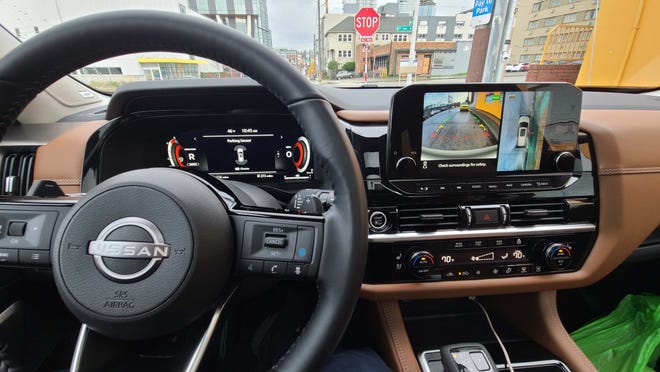
Heading to Tukwila for some Saturday afternoon go-karting, the Pathfinder plied Interstate 5 with a competent assisted-driving system that kept us lane-centered and distanced from vehicles ahead of us. It’s a system Nissan has touted going back to its “Rogue One: Star Wars” commercials. The system may be able to navigate Star Wars robots, but in an indication of the challenges ahead for a self-driving future, the system would give up in Seattle’s heavy rain — the camera struggling to find road lines.
The Green Church has a big congregation in Seattle, and Teslas are a common sight here (though its Chevy Bolt, Mustang Mach-E and Audi EV competitors are conspicuously few). With regular gas at a lofty $4.38 a gallon — and hydroelectric power-fed electricity a cheap 7 cents a kilowatt hour — this is a town where EVs make sense for local commutes.

For longer trips to Washington’s lovely mountains and rivers, Pathfinder’s 286-horse V-6 offers good grunt combined with 480-mile range that puts your mind at ease. That range is especially important considering the range degradation of EVs in heavy rain.
Pathfinder is also a challenge to Nissan’s luxury brand. Built on the same platform as the Infiniti QX60, the Nissan may not be as pretty as its high-class cousin — but the digital interior is the Infiniti’s match.
You can put 65 grand down on a Tesla. But when it comes to holiday family duties, a $52K Pathfinder has everything you need for a lot less.
2022 Nissan Pathfinder
Vehicle type: Front engine, front- and-all-wheel-drive, seven- or eight-passenger SUV
Price: $34,560, including $1,150 destination fee $51,790 as tested)
Powerplant: 3.5-liter V-6
Power: 284 horsepower, 259 pound-feet torque (V-6)
Transmission: 9-speed automatic
Performance: 0-60 mph, 6.7 seconds (Car and Driver); Towing, 6,000 pounds
Weight: 4,506 pounds
Fuel economy: EPA est. mpg 21 city/26 highway/23 combined
Report card
Highs: Family-friendly three-row seats; value pricing
Lows: Big thing to park in the city; wireless Apple CarPlay but not Android Auto
Overall: 4 stars
Henry Payne is auto critic for The Detroit News. Find him at hpayne@detroitnews.com or Twitter @HenryEPayne.