- Search Cartoons
- Comic Archive
-
Payne
Store



 Henry Payne RSS

Articles Blog
Payne: Audi e-tron GT is an electrifying, elegant but expensive EV
Posted by Talbot Payne on January 21, 2022
The last time I saw the Audi e-tron GT, it was being mobbed by members of a panting press at the 2018 Los Angeles Auto Show with Iron Man — er, actor Robert Downey Jr. — behind the wheel. The GT hasn’t lost its appeal.
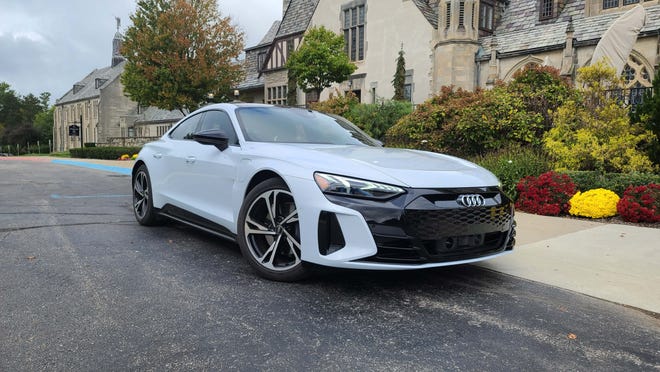
With a long, lean Audi figure draped over the same bones that carry the Porsche Taycan EV, the e-tron is a rocket ship with four doors.
It’s also a lot more fun with an in-house charger.
Last year, I piloted a wicked-quick Taycan EV around town, but had a shy right foot given the limits of 200 miles of range. I had scant few electrons left after a trip to Hell (Michigan) and back — then faced a lengthy charge at a local (glitchy) Electrify America station.
A Juicebox 240-volt charger (displacing $1,275 in my wallet including installation) now hangs on my garage wall next to a Tesla charger for my Model 3 Performance. The Tesla charger is proprietary and therefore useless to the parade of EV testers now coming to my door. Three years ago, I crawled to Ferndale in a Jaguar I-Pace to recharge (my wife trailing behind in her gas-powered Subaru if I didn’t make it). Sigh.
EVs are still a niche for customers with deep pockets.
If you have the coin for my $115,695 ($108,195 after the federal tax credit!) e-tron tester, it is a sensational metro commuter. ZAP! Squeeze the pedal onto Interstate 696 and merge effortlessly into traffic. ZOT! Stomp the pedal out of a Woodward stoplight and leave muscle cars behind. WHIRRRRR! Creep silently into the American Speed Festival parking lot at M1 Concourse’s Checkered Flag Charity event, and heads swiveled to follow the GT’s supermodel-on-wheels figure.
Well, maybe not the face. Beauty is in the eye of the beholder, but the Audi’s black-masked face is not as engaging as the Porsche with its unique tear-drop headlights. Without the e-tron’s four rings, the face could be mistaken for the love child of a Dodge Charger and an Audi A5.
The tapered roof and beautifully sculpted tail — anchored by Audi’s direction-arrow-taillights — is what makes this GT stand out from the masses.
The interior will be familiar to Audi customers — just as the Taycan resembles the Porsche family — an indication of the brand’s determination to make the EV experience comfortable, not a leap into the unknown. The interior sits under a Tesla-like full-cabin sunroof that adapts to sunlight overhead. A nifty chiclet shifter negotiates the two-speed automatic transmission.
Otherwise the instrument and infotainment displays are vintage Audi, with haptic touch commands and striking Google Earth navigation displays.
The challenge for Audi buyers is how it stacks up to other vehicles in the showroom. There are a lot of sweets in this candy shop.
My friends Caroline and Jim recently downsized to an RS5 from a RS7 Sportback. Caroline giggled as she squeezed the pedal on Woodard, the e-tron exploding forward as if launching to space. Thrust is similar to the RS7 but without the audio accompaniment of a twin-turbo V-8.
The distant scream of the twin electric motors don’t do justice to the jaw-dropping speed.
Jim allowed how the instant torque made e-tron feel like the quickest Audi he’d driven. A family man, he’s uninterested in the $110,000 Audi R8. But even as his Audi RS5 Sportback tops the A5 range at a heady $68K, it is a loooong throw from the $115K e-tron.
They are the same size, but e-tron does not have the RS5’s handier hatchback utility. Perhaps Audi had to conform to the Taycan’s trunk design to produce two sedans off the same platform.
The e-tron, in other words, is a tease to A5 owners until/if EV prices drop in half (consider the $40K Chevy Bolt vs. the similarly sized Chevy Trax — not even the proposed $12,500 federal subsidy will get you there). Especially since, at 238 miles of range, it is not an easy long-distance car.
Caroline and Jim travel frequently, and they aren’t interested in spending extended periods charging in Meijer parking lots. They, like a lot of electric owners, would use the e-tron as a daily commuter. To attend baseball games — or Iron Man movies. If that isn’t entertainment enough, there is 469 horsepower on tap. ZAP!
Pair the e-tron GT with a gas-powered Audi SQ5 (that can fill up its 500-mile range in five minutes) and you have the ideal two-car garage. Just remember to plug your GT into the Juicebox.
2021 Audi e-tron GT
Vehicle type: Battery-powered, all-wheel-drive, five-passenger sedan
Price: $103,445 including $1,045 destination fee ($115,695 Premium Plus as tested)
Powerplant: 93.4 kWh lithium-ion battery with twin electric-motor drive
Power: 496 horsepower (522 in Boost mode), 464 pound-feet torque
Transmission: Single-speed direct drive/front axle and two-speed/rear axle
Performance: 0-60 mph, 3.9 seconds (mfr.); top speed, 152 mph
Weight: 5,060 pounds
Fuel economy: EPA MPGe 82 city/98 highway; range, 238 miles
Report card
Highs: Awesome acceleration; lovely profile
Lows: Challenge to charge beyond home charger; oh, that face
Overall: 3 stars
Henry Payne is auto critic for The Detroit News. Find him at hpayne@detroitnews.com or Twitter @HenryEPayne.
New EV rules handicap transplants, play to Detroit Three’s strengths
Posted by Talbot Payne on January 21, 2022
As the most onerous federal mpg regulations in 50 years force the auto industry toward electric vehicles, domestic manufacturers are in the catbird seat. Credit the Detroit Three’s huge advantage in profitable fleet trucks and vans, say industry analysts, that are lining up corporate customers. Meanwhile, more consumer-reliant Asian automakers see a tough road for EV adoption.
Call it the Motor City’s revenge.
The Detroit Three automakers’ rising stock prices and fortunes contrast with sliding market share in the late 20th century after 1970s Washington fuel-efficiency regulations compelled vehicle downsizing. Designed to reduce dependence on foreign oil, so-called CAFE laws opened the door to smaller, sippier Asian brands. Coupled with huge domestic assembly-plant investments, foreign transplant automakers rode the wave to become major players in the U.S. market.
“The tide has turned,” said Dan Ives, Wedbush Securities’ managing director of equity research, in an interview as Ford’s market cap crested $100 billion. “In the EV market, the golden goose is the pickup truck. Detroit automakers are leveraging their position of strength, (which is why) you are seeing stock value in Ford at an all-time high.”

With big businesses pledging their commitment to the planet by electrifying pickup and van fleets — some 3 million trucks were sold in the U.S. in 2021 — Detroit executives like GM’s Mary Barra and Ford’s Jim Farley have embraced federal regulation aimed at making half of U.S. auto sales battery-powered by decade’s end.
Compare that with foreign brands who are unsure their customers want battery-powered vehicles.
“What is the consumer uptake? Right now, I think that’s something that’s a little out of whack” with manufacturers’ rush to bring EVs to market, said Honda North America boss Dave Gardner at a January briefing with reporters.
The Japanese automaker is tentatively dipping its toe in the EV market by jointly developing two 2024 EVs with GM. Meanwhile, Ford and GM are readying battery-powered versions of their most popular pickup products — the Ford F-150 Lightning and Chevy Silverado EV. If Honda is dipping a toe, “Ford is diving into the deep end of the EV pool,” said Ives.
That’s a change from 20 years ago, when Honda and Toyota pioneered battery-powered, gas-electric hybrids. The compact 2000 Honda Insight and Toyota Prius captured the fancy of green celebrities and politicians for their fuel-efficient ways. The Asian brands expanded hybrids across their sedan and SUV model lineups, while Detroit automakers struggled to sell similar products like the Ford Fusion Hybrid and Chevrolet Volt.

A 2009 IBM Institute for Business Value research survey found that auto industry executives expected 100% of sales would be hybrid by 2020. They were off by 97 percentage points. Though dominated by Asian automakers, hybrid sales only amounted to 3% of 2020 sales as consumers resisted hybrid premiums and gas prices plunged.
Now it’s Detroit automakers who are bullish on alternate powertrains, with GM predicting all-EV sales by 2035. Their volume customers seem to be on board.
Barra’s commitment to the “pursuit of sustainability and climate equity” echoes that of corporate giants like FedEx and Walmart — not to mention powerful green politicians like Sen. Bernie Sanders, I-Vermont, whose legislation aims to shape the future of transportation.
“Corporate fleets are a real market,” said veteran Wall Street analyst Joe Phillippi, president of AutoTrends Consulting. “Barra and Farley have got it figured out. They have massive truck and van fleet sales and they can subsidize their EV truck development with gas-powered trucks. No one else has that cash machine. I think Wall Street has figured out that, at the end of the day, the volume buyer is going to drive EV sales — and the volume is in corporate fleets.”
Foreign transplants from Honda to Hyundai to Volkswagen depend on mainstream SUV and sedan sales where retail customers have turned a cold shoulder to EVs not named Tesla. EV sales are just 3% of the U.S. market (almost half of them in California) — 80% of them by the luxury Silicon Valley brand.
But for big corporations under pressure from activist investors to declare Environmental Social Governance goals, service fleets are a moral haven — and make a sound business case too, say analysts.
“EVs may be more relevant to the fleet market than to the consumer market,” said Ed Kim, industry analyst with Auto Pacific, as corporations eye $7.5 billion in federal infrastructure subsidies to jump-start their charging infrastructure. “Fleet vehicles can run fixed routes of 150 miles on a smaller, cheaper battery. Then they can charge overnight on cheaper utility rates. With Congress’s proposed $12,500 in incentives, a Ford Lightning, for example, can make up its purchase premium over a gas-powered F-150.”
The $12.5k subsidy is a controversial expansion of EV tax credits proposed by Michigan Democrats that would favor domestic, battery-electric vehicle production at Detroit Three unionized plants.
When asked about the pro-UAW tax credit provision, Honda’s Gardner said the legislation was unfair to non-union U.S. plants like Honda’s Ohio facilities.
Honda has long touted its goal to “electrify” two-thirds of North American sales by 2030 in part to ward off the threat of global warming lawsuits against automakers similar to those brought against tobacco companies to cover state Medicaid costs. But electrification assumed a mix of hybrids, plug-in hybrids, BEVs and fuel-cell vehicles.
Gardner said Honda is committed to EVs by 2040, but only with “very aggressive government help and subsidies.” Such subsidies have already existed for hybrid vehicles for 20 years, yet hybrids make up just 10% of Honda sales.
He said Honda’s strength is affordable vehicles, but EV sales are overwhelmingly bought in premium segments. It’s a niche where trucks also play as status symbols. The average price paid for an F-150 in 2020, for example, was a lux-like $47,174.
“That’s the beauty of pickups,” said Auto Pacific’s Kim. “They can sell a variety of flavors to fleet and high-end retail customers. Chevrolet is launching a work truck, but also a loaded, $105,000 Silverado EV.”
Federal mpg laws originally slowed Detroit companies, but “today they are a headwind for Asian automakers,” said investment analyst Ives.
Henry Payne is auto critic for The Detroit News. Find him at hpayne@detroitnews.com or Twitter @HenryEPayne.
Bollinger shelves consumer EVs to focus on commercial trucks
Posted by Talbot Payne on January 14, 2022
The imposing, battery-powered Bollinger B2 pickup truck won’t be seen on the road anytime soon.
The Oak Park-based startup announced Friday that it is canceling consumer orders for its innovative, off-road-capable B2 pickup and B1 SUV in order to focus on its burgeoning commercial truck business.

The $125,000 B1 and B2 were part of a squadron of epic super-trucks — including offerings from Rivian, GMC, Chevy, Ford, Tesla and Lordstown Motors — coming to market in the wake of Tesla’s success as a luxury electric vehicle maker. The $74,000 Rivian R1T pickup Launch Edition began customer deliveries at the end of 2021, as did the $113,000 Hummer EV Edition 1, but Bollinger’s announcement is an indication that the volume demand for EV trucks is in the commercial, not retail, sector where the lofty prices are only attainable by a few.
“We’ve been in development on the commercial front for quite some time. This has been growing and growing,” CEO Robert Bollinger said in an interview. “We’ve had large fleets looking at (our battery-powered platform). We just read the writing on the wall. Most of our employees are on the commercial side, and so I made a decision to defund the B1 and B2.”

The decision wasn’t easy for the entrepreneur, who began Bollinger Motors on his New York farm in 2015 with a passion for building an eco-friendly EV pickup with unique performance attributes. The boxy B2 was born.
Unveiled at a glitzy Times Square event in 2017, it featured gob-smacking numbers like 614 horsepower and 668 pound-feet of torque, zero-60 mph acceleration in 4.5 seconds, 5,000-pound payload capacity, and a suspension that offered variable ground clearance of 10 to 20 inches. The truck’s signature attributes were Jeep Wrangler-like removable body panels, and a unique, hollowed-out interior that could swallow objects up to 16 feet long by dropping the vehicle’s tailgate, midgate and front gate.
“It was time we did something new,” Bollinger said at the time. “I just wanted to build the best truck without compromise.”
Bollinger moved the company to Metro Detroit to take advantage of the region’s deep engineering and manufacturing talent. The company showed pre-production prototypes in late 2019 of a B1 SUV model to be hand-built alongside the B2 truck. Initial production for the $125,000 vehicles was sold out with a reservation list of 30,000.

The B2 turned heads at last fall’s Motor Bella show in Pontiac. Bollinger Motors will refund deposits for those who had reserved B1 and B2 models.
A passionate environmentalist who has self-funded Bollinger Motors with a personal fortune gained from selling his New York cosmetics marketing company, Bollinger sees the commercial truck direction as the best way to pursue his green goals.
“It’s clearly the correct decision even if it’s hard for me to set aside my love” for pickups, he said. “I replaced that for the moment with the incredible amount of impact you can have with commercial fleets. The amount of CO2 we can take out of the air and the particulates is incredible.”

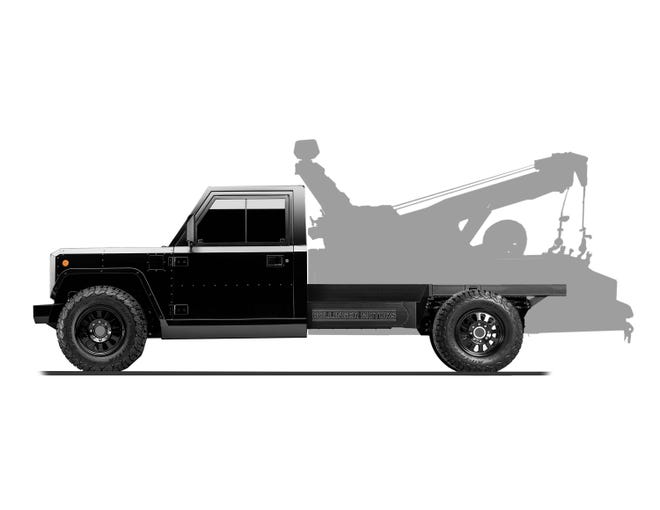
Bollinger says that “upfitters” (companies that equip vehicle platforms for commercial applications) and fleet buyers will use his raw, skateboard battery platform for a variety of uses quite different from its original, dirt-kicking aspirations. The rear-drive platform can be scaled to different wheelbases and battery sizes for use with heavy-duty utility vehicles, tow trucks, small garbage trucks, and municipal buses.
He sees Bollinger’s opportunity in medium-duty Class 3-6 trucks — capable of gross vehicle weight ratings (GVWR) from 10,000-26,000 pounds. That’s different from competitor platforms like the Rivian, Ford F-150 Lightning, Chevy Silverado and Lordstown Endurance EV platforms that are targeted at Class 2 GVWR pickup applications (6,000-10,000 pounds) like Amazon delivery trucks — or Class 1 vehicles (0-6,000 pounds GVWR) like the electric Ford E-Transit and GM BrightDrop vans.
Government and corporate ESG (Environmental, Social Governance) policies are driving fleet purchases as well as the promise of government subsidies for charging infrastructure. EV trucks lag gas-powered trucks in towing range, but Bollinger sees most fleet applications as limited, low-mileage routes. Bollinger manufactures its own battery packs and will supply platforms with 70-kWh, 140-kWh and 220-kWh capability. By comparison, the Tesla Model 3, the most popular EV in the U.S. market with 320 miles of range, sports a 82-kWh battery.
“(Commercial EV fleets) are where everything is going as far as regulations from states,” said Bollinger. “Maybe the federal government too. All the expectation on the commercial side is really going to be the driver for the volume of vehicles turning electric.”
While sexy sedans like Teslas, Mercedes EQS and Lucid Air turn heads, auto startup and legacy automakers alike see gold in commercial trucks.
GM, too, has wowed with $100,000-plus retail super-trucks, but it’s the fleet-focused Silverado EV Work Truck that will first come to market in early 2023. Ford’s F-150 Lightning EV is also teasing wealthy first adopters with $90,000 Lightning Platinum models, but its base $40k Pro trim is targeted at commercial fleets.
Startup Lordstown Motors had ambitious plans to produce thousands of commercial trucks based on its Endurance pickup platform. Delayed by financial issues, the Endurance is expected to come out this spring under a production contract with Foxconn.

Bollinger, too, will soon announce a production partner for its Class 3-6 platform. It will not provide charging infrastructure — a big challenge that commercial customers are just getting their arms around.
“There’s a lot of capital companies that offer the capital for these companies to switch over” to electric fleets, said CEO Bollinger. “You have to change a depot that, for example, has 100 trucks and you need 100 chargers. And they all have to be fast chargers and your whole building needs a new amount of power coming in from utilities. It’s a big package.”
Bollinger regretted having to cancel orders on his beloved B1 and B2 off-road beasts, but hopes to return to them someday.
“We wouldn’t be here without our deposit-holders,” he said. “We can’t thank them enough and and hopefully they’ll continue to follow our progression, even if it’s not something that they can buy for themselves right now.”
Henry Payne is auto critic for The Detroit News. Find him at hpayne@detroitnews.com or Twitter @HenryEPayne.
Payne: Ford Bronco Sasquatch vs. Land Rover Defender 90 in the Dirt Bowl
Posted by Talbot Payne on January 13, 2022
Holly — What’s better than taking an off-road beast over snowbound Holly Oaks ORV Park? Taking two off-road beasts.
I flogged the Land Rover Defender 90 and Ford Bronco First Edition two-door models over southeast Michigan’s premier adventure park for grins — and to see how the two warriors compared. The Bronco has wowed in comparison tests with its arch-rival Jeep Wrangler.
But so good is Bronco that it also matches up against His Highness of Rugged Royalty, Land Rover.
It’s good to have the Brit and Bronc back. They are iconic names that disappeared from the U.S. market for years. Defender last sold here in 1997, the Bronco 1996. Credit Wrangler’s wild success as a brand halo for Jeep in the Age of Ute for bringing these two legends out of retirement.
Like Wrangler, Defender and Bronco have their roots in World War II. They were first built as rugged, battle-ready General Purpose (GP — or Jeep for short) vehicles. But the Brit and Yank have diverged dramatically since then. Aimed at Land Rover’s First Class clientele, Defender now rides on a — la-de-da — air suspension and crisp unibody SUV chassis contrary to the truck-based bruiser of safari legend. The Americans are still based on ladder frames and can be stripped naked of their doors and roof to get even closer to Mother Nature.
Wrangler and Broncos are natural predators and will be hunting each other for years across Holly Oaks and other U.S. adventure parks. But, in a challenge to Jeep, Bronco has updated the off-road formula with state-of-the-art tech — rotary mode shifter, single-button sway-bar disconnect, fully digital instrument displays, independent front suspension.
Its sophistication not only challenges Jeep — but puts it in the same neighborhood as Land Rover for $20,000 less.
A consistent theme of these columns is how the electronics age has shrunk the gap between luxe and mainstream (see Mazda CX-50 vs. BMW 2-series, VW Golf R vs. Audi S3, Corvette vs. Porsche), and Rover v. Bronco is another example. Game on.
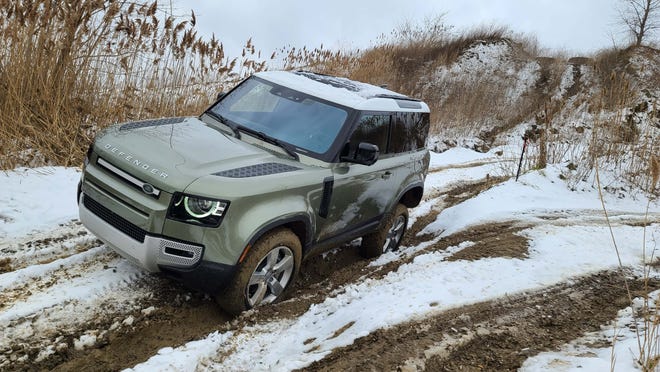
Punching the Rover 90’s 395-horse, supercharged-and-turbocharged inline-6 across Holly Oaks’ frozen tundra, I slewed the 5,000-pound beast into The Sandbox — an undulating sea of sand that tests vehicles’ stability and strength. The Defender was solid as a rock (despite an eerie wail from the brakes which my pal, Tom — riding shotgun — surmised was sand in the discs) on its unibody chassis.
The unibody choice raised eyebrows at the Rover’s introduction in 2019 — Heresy! Off with the engineers’ heads! — but it’s more rigid than the old ladder frame and never flinched through Holly Oaks’ unsparing terrain.
Defender knows its clientele. For all its off-road chops, Land Rovers are show horses. They spend their time ferrying its occupants to country clubs, not ORV parks.
Roll out onto the Holly Oaks battlefield and Rover intuitively recognizes the incongruity of the task at hand.
“Um, do you really know what you’re doing? I’ll take it from here.”
What ensues is a heavily managed trip around the grounds, the 90’s electronics always present to ensure you don’t get too far over your skis. For clearance over rocks Defender’s air suspension rises to 11.5 inches.
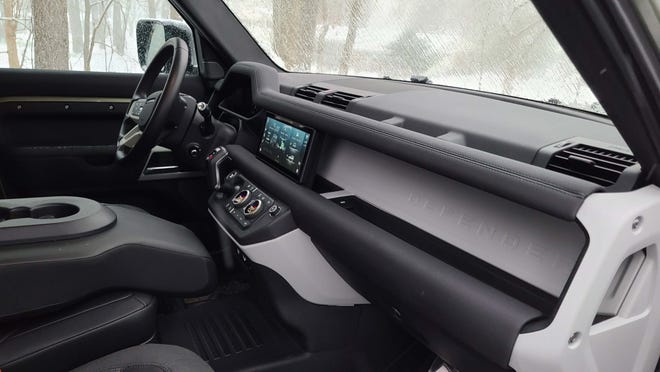
The big rotary dial on the dash allows easy access to Defender’s multiple modes: AUTO, GRASS/GRAVEL/SNOW, MUD, SAND, ROCK CRAWL. But no matter the mode, Defender won’t let you tune the nannies off. As our friends at Car and Driver put it: “Non-defeatable stability control occasionally stifles off-roading.”
The Bronco wants you to push the envelope. Four exposed tow hooks come standard — on the Rover, exposed tow hooks are optional. That tells you something.
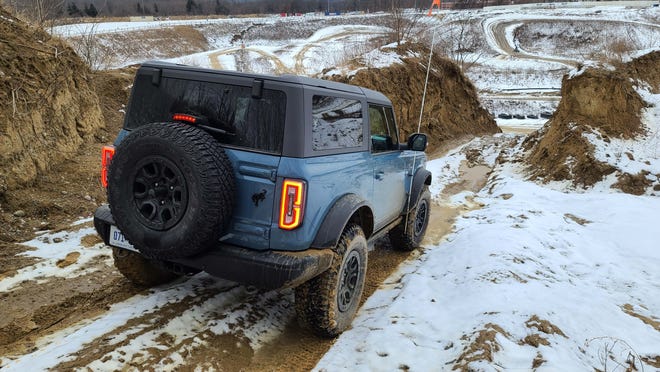
Bronco achieves its 11.5” ride height the old-fashioned way — by slapping on huge 35-inch Goodyear Territory tires, part of a Sasquatch package that includes dual-locking differentials and performance shocks.
The heck with air suspension, these balloons with teeth not only jack up the car, they can claw up Rushmore’s face. Ford encourages its drivers to play with the firepower on hand. High on the dash are buttons to turn off stability control, disconnect sway bars, turn on lockers, even toggle Turn Assist for extra-tight turning radius.
The Ford swaggered up to Holly Oaks’ intimidating, snowy, slick Mt. Magna rock face. With 43-degree approach angle, lockers on and sway bar disconnected, I waltzed up Magna as easy as Gretzky stuffing a power-play goal.
The Defender struggled. Never mind its lack of suspension articulation (the Defender doesn’t offer sway bar disconnect), traction control forced multiple attempts to find grip. Its 37.5-degree approach angle and 32-inch Goodyear Wrangler tires also were relatively limited.
Oh, how I pined for Bronc’s button controls and Territory 35s. The sequence repeated itself across Holly Oaks — the Ford attacking, the Rover managing. Ultimately, the Bronco’s incredible capabilities took me places the Defender wouldn’t dare.
How different might “No Time to Die” have turned out if the bad guys had Sasquatch package to pursue Bond?
The beauty of the Ford is that, thanks to modern electronics, its controls are as easy to use as Rover’s. The Bronco’s horizontal all-digital dash is surprisingly similar to the luxe Rover — then Bronco ups the ante with a giant center screen and wireless Apple CarPlay and Android Auto.

Drive modes — NORMAL, ECO, SPORT, MUD/RUTS, SLIPPERY, SAND/SNOW, ROCK CRAWL, BAJA, and MARS (just kidding about that last one) — are accessed via similar rotary dial. No muscling a second transfer case shifter as in Wrangler. Modes are then refined using the aforementioned dash buttons.
Bronco also matches Rover for visual drama. The two-doors are athletic looking — the Defender in Pangea Green, the Ford in Area 51 Blue — compared with four-door models. Bronco’s Sasquatch package made my truck pal Scott’s knees weak when he saw it in the parking lot.
“I gotta take a picture for my daughter,” he smiled.
Yeah, chicks dig these brutes. But those 35s come at a cost to comfort. On road, Defender is noticeably quieter. Put your right foot down and the Defender’s 395-horse supercharged-and-turbocharged inline-6 will get you to 60 mph in 5.7 seconds.

Hit the gas in the 330-horse Bronco and the turbo V-6 hits 60 mph in 6.3 seconds, but with a roar: WAAUUURRGHH!
If you want a rugged-looking Land Rover, the $66,000 Defender is the summit. If you want to go off-roading, the $49,000 Bronco is the bomb.
And you can put the 17 grand you save toward a $21K Ford Maverick pickup.
2021 Ford Bronco First Edition Advanced
Vehicle type: Front engine, all-wheel-drive, five-passenger two-door compact SUV
Price: $49,180, including $1,495 destination fee as tested ($31,490 for standard two-door)
Powerplant: 2.7-liter twin-turbo V-6
Power: 330 horsepower, 415 pound-feet torque
Transmission: 10-speed automatic
Performance: 0-60 mph, 6.3 seconds (Car and Driver); towing capacity, 3,500 pounds
Weight: 4,871 pounds
Fuel economy: 17 city/17 highway/17 combined
Report card
Highs: Off-road beast; easy-to-use controls
Lows: Hard-top leaks; noisy ride
Overall: 4 stars
2021 Land Rover Defender 90 First Edition
Vehicle type: Front-engine, all-wheel drive, five-passenger two-door compact SUV
Price: $66,475, including $1,350 destination fee as tested ($50,050 base model)
Powerplant: 3.0-liter supercharged turbo-inline 6-cylinder
Power: 395 horsepower, 406 pound-feet of torque
Transmission: 8-speed automatic
Performance: 0-60 mph, 5.7 seconds (mfr.); towing, 8,201 pounds
Weight: 5,000 pounds
Fuel economy: EPA, 17 mpg city/22 highway/19 combined
Report card
Highs: Standout style; composed ride on- and off-road
Lows: Undefeatable off-road nannies; no wireless Apple CarPlay/Android Auto
Overall: 3 stars
Henry Payne is auto critic for The Detroit News. Find him at hpayne@detroitnews.com or Twitter @HenryEPayne.
Payne: What I got right (and wrong) in my 2022 Car, Truck and SUV of the Year vote
Posted by Talbot Payne on January 13, 2022
Detroit — The auto Oscar winners have been crowned, and I picked two of three of them.
Every year, I join 49 other North American Car, Truck and SUV of the Year judges in voting for the best new models. It’s the continent’s most prestigious prize given by an independent group of journalists — complete with this week’s posh ceremony at Huntington Place (aka Cobo Center) with dramatic envelope openings. This year (drumroll, please) a drone flew the envelopes on stage.

We sorted 2022’s 36 new models into their respective categories and then flogged them hard, testing comfort, performance and whether they moved the needle for their segments. The year was particularly fascinating as automakers brought a wide variety of films — er, cars — to market. Like the Academy Awards for Best Picture, nominees ran the gamut from blockbuster remakes by big-name directors to artistic gems from tiny production companies.
My pick for best SUV — Ford’s epic reboot of the Bronco — won. As did my favorite for Truck of the Year, the Ford Maverick. However, my choice of Car of the Year — the Volkswagen Golf GTI — was not shared by fellow scribes.
Let me explain, beginning with the latter.
The Golf GTI redefined small cars waaaay back in ’83 when it combined utility and performance in an affordable package. That “pocket rocket” formula has been replicated since by virtually every other automaker with tasty treats like the Honda Civic Si, Ford Focus ST, Hyundai Veloster N, Mazda3 Turbo, Subaru WRX and more.
Multiple GTI generations have followed but few as significant as the eighth-gen, 2022 model. In addition to the expected steroid boost — the $30,540 GTI wrings a ridiculous 241 horsepower, 273 foot-pounds of torque from its wee 4-cylinder engine — the latest hot hatch delivered a wardrobe and state-of-the art, digital interior to rival its sibling Audi S3. If that wasn’t enough, GTI’s Golf R cousin further spiced the recipe with all-wheel-drive and 315 horses.
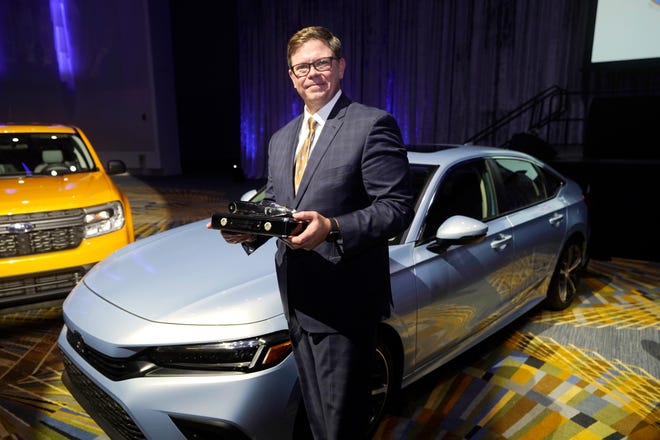
Not good enough, judged my peers. While offering the GTI/Golf R as performance halos for its lineup, VW ditched the standard Golf. Not Civic, which continues to offer a full model menu, from the base, $23,365 sedan to the $25,115 Sport Hatchback to the sensational $28,315 Si apex-carver. All followed the Golf GTI with next-level interiors.
“The Civic combines just about every positive attribute you can think of — low-cost, high fuel efficiency, utility, comfort, dependability, and fun to drive among them,” said veteran juror Jack Nerad.
My fellow judges grumbled that the knob-less GTI interior is obsessed with its hi-tech touchscreen to the point of annoyance. Whereas the Honda (learning from its own bout of tech-itis in the previous gen) includes user-friendly dials to negotiate essentials like climate control.
Speaking of hi-tech, underdog Lucid Air racked up an impressive 170 points to the Civic’s 241 (Golf garnered just 89). The $80k Air is the Silicon Valley startup’s first vehicle — but what a vehicle. Bringing a new brand to market is a gargantuan task, yet electric Lucid has hit its marks with best-in-class range, staggering power of up to 1,111 ponies and gorgeous looks. With continued execution — and more affordable models — Lucid could be a future winner.
Lucid was inspired by fellow EV maker Tesla’s success (its CEO was the Model S’s chief engineer) — as was another startup sensation, Rivian.
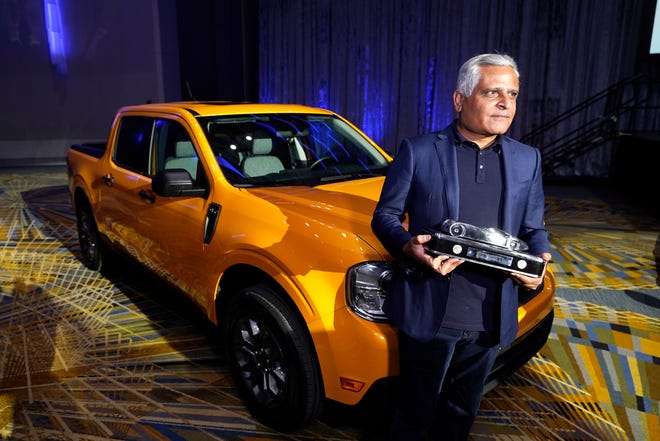
The brand’s $74k R1T pickup is a knockout with its Tesla-simple interior, big frunk and off-road abilities. Its fresh approach to the pickup market should have won this year were it not for another fresh approach, the $21k Ford Maverick.
We jurors like affordable prices, and I picked Maverick for its irresistible combination of value, innovation and performance. Sharing a unibody platform with Ford Escape and Bronco Sport, Maverick offers an SUV ride while delivering trucky qualities like 1,500-pound payload and underseat rear storage. That versatility also defines the unibody, $25k Hyundai Santa Cruz, which brought a box-full of innovation like sub-bed storage and a lockable, sliding tonneau cover.
Maverick (also my Detroit News Vehicle of the year) ran away with 277 points, but all three entries foretell a pickup segment that is expanding beyond its traditional, light-duty roots.
Like Hollywood, Ford sees profit in remakes and it had a lot riding on “Bronco: The Sequel.”
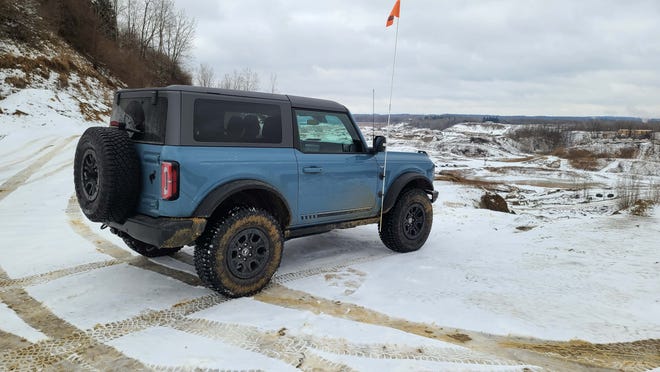
Not only was Bronc tasked with taking on box-office king Wrangler, it also leads a recasting of Ford as an SUV brand. The 2022 remake hits it out of the park.
Jurors agreed Bronco was the Jeep’s dirt-kicking equal with removable doors and detachable sway bar, and that its stylish looks and high-tech features rivaled more expensive off-roaders like Land Rover.
I though Bronco would walk away with Best Ute (I gave it 8 of my 10 points in SUV balloting). But in a nod to the rampant innovation in the industry, my peers gave 153 points to the Hyundai Ioniq 5 and 113 to the Genesis GV70, both superb debuts in their respective EV and lux segments. Both face formidable brand challenges — Ioniq what? Genesis who? — in competing against Tesla and BMW, but their fresh designs are hard to miss.
As for my miss, I still recommend the Golf GTI. Mrs. Payne judges the best movies as the ones you’d see over and over again. Big things come in small packages, and I enjoyed driving the affordable Golf GTI and Civic Si day after day after day.
Car of the Year voting:
Honda Civic, 241 points
Lucid Air, 170
VW Golf GTI/Golf R, 89
Truck of the Year:
Ford Maverick, 277
Hyundai Santa Cruz, 97
Rivian R1T, 126
SUV of the Year:
Ford Bronco, 234
Hyundai Ioniq 5, 153
Genesis GV70, 113
North American Car, Truck and SUV of the Year: Civic, Maverick, Bronco
Posted by Talbot Payne on January 13, 2022
Detroit — The envelope, please. . . .
Ford dominated the North American Car, Truck, and SUV of the Year awards Tuesday. The wildly-popular Bronco won SUV as expected while the Maverick overcame formidable competition from the electric Rivian R1T and Hyundai Santa Fe to win best truck.
The Honda Civic rounded out the awards as best car, defeating the battery-powered Lucid Air and Volkswagen Golf GTI/Golf R hot hatch.
The winners were announced at Huntington Place (the former Cobo Center) in Detroit. Rod Alberts of the North American International Auto Show introduced the awards that once coincided with the Detroit Auto Show. After a three-year hiatus, Alberts confirmed the show will return this fall, Sept. 14-25, at Huntington Place.
The six NACTOY finalists were whittled from an initial list of 36 eligible cars, trucks and utility vehicles for the 2022 model year. The finalists tracked trends in the industry as consumers have moved from cars to SUVs and embraced the off-road lifestyle. Following the success of electric automaker Tesla — and under pressure from the most onerous federal regulations in 60 years — manufacturers are also flooding the market with new EVs.
“2021 has been a highly significant year in automotive history,” said NACTOY President Gary Witzenburg. “We have seen the emergence of new vehicle segments and impressive redesigns of familiar models. Meanwhile, a number of all-new, EV start-up manufacturers are proving they are capable of competing with established automakers even with their first product offerings.”
The Civic has been a NACTOY favorite for decades and the 11th generation car was no different, winning the award with its sedan, Coupe, and Si performance variants.
But the affordable compact got a surprising run for its money from the Lucid Air, the gorgeous, $170,000 luxury EV from the Silicon Valley startup. The Civic received 241 votes from the jury, the Lucid 170. The Golf GTI/Golf R — the only performance variants of the Golf compact in the U.S. market — received 89 votes in third.
Sedans have fallen out of favor in the American market with Detroit brands like Ford and Dodge exiting the sedan market completely. But cars are still key volume segments for foreign makers and icons like the Civic and and Golf boast near luxury-grade electronics tech to go with their whip-quick handling. Startup makers like Lucid see opportunities to establish themselves in the EV market with beautiful, halo sedans.
“The new Civic shows Honda at its very best. Bulletproof, brilliantly engineered and fun-to-drive, the Civic is the kind of affordable car that every automaker should aspire to,” said juror Lawrence Ulrich.
The Maverick took the truck crown over the Hyundai Santa Cruz and Rivian R1T in a category traditionally dominated by Detroit Three big pickups. But 202 was a year for innovation with the Maverick and Santa Cruz introducing segment-busting truck based — not on ladder frames — but on unibody SUV platforms. The daring Rivian R1T pickup is the first in a wave of electric pickups coming to market, beating EVs from established makers like Ford and Chevy.
The affordable Maverick — its $21,000 hybrid model has a range of more than 500 miles — won with 277 votes over Rivian (126) and Santa Cruz (97).
“Our F-150 truck has been the industry’s best-seller for decades, so the Maverick product team went through a thought process that was very customer-based,” said Ford North American President Kumar Galhotra after accepting the truck award. “They saw a need for this vehicle in this space and price.”
Heavy favorite Bronco won over the Genesis GV70 luxury SUV and Hyundai Ioniq 5, the Korean brand’s most ambitious EV to date. SUVs are America’s favorite non-pickup vehicle and now take 70% of the market versus 30% for cars.
The Bronco won with 234 votes, with the Ioniq 5 gathering 153 and the Genesis 113.
“The Ford Bronco delivers on the promise of its legendary name,” said NACTOY juror Jack Nerad. “Instead of giving the public a lukewarm placeholder with a nostalgic logo, Ford has pulled out the stops to create a very credible competitor to that other four-letter off-road brand.”
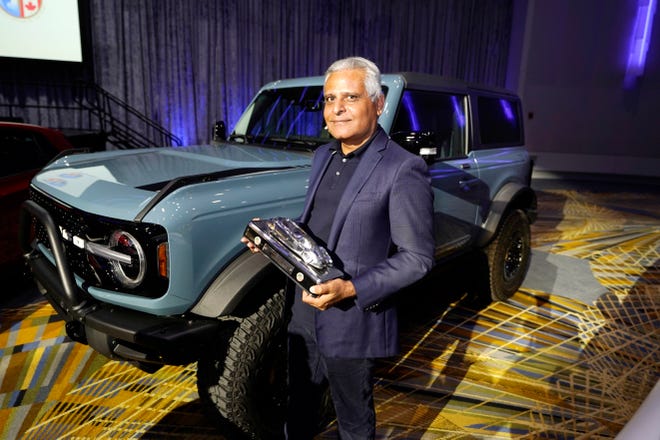
Ford’s Galhotra spoke to the challenges of re-creating the iconic Bronco with roots in the 1960s: “It was a huge lift. The expectations were huge. But we couldn’t get stuck in the Bronco’s history — the team had to take Bronco to a different level.”
With independent front suspension, electronic disconnecting sway bar, and all-digital screens, the Bronco proved a new icon for 21st century adventure.
Judged by a panel of 50 independent journalists (including the author of this article) from the U.S. and Canada, the NACTOY awards are among North America’s most prestigious prizes. Jurors convened in Ann Arbor in October for a comparison drive of semi-finalists, then announced finalists in November.
Henry Payne is auto critic for The Detroit News. Find him at hpayne@detroitnews.com or Twitter @HenryEPayne.
Payne: Charge it! Pricey Detroit EV pickups target premium customers
Posted by Talbot Payne on January 11, 2022
The electric truck wars are in full swing with the Chevy Silverado EV and Ford F-150 Lightning going toe-to-toe with starting prices of $40,000 for their first EV pickups.
Consider the number $50,000, too.
That’s how much more the Silverado EV’s RST trim costs than a comparable, diesel-powered Silverado RST. Ford has also released its price configurator for Lightning, and EV models run from $18,000 to $25,000 more than their gas-powered counterparts. They will also be shopped against startup EV trucks like the $74,000 Rivian R1T and the $125,000 Bollinger B2.
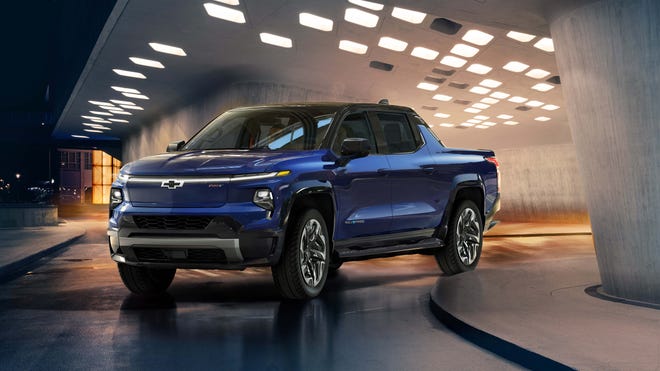
While manufacturers advertise EVs as the future of autos, their initial offerings have a decidedly premium feel. Like Teslas or Mustang Mach-E electric SUVs, American pickups appear targeted at a niche market of luxury customers with multi-car garages — or wealthy corporations with trendy environmental sustainability goals to meet.
“For now, automakers know that EVs are a premium market. Particularly wealthy first adopters in places like Silicon Valley,” said California-based auto analyst Karl Brauer of iSeeCars. “These are the same people who have bought Tesla Model Ss for their high performance.”
Chevy’s all-wheel-drive Silverado EV RST first-edition model will debut in late 2023 at an eye-watering $105,000 — about the same price as Porsche’s AWD electric car, the Taycan. The RST’s sticker is just shy of the GMC Hummer EV Edition 1 price of $112,595.
The Ford Lightning’s top-trim, loaded Platinum model stickers at $92,569 (compared with a loaded, $72,000 Platinum gas-hybrid model) — more than $8,000 north of the standard, rear-wheel-drive Porsche Taycan EV. Lightning will be offered in a variety of lower trims when it hits the market this spring, a year ahead of the Chevy.

All trims carry a hefty premium over their gas-engine siblings. Ford’s base Lightning Pro model starts at $41,669, about $10,000 (32%) above the starting price of the $31,685 gas-powered F-150 XL.
That’s similar to the $10,000 premium that buyers have paid for Chevrolet’s first electric vehicle, the Bolt EV, over a comparably-sized, gas-powered Chevy Trax SUV that starts at $22,595. The Bolt EV was hyped as a volume EV seller when it was revealed in 2016, but its sales have hovered around 20,000 units annually — or just 20% of Trax sales.
Lightning will initially only be offered in a SuperCrew cab (four-door) configuration. In XLT trim, that would align it with the F-150’s meat-and-potatoes XLT gas model, one of the Blue Oval’s best-selling vehicles. Load up a Lighting XLT and gas XLT, however, and the prices diverge.

An AWD Lightning XLT, for example, costs $75,000 compared with its $57,000 hybrid-gas XLT counterpart before a $7,500 federal tax credit. That’s also on par with the luxury-market, $74,000 Rivian R1T. The price spread is comparable to the gulf between a top-trim, $57,000 mainstream Ford Explorer three-row SUV and a luxury, $75,000 BMW X7 three-row SUV.
Automakers like Ford and GM have targeted EV sales to be half their volumes by the end of this decade — with GM aggressively forecasting all-EV sales by 2035. Initial market offerings point to less bullish expectations.
“This is not volume pricing. Automakers don’t think they can sell EVs in volume,” said analyst Brauer. “EVs don’t make sense at volume right now because automakers wouldn’t be able to make the profit they make on gas cars.”

Consistent with selling luxury compared with a mainstream brand, Ford emphasizes the capabilities of Lightning versus the gas F-150, such as a whopping 563 horsepower (versus 430 for the hybrid V-6 engine) and 775 pound-feet of torque (versus 570 for the hybrid). Similarly, a Silverado EV specs 775 pound-feet of torque versus a $56,600 diesel Silverado’s 460 pound-feet.
“Lightning has a number of capabilities only an all-electric powertrain can deliver,” said Ford spokesperson Hannah Ooms. “Such as 9.6 kilowatts Pro Power Onboard (charging), Ford Intelligent Backup Power, vehicle-to-vehicle Charging, 400-liter front trunk, 775 lb.-ft. of torque, and 0-60 mph time in the mid-4 second range,” compared with the hybrid F-150’s 5.3 seconds.
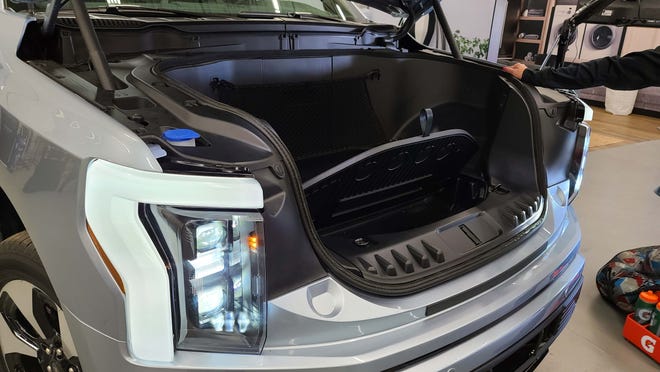
In addition to its price advantage, the hybrid-gas F-150 boasts other its own advantages such as 700 miles of range (versus 300 for the Lightning) and a significantly higher towing capacity (12,700 pounds vs. 8,000 for the EV).
So distinct in pricing and features are the Detroit EV trucks that car buff sites like Car and Driver list them as separate models.
The premium EV message plays out in work truck models as well. Detroit automakers sell huge volumes to fleets serving everything from landscape to construction businesses. But Chevy and Ford are targeting EV work trucks at billion-dollar corporations that need to meet Environmental Social Governance quotas demanded by activist investors and governments.
“The work truck is about supporting our fleet customers and their sustainability goals with wanting to have a sustainable future (and the) ESG demands of their green investors. So we’re starting with our fleet model first,” said Silverado chief engineer Nichole Kraatz in an interview, previewing the Silverado WT’s debut in early 2023.
The activist push to electrify big fleets follows other trendy solutions in recent decades like ethanol and natural gas. In the wake of 9/11, the Bush administration in 2005 mandated the federal government’s vehicle fleet be capable of operating on corn-based ethanol. And FedEx, one of GM’s key partners with the Silverado Work Truck, invested in natural gas-powered vehicles last decade to meet sustainability goals.
Startup automakers like Rivian and Bollinger also see the opportunity to take corporate fleet share from legacy automakers. Rivian has benefited from Amazon capital as the tech company builds a fleet of delivery vehicles on the bones of the pickup-maker’s battery platform.
“Big corporations have a symbiotic relationship with Big Auto. They both need to claim how green they are,” said Brauer. “The mantra among the tech and government crowd is sustainability. Big corporations also have money they can put into charging infrastructure, which is ideal for commercial trucks with set routes in an urban area.”
Expensive EV trucks also dovetail with the premium pickup phenomenon of recent years. While Detroit luxury brands like Cadillac and Lincoln have concentrated on SUVs, top-trim trucks like the Chevy High Country, Ford Platinum, and Ram TRX now compete with top-drawer German luxury brands with big screens, high tech and gilded interiors. A special Ignition Edition of the 702-horsepower Ram 1500 TRX, for example, retails for $93,280.
Can pickup makers translate premium EV cache into mainstream sales volume?
“Who knows what will happen in 10 years?” smiled Brauer.
Henry Payne is auto critic for The Detroit News. Find him at hpayne@detroitnews.com or Twitter @HenryEPayne.
Payne: Inside Lucid, Tesla’s Silicon Valley EV arch-rival
Posted by Talbot Payne on January 11, 2022
Newark, California — Located just 11 miles up the San Francisco Bay from Tesla Inc.’s Fremont factory, Lucid Motors is the third electric vehicle maker in California’s Big Three.
With a market capitalization hovering near $100 billion — more than Detroit’s Big Three of General Motors Co., Ford Motor Co. and Stellantis NV — the brand joins Tesla and Irvine-based Rivian Automotive Inc. as highly-valued, 21st-century automakers delivering a new breed of luxury performance.

With ex-Tesla chief engineer Peter Rawlinson at the helm, the Bay Area startup wants to be beat Tesla at its own game. With a stunning, 1,111-horsepower sedan as its flagship, Lucid is coming to a studio showroom near you.
Boasting the industry’s longest range and most-efficient electric motors, it aims to be an American icon. Significantly, Lucid does not offer Tesla’s secret sauce: A proprietary charging network. Instead, it boasts technology-partner Atieva, which produces the battery packs for the international Formula E electric racing series that is pushing the boundaries of battery performance.

Lucid is headquartered in an unassuming office park here, its sans-serif logo glowing atop a low, glass building. Inside, the lobby is dominated by the Lucid Air’s 900-volt, skateboard architecture — its batteries slung low between the four wheels. As the first, $169,000 Air Dream Edition models come down the line at the company’s Casa Grande, Arizona, assembly plant, the company dreams of 500,000-a-year production volumes by 2030 — including production of the Gravity SUV in 2023.
But first it needs to sell the Air, one of the most stunning cars on the market, whether gas-or-electric powered. After wowing the 2017 New York Auto Show, the Air prototype has been methodically prepared for production while Rawlinson & Co. raised capital, a production facility, and performance expectations.
Designed by ex-Mazda design chief Derek Jenkins, Air uses the skateboard chassis to full advantage. Without a gas engine up front, the sleek sedan sits on a wheelbase for a mid-size BMW 5-series — but with interior room similar to a full-size BMW 7-series, including a rear seat fit for 7-footers.

The sci-fi nose features a thin chrome brow stretching the width of the fascia — an even thinner line of LED headlight underneath it. Clam shell hoods reveal big cargo spaces for rear and front trunks. The car wouldn’t be out of place in a Tron movie.
The cabin is dominated by twin console and instrument screens, the latter a 34-inch, curved piece of glass that remind of the Porsche Taycan EV. A panoramic glass roof spans the cabin.
The years after he helped bring the Model S to market, engineer Rawlinson hopes the Air will be the EV standard for the next decade.
Rawlinson took the helm of battery-maker Atieva in 2014 with the promise of building an EV brand. In addition to Jenkins, the Welsh-born engineer has attracted top industry talent to Lucid including ex-Tesla Model 3 and Audi manufacturing veteran Peter Hochholdinger and ex-Apple and Rivian software engineer Michael Bell.

In the back of Lucid’s HQ, doors open to a big development bay where workers fuss over Air models in various states of undress. Atieva’s Formula E manufacturing is also done under the building’s roof, a reminder of the importance of race track-to-production technology transfer which has been key to gasoline engine development over the last two centuries.
“There is a lot of talk of racing technology transfer in the industry, but this is the real deal,” said Justin Berkowitz, Lucid Public Relations Manager for Technology who came over from BMW. Rawlinson himself was Lotus chief engineer, a company with deep roots in racing, before his stint at Tesla.
Beginning in 2018, Ateiva has been the sole manufacturer of batteries for Formula E — its high-performance cells riding in Jaguar, Audi, Porsche, and other racers. Similar battery cell tech sits in the belly of the Air, achieving an industry first 500-miles plus of range (520 miles in the Dream Edition and Grand Touring models).
The batteries drive Rawlinson’s prized, electric drive unit. With a power density of 9.05/kilogram — three times that of the Tesla Model S — at 20,000 RPM, the small, 163-pound drive unit efficiently integrates the electric motor and differential into one housing. The result is not only more power — the Air Dream Edition’s horsepower rivals that of the $3.8 million Aston Martin Valkyrie hybrid supercar — but space efficiency that allows class-leading front trunk space.
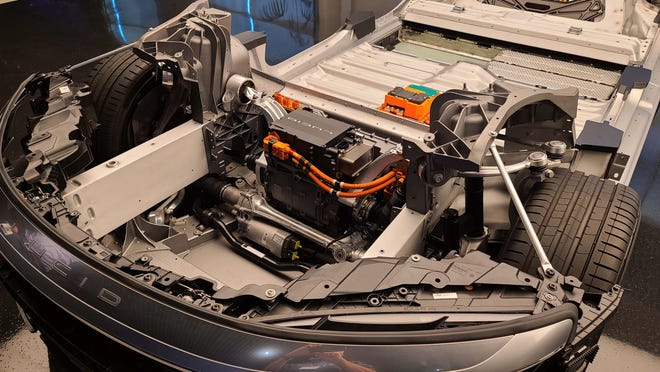
Lucid is ambitious. After the Air Dream’s launch — Grand Touring and base Pure models will follow — Lucid’s Gravity SUV will go toe-to-toe with the gull-winged Tesla Model X. Lucid plans to expand into Canada, Europe in 2022, and China in 2023.
The Air’s beauty, performance, and startup appeal earned it a nomination for North American Car of the Year versus affordable, more established models like the Honda Civic and VW Golf GTI.
“It’s an effortless vehicle. Interior is a knockout. The performance is extraordinary,” said NACTOY juror Lindsay Brooke, publications editor for the Society of Automotive Engineers. “And for being such a big machine it really handles better than I thought it would. If they can build up this brand it will be a powerhouse in electric vehicles.”
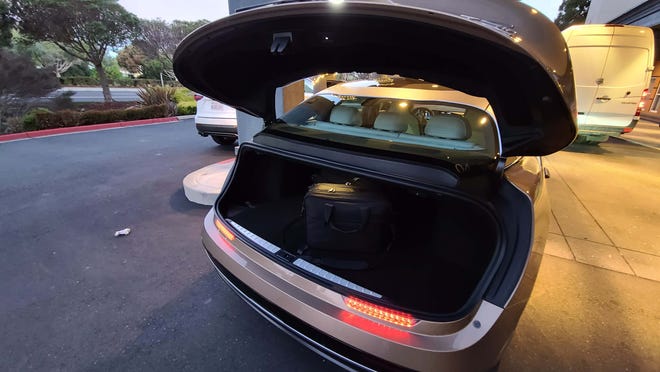
It has gained the reputation as the “next Tesla” here in Silicon Valley, but some analysts are wary.
“Tesla also enjoyed a first-mover’s advantage in the EV market. Today, the EV market is much more saturated,” writes Motley Fool consumer goods analyst Leo Sun. “In addition to competing against Tesla, Lucid will need to fend off traditional automakers like Ford, BMW, and Volkswagen. That saturation will make it tough for latecomers like Lucid and Rivian to replicate Tesla’s growth.”
Intriguingly the Air Dream Edition begins customer deliveries at about the same time as Tesla’s own 1,000-horsepower beast, the Model S Plaid, which hits the market at $134,490. The Lucid boasts 124 miles range more than the Tesla while still providing shocking power. The Plaid hits 60 mph in 2 seconds, the Air in 2.5.
Game on.
Henry Payne is auto critic for The Detroit News. Find him at hpayne@detroitnews.com or Twitter @HenryEPayne.
Truck e-Wars: Chevy Silverado EV brings 400-mile range, bed extender
Posted by Talbot Payne on January 11, 2022
The Detroit truck wars have gone electric.
Answering Ford Motor Co.’s F-150 Lightning E
The Detroit truck wars have gone electric.
Answering Ford Motor Co.’s F-150 Lightning EV salvo, General Motors Co.’s Chevrolet let loose its first electric Silverado pickup truck Wednesday at the Consumer Electronics Show in Las Vegas with headline-grabbing features like a mid-gate bed extender, 664 horsepower, and 400-mile range.
Aimed at affluent first-adopters in an EV market accustomed to $100,000 Porsche Taycan and Tesla Model S sports sedans, the loaded, $105,000, 2024 Silverado RST pickup will lead the EV truck parade, followed by other model trims in 2024. A 400-mile-range, fleet-focused Work Truck is scheduled to go on sale in spring 2023, while the RST is due to arrive in late 2023.

Like Lightning, Silverado EV pricing starts at just under $40,000 before government tax breaks. Unlike Lightning, which uses a familiar F-150 ladder frame, the Silverado EV makes a clean break from its petrol-powered Silverado stablemate with an all-new platform based on GM’s 800-volt Ultium battery skateboard and capable of fast, 350-kW charging. It’s the same architecture that cradles the Hummer EV — GMC’s first foray into the e-pickup space.
“We have a foot in both camps,” said Chevrolet marketing guru Steve Majoros as the brand will now produce trucks on gas and electric platforms. Majoros and the Silverado team gave media a sneak peak of the pickup ahead of its official CES intro.
After the fleet-customer Work Truck and top-shelf RST retail model, production will ramp up in 2024, with models like the base WT ($39,900 with a smaller battery), RST, and Trail Boss models stickering at $50,000-$80,000.
Chevrolet’s Dearborn rival is already taking orders with four trims advertised to hit the market this spring: Lightning Pro ($39,974, excluding 1,695 destination charge), XLT ($52,974), Lariat ($67,474), and Platinum ($90,874).
The big-battery, 400-mile Work Truck (price yet to be determined) aims to help corporate fleets satisfy ESG (environmental, social, and governance) demands of green investors by filling their fleets with zero-emission vehicles.

“The Silverado EV (provides) customers with a true work-capable truck to help them begin the transition to an electric fleet and assist them in achieving their own sustainability goals,” said GM Fleet VP Ed Peper.
The retail strategy will initially target premium EV buyers who also have the coin for, say, a $105k Mercedes EQS EV. Pickups like the Silverado High Country have become prized by luxury items in recent years, though the RST EV will cost $40,000 more than a fully-loaded V8-powered High Country.
For that price, buyers will get a lot. The Silverado EV is a rolling tech showcase. It plays in the same space as other luxury trucks from startups like Rivian, Bollinger, and Tesla boasting big performance numbers that high-torque batteries can deliver.

The same Ultium batteries that rocket the tri-motor, $112,595 Hummer from 0-60 mph in 3.0 seconds will get the dual-motor Silverado RST there in under 4.5 seconds. Credit a gob-smacking 664-horsepower and 780 pound-feet of torque. The high-voltage platform rivals the Porsche and Lucid Air luxury cars and can add 100 miles of range in 10 minutes at a fast charger. The Chevy’s 400-mile range bests Lightning by 100 miles.
“The Ultium Platform enabled our design and engineering teams to start from a clean slate and create a pickup with impressive performance,” said Nichole Kraatz, Silverado EV chief engineer, who added the architecture allows over-the-air software updates to improve the truck over time.

The truck’s sprawling, 145.6-inch wheelbase sits on giant, 24-inch wheels and an independent air suspension — its profile sleeker than the similarly-sized, gas-powered Silverado. For range-extending aerodynamics, the hood and cowl are lower. A fashionable, LED light runs the width of the grille-less front fascia, similar to Lightning. Silverado EV doesn’t share any body panels with its gas brother.
Step up into the cabin and the truck turns on via card, key, or phone app recognition. Interior space is palatial. Twin 11-and-17-inch screens anchor the dash with a 14-inch head-up display projected over the hood. Drivers can delve deep into the infotainment menus while driving hands-free with SuperCruise semi-autonomous tech. Also notable is a Tesla-like column shifter and class-leading 7 gallons of console storage space.
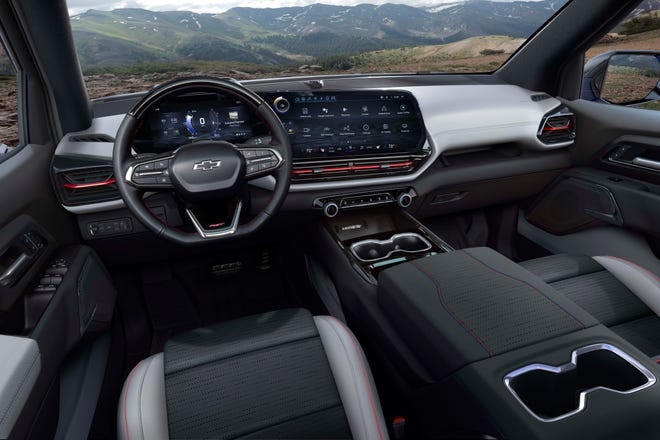
The pickup’s signature piece is the bed.
A flying buttress C-pillar — reminiscent of the 2013 Chevy Avalanche pickup — frames the 5’ 11” bed that can be extended to 9 feet (10’ 10” with the tailgate down) by dropping the Multi-Flex Midgate wall and window behind the rear, crew-cab passengers. It’s not as radical looking as the angular Tesla Cybertruck, but it’s distinct from traditional, boxy Silverados. The gate can be split 60/40 — or drop flat with storage for the removable window. The rear Multi-Flex Tailgate offers multi-functionality like walk-in steps or a work table.
“This is not a conventionally-styled pickup,” said designer Ryan Vaughn. “It’s more muscular, more sleek. It’s driven by functionality. The electric range is important.”

The bed’s utility is aided by the stiff chassis structure that sits atop the Ultium platform — the battery low for improved center of gravity. An underbody shield runs the length of the truck, helping keep road noise from the cabin.
The RST offers four-wheel steer for maneuverability in tight spots on and off-road. Hook up a trailer and it will tow 10,000 pounds — though that will likely compromise range. TFLTruck.com estimates towing degrades mpg in a gas/hybrid-powered trucks by 70% — and will take a similar toll on battery range.
Without an engine up front, the void below the hood is used as an e-frunk (front trunk) that can hold three pieces of luggage. Frunks were popularized by Tesla EVs and the Ford Lightning offers its own lockable cavity. Overall, the RST and Work Truck feature 10 charging outlets, which Chevy says can be used to power a tailgate party, home or even another EV.
The fleet-focused Work Truck will arrive ahead of the RST and will be more spare while still boasting 400-mile range. The Multi-Flex Tailgate is unavailable and power downsized to 510 ponies and 615 pound-feet of torque. Payload? 1,200 pounds compared with the RST’s 1,300, with towing capability at 8,000 pounds.

The Work Truck is distinguished by a black fascia — shades of its gas peer.
Chevy bills the six-figure RST as a “statement truck” — a halo EV to lure customers and encourage dealers to invest in EV infrastructure. It will likely compete with the $92k Lightning Platinum, the top trim of Ford’s EV pickup. Of Chevy’s 2,900 dealers, Majoros says 2,000 have been certified to sell low-volume Chevy Bolt and Bolt EUV crossovers, making them equipped for Silverado EV sales too.
Chevrolet is bullish on the California market. The Golden State not only has the nation’s most onerous environmental regulations but also its biggest EV sector, with nearly half of American EV sales. Silverado is the No. 1 selling pickup in Los Angeles.
The Silverado EV will be assembled alongside the Hummer EV at the Factory Zero Detroit-Hamtramck Assembly Center, the plant retooled with an EV-focused, $2.2 billion investment.
Henry Payne is auto critic for The Detroit News. Find him at hpayne@detroitnews.com or Twitter @HenryEPayne.
V salvo, General Motors Co.’s Chevrolet let loose its first electric Silverado pickup truck Wednesday at the Consumer Electronics Show in Las Vegas with headline-grabbing features like a mid-gate bed extender, 664 horsepower, and 400-mile range.
Aimed at affluent first-adopters in an EV market accustomed to $100,000 Porsche Taycan and Tesla Model S sports sedans, the loaded, $105,000, 2024 Silverado RST pickup will lead the EV truck parade, followed by other model trims in 2024. A 400-mile-range, fleet-focused Work Truck is scheduled to go on sale in spring 2023, while the RST is due to arrive in late 2023.
Like Lightning, Silverado EV pricing starts at just under $40,000 before government tax breaks. Unlike Lightning, which uses a familiar F-150 ladder frame, the Silverado EV makes a clean break from its petrol-powered Silverado stablemate with an all-new platform based on GM’s 800-volt Ultium battery skateboard and capable of fast, 350-kW charging. It’s the same architecture that cradles the Hummer EV — GMC’s first foray into the e-pickup space.
“We have a foot in both camps,” said Chevrolet marketing guru Steve Majoros as the brand will now produce trucks on gas and electric platforms. Majoros and the Silverado team gave media a sneak peak of the pickup ahead of its official CES intro.
After the fleet-customer Work Truck and top-shelf RST retail model, production will ramp up in 2024, with models like the base WT ($39,900 with a smaller battery), RST, and Trail Boss models stickering at $50,000-$80,000.
Chevrolet’s Dearborn rival is already taking orders with four trims advertised to hit the market this spring: Lightning Pro ($39,974, excluding 1,695 destination charge), XLT ($52,974), Lariat ($67,474), and Platinum ($90,874).
The big-battery, 400-mile Work Truck (price yet to be determined) aims to help corporate fleets satisfy ESG (environmental, social, and governance) demands of green investors by filling their fleets with zero-emission vehicles.
“The Silverado EV (provides) customers with a true work-capable truck to help them begin the transition to an electric fleet and assist them in achieving their own sustainability goals,” said GM Fleet VP Ed Peper.
The retail strategy will initially target premium EV buyers who also have the coin for, say, a $105k Mercedes EQS EV. Pickups like the Silverado High Country have become prized by luxury items in recent years, though the RST EV will cost $40,000 more than a fully-loaded V8-powered High Country.
For that price, buyers will get a lot. The Silverado EV is a rolling tech showcase. It plays in the same space as other luxury trucks from startups like Rivian, Bollinger, and Tesla boasting big performance numbers that high-torque batteries can deliver.
The same Ultium batteries that rocket the tri-motor, $112,595 Hummer from 0-60 mph in 3.0 seconds will get the dual-motor Silverado RST there in under 4.5 seconds. Credit a gob-smacking 664-horsepower and 780 pound-feet of torque. The high-voltage platform rivals the Porsche and Lucid Air luxury cars and can add 100 miles of range in 10 minutes at a fast charger. The Chevy’s 400-mile range bests Lightning by 100 miles.
“The Ultium Platform enabled our design and engineering teams to start from a clean slate and create a pickup with impressive performance,” said Nichole Kraatz, Silverado EV chief engineer, who added the architecture allows over-the-air software updates to improve the truck over time.
The truck’s sprawling, 145.6-inch wheelbase sits on giant, 24-inch wheels and an independent air suspension — its profile sleeker than the similarly-sized, gas-powered Silverado. For range-extending aerodynamics, the hood and cowl are lower. A fashionable, LED light runs the width of the grille-less front fascia, similar to Lightning. Silverado EV doesn’t share any body panels with its gas brother.
Step up into the cabin and the truck turns on via card, key, or phone app recognition. Interior space is palatial. Twin 11-and-17-inch screens anchor the dash with a 14-inch head-up display projected over the hood. Drivers can delve deep into the infotainment menus while driving hands-free with SuperCruise semi-autonomous tech. Also notable is a Tesla-like column shifter and class-leading 7 gallons of console storage space.
The pickup’s signature piece is the bed.
A flying buttress C-pillar — reminiscent of the 2013 Chevy Avalanche pickup — frames the 5’ 11” bed that can be extended to 9 feet (10’ 10” with the tailgate down) by dropping the Multi-Flex Midgate wall and window behind the rear, crew-cab passengers. It’s not as radical looking as the angular Tesla Cybertruck, but it’s distinct from traditional, boxy Silverados. The gate can be split 60/40 — or drop flat with storage for the removable window. The rear Multi-Flex Tailgate offers multi-functionality like walk-in steps or a work table.
“This is not a conventionally-styled pickup,” said designer Ryan Vaughn. “It’s more muscular, more sleek. It’s driven by functionality. The electric range is important.”
The bed’s utility is aided by the stiff chassis structure that sits atop the Ultium platform — the battery low for improved center of gravity. An underbody shield runs the length of the truck, helping keep road noise from the cabin.
The RST offers four-wheel steer for maneuverability in tight spots on and off-road. Hook up a trailer and it will tow 10,000 pounds — though that will likely compromise range. TFLTruck.com estimates towing degrades mpg in a gas/hybrid-powered trucks by 70% — and will take a similar toll on battery range.
Without an engine up front, the void below the hood is used as an e-frunk (front trunk) that can hold three pieces of luggage. Frunks were popularized by Tesla EVs and the Ford Lightning offers its own lockable cavity. Overall, the RST and Work Truck feature 10 charging outlets, which Chevy says can be used to power a tailgate party, home or even another EV.
The fleet-focused Work Truck will arrive ahead of the RST and will be more spare while still boasting 400-mile range. The Multi-Flex Tailgate is unavailable and power downsized to 510 ponies and 615 pound-feet of torque. Payload? 1,200 pounds compared with the RST’s 1,300, with towing capability at 8,000 pounds.
The Work Truck is distinguished by a black fascia — shades of its gas peer.
Chevy bills the six-figure RST as a “statement truck” — a halo EV to lure customers and encourage dealers to invest in EV infrastructure. It will likely compete with the $92k Lightning Platinum, the top trim of Ford’s EV pickup. Of Chevy’s 2,900 dealers, Majoros says 2,000 have been certified to sell low-volume Chevy Bolt and Bolt EUV crossovers, making them equipped for Silverado EV sales too.
Chevrolet is bullish on the California market. The Golden State not only has the nation’s most onerous environmental regulations but also its biggest EV sector, with nearly half of American EV sales. Silverado is the No. 1 selling pickup in Los Angeles.
The Silverado EV will be assembled alongside the Hummer EV at the Factory Zero Detroit-Hamtramck Assembly Center, the plant retooled with an EV-focused, $2.2 billion investment.
Henry Payne is auto critic for The Detroit News. Find him at hpayne@detroitnews.com or Twitter @HenryEPayne.
Payne: Subaru WRX gets fancy new duds, still wants to play hard
Posted by Talbot Payne on January 6, 2022
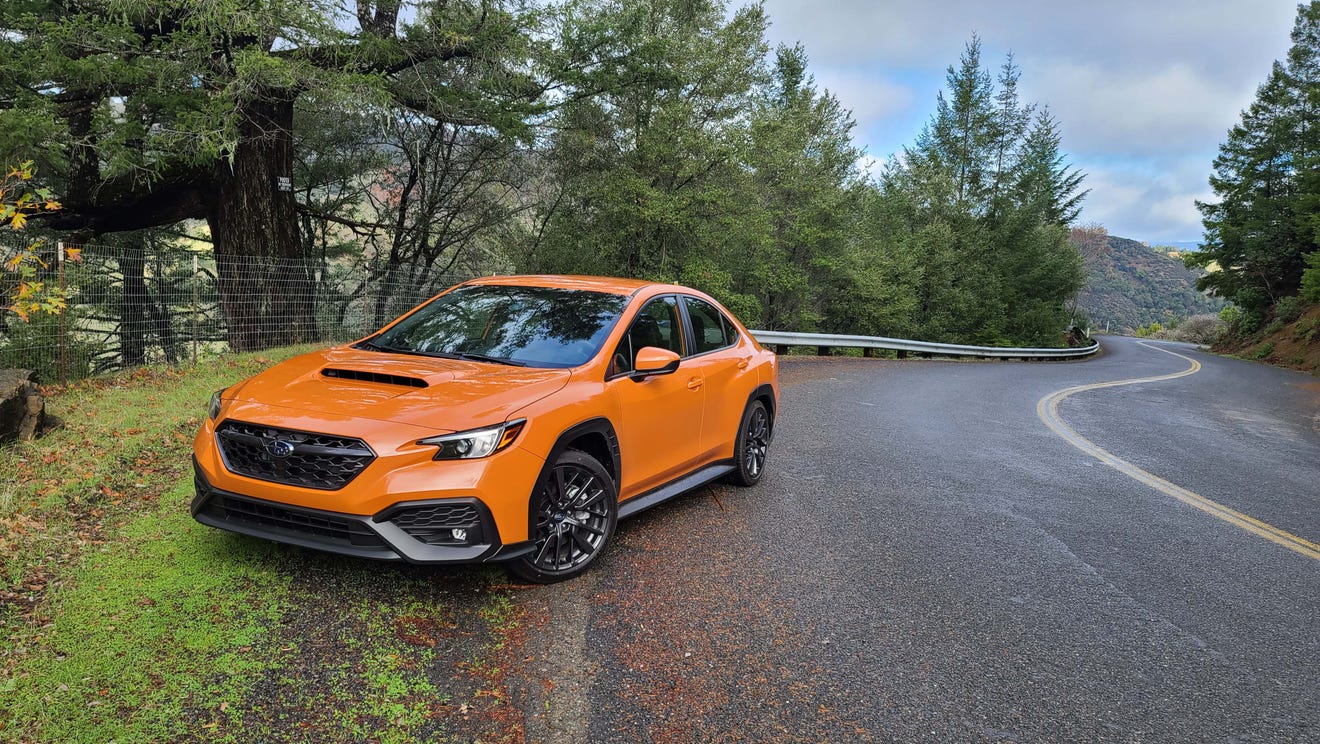
Santa Rosa, California — An old stagecoach trail running through Mendocino County called Mountain View Road is hell. Its blind, narrow, asphalt path is pocked with patches and neglect. It snakes below a canopy of redwood trees, the perpetually damp surface iced with pine needles making the road surface even more challenging.
My 2022 Subaru WRX tester was in heaven.
Rally bred, the WRX (short for World Rally Cross) cut across the challenging terrain like Barry Sanders through a defensive line. Stiffly damped, its suspension absorbed road irregularities. Barreling into a tight series of S turns, I flicked the stick into second, then blasted out of the corner — the all-wheel-drive system propelled by 271 ponies.
A road that would be a nightmare in the average family SUV turns into a grin-inducing playground at the wheel of the WRX.
The swift Subie is the latest remade entry in my favorite automotive segment: pocket rockets. These talented hellions will happily do daily chores all week, then gleefully devour country roads on the weekend. It’s a segment apparently sheltered from the SUV revolution — so passionate is its fanbase (guilty as charged), so capable are the players.
Each athlete brings a unique skill set to the arena, with the Subaru flaunting manual-shifting, all-wheel-drive DNA born of some of the toughest rally-racing terrain in the world. Mountain View Road? Ha, have you seen Motu Road Gorge in New Zealand? Like the Volkswagen Golf GTI, WRX is a segment icon.
And like the GTI, the ’Ru got a total makeover for the new model year.
The remake is timely given the all-out assault by its competitive set on the market. Notably, WRX has been challenged by the Mazda3 Turbo as the only segment competitor offering AWD — a boon to those of us living in snow country.
The Mazda has set segment benchmarks for looks and interior panache. Its gorgeous tablet-topped dash and hatchback utility make it a formidable rival.
Subie answers with its most daring exterior style ever, its boomerang headlights bracketing the familiar hexagonal grille while also emphasizing the compact car’s wider stance compared with the standard Impreza compact car. Indeed, while WRX shares the Global Platform that undergirds Impreza, the WRX has divorced itself (even dropping the Impreza family name!) from its underpowered sibling and adopting its own unique body panels. The blistered rear fenders and huge quad-pipe-engorged rear diffuser instantly send a message as you come upon a WRX: do you know who you are tangling with?
More controversial are blocky black fender claddings that echo other, more-off-road oriented Subaru Wilderness models. The cladding is unusual. But given WRX’s rally focus and liberal use of black makeup, the styling works remarkably well.
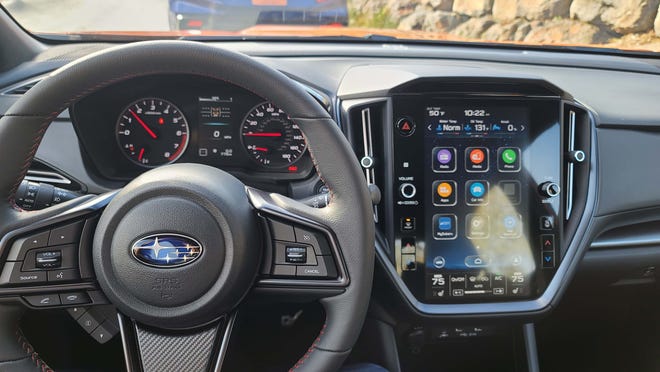
Inside, the ’Ru brings a trendy new 11.6-inch center screen copied from its Outback and Legacy siblings. The touchscreen (complete with Apple CarPlay and Android Auto connectivity) is easier to use than the Mazda’s sometimes quirky remote rotary controller, but it isn’t as driver-focused as the 3’s high-mounted tablet.
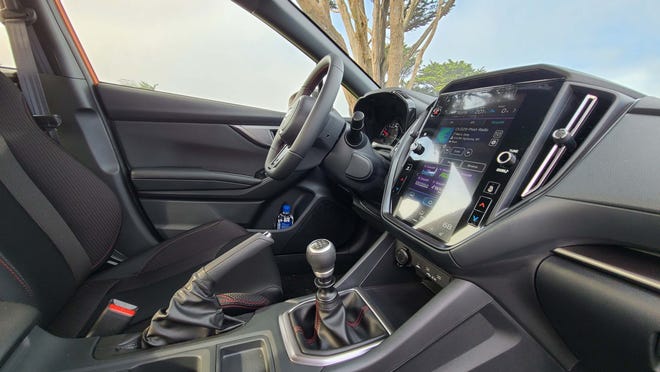
Style marks go to the automatic-shifting Mazda, but the Subaru is intensely performance driven, starting with a tight six-speed shifter.
Plunging through the redwoods, I never missed a shift. The throws are short, the pedals conveniently placed for heel-and-toe downshifts, even for my size 15s. The arrangement is better than the Golf GTI’s stick, if not on par with the Honda Civic Si’s terrific shifter — one of the best I’ve experienced this side of a Porsche.
Unlike the GTI and SI, however, WRX is curiously emotion-less. There is no rev match on downshift, no growl, not even a SPORT drive mode selector (though the top model GT trim will get six driving modes with its automatic tranny). Odd choice that.
With a quieter cabin that the last gen, the WRX engine feels curiously removed from otherwise pulse-pounding performance. Take the AWD system, for example.
While the Si and GTI bring superb front-wheel-drive, limited-slip differentials that help rotate them through the twisties, the ’Ru goes all out with a rear-wheel-biased, longitudinally mounted low-center-of-gravity Boxer engine that feeds all that power to all four wheels all the time. You know, like an Audi.
Adding nearly another half-liter to last gen’s 2.0-liter engine, the Subie pulls hard. Past quibbles about turbo-lag are forgotten. As I overcooked it into a mountain switchback, the rear end came around nicely as I applied throttle.
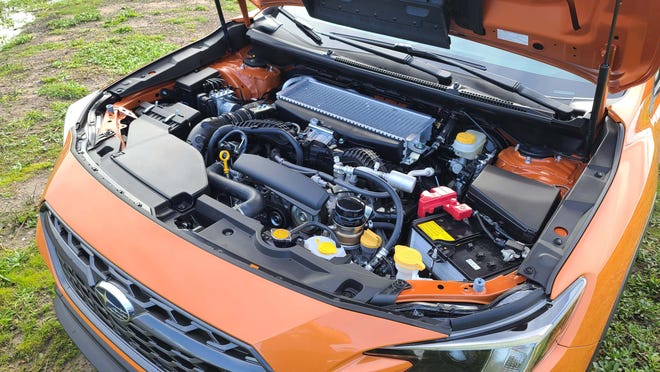
So proud is Subaru of its AWD drive grip that it provides sticky summer tires — standard — for WRX.
I’m a sucker for hatchbacks, and the Golf’s hatch utility gives it a leg up over WRX and Si. Subarus are traditionally strong on the standard feature front, but the manual WRX oddly overlooks adaptive cruise control (reserving it for the automatic, even though manuals make up 85% of WRX’s sales volume). ACC — especially for the young (average age 37) WRX buyer — is becoming an essential feature. Both GTI and Si offer it on their manuals.
Not overlooked is seating comfort. Over four hours of aggressive driving, my big 6’5” frame never felt uncomfortable.
The WRX’s new thrones have been extensively reworked, and my Premium trim’s (the meat of WRX sales) cloth seats were as comfortable as if they had been leather while keeping me in place though the curves.
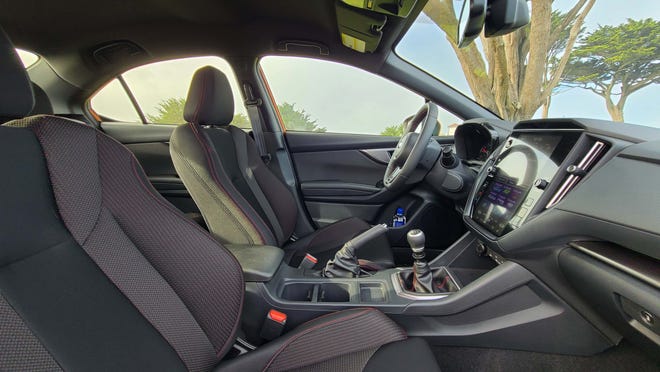
Rear legroom is admirable, too. The ’Ru has put its extra inch of wheelbase to good use, and could fit my giraffe legs easily behind myself in the backseat. But for the tight Mazda, roomy rear seating for four has become a segment staple — though your passengers may squirm when you point at the S curves ahead.
So iconic is the WRX that Subaru no longer feels the need to enter it in a high-profile race series. It exited the World Rally Championship (recording a record 46 wins) over a decade ago, and American Rallycross expired during the pandemic. The WRX is not alone in the Subaru performance lineup, sandwiched between the BRZ and the winged STI.
As engaging as the rear-wheel-dive BRZ is, however, WRX — for about the same price — shows off its value with winter-friendly AWD, comfy seating for four, deep trunk space and big-screen ergonomics.
If you were hoping for a WRX for Christmas, however, you were disappointed. Production was delayed until January.
2022 Subaru WRX
Vehicle type: Front-engine, all-wheel-drive five-passenger pocket rocket
Price: Est. $29,000 (est. $32,000 Premium trim, Solar Orange Pearl paint as tested)
Powerplant: 2.4-liter turbo-4 cylinder Boxer engine
Power: 271 horsepower, 258 pound-feet of torque
Transmission: 6-speed manual, continuously variable transmission (CVT)
Performance: 0-60 mph, 5.4 seconds (Car and Driver est., manual); top speed, 145 mph
Weight: 3,320 pounds (premium as tested)
Fuel economy: EPA, 19 mpg city/25 highway/21 combined (auto); 19 mpg city/26 highway/22 combined (manual)
Report card
Highs: Upgraded looks; AWD OMG
Lows: Emotionless engine note; no adaptive cruise control with manual
Overall: 3 stars
Henry Payne is auto critic for The Detroit News. Find him at hpayne@detroitnews.com or Twitter @HenryEPayne.
Truck e-Wars: Chevy Silverado EV brings 400-mile range, bed extender
Posted by Talbot Payne on January 6, 2022
The Detroit truck wars have gone electric.
Answering Ford Motor Co.’s F-150 Lightning EV salvo, General Motors Co.’s Chevrolet let loose its first electric Silverado pickup truck Wednesday at the Consumer Electronics Show in Las Vegas with headline-grabbing features like a mid-gate bed extender, 664 horsepower, and 400-mile range.
Aimed at affluent first-adopters in an EV market accustomed to $100,000 Porsche Taycan and Tesla Model S sports sedans, the loaded, $105,000, 2024 Silverado RST pickup will lead the EV truck parade, followed by other model trims in 2024. A 400-mile-range, fleet-focused Work Truck is scheduled to go on sale in spring 2023, while the RST is due to arrive in late 2023.
Like Lightning, Silverado EV pricing starts at just under $40,000 before government tax breaks. Unlike Lightning, which uses a familiar F-150 ladder frame, the Silverado EV makes a clean break from its petrol-powered Silverado stablemate with an all-new platform based on GM’s 800-volt Ultium battery skateboard and capable of fast, 350-kW charging. It’s the same architecture that cradles the Hummer EV — GMC’s first foray into the e-pickup space.
“We have a foot in both camps,” said Chevrolet marketing guru Steve Majoros as the brand will now produce trucks on gas and electric platforms. Majoros and the Silverado team gave media a sneak peak of the pickup ahead of its official CES intro.
After the fleet-customer Work Truck and top-shelf RST retail model, production will ramp up in 2024, with models like the base WT ($39,900 with a smaller battery), RST, and Trail Boss models stickering at $50,000-$80,000.
Chevrolet’s Dearborn rival is already taking orders with four trims advertised to hit the market this spring: Lightning Pro ($39,974, excluding 1,695 destination charge), XLT ($52,974), Lariat ($67,474), and Platinum ($90,874).
The big-battery, 400-mile Work Truck (price yet to be determined) aims to help corporate fleets satisfy ESG (environmental, social, and governance) demands of green investors by filling their fleets with zero-emission vehicles.
“The Silverado EV (provides) customers with a true work-capable truck to help them begin the transition to an electric fleet and assist them in achieving their own sustainability goals,” said GM Fleet VP Ed Peper.
The retail strategy will initially target premium EV buyers who also have the coin for, say, a $105k Mercedes EQS EV. Pickups like the Silverado High Country have become prized by luxury items in recent years, though the RST EV will cost $40,000 more than a fully-loaded V8-powered High Country.
For that price, buyers will get a lot. The Silverado EV is a rolling tech showcase. It plays in the same space as other luxury trucks from startups like Rivian, Bollinger, and Tesla boasting big performance numbers that high-torque batteries can deliver.
The same Ultium batteries that rocket the tri-motor, $112,595 Hummer from 0-60 mph in 3.0 seconds will get the dual-motor Silverado RST there in under 4.5 seconds. Credit a gob-smacking 664-horsepower and 780 pound-feet of torque. The high-voltage platform rivals the Porsche and Lucid Air luxury cars and can add 100 miles of range in 10 minutes at a fast charger. The Chevy’s 400-mile range bests Lightning by 100 miles.
“The Ultium Platform enabled our design and engineering teams to start from a clean slate and create a pickup with impressive performance,” said Nichole Kraatz, Silverado EV chief engineer, who added the architecture allows over-the-air software updates to improve the truck over time.
The truck’s sprawling, 145.6-inch wheelbase sits on giant, 24-inch wheels and an independent air suspension — its profile sleeker than the similarly-sized, gas-powered Silverado. For range-extending aerodynamics, the hood and cowl are lower. A fashionable, LED light runs the width of the grille-less front fascia, similar to Lightning. Silverado EV doesn’t share any body panels with its gas brother.
Step up into the cabin and the truck turns on via card, key, or phone app recognition. Interior space is palatial. Twin 11-and-17-inch screens anchor the dash with a 14-inch head-up display projected over the hood. Drivers can delve deep into the infotainment menus while driving hands-free with SuperCruise semi-autonomous tech. Also notable is a Tesla-like column shifter and class-leading 7 gallons of console storage space.
The pickup’s signature piece is the bed.
A flying buttress C-pillar — reminiscent of the 2013 Chevy Avalanche pickup — frames the 5’ 11” bed that can be extended to 9 feet (10’ 10” with the tailgate down) by dropping the Multi-Flex Midgate wall and window behind the rear, crew-cab passengers. It’s not as radical looking as the angular Tesla Cybertruck, but it’s distinct from traditional, boxy Silverados. The gate can be split 60/40 — or drop flat with storage for the removable window. The rear Multi-Flex Tailgate offers multi-functionality like walk-in steps or a work table.
“This is not a conventionally-styled pickup,” said designer Ryan Vaughn. “It’s more muscular, more sleek. It’s driven by functionality. The electric range is important.”
The bed’s utility is aided by the stiff chassis structure that sits atop the Ultium platform — the battery low for improved center of gravity. An underbody shield runs the length of the truck, helping keep road noise from the cabin.
The RST offers four-wheel steer for maneuverability in tight spots on and off-road. Hook up a trailer and it will tow 10,000 pounds — though that will likely compromise range. TFLTruck.com estimates towing degrades mpg in a gas/hybrid-powered trucks by 70% — and will take a similar toll on battery range.
Without an engine up front, the void below the hood is used as an e-frunk (front trunk) that can hold three pieces of luggage. Frunks were popularized by Tesla EVs and the Ford Lightning offers its own lockable cavity. Overall, the RST and Work Truck feature 10 charging outlets, which Chevy says can be used to power a tailgate party, home or even another EV.
The fleet-focused Work Truck will arrive ahead of the RST and will be more spare while still boasting 400-mile range. The Multi-Flex Tailgate is unavailable and power downsized to 510 ponies and 615 pound-feet of torque. Payload? 1,200 pounds compared with the RST’s 1,300, with towing capability at 8,000 pounds.
The Work Truck is distinguished by a black fascia — shades of its gas peer.
Chevy bills the six-figure RST as a “statement truck” — a halo EV to lure customers and encourage dealers to invest in EV infrastructure. It will likely compete with the $92k Lightning Platinum, the top trim of Ford’s EV pickup. Of Chevy’s 2,900 dealers, Majoros says 2,000 have been certified to sell low-volume Chevy Bolt and Bolt EUV crossovers, making them equipped for Silverado EV sales too.
Chevrolet is bullish on the California market. The Golden State not only has the nation’s most onerous environmental regulations but also its biggest EV sector, with nearly half of American EV sales. Silverado is the No. 1 selling pickup in Los Angeles.
The Silverado EV will be assembled alongside the Hummer EV at the Factory Zero Detroit-Hamtramck Assembly Center, the plant retooled with an EV-focused, $2.2 billion investment.
Henry Payne is auto critic for The Detroit News. Find him at hpayne@detroitnews.com or Twitter @HenryEPayne.
Mercedes’ sleek, electric Vision EQXX concept claims 620-mile range
Posted by Talbot Payne on January 5, 2022
Mercedes kicked off the new year Monday with its Vision EQXX concept, a long-range electric halo vehicle for the German brand.
The aerodynamic EQXX packs a similar-size battery as Mercedes’ current, full-size production EQS sedan into a compact chassis about the size of the entry-level, gas-powered Mercedes CLA Class. Introduced ahead of this week’s Consumer Electronics Show in Las Vegas, EQXX is also stuffed with a full-dash infotainment screen and virtuous, sustainable materials prized by green customers.

Mercedes announced that, when the concept hits the road this spring, it will be capable of 620 miles of range — a trip from Detroit to New York City. That figure rivals that of gas-electric hybrids like the 633-mile-range Toyota Prius, though it comes up short of diesel-powered marathoners like the 1,000-mile-range Ram 1500 pickup.
The Merc follows in the footsteps of other European moon shots like the 2002 Volkswagen 1-Liter concept, a similarly sleek, cigar-shaped, diesel-powered creation that achieved the European benchmark of using just one liter of petrol to travel 100 kilometers — the equivalent of 237 mpg.

For the EV Age, Mercedes says its concept will hit a new efficiency target of less than 10 kWh consumed per 100 kilometers traveled (6 miles per kWh).
The VW diesel appeared at a time when Middle East conflict dominated headlines and Europe was determined to free itself of Mideast oil by encouraging the adoption of efficient, diesel-powered autos. Diesels have since fallen out of favor with governments. EVs are the new political fashion and EQXX claims the moral high ground as governments force non-fossil fuel vehicles.
“The Mercedes-Benz EQXX is how we imagine the future of electric cars,” said Mercedes Chairman Ola Källenius. “The EQXX is an advanced car in so many dimensions — and it even looks stunning and futuristic. With that, it underlines where our entire company is headed: We will build the world’s most desirable electric cars.”

The EQXX achieves its efficiency goals with a low frontal area and a long, race car-like tail. The Merc boasts a drag co-efficient of just 0.17 — lower than state-of-the-art production cars like Lucid Air’s 0.20 and Tesla Model S Plaid’s 0.208. The low drag co-efficient is achieved with a smaller frontal area than the entry-level, Mercedes CLA-class and a rear track width 2 inches less than at the front.
The concept’s range numbers are better than the brand’s current, $103,360 EQS production EV halo, which gets 350 miles of range. In packing a similar 100 kWh battery into a compact-class chassis, EQXX claims 95% driveline efficiency compared with 75% for the EQS. Drawing on its experience in Formula One and Formula E racing — both of which utilize battery technology — the Vision concept claims 50% less volume and 30% less weight than the EQS battery.
The lightweight battery means the Mercedes tips the scale at 3,858 pounds — or about the same girth as a Tesla Model 3 that has nearly half the range. A solar roof on EQXX delivers another 16 miles of potential mileage.
“Driven by the idea of zero impact on our planet and a highly responsible use of green energy, we encouraged our engineers to go above and beyond,” reads the EQXX news release. “The VISION EQXX is the result of a mission we set to break through technological barriers and lift energy efficiency to new heights. It answers the progressive demands of a modern generation of customer.”

But Mercedes’ push toward electrification is driven by more than political virtue signaling. Long dominant in the U.S. market, Germany’s Teutonic trio of Mercedes, BMW and Audi have been passed by the Model 3, which recorded more than 200,000 unit sales in 2020, compared with just 52,000 for Mercedes’ best-selling GLC-class sport utility. As EV mandates accelerate in the next few years, Tesla is in the catbird seat, accounting for about 80% of EV sales in the U.S.
“Marking the launch of a new, super-purist design style, the EQXX represents a new expression of efficiency in interior design,” says the Mercedes press release, echoing Tesla. “In a departure from the conventional design approach, the interior layout focuses on just a few modules and the beautiful simplicity of lightweight design.”
The design includes vegan leather seats made from mycelium, adapted from the rootlike structure of mushrooms. Carpets are made from bamboo fiber, and the rear floor from landfill items like mixed plastics, cardboard, even baby diapers.
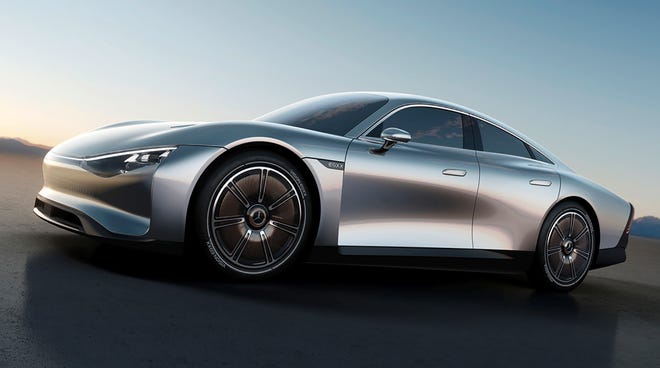
The chassis is based on a 900-volt architecture for quicker charging and a heat pump is integrated to keep cold-weather battery losses to a minimum in, for example, frigid Michigan winters.
“By making efficiency the new currency, Mercedes-Benz has created … luxury and convenience with less impact on nature, and more electric mobility with less waste,” says the Mercedes press release.
Henry Payne is auto critic for The Detroit News. Find him at hpayne@detroitnews.com or Twitter @HenryEPayne.
Payne: High Five! Hyundai Ioniq 5 is a stylish, roomy and speedy EV
Posted by Talbot Payne on January 5, 2022
Julian, California — We’ve come a long way from Pious to Ioniq.
Twenty years ago, the Toyota Prius sparked a green segment in the American car market. The stylish hybrid was gobbled up by granola chewers and became a hit, inspiring predictions from the pointy-head class that hybrids would dominate the market by 2020. Hybrid GMC Yukons, Ford Fusion hybrids, Chevy Volts came and went as the hybrid hype fizzled. Turns out, green is a niche like V-8s, diesel trucks, off-road dirt kickers.
Now comes another green spasm and the market is flooding with battery-powered vehicles. But this time, the niche is fun.
Hybrids wore out their welcome in part because they were sooooo cloying. Their screens awoke with tree branches reminding us they were doing good. Saving the planet! Just like Leo DiCaprio! Prius was derisively dubbed the “Pious” and the name stuck.
The Ioniq 5 is not that car, even as it is the Prius’s logical heir.
“What is that?” a passerby on a San Diego sidewalk exclaimed, ogling the Hyundai’s brooding, Dodge Challenger-like cowl, creased doors and sci-fi pixel taillights. “It’s cool looking.”
“You should see the inside,” I smiled, flinging the door open to reveal twin 12-inch screens like a computer desktop. “Ooooooh,” my new friend panted.

Self-driving through California traffic (good Lord, is it ever not rush hour in Cali?), I toggled the 5’s left turn signal and the car automatically switched lanes. Then I floored the accelerator pedal — ZOT! — and 446 pound-feet of torque shot me past the slower car. Toggle the right signal and I automatically merged back in lane. Gimme a high 5!
Green doesn’t have to be vanilla. It’s a lesson Hyundai learned with its Ioniq sub-brand, which started in 2015 as an electrified answer to Prius but lacked personality.
Then along came stylish Tesla rocket ships that you could summon across a parking lot and drag race out of stoplights. How cool can EVs be? Mustang now makes one.
The edgy Ioniq 5 follows in these sexpots’ footsteps, but it is more interested in room than vroom.
Sure, the Ioniq can wear you out with windy speeches about how moral it is — “seats, headliner, door trim, floor, arm rests use eco-friendly, sustainably sourced materials (that) include recycled PET bottles, plant-based yarns and natural wool yarns and bio paint with plant extracts” — but these claims are buried in press releases. There’s not a green leaf to be found on its mod bodywork.

The 5 reminds that the Prius was a very practical car. It had good cargo space under the rear hatchback (begiining with 2004 models), good visibility, head-up dash driving info (before head-up displays were a thing), and could go forever on a tank of gas.
Ioniq follows in Prius’s footsteps with an EV that is more hatchback than SUV. The 5 is stretched over the longest wheelbase in Hyundai’s lineup — longer even than the Palisade three-row SUV. Note: in an indication of EVs’ niche status, however, my Limited trim Ioniq 5 tester cost nine grand more than a similarly equipped full-size Palisade Limited. That’s a lot of extra coin for a compact-class Hyundai.
My 6’5” frame easily sat behind myself in the 5’s rear seat with knee room to spare. Heck, Hyundai could fit a third row in this thing (like the spacious Tesla Model Y) if it wanted to. A Tesla-like panoramic sunroof gives the cabin an added sense of openness.
The airiness continues up front. The Ioniq employs an open footwell like the original Tesla Model S (or my parents’ 1960s Buick station wagon), so I could splay my feet while self-driving. Postal carriers might embrace the 5 to easily slide across the seat to stuff mailboxes.
When I get a hot hatch at home like the VW Golf GTI or Mazda 3 Turbo, I head to Hell, Michigan, to have some fun. When in San Diego, the spaghetti curves of the Laguna Mountains beckon.
Ioniq’s acceleration may be bioniq, but it is no hot hatch.
This is curious given Hyundai’s choice (like its Model Y, Mustang Mach-E and Volkswagen VW ID.4 rivals) to make the base single-motor Ioniq 5 a rear-wheel-drive car to optimize performance. Hyundai certainly knows how to make corner carvers like the rabid Veloster N.

But 5 could care less about handling. Through the California-79 twisties, my all-wheel-drive tester wallowed about, an indifferent dance partner. “Payne, do we really have to do this?” it seemed to say as I toggled SPORT mode, trying to add pep.
My hatchback preference would be the VW Golf GTI, which is an absolute riot to flog through the curves — while offering plenty of hatchback utility and range to spare for long weekends in the mountains. But I belong in the motorhead niche.
For green buyers who don’t have my need for speed, Ioniq offers everything you need — including good range. Range is the Achilles heel of EVs, limiting them to metro commuters. Within its metropolitan envelope, the Ioniq 5 works hard to earn your trust.
For example: behold the heat pump.
Outside SoCal’s climate paradise, northern latitudes are hell on EVs. Option all-wheel drive on Ioniq 5 and it reduces range from 303 to 256 miles. But the AWD 5 comes standard with a heat pump to assure you get that range even in cold temps. The only EV (including my Model 3) that has hit its mileage marks in sub-30 degree weather was a Hyundai Kona EV I tested two year ago — complete with heat pump.
That assurance should get you good range around Michigan when Hyundai begins to sell 5s beyond its core coastal markets in 2022. If you need to juice up the 5 at a local Supercharger, it won’t keep you waiting.

After a full day flogging 5 through the mountains, I stopped at an Electrify America supercharger at a shopping mall with just 27% of charge remaining. ZOT! With Hyundai’s Porsche Taycan-like, 800-volt recharging architecture, I filled to 80% (205 miles) in just 15 minutes — twice as fast as in my 400-volt Tesla.
That’s not Tucson fast (Hyundai’s best-selling compact SUV will fill up with 370 miles worth of petrol in just 5 minutes), but it’s a stop that can be budgeted into a busy day.
And that 15 minutes will help you bone up on more of the Ioniq 5’s cool features. Like Smaht Pahk. After unplugging, you can summon the car to you with Hyundai’s smartphone app. Just like Hollywood actor John Krasinski in that TV ad.
He’s not nearly as pious as DiCaprio.
2022 Hyundai Ioniq 5
Vehicle type: Battery-powered, rear- and all-wheel-drive five-passenger hot hatch
Price: $40,925, including $1,225 destination fee ($55,725 as tested)
Powerplant: 58 kWh or 77.4 kWh lithium-ion battery with single or dual-electric-motor drive
Power: 225 horsepower, 258 pound-feet of torque (RWD); 320 horsepower, 446 pound-feet of torque (AWD)
Transmission: single-speed automatic
Performance: 0-60 mph, 4.9 seconds (Car and Driver, AWD as tested); top speed, 115 mph
Weight: 4,662 pounds (AWD as tested)
Fuel economy: EPA, 114 MPGe (FWD), 98 MPGe (AWD); range, 303 miles (FWD), 256 miles (AWD)
Report card
Highs: Sharp looks; roomy cabin
Lows: Pricey; limited initial nationwide availability
Overall: 3 stars
Payne: These are the Top 10 new car features of 2021
Posted by Talbot Payne on December 29, 2021
Combine SUV demand, electric motors and an electronics revolution, and you had a recipe for innovation in 2021. Auto workshop elves were busy hammering together new treats for us.
Showrooms offered pickup trucks from $20,000 entry-level models to $140,000 electric monsters. Electric sports sedans boasted acceleration numbers quicker than super sports cars. Jeep inspired a new generation of overland SUVs. Look inside, and they were full of goodies. So capable is the modern vehicle that it was hard to find enough chips to operate them — condolences if you’re having to wait for these toys to appear in your driveway.
Here are the Top 10 new features of 2021.

Backseat living rooms. Americans live in their cars and they are looking more and more like our domiciles. The Jeep Grand Cherokee and Nissan Pathfinder got third-row seating so roomy that 6’5” basketball players like me could comfortably lounge back there. The second-row seat in the Kia Carnival is literally a lounge with a par of reclining Barcaloungers. And Jeep’s Grand Cherokee and Grand Wagoneer allow you to hook up your phone to backseat screens and binge-watch your favorite Netflix series. Ah, home away from home.
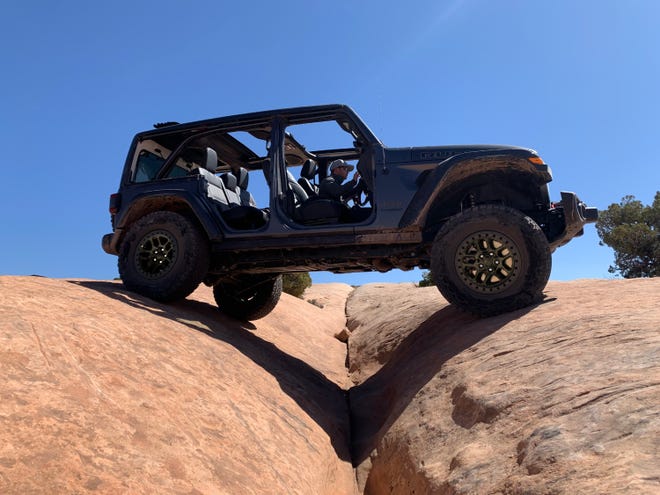
Thirty-fives. 33s once were a reference to vinyl records. In the auto world, 33s designate the biggest diameter off-road tires offered on the Jeep Wrangler Rubicon — at least until this year, when the Ford Bronco Sasquatch package offered 35s. Those were immediately matched by Wrangler’s Xtreme Recon Package. Not only do they look awesome, they are invincible over rough terrain.
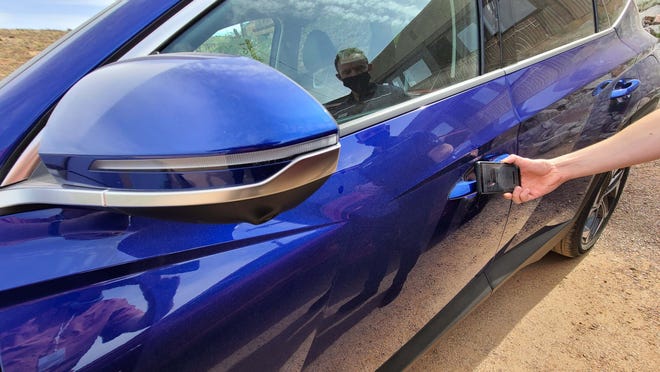
Phone apps. This was the year phone apps became a common commodity. Pioneered by (who else?) Tesla as a way to, say, preheat your car or check its charging state, the feature can now be found on many vehicles from Hyundais to BMWs. Naturally, Tesla is taking the app a step further with Summon, so your car will come to your phone like a sort of mechanical dog.
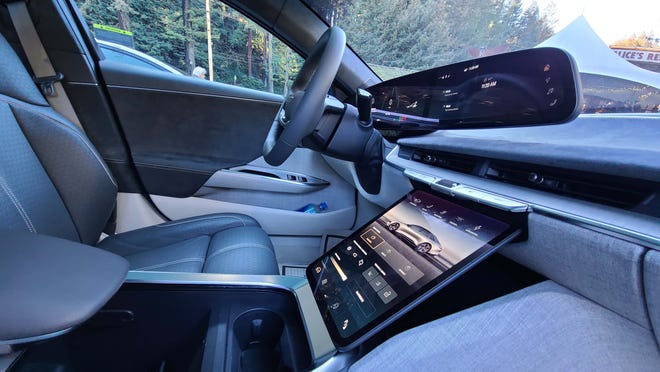
Curved screens. Go ahead, ooh and aah at the curved screens behind the steering wheel of the Porsche Taycan, Lucid Air EVs (extending 34 inches) and Cadillac Escalade (38 inches). They aren’t easy to make, but expect more of them from luxury makers.
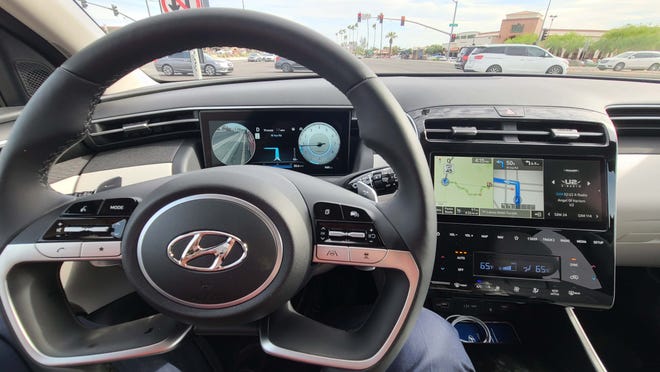
Hoodless displays. Speaking of screens, Hyundai Tucson, Hyundai Ioniq 5 and Ford Mustang Mach-E introduced bright, hoodless instrument screens — continuing the trend of autos becoming rolling smartphones. The Hyundai screens also allow for a more symmetrical interior with clean horizontal lines around the cabin.
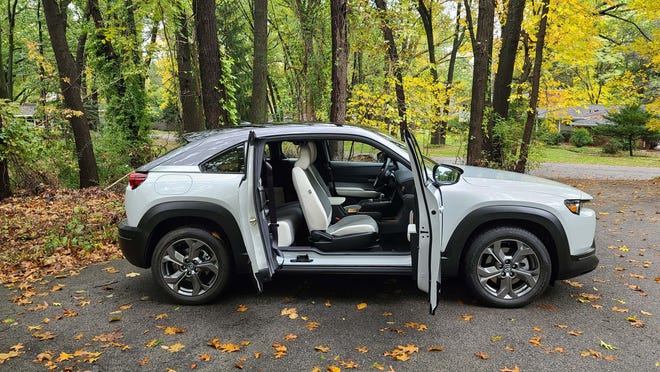
Cabinet doors. Mazda’s first EV, the MX-30, disappointed with its 100-mile range. But the stylish ute wowed with cabinet doors — the sort of thing we’re used to seeing on show cars. The 2019 Lincoln Continental Coach Door Edition, for example, wowed at the Detroit Auto Show with a limited, 80th Lincoln anniversary, 80-car run. Not only do the MX-30 doors differentiate the EV from its gas cousin CX-30 — they also enable easy entry and egress.
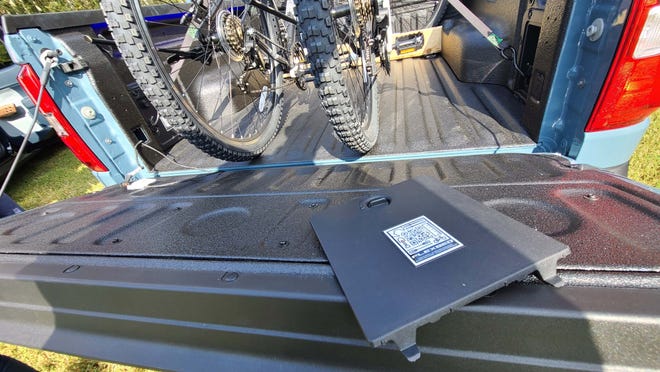
Unibody pickups. Based on SUV platforms, the Ford Maverick and Hyundai Santa Fe broke the pickup mold, offering smooth-riding affordable pickups for less than $30k. With their smaller size came cool new bed features like a sliding tonneau cover on the back of the Santa Cruz. The Maverick appealed to pickup owners’ Do-It-Yourself ethic with multiple options. There’s a QR code in its bed, for example. Scan the code with your phone and Ford takes you to a website with helpful tips on how to, for example, hack 12-volt bed wiring to configure your favorite accessories. A pair of 110-volt outlets are also back there to power tailgate parties.
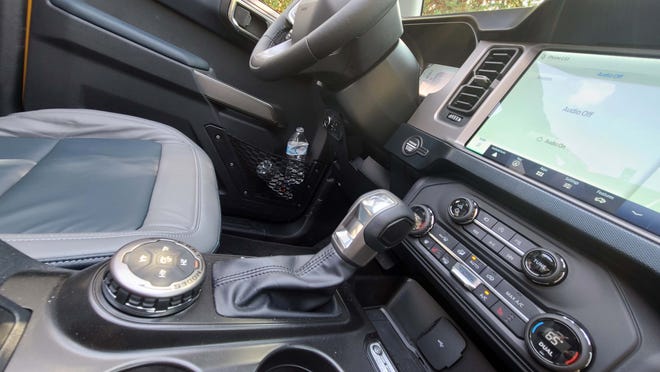
GOAT mode. At the center of the popular Ford Bronco is an electronic GOAT (Goes On Any Terrain) dial that drivers can simply spin to access the off-road bruiser’s variety of drive modes. Combined with electronic buttons atop the dash for complementary functions like swaybar disconnect or Trail Turn Assist, the Bronco’s electronics advance the cause of trailblazing.
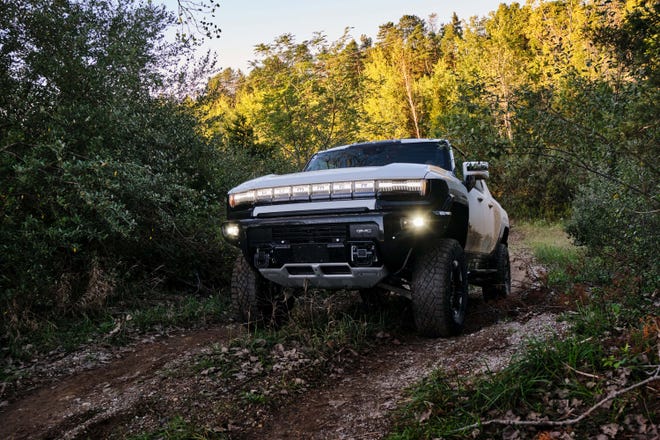
Crab walk. Teased for an early 2023 launch, the Hummer EV is the industry’s most outrageous vehicle with 9,000-pound curb weight, 3.0-second zero-60 mph capability, and crab walk. Hummers were spotted testing on public roads moving in a coordinated shuffle dance. Thanks to all-wheel-steer, the dance has practical applications off-road when the Hummer gets into a tight spot and can move sideways to get out of trouble.
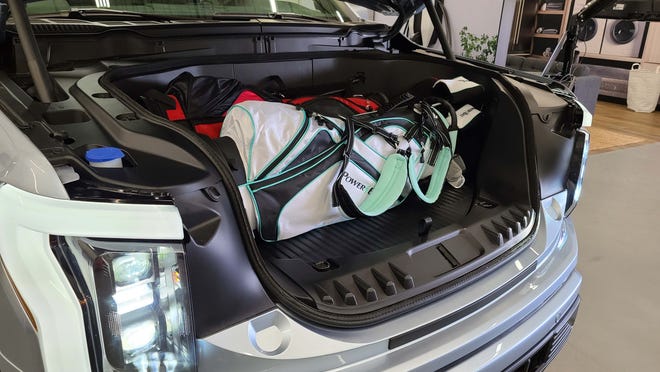
Mega-frunk. Mid-engine sports cars pioneered the “frunk” (front trunk). EVs made it popular. Electric pickup trucks have supersized it. I’m cheating a bit here since the Ford F-150 Lightning won’t be out until next spring, but I got an eyeful this year. Freed of a front engine, the pickup Ford revealed in May boasts the world’s biggest frunk, with 14 cubic feet of cargo room that can fit two golf bags and 400 pounds of payload. Expect more mega-frunks as EV pickups battle it out.
More: Tiny shifters, lane nannies top list of most annoying car technology
Henry Payne is auto critic for The Detroit News. Find him at hpayne@detroitnews.com or Twitter @HenryEPayne.
Payne: Sci-fi Lucid Air offers Tesla performance, European style
Posted by Talbot Payne on December 29, 2021
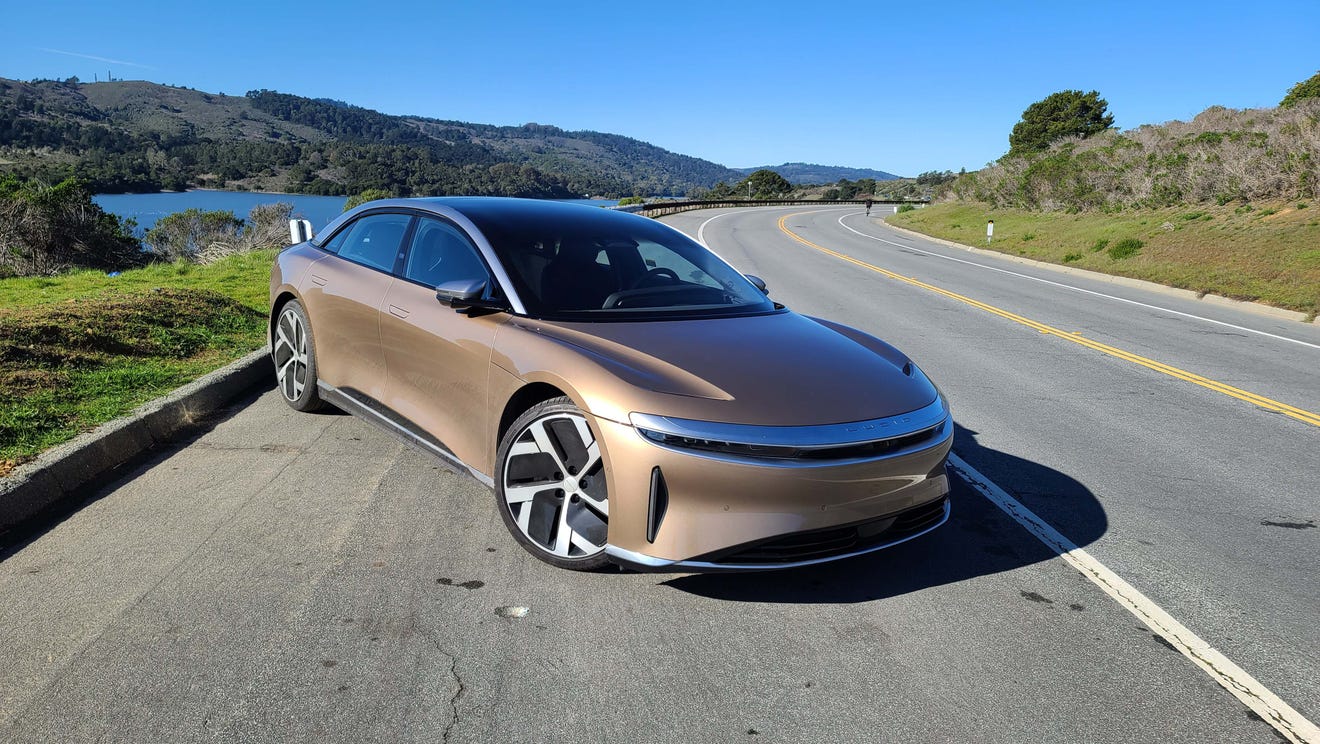
Woodside, California — In 2017 I hustled across Skyline Boulevard here in an American-made, electric, 680-horsepower Tesla Model S P100D. The car was hypnotic — a new standard for luxury that blew away rivals like Mercedes S-class and the BMW 7-series in acceleration (2.3 seconds zero-60) and tech. My goosebumps told me luxury had a new boss.
Four years later and I followed in the Tesla’s tire tracks in the 2022 Lucid Air. The goosebumps were back.
The creation of original Model S engineering genius Peter Rawlinson, Lucid Air has followed the Tesla playbook — leap-frogging the European competition with sci-fi performance, instant torque and drop-dead beauty. With clean-sheet designs propelled by state-of-the-art electric-motor technology, the twin Silicon Valley startups stand atop the luxury class for most electrifying vehicles (pun intended).
At a Woodside stoplight, I triggered launch control by flooring both pedals. Then released the brake. I was halfway to the moon before my vision cleared. With 1,111 horsepower (um, about the same as Penske’s famed 1973 Porsche 917-30 Can Am for you racing fans), the 5,200-pound rocket ship launches to 60 mph in 2.5 seconds. Nearly as quick as the P100D.
Having achieved these heights, the Lucid steps back to ask whether the world is big enough for another Tesla. Push the limits of autonomous driving? Of government regulation? Controls in screen? Yoke steering wheel?
Let Tesla be Tesla. Lucid tries a third way. With one foot in New World power and the other in Old World European luxury, Lucid aims to be the Mercedes of the electronics age.
Take that mind-blowing acceleration, for example.
Unlike Tesla, Lucid hasn’t taken its business model from “Spaceballs,” the movie. My rocket-pad launch was not achieved using Ludicrous or Plaid mode. Lucid sports more conventional Smooth, Swift and (the ultimate Launch Control-equipped) Sprint drive suite. It dovetails with a product that wants to bring classic elegance to EVs, while Tesla explores the bleeding edge of smartphone tech on four wheels.
My $170,500 Air Dream tester is already a collector’s item. Just 520 will be built to launch the model line which begins at $78,900 with the Lucid Air Pure. Slip inside the sedan and it recognized my key like the Model S Plaid I tested earlier this month. No starter button. No brake initiation. Hand meets glove.
But the interior surrounds are more European luxury than Apple smartphone. Lush materials. Porsche Taycan-like, 34-inch curved screen. A traditional full wheel (flat-bottom for ease of entry) versus the Model S’s yoke steering wheel.
A second console screen follows the Tesla example — containing drive modes, steering wheel, climate, even mirror controls. Sealed tight with sound-deadening materials, the 2 1/2-ton space ship is a dream to drive. Like the Model S, it feels organic — no piped-in faux engine sounds like Taycan. Just silent, relentless torque.
At busy Alice’s Restaurant on Route 35 I stepped out of the cabin and Air drew onlookers like a magnet. They’re used to exotic vehicles in the wealthy Bay Area where startups Rivian and Tesla have redefined luxury sedans and pickups (not to mention the stodgy image of EVs).
I remember the first time I saw the Air prototype at the 2017 New York Auto Show. Slim chrome cowl over slimmer headlights. High sills. Bubble greenhouse. It looked like a car from a sci-fi flick.
Take Air to the local country club and your guests will spill out from a backseat as big as your living room. Unlike the prototype, however, the rear compartment is spare, devoid of seat recliners and passenger tablets like Euro rivals. Drive controls are familiar, though you may have to explain one-foot regenerative driving to the valet.
The expected EV details are here. Up front is a bigger frunk than the Tesla — so big it has a sub-frunk. The new Mercedes EQS and BMW iX don’t have frunks. Huh?
Blame poor packaging, something Lucid and Tesla have down cold. The Air has the interior room of a Merc S-class, the wheelbase of an E-class. Credit Lucid’s compact motors — more space efficient than even Tesla’s hallowed tech. Sitting on an industry-leading 900-volt architecture (compared to the Model S’s 400 volt), Lucid benefits from battery technology developed for Formula E racing by battery partner Atieva.
Plug the Air into a 350-kWh charging station and it claims 300 miles of range added in 22 minutes. That’s tops for EVs, though still well shy of a gas engine’s capability.
Air’s huge 118-kWh battery pack is mounted low in a skateboard chassis, and I tackled Route 35’s twisties with confidence. Throttle back and ogle the redwoods canopy above through a Tesla Model X-like panoramic roof.
The standard Lucid Pure features a full steel roof. That front trunk is enveloped by a dramatic clam-shell hood, as is the rear trunk.
Lux buyers want white-glove dealership service, and here Lucid is a work in progress. Following Tesla’s pioneering path (and statehouse lobbyists), it wants to build its brand with unique “studio” showrooms and adjoining service centers. Mobile units will provide home service for small fixes — a convenience I enjoy with my own Model 3.
But my Tesla showroom/service center is an hour away, and mobile units can take days for an appointment. Lucid will face similar challenges. Speaking of infrastructure, Tesla’s secret sauce is a Supercharging network integrated with vehicle software, easing owners’ range-anxiety on long hauls. Lucid puts its trust in a promised network of third-party chargers — in particular partner Electrify America.
In the Golden State Lucid navigated a mock trip to Santa Barbara. The system dutifully found an EA supercharger on the way. Nice start. But, in the Age of Tesla, buyers will also want to know how long they will be at the charger, where to eat nearby, and so on. Lucid hopes its sexy looks, 520-mile range and powerful motors will keep owners content until the charging network catches up.
It also promises self-driving technology. Eschewing Tesla’s daring all-road Autopilot, Lucid talks of a “DreamDrive” hands-free system like Cadillac SuperCruise and Ford BlueCruise. Lucids will get an over-the-air update to awake 32 onboard sensors — including LIDAR for all-season nasty weather.
In just a decade American brands have upended the luxury vehicle landscape. They aren’t called Cadillac or Lincoln. They are fresh-faced kids named Tesla and Lucid. And they come up quickly, silently in your rear-view mirror.
2022 Lucid Air
Vehicle type: Battery-powered, all-wheel-drive five-passenger luxury sedan
Price: $78,900, including $1,500 destination fee ($170,500 Dream Air Performance as tested)
Powerplant: 118 kWh lithium-ion battery with dual-electric-motor drive
Power: 480 horsepower, 443 pound-feet of torque (1,111 horsepower, 1,025 pound-feet of torque Dream Air as tested)
Transmission: single-speed automatic
Performance: 0-60 mph, 2.5 seconds (mfr); top speed, 168 mph
Weight: 5,200 pounds (as tested)
Fuel economy: EPA, 114 MPGe (FWD), 98 MPGe (AWD); range, 406 miles (Pure), 520 miles (Dream Air)
Report card
Highs: Gorgeous figure; best-in-class EV range
Lows: Slim dealer network; gets pricey
Overall: 4 stars
Henry Payne is auto critic for The Detroit News. Find him at hpayne@detroitnews.com or Twitter @HenryEPayne.
Payne: Inside Lucid, Tesla’s Silicon Valley EV arch-rival
Posted by Talbot Payne on December 29, 2021
Newark, California — Located just 11 miles up the San Francisco Bay from Tesla Inc.’s Fremont factory, Lucid Motors is the third electric vehicle maker in California’s Big Three.
With a market capitalization hovering near $100 billion — more than Detroit’s Big Three of General Motors Co., Ford Motor Co. and Stellantis NV — the brand joins Tesla and Irvine-based Rivian Automotive Inc. as highly-valued, 21st-century automakers delivering a new breed of luxury performance.
With ex-Tesla chief engineer Peter Rawlinson at the helm, the Bay Area startup wants to be beat Tesla at its own game. With a stunning, 1,111-horsepower sedan as its flagship, Lucid is coming to a studio showroom near you.
Boasting the industry’s longest range and most-efficient electric motors, it aims to be an American icon. Significantly, Lucid does not offer Tesla’s secret sauce: A proprietary charging network. Instead, it boasts technology-partner Atieva, which produces the battery packs for the international Formula E electric racing series that is pushing the boundaries of battery performance.
Lucid is headquartered in an unassuming office park here, its sans-serif logo glowing atop a low, glass building. Inside, the lobby is dominated by the Lucid Air’s 900-volt, skateboard architecture — its batteries slung low between the four wheels. As the first, $169,000 Air Dream Edition models come down the line at the company’s Casa Grande, Arizona, assembly plant, the company dreams of 500,000-a-year production volumes by 2030 — including production of the Gravity SUV in 2023.
But first it needs to sell the Air, one of the most stunning cars on the market, whether gas-or-electric powered. After wowing the 2017 New York Auto Show, the Air prototype has been methodically prepared for production while Rawlinson & Co. raised capital, a production facility, and performance expectations.
Designed by ex-Mazda design chief Derek Jenkins, Air uses the skateboard chassis to full advantage. Without a gas engine up front, the sleek sedan sits on a wheelbase for a mid-size BMW 5-series — but with interior room similar to a full-size BMW 7-series, including a rear seat fit for 7-footers.
The sci-fi nose features a thin chrome brow stretching the width of the fascia — an even thinner line of LED headlight underneath it. Clam shell hoods reveal big cargo spaces for rear and front trunks. The car wouldn’t be out of place in a Tron movie.
The cabin is dominated by twin console and instrument screens, the latter a 34-inch, curved piece of glass that remind of the Porsche Taycan EV. A panoramic glass roof spans the cabin.
The years after he helped bring the Model S to market, engineer Rawlinson hopes the Air will be the EV standard for the next decade.
Rawlinson took the helm of battery-maker Atieva in 2014 with the promise of building an EV brand. In addition to Jenkins, the Welsh-born engineer has attracted top industry talent to Lucid including ex-Tesla Model 3 and Audi manufacturing veteran Peter Hochholdinger and ex-Apple and Rivian software engineer Michael Bell.
In the back of Lucid’s HQ, doors open to a big development bay where workers fuss over Air models in various states of undress. Atieva’s Formula E manufacturing is also done under the building’s roof, a reminder of the importance of race track-to-production technology transfer which has been key to gasoline engine development over the last two centuries.
“There is a lot of talk of racing technology transfer in the industry, but this is the real deal,” said Justin Berkowitz, Lucid Public Relations Manager for Technology who came over from BMW. Rawlinson himself was Lotus chief engineer, a company with deep roots in racing, before his stint at Tesla.
Beginning in 2018, Ateiva has been the sole manufacturer of batteries for Formula E — its high-performance cells riding in Jaguar, Audi, Porsche, and other racers. Similar battery cell tech sits in the belly of the Air, achieving an industry first 500-miles plus of range (520 miles in the Dream Edition and Grand Touring models).
The batteries drive Rawlinson’s prized, electric drive unit. With a power density of 9.05/kilogram — three times that of the Tesla Model S — at 20,000 RPM, the small, 163-pound drive unit efficiently integrates the electric motor and differential into one housing. The result is not only more power — the Air Dream Edition’s horsepower rivals that of the $3.8 million Aston Martin Valkyrie hybrid supercar — but space efficiency that allows class-leading front trunk space.
Lucid is ambitious. After the Air Dream’s launch — Grand Touring and base Pure models will follow — Lucid’s Gravity SUV will go toe-to-toe with the gull-winged Tesla Model X. Lucid plans to expand into Canada, Europe in 2022, and China in 2023.
The Air’s beauty, performance, and startup appeal earned it a nomination for North American Car of the Year versus affordable, more established models like the Honda Civic and VW Golf GTI.
“It’s an effortless vehicle. Interior is a knockout. The performance is extraordinary,” said NACTOY juror Lindsay Brooke, publications editor for the Society of Automotive Engineers. “And for being such a big machine it really handles better than I thought it would. If they can build up this brand it will be a powerhouse in electric vehicles.”
It has gained the reputation as the “next Tesla” here in Silicon Valley, but some analysts are wary.
“Tesla also enjoyed a first-mover’s advantage in the EV market. Today, the EV market is much more saturated,” writes Motley Fool consumer goods analyst Leo Sun. “In addition to competing against Tesla, Lucid will need to fend off traditional automakers like Ford, BMW, and Volkswagen. That saturation will make it tough for latecomers like Lucid and Rivian to replicate Tesla’s growth.”
Intriguingly the Air Dream Edition begins customer deliveries at about the same time as Tesla’s own 1,000-horsepower beast, the Model S Plaid, which hits the market at $134,490. The Lucid boasts 124 miles range more than the Tesla while still providing shocking power. The Plaid hits 60 mph in 2 seconds, the Air in 2.5.
Game on.
Henry Payne is auto critic for The Detroit News. Find him at hpayne@detroitnews.com or Twitter @HenryEPayne.
Payne: 4Fest off-road autopalooza will be Detroit’s fourth major September auto event
Posted by Talbot Payne on December 21, 2021
If you like beer, go to Munich for Oktoberfest. If you like autos, fall in the Motor City is looking a lot like Septemberfest.
The 4th annual Detroit 4Fest will be held Sept. 16-18, completing a diverse quartet of major auto events next fall including the Detroit Auto Show, Sept. 14-25; the American Speed Festival at M1 Concourse, Sept. 29-Oct. 2; and the Hagerty Concours d’Elegance at the Detroit Institute of the Arts with a September date yet to be determined.

Held at Holly Oaks ORV park in Oakland County, Detroit 4fest powered by Jeep will be the month’s signature event for off-roaders, showing off the talents of dirt-kickers like the Jeep Wrangler and Ford Bronco in their natural habitat.
The 2022 event hopes to gain momentum from 2021’s successful gathering that saw some 5,000 attendees and nearly 600 vehicles. As automakers drift away from static auto shows, experiential events like 4Fest are a chance for brands to show off their wares to customers in real-world surrounds.
“Lots of cool thing to bring to southeast Michigan (next year). Unlike traditional auto shows, 4fest is very participative,” said Detroit 4fest CEO Tom Zielinski in an interview. “You get to go off-roading for real. That makes it an especially attractive place for all automakers to show off their latest greatest vehicles. On top of all that, it’s an environment for the aftermarket companies to show off their wares in places where you can go use them.”

Detroit 4fest vendors include a who’s who of off-road products like Polaris, CanAm, Rebel, America’s Most Wanted, Fox, Hypercraft, Rancho Suspension — in addition to familiar automotive brands like Ram, Ford and Jeep.
Jeep introduced the 2022 Wrangler Willys to 4Fest media in ’21 with the Xtreme Recon package that includes huge 35-inch tires and specially-tuned shocks. And Ford Motor Co. showed off its all-new Bronco with rides to 4Fest attendees over Holly Oaks challenging terrain.
The park’s terrain is a showplace for the capabilities of features like four-wheel-drive, descent control and swaybar disconnect.
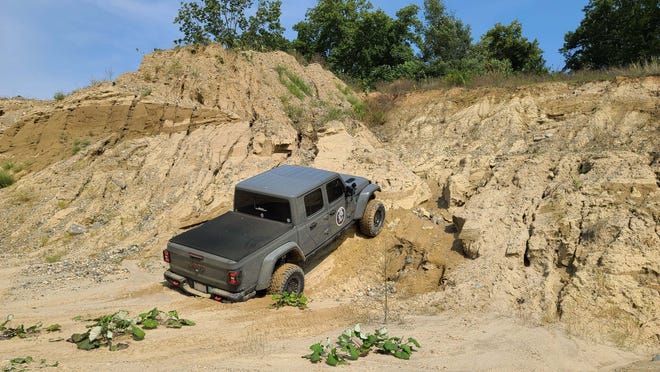
The pandemic dove-tailed with a market trend toward SUVs and more off-road capable vehicles. Exploring the outdoors is a lifestyle choice and as customers looked to take their vehicles overlanding, automakers fed the urge with new choices like the Bronco Sport, Wrangler 4xe, Wrangler 392, Chevy Silverado Trail Boss, Wilderness trims of popular Subaru SUVs, and more.
“Go out and have a fun weekend all weekend long, spray the mud off, and you have your daily driver to go to work,” smiled Zielinski.
4Fest has grown in popularity with this trend with events in ’21 including Detroit4Fest, Minnesota4Fest, and Texas4Fest in Austin, Texas.
Detroit4Fest is structured for the hardcore enthusiast who wants to assault trails in their side-by-side mudder — or for the novice who wants to learn the capabilities of their new SUV. Seminars and demos are available from industry experts including Offroad Skills 101, Tread Lightly principals, and Vehicle Setup.
For 2022, Detroit 4fest is also cooking up some off-road racing.

“King of the Hammers President Dave Cole and I are plotting and conspiring,” said Zielinski of one of the best-known off-road racers in the country. “We may have some really cool racing features to add to 4Fest next year. There may even be an EV component which adds a cool modern twist. There’s some cool stuff coming in the EV space.”
In addition to off-roading on Holly Oaks’ network of trails, attending seminars and shopping in the vendor village, visitors can chow down at food trucks. The event is free to the public, while drivers can register their vehicles beginning on Jan. 10, 2022.
Holly Oaks’ 121-acre arena is gaining a reputation as one of the nation’s premier off-road destinations since it opened in 2020. 4Fest hoped to open an additional 71 acres to participants in 2021, but rainy weather prevented bulldozers from prepping the area. It should be available come next fall’s Septemberfest.
Detroit 4Fest
When: Friday, Sept. 16 (media only). Saturday-Sunday, Sept. 17-18 public days, registration opens Jan. 10, 2022
Where: Holly Oaks ORV Park, 13536 Dixie Hwy, Holly, MI 48442
Henry Payne is auto critic for The Detroit News. Find him at hpayne@detroitnews.com or Twitter @HenryEPayne.
2021 Detroit News Vehicle of the Year: Fresh, feisty, ‘ffordable Ford Maverick pickup
Posted by Talbot Payne on December 16, 2021
News that Dodge is burying its iconic Hellcat models sent a shiver through the auto market this fall as enthusiasts fear a wave of cookie-cutter electric vehicles in the decade ahead. Government scolds are in the driver’s seat — are we doomed for a repeat of “That ’70s Show”?
Happily in 2021, the auto menu is a feast of flavors.
Consider the year saw the introduction of everything from the V-8-powered, 668-horsepower Cadillac CT-5 Blackwing to the battery-powered, 1,020-horsepower Tesla Model S Plaid. Automotive purists got manual toys from the $28K Subaru BRZ to the $138K Porsche 911 GTS. Even the pickup market saw an explosion in diversity with rookies like the entry-level Ford Maverick and electric Rivian R1T.
The sudden growth of pickups beyond the usual light-duty workhorses dovetailed with the SUV revolution that has washed over the U.S. market in the past 10 years. Volume SUV segments saw upgrades from familiar names like Jeep Grand Cherokee, Nissan Pathfinder and Jeep Wrangler, as well as new kids like Volkswagen ID.4 and Genesis G70. Americans escaped to the great, socially distanced outdoors in the adventurous Ford Bronco and Jeep Wrangler 4xe — as well as new trim lines like Subaru Wilderness.
We got a Mach-E, e-Tron, MX30, TLX, Ioniq 5, RS6, Carnival and Karma. Off-road, on-track, gas, electric, three-motor, four-wheel-drive.
My 2021 Detroit News Vehicle of the Year winners:
Third place: Tesla Model S
Yeah, I know, it starts at $91,190 and is out of reach for most of us. But the Model S has been the most influential car of the past decade and the 2022 model is its first major reboot since the OG wowed in 2011.

After Tesla’s success, other companies remade their business models (see Cadillac and Jaguar) to go all-electric. But Tesla’s secret sauce is more than battery power. The Model S remade the luxe space with fresh design, big screens and performance. The ’22 model continues Tesla’s relentless effort to re-imagine the automobile.
The new Model S interior echoes its Model 3/Y siblings with a landscape-oriented, 17-inch infotainment display that includes everything from Autopilot self-driving controls to streaming channels to watch while you’re recharging at the brand’s cross-country network of Superchargers (the only way to travel EV).
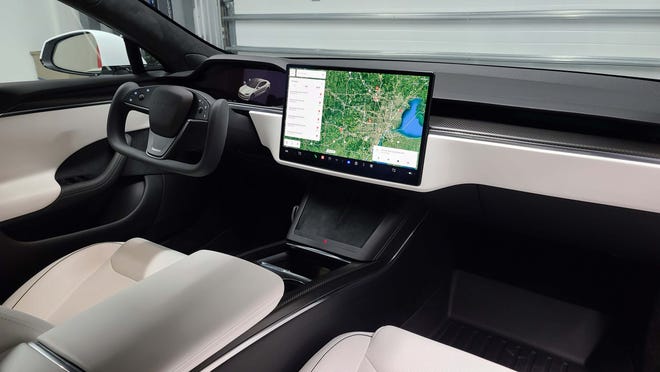
The already minimalist interior gets more so by deleting steering wheel turn signal and shift stalks. Shifting (PARK, FORWARD, REVERSE) is done via swipe on the big screen while the turn signal is integrated into the vehicle’s signature feature, a steering wheel yoke. No joke. Toyota is already following Tesla by adapting a yoke of its own for the forthcoming bZ4X EV.
I tested the $134K Model Plaid, which takes the car’s already superhuman performance to another level: 2-second zero-60 mph launches, cornering grip greater than a Corvette C8. Its 1,020-horsepower, tri-motor drivetrain propels the car to acceleration speeds greater than even the legendary, $3 million Bugatti Chiron supercar — for 20% of the price and 50% more seats.
Runner-up: Volkswagen Golf GTI
The original hot hatch, the Golf GTI has been my baseline for best all-around vehicle. Fun to drive, fuel-efficient, seating for five, hatchback utility — all for an affordable price. Like the Tesla, Golf GTI has reset the bar again with its 2022 model update.

The exterior is updated with sharp stampings and thin headlights — an industry trend as designers love to play with their new LED tools. For my money, the V-dub outclasses its Audi S3 cousin. The car’s performance is more engaging than the Audi’s (with which it shares a platform) thanks to its manual transmission option and hatchback.
The manual bonds driver to machine and there are few experiences more engaging than rowing the Golf over a twisty road. Drivers who prefer automatics will enjoy the GTI too, with its optional “chiclet” shifter right out of a Porsche.

The interior is the real game-changer as VW has brought in twin digital screens with wireless Apple CarPlay and Android Auto. Honda also introduced an all-new Civic Si this year that is an even more affordable pocket rocket than GTI — but the Golf’s hatchback utility trumps the Civic sedan’s standard trunk.
Winner: Ford Maverick pickup
With average prices hovering around $40,000, affordable new vehicles are an endangered species. Say hello to the terrific $21k Maverick.
Not only is the compact pickup a tasty appetizer for Ford’s sprawling truck menu, it’s the entry-level vehicle in Ford’s lineup. And the $21,490 model is no stripped starter. It comes standard with hybrid drivetrain, 500-mile range, 191 horsepower, cool steel wheels, smartphone connectivity and clever interior.
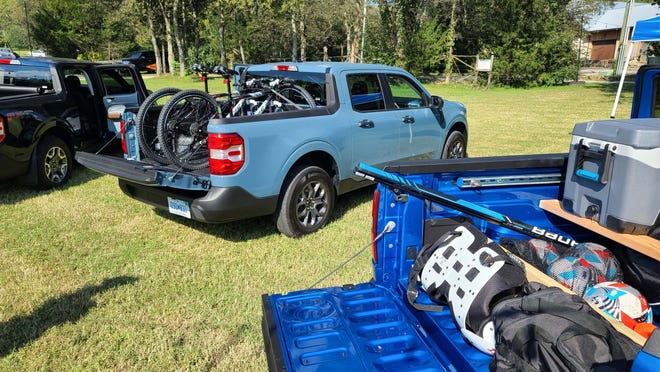
It’s a Swiss (Dearborn?) Army knife for the urban do-it-yourselfer with a roomy interior and capable of carrying 1,500 pounds of mulch in its 4.5-foot bed (the same size as, ahem, an electric, $70K Rivian R1T pickup). Need more oomph? Upgrade to the 250-horse, 2.0-liter turbo-4 engine that can tow 4,500 pounds. If it’s an Olympic weightlifter you want, buy a ladder-frame F-150 truck, but you can’t park big brother easily in a downtown parking spot.
Built south of the border on the same unibody platform as the Bronco Sport (The News’ 2020 Vehicle of the Year) and Escape SUVs, Maverick is fun to drive around town and on the open road. The rear seat can be flipped up, revealing all kinds of sub-storage thanks to its flexible frame. Get the sub-seat organizer — part of a $50 five-pack of gadgets for the rear seat console including cord wrap, cupholder, grocery bag holder and trash bin.
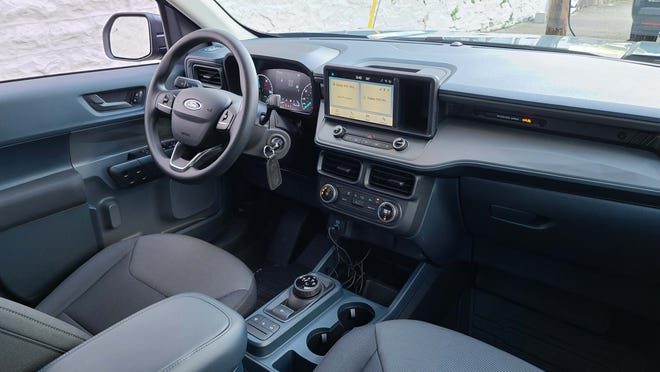
The Maverick is now the third SUV-based pickup in the U.S., and automakers will be watching the wee Ford closely to see if the king of ladder-frame trucks can also sell the unibody variety. Early signs are that customers are biting.
Alas, the affordable Maverick is not immune from chip shortages. Model year 2022 Mavericks are sold out and new orders will not be filled until next summer.
Henry Payne is auto critic for The Detroit News. Find him at hpayne@detroitnews.com or Twitter @HenryEPayne.
Payne: Honda makes ’em drool with racy, 2023 Civic Type R teaser
Posted by Talbot Payne on December 16, 2021
One of 2022’s most hotly anticipated cars is the Honda Civic’s range-topping Type R performance model. Honda whetted enthusiasts’ appetites with camouflaged, teaser photos of the hot hatch undergoing development at the Suzuka Formula One race track in Japan this week.
The striptease doesn’t leave much to the imagination.

The 2023 Type R takes the 11th generation Civic’s conservative styling and adds a big rear wing, swollen rear fenders for fatter tires, center tri-tailpipes, and bigger front grilles to feed the turbocharged beast within. The current-generation Type R makes an impressive 306 horsepower and 295 pound-feet of torque from its 2.0-liter turbo-4 engine and the new-gen model is expected to update the formula.
In defiance of the SUV trend, the compact 2022 Civic sedan was the sixth best-selling non-pickup vehicle in America in the first nine months of 2021, according to Car and Driver. The new Type R will likely be built in Indiana alongside the Civic Sport hatchback after Honda discontinued production in Swindon, England, earlier this year. The move would continue to cement Honda as one of the Midwest’s biggest manufacturers. The Japanese company already produces the #2 best-selling SUV in America, the CR-V, in East Liberty, Ohio, and the Accord sedan in nearby Marysville. Some 95% of Honda’s U.S.-sold vehicles are made in North America.

The 10th-generation car, manufactured from 2017-2021, was a wild sculpture of wings, splitters and scoops. Car and Driver wrote that the exterior looked like “a disheveled knife drawer,” and the new gen tones down the wardrobe significantly.
The last-gen car was a hit. So coveted is the Type R, it owns the fifth-highest retained value in the U.S. market — 61.3% after five years, according to IntelliChoice — behind only the Porsche Cayman GT4, Porsche 718 Boxster Spyder, Ford Mustang Shelby GT500 and Porsche 911 Turbo Cabriolet.
At half (or less) of the sticker price of those exotic beasts, the ultimate Civic is one of the most capable front-wheel drive cars in the market.
With standard, six-speed manual transmission, the 10th-generation car set the fastest time ever recorded at Germany’s epic Nürburgring race track for a FWD vehicle in 2017. Renault’s Mégane R.S. Trophy-R beat that time in 2019, and the new Type R surely has its sights on taking the title back when it debuts sometime next year.

The Honda leads a parade of affordable, front-wheel-drive, $30K-something performance compacts into the market, including the Volkswagen Golf GTI, Toyota Corolla GR, Acura Integra Type-S, and Hyundai Elantra N — and the popular Civic Si sedan, which shares the Type R’s manual shifter but is shy about 100 horsepower.
“I have a Type R on order,” said Jason Richman, a Honda enthusiast from Chicago. “I cannot wait. Last year’s Si compared to the Type R was like night and day. With the 11th-generation Si stepping up so much, the Type R is going to be at another level.”
Henry Payne is auto critic for The Detroit News. Find him at hpayne@detroitnews.com or Twitter @HenryEPayne.
Payne: Tesla Plaid pushes the limits of speed and tech
Posted by Talbot Payne on December 9, 2021
Pontiac — When Spaceballs One hits Plaid speed in Mel Brooks’ classic “Star Wars” spoof, the space ship shakes like a tin can, the engines scream, the crew cowers, and the evil Dark Helmet (played by the incomparable Rick Moranis in a send-up of Darth Vader) yells: “What have I done? My brains are going into my feet!”
The 2022 Tesla Model S Plaid isn’t quite so harrowing. Though I think my brains did bounce off the back of my skull.
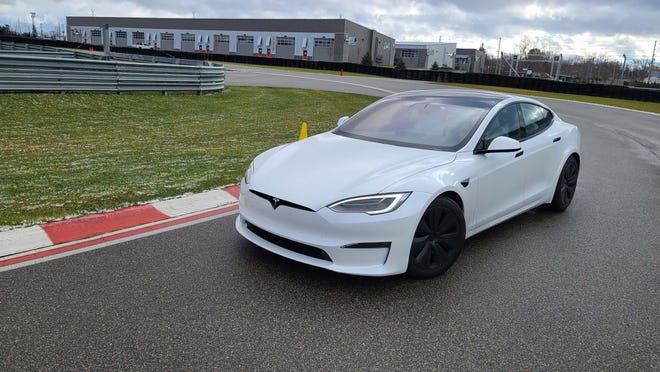
I took the Plaid out onto M1 Concourse’s Champion Motor Speedway this week to experience the world’s new standard for speed. Zero-60 mph in sub-two seconds, 1,020 horsepower, 9.23-second quarter mile at (cough) 156 mph. For comparison, the fastest gas-powered car, the supercharged, 840-horse Dodge Challenger SRT Demon, hits 60 in 2.3 seconds — and the quarter in 9.65. In cold, 30-degree temps on a damp December track, I couldn’t match Tesla’s claimed 1.99-second 0-60 sprint, achieved in optimal California conditions.
But I did manage a series of 2½-second, launch-controlled, 0-60 runs that were a serenely violent experience.

Set Launch Control by matting the brake and accelerator pedals with (respectively) your left and right feet. Release the brake. Holy Mother of Mercy.
The Model S Plaid briefly recoiled as if it been hit by a bolt of lightning. The instrument display lit up with Spaceballs-like orange Plaid graphics. Then the Tesla exploded forward, the tri-motors’ instant, 1,050 pound-feet-of-electric-torque silently crushing my spine into the seatback. According to the data crunchers at Motor Trend, Plaid generates 1.00 g-load at launch, peaking at 1.23-g at 32 mph.
Sixty mph blew by in a snap, but Plaid didn’t stop there, hitting 120 mph in about seven seconds — or about the time it takes a Nissan Leaf EV to hit 60.
“Just stop this thing! I order you! Stooooop!” yells Spaceballs’ Dark Helmet as he holds on for dear life.
But as the end of M1’s back straight rushed up, I simply hit the Plaid’s big brakes and the sedan rotated beautifully into the long, 150-degree Turn 7 sweeper. Another data point? Plaid not only shattered Motor Trend’s acceleration records, it went from 0-to-100-and-back-to-0 again in 8.2 seconds, beating the McLaren Senna supercar by 0.3 seconds.
Tesla CEO Elon Musk is obviously a Spaceballs fan and Plaid has always been the goal of the Tesla’s flagship Model S. But Model S’s performance long ago reset expectations for EVs.
In 2012, the standard, $70K Model S wowed with 5.1-second 0-60 acceleration and 240-mile range. The Silicon Valley automaker relentlessly improved the formula, introducing more capable, more costly all-wheel-drive models. In 2015, Tesla dropped the Model S P90D with Ludicrous mode — a reference, natch, to the speed Spaceballs One hits before Plaid.
I tested Ludicrous six years ago and it made me light-headed, so instant was the torque. It was a Cedar Point roller-coaster ride, and you could do it over and over and over. Zero-60? 2.8 seconds. Now comes Plaid — nearly 30% quicker.
Credit those three carbon-sleeved motors driving the wheels (up from two), more efficient battery pack and fatter 9.5/10.5-inch tires front/rear under enlarged fenders.
But Tesla has always been about much more than straight-line speed. Musk and his elves are about rethinking the automobile (no coincidence Model S badging echoes the revolutionary Ford Model T of a century ago). And legacy automakers are paying attention.
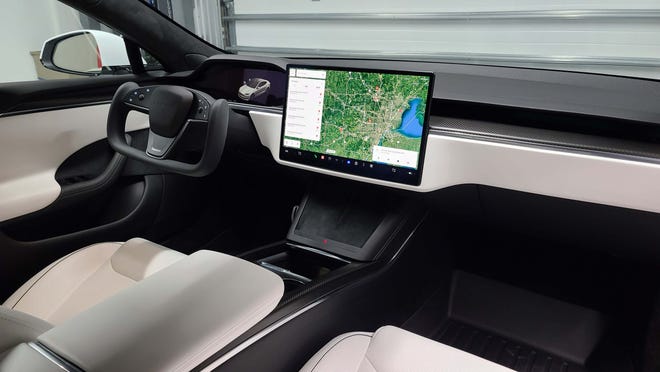
Tesla also captured the popular imagination with its iPhone-simple interior — 17-inch screen, over-the-air updates, Autopilot driver-assist capability.
Desperate to catch the American car company that has been eating their lunch the last decade (something Detroit premium makers struggled to do), German makers have brought out the big guns with EVs like the Porsche Taycan, Mercedes EQS and Audi e-tron GT.
Your move, Tesla. If Model S’s exterior plays it safe (subtle changes include front/rear face tucks and rear Plaid badge), the interior does anything but. Where brand halos usually set the lineup’s tone, Model S takes its design cues from its popular Model 3 junior sibling.
The signature 17-inch center screen has been flipped to landscape mode against a simple horizontal dash (secluded air vents and all) like the Model 3 I’ve owned for three years. Unlike 3, S still features an instrument display, now more subtly integrated into the dash.
What’s really daring in the 2022 Model S is the yoke steering wheel.
Obsessive about pushing the envelope, Tesla has adopted a wheel more common to game consoles and Formula One Racing. Dude, round is sooo 15 minutes ago.
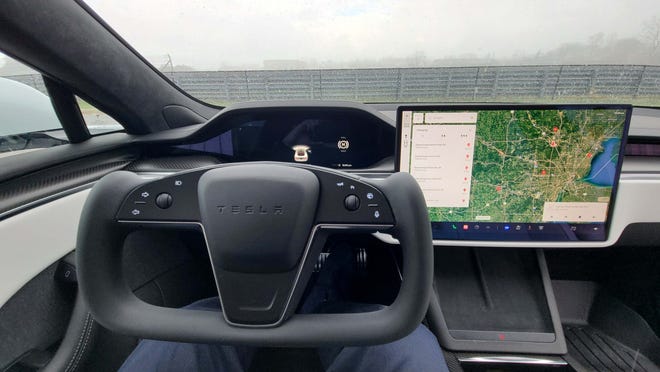
The design improves instrument-display visibility (see that Plaid light show) and is easy to use on track. But it takes getting used-to around parking lots and other tight turns typically negotiated by rotating the wheel hand-over-hand. I found myself learning one-handed driving in tight situations like a baton twirler. If Tesla introduced one-pedal regenerative driving, why not one-hand steering?
The Model 3’s clever, multi-functional scroll orbs are now the heart of the Model S yoke. But Musk & Co. continue to push boundaries by striking the shift and turn signal stalks. Shifting between park, drive and reverse is now done by a screen slider, turn signals by wheel-based buttons. The latter can be maddening.
Cruising along I-75, I actuated Navigate on Autopilot with a simple press of the scroll orb — then automatically changed lanes with the turn-signal button.
At the limits, no one can compete with the Porsche Taycan for handling talent, but Plaid makes a good effort with its state-of-the-art adaptive suspension. In COMFORT mode, I floated above Detroit’s pocked streets. In PLAID mode, the Model S crouched low — hugging M1 Concourse’s turns despite wintry conditions.
Overcooking it into Turn 9, I caught the Plaid’s rear end easily, the car’s electronics helping herd its 4,677-pound girth back into line.
The first significant makeover of the Model S in a decade, Plaid once more raises the bar for luxury performance. With its unmatched Supercharger network, shocking speed, predictable handling and leading-edge tech, it’s the most ambitious sedan in the world. No doubt, its price is only attainable to a few. But at $134,490, it is not only $50,000 cheaper than the comparable Porsche Taycan or Merc EQS, it’s $5K less than the P90D I drove in 2015.
Tesla has gone Plaid, and the competition is still catching up.
2022 Tesla Model S Plaid
Vehicle type: Battery-powered, all-wheel-drive, five-passenger sedan
Price: $134,490 including $1,200 destination fee ($99,490 for base Model S)
Powerplant: 98 kWh lithium-ion battery with three-electric-motor drive
Power: 1,020 horsepower, 1,050 pound-feet torque
Transmission: Single-speed direct drive
Performance: 0-60 mph, 1.99 seconds (mfr.), 2.07 seconds (Motor Trend); top speed, 200 mph
Weight: 4,766 pounds
Range: 348-396 miles (depending on wheel selection)
Report card
Highs: Rocket-ship acceleration; sci-fi interior tech
Lows: Clumsy turn signal buttons on steering wheel; phantom braking in Autopilot
Overall: 4 stars
Henry Payne is auto critic for The Detroit News. Find him at hpayne@detroitnews.com or Twitter @HenryEPayne.