- Search Cartoons
- Comic Archive
-
Payne
Store



 Henry Payne RSS

Articles
Payne: For Christmas, track your dream car in an affordable experience
Posted by Talbot Payne on December 9, 2021
Atlanta — Just a direct flight away, Michiganians can visit Avengers headquarters, jump in a $150,000 Porsche 911 like Tony Stark, and spend an afternoon doing hot laps with an expert instructor.
Cost? About $500.
The world of Porsche and other performance makes has become a lot more accessible this Christmas for auto buffs who don’t necessarily have the means to purchase the cars of their dreams. The Porsche Experience Center (which Marvel used to film Avenger headquarters in the superhero franchise’s hit movies) is the cutting edge of a growing menu of auto experiences available to consumers directly from manufacturers.

Once the exclusive domain of expensive driving schools and track rentals, automakers are opening affordable opportunities to bond with their creations. The opportunities come as the performance product landscape has never been so robust. Track enthusiasts can find everything from a $38,000 Ford Mustang GT to a $60,000 Dodge Challenger Hellcat and even a $60k Chevy Corvette — an exotic, mid-engine package once unthinkable under $100,000.
These thoroughbreds are complemented by off-road performance too: think Jeep Wrangler, Ford Bronco and Ford F-150 Raptor.
The manufacturer programs signal a golden era for auto performance not seen since the ’60s. While emissions mandates and $8-a-gallon gasoline are squeezing vehicle choice abroad, U.S. makers are thriving on cheap gas and deep pockets.
Ford has long been a pioneer in offering performance opportunities to owners beyond getting the kids to school on time. Ford is opening a network of “Off-Roadeos” to celebrate the debut of its much-anticipated Bronco — and owners can take advantage of the opportunity for free (travel to these sites not included). Not to be outdone, the Jeep Adventure Academy caters to 4×4 owners with rugged playgrounds from Hollister, California, to Vermont starting at $329 a day.

But the buffet is opening up for non-owners as well.
The Ford Performance Racing School in Charlotte, North Carolina, offers one or two-day driving schools in the iconic Mustang GT starting at $1,695. “All Ford Performance Racing School classes are conducted by professional instructors (offering) exhilarating, on-track driving instruction for every performance driving enthusiast, regardless of skill level or goal,” says the website.
GM has a similar program for those who want to see if the sexy Corvette C8 is their cup of tea before dropping their life’s savings. The opportunity costs $3,695 for a two-day school and buys them a ticket to Pahrump, Nevada. Owners get in for a grand.
Cadillac sweetens the deal for those who want to saddle up a ferocious CT4-V or CT5-V Blackwing sedan. Tuition is free for owners, $3,545 for non-owners. The school attracts about 12 to 24 Cadillac students per week.
Closer to home in Pontiac, Dodge makes available Dodge Charger Hellcats and Viper sports cars at M1 Concourse. For $2,000, customers can get schooled in how to drive M1’s race track in their own car, then take a spin in the Hellcat and Viper for comparison.
“The package was suspended last year due to COVID and we’re looking at bringing it back in 2022,” said Marc Molzen, chief instructor for M1 Concourse.
And then there’s Porsche. Its affordable offer to non-owners is unusual for such a high-performance brand.
The automaker keeps a fleet of 911 supercars, mid-engine Caymans/Boxers, Cayennes SUVs and Taycan EVs for curious drivers to experience. Porsche is the world’s baseline for performance, and drivers can experience the extraordinary limits of these automobiles for the price of an airline ticket to Atlanta.
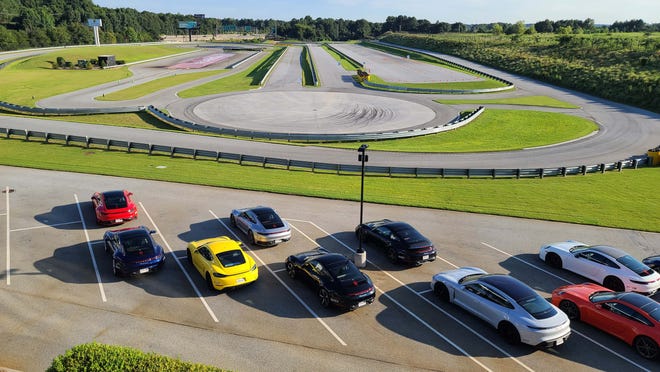
The experience not only allows Porsche the opportunity to addict potential buyers to the brand’s legendary speed, but also enables exposure to new products like the 2022 Porsche 911 GTS hellion — or the Taycan EV as the industry makes a risky bet on battery-only vehicles.
A visit to Porsche’s Georgia facility — which backs up to Atlanta’s Hartfield International Airport (fewer complaints from the neighbors about noise that way) — is also evidence of how foreign automakers have come to dominate geographical regions of the country outside the Detroit Three’s lair.
Today, Honda rules central Ohio with two plants churning out some of the highest-volume vehicles in the U.S. market like the CR-V SUV and Accord sedan. South Carolina is home of BMW, which produces its North American SUVs in Spartanburg — while also offering a driving experience like Porsche’s to whet consumers’ appetite for the Bavarian brand.
Out west, Tesla has become the signature California brand — its electronic wizardry in sync with a West Coast tech culture. Tesla does not offer driving experiences, but manufactures vehicles in a Fremont plant once home to GM.
Porsche has no production in the U.S., yet the American market is essential to its success.
Since the first 356 Speedster was sold in 1950, Porsche has aggressively marketed to Americans, establishing a New Jersey-based North American HQ in 1960. Porsche’s headquarters in Atlanta (established in 2015) is an ambitious effort. Set on 27 acres, the headquarters building is an architectural gem that has attracted multiple movie studios for filming — including Avengers. The company plans to expand the facility with a sprawling networks of roads and proving grounds.
For now, the Porsche Experience is concentrated on a 1.5-mile track that envelopes a complex of skid pad, wet-skid pad, slalom course and off-road course. The 90-minute program is designed with German efficiency to accommodate a traveler with an overnight stay in Atlanta’s airport on their way overseas.
Customers can choose from an extensive menu of driving experiences, from a singular date with the Porsche Boxster ($365) to a comparison test of 500-horsepower 911 Turbo and 911 GTS ($975). Allow me to recommend the latter. It’s the Christmas season.

The program includes food at the palatial headquarters and a guided tour of the facilities — featuring the Porsche Heritage Museum — a rotating exhibit that features some of the most legendary cars in Porsche’s racing/production pantheon.
My tour included Jack Ryan’s black #12 Porsche 911 — the first 911 to go to victory circle when it won the 2.0-liter class at the 1964 24 Hours of Daytona.
Henry Payne is auto critic for The Detroit News. Find him at hpayne@detroitnews.com or Twitter @HenryEPayne.
Payne: The times they are a-changin’ with BMW’s wild, 750-horse XM super-ute
Posted by Talbot Payne on December 2, 2021
The auto market is wacky these days. The popular Dodge Hellcat is being axed, automakers are converting their fleets to electric vehicles with limited demand, and Ford’s entry-level vehicle is a pickup truck.
Not to be outdone, BMW’s M performance division is celebrating its 50th anniversary with an electrified super-ute.
The division’s second standalone M-vehicle, the BMW XM SUV is a long way from the original, legendary mid-engine 1979 M1 supercar. In a sign of the times, BMW’s most powerful car for the 2020s will be a sport utility model carrying a plug-in hybrid powertrain under the hood.

The 750-horsepower BMW XM debuted this week with supersized power, body stampings, and twin-kidney grilles that can be seen from space. BMW called the x-otically designed XM a concept car, but it is likely close to finis form as it will go into production at the automaker’s Spartanburg, South Carolina, assembly pant in just 12 months.
In keeping with the changing times, XM took its bow at the international Art Basel show’s Miami Beach exhibition as automakers look for new ways to debut their wares beyond the traditional auto show. The XM was unveiled with a special musical performance by Grammy-wining hip hop artist Nas beside a sculpture crafted for the occasion by Brooklyn-based artist Kennedy Yanko.
“Art Basel in Miami Beach is the perfect moment to launch the BMW Concept XM, a product unlike anything we’ve ever produced,” said BMW North America marketing boss Uwe Dreher. “This unique concept vehicle is matched perfectly to the expressive artwork from our partner artists, underscoring BMW Group’s commitment to supporting culture and the arts.”
BMW wowed the auto world in 1978 with the Italian-designed M1, a mid-engine cyborg that opened BMW’s M performance era. The M1 was produced in limited numbers — just 453 units were built in order to homologate it for international racing — but it fathered the German maker’s signature performance badge. So successful has M division become that it inspired similar product strategies from competitors like Cadillac (V-series badge), Mercedes (AMG) and Audi (S-line).
Generations of steroid-fed, M-badged hellions have followed, with the M3 and M4 performance cars the most iconic. But as the world has flipped for four-wheel-drive SUVs, BMW has found a vast new market for M-badged utes despite their inherently inferior handling compared with low-slung sedans — much less mid-engine supercars.
So for Bimmer’s 50th, the XM super-SUV popped out of the birthday cake.
The XM also introduces the M-badge’s first plug-in hybrid drivetrain — marrying the capabilities of battery power with the brand’s traditional, twin-turbo, 4.4-liter V-8 gas engine. The XM can cruise silently on battery power for up to 30 miles — or you can stomp your right lead foot and rocket out of stoplights with 737 pound-feet of combined gas-electric torque. The XM out-guns other super-utes like the Lamborghini Urus (641 horsepower), Dodge Durango SRT Hellcat (710) and Porsche Cayenne Turbo S E-Hybrid (670).
Unlike M-badged sedans, however, it’s unlikely to be seen at track days.
“The BMW Concept XM represents a complete re-imagining of the high-performance vehicle segment,” said M division chief Franciscus van Meel. “It underlines the ability of BMW M to break with established conventions, and . . . also shows how we are approaching the step-by-step electrification of our brand.”
The BMW brand has been challenged by EV maker Tesla. The U.S.-based automaker’s Model 3 outsold all other luxury models in 2020 — its 206,500 unit sales beating BMW’s X3 by more than 3:1.

The XM — with a similar wheelbase to BMW’s largest SUV, the X7 — wraps its performance in one of the most angular SUV designs this side of a Lamborghini Urus.
The huge, oxygonal front kidneys — filed with horizontal slats — set the tone for a bold design dominated by polygonal shapes on the exterior and interior. Headlights and taillights are reduced to spare strips, while pentagon wheel wells (sitting atop enormous, 23-inch wheels), square exhaust pipes, hexagonal air vents — even hexagonal seat headrest cutouts — define the styling. Breaking up the polygons are twin BMW roundel logos on the rear glass commemorating the original M1 supercar.
A two-tone paint scheme finishes the upper body in matte gold-bronze — the lower torso in Space Grey Metallic. A high-gloss black boundary — dubbed “black belt” — separates the two colors.
Underneath the narrow greenhouse is an all-digital cockpit wrapped in upscale leather, copper and carbon fiber.

A curved display screen dominates the dash, stretching from behind the steering wheel over the center console. The system is operated by BMW’s familiar remote i-Drive controller. Behind the driver-focused cockpit are rear “M Lounge” seats secluded by black-tinted windows and decorated with “deep aquamarine shade Petrol,” in contrast to the front brown leather.
The headliner is decorated with an artistic three-dimensional prism structure — echoing the Art Basel gallery displays nearby. The new SUV will be on display all week at Miami’s convention center.
Henry Payne is auto critic for The Detroit News. Find him at hpayne@detroitnews.com or Twitter @HenryEPayne.
Payne: Honda Civic Si is a manual-shift value meal
Posted by Talbot Payne on December 2, 2021
Simi Valley, California — Some performance cars fit like a glove. The Ford Mustang HiPo, Porsche Cayman, Volkswagen Golf GTI. They are intuitive to drive. Instantly familiar. Balanced.
Put the 2022 Honda Civic Si on the list.

This is Honda’s driver’s car. Manual gearbox only. Rev-matching downshifts. Limited slip differential. Charging though the twisted canyons of Simi Valley north of Los Angeles, the Civic Si never put a foot wrong. The sedan rotated effortlessly for a front-wheel-drive car, summer tires sticking like flypaper. Rowing the box, I stomped the throttle and turns flew by.
Call it Si-mi Valley. This is where Angelenos come to escape suffocating traffic, cramped apartments, insufferable celebrities. It’s the playground of sports cars, hot hatches, sport bikes. The Civic Si is proof you can have it all in one car.
Honda took the compact class by storm in 2015, unveiling an ambitious 10th-generation Civic baselined to an Audi A4 and fine-tuned at the famed race track in Nurburgring, Germany, for goodness sake. The Civic boasted best-in-class fuel economy, rear leg room, smartphone connectivity. I dubbed it King Civic, the compact by which all others must be judged. Si and Type R performance models followed, each better than the last.
For its encore, Civic hasn’t rested on its laurels. The standard Civic introduced earlier this year won rave media and reviews with generous features, affordable sticker and sleek fastback variant.
But for enthusiasts like me, a Civic lineup isn’t complete until the performance models come along. Remarkably, Si is better in nearly all respects from the last gen. Let’s go inside out.

Engineers have sweated the details. The stick shift goes to the head of the class, rivaling Porsche and Mazda for short, notchy throws. In more mundane stop-and-go urban commutes, owners will appreciate the easy clutch.
Speaking of clutches, heel-and-toe downshifts are a snap (much improved over the previous gen, where even my size 15 clown feet struggled to blip the throttle on downshifts). Not that you’ll need it. Honda is also throwing Si drivers the same rev-matching convenience as the last-gen Type R track rat. Whether in the LA canyons or GingerMan Raceway in west Michigan, the digital feature makes downshifts wonderfully efficient.
Toggle the drive mode rocker to SPORT and Si tenses for action. I rode shotgun with Honda IMSA racer Ryan Eversley for a spell and he sung the praises of the heavy steering and sticky rubber. They are natural outcroppings of a Honda racing culture that spans everything from Eversley’s TCR racer to IndyCar.
All of this mechanical goodness is wrapped in Civic’s upscale interior — a major leap from last gen’s plasticky, too-busy interface. So appealing is the signature honeycomb dash that Honda’s High Performance Division kept it in the upcoming Si TCA race car — while stripping out the rest of the interior for light-weighting and rollbar.
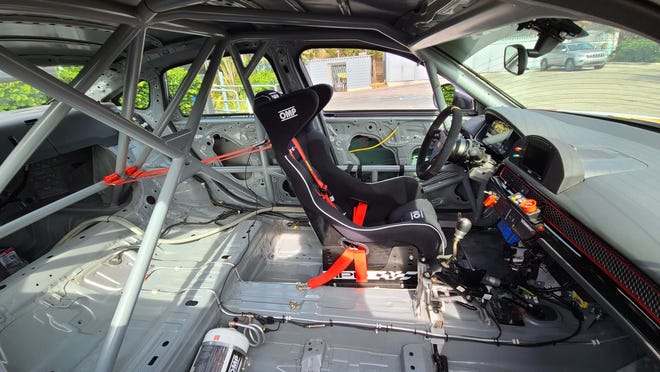
The production cockpit features a sunroof and all-digital instrument/console displays (standard on the base Civic), with Si bringing a 9-inch version with one of the most intuitive infotainment layouts this side of Jeep’s UConnect 5. Wireless Apple CarPlay and Android Auto connectivity beats many luxury cars to market, and Civic — true to Honda’s obsession with detail — even makes sure directions from Google Maps translate to the instrument display so you never have to take your eyes off the road. BMW does that too — for $50,000.
Jump into Civic Si and it will recognize your phone’s Google Maps directions (look Ma, it’s wireless!) and chart your course. So much fun is Si to drive, you’ll get there early.

Add in Honda’s standard Safety Sensing suite of adaptive cruise control, blind-spot assist, auto-rear braking and laser night vision (kidding about that last one), and Si stickers at $2,000 more than the outgoing car.
It’s one of the best $28,315 bargains in autodom.
I’m a Golf GTI missionary — VW’s iconic, FWD stick-shift hellion — but to get the same features on the GTI (base price $31,000) I’d have to shell out a cool $35,290. Ouch.

That’s a lotta coin for the V-dub’s hatchback and 272 pound feet of torque (vs. Si’s 192). The Honda knows its niche, and sets the bar for sub-$30K pocket rockets.
Golf’s advantages expose the Si’s weak spots. Since the screaming, 201-horse 2006 Si (I still own one) the car’s numbers haven’t budged, while Golf GTI has increased by 25% to 240 ponies. Sure, the torque band has fattened as Honda went turbo power, but my right foot wants more. Blame federal bluenoses — and Honda’s target of 30 mpg-plus — for holding the numbers back.

Out back, I would prefer Si with a hatchback, like that offered on Civic’s $29K Sport model. The hatch brings utility and design character — but at added engineering cost.
After the far-out design of the 10th-gen Civic (its boomerang taillights right out of a comic book), Generation 11 is mercifully more conservative, with styling that will endure for years like my similarly spare 2006 model. The ’22 Si does gain cool black 18-inch wheels, a honeycomb front grille (echoing the dash) and Blazing Orange paint to help separate it from the rest of the brood.
Honda says it’s saving the hatch for the Type R.
The 2022 Civic’s return to more austere styling comes as the Hyundai Elantra N muscles its way into the segment. The Elantra looks like it was penned by an ex-pat Lamborghini designer, with more jagged surfaces than a broken mirror. Nice to have choices.
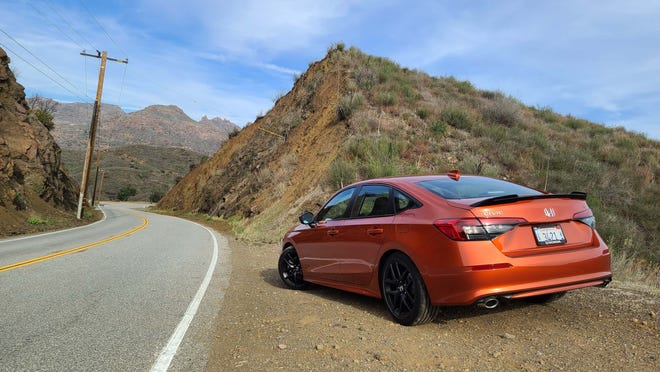
I tested the Civic Si after the Los Angeles Auto Show and it was a breath of fresh air after the nonstop gloom-and-doom press conferences pushing morally correct electric SUVs with the sex appeal of a granola bar.
Si is what automobiles were meant to be since Henry Ford terrorized Grosse Pointe. It’s a sedan designed to seat four and fetch the groceries. But it is also built for freedom — a car that can transport you to the joys of the open road.
For lead foots who want a little more from their ride, Si’s an engaging date for an autocross or a track day at GingerMan. Just be sure and bring a spare set of tires. It’s so much fun to drive, you might wear the summers to the bone.
2022 Honda Civic Si
Vehicle type: Front-engine, front-wheel-drive, five-passenger sports sedan
Price: $28,315, including $1,015 destination fee ($28,910 with summer tires and Blazing Orange paint as tested)
Powerplant: 1.5-liter turbo-4 cylinder
Power: 200 horsepower, 192 pound-feet of torque
Transmission: 6-speed manual
Performance: 0-60 mph, 6.4 seconds (Car and Driver); top speed, 135 mph
Weight: 2,952 pounds
Fuel economy: EPA, 27 mpg city/37 highway/31 combined
Report card
Highs: A joy to drive; manual shifter from the gods
Lows: Bland face for such a fun car; no hatchback
Overall: 4 stars
Henry Payne is auto critic for The Detroit News. Find him at hpayne@detroitnews.com or Twitter @HenryEPayne.
Payne: Porsche Cayman GTS sings sweet music for the sports car purist
Posted by Talbot Payne on November 29, 2021
Hell — In this age of rapid technological change, we crave analog experiences. We enjoy unplugged instrumental music. Or cozying up with a page-turning novel rather than a digital Kindle. In the auto world, the normally aspirated, rear-wheel-drive manual sports car is the purist’s choice. MX-5 Miata, Mustang GT, Subaru BRZ.
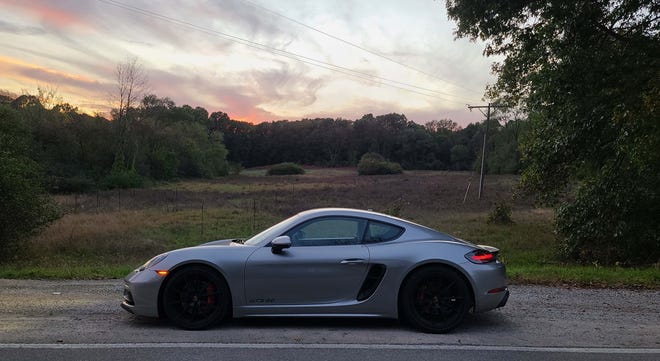
The summit of the art form is the Porsche Cayman GTS.
With its howling 394-horsepower flat-6 engine amidships, six-speed manual shifter and tight chassis, it is the Stradivarius of pure automotive instruments. On the writhing roads of Livingston County west of Hell, the Cayman proved why you have to take this thoroughbred out of the city to fully realize its potential.
Hadley Road swells and dips like a roller-coaster with blind turns and long straightaways. The Cayman GTS stuck to every undulation like a fly to flypaper. Its steering is telepathic, hitting my marks — the front and rear ends a symphony of balance. Speaking of symphonies, the six-cylinder chambers breathe in natural air like God intended — no turbos or superchargers here — then exhale through twin pipes with a passionate wail.
Like listening to Springsteen belt the chorus of “Born to Run,” I kept the volume on high — habitually driving a gear lower so I could maintain revs over 3,000 RPM.
Yet even as the Cayman GTS has achieved iconic status, it is under assault on multiple fronts.
The greatest threat are government killjoys who aim to strangle the flat-6’s vocal chords. In order to meet increasingly restrictive global emissions rules, Cayman (and sister Boxster convertible) had to downsize to four pistons in 2017 — resorting to the turbocharger to maintain power.
Robbed of the six’s siren call, customers went elsewhere and U.S. Cayman sales dropped by half in 2019. Under Communist China’s strict mandates, the 4-banger is all that’s available, but in the USA, Porsche heard customer demand and rallied to offer the flat-6 where possible (matched with a manual to sweeten the deal).
The result is the GTS and Cayman GT4 models, which represent the mid-engine terror’s rebel soul.
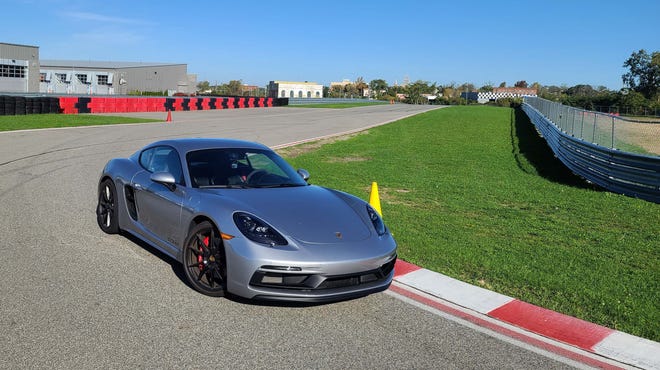
At M1 Concourse’s Champion Motor Speedway in Pontiac, I paused at pit exit to engage launch control. WAAUUUUGGHHH! The engine spiked at 5500 RPM before I dumped the clutch and leapt into Turn One, clicking off upshifts with short, precise throws.
The lap is an enthralling carnival ride with multiple thrills: neck-straining G-loads, lurid power slides, heart-stopping brakes. The aural highlight comes on the back straight where I exit the hairpin in first gear, then open the throttle to 8,000 RPM as I row the box — BAM, BAM, BAM — to fourth gear. Some people like Carmen, I’ll take the Cayman’s operatic notes.
But as European nannies further turn the screws, Car and Driver reports that the next-gen Cayman-Boxer will be electric — a radical move that could fundamentally change this storied athlete. Battery weight (the Cayman GTS weighs a mere 3,042 pounds) is the enemy of sports cars — not to mention the lack of audio thrills.
Porsche has made known it will not mess with its iconic 911, which will remain gas-fired. Perhaps they learned the lesson of Mustang, which compromised its own sports car halo with a four-cylinder weakling in response to federal nannies in the 1970s. It was reviled by purists.
But if reports are true, Porsche seems willing to experiment with its mid-engine icon. It’s “That ’70s Show” again, and automakers are in a tight spot. Who do you anger, bureaucrats or customers?
Cayman is no longer alone in the sub-$100K mid-engine supercar space.
Chevy’s Corvette has gone mid-engine, too, putting its own heavenly, naturally aspirated V-8 soundtrack just behind your right ear. The V-8 is no-less addicting than the Cayman’s flat-6, and designers nailed the car’s proportions on their first try — bringing the ’Vette’s signature sharp design cues in contrast to the Cayman’s spare, bullet shape.
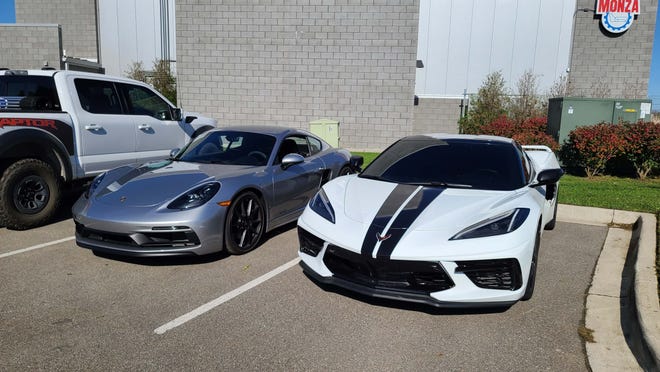
The ’Vette dropped a rung on purists’ wish list when it sacrificed its manual transmission for its eighth-gen car. But it’s no great loss, as the last-gen Corvette C7 manual was a mushy, three-gated 7-speed that often left drivers with a bag of neutrals. The Porsche is crisp, notchy — gear changes require nothing more than a flick of the wrist.
It’s pure sports car.
But interior technology matters, and Cayman lags the ’Vette. The Porsche is tidy, ergonomically friendly — especially with regards to performance, where the brand has pioneered a steering wheel-based mode selector so you can rotate into SPORT PLUS without taking your eyes off the road. Corvette has learned the lesson with tools like Z mode.
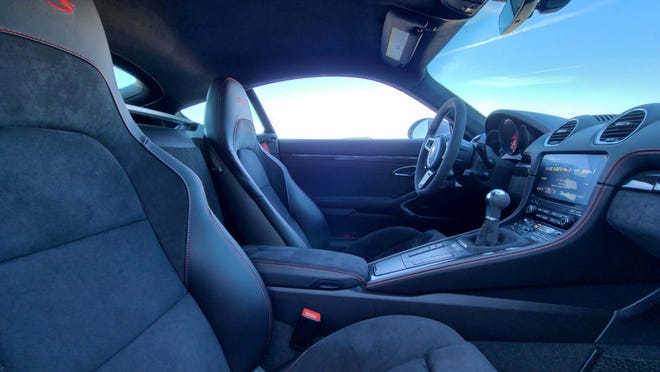
Yet the Cayman interior relies on flimsy cupholders that retract from the dash (hang on to your drink before zipping through Hell!). The ’Vette has access to the full GM toolbox, and brings Apple Carplay/Android Auto and an array of digital instrument displays — even an optional head-up display — that wear well on long trips.
Cayman is more accommodating in the luggage compartment. There is ample space in the frunk for a carry-on bag (or helmet if you’re headed for a track), and the rear hatchback can swallow lots of stuff, including a golf bag. As I’m a proponent of Golf GTIs and Mazda 3s, the Porsche’s hot hatch warms my heart.
As does the styling.
Given the 1970s-like regulatory upheaval going on today, many customers will be holding on to their flat-6 Caymans/Boxsters for years to come. Cayman helps with its timeless looks. It’s a German thing (my son’s 2012 Golf GTI still looks relevant even as the V-dub has evolved two generations since), and the Cayman should wear well just as 911s and 928s before it.
For Cayman fans with even more need for speed, Porsche offers a winged GT4 with sticky Sport Cup 2 tires. The Cayman GTS — in the tradition of performance “tweeners” like the Corvette Grand Sport or Cadillac V-series — is a happy medium between full-on track rat and base car.
Base is a relevant term and the Cayman starts at a Corvette-like $61,850. Stuff it with the GTS’s glorious flat-6 and the price jumps to $88,750. Don’t expect that number to decline much in the years ahead.
Porsche has crafted an icon, a classic that will be more appreciated over time as a benchmark for handling and gas-powered performance.
Dancing on the edge of adhesion around Turn 10A at M1 Concourse, I flicked the Cayman’s stick into third gear and the Cayman sang. Simple, repeatable, thrilling. What purists crave.
2021 Porsche Cayman GTS
Vehicle type: Mid-engine, rear-wheel-drive two-passenger sports car
Price: $88,150, including $1,350 destination fee ($100,990 as tested)
Powerplant: 4.0-liter Boxer flat-6 cylinder
Power: 394 horsepower, 309 pound-feet of torque
Transmission: 6-speed manual
Performance: 0-60 mph, 4.3 seconds (mfr); Top speed, 182 mph
Weight: 3,042 pounds
Fuel economy: EPA, 17 mpg city/24 highway/19 combined
Report card
Highs: Flat-6 music; precision handling
Lows: Infotainment tech lags; gets pricey with options
Overall: 4 stars
Henry Payne is auto critic for The Detroit News. Find him at hpayne@detroitnews.com or Twitter @HenryEPayne.
What’s your car worth? Honda, Lexus take home JD Power Residual Value Award, again
Posted by Talbot Payne on November 29, 2021
Buy a new home and you can track its value on Zillow or Redfin. Buy a new car and JD Power is at your service tracking residual value.
If you own a Honda or Lexus, then your asset is looking pretty good.
That’s the conclusion of ALG, a division of JD Power, and its 2022 Residual Value Awards which honor the Japanese companies as the top brands in the mass market and premium segments. In addition to the coveted brand awards, ALG handed out trophies to models in 29 segments this month, including the GMC Sierra HD as winner of ALG’s first award for fullsize heavy duty pickup.

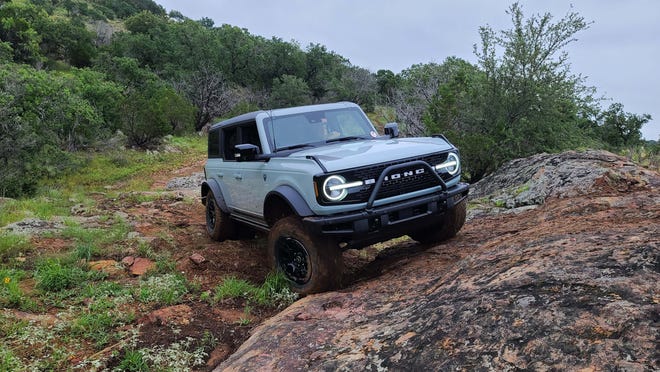
Other notable Detroit winners were the Dodge Charger for fullsize car and the Ford Bronco as off-road utility.
“It’s Honda’s tenth time winning the brand award. Toyota has only won once. There is only one other brand that’s won our award and that’s Subaru and they have won eight times,” said ALG Vice President Eric Lyman in an interview.
ALG’s awards recognize vehicles projected to hold the highest percentage of their manufacturer’s suggested retail price after three-years of ownership. The value is a key factor in which models buyers shop for — as well a key variable in valuing the estimated $225 billion lease portfolio of vehicles in the United States.
The residual awards judge vehicles on long-term quality and design, as well as the overall brand desirability.
“We have these three Japanese brands (Honda, Subaru, and Toyota) well known for their long term durability, quality and resale value winning the award year after year,” said Lyman. “But we’ve seen the domestic brands and Korean brands close the gap. We’ve got representation from the Detroit Three auto makers with Ford Bronco winning for (their) first year in market. Dodge Charger is the perennial winner in the full-size segment, and Chevy Tahoe winning in full-size utility.”
For model-year 2022, 284 vehicles were assessed in 29 segments. Eligibility for the brand award requires a manufacturer to have model entries in at least four different segments.
In taking home the mass market brand bauble, Honda also won three model segments. By contrast Lexus won best premium brand even as none of its models won a segment outright.
“The achievement of Lexus speaks to an impressive, industry-leading continuity of residual value across its entire lineup,” Lyman said. “It’s like a decathlete who doesn’t have to win any of the individual 10 events but scores enough points in each of them to stand atop the podium.”
Honda and Hyundai share the most model-level awards, with three each. Audi, Kia, Land Rover, Mercedes-Benz, Subaru and Toyota had winners in two categories.
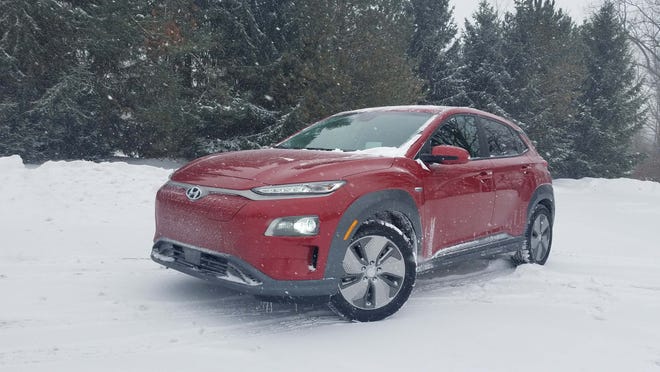
In addition to Bronco and Sierra first, notable winners were the Mercedes-Benz AMG GT sedan topping long-time Premium Executive segment champ Lexus LS. In the emerging electric vehicle market, the Kona EV won for best mass market EV while the Tesla Model Y won the premium EV segment.
Full list of model winners:
Compact Utility: Subaru Forester
Full-size Utility: Chevy Tahoe
Micro Utility: Hyundai Kona
Midsize 2-Row: Honda Passport
Midsize 3-Row: Kia Telluride
Off-Road Utility: Ford Bronco
Premium Full-size Utility: Jeep Grand Wagoneer
Premium Midsize 2-Row: Range Rover Velar
Premium Midsize 3-Row: Land Rover Discovery
Premium Subcompact Utility: Audi Q3
Subcompact Utility: Mazda CX-30
Mass Market Electric: Hyundai Kona EV
Premium Electric: Tesla Model Y
Fullsize HD Pickup: GMC Sierra HD
Fullsize Pickup: Toyota Tundra
Midsize Pickup: Toyota Tacoma
Commercial Van: Mercedes Metris
Minivan: Honda Odyssey
Compact Car: Honda Civic
Fullsize: Dodge Charger
Midsize: Kia K5
Premium Compact: BMW 2-series
Premium Executive: Mercedes-AMG GT 4-door
Premium Fullsize: Audi Allroad
Premium Midsize: Genesis G70
Premium Sportscar: Porsche 911
Sportscar: Subaru WRX
Subcompact: Hyundai Accent
Henry Payne is auto critic for The Detroit News. Find him at hpayne@detroitnews.com or Twitter @HenryEPayne.
Payne: Dodge drops Hellcat V8, previews new age of electric Muscle
Posted by Talbot Payne on November 29, 2021
The Era of Electrification has claimed its first big scalp.
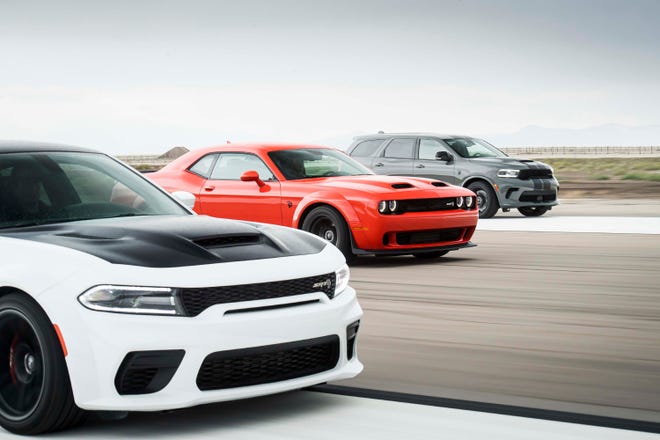
Dodge is ending production of its iconic, V8-powered Hellcat Challenger and Charger muscle cars models by 2023 as the brand transitions to a mix of electrified EV, hybrid, and plug-in drivetrains in the face of government regulations forcing battery-powered vehicles. The high horsepower, supercharged hemi engines have defined the brand for the last six years, driving an increase in sales as Dodge stuffed Hellcat V8s into everything from its muscle cars to the three-row Durango SUV.
The Charger and Challenger models, however, will remain in the lineup as the Hellcats pass into history. The news amps up the pressure on Dodge’s first so-called eMuscle electric car, due early next year in prototype form, to deliver on its promise of a new era of Tesla-like, electric performance.
“People are really nervous about (electrification),” Dodge CEO Tim Kuniskis said in an interview at the Los Angeles Auto Show. “(But) power isn’t going away. Muscle isn’t going away. We’re going to show a concept of our all-electric muscle car. We’re going to show it in about four months. We’re going to show you what it can do . . . and redefine American muscle.”
Reaction to Dodge’s announcement ending the sizzling, supercharged V-8s from the enthusiast community was met with a mix of rage, disbelief, and resignation.
“Hellcat production is sadly going to end in 2023,” moaned enthusiast publication Car and Driver of the Hellcat engines that delivered between 707 and 840 horsepower. “You have two years left to buy a Hellcat. We won’t let the Hellcat’s rambunctious whine of its supercharger be forgotten by the whispering whir of electric motors.”
Wrote Hellcat_Red on the SRT Hellcat Forum: “Seems like we are close to say good bye at the most legendary American muscle car. Really sad the future that is coming.”
“Not happy with this forced EV situation. Guess I need to order a Redeye before it’s too late,” added “S8ER01Z” in reference to the 797-horsepower V-8 Challenger model..
“2024 will be the new plug-in stuff, no thanks,” said Caddy59.

The Hellcat lineup — paired with ringleader Kuniskis’s over-the-top marketing instincts — has driven a brand sensation. Despite being built on two-decade-old platforms, the sinister looking Challenger and Charger vaulted over Camaro in Detroit’s muscle car race and is challenging Mustang for #1. They are best-sellers in the coveted California market. Dodge web traffic has been epic despite its relatively low sales volume — across three models — compared to megabrands like Chevrolet and Ford.
The move to electrification challenges the brand’s devil-may-care personality.
“In a world where everyone is obsessed with making everything better for the environment, the Challenger just doesn’t care. It doesn’t care what people think or say about it,” wrote HotCar.com earlier this year. “Fans of the Challenger do not want a hybrid powertrain or an electric SUV model. What they want is a fire-breathing muscle car.”
Dodge isn’t the only brand grappling with electrification’s challenge to a carefully-manicured image.
Porsche has been clear that it will not electrify its iconic 911 supercar, the brand’s touchstone. Instead, it has moved into battery power with the Porsche Taycan sedan and Taycan Cross-Turismo. It has already felt the sting of trying to accommodate MPG concerns in its performance cars — when it replaced its Cayman/Boxster sports cars’ screaming 6-cylinder engine with a 4-cylinder, the models lost half their U.S. sales.

Ford, too, has been careful to not to fiddle with its V-8 secret sauce. When the Blue Oval used its Mustang performance brand to introduce its first EV, it chose an all-new Mach E SUV while leaving the fire-breathing Mustang coupe alone with its gas-engine lineup.
Patrick Rall, a writer with StellPower.com, is influential in the muscle car community and a Hellcat owner himself. Like Porsche and Mustang, he thinks Dodge recognizes the purity of its V-8 Challenger muscle car and will choose to electrify the Charger sedan.
“Like the Porsche Taycan and Tesla Model S Plaid, it makes sense for Dodge to explore the sedan space,” he said. “If you’re going to be the best, you have to take on the best.”
CEO Kuniskis is aware he is playing with fire.
“I’m juggling knives because I’ve gotta’ keep two different huge factions happy because at some point those two factions will converge,” he told Motor Trend at the LA Show, referencing customers who will embrace electrification and those who want his brand’s signature V-8 and V-6 power. “The problem is no one knows when they will converge. My job is to provide confidence, over the next 24 months, that we’re gonna’ do this.”
Industry insiders say that the EPA-forced change to electrification is fraught with danger, pointing to the 1970s when federal MPG standards tripped up Detroit automakers.

“The ’70s were the Dark Ages of the auto industry,” said Karl Baer, industry analyst with ISeeCars, recalling models like the 1974-78 Ford Mustang II that scaled back on performance to meet MPG concerns. Reviled by purists, the Mustang II is rarely seen in Woodward Dream Cruise parades.
“The older cars were better than the new ones in the 1970s,” said Brauer. “There were big changes, big government mandates. I hope that doesn’t happen again and we’re more technologically advanced this time.”
For its part, Dodge seems to be assembling a diverse lineup of drivetrains beyond the EV debuting early next year.
Built on an all-new platform beginning in 2024 to accommodate electrified powertrains — which The Detroit News first reported in 2019 — the Challenger and Charger, say experts, will likely get hybrid and plugin drivetrains utilizing a hybrid ZF transmission recently contracted by Stellantis.
Brauer said Dodge’s small size and unique image affords corporate parent Stellantis room to experiment.
“Dodge profits are a sliver of total revenue,” he said. “So the risk of remaking Dodge is less than, say, the volume Jeep brand. If Dodge can remake Hellcat power with the right kind of car, then it will help a certain percentage of traditional buyers to give electrification a try.”
Dodge has been here before when it developed the Dodge Dart to meet Obama Administration requirements that the new Fiat-Chrysler alliance make a 40 mpg car. The Dart was manufactured from 2013-2016 before it died due to poor sales.

Significantly, Stellantis is not toying with its V8-powered formula in its high-volume Jeep brand. The Jeep Grand Cherokee and Grand Wagoneer were both launched on all-new platforms this year and both boast optional normally-aspirated, 5.7-liter V-8s in addition to standard V-6s.
As Dodge accelerates towards its new era in 2024, Kuniskis said the brand will roll out a series of teasers to keep customers engaged.
“When we say we’re going to electrification in 24 months it would have been easy to go quiet. We don’t do anything quiet, we don’t so anything subtle,” he smiled. “We put out a calendar, . . . there’s 24 doors and those doors are going to open every couple of months or so. We’ll show our full electric plan as we get to the end, and we’ll show (gas-engine) stuff along the way.”
Dodge has already teased a new Jailbreak package on its Charger and Challenger Redeye models that allow buyers to customize them for $995. And it’s shown an EV logo called the “fratzog” — a made-up word for the triangle arrangement of three arrowhead shapes used by the brand in the 1960s.
“People come up to me all the time and they say: ‘Hey, you’re the Dodge guy, you’re gonna be totally opposed to EVs. What are you doing? Are you selling out?’” said Kuniskis. “I say, no, performance isn’t going away. There are some really cool innovative things we can do with electrification.”
Henry Payne is auto critic for The Detroit News. Find him at hpayne@detroitnews.com or Twitter @HenryEPayne.
Payne: Corvette Racing goes big with two global series, Z06 GT3.R customer car
Posted by Talbot Payne on November 23, 2021
Chevrolet is revving up its Corvette race program.
Corvette Racing has been integral to development and marketing of the brand’s iconic sportscar, and, for the first time in its 24-year history, the race team will compete for both the 2022 IMSA sportscar championship in the U.S. and World Endurance series overseas. Come the 2024 calendar year, GM will offer — also for the first time — the mid-engine, C8.R race car to private teams to go head-to-head against Lamborghini, Ferrari, Aston Martin and other supercars in international GT3 competition.
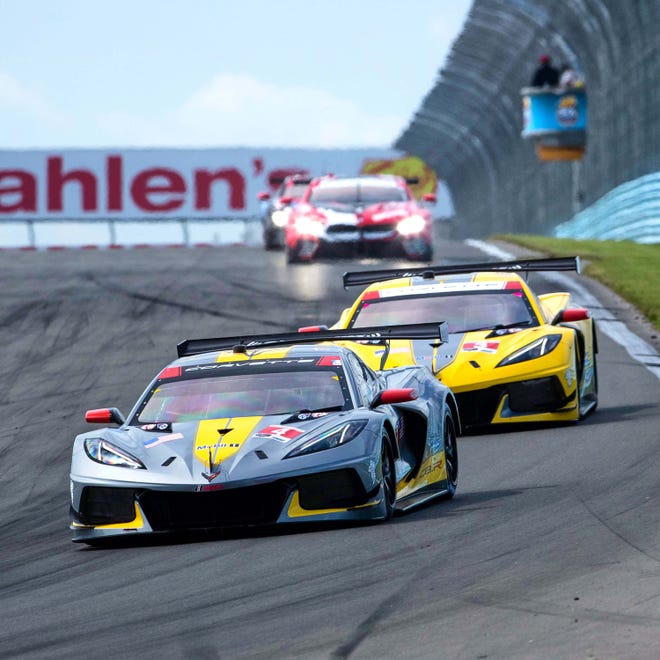
The program expansion follows the C8.R’s second straight U.S. title in the IMSA endurance sportscar series. That success has paralleled the red-hot sales of the production Corvette with sale prices often well above sticker.
“This is the most ambitious schedule that Corvette Racing has faced,” said Jim Campbell, chief of parent General Motors Co.’s Chevy Performance and Motorsports. “It will be an honor to race in both the IMSA and WEC series at some of the best tracks in the world.”
A dominant player in IMSA since Corvette first went GT racing in 1999, the team has also raced in choice World Endurance Championship (WEC) races like France’s Le Mans and Spa in Belgium. The new year will mark the first time Corvette will field a full-time car in both series. Since 2001, Corvette has won 13 IMSA manufacturers championships.
The announcement came as Chevy showed off the 670-horsepower Corvette Z06 performance model for the first time at a major auto show in Los Angeles. The Z06 shares the same high-revving V-8 engine the C8.R has been campaigning the last two years on the race circuit. A significant departure from the standard Corvette’s traditional push-rod, the Z06’s 5.5-liter mill utilizes Ferrari-like flat-plane crank technology that shrieks to 8,600 RPM.
Corvette’s move comes as sports car racing undergoes a major shift in the next two years with unprecedented interest from manufacturers across the globe. Race teams from Cadillac, Acura, Audi, BMW and Porsche will compete in an international prototype class.

On the Grand Touring front, IMSA is consolidating its GT classes into one and eliminating the GTLM class where Corvette dominated the last two years over entrants from Porsche, Ferrari and BMW. For 2022, the team — managed by Pratt & Miller in New Hudson — will field a C8.R slightly modified for the GTD class with a different rear wing and customer Michelin racing tires.
The driver teams that were fielded in the 2021 IMSA GTLM class will split with the team of Antonio Garcia, Jordan Taylor and Nicky Catsburg (Garcia and Taylor were driver champs in 2021) going to IMSA GTD for its 10-race schedule, while Tommy Milner, Nick Tandy and Alexander Sims go globe-trotting in the WEC. The international series features six races at venues from Japan to Bahrain to Sebring, Florida.
“This is a World Championship and that is something that is really important for Corvette, Chevrolet and our team,” said Tandy. “Going for a world championship is something that not many people compete for, so I’m looking forward to what comes ahead.”

Corvette will field two cars in June at the world’s premier endurance race, the 24 Hours of Le Mans in France, where it has won eight times since 2001.
Competitors in the IMSA GTD class run the gamut with private entries from Lamborghini, McLaren, Aston Martin, Porsche, Mercedes, Ferrari, Acura, Audi, Lexus and BMW. Intriguingly, the Chevy would be the only mainstream badge in a sea of luxury makes — a testimony to how much less the Corvette C8.R costs than its peers even as it boasts similar capability.
“It’s an exciting time for Corvette — first with the reveal of the production Z06, and now confirming the Z06 GT3.R,” said Chevy Director of Motorsports Competition Engineering Mark Stielow. “The GT3.R will allow customer race teams the opportunity to campaign a Corvette that has benefited from Corvette Racing’s rich history.”
The production Z06 and GT3.R race car are closely related, with the latter sharing the same aluminum chassis, engine and similar aerodynamic features.
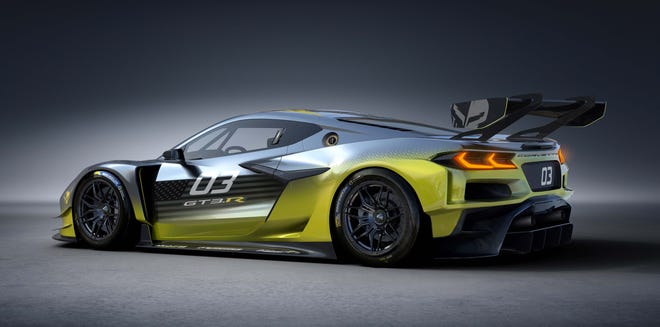
GT3 racing spans the planet with series in countries from England and Spain to Australia and Japan. In the U.S. the 2021 GT World Challenge America featured seven races.
Henry Payne is auto critic for The Detroit News. Find him at hpayne@detroitnews.com or Twitter @HenryEPayne.
Fisker: Why EV startup valuations are sky high and going higher
Posted by Talbot Payne on November 22, 2021
Los Angeles — Is Fisker the next electric vehicle unicorn?
The California-based EV company unveiled a final prototype here this week of its first, widely-anticipated SUV, the Ocean, with production to begin in November 2022. If Fisker, run by EV pioneer Henrik Fisker, follows the pattern of U.S. EV startups, it should be a multi-billion dollar company in a year.

Sister EV startups Rivian and Lucid have seen their market values roar to dizzying heights in recent weeks after producing their first vehicles. With no revenue and one $70,000 pickup truck in its lineup, Irvine, California-based Rivian owns a market cap of $140 billion, more than General Motors. Lucid Motor’s $160k Air sedan rolled off the line last month and its market cap is now about $90 billion, more than Ford Motor Company.
Subscribers: LA Auto Show: Reborn Fisker unveils the Ocean EV
“Wall Street (investors) think half of the global market will be EVs by 2030. Wall Street is betting that startup EVs automakers are going to make up most of that production,” CEO Fisker said in an interview in Los Angeles just hours before unveiling the Ocean on Wednesday. Battery-electric vehicles make up under 3% of U.S. sales.
Fisker’s prediction is self-interested, but consistent with current trends.
Despite facing competition from numerous legacy automakers in the EV space, Tesla — the first all-electric startup to enter the mainstream market in 2012 with its Model S sedan — still owns an 80% market share with a growing list of vehicles including the Model 3 sedan and Model Y and Model X SUVs. EV entries from household names like Chevy, Volvo, Audi, Porsche, BMW and Mercedes have barely dented Tesla’s juggernaut, which delivered 499,550 vehicles in 2020 — an increase of 36% over the previous year in the midst of a global pandemic.
Tesla’s market value soared over $1 trillion this month — more than the nine largest auto companies combined.
“Like other startups, we are building an EV company from the ground up,” said Fisker. “We are currently valued at $7 billion. The difference between us and Rivian and Lucid is that we won’t be in production for another year. If we hit our targets, I expect to see similar success.”
Joe Phillippi of Autotrends Consulting, a veteran Wall Street analyst, is doubtful that EVs will make up half of global sales anytime soon. “I don’t see it, that’s 50 million units a year,” he said. “I worry this a bubble, but it’s a bubble that may last a long time. There’s a lot of money chasing these ideas.”
Fisker attributed investor confidence to a combination of government coercion and consumer acceptance.
Fisker’s home state of California, for example — the largest auto market in the world’s richest country — is mandating that all new car sales be zero-emission vehicles by 2035. The state has repeatedly had to adjust its goals over the last two decades, however, as consumers have been reluctant to adopt battery-powered vehicles.
China, the world’s biggest auto market, has mandated that all vehicles must be electrified — battery-powered, plug-in hybrid, or hybrid — by 2035. And the European Union has announced a ban on gas-powered cars by 2035.
“Europe is moving so fast. I expect that half of our sales will by in Europe,” said CEO Fisker. He said cities like London are banning diesel cars and Norway is moving to eliminate gas and diesel engines.

West Coast-based, Fisker is outsourcing its manufacturing to Magna in Europe. That strategy is in contrast to the “Big Three” electrics of Tesla, Rivian and Lucid, which run their own assembly operations stateside. Fisker said it’s important for startups to keep costs down and to deliver products on time — and Magna is a proven manufacturer, having produced the Mercedes G-class and Jaguar i-Pace. The Ocean EV is made on a heavily-modified, front-wheel-drive EV skateboard platform of Magna’s making.
Fisker said Magna’s Graz, Austria, plant also meets Fisker’s carbon neutrality goals by sourcing its electricity from hydroelectric power. Hydro-power also played a key role in Volkswagen’ location of its first U.S. EV plant in Tennessee.
While upper trims of the Ocean will cost over $70,000, Fisker is keen on keeping the starting price of his cars below $40,000.
“Magna’s base platform saved us a lot of time because we didn’t have to do basic design things,” he said. “But we still had the flexibility to change what we needed. It’s important because we’ve got to get our development time under 2½ years.”
He is particularly bullish on his next, smaller SUV called the Peach. With a price target under the Ocean, Fisker said PEAR will be outsourced to manufacturing partner Foxconn in Lordstown and will bring EVs to higher volume segments.
He suggested one reason for Rivian’s high market cap is its production of fleet vehicles to, for example, Amazon, which must meet sustainability targets. He expects vehicles like Ocean and Peach to do similar fleet business.

“But ultimately, retail buying will pick up as the cost of EVs continues to go down under $40,000,” he said.
He said 75% of customers ordering Ocean EVs are crossing over from gas-powered vehicles from makers such as Mercedes and BMW.
The Ocean boasts similar proportions to the hot-selling Tesla Model Y. The standard, front-wheel-drive Sport model offers 250-mile range, a 17-inch center tablet, panoramic sunroof and digital camera mirror.
It debuted Wednesday at the LA Auto Show.
Henry Payne is auto critic for The Detroit News. Find him at hpayne@detroitnews.com or Twitter @HenryEPayne.
Payne: 2021 LA Best in Show features EVs, gas-powered muscle
Posted by Talbot Payne on November 19, 2021
Los Angeles — The City of Angels is a different place than I left after the last, 2019 LA Auto Show. Like a dystopian Hollywood film, fear of viruses and climate Apocalypse haunt the city. Unlike middle America, masks are still mandated, vaccines required for entry, automaker press conferences grim with warnings of an uninhabitable planet, and big exhibit halls empty of many major brands.
But there is still lots of eye candy here for auto lovers.
California is determined to drive an electric car revolution just as its tech giants transformed everything from phones to media. Gas engines will be banned here by 2035. Startup and legacy manufacturers have responded with a variety of innovative EV product to capture the public’s attention.
Customers still overwhelmingly prefer petrol power and there is plenty of everything to choose from. Here’s the show’s Top 10:
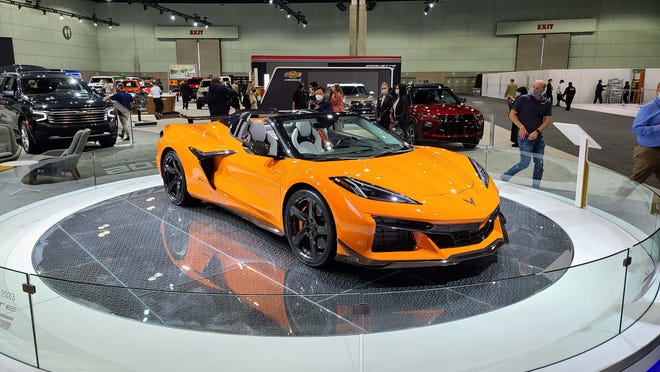
Chevrolet Corvette Z06. The show stopper. The first performance upgrade of GM’s mid-engine predator is as wicked looking as it is fast. Under its shark’s skin is the sportscar’s first overhead cam, V-8 engine. It’s the same mill that propelled the C8.R race car to two consecutive IMSA sportscar championships. Too bad Chevy can’t rev it to 8,600 RPM at the show.

Porsche Mission R. This track-focused e-missile follows the Mission E as Porsche’s second electric concept. Just as the Mission E previewed the production Taycan, so is the Mission R fueling rumors of an electric production Cayman sportscar. The winged Mission R imagines a Porsche race series (think similar 911 Club Sport series) with enough battery to make a 30-minute sprint race. The R has twin motors and 1,100 horsepower. Electrifying.
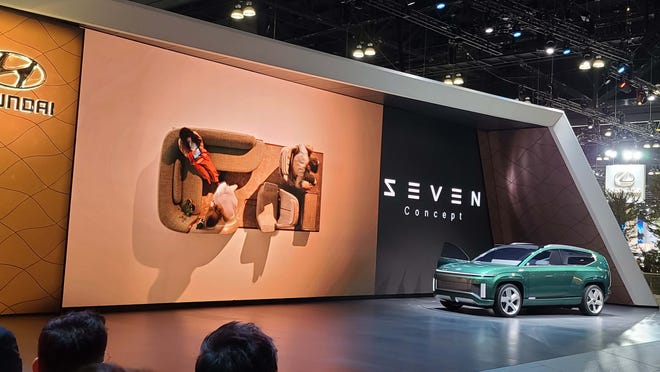
Hyundai Seven. Dude, far-out show concepts are back. The Seven previews a (likely) 2024, three-row, family EV with 300 miles of range, full glass rear, and a pixelated, front-end light show like a Cadillac Lyriq. Open the cabin doors and Seven offers a configurable, three-row furniture showcase complete with couch, fridge, and shoe drawers. Anticipating more pandemics to come, the interior offers an airliner-inspired Hygiene Airflow System to isolate air circulation between front and rear passengers. UVC lights sanitize the interior when you exit. Jeepers.

Dodge Challenger SRT Redeye Jailbreak. America’s favorite muscle car can be customized for just $995. Put down $80k for your Dodge Redeye, and pick from a cookie jar of Jailbreak goodies. Colors, stripes, seats. . . with Dodge throwing some new offerings like Hammerhead Grey upholstery, copper and bronze trim, and unique 20-by-11-inch wheels. Oh, and you get 10-horsepower boost to (gasp) 807 ponies.

Subaru Solterra. Subie’s eco-friendly buyers finally get an EV. Though with just 220 miles, its range may challenge adventure seekers. Otherwise, the Solterra delivers the outdoor brand’s signature AWD capability with front/rear electric motors and 8.3-inch ground clearance. The interior is the most modern ‘Ru yet with a waterfall-style console and hoodless, digital instrument display. Co-developed with Toyota, Solterra masked headlights appear inspired by Catwoman.

Subaru WRX. Not to be left out, Subie’s speed freak base finally gets a new-gen WRX hellion built on the brand’s modern Global Platform. The architecture should further enhance WRX’s AWD handling while delivering state-of-the-art electronics. You’ll know it by the boomerang headlights and macho fender cladding.

Fisker Ocean. EV-pioneer Henrik Fisker wowed with a low-slung, performance sedan last decade. For his next chapter, Fisker introduces a boxy, electric SUV. The Karma wowed outside, Ocean does its talking inside with a rotating, 17-inch screen that displays in portrait and landscape mode. Just like your smartphone. Check out the cargo doggie windows so your canine can sniff the air. Woof.

Kia EV-6. EV-6 joins cousin Hyundai’s Ioniq 5 EV in bucking the boxy EV trend (see Fisker nearby). EV-6 stand out with a low front end and hatchback stance. The interior is big screen, EV-chic with lots of digital derring-do.
Ford F-150 Lightning. Most pickup trucks show off their beds. The Lightning EV leads with its frunk. That big hole under the front hood where the engine used to be is wide open on the LA Show floor to show off its bottomless cargo capacity. Let the kiddies jump in for a photo op. Visitors will also marvel at the 4.5-second zero-60 mph time and the giant console inside.

Vinfast VF e35. It’s the Wild West for EVs and the young Vietnamese startup wants in. The compact e35 checks all the boxes with an SUV, Nvidia-chip powered self-drive system — even a single screen interior like a Tesla Model Y. Chinese companies like Byton, GAC, and Qiantu all whiffed on US delivery promises. If Vinfast can price itself $20k below the mighty Model Y, it might have a future here.

The LA Show is back. Keep an eye on it because it may be your electric future.
Henry Payne is auto critic for The Detroit News. Find him at hpayne@detroitnews.com or Twitter @HenryEPayne.
Payne: If only Clark Griswold had driven a Jeep Grand Cherokee Trailhawk
Posted by Talbot Payne on November 18, 2021
Moab, Utah — Poor Clark Griswold. He famously took his family out west in “National Lampoon’s Vacation” movie in an overmatched Wagon Queen Family Truckster.
He should have bought a 2022 Jeep Grand Cherokee.
The fifth generation of Jeep’s best-selling family vehicle will now not only confidently carry you over America’s highways — but beyond where the asphalt ends. Griswold and family’s final destination was Wally World, California, but allow me to suggest a detour to Moab, Utah, in the Grand Cherokee.
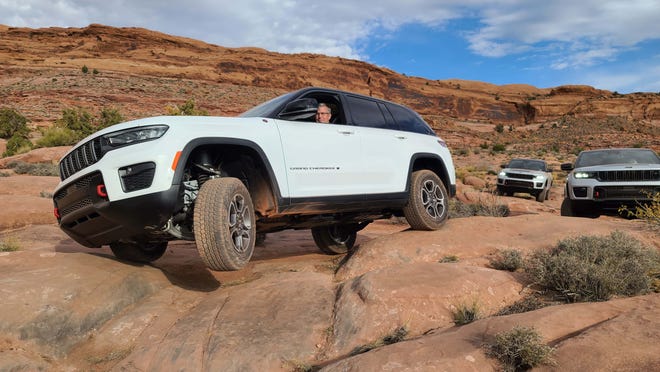
Moab is Jeep’s home away from home. For decades, Wrangler pilots have come here to put their 4x4s to the ultimate test across Hell’s Revenge, one of the most daunting off-road terrains in the United States. Drive down Main Street and Wrangler rentals are everywhere. Now the family Grand Cherokee can join off-road fun with its Trailhawk package armored with steel skid plates, a detachable swaybar, air suspension with 11.3 inches of clearance and all-terrain tires.
Those tools came in handy as I followed a Wrangler Rubicon up a steep trail into Moab’s vast slippery-rock wilderness. It’s territory the Grand Cherokee Trailhawk knows well, having been tested extensively here. I’m betting Griswold would want to impress his family with the SUV’s capability.
Off-roading is not unlike on-road track racing. You want a belt-full of tools at your disposal. Tracking a production car means stiffening everything from shocks to steering response. Off-road is the opposite. You want as much vehicle flexibility as possible.
Dipping into Trailhawk’s toolbox, I shifted into NEUTRAL, selected 4-LOW and engaged ROCK mode. The beast loosened right up: swaybar disconnected to allow the front wheels Gumby-like articulation; ride-height jacked to protect the belly. Throttle eased to prevent sudden lurches.
The Jeep crawled around the broken landscape like a two-ton mountain goat.
If that sounds too nuts, then Griswold might haul the family over to Schafer’s Trail Road in Canyonlands National Park east of Moab. Be sure to option the Family Truckster — er, Grand Cherokee Trailhawk — with the panoramic sunroof. The Colorado and Green rivers have carved Canyonlands as deep as Arizona’s Grand Canyon.
The kiddies will gawk at the sheer cliffs above while Dad white-knuckle steers past sheer drop-offs unprotected by guardrails. Happily, the sure-footed mountain goat is your friend. Sitting on 18-inch rims, Trailhawk’s 30.5-inch-tall sidewalls will ride smoothly over Shafer Trail’s pocked rocky road — just like the thousands of Wranglers that have gone before it.

Better to take the Grand Cherokee to Arches National Park 28 miles north, where the only off-roading is by foot. Along the park’s winding asphalt road, the panoramic roof is a glorious window to a natural red skyline that includes iconic structures like the Three Penguins, Park Avenue, Balanced Rock and other achingly beautiful natural wonders.
That is, if your teens can pull themselves away from the 10-inch screens available in the rear. Fire TV transforms the backseats into a rolling family room where you can watch your favorite series, movies and so on. I took a break in the back seat myself to watch some auto racing highlights on YouTube after a long day of driving the Colorado River basin to the LaSalle Mountains. The Grand’s back seat is the biggest in class and easy on my 6’5” frame.

Wait, spirited drive? In a mid-size SUV?
“Slow down!” Griswold’s wife barked as Clark’s right foot got too heavy on the highway. Grand Cherokee tempts the right foot in the twisties, too.
The Jeep is not only built for the off-road, but engineer Dave Partlow and his team have cast a spell on the suspension to make it truly enjoyable at speed. My Trailhawk tester was nicely equipped with the Grand’s standard 292-horse V-6 workhorse. But for Jeep lovers with a lead foot — and there are plenty of them — the 5.7-liter, 470-horse V-8 is also available. Yes, the same eight-holer as in the insane Wrangler 392 that I destroyed Holy Oaks ORV park with last summer.

For my money (and the Grand demands deep pockets; more on that later), the Trailhawk is plenty bad-ass with six cylinders. Its black hood, tow hooks and eye-catching wheels look plenty cool (and the black hood is also useful for reducing sun glare when the Moab sun is baking you and the slippery rocks at 115 degrees in August).
In those conditions, the Griswold clan may be happy to close the roof, turn up the AC and keep cruisin’ to Wally World. Because the interior of the Jeep is a grand place to be.
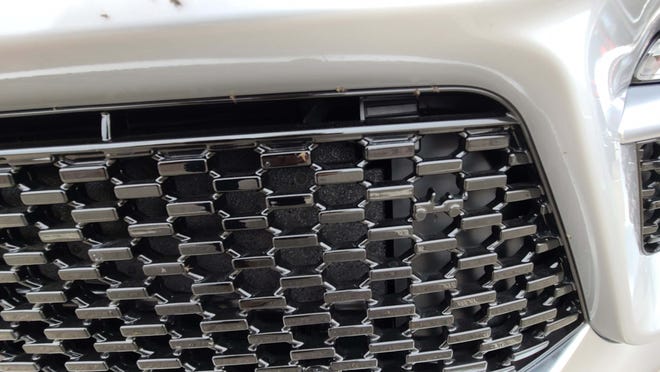
For all its exterior muscle, the lines of the 2022 Grand Cherokee have changed little from Gen 4. The signature seven-slot grille is more upright, the LED headlights narrowed from squinting into the sunset, the body more sculpted, as if it has spent more time in the gym to take advantage of the advanced hardware underneath.
The interior, meanwhile, has undergone a major face-lift.
No wonder Jeep has raised the Grand’s base price by a stiff $3,705 — the brand team knows the Grand is the rare mainstream badge cross-shopped against luxury makes Audi, BMW and Land Rover.
An elegant center console spills like a waterfall between the seats, splitting the wing-shaped dash spread between the A-pillars. The digital screens are packed with tech befitting a smartphone. Indeed, Jeep designers modeled the Uconnect 5 system — already an industry benchmark — after an Android with a “dots” avatar that allows intuitive navigation between pages.

Pages can be configured with the content you want. My favorite layout put Android Auto (wirelessly mated to my phone) at my fingertips next to my wife’s telephone number, Spotify app, map and SiriusXM radio.
Mrs. Griswold can have a screen of her own thanks to the Grand’s class-exclusive passenger screen (she can use it to monitor what the kids are watching).
Like Tesla, Jeep is obsessive about putting climate controls in the center screen, which will turn off some shoopers yearning for more console knobs. Jeep’s excellent Level 2 adaptive cruise system helps keep the Grand centered in-lane to mitigate distraction.
Imagine that, Clark Griswold. Level 2 self-driving for those long cross-country miles. So when Christie Brinkley pulls up in her Ferrari, you can give her a nice wave. But you’ll keep the Grand Cherokee, thank you very much.
After all, you can’t fit a family of four and their luggage in a Ferrari. Or take it off-roading in Moab.
2022 Jeep Grand Cherokee
Vehicle type: Front engine, rear- and-all-wheel-drive, five-passenger SUV
Price: $39,185, including $1,795 destination fee ($60,645 Trailhawk and $73,085 Summit Reserve as tested)
Powerplant: 3.6-liter V-6, 5.7-liter V-8
Power: 293 horsepower, 260 pound-feet torque (V-6); 354 horsepower, 390 pound-feet torque (V-8)
Transmission: 8-speed automatic
Performance: 0-60 mph, 6.6 seconds (Car and Driver est. V-8); towing, 7,200 lbs (V-8)
Weight: 4,747 pounds (V-6 Trailhawk)
Fuel economy: EPA est. mpg 18 city/25 highway/21 combined (V-6 AWD); 14 city/22 highway/17 combined (V-8 AWD)
Report card
Highs: Luxury, roomy interior; tech-tastic
Lows: Gets pricey
Overall: 4 stars
Henry Payne is auto critic for The Detroit News. Find him at hpayne@detroitnews.com or Twitter @HenryEPayne.
Fisker: Why EV startup valuations are sky high and going higher
Posted by Talbot Payne on November 17, 2021
Los Angeles — Is Fisker the next electric vehicle unicorn?
The California-based EV company unveiled a final prototype here this week of its first, widely-anticipated SUV, the Ocean, with production to begin in November 2022. If Fisker, run by EV pioneer Henrik Fisker, follows the pattern of U.S. EV startups, it should be a multi-billion dollar company in a year.
Sister EV startups Rivian and Lucid have seen their market values roar to dizzying heights in recent weeks after producing their first vehicles. With no revenue and one $70,000 pickup truck in its lineup, Irvine, California-based Rivian owns a market cap of $140 billion, more than General Motors. Lucid Motor’s $160k Air sedan rolled off the line last month and its market cap is now about $90 billion, more than Ford Motor Company.
Subscribers: LA Auto Show: Reborn Fisker unveils the Ocean EV
“Wall Street (investors) think half of the global market will be EVs by 2030. Wall Street is betting that startup EVs automakers are going to make up most of that production,” CEO Fisker said in an interview in Los Angeles just hours before unveiling the Ocean on Wednesday. Battery-electric vehicles make up under 3% of U.S. sales.
Fisker’s prediction is self-interested, but consistent with current trends.
Despite facing competition from numerous legacy automakers in the EV space, Tesla — the first all-electric startup to enter the mainstream market in 2012 with its Model S sedan — still owns an 80% market share with a growing list of vehicles including the Model 3 sedan and Model Y and Model X SUVs. EV entries from household names like Chevy, Volvo, Audi, Porsche, BMW and Mercedes have barely dented Tesla’s juggernaut, which delivered 499,550 vehicles in 2020 — an increase of 36% over the previous year in the midst of a global pandemic.
Tesla’s market value soared over $1 trillion this month — more than the nine largest auto companies combined.
“Like other startups, we are building an EV company from the ground up,” said Fisker. “We are currently valued at $7 billion. The difference between us and Rivian and Lucid is that we won’t be in production for another year. If we hit our targets, I expect to see similar success.”
By contrast, Fisker said, legacy automakers will increasingly be stuck with costly gas-engine plant capacity while the market shifts to EVs. GM and Ford have announced aggressive moves to go all-electric in the next two decades.
Joe Phillippi of Autotrends Consulting, a veteran Wall Street analyst, is doubtful that EVs will make up half of global sales anytime soon. “I don’t see it, that’s 50 million units a year,” he said. “I worry this a bubble, but it’s a bubble that may last a long time. There’s a lot of money chasing these ideas.”
Fisker attributed investor confidence to a combination of government coercion and consumer acceptance.
Fisker’s home state of California, for example — the largest auto market in the world’s richest country — is mandating that all new car sales be zero-emission vehicles by 2035. The state has repeatedly had to adjust its goals over the last two decades, however, as consumers have been reluctant to adopt battery-powered vehicles.
China, the world’s biggest auto market, has mandated that all vehicles must be electrified — battery-powered, plug-in hybrid, or hybrid — by 2035. And the European Union has announced a ban on gas-powered cars by 2035.
“Europe is moving so fast. I expect that half of our sales will by in Europe,” said CEO Fisker. He said cities like London are banning diesel cars and Norway is moving to eliminate gas and diesel engines.
West Coast-based, Fisker is outsourcing its manufacturing to Magna in Europe. That strategy is in contrast to the “Big Three” electrics of Tesla, Rivian and Lucid, which run their own assembly operations stateside. Fisker said it’s important for startups to keep costs down and to deliver products on time — and Magna is a proven manufacturer, having produced the Mercedes G-class and Jaguar i-Pace. The Ocean EV is made on a heavily-modified, front-wheel-drive EV skateboard platform of Magna’s making.
Fisker said Magna’s Graz, Austria, plant also meets Fisker’s carbon neutrality goals by sourcing its electricity from hydroelectric power. Hydro-power also played a key role in Volkswagen’ location of its first U.S. EV plant in Tennessee.
While upper trims of the Ocean will cost over $70,000, Fisker is keen on keeping the starting price of his cars below $40,000.
“Magna’s base platform saved us a lot of time because we didn’t have to do basic design things,” he said. “But we still had the flexibility to change what we needed. It’s important because we’ve got to get our development time under 2½ years.”
He is particularly bullish on his next, smaller SUV called the Peach. With a price target under the Ocean, Fisker said Peach will be outsourced to manufacturing partner Foxconn in Lordstown and will bring EVs to higher volume segments.
He suggested one reason for Rivian’s high market cap is its production of fleet vehicles to, for example, Amazon, which must meet sustainability targets. He expects vehicles like Ocean and Peach to do similar fleet business.
“But ultimately, retail buying will pick up as the cost of EVs continues to go down under $40,000,” he said.
He said 75% of customers ordering Ocean EVs are crossing over from gas-powered vehicles from makers such as Mercedes and BMW.
The Ocean boasts similar proportions to the hot-selling Tesla Model Y. The standard, front-wheel-drive Sport model offers 250-mile range, a 17-inch center tablet, panoramic sunroof and digital camera mirror.
It debuted Wednesday at the LA Auto Show.
Henry Payne is auto critic for The Detroit News. Find him at hpayne@detroitnews.com or Twitter @HenryEPayne.
Ford, Hyundai, startups lead diverse 2022 Car of Year finalists
Posted by Talbot Payne on November 17, 2021
Los Angeles — And then there were nine.
Ford and Hyundai led a diverse group of finalists announced Wednesday at the Los Angeles for the 2022 North American Car, Truck and Utility Vehicle of the Year awards, with two nominees each. Hyundai’s luxury Genesis brand also grabbed a nomination. The prestigious awards — judged by 50 independent journalists across North America — led off the show with finalists in three categories.
In addition to the legacy automakers, two startup electric vehicles, the Lucid Air and Rivian R1T pickup, nabbed nominations, reflecting how Tesla’s success has emboldened a new era of auto entrepreneurs.
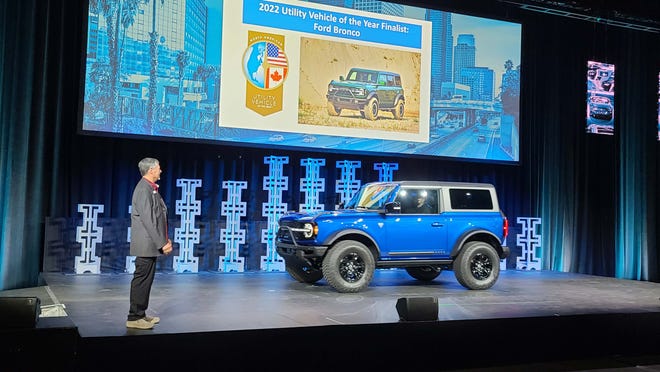
“These nine vehicles represent an unusually excellent and diverse group of finalists,” said NACTOY president Gary Witzenburg. “From new automakers to vehicles that have created fresh segments in their categories, these vehicles showcase the industry’s current diversification. This year’s finalists also illustrate how many more EVs are available to customers.”
Ford’s wildly popular Bronco will be the favorite to win SUV of the year. The Jeep Wrangler rival can be stripped of its doors and roof to offer rugged, open-air fun. Its modern technology also aims to make off-road tools more accessible to drivers, including a rotary mode selector and electronic sway-bar disconnect.
Hyundai’s Ioniq 5 EV boasts a sleek design and simple interior as Hyundai tries to follow the Tesla Model Y’s success in the compact EV SUV segment. The Genesis GV70 is a stylish SUV of the familiar gas-fired variety. After years of copycat designs, Genesis has forged its own path with distinctive exterior and interior looks.
Ford also flexes its truck brand muscles with the affordable Maverick pickup. The entry-level unibody truck will be the favorite to win with its $20k starting price tag and creative interior. Hyundai’s eye-catching Santa Cruz is also a unibody-based pickup truck and features clever features like a lockable, slide-able tonneau cover.

Startup Rivian created a big splash in LA in 2018 when it debuted the first electric pickup. Founder RJ Scaringe has followed through on the concept’s promise by bringing the R1T to market ahead of the Tesla Cybertruck and EV offerings from Ford and GM.
Sedan sales have suffered from the SUV revolution but the eighth-generation Honda Civic is still going strong and is the favorite for yet another Car of the Year trophy. In addition to its trademark nimble handling, the Civic shows off interior tech and handling to shame some luxury sedans.
Another perennial favorite, the VW Golf GTI (together with all-wheel-drive cousin Golf R) is back to give Honda a run for its money. The GTI pioneered the hot hatch segment and still offers manual-transmission fun.
Startup Lucid offers the priciest entry with the $160,000 Air. The sleek battery-electric sedan was developed by ex-Tesla Model S engineer Peter Rawlinson and aims to best the Tesla in range and design.
Founded in 1994, the NACTOY awards are the longest-running new vehicle awards not associated with a single publication. Jurors — including the author of this story — narrow the model year’s new cars to a list of semifinalists that are evaluated at an annual test event in Ann Arbor. Finalists are chosen from there.

“The diverse opinions of our jurors bring together a combination of expertise and individual testing regimens to select these nine outstanding finalists,” said NACTOY vice president Jack Nerad.
NACTOY winners will be announced in early January.
Henry Payne is auto critic for The Detroit News. Find him at hpayne@detroitnews.com or Twitter @HenryEPayne.
LA Auto Show: Reborn Fisker unveils the Ocean EV
Posted by Talbot Payne on November 17, 2021
Los Angeles — Media reveals are sparse at the 2021 Los Angeles Auto Show, and start-up electric vehicle-maker Fisker is taking full advantage.
EV pioneer Henrik Fisker led off the show with a splash Wednesday by unveiling the Fisker Ocean SUV. The EV marks the legendary designer’s second venture into a battery-powered future.

Ten years after Fisker’s beautiful — but ill-fated — Fisker Karma sports sedan created waves with its plug-in battery drivetrain, the compact Ocean SUV is aimed at the heart of the emerging EV market. Priced from $37,499 for the standard Sport model — or about the average new vehicle price today — the stylish Ocean’s price climbs to $49,999 for the all-wheel-drive Ultra model, and $68,999 in fully-loaded Extreme and Ocean One trims.
The Fisker will go head-to-head with other EVs like the Tesla Model Y, Mustang Mach-E, Volvo C40, and VW ID.4 in the industry’s highest-volume segment, compact SUVs.
With lean headlights and a chunky, funky body draped over huge 22-inch wheels, the Ocean One prototype looks like the Range Rover Evoque and BMW i3 had a love child. Expect the final draft to look similar when the first Fisker rolls of the assembly line in November 2022. Its SUV practicality is married to significant performance thanks to a big battery and torque-vectoring all-wheel-drive system.
“We all want to own a sportscar, but then we all want to drive an SUV,” smiled Fisker during a walk-around of the car ahead of its show floor debut. Before starting his own brand, he made his mark as the designer of the BMW Z8 and Aston Martin DB9 coupes. “I’m into sportscars myself, so I made a sporty car that acts like an SUV.”

Ever the showman, the Danish-born designer penned the Ocean with dramatic features to help it stand out from other fish in the EV sea. The push of a button will peel back the roof and drop the windows for an open-air “California mode.” The canopy is available as a solar roof on top trim models, which Fisker says could deliver 10 miles of range within a decade. And dog lovers will admire the “doggy windows” aft of the C-pillar so that canines in the cargo hold can sniff the salty ocean air.
The car’s interior showpiece is a huge 17.1-inch center touchscreen. On the upper-trim Ocean Extreme and One model, the screen sits in landscape mode when stationary — then spins around to landscape mode when the sleek SUV gets moving.

“We thought of your smartphone when we designed it,” said Fisker. “You can turn your phone to look at a picture in landscape or portrait modes.”
To further pique public interest, Fisker is under contract to make a version of the Ocean as the Popemobile to carry Pope Francis, a devout environmentalist.
Thanks to its torque-vectoring AWD and low center-of-gravity, the Ocean also boasts nimble handling. With instant electric torque, it can also take off from a stoplight with authority. Fisker rattled off the numbers: zero-60 in 3.6 seconds when equipped with the twin motors and the large 350-mile range battery. The standard, 250-mile range, front-wheel-drive Ocean can hit 60 in 6.9 seconds.

With the electric motor hardware up front, Fisker chose not to offer the Ocean with a “frunk” (front trunk) like his RWD competitors to reduce costs and keep the base model under $40,000.
With cost savings in mind — and in contract with rival U.S.-based EV makers Tesla, Rivian, and Lucid — the Ocean’s manufacturing will be outsourced to Magna in Graz, Austria, which also makes the Mercedes G-wagon and Jaguar i-Pace. Tesla famously had teething pains as it ramped up production and Fisker said the Magna partnership will keep development of the Ocean to just 2 1/2 years.
The Austrian import will work against the fledgling automaker if Congress passes legislation eliminating the $7,500 tax credit for foreign-built EVs by 2026. Fisker is planning another EV, the Pear, to be built by Foxconn stateside in Lordstown, Ohio.

The Ocean features Earth, Fun and Off-Road drive modes — with Hyper mode for driving ultra-fast in Ultra, Extreme and One models.
A decade ago, Frisker and Elon Musk were the battery-powered golden boys on the performance electric frontier. Fisker’s Karma sedan is still considered one of the prettiest cars made, but its underpowered drivetrain and tight interior ultimately took a backseat to Musk’s Model S, which took the luxury market by storm with its Ludicrous acceleration mode and cross-country Supercharging network. The Karma has been rebadged and is now sold by a Chinese company.
The Ocean is a more mainstream vehicle that hopes to grow the luxury market that Tesla’s subsequent Model Y and Model 3 EVs created. But Fisker has resisted building an expansive charging network like Tesla. Instead, the company is partnering with Electrify America as the VW-funded network builds out a parallel charging network.
Following the Tesla and Rivian EV models, Ocean sports an eco-chic interior with materials made from recycled T-shirts, plastic bottles and fishing nets.

“We’ve got to change this industry to be much more sustainable,” said Fisker. “And it’s a lot more than making an electric car. It’s about how this car is made. It’s also about what materials go into the car.”
Fisker said the Ocean has already received 19,000 pre-orders with a $250 deposit. Orders can be placed online. To keep overhead down, Fisker is not selling though a dealer network — or building showrooms like Tesla. Instead, cars will be delivered to customers at their homes, whether near Fisker’s California headquarters or in Michigan.
Henry Payne is auto critic for The Detroit News. Find him at hpayne@detroitnews.com or Twitter @HenryEPayne.
Made in America: Mazda is back with the ‘Bama-produced, Yankee-inspired CX-50
Posted by Talbot Payne on November 17, 2021
Mazda is making cars in the U.S. again.
A decade after the last Mazda6 sedan rolled off the assembly line in Flat Rock — ending a four-decade marriage with Ford — the Japanese automaker announced production of the all-new CX-50 SUV. The cute ute is the product of new nuptials with Toyota in Alabama.
The new Mazda adds some off-road heft to a sleek SUV model lineup known for its on-road manners. The 2023 CX-50 will slot into the brand’s lineup next to the best-selling CX-5 and above the entry-level CX-30 SUV and will go on sale next year. The addition follows similar efforts from other automakers to quench Americans’ unquenchable thirst for adventure-seeking SUVs. Think the Ford Bronco Sport, Chevy Trailblazer, Jeep Cherokee Trailhawk and Subaru Forester Wilderness.

“This new Mazda vehicle has been developed for North America, particularly to support the active and outdoor lifestyles of customers in this region,” said Mazda North America boss Jeff Guyton.
The CX-50 is an indication of how dramatically the U.S. vehicle landscape has changed since 2012 when Mazda and Ford co-produced the Mazda6 sedan. That sedan not only exited Flat Rock — it has exited Mazda’s North American lineup, as some 70% of Americans’ light vehicle purchases are sport utilities.
The joint venture with Toyota, called Mazda Toyota Manufacturing, is also evidence of the transformation of the American South into a foreign transplant, manufacturing powerhouse. The MTM plant — with capacity to produce 300,000 vehicles a year with 4,000 employees — is on the Alabama/Tennessee border. It’s within a 200-mile radius of production facilities (and attendant suppliers) operated by Nissan (Nashville), VW (Chattanooga), Hyundai (West Point, Georgia), and Mercedes (Vance, Alabama).
Toyota makes the Corolla Cross, unveiled earlier this year, in the same Huntsville plant.

Similar in size to the CX-5 crossover, which starts at $26,545 with optional all-wheel-drive, the CX-50 will come standard with AWD befitting its all-terrain ambitions. Also standard is a more rugged exterior presence with squared-off, heavy-clad fenders in contrast to the round wheel wells of its CX-5 and CX-30 siblings. The front fascia also gets a more aggressive look to clear yetis on its forested path.
The AWD system will be married to a new Mi-Drive switch that enables suitable tow and off-road modes.
Putting the power to all four wheels will be Mazda’s familiar 4-cylinder engines: a naturally-aspirated, 2.5-liter and turbocharged 2.5-liter, paired with a 6-speed automatic transmission. The engines are already paired in the Mazda CX-5, CX-30 and Mazda 3 sedan and hatchback producing 186 and 250 horsepower, respectively.

Mazda plans electrified drivetrains for the CX-50, including hybrid model, in the future.
The driver-focused interior of the CX-50 is also familiar to owners of the CX-30 and Mazda3. A wide, horizontal screen mounted high on the dashboard (to keep eyeballs glued to the road) is operated by a remote rotary controller. The interior appears crafted with upscale materials rivaling luxury makes.
Sitting above the passenger compartment is a panoramic moonroof — a first for Mazda and in sync with the car’s outdoor ambitions. A new, Zircon Sand exterior paint continues the outdoors vibe.

“The idea for this car came from exploring two main themes: what does Mazda uniquely offer and what do we in North America uniquely value?” said Mazda Design America chief Yasutake Tsuchida. “Engaging with the outdoors and getting out of the city are cherished values that have only grown during these tough pandemic times. So we designed a new vehicle to explore new frontiers.”
Henry Payne is auto critic for The Detroit News. Find him at hpayne@detroitnews.com or Twitter @HenryEPayne.
LA Auto Show: All eyes on California’s EV transformation
Posted by Talbot Payne on November 17, 2021
Los Angeles — After a year off due to the pandemic, the Los Angeles Auto Show is back. Like the Detroit Auto Show, the LA event’s media profile will be diminished this year as manufacturers diversify the venues by which they introduce new product.

But the Los Angeles show, with press and trade days Wednesday and Thursday and public days Friday-Nov. 28, remains a significant auto event for another reason: electric vehicle sales.
As global governments for the first time dictate what drivetrains automakers must sell, California is on the leading edge of mandated EV adoption. In recent years, LA has been the stage for some of the country’s most significant EV debuts, including the Ford Mustang Mach-E and Rivian R1T pickup.
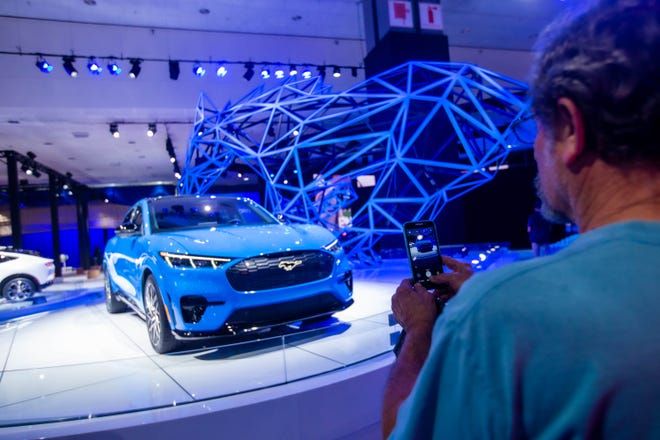
With hundreds of thousands of consumers expected to stream through the LA Convention Center doors in the next two weeks, auto dealers are desperate to introduce them to new EVs that buyers have so far largely ignored due to high costs and limited range.
“These (electric vehicles) mandates are coming fast,” said David Fortin, LA Auto Show consumer marketing director, in an interview. “We’re leading the charge over here. The show reflects that. People are interested to see what the future looks like.”
California is the U.S.’s largest auto market with more than 2 million vehicles sold annually, led by trucks and SUVs. It also makes up the lion’s share of America’s EV sales. Nationally, EVs make up less than 3% of new car sales, but nearly 50% of those sales are in the Golden State.
California Gov. Gavin Newsom has mandated that all new vehicle sales must be zero-emission vehicles by 2035 in an aggressive campaign to ban gas engines, yet just 6% of vehicles registered in California today are EVs.
With an interim goal of 1.5 million ZEVs by 2025, California requires automakers to sell a certain percentage of EVs according to a complicated formula depending on sales volume. Those who miss the target must buy emissions credits. With Newsom’s 2035 executive order, regulations are expected to get much tougher.
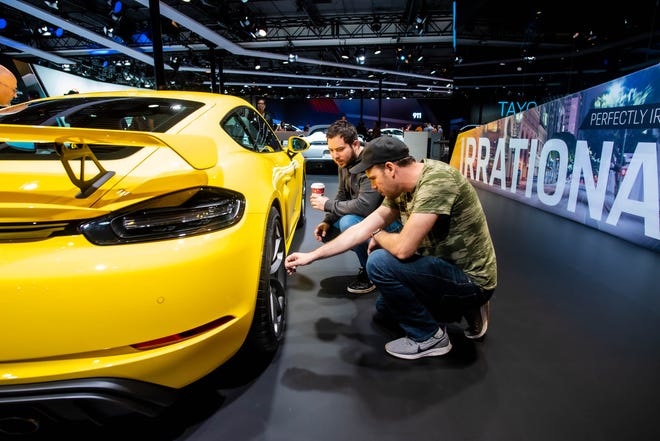
The mandates are part of a comprehensive effort to wean California from fossil fuels. As utilities have abandoned carbon fuels like natural gas, electric rates have skyrocketed to 80% above the national average according to UC Berkeley’s Haas Business School — complicating electric vehicle adoption.
Most media vehicle debuts Wednesday will be battery-powered, with reveals from Fisker, Hyundai, Kia and Subaru. Porsche — which sells 25% of its U.S. volume in California — also plans a big splash with an expected five world-premiere vehicles, three of them electric.
Reveals are down significantly from just two years ago, when the show was host to 25 world debuts. Part of the reduction is due to the lingering uncertainty of the pandemic. While much of the country is open and hosting indoor events mask-free, Los Angeles County is strictly regulated with vaccine, testing and mask mandates to enter the LA Convention Center. The New York City Auto Show was canceled with just two weeks notice in August, and many automakers have shelved plans to attend shows.
In the age of social media, automakers are also eschewing auto shows for individual reveal events where they do not have to compete for media attention. Significant vehicles like the 2022 Jeep Grand Cherokee, Hyundai Ioniq 5 EV, and Honda Civic Si are being revealed this fall at venues far from auto show floors.
“The experience has to provide value. Every automaker has their own strategy,” said Fortin. He added that auto shows still provide unparalleled access to consumers, especially in an age of social media.
“We position ourselves with our global platform,” he continued. Automakers can “leverage the two days of Automobility LA and 10 days of consumer show to reach — it’s a crazy number — billions of impressions when you take (into account) media influence, social media influence.”
The dearth of legacy automaker debuts on the show floor offers opportunities for upstarts. The LA show will showcase debuts from the first Vietnamese models to the U.S., the 2022 VinFast VF e35 and VF e36. If the young firm’s plans stay on track, it will beat a host of Chinese automakers to market in 2022.
Fisker Inc. is also seeking a comeback. Founder Henrik Fisker was an EV pioneer with Elon Musk a decade ago, yet his company has not had the success of Tesla, which makes up about 80% of EV sales nationally. Fisker will introduce the all-new Ocean in LA and hopes to catch the capital funding wave that has valued Tesla at more than $1 trillion and Rivian — which introduced its electric pickup here in 2018 — to more than $100 billion.
The LA Show will also debut the Zero Emissions Vehicles Awards to help “connect the public to this transformative moment going on,” said Fortin. The ZEVAs break the 93 EVs on the market today into nine categories, with the winners being announced Wednesday.
For all the electric hype, however, gas-powered vehicles still dominate the California market, with more than 90% of vehicle sales.
“Gas-powered vehicles are still really important and there’s a healthy mix of those on display,” said Fortin. “It’s a transformative time when we need to showcase both.”

In addition to the more than 1,000 vehicles on the showroom floor, automakers will have have 10 interactive exhibits for customers to climb aboard and ride. The all-new, gas-powered Bronco SUV will face off against Camp Jeep with Ford’s Bronco Built Wild activation. Ram will offer rides in its 1500 light duty pickup. Other rides will be available from automakers including Audi, Chrysler, Dodge, Honda, Nissan, Toyota, Subaru and Jeep.
There will be a dedicated, 55,000-square-foot area to experience EV rides.
“The public has been really responsive after tickets went on sale,” said Fortin. “People have been pent up at home and missing the annual event. It’s showtime.”
Henry Payne is auto critic for The Detroit News. Find him at hpayne@detroitnews.com or Twitter @HenryEPayne.
Payne: Gen-8 VW Golf GTI isn’t getting older, it’s getting better
Posted by Talbot Payne on November 13, 2021
Asheville, N.C. — It’s not easy staying top dog.
Roger Federer’s extraordinary career at the top of professional tennis has spanned parts of three decades and is due, in part, to his determination to improve over time. Example: his average backhand became a weapon in the last decade.
As in tennis, so, too, with hot hatches.
Long before Federer won his first Wimbledon title in 2003, the Volkswagen Golf GTI (then badged Rabbit GTI for the U.S. market) won America’s hearts as the first affordable pocket rocket in 1983. By turning a standard compact Golf into a steroid-infused, apex-carving, cargo-hauling fun box, VW inspired a segment that has born imitators like the Ford Focus ST, Honda Civic Si, Subaru WRX, Hyundai Veloster, Hyundai Elantra N and Mazda 3 Turbo.
Like Federer, Golf GTI has responded to challengers to the throne with constant improvement complementing its innate German-engineered talent. The third-gen Mark III introduced a sensational V-6 engine. Mark V showed off phone dial wheels, one of V-dub’s most distinctive designs.
Of late, GTI has lagged in interior panache. The mesmerizing Mazda 3, for example, upped the ante with its stylish, driver-centric design. If Federer spent hours perfecting his backhand, then Wolfsburg has been burning the midnight oil on dashboard upgrades.
The result is the best GTI ever, a landmark model that — like Gen I — sets a new bar for pocket rockets. It is a vehicle so good that Audi S3 consumers will be left wondering why they paid 16 grand more.
My GTI tester was painted bright Pomelo Yellow to call attention to the feat.
The VW’s huge twinned, all-digital displays are state-of-the-art. You want an Audi? The 10.5-inch instrument display offers five configurations just like its luxe cousin. GTI telegraphs this interior transformation with its sexiest exterior in years.

Menacing narrow headlights set the tone. Sharply creased hood and shoulders once again remind of Audi. Get the 19-inch wheels. Love it.
Love the handling, too. Over the roller-coaster State Route 209 west of Asheville, the GTI stormed about as if on rails. GTI comes standard with a limited-slip front differential, suspension upgrades and an aluminum subframe that actually reduces curb weight (rare in this age of weighty interior upgrades) from last gen.
The front-wheel driver rotated through corners with the balance of, well, Roger Federer.
A driver’s car like this deserves to have its neck wrung with a manual shifter, and the 6-speed tranny is VW’s best yet. Past boxes could ruin momentum with mushy 2-to-3 shifts. My tester was as crisp as the fall air. GTI typically sells 40% manuals; this gen should sell more.

Not that the 7-speed dual-clutch automatic is any slouch. Stealing again from the luxury store, GTI’s Chiclet-sized shifter reminds of a Porsche 911. With a flick of the wrist, I slotted it into DRIVE, firing off lightning-quick up-and-downshifts with steering-mounted paddles.
But analog manual better fits GTI’s personality. If it’s automatic you want, let me introduce you to GTI’s big brother Golf R — R as in Rocket.
Starting at $44,640 with all-wheel drive, 7-speed auto and a whopping 315 horsepower from the same turbo-4 that burns in GTI’s belly, Golf R is the fully armored cyborg of the family.
R can crank off 4.3-second, 0-60 mph hole shots and explode off corners with torque-vectoring wizardry that throws 100% of torque to the rear summer tires. It even features a one-button R-mode on the steering wheel that instantly changes the personality of the beast like Corvette’s Z-Mode, for goodness sake.
Get it if you can afford it, but your grin will be no wider than in the GTI. That’s because both share an electronics architecture that includes (standard on the GTI) goodies like adaptive cruise control that is as good a highway semi-autonomous system as I have found this side of Tesla’s Autopilot and GM’s SuperCruise.
It allowed me secure driving over I-40 so I could talk on the phone and check messages.
This tour de force Mark VIII GTI is the Swiss Army knife of the VW lineup. Affordable like a Jetta. Tech-tastic like the ID.4 EV. Hatchback utility like the Taos SUV. Arteon sedan style. Handling without peer.

That diversity not only marks GTI as the icon of the segment it founded — it’s also the North Star of the VW brand. The standard Golf is gone from the lineup, a victim of Americans’ hatchback ennui.
Yankees are from Mars, Europeans are from Venus. On this side of the pond, customers like sedans, so VW sells the Jetta (complete with GTI engine in the GLI performance variant) as its base car. But in Europe, buyers prefer hatchbacks, so Jetta has been discontinued. Go figure.
No wonder VW threw everything and the kitchen sink at the U.S. Golf GTI and R models, including premium options like self-park assist, head-up display — plus a manual Golf R version even Euros don’t get. These vehicles can no longer skim by as high-trim revenue generators for the Golf line. Their purpose is now halo for the entire V-dub line.
And the competition isn’t going away despite Americans’ embrace of SUVs.
The Mazda 3 Turbo is a credible contender with its hot bod and explosive 310-torque turbo-4 under the hood. The GTI’s high-tech displays raise the bar inside, but they also raise the price by $895 against a Mazda that is already a value with a Premium Plus package that includes all-wheel drive, head-up display, adaptive cruise, blind-spot assist and a partridge in a pear tree for just $35,390.
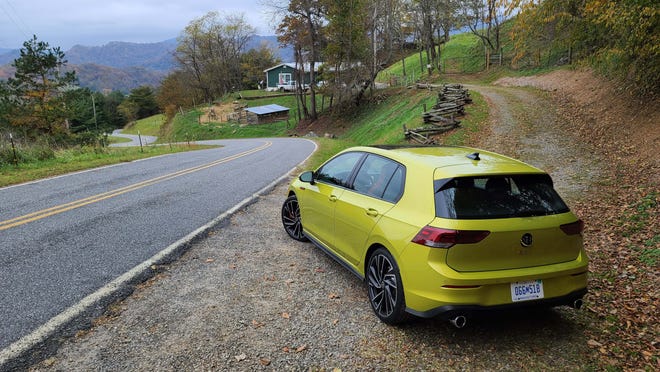
The comparable GTI sticker is, ahem, $39,385. That’s a big number in this segment. The $30,540 GTI SE model will do fine.
Also playing in that league is the $38.9K Honda Civic Type R, a ferocious front-wheel-drive hellion that matches the GTI’s top Autobahn trim with its track-tuned suspension while pushing out a heady 306-horsepower from its own turbo-4.
Based on the new Generation-11 Civic, the Type R will soon reveal a more conservative design — compared to the current comic book-inspired Batmobile — aimed squarely at GTI buyers (as well as Golf R enthusiasts).
As Federer can tell you, the waves of youthful new contenders never stop. But unlike Federer and his groaning knees, GTI shows no signs of slowing down.
Throttle wide open over a high-speed crest on Route 209, the eighth-gen Golf GTI felt as fresh as my first Mark I 40 years ago. Bar reset.
Next week: 2021 Porsche Cayman GTS
2022 Volkswagen Golf GTI
Vehicle type: Front-engine, front-wheel-drive five-passenger hot hatch
Price: $30,540, including $995 destination fee ($39,385 manual with carbon fiber package as tested)
Powerplant: 2.0-liter turbo-4 cylinder
Power: 241 horsepower, 273 pound-feet of torque
Transmission: 6-speed manual, 7-speed dual-clutch automatic
Performance: 0-60 mph, 5.4 seconds (automatic, Motor Trend)
Weight: 3,113 pounds (manual as tested)
Fuel economy: EPA, 24 mpg city/34 highway/28 combined (manual); 25 mpg city/34 highway/28 combined (auto)
Report card
Highs: Serious handling; big interior leap
Lows: Price can push $40K; base car only has 8.5-inch touchscreen
Overall: 4 stars
Payne: Jeep Grand Cherokee L is a first class road trip
Posted by Talbot Payne on November 5, 2021
Charlevoix — At first blush, the new, 2021 Jeep Grand Cherokee L looks familiar.
On a road trip Up North, the SUV brand’s ubiquitous, best-selling vehicle barely turned a head. Seven-slot grille. Body chiseled as if from granite. V-6 engine purring under the hood. This being Michigan, a couple of car guys noticed something different — like the local book club noticing one of its own just got their first Botox treatment.

“That’s the new Grand Cherokee, isn’t it?” said the owner of a blood-red Corvette C7 after I parked next to him on Michigan Beach. The thinner front headlights tipped him off.
“The Grand Cherokee’s gotten longer,” said my neighbor Jon as I drove up.
Correct on both counts as Grand Cherokee designers took advantage of the latest advances in lighting technology, while brand marketers saw a sales opportunity by offering the Grand with three rows for the first time. L-yeah!
Open the door to check out the three-row execution and the new stuff hits you like a tidal wave.
“Whoa! That’s nice. Where’s the umbrella in the door?” laughed Jon, referencing the Rolls Royce Cullinan I recently tested — complete with the Brit brand’s signature rear-door parasols.
Jeep has longed bridged the mainstream and luxury segments — its powerful brand cross-shopped by Mercedes and Toyota owners alike. It’s a rare talent shared by Detroit Three pickups and Mazda. The 2021 Grand Cherokee goes all-out luxe. Its handsome, thin infotainment screen spills down the console like a black waterfall. Behind the bronze-trimmed steering wheel is a configurable digital dash that would be at home in a Bimmer. A head-up display floats over the dash like a Caddy.

Much of this is made possible by modern electronics, which have democratized vehicle brands. But the Jeep backs this capability with carefully paced materials. Lush wood sprawls across the dash from A-pillar to A-pillar. At night, cool blue trim lights circle the cabin like a Merc. The leather seats on my Summit tester were laced with stitching that extended to the third row, where my sprawling 6’5” frame sat behind myself with ease.
I was sometimes lulled into complacency by the rich details.
Lounging in the third-row thrones, I simply pulled the seat tab in front of me and the entire second-row seat folded forward — opening a passageway out like Moses crossing the Red Sea. On my way out, I carelessly cut my foot on the seat’s bottom plastic frame. Careful, Payne! This is still a vehicle, not your living room.
Dropping my kids at the airport on the way north, we unloaded the enormous cargo hold stuffed with luggage — including sub-cargo beneath the trunk floor. Jeep has thoughtfully placed a throw carpet over the cargo floor so the base carpet doesn’t get ripped up by repeated luggage tosses (I wish my thinly carpeted Tesla trunk had one of those).
But I neglected to make sure the carpet was in place after disgorging our cargo. I pushed the automatic (of course) trunk close button and jumped back in the car. Unbeknownst to me, the lid bounced off the carpet and re-opened so that I exited the airport with rear wide open.
The automatic wizardry extends to the road, were the big Jeep boasts one of the best semi-autonomous driving systems on the market. The system lane-centers beautifully, even holding mild curves on I-75. On long road trips, it makes it safer for an attentive driver to eat a meal or check the phone for a message.

Speaking of safety, electronic suspension systems have made big vehicles remarkably nimble, something I first experienced on a GMC Sierra pickup with magnetic shocks years ago. The L benefits from this revolution, and I actually enjoyed driving — not wrestling — the Jeep through M-32’s curves once I exited I-75 and head for the Lake Michigan shore.
The old school V-6 drivetrain competently motivates this rolling furniture showroom.
Such luxury doesn’t come cheap, of course, and my Jeep L stickered for a healthy $66,985 — $23K over the Atlas Cross Sport tester that I returned home to after my Up North trip.
That’s a luxury-like gulf (credit wood trim, head-up display, third-row accommodations) between two mainstream brands.
Jeep has come a long way from its humble World War II origins.
2021 Jeep Grand Cherokee L
Vehicle type: Front engine, rear- and-all-wheel-drive, seven-passenger SUV
Price: $41,425, including $1,695 destination fee ($65,775 Summit Reserve as tested)
Powerplant: 3.6-liter V-6
Power: 293 horsepower, 260 pound-feet torque
Transmission: 8-speed automatic
Performance: 0-60 mph, 6.7 seconds (Car and Driver est.); Towing, 6,200 pounds
Weight: 5,068 pounds
Fuel economy: EPA est. mpg 19 city/26 highway/21 combined
Report card
Highs: Roomy three rows; luxury interior
Lows: Gets pricey
Overall: 4 stars
Henry Payne is auto critic for The Detroit News. Find him at hpayne@detroitnews.com or Twitter @HenryEPayne.
Payne: Mazda MX-30 EV is long on style and handling, short on range
Posted by Talbot Payne on November 5, 2021
Birmingham — The Mazda MX-30 is the ZOOM! ZOOM! brand’s first electric vehicle and it brings Mazda mojo. It’s stylish, feature-rich and fun to drive.
It’s also a poster child as to why EVs are niche vehicles.
Entering Telegraph Road off Lone Pine, I flung the front-wheel-drive MX-30 through a 90-degree turn and it rotated beautifully. I stomped the right pedal and the front motor responded instantly with a satisfying, electric WHIIRRRRR! — the instant, buttery-smooth torque launching the EV forward.
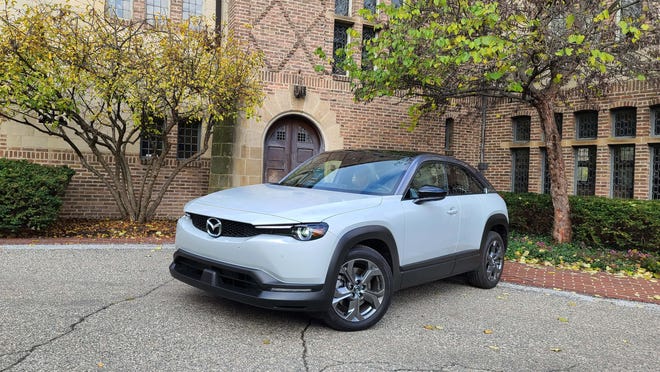
Sauntering through Cranbrook’s campus, I rotated heads with the MX-30’s nice looks. “Ooooh, I really like the design,” said my friend Laurie, lingering on the sculpted rear taillamps after I rolled into her driveway. But Laurie won’t be giving up her gas-powered Mazda CX-30 anytime soon.
That’s because the MX-30 and the CX-30 share the same platform and — thanks to its gas powertrain — the CX-30 is the better all-around car.
In today’s luxury EV market, most electrics are built on skateboard platforms housing enormous batteries. They are capable, fun and expensive. The average Tesla transaction price is a healthy $55,000. The Silicon Valley automaker’s trillion-dollar brand is built on envelope-pushing, luxury tech like autonomous driving, over-the-air updates and breathtaking acceleration.
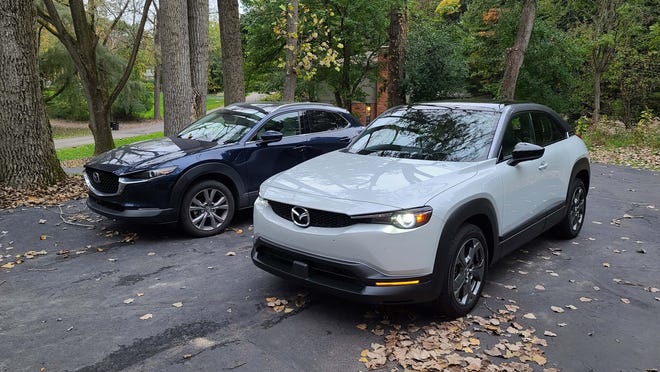
Its success has inspired governments to force electric vehicles on everyone — not just the luxe buyers who can afford Teslas. But to make electric cars mainstream, they have to compete at $35K — the average market transaction price (when not roiled by chip-induced supply chain shortages) — not $55K.
That’s where the MX-30 plays, and it is a poor second to its gas-powered sibling.
Pal Laurie’s gas-powered, $29,875 CX-30 Premium is one of the best values in the subcompact SUV class. Leather seats, head-up display, adaptive cruise control, auto headlights, blind-spot assist, sunroof, 186-horsepower, 392-mile range, flat-screen TV (just kidding about that last one). It’s a premium car in a mainstream badge.
My MX-30 tester Premium Plus matched it stride-for-feature, except … it had 143 horsepower, 100 miles of range, and costs $38,550. Oh.
Laurie is environmentally conscious but couldn’t make sense of the MX-30 compared with her beloved CX-30 (her third Mazda). EV advocates never tire of pointing out that most drivers don’t travel more than 30 miles in a day. So what’s all this fuss about range?
True enough, most of Laurie’s business clients are within the Mazda’s 100-mile radius. But, ahem, anything beyond requires a charge. Even her U. of Michigan alma mater would be dicey — especially in cold Michigan weather. She makes occasional trips east to, say, New York City to visit family — a trip that would take, well, forever in the MX-30. She, like most folks, needs the versatility of gas.

Within its niche electric segment, however, the MX-30 is an intriguing little morsel.
Along with the BMW X1 (heady company), the CX-30 is already the best handling small ute I’ve driven. The MX-30 magnifies its inherent balance with its battery strapped low between the wheels in the vehicle’s belly — eliminating the nose-heavy gas engine. The 35.5 kWh extra battery weight is obvious — the MX-30 weighs 420 pounds more than its gas counterpart — but its placement lowers the center of gravity a whopping 2.1 inches.
With no six-speed transmission to interrupt it, the electric motor felt terrific around town. All torque, all the time.
Shoppers will note that the Mazda not only significantly lags the CX-30 in range — but also direct competitors like the 250-plus-mile range Chevy Bolt and Hyundai Kona EV. That’s a problem, as the Chevy and Kona will effortlessly be able to go to, say, Lansing and back on a single charge.
MX-30’s low battery helps Mazda maintain its ZOOM! ZOOM! heritage (Mazda’s new slogan is actually “Feel Alive” — but gimme the ol’ “Zoom! Zoom!”) with nimble handling and a 45% stiffer chassis. But Bolt and Kona are no slouches in the handling department either.
Mazda, aware of its battery shortcomings, tries to divert attention to its style and affordability.
My $38,550 tester is $2,400 under a comparable Bolt EUV, and a whopping $8,225 less than the Kona EV. And that’s before you spend about two grand on each vehicle to outfit your garage with a 240-volt charger so you can charge overnight (Mazda helpfully kicks in $500 to help buy a charger).
That relative bargain, however, could be erased by Washington’s punishment of foreign automakers. Only American-made, UAW-assembled EVs are currently favored with a $12,500 tax credit in the massive climate legislation, while the small-battery Mazda gets thrown a smaller $7,500 bone. Ouch. Small consolation: the subsidy at least makes MX-30 price more competitive with the gas-powered CX-30.
While the Bolt and Kona both look at you with blank, Jedi battle droid stares, the Mazda cutie brings that Rodney Copperbottom cheer. Then it borrows a little luxury from Rolls Royce — cabinet doors that open to the interior. What, no red carpet?

The interior raises the bar over the CX-30’s already handsome office space. The console has lots of basement storage for m’lady’s purse — or to charge a phone. A second, 7.5-inch touchscreen complements the high-dash remote screen with climate controls. The whole console is trimmed with cork (Mazda started as a cork maker, don’t ya know) — aimed at the green crowd.
But as with its battery size, the interior space lags competitors. Rear legroom — 30.1 inches compared to the Bolt’s 36.5 — is cramped for six-footers like me.

Mazda recognizes the MX-30’s niche status and only offers it for sale in California (so eager Michiganians have a long drive back from the dealer), which currently makes up about half of EV sales. There, green is religion and the MX-30 should find an audience of upscale urban buyers whose lifestyle is a perfect fit.
Beyond that, MX-30 has my friend Lauri’s attention that Mazda is in the electric game should it ever offer an EV as practical as its gas lineup. It’s a mountain EV-makers have been trying to climb since Henry Ford’s gas-powered Model T outsold Detroit Electric over 100 years ago.
2022 Mazda MX-30
Vehicle type: Battery-powered, front-wheel-drive small SUV
Price: $34,465 ($38,550 as tested before $7,500 federal tax credit)
Powerplant: 35.5kWh lithium-ion battery pack driving front electric motor
Power: 143 horsepower, 200 pound-feet of torque
Transmission: Single-speed automatic
Performance: 0-60 mph, 9.6 seconds (mfr.); top speed, 90 mph
Weight: 3,655 pounds
Fuel economy: EPA est. range, 100 miles
Report card
Highs: Handling improves over already nimble CX-30; cool cabinet doors
Lows: $10K premium for one-fourth the range of its gas sibling
Overall: 3 stars
Henry Payne is auto critic for The Detroit News. Find him at hpayne@detroitnews.com or Twitter @HenryEPayne.
Payne: How congressional EV tax credit bills discriminate against foreign and domestic models
Posted by Talbot Payne on November 5, 2021
As it tries to compel electric vehicle adoption with federal sweeteners, Congress is using tax credits to tip the scales to union-made EVs. Senate and House bills offer a whopping, $12,500 tax credit to purchase an EV — provided it’s Made-in-the-USA and Made-by-the-UAW.
The twin bills, when merged in congressional reconciliation, say industry insiders, could complicate the emerging EV market for foreign and domestic automakers alike.
Under the House bill pushed by Rep. Dan Kildee, D-Flint Township, EV buyers would get a base credit of $4,000 or $7,500 — depending on battery size — plus an additional $4,500 if the vehicle is built in the United States by United Auto Workers labor, and $500 if the battery is U.S.-made. That bill has been included in the draft of President Joe Biden’s social spending package that Democratic lawmakers are considering.
The Senate bill, championed by Sen. Debbie Stabenow, D-Lansing, contains similar provisions. It calls for $2,500 to go to U.S.-made EVs plus $2,500 if built by union workers, in addition to the $7,500 base credit.

The buyer of a $38,550 Mazda MX-30 EV, under the House language for example, would only receive a $4,000 tax credit since it is imported from Japan and has a smaller battery. Its Orion Assembly-made, UAW-assembled, $40,950 Chevrolet Bolt EUV competitor, on the other hand, would come with a $12,500 credit against the purchaser’s April 15 tax bill.
The federal subsidy would erase the Mazda’s $2,400 price advantage and drop the favored Bolt EUV’s sticker below $30,000.
“We want a level playing field,” said Dan Ryan, Mazda vice president for government and public affairs. “If government wants to spur EV adoption, it should give consumers as much choice as possible.”
The favorable tax credit would not just discriminate against foreign transplants, but also domestic brands. Ford’s Mexican-made Mustang Mach-E would not receive the UAW-Made and Made-in-America credits, and Tesla’s California-made EVs would not be eligible for the UAW-Made credit. Both would get the base $7,500 credit — until 2026, when the foreign-built Mach-E would lose that credit under the House bill.

“These bills get complicated,” said Ed Kim, vice president for industry analysis at Auto Pacific. “They are now meant, not just to incentivize EVs, but to incentivize the manufacture of UAW-built vehicles as well.”
Ford Motor Co.’s Oakville, Ontario, assembly plant is undergoing a major conversion to produce five EVs starting in 2025 — but none would be eligible for the American-made congressional credit. Meanwhile, the luxurious Cadillac Lyriq EV — to be produced in General Motors Co.’s Spring Hill, Tennessee, plant by the UAW next year — would qualify for the full $12,500 credit.
As will the GM-made Honda and Acura EVs coming down the Detroit automaker’s Spring Hill line, said Kim. Just down the road in Chattanooga, Honda competitor Volkswagen AG would only qualify for the partial, Made-in-America credit because its plant is non-union.
Despite the credit’s complications for its North Americans plants, Ford has endorsed congressional efforts. “EV consumer incentives are key to accelerating the transition to a zero-emissions transportation future, and we appreciate Congressman Kildee and Senator Stabenow’s leadership on this issue,” said Ford president for the Americas, Kumar Galhotra, in a statement on Kildee’s website. “This legislation will help more Americans get into EVs, while at the same time supporting American manufacturing and union jobs.”
They estimate that only two EVs — the Chevy Bolt EV and Bolt EUV, out of dozens currently selling in the U.S. market — would be eligible for the full tax credit. Four of the top-five selling EVs (Tesla Model Y, Model 3, Mustang Mach-E and Nissan Leaf) would not be eligible.
“The UAW is nervous about EV production because battery-driven vehicles have fewer parts than gas engines,” said Mazda’s Ryan. “They fear this will produce widespread joblessness, and so they are pushing incentives.”
The federal government currently gives electric vehicle consumers — regardless of the origin of their vehicle — a $7,500 tax break until the manufacturer reaches a ceiling of 200,000 EVs sold.
Due to EV shortcomings on cost and range compared with their internal combustion engine (ICE) peers, automakers say that subsidies are essential to EV adoption. Even with subsidies, Chevy’s Bolt and the Mustang Mach-E have sold in low volumes.
The exception is luxury-brand Tesla — with an average model transaction price of $55,000 — which blew through its 200,000 sales cap two years ago. Yet it continues to dominate the EV market with 80% of sales.
While Ford’s Mustang Mach-E would only get $7,500 in subsidies under the proposed bills, the legislation’s ultimate goal is to subsidize only U.S.-made vehicles. Automakers call this the “import cliff” as all subsidies disappear.
As foreign-built vehicles, the Mach-E and Mazda MX-30 — to use two examples — would lose all EV credits after 2026 in the House bill, and after 2027 in the Senate bill. The Tennessee-made Volkswagen ID.4, by contrast, would still get federal subsidies for U.S. content — though not for union labor since the UAW has failed to organize workers at its Chattanooga site.
The import cliff and UAW provisions have drawn the wrath of foreign countries and automakers alike. And Toyota Motor Corp. is taking out ads this week in newspapers from the Wall Street Journal to The Detroit News.
“Let’s not play politics with the environment, the American autoworker, or the American consumer,” Toyota says in the ads.
The UAW has powerful Democratic allies in Washington with Kildee and Stabenow leading the charge for tax subsidies. Former Michigan Democratic Gov. Jennifer Granholm, now secretary energy, long has been a strong advocate for union members and the Detroit automakers.
GM has lobbied for lifting the 200,000 sales cap on its electric vehicle sales and has pushed for the United States to follow the path of Norway, which has seen its EV sales soar with 50% EV purchase subsides as well as $8-a-gallon gas.
Even with the $12,500 tax credit — or about 30% of the cost of a new Bolt EUV — EVs face an uphill battle in the United States with $3-a-gallon gas and high home-charger installation costs that can top $2,000.
In addition to throttling foreign-made EVs, the House legislation would penalize small electric batteries. With a 35.5 kWh battery, the Mazda MX-30 meets the House threshold of 10 kWh to receive a $4,000 subsidy. But for customers to get back $7,500 on their taxes, EVs must have batteries over 40 kWh — a threshold the Bolt twins meet but not the Mazda. After 2027, battery packs must be north of 50 kWh to qualify.
“(Congress is) basically dictating battery size to the market,” said Mazda’s Ryan. “I think it would be better to stay away from minimum battery size that may inhibit creative solutions or more choices for consumers. Not everyone needs a BEV with 400-mile range.”
Henry Payne is auto critic for The Detroit News. Find him at hpayne@detroitnews.com or Twitter @HenryEPayne.
Payne: Dodge does the muscle-car mash with these scary packages
Posted by Talbot Payne on October 30, 2021
If 700-plus horsepower isn’t scary enough, Dodge is dressing up its muscle-car monsters for Halloween with Hemi Orange and SRT Black packages.
The sinister wardrobes are available on everything from V6-powered GT models up to blood-sucking Hellcats.
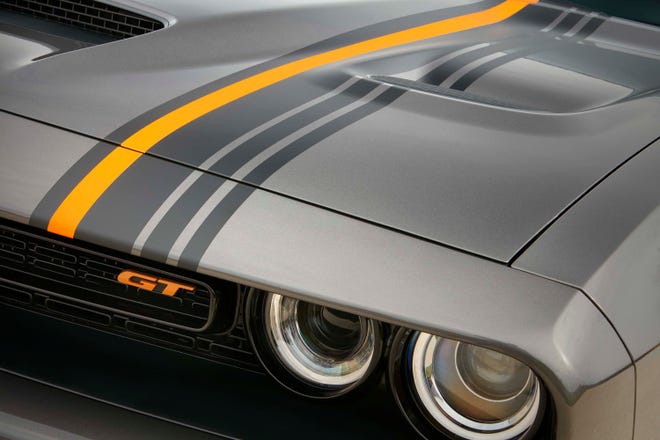
The holiday candy adds to a lineup of Dodge muscle that has captured America’s hearts, vaulting the Auburn Hills-based automaker to the best-selling muscle brand in the country with 130,420 units sold in 2020 between the fire-breathing Challenger coupe and Charger sedan. Including the ridiculous, 710-horsepower Dodge Durango SRT Hellcat SUV, Dodge averages more horsepower across its lineup than any other American brand.
“Performance-vehicle owners are unique, and these two packages offer our customers the chance to stand out even more on the street,” said Tim Kuniskis, chief Dodge hell-raiser.
The packages are comparatively subtle for a brand that has offered treats for its current lineup ranging from hood shakers to superchargers that shriek like a coven of witches.
The Hemi Orange package — available on the V6-powered, rear-wheel-drive GT and earth-shaking, 485-horse V-8 Scat Pack Widebody models for Charger and Challenger — is distinguished by a grille-to-tail orange stripe embedded in Gunmetal black. It can be paired with a variety of colors, including Granite Crystal, Smokeshow, Triple Nickel, Pitch Black and White Knuckle.
Like ghouls’ eyes at midnight, other orange accents include grille and fender badging, and — on the Scat Pack Widebody — orange Brembo calipers. The calipers contrast with Carbon Black 20-inch wheels, naturally.
The accents continue inside the crypt — er, cabin — with orange stitching on the instrument panel, upper doors, armrest, console lid, shifter boot, and flat-bottom steering wheel. The seats are highlighted by orange stitching and a Dodge Rhombi logo.
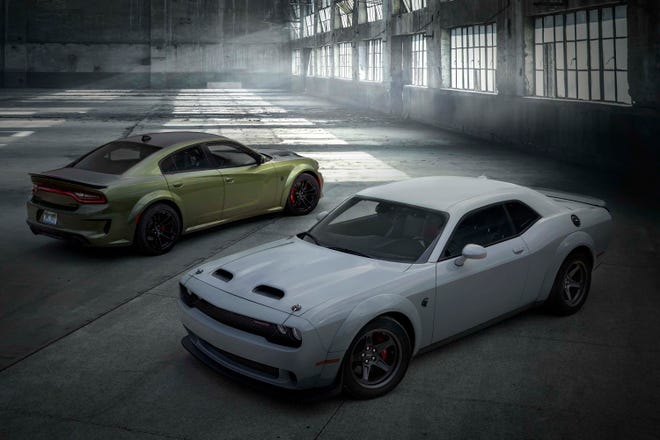
The SRT Black package is reserved for the insane, 717-horsepower Charger and Challenger SRT Hellcat and 797-horse SRT Hellcat Redeye models — if you can catch them. The costume is distinguished by blacked-out exterior badging for the grille, fender and spoiler for Challenger — grille, fender and decklid for Charger. The Durango SRT 392 also can be outfitted like its muscle car siblings.
The Hemi Orange package will be available for order in the fourth quarter of 2021. Price: $2,995 for the GT RWD and $1,500 for Scat Pack Widebody. The SRT Black appearance package will set customers back $695.
Watch Dodge’s Twitter and Instagram channels on Oct. 31 for additional Halloween-themed content. Better yet, hitch a ride in a Hellcat for a real scream.
Henry Payne is auto critic for The Detroit News. Find him at hpayne@detroitnews.com or Twitter @HenryEPayne.