- Search Cartoons
- Comic Archive
-
Payne
Store



 Henry Payne RSS

Articles
Playing in Vegas: The SEMA Bronco, Wrangler and Hummer EV Show
Posted by Talbot Payne on October 30, 2021
Forget Celine Dion and Cirque de Soleil. If you’re an auto buff, the biggest show in Vegas next week will be the SEMA circus featuring the Ford Bronco, Jeep Wrangler and GMC Hummer EV off-road warriors.
The Detroit Three’s off-road stars will take center stage at the Nov. 2-5 Specialty Equipment Market Association’s annual show, which is back live after taking last year off because of the pandemic.

The show has been an annual pilgrimage for Wrangler, the halo car for Jeep’s rugged lineup of SUVs. The Wrangler will showcase two unique off-road mods this year. But in an indication of the escalating off-road battlefield in an SUV and truck-crazed nation, the Wrangler will be joined by debut outings from Bronco and Hummer EV.
SEMA represents auto-mod businesses — a market estimated at $40 billion in 2020 – geared towards enthusiasts who want to personalize their vehicles beyond the multitude of trims that manufacturers offer. The convention floor is a toy chest full of vehicle mods for everything from pickups to sportscars.
Ford traditionally brings hot-rod versions of its Mustang muscle car, while Chevrolet is sure to show off its new, 670-horse Corvette Z06 supercar as well as a 632-cubic-inch V-8 crate engine — offering the most horsepower in Chevy history at 1,004 horsepower. Foreign brands like Toyota have made SEMA home with its smokin’ Supra sportscar, while the floor is also littered with aftermarket shops like Dana (axles) and Wixom-based Lingenfelter Engineering.

Off-roading has been supercharged in the pandemic and overlanding age, and Detroit’s rugged brands are determined to capture the market with hundreds of high-margin accessories. In addition to ogling cars at manufacturer booths, SEMA attendees can climb aboard for rides in activations outside the Las Vegas Convention Center.
Having locked horns with Wrangler at Michigan’s Motor Bella and Detroit 4Fest shows this fall, Bronco swaggers into Vegas with four Broncos and two Bronco Sports specially-outfitted by mod shops for some serious dirt-kicking.
“Bronco and Bronco Sport customers love parts and accessories that emphasize (the) off-road lifestyle,” said Ford guru for personalization Eric Cin, whose Bronco is a nominee for SEMA’s inaugural 4×4 SUV of the Year Award. “Since the reveal last year, we’ve expanded the line to more than 350 Bronco and Bronco Sport parts and accessories.”

Leading the Built Wild Bronco parade is drift-champion and builder Vaughn Gittin Jr. with a “Fun-runner” badged, two-door Badlands tattooed with body graphics and lime green wheel beadlocks. A sport exhaust telegraphs the ute’s enhanced off-road performance.
Other offerings include: a fire-red rescue Bronco festooned with a roof-full of lights, winches and huge, 37-inch tires; a gray-and-green Bronco rescue vehicle with tank-like quad tracks under the fenders; and a four-door Outer Banks model that can go off the grid with an onboard fridge, premium sound bar and folding table.
“Baby Bronco” Sport entries include a lifted, rough-and-ready mod — and a red model swarmed with everything from an underbody light kit to all-terrain tires and a rear spoiler.

Not to be outdone, Jeep shows off its Mopar accessory brand customizing a pair of Wranglers
“With its dedicated enthusiast audience, SEMA is the best place to showcase our full catalog of factory-backed performance parts,” said Mopar veep Mark Bosanac.
The Wrangler 4xe, the model’s first plug-in hybrid, leads the way, featuring a lifted white bod, 37-inch tires, beadlocks, underbody light kit and more. You’ll know it by its “skeleton” tube doors and blue interior. Joining it are a swanky, bronze-colored Jeep Overlook concept stretched a foot to hold a third row — and with its ceiling raised five inches to accommodate the Detroit Pistons front court.
Joining the Wranglers are more Stellantis-brand vehicles:
- A gloss-black, three-row Jeep Grand Cherokee L Breckenridge concept with blue quilted doors and comfort pillows
- A desert-tan, vintage Kaiser Jeep M725 military ambuance stuffed with a 485-horse Hemi V8 to get you there fast – then a rear cargo area big enough to stand in to deliver supplies
- An even faster Ram 1500 TRX RexRunner concept equipped with 37-inch tires for rock-crawling
- A Ram 1500 Outdoorsman pickup concept with multi-purpose bed
- A Dodge Challenger Holy Guacamole concept painted in — yes, Rotten Avocado green — with a hood scoop and wood panel-trimmed interior.
The Hummer runs with a different social crowd than the Broncos and Jeeps — it stickers for twice those vehicles — but GMC wanted to show its its cupboard-full of 200 accessories.
The premium brand brings a Hummer SUV and two pickups to the Vegas party.

Some of the accessories featured on the Hummer EV pickup include a frunk organizer, bed-mounted spare tire carrier, battery-powered cooler and roof pup tent.
“We knew from the outset that the Hummer EV would inspire a high degree of personalization from owners,” said lead accessories designer Humberto Ortiz. “The accessories developed for GMC Hummer EV are inspired by its extreme performance capabilities.”
Floor the 9,000-pound EV and it can rocket to 60 mph down the Vegas strip in just three seconds.
Henry Payne is auto critic for The Detroit News. Find him at hpayne@detroitnews.com or Twitter @HenryEPayne.
Payne: Riveting Rivian R1T pickup is a Tesla with a bed
Posted by Talbot Payne on October 28, 2021
Ann Arbor — Tesla has delayed its Cybertruck pickup until late 2022. For those who can’t wait, the Rivian R1T is here.
Slip into the driver’s seat of the R1T and you are surrounded by iPad minimalist design. Just like a Tesla. The steering wheel is naked but for two scroll wheels. Just like Tesla. Roll the wheels to set your mirrors. Your steering wheel height. Everything else is in the huge 16-inch touchscreen to your right. Just like the Tesla.

Mash the throttle and — ZOT! — the Rivian takes off like a lit firecracker. Zero-60 mph in just 3 seconds. Just like a Tesla.
It’s been three years since Plymouth-based Rivian wowed the 2018 Los Angeles Auto Show with its spare, revolutionary pickup. Since then, the electric pickup space has been flooded with innovative intros from Cybertruck to the GMC Hummer EV to the Bollinger B1 and Ford F-150 Lightning.
So it’s hard to remember just how jaw-dropping the R1T was.
“Who are these guys?” asked an impressed Autoblog. R1T (and sister R1S SUV) wowed for the same reason Tesla had with its S3XY lineup of EVs: Rivian was a clean-sheet, electrified re-imagining of the pickup from bumper-to-bumper.
It was the first Generation Tesla pickup — right down to the manufacturer-owned service centers (the first in Michigan is being built in Plymouth) and Mobile Unit visits. That’s right, they’ll come to your house to fix your vehicle.
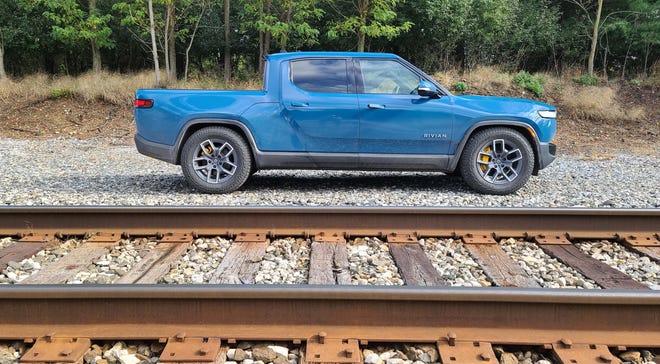
R1T is a semi-finalist for North American Car, Utility and Truck of the Year, and I had the chance to flog it at NACTOY’s Ann Arbor jury test.
Its simple, Tesla-like approach to the automobile was immediately familiar. I’ve owned two Tesla Model 3s and they are radically different from operating any other vehicle. I shy from dropping my car at a valet stand lest I have to give the attendant an operations tutorial.

But the spare design makes sense from an operational, simplicity-of-manufacturing perspective. Rivian has taken that to heart, and it will be interesting which automakers will follow.
After merging onto Interstate 96 like an Apollo rocket (chest-caving 838 horsepower and 908 pound-feet of torque never get old), I settled into highway driving on adaptive cruise control. Toggle the steering wheel scroll wheel to measure distance to the car in front of you, then click the rocker on either side of the scroll wheel to adjust speed up/down. The left-hand scroll also serves to adjust infotainment volume. Easy-peasy.
Just as Tesla saw skateboard battery design as an opportunity to remake interior/cargo space, so has Rivian gleefully seized on the skateboard to reinvent pickups. Let me count the ways.

Tesla popularized the frunk (front trunk), Rivian expanded it. Behind Rivian’s signature vertical headlights — where a gas engine would normally be — is now a deep storage space with a sub-frunk. It’s not as big as the F-150 Lightning’s frunk — which could house a small family — but that’s a reminder R1T is not a full-size truck.
The Rivian is closer to a midsize Honda Ridgeline in both size, ride quality and unibody construction. But unlike Ridgeline, the unibody chassis is bonded to a battery-boxed skateboard foundation, which gives Rivian more structural rigidity to tow an F-150-like 11,000 pounds (Ridgeline can clean and jerk just 5,000).
Above decks, R1T’s crew cab is roomy. The front footwell is open like a Tesla, with deep console storage between the seats. My 6’5” frame easily sat behind myself in the rear seat. Probe the rear seat console and a clever trapdoor gives way like the false wall of a Halloween mansion — allowing access to the Gear Tunnel behind the crew cab.
The Gear-what?
Taking a page from Army Jeeps that ran a transverse tube behind the rear seats (storing ammo, weapons, etc.), the R1T’s Gear Tunnel can hold everything from gym bags to two-by-fours to the portable stove Rivian options.
The Gear Tunnel is capped by folding doors at either end that double as steps to the 4.5-foot rear bed. I tested the 250-pound capacity with my 230-pound frame … it passed the test.

The bed has functional tie-downs, a sub-bed for storage/tire spare, and, dude — this is the cool part — an air compressor built into the chassis. Use the compressor to pump up the spare, bicycle tires, rafts, river tubes, and so on.
My guess is that river/camping trips will be more in the Rivian’s wheelhouse than towing.

With a Tesla-like 314 miles of range — 270 when equipped with 34-inch all-terrain tires like my tester’s Pirelli Scorpions — the battery won’t get far dragging 5,000-10,000 pounds of boat behind it. Our friends at TFL Truck, for example, have seen 70% range degradation on Model X SUVs when towing.
Rivian founder R.J. Scaringe shares many things with Tesla founder Elon Musk — a missionary’s zeal to save the planet with EVs, for example — but he aims to achieve that mission through commercial truck volume (he has a big contract with Amazon) rather than retail sales.
Rivian is in the process of building an exclusive, Level 3 fast-charging network for its customers — Tesla’s 1,100 stations are its secret sauce – with a promised 600 stations coming online by the end of 2023. In the meantime, if you hit the road in an R1T, you’re at the mercy of third-party chargers. E-gad.
Rivian also promises a network of Level 2 chargers at national parks, but their utility is limited. Neither is Rivian intent on producing R1Ts in Tesla-like (much-less F-150-like) volumes.

When Musk unveiled his $40K Model 3 in April 2016, he committed to meeting 250,000 customer orders (including mine) just over a year later.
Rivian is content to build an exclusive pickup for well-heeled customers — thus the three-year wait since the truck was unveiled in L.A. Thus the production of only a sold-out First Edition model (in production now!) to start. My walkaround of the R1T impressed with tight panel gaps and solid door slams. Rivian seems to be sweating manufacturing details that Tesla sacrificed to volume production.
The $73,000 First Edition (to be followed next year by similar $73,000 Adventure and $67,500 Explorer models) comes with a standard self-charging flashlight in the door to add a premium touch — think Rolls Royce umbrella.
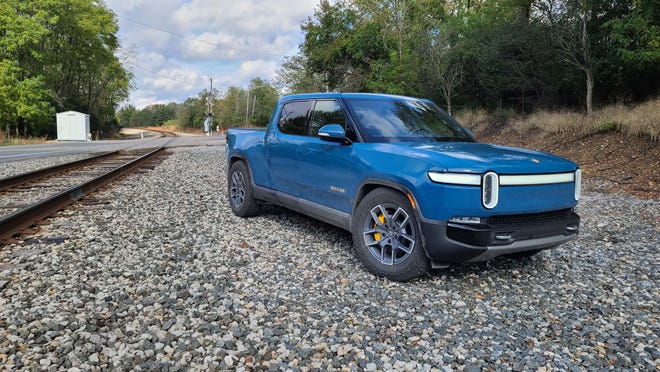
The flashlight is just the beginning of standard features. There’s the standard quad motors (two each, front and rear) for that monstrous acceleration. Sliding tonneau bed cover. Portable console-based Bluetooth speaker. Panoramic roof. Ride height of 11.5 inches with more than six inches of adjustability, thanks to air suspension. Security camera. Multiple drive modes. Suction cups to scale vertical rock faces (kidding about that last one).
More features will come with future over-the-air updates: self-park, semi-autonomous driving, 360-degree tank turn.
Your move, Cybertruck.
2022 Rivian R1T First Edition
Vehicle type: Battery-powered, all-wheel-drive four-door pickup
Price: $73,000 ($80,775 First Edition est. price as tested)
Powerplant: 68-88-kWh lithium-ion battery driving single or twin electric motors
Power: 838 horsepower, 908 pound-feet of torque
Transmission: Single-speed automatic
Performance: 0-60 mph, 3.0 seconds (mfr.); towing, 11,000 pounds; payload, 1,760 pounds
Weight: 6,950 pounds
Fuel economy: EPA est. range, 314 miles; 270 miles as tested with all-terrain tires
Report card
Highs: Swiss Army knife capability; clever ergonomics
Lows: Dependent on third-party charging network; minimal dealer network
Overall: 4 stars
Henry Payne is auto critic for The Detroit News. Find him at hpayne@detroitnews.com or Twitter @HenryEPayne.
Head-turning Kia Sportage gets bigger, more high-tech
Posted by Talbot Payne on October 28, 2021
The Kia Sportage is getting new plumage.
The Korean brand’s made-in-Georgia compact SUV gains a radical remake for its fifth-generation model with a stylish exterior and interior screens that rival luxury automakers. Previously one of the smallest utes in class, the 2023 Sportage leapfrogs the competition to boast the biggest backseat in class.
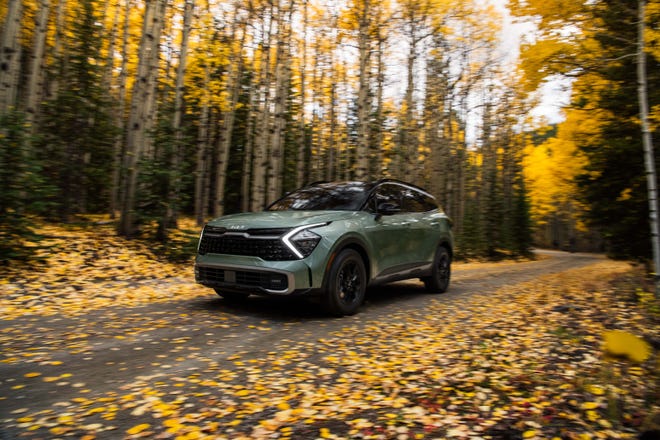
Based on the same platform as cousin Hyundai Tucson — which has also turned heads — the Sportage’s headliner is a curved, hoodless, 25-inch instrument display that stretches across the dash like one in a Mercedes. Following in the footsteps of Kia’s sexy Stinger sport sedan and the wildly popular Telluride three-row SUV, the Sportage continues the automakers’ assault on the U.S. market with some of the most talked-about mainstream vehicles of the last few years.
“The tremendous success formula of our current stable of SUVs has been infused into every ounce of the new Sportage, transforming it into a leader of the pack with its cutting-edge design, adventurous capability and desirable in-car technology,” said Kia North America CEO Sean Yoon.
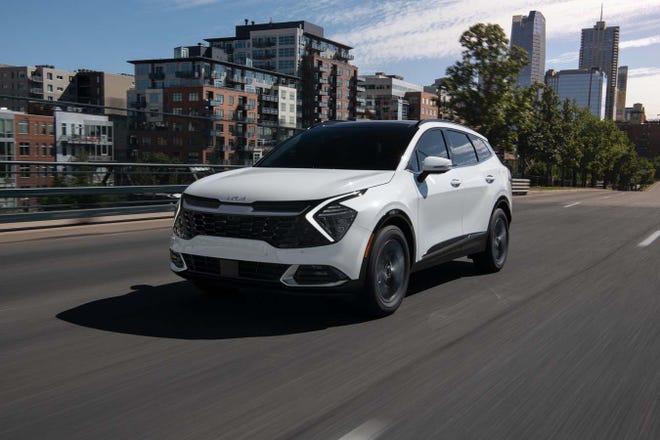
With 84,343 in sales, Sportage was the brand’s second-best selling vehicle in 2020 after the Forte compact sedan. As consumers have gobbled up SUVS, so has Kia shifted its lineup’s focus to the Telluride, Sorento — and now Sportage — SUVs, imbuing them with off-road flavor made popular by Jeep models.
Likely starting around $26,000 with familiar trims like EX, SX and SX, the Sportage will offer more adventure-oriented X-Pro and X-Pro Prestige models. The latter, for example, offers all-terrain tires to complement its increased-by-1.5 inches ride height (8.3 inches total) for when the asphalt ends.

The Sportage ups its game for a class that has seen overland entries in recent years like the Ford Bronco Sport and Toyota RAV4 TRD. As governments force electrification, Kia said that the Sportage will soon offer a hybrid model.
Kia’s Telluride is one of the most distinctive SUVs on the road and the Sportage aims to get tongues wagging with its own knockout face. The brand’s “tiger nose” design occupies nearly the entire fascia — bracketed by huge, “boomerang” LED running lights that push the headlights to the front corners.
The boomerang lights run across the hood line setting up muscular shoulders that run to distinctive “notch-shaped” taillights — integrated by a thin, Audi-like black graphic across the tailgate.
The luxury-inspired forms reach their summit inside with the Sportage’s dramatic, panoramic screen that connects the 12.3-inch instrument and 12.3-inch infotainment displays. The screen is standard on upper SX (likely starting in the mid-$30k range) and X-Pro trims. The form, pioneered by Mercedes and Cadillac Escalade, has been adopted most recently by the Hyundai Ioniq 5 electric car.

A second touchscreen above the console is designated for climate controls similar to Audi’s design. More console innovation includes cup holders that can come apart if the space is needed to hold something larger like a phone or tablet.
Taking a page from big brother Telluride, the front seatbacks house USB ports and an integrated hook for shopping bags. Best-in-class, 41.3 inches of legroom follows behind the front seats as Sportage grows by 7.1 inches with a 3.4-inch longer wheelbase. That stretch enables best-in-class, 39.6 cubic feet of cargo space under the hatchback.
In keeping with competitors, the Kia offers standard Android Auto and Apple CarPlay phone connectivity on all trims, a phone app (compatible with smart wrist watches) for remote monitoring of the car, WiFi connectivity for up to five devices and available wireless charging.

Electrics are the new, new thing, but the Sportage insulates the engine compartment from the cabin for a quiet drive experience. Power is provide by a 2.5-liter, 187-horse four-banger common to Hyundai products.
The rugged X-Line and X-Pro trims come standard with all-wheel-drive for Michigan’s unruly winters. Blacked-out mirrors, roof rack and window surrounds distinguish the X-line trim along with 19-inch wheels. The X-Pro goes further with B.F. Goodrich all-terrain tires, matte-black wheels, heated windshield, two-tone roof and multiple drive modes.
Behind the high-tech interior screens is a chest-full of safety tech, including standard driver attention monitoring, auto high beams, and lane-keep assist. Optional safety systems include blindspot monitoring, adaptive cruise control, and exit safety assist which, for example, will warn of a biker aproaching as you open the door on a crowded street.

Buyers can also option Kia’s remote smart-parking assist shared with sister Hyundai which popularized the feature in its “Smaht Pahk” 2020 Super Bowl ad.
Assembled in West Point, Georgia, the Sportage will be on sale in the first quarter of 2022.
Henry Payne is auto critic for The Detroit News. Find him at hpayne@detroitnews.com or Twitter @HenryEPayne.
Payne: Road trip! An urgent journey exposes EV challenges
Posted by Talbot Payne on October 28, 2021
Charleston, W. Va. — This month, I had to make a hurried roundtrip from Detroit to my hometown on family-related affairs. Who hasn’t had to make one of these journeys? To paraphrase the Blues Brothers, it was 388 miles to Charleston, I had a full tank of gas, half a bottle of water, it was noon, and I was wearing sunglasses.
But unlike Jake and Elwood Blues and their Dodge sedan, I had the option of driving a fully charged electric vehicle instead.
Sitting in the driveway were my 315-mile range Tesla Model 3 Performance EV, a 260-mile range Volkswagen ID.4 EV tester, and my wife’s 460-mile range, gas-powered Subaru Impreza hatchback.
I took an EV. This is a chronicle of that journey.
Electrics are all the rage these days as governments force electrification and automakers try to comply with vehicles that also meet customers’ needs. It’s a tall order. Fun to drive with instant torque, EVs are excellent commuter cars and have gained a niche among luxury buyers who drive locally, then plug them in at home.
But with limited range and steep sticker prices, EVs lack the dexterity of gas cars.
EVs “post significant time costs to drivers as a result of both inadequate infrastructure and wait times associated with fueling, which can be five to ten times the cost for ICE (internal combustion engine) drivers,” reports a new study from economist Patrick Anderson of the East Lansing-based Anderson Economic Group.
Electrics typically find a home in multi-car garages where families can afford a local car as well as a gas-powered mule for road trips. Families like the Paynes.
Governments aren’t satisfied with this niche status, however, and have declared EVs the future, offering buyers generous subsidies and billions for infrastructure to hurry adoption. But adoption will only happen when customers deem EVs superior to gas cars — not just around town, but as a primary car for all of their needs.
Like sudden road trips.

The gas-powered Subaru was the obvious choice to get me to West Virginia. Its 460-mile range would cover the 388-mile journey without a stop in 6 hours, 18 minutes — plenty of time to make my 7:30 p.m. Charleston dinner date. And when I arrived, I would be able to fill a new tank of gas in five minutes to meet more appointments.
I quickly ruled out the ID.4, VW’s flagship EV.
With just 260 miles of range, it would need to recharge en route. I charted my trip in the V-Dub’s navigation system, which planned a time of 15 hours and 53 minutes — with two recharging stops at slow, Level 2 chargers totaling 8 hours 53 minutes. What? Seems VW has not yet programmed its maps system for Level 3 fast chargers.
With infrastructure everywhere, gas cars face no such planning. With 116,090 BTUs of energy per gallon, every gas station is a fast, 5-minute stop. Not so electric chargers.
Level 3 DC fast chargers are desired, providing about 10 miles per minute on average (a Level 2 charger will only add 12 miles per hour of charge). Running out of patience, I checked Electrify America — the most reliable fast-charging network outside of Tesla. They listed one charger in Columbus, none in Charleston.

That is to say, I would be severely hampered in Charleston with no fast charging available. Other fast-charging networks exist (ChargePoint, for example) but third-party chargers are notoriously unreliable — a Mustang Mach-E recently took an extra 6.5 hours to make a New York-Niagara Falls roundtrip because two chargers along the way were out of order.
For my jaunt, I decided on the Tesla and its reliable, proprietary Supercharger network with multiple stations along the way — including in Charleston.
I barked my destination to the Model 3 (its superb voice recognition system the industry standard) and it charted a trip in 6 hours and 53 minutes with a single 30-minute recharging stop in north Columbus. I would arrive in Charleston ahead of my appointment with 13% charge to spare.
At noon, I was on the road — hustling south on I-75 at 75 mph on a perfect, 75-degree fall day.
Moderate weather had been an important factor in my taking the EV. Extreme temps can sap up to 25% of battery, another area in which gas vehicles are worry-free.
At 1 p.m., my stomach growled for lunch. In the Subaru, I might have simply stopped at a fast food drive-thru and eaten on the road. But coordinating meal breaks is key to EV trip efficiency. Once again, Tesla’s superior software showed its stuff.
I asked the nav system for the nearest Supercharger in Toledo, where I could stop for a 30-minute charge and eat lunch while I charged. Tesla not only found a Supercharger but listed food joints nearby. My stomach craved tacos. Taco Bell was close. Perfect.

With the car plugged into a Tesla charger in a Meijer parking lot, I walked 0.2 miles to Taco Bell. It was closed, except for drive-thrus, due to the labor shortage. With the Model 3 already plugged in, my only choice was to order via the restaurant app — which took 30 minutes.
I returned to the Tesla to find it needed an extra 10 minutes to reach my charge target (chargers can be inconsistent that way) — enough time to eat my taco. My lunch stop also meant I’d require a second stop in Columbus, adding another 20 minutes to my journey.

While less efficient than the $28K ‘Ru in making the long journey, the $60K Tesla was more entertaining.
I was inevitably challenged by muscle cars out of stoplights. ZOT! I dispatched a Mustang GT in Columbus. The car’s Navigate on Autopilot self-driving system is not only state-of-the-art, it is constantly improving thanks to over-the-air updates.
I drove for miles hands-free. When it encountered a slower car ahead, the Tesla would automatically change lanes to get around it. Highway exit ahead? The Model 3 would automatically exit. The system even recognized construction barrels — then urged me to move a lane away from them.

The Columbus recharge took 20 minutes and I entered the home stretch to West Virginia.
Outside affluent metro bubbles like Oakland County and Los Angeles, it’s notable how few electric cars are on the road. Advocates predict 40% of sales will be EV by the end of this decade — an ambitious target from only 2% today with close to half of those sales in politically green California.
But for other Teslas (most of them at chargers), I rarely encountered another EV on my journey across Ohio and West Virginia. No Mustang Mach-Es, Chevy Bolts or Nissan Leafs. For Middle America, gasoline power means affordable, reliable transportation.
“Before consumers can feel comfortable buying EVs in large numbers, they need to understand the true costs involved,” Anderson said in his report.
My added charging (the EV was an hour longer than the predicted gas journey) put my arrival in Charleston at 7:32 p.m., so I pushed my dinner date back 30 minutes. With only 30 miles of battery charge remaining, I detoured to a Tesla Supercharger — topping up for 10 minutes to get the 110 miles I would need for local errands the next morning.
My Charleston business complete, I headed back to Detroit at 3 p.m. Wednesday, retracing my steps (including another long wait at a worker-short food joint). I recharged for 25 minutes at the Charleston charger — then twice more at Superchargers in south Columbus and Toledo.

All told, six charging stops added 2 hours and 20 minutes to my trip versus a comparable 10 minutes and two stops for gas. At an average cost of 30 cents per kWh, my Tesla Supercharging costs came to $68.74 for the trip. If I had taken the Subaru, two full tanks of regular gas at $3 a gallon would have set me back $79.20.
When I got home at 10:45 p.m., Mrs. Payne asked how my trip had been. I recounted the journey, EV stops and all.
“How come you didn’t take the Subaru?” she said, rolling her eyes. “It would have been a lot easier.”
Henry Payne is auto critic for The Detroit News. Find him at hpayne@detroitnews.com or Twitter @HenryEPayne.
Ferocious Corvette Z06 gets 670-hp C8.R race engine, aero upgrades
Posted by Talbot Payne on October 28, 2021
Warren — Chevrolet on Tuesday unveiled the track-focused model of its mid-engine Corvette supercar, the Z06. They might have called it the Z-OMG.
Sporting the most powerful, normally-aspirated engine ever made, the Z06’s bespoke, 5.5-liter, dual-overhead-cam V-8 (General Motors code name: LT6) boasts a colossal 670 horsepower — 175 more than the standard, mid-engine Corvette Stingray, and 20 more than the last-gen Z06 and its supercharged V-8 LT4 engine.

The Z06 achieves its outrageous output using a free-spinning, flat-plane crank and 8,600-rpm redline — technology usually associated with Ferrari supercars costing three times as much. The spine-tingling shriek of the Z06 will be familiar to race car fans who have heard the engine propel the Corvette C8.R to seven wins and an IMSA sportscar championship since its introduction in 2020.
“It’s been hiding in plain sight. (We were) developing the heart of the beast,” smiled Corvette Executive Chief Engineer Tadge Juechter as we circled a menacing, pumpkin-colored Z06 under GM’s Warren design center dome a week before Halloween.

To realize the full potential of the ferocious LT6 engine, Juechter and his elves had to make significant upgrades to the nimble Corvette C8, which — at $62,195 — has sold like hotcakes with 495 horsepower and European-supercar good looks. Stingrays are trading at some dealerships at $30,000-plus above sticker price.
Though pricing for the 2023 Z06 won’t be announced until closer to its summer 2022 release, expect it to start around $85,000. The Detroit News was first to report on the LT6-powered Z06 variant (along with forthcoming ZR1 and Zora performance models) in April 2020.
Equipped with the must-have Z07 handling package, the orange Z06 looks like a four-wheeled, alien insectoid that just invaded earth.

A huge, carbon-fiber rear wing juts from the rear chassis like a scorpion’s tale. Fang-like dive planes pepper the face below the ‘Vette’s familiar, brooding headlights. Contrary to past Z06 upgrades, the ‘23 model shares only hood, hatchback, doors, and roof with the base Stingray.
Two features instantly distinguish the Z06 from the standard model. The first: larger side intakes shaped — appropriately — like a stingray’s tale.
“Performance aspirations force the car to look different,” said Juechter. “(It’s) enabled by the tires. That width drives the rear quarter panel out and makes the duct opening bigger, and the engine needs that.”
To harness the power of the LT6 mill, Michelin PS4 tires have been widened 1.3 inches over the already fat, 12-inch standard tire. Gummier Michelin Cup 2s are also available. The big rubber forced a 3-inch widening of the rear bodywork.
The second signature feature is the center-mounted quad tailpipes out back (the base V-8 splits its quad pipes into pairs on either corner of the rear diffuser). Juechter said the change was necessary in part to better channel the high-revving V-8’s sound — not just for exterior presence — but also for the enjoyment of the driver riding in the forward cabin.
The new, bigger fascia leers like a jack o’ lantern. Its more pronounced lantern jaw holds three heat exchangers (the standard Stingray has two) to cool the beast within.

“We start with the Stingray, then amp everything up. This is the first time we’ve done a full perimeter” on a Z06, said Juechter, referring to the exterior bodywork. “This enables us to do a better job on aerodynamics, package more coolers. We wanted this to be extremely capable on track.”

Capability is its mission.
Juechter said Chevy’s new track weapon significantly outruns the previous-gen Z06 — and can go wheel-to-wheel with the winged, $122k, 755-horse ZR1 C7 uber-‘Vette. With the Z07 package, the Z06 makes 734 pounds of downforce at 186 mph, the most of any Corvette ever. On the skid pad, Juechter says the Z06 will pull a neck-straining 1.22 g-loads compared to ZR1’s 1.2. At 186 mph, it boasts 6% more downforce, 8% less drag.

The standard Stingray’s high-tech interior already shames most European exotics, and the Z06 doesn’t fiddle with the formula. The instrument displays are digital, configurable. Wireless Apple CarPlay and Android Auto are standard so you can find the nearest racetrack. The square steering wheel is festooned with useful buttons, including Z-mode so you can instantly transform the car from interstate comfort to nuclear weapon should any muscle-car peer dare to challenge.

Purists disappointed that the Stingray didn’t option a manual shifter will still be left wanting — only a quick-shifting 10-speed, dual-clutch automatic is offered. They may be reassured that the Z06 is returning to its roots with a normally-aspirated powerplant after the last-gen car’s detour to supercharging.
In keeping with its expected $20k premium over the standard car, Z06 has turned up the volume on materials.
The steering wheel can be trimmed in carbon fiber — as can the entire center console.
All this performance is still available in both coupe and removable hard-top convertible configurations, and trunk and frunk (front trunk) storage are uncompromised. The coupe version allow you to gaze into the engine chamber at the 5.5-liter engine.
Not only does its high-pitched note sound like a Ferrari, its output is well north of the $300k Ferrari 458 Speciale V-8’s 597 horsepower. More mind-blowing comparisons? The production LT6 engine has 170 more horsepower than the C8.R race engine due to Balance of Performance restraints placed on the race car to keep it from running away from class competitors.

“We have a lot more power than the race car,” laughed Juechter, who also points to the sophisticated, standard, magnetic dampers on the Z06 — also prohibited in racing.
The race car and production Corvette C8 were developed in parallel, ensuring a direct technology transfer from track to street. The C8.R shined in its first year of IMSA sports car competition, capturing six victories and winning the GT manufacturers title.
“The new Corvette Z06 defines the American supercar,” said GM President Mark Reuss, himself a race-licensed driver. “It builds on the groundbreaking dynamics introduced with the mid-engine Corvette and elevates them too.”

It will be built in Bowling Green, Kentucky, in left-and-right-hand drive configurations — the latter for overseas markets.
“Ex-Corvette racer Oliver Gavin has been doing development work at the Nürburgring,” said Juechter, referring to Germany’s epic 140-mile racetrack. “(We want) to make sure the car is competent on track and on the Autobahn, which is why we go there. We want to sell this car in Europe.”
Henry Payne is auto critic for The Detroit News. Find him at hpayne@detroitnews.com or Twitter @HenryEPayne.
Payne: Last of the breed, best of the breed. Cadillac CT4-V and CT5-V Blackwings can absolutely fly
Posted by Talbot Payne on October 21, 2021
Wampum, Pennsylvania — The trouble with straightaways is they have to end.
With 668 horses howling in my ears, I bang the gearshift into fourth through the kink on Pittsburgh International Race Complex’s back straight and the supercharged 6.2-liter V-8 engine in the 2022 Cadillac CT5-V Blackwing wants to take me to the moon.

The sound is heavenly. Violent. Addicting. My brain wants more. My right foot flattens the throttle, but as the digital instrument display gallops past 135 mph, a first-gear hairpin looms. Sigh. Huge 15.7-inch brakes haul my Electric Blue missile back to earth for the right-hander ahead.
For the last 20 years, General Motors’ luxury brand took a detour from a century as America’s premier land yacht-maker to become the sculptor of Detroit’s best track athletes.
Ditching Brougham elephant for CTS greyhound, Caddy benchmarked to Germany’s BMW, Mercedes and Audi in an attempt to climb the international podium as world’s best luxury performance brand. Engineers traveled to the Nürburgring, the world’s premier test track. Drivers competed in the world’s most challenging race series.

The results are the Blackwing siblings: CT4-V and CT5-V. They are the best performance vehicles ever developed by Cadillac — and the last gas-powered hot rods before the brand transitions to electric power.
Like other performance-oriented badges, the demands of making sedans this good trickle down to make the whole model line better. Just as development for the Porsche 911 GT3 track weapon assures the standard 911 is the world’s best sports car. Or the Honda Civic Type R promises the standard Civic is a superior compact sedan. So do the Blackwings make the base CT4 and CT5 exceptional cars.

I still remember my first test of the CT4 (then called the ATS — luxury brand alphanumerics can make your brain hurt) in 2015. It was magical. It was one of the best-handling compact sedans I’d driven. I would get in ATSs just to drive them — no destination required.
When the ATS-V performance model debuted, it went toe-to-toe with the BMW M3 and Giulia Quadrifoglio for the world’s best four-door filly. (Caddy even loaned its Alpha chassis to Chevy so Camaro’s team could make it the best-handling muscle car in class.)
The ’22 CT4-V Blackwing model updates the ATS-V and improves the formula for the new badging. Like thoroughbreds from Porsche to Dodge to Honda, you have to track it to appreciate its enormous bandwidth. Over PIR’s undulating 2.8-mile course, the neutral, rear-wheel-drive beast switched directions nimbly. Credit better Michelin tires, magnetic shocks and chassis stiffening for making this scalpel even sharper.

But the real revelation here is the CT5-V Blackwing — once known as the CTS-V Hair-whitener.
Injected with the last-gen Corvette Z06’s V-8 nuclear reactor, Cadillac’s alpha male sedan has always been a straight-line hoot. But get it into the twisties and its phenomenal power could try your nerves. I’ve had some hairy moments in the CTS-V on Michigan roads when my right foot was filled with too much lead.
Hairy on track, too. So hairy, in fact, that Caddy test drivers were faster in the ATS-V around Austin’s high-speed Circuit of the America’s Formula One track despite the V8-powered CTS-V’s tremendous speeds on COTA’s long straightaways.
Clearly something had to be done to correct this problem for Generation Blackwing.
“Oh, man, ya’ll gonna be in for a treat today!” exulted Johnny O’Donnell as he welcomed some hot-shoe media types to PIR. Johnny is a Connecticut boy who has adopted Atlanta and its native tongue, and it suits his outsized personality. He also has an outsized racing record — winning more races than any other GM driver in history.

It was his first visit to PIR, and he was in clover with 668 horses and a new track to conquer.
I wasn’t so sure. I’d raced PIR before. It’s a tight, technical track for my 1,000-pound Lola sports racer. But a 4,150-pound sedan with a V-8 boat anchor up front?
Caddy executive chief engineer (and SCCA nationals racer) Brandon Vivian and his merry band of elves have transformed the CTS-V into the Kraken in tennis shoes. The CT5-V Blackwing now feels like a big CT4. Like the NBA’s 6’3” Chris Paul supersized into 6’8” LeBron James, it’s a franchise player.
At the end of PIR’s back straight, the first gear right-hander opens up quickly to a long uphill bend crucial to front straight speeds. This is a challenge in any big car, and I can feel the weight transfer as the CT5 searches for traction.
It finds it with an impressive bag of tools including Michelin Pilot Sport 4S tires, a sub-chassis stiffening plate, multi-link suspension and something called PTM modes.
I played with the dial constantly during my hot laps, modulating power where I needed it the most. Exploding out of Turn 17 in first gear to maximize torque, the head-up display projected my RPM shift point so I never had to take my eyes off the road.
Every Blackwing should come with a “SAVE THE MANUAL” bumper sticker. Though Caddy options a 10-speed automatic, the 6-speed stick is the choice here. It’s tight, intuitive. Downshifting three gears into first into Turn 17 — BAM! BAM! BAM! — is made quick by electronic-assisted auto rev-matching. Quicker than I could manage via heel-and-toe.

This technical wizardry also gives the Blackwings dual personalities.
Track them on Sunday, commute them on Monday. The comfy interiors are bordered by configurable digital displays. Wireless Apple CarPlay and Android Auto seamlessly integrate your phone for navigation.
This digital cockpit will grow even more sci-fi as Cadillac transitions to its next-gen Lyriq and Celestiq battery-electric sedans. As the proper names infer, Cadillac is going back to the future — and away from the alphanumeric CT athletes — in order to take on Tesla. As good as Caddy’s athletes have been, they’ve failed to rival the Escalade SUV for brand awareness.
So Cadillac will tease customers with Escalade-like old-school style and electric-motor torque. Broughams with 21st century electrification.
The trouble with Cadillac’s manual shifters and roaring V-8s is they have to end. But we’ll have the Blackwings to remember them by for years to come.

2022 Cadillac CT4-V Blackwing
Vehicle type: Front-engine, rear-wheel-drive five-passenger sedan
Price: $59,990, including $995 destination fee ($76,635 manual with carbon fiber package as tested)
Powerplant: 3.6-liter twin-turbo V-6
Power: 472 horsepower, 445 pound-feet of torque
Transmission: 6-speed manual, 10-speed automatic
Performance: 0-60 mph, 3.9 seconds, automatic. 4.1 sec., manual (mfr). Top speed, 189 mph
Weight: 3,860 pounds (manual as tested)
Fuel economy: EPA, 15 mpg city/23 highway/18 combined (manual); 16 mpg city/24 highway/19 combined (auto)
Report card
Highs: Nimble handling; improved styling over ATS-V
Lows: Tight back seat for 6-footers; turbo V-6 not as viscerally appealing as V-8
Overall: 4 stars
2022 Cadillac CT5-V Blackwing
Vehicle type: Front-engine, rear-wheel-drive five-passenger sedan
Price: $84,990, including $995 destination fee ($106,265 automatic, $112,845 manual with carbon-ceramic brakes, as tested)
Powerplant: 6.2-liter supercharged V-8
Power: 668 horsepower, 659 pound-feet of torque
Transmission: 6-speed manual, 10-speed automatic
Performance: 0-60 mph, 3.4 seconds, automatic. 3.6 sec., manual (mfr). Top speed, 200 mph-plus
Weight: 4,123 pounds (manual as tested)
Fuel economy: EPA, 13 mpg city/21 highway/15 combined (manual); 13 mpg city/22 highway/16 combined (auto)
Report card
Highs: Most improved handling; supercharged V-8 from the gods
Lows: Adaptive cruise control only available with automatic; options get pricey
Overall: 4 stars
Henry Payne is auto critic for The Detroit News. Find him at hpayne@detroitnews.com or Twitter @HenryEPayne.
Payne: Hammer down in Rolls’ first, three-ton, umbrella-shod SUV
Posted by Talbot Payne on October 21, 2021
The SUV has officially taken over the automotive landscape. Rolls-Royce has introduced its first ute.
The Cullinan is the zenith of SUVs. The uber ute. Super luxury comes standard. Starting at $335,350, the Rolls (named after the largest diamond ever discovered, which now resides in the British Crown Jewels, naturally) checks all the usual boxes: imposing road presence, enormous grille, big-displacement engine, palatial interior, Spirit of Ecstasy hood ornament.
Rolling through Charlevoix’s Venetian Festival at the peak of tourist season in northwest lower Michigan, my 17½-foot-long, Galileo Blue land yacht — with 22-inch wheels and laser headlights — dutifully turned every head on Bridge Street.
Short of the president’s limousine rolling through town, there are few vehicles — Lamborghini Aventador, Bugatti Veyron — with a Cullinan’s presence. Rolls is automotive royalty.
But Cullinan also arrives at a transformational moment in the automotive market. In the early 21st century, luxury is defined as much by electronic innovation as the traditional benchmarks of craftmanship and pulse-quickening power. Mercedes has been supplanted by Tesla as the must-have luxemobile with its electrifying acceleration, Autopilot self-driving ability, and over-the-air updates.
My Cullinan straddles old school and new school.
What it leaves out is as telling as what is listed in its laundry list of features. In many ways, Rolls’ evolution to the SUV seems only natural — even belated — given the brand’s origins as a high-riding chariot in the early 20th century. Rolls’ breakthrough, 1907 Silver Ghost (the longest Rolls model in production) sailed high above the ground on a ladder frame.
It famously, reliably traversed India’s brutal Ghat mountain passes, becoming the cross-country vehicle of choice for maharajahs. In World War I, Lawrence of Arabia tore across the Sinai Peninsula in armored Silver Ghosts blowing up the Ottoman Empire’s Hejaz Railway.
Like its forebears, Cullinan is powered by a monster mill, this one a 592-horsepower, 6.7-liter, twin-turbocharged V-12. That’s comparable to the 7.0-liter 6-cylinder engine that propelled the first Silver Ghost — but with twice the cylinders. No electric drivetrain here. Impatient Rolls customers want to be punctual on their drive Up North — not sit in Walmart parking lots (gah!) recharging batteries.
Despite a gas-guzzling 14 mpg, Cullinan boasts a healthy 444 miles of range — easily enough for a Detroit-Charlevoix non-stopper.
Turning west on M-32 off I-75, I nailed the beast and it blew through 60 mph in just 4.5 seconds on the way to (speed redacted to protect my license).
“Whoa! That’s a lot of torque!” smiled my friend Jon as the Rolls planted him into the seatback.
Yet, in the hushed Rolls’ cabin, the violence of the 12 combustion chambers seemed remarkably remote. “The running of this car at slow speeds is the smoothest thing we have ever experienced,” wrote Autocar magazine way back in 1907. That hasn’t changed.

What has changed are the oily bits — augmented by modern electronics — connecting that mighty engine to the ground in Rolls’ first all-wheel-drive vehicle. Big SUVs from the Cadillac Escalade to the Ford Explorer ST are incredibly stable these days, and Cullinan is state of the art: rear-wheel-steering assist, double-wishbone front and five-link rear suspension, air suspension, aluminum chassis.
Tipping the scales at more than three tons, Cullinan never felt tippy through M-32’s twisties, the SUV rotating nicely despite the V-12 boat anchor up front.
Yet, for all this mechanical sophistication, the Rolls is light on 21st-century electronic wizardry. For a brand that built its reputation as a chauffeur of queens and kings, dare I say the Cullinan is a driver’s car?
The $46K Ford Mustang Mach-E I tested days before runs rings around the Cullinan when it comes to digital tech. The Mach-E’s spare, Tesla-like cockpit boasts a 15.5-inch screen, wireless Android Auto (and Apple CarPlay) connectivity, multiple drive modes, self-parallel park assist, and self-drive assist. I nearly drove the length of I-75 hands-free in the ‘Stang.

The Rolls’ sticker is 10 times that of the Mach-E, but wants your hands (or at least your chauffeur’s hands) on the wheel at all times.
In this digital revolution — and with BMW’s engineering (Rolls is owned by the German maker) behind it — Rolls clearly sees the opportunity for a wigged-out, high-tech, autonomous, sci-fi electric vehicle that would put the Tesla Model X to shame. See the retro-futurist 103EX concept.
Friend Jon is ready for the revolution. As we cruised M-66, a Harley blew by us. “Cullinan, vanquish that motorbike!” he commanded. But the big SUV ignored him, cruising happily at the speed limit. The future will have to wait.
For now, Cullinan concentrates its brand on what got it here: British luxury.
On a rainy day in northern Michigan, I pulled a long, black umbrella from the Cullinan’s rear cabinet door to shield my passengers as I loaded them for a drive to Petoskey. Once inside, rear passengers can finger a button on the C-pillar to automatically close the doors behind them.

“These are the most comfortable seats I’ve ever been in,” commented one, settling into the yellow-stitched white leather seats.
Options abound. There’s the $5,325 picnic tables that drop from the back of the front seats like an airliner. Or the Shooting Start Headliner ($7,800). Or the $15,400 Galileo Blue paint job. The latter was stunning, but also deterred me from taking the beast off road — even as Rolls press materials encouraged fording water up to 21 inches and driving Cullinan “completely off the beaten track to reward (occupants) with life’s most enriching experiences.”
Other options include head-up display and a rear drinks cabinet with Rolls-Royce whiskey glasses, decanter, champagne flutes and fridge.
In brand tradition, Rolls will work with buyers to customize the SUV in any way they choose. Choose timber from your north Michigan home for the dash inlays. Or reproduce your favorite Mondrian art masterpiece. A quick check of the internet finds celebrity Kylie Jenner personalized her Cullinan with an all-pink interior.
My tester’s factory “Black Badge” treatment was striking. Appealing to a new generation of buyers who like everything goth, the Cullinan BB features black window trim, black grille, and most strikingly — a black Spirit of Ecstasy hood ornament.
The latter is a collector’s item all by itself. Rolls is aware of the vulnerability of its winged icon standing on the ute’s bow — and so has made it retractable. Walking away from the Rolls in a Petoskey parking lot, I pressed the LOCK button and Miss Ecstasy disappeared through a trap door.
The rest of the outsized Rolls remained. Loud. Proud. And the summit of Ute Nation.
2021 Rolls Royce Cullinan
Report card
Henry Payne is auto critic for The Detroit News. Find him at hpayne@detroitnews.com or Twitter @HenryEPayne.
Payne, first drive: Mach-E GT flexes good ol’ Mustang muscle
Posted by Talbot Payne on October 19, 2021
San Francisco — Hustling over California’s twisted two-lane Pacific Coast Highway in a Mustang GT, I suddenly came upon a three-car moving road block. I flattened the right pedal. ZOT! The GT gulped the trio like a killer whale feeding on fish.
No downshift, no V-8 roar, no rear tail wag.
Say hello (and a quick wave goodbye as it disappears into the distance) to a different kind of Mustang GT — the 2022 Ford Mustang Mach-E GT. A kilowatt-guzzling hatchback SUV. Infused with the same wicked DNA as its gas-guzzling V-8-powered Fastback forebear, it’s even dressed in bright Cyber Orange to match Papa Pony’s Grabber Yellow.

This is the one we’ve been waiting for.
Ford Motor Co.’s Blue Oval has been chasing Tesla since the Palo Alto-based automaker wowed the world in 2016 with the Model 3 and changed the electric game with an accessible, lightning quick, Apple phone-simple EV that made even gas-drinking motorheads like me go weak in the knees (I bought one).
Ford dropped what it was doing and gave chase. Maybe it was enraged Tesla had stolen its iconic “Model” moniker to stake its claim as the Model T of the 21st century. Maybe it admired a startup for cracking the battery-electric code after Ford floundered with the C-Max and first-gen Escape Hybrid. Maybe both.
But Ford understood it would have to bring out its big brand guns to compete with Tesla’s mega-brand. The Mustang Mach-E was born and it slavishly followed the Tesla Model Y (a Model 3 in ute clothing) formula: 15-inch center screen, frunk, 300-mile range, remote app, $40K starting price.

When I got my hands on the new pony, I saddled it up alongside a Model Y and tested them toe-to-hoof. The Mach-E is very good — yet doomed to live in Tesla’s shadow. The apprentice to the OG. Mach-E sales are a modest 2,000 a month — outsold by Model Y, 6-to-1.
Mach-E GT is a different animal. Bringing years of muscle car experience to the compact SUV, veteran engineer Dave Pericak and his merry elves have layered Mach-E with Mustang muscle. Think 0-60 mph in just 3.5 seconds — equivalent to a Hellcat-fired $100K Jeep Grand Cherokee Trackhawk.
Like the V-8-powered Mustang Fastback, Mach-E gets a steroid booster over its standard 346-horse, 428-torque sibling. Optimizing the same 88 kWh battery pack, the GT pumps out a Mercedes AMG 63-like 480 horsepower and a gob-smacking 634-pound-feet of torque when equipped as the Performance Edition. That’s right, a performance package just like the sports car offers: gummy Pirelli summer tires; active suspension; Brembo brakes.

Out of a hairpin turn on Route 1, I nailed the Mustang Mach-E GT Performance (that’s a lotta names) and the beast pounced. I have driven these roads in a Mustang V-8 Fastback, but there is nothing like the ON/OFF electric torque switch of a big-battery EV. The Pirellis gripped like claws. The electric motor whined. The sky blurred like Han Solo’s Millennium Falcon jumping to hyperspace. Chewie, set course for the next galaxy.
Another hairpin rushed into view and big 15-inch front Brembos brought me back to earth. The battery-powered Mach-E GT is porky at 4,962 pounds (500 more than Tesla), but it’s low in the belly. With no V-8 anchor up front, the beast rotated nicely, the magnetic suspension working hard — in part to compensate for 2-inch narrower tires than a Merc AMG (EVs gotta balance stick with range-sucking rolling resistance).
To harness its nearly 2 ½ tons, the Performance Edition is stiffly sprung. Less enthusiastic drivers will prefer the standard GT.
The Model Y has similar thrust — 0-60 in 3.6 seconds — but is less intuitive in the corners compared to the crisp Mustang. GT debuts a Traction Control OFF button so you can hang it out more.

In max Unbridled mode the ’Stang pipes a satisfying GRRRRRRR-owling noise into the cabin. It’s not the GT Fastback’s reptilian gurgle, but it’s a bit of Mustang soul. So athletic-minded is the SUV that it’s lower to the ground (5.1 inches vs. 5.8) than the GT Fastback.
I know, I know what you’re thinking. If Ford wanted to expand the Mustang sub-brand, why didn’t they follow Porsche and just make a meaty, more practical V-8-powered ute? That would have been glorious. Mustang should have done it five years ago like (aping Porsche) Jaguar, Maserati, Alfa Romeo and other sports car brands.
But that was then, this is now and EVs are the fashion (not to mention forced by governments). Even Macan is going electric, so rather than chase the tail, Mustang jumped the queue with the first performance SUV to run with Tesla.
It’s a niche segment of two for now. Model Y Performance and Mach-E Performance are right on top of each other at about $62K. A lot of coin.

Who will buy it? My motorhead pal Jim and spouse crave the Mach-E, and the GT badge is right in their wheelhouse — a daily driver next to an Audi RS5 hatchback and Ford truck.
Mach-E GT would naturally replace their BMW X3 M. Heck, the ’Stang beats the Bimmer to 60 mph by a half-second — for 10 grand less. It looks the part, too, with GT gaining a menacing black grille compared to the awkward traced mouth on the standard Mach-E. It says “GET OUTTA THE WAY” in a slower car’s mirror.
Where Mach-E GT falls short of the BMW — and Tesla — is on road trips. One reason why the feds take pity with a $7,500 tax credit.
With a claimed 260 miles of range (I, ahem, got just 60% of that while flogging the pony over northern California), Mach-E GT requires long recharging stops from an unreliable third-party charging network. Bimmer can whet its beak with petrol everywhere. Tesla’s reliable charger network is the brand’s secret sauce.
Tesla also brings its signature Autopilot system. Though Mach-E GT’s similar Blue Cruise system allows truly hands-free driving (a camera watched me to make sure I was paying attention), I found it less confident at lane-centering over California’s swoopy 101 four-lane. The Tesla (which asks that you keep a hand near the wheel) is remarkably precise — while offering cutting-edge tech like Navigate-on-Autopilot and auto-lane change.
It’s hard to compete with Silicon Valley’s iPhone on wheels. So Mach-E gets your attention the ol’ fashioned way — muscle car speed ‘n’ style.
The blank-face Tesla looks alien. Mach-E’s anthropomorphic fascia, muscled shoulders and fastback are as familiar as the screaming V-8 GT you coveted when you were 16.
And when you stealthily leave everyone behind at a Woodward stoplight, it won’t wake up every officer within a 10-mile radius.
2022 Ford Mustang Mach-E GT
Vehicle type: Battery-powered, all-wheel-drive, four-door SUV
Price: $60,100, including $1,100 destination charge ($63,285 GT and $69,800 GT Performance Edition as tested)
Powerplant: 68-88-kWh lithium-ion battery driving single or twin electric motors
Power: 480 horsepower, 600 pound-feet of torque (GT); 480 horsepower, 634 pound-feet of torque (GT Performance)
Transmission: Single-speed automatic
Performance: 0-60 mph, 3.8 seconds (GT, mfr.); 3.5 seconds (GT Performance); top speed, 124 mph
Weight: GT: 4,962 pounds (4,989 pounds, GT Performance Pack)
Fuel economy: EPA est. range, 270 miles (GT); 260 miles (GT Performance)
Report card
Highs: Ruthless acceleration; confident handling
Lows: Needs more interior definition; Performance model may jar a filling loose
Overall: 4 stars
Henry Payne is auto critic for The Detroit News. Find him at hpayne@detroitnews.com or Twitter @HenryEPayne.
Payne: Riding the last VW Golf into the sunset
Posted by Talbot Payne on October 19, 2021
Gaylord — Farewell, Volkswagen Golf, I’ll miss you.
Well, kind of. I mean, the GTI hot hatch is my favorite Golf model and that’s not going away. But the standard Golf is, and without that … well, there wouldn’t have been a GTI or all-wheel-drive Golf R, now would there? Or even a New Beetle built on the same platform, which VW doesn’t make any more either. So, my last 500-mile dance with the Golf through northern Michigan was bittersweet. Except I can’t wait to drive the new Golf GTI later this year.
Confused? You’re not alone. You need a scorecard to keep track of all the VW model changes these days.
Volkswagen’s lineup is dramatically different than when the Golf debuted (as a Rabbit, just to confuse you more) way back in 1974. Since then, it has become the best-selling V-dub ever. It even surpassed the iconic Beetle globally: 30 million units to 23.5 million for the Bug.
In the ’70s, Golf sold alongside the Beetle, Scirocco and Passat (Dasher in the U.S.). None of those badges exist today, save for Passat, which will bow out in the U.S. after the 2022 model year. Synonymous with the brand, Golf has grown out of touch with the mainstream, SUV-crazed U.S. consumer. Golf is gone, long live the Golf.
In my ride north in the 2021 tester, the clever hatchback reminded why its DNA carries on across the lineup.
The styling is timeless. Simple and sophisticated, it has changed little over the years — the most dramatic change being the big, swept headlights versus the round, owlish eyes of the early days. With its sharp body stampings and thin grille, my Golf was easy on the eyes.
That styling informs Golf siblings — a model line chock full of SUVs that no one dreamed of back in the ’70s: Taos, Tiguan, Atlas, Atlas Cross Sport.

Indeed, Golf’s practical hatchback is the inspiration for today’s sport ute. Leaving my house in Oakland County, I simply lifted Golf’s hatch (tugging the rear VW logo like a piece of furniture that opens a secret bookcase) and stuffed my weekend luggage inside: bag, tennis bag, shoes. If I needed more room, I could simply have pushed over the backseats to create a longer load floor. Just like an SUV.
Exiting I-75 at Gaylord, I got sucked into the twisties of M-32 — flowing west fast like a river emptying into Lake Michigan. My Golf was in its element here — the tight chassis, suspension and four-wheel disc brakes working together to make the car wonderfully tossable. It has ever been such.
So wonderful that Golf inspired a new segment of performance compacts with its 1984 GTI. The Honda Civic Si, Ford Focus ST, Mazdaspeed 3, Hyundai Elantra N, et al have followed in its footsteps. I owned the first generation GTI. My 29-year-old son owns the sixth. The eighth-gen coming later this year promises to be the best yet.
With unique wheels and blood red trim, the GTI’s exterior hints at the steroid enhancements beneath: a 2.0-liter turbo 4 making 220 horsepower and a gob-smacking 310 pound feet of torque. With a limited slip diff up front, the GTI rotates like a rear-wheel driver at the autocross course.
My standard Golf tester sported the standard 147 horse turbo-4, which is surprisingly peppy despite its smaller 1.4-liter displacement. The GTI will live on as inspiration to the rest of the VW lineup — like the Miata spirit that inhabits every Mazda SUV.
Take the new VW ID.4 electric car. With its 77-kWh battery stowed below decks, the new SUV has a lower center of gravity than most SUVs and wants to boogie. The battery may be heavy, but ID.4 channels the Golf’s excellent dynamics. On a recent test drive in the Tennessee mountains, I put ID.4 in SPORT mode and flogged it like a Golf through the twisties.
Inside, my 2021 Golf was simple, with lots of right angles like the exterior. It’s a style that continues across the lineup — from the compact Taos SUV to the giant three-row Atlas.
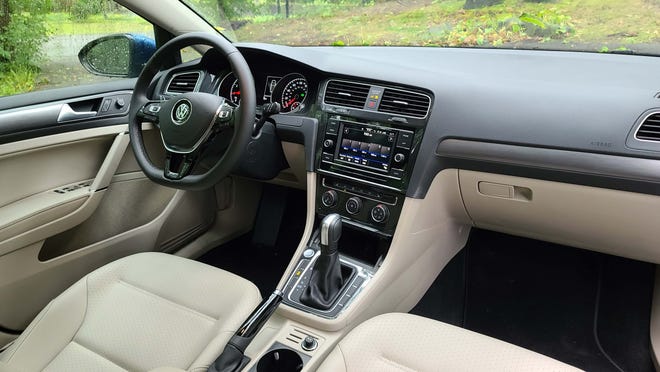
But technology was notably lacking in my V-dub. Its competition (Civic, Elantra, Impreza, Mazda 3) have upgraded to all-digital instrument displays, adaptive cruise control and head-up displays. Rather than invest in a declining segment, VW is bringing that tech instead to the compact Taos SUV (as well as the more premium GTI and Golf R). Taos is already killing it, selling 7,000 units a month.
Golf stacks up nicely against its competition in interior size and utility. Its 35.7 inches of rear leg room match the Civic and Elantra. It even tried to offer all-wheel drive with the 2018 Alltrack wagon to appeal to SUV buyers.
But Alltrack was pricey compared to, say, the AWD Subaru Impreza and never got traction. Indeed, my wife tried both and chose the ’Ru. Maybe it was the Subaru Love. Maybe it was the $2,000 cheaper price tag. Maybe it was the Golf’s **%!!& lack of a mute knob so that you have to turn the volume knob all the way down every time you want to silence the screen.
It’s a rare hiccup in VW’s otherwise nicely appointed interior.

That tradition continues in the SUVs. Different as the ID.4 interior is (think screen-focused Tesla-simple), it continues the Golf tradition of offering intuitive controls for everyday driving. The ID.4’s liquid-smooth electric drivetrain also seems the perfect sequel to my Golf’s smooth automatic tranny. No droning continuously-variable tranny here. The eight-speed is one of the segment’s smoothest — never getting a step wrong during my long journey. A manual is also available, though I’d leave that to GTI motorheads.
Even as it opened manufacturing plants in my West Virginia and Pennsylvania backyards in the 1970s, VW was slow to learn Americans’ driving habits. Wolfsburg was tardy to the SUV market, and then offered too-small segment entries.
It’s determined not to make that mistake again, so it’s ditching Golf for the hatchback Taos SUV. On my way back from Up North, my wife packed the Golf to the roof with goodies. Taos will hold even more. If you still want a compact car, VW offers the Jetta sedan.
And if you still want a Golf, there’s the 2022 GTI. I can’t wait.
2021 Volkswagen Golf
Vehicle type: Front-engine, front-wheel-drive, five-passenger hatchback car
Price: $24,190, including $995 destination fee ($24,990 as tested)
Powerplant: 1.4-liter turbocharged 4-cylinder
Power: 147 horsepower, 184 pound-feet of torque
Transmissions: eight-speed automatic
Performance: 0-60 mph (7.6 sec., Car and Driver); top speed, 122 mph
Weight: 3,012 pounds
Fuel economy: EPA, 29 mpg city/36 highway/32 combined
Report card
Highs: Sharp looks; fun-to-drive
Lows: Dated screens; no mute button
Overall: 3 stars
Henry Payne is auto critic for The Detroit News. Find him at hpayne@detroitnews.com or Twitter @HenryEPayne.
American Speed Festival: Chaparrals, hot laps, $100K for Pontiac charity
Posted by Talbot Payne on October 12, 2021
Pontiac — Parting is such sweet sorrow.
Workers packed up Jim Hall’s legendary Chaparral race cars at M1 Concourse after headlining the inaugural American Speed Festival. The display of the pioneering race cars — the first to sport aerodynamic wings — was the first time the vehicles had been seen on track outside their Midland, Texas, museum home since 2005.
The Chaparrals led the fourth major public auto event at the private race club facility in two months as the COVID pandemic has shifted the epicenter of Metro Detroit auto events to Oakland County.

The American Speed Festival, touting a “celebration of speed past, present and future,” played host from Oct. 1-3 to more than 100 cars covering 120 years of race history. Taking laps around the 1.5-mile Champion Motor Speedway was everything from the 1901 Sweepstakes car that Henry Ford piloted to Grosse Pointe glory to a 1973 1,100-horsepower Porsche 917/30 Can-Am car.
Other highlights included the 1952 Hudson Hornet (financed by the Detroit department store of that name) that dominated NASCAR in the 1950s and a state-of-the-art 2020 Ferrari 488 GT racer. Both were among the 11 winners for best in show.
The show-stopper was Hall’s high-wing Chaparral 2E, which pioneered aerodynamic tech in the mid-1960s CanAm series. Today, wings are an essential aerodynamic feature on everything from IndyCars to IMSA sports racers.
“Chaparral is going to be a tough act to follow. To see that kind of racing history on track was such a unique opportunity for the fans that won’t be soon forgotten,” smiled Tim McGrane, CEO of M1 Concourse, a transplanted Brit who previously ran Laguna Seca Raceway in California.

He has overseen the facility as it played host, since August, to Roadkill Nights, Woodward Dream Show, Motor Bella and the Speed Festival.
“We’re very pleased with the success of our inaugural Speed Festival weekend,” McGrane continued. “Although weather hampered us a bit Sunday, we had a tremendous three days of on-track time trials.”
The Festival also played host to a sold-out Checkered Flag Ball charity event supporting M1 Mobility. The event raised more than $100,000 to assist with the needs of transportation-challenged Pontiac residents.
Hall was also honored at the ball as ASF’s first Master of Motorsports for a career that is compared with that of Lotus’s Colin Chapman for racing innovation. Hall, 86, accepted the award in a live feed from Motorsports Hall of Famer David Hobbs. The weekend was livestreamed globally by Speedsport TV.
Category winners as voted upon by ASF attendees and officials were:
Best Can Am Car — 1966 Chaparral 2E (Jim Hall, owner)
Best Indy Car — 1972 Parnelli VPJ-1 (Chuck Jones)
Best Endurance Car — 1959 Maserati Tipo 61 (Team Stradale)
Best Featured Car — 1992 Jordan 192 Formula One (RM Motorsports)
Best Stock Car — Kyle Petty #42 NASCAR Pontiac (Michael Haislet)
Best Super Car — 2020 Ferrari 488 Challenge EVO (Bob Hertzberg)
Best European Performance Car — 1967 Maserati Ghibli (Larry Smith)
Best American Performance Car — 1952 Corvette Duntov Mule (Ken Lingenfelter)
Best Import — 2008 Subaru WRX STI (Michael Aumick)
Selection Committee Award — 1952 Fabulous Hudson Hornet (Al Shultz)
M1 Concourse Award — 1901 Sweepstakes Race Car (The Henry Ford)
The American Speed Festival will return Sept. 29-Oct. 2, 2022, featuring the Shelby race cars in honor of the 60th anniversary of Shelby American.
Payne: Ford completes a radical remake for the Age of Ute
Posted by Talbot Payne on October 12, 2021
Nashville — Ford has made national headlines with billion-dollar battery investments in Tennessee and Kentucky as it explores future electric-vehicle markets. But the news has overshadowed a remarkably fast transformation of the Blue Oval brand from a car-and-truck maker to an SUV-and-truck maker.
With the Ford Maverick, Ford’s entry-level vehicle is now an SUV-based pickup truck — not a Focus or Fusion sedan. Indeed, a brand that just a generation ago made the country’s best-selling Taurus sedan doesn’t have a single four-door car in its lineup.

The Maverick headlines an appealing, gas-powered compact SUV lineup — Maverick/Bronco Sport/Escape — that is one of the most innovative in the industry’s highest volume, non-pickup segment.
“As we exit sedans, it’s an opportunity to bring value/affordability into the marketplace,” said Todd Eckert, marketing chief for Ford trucks, of the SUV triplets at the Maverick’s media test in Nashville. “At an entry price-point, (they) give customers a choice. We have options: traditional SUV with the Escape. Bronco Sport for a more rugged off-road environment. And with Maverick, the opportunity to combine affordability and the flexibility of a pickup box.”
Ford is making this value appeal with a shrewd strategy that leverages iconic sub-brands far beyond their traditional niches: Bronco, pickup trucks and Mustang sports car. The latter brand has been expanded far beyond its traditional muscle car segment to introduce a Tesla Model Y-fighting electric SUV.
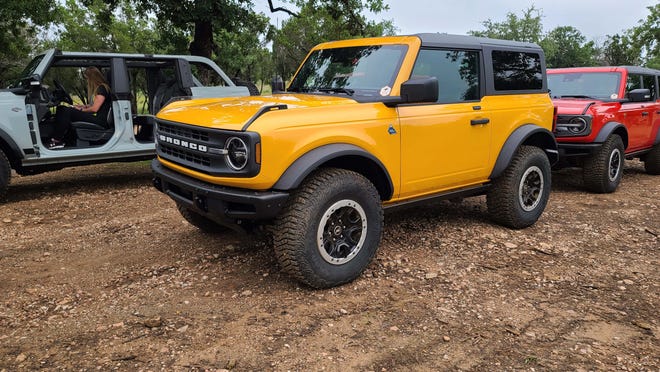
“They have figured out how to marry these sub-brands to a wider consumer for the 21st century,” said ISeeCars.com executive auto analyst Karl Brauer. “If you take an SUV and give them added capability, then you can appeal to customers who aren’t traditional Ford buyers.”
Buyers like Jeremy Ingram, 47, of Oakland Township. Ingram has bought both a Bronco and a Maverick, despite having never owned Fords in those vehicle segments before.
Ingram buys vehicles for fun. He and his wife sold their Roxor side-by-side off-roader and convertible VW Bug in order to buy the Bronco.
“I’ve been looking forward to this vehicle for a long time,” smiled the off-road fan, who has helped build the Holly Oaks ORV park. Ingram had resisted buying a Jeep Wrangler — long the king of the dirt — due to its cramped interior and rough on-road ride. The rugged Bronco is in his sweet spot with a roomier interior and smoother-riding, independent front suspension.
He has a Maverick on order as his daily driver for its maneuverability and 500-mile hybrid range — while still providing the bed utility he got with a big, thirsty F-150. If his Maverick works out, he plans to buy others for his contractor business. “I like the fuel economy, it keeps costs down,” he said.
For customers like Ingram, Maverick has instant credibility despite its smaller size due to brand cred Ford has earned over 40 years as America’s best-selling truck-maker.
“This is a breakthrough for us and the industry. We feel like it extends the Built Ford Tough lineup,” said Ford’s Eckert. “We’ve been watching customers in terms of affordability and maneuverability. Maverick is the first standard hybrid in a pickup. Forty mpg, 500 miles of range — giving a 1-2 punch of maneuverability and efficiency.”
It’s hard to understate the dramatic shift in the U.S. auto market in the last decade. In 2010, sedans made up 51% of non-pickup truck sales as the country flirted with $4-a-gallon gasoline and buyers cut back during the Great Recession. Today, SUVs make up more than 70% of such sales.
As recently as 1992, the Ford Taurus sedan was the best-selling car in America with more than 410,000 units. Today the Taurus (and its Fusion stablemate) have disappeared and the Toyota RAV4 SUV is the non-pickup sales king at more than 400,000 units.
Credit the fracking revolution and cheap gas as far as the eye can see — and car-like chassis designs that make, say, a unibody Ford Explorer SUV ride like a magic carpet compared with its truck-based ancestors.
“After a couple of decades making money-making SUVs and money-losing sedans, automakers figured out how to make SUVs drive more like cars,” said Brauer. “The Maverick is a truck that, in reality, is an SUV that feels as car-like as possible.”
The Maverick is built on the same compact unibody skeleton as the Escape and Bronco Sport. Ford says its future is electric, but for now customers want more affordable petrol power. The 2021 Bronco Sport is outselling the 2021 Mach-E by a ratio of 6-1.

Fiat Chrysler Automobiles was first to recognize the SUV revolution. The Stellantis predecessor ditched sedans and leveraged the iconic Jeep name to lead its own brand reinvention — the Wrangler SUV leading a Jeep sales parade that exploded from 231,701 units in 2009 to 923,291 in 2019.
Ford dusted off its own Bronco off-road icon and followed the Jeep model.
“Ford learned from Jeep,” said Brauer. “The unibody Grand Cherokee was the first no-compromise SUV with on-and-off-road capability. Ford is doing that with the unibody Bronco Sport that brings durability, capability — and looks cool.”
The Ford and FCA strategy makes an interesting contrast to that of cross-Motown rival General Motors.
The General has leveraged powerful luxury brands Hummer and Cadillac to compete against luxury automakers like Tesla and Audi in the $60,000-plus EV space. In so doing, the Detroit automaker aims to prove the efficacy of all-electric platforms for more mainstream EVs like the Chevy Bolt EUV.
GM, once a pioneer in hybrids, has abandoned the technology. But like Japan’s Toyota, Ford and Jeep have embraced it as a more affordable, fuel-efficient tech for mainstream buyers.
The Maverick (which shares its hybrid drivetrain with the pricier Escape) is the cheapest hybrid sold in the U.S. market — starting at an eye-opening $21,490.
“I’m disappointed in GM. They were ahead of their time with plug-in hybrids,” said Brauer. “But they walked away from them in order to pursue pure EVs. Toyota has stuck with hybrids and that is where the consumer seems to be.”
GM has receive rave media and environmentalist reviews for its zero-emissions strategy while Toyota has been widely shamed. But Ford and Jeep are following Toyota’s path with, respectively, the Escape Hybrid Sport and Wrangler 4xe Plugin Hybrid in high-volume, mainstream segments.
For the pure EV space, Ford is competing in the $40k-plus bracket against the Chevy Bolt by leveraging its sexy Mustang and F-150 sub-brands to make the Mach-E SUV and Lightning pickup EVs.
One hundred years after the tall Model T led a transportation transformation, Ford is betting the farm that its high-riding Bronco/F-150/Mustang brands can win SUV and electrification revolutions.
Henry Payne is auto critic for The Detroit News. Find him at hpayne@detroitnews.com or Twitter @HenryEPayne.
Payne, first drive: Mach-E GT flexes good ol’ Mustang muscle
Posted by Talbot Payne on October 12, 2021
San Francisco — Hustling over California’s twisted two-lane Pacific Coast Highway in a Mustang GT, I suddenly came upon a three-car moving road block. I flattened the right pedal. ZOT! The GT gulped the trio like a killer whale feeding on fish.
No downshift, no V-8 roar, no rear tail wag.
Say hello (and a quick wave goodbye as it disappears into the distance) to a different kind of Mustang GT — the 2022 Ford Mustang Mach-E GT. A kilowatt-guzzling hatchback SUV. Infused with the same wicked DNA as its gas-guzzling V-8-powered Fastback forebear, it’s even dressed in bright Cyber Orange to match Papa Pony’s Grabber Yellow.
This is the one we’ve been waiting for.
Ford Motor Co.’s Blue Oval has been chasing Tesla since the Palo Alto-based automaker wowed the world in 2016 with the Model 3 and changed the electric game with an accessible, lightning quick, Apple phone-simple EV that made even gas-drinking motorheads like me go weak in the knees (I bought one).
Ford dropped what it was doing and gave chase. Maybe it was enraged Tesla had stolen its iconic “Model” moniker to stake its claim as the Model T of the 21st century. Maybe it admired a startup for cracking the battery-electric code after Ford floundered with the C-Max and first-gen Escape Hybrid. Maybe both.
But Ford understood it would have to bring out its big brand guns to compete with Tesla’s mega-brand. The Mustang Mach-E was born and it slavishly followed the Tesla Model Y (a Model 3 in ute clothing) formula: 15-inch center screen, frunk, 300-mile range, remote app, $40K starting price.
When I got my hands on the new pony, I saddled it up alongside a Model Y and tested them toe-to-hoof. The Mach-E is very good — yet doomed to live in Tesla’s shadow. The apprentice to the OG. Mach-E sales are a modest 2,000 a month — outsold by Model Y, 6-to-1.
Mach-E GT is a different animal. Bringing years of muscle car experience to the compact SUV, veteran engineer Dave Pericak and his merry elves have layered Mach-E with Mustang muscle. Think 0-60 mph in just 3.5 seconds — equivalent to a Hellcat-fired $100K Jeep Grand Cherokee Trackhawk.
Like the V-8-powered Mustang Fastback, Mach-E gets a steroid booster over its standard 346-horse, 428-torque sibling. Optimizing the same 88 kWh battery pack, the GT pumps out a Mercedes AMG 63-like 480 horsepower and a gob-smacking 634-pound-feet of torque when equipped as the Performance Edition. That’s right, a performance package just like the sports car offers: gummy Pirelli summer tires; active suspension; Brembo brakes.
Out of a hairpin turn on Route 1, I nailed the Mustang Mach-E GT Performance (that’s a lotta names) and the beast pounced. I have driven these roads in a Mustang V-8 Fastback, but there is nothing like the ON/OFF electric torque switch of a big-battery EV. The Pirellis gripped like claws. The electric motor whined. The sky blurred like Han Solo’s Millennium Falcon jumping to hyperspace. Chewie, set course for the next galaxy.
Another hairpin rushed into view and big 15-inch front Brembos brought me back to earth. The battery-powered Mach-E GT is porky at 4,962 pounds (500 more than Tesla), but it’s low in the belly. With no V-8 anchor up front, the beast rotated nicely, the magnetic suspension working hard — in part to compensate for 2-inch narrower tires than a Merc AMG (EVs gotta balance stick with range-sucking rolling resistance).
To harness its nearly 2 ½ tons, the Performance Edition is stiffly sprung. Less enthusiastic drivers will prefer the standard GT.
The Model Y has similar thrust — 0-60 in 3.6 seconds — but is less intuitive in the corners compared to the crisp Mustang. GT debuts a Traction Control OFF button so you can hang it out more.
In max Unbridled mode the ’Stang pipes a satisfying GRRRRRRR-owling noise into the cabin. It’s not the GT Fastback’s reptilian gurgle, but it’s a bit of Mustang soul. So athletic-minded is the SUV that it’s lower to the ground (5.1 inches vs. 5.8) than the GT Fastback.
I know, I know what you’re thinking. If Ford wanted to expand the Mustang sub-brand, why didn’t they follow Porsche and just make a meaty, more practical V-8-powered ute? That would have been glorious. Mustang should have done it five years ago like (aping Porsche) Jaguar, Maserati, Alfa Romeo and other sports car brands.
But that was then, this is now and EVs are the fashion (not to mention forced by governments). Even Macan is going electric, so rather than chase the tail, Mustang jumped the queue with the first performance SUV to run with Tesla.
It’s a niche segment of two for now. Model Y Performance and Mach-E Performance are right on top of each other at about $62K. A lot of coin.
Who will buy it? My motorhead pal Jim and spouse crave the Mach-E, and the GT badge is right in their wheelhouse — a daily driver next to an Audi RS5 hatchback and Ford truck.
Mach-E GT would naturally replace their BMW X3 M. Heck, the ’Stang beats the Bimmer to 60 mph by a half-second — for 10 grand less. It looks the part, too, with GT gaining a menacing black grille compared to the awkward traced mouth on the standard Mach-E. It says “GET OUTTA THE WAY” in a slower car’s mirror.
Where Mach-E GT falls short of the BMW — and Tesla — is on road trips. One reason why the feds take pity with a $7,500 tax credit.
With a claimed 260 miles of range (I, ahem, got just 60% of that while flogging the pony over northern California), Mach-E GT requires long recharging stops from an unreliable third-party charging network. Bimmer can whet its beak with petrol everywhere. Tesla’s reliable charger network is the brand’s secret sauce.
Tesla also brings its signature Autopilot system. Though Mach-E GT’s similar Blue Cruise system allows truly hands-free driving (a camera watched me to make sure I was paying attention), I found it less confident at lane-centering over California’s swoopy 101 four-lane. The Tesla (which asks that you keep a hand near the wheel) is remarkably precise — while offering cutting-edge tech like Navigate-on-Autopilot and auto-lane change.
It’s hard to compete with Silicon Valley’s iPhone on wheels. So Mach-E gets your attention the ol’ fashioned way — muscle car speed ‘n’ style.
The blank-face Tesla looks alien. Mach-E’s anthropomorphic fascia, muscled shoulders and fastback are as familiar as the screaming V-8 GT you coveted when you were 16.
And when you stealthily leave everyone behind at a Woodward stoplight, it won’t wake up every officer within a 10-mile radius.
2022 Ford Mustang Mach-E GT
Vehicle type: Battery-powered, all-wheel-drive, four-door SUV
Price: $60,100, including $1,100 destination charge ($63,285 GT and $69,800 GT Performance Edition as tested)
Powerplant: 68-88-kWh lithium-ion battery driving single or twin electric motors
Power: 480 horsepower, 600 pound-feet of torque (GT); 480 horsepower, 634 pound-feet of torque (GT Performance)
Transmission: Single-speed automatic
Performance: 0-60 mph, 3.8 seconds (GT, mfr.); 3.5 seconds (GT Performance); top speed, 124 mph
Weight: GT: 4,962 pounds (4,989 pounds, GT Performance Pack)
Fuel economy: EPA est. range, 270 miles (GT); 260 miles (GT Performance)
Report card
Highs: Ruthless acceleration; confident handling
Lows: Needs more interior definition; Performance model may jar a filling loose
Overall: 4 stars
Henry Payne is auto critic for The Detroit News. Find him at hpayne@detroitnews.com or Twitter @HenryEPayne.
Payne: Riding the last VW Golf into the sunset
Posted by Talbot Payne on October 11, 2021
Gaylord — Farewell, Volkswagen Golf, I’ll miss you.
Well, kind of. I mean, the GTI hot hatch is my favorite Golf model and that’s not going away. But the standard Golf is, and without that … well, there wouldn’t have been a GTI or all-wheel-drive Golf R, now would there? Or even a New Beetle built on the same platform, which VW doesn’t make any more either. So, my last 500-mile dance with the Golf through northern Michigan was bittersweet. Except I can’t wait to drive the new Golf GTI later this year.
Confused? You’re not alone. You need a scorecard to keep track of all the VW model changes these days.
Volkswagen’s lineup is dramatically different than when the Golf debuted (as a Rabbit, just to confuse you more) way back in 1974. Since then, it has become the best-selling V-dub ever. It even surpassed the iconic Beetle globally: 30 million units to 23.5 million for the Bug.
In the ’70s, Golf sold alongside the Beetle, Scirocco and Passat (Dasher in the U.S.). None of those badges exist today, save for Passat, which will bow out in the U.S. after the 2022 model year. Synonymous with the brand, Golf has grown out of touch with the mainstream, SUV-crazed U.S. consumer. Golf is gone, long live the Golf.
In my ride north in the 2021 tester, the clever hatchback reminded why its DNA carries on across the lineup.
The styling is timeless. Simple and sophisticated, it has changed little over the years — the most dramatic change being the big, swept headlights versus the round, owlish eyes of the early days. With its sharp body stampings and thin grille, my Golf was easy on the eyes.
That styling informs Golf siblings — a model line chock full of SUVs that no one dreamed of back in the ’70s: Taos, Tiguan, Atlas, Atlas Cross Sport.
Indeed, Golf’s practical hatchback is the inspiration for today’s sport ute. Leaving my house in Oakland County, I simply lifted Golf’s hatch (tugging the rear VW logo like a piece of furniture that opens a secret bookcase) and stuffed my weekend luggage inside: bag, tennis bag, shoes. If I needed more room, I could simply have pushed over the backseats to create a longer load floor. Just like an SUV.
Exiting I-75 at Gaylord, I got sucked into the twisties of M-32 — flowing west fast like a river emptying into Lake Michigan. My Golf was in its element here — the tight chassis, suspension and four-wheel disc brakes working together to make the car wonderfully tossable. It has ever been such.
So wonderful that Golf inspired a new segment of performance compacts with its 1984 GTI. The Honda Civic Si, Ford Focus ST, Mazdaspeed 3, Hyundai Elantra N, et al have followed in its footsteps. I owned the first generation GTI. My 29-year-old son owns the sixth. The eighth-gen coming later this year promises to be the best yet.
With unique wheels and blood red trim, the GTI’s exterior hints at the steroid enhancements beneath: a 2.0-liter turbo 4 making 220 horsepower and a gob-smacking 310 pound feet of torque. With a limited slip diff up front, the GTI rotates like a rear-wheel driver at the autocross course.
My standard Golf tester sported the standard 147 horse turbo-4, which is surprisingly peppy despite its smaller 1.4-liter displacement. The GTI will live on as inspiration to the rest of the VW lineup — like the Miata spirit that inhabits every Mazda SUV.
Take the new VW ID.4 electric car. With its 77-kWh battery stowed below decks, the new SUV has a lower center of gravity than most SUVs and wants to boogie. The battery may be heavy, but ID.4 channels the Golf’s excellent dynamics. On a recent test drive in the Tennessee mountains, I put ID.4 in SPORT mode and flogged it like a Golf through the twisties.
Inside, my 2021 Golf was simple, with lots of right angles like the exterior. It’s a style that continues across the lineup — from the compact Taos SUV to the giant three-row Atlas.
But technology was notably lacking in my V-dub. Its competition (Civic, Elantra, Impreza, Mazda 3) have upgraded to all-digital instrument displays, adaptive cruise control and head-up displays. Rather than invest in a declining segment, VW is bringing that tech instead to the compact Taos SUV (as well as the more premium GTI and Golf R). Taos is already killing it, selling 7,000 units a month.
Golf stacks up nicely against its competition in interior size and utility. Its 35.7 inches of rear leg room match the Civic and Elantra. It even tried to offer all-wheel drive with the 2018 Alltrack wagon to appeal to SUV buyers.
But Alltrack was pricey compared to, say, the AWD Subaru Impreza and never got traction. Indeed, my wife tried both and chose the ’Ru. Maybe it was the Subaru Love. Maybe it was the $2,000 cheaper price tag. Maybe it was the Golf’s **%!!& lack of a mute knob so that you have to turn the volume knob all the way down every time you want to silence the screen.
It’s a rare hiccup in VW’s otherwise nicely appointed interior.
That tradition continues in the SUVs. Different as the ID.4 interior is (think screen-focused Tesla-simple), it continues the Golf tradition of offering intuitive controls for everyday driving. The ID.4’s liquid-smooth electric drivetrain also seems the perfect sequel to my Golf’s smooth automatic tranny. No droning continuously-variable tranny here. The eight-speed is one of the segment’s smoothest — never getting a step wrong during my long journey. A manual is also available, though I’d leave that to GTI motorheads.
Even as it opened manufacturing plants in my West Virginia and Pennsylvania backyards in the 1970s, VW was slow to learn Americans’ driving habits. Wolfsburg was tardy to the SUV market, and then offered too-small segment entries.
It’s determined not to make that mistake again, so it’s ditching Golf for the hatchback Taos SUV. On my way back from Up North, my wife packed the Golf to the roof with goodies. Taos will hold even more. If you still want a compact car, VW offers the Jetta sedan.
And if you still want a Golf, there’s the 2022 GTI. I can’t wait.
2021 Volkswagen Golf
Vehicle type: Front-engine, front-wheel-drive, five-passenger hatchback car
Price: $24,190, including $995 destination fee ($24,990 as tested)
Powerplant: 1.4-liter turbocharged 4-cylinder
Power: 147 horsepower, 184 pound-feet of torque
Transmissions: eight-speed automatic
Performance: 0-60 mph (7.6 sec., Car and Driver); top speed, 122 mph
Weight: 3,012 pounds
Fuel economy: EPA, 29 mpg city/36 highway/32 combined
Report card
Highs: Sharp looks; fun-to-drive
Lows: Dated screens; no mute button
Overall: 3 stars
Henry Payne is auto critic for The Detroit News. Find him at hpayne@detroitnews.com or Twitter @HenryEPayne.
Payne: Affordable Ford Maverick pickup is a 40 mpg Swiss Army knife
Posted by Talbot Payne on October 5, 2021
Nashville, Tenn. — We auto journalists love to prattle on about how capable the ripped Ford F-150 Raptor supertruck is with its terrain-chewing tires, high-tech Fox shocks and powerful, twin-turbo V-6. But at $70K, the Raptor tool can only be afforded by a few.
Everyone else is left coveting the stud with their noses pressed against the window.
Until now. For a Ford Truck Nation that has always dreamed of an affordable Swiss Army knife, your ship has come in. The entry-level Maverick pickup is here and it is really, really good.

Yes, the base $21,490 Maverick XL. You want a truck with 500 miles of range? 191 horsepower? A hybrid drivetrain, Google maps smartphone connectivity, and more storage options than the Queen Mary? Write your check for $21,490.
This stud doesn’t require two parking spaces to park. Downtown Nashville is overrun these days with music acts, IndyCar races, tourists. Want to park an F-150 in the cramped parking lot of Carter Vintage Guitars on 8th Avenue? Ain’t happening, ya’ll.
With Maverick, it’s a cinch. Exit downtown and load 1,000 pounds of mulch and rock from Home Depot for your home lawn project.

Pickup capability used to mean you had to ride a rough ladder-frame chassis or pay big bucks for magnetic shocks to smooth things out. Maverick, on the other hand, is a joy to drive. Fast. With mulch loaded behind me, I drove Mav hard like it was a unibody, compact SUV.
That’s because it is a unibody, compact SUV.
Maverick is now the entry-level vehicle for Ford’s lineup. Not just the truck lineup, the entire vehicle lineup. If you’re thinking Maverick sounds like an Escape or a Bronco Sport with a bed, it is. The Mav’s secret sauce is it brings truck capability to the market’s biggest volume class, compact SUVs.
As I drove the baby F-series, I realized it wasn’t so much a truck as a bed option in a segment my wife and I have occupied all our lives. Me in VW Golfs and Honda Civics. My wife in her beloved $28K Subaru Impreza with all-wheel drive, adaptive cruise, sippy fuel economy and park-anywhere maneuverability.

Maverick checks the same boxes for the same price. Substitute bed for hatch. The pickup completes the trifecta of three compact SUVs — Escape, Bronco Sport and Maverick — built on the same chassis but with three distinct personalities.
For that reason alone, the new littlest Ford (India-made Ecosport has been axed) deserves its rebel name. Maverick demonstrates the transformation of a 20th-century car company to a 21st-century truck ‘n’ SUV company. Want a Focus or Fiesta hatchback? Move to Europe.
For all its segment-busting swagger, the Maverick is conservatively styled. This is no Hyundai Santa Cruz — the other unibody pickup introduced this year and Hyundai’s first pickup — which screams for attention with its angular bod, sliding tonneau cover, and sub-bed trunk.
Maverick is part of a larger truck family. The brand knows it has market cred — Mav takes design cues from big brother F-150 with its C-clamp grille and squared-off bed design. There’s no sub-bed to carry coolers (Ford says it compromises the steel box’s strength), no sliding bed covers (Ford says it compromises bed width), no angular c-pillar (compromises access). Hyundai dares to question the ol’ formula.
Maverick saves its innovation for under the skin. This is no plasticky Ranger — which felt rushed when Ford realized it was late to the midsize truck party in 2018.

Maverick’s interior has the confidence of a segment buster — tastefully done with clever use of materials (recycled carbon fiber dust here, orange/bronze trim pieces for XLT/Lariat trims there). Doors are scalloped for oversized bottle storage — the handles floating in space. Take a bow, interior design team.
Accessories are numerous. My favorite? A $50 five-pack of interchangeable gadgets for the rear seat console: trash bin, cupholder, cord wrap, grocery bag holder, sub-seat organizer.
The sub-seat organizer provides ample storage space under the rear bench seats — an inherent benefit of unibody construction. Bronco Sport sports similar space, but Maverick goes even deeper. Store footballs, muddy cleats, bottles — not to mention the rest of the accessory five-pack.
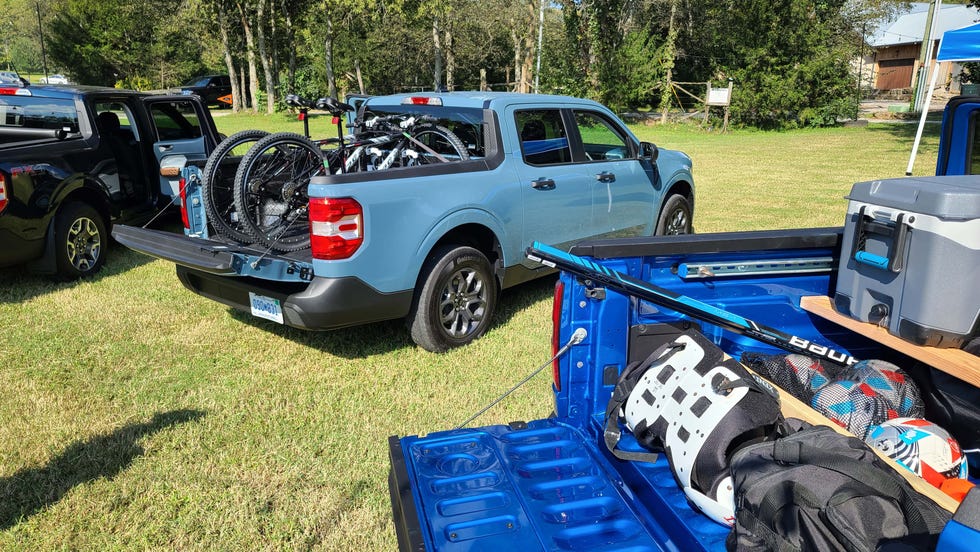
Though just 4.5 feet long by 4 feet wide (the same as, ahem, a $70,000 Rivian EV), the pickup’s rear bed can store a bicycle — or two if you take the front wheels off. Like competitors, Ford knows customers (especially younger buyers in this segment) expect their vehicles to talk with their phones. Mav depends on your smartphone for its navigation — and sticks a QR code on the rear bed so you can access a variety of online Ford help videos to configure lights, bike rack, etc.
Hyundai knows the bed is key, too, and its sliding tonneau cover, sub-bed storage and soft-drop tailgate will challenge Maverick.
Santa Cruz will also create buzz with its greater towing capacity, standard wireless smartphone connectivity/blind spot-assist and premium interior (including a hoodless, LED instrument display that is one of my favorite new 2021 items) when pitted against the Maverick’s XLT and Lariat trims for a comparable $25,000 (where Maverick gains all-wheel-drive with a more powerful, 250-horse 2.0-liter turbo-4).
But that base $21,490 Maverick XL bargain stands alone.
That’s a whopping four grand below the Hyundai, a real number for entry-level buyers. Not long ago, I asked a Golf engineer why V-dub didn’t hybrid-ize its compact hatch for superior fuel economy. His answer: battery cost made compact-class hybrids unrealistic.
Cue Ford, which has managed a rockin’, 191-horsepower hybrid with 40 mpg city — in a $22K compact pickup. Chew on that for a moment. This is an accomplishment right there with racing a Raptor across sand dunes at 100 mph. And it’s something you’ll appreciate every day.

With a Maverick dressed in Area 51 Blue and steely wheels, I strutted around the Music City in style. I parked in front of Nashville’s Dolly Parton street mural, the queen of country smiling down on my ride.
A huge, full-size Toyota Tundra parked (very carefully) nearby. “Cool color,” the owner commented, looking over my Mav. When I told her the price, her jaw dropped.
My Ford truck buddies covet a big, bad F-150. My wife loves her compact hatch. I get it. But for those who want the two combined, Ford has worked a miracle: an affordable truck with personality.
2022 Ford Maverick
Vehicle type: Front engine, front- and four-wheel-drive, five-passenger compact pickup
Price: $21,490, including $1,495 destination fee ($21,490 FWD XL Hybrid and $37,360 FWD Lariat turbo-4 as tested)
Powerplant: Hybrid 2.5-liter 4-cylinder mated to electric motor; 2.0-liter turbocharged 4-cylinder
Power: 191 horsepower, 155 pound-feet torque (hybrid); 250 horsepower, 277 pound-feet torque (turbo-4)
Transmission: Continuously variable transmission (hybrid); 8-speed automatic (turbo-4)
Payload: 1,500 pounds; Towing capacity: 2,000-4,000 pounds
Weight: 3,674 pounds (hybrid as tested); 3,731 pounds (AWD turbo-4 as tested)
Fuel economy: 36 mpg (hybrid combined, observed on test drive); EPA est. mpg 23 city/30 highway/26 combined (turbo-4 FWD); 22 city/29 highway/25 combined (turbo-4 AWD)
Report card
Highs: Hybrid price is right; nifty interior
Lows: No sub-bed option like Hyundai Santa Cruz; wireless Apple CarPlay, please
Overall: 4 stars
Henry Payne is auto critic for The Detroit News. Find him at hpayne@detroitnews.com or Twitter @HenryEPayne.
First drive: GMC Hummer EV pickup is an elephant in tennis shoes
Posted by Talbot Payne on October 5, 2021
Milford — The GMC Hummer EV truck is big, bad and surprisingly balletic.
The Detroit News got a rare opportunity behind the wheel of the mega-ute at General Motors’ 4,000-acre Milford Proving Grounds, where it showed off its bag of tricks. Reborn as an electric vehicle 30 years after it invaded U.S. roads as a military-Humvee-turned-SUV, the upcoming GMC Hummer aims to be the General’s halo for a new generation of electron-powered autos.
A halo performance pickup? It’s true. The Hummer EV truck, expected to hit dealerships by year’s end, is being produced in the automaker’s Factory Zero at Detroit-Hamtramck Assembly Center. Overall, GM is investing $35 billion through 2025 in electric and autonomous technologies, and plans to have 30 EVs globally in that time frame.
Brands have used super cars to showcase their best engineering, but battery size (the Hummer reportedly weighs more than 9,000 pounds) can inhibit sports cars compared with their lighter gas peers. Enter the electric super truck, which doesn’t sweat the added weight — and even benefits from the battery pack’s location between chassis frame rails to lower the center of gravity for better handling. Armed with three electric motors, 1,000 horsepower and state-of-the-art electronics, the 2022 First Edition model should come with a cape.

I mashed the accelerator and the Hummer EV’s jaw jutted upward. Then it devoured a gravel and dirt road, evenly distributing torque between its four 35-inch off-road tires. Then this elephant in tennis shoes showed off some circus tricks.
I rotated the beast in a 37-foot circle — equivalent to a much smaller Chevy Equinox — then pitched it through a tight slalom like a sedan.
Credit all-wheel-steer that can angle rear wheels up to 10 degrees. It’s reminiscent of the Ford Bronco’s Trial Turn Assist, which brakes the inside front wheel to achieve similar results. Turn off Traction Control and Hummer will do dirt doughnuts. The maneuverability is assisted by the Hummer’s independent rear suspension — a novelty (the Ford F-150 Lightning EV also has it) among full-size trucks that prefer solid rear axles to maximize towing but sacrifice handling. Hummer’s priorities lie elsewhere.
If the original military Humvee was armored for battle, Hummer EV is built for the Outback.

Its extreme suspension travel allows the elephant to hike its skirt 16 inches off the ground (from a normal 10.5), as well as provide a ridiculous 50-inch approach angle to manage tough terrain. In Terrain mode, I utilized 18 camera views — two of them under the truck’s belly — to pick through a rock pile. From the 13.4-inch console screen, I monitored camera views above, below and beside the Hummer.
Inevitable slips off rocks were cushioned by the truck’s sturdy frame rails and full underbody armor. Such capability is familiar to other off-road trucks — Hummer smooths the experience with instant electric torque at my right foot.
The pickups’ signature “CrabWalk” mode can be activated via the console’s rotary dial. The system steers front and rear wheels at parallel angles, allowing me to escape sideways — crab-like — from tight spots.
Some of Hummer’s EV compatriots — think Rivian R1T pickup — put a motor at each wheel to do derring-do like tank turns. Hummer’s engineering team chose the more conventional route of e-motors mounted amidships.
“We did it for efficiency,” said chief engineer Al Oppenheiser, who knows something about power, having developed the Chevy Camaro. “It’s easier to move torque between the motors and it’s more affordable.”

Maximize torque to all three motors in the First Edition and you get GM’s “Watts to Freedom” acceleration to 60 mph in just three seconds. That’s on par with my electric Tesla Model 3 Performance, which weighs half as much as Hummer.
The Tesla also, ahem, has less than half of the GMC’s 1,200 pound-feet of torque and 1,000 horsepower.
Prep Watts to Freedom with two taps of the Traction Control Button. The beast crouches on all fours. The driver’s seat begins to vibrate (“Like a rollercoaster ride,” grins Oppenheiser). The vibration grows stronger. Flatten the throttle pedal on GM’s asphalt oval test track, and the truck explodes forward — 60 mph goes by in a blur.
Hummer’s development speed was nearly as quick.
Clean-sheet vehicles usually take four years to develop. Hummer EV took just over two, being developed in 117 weeks. Credit modern simulators and computer-assisted design systems — including a state-of-the-art Driver in the Loop simulator in Milford’s Building 144.

“We couldn’t have done it without these tools,” lead development engineer Aaron Pfau said. “It gets us 95% to where we need to be before a model hits the road.”
That speed to market — the $112,595 First Edition should make deliveries before year’s end (standard $80,000 models in the first quarter of 2022) — is guaranteed even with the semiconductor crisis plaguing industry production.
“Our volume is protected,” Oppenheiser said. “For chips, seat foam, steel … anything affected by the pandemic.”
Little would seem to affect Hummer on road — the air suspension smooths the ladder frame even at highway speeds. Like its predecessor, it is intimidating — its broad shoulders and tall stance reflected in celebrity spokesman LeBron James. Get outta the way when Hummer wants to dunk.
Unlike its spartan predecessor, the Hummer EV’s interior is a swank game room. Materials are first-rate, seats comfortable, ergonomics well-thought-out. It’s capped off by two huge screens: instrument (12.3 inches) and infotainment (13.4 inches). Both are run by Epic Games’ 3D Unreal Engine rendering software — the same Epic Games behind PlayStation graphics and PC game hits like “Fortnite.”
My time in the pickup was brief and performance-focused. I could have stayed longer, exploring its interior options, big backseat, six-way Multi-Pro tailgate. And then I could have removed the roof panels and spent the night star-gazing.
The panels can be stored in the frunk (front trunk), where the gas engine used to be. This isn’t your father’s Hummer.
Henry Payne is auto critic for The Detroit News. Find him at hpayne@detroitnews.com or Twitter @HenryEPayne.
Jim Hall’s Chaparral racers highlight Pontiac’s American Speed Festival
Posted by Talbot Payne on October 2, 2021
Pontiac — The ground will shake this weekend when three of the most legendary race cars in motorsport hit the M1 race track at the inaugural American Speed Festival.
Created by Texan Jim Hall, the Chaparral 2, 2E and 2F revolutionized motorsport in the 1960s with their daring aerodynamic designs. Along with Lotus-founder Colin Chapman of England, Hall — who also raced his cars — helped define a golden age of racing that pushed the boundaries of technology and speed.

Hall is being honored with the Festival’s Master of Motorsports Award as his creations headline a unique weekend celebrating auto racing past, present and future. In addition to ogling dozens of racers covering the spectrum from NASCAR to IndyCar, fans will get to see the thoroughbreds perform on track — including the rare Chaparrals in their signature vanilla white livery.
The Texas engineer’s showcase is timely as motorsport experiences a second renaissance with more offerings than ever before — yet in a very different industry environment where a government and corporate electrification push is forcing the homogenization of production and race cars alike.
“I came along at a time when a lot of latitude was given to change cars,” said Hall, 86, in an interview looking back on six decades of racing. “As anything becomes standardized and everyone focuses on the best equipment, then everyone heads in the same direction until someone comes up with a new idea.”
In addition to industry pressures, motorsport has self-regulated to encourage competitive racing that attracts TV coverage. The ‘60s, by contrast, were the Wild West of motorsport and independent innovators like Hall, Chapman, Dan Gurney and Bruce McLaren were full of new ideas.
Some of those ideas are prominently displayed in the Festival’s Chaparral Corral.

Powered by a ground-thumping Chevy V-8, Hall’s Chaparral 2 exploded on the scene in 1963 with an aviation-inspired chassis design. Using fiberglass-reinforced plastic, a mid-engine layout and automatic transmission, Hall notched 22 wins in 39 races.
The next-gen Chaparral 2E, however, would be the car that captured the world’s attention. Entered in the 1966 Can Am series — the fastest sportscar series on the planet — the sleek racer featured a high-wing (operated by the driver’s left foot) to generate downforce to push the car into the road for better cornering grip.
“We started with a brand-new sheet of paper and put everything we knew about aerodynamics at that time into the car,” said Hall, who calls the 2E his favorite design. “It was a major change . . . and after (people) saw that, they realized (the wing) was a very important feature.”

Wings are ubiquitous on race cars today. Hall competed with the 2F — designed with a similar high wing — in the 1967 World Manufacturer’s Series, competing neck-and-neck with full factory-funded teams from Ford, Porsche and Ferrari.
Models from those famous marques will also be on display in a sweeping look at motor racing’s evolution.
Henry Ford’s original 1901 Sweepstakes car — the winning racer that grabbed the attention of investors — will take laps around M1 Concourse’s 1.5-mile race track. A 1973 Porsche 917/30 — generating more than 1,000 horsepower — will make an appearance, as will a 2015 Ferrari Challenge GT car.

Modeled after the Goodwood Festival of Speed in England, the track days will also showcase great drivers including England’s David Hobbes and Indy 500 winner Bobby Rahal, who will demonstrate his 1966 Eagle-Ford V-8 Indy car. Hall will not make the trip to Pontiac, but his son and grandson will be on hand to pilot his cars on track.
“The American Speed Festival allows race fans to get close to some of the greatest performance and race cars in the world and learn more about some of the legends of the sport,” said Tim McGrane, CEO of M1.
Speed Festival follows an active summer at the private racing club that began with legal drag racing at Dodge’s Roadkill Nights kicking off Woodward Dream Cruise week on Aug. 14. Roadkill was book-ended by the Woodward Dream Show the following Saturday and featured some of the wildest modified cars in existence. Last weekend, M1 hosted the inaugural Motor Bella — a scaled-down, outdoor version of the Detroit Auto Show that focused on experiential rides in everything from Ford Broncos to Dodge Hellcats.
American Speed Festival continues the show trend away from static displays — and toward putting vehicles into action. Each year, ASF will feature a class of cars and honor an industry legend. This year’s featured Can Am cars defined a ’60s racing era with no limits.
“I don’t know that there is anyone who, by himself, changed the sport of auto racing globally as much as Jim Hall,” said George Levy, president of the Motorsport Hall of Fame of America and author of a coming biography about Hall. “To car-crazy kids like me in the 1960s, Jim Hall was the Neil Armstrong of motorsports.”
The American Speed Festival kicked off Thursday with an exclusive “Dine and Drive” event throughout Metro Detroit for behind-the-scenes looks at Motor City automotive history. Friday and Saturday heat up with fast laps, while Sunday offers the ASF Exposition, which judges the best cars in all classes. Guests also have a chance to ride shotgun with a pro drier in a Dodge Hellcat or Lexus sports sedan.

The family friendly American Speed Festival offers a Festival Pass for $75 per person with free attendance for children under 12. In addition to the cars, there will be daily live entertainment, including music and RC cars for kids to race.
“I get a real good feeling from the youngsters who read about (my racing) but didn’t get to see it,” said Hall. “And they still get excited about it.”
For more information, go to https://americanspeedfestival.com/
American Speed Festival, Friday, Oct. 1-Sunday Oct. 3
Gates open at 7 a.m.-10 p.m. Friday and Saturday, 7 a.m.-6 p.m. Sunday
Henry Payne is auto critic for The Detroit News. Find him at hpayne@detroitnews.com or Twitter @HenryEPayne.
Payne: Road trip! Turning heads, chasing chargers up north in Mustang Mach-E
Posted by Talbot Payne on October 2, 2021
Charlevoix — While I waited for my 2021 Ford Mustang Mach-E tester to charge at an Electrify America station in a Meijer parking lot in Gaylord, a couple waiting for their Model S to recharge at the adjacent Tesla station asked if they could check out my filly.
“I really like it,” said Raj after I gave him the full tour. “It’s better looking than a Model Y and it really feels solid.”

My encounter captures the promise and limitations of Ford’s first EV.
The comely Mustang gets a lot of interest in a hungry Midwest market that has been dominated by Silicon Valley’s sexy Tesla brand. But it’s a niche market of people willing to spend their road trips hanging out in, um, discount store parking lots for extended periods of time.

I spent a week with Ford’s first EV up north. Like renting a Mustang convertible on a vacation trip, it’s a refreshingly different experience: high-tech, high-torque, high style. And, like my Tesla Model 3 (in which I’ve made the same trip many times), it demands patience when outside its metro comfort zone.
“Training a wild mustang (horse),” Sunset Magazine once wrote, “can be, to no one’s surprise, an intimidating task.” So can driving an electric Mustang Mach-E on a road trip.
With 197 miles on the Mach E’s battery, I left Oakland County for a vacation cottage in Charlevoix. “Navigate to Charlevoix, Michigan,” I barked at the nav system. I might have heard the navi voice sigh as she plotted my trip. It would be a two-stopper.
I did not have enough juice to go the 255-mile distance — a distance easily covered in, say, a gas-powered Ford Explorer. I would have to stop first at an Electrify America fast charger at a Bay City Meijer on the way.
With the outside temp at a pleasant 72 degrees, Mach-E and I trotted along with traffic at 80 mph. But speed (and temperature) drinks electrons. Above 75 mph, I start losing 20% of range (that is, for each 10 miles I traveled on the odometer, I took 12 off the battery). I backed off to 70 mph to conserve electrons, swallowing my pride as Explorers blew by my ’Stang at 80 mph. As the outside temp dropped to 50 degrees in the evening (in, ahem, July. What’s this I hear about global warming?), I even suffered range loss at 70 mph.

My standard-battery Mach-E tester stickered for $47,235 — a significant 10 grand under the price of a long-range, 326-mile Model Y, which is the only Tesla available right now (standard range model not available). Mach-E wore a striking shade of Rapid Red (I like) which, at $400, is also cheaper than Model Y’s $2,000 red coat option. Factor in the $7,500 federal tax subsidy (no longer available on Teslas), and the $39K is a no-brainer for budget-minded EV buyers (if still significantly more than a comparable gas-powered Ford Bronco Sport).
“I want to arrive at my friends’ house in a Mustang,” smiled the Detroit-raised motorhead.
The brand appeal was not lost on others on my journey. “Is that the new Mustang EV?!” thrilled a middle-aged couple in Charlevoix. “That’s sooo cool.”
Convincing them (and my son) to buy one, however, is the challenge. “Good luck beta-testing EVs for Ford,” they said, walking away. At the local Ford dealer here, customers had put in 11 orders for the new gas-powered Ford Bronco — none for the Mach-E. Bronco Sports are outselling Mach-Es by 6:1.
Owning an EV requires doing a lot of math. After a half-hour at Bay City’s Meijer charger, I stopped at 80% charge. Why 80%, you ask? Because the charging rate drops off sharply after 80% (charging an EV, the analogy goes, is like filling a beer glass — the last bit is slow). Charging to 100% would take another two hours. Gotta’ know these things owning an EV.
Also of note: it costs more to fill your EV (14.5 cents per mile) at EA’s 43-cents-per-kWh rate than your gas car (13 cents per mile) at $3.20-a-gallon gas prices. For now, though, automakers are providing free charges.
Mach-E told me I had 160 miles left, enough to make it to Charlevoix — albeit with 0% of battery left. I needed to charge in Gaylord to bank enough miles to get around in charger-poor Charlevoix. But Mach-E couldn’t find the Electrify America fast charger. I called EA’s 800 number to confirm it was working. Whew! After my Meijer stop (and conversation with Tesla-philes), I arrived in Charlevoix at 1:25 a.m.
Mach-E got a lot of interest from my Charlevoix neighbors. I gave a lot of test-drives.
The SUV’s Mustang styling cues — muscular shoulders, three-bar taillights, brooding headlamps — drew them in. Inside, it’s a Tesla clone with a big 15.5-inch center screen running the show (and a helpful LCD screen behind the steering wheel bearing key data like range and mph). It’s roomy and a hoot to drive (for a ute) with instant electric torque and low center of gravity.
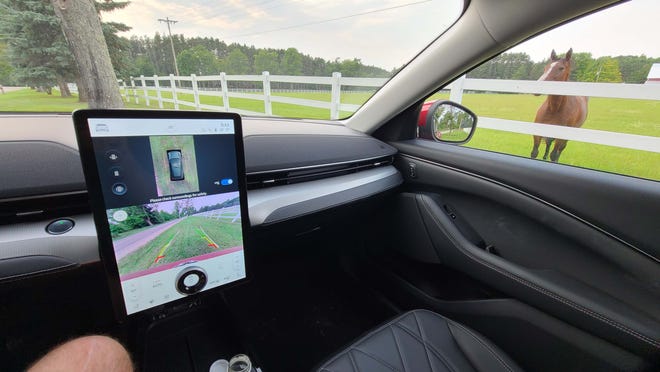
Susie, a 76-year-old granny in tennis shoes who owns an Audi Q5, was smitten. She took an extended test-drive enjoying Mach-E’s single-pedal driving, hands-free drive assist and artificial engine sound in Unbridled mode. We did lots of range-sucking Unbridled mode.
With just 76 miles of range left on Mach-E (I needed 50 to get back to Gaylord’s EA charger to top up for the trip home), I went to charge overnight at Charlevoix’s lone 240-volt charger. It was blocked off by a summer carnival in town. What to do?
Mach E’s nav said a dealership three miles out of town had a 240-volt charger. The Jeep dealer was nice enough to let me use the charger, but it was slow. A just-installed Ford dealer charger across the road (which did not show up in the Mach E’s charger finder) worked best. I plugged in and rode 20 minutes back to our cottage on a bicycle I’d stashed in the Mach E’s hatch.
Maybe EVs should be sold with bicycles.
The lesson: if you want to travel north in your EV, install a charger (cost: about $2,000) in your second home (indeed, that’s what a Model S-owning doctor I met at another Meijer had done in Traverse City). Or keep your EV in Detroit for local commutes, then buy a gas-powered Explorer for trips everywhere else.

2021 Ford Mustang Mach-E
Vehicle type: Battery-powered, rear- and all-wheel-drive, five-passenger SUV
Price: $43,995, including $1,100 destination fee ($47,235 RWD Select with standard battery as tested)
Powerplant: 68-88 kWh lithium-ion battery driving single-or-twin electric motors
Power: 266 horsepower, 317 pound-feet of torque (as tested)
Transmission: Single-speed automatic
Performance: 0-60 mph, 5.8 seconds (mfr.); top speed, 134 mph
Weight: 4,394 pounds (as tested)
Fuel economy: EPA MPGe 101 combined city/highway; range, 211 miles
Report card
Highs: Gets folks’ attention; useful hatchback for carrying stuff
Lows: Inferior refueling network; pricey compared to gas peers
Overall: 3 stars
Henry Payne is auto critic for The Detroit News. Find him at hpayne@detroitnews.com or Twitter @HenryEPayne.
Payne: Bronco and Wrangler lock horns at Detroit 4Fest
Posted by Talbot Payne on October 2, 2021
Holly — When the going gets tough, the tough get going.
Rain put a damper on the first Motor Bella auto show at M1 Concourse Sept. 21-26. But 30 miles north at Holly Oaks ORV Park’s third annual Detroit 4Fest, the water just added spice to the off-road recipe. Holly Oaks is home to an epic off-road playground of dirt, sand, hills, bogs and trails spread out over 192 acres and 200 feet of elevation change.

It’s a grown-ups sandbox that attracted 1,200 off-road lovers for a weekend of fun — including this big, 6’5” kid. It also brought Jeep Wranglers and Ford Broncos face-to-face in the most anticipated rivalry since a Camaro and Mustang first squared off at a Woodward stoplight.
“Let’s go!” said King of the Hammers founder Dave Cole as I handed him the keys to my four-door 2022 Ford Bronco tester.
Cole is no stranger to off-road playgrounds. He’s won the Baja 1000, Pikes Peak and countless other off-road races in extreme, Ultra4 off-road beasts. His California-based King of the Hammers is one of the country’s premier off-road racing series. This was his first taste of Holly Oaks (it just opened last fall), and it didn’t take him long to find the biggest challenges.
Darlene’s Ridge rises 125 feet above the sandy floor of Holly Oaks. Getting to the top requires traversing a narrow 30-degree gully that gets steeper as you climb. After days of rain, the trail was slipperier than an oily rope.

“We can get to the top of that,” Cole confidently declared after watching a 4×4 surrender after a failed assault that ended two-thirds of the way up.
Our Bronco is built for this kind of insane terrain.
Dressed in striking Area 51 Blue, the new Ford got a lot of looks in my neighborhood before I headed out to Holly. My neighbor Heather covets it for her next vehicle and liked its smooth ride, all-digital display, wireless smartphone connectivity and roomy interior (the Bronco has about two more inches of shoulder/legroom in front and seven more cubic feet for cargo than arch-rival Wrangler).
But the ute’s enormous, meaty 35-inch tires on bead-lockable 17-inch wheels are there for a reason. Part of the $4,495 Sasquatch package (available on every Bronco model), they complemented our armored Black Diamond trim (rock rails, washable interior, seven drive modes, steel bumpers, skid plates) to make the truck-based SUV a dirt-eating monster: electromechanical transfer case, locking front/rear axles, bulging plastic fenders, higher ground clearance, and brawny Bilstein shocks. Oh joy!

Cole dialed the GOAT (Goes Over Any Type of Terrain) mode selector to Mud/Ruts, then selected 4-wheel-drive Low.
WAAUUUGH! We charged up the incline … only to fall back at the summit, all four wheels churning helplessly. We reversed back down. Tried again. Failed. Cole toggled 4-HIGH for the next assault.
WAAUUUGH! Short again. Off-roading is a social sport. A crowd was gathering at the summit to watch what the new Bronco kid on the block could do. “Try it in manual mode, both lockers on!” advised a bystander (now that’s a guy who knows his Broncos!).
We watched two side-by-sides and a Toyota truck fail. Our turn again.
WAAAUUUGH! We made it, the front wheels leaving the ground as we cleared the top. A roar went up from the crowd. Cole punched the Trail Turn Assist feature and did doughnuts in celebration.
Cole went hunting for more obstacles. Then I went hunting for more. Then I handed the wheel to Jeremy, with a Bronco on order, and he found still more. By the end of the afternoon, the Bronco’s blue patina was barely visible, obscured by a layer of mud and dirt — Bronco’s best color.
For years, Mustang, Camaro and Challenger muscle cars have tested each other at stoplights, twisted roads and race tracks. Now the Bronco and Wrangler are headlining new battlefields where the asphalt ends — alongside Chevy Colorado ZR2s, Ford Raptors, Ram Rebels and a growing herd of mudders.
Like their muscle car brethren, off-road competition will raise all boats — er, SUVs.

Wrangler has already upped its game with an Xtreme Recon package that offers 35-inch tires and specially tuned shocks resulting in best-in-class 12.9-inches of ground clearance, approach angle (47.4 degrees), breakover angle (26.7 degrees) and departure angle (40.4).
Those tools came in handy in even trickier Holly Oaks conditions when I hit the trails pre-4Fest in a steady rain. The Xterme package benefits a lineup that has a big head start on Bronco in drivetrains.
The Wrangler can be had in turbo-4, V-6, diesel, 4xe plug-in electric, and — my favorite — V-8 392 mode.

That’s 392 as in the same 392-cubic-inch bear at the heart of a Dodge Challenger Scat Pack. RRRAOOWWRR! growled the Jeep 392 Rubicon as I fired it up. My co-pilot was Jim Morrison, Jeep CEO and a passionate off-roader himself who calls Holly Oaks his backyard.
We hammered around the park’s muddy trails in 4-LOW, putting the Jeep’s trusty twin lockers and detachable sway bars to good use over rocks, hills and gullies. But the 392’s secret sauce is 470 horsepower and 470 pound-feet of torque.

Grinding up another impossible grade, we tested the Rubicon’s Selec-Speed Control, which senses slip in all four corners — then distributes torque where needed. We hit a deep rut of mud that challenged even this tool of electronic wizardry — the Jeep slipping, sliding, struggling to get out of the hole.
“Just 392 it!” said Morrison.
I planted my right foot and the Wrangler exploded out of the hole like a mortar shell, scampering to the summit. Ya’ gotta have a V-8.
On the trail over the weekend, Bronco and Wrangler owners happily co-existed. Like muscle car track days, off-roaders are family. They help their neighbors stuck in swamps, on hills, over rocks.
After the park closes, the discussions will grow more heated over dinner as partisans compare their steeds. Jeep owners will highlight authenticity born in World War II, twin solid axles, manual transfer case shifter.
Bronco riders will boast of modern tech, better on-road manners thanks to an independent front suspension, even a front hood that’s easier to open.
For my money (and, ahem, these warriors ain’t cheap), they are both correct. They give us motorheads more options for when the going gets tough.
2022 Ford Bronco Black Diamond
Vehicle type: Front engine, four-wheel-drive, five-passenger compact SUV
Price: $40,835, including $1,495 destination fee ($48,325 as tested)
Powerplant: 2.3-liter turbocharged 4-cylinder
Power: 300 horsepower, 325 pound-feet torque
Transmission: 10-speed automatic
Performance: 0-60 mph, 8.0 seconds (Motor Trend est.); towing capacity, 3,500 pounds
Weight: 5,100 pounds (
Fuel economy: EPA est. mpg 20 city/22 highway/21 combined
Report card
Highs: Easy-to-use off-road tools; those big 35-inch tires
Lows: Feels floaty on freeway; gets pricey
Overall: 4 stars
2021 Jeep Wrangler Rubicon 392
Vehicle type: Front engine, four-wheel-drive, five-passenger compact SUV
Price: $74,995, including $1,495 destination fee ($78,545 as tested)
Powerplant: 6.4-liter V-8
Power: 470 horsepower, 470 pound-feet torque
Transmission: 8-speed automatic
Performance: 0-60 mph, 4.5 seconds (mfr.); towing capacity, 3,500 pounds
Weight: 5,100 pounds
Fuel economy: EPA est. mpg 13 city/17 highway/14 combined
Report card
Highs: Go anywhere attitude; OMG V-8
Lows: Transfer case shifter requires some muscle; gets pricey
Overall: 4 stars
Henry Payne is auto critic for The Detroit News. Find him at hpayne@detroitnews.com or Twitter @HenryEPayne.
Payne: Acura TLX Type S struts its Type A personality
Posted by Talbot Payne on October 2, 2021
Gaylord — Get it in Tiger Eye Pearl.
With its dramatic color (don’t call it bronze), my 2021 Acura TLX Type S is meant to be noticed. Angular jawbones. Diamond pentagon grille. Hooded Camaro-like headlights. Front and rear spoilers. Quad tailpipes the size of ship cannons.
“Cool car,” said a passerby in Gaylord.
“Really like that car,” said another in Charlevoix.
“Did a great job on the styling,” said my gearhead son.

The Type S is the Japanese luxury brand’s Type A personality. It’s a return to the brand’s sporty roots (Acura is even bringing the sporty Integra nameplate back) and a Type S badge that graced its performance models like the TL, CL and RSX in the 2000s.
To emphasize the point, Acura introduced the Type S in May at Mid-Ohio race track in the hands of none other than IndyCar supercar Helio Castroneves, who wrung the sedan’s neck around one of North America’s most demanding tracks with your loyal Detroit News scribe strapped into the right-hand seat. It was his first time in the car as well as mine.

“I was not expecting it to be this quick — wow,” exclaimed the four-time Indy 500 winner as he mashed the throttle onto the front straight.
This go-round, the Type S is aimed squarely at luxury muscle cars like Audi’s S-line, BMW’s M-series, Cadillac’s V-series — vehicles that beg you to bypass the interstate and take the long way home on country roads.
West of Interstate 75 in northern Michigan, I turned right on to M-32 — its serpentine curves flowing like a fast river to Lake Michigan. I held the Drive Mode selector to the right until it registered SPORT PLUS. HUNNHHH! The engine quickly downshifted with a grunt. Type S, meet S curves.

Its muscles taut, the Acura leapt from turn to turn, the 355-horse turbo-6 — unique to this car in the TLX lineup — roaring. The paddle shifters — unlike many vehicles — responded quickly to my touch, downshifting 4-3-2 into a hairpin turn with a matching engine blip. HUNHH! HUNH! Big red Brembo brakes slowed the 4,221-pound all-wheel-drive beast. Back up through the ratios in this 10-speed box, the Type S was confident, smooth.
The Acura is worthy of the segment. But the joy of the Type S is not just in its eager drivetrain.
This is a sedan that aims to be as different as the mid-engine NSX supercar that rebirthed Honda’s performance brand back in 2015. While not as radical as Tesla, the TLX is a comprehensive reassessment of each vehicle feature.
Take the aforementioned Drive Mode selector. Like Cyclops’ eye, the selector is the focus of the Acura console. I spun the selector to the desired setting — COMFORT, NORMAL, SPORT, SPORT PLUS (yes!) — then tucked my fingers into the “trigger shifter” buttons below. It’s intuitive and an Acura signature. Over time, you learn its contours and don’t even need to look when shifting between, say, reverse and drive.

Acura’s next innovation in its so-called Acura Precision Cockpit is more problematic. Like a Mazda 3, the remote infotainment screen is high on the dash for better driver visibility. Unlike the Mazda’s rotary dial (familiar to users of Audi, BMW, Genesis), TLX uses a touchpad as controller.
It’s not as unworkable as Lexus’ maddening touchpad, but it takes time to learn. May I recommend learning it when stationary? It’ll save you distraction. I’ve grown accustomed to the pad after driving multiple TLX, RDX and MDX models — and it has its charms. In particular, I love the — CHING! — sound it makes when I swipe from screen to screen. Like all systems (save, ahem, the dreaded Lexus) you’ll eventually settle on a pattern of icons you prefer (aided by corresponding steering wheel buttons).
The dramatic cockpit offers separation from Acura’s more spare Honda sub-brand. That’s good. Indeed, the Type S bears no similarity to the Civic Type R, Honda’s halo hellion. The two vehicles crystallize the difference between the two brands. Both are fast. But the Type S is sophisticated, stylish. The Type R — with a wing here and black tattoos there — looks like it was designed by a teenage gamer.

Still, the Acura is a cautionary tale in how quickly technology is moving. The 2021 platform has already been lapped by the 2022 Civic, which boasts wireless Apple CarPlay and Android Auto, compared with the Type S’s wired connections.
Curious, too, is the midsize TLX chassis layout. Its 113-inch wheelbase puts it squarely between the 115-inch Audi A6 and 111-inch Audi A4. However, the Acura’s 32.9-inch rear seat legroom is significantly smaller than the Civic’s 35 inches (on a 110-inch wheelbase). That makes for tight rear-seat confines if you pick up your six-foot-tall buddies for a night out.
That space consideration might drive performance advocates to the roomier Audi S6. But Acura is betting everybody else on the block has an Audi. And that four-ring badge will cost you a whopping $79,440, while my comparably equipped Type S tester is $53,825. Oh.
Roll down the cu-de-sac in your Tiger Eye Pearl Acura — Jewel-eye headlights shooting daggers — and no one will mistake you for an Audi. The Type S exudes a muscle-car vibe — consistent with its birthplace in the industrial Ohio heartland.
In that regard, the Type S’s most natural competitor is the Cadillac CT5 V-series — itself equipped with a special turbo-6 with specs remarkably similar to the Type S: 10-speed tranny, exquisite handling, sculpted design. And the Caddy easily fit my 6’5” frame in back. I was enthralled with it after an aggressive drive to Hell (Michigan) and back.
But the Acura makes a strong value play with its standard AWD system compared with the $57,000 Caddy’s RWD offering. Add AWD and the Cadillac’s price balloons to $64,000.
Michiganians might appreciate that AWD in, say, February.
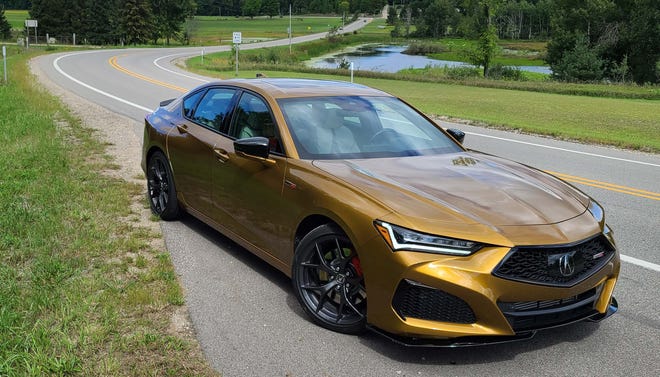
2021 Acura TLX Type S
Vehicle type: Front-engine, all-wheel-drive, five-passenger sports sedan
Price: $53,325, including $1,025 destination fee ($53,825 as tested)
Powerplant: 3.0-liter turbocharged 6-cylinder
Power: 355 horsepower, 354 pound-feet of torque
Transmissions: 10-speed automatic
Performance: 0-60 mph (4.9 sec., Car and Driver); top speed, 155 mph
Weight: 4,221 pounds
Fuel economy: EPA, 19 mpg city/25 highway/21 combined
Report card
Highs: Head-turning style; smooth, powerful drivetrain
Lows: Small backseat; quirky touchpad
Overall: 3 stars
Henry Payne is auto critic for The Detroit News. Find him at hpayne@detroitnews.com or Twitter @HenryEPayne.
Detroit News Readers’ Choice Awards: Hummer EV and Ford rule
Posted by Talbot Payne on October 2, 2021
Pontiac — Bigger is better.
The GMC Hummer EV took home Best in Show in the annual Detroit News Readers’ Choice awards at Motor Bella this year — leading a parade of muscled trucks and SUVs as car buyers’ favorites at the outdoor substitute for the Detroit Auto show. Ford racked up five awards as readers judged their favorites on M1 Concourse’s sprawling campus Friday.

The awards are coveted by automakers for their status as the Detroit show’s only awards judged by car buyers themselves.
The Hummer — which first assaulted the market in the early ’90s as a military-inspired, gas-guzzling SUV — has been reborn as a nearly five-ton, electron-guzzling EV that can hit 60 mph in a mere 3 seconds in its ultimate, 1,000-horsepower trim. The Hummer won 40% of judges votes — double the number of runner-up Ford F-150 Lightning. Hummer also scored first place in the Best Future Concept category.
The Lightning EV — no slouch itself at hitting 60 mph in 4.5 seconds thanks to 775 pound-feet of torque — led a strong team of new Ford products to win trophies.
Lightning grabbed Coolest Technology while its smaller EV sibling, the Mustang Mach-E, electrified the judges as Most Amazing Mobility and Most Eco-friendly.

Ford’s long-awaited Bronco — one of the hottest vehicles on the market — shrugged off recent roof troubles to pick up the prizes for Best Family Fun Finder and Baddest Off-Road Vehicle. The latter category was hotly contested, with Bronco getting the nod over the Ford F-150 Raptor and Ram 1500 TRX super trucks.

Even Ford’s luxury division got into the act with the Lincoln Navigator land yacht beating the Mercedes S-class by a nose for Best Road-Trip Ride.
The only non-SUV to score a prize was America’s favorite supercar, the mid-engine Corvette C8. It won for Best Dream Machine, narrowly beating the Rolls Royce Cullinan, the Brit brand’s first ute. Corvette fans will get more muscle on Oct. 26, when Chevy takes the wraps off its Z06 performance version.
Stellantis’ Jeep Renegade broke up the GM/Ford monopoly by winning The Most for Your Money prize over second-place Hyundai Elantra.
Winners:
BEST IN SHOW: GMC Hummer EV
BEST ROAD-TRIP RIDE: Lincoln Navigator
COOLEST TECHNOLOGY: Ford F-150 Lightning
THE MOST FOR YOUR MONEY: Jeep Renegade
MOST ECO-FRIENDLY: Ford Mustang Mach-E
MOST AMAZING MOBILITY: Ford Mustang Mach-E
BEST FAMILY FUN FINDER: Ford Bronco
BEST FUTURE CONCEPT: GMC Hummer EV
BEST DREAM MACHINE: Chevrolet Corvette C8
BADDEST OFF-ROAD VEHICLE: Ford Bronco
Henry Payne is auto critic for The Detroit News. Find him at hpayne@detroitnews.com or Twitter @HenryEPayne.