Pontiac — When Corvette expert Chris Mazzilli saw 36 forlorn Corvettes buried in dust and bird droppings in New York garages, one thought crossed his mind: “This is the greatest barn find in history.”
Today at Motor Bella on M1 Concourse’s event center stage, six of those historic coupes — polished like new — will be given away to six lucky ticket holders in the ‘Vettes for Vets Sweepstakes.
Mazzillii and his New York partners, the Heller and Spindler families, created Corvette Heroes and have spent the last seven years restoring the “Lost Corvettes” from legendary pop artist Peter Max’s collection to their former glory. In the process they have raised over a million dollars for American military veterans with disabilities like Post-Traumatic Stress Disorder and traumatic brain injuries.
As part of their fundraising efforts Corvette Heroes created a national Sweepstakes to win the rare ‘Vettes in which participants could buy $3 tickets online at TheLostCorvettes.com. Of the the 36 Lost Corvettes, 22 have already been given away in drawings on Veterans Day and Memorial Day in New York City — and in Chicago in July. After the Pontiac giveaway, eight will be left.
Corvette Heroes is flying the six winners into Detroit from all corners of the USA to collect their treasure at the ‘Vettes for Vets event — but winners won’t know which cars they will take home (tax-free) until noon Friday at Motor Bella.
The six ‘Vettes are classics.
A white, 1955 model — one of only 700 produced — headlines the group with a value approaching $200,000. A 1973 Stingray with unique chrome bumpers, made for only one model year. An ’82 model in two-tone blue is the last of the Corvette C3 generation.
A 1962 black Corvette, ’71 model, and ’89 convertible with just 7,000 miles round out the offerings, which have been on display since Tuesday. Heavy rain has kept them under wraps some of the time.
Artist Max purchased the collection in 1989 from the winner of a VH1 giveaway. His intent was to use them as one-of-a-kind art canvases — but instead they sat for more than a quarter-century in a series of New York City parking garages managed by the Hellers and Spindlers.
“The dust and layer of grime actually protected them,” laughs Mazzilli. “But some were in pretty bad shape. We restored them or, in some cases, modified them, like a 1967 Corvette that we upgraded with a 427 big block engine.”
The Hellers and Spindlers bought the collection from Max in 2014 and set about restoring it with Mazzilli’s assistance.
“It’s very personal to me,” said Mazzilli who owns the Dream Collection restoration shop on Long Island. “A number of my family have served in the military and we are very close to veterans.”
The sweepstakes money benefits Stand for the Troops, a national nonprofit that offers a diverse set of therapies to veterans suffering from PTSD, brain injuries and other permanent and debilitating psychological and physical wounds of war.
After the Pontiac six are awarded at Motor Bella, eight Lost Corvettes remain to be auctioned at two more events later this year.
‘Vettes for Vets
WHEN: 11 a.m. Friday, Sept. 24
WHERE: Motor Bella, M1 Concourse, 1 Concourse Dr, Pontiac, MI 48341
WINNERS of the six classic Corvettes Sweepstakes:
Tommy Cain from Austin, Texas
Joseph Keller from Stoughton, Wisconsin
Jean Lamborn from Grapevine, Texas
Peter Lawrence from Studio City, California
Steven Mortensen from Parkland, Florida
David Trautenberg from New Orleans, Louisiana
Henry Payne is auto critic for The Detroit News. Find him at hpayne@detroitnews.com or Twitter @HenryEPayne.
Pontiac — A 1961 Amphicar 770, the amphibious convertible that could drive in water as well as on land, would have been the perfect show car Wednesday when torrential rains shut down Motor Bella at M1 Concourse.
The Amphicar would also fit right in with the show’s experiential theme.
This is a different experience for Detroit Auto Show goers. Static car displays play second fiddle around M1’s 85-acre property containing on- and-off-road tracks. Like M1’s Roadkill Nights before the Woodward Dream Cruise, if you aren’t in a long line waiting for a ride then you’re missing the full experience.
With that in mind, this column recommends — not just the best cars in show — but the best Motor Bella features. Here’s my Top Ten:
Ride the ‘Rex: What do you get when your cross a Hellcat with a Ram pickup? TRX — pronounced T-rex. With a 702-horsepower supercharged 6.2-liter V-8 in its belly, the Ram 1500 TRX joins the Ford Raptor as segment-busting supertrucks. Ram wants you to experience TRX at full tilt. Jump in line at the 120-square-foot off-road experience and hang on: with a pro driver at the reins, you’ll accelerate from 0-60, hurtle moguls, claw ’round a dirt banking and hit 50 mph before flying — yes, flying — over a jump. TRX sticks the landing every time.
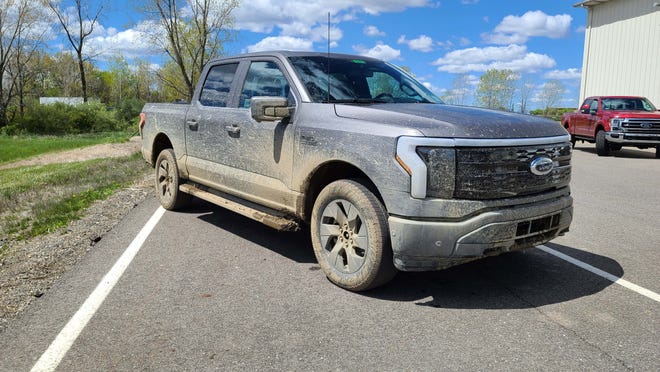
F-150 Lightning bolt: At the opposite, northwest end of the M1 property from the TRX test is an on-track opportunity with the electric Ford F-150 Lightning. It’s the stealth pickup. Armed with an absurd 775 pound-feet of torque from twin motors, Lightning will quietly rocket to 60 mph as fast as TRX.
“This sucker’s quick!” exclaimed President Joe Biden when he drove it on a recent Dearborn visit. Check out the pickup’s gigantic frunk (front trunk) where the gas engine used to be. Lightning’s batteries are stored low between the pickup’s frame rails.
Toyota Tundra: The all-new Tundra, big and aggressive, anchors Toyota’s exhibit overlooking Motor Bella’s infield. Remade from the inside out, the Texas-made pickup learns lessons from its Detroit peers and should be the most competitive full-size Toyota yet. The once conservative skin is replaced by a chiseled bod that looks like it drove out of a LEGO Technic box. Under the new sheet meal, innovations include coil springs in the rear (like Ram), a big 14-inch screen (like the Detroit Three) and composite bed (Toyota’s answer to more corrosive steel and aluminum boxes).
Get dirty in a Wrangler: Jeep Wranglers are everywhere, but have you experienced their off-road capability? Saddle up a Wrangler Rubicon, 392, or 4xe, and you’ll get a treat over Jeep’s diabolical dirt course (next to Ram’s course). Tilt 20 degrees through The Spine, charge up an extreme dirt hill, scamper over logs, chew rocks. The course has it all.
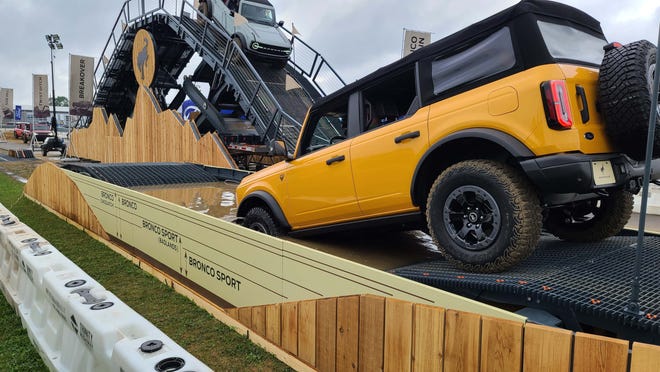
Bronco rodeo: Ford has its sights set on Wrangler and its dirt-kicker has brought a course of its own to M1’s infield. There, a fleet of Broncos take you through water, sand, and up and over a 21-foot-tall roller-coaster hill (the best view in Motor Bella). The obstacles show off the ute’s capabilities and tools, including water-fording, articulated wheel crawling and hill descent control. After the ride, immerse yourself in static displays that demonstrate Bronco’s removable doors, top and fenders.
Mustang Mach-E e-Xperience: Next to the Bronco rodeo is a ride of a different sort. The Mustang Mach-E is Ford’s first EV. Like Bronco vs. Wrangler, Mach-E wants to go toe-to-battery with class stud Tesla Model Y. Big center screen, tight handling, instant torque. Say hello to your driver before he stomps on the throttle — behind those masks are some interesting folks. Mine was a National Hot Rod Association nitro-fuel drag racer.
McLaren Senna: For the first time, the exclusive Gallery exotic car show (usually invitation-only) is open to the masses. Located behind the infield toward the road course, it contains some rare birds. My favorite is the Senna — named, appropriately, after the late Brazilian Formula 1 superstar. The McLaren is a race car with a license plate. It owns Car and Driver’s Lightning Lap record around epic Virginia International Raceway in 2 minutes, 34.9 seconds. That’s, ahem, three seconds faster than a Porsche 911 GT2 RS.
Bollinger B2: Metro Detroit is home to two new pickup brands: Rivian and Bollinger. Bollinger makes its auto show debut at Motor Bella. The imposing, black B1 SUV and B2 pickup siblings loom just off the infield. They’re off-road ready with dual locking-differentials, gnarly tires, 15-inch ground-clearance, and 10-inch suspension travel. My favorite feature is the bumper-to-bumper pass-through channel so you can load longboards.
‘Vettes galore: Lots of eye candy here for fans of America’s favorite supercar. A pair of delicious mid-engine C8 Stingrays — in IMSA GTLM Championship Edition trim — welcome you to GM’s infield tent. But wait, there’s more. The so-called “Lost Corvettes” from artist Peter Max’s historic car collection are on the Woodward Avenue side of the infield. Restored to perfection, six will be given to military veterans Friday as part of a charity auction. Call them ‘Vettes for Vets.
Camaro NASCAR: In addition to the race-inspired Corvettes, GM is showcasing the intersection between racing and production. Hot shoe Austin Dillon dropped in to introduce the next-gen NASCAR Camaro Cup car. It features significant updates with an independent rear suspension, sequential shifter, and wicked stance. It debuts at next year’s Daytona 500.
Not a bad debut for Motor Bella either. Hopefully the first of more great shows.
Henry Payne is auto critic for The Detroit News. Find him at hpayne@detroitnews.com or Twitter @HenryEPayne.
Holly — Metro Detroit will get an auto show double-header September 25-26 as Motor Bella and Detroit 4Fest roar into Oakland County.
Motor Bella — aka, the revamped Detroit Auto Show — will showcase 400 of the latest production cars, sportscars, EVs, and exotics at M1 Concourse car club in Pontiac. Just 30 miles up I-75, Detroit 4Fest sponsored by Jeep will be a playground for the latest off-road warriors as 600 vehicles each day descend on the 192-acre Holly Oaks ORV Park. Attendees will be able to sample the Ford Bronco and Jeep Wrangler in their natural habitat.
Ahead of their September auto-palooza, the twin events released details this week. With non-stop action, displays, and activations, both events aim to be the future of auto shows bringing vehicles in their natural asphalt and off-road habitats.
“There will be something for everyone in Oakland County this fall,” said Tom Zielinski, event coordinator for Detroit 4Fest who gave The Detroit News an exclusive look at a 71-acre off-road addition to Holly Oaks ORV Park that will host 4Fest. “You can see today’s off-road models do their stuff here in Holly, or watch performance models do their stuff on track at M1.”
Holly Oaks’ southern, 121-acre area has already become one of the nation’s premier off-road destinations since it opened last fall. The county facility hosted two previous 4Fests before the park opened. With a sprawling, 192 acres now at its disposal, the show will go to another level this year.
The venue will be an arena for today’s premier off-road gladiators, the Jeep Wrangler and Ford Bronco, that headline an industry shift to more off-road capable SUVs. Detroit 4Fest (which also boasts sponsorships from Fox Shocks, Dana, Magna, and Drive One) will be crawling with everything from Detroit Three pickup trucks to Subaru Outbacks, reflecting a marketplace now dominated by trucks ‘n’ utes.
Wrangler has long dominated the dirt and will showcase models from the V8-powered 392 to the electrified, 4xe model. Bronco is determined to expand consumer offerings in the overlanding space and will showcase its two-and-four door models — two of the hottest vehicles in 2021. Ford also will offer spectators rides to show off Bronco’s abilities around Holly Oaks punishing landscape.
Note to be outdone, sources say Jeep will introduce a new vehicle during two media days before gates open to the public, September 23-24.
Some 600 registered off-road vehicles will then flood the park along with spectators. In addition to Bronco rides, attendees can follow their favorite off-roaders across the park, picnic from food trucks, or visit a variety of vendors at 4Fest’s midway overlooking the park’s south rim.
Further south in Pontiac, Motor Bella also will feature Jeep and Bronco rides along across M1’s 87-acre campus. Its centerpiece is a 1-mile race track that will be open to the public for Motor Bella.
The Bronco will be one of three Ford activations, including the F-150 and Mustang Mach-E electric car. A specially-constructed off-road course is also on offer for ticket-holders to ride in Jeeps and the Ram TRX supertruck.
Motor Bella, sponsored by Delta Air Lines, Michelin and Michigan Economic Development Corp. and presented by PNC Bank, takes place in Pontiac this year as a stand-in for the North American International Auto Show which was canceled in Detroit due to concerns over the pandemic.
The outdoor M1 venue is meant to alleviate COVID-19 concerns (the venue hosted big crowds for the Woodward Dream Cruise’s August Roadkill Nights and Dream Show events) while previewing a new era of interactive, outdoor Detroit auto shows compared to static, indoor shows of Januarys past.
Like Detroit 4Fest, Motor Bella will open to the media with two press days, Sept 21-22. Ford and Toyota will introduce new products amidst a sea of 400 production vehicles from 39 brands. The 25,000-square foot AutoMobili-D exposition will showcase future technologies and the North American Car, Truck and Utility Vehicle of the Year (NACTOY) award will announce its 2022 semifinalists.
The venue will then open to the public September 23-26, when the action will really get started. Both Motor Bella and Detroit 4Fest will be alive with vehicles demos.
At Holly Oaks, Zielinski gave a demonstration of the off-roading challenges Detroit 4Fest attendees will encounter.
He piloted a rugged Jeep Gladiator Rubicon pickup through impossible gulches, trails, and 30-degree slopes showing off the SUV’s twin-locking differentials and extreme approach and departure angles. 4Fest attendees also will encounter swamps, 200-foot elevation changes, and Mt. Magna’s formidable suite of Moab, Utah-like off-road obstacles like Potato Salad Hill and Gravy Bowl.
Bulldozers are still working over the new, 71-acre addition as Detroit 4Fest approaches.
At M1 professional drivers will be on hand to give attendees hair-raising rides around the race track. EVs have been a staple of past Detroit shows as attendees descended to the basement for slow rides. Motor Bella will take it up a notch by offering EV rides down Woodward adjacent to M1.
In addition to new vehicles, Motor Bella will host The Gallery, a collection of exotics from Lamborghini, Ferrari, Maserati, Rolls-Royce, Aston Martin and McLaren that normally are exhibited in a separate, invitation-only soiree.
GM will have a healthy presence at Motor Bella, showcasing its giant GMC Hummer EV and an exhibition of its racing history. Its halo Corvette supercar also will get plenty of eyeballs. Aftermarket shop Lingenfelter Engineering will debut an electrified Corvette, and a “Lost Corvettes” show will display 12 refurbished ‘Vette classics (1953-1989), originally from the Peter Max collection.
All Corvettes will be given away as part of a national sweepstakes to benefit the Stand for the Troops non-profit charity.
Pontiac — A sprawling buffet of 23 new vehicles will compete for the 2022 North American Car, Truck and Utility Vehicle of the Year.
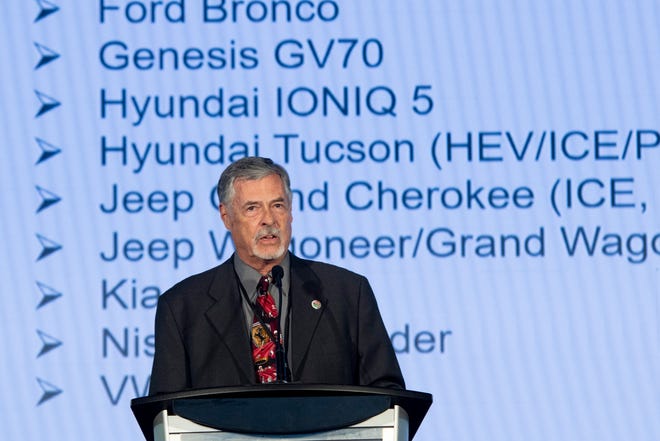
NACTOY opened the Motor Bella auto show Tuesday with its semi-finalist list. The list boasts everything from snarling trucks to whip-quick sedans to electric vehicles. Jurors whittled an initial list of 36 eligible cars, trucks and utility vehicles to choose the semifinalists.
“This year’s group of semifinalists includes some of the most interesting and innovative cars, trucks and utility vehicle candidates in recent memory, and a larger number of new trucks than we’ve seen in many years,” said NACTOY President Gary Witzenburg, “And it features more electric vehicles than we’ve ever seen.”
The semifinalists track trends in the industry as consumers have switched from cars to SUVs and embraced the off-road lifestyle. Following the success of Tesla, manufacturers are also flooding the market with new, performance-oriented EVs.
EV nominees are most prevalent in the truck category where a variety of manufacturers see an opportunity to use electric motors’ torque for hauling and speed. Startup Rivian R1T and the GMC Hummer made the semis with expensive Vs boasting impressive acceleration numbers. But the votes here are likely to come from more mainstream brands like Toyota (its substantially reworked Tundra) and Ford (its first unibody small pickup Maverick). The Hyundai Santa Cruz will also turn heads with its innovative, SUV-based platform.
SUVs are America’s choice of daily rider and nine will vie for the 2022 title. SUVs now take 70% of the market versus 30% for cars.
The Ford Bronco is the favorite here with its long-awaited Wrangler fighter. Jeep icons Grand Cherokee — now with its first three-row model, the L — and Grand Wagoneer will be strong contenders as well. Hyundai waves the flag with three strong entries — the Ioniq EV, Tucson, and luxury Genesis GV70.
Judged by a panel of 50 independent journalists from the United States and Canada, the NACTOY awards are among North America’s most prestigious prizes. Jurors will convene in Ann Arbor in October for a comparison drive of semi-finalists. Finalists will be announced in November and winners crowned in January 2022.
Here are the nominees:
Car of the Year
Audi A3
Cadillac CT5-V Blackwing
Genesis G70
Honda Civic
Lucid Air
Mercedes EQS EV
Mercedes S-class
VW Golf R/GTI
Truck of the Year
Ford Maverick
GMC Hummer EV
Hyundai Santa Cruz
Nissan Frontier
Rivian R1T
Toyota Tundra
SUV of the Year
Ford Bronco
Genesis GV70
Hyundai Ioniq 5
Hyundai Tucson
Jeep Grand Cherokee
Jeep Wagoneer/Grand Wagoneer
Kia Carnival
Nissan Pathfinder
Henry Payne is auto critic for The Detroit News. Find him at hpayne@detroitnews.com or Twitter @HenryEPayne.
Pontiac — Motor Bella is not your standard Detroit auto show, and it’s not supposed to be.
The first show since the pandemic is part auto show, part racetrack. Based at M1 Concourse car club in Pontiac, it’s a sign of things to come. Sprawling static displays sit next to test track tests, off-road courses, even off-site drives for customers who want to get behind the wheel of a Ford Mustang Mach-E or Audi e-tron for the first time as manufacturers try to get customers into vehicles — not just to ogle them.
For all of the creativity, however, Motor Bella offers familiar meat and potatoes for Detroit showgoers: trucks and lots of muscle. The Ford Expedition and Toyota Tundra introduced beefy new upgrades while show attendees can ford water in a Bronco or catch air in a roaring, 702-horsepower Ram TRX super truck.
“It feels like a carnival,” said Motor Bella chairman Doug North, who owns North Brothers Ford in Westland. “But we’re kicking it off with a Ford reveal just like an auto show.”
Media press conferences, comparatively light on news compared to the executive-heavy pressers of past, have been replaced by experiences — a Jeep SUV trundling over beds of logs here, a Mustang Mach-E racing down a short chute there.
At the show’s center is a 2.3-acre infield — normally M1’s asphalt test pad — which is dominated by General Motors Co., Ford Motor Co. and Stellantis NV manufacturer brand displays.
Circling the Detroit Three infield like moons are more automaker displays — smaller, static dealers displays, not elaborate stages familiar to TCF Center showgoers. The exception is Toyota Motor Corp., which has constructed a pop-up dealership building that overlooks the infield and is fronted by the Tundra and America’s best-selling SUV, the RAV4.
Typical of Detroit auto shows past, manufacturers push environmental virtue with lots of talk of sustainability and alternative-fuel vehicles. But at Motor Bella, vehicle electrification is no longer a side hustle that may someday be realized — it’s a core business strategy with real products on display. Customers are wooed less by gauzy slogans and more by the reality of experience.
Electric vehicles used to be relegated to the TCF Center basement for test drives. At Motor Bella, they are front and center. Showgoers can get behind the wheel of a $50,000 Ford Mustang Mach-E or $70,000 Audi e-tron and take them out on adjacent Woodward Avenue for a spin. Mash the pedal and customers gasp at the acceleration.
But the internal combustion engine still powers 98% of U.S. auto sales, and the headline vehicles at Motor Bella are still powered by gas. A lot of gas. Two race tracks are at the periphery of Motor Bella, and the constant roar of Ram TRX pickup’s V-8 is Motor Bella’s soundtrack.
“Now you see it, now you don’t,” blares a big-screen video display as riders experience the super truck’s neck-snapping, 4.5-seconds 0-60 acceleration.
The Ford Bronco vs. Jeep Wrangler war is on in earnest here, with Jeep hauling in tons of dirt and rocks for its 120,000-square-foot off-road track where attendees can experience the extraordinary off-road capabilities of the Wrangler Rubicon.
Not to be outdone, Ford held a news conference and dropped a bomb that the Bronco will gain a tree-chewing, high-horsepower Raptor model. A Bronco ride is on offer in the infield that takes passengers through water, sand and over a 21-foot roller-coaster hill with the best view in Pontiac.
The line for the Bronco ride was a half-hour long, while an adjacent Mach-E experience had no wait on Tuesday. Demand for the Bronco is so high that — at the customer drive experience on Woodward — showgoers must drive another Ford model (Bronco Sport, Explorer, Mach-E) before they can jump into a Bronco.
“I think it’s great — anytime you’re able to drive a product, that’s good,” said John McCandless, the retired national manager of public relations field offices for Toyota Motor Sales. “I love the Jeep outdoor display and the Ford outdoor display.”
Auto shows are an opportunity for startups to break through — Tesla in Detroit in 2015, Rivian in Los Angeles in 2018 — and Motor Bella marks the auto show debut of Bollinger Motors with its B1 SUV and B2 pickup. One of a number of automakers bringing electric trucks to market, the Bollinger pickup stands out for its open front-and-rear bumper — so you can slide longboards the length of the truck.
“Bollinger is excited to be here,” sales director Chet Parsons said. “We are a Detroit company, and doing our first big auto show in Detroit really cements our presence here.”
If Motor Bella was light on CEO-led news conferences (GM President Mark Reuss was at the Detroit Regional Chamber’s Mackinac Policy Conference on Mackinac Island), it was still a stage for celebrities and politicians.
NASCAR star Austin Dillon wowed the GM display with an appearance with the next-gen Chevy Camaro NASCAR. The General is showcasing the intersection between racing and production vehicles — and the 1,000-horsepower GMC Hummer EV.
“The back wheels actually turn, so when you’re driving out of mud, you’re gliding out of it,” Oakland County Executive David Coulter observed. “It’s a very impressive vehicle.”
The $105,595 Hummer also caught the eye of Gov. Gretchen Whitmer who took a tour of the grounds Tuesday. Not to be an auto partisan, she also visited Jeeps’ luxurious Grand Wagoneer before checking out the Ford Bronco and electric F-150 Lightning pickup.
It can’t be an auto show, however, without some political controversy. A single-engine plane towed a banner that read: “General Motors fuels insurrectionists” — the latest move by the progressive political action committee MoveOn attacking GM for donating to lawmakers who voted not to certify the 2020 election results earlier this year.
Motor Bella promises thrills and eye-candy galore for this weekend’s expected 150,000 showgoers (it opens to the public on Thursday). And it promises a way forward in the nation’s pre-eminent auto town: the CEO of the Detroit Auto Dealers Association, Rod Alberts, repeatedly signals that a Motor Bella-like event is the future for a reimagined, post-pandemic Detroit auto show.
Reinvention is not an option. Traditional auto shows may still have staying power with folks accustomed to patronizing the familiar. But it’s beyond question that the automakers — the real paying customers who make auto shows possible — long ago decided that auto shows as they’ve been known since the 1990s are relics of a golden age.
There are too many tools available to reach would-be customers, to wow them with the new metal, to spend millions on static auto show stands or press conferences that repeat news released two, three or four weeks earlier to a captive media crowd. Competition is the lifeblood of the auto industry, but competition for media (and public) attention is best avoided.
If Motor Bella is judged a success, it likely will ramp up Metro area competition. Will Motor Bella be folded into the 2022 Detroit auto show downtown? Or will it become a permanent fixture at M1 in Pontiac?
“I can’t think of a better place,” Oakland County Executive Coulter said. “Both Pontiac and, of course, M1 Concourse are very conducive to putting on an outdoor event that people can jump in the car and have a real experience.”
Henry Payne is auto critic for The Detroit News. Find him at hpayne@detroitnews.com or Twitter @HenryEPayne.
Daniel Howes is senior editor / business & columnist.
Staff Writers Jordyn Grzelweski, Kalea Hall and Breana Noble contributed.
Like its Detroit Three competitors, the Toyota Tundra pickup has been completely remade for the 2020s. While unable to match its opposition’s breathtaking range of trims and engines (not to mention heavy duty work trucks), the Texas-made pickup is more competitive than ever while offering Toyota’s proven formula of reliability, value and off-road machismo.
Developed with teams in California and Ann Arbor — and assembled in San Antonio — the ’22 model is the first Toyota truck to offer a hybrid powertrain, and only the second to feature a multi-link rear suspension with coil springs.
With aggressive styling, a state-of-the-art digital interior, and rock-chewing TRD Pro model, Tundra is the most competitive tool the Japanese brand has offered. While offering range-topping TRD Pro and Platinum models, the Tundra will likely start in the mid-$30,000s and make a strong value pitch with standard adaptive cruise control, blind-spot assist, and an all-new, 389-horsepower, 3.5-liter twin-turbo V-6 engine replacing its old nail V-8.
“We took a fresh, transformational approach to our truck development and had to rethink many things we’d previously done,” said Senior Vice President for Product Development Mike Sweers, who has been navigator aboard some of Toyota’s ambitious Baja 1000 race entries.
The truck matches innovations found in the current generation of Detroit pickups — Ram-like coil springs, Silverado-like big horizontal dash touchscreen, Ford-like materials bed innovation — while bringing unique Toyota design and powertrain innovation.
Tundra looks like it drove out of a LEGO Technic box with bold, segmented shapes. Its so-called “Technical Muscle” design theme is a sharp departure from the previous, second-generation model’s conservative lines. Following in the footsteps of Toyota and Lexus models that President Akio Toyoda demanded be styled to turn heads, Tundra features deep body scallops and a lantern jaw.
“Our design goal from the beginning was to create the most powerful, rugged and sophisticated looking full-size pickup that will take Tundra to a whole new level,” said Kevin Hunter, president of Toyota’s U.S.-based Calty Design Research.
While Toyota, like Ram, Chevy and GMC, has resisted Ford’s radical turn to aluminum body panels, it nevertheless delivers an unusual, aluminum-reinforced composite bed that Toyota claims will be rust-free without compromising strength. The bed is offered in 5.5, 6.5, and 8.1-foot configurations. They are anchored to two different, four-door Double and CrewMax cabs.
The material light-weighting continues in the tailgate, which loses 20% of its girth while adding a remote drop key-fob feature like Silverado.
Under the bed, the Toyota sits on a multi-link suspension with coil springs (double-wishbone suspension up front). The push to a more SUV-like suspension geometry suggests the Toyota’s ambitions as an aggressive handling truck true to its TRD Pro performance badge. To complement its upgraded suspension, Tundra offers Fox (TRD Pro) and Bilstein (TRD) performance shocks and versatile air suspension for premium trims.
Top grades also offer hydraulic cab mounts for a smoother road ride on the truck’s traditional ladder frame.
At its heart, Tundra is the first full-size pickup to ditch the V-8 engine. The core, twin-turbo V-6 produces a healthy 389 horsepower and 479 pound-feet of torque — eclipsing the previous-gen, 5.7-liter V-8’s 381 horsepower and 401 pound-feet of torque. While other automakers offer V-8 and diesel options, Tundra tries to incorporate attributes of both — torque and fuel efficiency — with the hybrid (Ford offers a similar hybrid).
When married to an electric motor and nickel-metal hydride battery (a Toyota staple even as other manufacturers depend on lithium-ion cells), the i-Force MAX hybrid powertrain lists an impressive 437 ponies and stump-pulling 583 pound-feet of torque that can operate in electric-only mode up to 18 mph. Both are controlled by 10-speed transmissions with towing capacity of 12,000 pounds — an increase of almost 20% (payload is 1,940 pounds).
The inside is wrapped in LEGOland styling with small instrument and 8-inch console screens in the base model before big, 12.3-inch and 14-inch digital screens are optioned like Detroit Three models. Tundra debuts Toyota’s Audio Multimedia system that includes wireless Apple CarPlay and Android Auto — as well as current voice recognition cues to wake up the system, like “Hey Toyota.”
Though shy of Ford Raptor and Ram TRX super trucks, the TRD Pro — raised an additional 1.1 inches on its Fox shocks — is aimed at the Ford F-150 Tremor, Ram Rebel and Chevy’s new Silverado ZR2. The beefy hybrid V-6 is the TRD Pro’s standard mill. Other off-road enhancements include underbody armor and all-terrain Falken tires.
Though refreshed in 2014, the Tundra’s core chassis and drivetrain were last changed in 2007.
Taking a page from Ford, Toyota’s Downhill Assist control and CRAWL control settings allow a sort of low-speed, off-road cruise control. In tow mode, the hybrid claims smoother operation thanks to the electric motor.
Tundra is festooned with tow-assist features and multiple camera views — the headliner being a Panoramic View Monitor that uses cameras to display a top-down, 360-degree view of the truck on the 14-inch monitor for better maneuvering. There is no sign, however, that Tundra is trying to keep pace with GM an Ford hands-free driver-assist systems.
The 2022 Tundra will arrive at dealerships later this year. It will be available in SR, SR5, Limited, Platinum, 1794 and TRD Pro grades.
Henry Payne is auto critic for The Detroit News. Find him at hpayne@detroitnews.com or Twitter @HenryEPayne.
The Lucid Air has set a new benchmark for EPA-rated EV range with 520 miles.
Founded by former Tesla engineer Peter Rawlinson, Lucid has been methodically building a Tesla Model S competitor since debuting to much fanfare at the 2017 New York Auto Show. Its promise: to eclipse Tesla as the electric vehicle standard.
The figure blows away Tesla’s 405-mile top range on its Model S and approaches diesel sedan territory. The range is available with the top trim Dream Edition Range model and it doesn’t come cheap, with a price starting at $169,000. The Tesla starts at about $90,000.
“Crucially, this landmark has been achieved by Lucid’s world-leading in-house EV technology, not by simply installing an oversize battery pack,” said Rawlinson. “Our race-proven technology endows Lucid Air with ultra-high efficiency, enabling it to travel more miles from less battery energy.”
The Dream Edition is maximized for efficiency but still boasts a staggering 933 horsepower to go with its long range and executive-size rear seat. It sits alongside the 1,111-horsepower Lucid Air Dream Edition Performance, which is optimized for speed, but still achieved an impressive 471-mile rating. The Lucid claims a dizzying, quarter-mile acceleration time of 9.9 seconds at 144 mph.
The entry-level, 480-horse Air Pure starts at $77,400 and features a single, rear-drive electric motor. The rest of the model line is all-wheel-drive with dual electric motors. The Grand Touring model generates 800 horsepower and achieved an EPA rating of 517 miles.
Lucid deliveries are expected late this year as the Lucid also chases Tesla on sci-fi features like big screen technology and self-driving features. The Silicon Valley-based company manufactures in Arizona and recetnly opened its first gallery showrrom on the east coast in New York City.
Henry Payne is auto critic for The Detroit News. Find him at hpayne@detroitnews.com or Twitter @HenryEPayne.
Chattanooga, Tenn. — General Motors and Ford aren’t the only automakers in the United States betting the farm on EVs.
Volkswagen has established its U.S. beachhead here in right-to-work Tennessee to build a new generation of electric vehicles starting with the ID.4 SUV. VW is investing $41 billion in electrification over the next five years, with $4.3 billion targeted at the Chattanooga plant that will begin producing ID.4s next year for North America.
EVs make up a sliver of U.S. sales, but the German automaker is all-in, hiring innovative former Cadillac chief Johan de Nysschen to run the show from Chattanooga; building a battery assembly plant; and partnering with Korean battery supplier SKI, which has erected a multi-billion plant across the border in Georgia.
“We’ve got to make it work,” said de Nysschen, the chief operating officer for Volkswagen of America, who built a reputation as a straight shooter in a career that spans Audi, Infiniti and Caddy. “We have burned the bridges behind us.”
VW’s ID.4 and smaller ID.3 already make up 15% of VW’s German sales with heavy government subsidies. VW, like the Detroit automakers, says U.S. taxpayer support is key as it ramps up sales of the ID.4 (the ID.3 is too small for America) as well as a future ID Buzz van and an as-yet-unnamed sedan.
The Detroit News tested an all-wheel-drive, $50,870 version of the ID.4 across southern Tennessee. With its 77 kWh of batteries stored under the cabin, the nimble EV recalled Tesla’s hot-selling Model Y SUV with keyless startup and liquid-smooth acceleration. At the Chattanooga Aquarium, ID.4 turned the heads of a young couple.
“Is that a new electric car?” said one. Automakers think a Millennial generation raised on plug-in smartphones will flock to plug-in cars.
Unlike the Detroit automakers, however, VW is not targeting Tesla with the compact-sized ID.4 — but segment volume sales leaders like the gas-powered Toyota RAV4 and Honda CR-V.
“Toyota and Honda don’t have anything like this,” said Scott Keogh, de Nysschen’s boss who runs VW North America from Herndon, Va.
Keogh expects a $7,500 to 10,000 tax rebate from Congress this year for each EV buyer. Significantly, he expects the rebate will be at the point of sale with no volume cap — a departure from the past, when Congress handed out $7,500 tax credits that could only be realized against an individual’s tax liability. The tax credit was capped at 200,000 sales — a number Tesla and GM long ago eclipsed — but would now be limitless.
Subtract $10,000 from the $50k ID.4 tester and its $40,000 price tag is close to that of a loaded RAV4 Hybrid.
Previous government attempts to encourage U.S. alternative fuels — diesel, ethanol, electric — have struggled. Auto executives are mindful that only Tesla (which accounts for 2 in 3 EV sales in the U.S.) has gotten any traction, even without a tax credit. But Keogh is confident the subsidized ID.4 will be a volume seller.
The News got a tour of the sprawling Chattanooga plant where ID.4 will be built alongside the hulking, gas-powered, three-row Atlas SUV and Atlas Cross Sport. Keogh acknowledges the paradox but says VW must meet market demands today to pay for the transition to VW’s EV plans of tomorrow. It’s a similar business model to that of Detroit automakers with pickup trucks/EVs.
Industry leaders say a confluence of factors has ramped up the pressure for automakers to ditch gas engines: the rise of socialist governments, activist corporations and the continuing decline of lithium battery prices.
Governments are demanding battery-powered vehicles. China, the world’s biggest auto market, is punishing gas engines. So is Europe — and in the U.S., former presidential candidate and socialist Sen. Bernie Sanders (I-Vt.) is leading a historic, $3.5 trillion climate bill that aims to transform the auto and utility sectors to zero-emission.
Regulators in states like California, America’s (and VW’s) biggest auto market, are for the first time dictating which powertrains carmakers must build.,
“Under government EV regulations over the next 10 years, we won’t be able to sell (internal-combustion vehicles),” said Keogh. “We have to invest now.”
Chattanooga roads are largely devoid of EVs. Only 2% of the U.S. market is electric and half of those sales are in politically green California. The V6-powered Atlas SUV is more prevalent here along with other gas-powered SUVs that fill up at $3 a gallon. Automakers point to Norway as the best example of electric adoption — there, EV sales are subsidized by about 50% of sticker, and gas prices are taxed to $8 a gallon.
“I don’t expect American politicians to approve $8-a-gallon gas,” smiles de Nysschen.
Encouraged by activist investors, CEOs like Keogh and GM’s Mary Barra have become vocal on global warming, echoing Democratic Party rhetoric that the planet is in crisis.
“We see it almost every day now. Environmental danger is a focus around the world,” said Keogh. “It is true for every farmer, every fisherman. We will make a difference.”
Corporations across the spectrum are united on this — as well as an unspoken fear they will become targets of government lawsuits to clean up weather-related damage. “(Electrification) will be the biggest transformation in the history of the automobile,” said de Nysschen.
The embrace of such a partisan Democratic issue in Republican-controlled Tennessee would seem to work against Volkswagen. But the automaker has been embraced by Republicans here for bringing thousands of jobs to the state with its sprawling, 3.8-million square foot facility thanks, in part, to its right-to-work status.
The refusal of VW to unionize plants has rankled Democrats and led to two contentious — and failed — UAW campaigns to unionize. Republicans have rallied around VW (and foreign transplants in other states) to oppose Democratic attempts to give EVs produced at unionized plants an added $4,500 tax break.
“The rules have been tilted after we agreed to what the rules were,” said de Nysschen of labor agreements under a new North American free trade deal (USMCA) that gave workers the right to choose union representation.
The Detroit News piloted the ID.4 across 128 miles of hilly Tennessee landscape. But the AWD model’s battery lost 171 miles — or 75% — of predicted range on a 75-degree September day. Come winter, the battery will suffer further in cold conditions.
Such concerns, VW executives say, make the 249-mile range ID.4 a suitable suburban commuter car. They hope Congress’s billions will fund infrastructure to make long-distance trips more viable. Keogh himself uses an ID.4 to commute while his wife’s gas-powered Audi Q7 does trip duty.
After Dieselgate, VW is determined to use ID.4 to remake the company’s image. It also makes sense for the company’s bottom line. Smaller companies don’t have VW’s billions to build new battery plants like Chattanooga. Keogh said licensing that technology to smaller automakers and startups is a business opportunity.
As is battery manufacturing, which is less labor intensive than a gas-powered drivetrain (Keogh expects little labor change on already highly automated assembly lines).
Keogh is confident of VW’s direction but still thinks it will take 30 to 40 years to transition to EVs. After all, the hottest vehicle in VW’s lineup is not the ID.4 but the all-new, gas-driven, $24,190 Taos SUV, which sold more than 7,000 units in July — more than all ID.4 sales in the second quarter.
Henry Payne is auto critic for The Detroit News. Find him at hpayne@detroitnews.com or Twitter @HenryEPayne.
Charleston, W.Va. — The Fisker Karma and Tesla Model S exploded into our lives in 2011. With stunning looks, sci-fi technology, dashing CEOs — even $500 million each in investment from the Obama/Biden administration — the four-door exotics promised a wild ride into the EV future.
But while Tesla soared, Fisker flamed out.
Burdened by a drivetrain and interior that did not match its sexy package, the alluring Karma labored around the dance floor while buyers boogied with the Model S’s Ludicrous acceleration and smart tech. A decade and multiple suitors later, Karma is now married to China’s Wanxiang Group Corp. — founder Henrik Fisker having moved on.
And the Karma GS-6 has finally realized the drivetrain potential to match its looks. Even as corporate elites obsess over a trendy, zero-emissions future, my road trip to West Virginia and back with the plug-in, coal-powered Karma promises a much more livable solution.
To begin with, Mrs. Payne agreed to join me.
After the expected gasp at encountering the Karma for the first time — “Wow, that is a beautiful car!” — she immediately pivoted to: “We’re not taking another electric car on our trip, are we?”
My long-suffering bride is weary of spending road trips sitting in Meijer/Walmart parking lots recharging my Tesla Model 3 (or the occasional Mustang Mach-E or Audi e-tron or EV flavor-of-the-month I get to test). She’d rather be dining with family at the end of our journey than hoofing it to a nearby fast-food joint while the EV sips electrons.
“We’re eating dinner at Arby’s,” she’ll text from a fast charger with a groaning emoji. “Be there soon.”
Rather than try to reinvent the U.S. electric grid, the Karma embraces the inherent benefits of electric and gas power. Let me count the ways:
Electric power. Taking advantage of cheap electricity at home, the GS-6 plug-in charges its 24.6-kWh lithium-ion battery pack overnight to 80 miles at 10 cents-per-kWh so you can do daily commutes on battery power alone. Easy, and you don’t have to visit a $3-a-gallon gas station.
Gas power. Want to go road tripping? Karma takes advantage of America’s vast gas station network to fill up on the road and get you to where you’re going without electric range anxiety (or long delays in parking lots). With its energy-dense, 116,090 BTUs per gallon, a gas pump can deliver you 25 miles in 5 seconds. Plug in to a 240-volt charger and it’ll take 2 hours to get 25 miles.
Karma is not the first luxury car to try this, of course. The Cadillac ELR plug-in (based on the Chevy Volt) debuted at the same time as Fisker and Tesla and bit the dust a few years later. It was overpriced at $80,000 compared with the larger, more luxurious startups.
And, like the Fisker Karma, its performance paled compared to peers.
That was enough to doom ELR, but not Karma. Like a siren in Greek mythology, Karma’s stunning looks continued to attract interest.
Penned by Aston Martin designer Fisker, the Karma is widely considered one of the prettiest cars conceived.
China’s Wanxiang rescued her from financial purgatory. Everyone adored her. Heck, even Bob Lutz and Gilbert Villarreal took some Karma chassis and stuffed them with Corvette V-8s.
The low-slung Fisker looks like a four-door Corvette. The long front hood arrives 10 minutes before the cabin, riding on muscular haunches. Like most super sports cars, it’s a pain-in-the neck (literally, I had to cock my 6-foot-5-inch neck every time I got out) to access, but once seated, you feel like the king of the road.
Below decks, Wanxiang has improved the secret sauce.
Massive electric motors propel the rear with 536 horsepower. Zero-60 mph goes by in 4.5 seconds. That’s not bad for a sled that weighs 5,034 pounds — but the real drawback is listening to the 3-cylinder engine bray like an angry mule. At least Karma makes the experience interesting with drag race-style Christmas tree lights in the digital instrument display that count down to launch.
It’s a big step from the former, $96,000 Fisker’s glacial, 5.9 second acceleration (which was slower than a Ford Fusion Sport). That was the result of a 402-horse drivetrain mated to a GM 4-banger (shades of the underpowered Caddy ELR), which Karma has swapped out for the more competent, 1.5-liter BMW turbo. Wainxiang first stuffed this 536-horse upgrade into its 2020 Karma Revero GT.
With instant torque and low center of gravity, Karma enjoyed hustling around a West Virginia test track. But this is a grand tourer, not a track rat. I’m the rare motorhead that will push this diva.
More interesting were the drive modes on my journey to the Mountain State. I mostly cruised in hybrid, SUSTAIN mode — the gas engine acting as a generator for the battery to preserve range. Upon hitting U.S. 35’s twisties, I switched to SPORT mode for maximum system power. Huzzah! Corner exits were a hoot with instant electric torque — the turbo-3 maintaining the torque curve at higher revs.
But maintaining battery reserve takes discipline. After a restroom stop, I forgot to return to SUSTAIN mode and promptly drained the battery to just 12 miles before realizing I was in SPORT mode.
At my West Virginia family’s home, I plugged into the local John Amos coal plant for the night (via 110-volt wall charger) to try and get my 80 miles back. After 12 hours, the battery range indicated 48 miles (from 20% to 65% of charge).
That was enough for a stealthy tour of Charleston in battery-only STEALTH mode — my relatives lounging in the rear bucket seats. They cheered Karma’s instant torque out of stoplight, enjoyed its quiet through city streets.
Tesla’s performance has opened a generation to the possibilities of all-electric powertrains (Karma, too, will be offering an all-electric version of the GS-6). But EVs are inferior to gas engines when it comes to long hauls. Now that the Karma finally has its act together, it can claim the crown as a plug-in halo.
Its $109,100 sticker may be exclusive, but it might inspire a look at more affordable plug-ins. Check out the $40,000 Ford Escape, Toyota RAV4 and Hyundai Ioniq plug-ins at your local dealership.
2021 Karma GS-6
Vehicle type: Front-engine, twin-rear electric motor, rear-wheel-drive, four-passenger, series hybrid sports sedan
Price: $85,700, including $1,800 destination fee ($109,100 GS-6L as tested)
Transmission: Single-speed automatic
Performance: 0-60 mph (4.5 sec., Car and Driver); top speed, 125 mph
Weight: 5,043 pounds
Fuel economy: Range, 80 miles battery; 360 miles combined gas-electric
Farmington Hills — The Silverado remake is complete.
The launch of Chevy’s fourth-generation, 2019 full-size pickup set segment benchmarks for chassis light-weighting and rugged bed construction. But the sleek truck was dogged by questions about the uninspired interior and lack of a performance truck model. With the 2022 Silverado, the bow-tie brand has filled in the holes with a state-of-the-art, digital interior and flagship, terrain-gulping ZR2 warrior.
Due in spring of next year, the Chevy Silverado ZR2 will go head-to-head against Ram and Ford competitors with a standard (on LT models and up), 12.3-inch digital instrument display and Tesla Model 3-like, 13.4-inch horizontal console screen.
With Formula One-inspired Multimatic shocks, twin-locking e-differentials, and two-speed transfer case, ZR2 will draw comparisons to the Ram 1500 Rebel and Ford F-150 Tremor and Raptor — though Chevy resisted going after the Ram TRX and Ford Raptor R super trucks by equipping its mule with a supercharged, 700-plus horsepower mill. ZR2 is motivated by Chevy’s familiar 420-horsepower, 460-torque. 6.2-liter V-8.
The new interior — combined with significant tech upgrades like the available, hands-free Super Cruise driver-assist system — signals an attempt to make Silverado a more premium player in the Detroit truck wars.
“For the new 2022 model, we’ve enhanced the Silverado lineup giving customers more choice, a refined design, and new technology options,” said Kelly MacDonald, director, Chevrolet Truck Marketing.
The flagship, off-road ZR2 — like the Corvette sportscar for on-track enthusiasts — is a showpiece for Chevrolet technology and performance.
Lifted over 11-inches off the ground on huge, 33-inch off-road tires, the ZR2 — in stock form — has been flame-tested in the brutal Best in Desert racing series. Its sophisticated Multimatic shocks are race-proven to go up against similar performance variants like Fox (Raptor, Tremor) and Bilstein (Rebel).
The black front grille and hood menaces, underbody skid plates protect against hard hits, and the V8 is a monster. But there is beauty inside the beast.
“We applied what we learned in racing and Moab testing to the new ZR2, but (it) doesn’t beat you up on the highway with its ride quality. It’s equally capable and comfortable,” said Dom Lester, GM chief engineer of Performance Variants.
The truck gains digital 12.3-inch and 13.4-inch screens now standard on all trucks above base, fleet-focused work trucks — major improvements over the dated interior of 2019-2021 models. The stalk shifter is replaced by a console T-shifter backed by the usual, bottomless console storage space.
Out back, the ZR2 can be optioned — on Silverado LT and up — with the Multi-Flex tailgate that first appeared on ’21 models. The six-way tailgate dropped jaws (literally, see the TV ads) of Truck Nation when it was first introduced on the GMC Sierra in 2019. The tailgate can be variously used as a stand-up desk, bar, or stairway into the bed.
The tailgate caps Silverado’s roll-formed high-strength-steel bed (available as 5 3/4-foot or 8-foot) that already offered a class-leading 89.1 cubic feet of standard volume.
ZR2 will headline a lineup of lifted, off-road models coveted by Silverado customers. Indeed, in 2021 lifted variants like the Trail Boss and ZR1 trims accounted for 60% of sales.The Silverado ZR2 follows the acclaimed Colorado ZR2 that accounts for nearly 12% of midsize Chevy pickup sales.
ZR2 is sure to approach those numbers as it improves on the Trail Boss trim with bigger tires, removable bumper endplates, two-more skid plates, and superior suspension and 31.8-inch approach angle.
“We race what we sell and sell what we race,” said Jaclyn McCaid, chief engineer for Silverado.
Chevy has resisted Ford’s much-ballyhooed move to turbocharged V6 engines and aluminum bodywork with its 14th-generation F-150. Analysts say the fuel economy benefits of V6s are overblown and that sticking to cheaper steel body parts has proven beneficial for profits and durability. The steel Silverado is up to 450 pounds lighter than its aluminum Ford competitor.
The 2022 Silverado carries over its 6.2-liter and 5.3-liter V8s and 3.0-liter diesel turbo-6 powerplants from the previous generation. But the standard, 2.7-liter turbo-4 engine gets major structural upgrades.
As a result, the 4-banger gains 20% torque over the previous model — 420 pound-feet — for a best-in-class rating. The 3.0-liter diesel offers maximum,13,300-pound towing grunt.
The premium, High Country trim is the first Chevy truck (following the Chevy Bolt EUV electric hatchback) to option GM’s Super Cruise drive-assist system. It allows hands-free driving — and automatic lane changes — on divided roads and interstates.
Chevy has partnered with tech giant Google to offer Google built-in2 compatibility. Passengers can control certain vehicle functions by saying, “Hey Google” followed by commands to text friends, listen to music, and set car temperature. Wireless Apple CarPlay and Android Auto are also standard.
The 2022 Silverado is now offed in nine trims — Work Truck, Custom, LT, RST, LT Trail Boss, ZR2, LTZ and High Country. While pricing won’t be announced until closer to launch next year, expect prices to range from the $40,000 LT to the $55k High Country.
Henry Payne is auto critic for The Detroit News. Find him at hpayne@detroitnews.com or Twitter @HenryEPayne.
Santa Cruz, California — And now for something completely different.
The segment-busting 2022 Hyundai Santa Cruz pickup is the first of its kind — a unibody-based, head-turning Swiss Army knife with many tools for many chores. Did I say pickup? Hyundai prefers the term Sport Adventure Vehicle because Santa Cruz is truly a different animal.
“I think this segment is the new hot hatch,” said Hyundai Test and Development manager Chahe Apelian of a compact SUV segment that will soon include the Ford Maverick and maybe entrants from Ram and VW.
That’s music to my ears as I was an early buyer of the segment-busting 1984 VW Golf GTI, the original hot hatch. An enthusiast’s compact. Since then, hot hatches have become the most versatile vehicle in autodom with utility and performance at an affordable price. Though hardly volume sellers compared to their peers, they attract passionate lifestyle buyers who turn brand missionaries.
In addition to the GTI, today’s hot hatch segment includes all-stars like the Golf R, Mazda 3 Turbo and Hyundai Veloster N (soon to be replaced by the Kona N).
As Americans have pivoted to utes and trucks, the Santa Cruz offers similar benefit to adventure-minded SUV buyers. Think lifestyle enthusiasts like Subaru Outback or Jeep Compass customers.
Start with Santa Cruz’s centerpiece:
The bed. As hatch is to Golf GTI utility, the bed is to Santa Cruz.
Unlike traditional pickups which option multi-length beds, the Cruz tub is fully integrated into the chassis design. Ladder-frame truck beds are clearly tacked onto the cabin so they can be swapped out for a bigger unit during assembly. Cruz’s bed is a natural extension of the vehicle’s lines. Hey, it’s not a Mercedes, but it makes for a leaner, more sinewy profile that is pleasing to the eye.
Then the bed gets down to basics: soft-drop tailgate, sub-bed storage, drainage plug, side-wall storage, LED lights, utility rails. All standard. In a vehicle starting at $24,000 — well under a mid-size pickup class where you’ll be hard-pressed to find standard goodies. Built in ’Bama, Cruz was designed on Cali’s surfer coast with Yanks in mind. It even copies Chevy Silverado’s corner steps to help you lay your surfboard in the bed.
Like hot hatches, pickups are generally boy toys, but I’m betting these features will make Santa Cruz a chick magnet, too. Wee Mrs. Payne is terrified of free-falling tailgates, but soft-drop reassures. And on a trip to the grocer (or the park to barbecue), it’s a no-brainer to throw your meats ‘n’ drinks into the sub-bed locker with a bag of ice. When you arrive at your destination, pull the plug to drain the water.
The icing on the cake is the tonneau cover. Lockable, water-resistant and easy to slide, it’s the answer to every pickup buyer’s prayers — a retractable cover that instantly turns the bed into a trunk to protect your stuff from the elements.
Not standard, but worth the $3,270 upgrade that includes 115-volt plug in rear, sunroof, sliding rear window, and more.
The sub-bed is also perfect for muddy kids cleats and jerseys — indeed, the whole idea of a bed on the back of an SUV is to keep smells and dirt separated from the cabin.
The 4-foot bed does come with compromises. You won’t be hauling ATVs back there. Indeed, the bed can’t even swallow a bicycle whole, necessitating that you throw the front tire over the tailgate to fit it in. That, naturally, means you have to buy a Hyundai accessory to protect the tailgate (or just throw a thick rug over it).
For those who want to drag their ATV to the Outback, you’ll need to buy a trailer. With that in mind, Hyundai ambitiously, obsessively benchmarked to the Honda Ridgeline (a segment bigger and the only other SUV-based unibody pickup) with 5,000-pound towing capability. Nice.
For more typical use cases of loading mulch, cinderblock, furniture … Santa Cruz also has a Ridgeline-like payload of 1,900 pounds.
It’s a compact SUV. Just as GTI shares a skeleton with the VW Golf, so is the Santa Cruz a Tucson with a bed. Tucson, also new this year, has immediately gone to the top of the SUV class in my book with its Lambo looks, clever interior and tight handling.
Male and female alike will find this pleasing for metro errands where even midsize pickups can feel big.
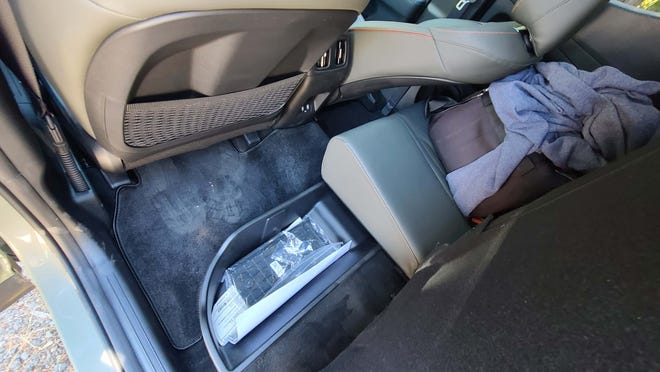
Around the crowded San Francisco Bay Area, Cruz was as easy to park as, well, a Tucson. That compact size shows in back, and my 6-foot-5-inch frame’s legs were jammed into the back of the front seat when I tried to sit behind myself. Normal-size folks will be more comfortable — and there’s sub-seat storage space to boot.
It’s a looker. The GTI and Mazda 3 Turbo hatches are eye-catching. Cruz, too. When I say the Cruz is a Tucson with a bed, I mean outside and inside. Teased waaaay back at the 2016 Detroit Auto Show as a prototype, Santa Cruz was a long time coming as Hyundai developed an architecture that could meet the pickup’s needs.
Hyundai has bold styling ambitions, and Tucson/Santa Cruz’s triangle-themed design is unique.
The state-of-the-art interior boasts the same pluses and minuses as Tucson. I love its simplicity with two all-digital screens running the show and twin lines wrapping the cabin. The latter is made possible by ditching the instrument display screen’s hood (credit a bright LCD display). Dude, it’s cool.
Hyundai jumps the shark by continuing that simplicity to a touchscreen without volume dials which occupants will miss. At least the driver can control volume with a steering-wheel button. It’s hard to be mad when Santa Cruz comes standard with wireless Apple CarPlay and Android Auto.
Fun to drive. OK, the high-riding (8.6-inch) Cruz is no hot hatch on road, but it can cut some rug. The 2022 Nissan Frontier is the best-handling ladder-frame truck I’ve driven thanks to clever suspension and cabin mounts — but it can’t hold a candle to the Santa Cruz. With a healthy turbocharged 281 horses under the hood (a 191-horse 4-cylinder is also capable), we danced together through the twists and turns of the Bay Area’s challenging Route 9 and had a ball.
Just, um, don’t try that with the groceries in back. Same goes for hot hatches.
2022 Hyundai Santa Cruz
Vehicle type: Front-engine, front- and all-wheel-drive, five-passenger pickup
Price: $25,175, including $1,185 destination fee ($40,905 Limited model as tested)
Holly — Metro Detroit will get an auto show double-header September 25-26 as Motor Bella and Detroit 4Fest roar into Oakland County.
Motor Bella — aka, the revamped Detroit Auto Show — will showcase 400 of the latest production cars, sportscars, EVs, and exotics at M1 Concourse car club in Pontiac. Just 30 miles up I-75, Detroit 4Fest sponsored by Jeep will be a playground for the latest off-road warriors as 600 vehicles each day descend on the 192-acre Holly Oaks ORV Park. Attendees will be able to sample the Ford Bronco and Jeep Wrangler in their natural habitat.
Ahead of their September auto-palooza, the twin events released details this week. With non-stop action, displays, and activations, both events aim to be the future of auto shows bringing vehicles in their natural asphalt and off-road habitats.
“There will be something for everyone in Oakland County this fall,” said Tom Zielinski, event coordinator for Detroit 4Fest who gave The Detroit News an exclusive look at a 71-acre off-road addition to Holly Oaks ORV Park that will host 4Fest. “You can see today’s off-road models do their stuff here in Holly, or watch performance models do their stuff on track at M1.”
Holly Oaks’ southern, 121-acre area has already become one of the nation’s premier off-road destinations since it opened last fall. The county facility hosted two previous 4Fests before the park opened. With a sprawling, 192 acres now at its disposal, the show will go to another level this year.
The venue will be an arena for today’s premier off-road gladiators, the Jeep Wrangler and Ford Bronco, that headline an industry shift to more off-road capable SUVs. Detroit 4Fest (which also boasts sponsorships from Fox Shocks, Dana, Magna, and Drive One) will be crawling with everything from Detroit Three pickup trucks to Subaru Outbacks, reflecting a marketplace now dominated by trucks ‘n’ utes.
Wrangler has long dominated the dirt and will showcase models from the V8-powered 392 to the electrified, 4xe model. Bronco is determined to expand consumer offerings in the overlanding space and will showcase its two-and-four door models — two of the hottest vehicles in 2021. Ford also will offer spectators rides to show off Bronco’s abilities around Holly Oaks punishing landscape.
Note to be outdone, sources say Jeep will introduce a new vehicle during two media days before gates open to the public, September 23-24.
Some 600 registered off-road vehicles will then flood the park along with spectators. In addition to Bronco rides, attendees can follow their favorite off-roaders across the park, picnic from food trucks, or visit a variety of vendors at 4Fest’s midway overlooking the park’s south rim.
Further south in Pontiac, Motor Bella also will feature Jeep and Bronco rides along across M1’s 87-acre campus. Its centerpiece is a 1-mile race track that will be open to the public for Motor Bella.
The Bronco will be one of three Ford activations, including the F-150 and Mustang Mach-E electric car. A specially-constructed off-road course is also on offer for ticket-holders to ride in Jeeps and the Ram TRX supertruck.
Motor Bella, sponsored by Delta Air Lines, Michelin and Michigan Economic Development Corp. and presented by PNC Bank, takes place in Pontiac this year as a stand-in for the North American International Auto Show which was canceled in Detroit due to concerns over the pandemic.
The outdoor M1 venue is meant to alleviate COVID-19 concerns (the venue hosted big crowds for the Woodward Dream Cruise’s August Roadkill Nights and Dream Show events) while previewing a new era of interactive, outdoor Detroit auto shows compared to static, indoor shows of Januarys past.
“Motor Bella could be the shape of things to come,” said Motor Bella Chairman Doug North and owner of North Brothers Ford in Westland. “We hope to continue with the Detroit Auto Show at TCF Center. But it’s clear that people want to get in and drive cars. Motor Bella is a really dynamic event that is safe and outside. And the automakers like it because because it’s a shorter duration show at a lower cost.”
Like Detroit 4Fest, Motor Bella will open to the media with two press days, Sept 21-22. Ford and Toyota will introduce new products amidst a sea of 400 production vehicles from 39 brands. The 25,000-square foot AutoMobili-D exposition will showcase future technologies and the North American Car, Truck and Utility Vehicle of the Year (NACTOY) award will announce its 2022 semifinalists.
The venue will then open to the public September 23-26, when the action will really get started. Both Motor Bella and Detroit 4Fest will be alive with vehicles demos.
At Holly Oaks, Zielinski gave a demonstration of the off-roading challenges Detroit 4Fest attendees will encounter.
He piloted a rugged Jeep Gladiator Rubicon pickup through impossible gulches, trails, and 30-degree slopes showing off the SUV’s twin-locking differentials and extreme approach and departure angles. 4Fest attendees also will encounter swamps, 200-foot elevation changes, and Mt. Magna’s formidable suite of Moab, Utah-like off-road obstacles like Potato Salad Hill and Gravy Bowl.
Bulldozers are still working over the new, 71-acre addition as Detroit 4Fest approaches.
At M1 professional drivers will be on hand to give attendees hair-raising rides around the race track. EVs have been a staple of past Detroit shows as attendees descended to the basement for slow rides. Motor Bella will take it up a notch by offering EV rides down Woodward adjacent to M1.
In addition to new vehicles, Motor Bella will host The Gallery, a collection of exotics from Lamborghini, Ferrari, Maserati, Rolls-Royce, Aston Martin and McLaren that normally are exhibited in a separate, invitation-only soiree.
GM will have a healthy presence at Motor Bella, showcasing its giant GMC Hummer EV and an exhibition of its racing history. Its halo Corvette supercar also will get plenty of eyeballs. Aftermarket shop Lingenfelter Engineering will debut an electrified Corvette, and a “Lost Corvettes” show will display 12 refurbished ‘Vette classics (1953-1989), originally from the Peter Max collection.
All Corvettes will be given away as part of a national sweepstakes to benefit the Stand for the Troops non-profit charity.
Lime Rock Park, Connecticut — Short but sweet, Lime Rock is one of America’s most formidable race tracks. It features double-apex turns, elevation changes and the Diving Turn — one of the most heart-in-your-throat downhill bends this side of Cedar Point’s Millennium Force.
But my 2022 Subaru BRZ tester likes Lime Rock’s new interior autocross track best.
This is the natural habitat of BRZ, one of the industry’s most entertaining sports cars. Entertaining for its quick reactions, low center of gravity and precise manual shifter. Whether at Lime Rock or your local Michigan parking-lot autocross, the Boxer Rear-wheel-drive Zenith (BRZ) earns its name. You’ll find yourself grinning as you fling it from pylon to pylon.
But for the first time, the heavily revised ’Ru is also not a fish out of water on big tracks thanks to its new 2.4-liter Boxer 4-cylinder mill.
A quick story: My son Henry coveted the Subaru BRZ for his first car. He loved the low-slung chassis, fastback and roomy 2+2 seating compared with the cramped two-seat Miata.
When I got a BRZ to test in 2014, I called him in Chicago. He took the next Southwest flight out. When he arrived, I had the manual BRZ with our six-speed 2006 Honda Civic Si in the driveway. The solid Civic was the car my two boys were raised on. They tracked it, traveled in it, bonded with it.
After testing the speedsters back-to-back on Milford’s twisty roads, I could see the verdict in Henry’s face. He was disappointed. BRZ’s handling was expectedly quick (though Si is no slouch), but not enough to overcome the lack of grunt. Despite boasting 200 horsepower on paper — equivalent to the Si — the Subie was no match for the Honda’s punchy, high-revving VTEC engine.
He returned to Chicago with BRZ scratched off his shopping list.
The 2022 model makes up for lost ground. Recognizing the hole in BRZ’s heart, Subaru engineers have thrown out the ol’ 2.0-liter and replaced it with a beefier, 2.4-liter flat-4 cylinder that pushes out 228 ponies and 184 pound-feet of torque — meaningful increases of, respectively, 28 and 33 over the original car.
BRZ’s added oomph was immediately apparent on Connecticut’s back roads. Subaru has raised the engine’s voice to celebrate. The flat-4 pipes engine sound into the cabin via the speakers. WRAUGHRRR! the engine howled as I rowed through the gears.
If my son’s need for speed concerns has been addressed, then so have my misgivings about the BRZ’s style. Co-developed by Subaru and Toyota, the first-gen felt like it had been penned by committee — dulling the design’s character.
Don’t get me wrong, I adore the sports car shape. But next to affordable rivals like the MX-5 Miata, Ford Mustang HiPo and Chevrolet Camaro 1LE, BRZ (and Toyota 86) lacked distinction. It had the moves of Roger Federer, but the style of Yevgeny Kafelnikov (who?).
The new BRZ is better. Flared side gills, sculpted rocker panels, duck tail. Fascia features are properly integrated, where before they looked stuck-on Mr. Potato Head-style.
Credit Toyota as the BRZ partnership’s design lead. The big Japanese automaker has become much more aggressive with its styling after years of somnolent design language. There are echoes here of Toyota’s curvaceous Supra sports car co-developed with BMW (I’d buy the racy-looking Supra over the Z4).
The new BRZ and Toyota 86 don’t differ nearly as much, but both have a maturity the previous gen lacked.
Speaking of curves, BRZ rotated through Lime Rock’s corners with confidence, a hallmark of Subaru engineering. Their signature Boxer engine with its horizontally opposed pistons (as opposed to taller V-6 and inline-4s) has been the standard in the industry for low center of gravity. The first-gen car was as low as a Tesla Model S (its batteries slung low) — and the new ’22 model is bettered only among gas-powered cars by the $160,000 Porsche 911 GT3 track monster, which itself benefits from a flat-6 Boxer engine.
The $30,000 ’Ru can hardly compete with Porsche’s leading-edge suspension upgrades like rear-wheel steer — but it does manage sophisticated handling tools like a stabilizer bar bolted directly to the frame for increased stiffness.
Whether on the autocross course or road course, BRZ inspires confidence. The manual is more responsive than the automatic (75% of BR sales are stick, for good reason), and the brakes remarkably resilient. The more I lapped, the more I pushed the envelope.
That push is helped by Subie’s reworked seats, which better hold the pilot. I’m a big boy at 6’5” but fit comfortably in BRZ even with a helmet strapped on. Contrast that to MX-5 Miata, which I don’t so much sit in as wear, so tight are its confines. Miata is just 2,300 pounds, but the 2,835-pound BRZ is plenty trim with lots of usable rear-seat cargo and cabin space.
Subarus have been leaders in affordable tech, but BRZ is less comprehensive, perhaps because of its shared platform. Subaru’s Eyesight Driver Assist suite, for example, offers goodies like adaptive cruise control and automatic braking — but only with the automatic tranny. At least Apple CarPlay and Android Auto connectivity are standard so you can hit the road and find the next autocross (Obetz, Ohio? Oscoda Airport, Michigan?) with ease.
Its dexterity is also a reminder of the thrill of sports cars at the time when the industry is facing a re-run of “That ’70s Show.” Like the killjoy 1970s, automakers are threatened by government rules forcing conformity (mpg mandates in the ’70s, EV mandates today).
Affordable vehicles like the lightweight long-range BRZ are at risk to penalties favoring heavy short-range EVs. The determination of Toyota/Subaru to develop the 2022 BRZ for their customers — not federal bureaucrats — bodes well for the future of automotive choice.
These are golden years, after all. Not since the 1960s have consumers had access to so deep a toy box. My sons can choose from $30,000 hot shoes like the VW GTI and Mazda3 Turbo; pony cars like the Mustang HiPo and Camaro V-6; pocket rockets like Civic Si and Hyundai Elantra N; roller skates like the Mazda MX-5 and Toyota 86 and Subaru BRZ.
They are gateway drugs to cheetahs like the Supra and Chevy Corvette, and ultimately cyborgs like 911 GT3 and McLaren 760.
Drifting through Turn 3 at Lime Rock’s autocross course in third gear, I mashed the brake, downshifted to 2nd with heel-and-toe, then smoked the tires with 184 pound-feet of torque.
It’s a trade handed down by generations of enthusiasts. And BRZ is their tool for the 21st century.
2022 Subaru BRZ
Vehicle type: Front-engine, rear-wheel-drive four-passenger sports car
Price: $28,955, including $960 destination fee ($31,465 Limited model as tested)
Powerplant: 2.4-liter Boxer 4-cylinder
Power: 228 horsepower, 184 pound-feet of torque
Transmissions: 6-speed manual; 6-speed automatic
Performance: 0-60 mph, 5.8 seconds (Car and Driver est); top speed, 140 mph
The high cost of electric vehicles is driving small automakers into the arms of the big boys.
With demand for EVs low, manufacturers like Subaru, Mazda and Honda are pairing with larger, more capitalized rivals Toyota and General Motors. The alliances enable smaller producers to meet government electric vehicle regulations and get their feet wet in the EV market without making massive expenditures.
Subaru, for example, will make its first battery-electric vehicle, the Solterra SUV, in tandem with a similar Toyota model. Subaru announced Tuesday that the 2023 model will go on sale next year, Only luxury brand Tesla has sold EVs in significant numbers, and most battery-powered vehicles in the pipeline are upscale vehicles.
Electrified vehicles have gotten little traction with Subaru’s off-road, price-conscious customer base, but the company, like its peers, is facing escalating government fines if they don’t make them. After years of dictating mpg numbers to automakers, governments from California to Europe are now mandating what drivetrains automakers use.
“The challenge is cost and range for any company trying electrification,” said Michael Reddick, car-line planner for the Subaru Forester SUV, WRX sedan, and BRZ sportscar models, in an interview. “We’re working through packaging costs and packaging constraints. Whatever (our EV model) is, it will be a Subaru first. It will be able to make it to the trail; it will be able to be used for outdoor adventure.”
Though its core northwest America demographic is environmentally conscious, Subaru has only brought to market one electrified vehicle, the Crosstrek SUV plug-in hybrid. With 17 miles of range before its gas engine kicks in, the hybrid’s $36,395 sticker price is well above a comparably-equipped, $29,045, gas-powered Crosstrek — a tough ask for Subaru’s price-aware customers.
Pairing with Toyota helps Subaru mitigate cost. Other industry players like Mazda (also partnered with Toyota) and Honda (GM) are forming Big Auto partnerships.
“Automakers don’t see a lot of volume in EVs in the next several years,” said auto consultant and former Wall Street analyst Joe Phillippi of AutoTrends Consulting. “Not until you can fill an entire auto plant with EV production, then it becomes economical. So the smaller guys have to partner with someone over time.”
He said the partner relationship is symbiotic.
“Toyota has made tremendous investments in electrification in the last 20 years. So the partnership helps the big guys, too,” continued Phillippi. “With a partner on board, Toyota’s piece cost goes down. The big companies need lots of volume to make EVs profitable.”
He said that, given the small market penetration of EVs, the huge investments in electrification would likely not be happening without government regulation. Subaru and other automakers face millions in fines this decade if they do not meet government electrification targets (they have already paid money in emissions credits to Tesla, the only EV-only automaker, in order to avoid fines).
Analysts do not see government’s fixation on global warming regulations going away, therefore companies have to develop business models that can make EVs profitable. Partnerships sharing the costs have become common across the industry beyond the small-big auto tie-ups. Ford, for example, has partnered with VW in Europe while also investing in EV-trucker Rivian here at home.
It’s not the first time that small automakers have paired with their big brethren to pare cost.
Halo sportscars are key products to differentiate small brands like Subaru and Mazda. But, given their low sales volume, they have become increasingly expensive to develop as safety and environmental regulations have grown in recent decades. Developing an all-new platform can cost as much as $1 billion.
In the last decade, Subaru partnered with Toyota to produce the BRZ and 86 sportscars, respectively. Mazda’s signature, fourth-generation MX-5 Miata was co-developed with corporate giant Fiat Chrysler (now part of Stellantis), which produced its own Fiat 124.
Subaru’s Reddick said the Subaru BRZ/Toyota 86 partnership worked well. “We both know our customers, and we both are strong in motorsports. So it was a natural fit for us to work with Toyota.” A second generation of both cars is coming to market this year and Subaru is developing the Solterra on a shared platform with Toyota’s bZ4X.
“Without a partnership, small-volume vehicles like the Miata likely wouldn’t happen,” said IHS Markit senior analyst Stephanie Brinley. “And the partnerships have also proven the ability of the companies to work together.”
The pairings, analysts say, also reveal automakers’ uncertainty about an electric future. Partnerships on sportscars after all, are low-volume affairs — as are EVs so far.
“The EV market is not here yet. The initial rate of customer acceptance is very small,” said Brinley. “Automakers are hedging their bets out of concern that there may not be a market there. EV partnerships are a bridge to when there is higher volume.”
IHS predicts that 32% of vehicles in the U.S. market will be electric by 2030. But the gas engine — particularly with cheap gas expected for decades to come — has proven resilient against repeated predictions buyers would adopt alternative fuels. (Earlier this year, the U.S. Energy Information Administration projected an average pump price of $3.23 a gallon in 2050.)
Europe, for example, tried to force adoption of diesel-powered engines 25 years ago — an ambition now abandoned as the continent pushes for all-EVs in the next two decades.
“Electrification is going to be a long transition,” said Brinley. “Regulations are pushing it, but when governments don’t hit their targets, they just push the targets off into the future.”
Until that transition proves real, only Big Auto has the resources to invest in battery plants. Everyone else, says AutoTrends’ Phillippi, is in “asset-light mode” while making the gas-powered vehicles customers desire.
Henry Payne is auto critic for The Detroit News. Find him at hpayne@detroitnews.com or Twitter @HenryEPayne.
Cadillac has set itself on a bold course to go all-electric by the end of this decade. Call it the Yankee battle strategy as Cadillac follows California’s Tesla — the only U.S. automaker to best the German juggernaut of Mercedes/BMW/Audi on the luxury front.
Caddy’s decision comes after two decades following the European’s performance model of crafting sleek, Nurburgring-tested stallions with racing pedigrees. But GM’s luxe brand couldn’t beat the Germans.
But it’s not for lack of trying.
The 2021 Cadillac CT5 Premium Luxury sedan in my driveway is a gem. Pulling onto Telegraph Road in Pontiac, I toggled Drive Mode to SPORT and stomped the throttle with my size 15s. The 10-speed automatic transmission didn’t miss a beat, launching the 335-horse, twin-turbo V-6 through the gears with millisecond-quick shifts.
It’s one of the smoothest drivetrains in luxury autodom, and its surge of torque encouraged more misbehaving as I headed west and the lake-country roads became more twisted. Caddy essentially rebadged the last-generation CTS midsize sedan, then dropped it a segment to take on the compact Bimmer 3-series and Audi A6. So this is a big compact car — but the AWD system grips the road, transferring 405 pound feet of torque to the road without drama.
The buttery drivetrain is electric-like, but with more personality. The twin-turbo V-6 barked as it threw off shifts like machine-gun shells. Hard into a right-hander and the transmission rev-matched on downshift, the exhaust exhaling — HNUGGH! HNUGGH! It never gets old.
The CT5’s V-6 is a reminder of the badge’s huge performance bandwidth, which extends from the base twin-turbo inline-4, to the V-series I tested last year (with a healthy bump to 360 ponies) and the beastly 668-horsepower, V-8-powered CT5-V Black Wing (release the Kraken!). When you have the need for speed …
Otherwise, the CT5 is a sharp gentleman in a black suit. Once overly masculine with a full-fascia grille and blocky corners, Cadillac’s Art and Science design has matured. Its elegance is an interesting contrast to BMW’s recent evolution to a macho full-fascia front grille. CT-5 proportions are classic: long hood, wheels pushed to the front corners, coupe-like roof draped over big rear haunches.
The doors open with a squeeze of rubber pads on the inside of fixed handles — a properly firm handshake welcoming you to the club — and you are inside the roomiest cabin in class. With a basketballer’s 6’5” frame, I fit more easily in this car — with front and rear legroom to spare — than in its European competitors.
A comparably equipped AWD BMW M340i will run you eight grand more. For the extra dough, Bimmer gives you more sophisticated all-digital instrumentation and dash design. But functionally, the 3-series and CT5 are similar. Their roomy consoles are anchored by monostable shifters and remote infotainment screen controls (the screen responds to touch as well, which is my preference). Goodies like head-up display and the V-series configurable drive modes are available.
In a nod to Cadillac’s ambitious Tesla-like future of smartphone-like electronics, the CT5’s voice recognition system is excellent (superior to the Bimmer). The infotainment and climate controls are also easy to use. CUE (Cadillac User Experience) stumbled out of the blocks last decade — a friend traded in his Caddy for that reason alone — but the current system is a snap to use. Radio presets — one of my personal bugaboos — are intuitive, the screen interface displaying my choices in easy view.
I barked the names of restaurants as well as Michigan towns at the navigation system, and the Caddy responded obediently, like I was talking to my phone’s Google Assistant.
State-of-the-art, wireless Apple CarPlay and Android Auto and smartphone charging are on hand.
Curious, then, that Caddy does not make adaptive cruise control and self-park assist standard (a blind spot in other GM models, too). Even a Mazda 3 comes with standard ACC for under $30,000. Cadillac advertises a sci-fi future of Super Cruse and hands-free driving — yet forces you to pay an extra five grand for ACC that’s common in mainstream vehicles costing thousands less.
Perhaps that’s the advantage Tesla has over Caddy — as a startup, its brand purpose was comprehensive: a smartphone on wheels. Meanwhile, Cadillac had to co-exist with other brands (the gorgeous plug-in Caddy ELR was a Chevy Volt in a tux). Maybe the new-gen battery-powered Cadillac will be different.
But in the present, CT5 should be recognized as one of the best vehicles in its segment: engaging V-6 drivetrain, superior interior room, distinctive exterior design. All at a value price.
New EVs are coming, but the best gas-fired Caddys are here right now.
2021 Cadillac CT5 Luxury Premium
Vehicle type: Front-engine, rear- and all-wheel-drive, five-passenger sedan
Price: $41,790, including $995 destination fee ($51,455 as tested)
Powerplant: 3.0-liter twin-turbo V-6
Power: 335 horsepower, 405 pound-feet of torque
Transmissions: 10-speed automatic
Performance: 0-60 mph (5.4 sec., Car and Driver); top speed, 126 mph
Royal Oak — My red 2021 Mustang Mach 1 was dressed for the Woodward Dream Cruise.
Muscled torso covered in black tattoos. Front spoiler out to here. Wicked black Magnum wheels. Mesh fascia with flared nostrils. Quad tailpipes the size of ship cannons. Swaggering down Woodward Avenue on Saturday morning, I noticed a Mustang Shelby GT350 pull up next to me, its high-strung, “Voodoo” V-8 engine gurgling menacingly.
“How do you like it?” its jockey asked about my Mach 1 before correctly noting: “It doesn’t seem to have much growl.”
Then, to make the point, he downshifted the GT350 —SNORT! — stomped the pedal and — WAAUURRRGH! — ripped up the strip with a shriek that sounded like a T-rex gargling razor blades.
The Mach 1 is not the GT350.
One of the most memorable names in Mustang lore (not to mention one of the coolest badges in all autodom), Mach 1 debuted in 1969 and brought distinctive style and power to the pony lineup. In my three decades cruising Woodward, the first-gen Mach 1s are instantly recognizable in their bright colors, black tats, rear wings, bulging hoods and outrageous wheels.
Conceived as the ultimate, V-8-powered grand touring (GT) model, the Mach 1 was the bridge between street-focused ‘Stangs and the twin-striped, trophy-winning GT350 track monsters made by Carroll Shelby’s shop.
After many years in the wilderness, Ford has successfully returned to that formula with its current sixth-generation Mustang. These are golden years. Producing the most extensive Mustang menu ever, Ford has offered ferocious Shelby GT350 and GT500 models as the ultimate expression of V-8 muscle. But for those who just want a GT with a few more calories, the Bullitt and Mach 1 special editions are on offer, too.
My 480-horse $58,490 tester deftly straddled the line between comfort and performance.
Framed by retro-Mustang elements like aviator air vents, T-shifter and engine gauges, the interior tech blew away pony enthusiasts who hadn’t been in a ‘Stang for 10 years. A stunning 12.3-inch digital cluster transformed according to drive mode. Need system info? I toggled through menus with steering wheel buttons. Voice commands and finger swipes controlled the console touchscreen, while windshield wipers and high-beam headlights activated automatically when needed.
Try that on my pal Peter’s 1969 classic analog Mustang GT.
We’re a long way from the 20th century, Toto. Peter reveled in the car’s leather-wrapped luxury, while his wife lounged comfortably in the back seats.
When they swapped places, the Mach 1 eagerly accommodated Carol’s lead right foot. ROARRGH! The 5.0-liter V-8 spat as she quickly hit 60 mph on a two-lane lake road. The V-8 that had purred nicely at Peter’s hand in traffic (and mine on Woodward) belts a brassy tune when you really put your foot in it.
It’s not the wake-the-dead howl of the 8,000-RPM, 5.2-liter, flat-plane crank GT350, but it means business. And it’s a reminder of Mach 1’s performance envelope.
I didn’t have the opportunity to track Mach 1 during Dream Cruise week (my usual M1 Concourse playground was busy with its inaugural Dream Show), but the coupe’s sporting aspirations are apparent the moment you step in the car.
My tester was not equipped with the optional handling package, but Mach 1’s standard upgrades over the GT are plenty: bigger sway-bars, front springs, bushings; Brembo brakes; and two additional heat exchangers.
Miles from Woodward stoplights, I had a blast flogging Mach 1 through Oakland County twisties. Dialing up TRACK mode (the instrument display changing to a broad RPM band for easy visual reference), the MagneRide shocks stiffened and I could confidently rotate the car’s 3,900-pound heft through tight turns. I squeezed the accelerator on exit, pulling paddle shifts as I built speed.
I preferred the paddles because the 10-speed auto was the drivetrain’s biggest weakness. Upshifts are harsh and the multitude of cogs could occasionally get confused.
I’d opt for the old-school six-speed manual. Not only is it better suited for manhandling the brute — but it now comes with new-school rev-matching for quick downshifts into corners. At $58,000, the Mach 1 split the $93,000 BMW M3 and $45,000 Honda Civic Type R Special Edition I tracked just a week before at Grattan Raceway near Grand Rapids. Mach 1 does not have the Bimmer’s buttery-smooth auto tranny, nor does it boast the Honda’s light-footed athleticism. But with a manual mated to a bellowing V-8, it has an American personality all its own.
Given the Mach 1’s dual ID as Woodward cruiser/corner carver, most folks will prefer the automatic. When not on the boil, the transmission makes for easy upshifts — and less distraction from the interior’s shelf-full of technology.
While cruising in Woodward traffic, I received numerous phone calls; barked directions to Android Auto to find the best way home through Cruise gridlocks; and thumbed my favorite Sirius XM channels via touchscreen.
A pair of Mach 1s fronted Ford’s Kruse & Muer Royal Oak Cruise display next to the automaker’s electric Mach-E. Ford has high hopes for its first electric SUV in its head-to-head battle with Tesla’s Model Y. It can credit a lot of that potential to the Mach 1.
In style and performance (though the lack of a V-8 compromises personality), Mach-E channels many attributes of the Mach 1 legend.
Alas, this Mach 1 will likely not reach the status of its ’70s predecessors. Those cars boasted multiple V-8s as well as a signature “shaker” hood-scoop option — a mod noticeably missing on this generation. Speculation is the 2021 Mach 1 didn’t get the Full Monty because it was meant as a menu pairing with the electric Mach-E (after all, Ford is a long way from the heady days of 1969 when the Mach 1 model alone sold nearly 80,000 copies).
Whatever the reason, Mustang purists have noticed. Those folks may choose to sink their money into collecting 1970s models instead. But the good news is the 2021 Mach 1 does not make the mistakes of 1974, when Ford neutered its V-8 icon in deference to mpg concerns in the wake of the Arab oil embargo.
That ’70s Show is back with governments forcing electrification. But this time, Ford has smartly separated the Mach-E while maintaining the Mach 1 as a pure expression of gas-fired muscle.
For sports-car buffs craving the intersection between daily driver and weekend warrior, there are few cars better than the ’21 Mach 1.
► Vehicle type: Front-engine, rear-wheel-drive, four-passenger sports car
► Price: $54,595, including $1,195 destination fee ($58,490 as tested)
Mazda’s signature “zoom zoom” will get a little quieter this fall.
The Japanese automaker on Tuesday introduced its first electric vehicle, the MX-30, starting at $34,645. The 100-mile range SUV enters the compact EV market against U.S. competitors like the Chevy Bolt EUV, Volkswagen ID.4, Hyundai Kona EV and Nissan Leaf. The entry-level, battery-only vehicles are priced about $10,000 higher than comparable gas-powered SUVs — and about $10k lower than premium, compact SUVs like the Tesla Model Y and Ford Mustang Mach-E.
The MX-30 also tipped Mazda’s hand on a conservative electrification strategy like fellow Asian manufacturers Toyota and Hyundai. Mazda said it is assembling a diverse lineup of EVs, plugins and hybrids while other automakers like GM and Volkswagen focus on high-risk, EV-only lineups. Mazda even offers access to its gas-powered lineup for range-limited MX-30 owners who want to take long trips.
Though there is little consumer demand for EVs, automakers are facing government regulations forcing battery-powered drivetrains, corporate sustainability requirements and a generation of Tesla-coveting Millennial buyers.
The Mazda MX-30 adopts the “MX” moniker of the brand’s gas-powered halo, the MX-5 Miata sports car, as it seeks to lure EV buyers. Like the MX-5, the MX-30 promises nimble handling with a low center of gravity and tuned suspension.
“Mazda is taking a multi-solution approach to electrification,” said North America president Jeff Guyton. “The battery-powered MX-30 will begin the introduction of additional electrified models, including a plug-in hybrid with a rotary generator for MX-30, a plug-in hybrid for our new large platform, and a traditional hybrid for our new American-made crossover. Mazda fans can expect great driving dynamics and beautiful design across all models.”
Notable on that list is the revival of Mazda’s signature, gas-powered rotary engine that will be paired with an electric motor. The hybrid approach gives new life to the fuel-thirsty rotary that had struggled under government emissions rules.
Mazda’s strategy echoes that of Toyota and Ford which have hedged their bets on electrification. Ford is offering both EVs like the Mustang Mach-E and hybrids like the Maverick pickup and Escape ute. Toyota showed an EV concept car this summer and dabbles in hydrogen fuel cells — but otherwise is betting on gas-electric hybrids.
GM and Volkswagen, by contrast, have eschewed hybrids and gone all in on battery-power. GM’s luxury Cadillac brand will offer only EVs by 2030, with all of the Detroit automaker’s brands going electric by 2035.
The $33,995 Chevy Bolt EUV and $35k Mazda MX-30 are similarly priced but diverge on specifics.
The Bolt EUV is a more premium, high-tech experience than other Chevy models — even optioning Super Cruise, the hands-free driver assist feature offered in premium Cadillac and GMC models.
Mazda sticks to the brand’s zoom-zoom formula (even piping in a little sound to simulate a gas engine).
The sleek exterior echoes small, sporty SUVs like the Mazda CX-30 and CX-3. The most striking departure is the thin grille compared to traditional, full-fascia openings that feed air to the gas engines behind.
Under the hood, an electric motor powered by a 35.5 kWh lithium-ion battery drives the front wheels. The electric drivetrain produces 200 pound-feet of instant torque and 143 horsepower. Those numbers pale in comparison to a comparably-priced Mazda CX-30 Turbo which boasts 310 pound-feet of torque and 250 horsepower from its 2.5-liter engine.
The MX-30 will benefit initially from a $7,500 federal EV tax credit that will undercut the Bolt EUV since GM has exhausted its EV vehicle credits. Michigan Sen. Debbie Stabenow has proposed a $13,500 EV tax credit exclusive to UAW-made, U.S.-assembled vehicle like the Bolt.
The Mazda’s size and 100-mile range is optimized for city driving. The Bolt EUV’s can go 250 miles on a charge.
In a nod to the MX-30’s range limitations, Mazda is offering an innovative “Elite Access Loaner Program” so that owners can reserve other, gas-powered Mazdas for longer trips up to 10 days. The MX-30 will initially only be offered in California, which currently makes up more than 40% of U.S. EV sales.
Mazda has partnered with the ChargePoint network to give MX-30 owners a $500 charging credit that can be used for public charging — or towards purchase of an in-home, 240-volt ChargePoint charger. On the latter, the MX-30 can be fully charged in about three hours.
Approach the MX-30 and “free-style doors” open like a cabinet. The stylish MX-30 interior appeals to green customers with sustainable cork materials (a nod to Mazda’s origins as a cork manufacturer). The familiar, minimalist Mazda design includes a recessed dash screen atop a floating console and electronic shifter.
The MX-30 offers a suite of standard features, and shoppers can upgrade to the $37,655 Premium Plus level that includes goo-gaws like blind-spot assist that will automatically steer you back into your lane if it detects a vehicle filling your blind spot.
In a nod to concerns about battery durability (Chevy recently recalled Bolts due to fire concerns), the Mazda MX-30 offers an eight-year, 100,000-mile drivetrain warranty.
Henry Payne is auto critic for The Detroit News. Find him at hpayne@detroitnews.com or Twitter @HenryEPayne.
Birmingham — The Woodward Dream Cruise came roaring back Saturday, a rolling reminder that if you love cars, the third Saturday in August is your Super Bowl.
If you love the Super Bowl, conversely, don’t bother bringing it up with Steven Ross.
“I’m a car guy,” he said, standing alongside his Montana red 1960 Chevrolet Impala along Old Woodward, and he was in good company — an expected 1 million to 2 million spectators as the Cruise came back from a pandemic-related cancellation last year.
“Let’s put it this way,” said Ross, 64, of Bloomfield Hills. “Some guys can talk sports. I don’t know a thing about sports. You want to talk classic cars, I could talk all day.”
A few yards away, the world’s coolest traffic jam proceeded as expected on a steamy day that topped out close to 90 degrees. A surprisingly rare Dream Cruise accident, northbound between 11 Mile and Catalpa, backed up traffic around lunchtime, but if COVID-19 could only stop the Cruise in theory, a wreck was just a speed bump.
He’s never missed a Cruise and last year when it was canceled, he drove his classic cars up and down Woodward.
“Dream Cruise week to me is Super Bowl week,” he said. “Detroit’s come back.”
He’ll likely swap out the Impala with another classic this afternoon. He has a 1969 Pontiac Firebird, a 1931 Ford Rat Rod and his 25-year-old son’s Porsches in his garage, which he had to have expanded during construction at his house to fit the 17-and-a-half-foot long Impala.
“There’s always something coming and going in our garage,” he said.
Here are some of the other sights and sounds from the Dream Cruise:
Getting juiced
There’s something for everyone along Woodward on Cruise Day, even if it’s just juice boxes. Two pre-kindergartners sat with their dad under a blue awning, alongside a deep blue Pontiac Bonneville convertible, happily sipping as they faced away from traffic.
Their dad turned them around in time to catch a silver Corvette convertible rolling by with a full-sized Bart Simpson riding shotgun.
A yellow Chevrolet Monza with chunks of upholstery missing and a swath of primer on the driver’s side door was parked facing traffic, as though the owner was giving it a goal. A white suicide-door ’64 Continental convertible that made you say “Wow!” eased past a souped-up red Geo Tracker than made you say, “Why?”
A hot time
In Birmingham, vintage Corvettes, old Chevy trucks and Ford Broncos lit up people’s faces as they watched the classics roll by on Woodward, the smell of exhaust fumes hanging in the muggy morning air.
Edgar Houlguin, 40, and his 16-year-old son Andres of Novi arrived in Birmingham at 7 a.m. to get the perfect spot for car and people-watching. They came prepared for a hot, sunny day — with temperatures forecast to touch 90 degrees — by setting up lawn chairs equipped with red umbrellas.
Edgar was looking out for the “oldies” driving by — specifically Fords, his favorite. Andres, camera in hand, was hoping to spot an exotic Bugatti.
This is their first time at the Cruise and they love it.
“It’s been great,” Edgar said.
Vivian Jugan, 67, and her husband, Gary Jugan, 69, came in from Mechanicsburg, Pennsylvania, for their second Cruise this year.
They picked a spot right at the corner of Woodward and East Brown Street so they can watch the vehicles when they stop at the light. It’s especially fun for them to see a grandpa driving an old car with his grandson in the passenger seat.
“We love that it’s generational,” Vivian said.
Today, they’re looking out for historic Ford Falcons and Chevy Novas, the car they had when they were first married.
“We love the really old cars like the Bel Airs and I do love Corvettes,” Vivian said.
Early birds get the views
Cruise early, cruise often.
One of the best times to get to the Dream Cruise is before 9 a.m. Start in Ferndale and cruise the length of the strip north to Pontiac. Traffic is light (Cruise rush hour doesn’t really begin until noon), but there is still lots to see.
You’ll watch the Cruise open like a flower. People setting up their tents and parties next to the road. Dozens of Ford Broncos from every generation heading south to Pleasant Ridge, where “Broncoland” is gathering for the day. In Royal Oak, a couple rambunctious Mustang revved their engines — WAAAGH! WAAAGH! — to the cheers of early risers.
In Birmingham, there is eye candy everywhere: souped-up Bugs, a jacked-up Bronco, an old Model T, a classic Pontiac Le Mans, mid-engine Corvettes that look like they are doing 150 mph standing still. People and cars thin north of Long Lake for the long, leafy stretch past Cranbrook School. In Square Lake, the lawn chairs reappear and the traffic starts to pick up again as you reach M1 Concourse, the new northern start of the show where the Woodward Dream Show debuts this year.
Running against the grain of blacked-out vehicle trims, Ford introduced an all-white, 2022 model of its iconic Ford Mustang Coupe and Mach-E SUV on Thursday ahead of this weekend’s Woodward Dream Cruise. Ford calls the special appearance package Ice White Edition.
If it were a pony, it would be a Cremello.
You’ll know them by their bright white paint schemes, white pony logos on the fascia, iced-out tail lamps, and white, 19-inch wheels. Ice White Edition is the first trim shared by the Mustang siblings as Ford expands Mustang to a sub-brand covering SUVs and EVs in addition to gas-powered muscle cars.
It also marks the first time in 28 years that Ford has offered an all-white Mustang — a throwback to the rare, 1993 Triple White Fox body. The Mustangs made nice bookends with white Ford GT heritage editions at Ford’s Woodward & 12 Mile Dream Cruise display.
The Coupe and Mach-E differ in details.
Available on the Mustang EcoBoost and GT Premium fastback models, the Oxford White coupe features a black and white interior with Oxford White leather seat inserts and leather door panels.
The Ice White Mustang Mach-E, offered on Premium models, gets Light Space Gray seats, center console and door-panel armrests. An Oxford White pony badge anchors the steering wheel.
The exterior is finished in Star White Metallic Tri-Coat paint and includes unique Star White mirror caps and wheel lip moldings.
“The new Mustang Ice White Edition could — just like the original ’93 Triple White Fox body feature Mustang — become one of the hot collectibles of future generations,” said Mustang marketing guru Jim Owens, in sync with the classics rolling down Woodward Avenue this week.
Orders for the 2022 Mustang Mach-E Ice White Edition open this fall.
Henry Payne is auto critic for The Detroit News. Find him at hpayne@detroitnews.com or Twitter @HenryEPayne.
The Woodward Dream Cruise is a giant class reunion — a celebration of decades of autos that have defined America. Each year Michigan honors the 26th reunion class as classics deserving antique plates (most folks mark quarter-century as antique, but we’re a little different here in the Mitten State).
This year we honor the great Class of 1995, which bowed the same year as the Cruise itself.
For aging gracefully, Michigan awards you with antique license plates that cost just $30 every 10 years (not to mention the insurance savings) provided you exercise the vehicles lightly in car shows, swap meets, and so on. August excepted, of course, when you can drive it anyplace you want.
Places like Woodward Avenue, where we’ll all gather to ogle your collector’s item and reminisce about, well, 1995. That was also the year Michael Jordan returned from his baseball detour to win more NBA titles for the Chicago Bulls (boo, hiss). Steve Fossett was the Lindbergh of hot air balloons with a solo flight across the Pacific. A little higher up, the first American Space Shuttle docked with Russia’s Mir Space Station. The 55 mph speed limit finally bit the dust, Jeff Gordon dominated NASCAR, Toy Story ruled the box office, and Billary ruled the White House.
And here are the new classics from 1995:
Chevy Corvette ZR1. Improbably, the 1995 C4 ’Vette ZR1 would be the last for the storied nameplate for another 14 years (when it reappeared on the ferocious 638-horse C6 ZR1). The 1990-1995 ZR1 made a huge mark. It came at a time when Corvette sales were slumping. ZR1’s technical prowess — a track-focused ’Vette! — gave new life to “America’s sports car.”
The ZR1 was visually distinguished by its fatter rear fenders and rounded, square taillights. But what made it special was a unique Lotus-engineered, high-revving dual overhead-cam V-8 married to a 6-speed transmission.
“What we’ve got here is the Corvette from hell,” raved enthusiast magazine Car and Driver. “It lets out the power with the speed and strength of water through a fire hose.”
By ’95, the power had increased from 375 to 405 horsepower — but so had the price. The uber-Vette stickered for $72,209 — nearly double that of the standard sports car, which had learned many of the performance variant’s technical tricks.
As the sticker soared and the base car improved, sales plummeted from 3,049 ZR1s in its debut year to under 500 in 1995. But the halo badge had done its job, upping Corvette’s sales game and keeping competitive pace with market entries like the Dodge Viper, Toyota Supra Turbo and Acura NSX.
Chevy Camaro. The bow-tie brand’s other muscle car got a more modest update for ’95 — gaining, for the first time, a second V-6 engine in addition to the base 3.4-liter six-holer. The so-called 3800 Series II engine upped the power to 200 ponies and eventually became the car’s standard mill. Customers could also option a V-8 with 275 horses.
Ford Mustang GTS. Camaro’s cross-town pony car rival introduced a purist-focused one-year special, the GTS. This stripper model offered all the performance of the V8-powered GT, but without frills like fog lights and rear-deck spoiler. What’s more, it was the last year of the 5.0 pushrod engine. Only 6,370 were made — a rare pony indeed.
BMW 5-series. The third-generation 5 capped its run in ’95 as one of the most handsome — and diverse — luxury sedans in the U.S. Today, it is a throwback to a time before SUVs dominated the earth.
The so-called E34 chassis was offed in wagon as well as sedan form with a manual transmission, V-8 engine option and AM/FM cassette player. All those features have gone the way of the dinosaurs 26 years later.
Dodge Viper SR I. Anyone who has ever been at a stoplight next to the original Viper will never forget it. Armed with an 8.0-liter V-10 engine, the snake literally shook the earth before disappearing into the distance.
Inspired by the legendary 427 Cobra, Viper was a raw, gloriously visceral experience. The beast had no exterior-mounted door handles or key locks — entry was negotiated by unzipping a vinyl window to reach the interior door release handle. Exit was more fraught, as you had to step over the red-hot exhaust. Buyers of the final, 1995-model year snake would at least get an air conditioning upgrade before a more refined SR II model arrived in 1996.
Toyota Tacoma. The midsize pickup that launched a legend. Actually, when Taco entered the market in ’95, it paled next to Detroit entries from Ford, Chevy and Dodge. The ’95 was considered underpowered and overpriced.
But Toyota’s patience paid off as Motown players exited the segment, leaving the Toyota as sales king — a title it still owns today. The original leaves a lot to be desired in the styling department, but its signature off-road toughness is apparent.
Ferrari F50. This is one of the Prancing Horse’s greats. The first production Ferrari built on a carbon-fiber tub architecture, the sleek F50 incorporated Formula One-inspired elements. Chief among them was the screaming mid-mounted, 512-horse 4.7-liter V-12 engine derived from the 1990 F1 race car.
It hit 60 mph in just 3.8 seconds and continued all the way to 202 mph (if you had the space). Priced at $475,000 in 1995, only 349 were produced. By 2017, Mike Tyson’s F50 sold for $2.64 million at auction and today the supercar fetches north of $3 million.
Chrysler Cirrus. The 1995 Cirrus was the first Chrysler built (the Dodge Stratus and Plymouth Breeze would follow) on the new innovative JA platform — a cab-forward architecture that opened up interior space.
The front-wheel-drive Cirrus was powered by a V-6 and standard stick shift — elements that have all but disappeared from mid-size cars today (heck, midsize cars are disappearing).
“Despite its efficient design, the Cirrus is far from a boxy crate. Its metal skin is sleek and stylish — the prettiest in the class,” raved Car and Driver at the time, naming the $9,600 Cirrus one of its Top 10 vehicles of the year. “Underneath, the Cirrus has a sophisticated control-arm suspension to provide a winning combination of precise handling and a smooth ride.”
The charm wouldn’t last long, however. Cirrus was discontinued after 2000.
Henry Payne is auto critic for The Detroit News. Find him at hpayne@detroitnews.com or Twitter @HenryEPayne.



 Henry Payne RSS