- Search Cartoons
- Comic Archive
-
Payne
Store



 Henry Payne RSS

Articles Blog
Payne: Cadillac CT4-V is the best small-luxury driver’s car
Posted by Talbot Payne on July 25, 2020

The 2020 Cadillac CT4-V is a new performance variant of the CT4 – which itself replaces the ATS sedan and debuts in the subcompact segment.
The Cadillac ATS was the best-handling luxury sedan in the compact segment. Only the Alfa Romeo Giulia matched it with rear-wheel drive, scalpel-like handling and chiseled looks.
Yet buyers ignored it.
So Cadillac has rebadged ATS as the CT4, added a V-performance version and dropped it into the subcompact sedan segment where its tight rear legroom isn’t a liability.
I took the 2020 CT4-V to Ohio’s racing mecca, Mid-Ohio race track, to see if would get any attention.
“I love it when you drive up in this car. It’s cool-looking,” said a Mid-Ohio gate attendant as I entered the track Saturday morning for qualifying.
I was racing my own 1990 Lola race car at the annual SVRA Vintage Grand Prix of Mid-Ohio, and I had driven the CT4-V the three hours from Detroit to Lexington, Ohio. For four days, the CT4-V and I came and went from the racing paddock and got plenty of comments. Mostly positive.
The CT4-V performance badge is, like everything but the chassis, new for 2021. The V allows Caddy to compete against the likes of the Audi S3 and the BMW M235i — performance upgrades to standard subcompact models — but without breaking the bank like uber-high performance Audi RS3 and BMW M2 models (Don’t worry speed freaks, the CT4 will eventually get a steroid-fed, $70,000, twin-turbocharged V-6 animal, too).
The CT4-V starts at $45,490 — an $11,500 leap above the entry-level $33,990 CT4. My loaded all-wheel drive tester stickered at $52,640, including the key ingredient: a new, 2.7-liter turbocharged inline-4.
That’s a lot of coin. It’s noticeably more than loaded, comparably equipped performance trims like the $48,300 BMW M235i Gran Coupe, $49,500 Audi S3 or $49,490 Tesla Model 3 AWD.
The sticker price caused pause among my pals. Can Cadillac support that kind of brand premium? Well, no. The CT4-V model should be priced below its German competitors in order to give it a fighting chance against stronger brands.
It does, however, more than match them for performance.
With best-in-class 325 horsepower and face-flattening 380 pound-feet of torque married to a lightning-quick 10-speed transmission, the V in CT4-V stands for “very fun to drive.” Especially on Lexington’s roller-coaster roads.
Like the race track that has made Mid-Ohio an international destination for racers from IndyCar to Trans Am to vintage racing, Lexington’s roads are a twisted delight. Exit flat-as-a-board, four-lane Ohio Route 30, take a two-lane south toward the Clear Fork Reservoir and the driving experience is suddenly transformed. Undulating straightaways meet blind crests that suddenly fall away into sharp downhill turns on the other side.
My athletic CT4-V was made for this. It never put a wheel wrong as I gulped country terrain.
Adding to its capabilities is V-mode, a button on the steering wheel — ripped right out of the mid-engine Corvette (which calls the feature Z-mode) — enabling me to pre-program the chassis settings so they could be changed in an instant from Route 30 cruiser to backroads cheetah. Steering: Track. Drivetrain: Track. Brakes: Sport. A sub-menu accessed by turning off traction control allowed even more electronic tweaking of the suspension and engine systems.
My friend and fellow Lola racer Mark was as addicted to V-mode as I was. He punched the button and the steering noticeably firmed, the Magneride shocks firmed, and the engine note dropped a couple octaves. Hard on the throttle out of a 90-degree turn and the transmission cracked off shifts — BRAP BRAP BRAP — while the torque pinned us in our seats.
Want more? Try launch control, another benefit of Corvette electronics: Toggle to Track mode. Hold the brake at a stoplight. Bury the throttle. Release the brake. The CT4-V rockets to 60 mph in just 4.9 seconds, nearly a full second better than the last-generation ATS equipped with a 325-horse V-6 (though the CT4-V is still shy of the BMW M235i’s 4.7 seconds).
Not as thrilling, though, is the turbo-four engine note, which suffers compared to the old six. Federal nannies are strangling multi-cylinder engines these days (on their way to mandating we all buy Tesla-like EVs), but six-cylinders are still available at this price point — most notably in the rabid Toyota GR Supra that I recently flogged through northern Michigan. A six will eventually be available in the top-line CT4 but it’ll cost ya.
The four-banger’s growl gets digital enhancement inside the CT4 because the thing is so danged quiet.
The cockpit was a pleasant place to be on my trip down to Mid-Ohio. The CT4 is all grown up from its too geeky ATS predecessor. The console has been remade with a touchscreen tablet infotainment display and multiple friendly control points including dial control-knobs for climate controls and a rotary dial to access the screen for those who find touchscreens distracting. Throw in Caddy’s head-up display and it’s all quite useful.
It will all appeal to my Caddy owner friends who have gone noticeably gray dealing with previous, maddening, too-clever haptic-touch systems.
But compared to its competition, the Cadillac noticeably lags in tech.
The voice-command systems of the BMW and Mercedes CLA are noticeably more refined, as are their crisp digital instrument displays. The Audi wows with is configurable instrument display. And then there’s Tesla with its game-changing, minimalist design. It’s a murderer’s row for the relatively average Cadillac interior to face.
And puts a lot of pressure on the rear-wheel drive CT4-V platform.
It’s the driver’s car of the lot, no doubt. Indeed, I’d be tempted to ditch the V-series AWD option were the winters in Michigan not so brutal. The rear-wheel drive system is 130 pounds lighter, which makes CT4 even more athletic. More tossable.
Now in its proper subcompact segment, the rear seat is no longer annoyingly tight. It’s competitive in its segment, and malleable enough to fit my 6-foot-5 stork legs. The exterior design is elegant — it looked like its belonged next to Mark’s Porsche 911 — and the geeky interior console a distant memory.
But there’s a new American kid on the block, Tesla, that’s turning heads now. And those Germans just won’t go away. Keep working at it CT4. V is for “very nearly there.”
2020 Cadillac CT4-V
Vehicle type: Front-engine, five-passenger performance sedan
Price: $45,490 including $995 destination fee ($52,640 AWD as tested)
Powerplant: 2.7-liter, turbo-4
Power: 325 horsepower, 380 pound-feet of torque
Transmission: 10-speed automatic
Performance: 0-60 mph, 4.9 seconds (AWD CT4-V, mfr.); top speed, 165 mph
Weight: 3,600-3,750 pounds
Fuel economy: EPA, 20 mpg city/28 highway/23 combined
Report card
Highs: Good looks; best-in-class handling
Lows: Infotainment system lags; cheap rotary controller
Overall: 3 stars
Ford Mustang SUV prototype has 7 electric motors
Posted by Talbot Payne on July 25, 2020
Electric cars aren’t just for tree-huggers anymore.
Ford Motor Co.’s performance arm announced the Mustang Mach-E 1400 prototype SUV Tuesday — a 1,400-horsepower electric track-monster with seven electric motors, massive rear wing, and seating for four adventure seekers.
The prototype aims to show that battery-powered vehicles can run with the fastest of their gas-guzzling cousins. The Mach-E 1400’s horsepower is on par with the most powerful hypercars made, the million-dollar-plus hybrid Koenigsegg Regera and 16-cylinder Bugatti Chiron, which both turn a claimed 1,479 horsepower — and well above the most powerful Motor City contender, the 840-horsepower Dodge Demon.
The Ford is a one-off prototype with no plans for production.
Developed in collaboration with hot rod-shop RTR Vehicles, the Mach-E 1400 follows on the heels of the Mustang Cobra Jet 1400 — Ford’s first all-electric, 1,400-horse dragster introduced earlier this year. But while the Cobra Jet is focused on straight-line speed, the Mach-E 1400 is billed as an all-around athlete that can compete in drag strip, road race or drifting competitions.
“The whole intention of this product is to show what the Mustang Mach E is capable of,” Ford Performance chief Mark Rushbrook said in an interview. “The Mach-E 1400 expands the envelope of all aspects of the production car.”
Ford has done halo supercars before, of course — most recently the limited-edition Ford GT supercar that won the 2016 24 Hours of Le Mans in race trim. But the Mach-E 1400 project is different.
“The Ford GT was a technical challenge to make a road car that could also win within the limits of an international race series,” said Rushbrook. “In the case of the Mach-E 1400, there are no rules. We were free to do whatever we wanted.”
The result is a Frankenstein’s monster that more than doubles the power of the 647-horse, $500,000 Ford GT. The seven electric motors make an unholy shriek at full power. Without any regulatory restrictions, the Mach-E 1400 is sucked to the earth by more down-force, said Rushbrook, than the Ford GT race car that dazzled Le Mans.
The prototype is built off on the $61,600 Mach-E GT’s performance trim (the standard Mach E will sticker for $44,995 when it hits showrooms this fall). Then it was injected with steroids.
Pushing the limits of SUV performance capability, the all-wheel-drive Mach-E 1400 is equipped with four electric motors in the rear and three up front — compared to the production car’s one front, one rear. Looming on the rear deck like a scorpion’s tail is a massive rear wing that helps generate 2,300-pounds of downforce at 160 mph.
“This car shows that Ford is serious about making electric cars,” said Rushbrook. “We are investing $11 billion in EVs, and we want to make them fun for people to drive.”
Though the prototype is not intended for any race series, Rushbrook and his team have every intention of sharing it with the public. Unlike most race cars that are hollowed out save for a driver’s seat, the Mach-E 1400 comes equipped with four racing seats so that three passengers can enjoy the fun inside a full roll cage.
The Mach-E 1400’s battery is 56.8 kWh — not much different than performance EVs like the Mach-E GT or Tesla Model Y — and well shy of the 100 kWh battery that powers Tesla’s almighty Model S Performance. The Ford team was focused less on range than of raw performance which is why it gets seven electric motors — four more than the Cobra Jet 1400 dragster.
“The 1400 can run for about an hour, then be recharged in an hour,” said Rushbrook. “We want it to be demonstration vehicle for what an EV can do. We want to put a smile on peoples’ faces.”
Ford collaborated with RTR and its reputation for making top-dog drift racing cars.
“Getting behind the wheel of this car has completely changed my perspective on what power and torque can be,” said RTR founder and racer Vaughn Gittin Jr. “This experience is like nothing you’ve ever imagined, except for maybe a magnetic roller coaster.”
Look for the Mustang Mach-E 1400 to debut at a NASCAR race later this year, ahead of the production Mach E’s debut in showrooms. NASCAR makes a good fit since the series will be going hybrid-electric in a few years.
Electrification is a trend in racing that Ford intends to exploit as it learns from hellions like the Mach-E 1400 project.
“This prototype can’t race in any current series,” said Rushbrook. “But we are committed to electric racing. The only electric series now is Formula E, but there are a whole lot more options coming in the near future.”
Payne: Toyota’s ferocious sports car is Supra cool
Posted by Talbot Payne on July 17, 2020
The Toyota Supra is back after two decades away, and Americans are thankful.
I took Toyota’s hot rod up north for a weekend and I haven’t seen a car swarmed like it since I drove a scissor-door 2016 BMW i8 around Motown. At a traffic light in the middle of Petoskey, everyone stopped in their tracks to ogle the Supra.
Sure, the Skittle-yellow color had something to do with it. But the Supra is also one of the most ferocious-looking cars on the road today. From its long, LeMans prototype-inspired snout to its double-bubble roof to its lion haunches, Supra is a rolling biceps muscle.
“You’ve got to take me for a ride,” said car pal Mary, who had been properly circumspect about drives in new cars during the COVID lockdown. She had resisted the Ram Power Wagon, the Mazda Miata and the Jeep Gladiator Mojave. But she couldn’t resist a go in the Supra rocket.
After a quick lap of north Woodward — the turbocharged, 3.0-liter, inline-6 cylinder howling like a wolf while its 8-speed tranny cracked off quick shifts — she was a giggling puddle in the right seat.
Yes, Supra 3.0 (for the 3.0-liter engine within) backs up its sensational looks with outrageous driving abilities. And affordable pricing to boot.
I almost felt sorry for the $100,000-plus Lexus LC500 convertible I had tested a week prior, which is no slouch in the sex-appeal department. Store the LC500’s hardtop in the boot with a touch of a button and you have a front-row seat to an open-air V-8 concert. But it’s no Supra.
Indeed, for the price of the LC 500 you could buy two of my $57,000 Supras.
Which is actually two BMWs. Because, truth be told, the secret of the Supra’s success is it shares its bones with BMW’s fabulous Z4 Roadster.
Given the high regulatory costs of developing low-volume sports cars these days, Toyota teamed up with its Bavarian counterpart, just as Mazda did with Fiat to build the current-generation Miata. Toyota got a heckuva deal.
Toyota took BMW’s chassis, engine and interior tech, wrapped it in a yowza Supra shell, and tuned the suspension for its natural Fast ’n’ Furious clientele. I first tested the Supra at Summit Point Raceway last year and it’s a car that loves to be thrown around. Its neutral suspension tuning encourages lurid slides through slow corners before exploding down straightaways to that glorious I-6 soundtrack.
At Michigan Beach in Charlevoix, my wife and I could barely see the sunset for all the dudes giving the Supra thumbs up. Huge front intakes set under brooding, wrapped headlights feed 335 horses in the 2020 model — a whopping 382 if you wait for the 2021 model hitting showrooms this summer.
Toyota Chairman Akio Toyoda wants his new generation of Toyotas and Lexi to be eye-catching. Some are misses, but the Supra’s a hit.
It’s especially noticeable from the rear with five-spoke wheels wrapped in fat 11-inch-wide tires under bulging fenders. It reminds of the ’70s Porsche 935 race cars I coveted as a teen. Toyota likes the look so much it’s shared with the Highlander SUV.
“You know, the old Supra was a good-looking car,” said a middle-aged gent circling the Supra in a grocery store parking lot. “And this thing looks cool, too.”
Also cool? My Supra 3.0 is five-grand cheaper than the four-cylinder, 255-horsepower BMW Z4 I brought up north last year to explore the same roads. New for 2021 is an even more affordable $47,000 Supra 2.0 equipped with the same BMW turbo-4.
But if you can spare the extra coin, go Supra 3.0.
The inline-6 is one of BMW’s jewels, and it aligns with Supra’s own inline-6 heritage. There was no race track up north to exercise the Supra, but M-32’s writhing curves were a satisfying substitute. I resisted the urge to drift, but the Supra still enjoyed the occasional tail wag under power.
It was a remarkable contrast with the Z4 — the BMW handling tidy as a good German should be. It’s also very different than the LC 500, which felt like a portly boulevard cruiser next to the whip-quick, 1,000-pounds-leaner, 3,397-pound Supra. I can’t believe I’m dissing the Lexus with a Toyota, but the Supra is that good.
Its full name is Toyota GR Supra 3.0 — after Toyota’s racing arm Gazoo Racing — and the little sports car comes with a Sport mode that really turns up the wick. Tap the console button and the exhaust baritone drops an octave. The suspension tightens like a cheetah in tall grass. I put the eight-speed automatic in manual mode. POUNCE!
Shifting at the 7,000-rpm redline, the sound is addictive. Hard on the red Brembo brakes, the engine breathes out, the dual rear pipes farting and popping. It’s obnoxious in town, irresistible on the open road.
But when the road flattens out, the BMW-crafted interior pays dividends. I mean, think about it — it’s a Toyota with a BMW interior.
Driving north for miles on I-75, the Supra’s bolstered sport seats are a pleasant place to be. The instrument display is styled after the LC 500 with its big tachometer, but the console is all BMW. Like Z4, the tablet infotainment screen features crisp menu pages that can be swiped by touch — or operated with the BMW’s best-in-the-biz remote rotary-dial. My carbon-fiber wrapped console also features BMW’s space-efficient monostable shifter.
Supra’s hatchback (like an old, front engine Corvette C7 for motorheads still pining for a front-engine beast) allows surprising space for two passengers and their luggage. This is not an Alfa 4C or Miata. An annoying negative: the hatch causes bad interior buffeting when you want to drive with the windows down.
At a West Branch service station off I-75, a mom leaned out the window of her SUV while her young son snapped Supra pictures from the backseat.
“I loooove the Supra,” she said. “I’ve seen two in white and black, but I really like it in yellow.”
As I exited West Branch onto the interstate, I punched the Sport button and hit (censored to protect my license) mph on the entry ramp before settling down to 80 mph for the rest of the trip north. Like all Toyotas, Supra was generously equipped with high-tech features like blind-spot assist and adaptive cruise-control to make the interstate miles more relaxing.
So that when you hit the M-32 twisties, you’re ready to rumble.
2020-2021 Toyota Supra
Vehicle type: Front-engine sports car
Price: $58,135 2021 Supra 3.0 as tested
Powerplant: 2.0-liter, turbo-4 cylinder; 3.0-liter inline-6 cylinder
Power: 255 horsepower, 295 pound-feet of torque (turbo-4); 335 horsepower, 332 pound-feet of torque (2020 I-6); 382 horsepower, 368 torque (2021 I-6)
Transmission: 8-speed automatic
Performance: 0-60 mph, 3.7 seconds (Car and Driver est.); top speed, 162 mph
Weight: 3,397 pounds (I-6)
Fuel economy: EPA, 24 mpg city/31 highway/26 combined (I-6)
Report card
Highs: A hoot to drive fast; BMW innards, Toyota price
Lows: Bad wind buffet with windows down; no stick option
Overall: 4 stars
New Ford Bronco debuts, challenges Jeep for king of the hill
Posted by Talbot Payne on July 15, 2020

Ford took direct aim at Jeep on Monday night with the resurrection of the off-road Bronco.
Starting at $29,995 — virtually identical to the $29,790 Jeep Wrangler — the two- and four-door Broncos go toe-to-toe with the Jeep with similar tools: standard four-wheel drive, the truck-based ladder frame of the Ford Ranger, removable doors and roof, rear-mounted spare tire, detachable sway-bar and low-speed transfer case.
The 2021 models harken back to the first-generation Bronco that debuted in 1966 but come updated with 21st-century design and technology.
Ford says the Bronco intends to up the ante with high-tech gizmos, such as a camera that can peek over hills and a low-speed version of adaptive cruise control that allows pedal-free off-road driving.
The smaller Bronco Sport that debuted Monday, meanwhile, is built on the same unibody chassis as Ford’s best-selling Escape SUV. It expands the Blue Oval’s presence in the compact SUV segment (the industry’s largest outside pickups), just as Jeep’s Cherokee and Compass complement the Wrangler. Pricing starts at $28,155.
“We created the Bronco family to elevate every aspect of off-road adventure and equipped them with class-leading chassis hardware and exclusive technologies,” said Jim Farley, Ford’s chief operating officer. “They’re built with the toughness of an F-Series truck and performance spirit of Mustang — and come wrapped in the original Bronco design DNA.”
For design cues, Ford reached back to the original compact 1966 dirt-kicker, not the larger F-150-based version discontinued after the 1996 model year. “It’s designed for function, not fashion,” chief designer Paul Wraith said.
The bigger Broncos
The 2021 Bronco boasts signature round headlights connected by a horizontal grille emblazoned with the Bronco name. The rest of the body is simple and boxy with an upright windshield, single-piece twin taillights, a spare tire that hangs off the rear swing door. Mirrors are mounted on the A-pillars.
The latter is key to the removable doors so riders can get closer to nature.
Unlike the Wrangler, Bronco’s doors don’t have window frames, and Ford claims their removal is easier thanks to simpler latches and wire-plug decouplers. In the longer four-door version, doors can be stowed in bags and stored in back.
Roof panels atop the steel roll cage are also removable (a soft top is optional). Inside is a console anchored by an 8- or 12-inch screen. Grab handles for when the going gets tough are located on the center console and dash.
The interior is designed to be hosed down after muddy forays, and an optional rubber floor and vinyl seats are available.
One of the most striking differences between Wrangler and Bronco is the latter’s electronic transfer-case for off-roading. Jeep customers swear by their mechanical unit – its second gear-shift sprouting between the seats — to limit the chance of electrical failure far from home. But the Bronco’s electronic, rotary-dial-operated system will likely be easier to move between 4×4 configurations (think of a rotary Escape shifter compared to a manual stick shift).
The so-called GOAT dial (Goes Over Any Terrain) contains up to seven driving modes, including Slippery, Baja and Rock Crawl.
That analog vs. electronic theme is replicated elsewhere as the Jeep holds true to its raw off-road legacy, where the Ford focuses on the technology that has defined its F-150 pickups.
Under the skin, for example, Bronco counters the Jeep’s solid front axle with an independent front suspension (both have solid rear axles), which Ford contends is better for daily driving. Still, Bronco will offer a detachable sway-bar in its Badlands trim to allow extreme wheel articulation when clambering over rocks like Jeep’s legendary Rubicon model.
For all its ruggedness, Jeep has set a high bar in infotainment tech with its heralded Uconnect system. Ford claims to match it — and more. The Bronco and Bronco Sport come equipped with Ford’s latest SYNC 4 system, which offers standard CarPlay and Android Auto connectivity as well as over-the-air updated to improve vehicles over time. The Bronco tops it off with more than 1,000 digitally curated trail maps.
Under the hood, the Bronco offers two members of its Ecoboost engine family: a 2.7-liter V-6 and 2.3-liter turbo-4. The V-6 puts out 310 horses and 400 pound-feet of torque, with the 2.3-liter listing at 270 and 310.
Both engines are mated to a 10-speed automatic transmission, with a seven-speed manual available.
The Bronco offers this blizzard of options across six trims (Wrangler offers four): Base, Big Bend, Black Diamond, Outer Banks, Wildtrak and Badlands. Shoppers can opt for more luxury with, say, Outer Banks, or more macho with Badlands. If more options are required, some 200 factory-backed accessories are available. A Sasquatch performance package is available on all models and includes big 35-inch tires, twin-locking differentials and Bilstein shocks.
Saddled for the trail, Ford claims best-in-class crawl ratio, ground clearance, suspension travel, water-fording capabilities, plus best breakover and departure angles.
The Michigan Assembly-built Bronco is available next spring. Reservations for all the new Broncos are now open at Ford.com for a $100 deposit.
Bronco Sport
Though based on the Escape, the Bronco Sport piggybacks on brother Bronco’s square-jawed profile.
That allows a rear cargo area that can store two bicycles upright on its rubber floor. The tailgate opens upward like a proper sport utility, unlike the Bronco’s swing-gate.
The Sport also shares four trim names with Bronco: Base, Big Bend, Outer Banks and Badlands.
Designers don’t expect owners to take the Sport to the ends of the earth like Bronco, so there is no transfer case — but the Sport still gets that seven-mode GOAT rotary dial. And, like the bigger Bronco, the Sport claims to beat its Jeep Cherokee and Compass competitors in ground clearance and approach/departure angles.
Behind its round peepers, the Sport offers a choice of two turbocharged engines: a 2.0-liter 4-cylinder with 250 ponies and 27 pound-feet of torque; and a 181 horse, 190-torque 1.5-liter. No manual here, just an eight-speed automatic.
The Bronco Sport, built in Hermosillo, Mexico, will be in showrooms this fall.
Bronco vs. Jeep
Industry analysts say there’s room for competition in the off-road segment dominated by Jeep, but it might be a difficult war for Ford to win given Jeep’s head start in the off-road segment.
“For years, Jeep Wrangler has stood alone, king of the hill of off-roaders, largely unchallenged,” said Michelle Krebs, executive analyst at Autotrader. “Ford’s effort to take on Wrangler with the Bronco will not be easy as Jeep is a long, well-established global icon.”
But the Bronco’s modern amenities could give it a leg up.
“There is no doubt that Bronco will be more than capable off-road, but what might be the most appealing is the vehicle’s combination of classic styling with modern features and conveniences,” said Ivan Drury, senior manager of insights at Edmunds.com.
The Wrangler has averaged about 17,000 sales per month for the past five years and was the best-selling midsize SUV in the second quarter of this year, according to Kelley Blue Book data. Ford has not made Bronco sales goals public.
The challenger to the popular Jeep Wrangler could be very good, said Brian Moody, executive analyst at Autotrader: “However, we’ve been down this road before — Blazer, FJ Cruiser, Xterra, Defender, Ramcharger and 4Runner have all tried the tough, funky and also cool utility-vehicle formula. Most gave up.
“Introducing a four-door Bronco is the smart move. But in many ways, Jeep has likely already won the first round of the battle: Everyone is talking about the Wrangler as king of the segment, and most Bronco conversations are firmly parked in a Wrangler context.”
Fans react
Bronco has built a cult-like following in the years since it was discontinued, and fans of the SUV have been eagerly awaiting the new model since Ford confirmed in 2017 that it was in the works.
“I am a big Bronco fan and owning my third one I wasn’t sure what I was going to think of this,” said Robert Parsons of Chicago, who is a member of a Bronco fan page on Facebook. “But after looking at the photos I am impressed!” He plans to buy a new Bronco — but not right away, because he wants to see “how well it holds up like its predecessors.”
Todd Maynard, of Holland, Michigan, was less impressed, comparing it to the discontinued Toyota FJ Cruiser. The range of models and trims, and the technology, were too much for the taste of Maynard, who currently owns a 1993 Bronco and has owned several others over the years: “When I’m wheelin’, the last thing I need is a WiFi touchscreen.”
Robert Yeager, 44, of Splendora, Texas, has wanted a Bronco since he rode in his uncle’s 1975 model years ago. He decided to wait on the 2021 model before taking the leap.
Shortly after 8 p.m. Monday, he planned to put down his $100 deposit for a four-door, which he hopes to get in yellow.
“We’re always doing something in the mud, out in the woods, riding around,” he said of his family, including a 16-year-old daughter and 14-year-old son who are just as excited as he is: “I’m just glad it’s back. It’s been three years we’ve been waiting and waiting and waiting.”
New Bronco debuts Monday; a look at what made previous generations special
Posted by Talbot Payne on July 10, 2020
The fifth-generation 2021 Ford Bronco debuting Monday night will be the first new Bronco since 1996.
The original first-generation 1966 Bronco was the marriage of Ford’s legacy as World War II military vehicle manufacturer and its new ’60s Mustang spirit. The result was a rugged 4×4 truck fired by six- and eight-cylinder engines that populated a new segment shared by the International Harvester Scout and Jeep CJ-R (which would eventually be called the Wrangler in 1986).
“Bronco started in World War II when Ford built more than 270,000 jeeps for the U.S. Army,” said Ford archivist Ted Ryan. “We took that know-how in four-by-four equipment and … established a program in 1963 code-named Bronco.”
Alternate names for the Bronco included Bravo, Gaucho, Explorer, Rustler, Sprint, Trail Blazer, and, yes, Wrangler. A 1963 memo nicknamed the Bronco as the GOAT, short for “Goes Over Any Terrain.”
The project was green-lighted by the legendary Lee Iacocca, who was vice-president and general manager of the company’s Ford division.
Resurrected for the 2021 model year, the two-door and four-door versions will be based on the Ford Ranger and will have removable doors and roof. The Bronco Sport — or “Baby Bronco” — will share the same chassis as the unibody Ford Escape.
Here’s a look at the Bronco and its predecessors through the years:
1941 Ford World War II GP
Ironically, Bronco’s roots lie with the Jeep, the military vehicles Ford helped produce in World War II using the Willys design. Known as the GP – short for “General Purpose” vehicle – Ford built 270,000 of these quarter-ton, four-wheel drive trucks for the military. Note the nine-slot grille; current Jeeps have seven slots.
1951 Ford M-151 MUTT
Following World War II, Ford built the MUTT as its next-generation 4×4 for the military. Come the early 1960s, it would be the model for Bronco as Ford considered production.
1966-1977 Ford Bronco
The first-generation Bronco was unveiled by then-Ford President Donald Frey as a “completely new line of sport utility vehicle” – the first time, says Ford, that term was officially used. Bronco was introduced in wagon, pickup and roadster body styles. It was assembled in Wayne, Michigan, and in Venezuela.
Built on a 92-inch wheelbase with solid rear axles front and rear, it would change little over its 12-year production run. It featured standard inline-six engines, with an optional 4.7-liter V-8 and (later) 4.9-liter a V-8.
1969 Bronco
With new market competition from the Chevy K5 Blazer, Bronco went racing under the wrench of Parnelli Jones and Bill Stroppe. Bronco won the legendary Baja 1000 in 1969, becoming the first production vehicle to do so — a feat that stands today. In 1971 Ford produced a handful of commemorative Baja Broncos tarted up in Stroppe’s red, white, blue and black racing livery.
1973 Bronco
Since its inception, the Bronco was available with a manual-transmission only. After seven years on the market, the bare-bones Bronco got some refinement. Modern touches included optional power steering and automatic transmission.
1978-79 Bronco
For its second act, the Bronco got bigger. It adopted the F-150’s large chassis, expanded by two-feet in length on top of 104-inch wheelbase, and adopted the pickup’s style cues like square headlights and an egg-crate grille. The Bronco’s round headlights and boxy shape were mothballed. “Positively awash in new features, its only real resemblance to the old box-basic Bronco of yesterday seems to be its name,” Car and Driver wrote in a review. The new Bronco also gained the F-150’s big-block engine and added air conditioning. A rear window that powered down into the tailgate would become a hallmark of future Broncos.
1980-86 Bronco
For its third-generation, the Bronco continued to move in lockstep with the F-150 pickup, becoming Ford’s truck-based family vehicle. In 1982, the Bronco for the first time wore a proper Blue Oval emblem on its kisser.
1983-90 Bronco II
While maintaining big brother’s signature two-door look, the Deuce was a smaller — by 19 inches in length — Bronco. The Ranger pickup-based model had a family focus that would eventually morph into the five-door Ford Explorer. Note the return to a self-contained grille like the original Bronco, though with square design cues.
1987-91 Bronco
The fourth-generation Bronco continued to evolve with wrap-around headlights and oval wheel arches. In 1991, Ford celebrated 25 years of Bronco with a limited-production, silver-anniversary edition. Electronic fuel-injection and rear anti-lock brakes were added.
1992-96 Bronco
For its fifth generation, the Bronco went upscale with an Eddie Bauer package featuring a two-tone exterior and more-luxurious interior. But the 1993 model-year Bronco may have been its most famous as one was owned by former football star OJ Simpson who infamously led police on a nationally televised slow-speed chase — viewed by 95 million Americans — after being charged with the murders of his wife, Nicole Brown Simpson, and her friend Ronald Goldman in 1994.
1996 Bronco
The last Bronco rolled off the line as Ford focused on the Explorer line of SUVs. It made room for the five-door Expedition based on the new-for-’97 F-150.
2004 Bronco Inspiration
The long tease begins as Ford introduced a retro-styled concept at the 2004 Detroit auto show. It woke up Bronco Nation with its modern turbo-diesel engine and dual-clutch automatic gearbox.
2019 Bronco Baja racer
Ford celebrated the 50th anniversary of its legendary Baja 1969 win with the Bronco R prototype at the Baja 1000. The racer is based on the same production chassis and powertrain that is the backbone of the 2021 Bronco.
Payne: Up north puts the versatile GMC Sierra AT4 to the test
Posted by Talbot Payne on July 10, 2020

The 2020 GMC Sierra AT4 is made in America. In Fort Wayne, Indiana to be exact.
When all you have is a hammer, everything looks like a nail, goes the old saying. But when all you have is nails, well — it sure is good to have a hammer.
That’s the way I feel about pickups.
As a speed-addled sports car guy, hulking pickups are low on my list of performance vehicles. But when you need a tool to get things done, there is no substitute for a truck, as I found out when I escaped to northern Michigan recently in a 2020 GMC Sierra AT4.
As regular readers of this column know, performance cars have been my refuge during the shutdown: Cadillac CT5 V-Sport, Mazda Miata, Tesla Model 3, Alfa Romeo Giulia Quadrifoglio, BMW M8. These stallions took me away to Hell, Michigan and Woodward Avenue and the Huron River where I could social-distance at speed.
Heading north, I thought it would be great to exercise a sports car as well. I wanted to flog it over the roller-coaster hills of Antrim County on M-32. Or up the Lake Michigan coast through the Tunnel of Trees on twisty Route 119.
But when it came time to leave, the only thing in my driveway was … a truck. It would turn out to be an inspired choice. There would be lots of nails that needed a hammer.
While southeast Michigan remained on lockdown, our benevolent Tsar Whitmer decided to open up north for business May 19. Apparently her husband wanted to go boating at their second home. We set course for our family’s summer domicile as well.
Like a kind of mechanical centaur, pickups are half wheelbarrow, half auto. Travel with a family and the wheelbarrow half is useless — where does the luggage go? My recommendation: Buy a tonneau cover so you can use the bed for cargo when needed. Only Mrs. Payne and I would make this journey, so the Sierra crew cab’s enormous rear seat was enough for our bags — and coolers, blankets, athletic bags, beverages and everything else you want on the lakes.
This cleverness continues up front where the Sierra boasts twin glove compartments, center console storage deeper than the Mariana Trench — there’s even a storage bin on top of the dash.
GM has been shamed for its uninspired interior design compared to, say, the Ram 1500. For example, where Ram uses a compact rotary gear-selector, Sierra sticks to an old-fashioned, steering-column shifter. Nice for space-saving — but, compare Sierra’s stalk to modern variants found in a Tesla or Mercedes GLE, and the pickup seems oh-so-15-years-ago.
The interior blah is especially notable because the GMC’s exterior is typically awesome. Sculpted bod. Strong shoulders. Chrome grille. The AT4 got a lot of looks.
“Nice truck.”
“Handsome truck.”
The accolades just fell out of people’s mouths. Sierra is also the sports car of trucks. With its best-in-class chassis light-weighting, I’ve enjoyed pushing GMCs through the twisties since the first 2016 Sierra Denali I drove with a Corvette-shared 6.2-liter V-8 under the hood.
My 2020 Sierra was outfitted with a 3.0-liter turbo-diesel inline-6, but it provided plenty of giddyap — particularly its low end, 460-pound feet of torque. I had some fun through the Route 32 curves before my wife got tired of swinging from the A-pillar grab handle.
“Slow down!”
We arrived at our Charlevoix family cottage and there were plenty of nails needing a hammer after a long winter away. Like bicycles.
We share the cottage with family and eight bicycles were strewn about the garage, six in various stages of disrepair: flat tires, seized wheels, rotted seats.
We called the local Revolution Bike Shop who told us to bring them over. No problem, we had a pickup. Bike capacity: six.
I know it’s six because we stacked every last one into the GMC’s rear bed. Side-by-side. Try that in a sports sedan.
The loading was made easier by GMC’s six-function Multi-Pro tailgate. You know it from its jaw-dropping TV ads. Sports car motorheads like to wow friends by lifting the hood. I wowed neighbors with the Sierra tailgate. Push the button and …
1. The full tailgate drops.
2. A loadstop bar keeps boards from falling out the back.
3. An inner gate enabled a second-tier loadstop.
4. Drop the loadstop and you have a work surface — or bar.
5. Drop the inner gate to “walk in” to the tailgate and create a standing desk.
6. Drop a step that makes stairs into the bed
I used that last feature to walk the bikes into the bed — a task that would otherwise require two people.
It wasn’t just bike shops opening up north. Swiss Hideaway Canoe Rental was open for trips down the Jordan River — but with a catch. Due to social-distancing regulations, they couldn’t pick us (and canoes) up in their vans at the end of the journey.
“We’ll rent you the canoes at a discount if you can bring them back yourself,” they said.
No problem. We had a pickup.
We dropped the Sierra at the East Jordan pick-up point — then piled into my son’s rental car (he and his gal pal had flown in from Seattle) to drive to the put-in spot. After our two-hour canoe trip, we loaded the canoes into the pickup for the ride back to Swiss Hideaway.
The Multi-Pro tailgate proved its worth here, too, as the “walk-in” feature allowed me to better tie down the canoes. Meanwhile, my son used the GMC’s corner bumper steps (why aren’t all truck equipped with these?) to jump in and out of the bed around the canoes.
Up north is pickup country. Far from urban Detroit where vehicles are used for commuting to tight parking garages, big trucks have more room to maneuver. The Sierra AT4 is also lifted two inches to explore irregular terrain.
At a lifted $83,565, the Sierra costs the same as a, cough, a Mercedes GLE SUV. That’s one fancy hammer.
2020 GMC Sierra AT4
Vehicle type: Front-engine, four-wheel drive, 5-passenger pickup
Price: $54,995, including $1,595 destination charge ($83,565 as tested)
Powerplant: 3.0-liter inline-6 cylinder diesel
Power: 277 horsepower, 460 pound-feet of torque
Transmission: 10-speed automatic
Performance: 0-60 mph, 8.3 seconds (Car and Driver est.); towing, 9,000 lbs.
Weight: 5,270 pounds (base)
Fuel economy: EPA: 23 mpg city/30 highway/26 combined (in 2WD)
Report card
Highs: Best tailgate in class; sculpted good looks
Lows: Uninspired interior; gets pricey
Overall: 3 stars
After shutdown, mid-engine Corvette celebrates July 4 with first race win
Posted by Talbot Payne on July 7, 2020

The winner. The #3 Chevrolet Corvette C8.R driven by Antonio Garcia and Jordan Taylor took home the mid-engine ‘Vette’s first victory at Daytone July 4.
Piloted by Antonio Garcia and Jordan Taylor, the No. 3 Corvette C8.R race car was the first GTLM-class car to take the checkered flag at the Daytona 240 Saturday night as the Weathertech IMSA Sportscar series returned to the track after being sidelined for months by the coronavirus. The C8.R made its racing debut in January at the Rolex Daytona 24-Hour race before COVID-19 concerns temporarily shut down the race season.
Corvette’s race team, New Hudson-based Pratt & Miller, had just a month to prepare the car after engineers and crew returned June 4 from the coronavirus lockdown. Working at a breakneck pace between their Michigan shop and a North Carolina simulator, the team hit the track for the first time on July 3, just 24 hours before Saturday night’s green flag.
The victory was all the sweeter because Corvette nipped its Porsche nemesis at the finish by just two seconds.
“Knowing the cars were just sitting there idle was tough for everybody, but we had four weeks to get everything done,” said Pratt & Miller team manager Ben Johnson. “IMSA had a (track) testing ban through all of June (because they) understandably want to continue to protect everyone.”
The C8.R is the racing version of the 2020 Corvette C8 — the first Corvette in the badge’s 60-year history to put the engine behind the driver — that went into production this spring. Offered in coupe and convertible models, the C8 has been wildly popular with orders for the 2020 model sold out.
The Corvette crossed the finish line in front of some 5,000 fans as Daytona offered limited ticket sales for the event to Florida residents. The race was broadcast on NBCSN.
“This win is twice as special for Chevrolet, as Corvette Racing has now achieved 100 victories in IMSA competition,” said Chevy motorsports chief Jim Campbell.
The ‘Vettes dominated qualifying, starting the race 1-2 on the front row. But tricky weather conditions led to a variety of race strategies. The pole-sitting, silver No. 4 car led with just an hour to go, but ultimately dropped to 5th at the finish. Its No. 3 sister car played a perfect strategy and emerged from its last pit stop right behind the leading Porsche.
Garcia made the winning pass with 31 minutes left — setting the race’s fastest GTLM lap of in the process — and held off Porsche for the win. A Mazda in IMSA’s prototype class was the outright race winner.
“It is amazing,” said Garcia’s co-driver Taylor who raced a Cadillac prototypes in the IMSA series from 2014-17. “I think the off time gave the Corvette Racing guys some decent time to make some headway with our new C8.R. Our fuel mileage, engine and drivability at the beginning of the race was much better than the first race.”
Key to development during that time off was two driver simulator tests conducted on big North Carolina-based rigs in June. With engineers feeding in data remotely, the simulators tests enabled drivers to virtually test changes that had been made to the cars in New Hudson.
“After the Rolex 24, we really came out with a full notebook of things we wanted to work on and investigate,” said Pratt & Miller’s Johnson. “We started on that and (then) were shut down. So our main focus from engineering perspective were the simulator events. They were a big step forward.”
Still, the drivers wouldn’t be sure of how the cars performed until the heat of battle.
The C8.R race car has been integral in development of the production, $59,995 C8. The two cars share more parts than any previous generation of Corvette — including a high-revving, 5.5-liter, flat-plane crank V-8 that will debut in high-performance Z06, ZR1 and Zora versions of the Corvette in years to come.
While the race engine is limited to 500 horsepower by IMSA regulations, the production model could produce as much as 1,000 horsepower.
The Corvette C8.R competes alongside some of the world’s most notable performance brands — Porsche, BMW, Ferrari — in the GT series all over the world.
Bronco is more than a ute, it’s a brand
Posted by Talbot Payne on July 7, 2020
When Ford Motor Co. unveils the all-new, 2021 Ford Bronco on July 13, it will be more than a rugged SUV. It will be a brand.
Like Ford’s Mustang sub-brand which now includes an electric SUV in addition to a stable of two-door muscle cars, the four-wheel-drive Bronco brand will include a truck-based SUV in two-door and four-door trim, and a Bronco Sport SUV based on the unibody Ford Escape. Customers will also have access to off-road parks, driving instruction, an online community and apparel.
The outdoor SUV brand — complete with the “Built Wild” marketing tagline — will be a key ingredient of Ford’s evolutionary, three-pronged product strategy built on SUVs, the Mustang sport coupe and pickups. Ford will no longer produce sedans for the U.S. market.
Echoing Mustang, the Bronco brand will be emotionally anchored in 1960s nostalgia when Ford introduced the first “sport utility vehicle” as an off-road, Jeep-inspired lifestyle vehicle. The 1966 Bronco was introduced just a year after the Mustang set the performance world on fire with an affordable, drop-top muscle car.
“Bronco gave rise to the fun and versatile off-road SUV in 1966, becoming the first enjoyable sport utility vehicle for those who wanted to live, work and play outdoors,” said Jim Farley, Ford’s chief operating officer. “Like the original, the all-new Bronco family is engineered to take you to epic places, with capability to deliver confidence on any type of terrain.”
Like the original, the Bronco brand supports a race car — the Bronco R — for the grueling Baja 1000 off-road race. The Bronco R made its debut last winter at the famed Mexican endurance race. A Bronco won the Baja 1000 in 1969, the first time a production vehicle had ever won the race — a record that stands to this day.
Ford’s 1960s success runs deep through the brand. Its halo Ford GT supercar — in production since 2017 — builds on Ford’s historic 1966 Le Mans 24-hour win. The Bronco was launched in 1966 and the Mustang in 1965.
“The mid-1960s were very good years for Ford,” said IHS Markit principal auto analyst Stephanie Brinley. “If you’re a traditional automaker, you have to evolve your brands. Ford is talking about its past and future at the same time.”
Though the Bronco name has been out of circulation for 25 years, it still peppers popular culture. It’s appeared in 1,200 films, as John Paul II’s Popemobile in 1980, not to mention the infamous 1994 O.J. Simpson chase.
Under the Built Wild tagline, the Bronco brand will seek to build an off-road and virtual community for owners that includes outdoor adventure playgrounds and social media.
Dubbed Off-Roadeo, the playgrounds will have four locations around the U.S. starting in 2021 and will be a place where owners can test their steeds — or get driving instruction — on challenging terrain similar to public Michigan parks like The Mounds near Flint or Jerome’s Bundy Hill. No word yet on whether one of those locations will be in Michigan.
When they’re not at play, Bronco enthusiasts can tune into Bronco Nation (www.thebronconation.com), an independent online community. It’s a forum for owners and enthusiasts to share off-asphalt adventures as well as vintage Bronco vehicle information and event calendars. Ford promises Bronco brand apparel, too.
“Bronco delivers on the common thread desired by enthusiasts — authenticity,” said Ford marketing manager Mark Grueber. “Building Bronco as Ford’s distinct outdoor brand includes engagement that extends far beyond ownership.”
In addition to helping re-order Ford’s lineup for an SUV and electric future, Bronco brand wants to capitalize on the “overlanding” trend. Made popular by the Jeep Wrangler, overlanding is an outdoor lifestyle of traveling around the country to often remote locations.
“There is a commonality in American culture going back decades that we want to go places, we want to explore,” said IHS Markit’s Brinley. “The Bronco very much taps into that American psyche.”
While more details of the Ranger pickup-based Bronco will be forthcoming July 13, we do know the two-and-four-door Broncos will come standard with 4×4 drive as well as removable body panels like the Wrangler.
The Bronco Sport, to be unveiled the same day, will seek to capitalize on this appeal as well, though it will be based on the same unibody architecture of Ford’s popular Escape crossover.
With the introduction of Bronco Sport, Ford will bifurcate the compact SUV segment. The sleek Escape will be aimed at urban commuters, while the Bronco Sport — complete with boxy design cues from the Bronco — will appeal to a more niche lifestyle owner.
“As Ford’s lineup changes, it’s not enough to offer another SUV,” said Brinley. “You have to do something different if you want to keep your buyers. People want to feel special about their vehicles whether they are sedans or SUVs. Bronco hopes to make that emotional connection using a great history.”
Ford Bronco targets Jeep Wrangler’s ‘overlanding’ appeal
Posted by Talbot Payne on July 7, 2020
When the long-awaited 2021 Bronco gallops into view July 13 Ford Motor Co. hopes to saddle up the “overlanding” generation.
The last decade has seen a heightened wanderlust for America’s great outdoors. The urge has been satisfied by a diverse group of vehicles including the Subaru Outback, Detroit Three pickup trucks, and an all-electric Rivian SUV/pickup that’s coming. But no vehicle has capitalized on overlanding more than Jeep Wrangler which has seen sales soar 120 percent, selling nearly 500,000 units in the last two years alone.
Ford wants a piece of the action, and thinks Bronco has the legacy to grab it. Bronco debuted in 1966 as a competitor to the truck-based Jeep Wrangler CJ and International Harvester before remaking itself as a big, F-150-based midsize ute from 1979-1996. Gone for 25 years, Bronco will be reborn in its original form — as a compact, Wrangler competitor.
“Society is looking to go overlanding. People want to go places,” said Doug North, president of North Brothers Ford in Westland. “Jeep has done a remarkably good job and has brought in a new generation. We’d like to have that, too.”
The new Ford sets up a showdown with its crosstown Jeep rival at a time when both brands are boasting all SUV/pickup lineups. Bronco vs Wrangler is a battle of icons. Both off-road focused. Both with removable body panels. Both with high-tech interiors.
A third player in the space — the aging, Tacoma pickup-based Toyota 4Runner —indicates the pent-up appeal for overlanding. The 4Runner, too, is putting up record sales, topping 130,000 units each of the last two years. Built on the same rugged frame as the Tacoma, the best-selling truck in a resurgent mid-size pickup class, the 4Runner offers a daily commuter that can also kick dirt on weekends.
“Overlanding has become a big thing,” said Roman Mica, publisher of TFL Truck YouTube channel, one the nation’s most popular truck sites. “We have an American culture of people who want to drive cross-country in the dirt. They want lifestyle vehicles like the Wrangler and Bronco that lets the world see what you are.”
Mica says the Wrangler has been a hit because it allows buyers to customize their off-road ride. He expects the Bronco will also be a hit.
“The question is: Why did it take Ford so long?” he smiles. “And the million-dollar question is: Why isn’t General Motors doing something like it?”
Always a key player in Jeep’s portfolio, parent Fiat Chrysler Automobiles NV elevated the Wrangler to icon status after the Italians purchased the brand in 2009. Wrangler sales have been on hyperdrive ever since.
The remade Bronco follows the Wrangler formula, offering two-and-four door variants with removable body panels so customers can get closer to nature. According to spy shots, the Bronco will feature retro, round headlights and boxy bodywork harking back to its roots when it was produced as a wee two-door from 1966-1977. Unlike the old mare, however, the new kid is expected to be stuffed with the latest creature comforts while starting in the low $30,000 range.

Retired in 1996, the Bronco is back at a time when Americans are buying all things ute — and at a time when Ford is remaking itself as an SUV brand. Ford is in the process of discontinuing all its U.S. market sedans, confirming Wednesday the end of the Lincoln Continental. Bronco will share the small Ranger pickup platform — not the Ford F-150 architecture as the last Bronco made in 1996 did — as well as its engines.
North says the mid-size Ranger’s success is an indication of the hunger customers have for new truck and SUV segments. Rather than pirate sales from segment leader Toyota Tacoma, new additions like the Ranger, Chevy Colorado, GMC Canyon and Jeep Gladiator have just brought in new customers to the pickup class.
Tacoma sales have jumped 72 percent since 2015 — 22 percent in 2019 alone — despite new competitors from GM and Ford successfully entering the market. North said he expects Bronco will similarly bring new customers into the truck-based SUV segment, not merely steal sales from the Wrangler and 4Runner.
“Jeep has shown there is a market for off-road vehicles,” he said. “Clearly, there is a part of the U.S. population that wants to drive these vehicles. Many of them are young people. High school parking lots are full of Wranglers. It appeals to a new generation of buyers as well as the off-road enthusiast.”
The first generation Bronco saw sales take a hit when 1970s federal fuel economy regulations strangled its 6-cylinder and V-8 powerplants. Bronco eventually morphed into a mid-size SUV that competed against the Chevy Blazer.
This time, however, the Bronco will, like the Wrangler, debut with sippier, small-displacement engines that will comply with stringent mpg rules. North also believes Bronco is perfectly timed for a post-COVID economy.
“The Bronco’s personal, overlanding appeal lends itself to people who want to own their own private vehicles,” he said. “I think the industry has been putting the cart ahead of the horse on autonomous cars. Autonomous may be the future some day, but I think the Bronco and Wrangler will have an appeal for many years to come.”
Payne: Porsche Cayenne E-Hybrid Tesla-fighter is different shade of green
Posted by Talbot Payne on July 7, 2020
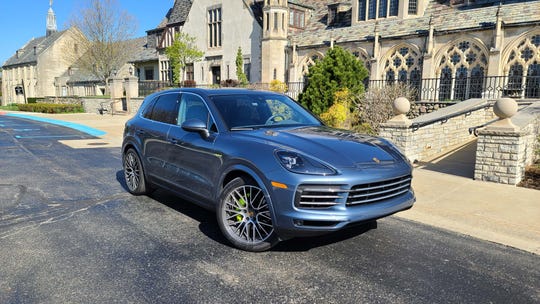
The 2020 Porsche Cayenne E-Hybrid offers a dual personality of green, all-electric driving — and massive AWD, 455-horsepower when the driver has a need for speed. (Photo: Henry Payne, The Detroit News)
Tesla Inc. has set the luxury world on fire, challenging establishment automakers with compelling, all-electric products with Apple-like design simplicity. No one has been able to match them — not the Jaguar i-PACE, not the Audi e-Tron, not the Cadillac ELR.
But maybe the solution isn’t beating Tesla at its game. Maybe it’s providing different answers for a different customer. The 2020 Porsche Cayenne E-Hybrid SUV is the antithesis of Tesla.
Playing in the same price ballpark as the $86,190 Tesla Model X SUV, the $81,150 Cayenne plug-in boasts similar performance and range but in a more practical, more conservatively styled package.
This vehicle that doesn’t wow with gull-wing doors — but with high IQ scores in industry dependability rankings. Tesla is a brash newcomer that wants to throw out the rule book, while Porsche has built respect over decades of racing success. Their games are as different as Federer and Nadal. Old school vs. new age.
I spent some time with Cayenne to see what it’s got.
The E-Hybrid is Porsche’s third generation hybrid — a commitment on par with Honda’s Insight (the first hybrid on our shores in 1999), and nearly equal to the fourth-gen Toyota Prius. These guys know hybrids, and, like the Japanese, Porsche has priced the E-Hybrid competitively with its regular Cayenne lineup (unlike the premium hybrid pricing of some other brands).
Cayenne E-Hybrid comes with old school, de rigueur virtue signaling — phosphorescent Acid Green “E-Hybrid” badging on the its flanks and tukus, as well as radiant green brake calipers. Less flashy customers can choose white or yellow calipers as part of Porsche’s typically dizzying array of options to personalize your car. But I like the Acid Green as a way to bring flavor to Cayenne’s vanilla design.
Cayenne has come a long way since its first ungainly attempt to translate Porsche 911-like, sports-car styling to a five-door ute. The new gen exudes masculinity even as it’s still one of the most conservatively styled SUVs out there.
That’s in stark relief with the Tesla Model X with its unmistakable egg shape, big hips and signature gull-wing doors. Interestingly, E-Hybrid comes at a time when the sleek, all-electric Porsche Taycan sedan has debuted as a direct competitor to the Tesla Model S sedan.
Cayenne’s conservative approach is in keeping with its appeal to luxury shoppers who want a quick green machine, but without the sacrifices of the full-electric lifestyle.
Own a Tesla and you’ll only visit service stations to buy newspapers. So, too, the Cayenne E-Hybrid. Plug it in overnight and Porsche claims 20 miles of electric juice for local commutes. Make that, plug into a 240-volt, Level 2 outlet and you’ll get 20 miles. Invest $2,000 for Level 2 installation, because a 110 volt-wall is terribly inconsistent.
On my 110-volt garage outlet I got seven miles in nine hours of charging. Ugh. Welcome to the uncertainties of the electric frontier. Fortunately, the gas engine will recharge the battery while driving for more, pure EV opportunities.
Turn the Porsche’s old-school dash key — on the left just like Porsche race cars of old — and the E-Hybrid defaulted to E-Power mode, allowing fully electric driving around town. Porsche achieves this with a bifurcated throttle. Let me explain.
Maintaining moderate throttle, I could drive on an electric charge over 70 mph on local interstates. A digital instrument gauge flanked the Porsche’s center tac, allowing me to monitor the range on E-Power. Bury the throttle for a quick maneuver and you’ll feel a noticeable detent in the throttle as it grabs the gas engine for help.
Stay on the shy side of the detent and the V-6 never engages. EPA says that 20-mile charge actually only translates to real-world 13 miles traveled. I can vouch for that. Such eggshell driving, of course, denied me the instant torque thrill of electric cars. Mash the throttle in a Model X and you’re suddenly Han Solo in a Millennium-Falcon, light-speed blur to 60 mph in just 4.4 seconds.
The downside of that thrill is massive range suck. Drive Up North and Tesla drivers will get their own eggshell time as the charging network thins out. Model X promises 353 miles of electric range at perfect, 55 mph driving — but access your inner Han Solo (or travel at over 70 mph) and range plummets.
That’s where plug-in hybrids like Porsche shine. Combined gas-electric range is an impressive 430 miles. And with gas stations everywhere, there’s no range anxiety even when you want to have fun — which is often in this rhino in tennis shoes.
The E-Hybrid is built for speed.
The 5,000-pound beast (400 shy of the Model X) matches the Tesla from 0-60. Thank the standard Sports Chrono package and its cool, steering-wheel-mounted Sport Response button (just like a 911), which allowed me to instantly switch from egg-shell E-Power mode to face-flattening Sport Plus mode. Hold on, honey!
Sport Plus accesses the full, combined gas engine/electric motor output of 455 horsepower, 516 pound feet of torque, which ignores the throttle detent and launches you straight to the moon.
With its instant torque, the electric motor effectively acts like a supercharger on top of the turbocharged 3.0-liter V6, eliminating turbo lag. The car rockets off the line as the 8-speed auto tranny fires off quick shifts, and Sport Mode adds appropriately louder exhaust note theme music.
Around 180-degree cloverleafs the rhino remained remarkably flat, its all-wheel-drive digging in as I fed more throttle. This confident handling translates to twisty roads Up North as well. The Model X, its battery creating a low center of gravity, is no slouch in the cornering department either.
Old-school Porsche is the rare brand that can match new age Tesla for engineering curiosity. Ogle the Model X’s graphics and big console tablet. Cayenne E-Hybrid is an airline cockpit by comparison, with a button for everything from volume to shock damping to radio source. Or you can use the touch screen to explore the ute’s myriad setups.
On basic tech items, however, Porsche noticeably lags. Voice commands are a Stone Age behind Tesla, and my $90,000 E-Hybrid mule was naked of driver-assist items like blind spot-assist and adaptive cruise control that are standard on $25,000 Nissan Sentras. Adaptive cruise is (cough) $6,250 extra.
Such shortcomings will be deal-breakers for new age EV buyers. But for luxe shoppers who just want a taste of EV with their Porsche DNA, Cayenne E-Hybrid is your answer.
2020 Porsche Cayenne E-Hybrid
Vehicle type: Front-engine, all-wheel drive, 5-passenger SUV
Price: $81,150, including $1,250 destination charge ($91,220 as tested)
Powerplant: 3.0-liter turbo V-6 combined with AC motor and 14.1 kWh lithium-ion battery
Power: 455 horsepower, 516 pound-feet of torque combined
Transmission: 8-speed automatic
Performance: 0-60 mph, 4.4 seconds (Car and Driver); towing capacity, 7,716 pounds
Weight: 4,950 pounds est.
Fuel economy: EPA 24 city/ 26 highway/ 25 combined
Report card
Highs: Hybrid long range; Sports Response button take me to the moon
Lows: Lack of standard safety assist features; infotainment tech lags competitors
Overall: 3 stars
Woodward Dream Cruise canceled over COVID-19 concerns
Posted by Talbot Payne on July 1, 2020
The 26th annual Woodward Dream Cruise is officially parked.
According to Woodward Dream Inc., community events planned for the occasion, including the Aug. 15 Dream Cruise itself, are canceled due to public health concerns over COVID-19, organizers announced Monday.
The decision was made Monday and comes after the Dream Cruise posted on Facebook earlier in the month that the event was still “in neutral.”
However, the inaugural Woodward Dream Show, a gathering of the best of the cruise at M1 Concourse in Pontiac, is still scheduled to go on in August.
“The Dream Cruise is the largest car event in the world, but there is not a cure for COVID-19, there is not a vaccine,” Woodward Dream board president Michael Lary. “We have to be responsible for the we, not the me.”
The announcement comes as Woodward was packed Friday and Saturday with cruisers as the summer ritual builds to its Aug. 15 summit. Muscle cars, European sports cars, and jacked trucks preened up Woodward in Royal Oak before taking a 180-degree Michigan turn and heading back the other way.
Other cruisers were content to pitch their hoods and socialize with friends and family in parking lots along the avenue. That scene likely won’t change through August. Enthusiasts like Rich Fasi took to the Woodward Dream Cruise Facebook page to voice support: “Before it became a big corporate affair we cruised Woodward — we will ride again!”
Jhan Dolphin, a cruiser and vice president of auto supplier Prefix Corp., said: “I know hundreds of people who are planning to go. Cruising is outdoors, and people are safe in their cars.”
What will be missing are the big media and corporate sponsors that normally pepper the sidewalks with concessions and car displays. Venues such as Ford’s Mustang Alley, Kids Play Zone, Berkeley Cruise Parade, and GM’s Birmingham display will be absent, as will many smaller corporate gatherings as communities deny permits for tents.
Cities on the route long ago canceled their community events like Ferndale’s Light & Sirens cruise featuring emergency vehicles.
The Woodward Dream Inc. board, the official sanctioning body for the Cruise, was under heavy pressure from cities to cancel the vent. Three of the nine municipalities along the 10-mile route passed resolutions urging cancellation. None demanded the show go on.
Board president Lary said the rise in cases in Florida and Arizona had an effect on the decision.
“At the beginning of the summer, the conversation was about how a warmer summer climate would help. But there is still concern in June,” he said.
“These cities are run by elected officials that have an obligation to their constituents and how a gathering of this size impacts them locally.”
Cruisers have flocked to Metro Detroit’s main street for decades, and Lary conceded car lovers still have a right to bring their rides and lawn chairs to public property.
He said the state will not shut down M-1 on Aug. 15 and that regulations along the route will vary by community. While governments cannot prohibit businesses from renting their property to cruisers, they will likely deny permits for tents and other installations.
With tens of thousands of cruisers descending on Woodward in August, enthusiasts say organizers missed an opportunity to get out ahead of the event to make it safer.
“No one wants more rules, but people do want guidelines,” Dolphin said. “We understand the public health concerns, but that’s part of the problem with canceling the Cruise. People don’t know what to do, they want a message.”
Organizers had planned to coordinate with sponsors to issue public service announcements — both on Woodward between Ferndale and Pontiac as well as over the airwaves — to issue guidance, such as to social distance.
Neighboring states have begun to open to similar events.
At Mid-Ohio race track in Lexington, Ohio, last weekend, the Sportscar Vintage Racing Association held its annual Vintage Grand Prix. Coupled with Trans Am and Formula 4 and Formula Regional pro races, the weekend attracted thousands of fans to the sprawling, raceway complex.
SVRA organized the event and the venue was chock full of signs for social distancing, officials taking temperature checks and clusters of port-o-johns.
While Dream Cruise organizers are discouraging attendance at their own event, the Mid-Ohio experience suggests pent-up demand for events even as 36 states have reported increases in COVID increases this month.
“I think it’s important to give people some sense of normalcy,” said Prefix’s Dolphin, whose company organized a cruise event earlier this spring in Rochester.

Another major event planned for the Aug. 15 weekend is unfazed by the Dream Crusie announcement. The Woodward Dream Show will continue Aug. 13-15 as planned.
Organized by the Pontiac Motorsports Exposition, the event will take over the M1 Concourse car club off Woodward in Pontiac and feature three days of racing, exhibits and food.
It will feature a judged display of the cruise’s best American hot rods Aug. 13. Then an auto-themed fashion show and after dark, afterglow party for charity will follow. Aug. 14 will be track-focused with performance car hot laps, wrapping up Aug. 15 with an open invitation to car clubs.
“The Woodward Dream Show is moving forward in planning,” CEO Tim Hartge said. “We are designing an event that integrates a variety of protocols, including social distancing and other safety measures. Our event is ticketed, and we are limiting the number of attendees according to guidance from officials.”
The Dream Cruise’s charitable mission will take a major hit with the event’s cancellation.
Originally organized in 1995 to raise funds for a community soccer field, the Dream Cruise has benefited charities large and small over the years. Mustang Alley typically raises $100,000 for the Juvenile Diabetes Foundation, while the Dman Foundation offers charity rides in Birmingham to disadvantaged youth.
“There are many pieces to the Dream Cruise pie,” Lary sid.
“We are concerned about the non-profit organizations that are going to be negatively impacted. The cruise does a huge amount of good for the community.”
Payne: High-speed Jeep Gladiator Mojave conquers the Mounds
Posted by Talbot Payne on July 1, 2020
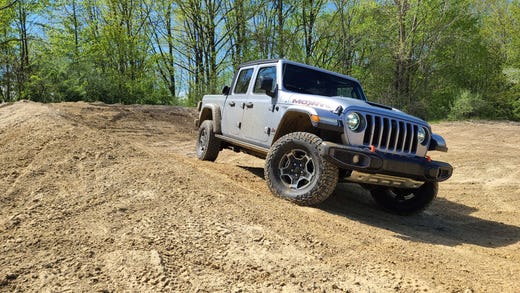
There are two kinds of auto enthusiasts: those who get their thrills on-road, and those who get them off-road.
A sports car racer for decades, I’m an on-roader. But the 2020 Jeep Gladiator Mojave pickup could convert me.
The Mojave is the latest variation of the tree-chewing, midsize Gladiator pickup designed for folks who want to explore the far corners of the earth. In this case, especially those with a need for speed. Unlike the Gladiator Rubicon which is built for rock-crawling, the Mojave wants to run. For a track rat like me, that sounds awfully appealing.
I’ve been hustling performance cars to Hell, Michigan, and back in the COVID-19 lockdown to test their limits. But for the Gladiator Mojave, I headed north from my coronavirus hideout to the Mounds off-road vehicle park near Flint. The Mounds has everything an off-road rebel needs: rock piles, swamp trails, sandy hills, high-speed dirt flats.
The Mounds is thick with Jeep Wranglers exploring every inch of its 118-acre playground. They mingle with giant, jacked pickups and swarms of ATVs and dirt bikes crawling over its hills and gullies. With its detachable front sway bars and front-and-rear locking axles, the Gladiator Rubicon — like the Wrangler Rubicon — loves the tight, uneven stuff.
The Gladiator Mojave, on the other hand, dreams of being a Ford Raptor. Ford’s high-speed, Baja-desert-friendly F-150 is a singular warhorse. In the saddle with 450 horsepower under the hood and sophisticated Fox shocks under the fenders, I conquered the Borrego desert in Southern California a few years back, hitting triple-digit speeds on the sandy flats.
It was extraordinary. But like a killer whale, the Raptor needs a lot of ocean to feed, and southern California — or the Baja peninsula — is a long way to go to stretch the big Ford’s legs. Gladiator Mojave aims to bring those pleasures closer to home. Like Flint.
Unlike the Raptor, the new Gladiator doesn’t have a new engine or get-outta-the-way bodywork. But it did feature Jeep’s throaty 285-horse V-6 and a unique hood scoop that sets it apart from brother Rubicon pickup. More important, it is raised an inch above Rubicon with trusty Fox performance shocks.
I shifted the Mojave’s transfer case to four-wheel drive, turned traction-control off and nailed the V-6 across the Mounds’ open, northwest trails. This is terrain where the dirt bikers like to open it up, and I picked up speed quickly, the Fox shocks absorbing the trail’s imperfections.
This might be hairy stuff in the ginormous Raptor, but the Mojave was in its element. A 75-degree left-hander loomed, and I slowed — then slewed it sideways across a water-filled dip. Gladiator’s dimensions allowed me to rotate the pickup beautifully, then I was back on the throttle as the big, 33-inch knobby tires sprayed the cabin with water.
Good thing I kept the doors on.
When you’re not splashing through Mother Nature at high speed, you can remove the doors and roof of the Mojave just like the Rubicon to get closer to nature. Just don’t wear your dinner clothes.
With the pickup bed out back, the panels are easy to stow. Of course, the dirt bikers I was riding with were eyeballing that bed as potential bike transport. They had arrived in regular, light-duty pickups, but the Mojave adds the tantalizing twin possibility: When you’re tired of running the hills in isolation on your bikes, you can pile into the Mojave for some communal dirt-kicking on the trails.
“Hey, can we come with you?” said one of the bikers who had already figured this out.
The Mojave is happy at low speeds, too. The Mounds has a number of tight scramble areas that favor Jeeps over big trucks. With the transfer case in four-wheel low, I flipped a console switch to lock the rear axle and gain better traction. The Gladiator Rubicon takes this capability one step further with twin locking axles and decoupling sway-bars for serious rock-crawling, if that’s your thing.
Naturally, all of this scene-chewing hardware doesn’t come cheap. The base Gladiator starts at $35,000 and the base Mojave at $45,000. My tester was an eye-watering $60,945, just $7,500 cheaper than the Ford Raptor I tested a couple of years ago.
What you get for that coin is a unique vehicle that is good at addition as well as subtraction. Subtract the doors and hood for that unique outdoors experience. Then ogle the additions that Jeep has brought to its console.
The Uconnect infotainment system is one of the industry’s best, with easy-to-use menus so you can blast your favorite Sirius XM station while pulverizing trails in the middle of nowhere. Where Uconnect is shy of the industry’s best is in the navigation department, Jeep has thoughtfully made Apple CarPlay and Android Auto standard on the Mojave.
Leaving the house for my off-road adventure, I plugged my Samsung phone into a USB port in a dash festooned with connectivity. The infotainment screen now duplicated my phone screen. A long hold on the steering wheel awakened Google Assistant. I asked her to chart a course to the Mounds. We were off.
Like my performance car trips to Hell, the hour drive to the Mounds gave me a chance to assess the Mojave’s livability on a long trip. I hope you like loud.
With all those removable panels, roll bar and cloth roof, the Jeep is hardly equipped for sound insulation like some of its mid-size truck peers. A Ford Ranger is a sealed tomb by comparison. Go topless on your ride and good luck hearing Google Assistant’s directions (fortunately the instrument display graphics are fine). The big, knobby tire howl adds its own soundtrack.
But the advantage of those high-tech, multi-valve Fox shocks is the Gladiator Mojave rides more smoothly on the road than the Rubicon. Smooth as in mattress smooth. The Mojave does tend to wander in lane thanks to its high ride height, but the overall experience is good for your backside when you arrive at your destination.
If that destination is a metropolitan area, you’ll find the Gladiator easier to maneuver than a huge, full-size truck. Then, like a sports car, it can transform into a weekend off-road thrill ride. Which this on-road racer finds very appealing.
2020 Jeep Gladiator Mojave
Vehicle type: Front-engine, four-wheel drive, 5-passenger pickup
Price: $45,370, including $1,495 destination charge ($60,945 as tested)
Powerplant: 3.6-liter V-6
Power: 285 horsepower, 260 pound-feet of torque
Transmission: 6-speed manual, 8-speed automatic
Performance: 0-60 mph, 8.3 seconds (Car and Driver est.);
Weight: 4,974 pounds (automatic as tested)
Fuel economy: EPA: 17 mpg city/22 highway/19 combined
Report card
Highs: Comfortable ride on road; carries dirt bikes or hits the dirt itself
Lows: Noisy on-road; gets pricey with add-ons
Overall: 4 stars
American Festival of Speed aims to be major car event in Pontiac
Posted by Talbot Payne on June 18, 2020

A group of 1970s Shadow Can Am cars do laps around M1 Concourse. The 2021 American Festival of Speed will feature similar cars on the track.
Pontiac – Imagine the sounds of supercars on the track. The sights of people ogling the latest cars for charity. Manufacturers spinning their muscle cars on the skid pad. Imagine it, not in Detroit, but in Pontiac.
The American Festival of Speed is coming in fall 2021 as Pontiac’s M1 Concourse aims to become the site of one of the premier automotive events in the U.S.
Paired with another new event called the Woodward Dream Show — which debuts this August during what is supposed to be Woodward Dream Cruise week — the events will be coordinated under the umbrella of the Pontiac Motorsports Exposition. They will be explicitly modeled after the Goodwood Festival of Speed and Goodwood Revival, England’s world-renowned motoring exhibitions.
The events come as the North American International Auto Show tries again in June 2021 to reinvent itself in downtown Detroit as a Goodwood-like outdoor festival after the pandemic shut down its first event this year.
Pontiac Motorsports Exposition CEO Tim Hartge acknowledges what he sees as the friendly rivalry between the shows.
“But we have a race track,” he said while overlooking the 1.5-mile Champion Motor Speedway here. “We’ve got an experiential marketplace. It hits all the senses. The NAIAS doesn’t have that.”
Where Goodwood’s events takes over the estate of English nobleman Lord March, the Motorsports Exposition events will occupy M1 Concourse, a private club for auto owners.
“We’re modeling it after Goodwood, and we want manufacturers to come, too. The theme of both shows is ‘Past, Present and Future,’ which is cool because we want to bring electric-sports racing out here, too,” said Hartge, a motorhead who drives a Ford Mustang Bullitt. “We want to have a demonstration of these kind of cars. And we’ll give the manufacturers a chance to do a demo day if the want to bring out their Hellcats or their GT500s.”
Goodwood’s Festival of Speed is a Disneyland of automotive attractions — past shows have featured everything from race cars suspended on giant Popsicle sticks, to the premiere of the 2020 Porsche 718 Cayman GT4 — that attracts some 150,000 people each year.
The American Festival of Speed will sport its own automotive royalty next year when it honors Jim Hall, the legendary race driver and entrepreneur who powered his 1960s Chaparral Can Am cars with Chevy engines. Hall will bring three of his priceless Chaparrals and will be honored with the festival’s first Master of Motorsports Award. Hartge says the Chaparrals will make a tour of the track between regular, timed runs of international supercars just like the hillclimb course that anchors Goodwood’s weekend.
European luxury-makers have vacated the Detroit auto show, but as the 2020 Cayman intro suggests, they might find the upscale digs of M1 more enticing.
“Static car shows have a problem. Manufacturers and the public want experiential events,” said Hartge. “We have all the senses engaged here on 87 acres.”
Pontiac Motorsports Exposition has ambitions beyond just sleek chariots. Like the NAIAS has benefited Detroit, Hartge says the American Festival of Speed — to be held Sept. 30-Oct. 3, 2021 — is part of a much larger vision for Pontiac. The festival will even have a major charity event, called the Charity Ball, like the Detroit auto show.
For a taste of what the facility can do, the Woodward Dream Show will debut this Aug. 13-15 during what is traditionally Woodward Dream Cruise week. But with cities from Ferndale to Birmingham canceling Dream Cruise events because of the COVID-19 pandemic, the Dream Show could become a focal point.
M1 Concourse has already become the unofficial launch of Cruise week with the annual Roadkill Nights blowout — though the event has been sidelined this year. Sponsored by Dodge for the last five years, it showcased drag racing on Woodward for about 47,000 attendees while offering hot laps on the race track and drifting around M1’s skid pad.
Acknowledging concern about the coronavirus, Hartge said tickets will help regulate crowd size and will be sold online to minimize hand-to-hand contact. The Dream Show will conform to government and social distancing guidelines. M1 will offer sanitizing stations, gloves and masks.
Three days of racing, exhibits and food are planned. The Dream Show will open Aug. 13 with a judged display of the Dream Cruise’s best American hot rods. An auto-themed fashion show and After Dark-Afterglow party will follow. Aug. 14 will be track-focused with single-lap, timed runs featuring performance cars. Aug. 15 is an open invitation to car clubs to take over M1’s lawns and asphalt.
The event will be capped off Aug. 15 with a Woodward Avenue parade to Pontiac’s downtown loop and Wide Track Drive.
“Pontiac is the next place besides Detroit that is natural for rehabilitation,” said Hartge who notes M1 Concourse sits on the site of a former GM plant that dates to 1908. “Let’s help the businesses here. The goal is to put Pontiac back on the map as an automotive capital.”
Woodward Dream Show
Aug. 13: noon to 8 p.m.
Aug. 14: 9 a.m. – 7 p.m.
Saturday, Aug 15: 9 a.m.-7 p.m.
Tickets (on sale in July): $35, single day. $57.50, 2-day pass. $85, three-day pass. All-day parking is $15.
For tickets, visit WoodwardDreamShow.com.
American Festival of Speed
Sept. 30-Oct. 2, 2021
Details pending.
Roadkill Nights is the latest Woodward Dream Cruise casualty of COVID-19
Posted by Talbot Payne on June 18, 2020
There will be no drag racing on Woodward this year. At least not legally.
The sixth annual Roadkill Nights has been canceled for Aug. 7-8, the latest victim of the COVID-19 pandemic. Roadkill, which shut down a section of Woodward Avenue in Pontiac for legal drag racing, has been the official kickoff for Woodward Dream Cruise week.
It joins staples like Mustang Alley and Ferndale’s Lights & Sirens Cruise on the sidelines as cities up and down Woodward have canceled their events scheduled for the Aug. 15 Cruise.
The exception is the inaugural Woodward Dream Show which is scheduled to go on as planned Aug.13-15 at Pontiac’s M1 Concourse, making it a focal point of attention when cruisers and their families gather later this summer.
Dodge has been a sponsor for Roadkill Nights. Tim Kuniskis, Fiat Chrysler’s global chief of passenger cars — and a dedicated cruiser — lamented the cancellation given its status as a “must-attend event for performance enthusiasts for the past five years.”
Cruisers are expected to flock to Woodward whether the Dream Cruise is officially canceled or not. Woodward has already been busy, despite COVD-19 concerns, as cruisers have hit the strip and congregated with friends who have a long winter in hibernation.
RoadKill Nights had turned the heat up a notch by shutting down Woodward north of St. Joseph Mercy Parkland hospital and inviting 140 of the top drag racers from around the country to compete for a $30,000 purse in their street-legal rods. Roadkill Nights also offered interactive opportunists for fans to take thrill rides in 700-plus horsepower Dodge muscle cars around the adjacent M1 Concourse.
The new Woodward Dream Show Aug. 13-15 will feature a hot rod contest, supercar shootout on the M1 race track, as well as food trucks and other family activities. The Oakland police will lead a Dream Show parade up Woodward on Aug. 15.
Organizers say coronavirus protocols will be followed.
“We will encourage distancing and masks,” said CEO Tim Hartge. “Ticketing will be online. Sanitizing stations, gloves, and masks will be available.”
Payne: Hyundai Sonata Hybrid has OMG mpg and looks, ho-hum performance
Posted by Talbot Payne on June 18, 2020

They should have named the Hyundai Sonata the “Hyundai OMG.” The mid-size sedan is a non-stop wow emoji.
There was the February Super Bowl ad featuring Boston celebrity jaws dropping in unison as actor John Krasinski demonstrated the Sonata’s self-parking feature. “Smaht pahk!” We couldn’t get it out of our heads. OMG.
I couldn’t get the Sonata’s good looks out of my head the first time I saw it. It still turns my head — like the other day when an all-black Sonata rolled my way in Oakland County, its signature LED running lights giving it a sinister look. The black Audi A4 behind it looked … almost as good. OMG.
Now comes the Hyundai Sonata Hybrid boasting the best fuel economy in class: 52 mpg. OMG.
At least on paper. In practice the hybrid is the least OMG feature of the Sonatas I’ve tested. And it still leaves me thirsting for the Sonata N performance version that will couple the car’s tight handling with an alleged 295 horsepower. I tasted the N earlier this year on windy roads through Arizona and it was a treat.
Until its arrival, drivetrains aren’t the Sonata’s strong suit. And that’s not just because I’ve got a lead foot instead of a green thumb. Indeed, I’ve been impressed by the industry’s latest hybrids, particularly new value entries from compact SUVs like the Ford Escape, Honda CRV and Toyota RAV4, which have exhibited feisty character even as they sipped gas from the pump.
But the Sonata Hybrid was surprisingly tepid. Especially since it gains 12 more horsepower than the regular Sonata’s turbocharged 1.6-liter 4-cylinder. The regular Sonata’s 1.6-liter made me yearn for the Sonata N — and the Sonata Hybrid made me yearn for the 1.6-liter.
Where the Escape and CR-V hybrids use their electric motor for an electrifying kick off the line, the Sonata seems to maximize the battery for that OMG mpg. The Hybrid’s acceleration is sleepy. The hand-off from electric to gas is as smooth as a middle-school track relay, with the 2.0-liter engine shouting as if someone stepped on its foot.
But I’ve been spoiled, dear reader, by the Ford and Honda hybrids’ dexterity, and the Sonata is not in their league. What’s more, my week in the premium Hyundai Hybrid Limited returned just 35 mpg — a far cry from the advertised 47 mpg.
That 52 mpg I spoke of belongs to the starter Hyundai Hybrid Blue model, which retails for $28,725 — with a $30,875 SEL and Limited model clocking in at $36,275. The latter pair achieve 47 mpg.
Those prices are in contrast to, say, the Honda CRV Hybrid, which is a ridiculous bargain at just $27,000 with lots of pep, 38 mpg and all the inherent advantages of SUVs like hatchback storage, all-wheel-drive and rear-seat headroom.
So the Sonata Hybrid will have to sell itself on sex appeal. And in that area it is loaded.
Every time I got annoyed with the Hybrid’s awkward drivetrain, I would stand back and ogle its curves.
The heavily sculpted sides (with this much stamped sheet metal how does the standard Sonata start at just $23,000?) sweep rearward to a gorgeous tail-section, a Lincoln-like horizontal taillight graphic providing the perfect punctuation. There is exquisite detail — like the delicate winglets on the taillight to aid aerodynamic flow and the signature LED running lights that parallel the hood.
The standard Sonata grille is distinctive like the mouth of a carp. Too big. The hybrid tones it down with some elegant chrome piping and a sweeping lower chrome piece that echoes the rear taillight. But the Hybrid Limited exterior’s OMG feature is the solar roof. Yes, a solar roof.
Embedded in the black sweep of the coupe-like greenhouse you can make out subtle traces etched to and fro to catch the sun. Dramatic looking, though less dramatic in operation. Hyundai says the solar roof will gain the driver 2 miles on a tank of gas. Like the drivetrain, it’s not worth the premium price in my book … but it’s a talker.
The interior on my Limited model was even more stunning, the seats swathed in tanned leather, the instruments fully digital.
The dash reminds of a Mercedes, which indicates just how high this mainstream sedan has aimed. A fully digital cockpit and infotainment display flows across the horizontal dash. The Hyundai can’t match the Mercedes’ exquisite detail — what can? — but the graphics are engaging and Sonata Hybrid does it all for tens of thousands of dollars less. No other sedan in class can match it.
The console offers more luxury touches, including a so-called “trigger shifter” that I first encountered on the Acura NSX supercar, of all things. I fell in love with it on the Acura and find Hyundai’s version just as useful. It’s different without being annoying — while also saving console space for knick-knack and smartphone storage.
The infotainment system features are useful, particularly Apple CarPlay and Android Auto navigation that allow the sedan luxe-like navigation skills. Drill deeper and you’ll find — yes, another OMG moment.
While most drivers will be content to play their own music, streaming services or Sirius XM’s multiple channels, Hyundai offers another escape: Sounds of Nature.
There are the soothing sounds of Snowy Village and Warm Fireplace. And Open Air Cafe, Calm Sea Waves and Lively Forest. Mrs. Payne balked at Rainy Day because she found it dreary. But the sounds are a reminder of Hyundai’s determination to make the Sonata a unique experience.
Available with the nav package, the feature’s also available on other Sonatas — not just the hybrid. Which brings me back to the question of the hybrid’s value. Indeed, the hybrid is oddly missing the “Smaht pahk” feature that got everyone all worked up about the Sonata in the first place.
Sonata says it’s coming, which is good thing because when you’re paying 36 grand for a sedan you want all the OMG you can get.
2020 Hyundai Sonata Hybrid
Vehicle type: Front-engine, front-wheel drive, 5-passenger sedan
Price: $28,725, including $975 destination charge ($36,275 Limited as tested)
Powerplant: 2.0-liter inline 4-cylinder mated to AC motor and lithium-ion battery
Transmission: 6-speed automatic
Power: 192 horsepower (combined system output)
Weight: 3,530 pounds as tested
Performance: 0-60 mph, 8.0 seconds (Car and Driver est.); top speed, 120 mph
Fuel economy: EPA est. mpg: 50 city/54 highway/52 combined (Hybrid Blue); 45 city/51 highway/47 combined (Hybrid SEL and Limited)
Report card
Highs: 47-52 mpg; luxury-class interior
Lows: Granola performance; pricey compared to competitive SUV hybrids
Overall: ★★★
Ford rolls out its first Mustang Mach 1 since 2004
Posted by Talbot Payne on June 16, 2020
With signature matte-black hood stripe, howling V-8 engine and extensive handling upgrades, the legendary Mach 1 Ford Mustang has been reborn for 2021.
Purists might miss the hood shaker and grille lights, though.
Ford unveiled the special edition Mach 1 in its birthday suit on Tuesday after teasing the car in camouflage two weeks ago. With 480 horsepower (nearly double that of the original, 250-horse coupe that debuted in 1969) and 420 pound-feet of torque like the outgoing Mustang Bullitt special edition model, Mach 1 features a unique fascia, paint scheme and performance pieces from its sibling GT350 and GT500 track monsters.
“It is the new pinnacle of 5.0-liter, Mustang performance,” said Mustang marketing chief Jim Owens, who says Mach 1 is defined by three criteria: handling, straight-line speed and style.
Likely to start around $50,000 when it hits dealers next spring, the Mach 1 is the most capable, 5.0-liter V-8 engine-fired stallion in the sixth-generation Mustang stable. It will reside in the middle of a performance lineup that ranges from the affordable 2.3-liter Ecoboost High Performance turbo-4 cylinder model all the way to the track-stomping $70.000, 760-horsepower GT500. The last Mach 1 was produced as part of Mustang’s fourth-gen, 2004 lineup.
Mach 1 and Mach E were spied circulating Pontiac’s M1 Concourse race track together last week, gaining footage that may appear in future marketing campaigns.
The 2021 Mach 1’s wardrobe pays homage to previous generations that sold from 1969-1978 and 2003-2004. A signature, low-gloss black stripe is prominent on the hood, as are rocker panel stripes down the sides. Unlike the ’69 original, the Mach 1 logo is separated from the stripe to stand alone behind the front fenders. The rear fascia is also painted matte black similar to predecessors.
An appearance package is available in Fighter Jet Gray with a choice of three stripe colors: white, red, and orange. Brake calipers are painted orange.
Purists will be disappointed that the 2021 Mach 1 is not optioned with a shaker (a hood scoop poking through a hole in the hood) for better engine breathing as in previous generations. “The 5.0-liter engine is focused on performance output, and it didn’t need (the shaker),” said Owens.
Budget issues may have been in play given massive amounts of money Ford is spending to bring the Mach E to market.
Another signature piece of hardware – twin lights in the grille – also are compromised compared to past models. Where the 1969 Mach 1 used the grille lights for extra lighting at night, the round inserts are plastic-capped and for show only on the new car.
“We have no doubt some of our customers will punch them out for increased cooling modifications,” smiled Owens.
The Mach 1 will be track ready.
Cooling the 305-cubic inch beast within was a priority of engineers. Two heat exchangers and other hardware are added behind the unique Mach 1 fascia for better breathing. A huge, new underbelly pan with special airfoils for cooling and downforce is the vehicle’s most significant aero upgrade, and the Mach 1 gets extensive suspension upgrades like bigger sway bars and stiffer springs.
Out back, bazooka-sized, 4.5-inch chrome exhaust tips signal the Mach 1’s intentions.
Buyers who want even more capability can add a Handling Package that consists of sticky Michelin Pilot Sport Cup 2 tires (a step up from standard Michelin 4S treads) wrapped around unique 19-inch wheels. Also included are a rear spoiler taken from the GT500, upgraded front splitter and aero tweaks around the fenders. Ford says it will increase downforce on track by 150%.
Inside, purists will revel in the standard, manual, six-speed shifter (with rev-matching for the first time) topped off by a cue ball. An automatic 10-speed transmission is also available. Behind the fat steering wheel is a 12.3-inch digital instrument cluster, and the dash is stamped with a chassis number badge.
In addition to Fighter Jet Gray, the Mach 1 can be dressed in an array of Skittle colors including Velocity Blue, Twister Orange and Grabber Yellow.
Seating can also be had with right-hand drive in foreign markets where the Mach 1 will also be sold. Mustang is the best-selling two-seat sports car in the world across 147 countries.
Remade Nissan Rogue SUV headlines looks, tech while ignoring hybrid
Posted by Talbot Payne on June 16, 2020
Nissan introduced a comprehensively redesigned model of its Rogue compact SUV Monday, the second best-selling SUV in America.
The descendent of the stunning X-Motion Concept Car that debuted at the Detroit Auto Show in 2018, the Rogue embodies the concept’s ambitions of bold SUV styling with a suite of high-tech innovations. Interestingly, the Rogue eschews the trend toward hybridization that has marked the recent launch of its close competitors, the Ford Escape, Honda CR-V and top-selling Toyota RAV4.
By contrast, the made-in-Tennessee Nissan comes with one engine option, an upgraded version of its reliable, sippy 2.5-liter 4-cylinder. While adding a premium Platinum trim for the first time, Rogue seems intent on pursuing Nissan’s strategy to offer best-in-class value at the cheaper end of the biggest segment in autodom. By contrast, Toyota offers a plug-in hybrid model that starts at nearly $40,000.
The Rogue’s upright, sculpted body is dramatically different from the outgoing 2020 model with its rounder, more potato-shaped lines. The upright grill and big shoulders of the compact ute reflect the X-Motion Concept as well as Americans’ preference for truck-like designs. The RAV4’s recent remake cribbed heavily from its Tacoma pickup.
Signature Nissan design touches like the V-Motion grille and floating roof are still in evidence, but otherwise the third-gen Rogue is a break from the past. Even the headlights have moved, with the Rogue deploying its peepers in the middle of the front-fascia underneath daytime running lights – a style made popular by Hyundai and the Chevy Blazer.
The Rogue’s engine is also offered in the mid-size Altima sedan. Unlike the Altima, however, the Rogue does not offer a more-powerful, turbocharged 2.0-liter. The Rogue is content to see its mill get a 6% bump in power to 181 horses to drive both front-wheel and all-wheel drive models.
The Rogue gets 30 mpg combined EPA fuel economy in front-wheel drive and 29 mpg in all-wheel drive.
Open the doors and Rogue turns up the high-tech.
Rogue cleverly piggy-backed on the “Star Wars” franchise in 2017 to offer a limited “Rogue One: Star Wars Limited Edition” model as well as introduce its ProPilot Assist feature. There will be no “Star Wars” movie to co-brand with this fall when the 2021 Rogue hits dealerships, but the SUV continues to push sci-fi, self-driving capabilities in the family segment.
Standard on the Nissan is a suite of driver-assist systems called Nissan Safety Shield 360 which includes auto high-beams, lane-keep assist, automatic emergency-braking with pedestrian detection, and blind-spot assist. Nissan says its adaptive-cruise ProPilot Assist system has been improved with less abrupt braking.
Taking it up a notch, ProPilot Assist with Navi-link (available on higher trims) will automatically adapt speed to road conditions. When deployed, it uses GPS to slow for curves as well as interstate off-ramps. Adaptive cruise will automatically start driving again after 30 seconds if stopped at a light – safety technology familiar to high-end luxury cars like Audi and Tesla. Nissan says their Gen Y target audience prizes safety in the SUV class.
Other luxury features like a 12.3-inch digital instrument display and Cadillac-like head-up display will also be available.
Passengers can enjoy these treats encased in a roomier cabin made quieter by acoustic front glass and underbody panels. Headroom, rear-seat legroom, and cargo space are all enhanced even as the Rogue’s length has contracted slightly.
The dash is crowned by a tablet infotainment screen with 9.0-inch option available. Apple CarPlay and Android Auto come standard. The center console has been remade with a Nissan-first electronic shifter that opens room for sub-console storage as well a rotary terrain-mode selector. Again mimicking luxury cars, the console storage box features a “butterfly” door so internal USB ports can better be connected to backseat passengers.
Backseat occupants get their own amenities like reclining and heated seats as well as tri-zone climate control. Leave anything in the back seats and a Rear Door Alert reminder sounds. This latest feature was innovated by GMC a few years back, but Rogue is not shy in adopting useful innovations pioneered by others.
Like the Honda CR-V, Rogue’s rear doors open to nearly 90 degrees for better ingress and egress. And, borrowing from the Ford Escape, the rear tailgate can be kicked open as an option on upper trims. More cleverness abounds in the cargo area where has placed a tray to store milk cartons so they don’t tumble under aggressive driving.
Likely starting around $26,000 when it hits dealer lots, the 2021 Nissan Rogue will be aiming for the 411,000-unit record it sold in 2019.
Payne: The mighty Ram 2500 Power Wagon is a beast, on-road and off
Posted by Talbot Payne on June 11, 2020
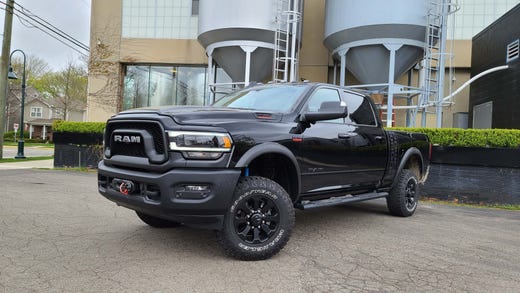
Positioned above light duty variants like the Ram Rebel and Ford Raptor, the 2020 Ram 2500 Power Wagon is a heavy-duty beast.
You want a monster Hemi V-8-powered, stump-pulling Ram 1500 pickup truck? You wimp.
Real men and women drive Ram 2500 Power Wagons.
The heavy-duty version of Ram’s light-duty truck that arrived in my driveway could pull my house off its foundation — assuming I can get in it. I walked out into my driveway and looked up.
Dressed entirely in black and an alleged 6-foot-7 tall (it seemed taller than that next to my mere 6-foot-5 frame), the Power Wagon loomed over me with a face that would make Thanos flinch. It’s a beast. I think the designers took their inspiration from a humpback whale swallowing an ocean of krill.
I stepped up on the rocker rail, then hoisted myself into the passenger seat with the A-pillar handle. On the passenger side, the 5-foot-5 Mrs. Payne needed our roof ladder to get in.
The 2500 reminded me of an older off-road Ram pickup — mega-modified with five-inch suspension lift and 38-inch tires — that dragged our Jeep Wrangler out of a ditch at the Mounds off-road park a few years back. But this beast doesn’t need after-market mods.
The Power Wagon comes from the manufacturer fully equipped to take on the outback. That’s the badge’s calling card, having carved out a new heavy-duty segment above and beyond famed light-duty performance trucks like the Ford Raptor, Chevy Silverado Z71 and sibling Ram Rebel. When a hammer isn’t enough, the Power Wagon offers a sledgehammer.
Ram’s crosstown rivals have followed suit with their own truncheons, the GMC Sierra AT4 and the Ford Super Duty Tremor.
The Power Wagon stands tall with massive 33-inch Goodyear Wrangler DuraTrac tires inside swollen fender wells. They add additional ground clearance over the usual 30-inchers for a total of 14.2 inches. Armed with armadillo-like skid plates, the Power Wagon has a ridiculous front approach angle of 29 degrees (the iconic Jeep Wrangler Rubicon is 33) and is rated for wading through 30 inches of water.
Power Wagon is a truck nerd’s dream. Behold the twin locking-differentials, like a Jeep Rubicon’s. There’s a separate floor-mounted four-wheel-drive transfer case for low-speed rock crawling. And for when the going really gets tough, the 2500 adds an extra link to its upper axle mount — call it Articulink — which combines with electronically disconnecting front anti-roll bars to give the monster 26 inches of front-wheel articulation for crawling over rocks. Dude!
That’s the quandary of the auto enthusiast. How much is enough? A sportscar-holic myself, I find a $30,000 Mazda MX-5 Miata plenty of enjoyment for a two-seat sports car. But if I had the coin to buy an $80,000, 495-horse Corvette C8? I’d buy even if I never took the thing to a track. I’d buy it because it exists.
When I drove up to English Gardens in the Power Wagon, a staffer’s jaw dropped.
“That’s a killer truck,” he said.
We motorheads live or an invitation to talk power, which we did while loading 10 bags of mulch into the 6-foot-4 box. That’s right, this beast is taller than its bed is long.
Power Wagon shrugged off the added weight as we hustled back home. It can shoulder a payload of 1,510 pounds and tow 10,580 pounds. That tow number, however, isn’t anywhere close to the 2500 Heavy Duty’s 19,780-pound capability since Power Wagon has softer springs for playing off-road.
If you want mega-towing, get the Ram diesel. The Power Wagon’s more playful character means a 6.4-liter Hemi V-8 under the hood and a tailpipe the size of Alaskan pipeline. The big V-8 loves to run, and I was more than happy to give it the gas — WAUUUUUGHHH! — through Oakland County while drinking half the oil reserves of Texas. There’s a glut of crude during the coronavirus crisis so I did my part to draw it down.
Back at the ranch — well, cul-de-sac — we unloaded the mulch into a wheelbarrow that exposed one of the Power Wagon’s rare flaws: How to climb into the bed easily?
Chevy and GMC offer the best solution — a corner bumper-step. But this being the truck wars, it would be sacrilege to follow GM’s lead. Nossir. Ford has invented a sort of Noah’s staff that sprouts from the bumper to help owners into the bed. Cool, but wouldn’t a bumper step be easier? The Tesla Cybertruck will allegedly kneel in back to allow access.
Ram just ignores the idea altogether. Which means you’ll have to clamber up into this thing like your childhood bunk bed. The good news is the side-bed toolboxes remind you how clever Ram can be. They provide a place for tools so they don’t bounce around.
But the real show is inside, where Ram sports the best interior in truckdom. Like Tesla, the cabin is oriented around a huge 12-inch vertical screen that communicated the cabin’s larger refinement. Gears are accessed not by a steering-mounted stalk, but by a space-saving rotary dial. Back seats are massive — Lew Alcindor and Walt Chamberlain could play a comfortable game of cards back there — and there is more storage beneath the floor if needed.
The Ram is festooned with the latest electronics, from adaptive cruise-control to blind-spot assist to 360-degree surround camera.
The latter two are helpful since the Power Wagon is to urban areas what Moby Dick is to a pond. Too big.
I wandered over to Auto Europe to drop off wheels from one of my sports cars and treaded carefully lest I accidentally crush the odd Lotus Esprit or Mercedes Coupe in the parking lot. I picked up fast food from the Clarkston Culver’s and the person at the window looked up at me.
But Clarkston felt more comfortable than Birmingham: No gridded streets. No tight parking lots. Just miles of country road for opening up the big V-8, and farms and woods that need stuff loaded into the back.
When the urge hits and you want to go exploring, off-road parks like the Mounds aren’t too far away. Because you never know when some city slicker in a Jeep Wrangler might need a tow out of the mud with the Power Wagon’s 12,000-pound winch.
2020 Ram 2500 Power Wagon
Vehicle type: Front-engine, four-wheel drive, 5-passenger, crew-cab pickup
Price: $55,045, including $1,695 destination charge ($69,890 as tested)
Powerplant: 6.4-liter Hemi V-8
Power: 410 horsepower, 429 pound-feet of torque
Transmission: 8-speed automatic
Performance: 0-60 mph, 8.4 seconds (Car and Driver); towing, 10,580 pounds
Weight: 6,996 pounds
Fuel economy: NA
Report card
Highs: Rules the road; best interior in truckdom
Lows: Too big for urban America; drinks petrol
Overall: 3 stars
Flop of BlueIndy car-share reflects broader ride-hailing challenges
Posted by Talbot Payne on June 10, 2020
The electric-car sharing future has got the blues.
BlueIndy, a pioneering car-sharing service in Indianapolis that launched in 2014, quietly closed last month. Beset by losses, the decision to pull the plug on BlueIndy’s electric cars came before the global coronavirus pandemic – and as other similar services have also shut their doors.
Now the post-pandemic landscape is creating more uncertainty for the nascent industry as the public pulls back from the idea of sharing potentially contaminated vehicles.
“The challenge is the same for everyone in the mobility space over the years, particularly car-sharing,” said Guidehouse Insight auto analyst Sam Abuelsamid. “It’s a really hard business to make money in. BlueIndy is not the only one to go under. We’ve seen a number of these go out of business over last few months – GM announced they shut Maven down after scaling back last year. And Share Now, that BMW/Daimler venture, announced they were pulling out of North American market.”
Widely hailed when it was introduced in 2014 as the Midwest’s first adoption of green city cars like Europe (BlueIndy featured the same Pininfarina-designed Bollore BlueCars that populate the electric car fleet in Paris), the service never caught on.
In its wake, Blue Indy leaves 250 battery-powered cars, electric-charging structure and recriminations over a city council that spent $7 million on the program without voter approval. Half of the cars have been sent to a scrapyard for dismantling while the other half have reportedly been relocated to Los Angeles for use in a similar car-sharing operation.
The program’s cute little EVs were sprinkled throughout Indianapolis and available to rent and return. The service was available for a one-time fee or annual membership. One-time users paid $8 for 20 minutes; an annual membership was $9.99 per month, not including additional charges for more time at the wheel.
The service had hoped to reach 15,000 members, 500 cars and 200 charging stations, but peaked instead at 3,000 members, 250 cars and 92 stations as interest waned after a well-publicized start. France’s Bolore was the primary investor, but the program also received support from Indiana institutions including Indianapolis Power & Light utility, which invested more than $3 million to extend electric lines to the chargers.
Former Indianapolis Mayor Greg Ballard hoped to give to give the Midwest city a progressive feel. Car-sharing and ride-hailing services like Uber have been touted as modern alternatives for less-dense cities without expensive, public-transit rail systems.
“We think it’s the perfect city to do this,” BlueIndy General Manager Scott Prince told the Indianapolis Business Journal in 2014. “If we had the world’s greatest mass-transit system today, this arguably would not be the first city we’d be launching in in America.”
GM’s Maven pulled out of eight of its 17 markets — including Chicago and New York — last year before the COVID-19 outbreak halted the business in its tracks this April. The BMW-Daimler joint venture Share Now was focused on major American and Canadian cities like Seattle, New York and Montreal, but folded its cards late last year.
As BlueIndy indicates, the car-sharing services were struggling before the COVID-19 crisis. The post-pandemic landscape looks even more challenging.
“The concern a lot of people have now, and this applies to car-sharing, ride-sharing — all the transit options — is when you get into one of these vehicles and you don’t know when it was last cleaned,” said analyst Abuelsamid. “There might have been somebody in there 15 minutes before who was sick.”
A survey taken this May by the IBM Institute for Business Value of 25,000 U.S. adults found significant change in attitude toward ride-sharing services, The survey found a shift away from public transit and ride-sharing toward individual transportation.
“More than half of people surveyed who used ride-sharing apps and services said they would either use these less or stop using these services completely,” concluded the IBM study. “More than 17% of people surveyed said that they intend to use their personal vehicle more as a result of COVID-19, with approximately 1 in 4 saying they will use it as their exclusive mode of transportation going forward.”
BlueIndy got mixed reviews from users.
Green advocate Mary Beatty, 65, told the IndyStar she was drawn to BlueIndy becasue of her belief in renewable energy. But they encountered issues when they took the EV to the airport.
“It was so difficult trying to put our luggage in, and we couldn’t figure out how to open the hatch,” she told the newspaper. “The quality of the car was not good and kind of frightening because it is a lightweight car and did not handle well on the highway.”
Abuelsamid said that the cars did not meet federal safety standards, so they could be used in a ride-sharing capacity. Some customers complained of the car’s cheap build. Others complained of poor customer service as well as lack of convenience.
“There was a pretty big learning curve, and it didn’t make it a user-friendly experience, even for someone who was motivated,” said Beatty. “After our membership expired we didn’t renew.”
1st Ford Escape Plug-In Hybrid gets best-in-class 100 MPGe
Posted by Talbot Payne on June 10, 2020
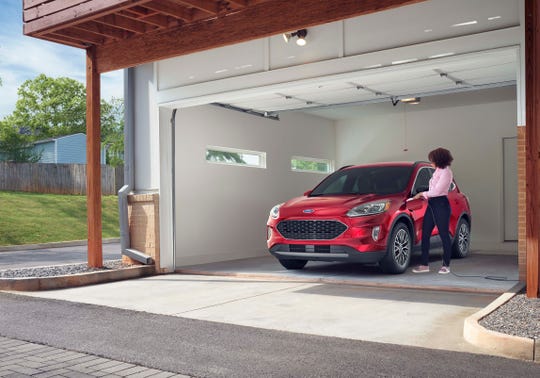
Ford announced the first-ever plug-in model of its Escape SUV today, part of the brand’s full-court press to bring electrification to its lineup.
Based on the $26,130 compact Escape that is the best-selling truck that isn’t a pickup in the Blue Oval’s lineup, the Escape Plug-In Hybrid will start at $34,285 and achieve best-in-class100 MPGe. On a full charge, the Escape Plug-In can go 37 miles on battery power alone before the gas engine kicks in.
The plug-in is the second hybrid model offered in the Escape lineup after the Escape Hybrid, which starts at $29,000.The plug-in model runs on the same electric motor-assisted, 2.5-liter four-cylinder engine as the Escape Hybrid, but then adds a more-robust 14.4-kWh lithium-ion battery beneath the second-row seats for extended battery range.
Escape pioneered hybrids in the SUV segment in 2005, but the 2020 models are the first offered since 2012.
Ford is ditching its sedan lineup including the Ford Fusion Energi, which was a mid-size plug-in car.Ford says green-oriented customers won’t miss it as the Escape Plugin’s 37-mile, all-battery range trumps the Energi by 11 more miles while offering a hatchback with four times the cargo volume.
The Escape Plug-In will go head-to-head against the pricier $39,220 Toyota RAV4 Prime with an estimated 42-mile battery-only range and 94 MPGe. The RAV4 Prime offers 302 horsepower, versus the Ford’s 221 ponies.
The Plug-in Hybrid will only come in front-wheel drive, unlike the RAV4 Prime and Escape Hybrid which have available all-wheel drive.
In addition to its green chops, the Escape features a sliding rear seat which adds 6 inches of legroom. It comes standard with Ford Co-Pilot360 safety features including blind-spot assist and autonomic high-beams.
On a standard, 110-volt Level 1 wall outlet, the the Escape Plug-In can reach full charge in 10-11 hours. Install a 240-volt Level 2 charger, and that charge time drops to 3.5 hours.
The Escape Plug-In Hybrid is part of Ford’s investment of more than $11.5 billion in electrified vehicles. The plug-in model available on every Escape trim level except S and SE Sport, and hits dealer lots this summer.