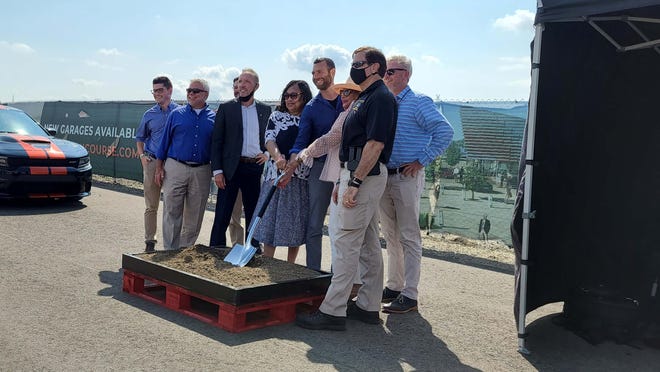
Pontiac – M1 Concourse planted the seeds Tuesday to make Pontiac a major auto events destination.
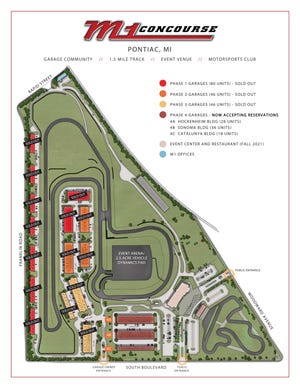
The private car club attracted a who’s-who of Oakland County dignitaries for the ground-breaking of its event center and restaurant. Scheduled to open in September 2021 ahead of M1 Concourse’s inaugural American Festival of Speed auto exposition, the 28,500-square-foot center will contain a ballroom, large events space and two-story restaurant aimed at hosting major events as well as daily patrons. It will offer public access to the facility and its race track.
“We believe this is going to be the new hub of all things automotive,” said M1 CEO Jordan Zoltoff in an interview. “We like to say we’re going to be the Dream Cruise every day.”
He was flanked at the ceremony by Pontiac Mayor Dierdre Waterman, Oakland County Executive David Coulter and Oakland Sheriff Mike Bouchard.
“There are a lot of firsts here in Pontiac right now,” said Waterman, ticking off recent business commitments by Amazon and United Shore mortgage company. “And Pontiac is taking its rightful place as the home of the largest sports enthusiast facility in the world.”
Located at the southeast corner of M1’s 87-acre campus, the event center will have views of the facility’s centerpiece 1.5-mile Champion Motor Speedway. The center will have separate, public entrances distinct from the garages that house M1’s private club members.
M1 is located at the corner of Woodward and South Boulevard, just north of St. Joseph Mercy Oakland Hospital.
The model is similar to high-profile private golf clubs like Oakland Hills and Detroit Golf Club that have played host to major golf tournaments. M1 swaps out the golf course for a race track. The event center is part of the facility’s long-term plan to be a private auto playground as well as a catalyst for change in Pontiac.
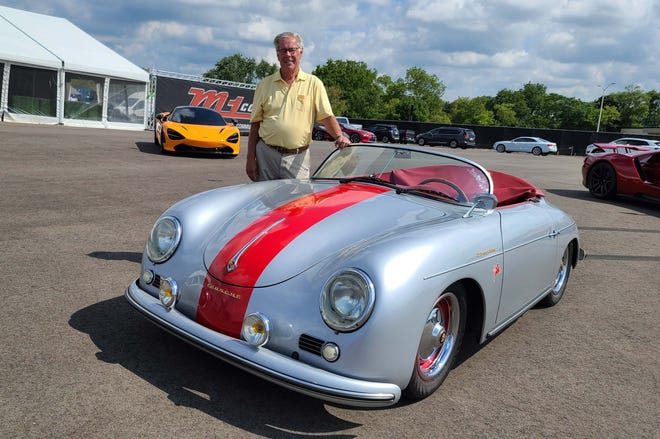
“We are breaking ground on something we have dreamed about for four years,” said M1 Concourse member Tom McDonald who drives a Porsche Speedster. He was one of a number of M1 members attending the ground-breaking who were enthusiastic about the facility’s larger commitment to making Pontiac shine.
“M1 is all about the Pontiac community. Pontiac is the next place besides Detroit that is natural for rehabilitation,” said Tim Hartge, CEO of the Pontiac Motorsports Exposition that will run the Festival of Speed. “Woodward Avenue connects them both. There is no reason not to see an a resurgence for both Detroit and Pontiac.”
Zlotoff said that his development team visited other private auto clubs around the country for ideas including Autobahn outside Chicago, Monticello west of New York City, and Spring Mountain in Nevada.
“The big difference between M1 and other motorsports facilities is we’re so close to not only the core metropolitan area, but also all the Motor City automotive activity that occurs here,” said Zlotoff. “We’re really catering to corporate clientele, whether it’s the (big auto companies) or tier one suppliers to do marketing events and VIP experiences.”
Zlotoff emphasized in particular the advantages of offering fine dining in the major metro area.
“We can have on-site dining facility that probably isn’t viable at other tracks just because they don’t have enough people coming through,” he continued. “We believe this is going to be a really desirable place to hang out and socialize.”
The two-story restaurant will be open seven days a week, feature indoor and outdoor patio seating, two full-service bars, and an upper level deck overlooking Champion Motor Speedway’s sweeping Turn 10B. A sealed cigar lounge is planned. M1 plans to announce a restaurant partner soon.
The event center’s grand opening will dovetail with Hartge’s inaugural American Festival of Speed next September. Modeled on the Goodwood Festival of Speed in England, M1’s auto-palooza hopes to rival the Detroit Auto Show as Michigan’s premier enthusiast expo with historic cars, point-to-point races, even new car reveals.
M1, located on a former General Motors manufacturing facility, has already attracted national attention.
“My friend Jay Leno called and wanted to film an episode of ‘Jay Leno’s Garage’ in Detroit. I told to come to M1 Concourse. It’s cool,” said Bouchard.
In addition to Leno’s show, M1 has played host to public events including cars and coffee car gatherings, open track days, and Roadkill Nights drag races presented by Dodge (the latter was canceled this year due to coronavirus concerns).
Construction of the auto club’s final phase-four garages is already underway just west of the Event Center’s location. Upon its completion next spring, phase four will round out the 253 private garage/condos that are home to M1’s enthusiasts and their toys.
A map released with the event center site plan includes a go-kart track behind the event center.
Henry Payne is auto critic for The Detroit News. Find him at hpayne@detroitnews.com or Twitter @HenryEPayne.
Car buyers want dashboard cameras on their next new vehicle more than any other feature, even though only a couple of automakers have started to offer them.
In an age when cellphones and doorbell cameras are nearly ubiquitous, about 70% of car buyers in AutoPacific’s annual Future Attribute Demand Study say an on-dash video camera is a must-have for recording on-road incidents — or just keeping watch over their parked cars.
While aftermarket dash cams are available starting at about $100, Silicon Valley-based luxury automaker Tesla Inc. is the only manufacturer that builds them standard into their vehicles. Cadillac is rolling out its Surround Vision Recorder as a feature on its CT5, XT4, XT5, XT6 and coming 2021 Escalade. A Performance Data Recorder is ready for duty on upper trims of the Chevy Corvette and Camaro.
I’ve been using my Tesla Model 3’s Dashcam system on the road … and when I’m away from the car.
In typical Tesla style, the Dashcam software was released as part of a model-wide over-the-air system update nearly two years ago. The software allows the cameras in Tesla’s Autopilot system to capture video on a USB drive. Incremental upgrades followed with a significant update this year allowing owners to view video footage on the big 15-inch console screen.
“Features that promote safety, whether through improved driver visibility or collision avoidance, have been trending upward in AutoPacific’s Future Attribute Demand research for the past few years,” said Deborah Grieb, a research analyst for the automotive marketing research and product-consulting firm.
Comfort and convenience items have traditionally topped the list, and five years ago the top two choices were power driver’s seats and heated seats.
This year, safety features like dash cams and air bags surged to the top of the list with convenience features such as head-up display and over-the-air software updates just behind.
“Consumers have experienced an influx of personal video in social and news media in recent years and are very familiar with the potential security benefits of camera footage,” Grieb said. “It’s really not surprising to see such high interest in an in-vehicle recording device.”
Dashcam uses four of my Model 3’s eight navigation cameras — front, rear and both sides — to monitor surroundings. With flash drive inserted, Dashcam will automatically turn on when I enter the car, its camera avatar glowing red at the top right of the console screen.
I have not been in any accidents, so I have no horrific video to share. But Tesla Dashcam videos of various incidents are popular on the web, drawing hundreds of thousands of views.
If desired, you can replay your recent journeys, the four cameras capturing multiple views. Did you see that sky-blue Chevy Bel Air ahead of me on Woodward? The Mustang I out-dragged at a stoplight? Want to see what it’s like to hustle through the twisted roads of Hell, Michigan?
Dashcam will record your every move for 60 minutes and then begin again, writing over previously footage.
The horn can be programmed to save the last 10 minutes of video. Which is logical, since hitting the horn usually means trouble or imminent contact. Honk! Incident saved to show the officer it wasn’t your fault.
Or in the event you’ve witnessed something, tap the camera icon to save the clip.
For now, the main competition in dash cams is in the aftermarket. For $100-$400 (before installation), you can get some seriously capable dash cams from companies like Garmin, Blackvue and Vantrue that offer widescreen video and voice commands, and can be accessed via your mobile phone.
Dashboard cameras were a $3 billion industry in 2019, according to Grand View Research in San Francisco, with expected strong growth in North America over the next decade.
Tesla’s operator’s manual is in the screen (like everything else in this space-age car), so it’s easy to follow the detailed setup instructions.
When I’m away from the car, I put the Tesla into Sentry Mode, which keeps an eye on things when I can’t. Unlike a doorbell camera, Tesla’s Sentry Mode doesn’t allow video footage to be viewed remotely via phone app. Videos can be watched later on the console screen, or by transferring them to a computer with a flash drive.
I particularly like using Sentry Mode in tight parking places, should someone open their door on me.
Sentry Mode operates in three escalating states.
Standby: In its default state, Sentry Mode constantly monitors the area surrounding my Model 3 for possible security threats.
Alert: If Sentry Mode detects a threat — say, someone leaning on the vehicle or trying its door handle — Sentry Mode switches to the Alert state. Headlights flash and a big red digital eyeball appears on the center screen with the word “RECORDING” next to it to alert passersby.
Alarm: An intrusive action such as someone breaking a window triggers Sentry Mode’s Alarm state. A security alarm activates and the audio system makes a loud sound. And at this point Sentry mode does engage your mobile phone, sending an alert to let you know there’s trouble. Tesla says the alarm will sound for 30 seconds.
Fortunately, Sentry Mode hasn’t had cause to disturb me.
But the videos it takes are interesting viewing when I return to the car. By touching the Dashcam icon and selecting “Launch Viewer,” I can watch footage of activity around my car from each of the four cameras. I can pause and rewind.
Tesla’s Dashcam is on the cutting edge of consumer tastes. And the best part is, no assembly required.
General Motors is moving its Corvette engineering all-stars into its autonomous and electric vehicle programs, a move intended to give a jolt to the automaker’s commitment to an all-electric future.
The move is more than a shuffling of corporate chairs.
Headed by Tadge Juechter, the Corvette squad employs some of the company’s top engineering talent. In particular, the team knows how to push the envelope of vehicle performance — a capability GM is determined to bring to its fast-growing electric portfolio.
“GM is committed to a zero crashes, zero emissions and zero congestion future,” Juechter, who is executive chief engineer for Global Corvette, said in an exclusive interview. “But we are also committed to vehicles that give a transportation experience. How do you make EVs a joyful experience when you remove the internal combustion engine and transmission options? We will work to bring that passion into the EV space.”
GM’s automotive product development is essentially housed under two umbrellas: Global Products Programs include internal combustion-engine vehicle lines from trucks to cars as well as engines and transmissions; that’s where the Corvette team has operated. Then there’s Autonomous and Electric Vehicle Programs which oversee development of EVs in brands as diverse as Cadillac, Chevrolet and GMC; that’s where the Corvette team is headed.
While not divulging future products, Juechter said his team will look to influence a new breed of performance electric stallions across GM’s portfolio. The automaker has already touted the capabilities of forthcoming products like the electric GMC Hummer which promises neck-snapping zero-60 mph acceleration in 3 seconds.
Juecheter hinted there’s more like that to come.
“We want to develop bespoke BEVs (battery-electric vehicles) that are a companion car to the Corvette in the garage,” said Juechter. “People have asked us questions like: ‘Why don’t you make a Corvette SUV?’ We want to create interesting BEVs that have a lot of driving cred.”
Juechter was quick to point out that the move will not compromise his team’s commitment to the fire-breathing mid-engine Corvette C8 introduced this year to rave reviews.
“Is this the end of V-8s for us? No,” said Juechter. “The V-8 powertrain plan for the Corvette will remain in its entirety.”
The 2020 C8 is the first Corvette to put the engine behind the driver, giving it performance on par with European supercars costing four times as much. In addition to the base 495-horsepower, 6.2-liter V8-powered Corvette, The News has previously reported that higher trims will get Corvette’s first overhead-cam V-8 — a high-revving 5.5-liter engine that motivates the Corvette C8.R race car
The News has also reported that the C8 will be electrified. A top-trim Zora model is expected mid-decade with an electric motor up front mated to a twin-turbo version of the 5.5-liter engine to create a combined 1,000 horsepower.
Juechter would not confirm any future Corvette models, but the team’s move is sure to fuel rumors of an all-electric Corvette. Democratic presidential candidate Joe Biden caused a stir earlier this month when he said he’s been told of a coming Corvette EV.
Juechter says that he has evolved into an electric believer.
“I have become more enamored with electrification over time,” he said. “Much of my life has been devoted to internal combustion engines. But the evolution to electric vehicles has to happen. You can either stand by or be a part of it. There are impressive things being done with electrification, and I am a passionate believer in the environment.”
There will be a a lot of automotive passion on the Autonomous and Electric Vehicle team.
Juechter will be reunited with Ken Morris, who recently left as Global Products Program boss to head Autonomous and Electric. The two motorheads have bonded before on vehicle development. Morris has been known to join the engineering wizards at GM’s Milford Proving Grounds to test their high-performance monsters.
“I’m excited to be putting the team that redefined supercar performance, design and attainability in key roles to help us integrate and execute our EVs to those same high standards,” Morris said in a statement.
Corvette until now was largely in its own silo (along with Camaro) on the internal-combustion side of the business. “Corvette shared the least with the rest of the portfolio,” Juechter said.
His group is expected to have a greater influence over the battery-electric side. As evidence is the promotion of one of Juechter’s top Corvette engineers, Ed Piatek, to a new role as chief engineer of future EV products. Corvette Chief Program Engineer Josh Holder will fill Piatek’s shoes as chief engineer for Global Corvette.
“We have to think long-term,” said Juechter. “What can I do to help the environment, but not lose the thrill of driving?”
Coming to a dealership near you: “Spawn of Tesla.”
America’s best-selling luxury electric automaker has inspired a wave of competitors from legacy rivals. The Ford Mustang Mach-E has its sights set on the Tesla Model Y. The Jaguar iPace targets the Model S. The Audi eTron takes on the Model X.
And now, the best-selling Model 3 finally has its first direct competitor, the Polestar 2.
But where Tesla tore up the rulebook on how to make an all-electric car, Polestar parent Volvo hopes to attract customers with more familiar features.
Flogging the Models 2 and 3 across the twisties of Hell, Michigan, I marveled at how Tesla has transformed green-car expectations over early market entries like the Nissan Leaf. Tree huggers? These athletes are road huggers. Like the Model 3, the Polestar 2 has nearly 80 kWh of battery in its belly and loves to attack apexes. Hustling along two-lane North Territorial Road in the Polestar, I encountered a sleepy Audi A7.
Mash throttle. Zot! I was by him on a wave of electric torque.
Polestar may be an electric startup, but it sprung from the bosom of a 93-year-old Swedish car company — not a mad genius entrepreneur in Silicon Valley. Legacy breeds conservatism.
The Model 3 shocked us with a spare cockpit anchored by a single 15-inch screen. All controls are in the screen, save two multi-purpose buttons on the steering wheel. Open the glovebox? It’s in the screen. Windshield wipers? In the screen.
Polestar 2, by contrast, modernizes Volvo’s familiar cockpit with a vertical, 12-inch screen. Adaptive cruise-control is controlled via traditional buttons on the steering wheel. An instrument display is behind it. The glove box is opened with a button. The wipers are operated by a stalk.
Given its more conservative nature, I doubt Polestar will sway the Tesla cult. Compared to hyper-growth Tesla, Polestar is suitably modest with its early sales projections. But it foretells a future of Tesla-like luxury vehicles.
Tesla is to cars what Apple was to smartphones. Its big screen revolutionized interiors. Its operating system set a new bar for electronics.
Think of Polestar as Android OS to Tesla’s Apple. Indeed, Android is at the heart of the Polestar experience.
Tesla follows Apple’s vertically integrated business model from battery production to its own operating system. Polestar is horizontal, contracting batteries to LG Chem and operating system to Android.
Polestar is the first to use Android OS in a car. Forget screen-mirroring your phone with Android Auto and Apple CarPlay. Polestar’s Android system is the real deal — a smartphone on wheels like Tesla.
“Hey, Google,” I barked at the car, just as I would my Android phone. The big screen awoke; familiar, multi-color Google bubbles awaited my command.
“Navigate to Hell, Michigan.”
The screen immediately plotted a course for Hell’s playground (from my Ypsilanti starting point). Android voice-recognition and ease-of-use put parent Volvo’s in-house OS (I recently used in a Volvo S60) to shame.
The Polestar 2 will naturally attract Volvo customers with its familiar Thor’s-hammer headlights, crisp styling and safety systems. They will also appreciate its hatchback – opening more useful cargo space than the Model 3’s standard trunk (the Polestar shares a platform with the Volvo VC40 SUV). And they will be impressed by the Android system – a big leap over Volvo’s fussy system.
The revelation extends to the digital, configurable instrument display which takes a page from Audi’s playbook by duplicating your map route in the instrument display as well as console screen. Some Tesla buyers will prefer it to glancing sideways at a center screen.
But, to my surprise, the Android system otherwise mimics Tesla. Take AM radio, for example.
Tesla doesn’t have it. Why? I’ve never received a straight answer. “Because AM is so 15 minutes ago. No one uses it in California,” a Teslaphile once told me. Really?
Leave it to Polestar engineers to explain. Electric motors interfere with the AM signal, one told to me, because they have similar frequencies. So Polestar doesn’t offer AM either. Over time (like my Model 3) digital options should become available.
As will Sirius XM, another feature Polestar — and Tesla — don’t offer. Both EVs, however, do offer Spotify, and it’s slick.
“Play U2,” I said to my friendly Google Assistant.
A list of U2 songs populated the screen.
Not as friendly is Polestar 2’s range, where it runs head-on into Tesla’s secret sauce: charging infrastructure.
My Polestar returned 73% of expected battery range (73 miles on the road took 100 miles off the battery) in my spirited outing to Hell and back. My Model 3 has returned similar numbers. But the Tesla’s mighty 80-kWh battery boasts 325 miles of range versus Volvo’s expected 270 (when EPA finalizes numbers next month).
That matters when traveling to, say, Traverse City, 250 miles from Ypsi.
“Navigate to Traverse City,” I barked.
“Out of battery range,” replied Google, noting I had just 100 miles of battery range left. “Add a charging stop.”
The first available stop was, um, a slow, 240-volt ChargePoint station. The map even put the word “Slow” next to it. I’m not making this up.
As with other key components, Polestar relies on third parties for charging. Companies like ChargePoint, EVGo and Electrify America. Which means you’ll need to research on your own whether you can get to Traverse City. Ask Tesla how to navigate there and it’ll map your course, including at which 150-kW fast-chargers to stop.
Polestar depends on Electrify America for fast-charging (like every other EV-maker not named Tesla) — and they haven’t a single supercharger north of Lansing. Tesla has eight.
Translation: Polestar owners will take their Volvo XC90 SUV up north. The Polestar 2 is a city vehicle.
Polestar is also conservative when it comes to self-driving. For an extra $8,000, Tesla offers you the world’s best autonomous capability. Automatic lane changes. Hands-free driving. Stoplight recognition (really, it just arrived in the latest over-the-air update). Polestar is content to give you Volvo’s adaptive cruise-control.
For many drivers that is enough. They don’t want to be a part of Elon Musk’s beta experiments.
Unlike Tesla’s mad rush to world domination (it was America’s best-selling luxury car last year), Polestar is starting as conservative as its styling. The 2 is offered as a top-trim, all-wheel drive model at $61,200 — add $5,000 for the Performance option like my $66,200 tester.
That’s about $5,000 more expensive than an equivalent Model 3 Performance model. The good news: New spawn Polestar still qualifies for a $7,500 federal tax credit.
2021 Polestar 2
Vehicle type: All-wheel drive, five-passenger electric hatchback
Price: $61,200, including $1,300 destination fee ($66,200 Performance model as tested)
Powerplant: 78-kWh lithium-ion battery pack mated to dual electric motors
Power: 408 horsepower, 487 pound-feet of torque
Transmission: Single-speed automatic
Performance: 0-60 mph, 4.5 seconds (Performance model as tested); top speed, 125 mph
Weight: 4,680 pounds
Range: EPA number pending. Estimated: 270 miles (as tested: 73 miles traveled took 100 miles off the battery)
Report card
Highs: Familiar Android OS; hatchback
Lows: Conservative styling; lacks Tesla charger network
As General Motors revs up its electric vehicles offensive with high-priced, high-style vehicles like the Cadillac Lyriq and GMC Hummer EV, it’s not forgetting about cheaper entries.
The $37,495 Chevy Bolt EV hatchback will get a refresh next year – and a bigger SUV brother, the Bolt EUV.
Chevy teased the two vehicles in a video Wednesday showing subtle changes in the EUV’s belt and roofline as it morphed from the familiar Bolt EV profile. The EUV loses the Bolt EV’s big A-pillar quarter window, while gaining a more dramatic “floating roof” at the C-pillar.
In addition to its bigger proportions, the Bolt EUV will be the first Chevrolet equipped with Super Cruise, GM’s cutting-edge self-driving technology first introduced in the Cadillac CT6. GM plans 22 vehicles with Super Cruise by 2023, including 10 by next year.
Both Bolts will go into production in summer 2021 as 2022 models.
Based on the same platform as the Bolt EV (which was introduced in 2017), the EUV and Bolt EV will not have GM’s latest, BEV3 platform that under-girds the Lyriq and Hummer. That platform features the 300-plus mile range Ultium battery.
But the EUV may exceed the Bolt EV’s 259 miles of range if it uses its longer size to stuff in more battery. Motor Trend reports that the EUV wheelbase is stretched 3 inches for more interior space and 5-6 inches overall.
Expect the EUV to be front-wheel-drive like the Bolt EV. And expect a starting price in the low-$40,000 range as Bolt EUV competes agianst other mid-price entries like the Telsa Model Y and Ford Mustang Mach E.
Both Bolts will be built at the Orion Assembly plant.
The subcompact Cadillac CT4 and compact CT5 may have gone down market compared to the, respectively, compact ATS and mid-size CTS they replace. But their performance variants promise to be just as potent.
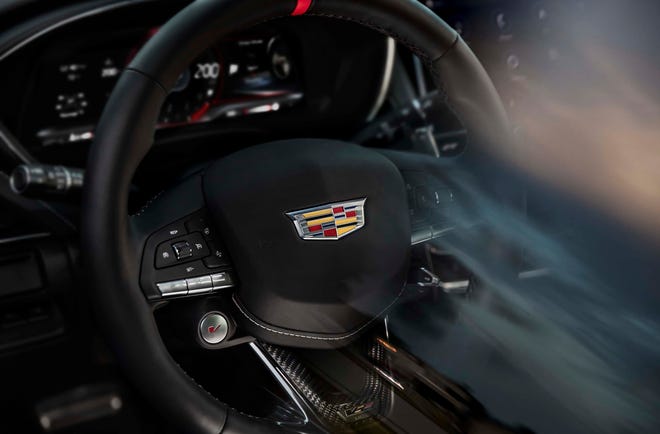
Both cars will get the same carbon fiber-trimmed, sport steering wheel and V-mode performance capability. But the big headliner is the CT5-V Blackwing will get the same, 200 mph, manual-transmission capability as the outgoing CTS-V, one of the most ferocious sedans ever to hit the market.
The 200-mph figure — barely visible in a teaser photo’s instrument display — signals that the CT5-V Blackwing will come with the same, supercharged, 640-horsepower, 6.2-liter V-8 at the heart of the retired CTS-V. That 200 mph engine was also found in the last-generation, front-engine Corvette C7.
That’s good news for General Motors Co. performance fans who miss the stick shift option in the new, mid-engine Corvette C8. For the first time, Corvette has eschewed the manual in favor of a quick-shifting, dual-clutch automatic transmission.
Spy videos reported by Car and Driver have shown the Blackwings testing with similar, powerful V-8 and twin-turbo V-6 engines from the outgoing CTS-V and ATS-V. The CT4-V Blackwing version will likely get the same 464 horse, 3.6-liter twin-turbo V-6 as the ATS-V it replaces.
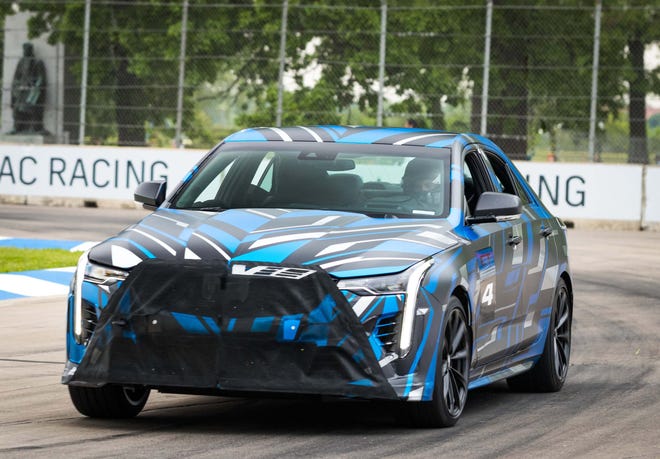
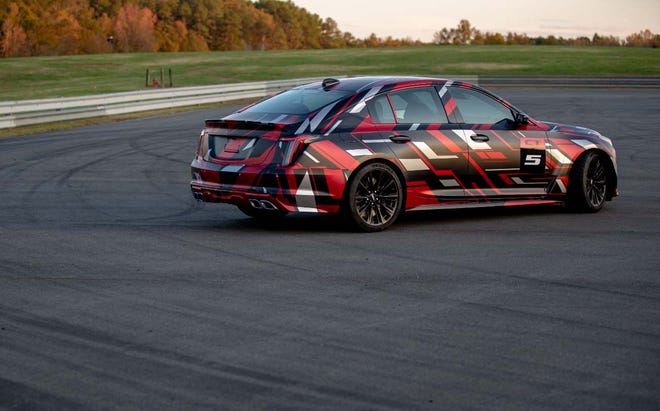
At a surprise, on-track appearance at the 2019 Detroit Grand Prix — with GM President Mark Reuss and Global Product Vice President Ken Morris at the wheel — media onlookers noted the familiar V-8 and V-6 exhaust notes from the two fully-camouflaged cars.
Don’t be fooled by the Backwing badge.
Neither Blackwing model is expected to carry the fabled, 550-horse, twin-turbo, 4.2-liter Blackwing V-8 engine in its belly. The mill, the most advanced gas engine built by Cadillac, had a short life span in the now-defunct Cadillac CT6-V. Cadillac has since signaled that its future is electric and has devoted more resources to battery-powered drive-trains.
The Blackwing name lives on as representative of Cadillac’s pinnacle of performance.
In addition to the 200 mph Easter egg, the teaser pic reveals that the Caddies will gain state-of-the-art electronics shared with the Corvette C8. A Performance Traction Management system is located on the right of the steering wheel — and a V-mode button (which can instantly transform the car from cruiser to street hot rod) is visible on the lower left.
The CT4-V and CT5-V Blackwings will be slotted above the middle-trim, V-series models. The Blackwings are aimed at Europe’s iconic BMW M, Mercedes AMG, and Audi RS Dobermans.
The mid-trim V-series models have debuted this year to warm reviews for their state-of-the-art aerodynamics and chassis tuning. The Blackwings promise to add to the formula with meatier engines will likely drive their sticker prices $30,000 north of the standard sedan models.
The standard, rear-wheel-drive CT4 starts at $33,990— well below the similarly-sized $36,490, compact ATS that it replaces — as it has moved down a segment to compete against the likes of the subcompact BMW 2-series and Audi A3. The mid-level $45,490 CT4-V makes 325 horsepower.
The CT5, currently available for sale, follows a similar path as its CT4 sibling with a starting price at $37,890 — well below the $47,990 of the CTS it replaces. The Blackwing will be priced above the $48,690 CT5-V which debuted last spring.
The mid-size CTS-V that the CT5-V Blackwing replaces started at $88,990 and could top out at over $100k as it competed against the mid-size BMW M5. Expect that price to drop as the Blackwing lines up against the compact-sized, $70,000 BMW M3.
The Blackwing athletes are due to hit dealer showrooms next summer.
When the green flag falls on the Indianapolis 500 this Sunday, it will mark the zenith of Roger Penske’s extraordinary racing career.
The Bloomfield Hills-based businessman and motorsports icon fell in love with America’s greatest race when his father took him to the track as a 14-year-old. Now 83, Penske will not only be looking to add to his record 18 Indy 500 wins as a team boss — he will be doing it as owner of the Indianapolis Motor Speedway and IndyCar series.
Penske has hardly had time to celebrate his trifecta.
The historic coronavirus epidemic threw a monkey wrench into the IndyCar series schedule. It has shut down racing for weeks and forced a rework of the schedule — including the Indy 500 that was moved to this weekend’s Aug. 23 date from its traditional Memorial Day.
“I think 2020 has been an incredibly difficult year for everyone,” said “The Captain,” as he is affectionately called, in an interview this week ahead of the big race. “Certainly, no one could have envisioned the challenges we have all faced this year. But the most important thing is we have found a way to keep moving forward.”
That relentlessly positive attitude has propelled Penske to a successful business career that includes not just the Indy jewels, but a sprawling empire that spans car dealerships, truck rentals, race engine manufacturing and supply chain management services.
At Penske Corp.’s heart, however, is a passion for racing. A passion seeded as a young teen growing up in Shaker Heights on the east side of Cleveland.
“My love for racing really began at the Indianapolis Motor Speedway when my father took me to see my first Indianapolis 500 in 1951,” Penske said. “Since then, it was always a goal of mine to return to race at Indianapolis and, of course, competing at the Indianapolis 500 was the pinnacle of racing — and it still is.”
He was an amateur Sports Car Club of America racer in the early 1960s. Quick in sports cars, he earned Driver of the Year honors in 1961 and caught the eye of pro series like Formula One and NASCAR. He was even offered a rookie test at Indianapolis, but turned it down because he couldn’t get time off from his Alcoa day job — another rookie named Mario Andretti took his place instead.
Penske’s sights were set on business ownership.
“When I first began racing I really just enjoyed the competition and the challenge. … But once I got an opportunity in the automotive business through a Chevrolet dealership in Philadelphia, I knew that was going to require so much of my focus,” he said. “I made the decision to retire as a race car driver in 1965 to build the business.”
He also built a racing team, starting in 1966. The two enterprises became inseparable as the years went by, the racing providing his businesses a halo marketing profile while also reinforcing good business practices.
“Racing continues to be the common thread that runs throughout our business. Our success on the track — especially at the Indianapolis 500 — has really helped build awareness of our brand,” he said. “But beyond that, the lessons we have learned and the philosophies that have brought us success in racing have been directly applied to all areas of our business: teamwork, technology, perseverance and focus.”
A key partner is his early team endeavors was Mark Donohue — nickname, Captain Nice — a rare racing talent who also was a skilled engineer. Their success began in sports cars, then Trans Am Camaros — an SCCA class that Team Penske would dominate in the late 1960s. But their eyes were set on bigger fish.
“The Indianapolis 500 was the pinnacle of racing. We worked with our sponsors to put together a program for the 1969 Indianapolis 500 with Mark,” remembers Penske. Success was immediate.
Donohue finished seventh, winning Indy 500 Rookie of the Year honors. Just three years later, he stood atop the podium — the first of Penske’s 18 Indy wins. Penske started racing in NASCAR and the globetrotting Formula One series in the mid-1970s, an endeavor that cost Donohue his life in a tragic 1975 accident.
The Captain’s biggest successes have come at Indy. His parking spot in the paddock is #18 — in honor of the number of times he has won the 500.His winning drivers are a who’s who of Indy legends — Rick Mears (four-time winner), Al Unser, Al Unser Jr., Emerson Fittipaldi, Helio Castroneves (three-time winner).
Associates who have worked for him describe a kind, driven entrepreneur with a keen eye for detail. He knows names and family details of team members right down to workers on shop floors. He attends every IndyCar race and serves as a driver race strategy manager.
The racers worship him.
“I’m very proud to know Roger, quite frankly. I think he’s a monument of racing — a monument of business in general,” Frenchman and 2019 Indy 500 winner Simon Pagenaud said. “I want to make him proud by winning. Frankly, I would like to be the driver to win his first Indy 500 as an owner of the speedway.”
Penske’s influence transcends his team. His efficient management style — even his white shirt and slacks dress code — is emulated up and down pit row.
“In the paddock, no one is more respected,” said former Car and Driver executive editor Steven Cole Smith, who covers motor racing for Autoweek and Grassroots Motorsports. “But interestingly, those who work for him don’t call him Mr. Penske. They call him Roger.”
The Indy 500 has changed dramatically over the years. Speeds have climbed from an average lap speed of 150 mph in the 1960s to over 230 mph this year. Yet perhaps nothing has altered the sport as dramatically as the coronavirus epidemic.
The racing world heralded a bold new era with Penske’s purchase of the Indy 500 and IndyCar from the Hulman family late last year. But the new boss couldn’t have had an inkling of what was to come.
The pandemic crippled the early 2020 racing season. May races at Indy and Detroit fell in quick succession, with the season not getting underway until June. The Indy 500 was rescheduled until late August, which seemed a safe bet at the time.
The season gained momentum as Wisconsin’s Elkhart Lake road course welcomed the return of thousands of fans to motorsport in July.
But a surge in national cases panicked officials, leading to the postponement of IndyCar’s Mid-Ohio race until October. Bad news for Sunday’s 500 inevitably followed: no spectators would be allowed for the “Greatest Spectacle in Racing.”
Penske reacted with his trademark optimism: “The most important thing is we have found a way to keep moving forward. I am proud of what we have been able to accomplish together, and while this year’s Indianapolis 500 will certainly be different without fans in attendance, we are looking forward to putting on a great show for everyone watching on NBC.”
Says Cole Smith: “There is no better steward to pull IndyCar and IMS through this pandemic.”
Dealing with fast-changing health conditions hasn’t been Penske’s only Indy 500 challenge. As a team owner, he has watched his Chevy-powered team uncharacteristically struggle in qualifying.
His Fab Four of drivers — Pagenaud, Castroneves, reigning IndyCar champ Josef Newgarden, and Will Power — were frozen out of the top three rows of qualifying last weekend. It’s the first time that’s happened since 2002. Instead, Penske’s Honda-powered rivals dominated qualifying, with Newgarden the first Penske car on the 33-car grid in 13th.
But The Captain is not one to dwell on the past. Of past Indy winners, he confesses no single favorite. All carry special moments, he says.
His focus now is on Sunday, the next race. The next challenge.
“To me, I am always looking forward,” he said. “While I am so proud of all we have accomplished at Indianapolis, I am focused on our next opportunity to win there and that will come for us this Sunday.”
The subcompact Cadillac CT4 and compact CT5 may have gone down market compared to the, respectively, compact ATS and mid-size CTS they replace. But their performance variants promise to be just as potent.
Both cars will get the same carbon fiber-trimmed, sport steering wheel and V-mode performance capability. But the big headliner is the CT5-V Blackwing will get the same, 200 mph, manual-transmission capability as the outgoing CTS-V, one of the most ferocious sedans ever to hit the market.
The 200-mph figure — barely visible in a teaser photo’s instrument display — signals that the CT5-V Blackwing will come with the same, supercharged, 640-horsepower, 6.2-liter V-8 at the heart of the retired CTS-V. That 200 mph engine was also found in the last-generation, front-engine Corvette C7.
That’s good news for General Motors Co. performance fans who miss the stick shift option in the new, mid-engine Corvette C8. For the first time, Corvette has eschewed the manual in favor of a quick-shifting, dual-clutch automatic transmission.
Spy videos reported by Car and Driver have shown the Blackwings testing with similar, powerful V-8 and twin-turbo V-6 engines from the outgoing CTS-V and ATS-V. The CT4-V Blackwing version will likely get the same 464 horse, 3.6-liter twin-turbo V-6 as the ATS-V it replaces.
At a surprise, on-track appearance at the 2019 Detroit Grand Prix — with GM President Mark Reuss and Global Product Vice President Ken Morris at the wheel — media onlookers noted the familiar V-8 and V-6 exhaust notes from the two fully-camouflaged cars.
Don’t be fooled by the Backwing badge.
Neither Blackwing model is expected to carry the fabled, 550-horse, twin-turbo, 4.2-liter Blackwing V-8 engine in its belly. The mill, the most advanced gas engine built by Cadillac, had a short life span in the now-defunct Cadillac CT6-V. Cadillac has since signaled that its future is electric and has devoted more resources to battery-powered drive-trains.
The Blackwing name lives on as representative of Cadillac’s pinnacle of performance.
In addition to the 200 mph Easter egg, the teaser pic reveals that the Caddies will gain state-of-the-art electronics shared with the Corvette C8. A Performance Traction Management system is located on the right of the steering wheel — and a V-mode button (which can instantly transform the car from cruiser to street hot rod) is visible on the lower left.
The CT4-V and CT5-V Blackwings will be slotted above the middle-trim, V-series models. The Blackwings are aimed at Europe’s iconic BMW M, Mercedes AMG, and Audi RS Dobermans.
The mid-trim V-series models have debuted this year to warm reviews for their state-of-the-art aerodynamics and chassis tuning. The Blackwings promise to add to the formula with meatier engines will likely drive their sticker prices $30,000 north of the standard sedan models.
The standard, rear-wheel-drive CT4 starts at $33,990— well below the similarly-sized $36,490, compact ATS that it replaces — as it has moved down a segment to compete against the likes of the subcompact BMW 2-series and Audi A3. The mid-level $45,490 CT4-V makes 325 horsepower.
The CT5, currently available for sale, follows a similar path as its CT4 sibling with a starting price at $37,890 — well below the $47,990 of the CTS it replaces. The Blackwing will be priced above the $48,690 CT5-V which debuted last spring.
The mid-size CTS-V that the CT5-V Blackwing replaces started at $88,990 and could top out at over $100k as it competed against the mid-size BMW M5. Expect that price to drop as the Blackwing lines up against the compact-sized, $70,000 BMW M3.
The Blackwing athletes are due to hit dealer showrooms next summer.
In the 19th century, huge elephants would kneel to pick up Indian maharajas. These royals would ride atop their steeds in gem-flecked carriages called howdahs, decorated with gemstones. In 21st-century America we don’t have royalty.
But we have howdah-carrying elephants.They’re called Chevy Suburbans.
I picked up Mrs. Payne for a night out this summer in Chevy’s all-new 2021 model. When we arrived at the Clarkston Union Bar & Kitchen, the elephant — er, Suburban — dropped 2 inches to allow for easier egress for my 5’5” wife.
Thank an all-new air suspension, part of a comprehensive remake of one of the bowtie brand’s most beloved vehicles.
The Suburban is the stretched version of the Tahoe, the Brobdingnagian mega-utes based on the same truck platform as the mega-selling Chevy Silverado. Sister brand GMC has its own version called the Yukon, while crosstown rival Ford puts its Expedition atop the Ford F-150 platform. Like the full-size pickup market, truck-based SUVs are dominated by Detroit automakers with Suburbans, Tahoes and Expeditions ruling the road like, well, elephants.
But for 2021, the Tahoe and Suburban have taken significant steps to separate themselves from their truck kin. Silverado and Suburban badges have always suggested a difference between ranch workhorse and family transport, but now it’s more than just a name, third-row seats and a hatch.
For the first time ever, Tahoe and Suburban get more upscale independent rear suspension and unique interiors. I’ve yet to drive the Tahoe, so I’ll focus on my Suburban Z71 tester.
I am already a fan of the new Silverado, the lightest truck in class thanks to a 400-pound diet over the last generation due to shrewd multi-metal chassis engineering. Suburban inherits this chassis, then adds car-like independent rear suspension making it a joy to drive.
The smoother road ride over Metro Detroit’s ox-cart roads is welcome — but the SUV’s light weight (Suburban saves 300 pounds over the last gen) still means it’s fun to drive on-road. Pity my poor third-row passengers.
This thing is an ocean-liner, stretched another four inches over its predecessor. Second-row seats not only gain 10 inches of legroom, but the captain’s chairs slide, allowing for easy third-row seat access. The rug rats are waaay back in coach now.
Curled up in their seats, headphones on, playing their video games, they deserve a warning when dad decides to have fun in the twisties. Might I suggest an intercom system like an ocean liner?
Attention passengers: the captain is about to have a little fun.
An intercom system (I’m not kidding, actually — the Kia Telluride has one and it’s a lot shorter than the Suburban) is one of the few things missing from this technological tour de force. The other is adaptive cruise control, which GM has been notoriously reticent in offering in vehicles from the Chevy Traverse to the Corvette. ACC comes standard on my wife’s $21,395, all-wheel-drive Subaru Impreza hatchback for goodness sake. And on one of my favorite SUVs, the $23,000 Mazda CX-30.
For a long-distance cruiser like the Suburban (starting at $57,795), adaptive cruise should be standard as well. Suburban doesn’t even offer it until the High Country trim, starting at the kingly sum of $77,890.
Or my $78,925 (cough) Z71 tester.
My recent $72,075 Corvette C8 ride didn’t have adaptive cruise, either. The good news is there are other Suburban features that favorably reminded me of King ’Vette — and the Cadillac CT4-V.
That’s because the interior has been comprehensively overhauled compared to Chevy and GMC Sierra pickups I’ve recently inhabited. The latter felt dated with, for example, stalk shifters and low infotainment screens. Maybe the Ford Expedition’s stylish new interior got GM’s attention.
The Suburban brings a modern electronic “trigger shifter” (a dash-mounted version similar to the Corvette). The tablet screen is mounted high on the dash — see Caddy and ’Vette — making for better visibility so I could keep my eyes on the road while accessing Chevy’s typical blizzard of tech offerings, from Sirius XM to Wi-Fi hot spot to nav system.
Forget the nav system, actually, as Suburban offers Apple CarPlay and Android Auto standard. My wife still swears by them as the best map guidance in autodom. “Go to Clarkson Union” I barked and Android Auto had it on our tablet screen in a jiffy.
Stomp the gas pedal and V-8 Corvette tunes fill the cabin. My eight-holer was of the smaller, 5.3-liter variety. Those wanting the Full-Monty, 6.2-liter V-8 ’Vette experience will have to jump (as with adaptive cruise) a rung to the High Country model.
There are a lot of rungs. Six in all as the Suburban lineup looks a bit like the endless, eight-trim Silverado — something for everyone. I like my Z71, thank you very much.
The Z71 gives the big bus a rugged, off-road swagger with blacked-out grille and nameplates complimenting its chiseled flanks and LED running lights. Royal elephants would kill for this kind of bling.
With a higher approach angle, skid plate, standard four-wheel-drive, all-terrain tires, two-speed transfer case, Hill Descent Control and red tow hooks, the Z71 elephant could credibly do support vehicle duty if you wanted to tow your ATVs to a Michigan off-road park.
Such work is usually the domain of pickups, but they cease to be passenger friendly aft of their crew cab. Stretching almost 19 feet from stem to stern, the Suburban is just shy of the 19.2-foot long Silverado with 5.8-foot bed — which means 41.5 cubic feet of storage in back for a Conestoga wagon with 550 miles of range.
And it’s covered like a Conestoga.
Inside are options galore — befitting a Chevy that can easily price out in the neighborhood of a Mercedes GLE SUV. My favorite features include the second-row captain’s chairs, which, like minivan seats, can flatten into an ottoman. I liked sitting in the third row, propping up my size 15 feet on the second-row stool and getting laptop work done while on the road.
And the center console island? It moves. Push an overhead button and the whole console slides backward, revealing a hidden drawer underneath — good for stowing valuables or just everyday items like charging cords for the two USB jacks in the back seat.
It’s one fancy carriage. Maybe they should have called it the Chevy Howdah.
2021 Chevrolet Suburban
Vehicle type: Front-engine, rear- and four-wheel drive, six-or-seven-passenger SUV
Price: $52,995, including $1,295 destination fee ($78,925 4WD Z71 trim as tested)
Powerplant: 5.3-liter V-8, 6.2-liter V-8
Power: 355 horsepower, 383 pound-feet of torque (5.3-liter); 420 horsepower, 460 pound-feet of torque (6.2-liter)
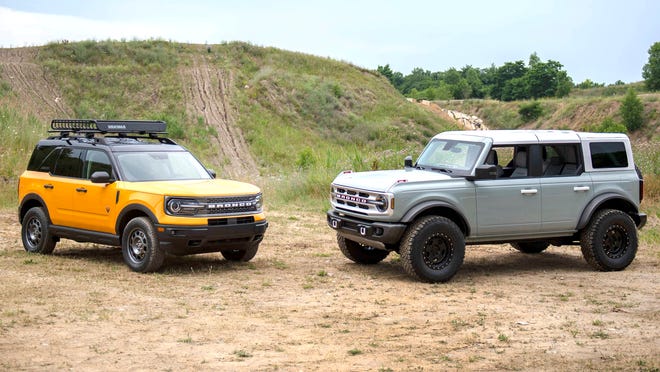
The Three Amigos (left to right): Ford Bronco 4-door, Bronco 2-door, Bronco Sport at Holly ORV park, reviewed by Detroit News auto critic Henry Payne.
Holly – The new Holly Oaks Off-Road-Vehicle Park off Interstate 75 will be one of the premier off-road playgrounds in Michigan when it opens this fall — just in time for the 2021 Ford Bronco and Bronco Sport.
I got a sneak peek of the park while riding shotgun in the Ford siblings’ most extreme Badlands trims last week. In their natural ORV habitat, the Broncos are a blast. And, yes, I’m including the unibody Bronco Sport in the same breath as the truck-based, scene-chewing, rock-stomping Bronco.
With its fancy rear clutch packs and four skid plates, the Bronco Sport Badlands brings big bandwidth as a daily driver and weekend warrior. More on that later. Let’s start with the Jeep Wrangler Rubicon-fighting headliner, the truck-based Bronco Badlands.
The $43,590 Badlands sits at the top of Bronco’s dizzying, six-model ladder (Base, Big Bend, Black Diamond, Outer Banks, Wildtrak, Badlands). Bronco Badlands isn’t bashful about copying Rubicon’s playbook: retro-looks, two-or four door configuration, outboard spare tire, removable body panels, manual transmission option, washable interior. My tester was further equipped with the Sasquatch package — 35-inch tires, dual-locking differentials, 12-inch screen — that can be had on any Bronco model.
Holly Oaks is gonna be a Bronco-Wrangler war zone when the Ford comes to market next spring. The park echoes California’s epic, state ORV sandboxes with its high-speed canyons and skyscraper-high trails. With pedal to the metal in our skid-plated armored, 310-horsepower Bronco Badlands, Ford engineer Dan Schaeffer rocketed up formidable, 27-degree dirt inclines, splashed through ponds and devoured sand.
But Holly ORV park isn’t just about trails. Like any serious ORV park it offers diabolical obstacle courses as well. Its signature hill is a re-creation of some of Moab’s most infamous rocky terrain: the 45-degree steep Hot Tub. Mogul-pocked Mashed Potato Hill. Or the I-dare-you-to-cross-me Golden Crack.
For these outdoor torture chambers, Badlands brings a deep toolbox like Wrangler Rubicon. The key difference is modern Badlands’ equipment like the hydraulic, detachable front sway bar that helped us crawl over an impossible incline. Or the independent front suspension (Wrangler prefers solid axle front and rear) that allows for a smoother ride.
Off-road veterans will swear by Wrangler’s mechanical purity, but a new generation reared on 21st-century electronics will cheer the Bronco’s advances.
Perhaps most significant is Bronco’s rotary, transfer-case controller with seven signature GOAT modes (Go Over Any Terrain) in Badlands models. It counters Wrangler’s manual option (essentially a second gearshift growing from the console).
As we grunted around the ORV park, Bronco cowboy Schaeffer simply spun the dial when he needed to switch from four-wheel-high to four-wheel-low or (Bronco exclusive) four-wheel crawl. It’s hardly a bucking Bronco.
A Wrangler Rubicon, by contrast, has to be stopped so you can arm-wrestle the stick shift to the proper mode.
Taking inspiration from the original Bronco that became the first production vehicle to win the grueling Baja 1000 endurance race in 1969, the Bronco team developed its toolbox (engines, 10-speed tranny, suspension, chassis) alongside the current Bronco R Baja racer. Both the V-8-powered ’69 Baja Bronco and the ’19 Baja Bronco R were available for Holly Oaks rides.
From the right-hand saddle, the ’69 machine — driven by pro driver Shelby Hall, daughter of ’69 Baja winner Rob Hall — proved to be a serious rodeo ride compared to the state-of-the-art R. But its V-8 roar made me nostalgic. The new car’s 2.7-liter turbo-6 (which Shelby will pilot at Baja this November) packs plenty of punch but lacks the visceral thrill.
As for the unibody Sport SUV, Ford likes to describe it as the mule that will haul gear, bikes and kayaks to the trailhead. If you want to go further, take the Bronco. Well, maybe.
Bronco Sport Badlands wants a piece of the action.
Holly Oaks echoes California’s epic ORV parks with its high-speed canyons and skyscraper-trails. Barreling along in the four-skid-plated Bronco Sport Badlands model, Ford engineer Kyle Culek attacked the same 27-degree dirt incline I’d experienced minutes before in a Bronco Badlands. Piece of cake.
At the summit Culek pressed the console “Trail Control” button — turning adaptive cruise control into a sort of low-speed crawl system. At 5 mph, we calmly descended the other side of the 27-degree hill. Look ma, no feet! All Culek had to do was steer.
Back in the canyon, Culek rotated the GOAT to sand, then floored it. WAAAUUGHRR! The throaty, 2.0-liter turbo-4 howled as all four wheels spit sand. Credit the same, rear dual-clutch pack found in Ford’s Focus RS track monster — calibrated for off-road performance. That’s my kind of family vehicle.
The demonstration indicates Sport’s unique appeal in the volume, compact SUV segment. It’s as if Bronco and Escape had a baby. This kid has off-road instincts without sacrificing road manners. If priced right, the roomy, all-wheel-drive Sport (note the same cavernous, sliding second-row seats as Escape) should be a serious challenger to mainstays like the Jeep Compass and Subaru Forester.
Matching their AWD capability with handsome looks, Sport can store two bikes upright in the rear hatch.
Like the U.S. pickup market, Wrangler vs. Broncos is going to be a Detroit civil war. They will square off on battlefields like Holly ORV park, and first impressions are that Bronco has brought serious firepower.
But for those who want their Bronco with a more comfortable saddle, Bronco Sport may be the sleeper pick.
The Dream Cruise is canceled, long live the Dream Cruise.
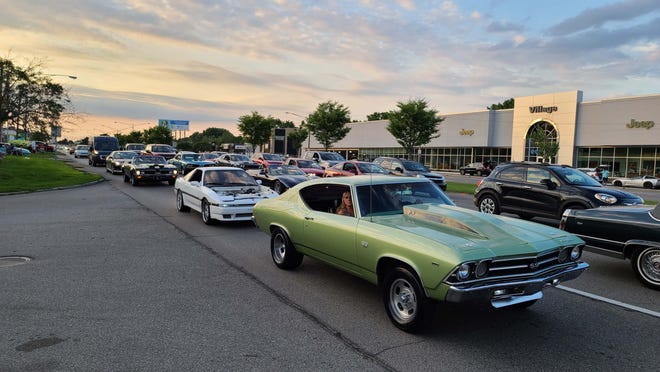
While official city and corporate events for this week’s originally planned Woodward Dream Cruise were canceled back in June out of COVID-19 health concerns, the annual pilgrimage to Woodward motors on.
Over the last few days, “the world’s biggest traffic jam” has attracted thousands of cruiser-faithful in lawn chairs enjoying a steady stream of sports cars, hot rods and Detroit classics ahead of what would have been the official culminating event on Saturday.
Many of those behind the wheel shrugged off the absence of official events and said it brought a refreshing return to the grassroots gatherings that made the Dream Cruise unique 25 years ago.
“It’s nice not to have all the companies here,” said Veronica Spitza of Brighton, who drove a mint 2010 Chevy Camaro SS to Royal Oak with husband Al. “It’s been easier to find a parking space that usually are soaked up by all the corporations.”
The Spitzas have been coming to the Cruise since the late 1990s, and this year they made it a family affair: They brought a 20-year-old nephew, Jack, from New York. A Barrett-Jackson Auction fan, this is Jack’s first Dream Cruise.
The annual event is a summer highlight for ’73 Corvette Stingray owner Sam Agus, 72, and pal Mike Detrych, 72, who haven’t missed a Cruise since 1995. The Milford natives grew up together and fought in Vietnam together. When Detrych returned from war, he bought a red 1969 Chevelle V-8 that he still drives today.
“It’s just like the old days out here,” said Agus, who met the original owner of his Corvette for the first time Thursday. “The companies aren’t here, but the cruisers still are.”
Behind them, the parking lot between the A.J. Desmond & Sons Funeral Home and vacant Art Van store in Royal Oak was taped off, empty of its usual crowds. That sight was not unusual along Woodward as businesses discouraged large gatherings.
Despite that, Cruise attendees were in a festive mood. They naturally social-distanced around cars and in lawn chairs.
Woodward Dream Inc. president Michael Lary defended his board’s decision to cancel official events out of concern for heightened COVID-19 cases.
“We made a decision based on the best interest of the public,” said Lary, whose board is made up of local city officials. “We didn’t want to be part of doing irresponsible things.”
Some cruisers lamented that local communities and corporations were not more involved, saying they could have brought sanitizer stations and broadcast public service announcements to the large gathering.
Longtime cruiser Roger Posey, 70, lamented that Memorial Park in Royal Oak was taped off, as were many other public spaces. He is president of the Woodward Tri Five Cruisers car club — which celebrates Chevrolets made in the years 1955-57 — that usually gathers there.
His group has relocated their lawn chairs to a strip of lawn in front of a medical office. A stunning, multi-colored lineup of Chevy Bel Airs and 210s was parked behind them. Posey’s ride? A 1956 V8-powered 210. Posey’s club usually attracts members from Canada and as far as Australia and England — but they won’t make it this year due to travel restrictions.
“This year reminds of the first five years of the Cruise,” said Posey, thinking back to the mid-1990s. “I remember three guys pulled up at the stoplight near Duggan’s. They drag-raced three abreast out of the light. Then 35 police on horseback came up Woodward and put a stop to the drag racing.”
Police in black Ford Explorer SUVs were common along the grassy median this week. But with traffic backed up for hundreds of yards, drivers behaved themselves. A ’60s Corvette Stingray-turned-dragster with a rear parachute and towering engine-blower made the earth shake. An orange McLaren 720S burned retinas. A topless classic 1967 Ford Bronco towered above an old MG.
It wasn’t just the old guard that was enjoying the atmosphere.
Nineteen-year-old Brennan Lata was hanging out with his West Bloomfield buddies in front of the Jeep dealership in Royal Oak. They had all piled into Lata’s Ford Mustang GT and 18-year-old Matthew Awdich’s Corvette to cruise the strip.
“We’ve been coming here since we got our driver’s licenses,” Lata said. Though overall numbers for this year’s Cruise will be way down, Lata and company signal that new generations will be here for years to come.
Dream Cruise President Lary hopes a vaccine proves successful soon so the Cruise can return to normal next year. Despite companies staying away this year, he was still pleased to see the classics on Woodward.
“The bottom line is there is still an experience there for folks who want to enjoy it,” he said. “That’s what is so great about this event.”
Everything has its baseline for greatness. In golf, it’s Tiger Woods. In tennis, Roger Federer. In basketball, Michael Jordan.
For sports cars, it’s the Porsche 911.
The 21st century has seen a resurgence in supercars with new entries like the McLaren 570 and Audi R8 joining mainstays Ferrari and Lamborghini. Yet the 911 has maintained the German brand’s claim to handling pre-eminence. The last-generation track-focused 911 GT2 RS destroyed Car and Driver’s Lightning Lap record at Virginia International Raceway held by the mid-engine carbon-fiber $500,000 Ford GT supercar. By five seconds.
Every brand baselines its sports cars to the 911 on track and off. The eighth-generation 2020 model is no different. Though I must admit, I had my doubts.
When Porsche introduced the latest 911 — factory code 992 for you Porschephiles — at the 2018 Los Angeles Auto Show, it aimed to swath the world’s greatest athlete in luxury. Digital electronics have transformed autodom and Porsche didn’t want to be left behind. The LA intro was just as lavish. LA celebrities as sleek as the 911’s classic Coke-bottle shape walked the outdoor runway with Porsche’s star. A light show lit up the night
Conversation strayed to Porsche’s electric sedan, the Taycan, into which the company had poured millions. Taking it all in, I worried the 911 might go soft. Like a Hollywood legend who forgot what made them a legend.
After a day going to Hell (Michigan) and back in the convertible, Targa 4S — a new trim for the 2021 model year — I’m happy to report the champ is still at the top of its game.
I felt the 911 difference almost immediately. I had stepped out of Corvette’s all-new C8 the day before — hands down the best-handling Corvette ever made — with full coil-over springs, widened track and instant traction. Yet, it doesn’t instill the same confidence as the 911.
The Porsche goes exactly where you point it. Pushing the Corvette (or most sports cars) over the undulating hills of M-32 in Antrim County, I had to work the steering wheel at the limit to keep the beast on its chain. Across similarly challenging curves on Hell’s Hadley Road, the Porsche feels like it’s on rails. It’s like a slot car begging for more juice.
It wasn’t always so. The 911’s aft-of-axle rear-engine layout — compared to Corvette/Ferrari/McLaren mid-engine weapons — is inherently unbalanced. It took decades for Stuttgart engineers to tease out the gremlins of oversteer. An arsenal of modern technology helped. My Targa 4S tester benefited from innovations like electronic limited-slip differential, rear-axle steering and engineering witchcraft like “PASM” and “PDCC” that would take pages to explain.
All the driver needs to know is it makes handling magic.
When I drove my Tesla Model 3 Performance — a nice-handling sports sedan — afterward, it felt like a wet noodle by comparison. The only car that rivals the 911 is another Porsche: the smaller Cayman/Boxster and its inherently balanced mid-engine layout.
But when it comes to the new 911’s biggest change — the interior — Porsche still has work to do. Especially when compared to the Corvette C8, which has vaulted itself to best cockpit in class. A reminder: the C8 is also the cheapest supercar in class, starting at a bargain $59,995.
My Racing Yellow Porsche tester starts at $136,550 but with options ballooned over $180,000. For this you get a roomy cabin with plenty of head clearance for this 6-foot-5 giraffe. Unlike its mid-engine competition, 911 has rear seats (though they are more hospitable to golf bags than people). Together with a carry-on luggage storage in the frunk, it’s a sports car fit for weekend trips.
The console is much improved over the previous generation with room for a cupholder (Imagine! Previous models had a flimsy pop-out from the glove compartment.). Theres’s adaptive cruise-control and a touchscreen complete with modern amenities like 4G Wi-Fi and Apple CarPlay. It’s a layout shared with the more-luxurious Panamera sedan and Cayenne SUV — even improving on those siblings with a small, ice cube-sized auto shifter that doesn’t obstruct climate buttons.
But other details lag compared to the ’Vette.
Porsche doesn’t offer Android Auto, and voice recognition is average. The 911 has upgraded its signature five-dial instrument display with state-of-the-art digital readouts — but the round steering wheel obscures some information. Corvette’s race-car like square steering wheel, by contrast, allows better visibility of its broad digital dash. The C8’s retractable hardtop can be stowed while moving at speeds up to 30 mph. Want to store the Targa roof? You’ll have to pull to the side of the road.
Classic touches like Porsche’s left-side key remain, but overall the cabin lacks the personality of rivals.
Leave the personality to the drivetrain.
Despite adding twin turbochargers, the flat-six engine makes beautiful music. The symphony’s exhaust notes get more aggressive as you cycle through the Sport and Sport Plus drive modes. Unlike the Boxster/Cayman which downgraded to a turbo-4, the 911’s six-holer screams for more right foot at high revs, just like the ’Vette’s V8. Advocates for a silent, electric future should drive these beasts first.
Mated to a lightning-quick dual-clutch 8-speed PDK automatic transmission, the 443-horsepower mill exhibits no turbo lag. None. Not on corner exits. Not on launch-control starts that snap your neck on the way to 60 mph in 3.4 seconds.
The Targa is available with a 7-speed manual for purists, but the PDK is superior and comes with paddle shifters for when you want to be in control.
For all the emphasis on interior-tech refinement, the 2021 reserves its most clever electronic trick for acceleration. “Sport response” plants a button in the middle of the steering wheel. Luffing behind traffic, I pushed the button. Instantly, the gearbox downshifted from 6th to 3rd, the flat-6 screaming whilst the tach quivered at 6,000 rpms.
Nail the throttle. Gulp traffic in the blink of an eye. Exhale. Wow.
Luxury upgrades exact their toll on weight, and the added tech and Targa roof meant my 4S weighed in at an estimated 3,700 pounds. The gym-toned athlete shrugged it off. As I wrung the 911’s neck through Livingston County curves and cloverleafs, it felt much smaller.
It’s what makes 911 the Tiger Woods of sports cars. But the competition is nipping at its heels.
2021 Porsche 911 Targa
Vehicle type: All-wheel drive, rear-engine, four-passenger sports car
Price: $120,650, including $1,350 destination fee ($181,840 Targa 4S AWD as tested)
Powerplant: 3.0-liter, twin-turbo flat-6 cylinder
Power: 379 horsepower, 331 pound-feet of torque (Targa 4); 443 horsepower, 390 pound-feet of torque (Targa 4S)
As he takes the helm of Ford Motor Co. in October, CEO-designate Jim Farley will steer the 117-year-old automaker through one of the most profound product shifts in its history.
The Blue Oval’s F-150 profit-machine continues to steam ahead as the best-selling vehicle in America, but Ford is completely revamping its North American lineup to meet changing consumer and government demands. In the works is a shift away from sedans to slake consumer demand for popular SUVs while at the same time investing billions in electric vehicles to satisfy government mandates.
The shift comes as Ford’s SUV lineup is under pressure from foreign automakers while the popularity of EVs is in question. Yet industry analysts say Farley, now chief operating officer, inherits a Ford and Lincoln model lineup that has made shrewd, measured moves to position itself in the marketplace without overexposing itself to government whims.
“Our new product vision — led by the Mustang Mach-E, new F-150 and Bronco family — is taking shape,” said Bill Ford, Ford’s executive chairman, in announcing Farley’s promotion. “We now have compelling plans for electric and autonomous vehicles … and we are becoming much more nimble.”
Credit that in no small part to Farley and ex-manufacturing boss Joe Hinrichs — Farley’s chief competitor for the top job before his abrupt departure in February — who ran the nuts and bolts of Ford’s marketing, technology and production over the last two decades.
“I think Farley and Hendrix really led to the march toward these new vehicles, and I think they’ve done an excellent job with it,” said George Peterson, a veteran industry analyst and president of AutoPacific, who says outgoing CEO Jim Hackett’s strength was high-level corporate strategy. “Hackett was a placeholder until Farley or Hinrichs was ready.”
A century after founder Henry Ford revolutionized the American automobile with the Model T, Ford is undergoing a historic shift in its lineup, particularly with an eye on the rich U.S. market.
“North America is where Ford makes its money,” said Stephanie Brinley, IH Markit senior auto analyst. And that’s likely to continue.
Ford F-series
When it comes to making money, the F-series pickup line is Ford’s franchise. From its debut in 1948, the F-series line now spans everything from F-150 light-duty trucks to F-750 super-duty commercial trucks. Together they sold 896,526 units in 2019, far and away the best-selling vehicles in the U.S.
Before joining Ford in 2007 Farley worked for Toyota Motor Corp. for 20 years, one of the few foreign companies that has taken a lunge at Ford’s pickup dominance. The Toyota Tundra sold 111,673 copies last year.
Credit the F-150’s dominance to relentless change, including the bold decision in 2015 to make a fully aluminum body, a segment first. Ford’s aluminum investment came with huge risks as competitor Chevy/GMC put its truck investment into growing the mid-size pickup markets with the Colorado and Canyon models.
The aluminum F-150 — together with its introduction of new, sippier, turbo-6 cylinder engines — was a hit, but the rest of the industry did not follow its aluminum, lightweighting strategy. Instead, Ford wound up playing catchup as the mid-size pickup market exploded — led by the twin GM products and Toyota Tacoma.
Ford’s Ranger, revived in 2019, has hit the ground running and is now one of the fastest-selling trucks in its segment. Meanwhile, F-series is in the middle of its first major refresh since its aluminum remake.
“The amount of investment they keep putting into the F-150 is impressive,” AutoPacific’s Peterson said. “The 2021 model is highly evolved — they claim at least 92% of all the part numbers on it are new, even though it doesn’t look any different particularly. They’ve paid a lot of attention to the interior craftsmanship and the interior infotainment systems.”
SUVs
Thirty years ago, the Ford Taurus was the best-selling sedan in America. For 2021, the Blue Oval won’t have a sedan in its U.S. lineup as the mid-size Fusion sunsets with the 2020 model year. Iconic Ford names like Focus and Fiesta will continue to sell in foreign markets like Europe.
Pickups aside, SUVs lead the charge in the U.S.
Riding point will be the rugged, Ranger-based Ford Bronco — aimed squarely at the Jeep Wrangler. Just as Wrangler has defined Jeep’s hot, SUV-focused lineup, so will the versatile Bronco headline a stable of utes, including the Ford Ecosport, Escape, Bronco Sport, Edge, Explorer and Expedition.
“The breadth and depth of the Bronco line is really, really impressive,” said Peterson, including the addition of the unibody Bronco Sport which — unlike the truck-based Bronco — complements the Escape as a more out-doorsy compact crossover.
The Explorer was one of the first five-door SUVs way back in 1995, and it remains a class best-seller. But it’s come under increasing assault from Asian competitors with the all-new Kia Telluride, Hyundai Palisade and Toyota Highlander.
IHS Markit’s Brinley says Ford has reacted by maximizing profits with new premium trims and sharing vehicle platforms. New for 2020, for example, the Explorer introduced an ST performance model that turns heads with wicked looks and bigger horsepower.
“Ford has been getting more efficient by sharing components across model lines,” she said. “It’s making a difference in profitability.”
Lincoln
One example of that sharing is the Explorer-based Aviator SUV. Aviator was the impetus for changing the Explorer’s traditionally front-wheel-drive platform to rear-wheel-drive to complement Lincoln’s re-invention as Ford’s premium SUV brand.
Nicknamed the “baby Navigator,” Aviator echoes big brother’s sumptuous interior and Bentley-like design cues while also riding on a rear-wheel-drive platform. The Navigator, too, shares its platform with a Ford — the F-150 pickup.
With blingtastic design and feathery rides, Lincoln has new life as an SUV brand. The Continental and MKZ sedans have joined the Taurus/Fusion on the scrap heap, and the volume Corsair SUV is just getting market traction.
“The re-invention of Lincoln is complete,” IHS Markit’s Brinley said. “The brand knows what it is, and knows what it has to execute in the future.”
Electrics
A passionate environmentalist, Chairman Ford has talked a big game on Ford’s green future. But with little consumer demand for EVs, the company’s product planners have resisted wholesale makeovers like Cadillac’s plan to sell only electric vehicles by 2030.
“No EV strategy is a good strategy,” said AutoPacific analyst Peterson, whose organization has polled consumers on electrics since 2005. “Consistently, EV consideration (for a new vehicle) has been between 3% to 5%. There is little consumer pull except for Tesla.”
Taking a page from its icons playbook that has elevated F-series and Bronco, Ford is expanding Mustang as a performance sub-brand that includes a battery-powered Tesla Model Y fighter called the Mustang Mach-E.
Ford hopes the Mach-E will not only rival Tesla in appeal — but also familiarize consumers with high-tech electronics essential to future autonomous vehicles.
On the government compliance front, Ford re-launched the Escape hybrid this year (after a 7-year hiatus) as a practical SUV aimed at the heart of the market’s biggest SUV segment. The company hopes its volume sales will meet government mandates while also satisfying consumer’s core needs of cargo space and fuel efficiency.
Ford’s product shift risks backlash if the market returns to sedans — now almost exclusively the domain of foreign automakers. But with Farley at the wheel, Ford has a car guy with a nose for what Americans covet, observers say.
The CEO-in-waiting, a weekend track warrior, has owned a 1966 Mustang and 1965 Ford GT40 race car.
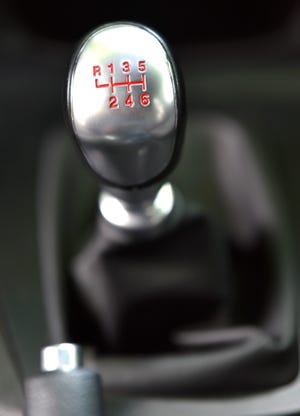
The manual transmission continues to go the way of the hand-crank window.
Several more vehicles — including the popular Jeep Compass and Honda Accord — will no longer have stick-shift options after the 2020 model year.
The continuing trend toward automatic transmissions is driven not only by ease of use: In many cases, automatics now get better gas mileage than their stick-shift counterparts. Adding to the decline is the phase-out of small, entry-level sedans that traditionally have offered manual transmissions as budget options.
Auto enthusiasts have rallied behind the hashtag #SaveTheManual, but it’s not just entry-level SUVs and sedans that are stiffing sticks. High-end sports cars in the pursuit of more speed are also turning their backs on manuals. Two of the highest-profile performance-car launches in 2020, the Ford Mustang GT500 and mid-engine Chevy Corvette, debuted without a three-pedal option.
“Track- and drag strip-focused sports cars are focused on pushing the envelope, and manuals just make no sense,” said Michael Fiske, IHS Markit principal auto analyst. “Dual-clutch transmissions in cars like the Mustang are crowding out the manual, because if you really want to shave tenths off your quarter-mile time, you need an automatic.”
Fiske says manuals are increasingly the domain of small, affordable performance cars that owners enjoy for the driving experience. The Mazda MX-5 Miata and Toyota 86, for example, are synonymous with stick shifts.
“Manuals let you write your own story,” said M1 Concourse chief instructor Alex Della Torre, 47, who owns three Mazda MX-5s. “If you want to max out your revs, you have that power.”
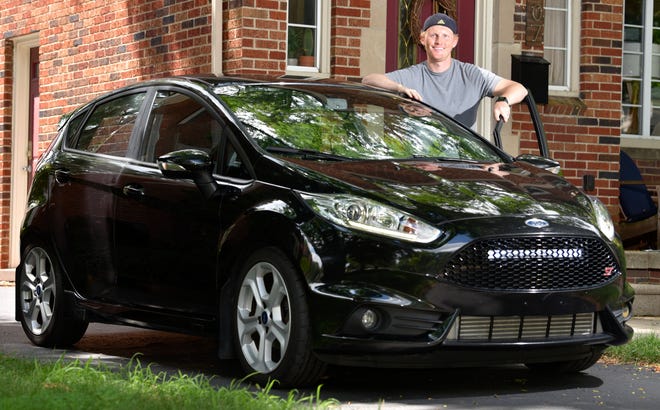
Yet even popular performance cars such as the stick-shift Ford Fiesta ST and Focus ST have been yanked from the U.S. market, a casualty of the relentless upshift from cars to SUVs.
James Carl, 30, of Royal Oak owns a 2015 Fiesta ST. He was raised on sticks, having previously driven a now-defunct Mazda RX-8 and Bronco II.
“I like the control of a stick. I like to know what gear I’m in and the ability to choose whatever gear I want in a particular situation,” he said. “An automatic doesn’t give you that choice.”
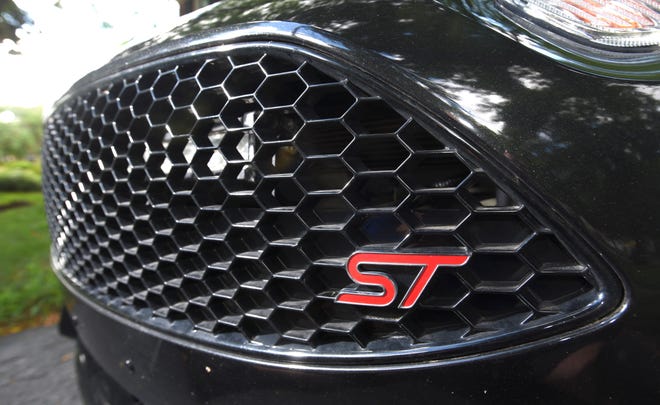
He laments the loss of the subcompact Fiesta ST — its last model year was 2019 (the compact Focus ST died in 2018). Ford’s ST performance badge continues on in sport utilities like the Explorer and Edge — but without the option of a stick.
A Ford partisan, Carl said his only choices going forward are the Mustang muscle car (he races one), and the forthcoming Bronco SUV, which will have a manual option.
Like some pickups and the Jeep Wrangler, the Bronco’s off-road performance promises to attract manual enthusiasts. That’s rare in an SUV. More typical is the Jeep Compass, for which just 7.7% of buyers go for the manual.
SUVs like the Compass have replaced cars like the Focus and Fiesta as entry-level vehicles, which were typically offered as base manual models because the stick’s $1,000 to $1,500 savings attracted cash-strapped customers.
But, say analysts, stiffer fuel economy rules mandated over the last decade made already low profit-margin small cars even more costly to produce.
“The EPA mileage rules really made it hard for small sedans to meet emissions standards. It’s easier to hit the mpg mark with SUVs because the rules treat them differently,” said IHS Markit’s Fiske, an industry veteran. Plus, he said, SUVs have higher profit margins.
Even the take-rate for manuals on Mustangs is just 9.1% as the marque has developed a smooth-shifting, 10-speed automatic. Mustang rival Chevy Camaro’s manual take rate is a paltry 1.4%. Ford now targets its manual Mustang offerings at special, upper-trim models such as the GT350, Bullitt and forthcoming Mach 1.
The top-trim Mustang, the ferocious 760-horsepower 2020 GT500, shocked enthusiasts when it skipped the stick and introduced the pony-car kingdom’s first dual-clutch, seven-speed automatic. That’s because even the best drivers will not be as fast on the track with a manual transmission.
The GT500’s tradition-busting move was followed by the 2020 Corvette, the first ‘Vette to put the engine behind the driver — and ditch the stick. The car’s eight-speed, dual-clutch automatic is staggeringly quick (performing shifts in under 100 milliseconds), allowing sub-3-second, zero-to-60 times. Try that with a manual.
Amateur racer and stick-shift fan Steve Nowicki, 61, of West Bloomfield isn’t interested in a manual muscle car. He drives an automatic Ford F-150 to work but has a stick-shift Miata for play.
“Stick shifts are more manageable with restrained horsepower,” he said. “My Miata is just fun to drive. It’s my summer, let’s-just-go-for-a-ride car.”
Vaunted sports car maker Porsche has flirted with eliminating the stick shift from its flagship 911, but pushback from core enthusiasts means it’s still offered on upper trims like the S and 4S models for 2021. For the entire 911 model line, manuals are chosen by a mere 2.7% of customers.
At the entry-level end of the market, performance brands like Mazda now dangle manuals at enthusiasts willing to pay more for the feature, rather than budget-conscious buyers. The $22,445 Mazda 3 compact offers the manual only its fully loaded Premium hatchback model, starting at $28,420.
Mazda now only offers a stick-shift in its Mazda 3 and MX-5 Miata, having ditched the three-pedal option in its sporty, mid-size 6 sedan after 2019.
The Honda Accord, a competitor to the Mazda 6, will follow suit by discontinuing its stick option after the current model year. Other sticks are leaving the market at year’s end because their model lines have been axed. They include the Fiat 124, Honda Fit, Toyota Yaris and Chevrolet Sonic.
Only 0.8% of Accord buyers opted for a manual. Honda, a driver’s brand with deep roots in racing, has found more success in its compact Civic model with a take rate of 9%.
Even the manuals’ once-vaunted advantage over automatics in fuel economy has dissipated. An automatic Civic with a 1.5-liter engine, for example, gets 33 mpg compared to 30 mpg for the comparable manual version.
M1 Concourse’s Della Torre, however, sees one clear advantage for manual transmissions.
“You don’t have time to text and drive,” he said. “You are forced to focus on driving alone.”
Presidential candidate Joe Biden appeared to spill the beans on a long-rumored, all-electric Chevy Corvette this week. As The Detroit News first reported last April, the mid-engine Corvette C8 was designed to include battery-power, and will feature the first-ever electrified model capable of 1,000-horsepower.
Expected to be called the Zora, the hybrid ‘Vette should debut in 2025. Given General Motors Co.’s commitment to a zero-emissions future, an all-electric Corvette after Zora has been expected, too — though without a definitive model year.
“They tell me — and I’m looking forward to this if it’s true, to driving one — that they’re making an electric Corvette that can go 200 mph,” said the Democratic candidate for president. “You think I’m kidding — I’m not kidding. So I’m excited about it.”
Who “they” is is not clear, though top politicians like Biden often have access to auto executives given Washington’s regulation of the industry as well as its importance in political swing states like Michigan. Government regulation is a key reason GM and other automakers are investing billions in electrification.
GM as a rule does not talk on the record about future product. When asked about an all-electric Corvette, a GM spokesperson would not comment on product speculation.
Since The News broke news of a mid-engine Corvette in 2016, however, sources have told The News that a key reason for putting the engine behind the driver was to open up possibilities for electrification. Chevrolet even went so far as to trademark the name Corvette E-Ray — an indication of the model’s electric ambitions.
Bob Lutz, GM’s former chief of product development who was involved with early development of the mid-engine ‘Vette, speculated that the program’s long lead time foreshadowed an electric version with “electric motors at the front (that) would enable limited AWD capability.”
Sure enough, The News confirmed this year the Zora hypercar (named after the engineer who advocated a mid-engine ‘Vette 50 years ago) scheduled for 2025 (before delays expected by the cornonavirus disruption).
Like European hypercars that use all-wheel-drive, hybrid-electric propulsion to achieve preposterous performance numbers, the Zora is expected to generate about 1,000 horsepower. Power comes from a front electric motor mounted to an all-new twin-turbo LT7 engine. The LT7 will also be found — sans electric motor — in the Corvette ZR1 performance model.
As a Corvette fan, Biden might also have gotten his information from rampant speculation in online Corvette forums and enthusiast magazines.
When asked by the British auto publication, Autocar, about an electric Corvette at the C8’s unveiling in Los Angeles last year, GM President Mark Reuss fueled rumors: “The company is committed to a strategy of 0-0-0: zero emissions, zero crashes and zero congestion. All of the technology rolling into this vehicle is meant to support that. This platform can carry a lot of different things into the future for General Motors.”
Intriguingly, an aftermarket company name Genovation has made headlines by converting an old, front-engine C7 Corvette to electric power making 800 ponies.
The Corvette wouldn’t be the first GM electric car that Biden has taken an interest in. Chevy’s first battery-powered car, the Chevy Volt, played a key role in the Obama-Biden administration’s rescue of Detroit automakers in 2009.
Biden was a strong advocate for the $54 billion in green energy initiatives that were a part of the $787 billion stimulus bill, and visited a Midland plant in 2010 touting battery production for electrified vehicles. In his 2011 State of the Union speech, President Obama promised to have one million battery-powered vehicles on the road by 2015.
That number never materialized as gas prices moderated and consumers gobbled up SUVS. Indeed, Volt production ended in 2019 for lack of demand.
But Biden says he will redouble efforts to move the US to fully electric cars if he is elected president. As part of his $2 trillion climate initiative announced this summer, he would build 500,000 charging stations across the country to help the auto industry go fully electric.
“This is an iconic industry. How can American-made vehicles no longer be out there?” he said in the campaign ad touting an all-electric Corvette. “I believe we can own the 21st century market again by moving to electric vehicles.”
When the all-electric Cadillac Lyriq introduced Thursday hits dealer lots in late 2022, it promises to be on the cutting edge of electric-vehicle style, range and technology.
With an estimated $70,000 sticker price, Cadillac’s first battery-powered SUV will join a luxury electric-vehicle market that’s expected to be crowded with Tesla’s four-car lineup, three Audi e-Trons, the Mercedes EQC, Polestar 2 (Volvo’s EV brand), Ford Mustang Mach E and others.
Here’s what sets the Lyriq apart.
1. Light show
Walk up to the Lyriq with key in pocket and the light show begins: The SUV’s blank face (like all electric vehicles, the Cadillac doesn’t need a grille to feed air to a gas engine) comes alive like a living room chandelier. Starting with the small Cadillac logo, LED lights cascade outward across the face like ripples from a stone thrown into a pond. The show is punctuated by vertical headlights at the outer edges. That’s right, Cadillac introduces its first-ever vertical headlights. While the lights are not as dramatic as Caddy’s signature 1950s vertical tail-fins, the effect is the same. In contrast with the minimalist designs of Tesla and Audi, the Lyriq is lush with detail.
2. Augmented reality
Cadillac has led the industry in head-up displays. The Lyriq introduces the next chapter. Called “augmented reality,” it projects not one, but two planes of information in front of the driver. The near plane features information like speed limit and vehicle speed. The second plane is cast further out onto the road to help with, say, navigation. In a crowded intersection, for example, virtual arrows hovering over the asphalt will show which road to take.
3. The big screen
Tesla wowed the auto world with a 17-inch vertical screen in 2012. Lyriq doubles it. A continuous, curved 33-inch LED screen stretches across the dash. It can be operated by touch or a console rotary controller. Cadillac says the screen gives it the real estate to be a leader in infotainment systems, so look for industry-best pixel density and configurable space.
4. High-style interior
The Lyriq is built on GM’s “roller skate” BEV3 platform that integrates the SUV’s big battery into the chassis floor. It makes for better structural rigidity and opens acres of space. Tesla pioneered this platform, with a front trunk – a “frunk.” Cabin space is freed up in the areas where a gas engine driveline traditionally resides. But Cadillac goes high style versus Tesla’s minimalist Apple design: The center console rises like a wave between the seats, the rotary screen controller perched at its crest (a similar bow bisects the rear seats, but may not survive to the production model). With Cadillac’s signature Supercruise driver-assist system, drivers can comfortably recline while using the rotary controller like a TV remote. A noise-cancellation system will mute even tire noise, so passengers can enjoy the 19-speaker AKG Studio sound system. Ah, luxury.
5. Details, details
Lyriq is stuffed with Easter eggs: Open the passenger door, and three ducks swim on the corner dash – an homage to the noble Merlettes on the family crest of Antoine de la Mothe Cadillac, the founder of Detroit. Press the Caddy crest behind the left wheel arch and a vertical panel shifts forward – like a hidden library door – revealing the charger port. Drivers may be surprised to learn a sci-fi machine like this is operated by a steering-column shifter – but this is no 1950s shifter off a Chevy pickup. Flick the thin wand up and down and it will engage drive modes.
Like all EVs, Lyriq faces the challenge of charging infrastructure. Cadillac believes most charging will happen at home, so the Lyriq is 19-kW charger capable and the company is working with Qmerit so buyers can get home charger installation. When on long trips, Lyriq will help you find a charger for its 300-mile range battery (middling range between a 220-mile Audi e-Tron and 400-mile Tesla) with the big screen or a mobile app.
The mobile app also allows you to monitor Lyriq remotely from your phone. Just like everything else in your 21st-century life.
The unveiling Thursday of Cadillac’s 2022 Lyriq SUV marks the brand’s dramatic turn to battery power. The new direction is in keeping with a company that, since its founding in 1902, has been synonymous with luxury innovation.
“Craftsmanship is a vocation, precision is a law” was the motto of Henry Martyn Leland, the gifted machinist who ran the company from 1904 to 1922. Leland pioneered standardized spare parts so that, for example, a faulty piston could be changed without having to swap out for an entire new engine.
A culture of innovation followed creating automotive breakthroughs like the first electric self-starter, first enclosed car, and first V-8 engine. Even as Cadillac’s luster dulled at the end of the 20th century as German automakers upped their games, the brand has continued to innovate. Among its most recent accomplishments is the head-up display in 2003.
Here are some of the Lyriq’s key forefathers in Cadillac’s 118-year history.
1902 Model A
Cadillac rose from the ashes of the failed Henry Ford Co. (He moved on to the successful Ford Motor Co. with new investors). So the first Cadillac was nearly identical to the Ford-designed Model A chassis, which Ford Motor Co. also produced in 1903. The 1903 Cadillac Model A sold 2,497 in its first year. About 7 horsepower turned the rear wheels. It came in 2 and 4-door models starting at $850.
1905 Osceola
The 1905 Osceola concept would eventually become the 1910 Model 30 (30 for 30 horsepower), the first car with a fully-enclosed body. Coveted for its privacy, the towering car stood 7-foot-2 — the tallest Cadillac ever made, a foot taller than today’s Escalade SUV.
1912 Model 30
Goodbye, cranky hand crank. The ’12 Model 30 introduced the first electric self-starter. It effectively destroyed the already pricey electric-car market which women drivers in particular had enjoyed for their less physical push starters.
1915 Type 51
As the four-cylinder Model 30 aged, competitors ate into sales with smooth 6-cylinder engines. Cadillac sales cratered in 1914. With furious innovation, Leland & company answered with the first V-8 powered car – the Type 51 – boasting 5.1-liters of piston and 70 horsepower. V-8s still motivate Cadillacs to this day.
1927 LaSalle
Known for its engines and quality, Cadillac was considered a stodgily styled brand. As Packard upped the aesthetic bar, Cadillac answered with Harley Earl who would establish Caddy’s “Art and Colour Section” as the the first styling department within an automobile manufacturer. Earl penned the 1927 LaSalle, a second brand made by Cadillac. Cadillac would endure as a cutting-edge design firm, but LaSalle would not. The name was eventually nixed to focus on Cadillacs.
1931 Phaeton
Double the V-8 and you get the V-16 engine, another Cadillac first. The fast, 170-horsepower mill was the heart of vehicles like the Dual Cowl Sport Phaeton. Celebrities like Marlene Dietrich coveted the incomparable V-16s and their long three-ton bods. The Great Depression eventually canceled these land yachts, but they remain valuable collector cars.
1959 Eldorado
After World War II, Earl was inspired by the design of the Lockheed P-38 Lightning fighter plane. He translated that inspiration into Cadillac tail fins. The fins would first appear on the 1948 Sixty Special and become a signature of American car design. The ’59 Eldorado was the era’s high point with fins measuring 38 inches tall.
1970 Eldorado
The eighth-generation Eldorado debuted an edgy style that remains a Cadillac signature to this day. It also boasted the biggest mass-produced engine in automotive history. Its 400 horsepower V-8 had a displacement of 8.2 liters – 500 cubic inches.
1985 DeVille
The Lyriq is partly a response to government-imposed, zero-emissions mandates, but 1974 marked the first time the U.S. government demanded fleet-wide mpg rules. The restrictions forced automakers to look for dramatic fuel economy savings, and Cadillac responded with one of the first front-wheel drive designs. The front-wheel drive DeVille was fit with a transverse V-8 engine.
2002 Escalade
Cadillac’s first SUV was introduced in 1999 as a response to the popular Lincoln Navigator. Based on GM’s full-size pick-up frame, the Escalade really hit its stride with its blingtastic second-generation 2002 model which inspired a generation of musicians and gained the favor of celebrity athletes. Escalade has spawned a full line of Cadillac SUVs. Its forthcoming 2021 model was introduced by moviemaker Spike Lee earlier this year.
2003 CTS
After a sleepy decade in which Cadillac fell further behind its athletic German competition, the CTS sedan sought to reboot the brand with a dramatic “Art & Science” design on a rear-wheel drive platform. The CTS gained new respect for the brand.
2014 ELR
Sharing the ambitious Chevy Volt’s chassis and plug-in drivetrain, the gorgeous ELR was Cadillac’s first battery-powered car. Dubbed “Volt in a tux,” the ELR could run 40 miles on battery power before a range-extending gas engine kicked in. The design turned heads, but the $75,995 price tag – similar to the Tesla Model S – turned buyers away. The ELR lasted just two years on the market.
The Made in America supercar. The 2020 Chevy Corvette, assembled in Bowling Green, Kentucky. (Photo: Henry Payne, The Detroit News)
The Corvette C8.R race car has been an instant success, winning three of its first four races against its formidable Porsche and BMW competition. In no small part that’s due to its mid-engine layout.
“Going to mid-engine C8.R (from front-engine C7.R) is night and day difference. It feels like a proper race car the way you drive it, you can really attack corners and be aggressive with it,” Corvette team driver Jordan Taylor told me ahead of his team’s 1-2 finish at Sebring on July 18.
I can attest to that in the production car as well, which I have driven in anger around GM’s Nevada race track. But the real genius of the first Corvette to put the engine behind its driver can’t be fully appreciated until you’ve lived with it as a daily driver.
At $72,000, my base tester Corvette C8 was drop-dead gorgeous, quick as lightning, yet a practical mule for a weekend road trip up north.
And the next generation is in love with it.
“This is a chick magnet,” said my 20-something friend Kevin (about the same age as Jordan Taylor) as we cruised down M-32 near Traverse City. “I got to take a picture for my brother, he talks about this car all the time.”
Millennials like Kevin and his brother were a big reason GM made the mid-engine Corvette. As the 21st century dawned, chief engineer Tadge Juechter and his elves had stretched the front-engine concept as far is it could go. A new generation had been raised on sexy mid-engine Ferraris, McLarens and Ford GTs. Put a mid-engine Corvette on their dorm wall and they would covet that, too.
Especially since you can buy four C8s for the price of one Ferrari 488. Same rapid-fire dual-clutch transmission, same eight cylinders, same 0-60 time.
“Gaaaah! I love the sound of that engine!” exclaimed Kevin as we used launch control to rocket from 0-60 mph in about 3 seconds.
That’s been Corvette’s genius for years — using GM’s parts bin to create a supercar many times cheaper than its competition. The pushrod V-8 is fundamentally the same small block that powers thousands of Chevy and GMC trucks. The infotainment system is shared with the Chevy Equinox.
But that sharing was a double-edged sword for Corvette, giving it a reputation as a poor man’s sports car. The C8 sheds that baggage. This rocket is one of the world’s best supercars, regardless of cost.
Start from the inside out.
I blanched at the chemical smell that greeted me every time I opened the last-generation C7’s door. It reeked of lack of attention to detail. The smell is gone in the C8 — solved, say engineers, by “pre-baking” materials before installation.
What I notice instead is the jaw-dropping interior. It’s better than the Ferrari 488, the McLaren 570 and the Audi R8 — all cars that cost at least twice as much as C8. The C8 beats these giants in digital switchgear — and personality.
The ’Vette wraps its driver in a unique environment with a square steering wheel (to better see the big digital dash), “trigger” shifter, clever climate controls and an instrument display that changes as you toggle through six drive modes, from Tour to Z mode (more on that later).
It adds luxe touches like the OMG-that’s-cool rear camera mirror and a center “ridge” of climate controls. You can even remove the roof if you want (storing it in back like a Ford Bronco stores its doors).
I could have spent all day inside. And did.
The interior loses nothing in size from the front-engine car, meaning it fits 6-foot-5, 230-pound basketball players like me. On I-75 north of Saginaw I had to pull over to file a breaking news story. In other sports cars, I might have searched for a coffee shop. Not the C8.
So space efficient is the ’Vette that I was carrying a luggage bag in the “frunk,” tennis racquet bag/cooler/briefcase in the trunk, and an iRacing steering wheel/pedals in the passenger foot well.
I turned on the ’Vette’s 4G Wi-Fi and wrote the story on my laptop from the passenger seat in a service station parking lot.
A day later, two 20-somethings towing Jet Skis ogled the Corvette as I emerged from an ice cream shop.
“It looks awesome in the flesh,” exclaimed one.
“You should see the interior,” I said.
“I already looked,” came the reply. “It’s really cool.”
They will be able to afford one in a few years as C8 volumes rise and their used prices drop into the $40,000 range with high mileage. Can’t expect that from a European supercar.
Though the sheet metal is busy, the design should wear well. Proportions are impeccable, the look distinctly Corvette.
Its livability will endear it to 30,000-plus buyers a year. It looks good. Rides great. But for those who want to push it, the C8 also transcends its predecessors in balance and tech.
Engineers managed to squeeze another 35 horsepower from the ol’ V8 nail to a healthy 495. Place it over the rear wheels for better traction, marry it to a lightning-quick eight-speed gearbox, and it’s magic.
Over Charlevoix County’s rural roads I did multiple launch-control 0-60 burnouts. It’s as thrilling as a Cedar Point roller coaster. Where the old C7 felt like you were hanging on to a rodeo bull, the C8 is on rails. Warning: Like a Cedar Point roller-coaster, it wants to go to the moon. Beware instant triple-digit speeds that local cops will frown upon.
Thrills come standard without moving up to the $5,000 Z51 performance track package. Drive modes allow you to explore multiple personalities. Luffing through the quiet town of East Jordan, I kept the Corvette in “My Mode” where I had set the engine to Stealth so as not to attract attention.
Outside of town, the roads turned twisty. Z Mode time.
Pre-programmed in the touchscreen like My Mode, Z Mode allows you to instantly switch to preferred performance settings. I like Track settings — steering, suspension, engine note — but without turning off traction control should I encounter gravel or a slick patch of road.
Over hills and turns, the Corvette was a treat. This is a big car at 182 inches long and 3,647 pounds, so it can’t be flung about like a Porsche Cayman or Alfa Romeo 4C. But its bandwidth as a people-mover outdoes those smaller, comparably priced mid-engine rivals.
That’s Corvette’s secret sauce. Now more than ever.
2020 Chevrolet Corvette
Vehicle type: Mid-engine, rear-wheel-drive, two-passenger sports car
Price: $59,995 including $1,095 destination fee ($72,075 as tested)
Powerplant: 6.2-liter V-8
Power: 495 horsepower, 470 pound-feet of torque
Transmission: 8-speed automatic
Performance: 0-60 mph, 2.9 seconds (mfr.); top speed, 184 mph
The inaugural Woodward Dream Show at the M1 Concourse in Pontiac, which was scheduled to go on Aug. 12-15 despite the cancellation of the Aug. 15 Woodward Dream Cruise, is the latest casualty of the coronavirus. All of the traditional city- and corporate-sponsored events — from the Berkeley Cruise Parade to Ford’s Mustang Alley — have all been kicked to the curb by organizers this year, even as cruisers have continued to rumble up Woodward Avenue.
Motorheads held out hopes that the Dream Show — held outdoors at the M1 Concourse, a private race track and grounds in Pontiac — would be immune to the wave of cancellations. But the governor’s restrictions on public gatherings were too tight for the event to go forward.
“This was a difficult decision, but based on the ever-changing business environment and health concerns in Michigan and across the country, we have decided to postpone the inaugural Woodward Dream Show to 2021,” said Tim Hartge, CEO of Pontiac Motorsports Exposition, organizer of the event.
The Dream Show organizers instead promise to kick off Dream Cruise week next year, the first of a twin bill of big events at M1 Concourse that will include the American Festival of Speed in early October. The events are explicitly modeled after the Goodwood Festival of Speed and Goodwood Revival, England’s world-renowned motoring exhibitions.
The 2020 Dream Show had planned three days of events that included a “Best of the Best” automobile show, a point-to-point timed race on M1’s 1.5-mile Champion Speedway race course, food trucks and a fashion show.
Organizers worked with state officials to provide proper safety protocols including ticket-only admission and hand sanitizers across the 87-acre facility, but social-distancing requirements meant the numbers didn’t add up.
Dream Show organizers then briefly flirted with the idea of doing an invitation-only event that would be live-streamed. But that was deemed insufficient for the show’s ambitious goals.
“We certainly appreciate the capabilities that online car shows have to offer,” said Hartge, “but no matter how we scheduled it, the final product wasn’t going to be all we hoped to bring to the car enthusiast public.”
The M1 car club also traditionally plays host to Roadkill Nights sponsored by Dodge — legal drag racing on Woodward Avenue — the weekend before the Dream Cruise, but that was also canceled this year.
The Dream Show’s struggles come as car enthusiasts across the country are grappling with the new COVID-19 environment. IndyCar announced over the weekend that it is postponing its event next weekend at Mid-Ohio race track north of Columbus as Ohio has tightened its health rules.
Meanwhile, Road America race track in Wisconsin hosted an IMSA sports car race last weekend that brought thousands to its 600 acres. And some 10,000 fans attended a NASCAR race in New Hampshire where facility capacity was limited to 20%. In Phoenix, Barrett-Jackson auctions announced that it will open again to the public this fall.
“The level of premium cars that people were bringing is something that the public should get a chance to experience first-hand,” Hartge said of the Dream Show. “Postponing our debut will allow us to better plan for next year’s show and allow the public to experience our ‘best of the best’ philosophy of an automotive event.”
My comparison cars this week have much in common. They are muscle models from notable performance brands. They bear fresh, head-swiveling colors: one District Green, the other Sinamon Stick red. Both have elegant “T” shifters, sculpted 20-inch wheels, elevated sticker prices and multiple words in their badges.
Yet the stunning Audi S5 Sportback and Dodge Charger Scat Pack Plus will rarely be cross-shopped.
Despite their focus on raw speed, their branding is aimed at entirely different customers. They are monuments to sales savvy, of the ability of marketing geniuses to conjure emotion for sheet metal. If they appeared in the movie “Caddyshack,” the Audi would be driven by Chevy Chase and the Charger by Rodney Dangerfield.
True to those stereotypes, these two hot rods satisfy their customers in dramatically different ways while arriving at 60 mph at the same time: just over 4 seconds.
After flogging them all over Michigan, I found them as divergent as German chocolate and American apple pie with a big scoop of ice cream.
The S5 Sportback is the performance version of the A5 Sportback, one of the most elegant designs in autodom. An offspring of the A7, which combines hatchback utility with fastback sex appeal, the compact-sized A5 is a class smaller while giving away little in the beauty department.
My S5 swan manages to be even more alluring than the standard A5. Credit its color — as irresistible as Jaguar’s British Racing Green — shard-spoked wheels, blacked-out grille and mirror caps, quad pipes. It turned a lot of heads across Oakland County.
But its performance was more understated, matching its buttoned-up clientele. Under the hood was a 349-horse turbocharged V-6 — a nice step up from the standard A5’s 228-horse turbo-4, but shy of the ultimate, 444-horse six-shooter in the RS5 Sportback. Like the Cadillac CT5-V I recently tested, the S5 aims to find that performance sweet spot between boulevard cruiser and track monster.
Its behavior is sweet, too. Not too tart, not too bland. Fire it up and the Audi authoritatively clears its throat like the host of a formal meal. I punched the Drive Mode to Dynamic (Comfort, Auto and Individual are also available), and the driveline subtly firmed with a dab of rev match on downshifts. Bravo, sir.
Not the Charger.
Turn the key — SNORRT! — and it’ll wake the neighbors (“What is that noise you’re driving?” asked mine). Growling at idle it sounds like a T. rex that hasn’t been fed for a week. If the Audi is eye-catching, then the Charger is in-your-face. The standard Charger is menacing enough, but Scat Pack turns the dial to 11. The front end is littered with air intakes, topped off by a big ice cream — er — hood scoop.
The fenders are swollen with Dodge’s Widebody treatment, like biceps from obsessive gym workouts. Charger is tattooed with badges — a Scat Pack Super Bee in the front grille, “392-Hemi” on its flanks.
That 392 means 392 cubic inches — 6.4 liters of V-8 muscle — which is the Scat Pack’s secret sauce. Like the S5 Sportback, the 392 is middle ground between the standard V-6 Charger and the insane 707-horse Charger SRT Hellcat which starts at the same price as the Audi S5 ($69,000) and will turn your hair white with its off-the-charts power and demonic supercharger whine at full throttle.
With 485 horsepower and 475 pound-feet of torque, Scat Pack packs plenty of punch.
Prowling the M-32 two-lane west of Gaylord, Michigan, the big V-8’s power was instantly accessible when needed. WAAAUUURRGGH! … and I was past slower traffic in the blink of an eye. The eight-speed transmission clicked off quick shifts while the speedo approached triple digits. The sound was deafening, my goosebumps an inch high.
The Audi’s eight-speed automatic is also silky smooth, but the engine exhibits noticeable turbo lag before its 349 ponies hooked up for quick passes. The American V-8 is an endangered species, long live the American V-8.
Through the twisty bits the mid-size A5 antelope is noticeably lighter, more agile. The Audi is aided by all-wheel drive which helps put down traction on corner exit. It tips the scales at a porky 3,925 pounds — but that’s still 400 pounds lighter than the full-size rear-wheel drive Charger elephant.
Jump in the elephant after the antelope and it’s noticeably more physical. But thanks to modern electronics — and a Scat Pack full of suspension upgrades — Charger is remarkably nimble at speed. The Widebody mod adds 3.5-inches of track width for better stability and fat Pirelli P-Zeros increase confidence with very corner.
With all 485 horses fed through the rear wheels, power application requires more care than the Audi. Charger’s electronic Mode selector tweaks suspension and powertrain dynamics to suit your style. I preferred Individual mode, tuning everything to Track (the steering is magnificent) while leaving the traction-control on to manage torque.
Its remarkable to have these electronic gizmos at your fingertips in a Dodge — same as a German chariot. It’s a big reason the gap between luxury and mainstream has shrunk so dramatically over the last decade.
That and the interior. The Audi cockpit is a lovely place to spend time, but so is the Dodge. Both have consoles wrapped in carbon-fiber trim. Both have Alcantara/leather thrones and useful cubby space. Audi’s premium appeal is in its digital displays which I always geek out over: configurable screens, Google Earth behind the steering wheel … oooooh.
But on trips, I used Android Auto in both cars. The Audi’s nav system isn’t up to speed with smartphones so Google Maps takes over its fancy center screen. Same as Charger.
The Audi’s interior is more serene thanks to its more, um, gentlemanly engine note. But if your passengers don’t mind that, the Charger gives ’em 5 more inches of rear leg space (35 vs. 40 inches). The S5 strikes back with its yuge cargo bay which, thanks to its hatchback design, gains 5 cubic feet of space (21.8 vs. 16.5) over Dodge.
Hatches are one of my favorite things — but they’ll cost ya given their extra engineering. On such little things do these utilitarian muscle cars differ.
But the yawning marketing gap remains. Turbo-6 vs. V-8. Audi vs. Dodge. Violin vs. electric guitar. I think Chevy Chase and Rodney Dangerfield will be very happy with their choices.



 Henry Payne RSS