- Search Cartoons
- Comic Archive
-
Payne
Store



 Henry Payne RSS

Articles
Payne: Ram TRX breaks 4-second 0-60 mph speed barrier
Posted by Talbot Payne on October 28, 2020
Pickup trucks have a new king of the hill.
The 2021 Ram 1500 TRX has become the first production truck to break the four second 0-60 mph acceleration barrier, according to The Detroit News and Ram real-world testing.
In its first media test last week in Nevada, the 702-horsepower monster rocketed from 0-60 mph in just 3.9 seconds, shattering Ram’s own estimate of 4.5 seconds for the supercharged truck. Perhaps as impressive, the TRX (pronounced T-Rex) recorded a 5.1 second 0-60 time off-road (dirt-gravel mix) time. The off-road sprint equals the on-road 0-60 time recorded by the 450-horsepower Ford F-150 Raptor, until now the fastest truck in production.

The TRX and Raptor — joined by the 2022 GMC Hummer EV this week — make up a new class of super truck capable of sports car-like acceleration while boasting astonishing off-road capabilities. The electric motor-driven Hummer claims a 0-60 time of 3 seconds when it debuts late next year.
The highly anticipated Ram — its engine bay stuffed with the same supercharged, 6.2-liter V8 engine found in the Dodge Challenger Hellcat — is the first truck to take on the Raptor, which has wowed the motorhead community since its introduction in 2008. Currently equipped with the same twin-turbo V-6 engine found in the Ford GT supercar and state-of-the-art, performance Fox shocks, the Raptor brought Baja 1000-capable equipment to the pickup realm. Its heights were not challenged — until now.
The TRX isn’t the first speed freak that Ram has brought to market. Car and Driver has been the media baseline for 0-60 tests over the years, and it recorded the 2004 Dodge Ram SRT-10 (Ram was under the Dodge brand then) at 4.9 seconds. A missile on wheels, the SRT-10 didn’t have off-road aspirations but came equipped with the same 500-horse, 8.3-liter V-10 engine found in the Viper supercar. The Ford SVT F-150 Lightning stuffed in a supercharged V-8 back in 2001 and hit 60 mph in just 5.2 seconds. The 2008 Toyota Tundra TRD achieved a torrid 4.5 seconds.
Today’s standard-issue pickups are hardly weaklings. Car and Driver recorded the 2019 Ram 1500 at 6.0 seconds 0-60 when equipped with a 395-hp, 5.7-liter V-8. The TRX is a whole different animal, though.
Its 0-60 dash is comparable to a Chevy Camaro SS muscle car. Though, to be sure, the $89,000 Jeep Grand Cherokee Trackhawk — with the same Hellcat engine lurking under the hood — still has 0-60 mph bragging rights in the Fiat Chrysler Automobiles NV brand stable with a 3.5-second time.
Similar to supercars like the Corvette C8 or Porsche 911 that routinely record sub-3.0 second 0-60 times, the top-shelf TRX uses launch control to achieve its astonishing drag times.

Hit the Launch Control button on the truck’s dash. Flatten the brake pedal. Bury the accelerator pedal. Wait for the revs to level at 2200 RPM. Release brake. The truck explodes forward with electronics managing the four-wheel-drive system for slip.
The grip of the 4WD drive system — particularly during off-road acceleration tests — is impressive. As is the visceral appeal. The Hellcat engine’s supercharger shrieks above the roar of the V-8. No wonder it’s named after the T-Rex predator.
The Ram’s speed capabilities come despite a considerable 850-pound weight disadvantage over the lighter Raptor. In addition to the V-8 boat anchor up front, the Ram’s ladder frame has been strengthened for off-road punishment.
Media tests included multiple laps around Nevada’s winding off-road Wild West Motorsport race track, where the Ram was launched four feet into the air at 65 mph over jumps. The impact was cushioned by competition Bilstein shocks, which, similar to Raptor, are capable of 14 inches of travel.

TRX is distinguished over other Ram trucks by its swollen fenders, 13-inch wide-by-35 inch tall tires and big hood scoop. And its $70,095 price tag.
That puts it well above the $55,000 Raptor, but is below the starting price for the electric Hummer at $79,995. Indeed, with its boisterous V-8 and luxurious interior with 12-inch Tesla-like screen, the TRX pickup indicates there is plenty of life in the ol’ gas engine yet.
Loaded with options, the Ram will cost about $95,000 next to the top trim $112,000 Hummer. Despite its thirsty 12 mpg fuel economy, the V8-powered TRX claims about 400 miles of range compared to the Hummer’s electric 350. Gas station infrastructure is much friendlier to off-road adventure seekers than the sparse national fast-charging network.
Payne: Hummer EV vs. growing field of competitors
Posted by Talbot Payne on October 22, 2020
In the middle of World Series Game 1 on Tuesday night — in between beer, smartphone and camping equipment ads — viewers were treated to a 2-minute commercial about … an $112,595 electric Hummer pickup.
There might have been some head scratching.
Brands that sell $100k vehicles — Porsche, Land Rover, Maserati — usually don’t take out TV ads. Customers with that kind of disposable income call their car broker to buy their cars for them. The rare exception is the $100k, 2021 Cadillac Escalade, but that debuted at the Oscars where Hollywood swells drive up in limos. Polarizing basketball activist Lebron James introduced the ad promising the Hummer “would change the world,” though revolutionary autos usually have more modest price tags like the Model T or the Jeep Grand Cherokee.
But if not a revolution, General Motors Co.’s Hummer indicates something wild is happening in the luxury pickup market. GMC Hummer is one of a handful of expensive electric pickups coming to market in the next two years.
Seeking to capitalize on trendy luxury consumers who value sustainability, these trucks offer no-compromise power and technology while delivering guilt-free, zero emissions. While the Tesla Model 3 sedan popularized lux EVs, battery architecture uniquely favors pickups by offering yuuuge power, handling and storage capabilities.
“As the first of GM’s next-gen EVs, the Hummer EV will fundamentally alter conventional off-road and truck paradigms,” says GM electric guru Ken Morris.
Here’s how it stacks up against the other electron-guzzling pickups currently available to order:
GMC Hummer EV
Due in: late 2021 as a 2022 model
Deposit: $100, https://tinyurl.com/yyyxg7c3
Service: GMC dealers
Price: $112,595 ($79,995 base model in 2024)
Horsepower: 1,000
0-60 mph: 3.0 seconds
Towing: NA
Battery size: 200 kWh est.
Range: 350-plus
The iconic Hummer comes at the segment by throwing everything into its bed and the kitchen sink. It brings open-air, off-road capability like Jeeps; Super Cruise self-driving like Cadillac; the instant acceleration and high-tech of Tesla; and the latest tailgate tricks from GMC itself.

Unlike the original, diesel-powered, Humvee-based H1, the Hummer EV is as capable on-road as it is off. Its whisper-quiet electric drive-train floats on an air suspension while offering eyeball-flattening, 3.0-second, 0-60 acceleration. Off-road, its 35-inch knobby tires can go anywhere and then some — its new Crab Walk mode allowing the truck to navigate tight terrain diagonally.
Without an engine up front, passengers can store the Hummer’s roof in the “frunk” (front trunk) in order to have an unobstructed view of the heavens. Range is a healthy 350 miles though that will vary greatly depending on weather and the number of 0-60 launches you do. The truck is fast-charge capable on Electrify America’s emerging national network.
Tesla Cybertruck
Due in: late 2021 as a 2022 model
Deposit: $100, https://www.tesla.com/cybertruck/design#battery
Service: Tesla stores
Price: $69,900
Horsepower: 600
0-60 mph: 2.9 seconds
Towing: 14,000 pounds
Battery size: NA
Range: 500-plus
If the Hummer is a riff on an iconic shape, the Tesla Cybertruck is the most radical design in segment, its stainless steel body looking like something out of a sci-fi movie. The Cybertruck is considerably cheaper than the Hummer with a base price of $39,900 for its single motor truck. The top-line tri-motor — first available and comparable to the Edition 1 Hummer now on sale — starts at $69,900.

Tesla has only shown a prototype concept truck thus far, but the interior looks to be typically Tesla spartan. Controls are accessed through a single console screen — like the Model 3 sedan.
Tesla is promising delivery through its own dealers in late 2021, but the Silicon Valley automaker has been notoriously erratic in meeting delivery schedules — one of the advantages of a legacy automaker like Hummer and its independent dealer network. On the other hand, Tesla has a big leg up on its competition with the best, fast-charging network in the country.
Rivian R1T
Due in: early 2021
Depost: $1,000, https://rivian.com/preorder/r1t
Service: Rivian stores
Price: $80,000 est.
Horsepower: 750
0-60 mph: 3.0 seconds
Towing: 11,000 pounds
Battery size: 105-180 kWh
Range: 400-plus
Before Hummer, before Cybertruck, Plymouth-based Rivian really opened eyes to the capabilities of an electric pickup. With four electric motors on board it promises a sprint to 60 mph in 3.0 seconds.
With its batteries stored in the basement, the R1T maximizes storage space with a massive frunk and pass through space behind the rear seats for another 12 cubic feet of storage. The Rivian is smaller than the competitive set — sized somewhere between a midsize and full-size pickup meant to appeal to urban customers. Its interior is uncluttered with two tablet screens for controls.
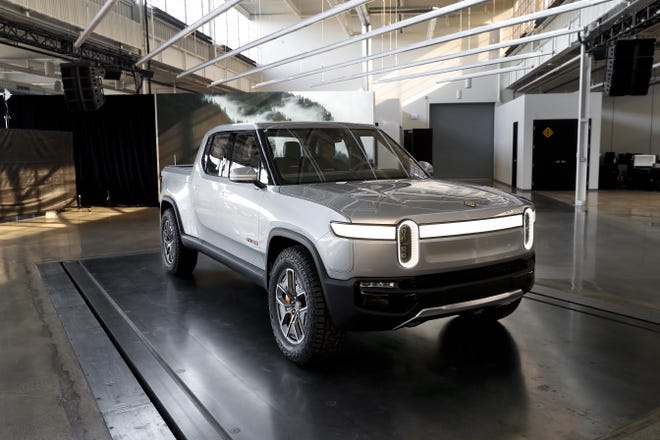
Like Hummer, the Rivian can perform a handling trick of its own. With its quad motors spinning left and right-side wheels simultaneously in opposite directions, the R1T can rotate in place. Rivian calls the feature “Tank Turn.”
Bollinger B2
Due in: late 2021 as a 2022 model
Deposit: $1000, https://bollingermotors.com/reserve/
Service: Independent dealers
Price: $125,000
Horsepower: 614
0-60 mph: 4.5 seconds
Towing: 7,500 pounds
Battery size: 142 kWh
Range: 200
Bollinger offers simple design and maximum storage. Designed for heavy lifting on founder Robert Bollinger’s New York farm, the B2’s pass-through interior can handle cargo up to 16-feet long stretching from front-to-rear bumper. With 15 inches of ground clearance, the truck can be raised or lowered another 5 inches.

Optimized as a work truck, the B2 has 8 electrical outlets for power tools. You can attach a plow to it.
Lordstown Endurance
Due in: late 2020 as 2021 model
Deposit: $100, https://lordstownmotors.com/25432293427/checkouts/ec7424381b59819074b0fe5a51979e77
Service: TBD
Price: $52,500
Horsepower: 600
0-60 mph: NA
Towing: 7,500 pounds
Battery size: 180 kWh
Range: 250-plus
Of the five trucks, the least is known about the Endurance to be built in GM’s old Lordstown Assembly site. But it is unique in that it features four hub-mounted electric motors for better vehicle control. Lordstown sales are focused on commercial fleets, so it appears determined to deliver an affordable truck — as opposed to competitors that are all starting production with high-end, $100,000-plus vehicles. That means it likely will have fewer gee-whiz features.
Payne: Five cool things to know about GM’s Hummer EV
Posted by Talbot Payne on October 20, 2020
True to its military roots, the GMC Hummer EV is big, brawny and blingtastic. And now it’s electric.
The gas-guzzling celebrity toy has transformed into an electron-guzzling celebrity toy. The $112,595, three-electric motor “Edition 1” launch model (the base model starts at $80k) will roll off the line in late 2021 on massive, 35-inch off-road tires — loaded to its removable roof with the latest in automotive technology. Promising “zero limits” performance to go with its “zero-emissions” drive-train, General Motors Co.’s Hummer hopes to be as fashionably athletic as its new spokesman, LeBron James.
In an indication of Hummer’s performance ambitions, GMC pirated long-time Camaro chief engineer Al Oppenheiser to create the OMG EV. “It’s an absolute off-road beast with a unique e4WD drive system that provides maneuverability unlike anything GM has ever offered,” said the muscle car veteran.

Here are five cool things to look for:
Crab mode
With four-wheel steering, the Hummer will have the ability to move like a crab. That is, diagonally, in order to get in and out of tight spots off-road. Officially dubbed “CrabWalk,” the system steers the front and rear wheels at parallel angles at low speeds, enabling sideways movement. With its underbelly armored with skid plates, the Hummer is designed for harsh terrain like its Army Humvee predecessors.
Power
Perched high off the ground with four-wheel drive and enough Ultium batteries to take it 350 miles off the grid, the Hummer is a monster. But with three electric motors making 1,000 horsepower (a number usually associated with hyper-sports cars like the Aston Martin Valhalla), the silent rhino will hustle from 0-60 in a neck-snapping 3.0 seconds. Compare that to Tesla ‘s upcoming, 1,100-horse Model S Plaid trim that promises a run to 60 in 2 seconds.
Star view
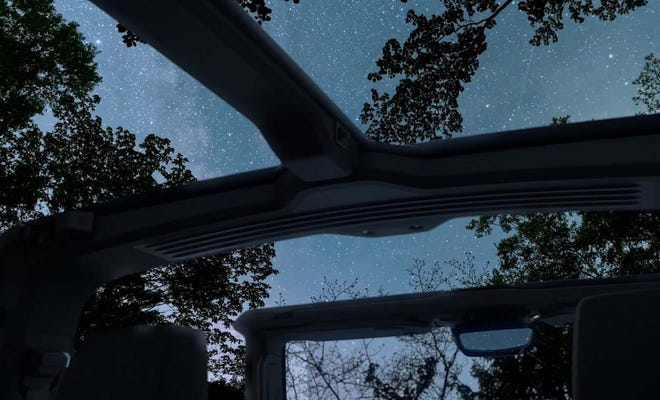
Like a Jeep Wrangler, the Hummer wants to put its passengers closer to nature. The big pickup’s roof panels come off (including a front compartment T-bar) to offer an unobstructed view of the sky. Unlike the Wrangler, the Hummer’s doors are frameless, meaning the view won’t be obstructed by door frames. Where to store the panels? GMC has made room in the front trunk — or frunk, as it’s called. Ditching a gas engine for batteries stashed in its belly, Hummer now has plenty of storage under the hood.
Unreal engine
Epic Games’ famous, 3D Unreal Engine rendering software dovetails nicely with Hummer’s no-gas engine theme, and with the new generation of millennial buyers that Hummer hopes to appeal to. Unreal Engine is legendary in the gaming space as the 3D rendition software behind Epic Games’ PlayStation and PC hits like Fortnite. The Hummer team used the software for stunning 3D images that can be displayed in the truck’s 13.4-inch console screen. The digital generation can gaze on a big, 12.3-inch display behind the steering wheel as well.

The 3D look leads a bevy of high-tech features including 18 camera views (including under the belly), high-speed charging and Super Cruise — GM’s acclaimed, self-driving system heretofore only found on Cadillac.
eLuxury
Pickups are the new luxury class, and Hummer is marinated in style. The bed can be covered by an automatic tonneau cover. The rear window will automatically roll down as well. This being a GMC pickup, the Hummer will also come with a MultiPro tailgate which can be configured six ways including as stairs into the bed or as an architect’s table. Like its sibling GMC Yukon SUV, Hummer will feature air suspension so the truck can be raised or lowered 6 inches for better access — or off-road clearance.
All these features are wrapped in a familiar Hummer look. The truck is designed with signature square wheel arches, c-pillar sail and high side sills topped by a narrow greenhouse. Like Hummers of yore, the truck features a tall front grille for extreme off-road approach angles — but with a twist.
As an EV, the signature six-slot grille will light up with the Hummer, since the grille is no longer needed to feed air to the gas engine behind. The Hummer EV comes a long way from the crude Hummer that AMG launched into the market with the urging of celebrity actor Arnold Schwarzenegger in 1992. That diesel-powered animal was a Humvee military vehicle with lipstick.
The new Hummer EV sits on an all-new electric platform with a 21st-century interior. GMC is hoping buyers will ride it into the future.
How Hummer fell from the heights of notoriety — and was reborn
Posted by Talbot Payne on October 15, 2020
Gulf War military transport vehicle. Celebrity fashion-statement. Great Recession symbol of excess. For three decades, the hulking Hummer SUV has been one of the most notorious vehicles on the planet.
When the all-new re-branded GMC Hummer EV is introduced Oct. 20 with LeBron James as spokesman, the giant SUV will begin a new chapter in Hummer lore as a more earth-friendly vehicle that’s powered by electricity.

Seventeen years ago, James — then a high school senior phenom in Akron — drove to school in his new 2003 Hummer H2. The bling-tastic, gas-guzzling $50,000 Hummer equipped with a custom sound system, three TVs and a video game console drew the attention of the Ohio High School Athletic Association, which wanted to know where the money came from.
Today, the reborn Hummer EV fits Hollywood celebrity LeBron’s green lifestyle.
Buzz — whether good or bad — has always followed the Hummer.

Originally manufactured by American Motors’ AM General subsidiary in 1981, the High Mobility Multipurpose Wheeled Vehicle became the U.S. military’s mainstay transport vehicle. GIs quickly gave it the nickname of Humvee or Hummer. In 1990, the Hummer became synonymous with the divisive Persian Gulf War as the U.S. led an international coalition of forces into battle to reverse the Iraq invasion of Kuwait.
Operation Desert Storm — or the “Videogame War,” as some called it — made the Hummer a TV star as Americans followed the action from their living rooms. While high-tech stealth fighters ruled the skies, Humvees were ubiquitous on the ground, carrying troops across the desert warscape.
Hollywood took notice. While filming “Kindergarten Cop” in Oregon, actor and former body-builder Arnold Schwarzenegger spotted a convoy of 50 Humvees on their way to a nearby military base. He was smitten.

“He just went ape for that machine,” his agent, Lou Pitts, said in Schwarzenegger’s unauthorized biography. “I mean, it was big, it was unique, and it was something that was larger than him.”
Schwarzenegger wanted a military Humvee for the street, complete with camouflage paint and a gun turret. AM General balked. But after flying to South Bend, Indiana, to meet with company executives (and signing a lengthy liability waiver), the Terminator got his way. Schwarzenegger had the hulking vehicle customized in Michigan to make it Los Angeles street-worthy.
Schwarzenegger, then at his peak as America’s action hero, saw a business opportunity. He lobbied AM General to make its war hero available to the general public.
The AMG Hummer was introduced to the civilian market in 1992. It dwarfed anything on the road.

Upgraded slightly from the spartan military original, the Hummer came in eight colors. The interior was dressed with carpet, stereo and cloth or vinyl seats. Options were few.
Its diesel V-8 guzzled 10 mpg, but given its military heritage, it had capabilities to die for in disaster-prone California with its fires, mudslides and earthquakes. The all-wheel-drive beast had an insane, 72-degree approach angle and could run on four flat tires. It came with a built-in air compressor to inflate or deflate the tires while moving.
Most buyers just drove it on the boulevard, reveling in all the attention.
Sales started slowly for the $65,000-$90,000 truck. But its profile grew as it was embraced by celebrities. Roseanne Barr got one. Mike Tyson bought six. Owners included CNN boss Ted Turner, talk show host Montel Williams, tennis star Andre Agassi, novelist Tom Clancy, Dennis Rodman and a squad of other NBA stars.
By the time LeBron James got his as a teenage basketball star, the Hummer had become a macho status symbol.

Credit that in part to General Motors, which bought the brand in 1999 and turned it over to its corporate marketing machine. GM called its Hummer flagship the H1 and launched a brand lineup: The smaller H2, built on the Chevy Tahoe chassis, rolled out in 2003 with a 6.0-liter V-8. The “entry-level” H3 arrived in 2006; it shared the Chevy Colorado’s pickup frame.
Sales soared and the Hummer display at the Detroit auto show became a must-see. Kids climbed over the civilian weapons like jungle gyms. But trouble was stirring on the battlefields of the military and of the American public.
The second Iraq Gulf War in 2003 showed the HMMWV vulnerable to guerrilla warfare. Hummers were no match for so-called improvised explosive devices, or IEDs. Scrambling to protect themselves, GIs welded on their own improvised steel armor. The military began development on a less vulnerable Humvee replacement.
Celebrity trends started to shift under the production Hummer, too. At the tail end of his acting career, Terminator Schwarzenegger became Gov. Schwarzenegger who represented a green California electorate that was more interested in Toyota Prius hybrids.
The Governator converted three of his four Hummers to alternative fuels: vegetable oil, biodiesel and hydrogen.
Celebrities were also mobilizing against the war as the George W. Bush administration pushed for regime change in post-9/11 Iraq. The “What Would Jesus Drive?” movement descended on the Detroit auto show and demanded an end to SUVs. The Hummer lineup was in their crosshairs.
“The symbolism of these impractical machines’ military roots is too delicious to ignore,” scolded media mogul Arianna Huffington. “We go to war to protect our supply of cheap oil in vehicles that would be prohibitively expensive to operate without it. Maybe the next model, the H3, will need to be connected to an intravenous gas-pump hose all the time.”
By 2006, the Hummer brand was at its apex. It was exported to 33 foreign countries with global sales of 71,000.
Then came higher gas prices and the Great Recession of 2008.

Sales dropped by half. Staggering toward bankruptcy, GM stopped production in 2010. A proposed sale to a Chinese firm tanked, and the Hummer brand was shelved.
In a prescient 2010 statement, Schwarzenegger said he believed “the Hummer is a great vehicle that needs to be reintroduced with a more green engine like electric or biodiesel.”
The Hummer, in fact, will be reborn as an electric vehicle under the GMC brand. Both SUV and pickups will be offered for the 2022 model year. A long way from stripped-down military efficiency, the new Hummer EVs will have luxurious interiors with state-of-the-art infotainment screens and will be controlled by the first application of Epic Games’ Unreal Engine Human-Machine Interface — the 3D rendering software coveted by the gaming world.
Estimated to start around $70,000, the Hummer EV’s top trim is expected to boast 1,000 horsepower, a 3-second zero-60 acceleration time, and a sideways crab-walking mode that likely will be used more often to get out of a tight spot in a parking lot than avoid an off-road boulder.
Still big. Still premium. Still a celebrity toy. At least until the next controversy comes along.
Payne review: Re-imagined Chevy Trailblazer takes on class-king Mazda CX-30
Posted by Talbot Payne on October 15, 2020
The Chevrolet Blazer has been roasted in … well, a blaze of criticism for not being like the new Ford Bronco. Unlike the wildly anticipated Ford, the mid-size Chevy isn’t sparking passion because it has forsaken its roots as a rugged truck-based SUV.
Its sibling — the subcompact 2021 Chevy Trailblazer — is feeling the heat, too. The original 1999 Trailblazer was a premium trim of the Blazer. “We want our old ladder-frame, rugged Trailblazer back,” cries the internet peanut gallery.
“Chevy just ruined the Trailblazer name, too,” huffs Top Speed.
“The 2021 Chevy Trailblazer is a total letdown,” stomps Motor Biscuit.
“The Trailblazer nameplate has been used on a unibody crossover instead of a body-on-frame off-roader as it was in its previous iteration,” moans CarBuzz.
I get it. The new Trailblazer is different. Peter Gabriel left Genesis to go solo and who the heck is this Phil Collins guy? Kirstie Alley followed Shelley Long and now “Cheers” is ruined! Drew Carey replaced Bob Barker?
To be honest, I know as much about those cultural earthquakes as I do the old Trailblazer. Which is to say, very little. I never drove one.
So instead of comparing “Trailblazer: The Sequel” to the original, I’m going to compare it to its current competitive set. Namely the Mazda CX-30, the best subcompact crossover I’ve driven.
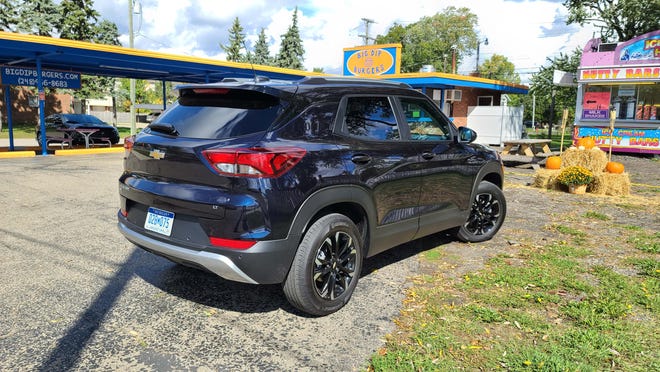
Because that’s what the Chevy Trailblazer is now: A smaller SUV squeezed between the entry-level Trax and the compact Equinox. With its stylish design and high-tech interior, it’s supposed to whet your thirst for the Blazer, should you covet a $40,000 mid-size ute.
The Trailblazer makes a very compelling case for itself. Indeed, along with the CX-30, my fellow jurors voted the Trailblazer a semifinalist for 2021 North American Utility of the Year.
Consider the high-volume LT trim I’ve been flogging. At $28,180, the all-wheel drive Trailblazer comes nicely equipped, just like the comparable, all-wheel drive $29,195 Mazda CX-30 Premium trim. That’s not something I’m used to.
Starting with the Chevy Traverse I tested back in 2017, the current generation of Chevy sport utilities has been stingy with standard safety features. Features like adaptive cruise-control aren’t standard on a Traverse until you reach the $55,590 High Country trim. Japanese manufacturers like Mazda, Subaru and Honda, on the other hand, have loaded their cars with standard cruise-control, automatic headlights, blind-spot assist and more.
So essential have these features become that Mrs. Payne won’t consider a vehicle unless it has adaptive cruise and all-wheel drive for under $30,000.
Trailblazer has learned the lesson.
While not offering adaptive cruise or blind-spot assist standard (both come standard on the Mazda Preferred trim, and all Japanese/Korean competitors offer at least one of the two standard), the LT offers these important features for just $620 and $345 respectively. That’s an affordable complement to standard goodies like lane-keep assist, automatic emergency-braking, automatic high-beams, Apple CarPlay/Android Auto connectivity and 4G Wi-Fi. Cruising along busy eight-lane I-96, these features quickly become essential to navigate traffic.
Chevy executes handsome interiors with technology shared across model lines as diverse as Cadillac and Corvette.
While I’m drawn to the Mazda’s premium interior with its high infotainment screen and remote rotary-controller, the Chevy’s touchscreen is much more intuitive. Menus are easier to navigate; radio stations easier to store. The attention to detail in both cars belies their subcompact status.
On the outside, I’ve never been a fan of Chevy’s too-busy split-grille fascias. But the Trailblazer (along with big brother Blazer) is one of the brand’s more coherent creations. Maybe because Trailblazer is starting to look a lot like Hyundais, which have developed along similar lines with their mid-fascia headlights (upper “eyebrow” lights are running lights). Check out the new Hyundai Venue. Separated at birth.
Upper trims of the Trailblazer get nifty touches like a white Mini Cooper-esque roof (so does Hyundai). But my LT and its sporty, 17-inch wheels looked great.
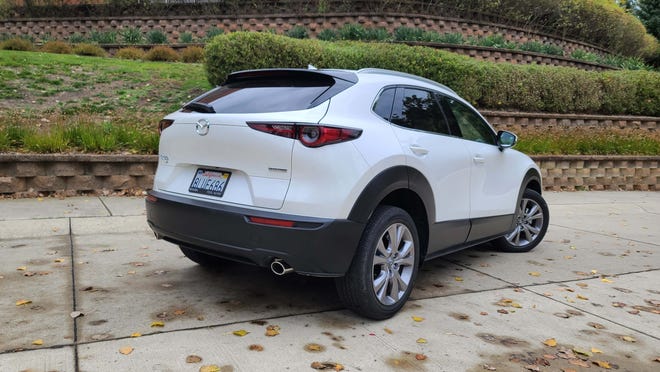
That said, the Mazda CX-30 is still prom queen with its long nose, swept headlights and elegant lines. Even the overwrought fender cladding (SUV virtue-signaling) didn’t spoil my white tester with its gray 18-inch wheels.
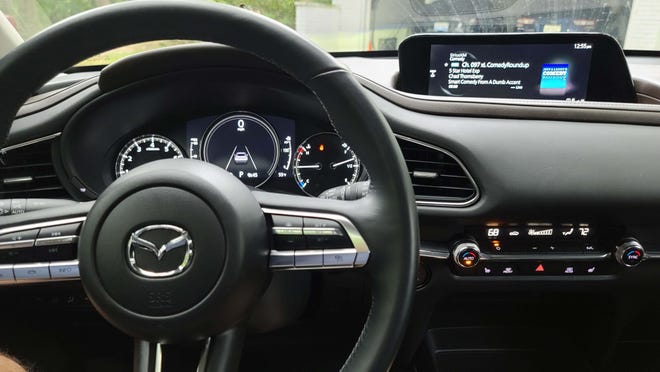
Mazda has also been cream of class in handling; I flogged it with the confidence only a BMW X1 can rival. But GM engineers have developed a disciplined cross-brand culture of tight, lightweight chassis from the best-in-luxe Cadillac CT4 to the lightweight Chevy Silverado to the nimble Equinox.
Trailblazer is no different, and it proved fun to drive as I lake-hopped across Oakland County from Loon to Wolverine to Orchard Lake.
The Chevy’s 155-horse 1.3-liter turbo-3 banger (exclusive with all-wheel drive) can’t rival the Mazda’s 186-horse mill, but the 174 pound-feet of torque (versus CX-30’s 186) is the real value here and pulls like a mule at low revs where you want it. Both engines are attached to buttery transmissions – 6-speed Mazda, 9-speed Chevy.
Loading more bling to go with its zing, my $29,195 CX-30 had a panoramic roof and leatherette seats that the Trailblazer can only dream of. Plus, the Mazda has the best 360-degree safety system (so you can monitor other cars around you) this side of Tesla.
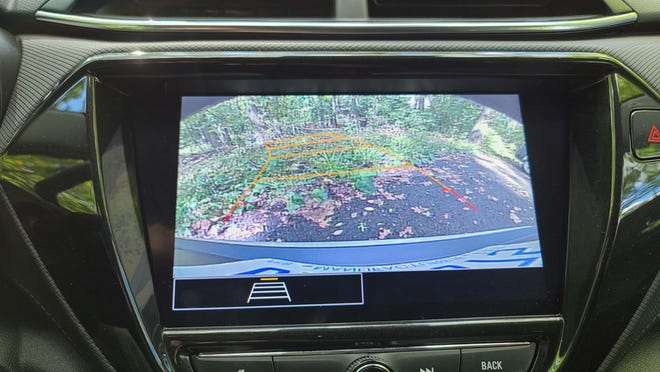
Trailblazer counters with impressive creature-comforts. After all, SUVs are bought for utility first, driving dynamics second. Trailblazer shares with siblings Trax and Buick Encore one of my favorite interior tricks – the fold-flat front seat. This ingenious tool (when combined with flattened middle-row seats) not only allows the wee Trailblazer to carry long toboggans or surfboards from hatch to glovebox — it’s also is an instant ottoman should you require the rear seat to get work done on a trip.
With three more inches of rear legroom — and 10 more cubic feet of rear cargo — the Chevy is much more accommodating of your friends when you ask them along for some trailblazing.
Speaking of trailblazing, it’s also worth noting how difficult the Trailblazer makes its for the brand’s electric ambitions: For a significant $10,000-plus less, the Trailblazer has 137 more miles of range than an equivalent $39,790 Chevy Bolt EV (396 vs. 259), more cargo room and all-wheel drive for Michigan’s’ long winters.
Nostalgia for old autos is natural. But when compared to the best the current market has to offer in subcompact SUVs and EVs, Trailblazer is a worthy sequel.
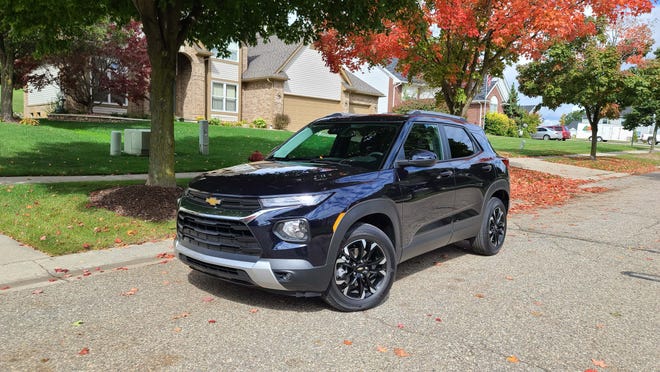
2021 Chevrolet Trailblazer
Vehicle type: Front- or all-wheel drive five-passenger subcompact SUV
Price: $19,995, including $995 destination charge ($28,185 AWD LT as tested)
Powerplant: 1.2-liter turbocharged 3-cylinder; 1.3-liter turbocharged 3-cylinder
Power: 137 horsepower, 162 pound-feet of torque (1.2-liter); 155 horsepower, 174 pound-feet of torque (1.3-liter)
Transmission: Continuously variable transmission; 9-speed automatic
Performance: 0-60 mph, 9.4 seconds (Car and Driver); towing capacity, 1,000 pounds
Weight: 3,252 pounds (as tested)
Fuel economy: EPA 26 mpg city/30 highway/28 combined (as tested)
Report card
Highs: AWD option; good interior room
Lows: Good value, but still lacks standard options offered in competitors
Overall: 4 stars
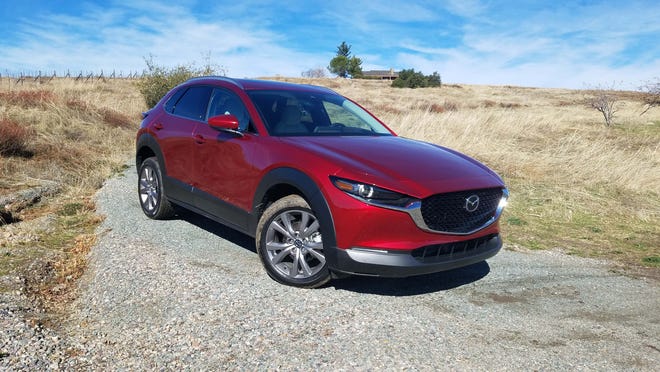
2020 Mazda CX-30
Vehicle type: Front- and all-wheel drive, 5-passenger subcompact SUV
Price: $23,000 including $1,100 destination charge ($29,195 AWD Premium as tested)
Powerplant: 2.5-liter inline 4-cylinder
Power: 186 horsepower, 186 pound-feet torque
Transmission: 6-speed automatic
Performance: 0-60 mph, 7.2 seconds (Car and Driver est.); towing capacity, 1,500 pounds
Weight: 3,388 pounds (as tested)
Fuel economy: EPA est. 24 city/31 highway/26 combined (as tested)
Report card
Highs: Sharp handling; premium looks
Lows: Heavy black cladding; tight rear legroom
Overall: 4 stars
Hyundai green-lights development of a ‘walking car’ with 4 dog-like legs
Posted by Talbot Payne on October 12, 2020
Rugged Jeeps and pickups can explore the great outdoors. But for those who want vehicles to travel further into unnavigable terrain, Hyundai is working on what it calls a “Transformer-class vehicle” right out of a science-fiction film.
The Korean automaker has formed an Ultimate Mobility Vehicles Studio in Silicon Valley to develop its so-called “walking car,” It’s based on the Elevate concept vehicle that wowed visitors to the 2019 CES technology show in Las Vegas.
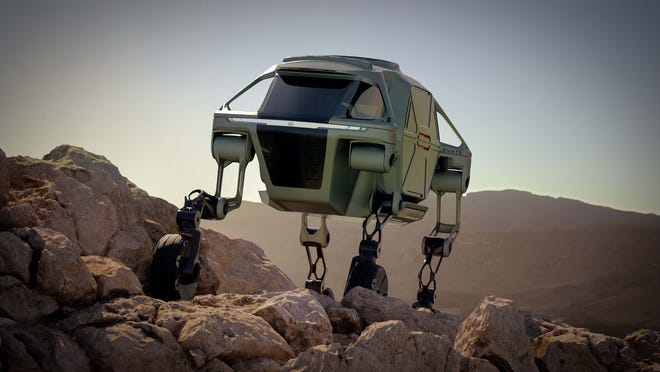
Envisioned initially as a vehicle to assist first-responders to reach remote disaster zones, the walking car will also be explored by Hyundai’s team for its potential in consumer and industrial uses.
In addition to rescue duty for earthquakes and other natural disasters, the Elevate vehicle could be used to satisfying individual wanderlust and help transport the disabled by, for example, walking up to their front door, leveling itself, and rolling in wheelchairs.
The Elevate looks like a giant robotic dog featuring leg joints for articulation over extreme terrain. Wheel are attached to the feet so it can roll as well.

The design, says Hyundai, allows the machine to walk with mammalian or reptilian gaits, while also allowing it to move in any direction.
The walking car can traverse uneven terrain, climb a 5-foot wall, step over a 5-foot gap, and spread its legs to a 15-foot wide track width – all while keeping its main cabin (and passengers) level. A combination of wheels and articulated legs enables faster walking speeds.

When not in the field, the ultimate mobility vehicle can drive on-road by folding its legs into stowed-drive mode. The battery-powered Elevate cuts power to the joints to allow travel at highway speeds like any other vehicle.
The Hyundai team not only shows off the Korean firm’s expansive view of the mobility future (it is also researching a flying car and drones), but also demonstrates the auto industry’s integration with Silicon Valley and Detroit at a time of intense technological change.
The New Horizons Studio is led by Hyundai Vice President John Suh, a 35-year veteran of investment in automotive and emerging tech, including positions at General Motors, Stanford University and the Palo Alto Research Center. He is a founding director of Hyundai Cradle, a California venture firm that invests in pioneering mobility projects.
The concept was designed in Metro Detroit by Walled Lake-based Sundberg-Ferar, a leader in transportation design. Sundberg-Ferar is no strange to Silicon Valley, having designed the region’s BART system trains.
“By combining the power of robotics with Hyundai’s latest EV technology, Elevate has the ability to redefine our perception of vehicular freedom,” said Sundberg-Ferar design chief David Byron. “Imagine a car stranded in a snow ditch just 10 feet off the highway being able to walk or climb over the treacherous terrain, back to the road potentially saving its injured passengers – this is the future of vehicular mobility.”
Hyundai isn’t the only auto manufacturer working on so-called “white-space development” beyond traditional cars. Toyota is developing a hydrogen-powered lunar rover and Honda has developed an innovative business jet airplane. Multiple companies are investing heavily in the future of autonomous vehicles.
“This is in the Hyundai culture. It is a manufacturing company that is always looking at building engineering solutions,” said Hyundai spokesman Miles Johnson. “It’s an ecosystem where we’re looking at everything from robotics to scooters.”
Payne: Room or vroom? Entry-level Mercedes GLB crossover vs. CLA sedan
Posted by Talbot Payne on October 12, 2020
The Mercedes GLB and CLA may sound like they come from the same family. But they are as different as Hansel and Gretel.
The GLB crossover and CLA sedan occupy the same entry-level compact segment. Both offer front- or all-wheel drive. Both feature the same state-of-the-art self-driving system. Yet Mercedes-Benz sees SUV and sedan buyers as entirely different people.
So it has given the entry-level vehicles two entirely different personalities.
Like siblings that take after mom or dad, the GLB gets its DNA from Papa G-wagon — Mercedes’ top-of-the-line SUV patriarch. The comely CLA learned its lessons from the top-dog S-class coupe.

GLB is square and chunky like the off-roady G-wagon, its giant greenhouse giving excellent 360-degree visibility and comfortable rear seating for your giraffe-legged reviewer. I could easily sit behind myself in the GLB with headroom to spare.
Elsewhere in its SUV lineup, Mercedes has been pushing the envelope trying to make its SUVs look more sedan-like with racy “coupe” designs on the GLC and GLE. Well, the GLB won’t be turning any heads.
The little Mercedes takes its design cues from a shoebox. This sport utility is all about utility.
Strangely, my GLB 250 came equipped with paddle shifters, which were as useful as tennis shoes on a fish. The GLB is not a vehicle you want to row hard. Its 2.0-liter turbo-4 has enough pep to get around town, but the turbo lags and the car’s top-heavy appearance (all that greenhouse glass!) translates to healthy body roll in the twisties.
Homely it may be, but you can throw everything and the kitchen sink inside its big square hatchback — and the GLB middle seats fold flat for easy loading. Its wheelbase stretches a healthy four inches beyond the CLA. Got more stuff? Load it on the roof rails.

If you want a stylish Mercedes, forget the GLA and check out runway model CLA.
With is long shark nose and swept lines, the sedan will get entry-level buyers’ attention. Papa S-class would be proud. Interestingly, the GLB is adorned with jewelry — chrome exhaust valance here, a dab of rocker-panel chrome there — in order to let you know the shoebox is a Mercedes.
The gorgeous CLA doesn’t need superfluous jewelry. Its lean body is visual enough. It’s even prettier than CLA’s first-gen car which I swooned over in 2015, especially in the rear quarters which drooped in the 2014 model like it had been held too close to a flame. The 2020 version sports a firmer derriere.
That’s important because the CLA is a companion sedan with the Mercedes A-class. Like the S-class and its S-class Coupe stablemate, Mercedes offers entry-level sedan buyers two body styles. Though the CLA has four doors, its raked roofline echoes that of the two-door, S-class coupe.
The A-class is attractive to look at — but for a couple grand more, you can score a date with the homecoming queen.

Speaking of a couple grand more, I would recommend upgrading to the CLA’s AMG performance trim.
Like the GLB, the standard 221-horsepower 2.0-liter turbo-4 in the CLA feels a bit uninterested. The AMG 35 trim gains 81 ponies and a taut all-wheel-drive suspension.
Luffing along state Route 250 in Ohio, a serious-looking 232-horse Mazda RX8 suddenly loomed in my mirrors. I toggled into the AMG 35’s exclusive Sport Plus mode, tightening the suspension and steering. The engine lowered an octave as if clearing its throat.
With a flick of the shift paddle (useful in the CLA as opposed to the GLB) I dropped the transmission a gear, then floored it. Blatt! Blatt! went the lightning-quick upshifts as I sped through a pair of ess curves, the chassis solid as a rock.

Exploding out of the last corner, I glanced in the rear-view mirror for my RX8 friend. He was barely in sight, struggling to keep up.
If anyone challenges you at a stoplight, the AMG’s launch control is also useful. Floor the brake. Bury the throttle. Wait for the revs to level at 3,000 rpms. Lift brake. Zot!
As different as the SUV and sedan look outside, the cockpits are similar. Both come with a standard 7-inch gauge cluster. Upgrade to a 10.25-inch cluster like my testers and you get one of the industry’s best digital experiences. Where Tesla has inspired a generation of cars with big center screens, Mercedes has innovated the horizontal dash screen, stretching from the driver’s instrument panels across the console.
Note the Kia K5, Hyundai Sonata and 2021 Cadillac Escalade as disciples of Merc’s design lead. Managing the wealth of information on these graphically rich screens is a beautifully engineered steering wheel. Without removing my hands from it, I used tiny mouse pads on the spokes to negotiate between menus.

There’s self-driving capability, too, for the ambitious. Mercedes’ system is reliable on a divided interstate, even changing lanes automatically when you pull the turn-signal stalk. Unfortunately, the voice-recognition system struggled with my navigation commands, whereas the available Android Auto (ahem, Mercedes, if Kia can do wireless Android Auto, why can’t you?) responded perfectly as always.
I continue to use phone apps for my in-car navigation.
The Mercedes’ consoles provide useful storage space for phone and water bottles — but could be even more useful were it not for the giant touchpad that occupies valuable console real estate and proved clumsy to operate. I didn’t use it.
Perhaps my favorite ergonomic feature on the Mercedes is the location of the engine stop-start button — the most annoying feature in autos today — right next to the ignition button. Turn on the ignition key — and turn off the stop-start button in one motion. Thanks, Mercedes!
Aft of the front thrones, the two vehicles change significantly. The CLA sedan gets cramped, the coupe roofline bearing down on my noggin while I have to splay my long legs to sit behind myself.
So different are GLB and CLA that Merc fanatics might consider buying both for the garage. One for daily chores, one for weekend getaways. One for Hansel, one for Gretel.
Next week: 2021 Chevrolet Trailblazer

2020 Mercedes-Benz CLA
Vehicle type: Front- or all-wheel-drive five-passenger compact sedan
Price: $37,645, including $995 destination charge ($66,340 AWD AMG CLA35 as tested)
Powerplant: 2.0-liter inline turbo-4
Power: 221 horsepower, 258 pound-feet of torque; 302 horsepower, 295 pound-feet of torque (in CLA35 as tested)
Transmission: 7-speed automatic
Performance: 0-60 mph, 4.8 seconds (mfr.); top speed, 155 mph
Weight: 3,505 pounds
Fuel economy: EPA 23 mpg city/29 highway/25 combined (as tested)
Report card
Highs: Sexy bod; sporty AMG dynamics
Lows: Useless touch pad; cramped rear seat
Overall: 4 stars

2020 Mercedes GLB
Vehicle type: Front- or all-wheel drive five-passenger compact SUV
Price: $37,595, including $995 destination charge ($55,340 AWD GLB 250 as tested)
Powerplant: 2.0-liter inline turbo-4
Power: 221 horsepower, 258 pound-feet of torque
Transmission: 8-speed automatic
Performance: 0-60 mph, 6.9 seconds (mfr.); top speed, 130 mph
Weight: 3,891 pounds
Fuel economy: EPA 23 mpg city/31 highway/26 combined
Report card
Highs: Roomy interior; state-of-the-art electronics
Lows: Boxy exterior; sleepy turbo-4
Overall: 3 stars
Debut: Honda Ridgeline pickup gets macho makeover for 2021
Posted by Talbot Payne on October 12, 2020
Honda’s midsize truck is getting truckier.
The only pickup on the market that is built on a unibody SUV platform, the latest generation of the Ridgeline has boasted superior ride dynamics and interior room since Honda left behind the traditional ladder-style truck frame for 2017. But it has suffered under the perception that it’s soft against trucks built on traditional frames. Meanwhile, the midsize pickup segment has gotten more crowded with new entries from Ford Ranger and Jeep Gladiator in the last two years.

So Ridgeline has hit the gym for a new more-toned look. The 2021 pickup sports a more aggressive, upright truck grille. The larger opening is crisscrossed with rugged latticework while a more muscular “power bulge” hood looms above it. Bodywork has been totally remade from the A-pillar forward.
A prominent skid plate, heavily clad fender wells and a dual exhaust emphasize Ridgeline’s tough new look. Want more bling? A new Honda Performance Development option adds a unique grille treatment, black fender flares and bronze-colored wheels.

“Truck enthusiasts have long recognized Ridgeline as an incredibly versatile and capable pickup, and now it’s got the rugged looks to match,” said Art St. Cyr, Honda North American vice president of auto operations.
Truck guys like what they see.
“The 2021 truck adds a much-needed dose of macho style with the new front and dual exhaust,” said Andrew Smirnov of The Fast LaneTruck, the online truck review site. TFL Truck baselines all trucks with extensive testing.
The styling backs up the Ridgeline’s sophisticated, torque-vectoring all-wheel-drive system and versatile bed which includes a 7.3-cubic foot trunk underneath and a versatile dual-action tailgate that can both drop and swing like a door. Ram only this year added a similar option to its full-size truck.
But truckers question whether the beefier styling will be enough to expand beyond Ridgeline’s niche as a smooth-riding city truck.

TFL Truck publisher Roman Mica said that he was surprised Honda didn’t take the opportunity to release a rugged, jacked-up, more high-speed version of its pickup similar to what Chevy does with the Colorado ZR2 or that Jeep offers with the Gladiator Mojave. Honda — which competes in multiple forms of motorsports —has certainly earned that right by competing in the brutal Baja 1000. The Ridgeline won its class this year for the fourth time.
Mica said that the Ridgeline is the rare pickup that doesn’t offer a two-speed transfer case or significant departure/approach angles that can get a truck through Mother Nature’s most difficult terrain, even if most customers never push that envelope.
“Most buyers are looking for the truck they want, not the truck they need,” he said. “Most truck owners want to be prepared for the zombie apocalypse.”
Built in Alabama on the same bones as its mid-size Pilot SUV, Honda seems content with Ridgeline’s versatility as a daily driver. The more rugged looks should please the Honda faithful who have complained the Ridgeline looked more crossover than pickup. Honda sold 8,607 in the third quarter, up from 8,378 a year ago.
The Tacoma led the segment with over 58,000 in sales last quarter while the Gladiator made big gains with 22,163 (a 37% gain) and the Ranger sold 28,350 (up 8%).
Though its tow rating of 5,000 pounds trails segment competitors, the Ridgeline is no slouch in payload with best-in-class 1,580 pounds. The interior is what really separates it, thanks to the more flexible unibody frame and clever Honda console.
The console shares the Pilot SUV’s sliding door which opens cavernous storage room. The rear seats flip up allowing for rear storage for, for example, a bicycle.
A Car and Driver comparison test of the segment’s front-runners found the Ridgeline scored best-in-class cornering performance, rear-seat space and volume, lowest sound levels, and best in class safety features.
Those safety features include standard forward-collision warning, lane-keep assist and adaptive cruise-control.
The Ridgeline’s drivetrain remains the same for 2021 with a standard, 280-horsepower 3.5-liter V-6 mated to a 9-speed automatic transmission.
Tesla takes a more traditional route to its new Berlin plant
Posted by Talbot Payne on October 6, 2020
Since the introduction of its groundbreaking Model S sedan in 2012, Tesla has been about industry disruption.
Led by mercurial CEO Elon Musk, the Silicon Valley electric-car maker has taken a clean-sheet approach to everything automotive — from its spare interior designs to its “Ludicrous mode” acceleration to its over-the-air software updates.

But its attempt to remake auto manufacturing in 2018 nearly broke the company.
The year of what Musk called “production hell” at its Fremont, California, plant was a lesson in hubris as Tesla sought to meet demand for its mass-market Model 3 sedan. Vehicles came off the line with sunken hoods, detached bumpers and uneven panel gaps. Some were assembled in parking lot tents. Flawed paint jobs delayed the delivery of thousands of vehicles.
As Tesla embarks on its first major production facility in Europe — building the Model Y compact SUV in Berlin starting next year — experts say the company appears to be adopting traditional production methods and relying less on robots. And it is simplifying the vehicle’s structure.

“Tesla’s got an innovative culture,” said manufacturing expert Sandy Munro, president of Munro & Associates. He has been a vocal critic of Tesla production. “Sometimes, it gets it right. Sometimes, it gets it horribly wrong, as in the case of the (California) plant. So now we’ve got the German plant, and it seems to be learning from its mistakes.”
Riding current consumer and government trends toward electric vehicles, Tesla announced a record 139,300 deliveries in the third quarter, up 24% from its previous record set last December. All of those vehicles were built in California.
Tesla began production of cars in its new Shanghai plant late last year and plans to boost capacity of the plant from 200,000 to 250,000 by the end of the year.
With Asian sales suppressed by the coronavirus crisis, the China plant is at overcapacity, and the automaker is facing increased competition in the electric market in Europe from established carmakers.
Still, Tesla anticipates increased demand for its vehicles globally, with countries like France and England phasing out gas and engines over the next 20 years.
But Tesla’s quality has been an issue even as it has been an innovator in the design of electronics and body construction.
Its electronics and battery systems are “not a generation but generations beyond what any other manufacturer is doing,” said Munro, a 30-year veteran of auto manufacturing and one of the industry’s most respected consultants.
And the manufacturing process?
“It’s crap,” he said of Fremont assembly’s attempt to automate assembly three years ago. “It was a terrible, terrible philosophy. Unless you’ve designed your product so that a blind, one-armed idiot — a robot — can put it together.”

Convinced he could make what he termed “alien dreadnought” factories operated mostly by robots, Musk hired Audi executive and automation advocate Peter Hochholdinger in 2016. Tesla made a crucial mistake in automating the factory while the Model 3 was still in prototype development.
David Cole, a veteran analyst and chairman emeritus of Ann Arbor’s Center for Automotive Research, said most manufacturers don’t start production until they’ve finished development. “Tesla, on the other hand, would take prototype tooling into the production line to see what worked. They didn’t figure out their processes before they started volume production.”
For its Berlin plant, Tesla is once again promising transformative change.
But this time, the company is playing to its strengths by designing a simpler product that will then be assembled to German manufacturing standards: Tesla has managed to reduce its front and rear chassis compartments to two castings for the Model Y.
“The current version of Model Y has basically two big high-pressure diecast aluminum castings that are joined, and there’s still a bunch of other bits that are attached,” Musk said in an April podcast. “Later this year we’ll transition to the rear underbody being a single-piece casting that also integrates the rear crash rails.”
The castings essentially make up the front and rear compartments of the car — the rear cargo area and the front trunk where the engine would be located in a gas car.
The advantages of using a single-piece casting are many: It reduces production costs by using fewer parts, which means fewer supplier stampings as well as less labor.
Sam Abuelsamid, principal analyst for Guidehouse Insights, agrees the single castings are an interesting idea but that execution will be key.
“Precision on a part that large could be challenging,” he said, pointing out the difficulties of deformities, for example.
Such manufacturing advances in Tesla’s new Berlin and Chinese plants have industry analysts bullish on Tesla’s future.
“The key takeaway from Tesla’s September investors meeting is its focus from being not just a cutting-edge EV maker — but to also being on the cutting edge of manufacturing,” said iSeeCars executive analyst Karl Brauer. “That focus could translate into a corporate mindset that gives him a long-term competitive advantage over competitors.”
Musk isn’t the first auto executive to learn the lessons of technical overreach. General Motors made similar mistakes under the leadership of Roger Smith in the 1980s. Under pressure from Toyota, Smith envisioned a “lights out” car factory where efficient robots shouldered most work.
In their 1994 book, “Comeback,” authors Paul Ingrassia and Joe White cataloged Tesla-like scenes from GM’s Hamtramck plant: “Instead of easing robots onto the line a few at a time, providing for inevitable debugging problems with redundant equipment, GM bet the entire Hamtramck production system on the proposition that leading-edge automation would work instantaneously.”
Mused Munro: “I guess Elon had to learn his lesson just like Roger Smith.”
North American Car, Utility and Truck of the Year semifinalists named
Posted by Talbot Payne on October 1, 2020
Forget the presidential debate, let the wrangling over Vehicle of the Year commence.
The 2021 North American Car, Utility and Truck of the Year (NACTOY) Awards announced its 27 semifinalists Wednesday. The list includes eight sedans, 15 SUVs, and four trucks, and tells the tale of the Detroit Three’s move away from cars. One sedan is from Detroit, while five Motown SUVs make the list. All four truck candidates are from Detroit.


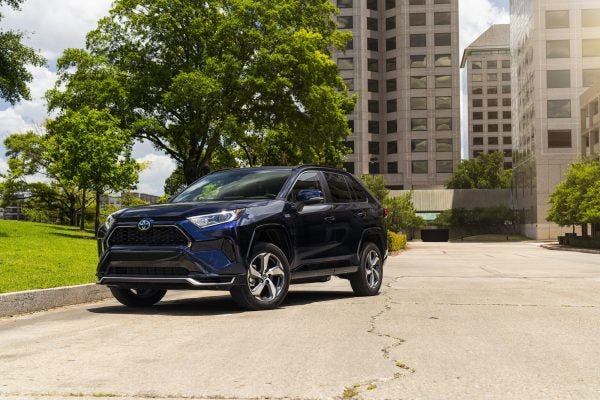


Contenders range from icons like the Cadillac Escalade and Ford F-150 to upstarts like the Ford Mustang Mach E, Ford’s first electric vehicle. Not only are the nominees dominated by utility vehicles, but they represent the most diversity of drivetrain offerings with everything from V-8 engines to gas-electric hybrids to full electric vehicles.
Early favorites are the Genesis G80 for Car of the Year, Ford Bronco Sport for SUV and Ford F-150 for best truck.
Significantly absent from the list is the Tesla Model Y, the American electric automaker’s latest SUV and the hottest selling SUV EV in the market. However, Tesla did not make its car available for jury testing.


A jury of 50 independent journalists whittled 46 new vehicles for the 2021 model year down to the semifinalist candidates. Each car will be fully vetted in the months ahead and finalists announced in December in Los Angeles. Winners will be announced in January during an event hosted by the North American International Auto Show in Detroit.
“The breadth of choices in the SUV category from style to powertrain is really impressive,” said NACTOY Secretary Gary Vasilash, an industry veteran who is editor-in-chief of AutoBeat. “You have everything from a $20,000 Kia Seltos to a $120,000 Escalade.”
The Escalade’s remake – which includes features like a 38-inch touchscreen – sits on top of the Chevy Silverado pickup truck platform that also supports 2021 Chevrolet contenders Tahoe and Suburban.
The full slate of nominees come despite a coronavirus-scarred year that saw auto sales crater in March and April as states shut down dealerships and national unemployment soared. Sales have since rebounded, but many product introductions were pushed back until later this year.
The Bronco Sport is an indication of the increased bandwidth of the SUV market. The so-called “baby Bronco” will have many of the rugged style attributes of the forthcoming Bronco (due in the middle of next year) which Ford has targeted at the Jeep Wrangler. Unlike the truck-chassis Bronco, however, the Bronco Sport will be on the same unibody platform as the Ford Escape. All three vehicles will be available to customers in the compact SUV segment – an unprecedented offering from the brand.

According to IHS Markit, SUVs made up 47.4% of US sales in 2019 with sedans dropping to just 22%. Taken together with pickup trucks – the most profitable vehicles in the Detroit Three lineup – SUVs and trucks now make up nearly 80% of US sales.
Nevertheless, 2021 NACTOY sedan nominees are some of the most stylish models ever conceived as automakers use their inherently sleeker shape and handling dynamics to sell to non-SUV customers. The Acura TLX marks a return to that brand’s sporty vibe. The gorgeous Kia K5 and Genesis G80 are statement cars from Korean automakers determined to go head-to-head with Japanese and European mainstays.
Vasilash is particularly fond of the $20,000 Nissan Sentra which offers upscale looks and a wealth of safety features like adaptive cruise-control and blind-spot assist not found on luxury cars costing thousands of dollars more.

All-new for 2020, the Nissan Sentra compact combines great looks with a more nimble, lowered chassis for just $25k in SR trim.

The 2020 Cadillac CT4-V is a new performance variant of the CT4 – which itself replaces the ATS sedan and debuts in the subcompact segment.


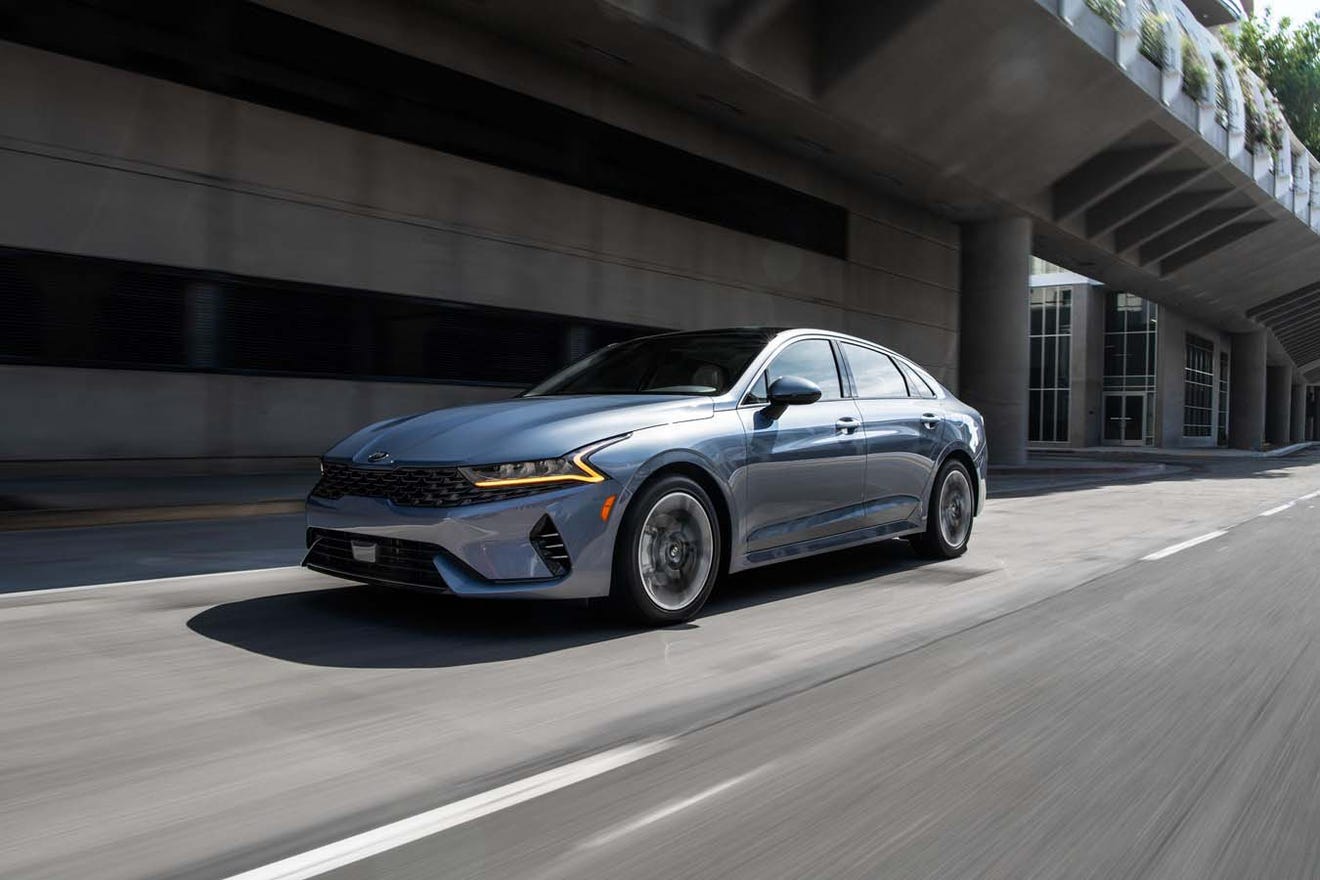


“It’s a car that regular people car afford to buy,” said Vasilash. “It’s significant because it is aimed at a customer that wants a vehicle with more style and dynamics than their neighbor’s SUV.”
The 2021 contenders also include a wealth of battery-powered vehicles as automakers try to replicate Tesla’s success in the market as well as meet California’s draconian sales goals. California’s governor has announced the state will prohibit the sale of new, gas-powered cars by 2035.
Models include the Polestar 2, the first sedan from Volvo’s electric car brand, as well as the Toyota RAV4 Prime, a gas-hybrid plugin variant of America’s’ best-selling SUV.
2021 NACTOY Semifinalists
Car of the Year
Acura TLX
Cadillac CT4/CT4-V
Genesis G80
Hyundai Elantra
Kia K5
Mercedes-Benz E Class Sedan, All-Terrain, Coupe, Cabriolet
Nissan Sentra
Polestar 2
Utility of the Year
Cadillac Escalade
Chevrolet Tahoe/Suburban
Chevrolet Trailblazer
Ford Bronco Sport
Ford Mustang Mach E
Genesis GV80
Hyundai Santa Fe
Kia Seltos
Kia Sorento
Land Rover Defender
Mazda CX-30
Nissan Rogue
Toyota RAV4 Prime
Toyota Venza
Volvo XC40 P8 Recharge
Truck of the Year
Ford Super Duty
Ford F-150
Ram 1500 TRX
Jeep Gladiator Mojave
Payne: In heritage white, ferocious Mustang Shelby GT350 takes its final bow
Posted by Talbot Payne on October 1, 2020

The Ford Mustang Shelby GT350 is not going out quietly.
The screaming 8,250-rpm, V-8 pony car rides into the sunset this fall wearing the historic Wimbledon White and Guardsman Blue stripe paint scheme of the original 1965 GT350 that tore up race tracks and made Mustang a legend 55 years ago. It marks the last batch of GT350s to roll off the Flat Rock assembly line since its 2016 debut.
You may have heard your windows rattle last week when I rode Mustang’s demon to Hell, Michigan’s challenging roads and back. With its high-pitched pterodactyl shriek, the 526-horse, 5.2-liter flat-plane crank V-8 — different than the low-pitch T. rex gurgle of Mustang’s traditional V-8 — has always stopped bystanders in their tracks.
Add its original paint scheme, and the last GT350 proves irresistible. It has always been so.

In 1965, Shelby race driver Ken Miles – immortalized in “Ford v. Ferrari” — won at Green Valley Raceway in Texas, establishing Mustang as a racing force. As the GT40 thrilled international crowds, GT350 made hearts race back home.
As the Mustang Mach E leads Ford into electrification, the sixth-generation muscle car shoulders a burden beyond its traditional role as America’s favorite sports car. Together with the Ford F-150 pickup and Bronco SUV, Mustang is now a key corporate pillar in Ford’s promise to deliver toughness, adventure and performance.

For the last five model years, the GT350 has defined performance.
With its daring 2015 Mustang redesign, Ford reestablished its pony at the head of the Detroit muscle car pack after years of trailing crosstown rival Camaro. Keen to rekindle its performance cred, too, Ford resurrected the Shelby GT350 for the first time since 1965. It led a stampede of speed including the Bullitt, GT500 and forthcoming Mach 1 models.

Given its ’60s heritage, there’s no doubt the GT350 is the brand halo. Like its 1965 forefather, its racing version — the GT350R-C — was an instant success on the race track, winning in its 2016 IMSA Daytona debut.
“Looking back on it, what Ford and Carroll Shelby created back in the mid-’60s was so important to Mustang,” said Mustang marketing boss Jim Owens. “The Shelby GT350 Heritage Edition vehicles are a meaningful tribute to the Shelby legacy.”
With its manual transmission, wicked Shelby Cobra badge and athleticism, GT350 embodies Mustang’s ethic: a wild stallion in a field of pure-bred horses.

I’ve driven more precise cars — Porsche, Corvette, Supra — over Hell’s undulating roads this year, but none made my hair stand on end like the Shelby. With 31 more horses than the mid-engine Corvette, the GT350 gulped real estate along Hadley Road. But with 317 cubic inches of V-8 up front, I always felt like I was hanging on to the great beast’s neck.
Boasting magnetic shocks and huge Michelin Pilot Sport Cup 2 gummies available on my GT350R tester, Ford engineers have worked miracles to strap the 3,700-pound ’Stang to the asphalt. But the naturally aspirated engine — rare in this turbocharged age — begs to be revved to 8 grand, where it hits a deafening 104 decibels (the dB race car limit at some race tracks, FYI). It’s the highest-horsepower, normally aspirated eight-cylinder Ford has ever crafted. It creates a deep bond between car and driver.

“We’re still deeply in love with the GT350R,” wrote Car and Driver magazine at its annual Lightning Lap competition at Virginia International Raceway in 2016. “We love that every time the throttle opens, it sounds as if a million tiny hammers were being fired into the exhaust.”
The 760-horse supercharged Mustang GT500 cyborg sibling may be faster, but GT350 is the class heartthrob.
Back off the throttle, and the V-8 pops and gurgles like it’s digesting a meal. Stab the throttle for a heel-and-toe downshift, and the Cobra seems to spit fire. During my time in Hell, I never turned on the radio. The engine is soundtrack enough.
But like the standard Mustang upon which it’s based, the GT350 is an easy daily driver. Dial back its Sport and Track modes (my preferred settings for Hellish delights) to Normal and it cruises along happily through Livingston County.

I gave it navigation instructions through the Android Auto app, tuned to my favorite comedy stations on Sirius XM, set cruise-control for town speed limits. These are alien concepts to the 1965 GT350 that spawned generations of enthusiasts six decades ago.
It’s a seductive package that’s been in demand for five years. In 2016 GT350 sold for $49,995 — my winged, more track-focused GT350R was $66,495. For 2020 those prices are $61,635 and $74,630, respectively. Demand has been through the roof.
Tack on an additional $1,965 for the Shelby Heritage Edition. It’s a small price to pay for history.
Payne: Rugged meets refined in Land Rover’s remade Defender
Posted by Talbot Payne on October 1, 2020

The Jeep light transport vehicle, General Dwight Eisenhower once said, was “one of three decisive weapons the U.S. had during World War II.”
Over 70 years later it inspires three of the most important SUVs in the U.S. auto market.
The Jeep Wrangler, Ford Bronco and today’s tester — the 2020 Land Rover Defender — all have their roots in the World War II Jeep. In an SUV-crazed market, their war-era history still resonates with customers. The Wrangler is the direct descendant of that Jeep. Ford also built Jeeps during the war, a legacy that ultimately inspired the Bronco.
And Land Rover? Its first model was built in 1948 on the Jeep warrior’s chassis.
Today, that vehicle has evolved into the Defender SUV. But while its sister Wrangler and Bronco are mainstream badges, the Defender is aimed at a higher demographic. It’s a Wrangler for the luxury class.
Like many Americans, I thought Land Rover was exotic even before I knew what it was. The “Series I” SUV (before marketing came to its senses and called it Defender) co-starred in the movie “Born Free” that I watched umpteen times as a kid. Rover’s occupants were beautiful people with English accents. Lions lounged on its roof. It drove across Kenyan grasslands. Cool.

By contrast, my first memories of Jeeps were windshieldless, machine-gun-toting Army vehicles. The Bronco? It won Baja 1000 races in the Mexican desert. Crazy, rugged stuff.
Turns out the modern variants pretty much follow the stereotypes. The Wrangler and Bronco can be stripped naked of their body panels for extreme off-roading. I’ve tested the Wrangler through the muck of Flint’s ORV park; rode shotgun as Bronco navigated the dirt and dust of Holly Oaks park. They feature articulated suspensions, so they can crawl over rocks at all kinds of weird angles. The Defender has none of these things. While plenty capable in the sticks, this is a more refined tree chewer.
So, naturally, I took it the grasslands of Kenya — er, Charlevoix County — up north.
Alas, I didn’t see any lions or Brits, but the Defender impressed with its off-road refinement. Start with the adjustable air suspension.

The Defender already comes with impressive 8.5-inch ride height. But as I encountered the long grass and uneven terrain, I wanted more. I toggled the suspension-lift button on the dash and Rover hiked its skirts to 11.5 inches. The transition took just seconds, upping the Defender’s specs to a class-competitive 38-degree approach angle, 28-degree breakover angle and 40-degree departure angle.
The Defender also comes with an encyclopedic range of drive modes including Grass and Sand, Mud Ruts, Sand and Ocean Bottom (kidding about that last one). I selected Grass and Sand and grunted happily along — splitting narrow tree lines, climbing grades, navigating rocks. The gnarly, off-road tires — Goodyear Wranglers — clawed the earth.
On a couple of occasions, deep ravines turned me back. If I want to go that rugged, I’ll slap 40-inch monster tires on a Jeep, thank you very much. The Defender is for more civilized outings.
At $72,180, my tester was dressed in classy jungle green over a body that can best be described as premium Lego.

The vehicle’s traditional, boxy design (“A shape a child could draw,” says Land Rover design chief Gerry McGovern) has been cleverly updated to match its modern electronics. Like Lego blocks, the pieces fit in place. Snap in round LED headlights embedded in glass blocks next to a block grille. Snap on black plastic strips on the hood. A white roof. A body-colored C-pillar block that defines the side view.
You can’t miss it.
And not just because of its design. This is a big vehicle. Nearly 10 inches longer than the compact Wrangler, the mid-size Rover is six inches wider and four inches taller. This translates into five more inches of shoulder room inside — 78 cubic feet of cargo with the rear seats down.
Like its famous ancestors, Rover comes in two-door (90) and four-door (110) variants. Unlike Defenders of yore, the brute is built on a unibody which Rover engineers say eclipses the old ladder frame for strength. It felt plenty solid off-road, but the Defender was quite comfy on my drive up Interstate 75. Made to shed its doors, the Wrangler is noisier than Defender, which could pass for a normal SUV. It’s an off-road wolf in sheep’s clothing.

This being luxury class, the Defender inline-6 is supercharged and turbocharged for gobs more power than Wrangler’s six. The result is 395 horses trampling the grasslands (a 296-horse turbo-4 is also available).
Echoing the exterior, the interior is Lego simple.
We motorheads love boy-toy touches on our sports cars like giant rear wings (Subaru WRX STI), flared fenders (Dodge Challenger Widebody) and hood intakes (Mustang GT500). Defender gives off-road motorheads some bling, too.
The interior style — Rover calls it “constructivist modular” — is punctuated with faux screws, as if the body panels were screwed in by 10-year-olds. The polyurethane steering wheel spokes are snapped in place. The dash is a wide trough interrupted by a simple tablet screen.
The center console offers lots of room, including subterranean storage. It’s particularly purse-friendly. I have a weakness for popcorn, and a popcorn box fits nicely. Land Rover figures you’ll spend hours in this car, and the passenger-friendly touches continue in back with a row of USB and charging ports.

The vehicle’s screens are rich in capability. Land Rover has struggled to keep up on electronics, so I used available Android Auto app for directions. But vehicle-specific information is excellent.
Venturing off-road, detailed driveline graphics suddenly came to life — taking the car’s pulse. Churning along a dirt slope, the Rover’s rear differential locked for better traction. An altitude number traced my climb. Toggle descent control and I could drive feet-free downhill in forward gear or reverse.
Assuming owners want to get their $72,000 SUV really dirty, drivers can wade through up to 35 inches of water. Dirty passengers needn’t worry — the seats are made from tough, washable fabric.
I threw lots of luggage in the back, the door-like hatch swinging open left to right. This being a Brit, it’s oriented toward left-hand drive English roads. There’s loads more room on top, with roof rails that can take 660 pounds of stuff.
You know, for any lions that want to lounge up there when you’re in Kenya.

2020 Land Rover Defender
Vehicle type: Front-engine, all-wheel drive, five-passenger SUV
Price: $51,250, including $1,350 destination fee ($72,180 110 SE as tested)
Powerplant: 2.0-liter turbocharged, inline-4 cylinder; 3.0-liter supercharged turbo-inline 6-cylinder
Power: 296 horsepower, 295 pound-feet of torque (I-4); 395 horsepower, 406 pound-feet of torque (I-6)
Transmission: 8-speed automatic
Performance: 0-60 mph, 5.7 seconds (mfr.); towing, 8,201 pounds
Weight: 4,830 pounds as tested
Fuel economy: EPA, 18 mpg city/21 highway/19 combined (I-4); EPA, 17 mpg city/22 highway/19 combined (I-6)
Report card
Highs: Distinctive style; plentiful storage
Lows: Rugged, but anyone gonna take their $70 Defender off-road?
Overall: 4 stars
Payne: Subaru Crosstrek spices it up with muscular Sport model
Posted by Talbot Payne on September 25, 2020
Subaru designers modeled a hiking boot when they sat down to shape the latest Outback SUV. Rugged front end. Blocky, black side-cladding.
So it only makes sense that the Outback’s little brother, the 2021 Crosstrek, looks like a trail-running shoe.
The new Subaru has beefier black cladding all around. The front grille lattice is right off a New Balance shoe. The chunky, charcoal fenders mimic a running sole. Even the 17-inch wheels are wrapped in a higher-profile tire.

All that is deliberate because, like sporty footwear, the Crosstrek itches to be taken off-road. I obliged, lacing up the Crosstrek and flogging it over the gravel and valleys of middle Ohio. Yes, Ohio. Turn south from the pancake flat terrain of Great Lakes Detroit and Toledo, and Buckeye country gets more hillier as it approaches the Appalachians.
This is familiar country to your hillbilly West Virginia-born reviewer who spent much of his youth trekking back and forth from Charleston to middle Ohio to autocrosses, race tracks and hill climbs in the right seat of my father’s sports car. Hurtling through the country, the road trip could be as thrilling as the race event.
For 2021, the Crosstrek offers a Sport trim for the first time, following the Impreza Sport hatchback and the Outback Sport (now called Onyx). The Sport comes after Crosstrek has spent the last eight years crushing it, selling over 750,000 units as America switched from sedans to utes. Crosstrek sales are now more than double that of stablemate Impreza hatchback.

It’s about time Crosstrek got a Sport option.
The idea behind the Sport/Onyx trims is to accentuate signature model features. The Impreza Sport amplifies the hatch’s sporty flavor with low-profile, sports car-like wheels, blacked-out grille and tightened suspension. It’s a hot-hatch wannabe.
The Crosstrek Sport (like the Outback Onyx) is a different animal. That shoe-like cladding tells the tale.
Barreling along between cornfields on gravel-strewn, pothole-pocked county roads, the Crosstrek Sport is a blast. Its standard all-wheel drive claws for grip, while the Global Platform architecture that underpins the Impreza and Crosstrek continues to impress. I became a convert in 2017 when I whipped the Impreza hatch over the challenging twisties of San Diego’s Cuyamaca Mountains.

The Crosstrek is no less impressive despite hiking up its skirts to 3.5 inches higher off the ground. At 8.7 inches the Crosstrek Sport isn’t quite a Jeep Wrangler (10.7-inch ground clearance) but it is the best in class — two inches higher than my other subcompact ute all-star, the Mazda CX-30. Which looks nothing like a trail-running shoe.
The sleek Mazda would be just as happy if it never saw a gravel road. Its athletic stance is more suited for asphalt where it devours every other small SUV on the planet.
Still, the CX-30 got Subaru’s attention. The Mazda boasts a best-in-class 186-horse 2.5-liter 4-banger. Subaru looked in its toolbox and realized it had one of those, too. Its 182-horse, 2.5-liter has been a mainstay as the Outback’s standard engine. True to Subaru DNA, it’s also a compact Boxer engine (like that found in a Porsche Cayman) that helps lower the high-riding SUV’s center of gravity.
Stuff it in the Crosstrek — and voila! — more spring in the trail-running shoe’s step.

Subaru says this should satisfy its growing “overlander” customer base — folks who want to hit the trails but are looking for something more affordable (and more comfortable) than a Jeep Wrangler. The Crosstrek Sport still can’t match the Wrangler’s’ 270-horse turbo-4, but the 182 horses is a nice step up from the standard Crosstrek’s 152.
The Crosstrek’s improved looks and power are icing on the cake, because the base ute is so dang generous.
Crosstreks get a lot of love from consumers, which translates into the segment’s highest resale value. It’s easy to see why. This thing is loaded with standard goodies. The standard-features war is intense these days with rivals like Honda and Toyota offering pre-collision brake-assist and blind-spot assist standard. Subaru takes a slightly differ tack with its “Eyesight system” that includes daily essentials like pre-collision braking and then adds keyless ignition, adaptive cruise-control and lane-keep assists for 2021.

Readers of this space know I think adaptive cruise-control a must (and glaringly missing on some cars like the $78,000 Chevy Suburban I recently drove).
Managed with two cameras on either side of the mirror (no radar brick in the grille), the system is the best self-driver this side of a Tesla or Mercedes. I’m not making this up. In low-speed traffic or at cruise on the interstate, the $27,000 Subie self-drives with minimal input from the driver. Boosting its off-road cred, the Sport model adds X-mode which enabled me to concentrate on steering over steep terrain without touching the pedals — the car managing speed by itself.
I last used that on a Jeep Wrangler. Adventurous Subaru fans will flip over it.
Crosstrek and Mazda are both loaded in the standard features department, adding generosity to their abundant personalities. Subaru doesn’t try and compete with Mazda’s wicked luxury interior, but the Sport trim does step up its game with yellow-stitched, faux-leather seats embroidered with “Crosstrek.” (Subaru wants you to know no bovines were harmed in the making of this car’s seats.)

The yellow theme is echoed by a gold insert in the steering wheel. The instruments are nothing fancy, but the essentials are all here – big knobs for navigating infotainment, Apple CarPlay and Android Auto for navigation, and useful storage bins in the center console.
In parallel with its rugged ethic, Subaru also is proud of its 5-star NHTSA safety rating and green credentials. Reminders abound. When I turned off the Crosstrek’s default auto-engine shutoff, lane-keep alert and traction-control buttons, avatars for all three lingered in the instrument display — like nannies wagging their fingers.
Small bother. Above all, Crosstrek Sport wants you to have fun.
Pop the rear hatch and the rear cargo area is covered in a rubber mat, encouraging you to throw dirty stuff back there. The sturdy roof rails beg for a bicycle or kayak. The rear seat room is generous so you can bring along your 6-foot friends.
I bet they’ll will be wearing trail-running shoes.
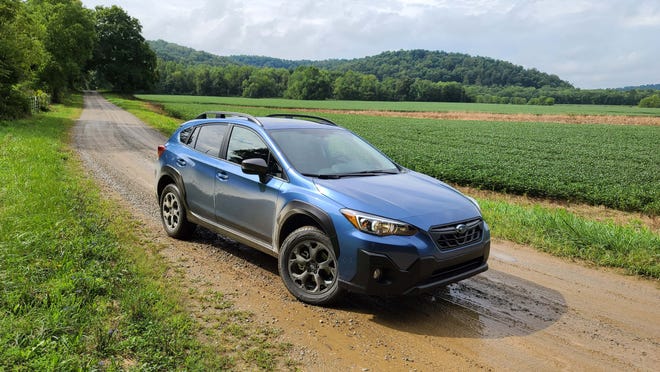
2021 Subaru Crosstrek Sport
Vehicle type: Front-engine, all-wheel drive, five-passenger SUV
Price: $27,545, including $1,050 destination fee
Powerplant: 2.5-liter Boxer 4-cylinder
Power: 182 horsepower, 176 pound-feet of torque
Transmission: Continuously variable automatic
Performance: 0-60 mph, 8.2 seconds (mfr.); towing, 1,500 pounds
Weight: 3,265 pounds
Fuel economy: EPA, 27 mpg city/34 highway/29 combined (1.2-liter)
Report card
Highs: Off-road cred; more power
Lows: Lags Honda HR-V competitor in cargo/leg room
Overall: 4 stars
Premiere: Volkswagen goes electric with made-in-USA ID.4 SUV
Posted by Talbot Payne on September 24, 2020
Volkswagen made its mark in the U.S. market with practical, affordable icons like the Beetle and Golf GTI. It hopes its first battery-powered vehicle, the ID.4, will do the same for electrics.
The German brand took the wraps off the compact SUV on Wednesday. The ID.4 will be the first EV from a foreign carmaker to be built in the U.S. as it competes against similar SUVs from domestic brands like the Tesla Model Y and Ford Mustang Mach E.

Like its competitors, it will have a steep road to climb against cheaper, longer-range gas-powered vehicles. Compact SUVs like the Toyota RAV4, Nissan Rogue and Honda CR-V each sell about 400,000 units annually.
Scheduled for 2022 production in Chattanooga, Tennessee, early models of the ID.4 will arrive here early next year from Germany. Once the source of Golf compact car production, the Zwickau, Germany plant has been remade to produce cars off the manufacturer’s new MEB electric platform – with high hopes to achieve global volumes of 330,000 units a year.
When production begins stateside, the ID.4 will be built alongside the gas-powered Passat sedan and Atlas SUV. VW says it is committed to an all-EV future and has invested $800 million in Chattanooga for electric vehicle production.

The ID.4’s footprint most closely resembles its sister Tiguan SUV, VW’s bestseller with about 109,000 units sold here in 2019.
Starting at $39,995 (with the price expected to be about $35,000 once U.S. production starts in 2022), the first edition ID.4 compares favorably to the smaller, subcompact $36,620 Chevy Bolt EV especially when the federal tax credit for EVs factors in. The Bolt is no longer eligible for the $7,500 credit whereas the VW will get the full credit until its reaches 200,000 in sales.
In addition to being bigger than the Bolt with a 6-inch longer wheelbase and 13 more cubic feet of cargo, the ID.4 will also be available in all-wheel-drive. A larger Chevy Bolt EUV is expected for 2022.

The all-wheel drive capability puts the ID.4 on par with the Tesla Model 3 and Model Y which dominate SUVs sales in the U.S. Through June, according to CleanTechnica, the two Teslas have piled up nearly 60,000 in sales compared to the closest competitor – the Bolt – at just over 8,000 units.
Like the Teslas (and the forthcoming Mustang Mach E), the 201-horsepower Volkswagen will be rear-wheel drive biased for better handling. The RWD option is unusual in the compact SUV market with its usually front-wheel drive powered vehicles. Interestingly, the ID.4 goes against type with low-tech rear drum brakes – with regenerative braking, VW says rear disc brakes aren’t needed in an EV.

With the 82-kWh battery stuffed under the floorboards like other EVs, VW says the ID.4 will have familiar, fun VW handling despite its high-riding SUV stance.
For another $4,000 — about $10,000 cheaper than a comparable, 384-horse Model Y — the ID.4 will add a front electric motor for a total of 302 horsepower and better winter grip. With 250 miles of range, the VW is competitive with the Bolt’s 259, if not Tesla’s class-beating 290-322 miles.
But in an indicator of why EVs have struggled in the US market at just 2 percent market share, the ID.4’s stats pale next to its gas-powered peers.

For under $30,000, for example, the VW Tiguan boasts 430 miles of range and more cargo space. For green customers looking for a hybrid option, the all-wheel-drive Toyota RAV4 Prime plug-in is $5,000 cheaper and will go 522 miles on a tank of $2-a-gallon gas.
Ford’s $28,000 Escape Sport Hybrid compact SUV will go 568 miles on a tank.
To make the electric offering more attractive, VW is offering three years of free charging from its national, Electrify America charging network. U.S. governments forced VW to build the network as penance for its Dieselgate sins. The network parallels Tesla’s national fast-charging network, though so far, there are only seven locations in Michigan.
Most EV buyers will use the ID.4 for local commutes, plugging in at home where the ute can do a full charge on a faster, 240-volt plug in about 7½ hours.
The ID.4’s interior maintains the simplicity of the exterior with most functions executed by touch or voice control. Like Tesla, ID.4 features big console screens – 10 or 12-inch tablets are available – though a classic instrument display is behind the steering wheel.

The $40,000 car is stuffed with standard stuff including self-driving tech called IQ.DRIVE, forward-collision warning, emergency braking, blind-spot monitor, adaptive cruise-control, lane-keep assist and more.
The flexible architecture underneath ID.4 will spawn a family of VW EVs. The Golf-sized ID.3 hatchback is aimed at the European market, and VW is working on a wagon and microbus-inspired van.
The ID.4 will be sold across all 50 states, through some 600 dealers. Buyers can put down a $100 deposit at VW.com with an additional $400 due later. Customers can follow their ute’s production progress online before eventual delivery at their VW dealer.
Payne: Aging Maserati Quattroporte grande dame still dazzles
Posted by Talbot Payne on September 17, 2020

The 2020 Maserati Quattroporte is dated, heavy, lagging in infotainment technology and expensive.
But, boy, is it irresistible.
There’s something about Italian luxury brands that make our legs weak, and the Quattroporte is a case in point despite the fact that it’s an aging sedan in a SUV world. Like its Ferrari, Alfa Romeo and Lamborghini countrymen, Maserati comes with boatloads of sex appeal. It’s got racing history. Runway style. Brand cache. It’s the Italian bombshell you always dreamed of in travel brochures.

With its Levante model, the Italian brand has dutifully followed market demand for an SUV. The Levante checks all the signature boxes — trident logo, racy roofline, big grille — but it’s designed to mimic the sedans that have carried the family crest for decades. Those are the vehicles we really covet.
The six-figure, sixth-generation, flagship Quattroporte (Italian for “four doors”) is the most desirable of all. My friend Rob has coveted a Quattroporte for 20 years. When I finally scored a tester, I immediately brought it over to him to see if reality lived up to the dream.
Right on cue, his knees buckled.
Like Monica Bellucci, the Quattroporte has presence. In an era of in-your-face grilles, the long hood is a ski slope, ending in a sports car-low nose that sniffs the ground. The huge trident grille with its uprights bars — as if imprisoning the rabid beast within — is unmistakably Maserati.

The swept headlights start a lovely shoulder line over big 20-inch wheels that doesn’t end until the broad hips. Every line is purposeful, efficient, European. There are hints that this is a dated, 2013 chassis — the headlight units, for example, are not as lean as current LED designs.
But overall, the style is timeless. Its sporty fascia is a welcome departure from the intimidating, upright grilles found on the mug of, say, the BMW 7-series.
Gal pal Missy, an 89-year-old car nut, also turned to jelly when I brought the Maserati by. She could have driven around in the Italian heartthrob all day. The big rear lounge chairs reclined — and she also had command over the front passenger seat when more leg room was needed.
But I didn’t feel the tug of younger generations as I have with, say, the Tesla Model S or the Audi A8. The Maserati has an Old World feel to it.

Part of that, surely, is that Maserati doesn’t race like other luxury brands — Audi, BMW, Mercedes. Racing wins was once a Maserati hallmark — and maybe that will return now that the 630-horse MC20 supercar is coming for 2021. But more than that is the cabin technology where Quattroporte lags. As Tesla and Audi wow with their splashy Google Map and touchscreen displays, the Maserati is a generation behind.
The instrument display is analog compared to the competition’s lush, digital landscapes. The center console screen is taken right out of Fiat Chrysler Automobiles NV’s corporate parts bin — shared with a Jeep Grand Cherokee. Don’t get me wrong, the Jeep’s UConnect system is one of the finest in the business, but it lacks the brio you would expect in a six-figure Italian stallion.
I thought of the new Corvette and how its mid-engine layout and sci-fi digital instrumentation have turned millennial heads. Does today’s youth aspire to a Maserati when they strike it rich?
The interior is otherwise swathed in luxury. Exquisitely stitched seats, acres of wood, and those adjustable rear seats that had Missy purring.

But what really woke me up was the drivetrain. Push the starter button and my murmurings about technological deficiencies were suddenly drowned out by my elevated heart rate. Italians are masters of styling and engine tech. The twin-turbo V6 under the hood in front of me was developed by Ferrari.
It growled at idle like a starved tiger. Sport driving mode is temptingly placed next to the simple monostable shifter. Shift paddles the size of butcher knives stick out from the steering column.
I toggle to manual shifting. We’re off.
Brap! Brap! Brap! go the upshifts as I lashed the 3.0-liter, two-turbo engine V-6 with an excellent 8-speed transmission. The Quattraporte is a big, all-wheel-drive luxury sedan — but it’s 150 pounds lighter than the equivalent, V6-powered BMW 7-series. Four hundred pounds lighter than the Mercedes S-class.

As I bounded through the twisties of M-66 up north, the Maserati really came into its own. Where the Germans are ocean liners, the Italian wants to gulp terra firma.
The car’s tight, weighted steering seals the deal, and Quattroporte and I danced from apex to apex. It’s a feeling not unlike another Italian, the Alfa Romeo Giulia, which lags its German peers in interior electronics but puts a smile on your face when you want to play.
Italians make driver’s cars, and that’s how the Quattroporte stands out in the big yacht market. My standard V6’s 424 horsepower is a good 60-100 ponies above its German peers. If that’s not enough, then an earth-pawing, 525-horse V-8 is available in the upper trim Gran Lusso.
I found 424 was plenty.

Luffing along I-75 north of West Branch, I came upon a pickup weaving back and forth across the northbound two lanes. The predicament allowed the Maserati to show off two of its latest assets.
The first was automatic braking. As the truck blocked the left-hand lanes, I moved to the right lane to pass. The truck veered right across my bow. Before I could react, the car did — its automatic braking system (using the same technology that enabled adaptive cruise control on my long ride north) flashing a red alert in my instrument panel and braking automatically. Eccellente!
The second was raw power. Reacting quickly to the pickup’s blocking maneuver, I juked left and dropped the hammer.

Foom!
The Quattroporte’s twin turbos rocketed the big sedan past the wandering pickup. The menace was a dot in my rear view mirror in seconds.
Of course such amenities are also available on full-sized sedans like, say, a Dodge Charger Scat Pack (485-horse V-8) or Kia Stinger (365 ponies) for half the price of the Maserati.
But they don’t have a trident at the end of a long nose that has mesmerized buyers for decades. Brand matters. But so does tech. Maserati will need to hustle to keep up with a new generation of luxury that decorate college kids’ dorm walls.
2020 Maserati Quattroporte
Vehicle type: Rear- and all-wheel-drive, five-passenger, big sedan
Price: $112,985, including $1,995 destination charge ($126,805 S Q4 as tested)
Powerplant: 3.0-liter, twin-turbo V-6
Power: 424 horsepower, 428 pound-feet of torque
Transmission: 8-speed automatic
Performance: 0-60 mph, 4.6 seconds (Car and Driver); top speed, 179 mph
Weight: 4,232 pounds
Fuel economy: EPA — 16 mpg city/23 highway/18 combined
Report card
Highs: Maserati moxie; engaging drivetrain
Lows: Dated console tech; big price tag
Overall: 3 stars
Battle of Tailgate: Ram Multifunction feature fires back against Ford, GMC
Posted by Talbot Payne on September 16, 2020

Call it The Battle of Tailgate.
This week, Fiat Chrysler Automobiles NV’s Ram launched another salvo at the truck market, making its dazzling, 60-40 split tailgate even more versatile with a companion, retractable step. Unlike conventional drop gates, the Ram 1500’s tailgate opens outward like a barn door allowing easier fork-lift pallet access to the bed — or easier individual access via a pop-out step.
The full-size truck’s innovation was the latest weapon in a battle begun by Ford Motor Co. over a decade ago with its Tailgate step — recently eclipsed by the General Motors Co. GMC Sierra’s jaw-dropping (literally, check out the ads), six-function Multi-Pro gate.
Once upon a time, the Detroit Three pickup wars were about who could tow more. But today, with pickup sales earning big profits at over 3 million units sold a year, skirmishes are breaking out all over the truck — not just under its hood.
The trick tailgate clash follows pitched battles over best interior, most creative bed, coolest console, and best super truck.
“Every truckmaker is looking for some away to set themselves apart,” said Roman Mica, publisher of The Fast Lane Truck, a leading truck benchmarking website. “So now we have a tailgate battle.”
Combined with the $395 retractable step available via Ram’s Mopar parts subsidiary, the $995 Multifunction tailgate is a cheaper option than the GMC Sierra’s Multi-Pro tailgate which is only available on upper trim models starting around $45,000. But it probably won’t bring your neighbor running for a demo. The six-way Multi-Pro has wowed truck buyers with its button-operated, six-way versatility: 1) tailgate drop, 2) long-board load stop, 3) second-tier, board load stop, 4) work surface, 5) walk-in standing desk, 6) bed-entry stairs.

GMC’s Multi-Pro ads — with jaws and tailgates dropping in awe as a GMC Sierra rolls by — have been a staple of weekend football games.
The Ram’s two-way tailgate not only opens to an 88-degree angle for easier forklift loading — but it also drops like a normal tailgate. The pop-out bed step is mounted under the middle of the rear bumper for easy bed access when the barn door opens. The retractable step is also available with a regular tailgate — swinging out from the driver’s side, rear-bumper corner.
“Our retractable bed step further enhances the convenience and utility of Ram’s industry-leading cargo management system,” said Mopar parts chief Mark Bosanac.
Ram’s innovation leaves Ford trailing its cross-town rivals, which is ironic since TFL Truck’s Mica said Ford started the tailgate battle.
“The F-150 has had a tailgate step for years,” he said. “And to be fair, the Honda Ridgeline (midsize pickup) pioneered the swing gate before Ram.”
Ford’s Tailgate step was re-engineered in 2014 to fully disappear into the tailgate when not in use. The tailgate package includes a grab handle that pops out to help with bed access. That’s so 15 minutes ago. Ford is now reportedly working on its own multi-function tailgate for the F-150.
Ram’s news comes on the heels of its success in the console battle. Its 12-inch, Tesla-like screen wowed in 2018.
“Interiors used to be Plain Jane,” said Mica colleague, Andre Smirnov at TFLTruck. “Then Ram blew everyone out of the water with an interior worthy of a BMW 7-series or a BMW S-class.”
Ford responded with its “table console” in the forthcoming, 2021 F-150 — which boasts innovations like a stowable, electronic gear shifter to clear a flat, interior work surface.
Territory aft of the front cabin has become a battleground, too. Ram offers sub-floor storage bins, GMC and Chevy Silverado have carved out hidden cubbies in the second-row seatbacks, and the 2021 Ford introduces lockable storage underneath the seats.
Further aft, the pickup bed became a high-profile showdown between F-150 and Silverado when Ford introduced the first aluminum truck in 2015. Chevy tried to puncture Ford’s bubble — literally — with an ad dropping a toolbox into the F-150’s bed to punch holes in the tin.
More recently Silverado laid claim to the segment’s biggest bed. Not to be outdone, Ram boasts the pickup war’s only bed-side toolboxes — called RamBox Cargo Management System.
Detroit’s three automakers have not forgotten about the engine bay.
Each model cycle seems to bring a new champ when it comes to clean-and-jerking the most weight. For 2020, the Silverado leads the field at 13,400 pounds towing — 2,543 pounds payload in the bed. F-150 is next with 13,200 pounds of towing — 3,270 pounds payload. Then Ram 1500 at 12,750 pounds and 2,500 payload.
All three makers vie for best fuel economy with diesel engines offerings. Chevy leads by a nose with 27 mpg versus Ram’s 26 and Ford’s 24.
When fuel economy is the least of your concerns, a battle is brewing on the “super truck” front. Like the horsepower wars of Mustang vs. Camaro vs. Challenger, pickups are pawing the ground.
Ford innovated the segment with the Baja Desert-eating, 450-horsepower Raptor. Ram is countering in 2021 with its own prehistoric predator, the TRX (pronounced T-Rex) stuffed with a 702-horse Hellcat engine.
And where Ford and Ram are, GM can’t be far behind.
NHRA smackdown: V-8 Mustang Cobra Jet dragster vs. electric Cobra
Posted by Talbot Payne on September 10, 2020
The Kentucky Derby wasn’t the only place high-performance horses were racing last weekend.
Ford’s 1,400-horsepower electric Mustang Cobra Jet 1400 drag racer squared off against its sister 1,000-horsepower V-8 Mustang Cobra Jet on Sunday at the NHRA Nationals in Indianapolis.
It was the gas-powered car by a nose.

The Indy appearance was the battery-powered Mustang Cobra Jet’s first at a drag strip. Ford sees an electric future. And just as with fossil fuel-powered sports cars, Ford is using the race track to test the limits of electric power. Ford has also developed a racing version of its Mustang Mach E — also packing 1,400 horsepower like the dragster — to push the envelope on road race tracks.
“It was pretty cool to see the response from all the fans,” said Ford Performance Chief Mark Rushbrook, who was on hand in Indy. “People were around (the electric car) all weekend — coming up to the car looking at it, taking selfies, excited to see the technology there and especially the performance capability.”
Capitalizing on the Mustang’s storied reputation for performance, Ford is launching a Mustang sub-brand headlined by the Mach E, the first electric Mustang SUV. It will go on sale later this year.
Check it out! Ford Mustang Cobra Jet match race: Gas vs. Electric at the U.S. Nationals
Indianapolis featured the first exhibition match-race for the two Cobra Jet dragsters in front of a national TV audience (and socially distanced grandstands) at the Super Bowl of drag racing, the NHRA Mello Yello Series Denso U.S. Nationals. The electric dragster’s battery powers four electric motors that make 1,100 pound feet of torque. The conventional Cobra Jet is motivated by a 5.2-liter supercharged V-8.
Dressed in matching white livery with gold cobras painted on the doors, the two cars lit up the Lucas Oil Raceway strip. NHRA Funny Car driver Bob Tasca III was behind the controls of the all-electric Cobra Jet 1400, while former NHRA Funny Car driver Tony Pedregon piloted the V-8 Cobra Jet.

Tasca popped a wheelie in the EV pony off the line, and Pedregon crossed the quarter-mile line first in 8.797 seconds at 158.26 mph. Tasca was just behind him at 8.826 seconds and 156.81 mph.
The e-dragster’s time was just off tests that clocked the car at 8.27 seconds at 168 mph. The gas-powered Cobra Jet has competed in NHRA for years against competition from Chevy and Dodge and holds the NHRA Factory stock quarter-mile record of 7.7 seconds at 176 mph.
Rushbrook said Ford and NHRA are in talks about bringing electric drag-racing to the sport. “NHRA is open to discussing the right classes,” he said. “We will include other manufacturers in those discussions… so that we can compete against Chevy or Dodge or Toyota. We’d love to have Tesla come and race with us, too.”
Rushbrook said there is lots more to learn about the electric monster’s capabilities.

“It’s been a great but challenging project for all of us at Ford Performance,” said Rushbrook. “We are very interested in continuing to work with NHRA to determine how electrification can be part of the sport and to show off the Cobra Jet 1400 at max power in due course as regulations develop.”
Instant electric torque off the line has already made Tesla a legend among amateur drag racers. YouTube is full of videos of Model S sedans disappearing from V-8 production muscle cars like the Mustang and Dodge Hellcat.
But the Cobra Jet face-off was the first chance to see the professionals go at it in cars made exclusively for the dragstrip. The silent launch of the Cobra Jet 1400 was in striking contrast to the earth-shaking supercharged V-8 Cobra Jet.
At the top end of the sport, nitro-guzzling Top Fuel dragsters make spectator eyes water as they rocket down the strip at 320 mph.

“Drag racing has always been where Detroit proves its most advanced powertrains,” said NHRA chief development officer Brad Gerber. “The U.S. Nationals is the sport’s quintessential stage for reaching enthusiasts wanting a glimpse at the future technology of performance vehicles.”
Look for the Mustang Cobra Jets to square off again at NHRA’s Gainesville, Florida event the weekend of Sept. 25-27.
Payne: Encore GX ST brings Buick manners to small SUVs
Posted by Talbot Payne on September 10, 2020
If you’ve been on Mars for the last few years, you may be disoriented when you see what’s happened to America. No, I’m not talking about the coronavirus pandemic and urban riots; I’m talking about Buick’s lineup.
America’s once-stodgy sedan brand has been transformed into a stable of hip SUVs.
Buick’s “mistaken identity” ads featuring utes like the Envision and Enclave were the most watched car ads of 2019, and “That’s not a Buick!” has become an American catchphrase. I’m not making this up.
To convince you the world has gone mad, let’s unpack the name of this week’s tester, the 2020 Buick Encore GX ST.

It’s the bigger brother of the Encore — Buick’s pioneering 2013 subcompact SUV. Yes, I just used Buick and pioneering and subcompact in the same sentence. Polling rock-bottom in brand identity and desperate for attention, GM let Buick’s product team off the leash to create a segment-busting, entry-level, cuddly SUV. Consumers adored the little pup.
Hitting the SUV craze in full stride, Encores flew out of the pet shop, selling 102,000 copies last year. That’s more than the Honda HR-V, for goodness sake. It also brought in new buyers to the brand who could move on to Buick’s other crossover offerings, the Buick Envision and three-row Enclave.
Buick decided to milk the Encore’s success with the Encore GX (for Grand Crossover). In Encore’s pioneering spirit, the Encore GX is one of the first subcompact-plus SUVs, shoehorned between the subcompact and compact spaces. Yeah, I’d like a new name, too, to avoid confusion. But Buick’s marketers figure they have a good thing going.

Other than its surname, Encore GX shares nothing with little-bro Encore. It’s on a longer front-wheel-drive platform, offers all-wheel drive and is more space-comparable to a compact — yet isn’t as doughty-looking as the more expensive Envision.
And just to remind you that it’s a luxury car, the Encore GX comes complete with an alphanumeric alphabet soup designation like the ST (for Sport Touring) tacked onto the end of the name. It’s right up there with the Mercedes GLA 63 GT mouthful.
So successful is Buick’s SUV transformation that it’s quietly killed off its last remaining sedans, the Regal and Regal Tour X Wagon. They were my favorite Buicks with their hatchback utility and sleek lines. Carrying on their sex appeal, my Encore GX ST was smeared with alluring red lipstick in the grille and a peppy 155-horse turbo-3 cylinder.
That’s not a typo. I said three-cylinder in an SUV.
Engineers are doing marvelous things with three-bangers these days, and I have mourned the passing of the Ford Fiesta and its “Godzilla-in-a-box” 1.0-liter turbo-3. It was a joy to drive while returning 35 mpg. The Encore GX’s 3 isn’t so sippy (just 28 mpg), but when mated to GM’s state-of-the-art 9-speed tranny it is plenty zippy.

Trouble is, while Buick was re-inventing itself, so was the competition. Lunging out of the subcompact-plus starting gates with the $25,095 Encore GX are two more SUVs from premium mainstream brands: the $23,110 Kia Seltos and Mazda CX-30.
Both offer even more powerful engines: the 175-horse turbo-4 in the Seltos, the 186-horse 2.5-liter 4-cylinder in the Mazda — while returning comparable 27-mpg fuel economy.
More important, they expose GM’s persistent refusal to standardize technology (a miss most glaring in the $78,000 Chevy Silverado I recently tested that neglected adaptive-cruise control). Adaptive-cruise and blind-spot assist — two essentials on Mrs. Payne’s shopping list — are standard in both the Kia and Mazda for hundreds of dollars less than the Buick.
Some buyers will balk at the Kia’s eccentric styling but not the Mazda, which (despite its lamentable wheel-arch cladding) is one of the most appealing vehicles out there. Then Mazda loads on the value.
An all-wheel-drive CX-30 (with Select trim) equipped with standard adaptive-cruise control, blind-spot assist, automatic windshield wipers and leather seating clocks in at $28,700. My front-wheel-drive Encore GX ST (in comparable Essence trim) started at $29,495 before selecting options that are standard on the CX-30.

Escape to rural roads in the Mazda, finger the paddle shifters in manual mode and it’s a fun box with tight handling and an eager drivetrain. The GX doesn’t even come with paddle shifters.
Reach behind the GX’s steering wheel and you can toggle … not shift paddles, but hidden volume and radio station controls. That’s where Buick makes its play. This is a ute for those who want that old feeling of Buick luxury in a new shell.
Cruise around Metro Detroit and the Buick adroitly soaks up bumps on our oxcart roads. The Mazda wants to squeal the tires; the Buick wants you to hear the sounds of your favorite Sirius XM station.
Cockpit features are familiar to other GM premium products. The infotainment system echoes the Chevy Corvette or Suburban SUV or Cadillac XT4, as did the posh camera mirror in my GX ST tester. There was even self-park assist, particularly useful in an SUV with yuuuge blind spots.
My favorite shared piece is the flat-folding front seat, which I first encountered in the wee Encore back in 2015 when I had knee surgery. If you’ve had leg surgery, you’ll know the difficulty of traveling in anything smaller than a Silverado pickup. But the Encore and Encore GX allow you to fold the front seat flat so I could easily use it as an ottoman from the back seat.
A more common use would be for toboggans that I used to take to Michigan’s snowy hillocks with my kids. GM’s clever engineers have chosen the right side for the 60 percent split in the 60-40 rear seat so it aligns with the front passenger seat — opening a cavernous aisle from rear hatch to front glovebox (with the front and rear seats flattened).
Three long sleds slot in there nicely.
Of course, if you’re heading out in the snow much, you might prefer the all-wheel-drive option of the Encore GX which gets you into even pricier territory, some $5,000 north of the comparably equipped Mazda. That’s the downside. But just the idea of a young family taking the kids to the slopes in a hip Encore GX ST SUV tells you how much this brand has changed in the last few years.
Welcome back from Mars. 2020 is one weird scene, man.

2020 Buick Encore GX
Vehicle type: Front-engine, front- and all-wheel drive, five-passenger SUV
Price: $25,095, including $995 destination fee ($34,115 front-wheel-drive Essence ST as tested)
Powerplant: 1.2-liter turbo-3 cylinder or 1.3-liter turbo-3
Power: 137 horsepower, 162 pound-feet of torque; 155 horsepower, 174 pound-feet of torque
Transmission: 9-speed automatic
Performance: 0-60 mph, 9.3 seconds (Car and Driver)
Weight: 3,094 pounds as tested
Fuel economy: EPA, 26 mpg city/30 highway/28 combined (1.2-liter); EPA, 26 mpg city/29 highway/28 combined (1.3-liter)
Report card
Highs: Smooth ride, peppy engine; versatile cargo storage
Lows: Tight second row; gets pricey relative to competition
Overall: 3 stars
Debut: Jeep Wrangler 4xe plug-in hybrid promises smooth rock-crawling
Posted by Talbot Payne on September 3, 2020
The long-awaited Jeep Grand Wagoneer SUV is coming back, and that’s not the off-road brand’s only new offering.
The 2021 Jeep Wrangler 4xe plug-in that debuted Thursday is a greener, more-premium version of the brand’s iconic dirt-kicker. Just as the Grand Wagoneer offers a teak-trimmed alternative to gold-plated Range Rovers, the 4xe is aimed at the lifestyles of the rich and adventurous.
The Wrangler 4xe will mate twin electric motors to a 2.0-liter turbo 4-cylinder gasoline engine for a combined 375 horsepower and stump-pulling 470 pound-feet of torque. The system claims about 400 miles of hybrid range with a towing capability of up to 3,500 pounds. The 4xe will get a claimed 25 miles on its 17-kWh battery alone.
Offered only in upscale 4xe, Sahara and Rubicon trims, the Wrangler 4xe will start well north of the standard $29,790 Wrangler. Gas-powered Rubicon and Sahara trims start at about $40,000 and fully loaded models can push $60,000. Expect 4xe models to climb even higher. Prices will be announced as the 4xe comes to market in the US, Europe and China next year.
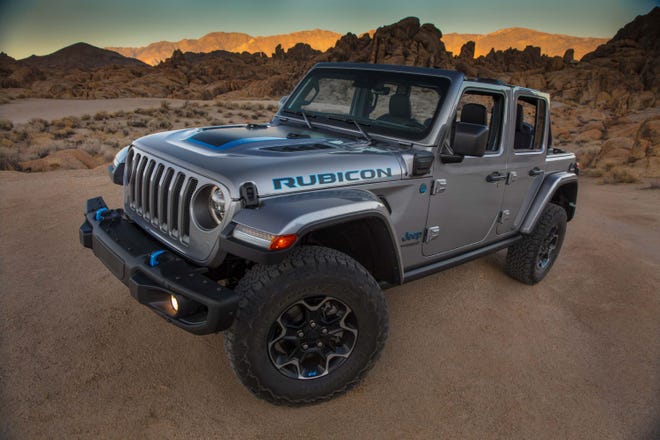
Just as Wrangler defines Jeep’s off-road ethic, so will the 4xe wear a green halo. It will lead a Jeep march of 30 electrified vehicles in the next few years as manufacturers strain to meet stringent government emissions mandates. At the premium end of the market where sleek EVs like the Tesla Model Y have gained traction, the 4xe plug-in offers a rugged choice without range anxiety..
Electric Blue will be the 4xe’s signature.
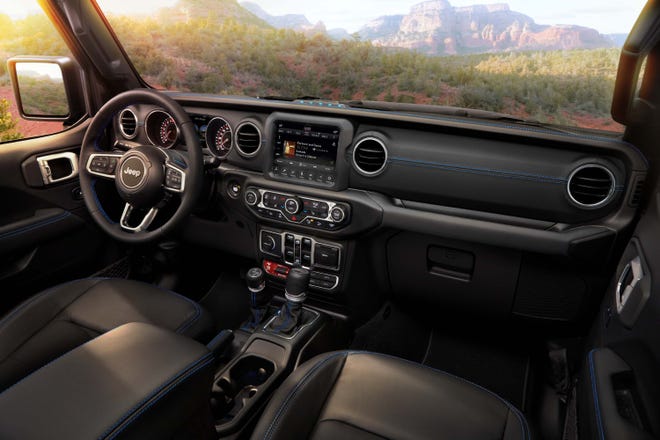
The unique color will trace Jeep badges as well as the Rubicon name on the hood. Electric Blue Rubicon tow hooks stand out against black bumpers. Inside, Electric Blue stitching highlights seats and trim in the 4xe Rubicon.
The Wrangler 4xe is armed for the Outback with a ladder frame, trail-rated gear, solid front and rear axles, full-time 4×4 two-speed transfer case, articulating suspension and 30 inches of water-fording capability (with the battery sealed under the rear seat to prevent damage).
Buttons left of the steering wheel control three modes of its “E Selec” energy-storage system.
- eSave: Saves the battery for pure-EV off-roading or in urban areas (like European cities) were gas engines are banned.
- Electric: The Wrangler operates on battery alone until the powertrain reaches minimum charge or the driver’s heavy right foot requests more torque (such as wide-open throttle) from the gas engine.
- Hybrid: The default hybrid mode combines the 2.0-liter engine and electric motors.
Jeep promises that treacherous off-road maneuvers will be smoother in eSave mode using the vehicle’s torquey electric motors.
“The Wrangler 4xe offers a more precise off-road driving experience with no traditional transmission torque converter,” said Wrangler engineer Mike Weissich. Translation: The electric motors smoothly apply torque as opposed to a gas engine where the driver has to rev the engine to roll over rocky terrain.
Credit a new motor generator, replacing the conventional generator, that spins the engine for nearly seamless, fuel-saving start-stop operation and generates electricity for the battery pack. A second generator is mounted at the front of the transmission case, replacing the conventional torque converter of an automatic transmission.
Typical of electrified vehicles, the 4xe regenerates the battery when the driver uses the brakes. The blue Wrangler amps up that capability with a “Max Regen” feature which applies more assertive regenerative braking calibration when the vehicle detects the driver’s foot is completely off the throttle.
Whether drivers paying $60,000 for an SUV will want to risk off-road scratches is an open question. But if they just want to use the 25 miles EV range around town, the battery will fully recharge in about 12 hours on a standard household outlet.
Payne: Pocket rocket’s progress, 1984 VW Rabbit GTI vs. 2020 Jetta GLI
Posted by Talbot Payne on September 3, 2020
The modern car is a technological wonder. Quiet, connected and smooth, it’s the rolling equivalent of a soothing, electronic pop song.
But sometimes I get nostalgic for a raspy rocker with a string guitar.
I was reminded of that feeling as I flogged a 1984 Volkswagen Rabbit GTI around the hills of Oakland County this summer. The Rabbit GTI (and its sedan stablemate Jetta GLI) are the 1980s ancestors of the all-new Golf GTI/Jetta GLI — performance versions of the German brand’s entry-level hatchback/sedan.
I had a chance to compare 36 years of progress when I tested a roomy, high-tech 2020 Jetta GLI recently as well. It’s not a hatchback, but the GLI sedan is otherwise the 2020 Golf GTI’s twin making it suitable for this week’s comparo. It shares the Golf GTI’s 228-horsepower engine, chassis and suspension, giving them serious punch over the base 147-horse Jetta/Golf.

The ’84 Rabbit GTI, of course, was the original pocket rocket, coming to our shores in 1983. The second generation of the car adopted the Golf name in 1986.
The 1984 GTI was the first car I ever owned. It was a hoot. And a revelation.
Taking a compact car and stuffing it with a performance engine, the Rabbit GTI was the automotive equivalent of Dr. Jekyll and Mr. Hyde. It was affordable, seated four — yet could instantly transform into a Tasmanian Devil picking on luxury cars twice its price. The V-dub inspired a revolution of pocket rocket including the Mazda3 Speed, Ford Focus ST and Honda Civic Si.
Getting behind the wheel of the ol’ ’84 with its hot red interior (VW keeps it in its Virginia heritage collection, occasionally letting it off its chain to play with journalists) brought the memories rushing back.
The Rabbit GTI was my post-college daily driver. I flogged it for hours from my Charleston, West Virginia, home to court the future Mrs. Payne in St. Louis. On the odd weekend, I would ring its neck at a local autocross. We bonded.
We even shared some hillbilly DNA, as Rabbit (and sibling Jetta) body stampings were made in Charleston before shipment to Westmoreland, Pennsylvania, for assembly. The Pennsylvania factory — which punched out VWs from 1978-87 — was the first modern foreign “transplant” in the USA, to be followed by Honda and others.
The ’84 GTI still felt relevant. It was the second historic VW I’d driven this year — a 1964 Beetle.

But the Bug felt like a museum piece, like an old-fashioned typewriter. For sure, the Rabbit GTI lacked the technological wizardry that makes the Jetta so much more livable today. But I didn’t feel like I’d be blown off the road by a passing Chevy Suburban as I did in the (72 mph top speed) Beetle.
Not that the Rabbit GTI was a Brink’s armored truck.
Tipping the scales at just 2,100 pounds, it is remarkably lighter than its 3,200-pound Jetta GLI and Golf GTI successors. Credit that difference not just to more technology, safety systems and sound insulation, but to simple dimensions. The Jetta GLI wheelbase is 105 inches compared to the 95-inch Rabbit.
Today’s compact cars have gotten fatter, just like its drivers.
I had to stuffed into the Rabbit while the Jetta was a Barcalounger by comparison. But that also means the Rabbit felt whip-quick. Its 90-horsepower 1.8-liter four-banger seems puny by today’s standards, but so does its one-ton weight.
With an intuitive 5-speed manual, the GTI was a treat to drive fast. Adding to the fun was a bratty engine note that rewarded hard driving. The GTI is a VW icon, its square shape and red highlights as recognizable as the Beetle’s bulbous profile and round headlights. I got more than a few thumbs-up from motorheads as I sped around town.
Four decades on, the current Jetta GLI has a more establishment feel.

In addition to its size, Jetta is loaded with safety and tech features that would have seemed out of a sci-fi novel in 1984: blind-spot assist, auto rain-sense wipers, anti-lock brakes, automatic windows, rear camera, automatic headlights, push-button start, heated seats and Apple CarPlay/Android Auto connectivity are standard for just $26,890. As is a 10-color, LED ambient lighting system that changes depending on which Drive Mode you’re in (Eco, Normal or Sport).
Yes, the 21st-century car is a marvel of electronic advances. But Jetta GLI is hardly a numbing experience. Ford may have dropped out of the pocket-rocket race when it ditched the Focus, but the Honda Civic Si and Hyundai Veloster N are serious segment challengers. Jetta GLI (and brother GTI) are up to the challenge.
GLI’s 228 horsepower is 150% more than my ol’ Rabbit GTI, more than making up for its increased heft. Power-to-weight ratio in the Jetta is 1:12 compared to Rabbit’s 1:23. Combine that with a whopping 258-pound feet of torque, and the turbocharged, 2.0-liter Jetta GLI flat-out goes.
A limited-slip differential up front assures stability, so I could really keep my foot on this beast out of corners.

Establishment it may be (check out the conservative black interior), but GLI is true to the GTI’s original mission as a driver’s car. In addition to the expected power, Jetta GLI has a manual transmission option. The shifter is one of the best in the business with its notchy throws. It even adds a sixth gear over the ’84 model, enabling 32 mpg highway compared to the Rabbit’s 26 mpg.
Readers of this column know my preference is for the hot-hatch GTI (just as in 1984) over the GLI sedan — but the GLI’s $1,800 cheaper sticker price can’t be ignored.
When I sold my Rabbit GTI in the early ’90s it was starting to rust along the rocker panels. Modern, galvanized steel steeds like the Jetta are better protected, adding to the GLI’s more robust feel. And yet. …
There was no denying the GTI’s personality. Like a favorite raspy rocker’s soundtrack, the loud GTI left me with a lot of memories.
That’s the challenge of selling modern cars in the electronic age. Jetta GLI has its predecessor’s performance appeal, but will you remember it in 30 years?

1984 VW Rabbit GTI
Vehicle type: Front-wheel drive, five-passenger, compact hatchback
Price: $8,350 ($21,232 in 2020 dollars, adjusted for inflation)
Powerplant: 1.8-liter, inline 4-cylinder
Power: 90 horsepower, 105 pound-feet of torque
Transmission: 5-speed manual
Performance: 0-60 mph, 9.7 seconds (Car and Driver); top speed, 104 mph
Weight: 2,100 pounds
Fuel economy: EPA 21 mpg city/26 highway/23 combined
Report card
Highs: Quick handling; bratty exhaust note
Lows: Tight cabin; loud interior
Overall: 3 stars

2020 VW Jetta GLI
Vehicle type: Front-wheel drive, five-passenger, compact sedan
Price: $26,890, including $895 destination charge
Powerplant: 2.0-liter, inline turbo-4
Power: 228 horsepower, 258 pound-feet of torque
Transmission: 6-speed manual
Performance: 0-60 mph, 5.8 seconds (Car and Driver); top speed, 126 mph
Weight: 3,225 pounds
Fuel economy: EPA 25 mpg city/32 highway/28 combined
Report card
Highs: Roomy interior; gobs of torque
Lows: Sleepy exterior; lacks personality
Overall: 3 stars