- Search Cartoons
- Comic Archive
-
Payne
Store



 Henry Payne RSS

Articles Blog
Payne review: All I want for Christmas is a McLaren GT
Posted by Talbot Payne on December 30, 2020
Coming out of M1 Concourse’s Turn 6 Hairpin onto the back straight, the McLaren GT’s twin-turbos hiss like a lit fuse. The mid-engine supercar explodes with astonishing speed down the 1,500-foot back straight, hitting 130 mph before massive, 14.4-inch front brake rotors bring it back to earth. Its carbon-fiber tub rotates effortlessly into Turn 7. Flat as a board. Begging me for more throttle up the hill into Turn 8.
The GT tops the Christmas wish list I sent to Santa.
Grand Touring cars like the McLaren are all the rage these days, from the Corvette C8 to the all-new Porsche 911 and Mercedes AMG GT. They are hellions in tuxedos. Felt hammers that can destroy a club test track by day, then take your date to the theater at night.

With its $213,000 GT, McLaren has joined the party. Replacing the 570 as the Brit brand’s “entry-level” sports car, the GT is intended as a more sedate daily driver compared to the $300,000, 710-horse 720S rocketship or the insane, race-car-in-production-clothing, $1 million Senna. The GT certainly looks the part with more conservative styling, comfy seats and loads of cargo room that rivals the Porsche or Corvette.
Indeed, the GT has gained the moniker “the McLaren Corvette” for its strikingly similar styling around the fascia and side flanks.
I had the good fortune to test the Corvette and Porsche this year, too, and it’s fascinating how different their personalities are even as they exhibit jaw-dropping performance on the limit. They each know their place on the shelf, with McLaren separating itself as the exotic of the bunch by bringing mid-engine, Formula One technology to the supercar market.
Sure, you can afford three Corvettes for the price of one McLaren GT, but the Big Mac is the best toy under the tree for GT performance.
As my test around M1’s club course suggests, the GT is not that much different than the 720S I tested there two years ago. Same fundamentals.
The GT is carved from the familiar, firm carbon-fiber backbone in the outgoing 570 and 720 (a new carbon chassis is due soon for a hybrid that will split the GT and 720 in McLarens’ lineup). Behind the driver’s head sits the same nuclear reactor that powers the 720.

Down 100 horsepower to the 720S at 612 ponies, the twin-turbo, 4.0-liter V-8 is the best engine I’ve driven. Its torque curve is relentless, its lung capacity seemingly limitless as it rockets past 100 mph. Consider the Corvette’s more pedestrian, push-rod, 6.2-liter V-8.
According to our pals at Car and Driver, both cars hit 60 mph in the same 2.8 seconds. Then the Englishman leaves the Yank behind.
The GT covers the quarter-mile in 10.7 seconds at 133 mph — half-a-second and 10 mph ahead of the ’Vette. The McLaren reaches 150 mph a yawning 5 seconds quicker. Holy Donner and Blitzen.
Of course, that’s why you belong to clubs like Pontiac’s M1 or Monticello in New York or VIR north of Raleigh/Durham. So that you can push the envelope of production cars with racing capabilities.
The magic of the McLaren GT and its Grand Touring peers is that you can also enjoy the drive there and back.

I was impressed by the McLaren’s bandwidth despite some obvious oversights.
Most obvious is a lack of available convenience features like Apple CarPlay/Android Auto apps and blind-spot assist — features customers take for granted on $30,000 cars today. They seem an odd oversight given the GT’s promise as a daily driver.
That said, no supercar I’ve tested can compete with the Corvette C8’s interior amenities. That may surprise since it’s the cheapest of the breed at just $60,000 — but the Chevy has the advantage of General Motors’ huge electronics toolbox, meaning it can grab a rear camera here (shared with Cadillac) or a 4G Wi-Fi system there (shared with GM’s other brands).
McLarens’ interior focus is on its unique attributes: beauty and speed.
Carbon-fiber tubs are inherently difficult for ingress given their high sills. But the McLaren enriches the experience every time with crowd-pleasing scissor doors — people really do say “oooh” and “ahhh” — that glide up and down effortlessly.

Once inside, my 6-foot-5 frame fit easily with plenty of head and knee room. Only the footwell was tight for my size-15 boots. Plenty of glass — including a full panoramic roof offering nice visibility for a mid-engine car. The knee room is aided by a floating center console screen as opposed to the typical high console spine. The console is then given over entirely to performance.
North of the simple push-button shifter are two electronic knobs that hold the keys to the GT’s enormous performance potential. They are activated by, well, an ACTIVATE button. One knob controls the suspension. The other the drivetrain.
Each has three settings: Comfort, Sport and Track.
Each ratchets up the performance: Smooth, Fun and Bonkers.
I had so much fun playing with all the mode combinations — and their effect on the GT’s road character and soundtrack — that I never fiddled with the infotainment system. The car is entertainment enough. There’s even a Launch Control button should you feel the need to test that 2.8 second, 0-60 claim.

Exiting stoplights is like transitioning to light speed in Hans Solo’s Millennium Falcon. Straightaways are gulped. Turns carved.
But for more utilitarian chores, the GT’s cargo space was more than adequate. The rear hatch easily swallowed two tennis bags (or a golf bag). The frunk (front trunk) is the biggest I’ve seen (bigger than even a Mustang Mach-E), swallowing a full-size suitcase for airport runs — not just a carry-on like the Porsche and ’Vette.
“I want to see the engine,” said a supercar collector friend. But like Porsche, McLaren is modest about peekaboo engine displays. The GT will get plenty of looks, but Christmas shoppers with more dramatic tastes will want the insectoid, winged 720S.
Still, drama can wear thin. A racing friend recently unwrapped a winged Porsche GT3, the brand’s most capable track car. After a year of spine-rattling commutes, he traded it for a Targa.
So have the elves crank out a McLaren GT for me, Santa. A gift for my senses — but not at the expense of my backside.

2021 McLaren GT
Vehicle type: Rear-wheel-drive, two-passenger sports car
Price: $213,195, including $3,195 destination charge
Powerplant: 4.0-liter, twin-turbo V-8
Power: 612 horsepower, 465 pound-feet of torque
Transmission: 8-speed automatic
Performance: 0-60 mph, 2.8 seconds (Car and Driver); top speed, 203 mph
Weight: 3,384 pounds
Fuel economy: EPA — 18 mpg city/22 highway/18 combined
Report card
Highs: Useful cargo space; turbo V-8 from the gods
Lows: Cramped footwell; more standard tech features, please
Overall: 4 stars
Ford, Fiat Chrysler lead NACTOY Vehicle of the Year finalists
Posted by Talbot Payne on December 18, 2020
Finalists for 2021 North American Car, Truck and Utility Vehicle of the Year Awards were announced Thursday, with Ford and Fiat Chrysler Automobiles scoring two contenders each.
Ford’s all-new Ford F-150 pickup is a finalist for Truck of the Year, with Ford’s first all-electric crossover – the Mach-E – picked as a finalist SUV of the Year. FCA’s Jeep Gladiator Mojave and Hellcat-Ram 1500 TRX are in the running for Truck of the Year. General Motors products were shut out.

Reflecting trends in the industry, Asian makers dominated the car category, Detroit automakers swept all three truck finalists, and the three SUV finalists were all premium-priced vehicles at a time when the average price of a new vehicle is pushing $40,000.
The F-150, perennially the best-selling pickup in the US, will be the odds-on favorite to win best truck with a comprehensive 2021 redesign that includes the truck’s first hybrid model. Its competitors are the off-road capable Jeep Gladiator Mojave midsize truck, and the first 700-plus horsepower pickup, the ferocious Ram 1500 TRX (pronounced T. rex).

Ford is also the front-runner to win Utility of the Year with its Tesla Model Y-fighting Mustang Mach-E. The $44,000 electric SUV is the first time that Ford has expanded Mustang into a sub-brand offering models beyond its core muscle cars. The elegant $50,000 Genesis GV80 will be a close contender as Hyundai’s value luxury brand makes its first foray into SUVs. The iconic $47,000 Land Rover Defender is the Jeep Wrangler of the luxury set. The first Defender to hit US shores in 40 years, it stars in the forthcoming James Bond flick, “No Time to Die.”
The finalists emerged from an intensely competitive field including GM’s lineup of popular SUVs — the Cadillac Escalade, Chevrolet Tahoe/Suburban and Chevrolet Trailblazer. Other wannabes included the Nissan Rogue, Ford Bronco Sport, Hyundai Santa Fe and Mazda CX-30.

Detroit automakers have put all their chips on SUVs and trucks, leaving the sedan field to Japanese carmakers.
The affordable Nissan Sentra and Hyundai Elantra will the favorites against the luxurious Genesis G80, the sister sedan to its GV80 ute. The affordable Sentra is a prime example of the democratization of autos with the $25,000 compact offering standard features like adaptive cruise-control, leather interior, sunroof and Apple CarPlay connectivity not found on luxury vehicles twice its price. Yet, the Elantra may have the upper hand in the voting race as it offers a vast lineup including a hybrid and N-line sport nodel.
The trio beat out a field of formidable group 2021 contenders, including the Polestar 2 – the car from Volvo’s EV brand – the Kia K5 and industry heavies like the Acura TLX and Cadillac CT4.

“In this very challenging year, these nine vehicles emerged as our Finalists out of an unusually strong field of 27 Semifinalists,” said NACTOY president Gary Witzenburg. “Each one of them – especially the 15 in the ultra-competitive utility vehicle category – is excellent in nearly every way.”
NACTOY is the most prestigious independent prize awarded in North America with a jury of over 50 auto journalists. Final voting is early next year, and the winners will be announced in Detroit on Jan. 11.
2021 NACTOY finalists
Car of the Year
Genesis G80
Hyundai Elantra
Nissan Sentra
Truck of the Year
Ford F-150
Jeep Gladiator Mojave
Ram 1500 TRX
Utility Vehicle of the Year
Ford Mustang Mach-E
Genesis GV80
Land Rover Defender
Payne: Ford Mustang Mach-E goes toe-to-hoof with Tesla Model Y
Posted by Talbot Payne on December 16, 2020
A 1910-era Model T sits on a farm just off North Territorial Road outside Unadilla, Michigan. I pulled my battery-powered 2021 Ford Mustang Mach-E alongside for a picture.
A century ago the Model T buried its electric-car competition with superior range and affordability — and revolutionized 20th-century transportation. At the dawn of the 21st century, the Mach-E SUV wants to bring EVs back from the dead.
To achieve its goal, the Mach-E not only must prove itself superior to more affordable gas-powered Ford sport-utilities — it also has to catch the Tesla Model Y. Silicon Valley’s EV king deliberately pays homage to the Ford Model T’s nomenclature as it seeks to revolutionize transportation.
Rather than beat electrics again with its gas-powered haymaker, Ford wants to be an EV maker. The ironies make your head spin.
Pulling back out onto twisty North Territorial, my path was blocked by a slower car. A brief passing zone appeared. I pounced. Zot! With instant electric torque, Mach-E was past.
Glorious. Just like a Model Y.
Yes, the Mustang Mach E is as good as a Tesla. And that’s a compliment. For the last decade Detroit automakers have tried to outsmart Elon Musk’s EV pioneer. GM made a $65,000 Cadillac ELR. Claiming superior hybrid plug-in technology to overcome range anxiety, the ELR was pummeled by the Tesla Model S.
Then along came the $40,000 Chevy Bolt EV hatchback. It claimed superior build quality over the similarly priced Tesla Model 3. It even beat Model 3 to market. Tesla stomped it in sales.

Ford has recognized that like BMW’s compact 3-series in luxury performance, you don’t beat the segment standard with different technology, you match it with another powerful brand. The Audi A4 and Mercedes C-class have thrived under that theory. They baseline to BMW, and the cars are strong sellers.
Acknowledging that the Model Y is a very good performance SUV, Ford has used it as the baseline for its own EV ute. And they badged the challenger with the automaker’s most formidable brand: Mustang.
Tesla defined green luxury with face-flattening performance. Mustang — not Cadillac, not Chevy — is one of the few Detroit legacy brands that has immediate performance respect. And Mach-E (that badge itself conjures the ferocious, 1970s Mach 1 coupe) milks that legacy for all it’s worth while going toe-to-hoof, spec-to-spec with the Model Y.
Rather than reinvent the electron, Mach-E is a Model Y doppelgänger.
Model Y has 300 miles of range? So does the Mach E. Model Y has a 15-inch screen. Mach E’s is 15.5 inches. Both have frunks. Remote app for Y? Same in E. Panoramic roof? Check. High-performance model? Check.
Audi stands out from BMW with all-wheel drive and a mega-grille. Mercedes has a superior interior. Having matched Model Y’s specs, the Mach-E aims to beat it by being less radical.

Tesla’s blank face makes the point that EVs don’t need grilles to cool radiators. But it’s a bit off-putting. Mach-E traces the outline of a familiar Mustang grille. The ute isn’t pretty (is any SUV?), but it’s got Papa ’Stang’s DNA.
The yuuuge center touchscreen is quick and easy-to-use. “Navigate to Unadilla General Store” I barked, and the screen filled with turn-by-turn directions. But Mach-E helpfully adds a second instrument display behind the steering wheel etched with essentials like navigation, range and speed. More traditional than radical Tesla, but some might find it more workable.
Familiar touchpoints abound. The Mach-E’s mirror controls are on the door rather than in the screen like the Model Y. Cruise-control buttons are on the steering wheel. A giant knob controls radio volume. There’s a good ol’ Ford rotary gear-selector.

Hustling along East Territorial, I selected the Unbridled performance drive mode and the Mach-E started to growl like a … well, Mustang. Grrrr. The piped-in sound can be muted, but it’s welcome pony brand reinforcement.
Ford hopes that familiarity will carry over into choosing a reliable, legacy automaker. After all, for every Tesla convert there’s a story about a rear bumper falling off. Or month-long waits for a mobile repair unit. Buy a Mustang EV and help is as close as the neighborhood Ford dealer.
But these traditional backstops are also a reminder the Mach E lacks some of the derring-do that has made Tesla stand out. Model Y’s Apple-simple dash, for example: Big screen aside, the Mach-E feels less luxurious with common dash contours and cloth trim inserts. Tesla has playful features like whoopie cushions and a crackling fireplace.

But most significantly, Tesla has the nation’s best fast-charging network. It’s the brand’s secret sauce, and it’s intimidating to contemplate trips without it.
Ford relies on third parties like Electrify America, EV-Go and Chargepoint. It’s bundled them like a cable service-provider under the FordPass app so you can pay with one account. But the patchwork of stations is a crazy quilt compared to Tesla’s uniform, multi-stall superchargers.
For example, I charted a path from Ypsilanti (where I picked up Mach-E) to Charlevoix, a distance of 207 miles on the ’Stang. It would require a game of hopscotch to get there: The Mach-E charted course to three chargers at a Chevy dealership, Consumers Energy station and a Gaylord public charger. Total time to arrival: 6 hours, 42 minutes. E-gad.
By contrast, my Tesla Model 3 (a Model Y in sedan clothing) would need to stop twice at Tesla Superchargers. Total time of trip: 5 hours, 20 minutes.

Mrs. Payne hates charging on long trips. She pointedly notes that her Subaru hatchback (no matter how much gas she has in the tank) could make the same trip in 4 hours and 40 minutes with one 10-minute gas fill-up along the way.
Such are the things that keep EV makers up at night.
Not to mention the competition in Ford’s own showroom like the peppy, $34,000 400-mile range Ford Escape Hybrid Sport — $15,000 cheaper than a comparable Mach-E before EV tax credits. But for those willing to brave the charging challenges (including the expense of installing a 240-volt charger to your home), the Mustang Mach-E is a torque-tastic treat.
Smooth power. Quiet cabin. No stop-start mechanisms at stoplights. Wrapped in sheet metal with clever design cues like button-handle doors and Mustang rear lights, the Mach-E fit this 6-foot-5 reviewer easily front and back.
Powered by electric motors, Mach-E doesn’t require the usual maintenance of oil and filters. But EV powertrains have their quirks and can interfere in AM-radio frequencies. The Model Y offers FM radio only. AM news junkies will be pleased to hear that Mach-E does offer AM/FM radio, along with Sirius XM, Apple CarPlay and Android Auto (unlike Tesla).
On such attention to detail does the Mustang Mach-E makes its claim to a broader EV audience.
2021 Ford Mustang Mach-E
Vehicle type: Rear- or all-wheel drive, four-door SUV
Price: $43,995, including $1,100 destination charge ($56,200 AWD, extended-range model as tested)
Powerplant: 68-88-kWh lithium-ion battery driving single or twin electric motors
Power: 266 horsepower (standard range, RWD or AWD), 290 horsepower (extended range RWD), 346 horsepower (extended range AWD); 317 pound-feet of torque (RWD), 428 pound-feet of torque (AWD)
Transmission: Single-speed automatic
Performance: 0-60 mph, 4.8 seconds (mfr.); top speed, 134 mph
Weight: 4,394-4,890 pounds
Fuel economy: EPA est. range, 230 miles (standard range, 68-kWh battery), 300 miles (extended range, 88-kWh battery as tested)
Report card
Highs: Techy interior; gobs of torque on demand
Lows: Busy dash materials; hopscotch charging network
Overall: 3 stars
Cadillac Blackwing sedans to be GM’s first production cars with printed parts
Posted by Talbot Payne on December 16, 2020
3D printing applications have become commonplace in consumer products to include sneakers, jewelry and Ikea clothing hooks.
Add Detroit auto manufacturing to the list.
General Motors Co. has established a 3D printing center at its Warren Tech Center called the Additive Industrialization Center. With 24 3D printers, the 15,000-square-foot facility is the hub of GM’s acceleration of so-called “additive engineering” in its manufacturing process.

Adding speed and efficiency to production, 3D printing is now used on everything from GMC Hummer EV and Corvette prototypes to finished vehicles like the 2022 Cadillac CT4-V Blackwing and CT5-V Blackwing sedans.
The Cadillac performance sedans will be the first GM production vehicles to feature printed parts – most prominently an emblem on the manual shifter knob. Other parts include the electrical harness bracket and a pair of HVAC ducts.
With auto-development cycles under relentless pressure to speed production, 3D printing has become an essential tool.

“The core component of GM’s transformation is becoming a more agile, innovative company, and 3D printing will play a critical role in that mission,” said GM Additive Design and Materials Engineering chief Audley Brown. “Compared to traditional processes, 3D printing can produce parts in a matter of days versus weeks or months at a significantly lower cost.”
For example, development of the 2020 Chevrolet Corvette was assisted by 3D-printed brake ducts that were put through grueling track tests. While evolving through four design changes, the printed plastic parts cut brake-development time from 10 weeks to just one, saving 64% of budget costs in the process.
The prototype for the forthcoming GMC Hummer EV pickup contains 17 printed battery-pack parts — components that have saved 50% of development time as GM rushes to bring the Hummer to market ahead of competitors like the Tesla Cybertruck.
“Three-D printed parts are currently suited to low-volume production like the Cadillac,” said Ali Shabbir, GM Engineering Group Manager for Additive Design and Manufacturing Product Applications. “A high-volume product like the Chevy Silverado would not be cost-effective today for additive-engineered parts. But 3D printing was certainly part of its development.”
Silverado’s sister, truck-based SUVs — the Chevy Tahoe and Suburban — benefited from nearly 100 hand tools that were printed at Arlington Assembly in Texas. The tools saved two months in the development process. Constructed with a nylon-carbon fiber composite, the parts weighed as little as three pounds compared to traditional tools weighing 10 to 40 pounds.
Warren Tech has been a hive of 3D printing development this year. They played a crucial role in the company’s contribution to the “Arsenal of Health” — as GM pivoted from making vehicles to medical devices in the early days of the coronavirus outbreak to assist hospitals and caregivers.
Applied engineering has been critical in the success of the IMSA Weathertech Series-winning Corvette C8.R. The GT racer carried 75 3D-printed parts, including essentials like the oil tank and oil cap and headlight assemblies. GM says that racing is a critical test bed for 3D parts as race teams hustle to prepare their thoroughbreds from week-to-week.
Given the brand’s high-tech profile, the Cadillac V-series cars were a deliberate choice to show off the company’s first 3D printed production application.
“And, this is just the beginning,” said Brown. “Ultimately, we see the potential for 3D printed parts to be used in a wide variety of production applications — from greater personalization options for new-vehicle buyers, to unique accessories and reproductions of classic car parts.”
Payne review: Bronco is delayed? Never fear, Baby Bronco is here
Posted by Talbot Payne on December 10, 2020
Delayed by COVID-related supplier issues, Ford Bronco fans must impatiently await its 2021 summer arrival. To make the time go by faster, may I recommend the Baby Bronco?
Available at your Ford dealer now, the 2021 Ford Bronco Sport — aka Baby Bronco — is a housebroken off-roader. Heck, with its cargo-friendly, quiet unibody cabin it would make a nice pair with the truck-frame Bronco in your garage.
I spurred this off-road hoss through Holly Oaks ORV Park’s “Sandbox” section so hard that stones got caught in the rim and dislodged the tire. Instant flat. Thankfully, the Bronco Sport comes with a spare so you can be on your way in no time. But the real lesson here is that you might want to equip your Bronco Sport with bead-locks like the Baja boys.
Payne, have you gone mad? Off-roading a compact family SUV?
Madness is encouraged by the Bronco team’s mad scientists who have invented one of the most refreshing utes to hit the market this year. Not only does the Bronco Sport resemble the open-air, all-wheel drive Jeep Wrangler-fighter coming next year, but it sports some performance drivetrain technology that even the bigger Bronco doesn’t have.
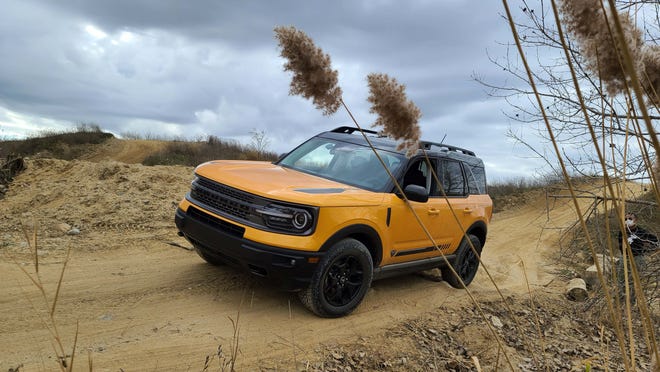
I’m talking about the available rear, twin-clutch pack system that can send 100% of torque to either rear wheel of the all-wheel drive system. If this thrilling torque-vectoring capability sounds familiar, that’s because it is. The twin-clutch pack comes right out of the ferocious Ford Focus RS (before Ford waved the white flag on cars and went all-SUV) that I destroyed the Waterford Hills race track with four years ago.
But pieces of the Focus RS live on: its 350-torque, 2.3-liter turbo-4 engine in the Mustang HiPo, and now the twin-clutch pack in a family SUV, for goodness sake.
“BWA-HA-HA-HAAAA!” I can hear Ford’s mad scientists cackling.
Modified for the ute, the clutch pack allows the Bronco Sport insane drifting capabilities when off-road — just like the Focus RS wowed us with on-track. “More throttle!” yelled vehicle engineer Eddie Khan as I hurtled into a tight, sand-choked turn. And, sure enough, the rear end slewed out, enabling me to rotate quickly like I was driving a rear-biased, 4×4 Ford Raptor instead of a common, front-wheel drive based ute.

Which means that when big brother Bronco arrives, you and family can take both vehicles to Holly Oaks — Bronco Sport for the high-speed bits, and the ladder-framed, twin-differential-locking Bronco for crawling over rocky obstacle courses.
I should mention that the twin-clutch system is only available on the Bronco Sport’s Badlands trim, which also gets a lifted, 8.8-inch ride height, sport shocks and off-road-spec tires for its Outback aspirations. But my loaded tester only cost $36,340, which is likely 10-grand south of a Bronco and much less than a premium-trim Ford Escape.
A word about the Escape, which shares the Bronco Sport’s bones.
While I go to bed each night cursing Ford’s decision to bury the Focus and Fiesta ST compact hatches (the latter a Payne Top 10 list pick), I’m soothed by the superb, compact Escape SUV. With a head-turning face outside and clever features inside (legroom-friendly, sliding rear seat; affordable hybrid model), it is one of the segment’s best offerings.
But Escape cannot do battle against the Toyota RAV4/Nissan Rogue/Honda CR-V juggernaut alone — thus the Blue Oval’s astute Bronco strategy that not only targets the iconic Jeep Wrangler, but also expands Ford’s presence in the compact SUV space with the Bronco Sport.

Instantly, Ford is now an alternative to the segment’s popular, off-road all-wheel-drive Jeep Cherokee, Compass and Subaru Crosstrek cuties. And Ford wasn’t content just to rebadge the Escape a “Bronco Sport.”
The new ute has a wonderful personality to go with its Bronco-esque looks.
Where Escape is stylishly sophisticated with its Aston Martin-like grille, tablet screen and sliding rear seat, Bronco Sport oozes outdoor playfulness. Its fascia is a dead-ringer for the Bronco with “split” headlights and the Bronco logo branded across its grille. No Bronco-like fenders — but roof rails and squared-off hindquarters are standard, as are healthy 30-degree approach and 28-degree departure angles for those off-road detours.
Inside, the Sport is decorated with chunky dials, pocket nets and storage bins right out of an outdoor catalogue. One of those dials is the signature Bronco GOAT mode drive selector including Eco, Normal, Sport, Slippery and Sandy (GOAT stands for “Goes Over Any Type of Terrain”).
My Badlands tester gives the Bronco Sport Jeep Trailhawk-like off-road bandwidth. But the starter base, Big Bend and Outer Banks models have plenty of capability to take you to the trail’s edge.
By raising its roof higher than Escape (to the benefit of 6-foot-5 giraffes like me in the back seat), the Sport can fit two bikes under its hatch. Just remove the front wheels, secure the hub forks to an installed bicycle bar and you’re set.
Brand manager Jovina Young got comfy with the Bronco Sport’s utility when she took it to the grueling, all-female eight-day Rebelle Rally in California this year. Bone stock, her Badlands Sport is still covered in sand from the rally. While she didn’t use the cargo hold for bikes, the rear hatchback’s built-in floodlights came in handy for when she (and fellow drivers) were camping in the middle of nowhere. There’s even a bottle opener for Miller time.

Rear carabiner hooks — shades of an F-150 pickup bed — helped her anchor gear and luggage with ratchet straps. Front cargo nets were stuffed with pens and other loose gear — as were the console’s multiple storage bins. While the interior can’t be hosed down like a rubberized Bronco Rubicon, the thick rear mats can be extracted for washing. Want to segregate mud-caked shoes? Or hide a wrapped Christmas gift? A sub-storage compartment is secreted under the rear seat.
Families — and off-roaders — live in their SUVs, and Young is evidence its builders lived in them as well.
So that’s what’s under the roof. Under the hood is a peppy 181-horse 1.5-liter turbo three-cylinder. Badlands buyers can upgrade to a 245-horse 2.0-liter turbo-4, which — ahem — adds additional Rock Crawl and Mud & Ruts GOAT modes.
So that when you you’re headed up north you can stop off at Holly Oaks — “BWA-HA-HA-HAAAA!” — and do some crazy off-road stuff.
Just make sure you’ve got bead-lockers on the tires.

2021 Ford Bronco Sport
Vehicle type: All-wheel drive, four-door, five-passenger SUV
Price: $28,155, including $1,495 destination charge ($36,340 Badlands cloth seats, $40,250 Badlands First Edition leather as tested)
Powerplant: 1.5-liter turbocharged 3-cylinder; 2.0-liter turbo-4
Power: 181 horsepower, 190 pound-feet of torque (1.5-liter); 250 horsepower, 277 pound-feet of torque (2.0-liter)
Transmission: 8-speed automatic
Performance: 0-60 mph, 5.8 seconds (Car and Driver est. for 2.0-liter); towing, 2,200 pounds
Weight: 3,713 pounds (as tested)
Fuel economy: EPA 25 mpg city/28 highway/26 combined (1.5-liter); 21 mpg city/26 highway/23 combined (2.0-liter)
Report card
Highs: Bronco looks; AWD utility and standard features
Lows: Toils in shadow of Bronco and Ford Escape
Overall: 4 stars
Raptor Lite: New Ford F-150 Tremor boasts off-road cred
Posted by Talbot Payne on December 9, 2020
The Ford F-150 is expanding its menu of pickup trucks with a meaty, off-road offering in its Tremor lineup. Call it Raptor Lite.
Taking inspiration from Ford’s tree-chewing Raptor supertruck, the 2021 F-150 Tremor is dressed in an aggressive new hood and grille, and boasts off-road goodies like 33-inch tires, skid plate, front and rear locking-differentials, and increased suspension travel. It will compete with off-road offerings like the Ram Rebel, Chevy Silverado Trail Boss and GMC Sierra AT4.
It is the third Tremor offering in the Blue Oval’s pickup lineup following the mid-size Ranger Tremor and heavy-duty Ford F-250 and F-350 Tremors. While pricing for the new F-150 package has not been announced, expect it to cost around $4,000. It goes on sale in the summer of 2021.
“Like Super Duty Tremor and Ranger Tremor, introducing the all-new F-150 Tremor is a response to seeing how customers use our trucks to enable their outdoor lifestyles,” said Ford truck marketing boss Todd Eckert.

You’ll know it by the orange highlights.
Bisecting the front grille below the swollen hood is an “Active Orange” bar that stands out next to the blacked-out Ford logo. Dual orange tow-hooks peek out of the truck’s raised chin. Tremor logos tattooed on the box, tailgate and side panel also feature splashes of orange. Inside, Active Orange punctuates more Tremor detailing, including seat stitching and dash and door finishes.
Wardrobe aside, Tremor is distinguished by rugged, off-road hardware. Under the skin of the aluminum, SuperCrew cab is standard four-wheel drive and an upgraded suspension with added ground clearance. Also standard are locking rear and front differentials (torque-on-demand transfer case similar to the F-150 Raptor is on offer) married to meaty 33-inch tires. The tires make for a more aggressive, wider stance, while a Raptor-like bash plate protects the front chin when drivers explore the big truck’s 27.6-degree approach angle.
Pushing the big beast is a 400-horse turbocharged 3.5-liter V-6 – just shy of the Raptor’s 450. Off-road hardware extends to the cabin, with a six-position auxiliary power switch on the overhead console so owners can easily add off-road winches and air compressors. The new, 2021 F-150 architecture enables a 2-watt on-board generator to power tools or football tailgate accessories like TVs and grills.

The Tremor can tow 10,900 pounds. With a payload rating of 1,885 pounds, the standard 5½-foot box can handle dirt bikes and ATVs when the trail ends.
In addition to its standard features, the Tremor offers goodies like a 360-degree camera and Trail Control – a sort of low-speed cruise-control. Familiar to Raptor owners, it allows pedal-free driving to make extreme off-road driving like rock-crawling easier. Determined to go anywhere, anytime, Tremor offers a Rock Crawl mode to go with standard drive modes including Tow/Haul and Mud/Rut.

The Tremor builds on the off-road capability of F-150’s familiar FX4 off-road package. The F-series broad lineup of pickups is the best-selling truck in the US with nearly 900,000 units in 2019. First models of the 14th-generation 2021 F-150 began shipments to dealers this week.
Printed auto parts are just around the corner for production vehicles
Posted by Talbot Payne on December 9, 2020
Five years ago, Detroit auto show crowds scratched their heads over a car whose body, frame and interior emerged fully formed at the show from computer printers that laid down layers of carbon-fiber infused plastic to form the three-dimensional components.
The 3D printing of auto parts, demonstrated then by a small company called Local Motors, has accelerated from auto show curiosity to manufacturing necessity in just a few short years.

This year, printed parts logged 80,000 miles on Chevrolet’s Corvette, IndyCar, NASCAR and Silverado race teams, while providing prototype duty on production vehicles like the Ford Mustang GT500.
With its hand-made cars and focus on immediate results, the racing industry is the current focus of 3D-printed parts, but manufacturers don’t rule them out for production-line vehicles.
“We’re on a journey of identifying opportunities across a number of areas including motorsports, product development and future production vehicles,” said Ali Shabbir, General Motors Co.’s chief of additive design and manufacturing product applications. “Racing continues to be an excellent proving ground for new concepts and technologies leading toward production.”
Leading the way is the mid-engine Corvette C8.R race car which bristled with 75 printed parts as it pounded through grueling endurance races to its first IMSA Weathertech Sportscar GT title this year.
Those parts included such essentials as the oil tank and oil cap, parts of the driver cooling-system, power-steering pump bracket and headlight assemblies. Fifty of the parts were made in-house by GM and survived some of the world’s most punishing tracks including the washboard-rough Sebring Raceway in Florida.

The 3D printing process starts with a three-dimensional digital blueprint of a part that is downloaded to a printer. A nozzle on the machine lays down successive layers of plastic, metal or ceramic until a perfect physical representation is created.
The manufacturing process has become a mainstay of educational art programs with classes on how to make printed jewelry and decorative objects for the home. On a much larger scale, the technology has become essential to automakers as they seek to shrink production cycles.
Before they become rolling sheet metal, modern cars are developed with extensive computer modeling. Printed parts help to quickly assemble them into prototype cars for wind-tunnel testing and other development needs.
“Right now, we see large benefits in the pre-production space,” said GM’s Shabbir. “3D printing has the benefit of speed and quick iteration. With 3D prototypes, teams can rapidly check the viability of different versions of the same part, which can save considerable time during the development phase.”
Ford showed off its pre-production assets — including supercomputers, printer and wind tunnels — to the news media last year ahead of the introduction of its 760-horsepower GT500 muscle car.

Crafted at Ford’s Advanced Manufacturing Center in Redford, the printed prototype parts for the GT500 were fitted to the front end of a standard Mustang GT for testing at Ford’s wind tunnel in Allen Park. The printed parts also did duty at the state-of-the-art Windshear wind tunnel in North Carolina that’s used by racing teams.
“We did over 300 simulations in the virtual world, then we 3D-printed car parts and took it in the wind tunnel,” Mustang GT500 aerodynamic engineer Matt Titus told The Detroit News.
The Team Penske racing team partnered in 2017 with Stratasys, a 3D printing solutions company, for tooling and engineering prototypes. Penske now uses printed components on its actual IndyCar racers. For example, the V-6 exhaust system was printed to eliminate failure points in traditional manufactured components while increasing design freedom and reducing cost.
NASCAR, too, is a hotbed for development. Chevy switched to the Camaro ZL1 1LE for this year’s Cup Series, replacing the ZL1. The body of the new car underwent extensive wind-tunnel testing using over 500 printed prototype parts. On-track, the Camaro uses a printed gear-cooling duct, which logged 18,500 miles of competition in 27 races.

Printed parts even go off-road racing. The Chevy Silverado off-road race truck has in-house printer-generated components including a rear shock absorber shield for protection over rocky desert terrain.
Don’t expect to see a car on a showroom floor anytime soon like the one with a body, frame and interior printed at the Detroit auto show. Individual components are a different story.
“GM’s 3D printing capability speeds up our learning cycles,” said Jim Campbell, chief of GM’s U.S. Motorsports, “and, in turn, these racetrack experiences help our additive manufacturing team move one step closer to using 3D printed parts in production vehicles.”
Payne review: Dodge Durango Hellcat is Hulk on wheels
Posted by Talbot Payne on December 3, 2020

Dodge’s muscular lineup has always struck me as an Avengers comic book. There’s Challenger. And Hellcat. Demon and Charger. So what to make of a full-size SUV joining the team, the 2021 Durango SRT Hellcat?
Let’s call it Hulk.
Get it in green. It’s the perfect color for this huge, 5,710-pound, 710-horsepower beast that was once called Bruce Banner — er, Dodge Durango.
Its capabilities are stupefying, comic-book stuff. Zero-60 in 3.5 seconds officially. I did it in 3.4. With launch control. You’ve got to take it out on the road with the kids: With all-wheel drive, this Hulk is a stable genius compared to its rear-wheel drive Charger Hellcat mate.
Find a deserted road on the way to school. Press the Launch button on the console (yes, there really is a button called Launch on the console). Mat the brake, mat the throttle, release the brake. Hulk explodes forward like a CGI action sequence, all four wheels churning in perfect harmony. The supercharger is screaming, the 6.2-liter V-8 roaring — if you can hear it over the kids’ cheers. It’s epic.

Try that in the Dodge Charger Hellcat and it’ll turn your hair white. With 707 horsepower running though just the rear wheels, it’s a challenge even for modern electronics systems to channel the power. I tested the Durango Hellcat back-to-back with an upgraded 797-horsepower Charger Hellcat Redeye in North Carolina this fall, and the Durango beat it to 60 every time thanks to superior traction — and despite Hulk’s added weight and ungainly appearance next to the sleek Charger.
The Charger Hellcat (and sister 485-horsepower Scat Pack) is one of my favorite sedans. But it’s hard for even this car disciple to deny that the Durango Hellcat is the superior family vehicle.
Not only does Durango accommodate six comfortably with its palatial third row seat — your 6-foot-5 correspondent could sit behind himself sitting behind myself in the third row — but it comes with significant interior upgrades you can’t get in the Charger.

Chief among these is adaptive cruise-control which the Durango possesses and the Charger Hellcat does not. That low Hellcat face is handsome compared to Hulk’s meaty mug, but it comes at a sacrifice of airflow which the hungry, supercharged monster under the hood demands. The radar brick simply takes up too much grille space. Not so with the taller Durango, even though it feeds the same V-8.
I find adaptive cruise essential in Hellcats — not just for easier highway driving — but to regulate them in heavily policed speed limit zones. Believe me, this beast is so effortlessly quick you’ll find yourself at insane speeds very quickly.
“I’m sorry, officer, but you say I was going HOW fast?”
Durango also gains (along with the new Chrysler Pacifica minivan) Fiat-Chrysler’s latest Uconnect 5 infotainment system. Uconnect has always been an ergonomic gem — Dodge-Chrysler cockpits are generally the easiest to use in the industry — and Version 5 continues to lead the way with an enlarged 10.5-inch screen (compared to the Charger’s old 8.5-incher), quicker response, Android operating systems and excellent voice commands.

The Durango even excels on the track (yes, I took it to Carolina Motorsports Park) despite its higher center of gravity. Screwed to the ground with advanced shocks, the all-wheel drive system allows you to mat the throttle out of turns. By contrast, the rear-drive Charger is more nervous on exit and therefore more of a handful to drive. You gotta track the Hulk to believe it. Dodge even offers a free driver’s school at Bondurant Raceway in Phoenix.
That said, Hulk could use a few beauty pointers from its Charger siblings.
The Charger Hellcat Widebody is one of the most sinister, reptilian designs conceived. With its glowing LED lamps and swollen hood, it looks like something that migrated from Skull Island to exterminate the Prius species. Durango Hellcat, on the other hand, looks like, well, a Hulk. You might think twice about bringing it home to mother.
SUVs are hard to make sexy. But may I suggest widebody fender flares like the Charger Hellcat? And perhaps an elongated roof-spoiler like some of Durango Hellcat’s smaller, hot-hatch car brethren? Widebodies have been a boon to Charger and Challenger sales — and they are practical, too.
Doing zero-60 launches on the way to elementary school won’t come cheap. The Durango Hellcat comes in a healthy $10,000 north of its Charger equivalent. But can you put a price on a child’s smile?
Mommy, can we please hear the Hulk roar one more time?
2021 Dodge Durango SRT Hellcat
Vehicle type: All-wheel drive, four-door, six passenger SUV
Price: $82,490, including $1,445 destination charge ($89,965 as tested)
Powerplant: Supercharged 6.2-liter V-8
Power: 710 horsepower, 645 pound-feet of torque
Transmission: 8-speed automatic
Performance: 0-60 mph, 3.5 seconds (mfr.); top speed, 180 mph; towing capacity, 8,700 pounds
Weight: 5,710 pounds
Fuel economy: EPA est. N/A (9.9 mpg observed)
Report card
Highs: Ferocious AWD performance; interior sanctuary
Lows: Gulps fuel; exterior design needs some love
Overall: 4 stars
Payne review: Versatile Chrysler Pacifica minivan gets a new face and AWD
Posted by Talbot Payne on December 1, 2020

Good looks. Stow ’n’ go seats. Vacuum cleaner. Sliding cabinet drawers. Under-floor storage. Three-row comfort. Kick-open sliding doors. Plug-in hybrid. The Chrysler Pacifica minivan almost had it all.
“Where’s the all-wheel drive?” asked customers.
Jeez, some people just can’t be satisfied. So rejoice, minivan fans. For 2021, the significantly refreshed Pacifica offers AWD just like its SUV cousins. The nod to SUVs comes at a sacrifice to the Pacifica’s pretty face that echoed the classy but discontinued Chrysler 200 sedan. Its thin grille and elegant bow-tie lower grille were automotive art.
As a fan of the original design, I’ll need time to get used to the plastic surgery, though the fascia now shares the mesh grille of the Chrysler 300. It’s bolder. More masculine. More ute-like. The rest of the Pacifica’s attractive swept lines are intact. Only the Kia Sedona can hold a candle to it in class.
But consistent with Pacifica’s “you can have it all” theme, the old look is still available. It’s now badged Voyager.

With the Dodge Grand Caravan kaput (a minivan just didn’t fit in a Dodge lineup consisting of fire-breathing Hellcats), Chrysler has taken the opportunity to fill the void left by the affordable Caravan with the affordable Voyager. Starting at $28,495 (the Grand Caravan started at $29,025), the front-wheel-drive-only Voyager is the entry-level minivan to the $36,540 Pacifica’s premium play.
Premium has never been so practical. It is an automotive Swiss Army knife, with an interior configuration to suit every family or need.
1. Need pickup capability? Stuff both rows of seats in the floor, open the hatch and roll in bicycles, boards, TVs, you name it. At 80 inches tall, you could put a table and four chairs inside for a card game on a rainy day, for goodness sake.
2. Need a basement? Open the stow ‘n’ go storage bins under the second row and fill them up. A bin easily swallowed my fat briefcase during my North Carolina test drive. A colleague used the space like a suitcase to store travel clothes.

3. Need a work chair? Fold over a second-row seat into an ottoman, then slide into the third row with your feet up and get to work on the road.
When done, an available vacuum cleaner can clean the place up.
The center console offers three variations as you climb the trims. The base Touring trim offers an “island” between the front seats with two drawers, cupholders and bin storage space. The island grows into a full console in the Limited trim with sub-storage for your purse. The top Pinnacle trim grows the center console so big it eliminates the stow ‘n’ go option for the second row.
With quilted seats and panoramic roof and a FamCam lens (for watching the kiddies in the back seats), Pinnacle is a rolling living room. But you don’t have to buy the top trim to get essentials. Indeed, Pacifica claims most standard safety features in the segment, including musts like adaptive cruise-control, blind-spot assist and automatic emergency-braking.
Honestly, the Touring is all you need — throw in 3-grand for AWD and $1,300 for the cool, blacked-out S appearance package (all the cool minivan parents got it) and you’re out the door for just over $40,000. Somehow, Chrysler’s elves managed to get a prop shaft through all that basement storage for the all-wheel-drive system.
My hip wife is allergic to the term “minivan,” but mention that it’s AWD and she’d have been hard-pressed to ignore this vehicle when we had rug rats in the house. I nailed the throttle over Charlotte’s twisties and all four hooves coordinated nicely. No fuss, no wheelspin from the front tires.
The throaty Pentastar V-6 reminded me how much I miss 6-bangers in a world where mpg nannies have all but mandated turbo-4s.

From its rotary console shifter to its obsessively organized control buttons, the Pacifica’s dash is a delicious buffet. Just mix in the latest digital googaws — wireless Apple CarPlay/Android Auto and UConnect 5. The latter now comes with a quick, spacious 10.5-inch screen with intuitive menus throughout.
As Pacifica proves, you really can have it all in a minivan. Though I did find one thing lacking ….
Dear, Chrysler: FCA’s stable of large family vehicles — Jeep Grand Cherokee, Dodge Durango, Dodge Charger all have performance badges boasting the 700-plus horsepower, supercharged 6.2-liter V-8 hammer.
Isn’t it time for a Pacifica SRT Hellcat?
2021 Chrysler Pacifica
Vehicle type: Front- or all-wheel-drive, four-door, seven-passenger minivan
Price: $36,540, including $1,495 destination charge ($52,140 Limited AWD with S appearance package as tested)
Powerplant: 3.5-liter V-6
Power: 287 horsepower, 262 pound-feet of torque (with 93-octane fuel)
Transmission: 9-speed automatic
Performance: 0-60 mph, 7.9 seconds (Car and Driver); towing, 3,600 pounds
Weight: 4,883 pounds (AWD as tested)
Fuel economy: EPA 17 mpg city/25 highway/20 combined
Report card
Highs: New AWD for Michigan winters; Swiss Army knife dexterity
Lows: Gets pricey — but there’s always the more affordable, entry-level Voyager van
Overall: 4 stars
Payne review: Mazda3 Turbo is a performance hatchback in stealth mode
Posted by Talbot Payne on November 25, 2020

Some auto trims seem inevitable. Ford Mustang and Mustang GT500. Dodge Challenger and Challenger Hellcat. Chevy Corvette and Corvette ZR1. Mazda3 and Mazda3 hot hatch. Yet we have been denied the latter since 2013.
Rejoice, motorheads, the 3 hot hatch is back. Albeit in stealth mode.
Badged the 2021 Mazda3 Turbo, this glorious athlete is the answer to many a motorhead’s (this one included) prayers. I spent three days with 3 Turbo over three states, 800 miles and a small West Virginia test track, and it was worth the wait. Pound for dollar, this all-wheel drive hellion is one the best cars in the auto kingdom.
It is based on the most-handsome compact hatchback made — the Mazda3 — which dropped jaws at the 2018 Los Angeles Auto Show. The well-dressed 3 cried out for a performance model. Two years later, here it is — but you’ll have to look hard for it.

Unlike its peers, the Turbo is virtually indistinguishable from the standard 3 — no wings, no flashy badges, no fancy wheels.
The Mazda3 Turbo couldn’t be more timely. As sedans have fallen to SUVs, so too have pocket rockets. The Ford Fiesta ST, Ford Focus ST and Hyundai Elantra GT have all been shelved in recent years. Which is a shame, because performance versions of these small cars offer the perfect combination of affordability, cargo utility and performance. Their close kin, the Honda Civic Si coupe and Subaru WRX STI sedan, are plenty sporty — but lack that unique hatchback ingredient.
The remaining players are an enticing group of misfit Christmas toys — the three-door Hyundai Veloster, the outrageously winged Honda Civic Type R, the pricey Mini Cooper John Cooper S. The exception is the VW Golf GTI.
The Golf GTI not only invented the segment waaay back in 1984, it is the gold standard. And now it has an equal. It’s Federer vs. Nadal. Frazier vs. Ali. Magic vs. Bird.

The Turbo vs. GTI has the potential of a great rivalry. They are similarly understated, yet offer meaningful differences.
It’s the Turbo’s ferocious-yet-civilized performance that makes it the GTI’s peer. It achieves this by stuffing its engine bay with the same turbocharged 2.5-liter inline-4 found in the Mazda 6. It’s a gem. Spitting out 250 horsepower (with 93-octane fuel — 228 on regular gas) and 320 pound-feet of torque, the turbo-4 is a match for the VW’s 228-horse (on 93 fuel) 285-torque turbo-4. The two even sound the same with low, pitbull growls.
Alas, unlike GTI, you can’t row the Mazda3 with a manual gearbox.
Not that Mazda doesn’t produce superb manuals — see the Miata and the standard Mazda3 — but Mazda has convinced itself that, like the mid-engine Corvette, its customer wants auto-sophistication over manual fun. Whatever. Mazda’s auto-6 is one of the best in the business.
Mash the throttle anywhere and it will downshift seamlessly, quickly. On a closed test track in West Virginia, I wrung the Mazda’s neck in both automatic and manual-paddle shifter modes. So intuitive was the auto tranny that I didn’t have a preference.

What I noticed above all was the all-wheel drive grip. Flinging the Mazda3 into a chicane, I rotated with ease, all four wheels digging for traction on exit. Some will experience this AWD determination if they autocross the 3; all will appreciate it in when the Michigan snows come.
AWD is standard on the Turbo, starting at just $30,845 compared to $33,115 for the manual front-wheel Golf GTI.
It’s an intriguing package. It’s targeted at a broader, more upscale audience (think AWD Audi buyers), yet maintains the extraordinary value of a mainstream compact (think AWD Subaru buyers). The 3 comes with Mazda’s typically best-in-class standard features: heated seats, Apple CarPlay/Android Auto, blind-spot assist, automatic headlights, automatic windshield wipers, adaptive cruise-control and a partridge in a pear tree.
The VW won’t bother to include these amenities until you opt for a $37,115 Autobahn trim. Oof. Just to rub it in, my $34,820 Turbo tester included a Premium Plus package with red leather sets, sunroof and autonomous feature called Traffic Jam Assist.
OK, I hear howls from the old MazdaSpeed faithful.
The ol’ 2013 Mazda3 hot hatch was a hellion on a stick-shift leash. It looked the part with its hood scoop and jack o’ lantern face. Mazda fans expecting a return to raw MazdaSpeed form will be disappointed. That’s intentional.
“We didn’t build this car because we’re trying to relive the days of our MazdaSpeed youth,” said powertrain chief Jay Chen. “We saw this as an opportunity to grow brand to satisfy more-mature drivers.”
Um, I think that means me. I cut my teeth on a rowdy 1984 GTI as a 20-something, but now pine for more sophistication in middle age. The Turbo does that inside and out. It’s consistent with Mazda’s premium strategy (shared by VW, by the way) that makes the Turbo as much a competitor with the Audi S3 and BMW 2-series as with mainstream peers.
After my two-day, 800-mile round trip to West Virginia, I was fresh as a daisy. As was Mrs. Payne. The Turbo’s interior is as refined as any luxury compact. The seats fit like a glove, without the harsh bolstering of some boy-toy models that can make your kidneys scream for mercy. Mazda’s adaptive cruise-control system is top shelf, too.

Like the standard $22,000 Mazda3 hatch, the Turbo fusses over the details like thoughtful storage space, rotary-dial operated screen and clever climate controls.
It shares the same shortcomings, too — its fastback style has less cargo space and passenger headroom than the shoebox-shaped Golf GTI, not to mention blind spots the size of Rhode Island.
With all its added performance moxy — AWD, stump-pulling torque — I would like more visual differentiation beyond the subtle front air-dam and rear spoiler. How about some big front gills like a BMW M2? Heck, even conservative GTI sports signature turbine wheels and red grille lipstick.
My stealthy tester was virtually indistinguishable from the similarly spec’d. standard $30,390 186-horse Mazda3 I tested 18 months ago. But it’s hard to be mad when you add up your savings. Consistent with the brand’s CX30 and CX-5 SUVs, the Mazda3 Turbo is the best value in segment.
Welcome back, Mazda hot hatch. We missed you.
2021 Mazda3 Turbo
Vehicle type: All-wheel drive, four-door, five-passenger hatchback
Price: $30,845, including $945 destination charge ($34,820 with Premium Plus package as tested)
Powerplant: Turbocharged, 2.5-liter, inline-4 cylinder
Power: 250 horsepower, 320 pound-feet of torque (with 93-octane fuel)
Transmission: 6-speed automatic
Performance: 0-60 mph, 5.6 seconds (Car and Driver); top speed, 134 mph
Weight: 3,379 pounds
Fuel economy: EPA 23 mpg city/32 highway/27 combined
Report card
Highs: Premium looks; turbo power for the 3, at last
Lows: Tight back seat; more visual flair, please
Overall: 4 stars
Ford’s fast Farley: Racer on Sunday, CEO on Monday
Posted by Talbot Payne on November 24, 2020

Jim Farley is the top dog at Ford – and he’s no slouch at auto racing, either.
Last weekend, Ford Motor Co.’s CEO stood atop the podium at the SVRA Road Atlanta Grand Prix, the winner of his race class in a 1978 Lola T298 sports racer. He also raced his 1967 Shelby Cobra in a separate class, finishing sixth.
A latecomer to racing as an adult, Farley has become an accomplished driver, escaping from the pressure-cooker world of automotive manufacturing to race amateur vintage racing events in the U.S. and Europe.
“He’s one of the best non-pro drivers we’ve ever had race with us,” said Bud Bennett of RM Motorsports in Wixom, which prepares Farley’s Lola. “He has quite a bit of natural ability.”
Farley took over the helm of Ford in October, joining an elite corps of Detroit auto execs with a passion for going fast. General Motors Co. President Mark Reuss and Cruise LLC CEO Dan Amman are both Nürburgring race track-licensed drivers. Toyota boss Akio Toyoda also has a fondness for race tracks.
Farley logged about a half-dozen races in the U.S. this year as well as a few in Europe. When across the pond, he pilots a 1966 Ford GT-40. Naturally, all three race cars are powered by Ford engines.

At Road Atlanta, one of North America’s most challenging circuits with its signature, writhing downhill esses, and long, undulating back straight, Farley won his class in two sprint races. He also placed first in his class in the endurance race, and fourth overall, while staying behind the wheel for all 70 minutes even though Bennett was listed as his co-driver.
Farley lapped Road Atlanta consistently in the 1-minute, 26-second range, recording a fast lap of 1:25.6. By comparison, Joe Blacker, an accomplished sports car driver with decades of racing experience, lapped his similar Lola T298 at 1:28.4 at the same event a few years ago.
“He drives the wheels off that thing,” said Bennett. “We see a lot of famous people in vintage racing, but we treat Jim like everyone else. He doesn’t have a big head.”
Vintage race series organized by sanctioning bodies like Sportscar Vintage Racing Association and Historic Sportscar Racing have allowed collectors to continue to race these cars just as the pros did in their prime.

Farley was competitive in his 289-cubic-inch 1966 Shelby Cobra, too, lapping at 1 minute, 40 seconds-flat despite giving up cubic inches to some monster 427-cube Chevy Corvettes.
Win on Sunday, sell on Monday, the saying goes. Farley was back on the job Monday.
Payne: Ford F-150 Hybrid is one tough nerd
Posted by Talbot Payne on November 19, 2020

If the last generation Ford F-150 concentrated on brawn, then the 2021 F-series is about brains.
America’s best-selling pickup is back for its 14th generation, and it’s one clever cookie. Think fully digital displays, over-the-air-updates, wireless Apple CarPlay/Android Auto, a stowable shifter and a hybrid powertrain that acts as an onboard generator that can operate an armful of tools.
Built Ford tough? Built Ford smart.
Five years ago, pickup buyers got a crash course in metallurgy as the 2015 F-series became the first truck to sheath itself in aluminum. Though based on the same rugged steel ladder frame familiar to full-size pickups, the F-150’s toned, aluminum bod allowed a weight savings of up to 700 pounds, making it more athletic and fuel efficient. The Ford weathered all sorts of taunts from its competition (remember Chevy’s aluminum bear cage ad?), but came away unscathed, posting big sales numbers as well as class-leading towing and payload.
Funny thing, though. The aluminum revolution didn’t follow. Other truck-makers ignored Ford’s tin lead. Now comes F-150 with the first hybrid drivetrain in class, and my bet is that it won’t be the last.
That’s because the benefits of going hybrid in trucks is — like super sports cars — about more than preening green.
Tell performance car buyers that a battery will make their car more sustainable, and you’ll get yawns. Tell them its torque will rocket it to 60 mph faster, and they’re all ears. Today, hybrid supercars abound — and wait until you get a load of the forthcoming, 1,000-horsepower hybrid-electric Corvette.
“It wasn’t enough that a hybrid F-150 got better fuel economy,” said engineer and F-150 program supervisor Mike Schneider. “We wanted to use it to really enhance a work truck’s capability.”

The onboard generator was born. Trucks are rolling toolboxes, and truck guys have been carrying around bulky gas generators in their beds for years. Schneider himself has a $2,300, 5 kW generator that takes two people to load into the truck bed.
Opt for the F-150’s “Powerboost” hybrid, twin-turbo V-6 engine option (a $3,300 premium over the 2.7-liter V-6) and a 2.4 kW generator is integrated into the truck (a 7.2 kW option is also available). My F-150 Lariat tester had the 7.2 kW option with five plugs bristling from the rear bed: four 110 volt outlets, one 240 volt.
The tailgate party options are enormous. Ford showed off a model at its Milford Proving Grounds that was running a 55-inch TV, Weber grille and meat smoker, which makes the truck a double threat at the football game and the worksite. Tailgate on Sunday, cut wood on Monday.

Ford couples bed outlets with a nifty tailgate complete with built-in rulers and clamp holders so you can plug in your bandsaw while measuring wood cuts.
The hybrid powertrain is no slouch on the road, either. Combining low-end electric torque with the twin-turbo’s upper-RPM range capabilities, the engine pulls hard through the rev range. That 570 pound-feet of torque was especially noticeable when dragging a 13,000-pound mobile home around local roadways.
With electric-motor assist, the 10-speed tranny was noticeably smoother in the hybrid than a comparably burdened truck powered by the non-hybrid, twin-turbo V-6. In keeping with its Swiss Army knife capability, the F-150 comes with a dizzying array of engine options including the standard, 3.3-liter V-6, turbo 2.7-liter V-6, twin-turbo-V-6, hybrid, V-8, and diesel.

You could shop all day mixing and matching the F-150’s drivetrain options over the vehicle’s six trim options. I focused my time on a $68,000, hybrid-powered Lariat model which was a nice middle ground between Ford’s best-selling XLT trim and the luxurious Limited ocean liner.
Ford claims 90 percent of its sheet-metal is new for 2021, but the exterior betrays few major changes. The grille has a nice ovoid shape to it — shades of little brother Ranger — for a more pleasing face. Otherwise, the signature elements are all there — C-clamp headlights, scalloped A-pillar window for better visibility, F-150-stamped tailgate.

My Sport 4X4 picked up a couple skid plates to keep from slapping its belly on off-road excursions. The truck was suitably rugged when I took it off-road — the frame rails absorbing punishment over challenging moguls that would have reduced a unibody SUV to a trembling bowl of jelly.
But even the off-road experience benefited from the new truck’s interior smarts.
I crawled up a steep embankment of the F-150, its 4×4 system churning happily along in the Mud/Ruts driving mode (one of eight modes). I couldn’t see what was on the other side. No problem. I pushed a button above the dash and an underbody camera showed me the way.
Such conveniences are all over this truck, and all of them operated from the truck’s big, 12-inch touchscreen (eight-inch is standard — but in the Age of Tesla, everything has a 12-inch option). Need a floodlight to illuminate the woods on a moonless night? It’s in the display. Need a bed light? In the display. Even the bed outlets can be monitored from the screen.
This dexterity extends to the console itself, where the turbo V-6 engines come with a stowable shift lever. Hide the lever with the push of button and the console turns into a flat desk surface.

My crew cab interior was enormous and enhanced with more storage — including a second glovebox and lockable, sub-rear seat storage. The latter is suitable for fishing rods and gear — but also for electronic devices that not only benefit from the truck’s Wi-Fi hot spot, but can be recharged by plugging into the second row’s outlet. These are amenities normally associated with your house, for goodness sake, so you can see why trucks are fast becoming a luxury option to rival big European sedans.
The truck’s brains help makes its size more manageable, too.
My F-150 featured advanced cruise control called CoPilot 360 Assist (a Cadillac Super Cruise-like Active Drive Assist is on the way next year), which offers capable driving assistance on interstates and in crowded traffic. Truck owners are busy folks, and the system allows them the ability to take phone calls or glance at text messages without having to pull over to the side of the road.
Trucks have always been the biggest, brawniest things on the road. Now a new generation of F-150s shows they are among the biggest nerds, too.
2021 Ford F-150 Hybrid
Vehicle type: Four-wheel drive, four-door, five-passenger pickup
Price: $42,840, including $1,695 destination charge ($68,090 as tested)
Powerplant: 3.5-liter, twin-turbo V-6 with electric motor
Power: 430 horsepower, 570 pound-feet of torque
Transmission: 10-speed automatic
Performance: 0-60 mph (NA); maximum towing, 12,000 pounds
Weight: 5,540 pounds (base, 4×2 hybrid)
Fuel economy: EPA mpg 24 city/24 highway/24 combined (16.6 mpg observed)
Report card
Highs: Hybrid innovates on-board generator; innovative cabin
Lows: Corner bed steps, please; gets pricey
Overall: 4 stars
Simple Civic: Honda’s best-seller sports spare design for 2022
Posted by Talbot Payne on November 17, 2020
SUVs may be all the rage, but the Honda Civic keeps on ticking.
Honda gave a first look at its 11th generation Civic Tuesday night as it hopes to maintain its status as the best-selling compact car in America. Indeed, the Civic was the second best-selling car in 2019 period — behind only the mid-size Toyota Camry.
The Indiana-made Civic will follow the formula of the popular 10th generation model by offering a buffet of models including manuals, automatics, sedans, hatchbacks and athletic performance variants like the Si and Type R.

But where the dramatic last-gen model appeared to have been designed by a Marvel comics artist, the 2022 model is drawn with a simpler, more mature pen.

Body lines are tidier, and the taillights evoke luxury brand Acura rather than the Batmobile. Perhaps most striking is the absence of a monobrow chrome grille. An LED headlight signature now dominates the face. The spare styling continues inside with a bold, horizontal dash layout punctuated by a 9-inch tablet screen on top. Car and Driver reports that an updated infotainment system will include wireless Apple CarPlay and Android Auto.
The prototype Civic’s unveiling begins a drumbeat toward the 2022 production model’s launch next spring.
Despite a market upheaval that has seen SUVs more than double sedan sales, Civic has been remarkably durable. U.S. sales were 316,638 in 2006, 344,996 in 2012, and 325,260 last year.
Civic has remained a mainstay in Honda’s lineup even as Detroit manufacturers have ditched the segment. The Ford Focus and Chevy Cruze both pulled the plug since the Civic’s last, 2015 remake. Unlike Ford and Chevy, however, Honda cannot rely on profit-rich, high-volume truck sales and so it’s dependent on Civic for volume sales as well as bringing new buyers into the brand.

To that end, the range-topping, $38,000 Type R is widely admired for its performance, and the Si carries the brand’s flag in professional IMSA racing. Civic is a perennial Top Ten pick by the enthusiast magazine Car and Driver.

Civic launched its new car — in eye-scorching Solar Flare Pearl color — via the Twitch gaming service, an Internet platform popular with young people.

“Leveraging its strong presence in e-sports and gaming, Honda’s debut on Twitch is a nod to Civic’s global appeal with young buyers,” said Honda in a press release. The 10th-generation Civic has been … the most popular vehicle, car or light truck with millennials, Gen Z, (and) first-time new vehicle buyers.”
Civic has come under renewed assault in the last two years from competitors Nissan Sentra, VW Jetta and Hyundai Elantra which have challenged Honda with striking designs and high-tech gadgetry. The new Elantra is particularly notable for an expansive lineup that mirrors Civic’s performance ambitions while also introducing a sippy hybrid model.
The 2022 Civic parries the attack with its first all-digital instrument display, clean design and usual obsession with vehicle dynamics.
With SUVs dominant in the marketplace, sedans have sought to accentuate their advantages like sleek design and superior handling. The new car’s design focuses on a low center of gravity and wider stance for better handling. In addition, the compact’s design empathizes a lower and longer hood for a more athletic look.

“The team also made substantial changes to the Civic’s upper body design to maximize visibility for the driver, including moving the front roof pillars rearward … and relocating the side mirrors to the doors for a clearer view through the front side windows,” said Honda.
In addition to its spare interior design, a new signature honeycomb mesh accent extends the width of the dash which also serves to visually conceal the air vents.
Details on the Civic’s drivetrain were sparse. Expect more as the vehicle approaches spring launch.
Against SUV headwinds, the 10th-gen Civic has sold more than 1.5 million units in the last five years, setting thstandard for best passenger car retail sales (Honda sells little to rental fleets). The Civic will be manufactured in Greensburg, Indiana where the compact has been produced since 1986.
Order window open for Rivian electric pickup, priced at $67,500
Posted by Talbot Payne on November 16, 2020
Rivian’s order lines are open.
The Plymouth-based electric truck-maker’s online configurator is live as of Monday for customers who placed orders for its highly anticipated R1T pickup and R1S SUV. The pickup starts at $67,500 and the SUV at $70,000. Both prices are slightly less than the anticipated $69,000 as the luxury electric pickup market heats up with competitive entries from Tesla, GMC Hummer, Lordstown, and Bollinger looming.

“It’s time to build an electric adventure vehicle exactly the way you want it,” reads the company website at https://stories.rivian.com/time-to-build. “Choose your color, interior, battery range, wheels and tires, even add a camp kitchen.”
The upscale Rivian truck first wowed the public at the 2018 auto show when it debuted its R1T pickup. With its battery under the cabin, the electric architecture opened up huge “frunk” storage (front trunk) storage and neck-snapping acceleration times. It brought Tesla-like capability to pickup trucks.
Following Tesla’s sales strategy, Rivian’s roll-out will be limited to certain trims.
Rivian has promised three batteries with its vehicles — 250, 300 or 400-mile range — but only the mid-range, 300-mile battery will be offered initially. The 2022 $67,500 pickup and SUV will be delivered in early 2022, while a limited-run, 2021 $75,000 First Edition model will begin deliveries in June of next year. The 2021 $77,500 First Edition R1S SUV will follow in August.

Tesla has often promised affordable versions of its EVs but struggled to make them work financially. For example, it canceled a promised $39,000, standard version of its Model Y SUV. The lowest-priced Model Y now available is a long-range all-wheel drive model starting at $49,990.
The initial, $75,000, 2021 Launch Edition Rivian pickups and SUVs will be outfitted with an Adventure package. Adventure models include extras like a power tonneau cover for the bed, onboard air compressor, and underbody shield for off-roading. The 2022 models will come with an Explore package which feature a manual tonneau cover and matte black cabin trim.
Manufactured in Illinois, all Rivians are equipped with panoramic glass roof, vegan-leather seating, 4G WiFi, quad-motor drive, independent air suspension, and electro-hydraulic roll control. A hands-free “Driver+” system is standard so that drivers can “automatically steer, adjust speed, and change lanes on your command,” says Rivian. The system is limited to divided highways and monitors the driver for attention like Cadillac’s Super Cruise system.

Rivian says its vehicles are capable of over-the-air updates, a feature pioneered by Tesla and that improves vehicles over time. Rivian says that its 400-mile battery pack will be available in January 2022.
As the Adventure and Explore names indicate, Rivian is targeting its vehicles as an outdoor brand. In that vein, Rivian will be available in 10 colors including Limestone, Glacier White, Compass Yellow and Red Canyon.
The GMC Hummer is also aimed at the $70,000 adventure market, but its launch edition starts at $112,595. Lordstown and Atlis pickup competitors will target service fleets. Key to Rivian’s success is a 100,000-unit order from Amazon through 2024 to supply delivery vehicles, an economic boon while the company tests the waters for expensive trucks.
While Rivian claims 300 miles of range, battery-powered vehicles have proven to get much less than that when operating in cold temperatures or under towing duress — shortcomings that may put them at a disadvantage against gas-powered pickup trucks that can travel 600 miles between fill-ups and tow 10,000 pounds.
Rivian plans to service owners’ vehicles via a Tesla-like, “comprehensive mobile service program.” Rivian says it will build a charging station infrastructure called the “Rivian Adventure Network — our nationwide network of fast-charging stations capable of adding up to 140 miles of range in 20 minutes.”
Holly Oaks ORV Park: A new playground for Jeeps and dirt bikes
Posted by Talbot Payne on November 14, 2020

Holly — Holly Oaks ORV Park is open. It should be called Holly Oaks OMG Park.
ORV, of course, stands for off-road vehicle. ORV parks cater to those keen to exercise their Jeeps and dirt-bikes in the great outdoors. The state of Michigan has a network of off-road parks spanning from the boggy Mounds in Flint to the sandy dunes of Silver Lake on Lake Michigan.
Oakland County’s Holly Oaks adds to the state’s diverse offerings with a sprawling 113-acre dirt theme-park of roller-coaster hills, high-speed flats and diabolical courses with names like Mount Magna, which is modeled after the craggy terrain of off-road mecca Moab, Utah. The park, situated in a former sand-and-gravel mine, opened in mid-September.
“It’s extremely unique, and it’s unique for a whole range of reasons,” said Tom Zielinski, a corporate-events creator who helped design the complex located just south of the Mt. Holly ski resort. “There are a couple other places in the state, but they don’t have nearly the challenges in terms of elevation. And here’s the single biggest thing: They don’t have proximity to a major metropolitan area.”

The idea for an off-road vehicle park was seeded 17 years ago in the office of Jon Noyes, principal planner for Oakland County Parks and Recreation.
Noyes concedes the idea of an epic ORV park in Metro Detroit was “a little outside the box.” But he points out that Oakland County was one of the first in the country to build a bicycle motocross facility. It was one of the first to build a wave-pool waterpark. It’s been innovative with dog parks, too.
After a state plan for an ORV park near Kensington Park collapsed under community opposition, Oakland County approached the state with the Holly Oaks plan: Build the park with Michigan funds, then allow the county to manage it with community input.
Whether on-road (Waterford Hills Race Track) or off-road, such facilities are a challenge, given their noise and the potential for disturbing neighbors. Indeed, dirt bikes and four-wheelers were banned from areas nearest Holly Road after the county received complaints.
“We ended up with the best possible location,” Noyes said. “The area shares a boundary with I-75, which is already loud. The park has 350 feet of vertical elevation — but it’s sunk into the ground, which helps muffle noise. And it backs up to a ski resort. It’s pretty much the ideal spot for an ORV park.”
The park’s proximity to the Motor City means carmakers have embraced it as a place where engineers — and customers — can put their vehicles to the test.
Like the paved proving grounds of Milford and Dearborn that have helped produce on-road athletes like the Chevy Corvette and Ford GT, Holly Oaks is an off-road torture chamber that pushes the limits of everything from the Wrangler to the Bronco to the 702-horsepower Ram 1500 TRX.
“It can be an opportunity for all the manufacturers,” said Zielinski, who noted the park has already hosted numerous manufacturer events such as the Ford Bronco reveal as well as customer events such as the Jeep Adventure Academy. Noyes said corporate events are key to the park’s financing in addition to customers’ daily $15 use fee and ORV permit.

Pedal down, dirt up
A ride over the park’s undulating terrain put to the test the Jeep Wrangler Sahara that I was driving.
Shoving my Jeep transfer case into four-wheel-low, I grunted along two-way Skyline Drive, a ridge that borders the north end of the park. An area called The Oasis — with a lake at its center — spread out below the ridge.
The fun began on the aptly named Vulture’s Roost, the park’s highest point that leads into a wicked, unidirectional trail that winds along Darlene’s Ridge. The trail is full of blind peaks and challenging terrain before plunging down the side of the mountain into a valley called Dead Wood.
With a spotter at the top of the daunting 35-degree Hot Tub slope, my Wrangler attempted to crawl out. The Jeep vaulted upward, then — GRONCH — high-centered on its left frame rail. Scratching for traction, it backed down — defeated — into the tub again.
Others fared worse: A Chevy Colorado pickup carefully picked its way from one rock to the next, only to high-center on a strategically placed concrete block. A Jeep is brought in to rescue the helpless Chevy.
My Jeep emerged outwardly unscathed from its journey, its scars of battle hidden underneath. Wranglers are off-road warriors after all, and Holly Oaks is a battlefield made just for them.

If you go
What: Holly Oaks Off-Road Park,113 acres of hills, rocks and mud that’s situated on a former sand-and-gravel mine. It’s open to trucks and SUVs, as well as dirt bikes and four-wheelers.
Where: 14551 Shields Road, Holly
Hours: The park is only open weekends in its first season, from 10 a.m to 5 p.m. Those hours will narrow to 10 a.m. to 4 p.m. the weekend of Nov. 21-22. On the three-day Thanksgiving weekend, Nov. 27-29, hours are 10 a.m. to 4 p.m. The park will then close for the season from December through March.
Admission: Admission is currently limited to 500 ticket sales a day — a ticket covers each vehicle and costs $15. Park users are encouraged to buy tickets online at www.oakgov.com/parks/parksandtrails/holly-oaks-orv-park. Tickets for each day can be purchased online starting at 9 p.m. the day before. Online ticket sales will stop two hours before the park closes. In-person sales at the gate will stop one hour before the park closes. In addition, vehicles will not be admitted without Department of Natural Resources ORV and ORV Trail stickers. The two stickers cost $36.25 combined.
Park rules: Vehicles cannot be louder than 94 dBa and must have a muffler and spark arrester containing baffles meeting U.S. Forest Service specifications.
Children12 and older can ride dirt bikes and quads in the park if they are properly licensed with a DNR ORV Safety Training Certificate.
Payne: 2021 Cadillac Escalade goes back to the future
Posted by Talbot Payne on November 13, 2020
For you Dream Cruisers nostalgic for the huge 1950s Cadillac Eldorado Sevilles that once ruled the earth, check out the 2021 Cadillac Escalade.
Skyscraping rear tail lights. Massive chrome front grille. Twenty-two-inch silver wheels. Monster 6.2-liter V-8 under the hood. Acres of interior cowhide. It’s stunning. The King of Bling.
If the Queen of Soul were still around, she’d get hers in pink.
But this Escalade is more than a boulevard head-turner. In keeping with Cadillac’s founding mantra for innovation, this old-school land yacht is on the bleeding edge of new digital technology. With two wheels in the past and two wheels in the future, it is a bridge to Cadillac’s coming electric transformation. It’s a “Star Trek” command center built on a truck frame.

In the 21st century, Cadillac has struggled to do battle against German competitors as a performance brand despite a talented squadron of alphanumeric dogfighters like ATS, CTS and CT6. The proper-name Escalade, meanwhile, has carried the century-old Cadillac flag, using technology and style to pamper celebrity.
The Escalade posits the solution that Cadillac’s future lies in its past.
The 10-foot-long cutter aims to inspire a new generation of electric cruisers with proper names like Lyriq and Celestiq. Cruising through Ann Arbor, the Escalade had serious presence, turning heads with its headlights like a rolling Fox Theatre marquee.
Its face is leaner than before. Modeled after the stunning Escala concept, the chrome is more subtle. Its slit, horizontal headlights suggests an athletic celebrity that watches its calories.
But this blockbuster saves its best scenes for the interior. The dashboard will shame corporate boardrooms. Sitting atop acres of luscious brandy wood is a curved, 38-inch OLED screen — the largest in the industry. You could do IMAX movie premieres on this thing.

The big screen serves as a preview of the Lyriq EV’s 33-inch screen. The screen of the Lyriq (due late 2022) will be one continuous window, whereas the Escalade is three screens in one. It’s a reminder that Caddy was an innovator in the luxury space with head-up displays (Escalade’s got that, too), but Cadillac hasn’t jumped the shark this time.
Where its first innovative CUE system drove owners screaming into the street with its button-less, haptic-touch interface, you can access the Cadillac’s deep infotainment offerings in multiple ways: touch-screen, BMW-like remote rotary dial and voice-control. I used elements of all three.
Google Maps still trumps any in-car navigation system, and the Cadillac generously offers Apple CarPlay and wireless Android Auto connectivity. But like Audi’s spectacular panoramic Google Earth map display in the instrument panel, the Caddy has a trick up its sleeve that Google Maps can’t offer …
I pointed the nav system to Zingerman’s Deli, its front door nestled in a confusing maze of one-way Ann Arbor streets. After exiting the freeway, I poked “Augmented Reality” on the screen’s far-left quadrant, and the 14.2-inch instrument display switched to video of the street ahead.

An arrow pointed the way on the road, but another series of directional arrows grew in the video display as my turn approached. I found the precision useful in Ann Arbor’s confusing college-town streets, though I would recommend only using it in low-speed streets.
The video display is available at highway speed, too, but can be distracting. I was essentially looking through double windshields, so large is the instrument display. Better to stick to the traditional “Map” display on the highway.
And now for its next trick …
Cadillac will also option the latest Super Cruise technology for use on geo-fenced interstates and divided highways. With a steering-mounted laser focused on your face to make sure you don’t (ahem) leave the helm, SuperCruise is the best self-driving system on the market even as Tesla can do more tricks on two-lane roads where the Cadillac system refuses to go.
Whether Cadillac users will embrace such a sci-fi system in such a massive vehicle remains to be seen. Autonomous systems make Mrs. Payne veeeery nervous.
My test Escalade was not equipped with Super Cruise, and its standard adaptive cruise-control system was underwhelming compared to better systems from more affordable brands like Subaru and Mazda.

It’s an oversight in Cadillac’s otherwise technological tour de force. Check out the Caddy’s self-park feature. Or seat-specific volume control. Fifteen camera views. Soft-close doors. Air suspension that’ll drop 4 inches to help you in the car. Teleport to Mars (kidding).
When it’s not giving you a peek at the future, the Escalade is refining the past.
Commuting across Metro Detroit’s high-speed freeways and cattle-car secondary roads, the Escalade is a magic carpet riding on available magnetic shocks and Escalade’s first-ever independent rear suspension. Like Astaire and Rogers, they are quite a team. Under car-guy Mark Reuss, GM’s been obsessed with athleticism and light-weighting, and even the Escalade benefits.
Where the CT4 and CT5 sedans will wow you on a twisty road, the Escalade will lull you into believing it sits on a unibody chassis, so sure-footed is this Hulk in a tuxedo. Only when I clattered across Huron River Road railroad tracks — the ladder frame shifting under me — was I reminded this Caddy still sits atop an old-school, Silverado pickup architecture.
The athletic obsession brings more creature comforts. Thanks to the independent rear suspension, third-row thrones have more well room so your 6-foot-5 reviewer could comfortably sit behind himself sitting behind himself. The third-row space is complemented by more second-row legroom, part of the Escalade’s comprehensive remake.
Well, except for that big boat anchor up front. If it ain’t broke, don’t fix it.
The small-block 6.2-liter V-8 has been a workhorse in everything from pickups to ’Vettes, and it does its usual yeoman’s work here. Its 460 pound-feet of torque (the same amount in an available turbo-diesel, if that flips your switch) is always ready to pull the sled — and more with my tester’s tow package.
In keeping with Escalade’s magic-carpet treatment, the V-8 is mated to a silky 10-speed transmission. That dynamic duo also does duty in the Chevy Tahoe, Suburban and GMC —impressive three-row yachts in their own right.
But the Escalade is the future of tech. They’ll remember it at the Dream Cruise in 2080.

2021 Cadillac Escalade
Vehicle type: Rear- or four-wheel drive, seven-passenger SUV
Price: $77,490, including $1,295 destination charge ($110,585 4WD Platinum as tested)
Powerplant: 6.2-liter V-8; 3.0-liter turbo inline-6 diesel
Power: 420 horsepower, 460 pound-feet of torque (V-8); 277 horsepower, 460 pound-feet of torque (diesel)
Transmission: 10-speed automatic
Performance: 0-60 mph, NA; towing capacity, 8,000 pounds as tested
Weight: 5,822 pounds (as tested)
Fuel economy: EPA 14 mpg city/18 highway/16 combined (V-8 with 4WD)
Report card
Highs: Oh, that screen; smooth ride
Lows: Super Cruise is super, but adaptive cruise-control is average
Overall: 4 stars
Here’s how auto startups are getting the cash to challenge Big Three carmakers
Posted by Talbot Payne on November 12, 2020
Not since the early 20th century have there been so many startups in the U.S. auto industry.
Add Phoenix-based Atlis Motor Vehicles to a growing list of electric-vehicle startups across the United States — Rivian Automotive, Nikola Corp., Lordstown Motors Corp. and Bollinger Motors among them — seeking to make their marks. The surge in 21st-century startups is inspired by the meteoric success of Silicon Valley EV-maker Tesla Inc. as well as government regulations that for the first time mandate the powertrains automakers must use.
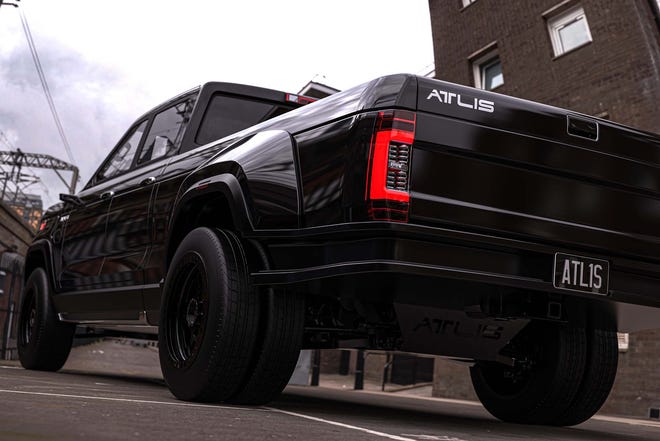
But where automakers a century ago were pioneers on the Industrial Revolution’s transportation frontier, today’s startups face formidable challenges from established Detroit-based and foreign automakers jockeying for the same space in a still-undefined consumer market. The competition is stiff and well-financed.
General Motors Co.’s Cadillac is going electric and its GMC unit has a new Hummer EV. Ford Motor Co. and Fiat Chrysler Automobiles’ Ram have electric pickups in the works. German rivals including Volkswagen and BMW intensify the competition.
Those legacy makers hold a big advantage in access to capital to build factories, manage distribution and establish dealer networks. But startups benefit from efficiencies created by in 21st century, including online marketing and low-maintenance electric powertrains.
Founded by Mark Hanchett, the Atlis XT pickup is aimed at the commercial vehicle market instead of the luxury niche targeted by Rivian and Hummer. Atlis promises a pickup starting at $45,000 with a flexible electric platform that fleet customers can configure to their own specifications.
“Organizations like Atlis are really looking at a much bigger picture,” Hanchett said in an interview. “It’s perfect for fleet owners. Electric technology is superior to the diesel technology that’s out there today.”
Hanchett breaks through the noise with a bold claim: that his trucks can recharge up to 500 miles on the Atlis high-speed charging network in just 15 minutes — competitive with the diesel trucks that dominate today’s market.
— competitive with the diesel trucks that dominate today’s market.
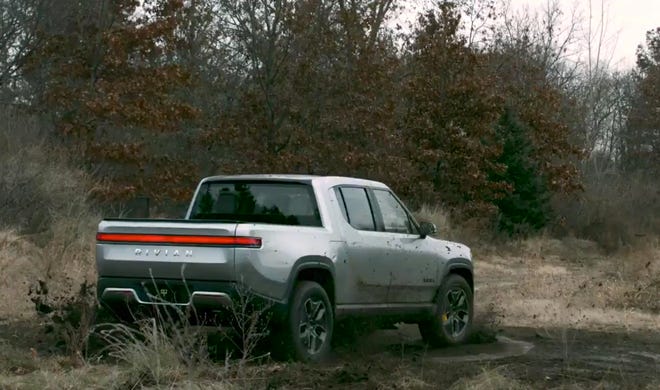
The variety of planned EVs is broad, reminiscent of the early 1900s. The Industrial Revolution’s innovation of gas and steam engines were the perfect spark for the horseless carriage. The Duryea Motor Coach Co. launched the auto revolution in 1896 with the first gas-powered motorcar.
The first decade of the 20th century saw anywhere from 500 to 1,500 startup automakers (depending on the source) in the U.S. They ranged from names that would become familiar like Oldsmobile and Cadillac, to forgotten shops like Pope Hartford and the Thomas B. Jeffery Co. But when Ford Motor Co. broke through with mass manufacturing in 1913, boutique automakers found themselves in trouble.
“Capital became a huge factor,” said Matt Anderson, curator of automotive history for The Henry Ford museum in Dearborn. “You had to have resources for manufacturing and then to weather World War I and the Great Depression.”
The demands of mass production inspired relentless consolidation as General Motors, for example, gobbled up Buick, Olds, Cadillac and Oakland. By 1929 the number of U.S. automakers was fewer than 50 with some 80% of production coming from GM, Ford and Chrysler. Ahead of the current wave, the last auto startups were Tucker Corp. and Kaiser Motors just after World War II.
The challenge of competing against the auto behemoths remains as true today as it was then. But the nature of EVs means that startup costs are much less than they have been for gas-powered vehicles in an industry whose barriers to entry historically have been high.
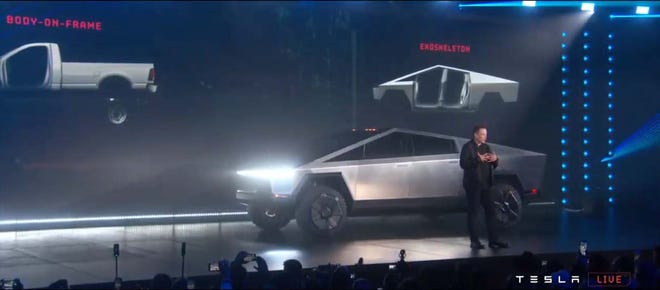
New cost-model
“A traditional gas-car company required $3 billion before you even put a spade in the ground,” said auto consultant Joe Phillipi, a veteran auto investment analyst who worked on Wall Street for decades. “Developing the powertrain, transmission, electronics were cost-prohibitive. But these new electric automakers have simpler powertrains, don’t have to worry about regulatory validation for emissions, and in some cases can outsource their production.”
California-based startup Fisker Inc. is one of the latter. Led by ex-Aston Martin designer Henrik Fisker, the company announced this fall that its $37,499 compact SUV, the Ocean, will be produced by Austrian supplier Magna Steyr.
Further reducing costs, the Ocean will be made on Magna’s own EV architecture. Fisker’s design will be coupled with off-the-shelf items from suppliers with Magna overseeing the car’s assembly. Magna has previously showcased an EV prototype for Sony and has experience assembling gas vehicles like Mercedes’ G-wagon SUV.
Atlis is a more-vertical company in the mode of Tesla. It not only builds its own vehicles, but also a proprietary charging infrastructure and battery cells. Ditto the plan for Atlis.
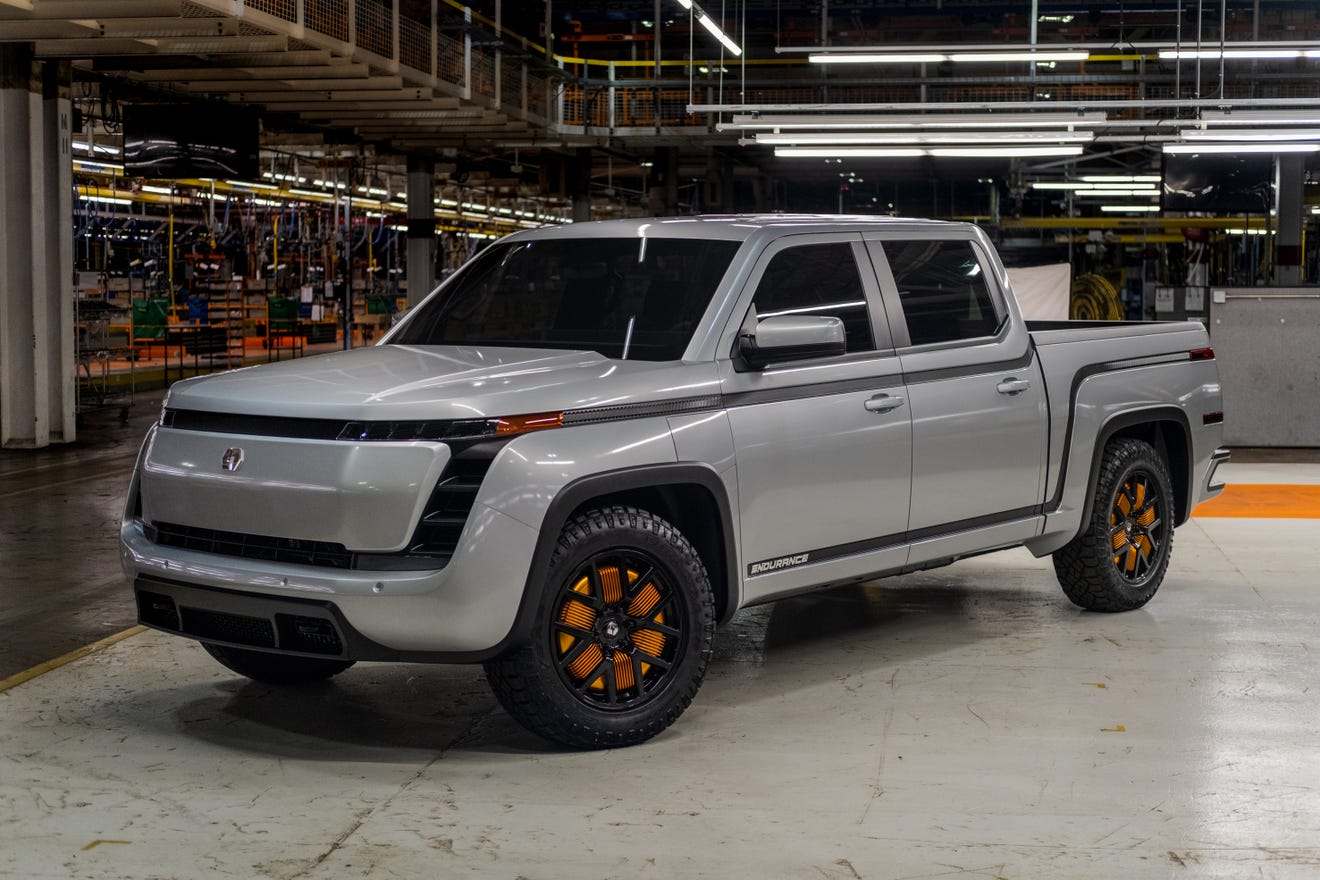
Lordstown Motors’ electric truck Endurance is displayed after its unveiling at the Lordstown Motors Corporation plant in Lordstown, Ohio.
Atlis’ priority is raising capital, which has been plentiful for upstart EV makers. The biggest sources of cash: U.S. equity markets, venture-capital investors and sovereign investment funds from countries like Saudi Arabia. Even such legacy automakers as Ford, an investor in Rivian, are active in the space.
Hanchett is pursuing an initial raise of $25 million for battery development and charging infrastructure before revving up vehicle production in late 2021 with a second round of financing.
“There are billions in capital out there from venture funds across the world,” said consultant Phillipi. “The Saudis are investing heavily in this technology because they want to diversify beyond oil for the next wave of transportation.”
He adds that truck makers Atlis, Lordstown and Rivian — while not ruling out retail orders — are directly dealing with fleet customers to cut inventory costs, a major expense for legacy automakers that traditionally sell through dealer networks.
Altis rival Lordstown Motors recently secured financing with DiamondPeak Holdings Corp. to jump-start manufacturing on the site of GM’s closed Lordstown Assembly in northeast Ohio. The merger with DiamondPeak provided $675 million of gross proceeds that will be used to fund production of the $52,000 Endurance pickup. GM invested $75 million in the startup. Lordstown Motors also received backing from institutional investors, including Fidelity Management & Research Co. LLC.
“We don’t see anybody in our lane,” Lordstown CEO Steve Burns told The Detroit News of his Endurance truck. “There is nobody with a full-size truck for workers priced in this range, and it is hard to get a lane to yourself in modern-day automotive.”
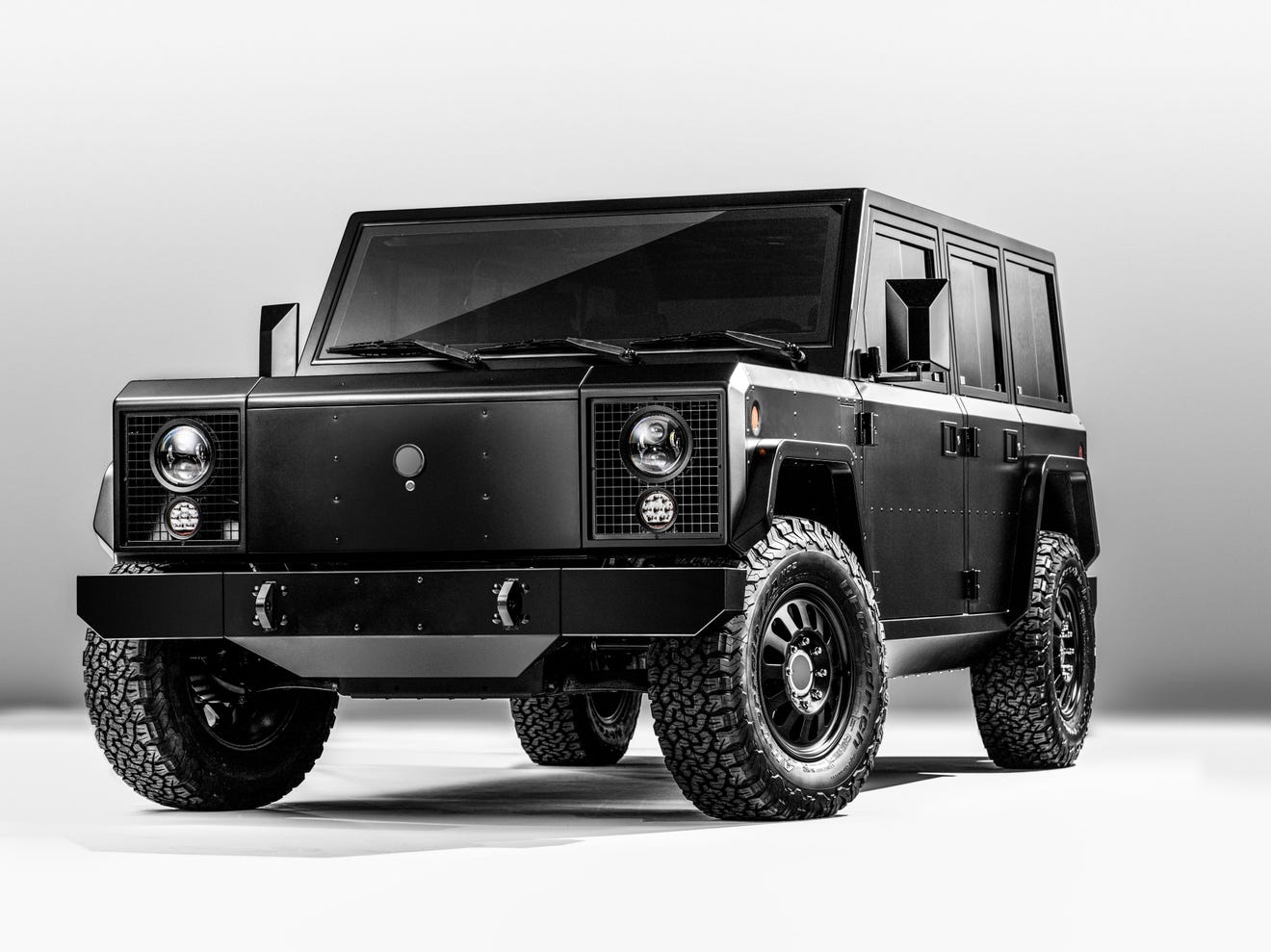
Ferndale-based Bollinger Motors introduced the B1 all-electric SUV sport utility on Thursday.
Startups vs. legacy makers
Even as these EV startups seek to upend Detroit’s three automakers’ hold on the truck market, they have a symbiotic relationship with them.
Besides GM’s investment in Lordstown, GM is working on a deal to partner with Phoenix-based Nikola to make electric and fuel-cell trucks together, including Nikola’s Badger truck. When announced in September, the deal was to give GM and 11% stake in the company.
Ford has invested $500 million in Plymouth-based Rivian.
Even Tesla, which claimed the best-selling luxury car in 2018 with its Model 3, is dependent on legacy automakers. The company would be unprofitable were it not for selling emissions credits to gas vehicle-producing manufacturers so that they stay in compliance with, for example, California’s stringent emissions rules.
Payne: It’s a bird, it’s a plane . . . it’s the 702-horse Ram TRX supertruck
Posted by Talbot Payne on November 5, 2020

Flying at over 65 mph in a 2021 Ram 1500 TRX — four feet off the ground — is when you realize that there’s not much pickups can’t do anymore. Hold that image, and let me catch you up.
The 702-horsepower TRX — pronounced T. rex — is the most powerful truck made.
But it’s much more than a rocket-sled. It’s like the recent crop of insane high-performance supercars I’ve tested — McLaren GT, Porsche 911 Turbo, Chevy Corvette C8 — that defy the laws of on-road physics while surrounding you in luxury. The TRX is an off-road weapon with the interior of a Bellagio Hotel suite.
This remarkable versatility has made pickups the new halo vehicles for brands — as desirable as luxury performance cars. Call them supertrucks.
I punished the TRX on Nevada’s off-road trails, rocky terrain and Wild West Motorsports Race Track. Yes, the Wild West Motorsport Park. Wild West, for the uninitiated, is home to serious off-road racing. It’s a twisted, four-turn torture chamber that puts Baja 1000-capable racers to the test with extreme jumps, slippery turns and severe drops.
OK, back to that flying truck …
Dropping seven stories down the ski slope-shaped Turn 4 — the supercharger screaming over the roar of the 6.2-liter V-8 — I pushed 70 mph and launched the 6,350 pound-beast into the sky over the main straight jump. My body tensed for the impact …
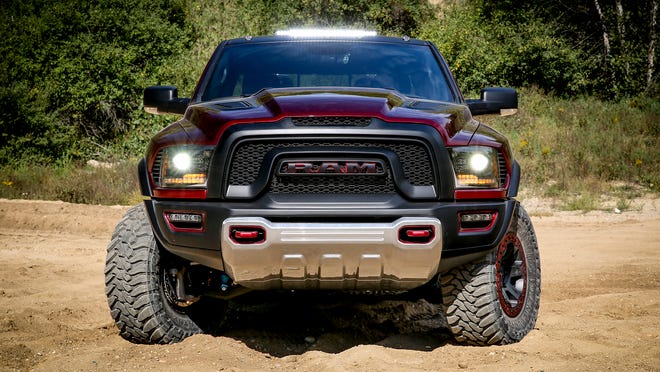
WHUMP! The behemoth landed with remarkable composure, its underbelly skid plate armor slapping the dirt. With 14 inches of suspension travel, TRX’s specially tuned Bilstein shocks rebounded with poise, sparing my helmeted head from going through the roof. Another 1.2 miles of drifting turns, punishing jumps and high-speed straightway followed. The Ram begged for more.
Not only did the pickup emerge unscathed after four laps, but so did I. No bruises. No back trauma. No kidding.
The United States is awash with club tracks (see M1 Concourse in Pontiac) catering to the owners of Corvettes, Porsche 911s and Ferraris who want to push the limits of their supercars in their natural habitat. Maybe they’ll build off-road club track for trucks like the TRX one day. Like supercars, its capabilities can’t be truly realized unless you’ve taken it off-road.
Unlike supercars, however, the ranks of supertrucks are few. Like two (three if you count the coming Hummer EV).
The $70,095 TRX joins the segment-busting 450-horse, $55,150 Ford Raptor as pickups with upgraded hardware to handle off-road extremes.
These vehicles are most intriguing, however, because of their bandwidth. I have marveled at the dexterity of the new mid-engine $59,995 Corvette C8, with interior amenities that match its mechanical bravado. It’s a car you can track on Sunday afternoon, then take to the country club for an evening meal. Ram’s super-truck takes this capability to the next level.

My loaded TRX tester could be hammered around Holly Oaks Off-Road Vehicle Park on Sunday afternoon, valeted at the club Sunday night, then filled up on Monday for the family vacation trip.
Let’s take each dimension one-by-one.
Off-road: If you guessed TRX’s 702 ponies come from the same Hellcat engine that have made legends of the Dodge Challenger/Charger — you’d be right. But where those hammers can shred a quarter-mile faster than any Mustang or Camaro competitor, their ancient chassis limit them in the twisty bits.
The TRX, by contrast, sits on Ram’s state-of-the art bones, battle-hardened by Fiat-Chrysler’s SRT performance shop. I’ll read with interest Car and Driver’s Jurassic Park Raptor vs. T. rex comparo test. But with 252 more horsepower, Bilstein shock technology and frame rails the size of skyscraper girders, the Ram costs $15,000 more for a reason.
Flogging the Raptor and TRX back-to-back, the Ford feels nimbler thanks to its lighter (5,500 vs. 6,350 pound) frame. But it’s no secret that Raptor fans pine for the monster’s rowdy, first-generation V-8 over the current twin-turbo, 450-horse V-6.
The TRX holds nothing back with the Hellcat furnace.
Toggle the launch-control button on TRX’s dash. Mash the brake. Mash the throttle. Release brake. The predator’s primeval roar mated to its quick-shifting 8-speed tranny will raise goosebumps on your neck, just like a supercar. I hit 60 mph in 3.9 seconds compared to Raptor’s 5.1 (Car and Driver figure clocked the TRX at 3.7). Let’s do it in the dirt, too. With 4×4 traction, engineers recorded 5.1 seconds on Wild West’s dirt flats.

Valet: Roll up to the club and grown men’s knees will buckle. The TRX shares sibling Ram Rebel’s aggressive face and then some. Menacing LED lights flank the jack-o-lantern jaw.
A hood scoop feeds air to the beast within. Three lights glow inside the opening (required by highway law because the TRX’s width has grown to over 80 inches). Eight-eight to be exact, thanks to massive, 13-inch-wide, 35-inch-tall Goodyear knobbies under the swollen fenders. Give this truck a steroid test.
Climb the TRX’s 12-inch ground clearance and there’s more wow inside. Ram spared no luxury, making standard a 12-inch, Tesla-like screen and materials that have made 1500 pickups the envy of your neighborhood. The rotary dash shifter is replaced by a hive of drive-mode buttons (4WD High, AWD Low, etc.), while a proper shifter sprouts from the console for easier V-8 rowing. A flat-bottom steering wheel rounds out the performance cockpit.
Road trip: I expect to see plenty of TRX’s towing boats and race cars across Michigan. The beast’s standard crew cab will easily swallow a family. Option a $695 tonneau bed cover and toss in back all the luggage/supplies you need. With 8,100-pound tow capacity and 650 pounds of stump-pulling torque, the TRX will haul your boat — and be the envy of the dock slip.
The 2021 TRX is proof that the 21st-century electronics revolution can transform even the wildest automotive beast. Built on an old-fashioned ladder frame, TRX is a one-vehicle auto show. It boasts 1) the ruggedness of a pickup with bed and tow-hauling capabilities; 2) roomy, leather-trimmed interior to rival any luxury vehicle; 3) mega-screen housing everything from infotainment to 0-60 mph performance pages; 4) a sports car suspension with massive brake rotors, coil springs, multi-link arms and Bilstein shocks.
Move over supercars. Supertrucks have arrived.

2021 Ram 1500 TRX
Vehicle type: Four-wheel drive, four-door, five-passenger pickup
Price: $70,095, including $1,095 destination charge (est. $87,170 as tested)
Powerplant: 6.2-liter, supercharged V-8
Power: 702 horsepower, 650 pound-feet of torque
Transmission: 8-speed automatic
Performance: 0-60 mph (4.5 seconds mfr., 3.9 seconds as tested; maximum towing, 8,100 pounds
Weight: 6,350 pounds
Fuel economy: EPA mpg 10 city/14 highway/12 combined
Report card
Highs: On- and off-road capability; interior opulence
Lows: Hard to park; gets pricey
Overall: 4 stars
Cadillac Super Cruise vs. Tesla Autopilot: Which is tops?
Posted by Talbot Payne on November 2, 2020
In a test of 17 driver-assistance systems across brands ranging from Tesla to Mazda, Cadillac’s Super Cruise topped Consumer Reports’ list in limited testing conditions. But in truth, Super Cruise and Tesla Autopilot are head-and-shoulders above the field.
Cadillac’s is the safest. Tesla’s the most capable. Their priorities reflect two very different companies that are in a race for the self-driving future.

Cadillac is part of the multi-brand, lawyered-up General Motors behemoth intent on realizing an electrified, autonomous future – including the Cruise ride-sharing service that has been approved to test Chevy Bolt robots in San Francisco. Its approach is conservative and deliberate, with layers of redundancy.
Tesla, by contrast, is an ambitious startup electric carmaker led by swashbuckling founding father Elon Musk. He sees his model lineup – not a separate fleet like Cruise – leading the world into the autonomous future. Autopilot 2020.12.6, the latest over-the-air update, is a daring, risky, real-world exploration of state-of-the-art self-driving.
I have driven all the automakers’ systems and am constantly evaluating upgrades. Consumer Reports’ test released Wednesday consisted of a 30-mile loop of interstate and secondary roads (plus the company’s test track) and was limited to the systems’ lane-keeping and speed-control ability using adaptive cruise-control. In industry jargon, these are “Level 2” systems that require full driver engagement. Full-self driving “Level 4” systems do not require driver attention.
Super Cruise and Autopilot, unlike their peers, push hard on the Level 2 envelope and give a peek at a self-driving future.
Super Cruise was introduced in the now-defunct Cadillac CT6 sedan, and is on course for use in 22 vehicles (including non-Cadillacs like the GMC Hummer and Chevy Bolt) by 2023. Super Cruise generally acts like other lane-keeping, adaptive-cruise systems in the market – though it doesn’t work on secondary roads and highways with stoplights.
It is limited to divided, limited-access highways like I-75. That’s because GM is intent on perfecting self-driving in a safe environment devoid of stoplights and traffic crossings that can confuse the current technology. Cadillac is determined that you can relax, take your hands off the wheel, and – yes – check your email and texts.

Consumer Reports tries to discourage such ideas, saying: “The evidence is clear: If a car makes it easier for people to take their attention off the road, they’re going to do so—with potentially deadly consequences.”
But, let’s be honest, that’s the whole point of autonomous systems – to allow drivers to do other things. And that’s why CR gives Super Cruise its highest rating, because it constantly monitors drivers to make sure they aren’t too distracted.
An infrared camera stands watch on the steering column, monitoring the driver at all times. The purpose of Super Cruise is to allow the driver to relax as if in an easy chair with hands off the wheel, whereas other systems constantly urge drivers to grip the wheel.
That includes Teslas like my Model 3. Tesla requires some assurance from the driver that they’re engaged – hand on the wheel, rolling the adaptive-cruise speed button – every 15 to 30 seconds.
Freed of the helm on Super Cruise, I ate a meal and thumbed email on a 400-mile test. If the camera detected my head turned for any period of time, a steering wheel-mounted light would escalate warnings: 1) flash green 2) turn red 3) flash red and start braking while a voice warned: PLEASE TAKE CONTROL OF VEHICLE.
Cadillac is clearly concerned the Barcalounger position will encourage naps.

With its constant nannying, falling asleep at the Tesla wheel is less likely. But quick texts and email checks are doable. If you ignore the nanny 1) a blue light will flash in the screen, 2) a warning chime will sound, then 3) the car will revoke your self-driving privileges for the rest of the drive.
Both vehicles can skillfully take turns up to 85 mph. Enter a curve too fast, and they’ll back off the throttle. Lane-centering is superb. True to its ambitious nature, Tesla features “Navigate on Autopilot” to negotiate a highway route entered in the car’s navigation system, lane changes and all. While in Super Cruise, you have to change lanes yourself – though a lane-change upgrade is coming this winter with the all-new Escalade.
For all of their sophisticated cameras, neither robot mode can see pop-up construction zones with orange barrels. Neither can see potholes. Neither will work in bad weather like snow.
Exit the highway and Super Cruise hands me back the controls. It knows its limitations.
But that’s just where the Tesla is getting interested. With its latest upgrade, Autopilot wants to drive secondary roads too.
It’s not for the squeamish.
Traveling down Telegraph Road with Autopilot’s blue wheel symbol glowing on the screen, the Model 3 detected a stoplight and slowed down to determine if it was red or green. I often had to goose the accelerator pedal so a surprised follower didn’t rear-end me. Having recognized the Christmas tree, Autopilot will stop at red or keep going through green. Or it might stop at green. Flashing yellow is a crapshoot.

At a busy construction intersection at Big Beaver and Crooks Road, the Tesla rudely sped by queued traffic in the right lane before I realized the lane was closing and I merged left.
In Charlevoix, two joggers in the street (their profiles popping up in the car’s crisp display) caused the Tesla to slam on the brakes. A human driver would have just weaved around them.
Navigating south to Detroit on I-75, Autopilot expertly changed lanes in and out of slower traffic, speeding up to make sure it merged seamlessly.
It’s a fascinating, attention-demanding glimpse at what the car sees, and a reminder of how far autonomous systems have to go. For those who simply want a relaxing interstate drive, however, Super Cruise is your driver.
Still, the two companies move relentlessly ahead. Even in the month since Consumer Reports’ test, advancements have been made. Super Cruise has added the aforementioned auto-lane change feature as well as adjusted lane-centering so the vehicle will move farther over in the lane when passing, say, an wide semi-truck. Meanwhile, Tesla has rolled out a fully self-driving update to select customers. That’s right – the Tesla turns at intersections on its own.
The driverless future is coming, ready or not.
Payne: Mercedes-AMG’s fearsome C63 Coupe is a sinister Halloween treat
Posted by Talbot Payne on October 30, 2020
It’s almost Halloween. Need a sinister car to drive the kiddies from house to house?
Well, if you’re Bruce Wayne or someone with similar means, I might suggest the Mercedes-AMG C63 Coupe. In matte black. My family immediately dubbed it the “Batmobile” when it rolled into my driveway this fall — its sinister shade a striking contrast to Michigan’s leafy, orange trees.
Yes, Mercedes. That icon of the establishment has produced one of the most wicked-looking cars in autodom. Brooding front grille. Slit headlights. Growling, 503-horse V-8 engine. The specs on this beast sound more like something out of Dodge’s bat cave.
Honey, our C-class Mercedes has been possessed!

I prowled Michigan in the C63 this fall, spreading fear throughout its northern latitudes.
It’s almost as evil-looking as big brother AMG GT R, the 550-horse racing version that is currently devouring Acuras and Porsches on the IMSA race circuit, with a maw the size of a humpback whale. Compared to the $200,000 GT R, the $106,440 C63 is a bargain.
A product of Mercedes-Benz’s AMG performance division, the C63 S is the alpha male of the three AMG coupes offered, each more capable than the last: C45 (382 horsepower), C63 (469), C63 S (503). And those are just the C-class choices for the two-door coupe! Add three AMG options to the each of the other C-class variants — wagon, sedan and Cabriolet — and you understand why it is so difficult for Detroit luxe brands to compete against the broad Merc lineup.
My tester was a rolling candy store — loaded with every sweet on the shelves. For example:
- Dark chocolate, silver-rimmed 19-inch front/20-inch rear five-spoke forged wheels: $2,100
- Licorice Michelin Pilot Super Sport tires: $600
- Black-night package on wing, mirrors, etc., plus chrome-plated exhaust tips: $750
- Black carbon-fiber package: $1,750
- Candy-corn yellow ceramic brakes: $5,450
And so on. I got cavities just looking at it.
But the real treat is the $2,020 Designo Graphite Grey Magno paint — matte black, for short — that wraps this refugee from hell.

Matte paints have been maintenance nightmares in the past (they can’t be protected by waxing like normal finishes), but Mercedes reassures that current coats “do not require any special instructions for care, other than don’t use abrasive materials on it or let harmful debris like bird dropping linger.”
Bird droppings. Good to know. But I’m pretty sure Bruce Wayne will keep it in his garage.
For all its wicked exterior looks, the GT is a grand touring model that competes with other daily-driver sports cars like the Corvette C8 and Porsche 911. That means cargo room.
Where the mid-engine Corvette (get it in pumpkin orange) offers its frunk and trunk for storage, the front-engine C63 offers a sizable boot and second-row seats. Wee trick-or-treaters will fit nicely back there.
Helping in the process are Mercedes’ magic seats. Just pull the seat-top handle and they silently glide — ghost-like — forward.
Up front, passengers are wrapped — too tightly for my 230-pound, 6-foot-5 frame — in heavily bolstered competition seats. These track-focused thrones are great for pulling Gs, but they grew uncomfortable on my four-hour trip north.
Happily, the interior surroundings are heavenly. Mercedes interiors are the most luxurious in the land, even in AMG monsters. The signature silver aviator vents stood out next to carbon fiber-wrapped console. Instrument and dashboard infotainment displays are rich in graphics, and — when the sun goes down and the goblins come out — interior mood lights can be programmed to change yellow, purple, red.

Indeed, cruise the highway and the C63 aims to please. While not yet equipped with the brand’s latest MBUX voice-recognition software (“Hey, Mercedes, turn the temperature to 70 degrees”), the C63 does come equipped with Mercedes’ steering-wheel-mounted mouse pads so that you can control the twin screens without your fingers leaving the wheel.
The AMG also features the latest in self-driving capabilities. Press adaptive cruise-control, set speed, and the coupe stays nicely centered in its lane. Pull the turn signal and it automatically changes lanes. But you don’t buy an AMG for self-driving.
Roll the drive-mode switch next to the monostable shifter, and Dr. Jekyll transforms to Mr. Hyde. Normal mode changes to Sport to Sport + to Race. With each step the beast grows more demonic.
The chassis tightens. The engine growl gets more menacing. The tailpipes crackle. The long hood grows horns.
On my favorite M-32 stretch of road up north, I unchained the horses of hell.
That’s 503 horses to be exact. In Sport + mode, a quick 8-speed dual-clutch transmission effortlessly swapped cogs. The 4.0-liters of V-8 shook the road, followed by bratty exhaust flatulence as I lifted off the gas for looming curves.
Despite slick asphalt dotted with the first orange leaves of fall, the big AMG stayed planted through the twisties. The steering was direct. The brakes toothy. Body roll minimal. The payoff were straightaways where I could open up the V-8 once more.
Race mode offers the kiddies the additional thrills of launch control, but the rear-wheel-drive Merc was curiously resistant to the idea — the electronic nannies intervening as I laid down the power. The C63 advertises sub-4 second 0-60 mph runs, but I was well shy of that.
Trees up north were turning fiery red and orange — the perfect backdrop to the streaking black batmobile. For $106,000, the C63 comes with an excellent Burmester stereo, but I never turned it on. Like the Porsche flat-6, the engines in the coupe class are music to the ears.
The Porsche’s talent is in its peerless handling, but the Mercedes’ V-8 sex appeal is more visceral. That’s part of the coupe’s charm.
Refined Mercedes is not the first brand that comes to mind at Halloween. But AMG has given the German badge needed personality. It’ll put a smile on your face like a Camaro SS and Mustang GT350. It’s a Detroit muscle-car wrapped in a matte-black German tuxedo.
Mercedes, like other European brands, is investing heavily in electric vehicles, and it will be a challenge to match the personality of AMG’s V-8. Strap in the trick-or-treaters. Empty the neighbors of their candy. Then toggle Sport +.
And let the big dog howl at the moon.

2020 Mercedes-AMG C63 Coupe
Vehicle type: Rear-wheel drive, two-door, four-passenger coupe
Price: $78,495, including $995 destination charge ($106,440 as tested)
Powerplant: 4.0-liter, twin-turbo V-8
Power: 503 horsepower, 516 pound-feet of torque
Transmission: 9-speed automatic
Performance: 0-60 mph, 3.8 seconds (mfr.); top speed, 180 mph
Weight: 3,803 pounds
Fuel economy: EPA 18 mpg city/27 highway/21 combined
Report card
Highs: Hot inside and outside; drivetrain personality
Lows: Heavy; beware bird poop on the paint
Overall: 4 stars