- Search Cartoons
- Comic Archive
-
Payne
Store



 Henry Payne RSS

Articles Blog
Payne: First date, boxy Mercedes GLB or sexy Mercedes CLA?
Posted by Talbot Payne on January 28, 2021
The Mercedes GLB and CLA may sound like they come from the same family. But they are as different as Hansel and Gretel.
The GLB crossover and CLA sedan occupy the same entry-level compact segment. Both offer front- or all-wheel-drive. Both feature the same state-of-the-art self-driving system. Yet Mercedes sees SUV and sedan buyers as entirely different people.
 >
>
So it has given the entry-level vehicles two entirely different personalities.
Like siblings that take after mom or dad, the GLB gets its DNA from Papa G-wagon — Mercedes’ top-of-the-line SUV patriarch. The comely CLA learned its lessons from the top-dog S-class coupe.
GLB is square and chunky like the off-roady G-wagon, its giant greenhouse giving excellent, 360-degree visibility and comfortable rear seating for your giraffe-legged reviewer. I could easily sit behind myself in the GLB with headroom to
Elsewhere in its SUV lineup, Mercedes has been pushing the envelope trying to make its SUVs look more sedan-like with racy, “coupe” designs on the GLC and GLE. Well, the GLB won’t be turning any heads.
The little Merc takes its design cues from a shoebox. This sport utility is all about utility.
Strangely, my GLB 250 came equipped with paddle shifters which were as useful as tennis shoes on a fish. The GLB is not a vehicle you want to row hard. It’s 2.0-liter turbo-4 has enough pep to get around town, but the turbo lags and the car’s top-heavy appearance (all that greenhouse glass!) translates to healthy body roll in the twisties.
 >
>
Homely it may be, but you can throw everything and the kitchen sink inside its big square hatchback — and the GLB middle seats fold flat for easy loading. Its wheelbase stretches a healthy four inches beyond the CLA. Got more stuff? Load it on the roof rails.
If you want a stylish Merc, forget the GLB and check out runway model CLA.
With is long, shark nose and swept lines, the sedan will get entry-level buyers’ attention. Papa S-class would be proud. Interestingly, the boxy GLB is adorned with jewelry — chrome exhaust valance here, a dab of rocker panel chrome there — in order to let you know it’s a Merc.
The gorgeous CLA doesn’t need superfluous jewelry. Its lean bod is visual enough.
 >
>
It’s even prettier than CLA’s first-gen car which I swooned over in 2015. Especially in the rear quarters, which drooped in the 2014 model like it had been held too close to a flame. The 2020 model sports a firmer derriere.
That’s important because CLA is a companion sedan with the Mercedes A-class. Like the S-class and its S-class Coupe stablemate, Mercedes offers entry-level sedan buyers two body styles. Though the CLA has four doors, its raked roofline echoes that of the two-door, S-class coupe.
The A-class is attractive to look at — but for a couple grand more, you can score a date with the homecoming queen.
Speaking of a couple grand more, I would recommend the upgrade to CLA’s AMG performance trim.
Like the GLB, the standard, 221-horsepower, 2.0-liter turbo-4 in the CLA feels a bit uninterested. The AMG 35 trim gains 81 ponies and a taut, all-wheel-drive suspension.
 >
>
Luffing along state Route 250 in Ohio, a hungry, 232-horse Mazda RX8 suddenly loomed in my mirrors. I toggled into the AMG 35’s SPORT PLUS mode — tightening the suspension and steering. The engine lowered an octave as if clearing its throat.
With a flick of the shift paddle (useful in CLA as opposed to the GLB), I dropped the transmission a gear. Then floored it. BLATT! BLATT! Went the lightning-quick upshifts as I sped through a pair of ess curves, the chassis solid as a rock.
Exploding out of the last corner, I glanced in the rear-view mirror for my RX8 friend. He was barely in sight, struggling to keep up. OMG AMG.
If anyone challenges you at a stoplight, the AMGs launch control is also useful. Floor the brake. Bury the throttle. Wait for the revs to level at 3,000 RPM. Lift brake. ZOT!
 >
>
As different as the SUV and sedan look outside, the cockpits are similar inside. Both vehicles come with a standard 7-inch gauge cluster. Upgrade to a 10.25-inch cluster like my testers and you get one of the industry’s best digital experiences. Where Tesla has inspired a generation of cars with big center screens, Merc has innovated the horizontal dash screen stretching from driver’s instrument panels across the console.Get the COVID-19 Update newsletter in your inbox.
Updates on how the coronavirus is affecting your community and the nationDelivery: VariesYour Email
Note the Kia K5, Hyundai Sonata and 2021 Cadillac Escalade as disciples of Merc’s design lead. Managing the wealth of information on these graphically rich screens is a beautifully engineered steering wheel. Without removing my hands from the wheel, I used tiny mouse pads on the spokes to negotiate between menus.
For the ambitious, there’s self-driving capability, too. Merc’s system is reliable on a divided interstate, even changing lanes automatically when you pull the turn signal stalk. Unfortunately, the voice recognition system struggled with my navigation commands, whereas the available Android Auto (ahem, Mercedes, if Kia can do wireless Android Auto why can’t you?) responded perfectly.
 >
>
I continue to use phone apps for my in-car navigation.
The Mercedes’ consoles offer useful storage space for phone and water bottles — but the real estate could be even more useful were it not for the giant touchpad that occupies valuable space and proved clumsy to operate. I didn’t use it.
Perhaps my favorite ergonomic feature on the Mercs is the location of the engine Stop/Start button (the most annoying feature in autos today) right next to the ignition button. Turn on the ignition key — and turn off STOP/START in one motion. Thanks, Mercedes!
Aft of the front thrones, the two vehicles change significantly. The CLA sedan gets cramped — the coupe roofline bearing down on my noggin while I had to splay my long legs to sit behind myself.
So different are GLB and CLA that Merc fanatics might consider buying both for the garage. One for daily chores, one for weekend getaways. One for Hansel, one for Gretel.
 >
>
2020 Mercedes CLA
Vehicle type: Front- or all-wheel drive, five-passenger, compact sedan
Price: $37,645, including $995 destination charge ($66,340 AWD AMG CLA35 as tested)
Powerplant: 2.0-liter, inline turbo-4
Power: 221 horsepower, 258 pound-feet of torque; 302 horsepower, 295 pound-feet of torque (in CLA35 as tested)
Transmission: 7-speed automatic
Performance: 0-60 mph, 4.8 seconds (mnfr.); top speed, 155 mph
Weight: 3,505 pounds
Fuel economy: EPA 23 mpg city/29 highway/25 combined (as tested)
Report card
Highs: Sexy bod; sporty AMG dynamics
Lows: Useless touch pad; cramped rear seat
Overall: 4 stars
2020 Mercedes GLB
Vehicle type: Front- or all-wheel-drive, five-passenger, compact SUV
Price: $37,595, including $995 destination charge ($55,340 AWD GLB 250 as tested)
Powerplant: 2.0-liter, inline turbo-4
Power: 221 horsepower, 258 pound-feet of torque
Transmission: 8-speed automatic
Performance: 0-60 mph, 6.9 seconds (mnfr.); top speed, 130 mph
Weight: 3,891 pounds
Fuel economy: EPA 23 mpg city/31 highway/26 combined
Report card
Highs: Roomy interior; state-of-the-art electronics
Lows: Boxy exterior; sleepy turbo-4
Overall: 3 stars
How M1 Concourse became Metro Detroit’s #1 auto venue
Posted by Talbot Payne on January 28, 2021
Pontiac — Suddenly, M1 Concourse is the epicenter of Detroit car shows.
In 2021, Pontiac’s exclusive car club will host four of the region’s major car events, including the Detroit Auto Show’s Motor Bella and American Festival of Speed back-to-back in late September. In addition to those fall headliners, M1 will dominate summer Woodward Avenue cruising as it brackets the Aug. 21 Dream Cruise with the (tentative) Roadkill Nights and Woodward Dream Show weekend events.
 >
>
In so doing, Pontiac — Metro Detroit’s second city — will be the focus of the automotive community as thousands of spectators and media descend on its sprawling enthusiasts’ playground anchored by the 1.5-mile Champion Motor Speedway race track.
“I don’t see us in competition with Detroit,” M1 Concourse CEO Jordan Zlotoff said in an interview. “Obviously there’s a lot of news right now about there not being a traditional auto show event in the city, but I think there is a big future for the whole region in terms of what we can do around automotive activations.”
Automotive activations are participatory auto venues increasingly craved by automakers over static convention center shows. Zlotoff said that M1 had been in talks with the Detroit Auto Dealers Association (which organizes and manages the North American International Auto Show) to complement Motor Bella before COVID concerns forced the entire event outdoors to M1 Sept. 21-26.
 >
>
“We offer things by having a mile and a half track and 87 acres of outdoor space that can’t be offered downtown,” Zlotoff continued. “Our whole is bigger than the sum of the parts, and there’s a lot of ways we can work together and just leverage each other’s strengths.”
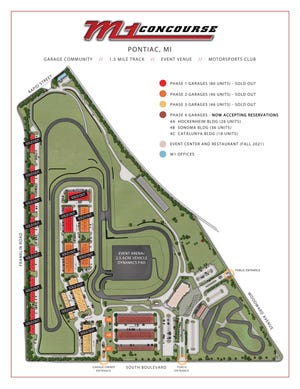
Zlotoff said that becoming the region’s automotive Disneyland was part of the plan since the club broke ground in 2015 on its first phase of private garages. With 173 built, M1 is now well into Phase Four of its garage development with a planned 255, making it the biggest private garage facility in the world. Its 160 Motorsport Club members keep a variety of exotic vehicles — from snarling Mustang muscle cars to rare Ferraris — with regular access to the track for exercise.
Tom McDonald, a member of M1 since 2017, likens the facility to a golf club — but with a track at its center. Like a golf course, M1 is a magnet for public events.
“Hosting auto shows is like bringing a PGA (golf) tournament to Oakland Hills,” smiled McDonald. “It brings more attention to the facility.”

It’s a twist on the usual auto club business model. Similar private club tracks like Virginia International Raceway between Richmond and Durham, North Carolina, or Autobahn south of Chicago, tend to attract racing competition. Located miles from urban centers, these tracks double as major race venues. M1’s location in the middle of an area precludes wheel-to-wheel racing lest it violate local noise ordinances.
Instead, it’s focused on testing and time trials, making it a prime spot for activation events where manufacturers can show off their wares. Zlotoff credits the facility’s attraction to auto shows to a number of factors.
 >
>
“One is just our location in Pontiac being so close to everything in metropolitan Detroit,” he said. “If you look at where (other) tracks are located, they’re far off from city centers. Also, we’re conveniently located to all (Detroit automakers) — as well as the hotels, restaurants, and the infrastructure of the city.”
Given its proximity to automakers and their supply chain, Zlotoff said that club’s goal from day one was to be an event facility — not just a track facility — with premium dining, restrooms and driveway amenities.
“This is a world-class facility that caters to clients that are in the automotive business world,” he continued. “They can produce a sophisticated event that has the look and feel of something you could do in a very high-end hotel or equivalent facility. I think it’s the confluence of those factors that are allowing us to put on all these events.”
M1 broke ground in September on an events facility that is designed not just to cater large events, but as a dining destination and configurable event space so that manufacturers could, for example, stage vehicles for auto show-like reveals.
McDonald, an ex-communications executive for VW North America and Mazda, said M1 is perfectly suited to new car reveals. Its exposure this year will raise its profile in North America, not unlike England’s Goodwood Festival of Speed which has become a must venue for international automakers.
 >
>
“The experiences of Motor Bella and American Speed Festival will really solidify M1’s reputation as an experiential facility that should push growth in the future,” he said. “Auto shows are changing, and auto marketing budgets are being tailored to take advantage of events like M1 can put on.”
McDonald points to the growth of similar, sprawling outdoor venues like Goodwood, Amelia Island Concours d-Elegance in Florida, and Monterey Car Week in California as examples of what M1 could become in the future. They are events where automakers can not only unveil new products — but also show them in action.
“What better location than a race track off of Woodward Avenue in Detroit?” he said.
M1 has recently hosted small media reveals for the Ford Mustang Mach 1 and the Honda Civic Type R. Porsche and Mazda have hosted track-oriented M1 events, too. Though Roadkill Nights sponsored by Dodge was canceled last year due to COVID concerns, the 2019 event brought 50,000 spectators to M1 over two days to ogle the new Dodge Charger Daytona, take thrill rides in muscle cars, and watch Woodward drag racing.
Zlotoff acknowledged that COVID circumstances have accelerated M1’s viability as organizers look for less-risky outdoor venues.
 >
>
The events will make for a crowded M1 calendar in 2021 that includes a Fourth of July fireworks show and regular Cars and Coffee collector events sandwiched around private member use. Zlotoff said the attention will benefit Pontiac, which as the center of M1’s mission statement.
M1 has been involved with the local community including the donation of a neighborhood playground, while M1’s Pontiac Motorsports Exposition arm will host charity events at the Aug. 19-21 Woodward Dream Show and Speed Festival to benefit local organizations.Get the COVID-19 Update newsletter in your inbox.
“Businesses are helping to change the nature and character of the city and its economic growth,” said Zlotoff. “We are certainly focused on helping the city. We want to see it prosper. I think M1 has been on a great trajectory, and I think it’s going to continue go upward in the next five to 10 years.”
New GM racing chief Klauser hits the ground winning at Daytona
Posted by Talbot Payne on January 27, 2021
Corvette Racing has a new boss.
General Motors Co. veteran Laura Wontrop Klauser has succeeded the legendary Doug Fehan, who left Corvette Racing at the end of 2020. Klauser assumed a new position as GM’s first Sports Car Racing Program Manager overseeing Corvette, Cadillac, and Camaro IMSA race programs. She has been involved with GM racing for the last five years.

“It’s a huge honor to move into this role with Corvette Racing,” said Klauser. “It unquestionably is one of the premier programs in all of sports car endurance racing. This motorsports management restructure is a great opportunity to rethink how Chevrolet operates on IMSA weekends. My goal is to promote more synergy between our racing programs and funnel our technical learnings back to GM.”
Klauser’s first week on the job was a successful one as the Cadillac Dpi-V.R prototype won the Motul Pole Award 100 at Daytona International Speedway and the Corvette team placed 1-2 in the GTLM division. By winning the Motul 100, Caddy will be on the pole for next weekend’s Rolex 24 Hours of Daytona, North America’s premier sports car endurance race. Cadillac is going for a 5th straight Daytona win.
Corvette is coming off a historic 2020 season in which its first mid-engine race car won in its inaugural campaign. It was a crowning achievement for Fehan’s 24-year career at Corvette Racing.
 >
>
“The team spent three years working double shifts — two jobs — to bring the C8.R to fruition,” Fehan said in an interview. “To come out the first year and win that championship it’s an outstanding achievement for that team, and I couldn’t be more proud of what they’ve done.”
Though his work at Corvette is done, Fehan won’t be going away quietly: “I’m not one to sit back and look out the window,” he laughed. “Racing is my passion and I plan to find a way to continue with that.”
Klauser, 34, takes the reins as GM continues its engineering-based approach to motorsports programs.
“Behind the scenes we try to take the lessons we learn on the race track and tie that back into production,” Klauser said in an interview. “In the case of the Cadillac (race car), we did a lot of aerodynamic trial and error. The CT5 and CT4 sedans took all of the learnings from the DPi program and brought that into production. It was a way to learn how to more efficiently bring air over the car which helps stability and better fuel efficiency.”

A mechanical engineer with a masters in engineering, Klauser joined GM in 2008 and looks to expand the technical direction for Corvette Racing.
After working in GM production and the Cadillac ATS race program, Klauser helped launch the Cadillac DPi-V.R racer, which has been a consistent contender in the high-flying prototype category against other manufacturer entries including Mazda, Acura, and Nissan. Cadillac-supported teams have claimed two manufacturers championships, four Michelin Endurance Cup Championships and 18 race wins.Get the COVID-19 Update newsletter in your inbox.
Updates on how the coronavirus is affecting your community and the nationDelivery: VariesYour Email
Since Fehan launched Corvette Racing in 1997, the program has compiled 14 IMSA team titles (including in 2020) and a record 100-plus wins.
In addition to her GM management roles, Klauser is the chair of the SAE Detroit Section Board and a familiar face to the Corvette customer and enthusiast community. She owns a 2013 Corvette Grand Sport that she takes to track days.
“We are pleased to have someone as enthusiastic and experienced as Laura,” said Mark Stielow, Chevy Director of Motorsports Competition Engineering. “Corvette Racing and GM’s road-racing efforts will benefit from her engineering experience with both the Corvette and Cadillac production cars.”
Klauser & co. will field nine cars in three different classes at next weekend’s Daytona events. The Cadillac Dpi-V.R and Corvette C8.R will take the green flag at the Rolex 24 January 30-31.
Payne: American Festival of Speed revs up Detroit fall autopalooza
Posted by Talbot Payne on January 22, 2021
The third leg is officially in place for this fall’s Metro Detroit autopalooza.
The inaugural American Festival of Speed car show will take place at Pontiac’s M1 Concourse Sept. 30-October 3, immediately after the 2021 Detroit Auto Show’s downsized Motor Bella. The twin M1 events, held at the region’s premier private motorsports club, will join the off-road Detroit 4Fest for an epic trifecta of southeast Michigan auto shows.

Billed as a “celebration of speed — past, present and future,” the American Festival of Speed is modeled after the Goodwood Festival of Speed in England, one of the world’s premier auto enthusiast events. Like Goodwood, American Festival will feature a race track as its centerpiece: M1’s 1.5-mile Champion Motor Speedway.
“We’ve studied some of the best automotive events around the world, and we’re taking the best elements and bringing them here to M1 Concourse,” said Dave Sherman, interim CEO of Pontiac Motorsports Exposition that will manage the event. “This will truly be a celebration of racing and performance, and we will have experiences and elements that will appeal to everyone from eight to 80 years of age.”
In contrast to the September 21-26 Motor Bella show, which will focus on current production cars, American Festival will celebrate exotic supercars as well as vintage classics and race cars. M1 got a taste of what to expect last summer when four, 1970-era Shadow Can Am race cars — one of them stuffed with a 1,000-horsepower Chevy V8 — rumbled around M1 to celebrate PME’s creation.

PME is the events arm of M1 Concourse, the newest race circuit in Michigan. While also taking place at M1, the Motor Bella events will be managed by the Detroit Auto Dealers Association. DADA sees the M1 event as a temporary bridge to the return of a full-blown, 2022 auto show at TCF Center in downtown Detroit — a prospect that is not guaranteed.
Detroit 4Fest, scheduled for September 25-26, will take advantage of a another new metro-area destination, Holly Oaks ORV Park. It opened last fall to rave reviews from off-road motorheads as a playground for dirt-kicking, four-wheel-drive vehicles.
In addition to closed-track racing and 200 distinguished automobiles drawn from automakers and car collections, American Festival will feature the Checkered Flag charity ball to benefit the Checkered Flag Challenge, a non-profit supporting worthy Pontiac causes.
“This is not just an ordinary car show,” said Sherman of American Festival. “It’s a celebration of all things automotive, mixed with premier food, wine and spirits that also make this a festival of the finer things in life.”
Each year, the American Festival of Speed will honor a class of cars — and an industry legend. This year, Can Am race cars (like the Shadows) from the 1960s and 1970s will be the featured class, while the first “Master of Motorsports” award will go to Texas racing legend Jim Hall, who developed the innovative Chaparral Can Am cars.

“What’s so important about having the Can Am cars here and honoring Jim Hall is that it fits right in with how we want to showcase innovation in racing and the automotive world,” said Tim Hartge, chief marketing officer of PME. “Jim is truly legendary for the advancements he made to racing in terms of aerodynamics and engineering advancements.”
George Levy, president of the Motorsport Hall of Fame of America and Hall’s authorized biographer, added that, to “car crazy kids like me in the 1960s, Jim Hall was the Neil Armstrong of motorsports.”
The American Festival will kick off on Thursday, September 30, with an exclusive “Dine and Drive” through the streets of Metro Detroit for behind the scenes peeks at the Motor City’s historic haunts. A Can Am Kick Off reception, open to the public, will follow.
The focus moves to the track Friday and Saturday with high-speed runs featuring classics and state-of-the-art cyborgs. In addition to single-car time trials, there will be celebrity autograph sessions, seminars, and more. Special guests include Hall, racing legend David Hobbs, and local collector Ken Lingenfelter.
Sunday will showcase the American Speed Festival Exposition, a judged competition of the weekend’s best cars.
PME’s Hartge celebrated the fall weekend’s back-to-back M1 shows: “This is the place to be at the end of September. You’ll find the best cars, the best food and spirits, and the best people in the industry… all gathering at M1 Concourse. It is the best of the best and you won’t want to miss it.”
Tickets are on sale now. Information and a full schedule of events are available at www.americanspeedfestival.com.
American Festival of Speed schedule of events, Sept. 30-Oct. 3, 2021:
Thursday
7:30 AM – Registration and Continental Breakfast at Event Center
8:30 AM – Guests leave from M1 Event Center and drive to The Lingenfelter Collection
9:30 AM – Guests arrive and tour The Lingenfelter Collection
11:00 AM – Guests leave The Lingenfelter Collection
12:00 PM – Guests arrive at The Automotive Hall of Fame for a strolling lunch
1:15 PM – Guests will tour The Henry Ford Backstage and Motorsports Display
4:00 PM – Guests leave The Henry Ford and drive to the M1 Concourse Event Center
5:00 PM – Guests arrive to M1 Concourse Event Center for a champagne toast
5:00PM–6:00PM – Cocktail hour
Friday
7:00 AM – Gates open
7:30 AM – Introduction Ceremony
7:45 AM – National Anthem
7:50 AM – Starting grid comes to life
8:00AM-11:15AM – Speed Ring runs begin – all 10 classes
11:15AM-12:45PM – Special vehicle driving demonstrations
12:45PM-4:00PM – Speed Ring runs resume – all 10 classes
4:00PM-5:00PM – Special vehicle driving demonstrations
5:00PM-9:00PM – ASF Garage Reveal at M1 Concourse
Saturday
7:00AM – Gates open
7:30AM – National Anthem
7:45AM – Starting grid comes to life
8:00AM-11:15AM – Speed Ring runs begin – all 10 classes
11:15AM-12:45PM – Special vehicle driving demonstrations
12:45PM-4:00PM – Speed Ring runs resume – all 10 classes
4:00PM-5:00PM – Special vehicle driving demonstrations
6:00PM-10:00PM – Checkered Flag Ball
Sunday
8:00AM – Gates open
9:00AM – 3:00PM – Vehicle Exposition, Judging, ASF Food and Wine Festival, and live music
3:00PM – 5:00PM – Presentation of awards for Speed Ring and Exposition
Payne: Hyundai Sonata and Elantra N Line are fast, furious ‘n’ ‘ffordable
Posted by Talbot Payne on January 21, 2021

The 2021 Hyundai Sonata N Line is the badge’s performance variant. The N Line brings 290 horsepower, tight handling and a high-tech interior to the mid-size class for an affordable $34,000.
Good news, enthusiasts. The Performance Club has taken new members. Everyone raise their glass to the Hyundai N Line.
Performance car trims are some of the most enjoyable fillies in the automotive stable. Born as regular autos, they are bred with steroids and big engines to believe they can do battle with sports cars. Thank the original 1984 Volkswagen Golf GTI and Honda Civic Si for this gift to autodom.
Over the years the club has delighted in paradoxes like the wee Ford Fiesta ST attacking Ford Mustangs out of stoplights. Or Honda Civic Type Rs hounding Porsches through the twisties. They’re fast, furious ‘n’ ’ffordable.
Meet Hyundai’s new club entries: the terrific Elantra N Line and Sonata N Line. Hyundai? Really?
The Korean brand has been intent on beating Toyota Motor Corp. at its own game (the Koreans and Japanese have, um, history, you know) as a maker of dependable, value vehicles for the everyman. Want a dependable, luxury value like Lexus? Hyundai’s Genesis brand has that covered, too. Hyundai’s sister brand, Kia, seemed the wild child of the family with its ferocious Kia “Baby Audi A7” Stinger and rad Kia “Hamster Rapper” Soul Turbo.
Move over, Kia. Big brother’s got game.

I’m a pocket rocket fanatic (my first car was a Golf GTI and I have a 2006 Civic Si in my driveway) and I’ll have plenty to say about Elantra N Line in a moment — but the Sonata N Line is the real breakthrough here.
We had a hint an N Line lineup was coming when Hyundai’s three-door Veloster hatchback suddenly grew horns — and an N badge — in 2019. But applying the badge to a mid-size sedan? That’s a welcome twist. I still pine for the Ford Fusion Sport and its 325-horse turbo V-6 that — like the rest of Ford’s rowdy litter of performance cars — was sacrificed to the SUV revolution. With all-wheel drive, it rocketed to 60 mph in just 5.3 seconds.
The Toyota Camry offers the wicked-looking TRD trim, complete with throaty, 301-horse V-6 engine common to other Camrys. The Sonata’s 290-horse, 311-torque, 2.5-liter turbo-4, on the other hand, is an N Line special. And it’s special.
So special that Hyundai programmed it with launch control, which I eagerly applied in the California canyons. Mat the brake. Mat throttle. Wait for revs to level at 3,000 RPM. Release brake.
The Sonata surged forward on a wave of torque, the smooth, 8-speed dual-clutch box throwing off gears. The torque curve is so fat that corners approach in a hurry, but the big car is prepared. Bigger brake rotors, suspension bushings, summer tires, the works.
The car gripped beautifully through switchbacks, though Sonata could benefit from the ol’ Fusion’s all-wheel drive as the torque sometimes overwhelmed the front tires with wheel spin. But who’s complaining? As one who was dissatisfied with the Sonata’s ho-hum base engine offerings, the 2.5-liter turbo-4 is a welcome addition to a platform dripping with design, tech and value.
Under a panoramic roof, the roomy interior is state-of-the-art. Digital screens stretch across the dash infused with cool tech features like Digital Key so you can interact with the Sonata entirely with a phone in your pocket (look ma, no key). Like Camry TRD, the N-line adds aggressive exterior styling to differentiate it from other models. But N Line’s true peers in this segment are the 250-horse Mazda 6 and 252-horse Accord Sport — cars that don’t get performance badges but offer dreamy handling.

True to performance trim tradition, I found myself picking on bigger game. I hounded a 600-horse, $150,000 Mercedes-AMG S 63 across Sunset Boulevard’s roller-coaster terrain, the lighter Sonata snapping at the big Merc’s heels.
Lighter still is the Elantra which, like the Sonata, got a major makeover this year. The pair are two of the sexiest new sedans on the market. So it’s only fitting they should get moves to fit their hot bods.
The 2021 North American Car of the Year Elantra looks like something Lamborghini might have designed, if it made $20,000 compact cars. The Hyundai is rich with sharp angles and slashed body work. Somehow it makes a cohesive whole — and, unlike a Lambo, you can see out of it.
Stuff Elantra N Line with a 201-horse, 2.0-liter turbo-4 and manual transmission (an automatic, yawn, is available, too) and I wrung its neck all over north LA’s twisted canyons.
If a 200-horse compact sounds familiar, you’d be right. The Elantra N Line is aimed squarely at the 205-horsepower Civic Si, Honda’s two- or four-door hellion that (along with VW GTI) is the gold standard for pocket rockets. It’s part of Hyundai’s ambitious strategy to take on King Civic and its lineup of capable compacts. In addition to the N Line hottie, Hyundai plans to go after Honda’s $38,450 Type-R with a range-topping, Elantra N stuffed with a 2.5-liter turbo-4 making 276 ponies and 310 pound feet of torque. Oh, it’s on.
Nürburgring-tested Civic is a formidable adversary, and I lament that more Ford products that used to excel in this segment (Focus ST and RS) are no longer available. Filling the void, Elantra is making all the right moves — N stands for Nürburgring, where the N Line cars have been extensively tested. And Hyundai has been pushing the envelope by racing its Veloster hatch head-to-head against the Civic Si in IMSA’s Michelin Pilot Challenge (dominating the championship in 2020).

That commitment will be needed to hang with Honda. My last ride in a 2020 Civic Si was at Circuit of the Americas Formula One track last year, for goodness sake, where it excelled on one of the world’s most formidable race tracks.
The Elantra N Line shies from the Si’s performance benchmark by not offering a limited slip differential or magnetic shocks. The interior, too, is tentative in places such as an orphaned screen extension to the driver’s left.
But the Elantra is built on solid bones, and its manual shifter is superb. Coupled with tightly spaced pedals for heel-and-toe shifting, I found the Elantra easy to row hard through California’s hills. That inherent goodness will also serve well the Civic Type R-fighting Elantra N model that combines the torquey engine found in the Sonata N Line with the more nimble Elantra chassis.
It’s a solid one-two punch that will get tested immediately. The all-new, 2021 Honda Civic hits the market in mid-2021 with Si and Type R variants to follow.
This is one competitive club.

2021 Hyundai Elantra N Line
Vehicle type: Front-wheel-drive, four-door, five-passenger sedan
Price: $25,105, including $1,005 destination charge
Powerplant: 1.6-liter, turbocharged 4-cylinder
Power: 201 horsepower, 195 pound-feet of torque
Transmission: 6-speed manual, 7-speed, dual-clutch automatic
Performance: 0-60 mph, 6.5 seconds (Car and Driver est.); top speed, 125 mph
Weight: 2,954 pounds (manual as tested)
Fuel economy: EPA 25 mpg city/34 highway/28 combined (manual); 28 mpg city/36 highway/31 combined (auto)
Report card
Highs: Daring looks; upscale interior
Lows: Incomplete dash display; no limited slip
Overall: 3 stars

2021 Hyundai Sonata N Line
Vehicle type: Front-wheel-drive, four-door, five-passenger sedan
Price: $34,305, including $1,005 destination charge
Powerplant: 2.5-liter, turbocharged 4-cylinder
Power: 290 horsepower, 311 pound-feet of torque
Transmission: 8-speed, dual-clutch automatic
Performance: 0-60 mph, 5.0 seconds (Car and Driver est.); top speed, 155 mph
Weight: 3,552 pounds
Fuel economy: EPA 23 mpg city/33 highway/27 combined
Report card
Highs: Fun, practical mid-size sedan; state-of-the-art interior
Lows: All-wheel drive option, please
Overall: 4 stars
Payne: Toyota Prius 2020 Edition celebrates 20 years as a electric icon
Posted by Talbot Payne on January 21, 2021
Slipping into the 2021 Toyota Prius special edition one night, I stared into the black abyss behind the steering wheel. No gauges. No instrument display. Just dashboard.
It’s a reminder the Prius is the O.G. The godfather of Tesla Inc.’s Model 3.

Prius was the first battery-powered vehicle to sell 100,000 units in the U.S. Indeed, it’s hard to imagine Tesla and the dozens of other electron burners available today without the old-school hybrid Toyota. Before the Tesla moved all functions to its center screen, Prius moved its twin screens to the center console. Before Tesla was the green darling, the “Pious” was the must-have tree-hugger accessory. Before Tesla rocketed from 0-60 mph in sub-3 seconds, well. . . .
That was how Tesla transformed EVs. With performance that motorheads like yours truly couldn’t ignore. Prius, on the other hand, was always the class geek. Tesla owners have posters of Chris Hemsworth on their wall, Prius owners ogle. . . Urkel. Its battery was channeled for efficiency. Stomp the gas pedal and the Prius yawned to 60 mph in 13.7 seconds.
My latest gen, the 2021 Prius, is dubbed the “2020 Edition” to celebrate its 20 years as a U.S. icon.

Even as Prius sales have plummeted from a high of 236,655 in 2012 to a low of 43,525 last year, its hybrid torch has been picked up by more mainstream badges like Toyota’s best-selling RAV4 SUV. RAV4 hybrid sales eclipsed Prius in 2019, and even hybrid RAV4s outsold standard RAV4s for a time last year.
With their long range and peppy low-end torque, hybrid SUVs like the RAV4 and Ford Escape Sport have become affordable family options — and they don’t make owners look like geeks.
Despite its sporty XLE trim with blacked-out grille and wheels, my Prius tester still reveled in its nerdiness. For its fourth generation, 2015 remake, Prius shed its potato profile for the sci-fi geek look, Tron tail lights, raked profile like a Jedi Starfighter, Pikachu fascia.
I liked it.
In this era of lookalike SUVs and soap-bar sedans, Prius stands out, as a halo car should. The look only further polarizes Prius as the nerd at the high school ball, but get it on the dance floor and it can cut some rug. Credit a switch away from Prius’ original wet noodle chassis to the tighter TNGA platform common to other Toyota sedans.

The interior is much improved too. Gone is the toilet-bowl white console that greeted us in 2015. Prius XLE has a proper gray-with-black trimmed console — its horizontal dash design shared with big brother Toyota Highlander (which in turn borrows Prius’ hybrid tech).
The high-place instrument display offers useful graphic displays, including fuel-sipping stats. There’s a Tesla-like digital readout for mph — no tachometer needed. Not that you would ever need it as Prius’ 0-60 sprint is still a 9.8-second crawl.
The display also illustrates what gear you’re in — a helpful guide since the shifter sticks out of the console like a joy stick.
The back seat remains cramped for 6-footers like yours truly. But over its 20 years, Prius has made significant changes. Introduced as a sedan, it became a more utilitarian hatchback in 2003. It gained Eco and Power modes in 2009. Speaking of Power mode, my favorite Prius upgrade was undertaken by New York mod shop America Racing Headers, which stuffed an 800-horse Hellcat engine under the hood. Called the SRT8, they bring it to the Dream Cruise each year to drag race down Woodward.

The standard Prius may have been replaced by Tesla as class hottie, but don’t count out its hybrid tech. As battery-powered cars mature, owners may return to hybrids for their ease-of-use. Never once did I worry about range.
Over two decades, Prius has gained 6 mpg in efficiency over the 50 mpg original. At 44 mpg I didn’t come close to depleting its 540-mile range tank — but if I had, I would simply have pulled into a gas station.
My experience with electrics is different — I’m always aware of my range should I need a recharge to reach my destination. Purists scorn hybrids for using the demon gas, but it’s an easier solution for the earth-conscious given that Prius can use existing fueling infrastructure. Easier on the planet? Hybrids are easier on the nerves.
You can floor the Prius around town anytime you want, while too much lead-footing a Tesla will drain your battery.
Alas, it won’t you get any looks from Chris Hemsworth.
2021 Toyota Prius
Vehicle type: Front-wheel-drive, four-door, five-passenger hatchback
Price: $25,520, including $995 destination charge ($30,870 2020 Edition as tested)
Powerplant: 1.8-liter 4-cylinder engine with nickel-metal-hydride battery and AC motor assist
Power: 121 horsepower combined
Transmission: Continuously variable transmission
Performance: 0-60 mph, 9.8 seconds (Motor Trend); top speed, 112 mph
Weight: 3,100 pounds (est.)
Fuel economy: EPA 23 mpg city/33 highway/27 combined
Report card
Highs: No range anxiety hybrid driving; funky interior
Lows: Snail-like acceleration; tight back seat
Overall: 3 stars
Payne: Hold on, Detroit 4Fest joins Metro Detroit’s fall auto-palooza
Posted by Talbot Payne on January 21, 2021
The Detroit Auto Show may be downsized for 2021, but late September is still shaping up to be a major auto blowout in southeast Michigan.
Jeep announced this week that it will sponsor Detroit 4fest — one of the country’s premier off-road events at Holly Oaks ORV Park, Metro Detroit’s sprawling off-road playground. Scheduled for Sept. 25-26, Detroit 4fest will be sandwiched between the Detroit Auto Show’s Sept. 21-26 Motor Bella event and the American Festival of Speed, Sept. 30-Oct. 3.

With Motor Bella and Festival of Speed held back-to-back at M1 Concourse in Pontiac — and Detroit 4fest taking over Holly Oaks 30 miles north off I-75 — the auto trifecta will move the epicenter of car shows to Oakland County, away from its traditional TCF Center location in downtown Detroit.
The three events should attract tens of thousands of auto fans and automotive media as they promise experiential showcases craved by automakers. A key reason the Detroit Auto Show had move its January dates to late September was to open up outdoor opportunities for automakers to display their wares to showgoers. Manufacturers are keen to show off their vehicles beyond old school, convention-hall static displays.
Like adjacent music stages at a music festival, the three auto events promise a lollapalooza of automotive hardware — and could just chart a way forward for what next-century auto shows could be.

Detroit 4Fest will be a showcase for the latest Jeep concept vehicles and Mopar accessories geared to adventurous consumers. In 2020, the event attracted some 680 off-road participants from novices to seasoned off-roaders. Fans can can come watch for free — with 4Fest offering a slate of events including live music, a vendor village, on-site camping, off-road driving instruction and seminars, Jeep Gladiator Challenge, and more.
“The Jeep brand is excited to power Detroit 4Fest again in 2021,” said Jeep brand boss Jim Morrison. “Jeep will celebrate with its owners and off-road enthusiasts and new products like the electrified Wrangler 4xe, the Wrangler Rubicon 392, and the all-new Grand Cherokee.”
In the spirit of auto shows, 4Fest also hopes to put on a charity event to raise money for local Detroit causes.
With the rugged Ford Bronco hitting the market this summer, 4Fest should also be one of the first venues for Bronco and Jeep Wrangler owners to go head-to-head on challenging off-road terrain. 4Fest dovetails with the Detroit Three’s increased emphasis on off-road vehicles and pickup trucks.
“It will be like muscle car days with dirt,” smiled Z Performance’s Tom Zielinski, who is organizing the event. “Wrangler and Broncos — not to mention the new Ford F-150 Raptor and Ram 1500 TRX super trucks. 4Fest is an experience unlike any other where you can drive your own rig at an ORV park.”

The Detroit Auto Show’s Motor Bella event will be aimed at a more traditional auto show clientele eager to see the latest cars and SUVs. With automakers like General Motors Co. and Ford Motor Co. promising a new generation of electric vehicles, it could offer the chance for customers to ride in in the latest EVs around M1’s 1.5-mile test track.
Though it’s unclear how many automakers will attend the Motor Bella, the Detroit Auto Dealers Association — which runs the show — expects multiple brands will be represented. Set up on M1’s 87 acres, the event is expected to include new vehicle debuts. DADA expects the show will return to TCF Center in 2022.
“(Motor Bella) will be a mobility-filled event. One that will provide our show partners with a cost-efficient backdrop to share all of their brands, products and technologies in a fun and festival-like atmosphere that’s completely outdoors,” said Detroit Auto Show chairman Doug North in a statement.
The American Festival of Speed, organized by M1’s own Pontiac Motorsports Exposition, will immediately follow Motor Bella and 4Fest and will take aim at higher end clientele.
Modeled after the annual Goodwood Festival of Speed in England, the M1 event will be showcase for some of the industry’s fastest super cars — as well as historic race cars. Fans will get to watch fast-lap competitions as well as take rides.
M1 teased its Festival events last summer when it hosted four classic Shadow Can Am race cars. The foursome — one of them fired by a 1,000-horsepower Chevy V-8 – celebrated the opening of M1’s events facility that will be an asset to both the Motor Bella and Festival shows.
M1 has hosted Roadkill Nights powered by Dodge during the Woodward Dream Cruise, an event that has attracted nearly 50,000 fans. Festival of Speed also has ambitions for a black tie Charity Ball intended to benefit Pontiac charities. All three events will take place in Oakland County.
“Detroit 4Fest brings something new and exciting to the Oakland County Parks and to the Holly and Groveland communities with this unique off-road event,” said Dan Stencil, Executive Officer, Oakland County Parks and Recreation.
Payne: From Citroën to Dodge, meet the Stellantis family of vehicles
Posted by Talbot Payne on January 14, 2021
This weekend, the trans-Atlantic merger of Fiat Chrysler Automobiles NV and Groupe PSA of France will cement an industry-leading 14 brands under one roof, eclipsing Volkswagen AG’s 12.
But don’t expect to see a Peugeot 5008 or Citroën C4 in American showrooms anytime soon. Or Ram pickup trucks and Dodge Hellcats prowling the streets of Paris.

Peugeot 580 Tibo
Industry analysts say the merger will continue to accelerate the globalization of Jeep, which FCA has transformed into one of the world’s most recognizable SUV brands. But otherwise, the merger positions Stellantis to have strong product lineups on two continents — with potential for growth on a third, China.
Engineering teams can then take advantage of a bigger toolbox to share vehicle platforms and components — especially electrification at a time when governments are mandating vehicle powertrains.
Translation: you may never see that Peugeot in the U.S. — but you might see its chassis and electric motors underpinning a new Dodge SUV.
That stands in contrast to FCA’s 2009 merger — rushed on a political timeline as the Obama administration chaperoned the marriage of Italy’s Fiat SpA and Auburn Hills-based Chrysler Group amid the global financial meltdown. Shaped by Washington predictions of an industry shift to small, high-mpg small sedans, Fiat introduced a lineup of wee cars and crossovers that struggled to gain traction in a U.S. market that accelerated in the opposite direction: towards bigger SUVs.
“The Washington narrative was that Detroit didn’t know how to make small cars,” IHS Markit senior auto analyst Stephanie Brinley said in an interview. “Time was critically important because Fiat had to meet so many requirements in order to buy Chrysler out of bankruptcy.”
Chief among those promises was that Fiat had to help Chrysler produce a 40-mpg car. The result was the sippy Dodge Dart sedan which rotted on dealer lots. The 30 mpg Fiat 500 suffered the same fate.

“The PSA-FCA merger is different,” smiles Brinley. She says it’s significant that the amorphous Stellantis name has been picked — a moniker untethered to any one brand. “They chose a name with the premise that this is a new, global company.”
A PSA Group spokesperson says that the company has not issued any plans for product synergies. While Peugot has had eyes on the U.S. market, analysts agree Stellantis is unlikely to follow in Fiat’s footsteps. Instead of trying to introduce Americans to a French brand, Stellantis is more likely to shore up existing products like Dodge and Chrysler.
“Prior to Stellantis, PSA was looking to bring a brand here, probably Peugeot,” said Autopacific analyst Ed Kim. “But with the merger there will be less pressure to bring brands to the U.S.” Instead, they might use Peugeot platforms to expand the Chrysler brand which has been starved for attention here.”

Veteran industry watcher John McElroy of Autoline agrees: “I think PSA would be mad to try and launch either of the Peugeot and Citroën brands in the U.S. market. It would cost them a fortune to even teach Americans how to pronounce the names,” he said in an interview. Steallantis CEO “Carlos Tavares would be better off rebuilding the Chrysler and Dodge brands using Peugeot/Citroën cars and CUVs. The franchises already exist and customers wouldn’t even know that they were simply rebadged vehicles.”
Kim speculates that Peugeot platforms for its 508 sedan and 5008 might ultimately benefit Chrysler if the Detroit brand wants to expand. “Citroën is a little out there for mainstream U.S. consumers, but Peugeot is basically saleable here as an upscale chassis like Acura or Buick.”
Not that Stellantis doesn’t have some serious trans-national ambitions. Even before the merger, PSA and FCA have partnered on commercial vans. The Ram ProMaster shares its chassis with Peugeot Boxer and Citroën Jumper full-size vans.
And then there’s Jeep, the money-making heart of Fiat Chrysler.

A brand synonymous with SUVs, it has already taken root in Europe, which has embraced high-riding utility like their Yankee cousins. But given Europe’s lofty fuel prices and heavy taxation, the best-selling Jeeps in the U.S. — Grand Cherokee, Wrangler, and Cherokee — are of little interest. Instead, subcompact Compass and Renegade SUVs are in vogue, sold with sippy diesel and 3-cylinder engines not found here.
The best-selling Peugeots and Citroëns overseas are also wee crossovers with little future in the US market. They’ve created synergies with Opel — General Motors Co.’s ex-German brand that PSA Group acquired in 2017. Kim says that the Opel Grandland and Peugeot 3008 share a platform. As do the Opel Mokka, Citroën DS 3 Crossback, and Peugeot 2008.
Opel is a cautionary tale when it comes to bringing European platforms across the pond. Under GM’s watch, Opel cars were rebadged as Cadillacs (the 1982-88 Cimarron) and Buicks (the 2018-2020 Regal Sportback and TourX wagon) with poor results.

So is FCA’s struggle to grow legendary names like Alfa Romeo and Maserati in the U.S. luxury market. PSA brings little to the bling ball except Citroën’s small DS luxury division.
Rather than rebadging autos, Stellantis is more likely to share technologies with the U.S. market. Nearly every major market now has government regulations mandating the phase-out of gas engines.
“The biggest opportunity is for PSA to share its electrification technology,” said Kim. “They have been forward thinking in Europe on EVs, while FCA has been content to follow in the U.S. market.”
With Jeep getting into plug-ins with the 2021 Jeep Wrangler 4xe, industry experts say cooperation with its European partners makes a lot of sense. Peugeot currently offers a hatchback 2008 (similar in size to the Chevy Bolt EV) while Citroën boasts a compact, battery-powered e-C4 crossover.

It’s unclear, however, how PSA’s green tech would help North American-specific brands like Ram or Dodge — two nameplates that prioritize power rather than efficiency prized in Europe. Dodge told The Detroit News this year that it is working on EVs with performance to rival its fire-breathing V-8 models.
“The Dodge brand is a little anachronistic,” says Kim. “V-8 power gives the brand a ton of attention. But it’s not a brand position they can rely on forever. There’s a lot of opportunity to apply electrification to Dodge brand for performance. That’s something that PSA might be able to help with.”
With the next generation of Dodge cars planned to stay on its North American platform, however, such synergies are a ways away. Analysts expect Stellantis will initially focus on volume models and common platforms.
“Stallantis is a new company and I hope that it looks at it that way,” says IHS’s Brinley. “They have time to generate a cohesive product strategy. They need to execute a vision with the brands they have.”
She points to VW as a company that has successfully integrated multiple brands, from mainstream VW to premium Audi to Porsche and Lamborghini supercars.
“VW Group has done it well,” says Brinley. “All the brands work together, making it easy for consumers to move between the brands.”
Payne: Electric or gas? Audi e-tron vs. Audi SQ5
Posted by Talbot Payne on January 14, 2021
Cadillac Lyriq. Ford Mustang Mach E. Polestar 2. New, premium electric cars are coming and they will inevitably be compared to Tesla, the baseline for battery-powered success. But to sell in volume, these challengers must also outperform the gas siblings across the showroom floor.
Take the electric Audi e-tron Fastback and Audi SQ5 SUVs I just drove to Hell and back.
Hell, Michigan, that is. My favorite southeast Michigan drive route, the 120-mile journey tests a vehicle’s tech, handling and range. The gas-powered, $45,000 Audi Q5 is the brand’s best-selling vehicle, and its SQ5 performance version is the e-tron Sportback’s peer in power, looks and handling.

Price them with similar features and an SQ5 costs $63,490 compared to my $79,390 e-Tron. For that premium you also get worse range, longer fuel stops and higher refueling prices. Oh.
I took off for Hell in the SQ5 without a moment’s thought. The e-tron, well … not so much. Drive an EV — especially a non-Tesla EV — outside its metro comfort zone and the trip conforms to your car, not the other way ’round.
I started my e-Tron with 174 miles of charge, and … but Payne, I thought the advertised range for e-Tron is 218?
Yes, but the first rule of battery-powered cars is you only charge to 100% when needed. Repeated, full charges compromise battery durability. E-tron’s 174 miles is shy of the Tesla Model Y’s 260 miles (80% of 326-mile full range) — and well short of the gas-powered SQ5’s 425-mile range (full tank, no 80% calculations needed).

The dreaded, range anxiety questions crawled into my head. Driving to Hell and back is 108 miles. But I also wanted to detour to Ann Arbor to pick up a Reuben sandwich from my favorite Zingerman’s Deli.
How many miles does that add? Will cold December weather sap my range? Can I make it?
Gah, I hate those questions. Tesla answers them with its proprietary Supercharger network. Not e-tron, which is dependent on third-party chargers.
The SQ5? No worries, even starting on a quarter of a tank. There are gas stations everywhere.
I asked the e-tron nav system to show chargers on my path. “No destinations were found,” came the reply. But I knew from experience that Ann Arbor has chargers in the vicinity, so I pushed the voices to the back of my head and shoved off.
But for its sporty, coupe-like roof, the e-tron looks similar to the SQ5. Silver vs. black grilles. Sculpted, 20-inch wheels. Hatchback.

The drive experience, however, is very different.
Stomp the 355-horse e-tron’s gas pedal entering I-96 west and a wave of smooth, electric torque vaulted me into traffic. The 349-horsepower SQ5’s turbo-6 growls like a poked beast, but its automatic 8-speed tranny feels like a bucking bronco compared to the e-lightning bolt. The joys of electric driving, however, are often interrupted by the range-anxiety gremlin.
Payne, enough with the lead foot. Do you want to drain the battery?
Thoughts of trips north in my Tesla Model 3 — with serious range degradation over 75 mph — creeped in. Fun time was over. I set adaptive cruise control to 75 mph in “Efficiency” mode and sailed west.
Contrary to Tesla’s (and Mach E and Polestar) radical interior, Audi wants EVs to feel familiar. At first blush the e-tron and SQ5 interiors are similar: lush 12.5-inch digital cluster behind the steering wheel, nav route displayed in Google Earth, same steering wheel controls. Closer inspection reveals the e-tron gains a richer console with two touchscreens and deeper storage.
The Audis are no match for Tesla or Ford EVs in the tech department. Voice commands lag (“Take me to Zingerman’s Deli, Ann Arbor” was translated as “Delhi, Michigan”), and it won’t tempt you to self-drive on interstates.

I reached Hell in e-tron after 55 miles — with 66 miles taken off the battery. Remaining range: 109 miles.
Tipping the scales at 5,819 pounds, e-tron is a hefty 1,400 pounds heavier than SQ5 despite their similar dimensions. But with all that battery weight in its belly, the EV was surprisingly stable around Hell’s writhing roads — matching the lighter SQ5.
My Zingerman’s detour left me with 76 miles of battery to travel 40 miles home to Oakland County. The range anxiety gremlins were back again. Not because I couldn’t make it — but because I don’t have a non-Tesla compatible charger in my garage.
I need to top up at a fast charger so I’d have reserve charge when I got home.
Audi’s nav system does not prioritize Electrify America fast chargers (the only 150 kW-plus network comparable to Tesla). I searched Ann Arbor — a Shell station, EV Go station — but their limited stalls and slow, 50 kW charging rate could take hours. Deep in the list, I found a Walmart charger — synonymous with Electrify America — 20 miles away in Novi, a short detour off my I-275 trip home.

This sort of thing drives Mrs. Payne crazy. She hates when the car dictates the trip. Not to mention the 25- to 40-minute charging time compared to a five-minute gas stop. Happily for her, she was not along this day.
I arrived at the Novi Walmart to find four state-of-the-art, 150 kWh EA chargers. Assuming the stalls are working.
Which mine wasn’t.
A call to EA confirmed my stall was down, but the others were OK. E-tron filled from 42 miles of battery range (20%) to 158 miles (80%-ish) in 25 minutes. Cost? $22.36 at 43 cents-per kWh. I didn’t need to fill the SQ5 on the trip back, but the equivalent mileage on $2.50 Premium gas would cost $16.10. Oh.
So much for cheap electricity. Happily for buyers, Audi knows it — and is offering free charging up to 1,000 hours.

I pulled on the charger to decouple it from the e-tron, and … it wouldn’t let go. Yank. Stuck. Yank. Still stuck. A call to EA confirmed it was an Audi issue.
“Try pressing UNLOCK on the key fob at the same time you press the charging door UNLOCK button,” said my EA guide helpfully. It worked. I arrived home — 30 minutes later than the same trip in SQ5 — with 144 miles of battery charge left. The SQ5 had 225 miles left on the tank.
“We all know EVs are coming with all the global governments enacting their EV regulations,” an Audi spokesman said this fall. The question is whether customers will be driving SQ5s instead.

2020 Audi e-tron Sportback
Vehicle type: All-wheel drive, four-door, electric SUV
Price: $70,095, including $995 destination charge ($79,390 as tested)
Powerplant: 95 kWh lithium-ion battery driving twin electric motors
Power: 355 horsepower, 414 pound-feet of torque
Transmission: Single-speed automatic
Performance: 0-60 mph, 5.5 seconds (mfr.); top speed, 125 mph
Weight: 5,754 pounds
Fuel economy: EPA est. range, 218 miles
Report card
Highs: Smooth performance; luxurious interior
Lows: Low range compared to competitive set; hopscotch charging network
Overall: 3 stars

2021 Audi SQ5
Vehicle type: All-wheel drive, four-door SUV
Price: $53,995, including $1,095 destination charge ($71,790 Prestige with S Sport package as tested)
Powerplant: 3.0-liter turbocharged V-6
Power: 349 horsepower, 369 pound-feet of torque
Transmission: 8-speed automatic
Performance: 0-60 mph, 5.5 seconds (mfr.); top speed, 155 mph
Weight: 4,321 pounds
Fuel economy: EPA est. 18 mpg city/23 mpg highway/20 mpg combined
Report card
Highs: All-around performer; long range
Lows: Tranny feels rough compared to EV; poor console space
Overall: 4 stars
Payne: The Acura TLX gets its mojo back
Posted by Talbot Payne on January 14, 2021
Think of great career athletic comebacks and a few come to mind. Tiger Woods at the Masters in 2019. Andre Agassi winning the French Open in 1999. Nike Lauda’s rebound after a fiery crash to win the world Formula One title.
Add Acura to the list.
Hondas’ luxury brand was the choice of motorheads at the turn of the century with such apex-carvers as the Acura Integra and TLX Type-S. Then Acura took a wrong turn and got lost in the wilderness. The quick moves gave way to soft cars as Acura built luxury liners like the RDX and hung big chrome beaks on its bow.
With its all-new 2021 TLX performance sedan, Acura has returned to its roots. The new car — with the first Type-S performance trim in 12 years lurking in the wings — is a toned, powerful, affordable athlete.
Yet in the decade-plus that Acura wandered the wilderness, the market changed.
Acura has once again positioned itself as a value athlete against the German trinity of BMW, Mercedes and Audi. But this go-around, Acura isn’t the only brand that is redefining itself with premium sedans. The $40,000 sedan market is flush with ambitious products for those who are looking for something different than the same ol’ German.
For example: while TLX baselines competitively to the Teutonic trio, the Mazda 6, Kia Stinger and VW Arteon (a mainstream German) baselines to the TLX, undercutting it in price while offering equally compelling specs.
In this boiling piranha tank of great sedans, I took the TLX predator for a ride.
Acura boss Jon Ikeda and his musketeers realized last decade that Honda’s performance brand had to build a distinctive brand or be left behind. Not for nuthin’ have the Germans achieved their renown. They’ve built reputations at the highest levels of motorsports which trickle down to their performance-studded production lineups.
Take BMW. With the mid-engine, 1979 BMW M1, Bimmer set a performance halo that is the envy of today’s luxe bands. The M badge — now appearing on Olympians like the BMW M4 and M2 — brings track-tuned athleticism that trickles down through every SUV and sedan in its lineup.
So Acura launched the mid-engine NSX in 2015, jump-starting Acura Precision Performance.
Awesomeness had followed. The NSX wowed with its hybrid performance, all-wheel drive and sculpted styling — a $160,000 supercar offering the same tech as a $900,000 Porsche 918. The NSX has spawned a competitive, IMSA GTD race car. And just to be sure no one questions Acura’s commitment to supercar performance, it won the IMSA championship outright in 2019 with a striking Acura DPI entry run by Captain Roger Penske.
The commitment to performance has spread through everything in the lineup. The Acura RDX may be a volume SUV, but its interior style and athletic handling are inspired by Papa NSX. Even the MDX mid-size sedan shared the NSX’s electric, all-wheel-drive system.
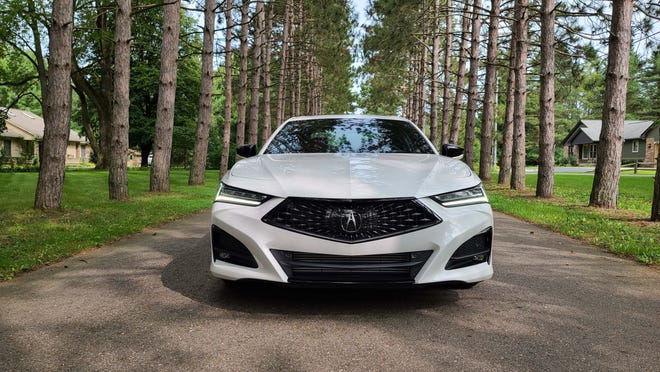
But it’s the TLX that most closely follows the NSX lineage. The world may be moving to SUVs — 70% reckons Acura by 2025 — but the premium brand realizes that buyers still want ground-hugging performance sedans.
Take my friend John, who has eschewed SUVs for a Tesla Model S and now an Audi A6. Why? Because when he leaves the city behind, he wants to have some fun on America’s wide-open roads.
The TLX is the perfect companion to the Acura RDX, one of my favorite SUVs for not only its handling, but its supreme value. This is a $38,000 SUV that offers standard adaptive cruise control, panoramic roof and leatherette interior. Good luck finding that on a German.
For about $700 less than the RLX, the TLX offers all that value with sedan handling.
Using all 272 ponies in TLX’s all-new 2.0-liter turbo-4, I consumed corners over Oakland County’s Old Pontiac Trail. The chassis has 50% more torsional rigidity than the last gen. The 10-speed tranny shifts like butter. The torque-vectoring all-wheel-drive system grips like a fly on ointment.
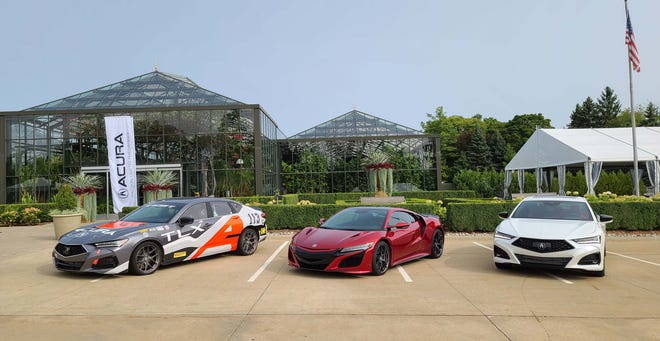
But surveying my stallion after my spirited ride, I wondered if that was enough.
For all its race car inspiration, the TLX is conservative in styling. Sure, designers have made a lower, wider, sleeker sedan. But everyone’s doing that these days — have you seen the Hyundai Sonata? At just $26,000, it’s created a rear LED light show that would make the luxe class proud.
TLX’s fascia design is more competitive with the Mazda 6 and Kia Stinger, which offer specs similar to the TLX — but for much less.
Consider that the Mazda — outfitted with a comparable, smooth, 2.5-liter turbo-4 — is the Acura’s equal in style and standard appointments, yet stickers for 7 grand less. Or for really insane value, consider Kia’s flagship AWD Stinger, which boasts 100 more horsepower, better interior and cargo room for a price similar to Acura’s AWD A-Spec model.
As I say, boiling piranha tank.
Better that I view the TLX from the interior — my 6’5” frame and broad shoulders fit easily in a driver’s seat that is noticeably broader (thanks to a wider track stance) than the last gen.
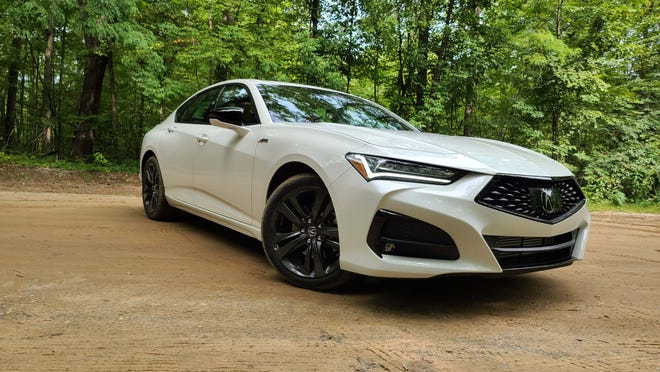
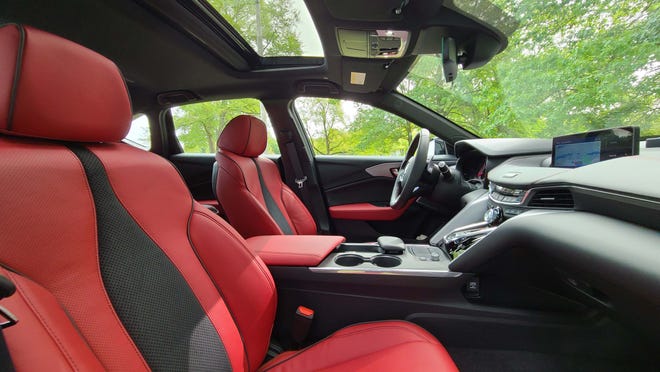
Here, Acura has constructed a more distinctive landscape. The center console immediately reminds of the NSX supercar with a Drive Mode button so big it could launch a nuke. The clever “trigger” shifter is signature Acura.
The red leather seat option is, well, red leather. It’s irresistible.
More resistible is the touchpad-operated infotainment system. While not as maddening as Lexus’ unworkable mousepad, it’s a distraction. Better to stick with tried-and-true rotary dials (Mazda) or touchscreen (BMW, Merc) that are more intuitive to a generation of smartphone users.
It’s worth noting, too, that Mazda also races a mid-engine IMSA racing prototype that competes against Acura. And the Mazda 3 hatchback is more beautiful than any entry-level luxury compact.
But TLX (and TL predecessor) has built impressive numbers over its 25-year U.S. run despite slips along the way. In 2019, TLX was the third-best selling model in compact luxe — behind only Audi and Cadillac. With the 2021 model, Acura is rewarding its fans with the best TLX in three generations. It’s a credit to Acura’s investment in a brand that speaks performance again.
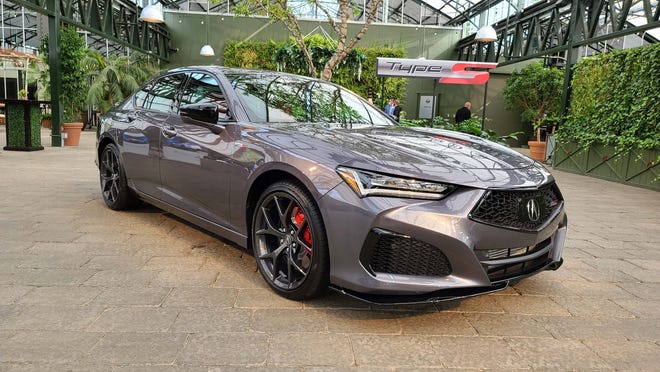
The comeback is complete, but nowhere near done. Just wait until the 350-horse, turbo 6-powered Acura TLX Type S arrives this spring. The Audi S4 should be nervous. But both will struggle to keep up with the Stinger GT.
2021 Acura TLX
Vehicle type: Front- and all-wheel-drive, four-door, five-passenger sedan
Price: $40,525, including $1,025 destination charge ($47,775 A-Spec as tested)
Powerplant: 2.0-liter, turbocharged 4-cylinder
Power: 272 horsepower, 280 pound-feet of torque
Transmission: 10-speed automatic
Performance: 0-60 mph, 5.9 seconds (Car and Driver); top speed, 131 mph
Weight: 3,920 pounds (AWD as tested)
Fuel economy: EPA 22 mpg city/30 highway/25 combined (FWD); 21 mpg city/29 highway/24 combined (AWD)
Report card
Highs: Distinctive interior; taut chassis
Lows: Conservative exterior; glitchy touchpad
Overall: 3 stars
Payne: How I voted in the North American Car of the Year Awards
Posted by Talbot Payne on January 12, 2021
Some elections aren’t very contentious at all.
My fellow North American Car, Truck, and Utility of the Year jurors and I have voted and Ford Motor Co. was the overwhelming winner of the Truck and Utility categories. The Ford F-150 pickup and Mustang Mach-E SUV won in landslides. We’re talkin’ Johnson v. Goldwater, Reagan v. Mondale.
Heck, the Ford F-150 won bigger than FDR v. Alf Landon in 1936. Alf who? The third category was a squeaker with Hyundai’s Elantra winning Car of the Year by two votes over the Genesis G80.
I voted with the majority in all three cases. Which is unusual, as I have had quarrels with my fellow scribes in the past. Since 1994, our 50-member jury of auto critics vote in the most prestigious, annual, independent auto award in North America. This year, we whittled a list of 43 new, 2021 models down to 27 semifinalists. From a comprehensive, October test event in southeast Michigan emerged our nine finalists.
If I have a beef with the election, it was in the primaries. The SUV primary in particular.
So hot are SUVs in the U.S. market that they made up 50 percent of new vehicle entries this year. So good were the entrants that 15 of the 27 NACTOY semifinalists were SUVs. From there emerged the $43,995k Mustang Mach-E, $49,925 Genesis GV80, and $47,450 Land Rover Defender.
Seriously? Not a single ute under $40k? Who can afford these chariots?
Not a lot of folks, which is why volumes for luxury SUVs are low. Of the three utes, the Genesis might push 50,000 sales a year. Compare that to some of the contenders that didn’t make the finalists list. The Nissan Rogue, for example. This blue light special has consistently sold 400,000 units a year — second only to the Toyota RAV4 as the best-selling non-pickup in America.

For 2021, the new Rogue really takes it up a notch. Sculpted styling, a knockout interior, loads of standard tech — and a new, luxurious Platinum edition which, at $36.5k, is still well under the starting price of our three finalists.
Even better is the 2021 Mazda CX-30, perhaps the best SUV bargain around. With a starting price of (ahem) $23k, this little beauty offers standard — standard — features like adaptive cruise control, auto high beams, lane-departure warning, best-in-class 186 horsepower, and a partridge in a pear tree. Load it up with all-wheel-drive, moonroof, leatherette seats and blind-spot assist and you get an SUV that can go toe-toe-with a $45 grand BMW X1 in the twisties for under $29,000. Go the head of the class, kid.
But my favorite was the Baby Bronco.
Voted Detroit News Vehicle of the Year, the Ford Bronco Sport brings a hatch-full of personality to America’s most popular SUV segment. With the looks of its dirt-kicking, truck-based Bronco big brother and the comfort of its unibody-based Escape sister, the Sport is a loaded, no compromise SUV.
How loaded? Get Sport in Badlands trim for $35k and its dual-clutch pack all-wheel-drive system will shred off-road trails. The rear hatch will devour two bicycles upright. Camp for the night and you can light the campfire with hatch-based floodlights. Dude, this treat could push 150,000 sales a year, giving Ford a powerful one-two punch with Escape in the compact class.
I know, I know. Our NACTOY mission statement reads the award should “honor vehicles that have raised the standards and have become new benchmarks in their classes.” But the compact EV benchmark is the 326-mile Tesla Model Y. The 300-mile Mustang Mach-E was a sentimental favorite with its ambitious effort stretching the Mustang stable to include a high-tech EV. It nearly doubled the second-place GV80 in points (265 to 136) while the Defender got just 99.
The Car of the Year votes were more to my liking.

Starting at just $20,625, the Hyundai Elantra is a comprehensive effort, bringing to market an affordable, 2021 compact with great looks, impressive tech, and an array of models. Elantra will push segment-leading Honda Civic (due for its own remake in 2022) with a full line of trims including hybrid and N-line performance models.
With 176 points (each juror is given 10 points to distribute in each category), the Elantra edged the luxury-bargain $48,725 Genesis G80 with 173 points. A close third went to the Nissan Sentra, another compact car punching waaay above its $20k price.
F-150’s win for Truck of Year was never in doubt as America’s best-selling pickup got impressive upgrades including an onboard generator, lay-flat seats for a lunch nap, and a console desk. These Ford folks know truck guys.
I had a warm spot for the Ram 1500 TRX. With its 700-horse Hellcat V-8, ripped bod, and boardroom interior, this super trucktruck garnered 130 points. But the F-150 stomped it and the Jeep Gladiator Mojave (30 points) with a whopping 340 points.
No one will be asking for a recount.
Ford dominates Car of Year Awards with F-150 and Mustang Mach-E
Posted by Talbot Payne on January 12, 2021
Detroit — And the envelope please. . . .
Ford Motor Co. dominated the first big award of the 2021 automotive season — the North American Car, Truck and Utility Vehicle of the Year — claiming two wins. The Ford F-150 took home Truck of the Year while the Blue Oval’s first all-electric vehicle, the Mustang Mach-E, won Utility of the Year. Hyundai Elantra’s won for Car of the Year.

The 28th annual NACTOY awards are one of the auto industry’s most prestigious. Selected by an independent group of 50 journalists from across North America (including the author of this article), the prize honors new vehicles that have raised the standards and become new benchmarks for their classes.
“It is always a complex process to bring a vehicle of this magnitude to market,” said Kumar Galhotra, Ford president of the Americas and International Markets Group, on receiving the award for the 14th generation of the best-selling F-150. “It was a process made even more complex by COVID.”
Ford has been the best-selling truck in America for 44 straight years, with a model line that offers models ranging from $30,000 work trucks to luxurious Limited models with sticker prices north of $70k.
The F-150 offers countless configurations across six different powertrains with a hybrid option offered for the first time in 2021. Detroit automakers dominate the pickup segment and the F-150 beat out two other formidable truck models, the off road-oriented Jeep Gladiator Mojave and the first 700-horse pickup, the Ram 1500 TRX.
The SUV category was the year’s most contested as automakers have flooded the market with models to satisfy consumers’ unquenchable thirst for all things ute. Of the 43 new vehicles introduced this year, half were SUVs.

The ambitious, battery-powered Mustang Mach-E is Ford’s answer to Tesla Inc.’s successful Model 3 and Model Y model line. The first non-sports car from Ford’s Mustang sub-brand, the Mach-E beat out Genesis’s first SUV, the GV80, and the iconic Land Rover Defender.
“This is really special in so many ways,” said Galhotra. “The Mach-E is the first new member of the Mustang family in a long time. It represents the future of our company.”
Though sedans make up a diminishing share of the U.S. auto market, Asian manufacturers like Hyundai continue to devote resources to compact cars as a way to attract entry-level buyers and appeal to consumers who prefer to think outside the SUV box. With its 2021 Elantra, Hyundai offers a comprehensive compact lineup to battle segment leader Honda Civic.
“With bold styling and an impressive list of standard high-tech features, along with multiple configurations that include hybrid and high-performance models, the Elantra confirms Hyundai’s serious commitment to the compact car segment,” said NACTOY juror and board member Gary Brauer, executive publisher of CarExpert.com.

The nine finalists for the 2021 model year were weaned from a competitive group of 27 semifinalists judged on criteria including: innovation, design, safety, performance, technology, driver satisfaction, and value.
The selection process takes place over 12 months of jury testing and three separate votes. This year was the first time the winners were announced via a virtual event due to the ongoing challenges of the coronavirus. The event was initially scheduled to be held at Detroit’s TCF Center.
New FCA Detroit plant to produce Jeep Grand Cherokee L
Posted by Talbot Payne on January 12, 2021
Detroit’s newest auto assembly plant will produce a larger, three-row version of Jeep’s most popular vehicle, and it will be called the Grand Cherokee L.
Combining the utilitarian tradition of the Grand Cherokee with advancements in technology and premium options, the 2021 Grand Cherokee L seeks to tap into up to 75% of the large SUV segment — much of which is currently unexplored by Jeep without a three-row option, Christian Meunier, global head of Jeep, told The Detroit News.

“This is a chance to expand the Grand Cherokee nameplate and volume and take care of our customers and make them happy,” Meunier said. “It’s a big opportunity to also keep the customers in the family because when you get kids or you expand or you need more space, now between this and Wagoneer and Grand Wagoneer, we’ll have everything needed to keep them in the family.”
Fiat Chrysler Automobiles NV formally will unveil the vehicle during a virtual event at noon Thursday on YouTube. The vehicle launches at the east-side Mack Assembly Plant in Detroit at the end of this quarter. It will start hitting dealers in the second and be exported worldwide. Pricing has not yet been announced, but will be “premium” in the segment, Meunier said. Details on the redesigned two-row Grand Cherokee and its 4xe plug-in hybrid version will come in the second half of 2021.

Long one of the best-selling, two-row, mid-size SUVs in the U.S. market along with the Toyota Highlander, the Jeep Grand Cherokee adds a third row that should expand the midsize ute’s reach to take on three-row competitors like the Ford Explorer and Chevy Traverse.
The Grand Cherokee L grows over a foot in length compared to the current model, but is not as large as the forthcoming Jeep Wagoneer. The three-row Grand Cherokee is longer than class leaders Traverse or Dodge Durango. A rare mainstream brand that is cross-shopped with luxury makers, the Jeep may also get a look from luxury shoppers of Audi’s three-row Q7, for example.
“It’s really remarkable with the Grand Cherokee today and it will be even more with the new one,” Meunier said, “that duality between the premium appearance, the sophistication, appearance and the charm, but also the ruggedness. It’s strong off-road, but it’s also very, very good on-road.”
The redesigned Grand Cherokee features a new architecture shared by both the two-row and three-row versions. Sixty percent of the vehicle is steel with aluminum making up the closures like the hood and tailgate.

It was designed from the bottom up, Meunier says. That’s in contrast to Jeep’s first attempt at the three-row with the three-row Commander that debuted in 2005 and ended in 2010, said Sam Fiorani, vice president of vehicle forecasting at AutoForecast Solutions LLC. The Commander was just 2 inches longer than the Grand Cherokee, comprising space in the back rows.
“Since the Commander, the market has blossomed for three-row crossovers,” Fiorani said. “There are so many Grand Cherokee owners out there that there’s likely a large number that have families and could appreciate that third row and extra space and a larger model.”

The standard 3.5-liter Pentastar V-6 engine offers 290 horsepower and 257 pound-feet of torque. It can pull up to 6,200 pounds and has a driving range of nearly 500 miles.For even more power, the 357-horse V-8 comes optional.
Future performance variants of the Grand Cherokee may come with even more capability. The current Grand Cherokee Trackhawk boasts 707 horsepower and a $100,000 price tag that challenges the BMW X5 M.
The Grand Cherokee L comes with four trims: Laredo, Limited, Overland and Summit. It offers three available 4×4 systems, five terrain modes and up to 10.9 inches of ground clearance and 24 inches of water fording.
The Grand Cherokee L’s design took inspiration from Jeep’s original full-size SUV, the Wagoneer. One example is the forward-tipped grille that further lengthens the already longer hood and cab from the current Grand Cherokee. The openings in the seven-slot grille are wider, and the front fascia is larger than in previous generations. The LED headlights also get a slimmer design.
The vehicle offers more than 110 safety features, including Active Driving Assist. That is FCA’s name for Level 2 hands-on-wheel, eyes-on-road automated driving capability such as lane-centering and adaptive cruise control. A hands-free version of the technology will be available later this year on the 2022 Overland and Summit models.
There is even more technology inside the vehicle starting with the up to 10.1-inch digital touchscreen installed with the Android-powered Uconnect 5 infotainment system that FCA says is five times faster than the previous generation. Also new is a 10.25-inch frameless digital gauge and cluster with nearly two dozen menus to select driver-assist technologies, media options, and other features.

The Grand Cherokee L is the first production Jeep to offer a fully digital rearview mirror and a windshield Head-up Display that shows speed, navigation and other information without having to look away from the road.
“If you’re building a high-volume family vehicle, it has to have pretty aggressive technology,” said Karl Brauer, an analyst at auto search engine iSeeCars.com. “Buyers are looking for that entertainment capability and technology.”
A 360-degree camera, a rear-seating monitoring camera and a McIntosh 19-speaker audio system also are available. The Grand Cherokee L is the first FCA vehicle to offer an electronic remote release to fold second-row seats flats. Palermo leather, Waxed Walnut wood and 21-inch wheels are available on the Summit Reserve Package. Mopar will offer 75 accessories for the vehicle.

The vehicle also is the first Grand Cherokee to have a front axle bolted to the engine for better noise and vibration management as well as a front-axle disconnect that automatically switches between two-wheel and all-wheel drive.
Fiat Chrysler paid $1.6 billion to transform its Mack Avenue Engine Complex into the first new assembly plant in nearly 30 years. The investment is creating 3,850 new jobs in the city. After current Fiat Chrysler employees are transferred, available positions will go to newly hired Detroiters first. An American flag decal on the Grand Cherokee L will pay tribute to it being made in Detroit.
“I think there is a lot of pride from people making the product in Detroit and designing it there,” Meunier said. “There is a lot of pride in the company there.”

Technology previously used in FCA’s body shop that match laser light with radar will be used at the end of the production line to ensure greater repeatability and accuracy than conventional camera-based measuring systems checking body-panel geometry. A new track on site also will conduct testing to ensure quality for things like noise level in the vehicle’s cabin.
“Quality is all about the attention to detail and about processes and consistency,” Meunier said. “We always like to say the only things tougher than Jeeps are their owners.”
Payne: Two good to be true, VW Arteon and Honda Accord Hybrid
Posted by Talbot Payne on January 7, 2021

It’s just gorgeous.
Sleek sedan lines. Clamshell hood. Black, 20-inch turbine wheels. Coupe-like roof tapering to a huge, utilitarian hatchback. No, I’m not talking about the Audi A7. I’m ogling the Volkswagen Arteon, the prettiest midsize car in the U.S. market.
This week’s $49,100 Arteon tester is a prime example of a wave of mainstream cars in the market that are as good as their luxury peers — but for thousands of dollars less.

You want beauty and power in a big sedan? You don’t have to pay the comparably equipped Audi A7’s $72,340 price tag. The VW will do nicely, thank you very much. And it upends the brand hierarchy since the two all-wheel drive lookers come from the same VW Group stable.
Another example is the $36,795 Honda Accord Hybrid I just flogged all over Washtenaw County. Is your idea of luxury a sippy 44-mpg Lexus ES 400e hybrid with a mega front grille? Save $10,000 and buy a loaded, 43-mpg Honda Accord Hybrid with a kisser you can see coming a mile away.
Credit the electronics revolution or manufacturing advancements or feng shui, but my twin testers have all but shrunk the mainstream/luxury gap to nothing. I’ll get to the gaps that remain in a moment.
But first, let’s take another lap around the Arteon.
Audi A7 designer Sebastiano Russo is a genius, and his protégés appear to have designed the Arteon. The symmetry of the car is perfection. Once upon a time, it was the wheels that separated luxury from mainstream, but my VW R-line’s turbine pinwheels are the most stunning thing this side of a Tesla Model S.

The Arteon’s fastback is not only lovely, but it’s a hatchback just like the Audi, bringing SUV-like utility to a sedan. That’s crucial in my book. SUVs have eaten sedans for lunch thanks to their easy hatch-storage and high seating position. But that utility has come at the sacrifice of appearance. Boxy, five-door ute profiles are hard to distinguish.
I recently drove a refined, athletic Audi SQ8 — its profile virtually indistinguishable from every other SUV in the parking lot despite its $95,495 price tag. Sedan designers have been quick to take advantage. There’s no mistaking the Arteon.
Or the Accord. Introduced in the 2018 model year, the Accord wowed with its stunning interior, dramatic sportback and chiseled physique. Its cheaper price compared to the Arteon owes in part to the car’s normal boot opening, as Honda avoided the considerable expense of fortifying the rear end for a hatchback. Additionally, the Accord does not offer all-wheel drive like Arteon.
But when compared to a $47,635 Lexus ES 300h, the bargain Honda is superior in every way. Its exterior is more elegant and its huge maw nearly as intimidating as the Lexus (if that’s your kind of thing).

The interior is a tour de force with digital instrument display, tablet display and acres of room (roomier than Lexus and on par with the Arteon, with palatial 40.4 inches of rear legroom) that allowed a giraffe like me more space than a living room Barcalounger.
Under its sunroof, it goes toe-to-toe with the Lexus on 12-way memory leather seats, heated steering wheel and trigger shifter. Then it pulls away with Honda’s typical, obsessive attention to interior ergonomics: better infotainment controls, head-up display and wireless Apple CarPlay and Android Auto smartphone compatibility.
A word on those last items.
General Motors pioneered head-up displays a couple decades ago in high-end vehicles like Cadillac and Corvette, and Honda is the only automaker to my knowledge to match Caddy in enabling head-up adjustment on the dash — a detail (remember that obsessive ergonomics?) consumers will appreciate.
As for the wireless smartphone apps, Mrs. Payne nearly bought the car on the spot. One of the electronic revolution’s greatest advancements, smartphone apps have enabled $25,000 cars the ability to navigate on Google Maps — and that’s superior to any navigation system that luxury-makers can produce. Wireless compatible means you simply have to enter the car to sync it to your phone’s nav/text/email. Coming soon to every vehicle.

The gap to luxury is still evident in the VW Arteon’s interior. Not that it’s bad — it just doesn’t measure up to the car’s exterior ambitions even as it supplies a standard digital instrument display, Wi-Fi connectivity, mobile-app connectivity and panoramic moonroof for stargazing.
Arteon matches Audi with its torque-vectoring all-wheel drive drivetrain. Shy of the Audi A7’s 335-horse turbo-6, Arteon’s 268 horses and 258 pound-feet of torque are good enough for a 0-60 mph sprint in 6 seconds compared to the A7’s 5.2.
Step on the throttle through the twisties and the big VW hatchback rotates with precision, the turbo-4 growling happily. It’s athleticism that VW has honed across hatchbacks like the peerless Golf GTI and R for years. In between retail store stops where the Arteon preened in parking lots next to cookie-cutter SUVs — boooring! — I enjoyed miles of social distancing across the country roads of northern Oakland County.
That athleticism is found in the Accord as well. Honda is a racing brand with deep roots in Formula One and IMSA racing championships. The DNA trickles down to the Accord. With its planted steering and stiff bones, it is a joy to throw around.
That joy is numbed a bit by the Accord hybrid’s one-speed drive and its unrelenting CVT-like drone. Ugh, the sacrifices of driving green.
But the numbers are undeniable. Compared to the luxe-class Lexus, Accord boasts 614 miles of range on the highway compared to the ES 300e’s 568. Yet the Honda sprints to 60 mph a noticeable 2 seconds quicker. Thrills for less dollar bills.
Of course, brand matters. Lexus exclusivity means you’ll see fewer of them on the road compared to the 250,000-plus units Accord moves every year. Giving the Accord Hybrid a unique grille treatment — or two-tone roof — might help. But so superior is it to the Lexus that it’s hard to justify another $10,0000 for a badge.
My sultry Manganese Gray Metallic Arteon had no such issue. Given its pricing as VW’s halo car, its sales numbers aren’t much different than the A7, meaning you won’t see many of them. Roll down the block and jaws will drop.
And with the $33,0000 you save by buying it instead of an A7? You can buy a Honda Accord EX-L Hybrid.

2021 Honda Accord Hybrid
Vehicle type: Front-wheel drive, four-door, five-passenger sedan
Price: $26,370, including $955 destination charge ($36,795 Hybrid Touring as tested)
Powerplant: 2.0-liter 4-cylinder mated to AC motor and 1.3-kWh battery
Power: 212 horsepower, 232 pound-feet of torque
Transmission: One-speed direct drive
Performance: 0-60 mph, 6.5 seconds (mfr.); top speed, 115 mph
Weight: 3,803 pounds
Fuel economy: EPA 44 mpg city/41 highway/43 combined
Report card
Highs: Good looks inside and out; loaded with premium features
Lows: CVT drones; polarizing, big front grille
Overall: 3 stars
2020 Volkswagen Arteon
Vehicle type: Front- and all-wheel-drive, five-door, five-passenger hatchback
Price: $37,015, including $1,020 destination charge ($49,100 Premium R-Line as tested)
Powerplant: 2.0-liter, turbocharged 4-cylinder
Power: 268 horsepower, 258 pound-feet of torque
Transmission: 8-speed automatic
Performance: 0-60 mph, 6.0 seconds (Car and Driver); top speed, 127 mph
Weight: 3,854 pounds (AWD as tested)
Fuel economy: EPA 20 mpg city/29 highway/23 combined
Report card
Highs: Stunning exterior; roomy cabin and cargo space
Lows: Conservative interior; lacks a GTI-like performance model
Overall: 4 stars
Trucks, SUVs can’t make up for shutdown as GM, FCA sales fall in 2020
Posted by Talbot Payne on January 6, 2021
Demand for pickup trucks and SUVs in the second half of 2020 could not make up for an eight-week pandemic-induced shutdown in the spring and flailing fleet sales in the months since.
Analysts watching the industry predict U.S. vehicle sales for 2020 will come in around 14.5 million vehicles. That’s a decrease from 17.1 million cars, trucks and SUVs in 2019 and could be the lowest level since 2012.

General Motors Co. on Tuesday said its U.S. sales fell 11.8% from 2019. Meanwhile, Fiat Chrysler Automobiles NV’s sales fell 17%, but its profit-heavy Jeep SUVs and Ram pickups and commercial vans made up a majority of sales, despite their sales falling 14% and 11% respectively from 2019.
Ford Motor Co. will detail its annual results Wednesday. Through November, the Dearborn-based Blue Oval’s total vehicle sales were down 16.8% year-over-year — declines that may not necessarily be a bad thing for Ford and other automakers.
Lighter inventories and resilient demand — despite economic decline from the COVID-19 pandemic — have kept transaction prices high. Buyers are continuing to put significant money down to buy larger vehicles with the features they want because other such spending options as vacations and restaurants are not as available amid the virus outbreak.
“There are two markets here,” said Jeff Schuster, vice president of global vehicle forecasting for LMC Automotive Ltd. “Those in the service, those that have really been significantly impacted, and then those that have shifted to working from home and continued with their employment. Those are the ones that are driving this push and recovery. What they are spending their money has shifted.”
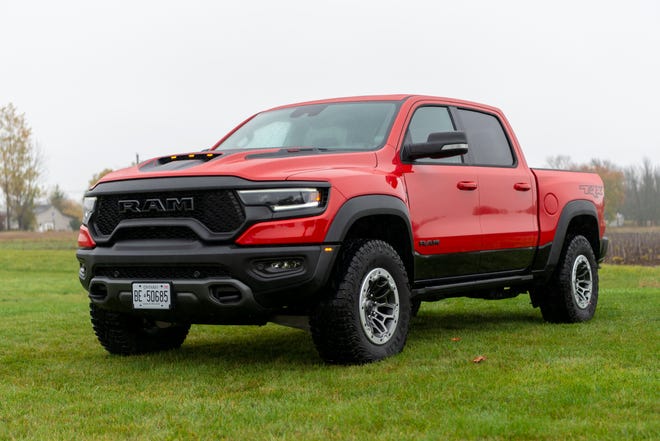
GM said its average transaction price for the year set a record at $39,229 and for the fourth quarter at $41,886. Its sales were up 4.8% year-over-year in the last three months of 2020, marking GM’s best fourth quarter since 2007. Retail sales, it said, have returned to their pre-pandemic level after starting their recovery in May when auto plants reopened.
But with its best-selling vehicle, the Silverado, sitting at just 47 days of supply versus a 65-day industry average, there’s room for growth: “No, we are not at pre-pandemic levels,” said Michelle Krebs, executive analyst at Cox Automotive Inc.’s Autotrader. “We won’t be next year.
“There are a lot of headwinds at the start of this year. The pandemic is still raging, cases are on the upswing, and the vaccination rollout is slow at the moment. Things won’t go back to normal until the pandemic is reined in and there is mass vaccination.”
Buick sales fell 21.4% in 2020. Cadillac’s fell 17.1%, Chevrolet’s dropped 11.2%, and GMC’s declined 8.8%. Chevy Silverado pickup truck sales rose 3.2%, and GMC Sierra sales were up 8.9%. All brands except Buick increased in October through December.
“Chevrolet, GMC and Cadillac set the bar high for these products in terms of technology, refinement and utility, and sales are exceeding our expectations,” Steve Carlisle, GM executive vice president and president for North America, said in a statement.

He highlighted the results of the Cadillac Escalade, GMC Yukon and Chevrolet Tahoe and Suburban full-size SUVs that launched this year in Arlington, Texas. Sales for all combined were down 19% for the year, but up 25% in the fourth quarter.
“We launched them on time despite the pandemic, and the team in Arlington is working around the clock to meet demand,” Carlisle said. “We have quickly recaptured all the short-term gains our competitors made as we transitioned to the all-new models.”
At Fiat Chrysler, only Alfa Romeo increased its sales for 2020, up 2%. Chrysler’s dropped 13%, Dodge’s fell 37% and Fiat’s plummeted 53%.
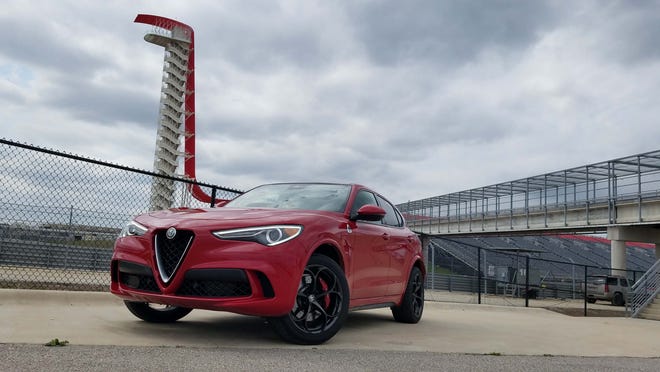
In the fourth quarter, FCA sales fell 8%. Although Ram had its best December for retail sales since it split from Dodge in 2010, total sales fell 5%. Jeep’s declined 4%. Only Alfa Romeo and Chrysler saw an increase of 23% and 5% respectively.
“The economic indicators are pointing in the right direction for the start of 2021,” said Jeff Kommor, FCA’s head of U.S. sales, said in a statement. “Gas prices remain low; housing remains strong and consumers have access to credit.”
All of that is contributing to predictions that 2021 sales will fall between 15.3 million and 15.7 million vehicles and take a few more years before they reach 17 million again. Forecasters expect dealer inventories will continue to remain lean through the first six months of the year.
“The first part of the year is going to be really rough,” Krebs said. “There’s some pent-up demand both on the retail side and fleet side. But because the economy is stalled (from the pandemic), the recovery is stalled.”
GM and FCA’s annual declines were larger than some of their competitors. Toyota Motor Corp.’s U.S. sales fell 11.3% in 2020, though they surged in December by 20%.
Hyundai Motor Co.’s 2020 sales fell by 10% as it was hit hard by declines in rental car fleet sales. On the retail side alone, the Korean automaker was up 1.2%, powered by new SUVs like the three-row Palisade and subcompact Kona.
“In the month of December, our (sales) mix was over 70% SUV and 30% sedan which I believe is the highest it’s been in quite some time,” Randy Parker, North American sales chief, said in an interview.
Still, Hyundai introduced two new cars this year as it remains bullish on a sedan market abandoned by Detroit automakers: “I’m thankful that Hyundai has stayed on the car side of the business. No matter what the market is, we’ve got a purse for every seat.”
The two Asian brands showed mixed results on electrified vehicles, which the industry has bet on for growth. Sales of Hyundai’s Ioniq sedan — the brand’s answer to Toyota’s Prius with hybrid, plug-in, and all-electric versions — dropped by 30% in 2020 to 13,570 units.
Toyota, on the other hand, saw its hybrid models grow to 16% of overall sales despite its Prius business plunging by 50% in four years. Hybrid versions of its popular RAV4 and Highlander SUVs have grown as customers have crossed over to crossovers.
Volkswagen AG’s U.S. sales also dropped 10% in 2020, and Nissan Motor Co. Ltd.’s declined by 33.2%, signaling deepening trouble for the Japanese automake
New autos: What’s coming to showrooms in 2021
Posted by Talbot Payne on January 5, 2021
The year ahead is still uncertain as to when auto shows and other new-vehicle introductions will return to pre-COVID normal. But that won’t slow the flood of new vehicles heading to showrooms. Buyer demand has remained unexpectedly strong despite the economic downturn and the uncertainty of the times.
Manufacturers are rolling out pickups and refreshed SUVs. There are fewer choices for those looking to buy sedans. But never have there been more electric vehicles to choose from.
Here’s what to look for in the next 12 months:
SUVs

Acura MDX
Acura’s flagship SUV is remade and will arrive early in 2021. Rising on a new platform, the MDX is longer and wider with a higher $47,925 starting price thanks to increased standard content like a panoramic sunroof. Amidst all the change, the V-6 carries over. But for those who want to rock, a 355-horse turbo V-6 will soon arrive in the Type S model.

Alfa Romeo Tonale
Fiat Chrysler’s struggling luxury brand needs more sport utilities and the gorgeous Alfa Romeo Tonale may be just the tonic. The $35,000 Italian stallion takes aim at other entry-level SUVs, such as the BMW X1, and should arrive as Alfa’s first hybrid vehicle.

BMW iX
The new flagship for BMW’s i-electric division after the lukewarm reception for the BMW i3 hybrid and scissor-door i8 sports car. The $70,000 all-wheel-drive iX SUV comes with a footprint similar to the gas-powered X5. An all-new interior has a huge, curved screen that incorporates both instrument and console displays.
Buick Envision
Regal? Tour X? Buick sedans and wagons are gone. This is an all-SUV brand now, completing a transformation that began with the big Encore crossover in 2008. The Envision compact ute will get a remake early in the year.

Chevrolet Bolt EUV
Much-ballyhooed as GM’s first Tesla-fighter, the Bolt hatchback beat the Model 3 sedan to market but failed to blunt Tesla’s momentum. The Bolt’s bigger brother, the Bolt EUV crossover, steps up Chevy’s game to take on Tesla’s Model Y crossover. It comes with Super Cruise, GM’s answer to Tesla’s semi-autonomous Autopilot system. The EUV gains 6 inches of length and 3 inches on interior over the Bolt.
Ferrari Purosangue
The Purosangue is Ferrari’s first SUV. Heresy! But that’s what customers want. Sports car makers are ringing the cash register with insanely powerful SUVs. Porsche started the trend with the Cayenne. Now there’s the Maserati Levante and Lamborghini Urus, so it was inevitable that Ferrari followed. The Purosangue is expected to ride on a new all-wheel drive chassis with a hybrid turbo-V-8 stuffed under the hood. Expect at least 650 horsepower and an asking price in the mid-$300,000s.
Fisker Ocean
Henrik Fisker wowed the auto world with his Fisker Karma back in 2012, promising an electric future alongside Musk’s Tesla Model S. The Karma, however, faded from view and the Fisker Ocean is Henrik’s reboot as a more affordable all-EV brand.

Ford Bronco
Not OJ-era Bronco of the ’90s, the reinvented modern Ford Bronco goes toe-to-toe with the Jeep Wrangler. The throwback look is there, but the Bronco takes a more high-tech approach like an electronic drive-mode selector. With two engine options and six trim levels, all the off-road goodies are here — from locking differentials to detachable sway bars to huge 38-inch tires on the Badlands trim.
Ford Fusion Activ
The Fusion sedan is dead, but the badge will find new life as a Subaru Outback-fighting crossover. Spy shots suggest a sleek, station wagon-like bod raised up for trips to the mountains.
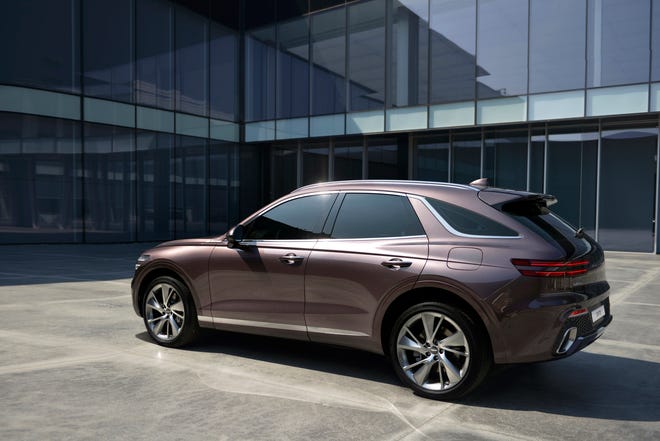
Genesis GV70
The Genesis GV80 wowed with its Bentley-like style and quiet ride. Next up: the GV70 aimed at the high-volume compact SUV market. Hyundai’s luxury brand has taken a while to move toward in-demand utes, but its intentions are now clear: re-create the Lexus model of offering premium style at an affordable price.

Hyundai Tucson
The Korean brand’s mainstay compact model gets a sexy makeover. In addition to its hot new bod, the Tucson may get a sporty 300-horse N-line performance model to go with 2.5-liter inline-4 and hybrid powertrains.

Infiniti QX55
Infiniti gets into the coupe-like SUV arena. QX55 channels the brand’s memorable FX looker and will complement the square-back QX50. Standard all-wheel drive and a more aggressive face separate it from its cheaper brother.
Infiniti QX60
While the QX55 rounds out Infiniti’s compact portfolio, the best-selling QX60 is an all-new three-row SUV flagship for the brand. With a stylish new interior, Nissan’s luxury brand hopes the QX60 can get the attention of a more upscale clientele.
Jeep Grand Cherokee
The Grand Cherokee gives up its status to the new Wagoneer as the top-line Jeep SUV, but not its swagger. Based on the same chassis as the Alfa Romeo Stelvio SUV, the Grand will reportedly be longer and more luxurious than the current model.
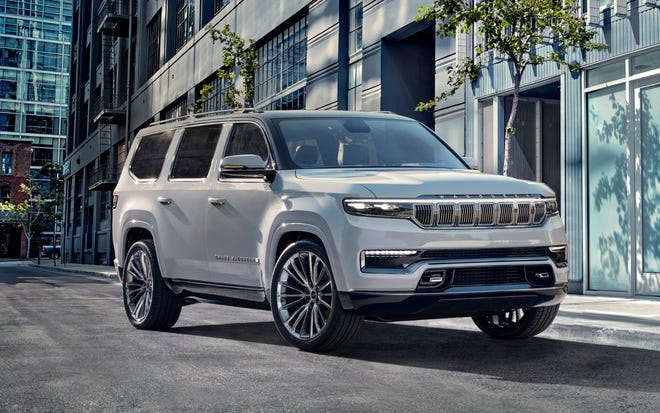
Jeep Wagoneer/Grand Wagoneer
Jeep goes after the truck-based Chevy Tahoe and Silverado with these twin three-row SUVs. The Grand Wagoneer concept suggests that Jeep may even have Cadillac Escalade in its sights. The concept’s interior boasted not one but three digital touch-screens, including one for the front passenger. A hybrid model might be coming, too.

Jeep Wrangler Rubicon 392
The Wrangler muscle car. The 392 means the Jeep will share one of the Dodge Challenger’s 6.4-liter, 470-horse V-8 so that you can go 0-60 in under 5 seconds. The 392 will be an off-road beast, too, as it is based on the dirt-kicking Wrangler Rubicon with 33-inch tires.

Jeep Wrangler 4xe
Jeep has a Wrangler for everyone. If the 392 is about blinding speed, then the 4xe (you’ll know it by the blue accents) is about preening green with a plug-in hybrid powertrain that offers long-range, a stump-pulling 470 pound-feet of torque — and an eSave mode so you can save battery power for when you want it. Like a quiet cruise through the forest.
Land Rover Defender 90
The Defender 90 is the two-door version of Land Rover’s iconic off-road warrior, the four-door 110. Offered with the same turbo-4 and V-6 engine offerings as big brother — but with fewer doors and lower sticker price.
Lexus LQ
Lexus has lacked a three-row, range-topping competitor to the BMW X7 and Audi Q7. The LQ — teased as the LF-1 Limitless concept at the 2018 Detroit auto show — will fix that. Expect multiple drivetrains including a hybrid model — and a giant spindle grille, of course.
Mercedes EQC
Delayed in the U.S. market, the EQC should be the German luxury brand’s first EV when it arrives in 2021. It will headline a full electric stable to parallel Mercedes’ gas-powered lineup. EQC will be a compact SUV sandwiched between a smaller EQA and bigger EQE.

Nissan Ariya
Nisan’s first EV was the Leaf, and the stylish Ariya really takes it up a notch. Aimed at the Tesla Model Y with a cheaper sticker price (Nissan’s signature value play), Ariya will offer 300 miles of range in its top big-battery trim. Nissan has been aggressive in driver-assistance systems so expect capable semi-autonomous driving as well.
Toyota Sienna
Toyota’s minivan gets a major makeover inside and out. The exterior follows the Highlander SUV’s head-turning wardrobe. Under the skin, the Sienna will be offered standard as a sippy hybrid. The second-row seats aren’t stowable like a Chrysler Pacifica — but they can be moved 25 inches for maximum legroom.
VW ID.4
VW promises an all-electric future and its first U.S. entry is a compact crossover. ID.4 will start as a rear-wheel-drive ute with optional AWD coming later. Expect a minimalist interior and $7,500 tax break for early buyers. Once the tax break runs out, the $40,000 ID.4 will face stiff competition from VW’s $26,000 gas-powered Tiguan SUV.
VW Taos
Making life even tougher on the ID.4 will be VW’s first entry-level subcompact SUV priced in the low $20,000 range. The Taos will share the Tiguan’s familiar boxy shape with lots of interior room for its class.
Volvo XC40 Recharge P8
Volvo’s electric brand, Polestar, debuted in 2020 with a sleek, Polestar 2 crossover. The Volvo XC40 Recharge P8 is Volvo’s first EV and — while built on the same platform as the Polestar — looks very similar to its gas-powered XC40. Expect 200 miles of range and standard AWD.
Cars
Audi A3
Audi’s entry-level sedan gets a makeover for the 2022 model year with sharper looks and the brand’s typically snazzy interior digital displays. With competitors like the BMW 2-series and Merc A-class, A3 stakes its claim with a peppy turbo-4 and AWD.

Audi e-Tron GT
Tony Stark’s gorgeous EV ride finally comes to the showroom. The e-tron looks like a Audi A5 with its sleek fastback, but it’s based on the same architecture as Porsche’s Taycan EV. Expect dual motors and 250 miles of range.
Audi Q4 e-tron
The Audi adds a starter EV to its electric lineup. The Q4 e-tron is slotted below the compact e-tron SUV and e-tron Sportback. Q4 e-tron will be the first Audi ute on the brand’s electric MQE platform.
BMW M3/M4
Here come the giant kidneys. The ferocious M-badge will reportedly bring 500-horsepower to the new 3-series sedan and coupe — and the first look at BMW’s controversial “buck-tooth grille.”
Cadillac CT5-V Blackwing
Cadillac’s BMW M-fighting compact sedan packs heat with Corvette’s 6.2-liter, 650-horse V-8 under the hood. Note: Blackwing signifies Cadillac’s performance badge — not the 550-horse Blackwing V-8 that briefly appeared in the CT6-V Blackwing sedan.
Chevy Corvette Z06
Corvette can’t make the red-hot, mid-engine C8 fast enough. Now comes the first track model — the Z06 version sporting the ‘Vette’s first overhead-cam, flat-plane crank, 8,000-rpm engine. The Ferrari-like, 5.5-liter V-8 will shriek like no other ‘Vette engine you’ve heard.

Honda Civic
The best-selling retail compact car in America gets an extreme makeover. Civic adopts a more sophisticated, conservative body style after its last wild-child generation. Expect the same expanded model lineup, however, with Si and Type-R performance variants. All Civics will from here on be four-door sedans.
Lucid Air
Championed by former Tesla designer Peter Rawlinson, the stunning Air goes after Tesla’s top-line Model S for EV pre-eminence. Boasting over 500 miles of range and executive rear seats, expect the EV to start at around $80,000 and push north of $150,000 on upper-trim models.
Jaguar XJ
Not your grandpa’s Jag. The Jaguar XJ gets a radical makeover. Radical as in all-electric. With 300-mile range and fast-charging capability, the XJ will be Jag’s second EV after the iPace crossover.
Maserati MC20
The Italian performance brand finally gets the mid-engine supercar the brand has desperately needed. With 621 horsepower and stiff carbon-fiber tub, the Maserati MC20 should be a rocket.
Mercedes S-class
Mercedes’ flagship sedan is all-new for 2021. Starting at $109,800 you’ll get space-age tech like: Augmented reality head-up display that projects images directly in the driver’s field of vision. A micro-sleep warning that uses an infrared interior camera to monitor driver drowsiness. And 10 massage programs with two levels of intensity and a duration from 8-18 minutes. Ah, Elysium.
Nissan Z
Nissan finally replaces the ancient 370Z sports car. Likely called the 400Z, the new variant should get a twin-turbo V-6 and the sleek looks previewed by the Z Proto concept.
Porsche 911 Turbo
As night follows day, so does the latest 911 get its supreme, AWD Turbo variant. The jaw-dropping numbers tell the story: A whopping 640 horsepower and 590 pound-feet of torque — improvements of 60 horses and 37 torque over the last gen. Zero-60 goes by in just 2.2 seconds. Keep it floored and you’ll hit 180 mph in 21.4 seconds.

Subaru BRZ
Rejoice, motorheads seeking an affordable, sub-$30,000 sports car. The nimble BRZ gets a major makeover and a new 2.4-liter 4-cylinder engine making about 10% more horsepower — addressing the biggest drawback of the last model.
Toyota GR Corolla
Still a rumor, the GR Corolla should at last offer a hot hatchback for the Corolla lineup. Aimed at the VW Golf GTI and Hyundai Veloster, GR follows the Supra sports car in bringing more excitement to the Japanese brand.
Toyota Mirai
The auto industry continues to predict a hydrogen future, and this is Mirai’s second crack at it. With a $50,000 price tag $9,000 lower than before, the Mirai moves to a rear-wheel-drive platform with expected 400 miles of range. Due to limited hydrogen fueling infrastructure, Mirai will only be offered in California.
VW Golf GTI
The original hot hatch will carry on (along with the pricier AWD Golf R) as the only variant of VW’s hatchback. The GTI gets a power boost with over 240 horsepower — but the big news here is a much more stylish, digital interior.
Trucks
Bollinger B1/B2
The electric Bollinger pickup (B1) and cousin SUV (B2) will be made in Detroit. The simple design is meant to maximize utility with a front as well as rear tailgate so you can pass long objects through the cabin. The $125,000 Bollingers have a claimed towing capacity of 7,500 pounds.
Ford F-150 EV
America’s best-selling pickup gets into the all-electric game. The EV follows the first hybrid F-150 that debuted in late 2020. While startup EV makers like Rivian and Lordstown have stolen the headlines, Ford has offered teasers like, for example, the EV prototype pulling 1 million pounds: 42 F-150s loaded on 10 double-decker rail cars.

GMC Hummer EV
The legendary Hummer military vehicle is resurrected as an electric pickup truck. Hummer debuts at $112,000 and features rugged off-road ability, including something called crab mode which allows the truck to maneuver sideways in tight terrain. Based on GM’s all-new Ultium battery platform, the Hummer boasts a 0-60 mph sprint in just 3.0 seconds when equipped with three electric motor.
Hyundai Santa Cruz
Remember Hyundai’s pickup truck concept at the 2015 Detroit auto show? Hyundai hasn’t forgotten. Based on a unibody platform like the Honda Passport, Santa Cruz will be a mid-size truck for folks who want their Hyundai with a bed.
Lordstown Endurance
Aimed at service fleets, the Endurance claims to the working man’s EV pickup. It will feature a motor at each wheel. The truck starts at $52,500 with 250 miles of range.
Ram Dakota
The long-rumored mid-size Ram pickup cometh. Based on the same ladder-frame as the Jeep Gladiator pickup, the Dakota will likely get a cheaper starting price.
Rivian R1T/R1S
The Plymouth-based EV maker brings its upscale, adventure-oriented electric pickup and SUV to market. With its batteries in the floor, the Rivian truck offers excellent cargo space in the bed, frunk — even a tunnel space behind the rear seats.

Tesla Cybertruck
Tesla stunned the world in November 2019 with its futuristic pickup. The stainless-steel bodied truck aims to be the Ford F-150 of electric trucks with a price starting at under $40,000 and one, two and three-motor variants ranging from 250-500 miles of range.
In a year of surprises, a surprise choice for Detroit News Vehicle of the Year
Posted by Talbot Payne on December 31, 2020
The coronavirus proved massively disruptive to automakers in 2020 with manufacturing delays, skittish consumers and regional dealer shutdowns.
But the show must go on.
Market competition is fierce, and the last year was important to multiple brands introducing cornerstone vehicles. I tested 59 new cars, trucks and SUVs from automakers determined to meet product delivery schedules despite uncertain economic winds. In the end, three stood out for the 2020 Detroit News Vehicle of the year.

The variety of new entries was impressive. In addition to Ford’s foundational F-150 pickup, I evaluated Ford sub-brand pioneers Mustang Mach-E and Bronco Sport. General Motors’ Big Three Sierra/Silverado/Escalade re-asserted their authority. I floored the Porsche Taycan, the company’s first electric missile, and the Polestar 2, the first offering from Volvo’s EV brand. They are chasing Tesla, which delivered its Model Y (shock) ahead of schedule. Land Rover’s Defender is back. Cadillac landed new CT4 and CT5 sedans.
Amidst these brand mic-drops came models to die for. The first 700-horsepower SUV, the Dodge Durango Hellcat. The Porsche 911 Targa, master-class of style and handling. A last fling with the legendary Mustang GT350 before it rode into the sunset.
It’s been a memorable 12 months. Here are my nominees for 2020 Detroit News Vehicle of the Year.
Third place: Mazda3 Turbo
The Mazda3 Turbo is proof that the gap between luxury and mainstream vehicles has been all but obliterated.
The Turbo was Mazda3’s long-awaited return to the hot-hatch segment. The best all-around vehicles in autodom, pocket rockets like the VW Golf GTI, Honda Civic Type R and Hyundai Veloster mix hatchback utility and devilish fun at an affordable price.

With its head-turning looks and stylish interior, the Mazda3 Turbo takes the formula to another level. Loaded with standard features including blind-spot assist, adaptive cruise-control, all-wheel drive and a buttery smooth turbo-4 drivetrain pumping out 250 horses and 320 pound-feet of torque, a loaded red leather-swathed Turbo can be had for just $34,000. That’s $10,000 less than a comparable (hatch-less) Audi S3 pocket rocket.
Runner-up: Tesla Model Y
The Tesla Model 3 was Tesla’s game-changer, bringing the Silicon Valley brand’s high-tech electric vision to the luxury market. But its Model Y doppelgänger is now deployed in the popular compact-SUV segment.
Delivered ahead of schedule (a rarity for Elon Musk’s elves), the Model Y instantly became the standard that every other electric SUV must match.

And there are quite a few. This year alone introduced the Audi e-tron Sportback, Polestar 2 and Mustang Mach-E. More will follow next year, including the VW ID.3 and Mercedes EQS. The Model Y’s formidable capabilities indicate the uphill battle these wannabes face.
Its battery range, rear-seat room and self-driving capability are all tops-in-class. It stomps the e-tron, for example, in range (326 miles compared to 222). Its over-the-air updates (I tested a Model Y fresh off an Autopilot upgrade that recognized stoplights, for goodness sake) are the envy of the industry. Imitation is the sincerest form of flattery, and the Mach-E (my runner-up as year’s best EV) follows the Model Y formula to a tee: spare interior, big screen, similar range, similar self-driving capability, performance.
But the Mach-E lacks Tesla’s secret sauce: a consistent charging network. Every other EV must depend on sparse, third-party chargers to get about when far from home. Tesla’s proprietary network is fully integrated into the Model Y’s navigation system, meaning a fast charger is never far away.
Model Y leaves the door open to competitors with its nagging quality issues (my test car had window problems just weeks after delivery). If the wannabes can deliver consistently better quality, it may dull Tesla’s luster.
Winner: Ford Bronco Sport
The 2020 Detroit News Vehicle of the Year is the Bronco Sport. Surprised you, didn’t I?

The Ford F-150 is the 800-pound gorilla in this year’s judging — an all-new model of America’s best-selling vehicle. With a hybrid option and on-board generator capability it is very good and will top a lot of Vehicle of the Year lists. But option the F-150 with these goodies and it can easily crest $50,000.
Bronco Sport is not only affordable (starting at $28,115) in America’s largest segment, but it brings with it an outsized personality to an often-vanilla class. Credit big brother Bronco, which will debut in 2021.
The Baby Bronco, as the Sport is affectionately called, is part of Ford’s one-two punch countering Jeep’s wildly successful SUV brand, led by the tree-chewing, ladder-frame Wrangler. The bigger Bronco takes aim at the Wrangler; the Bronco Sport takes on the Jeep Cherokee and Latitude.
Built on the same unibody platform as the elegant Escape, the Bronco Sport teases offroad adventure to complement the Escape’s more metro vibe. Ford did not hold back. The Sport is a comprehensive effort.
The exterior shouts Bronco swagger with its round headlights and squared-off design. A bright color palette (my testers wore sky blue and yellow) telegraph the vehicle’s colorful personality. The interior is loaded with technology and lots of thoughtful details: There’s F-150-like second-row storage beneath the floor. A big cargo bay that can hold two upright bikes. Floodlights in the rear gate. A bottle opener on the rear pillar.

Typical of Ford, the Baby Bronco also comes with multiple engines and trims. My favorite is the off-road focused Badlands model. This eager beaver takes the 2.0-liter turbo-4 from Escape and marries it to the twin-clutch pack from the Ford Focus RS track rat for some serious off-road cred.
So capable is Badlands that I tore up an off-road, sand-choked autocross course at Holly Oaks ORV park. That’s my kind of family ute. Ford has put sedans in its rear-view mirror, but the Bronco Sport is proof that the fun spirit of Ford hot hatches — Focus ST and Fiesta ST — lives on.
In an auto market that offers so much variety, Bronco Sport has it all: fun, utility, style and a price tag that won’t break your wallet.
Out to pasture: These cars aren’t coming back in 2021
Posted by Talbot Payne on December 31, 2020
A long list of sedans introduced with great fanfare just a few years ago have been quietly retired for the 2021 model year.
The industry is experiencing radical change, and vehicles have to prove relevant to keep up. Sedans have been displaced by SUVs as Americans’ favorite vehicles. Trucks are the new lux. Manufacturers are pouring money into electrics to satisfy goveSearch Assets rnment mandates. And electronics are changing everything.
Here’s a farewell to vehicles we won’t be seeing next year.

Acura RLX
Acura’s flagship sedan is packing it in. The big sled boasted a hybrid V-6 derived from Acura’s NSX supercar, a trunkload of standard technology, and an affordable starting price. But it never was able to slug it out with luxury heavyweights like BMW and Mercedes. Honda is rebirthing its luxury line as a performance brand and the tame RLX doesn’t fit the new narrative. Acura’s smaller sedans are quick and athletic, while large and nimble SUVs like the MDX are customers’ preferred sleds.

Alfa Romeo 4C
Alfa Romeo’s sensational coupe ends its run as America’s only sports car under $100,000 with a carbon-fiber chassis. Introduced as the performance standard for the brand’s expanded sedan and SUV lineup, the wee 4C was a grown-up’s toy. With pin-point handling and a farty exhaust note, the 2,500-pounder was a great escape pod from daily life. Just don’t venture too far from home: cargo room was virtually non-existent. The 4C goes out in style with the final edition Spider 33 Stradale Tributo. Honoring the legendary 1967 Alfa 33 Stradale race car, it’s dressed exclusively in Rosso Villa d’Este paint with gray-gold alloy wheels.

BMW i8
The i8 was the first mid-engine BMW since the legendary 1979-1980 M1. The exotic i8 stopped traffic with its gorgeous design, including scissor doors, multi-colored kidney grille and swept hips. The all-wheel drive hybrid was powered by a three-cylinder gas engine mated to a front electric motor. If the M1 launched the Bavarian brand’s iconic M-performance badge, the i8 was supposed to introduce a new, battery-powered BMW to the world. But the i8 lacked an identity — it had supercar looks, but its performance was geared more toward environmentally conscious buyers.

Buick Regal/Regal Tour X
The venerable Regal made a last stab at relevance in Buick’s remade SUV lineup with a sportback sedan and a crossover wagon. A sleek sedan with hatchback utility, the Regal sought to combine the best of two worlds. Its sister Tour X was based on Europe’s Opel Insignia Country Tourer, bringing Euro-wagon elegance to the U.S. Despite their best efforts, the Buicks succumbed to stereotype: Americans don’t buy big sedans or wagons.

Cadillac CT6
Hatched as Cadillac’s flagship sedan in 2016, CT6 brought a number of cutting-edge technologies to the brand including a lightweight multi-metal chassis, Super Cruise driver-assist and a twin-turbo Blackwing engine. Super Cruise and Tesla’s Autopilot have led the way in semi-autonomous driving, and it will soon be in every vehicle in the Cadillac lineup. As the CT6 bows out, it leaves the Escalade as Cadillac’s flagship.

Chevrolet Impala
One of GM’s most storied badges bites the dust. Again. In a past life, the Chevy Impala was the best-selling U.S. vehicle ever, selling more than 1 million units in 1965. After hiatus from 1996-2000, GM brought the big sedan back as a mainstay of police and rental fleets. With the large-sedan market cratering (and even police cars are moving to SUVs), Impala got one final, handsome makeover in 2014 as a handsome, roomy sedan with muscular hips that made the badge proud.

Chevrolet Sonic
With the departure of the Impala and Sonic, Chevy is waving the white flag on cars. The wee Spark and mid-size Malibu are all that remain against a sea of Asian sedans. The Sonic was a pert, affordable subcompact, but was perhaps best known in Detroit for its manufacturing lineage. Production of the Korean-made Sonic was moved to Orion Assembly after GM bankruptcy negotiations with the UAW. It leaves Orion as it converts to EV production.

Dodge Grand Caravan
Dodge has become a muscle-car brand, and the Grand Caravan minivan doesn’t fit in with the Brotherhood of Muscle since Dodge has no plans to stuff it with a Hellcat V-8. Still, Grand Caravan sold well until its last breath. The Chrysler Voyager will pick up where Caravan left off, offering family-value below $30,000.

Dodge Journey
The aged Dodge Journey SUV was one of the best values on the market, offering three-row utility for a ridiculous starting price of $25,000. Media types griped about its 4-speed transmission and dated 2.5-liter engine, but the Journey was roomy with Dodge’s superb Uconnect infotainment system.

Fiat 124 Spider
A modern take on Fiat’s classic 1960s roadster, the 124 was an attractive, affordable small sports car. Produced alongside the Mazda Miata – with which it shared a chassis and interior — in Japan, the “Fiata” never sold as well as its Japanese twin.

Fiat 500L
Fiat’s little 500L compact wagon was the Pope’s choice of wheels when he visited the White House in 2015, but it did little for the Fiat’s profile in the U.S. market. Cute as button, the Fiat just wasn’t the brand Americans were looking for when they went ute shopping. The 500L’s demise leaves its sister SUV, the 500X, as the last Fiat standing in the U.S. market.

Ford Fusion
The Fusion limps to the finish line as Ford transitions to an all-SUV brand. It seems like another lifetime ago, but when the 2013 Fusion debuted it turned heads as one of autodom’s most beautiful sedans. It inspired a generation of Fords with Aston Martin-like grilles. Competing in the high-volume mid-size segment, the Fusion had it all. Options included all-wheel drive, a hybrid plug-in model, even a hopped-up V-6 muscle sedan. Look for the Fusion badge to return soon as a Subaru Outback-fighting crossover.

Ford Mustang Shelby GT350/350R
With its shrieking 8,000-rpm engine and dual stripes, the Shelby GT350 (and track-focused R model) was an instant muscle icon. The first Shelby GT350 produced since the 1965 legend, the modern car had amenities — magnetic shocks, digital displays — that the original could only have dreamed of. Yet, the GT350’s raw nature was intact with manual shifter only. In one last homage to the original Shelby, the last GT350s to roll off the line were dressed in Wimbledon White.

Honda Fit
One of the most versatile subcompacts in its class, the Honda Fit falls victim to the SUV onslaught. What it lacked in gerbil-power it made up for in practicality. The Fit featured sippy mpg and a handy hatchback. Inside, its signature second-row “Magic Seats” could be folded flat or folded up, so you could roll a bicycle inside. The front passenger seat could be folded flat for extra cargo room.

Jaguar XE
Jaguar’s entry-level, compact sedan couldn’t compete with SUVs. Notice a theme here? Typical of Jaguar, the XE was a looker and a joy to drive through the twisties. Alas, the infotainment system was slow and the back seat tight. With the loss of V-6 and diesel engine options for 2020, the XE was neglected.

Jaguar XF Sportbrake
The XF Sportbrake was a stunning Brit wagon in a Yankee market that does not prize wagons. The Sportbrake crossed the pond and wowed with all-wheel-drive handling and hot styling. Step up to the V-6-powered 380-horse S model and you could pick on Porsches on the way to soccer practice.

Kia Optima
Optima, meet the new Kia K5. Kia’s Optima was one of the prettiest sedans in its segment and helped establish Hyundai’s sister brand as an upscale buy. Don’t cry for the Optima, though. The K5 is even better looking while offering luxury amenities for under $30,000.

Lexus GS
Not even the strong Lexus brand could save the GS sedan. Slotted between the sporty, compact ES and the top-drawer LX, the vanilla GS got lost. Lexus customers prefer the best-selling RX350 SUV when shopping for a mid-sizer. And if you’re looking for a luxurious sedan, the Toyota Avalon is a better buy, anyway.

Lincoln Continental
The flagship Lincoln Continental wowed the 2017 Detroit auto show. Resurrecting the brand’s storied badge, the Continental debuted with a host of knockout features inside its elegant shell. There were 30-way front seats and a rear seat as nice as a boardroom. Those features eventually trickled down to more popular SUVs. Its work done, the sedan is being put out the pasture.

Lincoln MKZ
Also out to pasture is the mid-size Lincoln MKZ sedan. It will be missed. The MKZ’s shapely bod still turns heads and many competitors have adopted its stylish, horizontal tail light. Built on the same front-wheel-drive platform as the retiring Ford Fusion, the MKZ lacked the gusto found in competitors like Acura and Cadillac.

Mercedes-Benz SLC/SLK
The Mercedes SLC Roadster and its SLK hardtop twin bow out, and the luxury class will be less fun without it. The SLC in particular was a topless, weekend joyride. The 241-horse turbo-4 was a treat, even if the interior felt dated.

Nissan 370Z
Nissan’s affordable 370Z sports car exits stage-right. The Z Proto concept indicates a sequel is on the way, albeit at a significant price jump into the mid-$40,000 range. The $30,000 370Z may have been getting long in the tooth, but its V-6 engine was a hoot.
Subaru BRZ
The Subaru BRZ sports car takes a one-year sabbatical. The good news is it will come back better than ever for 2022. One of the most fun, affordable sports cars around, the next-gen BRZ will have a stiffer chassis, 10% more horsepower and updated styling. Good things come in twos, and BRZ will also have a twin sold as a Toyota 86.

Toyota Yaris
One of the most affordable cars in the market, the wee Toyota Yaris was a starter car with punch. Based on the Mazda2 chassis, it was fun to throw around. With 40 mpg and easy-to-park dimensions, it was an urban favorite. Entry-level Toyota buyers will have to cough up an extra $4,000 and buy a Corolla.
Used-car boom: Car buyers take refuge in affordable sedans
Posted by Talbot Payne on December 30, 2020
With a dearth of new cars priced under $20,000, average new-car transaction prices pushing $40,000 and vehicles lasting longer than ever, the used-car market is primed for growth as cost-conscious buyers shop for their next vehicles.
Mix in the COVID epidemic — with financial insecurity and a reluctance to use public transportation — and the used market exploded. And some of the hottest commodities out there? Used Japanese sedans.

The second half of 2020 saw the hottest pre-owned vehicle market in years. In June alone, used-vehicle sales were up 22% — the most since 2007, according to Edmunds.com. Edmunds sees that trend continuing in 2021 with a forecast of used-vehicle sales up 7% to 41 million sold.
After the Ford F-150 and Chevy Silverado pickups (consistently the top two best-selling used vehicles), the next best-sellers were the Honda Accord, Honda Civic, Toyota Camry, Nissan Altima and Toyota Corolla.
Sedans might be taking a backseat to trucks and SUVs in the new-vehicle market, but on the pre-owned lot, their affordability and fuel efficiency remain irresistible. Combined with healthy, extended warranties and more durable chassis and drivetrains, sedans are winning over customers and earning brand loyalty for new buyers.
Jennifer Nickerson, 39, of Westland bought a used 2017 Honda Accord for her family this fall. She traded in her husband’s used Ram 1500 pickup at LaFontaine Honda in Dearborn.
“Gas prices brought him to the Accord,” said Nickerson, who bought the sleek made-in-Ohio sedan for $15,000 with about 30,000 miles on the odometer. “The pickup was a monster to refill.”
Dealers say fuel economy is a common reason for going with used sedans. The Accord, for example, gets 30 mpg compared to the thirsty Ram V-8’s 17.
But there are other factors that influence buyers that uniquely benefit sedans. They are generally $1,000-$1,500 cheaper than comparable SUVs, meaning Nickerson’s $15,000 Accord was not only a whopping $10,000 cheaper than a new 2020 model, but it was cheaper than a comparable Honda CR-V SUV. With a 16-year-old son starting to drive, affordability was key.

That affordability came with an extended, bumper-to-bumper warranty of eight years/120,000 miles — better than a new Accord at three years/36,000 miles.
Lafontaine Automotive Group Used Car Director Eric Benson said Dickerson’s experience is not unusual. Combine low interest rates, increased new-car lease rates and extended warranties, and he says used vehicles “can cost two-thirds of the price of a new car.”
In addition to veteran customers like Nickerson, Benson says used cars have become key to luring first-time buyers.
So successful has Honda been at attracting first-time customers through its pre-owned business that it now offers a sales portal for used cars through its own manufacturer website. It’s the first mass-market brand to do so.
“Rising new-vehicle transaction prices make used and certified pre-owned vehicles an increasingly important entry point to vehicle ownership for both young and first-time buyers,” Honda said in launching the service this month.
Detroit brands also see used cars as key to bringing in new buyers as Ford, Chevrolet and Chrysler all exit the small-car market.
“Selling new cars under $20,000 is a money-loser for Detroit manufacturers,” said LaFontaine’s Benson. “They can’t make them at a profit. So they are increasingly emphasizing the certified, pre-owned market to keep getting new customers into their brands.”
Benson’s colleague, Gordy Koenig, said LaFontaine Group’s used-car sales are up 10% this year over last, with continued growth ahead. He is predicting a 15% increase in 2021.
Bumper.com’s Alessandro Mannino sees the same trend nationally. Bumper examined over 134,000 vehicle searches across all 50 states from April 1-Sept. 15 to monitor buying trends.
“A lot of this has been driven by people in places like New York City where they are moving out of the city and need a car,” he said. Plant shutdowns caused by the pandemic in spring tightened new-car inventories and wallets. An aversion to public transit and ride-sharing drove more buyers into the car market.
For example, the No. 1 used (and new) Honda/Acura dealer in the nation this summer was Paragon Honda in Queens, as New York residents swarmed the dealership looking for fuel-efficient, metro-friendly sedans.
“No one is going into New York. It is a ghost town,” said Paragon general manager Brian Benstock, noting subway ridership has plummeted from 5 million a day to 1.2 million. “People are working from home, they are unemployed, they aren’t comfortable riding on a subway, bus or rideshare. Twenty-five percent of that market is shifting to personal, used vehicles.”

Bumper.com’s data indicates the affordable sedan trend could be here to stay as buyers find good cars without new car prices.
“The average age of vehicles searched is 12 years old,” said Mannino. “That shows users are willing to buy older vehicles they see as reliable vehicles. Overall, pickup trucks are the most popular vehicle for used-car buyers. But after that, sedans were the most-searched vehicles in 11 states, while SUVs were the most-searched in only three.”
Only the Jeep Grand Cherokee and Ford Explorer (No. 9 and No.10 respectively) SUVs broke the Top 10. The average oldest vehicles searched are the Honda Accord and Ford Mustang (15 years each).
The Ford F-150 (Ford was the most-searched vehicle in 31 states) and Chevy Silverado pickups were the most popular used-car searches, dominating across the southern, middle and western states. But midsize and compact sedans — led by Honda — were No.1 in states as varied as California, Connecticut, Georgia and Virginia.
With regulatory costs and the addition of new electronics driving up new-vehicle costs, both U.S. and foreign brands have seen average new-car transition prices soar. Kelley Blue Book reports the average new-car transaction price at $39,259 for November.
LaFontaine’s Koenig says the used market is increasingly important as a refuge for cost-conscious buyers: “Seventy to 80% of our sales are for vehicles less than $20,000.”
V-8 to volts: How do American muscle brands transition to EVs?
Posted by Talbot Payne on December 30, 2020
From California to New York to Washington, regulators increasingly are looking to phase out gasoline-powered cars in favor of electrics. That could pose challenges for some legacy Detroit brands.
Take Dodge for example.
The performance brand has built its current lineup on V-8 powered Challenger and Charger muscle cars harkening back to the company’s 1960s muscle-car roots. Dodge’s earth-shaking 700-horsepower Hellcat engines have pulled buyers into showrooms. Even the three-row Durango family-hauler has a Hellcat option.

But can Dodge convince customers to buy stealthy battery-powered machines that announce themselves on cat’s paws instead of with thunder?
“We are really in the infancy of where we’re going to go as an industry,” Dodge marketing chief Matt McAlear said trackside at the Durango Hellcat’s media debut in November.
“We’re not going to be able to change it — electrification is the future, and that’s what gets us out of bed is to continue to build this brand and make sure it evolves. Who knows where we are going to go? Maybe sound is piped in, maybe it’s a more modular design on skateboard architectures.”
Dodge has bucked the trend of declining sedan sales over the last five years by positioning itself as anything but a boring commodity product, McAlear said.
“We stand out in a crowd. It’s about our signature sound in our exhaust to our signature colors that you can’t get anywhere else.”
Sound is a big challenge. The distinctive melody of the supercharger-fed Hellcat engine is core to the brand. It’s the soundtrack to Dodge’s marketing pitch. But Dodge could follow the lead of other builders of electric performance cars, and broadcast the roar of a lusty V-8 into the cockpit via the cars’ sound systems.
Government and cultural trends in the last decade have pushed automakers to tout their fuel-efficient hybrids and safety qualifications. Dodge has achieved its success, say analysts, by positioning itself as a counterculture brand that thumbs its nose at politeness. Dodge’s 459,000 unit sales in 2019 dwarfed the 242,000 of all EVs combined in the U.S.
“They have cultivated a position that goes against general trends,” said Karl Brauer, executive analyst with ISeeCars.com. “It has created a brand with very strong identity, with good results in sales and consumer quality ratings.”

But states like California are moving counter to the trend. California Gov. Gavin Newsom signed an executive order ending sales of new cars with internal-combustion engines by 2035. A Biden White House is expected to move toward a more carbon-neutral policy.
“Brands like Dodge will be the most threatened,” Brauer said.
Ford’s Mustang muscle-car brand already is experimenting with the transition. It has targeted Tesla’s best-selling Model Y in the compact EV segment with the Mustang Mach-E SUV.
Ford is banking that Mustang’s performance history will give Mach-E credibility against a Tesla brand that has defined green performance since it introduced its “Ludicrous” acceleration mode in 2016.
Its signature V-8 bark has always set Mustang sports cars apart from wispy European turbo-6s. V-8 means Yankee muscle.

The electric Mustang Mach-E seeks to replicate some of that bark. In addition to the eerie thrum that all EVs must emit by federal regulation in order to alert pedestrians to their presence, the Mach-E’s drive modes (Whisper, Engage and Unbridled) pipe in noise through the stereo system to simulate an exhaust note. Unbridled’s low roar is the most distinct.
Porsche experiments with a similar sound in its first electric, the Taycan.
But neither EV utters the hair-raising shriek of a V-8 at full throttle. The absence of that soundtrack has turned off some early reviewers.
“A Mustang is supposed to be exuberant, unbridled. It’s supposed to make driving an occasion of joy,” wrote Road & Track. The magazine called the experience of driving the Mach-E “about as exhilarating as shopping for chest freezers.”
That doesn’t deter Dodge’s McAlear. He argues the brand has other signature qualities including color and style: “When you see a black-on-black Hellcat coming down the road, usually you hear it. But if not, you see it coming. There’s something about that grille, that stance — the air intake in the hood, the vivid colors. This brand is successful on so many aspects of vehicle design.”
ISeeCar’s Brauer says electric powertrains have inherent qualities — face-flattening acceleration, low center of gravity — that dovetail nicely with performance. If used correctly, those attributes could help the transition.
He points to Ford’s cornerstone F-series pickup brand which was largely V-8-powered until five years ago when Ford introduced turbocharged V-6s. Boasting similar capability to V-8s while bettering gas mileage, Ford’s “Ecoboost” V-6s are now part of a buffet of engine offerings including a hybrid.

“The F-150 now offers six powertrains, and only one is a V-8,” said Brauer. “It’s still there because buyers who have been with the brand for 30 years won’t buy a pickup without a V-8. The lesson is, if you don’t abandon your traditional buyers, then you can play with new technology.”
Analysts expect turbo V-6s in Dodge to replace some V-8s just as F-150 has done. Electrification would be the next step.
“The reality is those platforms and that technology we used does need to move on. They can’t exist as you get into the middle-2020s,” Fiat Chrysler chief Mike Manley told The Detroit News at the 2019 Detroit auto show. “And we can use electrification to really supplement those vehicles.”
Dodge and Ford marketers are also looking to racing, long a pillar of performance marketing, to help with the transition. NASCAR, where Ford plays, is going hybrid in two years. Drag racing, which suits the Dodge brand, may be a tougher sell with electric dragsters an oxymoron in a sport where nitro-burning, eye-watering fuel is at the heart of the sensory experience.
Traditional brands have a tougher road to drive compared to Tesla which was founded as an electric brand. “Detroit brands are fighting with another image,” Brauer said. “They are not going to get there overnight.”
But government mandates are unlikely to happen overnight, either.
“California has a long history of setting zero-emission standards — going back to the 1990s — that don’t get met,” continued Brauer. “The government comes up to a deadline, and then realize the consumer isn’t there.”
Website Copyright © 2009 - 2021 Henry Payne