- Search Cartoons
- Comic Archive
-
Payne
Store



 Henry Payne RSS

Articles Blog
Payne: Welcome to Cruise reunion, Class of 1989
Posted by hpayne on August 13, 2015

In 1989, the Detroit Pistons were NBA champions. Bill Cosby was Americas’ most beloved Dad on “The Cosby Show.” Michael Keaton was “Batman.” George Michael had the album of the year. My hair was brown.
Different times. But some things never change like our lust for speed, sizzle, and sports cars.
Which is why we love the Woodward Dream Cruise, that annual automotive class reunion when we gather with 1.5 million of our closest friends to remember the cars we loved. This year we celebrate the Class of 1989 which has been officially knighted as “historic” by the Michigan Secretary of State’s office (inexplicably, the SOS grants antique status at 26 years, not 25. Does this mean I don’t retire until I’m 66?).
It was a memorable class to round out a memorable decade. The auto industry bloomed again after the twin ’70s shocks of suffocating oil prices and government mpg edicts. Times were a-changin’. Bailed-out Chrysler picked itself up and swallowed AMC’s Jeep. The Honda Accord eclipsed the Ford Taurus as the No. 1-selling car. I bought my first wheels, a VW Rabbit GTI, that had birthed a new segment of front-wheel-drive, affordable hot hatches to rival Detroit’s affordable rear-wheel-drive pony cars. After their success in sedans, Japanese makers aimed to transform the luxury aisle with chariots like the 1989 Lexus ES that combined Camry-like reliability with dealer service that included monthly visits from six geishas to clean your home and cook your meals.
So welcome to the reunion, folks. Bolt on your historic plates at the desk and grab your class yearbook. Here are the highlights:
Corvette ZR1
Choose your nickname: King of the Hill, Big Man on Campus, the Corvette from Hell. Jointly developed with Lotus engineering to be the fastest sports car on the road, the 375-horse ZR1 was a limited-edition sensation. Its 4.5-second zero-60 time made it the second fastest car on the planet — second only to Porsche’s immortal 959. “Its power just plain warps the mind,” wrote Car & Driver. The ZR1 was distinguished from the base, C4 ’Vette by its huge rear rubber, and even huger sticker price.
Mazda MX-5 Miata
Can a Japanese sports car cruise Woodward with Detroit muscle? You bet. The Miata’s nostalgic vibe is what the Dream Cruise is all about. What’s more, it was designed in L.A. with Yanks in mind. Its father was Motor Trend journalist-turned-Mazda-product-planner Bob Hall, who sold Mazda on a fun, affordable roadster. The most-raced car in America, the fourth-generation MX-5 was just launched for 2016.
Ford Taurus SHO
The performance variant of Ford’s revolutionary Taurus, the SHO turned the family grocery hauler into a lethal weapon. Bearing the Taurus’ radical “jelly bean” shape, the SHO (Super High Output) was stuffed with a 220-horse, 24-valve dual-overhead cam V-6 that could go zero-60 in just 6.6 seconds on its way to a top speed of 143 mph. Now that’s a sleeper car.
Cadillac DeVille/Fleetwood
A Caddy is a Caddy and the nameplate will always turn heads — even the compromised ’89 model. The plush DeVille was no Cimarron — a perennial on Top Ten Worst Cars of the ’80s lists — but the front-wheel driver was a far cry from the grand boulevard cruisers of Cadillac’s heyday. The DeVille had also been disastrously downsized in 1985 and the enlarged ’89 model was an attempt to mute customer howls. But the redesign didn’t stop slipping sales and the badge was retired altogether in 2011. Today Caddy is resurgent with rear-wheel-drive stallions that rival BMW. A pity it took 26 years to get back there.
BMW 5-series
If Caddy had lost its way, BMW was the new standard of American luxury. Rear-wheel drive (all-wheel drive optional). Powerful V-6 and V-8 engine options. Bullet-proof reliability. Bullet-fast performance. The ’89 is dated by two things: those ugly period black rubber bumpers and a standard manual transmission. Heck, these days even a carbon-fiber, 2,400-pound, Alfa sports car doesn’t come with a manual.
Ferrari 348
Hello, junior. Living in the shadow of Ferrari’s spectacular, 12-cylinder Testarossa, baby brother 348 was still a looker. Its sleek skin carried the same, signature side strakes as the Testarossa with a 300-horse V-8 screaming right behind the driver’s ear. Zero-60? A fast 5.4 seconds that was half-second behind “King of the Hill” ZR1’s four-point-five. Oooh, what I wouldn’t give to see those two boys pull up at a stoplight late Saturday night.
Ford Thunderbird
“The most perfect, dazzling creature I’ve ever seen,” said Richard Dreyfuss of the 1956 T-bird (and its blonde occupant) in “American Graffiti.” But by the ’80s the Bird’s glory days were a distant memory. Completely redesigned for ’89, the T-bird was more Taurus than ’50s cruiser. With a supercharged V-6 and RWD handling, the Bird could fly circles around GM’s FWD products — but its niche was shrinking fast.
Porsche 911 Carrera 4
Timeless in design, relentlessly modern in engineering, the ’89 Carrera 4 introduced all-wheel-drive performance to the 911. The drivetrain was inspired by the 1986 Porsche 959 — a 195-mph cyborg from a future, more-advanced civilization. The all-wheel grip off the line made the Carrera 4 one of the quickest cars made with a 4.8 zero-60 time.
Pontiac 20th Anniversary Trans Am
The Carrera 4 went zero-60 in 4.8, eh? That’s loafin’. This Detroiter did it in 4.6. And with a 6-holer just like the Porsche. Whaaaaat? In 1989 GM needed a pace car for the Indy 500 so GM took the insane, 3.8-liter, fuel-injected turbo V-6 out of the defunct, deviant Buick Regal GNX and stuffed it in the Pontiac. Only 1,555 Trans Ams were made — all painted pearl white with tan interiors. Looked just like a regular Firebird — ’til you hit the pedal and put tire tracks over the Porsche in front of you.
Ford Probe
Ford’s new sport coupe was controversial from its front-wheel drive powertrain to its rear trunk badge. But what were they thinking in marketing? “Ford Probe, hummm, how’d you like to get hit in the rear end by that?” cracked Jay Leno. Worse, the front-wheel-driver — co-developed with Mazda — drew the wrath of Ford faithful when it was proposed as a replacement for the iconic, rear-wheel-drive Mustang. Replace the ’Stang with a FWD Japanese car? Grab your pitchforks, boys, we’re marching on the glass house! In the end, both survived with the bullet-shaped Probe GT making Car & Driver’s 1989 Top Ten list for its deft handling and blown 2.2-liter mill.
Payne: Q&Auto: Australia’s Mustang maestro
Posted by hpayne on August 11, 2015

Australia’s Richard Petty he may be, but Moffat is an unassuming man. No sideburns. No wrap-around sunglasses. No cowboy hat. Not even a “Crocodile Dundee” Australian drawl. Moffat was born in Saskatchewan, Canada before migrating with his father to Australia. As a teen he became obsessed with racing.
“My dad thought I was wasting my time chasing wild women and fast cars,” he smiles. “He thought I was wasting my life.”
But after getting his start in motor racing Down Under, Moffat’s big break would come in the U.S. at the dawn of the pony car era.
In 1965 Ford’s Mustang had taken the States by storm. With Chevrolet (Camaro), Pontiac (Firebird), and AMC (Javelin) following in its wake, America had a full-blown muscle car war on its hands. When the Saturday Night cruisers weren’t challenging each other at Woodward stoplights, their owners were banging fenders on the race track. By 1966, the country’s largest amateur racing organization, the Sports Car Club of America, created Trans Am to give Detroit’s Big Three a playground for their ponies.
It was a monster hit. Some of America’s biggest racing names – Shelby, Penske – cut their teeth on the Trans Am series. Monday-through-Friday, the storied Mustang vs. Camaro rivalry played out in the showroom. On weekends, the titans took the bout to the track. From racing’s kiln were forged legendary badges like the Camaro Z28 and the Boss Mustang 302.
Driving a Ford Lotus Cortina in the Trans Am under-2 liter division, Moffat’s take-no-prisoners driving style caught the eye of Ford’s racing brass.
“I got a call to drive a Mustang at Watkins Glen,” remembers Moffat. “I led it from start to finish. And the media realized — ah, he’s not just a Cortina driver after all.”
In 1969 Moffat was hired by Ford race shop, Kar Kraft in Dearborn, for car development with Ford ultimately rewarding the young Aussie with a Coca-Cola sponsored Boss 302 to conquer Australia. The 470-horsepower V-8 was a track-tuned variation of the street Boss 302 with 280 ponies. “Detroit winters were getting to me a bit,” cracks Moffat.
The Outback would never be the same.
With its ferocious, shark-like maw, crouched stance and screaming V-8 engine, fans had never seen an earth-pawing beast like Moffat’s Boss. His nimble, aerodynamic steed was unstoppable in taking the Australian Touring Car Championship (ATCC) by storm — even though its 5-liter power plant had less grunt than big block Aussie competitors like 7.0 liter ZL-1 Camaros, 6.0-liter Holden Monaros and 5.8-liter Ford Super Falcons.
“Nobody knew what hit them,” says Moffat. “No one knew what a Trans Am car was. The opening race was in May, 1969. We walked all over everything.”
Moffat would go on to win four ATCC titles, then gain international acclaim with his victory at the 1975 Sebring 12-Hour in a BMW CSL, the 1982 24 Hours of Daytona GT class in a Mazda RX-7 and more.
But like Petty in the blue #43 Plymouth Superbird, Moffat will forever be associated with his the Coca-Cola Boss 302.
“That was my pride and joy,” he says wistfully.
The immortal car is now part of David Bowden’s Australian Touring Car Collection in Queensland, Australia. “The Moffat Mustang is the cornerstone of our muscle car collection,” says Bowden. “It’s just the best muscle car Australia has ever had.”
Sounds like a good car to headline for a Down Under Dream Cruise.
Payne: Teutonic sedan showdown, BMW M3 vs. Audi S4
Posted by hpayne on August 6, 2015

My biggest complaint with the latest “Mission: Impossible — Rogue Nation” action thriller is that the BMW M3 doesn’t get as much screen time as Tom Cruise.
In its memorable appearance the ferocious four-door rampages through the cramped streets of Morocco variously chasing BMW sport bikes, dodging bullets and vaulting staircases. It’s a fitting product placement for the ultimate driving machine. Like Cruise’s ripped Ethan Hunt character, life with the 2015 M3 is never dull. The exhaust growls. Rivals challenge you at stoplights. Police lurk around every high-G corner.
But is this any way to live? The Audi S4 offers a simpler, quieter life.
Since the dawn of the luxury small performance sedan, one question has been constant: How crazed do you want your four-door to look? Low-slung sports cars telegraph their intentions. Performance sedans can be more subtle. Practical transit one moment, howling heathen the next. Dr. Jekyll and Mr. Hyde.
Germany’s BMW birthed the segment in 1986 with the (E30 chassis) M3. Built to meet European touring car racing production rules, it was all Hyde hair and sharp teeth. Boy-toy wings and flared fenders. But with market success, the M division and its Mercedes AMG and Audi S German imitators smoothed the rough edges to expand the buyer demographic. Jekyll didn’t necessarily want the world to know he was Hyde.
I fit that demo. In 2001 I bought the third generation (E46), 333-horsepower M3, which had shed the Red Baron wing for a more cloak-and-dagger look. In the morning I was a respectable father dropping the kids at school; in the evening I mauled unsuspecting Porsches on the way home from work.
Fast forward to 2015 and the small sport sedan stable has never been more deviant — er, diverse. Options include the superb, metal-mouthed Cadillac ATS-V, the Darth Vader-masked Lexus IS-F, and the muscular Mercedes A63 AMG. But it is the Teutonic twosome of fifth-generation (F80) M3 and Audi S4 that offer the biggest contrast.
The BMW M3 is the big, bad wolf. The Audi S4 is a wolf in sheep’s clothing.
I spent a week with a matched pair. Both white. Both four-door. Both powered by sixes. Both manuals. Two albino predators cruising Michigan’s byways.
The twin-turbo, 425-horsepower M3 looked hungry just sitting in my driveway. I swear the critter population in my neighborhood declined while it was there. This is not my 2001 M3. This is a four-door Corvette.
The M3’s external accents aren’t subtle. The eyes are slanted, snake-like. A hood bulge betrays the muscle underneath (the engine is actually strapped down with a boomerang-shaped, carbon-fiber brace, as if it might escape and devour a passing Prius). The wheel wells are engorged with wide, hurricane wheels. Gold, six-pot calipers on 15.7-inch carbon-ceramic rotors lurk within. Huge front and side gills feed air to the massive mill. A shark-like fin (antennae housing) atop the black, carbon-fiber roof completes the menacing image.
Just a mile from my home, a Challenger R/T pulled alongside itching for a fight. So begins another day in the life of Ethan Hunt.
The Audi is less dramatic. Outside it’s a typically understated VW product. You wouldn’t know it from a base A4 but for the red S4 badge in the grille. No hood bulges or spoilers. No exposed carbon fiber.
Its quiet, 333-horsepower engine is civilized too — and not just because it has 92 fewer ponies than the M. Audi chose to supercharge its V-6 for instant pull right up to 6,500 RPM redline. It’s a predictability that complements Audi’s signature AWD system.
On track at Autobahn Raceway outside Chicago, I found the drivetrain combo a blast with the car rotating into corners with little understeer — then evenly putting down power to all four corners under acceleration. Typical of the Audi/VW/Porsche stable, the manual box is best in class. Foot pedals are nicely spaced for heel-and-toe (though rev matching is available).
Push the M3’s starter button, by contrast, and the four exhaust pipes awake like a poked bear. At low speeds, it burbles along impatiently. Hey, buddy, when can we play?
Punch the throttle and the straight-6 delivers nice pull — but when the turbos fully kick in just shy of 3,000 revs, well, hold on darlin’. The 406 pound-feet of torque is startling. Too much thrust and I overwhelm the rear gummies. Every interstate clover leaf is the Carousel at Road America Racetrack. Washboard stiff, the car plants, but you feel its 3,500 pounds move under the G-loads. Mommy, I want my old M3!
Enter the highway, and the car’s passing power is astounding. The upshifts bark and the car launches to 120 mpg effortlessly. Zero-60? Its 4.1 seconds leaves the S4 behind at 4.9.
True to the luxe performance sedan, both car’s feature sumptuously tailored inner sanctums. The Germans sport similar dashes with clean buttons and an eccentric, rotary-dial console controller. The M3’s racier pretentions are in evidence here too with carbon fiber accents (the S4 is brushed silver) and 200 mph speedo.
Rear leg room is a revelation at 35 inches — though the M3 felt bigger. I could sit behind myself with headroom to spare. At Autobahn I packed three friends into the rear of the S4 for multiple, nausea-inducing hot laps. But once on the road, the backseat is a comfortable lounge with climate control and plenty of quiet to enjoy the Bang & Olufsen sound system.
Truth be told, I never turned on the stereo in the M3. The roaring six-holer was all the music I needed. BMW actually pipes in engine sound in addition to the natural, four-flute symphony. Rev-match downshifts. Upshift barks. Glorious. I kept the car in Sport Plus mode for maximum volume.
Par for German makes, both cars upcharge for extras that are standard on lesser vehicles (rear view camera, for example, which is standard on a $22K Mazda 6). But like its plainer wrapping, the S4’s bottom line is less outrageous than the M. My loaded S4 topped out at $55,475 — nearly 7 grand under the M’s base price. Most will prefer the AWD A4’s all-season practicality.
Marrying a movie star is another matter with the M topping out at $81,425 (if you want those $8,100 carbon ceramic jewels). Mission impossible for many. Even the gas is premium. The hungry M3 demands 93 octane high test. Or you can feed it small rodents.
2015 BMW M3
Vehicle type: Front-engine, rear-wheel-drive, five-passenger sedan
Price: $62,950 base ($81,425 as tested)
Power plant: 3.0-liter, twin-turbocharged, inline 6-cylinder
Power: 425 horsepower, 406 pound-feet of torque
Transmission: Six-speed manual (as tested); seven-speed, dual clutch automatic transmission
Performance: 0-60 mph, 4.1 seconds, manual (manufacturer); 3.9 seconds, auto transmission
Weight: 3,540 pounds
Fuel economy: EPA 17 mpg city/26 mpg highway/20 mpg combined
Report card
Highs: Dressed to kill; breathless acceleration
Lows: Ticket magnet; stiff as a board over rough Michigan roads
Overall:★★★★
2015 Audi S4
Vehicle type: Front-engine, all-wheel-drive, five-passenger sedan
Price: $49,325 base ($55,475 as tested)
Power plant: 3.0-liter, supercharged V-6
Power: 333 horsepower, 325 pound-feet of torque
Transmission: Six-speed manual (as tested); seven-speed automatic transmission
Performance: 0-60 mph, 4.9 seconds, manual (manufacturer)
Weight: 3,869 pounds
Fuel economy: EPA 17 mpg city/26 mpg highway/20 mpg combined
Report card
Highs: Rail-like all-wheel-drive; notchy manual shifter
Lows: Distracting rotary console knob; shouldn’t a performance car have a manual parking brake?
Overall:★★★★
Payne: Volvo XC90 sensibly spiced
Posted by hpayne on July 30, 2015

When driving the old Volvo XC90 I had the urge to wear Izod, sip lattes, and drone on about Consumer Reports safety ratings. The Swedish ute was the stereotypical suburban Preppy-mobile with tank-like invulnerability and a yawn-inducing boxy design.
Not anymore. The all-new, 2016 XC90 is stylin’.
Featuring dramatic headlights shaped like Thor’s hammer, you might expect Chris Hemsworth himself to step from this bold SUV. Talk about your ugly duckling transformation. Credit new Chinese ownership. Or Volvo’s flagging market share. Whatever. The 2016 XC90 has X-panded its appeal to Yuppies who want the neighbors to know they’ve arrived — without sacrificing its core, conservative constituency.
Starting at $49,895, the three-row XC90 is price competitive with its German nemeses, the $55,000 BMW X5 and the $49,000 Audi Q7. Volvo offers this beauty in two trims – elegant “Inscription’ or “R-Design” for the sport-minded. Like Kim Kardashian after a shopping trip to Somerset Mall, my $66,705 XC90 Inscription was accessorized with all the latest luxury gear. Behold:
■ Tesla-like, iPad-like screen
■ Cadillac-like heads up display
■ BMW-like handling
■ Audi-like good looks
■ Acura MDX-like LED headlights
■ Lincoln-like moon roof
■ Cadillac-like rimless mirror
Call it the Volvteslaudibimmerllac MDX. The XC90 is a confection of flavors wrapped in a distinctive Volvo shell. The flagship SUV introduces a new, signature “iron grille” that will set the design tone for the line. It’s bolder than the old mouth, but is marred by Volvo’s logo. I still find the diagonal stripe off-putting — as if the Volvo is a rolling DO NOT ENTER traffic sign. At least the Swedish designers have the presence of mind not to paint it red.
But this face belongs to the peepers. Thor’s hammers are stunning. Elton John, you need glasses like these. If the original XC90’s dorky eyes looked like goggles stolen off a Minion, the second generation is the Light Runner from Tron. With split flog lights along the skirt, the front end is a perfect balance of grille and lights.
Distinctive coming and going, the Volvo boasts rear, trademark vertical taillights that rival the Fox Theater’s marquee. And like its smaller stablemate — the XC60 that I ogled last winter — the XC90 thinks outside the box with full, curvy hips.
Sexier. Bolder. Hold the bling. Hemsworth in a business suit.
But the sweet confection inside is what makes the XC90 stand out. Your nostrils are met by the sweet smell of Nappa leather seats and wood trim. Evoking its native land’s lush woods and crafted furniture, Volvo calls it a “Scandinavian Sanctuary.”
Ergonomically-shaped seats “that resemble the human spine.” Diamond-cut controls for the start/stop button and volume control. Crystal glass gear lever by Swedish glassmaker Orrefors (only available in the hybrid model).
On the functional side, I can tell you the infotainment display is the best vertical computer tablet this side of a Tesla Model S. The tablet screen responds instantly to the touch like your smartphone — a welcome change from sluggish auto displays. Unlike rival German consoles (or Cadillac’s fussy, haptic CUE display) that are festooned with buttons — the Volvo’s commands are buried in the iPad, making for an uncluttered, wood-trimmed console. Like simple-yet-elegant Scandinavian furniture, this Swede makes you want to stay awhile.
Then you stomp on the gas pedal and you get … a four-banger.
A supercharged, turbocharged, 316-horse four-banger to be sure. But still a four hauling around a 4,400-pound sled. This may satisfy the right foot of the traditional Volvo user — but what about the lead foot of the German performance crowd? Smoother 6-cylinder engines from Audi and BMW offer similar performance numbers as well as more efficient turbo-diesel options.
All these upgrades add 10 grand to the old XC90’s $39K sticker price, moving the ’16 out of the bargain basement to main floor jewelry case. And for the first time the thought creeps into your mind: Why am I paying $66,000 for a luxury 7-seater when I could have a $46,000 Ford Explorer Sport with a smoother, twin-turbo V-6 turbo and 365 horsepower?
Ah, but the center console is gorgeous with a rotary engine start knob and a sliding door that covers the cup holders. Just like a Honda Pilot, which sells for $20,000 less, and … the thoughts creep in again (indeed, the XC90’s sliding door is not nearly as versatile as the Pilot’s clever creation).
What about safety you ask? As expected the boron steel-reinforced Volvo is a fortress of safety systems including world-first “intersection auto brake” and “off-road crash spinal protection”. Happily I didn’t test either, but I did use the excellent 360-degree camera, blind-spot monitor, cross-traffic alert, and lane-departure warning – which (ahem) comes in handy when you’re distracted by the touch screen.
Yes, distracted. As attractive as the tablet is, it requires a lot of touching and swiping to get around, which is at odds with Volvo’s stated obsession with safety (though I should also note the voice recognition is superb). Maybe being sexy and practical isn’t so easy after all. Like running across the street in 5-inch heels.
And you see the problem with luxury SUVs these days. Mainstream brands offer many of the same safety systems for much less. No wonder Ford’s Explorer is sticking its neck into the premium category with its 2016 premium Platinum model. At 10 grand less than the XC90 it will blow it away in straight-line performance while offering similar tech options, AWD, entertainment, plus a wood steering wheel, plus quilted leather seats (that got your attention, yes?).
So Volvo called in Thor’s hammers.
After a week with the big, black Swede, my mpg was a practical 22 mpg and my “hey, that’s nice” factor was a 10. That’s what a luxe-owner wants to hear. The handling was superb, the heavily-weighted leather steering wheel a scalpel in my hands (don’t get carried away Payne, it’s still an SUV).
Admired as a segment buster when it debuted in 2003, the long-overdue second generation has finally arrived and does not disappoint. It’s a refreshingly different choice in a luxe segment dominated by German makes. If only that diagonal stripe didn’t bar the grille.
Volvo no longer means DO NOT DRIVE UNLESS WEARING IZOD.
2016 Volvo XC90
Vehicle type: Front-engine, all-wheel-drive, seven-passenger sport utility vehicle
Price: $49,895 base ($66,820 as tested)
Power plant: 2.0-liter, supercharged, turbo inline 4-cylinder; Twin-engine, plugin hybrid with 2.0-liter, supercharged, turbo 4-cylinder mated with electric motor and 65 kW lithium ion battery pack
Power: 316 horsepower, 295 pound-feet of torque (inline-4): 400 horsepower (plug-in hybrid)
Transmission: Eight-speed automatic
Performance: 0-60 mph: 6.1 seconds (2.0L 4-cyl as tested, manufacturer); top speed: 130 mph
Weight: 4,627 pounds
Fuel economy: EPA 20 mpg city/25 highway mpg/22 mpg combined
Report card
Highs: Gorgeous — that’s a Volvo?; tablet-sized touch screen
Lows: Tablet controls can be distracting; more engine options, please
Overall:★★★
Payne Q&Auto: Bigland’s big Alfa startup
Posted by hpayne on July 25, 2015
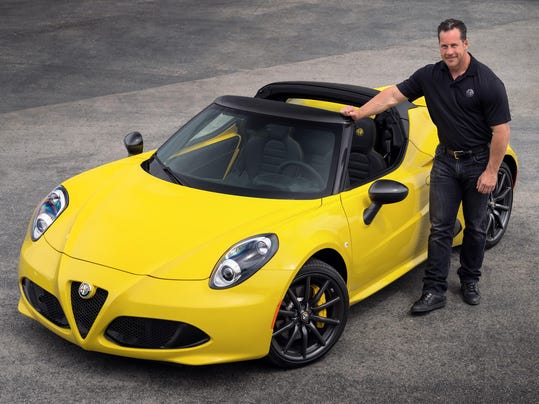
Suddenly, automotive startups are all the rage. Fresh luxury names like Tesla and Fisker have made headlines rekindling the century-old competition between battery and gas power. But an Old World, 105 year-old brand is also starting with a clean sheetagainst icons like Mercedes, BMW, and Cadillacusing the tried-and-true gas engine.
Say hello to Alfa Romeo, America’s newest luxury badge.
Like Tesla’s Roadster, Alfa begins with a tiny sports car, the sexy 4C. Now comes the hard part with last month’s Alfa Giulia unveil kicking off eight new products by 2018. Oh, is that all?
Fiat Chrysler has put this formidable task on the broad shoulders of Reid Bigland, 48, a straight-shooting Canuck with a physique right out of a Mr. Universe contest. At a June 4C introduction, I half expected him to come out with one under each arm. “You don’t want to mess with this guy,” laughs Fiat Chrysler Automobiles CEO Sergio Marchionne about Bigland.
Bigland’s swift rise at FCA – since 2006 he’s run Dodge, RAM trucks, and now juggles Alfa, North America sales and CEO of FCA Canada — has landed him on the short list of names to succeed Marchionne. I sat down with the ex-hockey player to talk Alfas, muscle cars, and Powerhouse Gym.
Q: You cut one of the most recognizable profiles in this business. You were an athlete?
Bigland: I grew up in Canada. I played a lot of junior hockey. I was lacking one necessary ingredient to play pro which was talent. Today I just try to keep fit by going to the gym.
Q: What gyms do you use in Detroit?
Bigland: Lifetime Fitness in Auburn Hills and . . . Powerhouse Gym in Detroit. That’s one of the old bodybuilder gyms left in this country and I usually hit that on the way to Canada.
Q: What was your first car?
Bigland: A 1979 Chevy Impala. I thought I was stylin’. It was up in the Toronto area . . . and the floorboards started to rust out and you could see the pavement.
Q: Do Canadians covet Detroit muscle cars?
Bigland: Absolutely. Growing up I had a soft spot for Corvettes. I’m very excited about our Hellcat with 707 horsepower. The question is who wants to drive a 707-horsepower car? Well, me.
Q: What’s in your garage?
Bigland: Jeep Grand Cherokee, Jeep Wrangler, and a Dodge Charger Hellcat.
Q: What excites you about FCA?
Bigland: It’s an honor to be working for Sergio Marchionne. I’ve learned a lot working for him the last six years. I’m a competitive guy – I like to compete in all things – and in the United States marketplace we’ve had 62 consecutive months of sales growth which is a significant source of pride, and in Canada . . . we’re the #1 selling vehicle manufacturer in the country. If I were to tell you that back in 2009 — which I did — you would have put me in a rubber room.
Q: Why the 4C to launch Alfa?
Bigland: The 4C represents what all of the great Alfas represented in the past and what all of the Alfas going forward will represent from a technological, style, and performance perspective. The car is truly unique: Carbon fiber chassis, aluminum sub-frame, mid-engine setup. There are only five other cars in the world like it – and most are north of a million dollars.
Q: The 4C comes out of FCA’s sports car toolbox. But Alfa has been a small, economy car brand in Europe. How do you make Alfa a global luxury brand?
Bigland: Alfa has been a lot of things over its 105 years. Some of the greats have been performance cars with outstanding style. We’re looking to re-recreate what the great Alfas were. We are currently in the process of investing over $6 billion to make sure these Alfa products . . . are consistent with those key attributes of technology, performance, and style. We have segregated a team of 1,000 people in Europe led by two senior engineers from Ferrari uncontaminated by the mass market.
Q: You’re starting from scratch?
Bigland: To be a credible, luxury player you cannot be tempted into dipping into the mass market parts bin. We’ve got great mass market cars, but to be true to the knitting in the luxury performance segment you’ve got to be authentic. As far as any leveraging of the FCA family it’s more along the lines of Ferrari and Maserati. Rebadging of a mass market car has shown time and time again that it doesn’t work.
Who’s the sexiest of them all? Ford Fusion vs. Mazda6
Posted by hpayne on July 23, 2015

Here’s an idea for “Punk’d,” MTV’s version of “Candid Camera.” Set up a fake Aston Martin auto dealership. Stock it with two dozen Ford Fusion Titaniums, strip off their “Ford” logos, and replace them with Aston’s winged badge. Then watch the buyers descend.
Whoa! When did Aston come out with a $38K midsize sedan? I’ll take two.
Yes, the 2016 Ford Fusion is that stunning. We’re jaded by now because there are 5 zillion of them on the road since Dearborn introduced its midsize beauty in 2013. It’s like a pill came out that could transform middle-aged men into Brad Pitt. Pitt’s looks would cease being remarkable. Ditto the Fusion. It lacks an Aston’s exclusivity, but it’s made midsize sedans stylish again.
Ford’s bold design has raised the bar for the segment, forcing everyone to play catch-up. The elegant Chrysler 200, handsome Hyundai Sonata, svelte Subaru Legacy. Heck, even the usually somnolent Chevy Malibu and Toyota Camry have gone back for extreme makeovers. The 2016 Malibu is stylish and the Camry’s look is improved — though when the Ford is better looking than your luxury Lexus entry, you know Toyota still has work to do.
Despite these efforts, however, only one other midsize sedan belongs on the same runway with Fusion. The Mazda6.
Call it the Mazda666. It’s devilish fun. Cruise through the country club in a Soul Red Metallic or Titanium Flash Mica (my tester’s color) wardrobe and this sexpot will embarrass richer makes. The 6 has more curves than Elizabeth Hurley in “Bedazzled.” And you only have to sell your soul — er, wallet — for $30,000 to afford it.
Ford and Mazda aren’t strangers to cutting-edge sedan fashion. The original, 1986 Ford Taurus revolutionized styling with its aerodynamic, “soap bar” shape and driver-centric interior (alas, Taurus’s looks couldn’t hide lousy transmissions with the reliability of Andre Drummond). I lusted after Mazda’s 1992 929 which was years ahead of its time in looks and handling. Recently both brands have taken detours down Ugly Alley — Ford with its three-bar grilles; Mazda with faces taken off Halloween jack o’ lanterns.
Goodbye to all that. Sexy is back. But which date to you take to the ball?
Fusion’s grille is unmistakable. But at $38,820 my loaded Titanium tester isn’t just a pretty face. Its trim flanks and arse are Son of Audi A8. The Ford only lacks 20-inch wheels to give it world-class luxe proportions.
Like Fusion, the Mazda’s curb appeal begins with an anthropomorphic, full-lipped face. If the Ford is slender, pout-mouthed English supermodel Kate Moss, the Mazda’s swollen front wheel arches and full lips recall the vivacious Sofia Vergara. Not a flaw in the lot.
From behind, these yoga-toned bodies are hard to tell apart. Curved hip lines sweep upward under coupe-like greenhouses — then taper into round, high-decked trunks. Only the exhausts differ as the Mazda goes for a twin-pipe sports car look while the Fusion wears elegant, flush chrome-tips.
Surprisingly, the coupe styling doesn’t sacrifice rear passengers to muscle cramps. I easily folded my 6-foot-5-inch frame into both cars — “sitting behind myself” with headroom to spare. These cars offer interior room that ranks with the best in class.
Inside, the Mazda gets Euro-envy. Push the starter and a Bimmer-like heads-up display rotates dramatically into place. Wrap-around interior. Pop-up nav screen. Even a console-mounted infotainment dial are oh-so-German — and oh-so-distracting in the case of the controller. So distracting that I went straight for the voice commands rather than fool with its rotary idiosyncrasies. I wasn’t disappointed. My every command was expertly followed — by a sexy female voice, natch — for radio and navigation. “760 AM” I’d bark, and she’d respond immediately.
Ford mimics Aston outside, but blazes its own trail inside. Detroit automakers boast autodom’s most intuitive interiors these days — reflecting a driving culture where Americans live in their vehicles. Touchscreen infotainment package. Space for XXL smart phones. Console storage with a toolbox-full of audio jacks, USB ports, and a 12V charger.
Fusion answers the question — why do modern automatics bother with a tac? — by locating the speedo front and center in a digital instrument display and shoving RPM off to the side with the fuel gauge. Only the rubberized button overlay seems dated — sure to be upgraded when the Fusion gets its mid-cycle refresh next year. Cupholders abound. Park assist, heated/cooled seats, heated steering wheel. All for $38K? Pinch me, I’m dreaming.
The quality and quantity of the safety and comfort systems — on par with luxury cars costing $10K more — in these mainstream beauties begs another question: What defines luxe anymore?
Oh, yeah. The drivetrain.
Washington’s nannies are determined to neuter mainstream sedan performance to save us from our carbon sins. Which means only the monied will be able to afford fun accessories like multiple cylinders, turbochargers, and battery-assist.
Credit Ford with bucking this trend despite a chairman who sounds like Green High Priest Al Gore. While Mazda6 surrenders to the scolds, the Fusion matches its looks with power.
To be sure the 6 is the best-handling car in segment while delivering an impressive 32 mpg. Sharing DNA with its Miata MX-5 sibling, it’s tight, even throwable — a word usually not in the same dictionary with “midsize sedan.” But stomp on it and the lone, four-banger option hesitates as if contemplating the plight of the polar bear. ZOOM ZOOM goes HUM DRUM.
The base $23,425 Fusion brings a similar four-holer, but also offers coach class first-class upgrades with two turbo fours (a 181-horsepower 1.5-liter and a 240-horse 2.0-liter) and a hybrid. Brand snobs eat your heart out. The 2.0L turbo cranks out 25 percent more power than the Mazda and is on par with a $50,000 all-wheel-drive, 2.0-liter turbo BMW 328i X-drive.
Speaking of all-wheel-drive (in Detroit winters, Mrs. Payne speaks of little else as in “The plow didn’t come again! Thank goodness my car has AWD!”), the Fusion offers it. The Mazda does not.
It’s a gift that keeps giving even after the snows have melted. Though the Fusion won’t bite in corners like the 6, its AWD gives a handy assist to the inevitable front-wheel-drive push.
So note the early 21st century for two related trends: As SUVs displace family sedans, so have midsize sedans like the sexy Fusion and 6 become the equal of pricier chariots. All they lack is the luxe badge. If it’s a big problem for you, just replace the Blue Oval with Aston wings.
2016 Ford Fusion
Vehicle type: Front-engine, front or all-wheel-drive, five-passenger sedan
Price: $23,425 base ($38,820 as tested)
Power plant: 2.5-liter, inline 4-cylinder; 1.5-liter, turbo 4-cylinder; 2.0-liter, turbo 4-cylinder; 2.0-liter Atkinson-cycle four-cylinder paired with AC electric motor and lithium-ion battery (hybrid)
Power: 175 horsepower, 170 pound-feet of torque (2.5L 4); 181 horsepower, 185 pound-feet of torque (1.5L 4); 240 horsepower, 270 pound-feet of torque (2.0-L 4); 188 horsepower (hybrid)
Transmission: Six-speed automatic (with steering-mounted paddle shifters as tested); Electronically-controlled continuously variable transmission (hybrid)
Performance: 0-60 mph: 7.3 seconds (Car & Driver); top speed: 124 mph (governed)
Weight: 3,461 pounds, base; (3,821 pounds AWD as tested)
Fuel economy: EPA 22 mpg city/34 highway mpg/26 mpg combined (2.5L 4); 24 mpg city/36 highway mpg/28 mpg combined (1.5L turbo-4); EPA 22 mpg city/31 highway mpg/25 mpg combined (2.0L turbo-4); 44 mpg city/41 mpg highway/42 mpg combined (hybrid)
Report card
Highs: Liveable interior; buffet of drivetrain choices
Lows: Options push price close to $40k; outdated rubberized buttons
Overall:★★★★
Mazda6
Vehicle type: Front-engine, front-wheel-drive, five-passenger sedan
Price: $22,315 base ($33,395 as tested)
Power plant: 2.5-liter 4-cylinder
Power: 184 horsepower, 185 pound-feet of torque
Transmission: Six-speed manual transmission (base); Six-speed automatic (with steering-mounted paddle shifters as tested)
Performance: 0-60 mph: 7.9 seconds (Car & Driver); top speed: 130 mph
Weight: 3,232 pounds
Fuel economy: EPA 28 mpg city/40 mpg highway/32 combined
Report card
Highs: Smorgasbord of standard features; quick handling
Lows: Rotary-dial infotainment controller; more engine options, please
Overall:★★★
Payne: Road trip! In a Corvette Z06
Posted by hpayne on July 18, 2015

Think of the 650 horsepower, 650 pound-feet of torque Corvette Z06 as Indominus Rex in “Jurassic World,” the latest installment in the dino-zoo movie series. “Big Nasty” (as its mad scientist creators like to call it) is a hybrid of a number of fearsome predators: The power of a Dodge Hellcat, the handling of a Jaguar F-Type, the sumptuous interior of a Porsche 911, the smart tech of a Cadillac CTS.
And it’s probably too ferocious to be freed from captivity.
After reviewing the Z06’s performance capability in the controlled confines of Spring Mountain Raceway outside of Las Vegas earlier this year, I have since lived with the beast for a two weeks in both convertible and coupe livery. It’s not unlike being a Jurassic World zookeeper. Everyone wants to see it. Few should be allowed to bridle it. It can bite your head off if you’re not too careful. This thing is 3,500 pounds of smart, fast, bone-crunching power.
Turn it on and the big V-8 gurgles menacingly like I-Rex at rest. Let it off its leash over 3,000 RPM and it bellows like a predator at feeding time. Birds scatter. 9-1-1 switchboards light up. Like I-Rex it’s and nimble as a Velociraptor, as ferocious as a T-Rex, as smart as a homo sapiens.
How smart? “Driving Mode” within its instrument panel allows you to set “Engine Sound Management” to AUTO, TOUR, SPORT, TRACK, or STEALTH. Yes, stealth. So you sneak up on an unsuspecting rival – an Audi, perhaps – with the quiet of a hybrid-electric Prius, then press TRACK and unleash the monster’s full fury. It’s diabolical.
I took a red and black hardtop on a road trip to Lexington, Ohio where I would be racing my own race car at the Vintage Grand Prix of Mid-Ohio. On the way I picked up my son, a fellow racer, at Metro airport. A similar adventure in the all-but-trunkless Alfa 4C would be impossible. In a Porsche Cayman it would require planning (what can we fit in the small trunk and frunk?). The ‘Vette was a piece of cake. The giant hatch – did I-Rex also get Volkswagen GTI DNA? – easily fits two suitcases, drivers suits, computer bags, books, and more.
The hardest part of our three-hour journey was not getting arrested.
The temptation to unleash the 650 horses is all but irresistible. Yet we were aware that the red raptor’s infrared footprint was on the radar of every warden in revenue-hungry Ohio. (Ohio state motto: “Pull over”). We confined our antics to on-ramps where the Z06 would explode like a rocket off Cape Canaveral’s pad in second gear, reaching a howling 125 mpg in 4th as we merged onto the highway.
At the track, the ‘Vette got almost as much attention as nearby, historic Ford GT40s and Gulf Mirage prototypes. But for subtle changes like wider fenders, wider rubber, more air scoops, and a different grille cage, the Z06 looks little different than Papa Stingray. But the sharp-eyed tourists know the difference. They’d heard about Corvette World’s latest attraction.
What’s it like? What’s the zero-60? What’s it eat?
The interior is sumptuous with heated/cooled leather seats, stitched console, carbon-fiber trim, and a heads up display that shows engine RPM, shift point, speed, and nearby Porsche prey (just kidding about that last part). The driver-centric console gives you everything at your fingertips. Or you can simply ask via a voice recognition button on the steering wheel (yes, the beast’s interior is that quiet). Touchscreen instrument panel, voice recognition, two cup-holders, Mode selector. But the passenger side is hardly an afterthought. It’s its own cocoon. Mrs. Payne loves it – and she’s usually petrified about getting into sports cars with my lead foot.
Two “oh, crap!” handles. Its own climate system. I suspect that if Z06 crashed, the passenger seat would self-eject like an Apollo space capsule and land safely with a parachute.
An $80,000 supercar is not without its flaws. Due to a quirk in the vehicle’s geometry, the 10-inch front tires will audibly squirm when turned on a tight radius. On wet pavement it’s annoying. The manual shifter is trouble – with 7 gears it’s easy to get lost in three gates. As much as I prefer manuals I’d opt for the tidier, 8-speed automatic with paddle shifters (which posts better performance numbers anyway). Other niggles: My clutch foot occasionally got hung up in the floor material, and the chassis isn’t as well-engineered as Euro-competitors.
Oh, yes. And if you punch it, the 650 pounds of torque can quickly become a handful.
Is there anything on four wheels more awe-inspiring than a Z06? Chevy has created the premier hybrid of affordability, comfort, and raw sports car performance. Just be careful who gets the keys when this monster is let out of captivity.
2015 Corvette Z06
Vehicle type: Front-engine, rear-wheel-drive, two-passenger sports car
Price: $78,000 base ($85,565 removable hardtop as tested; $94,235 convertible as tested)
Power plant: 6.2-liter, supercharged V-8
Power: 650 horsepower, 650 pound-feet of torque
Transmission: Seven-speed manual (as tested); Eight-speed automatic with steering-mounted paddle shifters
Performance: 0-60 mph: 2.95 seconds with automatic; 3.2 seconds with manual (manufacturer). Top speed: 185 mph
Weight: 3,524 pounds
Fuel economy: EPA 13 mpg city/23 mpg highway (automatic); 15 mpg city/22 mpg highway (manual as tested)
Report card
Highs: Wicked styling; Awesome power
Lows: Difficult manual shifter; Power is dynamite in wrong hands
Overall:★★★★
Payne: BMW’s Frankenstein X5 M
Posted by hpayne on July 16, 2015

What is this BMW X5 M? A Frankenstein monster from mad Bavarian scientists? A weaponized vehicle from Q’s lab for the next James Bond film? A cyborg from a future earth where sedans are extinct and pro drivers race SUVs?
Like Dodge’s 707-horsepower Challenger Hellcat, the 567-horsepower X5 M is proof automakers have a sense of humor. The Bimmer is 5,260 pounds of marbled machismo representing what is possible in an automobile. Like the 570-horsepower Porsche Cayenne Turbo S or the 470-horsepower Jeep Grand Cherokee SRT, the M pushes the limits of SUV sanity. These juiced utes are comic book science experiments — like genetically engineering a rhino to move as fast as a cheetah.
“M,” of course, is BMW’s performance badge, which has propelled sedans like the 3-series into Porsche 911 sports car performance territory. Roughly translated, M means “more.” More power. More stick. More speeding tickets.
In 1999 BMW first explored the SUV frontier with the X5, putting the “sport” into sport ute with a unibody chassis shared by its 5-series sedan. The M badge inevitably followed — part of an ongoing horsepower arms race that saw the X5 M (briefly) leap frog the 2014 Cayenne’s 550 horsepower before Stuttgart countered with 570 for 2016. No peace summit is in sight.
Today, BMW’s M3 represents the Bavarian marque in world sedan racing. Will tomorrow feature fender-banging SUVs around Belle Isle? Heck, if NASCAR can race pickups …
I took the X5 M on a road trip to Autobahn race track outside Chicago where I compete in purpose-built race cars with some motorhead mates. In an open track session, I took the M out and turned a 1 minute, 43 second lap at an average speed of about 72 mph — just five seconds off the production car track record held by a 2008 BMW M3 (and seven seconds quicker than a friend in his new Alfa Romeo 4C).
This isn’t your ordinary grocery hauler.
“We have to beat 1.43 or we’re slower than an SUV,” I joked to my pals back in the paddock, the Bimmer immaculate behind me (happily, we were all well under 1.30 seconds).
Thanks to its sports suspension and X-drive AWD system, the X is manageable enough in the corners — before the real thrill arrives when its twin-turbos kick in on the straightaways. But off track the big German is more docile dachshund than demonic Doberman.
Unlike the snarling M3 and its brooding visage, the boxy X5 M doesn’t flaunt its athleticism. The car looks more ox than thoroughbred. Its proportions are massive — accentuated by BMW’s choice of a large greenhouse for good driver visibility. The upright front end comes with a snoot-full of radiator cooling gills that would make a Great White shark jealous, but the M isn’t really menacing until you round the big rear end where fat, 12.8-inch tires and four pipes protrude. You’re different from the other kids aren’t you, Clark Kent?
But the double-barrel pipes are muted. Where the M3’s twin-turbo BRR-A-A-PP will send the dog scampering under the bed when you press the starter button, the X5 M is more subtle. A pleasant HUMMMMRR fills the air even as the ute’s blown mill gains two more cylinders and nearly half-a-liter over the sedan (4.4 liter V-8 vs. 4.0-liter V-6).
This predator is on you stealthily. Just a ground tremor and you are breakfast.
Indeed, the first impression of the X5 M is more opulence than menace. Its interior is like something out of a Vegas penthouse.
Red leather extends from door to door. Mugella red leather. Like someone dumped a can of red paint through the sunroof. This interior will make the $1,000 Louboutin shoe crowd go wild (and they certainly won’t blink at the M’s $115,000 price tag). My wife shied from an interior that looks like it was designed for Bally’s showgirls. But the whisper-quiet rear seats roll out the red carpet with their own individual temperature and vent controls.
Cruising along I-94 in a six-figure chariot, I expect to be pampered with luxury accessories like rain-sensing wipers, heads-up display, and lane-keep assist. But just because you can afford them doesn’t mean you want them.
The lane-keep was so intrusive — sending a shudder through the steering wheel even when I changed lanes — I switched it off. Save the $1,900 “Driver Assistance Package” and buy her some Louboutin pumps instead (or two).
The X5 comes with the M’s familiar performance sleeve boasting EFFICIENT, SPORT, and SPORT PLUS settings which tunes engine response. But wait, there’s more. An M DRIVE 1 or M DRIVE 2 setting — at the push of a button on the left steering wheel spoke — allows you to pre-program vehicle settings from seat position to ride handling.
These tweaks are found buried in the car’s dash screen — accessed by the notoriously annoying, console-mounted rotary iDrive BMW developed over a decade ago. The system has improved with time; I found this to be the most workable rotary dial amongst German luxe-makers that insist on such goo-gaws.
Otherwise the console is nicely shelved with cupholders in front of the electronics where a soda spill won’t cause mayhem (ahem, looking at you, Audi) with the e-shifter or starter button. And the large phone holder is a rare automotive nod to the new reality of oversized Samsung Note 3 or iPhone 6 phones.
In short, the M fulfills its promise of MORE without sacrificing X5 luxury.
Misbehaving on track I sucked down a day of Texas oil reserves — a mighty 9.1 mpg. But back and forth from Motown, the big beast’s diet was a healthy 20 mpg. Pair that with a 22.4-gallon tank and you can ride this bull a long way. The beast’s brakes seem to defy physics: Its huge vented rotors and discs stopping the 21/2-ton heifer cold. With no fade. Lap after lap.
I hope BMW’s mad scientists continue to refine their Frankenstein. I haven’t even begun to explore this all-wheel-driver’s winter-time possibilities. Throw on a set of Blizzak winter tires and the earth-pawing, AWD beast should make an easy transition to winter. Imagine lurid, four-wheel drifts on icy roads. Or a Bond-like chase of snowmobiles down an Alpine mountain. Sounds absurd, I know.
But so does a 1 minute, 43-second lap around Autobahn.
2015 BMW X5 M
Vehicle type: Front-engine, all-wheel-drive, five-passenger sport utility vehicle
Price: $98,700 base ($115,450 as tested)
Power plant: 4.4-liter, twin-turbo V-8
Power: 567 horsepower, 553 pound-feet of torque
Transmission: Eight-speed automatic with steering-mounted paddle shifters
Performance: 0-60 mph: 4.0 seconds (manufacturer); top speed: 155 mph (governed)
Weight: 5,260 pounds
Fuel economy: EPA 14 mpg city/19 mpg highway
Report card
Highs: Red leather interior; earth-moving power
Lows: Red leather interior; iDrive idrives me nuts
Overall:★★★★
Payne Q&Auto: David Hobbs does Detroit
Posted by hpayne on July 6, 2015
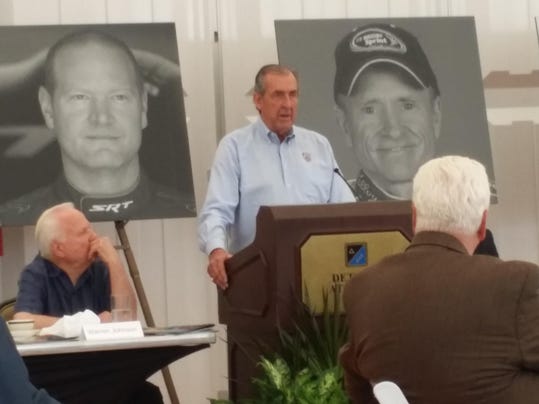
In 1984 David Hobbs assaulted Detroit’s street course in a Corvette Trans Am car, then climbed out and did color commentary for the Detroit Grand Prix. Just another day in the life of one of motor racing’s legendary talents and most recognizable TV personalities.
Today, the 76-year old Hobbs is a staple of NBC Sport’s Formula One coverage with his British wit, brutally honest commentary (“What a bone-headed move, you dork,” he quipped after one driver’s spin) and “Hobbs-sims” (“you need rather large appendages to make that pass”). His 31-year racing career (1959-1990) spanned the sport from Trans Am to Formula One to NASCAR to LeMans. Before the modern era of sports specialization, Hobbs came from a generation of racers who — like the ol’ three-letter college athlete — excelled in multiple disciplines.
I first saw him up close at Road Atlanta in 1979 in his ferocious, 650-horsepower BMW 320 turbo where he put on a memorable show against the IMSA Series’ dominant Porsche 935s. Outside the car, the bloodhound-faced Hobbs was instantly recognizable with lamb-chop sideburns and a slow English drawl. He was inaugurated into the Troy-based Motorsports Hall of Fame in 2009 and returned this June to emcee the final Hall induction ceremony before it’s uprooted to Daytona.
I sat down with the now-Milwaukee resident to talk RenCen, mom, and liquid-suspensions.
Q: What was it like racing in Detroit in ‘84?
Hobbs: I really liked the circuit. Some of the corners were a bit sharp — they were right angles that would normally be a traffic light. It was a bit bumpy . . . and of course the old Corvette took a lot of stopping and starting. Particularly stopping. I dropped back because we had brake issues.
Q: Would you like to see Formula One here again?
Hobbs: I was sorry to see that race go quiet honestly because I thought it was a very good venue. I was walking around there today . . . and I thought they could still have a race. It could be one of those hot buttons Detroit is looking for at the moment.
Q: Special memories of race week?
Hobbs: We used to stay in the RenCen and of course got lost in there every night after a few drinks at the bar. You’d go around and around in circles and unless you took particular notice of numbers you never knew quite where you were.
Q: You still race?
Hobbs: I raced for a long time: 1959-1990. I did Indy, Daytona, LeMans 20 times, Trans-Am, Formula 5000, but somehow I never got hurt. My great friend (ed. note: and fellow racing legend) Brian Redman always says: “That’s because you weren’t going fast enough, lad.” I was very fortunate because those were probably the most dangerous years of racing. I didn’t have a fire-proof suit until I had been racing at least 6 or 7 years. My mother used to put in Borax to give it some fire retardant. I’m not superstitious but I believe in the law of averages. I’ve been busy with TV the last 25 years. The last time I drove a race car was at Goodwood in 2010.
Q: Who’s the greatest driver you ever saw?
Hobbs: Joe Siffert, Brian Redman, Ronnie Peterson, Mario Andretti, Stirling Moss. Jimmy Clark was my hero. Among the current generation? Lewis Hamilton.
Q: I was saddened to see the great Barber School close shop at Laguna Seca Raceway. Is it harder for young drivers to get a start these days?
Hobbs: It’s so difficult. Because the money requirement is absolutely extraordinary. I started racing my Mum’s Morris Oxford. I drove it to races and drove home again. It had road tires, it didn’t have racing tires. My grandson is trying desperately hard now. Formula 1600 is costing him $90,000 for the year. If he wants (a co-drive) at Sebring (endurance race) it costs something like $50 grand. It’s gone completely haywire. Say he wins the championship this year and moves up — then wants to do Indy Lights. That’s $1 million.
Q: Is Formula One in trouble?
Hobbs: It’s not going away, but at the moment it’s being mishandled a bit. There is a lot of unsustainability about it, but F1 is still top of the tree worldwide.
Q: Your favorite race? Worst?
Hobbs: LeMans in 1983. I had a terrific duel with Klaus Ludwig. We both had Porsche 962s. We’re averaging 150 mph lap speeds, doing 225 down the straight, passing and repassing. Worst race I had was in ‘69 – I think — Watson liquid-suspension special at Brainard road course with offset suspension for ovals.
Payne: Odd couple, Cherokee Trailhawk vs. Toyota RAV4
Posted by hpayne on July 2, 2015
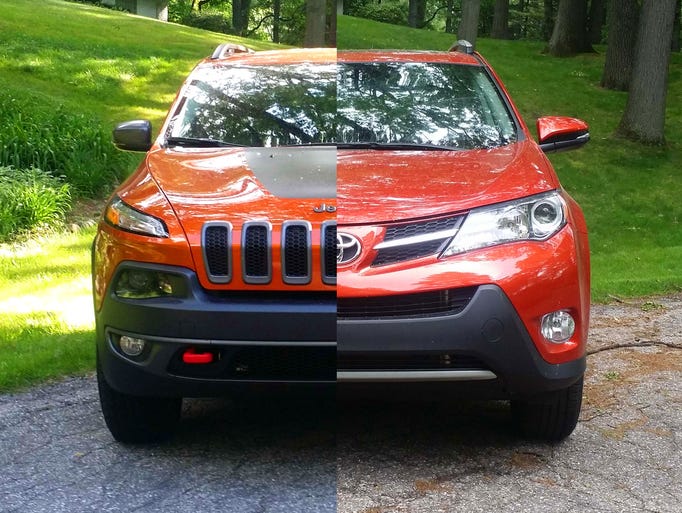
In the case of the Jeep Cherokee Trailhawk and Toyota RAV4, you can tell a book by its cover.
Named for the Appalachian Indian tribe, my Cherokee looks ready to saddle up for some serious, deep woods deer-tracking. The RAV4 (short for Recreational Active Vehicle with 4-wheel drive, if you gotta know) on the other hand, could just as well be the name of the Brother MFC-J5620DW inkjet printer that sits in my office.
The Trailhawk screams adventure, the RAV4 hums reliability. But the marvelous thing is that both are available in AWD trim for less than $30K in the small crossover department. Sport ute shopping is getting fun.
Small utes were once as useful as a microwave and just as sexy. Boxy lookalikes like the RAV4, Honda CR-V and Ford Escape pioneered the segment. But then the Escape got a notion in its tinny brain that utes could be stylish. Crossovers started cross-dressing in sedan clothing — a fast-backed roofline here, a creased body panel there — and next thing you know utes are threatening sedans for most-bought-vehicle supremacy.
Utes are where all the cool kids are, so Jeep has jumped in the pool and now it’s really a party.
The ’15 Trailhawk (introduced in 2014) brings the usual stubble-faced Jeep swagger to crossover utes. Knobby tires apparently hijacked off a Mars rover. Five-terrain modes so you can take the creek bed back from the grocery store. Front tow hooks to pull Chris Christie from a pool of quicksand. But upon closer inspection, the Cherokee is as radical a departure from Jeep as it is from the average ute.
Jeep styling has never strayed far from Uncle Wrangler. The square-jawed, boxy look was as much in Jeep’s DNA as four-wheel-drive. But Cherokee is something out of a Hollywood makeup shop. Catch the Jeep from behind and you might mistake its smooth, round tookus for a Ford Escape. Swim alongside and its long nose tapers like a tiger shark.
Look it in the eyes and it’s unforgettable. The slit running lights glow where headlights normally should be, while the actual headlights hide next to the grille. It’s Jeep’s famous seven-tooth grin no doubt. But it’s less grin and more Hannibal Lecter in a mask. Unlike Wrangler-esque, little brother Renegade, the anti-Jeep Cherokee isn’t festooned with Jeep tattoos either. No homage-to-WW2-gas-can “X”s carved in the taillights. No little Jeep silhouettes crawling up the windshield.
The RAV4 isn’t nearly as hip. But neither is it old-fashioned.
While cousin Camry has grown a goatee and started crashing weddings to get noticed, the fourth-gen, 2015 RAV is clean-shaven, fit and well-tailored. The kinda guy you’d take home to Mom. The face won’t give you Hannibal nightmares, but neither will it leave an impression.
It’s a sure-fire cure for insomnia. The Toyota logo is flanked by a two-port grille. As I recall. Um, it’s fading from memory already. … The torso is more interesting with sharp beltlines and an aerodynamic greenhouse. No one will mistake RAV for a boy toy like my “Mango Tango”-painted Trailhawk tester (complete with macho “TRAIL RATED” badge), but the “Hot Lava” orange RAV I tested was no wallflower.
The chiseled torso suggests RAV has spent some time in the gym. Its 3,610 pounds is some 500 less than Cherokee’s 4,108. With Washington nannies forcing autos to reach 54.5 mpg by 2025, RAV has ditched its previous-gen 6-cylinder option for a 4-banger only, while Jeep continues to offer Chrysler’s workhorse, 3.2-liter, 271-horsepower Pentastar 6-shooter.
Forget the nannies — I like a confident V-6 in an SUV. The Trailhawk’s 6 won’t light Woodward on fire but it has nice, smooth power — until the fuel-efficient, nine-speed tranny (another nanny nod) kicks in like a mule on upshift. Given Jeep’s near-bottom rating in the latest JD Power Initial Quality survey, this may make customers pause. Especially as Toyota is a perpetual front-runner.
Personality or reliability? As in dating, it’s nice to have the choice.
But different as they may be outside, the Cherokee and RAV4 are similarly straightforward inside. Crossover customers want convenience and the pair aim to please. Both boast gadgetry— blind-spot warnings, voice recognition — that used to be luxe exclusive. The Jeep boasts Chrysler’s terrific UConnect system and an organized interior décor that would make Martha Stewart proud. The Toyota, by contrast, is a mason’s stack of building materials– my RAV4 XLE had layers of aluminum trim on top of stitched vinyl on top of faux carbon fiber – with console elements that seem to have been assembled from Micro Center’s shelves. Yet the pieces all fit together simply and intuitively. No one understands how Americans live in
their cars better than Chrysler, but Toyota at least speaks the language.
Most refreshing is RAV’s open interior architecture.
I drove a Camry recently with a center console aluminum bezel that carved my knee in half. Not the comfy RAV which separates dash from console providing enough leg room for an elephant up front. Or two. Ahhh, sweet legroom for my long legs on a long journey Up North.
But interior storage benefits as well — particularly in front of the shifter where a nifty triangular slot begs for smart phones so you can easily follow nav instructions or screen your phone calls. Cup holders are cleverly split with one fore (for the driver) of the shifter, the other aft for the passenger. All this space allows room for a full hand-brake, which is much easier to locate in a panic than today’s trendy e-brakes. RAV only disappoints in the connectivity department where its single USB port and 12-volt charger aren’t as generous as Cherokee’s multiple offerings.
The roominess obsession continues in RAV’s palatial backseat. I could easily sit behind myself (can we have Toyota design Delta’s coach class seats, please?), and the seats recline to boot. Fold ’em flat and interior cargo room expands to an impressive 73.4 cubic feet.
The Cherokee can’t match the RAV’s room, but why bother when you can etch “Jeep: Since 1941” on your steering wheel. We all know what 1941 means.
Jeep rides that patriotic heritage into every new segment it tackles. That identity was good for a healthy 176,000 in sales last year as the new Cherokee hit the trail running. So what is Toyota’s subcompact identity? That printer-like RAV4 badge has gotta go. May I suggest ROOMY-for-4 instead?
2015 Jeep Cherokee Trailhawk 4X4
Vehicle type: Front-engine, front or all-wheel-drive, five-passenger sport ute
Price: $30,890 base ($37,614 as tested)
Power plant: 3.2-liter Pentastar V-6; 2.4-liter, Tigershark inline 4-cylinder
Power: 271 horsepower, 239 pound-feet of torque (V-6); 184 horsepower, 171 pound-feet of torque (4-cyl)
Transmission: Nine-speed automatic
Performance: 0-60 mph: 7.2 seconds (V-6, Car & Driver); maximum towing: 2,000 lbs.
Weight: 4,108 pounds
Fuel economy: EPA 19 mpg city/26 mpg highway/22 mpg combined
Report card
Highs: Dude, you’re lookin’ good; go-anywhere rugged
Lows: Heavy; tranny gets the yips
Overall:★★★
2015 Toyota RAV4
Vehicle type: Front-engine, front or all-wheel-drive, five-passenger sport ute
Price: $26,935 FWD XLE as tested ($30,735 for AWD Limited, comparable to Trailhawk)
Power plant: 2.5-liter, double-overhead cam 4-cylinder
Power: 176 horsepower, 172 pound-feet of torque
Transmission: Six-speed automatic
Performance: 0-60 mph: 8.7 seconds (Car & Driver); maximum towing: 1,500 lbs.
Weight: 3,465 as tested (3,610 for AWD Limited)
Fuel economy: EPA 24 mpg city/31 mpg highway/26 mpg combined (FWD as tested); EPA 22 mpg city/29 mpg highway/25 mpg combined (AWD Limited)
Report card
Highs: Roomy; reliable as a collie
Lows: Themeless interior; how about a kick-actuated liftgate?
Overall:★★★
Payne: Rugged Ram 1500 diesel hugely economical
Posted by hpayne on June 25, 2015

I think I’ve been cast as Lemuel Gulliver in the adaptation of a Jonathan Swift novel. Last week I was a giant testing the tiny Alfa Romeo 4C Spider in Lilliput. This week I’ve been driving around in a Brobdingnagian Ram 1500 diesel.
This thing is huge. I may be 6-foot-5-inches but, when I climb into the driver’s seat, I look like a six-year-old scrambling onto a bunk bed. Meanwhile, my 5-foot-5-inch wife is looking in the passenger-side door for a step ladder. Which is about the only option the luxurious, $52,620 Laramie model doesn’t come equipped with.
For an auto racer like me, the jump from Lilliput to Brobdingnag is actually not as disorienting as it was for Lemuel. It’s a normal occurrence on weekends where 8,000-pound, diesel-powered, heavy-duties tow 1,500-pound race machines to the track.
So what better way to test the Ram than to drive it to Indianapolis Motor Speedway?
For years my team has towed my pint-sized, 1966 Porsche 906 to the races with a 2003 Ram 3500 Heavy Duty. Talk about huge. Our 3500’s 5.9-liter, Cummins dieselinline-6 puts out 305 horsepower and 555 pound-feet of torque (the ’16 model ups the torque to a staggering 900 pound-feet) compared to the 1500’s 240-horse, 420-pound feet, turbocharged, 3.0-liter “ecodiesel.” Crank the ol’ Cummins up and the ground shakes, trees topple, car alarms go off in three counties. This is a work truck, a purpose-built diesel meant for pulling stumps — and cars.
It’s also a baseline for how refined modern turbo-diesels have become even as they deliver plenty of utility.
As I crossed the American heartland to America’s racetrack in an All-American pickup, all is not as it appears. Brazilian Juan Pablo Montoya just won the Indy 500 in an Italian-built Dallara — and the Ram 1500 is assembled in Mexico and owned by Italy’s Fiat. Which also happens to be where its diesel engine is made.
After decades of development Europeans know diesels. Gliding south on Route 23 out of Michigan, I wouldn’t guess the engine beneath me was a diesel but for the 4,800 RPM redline and “DIESEL” etched in the fuel gauge. The turbo-6 is whisper quiet. Jump on the throttle and there’s no rumble. No shudder. No belch of black smoke from the double-barreled exhaust. Diesel, thy name is Serenity.
And Efficiency. Forget your truck stop-phobia (please, Lord, let the toilets be sanitary). Your fear of running out of gas. The diesel Ram will go 570 miles on a tank. Five-hundred-and-seventy miles. That’s from Detroit to St. Louis. You could stash a Prius in the bed and then go another 530.
The $7,795 premium for the Cummins engine in the heavy duty is easily justified by the engine’s off-the-charts, 30,000-pound towing ability — not to mention fuel saved over long trailer hauls. But does the $2,830 diesel premium over the standard Ram’s 5.7-liter, gas-powered V-8 make sense?
After all, the ripped Hemi can clean and jerk 8,610 pounds compared to the diesel’s 7,660 tow capacity. The oil-burner’s case rests on fuel economy. Ram claims 22 mpg (I got 23.6 mpg in AWD mode, 25.8 in 2WD) versus the Hemi’s 17. That 30 percent better fuel efficiency looks good on paper, but, with gas and diesel prices essentially the same (I paid $2.70 in Indiana vs. $2.77 for regular gas), you’ll have to drive 15,000
miles-a-year for 5 years to earn it back. Plan on owning your truck longer that long?
You might, given the 1500’s livability.
The Crew Cab’s quiet interior is bigger than most Manhattan apartments and just as posh. The ram’s-head sculpture on the console is a piece of art. The dash-mounted rotary shifter opens up even more room. I bought dinner at Chick-fil-A outside Toledo (ahem, more Chicks in Michigan, please?) and arranged it in the sprawling console like a high school cafeteria tray: The box of chicken nuggets in the deep compartment at my right elbow, my fries in the space behind it. My X-large soda occupied Cupholder A — right next to the bottled water in Cupholder B.
And I still had another compartment left over if I had had dessert (chocolate pudding was always my favorite in school). Try that in any other vehicle. No wonder pickups aren’t just for construction workers.
A neighbor’s teenage daughter drives a Ram. In a large family she provides essential shuttle service. I came across her one day at the local tennis club snacking in the cafeteria — er, cab — while waiting for her kid brother to finish his lesson. A repaired bicycle was in the bed. Little brother jumped into the back seat slinging his huge tennis bag before him. His back seat, hers front seat. Good for sibling relations.
Premium trucks have gone from 1 percent of the pickup market in 2009 to 16 percent today for good reason: They are rolling offices. In the searing summer heat of Indy’s infield, I spent an afternoon between races getting work done. I lounged comfortably in cooled, ventilated leather seats. I kept my laptop juiced in a 12-volt outlet. I browsed the Internet via the UConnect Wi-Fi app. If I had had a port-a-john in the pickup bed, I would never have had to leave the truck.
In Lilliput I skimmed the earth in the Alfa. I felt every pore in the road. Saw every blade of grass. In giant pickup land you’re above it all. It’s like riding in a skyscraper. I looked across the landscape and saw people in other skyscrapers: GMC Sierras, Ford F-150 pickups, Chevy Silverados.
A signature feature of Ram is its smooth ride thanks to sedan-like coil springs in the rear suspension. But for the third-story view, I forgot it was a pickup a few miles into my journey. Big pickups — looking at you Toyota Tundra — can become annoying on long trips for their harsh ride on rear leaf-springs. Combined with an empty bed, the flutter rides right up your spine. Not Ram.
In the Big Three pickup wars, every brand needs a calling card. Chevy’s got the best bed access with corner step-up. Aluminum Ford wows with gizmos like mirror spotlights and bed cleats. Ram’s got the silky ride.
America’s roads have gone supersized with the calories to match. Jumbo candy bars at every service station. X-Large drinks at every drive-thru. How clever to have a supersized diesel pickup that uses fewer calories. A Brobdingnagian with a Lilliput appetite.
2015 Ram 1500 diesel
Vehicle type: Front-engine, rear or four-wheel-drive, five-passenger pickup
Price: $25,165 base ($52,620 Larami Crew Cab Diesel 4×4 as tested)
Power plant: 3.6-liter V-6; 5.7-liter hemi V-8; 3.0-liter, turbocharged, 3.0-liter diesel V-6
Power: 305 horsepower, 269 pound-feet of torque (3.6L V-6); 395 horsepower, 410 pound-feet of torque (Hemi V-8); 240 horsepower, 420 pound-feet of torque (diesel)
Transmission: Six or eight-speed automatic
Performance: 0-60 mph: 8.8 seconds (Motor Trend); Maximum payload: 1,340 lbs.; Maximum towing: 7,660 lbs. (as tested)
Weight: 5,611 pounds (diesel as tested)
Fuel economy: EPA 16 mpg city/23 mpg highway/19 mpg combined (3.6L V-6); EPA 15 mpg city/21 mpg highway/17 mpg combined (Hemi V-8); EPA 19 mpg city/27 mpg highway/22 mpg combined (diesel)
Report card
Highs: Roomy; the range of a stealth bomber
Lows: Diesel premium; won’t fit in “compact car” space
Overall:★★★★
Payne: Neck-and-neck with a GT40 at . . . Indy?
Posted by hpayne on June 20, 2015

What do ex-Indy car ace Max Papis, a 50-year-old Ford GT40, a 1966 Porsche 906, and your humble auto critic have in common? We were all on the grid in Gasoline Alley at Indianapolis Motor Speedway last weekend.
Indy isn’t just for 230-mph open-wheel racers anymore.
From June 11-14, the second annual Brickyard Vintage Racing Invitational came to America’s cathedral of motorsport, bringing with it a century of auto racing cars and stars. While Ford was announcing in Dearborn that it was returning to LeMans in 2016 with a new Ford GT — 50 years after it swept the podium there — I was racing neck-and-neck with the historic Ford GT40s that raced at LeMans a half-century ago.
Well, briefly neck-and-neck. The 7-liter, 1966 GT40 blew by my 2-liter 906 at 170 mph just like it did in ’66 when the two cars dominated their respective classes. That is the intent of historic racing — to enable spectators to relive the past glories of motor racing.
Not just relive them, but reach out and touch them.
My 906 is virtually unchanged from 50 years ago when the marque won the under-2-liter class at LeMans and finished fourth overall — the first non-GT40 to cross the finish line. What changes have been made are for safety like 5-point harness seat belts, modern racing tires, and stiffer suspension settings. Such modifications are critical to my safety as I hurtled at 150 mph down Indy’s main straightaway — and is even more crucial to the modern race cars that cross the same bricks at 230 mph every Memorial Day.
Fans can also reach out and shake hands with some of the greatest drivers who ever raced at the Brickyard: Al Unser, Lyn St. James, Eliseo Salazar, Willy T. Ribbs, and Papis. The gregarious, talented Italian Papis competed at Indy thrice in an illustrious career that included a fifth place at LeMans and a season in Formula One. He flashed his trademark smile at spectators then flashed me a thumbs up as he climbed aboard his 1970 Trans-Am Mustang Boss 302 for a Saturday practice session. Going by me on the main straight, “Mad Max” and that big V-8 shook my fillings.
On the same weekend that I was racing my 906 at Indy, a Porsche 919 won the 24 Hours of LeMans in France.
My Porsche shares little with the hybrid-powered, carbon fiber-chassis, 200 plus-mph 919 — except a nameplate defined by endurance racing excellence. Indeed, the Porsche endurance legend began with the 906 — their first fiberglass, tube-frame, purpose-built race car.
Under the direction of Ferry Porsche’s then-29-year-old grandson Ferdinand Piech — just booted as the 78-year-old chairman of VW — the 906 set a standard for racing excellence that would be followed by Porsches from the 907 (first Porsche to win an overall endurance race in 1968) to the 962 (which dominated racing in the 1980s and ’90s) to the 911 GT and 919 prototype racers of today.
My car (the last of 160 made by the factory) first competed at the 24 Hours of Daytona in 1966 — finishing eighth — then the 12 Hours of Sebring where it hit a stray dog and retired. The car then knocked about in American SCCA racing before my father bought it 1975. A family hand-me-down of sorts. He raced it sparingly before his eager young son took over the wheel in the 1990s where we’ve been an inseparable team ever since. I’ve raced it everywhere from Sebring, Florida, to Watkins Glen, New York, before we finally found our way to Indy.
It’s the ambiance of Indy that draws the entries, not the track. Like the short-lived Formula One races at Indy, we run Indy’s “roval” — an uninspired combination of oval track and infield road course.
The light, sleek 906 is just 3-feet tall. At 6’5″ I’m squeezed into its cockpit like stuffing in a Thanksgiving turkey. And it’s hotter than an oven in there.
But once on track, the nimble prototype is more fun than a Christmas toy. Obsessed with lightweighting, Piech laid the car’s plastic skin over a tubular space frame weighing a grand total of 1,410 pounds. With carbon fiber monocoque chassis, modern open-wheel cars are almost as light as my car but offer much better protection should they hit, say, a nearby wall.
Extremely reliable, the 906 is powered by an air-cooled, fuel-injected, flat-six engine — a close cousin to the water-cooled power plants in today’s 911.
The hybrid 919, however, is a different animal altogether. It requires a fleet of engineers to run. Thanks to safety advances, race jockeys like Mad Max live longer than ever. But in another 50 years you’ll be more likely to see my 906 or a GT40 at the Brickyard Invitational than a diabolically-complicated 919.
1966 Porsche 906
Vehicle type: Rear-engine, rear-wheel-drive, race prototype
Price: Fuhgettaboutit
Power plant: 2.0-liter, air-cooled 6-cylinder
Power: 220 horsepower, 153 pound-feet of torque
Transmission: Five-speed manual
Performance: Top speed: 170 mph
Weight: 1,410 pounds
Fuel economy: 8 mpg (at race speed)
Report card
Highs: Gorgeous, first car wind tunnel-tested by Porsche; Perfectly-weighted handling
Lows: Hot as Hades inside; I need a shoehorn to get in
Overall:★★★★
Payne: Sexy Alfa 4C goes topless
Posted by hpayne on June 18, 2015

Sure, the 2015 Alfa Romeo 4C doesn’t have the landscape-swallowing horsepower of the Corvette C7 Stingray. It doesn’t have a Porsche Boxster S’s clinically perfect balance of turn-in handling and corner exit torque.
But the “Baby Ferrari” will make you a rock star.
It’s a miniature diva with the body of Christina Aguilera and the outsize personality to match. And now it’s going topless. Beginning this July, the 4C Coupe will be joined on dealer lots by the convertible 4C Spider.
Carmel-by-the-Sea south of San Francisco is a sandbox for the Bay Area’s well-to-do. Folks here aren’t easily impressed. But at a media test here, my red Alfa Spider stopped traffic. Rolling through the boutique-lined streets, women in $5,000 designer suits perched on Louboutin heels stopped and stared. At the corner of Seventh and Juniper a busload of tourists snapped pictures as if they had just spied Cher. The paparazzi treatment continued down the Pacific Coast. At a rest stop in Big Sur, the 4C was swarmed by kids. Can we sit in it? Sure. Can we take pictures? Yes. Can we take it home and feed it? Nope.
I haven’t had a car get this kind of attention since a BMW i8. But the secret to the Alfa’s celebrity is its accessibility. It has a supercar’s mystique without the supercar price tag. It’s a rare gem for less than six figures. There are 30,000 Corvettes sold a year. Some 7,000 Boxsters and Caymans.
Buy a 4C Spider or Coupe and you are a member of an exclusive club. Less than 300 4Cs have been sold in the U.S.
Alfa couldn’t make more if it wanted. The mid-engine 4C’s sturdy, lightweight tub is meticulously handcrafted over six months by elves in Lilliput who’ve handed down carbon fiber trade secrets for generations. They’re the same gnomes that make Rolex watches (if I’m remembering the presentation correctly). Each one a piece of art.
Hounding a Cayman down the Pacific Highway, I was struck by the Spider’s unabashed sex appeal compared to the handsome yet more conservatively-styled Porsche. The Spider is Mazda Miata-tiny, but Porsche-wide giving it an aggressive, ground-hugging, athletic stance. With its signature Alfa cat’s face, raked windshield, and muscular haunches, it looks like an angry predator about to pounce. Step around the rear and it is classic Ferrari. Honey, I shrunk the 485!
The Alfa team took us to Laguna Seca Raceway to show off the car’s track chops. But despite its lightweight, carbon tub (the Spider is just 22 pounds heavier than the Coupe), the Alfa pales on the track next to a Corvette or Cayman. I’ve had both out on Autobahn Raceway in Joliet, Illinois recently and they are worthy big track cars. Carrying 500 fewer pounds less than the Boxster S and a full grand less than Stingray, the 237-horsepower 4C’s awesome power-to-weight ratio should — on paper — be a worthy a competitor to its similarly-priced competitors. But it’s light on something else: Displacement. Even though the little car’s 1.7-liter engine is turbocharged out of its
mind, it’s still just 1.7 liters.
Throw this cat into a corner and it ferociously claws its way to the apex at which point the combination of little pistons and big turbo lag conspire to mute its progress. The Corvette and Boxster S explode off a fast corner, the Spider merely pops.
Better to take it on the tight California hill roads around Laguna Seca where the 4C is really in its element.
rails like the Pacific Coast Highway. Or Carmel Valley Road, which feels like Route 119 — aka, the Tunnel of Trees Road — north of Harbor Springs. Tight, leafy, narrow. Let the Alfa out of its cage here and it hunts like a wild animal. The short, 93.7-inch wheelbase rotates around tight curves, its hydraulic steering giving me feedback from every pore in the road.
Jump on the gas pedal and the turbo erupts with sounds never before met by human ears.
The gorgeous starlet is suddenly transformed into Linda Blair in “The Exorcist.” It spits, growls and cackles. If it were human, its head would rotate 360 degrees. Get a priest. It’s demonic and heavenly at the same time.
Every stomp unleashes a different manic note. Meanwhile, the car shoots forward like a scalded cat. Where the two-lane road straightens out, I gobbled SUVs stuffed with California tourists. A BMW M4 gamely kept up before more twisties arrived and it dropped from view. Buy a 4C and get a cottage up north to house the Alfa with quick access to twisty roads.
And because you and the missus won’t be able to pack a bag and go back and forth for the weekend. There’s simply no room.
This is the part where I tell you how quirkily inconvenient the Alfa is. Roll up the soft top into its bag and it occupies most of the trunk. Not that the tiny space could stow a small suitcase to begin with. Where the Boxster’s roof automatically stows behind the front seats leaving ample storage in the trunk and frunk, the Alfa becomes trunkless when it goes topless.
Pack for a weekend getaway and you’d have to mail your suitcase ahead. Or tow a U-Haul trailer that would kill the whole handling thing. Not that you’d want to spend hours in the Alfa anyway. The ergonomics of a $30K Miata are like an Audi A6 by comparison. The spare console (just an Alpine radio is offered which I never turned on anyway because I was so enthralled with the engine demons) is so driver-centric that the passenger seat is a cramped torture chamber. The console cuts into passenger’s knees already constrained by the low, glove boxless dash. At least Alfa thoughtfully included an “oh, crap!” handle for when those g-loaded country roads arrive.
A cruiser this is not. It’s a speed toy. An afternoon getaway car. A Miata on ‘roids. And it is something else: Alfa’s alpha dog. The raucous 4C sets the tone for the sexy Alfa luxury sedans that are about to hit American shores.
Beginning with a BMW 3-series fighter to be introduced later his month, these sedans will also usher in more engine options for the Alfa lineup. Which means that someday there might be a 4C Spider with a proper, torquey 2.0-liter turbo. A rock star that can play the small country roads and the big stadium race tracks.
In the meantime you won’t lack for attention.
2015 Alfa Romeo 4C Spider
Vehicle type: Mid-engine, rear-wheel-drive, two-passenger sports car
Price: $65,495 base ($73,395 as tested)
Power plant: 1.7-liter, turbocharged 4-cylinder
Power: 237 horsepower, 258 pound-feet of torque
Transmission: Six-speed, dual-clutch automatic (with paddles)
Performance: 0-60 mph, 4.1 seconds (manufacturer)
Weight: 2,487 pounds
Fuel economy: EPA 24 mpg city/34 mpg highway/28 mpg combined
Report card
Highs: Hollywood gorgeous; razor-sharp handling
Lows: Cramped passenger seat; small displacement, big turbo lag
Overall:★★★★
Payne: Nissan Maxima vs. Dodge Charger in a diva duel
Posted by hpayne on June 11, 2015

If SUVs are taking over the market, then how come big sedans are having all the fun?
Trick question, of course. The answer is the two are related. As ute family haulers like the Ford Explorer, Honda Pilot and Chevy Traverse have gained our fancy, big sedans are sitting neglected on dealer lots. So brands are turning on the sex appeal to get noticed. Bling-master Chrysler 300C is a middle-class Bentley, the toned Chevy Impala got a Camaro makeover, the Ford Taurus SHO packs more punch than a Mayweather haymaker, the Toyota Avalon hybrid is quiet elegance.
But the class fashion divas are the Nissan Maxima and Dodge Charger R/T.
Priced in the affordable $35K-$40K range, these low-riding, high-style mainstream sedans boast looks that shame their jacked-up ute cousins. When the kids flee the treehouse and Mom and Dad climb down from their family utes, these beauties deserve a look. Indeed, their sport and performance capabilities rival pricier, comparably sized luxury makes.
Yet, despite their similar dimensions and shocking wardrobes, the Maxima Platinum and R/T Scat Pack (awesome rock band names, by the way) that I’ve been driving appeal to very different tastes.
I’m a real cheapskate when it comes to family vacation rental cars. I’d rather blow money on another Space Mountain ride. I just want fuel efficiency and room. Yet there was a time when I also wanted Maxima. For a little vacation spice, I’d ask for an upgrade to a full-size Maxima. The 2003 car’s raked front and firm handling were the cure for the boring sedan — bringing g-loaded cheers from my kids at the sacrifice of neck pain for my long-suffering wife (family is balance, no?).
But in recent years, the Maxima took its own vacation. The styling became stale while competitors — thank you, 300 — stepped up. Maxima was minima. Not anymore.
The 2016 model kicks in the front door with high-stiletto boots, throws a mane of hair from its forehead, and purrs in your ear with a come-hither voice. Let’s drive.
You’ve seen this wild, art deco wardrobe before— the signature V motion-grille, the floating roof, the brawny front shoulders — on Nissan’s more-expensive, kid-sister, crossover Murano (all-new for 2015). But it looks better on the lower, leaner Maxima.
The V-grille on the Murano sits tall, a sculpted hood ornament with no mechanical purpose. Maxima’s grille, in contrast, is lower with purpose — feeding air to the V-6 behind it. Like Audi’s full-fascia grates, it reminds of a locomotive cow-catcher hurtling down the tracks. Look out heifers.
Like Maxima of yore, the athletic curves scream performance. Yet beneath its racier, Lindsey Vonn-exterior, the Nissan is still motivated by the same ol’, continuously-variable-transmission, 3.5-liter six-banger on a front-wheel-drive Altima platform. Oh. Despite Nissan’s best efforts, “sporty CVT” is an oxymoron.
If you want to talk sports sedan, let’s talk Charger. Rear-wheel drive. Massive brakes. Engines from Olympus.
While the Maxima features one 300-horse V-6, a 292-horse 6-banger is just the opening appetizer on the Dodge menu. The epic, supercharged, 707-horsepower, 6.2-liter V-8 in the $60K Charger Hellcat gets the headlines, but the meat of the lineup is the more affordable — still plenty lethal — 5.7 and 6.4-liter R/T (Road/Track) power plants.
The latter is my favorite. Stuffed inside the R/T Scat Pack, its 392 cubic inches not only dwarf Maxima, its 485-horsepower out-thumps the Corvette Stingray’s 455 ponies, for goodness sake. My motorhead, soccer-mom neighbor Holly lusts after the Scat for school runs. I imagine her kids awaking in terror at 6 a.m. after the seismic tremors generated by Mom igniting the V-8.
But mostly the R/T will appeal to males who want their machismo back after years of drudgery behind the minivan wheel. With the same elegant, wraparound lighting and hood scoop as the Hellcat, Scat Pack is a clean break from the last generation Charger’s more upright, RAM truck-like grille and taillights. It is both menacing and fetching.
And it masks the fact that the Charger’s old, heavy bones remain unchanged. Stomp on the gas and the beast bellows with joy. Tap the automatic T-shifter into manual mode and you can induce lurid, rubber-burning power slides from the rear wheels as you snap a Michigan U-turn on Woodward. That’s my kinda’ Saturday night special.
But with 4,400 pounds in its belly, it’s harder to have fun in the twisty bits.
This is where the 3,500-pound Maxima — nearly a grand lighter thanks to lightweight steel construction — earns its sporty chops. Dive into a sharp bend and the lighter Nissan actually has less front push than the over-fed Charger despite its front wheel-drive architecture. What’s more, the well-engineered Maxima also exhibited no torque steer even under heavy coaxing from my size-15 right foot.
Getting the Charger through a corner can feel like riding a bull, but nail the V-8 throttle on exit and all is forgiven. Driving this pair back-to-back, I yearned for a big sedan “hybrid”: Charger Hemi mated to lightweight Nissan chassis.
For all the aggression on the outside, this pair of lookers are lounge-like inside. The Charger sports the same crisp, simple layout that has made Dodge/Chrysler ergonomics the best in the business. So good is the multi-media system that it earns a place in the Maserati Ghibli I recently drove.
But where the Dodge goes over the top in the engine department, the Maxima earns its bragging rights in the cabin. The different priorities is what separates these peers.
Think of the Charger as a discount version of the explosive, $100K, 560-horsepower BMW M5. Think of Maxima as a budget version of the serene, $100K, leather-stitched Audi A8.
While the Charger mimics M-power, the Maxima wants you to think Audi comfort. Its instrument gauges echo Audi. As does its console-mounted, multi-media rotary dial control. And panoramic sunroof. Dash stitching. The Maxima even sports diamond-quilted seats like those in the A8 (though the diamond-etched dash trim jumps the shark).
Maxima and Charger are proof that four-door sedans can be sexy. Heck, these divas are so slinky they should come with their own soundtracks. How about Rod Stewart’s “Do you think I’m sexy?” single when you turn on the Maxima? And for the Charger, well … the eight-cylinder symphony at 6,000 rpm will do.
2016 Nissan Maxima
Vehicle type: Front-engine, front-wheel drive, 5-passenger sedan
Price: $33,235 base ($40,685 Platinum as tested)
Power plant: 3.5-liter V-6
Power: 300 horsepower, 261 pound-feet of torque
Transmission: Continuously variable transmission (CVT)
Performance: 0-60 mph, 5.6 seconds (Car & Driver)
Weight: 3,593 pounds
Fuel economy: EPA 22 city/30 highway/25 combined
Report card
Highs: Look-at-me styling; Best-in-class fuel economy
Lows: Diamond-patterned interior trim jumps the shark; AWD, please?
Overall:★★★
2015 Dodge Charger
Vehicle type: Front-engine, rear-wheel drive, 5-passenger sedan
Price: $27,990 base ($41,685 R/T Scat Pack as tested)
Power plant: 3.6-liter V-6; 5.7-liter, Hemi V-8; 6.4-liter Hemi V-8; 6.2-liter, supercharged Hemi V-8
Power: 292 horsepower, 260 pound-feet of torque (V-6); 370 horsepower, 395 pound-feet of torque (5.7L V-8); 485 horsepower, 475 pound-feet of torque (6.4L V-8); 707 horsepower, 650 pound-feet of torque (6.2L supercharged V-8)
Transmission: 8-speed automatic
Performance: 0-60 mph, 4.1 seconds (R/T Scat Pack, Car & Driver)
Weight: 4,400 pounds (as tested)
Fuel economy: EPA 19 city/31 highway/23 combined (V-6); 16 city/25 highway/19 combined (5.7L V-8); 15 city/25 highway/18 combined (6.4-liter V-8); 13 city/22 highway/16 combined (6.2-L supercharged V-8)
Report card
Highs: Epic torque; best-in-class multi-media system
Lows: Porky; thirsty
Overall:★★★
Payne: The comical, drivable Fiat Abarth
Posted by hpayne on June 7, 2015
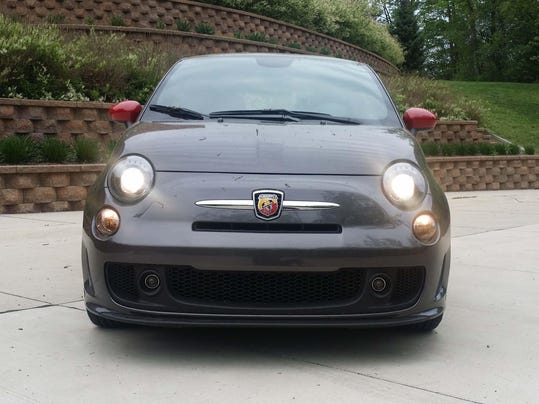
As a wee motorhead cartoonist growing up in the 1970s, my favorite cartoon was not “Peanuts” or “Dennis the Menace” or “Beetle Bailey,” it was Road & Track’s “Cyclops.” Cartoonist Stan Mott’s brilliant, single-headlight, tin can creation (look it up) went into battle against the titans of Porsche, Ferrari, and Lotus at LeMans and Indy and gave me hours of grins. Run by the mercurial, fictional, Italian madman Piero Martini, Cyclops (powered by a 30cc engine running on olive oil) was the ultimate auto underdog.
Meet the Fiat 500 Abarth, the modern-day Cyclops.
The descendent of race cars conceived by mad, Italian genius Carlo Abarth, the Abarth (pronounced “Ah, Bart”) is a Fiat 500 on steroids. A real-life cartoon car. Complete with trademark scorpion badge (Scorpio was Carlo’s astrological sign), the turbocharged, 1.4-liter Abarth adds sting to the cute-but-molasses-slow 500 line. Abarth is the mouse that roared.
Turn the key and the little dumpling’s sport exhaust awakens with a growl. It makes you jump like the dog that explodes in a barking fit when you ring a stranger’s doorbell (then you notice it’s a Pekingese).
Abarth’s bark is worse than its bite. Behind the growl is the same 157-horsepower, 4-banger that inhabits the base Fiat 500X SUV. Sprightly, but hardly top drawer in a class that includes the 189-horsepower Mini Cooper S or Ford’s spicy tamale – the 197-horse, 1.6-liter turbo Fiesta.
Despite its raft of scorpion logos, Abarth won’t sting if stepped on. Stomp the accelerator pedal and the front wheels betray none of the torque steer prevalent on the Ford.
Though not as tight as class-pet Mini, I love the superb, tossable handling. The little ankle-biter’s bulbous shape seems to defy physics. For all its sporty touches – red stripes, scorpions – the Fiat looks like a toy that someone blew up in their garage. It’s as round as a newborn with wide-eyed headlights and a puckered mouth that looks like it should be sucking on a binky.
But this is a bambino with chin stubble. To feed the hungry turbo within, Abarth comes with a bigger air scoop around the front than its normally-aspirated, sibling 500.
Round back the taillights are round, natch. Door handles too. The door-mounted mirrors are blood red. Nice touch. Bright red calipers brake the rotors. Jam them and the little car skitters like a terrier on a kitchen floor.
The ovum theme continues inside where everything is round except the flat-bottom steering wheel (which should be round). The tach. The switches. The temperature dials. Volume controls (though pressed, not turned – weird). A turbo pressure monitor is round. And, new for 2015, an automatic shifter sticks out of a round bowl in the center console like you’re stirring a pasta dinner.
From the 500X ute to the auto Abarth, Fiat is keen about expanding its customer base in the US after a slow start. Authentic, manual-shifting Italian performance is great in theory – until you realize Americans are stick illiterate. “Accessible performance has always been a hallmark of the Abarth name,” said Fiat North American Brand Chief Jason Stoicevich, “Now, with the addition of an optional automatic transmission, an entirely new group of customers is able to experience the thrill.”
Automatic, but with an Italian manual accent. In addition to DRIVE you can move the lever to the southwest corner of the mixing bowl for SPORT. Toggle down for upshifts, up for downshifts. Upshifts are accompanied by a loud BLAAAAT – downshifts by rev matching usually associated with high dollar sports cars.
This kid has more attitude Baby Herman in “Who Framed Roger Rabbit.”
I prefer the manual tranny nevertheless. Nail the throttle and the auto-driven engine will bump its head on the 6-grand redline – a delay not present in the manual. Still, the engine’s perkiness reminds of its potential in the 500X – which inexplicably comes only in an auto tranny. Can’t we all share?
Abarth is a subcompact so the cockpit space is narrow with a handbrake on the floor and armrests the size of pencils. You can smell what your passenger had for breakfast. The seats are cloth, stitched with Italian red. The backseats are small but – thanks to the hatch layout – provide decent headroom and cargo versatility if folded flat.
Load the little Abarth up – Mrs. Payne is thrilled that a subcompact has optional heated seats – and my auto Fiat stickers for $28, 295. That’s a lot of coin for a shoebox. But this is no ordinary shoebox.
It’s a rolling cartoon that’ll make you grin like a kid again.
2015 Fiat 500 Abarth
Vehicle type: Front-engine, front-wheel drive, 4-passenger hatchback
Price: $ ($28,295 as tested)
Power plant: 1.4-liter turbocharged inline-4 cylinder
Power: 157 horsepower, 183 pound-feet of torque
Transmission: 6-speed automatic or 6-speed manual
Performance: 0-60 mph, 6.9 seconds (Car & Driver)
Weight: 2,683 pounds
Fuel economy: EPA 24 city/32 highway
Report card
Highs: A smile-a-minute; Raucous exhaust note
Lows: Gimme the stick; Underpowered in class
Overall:★★★
Payne: New Miata’s old-fashioned fun
Posted by hpayne on June 4, 2015

It’s the simple things in life. The things you’ve always known. A Coca-Cola when you’re thirsty. A Snickers when you’re hungry. A Mazda MX-5 Miata when you crave sporty fun.
But staying simple isn’t simple.
In a changing world, there are always new pleasures. New tastes. Snickers? Why not a Kind fruit & nut bar? Sun-Maid raisins? A Pepperidge Farm Sausalito cookie (oh, I’m a sucker for those). The simple pleasures have to stay hip even as they can’t lose the recipe that made them must-haves in the first place. A tricky balance easily mangled. Take New Coke, the mother of all cautionary tales.
I cringe whenever a classic remakes the formula. Ford blew it with the Mustang II in 1974. Nailed it with the 2015. Now the 25-year-old MX-5 Miata — America’s sporty sweetheart — has arrived at its crossroads moment. Mazda has tapped out its Lotus Elan-throwback design about the same time it’s tapped out a boomer generation that still remembers what the heck a Lotus Elan looks like. The last MX-5 looked tired. Time to update the roadster for a new generation of motor heads and make it look like family (happily, Mazda’s current Kodo design is widely admired, unlike the jack o’ lantern face of the last generation).
But as it modernized Miata’s look, Mazda smartly stayed true to the badge’s lightweight roots. The Los Angeles design office could have gone all Hollywood with its makeover. More technical gee-whiz. Lustier exhaust note. Bigger front splitter. Instead, it kept it simple. The result is a Miata with the face of a Mazda and the spirit of a British sports car.
The verdict? Mazda hit the bulls-eye.
I got a hold of the 2016 MX-5 one fair day this May. When spring finally arrives in Michigan, muscle cars head to Woodward, sports cars go to Hell. Literally. To test the Miata’s capabilities I took the little roller-skate straight to the curvaceous county roads that surround the 266-population burg in southern Livingston County. Blind jumps, 90-degree right-handers, swift switchbacks. Hell’s roads are heaven.
Last July I drove a 2015 Miata GT over northern Michigan’s similar Route 66. The new gen is immediately familiar: tight, nimble, throwable. Once again, the roadster comes in three trims — base Sport, sporty Club, luxury GT — with the manual, $32,950 Club model I drove boasting similar grunt as the outgoing, automatic, 158-horse GT. Wallet alert: The new Miata is a $1,000 more expensive, and — properly equipped — should be thought of as a 30 grand car.
Every Miata I drive is like reconnecting with my first, wee sports car flame. Yet as we age, we gearheads feel compelled to want more and more power. Like the proverbial fish story, we sit on the porch and tell tales of bigger and bigger horsepower conquests. The latest 6.2-liter, 650-horsepower Corvette Z06, for example. A snarling, tornado of a car that demands all of GM’s massive Milford Proving Grounds to demonstrate its power.
The Miata doesn’t need a big canvas to strut its stuff. For the MX-5, Hell’s Glenbrook Road will do.
Even as the little, 155-horse firecracker loses 3 horsepower to the outgoing auto-driven engine — and 12 to the manual — the addition of direct-injection and subtraction of 150 pounds means the new car is peppier. Indeed, the boys at Car & Driver clocked it a full second quicker zero-60.
A driver’s car, the ’16 MX-5 has been engineered for greater pilot comfort. That means that, though the car’s length has actually shrunk by 2 inches, the cockpit has grown. Driver seating has been moved inboard for better visibility which is further enhanced by a 1-inch lower front hood. And the steering wheel and pedals have been raised to increase leg and foot space. A windscreen-mounted, aluminum piece stiffens the roof reducing wind noise by 40 percent.
Every little bit counts when you’re 6-foot-5-inches of elbows and size-15 loafers, I suppose, but I still need a shoe-horn to get into this little slipper.
The advantage of such close quarters is I can reach back and secure the soft top as easily as pulling a blanket over my head. Grab the shifter in the old Miata and — D’oh!Cup holders behind the shifter compromised box rowing. The new pup pushes clip-on holders out of the way to the firewall — which also opens the option (when passenger isn’t present) of moving a cup holder to a passenger side clip. Clever.
I enjoy all this even as I still prefer Miata’s competition, the Scion FR-S.
“The MX-5 has always been about the fun factor, not the numbers,” says Miata Development Engineer Dave Coleman. Which is another way of acknowledging the stiffer Scion is quicker in just about every metric. Better grip, better top end, better raw athleticism.
But I appreciate Mazda’s candor. They have purposely made the Miata softer and cuter because it is not a hardcore boy toy like the Scion, but a put-the-top-down, hit-the-open-road, bring-a-little-Heaven-to-Hell can of ZOOM! ZOOM! that attracts as many female fans as male.
It’s a formula that helped recapture a passion for pure driving fun and made Miata an affordable sports-car icon. For a quarter century it has seen competitors — Porsche 944, Pontiac Fiero, Toyota MR2, Saturn Sky — come and go. And as good as the Scion and its Subaru BR-Z twin are, the Miata is likely to outlast them too. Why? Because Mazda is essential to the Mazda brand. Despite annual sales numbers between 5,000 (2014) and 17,000 (2006), Mazda continues to pour millions into every generation of Miata.
Is the wicked-fast FR-S essential to a Toyota youth brand? Will the BR-Z last as the only rear-wheel-driver in a an AWD Subaru stable?
How did a Japanese company successfully launch a British retro sports car to American buyers? By making it a brand priority. “There’s a little bit of Miata in every car we make,” says spokesman Tom McDonald. At Mazda Raceway outside Monterey, California, weekend racers learn to drive on Miatas. SCCA racers enter Miatas more than any other car. Heck, engineer Coleman races his Miata in 24-hour endurance races.
The MX-5 isn’t a fad, it’s a fixture. An affordable, efficient, fun way to enjoy life’s simple pleasures. Once upon a time, motor heads bought a Miata to replace the dying English sports car in their driveway. Today, motor heads will flock to the Generation 4 Miata to replace the aging Gen 1 Miata in their garage.
Vehicle type: Front-engine, rear-wheel-drive, two-passenger sports car
Price: $25,735 base ($32,950 as tested)
Power plant: 2.0-liter, dual overhead-cam 4-cylinder
Power: 155 horsepower, 148 pound-feet of torque
Transmission: Six-speed manual
Performance: 0-60 mph, 5.9 seconds (Car & Driver)
Weight: 2,332 pounds
Fuel economy: EPA 27 mpg city/34 mpg highway/29.8 mpg under Payne’s lead foot
Report card
Highs: Distinctive new styling; simple-as-pie soft-top operation
Lows: Not for tall guys; you’re a sports car, growl a little
Overall:★★★★
Payne Q&Auto: How Honda got its mojo back
Posted by hpayne on May 30, 2015

This year Honda General Manager Jeff Conrad and his team are introducing reliable, new Honda Pilot and HR-V sport utes. Ho-hum. Sure, we Americans admire .350 batters. But we loooove .350 batters that hit with power.
And for much of its existence, Honda was synonymous with power.
A 1967 RA300 Honda Formula One car won its first race at the Italian Grand Prix. Jaws dropped when Honda’s mid-engine, aluminum-chassis Acura NSX supercar debuted in 1991. The 1999 Honda S2000 was the first-ever 9,000 RPM road car, producing an astonishing 240 ponies with just 2-liters. And the 2006 200-hp Civic SI in my driveway was one of its generation’s hottest hot hatches.
But recently, as ol’ reliable Honda ruled the retail sales floor with appliances like the Accord, Civic, CR-V, and Odyssey minivan, muscular Honda got locked in the basement. Honda withdrew from F1, ditched the NSX and S2, neglected its hot hatch.
Good news, kids. Honda’s got its mojo back.
With the unveiling of the 2016 OMG NSX at the Detroit Auto Show, Honda has launched a performance blitz that includes an F1 return and the insane, 300-plus horsepower Civic Type R (an SI pocket rocket on ‘roids). At Pilot’s unveiling in Cincinnati this April, I sat down with Conrad, a 33-year Honda veteran, to talk power, pioneers, and 1995 T-top NSXs.
Q: Is sporty Honda back?
Conrad: I don’t think it ever really went away. We went through a few tough years with the (Japanese) tsunami and flooding in Thailand. We had to make sure we took care of our core vehicles, but performance is part of Honda’s DNA. If you think back to our racing over the years a lot of our engineers cut their teeth (in) our F1 program. That spirit is always with Honda, and you’re seeing that with cars that are coming out – we have a new Civic which is the most aggressive that we’ve ever made. It’s a huge redesign and . . . will be in an expanded number of body styles with the sedan, coupe, five-door, SI, and ultimately the Type R.
Q: It’s not just production muscle, you guys are back in F1, too.
Conrad: We dominated F1 from 1985 until 1989. Got out for a few years . . . and just got back in. We’re happy with the way things are going. Takes time to get your sea legs. We have always been active in Champ car, now IndyCar.
Q: Is the step up in production performance coordinated with the racing? Win on Sunday, sell on Monday?
Conrad: It’s coordinated from the point of view that we know that sports-oriented cars build excitement among enthusiasts and enthusiasts influence other people. Everybody loves performance. You may not buy that particular high-performance vehicle, but everyone wants a little bit of performance in their vehicle.
Q: Honda doesn’t just “get” the U.S. consumer, it’s been a pioneer in U.S. segments like compact SUVs. Now you’re a pioneer again with the subcompact HR-V. How does a Japanese company understand American customers so well?
Conrad: You hit on it when you say “customer.” Lots of people talk about engineering things around the customer, some people give it lip service. We don’t. Everything we do is built around the customer. We do our research. We listen to the research. We try and build what they want.
Q: Unlike its stable mates, Pilot sales have lagged its segment. How does it catch up?
Conrad: Two things. 1) It’s a very competitive segment. Everyone wants to be a major player in it. We have had some very big years with Pilot sales and we are targeting the 2016 Pilot to be #1 in retail sales. 2) We’re not going to get there overnight –we don’t have the (production) capacity.
Q: What defines Pilot?
Conrad: Modern styling, a high degree of sophistication, every piece of technology (customers) would want in a vehicle. Better fuel efficiency, improved handling . . . it’s the entire package wrapped up in a price point that our customer is going to find attractive.
Q: You’re into motorcycles. Still got a bike in your garage?
Conrad: I no longer have a motorcycle. My wife had something to say about that . . . but I do have my eye on a low mileage, 1995 Acura NSX. The ’95 was the first year (the NSX) got a bump in horsepower and the removable T-top. I like to feel the rush of wind going through my hair (laughs – because he is bald as a basketball).
Payne: Explorer and Pilot slug it out
Posted by hpayne on May 28, 2015

It’s lonely at the top, they say. Well, they haven’t been to the summit of the midsize sport utility segment.
The three-row, family-hauler space is as bitterly contested as a juniors soccer league. After dominating the segment it invented in 1991, Ford’s Explorer had grown fat and complacent by the turn of the century. Catching the lumbering veteran off guard, Honda’s Pilot — one of the first mid-SUVs to sport a car-like unibody — blew by into first place. Game on.
Explorer reinvented itself to claw back to the top of Hamburger Hill in 2011. The unibody Ford also introduced a dizzying array of tech and functional innovation: Versatile, three-way, third-row backseats, collapsing second-row seats, high-tech MyFordTouch infotainment.
Midsize frontier rediscovered. Explorer, indeed.
Now Honda is back with its best Pilot yet. Yet its extreme makeover is a reminder of just how good the Ford is. And with its own, mid-cycle refresh this year, the Explorer is hardly standing still. Good grief, don’t these all-stars ever get tired?
What’s better? Who’s stronger? Like a referee in a soccer scrum, I waded into this battle to see. Pilots vs. Explorers. Bring it on.
Ford Utility Marketing Manager Craig Paterson is known inside his company as “Yoda” for his endless knowledge of the industry. Yet when Patterson tells me that 65 percent of Explorer buyers don’t have kids, I am incredulous. I mean, c’mon people. The Explorer is a family vehicle. Three rows of seats to fit kickballers and their pals. Four-wheel drive to get them to the game. Command seating so Mom and Dad can negotiate the field of battle.
If you are young without kids, why aren’t you cruising topless in a Mustang? If you’re an empty-nester, shouldn’t you be exploring the Outback in your Jeep Grand Cherokee?
But maybe that’s the charm of utes. They are hip beyond the wonder years. Drive a minivan and you’re tattooed for life. Drive a midsize crossover and you shed the mom label without throwing away third-row cargo flexibility. Moms like Mrs. Payne who drove our comely, AWD Chrysler Pacifica crossover well after our rug rats had moved on.
With their chiseled exteriors and AWD capability, midsize utes like the Explorer, Chevy Traverse, and Toyota Highlander swagger with style. Honda’s homely, boxy Pilot had some catching up to do.
With the ’16 model, Pilot has car-like curves to go with its car-like chassis. Its exterior gains the sharp, forward look of little brothers CR-V and HR-V with tapered windows and a bold, three-bar front end right out of the, um, Explorer’s playbook.
But where the Honda catches up, the ’16 Explorer stands out as a segment icon.
Endowed with its trademark flying buttress c-pillar and sculpted shape, Explorer’s face nonetheless looked puffy, swollen. Like it had just driven through a swarm of bees. The new look is leaner with less calogen in the lips. New corner fog lamps echo the “c-clamp” headlights on the Ford F-150 pickup. Advantage, Explorer.
Americans live in their cars — midsize utes in particular. They’re family. Like the family dog, they have names — Explorer, Pilot, Pathfinder — rather than cold, alphanumeric badges like the Brother MFC-J5620DW printer sitting on my desk.
Their interiors fit like home. Explorer and Pilot are particularly distinguished.
No one can touch the Explorer’s rear-end versatility. This baby’s got back. It’s Swiss Army Knife third-row seats fold forward, independently, flat — even backward as tailgate chairs. To access them Ford has added its trademark kick feature found on the Escape and Edge SUVs. Stagger up to the tailgate with a load of groceries in one arm and a screaming hellion in the other, kick under the bumper with a spare leg and —voila! — the rear hatch rises.
While Pilot can’t match this show, its engineers have nonetheless invented a brilliant solution to the muddy cleat. Flip the floor aft of Row 3 to rubber-side up, and wee footballers can kick off their mud-crusted shoes, saving the seats from total annihilation.
Ford’s instrumentation remains a class leader. But from dash to moon roof, the Pilot has set a new standard for interior usability. Its console is no longer a dog’s breakfast of screens, shifter knobs and instrument stacks, but Ford-simple, with one touchscreen and a button shifter.
The sliding center console storage space is a Mom magnet. It’ll hold a handbag on top. Or within. Its slat-less construction won’t harbor crumbs.
Second-row captain’s chairs collapse forward with a single button mounted low so even Cindy Lou Who can reach it. Oh, and that third row! It fits adults and even gains sunlight thanks to a moon roof with its own sun shade, so even if the front passengers have been burned to a crisp, back-benchers can still worship the Sun god.
Ford’s excellent interior (its one-button trick buckles the second row seat like Rocky Balboa hitting Drago) feels dated only next to Honda’s Extreme Makeover. Advantage Honda.
But the Explorer’s real secret is under the hood where it offers three — count ’em, three — engine options: A base 3.5-liter V-6, 3.5-liter V-6 Turbo, and new-for-2016 2.3-liter turbo-4.
Pilot options? A 3.5-liter 6-cylinder. Honda being Honda (this is a company providing engines to both IndyCar and Formula 1), it dazzles with best-in-class V-6 fuel economy. But its choices come only in trannies: A 6- or 9-speed.
My Ford engine of choice is the turbo-4 — essentially the same engine that powers the Mustang. But whereas the four doesn’t quite fit a muscle car (ya gotta have a V-8) it’s a perfect fit for the ute.
This four-banger would make Europeans blush with its muscly 280 horses and 310 pound-feet of torque. It not only shames turbo fours found in, say, an Audi Q5, but also outpowers Ford’s traditional 3.5 six. What’s more, it is quieter than the six even at full throttle — a crucial advantage inside a cabin where Mom is on the hands-free phone with Dad at the same time she is hearing the details of Junior’s day from the backseat.
More? The turbo four rivals the Honda in fuel economy despite the Explorer’s considerable heft.
From a base price of $30,000 to premium packages upwards of $50K, the midsize Explorer and Pilot appeal to demographics well beyond the soccer mom. No wonder everyone wants to be at the top of the mountain. No wonder Explorer and Pilot are at the top of their game.
2016 Ford Explorer
Vehicle type: Front-engine, front or all-wheel drive, 7-passenger sport ute
Price: $31,595 (Base)-$53,495 (Platinum)
Power plant: 3.5-liter V-6; 2.3-liter, turbocharged inline-4 cylinder; 3.5-liter twin-turbocharged V-6
Power: 290 horsepower, 255 pound-feet of torque (V-6); 280 horsepower, 310 pound-feet of torque (turbo 4-cyl); 365 horsepower, 350 pound-feet of torque (twin-turbo V-6)
Transmission: 6-speed automatic
Performance: 0-60 mph, 5.9 (twin-turbo V-6) – 7.4 (V-6) seconds (Car & Driver)
Weight: 4,457 pounds (FWD) – 4,890 (AWD)
Fuel economy: EPA 16 city/23 highway (V-6); 18 city/26 highway (turbo 4-cyl); 16 city/22 highway (twin-turbo V-6)
Report card
Highs: Sculpted styling; Turbo-riffic
Lows: Porky
Overall:★★★★
2016 Honda Pilot
Vehicle type: Front-engine, front or all-wheel drive, 7 or 8-passenger sport ute
Price: $30,875 (Base) – $47,300 (Elite)
Power plant: 3.5-liter, direct-injection V-6
Power: 280 horsepower, 262 pound-feet of torque
Transmission: 6 or 9-speed auto
Performance: 0-60 mph, 6.2-6.6 seconds (Car & Driver est.)
Weight: 4,054 (2WD)-4,317 pounds (AWD)
Fuel economy: EPA 18 city/26 highway/21 combined (6-speed auto, AWD); 19 city/26 highway/22 combined (9-speed auto, AWD)
Report card
Highs: Innovative, roomy interior; Refined styling
Lows: Slow center screen; Another engine option, please?
Overall:★★★★
Payne: The auto is dead, long live the auto
Posted by hpayne on May 28, 2015

I’ve been knee-deep in Camaro-mania this month. On May 16, I drove a 2015 Z28 — the marque’s most capable cyborg ever — to Belle Isle to join 1,000 pony car owners from 38 states and Canada in baptizing Chevy’s latest blockbuster: The sixth-generation Camaro. The faithful crushing the stage around me roared when GM vice president Mark Reuss took the wraps off, calling it “wicked fast.” They gasped at its plush interior. Heck, if Reuss had auctioned the owner’s manual it would have fetched a king’s ransom.
This passion transcends Camaro. From the Dodge Challenger Hellcat to the Ford Focus ST to the Corvette Z06, Americans have never enjoyed so much auto performance. Forget the ’60s, Dodge CEO and Chief Motorhead Tim Kuniskis calls today “the Golden Era of the Muscle Car.”
How then, to square this rapture with the current media narrative that — to quote the New York Times’ Elizabeth Rosenthal — “America’s love affair with its vehicles seems to be cooling”?
From media to liberal academia to conservative P.J. O’Rourke, a consensus has hardened that we have reached “peak auto.” According to a pickup bed-load of statistics, the long trend of Americans driving more miles each year has stalled since 2007. We are telecommuting, sick of traffic, fearful of global warming, preoccupied with iPhones.
We are soooo over the automobile. Nonsense, I say.
But first, let’s give the statistics their due. Adjusted for U.S. population growth, the number of miles driven peaked in 2005 and has declined by 9 percent since, according to a study by investment research firm Advisor Perspectives. A recession-driven hiccup? University of Michigan professor Michael Sivak thinks not, citing demographic trends indicating a drop in driver licenses sought by 16-to-39-year-olds.
“Rates of car ownership per household … started to come down two to three years before the downturn,” Sivak told the Times. “I think that means something more fundamental is going on.”
Sivak’s research dovetails with sociologists’ observations of our brave, new digital world — and millennials in particular. You know the bullet points:
■ The Internet has enabled telecommuting.
■ Millennials would rather chat with friends online than cruise to Woodward and hang out.
■ Walkable inner cities are hip.
■ Smartphones are the new status symbol. Who needs cool wheels when an iPhone 6 says so much about you?
But these statistics are gnats on the windshield of America’s big, honking car culture.
In the 1900s, we were liberated by Henry Ford’s Model T. Historian Daniel J. Boorstin called the automobile the “great equalizer” of the 20th century because it enabled the poor man to travel where only rich men could go before. Post-WWII Detroit fed the imagination of an exploding middle class with affordable sports cars and chrome-caked sedans. The century’s end opened the floodgates to a world of cars from Hondas to BMWs to Volvos to Hyundais. Last year, Americans bought a near-record 16.94 million vehicles, the most since a recession so deep it bankrupted GM and Chrysler.
Americans have more choices of models — more than 130 — and many more nameplates. In the last four years, Fiats and Alfa Romeos have appeared in corner showrooms while America has birthed its first successful auto startup — Tesla — in decades.
Is the love affair over? The car permeates every corner of American culture affecting every age group.
Clubs for enthusiasts — Camaro, Dodge, Porsche, BMW, Viper and more — are nationwide. The Woodward Dream Cruise, just two decades old, attracts more than 1 million visitors a year. Car programs dominate cable TV. The Barrett-Jackson auction is practically its own channel.
Only football and baseball are more popular than NASCAR racing, according to Harris polling.
America is experiencing a racetrack building boom as love-struck Americans even want to spend weekends with their four-wheeled pets. Virginia International Raceway, Monticello in New York, Autobahn outside Chicago, Spring Mountain in Vegas and more have sprouted since the century’s turn.
Sure, the Dream Cruise is mostly populated by boomers trying to recapture their youth, but younger generations are also consuming all things auto. “Fast and Furious 7” — a car flick marketed to youth — just surpassed “Avatar” as the fastest movie to make $1 billion at the box office.
“Mad Max: Fury Road” — a two-hour orgasm of road thrills — has trumped box office receipts of the expected summer blockbuster, “The Avengers: Age of Ultron,” since its May 15 release. The Pixar kid-friendly “Cars” franchise has grossed nearly a half billion. My 20-something children share YouTube episodes of motorhead phenomenon “Top Gear,” the Guinness Book world record-holder for most-watched factual program.
The oracles of “peak auto” largely hail from the ivory towers of academia or coastal media journals where traffic is dreadful (see Los “Car-mageddon” Angeles) and Big Government elites have ulterior motives for the car’s demise.
Writing for TPM.com, Nona Willis Aronowitz embraces “peak auto” as just desserts for automakers who have sold America a sexist, climate-destroying “ball and chain.” The current rebound in sales, she says, is Detroit’s last gasp as “car companies are squeezing out what’s left of masculine paradigms, banking on our need to tap into a less complicated past.”
Reporting on the decline in miles traveled, Times reporter Rosenthal cheers that “it will have beneficial implications for carbon emissions and the environment.”
Such sentiments are echoed in Washington, D.C., which in 2009 mandated doubling fuel economy — a regulatory assault unseen since 1974 mpg laws that slowed ’60s-era muscle cars and affected a drop-off in miles driven.
That was too much for Libertarian author O’Rourke. “We’ve lost our love for cars,” he wrote in 2009. “Meanwhile, the pointy-headed busybodies have been exacting their revenge.”
Don’t look now, P.J., but automakers’ — and their customers’ — response to Washington’s diktat are perhaps the best evidence of America’s unsinkable auto love affair.
Today’s offerings are the most powerful, the most athletic, the most innovative products. Ever. Take Tesla’s Model S 85D. The tree-huggers’ favorite electric vehicle is also the envy of motorheads everywhere — it will out-drag a Corvette C7.
Or the brawny Mustang. It is now sold to women and men in equal measure — car lovers all.
And then there is the connected car. A KPMG study released last year found young drivers don’t believe “texting is getting in the way of their driving,” they believe “driving is getting in the way of their texting.” With features like 4G making, say, an entry-level Chevy Trax a rolling smartphone, cars have never been more youth-friendly.
The love affair rolls on.
Payne: Mad Max, your Z28 is here
Posted by hpayne on May 23, 2015

If Mad Max drove a Camaro Z28, he would dominate Fury Road.
With its massive front cowcatcher – er, splitter — it would punt bad guys from its path like a 19th century locomotive scything through a herd of steer. Its jackhammer-like, 427-cube pistons would crack the earth. Its narrow, windows would deflect explosives. Charlize Theron and her fetching crew would be home free.
When Chevy introduced its new, sixth-generation, 2016 Camaro at Belle Isle last weekend, Camaro faithful from around the country came to witness it. But they also lined up to experience hot laps in the already legendary Z28.
Harking back to the original, 1967 Z28 that homologated Camaro for SCCA racing, the 2015 is a purpose-built track weapon. It really has no peer. Though its 580-horsepower, supercharged 6.2-liter ZL1 stablemate is more powerful, it can’t stay with Z in the zig-zags. So too Mustang’s muscular Boss 302 Laguna Seca. The Z28 has its sights set on other prey.
“We actually want to be in conversations with the 911 GT3 Porsche and Nissan GT-R,”says Chief Engineer Al Oppenheimer. Mission accomplished. In Car & Driver’slegendary Lightning Lap competition around Virginia International Raceway, the Z28 is – wait for it — five seconds faster than the Porsche and just a second shy of the GT-R.
This 505-horsepower monster goes. Like. Stink. Zero-60 in 4.4 seconds. G-loads of 1.06. It is the fastest thing Chevy makes outside of the 650-horse Corvette Z06, but it’s meaner than its gentleman cousin.
Like the death machines that roam Mad Max’s movie landscape, the $72,705 Z28 is a Frankenstein hybrid. Beautiful black trim package, but no trunk lining. Blue-tooth phone connectivity, but manual seats. Alacantra and leather-stitched thrones, but no air conditioning. A heater it has – though with its slick, track-ready Pirelli P-Zero tires (more on these gumballs later), the grizzly hibernates in winter. Its part bin includes the elegant, rimless, rear-view mirror found in ‘Vettes and Caddies. Not that it’s any use. I needed a spotter to back up.
I drove Chevy’s weaponized Camaro for a week. It’s like living with a pet tiger. You learn to respect it because it could kill you. Its raw power must be learned. I fed it raw meat for breakfast.
The beast under the hood is so ravenous, Chevy even carves out the middle of the grille-mounted, bowtie logo to give it more air. Or maybe I was supposed to feed it small rodents through there. I don’t know.
I do know it’s hungry. Driving hard around Metro Detroit I got 14 mpg. It has a 19-gallon fuel tank, and requires 10 quarts of oil for its dry-sump engine.
It struggles outside its natural track habitat. Turn the key and it wakes up like a tiger from a bad dream. The earth shakes. Trees bend. Neighborhood car alarms go off. Loping around town, I had to remember to keep the big front splitter away from curbs.
But given a little room the Z28 handles like a big cat in tall grass.
Through aggressive light-weighting, Oppenheimer’s team has reduced the Z28’s weight 300 pounds from the 4,100-pound ZL1. Diving into a 90-degrees right-hander (my computer bag flying around the unlined trunk like a sneakers in a clothes dryer), I felt the old Zeta chassis flex beneath me. But Chevy has screwed it down with stiff springs and Formula One-inspired, valved shocks.
Banging down through the gears, the clutch is too sensitive. But the Alcantara-wrapped shifter is a delight with its positive, short throws. The real stars here are the massive brakes and tires.
The drilled, 15.5-inch front/15 rear carbon ceramic rotors are the size of manhole covers. Paired with Brembo calipers they stop the hurtling beast like a brick wall. With the 427 boat anchor up front, the Camaro’s bias is to understeer, so Chevy equipped it with 12-inch front P-Zeros – the widest front production tires in existence.
The gummies briefly protest, then bite. G-loads are massive, yet passengers have nothing to hold onto in the spartan interior. No “oh, crap!” handles like a “Vette. During Belle Isle hot laps – OH, CRAAAAAP! – Chief Driving Instructor Rick Malone had to warn passengers against grabbing the passenger-side-located emergency brake for stability.
Exit the corner and it’s all engine. Armed with titanium connecting rods and intake valves, the liquid-fuel rocket revs freely to 7000 RPM. Houston, we have liftoff.
Now imagine the next generation Z28 on the Gen 6 Alpha platform. Stiffer. Another 200 pounds lighter. Holy Mother of Pearl. Alas, the 427 V-8 will likely not survive. But it’ll make the ’15 Z28 a collector’s item.
So get one now. Before Mad Max buys up the whole fleet.
2015 Chevy Camaro Z28
Vehicle type: Front-engine, rear-wheel-drive, four-passenger two-door sedan/coupe
Price: $72,750
Power plant: 7.0-liter V-8
Power: 505 horsepower, 480 pound-feet of torque
Transmission: Six-speed manual
Performance: 0-60 mph, 4.4 seconds; 172 mph top speed (Car & Driver)
Weight: 3,8200 pounds
Fuel economy: EPA 13 mpg city/19 mpg highway/15 combined
Report card
Highs: Athletic looks; Neck-snapping handling
Lows: No AC; The visibility of a tank
Overall: ★★★★