- Search Cartoons
- Comic Archive
-
Payne
Store



 Henry Payne RSS

Articles Blog
Payne: Driving in the Google Marshmallow Bumper Bot
Posted by hpayne on October 2, 2015

Mountain View, California — Driving in the autonomous Google electric car is a very different experience than its predecessor, the Lexus RX350 Hybrid equipped with Google self-driving equipment that I tested here over a year ago.
For one thing, there’s what to call it.
Google has yet name it so the public has been filling the void. It’s been variously referred to as a “marshmallow,” “nerf car,” and “koala ball.” My favorite? The “Skynet Marshmallow Bumper Bot” (courtesy of The Oatmeal.com).
But the other difference is the car doesn’t feel like a car at all. It feels more like a Disneyland ride. The interior is devoid of traditional car tools. No pedals. No instrument panel. No steering wheel. The absence of the latter is transforming, actually. Rather than making me feel less safe, it is comforting not to see the pilot-less steering wheel spinning around like car is possessed. My wife won’t get in a self-parking, steering wheel-spinning Ford Focus, much less a possessed, self-driving Google Lexus.
I felt like I was in a Disney monorail, or the front of a New York subway rail-car. But without the rails.
Government regulations still demand that autonomous vehicles have a safety engineer sitting by in the driver’s seat if they are let loose on public roads. Which is why I was driving in the Google Lexus on public roads last year — and on the parking-lot roof of Google’s X-lab in the Marshmallow Bumper Bot. But Google did everything to make the roof seems like a public road.
They threw pedestrians across our path. Bicyclists. A merging Ford Fusion. Not to mention the fixed rooms, light poles, and walls that make the X-lab roof look like a maze. The Google car navigated them all — braking, stopping, steering. By my second ride, I was comfortably glancing at my phone and checking email.
There’s another big difference with the Lexus. The Marshmallow Bot is Made in Detroit.
Google has partnered with Roush which manufactured my tester in Livonia. There the car is hand-built with the same roof-mounted “LIDAR” dome (a package of lasers, radars, and cameras), sensors, and software as the Google Lexus — but packaged about the size and shape of a VW Beetle. Then it’s shipped to Mountain View for final software updating by Google engineers.
The engineers say the Google car looks so cute because it was designed from the ground up with round corners so the LIDAR can see 360 degrees around the car. “We wanted to re-imagine the car without the steering wheel,” says Lead Systems Engineer Jaime Waydo. “When we do that we want to build a car that can see 360 degrees.”
But Google also admits its cuteness has the effect of helping the self-driving car gain public acceptance. It’s reassuring that the autonomous car heading down the street looks like a friendly kid’s play toy and not Darth Vader (like, ahem, the new Lexus RX’s grille). Significantly, the LIDAR dome — which looks like a spinning bubble gum machine with legs on top of the Google Lexus — has been greatly modified to resemble the blue dome on Andy Griffith’s Mayberry police car. Indeed, from a distance, the Google car can look like a VW meter maid.
This attention to detail means Google car is serious about coming to the market. Soon.
While Google founder Sergey Brin won’t put a date to the Google car’s ambitions, he says Google is working closely with regulators. The Marshmallow Bot is also a regular fixture on public roads — approved for testing by the government of Mountain View and Austin, Texas.
Google is testing the cars furiously, having already logged 1.2 million miles. Safety is a first priority, and the Google car has been limited to 25 mph on local streets. The few accidents it has been involved in have been almost entirely caused by human drivers running into it.
“We were surprised by the frequency of times we’ve been rear-ended,” says Brin. It’s much higher than we first thought. Human drivers are not paying attention. It speaks to the challenge of people driving with cell phones and other distractions. And that’s the safety issue that a self-driving car solves.”
Brin says the Google car will make driving safer, but will never replace the fun of driving. “There is a future for both worlds,” he says. “There’ll always be the pleasure of the open road.” But for the daily drudgery of metro commuting — Brin says the average work commute is 50 minutes — the Google car’s technology will be a revolution.
Driving in the Google car, its immediate future is evident: It will be a boon to taxi services like Uber and commercial fleets like airport shuttles. My tester was roomy with heated seats, a tasteful stitched vinyl interior, and luggage room where the dashboard and console used to be.
“Driverless vehicles will change the game,” says Rattan Joea, CEO of California-based, airport-focused Prime Time Shuttle, who sees a future of Uber-like ride shares. “It will streamline our service by taking the operator out of the equation. It will save on insurance by removing human limitations. Computers don’t get tired. They don’t get sleepy.”
Such commercial services might initially be able to afford the huge up-front costs of the Google technology given its long-term labor savings. But ultimately, Goggle’s Brin sees the rolling marshmallow — or whatever its name will be — as affordable transportation so that the elderly (like his Parkinson’s afflicted mom) can get around even after they are no longer fit to drive.
Payne: House-broken Caddy ATS-V
Posted by hpayne on September 27, 2015

I’ve played tennis for over 40 years and have used a version of the Wilson Pro Staff for the last 25. No matter how long I’m away from the game (as now after getting a new knee), when I return the Wilson feels just right in my hands. The right balance. The right power. The right weight.
The 2016 Cadillac ATS is a Wilson on wheels.
Since I first drove Caddy’s compact performance coupe at its maiden test launch a year ago, we’ve played together a number of times. And each time it feels like we never parted. The right balance. The right power. The right weight. It’s the best-handling tool in the segment when the testosterone rises (eclipsing even you, my old flame BMW 3), yet is a comfortable commuter as well.
When the ATS-V performance version debuted in May, GM invited media to Austin’s epic Formula One track, Circuit of the Americas, to test Caddy’s BMW M3 fighter in the most demanding environment. The twin-turbo, 464-horse, carbon-fiber-trimmed V passed with flying colors, gobbling the curves like it was possessed by Teutonic engineering itself.
But back on Planet Earth, the average ATS-V shopper will never lap their V on COTA. Will never take it to a racetrack, period.
Poor V will never feel the wind across its back at 150 mph. Never get to feel .97 Gs through the esses. Never get to use its Performance Data Recorder to snap off fast laps. Alas, it will mostly sit in a garage for hours on end, just as my Phantom Grey Metallic tester did for a week this September. A $74,635 weapon without a war.
And that’s what makes the ATS-V so good.
It doesn’t have to go nuclear to be appreciated. It’s a perfectly civilized, date-night-with-Mrs. Payne mobile. Like my Wilson racquet, it always feels comfortable in my hand. The leather-scented, Alcantara-lush interior fits just right. The instrument display is intuitive. The engine purrs like a leopard, the magnetic shocks absorb road bumps with grace. I could drive for hours without thinking about the performance-enhancing, aluminum chassis brace hidden underneath. Or the titanium-aluminide turbochargers that can stuff the cylinder heads with 444 foot pounds of tire-smoking torque.
By contrast, two competitive vehicles in the ATS-V’s price range that I’ve tested recently– the $81,425 BMW M3 and $76,465 Corvette C7 with Z51 trim package – don’t have as polite daily table manners. The M3 and C7 want red meat all the time.
Turn the key on the washboard-stiff Bimmer and it growls like an empty stomach. Its gaping front air intakes are King Kong’s nostrils. The car itches like a case of poison ivy to be floored. The C7 is worse.
The interior has a chemical smell. Like a boxer oiled for a fight. Its shark-like visage attracts police radar guns up to 10 miles away. Nail the throttle over 3000 RPM and unleash the Kraken’s roar.
The ATS-V is more subtle, yet every bit as lethal when force is required.
Approaching Telegraph Road on Lone Pine, a modified Mustang with a hood bulge the size of Mount Everest spied the V-badge on the back of my Caddy and glued himself to my rear end spoiling for a fight. Just before the 90-degree turn onto Telegraph I downshifted into second – like butter with the V’s digital rev-matching – then danced the beautifully-balanced Alpha chassis across the apex under power. Glancing in the rear view mirror, I saw the ’Stang strain to keep up, its tail slewing right to left like it was swatting horse-flies. My eyes got back to the tac in time to see the needle rocketing to the 6,500 redline. Third gear. Fourth. I was gone.
Living with V isn’t all wine and roses, though. Optimized for dry-weather performance, its low-ground clearance and rear-wheel-drive won’t be much fun come winter. For those who covet an all-season performance ATS, the AWD, 321-horse V-6 Caddy is a tasty alternative for $20K less. The V’s chiseled body is pleasingly athletic, but the fearsome, chain-link grille is too severe to look at every day. Inside, the haptic-touch, CUE infotainment system quickly wears out its novelty. Especially when GM’s coach-class brand, Chevy, has upgraded its infotainment system with First Class Cadillac systems like 4G WiFi and Apple Car Play — not to mention a much more intuitive touchscreen with redundant dials. Anyone do console transplants?
But every marriage has its compromises. If those details don’t bother you, then Cadillac has built the best all-around, small luxury performance sedan on the market today. It’s a car you can live with. And play with.
2016 Cadillac ATS-V
Vehicle type: Front-engine, rear-wheel-drive, four-passenger coupe/sedan
Price: $61,460 base ($74,635 as tested)
Power plant: 6-liter, twin-turbo V-6
Power: 464 horsepower, 444 pound-feet of torque
Transmission: Six-speed manual (optional eight-speed automatic)
Performance: 0-60 mph, 3.8 seconds; 189 mph top speed (manufacturer)
Weight: 3,750 pounds
Fuel economy: EPA 16 mpg city/24 mpg highway (auto transmission); 17 mpg city/23 mpg highway (manual)
Report card
Highs: Nimble handling; Comfortable daily driver
Lows: Metal-mouth smile; No fun in the snow
Overall:★★★★
Payne: iDrive the Scion iM and iA
Posted by hpayne on September 24, 2015

I’m a 25-year-old hiding out in a 53-year-old body. Which is why I just got a knee replacement so I can keep playing tournament tennis. Which is why “Minions” is my favorite movie of 2015 (OK, maybe I’m a 12-year old).
Which explains why I’ve been a fan of Toyota’s youth brand, Scion.
I like their bookshelf-style auto show display. Their Apple-like, lower-case-upper-case alphanumeric badges like tC and xB. Saturn-like, mono-spec, no-haggle pricing. And don’t even get me started on the sensational, tossable, pure-sports car FR-S.

So am I a fan of the new iM and iA? iThink. iShouldbe. iDunno.
Scion is in transition. Gone for 2016 is the square xB (boxy is soooo 15 minutes ago). Gone is the iQ (another mini-car ignored by Americans). Replaced by the more mainstream iM and iA sedans with a third player to be named later (I’ll get to that). I understand. Because not only did Toyota create the brand to bring new customers to its doors, it’s also an incubator. A test tube for ideas, misfits, mutants.
Call it Frankenscion.
The sporty, Toyota-conceived FR-S is a rebadged Subaru BRZ. And now the iM and iA twins are Scion’s first entry in the small sedan and hatch market. Except, in typical Scion fashion, they aren’t a pair at all — but two very different bots assembled from different parts bins.
Start with the five-door iM. The hatch. Readers of these columns know I’m hip to hatches. To the point of irrationality. As a juror I voted the Volkswagen GTI the 2015 North American Car of the Year over the all-new, all-cool Mustang GT. Even though the V-dub hasn’t changed much in three generations. Oh, yes, some of you gave it to me good and loud. No matter, hatches are the best combination of utility and fun and the GTI is the standard.
But I’m preaching into a prairie wind. What most Americans want are hatches on stilts. Crossovers. So iM puzzles: Why a Scion hatch and not a crossover to compete in the hot-as-Hades subcompact ute segment against the Jeep Renegade, Fiat 500X, Honda HR-V, et al?
Trendy, youthful. Heck, another struggling youth brand, Fiat, has figured it out with its massively cute Fiat 500X — a 500 on stilts that is finally connecting the brand to what Yanks want. No doubt, the Scion crossover is on the way (that player to come) along with Toyota’s own late-to-the-party offering. But driving the iM I can’t help but think Scion missed its moment.
Enough. As they say back home in Appalachia: Ya’ dance with who brung ya’.
The Frankenscion iM is a U.S. variant of the Japanese Auris which is built on the Corolla chassis. The front and rear ends sport jaunty angles, aggressive intake gills, topped off with a boomerang grille (side-skirt cladding optional). Sure, the Toyota Yaris and Corolla S have received recent upgrades after Akio Toyoda’s demand that his cars get more stylish or there were gonna be some whoopin’s. But the iM is even sleeker, more European.
When I ask patient Toyota reps why the brand doesn’t make a pocket rocket like the Ford Focus ST or VW GTI, the answer is: “We have Scions.”
But despite its come-hither wardrobe, the iM is hardly a hot hatch. Reach for the leather-webbed gear knob (nice), stomp on the accelerator pedal and … a little 1.8 liter 4-banger howls with all the conviction of 137 rodents in a gerbil wheel. Sigh.
In “Young Frankenstein” Marty Feldman’s Igor (iGor?) mistakenly fetches an “Abby Normal” brain to power the good doctor’s creation. The iM is like that. The drivetrain doesn’t fit the iM’s ambitions. The underpowered 4-holer will buzz like a bee’s nest under power, but once up to highway speeds it’s easy on the ears and gas. Despite my lead foot, gas mileage was excellent at 31 mpg around town.
Inside, Scion is a Toyota. For better or worse. The interior is nicely appointed with soft touch materials and intuitive, matte-black console buttons. And the voice recognition system on my tester was superb — and had no problem with my hillbilly drawl. Other details annoy. The hard console edges that cut into my knees. The cruise control stalk that takes me two days to figure out.
For anyone who wishes for a Corolla hatch, the iM is it. For those who wished Mazda would bring its ZOOM ZOOM to the U.S subcompact market, say hello to the iA.
Scion went to Mazda’s Mexico plant, skinned a Mazda 2 and brought it across the border disguised as a Scion. Same pop-up infotainment screen. Same console-mounted rotary dial. Same horizontal dash vents. The drivetrain is all Mazda too — a 1.5-liter Skyactiv engine that is both peppy and a sippy 42 mpg.
So why does the iA look so grumpy? Ditching the Mazda’s pleasant facade, the iA gets a polarizing, Lexus-like maw. Frankenscion with Frankenstein’s face. The gaping mouth doesn’t fit the shapely Mazda behind it. If only Scion offered a Mazda-like smiley grille with its healthy list of standard features. Features like backup camera, push-button start, and 7-inch touch screen.
Those features — and Scion’s unique mono-spec pricing strategy — are Scion’s biggest strength. In a brand with a complicated quilt of body styles, Scion’s defining trait is its simple “Pure Process” sales experience.
It’s like putting together a Dell computer online. I went to Scion.com late on a Sunday night to simulate buying an iM. “Possibly the Easiest Car Buying Process in Three Simple Steps” boasts the website — and iWas impressed. I watched a quick video then picked the color, tranny, and a la carte accessories I wanted. Just like adding a printer, monitor, warranty, etc. to your Dell order. When I had questions about anything, I just asked for an online expert (Adrian was mine) who helpfully guided me around. When done, I picked the dealer closest to me — and a salesman called me Monday morning. No kidding. Like the Saturn experience of yore, Scion buyers might actually enjoy the buying process.
What a concept.
Still … to feed my inner 25-year-old, I FR-Sure want the Scion sports car. Would I pick a Scion hatch over a 170-horsepower VW Golf? iM not sold. Can Scion compete with a 37-mpg, turbo 3-banger Focus? iAin’t convinced.
2016 Scion iM
Vehicle type: Front-engine, front-wheel-drive, five-passenger hatchback
Price: $19,255 base price ($20,603 manual as tested)
Power plant: 1.8-liter, dual overhead cam 4-cylinder
Power: 137 horsepower, 126 pound-feet of torque
Transmission: Six-speed manual; Continuously Variable Transmission
Performance: 0-60 mph, 8.8-9.5 seconds (Car and Driver)
Weight: 2,943 pounds (manual); 3,031 (CVT)
Fuel economy: EPA 28 mpg city/37 mpg highway/32 mpg combined
Report card
Highs: No-haggle buying experience; standard options
Lows: iMeh styling; iMeh performance
Overall:★★
Payne Q&Auto: Lexus’s guru of Extreme Makeovers
Posted by hpayne on September 20, 2015

When I tell Brian Bolain, marketing manager for Toyota’s Lexus luxury brand, that the new, radically-styled Lexus NX and Lexus RX utes are the most polarizing vehicles I have driven, he beams.
“Lexus is no longer just a rational brand,” he likes to say of its emotional “L-Finesse” styling.
Irrational? Emotional? Lexus? Those words once never appeared in the same sentence together, much less the same page. Introduced to the U.S. market in 1989, Lexus had its share of innovation – “with the RX we created an entire segment,” notes Bolain – but its reputation was built on appliance-like customer service and reliability. The result has been a fanatically loyal owner base that has made Lexus one of the Big Three in luxury sales along with the German titans, Mercedes and BMW.
But in the trendy, mercurial luxury market image is everything. Brands can’t rest on their laurels, and Bolain’s team sensed a shift in the wind.
“It’s not uncommon for owners to have had four or five RXs,” he says of the ute that debuted in 1998. “And they say (they) wouldn’t mind if there was a bit of the change. It’s kind of like eating the same meal every day. I’d really like the chicken instead of the fish today. I think that’s where we are with RX. It’s time to give them something more.”
I sat down with Bolain, 55, at RX’s Portland, Oregon media launch this month to talk spindle grilles, shoveled driveways and three-row seating.
Q: The NX was the first Lexus ute to get the spindle grille last year. How’s that working out?
Bolain: The NX is going great. We do about 4,000-4,5000 (sales) a month and that’s pretty much all we can get from the factory (Ed. note: NX built in Japan) because that segment is on fire. First time in my career I can remember one segment being in such high demand virtually everywhere in the world. Consumer acceptance is quite high — and we’ve got more feedback that owners of some of the German competitors would now consider NX because of F-Sport.
Q: My Lexus-owner friends rave about the owner experience. What’s different?
Bolain: From the beginning our tagline has been “The Pursuit of Perfection.” And our dealers adopted that as a personal mantra. It’s just going that extra mile. We could talk about . . . stories we hear about a sales person who – when somebody’s car had a flat tire – goes to get them. Or the sales person who shoveled someone’s driveway. Sales people who go far beyond “here’s my check and here’s your keys” to have a personal relationship with their buyers. That’s why we have the loyalty, because you get used to that and hate to give that up.
Q: Why not a turbo 2.0-liter for the U.S. market RX as in Japan and Europe?
Bolain: It could. Right now we’re just dipping our toe in the turbo waters. We just introduced it in NX. First turbo in our history. We’re just putting it in IS . . . and RC and we’re also putting it in GS. So we’re learning how acceptance goes. This market still desires to have a V6 engine – our gas prices are certainly lower than Europe and parts of Asia.
Q: What’s Lexus doing to advance beyond styling?
Bolain: We’re rounding out our lineup nicely not only in terms of product, but now in terms of engine choices. So that “personalizability” – I’m going to make up a word – means your Lexus isn’t the same as your neighbor’s.
Q: The two-row RX’s Toyota platform mate, the Highlander, has three row seating. Mainstream, mid-size ute buyers demand three rows, yet it’s rare in luxury mid-size. Why?
Bolain: As Baby Boomers became empty nesters, RX became a fantastic alternative for them. We now have a whole new generation of buyers coming into luxury at a fast rate – but they’re young families. So we’ve moved from Baby Boomer, empty-nesters buying this vehicle to the young family. We know there is a need for third row. Our dealers have made it very clear that if there was one wish they could have it would be a third row in the RX. So we took our truck-based, three-row, midsize, GX SUV (and repriced it) at $49,995 to test the waters. It used to sell 700-800 a month – we now sell 2,000-2,200 a month. So we’ve proven to ourselves that what we’ve heard is true. So next move for Lexus is to have a car-based SUV with three rows.
Payne: Nerdy Hyundai Tucson dresses up
Posted by hpayne on September 20, 2015

Hell must be freezing over. I’m recommending SUVs.
I worship at the altar of physics. A car with a low center of gravity is optimum. If not the road-hugging-if-space-limited sports coupes I own, then a four-door sedan. The lower the center of gravity, the better the car’s handling and reactions when you find yourself in extreme conditions: A sudden swerve, a wet mountain descent. Lower center of gravity also benefits aerodynamics and fuel efficiency. Need cargo space? Buy a hatchback.
Sport utes defy my physics textbook. They totter in the air, half-a-foot higher than sedans. They are the auto kingdom’s water buffalo: Heavier, less nimble, and requiring more grassland to feed. Take the Subaru XV Crosstrek I reviewed last week compared to the Subaru Impreza hatch. They are the exact same vehicle except the Crosstrek sits 4 inches higher, gulps more fuel, and makes the Impreza feel like you’re driving a Porsche.
And yet I’ve been recommending utes like Slow’s Bar BQ to foodies.
I’d consult my racing buddies about my apparent insanity, but half of them are driving SUVs to the track. What gives? There is method to my madness. Begin with the fact that sport utes have rendered station wagons all but extinct. In the wagons’ absence, ute hatchbacks are the most versatile cargo haulers on the lot. What’s more most SUVs now sit on unibody car chassis, making them more nimble than their body-on-rail, truck-based ancestors. And as ute chassis have followed cars, so have their body styles. Today’s Ford Escape looks like Maria Sharapova next to its boxy, 2012 predecessor.
Which is why the Escape’s mid-size ute segment is the hottest thing this side of the iPhone 6 Plus.
Which is why I’m recommending the Jeep Cherokee to my neighbor on the physical therapy table. He likes Jeeps. He doesn’t need three-rows. He’s got bad knees (been there) and balks at bending down into sedans.
Which is why I just gave my friend, Judy, a walk around this week’s review: The handsome, all-new Hyundai Tucson. I admit that when she first asked what car she should get I said a Mazda Miata. Judy’s sporty after all. But when she looked at me like I had just recommended she try cliff diving, I also realized she’s a sixty-something and prioritizes practical things like cargo versatility and visibility.
Physics has to live with convenience.
Judy loves the higher seating position of the Tucson — and not just because she’s 5-foot-2. The ute is infinitely easier to slide into compared to her Honda Accord sedan. Last weekend I ate with middle-aged friends at a Japanese restaurant — it took us all five minutes to get up off the Tatami mats.
The 2016 Tucson’s looks have also bloomed. While no Miata, the Tucson’s raked windshield, streamlined stance, and sculpted dash make it a class hotty. Like the Genesis luxury sedan, the Tucson continues Hyundai’s run of pleasing designs including the Sonata and Tucson’s midsize SUV sibling, the Santa Fe.
Sure, Hyundai is derivative. The Genesis is an Audi knock-off and the Tucson borrows its face from the Ford Edge. But, hey – like Ford’s Fusion taking its grill inspiration from Aston Martin, at least the Korean maker has the good sense to ape the best.
The brand once known only for class-leading affordability and a 10-year/100,000 drivetrain warranty (yes, wow) has grown into so much more. Yet Hyundai hasn’t forgotten its roots. The handsome, $23,595 base, front-wheel-drive Tucson SE is still one of the cheapest in class (along with precocious cousin Kia Sportage), yet doesn’t look the part.
Throw on essential all-wheel-drive for our brutal winters, and only the homelier, standard-all-wheel-drive Subaru Forester is a better bargain.
Even where the SE comes up short — its 2.0-liter engine can’t keep up with competitors’ 2.5-liter mills — refinement comes to its rescue. Extensive upgrades of body mounts, bushings, adhesives, and other engineering tricks throw a blanket over the buzzy four-banger.
The hushed interior punches several classes above its weight. I’ve taken to showing folks photos of Audi and Tucson dashes and asking them which is which. So tasteful is Hyundai’s use of simple lines, matte-black buttons, and aluminum-trim that you have to squint to confirm it’s not wrapped in luxury leather.
The insides are festooned with smartly-located cubbies for that plus-sized phone — a trend the Lexus RX350 (double the Tucson’s price) is apparently unaware of. The Tucson complements the cubbies with a USB charger and twin driver-passenger 12V ports — even the gearshift looks hip with a leather sleeve hiding the shift gate.
Around back, the Hyundai is crisp and stylish. Indeed, I defy you to distinguish the arse of many of the SUVs in this class — Escape, Cherokee, Audi — from the other.
Helping our son move, Mrs. Payne and I stuffed the Tucson to the rafters. Boxes, books, clothes, shoes, the kitchen sink. Despite its redesign, the Hyundai still falls well short of class leaders like the Forester and Toyota RAV-4 in interior cargo room — yet the Tucson loads easily courtesy of its fold-flat seats while stowing a full spare tire under the floor.
The SE’s a competent, utilitarian base model. But can it be upgraded to do tricks?
The Mazda CX-5 offers a nifty button so you can flatten second-row seats from the rear. The Escape allows you to raise the back hatch by kicking the rear bumper if your arms are loaded with groceries, small children, and … well, so does the Tucson. Hover behind an upper trim Hyundai with an armful of groceries and the “Smart Power Liftgate” reads the key fob in your pocket and opens.
The trick is a prelude to the boatload of features (including a more powerful turbo-4) that can dress a Tucson Limited in an all-leather, all-LED wardrobe costing $32,195.
Hyundai calls its little ute “Tucson” because it wants me to daydream of the rugged outdoors of Arizona where utes climb sheer rock faces and hurdle rocks on the way back down. Nonsense. Judy’ll sooner go cliff-diving than I’ll explore the Outback in this thing. That marketing machismo used to turn me off of utes, too.
Not anymore. Hell has frozen over. Save your knees. Load your arms with groceries. And stuff a cute trucklet to the rafters.
Vehicle specs
Vehicle type: Front-engine, front or all-wheel-drive, five-passenger sport ute
Price: $23,595 ($23,720 as tested)
Power plant: 2.0-liter, inline-4; 1.6-liter, turbocharged inline-4
Power: 164 horsepower, 151 pound-feet of torque (2.0-liter); 175 horsepower, 195 pound-feet of torque (turbo)
Transmission: Six-speed automatic transmission
Performance: 0-60 mph, 8.1 seconds (Car & Driver estimate)
Weight: 3,186 pounds
Fuel economy: EPA 23 mpg city/31 mpg highway/26 mpg combined (2.0-liter FWD); EPA 24 mpg city/28 mpg highway/26 mpg combined (turbo AWD)
Report card
Highs: Ugly duckling no more … yet still a cheap date
Lows: 2.0-liter underwhelms next to competitors … as does cargo room
Overall:★★★
Defiant Honda Civic counters SUV surge
Posted by hpayne on September 18, 2015

The sedan isn’t dead yet.
On Wednesday Honda launched its completely remade, 2016 Honda Civic compact car as America’s best-selling compact sedan strains to stay relevant in a market where crossover sales are surging. Built on Civic’s first global platform, the new sedan is larger, sportier, and more digitally-connected than any previous Civic.
“This is our most ambitious Civic yet,” said Executive Vice President of American Honda John Mendel from downtown Detroit, which shared the media spotlight for the Civic’s introduction with a live YouTube event Los Angeles.
While the Civic has stood atop retail compact car sales since 2007, the challenge to its sales growth is evident inside Honda itself, where the Honda CR-V crossover — built on the same platform as the Civic — has become the hottest-selling vehicle in the hottest segment in America. CR-V sales jumped 10.9 percent to a record 335,019 in 2014 and are up 6 percent this year while Civic sales slid by 4 percent.
“The new Civic comes right at the time the (compact) sedan segment is struggling,” says Dave Sullivan, manager of Product Analysis at Auto Pacific. This car is a test as to whether sedans can compete against crossovers. Indeed, can this car hold a candle to the CR-V?”
To prove its relevance, the U.S.-developed, tenth-generation Civic throws everything and the kitchen sink at the market.
It will come in the most diverse packaging in the Civic’s 43-year history: Sedan, coupe, five-door hatchback, performance Si models, and a hot-hatch, 300-horsepower Civic Type-R. A suite of driver-assist features will be available including Collision Mitigation Braking, Road Departure Mitigation, and Adaptive Cruise Control as well as a buffet of digital features from a 7-inch touchscreen to apps for Apple Car Play and Android Auto.
But stung by criticism that the ninth generation, 2012 Civic had grown fat, Honda executives are “emphasizing the sporty element” as Civic returns to its nimble-handling, performance roots, says Mendel.
“Two key words,” he adds. “Low and wide.”
New from stem to stern, the new Civic features shorter overhangs and a longer wheelbase making it the largest car in its class with cavernous rear seat space. An inch lower than the previous model, the car bears a more athletic stance with a meaner, mono-brow front chrome grille accent and edgy, boomerang taillights. The base car will be available with two engines promising 40 mpg on the highway: A 2.0-liter inline four-cylinder mated to a manual or Continuously Variable Transmission or a 1.6-liter turbo-4 — Honda’s first turbocharged engine for the U.S.
“The 10th-generation Civic reflects styling trends emerging in the industry: fastback design elements (Audi A7), bulging fender flares (Nissan Maxima), bold tail lamps (Toyota Prius) and a shrinking front grill (Chevy Volt),” says Eric Lyman, TrueCar’s vice president of industry insights, who suggests that — as gas prices have dropped — styling will be more important to differentiate the car in the compact segment. Honda’s new styling changes to the Civic likely are intended to attract more millennial buyers, he said.
Boasting to be the “world’s best C-segment vehicle,” Honda engineers baselined the Civic’s development to Germany’s best luxury compact sedans — specifically the Audi A3.
“This Civic is an about-face from the last one,” says AutoPacific’s Sullivan.
Built in 11 locations worldwide on the same platform, U.S. Civic production will come from plants in Greensburg, Indiana, and Ontario, Canada.
Chevy SS gets SS-nazzier
Posted by hpayne on September 18, 2015
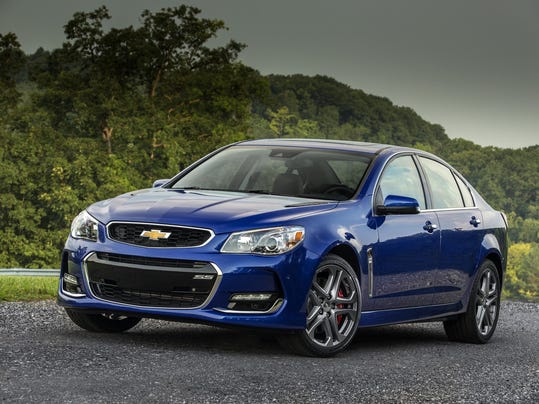
The Australia-manufactured Chevrolet SS may soon be gone, but it won’t be ignored.
Due to cease production when the sun sets Down Under on Holden’s sister Commodore in 2017, Chevy’s flagship sedan gets a design update for the 2016 model year. But the minor changes won’t change its reputation as the market’s stealthiest muscle car. Curbside, the SS still looks like an oversized Chevy Cruze — until the driver turns the key and shatters the facade with the roar of its 415-horsepower V-8 engine.
The rear-wheel drive SS gets minor plastic surgery with vertical ducts that improve front-end aerodynamics, functional hood vents, LED-signature lighting, and fresh, 19-inch cast-aluminum wheels.
Unchanged is the SS’s ferocious power plant — the legendary LS3 small-block V-8 that the sedan shares with the last-generation Corvette C6 and the Camaro SS. However, Chevy boasts that a new, dual-mode exhaust system will make for an even stealthier, low-RPM purr and a throatier howl at full throttle.
Only Dodge’s Charger SRT Hellcat sedan can play in the SS’s performance league, yet the $46,740 SS also features remarkable .97 G-load skid-pad performance and a luxurious, standard leather interior that brings flattering comparisons to BMW’s luxury M5 performance sedan.
“The 2016 SS design changes more fully express the true driving character of the sedan while further enhancing the car’s overall performance,” says Todd Christensen, Chevy Performance Car marketing manager.
The design changes 2015 performance upgrades including a manual transmission and magnetic ride shocks. The SS will remain as Chevy’s NASCAR Sprint Cup car in 2016
Payne: Subaru Impreza-on-Stilts
Posted by hpayne on September 12, 2015

One of my favorite Detroit restaurants is Mike’s Famous Ham Place. A tiny, ten-seat pillbox on Michigan Avenue. Its menu is just as compact.
Mike’s does one thing exceptionally well: Ham. And they do it over and over and over. Ham and eggs for breakfast. Ham sandwich for lunch. Ham and pickles sandwich. Ham and cheese sandwich. Ham and Navy bean soup. Ham and split pea soup (which I would walk across hot coals for). When I enter Mike’s I feel like I’m in a Monty Python skit (substitute “ham” for “spam”). I’d like ham, ham, ham, ham, ham, and split pea and ham, please.
Subaru is the Mike’s of autos. The all-wheel-drive Impreza its ham.
You can have the AWD Subaru Impreza sedan. The AWD Impreza Wagon. The AWD Impreza WRX. The AWD Impreza WRX STI. The AWD, Impreza-based Forester. Or this week’s review: The AWD, Impreza-based XV Crosstrek.
It’s delicious. Affordable. And essentially the same meat as everything else on the menu (including the AWD Legacy sedan and Outback crossover which are oversized Imprezas). What about the racy, rear-wheel-drive BRZ sport car, you ask? Um. I don’t know why that’s on the menu. It’s like Mike’s Ham started serving hot fudge sundaes.
But I digress. You know the XV Crosstrek is a crossover because it sits four inches higher than the Impreza, gains body cladding, and has an X in its name. Everybody’s doing it. BMW X5. Cadillac SRX. Mazda CX-3. Lincoln MKX. Acura MDX. And so on.
Otherwise the Crosstrek’s an Impreza. Insert my Impreza review from December, 2013HERE.
Same console. Same all-wheel-drive system. Same instruments, seats, 2.0-liter, boxer engine, continuously variable transmission, special sauce, cheese, lettuce, on a sesame seed bun (OK, got carried away there).
In short ‘Trek is a crossover for ‘Ru fans who think Impreza station wagons are uncool. That cool factor is reinforced by blinged-out, daisy wheels and hip colors like Tangerine Orange Pearl. Dude, DUB did an Impreza!
Reserved Impreza owners would never be caught dead in Tangerine Orange Pearl — owners like my wife who prefers a proper Deep Sea Blue Pearl. Deep Sea Blue Pearl, by the way, is also why Mrs. Payne opted for the Impreza over the Lightning Red Subaru WRX. That and the WRX’s hood scoop and blaring exhaust.
Sitting high in the saddle does not appeal to Mrs. Payne, either. Indeed, the Crosstrek’s added height and softer “off-road” suspension setup is noticeable under hard cornering, making this a hammier sandwich than the Impreza despite their similar dimensions.
But if you do have a taste for sitting up high. . . but not in Tangerine Orange Peal. . . but with more room. . . . Well, then the boxier Subaru Forester would be your thing with a whopping 17 more cubic feet in cargo space over the Crosstrek/Impreza.
Not that that the ‘Trek’s 52 cubes is anything to sneeze at. The affordable Crosstrek is priced with youthful, subcompact crossovers like the Chevy Trax and Mazda CX-3 while offering more room. Meanwhile, the frumpier Forester is a $5,000-savings bargain compared to comparably-sized compact SUVs like the Chevy Equinox and Mazda CX-5.
Ham is still ham, though, and the Crosstrek — like Impreza — is pretty bland in the power department. With only 148 horses paired to a molasses-like CVT tranny, I got out-dragged by milk trucks. Subaru saves the mustard and onions for the Forester (optional, 250-horse turbo) and the tongue-scorching STI (305 turbocharged ponies).
Subaru repackages these options with stepped price hikes. The Impreza Hatchback Premium trim starts at $22,345, the Crosstrek at $23,145, and the Forester at $26,645. The winged, howl-at-the-moon, track-ready STI will set you back $35,490.
Throw in the hot fudge sundae – er, sporty BR-Z – for motor-heads like me and Subaru has a staggering menu of affordable small cars. The bargains don’t stop when you sign the check. The number crunchers over at Kelly Blue Book rank Subaru #2 – behind Mazda – in lowest cost of ownership over five years based on seven categories including depreciation, fuel costs, and insurance premiums. My wife keeps the family books and she’s been all smiles.
With such rave reviews the new AWD Impreza menu items aren’t pirating sales from one another – just bringing more customers to the counter. Introduced in late 2012, the ‘Trek sold 71,000 units last year while Forester ballooned from 76,000 in 2012 to 159,000 to become the brand’s best-selling vehicle. In a challenging market for sedansImpreza still gained nearly 2,000 in annual sales.
All this talk has made me hungry. I’m thinking ham and pea soup . . . and a tangerine
2015 Subaru XV Crosstrek
Vehicle type: Front-engine, all-wheel-drive, five-passenger sport ute
Price: $22,445 ($25,440 2.0i Premium as tested)
Power plant: 2.0-liter, Boxer 4-cylinder; Gas-electric hybrid 2.0-liter Boxer-4 with AC electric motor driven and nickel-metal hydride battery pack
Power: 148 horsepower, 145 pound-feet of torque (4-cyl)
Transmission: Five-speed manual transmission; Continuously Variable Transmission (as tested)
Performance: 0-60 mph, 10.2 seconds (Motor Trend estimate, CVT)
Weight: 3,186 pounds
Fuel economy: EPA 26 mpg city/34 mpg highway/29 mpg combined
Report card
Highs: A head-turning Subaru; Bargain buy
Lows: Molasses-like CVT tranny; Softer handling is only a benefit if taken off-road
Overall:★★★
Lexus RX gets X-treme Makeover
Posted by hpayne on September 10, 2015
Japanese design is widely admired. Elegant gardens. The most Pritzker Architecture Prize winners (six) outside the United States. Even my cartoon colleagues have been influenced by Japanese anime — popular animators like “Boondocks” artist Aaron McGruder and “Samurai Jack” creator Genndy Tartakovsky.
Missing in action has been Japanese auto design — credited with inspiring more naps than imitators. Don’t have No-Doz? Flip through a Lexis ES sedan brochure instead.
But in recent product cycles, a distinct Japanese style has been emerging. Mazda’s KODO curves inhabit everything from the Mazda CX-3 to the Mazda MX-5. Nissan’s Murano is the wild child of the mainstream crossover playground. And now comes Lexus with the boldest, most polarizing thing in luxury SUVs, the …
Midsized RX350?
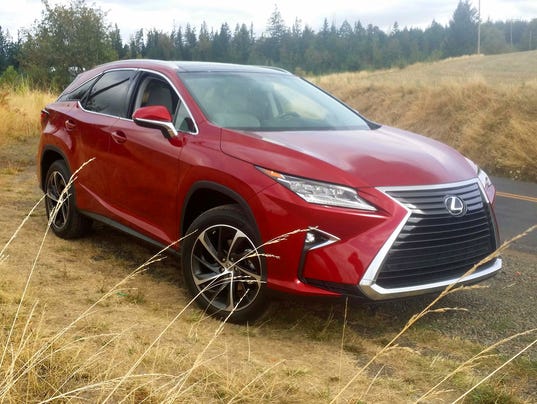
Yes, the RX350 (and its hybrid sister RX450h), the best-selling, luxe appliance since 1998. The beige ute. The SUV that launched a thousand snores. That was then. This is now. The official car of Florida retirement communities is a head-turner.
Cruising the streets of Portland, Oregon last week, I caused a rubbernecking epidemic. At a roadside stop a 40-something VW Passat pilot beckoned: “What is that?”
Just as tellingly, graying owners of old RXs seemed oblivious to the radical new ute. They would drive by my Lexus in a beige haze. Lexus expects a younger, hipper generation to be attracted to the sci-fi shape — but will it turn off older, more conservative loyalists?
I’ve modeled the new look for you before. Unlike, say, BMW or Audi, which generally use their flagships to launch new designs that then trickle down to smaller vehicles — Lexus launched its so-called “L-face design” with the little IS sedan, NX crossover and RC sports car. The Extreme Makeover has been a sales hit on the NX with sales running so hot (4,500 a month) that production can’t keep up. Yet the spindle-grille plastic surgery looks so out of place on the sleek RC that it should get an episode on E! network’s “Botched.”
But on the RX, the design has found its vessel.
The huge grille — together with Murano-like creases and floating roof — don’t overwhelm the larger canvas. The look still gets polarized reaction. My posts on social media elicited responses from “that’s plug ugly” to “that front end … I dunno.” But in-the-flesh comments are more flattering. Most important for Lexus, it gives the beige brand emotional appeal.
It’s a style that runs counter to the anthropomorphic face of most vehicles. The Infiniti Q70 is chubby-cheeked. The Mazda CX-6 a grinning warrior. The RX looks like … Darth Vader’s mask.
The menacing visage is transforming. No longer was I piloting an invisible appliance; now I was driving something that looked like it had just flown out of a Death Star. Along Portland’s Route 30, my black-Vader-grilled, RC350 F-Sport filled a Nissan Z’s mirrors. I pulled alongside. Our eyes met. The Z sucked my doors off.
The RX’s X Games exterior may cause the heart to race, but not the drivetrain. A Toyota Camry-derived, 3.5-liter V-6 pumping out 295 horsepower is the only engine option (with smooth eight-speed tranny) on the 4,387-pound ute. Opt for the RX450h hybrid and the V-6 and electric motor make a torquey team. The 567-horsepower BMW X5 M need not worry. But, if green is your thing, the racy-lookin’ hybrid will thump a more-expensive Mercedes GLE diesel in every metric from acceleration to fuel economy.
I would opt for the F-Sport model — now available in V-6 or hybrid trims — as its more-weighted steering is a significant improvement over the base model’s frigate-like numbness. Toggle full-time all-wheel drive, spin the Mode wheel to F-Sport-Plus, check the G-meter, and you’ll not only arrive at young Johnny’s soccer game first, you’ll also stand out from all the Ford Explorers and Acura MDXs in the parking lot.
Whoa, dude. When did your Mom get the Galactic Empire star ship?
But when Johnny brings his friends over for a ride home, Mom will have to decline. Sorry kids, no third-row seat. Um, can we talk about this oversight?
Despite its upgrades inside and out, the RX still refuses a third row-seat. It’s not alone. In a luxury segment that parallels a mainstream class where competitors are shunned if they don’t do a threesome, the choices are embarrassingly slim. The Acura MDX and pricey Volvo XC90 are rare exceptions.
A third-row option would nicely fit the RX’s tradition of interior comfort (acres of stitched vinyl and leather abound in a variety of colors including Rioja Red) which gets even bigger thanks to a 2-inch wheelbase extension.
Lexus marketing guru Brian Bolain is candid about the third-row omission. “We know there is a need,” he says. “Our dealers have made it very clear that if there is one wish they could have it would be a third row.”
Love those Lexus dealers. They are the secret sauce to Lexus’ customer loyalty. A friend tells the story of the dealer rep who sold them a car, then came home with them and spent another two hours at the house helping their new RX move in. Programming the garage door opener. Going over maintenance details. I think he even cooked them dinner.
The dealer love helps mask the brand’s (few) deficiencies.
The ’16 RX, for example, retains its claim as midsize luxe’s most affordable ute, but stylish, 10-grand-cheaper, mainstream makes like the Nissan Murano and Ford Edge are more tech savvy.
The RX gets optional adaptive cruise control, blind-spot assist, and 360-degree camera, sure, but so do mainstream utes. Shouldn’t a $42K luxury yacht come standard with these features? Want Apple Car Play like a Chevy? Sorry. Self-park assist like the Edge? Nope.
Solid in so many ways, Lexus can be annoyingly cute in others. Instead of replicating Ford/Audi’s brilliant, foot-actuated auto-rear tailgate, Lexus gives you a hand-actuated feature (hold your paw in front of the rear logo). Huh? Does Lexus think we carry groceries on our heads? At least Lexus has ditched the all-but-unworkable, touch pad-driven infotainment control from the NX.
Lexus has been slow to the turbo revolution, yet the NX’s turbo-4 will be shared soon, giving mpg-hungry customers a cheaper option than hybrid. Lexus will announce pricing for the RX closer to its November arrival in showrooms, but expect a $1,000 jump.
Sci-fi looks come with a price. Dude, Darth Vader is waiting to pick you up from soccer practice.
2016 Lexus RX350 and RX450h
Vehicle type: Front-engine, front and all-wheel-drive, five-passenger sport ute
Price: TBA (Likely $1,000 increase over 2015 model’s $41,910 base price )
Power plant: 3.5-liter, dual overhead cam V-6 (RX350); 3.5-liter V-6 with Nickel Metal Hydride battery-driven electric motor
Power: 295 horsepower, 267 pound-feet of torque (RX350); Hybrid gas-electric combined 308 horsepower (RX450h)
Transmission: Eight-speed automatic transmission (RX350): Continuously Variable Transmission (RX450h)
Performance: 0-60 mph, 6 seconds (RX350); 0-60 mph, 7 seconds (RX450h — both Motor Trend estimates)
Weight: 4,387 pounds. (AWD RX350); 4,740 pounds. (AWD RX450h)
Fuel economy: EPA 19 mpg city/26 mpg highway/22 mpg combined (RX350); EPA 30 mpg city/28 mpg highway/30 mpg combined (RX450h)
Report card
Highs: Darth Vader grille; roomier than ever
Lows: Darth Vader grille; third-row seat, please
Overall:★★★
King Corvette: Chevy supercar beats elites
Posted by hpayne on September 9, 2015
Imagine Target trumping Saks Fifth Avenue. Timex outshining Rolex. Chevy beating Lamborghini.
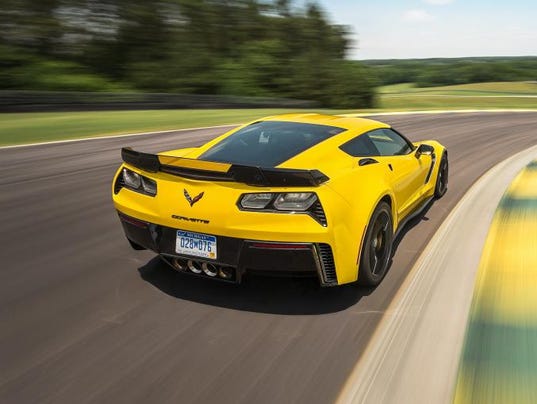
Actually, that last one should come as no surprise. The Chevrolet Corvette has added to its status as the world’s most affordable supercar as it emerged the king of the 2015 Car and Driver Lightning Lap competition at Virginia International Raceway. It outran such thoroughbreds as the $353,115 McLaren 650S Spider, $274,120 Lamborghini Huracan and $163,000 Porsche 911 GT3.
So quick was the $100,245 Z06 — Corvette’s 650-horsepower performance model — that in the nine-year history of the famed Lightning Lap only one car has ever recorded a faster time: the 2014 Porsche 918 hybrid, a carbon-fiber cyborg from the future that costs nearly nine times as much the Corvette. The $875,175 Porsche was faster by a mere 1.5 seconds. That’s over $250,000 per half second.
The Corvette’s performance left Car and Driver Editor-in-chief Eddie Alterman in awe.
“It’s incredible how much performance they pack into that $100,000 price point,” Alterman said. “One of the interesting things about the Z06 is it proves the car with the highest top speed is not necessarily the fastest car around a race track. The McLaren (top speed: 204 mph), for example, was faster on the straights, but the Z06 with more down-force and grip just dominated on the more technical parts of the track.”
Ann Arbor-based Car and Driver is perhaps the country’s most revered auto enthusiast magazine, and VIR is one America’s most revered tracks. “We go there because it’s the closest thing to an American Nurburgring,” Alterman said in comparing the 4.1-mile, 24-turn roller-coaster outside Danville, Virginia, to the legendary, 13-mile German circuit.
The resulting Lightning Lap test is an independent benchmark of whether today’s best performance cars are as quick on the track as their numbers suggest on paper. For three days, four top driver/journalists analyzed 18 of the industry’s state-of-the-art grouped by price.
“The goal is to see … how much true dynamic value you get for the price,” Car and Driver said. In the case of the ’Vette, quite a lot.
The 2015 Z06 built on the success of the critically acclaimed, $55,400, 2014 Corvette C7 Stingray — the first Corvette to get an all-aluminum chassis. The Stingray also improved interior comforts with features such as dual climate control, stitched leather seats and multi-mode driving controls comparable to pricier Porsches.
“The Z06 is truly an all-around performer,” said Todd Christensen, Chevy marketing manager for performance cars. “You could drive it to work every day and still be the fastest at the track. It can compete with and even beat some of the most expensive, most exotic cars on the market.”
Yet the Corvette remains old-school in many ways to reduce costs. It is still a front-engine, push-rod V-8 in an era of mid-engine, overhead-cam, hybrid-drivetrain mega-bots. No matter. When the rubber hits the road, the Z06 is supreme.
Its 2:44.6 minute lap this year not only nipped the McLaren (2:45.8) and Lamborghini Huracán (2:47.5), it destroyed the Porsche 911 GT3 (2:50.4) which is widely considered to be the best all-around sports car on the planet. Rummaging through previous Lightning Lap data, only the Porsche 918 beats the Z06 with a 2:43.1 second lap. Not the $333,376 Ferrari 458 Italia. Not the V-10-powered, $196,795 Audi R8.
The Lightning Lap results reaffirmed the decision of Farmington Hills resident Bruce Anderson to buy his orange Z06 this year. “It’s nice to know there’s not a lot on the road that I can’t beat,” he smiled.
The Corvette’s showing was not the only bright spot for Detroit iron. Cadillac’s latest entries in the performance sedan field, the Cadillac CTS-V and ATS-V, also impressed.
“The CTS-V is mind-blowing.,” Alterman said of the big sedan that shares an engine with the Z06. It’s essentially a Corvette with four doors. It lapped VIR in 2:56.8, beating competitors in the $65,000-to-$124,999 category such as the Mercedes-AMG C63 S and Lexus RC F.
“It is very cool to see the home team putting out cars that are every bit as good as the heritage European brands,” said Alterman, who has a soft spot for his hometown. “GM, Ford, Fiat-Chrysler are really turning out incredible performance with real personality.”
But for good ol’ driving pleasure, the Car and Driver team gives a nod to another sports car with a lot of bang for the buck: the $33,320 Mazda Miata MX-5. Though it finished last in the coach-class segment (under $34,999) behind the VW GTI, Mini Cooper, and turbocharged four-cylinder Ford Mustang, the Miata got raves.
“The car is in no way remote from you,” Alterman said. “We’ve always loved the Miata. But this is a special, special car.”
Payne: Q&Auto with the Shelby GT350’s guru
Posted by hpayne on September 5, 2015
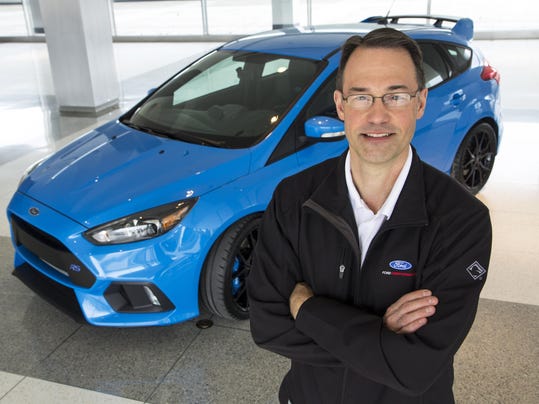
Interviewing Kerry Baldori, Ford’s chief functional engineer for Ford Performance, on Laguna Seca Raceway’s main straight during media testing of his team’s brand new, 2016 Shelby GT350 Mustang isn’t easy. Because with a track-full of 8250 RPM, 526 horsepower Mustangs going by every 30 seconds it gets. Really. Loud. So the conversation goes kind of like this.
Me: Kerry, when did Ford start work on ROOOOAAAAAARRRRRRRRRRR!
Baldori: Can you repeat the question?
Baldori is used to it. Because not only does he oversee the ferocious GT350, he is responsible for the entire stable of Ford performance thoroughbreds including the Focus ST, Fiesta ST, all-wheel-drive Focus RS, F-150 Raptor, and the alpha male of the herd: The Ford GT supercar which will debut in the 24 Hours of LeMans in France next year to rekindle Ford’s 50-year-old race rivalry with Ferrari.
It would also be a nice 50th birthday present for Baldori. The life-long motorhead grew up in Frankenmuth, Michigan where he flogged go-karts and mauled drag strips in his first racer, a ’69 Camaro. With degrees from Western Michigan and Wayne State, Baldori joined Ford 26 years ago where he built a resume on the cutting edge of vehicle performance.
Baldori’s team shocked the world with the stunning Ford GT at January’s Detroit Auto Show. But the 600-plus-horsepower supercar also signaled a new, more focused performance direction for Ford.
From its dominance of LeMans in the 1960s to NASCAR to its RS division in Europe to its stateside SVT hot rods, Ford has a long history of making quick cars. But the effort was never organized under one roof until now.
“Prior to Ford Performance organization it was kind of hit and miss,” says Baldori. “Then six-to-seven months ago we brought everything together under the Ford Performance umbrella. That has really been a huge change. It not only bring our products together globally, but also the motorsports organization (including) our technical organization that supports NASCAR and all the specific race organizations we’re involved in.”
Baldori credits Raj Nair, Ford’s chief technical officer for Ford Global Product Development, for the change. “He’s a huge supporter of our team and performance in general,” he says.
The Shelby GT350 was in the works well before the consolidation. Indeed – after being estranged for years – Ford and Shelby rekindled their ’60s flame after the new, retro-styled, fifth-generation Mustang was unveiled in 2005. A GT500 stoplight king followed in 2007, the first of a series of 500s that culminated with a 2013 model with a 5.8-liter V-8 putting out an insane 662 horsepower. It was a brute.
But with the more nimble, sixth-generation Mustang chassis, Baldori’s team was eager to go beyond face-flattening, straight-line performance.
“The GT500 was mainly about power but we always tried to make it as track capable as possible,” he reflects. “We always wanted to make a naturally-aspirated, well-balanced, lightweight car that would go back to that original GT350 that could live up to the Shelby name. There has been a GT350 done through Shelby America – but we had never done a GT350 before.”
The Performance team set a high bar. How high? They benchmarked the GT350 to Porsche’s best: The 911 GT3.
“We want to benchmark and try to improve ourselves,” says Baldori. “(The GT3) became an inspirational benchmark for us. We learned a lot from the car, it’s all part of the process.”
That benchmark meant taking the GT350 to the track this year against Porsches and BMW M3s where it has had a stellar rookie season winning at both Mosport and Watkins Glen. Multimatic, a racing team out of Toronto, prepares the Mustangs – as itwill the Ford GT for LeMans. Baldori knows a thing or two about pro racing himself having been embedded by Ford in Newman Haas Indy car racing team in the 1990s as a vehicle dynamacist.
ut developing a performance car today also means engineering for comfort. You wouldn’t know it by the nearby GT350s making our ears bleed in full-predator TRACK mode (one of five modes including Eco and Drag) – ROOAAAARRR! – but the muscle car was made for everyday driving comfort.
“It’s very easy to drive. It’s incredibly quiet,” says Baldori. “A lot of extreme performance cars have their little quirks. These cars are really good.”
In that great garage in the sky, Carroll Shelby must be smiling.
Payne: Muscular Mustang GT350 can dance
Posted by hpayne on September 3, 2015

I’ve wrestled the twin-striped snake before.
The 662-horsepower, Cobra-badged, 2013 Ford Shelby GT500 Mustang — distinguished by its supercharged, 5.8-liter V-8 — could strike quickly at a stoplight, hitting 60 mph in just 3.4 seconds. It could also bite you back. Based on the solid-rear axle, sixth-gen chassis, the Shelby was a reptile-by-the-tail in the twisties. In the rain it was downright diabolical. Give the big V-8 too much boot and you could take out a whole block of mailboxes.
The all-new, razor-sharp, curve-carving 2016 Shelby GT350 Mustang is not that car.
Indeed, I should check the wedding registry at The Henry Ford. I swear the GT350 married a Ferrari California and spawned a child. Despite the Hatfield and McCoy history of the two companies (cue the Ford GT supercar’s war on Ferrari at LeMans next year to commemorate the 50th anniversary of their last assault), Ford engineers went to Ferrari school.
Pay attention, class. There will be a quiz at the end. Under the football-field-long hoods of the Mustang and Ferrari beat flat plane-crank, V-8 engines. Until now the exclusive territory of Ferraris and race cars, the flat crank is a Ford first. It was worth the wait. The GT350 team chose the lightweight design for its inherent, high-revving character while engineering out its less desirable tendency to shake like a wet dog. The result is a smooth eight-holer that revs to (no kidding) 8,250 RPM with an endless torque band over 3,500 RPM that will have you begging for more.
But the Shelby’s handling is the revelation here — allowing this snake to transcend muscle car stereotype and compete with more expensive exotics.
I admit some trepidation before taking the big pony out on Laguna Seca, California’s legendary Mazda Raceway last week. The 2.3-mile rollercoaster is appropriately brought to you by the makers of the sprightly MX-5 Miata. This is a track that demands nimble handling. Even its lone straightaway has a blind kink in the middle that requires a deep breath in the smallest of cars.
I’ve flung 1,400-pound Barber School formula cars, 2,400-pound Alfa 4Cs, and 3,400-pound, AWD Subaru STIs around Mazda Raceway, but never a 3,800-pound muscle car. Forget Oakland County in the rain. A GT500 would be a challenge around Laguna in the most-experienced of hands in the dry.
The GT350 is a revelation from the first turn of its Cobra-tattooed steering wheel.
My striped steed crouches with astoundingly good corner manners for a big palooka. The clutch pedal is too long, but ceases to be an issue as I launch up the hill toward the famous Corkscrew turn, all 526 ponies straining at 8,000 RPM in third gear. I snatch fourth near the summit and imagine Pegasus sprouting wings and flying across San Francisco Bay — but as I slam on the huge, 15.5-inch front brakes, the Mustang crouches again, nailed to the pavement. No drama. No search for the eject button. Over the heart-in-your-mouth, straight-drop Corkscrew with throttle — with throttle! — my confidence soars. By the time I’ve reached final Turn 11, I am Hiccup in “How to Train Your Dragon.” We are one. I slide the rear end under throttle onto the pit straight and fearlessly attack the kink. Get thee behind me, trepidation.
Credit additions like “MagneRide shocks” and sticky, bespoke Michelin rubber. But more importantly, the stem-to-stern, comprehensive remake of the sixth-gen Mustang. With its independent rear suspension, revised double-knuckle MacPherson front, and lighter skeleton the ’15 expanded the playing field for Ford’s formidable performance team.
“We did the usual tricks to make the GT350 more suited to the track,” says Adam Wirth, the car’s chassis dynamics engineer. “But the new chassis gave us so much to work with.”
How much?
“Frankly, we didn’t see the need for a chassis brace,” he continues when pressed on why the Shelby doesn’t bear a bat-winged support like Cadillac ATS-V or BMW M4. “The basic chassis is that good.”
Perhaps. Or maybe Mustang is watching costs and holding something in reserve pending Camaro’s response to the GT350. Because respond it will. Talking Mustang vs. Camaro is like rehashing Balkan territorial disputes: after a few minutes you’re arguing about wars that happened centuries ago. In the case of Detroit’s muscle car rivals, the Battle of the Sixties.
This is the first GT350 since Carroll Shelby’s modified 1965-68 models started a Detroit arms race that by decade’s end had Roger Penske Camaros and Ford Boss Mustangs exchanging body blows in the Trans Am ring.
Ford has dusted off the Texas gunslinger’s badge for good reason: Chevy’s Camaro Z28. The 505-horsepower track weapon combines formidable power with track savvy and set a new benchmark for performance. Mustang’s new chassis gives the Shelby added versatility, from producing a base, $48K GT350 that is comfortable both on and off the track to the bonkers, $66K GT350 R which can not only arm-wrestle the Z28 but challenge Porsche GT3s too.
Speaking of GM’s finest, the R completes a murderer’s row of Detroit muscle. Got $70K? You have a choice between the ’Stang, Camaro Z28, Dodge Hellcat, or Corvette with Z51 track package.
Indeed, with its quicker, more cobra-like reflexes, the GT350 signals an evolution of the muscle car. This new generation deserves consideration as a discount competitor to the Cadillac ATS-V and M4 — if not on interior appointments (essentially unchanged from the Mustang GT), then in looks and good road manners.
The GT350 is confirmation that Ford hit the bulls-eye with its controversial, sixth-gen design.
The Mustang is burning up the sales charts because its styling is both retro and refreshingly modern. While some of my most partisan Mustang pals complain the pony’s snout had been Fusion-ized, it has a distinct presence on the road. The new Shelby (available in Competition Orange, Avalanche Gray, Shadow Black, Triple Yellow Tri-coat, Deep Impact Blue, Magnetic, Race Red and Oxford White) distinguishes itself from the base pony with all-new body panels from the doors forward. The lower, shark-like snout gets carbon fiber for stiffening, and the corner fog lamps have been replaced by air-sucking nostrils to cool the massive brake shoes.
Thus the Shelby’s most distinguishing feature: The vertical shark’s gills behind the front wheel which suck air from the brakes. It’s a subtle but effective touch — like gills exhausting the Corvette Z06’s similar, 15.5-inch front rotors.
But don’t think the GT350 is the last word. There’s an arms race on. Can a 700-horsepower, GT500 Hellcat-fighter be far behind?
2016 Ford Shelby GT350 Mustang and GT350 R
Vehicle type: Front-engine, rear-wheel-drive, four-passenger sports coupe
Price: $47,795 base ($57,970 GT350 as tested)
Power plant: Flat-plane crank, 5.2-liter V-8
Power: 526 horsepower, 429 pound-feet of torque
Transmission: Six-speed manual transmission
Performance: 0-60 mph, 3.7 seconds (Car & Driver estimate)
Weight: 3,791 pounds
Fuel economy: EPA 14 mpg city/21 mpg highway/16 mpg combined
Report card
Highs: Athletic handling; revs to the moon
Lows: You call those rear seats?; touchy clutch
Overall:★★★★
Payne: The legendary Shelby GT350 Mustang returns
Posted by hpayne on August 31, 2015

In the beginning there was the 1965 Ford Shelby GT350 Mustang. The first performance mule based on the wildly popular Dearborn coupe. The first Mustang developed between Ford and racing genius Carroll Shelby. The first, track-focused pony car.
Rejoice Mustang faithful. The legend has returned.
Just in time for its 50th birthday, the Shelby GT350 is here — the first Ford-engineered GT350 since the first generation went out of production in 1968. On Wednesday, I had a chance to put it the test on one of America’s most challenging race tracks, Mazda Raceway in Laguna Seca, California. Lookout Camaro Z28. The muscle car wars are going nuclear.
In that great racetrack in the sky Carroll Shelby is smiling. The GT350 not only lives up to his name, it promises a car as comfortable on the street as it is fearsome on the track. But let’s begin on the track, where the GT350 made its name collecting Sports Car Club of America trophies by the bag-full.
As part of its new performance division, Ford has developed a coven of assault vehicles from the Ford GT supercar to the Ford Focus RS. The GT350 is Mustang’s contribution, featuring the highest horsepower, normally-aspirated V-8, Ford has ever made. The 5.2-liter mill develops a stunning 526 horsepower, a number that dwarfs performance coupes like the BMW M4 and Cadillac ATS-V and approaches the lofty numbers of supercars like the Porsche Turbo S and Nissan GT-R.
Ford achieves this feat using lightweight, flat-crank engine, a technology rarely used except by Ferrari and purpose-built race cars — that allows the 317-cube V-8 to spin to stratospheric 8,250 RPM. Not even Ferrari’s flat-crank, $240,000 458 (which makes 570 horsepower if you’re wondering) tips the scales as light as the ‘Stang.
Yet the GT350 begins at just $49,995 — pocket change for a Ferrari owner. Even a loaded GT350 R will set you back just $66,495, well south of an air conditioning-less Camaro Z28.
With my foot buried at 8,000 RPM and 125 mpg over the crest into Laguna Seca’s blind Turn One, the sound is glorious. This is not the ground-shaking V-8 rumble I’m familiar with from classic 600-RPM V-8s, like the Shelby GT500 drag-racer that Ford has made since 2007. No, this is more like the high-pitched bellow I hear from NASCAR V-8s that belt out 850 horses at 9,000 RPM.
But the Mustang is more than a pony with an engine. Strapped to Mustang’s new, sixth-generation chassis featuring the badge’s first independent rear suspension and fitted with gummy, specially-made Michelin sport shoes the GT350 is remarkably nimble for a 3,700-pound beast.
As a result, the pony combines the finest attributes of the old, musclebound GT500 and the corner-carving Boss 302. This combination of high-revving power and handling inspired Ford to not only benchmark the car to Camaro’s ferocious Z28 track start, but to look beyond to Porsche’s 911 GT3.
A stretch, you say? Early testing shows the GT350 R — which saves another 100 pounds from the standard GT350 with tricks like carbon-fiber wheels and no backseats — lapping in the low 1.30s at Laguna alongside the Porsche.
Yet this track-focused thing is surprisingly docile on the street. The V-8 makes a pleasing rumble at ignition but quietly strode the boulevards of Southern California in under 3000 rpm. The interior is blessed with Recaro seats, but otherwise GT350 buyers can opt for all the amenities of a Mustang GT with the “tech” package — including the latest version of Ford’s communication system, SYNC 3.
Even owners of the wicked GT350 R — distinguished by its high rear spoiler and first-ever carbon-fiber wheels — can upgrade from the AC-less base to a “electronics” package with all the creature comforts.
Mustang has thrown down the gauntlet to Camaro with the GT350. And with its lightweight, Cadillac ATS-based chassis, the sixth-gen Camaro is sure to respond. Put in your ear plugs folks, the muscle car wars are just beginning.
Payne: Terrorizing Detroit in Nissan’s GT-R
Posted by hpayne on August 31, 2015

Godzilla.
We motorhead media types drool at the mention of the Nissan GT-R’s nickname. Yet few of us get a chance to experience it. The $101,000 machine is rarely found in press fleets. My chance to ride Godzilla came this summer. I was expecting tail-wagging aggression, window-rattling roars — a menace with fiery upshifts and a disturbed disposition.
I got none of that. Godzilla? Sure, Japan’s most powerful sports car deserves comparison to Japan’s most fearsome B-movie reptile. But in truth the Nissan GT-R is more cyborg than monster.
Call it the Terminator.
Like the original Terminator Model T-800 from 1984 (which is how long it seems the aging GT-R has been around) — not the sleek, advanced, liquid metal, “Mimetic polyalloy” Terminator T-1000 of later sequels. This beast is Schwarzenegger. Big, heavy, awkward at slow speeds. You can hear the gears meshing. Its feels analog, not digital.
As the auto tranny downshifts from 3rd to 2nd into a red light, the car lurches to a stop. But then, oh, what a launch.
With an electronic, torque-managing, all-wheel-drive system and twin-turbo power, the GT-R is a rocket off the line. The sensation resembles Cedar Point’s Top Thrill Dragster roller-coaster. No slip. No wheel spin. Just nail it and you’re pulled on invisible rails. The engine is a muted roar — an angry vacuum cleaner.
No tail-wagging drama like a Dodge SRT Hellcat. No thunderclap like a Z06 Corvette. No barking upshifts like a BMW M3. Just relentless, robotic power from the 3.8-liter V-6 mill. Godzilla meet Terminator.
The GT-R’s layout is more sports coupe than sports car. The lip doesn’t drag out of my driveway like a Corvette or Porsche Cayman. Indeed, the GT-R feels like an Audi RS 5and Corvette Z06 had a love child. At almost 4,000 pounds its chassis is Audi-solid, AWD, well-engineered.
Face-to-face the GT-R appears a big athlete with nice jewelry. Mike Tyson wearing earrings. My 2016 45th Anniversary Edition GT-R celebrates its first, early-’70s ancestor. The color is a gold-like hew called “Silica Brass” (for the 50th anniversary edition maybe GT-R will get actual gold). A big, Mitsubishi Evo-like goatee fills the face. Horizontal LED lights adorn the cheeks below elegant, LED-tubed headlights. Flush door handles flip outward, opening the car at your fingers’ command. The GT-R is 10 years old now, but the fashion details keep it hip.
Like an RS 5, the 2+2 interior will technically seat four. If the rear passengers are five-year-olds. Sitting on their knees. In the posh suede and leather driver’s bucket, my seat back hit the rear seat (at least rear passengers get the best concert seat in the house between two giant Bose speakers). Tidy rectangular modules organize the dash holding circular instruments and vents — all trimmed with carbon and stitched leather.
The console-mounted starter button is even Audi-like, except for one detail. It’s red. Like the button to launch a nuclear warhead. WARNING: TOUCH THIS BUTTON AT YOUR PERIL.
Let’s talk about that because I know what you’ve been thinking since the first paragraph: Why would I pay $101,000 for a Nissan??!!!
One hundred grand for a car with the same badge as the Sentra? Seriously? Heck, a nicely-equipped, 450-horse V-8, AWD RS 5 costs $70K and when I roll up to the country club, the valet will say: “Can I park your Audi for you, sir?”
I understand. And that’s why that red button matters. Because the GT-R is not an overpriced Nissan — it’s an underpriced supercar.
Like the aforementioned, 650-horsepower Z06, the Nissan is that rare mainstream breed that can do things supercars can — for half the price. Want a lively AWD coupe to cruise to work? Save $30K and buy the silky RS 5 or a base 450-horse Corvette Stingray. Want to terrorize Porsche Turbos and Ferraris at Waterford track days? Buy a GT-R.
Consider the numbers.
The GT-R packs 545 ponies. Like the Z06, it beats the Ferrari 458 Italia and Porsche 911 Turbo S and Lamborghini Gallardo to 60 MPH in 2.9 seconds. It laps with the supercars at even the epic, 4.1-mile Virginia International Raceway. Yet the Ferrari costs $240,000. The Porsche $183,000. The Gallardo $182,000. Oh.
Walk around the GT-R and it’s apparent this is a race car in drag.
Inside the gorgeous, 20-inch, 20-spoke rims loom massive, drilled 15.35-inch front and 15-inch rear rotors anchored with Brembo calipers that will pull out your fillings under hard braking. The gummy, Dunlop tires — 10-inch front and 11 in the rear — mimic the Z06’s sticky, Michelin 10 x 12s. Throw it into a corner and it rotates with ease. Credit Nissan’s location — ditto the Chevy — of the transmission in the rear (along with the GT-R’s AWD transfer case) giving it remarkably neutral handling despite its girth.
The car’s most distinctive angle is the spoiler-equipped rear end, which makes sense since it’s the view most folks will have of this 193-mph weapon. When’s the last time you saw a car with exhaust pipes as big around as its taillights? The Detroit Tigers could store baseball bats inside these things.
Like the ’Vette, the GT-R betrays its discount supercar price with little shortcomings. The ’Vette smells like an oil refinery inside. The GT-R props its hood with a stick. The Z06’s chassis twists and rattles. The GT-R’s drive-train whirrs and clunks.
Put your foot down and all is forgiven.
The traction is surreal. Stomp on the pedal with or without traction control and the car — 545 horses distributed to all four wheels — stays true as an arrow.
The GT-R’s tight, balanced chassis responded to little inputs as I barreled through tight Oakland County corners, tires chirping. Predictable. Predatory. On the street, the GT-R is a head-turner, but is otherwise docile in daily commuting. Yet, unlike Z-OMG-6, it won’t wake the police departments in three counties when you put your foot down. The angry vacuum cleaner stays stealthy.
Should you buy it? I thought the $81K BMW M3 was expensive until I met the GT-R. Now I’m not so sure. The twin-turbo V-6 M has more attractive lines. More seat room. More badge cache. But then the Terminator GT-R will pound it into the asphalt at a stoplight.
Or, if you prefer, call it Godzilla.
’16 Nissan GT-R
Vehicle type: Front-engine, all-wheel-drive, four-passenger sports car
Price: $101,770 base ($104,660 as tested)
Power plant: Twin-turbocharged, 3.8-liter V-6
Power: 545 horsepower, 463 pound-feet of torque
Transmission: Dual-clutch, six-speed automatic transmission
Performance: 0-60 mph, 2.9 seconds (Motor Trend)
Weight: 3,922 pounds
Fuel economy: EPA 16 mpg city/22 mpg highway/19 mpg combined
Report card
Highs: Race-car performance; rail-like traction
Lows: Clunky drive-train; those are backseats?
Overall:★★★
Payne: Cruisin’with the top down . . . in a 4-banger?
Posted by hpayne on August 23, 2015
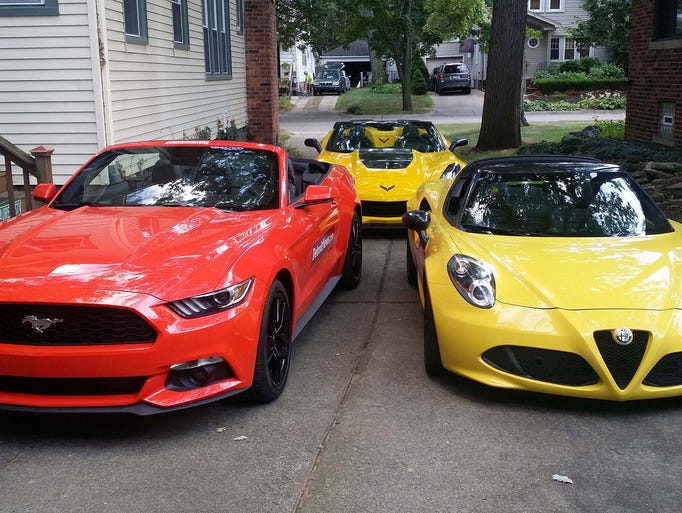
Courtesy of the fine folks at Chevy, Ford and Fiat-Chrysler, the official Detroit News Dream Cruisers this year were a 2015 Corvette Z06 convertible and a pair of topless turbo-4s: The Ford Mustang and Alfa Romeo Spider.
Which begged the question: Can a 4-banger find love at the Dream Cruise?
After all, the Cruise is V-8 country. Hellacious supercharged Hellcats. Earth-shaking ’67, 389-cube GTOs. And of course, ’Vettes, ’Vettes, ’Vettes. But in the early 21st Century, the Green Church rules and in our zeal to save the polar bear the V-8 is an endangered species. With 54.5 mpg-by-2025, the new fuel mileage standard automakers are turning to fewer cylinders and more turbochargers to both conserve gas and quench our thirst for speed.
Turbo-4 Mustangs, turbo-4 Camaros, twin-turbo BMW M3s … Rumors even swirl that a mid-engine, turbo-6 Corvette is in the works. Clearly, we’re going to have to get used to fewer V-8s. Six-bangers aren’t much of a stretch. But can a pony car be a classic with a 4? Can a $70,000 sports car?
My fellow News writer, Tom Greenwood, and I put the Alfa and Mustang to the test in a week of top-down driving along with the undisputed King of the Cruise, the Z-OMG-6.
That the ’Vette is king is not in dispute. The new C7 Stingray is an instant classic. A muscled Michelangelo sculpture. Its base 450-horsepower, 6.2-liter V-8 makes grown men weep. Supercharge it to 650 horses and they bow before it. Porsches inspire. The Z06 you’d follow into battle.
Even at 5 mph (the Official Average Speed of the Dream Cruise) the V-8 is authoritative. Between 11 and 12 Mile Saturday a kid holds up a sign: “REV IT UP!”
I pop the eight-speed auto tranny in neutral, stomp the gas, and the 389- cubes of pistons jackhammer the pavement. BRAAAAPPA! BRAAAPPA! Car alarms go off for blocks. All hail the king!
The Alfa pales by comparison. At 13 Mile I pass another kid. Another “REV IT” sign. Surprisingly, the turbo-four – which has a wonderful, obnoxious growl at speed – sounds bashful. The kid and I look at each other in mutual disappointment. How can such a wicked-looking schnauzer have such a weak bark?
The rev test aside, however, the Alfa is a Cruise star.
Begin with its supermodel looks. They don’t call it the “baby Ferrari” for nothing. Curved flanks, mid-engine layout. Our matching yellow Alfa and Z06 cruised Woodward together and the Italian got more attention. Maybe because only 500 4Cs have been sold in the U.S.
But good looks are just the beginning. The Alfa is simply the most fun car on the road today.
Put your foot in it and the turbo-4 barks on upshifts, snorts under power, and generally sounds like a Rottweiler with indigestion. But handling is what sets it apart. Driving the ferocious Z06 around Metro Detroit feels like having a nuclear war in your living room,
while the nimble Alfa is a much more precise weapon. Its stiff carbon fiber tub gives it an over-sized, go-kart feel as you fling it through Oakland County’s lake hills.
But the real payoff is the bottom line. The 4C is not just half the price of our $113,835 Z06, it is the only carbon sports car under $135,000. At a remarkably affordable $53,000, both the base Alfa and base C7 offer totally different performance experiences.
At $43,290, the Mustang was our bargain cruiser, but its 310-horsepower turbo-4 was the big question. After all, muscle cars have been defined by its throaty V8s back to the 1960s.
Greenwood cruised happily in our bright, “Competition Orange” pony all week. It’s striking, comfortable and powerful. Ford has worked wonders with its Ecoboost turbos which offer greater power than similar fours from BMW and Audi. It’s no slouch against V-8s either.
In Royal Oak Sunday night, I drag a recent vintage, 370-horse Dodge Charger R/T V-8out of a stoplight to a draw. Impressive.
But does the 4 feel out of place in the herd? North of Maple, I hook up with Andrew Fallon, 23, of Warren cruising in a gorgeous, red, fourth-gen Mustang GT. Hood scoop. Black center wheels. Rear spoiler. The works. He revs his 4.6-liter V-8 and the earth shakes. My turbo-4 responds with . . . was that a loud hum? Like I just plugged a vacuum cleaner into a 220-volt socket.
Ummmm.
“You need a 4 cylinder in the age of emission controls,” Fallon smiles. “But a muscle car’s gotta have a V-8.” Yes it does. Long love the eight-holer.
Henry Payne is auto critic for The Detroit News. Email him at hpayne@detroitnews.com. Follow him on Twitter @HenryEPayne. See all his work at HenryPayne.com
2015 Ford Mustang Turbo-4 Convertible
Vehicle type: Front-engine, rear-wheel-drive, four-passenger coupe
Price: $34,800 base ($43,290 as tested)
Power plant: 2.3-liter, twin-turbocharged, inline 4-cylinder
Power: 310 horsepower, 320 pound-feet of torque
Transmission: Six-speed automatic transmission
Performance: 0-60 mph, 5.2 seconds (Car & Driver)
Weight: 3,524 pounds
Fuel economy: EPA 21 mpg city/32 mpg highway/25 mpg combined
Report card
Highs: A dream cruiser; Torquey turbo power
Lows: Little room for backseat cruisers; Where’s the growl?
Overall:★★★
2015 Alfa Romeo Spider
Vehicle type: Mid-engine, rear-wheel-drive, two-passenger sports car
Price: $63,900 base ($76,495 as tested)
Power plant: 1.7-liter, turbocharged, inline 4-cylinder
Power: 237 horsepower, 258 pound-feet of torque
Transmission: Six-speed, dual-clutch, automatic transmission
Performance: 0-60 mph, 4.1 seconds (manufacturer)
Weight: 2,487 pounds
Fuel economy: EPA 24 mpg city/34 mpg highway/28 mpg combined
Report card
Highs: Body of Aphrodite; Go-kart-quick handling
Lows: Cramp-inducing passenger seat; No room for luggage
Overall:★★★★
2015 Corvette Z06 Convertible
Vehicle type: Front-engine, rear-wheel-drive, two-passenger sports car
Price: $83,000 base ($113,835 as tested)
Power plant: 6.2-liter, supercharged V-8
Power: 650 horsepower, 650 pound-feet of torque
Transmission: Eight-speed automatic transmission
Performance: 0-60 mph, 2.9 seconds (manufacturer)
Weight: 3,524 pounds
Fuel economy: EPA 13 mpg city/23 mpg highway/16 mpg combined
Report card
Highs: Awesome power; Thrones fit for king and queen
Lows: Chemical-like interior smell; Tire-squirm in tight turning radius
Overall:★★★★
Payne: The Toyota Tacoma off-road assault vehicle
Posted by hpayne on August 20, 2015
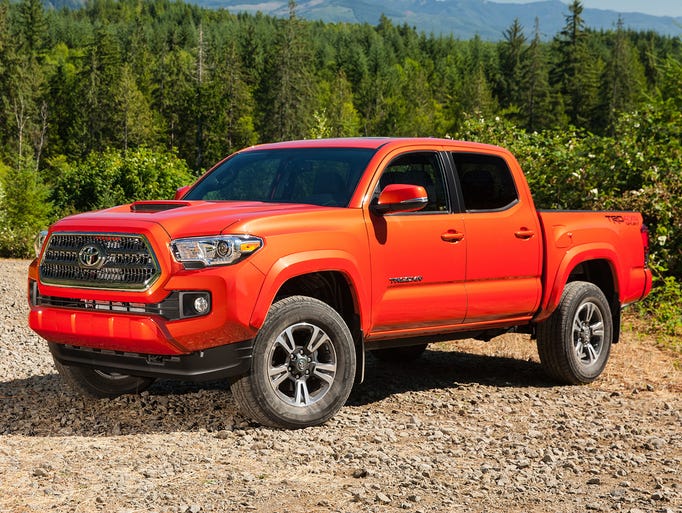
I’m confused. I just spent a day flogging a Toyota Tacoma pickup and I can’t wipe the grin off my face.
Yes, Toyota. That manufacturer of the best auto appliances — and cures for insomnia — in the business. Camry, Corolla, RAV4, Avalon. Reliable, competent, dependable. And as exciting as vanilla. There are exceptions to be sure — like the Scion FR-S sports car which I’d take over a lifetime free pass to Cedar Point.
But then the FR-S is a Scion because Toyota self-consciously created a youth brand to try to pep up its somnolent reputation. Toyota is very aware of its, um, personality deficiency. Like Al Gore cracking a joke, its efforts to appear fun can come across as strained. Take current ads suggesting that the new Camry is so spontaneous it’ll drive you to crash weddings and elope with the bride. Please.
So how to explain the Tacoma? A rock ’em, sock ’em, youthful, off-road toy that is to pickups what the Jeep is to sport utes.
When Baja 1000-veteran Chief Engineer Mike Sweers calls the Tacoma a “bad ass” truck no one snickers. Tacoma comes by its reputation the old-fashioned way: It earned it. Turn the clock back to the ’80s when off-road racing legend Ivan Stewart joined Toyota on his way to winning a record 17 Baja 500s and 3 Baja 1000s in the roughest, readiest tests of trucks. It continues today with Toyota segment innovations like crawl control and a 32-degree front attack angle.
If Jeep did a pickup it would be the Tacoma. Indeed, when Sweers & Co. invited the media to check out its newest creation they did it the Jeep way: They took us to a terrifying off-road course (near Tacoma, Washington, natch).
Black Diamond is an old mining town surrounded by steep hills and deep hollows. Like black diamond ski slopes, they’re not for the amateur truck. Forty-degree inclines, jagged rock quarries, snake-like gravel roads.
I started Toyota’s obstacle course on a 41-degree incline called Double-Drop Hill. If I had my druthers, your road-racing scribe would rather be racing at 170 mph across a 30-plus degree incline — say, Daytona’s 31-degree bankings — than off-roading straight up it at 5 mph. But it’s no less harrowing. So steep is Daytona’s banking that all you see out the front windshield is a wall of asphalt. To actually see where you’re going, you actually have to look out the side window.
Ascending at 41 degrees is a learning experience, too. Any truck with hill descent will help you brake down a slope, but going up is another matter. All you can see at that angle is the sky (and flags that you/your spotter have planted along the path). Leave the rest to Tacoma’s crawl control system which takes over the brakes and accelerator to get you to the top. I felt like Spiderman scaling the Empire State Building. Tacoma is that solid.
And that unique. No other mid-size pickup can accomplish such feats.
Which is a good thing for Toyota because its hold on midsize trucks is under assault from Detroit’s biggest truck armies. While the full-size segment has been a raging war between Ford, Chevy, GMC, Toyota, and Nissan, the midsize front has been strangely peaceful. Chevy’s Colorado and GMC’s Canyon got out in 2011 — as did Ford’s Ranger — leaving the spoils to Tacoma and a few scraps for Nissan’s Frontier. But as you may have noticed from the glassware tinkling in your cupboards, the GM makes have unleashed a full-scale artillery assault to retake the pickup segment. Call it P-Day.
The Colorado and Canyon are formidable players with tomb-quiet interiors, Olympic strength, and competitive pricing.
The Yanks have turned the tables on their Japanese competitor by offering the most cost-competitive vehicles at a $20,995 (for Colorado, $21,880 for Canyon) — significantly undercutting the Tacoma’s $24,200 base price — itself a $2,335 jump over the 2015 model. What’s more, the Detroit boys come at the homely Toyota with dazzling facias and best-in-class fuel economy and towing numbers.
This two-front war goes to the heart of the segment’s traditional demographics: Budget-conscious, 20-something male adventurers and comfort-minded 50-somethings who want to downsize from full-size pickups the size of Rhode Island.
Game on. GM’s challenge forced the aging, decade-old Tacoma back to the lab to produce its best truck ever. To counter the GM twins’ superior looks and performance numbers, Tacoma offers go-anywhere, run-forever endurance.
At the bottom of Double-Drop Hill, I toggled off crawl control which hands me back full control of the vehicle. I floor the 278-horsepower, 3.6-liter V6 — a smooth, gem of an engine — creating rooster tails of dust as I bomb along the gravel trials. The fun doesn’t diminish on public roads where the TRD Sport’s suspension checks body roll.
Gone is the old Tacoma’s noisy cabin. Responding to the Detroiters’ hushed interiors, Tacoma upped its game too, surrounding me in a cocoon of acoustic glass and sealed joints to record a claimed best noise/vibration/harshness spec (NVH) in class.
The build quality is superb. No squeaks, no rattles despite the off-road punishment. I bark at the navigation system and she understands every word. Nice. A truck that assaults the trails, then finds the quickest road home for dinner. Cabin amenities are familiar to Toyota owners — though again Tacoma dances to its own tune with bright, Jeep-like trim molds in the Sport model.
When you have the tools for the job, it breeds confidence. And confidence breeds personality. I like this Toyota.
Like Jeep, that personality brings swagger. At Black Diamond Toyota names its final obstacle the Devil’s Boneyard — a sinister rock quarry that the pickup’s 32-degree attack angle and extensive skid-plating tackles with ease. Try that in the handsome, 17-degree-attack-angle Canyon and it won’t be handsome for long.
Tacoma’s off-road obsession sacrifices looks. The 2016 is an improvement over its homely predecessor. But its blunt front end will win no beauty contests. It’s a bulldog compared to the GM’s golden retrievers.
The Detroiters’ are on-road work trucks. The Tacoma begs to go to oblivion and back. Throw your dirt bikes into the rugged, composite sheet-lined bed. Tie them down with sliding cleats. Bury the rear axles in mud and sand, the drum brakes won’t mind.
Which makes for a dilemma. Buy the GMC Canyon to tow your Scion FR-S to the race track? Or claim a Tacoma to have as much fun off-road as the FR-S gives you on-road?
2016 Toyota Tacoma
Vehicle type: Front-engine, rear and four-wheel-drive, five-passenger pickup
Price: $24,200 base (TRD Sport AWD model tested starts at base $33,850; Limited model starts at $38,720)
Power plant: 2.7-liter in-line 4-cylinder; 3.5-liter V-6
Power: 159 horsepower, 180 pound-feet of torque (4-cyl); 275 horsepower, 268 pound-feet of torque (V-6)
Transmission: Five-speed manual or six-speed automatic
Performance: Payload: 1,120 pounds; Towing capacity: 6,400 (with prep package)
Weight: 4,445 pounds (4WD double cab as tested)
Fuel economy: EPA 19 mpg city/22 mpg highway/20 mpg combined (4-cyl 4WD); EPA 18 mpg city/23 mpg highway/20 mpg combined (V-6 4WD)
Report card
Highs: Go anywhere attitude; hushed interior
Lows: Base price sticker shock; gas mileage barely better than full-size truck
Overall:★★★
Automakers: Desperation in Detroit
Posted by hpayne on August 20, 2015
The Obama administration gave with one hand but took away with the other.
Detroit — Just six years after the Obama administration bailed out Chrysler with $12.5 billion in federal loans and handed it to the Italian automaker Fiat, the company — now called Fiat Chrysler Automobiles (FCA) — is nervous about its future. CEO Sergio Marchionne has been knocking on doors this summer seeking a marriage with General Motors or another major automaker.
How did this happen? The reasons are many. The Chrysler division’s sales are strong, but mother ship Fiat is bleeding cash in Europe. The auto industry’s return on investment is notoriously poor these days compared with those of other industries.
But, perversely, perhaps the biggest threat to FCA is the same government that saved the company in 2009.
While the Obama administration was throwing a life preserver to Chrysler, it was also tying an anchor around its legs in the form of new standards to combat global warming that require automakers to more than double their average fuel-economy rating, from 25.5 mpg in 2010 to 54.5 mpg by 2025.
Yet in the last two decades, fuel economy gained by just 4 percent. According to Professor Michael Sivak of the University of Michigan Transportation Research Institute, average vehicle fuel economy is down to 25.4 mpg this year, “consistent with the increased market share” of sport utility vehicles (SUVs).
With 2025 less than two product cycles away, the government’s 54.5 number is a pipe dream. But as Marge Oge, the former director of the EPA’s Office of Transportation and Air Quality, discloses in her insider’s account of the 2009 mpg negotiations, Driving the Future: Combating Climate Change with Cleaner, Smarter Cars, the Obama administration wants to use the mandate to force a fundamental change in engine technology, in the same way that federal lighting standards were aimed at eliminating the incandescent bulb.
If automakers build alternative-fuel vehicles, the EPA will award credits to soften the mpg diktat. As a result, automakers are spending billions on electric-vehicle (EV) technologies to game the government rules — even though EVs have been met with a collective shrug by consumers.
Marchionne and his executive team are outspoken about the unsustainability of such spending.
“The entire industry is going more towards electrification,” says Reid Bigland, FCA’s North American vice president of sales. “It’s really the primary way to be compliant with the 2025 standards. That is consuming a significant amount of capital in this industry.” The global-warming rules have created a two-tier market.
Automakers are churning out money-making sport utility vehicles at a record pace to keep up with popular demand. SUVs (“utes,” as they’re known in the trade) now account for 54 percent of market share — a 15 percent increase in the last five years. Yet production of money-losing battery-powered vehicles has also soared — even as their market share has remained flat at 2.2 percent.
The numbers tell a perverse tale of government incentives. Manufacturers have introduced 31 all-new ute models to meet demand since 2009. Meanwhile, despite stalled sales of EVs, automakers have flooded the market with 50 new hybrid and electric models.
“The automakers are beholden to two masters,” says long-time auto investment analyst Joe Phillippi of Auto Trends Consulting. “The companies are responsible to their customers and shareholders, yet the government wants its own way but with responsibility to no one.”
The rules are particularly punishing for U.S. brands like FCA’s Jeep, GM’s Chevrolet, and Ford, which dominate the truck market and depend heavily on utes for their profits.
“FCA’s problem is compounded by the fact that their gas-guzzling Wranglers and Grand Cherokees are hugely successful,” says Bob Lutz, former product-development chief for both Chrysler and General Motors. “Normally a situation you like, but problematic in a market distorted by [mpg] regs.”
Since Chrysler sells few small cars, it makes little sense for it to invest billions in battery technology, which is most useful in those cars. “Chrysler did not have the funds” to invest in EVs before bankruptcy, continues Lutz. “And even now they can’t divert scarce capital and engineering money for these money-losing ‘compliance vehicles.’”
“What’s really driving the portfolio of American automakers is carbon-dioxide regulation,” Marchionne told the Detroit News earlier this year. “It’s the CO2 stuff that’s wagging the dog.”
The Detroit bailouts were a key part of President Obama’s 2012 election strategy, because they kept United Auto Worker funds flowing into Democratic-party coffers.
Yet the president’s global-warming rules are hurting UAW workers. Ford, for example, would be better off investing in profitable truck plants. Yet it must build “compliance” EVs like the C-Max Energi and Focus Electric, which aren’t selling. Last month Ford announced it is moving production of those vehicles to Mexico in order to save on costs — even though it received a $5.9 billion Energy Department loan in 2009 to build them in Michigan.
Democrats decry the outsourcing of manufacturing south of the border, yet their green policies only accelerate the trend. Worse, as automakers divert resources to unprofitable EVs, they will be ever more dependent on trucks for profits. But trucks too — which account for an estimated 80 percent of Ford’s profits — are under pressure from the EPA. Ford is light-weighting its trucks with aluminum skin to meet mpg standards — a move that has added $1,000 in variable costs to its popular F-150 pickup.
President Obama touts his love for America’s automakers, yet his lead mpg negotiator, Oge, lays bare her agency’s contempt for Detroit carmakers in Driving the Future.
“The weakened bargaining position of the now crippled automakers” in 2009, Oge writes, gave the administration the opportunity to impose the mpg mandates. Oblivious to consumer tastes, much less manufacturer profitability, the agency went for the jugular in demanding 5 percent a year increases in fuel economy to force, as Oge puts it, “game-changing full electric vehicles or fuel cells.” She mocks automaker complaints that the regulations are unworkable. “They will always estimate that any regulation will cost far more than it actually does,” she writes.
Six years later, we can all see that the costs are real. Marchionne’s desperate search for a partner foreshadows the long-term threat that EPA mandates pose to the industry.
Caged ‘Cats still thrill with safe, smoky burnouts
Posted by hpayne on August 18, 2015

I’m a little disappointed in our 2015 cruisers.
This is the first year that Ford’s “line-lock” burnout function – which allows drivers to smoke their tires without ever moving — is available in the 2015 Ford Mustang GT. The stunning ‘15s are everywhere. Yet in cruising the strip all week, I have yet to see a GT light up its tires in place.
Maybe folks aren’t sure of the parameters of the Cruise’s “no burnout” clause. Maybe they aren’t familiar with the line-lock feature.
But the Dodge boys have come to the rescue. Dodge loaded a Charger Hellcat and a vintage Challenger onto a semi-trailer and are towing it up and down Woodward today to do spontaneous burnouts. On the trailer. Behind a cage. Safe and smoky.
“We’re pretty sure it’s legal,” says Dodge CEO Tim Kuniskis. “And we think it’ll give the fans a thrill.”
Count me thrilled. Since line-lock is production tech exclusive to Ford, I figure that the Dodges have been specially equipped for their Cruise stunt. The Hellcat-mania semi pulled onto Woodward this morning with its two caged, stationary animals smoking their wheels like mad. I followed the rig for a mile this afternoon on Woodward in my Alfa and didn’t witness a burnout.
But if I were stuck in traffic this evening at 2 miles an hour, that’s where I would want to be.
Dodge Hellcat at full roar at Woodward Dream Cruise
Posted by hpayne on August 15, 2015

Royal Oak – “WAAUUUURRRGH!!” What better way to start Dream Cruise Saturday than at full opposite lock in a bellowing 707 hp Dodge Hellcat?
I climbed aboard the Detroit’s premier muscle car for the first-ever “Dodge Rock City Thrill Rides” in the middle of the Dodge display in the Kroger parking lot at 13 Mile and Woodward.
Then driver Chris Ferraro – an SCCA national Trans Am champion – unleashed the 707 ponies. Kroger parking lot will never be the same. Laying black tire marks for 100 feet, we torched the mini-autocross course that Dodge has set up behind a phalanx of police barriers. Ferraro and his “Driving Experience” buddies will be here all day giving rides.
Macomb County high school pals Chris Noel, 17, Joseph Pizzo, 18, and Dominic Gyn, 16, began waiting at 5 a.m. to be the first in line (after your Detroit News speed addict, of course) for the Hellcat ride.
Dodge Vipers are also available for a hot lap, but these boys wanted a taste of Hellcat. After his earth-shaking, tire-shrieking ride, Noel emerged with an ear-to-ear grin. He says he’s ready to trade in his 2011 Buick Regal Turbo.
“Though it’s a bit of a price gap,” to the $60K Hellcat, he says.
Wakin’ the dead at the Dream Cruise
Posted by hpayne on August 15, 2015
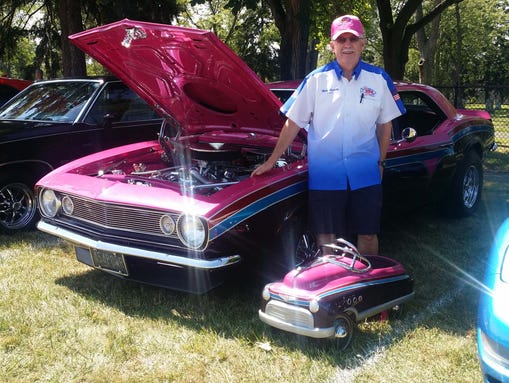
Call ’em the Wake Up the Dead Club.
For nearly the length of the Woodward between 12 Mile and 13 Mile, some of the Dream Cruiser’s loudest, prettiest muscle cars line up in reserved spots year after year. Right in front of Berkley’s Roseland Park Cemetery.
“Want to hear how she sounds?” Rob Metzger, 63, from Livonia asks me as he turns the key on his bright pink – yes, pink – 1969 Plymouth Barracuda. VROOOOOM! goes the 340 cid, six-pack under the hood, and I swear I hear the tops pop off a dozen caskets behind us.
I’ve decided Roseland is where I want to be buried.
Metzger drag-raced the big Barracuda back in its heyday to an 11-second quarter mile time. Or about what a Dodge Hellcat will do today. Not bad for an old stocker.
A few plots – er, parking spots – down from Metzger, the purple, red, blue and black paint job on Mike Oginsky’s 1967 Camaro is as loud as the 500-horsepower V-8 within. Oginsky knows his colors. He’s a retired paint engineer for General Motors. Next to his ’67 (you know the ’67s by the vented windows), is a tiny pedal car for his granddaughter. With the same paint scheme, natch.
The symphony wouldn’t be complete without a Corvette. Greg Pelton’s bright blue, 1970 Stingray does the job. With its side pipes exhausting the 5.7-liter monster within, it makes beautiful music. The classic shape of the ’70 is a reminder of why Chevy waited another four generations – and 45 years – after the C3 chassis to give the latest, C7 model the name Stingray.
It takes a special kind of car.