- Search Cartoons
- Comic Archive
-
Payne
Store



 Henry Payne RSS

Articles Blog
Payne: Porsche 911 still king
Posted by hpayne on May 8, 2016
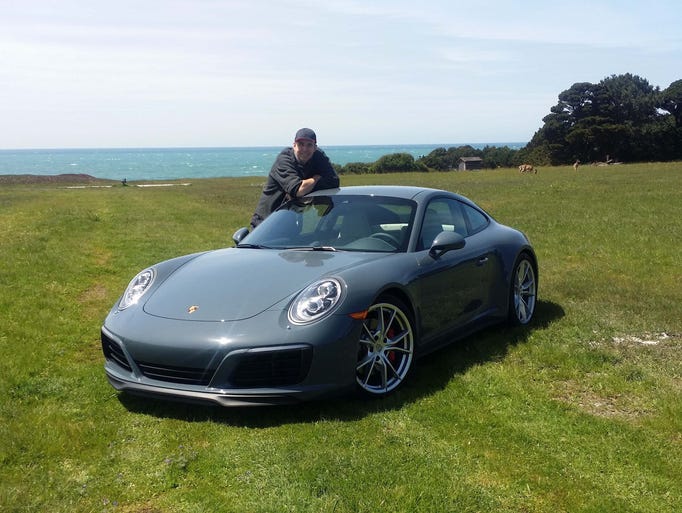
I’ve been club-racing mid-engine, vintage Porsches all my adult life: Porsche 904, Porsche 906, Porsche 908.
All are exquisitely-balanced, apex-carving knives. Their engines are in front of the rear axles where God intended them to be. They were the models that made the sports car marque’s reputation in the late 1960s as it amassed a trophy-case full of world championships. The Porsche 917, 956, 962 and 919 — all mid-engine masterpieces — continued the winning tradition into the 21st century.
And yet the brand’s celebrity icon is the aft-powered 911. An automotive artifact that shared ancestry with the original VW Beetle. Yet not even the Bug has a rear-mounted power plant anymore.
Mid-engine heroes have come and gone, but King 911 has carried the flag into battle for generation after generation of Porsche fans. It is the winningest-ever Porsche on Sunday, and the most-sold on Monday. Like its Yankee rival front-engine Chevy Corvette, it has defied convention for over half-a-century by resisting mid-mounted physics. And Porsche has laughed all the way to the bank.
Selling more than 30,000 vehicles apiece year after year, the volume of 911s andCorvettes produced is the envy of every other manufacturer even as we all know —we know! — that they are technical dinosaurs. But just as Coca-Cola’s secret formula has dominated taste buds for a century, so have Porsche and Corvette’s mastery of — respectively — rear-mounted boxer engines and push-rod, small-block V-8s. They have adapted to the ever-changing demands of the brutally competitive sports car market.
“Drive a 911 every once in a while to remember what a great car feels like,” my pal and ex-Detroit News colleague Scott Burgess likes to say. Last week, I drove the new 2017 911 (run, don’t walk, to your local showroom). The first 911 to feature a turbocharged, flat-six as its base mill, it is the most significant engine upgrade since Stuttgart changed its flagship from air-cooled to water-cooled power plants in 1998.
Brother Burgess would be proud. To drive the new 911 is to pilot greatness.
As a mid-engine disciple, I was skeptical. The new 911, known at Porsche as the 991.2 — that is, Version 2.0 of the all-new 991 platform introduced in 2012 — is the first 911 I have spent a full day with since my first racer’s school in 1980 as a fuzzy-faced 18-year-old. I was quick but raw. I successfully negotiated the pylon-choked race course in Ohio to the school’s satisfaction, though I melted the tail-happy car’s clutch in the process.
I’ve gotten better — as has the 911.
In between my 911 dates, I have danced with numerous Porsches — and not just the 1,400-pound, tube-frame track legends of yore. The mid-engine 914-6. The 50-50 weight-balanced, front-engine 944. And the peerless, tossable, mid-motor 2016 Cayman/Boxster, dollar-for-pound the best sports car on the planet. Surely, the 911 — 100 pounds heavier than the Boxster, its engine hanging out its keister like a four-wheeled Kim Kardashian — would be the lesser athlete.
Not. Bigger in every dimension than its mid-mill stablemate, my 911 tester — base model, $90,450, manual, fire engine red — seemed to shrink around me as I settled into its form-hugging, bolstered “Sport Plus” seats. Key on the left as always. The world’s best manual box to my right.
Its Boxster-like, firm chassis-and-suspension a scalpel in my hands, the 911 shredded Northern California’s twisty roads.
Chassis engineering aside, there is method to Porsche’s rear-mounted madness after all. With the engine in the stern, the Porsche has space for (small) rear seats so the kiddies can share in the fun. Rear-end heavy, the car dives deeper into bends with less weight transfer compared to its athletic peers, allowing for beautiful, throttle-induced rotation through corners instead of speed-scrubbing understeer.
“And with the engine’s weight over the rear wheels, the traction out of the corners is unmatched,” says Porsche powertrain engineer Bruno Kistner, who flew in from Stuttgart to take a bow.
Oh, yes, about that turbocharged engine.
I thought Porsche’s controversial switch to turbos — not just its high-price, high-horsepower Turbo — would dominate my review. Green theology obsesses governments today, especially in Europe, and automakers are under pressure to lead carbon-celibate lives even as their customers demand more performance. Porsche’s solution ingeniously satisfies both poles.
Maintaining its core boxer-six, the 911 only shaved piston displacement from 3.4 to 3.0-liters then upped the ’roids with twin, small turbochargers anchoring each cylinder bank. The result is an engine that pulls like an ox — full torque is reached at just, cough, 1,700 revs — all the way to 7,500 rpms, just 300 shy of the previous mill. No lag. No low-rpm hole.
Porsche had to widen the rear tires to 11.5 inches to help plant the prodigious, 331 pound-feet of torque (a 15 percent gain). Were it not for a faint turbo whine (more pronounced in the convertible), you wouldn’t know this was a forced-induction mill
All this plumbing added weight to the engine, but Porsche’s historical obsession with light-weighting — behold the drilled key on my 1,380-pound, 1969-vintage 908 racer — shaved pounds elsewhere so that the drivetrain gains just 44 pounds overall. Typical of the 911’s timeless, teardrop shape, small subtleties differentiate 991 Version 2.0 from 1.0. Most obvious are two vents immediately behind the rear wheels which exit air from the red-hot turbos. The rear grill strakes flip vertical. Rear taillights are more three-dimensional.
I love to man-handle sports cars, so I’d buy manual. But tack on a few grand, and the optional PDK gearbox on a 420-horsepower Carrera 4S (AWD for more grip, natch) is a delight with lightning-quick shifts and available mode selector on the steering wheel with an F1-like “push-to-pass” button.
Spying a dotted passing line on California’s Pacific Coast, I punch the button and the box jumps from seventh gear to third and hurtles the 911 past traffic.
Ninety-five grand has never seen such performance. So which icon to buy? Rear engine 911 or front-mounted ’Vette V8 Z06?
The two are as different as their national stereotypes. The Z06’s explosiveness is unmatched on an asphalt battlefield. The 911 lacks the Corvette’s nuclear firepower but gains in pinpoint accuracy.
Either will do, though I prefer the Porsche’s more controlled aggression. So much for assumptions. Greatness, thy name is the rear-engine 911.
2017 Porsche 911
Specifications
Vehicle type: Rear-engine, rear- or all-wheel drive, 4-passenger sports car
Price: $90,450 base ($97,010 Carrera; $138,550 Carrera 4S PDK as tested)
Powerplant: 3.0-liter, “Boxer” 6-cylinder
Power: 370 horsepower, 331 pound-feet of torque (base Carrera); 420 horsepower, 368 pound-feet of torque (Carrera S and Carrera 4S)
Transmission: 7-speed manual; 7-speed, dual-clutch PDK
Performance: Zero-60: 4.3 seconds (base, manual Carrera); 3.6 seconds (4S with PDK): 191 mph top speed (Carrera S) – manufacturer numbers
Weight: 3,153 pounds (base, manual Carrera as tested); 3,285 pounds (Carrera 4S PDK as tested)
Fuel economy: EPA 20 mpg city/29 mpg highway/23 combined (base, manual Carrera); EPA 20 mpg city/28 mpg highway/23 combined (4S PDK)
Report card
Highs: Classic shape; precise handling
Lows: Zero engine access; turbo takes edge off raspy six howl
Overall:★★★★
Payne: Subaru Impreza Jekyll vs. STI Hyde
Posted by hpayne on May 7, 2016

All cars come with WARNING stickers cautioning front-seat passengers about the dangers of air bags.
I’m thinking four-door sport sedans should have rear-seat WARNING labels, too. Then, when drivers are seized by their inner street-racer, they’d see something like: WARNING: THIS CAR MAY MAKE SUDDEN, VIOLENT, HIGH-G TURNS THAT COULD RESULT IN DIZZINESS, NECK SPRAINS OR KNOCKED NOGGINS.
I had such a moment recently in a 2016 Subaru WRX STI with my teenage nephew riding astern. I took a 90-degree right-hander off Telegraph Road like Turn 6 at Waterford Raceway and my cousin’s head thumped — WHACK! — the door window. He’s a good, hard-headed Payne male, so no harm done, but you get my point: He should have been warned.
After all, if you’re riding shotgun in, say, a $75,000 Corvette, you know violence might ensue at any moment. The thing looks like a Ferrari, sounds like the Kraken, and has two “OH, CRAP!” handles within easy reach. But how’s a compact sedan passenger in the back seat supposed to know?
Such are the risks of today’s most capable, under-$40,000 machines: VW Golf R, Ford Focus RS, and Subaru STI.
Yes, Subaru.
The STI is the unlikely, evil twin of arguably the nicest, most capable auto bargain on the lot, the Subaru Impreza. So adorable is Subaru that its ads talk incessantly about “love.” At an affordable $19,090, the Impreza is the only all-wheel-drive compact on the market. I particularly like the utilitarian, five-door Sport hatchback ( my wife loveshers) which starts at $23,990 — or half the price of a similarly-sized AWD Audi A4 All-Road. Half.
The Subaru ain’t bad looking, either. In 2012 Impreza received an extreme makeover to match its winsome personality. Raked headlights, trapezoidal grille with chrome winglets, swept-back windshield, athletic stance. No more boxy bods with clown noses that stuck out like pimpled nerds in too-short pants in high school.
The interior is a comfortable office as well — class-competitive rear head and legroom in the wagon, a console with cubbies in all the right places, big fat knobs for easy infotainment/climate navigation.
The Impreza is as handsome and as loyal as Lassie. Its AWD will rescue you in the worst stuff that Old Man Detroit Winter can throw at you. And its consistently-high reliability ratings will keep it out of the auto repair pound ( Consumer Reports lovesit).
The all-wheel-drive STI is a whole ’nother breed. It’s the Impreza with rabies. A Rottweiler in a collie suit. A snarling, misbehaving ticket to trouble.
Park the Hyper Blue STI (special ’16 edition) and Quartz Blue Pearl Impreza next to one another and they look as opposite as Schwarzenegger and DeVito in “Twins.” The STI doesn’t hide its aggressive intentions, featuring a big hood scoop and rear wing that looks like it was taken off Baron von Richthofen’s WW I triplane.
Slip into the familiar interior and the instruments’ blazing red graphics — like glowing wolf eyes — alert you that something is different. The bolstered seats grip like go-kart buckets, warning of the capabilities to come.
Driving the Impreza hatchback is like driving your washing machine — the 2.0-liter, 148-horse engine mated to a droning, automatic CVT transmission that methodically takes you on your way: START, WASH, RINSE, ARRIVE. The blown, 2.5-liter STI boxer mill more than doubles the Impreza’s output — to an Audi S4-challenging 305 ponies — and is controlled by a firm, 6-speed manual box that begs to be rowed.
Impreza is hardly a boat, but it’s a ’95 Buick Roadmaster compared with the STI’s washboard-hard suspension. When the STI debuted a couple of years back I rung its neck around Laguna Seca raceway, posting times that would make many sports cars blush. Its power and torque-vectoring AWD make it a sensational weekend track warrior. You might want to check house listings next to Waterford.
On road, though, it’s like a piranha in a goldfish bowl — it never seems happy unless it’s devouring other fish. Stomp the gas, bury the bravo Brembo brakes, throw it through corners (sorry, nephew), and STI pleases. But grunt around town and it’s loud and uncomfortable.
The 2016 Impreza and STI are built for different folks. And they are taking their last bows.
At last fall’s Los Angeles Auto Show Subaru showed Impreza 5.0 due later this year. The exterior was nicely evolved — crisp lines, tidy fascia — but the biggest change is within, where Subaru promises a quieter ride on an all-new, stronger global platform. This will benefit STI as well as it pales in daily drivability next to same-priced peers such as the Focus RS and Golf R. We can’t be boy racers all the time.
But when we are, my nephew would appreciate that WARNING sign in the back seat.
2016 Subaru Impreza
specifications
Vehicle type: Front-engine, all-wheel drive, five-passenger hatchback
Price: $19,090 base ($26,682 Sport Hatchback as tested)
Powerplant: 2.0-liter, Boxer 4-cylinder
Power: 148 horsepower, 145 pound-feet of torque
Transmission: 5-speed manual, CVT
Performance: Zero-60: 9.0 seconds (CVT, Car & Driver)
Weight: 3,131 pounds (as tested)
Fuel economy: EPA 28 mpg city/37 mpg highway/31 combined
Report card
Highs: All-wheel-drive; Roomy hatch
Lows: Droning CVT
Overall:★★★★
2016 Subaru WRX STI
specifications
Vehicle type: Front-engine, all-wheel drive, five-passenger sport sedan
Price: $35,290 base ($39,790 HyperBlue Series as tested)
Powerplant: 2.5-liter, Boxer 4-cylinder
Power: 305 horsepower, 290 pound-feet of torque
Transmission: 6-speed manual
Performance: Zero-60: 4.8 seconds (Car & Driver)
Weight: 3,411 pounds (as tested)
Fuel economy: EPA 17 mpg city/23 mpg highway/19 combined
Report card
Highs: Great seats; Torque-vectoring terror
Lows: Harsh ride; Pricey next to more refined competitors
Overall:★★★
Dude, Kia Sportage got game
Posted by hpayne on April 29, 2016

I’ve always chafed at the name Kia “Sportage.” Sportage sounds like something MTV’s star beach bum Pauly Shore would say. Like “After I do some sportage, I’m gonna get some foodage.” Or “Like, dude, I’m totally spent. That was some serious sportage.” Hip. Funky.
Not something you’d associate with a compact crossover appliance in the high-volume, mainstream segment. But after driving Kia’s new 2017 Sportage, maybe I was wrong.
This is no appliance. This dude is loaded with personality.
In its ambitious climb to social respectability, Kia and Korean-twin Hyundai have slavishly copied German brand wardrobes. Hyundai’s luxury Genesis has aped Audi’s big grille and taut lines, while Kia just hired VW-Audi designer Peter Schreyer himself. Schreyer wasted no time sculpting a sexier Kia. Leaner stance. Signature, “tiger-nose” grille. Personality.
For the new Sportage, Schreyer reached for exterior cues from the Alpha male of the VW family: Porsche. Stroll around the outside and Sportage has an unmistakable echo of Stuttgart’s bullet-shaped Macan. Rake, dual-eyed headlights. Rounded corners. A menacing mouth. The Porsche’s egg-crate grille screams mean while the Sportage has … cute-age? Yes, like an enraged Pokeman. GRRRRRR.
Stomp on the Kia’s turbocharged, 2.0-liter 4-cylinder engine and this box goes. It’s not the tire-squirming torque steer of Korean imports of yesteryear, but the refined pep of a German machine. This isn’t a quirky Kia Soul but a serious automobile with crisp handling and tailored interior to match its styling, right down to the alphabet-soup badge on my top-of-the-line turbo: SX-GDI.
The black instrument cluster behind the flat-bottomed steering wheel (sport-age!) is highlighted by white graphics and red dials. The dash is nicely appointed with matte-black row of buttons, air ducts, and horizontal lines. It’s right out of a VW-Audi parts bin.
The Sportage follows on the same platform as the handsome, 2016 Hyundai Tucson (big brother always gets the first wardrobe makeover). Last summer I tested the base, wonderfully-affordable, $23,720 Tucson, which goes about its business in a very, um, business-like way. My all-wheel-drive Sportage tester is a different animal. Not just because it was dressed to the nines at $34,895 (its base price just $300 more than the Tucson) — but because it cuts a more athletic stance.
The Kia feels less like the Tucson and more like Hyundai’s Sante Fe Sport — a sexier version of Hyundai’s larger, mid-sized Santa Fe aimed squarely at Ford’s Edge. Confusing, I know, but that’s how these Korean twins differentiate themselves.
Befitting their badges, Sportage and Santa Fe Sport get steroid-fed engines — 181 horsepower base 2.4-liter or powerful 240-horse turbo-fours. The Tucson is stuck with a 2.0-liter, 164-horse, 2.0-liter four or a 1.6-liter turbo-4 option with 175 ponies. In a 0-60 sprint, Sportage leaves Tucson in the dust.
If they were high school classmates, you’d recognize Sportage and Sport as the jocks — Tucson the nerd.
That said, Sportage’s safety and reliability numbers are class summa cum laude. The Kia is an Insurance Institute for Highway Safety top safety pick and its J.D. Power reliability and dependability numbers shame even Honda and Subaru.
Brains and looks. Like Jennifer Grey’s nose job, Sportage’s new face has born a thousand opinions. I like it. The AWD model also gets less chin for more ground clearance — in case you want to take it off-road. The Sportage turbo’s prominent side gills — more Porsche inspiration — are lit up with four, luxurious “ice-cubes” each. Dude, LED-age. The flanks continue the athletic, rounded theme with the rear sporting a tasteful combination of Audi lights (ribbed LED inlays) and a horizontal, Lincoln-esque signature connecting the corners.
Kia has done its homework. So how does Sportage stand up to my favorite compact crossover, Ford Escape?
Where the Escape and Hyundai Tucson appear separated at birth, the Kia’s dramatically different looks will stand out on Michigan highways choked with Escapes (the second-best selling small crossover). The Kia offers lots of nifty features like lane-keep assist (handy on late interstate drives back from the sticks when your eyes are getting sleepy, sleeeeeepy — BEEEEEPP! — the warning tells you you’ve crossed the line). Unlike some of its peers, the system is calibrated to detect steering wander — not every lane change — so it never feels like a nanny. Thanks, Kia.
Kia’s instruments feel more luxurious than the Ford — that Audi influence again — though I craved more personality (like the unique Chrysler Pacifica I just drove). But in certain crucial details the Ford still sets the standard. Like the kick-open rear hatch, which even Audi has copied. Lay-flat rear seats (Kia still has an annoying hump that would impede storage) assist Ford’s superior cargo room. Little things, but this segment is so competitive it comes down to the little things.
Still, for just $34K — the price of an Escape Titanium sans trimmings — a loaded Sportage matches Ford’s full moon-roof so you can stargaze while doing spoon-age with your date.
Ford’s SYNC system I found more responsive to voice commands — but in truth, no infotainment system these days (shy of Audi’s sensational 12-inch instrument display) is worth the price with superior smart phones at our finger tips. On this point, Hyundai and Kia (and Honda and GM) are a lap ahead of the competition. With Kia’s Android Auto taking over the dash, I can use my Samsung phone’s superior “Ask Google” app to navigate me to some far flung point of interest — say, “The Lingenfelter Car Collection” in Milford. Try that with your car’s nav system.
Kia’s nicely-sorted console space even provides a large cubby in front of the gearshift so your essential phone is never far away.
But where the Sportage rewards you day-in-and day-out is with its on-road charisma. This is not a boring SUV. Acceleration is rabbit quick — and the SX-GDI even offers a Sport mode for a few more revs in the twisties. In a world where (my favorite 220-horse) hot hatches are in the Sportage price point, this grunt is a welcome addition to the family ute. As is the handling. The AWD system rotates beautifully and I tore up Oakland County esses with the nicely appointed chassis. When the venom seized me Mrs. Payne reached for the door handles — which are right where they are supposed to be.
Yeah, the Sportage comes with lane-keep warning. But this little hipster will never make you drowsy.
017 Kia Sportage
specifications
Vehicle type: Front-engine, front or all-wheel drive, five-passenger sport utility vehicle
Price: $23,885 base ($34,895 SX as tested)
Powerplant: 2.4-liter, inline-4 cylinder; 2.0-liter, turbocharged 4-cylinder
Power: 181 horsepower, 175 pound-feet of torque (2.4-liter); 240 horsepower, 260 pound-feet of torque (turbo)
Transmission: 6-speed automatic
Performance: Zero-60: 7.5 seconds (AWD turbo, Car & Driver); 2,000-pound towing
Weight: 3,305 pounds (base, FWD); 3,997 (AWD turbo as tested)
Fuel economy: EPA 23 mpg city/30 mpg highway/26 combined (base FWD); EPA 21 mpg city/26 mpg highway/23 combined (AWD turbo)
Report card
Highs: Distinctive styling; peppy turbo
Lows: Polarizing styling; less cargo room than competitors
Overall:★★★★
Payne: What will race cars look like in 2030?
Posted by hpayne on April 26, 2016
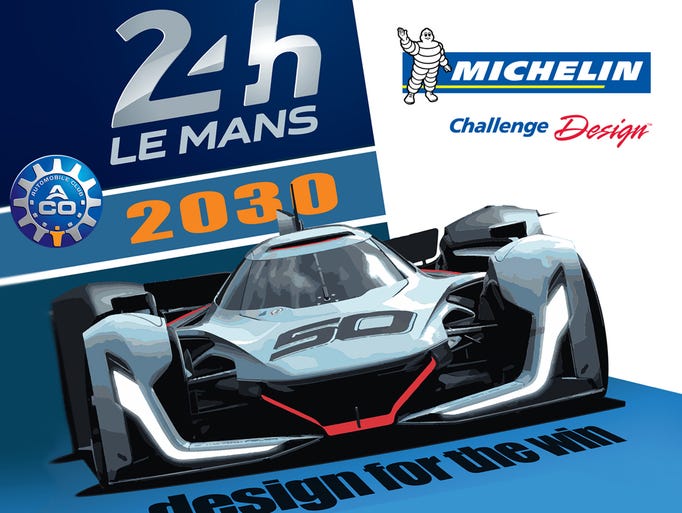
What will race cars look like in 2030? Will they be remote-control driven drones? Will they drive upside down through super loops? Will they run on hydrogen?
The prestigious Michelin Challenge Design wants to know.
So at the Detroit Athletic Club this week, award organizers picked auto racing as its 2017 design theme. Not just any form of racing, but the world’s most famous race, the 24 Hours of LeMans in France. For nearly a century LeMans has been at the cutting edge of auto design thanks to its unique demands of speed, durability and efficiency. It’s attracted the world’s top automakers — Audi, Porsche, Ford, Chevrolet, Ferrari — testing the latest materials, power trains and aero tricks that give them a competitive edge, not just on the track but also in the showroom.
Challenge Design, now in its 15th year, promises thousands of breathtaking entries, pushing the envelope on everything from fuels to autonomy. But if history is any guide, 2030 race cars will look a lot like they do today.
For all its tech savvy, racing is still a commercially-driven, spectator sport. And spectators want to see the best man (or woman) win. That means design will continue to be dictated by rules that 1) promote competition 2) keep costs down and 3) prioritize entertainment.
Promote competition: “My favorite LeMans car is still the Porsche 917,” said Acura Creative Director Dave Marek at Michelin’s event — referring to the gorgeous, 12-cylinder missiles that dominated the 1971 race. With top speeds in excess of 220 mph, the 917 set records for distance traveled that would last for decades.
Its record stood because the car’s dominance forced rule changes for 1972. The fan’s thirst for competition must be slaked. The 4.9-liter 917 was banned — replaced by 3.0-liter, prototype-class cars that allowed more manufacturers a look in at the winner’s circle. Forty-four years (and more rule changes) later, and a hybrid gas-electric Porsche’s 919 won the 2015 LeMans. Yet despite its advanced drivetrain and carbon-fiber chassis, the 919 and 917 look similar — same narrow greenhouse, same long, aerodynamic shape, same rear wing. The laws of physics don’t change.
Keep costs down: Not just physics, but cost must be respected as well. Porsche’s 919 drivetrain is the competitive — and political — engine of choice in endurance racing. Ten years ago, it was diesel as LeMans-winner Audi made the euro tax-favored engines sexy as well as politically correct. But politics is a fickle mistress. “The regulations will define what happens in the race,” said race designer Ben Bowlby at the DAC.
Today, governments favor batteries over diesels. But electrics are expensive, which favors big spenders. Which squeezes competition. Witness Mercedes’ dominance (yawn) of hybridized Formula One.
Will alternative fuels dominate in 2030? Consider that Lemans’ most competitive class — production-based Grand Touring — forbids hybrids to reduce costs. Which means that when Marek’s hybrid supercar Acura NSX enters endurance racing next year it will do so with a gas engine.
Prioritize entertainment: Connectivity and autonomy are the buzzwords of the future.
“Warfare today is conducted with no people,” said Doug Fehan, Corvette’s legendary racing chief. “Does safety become such an element that a decision is made that it’s too dangerous to have humans involved?” Will it mean drones? Virtual racing?
Not likely. The trend in racing entertainment is toward more — not less — driver involvement. Case in point: Daytona. The world-famous race track — which hosts both the LeMans-like 24 Hours of Daytona and NASCAR’s 500 — debuted a $400 million main grandstand “sports megaplex.” Its design gives fans a better front row seat so they can see, hear and interact with their favorite drivers pounding around the track in deafening V-8s.
In a world of multiple sports fan experiences, auto racing offers a unique visceral experience. Like the NFL, the NBA and Major League Baseball, fans demand sportsmen and women over technology. Baseball still uses a wooden bat to level the playing field between pitcher and batter.
Michelin Challenge Design entrants (tune in this fall for winners) will be tempted to gorge on tech, but the truly futuristic entries will dumb-down technology to favor driver parity.
LeMans has its own innovation award called Garage 56, which has produced marvels like the Delta Wing. For 2017 its winning technology that will allow quadruple amputee Frederick Sausset to race. But the car he will pilot — a Morgan prototype — will feature a highly regulated, normally-aspirated, gas-powered V-8 to limit costs and encourage competition.
Because while we love cars — we really care about the human on the winner’s stand at the end.
Payne: GMC Sierra, the hot rod pickup
Posted by hpayne on April 25, 2016

I often hustle down northern Ohio’s rural roads late at night on my way to Columbus, Mid-Ohio Sports Car Course or my family home in West Virginia. The traffic is minimal. I can make good time. And the curvy roads — interrupted by long straightaways bordering flat farm fields — are a blast to drive. My motoring solitude is interrupted only by a paranoia of deer leaping in front of my car.
But not this night.
I’m flying along in a 5,559-pound, Corvette V8-powered GMC Sierra Denali pickup. If I hit a deer it would likely vaporize.
The Sierra Denali is a freak of nature. Like 6-foot-3, 250-pound Denver Broncos linebacker Von Miller who, despite his bulk, can explode through a line and take down Cam Newton before he has time to scan his receivers. We’re talking a 4.5-second, 40-yard dash. Maybe Miller should change his nickname from “Karate Kid” to “Sierra Denali.” This pickup will go zero-60 mph in just 5.8 ticks.
GMC likes to refer to the 6.2-liter, 420-horse Sierra as “the hot rod pickup.” It’s the only pickup available with General Motors’ magnetic-ride shock technology. A quick primer on MagneRide: Developed by GM supplier Delphi, it mixes flecks of metal in the shock liquid. Run current through it and you can stiffen the suspension. It makes for a ride so road-hugging that Ferrari has adopted the technology. (Detroit? Maranello here. Can we, um, borrow your shocks for our 599 GTB?).
MagneRide is available in a variety of GM products including the Corvette C7 and all-new Camaro, but it is transformative in big beasts like the Denali.
Combine it with the ferocious power of the ’Vette-derived, small-block V-8 and eight-speed tranny, and the pickup feels like a vehicle half its size.
Down Ohio’s rural Route 68, I hurtle into tight sweepers, the big truck planting nicely into apexes. The steering feels grounded — like a sport coupe — as the nearly 3-ton beast actually rotates through the corner carrying momentum on exit. At which point I deploy the hammer: 393 cubes of piston jack-hammering the asphalt with 460 pound-feet of torque. The roar is addictive and I mash the pedal to take advantage of the truck’s four-wheel-drive grip.
Don’t get me wrong. Three-ton, leaf-sprung trucks still demand respect. With an empty bed, the hindquarters still flutter down the highway. Go too hard into a corner and the heavy front end will plow like a farm implement. But respect the big bull’s physics and it’s actually fun to drive.
Launching out of sweepers, I gained confidence to test the big truck’s high-speed limits as I would push a 155-mph Camaro SS. Which is how I discovered that pickups are governed at 100 mph. Dang. Seems GM wants to keep 3-ton rhinos on a short leash.
Of course, for $60,765 you get a lot more than an engine on wheels. At more civilized speeds, the hunky Sierra will turn heads. GMC’s sculpted “Body by Jake” exterior is the envy of the truck world. GMC’s signature bold, square, wheel arches look like they were made in the Kronk Gym. This thing should have a weightlifter’s belt tied around the middle. Is that car wax or body oil that made my Sierra glisten?
New for 2016, the muscled GMC’s LED headlights glow with menace. The Denali’s unique chrome mouth is Mike Tyson with a gold tooth.
The spectacle continues inside where the Denali is more comfortable than Boeing first class — and as well stocked. Heated seats, heated steering wheel, infotainment screen, Apple CarPlay, voice recognition, USB ports, wireless phone charger, 110-volt plug. Materials like stitched leather, aluminum trim and handsome wood inlays abound. The Denali’s stalk shifter opens a console as big as a side table — and as useful, too, if you want to nibble on lunch on the way to an appointment. Store keys and change in the ribbed tray atop the console box — or an iPad inside it.
Back home in Detroit, I made the rounds with Pickup Bob, my neighborhood truck expert and construction company boss. Married to an F-150, he was nevertheless impressed with the GMC’s style and muscle — though he wondered how practical an executive’s truck this luxurious would be on a worksite where its club décor would quickly get muddied. Like the rugged, $100K Range Rover I recently reviewed, the Denali’s luxury seems at odds with its utilitarian capabilities.
Consider this a pickup hot rod for enjoying the open road and hunting trips Up North rather than a dirt-hauling, throw-the-shovels-in-the-back, pull-stumps-out-of-the-ground backyard bruiser.
I’m puzzled why motorhead mags don’t spend more time on pickups’ box capability. I mean, if a truck chooses not to put a roof over half its length, I want some detail on how good it is at carrying stuff. Big Three pickup interiors are similarly roomy, tech-savvy family rooms. But their beds are very different sandboxes.
Pickup Bob likes the GMC’s corner step-up (shared with sibling Chevy Silverado) making for class-best accessibility. The standard eight tie-down points are handy, too — especially if you’re strapping down an ATV (and loading ramps).
The F-150’s interchangeable box cleats go the Sierra one better for bolting in ramps so they don’t clatter about. And Ram’s fender-mounted “Rambox” storage is ingenious for storing toolboxes, coolers, even shovels. Whatever your favorite pickup box, you can fill in the gaps with aftermarket options galore.
There is little gap between the Sierra and the F-150 when it comes to weight. Ford’s new all-aluminum diet may have saved it 600 pounds over the previous generation, but that only means it finally weighs as little as its steel-boned GM rivals. Indeed, the Sierra tips the scales 18 pounds lighter than a comparably priced F-150 Platinum.
Which is another reason the Sierra deserves its hot rod reputation. At the end of your Up North family adventure, unload the ATV, tuck the kiddies in bed, then head out on a twisty road for a late-night dance. Rotate the drive mode to 4WD, find yourself an abandoned country road, then let the big, 6.2-liter hot rod roar.
The deer will want to be warned you’re coming.
2016 GMC Sierra Denali
Specifications
Vehicle type: Front-engine, rear or four-wheel drive, five-passenger pickup
Price: $28,910 Sierra base ($60,765 Denali as tested)
Powerplant: 6.2-liter V-8
Power: 420 horsepower, 460 pound-feet of torque
Transmission: 8-speed automatic
Performance: Zero-60: 5.8 seconds (Motor Trend); 2,010-pound payload capacity; 11,700-pound towing
Weight: 5,599 pounds
Fuel economy: EPA 15 mpg city/21 mpg highway/17 combined
Report card
Highs: Sporty truck ride; bodybuilder good looks
Lows: Too pretty to get dirty?; more box capability, please
Overall:★★★★
EPA retreats on racing regulation
Posted by hpayne on April 20, 2016
After a national uproar and months of insisting it had no intention of regulating auto racing, the Environmental Protection Agency has reversed course on plans to prohibit the modification of street cars for competition.
The issue came to a head last week after House Energy and Commerce Committee Chairman and Michigan Rep. Fred Upton, R-St. Joseph, sent a letter to EPA Administrator Gina McCarthydemanding clarification of the agency’s intentions. Upton’s letter followed a storm of protest from weekend racers, state attorneys general, the Global Automakers Alliance — even former presidential contender Marco Rubio. They said the EPA’s action would have chilled grassroots racing and threatened a $30 billion parts industry.
The EPA told Congress late Friday it was withdrawing its language.
Critics were quick to celebrate, although they said that congressional legislation to exempt racing from EPA’s emissions rules — first reported by the Detroit News — still was necessary to prevent future EPA meddling.
“We want to thank Congress for pushing EPA to withdraw an ill-conceived proposal,” said Chris Kersting, head of the Specialty Equipment Manufacturer’s Association, which represents racing parts manufacturers. “However, confusion reigns. Only clarifying legislation … will confirm that such activity is legal and beyond the reach of future EPA regulations.”
The so-called RPM Act (Recognizing the Protection of Motorsports), a bipartisan bill introduced last month, would put in law the decades-old intent of Congress to exclude off-road vehicles from federal emissions regulations.
The firestorm erupted early this year after the agency inserted new language in the Clean Air Act’s Heavy-Duty Greenhouse Gas rules. It said “certified motor vehicles and motor vehicle engines and their emission control devices must remain in their certified configuration even if they are used solely for competition.”
EPA claimed the new language was necessary to clarify the act’s regulation of vehicle greenhouse gas emissions. SEMA claimed the agency was rewriting 46 years of law that had exempted competition vehicles. A national petition to rescind the EPA’s rules gathered more than 168,000 signatures. Congressional hearings and grassroots protest ensued.
“The wording of the EPA rule would have destroyed the world of racing and the billions of dollars that go with it,” said Speed Sport chief Ralph Sheheen, who testified at the hearing and whose publications cover every form of motorsport. “From Saturday night short-track dirt racing to local drag strips, as far up the line as the Pirelli World Challenge which is based on production vehicles — it would have ripped the heart out of racing for thousands of people.”
On April 1, seven state attorneys general — including Michigan’s Bill Schuette — sent a letter to the EPA saying its “language (is) inconsistent with the federal Clean Air Act,” and that “any purported benefit from this change would pale in comparison to the economic damage caused by this regulation.”
In removing the language governing competition vehicles, the EPA last week said its attempt to clarify led to confusion. It said it would focus on “reducing pollution from the cars and trucks that travel along America’s roadways and through our neighborhoods.”
Michigan has refused to comply with the EPA’s Clean Power Plan targeting coal-fired utilities until the courts have decided on the issue. And rules mandating that automaker fleets average 54.5 mpg by 2025 have come under fire from Congress and the National Auto Dealers Association.
“The proposed race car provisions are just one of many attempts at regulatory overreach under the Obama administration, and we will continue to scrutinize all of them in a common-sense way,” said Upton.
Payne Q&Auto: Graham Rahal on NSX, Indy and marriage
Posted by hpayne on April 16, 2016

Forget Brangelina. Never mind Willkat. The hot celebrity couple in autodom these days is Grahamney. The marriage last fall of IndyCar racer Graham Rahal and drag racing’s Courtney Force united two of the hottest rising stars in auto sport from two of racing’s greatest family dynasties.
The talented, dashing Graham, 27, is the son of Indy 500 winner and Rahal-Letterman-Lanigan Racing team owner Bobby Rahal. Courtney, 26, is the daughter of the legendary John Force, 16-time NHRA Funny Car champion. America got to see Courtney’s talents outside a driver’s suit when she posed for ESPN’s 2013 Body Issue.
Accustomed to the public eye at an early age, Rahal has stepped out of the shadow of his famous father and established a brand all his own. He is a perennial championship contender in IndyCar, a cheerleader for his wife’s own NHRA title dreams – and a prominent corporate spokesman for his engine sponsor, Honda. That relationship allowed him to follow in the footsteps of another open-wheel superstar, Brazil’s Ayrton Senna, who helped develop the 1990 Acura NSX, the flagship of Honda’s Acura luxury brand.
Ohio-born Rahal helped bring the second-generation NSX to market this year – appropriate since Acura is no longer an exotic import, but made right in Rahal’s Columbus backyard.
The 573-horsepower, 2017 NSX is a mid-engine hybrid-electric cyborg capable of neck-bending performance on the race track, yet comfortable enough to drive home. Credit Graham for some of its bravado.
“It’s the first program I’ve been involved with on the development side,” he said at California’s Thermal Raceway, where he emceed the car’s media introduction. “Early on (they’d ask) my sense of the way things needed to be. I can tell driving today vs. even two months ago they continue to tweak the car and get it better.”
Does it share anything with his race car? “No GT car reminds me of an Indy car,” he said. “But the performance of the car is tremendous for the ($157,000) price point. The torque in this car is instant – the turbo and electric motors complement teach other. That’s what’s cool about it.”
Though a generation apart, we are both sons of racers. I’ve known his dad, now 64, for years on the vintage race circuit where our fathers became fast friends after Bobby’s competitive days were done.
Graham racing success was meteoric. He rose from a 10-year-old go-karter through Formula Atlantic to be the youngest-ever winner of an IndyCar race at age age 19 in 2008.
“I got myself up to the top level fast,” he reflects. “But in hindsight, the experience of taking more time maybe would have been a better thing.”
His father was supportive every step of the way, but when Graham made it to the pro ranks, he wanted to carve his own path. “When I started my career, I drive for Newman-Hass and Ganassi. I did that on purpose to build my own name away from my dad,” he says. “But every time I would go to a sponsor to pitch, the first question was ‘Why don’t you race for your dad?’ It became obvious that using the names together was the most beneficial for us.”
Since uniting under the same flag in 2013, Team Rahal has met with success, finishing fourth in the championship last year. Yet, father and son have never raced together, even in the BMW M6 that Rahal-Letterman-Lanigan entered for this year’s Daytona 24 Hour endurance race – and that Graham co-piloted.
“I tried to get him to race,” says Graham. “But when my dad stepped away, he stepped away. He never did a Michael Jordan. All you do is risk looking worse than you did.”
“My hands are full. I’m always in the drag-racing world with her,” he says of a life split between his home in Indianapolis, her pad in SoCal and the constant race travel. “Between her schedule, my schedule, chasing sponsors – there’s no off time.”
Since his marriage to Courtney in Santa Barbara late last year, Graham has gained a new racing family.
Has he ever been tempted to jump in a dragster and race her down the strip? “Never. And she has never driven an Indy car. It’s a different world.”
Grahamney does share a passion for cars, however. He’s had a variety of steeds including a million-dollar Porsche 918 – and he has an NSX on order. But there is one car that he won’t be selling: a classic 1966 Mustang 289.
“That’s Courtney’s baby. She won’t let me sell it,” he laughs.
Range Rover vs. Explorer Platinum
Posted by hpayne on April 14, 2016
I “get” supercars. Six-figure, 600-horsepower cyborgs made from unobtanium and loaded with every weapon in the auto arsenal: Torque-vectoring all-wheel drive systems, Brembo brakes, dual-clutch transmissions. These sports cars can do aught-to-60 in the blink of an eye, push 200 mph and turn your neck into a noodle with apex-hugging g-loads.
But I’ve never understood $100,000 SUVs — until now. They are the light-truck equivalent of supercars. Call them “super utes.”
I’ve been driving one for the last week. Priced at a stratospheric $106,325, the Range Rover HSE Turbo-diesel-V6 (Td6) stuffs everything mankind — or at least Land Rover, the legendary British military vehicle maker — knows about SUVs into one, swaggering, 115-inch wheelbase package. Air suspension, longitudinal four-wheel-drive, two-speed transfer box, aluminum chassis, aluminum skin, hill-descent control, hill-start assist…
(Catch breath)
… self-parking, 360-degree park assist, auto windshield-wipers, auto high-beams, heated steering wheel, heated front windshield, Meridian stereo, individual backseat video, Grass/Gravel/Snow/Mud/Sand modes — or just put the big robot on AUTO and it’ll detect the bloody terrain itself.
There’s nothing else like it on the planet. Except, um, a $54,760 Ford Explorer Platinum which comes loaded with nearly the same Swiss Army’s knife of features but with half the sticker shock.
Half.
Heated front and rear seats? Check. All-terrain modes? Check. Self-park, leather interior, moon roof, stereo, massage seats, wood-inlaid heated steering wheel? All check. In upgrading the Explorer for 2016, Ford obviously had the Range Rover HSE in its sights right to down to the same clam-shell hood and egg-crate grille.
But this is no Rolex knock-off. The Explorer brings remarkable luxury to mainstream utes while only sacrificing hard-core performance values that customers never use. It’s like a gorgeous, $55,000 200-mph supercar that understeers at the limit through Mid-Ohio Raceway’s Turn One.
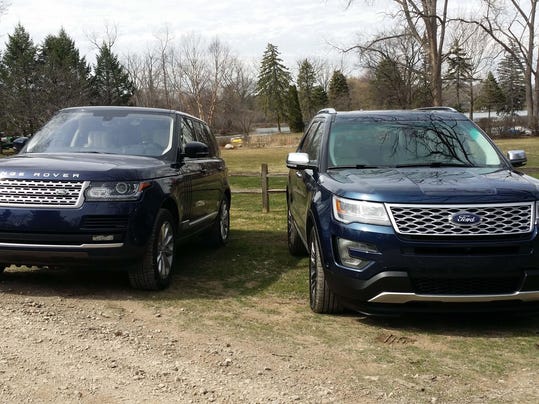
With its leaner face, the Platinum bears an uncanny resemblance to the HSE. Paint them both dark blue like my testers, and the Explorer could do an excellent Rover impersonation.
The stroll around the exterior of these rolling condos flatters both, even as differences emerge. With its longitudinal engine, the Range Rover HSE sports a hood the length of a cricket pitch, pushing the cabin rearward and giving it a hearse-like look. The transverse-engine Explorer, by contrast, looks more compact and is punctuated with its familiar, flying-buttress C-pillar.
The interiors could have been on “Lifestyles of the Rich and Famous.” Range Rover cut down a forest for more wood paneling than your average executive’s corner office. It’s so pretty I wanted to throw a tablecloth across it and order a meal with Mrs. Payne. Vase of flowers, garcon?
Rover’s perforated leather seats are more comfortable than the Ford’s cowhide, but no more capable (multi-way, massaging, heated front and rear). Two-tone interior. Stitched dashboards. Consoles? Brits and Americans understand the best infotainment access is via touchscreen and knobs — not rotary dials and mouse pads (ahem, looking at you, BMW and Lexus). Like a tour of a celebrity’s flat overlooking Central Park, Rover’s details separate it from Explorer’s mere executive digs. There are secret compartments under the armrest to hide important things that jewel thieves might miss. Beautifully trimmed, dual glove-boxes show up Explorer’s more pedestrian, hard-plastic model.
Turn on the Rover and a rotary shifter rises out of the console like a doomsday button. READY TO NUKE THE LANDSCAPE it seems to say.
And this is where the Range Rover puts on its super-ute cape. With its sophisticated four-wheel drive, this thing can climb Rushmore.
The Englishman rides noticeably higher in the saddle than the Detroiter because it’s built to conquer nature. Flip our testers like turtles and they are dramatically different: Rover’s underbelly is covered with rock-resistant armor. Enable the air suspension, and super ute will rise another two inches to leap tall boulders in a single bound. To crawl across a rocky landscape, Rover’s Reactive Grounding Response allows air springs to inflate independently to adapt over hostile terrain.
But with all that leather and wood inside — not to mention chrome-crusted body panels — would you ever want to go there? My duck-hunting pals laugh at the idea of Rovers in the Outback. Super utes are so beautifully tailored that the only field they’ll ever see is a soccer field.
And for such duty, the Explorer is more than capable. Indeed, the Ford makes soccer moms drool.
Get past the front thrones, and Platinum has rear details Rover can’t touch. Only the Ford comes with three-row seating — the third easily accessible with Ford’s two-step, middle-seat fold. And with the touch of a button, row three can perform more tricks than a Westminster dog show champ: fold, stow, go. The Rover sports a pickup-like drop-gate for tailgate parties. Clever. But only Explorer offers a kick-open option so you can raise the hatch when your arms are full of game — er, groceries.
The HSE’s diesel engine is a beast with 254 horses and 443 pound-feet of torque that could pull Michael Moore out of quicksand. But unlike supercars, engines don’t define super utes. Ford’s twin-turbo, 3.5-liter six, for example — the same workhorse found in the Taurus SHO and F-150 — boasts a very competitive 365 horses and 350 pound-feet of torque.
Where the Land Rover diesel excels is in fuel economy, pushing the 5,485-pound ute around for 25 mpg. The Ford turbo will manage just 18 mpg (I got 171/2 with my size 15 lead foot).
Once America gets through its collective freak-out over diesels, folks will remember they are the best way to move heavy vehicles. And with diesel prices in line with $2 gas these days, the fuel savings will earn back the engine’s $1,500 premium.
Speaking of premiums, the Rover doesn’t have to go all the way to Moab to prove its expensive, all-aluminum chassis engineering. Over dirt roads, Explorer’s bones are noticeably more brittle than the $106,000 Rover. Platinum may have similar sand and snow options, but super ute glides over rough terrain like it was born to it. Thanks to extensive cabin-quieting, Explorer’s rattle disappears on asphalt.
Stay away from Rolex knock-offs. But if a super ute is too rich for your blood, a half-price Platinum will do just fine, thank you very much.
2016 Range Rover HSE Td6
Front-engine, four-wheel drive, five-passenger SUV
$72,445 base ($106,325 as tested)
3.0-liter, turbocharged diesel V-6
254 horsepower, 443 pound-feet of torque
8-speed automatic
0-60 mph, 7.3 seconds (Car & Driver); top speed, 130 mph
5,485 pounds
EPA 22 mpg city/29 mpg highway/25 combined
Range Rover Report card
Highs: King of the Outback; elegant interior
Lows: Who goes to the Outback in a $100K SUV?; third-row seat, please
Overall:★★★
2016 Ford Explorer Platinum
Front-engine, four-wheel drive, seven-passenger SUV
$52,970 base ($54,760 as tested)
3.5-liter, twin-turbocharged V-6
365 horsepower, 350 pound-feet of torque
6-speed automatic
0-60 mph, 6.0 seconds (Car & Driver); 123 mph (governed)
4,939 pounds
EPA 16 mpg city / 22 mpg highway / 18 combined (manual as tested)
Ford Report card
Highs: Bang for the buck; three-row flexibility
Lows: Plastic interior trim; tinny chassis over bumps
Overall:★★★★
i-nnovative Toyota i-Road
Posted by hpayne on April 14, 2016

If buses, cabs and autonomous vehicles aren’t interactive enough for you, Toyota wants you to meet its i-Road three-wheeler. Part Jet Ski, part motorbike, part car, this sci-fi prototype from Toyota aims to explore the ride-share market frontier.
Like something out of the movie “Tron,” the two-door, battery-powered pod cuts through traffic like a motorscooter while offering the enclosed protection of a car. Just three feet wide and seven feet long, i-Road can be shoehorned into the tightest of urban parking sports.
Toyota gave i-Road demonstration rides at the SAE 2016 World Congress and Exhibition show in Detroit this week. Already on the streets in select Japanese and French cities, the i-Road would turn heads slashing through downtown Detroit traffic — but will likely make its debut in California cities where ride-share programs are common and where the electric i-Road can gain credits against the state’s draconian zero-emission regulations.
While other ride-sharing programs such as Zip Car, Car2Go and BMW’s ReachNowuse existing production vehicles like Smart Fortwos and BMW i3s, i-Road is unusual as a vehicle specifically targeted at the ride-share market. Although Bollore, a Paris ride-share company, began its “BlueIndy” service in Indianapolis, Indiana last fall using its own electric Bluecars developed by Italy’s Pininfarina.
Toyota’s three-wheeler was developed in Japan by a Toyota “skunk works” team tasked to create engaging vehicles like the Toyota 86 (formerly the Scion FR-S) sports car.
“We wanted to make ride-sharing fun to drive,” says California-based engineer Christopher Gregg, 36, who is developing the i-Road for the U.S. market. “It can really take a curve and delivers great maneuverability through city streets.”
Built with lightweight, carbon fiber-reinforced plastic on a steel chassis, the 660-pound i-Road (which, with its single locomotive-style headlight, resembles a Smart car smashed in a Panini maker) is propelled by lithium-ion batteries in the floor driving twin electric motors on the front wheels. A gyroscope regulates the vehicle’s lean angle and keeps it upright. The drive-by-wire steering system operates the rear wheel for a tight, 10-foot turning radius.
On a closed track in Cobo Convention Center’s main hall, the i-Road drove like a Jet Ski on wheels — leaning up to 26 degrees through slaloms and tight turns. The rear-wheel steering, however, lacks the precision of front-wheel steering at its 35-mph limit. Drive it like Tom Cruise in “Mission Impossible” and you might wind up like a gnat in the grille of an oncoming Chevy Suburban.
In more measured driving, however, the gyroscope is particularly adept at sensing slip angle. Stop on a dime in a turn, and the i-Road instantly rotates upright — unlike a traditional, wobbly tri-wheeler.
Like BMW’s ReachNow, Toyota’s ride-sharing plans are as flexible as the i-Road is in tight spaces. Download the smartphone app and — similar to an Uber app — available i-Roads light up the map. Pick the nearest one, turn it on, drive it by the minute. Then park it at your destination. The i-Road can be charged in three hours with a standard, 110-volt wall socket, and has a range of 30 miles (less in Detroit and other colder climates). The service is in use in Tokyo, Toyota City and Grenoble, France.
Toyota’s Gregg says the company still is working on the i-Road’s introduction in the U.S. The primary hurdle, he says, is a thicket of government regulation — for example, whether the car will be classified as a motorcycle (and therefore subject to state helmet laws) or as a so-called “neighborhood electric vehicle” (which would prohibit its use on highways).
IHS Automotive auto analyst Stephanie Brinley says the i-Road is an ambitious approach to a market that has been created almost overnight by the smartphone app revolution. Where autonomous cars offer the potential of ride-sharing fleets that can move themselves, vehicles like the i-Road offer customers the thrill of driving — without the overhead of owning a car.
“Automakers need to understand how ride-sharing impacts their sales model,” she says. “And they need to understand what the needs of the market will be — and if they can be profitable.”
Payne: Why I’m buying a Tesla Model 3
Posted by hpayne on April 6, 2016

I think the new all-wheel drive Ford Focus RS will run rings around the Tesla Model 3 for the same price. I don’t believe the gasoline engine is the Fifth Horseman of the Climate Apocalypse. I don’t think Uncle Sugar should hand out $7,500 checks to buy electric cars.
So why did I put down $1,000 to buy a $35,000 electric Model 3 last week?
Because it’s the most intriguing auto story since the Model T, and Elon Musk is the boldest America auto entrepreneur since Henry Ford. In short, I want to be along for the ride.
In 1908, Henry Ford introduced his $950 Model T to a customer stampede. “It was an overnight success,” says Matt Anderson, transportation curator for The Henry Ford museum. “With a lightweight, steel chassis and sophisticated engine, it was the first good, affordable car.” Sound familiar?
By 1917, Ford was selling a staggering 785,433 Model Ts a year for $360 a pop, hitting a peak of 1.8 million a year by 1923 at a price of just $260. The Model T single-handedly created a national network of gas stations. It spawned the Rockefeller Standard Oil empire.
And it buried the battery-powered cars made by competitors. Until now.
Late Thursday I signed into Teslamotors.com to report on the live webcast of the Model 3’s unveiling. I bypassed a form to reserve my own Model 3. At midnight, Musk introduced the 215-mile-range, $35,000 Model 3 to the world and autodom witnessed something new: Within 24 hours, 180,000 customers had signed up to buy it. It was no April Fool’s joke. By Saturday, that number had climbed to 232,000.
I talked with fellow auto writer Aaron Gold on the ground in Los Angeles. He said he hadn’t seen anything like the around-the-block lines at Tesla stores since the iPhone’s launch.
“We are simply awestruck by the demand surfacing for the Model 3,” wrote one auto analyst. Even Musk admitted he was surprised.
Saturday afternoon I was back at Teslamotors.com (Michigan, ahem, doesn’t allow Tesla stores) to drop my own grand for fear Tesla would shut down orders. After all, “in May 1909 Ford actually stopped taking new orders,” says Henry Ford’s Anderson, “because every car it could build had already been claimed.”
Why would I make a deposit on an untested car? With a featureless face that’s creepier than Voldemort? That I may not get until the end of the decade?
Because I already know what the Model 3 is capable of. It is, after all, the $70,000 Tesla Model S’s “mini-me.” And the Model S is unlike anything on the road (and, based on Tesla design sketches, I suspect that face is going to get more interesting)
The Model S, introduced as a 2012 model, has blown away the luxury car segment. Last year it outsold the iconic BMW 7-series and Mercedes S-Class. The reason is simple — it’s a high-tech rocketship. I have driven everything from the base 70-kilowatt Model S to the $139,000 P90D in “Ludicrous” mode. (The P90D goes from 0-60 mph in a dizzying — literally, its instant torque briefly unsettles the inner ear — 2.8 seconds.)
The Model 3 is to the Model S what the BMW 3-series is to the 7-series. It has the same DNA in a smaller package. The same aluminum chassis. The same batteries-in-the-floor design, which creates best-in-class passenger space and best-in-class center-of-gravity (for wicked-good handling).
Tesla confirmed my order immediately on Saturday afternoon.
Musk promises first deliveries by late 2017, though I’m dubious given past delays. Full production at Tesla’s Fremont, California, plant is not slated until 2019. California customers will be first in line with deliveries, which then roll eastward by region.
“Reason initial cars are delivered close to factory is to have rapid turnaround on early issues,” Musk tweets (imagine Henry Ford tweeting). And there will be “issues,” no doubt. The Model S has been plagued with quality problems, as might be expected from a startup manufacturer.
The Model 3 is hardly perfect and neither is its maker. Like the controversial Mr. Ford — who meddled in employees’ private lives and beat up unions — Mr. Musk is famously intemperate and has disingenuously claimed his cars produce zero emissions (in truth, auto electrification will require a massive expansion of centralized, carbon-powered infrastructure). Auto genius, it seems, breeds eccentrics.
It also breeds underdogs. And like Ford, Musk’s big, risky bets have made him an instant American folk hero.
The wait for my Tesla will be trying, no doubt. Especially since I have a lot of other cool cars on my wish list. Take Mr. Ford’s latest offspring — the 2017 Focus RS, which I will soon test.
The Focus RS, a $36,605 five-door, AWD hellion will never run out of charge on track days. It will spit snow in Detroit winters and stomp the Model 3 from zero-60 (4.6 seconds vs. a claimed sub-6 for the Tesla). A similarly equipped dual-motor, all-wheel drive Model 3 (like that tested by colleague Gold after the LA launch) will reportedly post an RS-like zero-60 time. But it will likely sticker north of $50,000. What’s more, the Ford’s face is a pet bulldog vs. the Model 3’s blank mug.
With a battery gigafacory still to build and billions in tooling still to assemble, Tesla may see half its buyers defect to the similarly capable Chevrolet Bolt due this fall.
Tesla is what inspired the 200-mile-range lickety-split Bolt. Musk’s vision has forced every serious automaker into the performance electric car space, from Chevy to Porsche (the Mission E) to Audi (the Q6 eTron). With the resulting volume in metro areas, the Model 3 & Co. will likely change energy infrastructure just as the Model T did. To paraphrase “Field of Dreams”: Sell them and the charging stations will come.
The Model 3 may not be the Model T. But it’s the auto story of the 21st century. And its mad genius creator will be tweeting every step of the way.
Payne: Camaro turbo-4 or V-6?
Posted by hpayne on April 5, 2016

The sixth-generation Chevy Camaro V-8 is a sensation. I’ve flogged it from New Mexico to Phoenix to Death Valley and Metro Detroit, and shouted its praises along the way (if you can hear me over the 455-horse, 6.2-liter mill’s roar). Built on GM’s nimble Alpha platform – shared by the athletic Cadillac ATS – it has transformed the muscle car into a true sports coupe that bears comparison to more exotic performance coupes like the Cadillac ATS-V and BMW M4. Among its many rewards is Detroit News Vehicle of the Year and Motor Trend Car of the Year.
But wait, there’s more. There are two other engines available in the Camaro: a 3.6-liter V-6 and, for the first time, a base 2.0-liter, turbo four-cylinder.
Under pressure from government nannies to improve gas mileage – but also intrigued by the possibilities of mating a forced-induction four-banger with the lightweight (just 3,339 pounds!) Alpha chassis – Chevy is determined to show that a “four-hole muscle car” is not an oxymoron.
Last month, I finally got a chance to answer the question for myself. Does the four-cylinder belong in the Camaro? In a word: no.
Compared to the Camaro SS’s mighty V-8 roar, the 275-horsepower 4-banger offers a whimper. Both cars have the same wicked, angled look after all. Revving the four is like watching King Kong open his mouth – and hearing Jennifer Tilly’s voice out.
Good lord, has the poor monster been neutered?
Four-bangers belong in boxy hot hatches, not muscle cars. The good news is that the Camaro’s six is a glorious symphony. Which is what you want in your sleek, $39,000 coupe because the competition is the boxy, $39,000 hot hatch at the stoplight next to you.
The under-$40k performance segment is a boiling piranha tank of competition these days with some of the most capable bargains on the planet: Rear-wheel drive Mustangs and Challenger R/Ts. The all-wheel drive hatchback Ford RS, VW Golf R and Subaru WRX STI. Forget your $70k Porsche Caymans and Corvette C6s – mid-priced performance machines are Tasmanian devils by day, yet remarkably refined at night when you need to impress your date.
Mind you, the base Chevy turbo-four still shows off the Camaro’s capable chassis. In a series of hot laps around Spring Mountain Raceway outside Vegas, the coupe was noticeably more capable than its Gen 5 predecessor and a new Mustang V-6. Though the new Mustang’s brakes and acceleration are excellent, its chassis engineering can’t hold a candle to Alpha. It just ain’t fair to outfit a pony car with a luxury-class sports chassis. What is Mustang supposed to do? Build its next generation around the Ford GT supercar’s carbon-fiber tub?
But against demonic AWD track hounds like the Subaru STI, Camaro’s gotta bring more to the knife fight than a four-banger. Here’s my recommended shopping list from GM’s weapons depot:
1. 335-horsepower V-6 mated to 8-speed transmission ($2,900).
2. RS package: 20-inch wheels with run-flat tires, rear spoiler ($1,950).
3. Dual-mode exhaust ($895).
With the eight-speed automatic transmission, I almost forgot how much I prefer sticks. Stomp the accelerator when the light turns green and the 335 ponies under the hood roar, the eight-speed tranny barking with each quick upshift. Throw out the anchor into a turn and the transmission mimics manual – rev-matching each downshift as if invisible race booties are heel-and-toeing an invisible clutch pedal. It’s addicting. The automatic matches my experience in Camaro’s big brother Corvette C6 which also sports a superior auto transmission to its meaty, seven-speed manual box in which – with its three gates – you can easily lose your way like a kid in an amusement park maze.
Is that third gear or fifth? I better go back to fourth and start over. . . .
I raced back and forth through Oakland County’s roads, a happy predator on the hunt for hot hatches. As readers of this column know, I am a Golf R/GTI partisan, but for the same money the V-6 Camaro offers more dramatic styling and rear-wheel performance. The R, of course, provides irreplaceable all-wheel capability in Michigan’s endless winters (it’s April, for goodness sake, and the snowy forecast is still spooking my motorhead pals from throwing summer tires back on) – but the Camaro’s electronics have helped make the pony more confident on its feet.
Dig deeper in the Camaro’s touchscreen (located just above the signature, rotating aviation air vents) and the features are impressive. Under “Engine Sound management” you can choose “Auto, Stealth, Tour, or Sport” modes.
The growl of the V-6 in Sport never gets old. And predators got to growl.
2016 Chevy Camaro Turbo-4 and V-6
Specifications
Vehicle type: Front-engine, rear-wheel drive, four-passenger sports convertible
Price: $26,695 base ($39,940 V-6 as tested)
Powerplant: 2.0-liter turbocharged 4-cylinder; 3.6-liter V-6
Power: 275 horsepower, 295 pound-feet of torque (turbo-4); 335 horsepower, 284 pound-feet of torque (V-6)
Transmission: 6-speed manual; 8-speed automatic
Performance: 0-60 mph, 5.5 seconds (turbo-4, automatic), 5.1 seconds (V-6, automatic)
Weight: 3,339 pounds (turbo-4); 3,435 (V-6)
Fuel economy: EPA 22 mpg city / 31 mpg highway / 25 combined (turbo-4); EPA 19 mpg city / 28 mpg highway / 23 combined (V-6)
Report card
Highs: V-6 growl; rifle-quick 8-speed automatic
Lows: Turbo-4 needs more bark; pill-box visibility
Overall:★★★★
Payne on Tesla’s Model 3: Where’s the face?
Posted by hpayne on April 5, 2016

The “Mini-Model S” is finally here. After years of anticipation, the mid-market, $35,000, electric Tesla small sedan — what Tesla mad genius Elon Musk calls the “final step in my Master Plan” — finally showed its face to the world Thursday night.
And the world immediately thought: Where’s the face?
Like Hollywood’s sunglasses-shod Invisible Man, the Model 3’s front end is featureless but for its headlights. No nose. No mouth. None of the familiar vents on our gas-powered cars because, of course, battery-powered vehicles don’t need openings to cool the radiator. Yet, even big brother Model S featured a non-functional, plastic grille — complete with Tesla logo — because we humans are comforted by anthropromorphic features on the front of our cars.
The Model 3 is a bold — if somewhat creepy — re-interpretation of front car design. Tesla insists that the prototype Model 3 shown in Los Angeles is production ready – but I would urge Tesla to add some graphics or sculptural elements (check out a McLaren or Acura NSX hybrid, for example) to its mug to compliment the car’s otherwise familiar, sexy Model S-like body lines.
It’s so naked. But hardly unfamiliar. Indeed, the face harkens back to the first mass market EV to hit California in 1996: The equally blank GM EV-1. GM’s own EV efforts are a reminder that the Model 3 is not alone in the “affordable” electric segment. Unlike the sensational, $70k Model S – which outsells traditional, luxury, gas-powered icons like BMW and Mercedes in the gold-plated chariot segment – the Model 3 isn’t the only toy in the $35k EV toy store.
The compact, 2017 Chevy Bolt EV goes toe-to-toe with the Model 3. Spec-to-spec.
Both are sleek, roomy, four-door compacts. Both are priced in the mid-30s ($37k Bolt, $35k Model 3). Both boast a range of 200-plus miles on a charge. Both have neck-snapping, 0-60 acceleration (under 7 seconds for Volt, under 6 for Tesla). Both store their batteries in the floor giving them low-center-of-gravity, nimble handling. Both offer “floating,” sci-fi, center consoles with large, iPad-like screen displays (the Model 3’s is landscape-sized as opposed to the Model S’s portrait configuration).
I was not at the Los Angles reveal, but my North American Car of the Year jury colleagues colleagues Aaron Robinson (Car & Driver) and Aaron Gold(AutoExpress.com) were – and their brief, parking-lot, first rides in the Model 3 echoed similar impressions of the Bolt’s debut: Instant torque, surprising head room for compact cars, cool vibe.
There are differences too. The Bolt is more crossover-like with a higher seating position and rear hatchback that will be pleasing to our SUV-obsessed market. The Model 3 makes up for its lack of hatch with a trunk. Learning from the EV-1’s numb design, the Bolt’s stylish, Chevy-like face is more welcoming than the Tesla even as the Model 3’s sleek, simple lines are more aesthetically appealing. After all, the Tesla is designed to compete against other $35k luxury compacts like the BMW 2-series and Audi A3.

That may make the Bolt a tougher sell since it is, well, a Chevy. As Gold says: “Comparing Tesla and Chevy is like comparing Apple and Microsoft. Brand matters.”
Luxury buyers are used to paying $35k for compact sedans. But will they pay $35k for a Bolt the size of a $17k Chevy Cruze? Slap a Cadillac badge on the Bolt and it should sell like hot cakes. The Volt-in-a-tuxedo Cadillac ELR shames even Tesla as the best-looking, battery-powered compact made.
But for now the most crucial difference between Bolt and Model 3 may be the delivery date. The Bolt will arrive late this year. GM, after all, has done this before. Startup Tesla? Maybe late 2017. Maybe 2018 given the brand’s history of delays. Maybe longer.
Maybe it will be enough time to grow a face.
Payne: The first convertible V-8 of spring
Posted by hpayne on March 31, 2016

Ah, spring. The snow has thawed. The skies are painted blue. And Detroiters’ ears strain to hear the sweet song of the first …
No. Not the first robins. The first new convertible V-8 of spring.
This year it’s a 2016 Camaro SS and its voice is music to my ears. Turn the key and the BLAAAAT! of the familiar quad-exhaust fills the air. With an insane 455 horsepower, the SS lopes down the street with a menacing gurgle. Stomp the pedal and the rear end briefly twitches with delight under the 455-pound feet of torque. This bird can fly.
It’s on sale now, and I’m happy to tell you it was worth the wait of the long winter. With the sixth-generation Camaro, GM has torn up the pony-car playbook and put a muscle coupe on a luxury performance platform. It’s the same backbone that stiffens the Bimmer-beating Cadillac ATS-V coupe. (Comparo test to come: Why pay $80,000 for a nimble 425-horsepower M4 when you can have a nimble 455-horse Camaro SS for $50,000?)
The Camaro isn’t a muscle car, it’s a sports car.
My colleague Pat Devereux of “Top Gear” argues that with the latest chassis upgrades of the clinical Camaro and Mustang, only the brutish Dodge Challenger can still be classified as a muscle car on the grounds that its old school, V-8-on-a-sled can still scare the pee out of you. Unleash a Hellcat’s 707-horses and you might wind up upside down in a tree. To paraphrase Hemingway: “Only the Challenger R/T, Scat Pack and Hellcat are muscle cars — the rest are just sports cars.”
A fair point. But surely the Camaro SS convertible is still a terror? After all, the last generation Chevy was a capable if overweight athlete. But when it went topless, its ginormous, 20-inch hooves rampaged through corners like a Pamplona bull.
Not this droptop. Like the sublime Corvette C7 (with which it shares an LT1 engine), the SS was conceived from the ground up with the convertible in mind. That means its modular structure is not only significantly lighter than its predecessor by 275 pounds — but lighter than the last-generation coupe. Extensive bracing does the rest to deliver 10 percent more torsional rigidity. An Underbody “X” brace. Underbody “Y” brace. Tower-to-tower brace. Front engine compartment “V” brace. And so on. This beast is strapped down tighter than Hannibal Lecter.
But the effect is a car that feels as nailed to the pavement as its Chevy SS coupe brother. And I tested it over a lot of pavement in Death Valley, California.
The Woodward Dream Cruise is held in perfect, 80-degree Michigan summer weather because it’s 125 degrees in Death Valley in the summer. If Dairy Mat sold ice cream here it would melt before it got to your mouth. You could cook hamburgers on a topless SS’s leather seats.
But Death Valley in winter is as pleasant as a Motor City August. Eighty degrees. Low humidity. And the roads! Miles of State Route 190 are straight as a shotgun barrel. Think of Woodward Avenue without stoplights.
This is Camaro convertible country. And when you get there you don’t have to stop to stow the roof.
The SS not only shares its chassis with ATS and engine with C7, it also gets the ’Vette’s hat. It’s like being the third Manning brother. Slow to below 35 mph and the SS top will retreat beneath a lovely rear tonneau cover. Which will be a relief to your Dream Cruise passengers in the backseat who have been sitting with their legs crossed under them all this time because the rear seats have less legroom than Delta coach class. Now they can sit on the rear deck and wave to the crowds.
On Death Valley’s Route 190, they might reconsider. With no intersections and sightings of other vehicles as rare as raindrops, my SS had plenty of room to stretch its legs. Keep the side windows rolled up and the cabin is surprisingly free of buffeting at high speeds. How high? The SS will rocket to 125 mph in the blink of an eye. The governed 155 mph top speed is not far beyond that. Yet with my $53,000 SS’s planted steering, magnetic shocks and stiff springs, the SS is a locomotive on rails.
Brother Devereux would be disappointed. No fear here.
The convertible also solves the Camaro’s legendary visibility problem. With the roof up the Camaro bears an uncanny resemblance to a World War II pillbox with its narrow slits for windows and a blind spot the size of Donald Trump’s ego. How tall are the Camaro’s flanks? I’m 6-foot-5, and my elbow rests on the door sill next to my ear.
So what? If you want visibility, buy a minivan. If you want a wicked muscle coupe that looks like a front-engine Lamborghini and sounds like Godzilla gargling jalapeno peppers, get an SS. And with the top down, you get the V-8 at full volume — its eight-speed automatic tranny spitting a peppery bark with each 6,500 rpm upshift.
Inside, the convertible’s interior is the same, quirky office as other Camaros. Same cool, central, aviator-style cooling ducts located so low in the cabin that only your elbows get air conditioning. The same infotainment screen angled downward so you can barely read the nav map through your 7-Eleven cup’s reflection. The same side pockets located so far back on the front doors they may as well be in the backseat (maybe on purpose so passengers have someplace to put their legs)
Luckily, it has the same awesome bolstered seats and heads-up instrument display because you’ll be spending hours in this car gulping asphalt at an alarming rate of knots.
I reached Death Valley’s Furnace Creek — which once hit 134 degrees, the hottest temperature ever recorded in the US — after 97 miles on an 84-degree March day in the hottest convertible Camaro has ever made. My blood-red steed had delivered me without convertible cowl shake, back discomfort or a misplaced wheel. A $73,000 Corvette Convertible cruised by in the other direction. Best-ever 455-horse ’Vette droptop, or the supreme 455-horse Camaro for 20 grand less?
It’s nice to have choices as you emerge from hibernation. Nice to finally hear the first V-8 of spring: RRRRWAUUUUGGGGHH!
2016 Camaro SS convertible
Specifications
Vehicle type: Front-engine, rear-wheel drive, four-passenger sports convertible
Price: $44,295 base ($53,075 2SS as tested)
Powerplant: 6.2-liter V-8
Power: 455 horsepower, 455 pound-feet of torque
Transmission: 6-speed manual; 8-speed automatic
Performance: 0-60 mph, 4.0 seconds (automatic), 4.3 seconds (manual); top speed, 155 mph (governed)
Weight: 3,685 pounds
Fuel economy: EPA 16 mpg city / 25 mpg highway / 19 combined (manual as tested)
Report card
Highs: Ferocious performance; glorious open-air sound
Lows: Balky manual shifter; eccentric ergonomics
Overall:★★★★
Chrysler Pacifica designer makes minivans cool again
Posted by hpayne on March 31, 2016

To reinvent the minivan, Chrysler turned to a mom from Tajikistan.
Irina Zavatski, a 38-year old mother of two, is lead exterior designer for the striking, all-new 2017 Chrysler Pacifica that has redefined elegance in the dowdy minivan segment. Like generations of Detroit companies before it, Chrysler drew on the region’s diverse immigrant community to make it happen.
Jewish émigré Zavatski and her family fled religious persecution in their native, majority-Muslim Tajikistan in 1994 as the country descended into civil war after its independence from the former Soviet Union.
“I was just 15 when we came to the United States,” explains Zavatski. “My mom explained to me she wanted a better future for her children.”
Educated at the Cleveland Institute of Art, Zavatski’s design future is bright — and thanks to her innovative design, so is that of Chrysler’s crucial minivan line. Typical of Fiat Chrysler minivans, the Pacifica is a Swiss Army knife of functionality, boasting innovations from hands-free sliding doors and a tri-pane moonroof, to Stow ’n Go seating. But it’s the Pacifica’s sleek exterior design that is crucial to keep customers coming back to minivans in an SUV-obsessed nation.
Zavatski and her team had to think outside the boxy minivan. Yet, she knew from her own driving experience that she couldn’t sacrifice function to form.
“The exterior is a huge part of the story,” says Zavatski, who has an 8-year-old son and a 5-year-old daughter. “The fact that I drive one and I knew how useful the vehicle was, for me I want to keep all of that functionality but make it look really beautiful. This is a very personal vehicle for me.”
The result is a sculpted body with brush-like chrome lines and a distinctive, lower bow-tie grille. Her efforts got raves when the production Pacifica debuted to media this month. “The Pacifica is one of the best-looking van bodies ever plopped atop four wheels,” raved auto enthusiast-bible Car and Driver.
Ralph Gilles, Fiat Chrysler’s head of global design, said, “I brought on Irina straight out of the Cleveland Institute of Arts and have watched her grow as a designer. Her vision — to make the all-new Pacifica more of a sculpture on wheels and at the same time appear to have organically grown that way — was not easy. She is a true industrial designer that, as a mom, happens to appreciate the incontestable virtues of a minivan.”
Zavatski earned her stripes the hard way.
She didn’t speak a word of English 22 years ago when her parents and older brother arrived in Cleveland after her mother’s sister — also a Russian transplant — helped them escape Tajikistan’s violence-torn capital.
“We came to Cleveland (because) they have a large Jewish support system,” recalls the designer. “The Jewish community center helped us settle in. They gave us loans for the first four months that we could pay off later.”
While she adjusted to her new surroundings in Cleveland’s South Euclid suburb — learning English by watching TV and observing her classmates — she took refuge in her artwork.
“I turned to art a lot as an escape from not knowing the language,” she says. “I had very good art classes.”
She also had an older brother who loved to build model cars — models that his little sister would play with after she managed to get them down from his hiding places when he wasn’t around. By college, she knew she wanted to go into automobile design — if she could convince her engineer father first.
“I went to Cleveland State first because my Dad said ‘Artists starve, so you can’t go to art school,’ ” she says. “I convinced him to take a tour of the Cleveland Institute of Art and we went into the transportation design program, and I said, ‘This is what I want to do.’ I think I convinced him I could make a living doing this.”
Multiple design internships — including one at GM — and a degree in product design later, Chrysler recognized her talents.
“I brought on Irina straight out of the CIA and have watched her grow,” says design chief Gilles. “She was involved in the new minivan project almost from the beginning.”
With the Pacifica, Zavatski was given a rare opportunity — designing a new product from a clean sheet. She brought her own style and background to the recipe.
“I feel that as a designer all your experience in your life influences what you draw,” she says. “I do feel like not being from here, I bring something different to the table.”
She describes her style as simple: sketching out a full vehicle in three or four lines then filling in the details. It suited Chrysler’s elegant design language that premiered with the 2015 Chrysler 200 mid-size sedan. The 200 is rounded — free of corners — which suited Zavatski’s goal of eliminating the van’s mom-mobile stigma.
“When we started working on it, I heard a lot of the stigma thing,” she said. “To be perfectly honest, I really didn’t get it because I didn’t grow up here. But I could tell people felt like they had to give something up to own one… so I want to make this awesome because I want moms to be happy driving it.”
With the Pacifica behind her, she has moved on to a Jeep crossover project. But as she looks forward to new challenges, she hasn’t forgotten her past. She reconnected with her best friend from Tajikistan in Moscow in 2012. And both her children are learning Russian so they can converse with their émigré grandparents when they visit them in Cleveland in mom’s new minivan.
Genesis shows its future with concept car
Posted by hpayne on March 25, 2016

New York – At the New York auto show this week Hyundai’s Genesis luxury brand rolled out a show-stopping ceramic-blue concept with copper highlights called the “New York Concept.” Big, bold and dramatic, it is a classic, one-off design concept made from bespoke materials that will never make production: carbon-fiber body, 3-D-printed details like “cheese-grater” side vents, and a futuristic, curved instrument display right out of a “Star Trek” movie.
But the New York Concept is still one of the most significant cars in the show because it makes a big statement: Genesis is not Hyundai.
“We are in the starting point of the brand,” said Hyundai Chief Designer Thomas Burkle. “The idea is to shape the brand and say what Genesis is really about.”
After years of consideration, Korea’s largest automaker has decided to spin off Genesis as an athletic, affordable luxury brand aimed at the U.S. market — just as other manufacturers have before it. Lincoln and Audi have long been the luxury divisions for Ford and Volkswagen respectively, while more recently Japanese giants Toyota (Lexus), Honda (Acura) and Nissan (Infiniti) have also created premium marques.
But unlike those manufacturers, which share front-wheel drive with their parent company’s mainstream products, Genesis will build separate, rear-wheel drive chassis like Cadillac, BMW, Mercedes and Alfa Romeo. On the other hand, Hyundai will not immediately create Genesis dealerships. Learning the difficult financial lessons of Acura and Infiniti, Genesis will continue to be offered as premium cars within Hyundai dealerships as the brand builds identity in the luxury market.
The New York Concept is key to distinguishing Genesis’ style from its Hyundai parent.
The midsize Genesis (soon to be Genesis G80) and big G90 (introduced at the Detroit Auto Show) are the brand’s first, rear-wheel drive sedans. The New York Concept takes the same basic design language of its production siblings — then previews future design and products, most significantly a G70 sedan that will surely be the brand’s volume leader.
“There is some link from this car to a future G70,” says designer Burkle. Other sources have gone further, telling The Detroit Bureau that the New York Concept, known internally as the IK and bearing the same dimensions as a small luxury car, will be badged the Genesis G70 and take on BMW’s 3-series and Audi’s A4. A production version will likely offer a variety of drivetrains in addition to the concept’s hybrid system. The car’s platform will ultimately support two additional Hyundai models: A compact crossover and sports coupe.
Signaling its determination to build a German-fighting luxury brand, Genesis hired away Burkle from BMW and design boss Peter Schreyer from Audi to sculpt Genesis’ signature design (its Audi-like “shield grille” is certainly his inspiration).
“The concept has short overhangs in the front, pushing the front wheels as far out as possible,” says Burkle. “Then the shape pushes out and emphasizes the rear wheels. You create a luxury car where you not only want to sit in the rear — you want to drive it. Maybe this is a little bit of European spice that we add. It’s fun to drive.”
He also emphasizes the “Korean way of thinking” in design, particularly the show car’s simple lines and the ceramic color.
Hyundai is also learning from the Japanese luxury experience. Or unlearning it.
Peter Lanzavecchia, a Hyundai-Genesis dealer in Philadelphia, also owned an Acura dealer when Honda first launched its luxury brand in separate dealerships.
“With Acura it was tough to open up a dedicated facility for a brand that hadn’t earned its premium stripes yet,” he said at the Genesis event. “Genesis will be more transitional. We can start the brand in Hyundai’s showrooms, and then as we grow awareness and product we can bring them into stand-alone facilities.”
“This is not a show car. It’s a glimpse into the future for Genesis,” said senior designer Luc Donckerwolke at the unveiling.
Payne: Chrysler Pacifica minivan makeover
Posted by hpayne on March 24, 2016

Outside an elementary school in Pasadena, California, my 6-year-old nephew and four of his buddies crawled all the all-new 2017 Chrysler Pacifica’s interior. Call them Minivan Minions: They gleefully performed the stow ’n’ go trick of making the second- and third-row seats disappear into the Pacifica’s floor. After a flurry of pressed buttons, pulled levers and collapsed furniture, they stood triumphantly in the cavernous trunk.
“Whoa! This car is better than my Dad’s Tesla!” exclaimed one.
Who says minivans aren’t cool? An older friend breaks out in smiles at the mention of “Town and Country” because her rock band toured the country in one. What else will easily fit the neck of a bass guitar? A motorhead pal swears by his Dodge Caravan, which he fills with car parts from junkyard sales. Heck, even your 6-foot-5 scribe finds a Chrysler hauler the best mobile office in town. Climb in the spacious third row, flatten the middle seat — instant ottoman! — and I can work on my laptop for hours.
No, that infamous minivan stigma comes from you moms out there. You know who you are. Ahem, Mrs. Payne.
My better half represents a sizable demographic who swore they would never set foot in a breadbox on wheels. No sooner had minivans replaced the dreaded station wagon than the SUV came along and replaced the dreaded minivan. Soccer moms embraced high-riding utes, and minivan sales plummeted from 1.4 million in 1990 to some 513,000 last year.
So for ’17, Chrysler brought in heavy artillery to advance its next-generation van: a soccer-mom designer and a new name.
“I didn’t have a minivan stigma when I started this project,” says Pacifica exterior designer Irena Zavatski. “But I was determined that no one else would have one either.”
So the Russian emigre and mother of two set about making a curvaceous minivan that didn’t look like a minivan. Oooh, it’s pretty. Beginning with a Chrysler 200-esque front grille, the Pacifica’s lines swoop and dive and tumble like waves on, well … the Pacific(a) Ocean.
Two signature details deserve attention: The lower front grille is tied off at the ends like a Brach’s candy wrapper. And the body’s character line extends from the front fender before wrapping around the rear wheel well.
You can almost trace the lines of Zavatski’s brush as the chrome highlights flow thick to thin across her vehicle canvas. With the C-pillar blacked out, the side windows add proportion. It reminded me of the lovely VW Passat wagon I drove in France last summer. Or — more familiar to U.S. eyes — the Mercedes R-Class wagon.
That’s right, I’m comparing a Chrysler minivan to a Mercedes. Zavatski and her team worked with engineers on an entirely new minivan platform that pushes the wheels to the car’s perimeter, creating a more planted, athletic stance than the traditional breadbox. Replace the R-class wagon’s four doors with sliders and you’d swear Mercedes and Chrysler had never divorced.
Indeed, the first vehicle Mercedes and Chrysler collaborated on after their ill-fated marriage was the segment-busting, first-ever crossover: the 2004 Pacifica.
Built on the minivan platform, the original five-door Pacifica was curvy and sculpted. It was the anti-minivan for the minivan-shy mom. Sound familiar?
If it weren’t for marketing and quality mishaps, that cutting-edge crossover might still be with us today looking very much like the current van. Alas, it was discontinued in 2008.
But not before Mrs. Payne and I bought one. We raised our two boys in the Pacifica’s second-row captain’s chairs. My wife, then, should be in the demographic bulls-eye of Chrysler’s new product initiative.
Would she give a Pacifica minivan a look? You bet, though she stumbled over the absence of all-wheel drive.
It’s a rare oversight in the superb new product. But Chrysler has other priorities at the moment — like a plug-in hybrid to wow California soccer moms and meet that state’s onerous EV quotas. With its batteries in the basement, the first-ever battery-powered minivan will sacrifice its stow ’n’ go middle seats. But it will gain a low center of gravity and 30 miles of electric-only range. Check this space when the minivan-with-a-plug debuts this fall.
All-wheel drive will come. In the meantime, this front-wheel boat won’t make you seasick. Credit a stiffer chassis and a superb, weighted helm — er, steering wheel — that instills instant confidence. South of Los Angeles I dared to take the Pacifica where few minivans dare tread — on the switchbacks high over Lake Elsinore. It’s no sports car, but it competently navigated the mountain.
Happily, my inner boy-racer is distracted in the minivan because Chrysler’s interior is the best thing on wheels.
Like Honda’s class-bestselling Odyssey, Chrysler wisely chooses an open console so women can deposit their purses on the floor. The center island is unchanged from the Town and Country, but the front console turns into a digital bureau with the best-in-class UConnect infotainment system and a sliding drawer for iPods, socks whatever.
Echoing the exterior, the dash is beautifully sculpted with horizontal strokes that complement the exterior’s widened stance. If it weren’t for the faux-leather stitched material (you tell the difference?) it would be right at home in pricier, luxury chariots. Of particular note are the dash’s modular elements, shaped (appropriately) like an artist palette. Unlike Honda and Toyota, which leave blank buttons for vehicle options, no space in Pacifica is wasted. With new options come added buttons — or they are stashed just a touch away in UConnect’s screen.
The attention to detail is everywhere. And every detail is where it should be: Vacuum cleaner behind the left middle seat. The three-prong plug behind the right one (where I charged my laptop). Third-row moonroof with passenger-operated shade. Buttons on the inside of each B-pillar to close the doors — or to move the front seats forward to begin the stow ’n’ go procedure.
Quality-challenged Chrysler has been top-of-class in JD Power Initial Quality ratings for minivans. That must continue with a new platform.
Only the balky navigation system disappoints, as it does in nearly every vehicle compared to a smartphone’s Google Maps. Wait for the 2018 (AWD?) model which gets Apple Car Play and Android Auto.
The Pacifica makes minivans cool again. Put one in the garage next to your Tesla — and see which one your Minions prefer.
2017 Chrysler Pacifica
Specifications
Vehicle type: Front-engine, front wheel drive, seven- or eight-passenger minivan
Price: $29,590 base ($47,480 Limited as tested)
Powerplant: 3.6-liter Pentastar V-6
Power: 287 horsepower, 262 pound-feet of torque
Transmission: 9-speed automatic
Performance: 0-60 mph (NA); 3,600-pound towing capacity
Weight: 4,330 pounds
Fuel economy: EPA 18 mpg city/28 mpg highway/22 combined
Report card
Highs: Artful styling; best-in-class interior versatility
Lows: Limited version gets pricey; all-wheel drive, please
Overall:★★★★
VW Alltrack: an AWD Golf crossover
Posted by hpayne on March 24, 2016
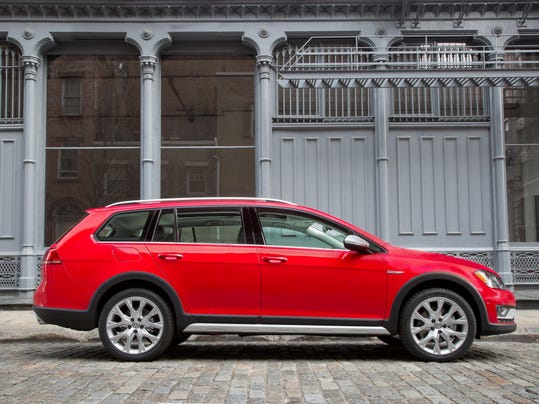
New York – If you can’t beat ’em, join ’em.
The No. 2 automaker by sales in the world, Volkswagen has struggled for sales in the U.S. It’s outsold by small-niche Japanese manufacturer Subaru. So VW has taken a page out of Subaru’s book and introduced an all-wheel drive compact wagon at this year’s New York auto show.
The 2017 VW Alltrack already is on sale in Europe, and packs the brand’s excellent Haldex all-wheel drive system into the award-winning, VW Golf Sportwagen clothing. The acclaimed Haldex 5 system — found in the hot hatch Golf R — can transfer up to 50 percent of power to the rear wheels, giving the car a sporty feel as well as excellent bad-weather traction.
Similar to the Audi A4 Allroad wagon that debuted at the Detroit auto show this year, the Alltrack is raised higher than the regular Golf hatch or SportWagen to give the car a crossover feel.
To further accent the rugged off-road vibe, VW adds body cladding, a unique grille, large wheels and “off-road mode” with hill-descent control. VW hopes the Alltrack will give the similar Subaru Crosstrek and Outback a run for their money — and give them a leg up on a wagon segment that has struggled against AWD crossovers.
“We heard from dealers and customers that they wanted to see a Golf SportWagen with the all-terrain capability that comes from an all-wheel drive system,” said VW America Product Marketing Chief Joerg Sommer. “We are excited to introduce the Golf Alltrack to meet the active lifestyle needs of our customers.”
Sitting on VW’s nimble MQB architecture — shared with the Golf and Audi A4 — the Alltrack will be powered by a 170-horsepower, 1.8-liter, four-banger.
F-Type SVR pride of big Jaguar litter
Posted by hpayne on March 24, 2016

New York – Jaguar hit the New York auto show with a roar this week as the resurgent brand unveiled its halo supercar F-Type SVR – the pride of its U.S. litter. With five vehicles in the market for the first time, Jaguar is a formidable force in an increasingly crowded market that includes new entries from Alfa Romeo and Genesis.
A product of Jaguar’s Special Vehicle Operations “skunk works” team outside Coventry, England, the SVR is the ultimate realization of Jaguar’s F-Type sports car. Bristling with carbon fiber, 16-inch front brake rotors, a rear wing and a snarling 575-horsepower V-8, the big cat can hit 200 mph and go zero-60 in just 3.5 seconds.
Equipped with snow-shredding all-wheel drive, Jaguar bills the F-Type as its “200 mph, all-weather supercar.” That is, if owners want to get this $125,000 beauty caked in salt.
“The wind tunnel tells is how this car should be shaped,” says designer Ian Callum, pointing out the car’s added side vents and rear wing for downforce. “This car is about physics.”
It’s also about setting the tone for a luxury lineup that extend the brand’s sporty lineage into sedans and crossovers.

The New York Show is as much about the F-Pace — Jaguar’s new crossover — as it is about F-Type. Jaguar’s first-ever crossover joins the F-Type and a full sedan lineup of XE, XF and XJ. Like other sports car manufacturers, Jaguar is following Porsche into the SUV segment and its outsized profit margins — not to mention outside customer demand.
“The world told us we had to do it,” Callum said.
Significantly, though, Jaguar has chosen not to compete against Porsche or Maserati, which ask premium, $70,000-plus stickers for their Cayenne and Lavante “sports car utility vehicles.” Jaguar is determined to take its sporty brand and compete head-to-head against traditional, volume luxury manufacturers like BMW, Mercedes and Audi. So it has priced the F-Pace starting at $40,000, the same as an Audi Q5 and well below a BMW M5. And it has given the F-Pace best-in-class rear legroom, trunk space and width.
Then Callum packaged it all in a shell meant to echo the $125,000 F-Type SVR. “I want a lot of F-Type in it,” says the English designer.
“I think it will be the best-selling Jaguar ever,” he says, just as sales for Porsche Cayenne and Macan SUVs have outstripped any sports car the legendary maker has ever made.
Sports cars turn heads at NY auto show
Posted by hpayne on March 23, 2016

Sports cars were the attention-getters on the floor of the auto show Wednesday. From the everyman’s Mazda MX-5 Miata with retractable fastback hardtop, to the snarling 575-horsepower Jaguar F-Type SVR, they looked like they were going 100 miles per hour standing still.
Mazda MX-5 RF
Is it a Porsche Targa? A Ferrari 308? No, it’s a new Mazda MX-5 Miata hardtop convertible.
Tongues were wagging at the MX-5’s New York Auto Show unveil over how radically different Mazda has gone with its retractable hardtop. So different that Mazda now calls its hardtop Miata a “retractable fastback.” So different that it drew comparisons to some much-pricier European sports cars.
Officially called the MX-5 RF (for retractable fastback), the wee Mazda sports a more sophisticated look in the small convertible-sports segment it has defined for over a quarter century. If “Targa” were not a Porsche trademark, the new Miata would surely get the name. Unlike the previous generation hardtop — or the base, $25,735 soft-top Miata — the RF features sloping “flying buttress” B-pillars that taper to the rear deck and remain standing when the roof folds behind the front seats.
Below the hardtop, the 2017 RF changes little from the popular fourth-generation MX-5 (other than a new color: “Machine Gray”) that has received rave reviews from the motoring press. In the U.S., the RF will sport Mazda’s “SKYACTIV” 2.0-liter engine pushing out 155 horsepower. Automobile magazine named the car one of its“2016 Automobile All-Stars” Tuesday — the latest in a string of baubles that includes finalist for 2016 North American Car of the Year and a spot in Car & Driver’s Ten Best List.
 Nissan GT-R
Whenever Nissan advertises a sequel to “Godzilla,” fans light up the Internet.
So when Nissan announced a refreshed GT-R (nicknamed after Japan’s favorite sci-fi monster) for this year’s New York show, expectations rose for the latest in all-wheel-drive sports car aggression.
Alas, Nissan’s promise of an all-new GT-R by 2020 is still in place. But the 2017 model is the most comprehensive refresh since the monster was introduced way back in 2007 — a lifetime ago in auto development.
To maintain its status as one of the planet’s fastest cars, it gets a stiffer chassis and more horsepower. The GT-R’s twin-turbo, 3.8-liter V6 now boasts a neck-snapping 546-horsepower — 20 ponies more than previously. And if more muscle is needed, Nissan offers the 591-horsepower Nismo edition (zero-60 in 2.7 seconds).
But the real focus is its refined wardrobe to address criticism this Godzilla was too raw in an era of plush, $100K-something Corvette Z06s and Audi R8s.
The bolstered seats are more comfortable. Shift paddles are now mounted to the steering wheel so motorheads can snap off gear changes mid-corner without having to move their hands from the helm.
Look for it at dealers late this summer.
AMG C63 Cabriolet
On the heels of the attractive Coupe crossover, Mercedes reminded the world why sedans are still the standard in auto beauty with the introduction of the stunning, 2017 AMG C63 Cabriolet.
The low-slung, drop-top version of the C-Class Mercedes — introduced to the world in Geneva earlier this month — now gets the brand’s ground-thumping, V8-powered AMG performance. Mercedes shoppers will now have a choice of a 469-horsepower, turbo-V8 in the AMG C63 or a 503-horse turbo V8 in the AMG C63 S. An AMG 43 is also available with a turbocharged V-6. The AMG Cabriolet joins a C-class sedan and coupe in the U.S. market.
The AMG 63 S will reach 174 mph and hit 60 mpg from a standing start in 4 seconds flat. It is distinguished by flared wheel arches at the front and rear, a wider track and large wheels. It will hit showrooms this fall.

Audi R8 Spyder
Spring must be in the air because performance cars were dropping their tops all over the New York auto show floor. The topless 2017 Audi R8 Spyder makes it all the better for drivers to hear the car’s glorious, screaming V-10 engine.
That V-10 is the same 8,700-rpm, 540-horsepower, 5.2-liter powerplant that motivates the R8 Coupe. Unlike the Mazda and its surprise Targa-style hardtop, the R8 convertible plays it safe, largely maintaining the previous-generation’s stowable open-cockpit softtop. Not that that’s bad.
Fifteen percent lighter and more chiseled than the previous R8, the Spyder is a high-tech wonder from its 12-inch, digital virtual cockpit display to its torque-vectoring, all-wheel drive system.

Jaguar F-Type SVR
Jaguar hit the auto show with a roar as the resurgent brand unveiled its halo supercar F-Type SVR — the pride of its U.S. litter.
A product of Jaguar’s Special Vehicle Operations “skunk works” team outside Coventry, England, the SVR is the ultimate realization of Jaguar’s F-Type sports car. Bristling with carbon fiber, 16-inch front brake rotors, a rear wing and a snarling 575-horsepower V8, the big cat can hit 200 mph and go zero-60 in just 3.5 seconds.
Equipped with snow-shredding all-wheel drive, Jaguar bills the F-Type as its “200 mph, all-weather supercar.” That is, if owners want to get this $125,000 beauty caked in salt.
Screaming V-10 Audi R8 goes topless
Posted by hpayne on March 23, 2016
“This engine is like listening to music,” smiled Dietmar Voggenreiter, Sales and Marketing Board Manager for Audi, as he unveiled the yellow and black show car with its distinctive, twin rows of cylinder intakes arching back from the open cockpit. Fifteen percent lighter and more chiseled than the previous generation R8 — a style common to the smaller Audi TT sports car introduced last year — the Spyder is a high-tech wonder from its 12-inch, digital virtual cockpit display to its torque-vectoring, all-wheel drive system.
“For Audi of America, the R8 started a revolution,” Audi America President Scott Keogh said of Audi’s brand-leading supercar. “It didn’t just win at the racetrack and become the car of superheroes, it truly added Audi to the luxury conversation in the U.S.”
To prove the track point, Audi unveiled the R8 Spyder on stage next to the winged R8 that won the GTD class at the Daytona 24-Hour race this February — beating out formidable competitors from Lamborghini, Porsche and the SRT Viper.
The GTD racing category is about to get even more competitive as Acura unveiled its NSX race car right across the show floor from Audi this afternoon. Sporting the same twin-turbo V6 (sans electric-assist) and bones as the production supercar, the NSX will likely go head-to-head against the R8 next year for mid-engine sports car supremacy in the sub-$200,000 class.
The R8 kicks off Audi plans for 12 all-new vehicles in the next three years, with an emphasis on the cockpit tech that has received raves from automotive media. The R8 Spyder will be produced along with the R8 Coupe outside Neckarsulm, Germany.