Articles Blog
Posted by hpayne on March 23, 2016

New York – Look out, Toyota Prius, you have company.
On Wednesday, Hyundai introduced three battery-powered Ioniq compact sedans aimed directly at the Prius family which has long dominated the compact-electric segment. Based on a new platform designed from the ground up for battery-powered drivetrains, the Ioniq family will come in hybrid, plug-in and pure electric guise. Hyundai claims it will best the Prius both in mpg (58 EPA combined for the Ioniq hybrid vs. 56 for the Prius hybrid) and in plug-in range (25 miles on battery-only for the Ioniq vs. 23 for the Prius plug-in).
In a press conference heavy on automakers’ responsibility to address global warming, the Ioniq was introduced by billionaire environmentalist David de Rothschild, heir to the Rothschild banking fortune, who proclaimed that “Hyundai’s vision is for a better world for us all.”
“People want to make the right choice for the environment,” said Rothschild who has circled the world preaching the importance of changing our lifestyles to prevent catastrophic climate change. But he said that the Ioniq would achieve “zero emissions with zero compromise” by offering attractive styling, a comfortable interior and digital connectivity including Apple Car Play and Android Auto.
The Ioniq, says Hyundai North America CEO Dave Zuchowski is also about meeting looming federal and California fuel economy mandates at a time when customer demand for EVs is declining amid high costs and low gas prices.
“The government demand that cars get 54.5 mpg by 2025 isn’t changing, so we need the product to get our fuel economy to that level,” said Zuchowski. “We have to create demand where is doesn’t exist.”
Zuchowski says that EVs have to be more than just a “just a way to save on gas” – they have to be “about our kid’s futures. When we got to market we focused on changing the world with no compromises. This car is nimble, it’s quick, it’s spacious in the way we package the batteries.”
The Ioniq chassis was built to put its lithium-ion batteries underneath the seats – with the pure EV version replacing the 1.6-liter, four-cylinder engine under the hood (in both hybrid and plug-in) with a 120-horsepower electric motor. Nissan hope the threesome will offer customers a wide verity of mobility options in order to increase sales volume. That volume, says, Zuchowski, is of paramount concern as California requires a percentage of sales to be “zero-emission” EV or hydrogen by 2020.
The pure-electric Ioniq and Hyundai Tucson hydrogen fuel-cell are the brand’s key compliance vehicles since “the hybrid vehicle doesn’t really count toward zero-emissions.”
The Ioniq welcomes you with a large, full-fascia version of the brand’s signature hexagon grille that provoke comparisons to Audi. With a sleek, sport-coups shape, the Ioniq sedans boast a best-in-class 0.24 drag coefficient. While attempting to broaden EVs’ appeal beyond eco-geeks, the Iconic also makes a nod to green enthusiasts with a dash made of compound resin derived from lava stone.
In a SUV-mad world, Hyundai Vice Chairman Eui-son Chung hopes that the Ioniq sedan will appeal to buyers with a vision for “freedom from anxieties about pollution, congestion, and traffic. It’s about driving comfortably in a world where environmental hazards are not the norm.”
Posted by hpayne on March 23, 2016

New York – On the heels of the attractive Coupe crossover, Mercedes reminded the world why sedans are still the standard in auto beauty with the introduction of the stunning, 2017 AMG C63 Cabriolet Wednesday morning.
The low-slung, drop-top version of the C-Class Mercedes – introduced to the world in Geneva earlier this month – now gets the brand’s ground-thumping, V8-powered, AMG performance. Mercedes shoppers will now have a choice of a 469-horsepower, turbo-V8 in the AMG C63 or a 503-horse turbo V8 in the AMG C63 S. An AMG 43 is also available with a turbocharged V-6. The AMG Cabriolet joins a C-class sedan and coupe in the US market.
“The C-Class is a decisive factor in our company’s success. The new combination of intensive open-air ambiance and powerful V8 engine is unique in the segment and perfectly supplements our large C-Class range,” says Mercedes CEO Tobias Moers.
The AMG 63 S will reach 174 mph and hit 60 mpg from a standing start in four seconds flat. The AMG model is distinguished by flared wheel arches at the front and rear, a wider track and large wheels. It will hit dealer showrooms this fall.
Posted by hpayne on March 23, 2016

Tongues were wagging at the MX-5’s New York Auto Show unveil over how radically different Mazda has gone with its retractable hardtop. So different that Mazda now calls its hardtop Miata a “Retractable Fastback.” So different that it drew comparisons to some much-pricier European sports cars.
That’s intentional, says Mazda’s North American Design Director Julien Montousse. “We want the brand to become more emotional,” he says. “Every car lover will fall in love with that roofline.”
Officially called the MX-5 RF (for retractable fastback), the wee Mazda sports a more sophisticated look in the small convertible-sports segment it has defined for over a quarter century. If “Targa” were not a Porsche trademark, the new Miata would surely get the name. Unlike the previous generation hardtop — or the base, $25,735 soft-top Miata — the RF features sloping “flying buttress” B-pillars that taper to the rear deck and remain standing when the roof folds behind the front seats.
Though the hardtop folds into the same space as the softtop, the mechanism is triggered automatically with a toggle switch in the center console. Hold it down and the hard top retreats between the flying buttresses – out of sight – in just 12 seconds at speeds of up to 7 miles per hour.
“We wanted to develop something completely different,” says Mazda’s Director of Brand Experience Jeremy Barnes.
Below the hardtop, the RF changes little from the popular fourth-generation MX-5(other than gaining a new color called “Machine Gray”) that has received rave reviews from the motoring press. In the US, the RF will sport Mazda’s “SKYACTIV” 2.0-liter engine pushing out 155 horsepower. Automobile magazine named the car one of its “2016 Automobile All-Stars” Tuesday – the latest in a string of baubles that includes finalist for 2016 North American Car of the Year and a spot in Car & Driver’s Ten Best List.
HIS Senior Auto Analyst Stephanie Brinley says the RF is “very pretty,” though the dramatic new design could “risk alienating loyal customers who will find the B-pillars reduce visibility.” Wary of the RF’s larger blind spots, Montousse says the RF will come standard with blind spot assist.
Since Mazda introduced the hardtop option in 2005, it has made up a healthy 50 percent of sales. Why fix what ain’t broken?
Just as the Gen-4 design gave the MX-5 an edgier 21st-century look that distanced the car from its retro-Lotus Elan origins, the RF looks to break hardtop convention.
Kelly Blue Book Managing Editor Matt Lorenzo says the RF is just what the market is looking for. “Styling is very important in this segment,” says the former Road & Track editor. “It gives the Miata a more mature look by picking up some Italian attitude.”
Though Mazda won’t release pricing until later this year, Brinley conjectures that the dramatically different RF might allow Mazda to fetch higher prices for the hardtop – increasing margins in a segment with stable sales numbers.
Posted by hpayne on March 23, 2016

New York – Whenever Nissan advertises a sequel to “Godzilla,” fans light up the Internet.
So when Nissan announced a new, 2017 GT-R (nicknamed after Japan’s favorite sci-fi monster) for this year’s New York auto show, expectations rose for the latest in all-wheel drive sports car aggression.
Alas, Nissan’s promise of an all-new GT-R by 2020 is still in place. But the 2017 model is the most comprehensive refresh since the monster was first introduced way back in 2007 – a lifetime ago in auto development. To mark the occasion, Nissan brought out the fastest man in the world, Usain Bolt, to introduce the fastest GT-R yet. The 2017 supercar features skin enhancements, a new interior and (naturally) better performance.
To maintain its status as one of the fastest cars on the planet, the ’17 model gets a stiffer chassis and more horsepower. The GT-R’s twin-turbo, 3.8-liter V6 now boasts a neck-snapping 546-horsepower – 20 ponies more than previously. And if more muscle is needed, Nissan offers the 591-horsepower Nismo edition (zero-60 in a Bolt-like 2.7 seconds).
But the real focus of this Godzilla is its refined wardrobe to address criticism that the beast was too raw in an era of plush, $100k-something Corvette Z06s and Audi R8s.
The dash has been completely reworked. The horizontally-flowed dashboard is wrapped in a single piece of Nappa leather – “stitched with Takumi-style precision” according to Nissan’s press release – and the center console is simplified, reducing the number of switches from 27 in the previous chariot to 11. The 7-inch touchscreen grows an inch and sports better graphics. The bolstered seats are more comfortable. Shift paddles are now mounted to the steering wheel so that motorheads can snap off gear changes mid-corner without having to move their hands from the helm.
Outside, the GT-R gains Nissan’s signature “V-motion grille” in order to look more like a Nissan family that includes the sporty Maxima sedan and stylish Murano crossover. A new hood helps stiffen the chassis, while aerodynamic tweaks to the front and rear increase downforce and sex appeal while maintaining the GT-R’s slick, 0.26 drag coefficient.
“As the icon of Nissan’s driving performance, the GT-R continues to evolve,” said Nissan Executive Design Director Mamoru Aoki in a statement. “With the signature V-motion grille, the GT-R now possesses the latest Nissan design language. Its exceptional aerodynamic performance and upgraded interior have given the GT-R a more mature character.”
With Active Noise Cancellation and new sound absorption materials – including an acoustic windshield – the GT-R promises a quieter cabin even as its prodigious power rattles the neighbors’ ear drums.
“The new GT-R delivers a heart-pounding driving experience at all times, on any road, for whoever sits in the driver’s seat,” said Chief Product Specialist Hiroshi Tamura. “We have continued to push its performance boundaries to the limit – at the same time, refinement has been added to take the driving experience to an entirely new level.”
Look for it at dealers late this summer.
Posted by hpayne on March 22, 2016
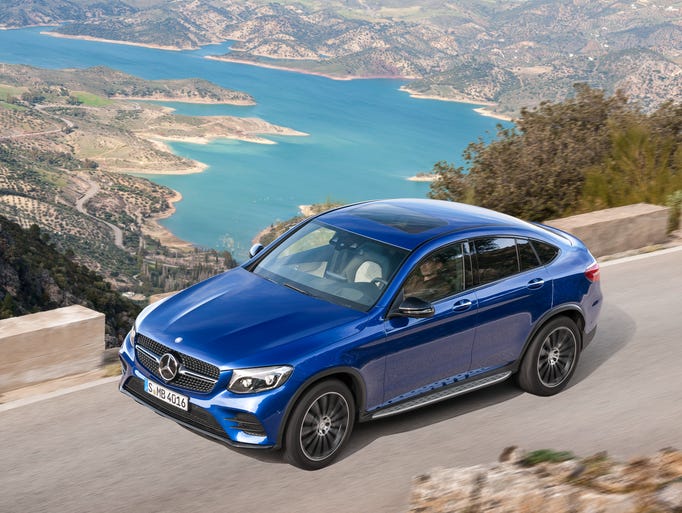
New York — Mercedes-Benz introduced the 2017 GLC Coupe crossover here Tuesday night — a sporty version of its popular GLC “small SUV.” Unveiled on the eve of New York auto show media days, the GLC Coupe continues German manufacturers’ expanded menu of SUVs as they try to feed America’s unquenchable thirst for luxury utes.
For the first time in the United States, Mercedes is also showing performance “AMG43” versions of both the GLC Coupe and regular, boxier GLC. The often-confusing, alphamumeric alphabet soup differentiates the luxury maker’s products in the SUV and sedan classes. “GL” designates crossovers, while “CLA” refers to Mercedes’ entry-level sedan — followed by larger C-, E- and S-class sedans.
“AMG” meanwhile, designates Mercedes’ performance models. So an AMG GLC43 SUV refers to the performance version of the brand’s small ute.
Adding to the confusion, the eye-catching GLC Coupe is not a two-door “coupe” in the classic sense, but a four-door with a coupe-like appearance. The GLC has similar lines to the larger, GLE Coupe. It comes with an available array of driver assist and safety systems — including thorax/pelvis side air bags for the front seats and an optimized window bag extending over both seat rows. The GLC Coupe will come standard with Mercedes’ signature 4MATIC all-wheel drive system and a nine-speed automatic transmission.
Dynamic and compact in appearance, the Coupe is more than 3 inches longer and some 1.6-inches lower than the GLC — with which it shares a platform. The front end is distinguished by a steeply-raked, diamond-radiator grille with Mercedes star logo implanted in the center. Large lateral air inlets add a sporty visage. That sportiness continues in the car’s profile with a high belt line, wide shoulders and sloping roof line that tapers at the tail. Huge 21-inch wheels are available when the vehicles debut in showrooms early next year.
GLC Coupe’s interior sports a single-piece, vertical console with Mercedes’ signature triad of aviator vents. An infotainment screen on the dash tops off the ensemble. The base GLC300 Coupe receives a flat-bottom steering wheel; the upscale AMG comes with an optional Sport Package.
Consistent with its sporty appearance, Mercedes’ aluminum-intensive suspension promises the SUV will have good handling propelled by a 241-horsepower turbo four-cylinder with 241 horsepower. The AMG Coupe (like the AMG CLA43 also on display) will get an injection of steroids — a turbocharged, 3.0-liter V6 with 362 horses that promises zero-60 mph in under 5 seconds.
The GLC will compete with BMW’s similar X4 “coupe” — and expand a ute lineup that boasts five SUVs including an even smaller, GLA-class, compact crossover. Along with similarly formidable lineups from BMW and Audi, Mercedes is well-positioned in the hot SUV market while Detroit luxury automakers Lincoln and Cadillac have struggled with three and two SUV models, respectively.
Not to be left out, Mercedes’ small, entry-level CLA-class sedan will debut minor upgrades.
The more significant face-lift appears on the performance AMG 43 model, which gets matte-titanium gray splitter inserts in the splitter and high-gloss black canards at the corners. Around back, the rear diffuser gets vertical fins, too. The CLA expands its standard equipment offerings with a rear camera and Active Brake Assist. And Mercedes catches up with Ford’s hands-free, “kick-me” trunk open feature as an option.
Posted by hpayne on March 22, 2016

The new Red Wings arena being built in Detroit, the expansion to the Big House at University of Michigan, the major overhaul of the Daytona International Speedway that debuted last month: All are part of an arms race to build venues that are as much about entertainment as they are about sports.
Helping make this boom a reality is quiet giant Barton Malow, a 90-year-old Southfield constructioncompany that has been the construction manager on all of these projects. Since it completed the Pontiac Silverdome in 1975, Barton Malow has been involved in the building of 60 major sports complexes across the United States. They range from Oriole Park at Camden Yards and the New England Patriots’ Gillette Stadium, to the Cincinnati Bengals’ Paul Brown Stadium and the in-progress SunTrust Park for the Atlanta Braves.
The $627 million Red Wings arena will set a standard for sports complexes when it is completed in September 2017, believes Ryan Maibach, CEO of Barton Malow. “I think we’ll see other arenas try to copy it,” he says of the yet-unnamed venue. Barton Malow also oversaw the completion of Joe Louis Arena in 1979.
The 20,000-seat facility just north of downtown will house two rinks — one for Wings games, one beneath that for practice and amateur events. Both are below street level to reduce the building’s visual profile to the surrounding neighborhood. The main rink will feature “gondola seating,” suite-like areas in the upper portion of the arena that will “hover” over the lower sections.
Other enhancements include plenty of dining options, a giant LED screen in an outdoor plaza and a “skin” on the outside of the arena that can display video and graphics. The venue will use a so-called “deconstructed” design with a glass-roofed concourse, offices, retail shops and restaurants in separate buildings outside the arena so that those venues can stay open even when the arena isn’t being used for a projected 150 events per year.
The first roof truss for the new sports complex was placed Wednesday.
Silverdome its big break
Barton Malow is on a short list of big-project construction firms that includes New York’s Turner Construction (which helped build Yankee Stadium) and Oklahoma’s Manhattan (the Cowboys’ AT&T Stadium).
Barton’s completion of the Silverdome in 1975 was its big break. One of the first football megaplexes, the Silverdome came on the heels of New Orleans’ Superdome, a project handled by another contractor that had been plagued by cost overruns.
Barton Malow’s efficiency in bringing the Silverdome in on time and budget polished the firm’s reputation in an industry that has to juggle huge capital project expenditures while keeping the cash flowing with ongoing sporting events.
In building the Daytona project, for example, Barton Malow had to work through two Daytona 500s. It had to coordinate construction with NASCAR in order to hit its mark with this year’s opening.
When Barton Malow was selected to build Red Wings arena along with partners White Construction of Detroit and Hunt Construction Group of Indianapolis, Ilitch Holdings CEO Christopher Ilitch said they had built some of the most innovative sports and entertainment venues across the country: “They were selected by Olympia Development over a number of top construction firms because of their sports and entertainment construction experience, construction management leadership and commitment to the local community.
What distinguishes modern sports complexes like the Red Wings arena and the $400 million remake of Daytona’s front-stretch grandstand is a more involving, more luxurious spectator experience. It’s not the diehard fans that sports organizers have been losing — it’s the more casual fans.
“These terrific venues have to compete against the comforts of home and high-definition televisions to get fans to come,” says Maibach. “Hence the investment in food services, scoreboards, Wi-Fi technology and sight lines.”
Aju Fenn, an economics professor at Colorado College who studies the sports industry, sees it this way: “The fan experience has been segmented into different price groups with different amenities so that sports complexes can appeal to fans at different price points. This allows sports firms to garner greater revenues compared to having a single type of seat and a few price categories.”
Daytona’s fans were focus
The re-imagining of Daytona International Speedway’s 3/4-mile-long main grandstand — unveiled at the Daytona 500 last month — was done with casual fans in mind. Every one of the 101,500 seats is within reach by no more than 20 steps. The number of restrooms has doubled to 1,891. There are 40 escalators. The number of concession stands tripled.
Known as Daytona Rising, the complex is billed as America’s first “motorsports stadium” with amenities similar to Comerica Park. (Barton Malow did renovation work on Comerica’s Pepsi Porch a couple of years ago.)
Daytona Rising might also be called “The House That Detroit Built”: Barton Malow is one of three key Metro area players that brought the project to fruition. Detroit-based Rosetti Associates was the lead design firm and Chevrolet is one of four “founding partners” (the others are Toyota, Sunoco and Florida Hospital) that supported the project from the ground up.
“Daytona is the only building project I know of where we had to take into account the curvature of the Earth because it is so long,” Maibach said. Although sports complexes represent only about 12 percent of Barton Malow’s portfolio — the company has more than $1 billion in annual revenue, according to Maibach — they are halo projects that showcase the company’s work.
Fans are welcomed into the Daytona complex through enormous entrances called “injectors,” each sponsored by a partner. Like anchor stores in malls, they give access to the facility as well as display opportunities for companies’ products. And they keep people hanging around and spending money if there are rain delays.
Chevy’s injector is designed to evoke a dealer showroom on steroids: Fronted by a vertical display of vehicles ranging from a Corvette to a Silverado pickup truck, it rises six stories and houses two showroom floors, sprawling concourse hallways, eateries and luxury suites to watch events like the Daytona 500 — or Memorial Day’s Country 500, featuring musical acts like Kid Rock, Willie Nelson and Little Big Town.
“We’ve been around NASCAR for a long time,” says Chevy Racing marketing chief Jeff Chew. “When Daytona came to us with plans for this rebirth, we were just blown away.”
Daytona’s motorsports stadium has generated some excitement since its opening: This year’s Daytona 500 was the first sellout since 2008.
Posted by hpayne on March 21, 2016

Porsche fans better get used to four-bangers.
On the heels of news that the six-cylinder mills in Cayman and Boxster sports cars will be replaced by turbocharged fours, Porsche will unveil a base model Macan crossover at the New York auto show this week that will also be powered by a four-pot turbo. Until now, the base Macan has been the 340-horsepower, six-cylinder Macan S.
The four-cylinder will save at the pump and in the wallet. The base Macan will improve fuel efficiency by 15 percent over the S (20 mpg city vs. 17) and sport a lower price of $48,550 — a whopping $7 grand below the Macan S. It also sheds 210 pounds over its six-cylinder brother.
Before they get too excited, Porsche fans should know the 2.0-liter turbo is not the same 300-horsepower, flat-four “boxer” gorilla found in the Cayman and Boxster sports cars (now called the 718 Cayman and 718 Boxster to indicate the new, four-cylinder direction). The Macan’s 4 comes off parent VW’s corporate shelf, but will still pump out a healthy 252 ponies and 273 pound-feet of torque (it’s been knocking around Europe for a couple of years). The base engine will be mated to Porsche’s quick-shifting, dual-clutch, seven-speed PDK gearbox. The 3,902-pound ute should go from 0 to 60 in just 6.1 seconds with a top speed of 142 mph.
Visually, the Macan four will look little different than its sibling S, Turbo and GTS models. It will come standard with all-wheel drive (optional air suspension), Bi-Xenon headlights, eight-way power front seats, Alcantara seat centers and a lane-departure warning system.
For more ferocious acceleration, Macan shoppers can opt for a 400-horsepower turbo. Porsche promises a sippier, diesel six will be added once the VW group’s Dieselgate storm passes. The new Macan will compete against the Mercedes-Benz GLC, BMW X3 and Audi Q5, and will hit showrooms this summer.
In addition to the Macan Porsche will be showing the 718 Boxster — with 300- and 350-horsepower engine options — in the U.S. for the first time as well as the 500-horsepower 911 R track weapon.
Posted by hpayne on March 20, 2016

There’s no winter so cold that a hot hatch can’t warm up.
It’s March in Detroit. Mid-winter break. Halfway to spring. Halfway? In my native South, March means short pants, blossoms exploding on cherry trees, sports cars gleaming with Turtle Wax.
Not Michigan. The groundhog sees six more weeks of testing rugged, all-wheel-drive SUVs, large sedans and pickups. So imagine my surprise to see a Ford Focus ST tester show up in my driveway. Black racing stripes down the hood. Recaro seats. Twin pipes out back. “Tangerine Scream” yellow paint practically melting two inches of snow off my driveway.
Hallelujah.
As good as SUVs are these days — see my recent rave reviews of the nimble Audi Q7, Ford Edge, and Cadillac XT5 — every garage should have a hot hatch in it. Like the family SUV, its five doors provide practical space and storage. But it also allows you to misbehave without taking out a whole block of mailboxes.
The ST is particularly naughty.
The proper hot hatch is the Volkswagen Golf GTI. The 2015 North American Car of the Year. A civilized pet that has been engineered to perfection by its German trainers. No torque steer. Perfect gearbox. Groomed, conservative design. You’d never see a GTI with racing stripes. The ST, by contrast, is the snarling Rottweiler you picked up from the pound.
It makes you nervous just looking at it. The huge, gaping mouth. You almost expect a little foam around the lips. Raked rear spoiler. It boasts a ferocious, 30 more horsepower than the GTI yet refuses to tame torque steer despite helpful spring-and-shock suspension tweaks that have improved cornering attitude. Stomp on the car’s accelerator and the leather-wrapped, flat-bottomed steering wheel practically rips out of your hand like a Rottweiler’s leash when he’s spied a bunny rabbit. The front tires squirm. The car darts back and forth across the road. It’s a hoot.
Still, 30 more beans does not translate into quicker zero-60 times than its German competition (6.3 second ST vs. 6.1 GTI according to our friends at Car & Driver). Credit Wolfsburg engineering that has made the Golf-on-’roids a perennial Car & Driver Top Ten pick. That masters-in-engineering also translates to smoother shifting, build quality, cornering, and … a sticker price at about a grand north of my Focus ST’s very affordable $31, 035.
Where the fearsome Focus excels is in the rear-view mirror. Plant yourself on someone’s bumper and they’ll break out in a cold sweat. Upgraded in 2015 to look even more menacing than before (if that’s possible), you can practically feel the Rottweiler breathing on your neck. The GTI, meanwhile, looks like, well, a Golf. Conservative, stealthy. Only its signature wheels give it away at a profile view.
Inside and out, the ST is infectiously naughty.
True, the cabin is a model of excellent ergonomics — typical of the Ford brand. The SYNC 3 console system is intuitive. Voice recognition excellent. Recaro seats fit like a glove. Excellent rear-seat head room thanks to the squared-off hatch. ST this even has a posh, heated steering wheel for goodness sake — heated all the way around (unlike, ahem, a recent Lexus I drove) for that warm and cuddly feeling on a wintry night. Ahhh, civilization.
Then I gaze down at the carbon-fiber shifter knob and matching handbrake. Naughty, naughty. In no time I am searching for an unplowed parking lot.
Let me explain. The transition to electronic parking brakes is one of the (rare) tragedies of the modern digital age. Yes, the little pull-up tabs are more space efficient than their handbrake forebears, but the pull-ups are handier for emergency stops and parking lot donuts. Especially snowy parking lots.
Locating one within miles of home, I stabbed the throttle (pedals are notably close together for quick foot work — whether misbehaving in winter or doing heel-and-toe downshifts on a Waterford Raceway track day in summer), yanked the parking brake and spun like a top.
Passersby must have smiled. Tangerine Scream tri-coat. Racing stripes. Mouth-breather. Sure, boys gotta have fun. If I had been in a conservative, civilized-looking GTI they probably would have worried.
These day, STs come with an all-season tire option — not just the summer gummies of yore. For a mere $30 you can have any-season confidence, – though you will sacrifice the limits of summer performance. What isn’t sacrificed is rear trunk space. Focuses, including the ST, can fold their rear seats flat making for a cavernous cargo hold just like their crossover cousins.
All the utility of an SUV, all the fun of a small supercar. Hot hatches warm my heart.
2016 Ford Focus ST
Specifications
Vehicle type: Front-engine, front-wheel drive, five-passenger hatchback
Price: $24,425 base ($31,910 as tested)
Powerplant: 2.0-liter, turbocharged, inline 4-cylinder
Power: 252 horsepower, 270 pound-feet of torque
Transmission: Six-speed manual
Performance: 0-60 mph, 6.3 seconds (Car & Driver est.); top speed, 150 mph (drag limited)
Weight: 3,248 pounds
Fuel economy: EPA 22 mpg city / 31 mpg highway / 25 combined
Report card
Highs: Aggressive wardrobe; A hoot to drive
Lows: Torque steer; Ticket magnet
Overall:★★★
Posted by hpayne on March 17, 2016

You want a rear-engine, super sports car for less than $200,000. But all your buddies at the club have Porsche Turbos, so you want something different.
Not Lamborghini Huracan different. You’re a modest Midwest dude after all — not a leather pants-wearing, lemon tart-dating, valet-park-my-supercar-in-front-of-the-Townsend celebrity. But still a car that’s wicked quick so you can take it to local track days. Mid-Ohio, Waterford, Gingerman. But you don’t want a stiff McLaren 570S with a carbon-fiber tub that’ll destroy tracks and then destroy your backside on the trip home.
Oh, and it would be nice if it were manufactured in the Midwest. Let me introduce you to the 2017 Acura NSX.
Four years in the making, the only made-in-America mid-engine supercar will roll out of Marysville’s Performance Manufacturing Center this fall. That’s Marysville, Ohio. Californians love their Silicon Valley-made Teslas. The Corvette Z06 (which will annihilate every mid-engine sports car in existence, but that’s another column) is the pride of Kentucky. Your Acura exotic is made this side of Columbus.
In 1990 Honda’s luxury division wowed the world with the NSX, a Japan-made track carving-knife blessed by Brazilian F1 superstar Ayrton Senna. For more than a decade it went toe-to-toe with European cutlery for a fraction of the price. Then it disappeared.
A generation later and the Acura NSX is reborn. It might have been endorsed by Senna again had he not died tragically in 1994. But now that the NSX is made in the Buckeye State it seems appropriate that Ohio-born IndyCar superstar Graham Rahal is its godfather (along with IndyCar mate Dario Franchitti).
Riding shotgun with Rahal at California’s Thermal Speedway, I got a front row seat to the screaming sequel.
Since NSX went away, the alphanumeric X badge has become shorthand for “crossover” in an American market obsessed with the things. Lincoln MKX, Cadillac SRX, Volvo XC90, BMW X1, X3, X5. Acura has its own popular RDX and MDX.
But NSX is no SUV. It’s back to broaden Acura’s appeal beyond crossovers — putting sizzle back in a lackluster brand. NS-XXX would be more appropriate.
Like its forbear, the NSX (short for New Sportscar Xperimental) takes the hybrid technology of 21st-century, million-dollar, sci-fi cyborgs like the Porsche 918 and Ferrari LaFerrari and stuffs it into a sub-$200,000 wrapping. If that lofty price still makes your eyes water (adjusted for inflation, a 1990 NSX would cost just $108,000), I understand.
But if a $45K Acura MDX is a bargain next to a $57K BMW X5, so is NSX a blue-light special next to a 918. Twin-turbo V-6. Lithium-ion battery. 573 combined horsepower. Aluminum-intensive chassis, plastic-composite skin, leather-and-Alcantara interior. That value proposition is key to Acura’s bold assertion that it can compete with the best athletes on the planet.
The $150K-$200K supercar segment has become a boiling piranha tank of competition. Lamborghini and McLaren, searching for more volume, have joined 911 and Audi R8 (and Nissan’s GTR Nismo and Aston Martin Vantage if we’re counting front-engine machines).
A $160K Acura? It starts to make sense.
You won’t emerge from the NSX through McLaren-like scissor doors, but it’s a handsome piece of art. For all its technical skills, Gen One was flawed with a rhino-sized booty. Gen Two is perfectly proportioned with the rear wheels pushed to the corners, arched greenhouse, and a short front porch for good visibility. Add 12 “Jewel Eye” headlamps and it’s a future classic.
Credit a compact, low-center-of-gravity driveline packaging a 75-degree V-6 with twin turbos, three electric motors (two-forward, one aft), and a 1 kWh battery laid like a slice of cheese between meaty engine and firewall.
Its buff proportions set, designer Michelle Christensen cut openings to feed the furnace within. Ten heat exchangers cool everything from electric motors to turbo intercoolers — so NSX gets massive side air scoops, hood fender vents and front chin intakes. At full thrust this rocket needs downforce lest it take flight — so more holes are punched in back to extract air and vacuum NSX to the pavement.
After a few laps with Rahal, I climbed in a sister NSX to follow his lead.
Nail the accelerator and the supercar takes off like a locomotive. Hybrid it may be, but NSX is no tree hugger (let me show you the BMW i8 on our menu, sir). That lithium-ion battery is committed to raw speed alone. With electric-assisted turbos, NSX delivers its 406 pound-feet-of-torque. Right. Now. The nine-speed, dual-clutch tranny barks off milli-second upshifts like a drill sergeant. Short of a Tesla P90D, it’s the most instant acceleration you’ll find. Well, shy of a $900,000 Porsche 918, anyway.
Starting to sound like a bargain?
Throw the NSX into Thermal’s 180-degree Turn One, and … well. You don’t throw the all-wheel-drive, 3,803-pound supercar into sharp corners. It’ll push like an ox cart. If you want to fling your supercar round a tight track, buy the rear-wheel-drive, carbon-tub McLaren. The NSX rewards big sweepers — or even better, open roads — where its AWD grips like ivy and the wail of the V-6 engulfs the cabin via two portholes in the firewall.
It’s an interior as efficient as the NSX’s exterior.
This isn’t a 911 with 500 button functions. The Acura’s four drive modes — QUIET, SPORT, SPORT PLUS, TRACK — are accessed through a single knob at the top of Acura’s familiar, button-shift sleeve. Launch control is a cinch: 1) TRACK mode 2) floor brake and accelerator pedal simultaneously 3) release brake. OMG.
A digital instrument display gives the pilot everything he needs behind the steering wheel. And what a wheel. Sculpted for your hands so they don’t need leave the 9 and 3 o’clock positions, it’s squared off on bottom and top (for better visibility).
“One of the signatures of this car,” grins Rahal.
Only the NSX’s slider-controlled infotainment system — from the Honda Civic parts bin — is out of place. But for you, my sensible Midwest supercar buyer, it’s a reminder that the NSX — unlike others in its upscale zip code — is manufactured in-house by an auto company synonymous with reliability. Where the thrill of supercars often comes with the agony of long hours at the shop, the NSX will deliver Honda reliability.
Which is important to you, because you’re driving the NSX to work. Marysville started taking orders Feb. 25. What are you waiting for?
2017 Acura NSX
Specifications
Vehicle type: Mid-engine, all-wheel drive, two-passenger sports car
Price: $157,800 base (about $180,000 pre-production prototype as tested)
Powerplant: 3.5-liter, twin-turbo V-6 with three electric-motor hybrid assist
Power: 573 combined horsepower (500 V-6, 73 from 1 kWh battery), 476 pound-feet of torque
Transmission: Nine-speed dual-clutch
Performance: 0-60 mph, 2.9 seconds (Car & Driver est.); top speed, 191 mph (manufacturer)
Weight: 3,803 pounds
Fuel economy: EPA 20 mpg city / 22 mpg highway / 21 combined
Report card
Highs: Instant, twin turbo-electric acceleration; cabin fits like a glove
Lows: Lofty sticker; Honda Civic infotainment screen in a supercar
Overall:★★★★
Posted by hpayne on March 16, 2016

Pahrump, Nevada — Rocketing out of turn one at Spring Mountain Raceway in the 2017 Camaro ZL1, General Motors President Dan Ammann sticks with Vice President for Product Development Mark Reuss like glue.
With the Camaro’s V-8 bellowing in our ears like Kraken unleashed, Ammann stuffs the Camaro into fourth gear just shy of the 7,000 rpm redline. The speedometer hits 122 mph before he hauls it back to earth for turn 2. “The brakes are just tremendous lap after lap,” the bearded, New Zealand native shouts over the howl.
This is no video game. These are two of the top auto executives in the world going at it hammer-and-tongs in the most capable Camaro ever. Track-licensed Ammann and Reuss not only manage the development of GM’s cars — they test them to the ragged edge of their capabilities.
Riding shotgun with Ammann at Spring Mountain this month, I got a glimpse at a unique partnership in the auto industry. The two executives are as capable in fast corners as they are in the corner office.
He’s really good,” Reuss says of Ammann. “(Our driving skills) help product development every day … because we both understand cars, and what a broad torque range means and all that stuff.”
Their track-bred insight has helped take GM’s performance to new heights as the company has unleashed one critically acclaimed car after another: the BMW M3-hounding Cadillac ATS-V, the Corvette Z06 supercar, the nimble Gen-6 Camaro.
Now comes the ferocious ZL1, which marries the neck-snapping power of GM’s 640-horsepower, supercharged LT4 V-8 — the same mill that powers the Z06 Rex — with the athletic Camaro’s Alpha platform. The platform shared by the Cadillac ATS, the best-handling car in luxury.
As is the team of Ammann and Reuss, an unlikely bromance between a veteran GM motorhead and a Wall Street financial guru who share a passion for cars. When Ammann joined GM’s executive team in 2011, Reuss sensed his talent for the track.
“I told the guys to put him in the driver program,” said Reuss. “He’s going to be able to do a very high level — I can see it in his temperament.”
An intense, year-long licensing process ensued, juggled with Ammann’s 24/7 duties managing GM’s marketing and sales. “It started at Milford in an STS as I recall,” says Ammann, who is designated a top-flight “Level 6” driver.
“The program we have is an achievement-based program. It’s very intense,” says Reuss, also a Level 6. “Very few go to the point where they can do Nurburgring (the legendary, 13-mile German track) and all those things within a tenth of a second of a professional driver.”
Ammann’s talent is evident as he smoothly whips the Camaro from turn to turn. I’ve raced go-karts and race cars since my teens. It’s in my bones. It’s more difficult to learn the instincts of any sport late in life — much less one where speeds can push 200 mph. Yet Ammann has mastered the art.
Today, the two men routinely test cars at GM’s Milford proving grounds, sharing feedback with top engineers like Corvette’s Tadge Juechter and Camaro’s Al Oppenheiser. GM CEO Mary Barra also visits Milford’s proving grounds, though usually on her own schedule. Last October, Ammann and Reuss took the ZL1 to Nurburgring where the car lapped while wearing leopard-spotted camouflage. They liked the result.
“The best Camaro I have ever driven,” says Reuss.
Ammann says, “It cuts like a knife. It makes 640 horsepower feel more approachable.”
The product of more than 100 hours in the wind tunnel, the muscular Camaro is 200 pounds lighter than the previous-generation ZL1, gains 60 horsepower and features 11 heat exchangers to cool the 378-cubic-inch monster beneath its aerodynamic skin. But the ZL1 is more than a fast muscle car.
It is also the first application of Chevy’s high-tech, lightning-quick 10-speed transmission. Jointly developed with Ford and planned for eight Chevy models for model-year 2018, the 10-speed shifts faster than many dual-clutch transmissions found in supercars.
The ZL1 also gets six-pot Brembo brakes with 15.35-inch rotors the size of Captain America’s shield; Recaro seats; wider front fenders; and special Goodyear tires.
It goes on sale this fall.
“The Camaro ZL1 is designed to excel at everything,” said Reuss. “Acceleration, handling and braking — with the highest levels of technology and perfect chassis damping, (it’s) suitable for everyday driving. It will compare well to any sports coupe, at any price and in any setting.”
At Spring Mountain, Reuss piloted a 10-speed, Ammann a 6-speed manual.
Who’s faster on track? “That’s classified,” jokes Ammann, his hair matted after 22 hot laps.
“Honestly, we don’t (compare lap times),” says Reuss. “We never do that because when you get into that sort of thing it’s not safe.”
Camaro sales are up 44 percent this year over last, the Corvette Z06 is clocking test times quicker than $200,000 Lamborghinis, and the development teams are having fun.
“It beats the office at the Ren Cen,” Ammann says.
Posted by hpayne on March 10, 2016

In response to a revved-up grassroots racing community, a bipartisan bill was introduced this week which exempts the modification of production cars for competition from the Clean Air Act.
It comes in response to language issued by the Environmental Protection Agency that would make such changes illegal — an action critics said would reverse decades of precedent and threaten the $30 billion racing parts industry.
The Detroit News first reported last month that Congress was considering legislation after an online petition by the Specialty Equipment Manufacturing Association gathered more than 150,000 signatures.
“The EPA’s new interpretation of the Clean Air Act would essentially rewrite the law and 46 years of policy and practice,” said SEMA President and CEO Chris Kersting. “Without congressional intervention, the racing community and racing parts manufacturers would be operating outside of that new law and could be targeted for enforcement.”
The uproar came in response to language added to the Clean Air Act’s Heavy-Duty Greenhouse Gas rules that asserted “certified motor vehicles and motor vehicle engines and their emission control devices must remain in their certified configuration even if they are used solely for competition.”
The EPA has downplayed the rule change. It says the agency “remains primarily concerned with cases where the tampered vehicle is used on public roads, and more specifically with aftermarket manufacturers who sell devices that defeat emission control systems on vehicles used on public roads.”
While not disputing the EPA’s responsibility to regulate cars modified for the street, opponents feared the agency’s language exposed parts makers to future regulation — in effect chilling the development of superchargers, turbochargers and other aftermarket equipment.
Introduced by Congressmen Patrick McHenry (R-N.C.), Henry Cuellar (D-Texas), Richard Hudson (R-N.C.), Bill Posey (R-Fla.) and Lee Zeldin (R-N.Y), the “Recognizing the Protection of Motorsports Act” would reiterate Congress’s decades-old intent to exclude off-road vehicles from the Clean Air Act.
An EPA representative said “the agency doesn’t comment on pending legislation.”
The proposed regulations are scheduled to be finalized this summer. The congressional action comes at a time when the EPA’s efforts to expand regulation of carbon dioxide from the automotive and energy sectors have provoked lawsuits and become an issue in the presidential campaign.
Republican candidate Marco Rubio responded to SEMA’s petition by calling for the EPA to revoke the rule. “For years, Marco has been talking about the EPA’s affinity for job-killing regulations, but they go after Americans’ hobbies with pointless power grabs, too,” the Florida senator posted on his website. “Now, the EPA is coming to your local race track.”
Posted by hpayne on March 10, 2016

Americans love comeback stories. Peyton Manning, Robert Downey Jr., Steve Jobs.
One of my favorites is ex-Detroit Piston Grant Hill, a superstar swingman whose bad left ankle sidelined him four years before he returned to showcase his skills to fans into his late 30s. A star in a team sport, he finally got the supporting cast he needed with the 2010 Phoenix Suns to make a deep playoff run.
We’re rooting for Cadillac’s comeback, too. An iconic luxury brand overtaken by self-inflicted wounds and superior foreign competition in the ’90s, Caddy has been on the rise for more than a decade with talented sedans: the nimble ATS, the ferocious CTS-V, the sublime CT6. Each is an all-star at its position.
But the superstar in Cadillac’s resurgence will arrive this spring: the midsize crossover XT5.
How good is the new XT5 (formerly the SRX)? Let me count the ways. It has so perfected Cadillac’s Art & Science design that it’s not an oxymoron to call it an “attractive SUV.”
Its rear legroom has grown three inches in a class where it matters — not just to 6-foot-5 apes like me, but to everyone. Yet the overall vehicle is the same size. That means with its lightweight chassis and upgraded, five-link rear suspension it is fun to drive.
Cadillac just needs to build a team around it.
Trucks and sport utes are where Detroit makes its dough, yet somehow Cadillac missed the crossover wake-up call. The XT5 is the only unibody ute in Cadillac’s lineup. While I was ogling the XT5 in California last week, Audi was introducing a new Q2 subcompact SUV to add to its compact Q3, mid-size Q5 and large Q7. Sure, Cadillac boasts the money-making (make that money-gushing) Escalade, but that’s a truck-based behemoth unique to the U.S. market. The brand’s only weapon against the Audi crossover army (or BMW’s army of Xs or Mercedes’ GLs) is the XT5.
The good news is Cadillac’s new XT nomenclature signals a cavalry on the way (likely XT4 and XT6) led by XT5 and Cadillac President Johann de Nysschen.
The formidable South African has been here before. He steered Audi North America from a Volkswagen sub-brand to a ute-birthing powerhouse in a market that craves everything on stilts. In the XT5, he has delivered a vehicle that matches Audi’s handsome styling and athletic AWD chassis. And more.
By increasing the XT5’s wheelbase by two inches over the outgoing SRX while keeping the same exterior dimensions, the Caddy looks more athletic while growing the wheelbase a full seven inches over an Audi Q5.
Good luxury makers have unmistakable nightlight signatures: BMW’s glowing halos and Audi’s repeating LEDs. Add Cadillac’s teardrop LEDs to the list. In daylight the XT5 also wows with its distinctive pentagon grille, chiseled flanks, and door-mounted mirrors which add both cockpit visibility and sports-car looks. No detail is overlooked, including a rear wiper hidden under the rear aero-canopy so as not to clutter rear visibility.
Kick open the rear hatch (more on that later) and interior details impress, too. The rear seats fold flat for uniform storage space. In addition to that extra three inches of leg room, rear passengers can slide their seats, heat them, even recline them 12 degrees. If airlines had seats this comfortable they wouldn’t have Chuck “There Oughta be a Seat Room Law” Schumer sitting in their lobbies. The interior room rivals class leaders Mercedes GLE and Lexus RX in size, yet the Caddy’s chassis puts it in another league handling-wise. Thanks to extensive computer modeling and acres of adhesives, the XT5 loses 278 pounds over the SRX, making it a whopping 650 pounds lighter than the Merc and 100 pounds shy of the Lexus.
Settle into the Cadillac’s nicely bolstered but comfortable seats, and the Cadillac flows through corners with minimal body roll and planted handling. Hustling across Orange County’s curvy Route 74, the XT5 nipped at the heels of a spirited Porsche Cayenne. When the road ironed out, however, the Caddy’s 320-horse, 3.5-liter V-6 was no match for the Porsche. The Caddy’s lightweight athleticism seems at odds with the V-6’s lack of low-end giddy-up.
Where the Caddy also bears resemblance, regrettably, to the Porsche is in pricing strategy. The base XT5 comes below $40K — a BMW X5’s room at an X3 price — and the costs quickly escalate from there. Indeed, an AWD XT5 (preferred for Michigan winters) isn’t available until $10,000 north of the base model. The XT5 comes with an impressive array of toys from a kick-open trunk to self-park to 360-degree camera. But these niceties are only available with the Premium Club starting in nose-bleed $57,000 territory.
Stroll across the street to the Ford dealership and you’ll find the XT-5 look-alike Edge with the same features for $10,000 less. The Edge has also gone on a diet and will offer you three engines including a gutsy, 315-horse turbo V-6.
They say Neiman Marcus customers don’t shop K-Mart, and luxe buyers don’t browse mainstream. Maybe they should.
America’s comeback kid wipes the floor with German luxe competitors in console usability (ask me again when the next Q5 gets Audi’s superb Virtual Cockpit upgrade). Women need a place for their purses (and motorheads need a place for our GoPro satchels).
So the XT5 opts for an e-shifter that — like the Chrysler 200 and Lincoln MKZ before them — opens a roomy cubby below the console. Brilliant. No clunky rotary dials clog the center console to access the infotainment screen. The touchscreen will do fine, thank you very much. And with a faster processor and improved volume controls, CUE (short for Cursed User Experience) is finally livable. Which is not to say I like it.
Smartphones continue to be light years ahead of cars in navigation usability, a fact that GM recognizes by offering Apple Car Play and Android Auto. Ask my phone to map the route to “San Juan Capistrano” and it does.
Android Auto was buggy in my tester. Make sure it works like a champ before you leave the dealer.
Pound-for-pound, dollar-for-dollar, the Cadillac XT5 is better than any player in the hot-selling midsize segment. With a few more crossover teammates for support, Cadillac may yet make it all the way back.
2017 Cadillac XT5
Specifications
Vehicle type: Front-engine, front- or all-wheel drive, five-passenger SUV
Price: $39,990 base ($55,385 AWD Premium trim as tested)
Powerplant: 3.6-liter V-6
Power: 310 horsepower, 271 pound-feet of torque
Transmission: 8-speed automatic
Performance: 0-60 mph (NA)
Weight: 4,257 pounds (AWD as tested)
Fuel economy: EPA 18 mpg city/26 mpg highway
Report card
Highs: Chiseled styling; composed handling
Lows: Pricey options; more engine choices, please
Overall:★★★
Posted by hpayne on March 9, 2016

In its battle for luxury relevance against Germany’s top automakers, Cadillac has forged some of the best sedans in the world: the 2013 North American Car of the Year ATS, Car & Driver Top 10 pick CTS, and the luxurious cutting-edge CT6.
Yet when the all-new, 2017 XT5 crossover debuts in showroom’s later this month, Cadillac will still boast only one crossover at a time when sport utility vehicles are the hottest vehicles on the planet.
While General Motors and other Detroit automakers have pioneered SUVs — bringing record profits — Cadillac has been conspicuously absent at the party. As a result GM’s luxury automaker has struggled to gain market share.
“When I discussed it with product planning, they looked at me with a bit of puzzlement and said: ‘There is no company in the world with a wider range of crossovers than GM,’ ” recounts Cadillac President Johan de Nysschen, who took over the iconic brand in 2014. “The problem is, that doesn’t include Cadillac.”
With XT5, that is about to change. Cadillac plans four new crossovers (including the XT5) by 2020. Built on an all-new platform that will be the backbone for future product, the mid-size XT5 also replaces the outgoing SRX — Cadillac’s best-selling vehicle — with a new XT nomenclature for SUVs.
Leading the charge is de Nysschen, who is remaking Cadillac within GM as an
autonomous brand.
“It’s been the smallest brand in a giant corporation,” said de Nysschen in Los Angeles where the XT5 was being previewed. “Without 100 percent focus on the luxury brand, it tends to get consumed by the needs of the big brands.”
Karl Brauer, senior analyst for Kelly Blue Book, said Cadillac is reversing its 25 percent sales slide in the last decade.
“In recent years it’s been all about putting out fires at GM,” says Brauer. “In that world, Cadillac just doesn’t rank as high. (GM) had to their get most important divisions sorted first. In that race, GMC and Chevy were more important — and they needed leadership for Cadillac.”
De Nysschen has been here before. In 2004 he was given the job making Audi a focused, luxury brand apart from its Volkswagen mother ship.
“There is nobody at Audi who also works on VW,” he says. “They have dedicated resources. They spend their entire working day planning for utter and complete annihilation of the competition.”
“I was one of the original Audi brand warriors,” continues de Nysschen, recalling VW CEO Ferdinand Piech’s shakeup of the company when he took over in the early 1990s. “In the mid-’80s, Audi was like Opel, it was nothing special. Piech … gave Audi the autonomy it needed and said: ‘Go for it.’ When I came over to the U.S. in 2004, (it) was the last major market to set up the brand separation.”
Since then, Audi’s U.S. sales have more than doubled on the strength of its SUV growth. In 2015 Q3, Q5, and Q7 crossover sales were up 30 percent, leading a record 202,202 in Audi unit sales.
De Nysschen has brought that focus to Cadillac. “(It) explains why we’ve decided to go to New York,” he says “Because the luxury market is different than the mainstream market. Autonomy, move to New York, focus on the luxury market.”
Despite the change in focus and crossover nomenclature, de Nysschen still sees a market for Cadillac’s big, truck-based Escalade ute.
“How does Escalade fit into the master plan at Cadillac in such a way as you don’t end up undermining the very things that have made it so successful?” he asks rhetorically. “We have found a solution. “It will also represent progress in terms on technology and sophistication. We want to ratchet it up because there is room between the XT5 and Escalade for another vehicle. Maybe two.”
With his team now firmly ensconced in the hip SoHo neighborhood of New York City, de Nysschen is bullish on Cadillac’s future.
“In the last 12 months they’ve made massive progress,” he says. “I consider Cadillac on a whole the most underrated brand on the market.”
Posted by hpayne on March 5, 2016

America’s Car Museum CEO David Madeira has trekked through Cambodia, Turkey, Sardinia. And the Himalayas. Three times. On a motorcycle.
He should do interviews wearing an Indiana Jones fedora, jacket and leather whip wrapped around his shoulder.
For his latest adventure, the rugged 65-year-old is leading what he calls the “Smithsonian of Car Museums” in Tacoma, Washington. It’s a vision built on late refuse magnate Harold LeMay’s epic car collection with ambitions to educate a new generations of vintage car mechanics and bring our auto heritage to drivers everywhere.
One of those road trips, “The Drive Home,” featured three cars from ACM – a 1957 Chevy Nomad, ’61 Chrysler 300G and a ’66 Ford Mustang – driving 3,170 miles from Tacoma across the Rockies to the Detroit auto show in January. Naturally, Madeira led the way in the red ’Stang.
I sat down with the ex-University of Illinois fundraiser to talk about America’s largest car museum, mechanics and crossing the Khardung La pass.
Q: You a car guy from birth?
Madeira: I think every boy who grew up in the ’50s and ’60s was a car guy. I loved British sports cars and motorcycles.
Q: First car?
Madeira: Triumph TR3.
Q: What’s in your garage now?
Madeira: My daily driver is an F-150 pickup truck. I also have a 1983 Porsche 911S convertible. A 1973 Norton Commando 850 that I just finished restoration on – British, one of the sexist motorcycles you’ll ever find. 2009 Royal Enfield Bullet 500cc motorcycle I bought in Bhuton after riding across the Himalayas. I had to have it.
Q: You’ve circled the world. What’s your most harrowing journey?
Madeira: Total wild-ass adventure was this summer in Kashmir. (Four couples on motorbikes) rode up into the Himalayas (in) the disputed area with Pakistan. Way out there. As remote as you can get today. We went over this pass called Khardung La (Ed. note: The highest vehicle-accessible pass in the world), which is 18,406 feet. We were held by the Indian army for four hours because there were avalanches up there. We could hear cannon fire behind us in a border flare-up. They (finally open the road) and all these vans and Tata trucks made a race for the top. I’m two-up with my wife on a 1950s Royal Enfield. We’re riding through sleet and snow, thunder and lightning, on an all-dirt road. No guardrails. I’m riding with the screen of my helmet flipped up so I could see. There had been three avalanches that day and (there were) boulders everywhere. We’re riding through raging waters and about 20 km from the end one of our guys hits a boulder he doesn’t see and breaks a leg.
Two people (not in Madeira’s group) died on the mountain that night – crushed by rocks from avalanches. I would do it again tomorrow in a moment.
Q: What’s next?
Madeira: Patagonia in 2017.
Q: What did LeMay’s collection look like when you started?
Madeira: The collection went back 100 years. It was mostly American. And if you walked through it, what you saw was America’s experience with the auto. He had collected 3,000-plus cars that ranged from absolute junk in the field with trees growing through them to million-dollar Duesenbergs. He had 227 Chevrolets. It was mind-boggling.
Q: What’s it mean to be the “Smithsonian of Car Museums”?
Madeira: Most museums struggle – because it’s someone’s wonderful collection. In 30 years no one’s going to care – it’s not a sustainable model. (Ours) was always a larger vision celebrating America’s love affair with the car. To tell the story of its impact on American life.
Then the vision grew to: How do we differentiate ourselves and be sustainable? I have great respect for craftsmen, but our schools don’t teach those shop skills anymore. The car has had more impact on American life than any other product in the 20th century. How do we preserve that heritage? Part of it is keeping cars on the road. So we got into the Hagerty Education Program to fund wooden boat-building programs (because the skills are related) and schools like McPherson College in Kansas and high schools in Michigan that are providing the education for kids.
The third piece is we want to get the cars out and drive them – like the Drive Across America to show the relevance of the car today. For our members we create unique driving experiences and events all the time.
Posted by hpayne on March 3, 2016

If Pei Wei started making its $10 Mongolian beef as tasty as P.F. Chang’s $17 version, why would anyone go to the upscale eatery? Service, presentation, interior design, perhaps. But you’re rolling your eyes because it ain’t gonna happen. Cars are a different story.
Thanks to digital technology and engine downsizing, the “democratization of autos” is here.
Take the $27,000 Hyundai Elantra that I just drove. It has the same rear seat space as the $45,000 Acura RDX and $50,000 Lexus NX in my driveway. Same seat/mirror auto memory. Same heated rear seats. Same Apple Car Play/Android Auto connectivity. Actually, the RDX and NX don’t have the latter two. See what I mean?
How does luxury stand apart? Service, presentation, interior design.
The NX and RDX have the service thing down cold. As Japanese automakers in the compact crossover space, they long ago made their name with bulletproof reliability and fawning dealer service. Lexus set the standard with salesman who would sell you a car, then come home and shovel your driveway. Acura ain’t so shabby either.
But presentation has been a challenge. Unlike BMW and Mercedes, which only do upscale, Acura and Lexus are under the same corporate umbrella as Honda and Toyota, respectively. Similarly, P.F. Chang’s and Pei Wei are owned by the same company and compete at different price points.

Acutely aware that it hasn’t done enough to distinguish its luxury and mainstream menus, Lexus has gone over the top in presentation. It’s as if an upscale eatery went out and hired architect Frank Gehry to design its exterior. Lexus SUVs boast an edgy, look-at-me design. Sports Illustrated supermodel Hailey Clausen is their spokeswoman. The NX’s intimidating face won’t be mistaken for Hailey. It looks like the Darth Vader Edition of a “Star Wars” Starfighter. Love it or hate, the new look of Lexus has gotten noticed.
An octogenarian friend recently bought a new Lexus RX (Not to be confused with Acura’s RDX. These alphanumeric badges make me crazy.) and loves the dramatic design.
Me: Even that Darth Vader grille?
She: I actually rarely see the front of my car since I park it nose first into my garage. But the sides I really like.
There you have it. Different. No one will mistake an NX for a Mercedes, much less a Toyota RAV-4.
Acura’s not there yet. I’ve always liked the RDX’s simple pentagon grille and 10-LED headlight ensemble up front — nicely balanced by lower fog lights openings. But those lower openings are just decoration — a stuck-on plastic mesh, unlike the Acura NSX supercar where every scoop is purposeful. The RDX shares the cool, “jewel-eye” headlights with the NSX — a brand signature … except they are now being shared by the Honda Accord as it seeks to compete in the dog-eat-dog midsize sedan class. So much for exclusive luxury.
I kept narrowing my eyes and imagining the RDX with a new wardrobe inspired by the Acura Precision concept car shown at the 2016 Detroit Auto Show. It’s a radical departure from the current Acura-Honda language. The concept car has a grille that thinks outside the beak, the much-maligned, chrome bottle-opener that disappears on the concept in favor of a more luxurious, mesh grille.
Interestingly, the concept’s sharp, multi-surface body styling is very similar to the sci-fi Lexus NX.
As for drivetrains, Acura and Lexus follow their corporate siblings. Acura uses the Honda Accord’s V-6 engine. Lexus shares Toyota’s mixed menu of gas engines and hybrid electrics. My AWD 300h tester had the latter. Though in the Michigan winter, you wouldn’t know it.
Below 32 degrees, the batteries shivered and went into hibernation. Where the Lexus will glide away on battery in the warmer months, it immediately calls on the gas engine in colder temps. Turn the key, on comes the four-cylinder. Fuel economy? Just 24 mpg. Or about the same as a 2.0-liter, turbocharged, four-banger option for $5,000 less. Either way, the Lexus was a hair better than the Acura’s 23 mpg.
Though none could match a 27 mpg Honda CR-V. Oh. So we’re back to justifying that $10K hole in your wallet and whether it’s worth it. Will interior design tip the scales?
Acura’s two-shelf navigation/audio system is a welcome departure from the German-popularized pop-up screens that dominate the luxury sector, including Lexus and Hyundai. By contrast, the Acura’s system — already gone in Honda’s Civic and Pilot — adopts the German pop-up screen for navigation, but without cluttering the console. The knob is elevated on the console, freeing up welcome space for cup holders, seat-heater buttons and a drawer where you throw your phone, change and receipts — all that stuff you horde in a car.
Separate from the navi-screen comes a lower audio touchscreen complete with volume knob instead of the Honda sliders that are causing an epidemic of console shootings. Complicated, but much more workable than Lexus’ remote touchpad controller which manages a twofer: It clutters the console and distracts the driver.
Happily, both RDX and NX center consoles can be ignored thanks to excellent, steering wheel-mounted audio controls. For example, push the audio button to bark address instructions in the Lexus and you avoid entering it with the touch pad. Steering wheels have become as complicated as F1 yokes. And that’s good because it keeps your hands on the wheel and your eyes on the road.
Still, the console complications cast further doubt on luxury’s premium. Add the cost of stabbing the Lexus touch pad with an ice pick in a fit of rage and the cost really skyrockets.
The questions continue round back. Buy a handsome Ford Escape SUV — 10 grand cheaper than an RDX — and you can kick open the trunk and lay the rear seats flat. Not the Acura or Lexus.
Service, presentation, interior design.
My Pei Wei vs. PF Chang’s test isn’t as clear cut as it should be. Lexus throws in one more factor — handling — to makes its case. If the NX’s Euro-like console is a mistake, then its German-inspired handling is not. The NX is X-tra stable. The RDX? Not so much. Were it not for all-wheel drive in SUVs, I would recommend a lower-center-gravity hatchback if handling matters to you. NX and RDX AWD in Michigan: Don’t leave home without it.
Except, um, the mainstream Honda and Toyota brands have it, too.
2016 Lexus NX
Vehicle type: Front-engine, front- and all-wheel drive, five-passenger SUV
Price: $35,905 base ($50,505 300h AWD hybrid as tested)
Powerplant: 2.5 liter 4-cylinder with electric motor/nickel metal-hydride battery assist
Power: 194 horsepower (combined hybrid system)
Transmission: Electronically controlled continuously variable transmission
Performance: 0-60 mph, 9.1 seconds (manufacturer); top speed, 112 mph
Weight: 4,180 pounds
Fuel economy: EPA 33 mpg city/30 mpg highway/32 combined (AWD as tested)
Report card
Highs: Radical styling; tight handling
Lows: Radical styling; hybrid system not as efficient in cold
Overall:★★★
Posted by hpayne on February 26, 2016

The green flag flew over a new NASCAR season Sunday, unleashing 40 bellowing, V-8-powered Toyota Camrys, Ford Fusions and Chevy SSs on the high bankings of Daytona International Speedway. Just feet away from the starter’s stand, I felt the ground shake. The eight-cylinder tremor rattled my rib cage, shook my fillings, tingled my ear drums. It was glorious.
But if you want to drive a V-8 on the street, you won’t find it in a Camry or Fusion. Only the Chevy SS is the real deal.
With rear-wheel drive, port fuel-injection and 415 misbehaving horses (just shy of NASCAR’s restrictor-plate-limited, 425-horse Daytona output), the SS is one of the last of a dying breed of sedan. Its only true competitor is the Dodge Charger R/T.
Six-holers are increasingly the standard in performance engines: BMW’s M3 has replaced its V-8 with a twin-turbo V-6. So has Cadillac’s ATS-V. Even Camaro’s 1LE will offer a six-pack in addition to its traditional V-8 when it debuts this fall.
At $50,000, the SS inhabits luxury territory where brand is king. Most motorheads with that kind of coin will want something like a BMW, not a Chevy.
The SS is autodom’s sleeper car — a chariot with the face of a Chevy Cruze and the heart of a Corvette. Under its hood beats a ferocious, small-block LS3 V-8 shared with the last-generation C6 ’Vette. With standard magnetic shocks and a neck-snapping 4.6-second zero-60 run, the SS (is that Super Sport or Super Sleeper?) will leave most luxe sedans in the dust.
Its modest wardrobe is its undoing. Most folks want looks with their brawn. The SS is as sexy as a loaf of Wonder bread. Harsh maybe, because Chevy has baked in a few tasty morsels like shark gills and delicious double-barrel exhaust.
Dollar per pound, there are few more capable cars on the market. It has BMW M5 performance for half the price. Thirteen more cubic feet of interior room than a Cadillac CTS-V (and a much more functional console). It has the muscle of a Camaro SS, but with four doors so you can pick up the kids at soccer practice.
Heeding the mating call of NASCAR’s V-8, I headed south for Daytona Beach in a 2016 SS.
My journey began in Charlotte. If Daytona is the birthplace of stock car racing, then Charlotte is where it got its degree. The sport’s engineers, teams and development are located there. After a lap around NASCAR’s Hall of Fame, I lit up the tires for Daytona like a good ol’ boy runnin’ moonshine.
I last tested the SS in the San Bernardino Mountains north of Palm Springs in 2013. The mountain curves brought out the best in its chassis, which is impressively nimble for a 3,975-pound sedan. By contrast, southern America’s roads were laid out by a triangle and a T-square.
Only the V-8’s prodigious power at stoplights, long straightaways and interstate cloverleafs saved the 675-mile trip from total boredom. I launched the SS up the enormous Sidney Lanier Bridge over Fancy Bluff Creek onto Jekyll Island, Georgia, with more smoke than the Atlantic Coast had seen since the last shuttle launch. The SS’s 418 pound-feet of torque generate so much low-end thrust that I quickly ran out of revs in first gear, banging against the 6,500 rpm redline before I could reach for second gear.
The balky shift linkage is one of my few complaints with the big Chevy, which will nevertheless smoke a Tesla 70D from zero-60 (4.6 seconds vs. 5.2). While the gorgeous Tesla shows battery power’s promise, the old-school SS reminds how far electric cars have to go to get to the mainstream. For similar size, speed and handling ability, the fully loaded, $50,000 SS is 20 grand south of the base Tesla. You could buy a low-mileage Chevy Volt with the difference.
The SS posed for photos with two Tesla-owning friends in Hilton Head and Savannah. Both use the Model S as a commuter. Neither has visited a gas station in months. Both would sweat my racehorse drive to Daytona, where hard flogs from zero-100 and sustained interstate speeds of 80 mph would drain the Model S batteries faster than Jeb Bush’s poll numbers. While my SS returned just 17.3 mpg under my lead foot, its 325-mile range dwarfs the Model S.
Production SS met NASCAR’s SS at Daytona (I couldn’t finagle a NASCAR test drive). Badging aside, the two have as much in common as Dale Earnhardt Jr. and Sammy Davis Jr. They share no body parts, no drivetrain pieces, not even exhaust tips.
But the essential rear-wheel drive V-8 DNA is there.
Chevy is aware of the SS’s, um, homely wardrobe and has given it some beauty tips for 2016: Vertical air vents add both downforce and character to the front end. Functional hood scoops add menace. Paint it blood-red like my SS and it’ll get wolf whistles.
But fans are few and far between. Fewer than 3,000 were sold last year. That 2017 will likely be the SS’s last hurrah is apparent in the interior, where SS lacks Chevy upgrades like Apple Car Play and Android Auto.
Which begs the question: What will replace the SS in NASCAR’s lineup? Will it be a front-wheel drive Malibu imposter like the Camry and Fusion? Or a worthy performance entry?
My suggestion: a four-door Camaro SS, like how the Charger complements the Challenger. Camaro’s exquisite Alpha chassis would carry on the SS’s legacy of linebacker power with running-back quickness.
That would be a Chevy worthy of Daytona.
2016 Chevy SS
Vehicle type: Front-engine, rear-wheel drive, five-passenger sedan
Price: $48,570 base (as tested)
Powerplant: 6.2-liter V-8
Power: 415 horsepower, 415 pound-feet of torque
Transmission: Six-speed automatic or six-speed manual
Performance: 0-60 mph, 4.6 seconds (Car & Driver); top speed, 130 mph (manufacturer)
Weight: 3,975 pounds
Fuel economy: EPA 14 mpg city/22 mpg highway/17 combined (manual, as tested)
Report card
Highs: Addictive, dual-mode exhaust sound; roomy
Lows: Vanilla styling; dated technology compared to other Chevys
Overall:★★★
Posted by hpayne on February 21, 2016

Ever wanted to take few hot laps around Daytona’s epic tri-oval like Dale Jr.? Your ship has come in. Make that your Chevy.
Beginning in late 2016, General Motors Co. will offer a car delivery experience at the famed Florida Super Speedway west of Daytona Beach that will allow buyers to pick up their new Chevy then take it on track. Accelerate your new Camaro under the starter’s stand. Flog your shiny Corvette down the half-mile long back straight. Dance your V-8-powered SS around Turn 3’s 31-degree banking.
The experience builds on Corvette’s successful buying experience at its Bowling Green assembly plant — but the Daytona experience will be open to more Chevy buyers. Adjacent to Gatorade Victory Lane in Daytona’s infield, Chevrolet has constructed a special “Delivery Center” where buyers can pick up their cars after placing their order through a local U.S. Chevy dealer. The experience will come as a priced option on select models (details are still being finalized).
“We are determined to deliver exceptional service through our dealers and unique experiences that only Chevrolet can offer,” said GM North America President Alan Batey. “Like driving your first miles in your new vehicle at the famed Daytona International Speedway.”
In addition to the hot laps, buyers will a get a tour of the Speedway’s 500-acre grounds, a keepsake to remember the experience, and validation that the car was delivered and driven around the famed track.
“The Chevrolet Delivery Center is the type of elevated experience that guests visiting Daytona expect,” added Daytona International Speedway president Joie Chitwood III. “We’re looking forward to witnessing that first delivery later this year.”
For an extra $990, Corvette buyers can take delivery of their new car at the National Corvette Museum in Bowling Green, Kentucky — then take a private tour of the plant where the iconic sports car is assembled. But the Daytona experience will also immerse consumers in one of the cathedrals of motorsport.
Daytona has long been important to Chevrolet as a showcase for the brand’s performance capabilities. Corvette this year finished a dominant 1-2 in the GTLM class, besting Ferrari, Porsche and Ford. Chevy will also compete in the Daytona 500 this weekend — “The Great American Race” — against Ford and Toyota entries in a 500-mile marathon that kicks off the 33-race NASCAR Sprint Cup series. This year,Chevy’s drivers will include household names like Dale Earnhardt Jr., Kevin Harvick and 2015 NASCAR champion Kurt Busch.
Chevrolet is also a founding partner of Daytona’s Rising redevelopment project — a massive $400 million investment that has transformed the front stands into a kind of motorsports stadium, complete with premium amenities and attractions. The attractions include 20,000 square feet of new Chevy vehicles displays stacked over three concourse levels.
“Chevrolet’s commitment to racing originated more than a century ago with Louis Chevrolet and remains strong today,” said Batey.
Posted by hpayne on February 18, 2016

Hell has frozen over. Dogs are sleeping with cats. Fish are pedaling bicycles. The Ultimate Driving Machine has made a front-wheel driver.
Fear not, the BMW X1 is still X-cellent.
Tiny SUVs are all the rage, so naturally the luxury shark tank is boiling with predators from Audi, Buick and Mercedes. Slotted under the BMW X3, the X1 debuted in 2013 and swam circles around the other fish with the brand’s trademark, rear-wheel biased, all-wheel drive chassis. SUVs are fun to drive? You bet. But the X1 disappointed with a dysfunctional console and backseat legroom unfit for anyone over 5 feet tall.
“X1: The Sequel” aims to address those shortcomings by moving to a bigger skeleton shared with the, um, front-wheel drive Mini Cooper. More room, more visibility … but less BMW?
After all, unique, rear-wheel drive platforms are what makes BMW a pure performance breed. Shared platforms? That’s for mutts like Toyota’s Lexus or Ford’s Lincoln.
The X1 arrived in my driveway Christmas week and I reacted like a 6-year-old with a new toy. I assaulted the chilly local roads, flinging the all-wheel drive into lakefront switchbacks, over curvy lanes, and — what ho, ho, ho? It stuck like glue.
I’d have to take it to the track (an absurd notion) to truly compare it to the rear-drive original. No doubt Gen One would be more flingable at the limit, but that’s a universe no one will ever explore on public roads. Suffice to say, Gen Two maintains Bimmer’s athletic prowess. Despite its high center of gravity, X1 still feels like a hot hatch on stilts. Pity its electronics are such a nanny.
Now, stop that, young man! What do you think this — a fun box?
Well, yes. The dynamic safety systems are waaaay too intrusive. Even with traction control turned off, the system interferes when you want to hang the tail out (one of the glories of AWD) for a bit of fun in the snow. Want to do doughnuts in the parking lot?
Oh, behave.
There are other, niggling annoyances that linger in this otherwise superb package.
Around town the car’s a quiet delight — until I floor the throttle and the X1’s eight-speed box bangs through the gears like a whipped horse. It doesn’t compare to the crisp, glorious, eight-speed tranny in the new (5 grand cheaper) Chevy Camaro, which barks through upshifts like, well, a BMW should.
Then there’s Bimmer’s iDrive rotary dial smack dab in the middle of the console. Controversial since its introduction last decade, BMW fans have learned to live with the (improved) rotary dialer. But in an age when touchscreen smartphones are the infotainment standard, accessing navigation and tunes via a remote dial seems more antiquated to me than ever.
If touch-swipe screens are state of the art, how come the stubborn variety of rotary knobs, sliders and other inferior methods are in luxe today? Exasperated by his XTS’s distracting slider volume controls, a friend says, “I am quitting Cadillac.” For what? A maddening iDrive? Sigh. How long until Jeep UConnect-like touchscreens with complementary volume knobs become the standard?
Meanwhile, you’ll have to console yourself that the new X1’s iDrive console with its quirky “jet-fighter-style” shifter is an improvement over the previous generation. Gen One had one cup-holder behind the iDrive, one inside the center console and a third to snap on the passenger side.
Where other manufacturers have worked to unclutter the console, the iDrive limits designers who have placed twin cup-holders in front of the (proper) gearshift. Better, but still awkward.
Germans struggle with this Americans-living-in-their-cars thing.
Space is also improved in the rear seat. How bad was rear legroom in the first gen X1? My 5-foot-5 women friends refused to sit back there. At 6-foot-5 I needed a giant shoehorn to get in. With its stretched dimensions — and more upright stance — the ’16 model gains nearly two inches in both head and leg room. I could easily sit behind myself.
The first-try X1 looked awkward from the side with a low roofline and narrow sides, as if BMW couldn’t decide whether the wee ute was a crossover or a wagon. The new X has no such identity crisis with a taller roofline, strong shoulder line and available 18-inch wheels. Sure, it now looks like every small SUV — but there’s no doubt this is a Bimmer.
Flanked by menacing, hooded headlamps, the face is more upright, more business-like than its predecessor. I’ve never been a fan of the BMW 3 series lights that are attached to the kidneys like two olives on a toothpick. The X1 properly separates lights from grille, allowing them space to make separate design statements.
The design improvements are critical to convincing customers to cough up more cash to what is essentially a smaller, more expensive Ford Escape: Front wheel-bias all-wheel drive. Full length moon roof. Powerful, 2.0-liter turbo four banger. Self-park assist. BMW even adopts Ford’s kick-me-in-the-can rear deck (though its rear seats won’t lay flat like the Ford).
Whoa, back up — what was that about just a turbo four-banger?
You read that right. The X1 ditches the rocking, 300-horse straight six from the first generation. And the four-banger actually loses 12 ponies to the outgoing engine’s 240. Yet another sacrifice at the green altar.
But whaddaya gonna do? BMW has been relentlessly ahead of the curve on bringing new models to market — especially exploiting American demands for all things ute. While Cadillac and Lincoln and Lexus and Acura have yet to introduce a small crossover variant to the U.S. market, the boys from Bavaria are already perfecting their second generation.
How far behind is Caddy? BMW X1, BMW (plug-in) i3, BMW X3, X4, and X5 are a quintuple threat against Caddy’s sole XT5 (formerly SRX). That’s a lot of catching up to do.
I still yearn for a BMW hot hatch to take on the iconic VW GTI and Audi A3 Sportback e-tron. But for now the X1 will have to do. With its front-wheel drive platform and 200-plus horsepower, its specs dovetail nicely with its sporty Teutonic competitors.
Sure, hell has frozen over. But with AWD, the X1 can negotiate it just fine.
2016 BMW X1
Vehicle type: Front-engine, front or all-wheel drive, five-passenger sport utility
Price: $35,795 base ($45,920 as tested)
Powerplant: 2.0-liter, turbocharged, inline 4-cylinder
Power: 228 horsepower, 258 pound-feet of torque
Transmission: Eight-speed automatic
Performance: 0-60 mph, 6.3; Top speed, 130 mph (manufacturer)
Weight: 3,660 pounds
Fuel economy: EPA 22 mpg city/32 mpg highway/26 combined
Report card
Highs: Muscular styling; more interior room than cramped Gen One.
Lows: Nanny electronic controls; rough transmission
Overall:★★★
Posted by hpayne on February 17, 2016

Marysville. Ohio — Driving down rural Ohio Route 739 northwest of Columbus, it is not uncommon to see cows, farm equipment and — FOOM! — a wicked, 573-horsepower Japanese supercar on a test run.
Twenty-six years after Honda’s luxury Acura decision wowed the world with the high-performance NSX, the long-awaited sequel will hit dealer showrooms later this year. The sleek hybrid-electric all-wheel drive 2017 model is a showcase for the latest sports car technology.
The NSX is also a showcase for how integral Honda has become to the U.S. Midwest.
In a purpose-built factory just three hours south of Detroit, Acura’s flagship is only one of two exotic, mid-engine supercars built in North America. The other, Ford’s $400,000 GT, is outsourced to Multimatic, a specialty coach maker in Ontario. Similar entries from Ferrari, Lamborghini, McLaren and Audi are all developed overseas by elite engineers near their home headquarters.
“The NSX’s biggest market is going to be North America,” says Frank Paluch, president of Honda R&D Americas. “To make it successful for this market, Honda gave us the responsibility to develop it. The magic here is taking the best in Japan and then putting it together to what we know of this market.”
Kelley Blue Book analyst Karl Brauer calls the decision extraordinary. “You see foreign automakers like Toyota, BMW and Mercedes more and more commit 100 percent of development of U.S. vehicles to North America. But the unique thing about Honda is this is their very top-end car. Their commitment to the U.S. is really stronger than any other automaker.”
The original NSX was made entirely in Japan in 1990.
A lot has changed. The second-gen NSX will be manufactured exclusively in Ohio. Its chief engineer, Ted Klaus, and designer, Michelle Christensen, are Americans. Designed in Los Angeles and engineered at Marysville’s Research and Development Center, the NSX is all-American but for its Japan-developed hybrid powertrain.
Like its predecessor, the NSX is Honda’s state-of-the-art. It is benchmarked to the Ferrari 458, the supercar standard. Yet, in keeping with Acura’s “affordable” luxury brand, it delivers Ferrari performance for some $90,000 below the Italian Stallion’s $240,000 base price.
The Performance Manufacturing Center, where the low-production NSX will be handmade, is in the shadow of Honda’s massive, 4-million-square-foot Marysville final assembly facility.
Opened in 1982, the plant produces the Honda Accord — the best-selling retail U.S. sedan — alongside the Acura ILX and TLX, the luxury brand’s top-selling sedan. Eight miles away, the East Liberty plant churns out America’s top-selling crossover in America, the Honda CR-V and its sister Acura, the RDX.
All told, Honda’s northwest Columbus empire employs 8,100 people over 8,000 acres, pumping out a staggering 680,000 vehicles a year. Another 3,900 work at the nearby engine plant in Anna and the transmission facilities in Russells Point.
Honda’s reach extends into Michigan, where it did $1.9 billion in supplier purchasing last year — in addition to $9.4 billion in Ohio and $2.4 billion in Indiana.
There’s more on the way. MDX production is moving from Alabama to East Liberty. “We’ll basically have all of our Acura manufacturing right here in one location — with us leading development hand-in-hand so we can start leap-frogging technologies,” says Paluch.
Posted by hpayne on February 13, 2016

It’s 28 degrees outside. Gloves? Check. Hat? Check. Heater cranked to 84 degree max, windows up and top down? Check. In Michigan you have to embrace the six-month winters or go stir crazy. Having a 2016 Mazda Miata MX-5 in your driveway helps.
How do I love the new Miata? Let me count the ways:
1. Above all, it is – after 26 years – still the raw, throwback car that it set out to be. Just over a quarter-century after it was introduced, the fourth-generation car is the same weight as the original. Heck, I’m not the same weight I was 26 years ago. And neither is any other car on the market I can think of. The BMW M3, for example – an icon of automotive athleticism – weighs 900 pounds more than it did three decades ago. Nine-hundred pounds. That’s 40 percent of a Miata.
2. That raw character translates into throw-able, joyous handling. Go on. Turn off the traction control. Go too fast into a corner. Throw the front end into the apex. Let the rear slide out. It’ll come back to you just like your favorite puppy. Lightweight. Good balance. Low center of gravity. All the things that make a predictable sports car.
3. The shifter. Short, firm throws. Why doesn’t every gearbox feel like this?
4. That’s gearbox as in manual gearbox. Yeah, I know, automatics have made manuals an anachronism because they deliver better fuel economy, better zero-60 times, better sanity when you’re trapped in a five-mile winter traffic backup on the Lodge because some lunkhead was driving his F-150 90 mph and did a barrel roll. But automatics lack one thing: total control. Heel-and-tow downshifts, rowing the box out to redline, drifting with throttle. The good stuff.
5. A trunk big enough so you don’t have to mail your luggage to your destination (lookin’ at you, Alfa Romeo 4C Spider).
6. Going topless is as easy as pulling off a T-shirt. When I get the spontaneous urge to put the top down and take Mrs. Payne out to dinner (she’s more appreciative of my spontaneity when it’s 80 degrees outside), the Miata is just as spontaneous. No manual required for a multi-step roof fold. No pull-down tabs that require the strength of Arnold Schwarzenegger (remember the last gen Camaro?). No long, Corvette-like button presses while the top folds into a tonneau cover in the rear (though the Vette’s ability to drop the top up to 35 mph is a real convenience). No, all you have to do is flip back the switch, pull back the soft cover and stuff it behind the seats. With one arm. Without getting out of the car. And it’s just as easy to put back up.
7. In this age of alphanumeric badges, it’s still OK to call the Mazda roadster a “Miata.”
8. Distinctive design. At a time of me-too styling, Miata ditched its me-too, Lotus Elan, retro look for its own wardrobe. It took guts but it also rewards the Mazda’s staying power. A quarter-century after it took a risk in the U.S. market, it is now an icon in its own right. A halo for the Mazda brand.
9. Modern outside – but still festooned with interior quirks reminiscent of a British sports car. Quirks like cup holders that can snap into place at driver’s elbow – or by the passenger’s left knee. Cute – but you’d be crazy to trust a McDonald’s coffee in this baby. Of course, the sensible thing to do would be to put the cup holder in the middle of the console – but that’s occupied by a rotary dial needed to operate a touchscreen that’s only six inches away inside a car so small everything is six inches away. Seriously, the 2,309-pound roadster is so small you can throw it in the back of a Suburban with your golf clubs for a weekend up north.
10. You can buy a turn-key, ready-to-race, Cup car to compete in the single-make, factory-supported, SCCA Miata MX-5 Cup series. And true to the affordable, $25,735 base Miata production sticker, the Cup car’s 53-grand price is one of the cheapest ways you can go racing today. Which means those Michigan winter months will fly by as you prep your car and team for the opening round at Laguna Seca Raceway, California on April 29.
It’ll still be winter in Michigan. But it’s always 70 degrees and sunny at Laguna.
’16 Mazda MX-5 Miata
Vehicle type: Front-engine, rear-wheel drive, two-passenger sports car
Price: $25,735 base ($31,015 GT as tested)
Power plant: 2.0-liter, dual overhead-cam 4-cylinder
Power: 155 horsepower, 148 pound-feet of torque
Transmission: Six-speed manual and six-speed automatic
Performance: 0-60 mph, 5.9 seconds (Car & Driver)
Weight: 2,309 pounds
Fuel economy: EPA 27 mpg city/34 mpg highway/29.8 mpg heavily flogged by Payne
Report card
Highs: Topless-made-easy; simple, affordable fun
Lows: Flimsy cupholders; BMW-like rotary infotainment dial
Overall:★★★★



 Henry Payne RSS
