- Search Cartoons
- Comic Archive
-
Payne
Store



 Henry Payne RSS

Articles
Indianapolis 500 contender Rinus VeeKay’s rise powered by Ford dealership, Chevrolet
Posted by Talbot Payne on May 25, 2021
After his family sold their Ford dealership to finance his racing career, a 20-year-old Dutchman will try and win the Indianapolis 500 on Sunday for Chevrolet from the outside of the front row.
Rinus VeeKay is one of many great acts as the IndyCar circus races under its biggest tent.

As VeeKay’s meteoric rise to the top of America’s fastest motorsport indicates, Indy is a global intersection of speed, legends, corporate giants, and young dreams. IndyCar spends the month of May in Indianapolis for practice, qualifying, and two races, and 2020 Rookie of the Year VeeKay already had established himself as one to watch May 15 when he ran away away from the field to his first IndyCar victory on Indy’s counter-clockwise road circuit.
One week later, and he was back for Indy 500 qualifying — run clockwise around the 2.5-mile oval at speeds in excess of 230 mph. VeeKay ran a breathtaking, 231.511 mph lap that stood as pole until the last minutes of qualifying when he was leapfrogged by fellow-Gen Z racer Colton Herta and pole-sitting veteran Kiwi Scott Dixon.
“I really drove on the limits and almost lost it in the last lap,” VeeKay said in an interview after his four-lap session. “Yeah, didn’t lift. I had a very big moment there of oversteer. But if I had lifted, I probably would not be on the front row. The goal is always not to lift in qualifying.”
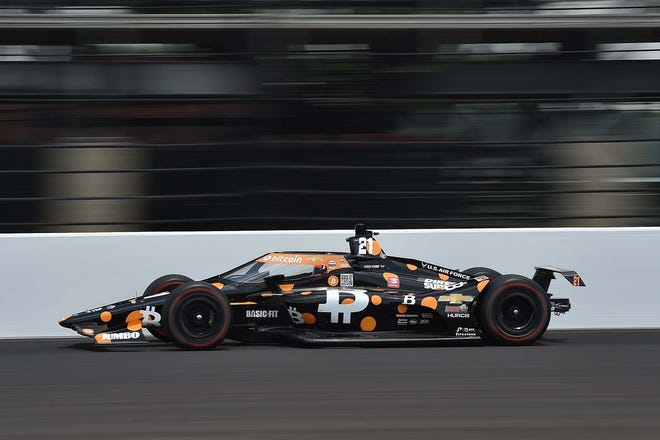
This prodigious, fearless talent was noticed early on in the young Dutchman’s racing career. After winning multiple European karting championships, he came to America as a 17-year-old, finishing second in the USF200 open-wheel series. By age 19 he was runner-up in the Indy Lights championship, IndyCar’s Triple-A farm league.
Like many American immigrants before him, Rinus American-ized his surname to “VeeKay” from the Dutch van Kalmthout.
“My parents call me VK. It was hard over here to spell my last name all the time. (It’s) super long. It’s way easier as VeeKay,” he said.
Though born in the Netherlands, VeeKay was raised in a Ford family. His father, Marijn van Kalmthout, was the country’s biggest Ford dealer.
“My dad sold his business when . . . I broke through with go-karts,” said VeeKay, who turned 20 last September. “He did that to make time for me and my, my racing and invest all his time and money managing me and making sure I made the right decisions.”
Ironically, VeeKay’s big IndyCar breakthrough came from a Chevrolet-powered team, Ed Carpenter Racing. Chevy and Honda are the series’ major corporate sponsors and engine providers.
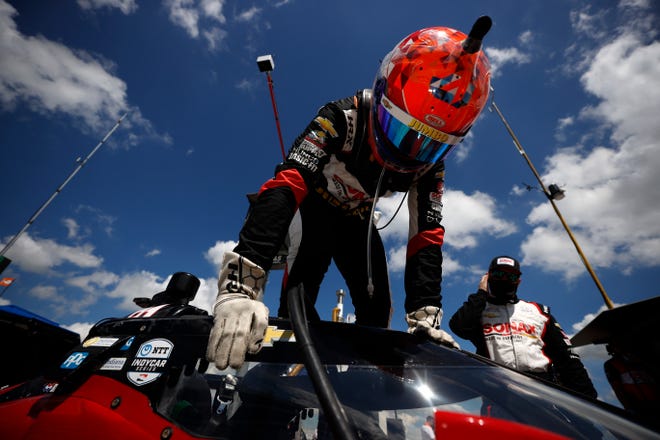
VeeKay enjoys additional backing from Arie Luyendyk, heretofore Holland’s most famous racing driver, and the winner of the Indy 500 in 1990 and 1997. Luyendyk (whose son is also a U.S. racer and “Bachelor” contestant) helps mentor VeeKay.
More: Scott McLaughlin, working to be IndyCar force, as first Indianapolis 500 looms
Forty-year-old team owner Carpenter, one of the sport’s best oval-track racers, is not just VeeKay’s boss — he is also a teammate who will be making his 18th attempt at winning the 500 (he has finished as high as second). He’ll start in the fourth position, right behind his young protégé.
Carpenter is part of a generation of IndyCar graybeards who are hungry to win this weekend, including 40-year-old pole-sitter Dixon, 46-year-old Tony Kanaan (starting fifth), 40-year-old Ryan Hunter-Reay (starting seventh), 46-year-old Helio Castroneves (eighth), 44-year-old Takuma Sato (15th), 45-year-old Juan Pablo Montoya (24th), and 42-year-old Sébastien Bourdais (27th).
They’ll be fighting it out with rising young guns half their age like VeeKay, Herta, Alex Palou (starting 6th), and Pato O’Ward (12th).
VeeKay has made the move to the United States for his IndyCar career (he lives right across the street from the famed track), and makes regular treks to the Pratt & Miller simulator in Charlotte, North Carolina, for hours of practice on Indy and other upcoming race courses.
“We’ll get a full day” on the simulator, he said, sharing the time with Carpenter or his third teammate, Conor Daly. “The engineers like to fly there early in the morning, but I always feel like I need my sleep so I go the evening before. It’s like office days for drivers.”
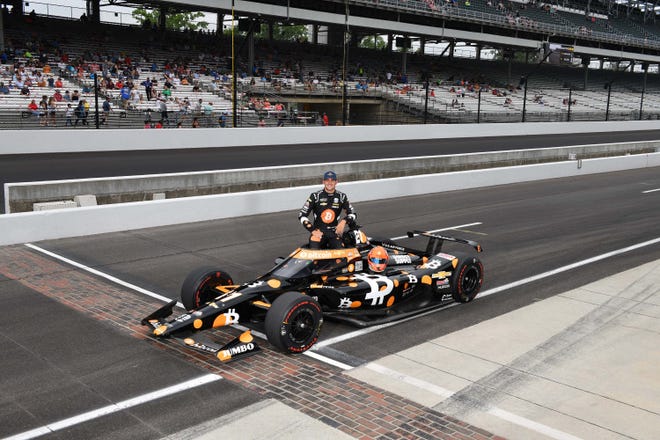
After Indy, VeeKay & Co. will travel to the Detroit Grand Prix, June 11-13, for a very different challenge on the raw streets of Belle Isle.
“In 2019, I got asked to drive the pace car laps in the (Chevy) Camaro” for the Detroit Grand Prix, VeeKay said. “So I got some experience there with the Camaro, but that’s about it.”
First impressions: Ford’s electric F-150 Lightning offers speed, grunt and a big frunk
Posted by Talbot Payne on May 25, 2021
Romeo — Eighteen months ago, Tesla CEO Elon Musk threw down the electric pickup gauntlet, introducing the sci-fi Cybertruck at a Los Angeles news conference as a vision of the future. In so doing, he mocked Detroit Three pickup designs, saying “they all look pretty much the same.” Promising “something different,” his stainless-steel exoskeleton EV opened a new battlefront in the pickup wars.
This week, Ford responded.
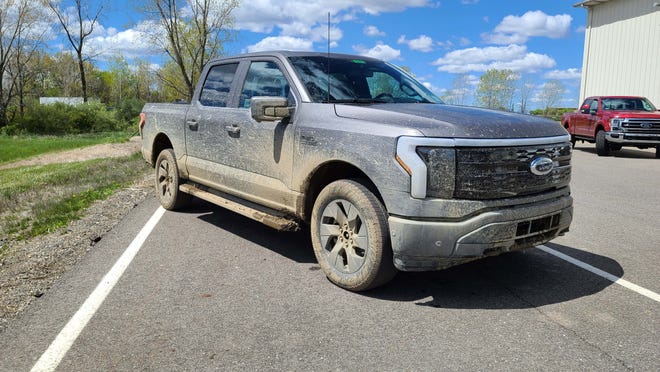
The 2022 F-150 Lightning enters the EV market using the same tried-and-true three-box, ladder-frame formula that has made the gas-powered F-150 the King of Trucks for the last 44 years. Then it spices the recipe with signature features only electrics can offer.
The Lightning sits an all-new, ladder-frame skateboard architecture built around a massive battery. Up front, it boasts the industry’s biggest “frunk” (front trunk) where an engine traditionally resides. With a jaw-dropping 775 pound-feet of torque and 563 horsepower, the Ford can dash from zero-60 faster than the Ford Raptor super truck. The Ford even uses its massive battery to double as a home generator should the lights go out.
More:Ford’s F-150 Lightning starts under $40K, has up to 300 miles of range
For subscribers:Here’s how Ford used its HQ to flash ‘a moment of history’ with electric F-150 reveal
“Our customers told us they wanted distinct, but not different,” said F-150 Lightning marketing manager Jason Turnbull, who threw some shade at Cybertruck’s radical design. “They did not want it to look like a doorstop or a spaceship.”
Like Ford’s first EV, the Mustang Mach-E, Lightning is aimed directly at Tesla, even matching its entry-level price — $39,974 before destination fees and government tax breaks. Yet unlike Mach-E, Lightning is determined to win over customers with an evolutionary — not revolutionary — design.
The Lightning name is even a throwback to the wicked-fast 1992 F-150 Lightning pickup. “Like the original, this is a truck that reinvents the way we look at trucks,” Ford North America president Kumar Galhotra said.
With this 6-foot-5 reporter riding shotgun, the Lightning’s development team recently demonstrated the e-truck’s prodigious capabilities at Ford’s sprawling 3,880-acre Proving Grounds in Romeo, with media riding shotgun in upper Lariat and Platinum-trimmed prototypes.
You’ll know the Lightning by its bold horizontal LED running light running across the plastic, non-functional grille like a unibrow. And a driver’s side charging port.
The Ford vaults from 0-60 in the mid-four second range despite its 6,500-pound curb weight. To achieve this freak of nature, Lightning operates in constant all-wheel-drive mode to maximize traction while putting its instant torque to asphalt. The mid-4 second figure is shy of the Cybertruck’s claimed sub-3 second shot (not to mention the reigning gas champ, Ram 1500 TRX’s 3.7 seconds) but beats the 5.3-second time of Ford’s fastest gas beast, the F-150 Raptor.
Mega-torque also pays towing dividends.
The F-150 effortlessly clean-and-jerked a 6,000-pound trailer up and down steep Proving Ground grades (maximum tow rating is 10,000 pounds, shy of the 13,200-pound figure claimed by the F-150’s 3.5-liter turbo-6 cylinder). With a single-speed transmission, Lightning pulled smoothly up a steep grade where its gas-engine counterpart would have to shift down to low gear to make the climb.
More:SK supplies batteries for Ford’s F-150 Lightning. Is a joint venture next?
All-wheel-drive, independent rear suspension and a low center of gravity also pay dividends off-road. The big truck sped through a serpentine dirt trail like an oversized rally car — the weight in its belly minimizing head toss. Thanks to state-of-the-art electronics, Lightning integrates all extra-terrain modes into a single “Off-Road” mode (Normal, Sport and Tow-Haul are also available). The pickup also features a lockable rear axle for when the going gets really tough.
Ladder-frame trucks are typically rugged, and Lightning showed off its macho chops by harmlessly slapping its belly over uneven moguls. Thanks to the flat battery drivetrain, however, Lightning appeared better protected by full under-body skid plates that didn’t have to protect a low-hanging muffler or rear “pig” (differential).
Passengers survey this capability from a familiar F-150 interior with options first introduced last fall on the 2021 gas model, including a stowable gear shift and work table.

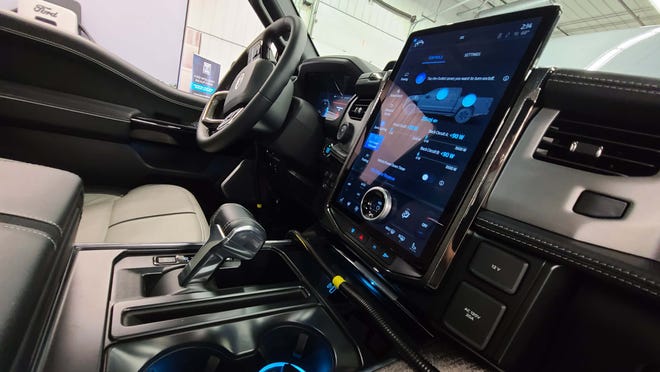
The interior departs from its gas sibling with an available, vertical 15.5-inch console touchscreen. It echoes the Mustang Mach-E’s tablet with swipeable pages and a giant volume knob. The touchscreen is paired with a fully digital instrument display behind the steering wheel.
Cybertruck debuted a clean, integrated box design — but that limits the ability to screw on different-length beds. Lightning sticks to the familiar pickup box design with no Cybertruck tricks like a rolling bed cover or kneeling rear.
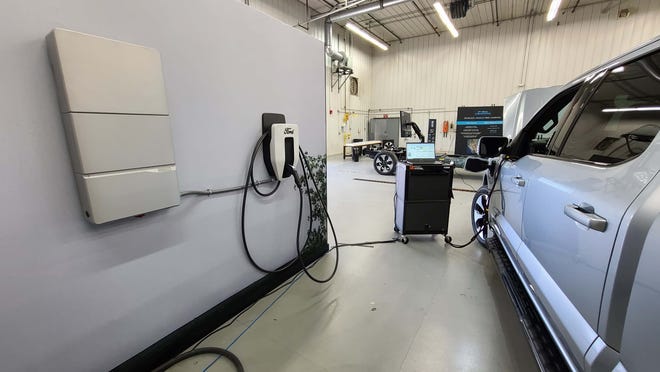
Sold separately from its vehicles, Tesla offers battery-powered “power walls” to light your home. Ford one-ups Tesla by offering Lightning as a home generator. The estimated $10,000 option is targeted at the gas generator industry that installs “engines-on-a-slab” for homes — and telegraphs Lightning’s ambitions to go after higher-income truck buyers.
With an industry-best power output of 19.2 kWh on board, the pickup’s power can be routed through a wall-mounted inverter to run a home during a power outage for up to three days.
Even without the generator option, Lightning offers 9.6 kW of onboard power (first seen on the F-150 Hybrid introduced last fall) that can be used to charge tools at a worksite or a TV at a football tailgate. The bed bristles with three 110-volt outlets and a 240. The frunk? Three 110s and three USBs.
The yawning frunk is Lightning’s killer app. Pickups alienate many due to the lack of covered cargo space. Not this pickup. Its frunk can swallow two golf bags or three pieces of luggage.
Lightning also comes with batteries’ inherent drawbacks. Chief among them is range.
The standard battery offers 230 miles, with an optional extended-range unit rated at 300 miles. That’s on par with the Mach-E — but well shy of, say, the F-150 diesel’s 850 miles.
Towing with any engine sucks juice — whether gas or electrons. TFLTruck.com reports that towing degrades mpg in a gas or hybrid-powered F-150 by 70%. Ford estimates Lightning will see similar degradation. But when the diesel runs out, there is ample fueling infrastructure. Not so the nation’s fast-charging grid. And when the Ford does stop for charging, it will take longer than a gas pump fill-up — think 10 minutes for 50 miles of range.
With the F-150’s six engine options, pickup owners have a lot of choice. Naturally, Lightning is targeted at the higher-income urban toy truck customer. Construction or landscaping pros seem a natural audience as well.
At the end of the day, the big EV can be recharged in about eight hours and be back on the job in the a.m.
The race is on for the first EV pickup, and the Lightning will compete with the GMC Hummer, Lordstown Endurance, Bollinger B2 and Rivian R1T due next year. In addition to its conventional styling, Ford thinks customers will appreciate the conventional dealer network. Some 2,300 Ford dealers are already certified for service.
Expect it to arrive on dealer lots in the middle of next year. Your move, Tesla.

Payne: Acura TLX Type S unveiled. While riding shotgun. With Helio Castroneves at the wheel.
Posted by Talbot Payne on May 25, 2021
Lexington, Ohio — “Yahooooo!” yelled Helio Castroneves as we hit 117 mph in the new Acura TLX Type S on the back straight of the Mid-Ohio race course. Hard on the Brembo brakes, he crested blind Turn 9, then flattened the throttle. “Love the grip!” he said of Acura’s signature, sophisticated all-wheel-drive system.
Say hello to the ferocious, 355-horsepower Type S, the first performance sedan from Acura in over a decade. And say hello to the post-auto show world of car debuts.
Rather than unveil the long-awaited, 2021 TLX Type S at a static car show display, media members like me got to experience the beast from the right-hand seat. Under the lash of the one of the world’s premier race jockeys. In front of thousands of racing fans at IMSA Weathertech’s annual Mid-Ohio speed-fest.

The Type S debut was more than a coming-out party. It was the intersection of three 21st century auto trends: the shift to experiential car premieres, the marriage of racing and production cars, and the integration of foreign automakers in America’s heartland.
Acura last debuted a performance car in 2015 at the Detroit Auto How. There were videos. A light display. The NSX supercar on a turntable. Celebrity exotic car collector Jerry Seinfeld was in attendance.
This time, the celerity was at the wheel on a race track.
Adding to the excitement, Castroneves — the winner of four Indy 500s, not to mention “Dancing with the Stars” — had never driven the car.
Castroneves gunned the turbo V-6, and we were off, the Brazilian ringing its neck like the Acura ARX-05 dPi prototype race car he won with at Mid-Ohio here a year ago. “Awright, here we go into Turn 1,” cheered the veteran, who will enter his 21st Indy 500 at the end of this month.
Type S was appropriately unveiled here at a track that Acura race has dominated. The dPi racer was part of a full-court press by Acura to return the brand to its performance roots after losing its way at the dawn of the 21st century.

Not only did Acura develop a halo, $160k, mid-engine NSX supercar sequel to the 1990 legend that wowed the world, it also developed a GT race version for the IMSA series. Not content with that, Acura also entered the ARX-05 at the pinnacle of U.S. motorsport — a 600-horsepower, winged weapon that won the last two IMSA championships under Team Penske’s management.
Type S, aimed at European athletes like the Audi S4 and BMW M340i in the heart of the luxury market, is the production beneficiary of that performance investment.
“I’m excited to try it,” said Castroneves ahead of our Type S test. “A lot that we have learned in sports car racing has been applied to this car.”
Based on the $38,525 TLX sedan, the 4,221-pound Type S is stiffer and wider — its fenders engorged with 20-inch wheels rapped in Pirelli P Zero summer tires. Behind the menacing, black Diamond Pentagon grille beats a 3.0-liter turbo V-6 unique to the Type S — and a major upgrade over the base TLX’s 272 -horse turbo 4. The V-6 is a close cousin to the 3.5-liter, twin-turbo V-6 that makes 600-horsepower in the Acura dPi.
Interestingly, Type S does not follow the NSX supercar with hybrid drivetrain. The next-gen Acura prototype racer, due in 2023, is expected to utilize hybrid technology

“I love how the car handles,” said Castroneves later as we weaved through the Acura race team’s garage — mechanics feverishly preparing the race car for battle later that day. Following my ride, he had given other journalists hot laps. “With each lap, I was giving it more. It handled very flat, very stable. Acura does everything so simple — the car was easy to learn.”
Having seen the Type S on the track, race fans in attendance could see it up close — along with the rest of Acura’s lineup — at a pop-up “showroom” at Mid-Ohio. There, visitors could get in the cars, do laps on a simulator, and fill out an Acura customer survey.
Like at an auto show.
Auto shows have been laid low by the coronavirus pandemic — but were already struggling as social media and experiential opportunities have allowed brands like Acura to do more customer-targeted events. Auto shows are coming back to life — see Chicago July 15-19 — but they are no longer the exclusive domain of auto debuts.
The Midwest is also no longer exclusively Detroit Three manufacturing. Indeed, Ohio is Honda/Acura country — the track is just an hour northeast of Marysville, where Type S is built alongside the TLX, ILX sedan and Honda Accord. A stone’s throw away from Marysville is the Performance Manufacturing Center, where NSX is hand-built. Drive further west to East Liberty, and the Japanese transplant churns out Acura’s RDX compact SUV, MDX three-row SUV and Honda’s mega-selling CR-V SUV.
All in, Honda’s Ohio empire employs over 8,000 people over 8,000 acres, pumping out nearly 700,000 vehicles a year.

Rounding Mid-Ohio’s famous Carousel turn onto the pit straight in the Type S, the guardrail is plastered with Acura signs — the scoreboard sponsored by Honda. “The weight distribution is really good,” Castroneves muses over the V-6 roar. “I was not expecting it to be this quick — wow.”
Mid-Ohio has become a training ground for tomorrow’s enthusiast. Acura ILX and Honda Civic are official track school cars in which budding motorheads can hone their skills.
While most Acura buyers gravitate to RDX and MDX SUVs these days, the Type S is targeted at motoring enthusiasts who won’t consider an SUV. Interest, said a local dealer rep, has been intense ahead of the thoroughbred’s arrival in showrooms next month.
Right on cue to celebrate Type S’s big debut, the Acurs dPi prototype — piloted by American ace Ricky Taylor — won Sunday’s race for the fourth year in a row.
Win on Sunday, sell on Monday.

2021 Acura TLX Type S
Vehicle type: Front engine, all-wheel-drive, five-passenger sedan
Price: est. $50,000-$60,000
Powerplant: 3.0-liter turbo V-6
Power: 355 horsepower, 354 pound-feet torque
Transmission: 10-speed automatic
Performance: 0-60 mph, about 5 seconds (mnftr.); top speed, 155 mph
Weight: 4,221 pounds
Fuel economy: EPA est. mpg 19 city/25 highway/21 combined
Payne: With V-8 power, Wrangler Rubicon 392 is King of the Jeeps
Posted by Talbot Payne on May 25, 2021
Holly — Well, you just knew the mad scientists in Auburn Hills had this up their sleeve. First came the Dodge Challenger SRT Hellcat. Then the Dodge Charger SRT Hellcat family sedan. Followed by the Jeep Grand Cherokee Trackhawk family SUV.
Now doff your cap to the earth-shaking 470-horsepower Jeep Wrangler Rubicon 392 off-road vehicle stuffed with the same 392-cubic-inch V-8 found in the Dodge Challenger Scat Pack, for goodness sake. The forest will never be the same.
I took the juiced Wrangler to Holly Oaks ORV Park (now open with your ORV sticker!) and made the trees shake. The ground quake. The rocks crumble. After I hurtled around the dirt track at obtuse angles, Joey Logano approached me and asked if he could enter the Wrangler in next year’s NASCAR Bristol dirt race.
Jeep’s compact SUV is insane. My only question is: was the alphanumeric 392 badge the best marketing could come up with?
How about Beast? Hulk? Was Hellboy taken?
After all, Jeep executives have made clear they don’t have room to fit the supercharged 700-plus horsepower Hellcat engine in the Wrangler without compromising crumple safety zones — so this is the highest-flying V-8-powered Wrangler we’re going to get. Heck, at $74,995 it actually costs more than a Challenger Hellcat. If an alphanumeric badge it must be, how about 666?
The Wrangler Rubicon 392 is a treat from the moment you push the Start button on the dash.
BRAAAPP! The 6.4-liter V-8 roars to life like someone stuck the Kraken with a hot poker (was Kraken taken?). Unlike its sedan and SUV peers, the Wrangler is wonderfully uninsulated due to its removable doors and roof, so the sounds wash over you like a wave.
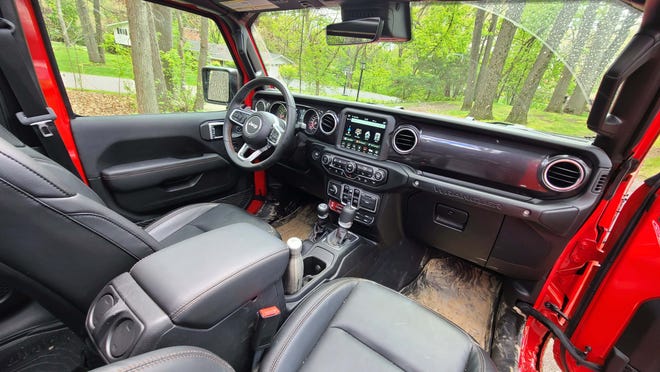
Naturally, Jeep dressed the 392 in full Rubicon off-road battle dress so that you could enjoy all the amenities the King of Off-road has to offer. The Jeep faithful will strip off the doors and peel back the roof to get even closer to the V-8 roar. If we had done that on this sun-soaked Saturday morning — a day after heavy rains in southeast Michigan — we would have been caked with mud from head to toe. We left the doors on.
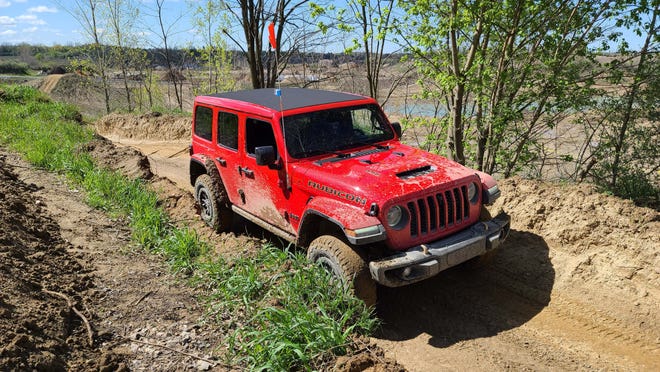
A red Wrangler Rubicon is a beautiful canvas to paint with mud. Now that’s landscape art.
When not destroying sports cars out of stoplights, the 392 loses none of its abilities off-road. Indeed, the 392 is raised another inch to encourage you to take it where the asphalt ends.
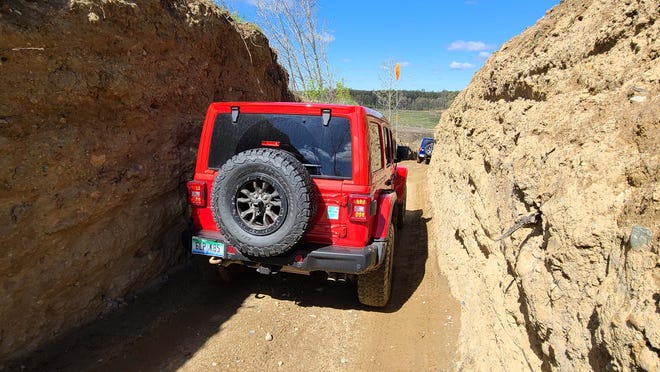
That extra inch is functional — a testament to the extensive re-engineering Jeep’s surgeons did to make this Frankenjeep monster a reality. The engine bay has been extensively reworked to fit the taller, longer, hungrier V-8. The hood scoop is real, and more airways are available should it get blocked or overwhelmed by a wave of muck while treading up to 32 inches of water.
Years ago, a mod shop stuffed a Porsche 968 motor into my Porsche 944 (more power! Uh uh uh!) engine bay, requiring extensive plumbing. And that was just swapping a 2.5-liter 4-banger for a 3.0-liter four. Ask an aftermarket shop to upgrade your Jeep Rubicon to a V-8 and you’re likely looking at a bill north of $40,000. Jeep does it for $24,000 over the standard Rubicon.
The Frankenstein transformation doesn’t stop at the engine bay. In addition to the aforementioned lift, the ladder frame gets stiffening, and the suspension gains Fox performance shocks and muscular Dana axles off the Gladiator pickup.
Bottom line: this is the most capable Jeep Wrangler ever, with 10.3 inches of ground clearance and an absurd 4.5-second 0-60 dash. Even the Rubicon’s legendary approach/breakover/departure angles increase up 44.5/22.6/37.5 degrees. Boowah-haw-haw!
Scaling the South Face of the parks’ Sandbox area is a formidable task as you have to accelerate up a sandy hill that steepens to 31 degrees (think Daytona’s high banking) at the top.
With 470 pound-feet of torque, my 392 fearlessly attacked the obstacle, flinging sand plumes from its knobby tires. At the top of the ridge Wrangler surveyed its Jeep kingdom below like Simba on Pride Rock. Ah, when the Ford Bronco arrives this summer, the fur will fly at Holly Oaks.
Soft ground after overnight rains demands extra safety vigilance over Holly Oaks’ steep, 200-foot drops. I man-handled the transfer case shifter into 4-low, locked front and rear axles, disconnected the swaybar and grunted across muddy Darlene’s Ridge — the huge 33-inch tires slipping and sliding but clawing for grip.
Grip was an issue on the steep rocks of the park’s signature Mashed Potato hill on Mt. Magna for some V-6-powered Rubicons. For the V-8, it was a piece of cake, the suspension lift adding extra clearance for the rugged frame.
On Holly Oaks’ challenging five-turn Glen short course, I turned off traction control to allow the rear end to really hang loose. I’ve overcooked the course’s moguls before — separating a Ford Ranger Tremor’s tire from its rim — but the Wrangler 392 comes standard with bead locks to protect against separation anxiety.
As I’m 6’ 5”, my biggest concern was hitting my noggin on the roll bar as we flew over hillocks.
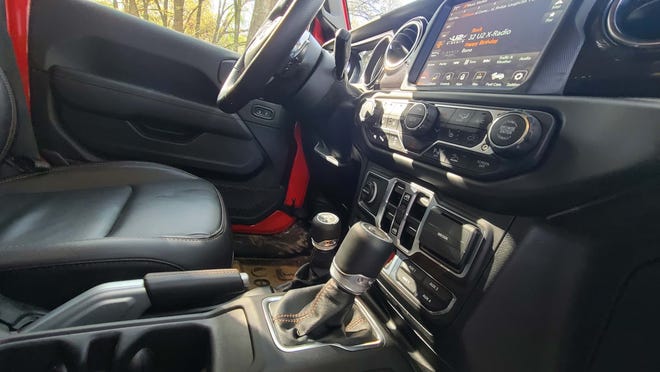
For its ultimate workhorse, Jeep has spared nothing. The 392 gets signature bronze tow hooks, leather 392 seat badging, a Sky One Touch roof, front-facing crawl camera, paddle shifters — even a quiet mode button on the dash should you want to hear the person in the backseat over the wail of the V-8.
But if it’s quiet you’re looking for on your off-road wanderings, get the plug-in hybrid 4xe that I recently tested in Texas. You can stealthily sneak around Holly Oaks and listen to every twig snap under your 33s.
The 392, on the other hand, is all about teeth-baring, chest-thumping dominance.
I know, let’s call it Kong.
2021 Jeep Wrangler Rubicon 392
Vehicle type: Front engine, four-wheel-drive, five-passenger compact SUV
Price: $74,995, including $1,495 destination fee ($78,545 as tested)
Powerplant: 6.4-liter V-8
Power: 470 horsepower, 470 pound-feet torque
Transmission: 8-speed automatic
Performance: 0-60 mph, 4.5 seconds (mfr.); towing capacity, 3,500 pounds
Weight: 5,100 pounds
Fuel economy: EPA est. mpg 13 city/17 highway/14 combined
Report card
Highs: Off-road cred; a Hemi V-8 in a Wrangler, need I say more?
Lows: Drinks gas; gotta shout to be heard in the cabin
Overall: 4 stars
Holly — Well, you just knew the mad scientists in Auburn Hills had this up their sleeve. First came the Dodge Challenger SRT Hellcat. Then the Dodge Charger SRT Hellcat family sedan. Followed by the Jeep Grand Cherokee Trackhawk family SUV.
Now doff your cap to the earth-shaking 470-horsepower Jeep Wrangler Rubicon 392 off-road vehicle stuffed with the same 392-cubic-inch V-8 found in the Dodge Challenger Scat Pack, for goodness sake. The forest will never be the same.
I took the juiced Wrangler to Holly Oaks ORV Park (now open with your ORV sticker!) and made the trees shake. The ground quake. The rocks crumble. After I hurtled around the dirt track at obtuse angles, Joey Logano approached me and asked if he could enter the Wrangler in next year’s NASCAR Bristol dirt race.
Jeep’s compact SUV is insane. My only question is: was the alphanumeric 392 badge the best marketing could come up with?
How about Beast? Hulk? Was Hellboy taken?
After all, Jeep executives have made clear they don’t have room to fit the supercharged 700-plus horsepower Hellcat engine in the Wrangler without compromising crumple safety zones — so this is the highest-flying V-8-powered Wrangler we’re going to get. Heck, at $74,995 it actually costs more than a Challenger Hellcat. If an alphanumeric badge it must be, how about 666?
Payne: Audi RS6 Avant, station wagon from the gods
Posted by Talbot Payne on May 14, 2021
I grew up in the back of a blue 1960s Buick station wagon. Bench rear seats. Steering column-mounted shifter. Rear-wheel drive. Turned like a cruise ship.
The 2021 Audi RS6 Avant is not that wagon.
On Hankerd Road south of Hell, Michigan, I initiated launch control. Then I released the 591-hp, 590-torque twin-turbo V-8 Kraken. With its 8-speed transmission firing off rifle-quick shifts and the all-wheel-drive system electronically managing torque to all four corners, the wagon gulped asphalt at an astonishing rate. The speedo blew by (censored to preserve my license) mph, yet the car felt stable as a rock — its 4.0-liter mill begging for more throttle.
Cul-de-sacs were the natural habitat of my mom’s Buick. My scarlet RS6 tester was at home on Hell’s twisted roads. Devil in a red suit. Swollen fenders like a muscle shirt over huge 22-inch wheels. Brooding headlight signature. Push the Avant’s start button and it awakens like a tiger that hasn’t eaten in a week. RRRROWR.

Avant’s gotta’ eat, and Hell’s rural roads are the best feeding ground in state.
RS is German for Rennsport — which translates to English as Racing Sport. I think Rocket Ship is more appropriate. With radical modifications to the suspension and drivetrain, the RS is Audi’s pinnacle badge — transforming luxury vehicles like the Allroad into snarling performance deviants that itch to get on track (not just drive the family to it).
Case in point, my Avant (more German: Avant means “wagon”) is based on the $66,895 A6 Allroad wagon I tested last summer. On my I-96 trip west to Hell, RS6 exhibited all the civilized qualities of that housebroken tourer: roomy interior, panoramic roof, twin console screens for infotainment/climate, driver-assist and Google Earth-enhanced navigation. A word about the latter two features.
Audi has made great strides since the first A8L I drove back in 2015 with erratic drive assist that would have smacked into the Lodge M-10’s concrete walls were it not for driver intervention. The RS6, by contrast, navigated westbound 96 beautifully. I took curves hands free, the wagon staying centered in the lane rather than pinballing from one side to the other.

Smartphone-based Google apps are the best nav systems on the planet, but I’m a sucker for the Audi’s gorgeous Google Earth displays — even if it often takes multiple attempts for the voice recognition system to understand me.
Me: Navigate to Hell, Michigan.
Audi: Hale?
Me: No, Hell.
Audi: Hell Ranch?
Me: Close enough.
Stunning, richly colored vistas of the countryside then splash across the instrument and infotainment displays with turn-by-turn overlays. It’s worth the voice-recog hassle. I cruised comfortably to the U.S. 23 South/Brighton exit, U2 X-Radio filling the cabin.
My luxurious ride was interrupted by a cloverleaf that the RS6 attacked like Lewis Hamilton entering the Parabolica sweeper at the Monza Grand Prix. That is to say, very fast.

With its V-8 boat anchor up front, the RS6 should push like, well, a wagon around a 360-degree turn — but this is no ordinary car. Audi has blessed the RS6 not only with torque-vectoring AWD, but with Porsche Turbo-like all-wheel steer. The 5,000-pound beast rotated into the cloverleaf on a dime, then begged for more right foot.
Sticking like hot wax on a 32-degree day, the Avant tenaciously hugged the long cloverleaf apex — g-loads straining my neck. By the exit, I finally got some squall from the huge 11-inch-wide tires, and even a wee bit of controlled oversteer as rear-wheel steer did its thing.
I exploded onto Route 23, V-8 drowning out U2.
So exhilarating is this experience that I instantly sought out the opposite cloverleaf going north on 23. Let’s do that again! I was alone this day, but I can understand how the Avant’s Jekyll and Hyde nature might drive a family nuts. Be sure to warn the backseat passengers: cloverleaf ahead.
Arriving in Hell, I stopped for a few photographs and noted how much I prefer the design of the RS6 over sister Allroad. Part of that is attributed to stunning wheels, power-dome hood, red brake calipers, bazooka-sized rear tailpipes and widened stance (2.5 inches wider than standard A6).

But the fascia is the charm. The Allroad grille is overdone, a vain actor that spent too much time in the makeup chair. The all-black Avant mug, by contrast, is not only tidier but also provides the right amount of menace as you loom in someone’s rear mirrors. You won’t be in their mirrors for long.
In this Age of Ute, the RS badge has been added to Audi SUVs just as BMW M-badge and AMG-badged Mercs have proliferated in their sport utility lineups. But with inherently flawed high-centered bods, the SUVs struggle to be pure performance machines.
With their more intuitive physics — yet similar hatchback cargo utility — European wagons are king of family performance. A couple of months back, I brought a 350-horse Audi SQ5 SUV to Hell. It can’t hold a candle to the Avant.
Alas, the RS6’s insane capabilities make me think of what might have been for Detroit brands. In particular the Cadillac CT5 Wagon, one of the most wicked wagons ever conceived. If Caddy hadn’t abandoned it seven years ago, CT5 Wagon (with the current CT5-V Blackwing’s supercharged 650-horse V-8 under the hood) could have been a match for the RS6. Woulda coulda shoulda.
Only a few will able to afford the RS6 Avant’s prodigious talent. The beast starts at $110,045, and my tester rung the cash register at over 119 grand.

For all that dough, Audi could make a better console. The shifter is too close to the driver, meaning my 6’5” frame’s right leg consistently knocked it over into “Manual” position. The twin screens rob the console of needed storage space.
More pleasing is the head-up display — a must-have on the Avant. Similar to Caddy’s V-mode, the Avant locates an “RS” button on the steering wheel so that — with a single press — the driver can instantly transform Jekyll into Hyde with pre-configured performance modes when twisty roads loom.
Corresponding to the RS button, the head-up display turns into a digital RPM and mph indicator so you never have to take your eyes off the road as you devour traffic.
All hail the performance family wagon. You’ve come a long way, baby.
2021 Audi RS6 Avant
Vehicle type: Front-engine, all-wheel-drive, five-passenger station wagon
Price: $110,045, including $995 destination fee ($119,840 as tested)
Powerplant: 4.0-liter twin-turbocharged V-8
Power: 591 horsepower, 590 pound-feet of torque
Transmission: 8-speed, dual-clutch automatic
Performance: 0-60 mph, 3.6 seconds (mfr.); top speed, 156 mph
Weight: 4,960 pounds
Fuel economy: EPA, 15 mpg city/22 highway/17 combined
Report card
Highs: Ferocious acceleration; all-wheel-steer handling
Lows: Poorly organized console; six-figure price tag
Overall: 4 stars
Pato O’Ward headlines generation clash coming to Detroit GP
Posted by Talbot Payne on May 14, 2021
Detroit — IndyCar racing returns to Belle Isle this June after a COVID-19 gap year, and fans will be treated to an intergenerational war.
Like tennis in the twilight of the Federer-Nadal era, a new group of young guns is hungry to take their place atop a podium that has been dominated by 40-somethings Scott Dixon and Will Power. Eager to spoil the crowning of a new prince are three drivers from NASCAR, Formula One and Australian Supercar who want to put their own mark on their new sport.

Hollywood couldn’t write a better script.
One of the series’ young standouts, 22-year-old Mexican Patricio “Pato” O’Ward, was in town Tuesday previewing the Detroit Grand Prix and the sport’s future.
O’Ward is the total package. Blindingly fast on track, he is a telegenic, bilingual bridge to a broader Hispanic demographic the racing industry covets – both in the U.S. and south of the border where IndyCar could expand its U.S. and Canadian base.
More: Detroit Grand Prix to allow limited attendance in Belle Isle race’s return
Last weekend in Texas he became the first Mexican driver to win an IndyCar race since Adrian Fernandez in 2003. O’Ward’s appearance in Detroit on Tuesday created a buzz across the Hispanic community as the Monterrey, Mexico native held a news conference sponsored by the Michigan Hispanic Chamber of Commerce and hosted by Taqueria El Nacimiento restaurant in Detroit’s southeast Springwells neighborhood.
IndyCar’s engaging new star then held a Zoom call with students from three area high schools: Casar Chavez Academy, Detroit Cristo Ray and Western International. In the wake of the Detroit GP’s announcement last month of partnership with NXG Youth Motorsports to bring young, minority, urban racers into the sport, O’Ward is an instant role model for a new generation.
He idolized Dixon and Power growing up – the 40 year-olds have amassed 87 wins and six titles (five of them by Dixon) between them over the last two decades. But while O’Ward was thrilled to be racing against his idols, he is not intimidated by them.
“It’s great giving them the headaches they don’t want,” he said.
Along with fellow Gen X phenoms, 21-year old Colton Herta and 24-year old Alex Palou, O’Ward is causing plenty of pain.
Each has a win in the first four races of the season with O’Ward winning at Texas Motor Speedway in his family’s adopted home state. The Arrow McLaren team driver is second in points only to Dixon as the series enters the crucial month of May with two races at Indianapolis Motor Speedway, including the sport’s crown jewel: the Indy 500 on Memorial Day weekend.
But as the upstarts chase Dixon and Power they are also aware of hungry veterans in their mirrors. NASCAR champ Jimmy Johnson is a rookie in IndyCar this year. As is 35-year old Formula One veteran Roman Grosjean and 27 year-old Australian Super Car champ Scott McLaughlin. All want to add an IndyCar championship to their trophy cases.

“We have a great mix of young, old, and in-between drivers and it’s as competitive as IndyCar has ever been,” O’Ward said. “The qualifying sessions are so competitive – 26 guys covered by just one second.”
He then adds a third name to the veteran list, Juan Pablo Montoya. The 1999 IndyCar champ (then called the CART series) and Indy 500 winner will join O’Ward’s Arrows McLaren team at the 500 this year (though not in Detroit).
“Montoya is someone who I looked up to. I look forward to learning from him as much as I can,” O’Ward said. “But the goal is still to beat him even though he is a teammate.”
The 22-year old has been racing since he was 6 and has seen a career of ups and downs while driving on both sides of the Atlantic Ocean. He has the business outlook of a seasoned entrepreneur.
“If your career didn’t end four or five times on the way up, then it wasn’t hard enough,” he said.
He is bullish on the future of IndyCar, including urging a race in Mexico City where he thinks the series could see its biggest audiences.
“(IndyCar) has got so much potential. We’re nowhere near it,” he said. “So I’m doing my best to speed that process up. Its such a great category, people just have to watch one race and they are hooked.”
The Chevrolet Detroit Grand Prix presented by Lear is June 11-13. Tickets go on sale May 20.
VW’s new Tiguan shows the steep climb ahead for EVs like the ID.4
Posted by Talbot Payne on May 14, 2021
Farmington Hills — General Motors and Volkswagen say their future is electric. The two manufacturing behemoths have set ambitious goals to produce only battery-powered vehicles by 2035.
But the latest model of VW’s best-selling vehicle introduced here — the 2022, gas-powered Tiguan compact SUV — shows how steep the road is ahead.
The new Tiguan, with an estimated base price of $26,000, will go on sale this fall alongside VW’s first global EV, the similarly-sized $41,000 ID.4. Even with the temporary federal $7,500 tax break for buying an electric vehicle, that’s a yawning $7,500 price difference in America’s most competitive SUV segment. With 398 miles of EPA-estimated range, the Tiguan dwarfs ID.4’s 250 miles of battery range.
“We do know it’s going to take awhile for most U.S. customers to say, OK, cool,” they will buy an electric vehicle, VW North American product marketing chief Hein Schafer said in an interview at the Tiguan’s media reveal.
“Price point is a challenge. (The) cellphone industry was no different. As they started up, battery efficiency was not where it should be, it was very expensive. Batteries got more efficient, they got more affordable. And so you got more range and the price point of cellphones came down. I think EVs are going to be no different.”
VW’s challenge to convince customers to go electric is compounded by governments that, for the first time, are forcing automakers to produce a specific powertrain. Both Washington state and Great Britain, for example, say they will forbid gas-engine car sales by the end of this decade.

It will be the second time in two decades that VW has had to reinvent itself. Just over 10 years ago, VW was a sedan brand, with the majority of its sales in Jetta, Golf and Passat cars. But as the American consumer flocked to SUVs, VW had to switch gears to adapt.
The Tiguan was introduced in 2008 and struggled to gain traction against popular badges like the Toyota RAV4, Honda CR-V, and Nissan Rogue. It wasn’t until the Tiguan’s second generation, 2017 long-wheelbase model that VW posted sales above 100,000 units in a segment where its Japanese competitors move over 400,000 vehicles annually.
“The Generation One Tiguan was very much Euro-centric — didn’t have second-row comfort, didn’t have the trunk. But we were working feverishly to find a Tiguan that met all the U.S. customers’ needs and wants,” said Schafer. “When we launched Tiguan in 2017, we saw immediate success. We more than doubled our volumes, Clear lesson: if you listen to U.S. customers, you . . . can have success in the U.S. market.”
The ID.4 enters a U.S. market where customers have shown little interest in EVs not named Tesla.
After Tesla’s big three EVs — Model 3 (89,976 units sold), Model Y (79,072) and Model X (22,255) — the best-selling electric chariot in 2020 was the Chevy Bolt at 20,754 units. In its fourth year of sales, the $36,000 Bolt hatchback — hyped as a Model 3 killer in 2017 — sold about 1/5th as many vehicles as the comparably-sized, gas-powered Chevy Trax crossover. The $33,000 Nissan Leaf EV — now in its tenth year on the market — sold just 9,564 units.
“Consumer consideration to buy an EV for the last 10 years has been stuck at about 3-4%,” said Ed Kim, vice president for Industry Analysis at Auto Pacific, while noting that actual EV sales are under 2% of the market. “With new vehicles in the market like the Model Y and Ford Mustang Mach-E, our recent data shows that doubling to about 6%.”

While the German-built ID.4 shows off a new, minimalist interior design, the Mexican-made Tiguan is hardly standing still as it gains new technologies like a digital instrument display, digital climate controls and wireless Apple CarPlay/Android Auto to match its own bold styling update.
Load an all-wheel-drive ID.4 with all the features and it tops out at $49,675 before tax incentives — a price more in line with Tesla’s luxury Model Y. A similarly-equipped Tiguan will run about $37,000 (pricing will be announced closer to fall release).
“There is a fair amount of apprehension (with EVs) when it comes to charging, range. Is it going to inconvenience me?” said Schafer. “So I think the (ID.4 and Tiguan) complement each other. We have the Tiguan that is extremely spacious, has all the creature comforts. Then ID.4 teases this prospect that EVs are not what you think they are. (It’s) fun to drive . . . and also doesn’t have servicing costs that a gasoline engine vehicle has.”
Auto Pacific’s Kim points out that — unlike the cellphone revolution that freed Americans from wall-tethered phones — EVs actually limit mobility by tethering consumers to a charge cord.
“With the internal combustion engine, you have the freedom to drive anywhere,” said Kim. “EVs don’t have as much infrastructure and they take longer to charge. We’re still at a point in time when it doesn’t make sense for everybody.”
The ID.4/Tiguan siblings are in the middle of a full lineup of utes (including the bigger Atlas and Atlas Cross Sport) that will soon be joined by the 2022 Taos, VW’s first subcompact SUV.
Tellingly, Taos is not an EV. The costs of batteries are simply too steep.
“(The Taos) is going to come out with a very peppy, 1.5-liter turbo engine, which is going to have phenomenal fuel economy because we know customers buying in that segment are extremely cost-conscious,” said Schafer.
Key to VW’s EV plans — as well as other manufacturers — is government partnerships for massive subsidies.
In addition to the $7,500 federal tax credit, VW touts state incentives for EV buyers like California’s $1,500 rebate and access to carpool lanes. VW also anticipates federal manufacturing subsidies for the ID.4 when it begins production at the company’s Tennessee plant in 2022.

“If USA is serious about reducing CO2 emissions, I feel like it makes sense to extend (the $7,500 tax credit) until you get to a point where these cars are affordable,” said Schafer, citing the Biden Administration’s push to reduce carbon dioxide emissions. “That’s a critical point — because if you look at the average transaction price of a car in the U.S., almost 70% of volume is below 40 grand. So if you really want to transform the market . . . you’ve got to stimulate that for a period of time.”
Other manufacturers face similar challenges as they bring EVs to market. Ford’s first electric SUV — the $44,000 Mustang Mach-E — enters the same compact SUV segment as Tiguan. Ford’s segment mainstay, the gas-powered Escape (2020 sales: 178,496 units) now sports a hybrid-electric version that stickers for under $30,000.
This year, Ford introduced a new gas-powered, $28,000 Bronco Sport to the segment that hit dealers about the same time as Mach-E. The electric Mustang came out of the blocks quickly with 3,739 sales in February, then trailed off to 1,951 sales in April. Bronco Sport, meanwhile, posted 5,525 February sales and accelerated to 13,856 units in April.
For now, VW touts the daily usability of the ID.4 — which can charge overnight at home for routine metro commutes. The build-out of national electric infrastructure is a longer-term play — also dependent on government’s help.
“We’ve made it clear that, post-2035, we’re not going to be developing any more gasoline-powered engines,” said Schafer. “How fast can we pull that off? We need to earn money, too. We make money with gasoline-powered cars, so it’s very clear we need to time that transition with the market.”
Payne: 2021 Cost to Own auto winners may save you big
Posted by Talbot Payne on May 10, 2021
Kelley Blue Book has announced its 10th annual 5-Year Cost to Own Awards, and the winners may surprise you.
Mixed among the usual, bulletproof Toyota, Lexus and Ford products in the five-year study are three Stellantis stallions (Dodge Charger, Jeep Wrangler and Chrysler Voyager minivan) from brands that generally rank at the bottom of reliability surveys.

Indeed, Volvo and Subaru — which also perpetually rank below average on J.D. Power’s Vehicle Dependability Survey — also placed multiple vehicles on a sprawling podium culled from 22 vehicle categories projecting the lowest ownership costs over the initial five-year ownership period.
What’s going on?
Turns out that cost of ownership is about more than the cost of maintenance, repairs, fuel, and insurance (all factors in KBB’s evaluation). Depreciation — that is, the resale value of your asset after five years — is also a big part of your car’s cost.

“Depreciation tends to be a strong component for total cost to own, so cars that win typically have strong residual values,” said Eric Ibarra, KBB’s director of residual consulting, in an interview. “The Charger has very strong performance in the full-size car segment and carries strong residual values. Performance is a strong attribute when you’re looking at how it will retain value. Wrangler is an iconic vehicle and wins years after year in the off-road segment.”
So, too, the Volvo XC90 SUV and S90 sedan are hardly volume sellers but have a rabid fan base for the vehicles’ Scandinavian styling and tank-like safety reputation. Subaru, another below-average performer on J.D. Power’s quality ratings, tied Stellantis and Lexus for the most vehicles on the list (three) thanks to strong residuals. As the ads say, customers “love” their Subies.
The Lexus RX, NX and UX won in their respective SUV categories as Toyota’s luxe brand has been a perennial favorite in sales and reliability scores. Ford, which typically gets good grades in reliability class, also gained cost-of-ownership gold medals for its two red-hot picks: the F-150 and Ranger.
There were upsets on the list as well.
Proving good things come in small packages, the wee Mazda MX-5 Miata won the sports car category over supercars like the Porsche 911 that is not only super-fast but also super-reliable. Porsche routinely vies with Lexus for durability crowns.
“The overall price of vehicle is a factor,” said Ibarra noting the that the Porsche 911 stickers north of $100k while the Miata starts at $27,825. “Porsche produces vehicles that hold value well, (but) overall depreciation on a 911 will be greater than a Miata.”

There were surprises at the other, mega-tron end of the vehicle scale too. The Nissan Armada beat out the Chevy Tahoe/Silverado and Ford Expedition for best full-size SUV despite inferior sales volumes and an older design compared with its Detroit peers. Its sister Infiniti QX80 full-size luxury SUV also beat out the iconic Cadillac Escalade.
The list of winners was a smorgasbord of brands, an indication of how competitive the U.S. market is today.
Other notable winners include the Subaru Forester compact SUV in the market’s best-selling, non-pickup category and the VW Passat in the best-selling, midsize sedan category. The Nissan Leaf topped Tesla in the electric vehicle niche, while the Hyundai Venue won in the subcompact SUV segment — one of the industry’s fastest growing segments as first-time buyers switch from entry-level sedans to utes.
Car shoppers understandably tend to focus on the purchase price when buying. But, in truth, you could score a great price deal — and still end up paying more over five years just because you didn’t factor maintenance, insurance costs, and resale value.
“Choosing a car with low ownership costs can help shoppers save a significant amount of money over time — often several hundred and sometimes even thousands of dollars — so it’s worthwhile to research the cost to own details of any new car you’re considering,” said Ibarra.
2021 Kelley Blue Book Cost to Own Award winners:
Compact car: Hyundai Elantra
Midsize SUV-3-row: Subaru Ascent
Midsize car: Volkswagen Passat
Full-size SUV: Nissan Armada
Full-size car: Dodge Charger
Luxury subcompact SUV: Lexus UX
Entry-level luxury car: Acura ILX
Luxury compact SUV: Lexus NX
Luxury car: Volvo S90
Luxury mid-size SUV-2-row: Lexus RX
Sports car: Mazda MX-5 Miata
Luxury mid-size SUV-3-row: Volvo XC90
Hybrid/alternative energy car: Toyota Corolla Hybrid
Luxury full-size SUV: Infiniti QX80
Electric vehicle: Nissan Leaf
Off-road SUV: Jeep Wrangler
Subcompact SUV: Hyundai Venue
Midsize pickup truck: Ford Ranger
Compact SUV: Subaru Forester
Full-size pickup truck: Ford F-150
Midsize SUV-2-row: Subaru Outback
Minivan: Chrysler Voyager
Revealed: NASCAR Next Gen racer accelerates into new era
Posted by Talbot Payne on May 6, 2021
America’s most popular form of motorsport, the NASCAR Cup Series, introduced its Next Gen race car Wednesday. The seventh-generation racer is a major evolution that embraces 21st-century technologies to improve handling, reduce costs, increase safety, and eventually transition the series to hybrid power.

While NASCAR’s roots lie in Detroit Three stock car battles, “stock” production chassis were replaced in the early 1990s by a bespoke racing architecture. Today, all three official NASCAR partners — Chevrolet, Ford, and Toyota — marry a common, tube-frame platform to a body design intended to reflect their current Camaro, Mustang, and Camry showroom offerings.
Each manufacturer — represented by NASCAR drivers and performance chiefs — showed off their new Next Gen designs at a joint press conference Thursday in North Carolina where most teams are based.
“We’re very excited about the Next Gen car. It’s really a big step forward for the sport … and to be more relevant underneath with the chassis, steering, and engine systems,” Mark Rushbrook, Ford Performance global director, said in an interview. The exterior “proportions (are) much closer to what we have in today’s street Mustang.”
Chevrolet touted the improved, more athletic appearance of the race cars to better reflect their siblings on the showroom floor.

“The Next Gen Camaro has a much stronger link to the production Camaro ZL1 in terms of styling integration, improved proportions and relevant technologies,” said Chevy NASCAR director Eric Warren. “From an engineering standpoint, this is a seismic shift.”
Desperate to continue growing the sport into the 21st century and expand its partners beyond the Chevy-Ford-Toyota trio, NASCAR hopes the Next Gen car will generate more affordable — and more competitive — racing.
“The economic model for the sport is not sustainable,” said David Wilson, Toyota Racing Development president. “The Next Gen model represents revolutionary change akin to what IndyCar is doing today. It’s a game-changer.”

Central to that revolution is sourcing the Generation 7, tube-frame NASCAR chassis from a single supplier: Jackson-based Technique. A model for cost control, the open-wheel IndyCar series also has moved in recent years to a single-source chassis supplier (Italy’s Dallara). Currently, NASCAR’s Gen 6 car is built from the ground up by race teams, requiring big investments in fabrication technologies and Computerized Numerically Controlled (CNC) machines.
Delayed a year by the coronavirus pandemic, the Next Gen racer will make its track debut at next February’s Daytona 500. Its more efficient production already has attracted new teams to the Cup Series, including Trackhouse Racing, Live Fast Motorsports, and 23XI Racing — the latter co-owned by NASCAR racer Denny Hamlin and ex-NBA superstar Michael Jordan.
The Next Gen NASCAR also promises future powertrain changes that could attract more automakers.

While the 2022 car will continue to use NASCAR’s ol’ reliable, pushrod V-8 engine, the new chassis has been designed to accommodate electrification updates for a hybrid powertrain — or even all-electric. Ford’s Rushbrook — echoing Ford’s corporate ambitions — is bullish on electrification in racing.
“We wanted to have the new car with carry-over engines. But then flexibility in the future to go to hybrid — and potentially full electric,” said Rushbrook, who has unveiled prototype electric Mustang Mach E and dragster racers in the last year. “As we go hybrid and electric that will be an opportunity for manufacturers to get in because they will start from Ground Zero.”
TRD’s Wilson agreed, and said the new engine/chassis package could open up NASCAR to six or seven manufacturers — similar to the IMSA GTD field where Toyota’s luxury Lexus sports car competes against Porsche, Acura, Aston Martin, Audi, Ferrari, Lamborghini, McLaren, and Mercedes.

For now, however, 550-670 horsepower V-8s (depending on the track) will power the Next Gen NASCAR. Wilson said he doesn’t expect a transition to hybrid until at least 2023.
For all the talk of electrified race cars that dovetail with government trends, Wilson acknowledges fans still like their engines loud and fast.
“The Next Gen hybrid engine is inevitable, but the hard thing is holding hands and jumping off the cliff at the same time,” he laughed. “Our fans want a big, powerful engine.”
Next Gen still boasts plenty of technological leaps coveted by drivers and teams.
The NASCAR model gains an independent rear suspension — common on production cars like Mustang, Camaro, and Camry — instead of a solid rear axle. The change will make cars more nimble — as will better downforce created by a flat underbody and rear diffuser.

Drivers also gain a five-speed sequential transmission which will enable more gear changes. A new rear transaxle design moves the transmission rearward, which — coupled with new side-pipe exhaust design — will better position the driver toward the center of the car, adding safety in the inevitable, high-speed wrecks where a car’s flanks are compromised.
Pit stops should look a lot different with the Next Gen NASCAR.
Wheels will be fastened with a single, center lug nut rather than five nuts. Fuel will delivered by a clamp-on hose familiar to IndyCar racers, rather than a more unwieldy gas cylinder. The changes will reduce crew sizes and speed up pit stops.
Wheels also will grow from 15 inches to 18 — mirroring the production world where low-profile tires proliferate and housing bigger brakes.
“The bigger wheels are more representative of what we sell,” Toyota lead engineer Todd Holbert said.
Damaged bodywork should be easier to repair thanks to carbon composite tech that replaces the current steel panels. NASCAR’s junior Xfinity series already has been using composite bodies to good effect.

Don’t expect real headlights or taillights, though. The new cars will continue to slap on sticker graphics to represent details like lights, logos — even upper grilles.
Manufacturers are thrilled with the new, more sculpted exteriors that better mimic their street cars. Wheelbase remains the same at 110 inches, but gone are ungainly tails and big greenhouses that robbed aesthetic beauty.
“It’s hard to understate the significance of this Next Gen. There is more change in this car than in the last 50 years,” Wilson said. “This is the best-looking Toyota we have ever raced.”
NASCAR is in the entertainment industry, after all, and fans want to see athletic bodies in close competition. Rushbrook said the Next Gen NASCAR should deliver, as all teams start from a clean sheet. This will put new teams like Live Fast and 23XI on more equal footing with legacy champs like Gibbs, Hendrick, and Penske.
“Settings from the Gen 6 car aren’t going to apply,” Rushbrook said. “Everybody starts from ground zero.”
Teams will begin getting new cars in July, with heavy testing expected this fall leading into the 2022 Daytona 500.
Payne: That’s a Hyundai? Tucson ute is hi-tech head-turner
Posted by Talbot Payne on May 6, 2021
The 2022 Hyundai Tucson might have been designed after the jagged edges of the Santa Catalina Mountains that surround the compact SUV’s Arizona namesake. Or the chiseled stones that flood the street markets of Tucson’s annual Gem and Mineral Show. Or maybe the Lamborghini Aventador’s dramatic lines, since Hyundai’s design chief Luc Donckerwolke once penned the Italian sports cars.
Whatever its inspiration, the Tucson is one of the most striking compact utes in the U.S.’s biggest volume, non-pickup segment.
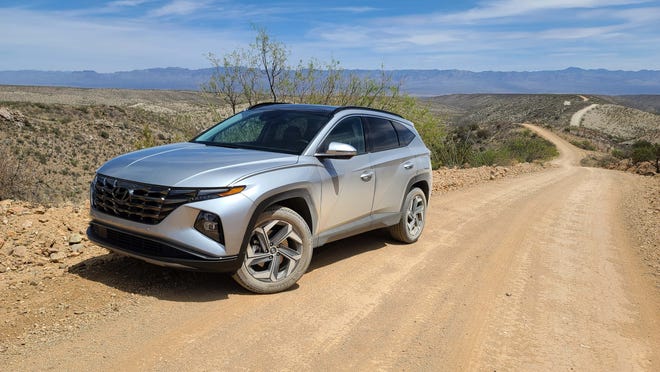
From its big front grille to its sculpted flanks to the crazy quilt of shapes out back, the Hyundai looks like it was pieced together with shards of glass. Linger over the triangular shards in the big grille. Or the pie-piece taillights. Or the triangle-choked mesh below the rear bumper. The tri-theme reminds me of Ford’s oval obsession with the 1996 Taurus, one of my favorite wagons from last century.
“You have to take a risk to get noticed,” said Hyundai chief designer Chris Chapman, a Yankee whose Los Angeles studio was tasked with designing the brand’s biggest U.S. seller.
Hyundai’s U.S. team also knows the segment’s formidable competition and American customers’ habit of living in their cars for long commutes and trips. Segment leaders like the Toyota RAV4, Nissan Rogue and Ford Escape not only offer unique exteriors but roomy, livable interiors.
Now that Tucson’s gemstone exterior had my attention, the interior is a study in Home & Garden practicality. Unlike the aforementioned Taurus, which carried its oval exterior theme inside, the Hyundai’s exterior and interior designs are apples and oranges.
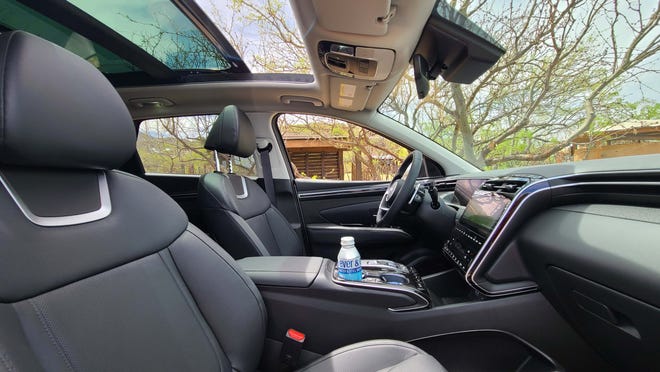
Make that triangles and rectangles.
The interior is built from simple, practical right angles. A pair of chromed lines border the cabin like a picket fence around an Arizona horse ranch. It’s lovely, and — but for the console — uninterrupted.
Look closely, and that’s because there isn’t a hood over the instrument cluster. Like a Ford Mustang Mach-E, the Tucson’s standard liquid crystal display screen (LCD) goes hood-free since it doesn’t reflect the sun’s glare. It makes for crisp digital graphics as well as a less-cluttered cabin. Slick.
Hyundai’s obsession with simplicity continues into the console with twin, stacked rectangular touchscreens. The upper (expandable to 10.25 inches on upper trims) handles infotainment functions, the lower takes care of climate. Engineers and designers are always at war over ergonomics, and the designers won this battle with a clean, touch-only interface. Honda tried this in its last-gen CR-V and ultimately caved to consumer preferences for a volume knob.
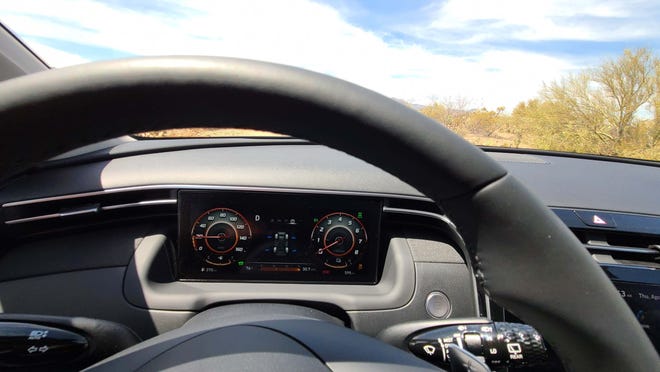
Hyundai buyers may ultimately demand the same, but the Tucson’s design is more elegant than the Honda, so we’ll see. For now, the driver can easily adjust volume using thumb tabs on the steering wheel while the passenger can poke at the screen’s up-and-down volume arrows.
The design theme continues through the lower console with the transmission function actuated through a (rectangular, natch) push-button shifter. The space-saving device opens acres of room for console storage and cupholders.
Room is the priority beyond the front seats. Every compact SUV wants best-in-class claims, and Tucson drops the mic with class-leading leg and cargo room. Rear seats are pickup-roomy. I easily sat behind my big 6’5” self with inches to spare before my knees met the front seat.
Continuing the Tucson’s appeal to giant Yankees, the cargo area is also best in class. Flatten the rear seats and you can transport a jumbo LCD television screen back there to go with the tiny LCD instrument display up front. If you have a family that spends a lot of time in the back, Hyundai offers option like heated rear seats, multiple USB ports and a panoramic roof.
Once an attractive, conservative family hauler, the Hyundais have been dressing to the nines for the roaring ’20s. Tucson follows the Hyundai Elantra, Veloster and Sonata with extreme wardrobe makeovers. The racy styling has been complemented with more pep under the hood, too. The Sonata, Elantra and Veloster have all received N-badged performance versions with taut suspensions and more ponies under the hood.
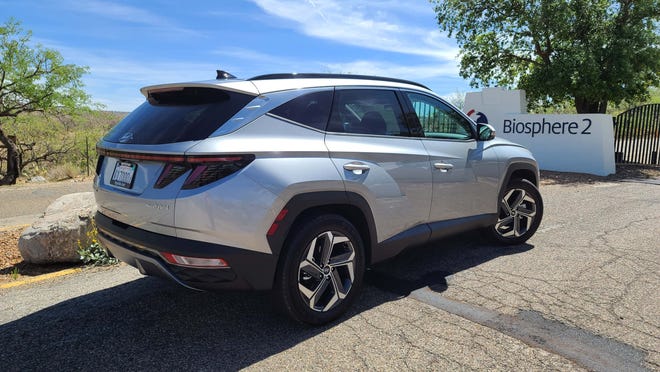
Tucson is content to leave the fast footwork to its siblings.
The compact SUV options an N-line trim, but it’s a showpiece only with blacked-out trim and bigger wheels. Crack open the hood and you won’t find a 295-horse (Sonata N) or 275-horse (Veloster N) furnace within — just a pair of reliable, sippy four-bangers. That’s in keeping with the Tucson’s determination to get you to your destination unruffled.
I tested both the 187-horsepower 2.5-liter 4-banger and 227-horse 1.6-liter turbo 4 hybrid, and they are almost indistinguishable (save the hybrid’s better low-end torque) under the cane given the cabin’s boardroom quiet. Credit slavish attention to detail as engineers have applied triple-layer lamination to the front windshield, a beefy firewall, and extensive sound-deadening throughout the cabin.
The compact yacht doesn’t encourage heavy left foots anyway. This is no Mazda CX-5 or Chevy Equinox with corner-carving ambitions. The Tucson wants you to admire its wardrobe as it saunters by.
Tucson competitors Toyota RAV4 and Ford Escape have big hybrid ambitions in the compact SUV space, with both targeting 30% hybrid sales. Hyundai won’t give any sales goals, but don’t expect the usual Hyundai price bargain. The 37-mpg Tucson hybrid — Hyundai’s first effort in this segment — is priced right on top of ($32,835) the 41-mpg Ford Escape hybrid ($32,990) when equipped with my essential features (AWD, blind-spot assist, adaptive cruise control).
It’s just a $1,250 premium over the standard 2.5-liter, meaning you’ll get your money back in under four years at $3 a gallon of gas courtesy of the hybrid’s 30% better fuel efficiency.
Given the cabin quiet, I’d be content with the 2.5-liter. In keeping with its smartphone-like LCD screens, the Tucson boasts wireless Apple CarPlay and Android Auto. Climb into the comfy front thrones and the Tucson recognizes your phone. Simply bark your destination to Google Maps and you’re on your way to the next destination.
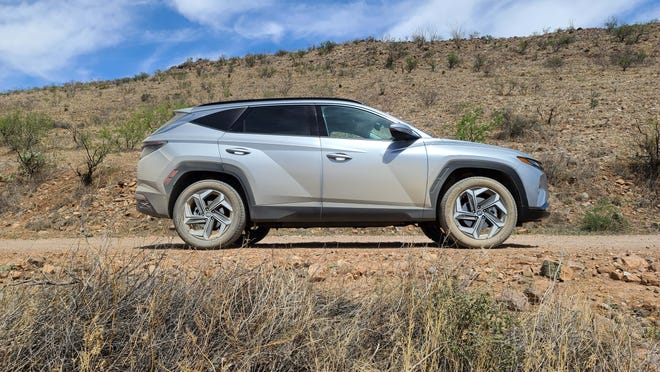
In Tucson, my destination was Arizona Zipline Adventures in the middle of the desert. Like Michigan winters and sandy coastlines, its slippery terrain rewards a good all-wheel-drive system, and Tucson comes equipped with an electronic transfer case that is lockable for maximum traction below 20 mph.
Like a Jeep, the Tucson’s four wheels churned happily away in unison in order to maintain traction. And like a Lambo, I couldn’t stop looking at its angles.
2022 Hyundai Tucson
Vehicle type: Front engine, front- and all-wheel-drive, five-passenger SUV
Price: $26,135, including $1,185 destination fee ($37,454 2.5-liter Limited AWD and $38,704 Hybrid Limited as tested)
Powerplant: 2.5-liter 4 cylinder; 1.6-liter turbo-4 mated to an electric motor and 13.8 kWh lithium ion battery
Power: 187 horsepower, 178 pound-feet torque (2.5-liter); 226 horsepower, 195 pound-feet torque (hybrid)
Transmission: 8-speed automatic (2.5-liter); 6-speed automatic (hybrid)
Performance: 0-60 mph, 8.5 seconds (2.5-liter, Car and Driver est.); towing capacity, 2,000 pounds
Weight: 3,651 pounds (2.5-liter Limited)
Fuel economy: EPA mpg 24 city/29 highway/26 combined (2.5-liter); 37 city/36 highway/37 combined (hybrid)
Report card
Highs: Daring exterior; spare, high-tech interior
Lows: No volume knob; no FWD option for hybrid
Overall: 4 stars
Dream Team: Porsche and Penske reunite to go sportscar racing
Posted by Talbot Payne on May 6, 2021
Two powerhouses of motorsport, Porsche and Penske, are teaming up to go sports car racing.
The Dream Team will develop a so-called LMDh prototype car for entry in international sports car racing from France’s 24 Hours of Le Mans to the Rolex Daytona 24 Hours. Due for the 2023 season, the LMDh will usher in a hybrid era for sportscar racing while reviving a Porsche-Penske partnership that won Can-Am titles in the 1970s and in sportscar racing from 2006-08.

The Porsche LMDh racer will headline the much-anticipated merging of global motorsport under one regulatory discipline, allowing — for the first time in years — manufacturers to enter the same car in FIA’s international World Endurance Championship and the North American IMSA WeatherTech SportsCar Championship. International prototype racing has been splintered with cars eligible for Daytona, for example, unable to compete in other countries.
“This is a proud day for our entire Penske organization. We have represented Porsche on the track or in our businesses for more than six decades. The heritage and success we have enjoyed together is unparalleled throughout our history,” said Roger Penske, chairman of Penske Corp., based in Bloomfield Hills. “I can’t wait to get started as we build a global racing program with Porsche that will compete for wins and championships well into the future.”
Under Penske team management, Porsche will enter two factory cars in the in LMDh class. LMDh will compete next to an even more powerful LMH — dubbed “hypercar” — class.
In structure, the twin prototype classes echo the North American 2006-08 seasons when the Dream Team collaborated on the legendary Porsche RS Spyder. The RS Spyder dominated the LMP2 class for three years running, even beating faster LMP1 prototypes on occasion.
The new international sportscar rules for LMH and LMDh set up a similar competitive tension beginning in 2023 across the globe. And it puts Porsche back in position to claim overall wins at Le Mans and Daytona — tracks where the brand made its marque in the 1960s as one of the globe’s premier performance brands.
“We are delighted that we were able to get Team Penske to form this partnership,” said Porsche chairman Oliver Blume. “For the first time in the history of Porsche Motorsport, our company will have a global team competing in the world’s two largest endurance series. To this end, we will be setting up team bases on both sides of the Atlantic. This will enable us to create the optimal structures we will need to take overall victories at Le Mans, Daytona and Sebring.”
The Dream Team announcement had been expected since Penske dropped its collaboration with Acura in the IMSA Weathertech series last year. With Penske Motorsport also fielding top teams in NASCAR and IndyCar it puts “The Captain” — as the 84-year-old Penske is fondly known — in a position to with the Triple Crown of Motorsport (Le Mans, Indy 500 and Daytona 500) in a single year.
“Team Penske has made a name for itself with an almost unparalleled success story in motorsport. In the long list of victories to date, however, the name Le Mans has been missing,” said Porsche Motorsport chief Fritz Enzinger. “I hope that we will finally be able to chalk up this success as of 2023 with Porsche Penske Motorsport. This would then mark Porsche’s 20th overall victory at (Le Mans) — a dream come true.”
For all the success of the RS Spyder, the Dream Team is probably best known for its Can Am collaboration racing in the early 1970s.

Featuring the most powerful sportscars on the planet, Can Am had made reputations for brands like McLaren and Chaparral in the U.S. Porsche and Penske ended McLaren’s dominance in 1972-73 with epic, 1,000-horsepower-plus Porsche 917s that put Penske — then primarily known for his stateside Trans Am success — on the map as one of the world’s premier teams.
Ironically, the Porsche 917’s success wrote the Epilogue to the so-called Golden Era of motorsport as the 1970s oil crisis forced auto racing to downsize engines. Motorsport is on the precipice of a similar catharsis today as global governments force automakers into electric powertrains.
Along with hybrid powertrains coming from NASCAR and IndyCar, the LMDh prototypes are an attempt by international sportscar racing to get ahead of the regulatory curve and help market electrified technologies to customers via motorsports.
“As of 2023 … our intention is to support and shape the new era with our LMDh prototypes,” said Porsche R&D board member Dr. Michael Steiner.
The Porsche LMDd cars will weigh about 2,200 pounds and put out 670 horsepower. In addition to two Penske entries, Porsche intends to make the cars available to private teams with full factory support.
The Dream Team will set up its U.S. base camp in Mooresville, North Carolina.
Payne: Put yer feet up in the bold, cavernous Kia Carnival minivan
Posted by Talbot Payne on April 29, 2021
The new Kia Carnival minivan wants you to know that it’s good looking. It’s a minivan thing, I get it. Minivans are insecure next to their high-riding, muscular SUV peers. So Carnival has raided its hot Telluride and Sorento siblings’ closets to outfit itself with a big grille, boxy stance and bold wheel arches. Nice.

But I want to talk about the awesome Barcaloungers inside.
Because, like pickups and their beds, cavernous interiors make minivans unique. Carnival, embrace your minivan-ness! Your roomy interior blows away SUVs. Reputations are made in the minivan circus with second-row seat tricks (Chrysler’s Stow ‘n’ Go, Honda’s magic sliding seat), and Kia has something to say.
Behold the “VIP Lounge chair” — two of them — available on the top, SX Prestige trim. Prestige will set you back $47,00 but will trump the back seat of a $100,000 Audi A8L. Check out these thrones.
I pressed the rear door handle button and the sliding door — open sesame! — receded automatically. Try that in your Audi. Then I slipped my 6’5” frame into an ocean of caramel leather, my elbows resting on twin armrests. With the push of a button, the chair began to flatten like my grandfather’s living room chair. An ottoman popped up under my legs. The seat back went … All. The. Way. Back.

If there were kids in the third row, they would have been flattened.
OK, so that may be a problem in families with four kids. I can hear the rear seat wars now (I still remember my backseat battles with my sister, and we didn’t have Barcaloungers to fight over). No wonder Kia options Carnival with a rear-seat camera so Mom and Dad can keep an eye on things. As a helpful distraction for the kiddies, Netflix can be streamed in the rear seat screens.
Standard on Carnival is a second-row bench seat that is clever in its own right. The middle section will slide forward so front passengers can attend to, say, a car-seated child. Or the middle seat can be converted into a table. That’s minivan cool right there.

Cool seats. Roomy interior. Bold exterior (Ford Flex fans in withdrawal, this is your vehicle.). So how does it stack up to King Pacifica, the reigning master of the minivan segment?
Carnival is handsome, and it’s got to be, in a segment Pacifica redefined. The Chrysler is one of my Top Ten vehicles, a comprehensive piece of automotive genius from its sculpted exterior (recently updated to look more SUV-like) to its innovative interior.
The Carnival may have VIP lounge seats, but the Pacifica’s interior tour de force includes a vacuum cleaner, kick-open sliding doors, sliding console drawer, and the ability to bury both rear rows under the floor (Carnival manages only the third row) or remove the second row entirely.
After spending time in the back of a Pacifica a few years ago, the first-grade child of a Tesla owner said to me: “Mr. Payne, this car is better than my dad’s Model S!”
Pacifica just keeps piling on the goodies, and for 2021 now options all-wheel drive and a plug-in hybrid with 30 miles of range for local commutes. For all this bling, the Pacifica is still a remarkable value. Where Kia traditionally dominates Detroit manufacturers in value (price a Telluride next to a Ford Explorer sometime), Pacifica is neck-and-neck with Carnival pricing.

Indeed, it’s Chrysler that brings the segment’s value player with the under-$30,000 Voyager minivan — essentially a last-gen-styled Pacifica that undercuts Carnival by two grand. Rock on, Motown.
Features aside, however, Carnival will turn heads for the brand’s bulletproof reputation. Think #1 on JD Power’s 2021 three-year U.S. Vehicle Dependability Study. That, and the eye-grabbing 100,000-mile drivetrain warranty. That reliability is gold for families whose western road trips (guilty as charged) are built around their vehicles. And I’ve been asked more than once about Chrysler’s basement-level quality ratings.

Pleasing looks aside, the Carnival also takes a page from the V-6-powered Pacifica’s playbook in tech and drivetrain. The infotainment system is superb, with lots of clever touches. The turn signal triggers a camera that shows your blind spot in the instrument display. A microphone enables communication to the distant third row. And the display is upgradable to a sweeping all-digital screen that brings to mind a Merc.
Under the hood is a good ol’ reliable V-6 that puts out a healthy 290 horses and can tow up to 3,500 pounds.
Ultimately, the Carnival will be compared against its Telluride sibling, which is the pride of the Kia litter. A loaded Telluride SX with Prestige package — Nappa leather seats, head-up display, sultry headlights — costs about the same as my Carnival Prestige tester.

But the Telluride won’t let you recline in Barcalounger comfort. Minivan, take a bow.
2022 Kia Carnival
Vehicle type: Front engine, front-wheel-drive, seven-passenger minivan
Price: $33,275, including $1,175 destination fee ($42,770 SX and $47,770 SX Prestige models as tested)
Powerplant: 3.5-liter V-6
Power: 290 horsepower, 262 pound-feet torque
Transmission: 8-speed automatic
Performance: 0-60 mph, 7.0 seconds (Car and Driver); towing capacity, 3.500 pounds
Weight: 4,727 pounds (SX Prestige as tested)
Fuel economy: EPA 19 city/26 highway/22 combined
Report card
Highs: Interior dexterity; one word — Barcaloungers
Lows: No all-wheel-drive option; awesome Barcaloungers may cause backseat kid wars
Overall: 3 stars
Payne: Makeover tones down Civic’s brash looks for 2022
Posted by Talbot Payne on April 29, 2021
The Honda Civic sedan has gone clean cut.
The best-selling retail compact car in America got an extreme makeover for its 11th generation, revealed Thursday. The outgoing generation, which debuted in 2015, burned eyeballs with an expressive wardrobe that included angular body lines, loud grille, and even louder boomerang-shaped taillights. A rolling billboard for ambitious upgrades in chassis dynamics and engines, the design was hard to miss.
For its next act, the Civic’s looks are more spare inside and out, echoing big brother Honda Accord. If the 10th-gen looked like it was designed by Marvel Comics, the 2022 car might have been penned by Mondrian.
The exterior is Audi-like in its simplicity, with a thin grille, sweeping high shoulder line and crisp, rectangular taillights. The horizontal discipline extends to the interior with a wide dash capped by a high touchscreen for good driver visibility.
If there is common ground between the two generations, it’s that Civic remains a driver’s car, with the new model improving on a 10th-gen chassis honed at the Nurburgring race track in Germany. The new Civic boasts 8% better rigidity, thanks to liberal use of aluminum, high-strength steel and structural adhesives.
Expect even more athletic versions to come with Si and Type R performance trims. For now, the Civic is showing off its LX, Sport, EX and Touring trims.
The Japanese brand’s longest-running nameplate, Civic has sold 12 million copies to U.S. customers since 1973 (5 million made in North America) making it one of the top three best-selling cars in America. The 2022 sedan will be produced in Ontario, while the forthcoming hatchback will be built for the first time in Greensburg, Indiana.

As American automakers have abandoned compact cars for all-SUV lineups, Asian and German manufacturers now dominate the segment. Civic sales have remained strong at more than 300,000 units annually (260,000 in a down, 2020 COVID year) ranking as the No. 1 model with first-time buyers, Millennials, and Gen Z since the 10th-gen was launched in 2015.
“Civic has been the go-to choice for compact car buyers for almost 50 years and the all-new 11th-generation Honda Civic builds on that leadership with simple and sporty styling,” said Dave Gardner, executive vice president of American Honda operations.
Civic’s popular, diverse model lineup is an industry benchmark that faces competition from new entries like the daring Hyundai Elantra, Mazda 3 and Nissan Sentra.
But rather than match those upstarts with attention-getting earrings and tattoos, the Civic has dressed itself more simply and authoritatively as the establishment choice. Knock me off the throne, it seems to say.
The design harkens back to simpler Civics of yore like the 1991 (5th generation) or 2005 (8th gen) models. Honda calls this return to simplicity “Man-Maximum, Machine-Minimum.” The horizontal design cues give the Civic a wide, planted stance. Other notable exterior changes include door-mounted mirrors for better visibility.
Inside, the horizontal theme continues with a metal honeycomb mesh accent that stretches from A-pillar to A-pillar. It serves both form and function — visually dividing the infotainment tablet and climate controls while concealing the air vents for an uncluttered look. The wheelbase is stretched by 1.4 inches (and overall length by 1.3), but interior dimensions remain virtually the same with cargo space slightly reduced.
Unchanged is the front-wheel-drive Civic’s suite of engines, beginning with a standard 158-horsepower 2.0-liter four-banger and optional 1.5-liter turbo-4. Both improve fuel economy over the last gen, with the turbo getting a 3% boost in power to 180 horses.
The Civic continues to push the envelope with standard tech features as common in this $22K class as in $50K luxury cars. Adaptive cruise control, for example, comes standard, as does Apple CarPlay and Android Auto, forward brake assist and lane keep-assist.

The Civic also pinches airbag tech from its luxury Acura brand. The new, doughnut-shaped airbags are designed to cradle the head to reduce brain injuries sometimes suffered in severe frontal collisions.
High-tech gewgaws include an available, all-digital, 10.2-inch, customizable LCD instrument display in the top-trim Touring model. The standard, 7-inch console touchscreen can be upgraded to a high-def, 9-inch screen. Other premium options include a 12-speaker Bose sound system and wireless charging.
The 2022 Civic goes on sale this summer.
Payne: Jeep Wrangler 4xe a mean Green machine
Posted by Talbot Payne on April 29, 2021
Green cars are a snore. Electrified cars are, well, electrifying.
That’s the difference Tesla figured out with Ludicrous mode Model S sedans that could blow away Hellcats at Woodward stoplights. Sports cars like the Acura NSX and Ferrari SF90 Stradale have figured it out, too. And now it’s the plug-in hybrid Jeep Wrangler 4xe’s turn to show off how electrification can make better toys.
The Wrangler is just a big kid’s Tonka toy. I mean, just look at it.
Goggle eyes, oversized tires, plastic fenders, roll bar and removable doors, for goodness’ sake. Built on a rock-hard ladder frame, the Wrangler’s most capable model — Rubicon — can climb over just about anything, thanks to a suite of goodies: a low-speed 4×4 transfer case, locking differentials, decoupled sway bar. And when they get bored with that toybox, Wrangler owners go buy more accessories like snorkels, lights, skeleton doors, monster tires.

No surprise, then, Jeep’s elves are offering an electric motor for more giggles. In my experience, there are few more passionate owners than the Jeep and Tesla nations. Gather members of either tribe and they’ll talk in their own language for hours.
Electrifying the Wrangler will open Jeep owners’ eyes to what Tesla geeks have been wowing about. Let me count the ways.
After an overnight charge in downtown Austin, Texas, my 2022 Jeep 4xe woke up and thought it was a Model S. I poked Electric mode (Hybrid and E-Save also available, more on that later) on the left dash, then Regen on the center console and plied the Lone Star state’s capital city Tesla-style.

Fully charged, the 17.3-kWh lithium ion battery under the rear seat will get you 21 miles, while Regen enables one pedal driving. The regeneration toy is something pure-EV owners (this author included) have come to love, but the Jeep 4xe brings it to the hybrid realm as well.
I one-pedaled around Austin, easing into lights by taking my foot off the accelerator and letting electric motor resistance do the braking. It’s fun. It saves on brake pad wear. Jeep Nation will love it.
Or save your 21 electric miles for the Outback. Select E-Save mode and Wrangler 4xe will bank your battery charge for when you want it — say, at Holly Oaks north of Clarkston, or Ink’s Ranch outside Austin.
With five miles of battery left on the Jeep 4xe, I toggled E-Save mode as I crossed Austin’s Colorado River and headed south for Ink’s. As I learned, however, you have to be REALLY diligent about banking electrons because the Wrangler 4xe’s ample torque encourages bad behavior.
After a rest stop, I merged with authority into traffic, the Wrangler throwing its mane back like Secretariat down the home stretch. FOOM! I left traffic behind. The combination of 2.0-liter turbo-4 and electric motor means 375 horsepower and relentless low-end torque — 470 pound-feet total. That’s the biggest number in the Wrangler family, including the stump-pulling diesel.
Zero-60 flies by in just six seconds, better than anything this side of the Wrangler 392 (which is stuffed, ahem, with the same 6.4-liter V-8 as a Dodge Challenger).
The acceleration is addictive — especially in 4×4 High with all four hooves clawing the pavement — and I torched Texas stoplights and passing lanes all morning. But all that aggression is also not possible without accessing the battery — so I also burned off the five miles of banked charge. Dang it.

In the wide-open spaces of Texas, this would be cause for concern in a Tesla — or any other all-electric vehicle. Wide open throttle sucks precious electrons and reduces range, a concern when charging infrastructure thins beyond metro areas.
That’s an advantage of Wrangler’s plug-in drivetrain. With the gas engine, fuel infrastructure is always nearby so I could exercise my lead foot free of range anxiety.
That’s a lesson for the Green Church, now running Washington, D.C., which insists on an absolutist, zero-sin — er, emissions — future. Plug-ins are much more convenient. Let consumers decide.
The downside is that carrying two drivetrains around ain’t cheap.
My Wrangler 4xe Sahara-trimmed tester cost a hefty $56,380 ($49,490 standard) — a cool 10 grand north of a comparable gas-powered model. Add another $1,000 to equip your garage with a 240-volt charger, and going green requires a lot of green.
To blunt the premium, D.C. pols are handing out $7,500 tax credits to the swells that can afford these expensive toys. Seriously? Another benefit that Tesla Nation has enjoyed.
The electrified fun continues off-road.
Entering Ink’s Ranch 63 miles south of Austin with no range anxiety worries and 300 miles of range still on the gas tank, I tackled some of the Southwest’s best rock-crawling landscapes.

Electric-only off-roading is a hoot. I jumped from the 4xe Sahara into a $62,415 4xe Rubicon (about the price of a Tesla Model 3 Performance) that had been juiced up on a DC fast charger. It’s part of the “Jeep 4xe Charging Network” of 240-volt chargers at off-road trails around the U.S. A full charge will take 2.5 hours — much less for just a few miles.
Jeep plans two charging stalls at each location (not the eight Tesla Nation is used to), so you might have to wait a bit if Jeep sells a lot of 4xes.
Rubicon’s rock-crawling ability is legendary (Jeep Nation: Dude, have you followed a Pink Jeep Tour around Sedona, Arizona’s red rocks? Awesome!) and electrification adds to the experience.
Like a stealthy predator, I crawled silently through Ink’s brush, streams and rocks. Off-road parks are Jeep Nation social time, and the quiet powertrain will help you hear fellow Jeepsters as they call out navigation instructions for insane cracks, cliffs and quarries.
“Keep right! OK, straight ahead! Go back! More throttle!”
Whether you are in full-electric mode or hybrid mode, the electric motor’s torque is instant. And the battery is unfazed by the elements. Not only did I navigate streams and flooded gulches in 4xe, but I did it under black skies that rained buckets.
Like a bathtub toy, Wrangler’s electronics are good in up to 30 inches of water. Not sure I’d try that in my Tesla. Off-road durability? Something Tesla Nation could learn from Jeep Nation.
2022 Jeep Wrangler 4xe
Vehicle type: Front engine, four-wheel-drive, five-passenger plug-in SUV
Price: $49,490, including 1,495 destination fee ($56,380 Sahara model and $62,415 Rubicon as tested)
Powerplant: 2.0-liter turbo-4 cylinder mated to an electric motor and 17.3 kWh lithium ion battery
Power: 375 horsepower, 470 pound-feet torque
Transmission: 8-speed automatic
Performance: 0-60 mph, 6.0 seconds (mfr.); towing capacity, 3,500 pounds
Weight: 5,222 pounds (Rubicon as tested)
Fuel economy: EPA 20 mpg combined (18.7 mpg as tested); range: 370 miles
Report card
Highs: Cool EV features like regen, battery-only mode; insane off-road capability
Lows: Gets pricey; EV learning curve
Overall: 4 stars
Payne: Aston Martin DBX – your SUV, Mr. Bond
Posted by Talbot Payne on April 22, 2021
The Aston Martin Rapide is the most beautiful sedan in the world. So it’s no surprise the Brit brand’s first SUV, the DBX, is a stunner. Now that’s how you pen a ute.
America has been overrun by SUVs, but save for the odd Range Rover, luxury automakers have struggled to translate the sex appeal of their sedans/sports cars to the high-riding hatchback. The Porsche Cayenne, which pioneered the performance ute back in 2003, still looks like an overweight 911. Mercedes GLC Coupes look like bowling balls. Even Lamborghini’s Urus fails to stir the loins.
The Aston DBX nails it. My white DBX tester takes the ugly SUV duckling and makes it a swan — literally. Signature beak and ovoid headlights sweep backward over a muscled torso to an elegant, swan-like tail. This is a rare bird in the auto kingdom.
But the DBX is about more than good looks.
Like the DB5 sports car that James Bond made famous, the SUV boasts speed and utility. Not rotary-tire-shredders-emerging-from-the-wheels or grille-mounted-machine-gun utility, but useful features nonetheless. Take the DBX to a road course, for example, and it’ll help with track setup as well as run hot laps.
I high-tailed it to my home state of West Virginia one weekend to see if DBX lives up to its family name with a few laps around a test track. The rural circuit only gets occasional use and was blocked by a tree from a recent ice storm.
No problem — I brought an SUV. I loaded up DBX’s ample cargo bay with a chainsaw and long brooms and went to work with Mrs. Payne clearing the debris. The DBX comes equipped with air suspension to accommodate multiple driving modes — GT for daily driving, Terrain/Terrain+ for off-roading, Sport/Sport+ for track days. The air suspension also knelt so I could sit on the rear sill and strap on my work boots.
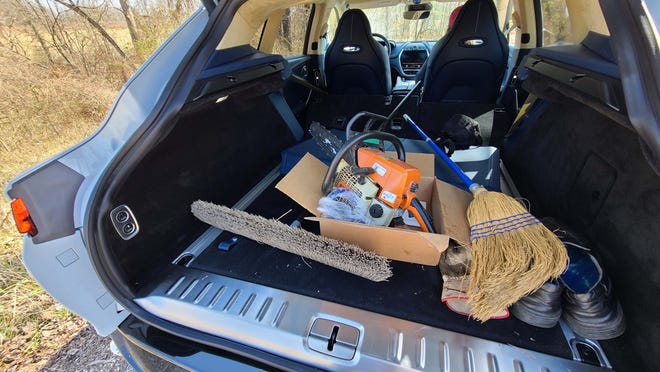
Once the track was cleared, the Aston proved worthy of its badge.
In this Age of Ute, branding is essential as legacy automakers transition to SUVs and electric vehicles. That goes for a $43,000 Mustang Mach-E as well as a $180,000 Aston. The crossover embodies Aston core values earned over decades: style, power and handling.
This SUV is old school, old Europe. It’s glorious.
Under the hood is a good old-fashioned V-8 with two turbos strapped to its back. It’s the same eight-holer found in Mercedes’ AMG models (Merc owns 20% of Aston) as well as Bond’s latest Vantage sports car. Exhaling though twin tailpipes the size of ship cannons, the V-8 puts out 542 horsepower and 516 pound-feet of torque. Our friends at Car and Driver clocked its 0-60 mph time at 3.9 seconds — a half-second shy of Vantage.
The nine-speed transmission (also Merc-sourced) seems barely able to keep up. Stomp the gas and the box bounces from sixth gear to third, delivering raw, violent power to its massive, 13-inch-wide tires. Like a flimsy gate giving way to the king’s cavalry, it unleashes a ferocious surge of power.
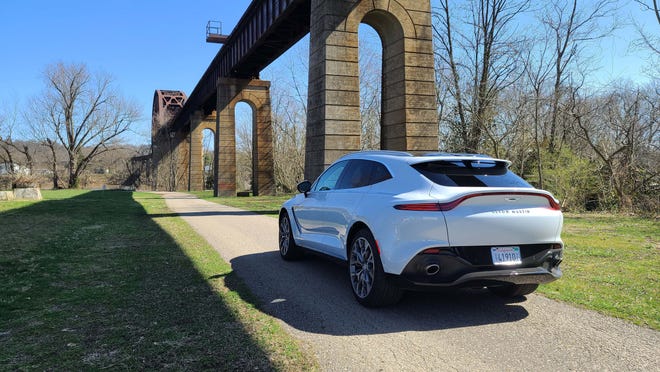
The elegant beast exploded out of a tight right-hander. The nose pointed at the heavens, the engine bellowing with joy.
For a 4,940-pound SUV, it is astonishingly agile. A rhino in tennis shoes. Enormous 16-inch rotors brought the DBX back to earth as I rotated around a long carousel turn — the rear end eagerly swinging outward as all four tires scrabbled for traction as I fed more throttle. The designers have drawn a sleek athlete — and the engineers have matched it with a midsize aluminum-chassis SUV that feels a class smaller.
The interior is Old Europe as well.
While Mercedes, BMW and Cadillac have introduced a new generation of dazzling, dash-spanning screens, Aston is content with digital instrument and console screens that wouldn’t be out of place in a $28,000 Hyundai Elantra. The infotainment screen isn’t even touch operated — it can only be controlled by a remote dial. And the screen only supports Apple CarPlay, not my Android Auto (at least there’s blind-spot assist since the coupe-like rear roof creates a blind spot the size of Oxford).
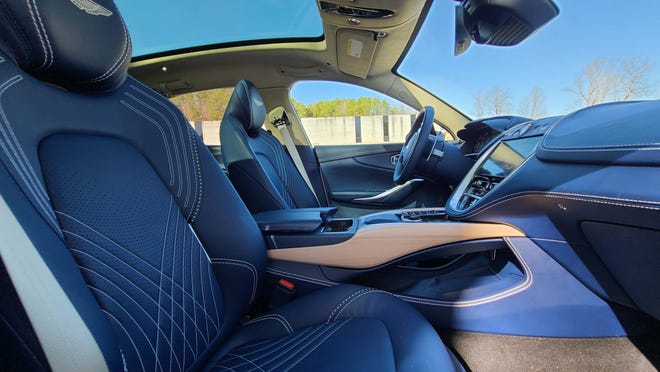
You don’t go to Windsor Castle to see the latest in big screen technology. You go to see exquisite rooms and sumptuous materials. So, too, the DBX.
The interior and front thrones are wrapped in delicious blue leather. White contrast stitching sows it together. On the door pillars and ceiling? Lush beige Alcantara. My wife swooned. Speaking of castles, the wood-trimmed console arches like a bridge over a moat — the blue leather space underneath perfect for secreting m’lady’s purse.
The rear seats of this royal chariot lacked the fancy-pants portable tablet of some fancy chariots I’ve driven recently. But this English athlete is guzzling barrels of oil — not coddling tea-sipping passengers. Strap them in and at least they’ll have plenty of leg room. Your 6’5” reviewer could sit behind himself with room to spare while basking under a huge panoramic roof unobstructed by crossbar support. How Aston managed to make this ute so nimble with all that glass on the roof is an engineering marvel.
After an afternoon flogging the thoroughbred on track, the ride home is soothingly quiet. The cabin is wrapped in acoustic laminated glass so it’s peacefully secluded from the outside world (unless your lead foot awakens the beast within).
Such luxury is out of the reach of most of us peasants, but that doesn’t mean it doesn’t bring pleasure to the masses. My Aston tester was routinely mobbed at gas stations (which you will visit frequently to slake the V-8’s thirst) by appreciative fans.
Like a winning stallion at the track, it’s sinewy flanks are just too gorgeous to ignore.
“I didn’t even notice it was an SUV,” said one bystander. “It’s so beautiful.”
A ute it may be, but DBX is a still work of art — just like its ancestors.
2021 Aston Martin DBX
Vehicle type: Front engine, all-wheel-drive, five-passenger midsize SUV
Price: $179,986 including $3,086 destination fee ($210,986 as tested)
Powerplant: 4.0-liter twin-turbocharged V-8
Power: 542 horsepower, 516 pound-feet torque
Transmission: 9-speed automatic
Performance: 0-60 mph, 3.9 seconds (Car and Driver); top speed, 181 mph
Weight: 4,940 pounds
Fuel economy: EPA 14 city/18 highway/15 combined
Report card
Highs: Aston style; ferocious V-8
Lows: Rough downshifts; underwhelming interior tech
Overall: 4 stars
Payne: Rugged Toyota Tundra TRD Pro likes to play
Posted by Talbot Payne on April 21, 2021
Mt. Morris — Rural Michigan is pickup country. Huge Ford F-250s towing equipment. Laden Silverados hustling to service jobs. Gorgeous Ram trucks prowling construction sites. And macho pickups of all stripes with big tires, menacing hood scoops and lifted suspensions eager to go beyond where the asphalt ends.
Despite its rare Toyota badge my hulking, 2021 Tundra TRD Pro tester fits rights in.
Sitting atop 32-inch Michelin all-terrain tires, Fox off-road shocks and 11 inches of ground clearance, the Lunar Rock-painted behemoth bristles with hood scoops and tow hooks. This is not your father’s Camry, but a serious bark-chewing beast.

Think of Toyota as Dr. Jekyll and Mr. Hyde. The Japanese automaker has built a reputation as a dependable daily driver (backed up by years of JD Power reliability MVP awards) and a weekend track warrior. Its Toyota Racing Development (TRD) shop has climbed podiums at the highest echelons of motorsports from NASCAR to Formula One. That resume includes winning the Baja 1000, North America’s premier off-road competition.
Beginning in 1998, the TRD badge started to show up on the Tacoma (Taco, as it’s known to its legion of fans) as a rough-and-ready off-roader. While the Detroit Three dominated full-size pickups, Taco owned the midsize segment with its Mr. Hyde TRD variants leading the way.
Tundra followed with its own TRD features but has lived in Taco’s shadow — its sales just half that of little brother (much less anywhere close to the Detroit Three). But Tundra upped its game in 2015. It grew a comprehensive TRD Pro package (like Taco) with serious suspension and skid plate mods. It even brought back a Baja 1000 trophy in the Pro Stock class to make little brother proud.
Tundra? My TRD Pro tester is Tund-raw.

Somewhere between Southview Farm and the Irish Road Canoe kayak launch, I turned off Mt. Morris Road into The Mounds Off-Road Vehicle Park. The Mounds is 200 acres of dirt, sand and bog. It’s a place where dirt bikers, ATV owners and Jeepsters can let out their inner child.
And where Tundra lets out Mr. Hyde.
I shifted to Neutral and turned the transfer-case dial from “2WD” to “4WD.” Then I held the traction control button to turn off the nannies. When I say “held” I mean “held for a loooong time.” This is a Toyota, after all, and the nannies don’t retreat easily.
Once unleashed, TRD Pro had a blast. ROOOAARR! I nailed the throttle and the 381-horse, 5.7-liter V-8 bellowed, the rear end slewing sideways through muddy bends. With the Fox shocks allowing extended suspension travel, Tundra bounded over a sandbox of moguls like an oversized puppy.
WHUMP! It’s easy to get too excited, and the enormous front skid plate is there for when the suspension travel runs out and the truck’s belly slaps a mogul.
The Mounds’ tight confines are, frankly, more suited for midsizers like the Tacoma, but it would be impressed by how big bro did.

My friend Scott, who bleeds Ford blue, was impressed, too. Walking around the TRD Pro back in Oakland County, he liked the menacing, black front grille and hood scoops (OK, so the scoops are fake). The big back-seat room. The lifted suspension.
“No running boards for better off-road clearance. Nice.”
The TRD Pro trim is key to giving the Tundra personality. It’s also key to keeping the Tundra relevant in the full-size truck market.

The Texas-built truck sits on old bones. In today’s high-tech truck world of big Ram screens and digital Ford F-150s, the interior of the Tundra is a generation behind. The instrument display is simple. The chassis competent. The 8-inch console touchscreen devoid of fancy graphics or wireless Apple CarPlay.
On the road back down I-75 to Metro Detroit from The Mounds, the rear end fluttered over road seams. Inside, the cabin lacks the noise insulation of today’s more refined Detroit trucks. But in its simplicity, truck lovers will find comfort.
Competitors offer cool stuff like digital screens and console work surfaces, but TRD Pro’s basics keep its price in the mid-$55,000 range, while comparably equipped off-road-trimmed rivals like the wicked-looking Ram 1500 Rebel (be still, my beating heart) and Ford F-150 FX4 will crest 60 grand.
With the money you save, you can go out and buy even bigger tires to pull little brother Taco out of The Mounds bog.
2021 Toyota Tundra TRD Pro
Vehicle type: Front engine, four-wheel-drive five-passenger pickup
Price: $54,645, including 1,595 destination fee ($55,224 as tested)
Powerplant: 5.7-liter V-8
Power: 381 horsepower, 401 pound-feet torque
Transmission: 6-speed automatic
Performance: 0-60 mph, 6.4 seconds (Car and Driver); towing capacity, 9,800 pounds
Weight: 5,998 pounds
Fuel economy: EPA 13 city/17 highway/14 combined
Report card
Highs: Aggressive looks; big interior room
Lows: Dated interior; rough ride
Overall: 3 stars
Racing 101: IndyCar sponsors Belle Isle classroom for Detroit youth
Posted by Talbot Payne on April 21, 2021
When the IndyCar circus roars on to Belle Isle this June, it will expand its tent to include Detroit youth.
The open-wheel racing series is partnering with NXG Youth Motorsports, an experiential academy for life-skill development, with the goal of increasing minority participation in motorsport — and, by extension, STEM (science, technology, engineering, and math) education.
The Indianapolis-based NXG first partnered with IndyCar last fall as part of the race series’ Race for Equality and Change initiative. Bloomfield Hills-based Penske Entertainment Corp. took over IndyCar last year.

NXG will host its first Detroit program on Belle Isle June 5-6, the weekend before the Chevrolet Detroit Grand Prix presented by Lear. Combining in-class learning with on-track go-kart time, the eight-hour program is open to kids ages 11-15 with a focus on teaching STEM via motorsport.
“We offer a bridge between IndyCar and the urban community. It’s an ideal way to get kids from surrounding areas an introduction into racing as a whole,” said Rod Reid, NXG co-founder and chief instructor. “We want to expose kids to the myriad of career opportunities in motorsport.”
The NXG program joins a widening array of Detroit-based youth programs with the intent of using elite, international sports as a classroom to broaden student horizons. Other successful urban programs include Midnight Golf, Detroit Horse Power (equestrian learning), Downtown Boxing Gym and Racquet Up Detroit.
NXG follows in the footsteps of national programs like Racquet Up, which was founded in Boston in the 1990s. Ten years ago, Racquet Up introduced Detroit youth to another sport, squash, that has helped hone students’ competitive and classroom skills. A 12-month, three-day a week out-of-school program, it has been a college pipeline for more than 100 Detroit youth.
NXG’s initial Detroit ambitions are more modest as it targets 20 Detroit-area kids for its immersive June weekend program. Founder Reid said the program will intentionally start small to ensure a 2-to-1 student-to- teacher ratio. With the lessons learned, he hopes minority pupils will be inspired to tackle more STEM learning as well as motorsports. Over time, Reid says he hopes the program will be able to offer more go-kart events at Detroit venues.
Building a thriving program in Indy for 15 years, NXG has connected with thousands of Indiana youth. With local corporate sponsorship from Blue Cross Blue Shield of Michigan enabling free enrollment, the program hopes to touch a new generation of Detroit youth.
Youth like Detroiter Ethan Kent, 13, who is looking forward to the June program on Belle Isle.
“This event will help me. I’ve never put on a driver suit before,” said Ethan. “I hope to get into cars more and make a career out of racing.”
He and his peers will take MA100, an entry-level course, in conjunction with flogging go-karts around the Detroit Grand Prix paddock — the same paddock that will host the IndyCar Dual in Detroit a week later, June 11-13. NXG students and their families will be invited to the races.
Post-Detroit GP, students can advance to other courses through the course of the year. The classes progressively introduce boys and girls to go-kart racing fundamentals — driving techniques, mechanical equipment understanding, self-control — that are transferable to daily life. One lesson, for example — “Pressure Points” — uses tire pressure to teach life lessons about peer pressure.
NXG’s curriculum aligns with middle and high school academic standards in science and math-related subjects.
“The shiny object here is the go-kart,” said Detroit GP chairman and Penske Corp. president Bud Denker. “Students go through two hours of STEM education to be part of two hours of driving a go-kart. It helps drive learning back into the classroom.”
Denker and his Penske team have been active in reaching out to area schools. Schools have been a foundation stone for Racquet Up’s squash program as well. Five city schools — three charters and two public schools — have helped connect families and their children with the program.
“NXG opens opportunities to youngsters like Ethan and others who want to take this path,” said Matthew Maxey, a Ford engineer and instructor with NXG. “Motorsports is not super-accessible like basketball. This program allows you to learn how to access a go-kart and work on it and maybe give someone a career path.”
Denker pointed to two mechanics on an F2000 team — a racing feeder series to IndyCar — that grew up in NXG’s Indianapolis program. They were inspired by their time there.
“NXG makes a connection to motorsports and STEM education for people that otherwise would not have this opportunity,” he said.
Payne: Hyundai’s segment-busting pickup aims for SUV buyers
Posted by Talbot Payne on April 21, 2021
Tucson, Arizona — The pickup wars have a new warrior: Hyundai unveiled its long-awaited pickup truck here Thursday, further expanding the red-hot midsize truck segment.
But the Made-in-America, 2022 Santa Cruz thinks outside the usual boxy pickup. It’s aimed at SUV buyers rather than the traditional, rugged, ladder-frame Detroit Three pickup customer.
Call it an SUV with a bed.

The strikingly-designed Hyundai, first seen as a concept at the Detroit Auto Show way back in 2015, is the second unibody-based pickup after the Honda Ridgeline. But where the Ridgeline’s long-bed proportions match up with the Detroit Three pickups, the Santa Cruz embraces its ute-ness. Out front, the full-fascia grille echoes the Tucson SUV with which the pickup shares a platform. Out back is a compact bed no longer than a typical SUV hatch.
The bed is shorter by 8 inches than competitors Ford Ranger and Toyota Tacoma. Since the box only comes in one size (not short and long options), it is more integrated into the vehicle’s angular body design than the traditional, boxy truck.
It’s most striking feature is a optional, sliding tonneau cover that brings to mind the radical Tesla Cybertruck pickup bed. The lockable cover allows owners to throw dirty, smelly items (think hockey gear) into the bed separate from the cabin — but without the risk of having them stolen.
Hyundai calls Santa Cruz a segment-buster — referring to it as a “sport adventure vehicle” that allows SUV buyers the utility of a pickup but without the interior and parking constraints of its bigger segment brothers. The idea appears to be in vogue as Ford is also reportedly coming to market with a unibody pickup called Maverick. VW, Ram and GM are also looking at the nascent segment.

“The Santa Cruz shatters convention,” said design director Brad Arnold. “This is neither truck not SUV. It’s an entirely new category of vehicle.”
The small Santa Cruz bed is designed more with fertilizer-toting gardeners in mind than home-builders with long wood planks. A hidden, sub-bed compartment can store additional gear or be used as a tailgate cooler (there is also sub-rear seat storage). The Hyundai also takes a page from Chevrolet with corner bumper steps for easier rear access.
“Open-bed flexibility coupled with closed-cabin security meets the changing everyday needs of its adventure-oriented buyers, while superb maneuverability ensure it is a pleasure to drive in urban or off-road environments,” said Hyundai Motor North America chief Jose Munoz.

The Santa Cruz will be built in Montgomery, Alabama, (adding some 1,200 jobs) and hit dealer lots this summer. Expect it to start at $25,000. Further making its case as a red-white-and-blue pickup, the taillights are embossed with “Designed in California” to honor Hyundai’s West Coast-based design team.
Those who want to take the Santa Cruz off the grid will be encouraged by a front skid plate and available all-wheel-drive system (front-wheel-drive is standard). True to its dual personality, the Sant Cruz’s AWD can be optimized for on-road or off-road grip.
The interior is thoroughly modern — anchored by modern digital displays. Familiar Hyundai tech abounds: wireless Apple CarPlay/Android Auto, phone charger and smartphone app connectivity for, say, remote starting and cabin warm-up. Standard safety features include lane-keep assist and forward collision alert with adaptive cruise control optional.
To motivate the little beast, Hyundai options two 4-cylinder engines with added oomph for off-roading or towing. A standard 2.5-liter four-banger makes 190-plus horsepower while a 275-horse turbo-4 (the same power output as Hyundai’s ferocious Veloster N hot hatch) is optional. The latter boasts 5,000 pounds of towing capability — on par with the Honda Ridgeline but shy of segment, ladder-frame leaders that boast 7,500-pound capability.

With its shorter bed and lower profile, the Santa Cruz comes in over a foot shorter than class competitors to assist in parking garage flexibility. Its unibody construction may also aid smoother daily ride than typical pickups.
Pre-COVID, sales of midsize pickup trucks in the U.S. jumped 22% in 2019 to 13-year highs. With SUV sales at 70% of the non-pickup market, Hyundai expects more buyers to be headed its way with the Santa Cruz.
Payne: SUV OMG — Acura RDX A-Spec vs. Mercedes-AMG GLC 63
Posted by Talbot Payne on April 15, 2021
I like dessert. I’m usually satisfied with a scoop of ice cream or slice of apple pie. Usually. But on occasion, I’m tempted by something more dangerous on the menu. Like a triple chocolate delight warm brownie topped with chocolate chip ice cream and hot fudge sauce. Oh, joy.
Think of our testers this week, the Acura RDX A-Spec and Mercedes-AMG GLC 63, as your dessert choices in the compact luxury SUV class.
Yes, compact utes. Sure, these pandemic times are weird, but they’re temporary. Not so the SUV trend, which appears permanent. Rather than honor the law of physics and drive low-center-of-gravity station wagons, Americans have decided they like their wagons on stilts for better visibility. Which means we have the RDX and GLC SUVs instead of Acura TLX and Merc C-class wagons.
This being the luxury space, there is money to be made (and thrills to be had) by offering performance versions. So, RDX A-Spec and Mercedes-AMG 45 and 63 sport models naturally follow. Hey, the market gets what the market wants, and after adjusting to this new reality, I’ve learned to enjoy these 4,500-pound bowling balls.
It’s also nice to have Acura back in the game.
With speed-addled Formula One fanboy John Ikeda at the helm and a determined strategy in place, Acura has gone back to its roots. It’s dusted off the sporty albums containing hot models like Integra and Type-S and set a path for excitement. The Acura NSX and wicked-looking Acura TLX S-Spec (the new Type-S) are the halo models, and the styling and attitude have trickled down to the RDX.
While motorheads will have to wait for a crazed RDX S-Spec model with upgraded drivetrain (I’m thinking there’s a turbocharged V-6 in Acura’s crystal ball), the A-Spec trim is a nice appetizer — make that scoop of ice cream — to start with.

My $47,000 tester was dressed to the nines with Performance Blue paint, black trim and 20-inch black wheels wrapped in all-season tires. All this on top of one of the best standard packages in class with panoramic roof, adaptive cruise control and 10-speed tranny. SUVs suffer from having to think within the five-door box, but Acura’s “Precision Design” language does its best to please with sculpted sides and a signature piece of jewelry in front called the “diamond pentagon grille.”
That precision continues in the handling department, where the RDX brings its rear, dual-clutch pack-equipped “super-handling all-wheel-drive” (call it SH-AWD for short) to rotate this two ton-plus beast when the need for speed seizes you. Which is often, in my case. RDX further tempts such acts of madness by offering a big, fat drive-mode sport dial straight out of the NSX supercar — so you can tune suspension and engine dynamics to Sport and Sport+.
Cruising to Ann Arbor with Mrs. Payne riding shotgun I flung the RDX into a U.S. 23 cloverleaf (my wife instinctively reaching for the roof handle) and steadily dialed in the throttle. The tires squawked at the limit, their racket drowned out only by the rowdy, Sport+-induced exhaust note. Ah, dessert.
With class-topping 279 standard horsepower, the $47,195 Acura A-Spec is a value plate compared with the 469-horse, turbo-8 $79,705 Mercedes GLC in sizzling AMG trim.
That 30 grand difference could buy you a nice starter SUV for your 16-year-old. Like the, ahem, Mazda CX-5 — a 250-horse, luxe-gorgeous mainstream ute that can cut the rug with these premium brands for just $40. That’s a comparo test for another day.

Slide into the GLC and Merc’s claim to being king of luxury comes into focus. The console is slathered in gorgeous Fortune 500-boardroom wood with upscale aviation vents anchoring the dash. Yeah, this is a Merc all right. For $750 more, a crisp 12.5-inch digital instrument display is available to anchor the electronic “MBUX” system — an infotainment network that is among the best in the business with delicious graphics, precise touchscreen and intuitive voice commands.
MBUX exposes Acura’s biggest weakness: the infotainment display. Controlled by average voice commands and a maddening console touchpad, it is Acura’s biggest misstep in its otherwise meticulously engineered effort to engage occupants in the sport ute experience. Merc also offers a touchpad option for the masochistic — but in this smartphone age, most folks will use the easy touchscreen. Acura would be wise to offer the same duality.

But it’s hard to be mad. Apple Car Play and Android Auto smart-phone apps are available in the Acura with state-of-the-art voice and nav. My wife and I were spoiled in heated-and-cooled, red leather thrones with generous under-console storage for her purse. Both Acura and Merc use clever digital shifters that remove the need for a shifter cable, but only RDX takes full advantage with sub-console storage (console genius is in evidence across the Honda/Acura lineup).
If you want a serving of ice cream, the Acura RDX is just fine, thank you. If you want something more, go all the way and get the triple-chocolate $80,000 AMG 63 GLC OMG LOL SUV.
Double the cylinders, double the calories, double the fun.
I first drove the GLC 63’s decadent 469-horse, 4.0-liter twin-turbo V-8 in the sister GLC 63 Coupe on a trip to Watkins Glen, New York, a few years back. I left western New York’s rural roads in flames after rampaging across them in that four-wheeled devil.

Like hot fudge sauce dripping off a sundae, you know this is more than your average GLC as you approach. The AMG is noticeably closer to the ground than the Acura, as if pretending to be a hatchback sedan instead of an upright ute. The front grille gets AMG’s menacing Panamericana treatment, its fenders engorged with huge tires.
Push the key and the quad exhaust pipes erupt. BRAAAPPP!! Let’s eat. The growl can be turned up further with a console button. That’s not the only way the Merc-AMG encourages bad behavior.
Thumb though the infotainment pages past Phone and Radio and up pops … AMG Track Pace. So you can clock lap times and 0-60 mph runs in an SUV, for goodness sake.
I set launch control and clicked off a few sub-4-second times. The V-8 bellowing. AWD gripping. Nine-speed automatic effortlessly swapping cogs. It’s addictive. And sure to get you in trouble with the local fuzz.
Acura’s dessert offering is plenty. But if you’ve got a bigger sweet tooth — and an extra 30 grand laying around — order the Merc.
2020 Acura RDX A-Spec
Vehicle type: Front-engine, all-wheel-drive, five-passenger SUV
Price: $46,795, including $995 destination charge ($47,195 as tested)
Powerplant: 2.0-liter, turbocharged inline-4 cylinder
Power: 272 horsepower, 280 pound-feet of torque
Transmission: 10-speed automatic
Performance: 0-60 mph, 6.6 seconds (Car and Driver); top speed: 113 mph
Weight: 4,015 lbs.
Fuel economy: EPA 21 city/27 highway/23 combined
Report card
Highs: Lotsa standard stuff; fun to drive
Lows: Oh, that touchpad; V-6, please
Overall: 3 stars
2020 Mercedes-AMG C 63
Vehicle type: Front-engine, all-wheel-drive, five-passenger SUV
Price: $74,745, including $995 destination charge ($79,705 as tested)
Powerplant: 4.0-liter twin-turbo V-8
Power: 469 horsepower, 479 pound-feet of torque
Transmission: 9-speed automatic
Performance: 0-60 mph, 3.6 seconds (Car and Driver); top speed: 157 mph
Weight: 4,486 lbs.
Fuel economy: EPA 16 city/22 highway/18 combined
Report card
Highs: Launch control in an SUV; state-of-the-art interior
Lows: Pricey; over-engineered console
Overall: 3 stars
Payne: Ford’s hands-free BlueCruise chases Tesla Autopilot and GM Super Cruise
Posted by Talbot Payne on April 14, 2021
Following the lead of Tesla Inc.’s Autopilot and General Motors Co.’s Super Cruise, Ford Motor Co. has telegraphed a semi-autonomous, active-drive-assist feature available with its 2021 Ford F-150 pickup and electric Mustang Mach-E.
Now that system has a name: BlueCruise.

Blue as in the colorful highlights in the instrument panel that indicate BlueCruise is available for hands-free driving on 100,000 miles of divided highways that Ford has mapped across North America. The feature, now available for purchase, will be activated by an over-the-air update on properly-equipped vehicles in the third quarter of this year.
While details are still emerging, the Ford system aims to play in the same space as Autopilot and Super Cruise. U.S. manufacturers have taken the lead in semi-autonomous systems with a view towards fully-autonomous, so-called Level 5, vehicles. For now, systems like BlueCruise are Level 2 grade, requiring driver attention.
Similar to GM’s Super Cruise (which debuted on the now-extinct Cadillac CT6 sedan in 2018 and is available on Escalade/CT4/CT5 models and the Chevrolet Bolt EUV), BlueCruise monitors driver engagement via a camera on the steering column.
GM’s Super Cruise also monitors drivers via an infrared camera on the steering column. Tesla’s Autopilot, which debuted on its Model S sedan in 2015, demands the driver keep at least one hand on the steering wheel.
With the instrument display lit blue, Ford says the pilot can easily monitor when the system’s engaged. Super Cruise uses a green light bar on the steering wheel to signal operation — if the system hits an unmapped area of road or construction zone (or if it detects the driver is distracted), it will initiate an escalation of red lights/warning sounds urging the driver to take over. Tesla’s Autopilot uses a blue steering wheel icon in the center screen to indicate engagement.

Ford claims BlueCruise will work even when the driver is wearing sunglasses or a face mask, with the steering column-based camera focused on the eyes for evidence of attention.
Ford developed the system over the last few years from its Dearborn engineering and Palo Alto labs. It did extensive national testing with a fleet of five F-150s and five Mach-Es in what it calls The Mother of All Road Trips (MOART). The BlueCruise-equipped fleet covered thousands of miles over 37 states and five Canadian provinces in a variety of weather and traffic conditions.
“I drive long-distance quite often, whether out to Boston or down to Florida to visit family or friends, and usually I mentally tire out on drives that far,” said BlueCruise feature development engineer Alexandra Taylor, who logged over 3,000 miles in an F-150. “When using BlueCruise, long drives aren’t nearly as mentally taxing to me.”
The company calls the 100,000 miles of divided highways it has mapped “Hands-Free Blue Zones.” GM claims it has mapped 200,000 miles. Tesla’s system depends on onboard hardware and GPS to place it on the road and is available on all byways.

Its Navigate on Autopilot feature, however, is only available on divided highways. Drivers can set a destination, yank twice on the gear selector stalk and the EV (Autopilot is available on all Teslas for $10,000) will automatically navigate — including with automatic lane changes — to the designated exit. Upon exiting the interstate, the navigation function of Autopilot ceases.
GM’s Super Cruise works similarly when a navigation point it set.
The BlueCruise and Super Cruise systems are unique in that they allow for extended hands-free driving, whereas Tesla constantly nannies the driver to keep a hand on the wheel. Tesla is beta-testing a Full Self-Driving mode enabling Navigation by Autopilot everywhere.
Using advanced camera and radar-sensing tech, BlueCruise builds on Ford’s adaptive cruise system, which can follow other vehicles, lane center and recognize speed limit signs. Ford’s system will not debut with whiz-bang features pioneered by Tesla like lane-change assist and predictive speed assist in turns. Ford says BlueCruise will be upgraded in the future to include such features — updates that Super Cruise recently added.

BlueCruise is offered standard on the F-150’s $70,825 Limited trim and as an option on the $44,695 Lariat, $56,330 King Ranch and $59,110 Platinum models. The feature is included in the $15,995 Co-Pilot360 Active 2.0 package, which enables tech-tastic goodies like adaptive cruise control and self-park assist. When BlueCruise is available for download this fall, buyers will receive a Ford app or mail push.
For the Mustang Mach-E, BlueCruise comes standard on CA Route 1, Premium and First Edition models. It’s an option on the $42,895 Select trim for $3,200 as part of a larger interior package.
By introducing BlueCruise in a high volume (900,000 annual sales) vehicle like the F-series, Ford projects sales of some 100,000 vehicles by the end of this year. The technology will be rolled out to other Fords in coming years.