Ford has reached into its classics stable for another retro-hit.
Following the runaway success of on-track performance coupes like the Mustang GT350 and Ford GT, the 2021 Bronco takes Ford capability off-road. But for all its nostalgic styling touches, the new truck-based ute is a thoroughly modern affair that bristles with state-of-the-art tools (and 200 more accessories to choose from) to make the Bronco a delight to drive on- and off-road.
Five cool things about the Bronco:
1) Buttons galore. Jump into the Bronco and behold its simple interior design bristling with more button-operated appliances than your kitchen. These buttons unlock drawer-fulls of capability. At the car’s center is the rotary Terrain Management System with GOAT mode (Goes Over Any Type of Terrain) selector — stuffed with buttons for 2-wheel-drive (rear-based), 4-wheel-drive-high, 4-low or 4-Auto depending on your type of terrain.
Spin the GOAT and Bronco’s eight available modes (NORMAL, ECO, SPORT, SLIPPERY, MUD/RUTS, SAND, BAJA, ROCK CRAWL) will automatically select their own drivetrain preference. Or you can select your own. At the GOAT’s center is an (available) button for Trail Control — a sort of adaptive cruise control for low speed off-roading so you can concentrate on steering.
On the steering wheel are buttons to operate Trail Control (which works up to 20 mph off-road), on-road cruise control, voice commands for Ford’s excellent SYNC 4 infotainment system and instrument menu controls.
Atop the dash is another bank of (up to six) buttons conveniently located so you don’t take your eyes of the road. I recommend Bronco owners take their mules to Holly Oaks ORV Park (or a similar off-road park wherever you live) to experience these buttons. Operated on the fly, they can transform your drivetrain by locking the differentials (for better off-road grip), increasing rotation with Trail Turn Assist, even disconnecting the front sway bars to negotiate rocks.
2) Open-air driving. “That looks like a toy,” said my sons when I texted them photos of my Bronco test. Grown-up toys, no doubt. Bronco engineers designed the ute with Legos in mind so you can easily remove its modular pieces. Go on, take the aluminum doors off to get closer to nature. You’ll need some muscle (they weigh 50 pounds each), but you only need deal with three screws (toolkit included) — then bag the door and stow it in back (four-door models only). Roofs are easy, too. The soft-top pops loose with two latches, then just peel it back like a sardine can.
If the open-air lifestyle appeals to you, option the washable vinyl seats. They come with plugs in the foot well so you drain muddy water.
3) Engine choices. Speed is at the core of Ford’s DNA going back to Old Man Henry’s racing to attract investors in 1903. Bronco options a twin-turbo 2.7-liter V-6 shared with F-150, but the base 300-horsepower 2.3-liter turbo-4 will do just fine, thank you. Yes, that’s the same 2.3-liter turbo architecture found in Ford’s legendary Focus RS hot hatch and the whip-quick Mustang HiPo. Mated to a similar 10-speed tranny found in the beastly-fast F-150 Raptor (manual also available), the turbo-4 growls aggressively when you put your boot in it.
“I actually prefer the 2.3. It’s lighter up front for better maneuverability,” said King of the Hammers off-road race star Loren Healy as he flung a Bronco sideways around Ford’s Austin Off-Roadeo course. Such standard options make the Bronco a treat no matter which of the seven trims you pick, for example …
4) Sasquatch package. Available on every trim beginning with Base, Sasquatch lives large. The giant 35-inch tires are paired with capable Bilstein shocks to give Bronco formidable off-road chops, and a formidable presence. A Sasquatch-equipped two-door Bronco is one of the coolest looking cars on the road. Like having your own personal monster truck.
5) High-tech. Technology is the defining attribute of the current auto generation, and the Bronco is dripping with it. Right out of the box, the $31,000 Bronco features a standard digital instrument display rich in tech. Roll the GOAT selector and each mode is illustrated with slick graphics.
Also standard is wireless Apple CarPlay and Android Auto. Chart a destination on your phone, enter Bronco and the console screen will automatically navigate the route (as well as read your play lists, texts, etc.). If you’re an off-road geek, opt for the 12-inch console screen with its array of camera views — 360-degree, front and rear corners, more — to help you navigate the gnarliest off-road rocks and gulches.
The Ford Bronco: inspired by the ’60s, cutting edge in the ’20s.
Henry Payne is auto critic for The Detroit News. Find him at hpayne@detroitnews.com or Twitter @HenryEPayne.
Austin, Texas — The frisky 2021 Bronco has reinvented Ford’s iconic 1960s off-roader as a high-tech, high-powered competitor to the Jeep Wrangler. But that’s just the beginning. As Ford remakes itself as a rugged, SUV brand (think Jeep), it wants to educate customers on the off-road experience.
Say hello to Bronco Off-Roadeos — four sprawling, Disney-like off-road-vehicle parks that Ford has developed across the country.
Available at no cost to buyers of the truck-frame Bronco (and its unibody kid brother Bronco Sport Badlands), these “ORV resorts” offer an immersive experience to teach the vehicles’ versatile tools in the wild. Just a week before its July opening to customers, I got a driver’s eye view of what is in store for Bronco Nation at Ford’s premier Off-Rodeo park 54 miles northwest of Austin.
“We bring customers out here and say: ‘Here is where you start.’ We teach the ABCs of off-roading,” said Bronco Off-Roadeo program manager Greg Nikolas as we looked out over the 360-acre property in the Texas foothills.
The idea of marinating customers in an auto brand is hardly new. Luxury performance automakers have done it for years. Buy a ferocious Cadillac V-series performance sedan and GM’s luxe brand will invite you to Spring Mountain Motorsport Ranch in Pahrump, Nevada, where you get schooled on track, then unwind by the pool. Porsche has built U.S. customer playgrounds in Atlanta and Los Angeles so customers can wring the neck of six-figure sportscars.
Ford itself has entertained buyers of its performance products — think F-150 Raptor and Mustang coupe — at locales like Utah Motorsport Campus and Charlotte Motor Speedway.
But the four Off-Roadeo theme parks — in Austin; Moab, Utah; Las Vegas, and an east coast location to be named — are ambitious for a mainstream brand. They cater — not just to speed-addled motorheads — but to a new generation of buyers as Ford repositions itself in the market.
Just a few years ago new Ford customers were learning to hoon around Utah Motorsports Park in entry-level Ford Focus and Fiesta ST pocket rockets. Those cars are gone — replaced by a full lineup of SUVs led by Bronco and Bronco Sport.
Like taking the family to a Disney theme park, Ford hopes the experience will nurture new Bronco fans for years to come.
Nikolas brought in drift racing legend Vaughn Gittin Jr. and King of the Hammers champ Loren Healy to help craft the park.
“We helped curate the experience,” smiled Gittin, who won the Formula Drift championship in 2020 and competes in Ultra4 off-road racing. “I call it Walt Disney-fying the off-road experience so that owners can learn everything they need to know about their Bronco. We want them to embrace the Bronco lifestyle and join the collective of off-roading.”
Gittin & Co. have designed off-road trails with spicy names like Jalapeno, Habanero and Ghost Pepper that snake through the park’s woods, streams, rocks and 150-foot elevation change.
Ford leases the off-road park from the Horseshoe Bay Resort overlooking the Colorado River. The Vegas venue will be the next to open late this summer. Off-Roadeo attendees can book rooms (flights and hotel are on the customers) at the resort or other local hotels — then take a 20-minute shuttle to the venue. Spouses and children over 12 are welcome.
Off-Roadeo’s ranch-like vibe is anchored by a main building where participants register and share southwest-style meals. Attendees can play games on the wide porch or relax in Adirondack lawn chairs. Broncos outfitted in the rugged “Sasquatch” wardrobe of 35-inch tires and Bilstein shocks are littered around the main campus.
Bronco Off-Roadeo welcomes drivers of all skill levels. The two-day experience begins after lunch with an orientation session at “The Sluice Box,” where customers learn the Bronco’s formidable off-road toolbox. Those tools include a 43-degree approach angle, best-in-class 29-degree breakover angle, front and rear locking differentials, and two-speed 4×4 transfer case.
With Off-Road 101 under their belt, customers make their way to the ORX course (Off-Road Experience), where they apply the tools in various disciplines. A steep hill shows off Bronco’s Trail Control feature. A rock crawl demonstrates the 360-degree camera. Tight turns show off Trail Turn Assist.
“We show them the techniques and the technology,” said Nikolas.
Broncos head out on a trail, next familiarizing drivers with the terrain. Drivers learn which modes to select with the SUV’s GOAT (Go Over Any Terrain) mode selector. Or how to shift to neutral before engaging the 4×4 transfer case.
Dressed in bright colors like Lightning Blue Metallic and Cyber Orange, Bronco impresses as a cute ute. But back on the main campus, Bronco experts demonstrate the Ford’s macho modularity with removable doors, fenders and roof. Some 200 accessories can be snapped on. It’s Legos for adults.
Attendees end Day One with dinner and a campfire.
After breakfast on Day Two, customers apply all they’ve learned in a four-hour drive across the property. A full stable of Broncos are stamped — Jurassic Park-style — with the “Bronco Off-Roadeo” logo. Ford built a gas station on property to keep their steeds fed.
The four-hour drive shows off the SUV’s remarkable range, from fording 34 inches of water to climbing steep rock faces.
At the end, customers get the icing on the cake: a high-speed Bronco roller-coaster ride with a skilled driver at the wheel.
“We call it the Funhammer Five-Smile Loop,” said Gitton before taking me through the course.
Exhausted and exhilarated, attendees return to the main building for lunch and debrief before re-entering civilian life. Now official members of Bronco Nation, they can share their experiences at thebronconation.com — an independent online community for the Bronco brand faithful.
Henry Payne is auto critic for The Detroit News. Find him at hpayne@detroitnews.com or Twitter @HenryEPayne.
The 2021 Bronco is a rockin, sockin’ instant archrival to off-road’s King Jeep Wrangler. After years atop the hill, our hero Wrangler has an equal for the throne. It’s Superman vs. Batman. Wonder Woman vs. Captain Marvel. Captain America vs. Spider Man. They’re both the good guys.
The Wrangler will put you on its back and take you anywhere. So will Bronco. Anywhere like Austin where I flogged Ford’s off-road beast over impossible terrain in the Texas foothills: streams, rocks, bigger rocks, craggy inclines, hair-raising declines. Built like Wrangler with two-or-four removable doors atop a rugged truck frame, Bronco boldly follows the trail the Jeep blazed.
The rivalry is refreshing in this age of kumbaya, let’s-all-hold-hands-to-the-EV-future bonhomie. Booooring. Bronco vs. Wrangler is the kind of gloves-off rivalry Detroit relishes. Like the truck and muscle-car wars, it will bring new customers to new frontiers.
I’ve lived and loved the track rivalry between Mustang-Camaro-Challenger — similar ponies, different personalities. So it is with Bronco-Wrangler.
Rivalries breed respect, and there is no bigger admirer of Wrangler than Bronco. Ford has embraced the Wrangler’s free spirit — fishnet door storage, detachable swaybars, roll bar, drain plugs, etc. — then mated it with the Blue Oval’s signature tech ‘n’ performance DNA.
“We saw the opportunity to build a more modern off-road SUV that Wrangler is not taking advantage of,” said Bronco marketing guru Mark Gruber, taunting his rival at the weigh-in ahead of the heavyweight fight.
From stem to stern, Bronco asks the questions: can we simplify it? Modernize it?
Start with the front end, a 2020s interpretation of the ’60s Bronco’s iconic face. Simplify? Modernize? Yup. The hood pops open like a normal hood — no struggling with the Wrangler’s signature straps.
Climb into the Wrangler and tall guys like me might bang their noggin’ on the fat rollbar. Go high-speed off-roading and I’ll have lumps the size of goat horns. Bronco integrates the bar into the ceiling, allowing for easier access and headroom.
Bronco’s smartly conceived, modular tech is everywhere.
In an off-road world spoiled by Wrangler customization, every Bronco panel can be removed (the term “Legos” was liberally used by engineers). Just locate the “Bronco Bolts” with BRONCO stamped on their heads. Even the grille can be swapped out if you wanna’ different look.
Removing 50-pound aluminum doors is never easy. Bronco simplifies the task with frameless, mirrorless doors (now you know why the wing-like mirrors are attached to the hood). Remove three bolts. Cap the electric wire harness. Wrap the doors in bags. If you have a four-door Bronco, you can stow them upright in the trunk. Fold back your soft-top roof (a removable hard top is also available) and you are at one with nature.
Want to take off my Outer Banks tester’s painted fenders for scratch-resistant plastic ones? Have at it with five easy clips. Want to take off the whole @&!** fender? Wrench some Bronco Bolts.
The drivetrain is simple, too, for the inevitable off-road temptation. It’s not, ahem, electric.
Ford suits say the automaker’s future is battery-powered, but their brand halo SUV says it’s gas-powered. Good luck crossing the Outback in anything else. Motivating all four wheels are a choice of great engines familiar to Ford fans: the 330-horsepower, 2.7-liter twin-turbo V-6 from the F-150 and 300-horse, 2.3-liter turbo-4 from the Ford Focus RS/Mustang Hi Po.
Okay, a brief detour off Simplification Trail into Trim Swamp.
The Bronco comes in a dizzying array of trims, including the Outer Banks, Base, Big Bend, Black Diamond, Wildtrak, Badlands and Skull Island (not sure about that last one). Just pick one depending on your budget and taste. They’re all good. Then lemme recommend the Sasquatch package with ginormous, 35-inch tires and Bilstein shocks. Add 360-degree camera. And vinyl interior with drain plugs so you can wash out the mud.
Now we’re cookin’ with hot sauce.
After a torrential overnight rain in Austin, I tackled the slippery, rocky terrain of Ford’s Austin Off-Roadeo Park in a two-door, Sasquatch-equipped Wildtrak. Where Wrangler offers a second stick shifter that has to be muscled to operate its HIGH/LOW gear transfer case, Bronco simplifies with a rotary dial. Ford calls it the GOAT (Goes On Any Terrain) dial.
I spun it to MUD/RUTS mode, which prepped the 10-speed transmission and engine for serious, low-speed rock crawling. When the 4WD system encountered slip, I reached for a row of buttons at the top of the dash (so I didn’t take my eyes off trail). Buttons like front-and-rear locking differentials or detachable swaybars that adjust on the fly (no stopping to shift into NEUTRAL. I see Wrangler nation drooling.).
We on-track speed junkies love torque-vectoring Subaru STIs and VW Golf Rs, and Ford makes sure off-roaders benefit from this tech, too. I fingered the Trail Turn Assist button and brakes retarded the inside rear wheel, slinging Bronco’s arse through tight turns. Treat your Dodge Hellcat buddies with off-road donuts.
Bronco left some Wrangler-inspired features alone — like the tailgate-mounted tire with integrated rear camera. Which is a good thing, because the spare is an off-roader’s best friend. You might even give it a nickname. Like St. Bernard. Or Lassie.
My Lassie saved me after an off-road adventure in the Middle-of-Nowhere, Texas.
I’d been traveling along twisty Lime Creek Road, well-known to Austin motorheads as a road to exercise their sports cars. Bronco offers no such temptation, though the independent front suspension makes for a smooth ride.
Sitting on a truck frame 10 inches off the ground on big, pillowy 32-inch tires, my Bronco Outer Banks chugged along. Until it heard the siren call of, well, the outer banks of the Colorado River. I detoured to its rocky shore, splashed in the water. Bronco stuff.
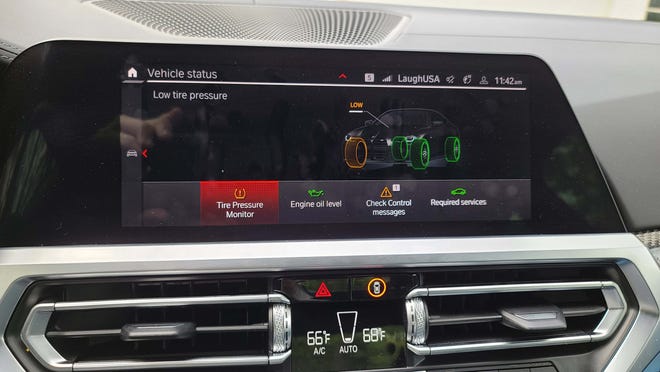
Then the digital instrument display signaled trouble. We were losing air in the left front, captain. And fast! I pulled into a parking lot, the front left punctured. I removed the jack from the trunk. Unscrewed the tailgate spare from its post. Replaced the front tire. Screwed the flat on the tailgate.
Quick, easy, and I only suffered third-degree burns (I kid) from sitting on asphalt on a 105-degree Texas afternoon.
The spare is the same as the tire it replaced so, if you’re in the wild, you can get right back to wildin’. Like when Bronco engineer Jamie Groves and his crew took a production Bronco Badlands (the most extreme Bronco trim, like a Wrangler Rubicon) to the bruising NORRA Mexican 1000 race on the Baja Peninsula.
They finished third (the first production-based car across the line) without a mechanical glitch — except for two flats they had to change in the desert.
That’s Ford for you. Not content to just go off-road, they gotta go fast. The need for speed goes back to founding father Henry at the 1901 Sweepstakes. And the GT40 at Le Mans. Heck, Bronco was the first production vehicle to win Baja waaaay back in ’69.
I preferred the lighter, 2.3-liter turbo-4 up front for its superior maneuverability. Think the Sandbox section at Holly Oaks ORV Park, where Bronco Nation will soon be locking horns with Wrangler Nation. Broncos are on sale now.
Don’t think Wrangler is waiting? Jeep introduced its Xtreme Recon package this summer with Sasquatch-fighting, 35-inch tires.
Oh, it’s on.
2021 Ford Bronco
Vehicle type: Front engine, four-wheel-drive, five-passenger, compact SUV
Price: $31,490 (2-door) and $36,190 (4-door), including $1,495 destination fee ($56,795 2-door Wildtrak, $53,150 4-door Outer Banks as tested)
After a year off during the coronavirus pandemic, Roadkill Nights Powered by Dodge is back to kick off Woodward Dream Cruise week Aug. 13-14. Presented by Motor Trend, the sixth annual event will feature drag racing on 1/8-mile stretch of Woodward public road in Pontiac with big horsepower, street-legal dragsters vying for a $10,000 prize in front of packed stands.
Spicing the menu this year will be a Grudge Match. Dodge is handing out $10k each to a select group of four popular online muscle-car celebrities and “Fastest Cars in the Dirty South” TV host Eric Malone to modify a Dodge Hellcat. No rules. Fastest cat wins.
“Being the sixth year, we want to make sure we did something different,” said Dodge chief motorhead Tim Kuniskis in an interview. “The big change this year is that we are going to have the Hellcat Grudge Match. Who’s faster? Who’s more legit? Is it the TV builder’s racers or is it the online guys? This probably is as hotly debated as professional wrestling.”
Dodge is the pro wrestling brand of autodom — the “People magazine of the industry” as Kuniskis likes to put it — and Roadkill Nights is the brand’s biggest stage. It’s a chance to show off its high-powered V-8 muscle cars in their natural habitat and host maybe the only street-legal drag race in the United States.
For the 2021 model year, Dodge offers an insane, Hellcat-powered, 700-plus-horsepower SRT version for every model in its lineup: the 807-horsepower Challenger SRT Super Stock, 797-horsepower Charger SRT Redeye sedan, and 710-horse Durango SRT Hellcat. All told, they boast more ponies than any other American brand.
“We’re all about having fun doing burnouts, and just enjoying our muscle cars and the lifestyle that goes along with (it),” said Kuniskis. “This is not (just) a Dodge event, this is open to the entire industry — anybody that loves fast cars. We want everybody to experience this thing that we call the Brotherhood.”
Brothers and sisters will be entertained by 120 invitation-only drag racers on Woodward as well as by interactive experiences at the adjacent M1 Concourse’s Champion Motor Speedway and car club. Experiences like tire-smoking drift rides in Challenger and Charger Hellcats, race simulators, classic and modern muscle car shows, dyno testing, food trucks, and more.
One fan favorite that will not return this year: the Mopar NHRA drag racers piloted by Leah Pruett and Matt Hagan. The dynamic duo wowed fans in years past with explosive, nitro-fueled hole shots down Woodward in their Slingshot and Funny Car Dodge dragsters.
The Roadkill circus will be streamed by MotorTrend live with a one-hour “Roadkill Showdown Special” capturing the highlights for MotorTrend TV. MotorTrend TV and online personalities David Freiburger and Mike Finnegan will host.
“Woodward Avenue is the sketchiest place to go drag racing thing I’ve ever seen,” laughed Finnegan in an interview. The road has “a crown and a crack in both lanes and (stops) in the action every 20 minutes to wait for a train to go by. This place is magical.”
“Dirty South” host Malone will not only be at Roadkill for the first time, but will be competing in the Grudge March.
“I’m not gonna tell everything. But my plan is this car is gonna make over 1,000 horsepower,” he said.
COVID restrictions in Michigan made the event impossible to pull off last year, and this year was uncertain, said Kuniskis, due to “a lot of hand-wringing in the corner from the attorneys and some other people.”
So Roadkill organizers reached out to their 13 million-strong audience to see if the show should go on.
“The response was amazing. Actually exceeded our expectations,” said Kuniskis. “Over 95% said ‘Hell yeah, bring it back immediately.’ That was the reinforcement that we needed.”
In years past, the event has attracted some 50,0000 people over two days. This year, gates will open Saturday 10 a.m. to 9 p.m. Drag racing starts at 11 a.m.
My road to Hell (Michigan) in the wicked-fast, 2022 Porsche Taycan Turbo Cross Turismo was paved with good impressions. Though I had to recharge at a weed shop to get there. Porsche’s latest electric vehicle highlights the paradox of performance EVs: state-of-the-art cyborgs dependent on an unreliable charging network to survive.
Let me tell you about a day on the electric frontier in one of the world’s quickest EVs.
The 2022 Cross Turismo, if you’ve been living on Mars, is the much-anticipated sequel to Porsche’s first EV, the Taycan performance sedan. With a hatchback, bike rack anchors and standard all-wheel drive, Cross Turismo is to Porsche’s electric lineup what Panamera is to gas-powered Porsches — a family crossover (ahem, don’t call it a wagon) with shocking speed.
Porsche established its electric vehicle line in 2020 — not with an electrified version of its iconic 911 super-sportscar — but a sedan, the Taycan. With its stunning looks and heavenly handling, it established Porsche as the pinnacle of EV performance.
The Cross Turismo, the brand’s second EV, takes the Taycan and adds a dose of practicality. But, as I have found after owning a lightning-quick Tesla Model 3 Performance model, practicality is a relevant term in the world of EVs.
My Taycan Turbo Cross Turismo begged to be driven hard, yet the realities of the electric charging grid demanded restraint. Like Odysseus plugging his ears with beeswax, I spent the day resisting the Turbo Cross Turismo’s siren call lest I be shipwrecked without charge on the side of the road.
I received the Porsche in my driveway at 9 a.m. on a June weekday with a near-full charge of 197 miles of range, and proceeded to plan my day around the EV. This drives Mrs. Payne crazy. In gas-powered cars, you simply jump in and go knowing refueling infrastructure is everywhere. In an EV — even one as sophisticated as Cross Turismo — you have to plan your trip around its range.
Any divergence can throw off your day. My plan: Drive 80 miles to Lansing for a photo shoot with my speed-addled, Taycan-owning, industry-expert pal Patrick. Then 50 miles south to Hell for playtime on Michigan’s mightiest twisties. Then 50 miles home to Bloomfield Hills. Total mileage: 180, with cushion for range anxiety.
To maximize range I selected RANGE mode (similar to ECO mode in other vehicles) predicting 205 miles of range. SPORT MODE (Boowahaha!) would have to wait.
Merging onto I-96 via cloverleaf, I stomped the throttle — ZOT! — and the dual motors delivered instant 626-pound feet of torque. Easy, Payne. Gotta save the electrons for Hell. I maintained a speed of 72 mph in the slow lane (above which range starts to deteriorate), while morning traffic streamed by at 80-90 mph. Not an easy thing to tolerate in a Porsche.
Though not as sleek as the Taycan sedan, Cross Turismo is still a looker with its low, wide proportions. An Audi Q7 cruised alongside me for awhile, the first of a few rubberneckers.
I set adaptive cruise control (Porsche calls it InnoDrive and it will cost you, ahem, $3,610. Welcome to Porsche’s a la carte options menu).
InnoDrive’s lane-keep feature navigated curves confidently while I got familiar with Cross Turismo’s comfy cockpit (two-tone Club Leather Olea Black/Atacama Beige seats option: $7,140). It looks the same as the Taycan sedan save Gravel mode (more on that in later). Per Porsche tradition, the start button is on the left dash — just like the Le Mans racers who ran to their cars, jumped in and fired the car in one motion. Toggle shifter on the dash. Curved, digital LCD screen behind the steering wheel.
Porsche-files will find the controls familiar, unlike, say, a Tesla Model S which is radically different from other cars. Different, too, is the option of piping in an artificial engine growl ($500) to the cabin — whereas Tesla revels in its silence. A programmable steering-wheel button allowed me to turn the sound on/off at my whim.
My Turbo tester ups the power from 375 horses on the standard, Taycan 4S Cross Turismo to 616. It was also a German spec car (U.S. models won’t arrive until this fall), which meant the navigation system was useless and only FM radio available. No worries, I had my phone.
I parked the Cross Turismo next to my friend Patrick’s Taycan at his North Lansing office park. He loved it. It was even the same deep blue as his car. He allowed how the Cross Turismo would be his preference given the hatchback’s easy utility (14.3 to 15.7 cubic feet, vs. 12.9 to 14.3 cubic feet for the sedan) and extra 3.6 inches of headroom.
He won’t be alone. Different from the Taycan sedan, Cross Turismo comes standard with all-wheel drive, big battery and sunroof, making it a better value.
After shooting the two supermodels together, conversation turned to charging. I had driven 83 miles and taken 75 miles off the battery — yet my range anxiety was tingling as I contemplated my trip to Hell’s delicious roads. I wanted more range in the bank. But where to charge?
Electrify America has a supercharger in Lansing — but it was 20 minutes out of my way (not including 20 minutes to charge).
Pat pointed to a Skymint marijuana shop with a 240-volt, customer charger just down the street. With charging infrastructure scarce, such outlets are essential.
While the Porsche inhaled electrons at the reefer charger, I got some work done in Pat’s office — then wandered back to the joint (pun intended) to buy something in return for the free charge. Pat and I are squares — I don’t drink or smoke, much less do weed — but fortunately Skymint also sells T-shirts and Snoop Dogg cookbooks.
Two hours later, my Cross Turismo had gained 24 miles of charge (by comparison, a gallon of gas will give you similar mileage, but fill in 5 seconds). It would prove crucial to my journey. I bid Pat farewell and headed to Hell.
For 50 more miles, I kept the bridle on Cross Turismo’s 616 horses. Then I released their full fury.
Select Sport Mode. Turn off traction control. Flatten both pedals to set Launch Control (increasing horsepower to 670). Release brake.
The electric silence was broken with an assault on the senses. Six hundred and twenty-six pound feet of instant torque buried my spine in the seat. Twin motors screamed. A hellish, artificial roar filled the cabin. The landscape blurred as 60 mph went by in just over three seconds. Cross Turismo meet Gran Turismo.
Cedar Point’s Top Thrill Dragster has nothing over the Taycan Cross Turismo. The rollercoaster ride didn’t end there, with the 5,200-pound sled gulping pavement at an astonishing clip. With 93.4 kW of battery in its belly and air suspension taut, the beast stuck like flypaper to Patterson Lake Road’s undulating surface. Turn-in was Porsche-sharp. Brakes vice-like. I dismissed cars in my way with a stab of the accelerator pedal.
Who needs drugs? But the fun comes at a price. The 24 miles I gained in Lansing quickly disappeared. For kicks, I also ventured briefly off-asphalt — employing Gravel mode (which can lock wheels in an electronic simulation of a Jeep’s locking diffs) and Cross Turismo’s additional 1.6 inches of ride height.
But with low-profile 21-inch tires, the torque-tastic Taycan’s thrills are on road. A Panamera feels like a slug in comparison. I holstered my lead right foot, put Cross Turismo back in Range mode and headed home — arriving with just 19 miles of range left.
EVs are for the niche buyers willing to accept their inferior refueling habits. For Porsche buyers with disposable income (and another 2 grand to install a 240-volt charger at their home/Up North cottage/Florida condo), the Cross Turismo is a new EV toy for their stable.
Porsche — there is no substitute.
2021 Porsche Taycan Cross Turismo
Vehicle type: Battery-powered, all-wheel-drive, five-passenger SUV
Price: $92,250, including $1,350 destination fee (Turbo Cross Turismo: $154,850 standard, $190,550 as tested)
Powerplant: 93.4 kWh lithium-ion battery with twin electric-motor drive
Power: 616 horsepower (670 hp with launch control), 626 pound-feet torque
Transmission: Single-speed direct drive/front axle and two-speed/rear axle
Performance: 0-60 mph, 3.1 seconds (mfr.); top speed, 155 mph
Weight: 5,200 pounds
Fuel economy: EPA MPGe 89 city/98 highway; range, 204 miles
Report card
Highs: Exhilarating acceleration and handling; eye-catching design
Lows: Tedious charging network; options alone can run $35K-plus
The North American Car, Truck and Utility Vehicle of the Year (NACTOY) has released its list of 38 cars, trucks and SUVs eligible for its 2022 awards. The roll call boasts a diverse range of vehicles from U.S., European and Asian manufacturers — including three battery-powered startups. The list representing industry trends toward utes and small pickups, as well as electric vehicles as automakers test the waters for battery power.
Twenty-five percent of entries are all-electric vehicles though EV sales make up just 2% market share. Automakers are counting on huge federal subsidies to goose sales this year, including a Senate proposal of $12,500 per car. Eight of the NACTOY entries are pickup trucks, a jump from previous years as automakers like Ford and Hyundai see opportunity in small pickups, and luxury EV makers like Plymouth-based startup Rivian and GMC bank target well-to-do buyers.
The U.S. consumer market is the world’s richest and 70% of the entries are foreign models. Coming off a year when the COVID pandemic depressed sales by 16%, the entry list indicates automakers are bullish about consumer demand.
“Utilities of all types and sizes continue as the largest and most popular vehicle category, so the large number of them comes as no surprise,” NACTOY President Gary Witzenburg said in a statement. “However, the number of eligible pickups is the most we’ve seen in several years, reflecting trends toward smaller pickups and electrics.”
Leading the pickup charge is Ford with a refresh of its fire-breathing F-150 Raptor super-truck (part of an F-series lineup that is America’s best-selling nameplate) and small, SUV-based Maverick pickup. Sharing a chassis with the Ford Escape SUV, Maverick joins the Hyundai Santa Cruz as a segment-busting small truck aimed at urban buyers.
The GMC Hummer, Rivian R1T and Tesla Cybertruck represent the cutting edge of the EV market as manufacturers see big potential for electrics among upscale truck buyers. In 2020, less than 2% of mainstream vehicle sales were EVs, yet electric made up a healthy 19% of luxury sales. Leading that charge is Tesla, which accounts for 75% of EV sales including its hot Model 3 sedan/Model Y SUV.
Typical of Tesla’s brand, the Cybertruck sports a radical, spare design with stainless-steel exterior and single-screen interior. Cybertruck promises ferocious, supercar-like acceleration — as do its Hummer and R1T competition.
SUVs now make up a whopping 70% of non-pickup sales as customers prefer the high-riding, hatchback body style.
Ford is the favorite with its highly anticipated, off-road Bronco SUV. Aimed squarely at the popular Jeep Wrangler, the ladder frame-based dirt-kicker offers similar, open-air fun with a retro-styled design. Jeep promises to be a formidable force with an all-new version of its Jeep Grand Cherokee (including new three-row and plugin versions) and a revival of its Wagoneer nameplate as a pickup-based, three-row mega-ute.
Other entries of note are new EVs from Mazda (the MX-30) and VW (the ID.4). Though the ID.4 is VW’s only electric entry in the market so far, the German manufacturer has promised, along with General Motors, to be an EV-only maker in just over a decade. The ID.4 will be produced in Tennessee and aims to take advantage of a proposed $174 billion in federal funding for EVs.
GM, too, is hoping that its Bolt EUV utility vehicle will generate interest after the first-gen Bolt EV hatchback failed to live up to hype. Other contenders include the dashing Hyundai Tucson and Genesis GV70 — the latter from Hyundai’s stylish, affordable luxury brand. Traditional nameplates like the Mitsubishi Outlander and Nissan Pathfinder also boast modern, high-tech entries.
Sedans may be a dwindling segment of the market, but their stylish designs are still in demand, both by entry-level customers and by manufacturers that want to make a design statement.
California startup automaker Lucid is debuting its first Air EV. The sedan is one of the most head-turning designs on the market. Other sedan stunners include the Karma GS-6 (the first car sold in the U.S. by Chinese auto-parts supplier Wanxiang. Production is in California), Maserati MC20 (the brand’s new, mid-engine supercar) and Cadillac CT5-V Blackwing (stuffed with a powerful V-8 making over 600 horsepower).
The favorites, however, will be two classic, compact nameplates: the Honda Civic and VW Golf GTI/Golf R. Civic is the best-selling retail compact in America, offering affordable fun to entry-level buyers. And, though VW is withdrawing its standard Golf from the U.S. market, the GTI lives on as the benchmark for affordable, performance hatchbacks.
To be eligible, the 38 NACTOY entries for the ‘22 model year must be substantially new and available for purchase before the end of this year.
Judged by a panel of 50 independent journalists from the U.S. and Canada, the NACTOY awards are among North America’s most prestigious. Jurors will narrow the list with a preliminary vote in September after conducting initial driving evaluations. Then they will convene in Ann Arbor in October for a semi-finalists comparison drive. Finalists will be announced in November and winners crowned in January.
Car of the Year
Audi A3
Cadillac CT5-V Blackwing
Genesis G70
Honda Civic Sedan
Karma GS-6 plugin
Lucid Air EV
Maserati MC20
Mercedes-Benz EQS EV
Mercedes-Benz S-Class
Subaru BRZ
Toyota GR 86
Volkswagen Golf Mk VIII (Golf R/Golf GTI)
Truck of the Year
Ford F-150 Raptor
Ford Maverick
GMC HUMMER EV
Hyundai Santa Cruz
Nissan Frontier
Rivian R1T EV
Tesla Cybertruck EV
Toyota Tundra
Utility Vehicle of the Year
Acura MDX
Buick Envision
Chevrolet Bolt EUV
Ford Bronco
Genesis GV70
Hyundai IONIQ 5
Hyundai Tucson (gas/hybrid/plugin)
Infiniti QX60
Jeep Grand Cherokee (gas, hybrid, L)
Jeep Wagoneer/Grand Wagoneer
Kia Carnival
Lexus NX
Mazda MX-30 EV
Mitsubishi Outlander
Nissan Pathfinder
Toyota Corolla Cross
VW ID.4
VW Taos
Henry Payne is auto critic for The Detroit News. Find him at hpayne@detroitnews.com or Twitter @HenryEPayne.
The automobile has deep roots in the American experience. If the industry’s “Arsenal of Health” production of desperately-needed ventilator and PPE in early 2020 exemplified the country’s collective commitment to combat the coronavirus pandemic, then IndyCar’s back-to-back, 2021 Indy 500 and Detroit Grand Prix represented America’s victory against COVID.
Over two extraordinary summer weekends, Penske-owned IndyCar put on one of the planet’s biggest post-COVID spectator events and the first mask-free auto race — both viewed by millions on national television.
“We had 155,000 people at Indy (and) we re-opened America Memorial Day weekend. This weekend we are re-opening Michigan,” said Bud Denker, chairman of the Chevrolet Detroit Grand Prix presented by Lear, in an interview on Belle Isle last Saturday.
Denker, also the president of Penske Corp. based in Metro Detroit, continued: “How ironic is this? For 15 months we’ve been operating IndyCar series with masks on, socially distanced, and vaccinations required to go in the paddock. We’re in Michigan —which has been one of the most restrictive states in terms of protocol — and here we are with none of that in place.”
Detroit followed a defining moment in the pandemic at Indianapolis as a nation rushed to get vaccinated and return to normalcy for the summer travel months.
Sports fans found their vessel in Helio Castroneves. Before the biggest public gathering in the world (dwarfing the Texas Rangers baseball opening day crowd of 38,238) since the World Health Organization declared COVID a global pandemic on March 11, 2020, Castroneves won his long-sought fourth Indy 500 — tying him with the legendary A.J. Foyt, Rick Mears, and Al Unser, Sr.
The 46-year-old star, who charmed America by winning “Dancing with the Stars” in 2007, is one of the most popular personalities in racing. His win kicked off a wild scene on Indy’s main straight. In his trademark “Spiderman” style, the Brazilian racer — now Ft. Lauderdale resident — climbed the fence with his team, pumping his fist while the crowd roared.
“It was pure Helio,” remembers Denker. “That was the cherry on the top. It was a moment in sports and for all America.”
The celebration didn’t end. Hopping down from the fence, Castroneves ran the length of the straightaway riding the wave of appreciation. Then he was mobbed in the pits. Greeted by Roger Penske (his former boss) on the winner’s podium. And wheeled around the track in a Camaro.
“The fans would not leave. They would not leave until Helio did his victory lap which was about 45 minutes after he crossed the checkered flag,” marveled Denker. Six million more fans were glued to their television sets, the biggest Indy 500 audience in 5 years.
It was a long road to get here. Like all sports, motorsports struggled to maintain a schedule through the pandemic. IndyCar put on nine events last year — followed by eight races to start the 2021 season — mostly in less-restrictive states like Florida and Wisconsin where large fan gatherings were allowed.
Yet, while state protocols changed from venue to venue, IndyCar’s strict protocols (coordinated with other series like NASCAR and IMSA and other sports) did not: Masks were required in the pits/paddock/podium with the exception of drivers when they were in the race car.
Sensitive to perception, sponsor needs and national TV, the rules stayed in place. Even as the CDC lifted mask requirements for vaccinated individuals in May. Even as vaccinated drivers chafed at the rules.
“Its been an arduous journey to get to this point,” said Denker. “We’ve worked with a number of players — Chris Illich with the Tigers, Jason Langwell with Rocket Mortgage Classic Golf Classic, Kathy Cooper of Meijer (Grand Rapids LPGA golf tourney this weekend). All these big organizations, like ours, have these big events coming up and what’s our play book going to be? Let’s be consistent in our approach to the government. It’s really been a team effort behind these scenes.”
Even as a second COVID wave over the winter brought concerns that the June Detroit GP — canceled in 2020 — would have no fans, sponsor Chevrolet, Lear, and TV-partner NBC stuck with the series.
“Then we got to 1,000 fans because the Tigers announced 20% in their grandstands — so we had 20% in our grandstands,” smiled Denker. The CDC’s May 13 announcement nixing masks accelerated conversations inside IndyCar.
“We had a call a month ago (with all the teams) and we said we want you all vaccinated,” said Denker. “Guess what? Our sport is 95% vaccinated, I don’t think any other sport can say that.”
IndyCar’s announcement that the Detroit GP would be mask-free sent dominoes falling. The IMSA Weathertech sportscar series, which shared the race weekend with IndyCar, also went mask-free. IMSA’s corporate parent — NASCAR — followed suit at Texas Motor Speedway last Sunday.
There were smiles all around the paddock Sunday as naked-face racers greeted fans for the first time in months. The smiles intensified after a weekend of gorgeous weather and two of the most exciting races of the year.
Overhead, NBC’s chopper televised overhead shots to millions across the country of Belle Isle, downtown, and the Renaissance Center. NBC broadcast’s of the Saturday Duel in Detroit race was seen by 845,000 viewers (a 10% increase over the 2019 event) while Sunday’s Dual in Detroit race reached 1.4 million viewers – a 26% increase over 2019 .
“How can you put a value on what this means for our city for two hours (Saturday) and two hours Sunday?” thrilled Denker, who said capacity was limited to 8,000 fans a day — about 1/3rd of normal. “Yeah, we didn’t fill up as many restaurants or hotels, but the value this city is going to get from this weekend is immeasurable and that makes us pretty proud.”
Henry Payne is auto critic for The Detroit News. Find him at hpayne@detroitnews.com or Twitter @HenryEPayne.
Detroit – For over a year, Michigan has lived under authoritarian rule.
In response to the coronavirus epidemic Democratic Governor Gretchen Whitmer claimed emergency powers on March 10, 2020. A series of long legal battles ultimately led to an October 2 state Supreme Court ruling that nixed her orders as unconstitutional and urged engagement with the state legislature.
“Our decision leaves open many avenues for the governor and legislature to work together to address (the coronavirus) and we hope that this will take place,” wrote Justice Stephen Markman for the majority.
Within days, Whitmer simply re-issued her orders via her health department.
With police authority, an army of citizen spies, a media chorus, and a militant, Democratic Attorney General Dana Nessel enforcing her edicts – Whitmer has ruled with an iron fist. She ignored the legislature – issuing orders on mask wearing, limitations on public gatherings, restaurant shutdowns, school closings, and more that she now says will finally end July 1.
She’s presided over the shuttering of a national-high 32% of state businesses, the highest job-loss rate in the country in April, and the loss of population to free states like Florida and Texas. She repeatedly ignored her own edicts with out-of-state travel and restaurant visits. She made national heroes of 78-year old Owasso barber Karl Manke and Polish emigre and restaurant owner Marlena Pavlos-Hackney, 55, who resisted arbitrary edicts.
The daily toll on Michiganders under a despot’s thumb has been widespread. A few examples from around the state (in some cases names are withheld to guard against retribution):
Novi, Michigan. A Novi man was taken seriously ill with COVID-19 in April, 2020 and admitted to a Metro Detroit hospital. His concerned family held a prayer vigil outside on their lawn.
A neighbor snitched on the sober gathering and police arrived to send everyone home. Their violation? Under Whitmer’s orders, no more than 10 people were allowed to gather.
Williamston. Golf course owner Dave Mahaney followed Whitmer’s re-opening rules at his Brookshire Inn and Golf Club. He kept equipment clean, encouraged social distancing, even enforced one golfer per cart (after Whitmer lifted her golf cart ban).
But he couldn’t abide with the governor’s ban on selling beer. Especially since convenience stores were allowed to sell alcohol. “I took a chance,” he told The Detroit News in June, 2020. “I just sold beer to my leagues. I try to keep my leagues happy; that’s my bread and butter.”
Someone snitched and an undercover staffer with the Michigan Liquor Control Commission – posing as a golfer – busted him with his first license violation in 34 years of operation.
“She never explains herself,” he said. “People in business in this state think she’s a dictator.”
Belding. An auto race at rural Grattan Raceway, 25 miles outside Grand Rapids, in August, 2020, had to adhere to a strict set of Whitmer rules.
Race-car tow rigs had to be “socially distanced” by 60 feet in the paddock. No cars parked between rigs. Masks mandatory outside. No spectators. A monitor enforced the orders under threat that a state inspector could drop by and cancel the event.
Lansing. In the defunct Soviet Union, elites played by a different set of rules. The nomenklatura shopped at special stores, traveled to exclusive homes. Michiganders know the type: Whitmer repeatedly violated her own rules.
Memorial Day weekend, 2020: Whitmer warned her constituents against traveling to Michigan’s lakes. “If you don’t live in these regions … think long and hard before you take a trip into them,” Whitmer warned, citing – without evidence – that gas handles could spread the virus. Then her husband was discovered visiting their second home in Elk Rapids to go boating.
June, 2020: the governor marched through Detroit with hundreds of Blacks Lives Matter protesters after condemning public protests against her own state shutdown orders as super-spreaders.
January 20, 2021: After telling Michigan residents to stay home, including over the holidays, Whitmer traveled to President Biden’s
inauguration with her two daughters. The visit also contradicted Washington, DC Mayor Muriel Bowser’s appeal for Americans to stay away from the inauguration.
April, 2021: Whitmer continued to urge residents not to travel as state COVID cases rose. She singled out Florida in particular, blaming snowbirds for bringing the virus back home. Then she and an aide were caught traveling to Florida.
May, 2021: Whitmer was caught dining out with 12 friends – in violation of her order that only six people could gather in a restaurant.
Pontiac. A popular restauranter had to lay off 35% of his staff as Whitmer’s orders dragged through 2021. Not allowed to seat his customers inside – even as studies indicated the virus was not being spread by restaurants – he had to build extra, heated seating capacity outdoors during Michigan’s frigid winter months.
“I have never seen more anger towards a politician than my fellow restaurateurs currently have towards Governor Whitmer,” he said after operating month-to-month in fear of shutdowns.
Of course, it’s nothing like the fear in Detroit. Fear of crime in America’s #3 most violent city pre-dates COVID-19. But it accelerated during the pandemic as police have come under assault and the governor encouraged “the spirit” of Black Lives Matter’s #DefundPolice mantra.
Non-fatal shootings were up 53 percent in 2020. Homicides increased 19 percent.
The all-new, 2021 Jeep Grand Cherokee L is a gorgeous hunk of granite. As solid on road as it is solid looking. But the real treats are in the details. Standard 10.1-inch digital screens. Sculpted rotary shifter that might have come off the queen’s finger. American flag badges. Winged dashboard with chrome bezels.
Oh yes, and it has a third row. (Pause here while a cheering Jeep nation does the wave.)
This is no third-row afterthought (looking at you, Toyota Highlander). This is a big, honkin’ American third-row couch made for 6’5” giants like me. That’s right. I can sit behind myself in the third row sitting behind myself in the second (best legroom in class) row. Raised middle console so my size-15 feet fit. Padded armrest. USB and USB-C charging ports. Clearly, 6’4” Jeep interior design chief Chris Benjamin spent some time back here.
The Grand Cherokee’s third row has been a looooooong time coming. The OG midsize-SUV born back in 1992 (when then-Chrysler product genius Bob Lutz figured out the way to skirt station wagon-killing mpg laws was to jack them up and call ’em utes) has consistently been a segment favorite even as competitors came along with a variety of three-row chariots that now make up 75% of segment offerings.
Now that Grand Cherokee is upping its game and adding a three-row, I expect it to sell (I’m just making an educated guess here) a zillion copies a year. Not just because this thing is a really good mainstream SUV. But because it’s also a really good luxury SUV.
Consumers know what I’m talking about. Jeep is a rare mainstream badge that is shopped by luxe and mainstream buyers. Check out the luxury brand-like price spread of a two-row Grand Cherokee (which will adopt the same design and features of L when it hits dealerships later this year) from its entry-level $36,000 starting sticker to the insane, $105,000, BMW X5 M-stomping, 707-horse Trackhawk.
“Should I buy the new BMW X5, Audi Q7, or Grand Cherokee?” my tennis club pals ask.
As readers of this column know, I regularly opine on how mainstream badges like Mazda and Kia have narrowed the gap to premium products. The Grand Cherokee L obliterates it.
Since its origins, the mid-size Jeep has been rear-wheel-drive based with powerful, longitudinally configured V-6 and V-8 engines. Like models from that other AWD SUV icon, Land Rover, this layout gives Grand Cherokee an inherently athletic look with a short overhang up front and a long hood. Seeking similar aesthetic gains, Ford and Lincoln recently converted their Explorer/Aviator middie platforms to RWD-based.
Also like luxury brands, the Jeep’s seven-slot grille is instantly recognizable. Bucking the current trend to big, toothy grilles (even Bimmer’s spouted buck teeth) the 2021 fascia is lean, athletic.
Speaking of athletic, the RWD platform — despite the wheelbase growing seven inches and overall length by 15 — allows more intuitive handling. My L-ephant in tennis shoes was nicely composed as I hustled around town chasing Detroit Grand Prix preparations. The tried-and-true 3.6-liter V-6 (a 5.7-liter, 357-horse V-8 is available for those who need to tow 7,200 pounds) has an authoritative voice.
Merging on to Interstate 96 in a top-trim Summit Reserve, I stomped the throttle and the V-6’s 293 horses responded immediately to my whip, propelling the 5,000-pound sled into the left lane. At cruising speed (air-suspension crouched for better aerodynamics), I relaxed and was pleased to find that both adaptive cruise control — and a more sophisticated semi-autonomous system called Active Drive Assist — were on offer. Nestled side-by-side on the steering wheel, the options are another welcome detail allowing drivers to choose their cruise.
Active Drive Assist is competent, and L drove smoothly in the middle of the lane — not ping-ponging back and forth like, ahem, a recent Volvo XC90 I piloted.
Keep your boot in it and the Jeep will travel 500 miles without range anxiety. When the feedbag runs empty just pull over and fill ’er up with $3 gas.
Jeep offered that I take the Grand Cherokee off-road to its diabolical Chelsea proving grounds where they tested the big ute across moguls, ditches, and flooded landscapes. Sounds like the typical Detroit road — so I stuck with my daily duties in town.
At a gas station on the east side, I ducked in for an iced tea. Upon my return, a few people had gathered to admire the Jeep made down the street in the Mack plant.
“That’s the new Grand Cherokee, isn’t it?”
“Yup, and this time it has three rows.”
My AWD tester is made for Michigan’s multi-season challenges with 10.9-inch lift (the same as a Wrangler Rubicon for goodness sake), two-speed transfer case for rocky terrain, limited-slip differential that’ll throw 100% torque from one rear wheel to the other to prevent slip in snow, and a prop shaft to swim the Detroit River (kidding about that last one). Lesser Laredo, Limited and Overland models get simpler systems that can merely climb Mt. Rushmore. It’s a Jeep thing.
Grand Cherokee saves the best for inside.
I liked the previous Grand’s “islands” theme (shared by Dodge products) that neatly organized dash elements. Jeep steps up the game with an integrated horizontal theme. Its focus is an elegant raised console screen. The dash is wrapped by flowing chrome bezels that extend, wing-like, to the doors.
The center display anchors a library of tech including Uconnect 5, the latest version of Chrysler’s (now Stellantis’) class-leading infotainment. It allows for wireless Apple CarPlay and Android Auto, a quick touchscreen, and swipe-able pages popularized by VW (I love when auto companies learn from one another).
A laundry list of standard safety and convenience features include blind-spot assist, adaptive cruise control, front-rear collision assist, rear cross-traffic detection, wireless smartphone apps.
(Pause to catch breath)
Optional night vision. Head-up display. Trail-rated skid plates.
If you don’t need the third-row seats, folding them flat opens 47 cubic-feet of space — 11 more than the current, two-row Grand Cherokee. Even the tailgate gets love with a button to set height so it doesn’t — WHUMP! — hit your garage door.
The Jeep’s value depends on where you’re standing. A $50,000 AWD Summit is 4 grand north of, say, a comparably equipped Kia Telluride. Shop against a three-row BMW X7 and it’s $20,000 cheaper.
That’s an L-uva deal.
2021 Jeep Grand Cherokee
Vehicle type: Front engine, rear- and-all-wheel-drive, seven-passenger SUV
Price: $41,425, including $1,695 destination fee ($66,985 Summit Reserve as tested)
How do you improve on a home run? Hit the next one into the upper deck.
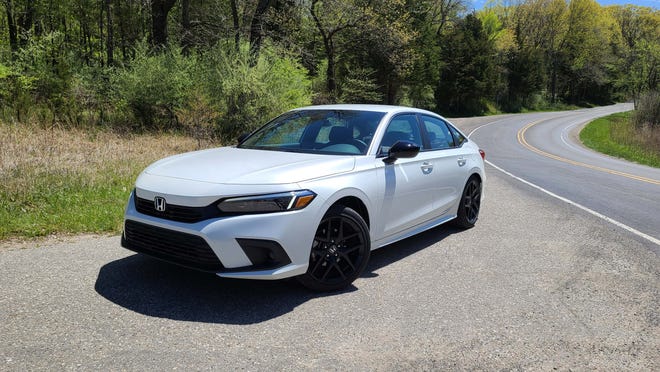
The 2016 Honda Civic became the instant benchmark for the compact sedan segment. A clean sheet design from the ground up, its taut chassis was Nürburgring tested. It boasted best-in-class horsepower, fuel economy and rear seat room. And to make sure the world noticed, it drew styling cues right out of a DC Comic book with boomerang rear headlights, narrow greenhouse and more tattoos than Allen Iverson.
The new 2022 Civic (coming to a dealer near you this June) dials the wardrobe back to conservative Bruce Wayne from rad Batman suit. But on everything else it turns the dial up from 10 to 11.
After a 10th generation that shattered sales records, King Civic is poised to continue its reign at the top of the compact segment. Compacts are personal favorites because they are the LeBron James of automobiles — the best all-around players in the game. I’ve owned a VW Golf GTI, Dodge Neon, two Ford Focuses and a pair of Civics because they can do it all: dance through the twisties while sipping gas, seating four, looking sharp, and all while not breaking the bank.
Let’s take the Civic’s talents one at a time.
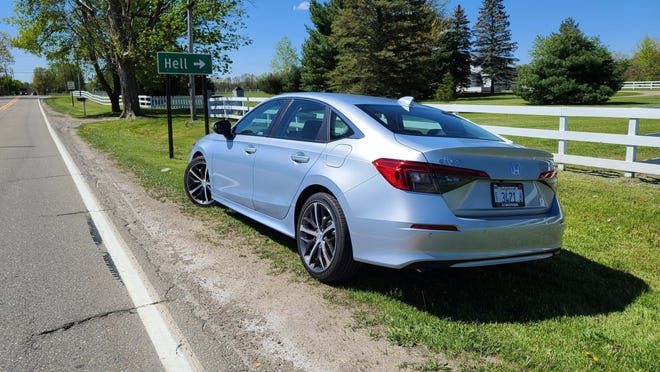
Dancing moves. I flogged the 2022 Civic through HUG — Hell, Unadilla and Gregory — the three burgs that border Michigan’s most insane network of country roads. The Civic left begging me for more.
Throwing the Civic across a 90-degree right-hander onto Doyle Road at Unadilla, the front-wheel driver is remarkably neutral — rotating easily like the rear-wheel-drive BMW 3-series I was chasing. That’s right, a BMW 3.
While underpowered at 180 horsepower compared to the Bimmer’s 248, they are both turbo-4s and the Honda is one sweet little drivetrain — its fuel-sipping, 36 mpg continuously variable transmission a universe away from the droning CVTs of yesteryear (the standard, 158 horse four-banger ain’t bad either, but lacks the upper-trim turbo’s low-end kick).
While I lost ground in the straightaways, the Honda could hold its own in the twisties, so intuitive is this chassis.
It’s a good thing, too, because the Honda has some serious competition nipping at its heels. I’m thinking the dazzling-looking, ninja-quick Mazda 3 and Hyundai Elantra that offer luxury amenities at a mainstream price. Set a high bar and others will follow.
Speaking of luxe, my $41,000 BMW sparring partner shot me a thumbs up as we exited Unadilla Raod — like two boxers after a good workout at the local gym. I didn’t have the heart to tell him he was being chased by a $25,000 Honda with more cargo space and 2.5 more inches of rear legroom.
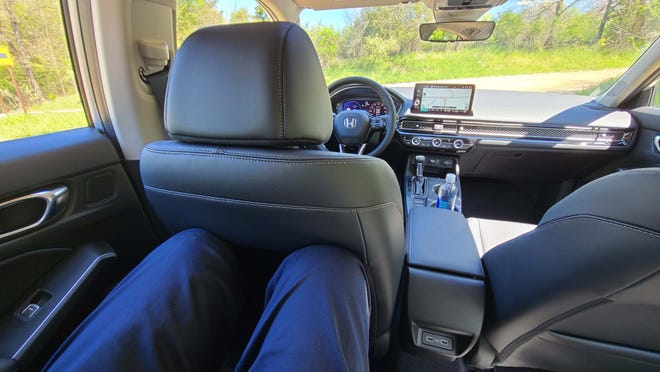
Acres of room. Well, acres is an exaggeration, but the Civic’s best-in-class legroom is more than a 2011 mid-size Accord sedan, for goodness sake. At 6’5” I was comfortably able to sit behind myself. Indeed, the Civic will surely be mistaken by some for an Accord. And not just its mature understated exterior.
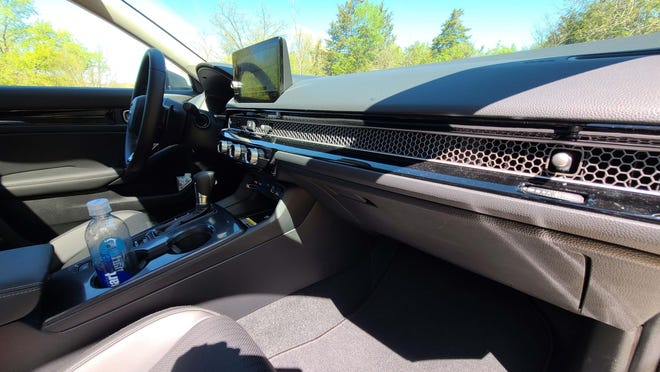
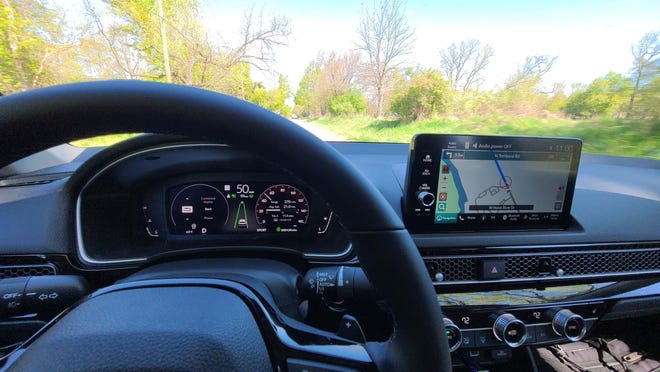
The interior takes a page from the Accord’s book with a simple horizontal dash design — placing the touchscreen high in the driver’s-eye view. Honda excels at interior ergonomics, and the Civic layout is master class.
Looks sharp. Like Accord, the interior has upscale aspirations — think Lincoln Aviator — with a honeycomb character line that is not just distinctive but hides the HVAC vents. Like the Lincoln, the touchscreen shelf helped steady my thumb as I paged through the infotainment display.
The higher dash also benefited your giraffe-legged reviewer. My knees chafed on the old Civic’s vertical dash buttresses. No issues with the 2022 design. Has Civic moved on from the cheap plastic buttons on the previous gen’s steering wheel? You bet. I lament only that the old car’s clever configurable console cupholders and storage has been sacrificed to the ‘22’s more mature design themes. Storage still abounds (something luxe-class Mercs and Audis don’t do well).
Though interior dimensions haven’t changed, the greenhouse has.
Looking out over that the high touchscreen, I surveyed the landscape through a bigger windscreen thanks to Honda moving the A-pillar backward to a more vertical position. Together with side mirrors mounted on the doors, visibility improves.
That field of view now takes in a lower, longer aluminum (a first for Civic) hood that tapers to a more modest fascia than the last model. I’m a big fan of my eighth-gen Civic Si’s timeless thin grille and swept greenhouse. The new Civic should age well, too.
As will its price.
Won’t break the bank. Despite the Civic’s massive upgrades in interior tech (better cameras, all-digital displays, more air bags), the compact sedan’s price doesn’t budge. Credit some of this to its Made in America origins — the 11th-gen Civic will be screwed together in nearby Canada (sedans) and Indiana (hatchbacks).
My $24,000 Sport (Civic’s most popular model, the kids love the blacked-out trim and big 18-inch wheels) and loaded, $28,000 Touring testers are priced right on top of the outgoing car. That’s in keeping with Civic’s status as brand beacon that brings new customers to its product family. In the Age of Ute, the sedan maintains its price value over pricier SUVs.
Tight handling, bigger back seat, digital displays … the gap between luxe and mainstream is narrowing. Is a compact Acura ILX a better car? Perhaps the biggest bonus is wireless Apple CarPlay and Android Auto available on the upper trim, EX and Touring models (EX and Sport, with a smaller 7-inch display, still require a cord to connect) just like the 90-grand BMW M4 I was tested recently.
Jump in and the car immediately recognized the phone in my pocket, turning the touchscreen into a mirror image of my ‘Droid. My texts, tunes — and destinations were all there.
All-around athlete, indeed.
My Hell trips are usually reserved for high-horsepower athletes. But like the Bimmer I was chasing, the standard Civic is in its element here. And it is just the appetizer.
With its toned bod, light weight — and 1.5-inch longer wheelbase than last model — the 11th generation Civic promises even more performance from its forthcoming Si and Type-R hellions.
They’ll be swinging for the top deck.
2022 Honda Civic
Vehicle type: Front-engine, front-wheel-drive, five-passenger sedan
Price: $22,695, including $995 destination fee ($24,095 Sport and $29,295 Touring as tested)
Belle Isle — A lap around the Detroit Grand Prix’s Belle Isle race track in an IndyCar is a violent experience.
Sitting directly behind ex-IndyCar star Davey Hamilton (and ahead of the engine) in a twin-seat, Dallara racer, the 700-horsepower rocket accelerates with blinding speed. Lightning-quick shifts punch me in the back. Serpentine turns whip my helmeted head from side-to-side. Instant braking throws me forward. Screwed to the earth at speeds up to 150 mph with 1,200-pound springs and front-rear wings, the car bucks like a bronco over the undulating, concrete public roads.
“And I was just running at 75%,” smiled Hamilton afterwards.
Turn up the dial to 100% for 70 laps between concrete walls and you can understand why IndyCar drivers (and fellow IMSA Weathertech sportscar pilots) say the Belle Isle track is one of the most demanding circuits on the schedule. And why accidents like Felix Rosenqvist’s Saturday hit are so scary.
“You got to be a little bit crazy” to drive here, said 20-year old IndyCar phenom Rinus Veekay after placing second in Saturday’s race. “If you don’t know the risks, you can’t give it your all. You will touch the wall a few times in the race, which I did. It gives you a lot of adrenaline.”
Ahead of her Saturday race, IMSA driver Katherine Legge, at the wheel of her Porsche 911 GTD missile said: “I love it. It’s like racing Sebring between concrete walls.” Florida’s Sebring, built on old, concrete military runways, is famously rough.
I, too, have raced Sebring in multiple cars and can attest to that. And I can attest that it’s better to be in the driver’s seat than in a passenger’s seat.
Behind the wheel you’re in control. You know what’s coming. In the passenger seat you’re always reacting to the driver’s inputs. Knowing that, the IndyCar Experience team strapped me tight in a five-belt racing harness for my Sunday morning Belle Isle lap. IndyCar Experience operates a fleet of five IndyCar twin-seaters which it takes from race to race. Ace drivers like Hamilton and Gabby Chevez and Spencer Pigot give team sponsors and media the ride of their lives.
“It’s nine times better than Cedar Point,” thrilled WDIV-Channel 4 reporter/anchor Kim DeGiulio after her thrill ride.
The Belle Isle course is unrelenting. Entering the very fast, 130-mph, Turn 1-2 complex, I note the first of a number of strategically placed tire barriers (tires wrapped in rubber conveyer belts).
Hamilton downshifts from sixth gear to fourth. Flick right, then left, than over the extremely difficult exit of Turn 2 that falls away just as drivers get on the gas. GM President Mark Reuss — a race-licensed driver — famously spun into the wall here in 2018 when pacing the field in a Corvette. IndyCar drivers have struggled here, too — like A.J. Almendinger who clouted the wall in 2013.
Turns 4-6 are tight, technical, and crucial to launching the car onto the long back straight for the track’s best passing opportunity — as Pato O’Ward proved in his race-winning pass on Josef Newgarden in Sunday’s race. “It’s my favorite part of the race track,” Cadillac sportscar driver Pipo Derani told me on a track walk Thursday.
The section proved disastrous for O’Ward’s teammate, Rosenqvist, in Saturday’s race when his throttle stuck wide open going through Turn 6 at nearly 100 mph. Fortunately, another well-placed tire wall helped slow the impact of Rosenqvist’s out-of-control car before it got to the concrete walls — though the impact was still so heavy that it knocked over the barrier.
A sticky throttle is one of the most frightening experiences in motorsport. I once had the throttle stick wide open on my Porsche racer at 150 mph at Georgia’s Roebling Road raceway. Luckily, it happened at the end of a straightaway with plenty of run-off room, and a long spin through the grass helped the car scrub speed before I hit a tire wall.
Rosenqvist was not so fortunate, immediately going into the tire wall at Belle Isle. He didn’t suffer serious injury.
Interestingly, my visceral IndyCar lap is not hard on the ears despite the 700-horse monster behind my helmet. The engine is a twin-turbocharged V-6, not much different than the Chevy and Honda mills in the single-seat IndyCars. The turbos (which recycle exhaust for more power) muffle sound despite the car’s high revs.
I did the lap without ear plugs, my ear drums tingling as we hit 150 mph on the back straight. By contrast, I wore ear plugs last week while riding shotgun in a Porsche GT race car (with racer Leh Keen driving at, ahem, 100%) at Road Atlanta. Its screaming, unmuffled, naturally-aspirated, 9,000-RPM flat-six would have rendered me deaf without protection.
Shaken, but not deterred, I emerged from my IndyCar lap understanding why this track is so diabolical. It’s a challenge for the best of drivers.
“I’ve done a lot of (simulator) work and nothing got me ready for the experience here,” said IndyCar star Jimmy Johnson who was here for the first time this weekend. “I was just floored how technical this track is, how rough it is, how little grip there is.”
Every driver prepares differently. Derani said he and Caddy co-driver Felipe Nasr (a former winner here) benefited from a day of sim work ahead of Detroit. At his Saturday news conference, IndyCar’s Veekay said the sim helped him, too.
“Those don’t do anything to prepare you for Detroit. What are you talking about?” shot back O’Ward.
Said Veekay: “No, I felt like it really happened.”
Both drivers had podium finishes this weekend. Maybe I can thumb a ride with them next year.
Henry Payne is auto critic for The Detroit News. Find him at hpayne@detroitnews.com or Twitter @HenryEPayne.
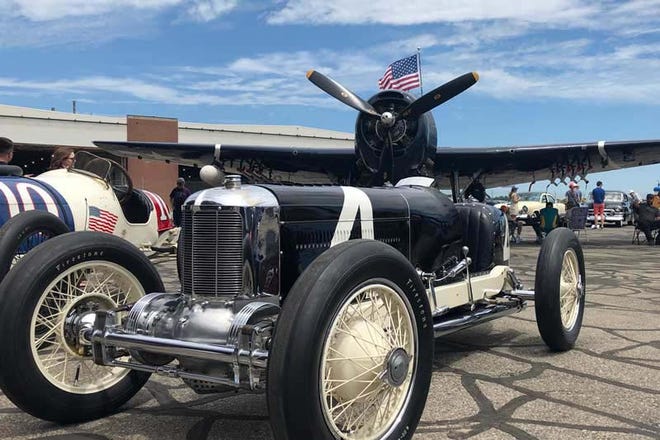
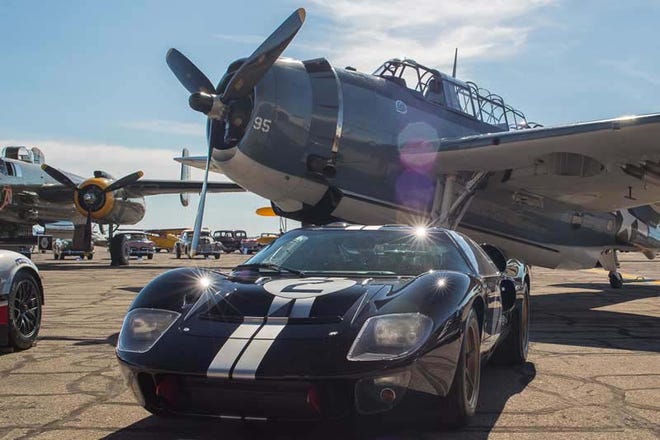
From Belle Isle to Woodward Avenue, summer car enthusiast venues are abuzz again after the pandemic pause.
Add Willow Run Airport to the mix. And it has hot airplanes to go with the cool cars.
The third annual Detroit’s Invitational Wings and Wheels at Historic Willow Run is back this Sunday with historic cars and planes from the 1930-1969 era. Willow Run itself made history during the same period as Ford Motor Company used its hangars to crank out over 8,000 B-24 Liberator heavy bombers from 1942-45 as part of US industry’s “Arsenal of Democracy” effort to help win World War II.
“Everyone will enjoy this show,” said Yankee Air Museum President Kevin Walsh. “There are cars and planes here that are simply legendary, like an immaculate North American F-86 Sabre jet fighter and — imagine seeing this — a General Motors Futurliner, one of only nine in existence.”
Arranged on the ramp of the Yankee Air Museum, the exhibit includes the event’s “poster car” Darrin Packard — a well as rare birds like the single-seat Douglas AD-1 Skyraider and a Grumman C-1 Trader cargo plane.
The Wings and Wheels committee, which includes ex-GM product guru Bob Lutz and Wings and Wheels chairman Peter Deloof, scooped up cars from private owners as well as the GM Heritage Center, Indianapolis Motor Speedway Museum, Stellantis/Chrysler, Nicola Bulgari Car Collection, and Ypsilanti Automotive Heritage Museum.
“The vehicles must be totally original, no ‘resto-mods,’ no lowering kits, no late model alloy wheels,” said Lutz. “We want cars that were actually common and owned by normal people, so no Pierce Arrows, Marmon 16s or Duesenbergs. We even have a 1932 Ford Model A fuel truck in Standard Oil livery.”
Owners will be on hand to chat about their toys. Gates open to the public at 10:00 a.m. Sunday, June 13 on the west side of Willow Run. Tickets are available here
Belle Isle — After a turbulent, COVID-cursed year that saw the Detroit auto industry shuttered, fan-free auto racing, and the cancellation of the Detroit Grand Prix, Roger Penske is bullish on the future of the auto industry.
All-electric vehicles? Not so much.
“If I had to do it again, we would still make the investment” in IndyCar, said The Captain (as his troops fondly call him) in a wide-raging media interview Friday in the Team Penske trailer in the Chevrolet Detroit Grand Prix paddock. Penske Entertainment Corporation bought IndyCar and its crown jewel, the Indianapolis Motor Speedway, in November 2019, just months before the coronavirus struck.
Motor racing is the intersection of the Penske auto empire that includes dealerships, Team Penske race teams, truck rentals, Indy, and the relentless technology transfer from racing to production vehicles. But as governments from Washington state to England try to eliminate the gas engine by 2030, Penske does not see the market following suit.
“I don’t think you’re going to see the world go all-electric,” said the soft-spoken 84-year-old, whose corporate headquarters are just up the road in Bloomfield Hills. “I think you’ll see hybrid solutions in all kinds of transportation sectors. There will be mandates in some cities. (But) I don’t see the market making a pivot and moving to 10-15% of market overnight.”
IndyCar, for example, will not follow the lead of Formula E — featuring battery-powered open-wheel racers — which has attracted European manufacturers like Porsche and Jaguar as that continent’s governments mandate battery-only transport. Instead, IndyCar engine makers Chevrolet and Honda — which have both pledged the elimination of gas engines in the next two decades — are developing a new generation of gas engines with hybrid-electric assist.
NASCAR and IMSA — racing series where Team Penske competes (IMSA is on the show card this weekend with IndyCar) — are also moving to hybrid engines, not all-electric.
“Formula E hasn’t gotten any money out of their investment,” said Penske. “The manufacturers are focused on what motorsports they want to to be in. You need to have something in your brand that shows you can win.”
Penske says IndyCar is in talks with two other automakers to provide hybrid powertrains for IndyCar. He says that manufacturer prospects for IMSA’s 2023 sportscar prototype LMDh class are even brighter with seven to eight automakers (including Team Penske’s Porsche team) interested in developing hybrid gas-electric racers.
He added: “It will be quite a while before the ICE (internal combustion engine) is out.”
Today’s buffet of car options seems to suit the market just fine, said Penske, as buyers — flush with cash after months in quarantine — are in a buying mood.
“After COVID, and looking at supply right now, we can sell most anything,” said Penske who owns dealerships across the country through his Penske Automotive Group and Penske Motor Group subsidiaries.
That health in turn drives auto racing. Belle Isle is a testament to the healthy intersection of racing and the industry.
After falling silent to race engines in 2020, the Detroit Grand Prix weekend is back this year without losing its primary sponsors. The series as a whole has maintained its top sponsors as well.
For Penske, the Detroit GP is personal as well as business-related.
“This is where I live,” he says. “We’re focused on autos. We have so many different relationships with the auto companies. In Detroit, you gotta give back. It started back in 2006 with the Super Bowl.”
With COVID receding in the rear-view mirror, Penske’s Detroit GP brought the venue back to life in just four weeks. Admission has been capped at one-third of normal attendance, but the GP is also the first major U.S. race to go maskless. Unlike other sports series, IndyCar and IMSA were not embroiled in political controversies over the last year.
“The die-hard fan is here,” said Chairman Bud Denker.
He and Penske see a bright road ahead after months of uncertainty. “IndyCar is in a better position as a baseline than it’s ever been,” says The Captain.
Still, even Penske said he had butterflies Memorial Day weekend as he — and a crowd of 135,000 — awaited the green flag at the Indianapolis 500.
“When they said ‘gentlemen, start your engines,’ I was shaking like a leaf,” he smiled. “It was exciting to see the response of the crowd.”
Before an engine was started at the Chevrolet Detroit Grand Prix presented by Lear, drivers took to the track Thursday afternoon by foot for their ritual “track walk “ahead of the June 11-13 race weekend. Accompanied by team engineers, strategists, managers and crew, they walked the 2.35-mile circuit on foot, in golf carts, on bicycles — scouring the surface for imperfections, changes, and generally re-familiarizing themselves with one of the most demanding circuits in auto racing.
But first, a little fun. Driving onto the track in golf carts for the first time in two years (the Grand Prix weekend was canceled in 2020 due to COVID concerns), Whelen Engineering Cadillac DPi-V.R team drivers Felipe “Pipo” Derani and Felipe Nasr floor their carts in a mock drag race. “My cart’s slow,” laughs Derani as Nasr opens a gap. Boys will be boys.
Team manager Chris Mitchum, 44, calls after his hot shoes, noting the “blend line” at Turn 2’s exit where race cars leaving the pits rejoin the hot track. “Remember to keep to the right of the line,” he says, lest the team be disastrously penalized in Saturday’s short, 100-minute race.
Derani, 27, and fellow Brazilian Nasr, 28, pilot the #31 Cadillac and are strong contenders to win the IMSA Weathertech sportscar race. IMSA Weathertech is one of two support races — the other is Indy Lights — to the main feature Dual in Detroit IndyCar doubleheader.
The Brazilians just missed out on a win in 2019, falling 0.8 seconds short to Dane Cameron and Juan Pablo Montoya in an Acura DPi prototype.
The Whelen Enginering-sponsored team, managed by Action Express Racing out of North Carolina, has been a fixture at the front of the sportscar series, winning four championships since 2014 — including in 2018 with their current weapon, the wicked-looking, 580-horsepower, V-8-powered Cadillac.
With a carbon-fiber chassis, slick tires, and high-downforce, the state-of-the-art, 2,050-pound Cadillac sports similar technology to open-wheel, 1,700-pound IndyCars. In 2019, Derani qualified the DPi-V.R at 1 minute, 19.9 seconds — just five seconds slower than Josef Newgarden’s IndyCar pole that weekend.
Turn 3’s 90-degree right-hander at the end of a long straight is the circuit’s first passing opportunity. It’s also the likeliest place racers will go down an escape road if they leave their braking maneuver too late.
“Check out the escape road to make sure you can get turned around,” says Whelen team strategist Tim Keene as Derani and Nasr explored the run-off area. Back on the main track, IndyCar racer James Hinchcliffe and his crew race by in a golf cart on their own track tour.
Keene, Mitchum and Chief Engineer Iain Watt from Scotland are racing veterans with years of top-shelf racing experience. Watt has been stateside for 25 years applying his engineering expertise in IndyCar, NASCAR and other series. The 56-year old Keene has collected five Rolex 24 Hours of Daytona wins in his storied career.
Keene will be the voice in the ear of Derani and Nasr as they negotiate this very physical race track. The race is the shortest on the IMSA calendar and will require quick-thinking by strategist Keene to keep his charges in position to tin. The race requires only two pit stops — perhaps only one if there is a long yellow flag period — so timing is crucial. Any delay could be disastrous, since opportunities to make up lost time are few compared to longer, 24-hour races like Daytona.
The pace will be relentless — a 100-minute sprint to the finish — and the drivers say there’s an urgency to be perfect every lap that is different from other races.
“You don’t want to touch this curb,” says Nasr, walking around the steep, candy-striped blue curb on the inside of Turn 5. “It can unsettle the car.”
The Turn 4-6 complex are Derani’s favorite turns on Belle Isle. The highly-technical, 100-mph section is crucial to carrying speed out on to the back straight (which parallels the Detroit River) where the Cadillac will hit top speeds of 170 mph before braking hard into Turn 7 — another key passing opportunity before the track narrows into the spectator-friendly “Carousel” complex behind Scott Fountain.
Narrow is a relative term because the entire course is encased in concrete walls that anchor safety fencing. There is no room for error. The crowned, concrete public road (normal peed limit: 35) makes for tricky traction as the cars wash out in some turns, coming perilously close to the barriers at 100 mph.
On higher-speed turns — think, ahem, 130 mph through Turns 1-2 — the walls have been “softened” with tire barriers wrapped by conveyer belts.
The Whelen team is satisfied that much of the track has remained unchanged since 2019. There are new patches here and there — a concrete strip to cover new timing cables on the back straight, for example — but there is only so much you can do to an undulating public road.
“The track is very green because this is the only race on it all year,” says Derani, pointing to the clean asphalt surface. “It will change a lot over the race weekend as it gets sticky with black rubber. Lap times could come down as much as 2-3 seconds.”
He and Nasr planned to spend a lot of time together during Friday practice and qualifying discussing how they want to set the car’s handling so it’s to both of their liking.
The team has war-gamed much of the Belle Isle race on simulators. Derani and Nasr spent a day on a simulator in Indianapolis this month — racing laps in dry and wet conditions, passing GT-class backmarkers, executing pit stops.
But there is nothing like being back at Belle Isle. In June. In Cadillac’s home city.
“I won this race in 2018,” says Nasr, whose co-pilot then was Eric Curran. “If we win again, maybe we’ll all jump in the fountain.”
Say hello to the 2021 BMW M4 coupe. B stands for “big”: big kidney grille, big proportions, big power, big sticker price.
Big ambition.
Most of it works, but the big news is that M4 is no longer the brand’s premier track rat. That title belongs to the smaller, apex-slicing M2 coupe — a rocket with the same proportions as the 2000 E46 M3 that established M as the handling standard for performance coupes. Twenty years later, M badge proliferates throughout the BMW lineup, from the M2, M5 and M8 to even M versions of its X3 and X5 SUVs.
And as the M4 (now the coupe’s badge, M3 is a sedan) has grown, it has shed some of its athletic identity to the nimbler M2. If today’s M2 is a scalpel, then the M4 is, well … having a bit of an identity crisis.
It’s a tweener between the M2 and the 600-horsepower M5 hammer. Like a 6’8” NBA player who wants to play guard. Or an electric guitar player who prefers Beethoven concertos. In M4’s case it wants … Ford Focus RS-like drift mode.
That’s right, drift mode.
On M1 Concourse’s Champion Speedway track, the M4 felt confused. Exploding out of the Turn 6 hairpin onto the back straight, the 473-horsepower, twin-turbo, 3.0-liter mill soared. I ripped off quick manual shifts — long live the manual! — as BMW’s inline-6 cylinder’s endless torque curve lit up the digital RPM instrument display. Thanks to M-mode, that display can be projected on the windscreen in my direct line of sight so I could upshift before the torque wave slammed into the 7,200-RPM redline.
But as I entered Champion’s long Turn 7, M4 suddenly wanted to be a Fast and Furious drifter — its rear stepping out — rather than firmly planted like Ms of old. The rubbery manual shifter doesn’t help, making it hard to find gears under heavy g-loads. The smooth engine and ragged handling clash.
Blame M’s confusion on three traction modes — Stability control ON, Stability Control OFF and the M Drift Analyzer (aka, drift mode) with its 10 settings. On M1’s skid pad afterward, I rotated around pylons like I was a steel horse negotiating rodeo barrels. The Drift Analyzer is a fun challenge to harness — though by the time you figure it out, your expensive Michelin Pilot Sport 4 tires may be reduced to dust.
It all felt like too much. How do you say “Jump the shark” in German?
I pined for the simplicity of my ol’ 3,480-pound 2001 E46 M3 — its raspy, 330-horse inline-6 singing at 8,000 RPM while the taut 107-inch chassis intuitively found apexes. Today, that simplicity is found in the M2 with its comparable weight, 16-inch wheelbase and 405 horsepower. If you frequent track days, M2 is the E46’s true heir.
M4 has stretched five inches beyond those athletes, tipping the sales at a porky 3,709 pounds.
The new Bimmer was more in its element on a day trip to Mid-Ohio race track, where I was competing with my SCCA Lola sports racer.
On the Buckeye State’s country roads (traction control on), the turbo-6’s siren song was addictive. Like Corvette Z-mode or Porsche’s Sport Response button, the M4 makes it easy to program the car to your liking. I prefer Sport Plus mode and the enhanced wail of the 6-cylinder.
There is no lag at low revs and gobs of power at redline. I opted for electronic rev-matching to make manual downshifts smooth and satisfying. Just keep your eye on the tachometer as triple-digit speeds arrive quickly.
On longer interstate stretches, the BMW’s superb interior shines.
Ergonomics are some of the best in the industry. The fat steering wheel felt rooted to the road. Instrument and infotainment displays are well placed, and the M4 adds (at a fee, of course) a head-up display that contains relevant speed/navigation/radio details so your eyes never have to leave the road.
Under the graphically rich dash screen is useful console phone storage despite the presence of the huge signature iDrive rotary screen controller. Redundancy is everywhere, including touchscreen controls if the iDrive doesn’t suit you. Oh, and there’s a row of radio preset buttons under the screen.
BMW is on the cutting edge of electronic technology, and M4 automatically detected my Samsung smartphone with wireless Android Auto each time I entered the car. This effortless synchronization of phone and car is the future of car-phone integration, and BMW even mirrored my phone’s Google Maps in the head-up display.
My $93,000 tester came with all the bells and whistles, including $3,400 carbon fiber seats and blue-and-yellow stitched interior that would make Gucci jealous. For those who don’t need such razzle-dazzle, the standard seats are luxury enough.
Interiors have been an M strength dating to my BMW ownership days. I chose the M3 over a Porsche Boxster/Cayman because I had a family and needed the coupe’s backseat to seat four. That same practicality holds today as buyers look at competitively priced coupes from Porsche and Corvette.
Speaking of competitive, I tested an M2 at the same time as the M4. It also seats four but for thousands of dollars less. Indeed, the rear seat room of the M2 matches M4 despite the latter’s stretched wheelbase. What’s more, M2 also brings electronic tricks like wireless phone connectivity (if not quite matching the M4’s poshness).
With a healthy 405 horsepower from the same, slightly detuned turbo I-6, the 3,415-pound M2 actually has a better power-to-weight ratio than the 473-horse, 3,700-pound M4. Bimmer seems determined to push M4 into grand tourer territory and crown the M2 its new track halo.
One big M4 ambition I took a shine to, however, was the full-fascia kidney grille.
The polarizing kidneys were a source of constant comment in the Mid-Ohio paddock. They are aggressive. They are grille-zilla, and I liked them. They match M4’s masculinity and power.
Grille-zilla is also available on the cheaper M450i, AWD version of the 4-series that I drove to Hell and back earlier this year. Endowed with the same interior tricks as M4, this may be — pound-for-pound — the best 4-series. Big grille, big power, but without the big sticker.
For those who want the legendary M thrill on the track, let me suggest M2 Jr.
2021 BMW M4
Vehicle type: Front-engine, rear-wheel-drive, four-passenger sports coupe
Price: $72,795, including $995 destination fee ($93,795 as tested)
Putting an exclamation point on its aggressive transition to all-SUV/truck brand, Ford Motor Co. debuted its Maverick compact pickup Tuesday — based on the unibody chassis shared with the Escape and Bronco Sport SUVs.
Slotted below the midsize, ladder-frame, $26,015 Ranger pickup, the entry-level Maverick starts at just over $21,000 including destination fee, $19,995 without. Its compact size and bed-full of tech features are aimed at urban buyers who want a “ute with a bed.”
Along with the Hyundai Santa Cruz pickup introduced earlier this year, the segment-busting Maverick further expands sub-$25,000 SUV offerings.
“Since 2009, the car market share in the U.S. has decreased 56% while at the same time, truck/SUV has increased 73%,” said Ford Global Chief Marketing Officer Suzy Deering. “Three years ago, Ford made the decision to stop producing sedans. It opened up an incredible whitespace opportunity for us (that) combined the best attributes of cars and utilities.”
Ironically, Ford first used the Maverick nameplate on a Japanese compact-fighting car in the early 1970s, but the badge now fits the brand’s off-road adventure vibe. It’s “the truck you didn’t see coming,” crows Ford’s YouTube ad.
While taking its conservative, bold design cues from Ford’s flagship F-series pickup, Maverick’s nimble unibody chassis, youthful interior, and clever tech will be more familiar to buyers of the Ford Escape and red-hot Bronco Sport, The Detroit News’ 2020 Vehicle of the Year.
“The unibody design gives the truck better ride and handling from an overall maneuverability perspective,” Maverick/Ranger marketing manager Trevor Scott said in a vehicle walkaround. “And it gives the truck more of the characteristics this customer is looking for. Five passengers. Tons of cargo space.”
Contrary to traditional, rear-wheel-drive trucks, the unibody Maverick will be front-wheel-drive-based with an all-wheel-drive option. It will be made alongside the Bronco Sport at Ford’s plant in Hermosillo, Mexico. Maverick power-train options are shared with the Escape. A gas-electric hybrid, 2.5-liter four-cylinder comes standard. A more powerful 2.0-liter turbo-4 is optional.
Indeed, Maverick will be the first pickup on the market with a standard hybrid powertrain.
Ford has aggressively priced the Escape Hybrid for volume sales to meet fuel economy regulations, and the Maverick appears determined to make hybrids mainstream with pickup buyers as well.
They will be rewarded with a significant mpg boost as the hybrid Maverick boasts 40 mpg city and 500 miles of range compared to the Ranger’s 21 mpg/414 miles.
“It’s actually stronger fuel economy than a Honda Civic,” said Scott.
Though priced on top of Ford’s cheapest SUV — the India-made Ecosport (and well below the $28,710 Bronco Sport) — Maverick is much more robust. It eschews Ecosport’s somnolent, 123-horse, three-cylinder and 166-horse 4-cylinder egg beaters for four-cylinder mills making 191 and 255 horsepower. Maverick engines can also tow a healthy 2,000 pounds (think two jet skis) and 4,000 pounds (think camper), respectively.
“It’s definitely intended to serve the entry-level price point for the Ford showroom — but also for the Built Ford Tough lineup,” said Scott. “We’re going to be looking at a lot of first-time truck contenders.”
Similar to Ranger, Maverick will start with Ford’s core XL, XLT, and Lariat trims with the loaded models topping out at $35k. Ford’s rugged FX4 package will be available on top trims. “We anticipate that a lot of the volume will be in the XLT series, which is closer to that $23,000-$24,000 price point,” said Scott.
The interior is a departure from the critically-panned, cheap plastic designs of Ecosport and Ranger. Adopting a youthful, blocky look — think IKEA meets LEGO — Maverick bristles with storage cubbies and clever details.
“Cut-out” front armrests allow more vertical space for tall Thermoses. In the rear, speakers have been moved to the c-pillars, opening room for, say, a computer tablet.
To keep costs down, the base XL model will offer basic tech amenities like auto high beams and emergency braking. Popular safety features like blind-spot assist and adaptive cruise control are available. Apple CarPlay and Android Auto come standard, however, as does Smart Pass app connectivity so owners can start the pickup remotely in frigid Michigan winters and check details like tire pressure.
Like Bronco Sport, the interior is decorated with bright orange trim while the console mimics a desk organizer with ample storage bins. More storage is under the rear bench seat — courtesy of moving the gas tank aft of the cabin.
Also aft of the cabin is the heart of the Maverick, a 4.5’ long x 4’ wide bed. “Flexbed,” Ford calls it.
Like Bronco Sport’s creative hatchback, the bed can swallow two bicycles with front tires removed. Maverick embraces the Do It Yourself trend with a bed-based 12-volt outlet, 10 tie-downs, and optional rails with cleats and 110-volt outlet. A QR code is even stamped on the bed wall to offers suggestions on how owners might configure the bed for more utility (DIY slots can be found inside for customer add-ons, too). Useful 8” x 8” side bed cubbies can store, say, two-liter soda bottles or bike pumps.
“You can go to your local lumber store, purchase a couple of two by fours, and create bed dividers,” noted Scott. “We’ll give (customers) instructions on how they can create their own bike rack.”
Maverick is not as radically designed as Santa Cruz (which channels Tesla’s Cybertruck with a sliding bed cover), but the Ford pickup’s flanks are notably clean like the Hyundai’s, thanks to a single-option bed. Ladder frame trucks like Ranger and F-series, by contrast, have a clean break between cab and bed in order to offer different bed sizes.
The wee Ford pickup’s front fascia bear signature F-series elements like a power-dome hood and C-clamp headlights. Out back, C-clamp taillights and Maverick-stamped tailgate are familiar as well. Maverick distinguishes itself with an off-center license plate holder — in order to make way for the tow hook.
Expect Maverick to ride into dealerships this fall.
In 2008, Buick introduced the elegant, three-row Enclave and heralded a new SUV era for the ailing sedan brand. Fourteen years later, Buick is healthy and it’s the Enclave’s turn to catch up with its siblings.
The 2022 Enclave gains a major refresh with all-new front and rear fascias as well as state-of-the-art interior tech.
The makeover comes as the four-strong, SUV-only Buick SUV lineup is focused on the meat of a ute-crazed U.S. market that is blooming a year after state coronavirus shutdowns flattened industry sales. With fresh faces across the lineup, General Motors’ premium brand — positioned between mainstream Chevy and luxe Cadillac — is poised to continue its growth spurt in a market facing historically tight supply and pent-up customer demand. Buick sales were up 75% this May over last.
With its big proportions, three-rows, and trusty V-6 engine, Enclave has been Buick’s North American halo for over a decade. Outside of North America it is sold only in China. While high-gas prices and costly emissions regulations force consumers into smaller sedans and wagons overseas, Buick’s SUV lineup has made the brand relevant again in its home market.
“We were pioneering really in making those tough choices to (go all SUV),” said brand chief Duncan Aldred. “(In) the space of two or three years, we’ve gone from seven or eight nameplates to four, yet we’re delivering better volume (and) better market share. That brings us to the major refresh of the new Buick Enclave (with) a new design that really gives it a very contemporary feel.”
Like the smaller Envision SUV aimed at America’s biggest-volume compact SUV segment, Enclave’s dramatic face features thin headlights that blend into a more pronounced grille. Dramatic gills bracket the grille and lights. The SUV’s signature big shoulders arch rearwards to a thin, horizontal tail-light graphic.
Buick has followed sister premium brand GMC in outfitting its vehicles with a top-shelf, profit-churning, luxury trim. For GMC, that nameplate is Denali and for Buick it’s Avenir. The trim has gained over 20% of sales for nameplates like Envision — and the 2022 Enclave model will feature a unique Avenir grille and 20-inch wheels.
The interior is all about space. The dash maintains Buick’s unique, swept horizontal lines, anchored by a digital screen. A button shifter replaces the 2021 model’s upright, monostable shifter to free up more console room. Enclave’s huge cargo area and second-and-third-row seats are unchanged.
Following the industry as a whole, the biggest interior changes are focused on tech. Electronics goodies once prized in luxury cars are trickling down through segments. Enclave now boasts nine standard, active safety features including blind-spot assist, auto high beams, forward collision alert, rear coss-traffic alert, lane-keep assist and more.
Optional features include a head-up display and camera mirror — fancy-pants features that debuted just a few years ago on Cadillac and are now utilized across GM’s lineup, including in the Chevy Corvette and GMC products. Wireless Apple CarPlay and Android Auto are also available so customers can simply set their destination on their phones — and the Enclave will automatically import it to its infotainment screen.
Powering the ship below decks is Buick’s trusty 310-horse, 3.6-liter V-6 engine that — when equipped with a tow package — can tow up to 5,000 pounds.
Available in front or all-wheel-drive, the Buick arrives on dealer lots in the third quarter of this year. It will do battle against other premium land yachts that have made significant changes in recent years, including the Acura MDX and Lincoln Aviator.
Certain milestones crystalize new realities. When we Skyped my kids in college. When Amazon Prime promised it could deliver my gifts Christmas week. When my phone became my camera.
And when the Volkswagen Taos SUV replaced the Golf hatchback.
So dominant are SUVs in the U.S. marketplace that VW has ditched its iconic Golf. Sure, the Golf GTI and R performance variants will live on, but as small-volume halo cars. That’s right, the Golf is now the VW brand equivalent of a Mazda Miata. How the world has changed.
In the Golf’s place now as VW’s entry-level compact vehicle is the Taos. Same MQB platform. Same four door-hatchback layout. Same 1.5-liter turbo-4. Same premium price over the Jetta sedan (which survives as VW’s entry-level vehicle … for now). Same $24,190 starting price. But, boy, has the brand focus changed.
And that’s important in a U.S. market where giant SUVs stalk the earth and a new generation of Americans demand that their transportation rides high like a Conestoga wagon. Still, it’s jarring for us VW vets who grew up ducking into low-slung Golfs and taking the back roads to our destination.
I didn’t so much duck into the Taos as slide in. Like jumping on a bar stool instead of stooping into a diner booth. SUV hip points are about half-a-foot higher than a car but it feels like much more. Barreling into a sweeper on Hadley Road north of Chelsea, I stabbed the Taos’ brake pedal to stabilize the Conestoga wagon on turn-in.
I’d never do that in a nimble Golf. That’s when it hits you. This isn’t a big Golf — it’s a mini-Atlas.
Atlas, of course, is the brand’s humongous three-row SUV. Made in Tennessee. All-wheel drive. Bold truck-like grille. Oh, yes, VW understands us Yankees now. It wasn’t always so.
VW resisted the SUV trend in early days with its first too-small Tiguan compact ute sampling the U.S. market like a Bratwurst maker forced into making — Gott on Himmel! — hot dogs!
But with the second-generation long-wheel-base three-row Tiggy, VW got it. Then came the Atlas, which (true to its namesake) put the brand on its back and carried it to new heights. Together with its sister, the two-row Atlas Cross Sport, it has outsold Tiguan to start 2021. Speaking of sisters, my own sis bought one and declared it the best V-dub she’s ever had (she’s owned several). She even gave it a nickname: Lassie. Remember when folks use to do that with Golfs? Gott in Himmel.
My nickname for Taos is Son of Atlas.
The rear seat is yuuuge. I sat behind myself with ease. Not only did my 6’5” knees have room behind the backseat, I had inches to spare. The Golf used to be roomy among its class peers (think Corolla and Mazda hatches) thanks to its squared-off styling. Taos benefits from the same design.
My expectations were that Taos would be a Hyundai Venue or Nissan Kicks-fighter. Small, cheap. I was wrong. VW leaves the $19K space to Jetta. The Taos starts a class higher, with my front-wheel-drive SE and all-wheel-drive SEL testers soaring as high as $34K. Want a VW hatchback that costs south of $20,000? Buy a used Golf.
The Taos niche on the menu has grown quickly in recently years to slake Americans’ insatiable appetite for all things ute. It’s aimed squarely at the Jeep Compass, Subaru Crosstrek, Chevy Trailblazer, Mazda CX-30 and Kia Seltos.
Think of it as the pasta serving at an upscale Italian Bistro between appetizer and entrée. These dishes are spicy meatballs. Much of that spice is communicated via outdoor ruggedness, like the all-new Crosstrek I cooed over last year with its tough mug and running-shoe-like cladding.
Interestingly, VW went after the Crosstrek five years ago with the Golf Alltrack — a raised (by 0.6 inches) Golf. Like the Crosstrek (essentially a raised Impreza hatchback), it seemed an easy solution. I loved it. Consumers didn’t. They passed over it as an SUV pretender. Tough crowd.
Golf Alltrack died quietly after the 2019 model year, clearing the way for Taos.
Upright Taos dresses up nicely in hiking garb. Further proof that Atlas’ size — not Golf athleticism — sets the tone for V-dub these days, the Taos offers only a 1.5-liter, 148-horse engine compared to the Alltrack’s 170-horse, 1.8-liter turbo-4. And Taos doesn’t even offer an engine upgrade like, say, the 250-horse Mazda CX-30 Turbo, which stands out as class athlete.
Indeed, I was particularly taken by the Taos SE with black trim and 18-inch black wheels. Like its targeted millennial demographic, Taos is also determined to accessorize outdoors chic with digital tech. Think an Apple Watch to go with your hiking boots.
A digital cockpit and infotainment screen come standard on Taos, with larger displays available. Tech such as rear camera, smartphone connectivity and auto headlights are standard as expected in this class — but then VW steps out of the rigid trim walk and offers the content-rich $995 IQ.Drive on even its base SE model: blindspot assist, adaptive cruise control, lane-keep assist, rear traffic alert, rain-sensing wipers, the works.
Winter-weary Michiganians will also appreciate that AWD is offered at entry trim (for $2,045) — another dramatic departure from the Golf class that only offered AWD as a performance accessory on the rambunctious, track-tastic $40K-something Golf R.
Ergonomics are quite good — with the caveat that V-dub continues to resist an audio mute button. Want to turn off your radio without shutting down the entire infotainment display? Ya’ gotta’ turn the knob aaaaaall. The. Way. Down. Gaaaargh!
Ahem. Otherwise, there are big knobs everywhere and information-rich digital screens so your eyes won’t be long diverted from the road.
Or off-road. Taos’ sheer interior size (its rear seat and cargo dimensions are only slightly smaller than Tiguan) will encourage families to pile in for long adventures. As such, Taos is another gas-powered threat to VW’s claimed electric future. With 410 miles of get-away-from-it-all range from its sippy, torquey 1.5-liter engine versus 250 miles for a much pricier ID.4, the Taos begs the question: Why EV?
Grunting along Unadilla Township’s back roads in the AWD Taos, my eyes began to wander looking for dirt roads to play on. A decidedly un-Golf-like thought.
What’s next VW? A pickup?
2022 Volkswagen Taos
Vehicle type: Front engine, front and-all-wheel-drive, five-passenger compact SUV
Price: $24,190, including $1,095 destination fee ($32,685 FWD SE and $35,440 AWD SEL models as tested)
Powerplant: 1.5-liter turbo-4 cylinder
Power: 158 horsepower, 184 pound-feet torque
Transmission: 7-speed dual-clutch automatic (AWD) or 8-speed automatic (FWD)
Performance: 0-60 mph, 7.8 seconds (Car and Driver est.); top speed, 120 mph
If I were shopping for my first car today? My Neanderthal tastes haven’t progressed much since I was a 22 year old exiting college in 1984. Back then, I wanted speed, speed, speed. And some hatchback utility.
I bought a used VW Rabbit GTI. I’d do the same today. Cost? About $18,000 with 75,000 miles as I surf the used car ads (the Rabbit is now a Golf).
That said, it’s comforting to see that there are new cars available for that price that don’t stink. In fact, they are quite pleasant. Take the all-new 2021 Nissan Versa I flogged across the Arizona desert recently.
Sporting the snazzy, V-motion grille found on bigger siblings like Altima and sculpted body stampings across its hood and flanks, the Versa was a nice weekend date out of the Enterprise subcompact sedan rental pool.
The pool has become a lot shallower of late.
Detroit automakers have abandoned the segment save the Chevy Spark (a cutie that, alas, was given a coat of vanilla for its 2021 refresh. C’mon, GM, these wee products need to stand out on the shelf!). Want Detroit iron? Hit the used lot. That leaves the new sedan menu to Asian morsels like the Hyundai Accent and Kia Rio appetizers.
To attract first-time American buyers, Nissan goes big. We Yanks take up a lotta room, after all.
I’m a 6’5” giraffe and was shocked that I could sit behind myself in an entry-level sedan. That size continues in the boot, where Mrs. Payne and I stuffed in two carry-ons, a tennis bag and another large bag. That’s more than a Kia Optima can swallow.
Entry-level prices can be a little deceiving for subcompacts as the standard, $15,930 Versa comes equipped with a manual and no Apple CarPlay. The former suits me just fine (my first GTI was a manual), but the lack of smartphone capability in the early 21st century is unworkable. Gotta have your smartphone running navigation when wanderlust calls.
So think of my SV-trim tester as the starter price at $18,130 — still well below what you can find in the SUV class. For that, you get the essential smartphone apps, blind-spot assist, cruise control (adaptive is available on the upper SR trim) and auto high beams. That’s a sweet suite of stuff — and on par with a used 2016 Golf GTI.
What you don’t get for your 18 grand is horsepower. The Versa is gerbil powered — 122 of them.
My interstate merges were done full throttle lest I be trampled by a herd of SUVs and semi-trucks. With a continuously variable rubber band — er, transmission — running the show, the Versa’s four cylinders make quite a racket.
Leave Tucson to the north and the table-flat desert gives way to the rolling foothills of the Santa Catalina Mountains. Twisties abound and the versatile Versa is fun to throw around — as long as you remember to get on the throttle early out of turns lest the gerbil wheel stalls mid-stroke.
Despite my heavy right foot, I managed an impressive 38 miles to the gallon — better than the advertised 35 mpg EPA — over some 300 miles of driving. That’s good news for the tight budgets of 20-somethings.
While you won’t confuse Versa’s interior for its fancy Sentra big brother (a contender for last year’s North American Car of the Year), it never discomfited my big frame.
The cloth seats fit nicely, and the instrument display is split between an analog speedometer and digital display. I thumbed through digital pages that featured mpg, mph and tire pressure data.
Typical of Nissan, engineers have included thoughtful details throughout. Door-mounted mirrors, for example, make for better outward visibility. Unscrewing a Snapple bottle at a stoplight, I yearned for a little door handle-mounted cubby to store the cap. There it was, right at my elbow.
Still, having spent the week before my Versa date in $30K-plus compact SUVs, I was quickly reminded of how spoiled modern electronics have made me. In the sub-$20K subcompact class, passive key entry is a luxury. I had to unlock the doors manually with the fob (“Thurston, is that a bead of sweat on your brow?”) as well as the trunk. Safety features like auto-shift-into-park-when-the-door-opens and adaptive cruise control have expanded the safety cocoon around more expensive vehicles.
That used 2016 Golf GTI will come similarly equipped, though it will be 75,000 miles worse for the wear. It will also have 220 horses under the hood, tempting Neanderthals like me.
If you prefer zero miles on the odometer — and don’t mind fuel-efficient gerbils — then the Nissan Versa is a fine choice.
2021 Nissan Versa
Vehicle type: Front engine, front-wheel-drive, five-passenger subcompact sedan
Price: $15,930, including $950 destination fee ($18,130 as tested)
Powerplant: 1.6-liter 4 cylinder
Power: 122 horsepower, 114 pound-feet torque
Transmission: 5-speed or continuously variable transmission
Performance: 0-60 mph, 9.0 seconds (Car and Driver est.); top speed, 115 mph
Weight: 2,657 pounds (SV as tested)
Fuel economy: EPA est. mpg 32 city/40 highway/35 combined (CVT)
Report card
Highs: Roomy interior; pleasant to look at outside
Lows: No standard smartphone connectivity; gerbil power
It’s been over three years since I’ve been behind the wheel of a Tesla Model S. The Original Gangster. The breakthrough electric vehicle that redefined what a battery-powered vehicles could be. Since that time, I’ve owned two Model 3s — the more affordable junior version of S that made the Silicon Valley brand a luxe best-seller when it was introduced in 2017.
But here’s the thing. The Model S is not only still state-of-the-art, it’s now affordable too.
The used market is awash in Model S cars going back to its original 2012 model year. Good cars. Like the 2015 Model S P90D with 60,000 miles I drove for two days while my Model 3 Performance was in the shop (to clean out a mouse that tried to escape from Michigan’s winter by nesting in the floorboards).
Ludicrous mode. Zero-to-60 in 2.8 seconds. All-wheel drive. Leather and Alcantara interior. Panoramic sunroof.
Tesla’s Clarkston dealership was using this P90D as a loaner for customers like me, but I’m sure they’d sell it to you. Offer 45 grand. That’s right, $45,000, a few grand more than the average $38,900 new car price paid in 2020. If they won’t sell it to you, there’s one in Glendale, Arizona, for $46.4K with 55,000 miles. Or Chattanooga for $49.9K with 50K miles, or …
You get the idea. They’re out there at accessible prices for a sedan that sold new for $140 grand. A new, 2021 Model S starts at $79,990. The performance version (now called Plaid instead of P90D)? $120k.
Despite its six-year age, a used Model S still feels like the most modern car in the midsize market. Other manufacturers have pedaled hard to catch up — most notably Mercedes, which now sports most of the tech features found in the Model S. But S remains as fresh as the first time I saw it on the Detroit auto show floor in 2012.
Crowds were three deep to get into it. They ogled its big screen. Its simple interior. My Model 3 took that simplicity to its logical extreme — an iPhone-simple interior with everything located in a 12-inch center screen. It was the Model 3’s radical design that enticed me to put $1,000 down after Elon Musk unveiled it in April 2016. I put a deposit on a $50,000 car without even sitting in it. Before a single model had even rolled off the line.
Turning right onto Interstate 75 after leaving the Clarkson dealership, I matted the throttle and … curses! The Tesla mother ship in Silicon Valley had restricted the loaner car’s drive mode to “Chill.” No Ludicrous mode for loaner drivers. Insurance reasons, I get it.
But the 4,800-pound sedan still surged forward nicely — an appetizer for the dizzying, face-flattening torque that Ludicrous mode offers. Yet for all its heft (equal to a base Ford F-150), the Model S felt planted, its battery underneath me creating a center of gravity lower than a Porsche Boxster Cayman, for goodness sake. I hustled around the clover leaf.
I barked a restaurant destination — “Zao Jun in Bloomfield Hills, Michigan” — and the system didn’t miss a thing, perfectly interpreting my southern West Virginia command for an Asian restaurant. I set sail using the beautiful Google Earth-rendered display that still wows nearly a decade after I first saw it on the showroom floor.
Significantly, the S felt current — its software updated through 2020 by over-the-air updates to contain the latest infotainment and toybox features (like Fireplace) that Tesla offers. That is, despite being six years old, the Model S has gotten better, its graphics and features updating all the while.
What the used Model S did not have, however, was Autopilot.
Though all cars Tesla manufactured from September 2014-October 2016 contained the hardware necessary for driver-assist, my car likely didn’t have the updated software for the same reason it was denied Ludicrous mode: so loaner customers didn’t play with it. It can be, um, intense for the uninitiated.
That will be fine with most folks (a friend of mine has a Model S with Autopilot and never uses it) since the vehicle’s standard adaptive cruise control, lane-keep assist and emergency braking are excellent. I cruised happily around town barking navigation instructions, deferring to the auto windshield wipers to clear muck from my screen, and watching the auto high beams switch on/off when they sensed another car.
The 2015 model still has the “nose cap” (as Tesla-philes call it) — that awkward faux plastic grille that S sedans had until designers removed it for a simpler “falcon beak” in 2016. My Model 3 looks awkward with no grille at all — its nose as featureless as bad guy Voldemort in a Harry Potter movie.
Unlike Model 3, Model S is equipped with a hatchback, opening massive rear cargo space just like an SUV. Or an A7, my favorite Audi sedan. It’s the best of both worlds: SUV utility meets sedan’s low center of gravity.
The Model S is also solid as a rock at high speed. Mrs. Payne remarked on how hushed the interior felt compared to the Model 3 — which has had numerous build issues as Tesla rushed them out the door to fill demand. Pals who own Model S’s have remarked to me how reliable theirs have been — a testament to the simplicity of the Tesla’s build. Electric motors and batteries don’t require much maintenance.
So for your $45,000 luxury yacht, you also get low maintenance costs. And — finally! — a dealership nearby.
The Clarkson dealership is the first in the state for Tesla after the incoming Whitmer administration lifted restrictions on manufacturers (i.e., Tesla) selling directly to customers. The state legislature tried to reverse the order, but the effort died in the Senate.
Just a half hour up I-75 from my Oakland County home, I returned the S and picked up my repaired Model 3. The 3 remains my preferred Tesla for its compact size and more track-worthy nature (we motorheads like track days).
But a low-mileage, sub-$50,000 P90D is a tempting dish indeed. Especially as it tastes as fresh as when it came out of the oven.
2015 Used Tesla Model S P90D
Vehicle type: Battery-powered, all-wheel-drive, five-passenger luxury sedan
Price: est. $45,000-$50,000 ($139,700 when new in 2015)
Powerplant: 90 kWh lithium-ion battery with twin, electric-motor drive
Power: 532 horsepower, 713 pound-feet torque
Transmission: One-speed direct drive
Performance: 0-60 mph, 2.8 seconds (Car and Driver); top speed, 155 mph
Weight: 4,842 pounds
Fuel economy: EPA MPGe 89 city/98 highway; range, 270 miles
Report card
Highs: Exotic EV at an affordable price; Ludicrous mode



 Henry Payne RSS