- Search Cartoons
- Comic Archive
-
Payne
Store



 Henry Payne RSS

Articles
Payne: Mazda MX-30 boasts full-EV and Wankel plug-in models
Posted by Talbot Payne on April 14, 2021
Performance brand Mazda wants to put its own unique stamp on the electric vehicle market.

The zippy automaker introduced the 2023 MX-30 SUV Wednesday, its first battery-powered offering. Following other Asian automakers’ electrification strategies, the ute is part of a portfolio of electrified vehicles that will include a hybrid and plug-in hybrid. But Mazda plans to bring signature attributes to the MX-30 with taut handling and a gas-powered rotary engine in the plug-in model.
The MX-30 will arrive with Mazda’s sleek but conventional styling, eschewing more radical, grille-less front ends seen on EVs like the Chevy Bolt EUV or Hyundai Kona EV.
By all outward appearances, MX-30 looks like a gas-powered Mazda. Built on the same platform as the gas-powered CX-30, the MX-30 has an air of familiarity. Though electric engines don’t need big grilles to feed air to engine combustion chambers, the car retains a grille design between the headlights — though it’s smaller than the brand’s traditional, full-fascia opening.

Body lines are coupe-like, and the wheel wells are more squared-off than the hoop-style design of cousin CX-30.
The MX-30 will go head-to-head against other subcompact EVs like the Kona and Nissan Leaf. Unlike these brands, however, Mazda will only offer a short-range, 35.5 kWh lithium ion battery. Mazda will announce range closer to the vehicle’s California launch this fall (other markets to follow), but expect 150-180 miles like its peers.
Unlike the Leaf and Kona, the MX-30 will not feature a larger, 220-mile-plus range battery. Instead, it will come equipped with a rotary-power plug-in unique to Mazda. Mazda and rotary have been synonymous for decades, with rotary-powered (so-called Wankel engine) race cars achieving international glory from France’s Le Mans track to the high bankings of the the Daytona 24 Hour.

The RX-8 sports car was the last Mazda to carry a Wankel engine in its belly, in 2012. The lightweight engine is being resurrected in the plug-in model — due as a 2023 model — as Mazda uses electrification to bolster the brand’s performance tech. With it notoriously smooth operation, the Wankel engine will complement the MX-30’s low-place batteries to lower the SUV’s center of gravity for better cornering.
“Mazda is preparing for the fast-changing US market demands by taking a multi-solution approach to electrification,” said Jeff Guyton, president of Mazda North America. “The battery-powered MX-30 will begin the introduction of additional electrified models, including a series plug-in hybrid with a rotary generator for MX-30, a plug-in hybrid for our new large platform, and a traditional hybrid for our new American-made crossover. Mazda fans can expect great driving dynamics and beautiful design across all models.”
First to arrive is the battery-only MX-30 that will send 144 horsepower and 200 pound-feet of torque to the front wheels. Mazda claims the 35.5 kWh battery can be charged to 80% in 36 minutes using DC fast-charging stations like those operated by Electrify America.

Besides sharing a platform with the gas-powered CX-30, the EV shares its elegant design. A floating console offers a new shifter for the electric drivetrain and a familiar rotary dial controlling the infotainment screen high on the dash.
For the first time, Mazda adds a second, lower, seven-inch touchscreen (think the interior of an Audi) that will display climate controls. Following other EVs, the MX-30 can be accessed remotely via a smartphone app to monitor interior temperature and charging. The SUV will also sport trendy green details like eco-friendly cork door grips. Cork pays homage to Mazda’s origin more than a century ago as a cork maker.
Safety and electronic details will be disclosed closer to launch, as will information about the highly anticipated rotary engine.
“The rotary generator will mark the return of our unique rotary powertrain,” said Guyton. “This technology is being engineered for nearly silent operation and will replenish the battery rather than drive the wheels.”
Payne: Dream Cruise on track for a post-COVID auto-palooza this August
Posted by Talbot Payne on April 9, 2021
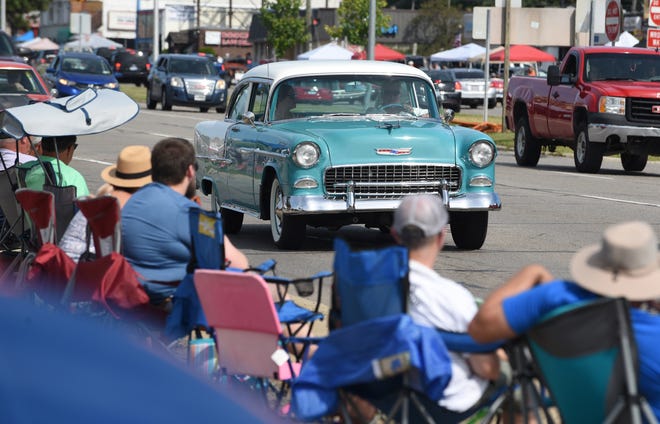
As Metro Detroit emerges from a long winter and coronavirus pandemic, car enthusiasts’ thoughts are turning to Woodward Avenue. After COVID-19 curtailed most official Woodward Dream Cruise functions in 2020, it’s looking like all systems go for the late summer, Aug. 21 auto-palooza.
“By then we should be rockin’,” says Woodward Dream Cruise Director Tony Michaels.
M1 Concourse in Pontiac — one of the Cruise’s epicenters — has confirmed two mega-events that will bookend Cruise week: Roadkill Nights drag-racing on Woodward Aug. 13-14 and the inaugural, Aug.19-21 Woodward Dream Show featuring the Cruise’s most coveted cars. Both events were canceled in 2020.
Michaels says that the communities along the Woodward route, venues, and sponsors are already coordinating the summer’s premier auto event — a decades-old tradition that, in a normal year, sees more than 1 million people descend on Woodward to celebrate automobiles old, young and mod. Thousands still flocked to “Detroit’s Main Street” last year despite the lack of an official stamp.
“We’re good to go,” Michaels said in an interview. “By the end of August — with the vaccine kicking in — we should have a great resurgence of all thing Dream Cruise.”
All things Dream Cruise include not just the third Saturday in August that caps off months of cruisin’, partyin’, and plain ol’ hangin’ along the Avenue — but also big sponsored events like Mustang Alley, Berkeley CruiseFest and GM’s Birmingham display.
First to firm up plans is the inaugural Woodward Dream Show at M1 Concourse, which dovetails with Dream Cruise weekend.
M1 announced that tickers are on sale for an event that will showcase the best of the Dream Cruise’s hot rods, race cars and cruisers. In addition to showing off hundreds of four-wheel toys across M1’s 87 acres in Pontiac, the Dream Show will feature a juried competition, food and fashion. M1 Concourse is one of the nation’s premier private garage and racetrack facilities.
“We’re providing the opportunity (to see) cars that have made the Woodward legend what it is — but you wouldn’t see them out on the road today, either out of their historical nature or value,” said new M1 CEO Tim McGrane, who formerly managed California’s legendary Laguna Seca race track. “We’re going to create displays of significant, legendary muscle cars. Put it in an environment that M1 offers with catering and entertainment.”
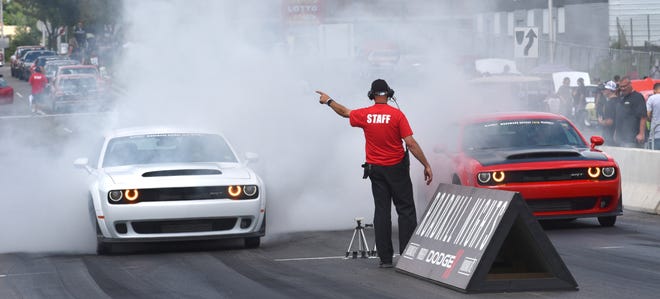
McGrane also confirmed plans for Motor Trend Group’s Roadkill Nights. The two-day event takes place on M1 Concourse property parallel to Woodward, offering car shows and track laps in snarling muscle cars. The main attraction is on Woodward itself, which is shut down and converted into a makeshift, 1/8-mile drag strip for legal racing. How legal? Oakland and Macomb County sheriffs squared off for a drag race in 2019.
The event is traditionally sponsored by Dodge, though McGrane did not confirm corporate sponsorship for 2021.
“One of the benefits of M1 is that we are an outdoor venue,” said McGrane. “We’re working closely with local authorities. Our events are planned not to be large spectator events — we’re expecting 10,000 people here. We’re keeping aware of what requirements are (and) we want to make it comfortable for attendees.”
The Woodward Dream Show kicks off at 8 a.m. Thursday, Aug. 19 with “Cruisin’ M1 Circuit Day.” Some 60 invitees — including a 1963 Chevrolet Corvette Z06 to numerous ’32 Deuce Coupes — will lap the track. Friday features 50 cars that helped shape the American car and cruising culture. The “Cruisin’ The Concourse Show” will follow Saturday, showcasing 20 local car clubs and their 100 best steeds.

Tickets start at $100 for one day admission and include access to the Taste of Woodward with upscale food and spirits. Tickets are available for after-hours ticketed events on Thursday and Friday like “Rev Up the Grille” and “Car & Cigars” where attendees can rub shoulders with car owners over BBQ or a cigar.
Dream Cruise director Michaels was also bullish on official late summer gatherings as Detroiters get back to normal.
“The Dream Cruise is spread out over 16 miles of Woodward Avenue outside,” he said. “The Board of the Cruise has been smart, hopeful, and responsible.”
Of course, the Michigan cruise crowd isn’t waiting for official events to gather. The warm April weather has already brought hot cars to local roads on weekends – even weekdays – as enthusiasts shake off winter and gather with hoods propped up.
Facebook pages are alive with notices. Cruisers gathered Tuesday night at the Ukrainian Cultural Center in Warren – the first of regular weekly gatherings. And a car show is scheduled at Pops Sweets an Treats in Mt. Clemens May 2.
“Were all going through events withdrawal,” said McGrane. “I think there is going to be a pent-up desire to go out and do what we all used to enjoy, but having been unable to.”
Payne: Infiniti QX55 brings back X-appeal to the SUV
Posted by Talbot Payne on April 9, 2021
Japanese luxury brands are going back to the future to find their mojo.
First Acura time-traveled back to the 1990s to rediscover its sporty roots. The successful journey brought us the Acura NSX supercar and athletic RDX and MDX SUVs. Infiniti is using the same method to aid its SUV fortunes.

Say hello to the sexy QX55 — created from the frozen DNA of an Infiniti FX found after a trip in the way-back machine. I took it to Hell (Michigan) and back.
QX55 is the first Japanese fastback to brave the compact luxe segment against the German trinity of BMW X4, Mercedes GLC Coupe, and Audi Q5 Sportback. But it’s not the first fastback Infiniti SUV. Indeed, Nissan’s premium brand pioneered the racy SUV concept waaaay back in 2003 with the FX. With a rear-drive layout, a long hood that arrived an hour before the cabin, and salacious looks, FX (which eventually became QX70 under Infiniti’s new nomenclature until it disappeared in 2017) was a German-like SUV hottie before the Germans ever thought of it.
Why Infiniti killed it is a head-scratcher. But now it’s been reborn as the smaller QX55. Talk about your sexy mom car.
My Slate Grey tester oozed sex appeal. Not that the stylish, square-back QX50 is a wallflower. But the QX55 is Kim Kardashian in spandex.

Sultry headlights frame a bigger, poutier front mouth. The grille — flanked by big intakes — is laced with an origami-inspired mesh. The coupe-like roof plunges into round rear hips dressed with a bold black belt under exotic LED taillights. It’s the love child of the FX and Q Inspiration Concept that turned heads at the 2018 North American International Auto Show in Detroit.
Drive up to the school pickup line slowly and let the other parents stare. But under that hot bod, QX55 is less ambitious than FX/QX70.
Gone is the rear-wheel-drive-based architecture. QX55 conforms to the front-wheel-drive-based architecture common to both the QX-50 and cousin Nissan. Gone, too, is the throaty, 325-horse V-6 engine. Sigh. As 21st century emissions regs have forced more turbo-4s, graveyards are filling up with sixes.
Like a good basketball coach, however, Infiniti squeezes every bit of talent out of its small, four-piston lineup. The QX55 drivetrain gives 110%.
Rotating through a 90-degree left-hander onto Unadilla Road outside Hell, I drifted the QX55 across the asphalt, the all-wheel-drive system scrambling for traction as I floored the throttle on exit. Smartly, Infiniti has made AWD standard on halo QX-55 (the volume QX50 comes standard with front-wheel-drive) so drivers can take full advantage of the torque on hand.
We motorheads pooh-pooh continuously-variable-transmissions, but Infiniti’s is an exception. It mimics a proper automatic tranny’s stepped shifts — but without the often rude, jerky downshifts.
The chassis shivers a bit under this duress — the QX55 can’t match the exquisite Mazda CX-5 or BMW X3 for handling — but the drivetrain, like the exterior, is all about emotion. Dialed into SPORT mode, the turbo-4 roars its approval through twin rear pipes. I wrung the QX55’s neck across Hadley and Hanker roads.
This emotional satisfaction comes a healthy $6,000 beneath competitors BMW and Mercedes, offering Infiniti as a value play in the segment (while offering a more premium coupe appearance than its Acura RDX A-Spec and Lexus NX F-Sport trim competitors).
Those savings have to come from somewhere and it’s the interior where the QX55 lags its German peers.
Nissan COO Ashwani Gupta once called Infiniti “Nissan-plus” and the interior of the QX55 doesn’t pop like other digitized luxury cabins. Sure, there is nice stitching and a Monaco Red leather option, but the knockout, $25K Nissan Sentra compact car has more character inside. The dual, stacked touchscreens remind of a last-decade Honda Accord — the tiny top screen often difficult to read in daylight due to reflection.

The rear seats were friendly to this 6-foot-five-inch reviewer, thanks to their ability to recline and slide 6 inches. Think Ford Escape, which employs a similar feature. Mainstream vehicles are killing it these days. Next to my $59K QX55 tester in the driveway was a $39K Mazda CX-5 Turbo, which matched the Infiniti feature-for-feature — head-up display, adaptive cruise control, blind-spot assist, auto wipers, sunroof, all-wheel-drive, turbo-4, the works. Talk about value.
Among its luxe peers, however, the QX55 puts Infiniti back in the spotlight. Just like the good ol’ days. “The QX55 is daring, unconventional,” says QX55 planning chief Eric Rigaux.
Here’s hoping QX55 continues the momentum with a performance, Red Sport variant stuffed with more horsepower to take on a BMW X4 M or Audi SQ5 Sportback. More daring. More sex appeal. More value.
After my fling through Hell, I picked up my favorite pastrami Rueben at Zingerman’s in Ann Arbor and set course for home on I-96. Those twin screens came in handy — the upper for Android Auto navigation (if you have an iPhone, the connection is wireless) — the lower for radio. I barked nav instructions to the phone and was off.
Like Acura, Infiniti puts its blind-spot warning on the A-pillar rather than at the edge of the mirror, where it can be more difficult to see. Blind-spot systems have become so good these days, I’m probably saving thousands on disc surgery by not craning my neck to check blind spots.
Nissan has milked good publicity from its ProPilot driving assist features (remember the Star Wars ads?), and the same system is imported into QX50. While not ready for prime time on secondary roads, it works competently on busy four lanes … until I came to a stoplight.
Like Nissan’s system, the QX55 waits until the last minute to brake for vehicles in front of you. So late, that my tester would activate the vehicle’s emergency vehicles braking system.
Glancing at my trip data, I registered 18.5 mpg on the 150-mile round trip to Hell. That’s a long way from the advertised 26 mpg, and more on par with the 18 mpg in the good ol’ FX’s V-6. I must have been having fun.

2022 Infiniti QX55
Vehicle type: Front engine, all-wheel-drive, five-passenger compact SUV
Price: $47,525 including $1,025 destination fee ($58,770 as tested)
Powerplant: 2.0-liter turbocharged, inline 4-cylinder
Power: 268 horsepower, 280 pound-feet torque (turbo-4)
Transmission: Continuously Variable Transmission (CVT)
Performance: 0-60 mph, 6.4 seconds (Car and Driver est.); top speed, 137 mph
Weight: 4,065 pounds (as tested)
Fuel economy: EPA 22 city/28 highway/25 combined
Report card
Highs: Hot bod; fun drivetrain
Lows: Dated interior; performance model, please
Overall: 3 stars
Payne: Detroit powers all-female Indy 500 race team
Posted by Talbot Payne on April 7, 2021
For the first time the Indianapolis 500 will feature a woman-driven, woman-owned race entry. And it will get a lot of horsepower from Metro Detroit.
Veteran Swiss ace Simona De Silvestro will pilot the Rocket Pro TPO-sponsored, #16, Chevy-powered Paretta Autosport IndyCar owned by Beth Paretta, a Detroit-based businesswoman with NASCAR and IMSA racing experience. The team will get technical help from Bloomfield Hills-based Penske Racing as it goes for glory at the iconic Memorial Day-weekend race.

“The cool thing about racing at a pro level is you can actually have men and women competing on the same team, competing against each other. It’s genuinely co-ed,” said Paretta in an interview. “And racing’s more more than just a driver; there are so many other roles on a team that people can aspire to be part of.”
The announcement comes as motorsport seeks to accelerate access for women and minority drivers. Female racers lost their most prominent ambassador, Danica Patrick, to retirement in 2018. Patrick is the only woman to have ever won an IndyCar race or qualified for a NASCAR pole. Paretta Autosport is a byproduct of the IndyCar series’ Race for Equality and Change initiative begun last year to broaden racing opportunities.
“There’s been a lull” after Patrick’s retirement, said Paretta. “There are great women with talent, but they need sponsorship money. If our team gets a few more people to watch racing that might not otherwise have watched, that helps the sport in its entirety. If we get viewership up because we’re telling the racing story a little differently, then that helps (all teams and drivers) in paddock by finding sponsors that see value in it.”
Beyond IndyCar, Katherine Legge and Christina Nielsen have been signed as an all-female team at the helm of a Porsche 911 in IMSA’s GTD class. And rules for off-road Extreme E electric-vehicle racing series require one male and one female driver — sharing driver and co-driver duties — “to promote gender equality and a level playing field.”
Paretta Autosport’s principals bring a wealth of experience to the track.

Currently a factory driver for Porsche in Europe, De Silvestro, 32, has raced in everything from sports cars to Formula One. Her IndyCar career dates to 2010, when she was Rookie of the Year at the Indy 500, finishing 14th. In 2011, she survived a horrific crash to quality for the 500 — a race in which she’s competed five times. She finished second in the 2013 Grand Prix of Houston, becoming only the third female IndyCar podium finisher after Patrick and Sarah Fisher.
“She’s a very good race driver,” said veteran Autoweek racing writer Stephen Cole Smith. “And she’s one of the top three female drivers in the world along with Katherine Legge and Pippa Mann.”
Team owner Paretta climbed the corporate automobile ladder to become the industry’s first female director of a performance brand and motorsport as operations chief for Fiat Chrysler’s SRT division. Under her watch, Team Penske took Dodge to the NASCAR championship in 2012, the last year the brand raced the stock car series’ high-banked ovals.
“Having the technical alliance with Penske is really a wonderful opportunity,” said Paretta. “We spent a lot of NASCAR race weekends sitting on timing stand together. I’ve worked with him in so many different capacities.”
She and Penske will team up again at Indy’s legendary Brickyard. De Silvestro will get her first laps in the Chevy-powered car Thursday and Friday as IndyCar race teams head out on Indy’s banking for an open test.
Team Penske, which will field four drivers under its own racing banner in the quest for its 19th Indy 500 win, will provide crucial technical experience to Paretta’s team.

Since 2015, Paretta has run Grace Autosport, an organization with an eye on promoting STEM (Science, Technology, Engineering and Math) education for women through racing.
An Indy 500 entry doesn’t come cheap. Paying the bills as chief sponsor will be Rocket Pro TPO, a division of Detroit-based Rocket Mortgage — the country’s largest mortgage lender — that works with independent mortgage brokers. Online banker MoneyLion is a co-sponsor.
“Having Rocket Pro TPO come on board as our primary sponsor is a perfect partnership,” said Paretta. “We are both huge proponents of highlighting the power of women, while also using technology and speed to be the best at what we do.”
With their IndyCar wrapped in bright red and with livery, Paretta and Rocket hope to bring attention to the potential for women in the racing and mortgage lending industries.
In 1977, Janet Guthrie became the first woman to drive in the Indy 500. She’s been followed by nine more women, with Patrick scoring the best result with a third-place finish in 2009. Patrick was the last female entry in the race, in 2018.
Paretta follows in the footsteps of racer Sarah Fisher (Indy 500 starts as a driver: nine), who formed Sarah Fisher Hartman Racing in 2011. That team since merged with Ed Carpenter Racing.
“Beth (Paretta) called me a few months ago and told me about this opportunity, and I think literally an hour later, I was on a Zoom call with Roger Penske and (Penske Corp. president) Bud Denker,” driver Simona De Silvestro told Racer magazine. “For me to really come back to the Speedway with a constellation like this, with the association with Team Penske, it’s really — to be honest, as a driver — a dream come true.”
Payne: GM goes big for EV wars with GMC Hummer SUV
Posted by Talbot Payne on April 5, 2021
The compact Chevy Bolt debuted in 2017 with high hopes as General Motors Co.’s first all-electric car. But it was buried by a startup brand called Tesla with a sexier, faster, more capable Model 3 compact sedan.
For its second act, GM isn’t messing around with compacts. It’s bringing an all-new, all-electric vehicle for the segments it knows best: gigantic SUVs and pickup trucks.

The 2024 GMC Hummer is the biggest, baddest, blingiest, electron-guzzling SUV in the market. Just like its gas-guzzling forefather, the 1992-2006 Hummer H1. Landing like a LeBron James dunk in the middle of the NCAA tournament last Saturday, the six-figure Hummer EV ute follows the Hummer EV pickup as a double shot of exotica because GM wants to show you what it is really capable of in the EV space.
Sedan? Pshaw. Behold the crab-walking, dirt-devouring, asphalt-torching e-Godzilla.
“It’s a benchmark vehicle for the industry,” GMC Global Vice President Duncan Aldred said in an interview. “We couldn’t have gone to that performance without going electric: 800 horsepower, 0-60 mph in 3.5 seconds. We call it a super truck. Spend time with a Hummer EV (then) get into anything else and it feels like taking a step backwards.”
GMC is arguably the General’s most powerful brand soldier — its gorgeous, chromed, gas-powered pickups boasting average transaction prices north of $50k — higher than Euro lux brands like BMW and Mercedes-Benz. Red-hot Sierra pickups are being gobbled up after only three days on dealer lots.
“What GM learned from the Bolt is that maybe introducing your best technology in a Chevy doesn’t work,” said IHS Markit senior analyst Stephanie Brinley. “Put it into a halo, $110,000 GMC Hummer and they can really demonstrate what their technology can do.”
Tesla Inc.’s Model S sedan wowed the world last decade with scorching performance, Ludicrous-mode acceleration, and Silicon Valley screen tech. The halo worked and Tesla a decade later is selling smaller, more affordable Model 3 and Model Y compacts by the boatload.
During that period, GM’s car business floundered. Already reeling from the late-20th-century Japanese invasion that had rendered its Malibu and Impalas sedans back-benchers, GM’s introduction of the battery-powered Volt and Bolt compacts didn’t gain traction any more than their petrol-powered Spark and Sonic models had. In the last couple of years, GM has been getting out of the car business entirely.
But its truck and SUV brands have flourished. Hummer’s purpose as GM’s first vehicle on its skateboard, Ultium battery platform is to jump-start volume EV sales. Jut as Model S did for Tesla.
“Ultium is the heartbeat of our electric future. It will get rolled out across all the brands,” Aldred said. “We have plans for a GMC EV electric truck, and more plans beyond as we progress with our EV future.”

Like Bolt before it, GMC Hummer will enter the SUV segment against other electric startups like the Rivian R1S and Bollinger B1.
“I think it’s really interesting. The whole EV space reminds you of back when the auto industry emerged in early 20th century and there were 1,000 brands,” smiled Aldred. “You get that same feeling now with a lot of new startups.”
Yet he believes GMC’s brand power will make it a more formidable adversary: “Hummer comes with a huge amount of equity — the fact that it’s all-electric and zero emissions puts it on a completely different plane than it was on previously.
“We have an amazing brand in GMC, an amazing vehicle in Hummer EV, and a fabulous dealer network which I believe is real advantage. Competition makes everyone better, but I’m really confident about the success of Hummer EV.”
The Hummer will match its competition with digital screens (its screen tech was developed by Perception, a veteran of Marvel Studios’ movies) that Tesla pioneered and which is now required for entry in the upscale EV segment. But true to a GMC reputation born of snarling, Denali V8s and tree-chewing AT4 four-wheelers, Aldred said it’s Hummer EV’s performance that sets it apart.
Weighing down with 200 kWh of battery across a 126-inch wheelbase, the top-trim, three-motor, 830 horsepower monster still manages 0-60-mph sprints in 3.5 seconds with “Watts To Freedom” launch control mode (think Ludicrous mode).
“What the Hummer EV has got is unbelievable capability. You see the vehicle has the physicality — that alone is quite astonishing,” said Aldred. “Watts to Freedom mode (prepares) the power surge you need to take it 0-60 mph in 3.5 seconds. The seats vibrate. The chassis lowers, you get a graphic experience on screens in front of you. . . it creates an amusement park-like experience.”
The first Hummer SUVs to roll off the production line in early 2023 will be Edition 1 models. Loaded with performance and interior features, the Edition 1 SUV will start at a lofty $105,595. All Edition 1 models have been sold. Production of the $89,995, 2024 Hummer EV with long-range battery will start in spring 2023.
The Hummer strategy is a clever remake of a sub-brand scorned by cultural elites during the Gulf Wars for its oil-rich lifestyle. GM thinks an electric Hummer resurrection is perfectly placed as a halo that will make customers rethink the capabilities of EVs — just like the Model S sold smaller Teslas.
“Tesla proved you could create emotion for a battery-powered vehicle,” said Brinley.

She says that Detroit automakers are shrewd to draw on their own badges to conjure similar emotion with sub-brands like Hummer and Mustang (the Mustang Mach-E is Ford’s first all-electric vehicle).
“The strategy is working because it embraces historic, emotional brands — then infuses them with modern tech to make them better,” Brinley said. “By pushing the capability of a Hummer, for example, GM gets the opportunity to demonstrate in the truck and SUV space that they have conquered the technology.”
GMC’s Aldred shrugs off questions about electric charging infrastructure. The Hummer EV will be bought by owners who have multiple vehicles. While Tesla and Rivian are developing charging networks for their customers, GM is betting that if the Hummer (and other halos like the Cadillac Lyriq) spark an EV revolution, then the infrastructure from independent networks like EVGo and Electrify America will flow as gas stations followed Ford’s Model T.
“GM’s vision (of zero emissions) is very real,” Aldred said of GM plans to sell only EVs by 2035. “To get that momentum is going to require a lot of things, and recharging infrastructure is clearly one of them.”
Five must-sees at The Henry Ford’s ‘Driven to Win’ racing exhibit
Posted by Talbot Payne on April 5, 2021
Dearborn — Behind the giant McDonald’s Hamburgers sign (over 160 million sold!) and sandwiched between the airplane and locomotive exhibits in The Henry Ford is one delicious serving of motorhead red meat.
“Driven to Win: Racing in America” opened March 27, and it’s a must on Detroit’s spring menu.

Occupying 24,000 square feet of floor space in the museum’s American Innovation building, the permanent exhibit is touted as America’s most comprehensive exhibit of motor sport.
True to The Henry Ford’s purpose, it draws on multiple resources — including those of sponsors like General Motors, Italian brake maker Brembo and Canadian racing supplier Multimatic — to showcase the evolution of U.S. auto racing.
Through 13 years of planning, building and acquisition, curator Matt Anderson and his elves have assembled the human — as well as mechanical — aspects of the sport. The narrative is both sweeping (covering everything from IndyCar to land speed racing) and meticulous in detail (a corner of the exhibit is dedicated to racing movies).
It all adds up to a display that can be visited over and over again. Here are my five highlights:

1) The simulators. This exhibit will keep you coming back. At its heart is a bull ring of six racing simulators. With three big wrap-around screens and hydraulic hardware, the sophisticated sims let drivers age 10-plus take the wheel against other competitors for a 15-minute race around one of the world’s race tracks. My simulated race was aboard a Porsche GT3 at the Red Bull Ring in Austria.
The racing was intense, but not too technical. Follow the racing line (helpfully laid out on the pavement before you), be patient, and you might just score a podium — assuming you can survive the Turn 1 mayhem. Then go online and see how your lap times compare with other racers before you.

2) The film. “Fueled by Passion” is a big-screen, 16-minute film that immerses you in the racing world from five perspectives: Breehanna Daniels (NASCAR tire changer), Brittany Force (drag racer), Tim Hardy (Pikes Peak BMW racer), Josef Newgarden (IndyCar champ) and Megan Volk (Bonneville Salt Flats racer).
The fast-paced film takes you to highs and lows of motorsport as these competitors tell their stories. It’ll get your heart racing for the rest of the exhibit.

3) Sports Car Performance Center. Behind this doorway is the Ford GT, the most stunning supercar ever conceived, in three guises. There’s a full-size clay model used by designers, two halves of a production GT and GT race car fused together to show you how closely they compare, and the actual #68 GT race car — still wearing the bugs and sweat of the race track — that won the 24 Hours of Le Mans in 2016, 50 years after Ford’s first victory at the legendary French circuit.
A wall of screens take you onboard for a high-velocity lap around Le Mans with video as well as telemetry charting #68’s speed, engine temps and lateral g-loads, among other data. It’s not just any lap, either — but the very lap where driver Joey Hand overtook arch-rival Ferrari for the lead.

4) The cars. Assembled here are priceless legends of motorsports. Everyone will have their favorite. Two of mine:
- Jimmy Clark’s Lotus Type 38 was the first mid-engine racer to win the Indianapolis 500, in 1965. No front-engine car would win it again. The Flying Scot was also a harbinger of winners to come as today’s race is populated by the world’s best drivers.
- The 2011 Ford Fusion brought 20-year-old Trevor Bayne across the Daytona 500 finish line that year, making him the youngest driver to ever win the storied race. Like the Le Mans-winning Ford, the Fusion still wears all the battle scars of the 500-mile race.

5) Sweepstakes. The car that started it all. History seems so pat in retrospect, but Henry Ford’s place in it was hardly pre-ordained. With his first car company a failure, Ford rebuilt his reputation by racing. His 1901 “Sweepstakes” car brought him renown — and investors — when he beat well-known Cleveland automaker Alexander Winton in a 10-mile Grosse Pointe race.
Two years later, he would form the successful Ford Motor Company.
There is much more racing history to come, and “Driven to Win” will be here to chronicle it. New exhibits will be opening in the coming months as we move beyond COVID restrictions. Kids will soon enjoy an interactive, tire-changing pit stop as well as a pinewood derby track.
As the film says: “racing is in our blood.”

Driven to Win: Racing America exhibit
The Henry Ford Museum of American Innovation
Address: 20900 Oakwood Blvd., Dearborn
Admission: $25, adults; $22.50, senior citizens; $18.75, ages 5-11; children 4 and under are free (additional charge for In the Driver’s Seat Simulators).
Payne: Big BMW M440i Grille-zilla still has the moves
Posted by Talbot Payne on April 5, 2021
The compact-class, BMW 3-series has grown a lot in the past 20 years. Check out the all-new 2021 BMW M440i Coupe prowling my driveway.
Once the 3-series was offered as both a coupe and a sedan, but in 2014 the coupe grew its own dedicated 4-series badge. That new line grew M trims like my 6-cylinder M Performance tester (in addition to a turbo-4-powered M Sport and fire-breathing M4). Its pant size grew, too. The ’21 coupe’s wheelbase has grown nearly half a foot and 450 pounds over my 2001 BMW M3 Coupe. Its wheelbase and weight are about equal to a 2004 5-series, for goodness sake.
And then there’s the twin-kidney grille.

M440i is the first car model to feature grille-zilla — full-fascia kidneys that look like they were taken off the X7 SUV. They are huge. They provoke heated arguments among BMW faithful about whether the grille makes the 4-series look bold — or like a buck-toothed gopher.
But one thing hasn’t changed. The BMW 3/4 series is still the compact class’ performance standard.
Hustling over Doyle Road’s rollercoaster turns west of Hell, the M440i was true as an arrow. The comfortable suspension that carried me on a magic carpet west from Detroit on I-96 was now taut — like the sinewy thighs of a greyhound — in Sport Plus mode. The balanced torso is an extension of my hands. Turning in to a hard, 90-degree left-hander, the car slid effortlessly across the apex to the edge of the road. Right where I placed it.
The car’s added girth is apparent. Its two tons tip the scales like the 4,068-pound, 2004 5-series of old. But the 4’s modern chassis feels smaller. About 2,000 pounds of that weight gain is the addition of all-wheel-drive, which means more grip. Lots of grip.
On a lonely patch of Doyle, I do a launch control-assisted, 0-60 mph sprint. The grip is instant (Car and Driver recorded an impressive 3.8 seconds). The drivetrain roars like a cheetah unleashed.
Ah, BMW’s unparalleled drivetrains. At the heart of M440i is another terrific 3.0-liter inline-6. This one is blown to 382 horsepower with a single turbo — 52 more horses than my 2001 M3 Coupe. The new M4 Coupe (formerly the M3 Coupe — sorry, the alphanumerics will make your brain hurt) now makes up to 503 horsepower by adding a second turbo.

I’ll have a chance to test the M4 sometime soon, but for now 382 horses will do. They make beautiful music.
Sport Plus mode cranks up the volume, filling the cabin with fury. The 8-speed automatic throws off effortless, quick shifts. Diving into a tight right-hander, dual pipes out back bark in rev-marching unison with automatic downshifts. It’s effortless, smooth, intoxicating.
Two years ago, I tested a small-kidneys 2019 turbo-4 BMW 330i M Sport against my (then) brand-new electric Tesla Model 3. Both 55-grand compact sedans. Both rear-wheel drive. Both hot-selling performance compacts.
After flogging them around M1 Concourse’s 1.5-mile Champion Motor Speedway, M1 instructor Alex Della Torre and I emerged with big grins under our helmets. But the question hung in the air: which car handled better?
“The BMW, no doubt,” we both said in unison.
As my 2021 M440i tester confirms, the magic endures. But Tesla has set a new benchmark in technology. The Silicon Valley maker has rewritten the rules with its smartphone-on-wheels experience: voice commands, navigation, screen graphics. Tesla has ridden that experience to the best-selling luxe brand in the U.S.

For the first time in a long time, the Germans have had to play catch up. M440i is a solid response.
Rather than copying Tesla, BMW has played to its strengths. The California automaker is Apple iPhone simple. The Bimmer is Neuschwanstein Castle posh.
Slip into the M440i and I was wrapped in 14-way, Cognac Vernasca leather thrones. A robotic arm handed me my seat belt (“Your seat belt, mein Herr”) and Mrs. Payne’s on the passenger side too. I expected the coupe’s 112.7-inch stretched wheelbase to add more room to the rear seats, but my 6’5” was a tight fit — though not as tight as a Mustang that requires six-footers to first remove their legs.

In contrast to Tesla’s minimalist three-button cabin, the BMW is littered with buttons. For the starter. For drive modes. Adaptive cruise control. Favorite radio stations. Lights.
Everything but that annoying stop/start button for when the engine stalls at stoplights to gain mpg credits from government regulators. Instead, M440i is equipped with a 48-volt battery (ditching the common 12-volt) to make the transition between stop and start smoother. Mostly, however, it’s there to support the electronic funhouse.
The sculpted dash is dominated by colorful digital instrument and infotainment screens — the latter operated by (take your pick) touch or remote rotary iDrive. Notably, BMW seems to have punted on voice recognition.
“Go to Hell, Michigan,” I commanded.
“Please don’t speak to me like that,” shot back a female voice.
Um. I’m sorry? Stymied, I connected my Android phone, with which I have a better relationship. “Go to Hell, Michigan” was not only immediately recognized by Android Auto (Apple Carplay also comes standard) in the console screen, but it was done wirelessly. What’s more, directions then appeared on the instrument and head-up displays.
That’s a first. Every other smartphone app-capable vehicle I’ve driven segregates smartphone apps to the console screen. In M440i, it’s integrated into all three displays — heads-up, instrument and console — making for a state-of-the-art, visual and voice experience to Hell and back.
The head-up display had other talents. Like scrolling my favorite radio stations via (yet another) button on the steering wheel. The more features in heads-up displays, the better to keep your eye on the road.
Most passersby kept their eyes on that big, fat kidney grille. To my surprise, most approved. I like its retro vibe recalling the sleek 1940 BMW 327 Aero or ’65 2000CS.

Shocking as they appear in photos, the kidneys in the flesh are nicely integrated with the nose. Striking blue laser headlights bracket the grille. A lower spoiler and vents frame it like a goatee. Many passersby compared it favorably to the Alfa Romeo’s similar full-faced, tri-logo grille.
Which is appropriate since the Alfa is the rare performance car that can dance with the M440i. The compact Bimmer isn’t so compact anymore, but it’s still got the moves.
2021 BMW 4-series
Vehicle type: Front engine, rear- and all-wheel-drive 5-passenger compact sedan
Price: $46,595, including $995 destination fee ($70,470 M440i as tested)
Powerplant: 2.0-liter turbocharged, inline 4 cylinder; 3.0-liter turbocharged, inline 6 cylinder
Power: 255 horsepower, 294 pound-feet torque (turbo 4); 382 horsepower, 364 pound-feet torque (turbo 6)
Transmission: 8-speed automatic
Performance: 0-60 mph, 3.8 seconds (Car and Driver); top speed, 157 mph
Weight: 3,977 pounds (as tested)
Fuel economy: EPA 22 city/31 highway/25 combined (M440i xDrive as tested)
Report card
Highs: Grille-zilla ain’t so bad; handling and agility
Lows: Porky curb weight; gets pricey
Overall: 4 stars
Payne: Lexus LF-Z concept signals measured electrification strategy
Posted by Talbot Payne on March 31, 2021
Toyota Motor Corp.’s luxury brand, Lexus, debuted an all-new, digitally advanced, electric LF-Z concept Tuesday, its first vehicle on a dedicated battery platform.
Billed as a transformative moment for the Lexus brand, the edgy LF-Z continues the brand’s evolution of battery-powered products dating to 2005 with the RX 400h, a hybrid that was the brand’s first electrified vehicle. By 2025, Lexus plans 20 new electrified models including all-electric, plug-in hybrids and gas-hybrid models. Currently, six of Lexus’ 10 models in the U.S. market have hybrid variants.

Unlike Cadillac and Tesla, however, Lexus did not signal a move to all-EVs. Lexus has consistently been one of the big three best-sellers the U.S. luxe market — together with BMW and Mercedes — in gas and and hybrid models. Lexus aims to offer electrified variants of all models by 2025, with the sales ratio of electrified variants exceeding gas-only vehicles.
The sharply angled, futuristic LF-Z builds on the LF-30 concept revealed at the 2019 Tokyo Auto Show. The sci-fi LF-30 was the first glimpse at the brand’s “Lexus Electrified” plan to create a dedicated battery architecture. The LF-Z brings that concept close to production.
The dedicated battery platform is similar to the Ultium battery-powered, skateboard platform that will undergird Cadillac’s 2023 Lyriq crossover. With its sharp edges and aggressive facia, the LF-Z also looks similar to Caddy’s EV design language. GM’s luxury brand, following the success of Tesla, is pursuing a more radical, all-EV plan by 2030 that it hopes will jump-start the brand’s small-volume sales.
In line with corporate trends promoting green initiatives, Lexus said its electrification plans are part of a larger commitment to sustainability.
“While fulfilling our social mission of realizing a carbon-neutral society, we will continue to provide the fun and joy that cars bring,” said Lexus International president Koji Sato.
Though Lexus sells in 70 markets around the world, the U.S. and China account for more than 70% of the brand’s global sales (about 525,000 of 720,000 units). Governments in both markets have signaled that they will force automakers to go all-electric in coming decades, even as luxury customers have been reticent to buy EVs not named Tesla due to batteries’ added expense and range challenges.

Like its sister Toyota brand, which brought the first successful hybrid vehicle to the U.S. in 2001, Lexus has been a battery-power pioneer. But unlike GM and Volkswagen, Lexus is skeptical of going all-electric anytime soon.
“The current business model of the car industry is going to collapse,” Toyota president Akio Toyoda warned late last year of industry plans to go all-EV. He said countries like Japan simply do not have the electric grid capacity to handle an all-electric fleet.

“The more EVs we build, the worse carbon dioxide gets,” Toyoda said, pointing out that most of Japan’s grid is powered by coal and natural gas. “When politicians are out there saying, ‘Let’s get rid of all cars using gasoline,’ do they understand this?”
Including Lexus’ diversification of its fleet to a new electric platform, Toyota plans to invest more than $13 billion in electrification in the next decade. That plan includes the 2024 opening of a new Shimoyama technical center in Japan. Lexus targets global sales of 4.5 million hybrid vehicles — and 1 million EVs — by 2030. Since the launch of the 2005 RX 400h, Lexus has sold 2 million hybrids worldwide.
Like the RX 400h, the LF-Z Concept is a two-row SUV. Following EVs from Tesla, Cadillac and Mustang, its advances are as focused on digital and style innovations as they are battery-oriented.

The smartphone revolution is redefining auto technology.
Under a panoramic glass roof, the concept wraps the driver in what it calls a Tazuna cockpit — a minimalist design featuring digital screens with AI software that learns the driver’s habits. With independent electric motors front and rear, the Lexus also debuts new, four-wheel driving tech called DIRECT4.
“The instant responsiveness of an electric motor’s driving force to freely control a vehicle’s four wheels for superior and highly flexible driving performance … sets it apart from conventional vehicles,” said Lexus in a press release.
The concept also features drive-by-wire steering — eschewing a direct mechanical connection between steering wheel and steering rack. The steering wheel itself is a radical, yoke design like the forthcoming 2021 Tesla Model S upgrade. And without a gas engine to feed, Lexus’ signature, huge spindle grille is more sculpture than grille.

Responding to a digital key, the LF-Z will open and turn on as the driver approaches the vehicle.
“The automotive industry has entered a period of once-in-a century transformation,” said Lexus as it pursues an ambitious agenda of electrification as well as driverless mobility. “In addition to the growing social mission of carbon neutrality and compliance with the Sustainable Development Goals of the United Nations, customers’ lifestyles and values are changing and diversifying at a speed previously beyond imagination.”
Sold! First-edition Hummer EV and Bronco auction for big bucks
Posted by Talbot Payne on March 31, 2021
The first production versions of the highly anticipated GMC Hummer electric pickup and Ford Bronco SUV have sold for big bucks. Charities will benefit.
The 2022 Edition 1 Hummer VIN 001 went on the auction block over the weekend at the Barrett-Jackson auction in Scottsdale, Arizona, and fetched a cool $2.5 million. Then the first 2021 Bronco First Edition two-door, VIN 001, sold for a hefty $1.1 million.

The two SUVs headlined a $5.8 million Barrett-Jackson auction haul for charity featuring multiple vehicles. Hummer monies will benefit the Tunnel to Towers Foundation, established in memory of Sept. 11 first-responder Stephen Siller. The Bronco proceeds will benefit the National Forest Foundation and Outward Bound, which provides outdoor experiences for young people.
“We are thrilled with the auction results, and what the proceeds will mean for the Tunnel to Towers Foundation,” said GMC global vice president Duncan Aldred.
Auctioning first units of landmark vehicles has become a Barrett-Jackson habit.
The first mid-engine Chevy Corvette C8 was bought for $3 million by NASCAR team owner Rick Hendrick at Barrett-Jackson a year ago, with all proceeds benefiting the Detroit Children’s Fund. The final front-engine production Corvette C7 sold for $2.7 million in 2019, and the first Ford Mustang Shelby GT500 to roll down the Flat Rock line sold for $1.1 million in January, 2020.
Nine VIN 001s were auctioned this year, including the first Mustang Mach 1 ($500,000), Cadillac CT4-V Blackwing ($165,000), Cadillac CT5-V Blackwing ($265,000), and Ram 1500 TRX Launch Edition ($410,000).

The Hummer’s auction price was well above the $112,595 starting sticker of the Hummer EV Edition 1, the only version that will be produced for the ’22 model year. All units have already been spoken for — save the VIN 1 auction truck that went Saturday. The standard, $80,000 Hummer EV won’t be available until the 2024 model year.
The auction car was loaded with features and specially appointed for the occasion, featuring a white exterior and unique Lunar Horizon interior. The buyer is as yet unknown.
In addition to being the first vehicle built on GM’s Ultium battery platform (other models from Cadillac and Buick will follow), the Edition 1 is loaded with:
- CrabWalk mode that allows the vehicle to diagonally drive out of tight spots.
- Three-motor, four-wheel-drive propulsion system with an estimated 1,000 horsepower and 0-60 mph time of three seconds.
- The latest version of Super Cruise, which allows for hands-free driving on divided highways.
As for Bronco, Ford is only making 7,000 First Edition models. VIN 001 features an exclusive Lightning Blue exterior and Dark Space Gray/Navy Pier interior. Under the hood is a 2.7-liter V-6 making 310 horsepower. The auctioned Bronco boasts signature, removable doors and a laundry list of off-road goodies like front-and-rear locking differentials, trail-turn assist and electronic stabilizer bar disconnect.

The Bronco will be made at Ford’s Michigan Assembly in Wayne and the Hummer EV at GM’s Detroit-Hamtramck Assembly plant, which has been retooled with $2.2 billion to exclusively produce electric vehicles.
EV-maker Rivian plans Tesla-like, mega-charging network
Posted by Talbot Payne on March 31, 2021
Electric-vehicle maker Rivian Automotive is borrowing a page from Tesla Inc. and building an exclusive, fast-charger network for its coming R1T pickup and R1S SUV.
Dubbed the Rivian Adventure Network, it promises an ambitious, 600 super-charging stations offering 3,500 chargers by 2023 on routes across the United States and Canada. The chargers will be exclusive to Rivian owners, though a secondary, so-called Waypoint network of 10,000, 240-volt chargers will be open to the public at hotels and other businesses.

With big capital reserves, Rivian and Tesla are separating themselves from the electric-vehicle pack by building exclusive charging networks. Other legacy automakers (as well as less capitalized EV startups like Lucid and Fisker Inc.) intend to rely on third-party, fast-charging networks like Electrify America, Chargepoint and EVGO.
Each Rivian charging station will operate six chargers on average at speeds starting at 200 kW (with planned 300 kW). Tesla’s 150-250 kW fast-charging stations — “Super Chargers” in Tesla speak — average nine stalls per station with the largest housing 56 stalls south of San Francisco.
Tesla’s Supercharger network launched in 2012 with its Model S sedan and has grown to 1,101 stations across North America. It has added enormous overhead cost to the young electric automaker — but has also been a key factor in establishing its EV dominance as Teslas can reliably slake their thirst for electrons on long-distance trips.
Competitors like the Chevy Bolt, GMC Hummer EV, Ford Mustang Mach-E, and Volkswagen ID.4, by contrast, cannot use Tesla or Rivian fast chargers. They must rely on the patchwork of third-party chargers.

Legacy automakers hope Electric America’s fast-growing network of 500 stations (built by VW as penance for the Dieselgate scandal) — as well as anticipated spending from electric utilities and the Biden Administration’s forthcoming, $3 trillion infrastructure bill — will help them compete.
“(Our) nationwide network of DC fast chargers are capable of adding up to 140 miles of range in 20 minutes to the R1T and R1S,” said Rivian in announcing its network on its website.
“The Rivian Adventure Network is designed for quick recharges so you can keep moving. Los Angeles to Tahoe. Manhattan to the Adirondacks. I-70 to The Rockies. Michigan’s UP via I-75. The entire Blue Ridge Parkway from Shenandoah National Park down to Great Smoky Mountains National Park. The network also extends further into more remote destinations.”
The remote destination promise dovetails with Rivan’s marketing as an adventure brand bringing battery power to off-road vehicles. The brand is aimed at well-heeled overlanders who want to get away to national parks and other locations.
Rivian promises its Waypoint 240-volt, “Level Two” chargers in every state park. It jump-started that goal this week by committing to install at least two charging stations in all 42 Colorado state parks by July.

The EV-maker is also committed to producing 10,000, battery-powered delivery trucks for Amazon by 2022 (100,000 by 2023) — but the Rivian Adventure Network will operate separately from infrastructure charging those trucks.
Rivian says its charging network will be conveniently located on highways and roads near cafes and shops. Tesla Superchargers are commonly found at Meijer mega-stores with dining and shopping nearby to kill time while its vehicles charge up to an hour depending on the amount of range required. Electrify America stations are frequently found at Walmarts. A Toledo area EA station is located at a Ohio turnpike service plaza.
Rivian says that details on pricing will be released for customers soon. Third-party charging companies typically have subscription plans with some automakers covering their costs for first-time EV buyers. Tesla rolled out its service free to Model S owners in 2012 but has since begun charging as more vehicles like the hot-selling Model 3 sedan have come to market.
Unlike Tesla, Rivian’s plug is based on the common CCS American standard so R1Ts, for example, can plug directly into EA fast chargers. Teslas require an adapter.
Utilities are getting in on the fast charging act, too. Six Midwest utilities — including Consumers and DTE Energy — have committed to building a fast-charging network from Michigan to Kansas by 20022. Currently, Consumers claims fast-charging stations in Cadillac, Gaylord, Marshall, Big Rapids and Saugatuck, with plans for 30 more.

“We’re excited to see automakers like Rivian building their own networks,” said Kellen Shefter, Electric Transportation director for the Edison Electric Institute, which represents the power industry. “Tesla has used their network to serve and build loyalty with their customers, so we’re not surprised to see Rivian following suite.”
EEI expects 20 million EVs on the road by 2030 (up from an estimated 1.4 million today). Shefter says the numerous parallel fast charging networks bring high voltage power into new areas like shopping centers but that the ramp up will be evolutionary and should not strain the power grid.
Rivian claims its chargers will be “powered by 100% renewable energy.” That’s likely a reference to company plans to buy carbon offsets like Renewable Energy Certificates — as the Adventure Network will draw juice from a power grid made up of natural gas, coal, and nuclear power.
The secondary, 10,000 Level Two Waypoint chargers will be found at restaurants, hotels, and campsites, to deliver up to 25 miles of range an hour.
Like Tesla, Rivian plans charging management via in-vehicle navigation or through a phone app. Details will be forthcoming as R1Ts and R1Ss roll off Rivian’s Normal, Illinois, manufacturing line this summer.
“On the road, our in-vehicle navigation automatically routes you through any needed charging stops, prioritizing Rivian chargers as well as DC fast chargers from CCS partner networks,” says the company of its vehicles, which boast up to 300 miles of range. “Simply enter your destination, our maps will plan charging for you.”

The EV maker with operations in Plymouth and California offers a wall charger for home installation at vehicle purchase. EV makers recommend 240-volt charger installations for about 16 miles of charge per hour. A standard, 120-volt outlet returns a meek few miles of charge per hour.
Payne: Stylin’ ID.4 is VW future, unless Tiggy has its way
Posted by Talbot Payne on March 25, 2021
The Volkswagen ID.4 comes with big expectations.
“For us, psychologically, we’re thinking about the ID.4 as our next Beetle,” says vice president of e-mobility at Volkswagen of America, Matthew Renna. VW’s first electric SUV aims to duplicate the defining trait of the German automaker’s most iconic car: practicality.

Unlike when the Bug hit U.S. shores over a half century ago, however, VW already has a practical ute in showrooms: the gas-powered VW Tiguan.
A weekend with the ID.4 shows Tiggy has met its match in some ways: handling, torque, novelty. But not practicality.
Like the Beetle, my ID.4 tester makes a pleasant first impression. Targeted at the market’s biggest volume segment, it is stylish, uncluttered. Detouring from its right-angled Tiguan peer, the grille-less ID is sculpted like a sand dune. Wrapped headlights flow into rising shoulder lines punctuated by a horizontal LED taillamp. Crouched under a narrow greenhouse on big, 20-inch wheels, my 1st Edition-trimmed model may not inspire a cute “Bug” nickname — but it has presence.
Slip inside with key in pocket and ID greets you with a Tesla-like, sci-fi vibe. Detecting my tush in seat, the VW’s twin driver/console screens flickered to life like a spaceship control room. Step on the brake pedal and ID is ready for duty.

That Tiguan across the showroom? Haw, you still have to press an ignition button. Dude, that’s so 15 minutes ago.
But that Tiguan also starts at just $26,440. The ID.4 at $39,995. Oh.
Tesla’s Model Y (and sister Model 3) debuted with shortcomings — lack of service network, poor build quality — but price was not one of them. Despite its pricey battery drivetrain, Y is priced right on top of a comparably equipped, all-wheel-drive BMW X3, for example: $52,190 vs. $52,895 for the Bimmer.
Add Tesla’s unique operating system and ferocious acceleration, and customers flocked to the new kid on the block.
Load a Volkswagen ID.4 Pro S trim with comparable features and its $48,195 sticker is more in line with these luxury chariots. A comparable Tiguan SEL — panoramic roof, adaptive cruise, blind-spot assist, auto wipers, leatherette seats — will set you back just $35,040. Practical.
Sure, ID.4 will initially benefit from a federal $7,500 tax subsidy (Beetle never needed that) — a capped credit that Tesla has exhausted by selling over 200,000 EVs. But add the credit and my tester was $37,690 — still 4 grand north of the comparable Tiggy.
For that premium ID.4 delivers good ol’ sporty V-dub handling.
I’ve lamented that VW cars’ sporty nature hasn’t translated to its SUVs. Compared to its thrill-ride Golf GTI cousin, Tiggy is uninterested in dancing through the twisties.
ID.4 has inherited Golf’s DNA. Volkswagen takes the inherent, low-center of gravity of ID.4’s electric, MBE “skateboard” chassis and marries it to a rear-drive motor (Tiguan is front-drive) to create a nimble ute.
On a trip to Hell’s devilish roads, ID had a blast despite its 4,665-pound girth (Tiguan weighs 3,757). In Sport mode, the heavy steering felt rooted in tight bends, the RWD chassis rotating confidently. When traffic interrupted my fun, 229 pound-feet of instant electric torque was on hand — ZOT! — to squirt past when a broken center line presented itself.
Curious, then, that V-dub holds back other unique EV features that have made rear-wheel-drive Model Ys and Mach Es so appealing. Notably absent, for example, is a frunk (“front truck”) that never fails to wow EV neophytes. Instead, the front bonnet is crammed with electric hardware despite the aft-located motor.
This lack of extra storage is especially jarring since ID lags Tiggy in cargo space: 64.2 cubic feet vs. 65.7.

Inside, ID is nicely minimalist. Sans driveshaft, the console is a well of storage that includes a wireless charger. Though shy of Tesla/Mach E’s radical tablet approach, the console and steering-column-mounted touchscreens are rich with graphics. A wee shift stalk selects gears. My kids’ smartphone generation will be disappointed by the cheap voice recognition. Fortunately, wireless Apple CarPlay and Android Auto save the day.
But the biggest shortcoming of EVs like ID versus peers like Tiguan is battery range.
As I contemplated my trip to Hell — 50 miles west of my Oakland County home — range anxiety was instant. In 30-degree March temps, ID had eaten 100 miles of battery range from a full charge in two days of local driving despite only traveling 60 miles. That 60% of predicted range means VW’s advertised 250-mile range is more like 150 in Midwest winters.
With 147 miles of range left and a 100-mile round-trip to Hell ahead (including an Ann Arbor side trip to grab my favorite Zingerman’s Reuben) — I knew I couldn’t make it. Tiguan never worries me with such thoughts thanks to plentiful petrol infrastructure.
I asked ID’s nav system for charging stations en route and it turned up a long list — but the only one that made sense was a rare Electrify America super-charging station at the Novi Walmart. Other 240-volt chargers that would take hours to deliver the necessary mileage.
When I arrived at the EA charger, all four stalls were available. But when I plugged in, the charge card reader didn’t work. Worse, the plug wouldn’t disengage to start a new session using ID’s remote app. I called EA’s help line and the problem was fixed after 20 minutes. The good news? VW offers free EA charging for three years.
After another 15 minutes of charging (a 45-minute detour in all) to add 45 miles and I was on my way.
That extra mileage would be crucial in returning me to Oakland County for a 4 p.m. tennis match. As I babied ID.4 up Telegraph Road with just 30 miles of charge remaining (the 130-mile trip sucked 175 miles of range), I asked the nav system for charge stations near the courts where I could add some juice.
The system directed me to a Telegraph Road BMW dealer. But the dealership had moved from that location four years ago.
Bottom line, EVs like ID.4 are niche vehicles. Install a 240-volt charger at home for daily commutes. In the EV ecosystem, the compact V-dub compares favorably to $35,000, subcompact EVs like the Chevy Bolt or Hyundai Kona. It’s more affordable than luxe offerings from Tesla and Polestar.
But it’s a long way before it can claim Beetle’s practicality crown. For now, the crown’s still worn by gas-swilling Tiggy.

2022 Volkswagen ID.4
Vehicle type: All-electric, rear- and all-wheel-drive, five-passenger compact hatchback/SUV
Price: $41,190, including $1,195 destination fee (about $45,190 for 1st Edition as tested)
Powerplant: 77 kW lithium-ion battery pack mated to rear electric motor
Power: 201 horsepower, 229 pound-feet of torque
Transmission: One-speed direct drive
Performance: 0-60 mph, 7.6 seconds (Car and Driver); top speed, 100 mph
Weight: 4,665 pounds (as tested)
Fuel economy: 250-mile range
Report card
Highs: Modern, minimalist interior; settled handling despite girth
Lows: Pricey compared to comparable Tiguan gas model; sparse charging network
Overall: 3 stars
Payne: Toyota Tundra TRD Pro likes to get dirty
Posted by Talbot Payne on March 25, 2021
Mt. Morris — Rural Michigan is pickup country. Ford F-250 duallies towing equipment. Laden Silverados hustling to service jobs. Gorgeous Ram trucks prowling construction sites. And macho pickups of all stripes with big tires, menacing hood scoops and lifted suspensions eager to go beyond where the asphalt ends.
Despite its rare Toyota badge, my hulking, 2021 Tundra TRD Pro tester fits rights in. Sitting atop 32-inch Michelin all-terrain tires, Fox off-road shocks and 11 inches of ground clearance, the Lunar Rock-painted behemoth bristles with hood scoops and tow hooks.

This is not your father’s Camry, but a serious, bark-chewing beast.
Think of Toyota as Dr. Jekyll and Mr. Hyde. The Japanese automaker has built a reputation as a dependable daily driver (backed up by years of JD Power reliability MVP awards) and a weekend track warrior. Its Toyota Racing Development (TRD) shop has climbed podiums at the highest echelons of motorsports from NASCAR to Formula One. That resume includes winning the Baja 1000, North America’s premier off-road competition.
Beginning in 1998, the TRD badge started to show up on the Tacoma (Taco, as it’s known to its legion of fans) as a rough-and-ready off-roader. While the Detroit Three dominated full-size trucks, Taco owned the mid-size segment with its Mr. Hyde variants leading the way.
Tundra followed with its own TRD features but has lived in Taco’s shadow — its sales just half that of little brother (much less anywhere close to the Detroit Three). But Tundra got serious in 2015. It grew a comprehensive TRD Pro package (like Taco) with serious suspension and skid plate mods. It even brought back a Baja 1000 trophy in the Pro Stock class to make little brother proud.
Tundra? My TRD Pro tester is Tund-raw.
Somewhere between Southview Farm and the Irish Road Canoe kayak launch, I turned off Mt. Morris Road into The Mounds Off-Road Vehicle Park. The Mounds is 200 acres of dirt, sand and bog. It’s a place where dirt bikers, ATV owners, and Jeepsters can let out their inner child.
And where Tundra lets out Mr. Hyde.
I shifted to Neutral and turned the transfer-case dial from “2WD” to “4WD.” Then I held the traction control button to turn off the nannies. When I say “held” I mean “held for a loooong time.” This is a Toyota, after all, and the nannies don’t retreat easily.
Once unleashed, TRD Pro had a blast. ROOOAARR! I nailed the throttle and the 381-horse 5.7-liter V-8 bellowed, the rear end slewing sideways through muddy bends. With the Fox shocks allowing extended suspension travel, Tundra bounded over a sandbox of moguls like an oversized puppy.
WHUMP! It’s easy to get too excited, and the enormous front skid plate is there for when the suspension travel runs out and the truck’s belly slaps a mogul.

The Mounds’ tight confines are, frankly, more suited for mid-sizers like the Tacoma, but it would be impressed by big bother.
My friend Scott, who bleeds Ford blue, was impressed, too. Walking around the TRD Pro back in Oakland County, he liked the menacing, black front grille and hood scoops (OK, so the scoops are fake). The big back seat room. The lifted suspension.
“No running boards for better off-road clearance. Nice.”
The TRD Pro trim is key to giving the Tundra personality. It’s also key to keeping the Tundra relevant in the full-size truck market.

The Texas-built Tundra sits on old bones. In today’s high-tech truck world of big Ram screens and digital Ford F-150s, the interior of the Tundra is a generation behind. The instrument display is simple. The chassis competent. The 8-inch console touchscreen devoid of fancy graphics or wireless Apple CarPlay.
On the road back down I-75 to Metro Detroit from The Mounds, the rear end fluttered over road seams. Inside, the cabin lacks the noise insulation of today’s more refined Detroit trucks. But in its simplicity, truck lovers will find comfort.
Competitors offer cool stuff like digital screens and console work surfaces, but TRD Pro’s basics keep its price in the mid-$55,000 range where comparably equipped, off-road-trimmed rivals like the wicked-looking Ram 1500 Rebel (be still, my beating heart) and Ford F-150 FX4 will crest 60 grand.
With the money you save you can go out and buy even bigger tires to pull little brother Taco out of the Mounds bog.

2021 Toyota Tundra TRD Pro
Vehicle type: Front engine, four-wheel-drive, 5-passenger pickup
Price: $54,645 including 1,595 destination fee ($55,224 as tested)
Powerplant: 5.7-liter V-8
Power: 381 horsepower, 401 pound-feet torque
Transmission: 6-speed automatic
Performance: 0-60 mph, 6.4 seconds (Car and Driver); towing capacity, 9,800 pounds
Weight: 5,998 pounds
Fuel economy: EPA 13 city/17 highway/14 combined
Report card
Highs: Aggressive looks; big interior room
Lows: Dated interior; rough ride
Overall: 3 stars
Payne: 2022 GMC Terrain gains AT4 trim, loses engines
Posted by Talbot Payne on March 25, 2021
GMC is leading General Motor Co.’s charge into electrification with the battery-powered Hummer pickup/SUV twins. But for now the brand’s meat and potatoes are gas-fired trucks and SUVs, and its compact Terrain SUV is one big potato.
The compact ute was GMC’s best-selling ute in 2020, and the brand wants to keep it that way with 2022 updates that include a new, off-road AT4 package as well as fancy electronics like wireless Apple CarPlay and Android Auto.
Competing against other premium brands like Mazda, Buick, Jeep, and Volkswagen that straddle the line between mainstream and luxury, GMC distinguishes itself with bold styling and dirt-kicking capability born from its iconic pickup line. In that vein the Terrain SUV adds the rugged AT4 variant — complete with skid plate, black trim and all-wheel-drive. It will be the last vehicle in GMC’s seven-vehicle lineup to gain the trim.
The Terrain saw record, 114,311 unit sales in 2018 with the launch of its current generation platform. Sales were interrupted by COVID in 2020 and dipped to 86,020. Pricing for the 2022 model will be announced closer to its summer delivery date, but expect its sticker to start in the $26,000 range.

Terrain’s upscale Denali trim — which can crest $40,000 into Cadillac XT4 territory — also gains upgrades to go with Terrain’s refreshed fascia and rear end. With its sculpted flanks and C-clamp, LED headlights, the Terrain has consistently won raves as one of the most visually striking vehicles in segment.
Curious, then, that GMC scales back on some premium amenities for 2022. While rival Mazda CX-5, for example, has added a powerful, 250-horse, 2.5-liter, turbo-4 cylinder engine to its lineup and Buick boasts a 228-horse, 2.0-liter turbo-4 of its own, the Terrain has eliminated its 252-horse, 2.0-liter turbo-4 and stump-pulling diesel options.
Only a 170-horse, 203-torque, 1.5-liter turbo-4 will be on offer, an engine that lags in horsepower to the competition and only tows 1,500 pounds compared to the 2.0-liter mill’s 3,500-pound rating.
“The larger (2.0-liter) turbocharged version — is a lively partner. The standard engine is generally apathetic,” wrote enthusiastic auto magazine Car and Driver of the 2021 model.
The 1.5-liter engine is shared with GMC’s cousin, the Chevy Equinox, as is its excellent, firm chassis. From Camaro to Sierra pickup to Terrain, GM has made a commitment to lightweight, well-engineered chassis in recent years. The engine is mated to GM’s ubiquitous, smooth, 9-speed automatic transmission used in front-wheel-drive-based autos.

Terrain’s interior takes bold styling cues from big bother Sierra while also boasting innovations like a “trigger shifter” — a compact, dash-mounted unit featuring buttons that frees up console storage space. Space abounds in the Terrain, one of the roomier vehicles in class.
The Terrain is not as generous as other premium brands in standard features. The GMC Pro Safety suite includes emergency braking and lane keep assist but does not add blind-spot assist or adaptive cruise control found standard on many competitors. For the first time, the Terrain Denali adds a head-up display, but it’s a generation behind compared to competitors like the Mazda. The Terrain display is projected off a plastic pop-up plane rather than the windshield.

Terrain will also gain four new colors and 18 and 19-inch wheels. The updated 2022 Terrain is manufactured at GM’s San Luis Potosí, Mexico, facility and will be available in three trims — SLE, SLT and AT4 — this summer.
The top-trim Denali will arrive on dealer lots in the fall along with the top-trim, Edition 1 Hummer EV.
Payne: Mid-engine Corvette invades Europe
Posted by Talbot Payne on March 18, 2021
Corvette will launch an all-out assault on Europe’s biggest race, the 24 Hours of Le Mans, this year as the mid-engine supercar goes for its first win at the legendary French circuit. The race entry will be part of a two-front attack as America’s iconic sports car also goes on sale at European dealerships this fall.
In preparation for Le Mans, a yellow Corvette C8.R will fly solo at Belgium’s 1,000 Kilometers of Spa this May. Then a pair of ‘Vettes will take on the grueling French marathon August 21-22, seeking the team’s ninth win at the world’s most prestigious endurance track.

The mid-engine C8.R won the stateside, IMSA Weathertech series in 2020 in its maiden season. Due to the coronavirus, the team — managed by Pratt & Miller in New Hudson — was unable to compete abroad for the first time in 20 years. Corvette is already one-third of the way to winning the Big Three of international endurance races having won the Rolex 24 Hours of Daytona in January. The 12 Hours of Sebring and 24 Hours of Le Mans complete the trifecta.
“Not going to Le Mans last year was something we really missed. Going back there this year is something we all want,” said Antonio Garcia, who co-drove the winning Daytona car in January and is Corvette’s winningest all-time driver. “Obviously it’s one of the biggest races of the year. We’ve already won a 24-hour race, which gives us a lot of confidence.”
Garcia, a three-time Le Mans victor, will share driving duties with Jordan Taylor and Nicky Catsburg in the #63 C8.R. The trio of Tommy Milner, Nick Tandy, and Alexander Sims will drive the sister, #64 car. Combined, the six drivers have logged 43 appearances and seven victories at Le Mans. Garcia and team veteran Oliver Gavin will co-drive in the team’s May 1 Spa effort.

“Competing at Spa will provide the Corvette Racing team a bit of a refresher on specific rules and strategy methods that are unique to (European) races,” said Chevrolet in a press release. “Pit stop operations and safety car procedures are among the biggest differences” from US rules.
The production C8 has been wildly successful in the United States, selling out its 2020 production run and receiving rave media reviews including 2020 North American Car of the Year. The 2021 model has been the hottest-selling car in the US to start this year with models spending only 10 days on dealer lots before getting snapped up.
The C8.R’s bid for Le Mans glory will coincide with the two-door, ‘Vette Stingray going on sale in Europe this fall.
Starting price of the C8 in Europe will be significantly higher than the $60,995, 2021 US model. Chevrolet says that the supercar will start at $117,873 in Europe — or €99,000. The 495-horsepower, V8-powered beast will reportedly be offered in a range-topping 3LT trim level and come standard with the Z51 track package.
The Le Mans date has been pushed back from its traditional June date to August in hopes that France will allow spectators through the gates as the European continent recovers from COVID. That is important to Chevrolet’s Corvette franchise as well since racing is integral to selling cars.

“We do use racing in Europe as a way to meet with customers and Corvette enthusiasts to demonstrate the new C8,” said a Chevrolet spokesperson.
The previous generation C7 — the last front-engine Corvette built — sold in modest numbers (about 650 units a year) in Europe since 2014 with a hefty price tag and without the support of a dealer network as Chevrolet pulled the plug on Europe in 2015. The mid-engine supercar, however, will rival similar, more costly mid-engine Euro models — and will be the first ‘Vette offered in both left and right-hand drive.
The only car listed for sale on Chevrolet’s European website — chevroleteurope.com — is the Corvette.
“Product relevance has always been paramount in my mind,” Doug Fehan, founder of Corvette’ racing program, told The News early this year. “That’s how you connect with the customer. The final distillation is: we need to sell cars.”
The racing C8.R will compete in Europe’s GTE Pro class against rival Ferrari and Porsche. On the home front, Corvette will have its plate full competing for its second-straight GTLM class crown in the 12-race IMSA Weathertech series.
Next stop: the 12 Hours of Sebring in Florida this Saturday, March 20.
Payne: VW Golf R-aises the bar — a lot
Posted by Talbot Payne on March 18, 2021
Brimley — Smithers Winter Test Center is a long way from the winding canyon roads of the Angeles Crest Highway, where California auto enthusiasts push their steeds. Or Nürburgring’s “Green Hell,” Germany’s epic track where manufacturers benchmark their latest weapons. Or Pontiac’s M1 Concourse, where weekend warriors can push the envelope of their daily sports car.
Heck, Smithers is a long way from anywhere.

Sprawling across 800 acres of frigid tundra 28 miles west of Sault St. Marie in Michigan’s Upper Peninsula, it is a cold climate testing ground for automakers. Earlier this month, I mercilessly flogged Volkswagen’s state-of-the-art performance car, the 315-horsepower Golf R, around Smither’s vast ice pads.
WAUUGGH! WAUUGGH! WAUUGHH! went the turbocharged 4-cylinder engine as I flung the hatchback around a sloppy, slush-rutted autocross course. The all-wheel-drive system strained to gain traction. The Pirelli winter tires flung slush onto my windshield. Yet, incredibly, this muscular compact is as confident on ice as it is on dry asphalt.
It’s a testimony to the lengths VW has gone to build perhaps the best hot hatch ever conceived.

The Golf R line (R for Racing) needs no introduction to auto enthusiasts. It took Golf’s iconic GTI performance model and injected it with steroids. Since its introduction as the R32 in 2004 with a ferocious inline-6 cylinder under its hood, V-dub’s premier all-wheel-drive compact has been the industry baseline for uber-hatchbacks.
But it wasn’t until the seventh-gen 2015 model that Golf R really went mainstream, hitting record sales numbers. Just as consumers were giving a cold shoulder to hatchback cars and embracing hatchback SUVs, R was hitting its stride.
With the 2022 Mark 8, Golf R has gone to an even higher level with torque-vectoring AWD and interior tech to die for.
The torque-vectoring comes courtesy of a rear twin-clutch pack that allows R’s electronic brain to throw 100 percent of rear torque to either wheel. RROOWWRGGH! barked the Golf as I slung it sideways around an icy skid pad in Drift mode, the front end towing the apex while the rear kicked its legs out like Rogers in an Astaire spin.
Transition to Smithers’ wet concrete skid pad and the Golf R will do the same, albeit with a greater commitment to throttle to rotate the 3,400-pound beast on the grippier surface. All playing aside, the system’s true calling is found in the dry slalom in Race mode, where the rear end follows the front like a shadow — the outside wheel speeding up with each flick of the steering wheel to maintain better traction and a tighter turning radius.
At Nürburgring, this added grip — along with a healthy gain of 25 horsepower from the 2.0-liter turbo-4 — allowed for an impressive 19-second reduction over a 13-mile lap of Green Hell. Its 7 minute, 51 second lap time is on par with the ’Ring’s reigning hot hatch king, the scorpion-tailed Honda Civic Type R.
Math 101: better grip + more power = faster corner exits.

“There’s tech you always want in a car,” VW racing ace and brand ambassador Tanner Faust says. “The leap from the generation seven to the generation eight Golf R in technology and dynamics is a huge jump.”
Golf R isn’t the first hot hatch to make use of a torque-vectoring twin-clutch rear differential. Ford stuffed it in the 2016 Focus RS that I destroyed Waterford Hills Race Track with a few years back.
Alas, the Focus RS has disappeared from the U.S. market. I envy European hot shoes who will be able to test the Golf R and Focus RS mano a mano.
The Golf AWD system’s full capability is accessed via new cabin-wrapping screens that match the R’s mechanical upgrades with digital wizardry.
Six drive modes are accessed via a convenient “R” button on the square-bottom steering wheel. The feature was pioneered by Porsche and has been replicated by other performance brands including Cadillac’s “V-mode” button. The democratization of autos continues as this whiz-bang feature now finds its way to a 40-grand hot hatch.

Press “R” and thumb through Comfort, Sport, Race, Drift, Special and Individual modes (the latter configurable to your driving style). I liked Race mode, which turned the instrument display into a horizontal digital tachometer like my Lola race car.
Each mode comes with its own dynamic screen graphic. The digital renderings are richly drawn and anchor multiple pages so you can configure the brakes, steering and more. Golfs have been a bit stodgy in their interior tech, and the graphics are a welcome change.
The triptych cockpit display looks like a gamer’s desktop setup. All the latest digital goodies are here, including wireless Apple CarPlay/Android Auto for finding your way to remote places like Smithers.
Elsewhere, the tech is delightfully simple — like a new chicklet-sized shifter (shades of Porsche 911). This being a hot hatch, you have a six-speed manual option, too.
All this is wrapped in a hatchback shell that is dimensionally similar to the Mark 7 chassis and oozes utility: comfy front thrones, useful rear seats for your pals, practical boot for luggage (not to mention tires, ahem, for track days). But don’t let the familiar dimensions throw you.
Like the cabin, VW has sexed up the exterior styling.
The low, raked hood is punctuated by menacing headlights and signature R thin-blue grille graphic. The air intake below is a shark’s maw that will get left-lane lollygaggers’ attention when you fill their rear mirrors. Out back, the huge quad pipes are matched by an imposing roof spoiler.
This new commitment to style is echoed by VW’s attractive first EV ute, the ID.4. As is the R’s athleticism, as I confirmed with some laps around the ice in the ID.4.
Shopping hot hatches with my son recently, the Mark 7 Golf R’s athleticism was unmatched. But it also came at a price — $42 grand — at least $5K north of competitors Type R and Mazda3 Turbo. Expect the new R to push $44K when it hits lots this fall.
Available in one, loaded trim, R costs about the same as a rear-wheel-drive ID.4, but with lots more gas-fueled range, performance and fun. Typical of government nannies, the EV has been awarded with a $7,500 tax break. Hmph.
If it were me in charge, I’d give the tax credit to the car that’ll puts the biggest smile on your face. Call it the Grin R.
2022 Volkswagen Golf R
Vehicle type: Front engine, all-wheel-drive, 5-passenger compact, hatchback
Price: est. $44,000 (final pricing in fall closer to delivery, European version as tested)
Powerplant: 2.0-liter turbocharged, inline 4-cylinder
Power: 315 horsepower, 310 pound-feet torque
Transmission: 6-speed manual, 7-speed dual-clutch automatic
Performance: 0-62 mph, 4.7 seconds (mnfr.); top speed, 155 mph
Weight: 3,450 pounds est.
Fuel economy: EPA 23 city/30 highway/26 combined (auto as tested)
Report card
Highs: Carves ice as well as track apexes; big interior tech upgrade
Lows: Price bump from last gen
Overall: 4 stars
Still a steal: Mid-engine Corvette price rises over $60,000
Posted by Talbot Payne on March 18, 2021
Well, that didn’t take long.
Chevy has raised the mid-engine Corvette C8’s price to over $60,000 for its second, 2021 model year. In keeping with Corvette’s tradition as the world’s most affordable supercar, the badge’s first mid-engine effort debuted in 2020 at $59,995.
“When the 2020 Corvette Stingray goes on sale in the US, it will start at less than $60,000,” said General Motors Co. President Mark Reuss at the July 2019 unveiling of the first ‘Vette with the engine behind the driver. The announcement was met by gasps from an audience of media, customers and Chevy dealers.

Even with the $1,000 bump, the C8 is a heckuva’ deal. Its closest peers in pricing are the 532-horsepower Audi R8 which starts at $145,895 — more than double the Corvette. The 573-horse Acura NSX boasts a hybrid V-6 powertrain and a starting price tag of $159,300. The cheapest mid-engine Ferrari, the 710-horsepower F8, starts at $275 grand.
Even the cheapest mid-engine European offering — the smaller, $61,250 Porsche Cayman — is priced north of the C8. It’s powered by a 300-horse, turbocharged, four-cylinder engine with half the cylinders (and thrills) of the ‘Vette’s ground-shaking V8. Comparably equipped with dual-clutch automatic transmission (the Corvette does not offer a manual), the Cayman starts at $66,130.
The new base, 1LT price includes shipping fees. It offers owners the most powerful base engine (495 horsepower) ever, leather interior, digital instrument and console displays, and a 0-60 mph time of just 2.9 seconds — on par with a $600,000 Lamborghini Aventador. Pound for dollar, the C8 is the best exotic car value on the planet.
“Clearly, GM wanted bragging rights with a super car that delivered on performance and pricing. They got what they wanted,” said ISeeCars executive auto analyst Karl Brauer, who owns a $500,000 Ford GT, the Blue Oval’s mid-engine supercar. “Now that the C8’s established as a car that delivers bang for the buck they can get on with making a tidy profit, which is the goal of every automaker.”
The 2020 model sold out in December, 2019 — before production began in February, 2020. Delayed by a United Auto Workers strike on GM, the C8 still delivered 21,626 units in the US — an increase over 2019 sales of 17,988 unites for the last-gen, front-engine Corvette. The price was a $3,000 hike over the C7.
The C8’s exotic, mid-engine design was meant, in part, to appeal to a new generation of buyers with exotic, European supercars on their walls. Early indications are that plan is working: C8 has more than doubled Corvette’s growth with Gen X buyers (born after 1977), and two-thirds of buyers are new to Chevrolet.
Given the C8’s exotic technology, styling and performance — on par with European supercars costing many times more — the price was expected to climb over the $60k number.
The $1,000 price hike also applies to the hard-top convertible version of the Corvette which now starts at $68,495. The drop-top accounts for about 40% of C8 sales.
Most C8s sold over the past year included the Z51 performance package which adds $5,995 to the bottom line.
The $60,995 base model, The Detroit News has reported, is just the beginning of a slew of expected C8 performance trims. Like past ‘Vettes, expect Grand Sport, Z06, and ZR1 models — the latter priced north of $100,000. Also in the wings is an insane, range-topping, 1,000-horspower, hybrid model named Zora after the legendary 1960s Corvette product manager, Zora Arkus-Duntov.
Despite the Vette’s relative affordability, its price today (adjusted for inflation) is nearly double that of the $4,252 1968 model, the first Corvette introduced with the Stingray badge.
“Cars in general are more expensive today due to the increased costs of safety regulations, chassis materials, and electronic technologies,” said Brauer. “In truth the new C8 is more than twice as advanced as the 1963 Stingray.”
The production supercar benefited from Corvette’s racing team that developed the C8.R race car in parallel with the C8. The C8.R won the IMSA Weathertech championship in its maiden, 2020 campaign.
The C8 will be sold on the other side of the pond for the first time this fall. And it won’t be nearly as affordable as in the States. The starting price of the European Stingray will be $117,873 (€99,000 Euro) with cars reportedly available only in a range-topping 3LT trim with Z51 track package.
Bollinger Motors debuts 2022 electric work trucks
Posted by Talbot Payne on March 18, 2021
Electric auto startup Bollinger Motors’s B1 SUV and B2 pickup are among the highly-anticipated crop of electric pickups scheduled to come to market in the next year. The pricey, $125,000 vehicles promise unique hauling capabilities as well as competitive towing and horsepower numbers compared to traditional petrol-powered trucks.
But Bollinger also needs to put food on the table to sustain its Oak Park-based operation.
To that end, Bollinger on Friday debuted a configurable, $70,000 B2CC commercial pickup chassis cab and $55,000 CHASS-E truck platform for the high-volume, work truck market. The products will be offered in rear-wheel drive, dually (four rear wheel) variants, and all-wheel-drive variants.

Bollinger’s announcement follows similar plans by Midwest startup rivals Rivian Automotive and Lordstown Motors Corp., who have also announced plans for high-volume sales in the work truck industry. The highest-profile e-pickup, Tesla Inc.’s sci-fi, Cybertruck starting at $39,900, has thus far focused on retail sales.
Electric truck manufacturers tout the benefits of high-torque, low-maintenance electric drivetrains to work truck fleets. Legacy truckmakers like Ford Motor Co., General Motors Co., and Stellantis NV’s Ram sell millions of gas-powered work trucks to fleets every year. They are also working on electrified variants.
“There’s nothing on the market, or in development, like our all-electric Class 3 work trucks,” said Bollinger CEO Robert Bollinger at the National Truck Equipment Association’s Work Truck Week. The NTEA is the trade group for the work truck industry. “We’re proud that the B2CC is the only Class-3 electric chassis cab in development. With our new RWD and Dual RWD variants, we’ll be able to offer a whole range of options to commercial fleets looking to electrify.”
Beefy Class 3 trucks are prized in the field for their hauling capabilities with Gross Vehicle Weight Ratings (GVWR) of between 10,001–14,000 pounds. That is, the total weight of a truck, plus passengers, fuel, and payload. By contrast, the best-selling retail truck, the Ford F-150, is a Class 2A beast with GVWR up to 8,500 pounds. The F-150’s big-boned brother, the F-350, is a Class 3 truck.
The CHASS-E electric, skateboard platform — which is the skeleton for all Bollinger models — starts at $55,000 for the RWD model, $57,500 for the dually, and $80,000 for AWD.
“Our trucks kick ass and now they kick ass three ways,” Bollinger said. “Now we’re making three versions to cover a wide range of needs for the commercial and government markets.”

Rivian has drawn the biggest commercial-truck headlines after Amazon.com Inc. announced plans to put 100,000 electric delivery trucks on the road by 2024. The bulk of those e-orders are expected to come from Rivian, where Amazon has invested $700 million. Amazon’s delivery vehicles have a Class 2b GVWR rating of up to 10,000 pounds.
Electric vehicles face enormous challenges in the retail market — they are less than 2% of sales today — but advocates believe commercial fleet networks are key to building out the electric charging infrastructure necessary to reduce range anxiety. EVs typically have much less range than comparable gas-powered cars and thin re-fueling infrastructure.
Amazon currently has about 30,000 of their ubiquitous, gray, gas-powered delivery trucks on the road.
Bollinger has said that COVID has been a challenge to product plans but that production is slated to begin later this year. Work truck deliveries are slated for 2022, and will dovetail with deliveries of the retail trucks which have been on order at BollingerMotors.com.
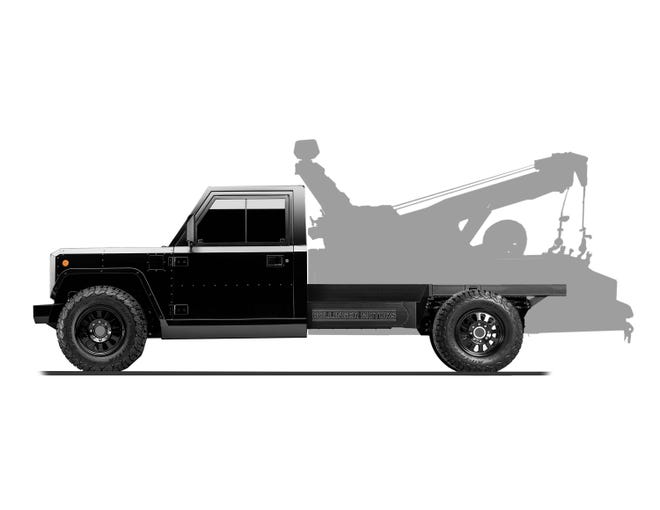
Bollinger announced an updated design for its B2 pickup in December with its signature pass-through cargo area. With the batteries in the floor, and twin tailgates at the front and rear of the vehicles, owners can pass, for example, long pieces of lumber through the B2 cabin.
The dual-motor B2 boasts 614 horsepower and 668 pound-feet of torque, about 200 miles of range, 15 inches of ground clearance for rugged farm duty, 10-inch wheel travel, 5201 pound payload capacity, and 7500-pound towing capacity.
“With our additional drive options, we’ll be able to provide work-truck solutions to every industry,” said Bollinger. “The significantly lower total cost of ownership for the RWD (model) makes it the best option for any fleet.”
Payne: Hummer-inspired Extreme E racer unveiled, evoking dune buggy
Posted by Talbot Payne on March 18, 2021
Behold the GMC Hummer EV race car.
Chip Ganassi Racing and chief sponsor Segi TV unveiled their muscular Extreme E racing livery this week as the team prepares to take electric racing to the farthest reaches of the earth. The Extreme E racer will make its debut at the Desert X Prix in AlUla, Saudi Arabia on April 3rd — the same day the production Hummer SUV is unveiled during the NCAA tournament.

General Motors Co. says its future is all electric and the estimated $70,000 Hummer EV — produced as both a SUV and pickup — is a key part of that strategy. The Ganassi race team has made its mark in IndyCar and IMSA racing, and is one of 10 entered in the inaugural Extreme E season.
Like sister brand Chevrolet and its Camaro-inspired NASCARs, GMC’s Extreme E Hummer bears little resemblance to the actual production ute. The racer takes its design cues from GMC’s first electric offering with an apparently non-functional, six-slot Hummer signature light graphic — H-U-M-M-E-R spelled on each slot — anchoring the front fascia.
Similarly, the Camaro ZL1’s distinctive bowtie and headlight graphic highlight Chevy’s NASCAR — though the elements are non-functional stickers applied to a body designed to series’ rules. In addition to the front graphic, the “Hummer EV” logo is emblazoned on the windshield sun blind as well as on the rooftop. The red, white, and blue racer (the only American team entry) also carries the Segi TV logo.
Overall, the Extreme E looks like a super-sized dune buggy — sharing no chassis or body components with the Ultium battery platform that undergirds the production Hummer. The Ganassi/Segi TV entry is built on a battery-powered, 550-horsepower spec chassis called the Odyssey 21.
The battery pack has been developed by Williams Advanced Engineering, an offshoot of the Williams Formula 1 team.

In keeping with the series’ woke ambitions, Sycamore Entertainment Group Inc.’s Segi TV is a new streaming service dedicated to programming about racial diversity and global warming. The series’ mission is to travel to global venues that highlight what Extreme E says is a climate emergency. Gannassi has announced a female/male driving team in keeping with the series’ strict gender rules meant to promote “a level playing field.”
“What Extreme E is doing right now is pretty incredible,” said Ganassi female driver Sara Price, an experienced off-road racer. “It is going to be able to provide girls who have incredible talent that’s never been seen before, a chance to showcase it — that itself is huge for women as well as for motorsport.”
Price will be joined by co-driver Kyle LeDuc, the only all-American duo in the field. The series has attracted drivers from across racing disciplines including ex-Formula 1 ace Jensen Button, Australian Rally Champion Molly Taylor, and IMSA sportscar star Katherine Legge.
“I am extremely excited to be partnered with the Chip Ganassi Race team and associated with the Hummer EV to bring global exposure to issues like climate change,” said Sycamore CEO Edward Sylvan, himself a longtime go-kart racer. “The positivity of this race series along with the core values of this championship series are sure to resonate with our audience worldwide.”
The Hummer SUV will be produced alongside the EV pickup that the brand unveiled late last year. Both are slated for production at the Factory Zero Detroit-Hamtramck Assembly Center starting later this year.
The Extreme E series will globe-trot to five remote regions of the world — desert, ocean front, Arctic, rainforest, and glacier. It will be broadcast stateside by FOX Sports.
Season 1, 2021 Extreme E calendar:
Desert X Prix: AlUla, Saudi Arabia: April 3-4
Ocean X Prix: Lac Rose, Senegal: May 29-30
Arctic X Prix: Kangerlussuaq, Greenland: Aug. 28-29
Amazon X Prix: Para, Brazil: Oct. 23-24
Glacier X Prix: Patagonia, Argentina: Dec. 11-12
Payne: Forget luxury SUVs, get a Mazda CX-30 Turbo
Posted by Talbot Payne on March 11, 2021
Auto consumers have been fixated on their transition to SUVs, but I encourage them to pay attention to a parallel trend: the democratization of the automobile. Thanks to the electronics revolution, the gap between luxury and mainstream autos has been shrinking rapidly.
With the 2021 Mazda CX-30 Turbo, the difference has been obliterated.
In design and performance, my mainstream CX-30 Turbo Premium Plus is the equal of compact luxury SUVs like the Audi Q3 and BMW X1/X2. Factor in the loaded, $35,225 CX-30’s price tag versus the $42,000 Teutons and the sexy Mazda is the best buy in segment. Mainstream or luxury. Call it a milestone.

Sure, brand matters when you’re a young professional about to drop $40,000 on your first car. But your college smarts are whispering that — with the $7,000 you save on sticker — you can buy a nice couch set, chairs, and 68-inch OLED TV for your new condo.
It’s not like you’re compromising looks, horsepower, or tech. I mean, just look at the Mazda.
It’s gorgeous. Lean face accented by chrome cheeks under headlight peepers that sweep backward into athletic flanks. It’s quite a sculpture, prettier than any luxe bod. Drawn with strong lines and a shallow greenhouse, the proportions are only interrupted by huge, black fender moldings.
Mazda designers say the black cladding was added — not to nip costs — but to instill a sense of off-roadiness in order to differentiate CX-30 from, say, its sister hot hatch, the Mazda 3 Turbo. My bet is Mazda will correct that design hiccup in a mid-cycle refresh, because few customers will take this little ute into the brush.
Heck, you’re more likely to seek out a race track to test this nimble beast. The CX-30 is a joy to drive hard.

The standard 182-horse CX-30 was the only crossover in class that could hold a candle to the BMW X-1. Now add the 250-horse turbocharged 2.5 liter to the recipe. and the Mazda is every bit the 228-horsepower Bimmer’s equal. Forget other mainstream brands like the Ford Ecosport or Hyundai Kona, this eager ute is a luxury performance SUV in, well, luxury performance clothing.
I’ve written before in this space how the Mazda3 Turbo and VW Golf GTI are superior value plays to their Audi A3 and BMW 2-series peers. But absent a similar VW effort in the subcompact ute space, the CX-30 is really a class of one.
Not only does the turbo-4 deliver gobs of torque — it is delivered via a six-speed transmission that’s as buttery smooth as Sade’s voice. Dancing through the twisties of Oakland County lake country, I rotated the CX-30 through an apex with minimal body roll — then stomped the accelerator on exit without the familiar hiccup of rival boxes.
The feeling is similar to a Mazda3 Turbo — my runner-up for 2020 Detroit News Vehicle of the Year — because the CX-30 is essentially a 3 Turbo jacked up a few inches. Same drivetrain. Same chassis. Same baked-in goodness.
The CX-30 interior is as attractive as the exterior. The layout is typical Mazda with the screen set high on the dash so drivers can keep their eyes on the road while corner-carving. This means the infotainment controller is of the rotary variety — similar to Bimmers. It took me a while to learn some CX-30 functions since Mazda insists on burying features in menus. But once you’ve stored your favorite radio stations, you’ll want to use the Apple CarPlay or Android Auto app for your navigation, phone and text needs.
Phone apps are a big player in the democratization of autos. I use Android Auto and it’s as good in the car as it is in your hand — meaning you won’t miss those high-priced, luxury SUV nav systems. Android Auto voice navigation beats them all.

Phone apps are just the tip of the iceberg. Starting at $31,000, the CX-30 is loaded with standard features that luxe brands dole out to you for thousands more: Adaptive Cruise Control, blind-spot assist, auto emergency braking, rear traffic alert, phone apps, push-button start, dual-zone front passenger climate control and a jacuzzi (kidding about that last one).
The ACC system is particularly worthy of note given its similarities to Tesla — yes, another point of electronically induced democratization. Though Mazda has no Autopilot-like self-driving ambitions (unlike Subaru, which self-drives quite competently under 40 mph), its graphics are very similar to a Model 3 when adaptive cruise is engaged. An avatar of the Mazda hovers on the instrument display while sensors indicate where cars are in your blind spots.
This feature is indispensable on the Mazda3 Turbo given blind spots the size of New Hampshire. The CX-30, too, makes a design statement with its narrow greenhouse — but its more conventional C-pillar means you can better eyeball your surroundings.
I recommend the Premium Plus trim’s luxe fixins’: head-up display, 18-inch black wheels, blacked-capped mirrors. Just like the Audi and Bimmer.

CX-30’s dashboard is simple, uncluttered. As is the center console — a relief compared to the over-engineered Audi.
Remarkably, the CX-30 Turbo’s sticker price is little different than its Mazda3 stablemate. Another value play in this SUV-made market for customers who normally must pay a $2,500 premium for anything ute (SUVs generally require more sheet metal and chassis rigidity).
I’m a hot hatch fanatic, but for those who want a higher-riding ute, the CX-30 offers better interior headroom and rear legroom than the lower-riding 3 Turbo. Engineers were especially clever in scalloping out the back of the front seats for added rear legroom. Your giraffe-legged 6’5” reviewer could sit behind himself thanks to the seat design.
My apex-carving was rudely interrupted by Michigan winter. But the CX-30 Turbo shrugs off the white stuff. More than off-roading, this is where the AWD system really shows its stuff.
I dialed the Mazda drive modes back to Eco from Sport in order to reduce engine torque and corresponding wheel spin. The Mazda grunted easily through the powder, its 3,500-pound weight manageable under slippery conditions.

Once upon a time, luxury brands separated themselves with style, tech, power. No more, at least when compared to Mazda.
The CX-30 does come with one rich taste, though. To get that 250 horses, you’ll need to fill the tank with premium, 93-octane fuel. Otherwise, cheaper regular fuel will get you 227 horses — equal to the X-1’s 227.
More savings you can put into furniture for your condo.

2021 Mazda CX-30 Turbo
Vehicle type: Front engine, all-wheel-drive, 5-passenger subcompact SUV
Price: $31,225 including $1,175 destination charge ($35,995 AWD Premium Plus as tested)
Powerplant: 2.5-liter turbocharged, inline 4-cylinder
Power: 250 horsepower (on premium, 93 octane fuel), 310 pound-feet torque
Transmission: 6-speed automatic
Performance: 0-60 mph, 5.9 seconds (Car and Driver est.); top speed, 125 mph
Weight: 3,505 pounds (as tested)
Fuel economy: EPA 22 city/30 highway/25 combined
Report card
Highs: Premium looks; smooth, powerful drivetrain
Lows: infotainment features take a while to learn; oh, that black fender cladding
Overall: 4 stars
Jeep Wagoneer/Grand Wagoneer reborn as super-sized, luxe SUVs
Posted by Talbot Payne on March 11, 2021
Jeep is jumping into the super-sized SUV space with a pair of old friends: the Wagoneer and Grand Wagoneer.
The three-row utes resuscitate the luxurious Wagoneer badge that adorned opulent, wood-trimmed ocean liners for the last four decades of the 20th century. The Jeeps complete the brand’s expansion as a full-line SUV maker by offering models in the industry’s biggest, most luxurious segment.

Built on a Ram truck-like ladder frame chassis, the Wagoneer will take on segment heavyweights like the Chevy Tahoe/Suburban and Ford Expedition, while the more opulent Grand Wagoneer will train its guns on land yachts like the Cadillac Escalade, Lincoln Navigator, and BMW X7.
Sitting atop a Jeep SUV lineup that now includes the Wrangler, Renegade, Compass, Cherokee and Grand Cherokee, the standard Wagoneer is 10 inches longer and six inches taller than the mid-size Grand Cherokee. Prices will start at $57,995 with a fully loaded Grand Wagoneer topping out over $100,000. It’s the second Jeep to eclipse the six-figure mark after the performance-focused Grand Cherokee Trackhawk.
“Wagoneer and Grand Wagoneer are born from the Jeep brand, but they have a flair of their own, building on a rich heritage of craftsmanship and refinement, while offering new levels of sophistication, comfort and legendary 4×4 capability, as well as a new level of customer service,” said Jeep brand chief Christian Meunier.

The Wagoneers boast Jeep’s signature square wheel arches and seven-slot grille, though the latter is notably thin at a time when even BMW has given in to a full-fascia kidney grille. You’ll know the Grand Wagoneer by its two-tone black roof, retractable side steps, fender flares, and a sculpted grille that Jeep describes as “laser-etched grille rings, similar to a knurled finish seen on fine watches.”
Don’t look for wood paneling like the Grands of old — for this generation, all the Satin American Walnut will be on the inside. And it anchors palatial interior digs.
The Made-in-Detroit Wagoneers can seat eight people if outfitted with a bench second-row seat. Front passengers sit in standard leather-wrapped thrones, with the Grand Wagoneer taking it up a notch with 24-way front seat including massage and 4-way headrests. Marrying style and utility, Wagoneer claims best-in-class passenger volume, cargo space, second-and-third-row legroom and third-row headroom.

Sealed off from the outside world by acoustic-laminated windshield and front door glass, passengers can luxuriate in a 23-speaker, 1,375-watt, 3D surround McIntosh audio system.
This rolling living room is then outfitted with state-of-the-art tech. In a smartphone age where hi-def digital screens are a plus, Wagoneers will wow with available, dual, stacked 12-and-10 inch dash screens. The set-up will be familiar to Audi users with the tablet-like main screen dominating the landscape.
The Grand Wagoneer features a four-zone climate system controlled by the front 10.25-inch screen and a similar 10.25-inch screen in back. Eleven USB ports and a Wi-Fi hot spot that can handle eight devices to keep passengers connected.
So big is the dash that Grand Wagoneer customers can option a third, passenger-focused 10-inch touchscreen over the glovebox. An HDMI plug allows the screen to mirror a tablet or smartphone. Capable of showing content independent from one another, the screens aim to create a “cinematic experience.” Including available second-row touchscreens, the Grand totals 75 inches of interior screen space.

The touchscreens will be operated by Jeep’s latest Uconnect 5 user interface — five times quicker than the outgoing system. They will also be available with industry-first Amazon Fire TV access using Alexa so passengers can stream a variety of movies, TV shows and apps.
Other available toys include a 360-degree camera, night vision camera with pedestrian and animal detection, and a digital rear camera mirror first seen in Escalade.
“These huge SUVs went away in the Great Recession, but now they are back more opulent than ever,” said ISeeCars executive auto analyst Karl Brauer. “The level of luxury technology and materials is impressive. The Wagoneer doesn’t just compete against Cadillac and Lincoln; it goes after Mercedes and BMW.”
Wagoneers come in three trims — Series I, II, III — with the Grand offering a further Obsidian trim that wraps the SUV in a black tuxedo including 22-inch black wheels, grille, badging, exterior mirrors and doors.

Both beasts are powered by V-8 engines. Wagoneer comes standard with a 392-horsepower, 5.7-liter mill. It’s paired with a 48-volt battery (also found in the Ram 1500 pickup) that enables improved fuel economy. Grand Wagoneer sports a 471-horse, 6.2-liter stump-puller that Jeep says will hustle from 0-60 mph in just six seconds. Drivers operate an eight-speed transmission with a rotary console shifter.
Self-driving features like Caddy’s Super Cruise and Ford’s Active Drive Assist are all the rage, and Jeep’s land yacht will be offer its own hands-free drive assist on divided highways. Parking won’t require a tugboat as the Wagoneers offer self-park assist.
The big utes won’t (yet) be trail-rated like some of their smaller kin, but they will still benefit from up to 10-inches of ground clearance, air suspension and all-wheel drive with drive modes for Rock, Snow and Sand/Mud. The Wagoneer comes standard with four underbody skid plates. Additional capabilities include fording up to 24 inches of water and towing 10,000 pounds up north.
Jeep is a rare brand cross-shopped by mainstream and luxury buyers alike. Wagoneer dealers will be trained to roll out the red carpet for customers including 24/7 concierge support, roadside assistance, and vehicle service pickup/delivery.
Not seen since 1993, the Wagoneer badge returns to showrooms in the latter half of 2021. Open the front doors and the outer edge of the dash features an inscription — EST. 1963 — that pays homage to the first model year of the original Wagoneer.