- Search Cartoons
- Comic Archive
-
Payne
Store



 Henry Payne RSS

Articles Blog
Toys for tots (and truckers): Lingenfelter revs holiday cheer
Posted by Talbot Payne on December 5, 2025

For the Lingenfelter Holiday Toy Drive and Open House, Kristen Lingenfelter collects a Corvette-full of toys.
Henry Payne, Detroit News
The Lingenfelter Collection will unlock its doors to the public for its sixth annual Holiday Toy Drive and Open House from 11 a.m.-2 p.m. Saturday in Brighton. Bring a toy for a needy tot and see Santa Claus, the Grinch and Ken Lingenfelter’s famed assortment of 160-plus collector cars — including a room-full of historic Corvettes.
It’s a collection built on Lingenfelter Performance Engineering’s mod shop down the road in Wixom, which for decades has slaked muscle-car enthusiasts’ thirst for higher horsepower General Motors Co. products like Chevrolet Corvettes, Camaros, and Cadillac V-Series monsters.
It’s a thirst that is increasingly shared by the market’s biggest segment: truck customers.

GM pumps out 30,000 Corvettes a year from its Kentucky factory, but that pales next to over 1.2 million in ladder-framed-based trucks and SUVs. Badges include the Silverado, Sierra, Yukon, Escalade, Suburban, Tahoe, Colorado and Canyon. Many of those customers want more muscle from their trucks too. The same goes for aftermarket mod shops for Ford (Roush, Saleen) and Ram trucks (Hennessey).
Truck mods now make up a healthy 20% of Lingenfelter’s business.
“We’re having a blast with our truck development, and there’s a lot of fun involved with that, too,” Lingenfelter said in an interview. “We supercharge the majority of them, but there’s lots of levels of horsepower. You can get some accessories that go with it, (and) business is great.”

Ken Lingenfelter in the Corvette room, which visitors will be able to peruse Saturday at the Lingenfelter Holiday Toy Drive and Open House. Henry Payne, The Detroit News
A visit to the Lingenfelter.com website reveals a Chevy Silverado pickup and full-size Chevy Tahoe SUV sharing equal billing with a mid-engine Corvette C8 on the home page.
Accessories for the truck/large SUV models include such toys as superchargers for 5.3-liter and 6.2-liter V-8 engines making 545 and 650 horsepower, respectively. Customers can also outfit their trucks with, say, Borla S-Type Classic Racing Howl exhaust to wake your neighbors in the morning.
“Superchargers have always been, from my perspective, the best way to go forward with trucks,” said Lingenfelter, who has run the mod shop since 2008. “We had to get through some encryption in the engine management system just like the Corvette C8, but we’ve got some good engineers.”

Lingenfelter Engineering has made a history of modifying Corvettes and Camaros. But 20% of its business is now GM truck mods. Henry Payne, The Detroit News
Those engineers, to Lingenfelter’s delight, have also figured out how to stuff a 7.0-liter, 427-cubic inch V-8 behind the driver’s ear in the eighth-generation Corvette C8.
“I couldn’t resist — 427 and Corvette just go together,” Lingenfelter said of the legendary engine metric that has graced everything from previous-generation ‘Vettes to AC Cobras to the 1966 Ford GT40. “Our development guys put together a 427 as a result. We’ve had it on the chassis dynamometer and it makes about 1,200 horsepower.”
A Lingenfelter 427 Corvette C8 prototype will be on display Saturday at the Collection — and a lot more horsepower besides.

Henry Payne, The Detroit News
“Our main product has alway,s been Corvette. The center hall of the collection is all Corvettes, and there’s some really unique cars in there,” said Lingenfelter who sits on the board of the National Corvette Museum in Bowling Green, Kentucky.
Corvette toys include the first V8-powered ‘Vette, the 1954 so-called “Duntov Mule.” The nickname comes from Zora Arkus-Duntov, the engineer who first made the sports car legend. You’ll know it by its open cockpit and rear-mounted shark fin for stability at speeds over 160 mph. There’s also a 1963 Corvette split-window and a 215-mph Greenwood Corvette GTO race car.

Shi Lessner 2020, Lingenfelter Engineering
The 40,000 square-foot space contains three bays and a shop full of swag like T-shirts, hats and other wearables. Other notable models in the collection include Ferraris, Camaros a two-door Chevy Nomad wagon, a V8-powered 1974 AMC Gremlin (dressed in Levi’s jeans interior), nitrous-fed 2007 NHRA Nationals-winning Dodge Charger Funny Car dragster, and the 2006 Pontiac Solstice sports car that played the character “Jazz” in the 2007 sci-fi movie “Transformers.”
Organized by a group of retired Marines, the Toys for Tots charity is dedicated to collecting goodies at Christmas time and distributing them to needy families.

Henry Payne, The Detroit News
“We just asked our guests to bring an unwrapped toy or a donation at the door in any amount, and then we open up the collection for them to come and take a look around,” Lingenfelter said.
Henry Payne is auto critic for The Detroit News. Find him at hpayne@detroitnews.com or @HenryEPayne.
Heartland America: After the Collapse of Democrat’s EV Socialism, Bipartisan Protectionism Emerges
Posted by Talbot Payne on December 4, 2025
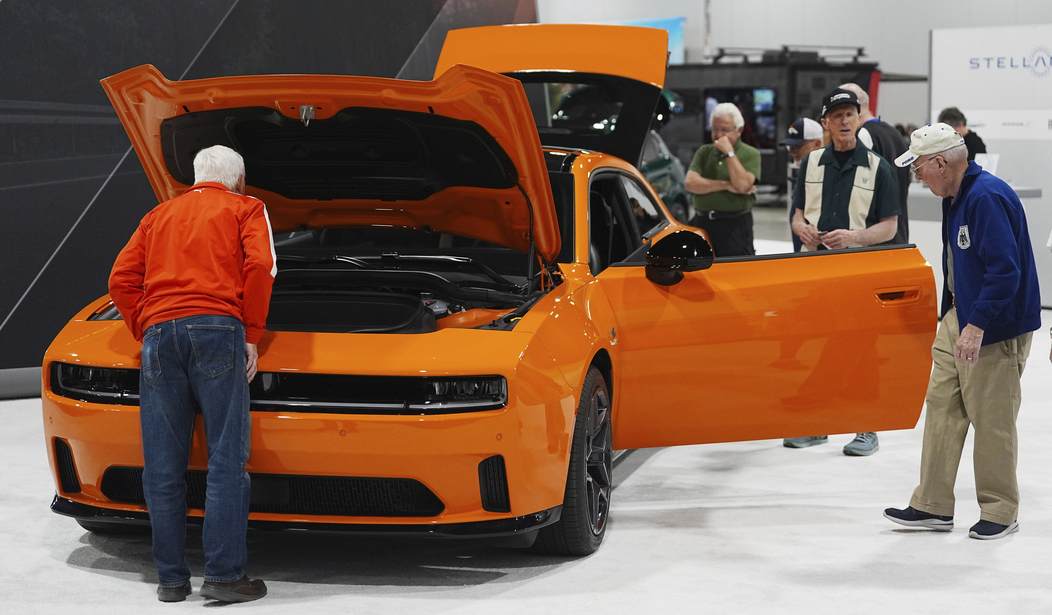
AP Photo/David Zalubowski, File
DETROIT – In response to the Trump Administration’s tariffs aimed at reshoring American manufacturing, Stellantis this fall announced $13 billion in new investment in U.S. operations. Spread across Midwest plants in Michigan, Ohio, Illinois, and Indiana, the investment – the largest in company history – is estimated to create over 5,000 jobs across all four of the transatlantic manufacturer’s American brands (Jeep, Dodge, Ram, and Chrysler) plus an additional 20,000 jobs at Stellantis suppliers.
“I’m extremely ecstatic about it. Without these tariffs, this probably wouldn’t have happened,” said Eric Graham, president of United Auto Workers Local 140 representing workers at Michigan’s Warren Truck, which stands to gain two new vehicles, hundreds of jobs, and $100 million in retooling after suffering significant layoffs last year.
The Administration’s dubious use of a trade deficit emergency to swiftly implement tariffs on international trade is facing strong legal headwinds. But on the political front, tariff policy is emblematic of the dramatic shift in working-class support to the Republican Party in America’s heartland. While the national Democratic Party has veered far to the climate left to embrace Communist China’s socialist industrial policy, President Donald Trump has adopted the protectionist industrial policy of 1980s Rust Belt Democrats like John Dingell (D-MI) and Dick Gephardt (D-MO), with Midwest Democrats scrambling to get on board.
Whatever the legal fate of Trump’s International Emergency Economic Powers Act, manufacturing protectionism has emerged as a bipartisan issue in a divided country.
Frequent Trump critic and Democratic Illinois Governor JB Pritzker hailed Stellantis’ plan that will jump-start Illinois’ idle Belvidere assembly with Jeep production. The investment, said Pritzker, will “anchor long-term economic growth, support local communities, and provide opportunities for workers and families who have historically been left behind.”
Echoed Michigan Democratic Senator Gary Peters: “(The Stellantis commitment) is a welcome investment in Michigan autoworkers and the future of our auto industry.”
“We win by putting American workers first,” said Michigan Republican Congressman John James.
Said Ohio Republican Senator Bernie Moreno, whose state will benefit from $400 million in new Ram truck investment in Toledo, creating 900 jobs: the announcement would “never have been possible without President Trump’s America First tariffs.”
Most significantly, Stellantis’ commitment – along with General Motors’ moving of $4 billion in vehicle production back to the U.S. from Mexico and Toyota’s commitment to $10 billion in U.S. manufacturing – backs up Trump’s 2024 campaign promise to working-class voters in key battleground states.
Voters like Charlotte Hayden, a 27-year employee at Ford’s Kentucky Truck plant, who told The Detroit News: “As a consumer, I’m worried about tariffs but not as an autoworker. It employs a lot of people. That’s important.”
Blue-collar voters enthusiastically backed a Republican president whose words have echoed those of 1980s Midwest Democratic leaders who compelled the Reagan Administration to impose import quotas on Japanese automakers – hurdles that led foreign automakers, including Toyota, Honda, and Subaru, to locate production stateside.
Meanwhile, Democratic leadership in the 21st century shifted to green, coastal states. Working-class voters recoiled as a climate crisis-obsessed Biden Administration copied China’s EV central planning.
“I actually went to China to see what they were doing,” Biden Energy Secretary Jennifer Granholm said at a 2024 conference in Washington, D.C. “To see. . . what their industrial strategy was like to bring jobs there, particularly in the energy sector.”
Granholm recounted how her conversations with Chinese officials inspired the Biden Administration “to get a national industrial strategy for clean energy.” Reckless federal EV mandates (greased with federal Inflation Reduction Act subsidies) followed.
“EVs were probably the number #1 issue to autoworkers in Michigan,” said Autoworkers for Trump founder Brian Pannebecker, who introduced (along with other auto workers) Trump in the Rose Garden on “Liberation Day.”
“If EV mandates were allowed to go forward, it would be the end of the domestic auto industry. Over 50 percent of all EV batteries are made in China, and they control rare earth minerals that go into those batteries.”
The Biden Administration’s socialism died on dealer lots.
EV sales hit a wall last year at about 8 percent market share. High-profile electrics like the Dodge Charger Daytona and Ford Lightning struggled, while other models were canceled altogether. GM laid off over 3,400 workers at its EV facilities this fall. According to a Detroit News analysis, over $28 billion in taxpayer-fed battery plant subsidies are at risk.
Most of Stellantis’ $13 billion investment is focused on gas-powered vehicles, leaning into U.S. strength as the world’s largest oil producer.
“A year ago, Stellantis was on a fast track to moving their U.S. operations out of the country,” said UAW President Shawn Fain. “Their decision. . . proves that targeted auto tariffs can, in fact, bring back thousands of good union jobs.”
Trump’s declaration of a national emergency over trade deficits invites copycat Democratic abuses of executive power, like, for example, declaring a national climate crisis emergency to mandate EVs.
But even if the Administration’s emergency act is struck down by the courts, bipartisan tariffs to encourage U.S. manufacturing of everything from autos to computer chips are likely here to stay.
“It’s not as if there’s going to be a lot of demand for our vehicles in other countries,” said Pannebecker, who estimates 60 percent of autoworker votes went to Trump. “The main effort here is to get U.S. auto companies to bring their production facilities back, the ones they’ve moved to Mexico and elsewhere.”
Henry Payne is auto critic for The Detroit News, 910AM-Detroit reporter, and cartoonist for Andrews McMeel Syndicate. Find him at hPayne13hp@gmail.com or Twitter @HenryEPayne
Payne: Hot EV match-up, Cadillac Lyriq-V vs. Tesla Model 3 Performance
Posted by Talbot Payne on December 4, 2025
Gaylord — The midsize Cadillac Lyriq SUV and compact Tesla Model 3 sedan are brand icons. The Lyriq redefined Caddy as an EV maker, the Model 3 made Tesla a best-seller.
Their performance trims — the 2026, $80K Lyriq-V and 2025, $56K Model 3 Performance — represent the state-of-the-art of two U.S. brands that are on the industry’s bleeding edge of modern digital electric tech.
You read that right: the bleeding edge.

The 2026 Cadillac Lyriq-V (left) and 2025 Tesla Model Performance are icons of their respective brands. The Lyriq is Caddy’s first EV; the Model 3, the market’s first EV best-seller. Henry Payne, The Detroit News
After decades of playing catch-up to European luxury brands, America boasts two models at the forefront of the premium market’s electric, autonomous trends. The Yanks come at the equation from different perspectives, but, as road trips from Oakland County to Charlevoix indicate, they arrive at the destination in a very similar manner. Here’s how they compare.
Hands-free driving
Tesla has been the lead stagecoach on the Wild West frontier of autonomous driving, and it continues to push the envelope. The Model 3 would have happily driven itself (its camera trained on me to make sure I was a good chaperone) from door to door on my 250-mile journey.
“Navigate to Charlevoix, Michigan,” I barked, and we were off. The Tesla exited my cul-de-sac, navigated a Telegraph Road Michigan turn, then accelerated up to speed onto I-75 North.

Henry Payne, The Detroit News
Since Full Self-Driving (FSD) became widely available to Tesla customers in 2022, it’s impressive how far the software has come in a short time. I used to put a “STUDENT DRIVER” sticker on the back of my car, so inconsistent was its habits. Like a 16-year-old novice, it would ghost brake on four lanes, edge out into traffic at Michigan turns, sometimes miss a red light.
No more. FSD has become more predictable. It has adapted sophisticated, human-like driving habits like: 1) slowing down in sight of slowed traffic rather than running up on it, and 2) executing right-on-red turns.
Cadillac’s Super Cruise actually beat Tesla to hands-free driving (both now go hands-free with camera surveillance) but has generally been more conservative, emphasizing passenger comfort. The Lyriq waited until I was on I-75 to go hands-free, then displayed a green light at the top of the steering wheel so I knew it was engaged. A blinking red light — complemented by a buzz to the seat — indicated when it was concerned my attention had wandered from the road (the Tesla’s self-driving avatar is a small blue steering wheel in the screen).

Henry Payne, The Detroit News
Both Caddy and Tesla changed lanes to pass cars — but Lyriq was much less likely to be a left-lane hog, courteously returning to the right lane after completing a pass. Off divided highways, Super Cruise is increasingly available on secondary roads. On M-31 heading into Petoskey, for example, the Cadillac remained hands-free until giving up at intersections like the light at Bay Harbor resort.
The Tesla, by contrast, continued confidently on its way.
Driving dynamics
Hands-free driving is sci-fi stuff, but I still love to drive.
Twisted, two-lane M-32 between I-75 and Charlevoix is one of the best driver’s roads in Michigan, and I put the hammer down in both EVs. ZOT!
At just 4,054 pounds, the Tesla came off corners like a rocket ship, delivering 100% of its 554 pound-feet of torque to all four wheels. At a porky 5,980 pounds, the Lyriq’s girth is evident (as with its compact 5,192-pound Optiq stablemate). But so is Cadillac’s competition-bred performance engineering.

Henry Payne, The Detroit News
Downhill into a group of M-32 esses, the Model 3’s Brembo brakes seem ill-equipped to stop the rocket, unlike the Caddy’s firmer shoes. Even more noticeable is the Lyriq’s confidence on corner turn-in. The Model 3 feels less certain, like a doe trying out its new legs. Tesla has work to do.
Charging
Tesla’s integrated charging network is the brand’s secret sauce, and it continues to impress.
Navigation not only charted my course to Charlevoix, but told me I would need to charge in Gaylord for five minutes to arrive with 7% of charge. Just 7% of charge?

Henry Payne, The Detroit News
“Set arrival energy,” read the Tesla display so I could target whatever percentage I wanted (I like 25%) so I have enough juice to do stuff when I arrive at my destination rather than hunting for another charger. Dependent on a third-party charging network, the Cadillac can’t offer this feature, nor can it guarantee charger destinations will, um, work.
The Lyriq-V initially charted my course to Charlevoix with zero charging stops — but once on the road adjusted that prediction and routed me to Bay City’s Electrify America charger. Right next to the Tesla chargers. Both chargers were busy, and with eight stalls — twice the EA number — Teslas didn’t have to wait as long.
GM has access to Tesla chargers, but not to the rival’s older, so-called, V2 chargers found in Bay City. Cost? The Tesla chargers averaged 36-39 cents per kWh — the EA chargers 56 cents.
On multiple trips, Model 3 — likely due to its improved drag coefficient of 0.22 (the Lyriq is still an impressive 0.28) — also seemed more efficient at high speeds. At 80 mph, the Tesla only lost 5% of range. The Caddy? About 35%.

Henry Payne, The Detroit News
For perspective, Tesla energy cost is comparable to a BMW M340i X-Drive at $4 a gallon premium gas, while Lyriq would cost about 25% more.
Design
It’s remarkable that the Lyriq-V’s drag coefficient is as good as it is. The brand has leaned into its storied design history with its boldest looks since the 1960s. The Lyriq (and other Caddy EVs) have swagger.
If the Tesla is a soap bar built for speed, the Caddy is a rolling Fox marquee sign built to get noticed.

Henry Payne, The Detroit News
That premium look extends to the interior, where the Lyriq is lathered in luxury, including 33-inch screen that sprawls across a dashboard peppered with jewel-like air vents and a center console anchored by a bling-tastic rotary screen controller. The Tesla? It’s so smartphone simple that everything is run through the center 15.4-inch screen. Even the air vents. A rotary controller? Fuhgettaboutit.
So luxurious is the Lyriq’s wardrobe (and those of (and sister Optiq, Vistiq and Escalade IQ) that Cadillac doesn’t consider Tesla a competitor and claims it is the best-selling premium EV brand. That’s silly given Tesla’s similar price points and market share.
But it does speak to how differently these two brands have approached the EV space. For Tesla, the Model 3 ushered in a complete reimagining of the auto industry from performance to autonomy to design. Its owners aren’t just drivers, they are guinea pigs in the experiment.

Henry Payne, The Detroit News
For Cadillac, on the other hand, EVs are a chance to recast itself as luxury leader. Just as Cadillac defined luxury in the early 20th century, so does Lyriq & Co. intend to establish a new standard of the world in autonomy and interior comfort.
Are you a pioneer with a taste for adventure or an arbiter of fine things? The difference may decide whether you drive Tesla or Cadillac.
Next week: 2025 Detroit News Vehicle of the Year
2026 Cadillac Lyriq-V
Vehicle type: Battery-powered, all-wheel-drive, five-passenger SUV
Price: $80,090, including $1,395 destination fee ($85,785 Premium as tested)
Powerplant: 102 kWh lithium-ion battery with single rear or dual electric-motor drive
Power: 615 horsepower, 650 pound-feet torque
Transmission: Single-speed direct drive
Performance: 0-60 mph, 3.3 seconds (Car and Driver); top speed, 131 mph; towing, 3,500 pounds
Weight: 5,980 pounds
Range: 285 miles on full charge
Report card
Highs: Cadillac presence; confident handling
Lows: Porky; third-party charger dependency
Overall: 3 stars
2025 Tesla Model 3 Performance
Vehicle type: All-wheel drive, five-passenger sedan
Price: Base $56,630, including $1,390 destination charge ($64,630 as tested)
Powerplant: Lithium-ion battery pack mated to dual electric motors
Power: 510 horsepower, 554 pound-feet torque
Transmission: Single-speed automatic
Performance: 0-60 mph, 2.8 seconds (Car and Driver); top speed, 155 mph
Weight: 4,054 pounds
Range: 298 miles on full charge
Report card
Highs: Autonomy leader; confident charging experience
Lows: Numb handling; questionable steering wheel ergonomics
Overall: 4 stars
Henry Payne is auto critic for The Detroit News. Find him at hpayne@detroitnews.com or @HenryEPayne.
Payne: Nissan Sentra serves some sizzle in the simple sedan
Posted by Talbot Payne on November 30, 2025
Phoenix — Nissan’s luxury brand, Infiniti, no longer offers the Q50 compact sedan. But no worries, the Nissan Sentra SR will do the trick.
Twin 12.5-inch digital instrument and infotainment displays in a 15-inch hoodless screen. Chromed climate vents. Wireless Android Auto and charging pad. Eighteen-inch machined wheels. Stitched leather steering wheel. Fashionable black front fascia and rear diffuser.
I pulled into a service station in my Bluestone Pearl Nissan and a local pulled me aside as I rounded the pumps.

JAMES LIPMAN, James Lipman
“Excuse me, but what is that you’re driving?”
“The new 2026 Nissan Sentra.”
“It’s gorgeous.”
“It’s $26,000.”
“Even better.”

Henry Payne, The Detroit News
If you’ve been on Mars for the last 10 years, you would have missed the tech ‘n’ design transformation of the compact car class into the best bargain segment in the industry. Not just the hot hatches that readers of this column know I adore, but sub-$30,000 bargains with technology and design that once was exclusive to luxury cars like Infiniti, BMW, Audi.
Cars like the Hyundai Elantra, Kia K4, Mazda3, Subaru Impreza and Honda Civic. Sadly, Motown badges like Focus and Cruze long ago left the playing field. In SUV Nation, small sedans have separated themselves from the average ute box with eye-catching design. Add Sentra to that list.
Always a bargain buy, the wallflower Sentra has upped its game for 2026 with a premium wardrobe makeover.

James Lipman
Styling is subjective and my design tastes lean iPhone simple — Mazda3, Tesla Model 3, Porsche 911. My Sentra SR’s signature blacked-out grille lean in the other direction like the Hyundai Elantra N. The Sentra comes at you with attitude — the expressive design sweeps rearward with a McLaren-like (yes, McLaren) blacked-out greenhouse, distinct shoulder line, horizonal taillights and black diffuser. That’s a lot of makeup.
The Sentra saves simplicity for its powertrain. HRRRRRRGGGHHHH!
I flattened the throttle pedal and the ol’ nail, 2.0-liter four-cylinder awoke and we merged into afternoon traffic on the Arizona-101. No turbos here. Or even a higher-output 2.5-liter, 181-horse option like Subie Impreza offers.
You shall have 149 horsepower and 146 torque and you shall like it. That’s half the power of a luxury offering like the discontinued Infiniti Q50. In the digital era, powertrains are the biggest difference between mainstream and premium models.

Henry Payne, The Detroit News
Even in its mainstream class, Sentra’s four-banger is a reminder that Nissan is about value. While competitors like Honda, Hyundai, Mazda, Toyota and Volkswagen offer multiple engine options, transmission choices and performance models with racy badges like N, Type R, GTI, GR and Turbo, Nissan sticks to its bread ‘n’ butter.
Nissan’s NISMO badge (see the Z) is there for the taking, but Sentra stays in its affordability lane. Nissan says its broad, 25-54 year-old 50% female/50% male customer wants a tireless gerbil wheel rather than a weekend track beast.
Not that the Sentra is somnolent.
Compact sedans are inherently athletic with their low center of gravity and lightweight chassis. Nissan engineers complemented the 3,153-pound bantamweight with independent front-and-rear suspension and increased chassis rigidity. I flogged Sentra over north Phoenix’s state Route 202, where it proved a playful companion.

Henry Payne, The Detroit News
Even the continuously variable transmission was smooth. CVTs are the bane of enthusiasts, their sound the auto equivalent of nails on a chalkboard. DROOOOONE! But, like so many things, electronics has made them bearable — like the Sentra with its subtle upshifts. Paired with cabin sound-proofing, the CVT is OK IMO.
Oddly, my sporty Sentra SR Sport didn’t sport shift paddles to add to the fun. But the interior is otherwise thoughtfully engineered with a row of climate vents and healthy console room. Steering-wheel ergonomics are a personal obsession, and Sentra features thoughtful, if not class-leading, tools. Driver aids are raised buttons so I could find them with my fingers without diverting my eyes from the road — consider the right-spoke scroll wheel for navigating the instrument display or left-spoke toggle for adjusting adaptive cruise control.
Speaking of ACC, Nissan’s value-mobile is generous with standard features.

JAMES LIPMAN, James Lipman
No matter which trim you get — starter $23,645 S, volume SV, SR, premium SL — you’re guaranteed ACC and blind-spot assist — two safety essentials often charged a la carte in luxury vehicles. Climb further up the trim tree and Sentra offers premium features like Bose audio, 360-degree camera, blind-spot intervention and leather seating.
I’d recommend the SR model for its aforementioned wardrobe — plus standard goodies like wireless charging and wireless Android Auto/Apple CarPlay.
The latter made it easy to navigate Arizona’s tangle of highways and surface streets on a busy workday. As much as I’d like an earth-pawing, high-horsepower Elantra-challenging Sentra NISMO, technology is what makes 9-to-5 commutes comfortable.
That comfort is augmented by one of the roomiest interiors in class. The compact class traditionally offers compact rear legroom (Corolla, Mazda3, VW Golf), but recent-gen models like Civic and Elantra have grown legroom to rival midsize cars.

JAMES LIPMAN, James Lipman
Sentra has class-leading front legroom as well as rear comfort for six-footers. I folded my giraffe frame into the back seat and sat behind myself with knee-room to spare. In back, the trunk opening has been enlarged and now offers best-in-class low lift height. Good for hauling in, for example, Mrs. Payne’s giant suitcases.
Here again, Sentra cedes territory to competitors by not offering a hatchback version. Buyers will want to divert to the Kia K4 hatchback and Impreza hatch for that option. Neither does Sentra offer an all-wheel-drive variant (Subaru), stick shift (Mazda3), or sippy hybrid (Civic).
Sentra is a meat and potatoes recipe. Now, for 2026, plated with premium presentation.
Next week: Tesla vs Cadillac
2026 Nissan Sentra
Vehicle type: Front-wheel drive, five-passenger compact sedan
Price: Base $23,645, including $1,245 destination charge ($31,945 with Premium Package as tested)
Powerplant: 2.0-liter inline-4 cylinder
Power: 149 horsepower, 146 pound-feet torque
Transmission: Continuously variable automatic
Performance: 0-60 mph, 8.2 seconds (Car and Driver est.); top speed, 125 mph
Weight: 3,153 pounds
Range: EPA est. mpg, 30 city/38 highway/33 combined; range, 471 miles
Report card
Highs: Affordably upscale; standard features galore
Lows: Polarizing fascia; lack of drivetrain/performance options
Overall: 3 stars
Henry Payne is auto critic for The Detroit News. Find him at hpayne@detroitnews.com or @HenryEPayne.
Payne: How Baja-beginner RJ Zanon, Bronco tackled daunting desert race
Posted by Talbot Payne on November 30, 2025
America loves sports underdog stories: basketball’s Muggsy Bogues, Notre Dame wannabe Rudy Ruettiger, high-school football-player Michael Oher.
Welcome off-road racer RJ Zanon.
The California Army Reserve helicopter pilot entered his own Ford Bronco in North America’s most grueling professional off-road race, the SCORE Baja 1000, this November, and — against all odds — crossed the finish line. He did it with a cast of 25 buddies called the Pew Pew Cachoo Racing team, including navigators Ken Brown and Austin Gillis he met at Bronco off-road events around the country.

RJ Zanon, RJ Zanon
Inspired by the SUV’s capabilities, Zanon pulled a totaled Bronco out of a junkyard in June, then raced against time to make it legal to compete in Baja’s 4Wheel Class 3. Even more improbably, he drove the entire 36-hour race — completing an “Iron Man” effort rarely achieved outside Baja legends like three-time winner Ivan Stewart — over 854 miles, three flat tires, and some of the most challenging weather conditions in memory.
“It is the longest point-to-point race in the world, and we were all a bunch of beginners,” said Zanon, 35, in an interview. “Nobody goes from no race experience to racing the Baja 1000. I’m one of the first to ever do this, and maybe the first to go from zero race experience to (driving) solo.”
Meanwhile, the Ford factory race team dominated the stock classes. The F-150 Raptor piloted by six-time class winner (three-times overall) Brad Lovell and teammates Austin Robison and Jason Scherer captured the Stock Full-Size class win in 25 hours, while the Bronco Raptor driven by seasoned pros Loren Healy, Vaughn Gittin Jr., and Bailey Campbell took the win in the Stock Mid-Size class in 30:34 hours.
But the day belonged to the underdog.

RJ Zanon, RJ Zanon
Zanon’s feat is rare in Baja history where the globe’s best teams enter formidable race cars across multiple classes to take on the desert’s unpredictable conditions. From the 24 Hours of Le Mans to Baja, Ford races its production vehicles in the world’s premier endurance races to enhance its engineering and product marketing, while offering customers access to, for example, the Mustang Driving Experience or Bronco Off-Roadeo to give them a taste of their capabilities.
Zanon’s stirring story spotlights a customer that got his feet wet at Bronco Off-Roadeo, then jumped into Baja’s deep end in his own SUV.
“What RJ, Ken and team accomplished is so fantastic,” said Global Director Ford Racing Mark Rushbrook, who oversees the brand’s ambitious racing programs. “Seeing a grassroots team compete in the Baja 1000 with a Bronco that started its life at a Ford dealership is incredibly rewarding and further proof of why we race — to make great vehicles for our customers.”
Zanon’s tenacity ranks with Bronco legend Rod Hall who won Baja in 1968 in his own production Bronco. But Hall was an experienced race driver who’d conquered events like the 1967 Mexican 1000. Zanon would enter the Super Bowl of desert motorsport as the first race of his life.
“RJ is a hero, he is as authentic as it gets,” said Detroit 4fest CEO Tom Zielinski, a veteran off-road auto and motorbike racer who designed the Holly Oaks Off-Road Vehicle Park in Holly. “He is the epitome of grassroots motorsports. This was not an easy year at Baja with extreme weather.”

RJ Zanon
For Zanon it all started as a 10-year-old growing up at his aunt’s house in Ensenada on Mexico’s Baja Peninsula where he watched the four-wheeled desert warriors.
“You see a Trophy Truck (Baja’s top class), and you’re like: ‘Wow, this is the coolest thing I’ve ever seen,’” he said. As he aged, movies like the classic Baja documentary, “Dust to Glory,” kept the fire burning inside.

RJ Zanon
Ultimately, the Blackhawk pilot bought a two-door Ford Bronco in 2022 — a Badlands model armed with off-road weapons like all-terrain tires and sway-bar disconnect. He traveled to Ford’s Bronco Off-Roadeo in Moab, Utah, one of five Off-Roadeos Ford has developed to give off-road training to owners. The playgrounds are a gateway to a Bronco Nation community that make regular pilgrimages to sandboxes like Johnson Valley, California and Holly Oaks.
Zanon became an off-road regular, posting his 4-wheel exploits to social media.
“The big one that got me involved was Bronco Super Celebration West in Colorado,” said Zanon of the annual gathering in Buena Vista he attended from 2023-2025. “Almost every person that worked the Baja pit crew were friends from the Bronco community events.” He went off-road in Nashville, Nevada, and the famed King of the Hammers race in Johnson Valley where he chased competitors — learning to drive at high speeds in the process.
“I was out there just chasing the race, getting to different spots to watch,” he said, marveling at the production Bronco’s capabilities. “We’re out there on the trails, going pretty quick.”
While assembling his crew, Zanon also had to assemble a car. Pro teams invade Baja backed by sponsors and big budgets. Zanon was a self-funded Army soldier planning to race his daily driver.
“My friends were like: ‘Are you crazy?!’” chuckled Zanon. “But I couldn’t afford to buy another Bronco just to turn into a race car. I had mentally accepted that I’d take (my Bronco) to Mexico and never bring it back.”
Then, in June, he found a totaled, 2023 Bronco Black Diamond on Facebook with 17,000 miles for just $14k.

RJ Zanon
“I gave this Bronco a second chance at life and turned it into a race vehicle,” said Zanon of his rollover rescue. “The only mechanical damage was the rear differential was bent, but we were planning to replace it with a Dana 60 anyway.”
Southwest Performance mod shop in Ramona, California, outfitted the Bronco to modified Class 3 rules including a roll cage, upgraded differential, 40-gallon fuel cell, suspension, and 37-inch tires. As payment Zanon wrapped the Bronco in Southwest’s logo.
He barely made it to Baja.
While most teams get to the Baja 1000 (the last of four races in the annual SCORE World Desert Championship) weeks ahead and take preliminary runs at the treacherous course, Zanon’s steed was still in the shop.
“We ran out of time, so I went into this with zero pre-running,” said Zanon who had helped wrench in Southwest’s shop since September. Of his two navigators, Ken Brown had racing experience while the other, Austin Gillis, “got a 30-minute class of how to use the GPS equipment the night before the race.”

RJ Zanon
Zanon’s motley Pew Pew Cachoo crew left Long Beach on Monday night, Nov. 10 and arrived at Ensenada in time for tech inspection before the Nov. 14 start. Some of the crew slept at his aunt’s house.
Come race day, the red #301 Ford got the green flag along with 168 other teams from 36 U.S. states, 20 countries, and 38 classes including dirt bikes, VW-powered buggies, stock trucks, and Trophy Trucks. The latter are the kings of the Baja jungle — bespoke desert cyborgs with 30-inch suspension travel that skim along the dunes at over 100 mph, completing the 854-mile lap in less than 16 hours. They left the line first.
“I can’t imagine not doing a pre-run of Baja,” said Zielinski, shaking his head. “What Zanon did is genuinely exceptional.”
The race was typically brutal.

RJ Zanon
Baja’s desert is vast and barbed with blind hazards like silt beds, low washes, and rocks that come out of nowhere at high speed.
“I’ve heard rumors about the silt beds in Mexico. They literally swallow entire vehicles,” marveled Zanon. “We got stuck in silt once because we were making good pace, and then — boom! — in front of us a vehicle’s stuck, so we end up getting stuck. I remember looking out … and seeing silt was halfway up the door.”
While Zanon’s team navigated the desert, the rest of the crew positioned themselves for fuel stops at 200-mile intervals. It’s easy to get lost, buried in silt, or worse. Zanon suffered three tire blowouts, one when he collided with a Trophy Truck coming through backmarkers after a setback.
The last stretch was 100 miles of Hell.

RJ Zanon
“I could spend two hours talking to you about the last 100 miles,” said Zanon of monsoon conditions in 50-degree temps. “People were talking about how that was the most brutal end of a Baja 1000 in years. I’d been up for almost 40 hours (and) I was struggling to stay awake. Me and my navigator were hypothermic there was so much water on us. My arms and wrists were seizing up. I couldn’t feel my fingertips; our visors were fogging up; we had mud on our visors, and every towel was full of mud.”
Driving blind, #301 suffered its third blowout. But with just three miles to go, they kept rolling on the flat. They crossed the finish first in Class 3 — but over the 36-hour cutoff — so everyone in class was disqualified. In the confusion, SCORE still gave Zanon a trophy that is on his mantlepiece today.
“What we did shouldn’t have happened,” reflected Zanon. “Ford knew we were there, and the support we got from them is pretty cool. We got the nickname ‘The Bronco Team.’”

RJ Zanon
What’s next for Pew Pew Cachoo Racing?
“My 100% focus is on the 2026 SCORE,” said the dogged underdog. “I want that championship. I’m already planning for the next race.”
Henry Payne is auto critic for The Detroit News. Find him at hpayne@detroitnews.com or Twitter @HenryEPayne.
David Malukas arrives: Team Penske’s new phenom on ovals, legends, Lithuania
Posted by Talbot Payne on November 24, 2025

David Malukas on track at World Wide Technology Raceway for his first test in the No. 12 Team Penske Verizon Chevrolet. IndyCar
Southfield – IndyCar driver David Malukas has been living with legends. Now it’s time to make his own.
The 24-year-old racing phenom has been on a meteoric rise through the open-wheel-racing ranks. Last year, his fourth in IndyCar, he raced with Indy legend AJ Foyt’s team, finishing second in the Indy 500. For 2026, he will fill the big shoes of two-time IndyCar champion Will Power in the No. 12 Verizon Chevrolet for America’s most famous motorsports owner, Bloomfield Hills-based Roger Penske.
“Growing up as a kid, Team Penske has been the dream for me,” he said here on his first Motown media tour wearing the iconic Team Penske black jacket. “I want to have a lot of success with them, and it’s very special that I’m also in that No. 12 Verizon Team Penske car. This is writing my own story, the David Malukas story.”
It’s a worthy story already.
A first-generation Lithuanian-American, Malukas is the son of immigrant truck drivers who fled to Chicago with nothing in 1991 as the Soviet Union crumbled. He spoke Lithuanian until he was 5 and got behind the wheel of his first go-kart in Indiana at the age of 6. At 15, he raced an open-wheel Formula 4 race car in the United Arab Emirates before he was old enough to own a driver’s license in the United States.

Growing up as a kid, Team Penske has been the dream for me,” David Malukas says. Justin Casterline, Getty Images
He raced F4 in Germany, then crossed the pond back to the U.S. in 2017 and entered the so-called Road to Indy series. Living the American Dream, his parents had by then built the multi-million-dollar HMD Trucking company, and in 2019 they invested in an Indy NXT team so their young son could pursue his dream. He finished second in the series in 2021 – winning seven races – and earned an IndyCar seat with Dale Coyne Racing for 2022.
“I’m lucky in the fact that (my parents) went through all that, and still decided to put it all into me,” Malukas told IndyCar.com in 2022. “Without them, I wouldn’t be anywhere near this goal.”
He joins a Team Penske Dream Team including future Hall of Famers Josef Newgarden and Scott McLaughlin at a time when interest in American open-wheel racing is at its zenith – boosted by IndyCar’s exposure on the Fox broadcast network and the notoriety of the world’s premier motorsport series, Formula One.
“With all the success that Formula One has created here in America, they got it started during COVID,” he said of the international series that has five of its 24 events in North America. “With (the mega-hit Netflix series) ‘Drive to Survive,’ they really brought in that younger audience – my audience. That show helped motorsports overall. For my generation, motorsport numbers (were) dropping, and after that show, they’ve blown up.”
For Malukas, it’s always been about IndyCar and Team Penske.

David Malukas visited Metro Detroit for his first media interviews as driver of the No. 12 Team Penske Verizon Chevrolet. Henry Payne, The Detroit News
“There are key differences between IndyCar and F1, for sure. Drivers have their favorites, and IndyCars has always been mine,” he said.
IndyCar is ferociously competitive. On any given day anyone in the 27-car field could win a race. Where F1 is dominated by a few teams, IndyCar’s margins are razor thin. Details – like a Team Penske – can make the difference between 10th place and first place.
“I think a lot has to do with Roger himself,” said Malukas of Team Penske’s secret sauce that has won an unmatched 20 Indy 500s. “There’s this environment that Roger has created that works to make sure that we can compete and be the best of the best. The dynamic of the team is so competitive, so performative. Everything has meaning, there’s purpose to all of it.”

David Malukas with his parents (Henry, left, and Daiva, right) at Belle Isle after David finished in top five in the 2021 Indy NXT series. Gavin Baker
Like those impossibly clean, formidable Team Penske trailers in the paddock.
“Their trailers have this style, this chrome-like reflective look,” he marveled. “I always thought: I wonder what’s going on inside there. Now, being inside, and seeing what’s going on, it’s just really good chemistry.”
His teammates, Nashville native Newgarden, 34, and New Zealander McLaughlin, 32, are already superstars. Newgarden is a two-time Indy 500 and series champion and McLaughlin a three-time Australian supercar champ who has twice finished third in the IndyCar championship. Malukas feels at home with them.
“Team Penske has figured out a perfect unification of two different sides: You’re competitive, but at the same time, you’re family-oriented and can still have a very good time. It’s a really good mix,” he said.

David Malukas rolls out onto World Wide Technology Raceway for his first test in the No. 12 Team Penske Verizon Chevrolet. IndyCar
Newgarden and McLaughlin had Malukas on their “Bus Bros” YouTube Channel his rookie season and they’ve been close since. Plus, Malukas’ father, Henry, is a Newgarden fan.
“My dad’s always said Josef’s his favorite,” David laughed. “So now, maybe me and Joseph are his favorites. He’s like, ‘If you’re not going to do it, then Joseph’s got to do it.’ It’s good relationship with all of them.”
Malukas fills the seat of Power, 44, who Team Penske did not re-sign for 2026 despite his illustrious career including the all-time IndyCar pole winner (71). In typical, disciplined Penske fashion, it was time to turn over No. 12 to the next generation.
Power has hardly been put out to pasture. He immediately landed a job with Andretti Global for the 2026 season.
“Will Power is a legend, and I watched him at Team Penske as a kid through the TV screen,” said Malukas. “I remember going on my little Razor scooter inside the house, and my mom was very upset. I was racing against Will Power. Fast forward, I get to race side-by-side with him in real life. I know he’s going to do fantastic things (at Andretti).”
Malukas has done fantastic things in his brief IndyCar career. The series demands mastery of road courses, street courses and ovals. It’s a shock to many athletes who grew up on a single, road-course diet like Malukas.
“When I first came into the series, I really didn’t like ovals. (They’re) pretty terrifying,” he admitted of the extremely high-speed, low-downforce racing inches from concrete walls. “But I knew IndyCar was my dream, so I put my head down and said: I have to learn ovals.”

David Malukas in the pits at World Wide Technology Raceway for his first test in the No. 12 Team Penske Verizon Chevrolet. IndyCar
In his breakout 2021 season in Indy Lights (now renamed Indy NXT), he won twice at World Wide Technology Raceway’s 1.25-mile oval east of St. Louis. He finished second at WWTR in his 2022 IndyCar rookie year – challenging Newgarden for the win. In 2025 he nearly won the Super Bowl of ovals, the Indy 500.
“(Oval racing) is something I’ve fallen in love with. It’s my preferred track,” said Malukas. “It’s like this big chess game – a mental game between all the drivers. Am I going to attack? Am I going to defend? What does he think I’m going to do? I love it.”
He’s not too shabby on street courses either. Last summer, he qualified on the front row for the Detroit Grand Prix.
Henry Payne is auto critic for The Detroit News. Find him at hpayne@detroitnews.com or X @HenryEPayne.
‘Best of the best’: 2026 North American Car, Truck and Utility of Year finalists announced
Posted by Talbot Payne on November 24, 2025
And then there were nine.
The North American Car, Truck and Utility Vehicle of the Year awards unveiled the 2026 model year finalists Thursday with three contenders in each category. Finalists for Car of the Year are the Dodge Charger, Honda Prelude and Nissan Sentra. The Ford Maverick Lobo, Ram 1500 Hemi and Ram 2500 will fight it out for Truck of the Year. And for Utility of the Year — by far the largest category of new vehicles hitting the market — jurors will consider the Hyundai Palisade, Lucid Gravity and Nissan Leaf.
Finalists were announced at the opening of the 2026 Los Angeles Auto Show, and the winners will be crowned at the Detroit Auto Show on Jan. 14.

Fifty jurors (including the author of this article) from U.S. and Canadian media outlets selected the finalists after testing 30 nominees across all categories, 19 of them SUVs. Of the nine finalists, two are electric. Nominee average price is $46,248 with the $96.5k Gravity the most expensive model and the $23.4k Sentra the cheapest.
“These finalists show the wide range of choices that consumers have in the marketplace,” said Jeff Gilbert, president of NACTOY and automotive reporter at WWJ Radio (950 AM). “Our jury of distinguished auto reporters has come up with a great selection of fantastic vehicles that truly reflect the best of the best.”
Count the Sentra, Ram 1500 and Leaf as front runners.

New for 2026, the $23k Nissan Sentra maintains its affordable price, while upgrading interior and exterior design. Henry Payne, The Detroit News
In the car category, the Charger and Prelude mark the return of sexy, legendary badges. Detroit’s sentimental favorite will be the $51,990 Charger, reborn for ‘26 after the previous, V8-powered generation exited the market in 2023 chased by federal emissions regulations. The Charger Daytona EV replacement has been a misfit with muscle car buyers, so the new, gas-fired Charger (dubbed Sixpack after its high-horsepower, twin-turbo inline-6 cylinder engine) is well-timed for hungry customers and a change in Washington management. Dressed in a sleek, retro-‘60s, Coke-bottle wardrobe, Charger Sixpack also boasts a more refined chassis, interior and utilitarian hatchback.
For the first time since 2001, Prelude is back with a different mission. As its badge implies, the sporty, $43,195 coupe is a prelude to Honda’s future. The Japanese automaker is leaning into gas-electric hybrids and hatchback Prelude is a hybrid halo showcasing good looks, peppy drivetrain and an S+ Shift tech feature that simulates a gearbox in an e-motor-driven car that doesn’t have one.

The 2026 Dodge Charger Sixpack is built on the same, flexible STLA Large platform as the electric Charger Daytona. Henry Payne, The Detroit News
Cool, but count Sentra the jury favorite. At a time when the average price for a new vehicle is over 50 grand, the $23,645 compact sedan is affordable without being cheap. While its 149-horse 4-banger won’t wow, its sleek looks and high-tech interior will. Twin, hoodless digital screens and wireless Android Auto/Apple CarPlay indicate Sentra punches above its weight.

The 2026 Honda Prelude is a stylish GT that is comfortable to cruise, drive on track, or just to look at. Henry Payne, The Detroit News
The Truck Wars are dominated by Detroit brands with Ram securing two spots with its refreshed, light-duty 1500 and heavy-duty 2500 pickups.
Ram 1500 is the front-runner. Like sister Stellantis brand Dodge, Ram spiked its Hemi V-8 — the choice of most buyers — for the ‘25 model year, which led to a swoon in sales. The eight-holer (officially the eTorque V-8) is back for ’26 with a rebel’s yell.

Ram is bringing back the Hemi V-8 engine in its 1500 pickups. They are expected to reach dealers this summer. Stellantis
Ram has stamped every V-8 model’s fender with the “Symbol of Protest” badge featuring a ram’s head atop a Hemi engine. Available in a dizzying array of trims, from work truck Tradesman to off-road Rebel to refined Longhorn, the Ram boasts one of the most refined interiors — and rides — in the truck biz. The Heavy Duty never lost its V-8 or diesel engines (spared by separate federal emissions rules) and brings Ram refinement to the big truck space.
The $37,625 Lobo adds a street performance trim to the Maverick’s XL, XLT, Lariat and Tremor lineup. Flexing a lowered chassis, stiffer springs and a torque-vectoring, rear twin-clutch, the all-wheel-drive Lobo is down to clown.
The SUV category should be a down-to-the-wire horse race between the three-row Hyundai Palisade and wee Nissan Leaf EV.
The electric Lucid Gravity is a mesmerizing first SUV from the creators of the Air sedan — perhaps the prettiest car on the market today. The three-row ute is a mix between supercar acceleration, minivan utility and Porsche Taycan interior style. Not to mention a frunk so big it sits two.

The Lucid Gravity boasts supercar acceleration, minivan utility and Porsche Taycan interior style. Lucid
Gravity is also a nearly $100k luxury chariot. At half the price of Gravity, the Hyundai comes with major upgrades for 2026, including head-turning style and hoodless, digital display not unlike Lucid. It also gains an XRT Pro off-road trim so you can take the family beyond the asphalt.
The Nissan Leaf buries its nerdy reputation with a stylish, all-new model. Think the transformation of the nerd-to-swan Toyota Prius hybrid, which won the 2024 Car of the Year award. With a healthy 303 miles of range, Leaf is still affordably priced at $29,990. Leaning into the jury’s preference for affordability, the Nissan is the only EV available for under $30k — an important metric at a time when the $7,500 federal subsidy has disappeared.
 The third generation of Nissan’s Leaf EV gets a facelift. Nissan
Along with the $23k, 500-mile-range gas Sentra, Nissan could grab two NACTOY trophies this January.
Awarded by a geographically diverse, independent jury of automotive journalists (not a single publication), NACTOY is recognized as one of the industry’s most prestigious baubles. Vehicles are judged as benchmarks for their segments based on factors including innovation, design, handling, user experience and value.
Link here for more information about NACTOY: http://northamericancaroftheyear.org.
2026 NACTOY finalists
Car of the Year
Dodge ChargerHonda PreludeNissan Sentra
Truck of the Year
Ford Maverick LoboRam 1500 HemiRam 2500
Utility Vehicle of the Year
Hyundai PalisadeLucid GravityNissan Leaf
Henry Payne is auto critic for The Detroit News. Find him at hpayne@detroitnews.com or @HenryEPayne.
Payne: Charger unplugged! Dodge Sixpack muscle car is large and in charge
Posted by Talbot Payne on November 20, 2025
Ann Arbor — In the early morning light, I rotated my gorgeous red 2026 Dodge Charger Sixpack Scat Pack onto empty Huron River Drive. I floored the throttle and awakened the beast. WAAUUUUUGHH! All four paws translated 531 pounds of torque to the asphalt and I exploded toward the twisties — my fingers rifling through the gears with steering-mounting paddle shifters. WHAP! WHAP!
The Dodge Charger is back, unplugged and untethered.
After three dark years in the government woodshed, Dodge has restocked its stable with an earth-pawing, gas-fed pony car next to the electric Charger Daytona. The Daytona was an answer to a question customers weren’t asking: what if we made the best-selling V-8 muscle car electric? Dodge sales fell off a cliff.

Henry Payne, The Detroit News
If the four-cylinder Ford Mustang II was the symbol of 1970s “Malaise Era” regulatory excess, then the charged Charger is the symbol of the 2020s’ forced electric-vehicle push. It makes artificial V-8 sounds. It’s heavier than the Titanic. It jumped the shark.
But in reducing Stellantis NV’s exposure to government emissions fines, it served its purpose and helped rebirth the gas-powered Charger. The legendary Hemi V-8 is coming, but first: the 3.0-liter, 550-horse twin-turbocharged inline-6 cylinder Hurricane Sixpack. Sixpack as in the gateway drug to the hard stuff.
It ain’t too shabby.

Stellantis, © 2025 Stellantis
I hammered the Charger Sixpack and Daytona EV Scat Packs across Washtenaw County’s rural roads. Based on a flexible chassis that can house gas and electric powertrains, the hatchback (more on that feature later) Chargers are beautiful to look at with their throwback, 1968-era fascias, Coke-bottle bods and digital interiors.
The Sixpack is six times better. The driving experience is more visceral, more alive, more genuine. Push the START button next to the naughty pistol-grip shifter and Sixpack growls menacingly. Start the Daytona EV and it roars to life. An electric roar? The sound is synthetic and its obnoxious volume only calls more attention to the forgery.
There’s nothing fake about the Daytona’s electric power, though. With a stump-pulling 623-pound feet of torque, the e-Charger slammed me into the back of the seat as I nailed it onto I-94. BRAWWWWWRRH! went the fake V-8 sound as I eclipsed (number withheld to preserve my license) mph.

Henry Payne, The Detroit News
But at 4,815 pounds, Sixpack weighs 20% less than Daytona, making it a lot more playful around the cloverleaf that prefaces the rocket launch into the four-lane. That lesser girth also means that, despite giving up 120 ponies to the 670-horse Charger Daytona, the Sixpack sports the same 1:8.7 power-to-weight ratio.
With 100% of torque available at launch, Daytona out-drags the Sixpack to 60 mph (3.3 seconds to 3.9), but the gas-guzzler is more fun everywhere else.
On an empty Huron Drive, I initiated launch control in the Sixpack by burying the brake pedal, then the accelerator. RPMs spiked to 3,000 and held — RRRRRGGGH — as I kept both feet in it.
Release the brake. Release the Kraken.

Henry Payne, The Detroit News
Like the EV, Sixpack comes standard with all-wheel drive to better harness the enormous power coming through its driveshafts. The Charger slewed right briefly on the cold morning asphalt before all four tires hooked up, launching me into fall splendor.
Sixpack offers $4,995 Customer Preferred Pack 22B, which includes goodies like wireless charging pad, ambient lighting, head-up display, auto windshield wipers, eight-way power seats, 360-degree camera, and a partridge in a pear tree.
Get it for the head-up display. It’s awesome.

Henry Payne, The Detroit News
I pulled the downshift paddle and automatically engaged the eight-speed tranny’s MANUAL mode. WHAP! In fourth gear, I entered a tricky right-left uphill complex. The horizontal tachometer in the head-up display was in my direct line of sight. 3,000 RPM. WHAP! I pulled the paddle again into 3rd gear and the engine screamed at 5,000 RPM.
I tore though the twisties, then upshifted to 4th at 6,000 RPM — the gear indicator right there in the head-up display — on my way to the moon.
That’s visceral fun the EV can’t provide. Good as the Sixpack was, I still dreamed of what the new Charger would feel like with a good ol’ Scat Pack V-8 at the other end of my lead foot.

Henry Payne, The Detroit News
“Have you looked at the new Charger Sixpack?” I asked a friend who owns a V8-powered, 2022 Charger Scat Pack.
“Yeah, it’s good looking,” he replied.
“Going to get one?”
“I’ll wait for the V-8.”
I get it. And when the V-8 comes, it will benefit from the same major chassis upgrades that make Sixpack a joy. When last-gen Charger (and its Challenger coupe stablemate) exited the market in 2023, they took with them an aging, rear-wheel-drive platform that could barely contain its Godzilla drivetrains.

Henry Payne, The Detroit News
Three years on and the new, all-wheel-drive STLA Large Platform is 25% stiffer. This is still a big car — gaining six inches in length and two inches of width over last gen. Add AWD, hatchback and more legroom and SixPack is a significant 500 pounds heavier than its predecessor. And that’s BEFORE you put a V-8 boat anchor up front.
The upgrades are all worth it.
I’ve touched on the benefits of a stiffer platform and AWD to keep this rocket on the road. But when you’re not setting fire to asphalt like a 4,800-pound Road Runner cartoon, you’ll find the car’s new-found utility commendable.
Readers of this column know I’m a missionary for hot hatches like the VW Golf GTI, Golf R, Mazda3 Turbo and Honda Civic Type R as the market’s best all-around value: fun, utilitarian, affordable. The Charger Sixpack is the world’s biggest hot hatch.
And relatively affordable. At $56,990, my tester was $10K cheaper than a comparably-equipped, inline-6-powered, $67K BMW 540i xDrive (not to mention the $64K Charger Daytona EV) while offering better looks, utility, rear legroom and speed.
Open the rear deck and Charger will swallow a cart-full of luggage. Flatten the rear seats and add bicycles to your cargo. It’s a taaaall hatch but Dodge has thoughtfully put the automatic OPEN/CLOSE button on the left rear of the trunk for easy access.

Henry Payne, The Detroit News
The four-door model will be preferred by most Charger customers, but the rear seats of the coupe model I tested are plenty big too — unlike, say, Mustang rear seats that require removal of your legs. Rear passengers will also benefit from the $995 panoramic roof option.
Cockpit ergonomics are typically superb for a Dodge product, with raised buttons on the steering wheel for adaptive cruise control, buttons on the back for volume/station changes. Drive modes hang below the left spoke so your hands never need leave the wheel.
So when you come up on a 375-horse BMW 540i on a cloverleaf, you can toggle SPORT mode and drag him off the exit.
As you blow by, be sure and shout: “The Charger is back, baby!”
Next week: 2026 Nissan Sentra
2026 Dodge Charger
Vehicle type: All-wheel-drive, five-passenger coupe and sedan
Price: Base $51,990, including $1,995 destination charge. Sedan an extra $2,000. $67,360 Scat Plus coupe with Customer Preferred Package as tested
Powerplant: 3.0-liter, twin-turbo inline-6 cylinder
Power: 420 horsepower, 468 pound-feet torque (R/T); 550 horsepower, 531 pound-feet torque (Scat Pack)
Transmission: Eight-speed automatic
Performance: 0-60 mph, 3.9 seconds (Scat Pack, mfr.); top speed, 177 mph (Scat Pack)
Weight: 4,815 pounds
Range: EPA est. mpg, 16 city/26 highway/20 combined (Scat Pack); 91 octane fuel required
Report card
Highs: Gorgeous hot hatch; AWD/head-up display/hatchback goodies
Lows: Gets pricey; no V-8 yet
Overall: 4 stars
Henry Payne is auto critic for The Detroit News. Find him at hpayne@detroitnews.com or @HenryEPayne.
Payne: Stylish Honda Prelude changes gears for new hybrid generation
Posted by Talbot Payne on November 13, 2025
Tochigi, Japan — The last manual Honda Prelude Type SH coupe I drove was a 2001 model. Stylish and whip quick, I took it by the scruff of the neck and whipped it around Oakland County, rowing its high-revving VTEC engine with abandon.
The 2026 Honda Prelude is not that vehicle.
The sleek, all-new Prelude, which enthusiasts have been thirsting for since it wowed as a concept at the 2023 Los Angeles Auto Show, is a new coupe for a new Honda generation. It lives up to its name as a gateway to Honda’s latest technology.
Henry Payne, The Detroit News
Where the last-generation Prelude was a performance brand halo pushing engine RPM and suspension limits (alongside the S2000 sports car), Prelude joins a 2026 model lineup already loaded with athletes: the manual pocket-rocket Civic Si and winged Civic Type R hot hatch. The Prelude’s mission is less track rat and more grand tourer.
I got a sneak peak of Prelude before it hits dealer lots in January. I flogged it from the streets of Ann Arbor to Honda’s test track here in Tochigi north of Tokyo, where the hot hatch proved itself unflappable (if less engaging than its predecessor) with an impressive 500 miles of range.
The 2001 ‘Lude was a shot of Red Bull; the 2026 model is a tasty latte.

Henry Payne, The Detroit News
Indeed, with the $42K Prelude and $46K Type R, Honda offers buyers $40K-something performance models with distinctive personalities, not unlike what Corvette has done with its E-Ray grand tourer and Z06 track rat at the, ahem, $110K price point.
Like the Z06 with a Z07 package, Type R lets known its intentions right away with a standard rear wing that arches from its back like a scorpion tail. With muscular fenders, black trim, hood scoop and three tailpipes out back, this Orca is ready to hunt.
Prelude, on the other hand, greets you with a dolphin smile.

Henry Payne, The Detroit News
Its thin, pleasant front grille integrates with equally thin headlights that sweep backward across a sloped hood. That hood gives way to a long, tapered hatchback making for a classic coupe profile that could pass for a mid-engine sports car. It stopped showgoers in their tracks on the ‘23 LA Show floor, and my white tester in Ann Arbor was no less grabbing.
A woman staying in Weber’s Hotel (where I was testing Prelude for the North American Car of the Year jury) came out the front door and made a beeline for the ‘Lude. “I want that car,” she exclaimed.
Also like a mid-engine sports car, Prelude’s big C-pillar comes with serous visibility issues. Pulling out of Weber’s onto Jackson Avenue, the rear blind-spot was, well, blinding. Happily, Prelude comes loaded with safety features including blind-spot assist, adaptive cruise control, auto-braking, and so on. Maybe Honda could option a camera mirror like a Corvette C8?

Henry Payne, The Detroit News
Coupe also means Prelude’s back seat is tougher to access than a Type R — or any other Civic for that matter. There’s a reason that niche-coupes Prelude, Honda Accord Coupe, Nissan Altima Coupe, Eagle Talon, Infiniti Q60, Mercury Cougar, Chevy SS and Chevy Camaro have dropped away over the years, leaving few choices like the Prelude, BMW 2-series and Ford Mustang: practicality.
Need to seat four? Child seat access? Take the kids to school? The Prelude coupe is more limited than its sedan brethren, which is why even the former-coupe Civic Si has gone four-door. What Prelude does offer, however, is a huuuuge rear hatchback. Drop the rear seats and it gets even bigger.
For coupe buyers, that practicality will get the attention of, say, $40K Mustang Ecoboost shoppers who want hatchback room and rear seat comfort. The Prelude’s five-inch shorter wheelbase than the Type R means just 32 inches of legroom, but that still beats the Ford (and Toyota GR Corolla hot hatch) by three inches.

Henry Payne, The Detroit News
Prelude doesn’t have the pony car’s natural rear-wheel-drive athleticism, but it’s surprisingly nimble for a front-wheel-drive car because it shares the front suspension and Brembo brakes with the track-tastic Type R. Ooooooh.
At the end of a long straight on Honda’s Tochigi, Japan test track, I stomped ‘Lude’s ‘Bos and we rotated nicely into a 90-degree hairpin. Credit torque-vectoring technology that brakes the inside front wheel, say Honda engineers, helping overcome the front-wheel-driver’s natural tendency to push. (Hot tip: the formula will get even better in the next-gen Civic, which we had the privilege to test at Tochigi in camouflage.)
In 1997, our colleagues at Car and Driver crowned Prelude the best-handling car under $30,000 ($60K in today’s dollars), beating out rear-wheel-drive hotties like the BMW 3-series, Chevrolet Camaro and Mazda Miata thanks to its similarly sophisticated front suspension, high-revving mill and precise manual gearbox.
As the torquey Prelude exited the hairpin turn, I stomped on the right pedal, and … what’s this, no manual?

Henry Payne, The Detroit News
If you want to row a box, get the Type R or Si. Prelude is here as prelude to Honda’s hybrid future. The Japanese brand is going all in on hybrids (like its cross-Tokyo rival Toyota) with a target of being all-EV in 2040. Not only does sixth-gen Prelude not have a manual, it doesn’t even have a gearbox, as twin electric motors translate engine power to the wheels like a single-speed EV transmission.
It’s a drive system but behaves like an automatic tranmsission with synthetic shifts. Expect a low six-second 0-60 mph dash, which beats a Civic Si (6.6) but trails the 315-horsepower Type R’s 4.9 secs, or the 315-horse Mustang EcoBoost’s 4.5.
Honda recognizes the visceral void left by a stick shift, and fills it with … more tech!

Henry Payne, The Detroit News
‘Lude introduces a nifty feature called S+ Shift — you can’t miss the American game-show button in the middle of the console — that is meant to impersonate a geared transmission. Your speed freak reviewer frequently punched the big S+ Shift button.
I’ll take SIMULATED ELECTRONIC FEATURES for $42,000, Alex!
S+ Shift nicely approximated an eight-speed gearbox as I tore around the Tochigi Proving Grounds (and Ann Arbor’s Huron River Drive). Simulated upshifts were crisp and downshifts were rev-matched like a manual transmission. I used the steering-wheel-mounted paddle shifters, which even simulated bouncing off a rev-limiter if revved to high. Comical that.

Henry Payne, The Detroit News
Cruising Ann Arbor’s morning traffic, I was content with the “trigger-shifter” console shifter ripped right out of Honda’s Acura luxury cars. It’s another indication of the Prelude’s upscale, tech-focused vibe relative to boy toy Type R.
My tester’s two-tone salt ‘n’ pepper cabin echoed that sophistication. Paired with Civic’s already appealing honeycomb dash and digital displays, it’s an interior where you can comfortably spend hours on the road.
Hours on track? A used, low-mileage 2001 Prelude Type SH stick shift will set you back about $20K.
Next week:
2026 Honda Prelude
Vehicle type: Front-wheel-drive, four-passenger sport coupe
Price: $42,000 (est.)
Powerplant: 2.0-liter, inline-4 cylinder mated to two electric motors
Power: 200 horsepower, 232 pound-feet torque
Transmission: Direct drive with S+ Shift
Performance: 0-60 mph, 6.2 seconds (est.); top speed, 126 mph
Weight: NA
Range: EPA est. mpg, NA. Est. 500 mile range.
Report card
Highs: Head turning looks; S+ Shift
Lows: Smaller back seat than Civic; blind spot the size of Rhode Island
Overall: 3 stars
Henry Payne is auto critic for The Detroit News. Find him at hpayne@detroitnews.com or @HenryEPayne.
Ford v Everything: 2026 Ford Racing takes on major on-and-off track titles
Posted by Talbot Payne on November 7, 2025
In 2026 Ford Racing is leaning into the brand’s roots with assaults on major open-wheel and sports car championships including Formula One, NASCAR and the World Endurance Championship and IMSA Weathertech Sportscar Championship with Mustang.
But wait, there’s more.
Ford will also be off-road racing a Raptor T1+ in Saudia Arabia’s Dakar Rally and a production-based Ford Ranger Raptor in Mexico’s Baja 1000, meaning the Ford factory will be taking on the world’s three major international off-road endurance races (Dakar, Baja, King of the Hammers in California) as well as the trifecta of major sports car endurance races (24 Hours of Le Mans, Rolex 24 Hours of Daytona, 12 Hours of Sebring in Florida).

Ford, Ford
The assault is confirmation that Ford sees racing as an opportunity to expand its brand — not just in the traditional on-track races that featured it in the Hollywood blockbuster “Ford v Ferrari” — but with its dirt-kicking SUV/truck-Raptor models as well. Ford announced this week it has hired one of the world’s premier, all-around factory drivers, Romain Dumas, to lead the off-road effort. A Le Mans-winning Porsche factory driver, Dumas has also raced extensively at Dakar and the Pikes Peak Hillclimb in Colorado.
“I like to drive everything,” said the modest Frenchman after the announcement. “(Off-roading is) the most stressful, the most difficult to anticipate.”
Dubbed the “The Man Who Races Everything” by his peers, Dumas is an apt standard bearer for Ford’s racing brand.

Marian Chytka, Ford
“I can’t think of another brand that races comprehensibly across on-track and off-road disciplines,” said veteran racing writer Steven Cole Smith, special projects editor for Hagerty. “Ford has always advocated to ‘race what you make’ and they are carrying that mantra on to SUVs and trucks.”
With the Big Three championships in both on-track and off-road in its sights, Ford now races across 22 different series. Ford’s ambitions on both terrains is similar in that they mix prototype and production GT racers.
The Raptor T1+ Dakar entry is similar to Ford’s legendary 1960s Le Mans GT40s — and the Ford Le Mans Hypercar targeted for Le Mans in 2027 — in that it is a bespoke race car built specifically for Dakar’s T1+ prototype category.

Ford, Ford
In the Baja and Hammers races, on the other hand, Ford will enter production versions of, respectively, the Ranger Raptor truck and Bronco SUV to seek class victories. On track, Ford outfits production-based Mustang racers to compete in GT3 and GT4-class racing in events like Daytona and Sebring.
“One is a frame chassis … the other is a pure prototype. You cannot give the same intensity to both cars,” Dumas said of the different driving styles required for his Baja and Dakar steeds.
He will first tackle the 2025 Baja 1000, which starts Nov. 10, racing the opening leg (a navigator by his side as demanded of tortuous off-road racing) and then handing over to another crew.

Alastair Staley, Drew Gibson Photography
“Race to road and road to race is our primary mission,” said Ford Racing General Manager Will Ford in an interview this fall. “We’re not just racing for fun or for managing purposes. We race to make our products better and put the best performance vehicles in the hands of our customers.”
Dumas, 47, is also a factory race driver for Porsche — another automaker with a multi-series commitment to racing. He won Le Mans three times (twice with Porsche in 2013 and 2016, once with Audi in 2010) while expanding his resume off-track to Dakar in 2015 and Pikes Peak Hillclimb in 2014. The latter event, the world’s premier hill climb in Colorado, has been a proving ground for Ford electric racers like the SuperTruck and SuperVan.
Ford’s motorsports ambitions dovetail with its 125-year racing anniversary, dating back to Henry Ford’s 1901 Sweepstakes win in Grosse Pointe, which helped secure needed investment for Ford Motor Co.

Ford, Ford
Since then, its track programs have attracted legendary names including Mario Andretti (Formula One), Dan Gurney and AJ Foyt (Le Mans) and Jim Clark (Formula One, Indy 500). Now comes Dumas, determined to add off-road titles to his resume — and to Ford’s.
“Ford is getting good bang for their buck with the off-road racing,” said Cole Smith. “It’s a way to get traction for their buyers just as they’ve done with Mustang and sports car racing over the last 60 years. SUVs and trucks are where the market is now, and they want to be dominant in racing in an area where they sell production cars.”
Ford sees racing not just as a branding opportunity, but as a benefit to technology transfer between race and road. Competitive environment push engines, like the Coyote V-8 in the Dakar racer, to the limits of durability, giving engineers learnings for the street.

Ford, Ford
“Ford is such an interesting brand we have no problem selling a $700,000 GT or $113,000 F-150 Raptor R,” Ford CEO Jim Farley said at Le Mans this summer of a brand that’s core sales come from $40,000 pickups and SUVs. “We’re already making multi-billion dollar profits in the (production) off-road world. Racing is helping us deliver even more technology to Raptor and Bronco on the road side.”
Dumas Pikes Peak success represents a potential third lane of Ford Racing: electric. In 2018, he took the overall record with an electric VW protype before contracting with Ford Racing. The past three years, he has taken the Ford SuperVan 4.2, F-150 Lightning SuperTruck and Ford Mustang Super Mach-E to three class wins.
Henry Payne is auto critic for The Detroit News. Find him at hpayne@detroitnews.com or @HenryEPayne.
Payne: No window, no problem. Chasing Tesla in the sleek Polestar 4
Posted by Talbot Payne on November 6, 2025

Henry Payne, The Detroit News
Montreal — On two-lane Route 117 in Quebec, I jumped into the left lane, nailed the throttle in my 544-horsepower, 2026 Polestar 4 and — ZOT! — was past the truck in front of me in the blink of an eye. I glanced in the rear camera mirror, pulled back into the right lane, and gave the truck a wave.
Except the Polestar 4 has no rear window, and the trucker never saw my gesture. Haw.
Polestar’s latest compact SUV is quick, cool and — as its clever rear design implies — innovative; just like Tesla models that pioneered the EV segment over the last dozen years. With Tesla in mind, Volvo (and its Chinese owners) spun off its Polestar performance badge in 2017 as a full-line electric vehicle brand. Where Volvo has developed EVs with its safety and design north stars, Polestar has leaned into speed and innovation.
The fourth — and most important model to date in Polestar’s young journey — the 4 is a Scandinavian Tesla Model Y. Call it Polesla.

Henry Payne, The Detroit News
Like the camera mirror in Tesla’s Cybertruck, the 4’s rearview unit is necessitated by its radical rear roof design. Determined to make the compact SUV look like a racy sports coupe (while maintaining utilitarian rear seat and cargo space), the Polestar 4 does without a rear window, confident that the advance of digital mirrors and blind-spot assist would cover the void.
It works, though old habits (like my trucker wave) will die hard.
It’s a reminder that digital technology is changing every tool in the automobile. Cadillac innovated the camera mirror last decade. At the Detroit Grand Prix in 2018, I asked race car driver Jorden Taylor what his 600-horsepower, $730,000 winged Cadillac DPi.V.R cyborg shared with a production Cadillac.
“Two things,” said the affable race pilot. “The V-8 engine block and the camera mirror. You can’t see out of these mid-engine race cars, and the camera mirror allows me an unobstructed view out back to I can see my competitors and slower traffic around me. I love it.”
Now it’s standard in the $57,400 Polestar 4. It will not be to everyone’s liking in a ferociously competitive premium class that includes Model Y, Cadillac Optiq, Mustang Mach-E, Genesis GV70, BMW iX3 and Lexus RZ. All with rear windows.

Henry Payne, The Detroit News
What won’t be polarizing is the Polestar’s rear head and legroom. At a charging station (more on that later), I hopped into the back seat, where the standard panoramic roof arched backward above me. It easily cleared my 6’5” head before plunging into the rear tailgate, much further rearward than other roofs in the segment. The result is plenty of light for the rear passenger. Sun too strong? Opt for the cool two-mode roof that will turn opaque at a touch of a button.
I could also move the rear seat back, comfortably stretching my legs to sit behind myself. Still, competitors like Tesla and Optiq offer more room.
Like its peer internal combustion engine segment, compact EV SUVs are where the sales are, and brands have brought their A game.

Henry Payne, The Detroit News
The Model Y is so good it was the second best selling non-pickup in the market last year after the gas-powered mainstream Toyota RAV4 compact SUV. The Polestar follows the formula with distinctive styling, a simple interior and raw speed.
South Korea-made and Chinese-owned (Geely), the 4 is the third mass production model in the Polestar lineup, following the (now withdrawn) 2 hatchback and 3 midsize SUV. The 4 (Polestar numbers its vehicles in order of rollout) has matured with its own design cues.
Gone are the Volvo-like Thor’s Hammer headlights in the 2 and 3, replaced by dual-blade headlights, grille-less sports car fascia and horizontal tail lamps. The separation from Volvo is important, even as Polestar stays true to spare Scandinavian style prized by everyone from Ikea furniture to Orrefors glass shoppers.

Henry Payne, The Detroit News
The 4’s exterior is cleaner than the busier lines of the 2 and 3. With its wide stance, coupe roofline and deeply-scalloped rocker panels, the SUV gives off a sporty, athletic vibe.
The simplicity continues inside. With key in pocket, the 4 recognized me as I approached, extending the flush door handles like a handshake. When I settled into the comfortable high-backed seats, the Polestar automatically turned on. No need to touch the brake pedal, push a button, insert a key. Slick.
As was the spare interior anchored by a 15.4-inch horizontal screen. No buttons cluttered the dash or doors. Tesla-like, I adjusted my side mirrors, steering wheel and air vents in the screen. Operated by Google Built-in (like General Motors EVs), other functions can be controlled by voice command.

Henry Payne, The Detroit News
Hey, Google, set driver temperature to 70 degrees.
Done.
Hey, Google, navigate to Mont-Tremblant, Quebec.
Done.
Hey, Google, make the roof opaque.
Done.
Hey, Google, tell me a joke.
“How do trees access the Internet? They log in.”

Henry Payne, The Detroit News
I like a car with personality, and the 4 has it in droves. Tesla has fart cushions, tracks Mars, and names its drive modes (like Plaid) after the movie “Spaceballs.” Polestar tells jokes, tracks the solar system and weaves its interior fabrics like Swedish textiles.
It tracks Tesla on charging, too, with NACS (North American Charging Standard) connector so you can navigate to — and fill up at — Tesla’s ubiquitous Supercharger network.
The 4 trails the segment’s best EVs, the Model Y and Optiq, in two respects.
First, while my $64,300 all-wheel-drive tester boasts eye-popping acceleration numbers on par with a Model Y Performance, the Polestar is a significant 800 pounds porkier and a big financial ask (especially with the $7,500 federal welfare gone) for a new luxury badge.

Henry Payne, The Detroit News
Second, while the equally luxurious Optiq is also porky, both the Cadillac and the Tesla offer superior hands-free driving systems. Navigate from, say, Montreal to Detroit, and the Tesla (and Caddy) will take you there hands-free on four lanes. Not the 4, which only sports adaptive cruise control.
Still, it’s great to see a new badge mature, and the Polestar 4 is a welcome addition to the U.S. market. Just remember to roll down your window if you want to wave at the trucker you just blew by.
Next week: 2026 Nissan Sentra
2026 Polestar 4
Vehicle type: All-wheel-drive, five-passenger compact SUV
Price: Base $57,400, including $1,400 destination charge ($64,300 Dual Motor as tested)
Powerplant: Lithium-ion battery pack mated to single/dual electric motors
Power: 272 horsepower, 253 pound-feet torque (single rear motor); 544 horsepower, 506 pound-feet torque (dual front and rear motors)
Transmission: Single-speed automatic
Performance: 0-60 mph, 3.7 seconds (mfr.); top speed, 124 mph
Weight: 5,192 pounds (as tested)
Range: 310 miles (single motor), 280 miles (dual front and rear motors)
Report card
Highs: Cool design; electric performance
Lows: Polarizing design; lacks full self-drive
Overall: 3 stars
Henry Payne is auto critic for The Detroit News. Find him at hpayne@detroitnews.com or @HenryEPayne.
EV interest waning? Honda is going all-in to be the next Tesla
Posted by Talbot Payne on November 6, 2025
Tokyo — The U.S. auto industry is navigating tricky roads as manufacturers face stalled electric vehicle demand, rising tariff costs, and intense competition. But Honda Motor Co., which counts the United States as its biggest customer with 40% of global sales and operates four manufacturing plants in three states employing over 23,000 associates, is determined to maintain a steady course.
In a wide-ranging interview at Honda headquarters in Tokyo, CEO Toshihiro Mibe said that the company remains on course for a fully electric future like Tesla Inc. and will continue to prioritize the United States for manufacturing investment.
Among legacy automakers, Honda has been — along with General Motors Co. — the most forceful in its commitment to ending the production of internal combustion engines, a challenge the company calls its Second Founding. Long one of the world’s premier ICE manufacturers — both on-road and on the racetrack — the brand gave a glimpse of its electric future this week in showcasing three near-production, so-called O-Series models at the Japan Mobility Show here.

Henry Payne, The Detroit News
Honda’s push comes despite dramatic changes in the U.S. political environment, with EV sales slowing, Congress’s elimination of the $7,500 tax break, the Trump Administration’s rollback of emission regulations, and billionaire global warming financier Bill Gates’ dismissal of a climate crisis.
“Electrification now is a little bit different from what we were expecting before,” said Mibe, who has previously projected that Honda would end ICE sales by 2040. “Maybe (we’ll see a) five-year delay as compared to our first expectations. And probably that means from 2040 on, the electrification will have to go faster. But as long as humankind has not abandoned efforts for global warming innovation, we have to keep up with our responsibility.”
Honda’s mobility presentation at the Japan Show was striking for its parallels to Elon Musk’s companies — not just in EVs, but in its commitment to a moral mission statement and the pursuit of reusable rockets.

Henry Payne, The Detroit News
“Before making a profit, there is one important condition: whether something is ‘right’ or ‘not,’” read a slide in Honda’s corporate presentation on rocket development. “We think ‘What can I do for society and for others?’ Since its founding, Honda has driven technological innovation and product development fueled by this very passion.”
That passion, says Honda, has driven its Second Founding to address global warming. The commitment dovetails with Honda’s belief that electric motor-driven technology is superior to ICE, and that customers will ultimately choose the former.

Sam Abuelsamid, Telemetry
Both Japan and U.S. customers have proven resistant to EVs, but the company has forged ahead with electrification plans. The commitment is not dissimilar to that of Toyota Motor Corp., which aimed to pioneer hybrid vehicles 25 years ago with the Toyota Prius. Once a nerdy outlier, Prius today is the halo car to a hybrid-focused model lineup.
“Honda has a long-term plan, but they are smart enough not to sacrifice their current profitable ICE vehicles to get there,” said iSeeCars.com Senior Analyst Karl Brauer. “Unlike some other automakers — Porsche, Dodge — you haven’t heard Honda say they are sunsetting ICE models to make EVs. Honda is going to make ICE Civics and CR-Vs as long as there is demand.”
Indeed, Honda gave the media a sneak peek of its next-generation midsize sedan and SUV platforms — the basis for its best-selling ICE Civic, Accord, and CR-V models — at its Toshigi Proving Grounds.

Henry Payne, The Detroit News
Tesla has been the pioneer of EV technology, accounting for 40% of U.S. EV sales. But Honda is determined to catch Tesla with its radical O Series vehicles. First up, the O Series SUV in 2026, which looks like something that drove off the set of a “Blade Runner” sci-fi movie. It will be followed by the O Series Saloon, which looks like a Lamborghini sedan, and is due late next year. The third, the O Series Alpha, debuted on Honda’s sprawling stage here in Tokyo.
The SUV and Saloon will be produced in Marysville, Ohio, which Honda has dubbed its EV Hub. The sub-compact Alpha will be made in India for Asian markets.
The 43-year-old facility is in the midst of a major manufacturing upgrade, so it has the flexibility to produce EVs, hybrid, and ICE vehicles. The reconstruction is part of a $26 billion Honda investment in its U.S. operations.
“The future is to bring something to market that people are really going to be excited about,” said Lance Woelfer, vice president for North American sales, who was in Tokyo for the Japan Show. “We showed these vehicles to our dealers not long ago and got a tremendous response. They are excited by the new design theme and how we differentiate our design from others.”

O Series production in Ohio comes as the Trump Administration has erected a 15% trade barrier to Japanese imports and 25% tariffs against Canadian imports, where Honda makes some of its Civic sedan and CR-V SUV models.
“Flexible, non-union manufacturing is Honda’s sweet spot,” said analyst Brauer. “It costs more up front than saying you’re just going to build, say, a single platform EV. But in the long run, they can build what the market demands, and it doesn’t risk a plant with no capacity, which is really expensive.”
Mibe was blunt about where Honda’s investment will be in the new tariff era: “We did consider a large investment for EV for Canada, but we’ve already decided to freeze this. For us, the U.S. market is the main market, and … we are making yearly investment of $2.5 billion into the U.S., which we plan to continue into the future as well.”
In addition to the Marysville line upgrades, Honda has begun plans to remake production of its East Liberty, Ohio, plant for more flexible production. That flexibility matches Honda’s flexible approach as it transitions to all-electric. With EV sales challenges, Mibe said the company is focused on hybrids.

Henry Payne, The Detroit News
“I believe that (hybrid) volume would continue to increase until 2030,” said the CEO. “Currently, we (sell) 0.8 million units (per year). Our prospect is that the number would go over 2 million units by 2030. The thing is, hybrids are not going to give us complete carbon neutrality . . . so the question is: how far can we continue using them? What we do after that will really depend on what the U.S. regulations might do.”
Though there are subcompact EVs in the U.S. market like the Nissan Leaf and Chevy Bolt, Mibe does think Alpha is viable here.
“Unless the battery cost is significantly lowered, the total cost of the EV cannot be reduced significantly. That’s the reality,” he said. “We are aware that there is a need to provide affordable EVs for the North American market, (but) the 0 Series Alpha size is probably too small.”
Honda and performance cars have been synonymous for decades, including the S2000 roadster and Acura NSX. But don’t expect an EV sports car anytime soon.
“I’m afraid that we will not have any option for you to drive an EV sports car,” said Mibe, though he is bullish on hybrid performance cars like the Prelude. Honda’s hybrid Formula One drivetrain will power the Aston Martin team next year.

Sam Abuelsamid, Telemetry
“We will be driving (with Aston Martin) our power unit — half of which will be engine, half (from) electrification,” he said. “This is the opportunity for us to demonstrate on electrification technology.”
As a stepping stone to its O Series models, Honda collaborated with GM to make its $50,000 Prologue EV. Mibe said such partnerships will be common in the electric era.
“Our first objective in collaborating with GM was to expand the volume so that we could reduce the cost,” the Honda CEO said. “We are continuing to talk with GM. Software development cost is very high. The more partners we work with, the more we can allocate all the development costs, and then all the costs can be absorbed.”
In addition to EVs, Mibe and North American President Kazuhiro Takizawa also pointed to Honda’s off-road and performance vehicles as a source of growth.

Henry Payne, The Detroit News
“With some models, like (Civic’s track-focused) Type R we have a sports image,” said Takizawa. “We really want to enhance our . . . off-road capability for light-truck models. Electrification is not our only challenge. We’re challenging in this field, too.”
Brauer was at the Specialty Equipment Market Association show in Las Vegas when the Japan Show opened: “It’s telling that, the same week Honda is previewing O Series EVs in Tokyo, they are also rolling out new parts from Honda Racing Corporation in Vegas to complement their gas-powered Passport and Civic models.”
Henry Payne is auto critic for The Detroit News. Find him at hpayne@detroitnews.com or Twitter @HenryEPayne.
Planet Japan: Highlights from the Tokyo auto show, and its different auto culture
Posted by Talbot Payne on November 4, 2025
Tokyo — The Japan Mobility Show is an ocean, 6,397 nautical miles, and a world away from the Detroit Auto Show.
The vehicle mix inside the Tokyo Big Sight convention center — and the streets outside — are as different from Motown’s Huntington Place as the fish in the salted Pacific Ocean versus unsalted Lake Michigan. Except the whales are in Huntington Place.
Where the streets of Metro Detroit are dominated by huge Detroit Three pickup trucks and three-row SUVs, the byways of Tokyo are awash with tiny, boxy, so-called kei cars. You won’t see the best-selling vehicle in the United States, the Ford F-150 pickup truck, because Ford doesn’t sell here — and rural pickups are small. The best-selling SUV in America, the Toyota RAV-4, is also a rare sight due to its large (by Japanese standards) size and price. Japan’s $4.25-a-gallon gas prices aren’t outrageous like Europe ($7 a gallon), but city streets are Euro-narrow.
Six-lane Route 20 runs thought the heart of Tokyo and is the city’s Woodward Avenue with a variety of supercars, European exotics and historic vehicles preening for attention. But most metro areas are a tangle of small roads and alleys with citizens crammed into tall apartment buildings.
Japan is deeply nationalistic, and the Top 10 brands here by sales are Japanese and right-hand drive. Only four non-Japanese brands stocked booths in Tokyo. Like U.S. shows, however, the floor was awash in EVs despite low Japanese consumer demand.
Here are highlights from the show floor — and the streets beyond.

Henry Payne, The Detroit News
1) Kei cars. These shoeboxes on wheels are made by every mainstream manufacturer. Encouraged by government tax policy since World War II, they are an affordable class of vehicle that fit a defined footprint and put out no more than 63 horsepower (usually from a three-cylinder gerbil wheel). Suzuki, nonexistent in the U.S. market, is the No. 2 automaker here thanks in part to prodigious kei car production. Its Tokyo show headliner? The electric Vision e-Sky Kei car.
In Tokyo drivers ride coach in kei cars next to First Class Porsches, Mercedes and BMWs. Go further out into Tokyo’s suburbs and small cities like Tochigi and Kei cars dominate thanks to their ability to shoe-horn into tight spaces, sidewalks, and garages.

Henry Payne, The Detroit News
China’s BYD made a splash here by introducing a Kei car, showing its commitment to the market. Eighty percent of Honda’s Japan sales are Kei cars like the N-Box. Its second-best seller? A small minivan called the FREED. Sightings of the Civic, Accord and CR-V (Honda’s No. 1 sellers in the States) are rare.
2) Chevy Corvete C8. Tokyo’s elite enjoy supercars like Ferraris, Mercedes-AMG GTs and Porshe 911s. Add the Corvette C8 to the list now that Chevrolet exports it from Kentucky with right-hand drive. Heads swiveled on Route 20 in downtown Tokyo as a red C-8 sauntered past.

Henry Payne, The Detroit News
3) Honda Super-One Prototype EV. If the U.S. market gets hot-hatch versions of the Honda Civic (the Si and Type R), then Honda decided Japan’s market deserves a performance version of its Kei car, the N Box. Honda calls it the Super-One and it’s a roomy, electric cutie.
The front-wheel-drive hot box debuted at the Japan Mobility Show, and though Honda has yet to publish specs for the Super-One, the little Rottweiler has a lot more grunt than the typical Kei car. That grunt gets audio in BOOST mode. GRRRRR! It most closely resembles the poor-selling Fiat 500e in the U.S. market, and Honda won’t export it.

Henry Payne, The Detroit News
4) Honda Prelude. What you will see in Japan and Detroit is the 2026 Prelude, a legendary performance car not sold since 2001. The new model is a sleek hybrid hatchback that shares its powertrain with the Civic Hybrid. Push the S-shift button and the Prelude will growl, but there is no manual transmission like the good ol’ days.
5) Jeep Wrangler. The best-selling U.S. model in the Japanese market, Wrangler is also an icon. Credit Jeep’s long history here beginning with the post-WW II occupation (Mitsubishi manufactured the original Jeep Willys here). Foreign makes are a hard sell, but Jeep has status — and Stellantis makes the effort to produce them with right-hand drive.

Henry Payne, The Detroit News
6) Mercedes-mania. Germany’s luxury brand is another icon with serious cred here. I saw everything from G-Wagons to CLAs to S-Class land yachts cruising Tokyo. Customers don’t care much for EVs — and government doesn’t mandate them — but they are fashionable among Japan’s elite, and Mercedes’ Japan stand was packed with EVs. Front and center was the gorgeous Porsche Taycan-beating, 1,341-horsepower AMG GT XX EV.
7) Subaru WRX STI. U.S. government emissions rules deep-sixed the beloved WRX STI pocket rocket, but with a new sheriff in Washington, Subaru appears optimistic about bringing it back. The STI hatchback concept looks ready to rumble.

Henry Payne, The Detroit News
Subaru didn’t tease powertrain specs, but its huge rear wing, swollen fenders and redesigned grille look production-ready. Subie’s best-seller in Japan isn’t an Outback, Forester or Crosstrek — it’s a Levorg. Le-what? Levorg is a station wagon built on the expired Legacy’s platform.
8) Honda O-Series. Honda showed its commitment to an all-electric future — internally called the Second Founding — with a third model for its battery-powered, radical-looking 0-Series sub-brand. The 0-Series Alpha will be produced in India and sold in Asia.

Henry Payne, The Detroit News
Though it shares proportions with the gas-powered HR-V, Honda CEO Toshihiro Mibe said Alpha won’t be sold in the United States due to battery costs. Alpha’s Ohio-made siblings will be sold in the States: the O-Series SUV and Saloon sedan, the wildest looking EV this side of a Cybertruck.
9) Toyota Corolla. Corolla is the vanilla of compact cars — until now. Toyota is determined to change that image with a sharp-edged concept that debuted at the Tokyo show. It looks like a Polestar and Lamborghini had a baby — powered by a trusty ol’ Toyota hybrid drivetrain.

Henry Payne, The Detroit News
10) Mazda Vision X-Coupe. Mazda stunned with the Vision X-Coupe — a sleek, long-hooded show car featuring a hybrid rotary drivetrain. But the most important Mazda in show was the new 2026 CX-5 SUV. Ditching its cursed, rotary infotainment remote-controller for a proper touchscreen, CX-5 will be even more appealing as the best performance SUV in the compact class.
Coming soon to the USA.
Henry Payne is auto critic for The Detroit News. Find him at hpayne@detroitnews.com or @HenryEPayne.
Waymo driverless ride-hailing service is coming to Motown
Posted by Talbot Payne on November 3, 2025
Robot cars are coming to Detroit streets.
Waymo LLC, a subsidiary of Google parent company Alphabet, said Monday that its self-driving fleet is headed to the Motor City. The electric autonomous ride-hailing service has become a fixture in cities like Phoenix and San Francisco, where hundreds of vehicles — instantly recognized by their rooftop Lidar arrays — service hundreds of thousands of customers with no driver behind the robotaxis’ spinning steering wheel.

A Waymo One Jaguar iPace in San Francisco. The self-driving company is bringing its robotaxis to Detroit, which will be its first northern market. Henry Payne, The Detroit News
Recently, the service expanded to Los Angeles, Atlanta and Austin — and now it is expanding again with service in Detroit, plus San Diego and Las Vegas. Detroit is significant because it’s Waymo’s first northern market. Waymo said the service is targeted to operate 365 days a year through rain, sleet and snow.
The service is also notable because it uses Zeekr minivans, the first Chinese electric auto brand on U.S. streets. At its inception in Phoenix, Waymo used Chrysler Pacifica minivans, which have been phased out over time.
“Starting next week, you’ll see us manually driving around the city as we familiarize ourselves with Detroit’s historic streets before moving to autonomous operations,” Waymo said in a press release. “We’ll arrive with a mixed fleet of all-electric Jaguar I-PACE vehicles with the 5th-gen Waymo Driver and Zeekr RT vehicles equipped with our 6th-gen Waymo Driver, which will be key to driving in winter weather.”

The Waymo One Jaguar iPace allows riders in any seat but the driver seat. Henry Payne, The Detroit News
Waymos are hailed by an app similar to Uber and Lyft. Waymo is the most-used robot service in the United States and is in fierce competition with Amazon’s Zoox and Tesla Inc. robotaxis to bring driver-free ride-hailing services to U.S. customers. The latter service, which recently started testing in Austin, Texas, with human monitors on board, aims to be more affordable than Waymo by eschewing expensive Lidar arrays and navigating solely by cameras.
Waymo said that it is coordinating closely with local officials, including the Michigan Department of Transportation and the city of Detroit, as it begins its step-by-step testing approach in the Motor City. Neither MDOT nor the city offered comments ahead of the Monday announcement.
“We’re proud of our roots in Metro Detroit, including in Novi, where we’ve had an engineering team for many years,” the company statement said. Waymo’s Novi office employs several dozen engineers, technicians and test drivers.
The company has prepared for its Detroit rollout through launches in other cities, closed-track testing and forays into areas like the Upper Peninsula with snowy winter conditions. A recent Waymo blog post discussed efforts to create an “all-weather Driver.”
The first phase of the Detroit rollout will feature human drivers manually operating the vehicles to collect a highly detailed, high-definition map of the city, Waymo technical program manager Jake Tretter said in an interview.
Once that phase is complete, the vehicles will roam the streets — supervised — using their autonomous technology while a human operator sits in the driver’s seat to make sure performance is safe and smooth.
The company did not provide a timetable for when testing phases would end and the public would be able to hail self-driving rides from the Waymo app.
“Our goal is to do it as soon as possible,” Tretter said. But he also stressed the importance of building “trust and understanding” so Detroiters are ready for an eventual full launch in the city.
“It’s harder to lose the trust and try to regain that than it is to slowly build that trust and make sure that we’re working in unison with the community and policy and legislators,” he added.
The Detroit expansion will “first and foremost” focus on the city’s urban core near Comerica Park, Ford Field and Little Caesars Arena before expanding out slowly from there.
Waymo began operating as a service open to the public in Phoenix in October 2020. Since its introduction in San Francisco in 2023, it has become a tourist sensation as well as ferrying locals on their daily rounds. Waymo has been validated over 100 million fully autonomous miles and 10 million-plus trips.
In May of this year, Waymo released a study saying that over 56.7 million miles, its vehicles had 92% fewer crashes with injuries to pedestrians and 82% fewer crashes with injuries to cyclists compared to human drivers. The company’s latest data show similar rates across 96 million miles.
Still, its robotaxis have faced scrutiny from safety regulators, including a 14-month probe by the National Highway Traffic Safety Administration into more than a dozen minor crashes in which Waymo vehicles ran into parked cars and other stationary objects. Waymo recalled 1,200 vehicles, leading NHTSA to close the inquiry, Reuters reported.
 A Waymo One Jaguar iPace hustles to pick up a customer in San Francisco. Henry Payne, The Detroit News
In addition to eventually opening its service to the public in Detroit, Waymo is partnering with organizations like the Epilepsy Foundation of Michigan.
“For many people living with epilepsy, transportation is a significant barrier. The Epilepsy Foundation of Michigan celebrates organizations like Waymo, which are leading the way in providing accessible and safe transportation solutions,” said Andrea Schotthoefer, the foundation’s president. “Their efforts show what’s possible and inspire collective action toward a future where transportation barriers no longer stand in the way of opportunity and inclusion.”
Henry Payne is auto critic for The Detroit News. Find him at hpayne@detroitnews.com or @HenryEPayne.
Trump aims to open Japan to U.S. autos with tariffs. It’s a tough sell
Posted by Talbot Payne on November 3, 2025
Tokyo — President Donald Trump arrived here this week for a wide-ranging state visit with new Prime Minister Sanae Takaichi — the same week the Japan Mobility Show opened to media. With its tariff policy, the Trump administration has been determined to open foreign markets like Japan to U.S. automakers.
It’s not easy.
In exchange for a 15% U.S. tariff on goods — lower than the previously threatened 25% — Japan this summer agreed to allow the import of American-made cars without its usual, unique safety standards and testing. “Perhaps most importantly, Japan will open their Country to Trade including Cars and Trucks,” Trump wrote on Truth Social.
But as Japan’s premier auto exhibition demonstrates, Japan’s nationalistic, right-hand-drive, compact car market is unlike that in the United States, with its large pickups and SUVs. Not a single U.S. brand showed here. Unique safety standards or not, foreign markets can be rocky soil for U.S. automakers to seed sales, say industry insiders, because of vastly different market conditions.

Henry Payne, The Detroit News
It’s not just Japan. From Tokyo and China to Europe and the United States, countries have different customers and national priorities.
China, for example, has prioritized the manufacture of electric vehicles for geopolitical reasons because the nation is home to 80% of rare earth minerals needed for battery construction. The United States, on the other hand, has the world’s largest fossil fuel reserves, which the Trump administration has encouraged use of to feed popular trucks and SUVs. The European Union has targeted 2035 to eliminate the sale of gas-fired vehicles because of climate-change concerns.
Here in mineral-poor Japan, small gas-powered cars are popular despite the country’s dependence on foreign oil.
“It’s (the) nature of a country where you have large, dense cities where a lot of people live in apartments. People don’t have access to off-street parking (with charging stations) which makes owning an EV challenging,” said Sam Abuelsamid, auto analyst with Guidehouse Insights. “So gas-electric hybrids represent a significant portion of the Japanese market. They are a fuel-efficient technology without having to worry about where to plug in.”

Henry Payne, The Detroit News
Located in the dramatic Tokyo Big Sight convention center overlooking Tokyo Bay just five miles east of where Trump and Takaichi met, the Japan Mobility Show opened to the public Thursday and runs through Nov. 9. It is markedly similar to the Detroit Auto Show in its focus on home team brands. If the Detroit show is dominated by the Detroit Three, then Tokyo’s floors are the domain of the Japan 10.
The Top 10 brands in the Japanese market, according to the Japan Automotive Dealers Association, are (in order): Toyota, Suzuki, Honda, Nissan, Daihatsu, Mazda, Mitsubishi, Subaru, Lexus and Isuzu. They are all represented here. The only foreign brands on display are Germany’s BMW and Mercedes-Benz, Britain’s Mini (owned by BMW), South Korea’s Hyundai and China’s BYD.

Henry Payne, The Detroit News
So dominant is Toyota that it consumes an entire hall at the Tokyo Big Sight (separated into halls like Detroit’s Huntington Place) along with its Daihatsu, Lexus and Century brands. Combined, the Toyota quartet make up 41% of the market.
“The Japanese are the most nationalistic people on the face of the earth,” said former Ford, Chrysler and Nissan-Renault communications chief Jason Vines, who spent considerable time in Japan in the latter role.
Unlike at the Detroit show (and other big U.S. exhibits like Los Angeles and New York), European luxury manufacturers Mercedes and BMW are represented with big displays. Indeed, after the Japan 10, six of the next 10 are premium, foreign automakers: Mercedes, BMW, Audi, Mini, Volvo and Jeep.
Jeep?

Henry Payne, The Detroit News
Stellantis NV’s icon is the best-selling U.S. brand in Japan (9,633 sales in 2024, or 0.002% of market share) and is considered a premium buy with a Wrangler Rubicon four-door, for example, costing about $70,000. Vines said that famed brands like Jeep, BMW and Mercedes are coveted by upper-income Japanese in big cities.
“The Japanese love American culture and branded clothing,” the industry veteran said. “Jeep is America. Nothing says America like Jeep.”
Jeep has been a presence in Japan since the post-World War II occupation in 1945, with Mitsubishi licensed to produce the Jeep Willys in 1953. Stellantis employs 141 people across eight Stellantis brands (Jeep, Fiat, Fiat Professional, Abarth, Alfa Romeo, DS, Peugeot and Citroen) with a head office in Tokyo and two vehicle prep centers in Aichi.
Modern Jeep models, imported from the United States and Europe, come in right-hand drive here. Jeep markets include left-lane road countries like Japan, India, Australia and the United Kingdom — thus the costly investment in right-hand drive.
In addition to “localizing” Jeeps with right-hand drive and navigation systems, Stellantis upgrades them to meet Japan’s emissions standards and safety regulations.
They’re investments that U.S. automakers are generally unwilling to make for the eclectic, 4.5 million-unit Japanese market — even though it’s the world’s third largest after China and the United States.

Henry Payne, The Detroit News
“It’s tough for U.S. brands to get penetration here because they don’t make vehicles that fit in this market. U.S. vehicles tend to be too large,” Abuelsamid said.
Tesla Model 3 and Y models are outfitted with right-hand drive, but the Texas-based EV maker is a bit player here in part due to low demand for battery-powered models.
Determined to grab a piece of the premium pie, General Motors Co. has outfitted its all-new Cadillac Lyriq EV with right-hand drive. Exports to Japan began in May at a price of $75,000. Remade as an EV brand, Cadillac is looking to start fresh in Asia and Europe.
“We’ve previously operated in a niche market, but we’ll develop new demand by introducing right-side steering wheels,” GM Japan Managing Director Tadashi Wakamatsu told Nikkei Asia.
The streets outside Tokyo’s convention center look very different than those in U.S. cities. Amongst the New York City-like bustle of cabs and lux chariots are schools of tiny, so-called Kei-cars that look like shoeboxes on wheels. The Japan show floor was choked with them from multiple automakers.

Henry Payne, The Detroit News
“It’s a special segment where the vehicles are restricted in power output to 64 hp and in size to get owners on taxes and registration fees,” Abuelsamid said. “They’re easy to park in Japan’s narrow streets.”
Even Honda’s model lineup is unrecognizable here. Eighty percent of the Tokyo-based brand’s sales are Kei cars. The No. 2-seller is a small minivan called the FREED. It is rare to see an Accord or CR-V here — the brand’s Ohio-made best-sellers in the United States, where Honda sells 40% of its global product.
Japan, by contrast, accounts for just 16% of global Honda sales. Exclusive to the States are its popular, U.S.-made, midsize Pilot and Passport SUVs that don’t come in right-hand drive.

Prior to Trump’s visit to Japan, the government of Prime Minister Takaichi floated the idea of buying a fleet of Ford F-150 trucks as a show of goodwill.
“She has good taste,” Trump told reporters. “That’s a hot truck.”
Tokyo tastes occasionally run to giant GMC Hummers. But don’t expect a run on F-150s here, signaled Mike Levine, a Ford spokesperson: “We don’t have any dealers in Japan or sell any vehicles there.”
Henry Payne is auto critic for The Detroit News. Find him at hpayne@detroitnews.com or @HenryEPayne.
Gallery: 2025 Japan Mobility Show, Tokyo
Posted by Talbot Payne on November 3, 2025

Henry Payne, The Detroit News

Henry Payne, The Detroit News
Henry Payne, The Detroit News

Henry Payne
Henry Payne, The Detroit News
Henry Payne, The Detroit News

Henry Payne, The Detroit News
Henry Payne, The Detroit News

Henry Payne, The Detroit News
Henry Payne, The Detroit News
Henry Payne, The Detroit News
Henry Payne, The Detroit News

Henry Payne, The Detroit News

Henry Payne, The Detroit News

Henry Payne, The Detroit News
Why sub-$30,000, entry-level auto offerings are shrinking
Posted by Talbot Payne on November 3, 2025
Phoenix — The average price of a new car crested $50,000 this fall, continuing an industry trend toward higher vehicle prices. Industry analysts point to a variety of factors, including consumer taste for higher-priced SUVs and trucks, government regulations, and an influx of electrified vehicles.
Another contributor is the demise of the entry-level, sub-$20,000, subcompact car segment.
In 2019, eight cars were priced at $20,000 or less (inflation-adjusted for 2025). Fast forward to 2025 and only one of these cars still exists, the $18,585 Nissan Versa, while no new models have joined the segment. Versa peers have all exited the market: Toyota Yaris, Chevrolet Sonic, Kia Rio, Hyundai Accent, Ford Fiesta, Chevrolet Spark and Mitsubishi Mirage.
New for 2026, the $23K Nissan Sentra maintains its affordable price, while upgrading interior and exterior design. Henry Payne, The Detroit News
Indeed, only Nissan still offers vehicles in the subcompact and compact car segments: the subcompact Versa and compact Sentra. Entry-level subcompact SUVs have also exited the market, including the Ford EcoSport and Kia Soul, and new tariffs threaten to squeeze lower-priced, Mexican-made models.
The ninth-generation Sentra takes a big design leap for the 2026 model year with a sleek exterior and premium interior, including a 25-inch hoodless, dash screen housing twin digital displays that is a match for a BMW.
“It’s important that we keep these entry points to our brand,” said Mark Zoba, product planning manager for the Sentra, in Phoenix at the car’s first media test. “We want to bring in young buyers when they shop for their first car. As they go through their life, we find that they will continue to buy another Nissan. As it comes to Sentra, 40% of buyers will come back and buy another Nissan.”

Despite the technology leap, Nissan expects the car to sell for virtually the same price as the current, eighth-generation sedan that starts just below $23,000. Its competition comes from Asian and European automakers as Ford (Focus), Chevrolet (Cruze) and Dodge (Dart) dropped out of the market in recent years.
“Our focus was to appeal to a buyer with a high-tech image. Having dual 12.3-inch displays really adds to that,” Zoba said. “Our target buyer is connected to their phone, so our tech makes it easier to bring that into our vehicles.”
Even price-conscious Nissan partner Mitsubishi — an entry-level mainstay with its subcompact Mirage and compact Lancer cars — has exited those segments. Today, it only makes one vehicle, the $29,700 Eclipse Cross SUV, for under $30K. This month, it previewed two SUVs for 2026: a premium, off-road version of its compact $32,205 Outlander SUV and an electric SUV based on the Nissan Leaf.

The Mitsubishi Mirage was the most affordable new car in the U.S. market until it ceased production after the 2024 model year. Henry Payne, The Detroit News
“Customer tastes have changed. They want SUVs,” Mitsubishi spokesperson Jeremy Barnes said. “We definitely have seen transaction price moving up. We’ve seen a higher-educated, higher credit-rated demographic with the Outlander. We have to fish where the fish are.”
Nissan’s Sentra is a top contender for the North American Car, Truck and Utility of the Year Awards’ car category. Of the 30 nominees across three categories (average price $52,000), the Nissan is one of only two vehicles (the other is the compact Kia K4 Hatchback) listed under $30K.
Sentra is one of five vehicles that Nissan offers under $30,000 (including destination fee): the $18,585 Versa, $23,325 Kicks subcompact SUV, $23,780 Sentra (eighth-gen, 2025 model), $28,195 Altima midsize sedan, and compact Rogue SUV at $29,980.
By contrast, Ford — which offered four vehicles under $30,000 (in 2025 dollars) in 2019 — sells just one for 2025: the $29,840 Maverick compact pickup truck. Stellantis’s mainstream brand, Jeep, lists one vehicle under $30K — the $28,895 compact Compass SUV. General Motors offers four sub-$30K models: the subcompact, $21K Chevy Trax SUV, subcompact, $25,195 Buick Envista SUV, midsize, $26,995 Malibu sedan, and $29,995, compact Equinox SUV — with the Malibu exiting the market after this model year.
As U.S. competitors have dropped out, Asian brands like Nissan have benefited.

The Maverick pickup is Ford’s lone model with a starting price below $30,000. Henry Payne, The Detroit News
“We’ve definitely gained customers looking for affordable sedans,” said Joe Ventimiglia, general manager for LaFontaine Nissan/Infiniti of Troy. “We have a number of vehicles under $30,000, and we’ve found a nice little niche.”
Echoing Zoba, he said most buyers are young, price-conscious, first-time buyers. “If we sell them a new Sentra, Kicks or Rogue, our experience is they will stay in the brand,” said Ventimiglia, who just returned from a Las Vegas dealer meeting where he said the new Sentra was met with excitement. “The Sentra is front-wheel-drive, so shoppers will move up to the Kicks or Rogue if they want all-wheel-drive in this climate.”
He said his dealership moves fewer Versas (42,590 in national 2024 sales) versus the Sentra (152,752 sales in 2024) in part because Nissan makes financing/lease terms attractive for buyers who choose the compact Sentra over its smaller sibling. A review of Nissan pricing in October, for example, shows Versa monthly finance payments for $323 over 84 months versus the Sentra’s $347-a-month.
“When your payments are just $30 more for a bigger Sentra, many customers find it a better value,” Ventimiglia said.
Auto analyst and Seeking Alpha investment columnist Anton Wahlman said there’s another factor: the steady increase in government regulations has shrunk the margins on small-car segments.

A fleet of Chevy Cruze hatchbacks in Midtown Detroit. The compact’s last model year was 2019, as GM has joined other carmakers in culling lower-priced vehicles from its lineup. Henry Payne, The Detroit News
“Government regulations have driven up the build cost and disproportionality increased the price of small cars,” Wahlman said. “All autos are required to have systems like airbags, rear-view cameras, automatic braking, catalytic converters, while emissions regulations have forced more expensive turbochargers and hybrid powerplants.”
The result is that subcompact prices have been pushed closer to their compact brethren, making them a less attractive value-buy.
“Added, mandatory costs have compressed the price difference between subcompact and compact model lines,” Wahlman said.
He said if the Trump EPA is successful in repealing the Obama-era, 2009 Greenhouse Gas Endangerment finding, then there could be a resurgence in smaller vehicles with simpler, less costly powertrains. On the other hand, Wahlman said, the Trump administration’s 25% tariff on Mexican imports has disproportionately hit smaller cars that are made south of the border with cheaper labor to increase tight margins.
 The affordable subcompact Ford Fiesta (left) and Mitsubishi Mirage have left the market. Henry Payne, The Detroit News
Both the Nissan Sentra and Versa are made in Mexico, and face tariff costs that would make them less price-competitive. Nissan could move production to one of its two U.S. assembly plants, but retooling would be costly. Competitor Honda manufactures its Civic Hatchback, a popular trim of its best-selling U.S. compact, in Indiana.
“(Tariffs) are a new aspect, and they are constantly changing as well,” said Sentra product chief Zoba. “Right now, it’s important to us to hold the price point for new, young buyers.”
Henry Payne is auto critic for The Detroit News. Find him at hpayne@detroitnews.com or @HenryEPayne.
Payne: The CX-ceptional Mazda CX-30 proves you can have fun AND utility
Posted by Talbot Payne on October 29, 2025

Henry Payne, The Detroit News
Oakland County — My former Detroit News colleague Scott Burgess made it a practice of getting into a Porsche 911 each year as a reminder of the industry’s sports car performance standard.
The same might be said of the Mazda CX-30 Turbo SUV.
The Japanese automaker’s entry-level hellion is the SUV segment’s handling benchmark. And for 2025, it has addressed its biggest customer ergonomics complaint: the lack of a touchscreen. In an age when sport utes make up 70% of non-pickup sales due to their superior utility, the CX-30 is a reminder that you don’t have to sacrifice cargo for fun.
I couldn’t wait to drive the 227-horsepower CX-30 Turbo in my driveway each day. It made daily chores enjoyable — and often led to extended drive time as I detoured to twistier roads. On the way home from Novi, I took the Exit 18A cloverleaf off the Lodge onto Telegraph.
Twice.
I toggled SPORT mode and the delicious, smooth six-speed transmission held a higher gear. The steering felt rooted to the asphalt. I hit the brakes, rotated into the cloverleaf and nailed the throttle around the loooong 180-degree turn. All-wheel-drive, all-season tires gripped the pavement, then started to protest as I leaned the ute on its door handles. The chassis remained poised until I shot out of the cloverleaf onto Telegraph like a ball from a ship cannon. WAAAUURGH! came the satisfying engine note from the 310-torque mill.
That torque number is competitive (as is the 0-60 mph time) with a comparable $50K BMW X1, and the 3,444-pound Mazda feels more planted in part because it’s a significant 300 pounds lighter than the Bimmer. The Mazda looks leaner, too, with its shark-nose hood and clean lines compared to the current-gen German’s chunky styling. Only heavy plastic makeup around the wheel arches and rocker panels compromise the CX-30’s premium look.

Henry Payne, The Detroit News
Regular readers know I think hot hatches are the best value in autodom: fun to drive, hatchback utility, affordable price.
At $35K, my CX-30 Carbon is as close to a hot hatch as any SUV I’ve driven. Call it a hoot ute.
Which makes sense because the CX-30 shares its bones and drivetrain with the Mazda3 Turbo hatch, one of the top all-wheel-drive hot hatches in the business along with the VW Golf GTI and Toyota GR Corolla.
But where those hellions’ DNA isn’t translated to their brands’ subcompact SUV offerings, the VW Taos and Toyota Corolla Cross, CX-30 is a Mazda3 on stilts.

Henry Payne, The Detroit News
Many buyers will find that an upgrade is worth the corresponding SUV upcharge.
The Mada3 is the best-looking hatchback on the market thanks to its fastback design, which comes at a price: blind spots the size of Texas, and a dungeon-like rear seat for passengers.
The CX-30 Turbo, meanwhile, maintains a sleek, narrow greenhouse roofline (which is why designers added those big plastic wheel arches) but with a smaller c-pillar design that makes for an airier backseat and better outward visibility.
Significantly, the CX-30 only adds 52 pounds compared to its hatchback sibling so it can dance with you through the curves. In a terrific subcompact ute class loaded with personality — think Taos, Chevy Trax, Buick Envista, Subaru Crosstrek — the CX-30 separates itself from the pack with its athletic talent.
When you’re not flinging the CX-30 from corner to corner, drink in the sumptuous interior of my Carbon edition: heated, power terracotta leatherette seats, leather steering wheel, leather shift knob and an elegant, horizontal dash that cradles the infotainment screen like a beach chair in a sand dune. I slipped into the Mazda as comfortably as if it were a BMW.
Also like BMW, Mazda years ago adopted the German’s rotary console controller — but without redundant touchscreen control. The controller has proved awkward for many a user. Thankfully, the advance of phone apps has come to Mazda’s rescue.
Android Auto and Apple CarPlay have proved more adept at navigating to our destinations while also bringing our phone apps into the car, and Mazda has embraced that innovation as a cure to its touchscreen woes. That is, when Android Auto/Apel CarPlay are in control of the screen, it is fully touch-capable.

Henry Payne, The Detroit News
I paired my phone with the CX-30 and never used Mazda’s native radio and navigation system — or remote controller.
“Navigate to Zmash Padel in Sterling Heights” I barked and Google Maps guided me while the phone kept its spark via a wireless charger. I pinched the screen to widen/narrow the map view. Along the way, I poked at the screen to choose my favorite Sirius XM stations.
Otherwise, Mazda ergonomics are as carefully engineered as the performance suspension. That high screen kept my eyes on the road, and climate controls are nicely designed to direct air — or close completely if so desired. The steering wheel is carefully designed with raised buttons so I could toggle radio volume and adaptive cruise control without ever looking down.
Speaking of ACC, the CX-30 is loaded with standard safety features including blind-spot assist in the mirrors, blind-spot assist in the instrument display, auto headlights, rear cross-traffic alert, tire pressure monitoring and parachute escape pod (kidding about that last one). Oh yes, and a passenger-side ceiling grab handle for Mrs. Payne to hang onto when her husband sees a twisty road. Just like a Bimmer.

Henry Payne, The Detroit News
Curiously, Mazda has neglected to give the CX-30 shift paddles — even on the aggressive, high-horsepower Turbo model. More than once, as I wound the engine out to max RPM, I reached for a shift paddle only to grab air.
There was little air in the back for my 6’5″ legs when I tried to sit behind myself. The Mazda is small for its class with 36.3 inches of rear legroom compared to, say, the 38.7-inch Trax. But then, it only gives up half an inch to the $50K BMW X1. Recognizing the issue, Mazda engineers have scalloped out the rear of the front seats to offer more knee room. But scalloping can’t help the rear cargo space, which is five cubic feet smaller (20.2) than the Trax or BMW.
A friend took his Mazda3 Turbo out west recently and tried to take a shortcut across a dirt road — pulling his exhaust shield off in the process. If he’s tempted by more off-roading in the future, he might consider the CX-30, which clears the road by another 2.5 inches.
And when it returns to asphalt, the hoot ute still begs to be rowed hard.
Next week: Polestar 4
2025 Mazda CX-30 Turbo
Vehicle type: All-wheel drive, five-passenger subcompact SUV
Price: Base $27,395, including $1,420 destination charge ($34,935 Carbon Turbo as tested)
Powerplant: 2.5-liter, inline-4 cylinder; 2.0-liter, turbocharged inline-4
Power: 191 horsepower, 186 pound-feet torque (2.5L); 227 horsepower, 310 pound-feet torque (turbo)
Transmission: Six-speed automatic
Performance: 0-60 mph, 6.2 seconds (Car and Driver); top speed, 126 mph
Weight: 3,444 pounds (as tested)
Range: EPA est. mpg, 22 mpg city/30 mpg highway/25 mpg combined (Carbon Turbo as tested)
Report card
Highs: Hot hatch SUV; improved infotainment system
Lows: Small back seat, and cargo spacefor class
Overall: 4 stars
Henry Payne is auto critic for The Detroit News. Find him at hpayne@detroitnews.com or @HenryEPayne.
Payne: Taking the sci-fi Tesla Cybertruck to work on the farm
Posted by Talbot Payne on October 23, 2025
Stratford, Virginia — If I had pulled up to the Lee family home in 1776 in a Tesla Cybertruck, they would have thought I was a time traveler from the future.
Which is not much different than the reaction I received when I pulled up in 2025.
I took a Cybertruck on a weekend trip with Mrs. Payne this fall to help prepare Stratford Hall, the historic home of signers Richard Henry Lee and Francis Lightfoot Lee, for next year’s 250th anniversary of the Declaration of Independence. Our Turo rental was mobbed by Stratford volunteers, staffers and board members as if I had driven onto campus in a Tron Light Cycle.

Henry Payne, The Detroit News
If the Ford F-150 is America’s best-selling pickup, then Cybertruck is its most famous. Six years after its wild Silicon Valley introduction, the electric pickup still creates a buzz.
From its radical shape to its face-flattening speed to its self-driving capabilities, Cybertruck is a celebrity that looks like it rolled off a sci-fi movie set. Bladerunner, Tron, Mad Max — take your pick. When I wasn’t giving thrill rides to just about everyone on the 1,800-acre Stratford farm, the truck was proving itself a useful Swiss army knife hauling cargo.
It is still a rarity — particularly in places like rural Virginia, where full-size work trucks are everywhere — with its rich, $82K starting price and propensity to attract domestic terrorists who want to blow it up. I was encouraged by the truck’s enthusiastic reception, a promising sign the furries have moved on to other targets. Still, the truck’s high price and sluggish sales are surely a disappointment to Tesla.
With Cybertruck, CEO Elon Musk was determined to jump-start the EV revolution in the market’s highest-volume segment. But the high price of batteries — and their inherent towing limitations — has kept Cybertruck (and other EV pickups) from competing in mass-volume, $40K truck business fleets.

Henry Payne, The Detroit News
Cybertruck competes against premium, country-club trucks like the Ford F-150 Raptor, Ram 1500 RHO, Chevy Silverado High Country, GMC Hummer EV and Ford Lightning Platinum EV.
In truth Cybertruck is a class of one, the most radical vehicle of the 21st century.
Begin with its polarizing design. Everyone has an opinion. The truck’s militaristic vibe skews male, but female reactions were all over the map.
Very futuristic.
It’s ugly.
Can you take a picture of me with the Tesla so I can share with my kids?
Where’s the machine gun turret?

Henry Payne, The Detroit News
I’ve driven Tesla’s distinctive model lineup extensively, and Cybertruck’s design is the most extreme. Yet, once inside, I was reminded how similar its operation is to its siblings. iPhone simple aesthetics. Horizontal lines. Mono-screen housing most controls: mirror/steering position, climate controls, even shifting.
To a non-Tesla user, it’s an alien landscape.
Exiting Metro D.C.’s Reagan National Airport, I barked my destination to the truck — “Navigate to Tesla Supercharger in King George, Virginia” — then didn’t touch the wheel for the next 48 miles. As I tuned Sirius XM stations, Cybertruck drove itself through D.C. traffic, the I-495 Beltway and Maryland routes 210 and 301 before exiting to fill up on electrons for the weekend ahead.
The FSD (Full Self Driving) system has made steady strides since its 2020 introduction. The truck slowed down to avoid a rogue trash can in the road and executed round-abouts with aplomb. On other occasions it maneuvered uncomfortably close to other vehicles, a reminder FSD still needs a chaperone.
Hands-free driving and stainless-steel skin just scratch the surface of its ambitions. Cybertruck’s also the first vehicle to market with variable electronic steering. Together with all-wheel steer, it makes the 19-foot-long beast feel smaller than it is.

Henry Payne, The Detroit News
Once Cybertruck had delivered me to the Supercharger in a Sheetz lot, I needed minimal steering input to maneuver it in place next to the charging stalls. The truck ID’d an open space, then backed itself in. Whoa. Not so “whoa” are Tesla charging cables designed for compact Model 3 and Model Ys — not Cybertruck ocean liners. The cord just reached the left-rear-fender-mounted NACS port.
Twenty-five minutes later, I exited onto rural-lanes roads with 80% battery capacity. Enough self-driving. Time to wring the truck’s neck over the twisted roads of Virginia’s Northern Neck.
ZOT!
Cybertruck blew by a line of traffic on two-lane Route 3 in the blink of an eye. Car and Driver recorded the 6,634-pound Cybertruck hitting 60 mph in just 3.9 seconds (the same as a 3,241-pound Porsche Cayman GTS, for goodness sake). On a narrow secondary road, it felt like warp speed.
That precise variable steering and adaptive shocks helped keep Cyberrocket grounded. But with all-terrain tires and air suspension, the Tesla’s natural habitat is off-road. Perfect for Stratford farm’s endless fields (or Detroit’s pocked streets).

Henry Payne, The Detroit News
I stopped at a Marathon service station outside Stratford and loaded the pickup’s cooler with ice. Cooler?
Tesla is synonymous with frunks (front trunk) and Cybertruck is no exception. But Tesla also sports a substantial, sub-bed locker space.
I emptied four bags of ice and only filled it halfway. Throw in a case of bottled water and I was a rolling fridge for thirsty Stratford staff.
Cybertruck’s six-foot bed is also unorthodox with its sloped panels. They make it difficult to load from the sides, but twin 110-volt plugs and a 240-volt plug are a tailgate party’s friend. The automatic tonneau cover is a welcome innovation for inclement fall weather. As I hauled beverage cases and event signage, protecting my cargo from a sudden change in weather was as simple as pressing the screen’s tonneau cover button.

Henry Payne, The Detroit News
I crisscrossed the farm’s dirt roads and grassy fields. Giant Pirelli Scorpion all-terrains are complemented by an air suspension so I could hike Cybertruck’s steel skirts to 16 inches off the ground. Shred a tire and it will cost (cough) $529 to replace. On the other hand, Stratford’s landscape chief Matt Peterschmidt approved of the simple drop-gate compared to competitor’s multi-action contraptions.
“Tailgates are the first thing to fail on a pickup,” he smiled.
In the middle of a field, I asked the truck to self-drive back to the main house and, remarkably, it found the fence opening and got to the main road.
At weekend’s end, I headed back to D.C., the truck’s 320-mile range proving accurate (I got 98% of predicted range) despite my heavy left foot.

Henry Payne
Turo required the Tesla be returned with 80% battery range, which exposed the EV’s weakness compared to gas-powered peers: efficiency. Tesla’s Supercharger network was accessible — even in rural Virginia — but charging back to 88% (at the closest charger to the airport) from 32% added 40 minutes to my 90-minute journey. Cost? At 44 cents-per-kWh, the same as $2.75-a-gallon gas in an 18-mpg F-150 Raptor.
While it may look like it came from Mars, Cybertruck proved right at home at the historic preserve. Heck, in 1776 — after the shock wore off — the Lees probably would have adopted it for use in the American Revolution. After all, its stainless-steel skin is bulletproof.
Next week: 2026 Nissan Sentra
2025 Tesla Cybertruck
Vehicle type: All-wheel-drive, five-passenger pickup
Price: Base $82,235, including $1,995 destination charge ($90,235 with FSD as tested)
Powerplant: 123 kWh lithium-ion battery pack mated to dual electric motors
Power: 593 horsepower, 525 pound-feet of torque
Transmission: Single-speed automatic
Performance: 0-60 mph, 3.9 seconds (Car and Driver); towing, 11,000 pounds
Weight: 6,634 pounds
Range: 320 miles on full charge
Report card
Highs: King of the Road; FSD OMG
Lows: Polarizing styling; $$$$
Overall: 4 stars
Henry Payne is auto critic for The Detroit News. Find him at hpayne@detroitnews.com or @HenryEPayne.
Ford Mustang RTR injects the 4-cylinder pony with more performance, personality
Posted by Talbot Payne on October 18, 2025
Dearborn — The performance-focused, V8-powered Ford Mustang GT, Dark Horse and GTD monsters now have a little brother to play with.
Say hello to the Mustang RTR hellion, the performance trim of the pony car’s base, Ecoboost, turbo-4-cylinder model.
The RTR is the spiritual heir to the last-generation, 2020-2023 Mustang’s High Performance model (HiPo for short), one of autodom’s best-kept enthusiast secrets. RTR brings similar performance, but ups the swagger by partnering with drifting champion Vaughn Gittin Jr.’s RTR Vehicles (RTR is short for Ready to Rock), an aftermarket mod shop in Concord, North Carolina.

Ford, Ford
The RTR hook-up marks only the second time in Mustang’s 60-year history that Ford Motor Co. has partnered with a third-party on a high-performance, factory-built Mustang. The other was with motorsports legend Carroll Shelby in 1965, and Gittin’s outsize personality and talent are a fitting sequel to Shelby’s legacy.
Like Shelby, whose cars came with signature double stripes, RTR brands the new Mustang model with its signature, lit, LED grille nostrils. The Mustang RTR’s left nostril is functional, sucking in air to feed the turbocharged beast within.
“With Mustang RTR, we’re producing the most badass, factory-built, turbocharged Mustang ever,” Gittin said. “When I launched RTR in 2009 at 29, I had no plan beyond making Mustangs cool and exciting for the next generation. The 2026 Mustang RTR does just that.”

Ford, Ford
The Detroit News got a sneak peek of the RTR at Ford’s Dearborn corporate headquarters ahead of its introduction Wednesday night in Los Angeles. Gittin is expected to demo the Mustang RTR’s capabilities at the Formula Drift Pro season finals in Long Beach on Saturday. You may be able to smell the smoke from melting tires all the way in Detroit.
Mustang RTR borrows multiple design features from big brother GT, beginning with a GT-styled grille anchored by a unique, Tarnished Dark Anodized version of the Mustang logo. Other GT-inspired goodies include quad tailpipes with active-valve exhaust roar, rear wing, and a large single dash screen that houses both the 12.4-inch instrument and 13.2-inch infotainment displays.
You’ll also recognize Junior by its unique graphics package on the hood ‘n’ hips, and larger Brembo brake calipers

Ford, Ford
But the real RTR magic is beneath the pony’s skin.
The Mustang RTR comes standard with an Electronic Drift Brake feature for, naturally, hoonigan behavior popularized by Gittin Jr. and his Formula Drift Pro peers. RTR adds to the recipe a so-called steering gear that allows increased steering input to aid the drifting experience. Like the last-gen HiPo, RTR adds upgraded shocks, springs, and sticky summer tires (Goodyear Eagle F1s) — then ups the ante by importing the rear subframe and beefier stabilizer bars from big brother Dark Horse.
Mustang RTR also boasts a Ford first — a so-called anti-lag turbo feature. Derived from Ford Racing experience on track, anti-lag keeps the turbocharger spooled for better throttle response while carving corners, drifting or engaging in general misbehavior.
“This is Formula Drift championship-winning know-how, Mustang EcoBoost balance and affordability, and the race-proven performance technology from Mustang Dark Horse,” said Mustang Chief Engineer Laurie Transou. “With the RTR Package, this Mustang is truly ready to rock.”
According to Mustang Brand Manager Ryan Shaughnessy, Gittin — the Formula Drift champion in 2010 and 2020 — was particularly keen on including the steering gear, anti-lag and suspension calibration features on the RTR to give it a unique personality.

Ford, Ford
Curiously, RTR does not come standard with a horsepower boost over the regular 2.3-liter Mustang EcoBoost’s 315 horsepower and 250 pound-feet of torque But customers can hit up their dealer after purchase for a Ford Performance Parts Installation upgrade to a stonkin’ 350 ponies and 400 pound-feet of torque. The latter figure is just 15 pound-feet shy of the GT’s mighty V-8.
Also an option are magneride shocks to improve handling, though stickier, track-focused tires are not (yet) available.
Sadly, a manual transmission is not an option.
Though the RTR benefits from numerous GT hand-me-downs, the six-speed manual is not one of them. Ford’s ubiquitous 10-speed automatic transmission is standard, and customers can get their stick kicks by shoving it in MANUAL mode and rowing the gears with the steering wheel-mounted paddle shifters. With half the cylinders, the 2.3-liter 4-cylidner up front saves 200 pounds over the V8-powered GT, making the car more nimble on corner turn-in.
Slip into the Mustang RTR, and the door sills glow with a MUSTANG RTR graphic. Seats are decorated with yellow stitching to complement yellow seatbelts. Seat options run from standard cloth to heated/cooled ActiveX thrones to heated/cooled premium leather. Recaro seats are also available. Customers can choose from 10 Mustang colors, including a new Avalanche Gray for RTR.

Ford, Ford
Push the START button and a cool RTR animation runs across the big digital screens, ending in the coupe drifting into the distance.
The RTR Package will be available for order in the second quarter of 2026 on the base Mustang EcoBoost with the High package and the Mustang EcoBoost Premium. Expect the RTR to start at over $40k compared to the standard, $34k Mustang Ecoboost when it hits dealerships next summer. Option-laden models should push $50k, less than the $66k starting price for the V8-powered Dark Horse Mustang.
Henry Payne is auto critic for The Detroit News. Find him at hpayne@detroitnews.com or @HenryEPayne.