- Search Cartoons
- Comic Archive
-
Payne
Store



 Henry Payne RSS

Articles
Sport-utility revolution elevates Buick and GMC
Posted by hpayne on October 16, 2017

The sport-utility revolution has transformed the automotive landscape in the last eight years from cars to high-riding SUVs.
Two of the biggest winners in that revolution are Detroit brands: Buick and GMC.
Struggling in the U.S. market as a stodgy sedan-maker, Buick was saved from General Motors’ 2009 bankruptcy graveyard by its stature in the Chinese market. But in a prescient reading of the U.S. marketplace, Buick pioneered the subcompact SUV segment and remade itself as an SUV brand in its home market to post record sales.
On the other hand, GMC — a truckmaker for over a century — has seen the market come to it. Recognizing the opportunity, it is expanding its “Professional Grade” truck mantra to become a full-line SUV builder including the all-new, compact GMC Terrain introduced this summer.
“With the industry really moving to SUVs at a rapid pace, GMC finds itself in the perfect position,” said Duncan Aldred, vice president for global Buick and GMC, at the Terrain’s media introduction in Pittsburgh. “It’s something we’re known for and we excel at.”
SUV-rich mainstream brands such as Chevrolet and Toyota have quickly retooled to produce SUVs from subcompact to full-size, while sedan-dependent automakers such as Volkswagen have struggled. Luxury-makers have exploited SUV sales to translate their sports car DNA into hot-selling crossovers; Jaguar, for example, is the fastest-growing brand in America with a 116 percent increase in sales thanks to its first SUV, the F-Pace.
As SUVs and pickups have increased their market share from 47 percent to 63 percent of the market since 2009, Buick’s resurgence has been particularly remarkable.
Unlike sister GM brands Chevrolet and Cadillac, which have been making popular SUVs since the late 20th century, Buick’s early SUV entrants struggled until 2008 with the midsize, three-row Enclave. While the Enclave proved a consistent 50,000-per-year seller, it was the groundbreaking subcompact Encore that really turned the tide for Buick.
The cute SUV pioneered the subcompact SUV segment in 2013 and was an instant hit, introducing first-time buyers to the brand with perky handling and decidedly non-traditional Buick looks. Despite being followed into the subcompact space by a flood of mainstream and luxury copycats, the Encore remains the third-bestseller despite a premium sticker price much higher than mainstream entries.
“We were the first to recognize the small SUV trend when we brought the Encore into the market,” Aldred said. “The beauty of that vehicle is that it conquests more than any vehicle in the GM stable. So it brings in more people to the brand than any other GM car. And it also has the highest buyer loyalty, the youngest age demographic and the highest percentage of female buyers in the company.”
Refreshed this year with a new face, the Encore is the unlikely halo vehicle for a full SUV lineup that now includes the compact Envision and mid-size Enclave, which will get its media introduction next week on an all-new platform for 2018.
“We have strong entries in the three core segments, and that’s been enough to transform Buick from a 30 to 35 percent SUV brand just four years ago to 70 to 75 percent SUV today,” Aldred said. “It’s really modernized the brand.”
Kelley Blue Book auto analyst Michelle Krebs said “the SUVs have brought new customers to the brand and brought its aging buyer demographic down.”
With 12.3 percent growth in 2016 — its fourth consecutive year of record sales — Buick outpaced the industry three times over. It is now the fourth-largest premium brand in the U.S., behind Mercedes-Benz, Lexus and BMW. GM’s internal brand-awareness tracking places Buick at a higher level than Acura, Infiniti and Lincoln.
Brand image hasn’t been an issue with GMC. It has ridden its high-gloss image and super-sized pickups and Yukon sport utilities to the highest, non-luxury-brand average transaction price — over $45,000. That makes the brand ripe for expansion into the red-hot smaller-SUV segments.
“GMC has done the right thing for a long time,” KBB’s Krebs said. “It’s allowed them to stay true and authentic to their customers. Now the SUV trend gives them a great opportunity to head-to-head against Jeep as the premiere utility brand.”
GMC sales have more than doubled since 2009 to 546,628 last year, and are up 3 percent this year as its all-new, midsize Acadia SUV has hit the market. It also exploited the reborn midsize-pickup market with the GMC Canyon. But the brand has particularly high hopes for the handsome, all-new-for-2018 Terrain which is redefining the brand’s image with a more sculpted, less-pickup-like design style that targets female buyers.
“The outgoing Terrain was wonderfully bold, but it was a little polarizing,” Aldred said. “With this car, it’s a stunning design that will have a broader appeal. It’s going into the compact SUV segment that is the biggest in the U.S. at over 3 million.”
Payne: Kia’s affordable Stinger GT challenges Porsche Panamera
Posted by hpayne on October 11, 2017

You saw the concept in 2011. You lusted for the production car at the Detroit auto show in January. Now the car that looks like an Audi A7 fastback with a Dodge Charger price is here.
All hail the growling Kia Stinger GT, a $39,895, 365-horsepower twin-turbo V-6, four-door fastback
Yes, Kia. The Korean maker of value cars has stolen Detroit’s GT mojo right down to the retro-1970s “Stinger” name. The name echoes autodom’s glory days before killjoy government bureaucrats dictated fuel-economy laws and Detroit automakers churned out sexy beasts with catchy names like Stingray, Javelin, Duster and Roadrunner.
The Stinger is a four-door Camaro that will have stroller-pushing muscle-car heads drooling.
As buyers have flocked to SUVs, performance brands have moved with them. Jaguar, Alfa and Maserati have smartly followed Porsche’s lead in transforming their sports car DNA into crossovers for customers who covet quickness but need more cargo room than, say, a 911.
Porsche innovated the same idea in the sedan space with its Panamera fastback —essentially a stretched 911 with four doors. Audi followed Porsche with the more aesthetically-pleasing, $70,000 Audi A7 and $54,000 S5 Sportback. And in the nose-bleed section there’s the jaw-dropping, $205,000 Aston Martin Rapide, surely the most beautiful sport sedan ever conceived.
But why should the jet set have all the fun? I’ve advocated that Detroit’s iconic Camaro and Mustang muscle car badge’s stretch into the sedan segment. Dodge has explored this space brilliantly with its “four-door Challenger,” the Charger. Three Chargers roll off the lot for every two Challengers, but with its aging 4,000-pound body, I pine for a modern four-door fastback version of the Camaro or Mustang.
The 3,600-pound Stinger is a visual knockout with enough punch to bury a Porsche Panamera out of a stoplight. Like the sixth-generation Camaro, the Stinger was baselined to the best coupe sedans on the planet — Panamera and A7 beauties costing twice as much.
The Stinger takes the same, athletic bones that stiffens Hyundai’s luxury Genesis G70 (Kia and Hyundai are bros, don’t ya’ know?) and dressed it up with the hottest wardrobe this side of Gal Gadot in a Wonder Woman suit.
Wonder Woman would admire its punch. Consider the numbers. The Stinger GT has gorged on performance hardware. A smooth, eight-speed transmission channels a relentless, twin-turbo 3.5-liter V-6 pushes out 365 horsepower and 376 pound-feet of torque. I tested a comparably priced, $39,940 335-horsepower, 284-torque Camaro V-6 last year. With two doors.
I’ve been babbling on in this space for some time now about the disappearing line between luxury and mainstream brands. The Kia all but obliterates it.
This is a $40,000 sportback that hangs with A-list Bimmers, Audis and Porsches. I’ve been stung.
Over an autocross course and 21/2-mile test track at Kia’s Mojave, California, proving grounds, the Stinger matched its teachers stride-for-stride. Its chassis balance is nearly on par with the Panamera and bests similarly sized $80,000 sedans like the A7 and BMW six-series coupe while offering (no doubt terrified) rear-seat passengers more room. Go down a size and only the BMW 4-series can out-dribble Stinger while giving up acres of rear cargo room to the Kia’s hatchback.
I particularly enjoyed the rear-wheel drive Stinger. So playful are its dynamics that I drifted it out of hairpin turns and tight switchbacks. Unlike the muscle car set, Kia doesn’t offer a manual, but the eight-speed is so transparent that I didn’t miss the stick under hard caning — the SPORT setting (ECO , NORMAL, and CUSTOM also available) holding the right gear through high-speed corners.
My Michigan mates, of course, will want the Kia’s available snow-shredding all-wheel drive. That’ll tack on an additional $2,200 to the $39,000 sticker. It’s tenacious grip will bring other benefits: the Stinger will stomp a Panamera from zero-60 mph: 4.7 seconds vs. the Porsche’s 5.2 seconds.
More numbers? The Stinger beats the Porsche at top end with 167 mph, offers Apple CarPlay navigation (my attempts at Android Auto were once again foiled), and comes with Formula E-racing developed Michelin Sport tires. Yet, the affordable Stinger won’t come with its luxury peers’ stiff maintenance costs. Add to that Kia’s signature 100,000-mile drivetrain warranty and its vaunted J.D, Power-approved reliability.
So comfortable is the Kia in First Class that one wonders why it doesn’t get an alphanumeric badge (or at least a Euro name like Panamera). A mistake? I don’t think so. Badging matters and those who can afford a true luxury sportback will do so. For everyone else, there’s the Stinger.
At the ridiculously attainable price of $40,000, it’s three cars wrapped into a niche of one:
1. Affordable luxury sedan: The interior design — aviator-style round center vents clash with vertical slats at the corners — may lack the Audi’s coherence, but it’s much more sophisticated than a Charger. Aluminum, soft dash materials, T-shifter and infotainment tablet are agreeable and upscale-looking. Flogging the Stinger across the Angel Crest Mountains, the sedan was whisper-quiet except when clearing its throat with quad pipes.
2. Four-door muscle: While the long hood and tapered back reveal its German inspiration, the details are all Yankee swagger: faux hood intakes, lid-wide taillights and quad exhaust (even in the base four!). For all its sleek European pretension, this is a busy, look-at-me design. The Kia has an unmistakable road presence. The signature tiger-nose grille and glowing LED running lights menace in the rear-view mirror.
3. Pocket rocket sedan without the wing bling: The $40,000 segment is a gold mine of practical performance, from hot hatch VW Golf Rs to Subaru WRX STIs. But for a combination of sedan looks, hatch practicality — and unrivaled backseat room and horsepower — the Stinger is just the ticket for the STI driver that has outgrown the boy-toy wing.
My favorite Stinger trim (if you haven’t guessed) is the Stinger GT: standard leather, Apple CarPlay (who needs navigation if you have that?), safety stuff, V-6, 19-inch wheels. But this cat has range above and below GT. Load it up with luxury features like color heads-up display, Harman Kardon 19-speaker stereo and Napa leather to $51,000 and you’re still well south of the $70,000 base A7. Or opt for the four-banger and get 18-inch wheels and leather out the door for just $32,000.
Speaking of the latter, a classic, muscle-car yellow four lurked at the Mojave media drive. Kia hasn’t committed it to production yet (deliveries start in late November). They should. Along with bright red, bright blue and bright green. It’s how affordable muscle cars roll.
Henry Payne is auto critic for The Detroit News. Find him at hpayne@detroitnews.com or Twitter @HenryEPayne.
2018 Kia Stinger
|
VEHICLE TYPE |
FRONT-ENGINE, REAR- AND ALL-WHEEL DRIVE, FIVE-PASSENGER SPORTS SEDAN |
|
Powerplant |
2.0-liter turbocharged, inline-4 cylinder; 3.5-liter, twin-turbo V-6 |
|
Transmission |
8-speed automatic |
|
Weight |
3,650 pounds 4-cyl. RWD, est.; 3,900 AWD V-6 est.) |
|
Price |
$32,000 base, est. ($39,895 – $52,000 GT V-6 as tested, est.) |
|
Power |
255 horsepower, 260 pound-feet torque (4-cyl.); 365 horsepower, 376 pound-feet torque (V-6) |
|
Performance |
0-60 mph, 4.7 sec. (Stinger GT, mftr.); top speed: 167 mph |
|
Fuel economy |
NA. (14-22 mpg in aggressive Detroit News driving) |
Report card
|
HIGHS |
LUXURY STYLE, LUXURY POWER; KIA RELIABILITY, DRIVETRAIN WARRANTY |
|
Lows |
Interior style a bit fractured; sedans out of favor with buyers |
Overall:★★★★
Payne: Super Cruise helps Cadillac pull ahead on driverless
Posted by hpayne on October 10, 2017

Dallas — Self-driving technology has made a great leap: I can now eat mashed potatoes behind the steering wheel, not just French fries.
Credit Cadillac, which this month unveiled Super Cruise in its 2018 CT6 sedan. It’s the first true hands-free driving system available to the public.
Compared to other state-of-the-art systems I’ve tested from Tesla, BMW, Audi and Volvo, the new system from General Motors Co. is the most mature.
GM took a notably different approach than Tesla, until now the standard in self-drive technology: Super Cruise works only on the 160,000 miles of U.S. interstates and other divided, limited-access highways that Cadillac has digitally mapped. Unlike the Tesla, Super Cruise automatically disengages on city streets or two-lane highways.
Super Cruise allowed me to drive hands- and feet-free up to 85 miles per hour. It handled the steering, acceleration and braking, all the while monitoring my face with a camera to determine if my eyes were on the road and ensure I was able to take over if necessary. Other “self-driving” systems limit me to one hand on the steering wheel and one hand in the French fry container.
Credit Cadillac with modestly calling its system Super Cruise. Contrast that with Tesla, which calls its self-drive feature Autopilot, a direct reference to self-flying airplanes. Most automakers shy from the autonomous label; BMW, for example, calls its system Driver Assistance.
Cadillac emphasizes that its system is a driver aid and not fully self-driving. Super Cruise is a Level 2 system, meaning it is partially automated and capable of steering, braking and accelerating, but leaving the driver responsible for more complex maneuvers.
Super Cruise stays within its limits at all times, allowing passengers to relax — or comfortably lunch — while not putting them in unsafe situations. In a world of hype promising robot cars, rolling office space and living rooms on wheels, that’s progress.
Conservatively marketed with training for buyers at dealerships, Super Cruise is an evolutionary step from the limited adaptive cruise-control offered in most luxury vehicles today. In short, it works.
The Super Cruise system is standard on the Platinum-edition 2018 Cadillac CT6, which starts at about $85,300. It’s available as an upgrade on Premium Luxury trims of the CT6 for an additional $5,000 on top of the $66,300 starting price. Whether consumers will pay the premium, time will tell.
Driving the competition
I have experienced every state-of-the-art, self-driving system on the road: from fully autonomous Level 4 Uber Volvos and Google bumper-bots to Level 2 driver-assistance systems in the Audi A8, BMW 5, Volvo S90 and Tesla Model S.
I have driven Tesla’s Autopilot extensively, for example. Tesla aggressively markets Autopilot hardware (available on its Model S sedan, Model X SUV and upcoming Model 3 sedan) as autonomy-ready with the caveat that “it is not possible to know exactly when each element of … functionality will be available, as this is highly dependent on local regulatory approval.”
A video on the company’s website shows Autopilot negotiating city streets with no human intervention. But in reality, Autopilot is no self-driver.
I recently took a Tesla onto congested Highway 101 south of Palo Alto. I tugged twice at the Tesla’s adaptive-cruise stalk to engage Autopilot, its eight onboard cameras and front radar expertly following traffic at 80 mph while maintaining a predictable path. Uniquely, the Model S accesses 12 ultrasonic sensors embedded in its skin to safely change lanes – hands-free – when I toggled the turn stalk.
But Autopilot doesn’t allow hands-free driving for long, repeatedly warning me about every 15 seconds to keep a hand on the steering wheel. This steering wheel-based driver engagement system is common to every Level 2 car except the camera-based Cadillac.
That attentiveness is crucial because the Tesla system will surrender as soon as it gets in over its head. Enter a high-speed interstate curve? Autopilot assumes the driver will take control. Exit to a stoplight? It’s your duty to stop. Try to drive twisty, two-lane roads? Forget about it.
Most importantly, Autopilot can’t see vehicles turn across your lane on a divided highway. No car radar can. Which is what got a Tesla driver killed in Florida two years ago, according to the National Transportation Safety Board. The Model S radar looked right under a crossing semi-truck, never slowed, and the driver was decapitated by the trailer.
I experienced this troubling situation in a BMW 540i on Ohio’s U.S. 23, a divided stoplight-riddled four-lane south of Columbus. BMW Driver Assistance isn’t as sophisticated as Autopilot – its lane-keep tends to bounce between lane lines – but the system allowed me to perform semi-distracted tasks like eating lunch and checking emails.
But when a southbound semi misjudged and crossed my northbound lanes, I had to hit the brakes and steer. Adaptive cruise never reacted.
Driverless limitations
Cadillac’s Super Cruise avoids such scenarios by never putting you in situations it can’t control. That is, the system won’t engage unless you’re inside its limited-access highway “geo-fence.”
Enter a highway, push the Super Cruise button, then keep your eye on the glowing blue light at the top of the wheel. When it turns green, the system is active.
Leave the highway “geo-fence” and the light goes red, warning the driver — loudly — that you are off the grid and the driving chores are yours.
With Super Cruise’s playing field clearly defined, Cadillac exhaustively mapped every inch of highway. Combined with GPS, this mapping allows SuperCruise to place the car on the road with 2-millimeter accuracy through even high-speed turns – a crucial difference from other systems which rely only on on-board hardware.
Fully autonomous systems are still years away. And current Level 2 systems have big blind spots. So my expectations were low when I slipped behind the wheel of a 2018 Cadillac CT6 Premium for a 453-mile trip from Memphis to Dallas.
Freed of the helm, I sat as relaxed as if I were in my living room chair. I could enjoy my meal, thumb email and chat comfortably with passengers. But if the camera detected my head turned for any period of time (between 4 and 20 seconds, says Chief Program Engineer Daryl Wilson), the steering-wheel light would escalate warnings: 1) flash green 2) turn red 3) flash red and start braking while a “Wizard of Oz” voice boomed: PLEASE TAKE CONTROL OF VEHICLE.
Had I ignored those stepped-up escalations, the car would have turned on the emergency flashers and come to a full stop in the middle of the road. Cadillac deemed unmapped shoulders less safe than stopping in the middle of an interstate highway.
That driver-engagement requirement extends to places like work zones and tolls (because orange barrels and toll booths haven’t been mapped). The goal, says Wilson, is “convenience and comfort” without sacrificing safety.
Super Cruise isn’t perfect. It won’t activate in snow or heavy rain or if lane markers aren’t clearly visible. It doesn’t work if the camera or radar sensors are covered with road salt or ice. And about a third of sunglasses on the market create problems with the face-recognition software and shut the system down.
Wilson emphasized that Super Cruise is separate from GM’s research on Level 4 (highly automated) and Level 5 (fully automated) systems being developed on the Chevy Bolt.
I’m not confident there is a middle ground between Level 2 driver-assist systems and full autonomy. Until then, Cadillac’s Super Cruise is a responsible, real-world system that emphasizes the importance of human attention. Especially when eating mashed potatoes.
Payne: New Honda Accord’s affordable luxury
Posted by hpayne on October 6, 2017

The traditional sedan’s struggle to stay afloat amidst an SUV sales tsunami has dominated headlines. But is has obscured another trend: the blurred line between luxury and mainstream autos.
The ute’s reign has been driven by a multitude of factors from five-door utility and command seating, to more fuel-efficient drivetrains. The narrowing luxe-mainstream gap hinges on two big developments: electronics and style.
The convergence has come with significant mile-markers: Ford Fusion’s premium Aston Martin face. Chevy Malibu’s Audi A7-like bod. Mazda 6’s suite of digital gee-wizardry. But this fall it hits full force in one complete and astounding package: the 2018 Honda Accord.
Yes, the dependable Accord, a car as genial and predictable as its inoffensive, peace treaty-evoking name: Oslo Accords. Geneva Accords. Honda Accords. All are excellent accomplishments. Genial. Hopeful. Um … what were they about again?
My wife’s 1992 Accord was typically Accord-like. We bought it because it was reliable, efficient, had four doors, four wheels and … um, doggonit, I’m going to have to Google “1992 Honda Accord” to remember what it looked like.
Not so the stunning, all-new 2018 car in top-drawer Touring trim which arrived in my driveway (at your local dealer this November) looking like someone swiped an Audi Sportback and stuck a Honda logo on its tookus. Priced at $36,675 — walking up the trim ladder from a $24,445 base LX — it is a glorious recipe containing the best auto ingredients baked to perfection.
My focus in this review is on the Touring trim, but it’s icing on top of what is a very good cake. In chassis dynamics, interior room and standard features like auto-brake safety systems and auto headlights, the Accord is a new mid-size standard.
We knew it was coming when Honda announced the all-new Accord would share a platform with the sensational 2016 North American Car of the Year Honda Civic. Like King Civic, which has more trophies than Tom Brady, the Accord is longer (two inches), wider (one-third inch), stiffer (32 percent more torsional rigidity) and with a lower center of gravity than the previous gen car.
Forget about its class competitors, Honda engineers base-lined the chassis to Audi. No wonder the luxury-mainstream gap is closing.
While front wheel-biased (most luxury chariots are rear-wheel drive), Accord handles with the confidence of a premium car. I tested Accord against an $82,000 BMW 540i X-drive and $46,000 Lexus IS 200 F-Sport (I have a big driveway), and the samurai was a worthy competitor.
Let me count the ways.
The Honda attacks corners with gusto, as predictable on turn-in as the Bimmer even without the BMW’s all-wheel drive advantage. A size smaller, the compact, tightly-sprung F-Sport was easier to rotate — until I hit the throttle.
The Honda’s 252-horse, 2.0-liter turbo-4 — a detuned version of the Tasmanian Devil that possesses the track-ready Civic Type-R — blows away the Lexus’ 241-horse turbo-4. Mated to Honda’s first 10-speed tranny, the Accord beats the 8-cog Lexus off apex. Power has long been the ace in the hole for luxury brands, but this is a mainstream driveline that is superior to one of the world’s premier luxury brands.
The Bimmer (remember this is car that stickers for $45,000 more) suffers no such embarrassment. Its 335-horse turbo-inline six is a rocket — as you would expect with two more cylinders and all-wheel-drive that gives the German better grip than the Accord. But so torquey is the Honda engine off the line that it routinely squeals the rubber. This provoked stern warnings from Mrs. Payne who was doing her best “National Lampoon Vacation” impersonation of Chevy Chase’s wife — to “SLOW DOWN!” Like the BMW, this kind of performance deserves all-wheel drive (please, Honda?).
The Honda’s athletic confidence is externalized in its coupe-like roof and sculpted torso. The rocker panels are scalloped upwards like the Lexus, but Honda’s designer eclipsed the IS with a subtle chrome signature that dovetails nicely with the rear bumper line.
From a rear, three-quarter view, the Accord holds its own with the iconic BMW 5-series. Both showcase handsome rooflines tapering to chrome-tipped rectangular tailpipes. Low profile tires frame artful, 19-inch, multi-spoke wheel designs.
Only the Accord’s face disappoints. Under an elegant, chrome monobrow and LED headlights (reminiscent of EV-maker Lucid’s signature look) — the grille reverts to mainstream form with a gaping black maw. It reminds me of a base Dodge Charger, only without the restraint. Like other Honda grilles (think the CR-V ute) it is a riot of too many conflicting details.
Given Honda’s history of righting wrongs, I’m hopeful a future Accord will get a face-lift. Kind of like its interior.
Step inside the Accord, and the fascia is forgotten because the car’s living space is a masterpiece. Talk about righting wrongs.
The previous generation Accord contained a confusing, two-tiered infotainment system that put the navigation screen on the top plane and the radio on the bottom (or was it the other way around?) That confusion still afflicts Acuras, Honda’s luxe brand.
But the ’18 Accord has gone to Audi school and transformed its interior into something worthy of the Teutons. A single, tablet screen rises out of a horizontal dash underlined in wood trim. The graphics are crisp, the leather stitched. Accord wants for nothing. You want a heads-up display? Both Bimmer and Honda got it. Programmable seat memory? Got it. Adaptive cruise control with 5 mph increments? Got it. Configurable driver instruments? Yup.
The Accord even one-ups the 5-series with more intuitive buttons to control its cornucopia of features, a roomier cabin and a better digital gearbox shifter. The BMW uses a confusing monostable while Accord sports the same intuitive “trigger buttons” used in the Acura NSX.
Speaking of Acura, I’d buy the Accord Touring over its luxury lineup. The back seat is huge (I could set behind myself with ease), the trunk could swallow an elephant, and the rear seats are heated. Yes, just like the Bimmer.
The only comparable mainstream car I’ve driven is Mazda’s CX-9 midsize SUV which is as gorgeous and capable as any premium SUV. Or VW’s European Passat wagon. Punchy, handsome and fuel efficient, it beats an Audi for $10,000 less. The Euro-Passat is not yet available in the States. But it will be.
Premium buyers will buy their Bimmers and Lexi because badges matter. But mainstream buyers can drive around in their Accord Touring with no class envy. They aren’t missing a thing.
Henry Payne is auto critic for The Detroit News. Find him at hpayne@detroitnews.com or Twitter @HenryEPayne.
2018 Honda Accord
|
VEHICLE TYPE |
FRONT-ENGINE, FRONT-WHEEL DRIVE, FIVE-PASSENGER SEDAN |
|
Powerplant |
1.5-liter turbocharged, inline-4 cylinder; 2.0-liter V-6 |
|
Transmission |
6-speed manual; continuously- variable transmission (CVT; 10-speed automatic |
|
Weight |
3,131 pounds (3,428 Touring trim as tested) |
|
Price |
$24,445 base ($36,675 Touring as tested) |
|
Power |
192 horsepower, 192 pound-feet torque (1.5-liter); 252 horsepower, 273 pound-feet torque (2.0-liter) |
|
Performance |
0-60 mph, TBA |
|
Fuel economy |
EPA est. 30 city/38 highway/ 33 combined (1.5 liter); TBA (2.0 liter) |
Report card
|
HIGHS |
LUXURY CLASS INTERIOR AND FEATURES; SMOOTH TURBO-4 AND 10-SPEED TRANNY MAKES GREAT DANCE PAIR |
|
Lows |
Oh, that grille; will make Acura’s comeback more difficult |
Overall:★★★★
Payne: Chevy’s (almost) great Traverse ute
Posted by hpayne on October 1, 2017

Sleeping Bear Dunes west of Traverse City is Michigan’s Grand Canyon, a supersized natural wonder that attracts families from all over to witness its grandeur. From the summit, you can barely see the people contemplating the daunting 450-foot climb back to the top after an effortless run down to the Lake Michigan shoreline. “Enjoy the view from here,” reads the state park sign, “Don’t risk the 2 HOURS it may take to get back up.”
From the summit you can also contemplate the state of America’s auto market.
The Dunes parking lot is stuffed with five-door SUVs of all sizes, the rows of hatchbacks interrupted by the odd sedan, pickup or pony car. Pickups and SUVs today comprise 60 percent of new-vehicle purchases, but I count 80 percent utes up here in nature’s Disneyland.
Mid-size chariots are the family ute of choice, offering the essentials American owners crave: high seating position, three rows for families of four or more, peppy engines and interior versatility for long drives to nature’s remote grandeur. Every mainstream manufacturer is in this hot segment, determined to establish themselves as the family brand. But how to tell them apart when everything is a five-door box?
Ford’s Explorer looks like a stylish Land Rover with its flying buttress C-pillar and toothy grille. The Toyota Highlander features a bold grille and graceful, blacked-out windows. Honda’s Pilot looks like an oversized Accord. The Jeep Grand Cherokee looks like a Jeep.
But my all-new 2018 Chevy Traverse tester is a wallflower, its conservative styling undistinctive.
That’s a change from the last-generation Traverse, and there were plenty of examples surrounding me as we traversed Traverse City. The old Traverse took its cures from Impalas and Camaros with a wrap-around grille and unique “boat bow” rear window shared with the lovely Buick Enclave (which shares the Traverse’s platform).
The new Traverse is squared-off in back, its front end adopting Chevy’s confused split-grille design. It’s an oversized Equinox, which is Chevy’s staid, compact ute entry.
But where the Traverse is content with vanilla packaging, it is a rich serving of Michigan Moose Tracks Caramel Chocolate Chunk under the skin. Chevy knows how to supersize interiors and the Traverse is state of the art.
With two inches of wheelbase over its predecessor — most of it going to legroom — the Traverse is the largest vehicle in class, beating the Explorer, Highlander and Jeep (heck, the Grand Cherokee doesn’t even offer a third row). At 6-foot-5, your oversized auto reviewer was comfortable in every row of the Chevy including the third where I had more knee room than Delta coach class. Just as important, Chevy makes it easy to get back there.
One pull of the side-seat handle and the second-row captain’s chair in my meat-of-the-market, $46,580 LT grade tumbled forward. (Though with still enough room so you don’t have to extract a kid’s car seat first. Clever.) The action is nearly as easy as Honda Pilot’s one-button solution — though Chevy only offers its feature on the right-side seat, whether to encourage curb-side entry or to save money.
Once back there, I had light (thanks to a full moonroof, highly recommended), legroom, USB port for my smartphone, and a cup and fry holder for my fast food. Mom, text me when we’re there.
Needless to say, the middle and front rows are even roomier, with the front center console rivaling a pickup truck in its versatility with storage and cup holders galore. My favorite console is the Pilot’s clever purse-swallowing space, but the Traverse is worthy of comparison while offering a more intuitive shifter compared to the Pilot’s less-intuitive push-button system.
GM has been a pioneer in connectivity and Mrs. Payne and I found our way across Northern Michigan’s vast spaces with ease using Apple CarPlay navigation and WiFi connectivity while working on our laptops.
With such attention to detail, however, the Traverse’s shortcomings stand out especially at the volume-selling LT’s hefty sticker. For the same price, you can get a Toyota Highlander Hybrid with 40 percent better fuel economy. More glaring, the Toyota (like the Pilot) comes standard with safety systems like adaptive cruise control, pedestrian detection, automatic high beams and lane-departure alert. Not the Traverse LT. Heck, a Mazda CX-5 offers these gadgets for $10,000 less.
“It’s a very strange decision not to include these features,” Auto Pacific analyst Dave Sullivan says. “Offering a family vehicle in 2018 without that equipment is a miss.”
Where Chevy focuses its tech is in chassis and drivetrain.
The Traverse has managed to slim down even as it got bigger. On GM’s new CY1 platform — shared with the GMC Acadia and Cadillac XT5 — the big Traverse has lost 360 pounds.
Hitch this beast to Chevy’s reliable 310-horse V-6 and first-in-a-large-ute 9-speed transmission, and the Traverse is genuinely fun to drive. With its torque-vectoring all-wheel drive rotating out of Sleeping Bear twisties, the transmission smoothly downshifted to find the right gear ratio and maintain the 4,500-pounder’s momentum.
Together, the frame and transmission increase the SUV’s fuel economy by 5 miles per gallon. That expands the Traverse’s range to 470 miles on a tank of gas, which is welcome security when karting the family over Michigan’s gas-station-sparse farm country.
I noted recently that the Camaro’s 8-speed is smoother than the Lexus 10-speed, and the Traverse’s 9-speed is another blue ribbon for GM’s trophy case. The smoothness is marred only by a stop-start at idle function which drivers don’t have the option to switch off.
Will stop-start be the 21st-century equivalent of the 1970s automatic seat belt? The latter was automakers’ response to federal seat belt mandates, and stop-start similarly gains manufacturers’ favor with the EPA’s mpg nannies.
Lost in the regulatory thicket is the customer who thinks their car is stalling whenever it reaches a stoplight. It drives my wife crazy even though Chevy’s solution is smoother than your average Land Rover. Chevy will no doubt get an earful from customers.
The Traverse was a welcome traveling companion, offering smoothness, comfort and predictability. Chevy offers a smartphone app so you can warm it up on your way to the parking lot.
Now if they would only make it more distinctive so that I can find the bloody thing in a sea of utes.
Henry Payne is auto critic for The Detroit News. Find him at hpayne@detroitnews.com or Twitter @HenryEPayne.
2018 Chevrolet Traverse
|
VEHICLE TYPE |
FRONT-ENGINE, FRONT- AND ALL-WHEEL DRIVE, SEVEN- PASSENGER SUV |
|
Powerplant |
2.0-liter turbocharged, inline-4 cylinder; 3.6-liter V-6 |
|
Transmission |
9-speed automatic |
|
Weight |
4,362 pounds (4,570 AWD LT model as tested) |
|
Price |
$30,875 base ($46,580 as tested) |
|
Power |
255 horsepower, 295 pound-feet torque (4-cylinder); 310 horsepower, 266 pound-feet torque (V-6) |
|
Performance |
0-60 mph, 6.9 seconds (Car and Driver est.); tow capacity: 5,000 pounds |
|
Fuel economy |
EPA est. 17 city/25 highway /20 combined |
Report card
|
HIGHS |
REAL THIRD-ROW SEATS WITH REAL LEGROOM; SMOOTH 9-SPEED TRANNY BETTER THAN SOME SPORTS CARS |
|
Lows |
The confused split grille strikes again; safety-assist systems missing on $46K vehicle |
Overall:★★★
Jaguar cub: The compact E-Pace ute debuts in Detroit
Posted by hpayne on September 25, 2017

Novi — Call it a Jaguar cub.
The iconic British sports car brand introduced the compact E-Pace sport utility vehicle — its second of three all-new SUVs — to the U.S. market Thursday.
The E-Pace rides the explosive success of Jaguar’s midsize F-Pace, the hottest-selling SUV in the red-hot premium ute market. The brand once known for its slinky sports cars is rapidly transforming itself into a full-line luxury brand to compete against BMW, Audi and Porsche In addition to the $39,595 E-Pace and $43,060 F-Pace, Jaguar is developing a top-of-the-line all-electric I-Pace SUV for production.
“We now have a family of Paces,” Jaguar design legend Ian Callum said at the E-Pace unveiling. “Who would have thought five years ago we’d have three SUVs?”
The all-wheel drive E-Pace will go head-to-head against compact utes like the BMW X1, Audi A3, Alfa Romeo Stelvio, Mercedes GLA, Lexus NX and Porsche Macan. After years in the wilderness squandering its early sports car inheritance, Jaguar has been reborn in the last few years under the ownership of India’s Tata. Its F-Type sports car is a runway supermodel and SUVs have hit the luxury market at the right moment.
Jaguar sales set a record for the seventh consecutive year in 2016, riding the tail of the mid-size F-Pace which has quickly become the best-selling Jag ever. The E-Pace starts just $3,465 below the F-Pace, but when properly accessorized should sell in the mid-$40,000 range, said Jaguar boss for North America Joe Eberhardt. The F-Pace typically transacts in the mid-$50,000s.
The new SUV will be available in early 2018.
Like the F-Pace and Jaguar’s gorgeous sedans, the E-Pace takes its design cues from the halo F-Type sports car with signature oval grille, J-blade running lights and a tapered, coupe-like roof. The E-Pace’s hindquarter’s will be distinguished by so-called “chicane” rear headlamps which will also appear on all future Jags. In a playful touch, Callum’s design team added the silhouette of a Jaguar and her cub in the corner of the windshield.
E-Pace will also be the first cat with a transverse engine, unlike its longitudinally-mounted, rear-wheel-drive siblings. That’s because the E-PACE cub shares the same architecture with the Range Rover Evoq SUV (also owned by Tata) so that it can fit its turbocharged, 4-cylinder engine under a short hood.
“We set the proportions of the car around the big wheels,” said Callum. “With an east-west engine, it has a larger overhang which is a challenge for any designer. We wanted to get some of the real sportiness of the F-Type so we can attract younger people.”
The 2.0-liter powerplant puts out 246 horsepower and 269 pound-feet of torque. A more aggressive version exclusive to sportier, R-Dynamic models will pump out 296 horses and 295 pound-feet.
Inside, the cub will be cozier that the F-Pace, but will feature an upgraded interior with standard 10-inch infotainment screen, optional 15-inch instrument cluster, and a center-console handle for the passenger to seize when the driver wants to test the nimble cat’s limits.
The E-Pace’s introduction in Metro Detroit was a cheeky reminder that European brands are eating Detroit’s lunch in a luxury small truck market that Motown innovated. While Lincoln and Cadillac birthed the large SUV, they are behind in the small crossover market as foreign brands have moved quickly to slake Americans’ thirst for smaller, nimbler family haulers.
“On the premium SUV side, the Detroit automakers have missed the boat,” said Navigant auto analyst Sam Abuelsamid. “Cadillac was there real early with the Escalade, but it’s the Europeans who are making the biggest in-roads with utility.”
Jaguar dealers at the event were over the moon about another SUV. The brand set the tone for its rebirth with the F-Type sports car and sleek XE sedan two years ago, but their sales have been tepid. America wants utes.
“I am very excited about another Jaguar SUV model of this size and caliber,” said George Sharpe Jr. who owns The Sharpe Collection of premium luxury car stores in Grand Rapids. “We’ve seen a degradation of sedan sales in Jaguar and all the brands we sell. It’s a great market entry for Jaguar.”
Jaguar also used the Novi event to unveil a 380-horsepower, $71,445 “Sportbrake” station wagon version of its mid-size XF sedan that will go on sale in 2017. Also joining the litter is the Jaguar XJR575, the brand’s latest full-size super sedan, with a top speed of 186 mph and an equally stratospheric price tag of $123,395. A limited-edition, 300-production run XE SV Project 8 will be available from Jaguar’s SVO performance lab with 592 horsepower. With a huge rear wing to keep it glued to the tarmac at 200 mph, the Project 8 will sticker for $187,500.
Payne: Cadillac CT6 Plug-In vs. Tesla Model S
Posted by hpayne on September 21, 2017

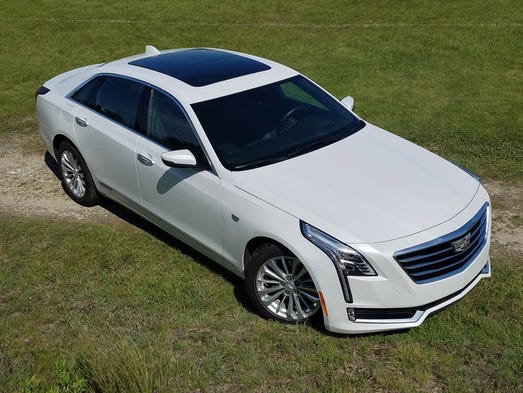
Cadillac established itself as the luxury-car standard at the dawn of the 20th century for innovations like electric self-starting, closed-body styling and powerful V-8 engines.
Spin forward 100 years and upstart Tesla has become the 21st-century innovator.
By reinventing the electric vehicle as a sleek performance machine, Tesla’s Model S has captured the imagination of America’s premium buyer to become one of the best-selling luxury sedans in the States. It has forced its chief rivals — BMW, Audi, Mercedes, Cadillac — to develop their own electron-charged chariots to keep up. Indeed, Cadillac is not only a shadow of its former self, it is in danger of being rendered an anachronism. Tesla has transformed the auto into a smartphone on wheels complete with supercar acceleration, iPad-like touchscreen and spacious interior.
Where young Americans once aspired to Cadillacs, today they covet Tesla.
The brand is omnipresent in big, premium-car coastal markets. Mention to my locker-room pals that I have a Tesla tester and they’ll line up like kids at Cedar Point’s Top Thrill Dragster roller coaster. Aware that its future is at stake — from German and Yankee alike — Cadillac has moved its headquarters to New York City, hired Audi-meister Johan de Nysschen and introduced its best luxury sedan ever.
Its Tesla fighter is the $76,090 Cadillac CT6 Plug-In and I took it had-to-head with the formidable Model S in back-to-back, long-distance tests this summer.
With its lightweight construction, gorgeous styling and battery-assist, the plug-in hybrid version of the CT6 is a thoroughly modern Caddy. It’s also a bargain next to similar Mercedes S-class and BMW 7-series hybrids. But next to the state-of the-art Tesla, it feels sooo 15 minutes ago.
To be clear, my Tesla tester was the top-of-the-line, $152,700 P100D. This legend-in-its-own-time speedster can spring from 0-60 mph in just 2.4 seconds in “Ludicrous” mode. That’s the same time as Ferrari’s $1.2 million LaFerrari supercar. But strip away the P100D’s bigger battery, all-wheel drive, carbon-fiber trim and expensive add-ons like “Bioweapons Defense Mode” (ahem, cabin air-filter) and you get a Model S 75 for the same price as the Caddy.
Nothing else is the same. The Model S crushes the Caddy in every metric — performance, interior space, cool factor — save one: range anxiety, the EV’s kryptonite. The CT-6 Plug-In’s 2.0-liter, turbocharged inline-4 cylinder gasoline engine will get you home even if the battery gets low.
The Tesla lets you know immediately it’s not the usual blind-date. Seductive, wide hips taper to a long front hood anchored by almond-shaped LED headlights. Gone is the original ill-considered, plastic faux-grille (EVs need grilles like animals need gills), replaced by a simple, Tesla graphic. The Tesla’s beak is like a falcon trolling for prey.
Step toward the Model S and its flush, silver door handles step out to meet you. Slip inside and it starts itself (assuming you haven’t already prepped the cockpit with a remote app — a feature the Cadillac shares). The design is Apple-like — elegant and spartan. It’s Tesla CEO Elon Musk’s vision of the iPhone on wheels.
With its simple driveline in the floor, the Model S’s luggage space is yuuuge. Where the Cadillac’s front hood is stuffed with an engine block, the Tesla offers a suitcase-swallowing “frunk.” The CT6’s battery eats up half the trunk and freezes the rear seats in place. The Tesla’s hatchback configuration can seat three or fold flat for acres of space for luggage or on-your-back star-gazing.
Six years after its introduction, the Tesla’s giant 17-inch console screen still gets gasps from the neighbors. There’s nothing like it on the market. Also unique is Tesla’s Google maps navigation, just like a smartphone. It’s the best navigation system on the planet. Why every automaker doesn’t contract with Google is beyond me. Instead, they (including Cadillac) insist on inferior, homemade navigation systems complemented by apps that mimic your phone’s nav. Awkward.
I bark my destination to the Tesla and we’re off like lightning. Talk about merging with authority. Floor the pedal and — ZOT! — instant torque shoots the S into traffic like a harpoon from a gun.
The Caddy is more laborious. Even when fully charged to 31-mile EV range, the battery defers to the turbo-four gas engine for hard acceleration causing a momentary balk as the transmission downshifts (the buzz of a four-cylinder doesn’t become a $75,000 chariot, either).
Through the hills, both vehicles feel a size smaller. Like 6-foot-10 Kevin Durant knifing through the lane, these are athletes. Despite topping the lightweight CT6 by 400 pounds, the battery-powered Tesla feels more grounded thanks to its Porsche-like, low center-of-gravity.
But the Tesla’s playpen is only as big as the nearest supercharger. The gas-assisted Caddy’s range is limitless.
After electrifying the Pacific Coast with its handling and acceleration, my P100D drank 157 miles of range while covering 90 miles. Arriving at a Mountain View supercharger at 9:30 p.m., all 12 chargers were used with a waiting line four-deep. I shuddered at the thought of tens of thousands of cheaper Model 3s flooding the market next year — even as Tesla doubles its network. I retreated to my son’s apartment complex where a 240-volt Chargepoint station refueled the S for $21 over 101/2 hours.
The CT6’s charge lasted just past Clarkston up Interstate 75, but then I hoofed it the rest of the way to Charlevoix on gasoline.
A Tesla friend from Chicago met me there, sans Tesla. Up North would be a dead end for his Model S (not to mention the hassle of an hour-long, supercharger delay along the way). Charging the Tesla on the 120-volt socket in our weekend cabin would have taken a lifetime (heck, it took 19 hours to fully charge the 30-mile Caddy!), while recharging it on the local utility’s 240-volt teat would render the car nearly useless for the weekend.
So the Caddy wins the long-distance prize. And everyone else learns the limitations of mass-market EVs.
But for those who can afford a $76,000 Tesla or Caddy, they can also spare change for a second, multi-purpose vehicle. For daily use, Tesla is the 21st-century standard.
Once the teacher, the handsome Cadillac is now the student. It has some learning to do.
Henry Payne is auto critic for The Detroit News. Find him at hpayne@detroitnews.com or Twitter @HenryEPayne.
2017 Cadillac CT6 Plug-In
|
VEHICLE TYPE |
FRONT-ENGINE, REAR-WHEEL DRIVE, FIVE-PASSENGER LUXURY SEDAN |
|
Powerplant |
18.4 kWh lithium-ion battery pack with AC motor; 2.0-liter, turbocharged, inline-4 cylinder |
|
Transmission |
Continuously variable automatic |
|
Weight |
4,530 pounds |
|
Price |
$76,090 |
|
Power |
335 horsepower, 432 pound-feet torque (total system power) |
|
Performance |
0-60 mph, 5.2 seconds (mftr.); 78 mph top speed in EV mode |
|
Fuel economy |
31 miles on full charge; EPA est. 62 MPe (34.7 total mpg as tested on 383 mile-trip) |
Report card
|
HIGHS |
COMPETITIVE PRICE; GAS ENGINE FOR LONG-RANGE TRIPS |
|
Lows |
Disappointing acceleration; battery robs trunk space |
Overall:★★★
Grading scale
Excellent ★★★★Good ★★★Fair ★★Poor ★
Tesla Model S
|
VEHICLE TYPE |
ELECTRIC, FRONT AND ALL-WHEEL DRIVE, FIVE-PASSENGER LUXURY SEDAN |
|
Powerplant |
75-100 kWh lithium-ion battery with electric motor drive |
|
Transmission |
Single-speed transmission |
|
Weight |
4,469 pounds (4,941 P100D as tested) |
|
Price |
$74,500 Model S 75 base ($152,700 P100D as tested |
|
Power |
382 horsepower, 325 pound-feet torque (605 hp, 687 torque P100D as tested) |
|
Performance |
0-60 mph, 4.3 seconds base model (mnftr.); 2.4 sec., P100D |
|
Fuel economy |
Range: 249 miles, base (315 mi. P100D. 157 miles of range to cover 90 miles as tested) |
Report card
|
HIGHS |
LUXURY REINVENTED; MASSIVE CARGO SPACE FROM FRUNK TO REAR |
|
Lows |
Less range when driven to capability; charging infrastructure limitations |
Overall:★★★★
Detroit sedans, Tesla Model 3 missing from NACTOY honors
Posted by hpayne on September 15, 2017
Semifinalists for the prestigious 2018 North American Car, Truck and Utility of the Year were announced Friday morning, and the list is as notable for what did not make it as for what did.
For the first time in the award’s 25-year history, not a single Detroit-based automaker is nominated for Car of the Year — a sign of the massive market shift to sport utility vehicles over sedans.
Since the 2008 recession, SUV sales have surged to over 60 percent of market share, with General Motors Co. and Ford Motor Co. studying whether to end production of full-size and subcompact autos. No new Detroit Three sedans were eligible for this year’s NACTOY selection process.
Ironically, one of the year’s most anticipated vehicles is a sedan, the Tesla Model 3. But Tesla withdrew the Silicon Valley-made electric vehicle, saying it is focused on scaling up production and could not have a car available for jury testing.
GM leads all manufacturers with four nominees in the truck and utility categories. Up for Utility of the Year will be the midsize Buick Enclave, and GM’s Chevrolet division will have three nominees for the NACTOY trophy. The compact Chevy Equinox and mid-size Traverse will compete for best ute while the Colorado ZR2 pickup truck will vie for Truck of the Year honors against the Ford Expedition and Lincoln Navigator — the only nominees from the Blue Oval stable.
Ford’s stunning GT supercar was deemed ineligible for NACTOY in July due to its low sales volume, its $450,000 sticker price and lack of availability to the general public. Ford has selected all 750 buyers of the GT through an application process.
Also ineligible was Dodge’s halo, 840-horsepower Challenger SRT Demon coupe that has set a production car record 9.65-second quarter-mile time. With the same drivetrain and structure as Dodge’s 707-horse Challenger SRT Hellcat — introduced for the 2015 model year — the Demon is not sufficiently altered to meet NACTOY’s criteria as a separate model.
Other notables vying for top SUV are the Alfa Romeo Stelvio, Honda Odyssey, and VW Atlas and Tiguan. The Stelvio, the Italian brand’s first SUV, will square off against perennial favorites from Audi and BMW. Minivans have also seen their market share crater in the face of the SUV juggernaut, but Honda has doubled down on its popular Odyssey minivan bringing new tech to market like a horizontally-sliding second-row seat. And VW hopes to put Dieselgate in its rear-view mirror with two three-row SUVs tailored for the US market.
Despite its its diminished status, the car category will feature a face-off between two of the industry’s iconic models — the Toyota Camry and Honda Accord. Determined to remain relevant (and maintain their 300,000-plus unit sales) in Ute Nation, the two sedans received major chassis, styling, and tech updates for 2018 that blur the distinction between luxury and mainstream sedans.
They will be clear favorites, but other notables in the car class are BMW’s premium benchmark 5-series, the sexy Alfa Romeo Giulia, and athletic Kia Stinger fastback which the Korea automaker has positioned as a halo vehicle for the brand’s sporty vibe.
The NACTOY award is one of the industry’s most prestigious. Some 60 auto experts from the U.S. and Canada, including the author of this article, will evaluate the nominees in October over a week of grueling testing, flogging and eyeballing in the Metro Detroit area.
Three finalists from each category will be selected and announced at the Los Angeles Auto Show in late November. The winners will be unveiled January 14 at the opening of the 2018 Detroit auto show.
Henry Payne is auto critic for The Detroit News. Find him at hpayne@detroitnews.com or Twitter @HenryEPayne.
Semifinalists
Car
2018 Alfa Romeo Giulia
2018 Audi A5 Sportback
2017 BMW 5-series
2018 Honda Accord
2017 Hyundai Ioniq
2018 Kia Rio
2018 Kia Stinger
2018 Lexus LC500
2017 Porsche Panamera
2018 Subaru Impreza
2018 Toyota Camry
Utility
2018 Alfa Romeo Stelvio
2018 Audi Q5/S5
2018 BMW X3
2018 Buick Enclave
2018 Chevrolet Equinox
2018 Chevrolet Traverse
2018 Honda Odyssey
2017 Jeep Compass
2017 Kia Niro
2018 Land Rover Discovery
2017 Mazda CX-5
2018 Subaru Crosstrek
2018 VW Atlas
2018 VW Tiguan
2018 Volvo XC60
Truck
2018 Chevrolet Colorado ZR2
2018 Ford Expedition
2018 Lincoln Navigator
Payne: Athletic Terrain breaks GMC truck mold
Posted by hpayne on September 13, 2017
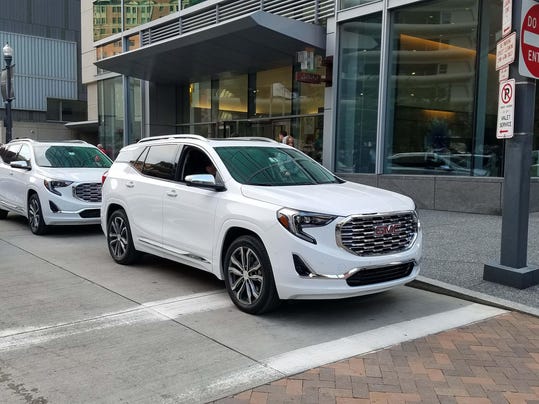
The compact SUV tourney is where it’s at these days. And the big field vying for the big prize money looks like a multinational U.S. Open tennis draw with everyone dressed in the same outfit — all-wheel-drive, five-door utes riding a half-foot off the ground.
Like tennis nationalities — big-serving Americans, steady Spaniards, flamboyant Frenchman — auto brands tend to conform to stereotype. They know what they do well and they bring their A game to family utes. Jeep Cherokee ruggedness, Honda CR-V efficiency, Mazda ZOOM ZOOM, GMC nimbleness.
Wait. … GMC what?
Isn’t GMC a truck brand? A hunky wall of steel that can break through walls and spit nails? A relative newcomer to the small ute segment, GMC is using America’s SUV transformation to do some transforming of its own. The all-new, 2018 GMC Terrain is a breakout vehicle, softening the brand’s truck-tough image and maximizing its premium-grade swagger.
If the stylish GMC Sierra Denali pickup is a Chevy Silverado in a tux, then say hello to Terrain Denali — the compact Chevy Equinox’s stylish brother. Upscale in taste, this GMC competes at the high end of the compact segment with the VW Tiguan and my segment standard, the Mazda CX-5 — two more well-dressed brands that blur the line between mainstream and lux.
The new GMC Acadia I flogged all over Northern Virginia a year ago attempts the same trick in the mid-size space, but its wardrobe falls short when compared to a looker like the Mazda CX-9.
Not so Terrain which the designers have knocked out of the park.
Gone is the first-gen Terrain’s chunky shoulders and square jaw. The bold look is still there — like GMC has been carved from granite. But straying from its truck roots, the Terrain is a riot of expressive details echoing Japanese fashion.
I test drove the compact ute from Pittsburgh to Fallingwater, Pennsylvania — architect Frank Lloyd Wright’s masterpiece that was heavily influenced by his time in Japan. American animation has also dipped its quill in the Japanese ink well. Add Terrain as a student of Asian fashion.
There’s its “floating roof” C-pillar pioneered by the Nissan Murano and Toyota C-HR crossovers. The canopy’s flowing lines depart from SUV tradition even as it creates a blind spot the size of Rhode Island. Hey, Wright’s Fallingwater created some creature discomforts too. Fortunately, Terrain has the driver covered with safety systems on offer like blind spot assist on all but the base grade.
More Japanese influence appears in back with the Terrain’s signature “C-clamp” taillights bent to stylized “boomerangs” — an echo of Nissan and Honda. The Cs are sprinkled liberally throughout the GMC including the beautifully integrated front fascia with scalloped bodywork cupping the C-clamp peepers and big grille.
Mission accomplished: The designers have our attention.
Inside the design is more truck-like — blocky console screen here, squared-off dash trim there — but I hardly noticed because GMC dug deep to provide a truly untruck-like, high-tech driving experience. Begin with the automatic transmission.
Shift-by-wire systems have liberated engineers from the gated lever (and freed up console space for more storage). Their innovations have run the gamut from balky mono-stable shifters (Chevy Bolt, BMWs) to my preferred rotary dial (Chrysler Pacifica, Ford Fusion Sport). With the Terrain, GMC’s tinkerers have innovated “Electronic Precision Shift” buttons — nicknamed “Trigger” because the reverse and drive buttons are pull tabs.
The buttons are horizontally-arranged on the console — park, reverse, neutral, drive, low — similar to Honda’s vertically-aligned trigger. Simply slip your index and ring fingers into the (most used) reverse and drive slots — then use your thumb and middle finger to access PARK and NEUTRAL buttons. It beats diverting your eyes to a shifter gate.
The nine-speed slushbox at the other end of your DRIVE finger is a treat. While GM’s rear-wheel-drive ten-speed has won huzzahs in the track-stomping Camaro ZL1, the FWD nine-speed has quietly found its way into daily drivers like the Chevy Malibu, Chevy Traverse, and now Terrain.
Mated to either the 1.5-liter or 2.0-liter (an expensive diesel option is also available with the ol’ six-speed) turbocharged engines, it completes a chassis-engine-tranny trifecta that makes this GMC a treat to ride. Sharing the same diet as sibling Chevy Equinox, the Terrain’s chassis has lost a whopping 350 pounds since Gen One. Like Equinox (which proved surprisingly athletic over North Carolina’s Blue Ridge Mountains earlier this year), the Terrain begged to be flogged on the rural roads around Fallingwater.
Through a twisted valley on two-lane, State Route 381, Terrain’s body roll was minimal. Uphill out of a gulch, I encountered traffic, which I obliterated in a passing-line stretch – the tranny downshifting seamlessly to unleash the turbo’s torque.
The experience reminded of my favorite Mazda CX-5 ute — absent the Mazda’s 2.5-liter, normally-aspirated 4-buzzer which shouts under the strain of hard work. You go, turbo. If the Terrain’s handling shatters its trucky image, its VW premium competitor, Tiguan, rebels against family type. Three-row Tiguan is less precise German handlingand more three-row room and comfort.
The GMC hardly neglects the rear passengers, however. My 6’5” inch frame rode comfortably in the backseat with legroom to spare — and if I wanted more the GMC’s front seat will fold flat (a trick borrowed from the Buick Enclave and Chevy Trax) as an Ottoman. Optional rear heated seats and full sunroof further spoil rear-dwellers, making the GMC a nice cross between Mazda sportiness and VW roominess.
Compact ute shoppers will be hard-pressed to find a better value than a fully-loaded Mazda CX-5 (190-horse, adaptive cruise, auto high beam, heads-up display, the works) at $34,060. At that price, GMC offers just the 170-horse, 1.5-liter mill, though its complimentary 9-speed tranny and suite of safety systems makes it a better value than sister Equinox.
Opt for GMC’s chrome-plated Denali edition, however, and it matches V-dub for uptown swagger. Both cars will push north of $40,000, but should make Audi blush for charging $52k for an Audi Q5. The GMC offers Audi Q5 performance (both 2.0-liter turbo-4s produce 252 ponies) and panache for an Audi Q3 price.
Such is the packed draw in today’s five-door ute derby where upstart mainstream brands are as worthy as top, premium seeds. It’s an opportunity for newcomers like GMC — especially newcomers that play way above stereotype.
Henry Payne is auto critic for The Detroit News. Find him at hpayne@detroitnews.com or Twitter @HenryEPayne.
2018 GMC Terrain
|
VEHICLE TYPE |
FRONT-ENGINE, FRONT AND ALL-WHEEL DRIVE, FIVE-PASSENGER SUV |
|
Powerplant |
1.5-liter inline-4 cylinder; 2.0-liter inline-4; 1.6-liter turbo-diesel 4-cylinder |
|
Transmission |
9-speed automatic; 6-speed automatic (with diesel) |
|
Weight |
3,622 pounds (1.5-liter AWD); 3,801 pounds (2.0-liter AWD); 3,815 pounds (diesel AWD) |
|
Price |
$28,970 base 1.5-liter ($43,955 2.0-liter Denali as tested); $32,295 base diesel |
|
Power |
170 horsepower, 203 pound-feet torque (1.5 liter); 252 horsepower, 260 pound-feet torque (1.5 liter); 137 horsepower, 240 pound-feet torque (diesel) |
|
Performance |
0-60 mph, 6.4 seconds (2.0-liter AWD, Car and Driver est.); tow capacity: 1,500 pounds (1.5 liter and diesel); 3,500 (2.0-liter) |
|
Fuel economy |
EPA est. 24 mpg city/28 mpg highway/26 combined (1.5-liter AWD); 21 mpg city /26 mpg highway/23 combined (2.0 liter AWD); 28 mpg city/39 mpg highway/32 combined (diesel AWD) |
Report card
|
HIGHS |
INNOVATIVE TECH LIKE “TRIGGER” SHIFTER; DENALI SWAGGER |
|
Lows |
“Trigger” shifter not for everyone; Denali sticker |
Overall:★★★
Payne: Can charging network handle coming EV flood?
Posted by hpayne on September 12, 2017

Chevy Bolt EV sales surged past the Nissan Leaf and Tesla Model X crossover in August, putting it on track to be the best-selling electric vehicle for 2017 after the iconic Tesla Model S sedan.
Now available in Michigan and all 50 states after dealers have received certification since the Bolt went on sale in December, the Chevy’s Tesla-like, 200 plus-mile range for under $40,000 brings a broader demographic of EV buyers.
Yet, the Bolt EV’s estimated 20,000 unit sales volume for 2017 pales compared to the sales tsunami expected from Tesla Inc.’s similarly-priced Model 3 when it goes into production later this year. With over 500,000 pre-orders for the Model 3, Tesla promises production of 20,000 units a month by the end of this year. CEO Elon Musk calls the task of meeting demand “production Hell.”
The flood of new EVs on the road also presents devilish challenges to recharging infrastructure that even now is having a hard time keeping up. Consider my experience in a Tesla Model S P100D last month in Silicon Valley.
I picked up my all-wheel-drive Tesla at the airport with 239 miles of predicted range if driven to the EPA mpg cycle like an overstuffed limousine (Tesla recommends charging to 85 percent of battery capacity to extend the life of the 100 kWh of lithium ion battery pack. The batteries have a 315-mile range).
But the P100D is no limousine. After a day of spirited driving in the four-door rocket ship, I pulled into a Tesla Supercharging Station at 9:30 p.m. having traveled 90 miles but taken 157 miles off the battery, leaving an estimated 82 miles of range. I estimated a half-hour to get my miles back (an advertised 170 miles per ½ hour charging) — but I wasn’t the only one needing juice.
The 12-stall station was full of Model S sedans and Model Xs — over $1 million worth of EVs on electron teets — with a waiting line four deep. One patient owner — she commuted 140 miles a day — said it was typical for a weeknight.
A check of Tesla’s navigation display indicated the nearest Superchargers — in Palo Alto or Fremont (Tesla’s Bay-area manufacturing facility) — were a half-hour away. And this was Silicon Valley, the nation’s EV capital.
A Tesla spokesperson confirmed the high demand the next day. A map in Tesla’s Palo Alto HQ charts the highest-use Superchargers in the world, and nearby Mountain View is No. 1. While Mountain View is a prosperous bedroom community where most owners (average Model S transaction price: $100,000) have installed Level 2, 240-volt chargers at home, many are apartment-dwellers dependent on fast chargers (charging a big battery Tesla on a standard, 120-volt home socket would take four days).
Tesla is doubling its Supercharger infrastructure by the end of this year. But that increase is coming with a ten-fold increase in Model 3 production volume — a buyer demographic more likely to live in apartments.
I retreated to my son’s apartment in neighboring Sunnyvale where I charged overnight at a 240-volt, Level 2 Chargepoint station. After 10½ hours I was back to 282 miles of range at a cost of $21.
“The charging infrastructure is still quite a mountain to climb,” says Karl Brauer, an auto analyst with Kelley Blue Book.
In Metro Detroit there is currently only a Supercharger, in Ann Arbor. Other EVs like the 238-mile range Bolt EV or 150-mile, 2018 Nissan Leaf (an over-200 mile range Leaf is expected next year) must find scarce, Level 3, DC fast chargers which advertise 90 miles of charge in 1/2 hour.
But I only gained 41 miles while recharging a Bolt EV this summer — and was lucky enough to get the only stall (unlike the 12 at Tesla’s Mountain View stable) at the State Street Shell station without a wait.
“There isn’t a gas station solution where EVs can magically recharge in 5 minutes,” says Rebecca Lindland, an auto analyst for Kelley Blue Book. “EVs are a suburban solution where owners with garages can charge at home at night and then at their workplace during the day.”
Lindland sees EVs as much more problematic for urban apartment dwellers where infrastructure is unreliable. It gets more complicated outside urban areas — Michigan, for example, does not a have a DC fast charger north of Pontiac. Take a Chevy Bolt EV or Tesla on a 250-mile trip up north and expect to spend much of the weekend plugged into a 240-volt socket getting recharged for the return trip.
And woe to the buyer who can only find a standard, 120-volt wall socket in their cabin. A Bolt EV will take 51 hours to fully recharge.
“It’s why plug-in hybrids like the Chevy Volt are far more attractive than EVs,” smiles Lindland. “They are an EV where appropriate — say on a daily commute from home to work. But you can also take them to a gas station for a 5-minute refill if you need to.”
The Volt, too, is under $40,000 with up to 53 miles of EV range before a gas engine kicks in for a total 420 miles of range.
California accounts for over half of U.S. EV vehicle demand. Metro Detroit area dealers say demand has been tepid for Volts, which has been on sale since 2011. Bolt EV deliveries to area dealers began in August. Mike Savoie Chevrolet of Troy, for example, has received three with prices starting at $37,495.
If you buy one, Lindland recommends installing a 240-volt charging plug at home. Dealers estimate a cost of $500 to $2,000 depending on the age of your domicile.
Payne: In the backseat of a self-driving Uber
Posted by hpayne on September 8, 2017

Pittsburgh — I am in the backseat of a self-driving Uber vehicle, a Volvo XC90 being tested like a lab mouse through a maze of urban streets.
Cruising south on busy, one-way Penn Avenue heading to downtown Pittsburgh, the Volvo encounters a delivery truck blocking the right lane. A worker is unloading its contents to the curb. But before the XC90’s computer brain can react, an engineer takes over the steering wheel, easing the SUV to the left. The engineer (“operator” in Uber lingo) explains he didn’t want the Volvo to surprise the worker by coming too close before veering left. Unlike a human driver, the self-driving Volvo hasn’t quite learned to acknowledge that it sees the deliveryman by giving him a wide berth early on.
I have done media ride-alongs in controlled Silicon Valley environments in Google’s self-driving Lexus SUVs and its cute “marshmallow” car. Each of those vehicles was equipped with autonomous systems similar to Uber’s Volvo. This drive, however, was not a planned media event, but a ride through Steel City streets in the middle of a busy workday. I was having the same experience as any paying passenger who hails one of Uber’s 40 autonomous vehicles that navigate Pittsburgh 365 days a year.
The experience proves the potential of autonomous vehicles — and how far they still must travel to gain acceptance in the marketplace.
Two women amble across the street in front of the Volvo, oblivious to its presence. The XC90 slows, giving them space. The autonomous car doesn’t honk and doesn’t crowd them. It lets them go on their carefree way.
Such driving subtleties are crucial to Uber as it operates the fleet of autonomous vehicles. Uber’s self-driving SUVs are more than an experiment – they are real-world beta tests in how autonomy can deliver a satisfactory experience to Uber passengers.
Like its human drivers, Uber wants autonomous vehicles to earn a five-star customer rating. So nothing is left to chance.
Urban streets are automobility’s most challenging operating environment, which is why Uber is here. Unless and until autonomy can provide a seamless experience, it is not ready for prime time in the hands of a ride-sharing brand that puts a premium on passenger experience.
Atop the Volvo, a head unit containing cameras and a spinning Electrodyne lidar laser-detection array – operators call it the “chicken bucket” – sees a stop sign at a four-way intersection and eases the Volvo to a stop. But before the XC90 turns right, a truck lurches into the SUV’s path. The operator takes over, lest the Volvo accelerate forward and then slam on the brakes.
Uber agreed to give me a ride under the condition that I not quote its operators and not broadcast live video. Otherwise, I was free to report on the experience — which I complemented with rides in “regular” Uber cars with drivers who gave me insight into what it’s like to coexist with the autonomous Volvos.
Two Uber operators occupy the front seats of every XC90, and I was surprised how frequently the driver took control of the robotic car. The operator explained that Uber is determined that autonomous cars learn from — and drive like — humans.
After months on the road, they concede the Volvos are not there yet.
Taking a right off Penn toward Smallman Street, the XC90 encounters a temporary construction site. The concrete New Jersey barriers occupy not just the inside lane, but part of the outside lane as well, bringing us to a stop. The operator takes over, explaining that the computer is confused by the partial lane-blockage – and likely would wait indefinitely, not sure what to do next.
The driver deftly maneuvers around the barrier, taking care that he doesn’t impede oncoming traffic.
Each episode is monitored and logged by the passenger-seat operator who sees the road through the XC90’s eyes on a laptop screen.
That data is then fed to Uber’s Advanced Technologies Group just north of downtown. This is Uber’s national self-driving headquarters (another operation in San Francisco is working on self-driving trucks). Run by ex-Carnegie Mellon University robotics guru Eric Meyhofer, ATG employs some 700 engineers, software developers, and operators.
Their autonomous fleet was recently upgraded from Ford Fusion sedans to roomier Volvo hybrids. The all-wheel drive, super- and turbocharged four-cylinder XC90 with battery-assist is an engineering marvel in itself. What the engineers really like is the 9.2-kWh lithium-ion battery that they use to help power their autonomous hardware.
The big computer and head unit are constructed at ATG and have gone through several evolutions. Uber has mapped four core districts in Pittsburgh — the equivalent to mapping Detroit’s downtown, Corktown, Greektown and Midtown — where the Volvos roam.
They don’t work outside that geo-fence. That means, for example, the self-drivers won’t take you to Pittsburgh’s airport. But Uber considers the interstate-heavy route to the airport light work for autonomous vehicles. They want to master inner-city streets.
Aboard a regular Uber Hyundai Elantra, the driver shared with me some of the Volvo’s tendencies. For example, when the Hyundai tried to drive alongside the XC90, the robot car would drop back. Uber engineers confirmed this safety-first programming, but it also indicated how other vehicles can mess with the Volvo’s path, a concern for Uber as they program behavior.
Such detail only scratches the surface of where autonomous cars need to go to be viable, ride-sharing transportation. Uber says the vehicles have operated well in winter snows and rainstorms. But there is more than just getting a passenger from point A to B.
Smallman Street is lined with stores fronted by 45-degree, nose-in parking like Detroit’s Eastern Market. The area presents navigation challenges involving pedestrians, cars backing out of spaces and double-parked vehicles. Not to mention spontaneous passengers: Could I tell the Volvo to pull over while I ran into a store to get my wife a box of candy? No, because the Volvo has yet to incorporate passenger-to-vehicle communication.
Uber is on autonomy’s cutting edge. But there are other mice in the maze here including Ford-owned Argo. Come snow, rain, gloom of night or pop-up construction sites, they are determined that autonomy complete its appointed rounds.
Payne: Jeep Trackhawk, the Hellcat SUV
Posted by hpayne on September 7, 2017
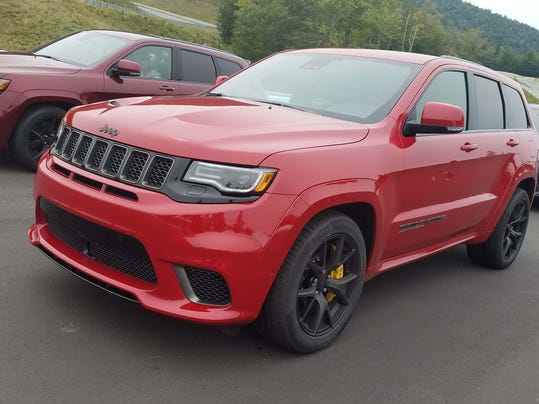
Last winter I was axle-deep in the muddy bogs of the Mounds Off Road Park in Flint. I was in a rugged Jeep Wrangler Sahara. This summer I’ve been dive-bombing apexes on the hills of New Hampshire’s Club Motorsports race track. This time I was in a supercharged Jeep Grand Cherokee Trackhawk.
Is there any other auto brand with this kind of bandwidth? Jeep is the only brand I know where I have to pack both hiking boots and racing shoes when I go for a test drive.
The Wrangler, of course, is Jeep’s icon — the tough, Rubicon Trail-conquering, off-road warrior with roots in World War II. Its tough DNA is at the core of a brand that pioneered the SUV and is just now reaching its zenith as the whole planet goes ute. But improbably, incredibly, Jeep is translating its off-road performance cred to the track.
Jeep aims to give you capability whenever and wherever you want it. Thus the insane Trackhawk. It’s sleeper Jeep (only the fat tires and quad pipes give it away) stuffed with Dodge SRT’s legendary, 707-horsepower, supercharged, 6.2-liter V-8.
Call it the Jeep Hellcat.
“Jeep is built on capability,” says Jeep brand manager Scott Tallon. “It’s always been the cornerstone of all Jeeps. Every Jeep must be the most capable within our segment. Trackhawk is taking capability to a while new dimension.”
Some folks get their kicks off-road. Others on-track. I’m a track rat who races ground-hugging race cars. I have buddies who go mud-hunting in jacked-up rad trucks. The cultures don’t speak the same language. I don’t go to Moab, the off-road Mecca in Utah. Mudders don’t do Indy. They are as different as boaters and airline pilots.
Yet Jeep not only does off-road and on-road in the same brand — it does them in the same model with the Grand Cherokee Trailhawk and Trackhawk. With the same chassis, same all-wheel drive system, same handsome interiors.
But no, not the same engine.
Borrowing the 707-horse, 645-torque, supercharged engine from Dodge’s SRT performance parts bin and mating it to an SUV may seem like Dr. Frankenstein lunacy. But in many ways it actually works better than in the Challenger and Charger Hellcat.
Like the Dodge brothers, the V-8 fits longitudinally into the Jeep — a rare, rear-wheel drive biased SUV like its three-row Dodge Durango cousin. Add a beefed-up transfer case and driveshafts and the Trackhawk can deliver up to 70 percent of the V-8’s twist to the rear wheels — ideal for a track car — while also gaining all-wheel-drive traction.
That means on Club Motorsports’ roller-coaster track, the Trackhawk is more manageable under power. It puts torque to the road out of apexes with aplomb, where the rear-drive Hellcats are like riding a tiger by the tail.
It also means the Trackhawk launches from zero-60 in 3.5 seconds — a tenth quicker than the Challenger Hellcat coupe according to Car and Driver’s test equipment — though they clocked a Charger Hellcat sedan at 3.4. I got the Trackhawk down to 3.3 at Club Motorsports.
Yes, an SUV quicker than its Hellcat brothers.
That’s not say that the 5,360-pound Trackhawk isn’t a challenge to drive fast. Eight hundred pounds heavier than a Charger Hellcat sedan and with a higher center of gravity courtesy of that big boat anchor in the bow, the hawk plows into corners and does not take sudden movements kindly. But it is shockingly comfortable at speed. After all, this isn’t Jeep’s first rodeo.
Grand Cherokee first tasted the track in 1998 with the 5.9 Limited. It went all-in with the SRT8 in 2006 and SRT in 2012. The latter’s athletic bones are the foundation for the 2018 Trackhawk. The Grand Cherokee SRT has done thousands of tracks laps while selling 2,500 to 3,000 copies a year. With minor tweaks (the aforementioned driveline, stiffer shocks, more heat exchangers), Trackhawk is screwed to the ground with mighty 11.5-inch Pirelli P-Zero tires that offer 30 percent more tread with than a standard Grand Cherokee.
So good is the SRT already, in fact, that it corners at a higher G-force — .90 vs. .88 — than the Trackhawk because its 392-cube, 475-horse mill is lighter up front. With smaller footprints than the bigger three-row Durango SRT that I wheel-hopped at Indy last month, the SRT and Trackhawk are more confident on their feet.
But there is no substitute for horsepower, and the Trackhawk sets a new standard for utes. All that grunt comes at a cost: $94,970 for the track animal I tested at Club Motorsports. But before your eyes water at a six-figure Jeep, consider that Jeepzilla stomps a $158,000 Porsche Cayenne Turbo S from zero-60 and beats it to the quarter-mile by over a half-second (11.7 vs. 12.3).
Simply put, the Trackhawk is the Corvette Z06 of SUVs — a Porsche slayer for a whopping $70,000 less.
I wrote earlier this year that Corvette should follow Porsche’s example and translate its “lunchbox” supercar brand to SUVs. A V-8 ’Vette ute would be a big hit. Well, you snooze, you lose. Jeep has filled the vacuum with the bonkers Trackhawk.
Trackhawk earns its investment inside as well as out. Chrysler does great interiors and the Grand Cherokee is no exception. Fans like to say you can take a Jeep from the outback to the opera. Make that from the race track to the opera. The interior is whisper-quiet until you put your boot in it and awaken the supercharger.
Best-in-the-business Uconnect also gains Apple CarPlay and trounces Porsche’s interior ergonomics with attention to detail. Think steering wheel-mounted controls that allow you to choose adaptive or regular cruise. It has paddle-shifters for manual shifting, but revert to automatic with a simple right paddle hold. There are drive modes for every mood: auto, sport, track, tow and snow.
Yes, snow. This is not just a Hellcat SUV — it’s an all-season ute you can use in winter long after rear-drive Hellcats have gone into hibernation.
With the Trackhawk, Jeep has made the ultimate SUV — a vehicle that can tow your race car to the track and set faster lap times than the car it towed. Expect more to come.
Like the off-road Trailhawk package found on all Jeeps, the Trackhawk should trickle down to its cheaper siblings. May I suggest a Jeep Wrangler Trackhawk? It would be an exclamation point on the most versatile brand in the land.
Henry Payne is auto critic for The Detroit News. Find him at hpayne@detroitnews.com or Twitter @HenryEPayne.
2018 Jeep Grand Cherokee Trackhawk
|
VEHICLE TYPE |
FRONT-ENGINE, ALL-WHEEL DRIVE, FIVE-PASSENGER SUV |
|
Powerplant |
Supercharged 6.2-liter V-8 |
|
Transmission |
8-speed automatic |
|
Weight |
5,363 pounds |
|
Price |
$86,995 base ($94,970 as tested) |
|
Power |
707 horsepower, 645 pound-feet torque |
|
Performance |
0-60 mph, 3.5 seconds (manufacturer, though Payne clocked it at 3.3); top speed: 180 mph (mftr); tow capacity: 7,200 pounds |
|
Fuel economy |
EPA est. 11 mpg city/17 mpg highway |
Report card
|
HIGHS |
PORSCHE SUV-STOMPING JEEP; BUTTERY-SMOOTH 8-SPEED TRANNY |
|
Lows |
Thirsty; 100K for a Jeep? |
Overall:★★★★
Nissan Leaf 2.0: More EV for less
Posted by hpayne on September 5, 2017
Since its introduction in 2010, the battery-powered, 107-mile-range, $30,000 Nissan Leaf has been the best-selling electric vehicle in the United States. But that leadership is under challenge with new, more attractive, affordably priced entries from Chevrolet and Tesla promising longer range for under $40,000.
On Thursday night, Nissan debuted Leaf 2.0. And while it won’t join the 200-like-range-for-under-$40,000 club pioneered by the Chevy Bolt EV and Tesla Model 3, it will increase its range while remaining the EV segment’s price leader.
At just $29,990 – $690 below the 2017 Leaf – the all-new, 2018 Leaf promises a 40-percent bump in range to 150 miles and more mainstream design. Produced in three plants around the globe – including Smyrna, Tennessee, for the U.S. market – the Leaf was jointly developed by a global engineering team, including significant input on autonomous and regenerative systems developed by Nissan’s Farmington Hills Tech Center.
“It’s about the right value,” said Overseas Chief Vehicle Engineer Chris Reed, who led North American Leaf development out of Farmington Hills. “The Leaf was hitting about 90 percent of (customer) usage scenarios, so we made it 40 percent better. We all are dealing with the cost of batteries. We are working on a bigger battery for the customer that wants that range. But for our main customer who wants to be under $30,000, with 40 percent more range, more features, and a mainstream car – the Leaf is the right value relationship.”
While EV sales remain under 1percent of the U.S. market, the Leaf aims to capitalize on increasing government mandates for zero-emission cars. The U.S.’s largest EV market, California, is mandating that 15 percent of vehicle sales by EV by 2025 while countries like England and French will ban the sale of gas-powered cars by 2040.
“When we launched Leaf in 2010, it instantly became the most affordable, mass market EV in the world. We are not walking away from that proposition,” said Jose Muñoz, Nissan North America’s Chief Performance Officer, in Las Vegas where the Leaf’s introduction was simulcast with Tokyo.
Derided for its nerdy styling, the original, egg-shaped Leaf made a green statement with a smooth, grille-less fascia and smooth sides. The 2018 model conforms to the rest of Nissan’s design portfolio with a familiar “V-motion” grille — anchored by its signature, chrome, “bull nose-ring” — as well as boomerang rear taillights and more sculpted rocker panels. The rear c-pillar even gets the racy, “floating roof” treatment pioneered by the stylish Nissan Murano.
Leaf 2.0 will initially come equipped with a 40 kWh battery with the upped 150-mile range that will eclipse other low-priced EV options like the Volkswagen e-Golf, the Hyundai Ioniq Electric, the Honda Clarity Electric, and the Ford Focus Electric. With a longer-range, 60 kWh battery similar to that found in the Chevy Bolt — which should push the range past 200 miles.
Plug the Leaf into a 240-volt, Level 2 wall charger and it will fully recharge in about eight hours. The new Nissan is also Level 3 (so-called “DC fast charger”) capable, which can recover 90 miles of range in 30 minutes. But Level 3 chargers are rare in Metro Detroit with locations in Ferndale, Dearborn, Ann Arbor and a few other locations.
The Leaf also introduces new, innovative technologies that the Bolt and Tesla have made synonymous with EVs like single-pedal driving — Nissan calls it the e-Pedal — and autonomous driving capability. In DRIVE mode the e-Pedal is activated by a switch on the dash that allows for single pedal driving — that is, when lifting your right foot off the accelerator, the car will start braking. Like the Bolt EV’s LOW mode, the Leaf can come all the way to stop if the e-Pedal is not applied for acceleration.
The e-Pedal idea was a product of Reed’s Farmington Hills engineering team.
“If we didn’t start that conversation here that wouldn’t have happened. We’re always listening to customer feedback through customers clinics and frontline feedback,” said Reed. “They understood regeneration and they asked if it couldn’t do more. So that is where idea started and so the people running the clinics brought it back to the engineers.”
He says the team saw the e-Pedal’s greatest benefit on hills for parallel parking and stop-start situations such as on the steep hills in San Francisco.
“Nissan a global operation … and all these little details differ from region to region. We did a lot of work on the hills of San Francisco,” Reed continued. “What is unique is the seamless connection between the regenerative brake side and the actual friction brakes. We call it stop-and-hold. You take foot off the pedal as it eases to a stop and it holds.”
Chevy’s Bolt has outsold the Leaf in the U.S. this year while Tesla’s Model 3 — due this fall — has created a global sensation with more than 500,000 pre-orders. But Nissan executives touted the Japanese brand’s reputation for reliability with a shot across the bow of Tesla, which has experienced quality issues and some highly publicized crashes.
“We have advantages that Tesla does not,” said Daniele Schillaci, Nissan executive vice president of global sales. “It’s easy to introduce technology that grabs headlines, but it’s harder to engineer it safely to makes people’s lives better.”
Engineer Reed says Nissan has never had a safety issue with the Leaf in its eight years on the market.
“We gouged the battery with a nail then started it right away. We shot it with a bullet. Crazy things can happen on the road. We focus all our engineering experience on everything we do,” he said.
Payne: Honda Fit punches above its weight
Posted by hpayne on August 31, 2017

‘Let Reagan be Reagan,” Sen. Paul Laxalt famously said in 1984 after his friend and incumbent President Ronald Reagan got stomped by challenger Walter Mondale in their first presidential debate. Over-schooled by his debate handlers, Reagan had looked hesitant and out of sorts. Laxalt’s prescription? The president should be his “aw, shucks” amiable self, not some pre-programmed autobot. He won debate No. 2, and a second term was no longer in doubt.
Honda might be taking that lesson to heart as it tries to make its small cars relevant at a time when buyers have gone ga-ga for crossovers. Honda’s answer? Let compacts be compacts.
The all-new 2016 Honda Civic compact doubled down on what separates cars from SUVs by lowering its center of gravity, increasing fuel economy and penning a wicked design. The result was Civic’s best sales ever as customers lined up for the showy athlete and its apex-carving variations: Sport, Si and Type-R. Honda’s CR-V crossover may be leading the ute revolution, but the Civic was a reminder that Honda knew what moved car-lovers, too.
Now it’s the 2018 Fit subcompact’s turn for a makeover and Honda is applying the same formula.
The Fit is only up for a mid-cycle refresh — the third-generation hatch debuted in 2014 — but it’s a racy redo. The wee Honda’s specs are unchanged — same 1.5-liter engine, same multi-purpose comfortable interior, same sippy fuel economy — but this is not the same adorable hatch. Fit gets a new outfit.
It’s called Honda Factory Performance, HFP for short. The racy package can be applied to any trim except the base $17,065 LX. New springs and shocks lower the hatch 10 millimeters, reinforcing a crouched stance signaled by a wider fascia and added rocker skirts. Borrowing the Civic’s mascara stick, the Fit takes its black eyeliner makeup tips from the Joker.
HFP Fit tops off its bad-boy look with black 16-inch wheels and a big, rear aerofoil that could shade my back porch. The package takes its inspiration from Fit’s successful history in motorsports where it’s competed for years.
The racing-obsessed brand has tracked everything from the supercar Acura NSX to the Civic in Pirelli World Challenge. If Honda announced it was entering its Honda Odyssey minivan in the 24 Hours of LeMans, I don’t think anyone would be surprised. As Honda founder and chief motorhead Soichiro Honda put it: “If Honda does not race, there is no Honda.”
I threw the eager, HFP-equipped Fit Sport — painted in its new “Orange Fury” war paint — into the twisty canyon roads northeast of Los Angeles.
The car was shockingly, pleasantly stiff thanks to its suspension upgrades. Its road-hugging qualities reminded of the Civic Type-R track fiend that I tested only weeks before, its front end porpoising purposely as the short-wheelbase subcompact tracked each undulation in road surface. True to Honda’s class-leading ergonomics, the steering was responsive, seats comfortable, and console roomy. Despite its subcompact size, your decidedly uncompact 6-foot-5 reviewer got generous knee-room.
The Sport version comes equipped with an excellent six-speed manual (the shifter topped off with a Civic Si-like silver ball). That’s important because the Fit needs constant rowing to maintain pace.
The meek, 130-horsepower (with manual, 128 with automatic), 1.5-liter, normally-aspirated gerbil wheel is Fit’s familiar engine, but it seems especially wanting now that the Civic’s 1.5-liter mill has received a dynamic, turbocharged upgrade.
The engine doesn’t do the Fit’s athletic new vibe justice. Readers of this column know I prefer manuals, but so wanting was the Fit for revs that I came to prefer the car’s CVT-with-paddles option. Stuff the shifter into manual mode, finger the steering wheel paddles, and the car will stay in manual. That allows for quick upshifts and downshifts as the CVT keeps the engine in the meat of the rev band. Nobody makes CVTs better than Honda.
The little fella badly needs a turbo like its bigger Civic sibling, and it is surely in the works when Fit gets its fourth-generation makeover in 2019. A turbo three-cylinder turbo is rumored to be on deck.
As the Fit turtled from zero-60 in an eternity, its four screaming gerbils nicely muffled by the cabin’s increased noise insulation, my mind wandered to the Civic Sport hatch. At just $2,000 north of the HFP-laden Fit, the Civic Sport would be the better buy for budget-minded motorheads. Or Ford’s turbo-3-powered Fiesta — Godzilla in a box — for just $18,000.
The Fit’s sporty trimmings are a nicely separate it from popular, subcompact sibling HR. But the best reason to buy a Fit remains its spacious, uniquely configurable interior.
Thanks to a clever packaging that moves the gas tank from under the rear to below the front seats, the Fit’s “magic” rear seats can flattened or flipped up in order to make room for, say, a bicycle behind the front seats. The deep cavity also benefits backseat occupants who will find substantial legroom despite the Fit’s short wheelbase dimensions.
And, of course, there is the equally magical front seat which can be flattened backward, creating a sort of BarcaLounger for the right-rear passenger. Readers will remember the Fit won my Best Post-Surgery Getaway Vehicle award a couple of years back. Unable to bend my heavily-sedated new knee, the Fit’s Magic Seat configuration was the perfect way for Mrs. Payne to get me around town.
The Fit’s interior versatility can also swallow a surfboard, grandfather clock or other long objects. You won’t pine for an SUV. What you might pine for is an Apple smartphone, because my Android Auto app connection proved unworkable. Honda was one of the first automakers to dangle the prospect of smartphone-connected Google maps in its infotainment systems, but the apps have proved glitchy. The Apple product pairs better with the Honda console.
Otherwise, the Fit is a fitting member of Honda’s all-star console lineup with a center console that easily accommodates phones, cups and more in its center-console box — a rarity in a subcompact ute or car. The Fit even throws in a flip-out cup holder at the driver’s left hand, a useful feature when you are trying to both sip and keep your eyes on the road.
Cute, maneuverable and cavernous, the Fit is a reminder of why we still love subcompact hatches. Turbocharge the gerbils and it has a bright future.
Henry Payne is auto critic for The Detroit News. Find him at hpayne@detroitnews.com or Twitter @HenryEPayne.
2018 Honda Fit
|
VEHICLE TYPE |
FRONT-ENGINE, FRONT-WHEEL DRIVE, 5-PASSENGER SUBCOMPACT HATCHBACK |
|
Powerplant |
1.5-liter inline-4 cylinder |
|
Transmission |
6-speed manual; continuously variable automatic transmission (CVT) |
|
Weight |
2,604 pounds |
|
Price |
$17,065 base ($20,175 Sport as tested) |
|
Power |
128 horsepower, 113 pound-feet torque (CVT) |
|
Performance |
0-60 mph, 7.7 seconds (Car and Driver est.); top speed: 120 mph |
|
Fuel economy |
EPA est. 31 mpg city/36 mpg highway/33 mpg combined |
Report card
|
HIGHS |
INTERIOR ROOM AND DEXTERITY; EAGER HANDLING WITH HFP PACKAGE |
|
Lows |
Needs a turbo; just 10.6 gallons of fuel capacity reduces range |
Jeep Trackhawk first drive: Hellcat SUV
Posted by hpayne on August 31, 2017

Tamworth, New Hampshire — First things first. What you want to know is whether the 707-horsepower Jeep Grand Cherokee Trackhawk — the one with the Hellcat engine — is quicker than Dodge’s signature Challenger Hellcat. The answer is yes, with the SUV breaking the zero-60 mph tape at 3.5 seconds versus the coupe’s 3.6. I managed multiple 3.4-second runs — with a best of 3.3 seconds — using launch control at Club Motorsports race track here for Trackhawk’s first media test.
Credit all-wheel drive traction vs. the Challenger’s rear-driven power.
But there is also this: The Jeep is quicker to 60 than the 3.8-second all-wheel drive Porsche Cayenne Turbo S, which costs $75,000 more than the Jeep and was until now the benchmark for SUV insanity.
The Trackhawk bookends an SUV brand that now offers the widest performance bandwidth of any nameplate. Where full-line brands like Toyota and Chevrolet offer everything from sports cars to SUVs, Jeep’s utes spans the terrain from its king-of-the-outback Wrangler Rubicon to the apex-carving Grand Cherokee Trackhawk.
“When you say Jeep, everyone sees a Wrangler. It’s the most capable off-road production vehicle on the planet,” Scott Tallon, Jeep brand director, said at the Trackhawk’s media meet-and-drive. “Now the Trackhawk has done the same thing, but at a different level of capability. Driving a Jeep on the track that fast is probably not something anyone expects. The breadth of the Grand Cherokee lineup is incredible — the price point starts at $30,000 and winds up at $85,000 in a single nameplate.”
Around Club Motorsports’ serpentine, 2.5-mile roller-coaster — with elevation changes of 250 feet over a single lap — the Trackhawk is a rhino on rails, an improbable track animal that Jeep has tamed with stiff Bilstein shocks, 11.5-inch Pirelli tires and Brembo brakes the size of Captain America’s shield.
Hurtling down the front straight — the V-8 roaring in my ears, the eight-speed TorqueFlite transmission firing off shifts like cannon shots — the thought crosses my mind that this nearly three-ton meteor could ignore the looming, 45-degree Turn 1 and simply burn a hole thought the surrounding Presidential Mountains. Then I stomp the brake with my racing shoe — racing shoes in an SUV! — and the 15.75-inch Brembos slow the Jeep like a steel net thrown over a charging rhino.
Jeep has been playing in this performance space since 2006 with Chrysler’s SRT performance package, first with the SRT8 and then the current generation, 475-horse SRT. Not satisfied to be a performance player, Jeep now applies the Wrangler’s best-or-go home expectations to Trackhawk.
It wants to win the space.
“SRT has been in the market since 2006 and has served as a really nice halo for the Jeep brand. But the performance segment among utility vehicles has surpassed what the Jeep has been for the last 12 years,” continues Tallon. “It was the most capable SUV, now a lot of European luxury marques offer phenomenal levels of performance. So we said let’s redefine what capability is. It has to be the ultimate vehicle, not just competitive.”
The numbers tell the story: best zero-60 ute short of the Ludicrous-mode electric Tesla Model X, best quarter-mile at 11.6 seconds, best top speed at 180 mph.
But for all its Hellcat-like numbers, the Trackhawk is no Hellcat. Dodges and Jeeps are for different demographics. The more family-oriented Trackhawk customer demands refinement for a family of four riding to the race track while towing, say, a race car. Even if the Trackhawk might lap the track faster than the racer on the trailer.
So Jeep has toned down the supercharger’s drama with a Helmholz resonator to keep the 707-horse monster at a dull roar. Or at least until you floor the throttle. It has swathed the interior in Trackhawk-monogrammed leather — offered in base black or sepia suede inserts or premium black and red leather — for miles of driving comfort. Cruising back to the Maine coast, I dialed the Jeep’s drive mode back from Track to Auto. The cannon-shot shifts turned buttery smooth, the V-8 stereo was replaced by soothing notes of a Harman Kardon stereo system.
“The Jeep Trackhawk is a no-compromise vehicle,” emphasizes Tallon. “It’s comfortable and quiet on the road, tows 7,200 pounds, yet you get close to supercar levels of performance.”
No compromise means a base price $24,000 north of the Hellcat, $20,000 above the Grand Cherokee SRT and $24,000 above the Grand Cherokee’s luxurious Summit ocean-liner.
“We know that our more premium trims get cross-shopped with other premium makes,” says Tallon of the $86,995 Trackhawk. “Yes, this is the most expensive Jeep we’ve ever brought to market — but for that level of performance it’s really not that expensive.”
Performance peers from Porsche ($160,650 for the Cayenne Turbo S) and BMW ($101, 695) are pricier — even above my full-bling, full-sunroof, Bright White $94,970 tester. The Trackhawk will only get quicker as Jeep brings a new — and surely much lighter — chassis to market by the end of the decade. Is a sub-3-second 0-60 possible?
With a price walk of nearly $70,000 from its base model to the top-trim Trackhawk, Jeep is a money-making machine. In the last year, the off-road Trailhawk trim has trickled down to all Jeep models. Trackhawk is poised to do the same — expanding brand bandwidth even more.
No wonder the Chinese reportedly want to buy Jeep. The Germans no doubt covet it, too.
Payne: Dodge Durango SRT is one racy workhorse
Posted by hpayne on August 23, 2017

I’m riding shotgun with IndyCar veteran Gabby Chavez around Indianapolis Motor Speedway’s infield Formula One track. In a Dodge Durango SRT.
On Turn 7 leading onto the back straight, the 5,510-pound, three-row SUV experiences “wheel-hop” as the extreme g-loads, adaptive dampers, high vehicle center-of-gravity and skill of one of the world’s racing elite overwhelm the sidewalls of the screaming tires, sending them hopping across the asphalt.
I just thought you’d like to know the limits of the Durango SRT. Because there aren’t many.
At $64,090 — or about the same price as a truck-based Chevy Tahoe or BMW M X430i sport crossover — the Durango manages to combine the skills of both into one brawny, athletic package. Imagine ol’ Farmer McDonald breeding an ox that would pull his plow during the day and then go into the town rodeo and compete against the horses in barrel racing at night.
With a 392-cubic-inch V-8 under its wicked air-scooped hood, the SRT is the most powerful three-row SUV ever, with 475 ponies and 470 pound-feet of torque. Hook it up to a trailer and it will tow up to 8,700 pounds — more than the Tahoe or any other three-row ute in class. Unhook the trailer and it’ll charge from zero-60 in 4.4 seconds and hit 138 mph in the quarter-mile in an astonishing 12.9 seconds. Pull up the third-row seats and Durango SRT will comfortably seat six with best-in-class third-row legroom for basketball players like me.
From the high-speed curves of Indy to the twisted country roads of Indiana to towing a boat, I explored the envelope of a weekend racer’s dream truck: a cool-looking vehicle that makes commuting fun, tows your toy to the track on Saturday and then takes three couples to dinner Sunday night to celebrate the win.
Only GMC’s Corvette-powered, 420-horse, magnetic-shock equipped Sierra Denali pickup can match the Durango SRT’s bandwidth — though that weapon favors mulch-transport over three-row people-hauling.
Taking the flat-bottomed steering wheel from Gabby in the Indy pits, I programmed the ute for launch control. Floored the accelerator with my right foot. Then, as the tach needle trembled at 3,500 rpms, I released the brake. Durango shoots down the pit lane like a boulder thrown from a catapult. Yes, this three-row SUV has launch control.
In the Age of the SUV, that’s a tempting thought.
For the consumer torn between three-row utility and sedan muscle, Durango offers the no-compromise solution. And it looks upscale to boot. For 2018, Durango gains a sexy, pouty-lipped mesh grille to complement its unique “race-track” LED taillights. In between are the distinctive hood scoops and heat extractors, bulged wheel wells, stylish rocker panels, black 20-inch wheels and 392 side badge.
As I throw the big rhino around Indy Speedway, I chose Track mode, which lets me send up to 75 percent of the driveline’s torque to the rear wheels for better grip. If this was January, I might choose Snow mode — one of seven available, including Eco (yeah, right) and Tow (more on that later).
Caning the Durango with brutal, mule-kick-in-the-back, 140-millisecond shifts, I hit 140 mph on the main straight before giant Brembo brakes hauled the triceratops back to earth. Given the Durango’s three tons of heft, it can be a brutish experience. But on public roads, these same elements make for an easy driver. In Sport mode, the upshifts are buttery-quick, with pleasing rev-matching accompanying downshifts.
The black leather-and-suede interior is not only comfortable but further blurs the lines between luxury and mainstream. This is an attractive, quiet, smooth vehicle. Above the stylish T-shifter is a UConnect console superior to anything in luxury this side of Audi’s Virtual Cockpit display. After weeks in cars with cumbersome rotary dials (Alfa Romeo) or Uconnect-wannabe touchscreens (VW Tiguan), the UConnect is easy to use and carefully detailed. I especially like the shelf below the touchscreen that allows for anchoring your thumb while you navigate the screen with your index finger.
And, unlike the Audi, the Durango’s touchscreen allows for better use of console space meaning there is plenty of room (well, not quite Tahoe room) for keys, French fries, smartphones and all the other accessories we Americans take with us in our cars.
Beauty and the beast come together nicely at the front of a 5,500-pound boat and trailer.
Use Durango’s backup camera to back up to the hitch, and the ute and boat are an attractive pair. Yet with 470 torques under the hood it still manages pickup-like towing abilities. Its 8,700 pounds is respectable next to the 11,700-pound, body-on-frame GMC Sierra’s spec — and well north of a BMW M X5 or Cayenne.
Stomp on the gas — no launch control this time — and the big V-8 effortlessly pulled the boat along.
Ditch the trailer and Durango feels like a sports car more than ever before. Include in that a guzzling 18 mpg according to the EPA. Want a fuel sipper? The torquey, Acura MDX Hybrid three-row will do nicely, but it can’t tow. SRT’s exhaust note makes a macho growl — courtesy of hanging around those Hellcatters — while the upshifts bark like a Porsche PDK.
Dodge offers a one-day Bob Bondurant driver’s school in Phoenix with purchase of the Durango SRT. I’d recommend it. Who knows, maybe Gabby Chaves will be there to take you for a spin.
Henry Payne is auto critic for The Detroit News. Find him at hpayne@detroitnews.com or Twitter @HenryEPayne.
2018 Dodge Durango SRT
|
VEHICLE TYPE |
FRONT-ENGINE, ALL-WHEEL DRIVE, 6-PASSENGER SUV |
|
Powerplant |
6.4-liter V-8 |
|
Transmission |
8-speed automatic |
|
Weight |
5,510 pounds |
|
Price |
$64,090 base |
|
Power |
475 horsepower, 470 pound-feet torque |
|
Performance |
0-60 mph, 4.4 seconds (mftr); towing: 8,700 pounds (mftr) |
|
Fuel economy |
EPA est. 13 mpg city/19 mpg highway/15 mpg combined |
Report card
|
HIGHS |
CAN PULL THE DOORS OFF MOST MUSCLE CARS; CAN PULL A BIG BOAT, TOO |
|
Lows |
Thirsty for fuel; Apple CarPlay, please |
Overall:★★★★
Detroit’s Big 3, Japan diverge on small cars
Posted by hpayne on August 22, 2017

Los Angeles — Amid a market shift away from sedans to SUVs, major Detroit and Japanese automakers appear to be charting different courses for the future of their entry-level compact-car lines.
Fiat Chrysler Automobiles has stopped production of both its small cars, the Chrysler 200 and Dodge Dart. And The Detroit News has reported that General Motors Co. and Ford Motor Co. are looking to end production of compact cars as they see a fundamental shift to more profitable five-door crossovers.
But while Japanese giants Honda and Toyota have capitalized on the ute craze with hot-selling crossovers like the CR-V and RAV-4, they remain bullish on the future of small cars. Toyota is even expanding it compact offerings, for what it and Honda see as continued demand for cars, especially among young, first-time buyers.
“We established our roots in this market with sedans,” said Jeff Conrad, executive vice president of American Honda, as the Japanese carmaker introduced its refreshed Fit subcompact for media here. “Sedans have always been the mainstay of our business. They continue to do very well. We intend to build sporty, performance-oriented cars, and we think there are a large group of buyers for it.”
The versatile Fit hatchback is getting a mid-cycle update for 2018 even as Ford may quit selling its subcompact Ford Fiesta in the U.S.
“It comes back down to shareholder value,” said Joe McCabe, CEO of AutoForecast Solutions. “If you can push more-profitable crossovers, SUV and trucks, basic math says that you’re going to improve profitability and therefore shareholder value.”
Industry analysts say Detroit automakers don’t find it makes economic sense to build small cars amid changing demand and cheap gas.
“GM is looking at every aspect of its portfolio, and if it’s not making money then they are going to get rid of it,” said AutoPacific auto analyst Dave Sullivan. “There’s no reason pickup truck sales should subsidize low-margin small cars. Dealers don’t want them because they can’t sell.”
Both GM and Ford declined comment, saying they don’t discuss future product plans.
Yet, amid the same market realities and slackened sales for their small cars, Toyota has added two entries this year: the subcompact Yaris iA and compact hatchback Corolla iM. The additions come as Toyota shifted product from its axed Scion youth brand experiment.
The $16,816 Yaris iA sedan gives Toyota a double threat in the subcompact segment along with the tiny Yaris hatchback. Toyota also introduced a subcompact crossover this year, the $23,460 C-HR. Despite its name, the Yaris iA shares little with the Yaris and is built on a different platform shared with the Mazda 2 (that Mazda is not sold in the U.S.).
“You need product across all economic status,” Toyota spokesman Curt McCallister said. “Small cars get our buyers hooked from cradle to grave. If you get them into the family early, then you can keep them on up the family tree.”
Honda’s Conrad echoed that strategy for the $17,065 Fit which has gained a “Sport” trim to take advantage of the subcompact’s inherent handling advantages over taller compact SUVs.
“Seventy percent of Fit buyers are first-time buyers,” he said. “It is critical to bringing youth into the brand. We’re interested in an entry point for cars and trucks. The Fit is that product for cars and H-RV is that for trucks.”
Last year Fit sold 56,630 units while the HR-V sold 82,041.
Many analysts feel a sense of déjà vu as U.S. automakers retreat from small cars. They remember the early 1980s when Japanese automakers made huge inroads into the U.S. by capitalizing on American demand for small, fuel-efficient cars amid rising gas prices and a dearth of reliable offerings from Detroit’s Big Three.
But Kelley Blue Book auto analyst Karl Brauer said that that was then and this is now. He said that Detroit automakers are correct in assessing a fundamental change to SUVs — and not just because they ride high for better visibility. Compact utility vehicles are filling a niche formerly dominated by small cars.
“The next time an economic shift comes, I think a careful analysis will reveal consumers won’t lose much mpg with modern CUVs,” he said. “Crossovers now are much more car-like in their engines and in their mpg.”
AutoPacific’s Sullivan agrees. He points to the runaway success of Fiat Chrysler’s strategy in producing more small Jeep compact utilities — the compact $18,990 Jeep Renegade and $22,090 Compass have both debuted in the last two years — as the automaker abandoned small cars. Even if gas prices top $4 a gallon as in 2008, he said buyers will stick with compact utilities because they get similar gas mileage as cars. A 4-cylinder Renegade, for example, gets 25 mpg combined city/highway; that nearly matches the fuel economy of Fiat Chrysler’s outgoing, comparably priced 27 mpg Dart sedan.
“Fiat Chrysler doesn’t have small cars? Oh, yes they do,” said Sullivan. “Subcompact crossovers like the Renegade have displaced the small car. Renegade sales are far exceeding Jeep’s expectations.”
Honda’s Conrad still likes to have small cars in his lineup if gas prices rise. “In today’s environment I don’t think people look at CUVs vs. sedans as a fuel economy argument,” he said, echoing auto analysts. “But there are buyers who have seen peaks and valley in gas, so some… want the highest fuel efficiency they can get. Sedans still get better fuel economy.”
KBB’s Brauer said a Big Three abandonment of compact segments could be risky.
“Even if the sedan market doesn’t come back, the Japanese are making a good investment,” he continued. “If you make a good product, customers will come. Companies like Honda and Toyota and Nissan are very good at making cars that sell at high volumes. And that breeds customer loyalty from an early age.”
Honda’s Conrad looks at the market as an endurance race, with Honda’s patience paying off as trends come and go.
“People have abandoned segments for a long time,” he said. “A few years ago a lot of manufacturer sold minivans. How many manufacturers really make a serious run at selling (them) anymore? Not many, but we’re still in it and we sold over 120,000 last year.”
The Fit has also sold steadily, holding on to the No. 3 spot in the segment behind Nissan’s Leaf and Hyundai’s Accent. “We think you need balance in your business,” said Conrad. “People run towards what’s hot — the shiny object — on one side of the ship and abandon something else. Well, we like to keep the ship from listing.”
KBB’s Brauer said that, as the market undergoes a fundamental shift to SUVs, different automakers are taking different approaches: “We’ll find out who did it right.”
Payne: Dodge Viper saves best for last
Posted by hpayne on August 17, 2017

You don’t see a Dodge Viper for the first time. You feel it.
My first time was on Woodward 17 years ago, shortly after my arrival in Michigan to work for The Detroit News. My rib cage started rattling as a first-generation, 488-cubic-inch — 488! — Viper Roadster pulled up alongside me at a stoplight. Ten cylinders pounded the asphalt like jackhammers. I was smitten.
Looking out my right window, all I saw was hood. The Viper’s red front end was so long it seemed to have come out of a Tex Avery cartoon. The exhaust pipes exited under the doors, soaking the non-air-conditioned cabin in heat. All that was missing was nitrous fuel to make my eyes water.
The Viper was the most visceral car on the road. It was a locomotive engine strapped to four wheels, a throwback to raw muscle cars of the 1960s like the legendary 427 Shelby Cobra I worshipped as a kid.
At this year’s Dream Cruise we celebrate the mighty beast’s end. After 25 years, Dodge is retiring the snake.
I joined 200 Viper owners for a trip up memory lane last Saturday to open Dream Cruise week. The parade kicked off at Detroit’s Conner Avenue plant (where the snake has been made since 1995) and finished at M1 Concourse’s Champion Motor Speedway in Pontiac — one of 15 U.S. tracks (and counting) where Dodge’s supercar owns the lap record. That statistic is testament to how far Viper has come in 25 years while still holding true to its roots as the rawest, baddest, fiercest sports car on the planet.
Fittingly, the last Viper is the best of the breed. Where today’s supercars — the Porsche Turbo, Audi R8 and Acura NSX — are digitally tuned, all-wheel drive cyborgs from the future with paddle-shifting, millisecond-quick dual-clutch transmissions and quick-revving, overhead-cam engines, the 2017 Viper ACR is a relic.
It sports a brutish, big-block, push-rod V-10 mill mated to a six-speed manual shifter driving the rear wheels. Yet its brute power, ginormous brakes and extensive aerodynamics — generating 1,300 pounds of downforce at 150 mph — lick all comers on track.
In short, the Viper ACR is a race car. A raw, no compromise weapon.
It was always such. First shown as a concept car at the 1989 Detroit Auto Show, the Viper was an instant sensation. It stole the show. It had to be built. And two years later it rolled off the assembly line as a 1992 model virtually unchanged from the roadster concept. If superheroes were cars, Porsche would be Iron Man — smart, high-tech, well-dressed — and Viper would be the Hulk. Powerful. Simple. Half-naked.
The first gen Viper came topless, sans exterior door handles or air conditioning, with an interior as Spartan as a bachelor’s first apartment. The side exhaust pipes would burn your calves, the heat from the front-mounted engine would soak your shirt, and its bellow would make your ears bleed.
“The Viper is a raw, unique car,” said parade-participant Peter Peia, owner of four Vipers – including an ACR with “Downforce” on the license plate. “Particular people want it. It’s a driver’s car. I’m glad they always made it in a manual.”
As I paraded behind “Downforce” up Woodward in my Viper tester — our stiff suspensions porpoising over every road imperfection — I reflected that Viper’s purity of purpose was surely its undoing: The $60,000 Corvette has made giant strides over seven generations to become a dual-mode track-it-Sunday, drive-it-to-work-Monday sports car that sells 30,000 in a year. Meanwhile, the $90,000 Viper has remained stubbornly one-dimensional. Last year it sold 630 cars.
Sure, the fifth-generation Viper has automatic windows, a coupe roof and air conditioning. But the side pipes still barbecue your legs, manual-shifting effort requires Thor’s forearms, and the V-10 drinks like a fish.
I got 10.8 miles per gallon in my Viper this week, which meant that — at 184 miles on a full tank — I had less range than a Chevy Bolt EV. Without America’s extensive filling-station infrastructure, Vipers would need airborne tanker support like Air Force fighter jets.
It’s worth every gallon. Press the red starter button and the Viper gurgles like a hungry T. Rex. Nail it over 4,000 rpms and the predator really hunts. Get off Detroit’s ox-kart roads to M1’s smooth track and the snake is in its element; its stiff, race car-flat handling chews up corners as fast as the V-10 devours straightaways. At the hands of M1 chief instructor and pro race jockey Aaron Bambach, the Viper lapped M1 in a stupefying 1:08.
Such performance attracts fans from every corner of the world. Like Romanian-born Peia. Or Dodge designer and snake owner Tome Joranowski, whose family gave him a scale-model Viper in his home country of Macedonia when he was 8; thus began a life-long dream to come to the USA and work for Chrysler.
Detroit chief of police and chief motorhead James Craig led the parade up Woodward in a new, black-and-white ACR (“Dodge Law” emblazoned on its hood and doors). He was like a kid in a candy store. Craig once worked for a Los Angeles police department that was gifted a black-and white Lamborghini, but he’ll take the Viper, thank you very much.
“This is a truly iconic Detroit muscle car,” he said at the Conner facility. “But this is also a bittersweet occasion because it marks the closing of the plant.”
Viper will be gone but not forgotten. As the chief led us up Woodward, workers poured from businesses along the route to record the moment on smartphones and cheer us on. We responded with lots of ground-shaking engine brap-brapppa-braps. Viper has inspired a visceral Dodge brand that now includes Scat Packs, Hellcats and a new icon to replace Viper: the insane, 840-horsepower Demon that stole the New York Auto Show this year like the Viper stole Detroit in 1989.
My 20-something motorhead son flew through Detroit from California Monday and I met him at the airport in the Viper just so he could get a taste behind the wheel. And to pass the torch.
When I was growing up in the late 1960s, I was awestruck by the raw, 427-cubic-inch Shelby Cobra. It was obscenely fast. Loud. Visceral. Today my peers collect originals, make Cobra kit replicars, and take them to the Dream Cruise. The Dodge Viper will be that car for a new generation.
Henry Payne is auto critic for The Detroit News. Find him at hpayne@detroitnews.com or Twitter @HenryEPayne.
2017 Dodge Viper
|
VEHICLE TYPE |
FRONT-ENGINE, REAR-WHEEL DRIVE, TWO-PASSENGER SPORTS CAR |
|
Powerplant |
8.4-liter V-10 |
|
Transmission |
6-speed manual |
|
Weight |
3,400 pounds (est.) |
|
Price |
$95,895 base ($154,885 GTC with ACR aero package as tested) |
|
Power |
645 horsepower, 600 pound-feet torque |
|
Performance |
0-60 mph, 3.4 seconds (Car & Driver); top speed: 177 mph (mftr) |
|
Fuel economy |
EPA est. 12 mpg city/19 mpg highway/14 mpg combined |
Report card
|
HIGHS |
GRIPS LIKE GLUE; DIVE PLANES ON A VIPER! |
|
Lows |
Loud, stiff, hot; gulps fuel |
Overall:★★★★
Chevy casts net for new Traverse SUV buyers
Posted by hpayne on August 16, 2017

Bigger and lighter, the second-generation 2018 Chevrolet Traverse reboots Chevy’s midsize SUV. The three-row Traverse, available now, is aimed squarely at the Ford Explorer, Jeep Grand Cherokee and Toyota Highlander which have dominated the midsize SUV segment in recent years.
The Lansing-built Traverse is one of General Motors Co.’s most important launches of the year. The first full redesign since debuting as a 2009 model, its sportier exterior and premium amenities are intended to better compete with the Explorer and Grand Cherokee, said Steve Majoros, marketing director for Chevy crossovers. Those SUVs have doubled the Traverse in annual sales and Majoros is hoping he can break through to some new buyers, including more men in the growing but crowded three-row SUV segment.
The redesigned Traverse, now on sale, adds new trim levels including a sporty RS, top-of-the-line High Country and Redline package featuring black with red accents that Majoros says will bring in new owners and push manufacturer’s suggested retail prices higher. The Traverse now trails the segment median of $41,200 by about $2,500.
“I think that’s the big challenge for us,” he said. “How do we become a product that handles all the great things it has done up to this point, but how do we break into a category or a dimension of the category that’s like, hey, I just want it because it’s a great looking car and it’s got some cool stuff and it fits what I need to do.”
LMC Automotive has predicted Traverse could see a slight boost in sales volume over the next two years to 120,000 to 125,000 annually. Traverse’s best sales year was 2015 when it sold nearly 120,000.
Most Traverse advertising will come early next year and will be more overt and direct against the competition, Majoros said. Part of that will be to boost familiarity of the Traverse.
Ditching the familiar “boat bow” rear window and wrap-around, Impala-like front grille, the Traverse sports a more squared-off shape, giving it a boxier appearance than the outgoing generation and bringing it more in line with the styling of its smaller Equinox sibling. The result is a less expressive SUV, especially when compared to its stylish GMC Acadia cousin, built on the same platform.
But the real focus of this family hauler is its inside creature comforts. The 2-inch longer wheelbase mostly benefits passenger space (cargo room is slightly diminished from the previous generation). Second-row seating is optional as a bench or twin captain’s chairs, with the latter offering a nifty, one-step tumbling feature for easy third-row access for the rugrats — while not affecting an installed child seat, rear or forward facing. The feature rivals competitor Honda Pilot’s one-step button feature, although Chevy only offers the tumble seat on the curbside of the vehicle.
The interior also features GM’s patented interior connectivity with 4G Wi-Fi and Apple CarPlay and Android Auto connectivity. In addition to a suite of infotainment apps that include iHeart Radio and Audiobooks, GM’s touchscreen infotainment system will offer over-the-air connectivity — to date an exclusive feature of Tesla — for future app upgrades.
The Traverse’s added size does not come at the expense of fuel efficiency, however, as the big Chevy goes on a 351-pound diet. The lighter chassis complements the Traverse’s familiar, 310-horsepower V-6 engine which gains 5 miles per gallon in fuel economy (and up to 27 mpg on the highway for a front-wheel drive model) and a full second in zero-60 acceleration. The fuel economy gain can largely be attributed, however, to Chevy’s 9-speed automatic transmission, the first application in a large, front-wheel-drive SUV. A smaller, 2-liter four-cylinder turbocharged engine also will be offered – but only in the RS trim with front-wheel-drive.
“It’s the biggest car in the segment but also one of the lightest,” GM Light Truck Chief Engineer Rick Spina said. “We’ve put together a package with good aerodynamics and fuel economy, good ride and handling dynamics.”
Remade from the ground up on GM’s C1Y platform, the Traverse — which shares architecture with the GMC Acadia, Cadillac XT5, and forthcoming redesigned Buick Enclave — continues the General’s transformation to lighter, more maneuverable vehicles across its vehicle lineup. Despite its bigger dimensions, the Traverse’s predictable, smooth, AWD handling and drivetrain gives it the road confidence of a large sedan.
The Traverse’s premium High Country trim comes standard with the same sophisticated, torque-vectoring system found in the smaller Acadia and Cadillac — helping the large SUV’s on- and off-road maneuverability.
The Traverse starts at $30,875, including destination charge.
Corvette dragster crowned ‘King of Woodward’ after Roadkill washout
Posted by hpayne on August 13, 2017
Pontiac – Gary Box of Cleveland, Ohio was crowned the King of Woodward Avenue Saturday night after a downpour washed out Roadkill Nights’ Final Five drag racing shootout.
After a full day of legal street racing down Woodward Avenue (closed north of South Boulevard for the event) next to the M1 Concourse, five drivers qualified for the finals: Box, John Paul Delisi of Eastpointe, Michigan; Brian Goidstone of Osceda Michigan; Jim Kline of Wyoming, Michigan; and Lenny Milton of Salisbury, North Carolina.
By virtue of posting the fastest qualifying time, Box was crowned the winner after the skies opened at 8 PM and rendered the 1/8 mile strip too wet to race. Box took home the $10,000 first prize.
Roadkill Nights Powered by Dodge opened Dream Cruise week and, in keeping with the democratic spirit of the Cruise, the race cars were all street legal and piloted by amateur enthusiasts. The packed stands were also treated to an exhibition run by NHRA pro racer Leah Pritchett in her 11,000-horsepower Top Fuel dragster.
Box, 63, was the only competitor to clock a run under 6 seconds in the 1/8 mile in his outrageous, black, 1960s-vintage Corvette Stingray — a towering blower sticking out of its front hood. He exploded down the southbound lanes of Woodward in a stupefying 5.7 seconds, drawing gasps from the drag racer faithful who were stunned that any car could break 6 seconds on a public road.
“This is cool as hell, man,” said Box before the rains came, Woodward turned jet black under his feet from a day of burnouts. “This surface really sucks – there are a lot of stones in this asphalt. But this is real street racing.”
Box should know – he got his stripes street racing in Cleveland. He built his monster ‘Vette — he estimates the 522-cubic inch Chevy puts out 1,300 horsepower — in 1999 and has put 40,000 miles on the odometer driving around town. The side pipes put out a deafening 99 decibels, but, like everything else here, the car is street legal.
Not so fortunate was Tom Joycey of Waterford Hills, Michigan, whose very quick 1977 Camaro Z28 was considered one of the favorites for the Final Five before he blew a skinny, front “roller” tire on his second qualifying run.
Joycey has been a Top Ten drag racer in the National Muscle Car Association for years. Like Box, this is his first year at Roadkill and that’s by design. In its inaugural year, organizers from the Roadkill Nights internet show and Dodge took entrants on a first-come, first-served basis. This year, to encourage better racing — and to guarantee competitors know what they were doing at 150 mph between two concrete walls — drivers had to apply for entry.
“I filled out an application and they accepted me,” says Joycey, whose Camaro puts out 1,500 ponies and needs rear wheelie bars to keep the front end planted when he launches off the line. He will come back next year if approved.
“This is just crazy – it’s hard to believe they can pull this off,” he said before heading home, nursing his eog and frayed front tire. “There are more people in these grandstands than there are at a track drag race.”
Joycey pointed to his 10.5-inch, DOT-approved, street legal tires (with all of three grooves) on the back of his Camaro. “I run slicks at Milan (drag strip),” he smiles.
Box didn’t realize there is another week of cruising after Roadkill nights. “I would have stayed for the week and done some cruising in my car,” he says.