- Search Cartoons
- Comic Archive
-
Payne
Store



 Henry Payne RSS

Articles
Late to the SUV party, a safari-ready Rolls-Royce
Posted by Talbot Payne on May 10, 2018

Ford is eliminating its sedan lineup, Porsche sells three times as many crossovers as sports cars and Ferrari is making a sport utility.
But for the ultimate proof that we are now an SUV world, look no further than Rolls-Royce’s first-ever SUV, the Cullinan.
Named after the planet’s largest diamond that currently resides in the British Crown Jewels, the $325,000 Cullinan was unveiled by the English carmaker Thursday as a 2019 model. The Cullinan shares elements with Rolls’ flagship sedan, the $417,825 Phantom that wowed Detroit Auto Show with its North American debut in January. Weighing in at a Ford pickup-like 5,864 pounds, the all-wheel drive land yacht comes with the expected luxury appointments that have made Rolls-Royce the standard for luxury: rear-seat refrigerator, drinks cabinet, V-12 power, smooth air suspension.
But the Cullinan SUV promises another dimension: off-road capability. Offering what it calls the world’s first “three-box” SUV, Rolls separates the cabin into three distinct compartments by placing a partition of glass between the rear seats and the luggage compartment. Not given to understatement, Rolls says the ute has been “tested to destruction all over the planet” so that its occupants can reach far-flung safaris “at the end of the earth.”
Once passengers get there, Rolls has equipped the cargo bay with a “Recreation Module” – a motorized stowage-bay that packs your favorite recreational items: polo accessories, fly-fishing gear or whatever flips your switch.
“The label ‘SUV’ is now applied to anything with a two-box silhouette, and the least suggestion of going off tarmac,” said Rolls Chairman Peter Schwarzenbauer. “We envisioned an authentic, three-box high-bodied all-terrain car with a convention-challenging design and absolute capability that would satisfy the adventurous urges of our clients.”
With a 130-inch wheelbase and 85-inch width, the two-row, aluminum-unibody Cullinan is the same size as a three-row, truck-based Lincoln Navigator. The high-riding Rolls uses its air suspension to kneel to its passengers, lowering itself 1.5 inches closer to the ground for better access. Whereas other premium SUVs like the Lamborghini Urus – which debuted at the 2018 Detroit Show – have had to compromise signature features like scissor doors for the five-door ute layout, Rolls offers the full Monty. The Cullinan features the first “suicide doors” on an SUV (Rolls prefers the term “coach doors”) which open wide like cabinet doors.
Inside, the Cullinan is swathed in Old World luxury that’s complemented by state-of-the-art electronics courtesy of Rolls’ parent company BMW, with which the Cullinan shares many infotainment system features. The huge dash screen can be controlled both by touch and by a remote console rotary dial.
The controls are familiar to the Phantom flagship, though the SUV will not get the sedan’s “gallery” feature that allows owners to personalize the dash with, say, an image of their favorite Van Gogh painting.
Rolls says the Cullinan’s calling-card is “effortless, everywhere,” and its one-mode drive button promises that. Unlike Jeeps and Land Rovers, which offer multiple off-road modes from SNOW to SAND, the Rolls simply offers a large OFF ROAD button on the console. Press it, and the Rolls promises that it will adapt to any condition.
“We knew we had to offer our clients what they couldn’t find in the SUV market,” says Rolls CEO Torsten Müller-Ötvös. “They do not accept limitations or compromises in their lives. They are the new pioneers, and for them it’s about their sense of adventure and daring in how they live their experiences. This approach to life demands a motor car that can go anywhere in ultimate luxury and style – Rolls-Royce style. Hence Cullinan.”
Small cars: Detroit 3 pull back, foreign rivals all-in
Posted by Talbot Payne on May 9, 2018

Detroit carmakers and their foreign counterparts are taking different roads when it comes to small cars.
Ford is parking its sedan lineup, including the entry-level Fiesta and Focus compacts, as the carmaker follows the market-shift to SUVs. Only the Mustang and a Focus-based crossover will remain. Fiat Chrysler killed its mid-size Chrysler 200 and compact Dodge Dart two years ago. And Chevrolet is expected to thin its compact offerings from three to two by dismissing the Sonic subcompact.
Their Asian and German competitors, in contrast, see small cars as ways to introduce younger buyers to the brands. They are doubling down on compact passenger cars while also expanding their SUV lineups. The dueling strategies are not just apparent in product but also in plant location as Asian makers invest in U.S. plants that build sedans.
Take Subaru, for example.
Following Subaru’s strategy of jacking up a compact car (the Impreza) and calling it a crossover (the Crosstrek), Ford next year will introduce the Focus Active crossover that’s based on the discontinued Focus compact. But while Ford will import the Active from China and discontinue Focus production here, Subaru has moved production of its all-new Impreza compact to Indiana to free up production capacity in Japan to build the Crosstrek. Honda also builds it all-new compact Civic in the Hoosier state.
“Compacts are gateway cars to our brand,” says Peter Tenn, Subaru’s planning manager for passenger cars. “We want to keep people for life. We want to get people early in the buying process who might eventually buy SUVs like our new three-row Ascent. We take a long-term view that we want to sell folks on our total portfolio.”
New for the 2017 model year, the Impreza joins the Civic, Toyota Corolla, Hyundai Elantra and Volkswagen Jetta as clean-sheet new products for the U.S. market. Their introduction hasn’t slowed investment in SUVs where Toyota (RAV4), Nissan (Rogue) and Honda (CR-V) are the three best-selling SUVs in America.
Ford’s canceled Focus was introduced for the European market in April but will not be sold here. When it debuts next year, the Focus Active will chase the Crosstrek — new this year — and VW Golf Alltrack in the compact crossover market.
Ford’s absence from the small-car segment puts a Japanese stranglehold on a 2.6 million-vehicle market it first entered 40 years ago with small sedans such as the Civic and Corolla. The only remaining mainstream entry-level compact sedans offered by U.S. brands are the Chevrolet Cruze and Spark.
“Detroit automakers have never really had their heart in small cars,” says Auto Trends Consulting’s Joe Phillippi, a veteran Wall Street auto analyst. “They only had to focus on them after the 1973 oil crisis. Compact cars get swept over by the enormous profits they make on big trucks and SUVs.”
When Ford’s Focus exits the Michigan Assembly Plant later this year, Japanese manufacturers will dominate mainstream small-car production in the U.S. (Chevy’s Cruze and Hyundai’s Elantra are the two exceptions.)
“Honda has a philosophy of building cars in the markets we serve,” says Morel. “We build a lot of our cars across all segments in North America, and we intend to continue that. The proportion of Honda products made in the U.S. for the U.S is very, very high. Honda is second only to Ford in using domestically sourced parts — 65 percent of vehicles sold in the U.S. were also made here.”
The Civic is the best-selling retail car in America with 377,286 sold here in 2017. Honda built 146,580 of those Civics at its plant in Greensburg, Indiana, employing 2,500 workers. Subaru produced 117,000 Imprezas last year in Lafayette, Indiana, employing 5,600.
Though it is exiting the sedan market, Ford says it is still committed to affordable vehicles.
“Affordability is really always a part of our brand promise,” Ford president of global markets Jim Farley told The News last month. “The price point that’s affordable to most Americans is still important. Our ambition is to grow (our lineup) and hit all the price points. The only thing that’s changing is how they’re going to look.”
But without the $15,080 Ford Fiesta and $17,650 Focus sedan, Ford will not have a vehicle in the market for less than $20,000. Ford’s entry-level SUV, the Ecosport, starts at $20,990 including destination fee. SUVs generally sell at a premium over comparable sedans. Subaru’s higher-riding Crosstrek, for example, is $2,500 more expensive than the virtually identical Impreza.
Honda also sells a $21,000 sport utility, the HR-V, but Morel still sees opportunity for sub-$20,000 cars such as the $17,085 Fit subcompact and $19,835 Civic.
“If you look at overall price distribution of the marketplace, you see a significant portion of volume under $20,000,” he says. “In fact, when you look at age comparisons, younger buyers disproportionately buy cars instead of SUVs. So if we abandoned that part of the market, it would put us at a disadvantage.”
Auto analyst Phillippi is concerned that Ford’s decision is being driven by Wall Street and not its product portfolio.
“The pressure for maximum return on investment has driven Detroit’s automakers’ business decisions,” says Phillippi. “You have to eliminate the losers … and Detroit can’t quite seem to come up with a consistent portfolio of small vehicles.”
Since Honda introduced the Civic to the U.S. in 1975, Ford has gone through three compact nameplates: the Pinto, Escort and Focus.
“Honda is built on conservative values doing things in the long run,” says Morel. “Part of that are that Civic and Accord are long-standing brand names. They are tremendous assets to the company, and we take pride that they have been successful for a long period of time.”
Subaru’s Tenn says that Subaru’s sedan lineup, which includes the midsize Legacy, are also an insurance policy against higher gas prices.
“Economy cars are easier to sell to customers with higher gas prices,” he says, contradicting an industry meme that SUV fuel economy has caught up with cars. “(SUV fuel efficiency) is closer, but it’s easier to get better fuel economy with a sedan.”
Payne: Stealthy Ford F-150 diesel is tech-tastic
Posted by Talbot Payne on May 3, 2018

In Broomfield County, home to Colorado’s “Creative Corridor” 30 minutes north of Denver, the disparate forces of high-tech office parks, traditional oil and gas development, and farmland collide like oil paint on a Jackson Pollock canvas. The result is a dynamic co-existence of cultures in one of the fastest-growing communities in America. It’s Washtenaw County on steroids.
Appropriately, Ford chose Broomfield for its media debut of the 2018 F-150 Power Stroke Diesel pickup — a tech-tastic, old-world oil-burner built for the open spaces of rural America.
It’s the Blue Oval’s first diesel in the light-duty segment, expanding on its years as the stump-pulling, steroid-fed heavy-duty champ. But this is a kinder, gentler light-duty.
Start with the technology. It will unite families and save marriages.
The Power Stroke was my first opportunity to drive the F-150 since its 2017 mid-cycle refresh that brought even more innovation to this oversized Swiss Army Knife. There is 10-device 4G Wi-Fi and smartphone app connectivity and automatic braking. But most notable is Pro Trailer Backup Assist. Married couples of the word, rejoice.
How many unions have been strained when Spouse A tries to line up the trailer with Spouse B at the wheel? Nerves are rubbed raw as the driver tries to align trailer with boat. A miss there. A jack-knife here.
Just turn the wheel to the left. No, the other left! No, right, now left …
Dang it, just start over!
All the while dozens of boaters look on at the town idiots, ridiculing, correcting … and dreading their own moment in the backup spotlight.
The autonomous wonder is similar to self-parking (first seen on the Escape SUV) — a whizzbang feature also optioned on the F-150. Get them both. Trailer backup-assist comes with the tow package for $995.
These are must-buys because diesel trucks are aimed at people who tow. A lot.
I’m thinking about my buddies, Chris and Tom, who have contracted the Airstream bug. Nature nuts, they want to see the country — Yellowstone! Georgian Bay! The Grand Canyon! — up close. No hotels. No restaurants. Just man, nature, campfire … and a diesel truck.
Diesel? The scourge of VW? Isn’t diesel dead? What outdoorsman would invade the Outback with a smoke-belching, old-world dinosaur?
Well, Phoenix-saurus has risen from the ashes because customers love it. It’s powerful, fuel-efficient … and clean. Credit technology again.
Contrary to popular perceptions of diesel as dirty clatter-traps (right there with other perceptions like “toads cause warts” and “broken mirrors mean seven years bad luck”), modern common-rail-injection diesel cleaning-fluid scrubbed diesels are quiet workhorses.
Last year, sales of diesel trucks nearly matched the combined sales of hybrids, plug-ins and electric cars: 537,000 diesels to 553,000 battery-mobiles.
Oil-burning giants like the Ford F-450 and Silverado 3500 and Ram 3500 in the heavy-duty segment have long clashed like robots in “Pacific Rim: Uprising.” Sporting sick specs like F-550’s 935 pound-feet of torque, these behemoths throw around 30,000-pound trailer rigs like matchsticks.
But the light-duty Power Stroke is hardly Heavy-Duty Jr. Where the 6.7-liter big brother is the ripped clean-and-jerk towing champion of the world, the F-150 diesel is happy with efficient refinement.
With its low 1,750-rpm peak torque and 10-speed transmission, my 3.0-liter diesel effortlessly towed a 3-ton trailer. It delivered power more smoothly and predictably than the higher-strung, twin-turbo V-6. It’s the V-6, not diesel, that boasts best-in-class 13,300-pound towing capacity. The Power Stroke is content with 11,400 pounds of capacity. If you want to pull a house, let Ford show you the heavy-duty aisle.
Through the Rocky Mountain foothills, the 3.0-liter Power Stroke was whisper-quiet. So quiet that if I did a blindfold test (not recommended at 60 mph), I couldn’t tell it was a diesel without reading the 4,500-red line tachometer. Even under the cane, the Power Stroke sounds like a gas V-6. Contrast that to my old 2003 Ram 2500 that sounds like a cement mixer.
Quieting the diesel beast ain’t cheap. The Power Stroke up-charge is $4,000 on the Lariat (versus the 3.5-liter, twin-turbo V-6’s $1,600), and diesel cleaning fluid refills will set you back $24 every 7,000 miles. So Ford only offers the diesel to individual buyers on premium trims — Lariat, King Ranch and Platinum — a space where customers likely own other pricey toys like Airstreams and horses.
The payback, I tell Airstream Tom, is in convenience rather than recouping lower fuel costs.
The diesel gets about 20 percent better fuel economy than the twin-turbo V-6, which translates to about 400 miles of range at 15 mpg highway (trucker rule of thumb: towing a 6,000-pound trailer cuts gas mileage in half. The Power Stroke’s EPA rating is 30 mpg). The V-6 will stop every 310 miles — or worse, given turbo’s notorious thirst under load.
Diesel means fewer stops on your way to Shangri La, U.S.A.
Speaking of paradise, my $63,435 Lariat interior was a luxury suite. Only luxe sedans rival Detroit trucks for premium cabins. Heck, with the Airstream, the whole family can fit easily in the palatial SuperCrew cab. Take a $70,000 King Ranch Power Stroke up north and its interior will rival nearby yachts.
The light-duty Power Stroke takes aim at the Ram 1500 diesel. Ford has thrown down the gauntlet with its record-setting 30 mpg highway, besting Ram’s 27. Chevy and GMC have their own diesels suiting up in the locker room for 2019. Ram, too, will counter with its own upgraded, 2019 diesel.
I got a preview of Ram’s upscale platform when I test drove the 2019 gas model last month. It sees the F-150’s tech and counters with a Tesla-like tablet interior display and a digital rotary shift knob opening more console space. Oh, yeah? Ford’s console knob will autonomously back up its trailer. Game on (if you’ve got $50,000 to play).
Premium sedans once introduced new technology. Now big, bold, diesel pickups are the new canvas for tech innovation.
2018 Ford F-150 Power Stroke Diesel
|
VEHICLE TYPE |
FRONT-ENGINE, REAR- AND FOUR-WHEEL DRIVE, FIVE-PASSENGER PICKUP |
|
Price |
$46,410 base ($63,435 4WD Lariat and $70,360 4WD King Ranch as tested) |
|
Power plant |
3.0-liter, turbo diesel V-6 |
|
Power |
250 horsepower, 440 pound-feet of torque |
|
Transmission |
10-speed automatic |
|
Performance |
0-60 mph, 7.2 seconds (Car and Driver est); towing capacity: 11,400 pounds; payload: 2,020 pounds |
|
Weight |
5,077-5,335 pounds (diesel adds 350-pounds to comparable gas-powered trucks) |
|
Fuel economy |
EPA fuel economy: 22 city/30 highway/25 combined (4×2); 20 city/25 highway/22 combined (4×4) |
Report card
Highs: Diesel fuel economy; self-driving towing, parking features
Lows: Diesel $3,000-$4,000 premium; diesel does not out-tow cheaper, twin-turbo V-6
Overall:★★★
Roush unleashes the beast in the Ford Super Duty F-250
Posted by Talbot Payne on May 3, 2018

In China, 2018 is the Year of the Dog. In the United States, it’s the Year of the Truck.
With U.S. pickup sales totaling more than 2.8 million last year, automakers are beefing up lineups with new trucks. At January’s Detroit auto show, the Detroit Three debuted an all-new Ford Ranger, all-new Chevy Silverado, all-new Ram 1500 and first-ever Ford F-150 diesel.
Not to be left out, renowned Ford mod-shop Roush Performance is introducing the first Roush Super Duty F-250.
The ferocious-looking truck, outfitted with giant 35-inch bead-locked off-road tires and a blacked-out grille, will make grown men whimper.
The heavy-duty Roush F-250 follows in the footsteps of the Livonia-based company’s lineup of three modified light-duty F-150 pickups which run from the wardrobe-enhanced Roush F-150 to the high-horsepower Roush Nitemare. Roush also makes a modified version of the off-road F-150 Raptor beast.
An aftermarket performance parts shop, Roush has a unique arrangement with the Dearborn automaker where its upgraded vehicles are sold to customers through Ford dealers. Founder Jack Roush’s long history of success in auto racing — from IMSA Ford Mustangs to providing V-8 engines to NASCAR teams — has helped elevate Roush to one of the most recognizable mod brands in the United States.
Roush-badged Mustangs and F-150 pickups swagger across American roads with fearsome fascias and rib-rattling exhaust notes. Roush’s signature vehicle has long been the Mustang pony car, which Roush brought to market in 1995.
The latest version, birthed in 2016, features a menu of mods which dial up the performance volume — from hood stripes to high-horsepower engine tweaks. The supercharged, 670-horsepower Stage 3 Mustang is Roush’s signature.
But the pull of big F-series pickups, which sold almost 900,000 units in 2017 alone, has proved irresistible. F-series pickups are sold in five configurations from base XL to luxurious King Ranch, plus the 450-horsepower Raptor. Since 2001, Roush has added to that stable with F-150 modifications to compete in a market that includes competitor off-road pickup trims like the Ram Rebel and coming Chevy Silverado Trailboss.
The Roush F-250 Super Duty resembles Roush’s entry-level F-150 and F-150 FC models with its Roush-stamped black grille, flared fenders, upgraded suspension, black hood and off-road tires.
A throaty dual exhaust makes the Roush instantly identifiable from the rear. Customers can use a vehicle configurator to pick additional options like body color and Roush badging, then take delivery of the pickup at one of 200 dealers around the world.
“Roush’s entry into the Super Duty market is a game-changer for drivers who crave an aggressive, no-compromise look,” said Roush Performance sales chief Taylor Bloor. “The 2018 Roush Super Duty F-250 looks incredibly intimidating with an off-road stance and isn’t afraid to get dirty. It’s reliable, functional and just plain cool.”
Unlike Roush’s F-150 Nitemare edition — or the Stage 3 Mustang — Roush doesn’t touch the Super Duty’s V-8 or Power Stroke diesel engines, both of which are available in the Roush wrap. The 6.7-liter Power Stroke puts out an eye-popping 925 pound-feet of torque and is the industry standard in towing and payload. Like any other Ford product, the Roush comes with full drive-train warranties and an additional 3 year/36,000 mile guarantee for the Roush extras.
With its muscled stance and raised suspension, the Roush F-250 is wider (4-6 inches) and taller (by 2 inches to 82.5) than the stock truck.
Now on sale, the Roush F-250 package starts at $13,880. Added configurations top out at over $15,000. Ford’s V-8 powered F-250 starts at about $52,000 and the diesel at about $65,000 before Roush modifications.
Payne review: Flamboyant Lexus LS 500 lives large
Posted by Talbot Payne on May 3, 2018
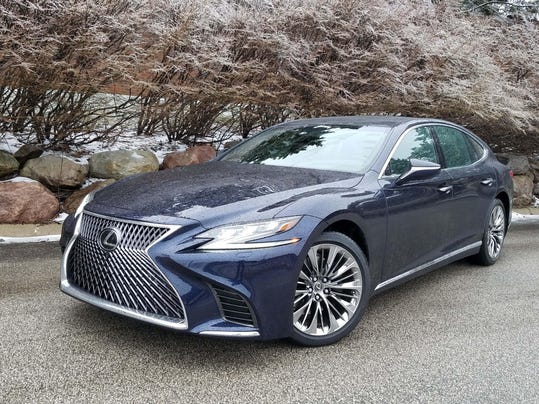
In 1989, “The Simpsons” debuted on television, the Tigers were mired in a rebuilding year and the fall of the Berlin Wall promised the end of the Cold War. Thirty years later, and the Simpsons are still America’s family, the Tigers are again reinventing themselves and Russian relations are colder than a Michigan spring.
But before you think we’re in a “Groundhog Day” movie loop, gaze upon the all-new Lexus LS 500 sedan. This is not your father’s LS.
The year 1989 was also notable, of course, for the debut of the LS 500 — at the Detroit auto show — as Lexus’ flagship. True to Japanese stereotype, the LS was a cheaper knock-off of the luxury segment’s state-of-the-art Mercedes S-Class. Same upright grille with rectangular, encased headlights. Same long, slab sides. Same gray rocker panels, same rectangular taillights, same leather-wrapped interior.
Toyota’s premium brand built its reputation on bulletproof reliability, slavish customer service and wallet-friendly pricing. Design was an afterthought.
Not anymore.
Once again using Motown’s show as its backdrop, Lexus’ all-new, fifth-gen LS hit the stage in January like Bette Midler belting out “Hello, Dolly!” This Lexus had brass, sass and a personality all its own. And like any Broadway diva, the result is a polarizing talent that won’t be everyone’s cup of tea.
My 2018 tester arrived in the driveway with a cowcatcher grille bigger than a steam locomotive.
The spindle grille has become Lexus signature. It graces everything from the enormous mask on the RX ute (a face only Darth Vader could love) to the artful sculpture on the racy Lexus LC 500 sports coupe. The LS’s sci-fi grille is somewhere in between — neither pretty nor hideous. Flanked by “Z” headlights, it is a galaxy away from the Mercedes’ classic facial bone structure.
“It’s a handsome car except for the grille,” said a friend. “The grille’s ugly, but the back is nice,” another friend said of the derriere’s bold, horizontal lines interrupted only by a chrome drip (another Lexus signature) at the corner taillights.
Indeed, the Lexus is a bit of a split personality, like Tommy Lee in a tuxedo. Elegantly radical.
In between its “ugly” face and “nice” tush are a coupe-roofed, rear-wheel-drive-proportioned sedan draped over a 123-inch (a foot longer than the 1989 model) wheelbase. In contrast with the RX which demands an opinion from every angle, the rocker panels and door handles are conservatively conventional.
But then Lexus goes too far with a touch-pad operated infotainment screen that will drive you bonkers. Mrs. Payne nearly took a tire iron to the mouse-controlled display of the Lexus GS on a recent journey to West Virginia so, naturally, Lexus made the LS controls even more diabolical.
Trying to navigate the haptic touchpad while traveling is like moving target practice. To make matters worse, Lexus buries features in the screen like heated seats that most automakers locate on the console. The LS console is a sleek piece of uncluttered art — at least until frustrated passengers start gouging it with blunt objects.
My wife tried adjusting her heated seats with the touch pad while I drove and soon threw her hands up in frustration. Naturally, the Lexus features an advanced safety system — no doubt to help drivers distracted by the maddening touchpad — that has its own issues. Like other Level 2 systems, “Safety System Plus” triangulates adaptive cruise-control, lane-keep assist and blind-spot assist to create a cocoon of self-driving comfort on freeways. Until it doesn’t.
Like Tesla’s Autopilot, SS+ will simply stop working when it can’t make out road lines or center itself in the lane. That means you have to be alert, lest the system takes a coffee break. It’s a toy, not a tool.
Happily, there is the back seat for when the front gets too stressful. In fact, I would recommend going everywhere with two couples to gain the full LS experience. Touchpad driving you batty? Time to switch with the rear passengers!
Equip your LS with the $12,270 luxury package and you won’t regret it. In addition to the aforementioned, 28-way front thrones, you get reclining, 18-way heated rear sofa chairs with power window shades, a seven-inch touchscreen controller (Hooray, no touchpad!) and Ultrasuede liner.
My chocolate Ultrasuede door liner looked like it had been applied with a cake knife, its sugary material shaped with scalloped swirls. I gained 10 pounds just looking at it.
The touchscreen controller not only heats and reclines your own seat, but moves the front passenger seat forward for extra space (oops, still got room up there?) and controls the front radio (“CNN? I’ll switch to Fox News, thank you very much!”). Opt for the $1,000 panoramic roof and you can also control how much sun you get. Aaaah, that’s the life.
The Adaptive Variable Suspension also makes for a carpeted ride back there, electronically adapting to Detroit’s worst roads. On a double date, our chauffeured friends paused from licking the chocolate suede to notice how uncommonly smooth was the drive down the pothole-pocked Lodge service drive.
Naturally, the Lexus also has split driving personalities.
Determined to match its hair-raising design with goosebump-raising performance, the all-new architecture is lower, lighter and more nimble. Give the big bull’s right horn (sprouting from the cockpit cowl) a twist and you are in Sport Plus mode: springs-stiffened, 10-speed tranny optimized, growling 3.5-liter twin-turbo V-6 at the ready.
Open the throttle gates and the 4,938-pound heifer is on the loose, its 442 pound-feet of V-6 torque stampeding across the landscape.
It’s not a the V-8 roar of old — hey, its’ not 1989 anymore. But it has personality, just like the rest of this big, ugly, handsome, relaxing, maddening Japanese land yacht. The new Lexus is still cheaper than a Mercedes, still leads five-year cost-of-ownership listsand still speaks geek. But it’s never boring.
Henry Payne is auto critic for The Detroit News. Find him at hpayne@detroitnews.com or Twitter @HenryEPayne. Catch “Car Radio with Henry Payne” from noon-1 p.m. Saturdays on 910 AM Superstation.
2019 Lexus LS 500
|
VEHICLE TYPE |
FRONT-ENGINE, REAR AND ALL-WHEEL DRIVE, FOUR- OR FIVE-PASSENGER LUXURY SEDAN |
|
Price |
$75,995 base ($103,635 AWD with luxury package as tested) |
|
Power plant |
3.5-liter, twin-turbo V-6 |
|
Power |
416 horsepower, 442 pound-feet of torque |
|
Transmission |
10-speed automatic |
|
Performance |
0-60 mph, 4.6 seconds (mfr.); top speed: 136 mph (electronically limited) |
|
Weight |
4,751 pounds (5,093 pounds as tested) |
|
Fuel economy |
EPA fuel economy: 19 city/29 highway/23 combined (RWD); 18 city/27 highway/21 combined (AWD) |
Report card
Highs: Unique design; palatial back seat
Lows: Maddening remote touch-pad screen controller; clunky auto downshifts at low speed
Overall:★★★
Payne: Yankee-fied VW Jetta goes big, stays nimble
Posted by Talbot Payne on April 19, 2018

We Americans are getting so fat that the compact 2019 VW Jetta is bigger than Volkswagen’s 2004 mid-size Passat. And don’t even ask how big the new Passat has become (hint — New Yorkers are using them as apartments).
The all-new, Mark 7 Jetta has more headroom, shoulder-room, belly-room, and leg room than its predecessor. But, I am happy to report, it has lost none of its spunk.
Indeed, despite its girth, the nattering of government mpg nannies, and Americans’ demand for a rolling arcade of electronic gizmos (guilty as charged), the Jetta has not lost its athleticism.
Credit its stiff, new, MQB chassis and a fearsome squadron of competitors that have also upped their game, and — WHUMP! Didn’t see that railroad crossing in Middle-of-Nowhere, North Carolina coming.
Despite my flogging the Jetta at high speed along a hilly country road outside Durham, the V-dub’s new, torsion-beam, rear suspension was barely ruffled by the uneven crossing. A V-dub without an independent rear suspension? Gott in Himmel! Happily, my 6’5” head — and that of my tall driving partner, Seyth Miersma — didn’t pogo-stick into the roof.
Indy-rear compacts are an elite club of which Jetta was once a part (Jetta’s sportier cousin VW Golf is still a member as is the Honda Civic). But in the ferociously competitive, $19,000-$26,000 compact segment every bolt counts and IRS is a luxury. Even the forthcoming, zoom-zoom Mazda 3 will succumb to the cheaper beam to cut costs.
Used to be VW thought it was enough to wave around IRS and German engineering and then have Yanks swoon at their feet in homage. Such arrogance led to woeful sales — and to Dieselgate. Humbled, it is now Volkswagen’s turn to grovel at the feet of us Yanks — and they are doing a fine job of it.
VW these days is talking with a very American accent. A southern, Tennessee drawl.
Ignore the cocktail party talk of an electric future, saving the planet, blah, blah, blah. Herr Volkswagen is leaving the party in a 3.6-liter, gas-powered Atlas SUV. Built in Chattanooga. And he wants to build a two-row Atlas and an Atlas pickup too, ya’ll.
The same XL theme carries over to VW’s compacts. Wolfsburg doesn’t even bother sending us its Pop and Polo subcompacts because they know they’d sit on the shelves like a Hillary Clinton campaign tome. Instead, they made a better, bigger, cheaper Jetta. Yes, cheaper (see axing that expensive, multi-link, IRS rear suspension).
Suddenly, über-engineered VW is a value brand in America, the only country where Jetta will be sold.
The volume SE model comes equipped with best-in-class, transferable, bumper-to-bumper warranty of 6 years/72K miles, smartphone app connectivity and blindspot assist, which — at $23,005 — is on par with compact peers.
Take the comparable Mazda 3 Touring — one of my favorite value models — and Jetta goes toe-to-toe on blind spot-assist, torque and handling. The Mazda jumps ahead with sexier looks and auto-headlights (something some luxe brands don’t offer) — only to see the VW claw back with a bigger, quieter interior and smooth-shifting eight-speed tranny (also shaming some premium entries).
Ultimately, cars in this segment must be judged against King Civic, which set a new bar in 2016 for fuel economy, handling, rear legroom and techno-smarts. Jetta doesn’t flinch from the challenge, nearly matching the best-selling, benchmark Honda in all respects.
But it also separates itself in two crucial respects: powertrain and looks. Under the hood, the 1.4-liter turbo-4 never starves for power with a stump-pulling, 183-pound feet of torque compared to the Civic’s 153.
As for curb appeal, the mascara-smeared, boomerang-taillight Civic looks like something on its way to a Mötley Crüe concert. Conservative Jetta can be taken home to mother with its nicely creased flanks and groomed front end. Brahms, anyone?
Actually, the V-dub secretly likes to rock out. Jetta brought Beat reps to its media debut, who had designed an audio system for (upper trim SEL) Jetta in collaboration with rapper and Eminem producer Dr. Dre. That’s right, Dr. Dre rappin’ in a Jetta.
Jetta is a fully Yankee-fied product in other ways, too. It’s made in Mexico just like The Donald’s suits. Its redesigned console sports plenty of cubby space for fries, smartphones and other daily necessities. Its big grille is a dead ringer for a Dodge Charger right down to the C-shaped LED running lights.
The V-dub even adopts the American habit of non-functional design cues tacked on just for show. Think fake engine ports. Or fake hood scoops. The Jetta’s contribution to the wardrobe malfunction club is rear, “floating” dual chrome exhaust tips. Except that there are no exhaust pipes behind them (the actual pipe is hidden behind the left fender). They are, ahem, just for show.
Exhaust tip bling also perfectly illustrates the difference between Jetta and its kissing cousin, Golf.
VW is unusual in splitting its compact models by body style: Jetta sedan and Golf hatch. Other auto models (Civic, Focus, Cruze) are content to change their wardrobe while maintaining the same badge. Readers of this column know I’m a hot hatch hooligan and prefer the Golf GTI to just about everything on the market.
I fit VW’s demographic stereotype perfectly. The $27K GTI embodies the Golf spirit with a different engine (turbocharged 2.0-liter) and accounts for some 50 percent of sales reaching well above 30 grand.
The Jetta, meanwhile, is marketed toward a more budget-conscious, more interior-oriented customer (an IRS-equipped GLI model sharing the GTI engine comes later). So the $20K S and SE models are the volume sellers with top, $27K-trim, SEL and SEL Premium trims getting exclusive touches like 10-inch digital instrument display, moonroof and heated rear seats.
The Jetta-Golf personality split is even evident in Jetta’s “sporty” trim, the R-Line. For just $23,845 its brooding black grille and racy wheels appear ready to rumble. But look closer and R-Line is not available with paddle shifters, or a manual transmission, or even a SPORT drive mode.
That autocross-friendly, limited-slip diff is a tech orphan.
But the Jetta lineup should find plenty of homes. Wolfsburg finally gets it and has produced a sculpted, roomy, techy Teuton aimed squarely at the heart of the American market. Or perhaps I should say, squarely at our big, fat behinds.
Henry Payne is auto critic for The Detroit News. Find him at hpayne@detroitnews.com or Twitter @HenryEPayne. Catch “Car Radio with Henry Payne” from noon-1 p.m. Saturdays on 910 AM Superstation.
2019 Volkswagen Jetta
|
VEHICLE TYPE |
FRONT-ENGINE, FRONT-WHEEL DRIVE, FIVE-PASSENGER COMPACT SEDAN |
|
Price |
$19,395 base ($23,845 R-Line and $27,795 SEL Premium as tested) |
|
Power plant |
1.4-liter, turbocharged inline-4 |
|
Power |
147 horsepower, 184 pound-feet of torque |
|
Transmission |
6-speed manual; 8-speed automatic |
|
Performance |
0-60 mph, 8.0 seconds (Car and Driver est.); top speed: 127 mph |
|
Weight |
2,970 pounds as tested |
|
Fuel economy |
EPA fuel economy: 30 city/40 highway/34 combined (automatic as tested) |
Report card
Highs: Nimble handling with peppy turbo; roomy interior
Lows: Fake, floating exhaust tips; volume knob mute, please?
Overall:★★★
Automakers push Congress for higher fuel standards
Posted by Talbot Payne on April 19, 2018
Two weeks after winning a victory against aggressive federal fuel economy rules aimed at speeding adoption of electrified vehicles, the U.S. auto industry went to Capitol Hill last week to press Congress for a national fuel octane standard that would help increase the efficiency of the internal combustion engine.
With consumers resistant to expensive, battery-powered cars and gas prices low, automakers say they will have to meet federal mpg standards in coming decades with advances in the gas engine.
Key to that progress, they say, is higher octane fuel — about 91-octane compared to today’s 87-octane pump standard — which will deliver 3-percent-better fuel economy for an estimated 3-percent increase in cost. The standard is referred to by its international metric, 95 RON, which translates to U.S. 91-octane.
“We got a very good reception in Washington,” General Motors Co.’s vice president for global propulsion, Dan Nicholson, told The Detroit News on 910 AM Radio Saturday, one day after a hearing before the House Energy and Commerce Committee that included representatives of Detroit’s Big Three and members of the fuel industry.
“The status quo is untenable,” said Nicholson, who first announced the pro-95 coalition on behalf of the U.S. Council for Automotive Research (USCAR) at the SAE World Congress last week. “Fuels and engines are a system together, so 95 RON is important. Better fuel means you can go back and redesign engines for better fuel efficiency.”
Higher octane makes gas more stable under ignition compression — commonly known as knock — which can damage internal engine components. A higher, 91-octane (95 RON) standard would allow engineers to design engines to a higher compression ratio — perhaps to 15:1 over today’s average of 10:1 — and gain more mpg while not sacrificing performance.
“America deserves at least as good a fuel as Europe has,” Nicholson told the SAE panel last week. “It will have customer value if it’s done correctly. We’ve studied it and we know that it’s cost-effective.”
The federal government, too, set ambitious goals of 54.5 average fuel economy by 2025, in part to encourage automakers to shift toward battery power. But consumers mostly have not followed, and — encouraged by automakers — the Trump administration has agreed to review federal mpg demands, even as Washington will continue dictating efficiency goals.
In Washington, Nicholson represented the USCAR coalition of automakers that includes Ford Motor Co.’s David Filipe, vice president for powertrain engineering, and Bob Lee, Fiat Chrysler Automobiles NV’s chief for global powertrain coordination. Also there were representatives from the fuel industry — ethanol fuel interests, refiners, and fuel retailers — which has long resisted higher octane standards because of their added costs.
The panel was a rare show of auto-oil industry brotherhood. Higher octane fuel typically fetches higher prices at the pump. Standard 87-octane fuel currently averages $2.71, with premium fuels another 50 cents above that at $3.23 a gallon.
Nicholson said that the high cost of premium fuel today, however, is misleading since it is “sold as a niche product.” If 91-octane were adopted as the national standard, the price increase would not be significant while delivering consumers better mpg in return.
“(The 95 RON standard) is the most effective way we can improve fuel economy — which is why we are fighting for it,” Nicholson told The News.
But David Cole, chairman emeritus of the Ann Arbor-based Center for Automotive Research, says it might not be that simple.
“One of the things that is really uncertain is the economics of this whole effort,” Cole said. “You could achieve a better fuel economy, but whether it’s going to be enough with the cost increase of the fuel is a question. The economics as projected through the consumer is a really big deal.”
U.S. Rep. John Shimkus, R-Illinois, on the House panel Friday, called the effort to change to 95 RON a “major undertaking.”
“For one thing, we must deal with the proverbial chicken and egg conundrum — we can’t expect refiners and gas stations to invest in a new fuel unless they know that cars will be manufactured that will run on it, and automakers don’t want to commit to the new engines until they know that the fuel will be widely available,” he said. “Significant investment dollars and a great many jobs may be at stake.”
Nicholson said efforts to increase fuel efficiency by re-engineering gas engines — such as Nissan Motor Co.’s introduction this year of a variable-compression engines in its Altima sedan — are much more expensive solutions than simply raising compression levels in synch with higher-octane fuels.
“If we’re going to move forward with keeping internal combustion engines viable then we have to have improved fuels,” said Nicholson, until such time as the consumer market embraces electrification. Battery-powered cars have been dogged by high costs, a spotty charging infrastructure and fears of more limited range.
“The internal combustion engine is not dead yet, and it’s very important as we march towards zero emissions that we make significant improvement in the efficiency of internal combustion engines,” Nicholson said. “We’re now in peaceful coexistence with electrification. We’re working on both. There’s no reason not to work on both.”
Former GM Vice Chairman Bob Lutz, who is not part of the auto-oil consortium, said the timing is right for a 91-octane standard given the low cost of fuel and continued demand for gas engines.
“Right now electric cars make no common sense,” he said. “They need federal subsidies to be sold. Everything about them is artificially stimulated under the assumption we are running out of oil. But we’re not going to run out of oil.”
Nicholson said that the House Energy committee, chaired by Rep. Greg Walden, R-Oregon, was encouraging of the idea but that key details would still need to worked out. He said California, which currently only allows 91-grade premium fuel, would need to sign on to the national standard. And the standard would have to be phased in over time.
GM exec: Detroit area’s ‘talent deficit’ cost it Amazon
Posted by Talbot Payne on April 13, 2018
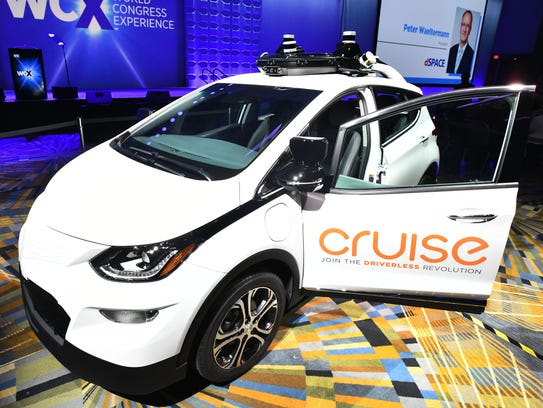
Detroit – Citing a missed chance at Amazon’s second headquarters as a dashboard warning light, General Motors Co. product chief Mark Reuss told the Society of Automotive Engineers World Congress here Thursday that the autonomous vehicle revolution will also bypass Detroit unless the region addresses its “talent deficit.”
“Look, it’s no secret why we couldn’t even make the final 20 cities on the list for Amazon’s potential second headquarters site,” said Reuss in a passionate keynote speech in Cobo Center. “It wasn’t because of a lack of mass transit, although that is important. It wasn’t because of a lack of cultural opportunities, or because of the weather. . . . It came down to a simple talent deficit.”
“Much of the future of the automotive industry is going to be determined and developed, right here,” he continued. “But only if we can develop, attract and acquire the engineering talent to do so.”
Saying that a historic shift to electrified, autonomous transportation is “all really happening,” Reuss outlined the challenge of educating more engineers as a national imperative. Currently, he said, the United States suffers labor shortages in every science, technology, engineering and math (STEM) field. In just two years the U.S. will face a shortfall of a half-million engineers, he said.
But Reuss focused his address here at home where Motor City automakers are investing billions in a sci-fi future — GM alone is in the middle of a $1-billion, 2,600-job expansion of its Warren Tech Center. He said anyone with a stake in Metro Detroit’s signature industry needs to focus on education.
“By my count, that’s just about everybody,” he said. “We have to meet or beat the talent levels in Silicon Valley and other technology hubs around the world.”
He didn’t spare SAE and industry business leaders. “I worry that we miss a lot of opportunities to really assume a leadership position,” he emphasized. “This industry is changing – fast.”
His stark diagnosis of Detroit’s failure to make Amazon’s Final 20 echoed, in part, what many regional leaders have said were the two major reasons — the other being a lack of mass-transit — that the region missed out on Amazon’s promise of 50,000 jobs and $5 billion investment.
Reuss’ comments contradict another prominent tech player in the region, Dan Gilbert, chairman and founder of Quicken Loans.
In a letter this January to the 60-member bid committee addressing Amazon’s decision, Gilbert dismissed concerns over talent and cited Detroit’s negative image as “the elephant in the room.”
“Old, negative reputations do not die easily. I believe this is the single largest obstacle that we face,” Gilbert wrote. “Outstanding state-of-the-art videos, well-packaged and eye-catching proposals, complex and generous tax incentives and highly compelling and improving metrics cannot nor will not overcome the strong negative connotations that the Detroit brand still needs to conquer.”
“Our analysis found that Detroit is clearly hurting in a couple of areas,” the Lansing-based economist said. “Though I think mass transportation did hurt us with Amazon, the difficulty of educating our people hurts us every single day with every single employer.”
Despite the Amazon setback — and the warnings of giants like GM — Anderson says that many in the region refuse to accept reality.
“We’ve been criticized for saying this repeatedly,” he said. “But we consistently have shown a serious problem with K-12 education. It’s a fundamental problem that has not been remedied.”
In his speech, Reuss cited the efforts of GM and SAE in building regional educational opportunities as a good start.
A World In Motion, an SAE-organized, teacher-administered program that has brought hands-on STEM activities to K-8 students over the last decade, will receive $600,000 this year to support 1,800 volunteers. He singled out a Detroit college student, Brittany Agee, the first person in her family to attend college. She benefited from the “GM Student Core” program where company engineers mentor underprivileged kids.
“We need more Brittanys,” said Reuss. “We all need to ask how our companies can help do that.”
One of the auto industry’s greatest future concerns are self-driving systems’ vulnerability to hackers. To address this threat, Reuss said, GM and SAE have created a new program for 2018, “Cybersecurity Challenge,” designed to teach middle-schoolers how to protect the Internet’s architecture from cyber attacks.
“This is something (students) hear about all the time — whether it is companies being hacked, or individuals — it’s in the news a lot,” said Reuss.
Payne: Stress-free, thrill-free Toyota RAV4
Posted by Talbot Payne on April 5, 2018

The best-selling book on Amazon for much of the year has been “12 Rules for Life: An Antidote for Chaos,” by Jordan Peterson. The title is self-explanatory. It’s a 12-step guide to stress-free living.
Chapter titles include: “Rule 3: Make friends with people who want the best from you” and “Rule 8: Tell the truth — or, at least, don’t lie” and “Rule 12: Pet a cat when you encounter one on the street.”
Psychologist Peterson might have added Rule 13: Buy a Toyota.
Toyota has kept auto buyers off the shrink couch for decades. The brand has been synonymous with chaos-free reliability as it scooped up award after dependability award.
It’s no wonder, then, that the Toyota RAV4 in my driveway is the best-selling non-pickup in the United States. A staggering 407,594 were sold last year.
As Americans have crossed over to crossovers, compact SUVs have become the equivalent of the midsize family sedan. True to its brand, RAV4 has a trophy case full of reliability awards including a 9.3 (out of 10) reliability rating from Kelley Blue Book, IHS Automotive longest-lasting vehicle plaudits, and so on.
The RAV4 is the nanny of autos. It’s always there to pick you up after school, always there to carry your stuff, always nag-nag-nagging you when you want to have fun.
OK, so I am not your typical automotive appliance buyer. I’m a little rebellious when it comes to driving.
Give me a hot hatch or a sports car. Or the all-wheel drive hatchback Audi TT S sports car that I recently raved about, because I can take it to the track in the summer and do four-wheel drifting on snowy county roads in winter. I tried that last maneuver and the RAV4 looked at me with arms crossed, shaking its head.
I tried anyway. I turned off the traction control and … well, I eventually turned off the traction control after looking everywhere in the cabin for the button. It’s a tiiiiiny little button northeast of the radio screen next to three other tiny buttons indicating whether all passengers are belted in.
Who puts it there? An SUV determined to get Insurance Institute for Highway Safety top safety ratings, I guess.
But one push of the button didn’t do it. Unlike every other car I’ve ever driven, the “traction-control off” light on the dash changed little in the car’s performance. Under throttle through some Oakland County twisties the power was suddenly cut back as if the nanny systems were still engaged.
Indeed, the nannies are so intrusive in the RAV4 that the car nearly stalls in a straight line — much less under g-loads — if the electronics detect tire slip. On Detroit’s snowbound roads, this often made for tortoise-like stoplight getaways as RAV4 refused to allocate power to the wheels while two lanes of traffic streamed by on either side of me.
To turn off traction control altogether, the “traction-control” button must be held down for five seconds.
Mrs. Payne would approve. She has no taste for my all-wheel-drive drifting shenanigans. And she is no doubt joined by the 100 percent of the appliance buyers who have made RAV4 their top sales pick. If you want to drift a best-seller, then buy the Nissan Rogue — No. 2 in sales to RAV4 by a mere 3,000 units — which sports a nimbler chassis than the Toyota and requires one push of its (easily located) traction-control button.
Conservatism is the RAV4’s default mode.
The Toyota doesn’t offer the electronic gee-gaws that other competitors do like self-park assist (Ford Escape); or automatic high-beams (Mazda CX5); or fold-flat front seat (Chevy Equinox); or kick-open rear hatch (Ford and Honda CR-V); or Apple CarPlay and Android Auto app connectivity like just about everybody.
Perhaps most glaring was a lack of heated seats in my $32,714 model. Nearby in my driveway were a $27,000 VW Passat (leather seats) and all-wheel drive Subaru Impreza wagon (cloth seats like the RAV4) which were both equipped to warm up a cold tush on a cold day. Heated seats are one of my wife’s No. 1 priorities.
The interior is roomy with workable ergonomics, though the old-fashioned gated shifter seems oh-so 15 years ago.
The staid interior contradicts first impressions, as I find the RAV5 one of the more interesting mainstream utes to look at — especially the new-for-2018 Adventure model that I drove. When you’ve got 400,000-plus units flooding American roads every year, it’s nice to have a little variety and the Adventure delivers.
It features a flat-black hood a la Camaro 1LE, more aggressive wheel-well cladding and blacked-out headlights that make the RAV4’s signature, thin, wraparound grille look even more like the X-Men’s Cyclops.
The Adventure model is supposed to appeal to Toyota appliance buyers with a little Jeep ruggedness in their blood (hey, now my off-road antics don’t seem so crazy after all, hon!). The inside is festooned with thick, rubber mats with an “Adventure” logo on them. The chassis gets big 18-inch blacked-out wheels, more ride-height, and engine radiator and transmission upgrades to more than double RAV4’s towing capacity to 3,500 pounds.
Nice, though in keeping with Toyota’s conservative nature, it’s still well off a Jeep Cherokee V-6’s 4,500-pound rating.
When I wasn’t begging for less nanny and more power on slushy roads, the RAV4’s ride was surprisingly quiet given its non-turbo, 176-horse four-banger engine. A similar mill in a Mazda CX-5, for example, can get shouty — credit the Toyota’s very smooth, six-speed tranny which also helps return a respectable 25 mpg.
Last week in New York, Toyota unveiled an all-new fifth-generation RAV4 with a remake that will address many of the shortcomings mentioned above, from standard features to clunky shift-gate to more horsepower (though its awkward new face made me nostalgic for Cyclops). Based on the same wider, lower, stiffer platform that rejuvenated the Camry sedan in 2017, the new RAV4 goes on sale next winter.
In the meantime, I have to sit back and applaud a five-year-old car that continues to soar to new sales heights. Who needs a redesign when you’re an antidote for chaos?
Henry Payne is auto critic for The Detroit News. Find him at hpayne@detroitnews.com or Twitter @HenryEPayne. Catch “Car Radio with Henry Payne” from noon-1 p.m. Saturdays on 910 AM Superstation.
2018 Toyota RAV4
|
VEHICLE TYPE |
FRONT-ENGINE, FRONT AND ALL-WHEEL DRIVE, FIVE-PASSENGER SUV |
|
Price |
$25,505 base ($32,714 RAV4 Adventure as tested) |
|
Power plant |
2.5-liter inline-4 |
|
Power |
176 horsepower, 172 pound-feet of torque |
|
Transmission |
6-speed automatic |
|
Performance |
0-60 mph, 8.5 seconds (Car and Driver); towing: 3,500 pounds |
|
Weight |
3,605 pounds as tested |
|
Fuel economy |
EPA fuel economy: 22 city/28 highway/25 combined (AWD Adventure as tested) |
Report card
Highs: Rugged Adventure trim; quiet interior
Lows: Nagging nanny safety systems; missing features
Overall:★★★
Payne: 10 must-see vehicles at NY auto show
Posted by Talbot Payne on March 30, 2018
New York – The Big Apple’s Auto Show is a different animal than its Detroit counterpart. If you can make it here, you can make it anywhere – and a lot of people have. Almost a quarter of Gotham vehicle registrations are for luxury models. That’s nearly double the national average. As a result, luxury-automakers target New York for product reveals.
Yet, this year New York showed surprising bandwidth with introductions of volume mainstream vehicles like the Toyota RAV4 compact SUV and the Nissan Altima midsize sedan. Detroit will always host Big Three truck intros, but Motown’s lux-makers are eager to make it here (so much so that Cadillac has made the Empire City its home), so Cadillac and Lincoln brought their A games. The variety extended to robot cars and battery-powered rocket ships.
Herewith, in no particular order, the 10 must-see vehicles in New York:
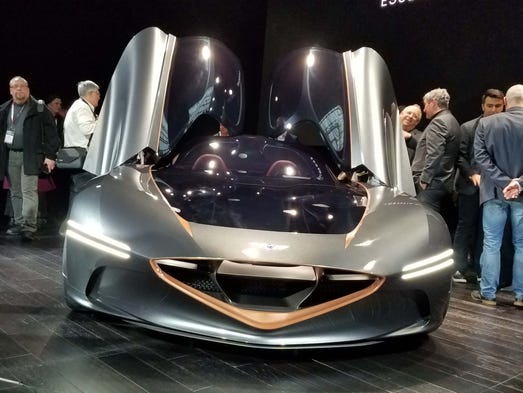
A throwback to fanciful show concepts of old, the Essentia imagines an electric 2+2 coupe for the semi-autonomous future. A Formula One-style keel nose sits under a transparent hood, revealing inboard springs and aerodynamic tunnels for increased down-force. The digital cockpit straddles a center-line battery pack so that passengers sit low to the ground. Naturally, the concept gets butterfly doors, but my favorite details are the thin LED front running lights. There are no projector lamps to be found, because self-driving cars won’t need headlamps to see.
Displayed in the show’s exotica bullpen next to $2 million Lamborghinis and Bugattis, the Croation start-up’s second model manages to stand out. Determined to be the fastest EV ever, the hypercar with four electric motors generates jaw-dropping numbers from its 120-kWh powerpack: 1,914 horsepower, 1,696 pound-feet of torque, 230 mph top speed and a zero-60 spirit in just 1.85 seconds. That’s faster than the new Tesla Roadster. Determined to be the EV benchmark, the C_Two will soon take a shot at the Nurburgring lap record.
Across the aisle from Rimac’s expensive nest is the $25,000 Forester, Subaru’s second-best selling vehicle and marvel of affordability. Based on Subaru’s all-new global platform, the all-wheel drive Forester has more room and more standard features. My highlight is the rear tailgate opening which grows 5 inches wider – enough to swallow a golf bag sideways. All this goodness is wrapped is a more handsome wardrobe than the last-gen cardboard box.
Think of it as the baby Navigator. The three-row Aviator concept replaces the unloved MKT with dramatic looks, sumptuous interior and signature 30-way Lincoln seats. But the big ute is more than a pretty face. It’s is built on a rear-drive platform which Lincoln says allows a longer hood design as well as better grip for towing.
Forget your growly V-8 Jags of old with hoods longer than your driveway. The I-Pace SUV takes aim at the Tesla Model X with a meaty 90 kWh battery that boasts 240 miles of range and lots of torque. With batteries in the basement, the Brit EV features nimble handling and room for five adults. But will customers want a Jaguar without the growl?
You read that right – a Volkswagen pickup. The German automaker is determined to connect with us Yanks and what better way than an all-American truck? The Tanoak concept would be built off the same unibody bones as the three-row Atlas SUV, making it the third ute-based midsize pickup after the Honda Ridgeline and coming Hyundai Santa Cruz. The Tanoak’s rugged design looks nearly production-ready and its large dimensions are competitive with the GMC Canyon. The bed should be big enough to fit your old VW Rabbit, too.
This subcompact ute begins Cadillac’s comeback in the SUV segment. Aimed at the BMW X1 and Audi Q3, XT4 follows sister XT5’s strategy of offering large dimensions for the segment. Like big brother Escalade, the XT4 sports dramatic, vertical tail-lamps taller than the Fox Theater marquee. Unlike its siblings, the new ute adds buttons to the CUE infotainment system’s unloved touchscreen.
The next-generation Altima is the latest Japanese sedan to try to keep cars relevant in ute nation. The Altima follows the Honda Accord and Toyota Camry with dramatic styling that SUVs like – well, the Nissan Rogue – can’t touch. Roomy Altima also offers all-wheel drive for the first time for better ute-like utility as well as a pioneering variable-compression turbo-4.
The SUV performance arms race continues. Maserati’s family SUV gets a 590-horsepower Ferrari-assembled twin-turbo V-8 to best the Alfa Romeo Stelvio Quadrifoglio’s (say that 10 times fast) 505 horsepower and the Jaguar F-Pace SVR’s 550. So you can go zero-60 in just 3.7 seconds while coddled by red leather seats with Wagner playing over the 17-speaker Bowers & Wilkins audio system. Be warned, though. The 707-horse Jeep Grand Cherokee Trackhawk is quicker.
It’s hard to ignore a remake of the best-selling non-pickup in America. The RAV4 gains capability on the Toyota’s new TNGA platform, but that doesn’t make it any prettier. The ute is homelier than ever. Happily, an interior decorator was hired for upgrades inside, bringing the RAV4 into the 21st century. Determined to give its loyal customers more model differentiation, a new Adventure trim brings the rugged (better) looks of the Tacoma pickup.
Bipolar auto disorder: mixed messages at NY show
Posted by Talbot Payne on March 30, 2018

New York – You can sense the desire for an autonomous electric future in Gotham’s gridlocked streets: Impatient business people, Uber drivers and families find themselves stalled in cross-town traffic wasting precious time.
Waymo and Jaguar opened the New York auto show early Tuesday with a lifeline to urban commuters: a gorgeous, five-passenger, self-driving Jaguar I-Pace EV with 360-degree lidar detection and a 240-mile battery range.
The future is here, right? Not so fast.
By the end of Tuesday, Jaguar had also introduced a 550-horsepower gas-guzzling variant of its F-Pace SUV. Wall Street’s NASDAQ index had stumbled – in part as Silicon Valley’s pet tech stocks faced the consequences of a fiery possibly self-driving Tesla crash in California and continued fallout from a fatal collision between an autonomous Uber Volvo XC90 and an Arizona pedestrian.
On the show floor, Volvo’s tight-lipped response to the Uber tragedy was as noticeable as Jaguar’s celebration of 20,000 I-Pace orders from Waymo.
The show’s bipolar nature points to the uncertainties that surround the industry’s massive investment in autonomous EVs. It’s an investment driven by the conflicting incentives of market opportunity (autonomy) and government regulation (electrification) – and a promise of safety that, in the words of best-selling author and Car and Driver contributor Malcolm Gladwell, “exchanges one class of risk for another.”
For small luxury-automakers like Volvo and Jaguar, there is an irresistible upside to partnering with ride-share giants like Uber and Waymo because it raises automakers’ profiles in a high-tech, eco-conscious segment of the marketplace. Autonomous ride-sharing also promises large sales volumes for EVs that have struggled to earn back their production costs.
But the downside was painfully obvious as the video of the fatal Uber crash went viral. Suddenly, the carefully manicured reputation of Volvo as a safety brand was in jeopardy.
Volvo refused comment this week, sticking to a statement it released after the Uber incident which read in part: “Uber is cooperating with local and national authorities and Volvo is assisting in these investigations. We cannot speculate on the cause of the incident. We await the full investigation report.”
Large automakers like General Motors, Audi and Toyota have been careful to keep their autonomous testing in-house – partially out of a concern of being dependent other manufacturers’ technology, company insiders say.
In an auto show forum hosted by Car and Driver, Gladwell – a renowned author whose work explores the sometimes unexpected implications of technological progress – expressed broader concerns over the vulnerability of autonomous cars if they fulfill their promise as the dominant form of personal transportation.
“The automobile can be subject to malicious manipulation,” said Gladwell, drawing parallels with the persistent hacking problems other industries like banking have suffered as they have increased electronic services. “If I were a malicious hacker, I’d want to hack into 5,000 cars on I-95 during rush hour and cause a 9/11-type event.”
“I worry about this,” he said.
On the battery front, uncertainty over EV profitability has driven Jaguar to, paradoxically, make more gas-guzzling SUVs.
Moments after declaring the battery-powered I-Pace “the future” of sustainable transportation, Jaguar design boss Ian Callum on Tuesday night rolled out the 550-horse, sub-20 mpg, SVR performance version of the brand’s best-selling E-Pace ute.
“From the sublime to the ridiculous,” smiled Callum. That is, from the unprofitable to the very profitable.
Bipolar product disorder is perhaps no more pronounced than at Volkswagen which stunned New York with a Big Three-fighting Atlas Tanoak pickup truck concept.
The 3.6-liter V-6-powered pickup was announced as part of a “family” of Atlas vehicles based on the German automaker’s huge three-row Atlas SUV. The announcement came just three weeks after Volkswagen declared at the Geneva Auto Show its commitment to a gas-free, all-electric future with its family of ID electric cars: the Vizzion, Crozz and Buzz Microbus.
The product paradox is everywhere in New York’s Javits Convention Center. Toyota’s self-driving ePallette autonomous concept – on course for its Tokyo Olympics public debut in 2020 – shares the lineup with the Tacoma and Tundra pickups. Nissan’s stand showcased the company’s new electric Formula E race car even as it introduced an all-new Nissan Altima powered by a cutting-edge, variable-compression gas engine. A Chevy Bolt EV is yards away from a V-8 Camaro.
“Automakers have got to keep one foot in the present while planning for the future,” said Kelley Blue Book auto analyst Karl Brauer. “Companies like VW are following a similar model to GM, which claims they are a button-push away from an electric future – yet sell hundreds of thousands of profitable Silverado pickups a year.
“The companies that successfully fund their future are the ones that can win this battle.”
Payne: VW wakes up sleepy Passat with GT model
Posted by Talbot Payne on March 30, 2018

The sleepy Volkswagen Passat made a New Year’s resolution at January’s Detroit auto show: I’m going to live a little.
So the German sedan raided hip brother Golf GTI’s closet, took an armful of hot-hatch clothes, and — Heiliger strohsack! — showed up in Detroit as a Passat GT.
Outfitted in white with lots of black mascara around the headlights and a grille outlined in red, the GT just popped. I can’t remember the last time I used “Passat” and “popped” in the same sentence. Three months later and Passat is keeping its resolution.
I just drove the GT to Hell (Michigan) and back, and it’s not only got the GTI’s zeitgeist, it does it with 50 percent more rear legroom and 60 more ponies from a growly V-6. Gott in himmel!
The GT is a welcome tonic for a sedan that has been a wallflower in a wallflower segment. Buyers walk right past sedans these days to dance with high-riding SUVs. Ute sales were up 24 percent in 2017. Car sales? Down 17 percent. So midsize mainstays like the Toyota Camry and Ford Fusion have sexed-up their wardrobes with flashy new sheet metal and pricey V-6 sport models.
The special-edition Passat GT comes from good (if understated) stock. Take the Passat SE recently in my driveway. “S” for somnolent.
The V-dub all but disappeared next to the hot-hatchback Kia Stinger (the time machine from the memorable Super Bowl ad with Aerosmith’s Steven Tyler) that I tested at the same time. Thin upper grille, slab sides, plain rockers … zzzzzz. If it weren’t for the VW logo the size of Flavor Flav’s clock dangling from its grille, it could be anything.
But climb into the mid-size V-dub and it blossoms into one oversize value. There, I did it again: VW and value in the same sentence! That’s new.
Start with the six-year/75,000-mile bumper-to-bumper warranty that covers everything including drivetrain. Transferable if you buy a used Passat.
The SE is loaded for just $27,145: Heated seats, keyless entry, adaptive cruise-control, smartphone-app connectivity, all wrapped in a cocoon of air bags and autonomous braking should you ever do anything naughty. Sure, I would have liked a couple more things like a heated steering wheel and a phone cubby, but that’s like complaining that your 10,000-square-foot beach rental doesn’t have a toaster oven.
The $29,995 Passat GT is a bargain, too. Compare that to the similar, front-wheel-drive, 302-horse Camry SXE V-6 which starts at $35,845. The GT gets big, 19-inch tornado wheels, sunroof, two-tone leather seats and a growlin’ V-6 that you used to have to shell out $35,450 for in the top-trim SEL. Mated to a paddle shift-equipped, dual-clutch transmission that shames many luxury models, the V-6/6-speed tandem is the best team since the Bryan brothers.
The V-6 even belts out rev-matching downshifts I nearly missed because the interior is so quiet. And roomy. I swear it’s 10,000 square feet inside. The back seat swallowed my 6-foot-5 frame with ease. The trunk is deeper than Bear’s Cave with fold-flat rear seats that extend its utility.
Speaking of length, Passat’s 181/2-gallon tank will carry you nearly 700 miles on a fill-up in the base model’s turbo-4. That helps make up for its slight mpg deficiency (29 mpg) next to others in its class. With 106 more ponies, the V-6 will still travel over 500 miles.
Overshadowed by the GT’s mill, the SE’s 2.0-liter 4 got more power for the new year and was plenty peppy on Oakland County’s curvy lake roads. Which is promising, because Passat’s Chattanooga plant will soon get VW’s light-weighted MQB chassis that is the foundation for the nimble Golf.
Still, the big Passat’s older platform makes this chariot feel a size smaller on the road. Like 6-foot-9 Blake Griffin making a spin move for the basket from the top of the key, drivers can feel confident the sedan will go where it’s placed.
This is in contrast to VW’s big cool-for-school Tiguan and Atlas SUVs which depart from the sporty car formula for a more carpeted ride. While other manufacturers — BMW, Mazda — draw a straight line between their sporty sedans and SUVs, VW’s model lines offer different personalities.
The GT is also a welcome addition to Passat because the badge must justify itself against King Accord.
Honda’s 10th-generation, mid-size sedan set a new standard as 2018 North American Car of the Year. Toe-to-toe with the likewise all-new Camry, it beats its Japanese rival in nearly every measure.
That’s a tough crowd. Compared against Accord’s comparable, EX trim, Passat SE punches strong with its laundry list of standard features. VW has caught up with the focus group-obsessed Japanese in the ergonomic category where Germans once sniffed at Americans’ obsession with living in their cars. Was is das? Cupholders? Drinking is for das Bierhaus, not for sie car!
The Passat provides decent storage — despite the, ahem, microscopic forward cubby — and most impressively, a user-friendly infotainment touchscreen with radio favorites easily thumbed with a toggle on the steering wheel for less-distracted driving.
As noted, the gas tank gives outsize range. And like the Accord, the VW’s superb chassis engineering allows it cavernous interior and cargo on a sprightly, 3,200-pound chassis.
On styling and drivetrain, the Accord is superior to the Passat SE. Once a disciple of V-6 engines, the Honda now makes an astonishing 1.5-liter turbo-4 that not only bests the German’s blown 2.0-liter by 20 horsepower, but does it with better fuel economy.
The Accord’s lovely swept sportback doesn’t compromise headroom. Its huge front bug-catcher isn’t my cup of tea, but at least it has personality. All this and a Honda bottom line that is $500 below the budget-friendly Passat.
Which is where we came in. Into the vanilla Passat menu comes the Chunky Monkey Almond Fudge V-6 GT.
It’s in limited production as Chattanooga assesses its value to a Passat line updating to MQB. If GT proves as popular with Passaters as the iconic GTI is with Golfers, VW will keep it cooking.
I’ll take that as another New Year’s resolution.
Henry Payne is auto critic for The Detroit News. Find him at hpayne@detroitnews.com or Twitter @HenryEPayne. Catch “Car Radio with Henry Payne” from noon-1 p.m. Saturdays on 910 AM Superstation.
2018 Volkswagen Passat and Passat GT
|
VEHICLE TYPE |
FRONT-ENGINE, FRONT-WHEEL DRIVE, FIVE-PASSENGER SEDAN |
|
Price |
$23,845 base ($27,145 Passat SE as tested); $29,995 Passat GT |
|
Power plant |
2.0-liter inline-4 (base Passat); 3.6-liter V-6 (GT) |
|
Power |
174 horsepower, 184 pound-feet of torque (turbo-4); 280 horsepower, 258 pound-feet of torque (V-6) |
|
Transmission |
6-speed automatic |
|
Performance |
0-60 mph, 5.7 seconds (Passat V-6, Car and Driver) |
|
Weight |
3,274-3,571 pounds |
|
Fuel economy |
EPA fuel economy: 25 city/36 highway/29 combined (turbo-4); EPA fuel economy: 19 city/28 highway/22 combined (V-6) |
Report card
Highs: Roomy interior; GT brings GTI-like pizzazz to Passat
Lows: Dated instrument display; GT can be thirsty under the whip
Overall:★★★
Volkswagen goes big with pickup concept
Posted by Talbot Payne on March 30, 2018

New York – Germany’s Volkswagen has thrown on a cowboy hat and boots and swaggered into the U.S. pickup market with the mid-size Atlas Tanoak truck concept.
Built on the same bones as the three-row Atlas SUV, the Tanoak — introduced Wednesday at the New York auto show — is the latest pickup to be based on a car-like unibody instead of a traditional body-on-frame truck chassis. It is also part of Volkswagen’s strategy to redefine itself as an ute-maker with an expanded Atlas family.
“The Tanoak takes (the Atlas) to a new all-American extreme,” Volkswagen North America CEO Hinrich Woebcken said at the reveal.
U.S. truck enthusiasts have long pooh-poohed unibody pickups for their lower towing and payload numbers. But unibody chassis boast a smoother ride than ladder frames, and the Honda Ridgeline — built on the same unibody as the Pilot SUV — has been a popular alternative since its 2016 introduction.
Hyundai is building its own unibody concept based on the Santa Cruz concept that debuted at the 2015 Detroit auto show. Volkswagen is testing the waters to see if there is room for its own unibody creation.
There are no current production plans for the Atlas Tanoak, according to Volkswagen. But the automaker wants to gauge response to the idea, since pickups are one of the biggest volume segments in the U.S.
“A mid-size pickup enhances what the VW brand wants to be — a serious player in the U.S. SUV market,” said Kelley Blue Book auto analyst Karl Brauer. “The product makes sense, they have the capacity in Chattanooga to make it, and if they’re smart they will make it as quickly.”
Edmunds analyst Ivan Drury was less impressed: “It will be tough to make a business case work for a lifestyle truck that would likely be priced at the higher end of the market, especially when you’re trying to compete with mainstays like Honda. The real missing link (in the U.S.) is a small, affordable truck with a minimalist design.”
The sculpted, upscale-looking Volkswagen concept is aimed at an increasingly crowded midsize pickup market that includes domestic truck giants like Chevy (Colorado), GMC (Canyon) and Ford (Ranger). All three domestic entries are rugged, off-road-ready, body-on-frame chassis — as is segment leader Toyota Tacoma.
The mid-size pickup market showed aggressive growth in 2014 when Chevy and GMC re-entered the game after years away, but sales tapered off in 2017. Ford’s Ranger enters the segment early next year.
The Volkswagen design looks mature with signature, narrow Volkswagen horizontal front and rear fascias wrapped by continuous LED lights. The bold side panels are etched with tall fender lines that echo the Atlas SUV.
Emphasizing the upscale, high-tech theme, the interior features a digital instrument display and center console touchscreen.
But make no mistake, Volkswagen wants customers to know this is a work truck you can take to the Texas ranch.
“The Atlas Tanoak would be built in America for Americans,” said CEO Woebcken. “It is a tribute to the American ideal … an American pickup that brings German precision.”
Contrary to stereotypically small, imported European vehicles, the big Tanoak is based on the Tennessee-manufactured Atlas midsize SUV as Volkswagen tries to better integrate itself into the U.S. market after years of slow sales.
The short-bed concept is comparable to segment-leaders Chevy and GMC, stretching to an overall length of 214 inches. That’s nearly 16 inches longer than the Atlas seven-seater. The 128-inch wheelbase is 11 inches longer than its SUV cousin.
Perched 2 inches higher than the all-wheel drive Atlas, the Tanoak is powered by a 276-horse 3.6-liter V-6 mated to an eight-speed automatic transmission.
Bigger, bolder, techier Subaru Forester debuts
Posted by Talbot Payne on March 30, 2018

New York – Subaru introduced the fifth generation of its best-selling Forester compact SUV at the New York auto show Wednesday. The latest Forester comes with more of everything: space, power, safety. Even style.
Shopping in the biggest-volume class in the market, customers flocked to the Forester for its typically Subaru all-wheel drive value, despite its frumpy exterior design. The third vehicle to be built on the brand’s new global platform (following the Impreza and Crosstrek siblings), the latest Forester sports a bolder appearance with defined wheel arches, more-sculpted body panels and designer peepers.
Under the upgraded wardrobe, the Forester takes on competitors like the Toyota RAV4, Ford Escape and Honda CR-V with improved metrics in every category.
Known for its standard all-wheel drive system that has made Subarus ubiquitous in northern climates, the Forester loads on the safety technology with standard features. Its so-called “EyeSight” system includes features found on SUVs costing thousands more: automatic pre-collision braking, adaptive cruise control, lane departure and lane keep assist. All for a starting piece of around $25,000 (exact pricing will be announced later this year).
On top of Eyesight, Subaru debuts a driver-monitoring system to address distracted driving. Subaru calls this feature “DriverFocus” and claims it “uses facial recognition software to identify signs of driver fatigue or driver distraction.” The feature will be available on Forster’s top-trim Touring model.
The bigger ute also gets more horsepower, as the Forester’s familiar, 2.4-liter “boxer” four-cylinder engine gains 12 sporty horsepower over the last generation.
Speaking of sporty, the 2019 also debuts a “Sport” model with a more-youthful appearance. Distinctive features include a blacked-out grille, unique 18-inch wheels and rear spoiler. Standard features include LED fog lights, auto high-beam assist, windshield wiper de-icer and paddle shifters.
Second in sales only to the brand’s iconic Outback wagon, the compact Forester is the anchor of an expanding SUV lineup that now includes the Crosstrek and three-row Ascent.
Audi’s 8th-generation A6 gets big technology upgrade
Posted by Talbot Payne on March 30, 2018

New York – Audi continues the rollout of its remade sedan stable with the introduction of the midsize, tech-tastic 2019 A6 at the New York auto show.
The A6 follows the full-size flagship A8, which debuted in Los Angeles last winter, and the slinky A7 sedan hatchback that bowed in Detroit in January.
Like its sister sedans, the eighth-generation A6’s wardrobe looks little different than the outgoing model. The German brand’s signature hexagon grille dominates the face with more chrome brightwork and sculpted cheeks than before. The most telling change is in the caboose where the A6 – like A8 and A7 before it – connects the rear lights with a horizontal chrome line across the trunk to give the Audi a wider appearance.
The big alterations are under the skin. Interior space grows while expanding on Audi’s reinterpretation of its infotainment systems to parallel smartphone technology. Audi has already been an innovator with its configurable Virtual Cockpit instrument display, best known for its colorful Google Map-like, landscape renderings.
Gone for 2019 is the center console’s rotary dial. For 2018, it’s replaced by two touchscreens embedded in the center dash, a change that will test owners who had mastered the remote-control dial.
The upper screen controls radio and connectivity. The lower controls temperature and other cabin functions.
The smartphone theme continues with more direct-voice commands and the brand’s myAudi Navigation system, which promises a seamless hand-off from a phone’s navigation commands to the car’s navigation screen when the driver enters the vehicle.
In part to run this hungry suite of electronics, the A6 will make standard a 48-volt battery. The battery will also complement an all-new turbocharged V-6 engine for a mild-hybrid drivetrain that lends better torque as well as an improved fuel economy.
While Audi sedans have ceded the sales crown to their SUV sisters in the German-maker’s lineup, they remain the brand’s stylistic touchstone. All-new versions of the volume-selling Q7 and Q5 SUVs have been a hit with consumers the last two years (the Q7 outsold the A6 by better than 2:1 in 2017). But sedans like the A6 are first to get Audi’s latest technology.
The SUVs will surely follow.
Payne: Uber car flunked Autonomous 101
Posted by Talbot Payne on March 23, 2018

Last August, I was a passenger in an autonomous Uber in downtown Pittsburgh in the same type of Volvo XC90 crossover with the same hardware as in the one that struck and killed a pedestrian in Tempe, Arizona, on Sunday night.
As the Volvo I was in headed down a one-way street at 25 miles per hour, two women randomly stepped off the curb in front of the vehicle. The Volvo detected them and slowed, letting pass the women who were seemingly oblivious to traffic.
As experts try to learn why Elaine Herzberg, 49, was hit as she walked across a road, questions abound. A safety driver was behind the steering wheel, but video released Wednesday by police shows the driver looking down before the crash.
The initial focus is on the why the lidar-equipped car never reacted to the pedestrian – and whether one Uber engineer at the wheel was enough supervision when many companies use two.
“This was a straightforward scenario that lidar should have detected,” says Ram Vasudevan, an assistant professor of mechanical engineering at the University of Michigan who has worked extensively with autonomous systems. “This was a tragedy that was avoidable.”
The Tempe incident shows the Volvo flunked Autonomous 101. Indeed, in a Google car ride I took at the company’s Mountain View headquarters in 2015, Google deliberately ran a bicyclist in front of my car. The lidar-equipped, no-steering wheel auto-bot slowed and avoided the cyclist without incident. On a public street in a Lexus SUV Google tester earlier that year, a similar scenario occurred with a pair of jaywalkers.
Yet, the video from the Tempe Uber XC90’s dash cam shows that the vehicle not only doesn’t slow down for the pedestrian, it seems to be totally unaware of her presence. The self-driving car doesn’t appear to brake or swerve before impact. Even without expensive lidar systems, many modern cars utilize simpler radars and cameras to brake for pedestrians as well as other objects. Uber’s Volvo XC90 was equipped with all three types of hardware in addition to an on-board computer that contained mapping – a so-called “geo-fence” – of the Uber’s route.
If lidar has a weakness, says Varudevan, it is rain or dense fog – elements that occur infrequently in Arizona. “It’s why the companies like to test there, because they are ‘weather-fenced’ as well as geo-fenced.”
The weather was clear on the night of the Tempe incident.
At root, autonomous cars are computer-based systems that engineers put through rigorous “stress testing” so that autonomous functions are repeatable. It’s why engineers are determined to get a report on Uber’s incident: Did a software algorithm misinterpret the situation? Did the lidar fail?
Experts are also worried about the need for better redundant systems – and that includes the human safety-drivers behind the wheel so they can take over.
Notably, there was only one person in the Tempe vehicle. My Pittsburgh test had two humans – one “operator” (Uber-speak for on-board engineers) ready to take over the wheel, the other to monitor on-board systems via a laptop and center screen. In the dashcam video released by the authorities after the Tempe incident, the single operator, Rafaela Vasquez, seems to be fiddling with the screen, distracted from the road until the moment of impact.
Through a spokesperson, Uber declined to comment on operator guidelines, saying “our cars remain grounded, and we’re assisting local, state and federal authorities in any way we can.”
Teams from the National Transportation Safety Board and National Highway Traffic Safety Administration are investigating the crash.
Kelley Blue Book auto analyst Karl Brauer notes that Waymo (Google’s autonomous testing arm) also tests in Arizona, but without anyone at the wheel (an engineer rides in the back seat of its Chrysler Pacifica minivans). Other companies are testing the idea of “teleoperation” in which driverless vehicles are monitored remotely should they get into intractable situations.
The Tempe incident raises a question: Whether autonomous autos should be held to a higher standard than human drivers.
Brauer says the woman would likely have been struck by a human driver, given that she was crossing a dark four-lane road at night.
“We know that autonomous cars can see their surroundings better than humans,” he says. “So do we hold autonomy culpable for their theoretical capabilities? Do we hold them accountable to a higher standard?”
Whichever the case, self-driving cars must be able deal with unusual situations like that Tempe. “Otherwise,” says Brauer, “what’s the point?”
Payne: Ram 1500 goes to head of versatility class
Posted by Talbot Payne on March 23, 2018

We motorheads like to say of our sports cars that we can track it Saturday, then drive it to work Monday. But pickup guys might have us beat. The modern pickup can carry ATVs to the country Saturday, take the family to dinner Sunday night, then drop the kids off at school on the way to work Monday.
Take the new 2019 Ram 1500. I recently tested Detroit’s latest pickup blockbuster from Phoenix highways to Arizona desert.
You know the 1500 from its Detroit auto show debut as the truck with the Tesla touchscreen. I used to lounge in the Tesla Model S sedan’s back seat on public days as show-goers climbed in and ogled the 17-inch vertical tablet. The Silicon Valley automaker didn’t make this year’s show, so I sat in the back seat of the Ram and watched a parade of attendees marvel at its 12-inch screen. The Ram may not match Tesla tablet’s Google Earth renderings — but it does feature exclusive Sirius radio archives content.
Ram isn’t a one-trick pony. This is a multi-trick workhorse that can tow ponies.
luxurious are upscale Limited and Longhorn models that they inspire more comparisons to Tesla. That Ram back seat? Ten more inches of legroom in the Crew Cab compared to the famously cavernous Model S. Leather-wrapped interior from front to rear glass. Deep console storage with space-saving, dash-mounted rotary shifter and adjacent drive-mode buttons.
Heck, the Ram is even electrified with an eTorque 48-volt battery mated to its Hemi V-8 (only non-eTorque Hemis were available for our test). Tesla uses its electric torque for neck-snapping acceleration, the Ram for back-breaking tow numbers. The eTorque-equipped 1500 approaches the Ford F-150’s best-in-class 13,200 pounds towing and 2,470 payload with 12,700 and 2,300 pounds respectively.
We haven’t seen this kind of versatility since pro wrestler Dwayne “The Rock” Johnson turned comic “Jumanji” actor. Or since Ford’s pickup.
The “Built Ford Tough” F-150, of course, is the undisputed truck wrestling champ with nearly 900,000 units sold in 2017. Ram and Chevy know it and benchmark to the champ while also carving out their own signature moves.
Ram has gone to great lengths to catch up with the tech-tastic Ford in the towing and payload department, and with adaptive cruise-control, 360-degree camera (which makes tow hookups easier), blind-spot trailer-assist, and self-park assist. You haven’t lived until you’ve seen a nearly 3-ton truck parallel-park itself into a cramped street space.
Having caught up on technology (at least until F-150 rolls out its new truck in 2020), Ram set out to extend its class lead in style and comfort. No doubt this is the most handsome, best-riding truck in the ring. While the latest F-150 staggered its rear shocks for a smoother ride, Ram remains the only truck in class with coil rear springs. Mated to adaptive shocks and a rigid 98-percent high-strength steel ladder frame, this 5,800-pound rhino glided around bends like a unibody SUV — not a ladder-framed pickup.
Ute-inspired similarities don’t stop there.
Ram boss Jim Morrison (no relation to the Doors) and his band took the opportunity of the first clean-sheet pickup remake since 2009 — and the first since the truck brand separated from Dodge — to redefine Fiat-Chrysler’s profitable truck brand. Gone is the imposing, cross-hairs Dodge grille. In its place is a sculpted mug that integrates grille and headlights not unlike an Audi A7 or Ford Edge SUV.
Ram designers carved a bold look while smoothing its rough edges. Bumpers are clean of sensor “bullet holes” (they are less-obtrusively integrated into plastic trims elements), the drag coefficient is a best-in-class .357, and the box raised 11/2 inches so that it mates with the cab’s big shoulders for one sweeping line from stem to stern.
The box, of course, is the defining trait of pickups and here Ram has long been a segment standout with its optional storage boxes which can secure everything from chainsaws to a picnic lunch. The 1500 also introduces a remote-operated drop tailgate, but the previous generation was challenged by a lack of bed access — especially compared to Chevy’s clever corner bumper-steps. Ram’s solution is effective. Its rear bumpers are now stepped in the middle, so I could get a good foothold with my size 15s to scale the gate.
Ram tag-teams with Chevrolet to body-slam the aluminum-bed Ford.
“We gave it high-strength steel around the cab and, of course, around the box. There won’t be any holes in our box,” Morrison said, referencing Chevy’s devastating ads that punctured Ford’s aluminum bed. “We talked to our customers and they want steel.”
Ouch. Here the gloves come off. Like The Rock circling John Cena circling Stone Cold Steve Austin, there is no fiercer rivalry than Ram vs. Ford vs. Chevy. Think Democrats and GOPers are polarized? They are pikers compared to pickup partisans.
Ford guy: I was the first to lightweight with aluminum.
Chevy guy: You’re a lightweight, all right. Let me tell you about my 450-pound diet.
Ram guy: Sit down dinosaurs, 21st-century coil spring suspension coming through!
OK, let’s take it outside, guys — outside and off-road. Ram shows off its ruggedness with the Rebel wardrobe, a swaggering brute of a truck with a black-painted face like a soldier on a special-ops mission. My Rebel attacked a challenging off-road course in the Arizona desert — proving its remake isn’t all fancy chrome and Tesla screens.
Building on its gym-toned frame, the Rebel adds Bilstein shocks, 33-inch Goodyear Wrangler DuraTrac tires and an electronic-locking rear differential for impressive control through sandy switchbacks. It’s no 450-horse twin-turbo V-6 F-150 Raptor, but the 385-pony V-8 gives the Rebel the V-8 growl many Ford fans miss. Note to Ram boss and off-roader Morrison: The Rebel is just an SRT Hellcat engine short of challenging the Raptor for Outback supremacy.
Speaking of engines, the 48-volt powered V-6 and e-Torque V-8 and diesel options will be available for testing later. But a volume 4X4 Big Horn Crew Cab was on hand — with essentials including Hemi V-8, eight-speed tranny, 8-inch Uconnect screen and subfloor storage bins for about 43,000.
Or you can upgrade to the Laramie model with the 12-inch touchscreen. Just like the one I saw you ogling at the Detroit Auto Show.
Henry Payne is auto critic for The Detroit News. Find him at hpayne@detroitnews.com or Twitter @HenryEPayne. Catch “Car Radio with Henry Payne” from noon-1 p.m. Saturdays on 910 AM Superstation.
2019 Ram 1500 pickup
|
VEHICLE TYPE |
FRONT-ENGINE, REAR- AND FOUR-WHEEL DRIVE, FIVE-PASSENGER PICKUP |
|
Price |
$33,340 base (approximately $43,000 4X4 Bighorn as tested; $60,000 4×4 Limited as tested) |
|
Power plant |
3.6-liter V-6 eTorque mild hybrid; 5.7-liter Hemi V-8; 5.7-liter Hemi V-8 eTorque mild hybrid |
|
Power |
305 horsepower, 269 pound-feet of torque (V-6); 395 horsepower, 410 pound-feet of torque (V-8); 395 horsepower, 410 pound-feet of torque (V-8 eTorque) |
|
Transmission |
8-speed automatic |
|
Performance |
0-60 mph, 6.6 seconds (Car and Driver estimate for eTorque V-8); towing: 12,700 pounds; payload: 2,300 pounds |
|
Weight |
5,300-5,800 pounds (Car and Driver estimate) |
|
Fuel economy |
EPA fuel economy: 15 city/22 highway/17 combined (Hemi V-8 as tested) |
Report card
Highs: Smooth ride; that 12-inch touchscreen
Lows: Drivetrain, noise abatement adds complexity; that 12-inch touchscreen not available except on upper trims
Overall:★★★★
Jeep debuts seven new Moab rock stars
Posted by Talbot Payne on March 23, 2018

Auburn Hills – Behold the first Jeep of spring. Make that seven Jeeps.
Thousands of off-road enthusiasts emerge from winter hibernation later this month to celebrate the annual Easter Jeep Safari on the epic landscape of Moab, Utah. For a week leading up to Easter Sunday, they will saddle up their street-legal, four-wheeldrive steeds to scale challenging trails with names like Hell’s Revenge and the Golden Spike.
Fiat Chrysler’s Jeep and Mopar brands will celebrate the occasion with seven state-of-the-art mules like the high-speed Jeep Sandstorm, Jeep 4SPEED and luxurious Jeep Wagoneer Roadtrip.
“I love this event,” said Jeep boss Mike Manley. “We spend a week (in Moab) with our customers who get to experience these vehicles in their natural habitat.”
The vehicles aren’t show concepts, but hardcore off-roaders that will be put to the test while in Moab.
“They are fully functional, and that’s the key,” Jeep design chief Mark Allen said in an interview. “All the hardware is real. We will fully drive and test them off-road. They are highly capable.”
Allen says the experience — Jeep has been making Moab concepts since 2003 — gives Jeep designers and engineers valuable insight into what customers want. Many of concept innovations wind up on production vehicles or in Mopar parts catalogs.
“For example, on the 2018 Wrangler the high fender-flares are a product of the concepts,” says Allen. “Also, the metal bumpers, because people were damaging the plastic ones. And we made the top a lot easier to take off — that was direct feedback we were getting from (Moab) enthusiasts.”
All but two of Jeep’s seven concept rock stars are based on the Wrangler.
One of the exceptions is the Wagoneer Roadtrip, a 1965 nostalgia piece that will whet Jeep nation’s appetite for the opulent Wagoner and Grand Wagoneer promised for 2020. The Ram truck-based Wagoneers will be land yachts aimed at the Cadillac Escalade and Lincoln Navigator.
The other exception is the B-Ute, a concept based on the Renegade.
The Wagoneer Roadtrip shows off interior luxuries like a custom cooler and toolbox. The Jeep team found it on Craigslist (“It was rust-free,” said Allen), then took it apart and reassembled it with upgrades like disc brakes and a 4.7-liter Hemi V-8. Then they painted it “mintage” green. Stretched five inches from the ’65 original, it comes with a wider track, custom fender-flares and Bottle Green glass. Its off-road capability will be reinforced by monster Dana front and rear axles with lockers, coil-over springs and big 33-inch BF Goodrich mudballs.
Wranglers crawl over Moab like insects and the 52nd Safari will no doubt welcome many, brand-new Wranglers which went on sale early this year.
The Jeep Sandstorm concept is a Wrangler on steroids for sustained, high-speed off-roading in places like Mexico’s Baja desert — which is a long way from Utah. Nevertheless, the long-wheelbase, stripped down Sandstorm (no tailgate, chopped doors, carbon-fiber hood) will get a racer’s cage and beefed-up suspension with up to 18 inches of wheel travel on cartoonish 39.5-inch tires.
Drivers will be strapped in to bucket seats in a stripped-down cockpit. A beefy, 485-horsepower, 6.4-liter V-8 engine provides power.
“I know nothing about high-speed off-roading,” said designer Allen. “This is a great opener, and I’ll learn a lot more in Moab. We can’t wait to throw it around on the rocks.”
With rock-crawling in mind, the Jeep 4SPEED concept goes on a 950-pound diet. Following on the 2011 “Pork Chop” and 2013 “Stitch” concepts, 4SPEED’s bod is shortened 22 inches for better approach and departure angles while maintaining the Wrangler’s stock wheelbase. Also stock will be the 2.0-liter turbo-4 found in the new-gen Jeep. Not stock are massive, 35-inch tires and raised ride-height. The rear seats have also been removed.
Rounding out the Jeep Safari concepts are:
■The Nacho Jeep is so-named for a Nacho yellow paint job that would fit right in at Taco Bell. Nacho gets a see-through “tube door,” cold-air intake for the turbo-4 engine and a winch kit. Bright LED windshield and A-pillar-mounted lights aid nighttime visibility. In the back, a four-color antennae-like LED communicates to followers the trail conditions ahead: stop (red); 1-3 mph (amber); 3-25 mph (green); and a floodlight (white).
■The Renegade-based Jeep B-Ute is armed with a Tigershark 4-banger and bristles with performance parts. Features include unique front and rear fascias, 11/2-inch lift kit, roof rack and Mopar all-weather floor mats. Allen calls the Renegade the “gateway drug to Wrangler.”
■The Jeep Jeepster reaches back to the ’66 Jeepster for its inspiration. The original’s classic, two-tone graphic theme is recreated with a Firecracker Red body and white, chopped hardtop. Rubicon fenders get fog lights that announce huge 37-inch tires. More Firecracker Red trim highlights the interior which also houses the spare tire. The tire-less swing-gate is reserved for storage packs for transporting gear, food and tools. In case you’re in Moab for a while.
■The premium J-Wagon concept is dressed to be at home in rural or urban environs. Starting as a Wrangler Sahara, the J-Wagon is painted gray with tinted glass and features body color-matching bezel trim and upscale Brass Monkey wheels. Posh appointments continue inside with camel-color leather seats and Brass Monkey trim on HVAC vents, door handles and steering wheel.
The concepts’ unique looks are all drawn from Mopar’s parts bin.
Payne: New Ram 1500 powers truck offensive
Posted by Talbot Payne on March 20, 2018

Phoenix — Behind the chromed bow of the new Ram 1500 is a growing truck-based armada as Fiat Chrysler Automobiles goes to battle against fellow Detroit truck titans, Ford and GM.
Test-driven by the automotive press here in early March, the Ram hits dealerships later this month with a strong buzz as one of the most formidable trucks ever made — a smooth-riding, luxurious benchmark for a class that includes the Ford F-series, Chevy Silverado and GMC Sierra.
But the Ram, which wowed the Detroit Auto Show in January, is more than just another new pickup. Developed apart from Dodge for the first time with its own design language and architecture, the 1500 is the linchpin of Fiat Chrysler’s strategy that pairs its two powerhouse, high-volume brands — Ram and Jeep — to go head-to-head against Ford and GM in the full-size pickup, mid-size pickup and large-SUV segments.
With an upcoming Wrangler-based Jeep midsize pickup (rumored to be called the Scrambler), Fiat Chrysler for the first time will have a full lineup of trucks.
“Jeep fans have been waiting a long time for a pickup,” says Patrick Rall, staff editor of Allpar.com, a website that tracks Fiat Chrysler news. He said it could also satisfy demand from customers who used to own a Ram Dakota, a midsize pickup that Ram discontinued in 2010.
Ram executives declined to discuss product plans.
But industry insiders say the profitable triad of large SUVs and mid-size and full-size pickups is key to all three automakers as they enter an uncertain future of heavy capital investment in autonomous and government-mandated electric vehicles.
“FCA has a lot of ground to cover on EVs and autonomous vehicles,” says analyst Joe Phillippi of AutoTrends Consulting. “EVs are a 10- to 15-year process and they are going to have to spend a lot of money on other products as well.”
The biggest potential lies with the Ram 1500 flagship and its heavy-duty variants.
“Ram is similar to (Ford and GM) in that it is filling two assembly plants with high-volume trucks that generate substantial gross profit margins,” says Phillippi. “Now the Ram platform will spawn the Wagoneer and Grand Wagoneer to go against the Suburban and Yukon.”
With development costs already sunk in body-on-frame pickup chassis, truck-based SUVs are money machines. On top of its 800,000-and-change annual Chevy-GMC pickup sales, for example, GM moves another 100,000-plus Suburbans and Yukons.
“They are selling pure profit,” says Philippi, who estimates GM’s big sport-utilities are generating $25,000-$35,000 per vehicle.
Together with the Jeep brand — which has tripled sales to over 800,000 since 1992 — Ram’s sales growth has been relentless. Since the Great Recession, it has grown its truck market-share by 6 points to more than 21 percent on a vehicle developed a decade ago.
After developing the ’09 1500 pickup, the Dodge and Ram brands separated so the latter could singularly focus on the commercial truck market and its Detroit rivals. The 2019 Ram is the brand’s first one-truck show — and media buzz in Phoenix was four-star worthy.
Gone is the Dodge inspired “cross-hair” grille, replaced by a horizontal grille with “RAM” stamped in the middle.
The pickup’s remake, said exterior designer John Opfer, “allowed us to establish our own design vocabulary. Stern visage, with brow, headlamps and a steely-eyed glint.”
That vocabulary joins the three key ingredients — tech, capability and luxury — to make the 1500 a no-compromise truck, says Ram boss Jim Morrison.
With technical advances like cabin noise-cancellation, smartphone-app connectivity and a 225-pound diet, the Ram matches its Ford and GM rivals. As does its robust 12,700-pound towing capacity, just shy of the F-150’s best-in-class 13,200 pounds.
But it’s luxury where the Ram separates itself, and it shows why pickups are the jewels in Motown automakers’ crowns. Where foreign manufacturers have become highly competitive in U.S market segments including mainstream and luxury crossovers, sedans, sports cars — even mid-size pickups — over the last four decades, none have figured out how to compete in big trucks and SUVs.
The Detroit Three have an inside line on American pickup tastes.
The 1500 offers features seen elsewhere only in luxury vehicles: a class-first 12-inch, split-touchscreen display like Tesla and Volvo; a 48-volt battery mild-hybrid system; exclusive-to-segment coil-over springs and adaptive dampers like premium SUVs; stitched, leather-wrapped interior; and reclining rear heated-cooled seats with class-best 45-inches of legroom that dwarfs even the largest Mercedes S-class land yacht.
“I’m calling it one of the best interiors in all of the segments,” says Ram’s Morrison. “I’d challenge you to compare to anything out there. Real-leather dash and doors, real wood, real metals.”
Such options allow Ram to charge anywhere from $32,000 for a base, two-wheel drive Ram Tradesman to $70,000 for a luxurious, 4X4 Ram Limited — a cost-bandwidth rivaling BMW’s $35,000-base, 3-series sedan which can reach as high as $80,000 for its M3 performance rocket.
“Only luxury cars and full-size pickup trucks can do that,” says auto consultant Phillippi. “Truck customers want all of the personal transport amenities the same as luxury buyers. If mom has a luxury BMW, then dad wants a luxury Ram Limited.”
Payne: The Ford future will be energized
Posted by Talbot Payne on March 20, 2018

In a rare public peek into its crystal ball Thursday, Ford confirmed we are ute nation. The Dearborn automaker predicted that by 2020 a whopping 86 percent of its sales will be driven by SUVs and trucks as Americans continue to flee from cars. That’s up from 70 percent today and 64 percent a decade ago.
But that doesn’t mean the future won’t be fun.
Ford’s SUVs will draw heavily on the automaker’s on- and off-road performance heritage including a battery-powered Mustang-derived ute, a rock-busting Bronco and two ST-badged SUVs including a three-row Explorer.
“We all have passions. You want to enjoy the car you’re driving, and Ford is focused on creating cars you want to drive every day,” says Chattanooga, Tennessee dealer Todd Dwyer, general manager of Marshal Mize Ford. He drives the insane 450-horsepower F-150 Raptor off-road animal to work every day.
The $51,000 Raptor (I terrorized a desert off-road course in a loaded $68,655 model two years ago) not only represents Ford’s performance passion but also the profit-gushing F-series. Truck sales will fuel the Blue Oval’s ambitious plan to replace 75 percent of its product in two years, including four new nameplates. The F-series is the best-selling vehicle in autodom at nearly 900,00 units sold in 2017. It covers an astonishing price-bandwidth from the $30,000 base-model to a diamond-studded $65,000 Limited, which pave the road with the lion’s share of the company’s profit.
Dubbed the “Porsche 911” of trucks, the Raptor alone outsold Porsche’s entire sports car lineup in 2017.
One of the 2020 Ford vehicles will be an all-electric, Tesla-fighting four-door SUV “with the rebel soul of a Mustang” grinned global market boss Jim Farley. That grin means this won’t be a granola-fed moving speed bump.
Channeling the iconic Mustang’s muscled heritage, the EV will be performance-oriented. Ford, echoing other automakers like Volvo and its Polestar EVs, is unsure of the broad market for electrics. But Tesla’s success has proven a thirst for battery-powered performance.
How determined is Ford that the EV be a performance halo for six new EVs by 2022? One of the names in play is the “Mach 1” – resurrecting one of Mustang’s storied performance badges from its ’60s muscle-car heyday.
Watching over these new siblings like Simba on Pride Rock will be the 2020 Mustang GT500. This 700-plus horsepower beast will be the most powerful Mustang ever and will sit alongside the Mustang Shelby GT350 in showrooms – the first time these athletes have been offered together since 1969.
Ford’s new SUV lineup will also get an infusion of ST-eroids.
“We’re planning a massive expansion of ST models,” said a Ford spokesman of the “Sports Technology” badge that has made motorheads’ pulses race on Focus and Fiesta hot hatches.
The Ford Edge is the first SUV to get the ST badge – even before the Fusion sedan, another indication of how radically the market has shifted away from cars. On Thursday, Ford announced that its three-row Explorer SUV will also get the ST badge. Not only that, but it is reportedly built on a rear-wheel drive, unibody longitudinal-engine architecture – just like high-end performance SUVs from the likes of Jaguar.
That’s a long way from the original truck-based body-on-frame Explorer dinosaurs that roamed the earth as recently as 2010.
As the F-150 Raptor indicates, Ford performance doesn’t stop where the asphalt ends. One of the Dearborn maker’s most anticipated vehicles is the rugged Bronco, another iconic name from the past. Bronco will go head-to-head against the Jeep Wrangler, coveted by adventure seekers everywhere.
“Ford helped start the off-road phenomenon and has majored in off-road capability for decades – from the Bronco to the Raptor,” said Ford’s Farley. “Now we’re ready to reclaim our rightful place as the off-road vehicle leader.”
The Bronco will sit on the same bruising truck frame as Ford’s mid-size Ranger pickup. It is one of five skeletons Ford will use going forward: front-drive unibody, commercial van unibody, body-on-frame, rear-wheel drive unibody and battery-electric “skateboard” platform.
Ford promises that the latter platform, the most ambitious in its lineup, will be the foundation for a future of connected, roomy, ride-sharing electric cars plying streets with no steering wheel. But with its inherent low center-of-gravity and the soul of a Mustang, it also suggests drivers will have a seat for the future.