- Search Cartoons
- Comic Archive
-
Payne
Store



 Henry Payne RSS

Articles
Charger Hellcat births 10,000-hp Funny Car dragster
Posted by Talbot Payne on August 1, 2018

All Hellcat is about to break loose at the drag strip.
The first family sedan to boast 707 horsepower and a demonic 204 mph top speed, it only seemed a matter of time before the Dodge Charger SRT Hellcat would inspire an NHRA Funny Car dragster. Emphasis on “inspire.”
The 2019 Charger SRT Hellcat Funny Car that will make its debut at the Dodge Mile-High NHRA Nationals outside Denver this weekend shares nothing with its production parent except wicked looks and raw speed.
True to the production Hellcat’s outrageous horsepower specs, the Funny Car — the drag-racing world’s second-fastest class after Top Fuel — will pump out more than 10,000 horses (that’s not a misprint). Where the showroom four-door Charger Hellcat will hit 60 mph in a sports car-like 3.4 seconds, its Funny Car offspring will cross the finish line of a 1,000-foot drag race (less than two-tenths of a mile) in under 4 seconds at about 330 mph.
The production Hellcat’s gas-guzzling 16-mpg V-8 is a fuel sipper next to the nitromethane-sucking dragster. In a single, rib cage-rattling, drag-strip run down Colorado’s Bandimere Speedway, the Hellcat Funny Car will consume some 15 gallons of fuel.
The Funny Car is the product of race development between Dodge, Fiat-Chrysler parts shop Mopar, and Don Schumacher Racing. Indianapolis-based Schumacher, the premier Funny Car race team along with John Force Racing, has previously managed Dodge’s Charger R/T dragster. Two-time Funny Car champion Matt Hagan will be the first to pilot the Hellcat at the Mile-High NHRA Nationals. He’ll be gunning for the Funny Car record of 3.8 seconds at 339 mph.
“The Dodge/SRT brand is all about performance, and the introduction of the Mopar Dodge Charger SRT Hellcat NHRA Funny Car body showcases our commitment to performance and excellence at the dragstrip,” said Fiat Chrysler passenger car brands chief Steve Beahm.
You won’t find any doors on the dragster — drivers get in and out after the whole body is raised from the skeletal chassis. Unlike the rear-engine, Top Fuel “slingshot dragsters,” front-engine Funny Cars must have full body work to resemble a current production car.
But Charger design cues abound.
Like a NASCAR that mimics the front of, say, a Ford Fusion, the dragster’s stick-on grille graphic echoes the production car’s fascia, including an embedded Hellcat logo. Other Charger-inspired details include scalloped side-bodywork and a front splitter.
All is not decoration, however, as the body scallops help to avoid “body burn” from the four, flame-spitting exhaust pipes that emerge behind each front wheel.The dragster is crafted from carbon-fiber and Kevlar which is significantly lighter than the production ‘Cat’s steel wardrobe.
“This new Funny Car body is something that Mopar and Dodge//SRT have put a lot of work and support behind, from R&D to wind tunnel testing,” said driver Hagan, who has spent all 10 years of his drag-racing career behind the wheel of a Mopar-powered Dodge Charger. “We’re going to have a little more downforce, a little more traction on these racetracks and it will be a huge performance advantage.”
Muscle-car fans fans might wonder why Dodge does not field the iconic Challenger SRT Demon badge on its Funny Car. The Demon debuted last year as the fastest production car in the quarter-mile ever, clipping the tape in 9.65 seconds at 140 mph. So fast is the Demon that it is banned at NHRA events unless equipped with a roll bar.
But the limited-edition Demon is out of production. And, for nearly a decade, the family sedan Charger has waved the brand flag in the NHRA. Win on Sunday, sell on Monday.
Payne: Who needs luxury? GMC Acadia vs. Mazda CX-9
Posted by Talbot Payne on July 19, 2018
I’m as weak as the next guy. Set me up with a shapely Audi A7 sedan. Or a cheetah-quick Porsche Boxster GTS. Or an explosively powerful, 707-horse Dodge Challenger SRT Hellcat. Ooooooh, I would rob a bank to get them in my garage.
But try to sell me a three-row family luxury SUV and I’m more rational. Five-door utility and fundamental physics have made some mainstream vehicles as desirable as their premium peers.
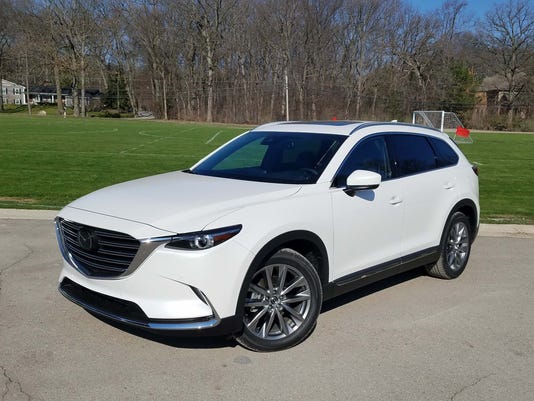
Take the upwardly mobile $43,445 Mazda CX-9 and $43,145 GMC Acadia sport utilities I’ve been hanging out in.
These two mainstream brands have translated their (respectively) sports car and truck DNA into family haulers that are easy on the eyes, tech savvy and fun to drive. In so doing they have largely closed the gap with luxury brands costing $15,000 more (the price of a nice, used Mazda 3 for your 16-year-old).


I revisited the GMC and Mazda two years after they first wowed me in 2016. This time around, I found the all-wheel drive family haulers were a blast over the country roads of Michigan and Virginia. Not only did these 4,000-pounders carry my family in style, but they were fun to drive with taut chassis and peppy turbo-4s. You know, the stuff for which luxury vehicles are known.
I rented the Acadia out of Dulles Airport which returned me to the roads where I tested the GMC in May 2016. If you think GMC is just about trucks, this ute will surprise you.
Based on the same bones that support the nimble Cadillac XT5, the Acadia went on a 700-pound diet from the previous generation. It shows. In 2016, I chased an Audi A7 cheetah through Virginia’s twisted hills, the Acadia showing remarkable poise for a big rhino.
This time, country roads took me across the West Virginia line near the famed Summit Point racetrack. The Acadia possesses an excellent all-wheel drive system that includes a mode selector with 4×2, 4×4, Snow and Sport. Yes, Sport. Dial in, hold on to the door handles, dearies, and let’s go Audi hunting.
Mated to GM’s excellent 9-speed transmission, the 193-horse 4-cylinder is up to the task. The Mazda, even more so.
True to its ZOOM ZOOM lineage, inside every Mazda ute beats the heart of a Miata. The CX-9 takes ute athleticism to the next level.
Not that GMC should hang its head. Car and Driver measured identical G-load numbers for both SUVs in its skid-pad test. That’s a remarkable stat for a ute with pickups as parents.
The Mazda simply manages its heft with more aplomb than the GMC. It also wins on style points. Indeed, CX-9 shames most premium vehicles with its fastback styling and runway-model fascia.
Inside, the GMC steps up its game.
While the Mazda struts its handsome European wardrobe of rotary dial, tablet screen and expansive dash, design alone won’t get you very far if you get lost in the West Virginia Outback.
Mazda continues to be tardy to the smartphone connectivity dance though it promises the popular feature … um, soon. Just how useful this feature can be was demonstrated by my Acadia.
My Acadia came with no nav. No problem.
Plug in your iPhone, and bingo! — the GMC’s infotainment system’s Google Maps routed us across the wildest of Wild, Wonderful West Virginia. This is every smartphone-user’s dream — no need to upgrade to an (inferior) auto nav feature. No need to learn a new system. Just enter the destination on your phone before leaving the hotel/home/work. Plug. And play.
The GMC and the Mazda won’t win any awards for interior space, but these are big three-row utes. Space comes standard.
My six-foot-plus sons fit comfortably in the rear of the Acadia where they read books, played computer games, even rested thanks to the GMC’s thoughtful recliner (Mazda has a similar feature). The third row is accessible in both the Acadia and Mazda with easy, one step pull-and-slide second row seats (though the Acadia, for budget reasons, only accesses the third row on the curb side). I was cramped, but I’m a 6-foot-5 circus freak, for goodness sake.
Where the CX-9 shows off details like auto high beams and a head-up display, the Acadia responds with thoughtful items like a rear passenger safety check: Exit the car and the GMC reminds you if you have left something like your computer in the back seat. Or, heaven forbid, a child. Clever.
But then GMC takes clever too far. Determined to gain EPA’s favor, the GMC refuses owners the option of turning off its Stop/Start engine feature. Stop/Start is this decade’s equivalent of the 1970s’ automatic seat belt. Annoying.
This is the second Acadia rental I’ve had with the feature and it grates like fingernails on a chalkboard. It drives my wife crazy. The constant stall at stoplights. BRRRUMP. The constant shudder back to life. BRRUPUP. Sure, GM’s Stop-Start is smoother than most, but it’s not smooth enough.
Mercifully, CX-9 does not come equipped with Stop/Start. The minor fuel savings are not worth the expense. Like GMC’s decision to only equip the curbside second row with third-row access.
On such small details can buyers’ purchase decisions hang. Maybe the GMC’s smartphone capability seals the deal for Acadia. Maybe the Mazda’s sexy styling flips your switch.
Either way, the details pale in comparison to that $15,000 it’ll cost you to buy a comparable luxury ute. Maybe that premium badge buys status — but as Acadia and CX-9 prove, it doesn’t buy you a better chariot.
Henry Payne is auto critic for The Detroit News. Find him at hpayne@detroitnews.com or Twitter @HenryEPayne. Catch “Car Radio with Henry Payne” from noon-2 p.m. Saturdays on 910 AM Superstation.
2018 GMC Acadia
Vehicle type: Front-engine, front- and all-wheel drive, seven-passenger SUV
Price: $29,995 base ($43,145 as tested)
Powerplant: 2.5-liter inline-4-cylinder
Power: 193 horsepower, 188 pound-feet torque
Transmission: 6-speed automatic
Performance: 0-60 mph, NA; towing: 1,000 pounds
Weight: 3,956 pounds (FWD)
Fuel economy: EPA fuel economy: 21 city/25 highway/23 combined
Report card
Highs: Lightweight, nimble chassis; Smartphone app connectivity
Lows: Can’t turn off Stop-Start; anemic 1,000-pound towing
Overall: 3 stars
2018 Mazda CX-9
Vehicle type: Front-engine, front-and rear-wheel drive, seven-passenger SUV
Price: $33,125 base ($43,445 as tested)
Powerplant: 2.5-liter, turbocharged inline-4
Power: 227-250 horsepower (87 or 93 octane gas), 310 pound-feet of torque
Transmission: 6-speed automatic
Performance: Zero-60: 7.5 seconds (Car & Driver est.); 3,500-pound towing
Weight: 4,361 pounds
Fuel economy: EPA fuel economy: 20 city/26 highway/23 combined
Report card
Highs: One good-lookin’ ute; athletic ride
Lows: No full moon roof; smartphone app connectivity, please
Overall: 3 stars
Acura debuts an updated MDX crossover
Posted by Talbot Payne on July 17, 2018
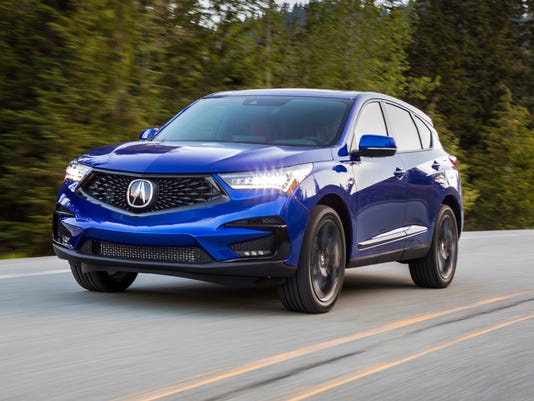
Acura introduced the 2019 model of its three-row 2019 MDX crossover on Tuesday, but the vehicle’s minor updates don’t tell the full story of big changes in both Acura’s brand and the American manufacturing market.
Introduced in 2001, the Ohio-built MDX is the third-best-selling three-row ute in the U.S. behind the Lexus RX and Cadillac XT5. Now in its third generation, the MDX received a stem-to-stern redesign in 2014 to be lighter and more powerful. But, unusual for mid-cycle refreshes, MDX development has accelerated over the last two years as the Acura brand has remade itself to be a more performance-oriented brand.
In 2017 the MDX was the first Acura to get the “diamond pentagon” grille – reflecting a major design change previewed by the Acura Precision Concept at the 2016 Detroit Auto Show. The grille is now spreading to all vehicles in the Acura lineup including the TLX sedan and the hot-selling, compact RDX crossover.
The ’17 MDX line also imported radical new technology from another Acura halo car – the NSX hybrid supercar. The MDX Sport Hybrid debuted with a similar twin-electric motor with all-wheel-drive system as the NSX. That made for better fuel economy as well as improved handling.
The 2019 MDX continues the performance push as the family SUV for the first time gets the brand’s sporty A-Spec package which offers torque-vectoring all-wheel drive, 20-inch alloy wheels, a blacked-out grille, paddle shifters and red leather seats. While the 2019 A-Spec gets the same 290-horsepower, 3.5-liter V-6 as the rest of the MDX family, the sporty package hints that even the three-row ute may ultimately receive Acura’s hot rod Type S badge, complete with a snarling, turbocharged V-6 producing a reported 400 ponies.
The A-Spec package debuts at $55,795. That’s $10,500 more than the base, front-wheel-drive MDX.
Upgrades to the 2019 MDX include a more responsive 9-speed transmission and optional adaptive dampers. The MDX comes standard with techy features like automatic braking, forward-collision warning and adaptive cruise-control. The base 2019 MDX starts $100 higher than the 2018 model.
All MDX production is in East Liberty, Ohio. In fact, all Acura vehicles are now made at the plant outside Columbus except for the slow-selling, Japanese-assembled RLX large sedan, a victim of its sibling SUV’s popularity.
At the turn of the 21st century, not a single foreign, mid-size SUV was built within U.S. borders. Now, as three-row sport utilities dominate America’s school yards, four of the five best-selling premium crossovers are built here: the BMW X5 (South Carolina), Mercedes GLE (Alabama), Cadillac XT5 (Tennessee) and the MDX.
Ford F-series, Mercedes dominate with same playbook
Posted by Talbot Payne on July 17, 2018
Nashville – Mercedes-Benz and Ford Motor Co. would seem an unlikely couple.
But in the American auto market they have used similar strategies to carve out dominant, cash-gushing positions in the industry’s two most lucrative segments: luxury vehicles and large pickup trucks. Both automakers, industry insiders say, have sliced the market so finely with so many different models that few will dare challenge their supremacy.
Mercedes leads an elite Big Three in luxury – BMW and Lexus are the other two – that sells more than 300,000 vehicles a year. Only one other automaker – Audi, with a growing 226,000-plus in sales – threatens their dominance.
A Big Three also rules pickups: Ford, Chevrolet and Ram. Their domination is even more dramatic with each cresting 500,000 sales in 2017 (Ford almost topped the 900,000 mark). Chevy’s premium cousin, GMC, sold another 250,000 in 2017.
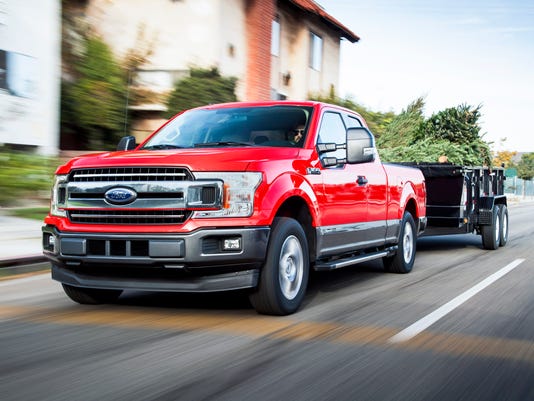
But it’s Ford that has ruled the pickup roost for the past 41 years, and it does so in part by giving pickup buyers more than 200 choices in all their configurations.
“Ford and Mercedes have extraordinary engineering capability. They can slice the cheese so thin,” says veteran auto analyst Joe Phillippi of Auto Trends Consulting. “The Germans can offer you an incredible portfolio of transmissions, styles and drivetrains. For the Detroit Three, pickups are their luxury product — the variable gross-profit numbers are mind-bending.”
The financial rewards for Mercedes’ and Ford’s slice-and-dice strategies are huge.
Ford’s future autonomous and electric investments are dependent on its pickup profit-gusher. The F-series numbers are even more eye-popping than Mercedes’.
North American consumers reportedly spent $41.25 billion on F-Series trucks alone last year. Ford says that’s more revenue than Coca-Cola, Facebook or Nike. It’s also more money than the gross domestic product of Bolivia.
Ford Truck Group Marketing Chief Todd Eckert says Ford sells two F-Series pickups every minute — 896,764 in 2017 — by offering “an F-Series for every need.”
Over at Mercedes, Bernie Glaser, director of product management for North America, Bernie Glaser sounds a similar note: “We are delivering what the customer wants. We work here and manufacture here in the U.S. market.”
The Ford F-series has been the best-selling truck in the U.S. for 41 straight years. Eckert attributes some of that success to an expansion into premium grades two decades ago.
“Go back into the ’70s and ’80s, and you had a work truck,” he says. “Now there have been improvements in terms of ride and comfort — as well as cab sizes when we brought out the SuperCrew in F-150 in 2001 and introduced King Ranch in 2001.”
To appreciate the expanse of the F-Series lineup, take the standard light-duty F-150 model. The XL work truck starts at about $28,000. Then the Ford engineers and marketers get busy offering five different engines across six different grades — XL, XLT, Lariat, King Ranch, Limited and Raptor — available in three cab sizes and two drivetrains (rear-wheel drive and four-wheel drive).
Toyota’s F-150 competitor, the Tundra, offers just two engine choices across three different grades, as well as two drivetrains. It doesn’t even try to compete in the heavy-duty segments. It sold just 116,000 pickups last year.
“It’s difficult (for foreign manufacturers) to compete against such a breadth of offering,” says TFLTruck.com’s Andre Smirnoff, a longtime observer of the pickup industry.
“(We) have a really true and believable racing history which we bring to the table. I think it plays into the authenticity of our brand,” says Glaser of Merc triumphs dating back to the 1954 Formula One championship.
Today, nearly every Mercedes model has at least one fire-breathing, high-speed variant pushing AMG badged-vehicles to nearly 10 percent of Mercedes sales.
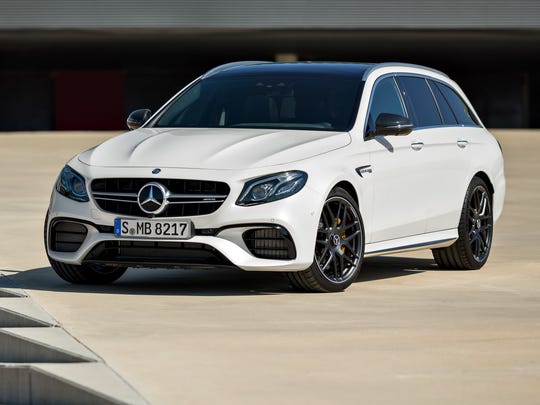
AMG variants have helped increase Mercedes offerings to some 70 different models. The mid-size E-Class sedan, for example, now offers everything from the base rear-wheel drive E300 sedan that costs $52,950, to the $127,000 AMG E63 S station wagon introduced here in Nashville to media in June.
That $75,000 product spread mirrors the price range of Ford’s F-series.
Yet, while Phillippi thinks that the brand-loyal, high-volume Big Three-dominated pickup market is out of reach of foreign competitors, he is critical of domestic manufacturers for not taking a run at the Mercedes-BMW-Lexus juggernaut.
In particular, he and other analysts see opportunity for Cadillac which has targeted the German makers with an aggressive product strategy that includes investments in performance cars (the V-series) and racing.
Cadillac’s E-class competitor, the CTS, comes with a competitive eight trims including AMG-fighters V-Sport and CTS-V. Yet, Cadillac has badly lagged in developing SUVs that Americans covet — and that Mercedes offers in waves.
“GM is happy harvesting profit from pickup trucks but not re-investing it into the other side of the portfolio,” says analyst Phillippi. “Cadillac is 20 years into remaking itself for the 21st century, and what do we have? They are leaving so much money on the table.”
Phillippi is especially critical of GM’s premium brand falling behind in SUVs, offering only three models: the XT5, aging Escalade, and new-for-2019 XT4. Meanwhile, Mercedes not only offers five SUVs plus two SUV coupe variants — but it also leads the class in performance SUV variants.
How has a German automaker so cannily read the U.S. customer?
“We do future trends scouting about what’s going on in the U.S., watching generational shifts, and we try and stay ahead of the curve and be prepared,” says Glaser, sitting inside a $91,150 AMG GLC 63 crossover. It’s based on a standard $40,000 GLC ut
Payne: It’s been a wild two years waiting for my Tesla Model 3
Posted by Talbot Payne on July 17, 2018

More than two years ago, I put down $1,000 to reserve my place in line with 450,000 others to order the most anticipated car of the 21st century. On June 26, I finally configured my Tesla Model 3 for delivery.
No greenie, I’m a speed-addled motorhead who ordered the Model 3 out of lust for its design and electric performance. And because, as a journalist, I wanted to be a part of the most audacious auto startup in memory.
The wild ride hasn’t disappointed.
The Model 3 has proved to be slow to market, hell to manufacture, banned from sale in Michigan, and a stage for the brilliant, maddening, tweeting, disruptive Donald — er, Elon Musk. Yet the car itself has not lost its allure.
Billed as Tesla Inc.’s entry-segment, $35,000 electric car to the Silicon Valley automakers’ premium Model S and Model X chariots, the most-affordable Model 3 trim won’t be available until next year. My rear-wheel drive, big-battery, 310-mile-range sedan will cost $20,000 north of the base 220-mile-range model. It also demands substantial upgrades to my house to meet its charging demands — more than $2,000 worth — a lesson in the challenges for electric-vehicle adoption.
Like all communication from Tesla, my notice came in a simple email: “Your Model 3 is Ready to Order,” followed by a link to tesla.com.
The email came in the middle of my June-August order window for a $49,000 rear-wheel drive, long-range car. That’s a delay of four months from my original February-April window (true to Musk’s promise of “production hell” at the Model 3’s July 2017 unveiling). Want the standard-range $35,000 car? I’d have to wait another 6-9 months. Want the $53,000 all-wheel driver? Cool my heels until late 2018.
The website added a new trim: a $64,000 all-wheel drive performance model to rival gas-powered rockets like BMW’s M3 and Cadillac’s ATS-V. Tempting, but its sticker would push the price into nosebleed Model S territory.
I stuck to my budget.
Compared to the dizzying array of options available in most cars these days, my 3 was configured in five easy steps.
Step 1: Car. All-wheel drive for Michigan winters? I like rear-wheel drive handling for twisty country roads. The 310-mile range model I chose has a 140 mph top speed and does 0-60 in 5.1 seconds — among the quickest in its class.
Step 2: Exterior. Any color other than plain black costs $1,000. I chose Obsidian Black Metallic with $1,500 19-inch Sport wheels. Gotta have 19s.
Step 3: Interior. To paraphrase Henry Ford on the Model T (which also suffered production pressures due to high demand), you can have any Model 3 interior you like … as long as it’s black leather. Wood trim and that big, beautiful Tesla tablet screen are standard.
Step 4: Autopilot. “Enhanced Autopilot” adds $5,000 for self-driving features like auto-lane change, adaptive cruise-control, self-park assist and a “summon” feature that allows the car to back itself out of a tight parking space without a driver at the wheel. Another $3,000 and the car would be armed for full autonomy (when the software matures) — no thanks, we motorheads want autonomous cars like fish need bicycles.
Step 5: Payment. Bottom line, my Model 3 cost $56,000, comparable to the BMW M2 coupe I also lust for. Subtract the $7,500 federal EV tax credit and I’m under $50,000.
The cost doesn’t end there.
Recharging on a standard, 110-volt wall charger would take longer than the wait for my Model 3 (well, 52 hours). The best bid from two electricians to upgrade my garage to 240-volt was $1,675. Add $500 for a 60-amp Tesla wall charger and I can recharge to 300 miles in seven hours overnight.
Before paying the electrician and my required $2,500 Tesla deposit (the rest due on delivery), I took a long pause. Fifty grand is a lot of money, and the headlines out of Tesla had become increasingly chaotic.
Some of that chaos was to be expected. Musk and Donald Trump may vehemently disagree on the fate of the polar bear, but they are both classic disruptors on a collision course with the establishment. Musk also takes inspiration from digital disruptors like Steve Jobs to upend the status quo on dealerships (Tesla stores) and manufacturing (more automation).
Never shy with a tweet, he’s unloaded on journalists, investors and industry leaders. As I ordered, he even attacked his role model, Ford Motor Co., to deflect criticism about a makeshift tent he had erected outside his California factory to meet production goals.
“Go to Ford, it looks like a morgue.”
Good theater, but worrisome for a luxury-car buyer who fears the consequences of his $50,000 car being built in a tent. By sleep-deprived workers. By a company with a history of defects — and that, by law, cannot have company dealerships in Michigan.
I’m not the only customer with concerns, but I’m philosophical. Tesla is a startup automaker trying to achieve the unprecedented: fill 450,000 standing orders for a single model. To put that in perspective, Mercedes only sells 375,000 units a year in the U.S. across 15 models.
Which brought me back to product.
Despite similar build issues, the Model X SUV and Model S sedan are two of the best vehicles I’ve driven. While chatting with one of Michigan’s first Model 3 owners in Birmingham this spring, I pointed out a sunken hood gap on her sleek red machine.
She and her husband hadn’t noticed. She went on to rave about the car.
I, too, raved about the first 3 I tested. Its spare, iPhone-like design and nimble handling drowned out voices in Model 3 forums complaining of inconsistent paint jobs and electronic hiccups.
Two years on, and the Model 3 is still unique. Which probably explains why — despite the chaos and delays — Tesla sales still dwarf other EVs. There are very good alternatives, after all — like the tidy, reliable, 238-mile-range Chevy Bolt EV. The Model 3 is outselling it 5:1.
Mine is ordered, but delivery is a uncertain. Tesla says it will arrive at its Cleveland dealership for pickup (Ohio allows Teslas to be sold there) between September-November. Based on the experiences of other owners, it could arrive in a month.
And to throw in one more blind turn on the wild ride, Tesla announced this week it is opening up orders to non-reservation holders. The company assures me that my place in line is secure.
The adventure continues. I’ll let you know when it comes.
Payne: 700 Club — 710-hp McLaren meets 755-hp ‘Vette
Posted by Talbot Payne on July 17, 2018


Requirement for membership: 700 horsepower. It’s an elite group of production vehicles including supercars, Bentleys and Hellcats. I’ve flogged a few. For 2018 the directory gets two new members: the McLaren 720S and Corvette ZR1, and they reflect the club’s diversity.
Not straight-line drag racers like the 707-horse Dodge Challenger Hellcat or 840-horse Demon, these remarkable athletes can harness their power for any discipline from the race track to Woodward stoplights, yet they are very different species raised in different worlds to achieve the same purpose: delivering face-flattening speed in tush-flattering comfort.
The 720S is the road-going manifestation of McLaren’s racing success.
With multiple Formula One titles under its belt, McLaren began distilling race technology into production cars with the MP4 super car in 1984. It now churns out models for three supercar “segments” that it calls Sport, Super and Ultimate. All are built on essentially the same mid-engine, rear-wheel drive, carbon-fiber platform.
My $331,335 tester fills the mid-level Super segment — slotting between the $210,000 570GT that I tested in this space last summer, and the insane, $1 million-plus P1 and Senna Ultimate-class track hellions. They’re all insane, really: carbon-fiber race cars made street legal.
The Corvette ZR1, by contrast is, well, a Chevy — though any relationship to mainstream Chevrolets is a stretch. Yes, it uses the same 6.2-liter pushrod V-8 technology found in a Silverado. Its 4G WiFi-capable touchscreen infotainment system is yanked right out of a Malibu sedan. And its supercar price tag is a Chevy-like bargain at $137,000, meaning you could buy two ZR1s for the price of one 720S and have money left over for a Camaro SS.
But like its predecessors, the seventh-generation C7 Corvette is built on a bespoke rear-wheel drive aluminum chassis with otherworldly capabilities. Then Corvette’s team of mad scientists took a page from McLaren’s book. The C7 was co-developed with GM’s Pratt and Miller race team to prep it for race use.
As the most capable Corvette in the stable, the ZR1 builds on the already-ferocious 650-horse Z06 by adding a bigger supercharger and even more downforce punctuated by a high-wing nailed to the frame out back.
The result is a ‘Vette on ‘roids, like Hulk bursting from Bannerman’s too-small clothes. The supercharger bulges from the hood, carbon-fiber dive-planes sprout from the nose, the bat wing looms like something out of DC Comics.
The McLaren looks like it came from the future.
Squeeze the door sill and scissor-doors glide upward. “Eye socket” headlight ducts suck air into twin radiators. A wing emerges on hydraulic struts when an Active aero button is engaged.
Get this thing a starring role in the next “Blade Runner” movie.
Bury the throttle out of M1 Concourse’s hairpin and the sci-fi experience goes into hyper-drive. The engine momentarily hesitates as the turbos spool up inside the 4.0-liter V-8. Then, Alice, it’s to the moon.
The same engine with 562 ponies in the 570S was the best mill I have ever driven.
Add another 148 horses for the 720S, and it’s OMG. Around town the acceleration is electric. With a turbo hiss, traffic vanishes in the rear-view mirror. On track the punch is relentless and linear, the torque curve never leveling off.
I hit 130 mph on M1’s back straight before carbon-ceramic brakes brought the rocket back to earth. Veteran M1 instructor Aaron Bambach says that’s faster than anything he’s seen on track shy of the $900,000, 887-horsepower (800 Club anyone?) Porsche 918 hybrid.
The seven-speed tranny fires off quick shifts, the turbos hiss, the engine howls. And then the twisties rush into view. Coping with the mad rush of a 700-plus horsepower — more than an IndyCar — in a 3,100-pound car is an intense experience. But throw it into a corner and the McLaren shrinks to an oversized go-kart.
The electro-hydraulic steering is intuitive, the chassis balanced, the carbon frame flat as a board. I could place the car on a dime around M1.
The McLaren is digital, the Corvette analog.
Of course, electronics is key to the 700 Club. Weapons like these would have been unthinkable 20 years ago without today’s electronic-stability controls, brainiac on-board computers and quick-shifting transmissions.
But as Belle Isle pace-car driver Mark Reuss will be the first to tell you, the ‘Vette can get away from you in a hurry. Pounding downhill through Road Atlanta’s fast esses, the throttle must be treated with care lest 378 cubic inches of piston thrust — 750 pound-feet of torque! — overwhelm the 12-inch rear tires.
Where the McLaren’s rocket builds momentum, the ZR1 comes off the launch pad like the Space Shuttle. The ground shakes. Birds scatter. Car alarms explode. The ZR1 will hit 170 mph on Road Atlanta’s back straight before 15.5-inch-saucers the size of Captain America’s shield haul it into a tight chicane. Unlike the carbon-fiber 720S, you can feel the aluminum ‘Vette flexing, the car moving under you like King Kong unleashed.
But you can feel the 1,000 pounds of downforce — much of it generated by the high wing — pushing down on Kong all the time like a net, keeping him from rampaging off into the forest.
The McLaren computer game is reinforced inside with a digital display that flips over into a narrow, race car-like rpm/mph readout when you choose Track from the console mode selector. A separate knob controls the suspension with Comfort-Sport-Track settings. It’s unique and works instantly to match your needs. The slow infotainment system takes a back seat to the drive dynamics.
The Corvette, by contrast, benefits from its corporate lineage by sporting the brand’s tried-and-true mass-market infotainment system with gadgets like Apple Car Play, head-up display and performance data recorder. Being a Chevy has its benefits.
Both steeds deserve their 700 Club supercar status. The McLaren is simply the best athlete I have driven. The Corvette, dollar-per-pound, is the fastest car ever conceived. What could possibly rival this pair?
I hear the 1,479-horsepower Koenigsegg Regera and 1,479-horse Bugatti Veyreon are starting a 1,000 Club …
Henry Payne is auto critic for The Detroit News. Find him at hpayne@detroitnews.com or Twitter @HenryEPayne. Catch “Car Radio with Henry Payne” from noon-2 p.m. Saturdays on 910 AM Superstation.
2018 McLaren 720S Coupe
Vehicle type: Rear-engine, rear-wheel drive, two-passenger supercar
Price: $288,845 base ($331,355 as tested)
Powerplant: 4.0-liter twin-turbocharged V-8
Power: 710 horsepower, 568 pound-feet torque
Transmission: 7-speed automatic
Performance: 0-60 mph, 2.8 seconds (mfr.); top speed: 212 mph
Weight: 3,128 pounds
Fuel economy: EPA fuel economy: 15 city/22 highway/18 combined (Car and Driver)
Report card
Highs: Supermodel looks; turbo V-8 from the gods
Lows: Slow infotainment system
Overall: 4 stars
2019 Chevy Corvette ZR1
Vehicle type: Front-engine, rear-wheel drive, two-passenger supercar
Price: $119,995 base ($136,815 as tested)
Powerplant: 6.2-liter, supercharged V-8
Power: 755 horsepower, 715 pound-feet torque
Transmission: 7-speed manual; 8-speed automatic
Performance: 0-60 mph, 2.85 seconds (mfr); top speed: 212 mph
Weight: 3,524 pounds
Fuel economy: EPA fuel economy: 13 city/19 highway/15 combined (manual); 12 city/20 highway/15 combined (automatic)
Report card
Highs: Comfy daily driver; Herculean torque
Lows: Oily interior odor; poor visibility
Overall: 4 stars
Payne: Think sedans are sunk? Try a snazzy Mazda 6
Posted by Talbot Payne on July 5, 2018
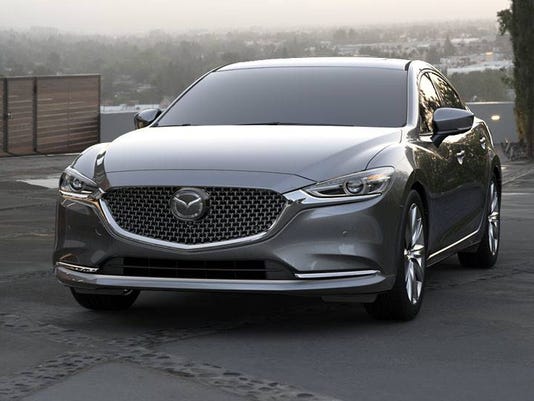
Here’s the thing about extinction — it concentrates the mind. America has gone ute crazy and sedans are in a fight for their life. It’s survival of the fittest. Evolve or die.
And so we are getting the best sedans I’ve ever seen.
I was ZOOM ZOOM ZOOMing the new Mazda 6 all over Metro Detroit this June and I think I’m in love. It’s the same feeling I had when I got out of the 2018 Honda Accordlast fall. A Rolex watch with a Timex price tag.
Like Honda, Mazda has a lot of mileage under its belt on race tracks and its quick handling is no surprise. What surprises are the luxury amenities.
Fast and luxurious, the Mazda improves on the one gripe I had about the Honda: great bod, but put a bag over its face, please. Not the Mazda. This beauty turns heads from head to tail. My Audi-owning friend Dicran lingered over the elegant, chrome-jeweled front end, the grille smiling seductively.
That is a good looking car!
Yes it is. Better looking than many luxury models. Automakers are taking a hard look at sedan viability in the Age of Ute, but the 6 begs the question: Do we need so many luxury brands?
Regular readers know I’ve been writing about the shrinking gap between mainstream and luxury ’til my fingers turned blue, but you could always count on the premium boys flexing more power.
Take the Mazda CX-5, for example. It’s a heckuva compact ute, right there with a BMW X3 in handling and accessories. But put your foot on the gas and … oh. Just 187 normally aspirated gerbils compared to the Bimmer’s 248 galloping, turbocharged horses — and the sound! Oh, my. Like Maria Sharapova hitting a forehand — HUUGGGH! — you can hear the effort. A silky turbo and the BMW badge will get help you cough up the extra 10 grand for the German.
But now here comes my $36,140 Mazda 6 with a 250-horsepower (on premium gas, 227 on regular) 2.5-liter turbo that goes toe-to-toe with, say, a comparably equipped $56,000, 252-horse Audi A6 out of a stoplight.
Zot! The Mazda 6 hit 60 mph in 6.4 seconds — just shy of the Audi’s 6.1.
Mazda is a stickler for detail and they zeroed in on their noise issues for the sixth-gen 6. Padded panels, recrafted-pillars, the works. Like Noah preparing for the storm, they plugged every leak in the cabin to make it more livable.
The result is a quiet, buttery smooth drivetrain under the cane. But no how matter how many pillows Mazda has stuffed in the cracks, the real story here is the new-for-2018, 2.5-liter turbo-4.
The same powerplant found in the lovely CX-9, three-row ute, the new engine puts out a whopping, best-in-class, 310 pound feet of torque with 63 more horses than the old 2.5-liter, normally-aspirated mill. The new engine is programmed (this is the electronic transmission era) for nearly the same 60 mph run, but then it runs away from the competition where you really want it — in 30-50 and 50-70 acceleration. True to its ZOOM ZOOM roots, the turbo-4 still makes a satisfying thrum at hard throttle — not unlike a turbo-4 Golf GTI, one of my favorite 4-bangers.
The old powerplant is still offered in the 6 as a base-engine $22,845 bargain. But the real bargain here is in the loaded, upper-trim models.
And I do mean loaded. My Signature tester undercuts the Audi A6 price by $20,000 despite boasting a two-tone leather interior, wrapped console, seat memory, head-up display, tablet screen, auto high-beams, and so on. Dicran and went back and forth between an Audi A6 and Mazda 6 interior to see the fine differences.
That’s no accident. Mazda benchmarks its interior to the Audi right down to the remote rotary infotainment controller and piano-key dash buttons. The Audi fits more chrome and wood decoration, but the Mazda gains points with more storage space compared to the Audi’s over-engineered console.
Where the Mazda really wows (did I mention it’s just $36,000) is in the premium details. Allow me to point out three:
1. Blind-spot information system. This is my list of must-have digital innovations. I’ve come to depend on a glance at mirror-based blind-spot system rather than twisting my neck into a pretzel every time I want to change lanes. It’s a technology that, like adaptive cruise control (another must), has rapidly migrated into mainstream cars from luxury.
The Mazda takes it up a notch. Adapting a graphic-based blind-spot system innovated by premium automakers like Tesla, the 6 keeps a digital image of your car in the instrument panel — right in front of you — at all times. Is there a vehicle in your quarter panel? The graphic displays “wavy lines” off your starboard stern so you know another car is there. Cars to your right and left? Twin waves off each quarter.
2. Head-up display. In another steal from cars costing thousands more, the Mazda nixes last generation’s el cheapo, dash-mounted head-up display for a state-of-the-art, windshield-projected system. The configuration includes useful info like mph, speed limit and navigation instructions.
Speaking of nav, the Mazda’s ethic of keeping info in front of the driver extends to the high-mounted infotainment screen — which displays the name of the road you are approaching. On dark nights when street signs are hard to read — or placed on black backgrounds (looking at you, Bloomfield Township) — you won’t miss a turn thanks to Mazda engineers.
3. Air vents. Yes, air vents. Most ventilation system require two controls — one for air direction, the other to close it off. The Mazda 6 cleverly combines them into one, making vent operation a cinch.
It’s details like these that give you confidence that the whole vehicle was endlessly fussed over. Which gets you luxury for $36,000. Speaking of details, Mrs. Payne says the only reason not to buy the peppy, roomy, sexy 6 over the CX-5 ute is all-wheel drive.
And if the CX-5 eventually gets the 6’s 250-horse engine, it’ll be one more challenge sedans will have to overcome. In the meantime, Mazda’s 6 is a 10.
Henry Payne is auto critic for The Detroit News. Find him at hpayne@detroitnews.com or Twitter @HenryEPayne. Catch “Car Radio with Henry Payne” from noon-2 p.m. Saturdays on 910 AM Superstation.
2018 Mazda 6
Vehicle type: Front-engine, front-wheel drive, five-passenger sedan
Price: $22,840 Sport base ($36,140 Signature as tested)
Powerplant: 2.5-liter inline-4 cylinder; 2.5-liter, turbocharged inline-4 cylinder
Power: 187 horsepower, 186 pound-feet torque (non-turbo 2.5-liter), 250 horsepower (93 octane fuel, 227 with 87 octane), 310 pound-feet torque (turbo-4)
Transmission: 6-speed manual (base Sport model only), 6-speed automatic
Performance: 0-60 mph, 6.4 seconds (Car and Driver); top speed: 149 mph (mnftr.)
Weight: 3,560 pounds as tested
Fuel economy: EPA fuel economy: 26 city/35 highway/29 combined (non-turbo 2.5-liter); 23 city/31 highway/26 combined (turbo-4)
Report card
Highs: Easy on the eyes; tech-tastic interior features
Lows: AWD please?
Overall: 4 stars
Payne review: Mercedes S560 Coupe, king of beasts
Posted by Talbot Payne on June 28, 2018
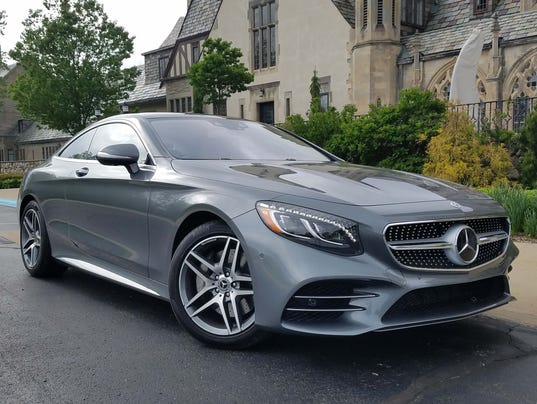
My former Detroit News colleague, Scott Burgess, once advised that auto reviewers schedule a regular Porsche 911 test — as a reminder of how good a sports car can be. The same might be said of a Mercedes-Benz S-class and its place atop the luxury kingdom.
Everyone is in luxury these days because there’s money to be made. Tesla, Genesis and Alfa Romeo offer new meat; Lincoln and Acura are rediscovering their mojo; Cadillac, BMW and Audi run the Nurburgring like greyhounds.
But for pure majesty, Mercedes rules.
Its perfect cheekbones and polished manners are handed down the family tree all the way to the little CLA. SUVS, sedans and coupes spring from its loins. Its sinewy V-8 inspires the AMG performance badge and GT race cars — muscled mutants that shred tracks like Marvel’s Juggernaut.
S is for Simba on Pride Rock.
How can any other mere luxury brand hope to compete? For pure presence and power, my favorite S is the Mercedes S560 4MATIC Coupe, a vision on wheels. It’s like living in Dwayne Johnson’s tuxedo: handsome, graceful, muscled shoulders out to here.
After some tired styling years in the ’90s, the new century has awakened Stuttgart designers from their slumber. Walking through a Mercedes auto show display (alas, it will visit Detroit no more) is like attending a DIA masters’ sculpture exhibit. The bodies are exquisite. King S560’s bold face — punctuated by a tri-star logo bigger than your head — is backed up by toned flanks and rocker panels with stampings so deep they might have been cut by the Colorado River.
The style is familiar across the brand’s body of work, perhaps most significantly in the entry-level, $32,000 CLA coupe and sedan. The CLA flaunts papa’s DNA right down to the exquisite, jewel-flecked grille. For Mercedes wannabes who can’t yet afford the three-piece suit, the CLA is a lovely jacket.
Even the $400,000 Rolls-Royce Dawn coupe I sampled last year (only Rolls can make a $157,000 car look like a bargain) can learn from the king. No, the S doesn’t come with umbrellas tucked into its doors (Rolls’ signature), but the Benz offers a more comprehensive, premium experience.
Slip into the quilted first-class leather thrones and be spoiled. An arm extends at the driver’s left shoulder, handing over the seat belt. Visibility is superb thanks to a non-existent B-pillar. The doors are encrusted with stitching and etched stereo speakers, while recessed lighting bathes the cabin in color. Rear-seat space is tight for giraffes like me, but Benz makes the accommodations livable with auto-sliding rear seats and deeply scalloped front seatbacks for the knees.
The cabin is wrapped in premium materials, from the quilted albino seats and mauve dash to an iPhone-like glass pane that stretches across twin 12.3-inch instrument and infotainment displays.
The screen is another brand trademark and can be found across the Mercedes lineup from sport utilities to compact cars.
The decadent interior isn’t just for show. Like furniture in Q’s James Bond lab, the S-class is a showcase for futuristic gizmos.
Fifteen years ago, Burgess took me for my first ride using adaptive cruise control. We marveled at the early autonomous technology as the big Mercedes floated to and fro in traffic, its radar reading traffic speeds up ahead. Today, adaptive cruise control is common on most mainstream cars. For the early 21st century, Benz follows Tesla with self-driving technology that can automatically change lanes with the toggle of a turn-stalk (appropriate, since Tesla borrowed Mercedes’ steering wheel stalks for its Model S).
Neither is the high-class S too proud to adopt other proven technologies: Kick-open rear trunk innovated by Ford. Head-up display from Cadillac. It’s all here. It even has millennial-friendly Apple CarPlay and Android Auto.
Mercedes’ engineers stretch their creativity with devices like night-vision pedestrian detection and miniature mousepads on the steering wheel. The pads are part of a suite of redundant center console controls, including a touch pad, rotary wheel, even push buttons. My accessory of choice was voice command that understood direct verbal commands — Navigate to Le Petit Dejeuner on Jefferson Avenue — like my smartphone.
With this upholstered apartment stuffed inside, the S Coupe tips the scales at over 4,700 pounds. But don’t let its weight fool you. This beast can move.
Credit an all-wheel drive, all-wheel steer system (the 4MATIC part of the Benz’s dizzying alphanumeric nameplate) that constantly keeps its four paws planted. I took ess-curves in Oakland County much faster than I thought possible, the big locomotive cornering as if on rails.
Mercedes has been dominating GT racing in recent years with ground-pounding V-8s. No sissy sixes for the king of beasts. Under the S560’s breast beats the heart of a lion.
I pressed the throttle of the twin-turbo, 4.0-liter, 463-horsepower V-8 and gulped traffic like Simba running down herd of antelopes. Credit 516 pound-feet of torque and a liquid-smooth, 9-speed automatic for the instant thrust. The transmission was nearly seamless as it swapped cogs to catapult past mere mortal cars. See a traffic opening? Voom! You’re there.
This brute power happens with remarkable calm in the cabin where the eight pistons sound like velvet hammers deep under the hood. Though hardly necessary, the hammer octet can be put on high alert with Sport and Sport+ modes — the latter offering rev-match barks with each downshift.
Whatever. This engine could tow the QE2 in Eco mode and not break a sweat.
Pity the competition which has to cope with not just one, but three S-class coupes on top of its formidable S-class sedan. Lincoln’s Continental interior rivals the Mercedes’ comfort. Cadillac this year unveiled its first twin-turbo V-8 CT6 V-Sport. Fetching, but they must jockey for air space with the S450 sedan, S63 sedan, S65 sedan as well as my S560 tester and its S63 and S65 coupe stablemates. The CT6 doesn’t even offer a coupe — not to mention just three SUV offerings versus Mercedes’ seven.
S560 is a magic carpet with animal thrust. Intoxicated by the quilted-leather seats’ “heated back massage” mode, my wife barely noticed as I pushed 100 mph merging onto I-94.
“I’d be afraid of smudging this gorgeous white interior,” she mused.
Such are life’s trivial worries when being chauffeured by the lead ship in Mercedes’ star fleet.
Henry Payne is auto critic for The Detroit News. Find him at hpayne@detroitnews.com or Twitter @HenryEPayne. Catch “Car Radio with Henry Payne” from noon-2 p.m. Saturdays on 910 AM Superstation.
2018 Mercedes S560 4MATIC Coupe
Vehicle type: Front-engine, all-wheel drive, four-passenger sports coupe
Price: $125,495 base ($152,195 as tested)
Powerplant: 4.0-liter, twin-turbo V-8
Power: 463 horsepower, 516 pound-feet torque
Transmission: 9-speed automatic
Performance: 0-60 mph, 4.0 seconds (Car and Driver); top speed: 130 mph (electronically limited)
Weight: 4,751 pounds
Fuel economy: EPA fuel economy: 17 city/27 highway/21 combined
Report card
Highs: Rolling Rembrandt; AWD balance
Lows: You can’t afford it — so buy the mini-S-class CLA
Overall: 4 stars
Payne review: More-refined Hyundai Veloster keeps its attitude
Posted by Talbot Payne on June 21, 2018

The Hyundais seem like such a nice family. A full-line automaker from the wee Accent sedan to family patriarch Santa Fe SUV, the brand is well-mannered and ranks No. 1 in Kelley Blue Book’s Cost to Own awards. It’s civilized, handsome and reliable.
And then there’s the mutant Veloster hatchback. I’d like to be at the family table when this thing shows up.
Like a three-headed Cerberus hound from hell, the three-door-plus hatch Veloster is a growling, spitting mutt that wants to pick on every sports car in the neighborhood. New for 2018, the compact Veloster is back for its second generation and I guess you could say it’s cleaned up a bit.
The Rottweiler-sized front maw has been tweaked and the severe cuts to the rocker panels and rear hatch have been field-dressed like wounds to Conor McGregor after a UFC cage fight. But saying the Veloster has changed is a little like saying Dennis Rodman dressed down by removing one of his lip rings.
Like Mazda’s Miata, Hyundai’s “reverse halo” sporty car is at the affordable end of the lineup. This hot hatch demands attention.
The grille upgrade has gone from Rottweiler to pit bull. See the difference? Me neither. The (slightly less) rounded haunches are still there. The (slightly less) muscled rockers. The twin tailpipes (why not three?) out the back. The squashed greenhouse with the visibility of a tank turret. The huge nose sniffing the ground hunting for the scent of prey.
The Veloster comes in a base model with a 147-horse, 2.0-liter inline-4 and a $29,000 Ultimate trim with 1.6-liter turbo and more options than a Mercedes: head-up display, rain-sensing wipers, auto-headlights, smartphone app connectivity, Alexa connectivity and so on.
Nice. But if you’re in the market for a rowdy pocket rocket, I recommend the R-Spec turbo.
Hyundai is the rare brand that splits its compact offerings between hatch (Veloster) and sedan/coupe (Elantra). Most competitors — Honda Civic, for example — offer a stepladder of variations on their compact car — Sport, Si, Type-R — to satisfy more performance-oriented customers. Hyundai says the heck with that and spliced DNA to mutate a different pet. So if you’re gonna opt for Veloster quirkbox over conventional Elantra sedan, I say go all the way.
Though not as spec’d out as the Ultimate, R-Spec is still a recipe for fun: black 18-inch wheels, blind-spot detection, heated seats, wireless phone-pad charger, AppleCarPlay/Android Auto connectivity to navigate where you’re going.
And then comes the icing: a 201-horse/195 torque, 1.6-liter turbo-4 mated to a six-speed manual for just $23,785.
That’s a grand below the manual Civic Si coupe and $3,500 shy of the VW Golf GTI while offering the same performance as the Si and the hatchback utility of the Golf. It’s a steal.
A car this unique demands engagement — no autonomous features here — so the R-Spec only comes in a manual. The six-speed isn’t as precise as the V-dub or Honda (call it Ford Focus-like right down to the pull-up-ring reverse gear) but it’ll do just fine for Michigan country roads or a weekend autocross.
The pedals are nicely placed for heel-and-toe downshifting, and the meat of the torque is at low rpms (unlike my ol’ high-revving, 2006 Civic VTEC). Rowing through the gears on to Interstate 75, my pit bull sprinted past 100 mph without breathing hard. A Drive Mode switch offers 500 more revs in Sport mode and the Michelin Pilot Sports — gummy tires unique to R-Spec — provide tenacious grip in the twisties.
The driver’s seat is comfortably bolstered (compared to, say, the Camaro 1LE I recently tested that hugs like a girdle) and the ride comfort noticeably improved from Veloster 1.0, which felt like it might rattle apart on Metro Detroit’s washboard roads. I expected more bark from those twin pipes out the rear, but the interior insulation is much improved. The electronic steering is firm, if numb, but the short wheelbase R-Spec is wonderfully tossable thanks to a multi-link suspension upgrade from Gen One’s torsion beam.
Aiding in that grip is front torque-vectoring which brakes the inside wheel for better rotation. I’d prefer a proper, mechanical, limited-slip differential (you’ll miss it under hard acceleration around autocross pylons) like the Civic Si, but that’s the budget sacrifice a $23,000 sticker requires.
Hyundai buyers will have to wait for the top spec, Civic Type-R-fighting Veloster N for limited slip — which will be key to reining in its expected 275 ponies.
R-Spec customers will find other corner-cutting details like a hard-plastic dash and door sills. But the carefully tailored surfaces mask the hard plastic. And the interior ergonomics are surprisingly good for such an unconventional car.
The 8-inch tablet screen is intuitive, as are the crisp dash buttons. The rear seat is accessible only via the right rear since Hyundai forgot to install a left rear door. Hyundai says this was done on purpose — you know, to give the car the dual personality of a coupe that still welcomes rear passengers.
Whatever. The curb access-only doesn’t seem so odd now that I’ve been in GM’s midsize SUV triplets — Buick Enclave, Chevy Traverse, GMC Terrain — that only allow third-row access via the curb-side middle seat. Maybe the GM models should also only come with three passenger doors.
Open the back door and Hyundai makes good on its rear-seat promise. After sliding all the way across to the left-side seat, my 6-foot-5 frame actually fit! … though my neck wouldn’t fancy a long journey stuffed into the headliner. Even more encouraging, the hatch manages to swallow as much cargo as the Jeep Renegade or Chevy Trax SUVs despite a roofline that looks like it was sat on by Andre the Giant.
I love pocket rockets and Hyundai’s all-new Veloster is a wonderful addition to the genre. It may fall short of the Golf GTI and Civic Si in pure driving ability, but its unique wardrobe and outstanding ergonomics complement the segment’s best value play.
Heck, its fun-loving nature has even caught the attention of Hollywood, where it will be starring in Marvel’s “Antman and the Wasp” this summer alongside the likes of Michelle Pfeiffer and Paul Rudd. “The Veloster totally exemplifies the energetic, no-holds-barred attitude that accompanies this franchise,” says a Marvel Comics representative.
Totally. Dude, having a mutant in the family ain’t a bad thing at all.
Henry Payne is auto critic for The Detroit News. Find him at hpayne@detroitnews.com or Twitter @HenryEPayne. Catch “Car Radio with Henry Payne” from noon-2 p.m. Saturdays on 910 AM Superstation.
2019 Hyundai Veloster
Vehicle type: Front-engine, front-wheel drive, four-passenger sport hatchback
Price: $19,385 base ($23,785 R-Spec and $29,160 Turbo Ultimate as tested)
Powerplant: 2.0-liter inline-4 cylinder; 1.6-liter turbo-4
Power: 147 horsepower, 132 pound-feet torque (2.0-liter); 201 horsepower, 195 pound-feet torque (1.6-liter turbo)
Transmission: 6-speed manual; 6-speed automatic; 7-speed automatic (with Turbo and Turbo Ultimate only)
Performance: 0-60 mph, 6.2 seconds (Car and Driver est., Veloster Ultimate); top speed, 135 mph
Weight: 2,912 pounds (R-Spec); 2,987 (Turbo Ultimate automatic)
Fuel economy: EPA fuel economy: 27 city/34 highway/30 combined (base 2.0-liter); 26 city/33 highway/29 combined (1.6-liter R-Spec); 28 city/34 highway/30 combined (1.6-liter R-Spec)
Report card
Highs: Hatchback utility; distinctive styling
Lows: Mediocre manual shifter; limited-slip differential, plastic dash are sacrifices for affordability
Overall: 3 stars
Payne review: Camaro 1LE is a joy to drive hard
Posted by Talbot Payne on June 19, 2018

I usually review a sexy coupe each May to celebrate the first muscle car of spring. Like a Mustang convertible galloping across a green landscape. A colorful Dodge Challenger on Woodward. Or a drop-top Camaro with its V-8 singing like a robin.
But spring never came this year. Michigan went straight from winter to summer.
April was a cruel, cold, wintry mistress, the coldest in 140 years. As May tentatively stuck its head out the front door, temps jumped from 40 to 80. One day the branches were barren, the next they were covered in leaves.
In part that’s because May brought more rain across the middle states than Noah’s worst nightmare. A weekend race of mine was canceled at Summit Point, West Virginia (old slogan: Take me home country roads. New slogan: Take me home swollen rivers.) due to flooding. Never seen that before.
So I’m still a little shy about the convertible thing. A hard-top Camaro SS 1LE will do, thank you very much.
In fact, its brooding, black hood — the 1LE’s signature — suits my mood.
Once inside this beast, my outlook brightened. Which is odd since the Camaro is an ergonomic nightmare. I can’t see out of it, the infotainment screen is cantilevered down and the front door pockets are in the back seat. Speaking of the back seat, there isn’t one — unless you take your legs off, because there is zero room. Think of the seats as shelf storage.
Then I push the starter button and all is forgiven.
The 6.2-liter eight comes to life like a bear out of hibernation. GRRRUMBUMBUMBUM. The earth shakes.
“What’s that?” a friend exclaimed as he drove tentatively into my driveway — the black-hooded, musclebound Camaro guarding it like a 3,700-pound Doberman.
But the real thrills begin when the 1LE hits the road.
Chevy introduced the 1LE package back in the third-generation 1988 car to make it more competitive in showroom stock racing. By the fifth-generation, the package had matured to a bona fide “track package” complete with that matte-black hood fronting a big V-8, stiffened suspension and fat (10-inch front, 11-inch rear) tires.
The sixth-generation $37,000 V8-powered Camaro SS options the $7,000 1LE package with magnetic dampers, Brembo brakes, electronic limited-slip differential, Recaro seats, and 11-inch front and 12-inch rear Goodyear gummies.
But the 2018 1LE’s secret sauce is GM’s Alpha architecture, the same bones that make the Cadillac ATS the best-handling compact premium sedan.
The car is simply a joy to drive hard. Only the deliberate, manual six-speed transmission seems out of step with the car’s athleticism.
My week with this toned athlete was enormously unproductive as every trip turned into an excuse to find interesting roads where I could stretch the 1LE’s legs. Trip to the grocery store? Tack on a half hour while I detoured through lake country in search of side-Gs. A trip to the art supply store? Tack on a half-hour while I cruise Woodward, lay rubber at stoplights, and acknowledge the muscle brotherhood.
With rear-wheel drive and a wheelbase just an inch longer than the Cadillac ATS, the SS 1LE is always composed. Always nimble. Always easy to control around corners. In short, it’s more in the competitive class with a BMW M4 than the Ford Mustang and Dodge Challenger.
I didn’t take it to M1 Concourse for test laps, but Car and Driver did track it at their Virginia International Raceway Lightning Lap. The numbers tell the story. The loaded, $46,295 SS 1LE threw down lap times around the epic 4.1-mile “American Nürburgring” comparable to a $97,000 Porsche Cayman GT4 and $194,000 Audi R8 V-10. I’m not making this up.
That’s what marrying a premium sports chassis to a 455-horse, push-rod V-8 gets you. Take a bow, Chevy. But also take a look at lil brother Camaro V-6 1LE.
Offered for the first time in 1LE track trim, the V-6 wowed Car and Driver’s Lightning Lap, blowing away other $40,000-something competitors like the Nissan 370Z NISMO, VW Golf R, and, ahem, Mustang.
“(The Camaro V-6 1LE) absolutely stomps its current Blue Oval rival, the Mustang EcoBoost equipped with the Performance package,” thrilled the buff mag. “And it gets worse for Mustang acolytes: Despite a 100-hp deficit, the 1LE laps VIR faster than the eight-cylinder Mustang GT.”
Ouch. Camaro has taken muscle-car performance to a new level, but — now that it’s dicing with the elites — it also begs the question: Is it a better value than a Caddy?
My SS 1LE certainly answers the question: What would an ATS coupe be like with a V-8? Around Lightning Lap the $46,000 Camaro bests the $65,000, twin-turbo V6-powered Cadillac ATS-V, the best driver’s car Cadillac has made.
But all things considered, the V-6 1LE would be my choice as a daily driver.
While the SS 1LE puts up the gaudier track numbers, the V-6 is much more balancedwithout the V-8 boat anchor up front. Its manners are like the V-6 Cadillac, and though it gives up 100 horsepower to the ATS-V (335 vs. 446), that’s still a lot of grunt for the street — or a weekend track day.
Not only is the V-6 1LE $20,000 cheaper than the ATS-V (that’ll buy you a Chevy Trax ute for the 16-year-old), it’s also well shy of a comparably equipped, $53,000 ATS coupe with performance suspension and the same 335-horse engine. Apples to apples, it’ll also save you $4,700 over the V-8 while offering the same wicked matte-black wardrobe.
Of course, there’s more to sport coupes than performance numbers. Like interior comfort.
The Cadillac ATS somehow manages four more inches of rear legroom than the Camaro despite its shorter wheelbase. But I am also a fan of the Camaro’s unique console — aviation-style temperature vents and tablet touchscreen. And this being GM, the Camaro shares a head-up display and 4G Wi-Fi and smartphone connectivity found on the Cadillac.
Ooooh, I’m feeling warmer already. Spring — er, summer — is finally here and the Chevy Camaro SS and V-6 1LE track editions are here to play.
Henry Payne is auto critic for The Detroit News. Find him at hpayne@detroitnews.com or Twitter @HenryEPayne. Catch “Car Radio with Henry Payne” from noon-2 p.m. Saturdays on 910 AM Superstation.
2018 Chevy Camaro 1LE
Vehicle type: Front-engine, rear-wheel drive, four-passenger sports coupe
Price: $40,590 V6 1LE base ($46,295 SS 1LE as tested)
Powerplant: 3.6-liter, V-6; 6.2-liter V-8
Power: 335 horsepower, 284 pound-feet torque (V-6); 455 horsepower, 455 pound-feet torque (V-8)
Transmission: 6-speed manual
Performance: 0-60 mph, 5.2 seconds (V-6 1LE, Car and Driver), 4.1 seconds (SS 1LE, Car and Driver); Top speed, 155 mph (V-6), 165 mph (SS)
Weight: 3,532 pounds (V-6); 3,747 pounds (SS)
Fuel economy: EPA fuel economy: 16 city/28 highway/20 combined (V-6); 16 city/25 highway/19 combined (V-8)
Report card
Highs: Affordably wicked; athletic V-6 1LE balance
Lows: Can’t see out of it; can’t fit in rear seat without removing legs
Overall: 4 stars
More-lethal Mustang Shelby GT350 debuts for ’19
Posted by Talbot Payne on June 12, 2018

Pontiac – The Snake is back, and it’s more poisonous than ever.
For the first time since it was unveiled for the 2015, the Ford Mustang Shelby GT350 gets upgraded performance for the 2019 model year. The patriarch of the Mustang family, the ferocious GT350 gets improved tires, suspension tuning and aerodynamics to improve its on-track performance and keep up with the Joneses. Make that the Chevys.
In its muscle-car war with cross-town rival Camaro, Mustang has come up shy in performance compared with Chevy’s holy trinity of 1LE, ZL1 and winged ZL1 1LE performance grades. The Camaros have consistently bested the Shelby in on-track comparison tests.
Introduced at the M1 Concourse’s Champion Motor Speedway on Monday, the 2019 GT350 aims to close that gap.
“This car brings more grip with better tires,” said Mustang Chief Engineer Carl Widmann, citing new Michelin Pilot Sport Cup 2 tires developed specifically for the car. “We can integrate the (magnetic) shock tuning with the tire with the ABS brake system to really get something that’s a step forward.”
Though the GT350 makes up less than 10 percent of Mustang sales, its wicked looks and Ferrari-like, high-revving, flat-plane crank V-8 has set it apart as one of the sexiest ponies ever made.
Ford has sold them as fast as they can be made.
The GT350’s drivetrain remains unchanged for 2019: a 526-horsepower (the most from a normally aspirated Mustang ever) 5.2-liter V-8 mated to a 6-speed manual transmission. At full cry, the unique eight-holer hits an ear-rattling 8,250-rpm redline.
Schaller says the focus of the 2019 changes was on tweaking tires, springs, roll bars, magnetic shocks and a more aero-friendly rear spoiler to increase handling.
“The new Shelby flatters the novice and rewards the professional,” he quipped.
The GT350 R – a lighter, even more track-focused version of the Shelby – remains unchanged for 2019. Engineers say the tweaks to the standard GT350 bring it closer to the R-spec car.
Named after the legendary Carroll Shelby’s mod shop, the current Shelby car was the first GT350 to be manufactured in-house by Ford since 1968. How to tell the 2019 from the 2018? The rear spoiler and gray pinstripe separating the signature, dual Shelby stripes.
The price for the new car increases by about $3,000 to $61,340 ($69,325 for the R) as it gains standard options like SYNC 3 infotainment, 4G WiFi and a wrapped center console.
The updated Snake goes on sale in the first quarter of 2019.
Payne: Nissan GT-R and Lexus GX show their age
Posted by Talbot Payne on June 12, 2018
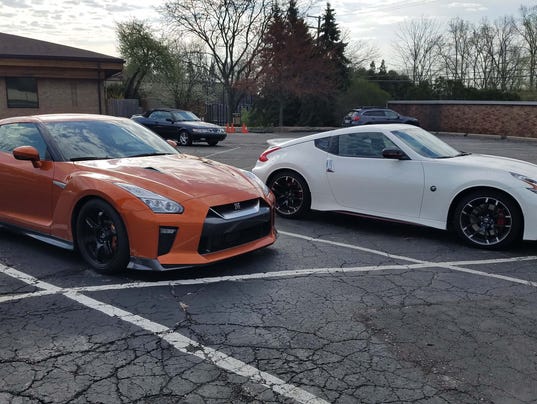
As we approach 2020, evolution is delivering us a new species of automobile.
Thanks to advancements in electronic and materials engineering, new cyborgs have emerged from the lab with light-speed performance capabilities outside, tranquil cabins inside: the Audi R8, Porsche 911 Turbo, Chevy Corvette ZR1, Mercedes GT AMG 63. Next to them in our garages are three-row premium SUVs sitting on car-like chassis that can haul a soccer team to practice while deftly carving country roads on the way: Mazda CX-9, Audi Q7, Acura MDX, Buick Enclave.
But dinosaurs from a decade ago still roam the Earth.
Two of these museum pieces fit neatly in my stable recently: the 2018 Nissan GT-R Track Edition supercar and Lexus GX 460. They are the perfect family couple — the Lexus a three-row daily workhorse, the GT-R a dazzling thoroughbred. Take the Lexus up north to the cabin; take the Nissan up Woodward to the M1 Concourse.
In a fast-evolving era where premium nameplates get new bones every six years, they are relative fossils. The GT-R has been around since 2009, and the truck-based Lexus since 2003. My high-class couple is determined to stay hip even as their age is showing.
Start with the GT-R, aka Godzilla, whose nickname is ready made for my prehistoric metaphor.
This beast still roars. The U.S. isn’t the only country with a muscle car tradition. The Nissan Skyline GT-R is Japan’s Mustang, a legend that dominated Japanese touring racing for decades. Thus its nickname.
Nissan put the GT-R on steroids for international export in 2008. It waded across the Pacific and came aboard U.S. shores like no monster we had seen before. It shredded roads, ate Porsches and spit out ‘Vette bones.
Back then at Car and Driver’s benchmark Lightning Lap competition — who is fastest around International Raceway’s formidable 4.1-mile track? — the new kid from Tokyo destroyed the Viper SR-10, Audi R8, Corvette Z06 and Porsche 911 GT3.
It achieved this feat with technology stolen from the future: torque-vectoring all-wheel drive, almost 500 horsepower, twin-turbo V-6 and telepathic handling. Nearly a decade later, Godzilla has been surpassed by many of its peers, but it still remains relevant as one of the most thrilling acts on the supercar stage. Credit consistent cosmetic, interior and performance upgrades.
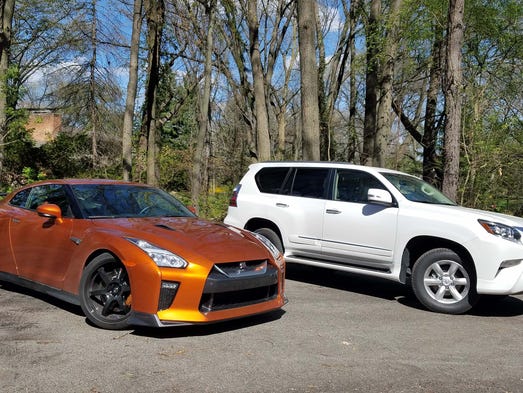
The result is still waaaay too much money, but if Godzilla is your kind of show, this is the ticket.
At M1’s Pontiac test track, the heavy, 3,915-pound GT-R shrunk in my hands. The steering is laser-focused, the stiff chassis balance 50-50 front-to-rear. Only at the limit does the car push, but the all-wheel drive system’s massive grip means it’s easier to put down the car’s nearly 565 horses. M1 chief instructor and pro-race driver Aaron Bambach had never had a GT-R on track and he emerged beaming.
Try that on Michigan’s battered roads, and you’d better wear a mouth guard. I tried navigating the M-10 Northwest Highway Service Drive — its pocked roads look like London after the blitz — and nearly lost my teeth. Even on smooth roads it’s unhappy at low speed, bucking and whining until you turn it loose.
Driving the GT-R in NORMAL mode lessens the harshness (and the temptation to do 2.9-second zero-60 sprints since launch control can only be activated in R-mode) and allows a look around the cabin.
GT-R ergonomics have evolved nicely, its knob-drunk dash upgraded with spare controls and a tablet touchscreen. Alas, the touchscreen is slower than Heinz ketchup, doesn’t come with smartphone connectivity and hasn’t a clue what you’re saying when you activate voice command.
Frankly, I was so enamored by Godzilla’s roar — WAAAAAHHHHHRGH! — over 3,000 rpm that I didn’t need infotainment.
Alas, the Lexus GX 460 provided no such diversion to take my mind off its old age.
Built on the same body-on-frame ladder that braces the aging Toyota 4Runner, the midsize Lexus’ chassis is in the Mesozoic Age compared to similarly priced, unibody competitors like the Acura MDX and Buick Enclave.
These modern, nimble SUVs run rings around Lexusaurus which doesn’t so much drive as lumber. Happily, a good ol’-fashioned V-8 lurks under the hood providing class-leading torque and 6,500-pound towing capability (useful for when the GT-R just becomes so dang jarring to drive on Detroit’s roads you only want to tow it to Waterford Hills weekend track days).
GX’s polarizing, full-fascia, window-blind grille says Lexus all right — but it can’t match the sculpted MDX or the gorgeous Enclave. Interior aesthetics are dated, as are neglected safety systems like blind-spot assist and adaptive cruise-control that come standard on the MDX (if not, ahem, the Buick).
But the interior of the Enclave is otherwise a modern studio with Apple CarPlay and Android connectivity, roomy cargo, 9-speed tranny and easy third-row seat access that the 6-speed Lexus lacks. Even a unique feature like the Lexus rear swing gate (just like the old Buick Roadmaster wagon!) is a head-scratcher.
The swing gate is pregnant with features like a toolbox and pop-open window so you can reach into the boot without opening the gate.
But when you pull up to the curb to unload that big flat-screen TV, the swing gate opens … the wrong way. Against the curb. So you have to walk around to the traffic side of the car and unload. That works in left-side-of-the-road Japan where the GX was designed — but how many three-row SUVs are sold back home?
The GX 460 is tough and Lexus-dispensable, but it’s even been lapped by the 10-grand cheaper Toyota Highlander. The scintillating, timeless Godzilla GT-R, however, endures.
Still, when the Track Edition got thumped in Car and Driver’s 2017 Lighting Lap by both the $80,000 Corvette Grand Sport and $63,000 Chevy Camaro ZL1, some will surely ask: Why did I just pay $131,000 for a Nissan?
Henry Payne is auto critic for The Detroit News. Find him at hpayne@detroitnews.com or Twitter @HenryEPayne. Catch “Car Radio with Henry Payne” from noon-2 p.m. Saturdays on 910 AM Superstation.
2018 Nissan GT-R
Vehicle type: Front-engine, all-wheel drive, four-passenger sports car
Price: $101,685 base ($131,605 Track Edition as tested)
Powerplant: 3.8-liter, twin-turbocharged V-6
Power: 565 horsepower, 467 pound-feet torque
Transmission: 6-speed, dual-clutch automatic
Performance: 0-60 mph, 2.9 seconds (Car and Driver); top speed: 195 mph
Weight: 3,915 pounds
Fuel economy: EPA fuel economy: 16 city/22 highway/18 combined
Report card
Highs: Still state-of-the-art AWD handling; wicked acceleration
Lows: Heavy; needs more refinement for the price
Overall: 3 stars
2018 Lexus GX 460
Vehicle type: Front-engine, all-wheel drive, 7-passenger SUV
Price: $53,450 base ($54,380 as tested)
Powerplant: 4.6-liter V-8
Power: 301 horsepower, 329 pound-feet torque
Transmission: 6-speed automatic
Performance: 0-60 mph, 7.8 seconds (manufacturer); towing capacity: 6,500 lbs.
Weight: 5,130 pounds
Fuel economy: EPA fuel economy: 15 city/20 highway/17 combined
Report card
Highs: Lexus service and reliability; nifty rear window
Lows: Boat-like handling; dated interior
Overall: 2 stars
Why the next Corvette pace car will be mid-engine
Posted by Talbot Payne on June 12, 2018

Pace driver and General Motors executive Mark Reuss wasn’t the only driver to spin in Belle Isle’s tricky Turn 2 on Sunday. IndyCar’s Santino Ferrucci came out of the pits too hot later in the race and spun, damaging his open-wheel race car’s front wing.
But Reuss’ Corvette ZR1 pace car’s crash is Exhibit A as to why Chevrolet is developing an all-wheel drive, mid-engine Corvette.
More: Mark Reuss says no excuses for pace car crash
While putting 755 horsepower to the rear wheels, GM”s product boss spun the most powerful front-engine ‘Vette ever into the retaining wall, scattering debris across the track and delaying the start by a half-hour.
It could have happened to anyone. But engineers and auto analysts say Reuss’ fortunes likely would have been better in a mid-engine, all-wheel drive car. Which is one of the many reasons Chevy, as The Detroit News reported two years ago, is bringing a mid-engine Corvette to market for model-year 2020.
Reuss, who wasn’t injured, is hardly an inexperienced Sunday driver. He is a skilled, race-licensed pilot with countless hours on tracks around the world including Germany’s formidable Nürburgring. He has put the top-dog $135,000 ZR1 through its paces on tracks from GM’s challenging Milford Proving Grounds to the epic Road Atlanta Raceway.
He had done multiple practice laps around Belle Isle last week in preparation for his pace stint. No stranger to the rough, twisty street course, Reuss paced the IndyCar field two years ago aboard the ZR1’s sibling, the 650-horse Z06.
Yet, when confronted with a “green” track free of sticky rubber after a day of rain, he made the same mistake as many others – including A.J. Almendinger who infamously crashed his Penske team IndyCar in Turn 2 on Lap 1 in 2013.
Reuss was apologetic in a Facebook post after the incident: “I have paced this race in the wet, cold, hot, and calm. On Z06s, Grand Sports, and other things. Today I let down my friends, my family, Indycar, our city and my company.”
The IndyCar field behind him was sympathetic.
“The track changes surfaces there,” Scott Dixon, who finished first and fourth in the weekend doubleheader, said in an interview with The Detroit News. “There’s actually a bit of elevation change there, too, which is what typically catches people out. We had a couple (IndyCars) spin out there this weekend.”
Said Team Penske IndyCar driver Will Power: “I felt really bad for whoever was in the pace car. Where it happened is such a bad corner. It’s real easy to do.”
And even easier when it’s a 3,600-pound production car with a supercharged V-8 boat anchor up front.
As horsepower numbers have skyrocketed in recent years, supercars have gone to mid-engine, all-wheel drive configurations for better stability and better traction. In recent years the Porsche 918, Acura NSX and Lamborghini Huracan have all been introduced as all-wheel drive, mid-engine cars.
Ex-Corvette engineer Wallace says that “mid-engine cars are a more comfortable way to get close to the limit in turns.”
That benefit is important, too, for Corvette’s racing program which increasingly has to deal with more sophisticated mid-engine competitors in the IMSA Weathertech Sports Car Championship like the Ford GT and Ferrari 488. Even Porsche’s iconic rear-engine 911 race car has moved its powerplant forward of the rear axles.
“Why mid-engine (Corvette)? Because the C7 Corvette … is tapped out,” wrote Car and Driver magazine, which has closely followed the mid-engine car’s development – code-named “Emperor” – since 2014 with details and spy shots. “Adding more power to a front-engine design only accelerates the conversion of rubber into smoke at the rear. Moving the engine’s mass closer to the drive tires is the most effective means of improving Corvette acceleration and braking.”
The magazine reports that the mid-engine 2020 Corvette C8 – which has been seen roaming the streets near GM’s Milford test track – will carry the marque’s familiar push-rod V-8 (married to a quick-shifting automatic transmission) and will carry a familiar, affordable supercar entry price.
But higher-trim, $100,000-plus models, writes Car and Driver’s Dan Pund, will push hypercar performance with all-wheel drive, turbocharging and electrified options.
Options are said to include a twin-turbo 5.5-liter V-8 driving the rear wheels and a 200-horsepower electric motor turning the fronts. Horsepower numbers over 1,000 demand– the traction and balance of mid-engine, all-wheel drive to stay on terra firma.
“With today’s horsepower numbers, every supercar is moving towards AWD and mid-engine chassis,” says Karl Brauer, an auto analyst with Kelley Blue Book, and owner of a mid-engine Ford GT and front-engine 840-horsepower Dodge Demon.
The Demon, the fastest production car ever through the quarter-mile, stirred consternation when it was launched last year with Automotive News editorializing that the rear-wheel drive coupe was so unsafe “that its registration as a road-worthy automobile should be banned.”
Brauer says the Demon has to go to extraordinary technical lengths to keep its rear tires from spinning like a bandsaw, including mechanical and electronic tricks to the suspension, transmission and engine.
When the mid-engine Corvette debuts next year, Wallace is confident that “it will be fundamentally quicker with less chance of going sideways.” But, adds the veteran GM engineer with dozens of laps around Belle Isle, “if you’re not careful through Turn 2, a mid-engine Corvette could still lose it.”
Santino Ferrucci and Mark Reuss no doubt would agree.
GM’s Reuss offers no excuses for pace car crash
Posted by Talbot Payne on June 12, 2018

Forgive General Motors product boss Mark Reuss if he wanted to call in sick Monday.
Reuss was the talk of Twitter when he put the Chevrolet Corvette ZR1 pace car into the wall Sunday, creating IndyCar gridlock behind him, and delaying the start of the race by a half-hour while Corvette bodywork was swept off the track.
Win on Sunday, sell on Monday? Not this time. The unusual pace car crash of Corvette’s $135,000, 755-horsepower pride and joy capped off a tough weekend for Chevy that saw Honda dominate the IndyCar engine wars.
More: Why the next Corvette pace car will be mid-engine
Reuss made no excuses. Taking to Facebook, he apologized for an incident that fortunately left everyone unscathed:
“I want to thank you all for your well wishes today. I am ok. I have driven this course many many many times. I have paced this race in the wet, cold, hot, and calm. On Z06’s, Grand Sports, and other things. It is never a casual thing for me, but an honor to be asked. Today I let down my friends, my family, Indycar, our city and my company. Sorry does not describe it. I want to thank our engineers for providing me the safety I know is the best in the world.”
If it’s any consolation, the pro drivers behind him were sympathetic. Scott Dixon, who had a good view of the crash from his fifth spot on the grid, observed that the Corvette wasn’t the only car to get sideways in tricky Turn 2.
“The track changes surfaces there,” said Dixon, who eventually finished fourth. “There’s actually a bit of elevation change there, too, which is what typically catches people out. We had a couple (IndyCars) spin out there this weekend.”
It’s not the first time a pace car has had trouble, Dixon mused to The Detroit News over breakfast Monday: “I think Toronto in 2014 was the last one with Arie Luyendyk (the two-time Indy 500 winner, not his “Bachelor” star son) spinning the Honda pace car in the rain.”
IndyCar’s E85 fuels competition, if not acceptance
Posted by Talbot Payne on June 12, 2018

The IndyCars racing in the Detroit Grand Prix at Belle Isle this weekend will carry the logos of Chevrolet, Honda, Firestone and others. With 100,000 in attendance on the island and nearly 2 million more watching on TV and the Internet, these brands benefit from their association with high-performance motor racing.
One product that hasn’t benefited is E85 ethanol fuel.
Politically popular in Washington and in Midwest presidential primary states like Iowa, the corn-based kindling has been the fuel of choice in IndyCar racing since 2012. But it has failed to catch on with consumers given its higher cost and decreased fuel efficiency.
E85 – a blend of 85 percent ethanol and 15 percent gasoline that’s also known as flex-fuel – is one of a number of fuel-centered public relations moves that major racing series have made.
Despite its lack of traction with the public, E85 has helped shield IndyCar from the wrath of green groups, proved a workable fuel for racing teams and delivered competitive racing. By being politically pro-active, American racing has managed to stay a step ahead of regulators even as production vehicles have become one of the most heavily regulated industries in the U.S.
“There have always been politicians and environmental groups that decry auto racing as a waste of fuel,” says Stephen Cole Smith, a veteran racing writer with Autoweek. “E85 fuel has been great PR for IndyCar and with which to answer their critics.”
The same can’t be said for other series like Formula One and the World Endurance Championship for sports cars. They have tried to currying favor with global governments by using trendy diesel and electrified racers, only to be burned by high costs and shifting political winds.
Under domestic political pressure to make the U.S. more oil-independent during the Iraq war, the Bush Administration embraced ethanol fuel in 2005 by mandating that gasoline be mixed with 10 percent ethanol. That’s what you filled your gas tank with this week.
Chevrolet, an IndyCar sponsor, has lobbied for more ethanol alternatives, and its large pickups, SUVs and Impala sedan are all E85 capable (so-called flex-fuel vehicles). By 2012, IndyCar followed suit, embracing E85 for its new, twin-turbo V-6 engines which it continues to run today.
“Partners like Chevrolet and Honda have been very supportive,” says IndyCar spokesman Curt Cavin. “Both are comfortable with the program, and certainly everything that happens around our event at the Iowa Motor Speedway is good for ethanol. It’s the best way for us to contribute to green initiatives and be good public citizens.”
IndyCar’s embrace of ethanol a decade ago buoyed hopes that it would become the fuel of choice for consumers.
“This shows average Americans what they can do to help meet the energy challenge our country faces, and it makes the point in a way a politician never could,” Sen. Evan Bayh, D-Indiana, told The Washington Post at a celebratory, handshake ceremony with Indianapolis Motor Speedway owner Tony George. “If a race car going 220 miles an hour can be powered by 100 percent ethanol, the family car can be, too.”
Yet, ethanol fuel has failed to catch on with the public.
Today, E85 is available in around 300 gas stations in Michigan, according to the Renewable Fuels Association, while just 3 percent of stations nationwide are equipped with the fuel. Studies have shown that few Americans choose E85 fuel at the pump. Sunoco, the official E85 fuel supplier to IndyCar offers, sells E85 at some of its Michigan stations.
IndyCar’s international brother, Formula One, meanwhile, has adopted hybrid-electric powertrains as it tries to stay in step with European governments’ promotion of battery-powered vehicles. The move, however, has been expensive and has led to a stratification of the sport as only a few teams can afford to develop expensive hybrid technology.
Attendance is down and drivers lament that the sport has lost its luster. While IndyCar celebrated another gripping Indy 500 finish over Memorial Day, Formula One star Fernando Alonso lamented “the most boring race ever” at Formula One’s iconic Monaco Grand Prix the same weekend.
“(Formula One) is facing an existential crisis,” wrote Wheels.ca, one of a wave of media examining the sport’s troubles. “The dismal performance of turbo hybrids – and the tepid reception from fans – should be more than enough impetus to make the changes necessary to restore the exhilarating noise and performance motorsport fans crave.”
Formula One’s struggles come on the back of difficulties in Europe’s major sports car series, the World Endurance Championship, and its signature race, the 24 Hours of LeMans. Europe’s green demands have wreaked havoc on that sport as well as the cost of fielding a hybrid-powered team climbed into the nine figures.
Manufacturers like Audi had used the series to showcase turbo-diesel engines (which combined with batteries made for exceptionally powerful, efficient endurance engines) favored by Euro tax policy since the 1990s. But with Dieselgate and global warming concerns, the fickle political winds turned against diesel and gas engines. Audi and Porsche have dropped out of the WEC to pursue the all-electric Formula E Series.
IndyCar has benefited from this turmoil as its ethanol strategy has kept costs stable. Despite the fact that E85 is 25 percent less efficient than gas, it can still be used (with some technical tweaks) in familiar V-6 racing engines.
“Though E85 fuel can only do about 30 laps at Indy, that’s about the life of the tires as well,” says IndyCar’s Cavin. “So it works out pretty well.”
While Formula One and WEC have struggled, IndyCar is on the upswing thanks to cost-friendly engine specs and close racing. Ticket sales at the Detroit Grand Prix, for example, are up 12 percent this year.
IndyCar’s engine/fuel rules are set to run through 2021. With states like California mandating electric car sales and E85 a sliver of U.S. fuel sales, is IndyCar thinking of changing its fuel formula to whisper-quiet hybrids for 2021?
“We’ve heard no encouragement from manufacturers,” says Cavin. “Our fans like their racing fast and loud.”
2 Payne: Acura reboots with X-cellent RDX ute
Posted by Talbot Payne on June 12, 2018

Three years ago, Honda got sick of criticism that its cars had gone soft.
So its product team rebooted the brand with the sensational Civic compact sedan. Benchmarked to the Audi A3, for goodness sake, Civic carved its own segment benchmark with best-in-class everything. Not content with that high bar, the Hoosier-built hottie then went about spawning whiz kids like the Sport, Si and Type-Rthat sent speed junkies running — nay, sprinting — to dealerships to get their fixes.
But wait, there’s more. So no one missed the message, Honda invested in Formula One, IndyCar racing and Pirelli World Challenge to taunt its competitors on-track as well as on-road. When the new Honda Accord arrived last year, it was no longer enough to be best in mainstream sedans, the fast-back four-door’s content rivaled luxury sedans.
Jeez, we get it, Honda. You’re back. Now get ready for the Great Awakening, Part II: Acura Gets Ticked.
Like Honda, the Acura brand had lost its way in the last decade as it strayed from its fun Integra and Type-S roots. It grew ponderous. Sprouted a chrome beak that looked like it should be opening bottles rather than gracing the front of a premium vehicle. Weird.
Acura listened, put designer and F1 fanboy Jon Ikeda at the helm, and got serious.
This being the Age of Ute, Acura chose to re-introduce itself with a compact SUV. Motorhead that I am, I might have preferred the ILX sedan (Civic’s luxury sibling), but utes are where it’s at these days.
With its stylish RDX, Acura has dropped the mic.
Benchmarked to class valedictorian BMW X3, RDX lays down some impressive class bests of its own. Best-in-class horsepower (not including niche players like Porsche Macan, Jaguar F-Pace, Alfa Stelvio). Best front passenger room. Best rear passenger room. Best cargo room. Best console room.
(Pause while I take a drink of water)
Best head-up display. First-in-class 10-speed transmission. Best torque-vectoring, twin-clutch-pack, off-road-shredding all-wheel drive (not shy, Honda calls this system Super Handling All-Wheel Drive. Or SH-AWD, for short).
Dude, Acura is back.
You knew it was coming. And not just because Roger Penske’s Acura prototype racers ran the competition outta town at Mid-Ohio raceway this month (yeah, Acura is doing the racing thing just like Honda). Acura methodically laid the groundwork for its RDX resurgence with the halo Acura NSX supercar, Precision Design Concept (2016 Detroit auto show) and Precision Interior Concept (2016 LA Auto Show).
This ute’s got NSX soul.
Barreling over the roller-coaster roads of Whistler, British Columbia ski country, the RDX’s only peers are the BMW and premium-wannabe Mazda CX-5. The latter’s buzzy, 187-horse drivetrain can’t play in the luxury class, so Bimmer ‘n’ RDX walk away when the road straightens out. Credit, too, the Acura’s buttery 10-speed tranny and NSX-inspired Sport Plus mode.
Push the trigger tranny’s center button and the little ute quivers with anticipation. The steering tightens. The exhaust rasps. Floor me now!
This eagerness is especially noticeable in the A-Spec model I tested. Like cheek paint on Tom Brady, A-Spec’s black trim means it’s game-ready. It also telegraphs a future Type-S model, the earth-pawing Acura equivalent to Honda’s insane, track-ready Type-R. Don’t expect a garish Type-R rear wing — but count on a new turbo V-6 for the S to hunt down the X3’s M-performance variant.
While Acura has followed the Civic playbook, the premium class is a different animal. Here, brand rules.
BMW, Audi, Mercedes and Volvo have earned their status with decades of consistent product. In turn, customers save for decades so they can afford, say, the coveted BMW kidneys.
Having matched (and exceeded) the competition in performance, Acura will have to consistently execute its signature jewel-eye headlights, grille and dragon’s tail-lights to stir the same passion in buyers.
Until that happens, Acura has other cards to play. Like value.
Acura takes top honors in the Kelley Blue Book Cost of Ownership Awards in a premium class where customers often pay through the nose for maintenance. A loaded $48,000 RDX Advance trim is $8,000 cheaper than equivalent BMW X3 or Audi Q5. At just $38,000, the base model gets a $4,000 jump on the competition with standard — standard! — panoramic sun-roof, 19-inch wheels, 10-speed tranny and a suite of safety systems including adaptive cruise and auto braking. It’s like Fleming’s merged with Cracker Barrel and served you filet mignon with a complimentary soup, salad and two sides.
RDX also aims to play with the big boys with its own, unique infotainment system. This is the price of entry in luxe and it’s Acura’s biggest gamble.
BMW debuted its iDrive, remote screen controller and perfected it only after years of struggle. Cadillac and Lexus have not been so successful, their unique CUE and touchpad systems causing customers to run from their cars screaming.
Acura’s Precision Touch system won’t cause any emotional breakdowns (I think Lexus’ touchpad phobia is actually a thing) but it requires patience. To keep the driver’s attention to the road, the screen is high on the dash and operated with a remote touchpad. I found it cumbersome, my finger hopping with the vehicle in motion. In an age when automakers are trying to be an extension of smartphones (Alexa, smartphone connectivity, etc.) I prefer the phone’s tried-and-true touchscreen.
Indeed, with its unique touchpad approach, Acura loses Android Auto capability — which Honda Corp. pioneered in its vehicles — because it’s still in development for touchpads (Acura says its coming, and Apple CarPlay is available now).
It’s a reminder that every luxury-maker has its quirks. BMW’s monostable shifter vexes many buyers. The over-engineered Audi Q5 console leaves no room for cubby storage. Cadillac still hasn’t perfected CUE. And so on.
Touchpad aside, RDX ergonomics are excellent. Screen icons can be personalized like a smartphone and voice commands are direct (Example: Take me to the nearest Starbucks). The trigger tyranny opens up a cavern of sub-console space for purse/tablet/Kleenex/whatever storage.
Made right down the road in East Liberty, Ohio, the RDX is the total package, pushing Acura to the head of the class. And the tail. Check out the thoughtful, deep, three-cubby storage under the rear cargo hold. It’s right above the A-Spec’s massive twin tailpipes.
Yup. Acura is back.
Henry Payne is auto critic for The Detroit News. Find him at hpayne@detroitnews.com or Twitter @HenryEPayne. Catch “Car Radio with Henry Payne” from noon-2 p.m. Saturdays on 910 AM Superstation.
2019 Acura RDX
Vehicle type: Front-engine, front- and all-wheel drive, five-passenger SUV
Price: $38,325 base ($46,495 A-Spec trim and $48,395 Advance trim as tested)
Powerplant: 2.0-liter, turbocharged inline-4 cylinder
Power: 272 horsepower, 280 pound-feet torque
Transmission: 10-speed automatic
Performance: 0-60 mph, NA; towing, 1,500 pounds
Weight: 4,015 pounds (AWD A-Spec as tested)
Fuel economy: EPA fuel economy: 21 city/27 highway/23 combined (AWD A-Spec)
Report card
Highs: Spacious, comfortable utility; a ute that’s fun to drive
Lows: MPG trails competitors; inconsistent touchpad controller
Overall: 4 stars
Payne: Jeep Cherokee grows up
Posted by Talbot Payne on June 12, 2018

We all have to grow up sometime.
Like the college grad who trades his AC/DC T-shirt and jeans for a button-down shirt and slacks on his first day at the office, the 2019 Jeep Cherokee has gone respectable.
The brand’s wild child debuted back in 2013 with a shark nose, three tiers of lights and its license plate hanging below its bum. Polite society was shocked – and couldn’t stop ogling it. The Cherokee eclipsed 200,000 in sales in 2015 and took the crown as Jeep’s best-selling vehicle. Big brother Grand Cherokee was so proud.
But as the novelty wore off, sales steadily declined to under 170,000 last year. Time for a wardrobe upgrade – but happily, not a lifestyle change.
Beneath its mature, upright seven-slot waterfall grille (just like big brother!), proper headlights (running lights and headlights under one cover) and tidy rear end (plate on tailgate, shirt tucked in), the Cherokee is still a tattooed, nature-loving four-wheeler that wants nothing more than to go off-roading.
And by off-roading, I mean navigating Detroit streets without fear.
The 2019 Cherokee arrived in my driveway after another Detroit winter from hell. Make that from the Arctic. A brutal winter and delayed spring wreaked havoc on the region’s feeble roads. One crater swallowed a wheel on a Genesis G80; my teeth barely survived a recent week in a hard-sprung Nissan GT-R.
That means you don’t have to go to Moab to appreciate the Cherokee’s ruggedness. There are stretches of pavement I try to avoid: the Lodge service drive, Mound Road, Lone Pine. I use to think wealthy neighborhoods in Oakland County were unpaved to slow folks down; now I know it’s because dirt is smoother than Michigan pavement.
But the Jeep doesn’t care. Riding on thick-sidewall tires and a unibody chassis hewn from Thor’s hammer, my Jeep Overland shrugged off bad pavement like Deadpool absorbs bullets.
I’m pretty sure the Cherokee could’ve handled the wet, gravel and sand beach I got stuck in last year in little brother Compass Trailhawk. Jeep’s trail-rated Trailhawk trim (and countless ads of Jeeps scaling cliff faces) is a temptation to take on Mother Nature. I found myself charging around the beaches of Lake Michigan in the Compass – until I decided to stop and take a picture.
The Cherokee Trailhawk, however, comes with a standard locking rear-differential borrowed from the Wrangler. My Jeep friends tell me this would have been my ticket out (that, and never stop in sand).
My Overland tester was not equipped with a locker. Which begs the question: Why pay $41,000 for a compact Jeep – over, say, the $35,000 Honda CR-V or Mazda CX5 – I tested last year if not equipped with the best 4×4 system?
The Japanese entries are equipped with all-wheel drive systems suitable for our ox-cart roads even if they don’t come with Jeep’s multiple terrain settings. Like Jeep’s optional Technology Group, they also come packaged with the latest electronics – blind-spot assist, adaptive cruise-control, automatic headlights – which shame more expensive premium sedans (looking at you, $67,000 BMW X4).
The competitors are also more nimble. The Mazda is downright sporty and the lightweight Honda shares a 1.5-liter turbo-4 and platform with the athletic Honda Accord.
Jeep boasts beefier engine numbers to complement its beefy, off-road vibe. The Cherokee debuts a premium turbo 2.0-liter with a healthy 290 pound-feet of torque (compared to Honda’s 176), but my tester sported the tried-and-true, 3.2-liter, 271-horse V-6. Nitpickers will naysay its 22 mpg (versus CRV’s 29), but only the Cherokee V-6’s 239 pound-feet of torque will tow a class-leading 4,500 pounds.
Unfortunately, it is paired with the tried-and-less-true Jeep nine-speed transmission which grumped and hiccupped through its daily chores. I’m a fan of high-ratio trannies in competitors like the nine-speed GMC Terrain, but Jeep’s effort has been trouble from the start.
“(Cherokees) have transmissions that suffer from hard shifts, odd shift points and sudden shutdowns,” reported jeepproblems.com back in 2016 – and though the new generation promises better reliability on that shutdown bugaboo, the quirky shift behavior remains.
Speaking of reliability, Jeep’s record continues to keep lemon lawyers in business.
But like quality-challenged Tesla, Jeep’s highly anticipated Cherokee will be a hit because brand matters. In the lookalike world of today’s autos, Jeep sends a message. That grille. That terrain-conquering dial. That “since 1941” World War II legacy carved into the steering wheel. The brand that invented SUVs screams authenticity.
And despite its flaws, the package screams quality. Like GMC’ s Terrain (which comes from premium truck DNA), the Jeep brand is the rare mainstream badge that gets considered alongside premium brands.
While the Cherokee’s outside is cleaned up – “We took the geekiness out of it,” designer Mark Allen likes to say – the inside has been mature since generation one.
The tidy instrument display with chrome bezels is first-class, as is the Uconnect infotainment system. Already the industry standard with easy-to-use menus, Uconnect has been updated with faster, bigger screens (even the base Latitude trims gets a 7-inch pane) and smartphone connectivity. Google Maps is far superior to any car navigation system.
Even the rear cargo space has been improved. Engineers carved out an extra 3 inches of width and more than two more cubic feet of storage. It’s good for two golf bags.
In an age when electronics are narrowing the gap between mainstream and luxury, Jeep bridges the gap with its macho vibe, powerful engines, and upscale interior. And now that it’s out of that awkward geek phase, you can take it on a date to the country club.
Henry Payne is auto critic for The Detroit News. Find him at hpayne@detroitnews.com or Twitter @HenryEPayne. Catch “Car Radio with Henry Payne” from noon-2 p.m. Saturdays on 910 AM Superstation.
2019 Jeep Cherokee
Vehicle type: Front-engine, front and all-wheel drive, five-passenger SUV
Price: $25,440 base ($41,510 Overland 4×4 as tested)
Powerplant: 2.4-liter, Tigershark inline-4 cylinder; 3.2-liter Pentastar V-6; 2.0-liter, turbocharged inline-4
Power: 180 horsepower, 171 pound-feet torque (2.4-liter I-4); 271 horsepower, 239 pound-feet torque (V-6); 270 horsepower, 295 pound-feet torque (turbo-4)
Transmission: 9-speed automatic
Performance: 0-60 mph, 6.6 seconds (Car and Driver est. for turbo-4); towing: 4,500 pounds (V-6 with Trailer Tow Package)
Weight: 3,960 pounds (V-6 4×4 as tested)
Fuel economy: EPA fuel economy (all figures for 4×2, front-wheel drive mode): 22 city/31 highway/24 combined (2.4-liter I-4); 20 city/29 highway/23 combined V-6); 23 city/31 highway/26 combined (2.0-liter turbo-4)
Report card
Highs: Classic Jeep exterior; high-class interior
Lows: Uneven 9-speed tranny; can get pricey
Overall: 3 stars
‘Alexa, start my car’: Latest app for auto revolution
Posted by Talbot Payne on May 22, 2018

Apple CarPlay and Android Auto? Dude, that’s so 15 minutes ago.
Amazon’s Alexa assistant is the latest must-have vehicle app as carmakers rush to put connectivity on wheels.
Alexa offers similar conveniences for the car that Amazon Echo users have come to expect in the home. In fact, most of the dozen brands with Alexa connectivity limit its use to the home Echo device to communicate with the car: Alexa, start my car. Alexa, lock the car doors.
But Ford Motor Co. (and its luxury arm Lincoln) takes it a step further, expanding those in-home commands to in-car demands. Called “Ford + Alexa,” the feature can be used to ask for directions on the road or play music. Sample commands include:
Alexa, where is the closest barbecue restaurant?
Alexa, play my workout playlist.
Alexa, what’s on my calendar tonight?
The in-car feature can also be used to communicate with smart-home systems. Mike Severson, Ford’s marketing manager for connected vehicles and technology, says that effectively makes a round trip from home to work seamless: Users can pre-heat the interior of the car from inside the house for a commute to work, then boost the thermostat of the house from inside the car on the return journey.
“Technology is something a lot of people crave,” says Severson. “We partner with the big boys to deliver that to the customer. People are very passionate about (their apps). Technology is increasingly more important on the vehicle purchase decision.”
From Bluetooth to Wi-Fi to music apps like Pandora, automobiles have become extensions of smartphone apps. Apple CarPlay first rolled out in upscale cars like Ferrari and Mercedes in 2014, allowing smartphones to take over a vehicle’s infotainment display. The app was slow to catch on.
Amazon’s Alexa app appears to be following a similar path as CarPlay and Android Auto, spreading across the industry to more than a dozen brands and counting.
“It was creepy at first,” says Kelley Blue Book auto analyst Rebecca Lindland, a self-professed early technology adopter. “But new generations who grew up with their personal phones will expect their cars to be fully integrated with their phone and their home.”
Lindland says that as phones have become the center of the personal digital universe, car owners expect a seamless transition from home to mobility.
Infiniti even headlines the Alexa feature in a national ad campaign. “Alexa, start my Infiniti QX50,” a woman says on a commercial as she and her partner rush from the house to attend a film premiere.
Genesis, Hyundai’s luxury brand, was the first automaker to offer Alexa home-to-vehicle connectivity. It debuted in late 2016 on the Genesis G90 sedan, two years after Amazon introduced Alexa on its Echo home device. The feature is now available across the Genesis and Hyundai model lines. Downloaded as an app on a smartphone and requiring minimal setup, it comes with a number of commands such as: Alexa, ask my Genesis to start the car and set the temperature to 72 degrees.
“We’ve received good feedback from our customers who appreciate that we have the latest technology,” says Yuval Steinman, a product strategy manager for Genesis. He expects the feature to grow in popularity as it becomes more ubiquitous in homes and as competitors come to market. The Genesis and Hyundai systems, for example, are now also compatible with Alexa competitor Google Assistant.
“We find customers want a choice,” says Ford’s Severson. “They love Apple, they love Android, their Google maps. One of the key philosophies of Sync is providing choice … to customers.”
Recent news reports have highlighted 13 cases of asphyxiation resulting from cars with push-button starters not shutting off in garages. To prevent this from happening, if a car is started with the Genesis-Hyundai Alexa app, it will shut the engine down after 10 minutes if the car has not been unlocked.
Hybrid vs. hybrid: Honda Clarity and Toyota Camry
Posted by Talbot Payne on May 22, 2018

The Toyota Prius became a sales sensation after it was introduced in the U.S. in 2000, provoking media predictions that hybrid cars would soon take over the market. As it turned out, folks didn’t want hybrids — they just wanted Priuses.
With its aero shape, split-window grille, eco-console and leafy badge, it was a personal statement. It was the green preener’s car. Nickname: Pious.
But what if you didn’t want to shout your moral intentions to the world? What if you didn’t need to show off your green chic at the Academy Awards? What if you simply wanted an affordable, family hybrid with the utility of a best-selling sedan?
The Toyota Camry hybrid was your answer. It was affordable, fuel-efficient and as plain as a quart of vanilla ice cream.
It sold modestly compared to the Prius, but it was part of Toyota’s strategy to leverage the halo status of the Prius and hybridize everything in its lineup from sedans to sport utilities to Lexus premium vehicles. Other brands followed the Camry hybrid — notably the Ford Fusion Hybrid and plug-in Energi, and Honda Accord Hybrid — with only moderate success compared to their gas-only counterparts.
But here comes Honda with a new strategy. Determined to electrify its entire lineup just like Toyota (Honda says two-thirds of vehicles it sells in 2030 globally will be electrified), Toyota’s Japanese rival has introduced its own green-geek halo: the plug-in hybrid Clarity.
Aero shape, split rear window, funky console, leafy badging. And it’s aimed, not at the Prius, but at the plain-vanilla Camry Hybrid.
In fact the Camry and Clarity in my driveway are as closely matched as Ali vs. Frazier: They’re the meat of the U.S. sedan market at $37,000 (before incentives — more on that later) with similar dimensions, leather interior, heated seats, automatic headlights, automatic braking and blind-spot assist.
Oh, it’s on.
First impressions favor the handsome Camry. No, that’s not a misprint. The eight-generation sedan is a quantum leap from the last wallflower. Remade from the ground up, it is visually sleek with sculpted rocker panels and strong rear shoulders. Unlike its sporty, mascara-caked XSE V-6 stablemate whose face deserves an episode on “Botched,” my XLE hybrid tastefully presents Camry’s new look with subtle, chrome grille lines artfully echoed in the headlamp LED signature.
The Clarity is no boat — especially with 17-kWh of battery lowering its center of gravity — but neither is it an Accord. The Accord is a handling sensation (North American Car of the Year, take a bow), eclipsing even the improved Camry. The Clarity is built on its own separate platform to handle multiple model trims from plug-in to EV to the expensive California-only hydrogen chariot. Want all-wheel drive? Move up to an SUV.
Honda hopes you’ll warm up to the Clarity’s unique styling. The front end (particularly in white) is a dead ringer for a “Star Wars” stormtrooper, its jewel-eye LED headlights surrounded by a black mask. Aft of the mask the Clarity geeks out with a long front overhang (complete with aerodynamic front-wheel air curtains), partially covered rear tire-wells, and aforementioned Prius-like dual rear window.
The split window aids visibility to overcome the Honda’s tall, roomy rear trunk. Cargo space is cavernous compared to the hydrogen car I tested a year ago (no hydrogen fuel tank, natch). The Camry, too, has gained trunk space over its predecessor thanks to cleverly packaging the battery under the seat instead of the trunk. Alas, neither car is a hatchback, meaning that — despite lay-flat second-row seats — the pass-through opening is too narrow to be bicycle-friendly.
Covet a hatchback sedan? Ditch your green ambitions and buy a Buick Regal or Kia Stinger for the same price.
Both cars sport distinctive interiors, with the Camry once again getting my nod for most user-friendly. As with all new Camrys, the console’s unique “Z-dash” offers helpful knobs for volume, storage space and easy shifter.
Clarity goes nerd with an Acura-borrowed trigger shifter bridging cavernous sub-console space (great for purse storage). A knob-less infotainment screen will annoy in the middle of a white suede dash (now, that will dirty easily!), though some will find Camry’s lack of smartphone app connectivity less forgivable.
Grin and bear the Clarity’s styling. Learn the trigger shifter. Because the Clarity’s real sci-fi payoff comes with the drivetrain.
The Camry’s camel-like 611-mile range may get you to Chicago and back on a single tank of fuel. But with its 17.4-kWh battery’s 40-plus mile range, Honda’s plug-in will make you a stranger to the cashier at your local gas station.
I never visited a pump during my week-long date with the Clarity. After a round-trip 65-mile airport run, I dipped into the gas engine briefly, then recharged at home on a pathetic, 4-miles-per-hour-charging, 110-volt wall plug. Still, that was enough to get back to full-charge overnight.
The driveline is optimized for efficiency, so stoplight burnouts are brief (despite its bigger battery, the Clarity barely beats the Camry Hybrid zero-60 in 7.6 seconds versus 7.9). The gas engine will even come to the rescue over 50 mph to keep the battery from over-exerting itself.
The Honda also has a clever, steering wheel-mounted, regen paddle like the Chevy Volt plug-in to recharge the battery under braking. In Ecomode (Sport mode is also available, but lord knows why, given the Clarity’s conservative nature) and generous use of regen paddle, I managed 55 miles on a single charge — out-performing the system’s advertised 41 mpg.
Clarity offers other useful Easter eggs like the HRV button which switches the system exclusively to the gas engine on long 80-mph highway trips to preserve the battery for when you want it around town. All of this information can be watched on the Clarity’s colorful, digital instrument display.
Geeky stuff, but useful.
Oh, and there’s a geek sweetener. Only the Honda comes with a $7,500 EV tax subsidy. Which means its bottom line sinks below $30,000. That’s a greenback bargain that any green will understand.
Henry Payne is auto critic for The Detroit News. Find him at hpayne@detroitnews.com or Twitter @HenryEPayne. Catch “Car Radio with Henry Payne” from noon-1 p.m. Saturdays on 910 AM Superstation.
2018 Toyota Camry Hybrid
|
VEHICLE TYPE |
FRONT-ENGINE, FRONT-WHEEL DRIVE, FIVE-PASSENGER SEDAN |
|
Price |
$28,695 base ($37,363 Hybrid XLE as tested) |
|
Power plant |
2.5-liter, inline 4-cylinder with 1.6-kWh nickel metal-hydride battery and AC motor-assist |
|
Power |
208 total system horsepower |
|
Transmission |
Continuously variable transmission (CVT) |
|
Performance |
0-60 mph, 7.9 seconds (Car and Driver); range: 611 miles |
|
Weight |
3,571 pounds (as tested) |
|
Fuel economy |
EPA fuel economy: 44 city/47 highway/46 combined |
Report card
Highs: Nice duds, Camry; 600-plus mile range
Lows: Toyota hybrids don’t get tax breaks; wish it had a hatchback
Overall:★★★
2018 Honda Clarity Plug-in
|
VEHICLE TYPE |
FRONT-ENGINE, FRONT-WHEEL DRIVE, FIVE-PASSENGER SEDAN |
|
Price |
$34,290 base ($37,490 Touring trim as tested) |
|
Power plant |
17-kWh nickel metal-hydride battery and AC motor with 1.5-liter, inline 4-cylinder assist |
|
Power |
212 total system horsepower |
|
Transmission |
Single speed |
|
Performance |
0-60 mph, 7.6 seconds (Car and Driver); Range: 340 miles (47 EV only) |
|
Weight |
4,059 pounds |
|
Fuel economy |
EPA fuel economy: 110 MPGe (combined electric/gas); 42 mph gas only |
Report card
Highs: Good EV range for a big car; trunk space
Lows: Geeky styling; wish it had a hatchback
Overall:★★★
Cadillac breaks old assumptions with racing program
Posted by Talbot Payne on May 11, 2018

For Cadillac, 2018 may be the Year of the SUV — but it’s also the Year of Performance.
GM’s luxury brand is playing catch-up to SUV-rich BMW, Mercedes and Audi with the first of three new crossovers to be introduced by 2021. But even as Cadillac announced this week the cancellation of its ATS sedan — billed as its BMW 3-series fighter — it also made clear that its goal to be the American alternative to the Teutonic threesome is about more than five-door family-haulers.
Despite the revamping of its sedan lineup and dismissal of product architect and CEO Johan de Nysschen, Cadillac says it has its pedal-to-the-metal on a long-term strategy promoting the brand’s athleticism.
Cadillac is accelerating its performance programs as it goes wheel-to-wheel against some of the world’s greatest track marques. The premium automaker has a new halo CT6 V-Sport sedan, new ad campaign and special Championship Edition V-series cars to celebrate the brand’s historic world endurance racing championship in 2017.
“We have an overall product ladder to continue filling out,” said Matt Russell, Cadillac’s marketing manager for racing and its V-series performance-car lineup. “But I want to make a clear statement that we are — particularly in the effect we get from motorsports and building sporty cars — committed to the sport-luxe compact car business.”
Continued Russell: “We may be entering a period of generation change for those models — particularly for the ATS sedan — but we are not walking away from those segments. Racing is an accelerant for conversation for our compact and midsize performance cars.”
As if to punctuate the point, Cadillac race driver Jordan Taylor campaigned the IMSA 2017 Championship Edition CTS-V across Michigan this week, leading up to the home team’s defense of its IMSA Weathertech Sportscar win here last year.
CTS is a poster child for how closely Cadillac’s engineers work with their racing programs. V-series development programs have translated racing technology to the street with features like traction-assisting Performance Traction Management.
Only 200 Championship Edition vehicles — encompassing the CTS-V, the ATS-V sedan and ATS-V coupe — have been made for sale in the U.S., Canada and Middle East. They are distinguished by special graphics including an outline of the sleek, IMSA DPi racing prototype that won last year’s championship.
And while the ATS-V Championship Edition represents the last hurrah for the small sedan, expect more performance cars like the 550-horsepower, twin-turbo V-8 CT6 V-Sport unveiled at this year’s New York Auto Show.
Race-driver and Cadillac ambassador Taylor left Belle Isle in the Championship Edition CTS-V for Grand Rapids on Monday afternoon to wow dealers and customers. Cadillac says the racing program has attracted new customers and younger people. Twenty-somethings come out to see Taylor, 26, sign autographs in the “Cadillac Corral” at races like Detroit.
“There are a lot of similarities between the race car and street car,” says Taylor who arrived in Detroit fresh from a fifth-place showing Sunday at the the IMSA Weathertech series’ stop at Mid-Ohio race track. “They have the same wheel design, same push-rod V-8 and same rear camera mirror.”
The race car and CTS-V share center stage — alongside the new XT4 crossover and Super Cruise self-driving technology — in the new Cadillac ad campaign, “The Future is Here.” The DPi V.R racer and the CTS-V roar across the screen on a race track accompanied by blaring rock music.
Russell says the emphasis on racing is part of a conscious decision by GM to break the Cadillac mold.
“When you’re 116 years old, there are certain elements of your brand and product that are established,” he says. “People know we can do comfortable. So where do we stretch our legs? We demonstrate that we have engineers that compete with all other engineers when it comes to safety, connectivity and racing.”
Taylor and steed will return to Belle Isle June 1-3 for Detroit Grand Prix weekend. Acura, Mazda and Nissan have all joined the IMSA Weathertech Sportscar prototype class with similar winged 600-horsepower beasts. Troy-based Team Penske manages the Acura team that won its first race at Mid-Ohio. The series also features production-based GT cars from BMW, Audi, Lexus, Ford, Ferrari and Porsche. Chevrolet is a GT competitor but will miss Detroit as it ships its Corvette racers across the pond to June’s 24 Hours of LeMans.
Cadillac cut its teeth in GT racing back in 2004 before taking the leap to prototype racing last year.
“We had won so much on the GT front with the V-series, you can’t allow it to become old news that you are good at something,” says Russell of the brand’s successful move to the DPi format last year. “It’s a way to keep ourselves relevant using racing as that stimulant for our street car business.”
Taylor finds his new CTS-V Championship Series plenty stimulating. Indeed, the supercharged, 6.2-liter V’s 650 horsepower actually exceeds that in his race car (competition rules limit power to 600 ponies).
“It’s funny driving my street car around and lighting up the tires by accident, and then getting in the race car with so much (aerodynamic) down-force you don’t feel like you’re going anywhere sometimes,” Taylor said. “It’s awesome to see Cadillac developing this side of the brand again and using racing to develop it.”