- Search Cartoons
- Comic Archive
-
Payne
Store



 Henry Payne RSS

Articles
Payne: EVs are struggling, so why are automakers betting on EVs?
Posted by Talbot Payne on May 7, 2019

Jaguar I-Pace sales – the first direct Tesla-fighter from a European lux-maker – have been disappointing. Aimed at the Tesla Model S/X, its costs about $86,000.
Tesla Inc. reported a bigger-than-expected $702 million loss in the first three months of the year, pushing the electric car-maker back to the capital markets for as much as $2.7 billion to shore up its dwindling cash reserves.
The red ink comes amid falling U.S. sales for electric vehicles and a struggle to show sustainable profits. So why are other automakers following its battery-powered business model?
As part of its “zero-zero-zero” strategy, General Motors Co. is promising a zero-emission electric-vehicle future as well as an autonomous vehicle-driven promise of zero crashes and zero congestion. Ford Motor Co. is making a Mustang-styled Tesla-fighter while also pouring $500 million into EV truck-maker Rivian Automotive of Plymouth. And Volkswagen AG is ending development of gas-engine powered vehicles by 2026.
Despite the headwinds facing EVs, automakers are betting on an uncertain future for a variety of reasons: fear of Tesla dominating “Generation App” millennials, activism of green CEOs, and the perfect marriage of batteries and autonomous cars. But the most immediate reason is government — not consumer — driven.
“First, there is a regulatory push in Europe and China that is driving players to introduce electric vehicles to fulfill their requirements,” says John Murphy, auto analyst for Merrill Lynch. Global governments — including California, the most populous state — are dictating specific drivetrains for the first time in auto industry history.
Tesla has been the runaway sales leader in EVs while charging a premium that often exceeds $100,000 for its cars. Its Model 3 was the best-selling luxury car in the United States last year, and the $40,000-plus EV has vaulted to the top of the sales charts in Europe as the California-maker has expanded overseas.
Yet, sales are down sharply this year in the U.S. as the initial Model 3 rush has subsided. So has the $7,500 federal subsidy for electric cars, scheduled to phase out over the coming year.
More ominously for automakers, total EV sales are down even as competitors entered the market. Sales of GM’s Chevrolet Bolt are down, for example, and Jaguar I-Pace sales — the first direct Tesla-fighter from a European luxury-maker — have been disappointing.
I’ve experienced the hesitation of potential EV buyers myself. The owner of a Tesla Model 3, I have been swarmed by friends who want to experience the car’s unique abilities. But when they learn of the compromises an EV owner must endure — garage charging upgrades, long waits at charging stations, range anxiety — their enthusiasm for ownership cools.
Indeed, Tesla-mania tracks early predictions that the Toyota Prius hybrid — a runaway sales success in the early 2000s — would lead to a hybrid sales wave. Didn’t happen. In truth, people just wanted the trendy Prius. Other hybrids like the Ford Fusion and Chevy Volt never caught on and have been retired.
“People don’t see EVs as a better solution for their needs than gas-powered cars,” says veteran auto analyst Rebecca Lindland of RebeccaDrives.com.
Still, automakers are betting the farm on EVs: “We’re committed to an all-electric future,” trumpets GM’s website. “It’s a simple equation: More electric vehicles on the road means fewer emissions and cleaner air for all.”
Much of this is regulatory, to be sure.
“On some level, they have to say that,” says Lindland. “Governments are mandating that they have to build EVs even though demand hasn’t grown significantly.”
What’s more, Volkswagen is trying to turn the page on its emissions cheating scandal. “It’s penance for past sins on Dieselgate,” says Merrill Lynch’s Murphy.
But there is also a concern among GM’s Cadillac and other luxury brands that they are losing out to what analyst Lindland calls “Generation App” — a rising group of worldly, earth-conscious buyers weaned on iPhones who will ultimately aspire to electric chariots.
Adds Murphy: “You’re looking at a marketing game to attract customers even if they don’t yet buy EVs. There’s concern among luxury-makers that Tesla may be taking market share from them.”
A big reason Tesla struggles is because — despite its promise to build a $35,000 Model 3 — the high cost of batteries destroys profit margins below $50,000. Merrill Lynch estimates EVs have to be in the $55,000-$60,000-plus price range to drive reasonable profit levels.
“It’s tough to understand why any automaker would significantly push econoboxes in the $30,000 range unless they need to meet regulatory requirements,” says Murphy.
Makers of those $30,000 econoboxes say, however, that there is legal risk in addition to regulatory. Specifically, they fear that governments will target Big Auto with lawsuits as they did Big Tobacco, suing them for such environmental damages as hurricanes and fires allegedly caused by carbon dioxide emissions.
“We consider that to be a real business risk, so we’re working very hard to be — not part of the problem — but to be part of the solution,” Honda Motor Co.’s vice president of environmental vehicles, Steve Center, told Autoline. Honda makes the $23,000 Insight hybrid and plans to electrify most of its lineup by 2030.
Don’t discount the personal activism of CEOs in wanting to be part of that solution, too. Tesla CEO Elon Musk is an outspoken green activist who has made saving the planet part of his company’s mission statement. His activism is echoed by two new EV partners — Ford Chairman Bill Ford Jr. and Rivian founder R.J. Scaringe.
Scaringe and Ford see eye-to-eye on green activism. “We believe the world needs to electrify,” says Scaringe. Happily, Rivian also meets Merrill Lynch’s investment threshold for $60,000-plus vehicles. Rivian is also attracting investment because it holds a key to perhaps the biggest door Tesla has unlocked: autonomy.
“The reason that Tesla’s valuation has been so high is because of its potential,” says analyst Lindland. “Investors see that potential in electrification and in self-driving cars.”
And sure enough, markets reacted positively to its stock sale plan this week despite the dilution in overall shares. Musk has been as much a missionary for robot cars as for battery power.
Rivian’s trucks — with their “skateboard” battery construction opening enormous storage space — have attracted Amazon investment for its autonomous delivery potential. GM has made Cadillac its lead EV brand, but close behind is its investment in Cruise Automation, a West Coast-based ride-sharing competitor to Waymo and Uber that the General intends to staff with driverless Bolt EVs.
These ride-sharing services — including one unveiled by Tesla last month — all test exclusively with EVs. Merrill’s Murphy has been bearish on Tesla’s profitability: “But in reality Tesla has changed the game, and everyone is chasing Elon.”
Payne: Kia Telluride is luxe and loaded
Posted by Talbot Payne on May 2, 2019

Telluride. Posh ski resort. Beautiful people. Rugged western landscape.
You know what the Kia Telluride is trying to evoke even before you see this handsome, chiseled SUV.
That’s right — Kia. Like Volkswagen and Mazda, the Korean brand is separating itself from its mainstream competitors with premium-looking vehicles that are $20,000 less than similarly equipped luxury chariots. But where VW names its cars after winds (Golf, Passat) and Mazda goes with technical alphanumerics (CX-9, MX-5), Kia aims for the American heart.
There’s the Sedona (cowboy!) and the Soul (man!) and the Sportage (dude!).
But Kia really hit the bullseye last year with the $39,000 all-wheel drive Stinger. The slinky, hatchback sport sedan is an Audi A7 without the price tag — but the name is all-American muscle car like Super Bee or Hornet before it. As is its Ford Mustang-like color palette of yellow, red and blue.
With athletic handling, a sleek bod, mod interior and 365-horsepower twin-turbo V-6, the Stinger halo car sets Kia up as a desirable brand. Stinger makes your heart go thump.
Now comes the Telluride, and it is an affordable Cadillac XT6: vertical design cues, body chiseled from stone.
This first-gen Kia is aimed right at that most American of segments — the three-row SUV — and Detroit icons like the Ford Explorer and Chevy Traverse. The Telluride was designed in Kia’s Los Angeles design studio and is built in Georgia.
I first saw it at the Detroit auto show where Kia built an indoor off-road track (an oxymoron if there ever was one) and offered bruising rides in Tellurides specially equipped to take on the Baja peninsula.
It was a four-wheeled stallion in a rodeo corral and had the features to prove it: all-wheel drive with multiple terrain modes; a chassis that adapts its ride height depending on the terrain; two “oh-crap” handles on the center console like dual horns on a saddle. It was cowboy tough on the outside, hospitable as a Telluride ranch house inside.
The back two rows are just as accommodating even for ex-basketball centers like me. Detroit competitor Chevy Traverse is made in Middle America and knows how to accommodate big, middle-American families with a third row that’s a livable place to be with cup holders, food holders, good legroom and panoramic roof for sunlight.
The made-in-Georgia Telluride doesn’t forget third-row passengers, either. Back-seaters get their own USB ports. And like the Traverse and another one of my class favorites, the Honda Pilot, the Kia allows third-row access with the simple push of a button. There are no multiple-step heaves to get into the back seat. Even little kids can do it.
Once back there, the second-row captains chairs (to keep peace between the kiddies) don’t just flop on your feet — they are slidable. The result is you can adjust first- and second-row seats to make everyone comfortable. In fact, I could not only sit behind myself in the second row — I could sit behind myself sitting behind myself in the third row!
This attention to detail is followed in every corner of the cabin — including thoughtful ideas like a front chime that alerts you if you left a child or pet in the back seat, and a microphone so you can talk to kids in the third row ZIP code.
Then there are standard features no $30,000 vehicle these days should do without.
Tops on my list is adaptive cruise-control, an important assistant for oft-distracted families on long road trips. Set adaptive-cruise and the big ute will keep its distance from vehicles ahead of you if you get distracted by — ahem — those second-row, fighting siblings. Kia matches segment pioneers like Honda and Toyota by making adaptive cruise-control standard and shames others — looking at you, Traverse — that don’t make it available until you’ve shelled out more than $45,000.
Telluride is one of the best values in the segment. For example, an all-wheel-drive S trim with 20-inch wheels and leather can be had for under $40,000.
And then the Kia goes a step further by wrapping value in a premium wrapper.
Its Asian competitors Honda and Toyota and Hyundai look like mainstream competitors (perhaps, in part, because they have luxury brands above them). But the Telluride looks like it belongs in the luxury class with Acura, Lexus and Genesis.
It’s been to Cadillac charm school, one of the most distinctive designs in the industry. Check out those vertical headlights pushed to the corners and highlighted by an orange LED signature. The inverted L-shaped taillights use bold red LED bulbs and might as well be taken right off the XT6.
Cadillac is worth dwelling on to hammer home one of my hobbyhorses: the narrowing gap between mainstream and luxury. My Kia tester looks like the XT6 and Range Rover had a baby. Its front-wheel drive-based, all-wheel drive system is similar to Caddy, as is its 291-horse, 3.8-liter engine (the Caddy’s 3.6-liter V-6 makes 310 horses).
All glammed up, the Telluride rides out the door at $45,000. The XT6 starts at $53,000.
Badge matters, no doubt. But with the $20,000 you save by going Kia, you could buy a terrific, used Cadillac ATS.
Telluride is not the only mainstream manufacturer to push upscale in the three-row space. The Mazda CX-9 is the best-looking three-row ute in autodom — mainstream or luxe — and has the dance moves of a 4,200-pound Miata. If handling is your thing, get the Mazda. The Telluride’s V-6 is plenty powerful, but the tranny is lackluster and it won’t inspire you in the twisties.
The upcoming rear-wheel drive-based (just like a Bimmer!) Ford Explorer will shame many luxury models with its tech-smarts — think of the one-button, self-park feature. But for best all-around game, the Telluride is Blake Griffin on wheels — big, smooth and multi-talented.
Come to think of it, Griffin was once a Kia spokesman. I wouldn’t be surprised if he was picking one up this spring.
Vehicle type: Front-engine, front and all-wheel drive, seven- or eight-passenger SUV
Price: Base price $32,735, including $1,045 destination charge ($48,100 AWD SX model as tested)
Powerplant: 3.8-liter V-6
Power: 291 horsepower, 262 pound-feet of torque
Transmission: 8-speed automatic
Performance: 0-60 mph, 7.1 sec. (Car and Driver); maximum towing, 5,000 pounds
Weight: 4,482 pounds as tested
Fuel economy: EPA: 19 city/24 highway/21 combined (AWD as tested)
Report card
Highs: Caddy-like good looks; three rows of comfort
Lows: No athlete; transmission can be balky when pushed hard
Overall: 4 stars
Payne: Chevy’s new Blazer, a sport-ute in Camaro clothing
Posted by Talbot Payne on May 2, 2019

The 2019 Chevy Blazer SUV starts just under $30,000 with FWD. Load it it up with options and the sporty RS trim (pictured) and it can run over $50,000. (Photo: Henry Payne, The Detroit News)
The mid-engine Corvette isn’t the only Chevy that’s been getting looks lately.
The same week GM confirmed the fabled C8 ‘Vette by driving it through the middle of New York’s Times Square, I was piloting the all-new Chevy Blazer SUV through Detroit and turning heads, too. Dressed in RS trim with red paint, blacked-out grille and 21-inch wheels the size of flying saucers, Blazer is a looker.
“That’s it, isn’t it!” said an onlooker emerging from a doughnut shop.
“Whoa, is that the new Blazer? I knew it!” ogled an office security guard.
Say a thank you for halo cars. Not the Corvette (which has always been in a league of its own), but the Chevy Camaro which had a heavy influence on the look of this new ute. It’s about time.
The Chevrolet brand has for too long been a wallflower, its signature split grille vexing to designers. The Malibu’s front end is a dog’s breakfast of too many shapes, the Chevy Equinox and Chevy Traverse bland vanilla cones.
I first saw the Blazer RS at GM’s design center where its bold, black-and-red suit stood out like Ironman at high noon. Sitting in my driveway next to an orange Audi Q8 costing (choke) $35,000 more, the Blazer holds its own.
Like all huge locomotive grilles — think Audi, Lexus, Toyota — the Blazer is polarizing to be sure, but the Camaro cues give it a sinister look. Credit the innovative placement of headlights. The Blazer gets its mean ‘Maro visage with thin upper LED running lights — and moving the actual headlights lower on the fascia where you’d find the muscle car’s running lights.
Like a Pontiac Aztec, only good looking! Chevy designers say this amalgam works because the taller grille of an SUV demands lower placement of the peepers to reduce glare in the rear-view mirror of, say, a sedan.
The design, befitting the class, is dramatic from head to toe. This is not your grandpa’s Blazer.
The Blazer of old was truck-based, boxy and rugged. When Chevy resurrected the badge for 2019, it came back as a unibody crossover wedged between the compact Equinox and the family-hauling Chevy Traverse.
It’s a space that attracts adults whose chicks have flown the nest. It’s for couples who still want the space of a big ute, but with more stylish looks and sportier ride than the three-row bus. Big as my 4,246-pound tester is, the Blazer sits on the same C1 platform that I have raved about in siblings Cadillac XT5 and GMC Acadia.
Dial in Sport mode and the beast is remarkably fun to throw around on the road. A front-wheel drive biased architecture it may be (sorry, hot rodders, engine mod-shops like Lingenfelter are unlikely to touch the RS for that reason), but the Blazer features nifty engineering like dual rear clutch all-wheel drive and rotates beautifully through corners.
With a healthy 308 horses from a reliable 3.6-liter V-6 under the hood (shared with Caddys) it ultimately earned me a reprimand from Mrs. Payne who was trying (unsuccessfully) to dial a number on her phone: Slow down!
The mid-size sport-ute segment is dominated by the Jeep Grand Cherokee (what better way to signal you are free of the three-row ute and ready for adventure?). So everyone else is trying to get attention with locomotive-size grilles or sporty tuning. The Blazer is definitely on the wild side of the segment, showing up more conservative offerings from Hyundai (Santa Fe) and Ford (Edge).
With its three-story grille and floating roof, it’s a felt suit and open-collar silk shirt next to the buttoned-up Edge. Though the Edge goes further in the sporting department with an ST trim that is a hot hatch on wheels.
Only the bling-tastic Nissan Murano and its rock-star wardrobe out-blazes the Blazer.
But where the Chevy really excels — and adopts the best of the Camaro — is inside.
No, not the Camaro’s tomb-like visibility — but its tablet screen, sport gauges and unique console with big aviator vents that can be rotated to control cabin temps. The Blazer improves on its muscle-car sibling by placing these controls higher on the console for good visibility and air flow.
GM has been tech-savvy with 4G WiFi and smartphone apps, and the infotainment system reflects that work. Ergonomics are great with clever tools like volume controls on the back of the steering wheel. The attention to detail extends beyond the console with A-pillar aviator vents, sliding rear seats and rear-seat alert.
Again, I compare it to the expensive Audi Q8 — which boasts one of the best interiors in luxury — and the Chevy exudes personality without the premium price tag.
Not all tech is useful, however.
Chevy continues to insist that its products have start/stop engine systems with no driver option to turn them off. Stop/start is fingernails on the blackboard for a lot of drivers (including this one), and not giving them the option to turn it off just makes them more irritable.
I should mention Blazer comes in multiple trims, including a turbo-4 powered, front-wheel drive, $29,995 base model. But if you’re looking to simply downsize from a Chevy Traverse, then I’d recommend the compact but roomy Equinox which is plenty sporty for less coin.
The Blazer continues Chevy’s habit of expensive pricing compared to comparably equipped Japanese competitors. A $38,000 V-6 powered Blazer will offer fewer standard options than a $33,000 V-6 powered Honda Passport, for example. A coveted brand like Jeep might get away with this, but not Chevy.
What the Blazer has that Equinox/Passport/Jeep don’t is that RS badge. It’s Camaro inspired with Camaro swagger.
It’s the fashionistas’ choice. And like designer clothing, it’ll cost you. My RS tester cashed out at the nose-bleed price of $50,000, which is $3,500 more than the comparably equipped Ford Edge ST I test drove last fall. The Ford’s interior feels dated next to the Chevy’s digs and the Blazer is leaner by 200 pounds, but my motorhead heart beats for the ST badge and its timeless styling, tight handling and 335-horse twin-turbo V-6 (which will leave the Chevy’s normally aspirated V-6 gasping).
Blazer is a work in progress with annoying ticks like stop/start that distract from its nimble handling. And that sticker may make you second-guess how much you want that snazzy interior.
But a red-and-black RS will look really nice next to your mid-engine Corvette.
2019 Chevrolet Blazer
Vehicle type: Front-engine, front and four-wheel drive, five-passenger SUV
Price: Base price $35,040 including $1,195 destination charge ($50,765 AWD RS model as tested)
Powerplant: 3.6-liter V-6
Power: 193 horsepower, 198 pound-feet of torque (turbo-4); 308 horsepower, 270 pound-feet of torque (V-6)
Transmission: 9-speed automatic
Performance: 0-60 mph, 6.3 sec. (Car and Driver); maximum towing, 4,500 pounds
Weight: 3,810 pounds (4,246 RS as tested)
Fuel economy: EPA: 22 city/27 highway/24 combined (automatic); 18 city/25 highway/21 combined (V-6)
Report card
Highs: Camaro interior done right; wicked RS styling
Lows: No option to turn off start/stop; pricey compared to competition
Overall: 3 stars
Luxury-car market demands huge risks and capital
Posted by Talbot Payne on April 24, 2019

The new Cadillac CT5 enters a stagnant sedan segment at a time when Cadillac is struggling to catch up in SUVs and EVs. (Photo: Cadillac)
New York — The Big Apple’s annual auto show is a tony affair as the world’s luxury automakers try to wow one of the ritziest ZIP codes in the world. But this year’s premium menu is an expensive hash as automakers try to make all things for all people.
Once purveyors of exclusive sleek sedans and sports cars, luxury-makers now must invest in a buffet of options from sedans to SUVs to electric cars. Trying to satisfy the demands of family buyers, performance enthusiasts and government regulators alike, the challenge is difficult enough for industry leaders like Mercedes and BMW.
But for smaller luxury-makers the challenge holds huge risks that demand dizzying amounts of capital. Take Cadillac and Jaguar, two industry icons that are struggling to make the right choices.
“The landscape has gotten very complicated,” says IHS Automotive principal analyst Stephanie Brinley. “The volumes are in SUVs, but it takes time for automakers to make the transition to those platforms. They are increasingly trying to figure out how to share platforms with other brands.”
This year’s New York show features a patchwork of new models — from the giant three-row Mercedes GLS class, to an electric Genesis coupe concept, to small sedans from Cadillac and Jaguar.
On the heels of splashy Oscars ads introducing its full SUV lineup, Cadillac is shifting gears here to sedans. Its CT5 compact sedan that debuted this week marks a major shakeup in the brand’s sedan lineup as a much longer, roomier and luxurious competitor compared to the outgoing ATS.
Impressive as it is, however, the CT5 enters a stagnant sedan segment at a time when Cadillac is struggling to catch up in SUVs and EVs – markets that the Detroit brand has neglected.
Cadillac product marketing chief Jason Sledziewski says making SUV, sedan and electric platforms is an investment in the future: “In order to be part of the luxury industry in the world overall (we’re) becoming what you need to be. There are sedan customers out there, SUVs are growing and we know there is an EV future.”
The CT5 enters the $40,000 compact sedan market against formidable brands like the BMW with its 3-series and Jaguar with its next-generation XE introduced Wednesday.
Jaguar leveraged its reputation for making the gorgeous E-Type sports car and posh XJ sedan to craft the F-Pace SUV for a utility-mad market. Sports-car maker Porsche pioneered the idea in the early 2000s.
The $45,000 Jaguar F-Pace midsize SUV was the hottest-selling SUV in luxury when it was introduced in 2016. It quickly became the brand’s best-seller, for a time outselling the rest of the Jaguar lineup. A smaller E-Pace ute followed. Meanwhile, the brand’s legendary sedans have fallen off a sales cliff.
Still, the XE sedan remains the Jaguar’s number-two seller despite a nearly 50 percent drop in sales last year to about 4,700. Like Cadillac, Jaguar has been maligned for its lack of interior luxury next to German competitors, so it has amped up the XE’s insides.
To juggle changing tastes from sedans to SUVs (and back again if market tastes change) Cadillac and Jaguar have leaned on sister brands to make sense of the enormous capital investment. No longer can luxury brands rely on unique architectures. They must share.
For athletic Jaguar this means, somewhat paradoxically, building on the same SUV platforms as off-road brother Land Rover. The Jaguar E-Pace cuts costs by sharing the front-wheel drive platform of the popular Range Range Evoque.
“The more volume on the same platform, the lower our costs,” says Jaguar-Land Rover product planning chief Dave Larsen.
When Cadillac needed to play catch-up in the three-row SUV segment with the new XT6, it went to the GM toolbox and pulled out the same front-wheel drive platform that undergirds the GMC Acadia.
IHS analyst Brinley says automakers that make luxury and mainstream cars on the same manufacturing line have an advantage. For example, the Honda CR-V and premium Acura RDX come off the same line in East Liberty, Ohio.
The electric race pitches another curveball at carmakers. But this one is dictated not by consumer demand, but by government edict as countries mandate battery-powered vehicles.
“EVs are so much more complicated because there is the whole issue of customer demand,” says Brinley. “It’s more government regulation that is driving this.”
France and England have targeted the internal-combustion engine for elimination by 2040 and 2050, respectively. China – the world’s largest auto market — is expected to follow suit. While Cadillac has abandoned Europe, it sees China as a key to future sales.
Yet, Jaguar and Cadillac are investing in electrics despite weak demand.
Jaguar introduced its battery-powered $70,000 I-Pace on a new, so-called “skateboard” platform last year to rave media reviews. But sales have been disappointing. Just 212 I-Paces were sold last month compared to some 15,000 by Tesla, which dominates the EV market.
Until consumer demand warms, Jaguar is seeking opportunities with autonomous carmakers to build volume and meet stringent government emissions requirements.
Jaguar-Land Rover’s Larsen points out that Google’s autonomous arm, Waymo, has purchased 20,000 I-Paces for the 2021 model year for its self-driving platform. “We’ll be able to meet our federal regulatory requirement with that in the States,” he says.
Cadillac is making its own new electric platform, part of GM’s plans to roll out 20 zero-emission vehicles by 2023.
“Regardless of the automaker, selling electric cars is a loss-making proposition,” says auto analyst and investor Anton Wahlman of Seeking Alpha, “and with over 200 new models coming in the next 3 to 4 years, the competition for a limited number of buyers will become increasingly difficult.”
At least Cadillac doesn’t have to worry about the European market where emissions standards are tightening fast. While Cadillac has thrown its hybrid powertrains overboard to concentrate on battery-electric, Jaguar-Land Rover is promising a hybrid/plug-in or electric version for every model by 2020 to help with European requirements.
“Time is going to tell which electric car strategies will work,” says Brinley. “On paper right now they don’t make sense.”
Adds Wahlman: “Margins are likely to compress even further. For the time being it’s looking like a horrible time for automotive industry profits.”
Payne: Despite Musk’s claims, my Tesla unlikely to drive itself soon
Posted by Talbot Payne on April 24, 2019

On Tesla’s latest, “Navigate on Autopilot” upgrade, the Tesla Model 3 will automatically change lanes on the way to its destination. That includes changing lanes when it is balked by a slower car. In this situation on the Lodge freeway, the car informed the driver of the lane change, waited for a faster car to come by, then made the pass. (Photo: Henry Payne, The Detroit News)
Tesla laid out its road map for an autonomous future Monday, and I’m a beta tester.
In a live-streamed conference with investors, the Silicon Valley-based automaker says that cars going into production now will be equipped with the computer chip necessary to be fully self-driving. By sometime next year, predicted showman-and-chief Elon Musk, the company will also roll out a self-driving “robo taxi” service similar to Waymo and Uber that will hustle customers to their destinations — but with no one at the wheel.
Musk also boldly claimed that, after just three years of development, Tesla had developed “the best chip in the world,” which he said was seven times faster than industry’s competitors. What’s more, he was dismissive of the lidar navigation hardware that has been a cornerstone of the rest of the self-driving industry. Lidar uses pulsed lasers to allow a car to “see” what’s around it.
“Lidar is a fool’s errand,” he laughed. “Anyone relying on lidar is doomed.”

Detroit News auto critic Henry Payne took delivery on his Tesla Model 3 in October, 2018 for $57,500. To upgrade to Tesla’s latest computer chip, he would need to pay an additional $5000. (Photo: Henry Payne, The Detroit News)
Tesla’s announcement came at the same time Tesla Model 3 owners like me have been receiving over-the-air updates to their autonomous “Autopilot” systems that increase the car’s ability to drive itself.
Called Navigate on Autopilot, the upgrade is a long way from self-driving, but gives owners a glimpse of the future. And it gives Tesla valuable, real-world data to test their technology.
Fun as it is, it seems generations away from full self-driving.
My state-of-the-art, Level 2 system requires constant attention from the pilot and makes for some nervy moments at the envelope’s edge. But with tens of thousands of beta testers on the road like me logging millions of miles, Musk touted Tesla’s leadership role in the race to autonomy and insisted full autonomy is right around the corner.
“The powerful sustainable force for us is the fleet,” said Musk. “We have 100 times the number of cars on the road (compared to competitors). It’s a massive data advantage.”
That plan has attracted skeptics — and billions in capital from investors such as Transpire Ventures’ John Meyer.
“Tesla’s autonomous vehicle training data clobbers anyone else aside from Waymo,” says Meyer. “This is due to the hundreds of thousands of cars that have been on the road for years, all of which have been collecting data on real-time driving … and sending it back up to Tesla.”

My Navigate on Autopilot came over the air (along with a 5% power boost to my already capable 271-horse system) on April 9 at midnight, just like an update to my smartphone.
The following morning, the Model 3’s giant console screen told me the car was now capable of changing lanes on its own once I had set a navigation point. Tesla allows me to set the test parameters — from Disable to Mild to Average to Mad Max (Tesla-speak for the most aggressive setting).
Naturally, I went for Mad Max.
Like Cadillac’s SuperCruise, Navigate on Autopilot is geo-fenced — that is, it only works on limited-access highways and freeways like the Lodge and Interstate 75. As I navigated M-10 to downtown Detroit from Oakland County, the car took over from me, following the 70 mph speed limit in the slow lane. When I encountered a slower car the screen informed me it was “Changing lanes into faster lane.”
The car paused. Waited for faster cars to pass. Then turned into the left lane, accelerated around the passed car, and pulled back into the right lane. Impressive.
But my eyes never left the road. There are infinite variables that a robot car can still not see — like potholes, which are ubiquitous in Detroit this time of year. Or the odd ladder that’s fallen off a truck.
Were any of these objects in the road, I would have had to seize the wheel to avoid them — an action that the car would initially resist with a tug (hey, I’m driving!).
A fellow Tesla owner friend has no interest in wrestling with such ambiguities and tells me he’s passing on being a beta tester, thank you very much.
“That scares me,” he says.
It hasn’t scared some people enough, and there have been some terrible accidents as Tesla drivers took Autopilot at its word.
Nevertheless, Tesla insists it can overcome such obstacles with the new computer chip, part of Tesla’s so-called HW3 package that includes a radar, cameras and 12 sonar devices to navigate its landscape.
“The core problem of neural networks (the brain of a self-driving car) is recognizing objects,” said Tesla director of artificial intelligence, Andrej Karpathy. “Neural networks work better with more data.”
So when my car encounters, say, another car moving into its lane — what Tesla calls a “cut-in” — the neural network takes that experience, coupled with thousands of others, to teach cars how to drive.
“We ask the fleet to automatically send us car cut-ins,” says Karpathy. “Then we train the network. Why is Tesla unique? Because we have the fleet.”
Tesla is unique in not adding lidar to help with the task of identifying objects. That move defies rivals like Waymo, Uber and General Motors’ Cruise Automation autonomous programs.
I have driven in Waymo and Uber self-driving cars, and they are heavily reliant on lidar. Those companies, too, have promised fully self-driving cars on the road by the end of this year.
For all my car’s contributions to Tesla’s learning, I would need to upgrade its computer chip to the HW3 standard — at a cost of $7,000 on top of the $57,500 I have already spent — to be eligible for Musk’s robo-taxi service.
“People will be able to add (their own cars) to the Tesla network with Tesla taking 25-30% of the revenue,” says Musk.
My car is currently equipped with HW2 hardware which will not be able to run the software the company says will be necessary to negotiate everything that Michigan roads will throw at me: potholes, ice, blowing snow.
Call me skeptical. I doubt full self-driving is a year away, much less 10 years away.
But in the meantime I’ll be beta-testing Tesla’s software upgrades and setting them on Mad Max.
Last year in San Francisco, I took a Tesla Model S in self-driving mode onto a highway cloverleaf. The car couldn’t make it.
At the end of my trip this month when I (automatically) exited the Lodge in my Model 3, it slowed down to 35 mph and gingerly made its way around the cloverleaf.
Mission accomplished. And I was hovering nervously over the steering wheel the whole way.
Payne: Top 10 premieres at New York auto show
Posted by Talbot Payne on April 21, 2019
New York — The Detroit auto show this year was a shadow of itself as foreign luxury automakers fled in droves. Except for BMW, the luxury crowd is well-represented at the New York auto show.
Despite that, Detroit automakers steal Gotham’s show. There’s the Jeep Gladiator pickup, and its off-road experience outside Javits Convention Center that will have the public lining up from Hell’s Kitchen to Brooklyn. And an electric pickup from Plymouth-based Rivian. And the ferocious Ford Mustang GT500.
A variety of vehicles also make their debuts in New York. Here are my favorites.
Koenigsegg Jesko – New York features high-end toys like no other North American show. This year the show attracted such curiosities as the BAC Mono (a single-seat rocketship) and the $2 million Karlmann King (Batmobile meets SUV), but my favorite came from Sweden’s hypercar maker. With a claimed top speed of 300 mph, the Jesko eclipses its 278-mph Agera predecessor as the fastest car in the world. The Jesko manages this feat with (cough) 1,579 horsepower, all-wheel drive and a carbon-fiber tub.

Cadillac CT5 – Cadillac takes the mid-size CTS platform downmarket with a thoroughly remade, compact BMW 3-series fighter. Interior room may be best-in-class, but the CT5 still has plenty of hustle from your option of two turbocharged engines. Gone is the fussy, haptic CUE system replaced by your choice of infotainment controls: touchscreen, remote rotary-dial or voice control.


Porsche 911 Speedster – The special-edition Speedster says auf wiedersehen to the current-generation 911. It doesn’t come cheap at $275,750, but in return you own one of 1,948 copies (Porsche’s founding year) and unique deck “streamers” behind the front seats like the 1950s classics. In the boot is a loud, naturally aspirated flat-6 that also sounds like the good ol’ days.
Mercedes GLS – Mercedes showed its first electric vehicle, the EQC, in New York. But it was overshadowed — literally — by the hulking GLS three-row SUV, which is where the money is made. The GLS has all the expected Mercedes touches: heated rear seats, voice-recognition controls. But my favorite feature is Carwash mode which closes the big ute tight as a turtle, then raises it up high for maximum fender-well cleaning. Posted by Talbot Payne on April 21, 2019 The 2019 Kia Niro EV has a range of 239 miles and can be recharged on a 100 kWh fast-charger 9though they are rare in the Midwest). (Photo: Henry Payne, The Detroit News) And now for something completely different. The battery-powered Kia Niro that suffers no range loss in cold weather. This has been the winter of my battery discontent. I enjoy electric vehicles, from the Chevy Volt to the Hyundai Kona to my Tesla Model 3. They are all mass-market targeted with attractive designs, good cabin room and — in the case of the Kona and Niro (and the Volt’s sister Bolt EV) — utilitarian hatchbacks. They push the class envelope on acceleration, interior design and technology. But they also push my patience with serious battery degradation when the weather gets frosty outside. Which is often in Michigan. When the mercury drops below 40 degrees, battery range drops with it. At 30 degrees, range suffers by 25 percent. Under 20 degrees (including the sub-zero polar vortex this winter), range drops a dramatic 50 percent. Not the Niro EV. The little Kia arrived in my driveway this March in 31-degree weather with 163 miles of range left (fully charged the Niro promises a Chevy Bolt-like 239 miles). I jumped in for an afternoon’s adventure … but not too much of an adventure, mindful that I likely had just 115 miles of actual range. The game was on. I logged 77 miles that day while losing just 70 miles off the battery, an unprecedented feat. And I wasn’t babying the Niro, either. My journey took me across 70 mph interstates (hitting 80 mph at times, and a steady state of 75) as well as Detroit city traffic. Oakland County twisties. Meijer parking lots. I flogged the Kia in Eco, Normal and Sport modes just like every other EV I’ve driven. On day two, temps improved to 43 degrees (for the first time this winter I was actually hoping for sub-zero readings just so I could test the Niro EV), but range didn’t change. The little hatchback soldiered on, logging a total of 114 miles on the odometer while losing just 110 miles of range. By comparison, the Niro’s Hyundai Kona sister car consumed 56 miles of battery in 20-degree temps while traveling just 28 miles on the odometer. How does the Niro do it? Despite surface similarities, it appears the Korea siblings are quite different. While they share a 201-horse electric motor, the Hyundai and Kia source their batteries with different battery manufacturers — LG Chem for Kona and SK Innovation for Kia. But the most dramatic difference in my tester appears to be that the Niro has an electric coolant-heater to warm the battery (Hyundai says it has something similar — but elected to import its Kona without one). I can preheat my Tesla Model 3 cabin in my garage, but that doesn’t do the battery any good. On a 30-degree jaunt to Kalamazoo this winter I got just 50 percent of battery range. Ouch. The Niro EV, by contrast, sat bone-cold in my driveway without any preheating ability — yet overperformed on range. Take a bow, Kia. It’s hard enough to sell a 239-mile range $46,500 Kia EV (estimated cost; Kia has yet to release pricing for the U.S.) against a comparable, gas-engine Niro costing $15,000 less with a whopping 550 miles of range. Then tell someone in the Midwest the EV’s range is even worse in winter and they’ll look at you like you’re one brick short of a full load. So at least the Niro EV’s range numbers are honest year-round. But it’s still a tough sell. Which is why Kia — even with its battery-warmer package — and Hyundai only make their cars available in the heavily regulated, zero-emission, tree-hugger kingdoms of California, New York, Rhode Island, et al. That is, they are government compliance vehicles. Make the effort to bring a Niro to Michigan, however, and you have an interesting competitor to the hometown favorite Chevy Bolt. The perky Bolt, of course, beat even Tesla in 2016 as the first car with a range over 200 miles per charge. But the Kia has caught up fast. The smaller Bolt is the more eager animal with zero-60 acceleration in 6.5 secs and tighter handling that will tempt you to take it to an autocross course (I did). The larger, taller Niro offers no such temptation. Where the Bolt is a hatchback, the Niro is determined to be a five-door SUV. It’s got 4 inches of wheelbase on the Bolt and 2 more cubic feet of cargo room. Throw it into a corner, and … well, don’t do that. While its floor-based batteries give it a low center of gravity, it’s not as athletic as the smaller Bolt or Kona. Acceleration, on the other hand, is instant, which soccer moms will find useful for freeway merging. Niro is fun to one-pedal drive with its regenerative-braking setting (like other EVs) and adds Bolt-like steering-wheel mounted paddles if you prefer to do your regen-brake by hand. Fun EV tricks aside, this ute’s mission is good ol’ utility. Which it does very well with standard features — blind-spot assist, adaptive-cruise control — the Bolt EV doesn’t have. Surprisingly, given the daring moves Kia’s made with the racy Stinger sedan and fetching Telluride SUV, Niro makes no attempt to stand out in the crowd. It’s vanilla compared to Bolt and Kona EVs’ chocolate-nut fudge styling. If you want Kia Chunky Monkey flavor, get a Soul EV. The Niro’s interior turns up the heat a bit with a typically attractive console and digital instruments. The rotary shifter is a particular favorite of mine, and there’s a nice big console space to stow a purse. My Niro tester is only a value play with the $7,500 tax credit. But for those who never want to visit a gas station again — yet still need the practicality of a family five-door — the Niro EV is the best option out there. Just be sure and spend the extra grand (or two) to outfit your garage with a 240-volt charger. Sure, the Kia is DC fast-charge rated — but stations are few and far between in the Midwest. And getting to a full, 239-mile charge on a standard 110-volt wall socket will take — are you ready? — 59 hours. Vehicle type: Battery-powered, front-wheel drive, five-passenger SUV Price: Estimated $37,495 (no details from Kia yet), including $895 destination fee ($46,500 est. as tested, though battery heater may drive that up further) Powerplant: 64-kWh lithium-ion battery mated to AC motor Power: 201 horsepower; 291 pound-feet of torque Transmission: 1-speed direct drive Performance: 0-60 mph, 6.5 seconds (Car and Driver); top speed: 108 mph Weight: 3,255 pounds (AWD hatchback as tested) Fuel economy: 239-mile range (112 MPGe) Report card Highs: Look ma, no cold-weather battery-range issues; useful interior Lows: Not currently available in Michigan; pricey relative to comparable gas models Overall: 3 stars Posted by Talbot Payne on April 21, 2019 The new Cadillac CT5 enters a stagnant sedan segment at a time when Cadillac is struggling to catch up in SUVs and EVs. (Photo: Cadillac) New York — The Big Apple’s annual auto show is a tony affair as the world’s luxury automakers try to wow one of the ritziest ZIP codes in the world. But this year’s premium menu is an expensive hash as automakers try to make all things for all people. Once purveyors of exclusive sleek sedans and sports cars, luxury-makers now must invest in a buffet of options from sedans to SUVs to electric cars. Trying to satisfy the demands of family buyers, performance enthusiasts and government regulators alike, the challenge is difficult enough for industry leaders like Mercedes and BMW. But for smaller luxury-makers the challenge holds huge risks that demand dizzying amounts of capital. Take Cadillac and Jaguar, two industry icons that are struggling to make the right choices. “The landscape has gotten very complicated,” says IHS Automotive principal analyst Stephanie Brinley. “The volumes are in SUVs, but it takes time for automakers to make the transition to those platforms. They are increasingly trying to figure out how to share platforms with other brands.” This year’s New York show features a patchwork of new models — from the giant three-row Mercedes GLS class, to an electric Genesis coupe concept, to small sedans from Cadillac and Jaguar. On the heels of splashy Oscars ads introducing its full SUV lineup, Cadillac is shifting gears here to sedans. Its CT5 compact sedan that debuted this week marks a major shakeup in the brand’s sedan lineup as a much longer, roomier and luxurious competitor compared to the outgoing ATS. Impressive as it is, however, the CT5 enters a stagnant sedan segment at a time when Cadillac is struggling to catch up in SUVs and EVs – markets that the Detroit brand has neglected. Cadillac marketing chief Jason Sledziewski says making SUV, sedan and electric platforms is an investment in the future: “In order to be part of the luxury industry in the world overall (we’re) becoming what you need to be. There are sedan customers out there, SUVs are growing and we know there is an EV future.” The CT5 enters the $40,000 compact sedan market against formidable brands like the BMW with its 3-series and Jaguar with its next-generation XE introduced Wednesday. Jaguar leveraged its reputation for making the gorgeous E-Type sports car and posh XJ sedan to craft the F-Pace SUV for a utility-mad market. Sports-car maker Porsche pioneered the idea in the early 2000s. The $45,000 Jaguar F-Pace midsize SUV was the hottest-selling SUV in luxury when it was introduced in 2016. It quickly became the brand’s best-seller, for a time outselling the rest of the Jaguar lineup. A smaller E-Pace ute followed. Meanwhile, the brand’s legendary sedans have fallen off a sales cliff. Still, the XE sedan remains the Jaguar’s number-two seller despite a nearly 50 percent drop in sales last year to about 4,700. Like Cadillac, Jaguar has been maligned for its lack of interior luxury next to German competitors, so it has amped up the XE’s insides. To juggle changing tastes from sedans to SUVs (and back again if market tastes change) Cadillac and Jaguar have leaned on sister brands to make sense of the enormous capital investment. No longer can luxury brands rely on unique architectures. They must share. For athletic Jaguar this means, somewhat paradoxically, building on the same SUV platforms as off-road brother Land Rover. The Jaguar E-Pace cuts costs by sharing the front-wheel drive platform of the popular Range Range Evoque. “The more volume on the same platform, the lower our costs,” says Jaguar-Land Rover product planning chief Dave Larsen. When Cadillac needed to play catch-up in the three-row SUV segment with the new XT6, it went to the GM toolbox and pulled out the same front-wheel drive platform that undergirds the GMC Acadia. IHS analyst Brinley says automakers that make luxury and mainstream cars on the same manufacturing line have an advantage. For example, the Honda CR-V and premium Acura RDX come off the same line in East Liberty, Ohio. The electric race pitches another curveball at carmakers. But this one is dictated not by consumer demand, but by government edict as countries mandate battery-powered vehicles. “EVs are so much more complicated because there is the whole issue of customer demand,” says Brinley. “It’s more government regulation that is driving this.” France and England have targeted the internal-combustion engine for elimination by 2040 and 2050, respectively. China – the world’s largest auto market — is expected to follow suit. While Cadillac has abandoned Europe, it sees China as a key to future sales. Yet, Jaguar and Cadillac are investing in electrics despite weak demand. Jaguar introduced its battery-powered $70,000 I-Pace on a new, so-called “skateboard” platform last year to rave media reviews. But sales have been disappointing. Just 212 I-Paces were sold last month compared to some 15,000 by Tesla, which dominates the EV market. Until consumer demand warms, Jaguar is seeking opportunities with autonomous carmakers to build volume and meet stringent government emissions requirements. Jaguar-Land Rover’s Larsen points out that Google’s autonomous arm, Waymo, has purchased 20,000 I-Paces for the 2021 model year for its self-driving platform. “We’ll be able to meet our federal regulatory requirement with that in the States,” he says. Cadillac is making its own new electric platform, part of GM’s plans to roll out 20 zero-emission vehicles by 2023. “Regardless of the automaker, selling electric cars is a loss-making proposition,” says auto analyst and investor Anton Wahlman of Seeking Alpha, “and with over 200 new models coming in the next 3 to 4 years, the competition for a limited number of buyers will become increasingly difficult.” At least Cadillac doesn’t have to worry about the European market where emissions standards are tightening fast. While Cadillac has thrown its hybrid powertrains overboard to concentrate on battery-electric, Jaguar-Land Rover is promising a hybrid/plug-in or electric version for every model by 2020 to help with European requirements. “Time is going to tell which electric car strategies will work,” says Brinley. “On paper right now they don’t make sense.” Adds Wahlman: “Margins are likely to compress even further. For the time being it’s looking like a horrible time for automotive industry profits.” Posted by Talbot Payne on April 21, 2019 The Tarok, Volkswagen’s midsize pickup concept, was unveiled Wednesday at the New York auto show. (Photo: Volkswagen) New York – To atone for its Dieselgate sins, Volkswagen has been touting its electric future, from its ID line of EVs to its Electrify America charging network. But VW has to make money to fund its electric dream. To that end, it has used the 2018 and 2019 New York auto show to introduce gas-powered pickup truck concepts. The Tarok midsize pickup concept made its debut on the New York show floor Wednesday, following the larger Tanoak pickup that took a bow last year. The Tarok shared billing with the ID Buggy, an electric reinterpretation of the classic American dune buggy. The Buggy joins ID concepts like the Roomzz SUV, Vizzion car, Crozz SUV and Buzz microbus. The Tarok is aimed at the mid-size U.S. pickup space, which has been one of the fastest growing segments in auto. The Tarok has a 117-inch wheelbase, which is small for the segment. It is 11 inches shy of the larger Tanoak which is based on VW’s biggest SUV, the Atlas. A VW spokesperson said the company was testing the waters with the Tarok, adding that the smaller pickup could lower the cost of entry into the market. The Tarok is based on the same versatile MQB platform that under-girds the Golf hatchback, Jetta sedan, Arteon SUV and other models that sell in the hundreds of thousands world-wide. But the platform is a unibody construction that has proved a difficult sell in a U.S. pickup market dominated by rugged, so-called “ladder frame” architectures use by everything from the Ford Ranger to the Toyota Tacoma. The only unibody midsize pickup made for the U.S., the Honda Ridgeline, has won media raves for its roomy interior and smooth ride. But it has struggled to get traction in the market. VW has entered a partnership with Ford to sell vehicles globally, but there are no plans to partner on Ford’s ladder-frame pickup chassis in the U.S. The unibody construction for either the Tarok or Tanaok concepts is attractive to the brand because it could be constructed at VW’s North American plants in Tennessee or Mexico. That would avoiding the steep “chicken tax” tariff on pickups that make it cost-prohibitive to import pickups from outside North America. VW currently makes a ladder-frame Amarok pickup in Argentina for international markets, but importing it here would be subject to the tariff. With its smaller size and possible cheaper price, VW says there is an opportunity for Tarok to attract young buyers looking for a hip, fuel-efficient wood-hauler. With that in mind, the all-wheel drive Tarok is powered by a sippy 147-horsepower, 1.4-liter turbo-4. To make up for its shorter length (a foot shorter than Detroit competitors) the Tarok invents the neat party trick of dropping the wall behind the rear seats. With the seats flattened, owners could use the added space for more cargo and long objects. The Tarok is attractively designed with signature VW touches like a horizontal grille and taillights. The interior is upscale like other VW models. And to demonstrate the little truck’s off-road chops, the Tarok has an approach angle of 23.8 degrees, a departure angle of over 26 degrees and ground clearance of almost 10 inches. And with a claimed payload capacity of 2,271 pounds, it could carry a lot more mulch than an electric dune buggy. Posted by Talbot Payne on April 21, 2019 China’s Qiantu K50 electric supercar. (Photo: Qiantu Motors) New York – Make it three Chinese cars coming to the U.S. market in 2020. Qiantu Motors unveiled the Qiantu K50 electric supercar at the New York auto show on Wednesday, throwing its hat in the U.S. ring along with GAC and Byton as Chinese automakers bringing models to the U.S. next year. Their products will be a diverse lot. GAC has a gas-powered family SUV introduced at this year’s Detroit auto show, while Byton’s M-Byte is an electric SUV with a giant dash-screen that’s aimed at Tesla. Introduced at last year’s Los Angeles auto show, the M-Byte has a sister in the wings, the K-Byte sedan. The Qiantu K50 is all about green speed. Developed in China with a U.S. distribution network by Mullen, Qiantu (pronounced “Shan-too”) will assemble the K50 in North America. It is already under production in China. The EV bears the proportions of a mid-engine sports car like the Audi R8. Behind the cockpit, however, resides a T-shaped battery, not an engine. That battery powers an all-wheel drive, 430-horsepower powertrain with electric motors in the front and rear. “We are thrilled to bring the Qiantu K50 to the North American epicenter of luxury, design and entrepreneurial spirit — New York City,” said David Michery, Mullen founder and CEO. “These are three of our brand’s core values, which are embodied in our first flagship vehicle with zero CO2 emissions.” To help its need for speed, the K50 is built on a a lightweight aluminum chassis with body panels crafted from carbon fiber. Add the massive lithium-ion battery, though, and the car tips the scales at a heavy 4,300 pounds. The battery is liquid-cooled and heated for seasonal climates, unlike many EVs on the market today. In addition to its mid-engine layout, the K50 shares design cues with other supercars. Its rear lights remind of McLaren while its dark black “sideburns” echo the first-generation Audi R8. The low, swoopy nose bears the Qiantu dragonfly logo, but no grille. The sports car is said to have a range of 230 miles on a single charge. Targeting a supercar market home to some of the world’s most prestigious brands, the Chinese rookie will come equipped with premium touches like a 15.6-inch digital instrument display, leather and Alcantara sports seats, solar-powered air circulation, and three drive modes: Adaptive, Sport and Boost. Mullen has a used-car sales infrastructure in the U.S. and is building retail stores specially for the K50. The supercar is scheduled to be on lots in late 2020 with a sticker price between $100,000-$150,000, putting it in the same space as the BMW i8 plug-in and Audi R8. The Qiantu K50 is trying to succeed where other electric supercar start-ups have failed. Both Faraday Future and Lucid have teased EVs for the U.S. market but haven’t been able to follow through on production. GAC, which first showed its Trumpchi SUV at the 2018 Detroit show, has a production-ready version of an SUV. But its entry has been delayed by the U.S.-China tariff spat. It’s due to make landfall here in early 2020. GAC sold more than 500,000 vehicles in 16 countries last year, but most of its sales have been in China. It plans to expand to Africa, South America and other Asian markets this year. Start-up Byton is on ambitious schedule to get its SUV to market next year. It wowed the LA show with it’s a big-screen interior that hints at an autonomous future. It has pulled some of its engineering talent from BMW and has offices in Germany, the U.S. and China. Posted by Talbot Payne on April 21, 2019 Mercedes debuted its giant three-row, gas-guzzling GLS SUV on Wednesday in New York. (Photo: Daimler AG) New York – In the age of $2.80 gas, giant fuel-guzzling SUVs are funding automakers’ investments in money-losing electric vehicles. For example, Chevy funds its Bolt EV with profits from its three-row Suburban SUV. Same goes for Mercedes-Benz. The German automaker on Wednesday revealed an all-new three-row Mercedes GLS SUV. It’s quite a contrast with the Mercedes EQC, a compact electric SUV that debuted at the CES technology show in January and gave Americans their first look at the brand’s new EQ electric line. The two SUVs share little except standard all-wheel drive, a state-of-the-art MBUX infotainment system and a curb weight in excess of 5,300 pounds. Though the three-row GLS is two vehicle sizes bigger than the EQC (which is based on the same chassis as Mercedes’ gas-powered GLC compact SUV), the EV’s 80-kWh batteries are a boat anchor bringing its weight on par with its big brother. The EQC is the first entry in a new brand of Mercedes SUVs, just as BMW has introduced an i-line of electric cars and Volvo has started a Polestar EV line. For New York, Mercedes is showing a special edition EQC 1886 – a reference to Karl Benz’s first three-wheel vehicle in 1886. The special edition is loaded with luxury details. Unlike competing SUV EVs like the Audi e-Tron or Tesla Model X, Mercedes has not made a new “skateboard” chassis for the EQC, but adapted an existing SUV chassis. As a result, the Mercedes is quick to 60 in under 5 seconds but lacks its competitors’ lower center of gravity for nimbler handling. The giant GLS, which originally debuted in 2006 and is made in Alabama for the American market, makes a nod toward electrification by introducing a 48-volt system for both its turbo V-6 and V-8 engines. The system helps with fuel efficiency, smooths the drivetrain and allows for a power boost of up to 21 horsepower when desired. Even at an estimated 20 mpg fuel economy, however, the GLS will go much farther than the EQC on a tank of fuel thanks to its mammoth 26-gallon fuel tank. The GLS will drive 500 miles on a tank while the EQC will get an estimated 200 miles on a charge. Final EPA numbers will be disclosed as the GLS comes to market later this year and the EQC debuts in 2020. The big GLS is based on a unibody chassis unlike truck-based three-row competitors like the Cadillac Escalade and Lincoln Navigator. Its third row is no less roomy, though. The rear seats are also heated and are equipped with USB ports (the SUV has nine in all). MBUX enables speech recognition command by simply introducing yourself to the system — “Hey, Mercedes” and then telling it what you want. The system first appeared on the entry-level A-class sedan and has migrated upward to its expensive SUVs. Such amenities are common in the imposing SUV which will likely start in the mid-$60,000 range but top out north of $100,000 if you want to option the V-8 engine and other amenities. Those amenities include optional second-row captains chairs over the standard bench seat. The second-row thrones get their own tablet for controlling cabin features. The standard all-wheel drive system is mated to the 362-horse, 3.0-liter turbo V-6 or turbo-V8 putting out 483. The GLS is equipped with safety technology like automatic braking and blind-spot assist to help it avoid trouble – or avoid causing trouble. The big German introduces a standard Carwash mode that preps the vehicle — with the push of a button — to enter a car wash. The program sets the car in the highest riding position for maximum cleaning of wheel wells. It folds the mirrors, closes the sunroof and any open windows, and turns off features like automatic windshield wipers when water hits the car. At the end of the wash, the GLS will automatically deactivate these settings and drive autonomously away at 12 mph. The GLS bears Mercedes’ familiar, imposing grille highlighted by a giant, three-pointed star logo. As an electric vehicle that doesn’t need air for a radiator, the EQC’s grille is put to a different use: styling. The logo lights up – complementing a wide LED light that connects the two headlights and fames the deep, black grille. The grille shield looks more Honda than Mercedes and is the signature for Mercedes’ new EQ line. Times are a-changing. Posted by Talbot Payne on April 21, 2019 The Jaguar XE is refreshed, luxurious and eager to remind you that the Brit brand still makes fast rear-wheel drive cars. (Photo: James Lipman, jameslipman.com) New York – The Jaguar XE is refreshed, luxurious and eager to remind you that the Brit brand still makes fast rear-wheel drive cars. Remember Jaguar sedans? The sleek cats have, along with its growling sports cars, defined the brand for nearly a century. All that changed in 2016 when Jaguar – following Porsche’s lead with the Cayenne and Macan SUVs – translated its sporty DNA into the F-Pace ute which instantly became the hottest-selling Jaguar. By a lot. Its 18,000-a-year sales dwarfed those of its XE, XF and XJ sedan stablemates. It led to the launch of another small ute, the E-Pace, that was based on a front-wheel-drive Range Rover Evoque, for goodness sake. When it came time for Jag to introduce an electric car, it even crafted that as a higher-riding SUV. The athletic XE takes Jaguar back to its roots while adding significant interior and engine upgrades. The entry-level compact sedan maintains its light, mostly aluminum platform which has won raves as one of the nimblest in the luxury jungle. The Jag is available in rear-wheel and all-wheel drive configurations driven by one of two Ingenium 2.0-liter turbo-4 engines, one making 247 horsepower and the other 297. The latter can spring from zero-60 in 5.4 seconds. Gone from the menu are the diesel and 340-horse V-6 options. The most notable change comes inside where the previous model was dinged for failing to match luxury-class expectation. “The last car, frankly, we left a bit short,” says Jaguar design chief Ian Callum. “The whole interior has been retouched.” Surrounding the monostable shifter is an optional 10-inch console screen that mimics the design found in the upscale I-Pace EV as well as SUVs from Jaguar’s sister Land Rover brand. Below the main screen is a second 5.5-inch touchscreen controlled by two fat knobs that separate climate control from the upper infotainment screen. Twin-screen systems are back in vogue these days with Audi adopting a similar layout, ditching its long-time rotary controller. To keep the driver’s attention through the twisties, the instrument panel behind the steering wheel is 12.3 inches wide and stoked with digital information. A head-up display is also available, as are clever features like self-park-assist and a rear-view camera mirror like that innovated on the Cadillac CT6. With the flip of a switch, the mirror can toggle between reflective and camera views. At the driver’s fingertips, a rotary shifter has been replaced by monostable device familiar to the F-Type sports car. Like the F-Type, the XE will only be available with an 8-speed automatic transmission. All this tech is wrapped in more luxurious materials than before including new door handles and standard leather seats. Befitting the Jaguar’s sleek, purposeful exterior design, wardrobe changes are small. The grille has been widened up front and the headlamps and air intakes leaned to give the car a more athletic stance. “The new Jaguar XE is all about building on the undeniable sporting proportions of the original car,” says designer Callum. “We’ve given the car much bolder graphics and more visual width, planting it in a way which really illustrates its dynamic intent.” The XE will go on sale this summer. Right next to the brand’s SUVs. Posted by Talbot Payne on April 21, 2019 Ford debuted the Ford Mustang Ecoboost High Performance to media at the Cork & Gabel restaurant in Corktown across from Ford’s new train station tech building. (Photo: Henry Payne, The Detroit News) The passionate heart of the Ford Focus RS is still beating. It’s under the hood of a Mustang. Ford Motor Co. unveiled its first, turbo-4 cylinder-powered performance Mustang Monday to complement its lineup of V8-powered beasts like the GT Performance Pack, GT350 and GT500. Called the Ford Mustang EcoBoost High Performance, the entry-level pony resurrects the ferocious, 2.3-liter mill from the discontinued RS — a victim of Ford’s exit from sedan segments. Armored with aerodynamic tools like a front splitter and rear aerofoil, gummy tires from Pirelli, and bigger brakes, the EcoBoost High Performance will be priced well below the retired, $41,000 Focus RS (not to mention the GT Performance Pack which can easily run north of $45,000) when it hits dealers this fall. “At the heart of this Mustang is the engine,” smiles Mustang Vehicle Product Manager Tom Barnes. “This is really a fun car to drive. It’s for the guys who like to so the same thing that RS customers do.” Mustang sales left its crosstown, Chevy Camaro rival in the dust last year, 75,842 units to 50,963. Mustang sees a chance to pick off even more buyers with its new performance model. The new pony is aimed squarely at the Chevy Camaro 1LE, a similarly-styled muscle car powered by a 275-horse, turbo-4. Since their recent upgrades to more athletic chassis, Mustang and Camaro have been in an expensive arms race to produce the fastest track weapon with Mustang’s 700-plus horse, $70,000 GT500 due later this year to battle the $70,000, 650-horse ZL1. The Camaro 1LE and EcoBoost High Performance take the war to a more affordable battlefield. Ford engineers say the new model came together quickly in the last year in order to make Mustang’s 55th birthday this week (the car debuted on April 17, 1964 at the World’s Fair). Reminiscent of the gen-one Mustang’s development six decades ago, the car began as a five-person skunkworks project in the Ford Performance garage. You’ll know it by its unique grille, black “hood whisker” stripes, 2.3-liter side badge, and wicked black wheels. Mated to either a 10-speed automatic or a 6-speed manual transmission, the RS engine is not only more powerful than the Camaro, but offers entry-level Mustang buyers a second engine choice above the standard, 310-horse 4-banger. Built in Valencia, Spain, it has been spun around from the front-wheel-drive, Focus application to fit the Mustang’s longitudinal, rear-wheel-drive demands. Where the AWD RS put down 350 horsepower/350 pound-feet of torque the Mustang version will pump out 330 horses and the same torque through the rears. Expect the new model to be 300 pounds lighter than a V-8-powered ‘Stang — but about 100 pounds more than an RS. “The lighter weight up front really makes this car turn in quickly,” says Mustang and Ford Performance Chief Engineer Carl Widmann, who says the EcoBoost High Performance straps on an engine brace for added stiffening. Sticky, 19-inch Pirelli rubber will aid that turn-in. Mustang contracts with the Italian tiremaker for its turbo-4 cars and Michelin for its V-8s. A sprint to 60 mph will blow by in about 4.5 seconds — arriving a half-second quicker than the standard ‘Stang. Top speed? 155 — 34 mph quicker than the base car. For those who want more, options abound. The EcoBoost High Performance will come in coupe and convertible trims. Coupe buyers can also opt for an EcoBoost Handling Package which adds wider tires, MagneRide shocks, limited-slip rear differential and stiffer sway bars. Interior options include a digital tachometer, leather seats, and bigger infotainment screen that will run the latest version of SYNC 3 as well as Apple CarPlay and Android Auto. Four new colors are available including Grabber Lime, Iconic Silver, Red Hot Metallic, and Twister Orange. Mustang sales have been split 50-50 between V-8 and turbo-4 engines, but the quieter 4 hasn’t gained the sex appeal of the V-8 with its baritone exhaust and storied racing history. The EcoBoost High Performance may change that with its more aggressive engine note and gurgling backwash. Look for the new pony in Ford’s New York autos show corral this week. It will be dressed in Velocity Blue. Posted by Talbot Payne on April 21, 2019 The 2020 Cadillac CT5 – shown here in Sport trim – will compete against the BMW 3-series in the compact car class. (Photo: Henry Payne, The Detroit News) New York — Cadillac is shaking up its luxury sedan lineup by taking its mid-size car down market. General Motors Co.’s luxury brand is replacing its CTS sedan with a similarly sized compact car aimed squarely at the German trio of BMW 3-Series, Mercedes C-Class and Audi A4. Badged the CT5, the new Caddy was unveiled Tuesday ahead of its appearance at this week’s New York auto show. Pricing will likely be thousands of dollars less than the current CTS while retaining its mid-sized proportions and adding exotic technologies like the Super Cruise limited hands-free driving system also found on Cadillac’s large CT6 sedan. With all-new skin, interior and engines, the 2020 Cadillac CT5 marks a bold re-positioning of GM’s luxury maker to take on its compact German competition with a bigger, more luxurious car than the current ATS. The ATS replacement expected later this year — the CT4 — also will likely go down-market against subcompact luxury cars like the BMW M2 and Mercedes A-class. Its small-for-compacts rear seat should be more competitive in that class. The CTS badge is retiring after nearly two decades as Cadillac’s premier sedan — a model that set a new, 21st-century course for the tired brand by introducing the angular Art & Science design language. The CT5 will contrast most notably from the CTS in its console and grille designs. The console sheds the CTS’ controversial, haptic-touch Cadillac User Experience for an all-new system introduced earlier this year on the XT6 mid-size SUV. The new CUE system enables users to choose from multiple controllers. “We want to be a class-leading user interface,” said Cadillac Chief Designer Andrew Smith. “We made the most logical system so that customers get to choose how to use it: by voice, rotary dial, or touch.” The sophisticated console complements a cabin lush with natural materials and optional tech features pioneered by Cadillac like a head-up display and Super Cruise — technology that allows hands-free highway driving while the car monitors the driver via steering-wheel-mounted sensors. Outside, the CT5’s front fascia and racy fastback distinguish it as a CTS successor. The narrow, LED headlights are integrated with the big pentagon grille while the brand’s signature, vertical running lights frame the fascia. The grille can be had in chrome for the Premium Luxury models or black for the Sport model — the two trims available above the base Luxury model on Cadillac’s new “Y-trim” strategy. A Platinum package available on both. The CT5 is four inches shorter than the CTS, which gives it a more coupe-like appearance in the rear. But the 116-inch wheelbase actually expands by two inches, bringing mid-size rear legroom to the compact class. “This is a vehicle I’ve really been wanting to show you,” smiled Smith. “We wanted to make a car that looks like it drives.” To that end the CT5 still will be based on the athletic, rear-wheel-drive-based Alpha platform that has undergirded the CTS and ATS. But in addition to its new wardrobe, it will also get a remade suspension and engine lineup to compete against its nimble class rivals. Cadillac engineers took the CT5 to race tracks including Virginia International Raceway, Colorado’s high Plains Raceway, and GM’s epic Milford facility. The multi-link front and five-link rear suspension get new bushings, springs and dampers. The Sport model gets performance Brembo brakes. The CT5 features four drive modes standard on both RWD and all-wheel-drive models. The compact Caddy debuts an all-turbo engine lineup with a standard, 2.0-liter turbo-4 making 237 horsepower and 258 pound-feet of torque, while a bigger, 3.0-liter twin-turbo V-6 will crank out 335 ponies and 400 pound-feet of torque. The torque numbers — when translated to Newton meters of torque (a nod to Cadillac’s coming wave of electric vehicles) — will distinguish the two cars with a trunk badge. Befitting the CT5’s downsizing to the compact class, both engines get less power than current CTS offerings — and will likely gain in fuel economy when EPA figures are finalized as the car approaches its fourth quarter sale date. No electrified powertrain has been announced — nor is there evidence yet of a V-sport performance variant to replace the Corvette-powered, supercharged CTS-V. Both engines will be married to GM’s 10-speed automatic transmission. The CT5 will be built in Lansing. It will be on public display here at the New York show April 19-28 and will be available to order this fall. Despite an overall industry decline in luxury compact sales of 15 percent in 2018, Cadillac Marketing Chief Jason Sledjewski says sedans like the CT5 remain important: “Sedans are a part of our DNA. They move consumers into our brand.” Posted by Talbot Payne on April 12, 2019 The worst-kept secret in autodom is out. The veil was lifted Thursday night when General Motors Co. confirmed the existence of its long-rumored mid-engine Corvette by driving it through the most public place on the planet — Times Square, New York. With Corvette Chief Engineer Tadge Juechter behind the wheel and GM CEO Mary Barra riding shotgun, the thinly-camouflaged C8 stopped traffic at 7th Avenue & Broadway on the way to the Marriott Marquis Hotel where Barra publicly confirmed the next-generation Corvette. The mid-engine supercar will officially break cover, sans camou, on July 18 at a yet-to-be-disclosed event. The first production Corvette to sport an engine mounted behind the driver, the new, so-called C8 ‘Vette (for eighth generation) will debut with the legendary Stingray badge and around 500-horsepower from a push-rod V-8 engine. More engine variations are expected including a twin-turbo V-8 and even a hybrid version with an electric motor up front producing over 1,000 horsepower. The C8’s Times Square debut was carefully choreographed to take place in the middle of New York rush hour — from 5.50-6.05 PM — and deliver Barra to the annual Footsteps to the Future Gala put on by the Stephen Siller Tunnel to Towers Foundation. The foundation honors New York fireman Siller, who died in the 9/11 attacks on the World Trade Center. Juechter and Barra piloted the supercar (its 07.18.19 launch date emblazoned on the side) out of a Barclays Bank garage where it had been secreted Thursday. Accompanied by four giant, black Chevy Suburbans — and one of New York’s finest on a police bicycle — the Corvette motorcade then made its way down 7th Avenue south of 47th Street and the giant Times Square grandstand where TV stations broadcast the New Year’s ball drop. GM had video and still cameras in place — including high in a Times Square building — to record the C8’s quick jaunt. A bystander says Juechter behaved himself, resisting the temptation to rev the C8’s big engine for the throngs of people cramming the curbs to get a peak of the camouflaged creature. After cruising past the Disney Store, Broadway, and a forest of neon billboards, Juechter hung a right at 45th Street (past the Minnskoff Theater where the Lion King is playing) and delivered Barra and the C8 to the Marriott’s front entrance. A blizzard of Internet media followed. While Barra addressed the gala, GM posted a not-so-cryptic notice on GM’s website. The company posted to customers: “Don’t get left behind. The Next Generation Corvette is the most anticipated Corvette ever. . . . Sign up to receive updates straight from the source and be the first to know about the Next Gen Corvette. “ The post was followed by GM social media posts and video of the mid-engine Corvette taking the city by storm. The icing on the cake came from GM motorhead and President Mark Reuss — long a champion of the Corvette program — who posted pictures of the C8 on his Facebook page. Rumors of a mid-engine Corvette have been around for years as the current car pushed the boundaries of front-engine performance — and competitors like Ford and Acura moved to mid-engine platforms. The Detroit News first confirmed the existence of the mid-engine car in August of 2016, and spy photographers have taken multiple shots of the car testing on race tracks and roadways around the U.S. When the car missed its expected debut at the Detroit Auto Show this January, reports surfaced of program delays caused by electrical gremlins as well as chassis-twisting issues. When Reuss was photographed riding in a thinly-disguised, mid-engine Corvette in Arizona this winter, speculation as to when the car would debut reached fever pitch. The program is under deadline pressures beyond a rabid fan base waiting to buy it. The C8 brings significant advantages on the race track — the current front-engine race car is getting long in the tooth against mid-engine competitors from Ford and Ferrari — and Chevy is expected to debut the car for the 2020 IMSA Weathertech racing season at next January’s Rolex 24 Hours of Daytona. The racing version of the C8 must be licensed for competition by the end of this year. Sales of the front-engine C7 have also fallen off a cliff as customers anticipate the arrival of the next-gen car. Sources expect the C8 will be priced a few thousand dollars more than the current gen. Along with breaking GM’s silence on the C8, Barra announced at the Marriott charity gala that the final front-engine C7 (a black, 650-horse Z06 model) will be auctioned at Barrett-Jackson in Connecticut on June 28 — and all proceeds would go to the Stephen Siller Tunnel to Towers Foundation. “GM, GMC and Chevrolet support the Stephen Siller Tunnel to Towers Foundation and its commitment to injured and fallen military members, first responders and their families,” said Barra. “The sale of this iconic Corvette will help the foundation continue its good work, and pave the way for the next-generation Corvette that we will introduce on July 18.” Posted by Talbot Payne on April 12, 2019 The Detroit auto industry is undergoing historic change as General Motors and Ford place big bets on the future of mobility with bold investments in autonomous and electric vehicles. But perhaps the most fundamental change in Detroit is coming from the smallest of the Big Three, Fiat Chrysler Automobiles, where a new Jeep mega-brand has emerged to put the company on its firmest footing in decades. Traditionally the most fragile of the home automakers, the now Italian-owned company has needed transfusion from the U.S. government twice in the last 40 years as its volume Chrysler and Dodge brands struggled to stay afloat in a market besieged by cheaper, more reliable Japanese imports. That has changed dramatically this decade as Jeep has emerged as the company’s volume brand and Chrysler and Dodge have faded to niche status. Indeed, Jeep was the badge that kick-started the SUV revolution three decades ago. Today, it is not only considered the pre-eminent utility brand with the highest transaction prices in segment, it is one of the most recognized brands in the world. “The foresight that the leadership team had five or six years ago was genius,” says Jeep North America chief Scott Tallon. “It was the right time to make those decisions and let them develop, and we have been very fortunate and we will stay hungry in the marketplace.” Significantly, this brand-build has been the focus of Fiat Chrysler’s expansion efforts – not autonomy or electrification, like its Detroit peers. FCA CEO Mike Manley says Jeep is committed to offering autonomous and electric features in its vehicles by 2021, but it is not on the expensive, technological frontier with new brands and platforms like GM (GM Cruise/new EV platform). It appears content, instead, to partner with other companies (Waymo) on autonomy while offering hybrids on existing gas-powered platforms. Jeep sales numbers tell the story. This continues Jeep’s rapid transformation into Fiat Chrysler’s volume brand with sales of nearly 1 million units in 2018, up from just 441,000 15 years ago. Internationally, Jeep sales have soared to over 1.5 million. FCA CEO – and former Jeep boss – Mike Manley is bullish about Jeep’s position. “We believe (IHS Markit’s) global industry forecast for 2022 of 37 million,” he told investors last year. “By 2022 we are targeting one Jeep sale for every 12 UVs sold in the world with a future vision of one in five. That compares to 1 in 23 in 2009.” So rapid is Jeep growth in Europe that it announced a deal with Tesla this week to offset the emissions from its red-hot SUV sales. Compare apples-to-apples sales of the Chevy and Jeep brands in 2018, and the numbers were very close. Remove pickup trucks (Jeep didn’t sell any) and the three sedans that Chevy is discontinuing (Cruze, Impala and Volt), and Chevy sold a total 974,105 sedans and SUVs in 2018. Jeep sold 973,227 SUVs. “Our clear mission is to be a full-line SUV brand and expand into segments where it makes sense for Jeep,” says Tallon. “And pickups are a natural extension.” Veteran Wall Street analyst Joe Philippi of Auto Trends Consulting says that the sky is the limit for Jeep, given its rare status as a brand that appeals to mainstream and premium buyers alike. “FCA is just starting to leverage the Jeep brand,” he says. “(Ex-CEO Sergio Marchionne) and Manley worked behind the curtain to push the organization to broaden Jeep’s portfolio. Sergio always had a soft spot in his heart for Jeep. He understood what the brand meant.” “When that opportunity comes, then Jeep has the brand strength to develop an EV platform,” the analyst says. “They can let the other guys spend the money on developing battery tech.” With Jeep still an SUV brand, Fiat Chrysler is vulnerable should the market shift back to sedans as it did in the 2009 Great Recession. But most auto analysts — as well as companies’ internal predictions — see a permanent shift to SUVs as well as long-term, stable, cheap energy prices. If that’s the case, says Phillippi, then Fiat Chrysler has another ace up its sleeve with Ram, which has been expanding its truck market share as well as its brand cred. “With Jeep and Ram as their volume vehicles, FCA is more valuable than ever,” he says. “And they are in apposition to expand Ram as and SUV brand just as GM has done with its GMC truck brand.” Posted by Talbot Payne on April 12, 2019 Modern meets classic. The 2019 Mazda 3 shows off its sleek, 21st-century lines in front of a classic from the last century. Photo taken in front of the Sacramento Auto Museum. (Photo: Henry Payne, The Detroit News) In the middle of the New York auto show floor each year sits the exotic car stand featuring the latest from storied makes like Lamborghini, Bentley, Bugatti and Koenigsegg. It’s hard to notice anything else nearby. Yet Mazda, with its stunning Kai Concept, managed to compete This luscious, candy-red hatchback was a show-stopper. I didn’t know whether to stare at it or lick it. Like the Cadillac Escala or Buick Avista concepts, the Kai Concept design study signaled the Mazda’s future. But it was hard to believe this work of art could become a $25,000 production car. Believe it. The 2019 Mazda 3 is now on dealer lots and is the Kai Concept incarnate save for larger mirrors and smaller wheels. Wrapped in Soul Red, it’s the most stunning hatch the segment has seen. From its long hood to curvaceous rump, it looks like a Mazda compact and a Mercedes GT Coupe had a love child. With a driver-focused interior, all-wheel drive and manual-box option, the Mazda 3 hatch is just an engine away from enthusiast nirvana. Not that the 186-horsepower four-banger is a deal-breaker. Smooth and quiet, it lacks the 200-plus horsepower turbo option of some segment competitors. But passing up the Mazda 3 over a turbo is like complaining that Carrie Underwood can’t play a Wurlitzer organ. It arrives at a time when the sedan segment has fallen out of favor in SUV nation. Ford, Chevy and Chrysler have all pulled out of the compact segment. Mazda is all-in with the new 3. It’s about the joy of driving. It’s a bright-yellow detour sign off the road to autonomy. With this fourth-generation compact, Mazda continues like fellow performance brand Volkswagen to split its compact offerings between sedan and hatch. V-dub badges its sedan (Jetta) and hatchback (Golf) separately. Not Mazda. But the four-door and five-door invite different customers. So different are their exteriors that they only share a hood. The sedan’s nice, but — as readers know — I’m a hatchaholic. Jumping into the 3 hatch (3 stands for the number of laps you’ll make around this lovely creature before getting in) in California’s Sierra Nevada Mountains, I enjoyed the car as much inside as outside. The steering wheel is planted, the body controlled, the six-speed tranny like butter. It begs to be pushed. Pushed to the point that you ask if there’s more under the hood. It’s a question Mazda won’t answer for now. My favorite car in the segment, the turbocharged 220-horse VW Golf GTI, is not threatened here. Yet. Though its minimalist good looks, alluring interior and athletic handling appeal to the same customer as the GTI, Mazda stops short of offering a GTI challenger even though it has the tool in the toolbox to do it: Mazda’s 2.5-liter turbo-four that produces 310 pound-feet of torque and 250-horsepower. For example, the 2.5-liter inline-4 cylinder that does come standard produces 186 horses and 185 pound-feet of torque. And it blows away every other standard engine in the segment, including Golf — all the while getting good fuel economy (34.7 mpg under my lead foot). Its stylish looks are for all Ford Fiesta and Focus refugees who are aching for an aesthetically pleasing hatch. There’s not just hatchback utility, but an all-wheel drive system that expands Mazda’s demographic into all-season Middle America. The system is good. Very good. I flogged it around a mountain snow course like a Finnish rally driver, the 3 never putting a foot wrong. The AWD play is a bold challenge to Subaru’s exclusivity in segment. But the Mazda is a more premium animal than the Impreza while offering similar standard features. The ergonomic detail is obsessive. It comes from a development team that studied Princeton psychologist George Miller’s cognitive learning theories about short-term memory in order to assist the 3’s ergonomics. You’ll appreciate that last feature because the hatch’s racy C-pillar could hide New Hampshire. It’s huge. Like its Mazda 6 and CX-5 siblings about which I’ve raved, 3 comes with i-Activsense, an instrument-display-based graphic that constantly informs you of other vehicles around your car. Innovated by Tesla, Mazda has made this tech its own. Still, this is where 3 customers might depart from the hatch. Stunning outside, it might not be comfortable for drivers who have to spend a lot of time in traffic — and rear-seat passengers might pine for more sunlight. Add AWD to your hatch for more grip and Soul Red paint for curb appeal and you’ll be the envy of the block for just $26,490 — competitive with an Impreza but with more everything. Heck, you’ll wonder why people bother to buy a similarly equipped $40,000 AWD Audi A3. Forget adding a navigation system — phone apps are better. Mazda’s generous center console allows plenty of room to stow your phone and hook in to Apple CarPlay or Android Auto — and the standard 8.8-inch display offers good graphics. That knee in your back is your rear passengers again — 6-footers cramped relative to, say, a roomy Golf or Civic. But they’ll be reassured by the 3’s well-engineered ride dynamics and quieted cabin. Credit more attention to detail as the 3’s engineering team calked all the gaps from the previous gen car. The four isn’t buzzy at high revs, but makes a nice warm growl under acceleration. Dude, you ask, every Mazda is spawn of the Miata sports car — so where’s the manual shifter? Smartly, Mazda has packaged it with the 3’s premium trim, recognizing manuals are no longer a value play but a feature craved by enthusiasts. Thus equipped, a premium manual (available with FWD only) will set you back $28,395 — competitive with a manual GTI. And if Mazda sells enough of them — and picks up sales from those suffering Cruze and Focus hatchback customers — the business case for an AWD manual with 250-horsepower would be irresistible. That would be a sight next to the exotics at the New York show. Vehicle type: Front-engine, front- and all-wheel drive, five-passenger sedan and hatchback Price: $21,895 base sedan, $24,495 for hatchback, including $895 destination fee ($30,390 Premium, AWD hatchback as tested) Powerplant: 2.5-liter, inline-4 cylinder Power: 186 horsepower; 185 pound-feet of torque Transmission: 6-speed automatic, 6-speed manual Performance: 0-60 mph, 6.9 seconds (Car and Driver est., AWD); top speed: 130 mph Weight: 3,255 pounds (AWD hatchback as tested) Fuel economy: EPA 26 city/35 highway/30 combined (FWD auto); 25 city/35 highway/29 combined (FWD manual); 24 city/32 highway/27 combined (AWD auto, as tested) Report card Highs: The cure for the common compact; premium interior Lows: Blind spot the size of New Hampshire; 250-horse turbo-4, please? Overall: 4 stars Posted by Talbot Payne on April 10, 2019 With locking front and rear differentials and detachable swaybars, the 2020 Jeep Gladiator Rubicon can go just about anywhere. (Photo: Henry Payne, The Detroit News) The fully armored Jeep Gladiator pickup truck has stepped into the Colosseum, and it’s ready to rumble. If you Google “Gladiator,” the Jeep pickup and the Russell Crowe movie from 2000 dominate the results. That’s appropriate. Both were wildly anticipated blockbusters from charismatic directors (Ridley Scott and Sergio Marchionne). Both feature buff, rugged stars (Crowe, Rubicon Jeep trim). And both lead characters are real softies inside. Before we ogle the Gladiator’s impressive biceps, pecs and glutes, behold the interior of this off-road general. Jeep’s pickup is based on another legendary warrior, the Jeep Wrangler. Tough enough to plow through walls, the World War II forged Wrangler has always had swagger, but owners had to suffer its spartan interior. This was a vehicle that was born to carry a rear-seat machine gun after all. That all changed last year with the fourth-gen Wrangler. Credit interior designer Chris Benjamin. He arrived at Jeep after years building European luxury suites for BMW, Mercedes and Volvo. His team understands that Jeep is the rare brand that hangs out at the intersection of Rodeo Drive and Main Street with appeal to luxury and mainstream buyers alike. Jumping into the 21st century with all four tires, the Wrangler gained interior quiet, rear-seat heating and air-conditioning controls, and state-of-the-art electronics while maintaining signature touches like dashboard “oh-crap-we’re-going-over-a-20-degree-rocky-incline!” handle and door nets. The Gladiator inherits all that and more. This is the Wrangler with a truck bed that enthusiasts have been pining for. It touts the best interior in a segment where interiors have been an afterthought. “It’s a truck, it gets dirty,” has been the stock line for midsize pickup interiors. Sure, class leaders like Toyota, Chevy and Ford have introduced modern trucks with high-fidelity infotainment systems and digital dials, but they’ve been surrounded by acres of uninspired plastic (the exception to the rule is Honda’s unibody-based Ridgeline). The Jeep makes budget with plastic materials, too, but they blend in with careful details like aviator vents, metal-plated bezels and meaty dials. This is an interior you’ll enjoy riding in every day. Behind the captain’s quarters the ship gets really interesting. Gladiator remakes the Wrangler aft of the B-pillar. The wheelbase gets stretched to a nearly Ram 1500-like 137 inches to accommodate the biggest back seat in segment. The 60-inch steel bed sports easy access and a two-step tailgate drop. The rear axles are pushed back to allow a 25-inch departure angle so I didn’t drag the tailgate down off-road inclines. Which is where Jeeps are happiest. My 6-foot-5 basketball player’s frame had more room in the back seat than in Delta first class. That seat is a skybox for the Gladiator’s off-road games like my foray into the wilds east of Sacramento. Normal-size humans will appreciate the assist from door-mounted grab handles, since the Gladiator rises nearly a foot off the ground. Despite its size, the pickup loses none of the Wrangler’s capability or open-air attributes — which women dig as much as guys. A female friend recently bought a Grand Cherokee SUV and was instantly the star of the playground set. “My mom got a Jeep!” her kids sang as they piled out of the four-door ute at school. If Mom buys a Gladiator, she’ll be over-run by playground paparazzi. And she won’t lose any utility, as the pickup’s back seat is as big as the Grand Cherokee. “Want it,” was all an outdoorsy pal responded when I posted Instagram pictures of the Gladiator devouring a mud-choked California off-road trail in the pouring rain. Jeep has more brand equity than anything this side of Nike, and Fiat Chrysler Automobiles milks it for all it’s worth. Loaded with mud-caked swagger, the Gladiator is pricey compared to comparable midsize competitors. The base Gladiator Sport begins at a lofty $35,040. Armed with a big seven-slot grille (for heavier breathing during towing and payload duties), the pickup comes with signature plastic fenders, removable roof and doors, double cab, 32-inch tires and a 4×4 system that can climb Mount Rushmore (which should make the family vacation interesting). Throw in useful tech packages for blind-spot assist, adaptive cruise-control and infotainment, and you’ll have a $43,000 Sport pickup that can go anywhere, any season. And it has a best-in-class 1,600-pound bed capacity and and can tow 6,000 pounds (equipped with trailer package, the Sport can tow up to 7,650 pounds). That’s a couple-grand more expensive than competitive Ford Rangers, Chevy Colorados and Toyota Tacomas. Jeep figures you’ll pay the premium for capability – and because you yearn for the kids’ playground approval. Roaring into the Colosseum priced just shy of the Gladiator Sport is a Ranger with FX4 off-road package. Unsheathe your swords, warriors! The $41,000 Ford has similar tow and payload numbers while swinging state-of-the-art technology like auto-crawl mode and self-park (useful when you have a long bed out back). Lower than Gladiator, it’s more athletic on road — and its FX4 bash plates make it a credible off-roader, too. King of the outback, the Gladiator makes a surprisingly good showing on asphalt thanks to its brother, the Ram 1500. The best-handling light-duty pickup, the Ram shares its coil-over, multi-link suspension tricks with the Gladiator. How’s that for sibling hand-me-downs? Climb the price ladder and Jeep has no peer. I tested a loaded $50,000 Overland tester ($40,000 base) with blacked-out wheels, body-colored aluminum fenders and roof, and two-tone interior that belongs on stage if it didn’t work so well in mud. It’s a knockout. Unlike the Ranger and its nifty rotary-shifter, Jeep insists on its signature stick mode-selector that sometimes requires the muscle of a — well, Gladiator — to yank into four-wheel-low. Turn off the traction control, and the little truck slices through gravelly mud ruts like a Roman sword through butter. Then there’s the peerless Rubicon starting at $43,545. With its extreme 43-degree departure angle and detachable sway-bars and ability to wade through 30 inches of water, the Gladiator Rubicon can go anywhere a Wrangler can. But if you want to throw a couple dirt bikes in the back for off-roading, only the pickup will get you there. The Gladiator Rubicon starts at two-grand north of the Wrangler. With a spare tire under the bed, throaty 285-horse V-6 and 200 available Mopar mod options, Gladiator should do very well at the box office. One more thing it has in common with its Hollywood namesake. Henry Payne is auto critic for The Detroit News. Find him at hpayne@detroitnews.com or Twitter @HenryEPayne. Catch “Car Radio with Henry Payne” from noon-2 p.m. Saturdays on 910 AM Superstation. 2020 Jeep Gladiator Vehicle type: Front-engine, four-wheel drive, five-passenger pickup Price: Base price $35,040 including $1,495 destination charge ($43,685 Sport S model, $53,380 Overland, and $57,615 Rubicon as tested) Powerplant: 3.6-liter V-6 Power: 285 horsepower, 260 pound-feet of torque Transmission: 8-speed automatic; 6-speed manual Performance: 0-60 mph, 7.2 sec. (Car and Driver); maximum towing, 7,650 pounds; payload, 1,600 pounds Weight: 4,450 pounds (5,072 Rubicon as tested) Fuel economy: EPA: 17 city/22 highway/19 combined (automatic); 16 city/23 highway/19 combined (manual) Report card Highs: Hits all the rugged Jeep benchmarks; friendly interior Lows:No rear-wheel-drive option; $1,495 destination adds to already pricey truck Overall: 4 stars Posted by Talbot Payne on April 10, 2019 Ford took the wraps off an all-new 2020 Escape compact crossover today as the brand ditches sedans and looks to a lineup anchored by SUVs and trucks. The sporty, lean Escape — the second-best selling Ford after the Ford F-150 — has a lot riding on its sleek back. It will do battle in the auto industry’s biggest segment against the best-selling Japanese trio of the Toyota RAV4, Nissan Rogue and Honda CR-V – while also trying to attract customers orphaned by the retirement of Ford’s Fusion, Focus and Taurus sedans. To accomplish these tasks, Ford brings the most versatile Escape yet. The 2020 model features a long list of technology and engine options — including a hybrid and plug-in option -— that has been the Escape’s calling card over four generations. But this Escape also expands its envelope with fetching good looks and interior volume. The new model has a lower belt-line than the outgoing ute with a sloping, shark-like nose that evokes the premium Porsche Macan SUV. The headlights are level with the hood-line (water-line in Ford parlance), and the Mustang-inspired trapezoidal grille is slung low. Longer, wider, lower, and 200-pounds lighter, the new Escape has a noticeably more athletic presence. “Like a cat ready to pounce,” designer George Bucca says of an SUV that will boast best-in-class drag coefficient. The Escape’s more athletic look will share the compact SUV space with a boxier, more off road-capable Ford SUV due in the 2021 model year. The as-yet unnamed model will be built on the same front-wheel drive platform as Escape but be more geared for true off-road capability. With a lower center of gravity than the outgoing Escape, the new ute should have more sedan-like handling. “This new vehicle performs like no other Escape before,” says Escape chief engineer Jim Hughes. “It’s quick and a lot of fun to drive.” Yet, despite its lower-by-a-half-inch-stance, the Ford has more room inside. The new architecture allowed engineers to scallop out more headroom, and rear seats can slide like the front buckets – opening up a whopping 6 more inches of legroom nearly on par with a full-size Expedition SUV. The back seat will be roomiest in class. Cargo room expands to 37.5 cubic feet. Four passengers can stuff four golf bags in the back for a day at the links. Up front, the Ford’s rotary shifter and SYNC 3 infotainment system will be familiar to Ford customers – but the console space is more generous than before, offering cubby space for phones and French fries alike. Since it debuted over two decades ago as a 1995 model, the Escape has watched its competitive set grow from six to 22 vehicles, with Japanese and Korean offerings coming loaded with standard features. Ford rises to the task with standard CoPilot 360 (which debuted on the Ford Edge last fall) that includes blind-spot assist, automatic braking and automatic high-beams. Wi-Fi connectivity for up to 10 devices is also standard (which is five more than the number of people that can fit in the Escape). An available park-assist feature is a reminder of the Escape’s pioneering history that included the first kick-open tailgate and first small SUV hybrid option. Active Park Assist 2.0 allows drivers to automatically parallel or perpendicular park with the simple touch of a button — without having to engage the steering wheel or brake. For 2020, the hybrid returns (after disappearing since 2012) along with a buffet of turbocharged (Ecoboost) and electric options. The battery-gas engine setup will include a 2.5-liter mill with up to 40 mpg, 550 miles of range and 3,500 pounds of towing capability. Engine firsts include a standard three-cylinder engine, a 1.5-liter turbo-4 with 180 horsepower, and a plug-in hybrid that can travel more than 30 miles on battery alone – over 50 percent better than the retiring Fusion Energi plug-in sedan. A fourth powertrain option, available in top-trim models, will be a peppy 250-horse, 2.0-liter turbo-4 capable of accelerating from zero-60 mph in just 6.5 seconds. A carryover from the last generation, it gains 5 horsepower and is tow-rated for 3,500 pounds. All engines are mated to an 8-speed tranny and are available in front-or-all wheel drive. The new front-wheel drive and all-wheel drive platform is one of five platforms that will gird Ford going forward. The other four are rear-wheel drive (Mustang), van, body-on-frame (trucks) and battery-electric. The platforms, according to Ford, will share 70 percent of their parts for cost efficiency. The 2020 Escape (and its future off-road segment mate) slots between the entry-level EcoSport and midsize three-row Explorer in Ford’s SUV lineup. It will make its auto show debut in New York City later this month and will be available for media reviews shortly thereafter. The Escape is assembled in Louisville and arrives at dealerships this fall. Posted by Talbot Payne on April 2, 2019 King of the Hill. The 2020 Jeep Gladiator is the most capable off-road pickup. Starting at about $35k, it has best-in-class 4×4 towing and payload. (Photo: FCA US LLC) One of the year’s most anticipated vehicles, the 2020 Jeep Gladiator, opened to media reviews this week, and the midsize pickup lives up to its hype. The Detroit News spent a day at the helm of the mighty pickup and will have a full review in Thursday’s Drive section. But with the embargo for drive impressions and pricing lifted this weekend, we couldn’t help but spill some of our initial thoughts on the vehicle, which arrives on dealer lots in May or June. In our 100-mile-plus adventure from the chilly streets of Sacramento to the rocky, rain-soaked foothills of California’s Sierra Nevadas this week, the Gladiator made a strong case for the best all-around vehicle in its segment. Combining Jeep’s unique off-road capabilities with a longer wheelbase than brother Wrangler, the Gladiator proved nimble when rock-crawling, and comfortable when asphalt-cruising. Those with $60,815 to invest in a fully-tricked-out Rubicon Launch Edition are rare, to be sure, but the base, $35,000 Gladiator comes loaded for bear with standard four-wheel drive, 285-horsepower V-6, and 6,000-pound-plus towing capability at a price a bit north of segment competitors like the Toyota Tacoma and Chevy Colorado. More on that pricing. Jeep’s unique off-road tools and stylish interior – not to mention that World War II-forged seven-slot grille that has made it one of the most coveted brands this side of Apple – means buyers will pay a couple-thousand-dollar premium over competitors. The Gladiator is based on the Wrangler’s body-on-frame platform and carries its familiar 285-horsepower V-6 (a diesel option will arrive in 2020). The pickup benefits from its iconic SUV sibling’s major update for the 2018 model year – an update that brought the Wrangler into the 21st century with modern technology, a quiet interior and properly cooled rear seats. Gladiator offers the best rear legroom in class (this 6-foot-5 reviewer lounged comfortably). That’s part of a thorough remake aft of the B-pillar that converts the Wrangler platform into a long-wheelbase, midsize pickup with a 60-inch steel box and 1,600-pound payload capability. Like class competitors, the Gladiator gets sub-rear seat storage capability – then adds locking storage for when owners strip the doors and roof for off-roading. That open-air vibe has been a signature Wrangler attribute, and the Gladiator exports it to pickups. It’s a reminder of the huge off-road bandwidth this pickup possesses, especially when dressed in Rubicon trim with full swaybar-disconnecting suspension and bash-plated armor. Gladiator Rubicon owners will generally use their new tool for daily commutes – or leverage its best-in-class towing and payload capacity to haul mulch or motorbikes to weekend escapes. But to explore the Rubicon’s sizable envelope, it needs to be taken to the far corners of the United States – Nevada’s Rubicon Trail in Nevada, the red rocks of Sedona, Arizona, and the twisted trails of Moab, Utah. Before the first $35,040 entry-level Sport model is sold, Jeep is offering the exclusive Launch Edition model to order for 24 hours on Tuesday. Why 4,190? To honor the (419) Toledo area-code where the rugged rig is manufactured. The special truck will only be available to order on the fourth day of this year’s fourth month (April 4) – a play on Jeep’s 4×4 capabilities. Entrants for the $100,000 prize will be judged on their submission of a video featuring their Gladiator. The Gladiator Launch Edition comes with an exclusive stamped tailgate, 17-inch wheels and red-stitched black-leather seats. Buyers get a choice of five colors, including Firecracker Red. Standard features include an 8.4-inch touchscreen, a nine-speaker Alpine sound system and a blizzard of safety systems. Buyers can go online to build their Launch edition at 12:01 a.m., Jeep 4×4 day at: www.jeep.com/gladiator/launch-edition.html. Then join us at the Drive section Thursday for more impressions. Subaru Outback – To introduce the latest version of its iconic crossover, Subaru built a spectacular floor display that transports visitors to an outdoor national park. A mainstay of the Subie lineup with station-wagon utility and all-wheel drive, the Outback sits on a new platform which brings new goodies like a big Tesla-like console screen and a torquey turbo-4 that replaces the reliable flat-6.

Payne: Kia’s Niro electric SUV shrugs off the cold

2019 Kia Niro EV
Luxury-car market demands huge risks and capital
VW tests the waters with a midsize pickup concept

Chinese Qiantu electric supercar targets U.S. market

Green and gas-guzzler Mercedes SUVs debut

Jaguar returns to its roots with 2020 XE performance sedan

Payne: Ford offers affordable, high-performance 2020 Mustang

NYC show: Goodbye mid-size Cadillac CTS, hello compact CT5

Mid-engine, camou Corvette takes Times Square by storm, debuts July 18

Jeep mega-brand transforms Fiat Chrysler’s future
 2019 Jeep® Wrangler Rubicon (Photo: FCA US LLC, © 2018 FCA US LLC)
Payne: Mazda 3 hatch has the looks and moves
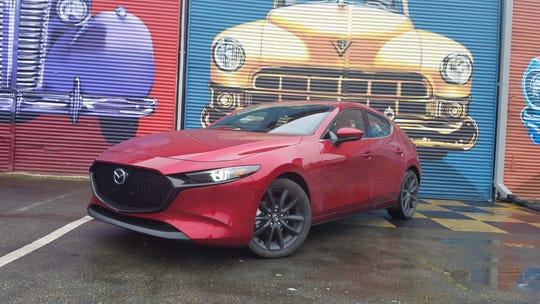

2019 Mazda 3
Payne: Jeep Gladiator jacked to the Maximus

All-new, sporty 2020 Ford Escape debuts

Payne: Jeep Gladiator pickup lives up to its hype
