- Search Cartoons
- Comic Archive
-
Payne
Store



 Henry Payne RSS

Articles Blog
Payne: Alfa Giulia Quadrifoglio vs. Audi S4 is a clash of personalities
Posted by Talbot Payne on April 23, 2020

Anyone who doubts machines have personalities hasn’t driven the Alfa Romeo Giulia Quadrifoglio and Audi S4. Though they are both of the luxury performance sedan persuasion, they are as different as Ralph Kramden and Ed Norton. Ginger and Mary Ann. Keegan-Michael Key and Jordan Peele.
They are as different as, well, Italian and Germans.
Luxe sedans may be taking a backseat to SUVs these days, but there is simply no segment more fun than compact cars. With superb new performance models like the Cadillac CT5-V, Tesla Model 3 Performance and Genesis G70 3.3T complementing stalwarts like the Alfa, S4, Mercedes C 43 AMG and BMW N340i, there has never been more choice for the enthusiast.
For 2020, the Alfa Romeo Giulia line has received significant interior upgrades — in particular a new touchscreen, self-driving and console features. To be honest, I didn’t know they were lacking.
That’s because the Giulia is a riot to drive.
Whether the base $39,840 Giulia, $45,000 Ti, or my tester — the $90,840 Quadrifoglio performance model — the Giulia is the best-handling car in class. Particularly now that its nimble peer, the Cadillac ATS, has been rebadged CT4 and shipped off to the sub-compact class.
When you’re nailing apexes, gulping straightaways and obliterating ess-curves, who has time to notice the console materials?
Naturally, I showed up at the gates of Hell (Michigan) to stretch Giulia’s legs on Michigan’s best roads. As distinct as three-headed Cerberus, the Italian features its signature Trilobo grille. Where the Audi is a tidy German businessman with pressed shirt and necktie, Alfa is a raging Fabio Fognini: brash, talented and attractive. Go ahead and stare at its sexy, phone-dial wheels.
Nail the throttle onto Hell’s Glenbrook Road and the 443 pound-feet of torque from the twin-turbo 505-horse turbo-6 — basically a Ferrari V-12 sawed in half — slews the rear end sideways. The quick-ratio steering wheel and athletic chassis absorb the moment without drama, and the red Alfa rockets forward into a series of ess-turns, carving them like a knife.
Though the 3,806-pound Giulia weighs about the same as the all-wheel drive Audi — and just 100 pounds less than the bigger Cadillac CT5-V — it feels lighter on its feet than its competitors. Having 150 more horsepower on tap helps, too.
I whipped the Caddy on these same roads just a week prior, and its athleticism impressed even though it’s 11 inches longer than the Giulia. GM’s engineers have done supreme work on that big compact. Inherently smaller, the Alfa is a Russell Westbrook to the Caddy’s LeBron James — as talented but able to change directions more quickly.
The engine is one of internal combustion’s great personalities. Crank the mode dial to Race and the bratty V-6 snorts on upshifts, backfires on downshifts and generally trash-talks its way through a spirited drive. It learned at the knee of its master, the delightfully rude 4C sports car.
The Audi is a more fitting dinner partner at the club. It sports a turbo-6 as well, but a very well-mannered one. Its meaty, 369 pound-feet of torque are delivered civilly, sounding more like an angry vacuum cleaner than the hounds of Hades.
Indeed, I wasn’t tempted to take the S4 to Hell after a couple of loops around Metro Detroit cloverleafs. The Audi is a straight-line rocket, but it doesn’t like to be pushed too hard. Its heavy, all-wheel-drive platform understeers easily and is generally averse to dancing on the limit.
Not the Giulia. In Dynamic mode — up a notch from the standard Natural — it wants to cut some rug. In Race mode it wants to set the rug on fire. Selecting Race requires an extra pause on the dial — as if the Alfa is asking: Are you sure?
The car noticeably quivers when Race is engaged, the throttle on edge, the engine growl menacing, the suspension taut.
Social-distancing in Hell was never so much fun. But the Alfa’s quickness is owed in part to its diminutive size. There is no social-distancing in the Giulia’s cramped rear seat. The Audi isn’t much better with only a half-inch more knee room, making it a tight fit for my 6-foot-5- frame.
Buy roomiest-in-class Caddy CT5-V if you frequently ferry foursomes — Giulia is a driver’s car. But Audi still understands that its clients will spend most of their time on four lanes like I-96 or U.S. 23 that lead to Hell — sometimes in hellish traffic. This is where the Germans excel.
Like its exterior, the S4’s interior wardrobe is Brooks Brothers conservative. But Audi has long been on the cutting edge of electronic tech with configurable digital instrument display, Google Earth-like nav graphics and sharp voice commands. Audi faithful will blanch at the fact that the brand has ditched its remote rotary infotainment controller, but the new touchscreen is crisply responsive.
I’ve always liked the Giulia’s interior — its big, goggle-eyed instrument displays, rotary ducts and sweeping dash lines are uniquely Alfa. For 2020 the roomy console has been nicely upgraded with wood and carbon trims. But it’s tough to compete against Audi, which draws from the big electronics toolbox over at VW Group. The new Giulia is a major upgrade with German-like “pages” to flip through on its now-standard 8.8-inch screen — navigable by touch as well as rotary controller (and it’s a proper, multi-way rotary controller unlike, ahem, Caddy’s two-dimensional dial).
But the system is slow and the voice command system average.
Alfa’s big play is on a new self-driving system with ambitions to take on class-leaders Tesla Autopilot and Cadillac Super Cruise. Accessing these systems allows busy drivers to check their phone in traffic or just relax a bit. Alas, the Alfa’s system is a nervous Nellie.
It demands a hand be on the wheel at all times. Its constant nannying defeats the self-drive purpose.
Ultimately, the Giulia Quadrifoglio’s stratospheric price — a healthy $25,000 more than the S4 — means it’s accessible to fewer buyers. Given its small size, rear-wheel drive and lesser-quality reputation, the Alfa will be considered a niche vehicle compared to the Audi.
That’s the clinical case. But after going to Hell and back in the Giulia, I had a big dumb grin on my face I’ve had in few cars. Alfa’s my kind of personality.
2020 Alfa Romeo Giulia Quadrifoglio
Vehicle type: Front-engine, rear- and all-wheel drive, 5-passenger performance sedan
Price: $39,840, including $1,295 destination charge; $75,740 Quadrifoglio ($90,840 Quadrifoglio as tested)
Powerplant: 2.9-liter twin-turbo V-6
Power: 505 horsepower, 443 pound-feet of torque
Transmission: 8-speed automatic
Performance: 0-60 mph, 3.6 seconds (Car and Driver); top speed: 191 mph
Weight: 3,806 lbs. as tested
Fuel economy: EPA 17 city/24 highway/20 combined
Report card
Highs: Balance of a ballet dancer; brash engine
Lows: Tight back seat; laggy infotainment system
Overall: 4 stars
2020 Audi S4
Vehicle type: Front-engine, all-wheel drive, 5-passenger performance sedan
Price: $50,295, including $995 destination charge ($62,840 model as tested)
Powerplant: 3.0-liter turbo V-6
Power: 349 horsepower, 369 pound-feet of torque
Transmission: 8-speed automatic
Performance: 0-60 mph, 4.4 seconds (mfr.); top speed: 155 mph
Weight: 3,847 lbs. as tested
Fuel economy: EPA 20 city/27 highway/23 combined
Report card
Highs: AWD rocket traction; state-of-the-art digital displays
Lows: Plows in corners; VW Arteon is better looking
Overall: 3 stars
As Michigan auto dealers start selling online, April shows an uptick
Posted by Talbot Payne on April 23, 2020
Detroit — After hitting a late-March low, sales of new vehicles are on something of an upswing in April, defying dire predictions: With the nation’s car buyers under stay-at-home orders, analysts predicted sales would be off 80% this month compared to pre-pandemic levels. Instead, they were off just 51% through Sunday, according to J.D. Power.
And around Detroit, where sales of new vehicles fell to next-to-nothing after Michigan’s governor ordered dealerships to close, things have gotten a little better after the state began allowing online sales April 9: Sales were down only 85%, compared to the 98% hit they took the previous week.
Extreme Dodge Chrysler Jeep Ram in Jackson sells an average of 190 to 220 vehicles during a typical April. Last week, the first since online sales were allowed, the dealer moved 18 autos off the lot, according to general manager Mark Trudell.
“It’s a far cry from what we normally do,” he said.
Adapting to online-only sales has been challenging. “It’s good to be back selling cars again, don’t get me wrong, it’s just very cumbersome right now,” Trudell said.
Customers have been calling to ask questions about the online sales process, but many have said they plan to hold off until the stay-at-home order is lifted. Said Trudell: “It seems like we would have a little bit better grasp on keeping everybody safer if the governor allowed us to come in the dealership and designate an area for the customer to come in and sign paperwork or meet with a salesperson, that we would sanitize every time it’s used.”
Like many dealers, Extreme lets customers test drive their new car when it’s delivered to their home, before any paperwork is finalized.
Although Michigan dealers are seeing more online activity, most customers will still want to shop in person, believes Jim Seavitt, owner of Village Ford in Dearborn
“There will be a portion of people this will forever change,” he said. “But I think that’s a small percentage. I think online (sales) will still represent less than 10% of our business.”
Said Trudell: “People still want to test drive cars. They still want to come in and look at a few different vehicles. Negotiate. Put their hands on them.”
All states now permit at least online sales during the coronavirus pandemic, with 24 allowing open dealership showrooms. Michigan was one of the last to relax the rules to allow online sales.
With record numbers of workers filing for unemployment and the economy in a tailspin, new- and used-car dealers alike are sweetening the pot. Serra Chevrolet in Southfield, for example, is trumpeting 0% loans for 84 months in online ads, while online used-car site Carvana is running TV ads promising seven-day trials.
All major metro markets, including heavily impacted New York City, are improving except for Denver, according to J.D. Power. That’s due in part to low-interest loans, record incentives and extended 84-month loans as the industry moves toward May, typically one of the top sales months of the year and now more crucial than ever as states start to open up.
Late-March harbingers from early-shutdown states like California suggested sales might be off a staggering 80% this month. But against the odds, sales stabilized in the first two weeks of April and are now showing signs of recovery. As of Sunday, retail sales were down 48% for the week from the pre-virus forecast, an improvement of 3 percentage points from April 12 and 11% since the March 29 nadir, according to J.D. Power.
“The U.S. auto retail market is now in full recovery,” said Tyson Jominy, the company’s vice president for data and analytics
April sales have been driven by Detroit Three pickup trucks which have been off just 16% in sales compared to the national average. Credit huge discounts averaging $4,700 per vehicle.
The Detroit Three were the first to launch 0% financing on 84-month loan offers – now at a near-record 19% of sales, three times more than pre-virus levels — with payment deferrals. Others including Hyundai, Nissan and Genesis have begun to follow.
In part due to pickup sales and long-term loans, average transaction prices are near record-high levels of $35,200 during the week ending April 19.
Despite the relative good news, J.D. Power still estimates total 2020 sales will be down to 12.6 to 14.5 million versus a pre-virus outlook of 16.8 million. The year 2019 was the fifth straight year of 17 million-plus annual sales, a record.
But all is not well. Current owners are defaulting on their car loans.
“Auto loans that are severely delinquent by 60 days or more are up,” said Jonathan Smoke, chief economist of Cox Automotive. “Subprime accounts that are severely delinquent are up to the highest level since at least 2006.”
Detroit-area dealers say they are tentatively preparing to reopen in early May, which is when automakers are hoping to restart factories and Gov. Gretchen Whitmer has said she intends to look at reopening sectors of the economy. Dealerships already are installing protective shields in showrooms, stocking up on sanitizers and thinking about how many customers they’ll be able to allow into a building at once. They expect customers will gradually act on pent-up demand after the state reopens for business
Still, caution abounds out of concern for employee safety.
“They’re trying to kill this virus,” said general manager Walt Tutak of Matthew Hargreaves Chevrolet in Royal Oak. “Why would you want to have it spike again?”
Blingtastic Cadillac Escalade comes with $77,490 price tag
Posted by Talbot Payne on April 21, 2020

The 2021 Cadillac Escalade starts at $77,490. The extended size model is $3000 above that. (Photo: Cadillac)
Cadillac this week announced that its all-new, 2021 Escalade land yacht will start at $77,490 when it opens for orders this coming Thursday, April 23.
Automakers are leaning on giant, profit-rich SUVs and pickups to tow them out of the COVID-19 sales hole. General Motors Co.’s Cadillac hopes the iconic Escalade, the best-selling full-size premium utility, will be a tonic for GM’s luxury line.
The hugely profitable Escalade is also important as Caddy retools into a battery-powered brand with ambitions to sell mostly EVs by 2030. Like the Escalade, the new stable of EVs will be stamped with names instead of alphanumeric badges — including the flagship Celestiq sedan and Lyriq SUV previewed to investors and media in March.
GM also previewed an as yet unnamed, three-row electric replacement version of the Escalade. But the money-making, 2021 Escalade is key to initially subsidize those new vehicles in a U.S. market where customers have thus far been cool to EVs.
In the currently frigid COVID-19 market, big vehicles have helped Detroit automakers gain 10 points of market share with transaction prices soaring to a record $35,800 as dealers have offered unprecedented volumes of 84-month loans with 0% financing.
Most of those sales have come in the pickup truck segment ($42,000 average transaction) which has seen sales decline only 18% in April’s shutdown economy compared to the industry-wide 56%. Premium vehicles have not shared in the love with sales off 60% in part due to the premium market’s higher lease rate and customers desire for lease extensions. But as shelter-in-place restrictions come off, analysts expect lease shoppers to be back in showrooms, and the Escalade — based on the same truck chassis as the Chevy Silverado — may be in the sweet spot of what they are looking for.
The $77,490 Escalade standard model for 2021 is $1,000 more expensive than the outgoing chariot. Supersize to the long wheelbase version and the sticker jumps to $80,490. The higher price reflects a new generation of Caddy stuffed with industry-first tech like a massive, curved, 38-inch, OLED screen, wireless Apple CarPlay and Android Auto, heated-and-cooled leatherette thrones, 22-inch wheels, 19-speaker sound system, and 6.2-liter V-8 engine mated to a 10-speed automatic transmission.
True to its stature as the King of Bling, the Escalade then piles on the options including self-driving Super Cruise system, twin, 12.6-inch HD screens for second-row passengers, and a 36-speaker AKG Studio system with movie theater-quality surround-sound. Nine interior color and trim combinations are also available.
The big SUV even offers a stump-pulling, Duramax 3.0-liter Turbo Diesel option for those who want fewer visits to the gas pump.
Such details have famously attracted Hollywood celebrities and athletes alike, and no less than film director Spike Lee is the front for the new ute. “The Escalade is a star like no other,” the “She’s Gotta Have it” director says. “It’s not just okey-doke. Art leads to innovation as we like to say in the People’s Republic of Brooklyn.”
To accommodate Spike’s New York Knicks pals, the rear compartment gains 10 more inches of legroom and 68% more cargo space thanks to an extended wheelbase and a lowered floor courtesy of Escalade’s first independent rear suspension.
Famous for its vertical, edgy styling, the 2021 Escalade conforms to current, more horizontal Caddy design cues first seen on Cadillac’s Escala concept car — and now smaller utes like the XT4 and XT6.
The 38-inch glass screen stretches from the driver-side A-pillar across the dash and houses three separate information screens — including a 14-inch screen behind the steering wheel that can display instrument-gauge view, night vision, navigation and something called “augmented reality” which shows live street views to indicate where the driver should turn.
The new behemoth gets a smoother ride thanks to that independent rear suspension as well as standard magnetic shocks. An Air Ride suspension is available, which enables curb-side tricks like kneeling down 2 inches to assist customer entry and exit.
The latest Escalade follows Cadillac’s new marketing convention. The SUV is offered in a simple “Y” model format starting with standard Luxury trim, then splitting into either Sport or Premium Luxury. A blingtastic Platinum versions is available for both.
The Escalade box office opens Thursday here.
Payne: Infectious disease, not climate, emerges as globe’s greatest health threat
Posted by Talbot Payne on April 17, 2020

The US was totally unprepared for coronavirus despite years of infectious disease warnings. Michigan National Guard members move beds for patients with coronavirus at the TCF Center. (Photo: Max Ortiz, The Detroit News)
As late as early March, Michigan’s auto companies and government leaders were trumpeting a new economic course based on fears that climate change was the world’s greatest health threat.
Then came the coronavirus crisis wake-up call.
Auto companies and governments are now belatedly retooling to fight World War C, investing billions to combat a health crisis that has gripped the planet with citizens making radical changes in their behavior to reduce COVID-19 transmissions — not carbon dioxide emissions.
The new normal confirms what economic and scientific experts at the Copenhagen Consensus and other institutions have warned for decades: That infectious disease, not climate, is humankind’s greatest threat and where mitigation dollars can have their biggest impact.
At a March 4 investor event, General Motors Co. CEO Mary Barra laid out a 50-state, National Zero Emissions Vehicle Program to combat global warming: “We believe climate change is real, it’s a global concern and the best way to remove automotive ambitions from the environmental equation is an all-electric zero emissions future.”
But GM’s $20 billion gamble on electrification with the introduction of 20 EVs by 2023 was quickly drowned out by the coronavirus tsunami. Just six weeks later, all 50 states would be under a major federal disaster declaration for the first time in history — not for rising temperatures, but for fear of an infectious disease. Auto sales tanked and the industry transitioned plants to make ventilators.
GM’s climate change ambitions have been echoed by Ford Motor Co., Volkswagen AG, Honda Motor Co. and other automakers — and dovetail with international and state governments whose climate policies are forcing automakers to convert to electric vehicles.
In her first State of the State address last year, Gov. Gretchen Whitmer identified climate change, along with safe drinking water, as the greatest health threat facing the state: “Climate change and extreme weather are already putting Michiganders at risk.

“As a state, we must take that risk seriously. We cannot and will not wait to act,” she said. Her warning echoed that of presidential candidates like Joe Biden, who last September called global warming “the single greatest concern for war and disruption in the world.”
In the last year, the Whitmer administration has established a new state office of climate and energy and committed Michigan to the United States Climate Alliance, a group of 24 states and Puerto Rico that has vowed to comply with the stringent demands of the Paris climate agreement.
But the escalation of climate preparation — the federal Government Accounting Office reports the U.S. has designated $154 billion to climate-related projects since 1993 —came as scientific experts warned that predictions of global warming had failed to materialize — and that threats of global pandemics were increasing.
In the last 30 years, frightening forecasts of increased temperatures, hurricanes, and tornadoes haven’t occurred. For example, the U.N. International Panel on Climate Change, long an activist for global warming mitigation, admits there is “low confidence for the attribution of any detectable changes in tropical cyclone activity to (human) influences.” From 2005-2017, the U.S. experienced the lowest occurrence of hurricanes in recorded history. Closer to home in Michigan, turn-of-the-century predictions that the Great Lakes would dry up have been contradicted by record lake levels today.
Meanwhile, the evidence of infectious global pandemics in a connected world continued to rise with the China-sourced 2002 SARS virus, Mexico-origin 2009 H1N1, and Africa-sourced 2014 Ebola crisis.
As those fears heightened, prominent Danish environmentalist Bjorn Lomborg convened a regular international panel of economists and researchers called the Copenhagen Consensus to assess global challenges — then rationally prioritize them by economic analysis. For example, in 2012, the Nobel laureate-studded panel assessed the question: “If you had $75 billion for worthwhile causes, where should you start?”
The panel ranked the top 16 of 40 world problems. Climate change didn’t make the list, while five disease mitigation crises — including malaria, tuberculosis, and child immunization — did.
“The investments to combat infectious disease are very cheap and effective, even using conservative assumptions,” said Nobel laureate economist Thomas Schelling. “Policy-makers can achieve a great amount in this area.”
Yet America’s government and media institutions have hyped global warming fears above all else. As the COVID-19 spread in China in January, the influential New York Times continued a daily drumbeat of climate stories, its Business section warning on Jan. 24 that “Climate Change Could Blow Up the Economy. Banks Aren’t Ready.”
When the coronavirus hit the U.S. in early march, Michigan and the country were utterly unprepared. As cases accelerated, hospitals found themselves overwhelmed with critical shortages of ventilators. Despite the warnings of past pandemics, medical stockpiles and testing infrastructure were non-existent. The auto industry responded, pivoting quickly from producing vehicles to manufacturing ventilators, masks and face shields.
The federal government botched initial test kits desperately needed for the growing pandemic. Experts say that if the $184 billion in climate health had been spent on virus mitigation, the U.S. would be in much better shape today.
“Money should be spent anywhere else than climate change,” said James Taylor, who runs the Illinois-based Heartland Institute’s Center for Climate and Environmental Policy.
Despite dire warnings of climate catastrophe, U.S. consumers haven’t changed their behavior — continuing to buy SUVs as predictions of famine and disappearing lakes failed to materialize. Behavior changed dramatically in face of the very real COVID-19 threat, however, with Americans self-distancing, donning masks and figuring out new ways to work from home while businesses shut down.
The historic COVID-19 crisis may further stiffen Americans against climate expenditures like that advocated by Ann Arbor which plans to spend $1 billion over the next decade to make the city carbon neutral, including a 50% reduction in personal vehicle miles traveled. Global warming consistently polls low as a public concern with a 2018 Pew poll listing it 22nd of 23 issues. Polls show 30% to 40% of respondents say they are not willing to pay anything.
Even as coronavirus shifts priorities to more urgent needs, the climate change lobby has continued to resist the new paradigm. The EPA’s easing of expensive fuel economy regulations to 40 mpg on March 31 to aid the corona-crippled auto industry sparked outrage among greens like the Safe Climate Campaign’s Dan Becker, who said Washington “is rolling back the biggest single step any nation has taken to fight global warming.”
Yet the EPA’s own numbers show the original 54.5 mpg-by-2025 standard would reduce global temperatures by a negligible three one-thousands of a degree (0.003) Celsius of warming — within the margin of error — over the next 90 years.
Payne: Used, sub-$10K, feisty Ford Fiesta is best buy
Posted by Talbot Payne on April 16, 2020

The 2017-2019 Ford Fiesta SE gets alloy wheels which are good looking – and affordable on a $10k used car. (Photo: Henry Payne, The Detroit News)
I miss the Ford Fiesta. But that doesn’t mean I can’t have one.
Ford makes some of the best cars on the planet, but, under pressure from America’s turn to SUVs (and small sales margins), it stopped Fiesta and Focus production for the U.S. market last year. Want a car? Buy used, says Ford.
Good idea.
The Fiesta subcompact cutie is one of the best bargains out there on used — er, pre-owned — car websites. Nimble. High-tech. Priced under $10,000. And that’s a good thing in these budget-sensitive coronavirus times. Michigan’s shelter-in-place order allows online selling. Let’s go shopping.
My wife and I rented a 2019 Fiesta sedan in Arizona earlier this year and had a blast. This tasty tamale was the last model year offered for the U.S. market — and the same car introduced in 2017 with two significant updates that put it right in my strike zone: Apple CarPlay/Android Auto app compatibility and alloy wheels.
The alloy wheels are the perfect complement for the subcompact class’ best-looking car. Crisp European lines, guppy grille, and … oooh, those eyes. Like Elizabeth Taylor’s Cleopatra, the Fiesta’s big peepers are huge — stretching all the way back to the A-pillars. This is an affordable car you can wake up to every morning and admire.
Apple CarPlay and cousin Android Auto have transformed automotive infotainment systems in recent years, allowing mainstream cars superior nav systems to those found in some $60,000 luxury cruisers. My wife set our destination on her smartphone, plugged into the 8-inch infotainment system, and we were off.
I’ve been in the market for numerous, sub-$10K used chariots over the last couple of decades and can attest to the fact that Honda and Toyota cars are consistently pricier than their Detroit peers. Credit Japanese reliability, which helps maintain value. Look no further than Ford’s recent problems with Fiesta’s dual-clutch automatic transmission that, ahem, ultimately led to a $30 million class-action lawsuit settlement.
But here’s the thing: Ford has agreed to fix the transmission for free for the relevant 2011-16 model years. Or you can buy an upgraded 2017-19 model. Or you can just bypass the automatic transmission and opt for one of the finest six-speed manuals in the business (a rarity in the market today). Either way, you win.
And either way, you can find 2017-and-newer Fiestas with less than 50,000 miles (my personal target for a used car) for less than 10 grand on Cars.com. That’s a steal.
Especially because you won’t find a comparable Honda Fit or Toyota Yaris for that price. Look it up. The only available Fit and Yaris competitors I could find under $10K within 250 miles of Detroit were older than 2016 — meaning they are technologically challenged compared to the gaggle of 2017 Fiestas available.
Fit didn’t get Apple CarPlay until the 2018 model year. Yaris until this year.
But wait, there’s’ more. My must-have tech trifecta is smartphone app compatibility, adaptive cruise control … and blind-spot assist. We’ve covered the Fiesta’s smartphone app advantages, and you won’t find any car in our competitive set with adaptive cruise (though all feature basic cruise control). But on blind-spot assist, Ford has another trick up its sleeve.
The Fiesta SE came equipped with the original blind-spot assist — Ford’s clever, mirror-within-the-side-mirror solution that allowed me to safely monitor my blind spots. Locate a 2018-and-newer model and it’ll have a standard back-up camera, too.
My Fiesta rental was a sedan, but I prefer the hatchback, which was priced $300 higher new. The used market doesn’t seem to notice a difference — so get the hatch for its superior looks and utility.
The interior of the Fiesta is as sporty as the exterior. A big, motorcycle-like instrument display lurked behind the steering wheel as I easily folded my 6-foot-5-inch frame into the cloth seats. Pity the six-footer behind me, though — the Fiesta’s rear seats are tight.
The cockpit is carefully engineered with big control buttons and knobs within easy reach. Along with the big instrument gauges, it’s driver-friendly.
As I barreled along — the 120 gerbils (er, horses) under the hood screaming away — I could keep my eye on the road between the big gauges and infotainment screen high on the dash. Interior designers even shielded the screen from the bright Arizona sun with a shroud. Smart.
Back in 2014, my favorite Fiesta engine was the 1.0-liter, turbocharged three-banger — Godzilla in a box — that got insane fuel economy while also producing three more horsepower than the standard, 1.6-liter 4-banger. Alas, it was discontinued for the 2018 model year as its $1,000 premium must have spooked segment buyers.
Still, my 1.6-liter posted an impressive 434 miles of range with a full tank. That’s more than a $40K Lincoln MKC.
Despite my lead foot, the Fiesta got excellent fuel economy — an important attribute for penny-pinching consumers shopping for sub-$10,000 cars. EPA rates the Fiesta for 30 mpg, but Mrs. Payne and I managed 35 over a variety of highway, city, and country roads. On Interstate-10 South between Phoenix and Tucson I consistently got 40 mpg-plus when cruising at 80 mph. That’s impressive — especially for this Tesla electric-vehicle owner who is used to seeing range crater over 70 mph.
One of my wife’s favorite movie scenes comes from “National Lampoon’s Vacation.” Chevy Chase — aka, Clark Griswold — is pushing his Wagon Queen Family Truckster station wagon past 80 mph when his wife breaks his reverie: “SLOW DOWN!”
I have been similarly admonished. But Mrs. Payne also knows the joys that personal transportation brings to motorheads like me. So does Ford.
In addition to its good looks, Fiesta will never bore. With its short wheelbase and taught chassis, the subcompact is a mini-party on wheels — tempting drivers to push the limits when beyond the city limits.
For under $10,000, it’s all there for the entry-level, COVID-economy buyer: high gas mileage, high-tech, good looks, good ergonomics, hatchback utility, fun handling.
Lacking is power, but 120 horses will keep novice drivers out of trouble while they learn the joys of driving. The Fiesta SE will impress. And when you get a little more money in your wallet — and a thirst for better acceleration than Fiesta’s glacial 9.1 seconds zero-60 crawl — you’ll return to the used lot and check out what more Ford has to offer.
Let me show you the sensational, used, 197-horsepower Fiesta ST hot hatch… .
2017-19 used Ford Fiesta
Vehicle type: Front-engine, front-wheel drive, 5-passenger subcompact sedan or hatchback
Price: Under $10,000 with under 50,000 miles (2019 Fiesta SE with 24,000 miles as tested)
Powerplant: 1.6-liter inline-4 cylinder
Power: 120 horsepower, 112 pound-feet of torque
Transmission: 6-speed, dual-clutch automatic, 6-speed manual
Performance: 0-60 mph, 9.1 seconds (Car and Driver); top speed: 118 mph
Weight: 2,578 lbs. as tested
Fuel economy: EPA 27 city/37 highway/31 combined (35 mpg observed)
Report card
Highs: Easy on the eyes; modern tech, handling
Lows: Tight back seat; snail-like acceleration
Overall: 4 stars
Pressure to restart auto industry grows, but it faces major hurdles
Posted by Talbot Payne on April 16, 2020

Technician Cory Elsarelli manufactures face shields inside the prototype lab at Mahindra’s North American Technical Center in Troy on April 15, 2020. The shields are given to first responders to help provide protection when treating patients with COVID-19. (Photo: David Guralnick, The Detroit News)
As COVID-19 cases show signs of flattening even as deaths continue to rise, pressure is intensifying to restart the economy in Michigan and across the country.
Michigan CEOs, medical professionals and labor leaders are consulting with Gov. Gretchen Whitmer, she said Wednesday. And President Donald Trump hosted a call with top executives of the nation’s four automakers and other industrial firms to push preparations to reopen the economy as early as next month.
The moves come as stay-at-home orders have grown to cover most Americans and as revenue-starved businesses cut back, forcing millions to lose their jobs. In few places is the pain more acute than Michigan, an industrial and politically vital state that is among the nation’s leaders in jobs lost so far.
“This is an unprecedented event in modern automotive times, even if you look back to World War II,” said Stephanie Brinley, principal analyst at IHS Markit Ltd. “The plants still operated and things still came out of it. Your workforce wasn’t sidelined.”
The urgency to return to work is rising as the threat from COVID-19 eases. Protesters crowded Lansing streets in vehicles and stood outside the state Capitol on Wednesday to protest Whitmer’s latest order aiming to protect public health being too restrictive. Meanwhile, Whitmer says she is in talks with the governors of neighboring Indiana, Illinois and Ohio over when and how to restart the economies in their major auto-producing states.
“The automotive industry is important to the U.S. economy, but it is also quite different than many other businesses,” said Doug Betts, president of J.D. Power’s automotive division, during a webinar this week. “The combination of high capital investment, heavy involvement of regulations, and the franchise model for going to the retail market makes it very different and somewhat non-intuitive versus other businesses.”
The industry also has a global supply base. Companies must navigate a patchwork quilt of rules determined by each country and state for which industries are “essential” during the outbreak. Some say auto manufacturing is essential, while others do not.
The bottom line, experts say, is that restarting vast chunks of the U.S. economy is neither easy nor uncomplicated. Sprawling supply chains, partisan political concerns and varying arcs of COVID-19 infections can influence the real-world balancing of prudent public-health policy with deepening economic concerns.
“There are larger partners that are at play, including federal guidelines, state guidelines, and as we’ve gotten into this, there’s county-wide rules that are baking into our process all the time,” said Jim Glynn, General Motors Co.’s vice president and global head of workplace safety. “The question about restarting for us, for me and our time is when we do get the green light to start up we want to make sure we are prepared — whenever that date comes.”
Interdependency
Ideally, Ford Motor Co. CEO Jim Hackett previously has said, there would be a nationally coordinated approach to restarting the economy around a certain date. With that established, Ford would declare a new date for when it will build vehicles again.
GM and Ford have suspended production indefinitely after beginning to shut down North American operations on March 19. Fiat Chrysler Automobiles NV has said it hopes to ramp up progressively starting May 4 after Whitmer’s stay-at-home order expires May 1. Some state orders, however, extend into June.
If a supplier in one state doesn’t think it can operate under another state’s rules, it could prevent production from restarting in another — a tiny glimpse into the just-in-time, integrated supply chains of the global auto industry and other manufacturers.
“In a typical, well-run assembly plant, there may be only 20 minutes of on-hand inventory for any significant Tier 1 part,” Betts said. “Twenty minutes after a Tier 1 ships, the factory would be shut down for lack of parts.”
Production shutdowns are costly. FCA’s 47-day shutdown is longer than the United Auto Workers’ 40-day national strike against GM last fall during which the company estimates it lost $3.6 billion. And it is not just Detroit that’s sitting idle.
In the United States, Honda Motor Co. Ltd.’s 12 plants, Toyota Motor Corp.’s 10 plants and Hyundai Motor Co.’s one plant are closed through May 1. Nissan Motor Co. Ltd.’s three plants will remain shut down through late April. Subaru Corp. will resume production May 11 in Indiana. Volkswagen AG does not expect the shutdown of its Tennessee plant to last more than four weeks — a deadline of Saturday.
More: Honda extends US furloughs to thousands of salaried employees
Collectively, 53 U.S. auto plants produce $11 billion of vehicles per week, according to J.D. Power. Add the complex web of suppliers, and an estimated 10 million Americans depend on the industry.
Ford already has said it expects a $600 million adjusted earnings loss for the first three months of the year. The companies have taken out billions in loans, and some are deferring 20% of salaried employees’ pay in addition to executive compensation cuts. Companies are itching to get back to work as soon as possible.
But for the most part, it is up to government to decide when a lot of America can go back to work — and not even just the U.S. government. Mexico is the country from which the U.S. auto industry imports the most parts and vehicles. A Mexican executive order, however, has restricted that manufacturing through April 30.
Mexican President Andrés Manuel López Obrador said earlier this month auto plants in Mexico might be able to reopen a few days prior to restart of production in the U.S., though no order has yet to appear in the Mexico Official Gazette. And if they don’t, a restart north of the border could be delayed.
“He basically acknowledged the interdependency of the supply chains and the need for Mexican inputs in the assembly process of the U.S.,” said Raul Rangel, co-chair of the Butzel Long law firm’s Mexico team.
Mahindra Group, an India-based automaker, has a small manufacturing operation in Auburn Hills. It has parts on hand for several weeks, CEO Rick Haas said, but it continues to be in contact with its critical suppliers over restart plans.
“It’s like cooking a meal,” Haas said. “All of the dishes go out at one time. You can’t have everything done except the turkey.”
All of this necessitates constant communication with suppliers. Canada-based Magna International Inc. speaks with its automaker customers daily, said Jim Tobin, company executive vice president and president of Magna Asia.
“We’re talking to the OEMs No. 1 to make sure we have a realistic start-up plan,” said Tobin during a recent webinar with the Center for Automotive Research in Ann Arbor. “The start-stop does not help liquidity because we start buying materials, employing people, then if they say we’re going to push it out another two weeks? We need a realistic start date that is in line with the containment of this virus.”
In mid-March, direct Tier 1 suppliers and their automakers kicked off efforts to develop a common “playbook” for the supply base, Tobin said. The Original Equipment Suppliers Association and Alliance for Automotive Innovation published guidelines on health and safety protocols for COVID-19. Southfield-based Lear Corp. published its own playbook online that outlines what disinfectant and protection materials to have on hand, social distancing measures and employee training.
The last thing a company wants is to be the source of a secondary outbreak, said Dave Andrea, a principal of the accounting firm Plante Moran and member of its automotive strategy team: “All of that safety apparatus that we built into the hard process of building an automobile, now we have to build the same kind of safety apparatus into a public health solution, and that’s a different animal.”
‘Very effective’
Some of the biggest concerns are ensuring workers feel comfortable returning to work. The companies are taking what they learned from China, which has restarted production. The ramp-up there, however, has been slow, taking about two months to return to a normal operating level.
The UAW has said the return-to-work must center on the contagion curve, not economic factors, and that employees should feel comfortable self-reporting symptoms without penalty. And the union leadership is pushing to be included in talks about how and when to restart the Detroit Three plants.
“The only litmus test that matters is whether you would send your own family, your own son or daughter, into the plant and be certain they will return home safely,” UAW President Rory Gamble said in a statement.
More: Detroit’s auto industry steps up against COVID-19
Protocols from China have been adapted for U.S. auto facilities making ventilators and face masks, GM’s Glynn said. They include no-contact temperature checks, questionnaires, masks, disinfectants at each work station, additional cleaning of common areas and distancing workers where possible. The company also is seeking out a potential partner for testing employees who see its medical team with possible symptoms.
“There have been no cases that we are aware of in China or Korea where we have these protocols,” Glynn said. “So far, it’s been very effective.”
Ford and Fiat Chrysler said they are communicating similar measures to their workers.
Meantime, automakers are relying on the data available to them and emphasizing the need to remain flexible and agile, said Chris Reynolds, chief administrator for manufacturing for Toyota’s U.S. division.
“In the course of a day, the assumptions tend to change,” Reynolds said in a statement. “Health of supplier network, day-by-day basis, might change. … We have to be agile and able to say what I’ve decided yesterday, may not work today or this week.”
Cadillac Blackwing goes to battle against German super sedans
Posted by Talbot Payne on April 16, 2020

GM VP for Global Product Ken Morris drives the blue CT4 performance variant around Belle Isle in 2019. In production trim, the car will be called the CT4-V Blackwing. (Photo: Eric Klauser, Cadillac)
Cadillac is upping its firepower in the premium performance wars with a track-focused variant of its CT4 and CT5 sedans called the V-series Blackwing.
Aimed at Europe’s iconic BMW M, Mercedes AMG, and Audi RS greyhounds, the CT4-V Blackwing and CT5-V Blackwing were first revealed — sans badging — at the Detroit Grand Prix on Belle Isle last year. Bristling with state-of-the-art aerodynamics and chassis tuning, they will likely cost $30,000 north of the standard sedan models.
However, they will not feature Cadillac’s state-of the-art, 4.2-liter, twin-turbo V-8 Blackwing engine that briefly appeared in the now defunct CT6-V sedan. The Blackwing engine appears to be homeless for now, but the name will live on as Cadillac’s pinnacle of performance.
“The Blackwing name has come to represent the very best of Cadillac performance engineering, craftsmanship and technology,” said Cadillac executive chief engineer Brandon Vivian. Slotted above the performance, V-series models, the Blackwing weapons will complete the rear-wheel-drive CT sedan lineups.
The CT4 will start at $33,990 when it arrives this year — well below the similarly-sized $36,490 ATS that it replaces — as it moves down a segment to compete against the likes of the BMW 2-series and Audi A3. The CT4 will be available in Premium Luxury and Sport trims. Buyers with a need for speed can then step up to the $45,490 CT4-V which makes 325 horsepower. The CT4-V Blackwing version will likely get the same 464 horse, 3.6-liter twin-turbo V-6 as the ATS-V it replaces — though expect the $68,790 sticker price to get slashed.
The CT5, currently available for sale, follows a similar path over little brother CT4 with a starting price at $37,890, well below the $47,990 of the CTS it replaces. That price also undercuts German competitors by some $5,000 before the CT5 options Premium Luxury and Sport models. The Blackwing will be priced above the $48,690 CT5-V which debuted this spring to critical acclaim from the motoring press.
The CT5-V Blackwing will likely get the same 640-horsepower, 6.2-liter V-8 monster stuffed in the outgoing CTS-V. That similarly-sized beast started at $88,990 and could top out at over $100k as it competed against the BMW M5. Expect that price to drop by maybe $20 grand as the Blackwing lines up against the compact BMW M3.
“The CT4-V and CT5-V Blackwings should be fantastic cars,” said IHS Markit senior auto analyst Stephanie Brinley, who has a lead foot and owns a Cadillac ATS-V. “Based on the same architecture as the CTS and ATS, they have great bones to work with.”
Brinley does not see the absence of the brand’s 4.2-liter V-8 Blackwing engine creating any confusion with the new badge. “The CT6-V was so short-lived,” she says of the brand’s flagship super-sedan that was introduced with much fanfare at the 2018 New York Auto Show.
The car’s 550-horsepower, 4.2-liter twin-turbo V-8 was the most advanced engine the brand had made — but it was shelved after just one model year as the CT6 was discontinued to make way for electric vehicle production at GM’s Hamtramck plant.
Blackwing sedans, however, will still come with plenty of juice as Car and Driver reports that spy videos of the cars testing confirm the powerful V-8 and twin-turbo V-6 engines from the outgoing CTS-V and ATS-V will carry over. At a surprise, on-track appearance at the 2019 Detroit Grand Prix — with GM President Mark Reuss and Global Product VP Ken Morris at the controls — media onlookers noted the familiar V-8 and V-6 exhaust notes from the two fully-camouflaged cars.
In addition to their bespoke engines, the Blackwings will feature specially-tuned chassis likely including the Performance Traction Management system found in the Corvette C8 and CT5-V. Cadillac says the new cars have proved faster than their predecessors in track testing at Virginia International Raceway.
Motorheads can rejoice, too, as the Blackwing cars will be optioned with rare manual transmissions. Some Corvette faithful bemoaned the end of the manual in the mid-engine C8 cyborg that went on sale this year.
Robots on the rise in the COVID-19 economy
Posted by Talbot Payne on April 16, 2020

The streets are empty of cars in Ann Arbor, but robot traffic is up.
Refraction AI’s robot restaurant food delivery service has seen demand increase by four times since the COVID-19 crisis shut down Michigan last month, and the company’s engineers are working furiously to expand the company’s small fleet of three-wheeled REV ‘bots.
Refraction is part of a surge in robot activity as the U.S. economy struggles to get back on track while maintaining self-distancing and exposing as few workers as possible in the workplace. The virus is accelerating robotics trends — from auto plant assembly lines to grocery store cleaning robots to security patrols — and that is likely to have enormous implications for the jobs of the not-so-distant future.
“This moment is a call to arms for robotics makers to really bring their technology to market that helps people. Particularly now in a time when there are so few options for doing tasks that we don’t want to put people at risk for,” said Refraction AI CEO Matthew Johnson-Roberson, an associate professor of engineering at the University of Michigan with 20 years of experience in the robotics field.
With the state’s closure of in-restaurant dining and subsequent shelter-in-place order, Refraction’s customer list has ballooned to 400, taxing the startup’s five robots which have been hustling to and fro along the edges of abandoned city streets.
“A bunch of new restaurants have said we have to have delivery now. The big limiting factor is the number of robots we have,” said Johnson-Roberson, 36. “We’ve been working to expand to groceries which is the more important need of the moment than takeout food.”
“It really changes consumer behavior across the board,” he said. “A lot of what we’re getting help with here is people getting comfortable with robots.”
That comfort has been reinforced with strict safety guidelines to mitigate virus spread. The robots are wiped down between every delivery; upon food delivery, customers can open the 5-foot tall robot’s door by phone instead of keypad; and the company has installed UV lights — a coronavirus killer — in the interior to disinfect the compartment and food.
With the added demand, the 15-person autonomous startup is looking to hire in these job-lean times. Some of its new employees come from the hard-hit restaurant industry.
“We’ve always thought about robotics as to how to improve people’s lives. It can do things people don’t want to do like bomb disposal robots, nuclear inspection robots,” said the robotics professor. “They’ve figured out a task that’s unpleasant for human beings and can do it better.”
One of those unpleasant tasks is cleaning grocery aisles after hundreds of patrons have filed through in a typical COVID economy day.
San Diego-based Brain Corp. is the world’s largest maker of autonomous navigation software for robotics giants like Minuteman, Tennant and Karcher. Its business has expanded as grocery retailers like Walmart have brought in more cleaning robots.
“As retailers are required to clean more frequently and deliver more cleaning coverage, BrainOS-powered autonomous floor care robots are providing 8,000-plus hours of daily work — over 250,000 hours over the next 30 days — that otherwise would have to be done by an essential worker,” said a company spokesperson. “This allows workers to focus on other tasks that are essential during this health crisis.”
Walmart is one of Brain Corp’s biggest clients and 110 BrainOS-powered robots are in service across Michigan in retail, grocery, and education applications.
Security robots are also in demand as companies have abandoned workplaces and employees work from home. For example, autonomous Cobalt Robotics bots are patrolling Metro Detroit businesses.
The U.S. auto industry is not likely to be immediately impacted with more robots in part because it is already heavily automated to reduce costs. Today, humans are scarce in giant assembly plants except at the assembly-line tail — and are therefore spaced safely. Stamping, painting, and body welding departments are crowded robot zones.
But with the enormous travel restrictions caused by COVID’s spread, industry insiders say the auto supply chain is going to change drastically — and robots will play their part. In pursuit of lower costs, the supply chain in recent decades has expanded to China, Vietnam, and elsewhere.
“Now, we see huge risk of the supply chain when something like this happens,” said Doug Betts, a manufacturing veteran and president of J.D. Power’s auto division. “The management of risk will reel the supply chain back in to the U.S. Labor costs are going to be high and that supply chain is likely to be established here with more robotics than what’s used in other markets.”
Example? A paint supplier abroad might use the cheaper labor of local people to spray paint onto parts. As those jobs move back to the U.S., they will be filled more by robots than people for safety, environmental and cost reasons.
Says robotics expert Johnson-Roberson: “Part of what we’re talking about is job displacement and that is something that is a concern. We want to be careful that whatever we are doing here is making life better on the whole.”
Amidst the coronavirus business devastation in Ann Arbor, he says robotics can help provide job and health security.
“People who run restaurants aren’t sure they can come through this,” said the Refraction CEO. “The fear that 25-to-50% (of) restaurants will go away is terrifying to me. And the jobs from dishwashers to bus people to caterers to line cooks — their livelihoods depend on their customers. If (the COVID crisis) goes on for six months — with one wave after another — we have to come up with a sustainable way to do this.”
In COVID-19 crisis, electric auto startups race to stay on track
Posted by Talbot Payne on April 13, 2020

COVID-19 has hit the U.S. auto industry hard, but the most precarious companies might be the handful of electric auto startups on the cusp of key vehicle launches.
Rivian, Lordstown Motors, Lucid, Bollinger Motors, Faraday Future, and Fisker are leading a historic wave of startups that, inspired by the success of Silicon Valley’s Tesla, see a new future of battery-powered sedans and trucks. But with their first products in the pipeline, the coronavirus threatens the capital flows and customer base they need to survive.
“We keep engineering but the big, big dollars you spend … we are holding on until funding is clear,” said Lordstown Motors CEO Steve Burns, who is converting General Motors Co.’s former Lordstown, Ohio, plant to manufacture electric pickups. “We don’t want to start something and not be able to finish it.”
No one has been laid off, but Burns has stopped hiring for now.
Most of the establishment industry’s assembly plants are idled; line workers are mostly sitting at home as their salaried counterparts continue to work remotely; and hundreds of dealerships have been severely impacted. J.D. Power estimates sales might be off 80% in April.
“It’s going to be tough for established companies to survive this,” said Navigant Research auto analyst Sam Abuelsamid. “For any startup that is still going to be relying on raising more capital, this is going to be an extraordinarily difficult environment to do that.”
Business models vary widely. Lucid, Faraday Motors and Fisker are focused, like Tesla, on retail sales with luxury, battery-powered products. As affluent buyers see their investment accounts swoon, they might put off disposable income purchases. Truckmakers like Rivian, Bollinger, and Lordstown, on the other hand, can bank commercial orders in addition to retail sales. Those fleet customers could put them in a more secure position.
“Fleets are much steadier, and if one thing has been proven during this [it’s] we still need fleets to do their jobs,” Lordstown’s Burns said in an interview. The Midwest has attracted three high-profile startups: Rivian, Bollinger, and Lordstown.
Pickup trucks have been a hot startup market as EVs seek to remake trucks with better storage room and torque. Plymouth-based Rivian captured the public’s imagination at the 2018 Los Angeles Auto Show — and millions in investment dollars from Amazon.com Inc.’s investment arm and Ford Motor Co.
“The world has changed a lot in these last few weeks,” wrote a determined Rivian to customers recently. “We’ve shut down all facilities to protect our team and to help slow the spread of COVID-19. While this situation has required us to redefine workflows and rethink the ways we collaborate, it hasn’t stopped us from making progress.”
Like establishment automakers, Rivian says the COVID-induced slowdown will impact its product timing. Rivian’s planned delivery of its $69,000-plus R1T pickup this fall has been moved back to 2021 due to the shutdown of its Normal, Illinois, plant.
Tesla, too, was ramping up production of its signature Model S sedan in Fremont, California, in 2008 when the Great Recession hit and capital markets dried up. Tesla required a $465 million loan from the federal government to survive.
Analyst Abuelsamid said he is confident Rivian will survive the pandemic: “They raised over $3 billion. Not only have they raised the money but they were really smart in offering up their platform to partner with other companies.”
Rivian has made its platform available to use for delivery vans and to Ford to make electric Lincolns. “That is going to give them a bunch of extra volume to generate some scale and help reduce their costs and improve their margin,” he said.
Bollinger Motors started on founder Robert Bollinger’s upstate New York farm as the successful cosmetics marketing entrepreneur sought to find an electric truck solution to his work needs. But as his product matured, Bollinger realized he had to move to Michigan — a decision that is paying dividends now.
“When it came time to engineer to the point of production, there were so many engineers needed,” he said in an interview. “The team moved out here — just a handful of us — and we hired 30 people. We are a Michigan company now. It’s so easy to just get in a car and go to a Tier One (supplier) for a meeting.”
Suppliers are shut down, as is Bollinger’s Ferndale plant, so the CEO expects some delays with plans to deliver the brand’s first luxury B1 SUVs and B2 pickups next year. But since initial financing has come out of Bollinger’s own pocket, work has been uninterrupted.
“We have everyone on board, everyone is still getting paid, everyone is still working full time,” Bollinger said. “We are unaffected in that way.”
Though some buyers have asked for returns on their deposits for the $125,000-plus EVs, Bollinger says that 70% of the first year’s production run is filled. The shutdown has enabled the company to process data from winter track and outdoor testing as well as solidify its dealer network. The innovative B2 pickup — which can load long cargo through the truck from bumper-to-bumper since batteries are located in the floor — will be sold through independent dealers in Detroit, New York, Miami, Los Angeles, San Francisco and Dallas.
Bollinger plans big news in the next month about its third-party production partner.
“Instead of us trying to figure out manufacturing … and have a huge learning curve, we’re going with someone who has been building trucks for decades,” Bollinger said. “We are crazy excited because it’s the best partner we could use for this.”
Lordstown Motors CEO Burns bears the twin burden of meeting orders — and of saving a town. The EV pickup maker has the hopes of Lordstown, Ohio, riding on its shoulders after GM abandoned production of the Chevrolet Cruze compact sedan and threw the northeast Ohio community’s future into doubt.
Now with the entire U.S. economy on edge, Burns says production of the Endurance pickup will likely not start until January 2021, a month later than originally slated. COVID-19 has delayed funding as well as prevented the startup from making modifications to the 6.2 million-square-foot plant.
“Orders are still coming in. That’s the one thing that hasn’t stopped,” Burns said. Akron-based FirstEnergy utility company has pre-ordered 250 trucks. Lordstown plans to produce 20,000 units in its first year with plant capacity to produce more than 400,000. The automaker has also received a letter of intent from Innervations, a Florida-based company specializing in fast DC and Level II EV chargers, to broker 1,000 Lordstown Endurances to their clients to convert their company fleets to electric vehicles.
Lordstown Motors recently posted a video of its Endurance truck in action. It uses a four-wheel-drive hub-motor system that reduces the number of moving parts in order to slash the lifetime vehicle service cost to commercial fleets.
A planned unveiling of the Endurance at the Detroit Auto Show in June — now canceled — will likely take place in Lordstown instead.
When he started Lordstown, Burns didn’t think if his business model was crisis proof. “We just did it because it was a market we knew and we thought it was attractive … if something is attractive to a fleet in good times, it’s probably just as attractive in tough times,” he said.
Perhaps the most Tesla-like startup is Lucid, which introduced its gorgeous Air prototype sedan at the New York Auto Show in 2017. CEO Peter Rawlinson and his San Francisco-based team have since secured financing for a production facility in Phoenix, Arizona — though work on the facility has stalled under the Arizona’s shelter-in-place order.
Rawlinson, vice president of engineering at Tesla before joining Lucid in 2013, is optimistic.
“The relationships with Lucid’s investment partners remains strong in the current business environment,” Rawlinson said in a statement, noting the plant’s machinery and tooling were well underway before COVID-19 struck. “Lucid is in a sound financial position, and has the financing needed to take it to start of production for the Lucid Air.”
Before the coronavirus pandemic, Lucid’s workforce had grown to more than 1,000 employees and the CEO says the brand is using the crisis’s social distancing challenges “to optimize connectivity and remote-work communication across the organization, including a range of disciplines from CAD computer design to CAE analysis and software coding.”
EV-maker Faraday Future has been a cat with nine lives since its 2014 founding — promising everything from supercars to crossovers. The China-financed startup is in the midst of transforming its Hanford, California, factory to vehicle manufacturing.
Fisker, a contemporary of Tesla found by legendary Aston Martin designer Henrik Fisker, showed off its latest Ocean electric SUV in January, with a plan to deliver its first vehicles to customers in late 2021.
“In general for the EV market it’s going to be challenging going into 2021 and even 2022,” Navigant’s Abuelsamid said. “We are going to be in probably a very deep recession in the second half of this year.”
Governor loosens Michigan auto dealership shutdown to allow online sales
Posted by Talbot Payne on April 10, 2020

Michigan auto dealerships will be allowed to make online sales during the COVID-19 pandemic. The state had been one of only four that banned all sales of new vehicles. (Photo: David Zalubowski, AP)
Detroit — Michigan auto dealerships will be allowed to make online sales during the COVID-19 pandemic, after Gov. Gretchen Whitmer issued a new executive order Thursday declaring that dealership employees are now considered critical workers.
“We are really excited to be able to help people who are in critical need of a car,” said Doug North, owner of North Brothers Ford in Westland. “We are hopeful that maybe this will give us an opportunity for the rest of April to certainly sell a few more cars and to service a few more.”
He said one Ohio dealership told him they had sold 15 vehicles to Michigan customers who had been unable to buy a vehicle in their own state over the last few weeks.
Michigan last week opened up a narrow window for sales, allowing dealers to perform sales for first-responders and other essential workers in emergency situations.
The new order Thursday specifically states that workers are deemed essential “at motor vehicle dealerships who are necessary to facilitate remote and electronic sales or leases, or to deliver motor vehicles to customers, provided that showrooms remain closed to in-person traffic.”
Michigan had been one of only four states — including Hawaii, Pennsylvania, and Kentucky — to ban all auto sales. Washington state dropped off the list last week when it OK’d digital sales, according to J.D. Power.
Overall, 24 states (accounting for 44% of US sales in 2019) allow for dealership sales operations to remain open. Another 23 states have restricted sales to online.
In the first week of April, sales were off 59% across the country, with Michigan flat-lining at a near 100% decline, J.D. Power said.
“This will impact every part of how we do business going forward,” North said.
Meanwhile, it’s unclear when auto production will restart to help keep stock on dealer lots. Most auto factories in North America are shut down. But inventory remained strong at the beginning of April with the average days’ supply number for the industry at 95 days, according to Edmunds.com. That’s a 26-day gain from March and is the highest it has been since February 2009 during the Great Recession.
Small consolation: Gas prices below $1, car insurance rebates, fewer traffic deaths
Posted by Talbot Payne on April 9, 2020
The coronavirus pandemic has been costly to Michigan’s transportation economy, exacting a high price in lost auto sales and plant shutdowns.
But if there’s any glimmer of a bright side, the COVID-19 economy has had some unexpected benefits for motorists: Gasoline can be had for under a dollar a gallon at some pumps as demand plummets. A few auto insurers have actually promised rebates on premiums because people are driving less due to stay-at-home orders. A reduction in crashes and traffic fatalities goes hand-in-hand with those reduced miles.
And in states where new cars still can be sold — Michigan is not among them — automakers are offering no-interest financing and record discounts. Buyers can expect those deals to continue as the country emerges from an enforced spring hibernation.
Allstate, Liberty Mutual and GEICO all announced premium rebates or reductions this week.
On average, Allstate estimates personal auto insurance customers will receive 15% paybacks on their April-May monthly premiums. Liberty Mutual echoed Allstate with 15% refunds on two months of premiums for a total of $250 million returned to consumers nationally. GEICO, which does relatively little business in Michigan despite the omnipresence of its spokesgecko, said it would give 15% discounts for policy renewals between April 8 and October 7.
“As society works together to slow the spread of COVID-19, there are more people at home, driving less and having fewer accidents,” Allstate CEO Tom Wilson said on the company’s website. “Given this decline in driving, we are announcing the Allstate Shelter-in-Place Payback of more than $600 million in April and May.”
Some consumer advocates were unimpressed by those discounts. ValChoice, a New York-based consumer advocacy outfit, said Allstate’s payout should be $2 billion – five times its promise.
“Auto insurance companies could receive outsized profits due to COVID-19. These consumers should demand refunds to improve their cash flow during these difficult economic times,” said Dan Karr, CEO and founder of ValChoice.
But industry insiders say it’s too early to know the frenetic COVID-19 economy’s impact on their costs, and companies are trying to do the right thing amidst the crisis to maintain customer relations. In addition to rate discounts, many carriers have voluntarily placed moratoriums on cancellations. And what it means for Michigan is unclear.
“Michigan’s auto insurance market is challenging, which includes the upcoming July no-fault reform,” said Chuck Whitelam, chief operating officer of Hershey Insurance Group, an independent agency based in Troy. “Announced insurance refunds still need to pass regulatory review. Typically, rates are based on past loss experience, not loss experience in the current term and not on such a broad range of risks. As many things at this time, this is unprecedented.”
Judging by the experience of other countries hit by the pandemic, car insurance claims could be down as much as 30%, though insurers warn that wide-open roads can lead to more catastrophic, high-speed accidents than the typical fender-benders incurred in heavy commuter traffic. According to Streetlight Data, a website that collects automotive GPS data for transportation planners, miles traveled are down 71% in Wayne County, 74%in Macomb County and 81% in Oakland County.
Month-to-month fatality statistics from the National Transportation Highway Administration are only available through last fall, and Michigan State Police say their official month-to-month fatality statistics are preliminary.
But a spokesperson said the state’s Traffic Crash Reporting Unit — which catalogs on average 315,000 crashes a year — indicates traffic fatalities are trending down with 30 fewer deaths in March. For the year, traffic fatalities are down 168.
Gas-price data is more current, with prices plummeting since the pandemic hit our shores. Credit an OPEC price war between Russia and Saudi Arabia as well as reduced consumer demand.
The average price of regular gas in Michigan was $1.58 on Wednesday, considerably below the $1.91 nationally. Michigan’s price fell 10 cents in a week and 66 cents in a month. Some stations in Detroit are pumping gas for under $1: the Costco in Madison Heights, for instance, had it for 89 cents Wednesday.
With stay-at-home orders limiting customer traffic and shutting down dealer showrooms in most major markets, automakers are doing all they can to attract customers. That won’t benefit Michigan customers, at least for now, as the state has shut down all dealer showrooms and online deliveries.
But in other states, auto data firm Edmunds said buyers can find healthy financing deals on new cars, including no-interest loans, record incentives, and deferred payments.
Chevrolet, for example, is offering zero-interest loans and 120 days of deferred payments. Jeep is extending 0% loans on select models with no payments for 90 days. And Ford is offering 90 days of deferred payments on some models with the first three months of payments as bonus cash.
Dealers are also writing record numbers of 84-month lease terms to keep buyers coming. Average vehicle incentives hit a record $5,100 the first week of April with J.D. Power reporting the biggest incentives — $7,300 — targeted at pickup truck sales, since they are the Detroit Three’s profit-drivers. Dealer inventories are strong.
Payne review: Toyota’s Sequoia warhorse is aging well
Posted by Talbot Payne on April 9, 2020
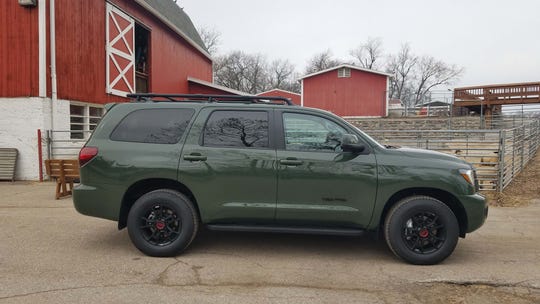
The rear-drive-based, 2020 Toyota Sequoia also comes with a 4×4 option for Michigan winters and remote country homes. (Photo: Henry Payne, The Detroit News)
The Toyota Sequoia is aptly named. It’s yuge.
Pre-COVID economy, Mrs. Payne and I rolled into Birmingham one Saturday night for dinner and a movie. But the 6-foot-9½ tall Sequoia wouldn’t fit in the Birmingham theater’s adjacent Peabody Street parking garage. Height limit: 6-foot-5.
I tried the nearby Pierce Street garage. Height limit: 6-foot-3. Hmmm. I finally found parallel street parking nearby. The end space, naturally — you don’t think I was gonna try to park this 17-foot cruise-liner between two cars, did you? I’d need a tug boat.
If we still had kids in the house, I suppose we’d go to the movies in shopping malls where sprawling lot parking is more appropriate for Brobdingnagian SUVs.
Then again, maybe this isn’t an urban SUV at all. My 2020 Sequoia was dressed in off-road TRD Pro trim with big, knobby tires, roof rack, intimidating grille, black highlights and a coat of Army Green.
“Henry, did you join the Army?” shouted my neighbor as I rolled by.
With its huge roof rack and 66 cubic feet of space with third-row seats folded, I could clean out the local Costco of toilet paper, bottled water and other essentials — then haul the family to a rural cottage and wait out the coronavirus.
With is impressive, 10-inch ground clearance (my 5-foot-5 wife needed a roof ladder to climb in), 27-degree front approach angle, skid plate and off-road-ready Fox shocks, the Sequoia seemed tailor-made to live out by the sequoias anyway. Far from the fancy-pants Chevy Tahoe that dominates its segment.
By dominates, I mean crushes.
The stylish Tahoe (and sister, stretched Suburban) swaggered to over 160,000 in sales last year compared to Sequoia’s 10,289 — and that’s even before the new-generation 2021 SUVs hit the market. The new versions will put increased pressure on the Sequoia in addition to ganging up on the Toyota with two available models.
Chevy’s catch-up is a reminder of the Toyota’s value these many years even as the interior and exterior design shows its age.
I folded my 6-foot-5 frame into the Sequoia’s driver seat with some difficulty. Despite the big ute’s size, front headroom is 35 inches — a significant 7 inches less than its Chevy and Ford Expedition competitors. Other interior dimensions, however, are competitive, and front and rear legroom will easily accommodate the average 250-pound American. And the easily accessible third-row bench seats can swallow adults, too.
Based on the same ladder frame as the Tundra pickup, the Indiana-made Sequoia’s dashboard space will be familiar to pickup owners. Covered in acres of black plastic, the big ute may not win any style awards but there is storage aplenty including twin gloveboxes, a bottomless center console and even a clever, hidden center-console slot for valuables or a laptop.
I had to squint at the puny 7-inch infotainment screen, but Toyota counters with its typical, class-leading suite of standard safety features including emergency braking, lane-keep assist, high-beam assist and adaptive cruise-control.
A word about Toyota’s adaptive cruise-control. Like the Sequoia’s 2008 chassis, it’s a bit dated.
Cruising along Telegraph in the big behemoth at 55 mph, the system began to brake as it sensed traffic ahead at a stoplight. But whereas modern adaptive cruise-control. systems brake to a stop, Toyota’s system works until 30 mph …
. . . then it gives up. Whoa, Nellie!
I quickly stabbed the brakes to keep from running over the top of the poor sedan in front of me. It’s a general rule of self-driving systems these days — you need to know what the car can’t do.
General Motors prides itself in engineering taut, lean truck chassis that consistently lead the class whether owners ever notice it or not. You’ll notice it in the Sequoia.
The big ute leans this way and that around corners as if bobbing on waves. Maybe the TRD PRO badge on the rear should read LAND YACHT. Happily, the truck’s big 5.7-liter V-8 engine comes to the rescue when the road straightens out.
The console shifter is from your grandpa’s generation with its clunky, gated track, but the driveline underneath will make you smile. The 6-speed tranny smoothly downshifts to engage the mighty eight and pull the TRD Pro’s 4,900-pound hull out of the waves.
BRAUUUGGHHH!
Keep your foot in it and you can watch the fuel gauge needle move. I got just 10.8 mpg in my week behind the wheel — and the Toyota’s optimistic EPA-rated 14 mg is still 20% less fuel-efficient than Chevy’s top dog 6.2-liter V-8 despite giving up 39 horsepower. Ouch.
The Sequoia will have to ride its ol’ V-8 nail for another two years before it gets updated off the Tundra’s coming new platform. That’s a looooong time given that current offerings from Chevy and Ford are already a generation ahead — and the Tahoe-Suburban coming later this year are even better.
Like plucky Americans holding out for the coronavirus to pass, the Toyota will be doing the best it can with what it has. Namely value.
While starting at just under $50,000 like the Tahoe, the base V-6 Sequoia offers good ol’ Toyota durability — and standard features the Chevy can only dream about. Adaptive cruise, for example, isn’t optioned in the all-wheel drive Tahoe until it hits $68,000, the price of my TRD Pro tester.
Speaking of TRD Pro V-8, the new rugged-appearance package allows Toyota to compete at the high end of the market against Tahoe’s head-turning RLT Edition (soon to be the Z71 package of the 2021 model) — but for much less. Apple to apples, my TRD Pro tester clocked in at $67,078 — or about $8,000 less than a comparable Tahoe.
You can buy a lot of toilet paper to wait out COVID-19 with 8-grand.
2020 Toyota Sequoia
Vehicle type: Front-engine, rear- and four-wheel drive, 7- to 8-passenger SUV
Price: $51,305, including $1,395 destination charge ($67,070 4×4 TRD Pro as tested)
Powerplant: 5.7-liter V-8
Power: 381 total system horsepower, 401 pound-feet of torque
Transmission: Single-speed direct drive
Performance: 0-60 mph, 6.7 seconds (Car and Driver); towing: 7,400 pounds
Weight: 5,730 pounds
Fuel economy: EPA 13 city/17 highway/15 combined
Report card
Highs: Go-anywhere family beast of burden; standard features galore
Lows: Aged interior; ancient adaptive cruise-control
Overall: 3 stars
Automakers’ global ‘Arsenal of Health’ fights common COVID enemy
Posted by Talbot Payne on April 8, 2020

Ford will produce ventilators at its Rawsonville Components Plant in Ypsilanti, shown here. (Photo: Ford)
The Detroit automakers that quickly retooled America’s factories to fight World War II with bombers, tanks and bullets are now rapidly ramping up to help the nation’s health care soldiers take on COVID-19.
But unlike the global war that split the world between Axis and Allied powers, World War C has united every nation against a ruthless virus. German, Japanese, South Korean, British and Chinese automakers also are rushing to help tool up an “Arsenal of Health” to fight the enemy with ventilators, face masks and other medical devices just like their Detroit rivals.
“The combination of manufacturing complexity at volume makes auto production unlike anything else in the world,” said Kelley Blue Book auto analyst Karl Brauer. “Once you have mastered those logistics, anything else you make will be easier. Automakers can quickly pivot to making ventilators at volume that are much less complex than automobiles.”
The American arsenal has expanded outside Detroit, too, with such upstarts as electric automakers Tesla Inc. and the North Carolina-based Haas Formula One team also lending their engineering skills to the good fight.
Nowhere is this joint spirit of innovation more apparent outside the United States than in Britain — which burned under the German Blitz in World War II and is suffering from rampant COVID-19 today.
Britain also is the epicenter of Formula One, the most advanced form of motor racing on the planet. Most F1 teams are based in Britain where they have access to state-of-the-art engineering talent and facilities — not unlike Michigan, where many international automakers have engineering facilities because of the deep talent pool here.
Seven F1 teams — including those funded by Germany’s Mercedes-Benz, America’s Haas, France’s Renault and Britain’s Aston Martin — have created “Project Pitlane,” which is dedicated to three workstreams to help the COVID-19 crisis in Britain: reverse engineering existing medical devices, scaling the production of existing ventilators, and rapidly designing and manufacturing a new device for certification and subsequent production.
Just as General Motors Co. and Ford Motor Co. offer a unique ability to scale ventilator production with expansive facilities and supply chains, Project Pitlane is structured around F1 racing’s unique ability to respond instantly to technical demands — a crucial trait in keeping up in a sport that demands cutting-edge, space-age materials and construction.
Project Pitlane is pooling the team’s advanced F1 resources with a focus on rapid design, prototype manufacture and skilled assembly.
F1’s most famous company, Turin, Italy-based Ferrari SpA, has shut down due to the crisis. Still, the prancing horse is working with Siare, Italy’s biggest hospital ventilator supplier to use its idled Maranello factory to ramp up production as Italy faces one of WWC’s toughest battles against the virus.
In addition, the Agnelli family — controlling shareholders of Ferrari as well as Fiat Chrysler Automobiles NV — has made an $11 million donation to the Italian Civil Protection Department to help it respond to local health needs.
Another Italian exotic maker, Lamborghini, also is speeding a transition to medical device maker to help Italy’s overwhelmed national health system. The Bologna-based supercar maker has converted production plant departments to produce surgical masks and protective plexiglass shields for the local Sant’Orsola-Malpighi Hospital.
“During this emergency, we feel the need to make a concrete contribution,” Lamborghini CEO Stefano Domenicali said. “We will win this battle together by working in union, supporting those who are at the forefront of fighting this pandemic every day.”
In particular, Lambo is using its skilled saddlery workforce — the men and women who sculpt supercars’ customized interiors — to produce 1,000 masks daily. By using the 3D printers automakers have helped pioneer to build prototype body parts, medical shields are being produced at a rate of 200 units a day out of Bologna’s carbon fiber production plant and the R&D department.
In hard-hit Spain, national automaker SEAT, a unit of Volkswagen AG, is adapting windscreen wiper motors to make automated ventilators for use in hospitals. The unique application was developed by 150 company employees over 13 prototypes before settling on a final production design.
The operation has transformed SEAT’s Martorell assembly line from making Leon compact cars to medical devices, yet another example of the industry’s vast technical capability to innovate under the pressure of a global pandemic.
“If ever there was proof of the need to have a healthy industrial base in each country, this is your proof,” said analyst Brauer. “That’s why it was key to rescue the manufacturing footprint of the U.S. back in 2009 — automakers continue to prove their value today.”
Once an automotive manufacturing giant, Britain has lost most of that base today. In addition to its Formula One efforts, Germany’s Mercedes-AMG High Performance powertrain division has partnered with University College London engineers to develop so-called Continuous Positive Airway Pressure devices — CPAP for short — in less than a week to help suffering British patients.
Typically used to help patients with sleep apnea, CPAPs help patients with respiratory infections breathe with oxygen to help them stay out of intensive care where they may ultimately need scarce ventilators. Like ventilators, CPAP devices are in low supply.
German and Japanese companies have also mobilized for the fight — in North America.
Volkswagen announced April 3 that it has partnered with supplier Faurecia, a fabrics and materials supplier to the brand, to produce 250,000 masks and 50,000 gowns a week in a Mexican plant for global distribution to medical personnel in the U.S., Spain and France. The first order of 70,000 masks and 5,000 gowns is destined for New York’s Javits Convention Center, recently re-purposed as a COVID-19 field hospital.
With operations across North America, Honda has re-purposed 3D printers to manufacture visors for protective face shields. Toyota, with U.S. headquarters in Plano, Texas, also has a huge production footprint here and has revved up production of 3D-printed face shields this week for distribution to hospitals in Houston, Dallas, Indiana, Kentucky and Michigan.
Also in the U.S., Tesla this week announced production of ventilators. Though renowned for its Fremont, California, plant producing the hot-selling Model 3 sedan, Tesla is partnering with ventilator-maker Medtronic to make the breathing devices at its solar panel facility in Buffalo. The facility will reopen after New York’s shutdown of non-essential businesses.
Ford vehicle sales fell 12.5% in first quarter, the worst of the Detroit 3
Posted by Talbot Payne on April 2, 2020
Ford Motor Co.’s sales fell 12.5% in the first three months of the year, the automaker said Thursday, following the dismal results of other carmakers who reported their numbers the previous day, as the pandemic closes dealerships across many parts of the country.
The sales drop was the largest of the Detroit Three automakers with Fiat Chrysler Automobiles down 10% for the quarter and General Motors Co. off 7% as government-mandated stay-at-home orders and a souring economy slowed buyer traffic to a crawl.
But the Detroit truck wars raged on, with Ford maintaining its crown as best-selling truck brand.
Other bright spots included Lincoln and the Mustang, which both gained sales ahead of what is sure to be a harrowing April. With most of the country anticipated to be in lockdown against the coronavirus storm, analysts expect auto sales to erode by 80%.
“Our Ford team is working around the clock on everything from building healthcare equipment, assisting our dealership network and providing our customers peace of mind through deferred vehicle payments,” said U.S. Ford marketing chief Mark LaNeve.
Dealer incentives were a big reason that Ford’s overall pickup sales were off only 5.4% as J.D. Power reported that automakers shoveled truckloads of incentives, including no-interest loans, to maintain volume in their most profitable segment.
Though even the mighty F-series was not immune to COVID-19’s effects with sales off 13.1%, it maintained its status as America’s best-selling vehicle with 186,562 units sold. Chevy SIlverado sales were 143,698 while Ram clocked in at 128,805.
Overall, GM, FCA, and Ford gained a whopping 11 points in U.S. market share thanks to healthy pickup sales.
Lincoln sales jump of 6.9% bodes well for Ford’s resurgent luxury brand for when markets return to normal. The gain came in the face of deep luxury sales losses as key premium markets like California and New York shuttered (although they are still permitted to do online sales, unlike Michigan). New York alone accounts for 14% of U.S. luxury sales.
Payne: Cadillac goes big with CT5-V, its sexiest, fastest, techiest compact ever
Posted by Talbot Payne on April 2, 2020
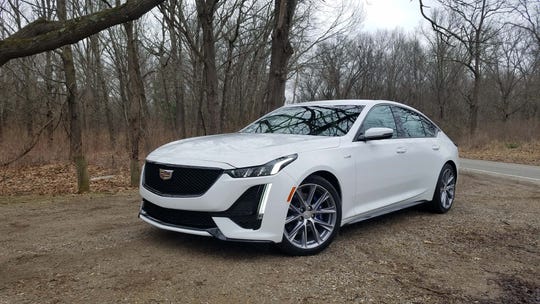
The 2020 Cadillac CT5-V is a compact, performance sedan that competes against the BMW M340i and Audi S4. (Photo: Henry Payne, The Detroit News)
When I was a kid, I imagined a button on my bike’s handlebars that would transform my two-wheeler into an asphalt-scorching race car. You, too?
Say hello to V-Mode in the 2020 Cadillac CT5-V.
I took the alluring sedan to my favorite Hell, Michigan,playground to play (and practice social-distancing). I luffed along comfortably through Livingston County, but as I approached the twisted curves of Hell, my heavy right foot began to itch. There, right out of my childhood dreams, was the V-Mode button on the steering wheel.
With a single press, the steering tightened in my paws, the 10-speed transmission dropped a gear and fangs seem to grow from the Cadillac’s front grille.
I buried the throttle and the beast leapt forward. WAAAUUUGGHHHH! roared the 360 ponies under the hood. BRAP-BRAP! spat the quick-shifting tranny. WHOOOOSH! went the scenery past my window.
The CT5-V lives up to Caddy’s mantra to go big in the compact sedan class.
Kicking its small ATS (now renamed CT4) down market to compete in the subcompact class against the BMW 2-series, GM’s luxe brand has tagged ATS’ big brother, CTS, to do battle against the likes of BMW 3-series, Audi A4, Mercedes C-class, Alfa Romeo Giulia and Tesla Model 3.
Rebadged the Cadillac CT5 and re-sculpted with a handsome fastback, the 2020 Caddy brings the CTS’ mid-size proportions to the compact class. It even expands its wheelbase 1.5 inches to claim biggest class specs: biggest front seat, biggest back seat, biggest wheelbase.
Then CT5 goes bigger on value. Starting at just $37,900 with a turbo-4 under the hood, the CT5 not only undercuts the ol’ $45,000 CTS by a whopping 7 grand, it’s also 5 grand cheaper than the BMW 3-series. With those big headlines and Cadillac’s sculpted bod, CT5 should turn heads.
But proportions and price aside, the standard 237-horse CT5 is an average meal. I flogged it around Ann Arbor last fall as part of the North American Car of the Year competition where its average power and interior didn’t stand out.
Not so the four-star CT5-V. V for va-va-voom.
It’s aimed at the up-market BMW M340i, Audi S4 and Mercedes AMG C 43. Just as the 382-horse BMW M340i offers buyers a taste of its mouth-watering, full-Monty, 444-horse M3 performance steak — but without the eye-watering, $80,000 sticker price — so does the Cadillac split the difference between the standard CT5 and its M3-fighter.
I wish I could tell you the name of the CT5’s tippy-top performance model (replacing my old favorite ATS-V), but Cadillac is leaving that fine cut of beef for later.
Suffice to say that the CT5-V offers plenty to chew on for now. This is a sleek, roomy, high-tech machine that will quietly deliver your guests to the club, then raucously entertain your inner child on twisty country roads to the cabin up north.
Let’s talk tech. Unlike the standard CT5, the V throws everything and the kitchen sink at the competition. Consider the V-mode that set Hell’s roads on fire.
It’s made possible by GM’s Performance Traction Management system — PTM, for short — that CT5-V shares with its mid-engine Corvette stablemate. The ’Vette’s button is called Z-mode. Personalize Z and V modes in Settings in the infotainment screen. My choices: Track setting engine sound, Track or steering, Track for powertrain, Sport for suspension, Sport for brakes.
The option instantly transformed my steed. I barreled through Hell’s empty ess-curves, the weighted steering anchored to the road, the four-barrel exhaust howling. Over roller-coaster brows, the stiffened magnetic shocks kept the 3,975-pound missile flat to the road. Entering a 90-degree turn, I stomped 4-piston Brembo brakes, then … stopped.
Launch control time. This is where PTM really shines. The computer-managed slip in my rear-wheel drive Michelin Pilot Sport 4S tires while the 10-speed tranny — exclusive in the segment — barked off rapid upshifts.
This Corvette-like performance bandwidth intrigued my pal Jamie, who just gave back his 2017 CTS-V off lease for an $85,000 mid-engine C8 with Z51 performance package.
The CT5-V packs many of the same elements — PTM plus e-diff and magnetic shocks — but with a $30,000 less sticker price and roomy rear seats.
“Boy, this thing is good!” exclaimed Jamie as he flung the V through some Oakland County curves. I’m betting his Vette will soon have a CT5-V garage-mate.
V is faithful to the standard CT5’s promise (which also comes as a Sport and Premium Luxury model) of being at least $5,000 cheaper than the German competition. My $56,875 tester was considerably less than comparable the $62,000 Audi S4 and BMW M340i I’ve tested.
The sexy V is more fun than the conservative Audi and holds its own against Bimmer’s terrific inline-6.
Like the standard CT5, the sacrifice the V-buyer will make to BMW — and Mercedes and Audi — is in the dash displays, where the Yankee lags a generation behind. Visit a BMW’s interior and you’ll walk away drooling over its graphics displays, remote-controller wizardry and intuitive voice control.
“Go to Uncle Joe’s Chicken in Southfield, Michigan” I commanded the Bimmer, and it obeyed beautifully. The Caddy? Not so much. The CT5-V’s door handles tantalize with their soft-squeeze entry, but old-school analog gauges and an antiquated rotary screen controller lag the German’s state of the art.
Still, even the Germans feel a step behind Tesla in the electronics game. The electric Model 3 remains a unique experience and its comparable Performance version is priced at $57,000 with the CT5-V while offering head-exploding 2.9-second zero-60 acceleration, standard all-wheel drive (a $2,600 option on the Caddy), and an optional, class-best, $7,000 Autopilot.
That uniqueness won’t last long.
Later this year, Cadillac will introduce its own Super Cruise autonomous system to the 2021 CT5 which is Tesla’s match (assuming Cadillac is serious about maintaining over-the-air updates). No one can match this pair in the self-driving field.
Super Cruise offers Cadillac another value-play if it can compete with Tesla’s $7,000 Autopilot price.
Cadillac has followed GM’s brand-wide policy of nickel-and-diming customers for safety features like adaptive cruise-control and blind-spot detection at a time when even compact cars like the Nissan Sentra make such systems standard for $25,000. Cadillac could go bigger by making those features standard on the V, too — a no-brainer for a badge that is doing so much right in this segment.
With its sexiest, fastest, techiest compact car player ever, Caddy’s gotta continue to go big.
2020 Cadillac CT5-V
Vehicle type: Front-engine, rear- or all-wheel drive, 5-passenger performance sedan
Price: $48,690, including $995 destination charge ($56,875 RWD model as tested)
Powerplant: 3.0-liter twin-turbo V-6
Power: 360 horsepower, 405 pound-feet of torque
Transmission: 10-speed automatic
Performance: 0-60 mph, 4.8 seconds (Car and Driver); top speed: 168 mph
Weight: 3,975 lbs. as tested
Fuel economy: EPA 21 city/26 highway/21 combined
Report card
Highs: Roomy interior; brilliant drivetrain tech
Lows: Dated rotary controller; standard safety features, please
Overall: 4 stars
Auto sales plunge as COVID-19 infects first-quarter reports
Posted by Talbot Payne on April 1, 2020

Automakers are releasing sales results from January through March, and they already show steep declines. Dealerships around much of the country have been shut down by the COVID-19 pandemic. (Photo: Paul Sancya, AP)
With March auto sales infected by the coronavirus, Fiat Chrysler Automobiles reported sales declines of 10% for the first quarter of the year, while General Motors Co. was off 7%, brought low by a dismal last few weeks after a healthy January and February.
Wednesday’s quarterly sales reports from automakers are the first since the U.S. was hit by the coronavirus crisis which has closed auto plants and many showrooms. Ford Motor Co. won’t release its January-March sales numbers until Thursday.
The pain spread across all sectors of the automotive market. Hyundai and Porsche saw sales decelerate, with the Korean manufacturer’s sales down 43% in March alone. Including its abysmal March results, Hyundai reported an 11% drop in the first quarter. Porsche first-quarter sales were off by 20.2% from a year ago after a record 2019.
The industry is bracing for difficult months ahead. After a record five years of annual sales over 17 million units in the U.S., sales were expected to slow in 2020, according to J.D. Power forecasts, to a still healthy 16.8 million units. Sales at the start of the year were promising even as automakers put more money on the hood to keep customers coming.
But with automakers poised for the spring selling season beginning in March, COVID-19 has changed the landscape.
Some 70% of the country’s population is operating under state shelter-at-home orders including major markets like California and New York. According to a University of Michigan survey, consumer sentiment tumbled last month to its lowest level since the 2008 Great Recession and is projected to hits its largest two-month decline ever.
As of Monday, at least 35 states had issued executive orders limiting non-essential business activity affecting dealerships.
Dealers across the country are offering no-interest loans and 84-month lease terms to entice buyers. GM and its dealers are offering concierge service, courtesy transportation, and home delivery where permissible. But permissible varies by state.
In Michigan, even online sales have been suspended until April 14.
The Michigan Automobile Dealers Association has advised its members that automotive sales remain closed under Gov. Gretchen Whitmer’s business guidelines. Only service, parts and body-shop operations are allowed to stay open.
“We are still actively talking with customers, answering questions and booking appointments for when the governor’s executive order lifts on April 14,” said a spokesperson for Lafontaine Automotive Group.
New York Gov. Andrew Cuomo lifted that state’s ban on online sales March 27. “This is an enormous win,” said New York State Auto Dealer Association President Bob Vancavage in a statement. Dealers “have been working non-stop to craft an exemption under the essential business guidelines to allow dealers to do what they do best: sell cars.”
In California, the nation’s largest auto market, the California New Car Dealers Association has advised all 1,400 showrooms to comply with Gov. Gavin Newsom’s shutdown order.
Even home-team Tesla was forced to shut down production and showroom deliveries of its electric cars . The shutdown comes as the Silicon Valley automaker is launching its first entry-level SUV, the Model Y. Analysts expect Tesla sales to be off 30%.
The Golden State’s first-in-the-nation shelter-in-place order on March 16 showed ominous signs for the industry as sales cratered by 86% the first weekend after the order. J.D. Power expects that pattern to continue in other states that have enacted stay-at-home orders.
For Detroit automakers, core truck lines were a bright spot for the quarter, even when the disruption of March was included.
In GM’s stable, the Chevy Silverado pickup roared to 26% sales gains over a year ago with 114,313 units sold. The brand’s SUV lineup did not fare as well with sales down significantly, save the entry-level, $22,295 Trax SUV.
Indeed, outside of pickups and the low-volume Bolt electric car, only the affordable Trax and entry-level Spark sedan saw sales gains. That trend will be watched closely as small vehicles also saw a big gain during the last, 2008 downturn.
Overall, Chevy saw the least degradation among GM brands with sales off 3.8%. GMC dropped 5.5 percent (the Silverado’s Sierra cousin the exception at plus31%), Cadillac 15.8% and Buick 34.7%.
For Fiat Chrysler, the popular Ram pickup lifted sales 7% to 128,805 vehicles while sales of the family-friendly Chrysler Pacifica minivan climbed 5%. Jeep’s all-new Gladiator pickup continued to impress with its third consecutive quarter of 15,000-plus sales.
Despite the sales gloom, TrueCar projected the average transaction price of vehicles to be up 3.2% in March 2020. Transaction prices have been key to industry profit margins, but TrueCar analyst Eric Lyman sounded a cautionary note as COVID-19’s effect on sales did not set in until mid-month.
“Historically, there’s been a strong correlation between consumer confidence and average transaction price,” he said. “We’re now seeing one of the largest one-month declines in consumer confidence in nearly 50 years. April will provide a much clearer picture of the full impact caused from the coronavirus.”
As U.S. auto plants remain idle, China’s are open again for business
Posted by Talbot Payne on April 1, 2020
While COVID-19 has stopped auto assembly lines across North America, Chinese plants are revving up again after closing there in late January.
Major automakers from General Motors to BMW to Toyota say their factories in China have reopened, including the virus epicenter in the Wuhan province.
The openings include key product startups from Volvo and Tesla. The Chinese-owned Swedish automaker flipped the switch this week on its all-new Polestar 2, a key car in its global electrification strategy. Tesla has reportedly returned to full production at its all-new Shanghai factory producing the Model 3 sedan.
“We start production now under these challenging circumstances with a strong focus on the health and safety of our people,” said Polestar CEO Thomas Ingenlath. “This is a great achievement and the result of huge efforts from the staff in the factory and the team securing the supply chain.”
As coronavirus cases ballooned in the U.S. over the last two weeks, all 46 assembly plants in the U.S., foreign and domestic, were shut down.
China’s bounceback comes as COVID-19 cases have declined from their peak in late January. Daily life there has returned to normal with restaurants and auto dealerships re-opened. Two of the world’s largest automakers, GM and Toyota, report that production is now back to full tilt.
“Our plants in China have resumed production on a staggered basis, including the two plants in Wuhan,” said a GM representative. “Only three out of 13 plants in China haven’t started production yet.”
Plants like Jinqiao North Assembly outside Shangahia are applying strict cleansing guidelines and workers are required to wear face masks.
Employees in China went on break Jan. 25 for the Chinese New Year, two weeks after China recorded its first coronavirus-related death. They were then told not to return to work as the disease spread. GM began preparing for plants to reopen the week of Feb. 10.
Toyota, the world’s second-biggest automaker behind Volkswagen, has resumed normal operations in China with all regular shifts and production lines up to speed.
Other automakers including VW, Nissan, Hyundai and Honda reopened plants in mid-February.
Volvo’s Polestar startup — a separate electric brand — is crucial to the company as it seeks to meet European and Chinese emissions demands while also appealing to an anticipated new generation of luxury-EV customers inspired by Tesla.
The fastback EV is scheduled to arrive in Europe this summer, and then in the U.S. with a starting price of about $65,000.
Tesla’s Shanghai factory, its first outside the U.S., has been a showcase of government-business cooperation. Determined that China lead the world’s EV revolution, the government exempted the company from the national 10% sales tax. China provided extensive assistance to Tesla — including 10,000 face masks — to help it reopen the first day after the new year shutdown.
The government “will make all efforts to help key companies including Tesla return to normal production,” Xu Wei, a representative the Shanghai municipal government, said at a briefing in February. Tesla began delivering Model 3s to customers in China just one year after it broke ground.
It is unclear when U.S. plants might start rolling again. GM said Thursday its plants are shut indefinitely. Ford and Fiat Chrysler said they could reopen their U.S. facilities as early as April 14.
Detroit auto show canceled as TCF Center selected for hospital overflow
Posted by Talbot Payne on April 1, 2020
Detroit — The Detroit auto show scheduled for June has been canceled after show organizers were told the TCF Center will be used by the Federal Emergency Management Agency to house overflow patients from hospitals that are becoming overwhelmed because of the coronavirus crisis.
“Our understanding is that TCF Center will become a ‘temporary field hospital,” North American International Auto Show chairman Doug North told The Detroit News.
“We were certainly aware that FEMA has been talking with a whole host of other sites around the country — primarily convention-type centers — so we knew this was a possibility,” North said. “It didn’t become a complete reality until Saturday. It’s not a shock FEMA would want to get in here. We need to get this thing stopped as quickly as we can.”
This year’s event was scheduled for June 7-20 at the former Cobo Center and at nearby outside venues such as Hart Plaza. The show had traditionally been held in January but was moved to the summer to be more consumer-focused.
The announcement is another blow to Detroit’s restaurant and hotel industries that already were reeling from the effects of the COVID-19 shutdown. The Detroit auto show draws thousands of visitors from around the globe to the downtown, infusing the regional economy with hundreds of millions of dollars. The next show will not be held until June 11, 2021; that’s 866 days after the last show in January 2019.
“We’re hoping that this pandemic will be gone, and we can have a great show,” North said. “All our partners and stakeholders were really excited. Up until the last few days, we were getting calls from companies and individuals that wanted to get involved.”
The U.S. Army Corps of Engineers has been assessing at least 15 sites for patient overflow as coronavirus cases have spiked around Detroit. The Detroit District is working under FEMA at the direction of the state to assess a list of potential alternate care facilities that Michigan Gov. Gretchen Whitmer’s office has prepared. The Army Corps was also assessing the Henry Ford Detroit Pistons Performance Center and two Wayne State University dormitories in Detroit.
The auto show’s move from from January to June this year had been an effort by organizers to reinvent the show and inject more excitement. There had been a decline in the number of global automakers participating in recent years, and public attendance had been down.
With the move to summer, there were to be outdoor debuts, test rides, demonstrations of robotic cars and off-road events at the TCF Center and Hart Plaza. Rally cars were to “drift” on the rooftop of the convention center. A new event, the Motor Bella festival of Italian and British cars was to have been held outdoors on Broadway next to the Detroit Opera House.
The Charity Preview ball was to have added a more casual and less expensive “summer chic” outdoor option in addition to the event with formal dress inside the convention center.
All tickets purchased for the 2020 show, including for the public show, industry preview and Charity Preview will be fully refunded, officials said. The ticket office will be in contact with ticket holders. Those with tickets to the charity event will have the opportunity to donate the proceeds of their refund to one of the nine beneficiaries had the event been held. NAIAS officials are discussing plans for a fundraising activity later this year to benefit those charities.
“It’s already been 18 months as of this June since our last show, so I’m hopeful we can develop something that will allow us to really try and support those charities between now and next year,” North said.
The 2021 event will begin June 11-14 with the Motor Bella festival. Press days will be June 15 and 16, with the Charity Preview event June 18. The public show will run June 19-26.
“We fully support NAIAS organizers in their postponement,” Mark Truby, Ford Motor Co.’s chief communications officer, said in a statement. “The health and safety of our community and those working throughout the industry is our top priority. We look forward to seeing the show’s return in 2021.”
General Motors Co. had been planning to “go big” for Detroit’s first summer show, said Terry Rhadigan, GM’s executive director of communications and corporate giving. GM was planning to use its Renaissance Center headquarters on the riverfront for the event put on by the Detroit Auto Dealers Association.
“We had big plans, but it all seems rather insignificant now based on everything else that’s going on,” Rhadigan said. “[NAIAS Executive Director] Rod Alberts and the DADA have been great partners for us for decades. We are thinking about them at this difficult time and support the decision that was made.”
Fiat Chrysler Automobiles added: “We understand and support the decision, at this difficult time.”
While the cancellation is unfortunate, Michelle Krebs, executive analyst for Autotrader, said it could conserve automakers’ money, “which they are desperately trying to save right now.”
The companies have shut down manufacturing plants in North America and elsewhere because of the outbreak, causing them to take out loans, put projects on hold and take other actions to conserve cash. GM even is deferring 20% of salaried workers’ pay for up to six months with the intention of repaying them with interest later this year or early next.
“The impact of canceling the auto show is nothing compared to the impact of the coronavirus and the economic fallout,” Krebs said.
Detroit is not the only city to have lost an auto show because of the coronavirus outbreak. Three days prior to the Geneva Motor Show scheduled early this month, Switzerland banned events of 1,000 people or more, forcing its cancellation. The Beijing Auto Show in April has been postponed indefinitely, and the New York International Auto Show was moved to August from April.
In 2019, the last year the Detroit show was held in January, European automakers — with the exception of Volkswagen AG — passed on the event. A used-car display from a dealer in sports cars and exotic vehicles helped fill vacant floor space.
The event drew 774,179 ticketed visitors, which was about 35,000 fewer guests than in 2018; attendance was down in part because of a major snowstorm. Despite the downturn, the show brought a $430 million boost to the regional economy — the equivalent of hosting two Super Bowls.
“There is an opportunity,” North said, “to do this again next June and make it safe for everyone — and one that lets us leverage the great excitement we had for what we’re planning in June.”
Payne: Trusty Toyota 4Runner is 4Ever
Posted by Talbot Payne on March 30, 2020

2020 Toyota 4Runner (Photo: Toyota)
Ford is about to enter the truck-based SUV market with the Ford Bronco and I get it. People are passionate about these things.
Yet, there are only two truck-based SUVs in the mid-size market — the Jeep Wrangler and the Toyota 4Runner. The Toyota what?
You can be forgiven for forgetting the Tacoma pickup-based ute doesn’t exist because Toyota hasn’t remade it since the Mesozoic Era (actually, 2009). It hasn’t had a wall-to-wall marketing campaign for some time, unlike the Jeep. You’d have to have been living on Mars not to have seen one of the Jeep ads (and I’m told there’s a Mars trim coming.). But 4Runner fans know the Toyota is there.
“What do you drive?” I recently asked a male acquaintance in Los Angeles.
“A 4Runner. Best car I’ve ever owned.”
“What do you have in the garage?” I asked a female shuttle driver in Texas.
“4Runner, I love it.”
We automotive journalists are guilty of pooh-poohing anything that hasn’t been remade in the last five years. We’re like children attracted to the latest shiny thing. But evidence is that you don’t have to be shiny to be relevant these days.
Take the Dodge Challenger and Charger muscle cars, two of the most-recognized nameplates in America thanks to savvy marketing, state-of-the-art infotainment and big horsepower. Make that ginormous horsepower.
Customers shrug at the fact that the Dodge brothers are based on an ancient 2006 chassis.
Ditto the 4Runner.
I climbed into my 4Runner tester with Mrs. Payne on a cold winter night at Detroit Metro airport after a long week away. The snow was blowing and the roads were covered with it. Detroit potholes were lurking. Boy, was I glad to see the 4Runner’s big bones and knobby, high-profile tires.
We threw our luggage in the cavernous boot, then cranked up the interior temps — heated seats, front rear-defroster, climate temps — with big, knobby dials to match the tires. After clearing the Toyota of crusted ice and snow, I tossed the snow brush into the back seat — rugged, mid-size trucks mean never having to worry about mussing the interior.
After a long day, we were in no mood to spend the next 45 minutes crawling along Detroit’s pocked cart paths worrying about a blowout in subfreezing temps. The opposite was true of 4Runner. The beast positively loved the conditions.
Like a salty sailor on rough seas, the 4Runner relies on old technology to chart its course. I eased the shifter into neutral, then yanked the truck’s second transfer-case shifter (familiar to Wrangler fans, too) back into four-wheel drive. With all four wheels churning, we set off into the gloom.
The 4Runner sits a ridiculous 10 inches off the ground with a Jeep-like 33-degree front approach angle for off-roading. Heck, we probably could have just cut through the woods to go home. The ute even includes a crawl mode for nature’s worst. This fearlessness has made Toyota’s ute a favorite of folks in rural communities where snowplows often take days to catch up to rutted roads. But this night, we decided to stick to paved roads.
The SUV bombed happily along, the 4.0-liter 270-horse V-6 mill roaring its approval. V-6s, of course, are frowned upon in this woke green age of turbocharged fuel-sipping 4-bangers. But with its guttural growl and instant torque, the six-holer matches 4Runner’s can-do character. Like the V-6s and V-8s under the hoods of Chargers and Challengers, if it ain’t broke, don’t fix it.
Customers sure don’t think the 4Runner is old-fashioned. Sales numbers in the last five years have seen a steady climb from 76,906 in 2014 to 131,888 last year. That’s a 70% jump, mirroring the 60% rise in Toyota Tacoma pickup sales to nearly 250,000 units over the same period.
As the U.S. has moved to SUVs, the idea of a Tacoma SUV with a hatch instead of a pickup bed has real appeal. Ford no doubt hopes for the same gains from a Ranger pickup-based Bronco.
Like Dodge, 4Runner mixes its old-fashioned with a taste of modern tech.
Once on M-39 headed north, I set adaptive cruise-control to 60 mph to avoid Melvindale and Dearborn speed traps. The localities are famous for using the 55-mph speed-limited Southfield Freeway to raise revenue, catching travelers who’ve been traveling the 70 mph common to the rest of the freeway.
Asian automakers have been aggressive about outfitting all their vehicles — right down to $20,000-something compacts — with safety systems like adaptive cruise and automatic emergency-braking. The 4Runner is no exception. In addition to saving my bacon from police radar, automatic cruise-control is a welcome trip companion.
Adaptive cruise is enabled by the big radar brick in the 4Runner’s gaping fish-mouth grille. After a while on M-59, ice and snow began to coat the brick like gnats in a Florida summer. Soon, the 4Runner’s brick was coated and the car’s brain told me adaptive cruise-control was no longer available. No problem, but a reminder of the many challenges self-driving systems have to overcome.
The 4Runner encountered no navigation challenges on the route thanks to another piece of updated software, Apple CarPlay. My wife simply plugged in her phone, and Google Maps routed us around stormy obstacles — traffic backups, road closures, accidents — for the quickest way home.
Speaking of plugs, 4Runner also has a three-prong outlet in the boot — perfect for charging laptop or other devices, because who carries those round cigarette lighter chargers with them anymore?
In a week of frosty, snowy weather, the Toyota was a welcome addition to the driveway. The big lug’s not much to look at, but my $48,000 Venture Edition tester served its purpose as a proper utility vehicle with heated front thrones, fold-flat second-row seats for extended cargo room, slide-out rear floor and updated 8-inch screen that keeps pace with the Wrangler’s modern U-Connect system.
Toyota prices comparably favorably to the Wrangler, too, while offering more cargo space and better interior quiet — if less overall character than the Jeep.
Both the Wrangler and the 4Runner are ol’ St. Bernards that will run the extra mile to save you from the elements. That’s how owners like them and sales numbers prove the point. Which sets up an interesting opportunity for the coming Bronco, which will surely bring lots of cutting-edge Ford tech to the ladder-frame segment.
The 4Runner is a loyal old friend. And customers are loyal back.
2020 Toyota 4Runner
Vehicle type: Front-engine, rear- and all-wheel drive, 5-passenger SUV
Price: $37,240, including $1,120 destination charge ($48,877 AWD Venture Special Edition as tested)
Powerplant: 4.0-liter 6-cylinder
Power: 270 horsepower, 278 pound-feet torque
Transmission: 5-speed automatic with second transfer-case shifter for AWD
Performance: 0-60 mph, 7.7 seconds (Car and Driver); towing, 5,000 pounds
Weight: 4,750 pounds
Fuel economy: EPA 17 city/20 highway/18 combined
Report card
Highs: Rugged beast; nice modern touches like Apple CarPlay and 3-prong electric plug
Lows: Dated interior; gotta muscle that transfer-case shifter
Overall: 3 stars
Payne: Honda CR-V Hybrid makes geek great
Posted by Talbot Payne on March 26, 2020

New for 2020, the Honda CR-V Hybrid is the best performing CR-V with 212 horsepower and excellent torque. (Photo: Henry Payne, The Detroit News)
Honda hybrids used to be soooo nerdy.
The Japanese automaker’s first hybrid debuted 20 years ago. Costing $28,932 in today’s dollars ($18,800 in 2000), the wee front-wheel drive, three-door hatchback looked like a college science project.
Shaped like a doorstop, it was optimized for 647-mile range — assuming a semi-truck didn’t run over it first as its 72 horses struggled to get up to interstate speeds. It came standard with a manual transmission. Its bicycle-thin rear tires were covered by fender slats to increase aerodynamics. It sold like granola in a candy shop. Not well.
How far hybrids have come.
For the same price, Honda’s all-new $28,870 CR-V SUV comes standard with all-wheel drive, adaptive cruise control, automatic high beams, Apple CarPlay, Android Auto and 212 horsepower. That’s 12 more ponies than the standard 1.5-liter turbo CR-V.
Heck, it’s more horsepower than the Honda Civic Si pocket rocket. The five-door hatchback merges up the interstate on-ramp like a tiger while maintaining maximum 560-mile range and best-in-class interior space.
Unlike the Insight, Honda may have a winner on its hands.
Customers had been more than happy with the CR-V’s two gas-powered options, gobbling up over 384,000 CR-Vs last year. But, this being the Age of the Nanny State, there is a regulatory advantage to Honda offering a hybrid option for its best-selling vehicle. So Honda ditched the second, 2.4-liter gas engine for the hybrid.
It helps make government electrification goals, not to mention Honda’s own internal goals. The idea of the Japanese automaker electrifying two-thirds of its product by 2030 seems absurd, until you realize its best-selling model will have batteries under the rear seat.
Unlike hybrids of the past, this greenie isn’t just for the faithful. Like similar offerings from Ford (Escape) and Toyota (RAV4), this nerd is superior to its gas-powered peer in almost every way.
As regular readers of this space know, I am a particular fan of the 2020 Escape ute, which Ford introduces in Sport trim at just $28,000. The Ford’s battery-assisted geekiness is buried under layers of hot black mascara makeup and cool tech displays. High mpgs never looked so good.
So, too, the CR-V Hybrid. The homely Honda can’t match class sexpots like the Escape and Mazda CX-5, but a remade lower facia and snazzy wheels are welcome upgrades. And the 2020 model gets attractive wardrobe colors like Radiant Red Metallic and a battleship gray called Sonic Gray Metallic.
The CR-V Hybrid’s real beauty is in the price.
Escape and RAV4 sticker prices balloon to over $30,000 with all-wheel drive, but that must-have feature for Michigan winters comes standard — along with everything else — on the Honda for under $29,000. That’s about $1,500 below its class competitors, and just $1,200 more than a comparable gas-fired CR-V.
Standard also is the CR-V hybrid’s 38 mpg fuel economy, 30% better than the 1.5-liter turbo-4 model. That means fewer stops at the gas pump — but it also means you’ll pay for that $1,200 premium in under five years.
Given the hybrid’s 50% better fuel economy in urban areas — I averaged 40 mpg carving Tucson, Arizona’s urban roads — you might make it up quicker than that.
This is one cocky nerd.
Not only does it go farther on a gallon of gas than its gas-only brother, but it has more fun getting there. Honda had the audacity to set up a sand course for the hybrid that showed off its low-end torque.
With its direct-drive to the wheels (no transmission), the Honda provides instant torque without the groan of a continuously variable transmission that accompanies its Ford and RAV4 competitors. The Honda boasts 212 horsepower at the top end, though it’s shoutier getting there thanks to its 2.0-liter engine versus Ford’s bigger 2.5.
Honda has deep racing roots, and that DNA is felt even in the CR-V.
As I’ve noted, Ford has sewn a Sport badge on the Escape to suggest its lively personality. Don’t expect a Civic-like Type R model for the CR-V anytime soon (man, would that be a hoot) but I still enjoyed pushing the compact ute around town. Honda obsesses over the details and the hybrid’s bod is taut with a suspension to match.
Like a nerd with thick glasses and thicker teeth braces, hybrids used to mean geeky outside and inside. But the CR-V Hybrid is thoroughly mainstream.
Open the door and you get Honda’s typical interior wonderfulness. In fact, pause and admire the CR-V’s rear doors: They are thoughtfully hinged to open almost 90 degrees to the B-pillar for easier ingress and egress.
The SUV’s console is nearly as clever with a roomy center console, thanks in part to its raised shifter island. There’s storage for cups and phone, and USB ports are forward-located so you can easily plug in your phone for turn-by-turn screen navigation. Exclusive to the hybrid is Acura’s nifty “trigger ignition” located high within easy reach.
That raised console was my only interior regret, as it sometimes bounced my knee. You’ll forgive them because Honda fussiness over passenger comfort is especially notable inside the console.
CR-V’s three-row Pilot cousin has the best-in-class console with a pullback shade that allows purses to be stowed on top of the console spine — or entirely inside it. The CR-V, too, allows multiple configurations depending on what you’re hauling.
Speaking of best-in-class, the hybrid obsesses over grades like a good nerd should. Best-in-class torque, best-in-class passenger space, best rear-seat legroom, lowest cargo floor for loading.
Poke around under the cargo floor and you’ll see the only sign of hybrid sacrifice. To accommodate its lithium-ion battery, the CR-V’s standard spare tire has been replaced by a tire repair kit. Got a flat? The kit will fill the tire with air while also coating the interior with a puncture sealer. Hopefully, ahem, that sealer will last as far as the nearest service station.
Other oddities include steering-wheel paddles so that you can play with regenerative braking. And at low speeds the hybrid will emit an eerie, alien spacecraft sound to alert other earthlings that a quiet electric car is headed their way — as required by federal law.
It’s weird. But, hey, sometimes hybrids have to let out their inner nerd.
2020 Honda CR-V Hybrid
Vehicle type: Front-engine, hybrid all-wheel drive, 5-passenger SUV
Price: $28,870, including $1,120 destination charge ($37,070 Touring as tested)
Powerplant: 2.0-liter 4-cylinder mated to AC motor with 1.4-kWh lithium-ion battery
Power: 212 total system horsepower, 232 pound-feet of torque
Transmission: Single-speed direct drive
Performance: 0-60 mph, 7.6 seconds (Car and Driver); towing: NA
Weight: 3,763 lbs. as tested
Fuel economy: EPA 40 city/35 highway/38 combined
Report card
Highs: 38 mpg for a family SUV; standard features galore
Lows: Homely face; no spare tire
Overall: 4 stars