- Search Cartoons
- Comic Archive
-
Payne
Store



 Henry Payne RSS

Articles
Payne: Buick’s three-row Enclave handsome inside and out
Posted by hpayne on February 23, 2018

Buick’s big car, the LaCrosse, is a stunning vehicle with elegant looks inside and out, acres of interior space and a light, all-wheel-drive chassis that makes it feel a size smaller on the road.
Trouble is, full-size sedans have as much appeal these days as professional ballroom dancing.
So Buick’s tailors fit the LaCrosse wardrobe to a three-row SUV and called it the Enclave. The result is one of the most head-turning SUVs on stage today. The fact that Buick isn’t sweating the cratering of the sedan market is testimony to the remarkable pivot the premium automaker has made from being a clueless sedan brand to a cutting-edge crossover player.
As the ads say: That’s a Buick?
Buick is now a full-line SUV manufacturer in the hottest segments on the planet with the cute-ute subcompact Encore and compact Envision. But it’s the Enclave that saved the brand’s bacon.
“The Enclave resuscitated Buick,” says ex-General Motors product guru Bob Lutz. “It sold to people in their 40s and 50s (as opposed to 60s and up), shared up-market garages with German sedans, and achieved what all the wise specialists said was impossible: It made Buick relevant again.”
Introduced in 2008, the first-generation Enclave was unmistakable. With its signature “boat bow” rear window, pronounced hips and huge kisser, it high-stepped into view like Ashley Graham on heels. This was no ute box. This was a super-size SUV proud of its super-size curves. It was a hit, forcing GM to add a third shift at its Lansing line to meet demand.
The second generation is made even more stunning by following the mantra that less is more. Like the LaCrosse, the Enclave is about simplicity of line. This car just flows. With generous use of chrome highlights, its lines connect as if inked from a draftsman’s silver pen. The signature winged grille bleeds into the headlight’s LED “eyebrows,” which are then picked up by curvaceous shoulders, then finished with a wide chrome stroke connecting the rear taillights.
Did I say the Enclave is as lovely as the LaCrosse? No. It’s better.
There is more daring here, from the way the grille integrates with the headlights to the familiar boat-bow window to the scalloped rocker panels — a touch that got lost on the LaCrosse in the transition from sketch pad to sheet metal.
Making the feat even more impressive is the Enclave’s size. Short of ginormous truck-based utes like the Lincoln Navigator or Cadillac Escalade or Infiniti QX80, the Enclave is the biggest three-row unibody-frame SUV out there. Its 204-inch length dwarfs competitors like the 196-inch Acura MDX or 194-inch Volvo VC90.
The sculpture continues inside with long, chrome bezels and parallel lines that lap across the dash like waves on a Caribbean island: natural, rhythmic, simple.
“That’s really nice,” my neighbor John, a former interior designer, cooed when I drove up.
This smoothness translates to the ride thanks to sharing its lightweight platform with GM’s Chevy Traverse.
Merging with authority onto the Lodge Freeway, the big car’s diet is immediately apparent. Shedding 350 pounds from the previous generation, the car rotates easily, its twin-pack all-wheel-drive system distributing torque and traction. With a butter-smooth nine-speed transmission and 310 horses available from a 3.6-liter V-6 (also shared with Traverse), my confidence grew with each mile as I hustled along behind a V-8 powered Dodge Challenger R/T whose driver must have wondered how the land yacht in his mirrors was keeping up.
Eventually, macho got the best of him — that’s a Buick! — in traffic as he tried to lose me by swerving onto the right shoulder and flooring it past a line of cars. Easy, Bullitt.
The Traverse DNA is both a blessing and curse.
The Buick’s best-in-segment size is reason alone to buy this beauty. But like the Traverse, it forces stop-start engine shut-off on drivers while holding back on standard features found on mainstream models costing $20,000 less.
The stop-start stall at stoplights is annoying to many — yet premium buyers moving up from Chevy coach to Buick first-class will be even more annoyed to find they still don’t have the choice to turn it off.
Speaking of first-class seating, a simple tug on the second-row captain’s chair side handle will cause the seat to tumble forward. The feature is both effortless and practical as it can be accomplished with a car seat intact. But the Traverse-shared feature is only available on the car’s curbside, meaning passengers on the left have to clamber through the middle of the seats to reach the third row.
Versatile seats like these are some of autodom’s most expensive items, so the curbside-only feature in the Chevy may make sense. But the Enclave? Shouldn’t luxury get more? Even Honda’s Pilot offers similarly clever, one-button collapsible seats on both sides.
Climb into the third-row and space abounds — including double cupholders for each passenger to accommodate, say, their Shake Shack milkshake and burger. Spoil your passengers with the $1,400 dual moonroof option to let the sun shine in. Its third row doesn’t make you feel like a third-class passenger.
Yet, starting at $51,290, my Premium trim Enclave did not include adaptive cruise-control — a standard item on competitor Acura MDX. And a $27,000 Mazda CX-5 or a $35,000 Honda Pilot, for that matter. Only the top-trim $55,000 Enclave Avenir offers it.
Happily, other goodies abound, like standard-in-all-trims smartphone connectivity, heated front seats (heated steering wheel on my Premium trim) and power liftgate.
Also standard is an open-sesame rear-kick liftgate. How to know where to waggle your foot to open the trunk when your arms are full of groceries? A Buick logo illuminates the spot on the ground.
Once in the cavernous rear trunk (with 8 more cubic feet than MDX), there is another 3-cubic-foot storage bin beneath the load floor. Which reminds me of another clever, hidden space in this roomy manor.
Made possible by the Enclave’s cable-free monostable electronic-shifter, Buick carves a cave under the shifter for hiding, say, a purse. Mrs. Payne loved it, even if it meant coming to terms with the sometimes-confusing e-shifter.
Buick has come a long way thanks to Enclave. With a little more generosity on standard items, its three-row yacht can be the bargain of the segment. She’s already making me forget why we need big sedans.
Henry Payne is auto critic for The Detroit News. Find him at hpayne@detroitnews.com or Twitter @HenryEPayne. Catch “Car Radio with Henry Payne” from noon-1 p.m. Saturdays on 910 AM Superstation.
2018 Buick Enclave
Vehicle type: Front-engine, front- and all-wheel drive, seven-passenger SUV
Price: $40,970 base ($56,455 AWD Premium as tested)
Power plant: 3.6-liter V-6
Power: 310 horsepower, 266 pound-feet of torque
Transmission: 9-speed automatic
Performance: 0-60 mph, 6.5 seconds (Car and Driver est.); towing capacity: 5,000 pounds
Weight: 4,358 pounds
Fuel economy: EPA 17 mpg city/25 mpg highway/20 mpg combined (AWD as tested)
Report card
Highs: A three-row sculpture; as handsome inside as out
Lows: “SmartSlide” rear seat is only smart on the right side; standard adaptive-cruise, please
Overall:★★★
Camaro ZL1 crashes the sedan party at Daytona 500
Posted by hpayne on February 23, 2018
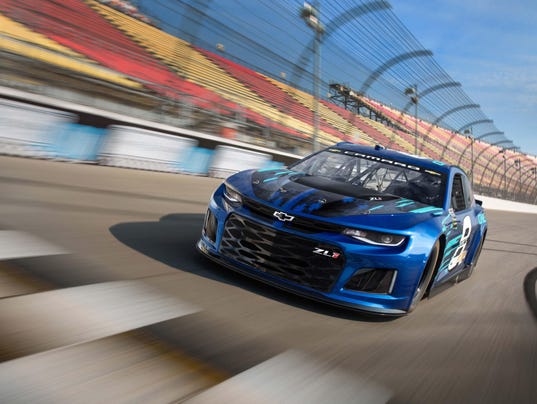
When the Monster Energy NASCAR Cup Series field rolls to the green flag for the start of the Daytona 500 on Sunday, it will be Ford Fusion and Toyota Camry family sedans versus… the Chevy Camaro ZL1 track beast. Doesn’t seem like a fair fight.
For the first time in NASCAR Cup Series history, Chevy will officially enter its Camaro muscle car in America’s premier racing league.
While the Camaro-Fusion-Camry competitors will still be largely the same under the skin according to NASCAR’s strict vehicle rules, the jarring contrast in car models marks a break from recent manufacturer marketing. And it echoes NASCAR’s 1960s glory days when automakers fielded hot rods like the Plymouth Superbird and Ford Talladega to give superstar drivers like Richard Petty and David Pearson a leg up in the championship fight.

The Camaro ZL1 production car is an earth-pawing athlete following in the tire tracks of this NASCAR prototype. (Photo: Chevrolet)
We are looking forward to bringing the Camaro ZL1 to the race track,” GM Vice President for Motorsports Jim Campbell said at Daytona last month. “We race Camaro in the Xfinity Series, Pirelli World Challenge GTS category, NHRA Stock, Super Stock Sportsman classes and up through Funny Car. This is another logical extension for us with racing.”
On paper, America’s greatest race should be no contest. The Camaro ZL1 production car is an earth-pawing, Nurburgring-tested athlete with the same supercharged 650-horsepower engine that fires the Chevy Corvette Z06. In showroom trim, the Camry and Fusion are 4- or 6-cylinder powered, four-door grocery-haulers with half the Camaro’s horsepower.
“Things had become so homologized in NASCAR that in 2007 Toyota decided to go racing with the least likely race car of them all, the Camry,” wrote Chris Smith at CarThrottle.com. “(It is) the culmination of the trend in removing any sort of ‘stock’ from stock car racing.”
NASCAR Cup racers bear little resemblance to their production avatars, save for glued-on headlights and badge stickers. As a result, manufacturers have fielded family sedans like the Fusion and Camry and Chevy Impala in order to market their brands to NASCAR’s family-friendly viewing demographic — a fan base that has also attracted household names like Tide, Cheerios and FedEx as sponsors.
Toyota’s 850-horsepower, V-8-powered Cup car has been badged as a Camry. The Japanese brand entered NASCAR in 2007.
“NASCAR has been a great platform for Toyota’s brand,” a spokesperson said ahead of Daytona. “It has introduced our company to a loyal and diverse audience that may not have known what our brand represented before we came into the sport.”
The NASCAR Camaro will pack a V-8 under its hood just like the ZL1 on dealer floors. It marks the first time a Camaro has been on a NASCAR Cup grid since 1971 when Tiny Lund fielded a private entry — but the first time that Chevy has entered the muscle car as a factory effort.
“The biggest challenge translating Camaro to the NASCAR Cup design template was maintaining the strong character of the production car while working with our race teams to create a great aero platform for them to build fastest race cars possible,” says Chevy NASCAR program manager Pat Suhy.
“This is racing, and we are always working on actions to improve performance and that includes engine, body, aero, everything on the car. We will make an announcement on any future body actions when we are ready,” says Ford Motorsports chief Mark Rushbrook.
Toyota teased the return of its new Supra this week, which will give the Japanese brand its own muscle car for NASCAR consideration.
After fielding the Chevy Impala family sedan until 2012, GM bucked the family car trend for NASCAR Cup cars by entering its V-8 powered rear-wheel drive Chevy SS. Trouble was, the SS — a four-door muscle car — sold just 4,000 cars in the U.S. market. The under-performing SS was discontinued for 2018, and the Camaro — with annual sales just under 70,000 vehicles — took its place.
“(The SS) was the most authentic entry in NASCAR from track to showroom,” said GM Motorsports boss Campbell. “We wanted to keep that principle intact as we went forward, and Camaro was the right place for us to do it.”
Payne: Alfa Stelvio sport ute vs. Cadillac ATS sport sedan
Posted by hpayne on February 15, 2018

The age of the performance SUV is upon us. Porsche, Jaguar, Alfa — even Lamborghini! — put the “sport” in sport utility vehicle. They come with heavy-breathing marketing materials claiming these five-door rhinos bring sedan-like moves to the ute class.
Don’t you believe it.
I recently speed-dated a similarly spec’d five-door Alfa Romeo Stelvio SUV and a Cadillac ATS sedan. Both had turbo-4 power. Sculpted lines. Eight-speed transmissions. Electronic accessories. The works.
The razor-sharp, toned ATS danced rings around the Alfa. The Cadillac begs to be spun around the rumba studio. The Italian ute? Slow the music down a bit, please.
Yet, when I step back from these two luxury partners, the SUV’s overall benefits are hard to deny. Driving-obsessed motorheads like me aside, we are ute nation. It’s no wonder that Alfa — that legendary crafter of the T33 Stradale Prototipo and V8 Montreal — chose to introduce its second U.S. volume vehicle as an SUV. And it’s no wonder that Cadillac is scrambling to complement its lone crossover entry, the XT-5, with s new XT-4 and XT-6 this year.
I was honestly surprised at how pedestrian the Alfa felt next to the ATS. The Stelvio, after all, is based on the same Giorgio architecture as the Giulia sedan which is neck-and-neck with the ATS for best compact athlete. The Alfa siblings share engines, gearboxes, even independent, multi-link suspensions. And the Stelvio costs 10 grand more than the ATS with similar amenities.
The Stelvio is as good as it gets in compact SUVs. Like the Porsche Macan and Jaguar F-Sport and BMW X2 (and, while we’re at it, the terrific, premium-wannabe Mazda CX-5) it is fun to drive, balanced on corner turn-in.
But the ATS is an Olympian.
You know this is a different animal as soon as you turn the wheel. The ATS fits like a tennis shoe, changing directions as quickly as Seth Curry. Heading north on Telegraph Road, I take the long way home through Oakland County’s twisty lake country. I push the Sport mode button for a throatier soundtrack to match my mood, stomp the throttle, and enjoy the quick, buttery, eight-speed tranny.
Its Alpha chassis (that’s Alpha with a “ph”) was bred to compete against Germany’s finest at the highest levels. Drop in a twin-turbo V-6, slap on some Michelin Super Sports, and the ATS-V performance model can go toe-to-toe against a BMW M3 around any track. It was part of Cadillac’s rebirth as a performance brand as it threw an army at the Teutons: Cadillac CTS-V, CT6 large sedans, CT6 plug-in hybrid.
So good is the Alpha chassis that GM also built the Chevy Camaro on it, which not only gave the Camaro bragging rights over the Ford Mustang — but made the Camaro competitive with BMW’s M4 coupe, for goodness sake.
Trouble is, customers wanted SUVs.
“People want to ride up high for better visibility. And SUVs also give them all-wheel drive and five-door utility,” says IHS senior analyst Steph Brinley.
Cadillac only offered one — the XT5 — and the Germans offered dozens. Alfa watched, learned and introduced Stelvio within a year of the Giulia. Stelvio sales have been slow out of the box, selling two-thirds as many units as the sedan. But give it time. Caddy’s lone XT5 outsells the ATS 5-to-1 — and it’s not even based on the same rear-wheel drive skeleton (it shares its bones with the front-wheel-drive GMC Acadia).
Jump in the Stelvio and it’s not immediately obvious why an SUV would outsell a sedan. Like its compact car counterparts, the backseat is small and its coupe-like styling negates the fundamental hatchback design advantage by squashing my 6-foot-5 frame into the ceiling.
Then it started to snow.
The white stuff negated all of the handling advantages of the ATS. My rear-wheel drive ATS couldn’t make it up my driveway. The Alfa climbed it like Sir Edmund Hillary.
The Stelvio comes standard with all-wheel drive — but four-wheelin’ is an option on the ATS which would bring its price to $52,000 (and make it even quicker to 60 mph with the added traction). That’s still $4,000 shy of the Alfa. But the average consumer has already signed the sedan divorce papers.
The standard all-wheel drive Stelvio rides higher for better visibility. It has nearly double the rear cargo space (18 cubic feet) compared to the Caddy’s 10. And then there’s the Alfa engine.
Most drivers don’t know an apex from a cortex — but they know how to mash a throttle out of a stoplight. Here the Alfa shines. Its 280-horsepower turbo-4 had just five more horsepower and 10 more pound-feet of torque than the Cadillac, but it feels like more. The Stelvio also feels smoother in the high-rev ranges where the Caddy shouts, sounding more like a mainstream four-banger than a luxury chariot.
More telling, fuel efficiency is almost identical despite the Alfa weighing some 500 pounds more than the sedan and lugging around all-wheel drive. That’s impressive — and also indicative of the leap that SUVs have made to become more competitive with cars. These aren’t your grandad’s gas-guzzling light trucks.
“Customers want it all,” says Brinley. “They expect utility and fuel economy.”
The more I drove the ATS and Stelvio back-to-back, the more I wanted to combine their strengths into one vehicle.
From the ATS: lower center of gravity for better handling, lighter weight, touchscreen infotainment. From the Stelvio: hatchback utility, all-wheel drive, beefier turbo-4.
Now that would be the perfect car. Call it the Alfallac ATStelvio.
Or call it the VW Golf R, one of my favorite hot hatches that combines the best of the sedan/ute worlds: hatchback (with 4 more cubic feet of cargo room than the Stelvio), a 2.0-liter turbo-4 (with 12 more horsepower than the Alfa), low center of gravity, monster brakes, lightweight (700 pounds lighter than Stelvio), all-wheel drive for snow and grip (a half-second quicker to 60 mph than the luxe twins), 25 mpg (same as the ATS), plus standard leather and safety systems.
And a loaded Golf R costs just $41,000 — 5,000 grand south of an ATS and $15,000 cheaper than the Stelvio. It’s a bargain.
Just thought you’d like to know.
Henry Payne is auto critic for The Detroit News. Find him at hpayne@detroitnews.com or Twitter @HenryEPayne. Catch “Car Radio with Henry Payne” from noon-1 p.m. Saturdays on 910 AM Superstation.
2018 Cadillac ATS
Vehicle type: Front-engine, rear-wheel drive, five-passenger sports sedan
Price: $36, 490 base ($47,255 RWD as tested)
Power plant: 2.0-liter, turbocharged, 4-cylinder
Power: 272 horsepower, 295 pound-feet of torque
Transmission: 8-speed automatic
Performance: 0-60 mph, 5.7 seconds (Motor Trend); top speed, 150 mph
Weight: 3,373 pounds
Fuel economy: EPA 22 mpg city/31 mpg highway/25 mpg combined
Report card
Highs: Slot-car handling; unique styling
Lows: Cramped backseat; shouty four-banger
Overall:★★★
2018 Alfa Romeo Stelvio
Vehicle type: Front-engine, all-wheel drive, five-passenger sports SUV
Price: $43,190 base ($54,090 Sport Ti AWD as tested)
Power plant: 2.0-liter, turbocharged, 4-cylinder
Power: 280 horsepower, 306 pound-feet of torque
Transmission: 8-speed automatic
Performance: 0-60 mph, 5.4 seconds (Car and Driver); top speed, 144 mph
Weight: 4,044 pounds
Fuel economy: EPA 22 mpg city/28 mpg highway/24 mpg combined
Report card
Highs: Quick engine-tranny combo; sedan-like mpg despite added girth
Lows: Cramped backseat; high CUV stance compromises handling
Overall:★★★
Toyota’s Supra-tease act
Posted by hpayne on February 14, 2018
Like the legend of the Yeti, there are few cars more mysterious than the Toyota Supra.
When Toyota wowed Detroit in 2014 with its curvy FT-1 concept, the automaker set off speculationabout the return of the Supra sports car last seen on U.S. shores in 1998. Detroit shows have come and gone for four years with hopes of a new Supra dashed, but gearheads have been atwitter with leaked spy shots of racy-looking sports cars co-developed by Toyota and BMW on the same platform in Graz, Austria. BMW showed its roadster concept, replacing the Z4, in Pebble Beach last fall.
This week, ahead of the Geneva Auto Show in March, Toyota finally gave Supra watchers a sighting when it teased “a modern racing concept (that) signals Toyota’s commitment to bring back to the market its most iconic sports car.”
The accompanying photo released by Toyota is as fleeting a glimpse as any Yeti wilderness shot, but the similarities to the FT-1 concept are unmistakable: dual-bubble roof, duck-tail trunk-lid and big wing.
Headlined “The Legend Returns” on Toyota’s website, all signs point to Supra.
“It will be a Supra,” says Stephanie Brinley, auto analyst with IHS Automotive, which first reported the Toyota-BMW partnership back in December 2013. “Toyota and BMW have been working on this for quite a while.”
The Supra is a reminder that, before it became the world’s best-selling purveyor of vanilla appliances like the Camry sedan and RAV4 ute, Toyota sold swagger, too. Its Supra was the equivalent of a Japanese Mustang or Camaro. Evolved from the Celica coupe, it became its own badge in 1986 as an affordable performance muscle-car with a ferocious, upper-trim fired by a twin-turbo V-6. A big, aerodynamic wing kept it on the ground.
The last Supra appeared in the U.S. in 1998. Sightings of camouflaged Supras have dovetailed with vows by Toyota Chairman (and part-time racer) Akio Toyoda to bring back sex appeal to the brand.
“Toyota wants to be more performance-oriented,” says IHS’s Brinley. “The Supra helps inject more excitement into the brand.”
After Toyota’s teaser Monday, the speculative furnace was fueled further by leaked photos and specs in Japan’s “Best Car” magazine. The pictures are an evolution of the FT-1 concept seen in Detroit. The specs claim a 3,284-pound car with 335 horsepower and 332 pound-feet of torque from a BMW-sourced turbocharged 3.0-liter straight-6 cylinder engine.
The engine would be shared with its BMW roadster sibling reportedly called the Z5. Weight for the Supra is listed at 3,284 pounds, making the car lighter and more powerful than the last turbocharged Supra seen on U.S. shores in the 1990s.
“The Supra-Z4 development is along the lines of the Fiat-Mazda partnership,” says Brinley. “Both Toyota and BMW wanted a new sports car with similar performance goals – but neither could justify the development costs to do a new chassis by themselves. We expect global sales of both cars to be about 44,000 units initially, settling into 30,000 annually.”
All eyes will be on Geneva for another Supra sighting in March.
Tesla Model 3 debuts in Midwest
Posted by hpayne on February 14, 2018
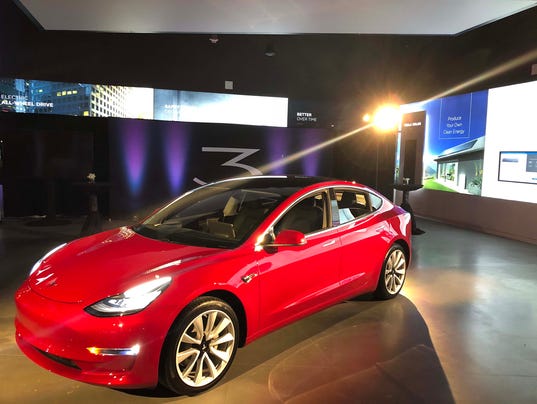
Premium electric-car maker Tesla will not have a display at the Chicago Auto Show that begins this week, but it’s still turning heads in the Windy City.
Tesla introduced the first Model 3, its entry-level EV under $40,000, for Midwest public display at its gallery space in north Chicago on Thursday. Tesla says other Midwest stores are sure to follow with their own Model 3 displays, including Troy’s Somerset Collection store, which opened last fall.
The sleek Model 3 is the hottest new vehicle on the planet with customers placing over 450,000 pre-orders for the car in 2016 before a vehicle was even produced. Like the coveted, $70,000-plus Model S sedan that made green vehicles sexy, the $35,000 Model 3 promises over 200 miles of range and explosive, battery-powered acceleration. Upper trims will crest $60,000 and offer all-wheel-drive and 310 miles of range.
Fremont, California, production began in late 2017 but has significantly lagged company production promises of 5,000 vehicles a month. InsideEVs reports that only 1,875 Model 3s were delivered in January — though that still made it the most-sold EV in the market ahead of the all-electric Chevy Bolt and Toyota Prius Prime. Tesla has revised its production schedule to 5,000 a month by the end of June.
The Chicago showcase is an indicator that Model 3s are being delivered to customers across the country after initial deliveries went to Tesla employees and early investors mostly in California near Tesla’s Silicon Valley headquarters and manufacturing facility.
Joel Szirtes of Pleasant Ridge, who already owns a Model S luxury sedan and Model X SUV, says that he will take delivery on his 310-mile range Model 3 in the next week. Szirtes configured his order online less than four weeks ago, suggesting that Tesla is at least meeting its promised delivery window of one month after customers finalize their purchase.
Szirtes, for example, ordered his Model S sedan online in 2011. It was serviced by Tesla staff out of Chicago’s West Grand Avenue store which opened in 2009.
As Ohio operations grew, southeast Michigan customers like Szirtes were redirected to the Cleveland store for service beginning in 2013. Vehicle service is one of Tesla’s greatest challenges as its “master plan” to electrify the market transitions to a mass-production vehicles like the Model 3. The company is working to increase service capacity three-fold — including mobile vans that can service owners at their home rather than making long-distance treks to, say, Cleveland.
Tesla’s Gold Coast gallery on North Rush Street opened Thanskgiving week and is the company’s fourth Chicago location. Unlike the other Chicago-area locations, however, Gold Coast showroom employees do not directly sell to customers given Illinois’ limits on sales locations. In addition to its innovative EVs, Tesla has sought to transform the auto showroom experience by adopting an Apple model with stores in heavily trafficked retail locations.
“This will be the first opportunity for Midwest consumers to visit a gallery to see the car, sit inside it and learn about it from Tesla’s knowledgeable staff,” said Tesla.
The Model 3 follows the general architecture of the larger Model S. Its large (up to 75 kWh) battery is located under the floor for a lower center of gravity and more cargo and seating capacity.
The Model 3’s minimalist interior, however, is even more radical than the Model S and X with most controls accessed through a 15-inch center screen. There is no instrument panel behind the steering wheel.
The design has both impressed and confused new owners and media reviewers. Some are uncomfortable having to turn on headlights and adjust climate controls via touchscreen.
“It might be going too far too fast in eliminating tried-and-true ways to control aspects of the car,” said Motor Trend, which has had extensive time with the car.
VW introduces artful Arteon sedan
Posted by hpayne on February 8, 2018

The Volkswagen Arteon debuted at the Chicago Auto Show on Thursday and the all-new 2019 sports sedan lives up to its name as the German brand’s artfully crafted design halo.
Replacing the stylish-but-misbegotten CC sedan that limped to just 1,355 sales last year after peak sales of nearly 30,000 units in 2011, the Arteon hopes to improve on the CC’s record with more of everything: more-dramatic styling, more legroom, more-nimble handling.
The Arteon has a hatchback trunk that has become all the rage in upscale sedans from the Audi A7 to the Kia Stinger and Buick Regal Sportback.
Like the Stinger, VW hopes Arteon will be a mainstream, upscale alternative to pricier premium models from Acura and Audi.
VW CEO of North America Hinrich Woebcken calls the Arteon a “brand shaper.”
From its wide grille and LED headlights to its clamshell hood and long wheelbase – five inches longer than the CC – the athletic Arteon brings visual drama to VW’s conservatively styled lineup of Jetta and Passat sedans.
Upper trims will offer goodies like a panoramic sunroof, digital cockpit and massaging driver’s seat.
For all its exterior beauty and backseat comfort, the Arteon has received mixed reviews in Europe.
“If it’s as good as the German-market model when it arrives stateside next summer, the Volkswagen Arteon will hold a lot of appeal for style-conscious buyers on a budget,” writes Autoweek.
“Before you sign on the dotted line you’ve got to think: ‘No, I don’t want a Mercedes CLS or a BMW 4-series or an Audi A5 Sportback. I want that sort of thing but with a VW badge at the front and a boot the size of the Blue John Cavern at the back,’” wrote The Grand Tour’s Jeremy Clarkson in London’s Sunday Times.
The 2019 Arteon will be available in SE, SEL and SEL Premium trim levels and is due to arrive on dealer lots in the third quarter of 2018.
Fiat 500 gets an extra dash of spice
Posted by hpayne on February 8, 2018

The cute Fiat 500 is ditching its 4-cylinder hamster wheel and going turbo.
Fiat Chrysler Automobiles announced at the Chicago Auto Show today that, for 2018, its Italian meatball will be roadkill no more: Its base 101-horsepower, normally aspirated engine is being retired for a turbo-4 shared by the rest of Fiat’s lineup.
Gaining 33 percent more horsepower over the previous leafblower, the 135-horse 1.4-liter MultiAir Turbo is a detuned version of the 160-horsepower buzzsaw in the 500’s Abarth performance model.
The 500’s engine is shared by the rest of Fiat’s lineup which includes the Pope’s favorite roomy hatchback, the 500L,; the 500X subcompact crossover; and the Fiat 124 Spider sports car. All Fiat models receive trim and feature updates for the new model year.
A mainstay in tight Italian streets since 1957, the 500 – or “Cinquecento” in Italian – has struggled to gain traction in SUV-obsessed America since its introduction in 2011.
In addition to its small size, the 500 was derided for its mousy mill. The new engine comes standard on Pop and Lounge trims with the six-speed manual transmission an option.
The feisty, top-trim Abarth, meanwhile, maintains its turbocharged 160 horsepower and 183 pound-feet of torque while offering sporty touches like bolstered seats, stiffened suspension, 16-inch black aluminum wheels, red brake calipers and a dual-exhaust with an obnoxious howl.
The 500 lineup adds new colors for 2018 – Brillante Red, Mezzanotte Blue Pearl and Vesuvio Black Pearl – for a total of 11 paint choices. The 500 is also available in a topless “Cabrio” body style as well as an all-electric 500e version targeted at West Coast greenies. The latter is only available in California and Oregon.
Also new for 2018, the 500L features a redesigned exterior with new front, rear, and side design updates. The 500X gets FCA’s award-winning Uconnect 4 infotainment system standard – including Apple CarPlay and Android Auto smartphone connectivity. The 124 Spider – which shares its bones with Mazda’s Miata – introduces a Red Top Edition on upper-trim Lusso models.
Audi TT RS: A sports car for all seasons
Posted by hpayne on February 8, 2018
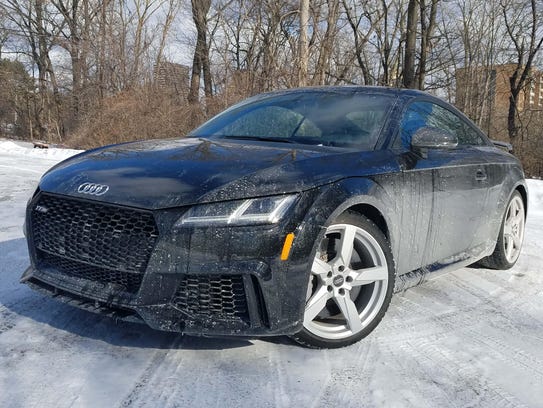
When I couldn’t make it to the Audi TT RS media test at Lime Rock race track last summer, I was bummed. I read report after report about the nimble TT’s raspy five-banger at full throttle around the challenging Connecticut race track.
“It’s an easy little car to toss and place with precision,” wrote Car and Driver. “Putting the power down on exit is easy with the quattro system deciding where to send torque,” thrilled Autoweek. “The Audi devours straight lines with a manic burble, and grips hard in high-speed turns,” raved Motor1.com.
But none of them got to do doughnuts in driving snow.
My TT RS tester arrived in my driveway in January in the teeth of Michigan winter. Day after chilling day of single-digit temps. Icicles longer than hockey sticks hanging off my roof. Even local Sierra Club groupies are burning their copies of Al Gore’s “An Inconvenient Truth” for warmth. A sports car?
I had put my sports-car fantasies into hibernation two months previous. This time of year I crave all-wheel drive — not for quick zero-60 launches, but to get me through snow drifts. Indeed, local sports-car test fleets usually fly south for the winter with the geese so they can frolic on warm asphalt and wink their headlights at cute beach bunnies.
I’m no stranger to the TT as readers of this column know. I took the base 220-horse, 2.0-liter turbo-4 car — little different from the RS save the insane, 400-horsepower, rally-derived, five-cylinder hornet’s nest under the hood and a wing out back — straight to Hell a couple of years back and had devilish fun on the best roads in Michigan.
But in January Hell freezes over. Ain’t going there. Which is OK, because the closest parking lot is all you need to enjoy a TT in winter.
After clearing the snow from the Audi’s shapely rear hatch and chiseling away the snow packs already encrusted like barnacles around the wing struts, I worked my way down the check list. Heated steering wheel? Check. Traction control turned off? Got it. Dynamic Mode selected? Always. 245/35/19 Continental ContiWinterContact snow tires? Heck, yeah.
This has never appealed to me before in other performance rear-wheel drive cars. My old Porsche 944? Tucked away in storage until spring. My favorite BMW M3? Same. The Audi even has me rethinking my rear-wheel drive Tesla Model 3 order.
The Tesla also comes in an all-wheel drive variant, but I checked the box for rear-wheel drive — both because Tesla might not deliver all-wheel drive versions of the Model 3 until my hair’s grown white, and that I like the lightweight, tossable handling of rear-wheel drive.
The TT opens new worlds as an all-season plaything.
The driver-oriented display clears out the center console for a clean, aesthetically pleasing dash anchored by huge, aviation-style air vents controlled with a twist of their rotary rims or a tap on their center temp controls. Slick. With the console screen gone, the only thing left of an infotainment system is Audi’s familiar rotary console knob. I never touched it.
It’s there for passengers like my wife to use when she wants to spin the dial to her favorite radio station. So big is the Virtual Cockpit display behind the steering wheel that she can easily see the station lists.
After my daily playground calisthenics, the TT RS and I took Mrs. Payne for a night on the (frigid) town. As beautiful as the Audi’s Nvidia graphics chip-driven navigation display may be, its search function is not as intuitive as Tesla’s smartphone-like Google Maps system. I couldn’t just bark the name of our restaurant at the car — I had to first look it up on my Samsung, then bark the exact address at the car. Smartphones: never leave home without ’em.
Despite its 2+2 seating design, the TT is not a car for double-dating. Like the similarly-priced rear-wheel drive Camaro and Mustang V-8 coupes — or the much pricier Porsche 911 — TT’s back seat is for storage only. Or maybe for misbehaving children. Roald Dahl’s the Trunchbull might have used it.
Matilda! I’m putting you in the Chokey — no, make that the TT back seat!
This, in my opinion, is the TT snow leopard’s other key ingredient given its sibling competitors, Porsche and VW.
As good as its chassis shared with the Volkswagen Golf may be, the TT can’t hold a candle to the $60,000 Porsche Boxster/Cayman in the handling department. The Porsche is an athlete without peer under $100,000.
By week’s end the weather gods gave us a brief thaw between deep freezes. The respite let me do a couple of zero-60 launch control runs in the TT RS just like my buddies enjoyed in Lime Rock: the seven-speed tranny barked off shifts, the 5-holer screaming like a possessed buzz-saw to 7,000 rpms.
Happy at zero degrees or zero-60 launches: That’s all-wheel drive bandwidth. When I shut down my salt-caked Audi TT it would make a signature, heartbeat chime: BUM-BUM.
An echo of my racing heartbeat.
Henry Payne is auto critic for The Detroit News. Find him at hpayne@detroitnews.com or Twitter @HenryEPayne. Catch “Car Radio with Henry Payne” from noon-1 p.m. Saturdays on 910 AM Superstation.
2018 Audi TT RS
Vehicle type: Front-engine, all-wheel drive, two-passenger (honestly) sports car
Price: $65,875
Power plant: 2.5-liter, turbocharged, 5-cylinder
Power: 250 horsepower, 295 pound-feet of torque
Transmission: 7-speed, dual-clutch automatic
Performance: 0-60 mph, 3.6 seconds (mftr); top speed, 155 mph/optional 174 mph
Weight: 3,306 pounds
Fuel economy: EPA 19 mpg city/29 mpg highway/22 mpg combined
Report card
Highs: All-season athlete; dashboard re-imagined
Lows: Back seat is more storage than seat; frankly, a $20,000-cheaper TT is just fine, thank you
Overall:★★★★
‘Hellcat SUV’ Durango SRT adds racing stripes
Posted by hpayne on February 8, 2018

Dodge’s biggest, baddest three-row SUV just got even badder.
For even more rear-view mirror presence, the fire-breathing, all-wheel drive, 475-horsepower Durango SRT will now be available with dual racing stripes across its air-scooped hood, lower springs for a more crouched stance — and a throatier Mopar exhaust system for when it blows by traffic on the way to a 155 mph top speed.
The stripes and exhaust tweaks are also available on the Durango R/T model, which is only slightly less ferocious than the Hemi V8-powered SRT with its own eight-holer pushing out 360 horsepower — an upgrade of 65 ponies over the base SUV’s 295. Dodge introduced the R/T and SRT upgrades ahead of the Chicago Auto Show on Wednesday morning.
“Think of the Durango SRT as a Charger Hellcat SUV,” says Dodge motorhead-in-chief Tim Kuniskis of the super-ute that was introduced last year.
Think of it as a family trip hauler, too.
The 392-cubic-inch V-8 is not only most powerful three-row SUV from a non-luxury brand, but it will tow up to 8,700 pounds — more than any other three-row ute in segment. Its third-row seats offer best-in-class, third-row legroom.
All that performance comes at a price and the Durango SRT rings the cash register at $64,090 — though that is still $30,000 south of comparable, rear-wheel drive based performance utes like the Porsche Cayenne and BMW M X5. Zero-60 in the SRT? A Cayenne-beating 4.4 seconds.
Offered in five different colors and extending from bumper to bumper across the Durango’s hood and roof, the twin-stripe package will cost $1,195. Colors: Bright Blue, Flame Red, Gunmetal Low Gloss, Low Gloss Black and Sterling Silver. Order yours beginning in March.
Lowering the Durango SRT by over a half inch, the Mopar spring kit upgrades the 5,500-pound SRT beast’s handling with less nose dive under braking and reduced body roll in corners. The kit is $325.
The special, chromium exhaust comes with a unique sound and polished, 4-inch tips and will set you back $1,850 on the SRT model; $1,595 on the R/T.
The SRT’s cabin is already distinguished by a flat-bottom steering wheel and T-shifter. The new interior carbon fiber accents are available on the instrument panel and door bezels — and are complemented by a Dinamica soft-touch headliner and accent paint on the speaker trim rings. Price? $2,495.
“Our Dodge/SRT performance enthusiasts are always looking for ways to make their vehicle their own,” said Dodge passenger car boss Steve Beahm. “The available stripes and carbon fiber throughout the interior really give Durango a custom look from the factory, and they are perfectly complemented by Mopar’s available exhaust systems and performance springs, which make Durango even more fun to drive.”
Station wagons are back – in crossover disguise
Posted by hpayne on February 1, 2018
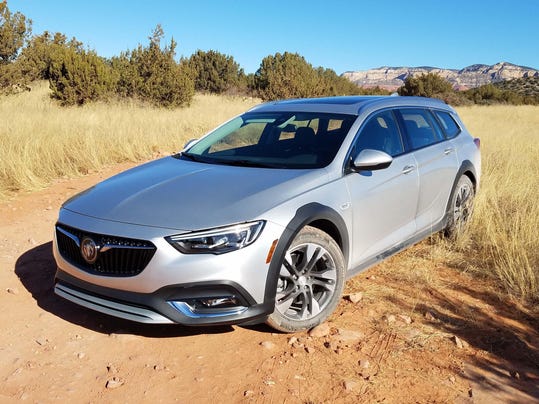
Phoenix — The station wagon is undergoing a resurgence as a sexy, more nimble alternative to the common five-door SUV.
Just don’t call them station wagons.
Buick’s 2018 Regal TourX is the latest addition to the growing stable of Europe-inspired, all-wheel-drive wagons that have been recast by automakers as lower-riding crossovers. They hope to capitalize on a new generation of millennials tired of their parents’ lookalike SUVs — as well as an older generation of “wagon orphans” who are looking to buy again.
The German-built TourX, its sleek, five-door wagon body disguised with black fender and rocker-panel cladding familiar to SUVs, joins other body-cladded new entries in the market: the Audi Allroad, Volkswagen Golf Alltrack, and Volvo’s V60 and V90 Cross Country.
“We call it a TourX. It’s a crossover vehicle with car-like driving characteristics,” Doug Osterhoff, Buick chief of marketing for cars, said at the vehicle’s media launch here.
Audi, a pioneer in the crossover-wagon space dating back to the 1999 Allroad Quattro, calls its latest Allroad (introduced at the 2016 Detroit auto show) a “luxury wagon” with an “adventurous spirit.” Volvo dubs its Cross Country models, first seen in Detroit last year, “sport wagons.” And VW calls its Golf Alltrack, which debuted on dealer lots in 2017, the “ultimate vehicle for adventure seekers.”
“SUVs are a generational thing,” says Osterhoff. “If you have three kids, you’re in a mid-size SUV. Kids who grew up in SUVs are looking for something different than they grew up in. Young millennials are open to vehicles like (the TourX) because they are active, and they have no preconceptions about wagons.”
Rebecca Lindland, senior auto analyst for Kelley Blue Book, agrees. “We are SUV Nation because baby boomers rebelled against their parents growing up in station wagons,” she says. “SUVs were an opportunity to express themselves differently. What’s interesting about wagons is we’re coming full circle — millennials’ version of rebelling is to drive a wagon.”
“A number of manufacturers left this market, like the Acura TSX or Saab wagons,” he says. “We did a lot of research and owners would hold on to these vehicles because they couldn’t find replacements that met their needs. They like the lower roof, the car-like handling — and first and foremost, the utility.”
Not surprisingly, most of the U.S. market’s wagons (the Subaru Outback is an exception) are made in Europe, where crossover-like wagons have proved resistant to the SUV onslaught. The TourX is built on the same bones as the Insignia Country Tourer, which is made by GM’s former German subsidiary, Opel.
“Utility vehicles have taken longer to grab hold in Europe, but SUV sales have been increasing there — from 3.9 percent in 2000 to an estimated 26.5 percent in 2017,” says IHS auto analyst Stephanie Brinley. “So far, the shift toward SUVs has had a worse impact on hatchbacks than wagons. Wagon sales have fluctuated between 9.3 to 10.7 percent share.”
KBB’s Lindland says that the wagon segment — especially if populated by more vehicles like the $30,000-something TourX, which has received rave reviews — could grow. She also wishes everyone would please call them station wagons.
“I think Buick’s made a bold move,” she said. “I think it’s an opportunity to redefine the wagon class. It’s an SUV alternative. It’s for people who think outside the box.”
Payne: X-ceptional Buick TourX wagon
Posted by hpayne on February 1, 2018

And now for something completely different.
Buick calls the five-door version of its Buick Regal a “crossover with car-like driver characteristics.” The Environmental Protection Agency calls it a station wagon, and millennials say it’s a hatchback. The badge says it’s a TourX. I call it gorgeous.
The long-awaited stunner finally brings Detroit onto the premium crossover-wagon catwalk alongside European beauties like the $45,475 Audi Allroad and $52,300 Volvo V90 Cross Country. Not surprisingly, the design comes courtesy of General Motors’ European Opel/Vauxhall sisters that have a knack for sexy wagons (across the pond, the TourX is badged the Insignia Country Tourer). Surprisingly, it debuts here as a Buick, the once-dowdy seniors brand that has transformed from ugly duckling to swan.
SwanX. Yeah, let’s call it that.
It’s not only the most bodacious-looking Buick in a long while, but the $29,995 wagon rivals its expensive European competition in looks while trouncing them in utility. In Americanizing the Insignia for us Yanks, nothing has been lost in translation. Indeed, the crossover effect improves on the Regal Sportback sedan (built alongside the X in Russelsheim, Germany) I reviewed earlier this year. Like mascara on Gal Gadot, the charcoal body-cladding enhances Regal’s naturally attractive features. Fascia makeup helps the eyes — er, headlights — stand out. Fender highlights tone TourX’s long flanks. And then there’s that hatch.
Ohhhh, the hatch. As I photographed the TourX, I kept returning to its profile. It’s like a 150-foot yacht sailing by that you can’t take your eyes off.
More: Station wagons are back – in crossover disguise
The Regal Sportback is pretty, but based on a front-wheel drive platform, its stunted front can’t compete against long-hooded rear-wheel drive models. TourX designers have pulled its rear deck waaaay back to here, so that — despite the same dash-to-axle proportions as Sportback — the wagon looks like it’s resting on its haunches.
For emphasis, a chrome roofline arcs over the narrow greenhouse and doesn’t stop until the taillights. It’s punctuated by chrome tailpipe tips embedded in the rear fascia.
The exquisite tailoring hides acres of interior room.
Kick your foot under the bumper, and the automatic hatch opens, revealing a cavernous, 73.5-cubic-foot cargo hold that beats the Audi, Volvo, and even a three-row Acura MDX ute (68 cubes). I know — I stuffed 25 athletic bags into the back of the Buick — six more than Allroad holds.
This is the wagon that didn’t exist when Mrs. Payne and I were shopping to replace our Ford Taurus wagon in 2008. Taurus was kaput, as were most mid-size wagons amidst a rush to utes. Sporty luxury-wagons were all that was left — and their price tags were too big, their confines too small for our family of four.
Reluctantly, we crossed over to crossovers and the first Chrysler Pacifica, a lovely (if reliability challenged) SUV. I can’t say I was ever tempted to carve a corner in the higher-riding Pacifica.
Call us wagon orphans.
Buick is targeting orphans who bought an Acura TSX sport wagon or Cadillac CTS wagon or Saab 9-5 wagon a decade ago and now find … hey, where’d everybody go? Buick to the rescue.
Buick’s savvy product-marketing has already rescued its nearly forgotten brand. Saved in GM’s bankruptcy by the Chinese market, Buick has radically transformed its portfolio here by thinking outside the box. Near-death experiences will do that for you.
The Enclave was one of the first three-row SUVs. It was followed by the pioneering Encore cute-ute. The Encore filled the “white space” in a market where emptynesters were downsizing from, well, Enclaves, yet didn’t want to go back to sedans. Especially Buick sedans with “has-been” stamped on their foreheads.
Buick thinks it’s found that white space with the TourX. While young families will still gravitate to Buick’s utes, X marks the spot for orphans, emptynesters and outdoors people who value handling and style.
I tested the TourX in that outdoor mecca, Sedona, Arizona. There’s not a lot of white space here. Surrounded by towering pillars of red rock, the Arizona town is one of the most beautiful spots on the planet. My red TourX fit right in.
True off-roaders will opt for Jeep Wranglers in this rugged environment, but with its sophisticated all-wheel drive system, low roof (the better for wee Mrs. Payne to fetch things from) and cavernous cargo-hold, the TourX will appeal to many.
The same applies in Michigan winters. Other than riding high, all-wheel drive has been a primary attraction for SUVs in grisly weather. All-wheel drive comes standard on TourX, along with a host of other goodies like roof rails, 18-inch wheels and cruise control.
I pounded across Arizona Route 152 — looking up at red rock skyscrapers through the X’s full-length sunroof — turning the traction control off for all-wheel drifts through switchbacks. At 3,708 pounds, the TourX is less than 100 pounds heavier and less than an inch higher than the Regal Sportback. For all its crossover cladding, its handling says sedan. I tried taking it farther off-road, but this is no Subaru Outback or Volvo Cross Country — both of which have been jacked to more ute-like heights. Stick to dirt, not rocks.
Lighter than the Audi All Road by 100 pounds, the TourX is nicely motivated by GM’s workhorse, 2.0-liter turbo-4 mated to a smooth, 8-speed box. A healthy 295 pound-feet of torque — 20 more than the Audi — comes in early (the Buick only revs to 6,500 rpms) like you want for a cargo-hauler.
Determined to compete with its higher-priced peers, Buick’s engineers labored to make the TourX whisper-quiet. “We’re doing 100 miles per hour?” exclaimed a colleague as I mashed the throttle on Interstate 17. The quiet interior never betrayed the higher speed.
Buick’s cheaper sticker-price is evident only when you’re inside the cabin.
The layout is nice but uninspired. The monotone black dash of my loaded, $41,550 tester lacked the personality of the exterior. The spacious console has but one USB port. Visors lack extenders for the long side windows exposed to the sun. The TourX doesn’t have GM’s innovative heads-up display, despite similar features that are included on cheaper, mainstream models like Honda’s Accord. Even GM’s progressive connectivity was slow here with Android Auto slow to engage.
Having built an architectural masterpiece, Buick seems to want to see if the house sells before fully decorating all the rooms. But a showpiece it is. Like a Frank Lloyd Wright home with poorly lit hallways, its missteps can be fixed retroactively.
Buick has crafted a flowing sculpture with easy roof access and endless, quiet living space. Welcome home, orphans.
Henry Payne is auto critic for The Detroit News. Find him at hpayne@detroitnews.com or Twitter @HenryEPayne. Catch “Car Radio with Henry Payne” from noon-1 p.m. Saturdays on 910 AM Superstation.
2018 Buick Regal TourX
Vehicle type: Front-engine, all-wheel drive, five-passenger station wagon
Price: $29,995 ($41,550 as tested)
Power plant: 2.0-liter, turbocharged, inline 4-cylinder
Power: 250 horsepower, 295 pound-feet of torque
Transmission: 8-speed automatic
Performance: 0-60 mph (NA)
Weight: 3,708 pounds
Fuel economy: EPA 21 mpg city/29 mpg highway/24 mpg combined
Report card
Highs: Cure for the common crossover; room everywhere
Lows: Interior not as inspired as exterior; visor extenders, please
Overall:★★★★
Payne: Corvette ZR1 new king of American Nürburgring
Posted by hpayne on January 31, 2018

It’s cold in Detroit, but the Big Three muscle car wars are heating up down south.
Chevrolet said Wednesday that the new, 2019 Corvette ZR1 — at 755 horsepower, the most powerful ‘Vette ever produced — shattered the Virginia International Speedway record just days after Ford’s GT supercar became the first car to record a sub-2 minute, 40 second lap around “America’s Nürburgring.”
King ZR1 posted a jaw-dropping 2.37.3 time — over a second under the 2.38.6 lap record announced by Ford just last week.
Ford’s GT time, in turn, had bested the Dodge Viper ACR’s 2.40.0 time — one of 13 American race track lap records the Snake set in 2015 before the car was retired from production last year.
VIR race track has become the focus of automaker bragging rights in the United State. At 4.1 miles, the long, demanding Grand West Course configuration has become a stateside benchmark for performance not unlike the famous, 14-mile long Nürburgring in Germany, where automakers also put their performance thoroughbreds to the test.
VIR also plays host to NASCAR testing, and is a stop (along with Detroit’s Belle Isle) of the IMSA Weathertech Sports Car Championship each year.
The track has also increased its profile with Car and Driver’s annual Lightning Lap competition between the year’s fastest new production cars. The magazine’s test is done entirely by staff writers — in particular hot shoe writer K.C. Colwell — creating a consistent benchmark between cars. The 647-horsepower GT this year eclipsed the long-standing Lightning Lap record — set by a $900k Porsche 918 hybrid — with a time of 2.43 seconds flat.
But as at Germany’s Nürburgring, manufacturers do their own VIR testing, complete with their top test drivers. The Ford GT lap was set with pro racer Billy Johnson behind the wheel. The ZR1’s record was set by Chevy’s in-house test driver and engineer Jim Mero, who had set a previous Corvette track record in the 650-horsepower Z06 at 2.41.3 seconds in 2015. Chevy also announced this week that Melo lowered the Z06’s VIR best with a 2:39.77 lap.
The record-setting monster was also weaponized with an eight-speed automatic transmission and Michelin Pilot Sport Cup 2 summer tires. Thus equipped, the ZR1 starts at $122,990. The ZR1 goes on sale this spring. The Ford GT starts at $450,000 with all 750 orders spoken for (a total of 1000 production models is expected).
Don’t feel bad for Ford. The GT beat the Corvette team at last weekend’s 24 Hours of Daytona race with a dominating 1-2 finish.
Waymo orders 1,000s of Pacificas for driverless taxis
Posted by hpayne on January 31, 2018

Fiat-Chrysler Automobiles announced Tuesday that Waymo has ordered thousands of Chrysler Pacifica Hybrid minivans for delivery by the end of this year as Google’s self-driving subsidiary expands its driverless ride-hailing service to multiple cities.
The Pacifica hybrid will be Waymo’s primary workhorse when its service debuts in Phoenix sometime this year. Other cities have not been announced.
The sleek minivans will be equipped with steering wheels, but will not have drivers in the front seats. Waymo, which had previously ordered 600 Pacificas, is expected to launch the world’s first driverless service offered to the public. General Motors has petitioned the federal government to allow its Chevy Bolt autonomous vehicles — the first robotic cars without steering wheels — on the road by 2019.
“With the world’s first fleet of fully self-driving vehicles on the road, we’ve moved from research and development, to operations and deployment,” Waymo boss John Krafcik said in a statement. “The Pacifica Hybrid minivans offer a versatile interior and a comfortable ride experience, and these additional vehicles will help us scale.”
The three-row minivans are produced in Windsor and then shipped to a facility in Metro Detroit where they are outfitted with self-driving hardware and software by a team of Waymo and Chrysler engineers.
The hybrid’s electric powertrain makes an ideal vehicle to accommodate Waymo’s self-driving technology, which includes high-powered computers and lidar, which uses lasers to “see” what’s around the car.
“In order to move quickly and efficiently in autonomy, it is essential to partner with like-minded technology leaders,” said FCA CEO Sergio Marchionne. “Our partnership with Waymo continues to grow and strengthen; this represents the latest sign of our commitment to this technology.”
Without drivers, Waymo achieved a milestone as the first so-called “Level 4” autonomous vehicles, which can operate without drivers within limited geographic areas. Waymo and Chrysler are in a race with other Fortune 500 automotive and technology manufacturers — including heavyweights like GM, Toyota, Ford, Volvo, Intel, Apple, Nvidia, Intel and Uber — to produce the first successful autonomous ride-sharing services.
Waymo has tested its technology in 25 cities across the U.S., including Atlanta, San Francisco and Detroit. GM has been testing its Volt AV fleet in San Francisco in conjunction with Cruise Automation, and Uber and Volvo have been running public tests in Pittsburgh.
Chrysler began its collaboration with Waymo in late 2016 with the delivery of 100 Pacifica hybrids. An additional 500 were delivered in 2017.
Payne: Goin’ rogue in Nissan Rogue Sport
Posted by hpayne on January 25, 2018

Nissan has once again joined forces with “Star Wars” and I have to admit it’s having an effect.
From those catchy ads of a Nissan Rogue negotiating a daunting landscape of enemy First Order craft to the Los Angeles debut of seven Nissan vehicles dressed up as “Star Wars”-themed vehicles (alas, they didn’t make it to the Detroit Show), the legendary sci-fi franchise is rubbing off on the mainstream Japanese brand. Maybe it’s Nissan’s funky styling. Maybe it’s that Nissan grilles look like Kylo Ren’s helmet. Or maybe the latest “Last Jedi” sequel is just so dang enjoyable it makes everything it’s associated with look good.
Whatever, the black Nissan Rogue Sport (with Stormtrooper-esque pepper-and-salt interior) that arrived at my garage door in December begged for adventure. I wanted to take it for a spin. I’m not the only one.
After Nissan’s debut partnership with “Rogue One: A Star Wars Story” (showcasing Nissan’s Rogue SUV, get it?) last year, brand sales soared 24 percent. The Rogue itself did 400,000 in sales, second only to the best-selling RAV-4 ute. With “Last Jedi” accelerating off the line with glowing reviews and 30 percent faster ticket sales than “Rogue One,” the force is sure to be with Nissan again in 2018.
Despite those wild-looking concept vehicles — behold the Nissan Rogue X-wing! — the Nissan tie-up does not emphasize performance but safety. The ad campaign preaches not horsepower and high-g maneuverability, but omniscient “Intelligent Mobility” features like lane-keep assist and automatic braking.
Yoda: Brake before you see a road hazard, it will.
Power, it has not. Nissan’s compact utes run on four-banger engines and plodding, continually variable-transmissions (CVT for short). I nailed the throttle on the 141-horsepower (11 less than a Subaru Crosstrek, for goodness sake) 2-liter four-cylinder, and it sounded like 141 gerbils grunting in a hamster wheel. Zero-60 doesn’t come in Lightspeed — it comes in Molassespeed.
The Sport’s strengths lie elsewhere.
Nissan has a well-earned reputation for making taut chassis — Maxima, 370ZX, Altima — and the subcompact Rogue Sport’s wheelbase is nearly a foot shorter than Rogue with which it shares a platform. Throw on all-wheel drive and the Sport is well-suited for Detroit’s annual deep freeze.
Winter is miserable for my rear-wheel drive sports cars, so I put them in hibernation. But when December dumped a half-foot of snow on the ground, my high-riding, four-pawed Nissan was scratching at the garage door to go out.
There are “Star Wars” nerds and there are car nerds. I’m the latter. In summer I’ll make the 60-minute trek to Hell, Michigan’s writhing roads for sports-car testing. This winter I needed only take the Sport as far as the neighborhood school parking lot, abandoned for the holiday break and covered in snow. Safety first: Make sure lots are empty of other cars and pedestrians (local fuzz frown on unsafe lot antics). The lots can be wonderful test grounds for 16-year-old drivers and all-wheel drive vehicles alike.
One of my favorite local haunts sports a small-diameter, curbed island I use for a sort of Gymkhana course — think Ken Block doing doughnuts around a barrel buried in snow. Turn the traction-control off and let the all-wheel drive do the rest. Around and around we went. Keeping the rear end hung out under moderate throttle, I could easily control the Sport’s short wheelbase with minimal steering input. It builds confidence in the car — not to mention your own Jedi abilities — for the inevitable moments when you’ll have to fight weather on, say, the way to Chicago when Lake Michigan lake effect makes I-94 an Olympic bobsled course.
Skywalker: Breathe. Just breathe. Now reach out and … feel yourself connected to all four wheels.
Enough with the car nerd stuff, you say. How’s the Sport to live with? I’m happy to report its short wheelbase does not compromise interior room, the Sport’s other big asset. Think of the Rogue Sport as a chopped Rogue.
The brand’s popular compact ute packs considerably more cargo space than subcompact Sport, yet the latter’s passenger cabin is about the same size, making it much roomier than Nissan’s quirky, discontinued Juke. The Juke is part of a near bygone era when subcompacts looked like characters from a “Star Wars” cantina screaming for attention. Think the Soul, or long-gone Nissan Cube, or frog-eyed Juke.
The Rogue Sport is recognition — along with competitors Honda HR-V and Chevy Trax and Jeep Renegade — that the subcompact SUV segment is the new mainstream and offers a big sales opportunity with first-time buyers. The Sport (like HR-V and Trax) can easily fit a Wookie behind the wheel — and his furry friends besides.
Nissan is flooding the ute segment with choices. Just as Jeep offers the subcompact Renegade, compact Cherokee and subcompact Compass tweener, Nissan shoe-horns the $22,380 base price Sport between the $25,000 Rogue and the forthcoming, $19,000 subcompact Kicks ute. To justify its place above Kicks, the Rogue Sport gets nifty standard features like satellite radio as well as the aforementioned cabin roominess that other subcompacts lack.
But in the ruthless, survival-of-the-fittest SUV battlescape, the Sport lags cheaper, similarly sized competitors like the HR-V and Trax — both of which offer standard Apple CarPlay and Android Auto smartphone connectivity. In a car priced to appeal to millennials this is no minor oversight, especially as the Nissan’s in-house voice recognition/navigation systems are light years behind today’s sci-fi smartphones.
The challengers keep coming like a wave of TIE fighters. There’s the 2018 Subaru Crosstrek — its attractive, all-new design offering all-wheel drive for $1,000 less. That bargain price used to come with a bargain-basement interior but the Subaru is much improved, boasts smartphone-app connectivity and is as reliable as Tom Brady in the two-minute drill.
Tough crowd. So Nissan brings “Star Wars” to the fight.
Unlike “The Last Jedi,” the new Rogue Sport doesn’t quite live up to the hype. But with its sharp looks, roomy cabin and all-wheel drive it’ll get you to the movie theater through a Michigan blizzard in style.
Henry Payne is auto critic for The Detroit News. Find him at hpayne@detroitnews.com or Twitter @HenryEPayne. Catch “Car Radio with Henry Payne” from noon-1 p.m. Saturdays on 910 AM Superstation.
2018 Nissan
Rogue Sport
Vehicle type: Front-engine, front- and all-wheel drive, five-passenger SUV
Price: $23,745 ($31,245 as tested)
Power plant: 2.0-liter, inline 4-cylinder
Power: 141 horsepower, 147 pound-feet of torque
Transmission: Continuously variable automatic
Performance: 0-60 mph, 10.0 seconds (Car & Driver)
Weight: 3,424 pounds (AWD as tested)
Fuel economy: EPA 24 mpg city/30 mpg highway/27 mpg combined (AWD as tested)
Report card
Highs: Roomy; AWD loves snow days
Lows: Molasses-slow; more connectivity, please
Overall:★★★
Ford GT destroys Lightning Lap record
Posted by hpayne on January 25, 2018

In its racing debut at France’s legendary 24 Hours of LeMans endurance race in 2016, the Ford GT race car scored first place.
Now it’s the production car’s turn for glory.
In its first go at Car and Driver magazine’s hallowed Lightning Lap competition at America’s Virginia International Raceway, the street-legal Ford GT has broken the lap record. The GT’s breathtaking 2-minute and 43-second lap beat by a one-tenth second the record by the $875,175 Porsche 918 Spyder hybrid supercar that has stood for four years.
Since 2006, Car and Driver has taken the world’s fastest production cars to the 4.1-mile track for a head-to-head, single-lap competition to determine performance bragging rights.
“The GT at VIR is, in one word, fastest. As in, fastest-lap-we’ve-ever-recorded fastest,” wrote Car and Driver staffer and hot shoe K.C. Colwell on the feat. The GT’s lap included “163.6 mph down the front straight (second-highest all-time speed to the 170.6-mph Porsche 918 Spyder); barreling into the Climbing Esses at 148.0 mph (a new record); and a neck workout at 1.17 g’s in Turn 1.”
The 887-horsepower Porsche’s record has been under assault in recent years from other Detroit makers, with the Chevrolet Corvette Z06 posting a 2.44.6 second lap in 2015 and a Dodge Viper ACR hammering out a 2.44.2 in 2016.
The Chevy and Dodge efforts were notable given that their under-$150,000 price tags are a fraction of the Porsche’s sticker, but it took the $494,750 ($525,750 as tested) GT to get the job done.
“This record is another great way to showcase the GT’s role to help us pioneer new technologies, push out engineering skills, and create novel processes with the goal of improving all our vehicles in the future,” said GT Chief Engineer Jamal Hameedi of the lap record set by Ford’s 647-horsepower halo car.
After the GT race car’s auspicious debut at LeMans in 2016 — 50 years after Ford first won the race in a GT40 in 1966 — the production GT began customer deliveries last year. Don’t expect Ford’s Detroit competition to let the record stand. Chevy introduced an even more powerful, 755-horsepower Corvette ZR1 this winter — a beast that will surely take aim at the GT’s mark.
With its record lap the GT took back a Lightning Lap crown worn by the last production GT made back in 2006.
Car and Driver holds its Lightning Lap late in the year over a three-day period, but in 2017 the rare Ford GT was unavailable for testing. The magazine scheduled a separate test for the GT — but as a result only had one day with the car. No matter. It still set the record.
Two-door sports car remain popular
Posted by hpayne on January 18, 2018
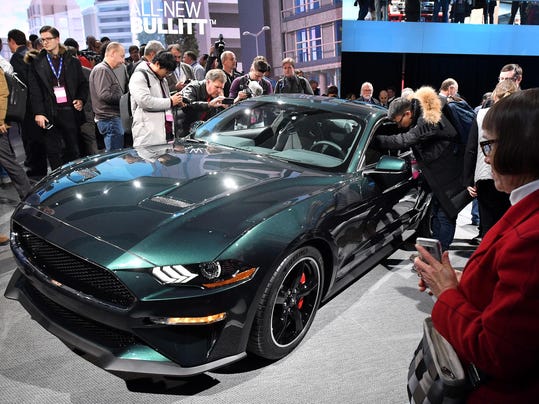
There seemed to be more news about sports-car companies making SUVs in 2017 than their core, two-door performance products. But they were out there. Ford started delivering the street-legal, $450,000 version of the LeMans-winning GT race car to a lucky few customers. At the other end of the income spectrum, Mazda rolled out its sexiest Miata yet, the RF hardtop. Corvette introduced the most fearsome, front-engine ZR1 ever before it transitions to a new-generation mid-engine design next year. Speaking of front-engines, the incredible Dodge Viper was put out to pasture. We’ll miss you, Snake.
Ford Mustang Bullitt
What it is:Putting an exclamation point on Mustang’s latest mid-cycle upgrade, the Bullitt is the third ’Stang to honor Steve McQueen’s movie original (the others were produced in 2001 and 2008). Highland Green is the featured color, just like the movie car, and a Shadow Black will also be offered. The Bullitt is trimmed in GT premium-spec with performance package, 6-pot front Brembo brakes and a 15-horsepower upgrade over the V-8’s usual 460 ponies.
Payne’s take:Your steed for high-speed chases through San Francisco (or Detroit) streets. The Bullitt bears all the signature cues of McQueen’s original (see the 1968 car right next to the ’19 on the show floor), right down to the white cue ball on the manual shifter. But this is also a thoroughly modern, electronic beast as the Ford GT-inspired 12-inch digital instrument display attests.
BMW i8 Coupe
What it is: An upgraded 2019 i8 coupe gets its world debut in Detroit alongside its new brother the i8 Roadster (first seen in LA in November). Upgrades to the e-mobile are minor, with the hybrid electric three-cylinder gas powertrain gaining 12 horsepower for a total of 369. The Roadster keeps the Coupe’s dramatic scissor doors while adding a retractable cloth top that disappears in 16 seconds at up to 31 mph.
Payne’s take: The jaw-dropping high-tech i8 is something right out of a Disney sci-fi “Tron” movie. With electric-motor torque, it explodes off the line. With a carbon-fiber chassis, it’s a well-balanced sports car. Only the skinny eco-tires and three-cylinder gas engine keep it from the supercar ranks. Gorgeously green, it’s a unique entry in the market.
Hyundai Veloster
What it is: The Korean automaker’s hatchback retains its unique three-door architecture — but everything else is new. The aging chassis has been replaced, sharing the same skeleton as the compact Elantra sedan. Exterior design maintains the Veloster’s bold, punky style, but the lines have been sharpened. The roomier interior gains Hyundai goodies like smartphone-app connectivity. The drivetrain gains, too — with the standard 2.0-liter up nine horsepower.
Payne’s take: Like VW’s Jetta and Golf stablemates, the Veloster is Hyundai’s hatchback alternative to the Elantra sedan. It comes loaded with personality — and spunk. Where the Elantra GT Sport is no slouch in the handling department, the Veloster Turbo upgrades its rear suspension to multi-link from the Elantra’s torsion beam. The turbo has been downsized to 1.6 liters, but maintains its predecessor’s 201 horsepower, while improving mpg.
Low gas prices and big spaces draw Americans to trucks
Posted by hpayne on January 18, 2018

Trucks are Detroit’s secret weapon. With low gas prices and big spaces, Americans bought nearly 3 million large and mid-size trucks last year. King F-series, with upper trims pushing $80,000, led the way with nearly 900,000 in sales. Cover the rear box and call ’em Ford Expeditions and Lincoln Navigators, and the pickup foundations pull in even more money as mega-utes. Toyota’s Tacoma had the midsize market all to itself until Honda (Ridgeline), Chevy (Colorado) and GMC (Canyon) rediscovered it. Now here comes Ford with a reinvented, mid-size Ranger. Keep on truckin’, America.
Chevy Silverado
What it is: Chevy’s long-awaited response to rival Ford’s turbo-V-6, all-aluminum F-150 is bigger, V-8-driven … and made of steel. Well, the bed and chassis, anyway. Doors, hood and tailgate are aluminum — part of mixed-metals approach that puts the Chevy on a 450-pound diet, tipping the scales as lightest in class. The Silverado gets a more-sculpted exterior, bigger interior, three more trims (eight total) and a 3.0-liter, diesel V-6 for its six-engine lineup.
Payne’s take: Expect more anti-aluminum bed TV commercials! Speculation ran rampant after F-150’s revolutionary conversion to aluminum skin that others would follow suit to meet federal mpg standards. Nope. Silverado doubles down on roll-formed, high-strength steel for its biggest-in-class bed. Silverado also out-geeks the F-150 with a segment-first remote-controlled, auto-drop tailgate. One thing the two titans do share — a co-developed, 10-speed transmission.
Ram 1500
What it is: The last visage of Dodge is scrubbed away as the Ram’s grille ditches the signature cross-hair grille. In its place is a more SUV-like grille that integrates the air intake and headlights. Remade from the ground up, the 1500 light-duty retains Ram’s smooth-riding coil-spring rear suspension and side-bed storage bins — but adds a mild-hybrid, 48-volt battery-system to assist its V-6 and V-8 engine options for better torque (read towing) and fuel efficiency. Inside, RAM augments its best-in-class Uconnect infotainment system with a Tesla-like 12-inch touchscreen.
Payne’s take: Ram has been a style leader in pickups, and the new 1500 forgoes the giant grilles of its competitors for a sleeker look aimed at more efficient aerodynamics. That efficiency runs throughout the truck as the Ram loses 225 pounds (like Silverado, it keeps its steel bed) and adds battery-assist for its engines — a development also seen on Ram’s corporate cousin, the Jeep Wrangler. Love the big touchscreen — alas, it’s only an option on the upscale trims.
Ford F-150 diesel
What it is: An oil-burner will be under the F-150’s hood for the first time (Power Stroke diesels have long been a staple of the heavy-duty F-series trucks). The 3.0-liter V-6 comes out of the box with a bigger torque number than the rival Ram diesel (440 pound-feet vs. 420) and will also try and best its rival’s 27-mpg fuel-economy number. Available only in top trims — Lariat, King Ranch and Platinum — the diesel will come with at least a $3,000 upcharge.
Payne’s take: The diesel’s grunt and fuel efficiency are worth the engine’s price premium if towing is your thing — and Ford has long boasted best-in-class towing stats. With Chevy also introducing a diesel into its 2019 Silverado, the Big Three pickups will go head-to-head for stump-pulling supremacy. Ford’s engine is shared with Land Rover and made in England.
Ford Ranger
What it is: The Ranger will return to the market as a 2019 model after an eight-year hiatus. The pickup continued to be a top-seller internationally, but the Ranger platform had to be significantly upgraded to meet U.S. crash standards and customer expectations. Such as? A class-exclusive, frame-mounted bumper and 10-speed transmission (mated to same 2.3-liter turbo-4 found in the Mustang). More toughness is available in the FX-4 trim with steel bash-plates and electronic locking differential for serious off-roading.
Payne’s take: Ford comes late to the mid-size market after it bet big on the all-aluminum F-150 to satisfy U.S. fuel economy rules. Ford must play catch-up in the red hot mid-size pickup segment to rivals Chevy Colorado and GMC Canyon and will bring tech touches like blind-spot alert system with trailer coverage. Ford’s betting plenty of urban dwellers want a smaller pickup for weekend getaways and the F-150 Jr. should get their attention.
Stylish designs help transform luxury SUVs
Posted by hpayne on January 18, 2018

The luxury segment has been transformed by SUVs. Long-hooded sedans with flowing, coupe-like roofs are out. Five-door hatchbacks are in. The monotony of designs has forced manufacturers to make SUVs with more coupe-like roofs, sacrificing the rear head and cargo room that drew customers to utes in the first place. But the elevated seating position rules. Even sports-car manufacturers have taken the plunge, with Porsche, Jaguar, Maserati and Lamborghini utes making big profits. Buick, once an also-ran sedan brand, has been transformed by an SUV lineup of Encores, Envisions and Enclaves. Look for a Ferrari SUV soon. I am not making this up.
Acura RDX
What it is: Acura calls its RDX ute a prototype, but in truth this is the near-production version of the most important Acura debut in some time. Adopting the design cues of the Acura NSX supercar and Precision concept, the RDX gets racier lines, a “diamond pentagon” grille, turbo-4 and standard features galore, including a huge panoramic sunroof and adaptive cruise control.
Payne’s take: With talented designer and race-car fan John Ikeda at the helm, the RDX signals a return to Acura’s sporty roots. The RDX promises nimble handling and brings back the A-Spec and Type-S performance trims. For all the exterior flash, the interior is more important with an industry-first touch-pad positioned within easy reach that projects onto a 10.2-inch display in the driver’s line-of-sight.
BMW X2
Payne’s take: In a development that will cause BMW purists to lose sleep, the X2 marks the second Bimmer with a front-wheel drive based platform and longitudinally mounted engine. Shared with a Mini, for heaven’s sake! The all-wheel-drive X2 makes the best of these heresies with BMW’s typically taut engine setup and three drive modes. The design tweaks are cool, too, from the new kidneys to the BMW logo on the c-pillar.
Lamborghini Urus
What it is: Lambo joins other exotic sports carmakers like Porsche, Jaguar and Maserati with an SUV. And what an SUV. With a longitudinally mounted, 645-horsepower twin-turbo V-8 under the hood, the Urus will sprint past most sports sedans while comfortably carrying four adults and their luggage.
Payne’s take: Where are the scissor doors? Urus means ancestor of domestic cattle, and this SUV proves that a crossover design will domesticate a Lambo. The Aventador-like design cures are unmistakably there: the front jet-fighter scoops, the sharp, chiseled body lines. But the upright five-door utility has inevitably compromised sex appeal. Buyers, however, will rejoice at the more domesticated, ergonomically friendly interior.
Mercedes G-class
What it is: The icon of the Mercedes SUV lineup, the G-class’s rugged exterior changes little (the front fender-mounted turn signals, for example, now retract in a collision to protect pedestrians) in this comprehensive remake – but the interior gets a major facelift. The dash and console conform to other Mercedes, with instruments and infotainment screen encased under a single pane of glass – the latter operated by Benz’s signature touch-pad. The big turbo V-8 and three locking-differentials carry over.
Payne’s take: As Wrangler is to Jeep’s SUV lineup, so is the tough “Gelandewagen” to Merc. The difference is the G-class must conquer Austria’s Schokl mountain (not the Jeep’s Rubicon). It stickers for $120,000 and doesn’t (ahem) come with detachable sway bars. The G-class is coveted by celebrities and comes with quilted leather seats and fashionable flat-black paint to look the part.
Lincoln Nautilus
What it is: Formerly known as the MKX. The Nautilus is the latest Lincoln ute, following the Truck of the Year Navigator, to shed its alphanumeric badge for a more approachable, organic name. Nautilus also gets a new face, adopting the handsome Bentley-like grille first seen on the flagship Continental sedan. Two turbo engines (4- and 6-cylinder) mated to an 8-speed transmission are offered — as are smartphone-app compatibility and an active-safety system to automatically steer you out of harm’s way.
Payne’s take: Lincoln eradicates the polarizing split-wing face with major plastic surgery. That should allow suitors to focus on the interior ergonomics, which are some of the industry’s best. Console storage is everywhere, thanks to a space-saving, button-operated digital shifter. Navigator and Nautilus suggest an aquatic theme. May I suggest the compact MKC be called Nemo?
Europeans double down on new sedans
Posted by hpayne on January 18, 2018

Sedans are oh-so 15 minutes ago. As SUVs have taken over dealer lots like dandelions in a country field, even King Camry has been humbled. After 15 years as the best-selling non-pickup in autodom, the Camry last year trailed the Toyota RAV4 and Nissan Rogue SUVs. Detroit automakers have taken a scalpel to their sedan lineups, with Chrysler eliminating all production except for its large 300 sedan. Expect more Detroit retirements, even as Japanese and European manufacturers double down on new sedans. All-new Honda Accords, Nissan Altimas, Camrys and VW Jettas will hit the market this year.
VW Jetta
What it is: VW’s best-selling sedan is all new, with bigger dimensions and a sleeker, more coupe-like exterior. Built on the brand’s excellent front-wheel-drive MQB architecture, it’s powered by the Jetta’s carryover turbo-4. The big story is the interior — the Jetta follows the Golf and crossover Tiguan with an array of digital goodies and plenty of storage.
Payne’s take: The Jetta joins a revamped U.S. lineup as the German brand builds momentum in a market it has long misunderstood. America has a thirst for SUVs, and VW has, at last, made its Yankee-fied Tiguan and Atlas crossovers competitive. But from the Jetta sedan to the hot-hatch Golf GTI to the AWD Golf Alltrack wagon, VW has one of the most capable compact lineups in the market.
Honda Insight
Payne’s take: You’ve come a long way, baby. The original 1999 Insight was a wee soap-bar that only a green geek could love. The 2019 model is a complete remake that trades covered wheel wells for a bigger, more upscale wardrobe. And with the Civic’s sturdy bones, this greenie should be fun to drive as well as eco-conscious.
Smart ForTwo
Payne’s take: Ubiquitous in Europe, where it can squeeze into cramped parking spaces, the ForTwo never hit its stride in the U.S. Cute as it was, the expensive gas-powered Smart’s underwhelming 40 mpg made it a tough sell. Now marketed as a pure EV, its mere 58-mile range will also limit its appeal in an age of 200-mile range EVs.
Toyota Avalon
Payne’s take:Chairman Akia Toyoda’s directive to sex-up the Toyota/Lexus continues with the Avalon. The sedan’s Darth Vader-like grille rivals Lexus products for most-intimidating face, and engineers promise more growl from the pipes. The highlight for me, however, is the interior, which gets character — and finally brings Apple CarPlay and Android Auto connectivity to the Toyota lineup.
Kia Forte
Payne’s take: This is what trickle-down looks like. The sexy Sportback Stinger sedan is the new halo for Kia’s lineup — it’s everywhere on the show stand — and its vibe is already being felt on down-market cars like the Forte. The new Forte is more aggressive-looking with its bold “tiger nose” grille (grrr!) and LED taillights.
VW Passat GT
Payne’s take: The GT sprung from the brains of VW’s American team in Santa Monica and Chattanooga (where the Passat is manufactured) as the German brand focuses on more value for U.S. buyers. The GT’s looks echo the popular Golf GTI, but does not yet get the updated MQB chassis that the Golf (and new Jetta) sit on. Patience, V-dub fans.
Concepts show where future vehicles are headed
Posted by hpayne on January 18, 2018
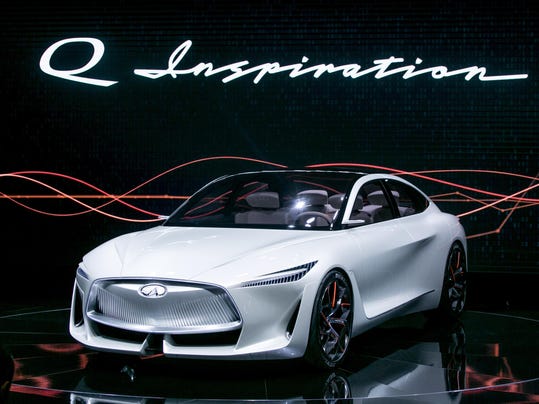
Concepts once ruled auto shows. Flights of fancy looking into the far-off automotive future. Hydrogen-powered cars. Hybrid-electric supercars. Self-driving cars. You know, sci-fi stuff. Well, the future has arrived with production vehicles offering the future today — the Honda Clarity fuel-cell car, the Acura NSX supercar, the autonomous Chevy Bolt. Who needs concepts? Well, designers do — and so they continue to proliferate on the floor to give you a look at where their brands are headed.
Infiniti Q Inspiration concept
What it is: “The concept is meant to demonstrate future technologies and will not be available for sale,” reads Infiniti’s press release. But its technology is not far off. This is a mid-size sportback sedan with dramatic new design language for Nissan’s luxury brand. The efficient variable-compression, turbo engine technology has already been introduced in the QX50 Infiniti SUV. The semi-autonomous ProPilot assist driving system is already in the 2018 Nissan Rogue SUV.
Payne’s take: From the sleek, sportback exterior to its minimalist interior and wrap-around digital instrument display, the gorgeous Q concept shows the dramatic effect Tesla has had on luxury makers. With one exception. The Infiniti is not an electric vehicle, but a cutting-edge demonstration of how a variable-compression combustion engine can provide better torque and less fuel consumption — without the compromises of a battery-powered vehicle.
Lexus LF-1 Limitless
What it is:In 1989, Toyota’s new luxury division debuted its flagship LS 400 sedan at the Detroit auto show. Nearly 30 years later comes the LF-1 Limitless as a concept previewing an SUV flagship, as the market has shifted to high-riding crossovers. The LF-1 offers an intriguing hint on where the polarizing spindle grille is headed. Inside, the controls are (encouragingly) steering-wheel focused, with paddles for controlling speed and buttons for shifting.
Payne’s take: From its slavish Mercedes-like design on its 1989 LS original, Lexus has definitely created its own unique design direction for the 21st century. The car also hints at the brand’s “Chauffeur” autonomous driving capabilities. Limitless apparently refers to the drivetrains offered — Lexus says anything from gas to hydrogen to electric.
Nissan Xmotion concept
Payne’s take: The Xmotion’s exterior — Xterior? — is a design preview, but the interior is good ol’ fantasy. Festooned with seven video screens, the X imagines bringing all the technologies we love on our smartphones and laptops into the car: fingerprint ID to start the engine, gesture controls, even a digital assistant in the form of a Japanese koi fish.