- Search Cartoons
- Comic Archive
-
Payne
Store



 Henry Payne RSS

Articles Blog
Payne: Stress-free, thrill-free Toyota RAV4
Posted by Talbot Payne on April 5, 2018

The best-selling book on Amazon for much of the year has been “12 Rules for Life: An Antidote for Chaos,” by Jordan Peterson. The title is self-explanatory. It’s a 12-step guide to stress-free living.
Chapter titles include: “Rule 3: Make friends with people who want the best from you” and “Rule 8: Tell the truth — or, at least, don’t lie” and “Rule 12: Pet a cat when you encounter one on the street.”
Psychologist Peterson might have added Rule 13: Buy a Toyota.
Toyota has kept auto buyers off the shrink couch for decades. The brand has been synonymous with chaos-free reliability as it scooped up award after dependability award.
It’s no wonder, then, that the Toyota RAV4 in my driveway is the best-selling non-pickup in the United States. A staggering 407,594 were sold last year.
As Americans have crossed over to crossovers, compact SUVs have become the equivalent of the midsize family sedan. True to its brand, RAV4 has a trophy case full of reliability awards including a 9.3 (out of 10) reliability rating from Kelley Blue Book, IHS Automotive longest-lasting vehicle plaudits, and so on.
The RAV4 is the nanny of autos. It’s always there to pick you up after school, always there to carry your stuff, always nag-nag-nagging you when you want to have fun.
OK, so I am not your typical automotive appliance buyer. I’m a little rebellious when it comes to driving.
Give me a hot hatch or a sports car. Or the all-wheel drive hatchback Audi TT S sports car that I recently raved about, because I can take it to the track in the summer and do four-wheel drifting on snowy county roads in winter. I tried that last maneuver and the RAV4 looked at me with arms crossed, shaking its head.
I tried anyway. I turned off the traction control and … well, I eventually turned off the traction control after looking everywhere in the cabin for the button. It’s a tiiiiiny little button northeast of the radio screen next to three other tiny buttons indicating whether all passengers are belted in.
Who puts it there? An SUV determined to get Insurance Institute for Highway Safety top safety ratings, I guess.
But one push of the button didn’t do it. Unlike every other car I’ve ever driven, the “traction-control off” light on the dash changed little in the car’s performance. Under throttle through some Oakland County twisties the power was suddenly cut back as if the nanny systems were still engaged.
Indeed, the nannies are so intrusive in the RAV4 that the car nearly stalls in a straight line — much less under g-loads — if the electronics detect tire slip. On Detroit’s snowbound roads, this often made for tortoise-like stoplight getaways as RAV4 refused to allocate power to the wheels while two lanes of traffic streamed by on either side of me.
To turn off traction control altogether, the “traction-control” button must be held down for five seconds.
Mrs. Payne would approve. She has no taste for my all-wheel-drive drifting shenanigans. And she is no doubt joined by the 100 percent of the appliance buyers who have made RAV4 their top sales pick. If you want to drift a best-seller, then buy the Nissan Rogue — No. 2 in sales to RAV4 by a mere 3,000 units — which sports a nimbler chassis than the Toyota and requires one push of its (easily located) traction-control button.
Conservatism is the RAV4’s default mode.
The Toyota doesn’t offer the electronic gee-gaws that other competitors do like self-park assist (Ford Escape); or automatic high-beams (Mazda CX5); or fold-flat front seat (Chevy Equinox); or kick-open rear hatch (Ford and Honda CR-V); or Apple CarPlay and Android Auto app connectivity like just about everybody.
Perhaps most glaring was a lack of heated seats in my $32,714 model. Nearby in my driveway were a $27,000 VW Passat (leather seats) and all-wheel drive Subaru Impreza wagon (cloth seats like the RAV4) which were both equipped to warm up a cold tush on a cold day. Heated seats are one of my wife’s No. 1 priorities.
The interior is roomy with workable ergonomics, though the old-fashioned gated shifter seems oh-so 15 years ago.
The staid interior contradicts first impressions, as I find the RAV5 one of the more interesting mainstream utes to look at — especially the new-for-2018 Adventure model that I drove. When you’ve got 400,000-plus units flooding American roads every year, it’s nice to have a little variety and the Adventure delivers.
It features a flat-black hood a la Camaro 1LE, more aggressive wheel-well cladding and blacked-out headlights that make the RAV4’s signature, thin, wraparound grille look even more like the X-Men’s Cyclops.
The Adventure model is supposed to appeal to Toyota appliance buyers with a little Jeep ruggedness in their blood (hey, now my off-road antics don’t seem so crazy after all, hon!). The inside is festooned with thick, rubber mats with an “Adventure” logo on them. The chassis gets big 18-inch blacked-out wheels, more ride-height, and engine radiator and transmission upgrades to more than double RAV4’s towing capacity to 3,500 pounds.
Nice, though in keeping with Toyota’s conservative nature, it’s still well off a Jeep Cherokee V-6’s 4,500-pound rating.
When I wasn’t begging for less nanny and more power on slushy roads, the RAV4’s ride was surprisingly quiet given its non-turbo, 176-horse four-banger engine. A similar mill in a Mazda CX-5, for example, can get shouty — credit the Toyota’s very smooth, six-speed tranny which also helps return a respectable 25 mpg.
Last week in New York, Toyota unveiled an all-new fifth-generation RAV4 with a remake that will address many of the shortcomings mentioned above, from standard features to clunky shift-gate to more horsepower (though its awkward new face made me nostalgic for Cyclops). Based on the same wider, lower, stiffer platform that rejuvenated the Camry sedan in 2017, the new RAV4 goes on sale next winter.
In the meantime, I have to sit back and applaud a five-year-old car that continues to soar to new sales heights. Who needs a redesign when you’re an antidote for chaos?
Henry Payne is auto critic for The Detroit News. Find him at hpayne@detroitnews.com or Twitter @HenryEPayne. Catch “Car Radio with Henry Payne” from noon-1 p.m. Saturdays on 910 AM Superstation.
2018 Toyota RAV4
|
VEHICLE TYPE |
FRONT-ENGINE, FRONT AND ALL-WHEEL DRIVE, FIVE-PASSENGER SUV |
|
Price |
$25,505 base ($32,714 RAV4 Adventure as tested) |
|
Power plant |
2.5-liter inline-4 |
|
Power |
176 horsepower, 172 pound-feet of torque |
|
Transmission |
6-speed automatic |
|
Performance |
0-60 mph, 8.5 seconds (Car and Driver); towing: 3,500 pounds |
|
Weight |
3,605 pounds as tested |
|
Fuel economy |
EPA fuel economy: 22 city/28 highway/25 combined (AWD Adventure as tested) |
Report card
Highs: Rugged Adventure trim; quiet interior
Lows: Nagging nanny safety systems; missing features
Overall:★★★
Payne: 10 must-see vehicles at NY auto show
Posted by Talbot Payne on March 30, 2018
New York – The Big Apple’s Auto Show is a different animal than its Detroit counterpart. If you can make it here, you can make it anywhere – and a lot of people have. Almost a quarter of Gotham vehicle registrations are for luxury models. That’s nearly double the national average. As a result, luxury-automakers target New York for product reveals.
Yet, this year New York showed surprising bandwidth with introductions of volume mainstream vehicles like the Toyota RAV4 compact SUV and the Nissan Altima midsize sedan. Detroit will always host Big Three truck intros, but Motown’s lux-makers are eager to make it here (so much so that Cadillac has made the Empire City its home), so Cadillac and Lincoln brought their A games. The variety extended to robot cars and battery-powered rocket ships.
Herewith, in no particular order, the 10 must-see vehicles in New York:
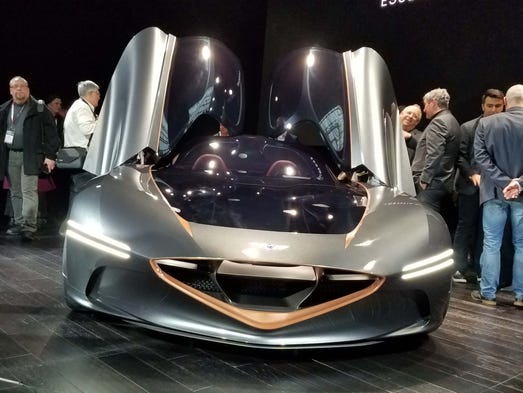
A throwback to fanciful show concepts of old, the Essentia imagines an electric 2+2 coupe for the semi-autonomous future. A Formula One-style keel nose sits under a transparent hood, revealing inboard springs and aerodynamic tunnels for increased down-force. The digital cockpit straddles a center-line battery pack so that passengers sit low to the ground. Naturally, the concept gets butterfly doors, but my favorite details are the thin LED front running lights. There are no projector lamps to be found, because self-driving cars won’t need headlamps to see.
Displayed in the show’s exotica bullpen next to $2 million Lamborghinis and Bugattis, the Croation start-up’s second model manages to stand out. Determined to be the fastest EV ever, the hypercar with four electric motors generates jaw-dropping numbers from its 120-kWh powerpack: 1,914 horsepower, 1,696 pound-feet of torque, 230 mph top speed and a zero-60 spirit in just 1.85 seconds. That’s faster than the new Tesla Roadster. Determined to be the EV benchmark, the C_Two will soon take a shot at the Nurburgring lap record.
Across the aisle from Rimac’s expensive nest is the $25,000 Forester, Subaru’s second-best selling vehicle and marvel of affordability. Based on Subaru’s all-new global platform, the all-wheel drive Forester has more room and more standard features. My highlight is the rear tailgate opening which grows 5 inches wider – enough to swallow a golf bag sideways. All this goodness is wrapped is a more handsome wardrobe than the last-gen cardboard box.
Think of it as the baby Navigator. The three-row Aviator concept replaces the unloved MKT with dramatic looks, sumptuous interior and signature 30-way Lincoln seats. But the big ute is more than a pretty face. It’s is built on a rear-drive platform which Lincoln says allows a longer hood design as well as better grip for towing.
Forget your growly V-8 Jags of old with hoods longer than your driveway. The I-Pace SUV takes aim at the Tesla Model X with a meaty 90 kWh battery that boasts 240 miles of range and lots of torque. With batteries in the basement, the Brit EV features nimble handling and room for five adults. But will customers want a Jaguar without the growl?
You read that right – a Volkswagen pickup. The German automaker is determined to connect with us Yanks and what better way than an all-American truck? The Tanoak concept would be built off the same unibody bones as the three-row Atlas SUV, making it the third ute-based midsize pickup after the Honda Ridgeline and coming Hyundai Santa Cruz. The Tanoak’s rugged design looks nearly production-ready and its large dimensions are competitive with the GMC Canyon. The bed should be big enough to fit your old VW Rabbit, too.
This subcompact ute begins Cadillac’s comeback in the SUV segment. Aimed at the BMW X1 and Audi Q3, XT4 follows sister XT5’s strategy of offering large dimensions for the segment. Like big brother Escalade, the XT4 sports dramatic, vertical tail-lamps taller than the Fox Theater marquee. Unlike its siblings, the new ute adds buttons to the CUE infotainment system’s unloved touchscreen.
The next-generation Altima is the latest Japanese sedan to try to keep cars relevant in ute nation. The Altima follows the Honda Accord and Toyota Camry with dramatic styling that SUVs like – well, the Nissan Rogue – can’t touch. Roomy Altima also offers all-wheel drive for the first time for better ute-like utility as well as a pioneering variable-compression turbo-4.
The SUV performance arms race continues. Maserati’s family SUV gets a 590-horsepower Ferrari-assembled twin-turbo V-8 to best the Alfa Romeo Stelvio Quadrifoglio’s (say that 10 times fast) 505 horsepower and the Jaguar F-Pace SVR’s 550. So you can go zero-60 in just 3.7 seconds while coddled by red leather seats with Wagner playing over the 17-speaker Bowers & Wilkins audio system. Be warned, though. The 707-horse Jeep Grand Cherokee Trackhawk is quicker.
It’s hard to ignore a remake of the best-selling non-pickup in America. The RAV4 gains capability on the Toyota’s new TNGA platform, but that doesn’t make it any prettier. The ute is homelier than ever. Happily, an interior decorator was hired for upgrades inside, bringing the RAV4 into the 21st century. Determined to give its loyal customers more model differentiation, a new Adventure trim brings the rugged (better) looks of the Tacoma pickup.
Bipolar auto disorder: mixed messages at NY show
Posted by Talbot Payne on March 30, 2018

New York – You can sense the desire for an autonomous electric future in Gotham’s gridlocked streets: Impatient business people, Uber drivers and families find themselves stalled in cross-town traffic wasting precious time.
Waymo and Jaguar opened the New York auto show early Tuesday with a lifeline to urban commuters: a gorgeous, five-passenger, self-driving Jaguar I-Pace EV with 360-degree lidar detection and a 240-mile battery range.
The future is here, right? Not so fast.
By the end of Tuesday, Jaguar had also introduced a 550-horsepower gas-guzzling variant of its F-Pace SUV. Wall Street’s NASDAQ index had stumbled – in part as Silicon Valley’s pet tech stocks faced the consequences of a fiery possibly self-driving Tesla crash in California and continued fallout from a fatal collision between an autonomous Uber Volvo XC90 and an Arizona pedestrian.
On the show floor, Volvo’s tight-lipped response to the Uber tragedy was as noticeable as Jaguar’s celebration of 20,000 I-Pace orders from Waymo.
The show’s bipolar nature points to the uncertainties that surround the industry’s massive investment in autonomous EVs. It’s an investment driven by the conflicting incentives of market opportunity (autonomy) and government regulation (electrification) – and a promise of safety that, in the words of best-selling author and Car and Driver contributor Malcolm Gladwell, “exchanges one class of risk for another.”
For small luxury-automakers like Volvo and Jaguar, there is an irresistible upside to partnering with ride-share giants like Uber and Waymo because it raises automakers’ profiles in a high-tech, eco-conscious segment of the marketplace. Autonomous ride-sharing also promises large sales volumes for EVs that have struggled to earn back their production costs.
But the downside was painfully obvious as the video of the fatal Uber crash went viral. Suddenly, the carefully manicured reputation of Volvo as a safety brand was in jeopardy.
Volvo refused comment this week, sticking to a statement it released after the Uber incident which read in part: “Uber is cooperating with local and national authorities and Volvo is assisting in these investigations. We cannot speculate on the cause of the incident. We await the full investigation report.”
Large automakers like General Motors, Audi and Toyota have been careful to keep their autonomous testing in-house – partially out of a concern of being dependent other manufacturers’ technology, company insiders say.
In an auto show forum hosted by Car and Driver, Gladwell – a renowned author whose work explores the sometimes unexpected implications of technological progress – expressed broader concerns over the vulnerability of autonomous cars if they fulfill their promise as the dominant form of personal transportation.
“The automobile can be subject to malicious manipulation,” said Gladwell, drawing parallels with the persistent hacking problems other industries like banking have suffered as they have increased electronic services. “If I were a malicious hacker, I’d want to hack into 5,000 cars on I-95 during rush hour and cause a 9/11-type event.”
“I worry about this,” he said.
On the battery front, uncertainty over EV profitability has driven Jaguar to, paradoxically, make more gas-guzzling SUVs.
Moments after declaring the battery-powered I-Pace “the future” of sustainable transportation, Jaguar design boss Ian Callum on Tuesday night rolled out the 550-horse, sub-20 mpg, SVR performance version of the brand’s best-selling E-Pace ute.
“From the sublime to the ridiculous,” smiled Callum. That is, from the unprofitable to the very profitable.
Bipolar product disorder is perhaps no more pronounced than at Volkswagen which stunned New York with a Big Three-fighting Atlas Tanoak pickup truck concept.
The 3.6-liter V-6-powered pickup was announced as part of a “family” of Atlas vehicles based on the German automaker’s huge three-row Atlas SUV. The announcement came just three weeks after Volkswagen declared at the Geneva Auto Show its commitment to a gas-free, all-electric future with its family of ID electric cars: the Vizzion, Crozz and Buzz Microbus.
The product paradox is everywhere in New York’s Javits Convention Center. Toyota’s self-driving ePallette autonomous concept – on course for its Tokyo Olympics public debut in 2020 – shares the lineup with the Tacoma and Tundra pickups. Nissan’s stand showcased the company’s new electric Formula E race car even as it introduced an all-new Nissan Altima powered by a cutting-edge, variable-compression gas engine. A Chevy Bolt EV is yards away from a V-8 Camaro.
“Automakers have got to keep one foot in the present while planning for the future,” said Kelley Blue Book auto analyst Karl Brauer. “Companies like VW are following a similar model to GM, which claims they are a button-push away from an electric future – yet sell hundreds of thousands of profitable Silverado pickups a year.
“The companies that successfully fund their future are the ones that can win this battle.”
Payne: VW wakes up sleepy Passat with GT model
Posted by Talbot Payne on March 30, 2018

The sleepy Volkswagen Passat made a New Year’s resolution at January’s Detroit auto show: I’m going to live a little.
So the German sedan raided hip brother Golf GTI’s closet, took an armful of hot-hatch clothes, and — Heiliger strohsack! — showed up in Detroit as a Passat GT.
Outfitted in white with lots of black mascara around the headlights and a grille outlined in red, the GT just popped. I can’t remember the last time I used “Passat” and “popped” in the same sentence. Three months later and Passat is keeping its resolution.
I just drove the GT to Hell (Michigan) and back, and it’s not only got the GTI’s zeitgeist, it does it with 50 percent more rear legroom and 60 more ponies from a growly V-6. Gott in himmel!
The GT is a welcome tonic for a sedan that has been a wallflower in a wallflower segment. Buyers walk right past sedans these days to dance with high-riding SUVs. Ute sales were up 24 percent in 2017. Car sales? Down 17 percent. So midsize mainstays like the Toyota Camry and Ford Fusion have sexed-up their wardrobes with flashy new sheet metal and pricey V-6 sport models.
The special-edition Passat GT comes from good (if understated) stock. Take the Passat SE recently in my driveway. “S” for somnolent.
The V-dub all but disappeared next to the hot-hatchback Kia Stinger (the time machine from the memorable Super Bowl ad with Aerosmith’s Steven Tyler) that I tested at the same time. Thin upper grille, slab sides, plain rockers … zzzzzz. If it weren’t for the VW logo the size of Flavor Flav’s clock dangling from its grille, it could be anything.
But climb into the mid-size V-dub and it blossoms into one oversize value. There, I did it again: VW and value in the same sentence! That’s new.
Start with the six-year/75,000-mile bumper-to-bumper warranty that covers everything including drivetrain. Transferable if you buy a used Passat.
The SE is loaded for just $27,145: Heated seats, keyless entry, adaptive cruise-control, smartphone-app connectivity, all wrapped in a cocoon of air bags and autonomous braking should you ever do anything naughty. Sure, I would have liked a couple more things like a heated steering wheel and a phone cubby, but that’s like complaining that your 10,000-square-foot beach rental doesn’t have a toaster oven.
The $29,995 Passat GT is a bargain, too. Compare that to the similar, front-wheel-drive, 302-horse Camry SXE V-6 which starts at $35,845. The GT gets big, 19-inch tornado wheels, sunroof, two-tone leather seats and a growlin’ V-6 that you used to have to shell out $35,450 for in the top-trim SEL. Mated to a paddle shift-equipped, dual-clutch transmission that shames many luxury models, the V-6/6-speed tandem is the best team since the Bryan brothers.
The V-6 even belts out rev-matching downshifts I nearly missed because the interior is so quiet. And roomy. I swear it’s 10,000 square feet inside. The back seat swallowed my 6-foot-5 frame with ease. The trunk is deeper than Bear’s Cave with fold-flat rear seats that extend its utility.
Speaking of length, Passat’s 181/2-gallon tank will carry you nearly 700 miles on a fill-up in the base model’s turbo-4. That helps make up for its slight mpg deficiency (29 mpg) next to others in its class. With 106 more ponies, the V-6 will still travel over 500 miles.
Overshadowed by the GT’s mill, the SE’s 2.0-liter 4 got more power for the new year and was plenty peppy on Oakland County’s curvy lake roads. Which is promising, because Passat’s Chattanooga plant will soon get VW’s light-weighted MQB chassis that is the foundation for the nimble Golf.
Still, the big Passat’s older platform makes this chariot feel a size smaller on the road. Like 6-foot-9 Blake Griffin making a spin move for the basket from the top of the key, drivers can feel confident the sedan will go where it’s placed.
This is in contrast to VW’s big cool-for-school Tiguan and Atlas SUVs which depart from the sporty car formula for a more carpeted ride. While other manufacturers — BMW, Mazda — draw a straight line between their sporty sedans and SUVs, VW’s model lines offer different personalities.
The GT is also a welcome addition to Passat because the badge must justify itself against King Accord.
Honda’s 10th-generation, mid-size sedan set a new standard as 2018 North American Car of the Year. Toe-to-toe with the likewise all-new Camry, it beats its Japanese rival in nearly every measure.
That’s a tough crowd. Compared against Accord’s comparable, EX trim, Passat SE punches strong with its laundry list of standard features. VW has caught up with the focus group-obsessed Japanese in the ergonomic category where Germans once sniffed at Americans’ obsession with living in their cars. Was is das? Cupholders? Drinking is for das Bierhaus, not for sie car!
The Passat provides decent storage — despite the, ahem, microscopic forward cubby — and most impressively, a user-friendly infotainment touchscreen with radio favorites easily thumbed with a toggle on the steering wheel for less-distracted driving.
As noted, the gas tank gives outsize range. And like the Accord, the VW’s superb chassis engineering allows it cavernous interior and cargo on a sprightly, 3,200-pound chassis.
On styling and drivetrain, the Accord is superior to the Passat SE. Once a disciple of V-6 engines, the Honda now makes an astonishing 1.5-liter turbo-4 that not only bests the German’s blown 2.0-liter by 20 horsepower, but does it with better fuel economy.
The Accord’s lovely swept sportback doesn’t compromise headroom. Its huge front bug-catcher isn’t my cup of tea, but at least it has personality. All this and a Honda bottom line that is $500 below the budget-friendly Passat.
Which is where we came in. Into the vanilla Passat menu comes the Chunky Monkey Almond Fudge V-6 GT.
It’s in limited production as Chattanooga assesses its value to a Passat line updating to MQB. If GT proves as popular with Passaters as the iconic GTI is with Golfers, VW will keep it cooking.
I’ll take that as another New Year’s resolution.
Henry Payne is auto critic for The Detroit News. Find him at hpayne@detroitnews.com or Twitter @HenryEPayne. Catch “Car Radio with Henry Payne” from noon-1 p.m. Saturdays on 910 AM Superstation.
2018 Volkswagen Passat and Passat GT
|
VEHICLE TYPE |
FRONT-ENGINE, FRONT-WHEEL DRIVE, FIVE-PASSENGER SEDAN |
|
Price |
$23,845 base ($27,145 Passat SE as tested); $29,995 Passat GT |
|
Power plant |
2.0-liter inline-4 (base Passat); 3.6-liter V-6 (GT) |
|
Power |
174 horsepower, 184 pound-feet of torque (turbo-4); 280 horsepower, 258 pound-feet of torque (V-6) |
|
Transmission |
6-speed automatic |
|
Performance |
0-60 mph, 5.7 seconds (Passat V-6, Car and Driver) |
|
Weight |
3,274-3,571 pounds |
|
Fuel economy |
EPA fuel economy: 25 city/36 highway/29 combined (turbo-4); EPA fuel economy: 19 city/28 highway/22 combined (V-6) |
Report card
Highs: Roomy interior; GT brings GTI-like pizzazz to Passat
Lows: Dated instrument display; GT can be thirsty under the whip
Overall:★★★
Volkswagen goes big with pickup concept
Posted by Talbot Payne on March 30, 2018

New York – Germany’s Volkswagen has thrown on a cowboy hat and boots and swaggered into the U.S. pickup market with the mid-size Atlas Tanoak truck concept.
Built on the same bones as the three-row Atlas SUV, the Tanoak — introduced Wednesday at the New York auto show — is the latest pickup to be based on a car-like unibody instead of a traditional body-on-frame truck chassis. It is also part of Volkswagen’s strategy to redefine itself as an ute-maker with an expanded Atlas family.
“The Tanoak takes (the Atlas) to a new all-American extreme,” Volkswagen North America CEO Hinrich Woebcken said at the reveal.
U.S. truck enthusiasts have long pooh-poohed unibody pickups for their lower towing and payload numbers. But unibody chassis boast a smoother ride than ladder frames, and the Honda Ridgeline — built on the same unibody as the Pilot SUV — has been a popular alternative since its 2016 introduction.
Hyundai is building its own unibody concept based on the Santa Cruz concept that debuted at the 2015 Detroit auto show. Volkswagen is testing the waters to see if there is room for its own unibody creation.
There are no current production plans for the Atlas Tanoak, according to Volkswagen. But the automaker wants to gauge response to the idea, since pickups are one of the biggest volume segments in the U.S.
“A mid-size pickup enhances what the VW brand wants to be — a serious player in the U.S. SUV market,” said Kelley Blue Book auto analyst Karl Brauer. “The product makes sense, they have the capacity in Chattanooga to make it, and if they’re smart they will make it as quickly.”
Edmunds analyst Ivan Drury was less impressed: “It will be tough to make a business case work for a lifestyle truck that would likely be priced at the higher end of the market, especially when you’re trying to compete with mainstays like Honda. The real missing link (in the U.S.) is a small, affordable truck with a minimalist design.”
The sculpted, upscale-looking Volkswagen concept is aimed at an increasingly crowded midsize pickup market that includes domestic truck giants like Chevy (Colorado), GMC (Canyon) and Ford (Ranger). All three domestic entries are rugged, off-road-ready, body-on-frame chassis — as is segment leader Toyota Tacoma.
The mid-size pickup market showed aggressive growth in 2014 when Chevy and GMC re-entered the game after years away, but sales tapered off in 2017. Ford’s Ranger enters the segment early next year.
The Volkswagen design looks mature with signature, narrow Volkswagen horizontal front and rear fascias wrapped by continuous LED lights. The bold side panels are etched with tall fender lines that echo the Atlas SUV.
Emphasizing the upscale, high-tech theme, the interior features a digital instrument display and center console touchscreen.
But make no mistake, Volkswagen wants customers to know this is a work truck you can take to the Texas ranch.
“The Atlas Tanoak would be built in America for Americans,” said CEO Woebcken. “It is a tribute to the American ideal … an American pickup that brings German precision.”
Contrary to stereotypically small, imported European vehicles, the big Tanoak is based on the Tennessee-manufactured Atlas midsize SUV as Volkswagen tries to better integrate itself into the U.S. market after years of slow sales.
The short-bed concept is comparable to segment-leaders Chevy and GMC, stretching to an overall length of 214 inches. That’s nearly 16 inches longer than the Atlas seven-seater. The 128-inch wheelbase is 11 inches longer than its SUV cousin.
Perched 2 inches higher than the all-wheel drive Atlas, the Tanoak is powered by a 276-horse 3.6-liter V-6 mated to an eight-speed automatic transmission.
Bigger, bolder, techier Subaru Forester debuts
Posted by Talbot Payne on March 30, 2018

New York – Subaru introduced the fifth generation of its best-selling Forester compact SUV at the New York auto show Wednesday. The latest Forester comes with more of everything: space, power, safety. Even style.
Shopping in the biggest-volume class in the market, customers flocked to the Forester for its typically Subaru all-wheel drive value, despite its frumpy exterior design. The third vehicle to be built on the brand’s new global platform (following the Impreza and Crosstrek siblings), the latest Forester sports a bolder appearance with defined wheel arches, more-sculpted body panels and designer peepers.
Under the upgraded wardrobe, the Forester takes on competitors like the Toyota RAV4, Ford Escape and Honda CR-V with improved metrics in every category.
Known for its standard all-wheel drive system that has made Subarus ubiquitous in northern climates, the Forester loads on the safety technology with standard features. Its so-called “EyeSight” system includes features found on SUVs costing thousands more: automatic pre-collision braking, adaptive cruise control, lane departure and lane keep assist. All for a starting piece of around $25,000 (exact pricing will be announced later this year).
On top of Eyesight, Subaru debuts a driver-monitoring system to address distracted driving. Subaru calls this feature “DriverFocus” and claims it “uses facial recognition software to identify signs of driver fatigue or driver distraction.” The feature will be available on Forster’s top-trim Touring model.
The bigger ute also gets more horsepower, as the Forester’s familiar, 2.4-liter “boxer” four-cylinder engine gains 12 sporty horsepower over the last generation.
Speaking of sporty, the 2019 also debuts a “Sport” model with a more-youthful appearance. Distinctive features include a blacked-out grille, unique 18-inch wheels and rear spoiler. Standard features include LED fog lights, auto high-beam assist, windshield wiper de-icer and paddle shifters.
Second in sales only to the brand’s iconic Outback wagon, the compact Forester is the anchor of an expanding SUV lineup that now includes the Crosstrek and three-row Ascent.
Audi’s 8th-generation A6 gets big technology upgrade
Posted by Talbot Payne on March 30, 2018

New York – Audi continues the rollout of its remade sedan stable with the introduction of the midsize, tech-tastic 2019 A6 at the New York auto show.
The A6 follows the full-size flagship A8, which debuted in Los Angeles last winter, and the slinky A7 sedan hatchback that bowed in Detroit in January.
Like its sister sedans, the eighth-generation A6’s wardrobe looks little different than the outgoing model. The German brand’s signature hexagon grille dominates the face with more chrome brightwork and sculpted cheeks than before. The most telling change is in the caboose where the A6 – like A8 and A7 before it – connects the rear lights with a horizontal chrome line across the trunk to give the Audi a wider appearance.
The big alterations are under the skin. Interior space grows while expanding on Audi’s reinterpretation of its infotainment systems to parallel smartphone technology. Audi has already been an innovator with its configurable Virtual Cockpit instrument display, best known for its colorful Google Map-like, landscape renderings.
Gone for 2019 is the center console’s rotary dial. For 2018, it’s replaced by two touchscreens embedded in the center dash, a change that will test owners who had mastered the remote-control dial.
The upper screen controls radio and connectivity. The lower controls temperature and other cabin functions.
The smartphone theme continues with more direct-voice commands and the brand’s myAudi Navigation system, which promises a seamless hand-off from a phone’s navigation commands to the car’s navigation screen when the driver enters the vehicle.
In part to run this hungry suite of electronics, the A6 will make standard a 48-volt battery. The battery will also complement an all-new turbocharged V-6 engine for a mild-hybrid drivetrain that lends better torque as well as an improved fuel economy.
While Audi sedans have ceded the sales crown to their SUV sisters in the German-maker’s lineup, they remain the brand’s stylistic touchstone. All-new versions of the volume-selling Q7 and Q5 SUVs have been a hit with consumers the last two years (the Q7 outsold the A6 by better than 2:1 in 2017). But sedans like the A6 are first to get Audi’s latest technology.
The SUVs will surely follow.
Payne: Uber car flunked Autonomous 101
Posted by Talbot Payne on March 23, 2018

Last August, I was a passenger in an autonomous Uber in downtown Pittsburgh in the same type of Volvo XC90 crossover with the same hardware as in the one that struck and killed a pedestrian in Tempe, Arizona, on Sunday night.
As the Volvo I was in headed down a one-way street at 25 miles per hour, two women randomly stepped off the curb in front of the vehicle. The Volvo detected them and slowed, letting pass the women who were seemingly oblivious to traffic.
As experts try to learn why Elaine Herzberg, 49, was hit as she walked across a road, questions abound. A safety driver was behind the steering wheel, but video released Wednesday by police shows the driver looking down before the crash.
The initial focus is on the why the lidar-equipped car never reacted to the pedestrian – and whether one Uber engineer at the wheel was enough supervision when many companies use two.
“This was a straightforward scenario that lidar should have detected,” says Ram Vasudevan, an assistant professor of mechanical engineering at the University of Michigan who has worked extensively with autonomous systems. “This was a tragedy that was avoidable.”
The Tempe incident shows the Volvo flunked Autonomous 101. Indeed, in a Google car ride I took at the company’s Mountain View headquarters in 2015, Google deliberately ran a bicyclist in front of my car. The lidar-equipped, no-steering wheel auto-bot slowed and avoided the cyclist without incident. On a public street in a Lexus SUV Google tester earlier that year, a similar scenario occurred with a pair of jaywalkers.
Yet, the video from the Tempe Uber XC90’s dash cam shows that the vehicle not only doesn’t slow down for the pedestrian, it seems to be totally unaware of her presence. The self-driving car doesn’t appear to brake or swerve before impact. Even without expensive lidar systems, many modern cars utilize simpler radars and cameras to brake for pedestrians as well as other objects. Uber’s Volvo XC90 was equipped with all three types of hardware in addition to an on-board computer that contained mapping – a so-called “geo-fence” – of the Uber’s route.
If lidar has a weakness, says Varudevan, it is rain or dense fog – elements that occur infrequently in Arizona. “It’s why the companies like to test there, because they are ‘weather-fenced’ as well as geo-fenced.”
The weather was clear on the night of the Tempe incident.
At root, autonomous cars are computer-based systems that engineers put through rigorous “stress testing” so that autonomous functions are repeatable. It’s why engineers are determined to get a report on Uber’s incident: Did a software algorithm misinterpret the situation? Did the lidar fail?
Experts are also worried about the need for better redundant systems – and that includes the human safety-drivers behind the wheel so they can take over.
Notably, there was only one person in the Tempe vehicle. My Pittsburgh test had two humans – one “operator” (Uber-speak for on-board engineers) ready to take over the wheel, the other to monitor on-board systems via a laptop and center screen. In the dashcam video released by the authorities after the Tempe incident, the single operator, Rafaela Vasquez, seems to be fiddling with the screen, distracted from the road until the moment of impact.
Through a spokesperson, Uber declined to comment on operator guidelines, saying “our cars remain grounded, and we’re assisting local, state and federal authorities in any way we can.”
Teams from the National Transportation Safety Board and National Highway Traffic Safety Administration are investigating the crash.
Kelley Blue Book auto analyst Karl Brauer notes that Waymo (Google’s autonomous testing arm) also tests in Arizona, but without anyone at the wheel (an engineer rides in the back seat of its Chrysler Pacifica minivans). Other companies are testing the idea of “teleoperation” in which driverless vehicles are monitored remotely should they get into intractable situations.
The Tempe incident raises a question: Whether autonomous autos should be held to a higher standard than human drivers.
Brauer says the woman would likely have been struck by a human driver, given that she was crossing a dark four-lane road at night.
“We know that autonomous cars can see their surroundings better than humans,” he says. “So do we hold autonomy culpable for their theoretical capabilities? Do we hold them accountable to a higher standard?”
Whichever the case, self-driving cars must be able deal with unusual situations like that Tempe. “Otherwise,” says Brauer, “what’s the point?”
Payne: Ram 1500 goes to head of versatility class
Posted by Talbot Payne on March 23, 2018

We motorheads like to say of our sports cars that we can track it Saturday, then drive it to work Monday. But pickup guys might have us beat. The modern pickup can carry ATVs to the country Saturday, take the family to dinner Sunday night, then drop the kids off at school on the way to work Monday.
Take the new 2019 Ram 1500. I recently tested Detroit’s latest pickup blockbuster from Phoenix highways to Arizona desert.
You know the 1500 from its Detroit auto show debut as the truck with the Tesla touchscreen. I used to lounge in the Tesla Model S sedan’s back seat on public days as show-goers climbed in and ogled the 17-inch vertical tablet. The Silicon Valley automaker didn’t make this year’s show, so I sat in the back seat of the Ram and watched a parade of attendees marvel at its 12-inch screen. The Ram may not match Tesla tablet’s Google Earth renderings — but it does feature exclusive Sirius radio archives content.
Ram isn’t a one-trick pony. This is a multi-trick workhorse that can tow ponies.
luxurious are upscale Limited and Longhorn models that they inspire more comparisons to Tesla. That Ram back seat? Ten more inches of legroom in the Crew Cab compared to the famously cavernous Model S. Leather-wrapped interior from front to rear glass. Deep console storage with space-saving, dash-mounted rotary shifter and adjacent drive-mode buttons.
Heck, the Ram is even electrified with an eTorque 48-volt battery mated to its Hemi V-8 (only non-eTorque Hemis were available for our test). Tesla uses its electric torque for neck-snapping acceleration, the Ram for back-breaking tow numbers. The eTorque-equipped 1500 approaches the Ford F-150’s best-in-class 13,200 pounds towing and 2,470 payload with 12,700 and 2,300 pounds respectively.
We haven’t seen this kind of versatility since pro wrestler Dwayne “The Rock” Johnson turned comic “Jumanji” actor. Or since Ford’s pickup.
The “Built Ford Tough” F-150, of course, is the undisputed truck wrestling champ with nearly 900,000 units sold in 2017. Ram and Chevy know it and benchmark to the champ while also carving out their own signature moves.
Ram has gone to great lengths to catch up with the tech-tastic Ford in the towing and payload department, and with adaptive cruise-control, 360-degree camera (which makes tow hookups easier), blind-spot trailer-assist, and self-park assist. You haven’t lived until you’ve seen a nearly 3-ton truck parallel-park itself into a cramped street space.
Having caught up on technology (at least until F-150 rolls out its new truck in 2020), Ram set out to extend its class lead in style and comfort. No doubt this is the most handsome, best-riding truck in the ring. While the latest F-150 staggered its rear shocks for a smoother ride, Ram remains the only truck in class with coil rear springs. Mated to adaptive shocks and a rigid 98-percent high-strength steel ladder frame, this 5,800-pound rhino glided around bends like a unibody SUV — not a ladder-framed pickup.
Ute-inspired similarities don’t stop there.
Ram boss Jim Morrison (no relation to the Doors) and his band took the opportunity of the first clean-sheet pickup remake since 2009 — and the first since the truck brand separated from Dodge — to redefine Fiat-Chrysler’s profitable truck brand. Gone is the imposing, cross-hairs Dodge grille. In its place is a sculpted mug that integrates grille and headlights not unlike an Audi A7 or Ford Edge SUV.
Ram designers carved a bold look while smoothing its rough edges. Bumpers are clean of sensor “bullet holes” (they are less-obtrusively integrated into plastic trims elements), the drag coefficient is a best-in-class .357, and the box raised 11/2 inches so that it mates with the cab’s big shoulders for one sweeping line from stem to stern.
The box, of course, is the defining trait of pickups and here Ram has long been a segment standout with its optional storage boxes which can secure everything from chainsaws to a picnic lunch. The 1500 also introduces a remote-operated drop tailgate, but the previous generation was challenged by a lack of bed access — especially compared to Chevy’s clever corner bumper-steps. Ram’s solution is effective. Its rear bumpers are now stepped in the middle, so I could get a good foothold with my size 15s to scale the gate.
Ram tag-teams with Chevrolet to body-slam the aluminum-bed Ford.
“We gave it high-strength steel around the cab and, of course, around the box. There won’t be any holes in our box,” Morrison said, referencing Chevy’s devastating ads that punctured Ford’s aluminum bed. “We talked to our customers and they want steel.”
Ouch. Here the gloves come off. Like The Rock circling John Cena circling Stone Cold Steve Austin, there is no fiercer rivalry than Ram vs. Ford vs. Chevy. Think Democrats and GOPers are polarized? They are pikers compared to pickup partisans.
Ford guy: I was the first to lightweight with aluminum.
Chevy guy: You’re a lightweight, all right. Let me tell you about my 450-pound diet.
Ram guy: Sit down dinosaurs, 21st-century coil spring suspension coming through!
OK, let’s take it outside, guys — outside and off-road. Ram shows off its ruggedness with the Rebel wardrobe, a swaggering brute of a truck with a black-painted face like a soldier on a special-ops mission. My Rebel attacked a challenging off-road course in the Arizona desert — proving its remake isn’t all fancy chrome and Tesla screens.
Building on its gym-toned frame, the Rebel adds Bilstein shocks, 33-inch Goodyear Wrangler DuraTrac tires and an electronic-locking rear differential for impressive control through sandy switchbacks. It’s no 450-horse twin-turbo V-6 F-150 Raptor, but the 385-pony V-8 gives the Rebel the V-8 growl many Ford fans miss. Note to Ram boss and off-roader Morrison: The Rebel is just an SRT Hellcat engine short of challenging the Raptor for Outback supremacy.
Speaking of engines, the 48-volt powered V-6 and e-Torque V-8 and diesel options will be available for testing later. But a volume 4X4 Big Horn Crew Cab was on hand — with essentials including Hemi V-8, eight-speed tranny, 8-inch Uconnect screen and subfloor storage bins for about 43,000.
Or you can upgrade to the Laramie model with the 12-inch touchscreen. Just like the one I saw you ogling at the Detroit Auto Show.
Henry Payne is auto critic for The Detroit News. Find him at hpayne@detroitnews.com or Twitter @HenryEPayne. Catch “Car Radio with Henry Payne” from noon-1 p.m. Saturdays on 910 AM Superstation.
2019 Ram 1500 pickup
|
VEHICLE TYPE |
FRONT-ENGINE, REAR- AND FOUR-WHEEL DRIVE, FIVE-PASSENGER PICKUP |
|
Price |
$33,340 base (approximately $43,000 4X4 Bighorn as tested; $60,000 4×4 Limited as tested) |
|
Power plant |
3.6-liter V-6 eTorque mild hybrid; 5.7-liter Hemi V-8; 5.7-liter Hemi V-8 eTorque mild hybrid |
|
Power |
305 horsepower, 269 pound-feet of torque (V-6); 395 horsepower, 410 pound-feet of torque (V-8); 395 horsepower, 410 pound-feet of torque (V-8 eTorque) |
|
Transmission |
8-speed automatic |
|
Performance |
0-60 mph, 6.6 seconds (Car and Driver estimate for eTorque V-8); towing: 12,700 pounds; payload: 2,300 pounds |
|
Weight |
5,300-5,800 pounds (Car and Driver estimate) |
|
Fuel economy |
EPA fuel economy: 15 city/22 highway/17 combined (Hemi V-8 as tested) |
Report card
Highs: Smooth ride; that 12-inch touchscreen
Lows: Drivetrain, noise abatement adds complexity; that 12-inch touchscreen not available except on upper trims
Overall:★★★★
Jeep debuts seven new Moab rock stars
Posted by Talbot Payne on March 23, 2018

Auburn Hills – Behold the first Jeep of spring. Make that seven Jeeps.
Thousands of off-road enthusiasts emerge from winter hibernation later this month to celebrate the annual Easter Jeep Safari on the epic landscape of Moab, Utah. For a week leading up to Easter Sunday, they will saddle up their street-legal, four-wheeldrive steeds to scale challenging trails with names like Hell’s Revenge and the Golden Spike.
Fiat Chrysler’s Jeep and Mopar brands will celebrate the occasion with seven state-of-the-art mules like the high-speed Jeep Sandstorm, Jeep 4SPEED and luxurious Jeep Wagoneer Roadtrip.
“I love this event,” said Jeep boss Mike Manley. “We spend a week (in Moab) with our customers who get to experience these vehicles in their natural habitat.”
The vehicles aren’t show concepts, but hardcore off-roaders that will be put to the test while in Moab.
“They are fully functional, and that’s the key,” Jeep design chief Mark Allen said in an interview. “All the hardware is real. We will fully drive and test them off-road. They are highly capable.”
Allen says the experience — Jeep has been making Moab concepts since 2003 — gives Jeep designers and engineers valuable insight into what customers want. Many of concept innovations wind up on production vehicles or in Mopar parts catalogs.
“For example, on the 2018 Wrangler the high fender-flares are a product of the concepts,” says Allen. “Also, the metal bumpers, because people were damaging the plastic ones. And we made the top a lot easier to take off — that was direct feedback we were getting from (Moab) enthusiasts.”
All but two of Jeep’s seven concept rock stars are based on the Wrangler.
One of the exceptions is the Wagoneer Roadtrip, a 1965 nostalgia piece that will whet Jeep nation’s appetite for the opulent Wagoner and Grand Wagoneer promised for 2020. The Ram truck-based Wagoneers will be land yachts aimed at the Cadillac Escalade and Lincoln Navigator.
The other exception is the B-Ute, a concept based on the Renegade.
The Wagoneer Roadtrip shows off interior luxuries like a custom cooler and toolbox. The Jeep team found it on Craigslist (“It was rust-free,” said Allen), then took it apart and reassembled it with upgrades like disc brakes and a 4.7-liter Hemi V-8. Then they painted it “mintage” green. Stretched five inches from the ’65 original, it comes with a wider track, custom fender-flares and Bottle Green glass. Its off-road capability will be reinforced by monster Dana front and rear axles with lockers, coil-over springs and big 33-inch BF Goodrich mudballs.
Wranglers crawl over Moab like insects and the 52nd Safari will no doubt welcome many, brand-new Wranglers which went on sale early this year.
The Jeep Sandstorm concept is a Wrangler on steroids for sustained, high-speed off-roading in places like Mexico’s Baja desert — which is a long way from Utah. Nevertheless, the long-wheelbase, stripped down Sandstorm (no tailgate, chopped doors, carbon-fiber hood) will get a racer’s cage and beefed-up suspension with up to 18 inches of wheel travel on cartoonish 39.5-inch tires.
Drivers will be strapped in to bucket seats in a stripped-down cockpit. A beefy, 485-horsepower, 6.4-liter V-8 engine provides power.
“I know nothing about high-speed off-roading,” said designer Allen. “This is a great opener, and I’ll learn a lot more in Moab. We can’t wait to throw it around on the rocks.”
With rock-crawling in mind, the Jeep 4SPEED concept goes on a 950-pound diet. Following on the 2011 “Pork Chop” and 2013 “Stitch” concepts, 4SPEED’s bod is shortened 22 inches for better approach and departure angles while maintaining the Wrangler’s stock wheelbase. Also stock will be the 2.0-liter turbo-4 found in the new-gen Jeep. Not stock are massive, 35-inch tires and raised ride-height. The rear seats have also been removed.
Rounding out the Jeep Safari concepts are:
■The Nacho Jeep is so-named for a Nacho yellow paint job that would fit right in at Taco Bell. Nacho gets a see-through “tube door,” cold-air intake for the turbo-4 engine and a winch kit. Bright LED windshield and A-pillar-mounted lights aid nighttime visibility. In the back, a four-color antennae-like LED communicates to followers the trail conditions ahead: stop (red); 1-3 mph (amber); 3-25 mph (green); and a floodlight (white).
■The Renegade-based Jeep B-Ute is armed with a Tigershark 4-banger and bristles with performance parts. Features include unique front and rear fascias, 11/2-inch lift kit, roof rack and Mopar all-weather floor mats. Allen calls the Renegade the “gateway drug to Wrangler.”
■The Jeep Jeepster reaches back to the ’66 Jeepster for its inspiration. The original’s classic, two-tone graphic theme is recreated with a Firecracker Red body and white, chopped hardtop. Rubicon fenders get fog lights that announce huge 37-inch tires. More Firecracker Red trim highlights the interior which also houses the spare tire. The tire-less swing-gate is reserved for storage packs for transporting gear, food and tools. In case you’re in Moab for a while.
■The premium J-Wagon concept is dressed to be at home in rural or urban environs. Starting as a Wrangler Sahara, the J-Wagon is painted gray with tinted glass and features body color-matching bezel trim and upscale Brass Monkey wheels. Posh appointments continue inside with camel-color leather seats and Brass Monkey trim on HVAC vents, door handles and steering wheel.
The concepts’ unique looks are all drawn from Mopar’s parts bin.
Payne: New Ram 1500 powers truck offensive
Posted by Talbot Payne on March 20, 2018

Phoenix — Behind the chromed bow of the new Ram 1500 is a growing truck-based armada as Fiat Chrysler Automobiles goes to battle against fellow Detroit truck titans, Ford and GM.
Test-driven by the automotive press here in early March, the Ram hits dealerships later this month with a strong buzz as one of the most formidable trucks ever made — a smooth-riding, luxurious benchmark for a class that includes the Ford F-series, Chevy Silverado and GMC Sierra.
But the Ram, which wowed the Detroit Auto Show in January, is more than just another new pickup. Developed apart from Dodge for the first time with its own design language and architecture, the 1500 is the linchpin of Fiat Chrysler’s strategy that pairs its two powerhouse, high-volume brands — Ram and Jeep — to go head-to-head against Ford and GM in the full-size pickup, mid-size pickup and large-SUV segments.
With an upcoming Wrangler-based Jeep midsize pickup (rumored to be called the Scrambler), Fiat Chrysler for the first time will have a full lineup of trucks.
“Jeep fans have been waiting a long time for a pickup,” says Patrick Rall, staff editor of Allpar.com, a website that tracks Fiat Chrysler news. He said it could also satisfy demand from customers who used to own a Ram Dakota, a midsize pickup that Ram discontinued in 2010.
Ram executives declined to discuss product plans.
But industry insiders say the profitable triad of large SUVs and mid-size and full-size pickups is key to all three automakers as they enter an uncertain future of heavy capital investment in autonomous and government-mandated electric vehicles.
“FCA has a lot of ground to cover on EVs and autonomous vehicles,” says analyst Joe Phillippi of AutoTrends Consulting. “EVs are a 10- to 15-year process and they are going to have to spend a lot of money on other products as well.”
The biggest potential lies with the Ram 1500 flagship and its heavy-duty variants.
“Ram is similar to (Ford and GM) in that it is filling two assembly plants with high-volume trucks that generate substantial gross profit margins,” says Phillippi. “Now the Ram platform will spawn the Wagoneer and Grand Wagoneer to go against the Suburban and Yukon.”
With development costs already sunk in body-on-frame pickup chassis, truck-based SUVs are money machines. On top of its 800,000-and-change annual Chevy-GMC pickup sales, for example, GM moves another 100,000-plus Suburbans and Yukons.
“They are selling pure profit,” says Philippi, who estimates GM’s big sport-utilities are generating $25,000-$35,000 per vehicle.
Together with the Jeep brand — which has tripled sales to over 800,000 since 1992 — Ram’s sales growth has been relentless. Since the Great Recession, it has grown its truck market-share by 6 points to more than 21 percent on a vehicle developed a decade ago.
After developing the ’09 1500 pickup, the Dodge and Ram brands separated so the latter could singularly focus on the commercial truck market and its Detroit rivals. The 2019 Ram is the brand’s first one-truck show — and media buzz in Phoenix was four-star worthy.
Gone is the Dodge inspired “cross-hair” grille, replaced by a horizontal grille with “RAM” stamped in the middle.
The pickup’s remake, said exterior designer John Opfer, “allowed us to establish our own design vocabulary. Stern visage, with brow, headlamps and a steely-eyed glint.”
That vocabulary joins the three key ingredients — tech, capability and luxury — to make the 1500 a no-compromise truck, says Ram boss Jim Morrison.
With technical advances like cabin noise-cancellation, smartphone-app connectivity and a 225-pound diet, the Ram matches its Ford and GM rivals. As does its robust 12,700-pound towing capacity, just shy of the F-150’s best-in-class 13,200 pounds.
But it’s luxury where the Ram separates itself, and it shows why pickups are the jewels in Motown automakers’ crowns. Where foreign manufacturers have become highly competitive in U.S market segments including mainstream and luxury crossovers, sedans, sports cars — even mid-size pickups — over the last four decades, none have figured out how to compete in big trucks and SUVs.
The Detroit Three have an inside line on American pickup tastes.
The 1500 offers features seen elsewhere only in luxury vehicles: a class-first 12-inch, split-touchscreen display like Tesla and Volvo; a 48-volt battery mild-hybrid system; exclusive-to-segment coil-over springs and adaptive dampers like premium SUVs; stitched, leather-wrapped interior; and reclining rear heated-cooled seats with class-best 45-inches of legroom that dwarfs even the largest Mercedes S-class land yacht.
“I’m calling it one of the best interiors in all of the segments,” says Ram’s Morrison. “I’d challenge you to compare to anything out there. Real-leather dash and doors, real wood, real metals.”
Such options allow Ram to charge anywhere from $32,000 for a base, two-wheel drive Ram Tradesman to $70,000 for a luxurious, 4X4 Ram Limited — a cost-bandwidth rivaling BMW’s $35,000-base, 3-series sedan which can reach as high as $80,000 for its M3 performance rocket.
“Only luxury cars and full-size pickup trucks can do that,” says auto consultant Phillippi. “Truck customers want all of the personal transport amenities the same as luxury buyers. If mom has a luxury BMW, then dad wants a luxury Ram Limited.”
Payne: The Ford future will be energized
Posted by Talbot Payne on March 20, 2018

In a rare public peek into its crystal ball Thursday, Ford confirmed we are ute nation. The Dearborn automaker predicted that by 2020 a whopping 86 percent of its sales will be driven by SUVs and trucks as Americans continue to flee from cars. That’s up from 70 percent today and 64 percent a decade ago.
But that doesn’t mean the future won’t be fun.
Ford’s SUVs will draw heavily on the automaker’s on- and off-road performance heritage including a battery-powered Mustang-derived ute, a rock-busting Bronco and two ST-badged SUVs including a three-row Explorer.
“We all have passions. You want to enjoy the car you’re driving, and Ford is focused on creating cars you want to drive every day,” says Chattanooga, Tennessee dealer Todd Dwyer, general manager of Marshal Mize Ford. He drives the insane 450-horsepower F-150 Raptor off-road animal to work every day.
The $51,000 Raptor (I terrorized a desert off-road course in a loaded $68,655 model two years ago) not only represents Ford’s performance passion but also the profit-gushing F-series. Truck sales will fuel the Blue Oval’s ambitious plan to replace 75 percent of its product in two years, including four new nameplates. The F-series is the best-selling vehicle in autodom at nearly 900,00 units sold in 2017. It covers an astonishing price-bandwidth from the $30,000 base-model to a diamond-studded $65,000 Limited, which pave the road with the lion’s share of the company’s profit.
Dubbed the “Porsche 911” of trucks, the Raptor alone outsold Porsche’s entire sports car lineup in 2017.
One of the 2020 Ford vehicles will be an all-electric, Tesla-fighting four-door SUV “with the rebel soul of a Mustang” grinned global market boss Jim Farley. That grin means this won’t be a granola-fed moving speed bump.
Channeling the iconic Mustang’s muscled heritage, the EV will be performance-oriented. Ford, echoing other automakers like Volvo and its Polestar EVs, is unsure of the broad market for electrics. But Tesla’s success has proven a thirst for battery-powered performance.
How determined is Ford that the EV be a performance halo for six new EVs by 2022? One of the names in play is the “Mach 1” – resurrecting one of Mustang’s storied performance badges from its ’60s muscle-car heyday.
Watching over these new siblings like Simba on Pride Rock will be the 2020 Mustang GT500. This 700-plus horsepower beast will be the most powerful Mustang ever and will sit alongside the Mustang Shelby GT350 in showrooms – the first time these athletes have been offered together since 1969.
Ford’s new SUV lineup will also get an infusion of ST-eroids.
“We’re planning a massive expansion of ST models,” said a Ford spokesman of the “Sports Technology” badge that has made motorheads’ pulses race on Focus and Fiesta hot hatches.
The Ford Edge is the first SUV to get the ST badge – even before the Fusion sedan, another indication of how radically the market has shifted away from cars. On Thursday, Ford announced that its three-row Explorer SUV will also get the ST badge. Not only that, but it is reportedly built on a rear-wheel drive, unibody longitudinal-engine architecture – just like high-end performance SUVs from the likes of Jaguar.
That’s a long way from the original truck-based body-on-frame Explorer dinosaurs that roamed the earth as recently as 2010.
As the F-150 Raptor indicates, Ford performance doesn’t stop where the asphalt ends. One of the Dearborn maker’s most anticipated vehicles is the rugged Bronco, another iconic name from the past. Bronco will go head-to-head against the Jeep Wrangler, coveted by adventure seekers everywhere.
“Ford helped start the off-road phenomenon and has majored in off-road capability for decades – from the Bronco to the Raptor,” said Ford’s Farley. “Now we’re ready to reclaim our rightful place as the off-road vehicle leader.”
The Bronco will sit on the same bruising truck frame as Ford’s mid-size Ranger pickup. It is one of five skeletons Ford will use going forward: front-drive unibody, commercial van unibody, body-on-frame, rear-wheel drive unibody and battery-electric “skateboard” platform.
Ford promises that the latter platform, the most ambitious in its lineup, will be the foundation for a future of connected, roomy, ride-sharing electric cars plying streets with no steering wheel. But with its inherent low center-of-gravity and the soul of a Mustang, it also suggests drivers will have a seat for the future.
Payne: Alfa Quadrifoglio is family track ute
Posted by hpayne on March 15, 2018

orget soccer moms. The 505-horsepower five-door Alfa Stelvio Quadrifoglio SUV is designed for track moms.
The muscular all-wheel drive Italian SUV whupped Germany’s legendary Nürburgring race track with a lap time of just under 7 minutes and 52 seconds, burying the previous SUV record held by the Porsche Cayenne Turbo S by eight seconds (not to mention the 2006 Ford GT and 2008 Lamborghini Gallardo). Indeed, the super-ute was just 20 seconds slower than its sister sedan, the 505-horse Alfa Giulia Quadrifoglio over the 13-mile lap.
My laps in the twin-turbo V-6 Stelvio Quadrifoglio around the 20-turn, 3.4-mile Circuit of the Americas’ Formula One track in Texas were, in turn, about 20 seconds slower than my lap times in a 150-horse Lola SCCA club-sports racer. Which in turn is about 20 seconds slower than a modern, 525-horsepower IMSA Corvette, and …
Payne, have you gone mad? What are you doing comparing an SUV to race cars? Or to the Giulia, the best-handling sports sedan on the planet? Or for that matter, what are you doing on a race track at all with a sport utility vehicle?
Yes, the world has turned upside-down.
Track tests used to be for Porsche sports cars and BMW M3 sports sedans to show their bandwidth as weekday commuters and weekend track-letes. But in ute-crazy America, such niche performance brands — which once sold mere thousands — have figured out how to sell tens of thousands by transferring their performance DNA to Frankenstein SUV-monsters like the Porsche Cayenne and BMW X5 M.
I am convinced that no human being will ever take these tall SUVs out to do track laps. Yet their very existence depends on convincing customers that they share the same personality as the sports cars that made their brands household names.
Mom and Dad can’t justify a two-seat Alfa Romeo — where would they put the kids? — but they can buy an Alfa Romeo Stelvio SUV, anchor two child seats in back and still arrive at the country club social with that legendary Trilobo grille up front. The Quadrifoglio is the steroid-fed version of Alfa’s ute which begins as the best handling, most powerful entry in the premium compact class.
Thus, the Stelvio Quadrifoglio’s SUV lap record around the legendary Nurburgring, which followed siblings Alfa 4C and Giulia Quadrifoglio who set the fastest lap for, respectively, an under-250-horsepower car and a sedan.
Stelvio’s lap eclipsed the record set by Porsche’s Cayenne Frankenstein. Call it Frankenstein Jr.
The 570-horsepower Cayenne Turbo S and 707-horse Jeep Grand Cherokee Trackhawk may have insane power but they are mid-size SUVs weighing 5,000 pounds. They are a serious handful in turns even as their power induces giddy goosebumps on exit. Barreling down Club Motorsports’ main straight — set in Maine’s White Mountains — into Turn 1 at 125 mph in a Jeep Trackhawk last fall, a voice in my head kept nagging:


If the steering fails, we’re going to burn a hole in that mountain yonder.
The Stelvio Quadrifoglio, by contrast, is a compact ute at 4,300 pounds — still a big piece of steak but more easily digested through Circuit of the Americas’ serpentine Turns 2-5 esses.
Flying downhill into Turn 2, chassis dynamics turned to Race mode, the 2.9-liter V-6 howling like a poked badger, the Qaudrifoglio is a composed handful. Its tight, 21/4 turns lock-to-lock steering makes for small inputs. Sliding right-to-left into Turn 3, however, I never think of pulling on the huge, curved silver paddle shifters (they look like they were pulled off the Black Panther’s Wakanda throne) for two reasons: 1) Fixed to the steering column, they are hard to grab, and 2) I don’t need them.
The Stelvio’s eight-speed transmission is so intuitive that I don’t feel the need to overrule it. Coming off tight Turn 9 into one of the fastest sections of track, the engine is in the meat of its torque curve, AWD scrabbling for traction, and …
Payne, are you still on a race track with an SUV?
OK, OK. The Alfa is a practical daily driver, too. The ute shares the same magnificent suspension and 505-horse drivetrain with the rear-wheel drive Giulia Quadrifolgio sedan. But Stelvio mates it to a sophisticated, torque-vectoring AWD system that makes it an all-season workhorse.
Where an M1 Concourse track jockey might store the rear-wheel drive Giulia Quadrifoglio for the winter once the snow falls, the Stelvio can be driven in all conditions.
It’s in a rare class of three. Although other compact utes from Audi (SQ5) and BMW (X3 M40i) offer impressive performance numbers, only Porsche’s Macan Turbo S, Mercedes’ AMG GLC63 and the Alfa are muscled in excess of 400 horsepower.
As you would expect from Germans and Italians, the Porsche and Alfa utes (I have yet to sample the V-8 powered Mercedes) have very different personalities despite their similar wheelbases and twin-turbo V-6s.
The Porsche — I took an S model out on the Mid-Ohio race track a couple years back— looks like a Turbo 911 on stilts, its enormous ribbed side air intakes big enough to swallow a flock of geese. Inside, the key (yeah, Porsche still does keys) is on the left (just like the LeMans racers), the tach front and center behind the steering wheel, the console sleeve tattooed with buttons to control everything from heated seats to spring settings.
The Alfa’s push-start button is on the steering wheel, racy-looking dials behind it, a quirky monostable shifter at your right hand.
Both infotainment systems are competent, but you buy these birds of prey for their war cries.
The German is soaring, determined. The Italian is more demented, like a meatball got caught in its esophagus. It snorts on upshift, clears its throat with rev-matching downshifts. Eccellente! Kids and normal-size adults will fit more comfortably in the rear seats than the tight Giulia Quadrifogio. And the five-door hatch opens up headroom — and provides two more seats than you have in the Alfa 4C sports car.
Oh, and did I mention that the Stelvio Quadrifoglio beat the nimble 4C’s Nurburgring lap time? By 12 seconds. That’s what double the horsepower gets you.
Hmm, maybe you really should take this SUV out for track days …
Henry Payne is auto critic for The Detroit News. Find him at hpayne@detroitnews.com or Twitter @HenryEPayne. Catch “Car Radio with Henry Payne” from noon-1 p.m. Saturdays on 910 AM Superstation.
2018 Alfa Stelvio Quadrifoglio
|
VEHICLE TYPE |
FRONT-ENGINE, ALL-WHEEL DRIVE, FIVE-PASSENGER SUV |
|
Price |
$81,590 base ($97,390 Competizione Red Stelvio with carbon-crmaic brakes/carbon-fiber seats as tested; Trofeo White Stelvio as tested $85,890 Trofeo White Stelvio) |
|
Power plant |
2.9-liter twin-turbo V-6 |
|
Power |
505 horsepower, 443 pound-feet of torque |
|
Transmission |
8-speed automatic |
|
Performance |
0-60 mph, 3.6 seconds (mfr.); towing: 3,000 pounds |
|
Weight |
4,360 pounds |
|
Fuel economy |
EPA fuel economy: 17 city/24 highway/20 combined |
Report card
Highs: Stirring engine note; fastest ute yet (until Lambo Urus comes along)
Lows: Big sticker price; if you want to track a Quadrifoglio, buy a Giulia
Overall:★★★★
Payne: Ford Ecosport is sporty — not so eco
Posted by hpayne on March 8, 2018

From the first 2014 Ford Fiesta I drove, I’ve been hooked. Cute, perky, affordable and loaded with options from the affordable, base 1.6-liter manual to the raucous ST, the Fiesta hatchback is a lip-smacking, salsa-soaked appetizer to the automotive world.
But I’m in a minority.
The wee Fiesta has been trampled by the U.S. rush to SUVs. Still popular in Europe where gas costs an arm and a leg, the Fiesta’s 2018 update hasn’t made it across the pond to U.S. shores.
Instead, Ford is importing its entry-level SUV, the Ecosport, all the way from India.
But the cute red Ecosport in my driveway is hardly a replacement for the Fiesta. Indeed, the five-door Fiesta remains Ford’s $15,000 entry-level vehicle complemented by the ST — the five-alarm, jalapeno pepper entree to Ford performance. Entry-level SUV it may be, but the Ecosport shares more with Ford’s Focus sedan than the Fiesta.
Both the Focus and Ecosport sticker well north of Fiestas (about $19,000 for the Focus, $21,000 for the Ecosport). Both are offered with the surprisingly peppy 1.0-liter “Godzilla-in-a-box” three-cylinder. And both appeal not only to new buyers, but also to downsizing empty-nesters coming out of three-row Explorers.
Suddenly I don’t fear for the Fiesta’s future so much as I fear for the Focus. In ute nation, I give the Focus a snowball’s chance in Vegas.
Ironically, Ford is late to the subcompact ute market despite being a brisk seller abroad since way back to 2003. While other mini-SUVs — the Jeep Renegade, Buick Enclave and Honda HR-V — scored hits by tailoring their subcompacts to the U.S. market, Ford has had to update its Ecosquirt — er, Ecosport — to meet Yankeed preferences.
Still, your ex-basketball player’s 6-foot-5 dimensions were cramped in the Ecosport’s back seat, and the accelerator and brake pedals felt close together under my big clown shoes. But its short length is an advantage in cramped city spaces — a trait tried and tested in tight cities abroad.
Other pleasant traits abound — what Ford’s literature calls “fun, capable, and connected.” Begin with fun.
Marrying its small wheelbase to Ford’s natural athleticism (cue the Fiesta), Ecosport is surprisingly good dance-partner. Though limited to front-wheel drive in my 1.0-liter base turbo-3 engine — the 2.0-liter turbo-4 comes with all-wheel drive— the Ecosport followed my lead through Oakland County’s twisty lake country.
The 1.0-liter overachiever — its trophies for engine of the year would probably require a Ford Expedition to carry — continues to impress. The three-holer once-upon-a-time paired nicely with the 2,600-pound Fiesta (alas, it is no longer available with the U.S.-version Fiesta) and proves worthy of the porkier Ecosport SUV.
Like Laurel throwing Hardy on his back, the wee three moves the SUV along out of corners, the effort masked by the Ford’s best-in-segment interior quieting.
That low-end turbo grunt comes at a price, though, as the 1.0-liter’s gas mileage is well off the 34 mpg (40 highway) of the Focus. Blame the SUV’s higher drag co-efficient as well. All told, the 123-horsepower Ecosport’s 28 mpg (29 highway) is no more “eco” than the larger-displacement 141-horsepower Honda HR-V and 138-horse Chevy Trax offerings.
The fun factor is amplified by the Ford’s mighty-mouse design. The hatchback has a raked-forward athletic stance. Its growly three-bar grille gets its DNA from the Mustang/Fiesta side of the family instead of the more conservative Edge/Explorer wing.
Fun and capability intersect in the Ecosport’s rear swing-gate, which is the subcompact’s defining feature. In a segment full of character, it’s almost a must that each bring a unique feature to the potluck party.
Ford Ecosport: Dude, my door swings open.
Jeep Renegade: Yeah, well, I can go topless!
Kia Soul: I look like a toaster.
Chevy Trax: My front seat folds flat so you can put a surfboard inside me.
Buick Encore: Me, too — and I’m also really cute.
Like the Mini Cooper Clubman’s Dutch doors, the Ford defies convention with its swinging cabinet door. Trigger the hidden button under the taillight and the tailgate swings halfway open to a detent — then will continue to full, 90-degree open.
It’s a feature folks with low garage ceilings (me) will appreciate. I recently had a Tesla Model X and was relieved when its falcon-wing doors sensed when to stop opening. Many SUVs are not so — BONK! — sensitive.
The Ecosport’s swinger is a garage-friendly throwback to the good ol’ station wagon days (though the Ford’s gate won’t fold flat like a pickup tailgate). A quick primer on the pros/cons of a swing-gate:
■Con: Only one person can access it at a time from the right.
■Pro: I don’t bang my head on it.
■Con: It doesn’t have a foot-kick-open option like the Ford Escape
■Pro: It offers roof access for wee Mrs. Payne who can stand on the rear cargo lip and help tie down a Christmas tree, luggage, etc.
As for being connected, Ford has put past hiccups behind it. It’s new SYNC 3 system is reliable, provides Apple CarPlay and Android Auto connectivity, and allows the driver to control the car remotely via a smartphone app.
Not long ago I was ogling luxury cars that I could start remotely. Now I have a crisp, detailed app on my phone for a common, $20,000 Ford that can do everything from start the car, check its maintenance status and pick up my laundry (just kidding about that last part, though it can’t be far away).
As an entry-level SUV, Ecosport sits in an interesting spot. Its high ride and five-door utility will make it a tempting buy for Ford customers who once defaulted to Focus for the compact car. But the Ecosport’s small back seat will cramp 6-footers expecting more from a ute — a cramp that may send them across the showroom (or to the certified pre-owned desk) to Ecosport’s roomier, techier Escape.
Whatever the case, there is still my favorite little Fiesta hatch which is still the only entry-level Ford five-door for under $17,000. It’s still the Ford that’s the most fun to throw about. And it’s still a moderate fuel-drinker despite its party name.
2018 Ford Ecosport
|
VEHICLE TYPE |
FRONT-ENGINE, FRONT- OR ALL-WHEEL DRIVE, FIVE-PASSENGER SUV |
|
Price |
$20,990 base ($25,740 1.0-liter Titanium FWD as tested) |
|
Power plant |
1.0-liter turbo-3 cylinder; 2.0-liter inline-4 |
|
Power |
123 horsepower, 125 pound-feet of torque (1.0-liter); 166 horsepower, 149 pound-feet of torque (2.0-liter) |
|
Transmission |
6-speed automatic |
|
Performance |
0-60 mph, 10.0-10.5 seconds (Car and Driver est.); towing: 1,400-2,000 pounds |
|
Weight |
3,021 pounds (FWD); 3,300 (AWD) |
|
Fuel economy |
EPA fuel economy: 27 city/29 highway/28 combined (1.0-liter FWD); 23 city/29 highway/25 combined (2.0-liter AWD) |
Report card
Highs: Interior space belies its small wheelbase; swinging tailgate
Lows: Still small in rear seat; thirsty 1.0-liter
Overall:★★★
VW unveils electric flagship, the I.D. Vizzion
Posted by hpayne on March 7, 2018

Volkswagen merged with authority into the electric car race this week with the I.D. Vizzion concept.
Introduced at the Geneva auto show, the fully electric all-wheel drive hatchback sedan is more than just a concept. It will be VW’s EV production flagship vehicle that will come to market by 2022. The 400-mile-plus range Vizzion stand atop VW’s new I.D. EV brand that includes the I.D. Crozz SUV, throwback Buzz Microbus and compact vehicle concepts.
While the Vizzion debuted in Geneva sans driver controls — a hint at VW’s plans for the car in its autonomous product planning — the 2022 production model is aimed squarely at Tesla and other EV entries like Volvo’s Polestar 1 and Jaguar’s I-PACE. Indeed, with its big greenhouse and skateboard batteries-in-the-floor architecture, the I.D. Vizzion looks similar to the I-PACE (introduced last week in Graz, Austria) and Tesla Model 3.
“We will be offering this model — by the latest in 2022 as the top sedan in the I.D. family with the innovative I.D. cockpit and a steering wheel,” said Volkswagen CEO, Dr. Herbert Diess, in a statement.
But the Vizzion intends to move beyond its competitors with a 111-kWh battery that is bigger than Tesla’s current offerings in its top-line Model S and X models. The result is a gas-engine like 413-mile range (in the European mpg cycle).
The I.D. Vizzion is part of VW’s aggressive campaign to put its Dieselgate scandal in the rear-view mirror. The I.D. family promises 15 EVs on VW’s new “MEB” skateboard architecture by 2025. VW is building vast battery-charger networks in the US and Europe and promoting EV racing series like electric Global Rallycross (e-GRC) with VWs and Formula E for its luxury Audi brand.
“We are betting the farm on electric,” Greg Lucia, director of experiential marketing at VW America, told The Detroit News last year. “We are making things differently now. Electric suits our product. And e-GRC is a great way to showcase it.”
The corporate shift to electrics is risky given the lack of consumer acceptance for EVs.
Electrics and plug-in vehicles are just over 1 percent of the European market where affordable, fuel-sipping diesels still reign. Sales in the U.S. are just as meager. But VW’s move is a nod to the 180-degree turn that global governments have taken with respect to once-favored diesel-fired powerplants.
Beholden to the Paris Climate Agreement, global governments from France to China are moving to phase out carbon-emitting engines in favor of electrics.
The Geneva show was preceded by buzz about Porsche’s first battery-powered 911 sports car. European automakers are trying to get ahead of government diktats that are far stricter than in the U.S. where the federal government is reportedly moving away from strict mpg mandates.
Automakers like VW and General Motors also hope that the EV transformation will dovetail with their plans for a future of self-driving cars and connected highways.
Volkswagen’s I.D. Vizzion, which showcases a dramatic new design language for the conservative brand, may be a fun-driving, low-slung EV in 2022. But the Geneva concept also foreshadows a pod that is a fully-autonomous, Level 5 (no driver controls at all) vehicle.
“(The I.D. Vizzion) shows that, even in the electric self-driving future, we will be using desirable, expressive and individual automobiles — and not just uniform tin boxes,” said Diess of the 122-inch wheelbase vehicle with the external dimensions of a mid-size Passat sedan but the interior room of a full-size VW Phaeton.
Free of steering wheel and pedals, the Vizzion concept boasts a roomy cabin for four that identifies its owner with a facial scan, then adjust the interior accordingly — seat depth, soundtrack, scents — and responds to voice commands and gesture controls for instructions.
The car’s sleek exterior includes high-definition Matrix lights in the grille that can, for example, project a crosswalk on the sidewalk to signal pedestrians that it is safe to cross in front of the vehicle.
Tesla’s Model 4 3 also hints at this driverless future with its minimalist dashboard. With no instrument panel in front of the steering wheel, the wheel may be recessed into the dash when the drive wants to be ferried autonomously.
Autorama in Detroit celebrates speed freaks
Posted by hpayne on March 7, 2018

Detroit — The automotive future promises a dystopian landscape of connected highways prowled by autonomous, anonymous pods shuttling their human cargo to their destinations risk-free and at a prescribed speed limit.
The 66th annual Meguiar’s Detroit Autorama hot rod show says the heck with all that.
Front and center in Cobo Center this weekend — in front of 800 chopped, channeled, dumped, and decked custom, hot rod hell-raisers — is a special exhibit of six, record-setting Bonneville Salt Flat speedsters. From sleek streamliners to lay-down motorcycles these land rockets push the limits of speed with daredevils like George Poteet and Roosevelt Lackey at the helm.
“There are no Penskes or Ganassis out there on the salt flats,” says longtime Bonneville participant and spokeswoman for SavetheSalts.com, Louise Noeth, in reference to two of the richest teams in IndyCar and NASCAR racing. “Bonneville racers are just everyday folks who have been chasing their dreams on the flats since 1949.”
Like speed-obsessed, real-life versions of “Mad Max” movie road warriors, these dreamers show up in their outlandish contraptions every year between July and November in a series of events to chase the fastest speed records on the planet. The biggest gathering is Speed Week in August.
Their race track is a 46-square mile expanse of encrusted salt near the tiny town of Wendover in northwest Utah where competitors vie for best average mile speed over a straight, five-mile run.
“The Bonneville Salt Flats is basically a dried-up ocean that got landlocked 11,000 years ago by a series of earthquakes that pushed up mountains around it and dried it up,” says Noeth, whose bullet-shaped, Team Vesco Turbinator set the wheel-driven land speed record at 458 mph in 2001.
Challenging the Turbinator for world speed record in recent years has been Poteet’s Chevy-powered, gold, spear-shaped Speed Demon which holds three class records for wheel-driven vehicles. A message on the team’s website chronicling last year’s Speed Week read:
“We blew up and caught fire on Tuesday. Rebuilt the car, switched engine and transmission, and re-wired the car. Today we went 438 (mph) average mile.”
Says Noeth: “That’s the beauty of it, man. These guys come out here with all kinds of bullets in their chamber. One guy went through eight engines in eight days.”
The outright speed record is held by a “thrust power” class vehicle — essentially a jet engine on rollers — at 763 mph. No thrust power vehicles will be on display at Cobo but there will be examples of the other two Bonneville vehicle categories: wheel-driven and motorcycle.
Arrow Racing of Windsor has fielded a motorcycle where the driver must lay on his back in a tube behind the engine, then peer through a periscope to see where he’s going. Bob Williams, who constructed the streamliner from his wheelchair, died last year, but his motorcycle once hit 228 mph on the flats.
Bob Sirna of Rochester Hills converted his classic, 1955 Mercedes 300 SL gull-winginto a land speed car back in 2001 to chase his dream. Fifteen years later, with a highly modified, 430-horse Roush V-6 under the hood, he set a Bonneville GT record at 291 mph.
Three other Bonneville stars will be on display including a Belly Tank Lakester, 1934 three-window coupe, and Roosevelt Lackey’s 1971 Triumph motorcycle.
When showgoers aren’t ogling these decidedly non-autonomous speedsters, they’ll be treated to the winner of the annual Ridler trophy. The bauble is awarded to the most outstanding new custom car. The winner takes home $10,000.
“It’s extremely gratifying that Detroit Autorama is the home of America’s most important hot rod award,” said Peter Toundas, president of Championship Auto Shows, which produces Autorama. “This is the Motor City, and Detroit is where hot rod, custom car shows started so we make every effort to let everyone know about this important heritage.”
Autorama will also play host to ex-NASCAR legend Dale Earnhardt Jr., who will sign autographs, and a display of eight of the famous “Fate of the Furious” movie cars.
Autorama runs through Sunday. For all the details, go to https://autorama.com/
Jaguar I-PACE stalks Tesla Model X
Posted by hpayne on March 7, 2018

Jaguar on Thursday introduced its long-awaited, all-electric I-PACE Tesla fighter. The I-PACE is the first SUV to take on the falcon-winged Tesla Model X which pioneered the premium EV crossover segment in 2015.
Like the Tesla Model X and its sister Model S sedan, the I-PACE is built on a unique “skateboard”-style chassis with a large 90 kWh battery pack in the floor. The low battery-pack position allows for increased interior room as well as a low center of gravity for the higher-riding SUV.
The silent-running, 240-mile range EV will be a stark departure from the British cat brand built on growly sports cars like the V-8 F-Type coupe.
The Jaguar is at the front of a herd of premium EVs due to hit the market in the next few years as automakers try to replicate Tesla’s success – as well as conform to global governments’ push to phase out the gas engine.
Volvo will introduce the coupe flagship of its new Polestar EV brand in Geneva this month. The Audi eTron is expected late this year followed by the Porsche Mission E, Mercedes EQC and Buick EV in 2019. By 2022 luxury and mainstream brands are expected to flood dealers with 100 new EVs with ranges in excess of 200 miles.
The I-PACE was introduced at Jaguar-Land Rover’s manufacturing facility in Graz, Austria in a webcast hosted by British comedian Jack Whitehall. Jaguar is owned by India’s Tata Motors. The I-PACE is expected to be unveiled in the U.S. for the first time at the New York Auto Show later this month. It will make its international public debut in Geneva on March 6.
“We set out with a clean-sheet approach to harness new battery-electric technology with an architecture engineered from the outset to optimize EV performance, aerodynamics and interior space,’ said Jaguar Vehicle Line Director Ian Hoban.
Building on a Jaguar reputation forged in sports car racing, the all-wheel drive I-PACE promises quick 4.5-second acceleration from zero-60 mph. That number would upstage the comparable all-wheel drive Model X 100D which dashes to 60 mph in 4.7 seconds. The I-PACE’s electric range is more in line with the base 75 kWh Model X’s 237 miles.
Jaguar will release pricing in Geneva. The 295-mile range Model X 100D starts at $102,000 and the 75 kWh model starts at $85,500.
The Jaguar will boast a 50-50 weight balance, and promises that its big battery can be 80-percent charged in 40 minutes using a public 100kW DC charger. A similar charge on a home-based, 240-volt socket would take just over 10 hours, says Jaguar. There are currently about a dozen public DC charging facilities in Metro Detroit. Tesla has a proprietary network of fast chargers.
To promote its I-PACE’s performance claims, Jaguar will sponsor the world’s first EV racing series based on production vehicles. Dubbed the I-PACE eTrophy, it will feature 20 race-prepared SUVs competing in 10 international races beginning in 2019.
Review: Volvo XC40 speaks with American accent
Posted by hpayne on March 1, 2018
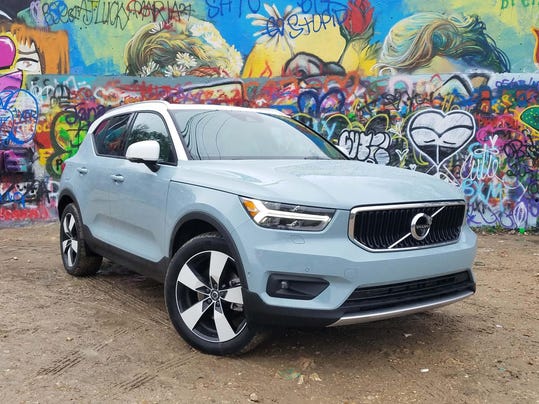
The Volvo XC40 is owned by Chinese automaker Geely, designed in Sweden and built in Belgium.
And it’s made for America.
Volvo’s first subcompact ute ain’t so compact. It’s the biggest subcompact in the luxury aisle with more storage space than a roll-top desk. Americans live large in their cars and the XC40 is a rolling habitat.
Volvos have always been furniture on wheels with their crafted Scandinavian wood surfaces and plush chairs. The XC40 is all that and utilitarian, too. The entry-level Volvo is the unmistakable descendent of the fancy-pants, midsize XC90 and compact XC60 with its “Thor’s hammer” headlights, vertical iPad screen and fortress of safety features.
But this Swede has a personality all its own.
After all, this XC isn’t riding up to the usual cocktail-sipping party-valet counter. It’s mixing with a new crowd of potential Volvo consumers — hip youngsters and old hipsters looking for something that stands out in the crowded Whole Foods parking lot. These are buyers who prefer to spend time behind the wheels of a Mini Cooper Clubman, or funky Nissan Murano or edgy Ford Edge than in the back seat of an $80,000 land yacht.
My funkadelic Amazon Blue XC40 with white roof and Hot Wheels wants to be noticed.
I spent a day with the XC in Austin, which is basically the Texas version of Ann Arbor. Only bigger. The Volvo fit right in among Austin’s music bar-lined streets, University of Texas campus and urban tech vibe.
Exterior designer Anders Gunnarson had Mini Cooper in mind when his Swedish team designed the white-top Volvo.
“It’s different. It gives the car youthful proportion,” he said pacing around the car. “It’s charismatic like a Mini Cooper, and gives it it’s own personality — different from its big brothers.”
Gunnarson has a nickname for his charismatic creation: “Tough little robot.”
A properly elegant XC90 or S90 sedan would be horrified if you called them a “robot.” But it fits the XC40. The car, the first on Volvo’s small-car CMA platform (short for Compact Modular Architecture) carries the Volvo signature design themes of Thor’s hammer headlights, rectangular grille and boomerang taillights.
Everything else is different, quirky.
The front grille has been scalloped, as if Gunnarson carved it out with a giant ice cream scooper. The rocker panels are dimpled. The three-dimensional tailgate is so expressive that Gunnarson moved the license plate to the lower bumper so as not to distract from it.
Oh, and that roof. It’s supported by a flying buttress-style C-pillar so large it looks like it was stolen from Notre-Dame Cathedral. Or Toyota’s own subcompact funk-mobile, the C-HR. I love it, though it creates a driver blind spot bigger than Kansas.
All this drama got the attention of Ato Musa, a Kenya-born clothing designer living the dream in downtown Austin. He drives a Mercedes E-class for its elegance and — naturally — its handsome interior materials.
He couldn’t take his eyes off my loaded $44,000 XC40 T5 Momentum (the T5 gets a 248-horsepower turbo-4, the T4 gets a 187-horse turbo-4). As I watched him shoot pics in his custom three-piece suit, I imagined he would probably forgo the punk white roof for a more conservative black top offered with the R-Design trim. Either way, it was the interior that really moved him.
The appointments are singularly Volvo with standard digital cockpit, huge 8-inch tablet screen (just like its big brother, the $60,000 XC90), soft-touch dash, aluminum dash accents, leather seats, floor carpet lapping all the way up to the console and felt door-liners made from 97 percent recycled water bottles (that’s the ol’ greenie Volvo I know).
Choose the interior in black leather and lava-orange carpet/felt, and you’ll be invited to every party in town.
Then there’s the storage. It. Is. Everywhere. A healthy center-console storage container — designer Gunnarson calls it a “fishbox,” which I think is Swedish for tackle box — included a deep, removable trash bin which I wish every car had for tossing tissues, candy wrappers and all that rubbage (Gunnarson’s term again) that you have to toss into the door side pockets in other cars because there’s no proper place to put it. I once rented a car where someone had stuck their used bubble gum under the dash. Ugh.
In front of the fish box are two cup holders, two USB ports and a trough for phones, change, etc.
Speaking of side pockets, the XC40 has extended them the length of the door by moving the base speakers to the top of the dash. My laptop fit easily in the side pocket. Plus mouse. And a water bottle.
I’m just warming up. A clever hook flips out from the glove box to hang everything from a purse to plastic grocery bags.
The rear seat will easily stow my 6-foot-5-inch frame. The XC40 sports the best rear legroom in a class in which this is usually an afterthought. In fact, the Volvo’s room and cargo space compare favorably to more expensive compact utes like the Alfa Stelvio and similarly priced Buick Envision while besting them in interior finish. The rear passengers not only get center cup storage, but their very own storage trays at each seat corner.
The cargo hold is more versatile than a Swiss Army knife with more flip-out grocery bag hangers, a hinged floor that folds up to keep loose groceries in place, and — voila!— a subfloor where you can store that bulky cargo blind when it’s not in use.
The giant rear c-pillar makes the second row a dark hole, so opt for the panoramic sunroof so the sun can shine in.
So brimming with self-confidence is the XC40 that its 2.0-liter turbo-4 even beats its BMW X1 and Audi Q3 competitors in horsepower with 248 ponies. Only the pricey Jaguar E-PACE R-Dynamic bests it in segment.
Just don’t ask the Volvo to keep up with those athletes in the twisties. The Volvo’s fun factor ends when you flog it hard, as the e-steering goes numb and the big chassis feels like it’s floating above the road. So, if it’s handling you want, buy the x-citing X1 which also rivals the XC40 in roominess.
But if you want a tough little robot with the best living quarters, then Volvo has you covered. With swagger and space, it’s a Swede with an American accent.
Henry Payne is auto critic for The Detroit News. Find him at hpayne@detroitnews.com or Twitter @HenryEPayne. Catch “Car Radio with Henry Payne” from noon-1 p.m. Saturdays on 910 AM Superstation.
2019 Volvo XC40
|
VEHICLE TYPE |
FRONT-ENGINE, FRONT- AND ALL-WHEEL DRIVE, FIVE-PASSENGER SUV |
|
Price |
$34,195 base ($44,315 AWD T5 Momentum; $45,935 T5 R-Design as tested) |
|
Power plant |
2.0-liter turbo-4 |
|
Power |
248 horsepower, 258 pound-feet of torque (187-horse turbo-4 coming later for base T4) |
|
Transmission |
8-speed automatic |
|
Performance |
0-60 mph, 6.2 seconds (mfr.); top speed: 140 mph |
|
Weight |
3,800 pounds (est.) |
|
Fuel economy |
TBA |
Report card
Highs: Versatile interior living space; loaded with standard features
Lows: Numb steering; all that carpeting could get soiled
Overall:★★★★
Review: Tesla Model 3 lives up to hype
Posted by hpayne on March 1, 2018

Correction: This review has been updated to reflect that the Tesla Model 3 keyless entry system responds to a digital key transmitted by Bluetooth from the car owner’s phone or by tapping a thin card on the car’s b-pillar. The system was incorrectly described. Also, the “Autosteer” feature cautions drivers to check mirrors for oncoming traffic before activating a lane change. The level of autonomy was incorrectly characterized. Finally, the characterization of the body panel fit as inconsistent has been restored from an earlier version.
Peering over the instrument-free dashboard, I threw the compact Tesla Model 3 into an M-10 cloverleaf. Its balanced rear-wheel drive chassis rotated easily, then — zot! — I bolted silently onto the freeway with instant electric-motor torque.
The “mini-Model S” is here, and it’s everything its iconic big brother is. And less.
Less, as in half the price. I spent a day around Metro Detroit driving one of the first customer-owned Model 3s delivered to Michigan. At a loaded, $59,000 ($35,000 base), the newest Tesla family sedan is considerably easier on the wallet than the $130,000 ($74,500 base) Model S sedans I have driven in recent years. Yet, in many ways, Model 3 is a more satisfying product.
Unless you’ve been living on Mars, you know the Model 3’s production launch has been a pickle — “production Hell” CEO Elon Musk calls it — as the young Silicon Valley automaker has struggled to get the assembly line moving for its mass-market EV with a range of 200-plus miles.
Musk’s bravado hasn’t helped. He boasted that Tesla would be turning out 5,000 vehicles a week by December 2017 (actual production: about 1,500 for the month). He took shots at legacy automakers, calling the pace of today’s manufacturing slower than“grandma with a walker.” Added Musk: “Why shouldn’t it at least be jogging speed?”
Critics have delighted as the most audacious auto entrepreneur since Henry Ford has struggled to get production up to a jog. But product will ultimately define Tesla — product that spurred an unprecedented 450,000-plus pre-orders from customers like me.
Take the much-ballyhooed issue of Tesla build-quality. Walking around this blue Model 3 tester, body panel fit is inconsistent. Gaps in the lid of the “frunk” — the front trunk — vary from nose to fender. An A-pillar seam is slightly misaligned. That doesn’t happen on, say, the similarly priced Audi RS3 I recently sampled.
I doubt owners will sweat such minutiae because the Model 3 is unlike anything they have driven. It’s the iPhone of autos.
Take that frunk: Luggage storage like that doesn’t exist on other cars except for the Porsche 911. But the 911 has a frunk in front because its engine is in back. With its battery-pack stowed under the floorboards, the Model 3 also has ample trunk-storage in the rear, augmented by bench seats that fold flat so you can pass through big toys like flat-screen TVs or skis.
The front cabin is as striking as the first iPhone you saw in 2007. The austere dash is uninterrupted by an instrument panel or butterfly-vent controls. Most controls are contained in a 15-inch, horizontal tablet that’s positioned high in the center console. Indeed, there’s not a single button in the cabin except for door openers and a federally mandated “emergency flasher” button in the ceiling. Glove box button? In the screen. Temperature controls? Screen. Radio? Screen.
Like a smartphone, the touchscreen uses a Google Maps interface for Tesla’s voice-activated navigation system. More responsive than the last Model S I tested, Google Maps loads quickly and responds to direct voice-commands — there are no multi-step navigation commands like most cars. “Navigate to Vinsetta Garage,” I barked after a sudden urge for mac and cheese. Done.
Only the mirrors and steering-wheel position are not controlled through the screen; they’re adjusted by two thumb-operated orbs on the steering wheel. If the iPhone redefined phone glass, then Tesla expands auto glass with an uncluttered front screen, full sunroof and easy rear-visibility.
I’m an advocate for cockpit-centered displays — Audi’s Virtual Cockpit is the best — but with key data like speed and range located in the tablet’s northwest quarter, the Tesla layout works OK. It would work better if complemented by a reflective heads-up display.
The simplicity of design and lack of console shifter (the right steering-wheel stalk controls the electric drive) means the center console is one big piece of furniture with multiple cubbies for storage. Battery location in the basement also opens more rear seat acreage for 6-foot-5 giraffes like me. I sat comfortably in the back seat with headroom to spare under the tinted glass roof.
The exterior is a sleek sportback-eggshell that — while not as elegant as the longer Model S — is distinctly Tesla.
Instead of keyless entry via a fob like the Model S (and other autos), the Model 3 responds to a digital key transmitted by Bluetooth from the owner’s phone. A thin card also grants entry if tapped on the b-pillar. Sensing the phone, the car unlocked as I approached, and then turned on when I slipped inside. Luke Skywalker would be impressed.
You’ll want to slip inside a lot because this Starfighter is a blast to drive.
My favorite compact sports sedan is the athletic Cadillac ATS. This 3,814-pound, 310-mile-range, 75-kWh Model 3 tester was every bit its match. Multiple Woodward stoplight launches (no Ludicrous mode here) yielded zero-60 times in the 5.2-second range (Motor Trend has recorded 4.8 seconds). The top-line 335-horse V-6 ATS? 5.6 seconds. The fat steering wheel feels rooted to the ground, the 113-inch wheelbase (the ATS has a 109-inch wheelbase, BMW 3-series measures 111) is balanced, the chassis flat as a board.
Flinging the Model 3 through 180-degree cloverleafs, I barely got a squawk from the Continental tires.
My tester came equipped with the latest version of Tesla’s self-driving Autopilot, which worked competently on I-696, though its turn-signal-activated, “Autosteer” lane-switch feature still not-so-autonomously cautions drivers to safely check the mirror for oncoming traffic first (impressively, sci-fi Telsa is constantly improving such features with over-the-air software updates). Most impressive is auto parallel-park: No hands — or feet — are needed.
As has been typical in my lead-footed Tesla Model S test drives, I took 44 miles off the battery for every 30 miles on the odometer. Under more civilized driving across Michigan and Ohio, my tester’s owner says he’s been able to average 305 miles on a full charge — not far off Tesla’s claimed 310 miles for the big-battery EV.
Only long-range Model 3s are currently being delivered — the standard-battery, 240-mile range $35,000 base-entry comes later this year. The wait isn’t getting any shorter — my projected August delivery is jogging four months behind schedule. But the mini-Model S lives up to the hype.
Tesla fighters: Volvo’s Polestar joins EV race
Posted by hpayne on February 23, 2018
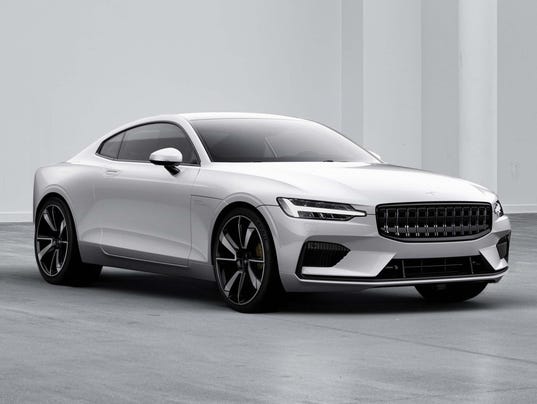
Here they come.
Spurred on by the success of American electric-car company Tesla, luxury European carmakers are bringing to market a wave of new battery-powered vehicles beginning this year.
Where other start-up companies like Lucid and Faraday Future have struggled to raise the capital to manufacture their sleek electric-vehicle dreams, established automakers like Jaguar, BMW, Porsche, Jaguar and Audi are pouring billions into new EVs. They will rival Tesla in performance, surpass it in initial build quality, and — perhaps most importantly — try to tempt buyers at a time when global governments are forcing the auto industry to go electric.
One of the boldest new entries is Polestar, an EV brand from Volvo.
Like Tesla wannabes Lucid and Faraday Future, Polestar has wowed the public with a jaw-dropping high-performance prototype. Unlike Lucid and Faraday, Polestar comes with the full backing of Volvo, an established Swedish maker with deep Chinese pockets behind it.
“Tesla is the leader in premium electric, but many other people are catching up to that party and there is going to be a lot of choice within it,” Polestar Communications chief J.B. Canton said in an interview. “We’re confident that what Polestar has in store is going to be right up there with the best of them.”
“Regulatory pressure is driving everything to electric vehicles,” says Canton. “Legislation is going that way — just look at China — and forcing R&D spending towards electrification that needed to happen anyway. Volvo feels a sense of corporate responsibility, and has made an emotional and moral commitment to push Polestar in that direction.”
What’s different, of course, is that Volvo is already a premium brand where Toyota, Hyundai and others invented premium brands to complement mainstream models. But Volvo believes the electric revolution is ripe for a new kind of luxury.
“So many other companies have launched … higher-margin products to appeal to more folks than their core-vehicle business,” says Canton. “With the world going to electric cars, it made sense for us to do it now. There is no premium nameplate already above the Volvo brand. So to go performance-electric and use the Polestar brand name … the timing was just right.”
Polestar’s first production car, the Polestar 1, will be a green beast.
All that grunt will come from a combined gas-electric plug-in powertrain, the only Polestar offered as a hybrid. After that, all models will be electric-only. After Polestar 1, a Polestar 2 and 3 will follow over two years, with the 2 offered as an entry-level, $45,000 EV.
Why a hybrid halo? “Outright performance, you can do more with both,” Canton said of a no-holds-barred exotic starting at $150,000.
Performance is key to the Polestar brand just as it defined Tesla — not as a slow granola-mobile, but as a zero-60 dragster that could smoke any muscle car out of a Woodward stoplight. The start-up brand gets its name from a familiar Volvo teammate, Polestar Racing. Long successful on the track (Polestar Volvos won Europe’s prestigious World Touring Car Championship in 2017), Polestar was brought in-house by Volvo in 2015 as a Volvo performance badge much like the Shelby moniker for Ford.
The Polestar 1 design shares Volvo family traits: “Thor’s hammer” LED headlights, C-clamp rear taillights, Scandinavian interior. And like the Toyota-Lexus creation, Polestars will share the same two platforms as Volvo cars and SUVs. The brand will explore new technologies like a continuously-controlled electronic suspension and twin-rear, torque-vectoring electric motors.
Like Tesla, Polestar will also pioneer new sales strategies. It’s looking at a subscription-ownership experience modeled on smartphones with customers turning in their Polestar for an upgraded model after two or three years.
“Ideally, all Polestars will be owned by subscription,” says Canton of a service called “Care by Volvo.”
Canton credits Tesla for spreading the EV gospel, but he expects the market to grow slowly. While Tesla’s Model 3 has roared out of the gates with more than 450,000 pre-orders, Volvo anticipates 1,000 sales a year for the exotic Polestar 1, with the cheaper Polestar 2 selling in the “tens-of-thousands globally.”
Echoing Chevrolet when it introduced its 200-mile-range Bolt EV opposite Tesla’s 200-mile r-nge Model 3, Volvo sees Polestar’s competitive advantage in manufacturing.
In a subtle shot at the Silicon Valley maker, Canton says, “Polestar is not redesigning the wheel. Volvo has these amazing platforms, they know how to build factories, they know how to build perfectly good cars with excellent quality control so we go to market with 100 years of developing cars behind us.”
Big and small, all EV brands will face the same challenge: how to capture more buyers. Sales of electrics and hybrids have stalled at less than 3 percent of the U.S. market.