- Search Cartoons
- Comic Archive
-
Payne
Store



 Henry Payne RSS

Articles
Revealed: 2024 Chevy Trax gains style and features, drops price and a cylinder
Posted by Talbot Payne on October 12, 2022
Buying a new car is a difficult experience these days with inventory scarce and average sticker prices pushing $50,000. It’s tough to find a bargain. Chevrolet hopes to buck the trend with its all-new, 2024, entry-level Trax SUV.
The new model debuts at $21,4951 — nearly a grand less than the current model — while offering more room, more tech, more safety, more style.
Taking styling cues from bigger brothers Blazer and Trailblazer, Trax gets an extreme makeover on the exterior while also adding a Trailblazer-like ACTIV trim. A perennial segment cost leader, the new Trax addresses criticism that it has lacked room and technology features compared to competitors like Honda and Nissan.
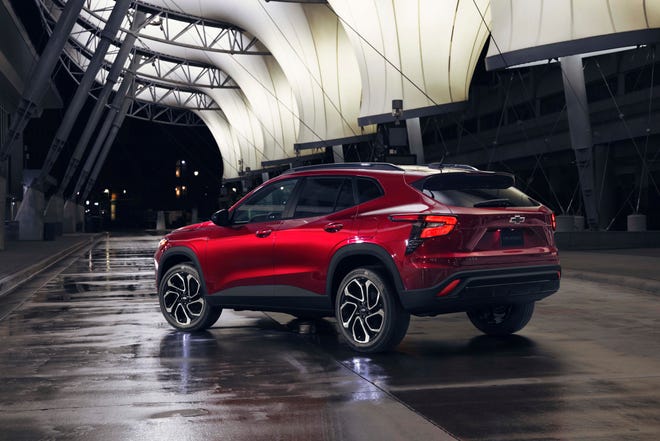
“The bold exterior and tech-forward interior design of the all-new Trax redefines what an entry-level vehicle can be,” said design chief Phil Zak. “It demonstrates that design doesn’t have to come at a premium.”
Reports of the Trax’s death after the 2022 model year proved premature. Trax continues as the brand’s entry vehicle in the preferred SUV segment, but Chevy also offers a starter Spark sedan at $14,595, one of the most affordable vehicles in autodom.
Along with the Buick Encore, Trax was a pioneer in the subcompact SUV segment in 2013, including a unique, flat-folding front seat that allowed passengers to use the entire length of the vehicle to carry oversize items like surfboards or lumber.
With its wheelbase stretched six inches longer than the outgoing model, the 2024 Trax gains significant interior room. Rear legroom grows by three inches — eclipsing the 37.7-inch rear legroom of the Honda HR-V, one of the segment’s roomiest rides. Cargo space increases by 12%, though it is still shy of the Honda.
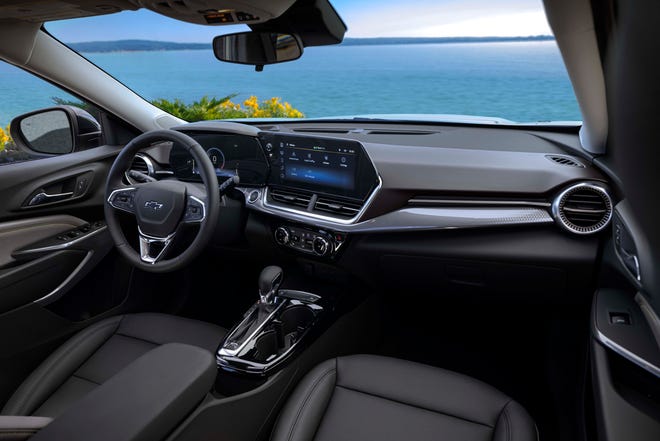
You get what you pay for, and Trax has traditionally undercut its rivals by skimping on standard equipment. The 2024 Trax won’t make adaptive cruise control standard, for example, while it is standard on the pricier HR-V and Mazda CX-30. But for the first time, the feature is available on Trax while the base LS model gains significant content.
Wireless Apple CarPlay and Android Auto for Google Maps navigation is now standard, as is push-button start and cruise control. Wireless smartphone apps have reduced the gap between mainstream and luxury cars, allowing riders to instantly transfer their phone’s navigation, contacts and text-messaging to their cars.
Other standard electronic advances in the Trax include an 8-inch touchscreen, automatic emergency braking, pedestrian braking, lane-keep assist, forward-collision alert and auto high beams.
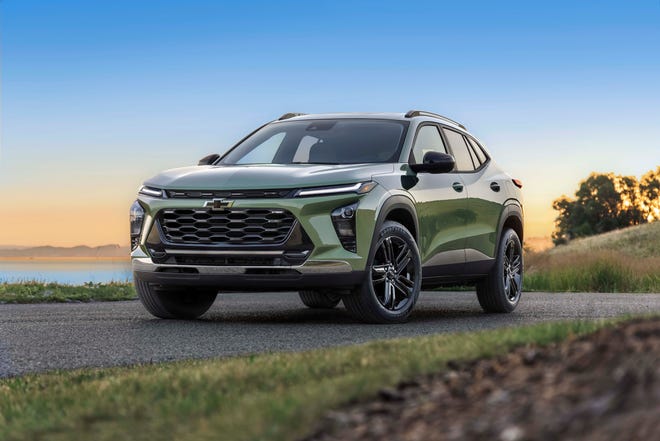
Work your way through the model lineup — 1RS, LT, 2RS — and Trax makes available more content like the aforementioned adaptive cruise control, blind-spot assist, sunroof, 11-inch touchscreen, 18-or-19 inch wheels. Step up to the loaded, adventure-styled ACTIV trim with heated front seats, heated steering wheel, heated outside mirrors, remote start, rear-seat USB ports and power-adjustable seats, and you’re paying the same $24,995 price as the stock HR-V.
Both interior and exterior designs follow upstream models. The infotainment screen is now higher in the driver’s view, forming a continuous dash sweep from the instrument display. The arrangement adds to an interior already praised by critics for its good visibility.
Reducing the price to compete with cost-leader Nissan Kicks also means reducing the number of cylinders and the Trax drops from a 155-horse, 1.3-liter turbo-4 cylinder engine to a mousey 138-horse, 1.2-liter turbo-3 powered by a six-speed automatic. Torque also drops from 177 to 163 pound feet, though the latter still trumps the HR-V’s 138 driven by a continuously-variable transmission.
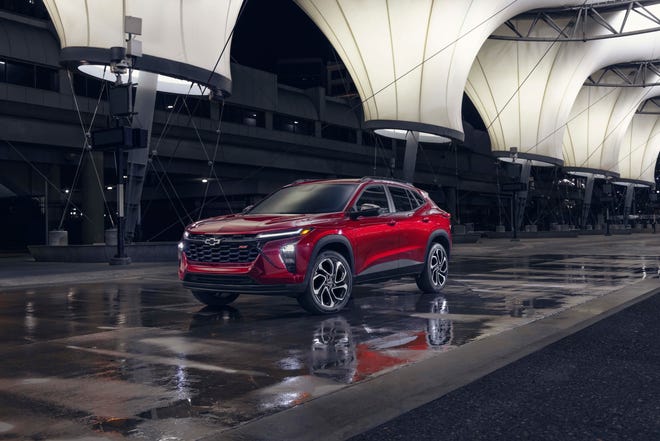
The Trax’s new interior digs are wrapped in an upgraded exterior that drops 4 inches in height for a leaner, more athletic stance.
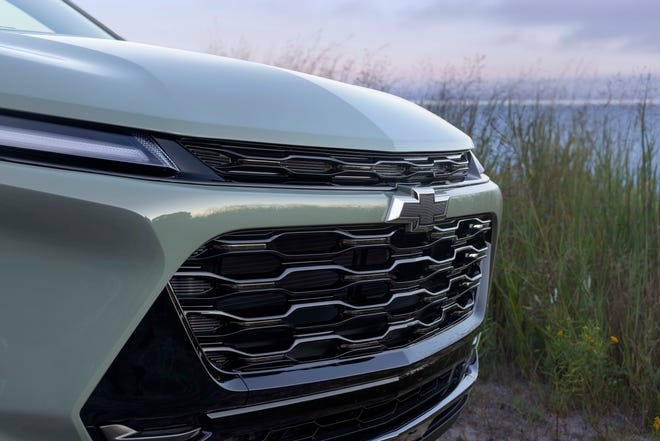
Gone is the blocky split grille, replaced by a more integrated shape anchored by thin, Blazer-like headlights. Each trim has unique grille and wheel design. The sporty-looking RS trims (1RS and 2RS) are particularly distinctive with black grilles and red RS badging.
Assembled in South Korea and Mexico, the 2024 Chevrolet Trax goes on sale in the spring of 2023.
2024 Chevy Trax pricing
LS — $21,4951RS — $23,195LT — $23,395 2RS — $24,995ACTIV — $24,995
Henry Payne is auto critic for The Detroit News. Find him at hpayne@detroitnews.com or Twitter @HenryEPayne.
Truck wars: GMC Sierra HD family gets beefier, techier, sexier
Posted by Talbot Payne on October 6, 2022
In the heavy duty pickup truck arms race, GMC has rolled out its latest weapon: the 2024 Sierra HD.
Surfing trends in these high-tech, high-performance times, the Sierra HD not only offers a raft of best-in-class claims but also sets a new bar for luxury. The mega-truck throws down the gauntlet on best-in-class towing, screen size, and trailering tech with 14 camera views and a slick feature that renders a gooseneck trailer invisible so the driver can monitor objects behind it.

Heavy duty capability commands big sticker prices and GMC’s premium brand claims 31% share of the over-$75,000 market. To sweeten the pot, Sierra is introducing two more premium models: the Denali Ultimate and AT4X.
The twin titans headline a lineup of that includes 2500HD and 3500HD models in Regular Cab, Extended Cab and Crew Cab configurations with dual-rear-wheel models — so-called duallys — available on the 3500HD. The trucks aim to satisfy customer demand for more diesel power, more interior technology, more stump-pulling capability across an expanded family of seven models.
“This truck elevates the HD segment with the introductions of the Denali Ultimate trim and will soon add the seriously off-road capable AT4X trim, further strengthening the dominance of the GMC truck portfolio,” said GMC vice president Duncan Aldred.
While GMC’s corporate parent, General Motors, is touting the transition of its brands to the Ultium battery platform in the next decade, Aldred said Sierra HD will be powered by diesel and gas technologies.
“This is not an EV,” said Aldred. “The Sierra Heavy Duty will become an EV in time, but it will be toward the end of the 2035 transition.”
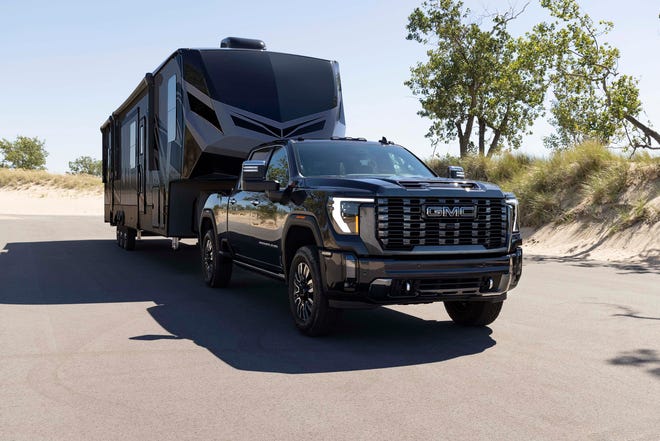
Towing tests from TFL Trucks with 6,000-pound trailers have shown range degradation of EV pickup trucks like the Ford Lightning of about 70% to less than 100 miles of range — a problem for long-distance hauls. While diesel and gas engines also suffer some range degradation, they offer better range and refueling infrastructure.
The Sierra will be powered by its tried-and-true, 6.6-liter Duramax turbo-diesel V-8 fed with more steroids to achieve an eye-popping 975 pound-feet- of torque — a 25% gain over the current model. Coupled with a 10-speed Allison transmission the Sierra HD makes 470 horsepower.
That added oomph will allow Sierra HD to clean-and-jerk a class best 21,900 pounds in 2500 HD Crew Cab trim. Spice the 3500HD, dually-rear-wheel pickup with a Duramax and it will tow 36,000 pounds. A 6.6-liter V-8 engine comes standard with 401 horsepower and 464 torque — and is now also paired with the Allision 10-speed for better power management.
While the Sierra HD flexes its muscle outside, passengers can travel in luxury inside.

The 2024 model — due on dealer lots early next year – gets major interior upgrades including 40 inches of digital dash screens. That expanse includes a best-in-class, 13.4-inch infotainment touchscreen.
Available touchscreen features include wireless Apple CarPlay and Android Auto connectivity and 14 camera views to better tow the 20,000-plus pounds out back.

While Sierra has long won raves for its premium styling and jaw-dropping rear MultiPro taigates, the towing ‘n’ tech upgrades are designed to close the gap to competitors from Ford and Ram.
“As good as they are, the (2022) Sierra 2500HD and 3500HD are outclassed by the Ford Super Duty and Ram HD,” writes Car and Driver of the current lineup. “The Sierra 2500 HD can tow up to 18,500 pounds and the 3500HD can haul up to 35,500 pounds, but those max ratings are eclipsed by rivals. What’s more, those competitors offer nicer interiors or more driver assists — or both.”
To address the latter concerns, Sierra HD also debuts new stitching and six new exterior colors (Titanium Rush Metallic, Sterling Metallic, Volcanic Red Tintcoat, Redwood Metallic, Meteorite Metallic and Downpour Metallic) while offering unique interior designs for the posh AT4X, Denali, and Denali Ultimate trims.
Denali is synonymous with GMC lux — accounting for 45% of HD sales — and the first-ever Denali Ultimate takes its refinement to the next level.
Standard with the Duramax under the hood, you’ll know the Denali Ultimate by its unique grille, Mount Denali fender badging, six-way, MultiPro tailgate, Alpine Umber interior, 16-way power seats, open-pore Paldao wood, power moonroof, 15-inch head-up display, and 12-speaker Bose audio system rolling along on 20-inch aluminum wheels with black accents.
“This truck could hold its own in the luxury sedan space,” smiled Aldred.
HD competitors have long headlined best-in-class tow ability, but — with the explosion in electronic gizmos over the last decade — best-in-class tech is also prized.

Sierra HD boasts the most trailer-assistance tech in class with a suite of available features designed to streamline the hitching-and-towing process. The headliner is an industry-first transparent trailer view for gooseneck trailoring so the driver can virtually “see through” the trailer.
Other features include blind-spot assist extended around the trailer, a warning if vehicle/trailer weight exceed its Gross Combined Weight Rating, and adaptive cruise control. Interestingly, the Sierra HD is not yet available with GM’s Super Cruise, hands-free drive assist.
For off-road enthusiasts who want to unhitch Sierra HD at the end of a long day of towing, there is the AT4X coming later in 2023. Armed with skid plates, meaty tires, and increased ground clearance, AT4X wants to play.
Assembled in Flint, Sierra HD’s pricing will be announced closer to the start of production.
Henry Payne is auto critic for The Detroit News. Find him at hpayne@detroitnews.com or Twitter @HenryEPayne.
Payne: S-class smackdown — Mercedes EQS EV vs. GLS SUV
Posted by Talbot Payne on October 6, 2022
Joliet, Illinois — Mercedes is the pinnacle of European luxury, and the S-class is the summit of Mercedes.
Big screens, big tech, big interior space — the S-class spares no expense to coddle its customers. For 2022, S-class offers a pair of models, the EQS 450 sedan and GLS 450, that try to capitalize on the latest trends in the U.S. luxury marketplace: electric cars and SUVs.
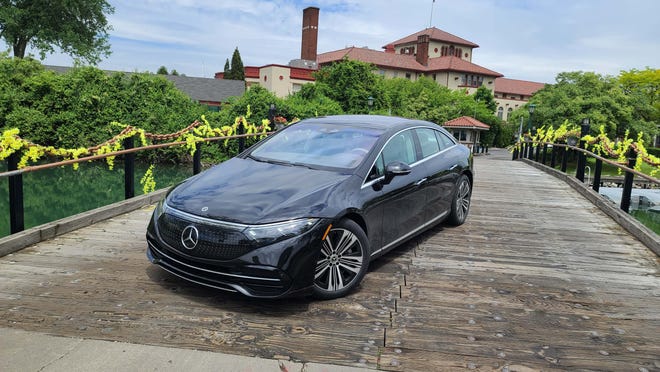
The EQS is a sleek showpiece of Mercedes technology with a screen the size of The Henry Ford’s IMAX theater and power delivery as smooth as water. But with limited range and two rows of seats, the $116,300 EQS indicates why EVs are a niche market compared to the market domination of three-row, gas-powered SUVs like the mighty, $94,230 GLS450.
With a big family weekend of racing, dining and sightseeing ahead in Chicago, Mrs. Payne and I loaded up the GLS 450. Stretched across a 123-inch wheelbase and measuring 17 feet long, the GLS is about the same size as its EQS EV sibling. But if I had an EQS in the garage, I would still want a GLS for road trips.
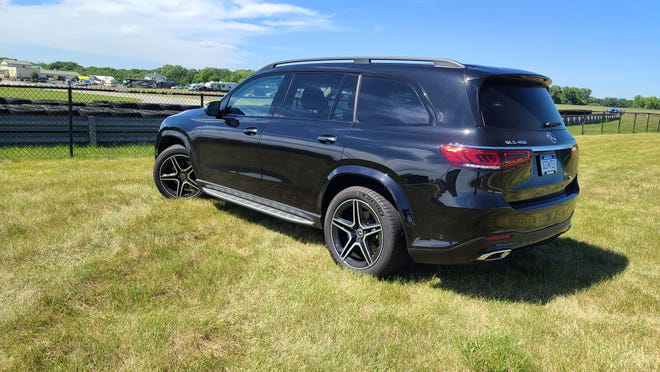
It’s not just that the Merc SUV offers a roomy third row essential for our six-person Payne family of three guys and their best gals. The GLS boasts 571 miles of highway range compared to the EQS’s 350 — and when your weekend itinerary includes a tight schedule, meeting four people at O’Hare airport and more than 800 miles of travel from Detroit to Joliet to downtown Chicago, you don’t want to be spending 30 minutes at chargers in Walmart parking lots to add 245 miles of electrons to the EQS (the EV’s 400-volt architecture can gain 70% of charge — about 245 miles — in a half hour).
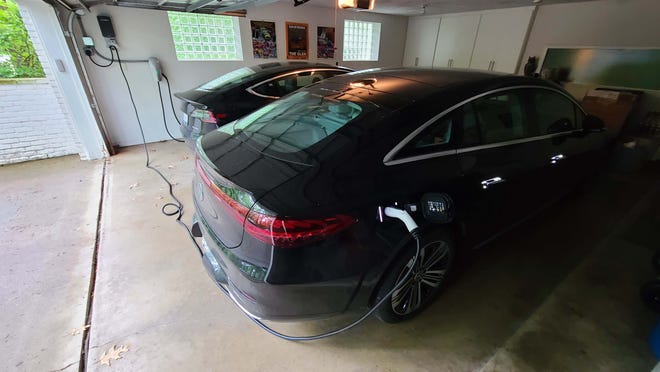
The GLS? I barely gave fuel a thought — filling it only once for five minutes on the way back to Detroit on I-94.
It’s popular these days to say: “Just wait until the federal government builds out a charging infrastructure.” Regardless of your confidence that the feds can efficiently build anything, the problem with EVs is more uncertainty than charger unavailability.
Weather and speed are big variables that make long trips in EVs a nervy affair. I traveled at 80 mph to O’Hare in the GLS — a speed that would have degraded EQS’s range by 20% (if experience in Tesla, Porsche and Hyundai EVs is any guide). There was also the threat of heavy downpours — Lake Michigan’s ecosystem is always unpredictable — which can cause 40% range loss in EVs.
Anticipating such challenges, my EQS tester is designed for efficiency with one of the cleanest skins in the industry. This thing is a bar of soap.
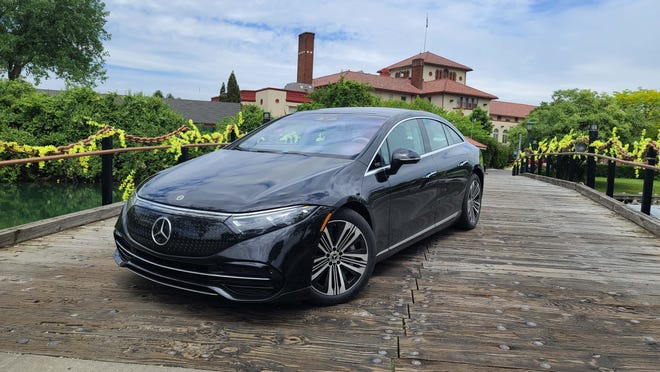
Its 0.20 drag coefficient bests the Tesla Model S and Lucid Air, but results in diminishing the design detail of its flamboyant, gas-powered predecessors. So determined was Merc to hit its drag coefficient target that it sacrificed its frunk — robbing the Merc of a feature prized by EV buyers.
GLS is no looker either with its big, boxy three-row SUV proportions. Yeah, there’s the signature muscular rear hips and the big star logo up front. But painted black, it melted into the schools of big SUVs on the road. My wife would consistently confuse it in the hotel parking lot for a BMW or big Infiniti SUV. Ouch.
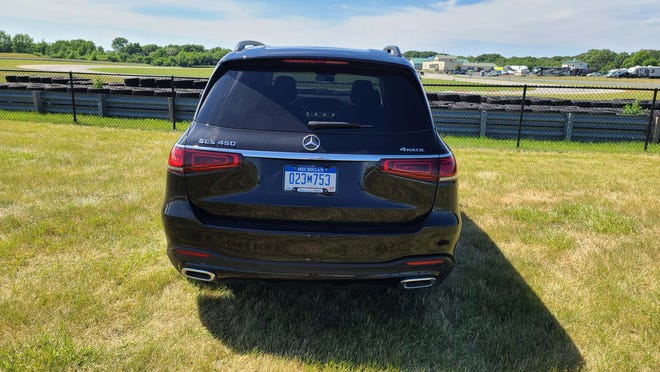
So despite carrying stiff price tags, my EQS and GLA testers were unassuming from the outside. The interiors are a different matter.
EQS sports a stunning 56-inch screen that is really three screens in one — 12.3-inch instrument display, 17.7-inch console display, and another 12.3-inch display for the passenger. The latter is a treat for occupants who want to control their own space. My son’s mother-in-law settled into a relaxing Metro Detroit journey by finding her favorite seat massage in the screen.
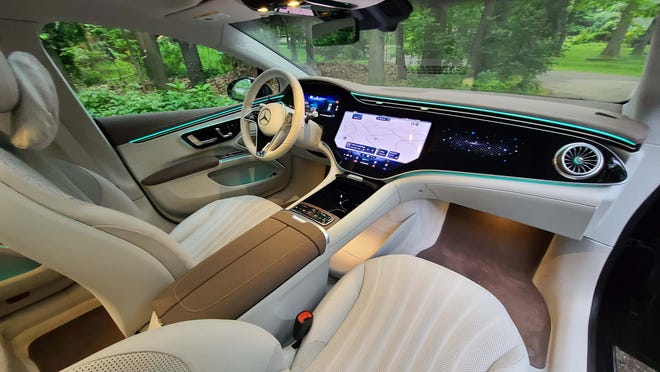
The GLS’s more familiar twin-dash screen can’t compete with the EQS in size and speed, but it is plenty useful as Merc has perfected a system of integrated graphics, swipe screens and steering-wheel mouse pads (yes, you read that right) so you can find just what you want in the system. The EQS also dazzled with Merc’s latest self-driving software — its lane-centering and auto-lane changing more Tesla-like than the GLS, which gave me some white hairs as I self-drove through Chicago on I-90.
Aft of the front thrones, however, the GLS was much more desirable than the EQS. The big ute not only fit my family of six comfortably for our trip into Chicago for dinner — but its second-row captain’s chairs were first-class seating, with the ability to adjust forward/back to accommodate the third-row behind.
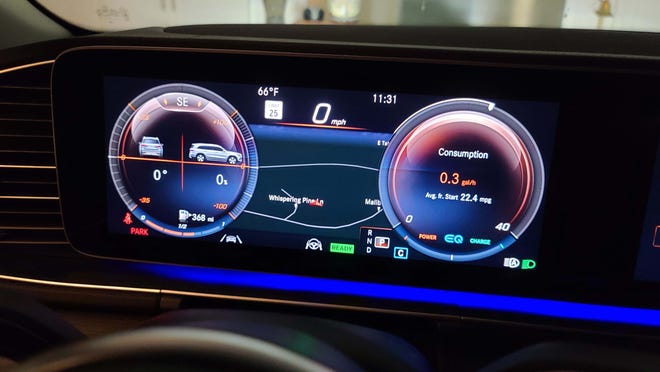
The EQS has rear-seat options, but they weren’t on my $116K tester, which featured utilitarian bench seats with standard-issue armrest and cupholders that folded down from the seatback.
Both EQS and GLS boast more than 300 horsepower, but the EQS comes on liquid smooth as we’ve come to expect from big EVs. But like its rear seat, the EQS complicates its claim to magic carpet smoothness with a rough ride over bumps. Crossing a Telegraph Road intersection, for example, EQS would bounce along — hitting the shock bump stops. Oof.
The GLS actually adopts an EQS gauge on its instrument display — to claim the green moral high ground with a 48-volt battery on board that smooths shifts from its 9-speed transmission. And its air suspension did yeoman’s work in smoothing the two-story-tall vehicle’s ride.
Autobahn Raceway, where my sons and I were competing in Lola sports racers, doubles as an auto country club (think a golf club but with a track in the middle) and allows members and guests to take their vehicles on the track at lunch hour.
I took the GLS on track to show the extended family around the course — in line behind a pace car and a who’s who of performance cars, including a Porsche 911, CT4-V Blackwing, BMW M3 and Corvette C8.
With SPORT mode engaged and air suspension managing the elephant’s girth, I had a blast squealing the tires and stomping the accelerator pedal out of turns. It’s an elephant in tennis shoes.
It’s also an elephant that doesn’t mind burning up fuel on such spontaneous activities — because gas infrastructure is always nearby. A similar track diversion in the EQS would have sucked valuable range, which would have made for another headache as we contemplated getting home on Sunday.
Buy the EQS to show off at the country club, buy the GLS if you need an all-around workhorse.
2022 Mercedes GLS450 4Matic
Vehicle type: All-wheel drive, seven-passenger SUV
Price: $78,900, including $1,050 destination charge ($94,230 as tested)
Powerplant: 3.0-liter turbocharged inline-6 cylinder
Power: 362 horsepower, 369 pound-feet of torque
Transmission: 9-speed automatic
Performance: 0-60 mph, 5.9 seconds (mfr.); towing capacity, 7,700 pounds
Weight: 5,412 pounds
Fuel economy: EPA 19 mpg city/23 highway/21 combined; Highway range, 570 miles
Report card
Highs: Seating for six, long-range utility
Lows: A gen behind EQS in some tech; boxy design
Overall: 4 stars
2022 Mercedes EQS 450+
Vehicle type: Battery-powered rear-wheel-drive, five-passenger sedan
Price: $105,450 including $1,050 destination fee ($116,304 450+ Premium as tested)
Powerplant: 107.8 kWh lithium-ion battery with rear electric-motor
Power: 329 horsepower, 417 pound-feet torque
Transmission: Single-speed direct drive
Performance: 0-60 mph, 5.8 seconds (mfr.); top speed, 130 mph
Weight: 5,597 pounds
Fuel economy: EPA 97 MPGe; range, 350 miles
Report card
Highs: Smooth ride; interior from the gods
Lows: Uninspired looks, jouncy suspension over bumps
Overall: 3 stars
Henry Payne is auto critic for The Detroit News. Find him at hpayne@detroitnews.com or Twitter @HenryEPayne
For new-car buyers in a tight market, the waiting is the hardest part
Posted by Talbot Payne on October 4, 2022
Detroit — Bruce Gorman of Livonia wanted a new 2022 Chevy Equinox. But when he took his aging, 2010 Chrysler Sebring into Serra Chevrolet on Telegraph for a trade-in last December, he was met by a surprise.“There was nothing on the lot,” the 66-year-old said. “They thought that Chevy might be building more by mid-February, so they said to check in the first of March.”
A couple of weeks later, his salesperson called to say that his car had arrived — and the $28,000 Equinox LT was blue after all.
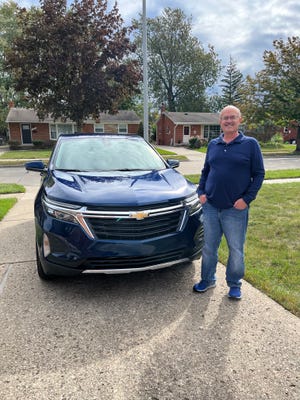
“I love it. It has push-button start, auto-lock, auto-high beams, adaptive-cruise-control, and blind spot-assist,” said Gorman, ticking off some of the electronic advancements that have revolutionized autos in the decade since he bought his Sebring. “(The Chevy) is lacking heated front seats, though. They never got the chips for that.”
On the plus side, Gorman said Serra kept him informed every step of the way — honoring the Equinox’s sticker price, minus a discount for those missing seat-heating chips.
If you’re in the market for a new vehicle, Gorman’s story may sound all too familiar as inventory shortages have frustrated would-be buyers. In a post-COVID market with high demand, supply is constrained by the continuing semiconductor shortage and disruptions in countries like China and Malaysia, which are key component suppliers. Manufacturing states like Michigan are awash in new vehicles sitting on lots waiting for chips.
A modern vehicle may have 900 to 1,200 different semiconductor chips — distributed across 100 electronics modules — to run everything from heated seats to an engine’s fuel injection system. They vary in cost and functionality and are produced across a multi-national supply chain that can include Taiwan, Korea, the United States, China and Malaysia — the latter pair creating significant uncertainty with COVID shutdowns in the last two years. The rush to electronics-heavy EVs will likely only increase the demand for chips.
“Not all vehicles are treated equally. Manufacturers are prioritizing high-margin vehicles and EVs at a time that they are making big investments in battery plants,” said Sam Abuelsamid, principle auto analyst for Guidehouse Insights. “Automakers need the cash flow to do build these plants, so they are building the high-margin vehicles they need to get cash now to fund future EV investments.”
To complicate matters, the shortage comes as the federal government is forcing automakers to transition to costly electric vehicles. To pay for the transition, automakers are shrinking the number of affordable, sub-$30,000 cars they sell and emphasizing new, more expensive models of, for example, high-margin pickups. This perfect storm of factors ballooned the average sticker price in July to an all-time high of $48,000, according to Kelley Blue Book — up from an average of $38,000 just two years ago.
For example, CEO Jim Farley indicated in April that Ford Motor Co. is prioritizing its chip supply for Ford F-150 Lightning EV pickups, which can sell for more than $90,000.
Abuelsamid said chip supplies should start to return to normal in the middle of next year. But Intel CEO Pat Gelsinger told CNBC’s TechCheck in May not to expect an end to shortages until 2024.
Either way, that means more long waits for customers like Mary Schelske of Bloomfield Hills. Her three-year lease ran out on her 2019 Ford Edge in December, but her dealer, North Brothers Ford, had no ‘22 Edges to replace it with.
“They said they couldn’t get me a car until April,” she said. April turned into June. “I kept calling and they kept trying to find me a car. I thought about buying out the lease because the market value of cars has been rising, but Ford waived the lease mileage limit so I could keep driving my Edge until they found a new one.”
Her Edge arrived in June and North Brothers not only waived the extra miles on the old car but gave her the same lease price — $420 a month — on the new one.
Ford’s best-selling SUV, the Escape, is also in short supply. Like Schelske, Lucian Bela of West Bloomfield Township got an extension on his lease after it ended in March — extra mileage waived — until a new one arrived in July. But Anne Ryan, 71, of Grosse Pointe, took advantage of a buyout on her 2019 Escape lease.
With the market desperate for Escapes, Ryan began shopping used car sites like Carvana to see if she could get a sweet price if she bought out the lease on her Escape. Her Ford dealer went one step better, saving her the paperwork headaches by offering $6,000 toward her Escape trade-in. She took the deal, then used it to step up to Ford’s luxury division — leasing a Lincoln Corsair for about the same , three-year, $400-a-month price as her old Escape.
“I deserved it,” she said with a smile.
None of the customers The News talked with considered an EV for their new car, even as the industry is prioritizing those vehicles.
“An EV makes no sense for me,” Ryan said. “I have a business I travel to Up North. … The charging takes too long and there’s no infrastructure up there. My Corsair has 470 miles of range. I can nearly make the round trip on one tank.”
Though Ryan took immediate delivery on her Lincoln, luxury brands are not immune from the inventory crisis.
Carla and John Libbe’s Audi Q5 was hit by a deer on M-115 near Cadillac, totaling the car. Carla suffered a fractured sternum, caused by the air bag deployment. While she healed, they went to her dealer for a replacement.
But Audi Birmingham had nothing on the lot. The wait for a new Q5? Six months.
The Libbes decided to shop for a Range Rover Velar, one of the SUVs on the market that had caught Carla’s eye. But Range Rover supply was no better than Audi. “We would have to wait 6-8 months for new Velar due to the chip shortage,” John said.
They cast a wider Midwest net and found a Velar at Land Rover of Westside in Cleveland that had been abandoned by its would-be buyer. It was the exact trim Carla wanted for a price of $69,285; they picked it up in mid-February.
“We just got lucky,” said John.
Paul Waatti, industry analysis manager for AutoPacific, notes that nearly all automakers have scaled back production estimates, even the Volkswagen Group (which makes Carla’s former Audi Q5) and Toyota, the large global automakers.
“VW has called the dismal supply chain and chip shortage the ‘new normal,’” Waatti said. “Automakers continue to prioritize more profitable models like trucks and other high-volume segments at the upper end of the market but inventory will remain at historically low levels even for those vehicles.”
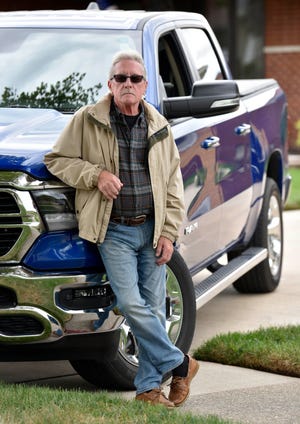
Take Steve Light of Sterling Heights, who recently shopped for a Ram pickup.
Light has leased four Ram 1500 Big Horns since 2013 without a hiccup, but when his current 36-month lease was up this year, he faced a wait of four to six weeks for a new one and a lease payment jumping from $340 a month to $450.
Concerned that the wait for a new truck would exceed six weeks — and aware his Big Horn model was trading in the used market for $38,000 — Light paid the $30,000 buyout on offer from the dealer when he signed the lease in 2019.
“The consumer suffers two-fold as not only is there limited inventory, but also many of the vehicles that are available are being marked up as dealers are trying to squeeze profit wherever they can to make up for fewer sales than normal,” analyst Waatti said. “That is affecting the used car market, as even those are flying off the shelf in record time with inflated prices.”
Cynasure Ross of Pontiac knows that first-hand. She purchased a used 2011 Hyundai Sonata Limited this summer. But it wasn’t easy.
Under a strict budget of $12,000, she had a hard time finding anything in Michigan that matched her desired trim. “Some listings had taken deposits the day after they were posted and before I could get to them,” she said.
She continued to cast a wide net beyond the state. After about 30 days of shopping, she located the Sonata she wanted — for the price she wanted — from Team Automotive in Ohio. She sent in her deposit, had the car inspected and delivered.
As chip delays continue, Giudehouse’s Abuelsamid recommends that buyers adapt: “If you need a new car to buy or lease, start planning ahead as early as you can so you are guaranteed to get it when you need it.”
Henry Payne is auto critic for The Detroit News. Find him at hpayne@detroitnews.com or Twitter @HenryEPayne.
Payne: Hot hatch Hyundai Kona N-line is more show than go
Posted by Talbot Payne on October 4, 2022
BMW makes an M-azing, M-asterful M3 sports sedan with gobs of horsepower, tires made from Superglue and a taut suspension. It’ll also cost you an M-azing 80 grand. For those who don’t need the full magilla, there’s the BMW M-line which offers M3-like style but without the nuclear power plant under the hood. M style without the M-egaprice.
The Hyundai Kona has decided to get in on the act.
Right next door in the alphabet, the Kona N offers a fire-spitting hot hatch with a loud 286 horsepower, stiff springs, $35K sticker price and N-grin launch control that’ll crush your spine into the seat on its way to 4.9-second zero-60 launches. Sound like fun? No?
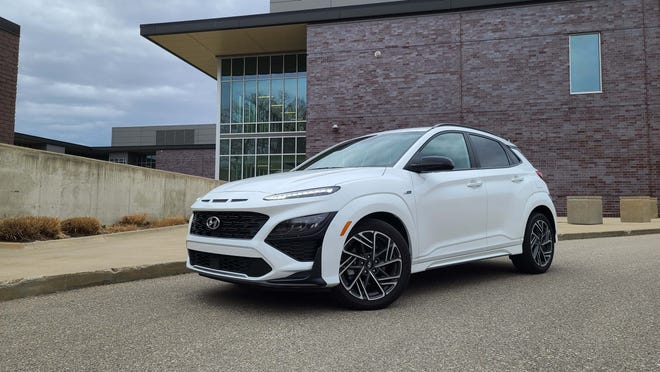
Then the Kona N-line might be your cup of Kia with all the N’s styling cues and just enough horsepower — 195 — to make it interesting. Heck, it almost fooled me when I picked my tester up at the airport on a cold April evening.
Lots of black mascara like the Kona N. Signature three-slot hood like the N. Rear diffuser, hot wheels, cladded rocker panels, red-trim and N-embossed sport seats. Just like the N. N-ice.
The N comparisons stop when you put your boot in it.
VROOOOM-NAHHHH, I don’t think so. Despite an upscale, dual-clutch transmission hooked up to the four-banger under the hood, the engine lacks urgency. I confined my enthusiastic driving to 90-degree turns where the N-line rotated nicely before setting off for … the autocross course? No, the grocery. There the Kona showed off its hatchback utility.

However, for a stiff $31K, the N-line made my mind wander to the $20,995 Elantra in the Hyundai aisle. You want affordable style?
At a whopping $10K south of Kona, the Elantra is a much more head-turning vehicle and is loaded with more modern amenities. I’m talkin’ standard wireless Apple CarPlay/Android Auto, blind-spot assist, and auto tranny. And Elantra has its own N-line for 2022 that uses the same turbo-4 as Kona N, and is $1,400 less than the Kona. Uh-oh.

They say Americans don’t like sedans, but the Elantra has significantly more rear legroom for basketball players like me, and that trunk — well, it’s not a hatchback but it will swallow plenty of groceries.
And don’t get me started on hot hatches like the VW Golf GTI, which starts at a similar price to the N-line and will run rings around it in the fun department while delivering better utility.

If SUV it must be, however, then Kona N-line is easy to learn with its tablet screen, useful knobs and digital displays. SPORT mode turns the instrument display red to match your blood temperature. All-wheel drive is a useful feature in the winter months, and the Elantra is just a front-wheel driver. And then there’s that 100,000-mile Hyundai drivetrain warranty, always comforting to buyers on a budget.
Hyundai has hardly been shy with designs. The Elantra and Tucson are unlike anything else on the market and the three-door Veloster has been a joyful addition to my favorite segment, the hot hatch.
Expect the Kona N-line to take over the lovable-if-quirky three-door Veloster’s mantle, given its more accessible four-door setup. That accessibility should mean better sales numbers for the Kona N as well, which in turn will lead more folks to the more accessible N-line. You can see where product planners are going with all this.

With its funky wardrobe, the N-line is worth a walkaround in the parking lot. The menacing slit running lights draw you in, then you notice the headlights at mid-fascia. The bulging fenders look like biceps honed in the gym. The twin tailpipes look like a double barrel shotgun out back. N-teresting.
And with the money you save getting 29 mpg in the 1.6-liter turbo-4 … well, one of these days you might be tempted by a full-blown N so you can go harass those smug BMW Ms.
2022 Hyundai Kona N-line
Vehicle type: All-wheel-drive five-passenger SUV
Price: $28,425, including $1,245 destination charge
Powerplant: 1.6-liter turbocharged inline-4 cylinder
Power: 195 horsepower, 195 pound-feet of torque
Transmission: 7-speed dual-clutch automatic
Performance: 0-60 mph, 7.3 seconds (Car and Driver); top speed, 130 mph
Weight: 3,287 pounds
Fuel economy: EPA 27 mpg city/32 highway/29 combined (AWD as tested)
Report card
Highs: Stylish looks, upscale interior
Lows: Engine lacks pep; lacks value compared to competitors
Overall: 3 stars
Henry Payne is auto critic for The Detroit News. Find him at hpayne@detroitnews.com or Twitter @HenryEPayne
Payne: Preview from the driver’s seat at American Speed Festival
Posted by Talbot Payne on October 4, 2022
Pontiac — Coming hard out of Champion Motor Speedway’s Turn 9 in third gear, I dance my 1966 Porsche 906E around the long Turn 10 sweeper. It’s test day for the Second Annual American Speed Festival at M1 Concourse, and come Saturday, hundreds of spectators will be lining the guardrails here when I will be on track again with other historic sports cars.
The fall auto shows just keep coming. On the heels of the Detroit auto show, Detroit 4fest and Concours d’ Elegance, the American Speed Festival comes to town Thursday through Sunday.

What makes ASF special is not just the opportunity to see some of the most historic race cars ever made — but the opportunity to see them at speed in their natural habitat: a race track. M1 is Metro Detroit’s premier enthusiast auto club with a 1.5-mile race track sharing 87 acres with private garages.
My 906E has been invited to the show along with dozens of other significant racers from NASCAR, IndyCar and sportscar racing — including Carroll Shelby’s legendary Cobras, which will be the featured marque this year celebrating Shelby America’s 60th anniversary. About two-dozen Cobras will be on display, including gems like the 1965 Cobra Daytona Coupe, 1964 Shelby Cobra 289 Hard Top Coupe, 1990 Shelby Aurora Can Am and the Cobra 289 used in the 2019 box office hit “Ford v Ferrari.” Shelby Club Parade Laps will take place from 11:55 a.m.-12:45 p.m. Saturday.

Other notables include Al Unser Jr.’s 1986 Lola T8600, his uncle Bobby Unser’s 1972 Olsonite Eagle, the turbine-engine 1968 STP Lotus, Alberto Ascori’s 1952 Ferrari 375, a 2004 Ferrari Enzo and a 2021 Ferrari Monza SP1. The Ferrari entries celebrate of 75 years of the Italian brand with Ferrari Club Parade Laps from 12:25–1:30 p.m. Friday.
There will also be a contingent of vintage go-kart racers and the V8-powered 1988 Fabcar IMSA prototype owned by David Nikolas, racer and owner of Pontiac’s Nikolas Motorsport.
On test day, I found myself sharing track time with the go-karts and the lightning-quick Fabcar. The latter was based on a Porsche 962 — then updated with a more modern rocker suspension and small-block Chevy V-8.
When Nikolas fired up his V-8 next to my mid-engine Porsche, the earth shook — and I couldn’t hear my 2.0-liter flat-6 engine even though it was directly behind my ears. A racing V-8 is a sight to see — and hear.
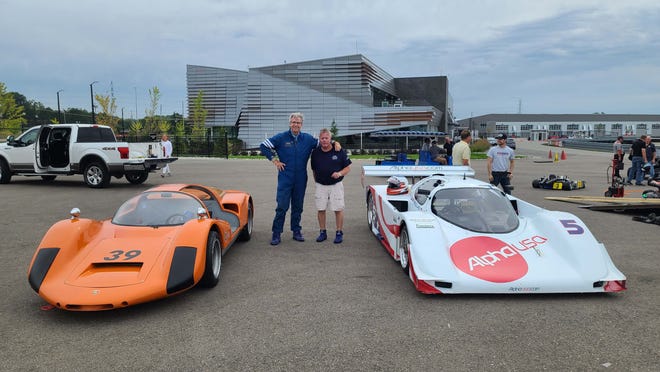
Each year, ASF awards a Master of Motorsports and this year’s headliner is legendary designer Peter Brock, who made his mark as a young Shelby America designer. A racing fanatic, Brock left General Motors in 1959 at the tender age of 21 to return to his native California. He was Shelby America’s first employee, and there he would design a stable of cars including the Shelby Daytona Cobra coupes that won the world sports car championship in 1965.
Brock will hold forth on his Shelby career Thursday and again Saturday at noon with driving ace David Hobbs. At noon Sunday, he’ll discuss his work on the Chevy Corvette and Brock Racing Enterprises — a racing design firm he started in 1965. Hobbs will also talk to Vintage Indy’s Mike Lashmett for Insiders’ Garage from noon-1 p.m. Friday.
Brock will receive his award at Saturday’s Checkered Flag Ball presented by McLaren Oakland. The event benefits M1’s philanthropic arm, the Checkered Flag Challenge, to address transportation challenges in Pontiac.
ASF kicks off Thursday with Drive & Dine, an intimate tour of Stahl’s private car collection followed by a sumptuous M1 dinner.
I get to take unleash my steed around M1’s track in the Endurance Sports Car class beginning Friday, when seven groups will be on display: Shelby/Cobra, Vintage Indy, Ferrari, Feature Race Cars, SuperCars, Endurance Sports Cars and Historic Go Karts. Track activities are from 9 a.m.-5 p.m. Friday and 8:30-4:30 p.m. Saturday.
On Friday evening, fans can hang around for the M1 Garage Reveal and enjoy rare tours of M1 garages from 6-9:30 p.m. — complete with hors d’ oeuvres.On Sunday, the track goes quiet (though guests can also take a ride in the right-hand seat of a hot car with a professional instructor) and a juried car show, Speed & Style Expo, takes the fore. Awards will be given in each car class plus an overall Best in Show honoree. The Art Expo showcases top automotive artists, including Nico Rousselet, Dave Chappel, Charles Maher, Alex Buchan, Steve Macy, John Baker, Robert Matthews, Garen Nicoghosian and Francois Bruere.
The weekend also includes live music by Vavoom, pedal/RC/slot cars for kids, food trucks and Carroll Shelby official licensed apparel.If you go
Tickets: $75 Friday/Saturday for 18 and older. Friday, 17 and under are free. Saturday ages 13-17 are $25 and 12 and under are free. Sunday is $50 for 18 and over and free for 17 and under. Tickets for the Drive & Dine Tour on Thursday are $200. Free parking is included with every ticket. Parking and shuttle buses are available at 2000 S. Opdyke Road.For more schedule details, go to: www.m1concourse.com/asf-overview.
Henry Payne is auto critic for The Detroit News. Find him at hpayne@detroitnews.com or Twitter @HenryEPayne.
Payne: Ogling Detroit auto show’s EVs and V-8s with Penske Indycar star Scott McLaughlin
Posted by Talbot Payne on September 23, 2022
Detroit – Even professional race car drivers get weak in the knees around the Corvette Z06.“That’s going to be mine when I win the Indy 500 next year,” smiled IndyCar star Scott McLaughlin, driver of the #3 Chevrolet for Team Penske, as he eyeballed Chevy’s mid-engine hellion. With a production-car record 670-horspower from its normally-aspirated V-8, the sports car is one of the highlights of this year’s show.

A week after the Detroit auto show opened with a presidential visit and media previews, the public portion of the show is abuzz with customers, musical entertainment and the occasional celebrity visitor. A native of Hamilton, New Zealand, McLaughlin’s visit put the “international” in North American International Auto Show in a year in which foreign automaker displays are scaled back from years past.
McLaughlin’s appearance also showcases the intersection between the Detroit automakers, global markets and motorsports. Chevy, for example, brought McLaughlin to the show floor to not only highlight the Detroit Grand Prix but also to understand the larger Chevy product lineup the brand promotes when its race cars win in front of millions of TV viewers.

The Kiwi is a natural ambassador for American muscle.
Unlike European drivers who grew up negotiating narrow city streets in wee, four-cylinder shoeboxes, Australia is a country with miles of open roads like America – and V8-powered American sedans to match. McLaughlin is a veteran of Australia’s biggest auto show in Melbourne.

“I craved V-8s as a kid. It’s hard not to. The national sport is the V-8 Supercars,” said the 29-year-old of the Ford Mustangs and Holden Commodores (similar to the late Chevy SS in this market) that are similar to NASCARs Down Under. In Australian Supercar, Team Penske waves the Ford Mustang flag, different from the Chevy IndyCar colors he flies here.
“That’s what I raced, and I grew up idolizing V-8 Supercars,” McLaughlin continued. “My Dad had a V-8, my mom had a V-8.”
McLaughlin’s dominance of the Supercar series in Australia – winning three titles from 2018-2020 – convinced Penske to bring the personable New Zealander stateside.

“This is the big leagues. I grew up idolizing America,” said McLaughlin. “Roger asks a lot of (his drivers). We promote the sport, we promote his brands, we promote his town. I wouldn’t want to drive for anyone else.”
Where Chevy made its reputation on American muscle, it is now joining the international market to go all-electric by 2035. For McLaughlin, that means getting familiar with the brand’s new EVs, which surround the Corvette display in Detroit. McLaughlin – just like other showgoers on the floor Wednesday – got an in-depth tour of the Silverado, Equinox and Blazer EVs and the Ultium battery chassis they ride on.

“Coming here as a Chevy driver, it’s been an awesome introduction into the GM family,” said McLaughlin. “To see the resources they put into their race cars and into their production cars is great.”
The push to electrification is not as pronounced in motor racing. McLaughlin’s Chevy-powered IndyCar will get battery assist in 2024 as a V6-powered hybrid. And the Corvette Z06 is based on the V8-powered C8.R race car that Chevrolet is, for the first time, selling to international race teams.
McLaughlin’s primary task here is selling tickets for the Detroit Grand Prix, which will return to downtown streets for the first time in more than 30 years next June. NAIAS planned to offer showgoers a tour of the new 1.7-mile track in Chevy Bolt EVs and Volkswagen ID.4s – but that hasn’t come to pass. Instead, visitors can get a brief ride in the vehicles on Atwater Street on Huntington Place’s riverfront.
McLaughlin did manage to take some laps of his own on the new circuit while in Detroit.

“On paper it doesn’t look very interesting, but then you get on track and see how wide it is and the monuments you pass like the Renaissance Center. It’s gonna’ be a really cool and unique race,” McLaughlin said of the circuit where IndyCars will approach 180 mph on Jefferson Avenue into the Griswold hairpin. “Chevy being a part of it and promoting it in the Motor City is really a big deal.”
After leaving downtown Wednesday afternoon, McLaughlin’s day continued with laps on a second track: GM’s Milford Proving Grounds out I-96. In a Corvette Z06.
“To get to drive a Z06 will be awesome,” he laughed. “I’ll get a taste of what I might own one day.”
Henry Payne is auto critic for The Detroit News. Find him at hpayne@detroitnews.com or Twitter @HenryEPayne.
Payne: New Honda HR-V is stylish, roomy and fun. Until you put your foot into it
Posted by Talbot Payne on September 23, 2022
Summit Point, W.Va. — Powered by a 1.5-liter Honda Fit engine, the F1600 class is one of my favorite open-wheel, so-called “Formula” racing classes. It’s a showcase for relentless wheel-to-wheel driving, some of the country’s best up-and-coming teenage drivers on the Road to Indy — and for Honda’s reliable engine technology.
Honda also makes a stylish small SUV that will get you to the track.
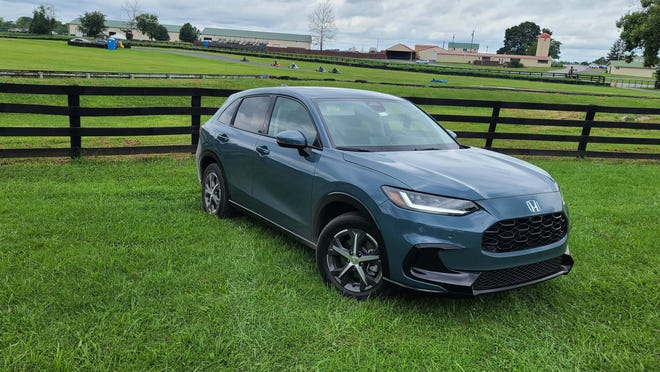
I picked up the Japanese brand’s newest entry-level, Mexican-built HR-V sport ute at Dulles Airport this summer to take my family to an F1600 race at Summit Point Raceway, one of the country’s most challenging regional racing circuits. I would also be racing my own Lola sports racer (powered by a Ford, not Honda, engine) in the Sports2000 series, which shared box office billing with the F1600s.
Ford was once synonymous with entry-level racing with its iconic Formula Ford series. But Honda recently replaced Ford engines in the F1600 series. The Dearborn maker is more focused on off-road and electrified vehicles these days with its dirt-kicking Bronco and a full pickup lineup that includes the entry-level, hybrid-powered Maverick.
Needless to say, pickups and open-wheel racing are opposite ends of auto culture — but not for Honda, whose entry-level Civic sedan and CR-V ute are whip-quick compacts that appeal to the young folks hanging around F1600 races and Summit Point.
So my family was surprised to find the 158-horsepower, 2.0-liter engine in my HR-V was the least interesting part of the vehicle. RRRRRRRRRR! Mated to a droning CVT transmission, the HR-V huffed and puffed up the hills of winding West Virginia roads leading to Summit Point.
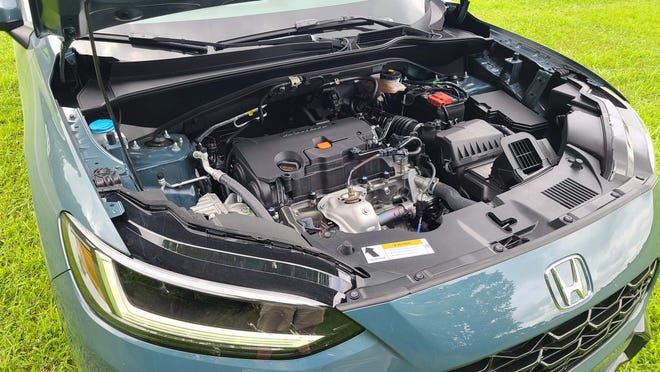
The F1600’s 1.5-liter Honda engine only makes 130 horses. But since the cars weigh just 1,110 pounds, that’s enough ponies for the job. The 2.0-liter, 158-horse unit in my HR-V, on the other hand, has to push around 3,350 pounds. Oof.
No doubt, the HR-V is as bulletproof as the F1600 mills, which have to endure constant punishment from their drivers. Still, the HR-V’s engine puts it at a comparative disadvantage in its ferociously competitive segment that includes the 186-horse Mazda CX-30 (my favorite driver’s SUV in the subcompact class) or the 184-torque (compared to the HR-V’s 138) turbocharged, 4-cylinder-powered Volkswagen Taos.
At least the HR-V upgraded its engine from the 141-horse hamster wheel in the first-generation model — part of an overhaul for the entry-level ute. As readers of this column know, I’ve got the need for speed, but for most customers in this class, it’s the HR-V’s other upgrades that will really turn heads.
Begin with the fact that the new HR-V is built on the same bones as the excellent Civic sedan.

That means one of the best interiors in class surrounded me as I jumped into the HR-V’s driver’s seat. A cool honeycomb dash stretched from A-pillar to A-pillar, featuring a high-mounted touchscreen for good driver visibility complemented by meaty climate-control dials. The interior fit like a glove. That utility extended throughout the roomy cabin.
I loaded three suitcases, a computer bag and a backpack into the rear hatch with ease, then climbed into the roomy backseat with leg and headroom to spare. My 6’3” son Sam sat comfortably in front of me. The current owner of a 2012 VW Golf GTI, he is the HR-V’s target audience should he and his wife, say, want to buy a second car.

After a weekend in the Honda, he said it would be on his shopping list along with the Taos, since Volkswagen has impressed him with the GTI. The Honda and V-dub are very similar, with bold, roomy interiors and distinctive looks — another big improvement for this HR-V over last year’s appliance.
I mean, it actually looked more like a kitchen appliance than a car. For this gen, the HR-V has adopted a more anthropomorphic face with bright eyes (headlights) and a cute mouth. Think the 2020 Kia Sportage or Ford Focus.
My other son, Henry, was a tougher sell. The owner of a 250-horse, all-wheel-drive hatchback Mazda3, he has understandably high expectations for modern subcompact SUVs.

Charging along between corn fields on Route 632 south of Summit, he gripped the fat leather steering wheel and seemed to enjoy the HR-Vs’s nimble Civic chassis. The engine, not so much. He reached for the DRIVE mode selector and got only ECO, SNOW and NORMAL. No SPORT mode. “Pretty boring,” he said. How about the interior? “Compared to the red interior in my Mazda3? Pretty boring.”
Like I said, tough class.
Mazda CX-30 has set a ridiculously high bar in this class in features, too, with standard adaptive cruise control, blind-spot assist, automatic braking, Apple CarPlay/Android Auto and coffee machine (kidding about the latter). Honda keeps up with standard adaptive cruise and auto braking, but load the two vehicles to the teeth and the Mazda wins on price.
Honda’s strengths are in its boxy utility and ergonomic excellence. The Mazda has its quirks — like a cramped, coupe-like roof and remote-dial controlled information screen. Typically, Honda has obsessively tested its SUV to make sure everything is easy. For example:—Tab on top of the rear seats to help them collapse? Check.—Console storage? Check.—Sub-rear cargo storage for small items? Check.—Wireless Apple CarPlay/Android Auto? Check (on models like my tester with 9-inch screens).—Front warning lights to let me know that I’m within inches of a stack of race tires in the crowded Summit paddock? Check.
Still, there are reminders this is an entry-level vehicle, even in my loaded $31K EX-L model. There are no ceiling grab handles (for passengers to seize when we motorheads choose to throw the Civic chassis around a bit) or climate controls in the rear (honey, could you please turn up the AC in front?).
But on the whole, this is a stylish, roomy vehicle that punches above its price point. Sitting in Summit’s paddock next to the Honda, a friend pointed at the HR-V’s clay-blue wardrobe.
“I like that color,” he said. “Very fashionable.”
In the middle of a sea of race cars sporting all kinds of entertaining paint jobs, it’s no small feat for a small SUV to get noticed. Just a few yards away, a trio of red, yellow and blue F1600s flashed by — nose to tail — down the pit straight.
If a little more of that sportiness rubs off on the HR-V’s engine bay, the Honda will be complete.
2023 Honda HR-V
Vehicle type: Front-engine, front-wheel-drive, five-passenger subcompact SUV
Price: $24,895, including $1,245 destination fee ($30,590 as tested)
Powerplant: 2.0-liter, inline 4-cylinder
Power: 158 horsepower, 138 pound-feet of torque
Transmission: Continuously variable automatic (CVT)
Performance: 0-60 mph, 7.0 seconds (Car and Driver). Top speed, 135 mph
Weight: 3,350 pounds
Fuel economy: EPA, 25 mpg city/30 highway/27 combined
Report card
Highs: Excellent, roomy interior; fun Civic platform
Lows: Engine lacks punch; oh, that CVT
Overall: 3 stars
Henry Payne is auto critic for The Detroit News. Find him at hpayne@detroitnews.com or Twitter @HenryEPayne.
Detroit News Readers’ Choice awards: Z06, V-8s and EVs take prizes
Posted by Talbot Payne on September 21, 2022
Detroit — The Detroit auto show floor is awash in whispery-quiet new electric vehicles, but show-goers still covet American heavy metal.
Muscle cars dominated the annual Detroit News Readers’ Choice awards at Huntington Place this year. The high-revving, 670-horsepower, V8-powered Chevy Corvette Z06 took home Best in Show, while the rowdy Ford Bronco Raptor — inspired by King of the Hammers racing trucks — won best Off-Road Warrior.
Ford’s focus on its iconic vehicles — Mustang, Bronco, F-150 — has received a lot of buzz, and that was reflected in jurors’ selections as the Blue Oval took home the most prizes, winning four of the nine categories. Ford’s luxury division, Lincoln, also took home Top Concept for good measure.
The Readers’ Choice Awards are prized by automakers for their status as the Detroit show’s only awards judged by car buyers themselves. Nearly 100 jurors were let loose on the show floor during the Sept. 14 media day to make their selections.
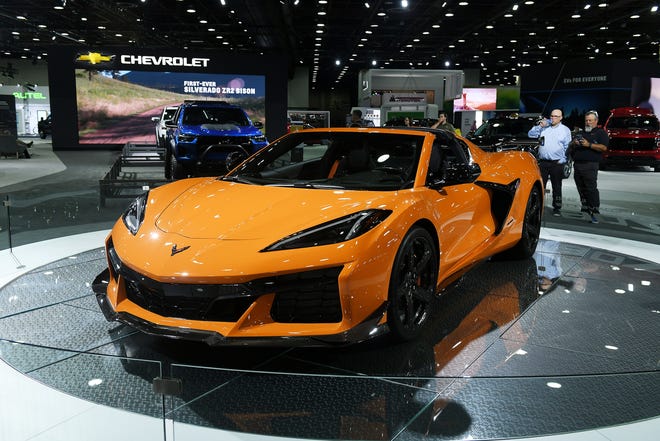
The 2023 Corvette Z06 had already caught the eye of President Joe Biden when he toured the show, and News’ readers found the orange supercar irresistible as well. The eighth-generation, $65,895 Corvette C8 is the iconic nameplate’s first mid-engine model — and much more affordable than comparable mid-engine exotics from Ferrari and McLaren. The Z06 is the C8’s first performance version featuring the most-powerful normally-aspirated V-8 production engine ever made.
That performance will cost customers another 40 grand over the base car — and for that, The News’ jurors awarded the Z06 the prize for If Money Were No Object.

The North American International Auto Show has traditionally showcased head-turning concepts, and 2022 was no different. In perhaps the biggest surprise of the Readers’ Choice Awards, the Lincoln L100 Concept edged out the much-hyped Dodge Charger Daytona Banshee — a peek at the brand’s first EVs — and Buick Wildcat as best concept.
The sci-fi L100 is Lincoln’s vision of an autonomous vehicle future with no steering wheel or pedals (a “chess piece” is provided on an electronic pad to override the car’s self-driving if needed) and front seats that can swivel to face rear passengers. The chariot boasts other exotic features like a glass canopy roof, glass “frunk” and hub-mounted electric motors.
Mustang’s most powerful model — the Shelby GT500 — took home the trophy for Muscle Machine. The track-focused, 760-horse hellion can hit 60 mph in just 3.4 seconds. You can’t miss its giant cow-catcher front grille.
Best Electric Vehicle awards went to the Ford Mustang Mach-E — inspired by the Mustang coupe — and Cadillac Lyriq. While Mach-E replicates the sports-car’s looks and speed in an updated EV package, Lyriq shows the way to an entirely electric Cadillac future with new fascia and bling-tastic interior.
In addition to winning best Off-Road Warrior, the ballistic Bronco Raptor also inspired the more affordable Bronco Sport, which jurors judged best Bargain Buggy. Based on the Ford Escape’s unibody chassis, the all-wheel-drive Bronco Sport Badlands trim offers surprising off-road capability for half the price of the ladder-frame-based Raptor.
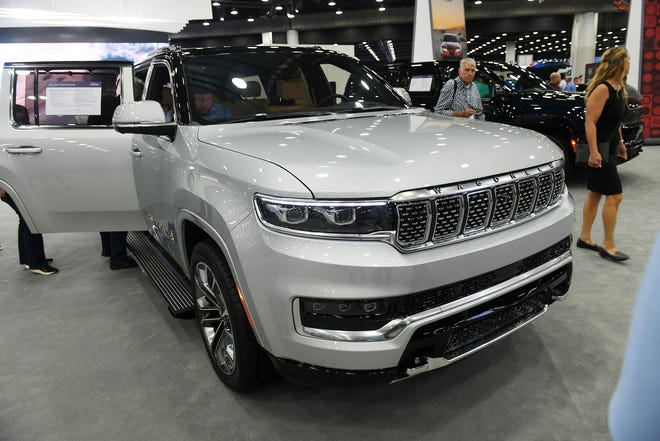
If you want to bring the entire family to Huntington Place for the show, jurors recommend the Jeep Grand Wagoneer as best Family Hauler with its spacious three-row interior. The Grand is a step above the Wagoneer (which competes against the Chevy Tahoe and Ford Expedition) and sets its sights on truck-based luxury models like the Cadillac Escalade and Lincoln Navigator.
Riding on a smooth air suspension, the Grand Wagoneer boasts an interior studded with luxury touches including four screens up front — even one for the passenger. Second-row passengers get their own infotainment screens, and third-row passengers their own sunroof.
Under the hood? A 471-horspower, 6.4-liter V-8, of course. Even family haulers are best served with American muscle.
The winners
HOTTEST TECH: Ford Mustang Mach-E
MOST ELECTRIFYING: Cadillac Lyric
BARGAIN BUGGY: Ford Bronco Sport
OFF-ROAD WARRIOR: Ford Bronco Raptor
FAMILY HAULER: Jeep Grand Wagoneer
MUSCLE MACHINE: Ford Mustang Shelby GT500
TOP CONCEPT: Lincoln L100
IF MONEY WERE NO OBJECT: Chevrolet Corvette Z06
BEST IN SHOW: Chevrolet Corvette Z06
Henry Payne is auto critic for The Detroit News. Find him at hpayne@detroitnews.com or Twitter @HenryEPayne.
Payne: Overlanding across the UP to Michigan’s other auto-palooza, Detroit 4fest
Posted by Talbot Payne on September 18, 2022
High Rock Bay, Upper Peninsula — The Back Yard Overland Tour kicked off Detroit 4fest this week with an epic adventure that included a visit into a 350-foot-deep mineshaft, a front hub blowout, and a mad Jeep dash to the northernmost point in Michigan.
And that was just the first day.

BYOT is the first in a packed calendar of events this weekend for the fourth annual 4fest, one of three auto circuses in town. The Detroit auto show at Huntington Place celebrates the latest vehicles in the industry. The Detroit Concours d’Elegance at the Detroit Institute for Art celebrates the industry’s classics. And 4fest celebrates utes ‘n’ trucks — the hottest segments in the industry, from Jeep Wranglers to Ford Broncos to Toyota Tacomas.
In many ways, 4fest is the most relevant of the three shows. It’s the intersection of some of the biggest trends in the industry as automakers ramp up production of off-road capable SUVs aimed at families in a post-COVID world who discovered how to work remotely and how to vacation at America’s network of national parks. It’s a culture struggling to accommodate government trends forcing the industry to produce overland-challenged electric cars, but 4fest will also have a global auto reveal of its own: the first battery-powered, King of the Hammers Ultra4 off-road racer.
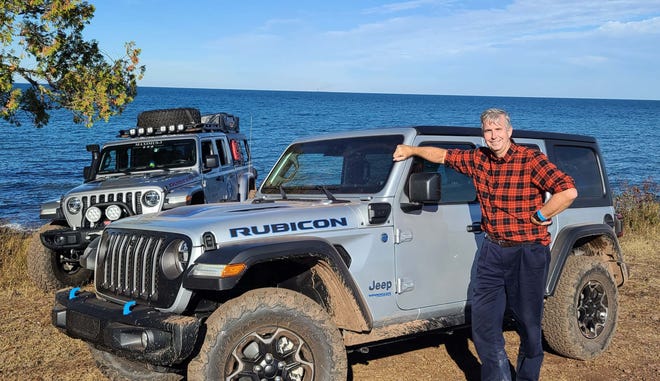
This year, 4fest is taking it up a notch with the introduction of an all-new electric off-road racer and the Overland Tour — a five-day, 750-mile celebration of the state that introduced America to automobiles, the copper industry, the Great Lakes, and more. I joined the train of five Jeeps — and their motley crews — with a plug-in hybrid 2023 Jeep Wrangler Rubicon 4xe for the first day of the journey in the far reaches of the Upper Peninsula.
Their ultimate destination? Detroit 4fest’s auto-palooza Sept. 17-18 at Holly Oaks ORV Park, where owners take the 4x4s they ogled at the Detroit auto show and turn them loose on the most challenging off-road environment in southeast Michigan.

“Off-roading is about more than just light bars and big tires,” said Liam Lafferty, 27, owner of a 1972 Jeep Commando and contributor to GoneGPN.com (Gone Jeepin’, get it?) that helped organize BYOT. “It’s about getting out into nature. Back Yard shows owners how they can experience the off-road lifestyle, but in a less intense environment in some of the most beautiful places in America.”
The UP certainly fits the bill.
With stunning lake vistas, sprawling state parks and geological and mineral history to match, Michigan’s northern “back yard” is a treasure — and today’s off-road vehicles are the perfect tools to explore it.
BYOT’s trip covers 750 miles starting at Keweenaw Peninsula, skirting the southern banks of Lake Superior east through Pictured Rocks National Lakeshore and Whitefish Point before plunging due south across the Mackinac Bridge, cruising along the Lake Huron coast, and arriving Saturday in Holly Oaks for the kick-off of 4fest’s weekend activities.
Overlanding requires improvisation, and our adapting skills were put to an immediate test. After 10 hours on the road from Metro Detroit to Keweenaw, one of our train — a classic Kaiser Jeep M715 (complete with gear tunnel that would make a Rivian R1T envious) — blew a left front hub.
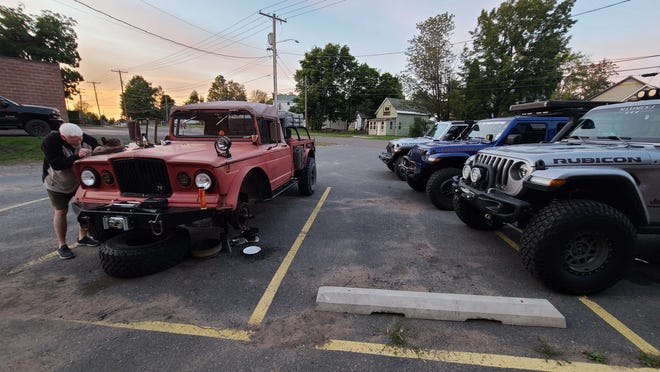
Dead in the water in the little town of L’Anse at the base of the Keweenaw, we sent out an SOS to the local off-road community and were met by immediate support. A local mechanic, Big Off-Road Repair, arrived along with others to fix the issue. It was a preview of the congregation of off-roaders we found along the way — whether in need on the road or at a campsite — who converse easily with one another. Even if they own a Wrangler or Bronco.
Overlanding take many forms. BYOT’s videographer, Mike Harrington, 67, who has a laundry list of Hollywood and auto industry ads to his credit — covered the Ultimate Adventure, perhaps the most extreme overland tour that pitted some of the country’s finest builders of dirt-kickers in a multi-state competition.
But more typical is the nine-day Jeep Safari in Moab, Utah, every Easter when families and enthusiasts gather in the country’s most famous off-road playground to camp, trail-ride, and generally ogle the latest Jeeps.
For their inaugural overland tour, Detroit 4fest wanted to showcase Michigan’s history and scenery as well as its extensive trail network. The Keweenaw is a reminder that Michigan is about more than just making automobiles.

Crossing the Keweenaw Waterway, we took steep, San Francisco-like roads to Houghton’s Quincy Mines. Towering above the Torch Lake valley, Quincy’s last remaining #2 mine shaft is a reminder that the UP was once America’s epicenter of copper mining, churning out the metal for everything from wire to plates.
We visited the Quincy #2 Hoist House — home to the world’s largest steam-driven mine hoist — that was built in 1918 with 2,500 horsepower to pull copper-laden, 10-ton cars at 35 mph up a 9,250-foot (nearly two miles) shaft to the surface.
Jeep dominates the off-road space, but Yoopers drive everything 4×4, including Broncos, Subarus, F-150 Raptors, Toyota Tacomas and more.
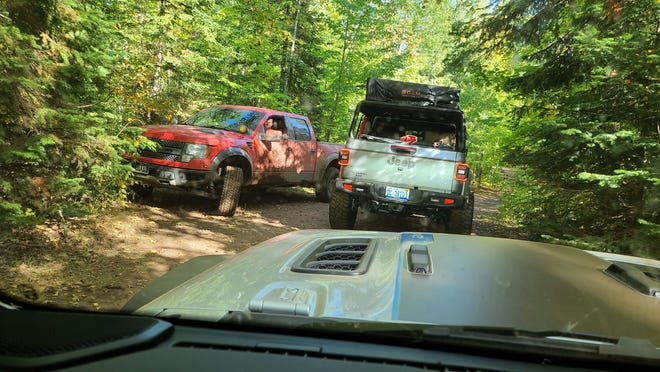
My plug-in hybrid Wrangler Rubicon 4xe was an excellent overland companion — though not nearly as fearsome-looking as the Maximus-3 Gladiator pickup truck with 40-inch tires that I followed up Route 41 to High Rock Bay, the northern-most point in Michigan with a staggering view of Lake Superior.
The 4xe’s signature trick is that it could preserve its 26-mile battery range until I got to the top of Route 41 — the end of the line for a road that winds 1,990 miles from Miami. I then went to full electric mode, stealthily crawling through the forest on dirt trails until we reached Superior’s sandy shores.

We were hardly alone, however as the campsite was full of other overlanders even though it was a Monday afternoon. They were on vacation in RVs, on lunch break, or just working remotely.
On the 16-mile round trip to High Rock, I ate all 26 miles of my electric range and needed gas power to get me the last two miles. Four-wheeling on trails — even at 5-30 mph — sucks electrons.
I didn’t see a single electric vehicle in my two days across the UP. Even at $4 gasoline, drivers I talked to resisted the government’s call to buy electric. Gasoline is more than a quick-fill convenience — it also provides range security in the long stretches between scarce service stations, where trailering an RV can eat up to 50% of a vehicle’s gas range. Tow behind an EV — or just go four-wheelin’ in a hybrid as I did — and batteries can lose a lot of range, stranding vehicles far from the energy grid.
Riding the EV wave, 4fest will have the global reveal on Friday of the King of Hammers Ultra4 race vehicle, marking battery power’s entry into the U.S.’s most demanding off-road sport. Whether on the road at BYOT or pounding around Holly Oaks, 4fest wants to teach the culture of off-roading to the thousands of new buyers coming into the ute ‘n’ truck segments today. The event is not only sponsored by Jeep and aftermarket parts companies like TYRI Lights (the Overland tour’s chief sponsor), but also Tread Lightly, a nonprofit that encourages trail and campsite maintenance.
“We want to get more people involved in this adventure lifestyle. It’s great for the soul,” said Tom Zielinski, CEO of 4fest. “At fest we also give folks Off-Road 101 lessons — how do I put this in AWD? How do I air own my tires? — that are important and give them the confidence to go back here to Holly Oaks, or go the the UP, or perhaps out west.”
Henry Payne is auto critic for The Detroit News. Find him at hpayne@detroitnews.com or Twitter @HenryEPayne.
Mustangs, dinosaurs and ducks: The Top 10 attractions at the Detroit auto show
Posted by Talbot Payne on September 18, 2022
Detroit — The Detroit auto show is finally back after a long hiatus. But it’s now more Detroit Fair than auto show.
Walk over to the totally revamped Huntington Place exhibition center Sept. 17-25 and you’ll find animals (Rams, Mustangs, Broncos), games (VR, simulators, raffles), food (elephant ears, corn dogs, pizza), thrill rides (Bronco Mountain, Camp Jeep, Lightning launches) and flying machines.
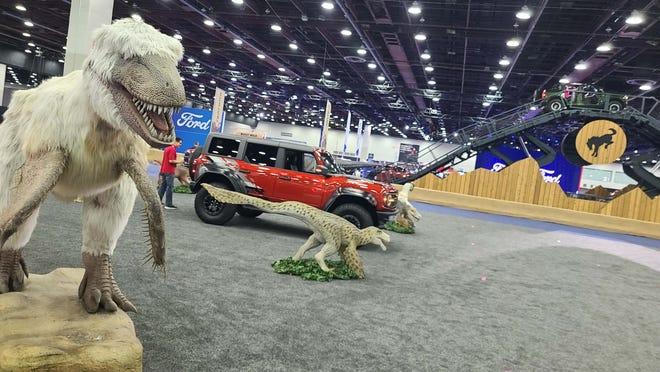
Even the weather has changed, with pleasant, carnival-like, 80-degree temps so attendees can walk outside and enjoy the day. Or the giant duck (another animal).
Of course, automobiles are still the centerpiece of the fair — er, auto show. But they are presented on acres of carpet like an oversized dealer lobby — not surrounded by the multimillion-dollar mega-stages of yore that looked right out of a Broadway theater. The Detroit Three automakers dominate the show floor with Ford sandwiched between the General Motors’ brands in the South Hall and Stellantis brands to the north. Gone are sprawling stages from BMW, Volkswagen, even Mercedes that once rocked the South Hall with bold autonomous cars and $100,000 AMG SUVs.

A more compact show is in their place so that mom and dad can easily shop for their next family car. But when the kids get antsy — Dad, can we see something other than cars?! — the parents can follow the neon green footsteps across the hall to the Dinosaur Expedition and time-travel back to the Late Jurassic.
I used to write about the Top 10 cars at the Detroit auto show. But in recognition of a show transformed, here are the Top 10 attractions.
1) The Concepts. Detroit auto shows have seen some wild concepts over the years, and ’22 is no different. Electric vehicle platforms and the electronics revolution have given designers new tools to play with. Check out the sleek Buick Wildcat. Or the wicked Dodge Charger Daytona Banshee, which will shriek as loud as a V-8 Hellcat thanks to its Fratzonic Chambered Exhaust.

Or check out the bling-tastic Lincoln Star Concept. It features a see-through frunk that turns opaque when you load it with cargo. It has a slide-out work desk in the front seat — a drink chiller in back. And it one-ups Rolls Royce — replacing the umbrella in each rear door with a “digital briefcase” compartment so can charge your laptop while accessing its files on the Star’s multiple screens.
2) Camp Jeep. Jump in a Gladiator pickup or Wrangler Rubicon on the show floor and a driver will demonstrate the dirt kickers’ diverse off-road skills. The highlight (pun intended) is a climb to the top of a rollercoaster-like hill where you get Huntington Place’s best views.
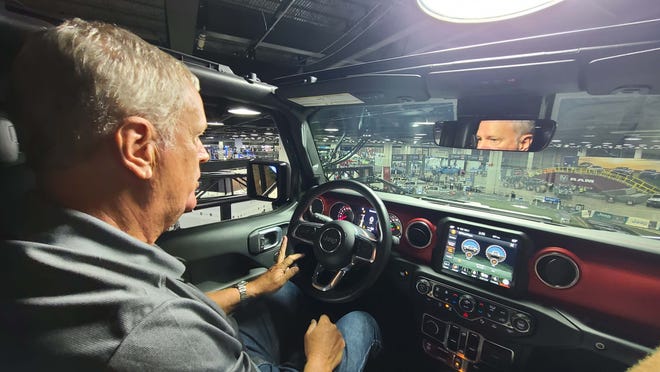
3) Ram pull. Next to Jeep is the Ram ride where you can luxuriate in the pickup’s palatial interior while the truck clean-and-jerks a 7,000-pound cement wall off the show floor. Dad will be pulled kickin’ and screamin’ out of this ride. The Ram 2500 Limited, for example, has a 850-torque diesel, camera mirror, multiple camera angles, and a console screen the size of the Henry Ford IMAX theater.

4) Corvette Z06. The Biden Administration wants the industry to go electric, but someone forgot to tell Joe Biden. The president is the owner of a ’67 ’Vette and his favorite car when he toured the show floor Sept. 14 was the new, V8-powered, 670-horsepower Corvette Z06 that’ll sing like an F-15 on afterburners when you put your foot into it. It made all the evening newscasts. It’s painted orange so you don’t miss it.

5) Rubber duckie. Painted yellow and unmissable is a 61-foot inflatable duck in front of the convention center. You can see it from space. It honors the Jeepster tradition of getting “ducked.” If a Jeep owner likes another Jeep, they put a duck on it. Sign up for Jeep’s $100,000 raffle and you’ll get a tiny rubber duck, too.

6) Dinosaur Expedition. Rivaling the duck in size are the Brontosauruses in Matt Flynn’s Dinosaur Expedition. Just follow the green footprints in the lobby and they will lead you to the Ballroom, which has been transformed into a dino playground. Take a dinosaur ride, listen to dino stories, buy dinosaur toys. It’s dino-mite.

7) The Mustang. The ’Vette isn’t the only car resisting the electric trend. The new, 2024 Mustang is in the house. It’s muscular, it’s menacing, it’s got a V-8 . . . but the surprise is a 21st-century interior with huge digital screens run by Unreal Engine 3D. That’s right, the same gaming company that designs your kids’ Fortnite video game.

8) Chrysler 300C. The 300C is heading for the exits after 17 years, but not before 2,200 copies of this final edition model are made (they’ve already sold out). With its slab sides, big grille and Hemi V-8, this is the ultimate gangster getaway car.

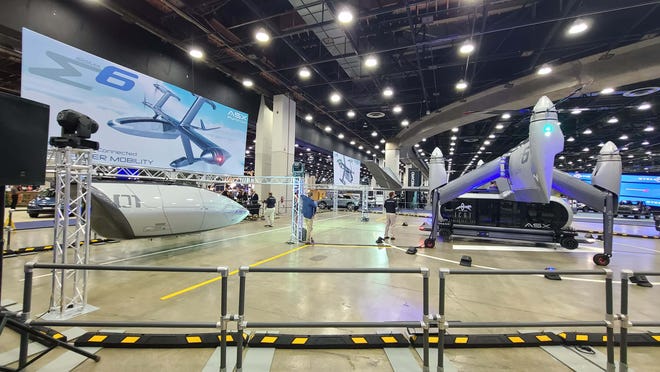
9) Aircraft. Since you’re no longer freezing in January, the Detroit show wants to invite you outside and scan the skies. There you’ll find the Drone Show with 300-400 drones celebrating Opening Day of the show’s public run at 9 p.m. Saturday. Inside you’ll find the biggest commercial drone you’ve ever seen: the six-engine ASX that will deliver people — or packages.
10) Lap the Detroit GP. Also outside, get in line for a lap around the Detroit Grand Prix’s new 10-turn, 1.7-mile course as the race returns to city streets next June for the first time in 30 years. The track winds north ’round the RenCen, skirts the waterfront, then shoots back west along Jefferson Avenue. At press time, a show spokesman said that VW and Chevy would be giving rides.
We hope the Chevys are Corvette Z06s.

Henry Payne is auto critic for The Detroit News. Find him at hpayne@detroitnews.com or Twitter @HenryEPayne.
Payne: Seven generations of the Mustang family and what made them special
Posted by Talbot Payne on September 18, 2022
Few auto badges have lasted 60 years, but the Ford Mustang isn’t your average auto.
The two-door sports coupe created the affordable muscle car class in the U.S. in 1965 and has been an icon ever since. As the Porsche 911 has defined luxury performance across the decades, so has Mustang endured through seven generations, the latest unveiled this week at the 2022 Detroit auto show.
Its essential, rear-wheel-drive, long-hood, coupe spec has remained the same since its inception. But the pony car has also changed with the times — evolving with technology, surviving strong regulatory headwinds, and spawning Shelby performance versions with eye-watering performance.
Here’s a look at each generation of Mustang and what made it special.
Gen One, 1965-73: The OG was born as a 1965 model in April 1964 and was an instant hit. Ford predicted first-year sales of 100,000 vehicles, but dealers sold 22,000 on the first day alone. By year’s end, Ford had sold over 400,000. By March 1966, the 1 millionth Mustang rolled off the line.

Today it is a collector’s car found in the garages of Dream Cruisers, former President Bill Clinton and Ford Chairman Bill Ford. Everyone has their favorite ‘Stang engine, and the ’65 debuted with 2.8-liter straight-six, 4.3-liter V-8 and 271-horse 4.7-liter V-8. For reference, that’s shy of the 310 ponies made by today’s entry-level, 2.3-liter turbo-4 engine.
It didn’t take long to spawn a performance version from Ford partner Carroll Shelby’s shop beginning in 1965, further polishing Mustang’s reputation. The white Shelby Cobra GT350 would become synonymous with Mustang with its twin stripes and 4.7-liter engine, and the light-weighted GT350R would dominate SCCA B-Production racing. A 7.0-liter Shelby GT500 was added to the lineup in 1967.
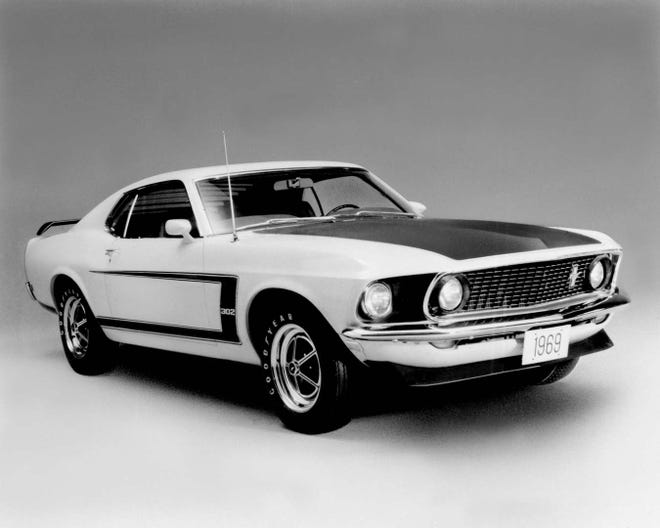
Looks and footprint evolved over the decade — the 1969 Mustang Boss 302 being one of the most iconic models with a second set of headlights integrated into the grille. By 1970, sales had come back to earth with less than 200,000 sold.
Gen Two, 1974-78: With the 1970s oil crisis came federal CAFE regulations and everything was downsized, including the Mustang.
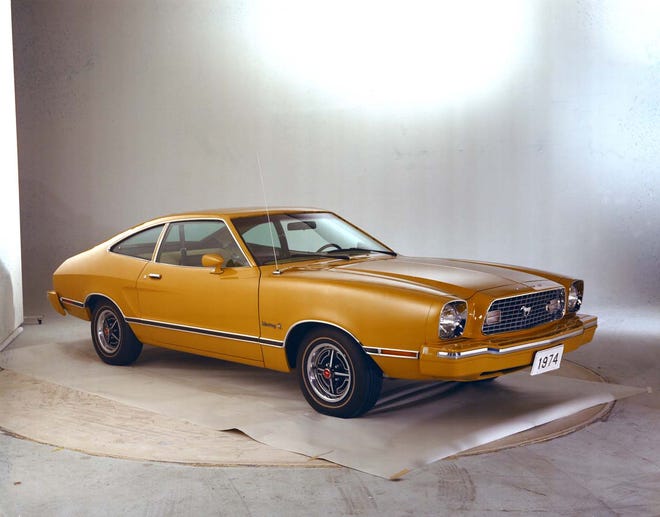
The pony car shared a chassis with the common Ford Pinto and sprouted a hatchback option. It featured small pony engines: a 2.3-liter four-cylinder and 2.8-liter V-6. Today, the Gen Two car is dismissed by Mustang enthusiasts, and few are seen at classic Dream Cruises. But in oil-embargoed 1974, the Mustang was embraced, with sales soaring to 386,000.

Eventually, Ford managed to stuff the coupe with a 5.0-liter V-8 (making just 140 horsepower), offered in Cobra II and King Cobra models.
Gen Three, 1979-93: Ford closed out the Malaise Decade with a new car based on the bigger Fox platform shared with the Fairmont sedan. Gerbil wheels continued under the hood with a 88-horse starter four, 132-horse turbo-4 inline-6 and V-8.

The roaring ’80s brought back some of the Mustang’s roar as well with a HiPo 225-horsepower V-8, quick turbo-four SVO, and the first convertible in a decade. For ’87, Mustang got a more muscular bod, though the car’s style had now evolved completely away from the original with a grille-less face and big horizontal headlights.
Gen Four, 1994-2004: Along with more curvaceous sheet metal and a return to the OG’s twin-cowl dash, the fourth-generation pony was powered by a stout, base 3.8-liter V-6 to go with the optional V-8.

There were plenty of toys for enthusiasts, like the 320-horse, V8-powered 1999 SVT Cobra, complete with front skirt and rear wing. The Bullitt model paid tribute to Steve McQueen’s movie car, the Mach 1 introduced a shaker hood, and the wonderfully named Terminator Cobra boasted 390 supercharged horsepower.
Gen Five, 2005-14: Rebirth. To many Mustang enthusiasts, the 2005 ’Stang rediscovered its roots. The coupe brought back round headlights and muscled, fastback looks. The retro-car rekindled the segment, sparking the re-emergence of archrivals Chevy Camaro and Dodge Challenger.

For the ’11 model year, there was muscle under the hood to match its looks with a 3.7-liter V-6 and 412-horse 5.0-liter V-8 on offer. Hot performance models followed, including the torrid, 444-horse track-focused Boss 302 and multiple high-powered Shelby GT500s — celebrating the return of the Shelby badge for the first time in nearly 40 years.
Gen Six, 2015-23: Mustang celebrated its 50th anniversary with an all-new car and big international ambitions. The new coupe would be exported to 140-plus countries. To encourage a wider demographic both abroad and at home, Mustang also got a radical redesign with styling cues more in line with brand siblings like the Focus and Fusion sedans. The round headlights disappeared into a modern headlight casing.
Some enthusiasts would deride the new style as the “Mustang Fusion,” but Ford backed its new car with a remade chassis and ’Stang’s first standard independent rear-suspension — key to the track ambitions of the V8-powered Shelby GT50 and GT500, back in the showroom together for the first time since the ’60s.

Harking back to the 1960s’ GT350, the Shelby was a ferocious driver’s car with stick shift and a unique, flat-plane crank V-8 engine that howled to 8,000 RPM like a Ferrari V-8. The supercharged GT500 boasted more horsepower than any Mustang before it — 760 — and a lightning-quick eight-speed automatic transmission.
Even the entry-level Mustang got a so-called High Performance variant with a 330-horse turbo-4 ripped from the Focus RS.
Gen Seven, 2024-: With killjoy government closing in again on muscle cars with draconian emissions regulations, Mustang defied elimination (the V-8 Camaro and Challenger expire in 2024) with the introduction of its 2024 coupe. Not only does the new ’Stang keep its V-8, it enhances it with twin throttle bodies promising more ponies when the car debuts in the summer of 2023.
But the big advance is in interior upgrades unheard of in the car’s six-decade existence. Gone is the famous double-bubble cockpit replaced by … twin digital screens sporting state-of-the-art graphics courtesy of the Unreal game engine.
Some six drive modes will be offered, including a configurable Custom mode. In a nod to enthusiasts, the styling harkens back to the muscled 2005 model with chunkier cues seen in everything from the hips to the steering wheel hub.
In honor of its heritage, a graphic on the back window features a silhouette of every generation reaching back to 1965.
Henry Payne is auto critic for The Detroit News. Find him at hpayne@detroitnews.com or Twitter @HenryEPayne.
Payne: Five things about the 2024 Ford Mustang
Posted by Talbot Payne on September 18, 2022
The Ford Mustang created the US muscle car segment in 1965, and it looks to be the last V8-powered muscle car standing after the 2024 model year. Both the Chevy Camaro and Dodge Challenger are packing it in.
Credit Ford with shrewd product planning to keep the regulatory vultures at bay. Though some Mustang fans have pooh-poohed the Mustang Mach-E electric vehicle as “not a real Mustang,” Where the V8-powered Challenger and Charger are racking up significant government fines, Ford insiders say the Mustang EV’s credits helped save its V8-powered sibling sports car’s from regulatory jail.

“Investing in another generation of Mustang is a big statement at a time when many of our competitors are exiting the business of internal combustion vehicles,” said chief motorhead and Ford CEO Jim Farley, an accomplished racer.
Product planning innovation aside, the seventh-gen Mustang continues the successful formula of the sixth-gen car with convertible, manual, and turbo-4/V8 cylinder power. But the new car is hardly mailing it in.
The ‘24 promises significant upgrades in technology and styling that should please long-time fans and a new generation of buyers alike. Here are five notable things about the new pony:

1) Style. For the sixth-gen car, Mustang went international, selling in over 140 markets. To appeal to its new audiences, the Ford got a more international style – less American muscle, more Ford sedan model line with softer edges and a cowl-less grille. The car was a huge hit – but the muscle-car faithful at home derided the car as the “Mustang Fusion.”
While maintaining the last gen’s modern design cues, the 2024 model leans into its muscular American design heritage. Take the steering wheel, for example. The sixth gen’s hub was round – the seventh gen’s is rectangular, like the Hulk’s pecs. The theme is repeated throughout the vehicle.
The grille is more squared-off, less ovoid. The headlights (the three rectangular beams) are set back in the bodywork like the 1969 Boss 302 – a horizontal line running across the grille’s brow, emphasizing the cars low stance. Indeed, the whole front clip is different for the GT and standard Ecoboost cars, a Mustang first. Other signature pieces are strong rear hip lines, and a functional GT hood sccop that pulls air through the front grille for downforce and to cool the radiator.

2) Interior. Welcome to the 21st century. While not as radical as the Mustang Mach-E’s screen-focused, Tesla-like interior, the 2024 has a modern interior like no Mustang before it.
Rather than the Mustang’s classic double-bubble dash, the new car gets twin, hoodless 12.4-inch instrument and 13.3-inch console screens running across the dash. A single button on the console operates volume.
The Mustang comes with six Drive Modes: Normal, Sport, Track, Drag, Slippery, and Custom. Thanks to state-of-the-art graphics from Unreal Engine 3D – the same gaming engine found in the hit video game, Fortnight, and the GMC Hummer EV – the screen display changes with each mode. Select the track mode and a map for Grattan Raceway in Grand Rapids – where Mustang underwent extensive testing – appears
The infotainment system is run by Ford’s latest SYNC 4 which allows wireless Apple CarPlay/Andriod Auto.
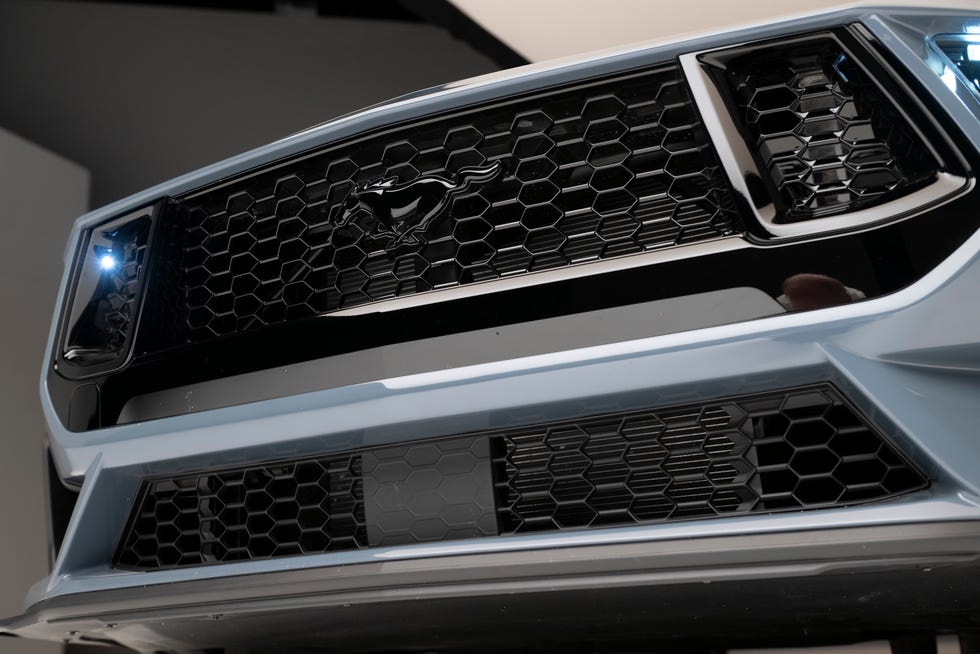
3) V8 power. The dual-overhead cam Coyote engine makes one of the auto kingdom’s most distinctive sounds and it is back in the GT model. Expect more capability thanks to dual throttle bodies which driver’s will want to show off at the Woodward Dream Cruise with the hood up.
The engine breathes through twin snorkels attached to the twin nostrils on either side of the front grille. The standard, turbocharged, 2.3-liter 4-banger is no slouch either making more than 300 horsepower.
4) Tricks. This being a muscle car, it has some cool tricks up it’s sleeve. The sixth-gen model debuted line lock – so that, dude, you could smoke your rear tires while stationary at stoplight. The 2024 model introduces Electronic Drift Brake for drifting.
The Mustang comes standard with a handbrake, then the e-Brake option (when actuated via the screen) encourages drivers to slew the rear end out and wow your friends – and melt your rear rubber to the cords. Ford developed the feature with professional drift racer, Vaughan Gittin, Jr.
Remote key fob tricks have become hip – think Tesla’s remote park feature. Mustang owner’s can use their key fob Remote Rev feature to rev their steed remotely. Vroom vroom!

5) Customization. Owners have always had a lot of choices to make the Mustang their own. The 2024 is no different. The car options 11 colors including new Yellow Splash and Vapor Blue. Brembo brakes – optioned on the Performance Pack – will also be available in three different colors. And there is even a Bronze trim option – part of the Mustang Design Series – with Sinister Bronze alloy wheels and a bronze pony logo on the grille.
In the screen display’s Custom driving mode, the ‘Stang’s current setup is displayed on the center stack as real-time graphical renderings. Settings can then be adjusted – gaming style – by simply swiping the graphic to rotate the car virtually.
The Mustang begins production at Flat Rock assembly in the summer of 2023.
Henry Payne is auto critic for The Detroit News. Find him at hpayne@detroitnews.com or Twitter @HenryEPayne.
Cadillac Celestiq turns heads at EyesOn Design Awards
Posted by Talbot Payne on September 18, 2022
Detroit — The Cadillac Celestiq, the dramatic sedan concept pointing the way to the luxury brand’s electric future, dominated the 2022 EyesOn Design Awards, taking home two trophies.
The Celestiq won for Best Use of Color, Graphics, or Materials and for Best Concept Vehicle. In the latter category, the Celestiq nosed out two other Motown nominees, the Buick Wildcat and Lincoln Model L100.

The 2024 Chevrolet Blazer EV and DeLorean Alpha5 lost out to the sleek Ferrari Daytona SP3 for Best Production Vehicle. Other winners included the Audi Grandsphere as Best Design Interior.
The EyesOn Design honors are the official design awards of the Detroit auto show and are judged by some of the most respected designers in the industry. They honor the best production and concept vehicles in the world and have attracted added interest this year as designers work with new architectures presented by electric vehicle development. Without a gas engine up front breathing through giant grilles, designers have new freedom to create “frunks” — front trunks — elongated cabins, and new fascias.

Though the Buick Wildcat failed to win a category, it received the most nominations with three. Wildcat was also nominated in the Color and Interior Design categories.
Now in their 35th year, the awards have honored some of the industry’s most iconic designs.
2022 winners:
Best Concept Vehicle: Cadillac Celestiq
Other nominees: Buick Wildcat, Lincoln L100
Best Production Vehicle: Ferrari Daytona SP3
Other nominees: Chevrolet Blazer EV, DeLorean Alpha5, Range Rover
Best Designed Interior: Audi Grandsphere Concept
Other nominees: Audi Urbansphere, Buick Wildcat
Innovative Use of Color, Graphics or Materials: Cadillac Celestiq
Other nominees: Audi Grandsphere, Buick Wildcat
Henry Payne is auto critic for The Detroit News. Find him at hpayne@detroitnews.com or Twitter @HenryEPayne.
Car, Truck and SUV of the Year semifinalists announced at Detroit auto show
Posted by Talbot Payne on September 18, 2022
Detroit — Let the games begin.
The North American Car, Truck and Utility Vehicle of the Year opened the 2022 Detroit auto show by announcing the semifinalists for the 2023 model year in three categories. The contenders were whittled from a record eligibility list of 48 entrants — 20 of them electric, 31 of them SUVs, and five startups, reflecting trends in the industry.
The Ford F-150 Lightning EV will be an early favorite for Truck of the Year, but otherwise domestic nameplates are few in the car and SUV categories.
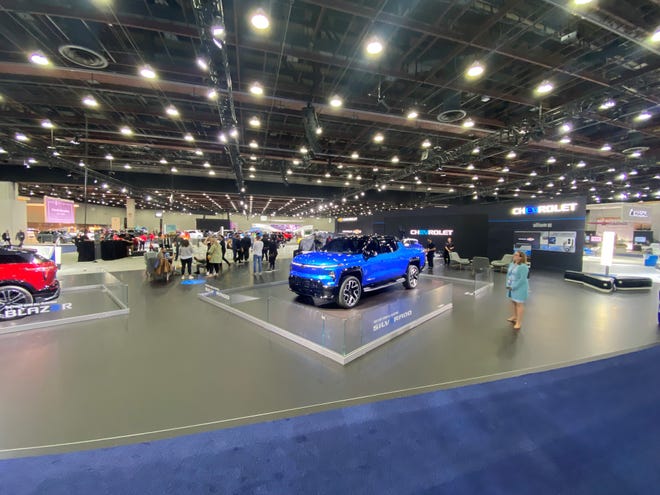
The Lightning is one of the flood of EVs coming to market as governments are forcing electrification (California, America’s biggest market, has announced a ban on gas car sales by 2035) and manufacturers are rushing to test the market for customer acceptance. The opportunity has also encouraged a bushel of startups to market — and two startup models, Rivian R1S and Lordstown Endurance, made the semifinalists’ list.
But traditional badges also populate the list as consumer favorites like the Honda CR-V and Lexus RX come to market with major upgrades thanks to the electronics revolution sweeping the industry.
“The semifinalist list indicates the enormous diversity available to consumers today,” said NACTOY President Gary Witzenburg, who announced the contenders from the Detroit Auto Show floor Wednesday. “There are a surprising number of sedans to choose from despite the trend to SUVs, while EVs have their work cut out for them given the challenges of charging and the rising cost of electricity. As for early favorites, I wouldn’t bet against the Lightning.”
Judged by 50 independent journalists (including the author of this article), NACTOY is one of the industry’s most prestigious awards.
SUVs now make up over 7 of every 10 new cars sold in the US, and automakers are focusing on the largest segment — compact utes — with EV offerings.
Two of those new models — the Rivian and Cadillac Lyriq — will be early favorites for SUV of the year. Rivian is an all-electric brand and Cadillac promises to be all-EVs by 2030, with bling-tastic Lyriq as its first battery-powered offering. Other EV favorites include the peppy, radically-styled Genesis GV60 and Kia EV6 — both built on the Hyundai Group’s first electric skateboard platform.
Popular gas models like the Honda CR-V, Honda HR-V and Mazda CX-50 are sure to give them a run. Surprisingly absent from the list are the first EVs from Subaru and Toyota — the Solterra and bZ4X. Startup EV automaker Fisker’s Ocean also notably did not make the final cut.
The Lightning — Ford’s first EV from its best-selling F-series pickup line — likely has the truck trophy in the bag thanks to its impressive torque and huge frunk. Competitors include the Chevy Silverado ZR2 and Lordstown Endurance — the latter an EV pickup from an Ohio-based startup that has struggled to bring its product to market.

Domestic automakers have all but abandoned the car market, but the category promises a close run for best 2023 model.
EVs also are plentiful here, including the BMW i4 eDrive 40i and Mercedes EQE. But a couple of sporty, nostalgic nameplates — the Acura Integra and Nissan Z — have early buzz as their fan bases have embraced the models’ updated looks and modern engines.
If Toyota (America’s No. 2 best-selling brand) was shut out in the SUV category, it looks strong in the sedan pool with two all-new gas-powered models: the luxurious Crown and wee hellion GR Corolla.
To be eligible for the prize, vehicles must be all or substantially new and available for purchase before the end of the 2023 calendar year. NACTOY jurors will gather in October for a comprehensive test of the semifinalists. A final trio are then announced in each category at the Los Angeles Auto Show in November, with the winners unveiled Jan. 11 at a special ceremony in Detroit.
The winners for the 2022 model year were Honda Civic as Car of the Year, Ford Maverick as Truck of the Year and Ford Bronco for Utility of the Year.
2023 semifinalists
Car of the Year
Acura Integra
BMW i4 eDrive 40i
Genesis G80
Genesis G90
Mercedes C Class
Mercedes EQE
Nissan Z
Subaru WRX
Toyota Crown
Toyota GR Corolla
Truck of the Year
Chevrolet Silverado ZR2
Ford F-150 Lightning
Lordstown Endurance
Utility Vehicle of the Year
Audi Q4 e-tron
BMW iX xDrive M50i
Cadillac Lyriq
Genesis GV60
Honda CR-V
Honda HR-V
Kia EV6
Kia Sportage
Lexus RX
Mazda CX-50
Nissan Ariya
Rivian R1S
Volvo C40 Recharge
Henry Payne is auto critic for The Detroit News. Find him at hpayne@detroitnews.com or Twitter @HenryEPayne.
The legendary ‘Rain Man’ Buick Roadmaster resides in Detroit and is still raising autism awareness
Posted by Talbot Payne on September 18, 2022
Southfield — One of Hollywood’s most famous cars, the 1949 Buick Roadmaster that Tom Cruise and Dustin Hoffman drove in the movie “Rain Man,” has found a home in Detroit.
And, true to its movie heritage, it’s making a difference for autistic children.

Hoffman played Raymond Babbitt in the move — the autistic brother of Cruise’s Charlie Babbitt character — and the car shared equal billing as the pair bonded on a cross-country trip from Ohio to Las Vegas. Hoffman adopted the car as his own after the movie, keeping it for 34 years before putting it up for auction earlier this year. It was bought by Detroit collector-and-entrepreneur Kevin Adell.
This Thursday, the car will be in a starring role again, this time in the fourth annual Stahls Automotive Foundation’s Autos for Autism event in New Baltimore.
“I got a call from Wayne Carini — he has a show called ‘Chasing Classic Cars’ on the Motor Trend Channel,” said Adell as he cruised Southfield in the legendary Buick. “I didn’t know until he called that one of his family members has autism. He asked if he could use the car to show awareness for autism. He’ll be at the Stahls Museum this Thursday from 4-8 p.m. . . . and this car will be used to raise money.”

The event on Sept. 15 will benefit the Ted Lindsay Foundation, which supports autism research and education. The Stahls Museum restores and exhibits vintage vehicles, music machines and memorabilia of the 20th century.
Along with Carini, Detroit Red Wings alumni Eddie Mio and Butch Patrick, who played Eddie on the “The Munsters” TV show, will be on hand.
The big, curvaceous, eight-cylinder Roadmaster convertible stands out on Metro Detroit roads surrounded by modern, jelly bean-shaped models. Buick’s signature quad port holes are prominent, as are whitewall tires and chrome grille. Open the door and the interior is a striking mix of cream and burgundy.
Adell says two Buicks were used for the movie — a primary mule car that was covered in plates and drill holes to carry cameras while filming the actors, and his car, which was used for running footage. The former went to director Barry Levinson, the latter to Hoffman.
“The car should have got an Oscar with those guys,” said a smiling Adell of the movie that took home four Oscars, including Best Picture and Best Actor for Hoffman. “Hoffman kept his Roadmaster in a garage for 34 years. Now he’s 85 years old, and he put it up for auction at Scottdale. I’ve got the original title with Hoffman’s home address in Beverly Hills.”
In the movie, Raymond famously tells Charlie that “I’m an excellent driver.” Cruise’s character turns over the wheel to his movie brother and Raymond bumps a couple of curbs outside a Las Vegas motel.
Adell’s car looks no worse for the wear, having been impeccably restored since it came into his collection — right down to the Ohio plates.
That’s how he met Carini, who had done restoration work on Levinson’s Buick in Connecticut. “We were stumped on the transmission,” said Adell, who owns media properties including the The Word Network, 910AM Superstation, and WADL-TV. “It’s a 1949 automatic Dynaflow — he helped with a number of things.”
Tickets for Autos for Autism are $20 for ages 16 and older — ages 15 and younger are free. A VIP ticket costs $40 includes a a photo op with the 1949 Buick Roadmaster, meet-and-greet with the three celebrities, and access to a special car exhibit that includes a 1951 Hudson Hornet and 1970 Dodge Challenger. Tickets can be purchased online at www.eventbrite.com/e/autos-for-autism-2022-tickets-400159757607, or by calling the museum. Stahls Automotive Foundation is at 56516 North Bay Drive in Chesterfield Township.
“I definitely know this car. It’s a 1949 Buick Roadmaster, straight-8 — Fireball 8 — only 8,095 production models,” says Raymond Babbitt in the movie. The most famous copy is in Detroit raising autism awareness.
Henry Payne is auto critic for The Detroit News. Find him at hpayne@detroitnews.com or Twitter @HenryEPayne.
Penske and Porsche united: Two motorsports superpowers, one Le Mans goal
Posted by Talbot Payne on September 18, 2022
aytona Beach, Fla. — Roger Penske’s race cars have been in the winner’s circle of the world’s most storied tracks — including the Indianapolis 500 18 times, NASCAR’s Daytona 500 three times, the 24 Hours of Daytona, the 12 Hours of Sebring, even Australia’s legendary Bathurst 1000.
But there is one title that has eluded Metro Detroit’s most famous car guy: the 24 Hours of Le Mans in France, the world’s premiere sports car endurance race. So Penske has teamed with Le Mans’ winningest sports car brand, Porsche, to realize his ambition at the age of 85.
“It’s like having a new baby. I don’t want to miss it taking its first steps,” said Penske, who came here Sept. 2 to watch the sleek, red-and-white Porsche cyborg take its first test laps around Daytona Motor Speedway’s high bankings.
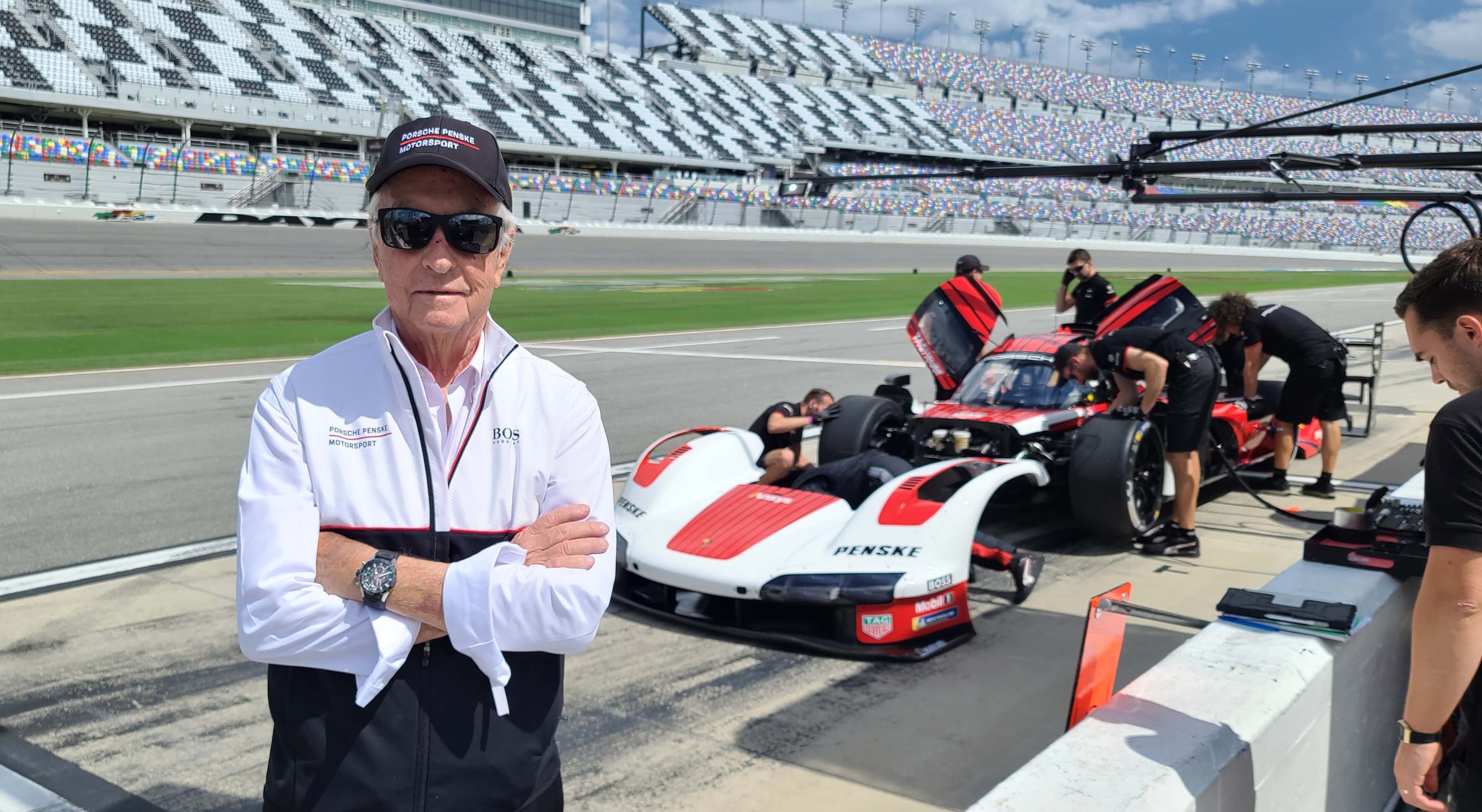
On the road to Le Mans next June, the 24 Hours of Daytona will be the first test of the Porsche 963. For “The Captain” — as his loyal troops at Team Penske call him — capping his illustrious career with a Le Mans win would be just desserts given that his racing days began behind the wheel of a Porsche RSK in 1958.
Penske long ago stepped out of the driver’s seat to run not only one of the world’s most successful racing programs. He sits atop a business empire that includes Indianapolis Motor Speedway, the IndyCar series, Penske Truck Leasing, and auto dealerships that employs 64,000 people across nine countries and four continents.
And yet, his passion for winning races — and for Porsches — is still at the heart of it all.
Under the banner Porsche Penske Motorsport, the formidable pair are teaming up again for an assault on the record books (Porsche is going for its 17th overall Le Mans win) at a time when the automotive world is in turmoil as government climate policy increasingly forces the industry to go all-electric.
Racing is not unaffected by the electrification push: the so-called LMDh (Le Mans Daytona hybrid) class that the Porsche 963 prototype has entered bows to the trend with a hybrid, 680-horsepower, twin-turbo V-8 that includes electric-motor assist.
But it’s the 4.6-liter V-8 that will do the heavy lifting in brutal 24-hour endurance races where cars crest 200 mph, and thrill crowds with their thunderous internal combustion-engine sounds.
“We didn’t buy the Indianapolis Motor Speedway to run around there with electric cars,” smiled Penske who packed nearly 300,000 fans into IMS last June to see 33 V-6-powered IndyCars take the green flag at full squawk. By contrast, the electric Formula E race series has struggled to gain fans. Penske says that electric racing is a long way off even as production luxury vehicles like the electric, $100K-plus Porsche Taycan EV in his showrooms have flown off the shelves.
Of more immediate interest is adding to his trophy case, a passion that creates a standard for the rest of his companies.
“This is the first (racing program) that is destined for the 24 Hours of Le Mans,” said Porsche 963 team director Jonathan Diuguid, 39, who has been with Penske since he graduated from the University of North Carolina as an engineer in 2005. “As you can see here, Mr. Penske is at the test, which doesn’t happen very frequently. It’s definitely something he is focused on, and it carries extra weight for that reason.”
Porsche first teamed with Penske in 1972 on the ferocious 917 Can-Am car that dominated North America’s fastest sports car series. With drivers George Follmer and Mark Donahue, Penske dominated the 1972-73 seasons before a similar era of government intervention forced performance changes on auto racing.
The two titans teamed up again in 2006-08 with the Porsche RS Spyder, a nimble, efficient racer that was a giant killer — challenging more powerful competition with better reliability and tactics. The bond the two teams share is rooted in decades of success — but also in the larger-than-life personalities behind the racing brands: the Porsche family and The Captain.
Respect for Penske in the Daytona pit was palpable.
He walked among his charges, talking to each individually. He is low-key but extremely well-briefed, says Urs Kuratle, Porsche Motorsports chief. Kuratle worked with Penske at Le Mans this year when the team entered a special, non-Porsche prototype entry to learn the Le Mans ropes.
“He was up for 36 hours at Le Mans, on the radio, asking questions,” said the Porsche team boss. “He knows the open points list as well as our engineers. To me, the man is from another planet.”

Patrick Long was the only North American driver on that team, a stint that launched him on a career as one of the world’s best race drivers.
“Growing up racing in the United States, I watched Roger Penske. He was the guy,” said Long, 41, who retired from racing last year and was on hand for the 963 test. “He called my races in 2008 (meaning each driver has a tactician in his ear during a race). Team Penske provided all the resources you could hope for, and in return was the expectation that you would win.”
Californian Dane Cameron is one of the hot shoes who tested the 963 in Daytona. Like Long, he is family — having won an IMSA title previously for Penske in 2019 when the team ran Acura’s program.
“It’s quite an honor to drive for Roger,” Cameron said. “And it’s quite an honor to join Porsche with their motorsport heritage. For me, that marriage is perfect and really something I wanted to be involved in.”
The car he will co-drive is at the summit of current automotive technology.

Taking its engine from Porsche’s legendary 918 hybrid supercar, the 680-horsepower 963 then adds an electric motor between the mid-mounted engine and seven-speed gearbox. A sophisticated aerodynamic chassis incorporating a Formula One-like front keel wing sucks the car to the ground enabling neck-straining cornering speeds.
As part of an 800-volt electric platform (similar to the Taycan electric road car), the electric current brings new challenges to drivers and tracks. If an incident occurs, the driver is trained to exit the cockpit by standing on the sill — then jumping as far from the car as possible to guard against electric shock.
Prior to the test, corner workers and fire safety teams are brought by the garage and debriefed on how to handle the car if it is involved in a crash. Key is a light in the front windshield that indicates if the electrical system is OK (green) or compromised (red, or no light at all). If the latter, then responders are not to touch the car until a special team from Porsche arrives.
While hybrids advertise efficiency in their road cars, they promise parity in auto racing, making for close competition that manufacturers covet.
“The LMDH regulations allow for all kinds of engine architectures: Cadillac normally-aspirated V-8, Porsche-and-BMW turbo V-8s, Acura twin-turbo V-6,” Diuguid said. “All engines have a different power curve shape (but) the hybrid system fills in holes and dips in the power curve so everyone is making the same power.”
This promise of parity, cutting-edge tech — and the tantalizing prospect of winning Daytona and Le Mans in the same calendar year — has attracted a who’s who of performance brands to the prototype class.
Porsche Penske Motorsport will compete in the years ahead against teams from Cadillac, Acura (both of which were at the Daytona test), BMW, Ferrari, Lamborghini, and Toyota.
With the track record of Penske and Porsche combined, there is no doubt who is the favorite.
Henry Payne is auto critic for The Detroit News. Find him at hpayne@detroitnews.com or Twitter @HenryEPayne.
Life under the Big Top: Highlights of 30 years of the Detroit auto show
Posted by Talbot Payne on September 18, 2022
The Detroit auto show’s history dates to 1907, when it became an annual event. But organizers took it to another level in 1989 when the Detroit Auto Dealers Association renamed it the North American International Auto Show and moved it to chilly January.
The goal: to compete against the world’s biggest shows in Frankfurt, Tokyo, and Shanghai and burnish Detroit’s global automotive cred. NAIAS became an instant sensation, attracting each year’s first model reveals and the attention of thousands of international journalists.
“It got so big, it was the best show in the world,” said Jason Vines, who attended his first show with Chrysler in the early ’90s. “I’m sorry, Germany and Japan. The Detroit show was the place to go.”
Cobo Center (now named Huntington Place) was transformed into a massive exhibition space showcasing the world’s latest wheels, hottest Hollywood celebrities, and the biggest annual charity event in the world. At its height, NAIAS played host to 79 vehicle introductions (in 2004) and welcomed 5,500 media (2008) — followed by two public weeks attended by nearly 1 million visitors annually.

“All the auto manufacturers were there,” continued Vines, who ultimately became Chrysler communications boss and the ringmaster behind some of the show’s most memorable debuts. “The Detroit show was the international show. When they changed the name, I thought, come on, give me a break — the North American International Auto Show? But it really was the international show, period.”
As NAIAS reboots this year with new September dates following a COVID-induced hiatus of more than three years, the auto show format is in transition with manufacturers favoring remote backdrops and internet buzz to glitzy new model displays. The new show aims to fill that void with activations, outsized attractions, ride ‘n’ drives, and electric monster trucks. Here’s a look in the rearview mirror at some of the Detroit auto show-palooza’s greatest hits.
1992: Jeep shatters expectations
It was the stunt heard ‘round the world. With “Maximum Bob” Lutz, Chrysler’s vice chairman, at the wheel and Mayor Coleman Young riding shotgun, the Jeep Grand Cherokee drove down Jefferson under police escort and up Cobo’s north steps before smashing through the convention center’s glass windows.
Well, it was a little more sophisticated than that.
“The plate glass was fake, it was actually tempered glass that they had put in with explosive charges all around the perimeter,” recalled Lutz, now retired after a legendary career that also included executive stints at BMW AG, Ford Motor Co. and General Motors Corp., in an interview.
“There was a guy with a remote — and the moment he saw the front bumper of the Jeep Grand Cherokee an inch from the glass, he triggered the explosives so you had a shower of glass granules.”
Chrysler had concluded that shattering actual glass would have been too dangerous, with shards threatening not only bystanders but Jeep’s precious human cargo.
“It was designed to be safe, and it was a brilliant demonstration of how you can use a low-cost PR stunt to far more effect at a product introduction than you could ever get from conventional advertising,” Lutz said with a smile. “That stunt was on every TV station, every major news media in the U.S. — and around the world.”
There would actually be a sequel in 2006 when Jeep drove another new product — the ’07 Jeep Wrangler Rubicon — off its stand and through Cobo’s glass into the street.
1995: Minivan meets Kermit the Frog
Chrysler was determined to create buzz for its new minivans, the Town & Country, Dodge Grand Caravan and Plymouth Grand Voyager, which featured segment-first sliding doors on both sides and a two-zone climate-control system.

Enter Lutz again, this time hamming it up with Chairman Bob Eaton reading giant storybooks in Mr. Rogers-style sweaters — who were then interrupted by Kermit the Frog piloting a red Caravan over their heads and onto a fake pond’s lily pads, dousing onlookers with water.
“Our stunt matched our message,” recalled Vines. “Our new minivan was going to leapfrog the competition.”
2008: Ram ‘n’ cattle drive
If Jeep’s glass-shattering stunt put the Detroit show on the map, then the Ram cattle drive may be the most ambitious.
Some 120 longhorn steers were trailered in from Oklahoma to accompany the all-new Ram truck (and upstage the new Ford F-150, also introduced at the show that year). They were kept in a parking lot overnight, then escorted down Washington Boulevard by cowboys with a trio of pickups in the middle.

“This could be the greatest thing — or the worst thing I’ve ever done in my life,” recalled Vines, who helped orchestrate the stunt. Sure enough, the spectacle included unscripted activity.
“Some of the longhorns start humping each other,” Vines said, laughing. “And now Chrysler’s CEO was petrified. But event emcee Jim Press (then Chrysler’s marketing chief) was quick on his feet. He said: ‘Look at those big cows trying to get a good look at the new Ram pickup truck!’ The video went viral around the world.”
The celebs
As the event grew in prominence — supercharged by media coverage and a ritzy charity ball — it naturally attracted Hollywood and musical celebrities to Detroit.
The ’06 show featured comedian David Spade, who memorably introduced the new Dodge Caliber with a dig at another Dodge product: “anything is better than Neon.” Eva Longoria, star of TV’s “Desperate Housewives,” unveiled the Chrysler Imperial concept while Blink-182 drummer Travis Barker touted a Cadillac Escalade special edition.
In 2003, the Charity Preview was headlined by superstar (and DaimlerChrysler spokeswoman) Celine Dion, who belted her single “I Drove All Night.”

Country music star Toby Keith introduced the 2009 Ford F-150. GM brought in a who’s who of musical talent in 2008 — Mary J. Blige, Maroon 5 and Detroit’s own Kid Rock — to show off a stage-full of concept cars. Infiniti unveiled its Q50 sedan in 2013 with the help of acrobatic Cirque du Soleil performers. Other notables over the years included Hall & Oates and actor/singer Kevin Bacon.
PR guru Vines was particularly fond of the celebrities who lingered over the sheet metal: “I remember Pixar’s John Lasseter — the creator of the ‘Cars’ movie — he had a ball just walking around the floor with us. And Jay Leno, of course — he really loves cars.”
2006: Aspen blizzard
Chrysler’s first SUV, the Aspen, was introduced by a blizzard of artificial snow from the off-Broadway act Slava’s SnowShow. Paper flakes exploded from the stage, showering the hall in what Autoline’s John McElroy called “the greatest press conference of all time.”
Auto reveals
Glitter aside, sometimes the cars have been the stars at the auto show.

Dozens of memorable vehicles have sauntered across Cobo’s stage, including the Ford GT40 concept supercar (in 2002 and again in 2015), the stunning Cadillac ELR hybrid in 2013, revived Toyota Supra in 2019, New Beetle in 1999, and the outrageous Tomahawk concept motorcycle powered by the Dodge Viper’s V-10 engine (piloted by no less than then-Chrysler Group COO Wolfgang Bernhard in ‘03).

And then there was the bright yellow Corvette Z06 that GM President Mark Reuss unveiled at the 2014 show, its 625-horse, 6.2-liter supercharged V-8 shaking the Cobo rafters of any remaining Slava’s SnowShow flakes.

Reuss gave it a nickname on the spot: “The Big Nasty.”
Henry Payne is auto critic for The Detroit News. Find him at hpayne@detroitnews.com or Twitter @HenryEPayne.
The 2024 Ford Mustang cometh: What we think we know
Posted by Talbot Payne on September 8, 2022
A new Mustang is coming. Long live the V-8.
The seventh generation of Ford Motor Co.’s iconic muscle-car figures to be a headliner for the 2022 Detroit Auto Show when it debuts Sept. 14. And unlike its Dodge and Chevrolet segment competitors, expect the 2024 pony car to continue to feed gas-powered red meat to its legion of fans — including a howling, 5.0-liter V-8 option under the hood.
While the Chevrolet Camaro is due to sunset in 2024 (complete with Heritage Edition farewell package, according to press reports) and Dodge is waving goodbye to its gas-powered Challenger and Charger beasts (even the legendary V8-fired Hellcat) the same model year due to crippling government fines, Mustang will continue to fly the flag for the affordable pony car segment it created in 1964.

Mustang, one of Ford’s iconic vehicles along with the F-150 pickup and Bronco SUV, is the Blue Oval’s performance halo.
That performance has inspired a quiet, electric, Mustang Mach-E SUV, but the sports car will continue on its rib-rattling, piston-pounding ways. We know that not only from spy shots with quad tailpipes sprouting out the rear of the ‘Stang, but from Ford’s motorhead CEO himself.
“Mustang is the world’s best-selling sports car because there’s one for everyone — from an EcoBoost convertible to 5-liter V-8 GT fastback coupe,” said Jim Farley as he rallied the Mustang faithful ahead of the new coupe’s evening reveal Sept. 14. “Now it’s time to. . .welcome the next chapter in Mustang’s legacy.”
Farley’s remarks were accompanied by an audio clip of the V-8 mill.
That powerplant is likely to be based on the same 5.0-liter Coyote V-8 found in the current GT. That engine already felt the pinch of federal regulators for the 2022 model year when its output was reduced 10 horsepower to 450 ponies.
But without Camaro and Challenger coupes in the market, Mustang stands to pick up sales above the 52,414 units it sold in 2021. Challenger outsold Mustang in 2021 with 54,314 units on the strength of its iconic V-8 mating call, while Camaro sold 21,893 cars. Some Mustang customers may also gain from the Charger sedan’s (the only four-door in the segment) demise, which leaves 78,389 in sales on the table.
The so-called “Ecoboost,” turbocharged, 2.3-liter inline-four cylinder engine is also expected to carry over in entry-level Mustang models. Shared with Ford’s ferocious, European Focus RS, the 310 horsepower/350 torque engine also has been popular in the Mustang’s High Performance model. Both engines should be mated to a six-speed manual and 10-speed, automatic transmission.
Beyond the oily bits, expect the exterior to get an evolutionary update from the radical, sixth-generation car that remade the face of Mustang in 2015. Look to the interior for the biggest change in the new coupe.
Electronics are reshaping vehicle interiors, and the new Mustang is no different. It will likely get a bigger, more exotic instrument display and console touchscreen. Expect them to be run by Ford’s SYNC 4 system (which debuted in the Ford F-Series trucks) which brings more computing power and nifty features like wireless Apple CarPlay/Android Auto and split screen usability.
The new, 2024 Mustang likely will debut in just the Ecoboost and GT trims, with the former expected to start just below $30,000 in keeping with the brand’s affordable reputation that has made it the world’s best-selling sportscar across 144 countries. Past generations have primed enthusiasts to expect high-powered, higher-priced variants like the Shelby GT350 and GT500 (which can crest $80,000), not to mention stylish trims like the Bullitt and Mach 1. The first Mustang hybrid may be one of those special models.
Look for them at future Detroit Auto Shows.
Henry Payne is auto critic for The Detroit News. Find him at hpayne@detroitnews.com or Twitter @HenryEPayne.
Payne: Porsche Taycan GTS Sport Turismo. OMG Speedwagon.
Posted by Talbot Payne on September 8, 2022
Charlevoix — On a vacant country road south of this small north Michigan burg, I initiated launch control in my all-electric, Mamba Green, 2022 Taycan GTS Sport Turismo wagon by simultaneously flattening the brake and accelerator pedals. Just like a Porsche 911 sports car.
I released the brake, and the all-wheel-drive GTS exploded forward like a Cedar Point amusement ride, crushing my rib cage into the seatback. “GEE-SUS!” was the universal reaction of everyone I took for a ride. Just like a Porsche 911. Sixty mph went by in just 3.5 seconds before I entered an ess turn, Taycan hugging the road courtesy of a battery powertrain mounted low in the chassis. Just like the flat-six engine in a 911.
Coveted by Porsche-philes, Taycan sold over 9,000 units in the 2021 sales year. Just like a Porsche 911.
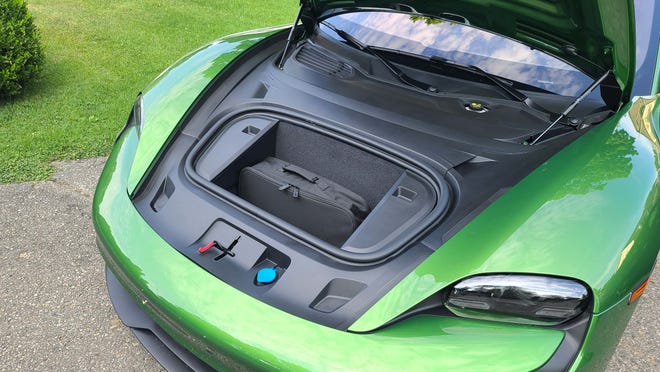
In a luxury EV market dominated by King Tesla, Porsche is the only brand to have made a significant dent. The Tesla Model 3, for example, outsold the #2 sedan in class, the Hyundai Ioniq Electric, 128,600 units to (ahem) 1,766 last year. The compact Model Y SUV outsold the Ford Mustang Mach-E: 172,700 to 27,140.
Taycan was the only vehicle to outsell Tesla in class: besting the Model S sedan by 9,419 units to 9,100.
The electric rocket also outsold Porsche’s gas-powered sedan, the Panamera, by 3:1. No doubt that’s because Taycan is the latest “It” thing from a fashionable brand. But I sense Taycan also has sex appeal that (the plenty capable) Panamera has struggled to achieve.
I’ve raced Porsches, owned Porsches, put the 911 on a pedestal as the best sports car on the planet. But I haven’t bonded with Panamera, the brand’s first sedan/wagon. Maybe because it looks like an overstuffed 911. Maybe because it’s powered by front-mounted, V-shaped engines (heresy!), not rear, horizontally-opposed, flat-cylinder engines. Maybe because of its cluttered center console.

By contrast, I’m smitten by Porsche’s second sedan/wagon entry because of its aforementioned attributes. Ask anyone who’s driven one. It’s the best handling EV on the market, period. My 911 pal Jon had to be pried out by 10 men.
Where Panamera always felt like it was trying (like the ungainly Cayenne SUV) to force sports car looks into a sedan wrapper, Taycan has its own design signature — while retaining Porsche’s crucial brand DNA.
The styling is stunning. The front end is more sportscar-ish (no front engine) than Panamera, and framed by unique horizontal headlights. They make Taycan look lean, menacing. Out back, the wagon’s hatch tapers elegantly between Simba-like muscular hips, punctuated by a 911-inspired horizontal taillight spanning the rear deck. This vision sits on Porsche J1 skateboard chassis, making for a low center of gravity and thrilling cornering capabilities despite the car’s 5,200-pound girth — 500 pounds more than the comparable Panamera GTS Sport Turismo.
Necks swiveled wherever I went. At a Charlevoix cross walk, a family walked by before the dad finally stopped in his tracks, staring. GTS OMG.
The 590-horse GTS Sport Turismo is the sweet spot of Taycan beauty, performance and utility. Slotted between the Taycan sedan and insane 2.4-second-zero-60, 750-horse Turbo S, the GTS (like a 911 GTS) brings a more handling-focused package with sticky Pirelli P-Zero tires, tightened suspension and SPORT PLUS mode that makes a futuristic flat-6 sound (I could do without it. I love the 911’s glorious, flat-6 wail, but if you’re going electric, give me an electric motor shriek).
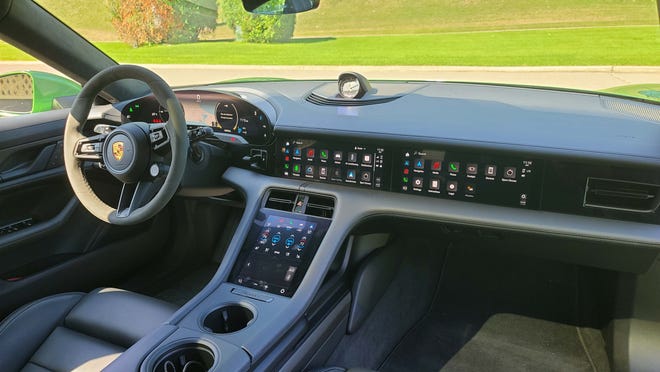
The wagon then adopts the hatchback from the Cross Turismo Taycan crossover — sans fender cladding for a sleek, simple aesthetic.
The spare elegance continues inside. Under a panoramic roof is a TV store of screens — not a button in sight. The dominate piece is the hoodless, curved boomerang-shaped instrument display. It’s as lovely as the first day I saw it at the Taycan’s 2019 Niagara Falls unveiling — though its novelty has worn off as other curved displays from Cadillac and Mercedes have come to market.

In Porsche tradition, the ignition is a button on the left dash (so you can fire up the beast as you jump into the driver’s seat like Le Mans racers of old). In fact, you only use the button to turn the car off with a loooong hold like a smartphone. Taycan comes to life automatically (with key in my pocket) as I step on the brake pedal.
Everything is simple. The electronic shifter has been reduced to a chicklet-sized toggle on the dash, freeing up the center console for a haptic touchscreen. Climate controls and charging info are accessed here — freeing the infotainment screens (there are two — one for driver, one for passenger) to do infotainment stuff like Sirius XM and Android Auto navigation.
Speaking of navigation, Taycan’s biggest shortcoming compared to Panamera is road trips.
Given its sales numbers, most Porsche sedan buyers apparently drive local. But hit the road to Charlevoix from my Oakland County domicile and Taycan is notably thin on self-driving tech. Herr Payne, zis ist ein Porsche. I am meant to be driven!
And then there’s the EV range issue. Panamera’s 400 miles of gas-powered range (enough to make the 500-mile round trip in a single stop) is a clear advantage (buy a Panamera E-Hybrid and that range extends to 464 miles).

After years of taking my Tesla Model 3 and other EVs north, I’ve settled on a two-stop strategy at Bay City and Gaylord fast chargers. Featuring a 800-volt platform (superior to a 400-volt Model 3 or Mach-E), Taycan should be able to charge at over 250 kilowatts at a 350 kW EA charger.
But I-75 EA chargers on this trip only let me charge at 115 kW, negating the $160K Porsche’s advantage. I sat at Bay City and Gaylord Meijer parking lots for 25 minutes each filling GTS to 80% of charge. Go joy riding in Charlevoix (guilty as charged) and you’ll need to go to, say, the local Ford dealer to charge on a 240-volt unit for a few hours. I like to pack a bicycle in the back of EV SUVs for the trip back to the charger — but the narrow (hey, you want those sexy Simba hips, dontcha?) Sport Turismo hatch requires I take off the bike’s front wheel.
Such are the compromises one makes for EVs.
So you can keep your Taycan caged in Metro Detroit for local commutes. Or you can explore this state’s glorious country roads testing the limits of this low slung, 626-torque rocket ship and its laugh-out-loud launch control capability.
Just like a 911.
2022 Porsche Taycan GTS Sport Turismo
Vehicle type: Battery-powered, all-wheel-drive four-passenger SUV
Price: $137,450, including $1,450 destination fee ($161,470 as tested)
Powerplant: 83.7 kWh lithium-ion battery with twin, electric-motor drive
Power: 590 horsepower, 626 pound-feet torque
Transmission: Single-speed direct drive/front axle and two-speed/rear axle
Performance: 0-60 mph, 3.5 seconds (mfr.); top speed, 155 mph
Weight: 5,152 pounds
Fuel economy: EPA MPGe 80 combined: range, 233 miles
Report card
Highs: Head-turning looks; electrifying performance
Lows: Lacks self-driving tech; road-trip charger blues
Overall: 4 stars
Henry Payne is auto critic for The Detroit News. Find him at hpayne@detroitnews.com or Twitter @HenryEPayne.