- Search Cartoons
- Comic Archive
-
Payne
Store



 Henry Payne RSS

Payne: Seven generations of the Mustang family and what made them special
Posted by Talbot Payne on September 18, 2022
Few auto badges have lasted 60 years, but the Ford Mustang isn’t your average auto.
The two-door sports coupe created the affordable muscle car class in the U.S. in 1965 and has been an icon ever since. As the Porsche 911 has defined luxury performance across the decades, so has Mustang endured through seven generations, the latest unveiled this week at the 2022 Detroit auto show.
Its essential, rear-wheel-drive, long-hood, coupe spec has remained the same since its inception. But the pony car has also changed with the times — evolving with technology, surviving strong regulatory headwinds, and spawning Shelby performance versions with eye-watering performance.
Here’s a look at each generation of Mustang and what made it special.
Gen One, 1965-73: The OG was born as a 1965 model in April 1964 and was an instant hit. Ford predicted first-year sales of 100,000 vehicles, but dealers sold 22,000 on the first day alone. By year’s end, Ford had sold over 400,000. By March 1966, the 1 millionth Mustang rolled off the line.

Today it is a collector’s car found in the garages of Dream Cruisers, former President Bill Clinton and Ford Chairman Bill Ford. Everyone has their favorite ‘Stang engine, and the ’65 debuted with 2.8-liter straight-six, 4.3-liter V-8 and 271-horse 4.7-liter V-8. For reference, that’s shy of the 310 ponies made by today’s entry-level, 2.3-liter turbo-4 engine.
It didn’t take long to spawn a performance version from Ford partner Carroll Shelby’s shop beginning in 1965, further polishing Mustang’s reputation. The white Shelby Cobra GT350 would become synonymous with Mustang with its twin stripes and 4.7-liter engine, and the light-weighted GT350R would dominate SCCA B-Production racing. A 7.0-liter Shelby GT500 was added to the lineup in 1967.
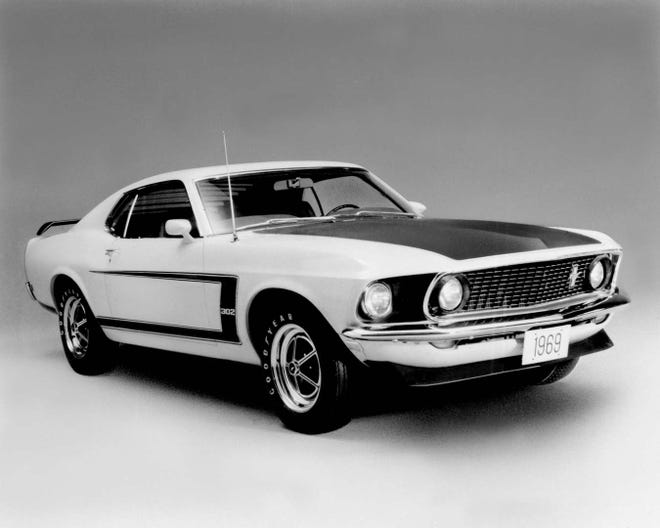
Looks and footprint evolved over the decade — the 1969 Mustang Boss 302 being one of the most iconic models with a second set of headlights integrated into the grille. By 1970, sales had come back to earth with less than 200,000 sold.
Gen Two, 1974-78: With the 1970s oil crisis came federal CAFE regulations and everything was downsized, including the Mustang.
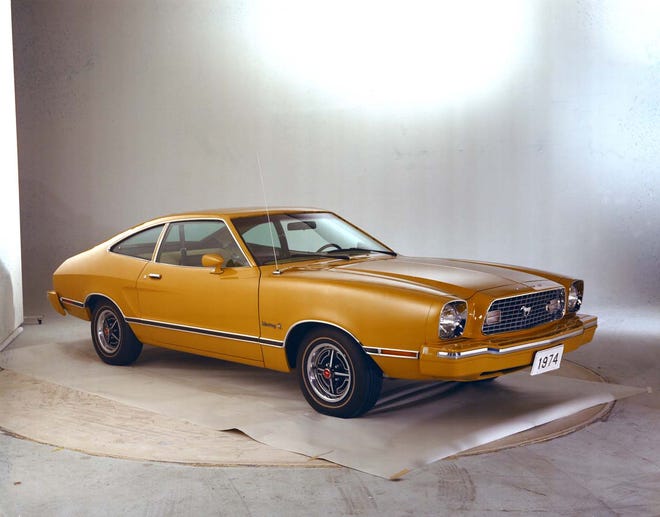
The pony car shared a chassis with the common Ford Pinto and sprouted a hatchback option. It featured small pony engines: a 2.3-liter four-cylinder and 2.8-liter V-6. Today, the Gen Two car is dismissed by Mustang enthusiasts, and few are seen at classic Dream Cruises. But in oil-embargoed 1974, the Mustang was embraced, with sales soaring to 386,000.

Eventually, Ford managed to stuff the coupe with a 5.0-liter V-8 (making just 140 horsepower), offered in Cobra II and King Cobra models.
Gen Three, 1979-93: Ford closed out the Malaise Decade with a new car based on the bigger Fox platform shared with the Fairmont sedan. Gerbil wheels continued under the hood with a 88-horse starter four, 132-horse turbo-4 inline-6 and V-8.

The roaring ’80s brought back some of the Mustang’s roar as well with a HiPo 225-horsepower V-8, quick turbo-four SVO, and the first convertible in a decade. For ’87, Mustang got a more muscular bod, though the car’s style had now evolved completely away from the original with a grille-less face and big horizontal headlights.
Gen Four, 1994-2004: Along with more curvaceous sheet metal and a return to the OG’s twin-cowl dash, the fourth-generation pony was powered by a stout, base 3.8-liter V-6 to go with the optional V-8.

There were plenty of toys for enthusiasts, like the 320-horse, V8-powered 1999 SVT Cobra, complete with front skirt and rear wing. The Bullitt model paid tribute to Steve McQueen’s movie car, the Mach 1 introduced a shaker hood, and the wonderfully named Terminator Cobra boasted 390 supercharged horsepower.
Gen Five, 2005-14: Rebirth. To many Mustang enthusiasts, the 2005 ’Stang rediscovered its roots. The coupe brought back round headlights and muscled, fastback looks. The retro-car rekindled the segment, sparking the re-emergence of archrivals Chevy Camaro and Dodge Challenger.

For the ’11 model year, there was muscle under the hood to match its looks with a 3.7-liter V-6 and 412-horse 5.0-liter V-8 on offer. Hot performance models followed, including the torrid, 444-horse track-focused Boss 302 and multiple high-powered Shelby GT500s — celebrating the return of the Shelby badge for the first time in nearly 40 years.
Gen Six, 2015-23: Mustang celebrated its 50th anniversary with an all-new car and big international ambitions. The new coupe would be exported to 140-plus countries. To encourage a wider demographic both abroad and at home, Mustang also got a radical redesign with styling cues more in line with brand siblings like the Focus and Fusion sedans. The round headlights disappeared into a modern headlight casing.
Some enthusiasts would deride the new style as the “Mustang Fusion,” but Ford backed its new car with a remade chassis and ’Stang’s first standard independent rear-suspension — key to the track ambitions of the V8-powered Shelby GT50 and GT500, back in the showroom together for the first time since the ’60s.

Harking back to the 1960s’ GT350, the Shelby was a ferocious driver’s car with stick shift and a unique, flat-plane crank V-8 engine that howled to 8,000 RPM like a Ferrari V-8. The supercharged GT500 boasted more horsepower than any Mustang before it — 760 — and a lightning-quick eight-speed automatic transmission.
Even the entry-level Mustang got a so-called High Performance variant with a 330-horse turbo-4 ripped from the Focus RS.
Gen Seven, 2024-: With killjoy government closing in again on muscle cars with draconian emissions regulations, Mustang defied elimination (the V-8 Camaro and Challenger expire in 2024) with the introduction of its 2024 coupe. Not only does the new ’Stang keep its V-8, it enhances it with twin throttle bodies promising more ponies when the car debuts in the summer of 2023.
But the big advance is in interior upgrades unheard of in the car’s six-decade existence. Gone is the famous double-bubble cockpit replaced by … twin digital screens sporting state-of-the-art graphics courtesy of the Unreal game engine.
Some six drive modes will be offered, including a configurable Custom mode. In a nod to enthusiasts, the styling harkens back to the muscled 2005 model with chunkier cues seen in everything from the hips to the steering wheel hub.
In honor of its heritage, a graphic on the back window features a silhouette of every generation reaching back to 1965.
Henry Payne is auto critic for The Detroit News. Find him at hpayne@detroitnews.com or Twitter @HenryEPayne.