- Search Cartoons
- Comic Archive
-
Payne
Store



 Henry Payne RSS

Articles Blog
Payne: Lincoln Continental takes a back seat to none
Posted by hpayne on November 7, 2016
When presidents travel, they leave traffic nightmares in their wake, as any commuter can attest who’s been stuck in motorcade gridlock on Interstate 94 outside Detroit Metro. Over the last eight years, President Obama has descended on Los Angeles for fundraisers so many times that locals have dubbed his visits “Obamageddon.”
I arrived right smack in the middle of “Obamageddon: Part 30” last week. And endured it in the nicest possible place: the back of a 2017 Lincoln Continental.
To compete against Teutonic performance sedans, Ford’s luxury brand is resurrecting the Continental name to emphasize passenger comfort first — and Nurburgring lap times second. It begins with reinventing the backseat space. With one eye on the U.S. market and the other on China’s limo-loving nouveau riche, Lincoln has outfitted the back as if it were your living room Barcalounger.
I arrived at LAX airport at 3 p.m. and was hustled into the Continental’s rear suite for my 15-mile drive to the Hotel Bel Air, the appropriately luxurious backdrop for Lincoln’s luxurious media launch. The journey should have taken 45 minutes in afternoon traffic. It took us 2 hours, 30 minutes in Obamageddon.
Motorcade One shut down Sunset Boulevard, cutting West L.A. in half and sealing our doom. No matter. I was just getting comfortable. I’m 6-foot-5 and even a big luxury car’s back seat can cramp my giraffe legs with the passenger seat moved all the way back. But a thoughtful button at my right elbow allowed me to roll the front seat forward, opening acres of room. After flying five hours from Detroit in Delta torture — er, coach — class, my legs audibly sighed with relief.
And at my left elbow was the biggest center rest I’d ever seen: bin storage, twin cupholders, climate controls, audio dials, sunroof control. Heck, I may have missed the fridge.
By the time I made it to the hotel, I had checked email, made phone calls, riffed L.A.’s radio stations, opened the sunroof and generally made myself at home. Only a jumbo TV screen was missing.
What’s also missing from the $45,485-$80,000 Continental is electrification. Tesla’s battery-powered, $70,000 Model S is the best-selling big sedan in America. Yet, startup Tesla still can’t make money on it. How about a mature automaker?
Ford Chairman Bill Ford Jr. shares the same bomb shelter with Elon Musk, warning of global warming Armageddon. Yet he hasn’t followed Musk’s lead in electrifying his own land yacht, which tells me EV-luxury is unaffordable below 70 grand.
Tesla’s high-risk investor class may one day get its home run, but Ford pensioners expect a return right now. So the Continental is built from the most affordable tech on the market. That means a choice of three gas engines and a stretched version of the tried-and-true Ford Fusion CD4 platform.
The combination made for competent power and handling the next morning as I explored north L.A.’s highways and twisty canyon roads. Continental’s stylish comfort embodies the brand’s “quiet luxury” mantra, but put your boot into the car’s exclusive twin-turbo, 3.0-liter V-6 and you’re ready to rumble. Ford Motor Co., after all, has been defined since birth by performance (the legendary Sweepstakes and GT40 racers, for example). And the same engineering talent that has developed state-of-the-art mills for the Ford GT, Mustang GT350, and Ford Focus RS has stuffed Continental with its own 400-horse beast.
The 3-liter pulls the land yacht nicely. But the chassis’ 4,500 pounds is evident under braking and through corners, so Continental makes available the same torque-vectoring, all-wheel drive system that possess the Focus RS hellion. I didn’t try any 360-degree, Gymkhana acrobatics, but the AWD system rotates Conti nicely and gives needed AWD oomph come Michigan winter blahs.
With its full-sized value, the Lincoln is positioned to go head-to-head against the midsize BMW 5-series, Audi A6 and Mercedes E-Class in the $55K-$65K luxe market for owners who value more leg-room and less cornering G. So I’d opt for the turbo, 2.7-liter V-6 (which stars in the Ford Fusion Sport I recently flogged) with AWD — then dress it up in Black Label trim.
Offering the best Lincoln accessories, Black Label will get you the rear-seat package, “turbine wheels” (the coolest this side of a VW Golf GTI) and the “Perfect-position seat.”
As pleasant as the back may be, Lincoln’s 30-way (or 24, sans massage) front throne is its calling card. With 30 patents, Lincoln has gone where no seat-maker has gone before, separating the chair into zones that allow front occupants to adjust everything from head to thigh.
Take your giant scribe, who has cursed conventional headrests for their reach-around, thumb-adjusted, twin-rod inanity. The Conti’s headrest can be simply adjusted up-down-aft-and-fore by a button. Brilliant. As are the individual thigh bolsters to cradle my sciatica-prone left leg, while allowing my right leg independence with the throttle. These functions are all located on the car door — with further tweaking available in the center console screen.
Add these options up and you have a $70K luxo-barge that is much roomier than an E-Class and similar to the $72k Genesis G90 I recently tested, which is reading from the same value playbook. Indeed, the handsome Genesis was the class multi-way seat record-holder until Lincoln came along.
The Conti vs. Genesis slugfest is an interesting one. Both offer excellent interiors with tantalizing details. Score one for the Lincoln’s superior digital instrument display, while the G90’s horizontal dash is more modern. Genesis throws in a best-in-class 5 year/100,000 mile warranty; Lincoln’s got self-park and kick-the-bumper-to-open trunk.
The deciding factor may be which stylish exterior tempted you inside in the first place.
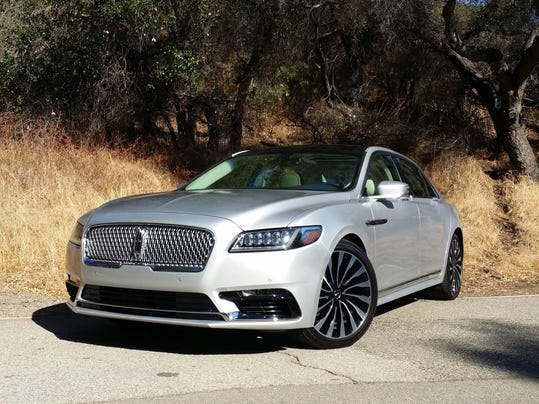
Lincoln has ditched its polarizing, winged fascia for a more old-school Jaguar grille and swept headlights (with delicious details like a grille mesh made of repeating Lincoln logos). From the headlights, a single line sweeps rearward along the beltline — over those big, irresistible turbine wheels — that anchors the mirrors and both fixed door handles.
To open the car you slip your fingers under the microprocessor-controlled E-latch like you’re holding hands with your mate. You’ll never want to yank on another door handle again.
Detroit luxury sedans are a rarity in L.A. Cadillacs? I saw only Escalade SUVs. Tesla, BMW and Mercedes dominated the four-door field. Conti hopes to reverse that trend. In a few decades I may be sitting in the back seat of an autonomous Lincoln. No driver. Controlling everything from the back seat. Waiting in Ivankageddon traffic.
Henry Payne is auto critic for The Detroit News. Find him at hpayne@detroitnews.com or Twitter @HenryEPayne.
2017 Lincoln Continental
specifications
| VEHICLE TYPE | FRONT-ENGINE, FRONT AND AND ALL-WHEEL
DRIVE FIVE-PASSENGER SEDAN |
| Power plant | 3.7-liter V-6; 2.7-liter, turbocharged
V-6; 3.0-liter, twin-turbo V-6 |
| Transmission | 6-speed automatic |
| Weight | 4,224 pounds (4,547 AWD 3.0L turbo
V-6 as tested) |
| Price | $45,485 base ($78,510 AWD 3.0L turbo
V-6 Black Label as tested) |
| Power | 305 horsepower, 280 pound-feet torque
(3.7L V-6); 335 horsepower, 380 pound-feet torque (2.7L turbo V-6); 400 horsepower, 400 pound-feet torque (3.0L turbo V-6); |
| Performance | Zero-60: 5.0 seconds (3.0-liter V-7, Car
and Driver est.); top speed: 130 mph |
| Fuel economy | (All figures for AWD) EPA 16 mpg city/24
mpg highway/19 mpg combined (3.7L V-6); EPA 17 mpg city/25 mpg highway /20 mpg combined (2.7L turbo V-6); EPA 16 mpg city/24 mpg highway /19 mpg combined (3.0L turbo V-6); |
report card
| HIGHS | VISUAL PRESENCE; 30-WAY FRONT THRONES |
| Lows | Rear end loses character; signature
wheels/rear seat control only available at premium |
Overall:★★★★
Payne: FCA’s Alfa Giulia hits the table smokin’ hot
Posted by hpayne on October 28, 2016
Sonoma Valley, California — Fiat Chrysler’s Dodge Viper cruise missile owns the most North American race track lap records — 13 — of any production car. Now FCA has conquered Germany, as well.
The company’s all-new, 2017 Alfa Romeo Giulia Quadrifoglio Verde (or QV for short) clocked a blistering 7-minute, 32-second lap around the hallowed Nurburgring race track this fall to claim the fastest lap ever recorded by a four-door sedan.
Not bad for a car that doubles as a daily driver.

The Alfa destroyed the lap record held by the Porsche Panamera by six seconds, and eclipsed the time laid down by formidable sports cars such as the Porsche 911 GT3 and Lamborghini Gallardo. The legendary, 13-mile, 154-turn Nurburgring is widely considered to be the most demanding racetrack in the world — and is a testing ground for every performance car manufacturer from Corvette to Porsche to BMW.
“The buzz for the Giulia has been truly phenomenal,” said Alfa CEO Reid Bigland at Sonoma Raceway in California this week as U.S. reporters got their first taste of a car that will hit dealerships this December. “We’ve had 16 million YouTube hits on videos for the Alfa Giulia and 4C.”
The 4C is a reference to the brand’s halo sports car that was introduced in the U.S. in limited volume in 2014. With a Formula One-like, carbon-fiber, lightweight chassis offering sensational handling, the 4C was the appetizer for Alfa’s launch as a full-course menu in the United States.
With premium, midsize sedans still the plurality of luxury sales at 23 percent of the segment, the Giulia is crucial to establishing brand credibility here. It will be immediately followed by a midsize SUV, the Stelvia, into luxury’s fastest-growing segment at next month’s Los Angeles Auto Show.
FCA’s launch of the Giulia has been highly unusual by debuting the badge’s most capable performance trim first. The twin-turbo, 2.9-liter, V6-powered Quadrifoglio is a snarling beast capable of hitting 60 mph in just 3.8 seconds and a top speed of 191 mph. Most manufacturers don’t introduce a sport variant until well into a model’s shelf life — but Alfa is determined to highlight its athleticism as a key differentiator in the ruthlessly competitive luxury space. The stylish, base Giulia is no slouch either, with a 2.0-liter, turbo-4 cylinder pumping out 280 horses that is also tops in its segment.
Journalists got their first experience with the Giulia QV from the passenger seat next to Fabio Francia, the ace Alfa test driver who blitzed the Nurburgring. Alfa flew him all the way from Italy to, apparently, set another lap record at Sonoma — while simultaneously turning journalists’ hair white.
Francia’s English was limited, but he let the car do the talking with its raw power and balanced, 50-50 handling. Behind the wheel on track and along California’s twisty, Pacific Coast Highway, I found the fetching sedan — in both 2.9-liter and 2.0-liter versions — on par with the BMW 3-series and Cadillac ATS as the best driver’s sedans today.
That was the intention all along. The Giulia is the product of a massive, multibillion dollar investment in an all-new product line. The Giulia’s so-called “Giorgio” platform will carry eight new models by 2020.
“The investment is unprecedented,” said Bigland. “This is a unique chassis with a unique set of engines. You lose credibility in this market as soon as you compromise on performance.” Some other large automakers, such as Ford and Toyota, share upgraded chassis from mainstream brands to make their luxury Lincoln and Lexus lines.
Richard Cox, director of Alfa North America, drove home the point.
“We started from scratch,” Cox said. “The intention is to make this car a benchmark for the segment.”
With the Giulia, Alfa has set new benchmarks in horsepower — and cutting-edge technology such as electronic, brake-by-wire — a first.
Having met the challenge of Nurburgring, Alfa now must build a credible dealer network in the U.S. despite weak, mainstream FCA brands to feed it (as Audi draws from Volkswagen customers, for example). The brand plans 250 showrooms here by the end of 2017 with a push to combine Fiat and Maserati products under the same roof
“No question that’s a challenge,” said Bigland. “We’re looking to conquest 100 percent. In order to do that you have to have a vehicle that is an alternative … and we think we have that from a driving and performance and styling standpoint.”
“We will lean on our marketing machine,” the FCA veteran continued. “Most of the dealer growth is going to come by creating duals with Maserati and Alfa.”
Payne: Nissan Z exudes old-school fun
Posted by hpayne on October 28, 2016

All hail the letter Z. In an auto world gone made with X — NSX, XT5, QX30, X3, MKX, X-drive — Xperts Xpect every car badge to have an X in it within the neXt decade. But the Z is sacred. A special badge for special cars. The Camaro Z28. Corvette Z06.
And my guest ride this week, the 2017 Nissan Z Roadster.
The Z and I go way back. As a kid who spent the early 1970s at autocrosses racing go-karts — a boy among sports car-driving men — I coveted the first-generation Z. It’s long hood and plastic-covered, scalloped headlights reminded me of a Jaguar E-Type (the Raquel Welch of sports cars). One particularly quick driver had outfitted his red, 1972 Z with fat slicks swelling beyond the fenders. Beauty and the beast. He gave me an on-track ride one day that is still etched in my memory. As I held on for dear life, he’d fling us through a series of pyloned corners, the Z’s rear zigging and zagging behind us, the six-cylinder singing like a bird.
The 370Z doesn’t make my heart race like the ’72.
After the Z’s epic, third-gen, Motor Trend-car-of-the-year, 1990 redesign — hailed as one of sports car world’s greatest bods — the body has grown bulbous, aping the family lines of Nissan’s Murano and Maxima. The coupe’s elegant fastback helps smooth the lumps, but my convertible’s shortened roof accentuates the body’s bulbous proportions.
Honey, does this dress make me look fat? Ummm …
Dropping the top helps. But the process reminds you that the old Z is getting long in the tooth. Unlike competitive soft-tops from Camaro or Audi TT, the Nissan’s roof can’t be operated while moving. Feel rain drops? Pull over, toggle the console switch and the roof folds into place in 20 seconds. The procedure is jerky and loud, the tonneau cover thumping into place like a restaurant waiter piling up chairs at closing time.
Once executed, however, the topless Z is a basket of adorables. Its short, 100-inch wheelbase makes for easy visibility. Its well-engineered climate control system and heated seats make it a cozy cocoon even in Michigan’s cool fall weather. And the twin-exhaust, naturally-aspirated six-cylinder can be heard in full stereo.
In an increasingly-regulated world of turbo-charged four bangers (even my precious Porsche Boxster has gone to four-pot), the Z remains a throwback to the glorious days of naturally-aspirated, big displacement engines.
The 370Z plays second fiddle in Nissan’s lineup to the (also aging) twin-turbo, all-wheel-drive, “Godzilla” GT-R. But the old school Z feels more like a baby Corvette Z06.
Inside the cockpit, it shares the Stingray’s long, carved hood, strange chemical smell (what are Chevy and Nissan using to stick these things together? Airplane glue?), and a narrow slit of a windshield that seems half-filled by the rear-view mirror.
With 270 pound-feet of torque and 3,696-cc of piston hammering on the crankshaft, it’s a blast to take into a parking lot for roaring, smoky burnouts. It won’t spin like a top as the 6,162-cc Z06 does, but it’ll put a grin on your face. Like the ’Vette, pulling on the 7-speed automatic Z’s big, bat-wing, steering-wheel-mounted shifter paddles provokes a guttural burp — like King Kong digesting his lunch — on each downshift.
The chassis on the Z and Z06 feel loose, their frames bending over Metro Detroit’s punishing roads — but get them up to speed and they are eager road carvers.
Throw the Nissan through Hell, Michigan’s Z-shaped country roads and the stocky beast crouches to the pavement, springing from turn to turn, vectoring right where you point it. Only on exit did the Z feel out of its element as the automatic box was lazy to shift — almost giving the Z the feel of a small-displacement turbo. I could have had cup of milk and a doughnut while waiting for the gear to kick in. The lag became so annoying I found myself reaching for the bat paddles regularly to speed up the shifts. Bang bang. Down two shifts, flatten the pedal and the eager six would roar. Even on the highway, I preferred the quick paddle downshifts for passing spurts.
How I yearned for the 6-speed manual — which, thankfully, Nissan still offers.
I should be careful what I wish for, though. When the next-gen Z appears, it will surely have a double-clutch tranny like its close competitor Audi TT (and even small sedans like the Elantra Sport I just tested) but it will also likely get a turbo-4 banger. Gotta appreciate these naturally-aspirated sixes while we can.
My pricy $50,465 convertible-Z most closely compares to the $52K Audi TT Roadster I tested last year, which also is a ready companion through Hell. With 100 less horses, the TT still manages a similar 0-60 sprint than the brawnier Z, so maybe there’s hope for 4-bangers yet.
The TT’s advanced Virtual Cockpit shows how far interiors have advanced beyond the Z’s traditional, slow-infotainment display. Nissan is also slow to the game with Android Auto and Apple Car Play, but beyond these connectivity issues, I don’t think sports car enthusiasts will mind the Z’s unique, motorcycle-like instrument display. The cockpit is driver-focused and easy to use — a blizzard of buttons and gauges at your fingertips. Like Porsche, Nissan can pull this off with a Z heritage that spans generations of track nuts.
Different from the TT, though, a base Z can still be had for a bargain $30,795. In a market stuffed with incredible, $40,000 sports toys (Golf R, Focus RS, Camaro SS), the TT’s $43K entry price is its Achilles heel. True to its ’70s roots, the Nissan remains one of autodom’s best values at half the price of a Porsche Cayman and comparable to muscle car alternatives such as the Mustang and Camaro sixes. Entry-level performance cars are as American as apple pie.
Yet, a quick look at the standard technology in the Z shows how sports cars have evolved. Side-curtain safety bags, tire-pressure monitoring, anti-lock brakes, front-and-rear crush zones, and on and on. It’s a long way from my favorite, but raw, test rider of 50 years ago.
Long live the Z.
Henry Payne is auto critic for The Detroit News. Find him at hpayne@detroitnews.com or Twitter @HenryEPayne.
2017 Nissan 370Z Roadster
specifications
| VEHICLE TYPE | FRONT-ENGINE, REAR-WHEEL
DRIVE, TWO-PASSENGER SPORTS CAR |
| Power plant | 3.7-liter V-6 |
| Transmission | 6-speed manual; 7-speed automatic |
| Weight | 3,503 pounds (Touring Sport trim as tested) |
| Price | $42,865 base ($50,465 as tested) |
| Power | 332 horsepower, 270 pound-feet torque |
| Performance | Zero-60: 5.5 seconds (Jalopnik);
top speed: 157 mph |
| Fuel economy | EPA 17 mpg city/24 mpg highway
/21 mpg combined (automatic as tested) |
report card
| HIGHS | SHORT WHEELBASE HANDLES LIKE A GEM; V-6 SIX-STRING |
| Lows | Roadster sticker shock; clunky drop-top |
Overall:★★★
Rolling out the red carpet for Lincoln’s Continental
Posted by hpayne on October 28, 2016

Los Angeles — With anticipation surrounding the introduction of its dramatic, flagship Continental sedan at Detroit’s North American International Auto Show in January, Lincoln has promised a brand reinvention centered around “quiet luxury” — a premium experience that’s less about performance numbers and more about a personally-tailored, customer experience.
But when the Lincoln finally, stealthily, rolled off the Flat Rock assembly line in late August to little fanfare, the “quiet luxury” mantra took on a different meaning.
But now quiet luxury is about to get a lot noisier.
The stunning Continental debuted to reporters from across the globe here this week at the posh Bel Air Hotel. The resulting stream of reviews, pictures and video comes as print ads shot by renowned photographer Annie Leibowitz are popping up in high-end publications. That will be followed by a year-end TV campaign featuring Lincoln’s mumbling, finger-rubbing spokesman Matthew McConaughey. Saturday Night Live parodies are sure to follow.
“The McConaughey ad is shot and in the can,” smiled a Lincoln spokesman.
Lincoln says the unusually hushed introduction of a brand flagship is part coordination of product shipping to some 30 markets around the globe, and partly to avoid the election campaign.
“We want to have critical mass at the dealerships so, when we gain messaging, people can go to the dealerships and experience it,” said Continental chief program engineer Mike Celantino, 57. “There’s a big political season going on. Getting the message out in the middle of that is hard.”
The Continental is the latest headliner in a resurgence of American large luxury sedans. At the top of the polls is the expensive, battery-powered Tesla Model S, which leads the class in sales, eclipsing even the mighty Mercedes S-class and BMW 7-series. Built in Silicon Valley, the Tesla is the pride of California, where it’s as common as Cadillacs in Michigan. For its part, Cadillac has launched the acclaimed CT-6 sedan. Benchmarked to BMW, the lightweight, powerful Caddy uses state-of-the-art bonding technology to create perhaps the best-handling big sedan made today.
Lincoln’s quiet luxury aims for a third way.
Though Ford Chairman Bill Ford Jr. is as outspoken about weening autos from the internal combustion engine as Tesla’s Elon Musk, the luxury brand at Ford’s company has eschewed the high-cost, high-risk strategy pursued by Musk’s electric startup. Rather than Tesla’s macro-ambitions to save the planet, Lincoln is micro-focused on delivering “great brand value and service” to each individual customer, says Celentino.
That includes services such as having dealers like dealer pick-up of Lincolns for all maintenance needs — and providing a Lincoln loaner. That commitment has already been put to the test when 1,900 Continentals were recalled this month for a minor LED headlight fault.
“It’s what you would expect from a boutique hotel, which is where we’re taking a page for the service aspect,” Celentino said.
The Continental, with three available V-6 engines, features state-of-the-art electronics, an industry-leading 30-way seat, and the same high-performance, torque-vectoring, all-wheel-drive system as the rally-racing star Ford Focus RS. But Lincoln has intentionally avoided a costly, ground-up, rear-wheel-drive platform revolution in order to compete against German sedans.
“We’re very different from Cadillac,” says Celentino. “The engineering is more about how does the car go through a corner more effortlessly, and less about how quickly can I get around a course like the Nurburgring” — a reference to the legendary German race track where many sports sedans are tested.
Instead, says Continental marketing chief Eric Turner, the Lincoln (based on a stretched version of Ford’s front-wheel-drive Fusion) challenges the Mercedes E-Class and BMW 5-series in the meat of the mid-sized luxury market ($55,0000-$65,000) — but with full-size sedan interior room, stylish design and comparable amenities. Starting at $44,560, the Continental is $9,000 cheaper than Cadillac’s CT-6.
The Continental’s Jaguar-like grille and headlights are the “new face of Lincoln,” said Celentino. Those features will be adopted by every Lincoln from the 2017 MKZ sedan to future versions of Lincoln’s elegant MKX and MKC crossover vehicles.
The Continental marks the rebirth — not just of Lincoln’s image — but of the Continental as the brand’s flagship. The Continental name was retired in 2002. This week’s media rollout featured more Chinese journalists than American, because Lincoln is launching a major expansion in China, where the business culture covets the big back seats of lux sedans. Lincoln plans to have 65 dealerships in China by the end of this year and has already more than doubled sales from 2015 to more than 20,000 cars.
“I have never seen the amount of support at the highest level for the Lincoln Continental,” says Ford/Lincoln veteran Celentino. “Everyone is fully invested in us.”
Henry Payne is auto critic for The Detroit News.
Find him at hpayne@detroitnews.com or Twitter @HenryEPayne.
Payne: Audi A4 sedan vs. Infiniti QX30 crossover
Posted by hpayne on October 20, 2016

The kids are gone. You’re empty nesters. Time to downsize from the Audi Q7/Infiniti QX60/Cadillac Escalade to something smaller and sippier. Without college tuition weighing you down, you can also indulge some sporty fun after years of road trips with suitcases and ballplayers stuffed in the aft rows.
Yeah, time to get that sleek luxury sedan you’ve always coveted: An Audi A4. All-wheel-drive. Fun, fun, fun.
But as you stoop into the Audi driver’s seat (man, were sedans always this low?) you realize the child-rearing years have taken their toll on your 50-year-old chassis. Your lower back protests. Your knees ache. You pine for the SUV’s command seating.
And you want its five-door utility: Just throw up the hatchback and throw in your bags. Or flatten the rear seats when you run over to Home Depot to gather materials for a project. It’s been so long since you’ve been in the market for anything other than a
family hauler . . . but you hear they make smaller SUVs these days. Crossovers, they call ’em. And some are pretty sporty at that.
Yeah, I know. Crossover owners are from Mars, and sedan buyers are from Venus. No one cross-shops SUVs and sedans. But maybe they should.
Take the 2017 Infiniti QX30 and Audi A4 sitting in my driveway.
I ache for BMW’s M-badge performance — I find myself daydreaming about the sinful, sinewy M2 coupe I drove this summer. But when it comes to German four-door daily drivers, the A4 is hard to beat. The M2 is Margot Robbie; the Audi A4 is the woman you marry. Four doors. All-season, all-wheel-drive, all-you-need. And you’ve admired its pleasing, coupe-like roofline and locomotive grille from afar.
Trouble is, the secret is out. All your friends drive one. Heck, A4s are as common as iPhone 6s in your neighborhood.
The Infiniti QX30 is unlike anything you’ve seen. Its sculpted shape looks like wind-cut desert sands. The thing appears to be in motion just standing there. Compared to the clean, symmetrical lines of the Audi, it’s a Henry Moore sculpture.
But what about its face? Japanese cars can look so … weird. Lexus appears to be a giant Darth Vader mask. Recent Infinitis have looked awkward, their grille mouths pinched by too much sheet metal. But the QX30 marks a new design direction following 2015’s Q60 coupe concept with a more anthropomorphically friendly face and menacing headlights.
QX30 is a dramatic package, wrapped up nicely with a square back that makes it look less like an SUV and more like a Ford Focus RS or Golf R (which, honestly, you would be buying if you were still 30- years-old). The stylish roofline is so low it might have been squashed in a giant panini maker.
Which means less room for rear passengers than an A4 even as the driver enjoys his high saddle. Still, this $36,950 base-price crossover is worth cross-shopping to the $39,400 Audi sedan because, below the skin, they both have German accents.
That’s right, the Infiniti is a rebadged Mercedes GLA: Mercedes-sourced chassis, drive system and 208-horsepower, 2.0-liter engine with 258-pound feet of torque. Hammering the QX30 across Oakland County’s lake country, I found the Mercfiniti a fun, drivable package. Riding 1.2-inches higher than the base, FWD QX30, it’s a hot hatch on stilts.
Jeez, that’s all sedans need. Already under assault from SUVs, how are they to compete when the high-riders steal their beauty and handling tips? Audi’s answer is to stick to fundamentals — assisted by a dose of futurism.
The 2017 A4 bulks up its already capable 2.0-liter mill with a 15 percent gain in horsepower and torques. Mix 252 ponies, 272 pound-feet of torque and slippery (0.27 drag coefficient) aerodynamics and the Audi rockets to 60 mph in just 5.2 seconds — a full second quicker than the Infiniti.
Leather car seats are vastly more comfortable than airline seats, so I prefer long road trips when possible. The quick way to New York’s Watkins Glen International raceway (where I was racing in mid-September) from Detroit is through Canada and the windy roads of the Empire State’s western lake country. I made it a little faster in the A4 thanks to its superb handling, easy power … and $3,250 Virtual Cockpit navigation system.
Virtual Cockpit puts all your necessary functions in a configurable, 12.3-inch instrument display right before your eyes. No more distracted glances to your center console. The system is manipulated via a thumb-controller on the left spoke of the steering wheel that deserves the Nobel Prize for physics. Mapped by Google Earth, my route through western New York was laid out in stunning, full-color 3-D before me. I checked the navigation system against my state-of-the-art Samsung phone’s Google Maps nav.
I’ve never found an auto nav that could outperform a phone (including a recent, bizarre attempt by one manufacturer’s system to take me a half-hour off a direct interstate route through D.C.’s mean streets). So a funny thing happened on the way to The Glen: The car nav saved me. Seems my smart phone’s map — obsessed with getting me to my destination quickly — uses every road available, while the Audi nav sticks to county, state, and federal roads. So deep in the gulches of rural New York my trusty phone sent me on some insane, gravel roads where I had a blast testing the Audi’s superb AWD system.
Until I got lost.
Confused by the spaghetti tangle of country roads, Samsung sent me in circles. Focused on paved roads, the Audi system suffered no such crisis and navigated me back on course to my destination. Phew.
For now, Virtual Cockpit is duplicated by a rotary-controlled, center dash screen which unnecessarily clutters the center console compared to the QX30. But the Infiniti’s infotainment system isn’t in Audi’s league. VC is OMG.
And Virtual Cockpit’s coming to the Audi Q3 — another nimble, AWD small crossover like the QX30. So if your back prefers the Infiniti’s high seat position — and your inner geek likes Audi tech — the Q3 could be worth waiting for.
But if you gotta pull 0.90 g-loads like your speed addled scribe, the A4 is still worth the stoop.
2017 Audi A4
specifications
| VEHICLE TYPE | FRONT-ENGINE, FRONT AND AND ALL-WHEEL
DRIVE FIVE-PASSENGER SPORT SEDAN |
| Power plant | 2.0-liter, turbocharged inline 4-cylinder |
| Transmission | 6-speed manual; 7-speed, dual-clutch automatic |
| Weight | 3,626 pounds (AWD as tested) |
| Price | $38,250 base ($47,900 as tested) |
| Power | 252 horsepower, 273 pound-feet torque |
| Performance | Zero-60: 5.2 seconds (Car and Driver);
top speed: 130 mph |
| Fuel economy | EPA 24 mpg city/31 mpg highway
/27 mpg combined |
report card
| HIGHS | FITS LIKE A GLOVE; VIRTUAL COCKPIT DISPLAY WITHOUT PEER |
| Lows | Looks like a V-dub from rear; smallish back seat |
Overall:★★★★
Grading scale: Excellent ★★★★Good ★★★Fair ★★Poor ★
2017 Infiniti QX30
specifications
| VEHICLE TYPE | FRONT-ENGINE, FRONT AND AND ALL-WHEEL DRIVE
FIVE-PASSENGER CROSSOVER |
| Power plant | 2.0-liter, turbocharged inline 4-cylinder |
| Transmission | 7-speed, dual-clutch automatic |
| Weight | 3,346 pounds (Premium AWD as tested) |
| Price | $37,945 base ($44,245 as tested) |
| Power | 208 horsepower, 258 pound-feet torque |
| Performance | Zero-60: 6.6 seconds (Car and Driver);
top speed: 131 mph |
| Fuel economy | EPA 21 mpg city/30 mpg highway
/25 mpg combined |
report card
| HIGHS | SCULPTED, UNIQUE STYLING; MERCFINITI HAS GERMAN
PRECISION |
| Lows | Uncrossover-like cramped back seat; less power
and worse gas mileage than Audi |
Overall:★★★
Payne: Should Chevy Cruze Hatch worry the Bolt Hatch?
Posted by hpayne on October 14, 2016

By hitting the market months (or could that be years?) ahead of Tesla’s ballyhooed Model 3 sedan, the battery-powered 2017 Chevy Bolt hatchback is stealing the Silicon Valley maker’s thunder on plans for electric domination. Like the Model 3, the Bolt promises 200-mile plus range, a roomy interior package – but will hit showrooms in December.
No wonder there’s a strut in young Bolt’s step.
While Chevrolet hypes the debut of its EV wunderkind, it’s also rolling out a hatchback version of its Chevy Cruze sedan. Our government betters tell us the Bolt and Model 3 are proof the world is going electric. Hatches like the Cruze are a bracing reminder why carbon-burners are still America’s top-selling vehicles.
Merging onto Interstate 94 in St. Clair Shores this week, I flattened the little Chevy’s right pedal and the turbocharged 1.4-liter mill eagerly answered the call with quiet aggression. This four-banger is not a noisy gerbil wheel. Credit the whispery turbo, but also the Cruze’s least-in-class interior noise. Engineering manager Seth Valentine and his team spent hours stuffing chassis leaks to make the Cruze library-quiet.
Cruze’s turbo-riffic 240 pound-feet of torque nearly matches the Bolt’s electric 260. Acceleration is respectable as well: 7.6 seconds from 0-60 (the Bolt should be sub-7); that’s because the Cruze weighs just 2,932 pounds compared to the EV’s 3,580.
Lithium-ion batteries are heavy. And expensive.
The Cruze hatch matches the roomy EV (look, ma, no drivetrain tunnel!) in passenger volume – 93.5 to 94 cubic feet – but, with a longer, 106-inch wheelbase, offers almost six more cubic feet of cargo volume behind the rear seat (22.7 vs. 16.9). The Chevy siblings are similar inside and out – the Bolt techier, the Cruze sexier – and come in LT and Premier trims with standard connectivity and nifty accessories.
Yet the bigger Cruze hatch offers all this for just $22,130 – that’s $15,000 less than the Bolt.
Sure, the Bolt will lop off $7,500 of its $37,495 price tag with a federal tax credit, but that only lasts until Chevy sells 200,000 of them. The Bolt’s landmark, range-anxiety-busting 238-mile range promises to expand the EV buyer demographic beyond the usual tree-huggers – but the sticker shock will drive many away. As will the Cruze’s sippy, 37 mpg-highway engine. Want more? A diesel in 2018 promises 50 mpg highway.
“The Bolt will be a second – or third – car option for older, upper-income Boomers,” says Joe Phillippi, an analyst with Auto Trends Consulting. “Lower-income millennials won’t even go there.” Boomers may trade the lease on their Buick Encore or Audi A3 for the Bolt. The Cruze hatchback will be millennials’ primary transportation.
This isn’t a knock on the terrific Bolt EV so much as a testament to the best value proposition around: The sippy, zippy compact hatch.
The hatchback’s versatility has carved out a 300,000-unit market (nearly the total sales of all EVs last year) in the U.S. with the Ford Focus, Mazda3 and Volkswagen Golf hatchback leading the way. Cruze wants a piece of the pie. Welcome back, Chevy, after a long time away.
I’d prefer a more squared-off roof line like the Golf or Mazda in order to complement the hatch’s inherent advantage – better rear head and cargo room. But Cruze’s curvy, sexy behind has a purpose – to make you forget about Chevy’s vanilla design past. Cruze’s face is forgettable, but, like cousin Malibu, it’s got a nice tush.
Speaking of tushes, solid-rear axle suspension in the Cruze hatch is no match in at-the-limit handling for the multi-link outfitted Focus, Mazda3 and Golf. But true to its compact class, it’s still a blast to whip around when the moon is full. Slip inside and the Cruze is a comfy office with Android Auto and Apple CarPlay, console cubbies, intuitive gauges and knobs, competitive legroom.
Quibbles are few – but notable. The weird cloth inserts – a dash rug? – on an otherwise fluid design screams “long-term liability.” Like carpets, they’re ripe for stains, frayed threads and scuffing. I prefer the Premier model with its tidier leatherette inserts.
Trouble is, the loaded Premier I tested came in at a pricey $29,435. That’s still less than an entry-level Bolt minus federal welfare – but a grand more expensive than the first-team VW Golf GTI Sport in my driveway. At 0-60 in 6.1 seconds it will bloody the Cruze in the performance ring while matching its interior refinement.
Like I said, the hatch market is one tough neighborhood.
Henry Payne is auto critic for The Detroit News. Find him at hpayne@detroitnews.com or Twitter @HenryEPayne.
2017 Chevrolet Cruze Hatchback
specifications
| VEHICLE TYPE | FRONT-ENGINE, FRONT-WHEEL
DRIVE FIVE-PASSENGER HATCHBACK |
| Power plant | 1.4-liter turbocharged inline-4 |
| Transmission | 6-speed manual or 6-speed,
automatic |
| Weight | 2,932 pounds |
| Price | $22,130 base ($29,435
Premier as tested) |
| Power | 170 horsepower, 177 pound-feet torque |
| Performance | 0-60 mph, 7.6 seconds (Car and Driver);
top speed: 132 mph |
| Fuel economy | EPA 30 mpg city/40 mpg highway
/35 mpg combined (automatic Premier as tested) |
report card
| HIGHS | THE HATCH IS BACK: TURBO-RIFFIC TORQUE |
| Lows | Best Cruze looks yet – still short of Focus; solid rear axle limits performance |
Overall:★★★
Payne: The presidential wheels of choice
Posted by hpayne on October 12, 2016

Americans are defined by their wheels, whether as motorheads, Prius huggers, minivan moms or pickup cowboys.
In a presidential campaign that has defied tradition and split America, Hillary Clinton and Donald Trump’s different automotive tastes are suitably unusual.
The Democratic public servant for nearly three decades hasn’t owned a car since 2000, while the Republican New York business tycoon has a collection of more than 110 vehicles to match his outsized lifestyle.
Yet when it came time to choose their wheels for glad-handing Middle America, they have reverted to campaign tradition and arrived at a bipartisan consensus: Buy American and drive SUV.
“I like the car I’m in now. It’s a Chevrolet Suburban. Made in the USA,” The Donald said in a campaign email when The Detroit News asked him to name his favorite car in a multimillion-dollar fleet that includes a scissor-door Lamborghini Diablo and a Rolls-Royce Phantom.
The man is a natural-born politician.
Clinton can be found riding around these days in her campaign’s GMC Savana Explorer Limited van. She likes to call it the “Scooby Van” — a reference to the flower-powered machine that Scooby Doo and his teenage sleuths drove in the popular animated series from the 1970s.
But don’t expect to find her behind the wheel. She hasn’t driven a car since she was first lady in 1996 — the Oldsmobile Cutlass she bought in Arkansas in 1986.
“I remember it very well,” she told the National Auto Dealers Association Convention in 2014. “Unfortunately, so does the Secret Service, which is why I haven’t driven since then.”
Clinton sold the Cutlass and has since been chauffeured in big, government vehicles — usually the familiar black General Motors sport-utility vehicles of the Secret Service.
Clinton has had a long history with big Detroit iron even before she bought an Olds in law school. She grew up in Illinois in her father’s Cadillac. If she moves into the White House in 2017, she will get another Caddy — an all-new, truck-based, presidential limo code-named “The Beast.”
Libertarian long shot Gary Johnson drives a 2003 Porsche Targa and 2009 Toyota Tacoma.
The German and Japanese wheels may not be politically correct, but they represent an American dream garage: A sports car for on-track driving and a pickup for off-roading.
Shake Johnson’s hand on the campaign trail and there might be oil under his fingernails. The former New Mexico governor is a garage monkey.
“Favorite car I ever owned is a 1967 Austin Healey Sprite,” he told The News in an email. “Bought it for $350 with a blown head gasket and fixed it myself.”
He would be a kid in a candy store in Trump’s Garage Mahal of collectibles.
The Manhattan billionaire lives large. A gold and diamond-covered door greets visitors to his Trump Tower penthouse apartment on Fifth Avenue. He flies aboard his own $100 million Boeing 757 — complete with gold-plated seat belts, according to BusinessInsider.com. And when he hits the road, he has a selection of toys to fit any mood.
Trump can go out in the Big Apple in a selection of luxury European land yachtsincluding a classic, 1956 Rolls-Royce Silver Cloud, 2015 Rolls Phantom or a sumptuous Mercedes S600 sedan. When he has the need for speed, earth-pawing stallions await like the 617-horsepower, $450,000-plus 2003 Mercedes Benz SLR McLaren. But he recently put up for sale on eBay the electric-blue 1997 Lamborghini Diablo capable of 202 miles per hour. It got one bid for $460,000.
And if he and wife Melania want to cruise with the hogs, The Donald can wheel out the 24-karat gold, custom-made motorcycle built for him by biker television star Paul Teutal Sr. — former “Apprentice” contestant and proprietor of Orange County Choppers.
Trump also has a taste for American iron — particularly from the General, which may explain in part why Ford Motor Co. has borne the brunt of his attacks about outsourcing production to Mexico (once upon a time, his Chevy Suburban was made south of the border in Silao). He owns a Cadillac Escalade SUV, Cadillac Allante drop-top and a 2011 Chevy Camaro Indianapolis 500 pace car.
Trump was actually supposed to pace the Indy field in the Camaro — but racing legend AJ Foyt took the wheel instead.
If this were a conventional election, Green Party candidate Jill Stein’s 2010 Toyota Prius hybrid usually would be the greenest of them all. After all, Stein chose the made-in-Japan fuel-sipper “because it had the lowest environmental impact of any vehicle offered by the auto dealers near her home” in the Boston suburb of Lexington, a campaign spokesman said.
But spitting in tradition’s eye, it is the Republican who owns the greenest ride. Trump, a global warming critic, has a Tesla Roadster, the first all-electric vehicle made by Silicon Valley’s environmentalist-in-chief Elon Musk. The little green sports car gets an EPA-rated 120 MPGe compared with the 2010 Prius’s mere 50 mpg, and the thirsty Scooby Van’s 12.
Nevertheless, if The Donald wins the election, he too will be ferried by the Secret Service in the gas-guzzling Beast down Pennsylvania Avenue. Who knows, maybe he’ll get it gold-plated.
Ford fires up replica of its pivotal 1901 race car
Posted by hpayne on October 12, 2016

Win on Sunday, sell on Monday. For years, auto manufacturers have raced cars in order to push innovation and draw customers into showrooms. In fact when Henry Ford stunned the auto world by winning his first race 115 years ago on Oct. 10, 1901, he might have inspired the phrase.
Except that was a Thursday.
Whatever. Ford’s stunning upset in his Ford “Sweepstakes” racer on the Grosse Pointe Sweepstakes’ one-mile dirt-oval track over racing superstar Alexander Winton would jumpstart the Detroit entrepreneur’s automotive dreams — and set the tone for a performance-oriented car company that is closely tied to autosports to this day.
“Many have called it ‘The Race that Changed Everything,’ ” said Henry Ford’s great-grandson, Edsel Ford, as he stood between a replica of the Sweepstakes car and the 2016 LeMans-winning Ford GT at the Henry Ford Museum. “His very unlikely victory attracted the investors he needed to start the Ford Motor Company 18 months later.”
He stepped aside as Roush Performance engineer Glenn Miller fired up the Sweepstakes’ two-cylinder, 8.2-liter engine to give Ford executives and members of the news media hot laps around the Henry Ford property.
Sitting atop the backfiring, black-smoke-belching, cabin-less Sweepstakes, it’s not immediately obvious that it has anything in common with the sleek, low-slung GT coupe. The Sweepstakes sits high like a modern SUV, its steering wheel on the right — which was the fashion of the day because drivers (like horse-carriage drivers before them) liked to be able to step out onto the curb. The “replicar” was built for the 100th anniversary of the win.
Though built over a century apart, both steeds embody the cutting-edge technology of their time. The 26-horsepower wood-frame Sweepstakes, built by Ford and three of his friends, innovated vaporized fuel delivery — an early form of fuel injection that fires the modern Ford GT. The carbon-fiber, 600-plus horsepower GT is at the forefront of “active” aerodynamic and turbocharging technologies. The race car was clocked at 212 mph on LeMans’ Mulsamme Straight this year, but the Sweepstakes was also a rabbit for its day with a top speed of 72 mph.
“I’ve had it up to 60 mph,” says Miller, who built the replica for the Henry Ford Museum. “It scared me to death.”
Ford’s competitiveness, technical skill and stunning victory over Winton in Grosse Pointe caught the attention of investors. Ford’s maiden company, Detroit Automotive, had recently dissolved, but with renewed investor interest he created the Henry Ford Company.
Ironically, Ford’s first taste of victory lane led to a racing obsession which created a rift with his backers. That, combined with his determination to build a car for the masses — his investors thought cars could only be afforded by the well-to-do — led to the collapse of the company (which carried on as Cadillac). But Ford was on the business world’s radar and in 1903, with the help of a partnership with the Dodge brothers, he would form the Ford Motor Co. that we know today.
“Racing is what makes Ford different, and this is the car that started it all,” says Dave Pericak, global director of Ford Performance, the Ford division that developed the GT as well as production cars like the ferocious Mustang GT350 R that won the Continental race series this year.
After its founder’s early success, the Ford’s racing ambitions were dormant for decades as it ramped up production of the affordable Model T, the car that would put the middle class on wheels. But by 1949 a Ford was winning in NASCAR, and by the early 1960s Ford developed its Total Performance division which would put the Blue Oval logo at the forefront of racing for years to come. From its Formula One Cosworth engines to its ground-thumping Trans Am Mustangs to Ford’s historic run of LeMans victories beginning in 1966, Ford would dominate 1960s racing.
The company now competes in a variety of motorsports from NASCAR to Red Bull rallycross.
“There is no other company with our racing legacy,” says Pericak. “Today we race for the same reasons that Mr. Ford did in 1901— to prove our products on the track and then take that success and market it to consumers.”
The Ford GT, with an estimated sticker price of $400,000, will be delivered to customers this December. The original 1901 Ford Sweepstakes can be viewed at the Henry Ford Museum, But alas, rides in the replica are not available. You’ll find its descendants on race tracks everywhere.
Payne: VW’s AWD Alltrack wagon is an all-star
Posted by hpayne on October 12, 2016

My first dates with Mrs. Payne were on the tennis court. Schooled in tennis from an early age, we were drilled in bending our knees for groundstrokes. A lower base makes for better movement, better balance, better power. Important if you’re 5-feet-5 like my wife, especially so if you’re a 6-foot-5 stork like myself.
Maybe that’s why we see eye-to-eye on family cars. We prefer all-wheel drive to survive Michigan’s brutal winters – and low, nimble station wagons.
So when the time came to buy a new car a few years back, we went hunting for an all-wheel drive wagon. Good luck. The menu was limited. We might have had better luck finding beef lasagna in a sushi bar. We tested the Audi Allroad Quattro and BMW 3-series wagons. Attractive, AWD, agile, yet – at a cost of over $40k – pricey for a luxury compact. Yet mainstream compact wagons like the VW Jetta didn’t offer AWD. Detroit’s shelves were bare.
Which is how we became members of the Subaru cult. I’d shied from Subies because they had a face only a mother could love (remember the 2006 Impreza with the hole in its mug?). Yet for the 2012 model year, the Japanese maker got an Extreme Makeover. Unashamed to be seen driving it in public, the Mrs. and I were won over by the Impreza wagon, a roomy compact with AWD for half – half! – the price of the German lux-o-wagons. Only its moaning, CVT-driven, 148 horsepower mill – unbuffered by a noisy cabin suffering from plasticitis – gave us pause.
It was a small price to pay. The Impreza wagon was the winner of the Paynes’ 2012 Best Value in the Market Award. Sold.
Five years and 100,000 miles later, we are back in a ute-dominated market that is no less hostile to wagons. The bulletproof Subie has served us well. But the driveline moan hasn’t gotten easier to live with, especially when my wife has to shout over the engine to be heard on her Bluetooth phone.
Just in time for our wandering eyes, Volkswagen is offering Golf Alltrack for 2017. With all-wheel drive. For under $30,000. With a dual-clutch automatic transmission.
Hallelujah.
I went to Seattle last month to test the Alltrack and I was impressed. Begin with the Alltrack’s inherent Golf goodness: Based on the same MQB-platform bones as the 2015 North American Car of the Year, Alltrack is as effortless to drive as its sister hatch. Firm steering. Minimal body roll. Quiet as a mouse.
The Alltrack is a welcome return to product for a company that has taken on more water in the last year than Florida after Hurricane Matthew. Faced with a choice of calling out EPA’s anti-diesel edicts as “tree-hugging nonsense” or cheating to get around them, VW chose the latter. Bad choice. Twelve months later and VW has lower approval ratings than America’s presidential candidates and is scrambling to save its reputation.
An AWD version of your best product is a good place to start.
The Alltrack appears to be a rush job to change the subject from Dieselgate to wheels. With new VW crossovers still a year away from hitting the market, I imagine the conversation in Wolfsburg went something like this:
Hans: What do we have with the utility of a crossover? I know, the Golf SportWagen!
Klaus: Ja, but Americans hate wagons.
Hans: So we jack it up a few millimeters, give it AWD, and call it Alltrack crossover wagon!
Klaus: Brilliant. I buy you a lager, Hans.
Actually, they just jacked it up 0.6 inches and “ruggedized” it (as VW product chief Megan Garbis puts it) with butch styling cues. Whatever. I’m smitten. All-wheel drive for the Alltrack takes the SportWagen to another level. Just to confuse things, SportWagen gets the AWD upgrade, too. For $2,000 less. Hmmm.
My head and heart still beat for Alltrack.
The heart because the wardrobe upgrades are significant. German design – whether VW, Audi or Porsche – is about economy of line. Which means looks that are aerodynamic, clean … and a bit bland. The VW GTI jazzes the base Golf with sensational signature wheels. The Alltrack sexes up the Sportwagen with cool wheels and a silvery ribbon of lower grille and body highlights. Ausgezeichnet.
My head likes the laundry list of Alltrack S-trim standard options that puts Subie’s Impreza or sister Outback crossover to shame. Apple CarPlay and Android Auto connectivity, heated leatherette seats, auto-crash braking and so on. All for just $26,670. Higher SE and SEC trims offer accessories like sunroofs and 18-inch tires, but I’ll take the base model, thank you very much. Crossover purists will quibble that a wagon jacked 0.6 inches higher is hardly a sport ute – not to mention that the base price includes a – gasp! – manual transmission.
Give me the lower center of gravity and a manual over CVT any day.
For those who prefer automatics (Mrs. Payne), prepare to lay out a grand more – worthwhile since you’ll be buying a DSG, VW’s double-clutch tranny. Double-clutches in supercars like the 911 offer lighting-quick shifts for breathless, zero-60-in-nothing-flat launch control shots. Compacts prioritize the dually’s fuel efficiency. No launch control here, but speed geeks like myself will get the thrill of sharp, redline shifts that maximize Alltrack’s 170-horse, 1.8-liter turbo mill.
The combination of turbo and DSG makes CVTs feel like dinosaurs.
Some will take the Alltrack off-road. I’ll take it to the racetrack. When I’m racing, Mrs. Payne’s Subaru becomes my designated car for noon-hour lunch rides. But the Subie often panics from the heat stress, triggering its oxygen sensor. Not the V-dub. Like other Golfs, it will lap all day long. That’s my kind of family car.
The idea of Deutschland’s huge, No. 2 in global sales Volkswagen baselining to tiny, niche-maker Subaru is a bit embarrassing. How far the mighty fallen. But recognizing that Subaru outsells VW almost 2-to-1 in the U.S. market is a lesson for VW and a plate of humble pie.
VW is learning U.S. customers want affordable AWD vehicles with utility. And when they get the formula right, the Alltrack is proof that no one does AWD utility better than V-dub. Just don’t call it a wagon.
Henry Payne is auto critic for The Detroit News. Find him at hpayne@detroitnews.com or Twitter @HenryEPayne.
2017 Volkswagen Alltrack
specifications
| VEHICLE TYPE | FRONT-ENGINE, ALL-WHEEL DRIVE FIVE-PASSENGER WAGON |
| Power plant | 1.8-liter, turbocharged inline-4 cylinder |
| Transmission | 6-speed manual or 7-speed automatic |
| Weight | 3,580 pounds |
| Price | $26,670 base ($28,615 S manual as tested) |
| Power | 170 horsepower, 199 pound-feet torque |
| Performance | Zero-60: (7.7 seconds, Car and Driver); top speed: 125 mph |
| Fuel economy | EPA 22 mpg city/30 mpg highway
/25 mpg combined |
report card
| HIGHS | THE RARE AWD WAGON: GREAT HANDLING ON AND OFF ROAD |
| Lows | More console storage room, please; pricier than
comparable Sportwagen |
Overall:★★★★
Payne: Roush and Shelby Mega-Mustangs pack a punch
Posted by hpayne on October 8, 2016

I knew a tennis player once upon a time who showed up at the courts dressed like Bjorn Borg. Headband, bright sweatbands on both wrists, multiple tennis rackets, and carrying an expensive tennis bag so big it needed a caddy. Then he walked out on court and hit 10 mph fluff balls. Why the big show if you have no game to back it up? It reminds me of folks who dress up production sedans with wings ’n’ things without changing a thing under the skin.
I got held up by one such dashing muggle recently while driving a fire-engine red 2016 Roush Stage 3 Mustang on the twisty two lanes of Detroit’s outskirts. The other guy had a neon-blue Honda Civic with a giant rear wing and exhaust the size of the Alaskan Pipeline, yet it labored along with nothing more than a stock four-banger under his hood.
Buyers of the wicked-looking, track-trained Roush or Shelby GT350 Mustangs are not that guy.
When Ford introduced its all-new coupe for 2015, Mustang nation swooned over its sleek styling and crouched stance. The pony car galloped out of showrooms. We motorheads, meanwhile, quietly salivated over the potential of the car’s new DNA. What would Ford’s legendary performance shops — Roush and Shelby — do when they got their hands on this beast? After all, this was the first Mustang equipped with independent front and rear suspension, chassis dynamics to finally harness its V-8 power.
Those mad geniuses didn’t disappoint. With Stage 3 and GT350, the fusion of a lineman’s muscle and tailback’s athleticism has been realized in two striking, similarly priced — yet very different — V-8 packages.
Indeed, I should probably be thankful that my Honda friend held me up. I might have had a trail of Smokeys behind the Roush longer than what chased the bandit. With the suspension wrapped in the sinew of available, three-way coil-over springs channeling a Hellcat-like 670 supercharged horsepower and 545 pound-feet of torque, it’s hard to behave in this land rocket.
How to exercise it? I might bolt on rally lights and go out after midnight when no one’s about. When I lived in Washington, D.C., in the ’80s, petrolheads would go out at 4 in the morning to set the fastest “lap” around the 64-mile D.C. Beltway. A Ferrari reportedly held the record at a half-hour — that’s an average speed of over 125 mph. Gives ya chills, doesn’t it? It’s a record sure to stand forever as I-95 has become busy 24/7.
Ditto, Detroit’s highways. So to thoroughly enjoy this meaty Mustang you’ll want to book a regular table at local tracks like Waterford or M1 Concourse. In fact, just move out of the house right now and buy a condo at M1, because you’ll want to track it every night. Some come home and unwind with a glass of Scotch. You’ll prefer hot laps around M1’s 1.5-mile track.
When you buy the condo, make sure the garage has room for two so you can put a Shelby next to the Roush.
Ooooh, the Shelby GT350. Grown men swoon at the sound of its 526-horse flat-plane crank V-8, the only such engine this side of Ferrari. The great Carroll Shelby has passed to that great racetrack in the sky, and his Cobra badge now belongs to Ford. But his spirit lives on in this monster.
I first tested the twin-striped snake — the track-goosed, $66,970 GT350R — over the rolling hills of Monterey and Laguna Seca, California a year ago. The $57,970 GT350 in my driveway is no less intense. Lope along in SPORT mode, and the flat-plane, 5.2-liter V-8 gurgles like a T-rex stalking its prey. Nail the throttle and rex takes off in a bellowing sprint to 8,000 rpm. The ground shakes. Birds flee from the trees. Fire hydrants explode.
There’s plenty of torque at low revs, but the piercing wail of a V-8 at 8-grand is other worldly. You NASCAR fans know what I mean. It oughta be a phone ring tone.
The Roush motor is different. Or rather, the same, core 5.0-liter eight you’ll find in the 435-horse Mustang GT. Unlike other hot rod shops that have to buy their cars and modify them, Roush gets exclusive access to Mustangs right out of Flat Rock Assembly so customers can accessorize them through dealers and have them delivered in full Roush attire. Get a Roush and you’re accessing performance engineering that has won 32 racing titles and 400-plus races.
Roush herds its pony recruits through their Plymouth plant where they are given a nose job, tattooed and generally hardened into track-ready stallions. Roush works its magic on Mustang’s V-6 (RS package), turbo-4 (Stage 1), and V-8 (Stage 2 and 3). But Ford holds back the 8,000-rpm screamer for Shelby only. It’s Ford’s signature engine.
Roush’s signature is supercharging: An Eaton TVS supercharger spins atop the V-8 boosting horsepower by a mind-blowing 235 horsepower. I tuned the ACTIVE EXHAUST mode to TRACK, buried my right foot out of a Telegraph stoplight and was sure I was going to the moon. With a chirp, the 20-inch tires channeled a wave of horsepower arcing to the 6,800 rpm redline. Unlike the old, solid-axle, 662-horse GT500, this animal (priced from $56,410-$72,080) never feels unstable. It never threatens to throw its rider.
This nimbleness translates to the track where Shelby and Roush record sports-car like, 1-plus G cornering numbers. Indeed, at this year’s Car and Driver Lightning Lap, the $66,000 magnetic shock-equipped GT350 lapped faster than a $105K Porsche Cayman GT4. Cradled in heavily-bolstered Recaros, drivers can enjoy the performance in leather-wrapped comfort.
What sports cars don’t have, however, is The Look — that intimidating visage that appears in slower vehicles’ rear-view mirrors causing them to reflexively pull over (neon blue Civics exempted, apparently). The Roush machine breathes down your back with a unique front clip, but what catches your eye is the “ROUSHCHARGER” hood scoop.
The Shelby’s hood scoop is more aerodynamic and therefore less obvious. Not that you’d notice because the twin stripes and massive “flying buttress” front splitter scream “Snaaaaaake!” My front splitters were jet black, yet still glinted in the sun like two machetes.
Shelby GT350 and Roush Stage 3: Twin-stripes or gaping hood scoop. High-revving snake or supercharged demon. These stallions perform as good as they look.
2016 Roush Stage 3 Mustang
specifications
| VEHICLE TYPE | FRONT-ENGINE, REAR-WHEEL DRIVE FOUR-PASSENGER SPORTS COUPE |
| Power plant | 5.0-liter, supercharged “Coyote” V-8 |
| Transmission | 6-speed manual or 6-speed automatic |
| Weight | 3,892 pounds |
| Price | $56,410 base ($72,080 as tested) |
| Power | 670 horsepower, 525 pound-feet torque |
| Performance | Quarter mile: NA; top speed: 155 mph |
| Fuel economy | EPA 14 mpg city/23 mpg highway
/17 mpg combined (automatic as tested) |
report card
| HIGHS | ROCKET-LIKE POWER; DISTINCTIVE LOOKS |
| Lows | Cop magnet; tight backseat for family burnouts |
Overall:★★★★
Grading scale: Excellent ★★★★Good ★★★ Fair
Poor ★
2016 Ford Mustang Shelby GT350
specifications
| VEHICLE TYPE | FRONT-ENGINE, REAR-WHEEL DRIVE FOUR-PASSENGER SPORTS COUPE |
| Power plant | 5.2-liter “Voodoo” V-8 |
| Transmission | 6-speed manual |
| Weight | 3,791 pounds |
| Price | $49,995 base ($57,970 GT350/$66,495 GT350 R as tested) |
| Power | 526 horsepower, 429 pound-feet torque |
| Performance | Quarter mile: 12.3 seconds est. (Car and Driver); top speed: 155 mph |
| Fuel economy | EPA 14 mpg city/21 mpg highway
/17 mpg combined |
report card
| HIGHS | ENGINE OF THE GODS; FEROCIOUS VISAGE |
| Lows | Ticket bait; tight backseat for thrill ride-sharing |
Overall:★★★★
Payne: Porsche Boxster — can 4 cylinders beat 6?
Posted by hpayne on September 29, 2016

Why do prudes always take the fun out of life? Determined to save polar bears from (global warming, global freezing, climate change or whatever they’re calling it this week) bureaucrats have tightened auto emissions screws so tightly that even mighty Porsche has cried uncle and silenced the world’s most glorious musical pipes this side of Adele at full croon.
The Porsche Boxster-Cayman flat-6 engine is no more.
In its place is a turbocharged 4-cylinder that produces less CO2. Before testing the four in Austin, Texas, I worried. It brought back memories of another cursed era, the 1970s and the Corporate Average Fuel Economy nannies. Then, the bogeyman was oil. Federal fuel economy laws forced manufacturers to downsize engines. The second-generation Mustang was the era’s poster child as Ford castrated its stallion with a neutered 4-banger. Muscle cars waned. Motorheads mourned.
Today we are in the midst of CAFE, Part 2, and automakers are being pinched again. Would the 2017 Boxster-Cayman be the Mustang II of its era? Would it signal the dawn of another dark age of muscle atrophy?
No, but …
The good news is the Porsche Boxster-Cayman is more capable than ever. Readers of these columns know I think the Boxster-Cayman the best pure sports car on the planet. But the four’s a snore, which ain’t good for an elite sports car.
I say that as an admirer of Porsche fours. My 1987 Porsche 944 is stuffed with a 236-horsepower 4-cylinder from its sister 995 Porsche 968, the best inline-4 of its era. But those were entry-level sports cars, not $75,000 athletes competing against Corvettes and Alfa Romeo 4Cs.
Four-bangers are for $40,000 hot hatches (see Subaru’s 305-horse, flat-4 STI), not for Corvette-carving Caymans. Indeed, despite its sensational go-kart handling, the Alfa’s turbo-4 is its biggest knock.
No human ear will listen to Porsche’s “boxer” flat-4 and tingle with joy. The normally aspirated six was operatic: The glorious, rising aria of its 7,500-rpm crescendo —WAUUUUUGGGGGHH! — kept your foot buried for more. Fellow gearheads on our test drive outside Austin pined for the six-shooter. Trundle along at 50 mph in the new Boxster and the ghost of an old VW Beetle flat-4 is there: BUDDA-BUDDA-BUDDA.
Nail the four and Porsche’s engineers coax magic from the crankcase, the four pistons revving as freely as the six, topping out similar, 7,500-rpm redline. But the sound is purposeful, not epic — it’s more free-revving machine than howling siren.
Porsche has invested hugely in turbo-4s and coordinated our Boxster-Cayman test with the Porsche 919 prototype race car’s appearance at Austin’s Circuit of the Americas World Endurance Car race. Its battery-assisted turbo V-4 engine is a technical marvel, pumping out an astonishing 900-plus horsepower which propels it to lap times just north of Formula One cars.
But the WEC series played to half-empty stands in Austin. Like struggling Formula One, it has been forced by the nannies to nix ear-splitting rockets for battery-powered drones.
Racing is as much about the visceral experience as it is about speed. So, too, elite sports cars.
Big-brother 911 has also gone turbo, but it’s still a six-pot. The boxer-4 is tarted up with a growly sport exhaust and rev-matching downshifts, but purists will be reluctant to give up their sixes.
So Porsche has tried to make the four irresistible by mating it to a comprehensively reworked platform — rear bracing, half-inch-wider rear rubber — that produces staggering performance numbers. It even gets a new name: the 718 Boxster-Cayman (the numbers are tattooed on each car’s lower back), a reference to the early-1960s 718-badged Porsche racers that punched above their weight.
Despite two fewer cylinders, the 718 milks 300 horsepower from its base, 2.0-liter engine. That’s 35 more than the outgoing 2.7-liter six. For the S model’s 2.5-liter four, output soars to 350 horses (over the retired 3.4-liter six’s 315).
With so much power on tap in the familiar 2,900-pound, aluminum-intensive chassis, my 2.0-liter $68,390 Cayman exploded from corner to corner through Austin’s hill country (an area not dissimilar from Hell, Michigan — an oasis of twisties in the midst of Lone Star prairie). More than once, I found myself rushing apexes carrying waaaaay too much speed.
Cayman shrugged. No problem. Where mere mortal sports cars would push through the corner, taxing momentum, the 718 rotated as if on rails, displaying an organic goodness baked into the cars from hours of Nurburgring cooking.
Cayman vehicle dynamics engineer Daniel Lepschi and his team spend six to eight weeks a year at the famed, 154-turn German track putting this production car through race training. Then he drives it home at night.
The mid-engine Boxster has always been a special athlete. But only in its last generation did aesthetics catch up with the goodness within. The 2017 continues that evolution.
Though more sculpted with sharper creases defining the wheel wells, the front is still easily mistaken for big brother 911. But the hindquarters are uniquely Boxster-Cayman. The thin “Porsche” strip across the rear makes the car look more planted. And the black side air-scoops are more elegant than the awkward ribs that used to scar the Cayman.
The topless thrill of the full flat-6 made the Boxster my pick of the litter in previous generations. But with 718, I like the Cayman very much — especially as it is now cheaper (a first) than its topless sister, $54,950 to $57,050 base-to-base. Get it in white with black rims and you’ll attract more paparazzi than Angelina Jolie.
From there, buyers can pay another $12,400 for the 350-horse S. But for my money, the best upgrade is the $3,200 PDK transmission and the $2,440 Sport Chrono package. I’m a manual romantic, but the PDK-Chrono marriage is dynamite. Think 100-millisecond upshifts, hair-raising launch control, barking downshifts, and a push-to-pass button that will slingshot you past slower traffic. Sad about the loss of the flat-6? This high tech package will put a smile on your mug.
Porsche gets zinged for its a la carte pricing (my Cayman tester up-charged $140 for an extended fuel tank). But the advantage of a la carte pricing is you can pick what you want, nothing more. My ideal PDK-Sports Chrono base car tops out at a nice $65,000 that will give you joy for hours.
If only I could choose the 911 Carrera’s six-pack soundtrack.
2017 Porsche 718
Boxster-Cayman
specifications
| VEHICLE TYPE | MID-ENGINE, REAR-WHEEL
DRIVE TWO-PASSENGER SPORTS CAR |
| Power plant | 2.0-liter turbocharged flat-4;
2.5-liter turbocharged flat-4 |
| Transmission | 6-speed manual or 7-speed,
dual-clutch “PDK” automatic |
| Weight | 2,944 pounds base Cayman
(3,054 Boxster S as tested) |
| Price | $54,950 base Cayman ($93,535
Boxster S as tested) |
| Power | 300 horsepower, 280 pound-feet
torque (2.0L); 350 horsepower, 309 pound-feet torque (2.5L) |
| Performance | 0-60 mph, 4.0 second Boxster S
(manufacturer, as tested); top speed: 177 mph |
| Fuel economy | EPA 21 mpg city/28 mpg highway
/24 mpg combined (2.0L base Cayman); 21/28/24 mpg combined (2.5L Boxster S) |
report card
| HIGHS | KNIFE-LIKE HANDLING; EASY ON THE EYES |
| Lows | Six-cylinder withdrawal, cluttered console |
Overall:★★★★
GM, Hyundai top 2017 Car of Year semifinalists
Posted by hpayne on September 25, 2016
The NCAA has its Final Four, the NACTOY has its Final Three.
The process of picking three nominees for North American Car and Truck/Utility of the Year began this week as the NACTOY jury winnowed the list of 44 eligible 2017 models to 29 “semifinalists” in three categories: car, truck and utility vehicle. For the first time in the 23-year history of the awards, utility vehicles get their own category in recognition of the dominant place that car-based crossovers and SUVs now hold in the marketplace.
General Motors Co. leads the list of nominees with seven vehicles, including the Chevrolet Bolt – the first electric vehicle under $40,000 to get over 200 miles in range. Hyundai/Kia Motor Group has the second most nominees (four), notably the Genesis G90, the badge’s first entry in the luxury market.
NACTOY is the only major automotive award judged by an independent jury of automotive journalists from the U.S. and Canada. Dozens of journalists (including the author of this article) will drive the vehicles and winnow the field to the Final Three candidates in early December.
The winners will be announced in January during the North American International Auto Show in Detroit. Taking top honors in 2016 were the Honda Civic as Car of the Year and Volvo XC90 for truck.
2017 NACTOY semifinalists
Cars
Acura NSX
Audi A4
Buick LaCrosse
Cadillac CT6
Chevrolet Cruze
Chevrolet Bolt
Genesis G90
Hyundai Elantra
Jaguar XE
Kia Cadenza
Lincoln Continental
Mercedes-Benz E-Class sedan
Porsche 718 Boxster and Cayman
Toyota Prius Prime
Volvo S90
Utility vehicles
Audi Q7
Buick Envision
Cadillac XT5
Chrysler Pacifica
GMC Acadia
Infiniti QX30
Kia Sportage
Mercedes-Benz GLS-Class
Jaguar F-Pace
Mazda CX-9
Nissan Armada
Trucks
Ford F-series Super Duty pickup
Ford F-150 Raptor
Honda Ridgeline
Nissan Titan half-ton
Payne: Genesis G90, affordable land yacht
Posted by hpayne on September 21, 2016

Genesis 1:1 In the beginning Hyundai created a luxury sedan. And Hyundai saw that it was good. So they made more.
One of the most unforgettable cars I’ve tested in recent years is the Hyundai Genesis midsize luxury sedan. Easy on the eyes — Hyundai designers borrowed heavily from Audi and BMW styling — the tech-stuffed Genesis offered BMW 5-series size at a 3-series price. Genesis was stuffed with everything but the kitchen sink (though, honestly, I might just have overlooked it) including clever features like lane-keep assist and adaptive cruise-control that can bring the car to a full stop — features that I had only previously experienced on uber-luxury chariots.
So eager was Genesis to please, it even offered two ways to control the center console screen: American-like touchscreen or German-like rotary dial. More modern than the made-for-Korea Equus limousine, the Genesis was Hyundai’s first real offering cooked to U.S. tastes.
Customers gobbled it up.
Hyundai’s midsize luxury offering has sold like a 12-ounce filet mignon, topping the charts for customer loyalty in a segment that includes Lexus’s ES350. It built its success on customers like my buddy Joe, a Lexus ex-patriot. Joe loves his Genesis. Priced from just $39,700, his sleek 311-horsepower steed has the good looks of an Audi A6 combined with the reliability of a Lexus.
Expect to see a lot more of that winged Genesis logo.
Encouraged by the Genesis’ success and Americans embrace of all things Hyundai, the Korean automaker is launching a separate luxury line of Genesis models. In the book of Genesis, God created earth in seven days. Hyundai modestly expects its plans for global dominance will take a bit longer. But with six models planned for the next six years, it won’t be lying about.
The Hyundai Genesis has been renamed the “Genesis G80.” It will be followed in short order by a G70 compact sedan, midsize SUV, sport coupe and small ute. But every brand needs a flagship, and so to kick off the 2017 model year, Genesis is rolling out the all-new, full-size sedan christened the G90.
Following the G80 formula, the supersize G90 is derivative of German styling that has defined luxury beauty for decades. The Genesis looks like an Audi, BMW and Mercedes were all thrown into a blender. Then Hyundai stuffs this pretty confection with every amenity it can think of.
First seen in Detroit this year, the G90 announces itself with a giant, Audi-like mouth flanked by LED headlights with hockey-stick shaped running lights. Aft of the giant bow are endless, Audi-like slab sides ending in Mercedes-like tail lenses.
From design to budget-pricing, Genesis follows in the successful tire tracks of Lexus. Toyota’s luxury brand built its foundation on upwardly mobile Toyota customers with the Mercedes-knock-off LS model in 1992; then it developed its own look as its brand strengthened. Ditto Genesis.
For now the conservative G90 wears its wardrobe like hand-me-downs from the last-generation Audi A8. Where the new A8’s fascia is beautifully sculpted fascia with lower air-scoop detailing — a toned athlete chiseled from hours in the gym — the G90 shows baby fat, its form still maturing. That maturity should accelerate with the addition of brand manager Manfred Fitzgerald and designer Luc Donckerwolke, the Euro-geniuses behind Lamborghini’s renaissance. The pair are too late to Genesis to affect the G90, but their influence is already being felt in the spectacular Genesis Concept that debuted at April’s New York Auto Show. Expect to see a lot of the Concept in the 2018 G70 sedan and future G90 refreshes.
Perhaps of more interest to luxury yacht buyers is the G90’s palatial interior which is remarkably mature and rivals Audi and Jaguar.
Credit the Hyundai Equus, Hyundai’s first foray into the luxury market in 2010. Grown from an Asian chauffeur culture, the Equus never lacked in interior amenities, including massaging rear seats and home-theater seat units.
Begin with a 22-way driver’s seat, the most versatile in class (at last until the Lincoln Continental rolls into town with its 30-way wonder). Settle into this rolling throne, and you get it all: heating and cooling, thigh support-adjustment, upper-back adjustment, lumbar support, headrest adjustment, back massage and tea service at 4 p.m. (kidding about that last one).
The cabin is beautifully appointed, from the fine-leather stitched dash to 360-degree camera to heads-up display to exquisite Lexicon stereo speakers — their detailing worthy of their own art gallery show. For the G90, Genesis has settled on a Euro-like rotary knob to control the giant 12-inch touchscreen. I prefer touch controls like Chrysler’s supreme UConnect, but G90’s redundant buttons make the meaty knob tolerable.
Rear seat details have been similarly fussed over. At 37.8 inches, the G90 rivals the stretched Audi A8 and Jag XK for legroom. At 6-foot-5, I had room to spare, yet Genesis still gave me buttons on the front passenger seat to kick it even farther forward if desired. Speaking of front controls, your teen will appreciate the rear radio channel controls (the driver can deny access if it becomes too annoying).
On a 300-mile drive across British Columbia, I found the center console intuitive, the seats comfortable, the cabin whisper-quiet. At full squawk under my left foot, even the 365-horse twin-turbo V6 sounded a football field away thanks to the cabin’s double-laminated glass, triple-sealed doors and underbody cladding. The G90 is no nimble Cadillac CT6 — the Genesis tips the scales a full 500 pounds porkier — but it’s no boat either.
“Why would anyone buy want to buy a luxury car made by Hyundai?” asked a bemused Canadian as I emerged from my journey as fresh as when I started.
Good question. Super-size luxury chariots are the kingdom of icons like BMW, Mercedes and Jaguar, after all. Genesis’s answer? The same value that made the G80 a hit.
For just $69,050 everything above is standard on the G90. Everything. Your options are all-wheel drive and a choice of two engines: the 3.3-liter V-6 or 5-liter V-8. Fully loaded, you could drive away in an all-wheel drive 420-horse 8-holer loaded to the gills for just $73,150. A comparable Audi A8 would crest $95,000. That’s enough dough left over to buy a new Hyundai Elantra. Add a best-in-class drivetrain warranty of 10 years/100,000 miles. And Genesis will pick up your car for service so you’ll never have to set foot in a dealership. Nice.
Genesis? Could be the start of something big.
2017 Genesis G90
specifications
| VEHICLE TYPE | FRONT-ENGINE, FRONT OR ALL-WHEEL
DRIVE FIVE-PASSENGER SEDAN |
| Power plant | 3.3-liter twin-turbocharged V-6;
5-liter V-8 |
| Transmission | 8-speed automatic |
| Weight | 4,784 pounds (V-6 AWD as tested) |
| Price | $69,050 base ($71,550 V-6 AWD
as tested) |
| Power | 365 horsepower, 376 pound-feet
torque (V-6); 420 horsepower, 383 pound-feet torque (V-8) |
| Performance | 0-60 mph, 5.1-5.8 seconds (V-6-
V-8 Car and Driver est.); top speed: 150 mph |
| Fuel economy | EPA 17 mpg city/24 mpg highway
/20 mpg combined (V-6 AWD); 15/23/18 mpg combined (V-8 AWD); |
report card
| HIGHS | PASSENGER-FRIENDLY REAR SEATS;
BEST BANG-FOR-BUCK IN LUX |
| Lows | Derivative styling; that radar
brick in the grille |
Overall:★★★★
2017 Chevy Bolt EV debuts at $37,495
Posted by hpayne on September 21, 2016

The 2017 Chevrolet Bolt EV will debut at showrooms later this year for $37,495 including destination charge, true to its promise to be the first electric vehicle under $40,000 to go more than 200 miles on a charge.
Including a federal $7,500 tax credit, the Bolt will cost as little as $29,995 – though the tax credit is capped to the first 200,000 EVs General Motors Co. sells.
Chevy’s pricing announcement Tuesday comes on the heels of news this month that the Bolt will get an Environmental Protection Agency estimated range of 238 miles on a single charge of its 60-kWh battery. The figures are competitive with Tesla’s Model 3, which boasts similar predicted performance — but is not expected to be on sale for at least another year. The Model 3 claims a 215-mile range for about $35,000.
“Value is a hallmark for Chevrolet and the pricing of the Bolt EV proves we’re serious about delivering the first affordable EV with plenty of range,” Alan Batey, president of GM North America, said in a statement. “We have kept our promise yet again, first on range and now on price.”
The Bolt, built at Orion Assembly north of Detroit, will be available in two trims at launch: base LT and more upscale Premier. Standard LT features include a steering wheel paddle that regenerates the battery, rearview camera, 10.2-inch dashboard touch screen and self-sealing Michelin tires. The Premier, which begins at $40,905 including destination, piles on amenities like heated leather front and rear seats.
DC Fast Charging is a $750 option for both trims.
The peppy, five-seat Bolt crossover is not to be confused with its sister Chevrolet Volt plug-in sedan, which has a 53-mile electric range before a 1.5-liter gasoline engine kicks in. The Bolt’s big battery – the same size as a base, $66,000 Tesla Model S – makes for zippy, sub-7 second 0-60 mph performance while doubling the range of other “affordable” EVs like BMW’s $43,395, 117-mile-range i3 and Nissan’s $29,010, 107-mile Leaf.
The Bolt will be available at select Chevy dealers in late 2016.
VW tries to hit ‘reset’ in U.S.
Posted by hpayne on September 15, 2016

Seattle – One year after Dieselgate buried Volkswagen under costly litigation and consumer distrust, the company is reintroducing itself to U.S. buyers with new vehicles, new management, a new philosophy – and an abandonment of diesel.
The German automaker’s strategy took form this week with the launch of its first new vehicle, the 2017 Golf Alltrack wagon, since the cheating scandal broke last September.
“The Alltrack is the beginning of the journey making the brand more family-oriented, more fun-to-drive, and also more smart-to-own. It is the beginning of a positive journey for this brand,” said Hinrich Woebcken, 55, who began in April as CEO for VW Group North America. “Me and my team are intending to take this negative perception which is in the market because of (diesel) right into a positive momentum.”
Notably, diesel is no longer on the menu.
“We are transitioning away from diesel to electric vehicles,” said Woebcken, an outsider who comes to VW after 10 years at BMW. “Regulations have made diesel harder to do in the U.S. market anyway.”
The Golf Alltrack, a “ruggedized” version of VW’s SportWagen, is powered by a turbocharged 1.8-liter gas engine. Woebcken says the all-wheel drive Alltrack, which rides nearly an inch higher than the SportWagen, is representative of the brand’s shift from “a compact car company to a bigger car company” featuring more all-wheel drive models. As part of the brand’s realignment, the SportWagen, too, will get an AWD option.
The most important product in VW’s relaunch, however, will come in the second quarter of next year when VW unveils a midsize three-row SUV.
“It is in the middle of ramp-up in Chattanooga,” said Woecken, referring to VW’s Tennessee assembly plant which makes the Passat sedan. “This product is going to be a splash. It is a great seven-seater – the biggest Volkswagen SUV ever. This product is designed into the heart of the U.S. market.”
VW will follow the as-yet-to-be-named sport ute – which debuted at the Detroit Auto Show in 2013 as the CrossBlue concept – two months later with a long-wheelbase version of its compact crossover Tiguan. A redesigned Jetta sedan will follow.
Karl Brauer, a senior analyst with Kelley Blue Book, said, “Last year’s VW emissions issue has damaged diesel’s image and all but eliminated that customer base. It will be a long road, but the new Alltrack – and strong focus on SUVs and EVs to meet customer and government demands – is a glimpse of where Volkswagen needs to go as an automaker.”
The shift in product emphasis will parallel a shift in responsibility to U.S. operations which gives it more independence from its corporate parents in Wolfsburg, Germany.
“With my arrival (in the U.S.) we decided to govern all activates in North America under one governance, so to speak,” said Woebcken. “We have factories, engineering centers, procurement, sales and marketing in the region – all these activities are under one umbrella now. And this is new.”
“In the past there was a direct reporting line of each function back to HQ where things were put together,” he continued. “The company feels that it is very important to get closer the customers, closer to the dealers.”
The strategy echoes the successful efforts of Volkswagen Group’s luxury brand Audi to build U.S. brand independence in 2005. That was done under the leadership of Johan de Nysschen, now Cadillac’s president. Audi has since set U.S. sales records for 68 straight months as a full-line seller of all-wheel drive luxury SUVs and sedans.
Volkswagen’s relaunch in Seattle was no accident. The brand covets the active, outdoorsy customers here who have made all-wheel drive niche brands like Subaru, a popular lifestyle choice. The Alltrack will be aimed squarely at Subaru’s Outback and Crosstrek AWD wagons. Once popular in the U.S. market, VW – the No. 2 brand in sales globally behind Toyota – saw U.S. sales plummet to less than 350,000 last year, well below smaller Subaru’s 582,675. Sales have continued to take a hit this year with only 29,384 units sold in August – a decline of 9 percent over 2015.
Answering criticism that VW models have been overpriced, the Alltrack will debut at $26,670 – comparable to the Outback but with more standard features like heated seats and leatherette seats.
VW’s product and organizational news comes in addition to big financial commitments to rebuild trust here. VW has agreed to pay $16.5 billion in fines and settlements, including $10 billion to buy back or modify diesel products owned by U.S. customers who may feel betrayed by the brand’s claim to clean diesels. VW has been banned from selling diesels since last September.
Also included are $2.7 billion into an environmental trust fund, and $2 billion for the next decade into electric vehicle infrastructure. “Electrifying America for more electric mobility is a huge commitment which is going to be beneficial for the whole country, for all consumers, for the whole nation,” said Woebcken.
Determined to use Dieselgate as a teachable moment, VW says it will invest $7 billion in U.S. operations by 2019. Part of that investment has gone to Puebla, Mexico, where the Alltrack – due on dealer lots in October – is built.
“A global brand like Volkswagen cannot rely on success in Europe, Germany or China,” said Woebcken. “We need this strong market in the U.S. We employ 6,000 people in North America, and that will grow.”
2 Payne: Fiesta vs. Mirage 3-cylinder face-off
Posted by hpayne on September 15, 2016
Threesomes aren’t always as fun as they sound. Sure, there was the sexy BMW i8 I tested last year with its turbocharged three-cylinder electric hybrid making instant, all-wheel drive power. And the 2015 1-liter Ford Fiesta with its overachieving 123-horsepower three-banger was Usain Bolt in a bottle.
But there was also Fiesta’s classmate, the 2015 Mitsubishi Mirage … three cylinders of disappointment.
If the Fiesta was the subcompact class valedictorian, Mirage was the kid who showed up for class in his pajamas carrying last year’s textbook. He obviously didn’t care if he got a failing grade. Mirage was a dud. So the wee Mitsu did the sensible thing: He took a year off to get his act together.
For 2017 Mirage is back in school, redesigned as a sportier GT model and prepped for the exam. Groomed and fit? You bet. Where the old model looked like a toaster with headlights and a rear spoiler glued on, the ’17 Mirage has spent some time in front of the mirror.
Swept headlights and a coiffed, chrome-lined grille give the Mirage presence. The spoiler is properly integrated into the rear hatch and the wheels — wow, Mirage is that really you? — are sculpted, multi-spoke jobbies that would make more expensive Honda Civics proud.
Let’s bring out the subcompact class stud for comparison: the 2016 Fiesta 3-cylinder. Bolt in a bottle. The holy trinity.
Before you judge me for leading a Mirage to slaughter, let me reassure you that this is a fair contest. It wasn’t easy. In fact, finding a three-cylinder Fiesta in Southeast Michigan is harder than finding a four-leaf clover. In these days of under-$3 a gallon gas, 3-cylinders aren’t in favor. I found —appropriately — only three on Metro Detroit dealer lots. Thanks to Bill Brown Ford of Livonia for letting me take their tike out with Mirage for a play date.
Both my testers go for under $18 grand. The Mirage for $17,330. The Fiesta: $17,670. For the price, the Mirage is well-equipped, indeed.
There are those Mirage wheels I mentioned. Very classy. And the GT gets pushbutton start. The key-operated Fiesta, meanwhile, is stuck with base wheels that look out of place on a car with a face modeled after Aston Martin. It’s like Cinderella showing up at the ball in army boots.
Fiesta has a choice of better wheels. But they will cost you. As will Android Auto and Apple CarPlay, the fashionable smartphone app twins. Mirage has ’em, base Fiesta does not. Ford offers the combo in its excellent SYNC 3 console unit — a $995 upcharge.
Though both subcompacts offer similar interior dimensions, cloth interiors and hard-plastic dashes, Fiesta’s attention to detail makes it the more livable space. The Ford is 400 pounds heavier for a reason: better interior quieting and engineering. And it has soft-material elbow rests and center console storage that the Mitsu lacks. Only on console knee-room did the Mirage feel more comfortable, which I discovered while taking both three-bangers to the limit.
I flogged them across interstate and rural real estate, because what you really want to know is whether three is enough. Can you really live with just half a six-pack?
Both cars deliver on the three-cylinder’s core premise: fuel economy. Mirage gets 39 mpg combined, Fiesta 36. But Mirage lags badly in other metrics.
That’s because Mitsubishi stubbornly sticks to its old, normally-aspirated 1.2-liter three with just 78 horsepower. That’s four more than the last go-round, but I think my leaf-blower has more horsepower. And sounds better.
Mated to a CVT transmission, the Mirage’s triad sounds like a bloodhound howling at the moon. HAWROOOOOOOOOOO! No stepped upshifts like Nissan or Honda CTs. Just one, continuous drone when you stomp the pedal. HAWROOOOOOOOO!
That said, the Mitsu’s fun factor has improved considerably thanks to GT suspension tweaks. I took the Mirage to my favorite roads outside Hell, Michigan, expecting it to topple over like a fridge on rollers. But its short wheelbase was a hoot to throw through corners. Coming out was a different matter. With just 74 pound-feet of torque and a CVT, I had to bury the throttle just to keep from going backwards. Which destroys that vaunted fuel economy — I recorded just 30 mpg.
The trip back to Detroit on the I-96 race track — the closest thing this metropolis has to high-speed Autobahn — reminded me of a trip to Germany years ago. I rented a Porsche 944 to fully enjoy the Autobahn (and a side trip to do Nurburgring laps, of course) — and found myself being drafted in rural areas by Fiats, Renaults and other tiny tin cans. With their foot to the floor, they were determined to use my Porsche to help them maintain 90-plus mph speeds over the rolling countryside.
With traffic on I-96 moving along at over 90 mph, I tried the same trick here. Drive any other car with your foot screwed to the floor in top gear and you’ll get arrested. Do it in a 3-cylinder Mirage and you’ll just be keeping up with Detroit traffic.
The Fiesta, by contrast, needs no help in the power department. Unlike the Mirage, this 3-banger isn’t the subcompact’s base engine (a mere, 1.6-liter I-4 is). I rowed this 1-liter, turbocharged delight with a manual. You can get an auto, but it’ll cost you ($1,095). With 8.3-second 0-60 time and 148 pound-feet of torque, you’ll want to take it out just to beat up on bigger fish. Merging onto I-96 near Brown Ford, I apologize to the three sedans I laid tire tracks over.
For all its pep, the 1-liter Fiesta won’t wow you in the handling department. If cornering is your game, then take a stroll over to Fiesta’s own GT — the so-called ST, a hot-hatch carnival ride. But once again, it’ll cost you. The Fiesta ST starts at $22 grand.
So applause to Mitsubishi for saving the Mirage from ignominy with its affordable, drivable ’17 makeover. At under $18 grand, the Mirage finally belongs in the U.S. market. Just be sure and speak up when you have a passenger — so they can hear you over the leaf blower.
2016 Ford Fiesta 1-liter
specifications
| VEHICLE TYPE | FRONT-ENGINE, FRONT-WHEEL DRIVE,
FIVE-PASSENGER SEDAN OR HATCHBACK |
||||||||||||||||||||||||||
| Power plant | 1-liter turbocharged 3-cylinder | ||||||||||||||||||||||||||
| Transmission | Six-speed manual or automatic | ||||||||||||||||||||||||||
| Weight | 2,537 pounds (manual as tested) | ||||||||||||||||||||||||||
| Price | $17,670 base (as tested) | ||||||||||||||||||||||||||
| Power | 123 horsepower, 148 pound-feet torque | ||||||||||||||||||||||||||
| Performance | 0-60 mph, 8.3 seconds (Car
and Driver); top speed: 120 mph
report card
Overall:★★★★
2017 Mitsubishi Mirage GT 3-cylinder specifications
|
Payne: Chevy Bolt has 238-mile range, lots of muscle
Posted by hpayne on September 13, 2016

The much-anticipated battery-powered 2017 Chevrolet Bolt isn’t just a green machine: This all-electric compact crossover can lay some serious black rubber, too.
Chevy claims a zero-60 time of 6.9 seconds. That’s comparable to Ford’s rabid Fiesta ST, but it feels quicker. Tesla calls its Model S P90D’s acceleration “Ludicrous” mode. Let’s just call the Bolt “Bananas” — and you might lose a few from the grocery bag by throwing around the nimble crossover on the way home.
Test-driving a Bolt outside its birthplace in GM’s Orion Assembly, I stomped the accelerator out of a stoplight and it, well … bolted. With 266 pound-feet of instant torque coursing through its front wheels, the Chevy’s Michelin tires left yards of scorched asphalt in my wake.
The five-door Bolt will have an EPA-estimated range of 238 miles on a full charge and beat the Tesla Model 3 to market as the first car under $40,000 to eclipse the 200-mile mark. The mileage figure is a significant 20 percent jump over the car’s anticipated 200-mile figure — and it beats the $66,000 base Tesla Model S luxury sedan by 20 miles.
From the Fiat 500e to the Nissan Leaf, there are more than a half-dozen “affordable” EVs in production. But none approach the potential of the Bolt and Model 3.
Promising similar range (the Model 3 is estimated at 215 miles on a full charge) and acceleration as the Bolt, the Silicon Valley-bred Tesla electrified the auto community with its plans to bring Model S-like range and performance to the masses. Pricing is even similar — the Bolt will start at around $37,500, minus a $7,500 federal tax rebate; the Model 3 should start at $35,000.
But the Bolt will hit showrooms by the end of the year, while the Tesla won’t be available for a year after that. And with such a huge jump in the marketplace, Bolt might steal some of Tesla’s thunder. Heck, tech god Steve Wozniak says he’s ready to trade in his Model S for the Chevy.
Riding shotgun with me with me on public roads north of The Palace of Auburn Hills was Bolt chief engineer Josh Tavel, a testament to the fact that Chevy’s Bolt ambitions go way beyond high mileage numbers.
An amateur race-driver who worked on GM’s Alpha platform — the athletic bones on which the Cadillac ATS and Camaro sit — the 37-year old knows a thing or two about performance. And he has brought it to the Bolt.
“This car is a noodle without the battery in the floor,” says Tavel, motioning to the car’s floor where a 60 kWh lithium-ion battery is fully integrated into the car’s steel chassis. For perspective, that’s the same size battery as in the much more expensive, base Tesla Model S luxury sedan.
Like Tesla, Tavel and his team want the high-tech Bolt to redefine the car experience. This isn’t a green vehicle. This is a high-tech vehicle that happens to be green. Tavel says 40 miles of the Bolt’s range is achieved through brake regeneration. It’s a concept is familiar to legions of Model S addicts.
Removing my lead foot from the accelerator acts like a brake, recharging the battery. Then Bolt takes the trick a step further: Move the mono-stable shifter from Drive to Low and the Chevy will coast to a complete stop without any brake at all. The Bolt also has a “regen paddle” on the steering wheel that allows the driver to slow the vehicle with a fingertip. It makes for an interesting game along your daily commute — a game with better range numbers as a reward.
“I always drive my Bolt home in Low mode,” Tavel says.
The battery in the basement does more than just give the Bolt a low 20.7-inch center of gravity on par with production sports cars: it transforms the interior space. With only an AC motor and control units like the AC/DC power-converter controller under the hood, there’s plenty of room to move the cabin forward, opening up acres of space in back. A leggy 6-foot-5 ex-basketball player, I could easily sit behind myself in the rear seat. The 102.4-inch wheelbase is midway between a Chevy Sonic and the Cruze, the B-segment subcompact. But its 94 square feet of interior room is decidedly C-segment.
Unlike its plug-in hybrid sister Chevy Volt, which has a battery splitting the cabin in two, the Bolt has plenty of interior elbow and legroom. Unencumbered by a drivetrain, the console opens for ample storage and a huge 10.2-inch screen on the dash.
Continuing Chevy’s embrace of digital devices, the Bolt won’t offer an in-car navigation system. It’s a nod to consumer preference for using their own Android or Apple smartphones’ navigation systems: With Android Auto and Apple CarPlay standard, drivers simply plug in their phones and ask Google (or Siri) to lead the way.
Even the Bolt’s tires are transformative. Run over a nail and Michelin’s compound will absorb the intruding shrapnel without going flat. “We are taking away every excuse not to buy this car,” says engineer Tavel.
Perhaps the biggest excuse Bolt overcomes is it’s not a sedan. The Chevy Volt suffered in a market that was rejecting sedans (it was ridiculed as a $40,000 Chevy Cruze). The Bolt’s elevated seating position, unique platform and compact-utility interior hit the sweet spot of the automotive market.
That sweet spot includes players like the 2015 North American Car of the Year VW Golf GTI which sports similar space and grunt — 210 horsepower, 258 pound-feet of torque — for $10,000 less. It’s a reminder of the steep hill the Bolt will face to grow its market beyond green customers.
The Chevy’s unique, raked crossover profile will stand out on the street despite its conservative Chevy styling cues. While the Bolt likely won’t beat the rear-wheel drive Tesla Model 3 sedan off the line in performance (the Bolt’s front-wheel drive architecture suggests its platform will be used for future GM vehicles — the next Sonic, perhaps?), its utility should be an advantage.
But can mainstream Chevy match Tesla luxury brand cache? After all, Tesla has hooked 373,000 customers (including your humble scribe) into committing $1,000 down payments on a product that doesn’t yet exist.
Chevy marketing chief Steve Majoros is unfazed by the Tesla’s head start in generating buzz. He prefers being first to market.
“We have a great, national dealer network,” he says. “And they already have customers lining up for this car. Having at least a year head start on the competition is fundamentally a great proposition.”
Tesla may be an EV rock star, but Majoros points out that Chevy has cred, too, given the Volt’s household name and record of bullet-proof reliability.
“Customers look at Chevy as a great people-hauling company,” says Majoros. “The Bolt fulfills that need and builds on the credibility that we have in the EV space. We may not be as publicly visible as Tesla, but we are going to come to market very aggressively with the Bolt.”
Behind the wheel in Rochester Hills, my aggressive driving gets plenty of encouragement from Tavel. I throw the road-hugging Bolt into a 90-degree right-hander, tires screaming, then flatten the throttle on exit. Try this in a 250-horse Ford Focus ST and the torque-steer will rip the steering wheel from your hands. Not the Bolt. Tavel’s team has dialed out torque-steer with careful programming.
The level of detail in the Bolt impresses: roomy enough for a soccer mom, yet enough pop to keep demon dad happy.
“To quote the Michigan Fab Five: We’re gonna shock the world,” says Majoros. Pun intended.
Payne review: Ford Fusion bulks up
Posted by hpayne on September 8, 2016
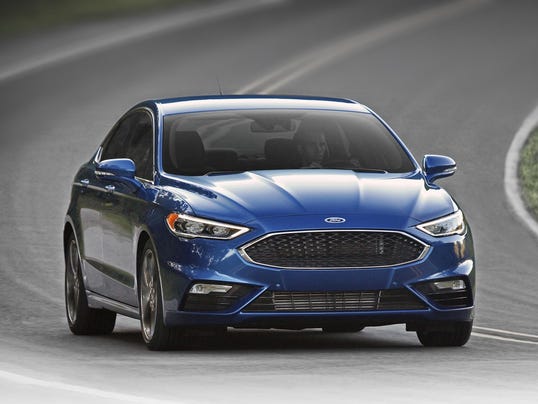
In 1989, basketball icon Michael Jordan shaved his thinning pate clean and males with receding hairlines wanted to Be Like Mike. They may have had potbellies out to there, but their HeadBlade domes looked as cool as the coolest athlete on earth.
Auto fashion is like that.
A pouty-mouth grille and fastback shape has made Aston Martin the coolest cat in autodom. So in 2013, Ford’s frumpy Fusion mid-size sedan modeled Aston’s grille and shape and — dude! — it was cool.
Four years later and Fusion is due for its mid-cycle refresh. There may be a million of ’em on the road, but the sleek sedan still turns my head, its upscale looks rivaled only by the Mazda 6. Meanwhile, Aston style has continued to define auto fashion.
Would Fusion evolve with the sexy Brit? Would it get rounder hips like the Rapide sedan? Or copy its full frontal grille? Or get a wrap-around fascia like the stunning DB11 and Bond-inspired DB10?
Um, well: No, no, no and no. If it ain’t broke don’t fix it, so Fusion Part Two has played it safe. Rather than rocking out as a full Rapide wannabe, Fusion has just tweaked its Aston cues — headlights more angled here, lips more pointed there, corners edgier over there. A little bling goes a long way, so Fusion’s tookus gets a nice, horizontal chrome strip connecting the rear taillights. And “eyeliner” front LED running lights. Like the theme song that accompanies Broadway musical characters, cars these days must have their own light signature.
But if the Fusion Part One’s exterior wowed, the headliner for Fusion Part Two is what’s under the skin. Like the Michael Jordan wannabe who shaved his head and then adopted a basketball fitness regimen, the new Fusion has put some serious firepower behind that lovely Aston face.
For 2017 Fusion has added a “Sport” badge to its lineup.
But this is no Honda Accord Sport model tarted up with big wheels and a decklid spoiler. Fusion Sport is packed with the same blown, 325-horsepower V-6 found in the F150 and Ford Edge Sport. That would be the first mid-size sedan to pack more than 300 horses.
Whip the Sport out of a Woodward stoplight and it will hit 60 mph in just 5.3 seconds — two seconds quicker than Fusion’s peppy, turbocharged 2.0-liter and just a half-second off Aston’s Rapide sedan. Now we’re talkin’.
Ford is a decidedly bipolar brand these days — a fuel-sipping Ecoboost greenie one minute, a hungry twin-turbo drag racer the next. Nowhere is this split personality more evident than the Fusion lineup, which made headlines in 2013 by offering a hybrid version that went farther on a gallon of fuel (42 miles vs. 41) than King Camry. There’s a plug-in too.
That was then, this is now. For Act Two, the 20 mpg Sport is the least efficient Fusion — part of a Blue Oval performance offensive that has includes the Le Mans-wining Ford GT, asphalt-melting Shelby Mustang GT350, and musclebound Ford Focus ST and RS hot hatches.
“We decided not to do an ST version of the Fusion. This customer is not quite as hardcore,” says Todd Soderquist, chief program engineer for Fusion. But Soderquist didn’t hold back much. This is a motorhead who spends his leisure time wringing the neck of a GT350 at a two-mile racetrack he built in Nebraska.
The Fusion Sport would sound great on a racetrack, too. WAAUUUUUGHHHHHH!! I nail the throttle coming out of the twisties near Hell, Michigan, and for a moment wonder if it isn’t a masculine Ford V-8 under the hood. Put Sport in SPORT mode and the sound sharpens, the steering tightens and the tranny holds a higher gear to take full advantage of 380 pound-feet of torque.
That’s useful because the Fusion Sport is no lightweight. Exiting a Glenn Brook Road hairpin, the V-6 grunts with exertion to keep the sedan’s porky 3,982 pounds (551 more than the base Fusion) moving. Continuously variable dampers — a cousin of the magnetic dampers that make GM’s performance cars such a joy to drive these days — help keep the big fella nimble.
Some of those added calories come from the Sport’s extra two cylinders and all-wheel drive. Other poundage comes from hood insulation and double-laminated glass that contribute to the 2017 Fusion’s biggest advance: a quiet, sophisticated interior.
Beginning at the Fusion’s SE trim (standard on Sport), the much-improved SYNC 3 system is available. SYNC’s console screen is quick to the touch, connects to my smartphone via Android Auto (CarPlay for you Appleheads), and displays its info in the instrument panel for safer, heads-up driving.
Transforming Fusion’s center console is an electronic rotary shifter. Its beauty is in what it adds — the aggressive, aforementioned SPORT button — and subtracts.
Eliminating hydraulic cables, the e-shifter also opens up the once-cramped console. The console storage bin is so deep it reaches to China, and a cave of space has opened under the dash screen big enough for spelunking. Add two cupholders and a roomy slot for my monster smartphone and you can have everything and the kitchen sink at your disposal.
Otherwise, Fusion’s dimensions are unchanged. I could sit behind myself in a backseat that is no Honda Accord-sized living room but comfortably average for the class. The Sport (you’ll know it by its unique mesh grille) is also joined in 2017 by an upscale Platinum trim, meaning the Fusion model line now runs from $22,610 to north of $42,000 — a $20,000 trim spread that is typical of lux models like Audi’s A4, for example.
With a growly voice, AWD and similar horsepower to Audi’s S4 sport trim model, think of Fusion as a roomier version of Audi’s S4 sports sedan. Sport even sports a unique LED light signature (Audi started this trend), ditching the standard Fusion “eyeliner” for an eyebrow LED. I would even go so far as to cross-shop against the Audi — especially as you can have the athletic Fusion for (cough) $18,000 less.
Take a good look in your rearview mirror the next time you hear a growly engine. That grille could be an Aston Martin. That menacing headlamp? An Audi. But when it roars past, you’ll note the Ford badge and think: I can afford that.
2017 Ford Fusion
specifications
| VEHICLE TYPE | FRONT-ENGINE, FRONT OR ALL-WHEEL DRIVE,
FIVE-PASSENGER SEDAN |
||||||||||||||||
| Power plant | 2.7-liter, twin-turbocharged V-6 (Sport model
as tested). Also available: 2.5-liter inline-4; 1.5-liter turbocharged inline-4; 2.0-liter, turbocharged inline-4; hybrid with 2.0-liter inline-4/battery assist; plug-in hybrid with 2.0-liter inline-4/7.6 kWh lithium-ion battery
|
Payne: Audi’s R8 is uncompromising in speed and comfort
Posted by hpayne on September 1, 2016
Car names are so homogeneous these days. Shopping for luxury sports sedans sounds like a trip down the microwave appliance aisle. Quick — what brands make the AMG CLA45, 3-Series M3, ATS-V and WM009? Answer: Mercedes, BMW, Cadillac, and that last one is a Westinghouse microwave. Even sports cars aren’t spared. Audi’s expensive goods department, for example, offers a choice of A7, S7, RS7, A8, S8 or R8. Which one’s the mid-engine coupe? You: I just bought an R8. Neighbor: Oh, yeah, I love the big back seat. You: No, that’s the A8. I have the two-seat sports car. Yeah, that one. The one that shares a chassis and engine with the Lamborghini Huracan. The one with 610 horsepower and dual-clutch S-tronic tranny that shifts in under 100 milliseconds. The one that goes 0-60 mph in 2.6 seconds, faster than any naturally aspirated car on the planet. At least Lamborghini names its rocketship after a bull. I mean, c’mon, Audi! If you had to go alphanumeric, you couldn’t have named it the XXX? Or PDQ? Or OMG? I particularly like that last one, because that’s what people kept shouting when I prowled the Dream Cruise last month. Even at 3 mph, the R8 looks like it’s doing a million. Heads snapped around like Beyonce had appeared in the middle of Woodward. Oh, my god, Dad! It’s an R8! Oh, my god! What is that? Oh, my god! Is that the new R8? OMG, this thing is intense. The Audi’s badge may be antiseptic, but it purposely echoes the brand’s legendary R8 race car that dominated LeMans at the turn of the century, proving Audi could compete on the world sports stage with Porsche and Mercedes. Like the racing prototype, R8 is the distillation of Audi’s best technology. Now in its second generation, the R8 is uncompromising in speed and comfort. Audi nixed the previous gen’s lower-priced V8 option, meaning your choice is a 540- or 610-horsepower V10. As such, the $164,000-$200,000 Audi occupies a competitive market space with other powerful cyborgs like the Porsche 911 Turbo, McLaren 570S, Acura NSX and Mercedes AMG GT S. With their conventional drivetrains (the battery-assisted NSX excepted) and sub-$200K stickers, these greyhounds put up similar performance numbers to gold-plated exotics like the $1.4 million Ferrari LaFerrari, $450,000 Ford GT, and aforementioned, $260,000 Huracan. Rare but hardly unicorns (by contrast, there are only three LaFerraris in all of Michigan) they are the face of GT racing, slugging it out in IMSA’s Weathertech series at venues like Detroit’s Belle Isle Grand Prix weekend where R8 won the GTD class ahead of a Huracan. They are the cars that the $100,000 Corvette Z06 use as a performance baseline (thus its rightful place as the “budget supercar”). Call them the Junior League of Supercars (taking a page from Marvel’s young superheroes). At $199,925, my Audi R8 V10 Plus may be the best of the breed. I say that having tested the class’s best athlete, the 2017 Porsche 911 Turbo, at California’s Thunderhill Raceway just days before delivery of my R8 (“Plus” designates the 610-horsepower option). Stuttgart’s superhero outduels the Audi in virtually every spec (according to comparisons by our friends at Car and Driver and Motor Trend). Zero-60 mph: Porsche, 2.5 seconds; Audi, 2.6. Braking, 70-0 mph: Porsche 139 feet; Audi, 153. Skid-pad cornering Gs: Porsche, 1.06, Audi, 1.00. And so on … Flogging the R8 around M1 Concourse’s 1.5-mile track in Pontiac, I found the stats backed up the user experience. Like the all-wheel-drive 3,527-pound 911 Turbo, the AWD 3,627-pound Audi was a blast to drive with neutral handling, maniacal acceleration and earth-clawing, ceramic-rotor braking. Compared to a first-gen R8 I drove at Autobahn Raceway outside Chicago a couple of years back, the 2017’s chassis is noticeably more rigid, its aluminum skeleton strengthened by a carbon-fiber bulkhead and undertray. Yet the Porsche’s more sophisticated AWD — dual-clutch torque vectoring assisted by rear-wheel steering — made for much better rotation through corners than the Audi and its more common Haldex system. Both cars were shod with Pirelli P-Zero summer tires, but the Turbo was more predictable on turn-in with less slip under high g-loads. Like the Acura NSX, the Audi’s inherent understeer impedes momentum through the tight stuff. Under stress, the R8’s brakes showed a tendency to fade (surprising for ceramics) and emitted a noticeable odor when I returned to the paddock. Porsche’s ceramic and steel rotors never blinked under more extreme flogging. Despite their transmission similarities, the R8 displayed eccentricities compared to the rock-solid Porsche — like a violent, surging downshift when floored at cruise speed. Audi makes up for these small track margins with big street pluses. Like design. Porsche’s familiar coupe lines won’t send Dream Cruisers running for their smartphone cameras like the slinky R8. Its fascia is no Lambo (Audi’s halo car conforms to brand design themes), but intimidating nevertheless. Eschewing the first gen’s awkward “sideburn” intake for a more conventional scoop, the Audi’s long, V-10-engorged rear deck is reminiscent of the dramatic Bugatti Veyron. In an age of whispery turbos, the howling, high-revving 10-pot is an aural masterpiece. Zero-60 stoplight launches are epic. My petrolhead pals were laughing as they put the throttle to the mat, the lightning-quick tranny and AWD grip propelling the car forward like Cedar Point’s Top Thrill Dragster roller coaster. On Woodward after hours, the R8 simply sucked the doors off all challengers like Maserati’s alpha dog GT MC. I could have set up a stand at the Dream Cruise and charged for rides. Before waking up the throaty V-10, the Audi’s interior, all-digital “Virtual Cockpit” wows. The 12.3-inch display integrates infotainment functions in the instrument panel. The 911’s classic gauge controls look soooo 15 minutes ago by comparison. And by eliminating the traditional dash screen and putting all controls including the START-STOP button on the steering wheel (shades of the racing R8 prototype), the Virtual Cockpit opens up the console for useful storage and cupholder space — a rarity in sports cars. The experience makes the R8 feel like I am driving a video game. Instant power. Ear-rattling audio. Digital special effects. With the R8, Audi has married raw Lamborghini performance with 21st-century drivability. Now if they could just come up with a more descriptive alphanumeric badge. How about “2.6 0-60”? 2017 Audi R8 V10 Plus specifications TWO-PASSENGER SPORTS CAR (V10); 610 horsepower, 413 pound-feet torque (V10 Plus) top speed: 205 mph report card Overall:★★★★ Posted by hpayne on August 29, 2016 Ginger or Mary Ann? Paper or plastic? Hillary or Trump? Life is full of vexing, self-defining choices. Here at The Detroit News, we take on the hard auto choices every year at the Woodward Dream Cruise, America’s greatest rolling car show. We schedule the coolest cars in the press fleet and put them through the ringer: Hours of grueling Woodward cruising, rubber-smoking stoplight burnouts, and constant Sirius/XM radio tuning. It’s a tough job but somebody has to do it. In years past we have addressed great existential questions like: Stingray or Hellcat? Mustang or Camaro? V-8 or inline-4? This year your intrepid auto critic took on the burning issue: Convertible or coupe? I was well equipped with cutting edge examples of both breeds: The soft-top 2017 Fiat 124 Spider and the fastback, 50th anniversary 2017 Chevy Camaro SS. The Fiat is everyone’s favorite Italian roadster. Nicknamed the Fiata because it is the dizygotic twin of the Mazda Miata, the 124 comes in convertible trim only. The Camaro SS, by contrast, is a coupe fortress, its windows narrower than a Normandy pillbox (and with more firepower under the hood, too). I last rowed the delightful Fiata over California mountain roads. Despite sharing everything but its skin and engine with the Mazda, Fiat has done a good job of separating the two brands. With retro-styling that updates the 124’s ’60s look for a new century, the Spider fits right into a Cruise culture that treasures nostalgic designs like Mustang, Challenger, and Camaro. The 124’s turbo four-banger is not as lively as the Miata’s 2.0-liter naturally-aspirated mill, but Woodward party accentuates the Fiat’s greatest virtues: Italian styling and topless cabin. Fiat is the tightest fit for my 6’5” frame of any auto. With ragtop in place, my head is stuffed into the roof, my knees one with the dashboard, and I have to dislocate my shoulder to operate the rotary screen-controller knob. But with the top down, the tiny Fiat is a delightful fishbowl with a 360-degree view of Woodward. Inching along in the Friday evening Cruise jam, I chatted with cars on the right and left of me while routinely taking smartphone “selfie” shots of cars streaming for miles behind me. Best of all, the Fiata soft top is a cinch to take up or down without ever leaving the driver’s seat. When a pattering of rain drops came Saturday afternoon, I simply popped the latch, reached back and pulled the cloth top over me as simply as I would yank on a blanket on a cold summer’s night. In the Camaro, you’re lucky to see in front of you. From the outside, the 2017 car is a knockout. Sculpted with muscular flanks and squashed greenhouse, Camaro might pass for a front-engine Lamborghini but for the bowtie Chevy logo on the grille. But inside, the angled windshield is so shallow that I had to lean forward just to watch stoplights change. The surrounding view? Fuhgettaboutit. The only way you know the guy in the tiny Fiat is at your elbow is the blind-spot monitor flashing in your rear-view mirror. The Fiata is for extroverts. If you want to show off your hot girl-/boyfriend, get the 124 — no one will see ’em in Camaro Cave. Chevy’s coupe is for a different kind of display: horsepower. With 455 horsepower on tap from the same small-block V-8 found under the hood of cousin Corvette, the SS is a master at the Woodward burnout. I tried a burnout with the 124 Spider’s 160 horsepower turbo-four and the tire squeak was louder than the engine. Spectators thought someone had stepped on a mouse. Cruising up Woodward on Thursday morning in Camaro’s 50th Anniversary Parade, I was followed by Kansan Logan Lawson — owner of the first Camaro ever made — attending his first Dream Cruise. Got to roll out the burnt-rubber welcome mat for these Kansans. Each stop signal on Woodward became a routine. Green light. Spike the revs to three-grand. Pop the clutch. Fill Logan’s cabin with tire smoke. With its 455-pound feet of torque and a limited-slip differential, the Camaro makes burnouts easy — and safe. Which reminds me of another advantage of coupes — when the air gets too thick with tire smoke and carbon monoxide, you can always roll up the windows and marinate in cool air conditioning. With 4G LTE WiFi and Android Auto connectivity, the Camaro is an easy refuge. Of course, readers looking for the perfect mix of topless roadster sociability and tire-smoking coupe macho may have already figured out the solution: The Camaro SS convertible. Happy cruisin’. 2017 Fiat 124 Spider Specifications TWO-PASSENGER SPORTS CAR top speed: 136 mph 2017 Chevy Camaro SS Coupe Specifications report card Overall:★★★★ FOUR-PASSENGER SPORTS COUPE (6.2-liter V-8 as tested) top speed: 155 mph report card Overall:★★★★ 
VEHICLE TYPE
MID-ENGINE, ALL-WHEEL DRIVE,
Power plant
5.2-liter V-10
Transmission
Seven-speed, dual-clutch “S-tronic” automatic
Weight
3,627 pounds
Price
$164,150 base ($199,925 V10 Plus as tested)
Power 540 horsepower, 398 pound-feet torque
Performance
0-60 mph, 2.6 seconds (Motor Trend);
Fuel economy
EPA 15 mpg city/22 mpg highway/17 mpg combined
HIGHS
VIRTUAL COCKPIT DISPLAY; VIDEO GAME-LIKE ACCELERATION
Lows
Odd, sudden tranny downshifts; cop magnet
Payne: Cruise convertible or coupe?
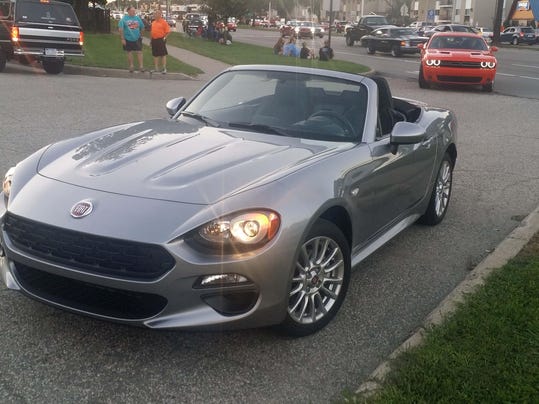
VEHICLE TYPE
FRONT-ENGINE, REAR-WHEEL DRIVE,
Power plant
1.4-liter, turbocharged inline 4-cylinder
Transmission
Six-speed manual (as tested)
Weight
2,428 pounds
Price
$25,990 ($27,285 as tested)
Power
160 horsepower, 184 pound-feet torque
Performance
0-60 mph, 6.8 seconds (manufacturer);
Fuel economy
EPA 26 mpg city/35 mpg highway/30 mpg combined (manual)
HIGHS
HASSLE-FREE DROP TOP; CLASSIC RETRO LOOKS FOR DREAM CRUISE
Lows
Tight interior quarters for six-footers; Turbo lag
VEHICLE TYPE
REAR-ENGINE, REAR-WHEEL DRIVE,
Power plant
6.2-liter push-rod V-8
Transmission
Six-speed manual (as tested)
Weight
3,685 pounds (SS as tested)
Price
$44,695 (50th anniversary editon base price, as tested)
Power
455 horsepower, 455 pound-feet torque
Performance
0-60 mph, 3.9 seconds (Car and Driver);
Fuel economy
HIGHS
COOL CONSOLE ERGONOMICS; WOODWARD BURNOUT ADDICT
Lows
The visibility of a Normandy pillbox; gotta take your legs off to fit in backseat
EPA 16 mpg city/25 mpg highway/19 mpg combined