- Search Cartoons
- Comic Archive
-
Payne
Store



 Henry Payne RSS

Articles Blog
Payne: 650-hp ZL1 Camaro blows the roof off
Posted by hpayne on May 5, 2017
Ah, May at last. Oil temperatures are rising. Woodward Avenue is calling. Songbirds are calling.
We here at The Detroit News prefer a warble that sounds like King Kong gargling razor blades on Skull Island.
That would be the song of the Chevy Camaro ZL1 convertible, Motown’s latest, greatest droptop. The convertible is a sight for sore eyes and a roar for deafened ears. You probably felt it first, an earthquake that made your lights flicker when I stomped the throttle unleashing 640 pound-feet of torque on M1 Concourse’s Champion Motor Speedway just feet from hallowed Woodward ground.
After a long winter’s hibernation, the race track calls for the ZL1 like honey to a bear. It wasn’t always so. The ZL1 badge is the stuff of Camaro legend: rare “COPO” (Central Office Production Order) cars with huge, modified engines for drag racing. The ZL1 was Camaro’s quarter-miler, the Z28 its track star. But with Camaro’s marriage of Corvette’s 650-horsepower Z06 V-8 to GM’s Alpha chassis (shared by the apex-carving Cadillac ATS-V), the ZL1 coupe introduced last fall is an all-around athlete as comfortable in the twisties as it is in a straight line.
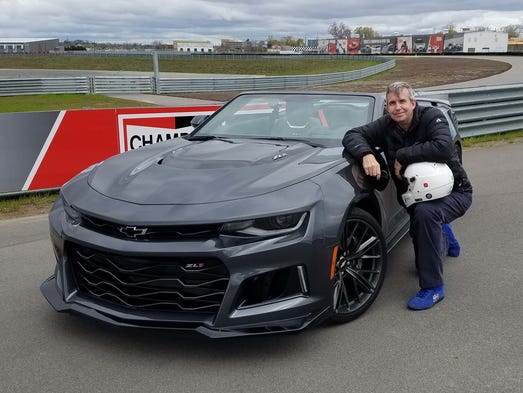
Call it a “Cormaro.” I shiver at the capabilities of the coming Z28.
But first, Camaro gives us the $69,135 ZL1 Convertible. How nice, you say. Another ragtop for Florida vacation rentals. But this is no rental-fleet floozy. It’s the coupe with a sun deck.
I first tested the hardtop at Willow Springs Raceway in December and it took to the big track like Kong to a banana grove. Put it on the small, 11/2-mile M1 and it’s like throwing Kong into a high school gymnasium. It can’t contain him.
Despite 12 inches of Goodyear F1 Supercar gummies on the rear, the ZL1 strains for traction when all horses are delivered through M1’s tight corners. I drift the beast across apexes on partial throttle, lest the 4,100-pound missile swap ends and start vectoring in the opposite direction. Even on M1’s curved front straight, I can’t bury the throttle (as I did in the AWD Audi R8 last year).
But M1’s Indy Lights-trained, Super Truck-racing, chief instructor Aaron Bambach is a wizard with the wheel. He takes the reins and drifts the beast at lurid angles.
“Very nice,” he observes after a string of laps. “Tight chassis and Goodyears really make this a nice track car.”
Um, Aaron, you know this is a convertible, right?
Like everything else about the sixth-generation Camaro, this one redefines the concept of muscle-car ragtop. Chevy leaves off the electronic, limited-slip differential (mechanical LSD is fine, thank you) and track timer (only crazy journalists will take it to the track, apparently). But still gets the coupe’s front splitter, magnetic shocks, rear airfoil, 11 heat exchangers — and the first application of GM’s Porsche-beating, 300-millisecond-shifting, manual-defying 10-speed automatic gearbox.
I’m a stick disciple, but the ZL1’s deca-tranny is a must-have.
Out of M1’s hairpin, I drop the hammer on the back straight and hang on. The 10-speed rips off shifts like rifle shots, while the quad-exhaust shatters windows in a 10-block radius. My jacket would have been torn off if M1 didn’t require that convertibles run with the top up. The end of the quarter-mile straight comes up in a heartbeat, the digital speedo clicking 125 mph before massive, 15.35-inch Brembos haul the ZL1 back to Earth.
“I could hear you all the way around the track,” says a pal back in the paddock. And in Ferndale, too, no doubt. The fun continues as we roll out of M1 and onto Woodward — going topless in 14 seconds up to 30 mph.
Stop at stoplight. Engage launch control: left foot floors brake, right foot floors throttle, tach steadies at 2,000 rpms. Release brake — and release the Kraken. Three-point-six seconds later we’re at 60 mph on our way to the moon.
Developed from the ground up to be convertible, the ZL1 soft top, like a Porsche Boxster, gives you aural thrills without chassis compromise. Gone is the cowl tremble of the fifth-generation Camaro convertibles. The Alpha chassis is a rock.
I cruised Woodward with the top down no matter what the temperature (hey, 48 degrees is a balmy Michigan April, no?) just to get the full audio experience. At low revs it’s a quiet cruiser. Put the throttle to the mat and it’s a glorious symphony. The rhythm of wind noise, the supercharger’s rising whine, the quad-pipe brass section — BRAAAAAPPPPP!
The soundtrack makes you forget the interior’s inconveniences.
Console storage is virtually non-existent and the door pockets are nearly in the child-sized backseat. The window ledges are so high that even your 6-foot-5 scribe’s elbow hangs awkwardly by his ear. And, unlike its cousin the Corvette, air vents are low in the console, so when I turn up the fan to keep the open cabin warm, most of the air gets blown on my knees.
But I rationalize the slights. Going topless eliminates the Camaro’s notorious visibility problem. And the rear seats are big enough to accommodate the neighborhood kids who pour from their homes for rides.
My friend Rick gave up his 2012 ZL1 for an Audi S4 a couple of years back. After a run in the Cormaro, he’s ready to go back. The convertible doesn’t come cheap at $7,000 more than the $62,135 coupe — and $8,500 north of a four-door ATS-V. But the Cadillac doesn’t come topless and the ZL1 will blow its doors off out of a stoplight.
“The new ZL1 is a different car than the fifth-gen,” Rick said after ripping off a couple launch-control starts from Woodward stoplights. It’s not the power — the old ZL1 had a healthy 580 horses — it’s the refinement (“the old car was loud all the time”) and the Alpha chassis (“noticeably firmer”). While the convertible is 200 pounds heavier than its coupe stablemate, that still makes it 37 pounds lighter than his old ZL1 coupe.
Rick is inclined to the sleek hardtop and its cheaper sticker. I’ll take the convertible for the audio experience.
Henry Payne is auto critic for The Detroit News. Find him at hpayne@detroitnews.com or Twitter @HenryEPayne.
2017 Chevrolet Camaro ZL1 Convertible
| VEHICLE TYPE | FRONT-ENGINE, REAR-
WHEEL DRIVE, FOUR-PASSENGER, TWO-DOOR CONVERTIBLE |
| Powerplant | 6.2-liter supercharged V-8 |
| Transmission | Six-speed manual; 10-speed automatic |
| Weight | 4,100 pounds (est.) |
| Price | $69,135 ($72,325
as tested) |
| Power | 650 horsepower, 640 pound-feet torque |
| Performance | 0-60 mph, 3.6-3.8 seconds
(Car and Driver est.) |
| Fuel economy | TBD (EPA for coupe: 12 mpg city/20 highway/
15 combined) |
Report card
| HIGHS | TOPLESS V-8 SYMPHONY;
FIRM CHASSIS DESPITE ROOF LOSS |
| Lows | Micro interior-storage;
insane V-8 will wake up the neighbors |
Overall:★★★★
Tesla rival Lucid rises on home turf
Posted by hpayne on May 2, 2017

New York — Peter Rawlinson says the Tesla Model S is Electric Vehicle 1.0, and the Lucid Air is EV 2.0. People are listening because he’s been the chief engineer for both.
Following his breakthrough success with Tesla founder Elon Musk on the Model S sedan in 2011, Rawlinson moved on to his second Silicon Valley electric-car startup. At Lucid Motors, the chief technology officer is honing the lessons learned at Tesla to build the Air.
A prototype of the striking battery-powered sedan with a full-glass moon roof stretching the length of the cockpit — hence the name Air — premiered in April at the New York Auto Show. California-based Lucid is ramping up a $240 million fundraising campaign as a first phase toward a 2019 production goal in Arizona. The company aims for a sticker price starting at $60,000, similar to the Model S.
In a field of would-be Tesla fighters that include General Motors Co.’s Chevrolet Bolt, Porsche’s Mission E, BMW’s i lineup and troubled prospects like Faraday Future and Detroit Electric, Lucid has emerged as the badge-du-jour largely on the shoulders of Rawlinson’s resume and the talented team of ex-Tesla engineers he has brought with him.
Based in Menlo Park not far from Tesla’s headquarters, Lucid is determined to prove that electric vehicles are the future. Investors have doubts and question whether Tesla’s sky-high market valuation is specific to mercurial CEO Musk. The visionary entrepreneur with a Midas touch created the online payment system PayPal and SpaceX, the private commercial space company that recently launched the world’s first reusable rocket.
“Elon Musk is Tesla,” said Jeff Schuster, vice president of forecasting at LMC Automotive, an auto industry analysis firm. “No one else has his kind of following. The luxury electric vehicle space exists because of him.”
Rawlinson, whose resume includes stints as boss engineering at Jaguar and Lotus, said the electric-vehicle revolution is bigger than one personality. So when Lucid came knocking in 2013, he brought his engineering brain trust to Lucid Motors to create a better Model S.
Rawlinson & Co. have created a car that is smaller than the midsize Model S or the Mercedes E-Class, but with the same interior space as a long-wheelbase Mercedes S-Class. With a top trim offering a 130 kilowatt hours or kWh of battery, Lucid said the Air can go 400 miles on a charge. Tesla gets 335 miles on a 100-kWh battery.
“What differentiates us (from other EV startups) is that we are the team that did it before. We were largely responsible for the Model S,” Rawlinson said in an interview with The Detroit News in New York. “I brought all the key engineering people who were with me at Tesla.”
Anton Wahlman, a Silicon Valley-based auto analyst with the investment site Seeking Alpha, follows the electric-vehicle market closely. “I love the car,” he said about the Air. “It looks great, and Lucid has a first-rate team. It’s the Model S 2.0. Updated interior and a much more plush backseat. But is there market enough for it?”
Wahlman pointed to first-quarter sales results indicating that Model S and Model X sport utility vehicle sales are flattening out. Indeed, Tesla sales in the United States were down 30 percent from the 2016 third quarter.
Nagging questions
Founded as battery-maker Atieva in 2007 with funding from Chinese electronics billionaire Jia Yueting, Lucid was spun off as a carmaker last October as its Air sedan was readied for public introduction. Atieva has continued as a battery-maker supplying power packs to Formula E racing in Europe.
LMC Automotive’s Schuster said EV startups are risky, but Lucid is among those that could make it: “What they’ve shown in prototype form is encouraging, that they can go after the Model S.”
As Lucid raises money for production, questions continue to dog the company. One concern is that Lucid has been without a chief executive since 2015 (chief technology officer Rawlinson is the senior executive).
Then there is Rawlinson’s insistence that the proof that electric startups can be profitable is that Tesla is making money. This even though Tesla says it has yet to turn a profit — it lost $773 million on $7 billion in revenue in 2016.
“It is a widely believed myth in the industry today that electric cars are somehow unprofitable. That is simply untrue,” Rawlinson said.
“There is potentially a larger profit margin on electric cars than its gasoline counterpart. Tesla is making money on its cars right now — and it very well suits Elon Musk. If you were pre-eminent in that business, wouldn’t it be the smartest play to convince all would-be competitors that it is unwise to enter and compete against you?”
Auto investment analyst Wahlman disputes the claim based on Tesla’s publicly released figures. “Tesla is not profitable; they are losing money hand over fist,” he says. “It’s in Lucid’s interest right now to make the argument that Tesla is making money because their money-raising depends on it.”
Rawlinson said Lucid has attracted investments from the Rockefeller family’s Venrock venture capital arm and Japan’s Mitsui Group conglomerate. One trend is particularly bright for EVs, he said: falling battery costs.
“The reality is battery prices are going to fall dramatically,” Rawlinson said. “You don’t need a ‘Gigafactory’ — the last thing we need is the financial burden of a ‘Gigafactory,’ ” referring to Tesla’s Nevada lithium ion battery plant. “We can rely on the supply base to carry that investment weight. The world is going to swing electric in the next decade as the price for batteries falls.”
Rawlinson said his team has worked with supplier Samsung on a new type of cell chemistry to improve battery degradation from fast charging.
Breaking the rules
Investment analysts like Wahlman are encouraged that Lucid is focused on just being a carmaker without the added infrastructure of a battery factory and charging stations that Tesla has taken on.
“They are not going to integrate as vertically as Tesla,” he said. “That will help them, but you have more established automakers like VW and BMW that are even less vertically integrated. And battery costs are going to come down for them as well — so that doesn’t give Lucid or Tesla an advantage. Samsung will sell any automaker the same (battery) from GM to VW to Hyundai.”
Startups, however, are in vogue. Barring a serious economic downturn, Wahlman and Schuster predict Lucid will reach its $240 million capital goal. “Like Tesla, they are the anti-car company. That has given them some cachet,” said Schuster, who added that Tesla and Lucid are specialty brands that will be swallowed up by larger automakers.
For now, Rawlinson said he is focused on producing a vehicle like no one has seen before.
To that end, Rawlinson lured one of the industry’s acclaimed designers, Derek Jenkins, to pen the Air. An ex-Mazda designer, Jenkins’ achievements include the widely admired MX-5 Miata sports car and CX-9 SUV.
Like Rawlinson, Jenkins found Lucid a liberation from the gas-engine box.
“The transition from the gas engine to electric car is the closing of one book and the opening of another,” Jenkins said in New York. “I can break rules that I couldn’t have done anywhere else.”
Payne: Hyundai Ioniq Hybrid is Uber-riffic
Posted by hpayne on May 1, 2017

‘How come Toyota makes such weird-looking cars?” a New York Auto Show visitor mumbled to me this month as we passed by the Prius display. Well, my friend, Hyundai has a hybrid for you.
I like the new Prius. From its goofy Pokeman face to its multiple-screen interior to its huge vertical taillights that were stolen off a ’59 Caddy Eldorado Seville, Toyota’s battery-powered icon is different. It’s a rolling billboard screaming “I saved the polar bear!” But it is polarizing, no doubt.
The 2017 Hyundai Ioniq is the anti-Prius.
Handsomely designed, the Ioniq fits at the Hyundai family table with its hexagonal grille, conventional dash screens and horizontal taillights. Sure, it also conforms to green convention with its slippery, 0.24 drag coefficient “potato” shape (as Car and Driver’s Aaron Robinson aptly describes it), split rear window and tiny, doughnut tires. It wants to be invited to all the Earth Day parties, after all. But like the Chevy Volt, the Ioniq’s aim is to widen its buyer demographic with a mainstream design.
By Jove, it just might work.
Timing is everything in the auto business and we are riding a ride-sharing revolution with well over 300,000 Uber drivers in the U.S. Hyundai unveiled the Ioniq last year at the New York Auto Show in stereotypically green fashion. Gazillionaire environmentalist David de Rothschild, heir to the Rothschild banking fortune, took a moment from globe-hopping to give a sermon declaring Ioniq “the right choice for the environment” to a crowd of rolling eyeballs.
Hyundai executives followed up this performance by conceding to reporters that the Ioniq would help the company comply with government green mandates (Ioniq will also come in pricier plug-in and pure EV versions) while selling Americans the Tucson SUVs they really want.
“We have to create demand where it doesn’t exist,” said then-North America CEO David Zuchowski.
But as it turns out, creating demand may not be so hard after all. Ride-share services crave hybrids.
Prius has proven the point. It is the most registered car in London, for example, for ride-sharing services, and it is ubiquitous in U.S. Uber/Lyft fleets, too. I hail Uber often and frequently end up in the roomy back seat of a Prius. The reasons are obvious enough: Ride-sharing drivers can put as much as 50,000 miles a year on their vehicles which means they prioritize fuel economy, seat and trunk space. It’s a cab, y’know.
Interestingly, it’s not a market that favors pure electrics. On recent rides in Los Angeles, I asked Prius Uber pilots why so few of their brethren drove EVs. Two big reasons: 1) the sticker price for EVs is generally $10,000 north of $25,000 hybrids. And, more importantly 2) EVs and plug-ins assume home garages for overnight charging. Many Uber drivers are apartment dwellers.
Even for those with garages, the plug can be a hindrance if the juice runs out on the road. A $40,000 Chevy Bolt EV, for example, will add 90 miles worth of charging distance in 30 minutes at a fast-charging station. In just five minutes, a Prius is filled with gas for another 600 miles.
So, hybrids it is. And Ioniq is poised to take advantage.
While Prius styling has helped it dominate the green market (more than 50 percent market share), most Uber drivers are in business for the greenbacks.
Where the Ioniq may have a hard time conquering tree-huggers, it should be embraced by ride-share jockeys who learn it has better interior space and gas mileage than Prius. And a cheaper sticker.
I played passenger while my long-suffering wife played Uber driver.
She drove me home from Detroit Metro after a recent trip, my suitcase and briefcase stashed comfortably in the 26-cubic-feet trunk. Your giraffe-necked, knob-kneed correspondent fit nicely in the rear seat (there are two more inches of leg space than the Prius).
Mrs. Payne, a compact car fan, declared herself satisfied with the well-rounded Ioniq except for rear-visibility issues.
After my week behind the wheel, I concur. Rear visibility is generous only of you compare it to a cave-like Camaro. The fashionable split-window and huge c-pillar make it seem like you’re peering out from inside a wedge of Swiss cheese. But otherwise the driving experience is pleasant. The interior is tomb-quiet, the Elantra-based chassis solid.
Despite just 104 gerbils — er, horses (11 more than Prius) — under the hood, the 1.56-kilowatt battery-assist makes for typically peppy hybrid acceleration.
Peppy enough to launch me into 90-degree right-handers at a pretty good clip — at which point the Ioniq’s eco-friendly rubber doughnuts hit the limit and the Ioniq dissolves into a sobbing heap of tire screams. Hey, if you want handling, get a Golf hatchback. Fuel efficiency? Get an Ioniq.
I got 47.9 mpg for the week, a far cry from the advertised 55 mpg. Still, with a range of 654 miles, the only thing I needed a service station for was a newspaper.
The cabin design is so driver-friendly, Ikea could adopt it for lounge furniture. Everything is where it should be: lidded bin, storage cup for wallet or phone, two cup holders, vertical slot for files or laptop. In a neat trick of packaging the Ioniq does away with the 12-volt starter battery. And then there’s Hyundai’s Apple CarPlay and Android Auto connectivity advantage over Toyota — though, judging from Uber forums’ chatter, it’s not yet compatible with the Uber app.
Still, a ride-share winner the Ioniq is. The same qualities will endear it to greens. My wife’s pal Laurie is a longtime Prius owner and the Ioniq fit her like a glove. She liked the styling, increased room and the fuel economy — but balked at the deep well of trunk (compared to Prius) which means awkward lifts of heavy objects over the bumper.
The Ioniq’s $1,275 lower sticker price got her attention. Loaded Prius leases have been creeping into the low $400s-a-month leaving room to steal some customers with savvy pricing. Hyundai also offers a lifetime battery warranty and best-in-auto 10-year/100,000 mile drivetrain coverage.
Once dependent on government credits to sell, affordability and practicality are hybrids’ new secret sauce for owners and Ubers alike.
Toyota has the icon. Hyundai the Ioniq. The hybrid that doesn’t look weird. Game on.
Henry Payne is auto critic for The Detroit News. Find him at hpayne@detroitnews.com or Twitter @HenryEPayne.
2017 Hyundai Ioiq Hybrid
| VEHICLE TYPE | FRONT-ENGINE, FRONT-
WHEEL DRIVE, HYBRID HATCHBACK |
| Powerplant | 1.6-liter inline 4-cylinder with lithium-ion battery assist |
| Transmission | Six-speed, dual-clutch automatic |
| Weight | 3,172 pounds as tested |
| Price | $23, 035 ($25,910 SEL
as tested) |
| Power | 138 horsepower (combined 104-horsepower gas engine and 32-kW electric motor) |
| Performance | 0-60 mph, 10.5 seconds
(Car and Driver) |
| Fuel economy | EPA 55 mpg city/54 highway/
55 combined |
Report card
| HIGHS | EXCELLENT INTERIOR ACCOMMODATIONS;
55 MPG, ’NUFF SAID |
| Lows | Poor rear visibility;
high mpg, low thrills |
Overall:★★★★
The stick shift is dead, long live the stick shift
Posted by hpayne on April 26, 2017
New York — The news of a five-door Porsche Panamera Sport Turismo rocked the New York Auto Show last week. A Porsche station wagon? Hell must have frozen over.
But the indignation from performance purists was tempered by the fact the German sports car manufacturer was bringing back an old friend: the manual gearbox in its Porsche 911 GT3 track animal.
Porsche isn’t the only automaker making manual news as the stick defies its long-predicted demise. To paraphrase Mark Twain, the death of the stick shift has been greatly exaggerated. In the last year Ford, Honda and Hyundai all have touted their manual options as automakers vie for an important niche buyer: the enthusiast.
News that the 911 GT3 was stiffing the stick back in 2014 seemed the nail in the coffin for a transmission option viewed by many as an anachronism in the 21st century. Stick take-rates peaked at 25 percent for cars in 1987, according to EPA figures, and have plummeted to between 3 percent and 7 percent over the last decade. In 2016 just 3.8 percent of sales were manual, according to Edmunds.com.
Once a rite of passage for 16-year-olds to master, the stick shift used to boast better fuel economy and better acceleration than its automatic counterpart. But with the advance of modern, multi-ratio automatic gearboxes, the stick’s advantages have melted away. Automatics do everything better, it seemed.
Except, automakers are learning, stoke passion.
Porsche’s state-of-the-art, dual-clutch, seven-speed PDK automatic transmission vaulted the 2014 GT3 to performance heights unseen by its manuals. Lightning-quick, 100-millisecond shifts, head-snapping launch control, and 3-second zero-60 acceleration — more than a half-second quicker than the previous generation’s stick. But purists complained that the technology was removing the fun factor from the legendary driver’s car.
“Though a lot of our customers want the performance advantage of the PDK, there are still some who want the engagement of the manual over the lap time,” says Porsche Product Experience Manager Frank Wiesmann.
So the 2018 GT3 will offer a six-speed manual for 2018 as well as its automatic PDK. The decision was encouraged by Porsche’s positive response to the recent Porsche Cayman GT4 and Boxster Spyder performance models — both of which come exclusively with sticks.
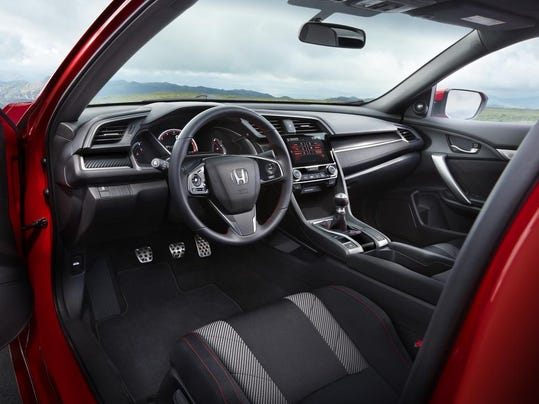
Honda showed off a whole lineup of manual Civics in New York — including its top-trim, 305-horsepower Type R hot hatch that comes with stick only. The entry-level, $21,300 Civic Sport will come with a manual option, as will the 205-horsepower Civic Si. All three Civics are performance-minded, with the Sport manual a gateway drug to nascent enthusiasts who want to take their Honda to the track and to work.
“A manual transmission in a performance vehicle contributes to the credibility of the product. It’s how you know a Type R, for example, is a hot hatch,” says IHS Automotive senior analyst Stephanie Brinley.
She adds that the move to manuals is also part of a healthy sales market where “automakers are trying to find ways to be more competitive.” Edmunds.com says the percentage of vehicles offered with manuals has climbed from 19 percent in 2012 to over 27 percent today.
As consumers move to SUVs, Ford is trying to keep its small cars competitive by offering performance variants of its hatchbacks — so-called “hot hatch” Focus ST, Fiesta ST and Focus RS models. Sales for the trio — which come in manual only — were up over 21 percent last year.
“Performance cars are the exception to the rule on the sale shift out of cars and into SUVs,” says Ford spokesman Chris Terry. “They are bought by people who want to drive, who want to get the most performance enjoyment out of their vehicles. These are anti-SUV people.”
Eager to make its mark in the enthusiast world, Korean-automaker Hyundai last year introduced the 2017 Elantra Sport featuring a 201-horsepower turbo engine, sophisticated dual-clutch automatic transmission — and a stick. Hyundai showed off the manual version to media at an autocross course in Indiana.
The Sport’s stick has been a success, with a consumer take rate of 25 percent. Hyundai’s three-door “hot hatch” Veloster Turbo has achieved similar success since its launch as a 2012 model.
“Manual transmissions have become a tool to attract enthusiasts rather than price-point or fuel economy,” says Mike Evanoff, chief of Hyundai product planning. “The manual take on the base, non-turbo configuration is much lower.”
That conforms with Ford’s experience, which says the take rate for base price, non-performance versions of its Focus and Fiestas is a lowly 5-6 percent.
In courting performance customers with manuals, Ford says they are bringing in a younger, more affluent, more educated buyer who also tend to be evangelists for the brands they adopt.
$34K Mazda CX-5 vs. $54K Volvo XC60: the Mazda wins
Posted by hpayne on April 20, 2017
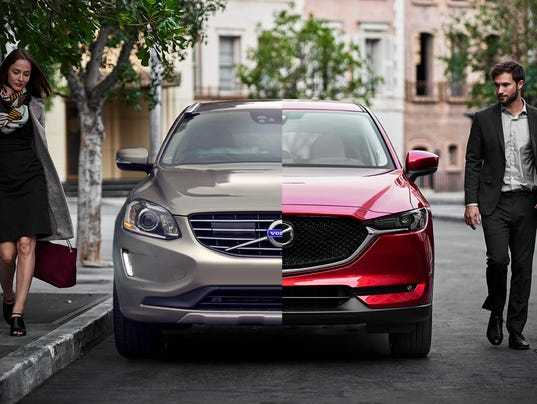
Welcome, dear reader, to another edition of “What’s it Worth to Ya?” It’s a little game I like to play comparing the ever-shrinking gap between luxury and mainstream brands.
We’ve played this game before with the Audi A4 and Ford Fusion. The latter’s roomier, more powerful, more affordable design really makes one think twice about paying a $15,000 premium for a four-ring grille.
C’mon, Payne, no one will ever cross-shop such cars.
Stay with me and you may reconsider.
Affordable electronics like heated seats and head-up displays are as easy to replicate in Mazdas as in Cadillacs. Meanwhile, five-door SUVs may be sweeping the planet for their practicality, but the resulting box-on-stilts restricts the tools available to designers to distinguish one brand from another. SUVs have turned dealer lots into the automotive equivalent of tract housing. How do you make your house stand out?
Take our compact-ute testers this week: the all-new, $34,000 2017 Mazda CX-5 and the $54,000 2017 Volvo XC60.
I won’t beat around the bush. The Mazda is the superior vehicle.
The XC60’s 2018 successor — introduced at last week’s New York Auto Show and due on dealer lots later this year — will finally get a platform upgrade after eight years on the U.S. market. It comes none too soon when you consider how the $20,000 cheaper Mazda has caught up — and often surpasses — the Volvo in metric after metric.
This is not to shame the Volvo, which is a lovely sculpture chiseled out of Scandinavian beech wood. Few luxury makes can hold a candle to the CX-5 in handling and design, not to mention value. Like its big brother, the CX-9 — the best-looking large SUV on planet Earth — the CX-5 is the prettiest, most athletic small ute this side of the seductive BMW X1. Dip it in Soul Red Chrystal paint and it’s more tempting than Elizabeth Hurley playing the devil in “Bedazzled.”
You feel the Mazda difference the moment you seize the steering wheel: It feels rooted to the pavement. It’s a sensation more often associated with a performance sedan. Not that the outgoing CX-5, which debuted in 2012, was a dog. Like Porsche’s SUVs and Panamera sedan, Mazda’s entire lineup is inspired by a sports car – in this case, the Miata. It’s a little like Mowgli being raised by wolves: He’s got their instincts. The CX-5’s father is Dave Coleman, a motorhead veteran of rally and sports car racing who also happens to be Mazda North America’s chief engineer.
Throw the CX-5 into an interstate cloverleaf and its Haldex-like AWD system bites like a Rottweiler on a postman’s leg. There’s push, sure — this is a front-wheel-drive biased chassis. But the finely tuned suspension (MacPherson strut up front, independent multi-link in rear) rotates with minimal body roll, tires protesting only at their limit. This little SUV thinks it’s a Miata.
The Mazda is not only the best-handling mainstream compact crossover, but it’s superior to everything short of high-performance crossovers like the Macan and Jaguar F-Pace. You’ll have to go a size smaller — subcompact utes like the BMW X1 or Audi Q3 — to find comparable handling. Yet even those vehicles are $10,000 north of the CX-5’s modest price tag.
The Volvo XC60, meanwhile, rolls leisurely through turns. Its steering chatters rather nervously as you approach the limit, then dissolves into a wail of tire screams as it senses the envelope’s edge.
Volvos have always been safety leaders and the XC60 is a Secret Service agent on wheels, always ready to protect with its state-of-the-art City Safety automatic braking. But the Mazda is hardly a potted plant: Using similar radar and camera tech, it is ready to intervene in perilous situations. The emergency-assist system isn’t standard like the Volvo’s, but the optioned Mazda still costs considerably less.
Volvo understands its brand is synonymous with safety and goes the extra mile. It boasts integrated child booster seats in the rear. Dogs are members of the family, too, and can be housed in a cage that has been crash-tested for safety.
But is the difference worth $20,000?
Perhaps Mazda’s most shocking accomplishment is in the beauty department. Design is what’s supposed to separate luxury from mainstream. The once-boxy Volvo has come into its own in recent years with sculpted lines and sultry grilles. Next year the new XC60 will get the cool Thor’s-hammer headlamps seen on the XC90.
But it’s the Mazda that has the luxury looks. Avoiding the grille clutter that defines many mainstream brands (I’m looking at you, Honda CR-V and Chevy Equinox), the CX-5’s face is a work of art. The headlights pierce the five-point grille like arrows; the LED work is evocative of Audi’s designer peepers. The body sweeps backward over high wheel-arches and deeply scalloped rocker panels — under blacked-out B and C pillars — to a chrome-punctuated fastback.
And did I mention it’s wearing a Soul Red Chrystal dress?
Inside, the Mazda is as whisper-quiet as the Scandinavian, but can’t match the Volvo’s carved-wood console. The CX-5’s design is more businesslike (think Audi) with attention to detail and material.
The XC60 and CX-5 both have meek infotainment systems that neglect Apple CarPlay and Android Auto connectivity. These oversights that are common among luxury brands. Despite these blind spots, the Mazda still one-ups its more expensive opponent with heated rear seats and a head-up display.
My favorite detail is the Mazda’s rear doors: They open to 80 degrees for easy rear egress. That solves a common ute challenge.
I have left the powertrains for last, because that is where the Volvo’s 300-horse, super- and turbocharged inline-4 clearly separates itself from the Mazda’s normally aspirated, four-cylinder 187-horse unit. But in practice, the CX-5 — though much buzzier under the cane — is a joy thanks to “G-vectoring control,” which cleverly manages engine-torque inputs for smoother acceleration and steering inputs.
Mazda execs call their strategy “moving to premium,” and it has all but eliminated the gap with more expensive SUVs. The high-tech Ford Escape and nimble Honda CR-V also play in the luxury league for thousands less. The pressure is on Volvo & Co. to justify their worth.
Henry Payne is auto critic for The Detroit News. Find him at hpayne@detroitnews.com or Twitter @HenryEPayne.
2017 Volvo XC60
| VEHICLE TYPE | FRONT-ENGINE, FRONT- AND
ALL-WHEEL DRIVE, FIVE-PASSENGER SUV |
| Power plant | 2.0-liter, turbo- and supercharged
inline 4-cylinder |
| Transmission | Six-speed manual or automatic |
| Weight | 2,875 pounds; 3,046 pounds
(with manual transmission) |
| Price | $41,945 ($53,555 Inscription
as tested) |
| Power | 302 horsepower,
295 pound-feet of torque |
| Performance | 0-60 mph, 6.4 seconds
(Car and Driver) |
| Fuel economy | EPA 20 city/27 highway/
22 combined |
Report card
| HIGHS | VAULT OF SAFETY SYSTEMS;
SCANDINAVIAN WOOD ACCENTS |
| Lows | Dull to drive; aging chassis has us
longing for update |
Overall:★★★
Grading scale
Excellent ★★★★Good ★★★Fair ★★Poor ★
2017 Mazda CX-5
| VEHICLE TYPE | FRONT-ENGINE, FRONT- AND
ALL-WHEEL DRIVE, FIVE-PASSENGER SUV |
| Power plant | 2.5-liter, inline 4-cylinder |
| Transmission | Six-speed automatic |
| Weight | 2,875 pounds; 3,046 pounds
(with manual transmission) |
| Price | $24,985 ($34,060 Grand Touring
as tested) |
| Power | 187 horsepower, 185 pound-feet
of torque (2.0-liter) |
| Performance | 0-60 mph, 7.6 seconds
(Car and Driver est.) |
| Fuel economy | EPA 23 city/29 highway/
26 combined (AWD) |
Report card
| HIGHS | AN SUV THAT HANDLES;
PREMIUM FEATURES |
| Lows | Tardy off the line; Apple CarPlay
and Android Auto, please? |
Overall:★★★★
NY Auto Show: Payne’s top picks
Posted by hpayne on April 15, 2017

The New York Auto Show is North America’s most-attended: More than a million New Yorkers are expected to rush the Javits Convention Center’s gates from now through April 23.
They won’t be disappointed. This year’s show is a new-car feast with a menu longer than Carnegie Deli.
These are my favorites.
Dodge Challenger SRT Demon
This will be remembered as the Demon’s show. The smoke from its huge tires obscured every other reveal. The 840-horse dragster is for the enthusiast who finds the Hellcat’s 707 ponies wanting. It’s also savvy marketing for an aging brand that can’t compete against the new, more nimble chassis of its Camaro and Mustang competitors. So the porky 4,223-pound Demon obliterates them in a straight line, racking up 9.65-second quarter-mile and 2.3-second 0-60 times that are unheard of in a production car. How fast is 2.3 seconds? The 1,380-horsepower, 3,075-pound Koenigsegg Agera RS1 supercar across the hall from the Demon huffs and puffs to 60 mph in 2.8 seconds.
Buick Regal Fastback and TourX
Lincoln Navigator
Lucid Air
Jeep Grand Cherokee Trackhawk
Porsche 911 GT3
Jaguar F-Type, 4-cylinder
The F-Type is designer Ian Callum’s Mona Lisa. So this mid-cycle refresh gets minimal tweaks — you’ll know it by the single outer air intakes on the front fascia rather than the old three-slot “shark gills.” The real story here is the first four-banger under the hood of an F-Type. The four not only helps the big cat meet emissions mandates, but it also drops its entry price below $60,000 so it can compete against Porsche’s full lineup of Caymans, Boxsters and 911s. But will four cylinders make a suitable Jaguar growl?
Lucid Air and Jaguar I-Pace take on Tesla
Posted by hpayne on April 15, 2017

New York — The Tesla Model S sedan and Model X SUV have pioneered the luxury electric-vehicle segment. But now they have company on both fronts.
The Lucid Air, a Model S-fighter, debuted at the New York Auto Show this week, just five months after the curtain rose on the Model X-fighting Jaguar I-Pace at the Los Angeles Auto Show. Beautifully styled by two of the industry’s leading designers to take on Tesla, the new models — one from a startup, the other from an established automaker — come from dramatically different business backgrounds.
“All credit to Tesla. They have pioneered electric vehicles, but now they know that other brands are on the march. There’s not a car brand at this show that’s not working on a (full-electric) vehicle,” said Andy Goss, Jaguar director of sales and marketing, in an interview. “BMW, Audi, Mercedes, Porsche all have product coming.”
But it’s Lucid, headquartered in Silicon Valley near Tesla, that is pushing the envelope of EV capability. With a clean sheet of paper, Lucid is coming to the auto market with the intent of redefining it with more versatile EV platforms.
“The establishment (automakers) still have the majority of their focus on maintaining their internal-combustion lines,” says Lucid design chief Derek Jenkins, who in his previous role with Mazda designed such lookers as the Miata and CX-9 sport ute. “That’s their bread and butter — it defines their segments and their brands.”
Jaguar admits as much. Its I-Pace will help the automaker meet looming government emissions rules even as it chases coveted luxury consumers.
“Compliance issues have something to do with this, especially in China and Europe,” says Goss of those nations’ increasingly strict greenhouse gas limits. Battery-electric vehicles are a massive contributors to getting your average (fuel-economy ratings) down.”
With a development team led by Chief Technology Officer Peter Rawlinson — Tesla’s former chief engineer — the gorgeous Air has the same exterior dimensions as the Model S but is larger inside. Where Tesla conformed to design standards of a long hood and tapered rear, the Lucid fully exploits the lack of gas engine for interior space. The Air’s premium model sports a full-glass moon-roof from stem to stern — hence its name.
“We can extract the full potential of the electric car. I couldn’t have done that at Tesla,” says Rawlinson. “Because the batteries are in the floor, this car has the exterior dimensions of a Mercedes E-Class and the interior dimensions of an S-Class long wheelbase.”
The Mercedes S-Class starts at $96,000. The Lucid, slated for 2020 sale, hopes to bow at just $60,000 — similar to the Model S. Lucid is in the process of raising $240 million to build its Casa Grande, Arizona, production plant.
Jaguar’s I-Pace, due next year, will likely start higher given its brand equity. Much of that value comes from the pen of legendary designer Ian Callum, father of the Jaguar F-Type, arguably the prettiest sports car in production. Yet Callum, like Lucid’s Jenkins, has turn away from the long hoods that Jaguar made famous (the signature 1960s E-Type is practically all hood) in order to take advantage of the 90 kWh battery pack stowed in the floor.
“I think we have an advantage because Jaguar has a design pioneer in Ian Callum and his existing design cues are particularly suited to electrification,” says Goss.
While similar in length to Jaguar’s popular F-Pace SUV, the I-Pace rides on its own platform and promises considerably more interior space thanks to its 4.6-inch longer wheelbase. Though nominally a crossover, Jaguar expects the I-Pace to draw both Model S and Model X customers.
Lucid’s product line more closely tracks Tesla’s model with a variety of battery options. Like Tesla, its base model with be rear-wheel drive with 240-mile range battery (kWh yet to be determined). Then battery sizes jump to 315-mile-range 100 kWh (equivalent to the current top-of-the-line Model S P100D), and a huge 130 kWh pack with 400-mile range and all-wheel drive.
“We’re the team that did it before. I’ve got the key brains behind the Tesla Model S,” says Rawlinson.
The Demon’s in the details with Dodge’s terrifying car
Posted by hpayne on April 15, 2017

New York – Forget muscle cars. No one does steroid-enhanced cars like Dodge.
Fiat-Chrysler’s performance brand introduced the much-anticipated sequel to its 707-horsepower, 6.2-liter, supercharged V-8 Challenger SRT Hellcat here Tuesday night ahead of the New York Auto Show: the 840-horsepower Challenger SRT Demon.
By now you know the Demon’s record-setting numbers: Fastest production car ever, zero-60: 2.3 seconds. Fastest 0-100: 5.1 seconds. Fastest quarter-mile: 9.65 seconds. But these numbers don’t tell the whole story.
What about that record 2.28-second Tesla Model S P100D zero-60 time?
According to Dodge boss Tim Kuniskis, Motor Trend’s independent test of Tesla’s super-EV included a roll-out — not an absolute standing start test. “Roll-outs aren’t a fair way to do zero-60, honestly. A real zero-60 is from a dead stop. But we included (a roll-out) anyway because we knew that question would come up,” said Kuniskis in the Big Apple. “You include roll-outs in our times and it’s 2.1 seconds.”
Remarkably, the Demon manages such feats with just rear-wheel drive versus the Tesla’s all-wheel drive
Circus-master Kuniskis
Dodge’s motorhead-in-chief is a rare bird. A drag racer himself, Kuniskis walks the talk. His words drip with scorn for the self-driving car trend, referring to its advocates as “the autonomous anonymous.” Kuniskis wants to make drivers’ cars.
“I want to walk you through a virtual run of what’s it’s like to run a Demon,” he said. “Activate your line lock. Start spinning your drag radials — get them hot and sticky. Over 200 degrees. You will literally have dripping rubber off of your tires. It’s pure car porn.” Does any other auto exec talk like this?
Demon from Hell
Dodge chose Pier 94 in New York’s Hell’s Kitchen district to introduce the Demon. Subtle.
A sequel for a sequel
Before the Dodge reveal on Pier 54, Dodge hosted an exclusive pre-screening for “The Fate of the Furious” at AMC Loews Lincoln Square Theater on Broadway. The eighth installment of the “Fast and Furious” movie franchise co-stars Vin Diesel and (natch) the Challenger Hellcat’s sequel, the Demon.
Co-stars unite
Speaking of Vin, the muscled celebrity was on hand for the Demon’s reveal, striding on stage after Kuniskis in a leather racing jacket. Diesel will tell you he prefers motorbikes, but he has a soft spot for Dodge. “I realize that I am part of a brotherhood,” he said. “The brotherhood of muscle that goes back to the Dodge Brothers.”
Skinny, not fat
That record-breaking 9.65 quarter-mile time was set on skinny, front dragster “runners” – just like the front tires you see on NHRA funny cars. The tires come in an available “Demon Crate” of drag-mod goodies, The runners store neatly in a foam insert in the trunk for transport to track. Leave the standard, 12.4-inch radials on the front and the Demon will be a bit slower — but still sub-10 seconds.
Wheelies on Woodward?
You bet. The Demon’s acceleration torque is so violent (a record 1.8 g-loads for a production car) that it will lift the front wheels in the air through first and second gears.
Banished Demon
The National Hot Rod Association certified the Demon’s production-record setting quarter-mile time and then promptly banned the Demon. How come? “The elapsed time and the speed (140 mph) on this run exceeded the limits … of our rules,” wrote the NHRA. “The car exceeds 9.99 seconds and 135 mph.”
That is, Demon should have a roll bar to legally run at those speeds.
Icebox
To pack the 2.7-liter supercharger with enough cold air to make 840 horsepower, the Demon actually diverts its air conditioning to the intercooler to chill the air by 45 degrees. “So hot. Yet so chill” as Dodge puts it.
Options
The Demon may be a stripped-down dragster (saving 200 pounds) to optimize performance, but it still comes with familiar options like power sunroof, heated leather seats, heated steering wheel.
Less familiar are for the missing front and rear passenger-seat options. You can have both for $2.
Price?
Dodge is mum for now, but chances are it won’t be much different than the $62,495 Hellcat because the Demon comes with so few amenities. If you’re one of the lucky 3,000 customers to own one, however, it should be worth every penny.
180-mph Jeep Trackhawk is a ‘Hellcat SUV’
Posted by hpayne on April 15, 2017
New York — What would happen if Fiat-Chrysler Automobile’s iconic Detroit brands — Jeep and Hellcat — had a love child? Say hello to the Jeep Grand Cherokee Trackhawk SUV.
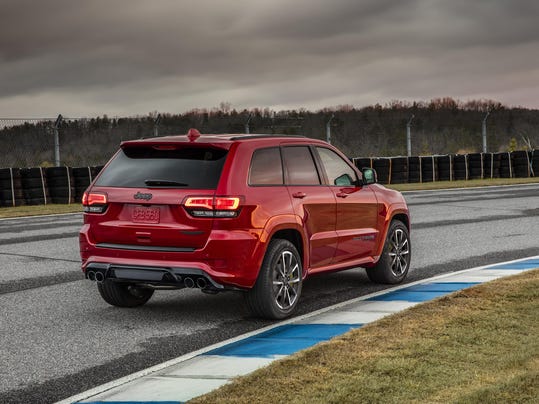
In a dramatic New York Auto Show unveiling before a packed house Wednesday, Jeep introduced the most powerful sport-ute ever with 707 horsepower and 645 pound-feet of torque. Perched on a four-wheel dynamometer on the Javits Convention Center stage, the blood-red, V-8 powered monster roared to life and proceeded to accelerate — in place — through the SUV’s record-setting numbers: zero-60 in 3.5 seconds; the quarter-mile in 11.6 seconds at 116 mph; then onwards to just shy of its 180 mph top speed.
The third FCA vehicle to receive its supercharged 6.2-liter Hellcat engine, the Trackhawk sports super sports-car acceleration and stopping power. With massive Brembo performance brakes, soccer moms can still bring the 5,550-pound behemoth to a stop and let the kids out for school.
“The Jeep calls out to the inner race-car driver we always wanted to be,” Jeep boss Mike Manley proclaimed.
Where the Dodge Challenger Hellcat coupe and Charger Hellcat sedan drip with menace, the Trackhawk attracts less attention. You’ll know it by the black mask surrounding the trademark seven-slot grille, twin-scoop hood heat extractors and quad-exhaust pipes out the rear.
“Our heritage and history is off-road capability, but the key word is capability,” Manley said in an interview with The Detroit News. “We have a history of producing high-performance SUVs. There’s been quite a big following within the Jeep community for extreme off-road with our Trackhawk, but also on-road capability as well. Grand Cherokee is now the most powerful and quickest SUV.”
The Trackhawk is the third evolution of the Jeep muscle-ute based on the popular Grand Cherokee, the second-bestselling midsize SUV behind the Ford Explorer. The first generation debuted in 2006 as the 420-horse Grand Cherokee SRT8 that was in production until 2011. Since 2012, Jeep has produced the $67,890 Grand Cherokee SRT. It features a 470-horsepower, 6.4-liter V-8 shared with the base Dodge Challenger SRT.
The Trackhawk, says Manley, will go above and beyond SRT with Hellcat power. That makes it an affordable competitor to SUV luxury beasts like the Porsche Cayenne Turbo and BMW M X5.
“The SRT and Trackhawk are very different,” says Manley. He ticks off the list: The Trackhawk is supercharged with much-higher horsepower. Fog lamps are removed, brakes are upgraded significantly, quad pipes added. But still packed with safety security features, and can still tow 7,200 pounds.
Jeep literature features the Trackhawk photographed at Atlanta Motorsports Park race track, where the big SUV can pull 0.88 g-loads in turns. That’s comparable to a Challenger R/T.
Despite weighing 1,000 pounds more than the Charger Hellcat, the Trackhawk boasts similar zero-60 times thanks to all-wheel drive and a so-called “Torque Reserve” launch-control feature that helps limit torque before the brake is released. It’s the same tool that launches the Challenger SRT Demon, which is sharing FCA-muscle billing at this year’s show.
The Trailhawk’s supercharged drivetrain — aluminum-alloy cylinder heads, all-wheel-drive, limited-slip differential, the works — is state-of-the-art, as are its interior and safety systems.
The award-winning, 8.4-inch Uconnect touchscreen anchors the console featuring, for the first time, Apple CarPlay and Android Auto smartphone connectivity. The standard black “Trackhawk” logo-embossed Nappa leather and suede seats are heated in the front and rear. Dark Ruby Red seats and seat belts, and a dual-pane panoramic sunroof are available options.
The Trackhawk features “Trailer Hitch Camera View at Speed” so passengers can keep an eye on the speedboat through the rear-mounted camera while moving. Other safety systems include adaptive cruise control, blind-spot assist and lane-departure warning.
Are there more Trackhawks in Jeep’s future?
“For now it’s a Grand Cherokee thing,” said Manley. “There’s opportunities with some of the others, but no plans at the moment. Grand Cherokee has a halo-effect for the brand.”
The Trackhawk joins a Jeep lineup — Cherokee, Compass, Grand Cherokee, Renegade and Wrangler — that sold a record 1.4 million vehicles globally in 2016. The Trackhawk will be built in Detroit at the Jefferson North Assembly Plant and arrive in showrooms in the fourth quarter of 2017.
Auto industry: Trump will mend, not end, mpg mandate
Posted by hpayne on April 15, 2017
New York – The Trump administration may have been elected to drain the Washington swamp, but it will not drain federal fuel economy laws.
That was the consensus of a panel of auto industry representatives convened before the New York Auto Show on Tuesday to discuss regulations.
“The talk of a rollback is fallacious,” said Mitch Bainwol, president of the Alliance of Automobile Manufacturers, in reference to the Environmental Protection Agency’s goal that all vehicles average 54.5 miles per gallon. “The pressures to meet fuel economy goals are global. The question is whether the slope is consistent with consumer demand.”
Candidate Donald Trump campaigned on scaling back the Obama administration’s global warming regulations. He called them a threat to job growth. He has wasted no time following through on his promise since entering office and fueled expectations that he might throw out the ambitious goal altogether by calling into question the EPA’s authority to regulate greenhouse gasses under the Clean Air Act.
But Bainwol agreed with Global Automakers trade group President John Bozzella and National Association of Auto Dealers President Peter Welch that – campaign rhetoric aside – the Trump administration would more resemble the George W. Bush administration in its approach to fuel economy laws in trying to broker agreements between industry and environmental players.
The Obama EPA’s decision to abrogate the so-called unilaterally “mid-term review” at the end of President Obama’s term enraged automakers. Agreed upon by the agency and automakers in 2009 as part of the auto bailout, the midterm review required that market data be reviewed in 2018 to determine whether the 54.5-by-2025 was attainable.
“The government violated a promise,” Ford CEO Mark Fields said at the Detroit Auto Show in January.
The Trump administration’s rollback of the EPA’s decision was a victory for automakers. Bainwol says that while there may be voices in the administration that favor further steps to review the EPA’s authority to regulate greenhouse gasses, the political reality is that Senate Republicans do not have 60 votes to enact a change in legislation.
As a result, the panel agreed that the Trump administration’s focus will be on crafting one set of mpg rules that automakers can meet nationwide. Once the midterm review data is in, the panel expects new rules by April of next year.
“The question is can we have one clear set of running rules and have the time to get the job done. Right now, we don’t have that,” said Bozzella. “We have three sets of rules, run by two federal agencies and the state of California. It’s a crazy patchwork.”
California, the panel agreed, will be the wild card. Granted a long-standing waiver to set its own emissions targets because its environmental rules pre-date federal laws, California has pursued an aggressive campaign to mandate that automakers not only meet 54.5-by-2025, but that 15 percent of their sales be zero-emission vehicles by that date. Currently, only 3 percent of California sales are electric vehicles – about double the national number.
“California has 43-page bible on how they are going to make the zero-emission vehicle mandate work. But when you look at the numbers, only a small percentage of Californians are buying EVs even with state incentives,” said Kelley Blue Book auto analyst Rebecca Lindland.
Panel members said their automotive clients are committed to greenhouse gas reduction. “The name of the game is the reduction of carbon,” Welch said, but it needs to conform to consumer buying habits.
Glitz meets Muscle at NYC Show Preview
Posted by hpayne on April 15, 2017
The curtain rises on the New York Auto Show this week with the usual Broadway scene-stealers: Finely tuned supercars with deep baritone pipes, gorgeous luxury sedans, land yachts as tall as skyscrapers. But like a Shakespeare play, there will be plenty of meat for the masses at the Jacob J. Javitz Convention Center including a dragstrip-ready Dodge Demon and a track-ready Jeep Grand Cherokee.
To keep customers coming to the box office, automakers are introducing new variations of popular crossovers at the show which opens to the public on Saturday.
Luxury crossovers in particular will have their day in spotlight: Shoppers from the Empire State and California buy a quarter of all luxury vehicles sold in the U.S, according to IHS Automotive. New York City alone accounts for 14 percent of national luxury sales, so Javits — like the Los Angeles Show in the fall — is an epicenter for pricey new toys.
Buick has been setting the auto world on fire in recent shows with the introduction of gorgeous car concepts like the Avenir and Avista. But it’s innovative SUVs that have redefined the brand. The wraps will be taken off the second generation of the full-sized Enclave SUV this week. A new Avenir edition should take Buick to a new level of luxury.
Buick’s successful risks in the sport-utility segment have emboldened it with sedans, too. The Regal Sportback and TourX, unveiled last week at GM headquarters to dropping jaws, will make their public debuts in New York. The slinky, five-door hatchback and wagon designs deserve billing alongside the BMW Gran Sport hatch and Volvo V90 Cross Country wagon.
Lincoln is expected to introduce the latest generation of the Navigator full-size SUV. Three New York blocks long and taller than Radio City Music Hall, the big Lincoln will be hard to miss.
Infiniti is teasing its big hunk, the QX80 sport ute concept, with a refreshed wardrobe for its plus-sized bod.
“The incredible popularity of SUVs and crossovers right now make even niche models a worthwhile risk,” says Edmunds auto analyst Ed Hellwig. “These variants create a winning scenario for automakers: They require minimal additional R&D investment, are typically very profitable and create a halo effect that has the potential to boost sales across the entire model line.”
Landing in the middle of New York’s sparkling pool of luxury will be two cannonballs from Detroit: the Dodge Challenger SRT Demon and Jeep Grand Cherokee Trackhawk.
Dodge has been teasing weekly hints of a Hellcat successor (isn’t 707 horsepower enough?) with short videos previewing details of its new Demon. It will debut Tuesday night before the show. You’ll hear its roar from the Hudson River all the way to Detroit.
The Trackhawk, meanwhile, gets stuffed with the Hellcat’s 707-horse engine and will hit a top speed of 180. That should get the kids to soccer in time.
Javits’ first-class seats are more crowded than ever as new brands like Genesis try to carve out sales in a space defined by Mercedes and BMW. Hyundai’s luxury division rocked the show in 2016 with a “New York” concept (naturally) meant to show the design future for the fledgling brand. Genesis will debut an all-new sequel to that show-stopper this year.
Mercedes will not rest on its laurels as it unwraps a squadron of new cars: the Mercedes AMG GLC, Mercedes E-Class Cabriolet, Mercedes AMG GT, and a sedan concept
The GLC compact SUVs are particularly noteworthy on how much popular compact utes are now getting the same sport trimmings as sedans that were once the Europeans’ bread and butter. The GLC and GLC Coupe will both get the Mercedes AMG performance badge complete with insane, 4-liter biturbo V-8 engines producing up to 503 horsepower.
After a much lamented styling detour that stuck Acura with the infamous “bottle-opener grille,” Acura is re-making the brand from its Precision design concept introduced in Detroit a year ago. The TLX sedan will showcase the latest Acura design look, first seen on it MDX crossover last year
Amidst all the Broadway glitz and muscle, some smaller-size players will also get their time in the spotlight.
Honda will drop yet another variation of the all-new Civic: the Si sports coupe and sedan. The Si is a young motorhead’s wall poster come to life with a rear wing and huge front air scoops feeding a 205-horsepower turbo under the hood.
Subaru will show an all-new version of the Crosstrek crossover which has vaulted to stardom in crossover-crazed America. Basically a jacked-up Impreza wagon that debuted at last year’s New York Show, the Crosstrek is built on the same global platform and gains significant technology upgrades like smartphone apps. The Japanese maker will also show a refreshed version of its popular Outback wagon.
Other expected reveals of note:
■Porsche will drop not one, but four U.S. premieres this week including the 911 GTS, 911 GT3, Panamera Sport Turismo and Panamera Turbo S E-Hybrid. Jaguar’s F-Type, too, will purr into town with a minor tweaks to designer Ian Callum’s coupe masterpiece.
■Toyota will reveal its FT-4X urban utility concept. Hyundai and Volkswagen will stick to basics with a refreshed versions of their Sonata and Golf cars.
■The Mercedes E-class cabriolet will get four-wheel drive for the first time – in addition to the expected headrest heaters.
Payne: Mazda 3 is a charm
Posted by hpayne on April 10, 2017
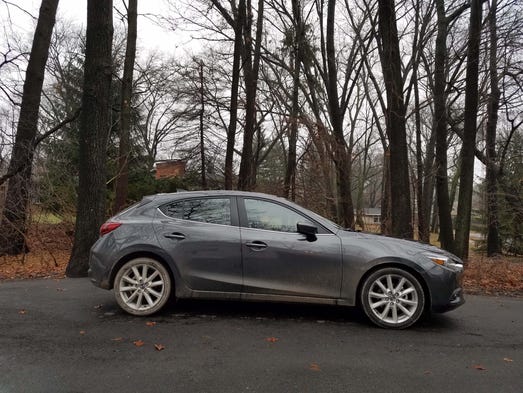
When I turned off my Mazda 3 tester at 10 p.m., the last thing to fade into darkness was the tachometer.
That was fitting, because I had been rowing the terrific 3’s gearbox all day.
Finding fun driving opportunities in the middle of winter isn’t easy. The weather doesn’t cooperate. The Mazda arrived in my driveway the morning of an ice storm. Walking across the asphalt to the 3 was more treacherous than Washington’s crossing of the Delaware. But even in such conditions, the 3 begs to be driven aggressively.
Start with design. Like all Mazdas these days, the compact hatch is gorgeous. Since its jack-o’-lantern crisis (designed by a kid with a crayon and carving knife as I recall) of the mid-2000s, Mazda visited a proper stylist and cleaned up its act.
My hot-hatch preference is for the Volkswagen GTI (for reasons to be detailed later), but there is no better-looking compact car out there than the 3 — even when painted gray to match the weather. It has a shark nose, flowing lines, slit headlights. The 3 is a front-wheel driver with the expected long front overhang — yet with its long hood, the Mazda hatch sits back on its haunches like a rear-wheel-drive BMW Z4 coupe.
Mazda calls its design philosophy “Kodo” — which translates to “soul of motion.” That is, Mazda’s designers look at their cars as living creatures. They have soul, all right. Even on the biggest car Mazda makes, the CX-9 crossover (a finalist for 2017 North American Utility of the Year), the design stands out.
For 2017 the 3 has been lightly tweaked with Kodo-rific exterior detail and a quieter interior. The Mazda brand is all about the joy of driving. Zoom-zoom-zoom go the ads. Where other brands add a sporty car as a brand halo, Mazda starts with its MX-5 Miata and grows from there. Every vehicle shares the MX-5’s drivable DNA. As my colleague Ron Sessions likes to say when we do Mazda test drives: “I don’t think we’ll be talking autonomous much today.”
Yet, Mazda is also building a reputation for rich content — part of its philosophy that cars should make the time we spend with them enjoyable.
I approach my 3 with key in pocket and depress a small, door-handle button to unlock the doors. That’s a slick detail for an entry-level vehicle.
Inside, the Japanese car speaks with a German accent: It has a tight, predictable stick shift with short throws. Closely placed pedals for double-clutch downshifts. Tablet infotainment display controlled by remote rotary dial (happily, for this touchscreen fan, it can also be controlled by fingertip when the car is stationary). Gauges accented by chrome like Porsche-Audi premium models.
It’s the little, fussy details that impress: Head-up display. Push-button start. Dual-climate control. Auto-adjust high beams. The sticker price says $28,450, but these are touches you expect (and often don’t find) on luxury mules costing twice as much.
The high-beams are particularly useful this wintry day because my schedule will take me through the pocked, wet streets of Detroit well after dark.
Over Motown’s dreadful roads, I probably should have brought a right-seat rally navigator. Google Maps would have to do. Driving I-94 to the Grosse Pointe War Memorial is a stage on the Dakar Rally. But the predictable, balanced 3 makes every rut and slick patch manageable.
It’s a landscape that needs maximum lighting, so I flick on the high beams — and leave them there. With the auto high beam feature, they smartly read oncoming traffic and turn off when another car comes into view. That’s one less thing for me to worry about as I negotiate streets that are rougher than Normandy Beach.
I turn off the traction control for maximum fun, and here I pine for my favorite GTI for the first time.
The 3 may shout zoom-zoom, but it lacks limited slip-limited slip. The limited-slip differential, like the one on the GTI equipped with its performance package, is a clever bit of engineering that distributes torque to help maintain grip under hard acceleration. It is particularly useful in front-wheel drivers, especially when the roads are 40 degrees and slick as David Beckham’s hair. For the same price as the 3, the GTI will deliver its performance package — limited-slip differential and all. So will the Honda Civic Si for that matter. If you plan on having fun (and isn’t that why you buy Mazda?) the lack of this feature will be missed.
Until 2013, Mazda made a direct GTI competitor called the Mazdaspeed 3 properly equipped with the feature. Bring it back, pretty please?
Happily, the 3 does come equipped with an independent rear suspension like the VW, Honda and Ford Focus. Which is a good thing when you are humming along at 60 mph and hit an unexpected Detroit road defect. On a solid rear-axle Hyundai Elantra or Chevy Cruze this might send your head through the roof. The Mazda just shrugs.
The 3’s sculpted rear-hatch looks cool but would appear to offer less headroom for rear passengers than the squared-off — if less pretty — Golf. But inside, the 3 was surprisingly roomy for your freakishly tall reviewer. Even with moon roof, I could sit up straight in the 3’s rear seat.
Need cargo room? The rear seatbacks neatly flop flat with a pull of a latch at the seats’ top.
Fortunately, I wasn’t carrying delicate cargo this night as my briefcase slapped back and forth across the rear hatch like a pinball. Rowing the box with abandon to 6-grand, the front tires howling under too much torque, I kept the revs up for maximum response.
Mazda has thus far resisted the industry stampede to turbo engines, opting instead for a less-torquey, 2.5-liter four-banger.
I emerged from the Mazda 3 at the end of the evening refreshed. It’s a high I always feel after driving a fine hatch — but for all I know it might have been enhanced by something Mazda calls “G-vectoring control,” a subtle, computer-assisted coordination of engine inputs and steering to make for smoother cornering.
It’s this obsessive, Jeeves-like care for driver comfort that rewards Mazda customers. From Kodo to G-vectoring to seats that hold you like a mother’s arms, the Mazda is about enjoying every minute of driving time.
Even on roads fit for the Dakar.
Henry Payne is auto critic for The Detroit News. Find him at hpayne@detroitnews.com or Twitter @HenryEPayne.
2017 Mazda 3
| VEHICLE TYPE | FRONT-ENGINE, FRONT-WHEEL DRIVE, FIVE-PASSENGER
HATCHBACK |
| Power plant | 2.0-liter, inline 4-cylinder; 2.5-liter inline 4-cylinder |
| Transmission | Six-speed manual or automatic |
| Weight | 2,875 pounds; 3,046 pounds (with manual transmission) |
| Price | $19,970 ($28,450 as tested) |
| Power | 155 horsepower, 150 pound-feet of torque (2.0-liter);
184 horsepower, 185 pound-feet of torque (2.5-liter) |
| Performance | 0-60 mph, 7.4 seconds (2.5-liter, Car and Driver) |
| Fuel economy | EPA 27 city/37 highway/31 combined (2.0-liter manual)
EPA 25 city/33 highway/28 combined (2.5-liter manual) |
Report card
| HIGHS | SCULPTED STYLING; UPSCALE FEATURES |
| Lows | No limited-slip differential; bring back Mazdaspeed 3 |
Overall:★★★★
Buick unveils its new Regal
Posted by hpayne on April 10, 2017
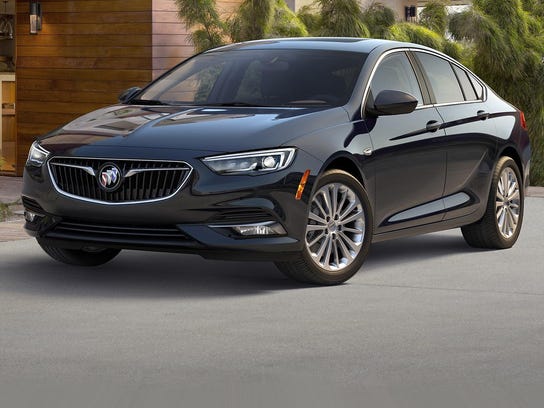
Buick unveiled an all-new Buick Regal on Tuesday as the once-sleepy brand continued its surge back to relevance in the U.S. premium market.
Based on the stunning Opel Insignia that debuted at the Geneva Auto Show in March, the 2018 Regal Sportback sedan boasts an innovative, roomy, Tesla Model S-like hatchback.
For customers who want even more rear utility, the Regal will also be available in five-door wagon trim just like its European counterpart. Called the Regal TourX, the five-door, crossover-inspired, all-wheel drive variant will go head-to-head with the fashionable Volvo Cross Country or Audi’s Allroad. It will ride about an inch higher than the Sportback and features more rugged fender cladding.
Though Buick isn’t releasing pricing yet, it will likely be thousands of dollars less than those European competitors. Both the Sportback and TourX will be available in the fourth quarter of this year.
“These are expressive cars like the Audi and Volvo and BMW 4-series coupe, but the pricing will be a real advantage for us,” said Buick Marketing Manager Doug Osterhoff. “With the TourX you get the five-door aspect with the sporty handling, but don’t have the trade-off of having to spend thousands of dollars more.”
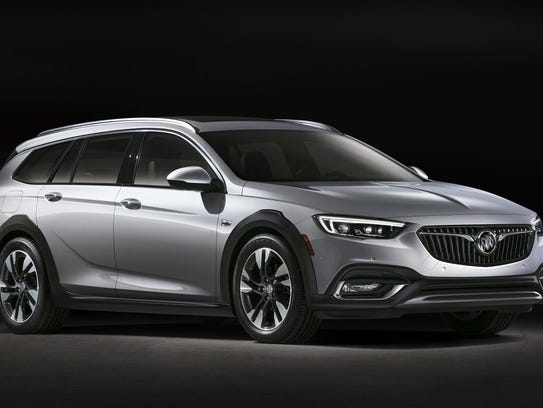
The reduced car lineup is also an acknowledgment that the sedan market is shrinking. Regal sales last year gained just 1.7 percent compared to the Encore’s 16.3 percent, for example. The Regal’s sister sedan, the larger Lacrosse, saw sales plummet 34.4 percent despite introducing an all-new vehicle.
But sedans remain the style leaders for car brands and the much-anticipated Regal is a head-tuner.
“You have to get noticed to stand out in the sedan market, and this car’s hallmark is its sculpted beauty,” said GM Vice President for Product Development Mark Reuss.
The Regal is the most concrete example of Buick’s new design direction inspired by the gorgeous Avenir and Avista concepts that headlined recent Detroit auto shows.
Based on GM’s new, front-wheel-drive Epsilon architecture, which undergirds the roomy Chevy Malibu, the Regal is considerably larger than the last generation with a three-inch-longer wheelbase that translates into almost that much more room in the rear seat. The Sportback also allows much more cargo versatility than the outgoing car with rear seats folding flat to allow trunk-to-front seat storage room. The sedan will come standard with front-wheel drive, with all-wheel drive available as an option as on the current Regal. Expect a high performance version to come later.
The 2018 Regal has a new, turbocharged mill under the hood, scrapping the old model’s normally aspirated, base 2.4-liter engine. A 2-liter turbo-4 will power both the Regal Sportback and TourX space and will be mated to GM’s sippy, nine-speed automatic transmission. The same engine that powers the Chevy Malibu, it will pump out considerably more muscle with 250 horsepower and 265 pound-feet of torque. That torque figure climbs to a whopping 293 pound-feet in the all-wheel-drive option for both Sportback and TourX. The latter will also feature a cavernous 73.5 cubic feet of storage.
The Regal was designed in Germany by Opel, which GM recently sold to PSA Group, owner of Peugeot and Citroen. Buick designer Bob Boniface, recently of Cadillac, said the Opel-Buick design partnership will continue to inform Buick design, with the inevitable transition stateside coming as Buick rolls pout 12 more vehicle updates by 2020.
Power outages hit home for electric car drivers
Posted by hpayne on April 3, 2017

Owners of battery-powered cars face challenges like battery-charging times and running out of juice on the highway. But here’s another problem that potential buyers may not have considered: What happens when the electricity goes out?
When strong winds hit Metro Detroit on March 8 and knocked out power to about 1 million DTE Energy and Consumers Energy customers at home or work, owners of electric cars scrambled to recharge their Teslas, Volts and Leafs. While it’s not as simple as topping off a cellphone at a coffee shop, most owners of electric vehicles managed.
“I had access to public charging while the power was out,” said Stanley Rivers, a plug-in Chevy Volt owner who commutes to Dearborn from Detroit. “Dearborn has good charging stations: three at the Dearborn Transit Center, one in west Dearborn and six in east Dearborn.”
With battery-powered car sales numbering some 400,000 a year in the U.S. (more than 2 percent of sales), an infrastructure is taking shape that includes public-utility and private enterprise-provided charging stations, dealerships, Tesla-installed superchargers — not to mention wall sockets at home and work.
“Our power went out, but our home generator is powered by natural gas and kicked on automatically,” said Grosse Pointe Farm’s Sean Maloney, who owns a Tesla Model S. “No issues after that.”
The Motor City might more accurately be called “The Engine City”: cars with electric motors are nowhere near as popular as in California and the Northeast. Even though the first all-electric car under $40,000 to promise more than 200 miles per charge — the Chevrolet Bolt — is assembled in Orion Township north of Detroit, Michigan dealers have not yet received Bolts. The first Bolts were delivered to dealers in California and Oregon late last year, and dealers there and in eastern states like New York, Massachusetts and Virginia take priority.
Electrics are “a California thing,” a spokesperson for one area Chevy dealer said when contacted about local interest. Other all-electric vehicles like the Nissan Leaf have sold poorly here. A spokesman for Suburban Nissan in Troy says the dealership moves just one or two a year.
The most prominent EVs in Detroit are all-electric Teslas and plug-in Volts, which sport a gas engine that takes over when the battery loses charge. With an electric-only range of 35-50 miles, however, many Volt owners take pride in never visiting a gas station.
“My home in Plymouth was without power for 48 hours, but my office in Novi never lost power,” said Volt owner Nate Dort. “I charge there for free — and usually do daily — so my charging routine didn’t really change.”
Dort echoes Leaf owner Cari Meabrod Sinke of Hartland, who said she has plenty of charging options: “If I had lost power, I would have used my generator to charge — or work or hit my dealership on my way to work.”
But for Volt owners like Joe Lopez of Detroit, the plug-in’s battery/gas duality is tailor-made for blackout Armageddon: “The beauty of having a Volt is you have the gasoline backup.”
Gas-station pumps are also vulnerable to power blackouts. But the service station infrastructure is so ubiquitous that fuel providers like Barrick Enterprises reported minor inconvenience for customers.
“About 10 percent of our customers lost power for an extended period,” said founder Bob Barrick, whose company delivers fuel to some 200 gas stations in the Detroit area. “For those without, it was a tough week. I had one customer without power in Highland Park and another with power just across Woodward Avenue. He doubled his sales.”
Jeff Sturm of Taylor is looking at a home-based solar panels to deal with emergencies.
“I’d like to cover my garage with panels but have not decided if I want grid-tied or off-grid,” said Sturm. “The latter would give me enough power to charge my car on many days, but would need battery storage to be useful.”
Connie Howe of St. Clair Shores, who winters in Fort Myers, Florida, was out of town during the power outages, but was still concerned about her Tesla Model S.
“I have a Tesla plugged into the 110 wall-socket in Michigan,” she said. “I just call up my Tesla app to make sure it’s still fully charged.”
Winning poster designer will see her first Grand Prix
Posted by hpayne on April 3, 2017

Every great auto race is remembered for its winner — and its poster.
We won’t know the victors of IndyCar’s doubleheader at the 2017 Detroit Grand Prix until the weekend of June 4, but we do know what the poster will look like that will adorn fans’ walls for years to come.
Kaylin Mahoney, a junior at the College for Creative Studies, won the fifth annual Chevrolet Detroit Grand Prix Official Poster Competition with a gorgeous watercolor featuring two open-wheel IndyCars splashing through the rain on Belle Isle with the Detroit skyline as a backdrop. Given that IndyCar —unlike NASCAR — races rain or shine, the poster is appropriate for a brutal street race that has often tested drivers’ nerves in the wet.
Mahoney took the podium from a field of five finalists culled from 19 CCS student entries. Lexi Pape and Dan Rees place second and third respectively with strong compositions.
“This is the most diverse field of entries we’ve had yet for this competition,” said Bud Denker, Grand Prix chairman and one of seven judges to award the prize at CCS Thursday. “This contest is a special part of the Detroit Grand Prix.”
Mahoney won $1,000 for her entry, which she will further tweak with Grand Prix design staff to be presented in official form on April 26. The poster image will be on sale at the race events.
“This process was a lot of fun,” said Mahoney, who specializes in CCS’s Illustration program. “It was great to see everyone’s design come to life.”
She is a veteran of the Woodward Dream Cruise — but has never been to the Detroit Grand Prix. She will attend this year —as will the other four finalists. Their work will also be on display at the Grand Prix’s June 2 charity gala.
Payne: Toned Chevy Equinox vs. Honda CR-V champ
Posted by hpayne on March 30, 2017

Bigger isn’t always better.
That line seems heresy in an American auto market where vehicles have grown with each generation to accommodate bigger performance demands, bigger storage needs and bigger (ahem) waistlines. Ford F-150s are the size of Detroit apartments, sports cars are more muscled than John Cena, and a Mini Cooper isn’t mini at all.
“Bigger is better” is most evident in crossovers. They are station wagons on stilts that are taller, longer and thirstier than the sedans customers have abandoned.
So imagine my shock when America’s brand, Chevrolet — the maker of supersized Suburbans, tremendous Traverses, carnivorous Camaros — put its 2018 Equinox on a diet. The brand’s best-selling SUV has lost a whopping 400 pounds, four inches of length and two cylinders to bring its proportions more in line with Honda’s svelte, class best-selling CR-V. That means an all-wheel-drive Equinox improbably weighs about the same (3,540 pounds vs. 3,523) as my athletic 2001 BMW M3.
Like Nixon going to China or Apple becoming a phone maker, who better than Equinox to challenge orthodoxy? Equinox has worn the bigger-is-better uniform since 2005 and has come up short.
The solution? Another all-American aphorism: If you can’t beat ’em, join ’em.
Impressively, the Equinox diet doesn’t compromise interior space but makes it more fun to drive. That’s a designation formerly reserved for niche zoom-zoom manufacturer Mazda and its CX-5 crossover.
“We can do anything, but we can’t do everything,” GM chief engineer for crossovers Rick Spina likes to tell his troops.
But compact crossovers are the Shane Halter (the last Tiger to play all nine positions in a game) of autodom. Customers demand all-around performers that are good at everything from utilitarian shopping needs to road trips through mountain twisties. Spina and team have defied their motto: Equinox and CR-V are good at dang near everything.
In targeting the CR-V — which invented the class way back in 1996 — the Equinox took on a moving target. The CR-V, too, has undergone a complete (if more evolutionary) remake that incrementally increased length, width, height and rear legroom. Honda sells so many models from its Marysville, Ohio assembly plant that it should call it McCR-V and put a big sign out front reading “Over 4 million served” (the actual number they’ve sold to Americans).
Honda’s remarkably taut chassis is based on the same platform as the Audi A3-baselined Civic play-toy that has motorheads drooling. How serious is Honda about SUV handling? CR-V project leader Takaaki Nagadome’s first job at Honda was body engineering for the NSX supercar. It shows.
I first drove the CR-V last fall in flat Marysville farmland and was soon pining for twisty, mountain roads. I’m not saying the CR-V is a Civic hot hatch, but Car and Driver recorded similar skid-pad numbers as the once-untouchable Mazda.
Throw the Honda ute into a 90-degree right-hander and it bites. Even the CR-V’s safety system freaked at the speeds I was taking corners: the auto-brake assist flashed “BRAKE” in the instrument panel as I hurtled into one ess turn.
With its new bod, Equinox goes toe-to-toe with its Japanese rival. Chevy’s confidence was apparent as it set media testers loose on the Blue Ridge Mountains’ serpentine roads. With an aluminum-block, 1.5-liter, base turbo engine up front, the crossover doesn’t plow through corners. The Mazda may still set the standard for this class, but the Equinox turbo has better giddyup than the CX-5’s normally aspirated 2-liter. The giddyup winner of this comparison, however, is the Honda’s 1.5-liter turbo that was first introduced in the Civic.
Heat up this hot tamale over 3,000 rpm and the CR-V really sizzles. Equinox is nearly as spicy, but it’s a 170-horsepower base engine compared to the Honda’s 190-horse premium offering (a normally-aspirated, 2.5-liter is the base mill). The CR-V’s engine strategy emphasizes economy: married to an excellent continuously variable tranny, it boasts 29 mpg (3 mpg more than the Equinox) despite its higher output.
Touting bigger-is-still-better when it comes to performance, Chevy will offer a muscular 252-horse, 2-liter turbo as its prime engine later this year.
It’s worth noting that the sticker on my $38,122 loaded Equinox — with moon roof and Premiere trim — was $3,500 above the $34,635, similarly equipped top-trim Touring CR-V with the premium 1.5-turbo. How expensive will that 2-liter Equinox be?
Chevy says the price is justified by going the extra mile on technology and refinement. For example, the Equinox went shopping at the upscale GKN boutique for a twin clutch-pack system that can move drive torque front to rear. Attack a snowy hill in the dead of Michigan winter and Chevy says you’ll feel the difference.
But will buyers feel enough of a difference to deter them from the tried, true and cheaper CR-V?
Chevy goes the extra mile inside with a more-sculpted interior, more buttons and optional gee-gaws like heated rear seats and surround-vision camera. The CR-V comes away looking cheaper — especially those plasticky steering-wheel controls. But the Honda comes with typically clever ergonomics of its own including versatile center-console storage and rear doors that open nearly 90 degrees for better entry.
Elsewhere, these valedictorian students of American taste are an even match, covering every driver need: hidden rear-storage compartments; grocery-friendly, kick-open rear hatches; fold-flat rear seats.
And Chevy and Honda continue to show why they have been pioneers in smartphone-app connectivity as Android’s Google Maps embarrassed both Honda Navi and Chevy OnStar in navigation tests.
What may ultimately decide your choice between these evenly matched rivals is your design taste. Neither will challenge the pretty Mazda for the title of Miss Crossover.
The Chevy’s sleek shape may earn its best-in-class .336 drag-coefficient, but it’s determined to offend no one — the designers even managed to make the problematic split-grille a generic shape. If the Equinox were ice cream, it would be vanilla.
The CR-V is Chunky Monkey. The youthful design details are familiar — bat-wing taillights, funhouse wheels — but with more attitude. The front grille looks like a bulldog with a pronounced underbite.
Lest you think Chevy still doesn’t value plus-size cars, you’ll be pleased to know that the forthcoming midsize Traverse is XXL. But for its compact SUV, the Equinox matches the CR-V as proof you can do everything with less.
Henry Payne is auto critic for The Detroit News. Find him at hpayne@detroitnews.com or Twitter @HenryEPayne.
2018 Chevrolet Equinox
| VEHICLE TYPE | FRONT-ENGINE, FRONT- AND ALL-WHEEL DRIVE, FIVE-PASSENGER
CROSSOVER |
| Power plant | 1.5-liter, turbocharged, inline 4-cylinder |
| Transmission | Six-speed automatic |
| Weight | 3,375 pounds (FWD); 3,540 pounds (AWD) |
| Price | $25,370 ($38,122 Premier AWD as tested) |
| Power | 170 horsepower, 203 pound-feet of torque |
| Performance | 0-60 mph (NA) |
| Fuel economy | EPA 26 city/32 highway/28 combined (FWD)
EPA 24 city/30 highway/26 combined (AWD) |
Report card
| HIGHS | LIGHT ON ITS FEET; TERRIFIC INTERIOR DETAIL |
| Lows | Vanilla styling; Premier-trim sticker shock |
Overall:★★★
Grading scale
Excellent ★★★★Good ★★★Fair ★★Poor ★
2017 Honda CR-V
| VEHICLE TYPE | FRONT-ENGINE, FRONT- AND ALL-WHEEL DRIVE, FIVE-PASSENGER CROSSOVER |
| Power plant | 1.5-liter, turbocharged, inline 4-cylinder |
| Transmission | Continuously variable automatic |
| Weight | 3,307 pounds (FWD); 3,508 pounds (AWD) |
| Price | $24,945 base ($34,635 AWD Touring as tested) |
| Power | 190 horsepower, 179 pound-feet of torque |
| Performance | 0-60 mph, 7.6 seconds (Car and Driver) |
| Fuel economy | EPA 28 city/34 highway/30 combined (FWD)
EPA 27 city/33 highway/30 combined (AWD) |
Report card
| HIGHS | FUN-TO-DRIVE SUV; EASY-ACCESS REAR SEATS |
| Lows | Bulldog front end; plasticky controls |
Overall:★★★
What if GM built a Corvette SUV?
Posted by hpayne on March 27, 2017
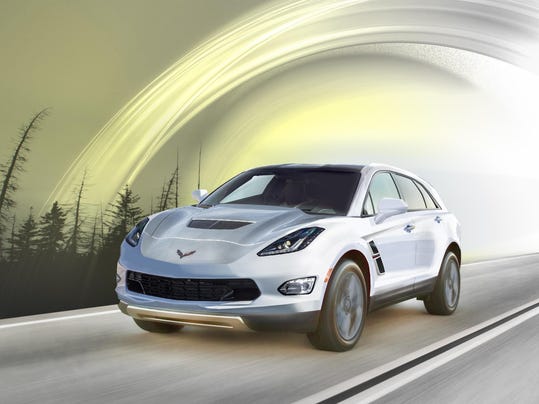
What if Chevrolet made a Corvette SUV?
Maybe that’s not so far-fetched. Corvette is a singular car within Chevrolet, and in many ways is a performance brand unto itself. Almost every performance brand now has its own crossover; the most prominent of which is Porsche’s money-machine, the Cayenne.
If Corvette did make an SUV, what would it look like? Detroit News presentation editor Jamie Hollar drew his own concept car, shown here. And The Detroit News talked to ex-GM big wigs, auto analysts and car enthusiasts for their ideas on what the high-performance SUV should be.
Since the first Jeep sport utility appeared in 1984, the automotive landscape has been transformed by high-riding, five-door SUVs with visibility and utility to spare. Even legendary performance brands that once built only ground-hugging sports cars have jumped in. Beginning with Porsche in 2003, SUVs have become a performance-maker’s goldmine. Nearly every performance badge wants a piece of the lucrative ute market.
Notably absent is the Corvette, America’s V-8-powered workingman’s superhero.
Though technically a Chevrolet product, the Corvette long ago became an iconic nameplate that’s equal to Europe’s elite sports car names. It’s faster than the Porsche 911, Jaguar F-Type, Alfa Romeo 4C and Lamborghini Huracan. And while those brands have all exploited their athletic images to expand into sport utilities — the Jaguar F-Pace, Alfa Stelvio and Lamborghini Urus — the Corvette remains a one-off.
“There’s certainly precedent for non-traditional SUV makers to jump into the market,” says Karl Brauer, senior analyst for Kelley Blue Book. “Every time one of them has jumped in, it has worked.”
With nearly two-thirds of Porsche buyers opting for SUVs, Porsche makes up a whopping one-third of Volkswagen Group’s profits while generating only 2.3 percent of its sales, according to MotleyFool.com. “The idea of a Porsche SUV still rubs sports-car purists the wrong way, but it has been a spectacularly profitable product for the brand,” says John Rosevear, senior auto specialist for the website.
GM executives won’t talk about future vehicles — and even if they did, there’s no evidence a sport utility is in the works. But everywhere we went, car fans loved the idea. The consensus was if Corvette were to build it, it would be a home run.
So let’s give this dream car concept a name. We called our concept the Corvette XC7: “X” for crossover, “C7” for the sports car’s seventh-generation architecture.

“XC7 and X06 (mirroring the high-performance version’s Z06 name) are great starters for naming,” says Tom Wallace, the retired GM engineer who ran Chevrolet’s Corvette program from 2006-08. “Stingray is off limits.”
It would be essential that any Corvette crossover share the sports car’s DNA.
“Front engine, rear drive, with AWD option. Lots of aluminum in the structure,” muses Wallace. “Aluminum is mandatory to support the theme that Corvette embraces to be the lightest vehicle in its class. The two V-8s from the Corvette stable are also a must.”
That means the 460-horse V-8 shared with the base C7 sports car — or for the Z06 version, the supercharged 650-horsepower V-8 for what might be the fastest SUV ever built. Considering the rear-wheel drive Z06 sports car is slightly slower from 0-60 than its all-wheel drive 540-horsepower Porsche Turbo rival, an all-wheel drive X06 crossover should be competitive with the all-wheel drive Cayenne Turbo’s 3.8-second, 0-60 romp.
“Maximum Bob” Lutz, the ex-vice president of GM product design who is revered for bringing back The General’s design mojo, agrees with Wallace’s assessment: “Like the Cayenne, the appeal of the ’Vette SUV would be RWD proportions. It should, in fact, have a silhouette not too different from a Cayenne.”
Start with the C7’s dramatic, sculpted lines created by Tom Peters and widely recognized as one of the best designs in Corvette’s 54 years. All performance SUVs are essentially vertically stretched, five-door versions of familiar sports coupes, giving them an inherently heavy look compared to low-slung two-seaters.
But angular designs like our mock XC7 or Lamborghini’s Urus show that it’s possible to break with the soap-bar shapes of the Porsche Cayenne and Maserati Levante. With Corvette’s trademark shark nose, scooped hood and quad exhaust pipes, it would drip with menace.
Inside, the XC7 would share the C7’s acclaimed interior: comfortable seats, stitched dash and quality trim materials. Naturally, the signature “oh, crap” passenger grab-handles from the sports car would carry over (for those times when dad is seized by the need for speed).
Other parts like transmissions and all-wheel drive systems could come from common GM parts bins, which has been key in keeping Corvette costs down over the years. “To engineer the vehicle, I would have to combine some of the Corvette team with some of the SUV team,” says Wallace.
Price? “More than the $40,000 Cadillac XT5, but about 10 grand below” a $60,000 base V-6 Cayenne, suggests Lutz.
But the chassis might be a deal breaker. “To be successful, this vehicle would require an all-new RWD/AWD architecture, which currently does not exist,” says Lutz. “That’s high investment for relatively low volume.”
Porsche was able to “lunch off” the VW Touareg chassis, which enabled Porsche to package its V-8 engine longitudinally. GM’s new C1XX platform is the backbone for the Cadillac XT5 and GMC Acadia utilities; it has been lauded for its stiffness and light weight. But its front-wheel drive, transverse engine layout appears ill-suited for our ambitious XC7.
“The Corvette ute probably would be a stand-alone architecture (or a major modification of an existing architecture), so volume would be critical to call it a business success,” Wallace believes.
Cost aside, Lutz says there is another obstacle to an XC7: “The reason a Corvette SUV won’t happen is the business case would be tough. Besides cannibalizing ‘normal’ Corvettes, it can also be expected to damage GMC and certainly the Cadillac XT5.”
And yet, Lutz acknowledges the unique draw of the Corvette: “Corvette is a powerful brand that should be developed. Go upmarket with a mid-engine sedan using big Cadillac CT6 architecture, and maybe eventually something like Cayenne. They would split it off from Chevrolet — nobody makes that connection anyway.”
Kelley Blue Book’s Brauer says financial analysts would grill GM on creating another brand so soon after it axed Pontiac, Hummer and Saturn in bankruptcy. “But history would suggest there is no downside to a performance brand expanding into SUVs,” he says. “Non-Corvette owners who couldn’t justify a two-seat sports car could finally put a Corvette badge in their garage.”
With the formula laid out here, Wallace says he has no doubt “the product would be a smash hit.”
“Product excellence usually leads to business success,” he says. He grins. “Let’s convince GM to do it!”
Henry Payne is auto critic for The Detroit News. Find him at hpayne@detroitnews.com or Twitter @HenryEPayne.
Corvette XC7 SUV concept
| VEHICLE TYPE | FRONT-ENGINE, ALL-WHEEL DRIVE, FIVE-PASSENGER, 5-DOOR SUV |
| Power plant | 6.2-liter, push-rod V-8 (XC7); 6.2-liter, supercharged V-8 (X06) |
| Transmission | 10-speed automatic; 8-speed automatic |
| Weight | Est. 4,100 pounds (AWD) |
| Price | $50,000 base est. ($75,000 for X06 performance version) |
| Power | 460 horsepower, 465 pound-feet of torque (V-8); 650 horsepower, 650 pound-feet of torque (supercharged V-8) |
| Performance | 0-60 mph, 3.6 seconds (X06 with supercharged V-8 est.) |
| Fuel economy | Thirsty |
Report card
| HIGHS | ICONIC BRAND EXPANDS TO UTES; 460-HORSE V-8. ’NUFF SAID |
| Lows | Expensive new platform; might cannibalize Cadillac SUV sales |
Design your own Corvette SUV
What do you think a Corvette SUV should look like?
Create your own design and enter The Detroit News design contest. Our team of judges — ex-Corvette chief engineer Tom Wallace, Detroit News auto columnist Henry Payne and Detroit News presentation editor Jamie Hollar — will pick a winner. Top entries will be published in The Detroit News and at detroitnews.com.
Entries can be done in any medium: computer rendering, pencil sketch, watercolor, whatever you prefer. Send a high-resolution copy by email to Henry Payne at hpayne@detroitnews.com.
Payne: Hydrogen-fuel Honda Clarity, first drive
Posted by hpayne on March 25, 2017

I’m tooling around the hills of Santa Barbara in a 2017 Honda Clarity Fuel Cell. Powered by the fusion of hydrogen and oxygen, the Clarity emits only water, which could be the solution to California’s drought issues: drive to work, produce H20, water your garden when you get home.
But that’s not why the Clarity is only available out here in La La Land. Let me explain.
When my motorhead pals visit Michigan, they notice our state is a little different. They remark on the prevalence of Detroit-made cars rarely seen elsewhere — Lincolns, Cadillacs, Buicks. They get it, of course. Motown is the capital of U.S. autos even if they don’t dominate the landscape like they once did.
Visit California and it’s a lot different. Indeed, the Left Coast could be its own country.
Travel to $6-a-gallon Europe and the narrow streets are clogged with tiny tin cans rarely seen on this side of the pond: VW Polos, Mercedes B-Class, Smart ForTwos. The wocka-wocka of diesel engines is everywhere thanks to favorable tax treatment from devout green governments that believe fossil fuels a sin. So too, California.
The Green Church here worships the polar bear, so the tax credits flow — not to nitrogen oxide-heavy diesels but to electric vehicles. There are whole schools of fish rarely seen elsewhere on the continent: the Nissan Leaf, Ford C-Max, lots of Toyota Priuses and hydrogen-powered cars like my Clarity tester. Gas prices here average $3.20 a gallon, but Californians get a fat $5,000 rebate if they choose an electrified vehicle.
California’s GDP would make it the world’s sixth-richest country, and it’s America’s biggest auto market. That gives Sacramento’s green priests enormous market power. By 2025, 15 percent of automakers’ sales here must be “zero-emission vehicles” powered by batteries or fuel cells whether customers want them or not.
Thus my Clarity.
The name will be familiar to green nerds as the 2007 spawn of Honda’s hydrogen experiments. The 2017 is available not just with the moon-shot hydrogen fuel cell, but also in pure electric and plug-in versions like the compact Prius (hybrid/EV/plug-in variants) or Hyundai Ioniq (hybrid/EV/plug-in).
The plug-in Clarity, which starts in the mid-$30,000 range, will take on competitors like the Chevy Volt and Tesla Model 3 in all 50 states.
The Clarity Fuel Cell is a more exotic animal built only for California (the pure-electric will also be for that state only). Though Honda lists a sticker price of $59,365, the Clarity Fuel Cell is only available for lease at an expensive $369 per month. Which is a steal. Let me explain.
The upper-$300s sounds more like a first-class Acura than a coach-class Honda ($200 for a mid-size Accord, $170 for a Civic). But California’s $5,000 rebate reduces the Clarity’s payment by $140 a month, and Honda throws in the hydrogen fuel for free. That’s a $160-a-month fuel savings if you’re the average Accord driver.
Do the math: $369 minus $140 minus $160 equals $69 a month.
My Left Coast media peers took notice. “Are you kidding? I’ll take it for 69 bucks!” said one. “I’ve been paying California taxes through the nose subsidizing Leo DiCaprio’s Teslas and Fiskers. It’s my turn for a break!”
Wise-cracking scribes aside, Clarity suitors are likely to be green nerds. The Clarity is a natural date for the social-climbing owner of a Prius, Accord hybrid or Ford Fusion Energi.
The Clarity’s face makes a good first impression. The familiar Honda grille and jewel-eye headlamps are framed by vertical LED running lights that remind of a Cadillac CT6.
But then its wardrobe gets geeky. Hondas sit on front-wheel-drive platforms, but the Clarity’s front overhang is particularly long thanks to the drivetrain’s front packaging and fuel-efficient aero-ducts.
Green chic runs amok in the rear where the Clarity borrows a dual-window from green icons Prius and Chevy Volt. Covered aero-fenders recall Honda’s ill-fated nerd classic, the compact Insight. Think of the Clarity as a grown-up Insight.
Mature suede and leather materials distinguish the interior. The push-button shifter bridges console storage for smartphones and purses. Honda offers its first heads-up display. There’s seating for five.
But what you really want to know is whether I needed a hazmat suit to fuel this rolling Hindenburg.
The good news: Pumping hydrogen these days is as easy, safe and fast as gasoline. Pulling into a Santa Barbara Shell station, I nuzzled the Clarity up to the hydrogen pump, selected the quicker 10,000-psi setting, locked the nozzle over the Honda’s narrow filler and was done in minutes. The massive hydrogen tank eats into the Clarity’s trunk space (good luck storing big suitcases back there), but Honda assures that it’s built to withstand a punt in the rear by an SUV piloted by an oblivious texter.
The bad news? Hydrogen has serious infrastructure and environmental problems. Where filling stations and cell-tower infrastructure naturally followed the explosive growth of gas cars and portable phones, no one’s lining up to fuel scarce hydrogen cars (only Toyota and Hyundai make Clarity competitors). Which is why the government is building a 100-station infrastructure, one costly $1.5 million pump at a time. And extracting hydrogen from water burns a lot of energy. As environmentalist Joseph Romm bluntly put it: “As a CO2 reducer, hydrogen stinks.”
Back on the road, I stomp the gas — er, electrons — and the result is dynamite.
The fuel cell spins an electric motor which launches the 4,134-pound sedan like a catapult or a slower Tesla Model S. Unlike the Model S, the Clarity is a front-wheel driver, but still manages quick getaways without spasms of torque steer.
I drove the Clarity like a Motor City madman and occasionally explored its 103-mph top speed. Like an electric car, a lead foot quickly degrades the fuel cell’s range. But unlike the 240-mile Tesla and Bolt EVs, the Clarity gets a gas-like 369 miles of range. Under my whip, the digital instrument display still projected 264 miles of range until the next hydrogen station. If you can find one.
Given its limitations, Clarity should meet its modest Republic of California compliance sales goals. That is, until someone figures out how it can also water lawns.
Henry Payne is auto critic for The Detroit News. Find him at hpayne@detroitnews.com or Twitter @HenryEPayne.
2017 Honda Clarity Fuel Cell
| VEHICLE TYPE | FORWARD-DRIVETRAIN, FRONT-WHEEL DRIVE, FIVE-PASSENGER SEDAN |
| Power plant | Proton-exchange membrane fuel cell driving AC electric motor |
| Transmission | Single-speed automatic (with Sport mode) |
| Weight | 4,134 pounds |
| Price | $59,365 (only available as lease for $369 a month) |
| Power | 174 horsepower, 221 pound-feet of torque |
| Performance | 0-60 mph, 8.5 seconds (est.) |
| Fuel economy | EPA 68 city/66 highway/67 combined |
Report card
| HIGHS | UPSCALE, ROOMY INTERIOR; EASY FUELING |
| Lows | Where’s the closest pump?; hydrogen isn’t zero-emission |
Overall:★★★
Honda takes a gamble on electric
Posted by hpayne on March 22, 2017

Santa Barbara, Calif. – Against a tide of low consumer demand for battery-powered vehicles and loosening federal emissions rules, Honda announced this week that it will aggressively pursue vehicle electrification. With a goal of two-thirds of brand sales coming from battery or hydrogen-fuel cell vehicles by 2030, the Japanese manufacturer is bullish on alternative fuels.
Though a pioneer in battery and hydrogen powertrains beginning with its (now defunct) Insight hybrid in 2000, Honda has had little impact on the electric vehicle market and only sold one battery-powered model in 2016, the Accord Hybrid sedan. The move to electrification marks a significant shift for a brand that has built its U.S. success on gauging consumer demand for efficient, gas-powered small cars and crossovers.
In 2016 the Civic, CR-V and Accord were the three top-selling vehicles in the retail market – after full-size pickups – with combined sales of more than one million units.
“This is a long-term vision to make sustainable, electrified vehicles – true volume vehicles for Honda,” says Jim Burrell, assistant vice president for American Honda Environmental Business Development.
To mark Honda’s new product ambitions, Burrell and his team invited national media here to test drive its flagship EV, the Clarity Fuel Cell – the first of three alternative powertrain Clarity vehicles to hit the market this year. The others, a plug-in electric vehicle and full-EV, will be introduced at the New York Auto Show next month. Honda will also announce an all-new hybrid vehicle in 2018.
With its stylish design, roomy interior and 366-mile range, the Clarity Fuel Cell (initially offered only in California) is just the second hydrogen production car in the U.S. market (along with Toyota’s smaller Marij). It ranks with General Motors’ late-1990s EV-1 electric car and Chevy’s 2017 Bolt EV as ambitious efforts to change the course of vehicle propulsion away from gasoline.
Honda press materials say this change is driven by “society’s need for dramatic CO2 reductions (that) are real and immediate.”
“Honda is the only mainstream brand that has set an electrification goal that is this aggressive,” IHS senior auto analyst Stephanie Brinley says of the company’s 2030 target. “This is a statement that will set the tone in this company that this is what matters.”
What matters to American voters, however, seems to be more SUV production and less government regulation. According to a 2016 Gallup poll, global warming ranks 12th out of 13 in problems seen by Americans. Meanwhile, hybrid/electric vehicle sales have dropped to less than 3 percent of vehicle sales. The newly elected Trump administration reflects those priorities and has promised to reduce carbon emission mandates on automakers.
“Washington may not be supportive of (electrification),” acknowledges Honda’s Burrell. But he notes that the Trump administration will likely leave in place the waiver that allows California – the biggest auto market in the U.S. – to set its own greenhouse gas rules.
Burrel added: “If you focus on California, it is … driving a lot of this.”
IHS analyst Brinley agrees that government regulations are behind much of Honda’s product development. “They have to meet these emissions requirements not only in California but also in Japan, China and Europe,” she says. “And they are going to get stiffer.”
Honda long ago embraced the American market, backing up its sales with U.S. production. Honda now makes more cars in the U.S. (1.7 million) than in Japan (1.3 million). And it sells more of its U.S. production (from plants in Ohio, Indiana and Alabama) than any U.S. manufacturer except Ford.
With its electrification strategy, Burrell says that Honda is taking a risk given the apparent lack of consumer demand. But it’s not new territory for Honda.
“We don’t follow the same drummer as the rest of the industry,” he says. “In 1997 we introduced the compact CR-V crossover with unibody construction to what was then a non-existent segment. The car that started that segment was the CR-V.”
He says hydrogen and electric vehicles like the Clarity are also “something we genuinely believe in. Yes, the government requirements are a certain percentage of that, but we are at a point that (electrics) will take on a life of their own. Honda does things because it’s the right thing to do. This is best for the environment, and for Honda in the long term.”
Payne: Mazda MX-5 RF’s beauty is more than skin deep
Posted by hpayne on March 22, 2017

Does anyone remember that Audi introduced a V10-powered, 200-mph drop-top R8 Spyder at last year’s New York Auto Show? I didn’t think so. That’s because the Audi, like everything else that year, was a footnote to the surprise reveal of the stunning Mazda MX-5 Miata RF (for Retractable Fastback) hardtop roadster.
No one saw it coming. After all, the best-selling sports car of all time is autodom’s puppy dog – playful, fun and adorable.
But sexy?
With its flying rear buttress b-pillars borrowed from Ferrari and fully automatic drop top borrowed from Corvette, the RF melted whatever snow was still on the ground in Gotham. In defiance of Soul Red Mazda tradition, the show car was painted Machine Gray – and still I couldn’t take my eyes off it. Baby got back.
A year later and the RF is ready for prime time. A show car no more, it made its much-anticipated media testing debut in San Diego this March. It didn’t disappoint. The RF (or maybe the RF is for Really Fantastic) is a head-turner with specs that make it the most capable Miata ever. And don’t think Mazda doesn’t know it: The RF will come with a $2,600 upcharge from the soft-top Miata compared to the old hardtop upcharge of $800.
Mazda anticipates that the RF will not only make up a healthy 60 percent of sales, but will attract more affluent female buyers to an already female-friendly brand.
I love the soft-top Miata. Unmoor the ragtop from the windscreen and it stows behind me as easily as throwing off a blanket. Feel raindrops? Reach back and pull it overhead like a quilt on a cold night. But I’m a long-armed ape. Smaller drivers will prefer the reduced air turbulence of the Targa top, and the simple, auto toggle-switch in the console that stows the roof in just 13 seconds (while creeping along at up to 6 mph in traffic).
Did I say Targa? Mazda can’t utter that copyrighted Porsche term but the comparison to the iconic 911 variant is deserved. Wee though it is, the RFs (Real Ferrari-like?) will also remind enthusiasts of 1960s lookers like the Ferrari 275 GTB. Such comparisons, Mazda hopes, will attract richer demographics as well. The sports car attracted plenty of gawkers during my morning sprint though the hills of Southern California.
But the RF’s beauty is more than skin deep.
Mazda claims much better aerodynamics which will perk the ears of Mazda’s driver enthusiast core. This is the most raced car in America after all. Mazda says that roll-hoop requirements will keep the Targa-top out of more serious SCCA club racing, but weekend warriors will no doubt notice higher straightaway speeds with the reduced drag coefficient. Mazda isn’t releasing numbers yet, but I’m betting the car-nut mags already have their testing equipment strapped to the car.
The Targa top is also a marvel of packaging – adding just 113 pounds to the 2,332-pound base Miata’s lithe frame, maintaining the car’s superb weight balance, and poaching not an inch on trunk space.
Otherwise, the Miata remains unchanged from the acclaimed fifth-generation roller skate that thrilled us just two years ago.
My RF date came after knee replacement surgery on my 6-foot-5 frame. I told my surgeon and physical therapist (who has suffered through four knee surgeries with my demands) that I had to have the strength and range-of-leg-motion to get into the smallest sports car made in just five weeks. She took the challenge in stride (probably because it didn’t sound as bonkers as a previous request that I had to race a Porsche just two weeks after arthroscopic surgery).
She got me to 110 degrees range of knee motion. That was (just) enough to fold into the MX-5’s cockpit which is the size of a large suitcase. Worse is the passenger compartment and its cramped dash. The glove compartment is between the seats, meaning I have to dislocate my shoulder in order to reach it. Going topless, my head stuck out of the roof, making my cranium the roll bar.
Once behind the wheel of MX-5, however, all ergonomic concerns are forgiven. Few cars are as fun to drive. Over Southern California’s twisted hills, the short-wheelbase RF was a tossable toy.
Mazda has set the table with all the tools right where they should be: Steering wheel straight ahead. Three gauges, tach in the middle. Short-throw, six-speed box. Peppy, 155-horse inline-4 engine. Accelerator and brake pedals perfectly spaced for heel-and-toe downshifts.
Those flying-buttress rear pillars might make a serious blind spot on a bigger car, but they’re not an issue in this go-kart. I can practically loosen the lug nuts on all four wheels without ever leaving the driver’s seat.
With its higher price point, Miata won’t bother with the base Sport trim – offering the RF only in Club and Grand Touring trims. My tester was the posh, leather- and nav-equipped GT, which is going to make life hard on the more upscale brand buyers looking at the Fiata (Fiat’s 124 Spider which shares a chassis with MX-5). My preference, though, is for the Club version with its stiffer Bilstein shocks and track-must, limited-slip rear differential.
The fifth-gen MX-5 is an important step for America’s favorite sports car. Iconic as it may be to Mazda’s ZOOM-ZOOM brand, the Miata had to be co-developed with Fiat in order to justify the enormous costs of a small production car. Sixty years on from European sports car nostalgia, the Mazda now has to set expectations for a new generation of buyers. The sharp, Mazda-esque styling of the soft top was bold – and now RF (for Reach Forward) sets a new bar.
Happily, Mazda’s crack team of engineers and marketing gurus seem up to the challenge of all that heavy lifting. Which means the toughest question you and I have to answer when we jump into the RF is: Should I buy it in Machine Gray or Soul Red?
Henry Payne is auto critic for The Detroit News. Find him at hpayne@detroitnews.com or Twitter @HenryEPayne.
2017 Mazda MX-5 Miata RF
| VEHICLE TYPE | FRONT-ENGINE, REAR-WHEEL DRIVE, TWO-PASSENGER
SPORTS CAR |
| Power plant | 2.0-liter, dual overhead-cam 4-cylinder |
| Transmission | 6-speed manual; 6-speed automatic |
| Weight | 2,445 pounds |
| Price | $32,430 base |
| Power | 155 horsepower, 148 pound-feet of torque |
| Performance | 0-60 mph, 5.9 seconds (Car and Driver) |
| Fuel economy | EPA 29 city/33 highway/29 combined (manual); 29 city/35 highway/29 combined (auto) |
Report card
| HIGHS | FLYING BUTTRESS, FASTBACK DESIGN; FULLY AUTOMATIC DROP TOP |
| Lows | Tight for 6-footers; limited-slip only in Club
trim |
Overall:★★★★