- Search Cartoons
- Comic Archive
-
Payne
Store



 Henry Payne RSS

Articles
Why now? How the 2020 mid-engine Corvette came to be
Posted by Talbot Payne on July 22, 2019
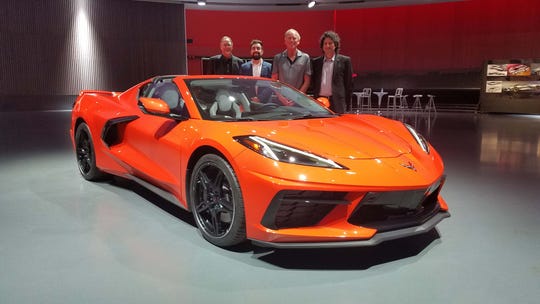
The mid-engine Chevy Corvette C8 arrived in California’s Orange County on Thursday night like a cyborg from the future. It is the iconic supercar’s first production model with the engine bolted behind the driver’s ear.
Incredibly, it’s an idea that has been germinating inside General Motors’ tech center for more than 60 years.
Since the late 1950s, GM engineers have debated the advantages of a mid-engine layout. They produced multiple prototypes, and GM even green-lighted a mid-engine car for production in 2007 before the financial crisis put an end to that.
The decision to finally produce the eighth-generation 2020 Corvette with a mid-engine was the result of a perfect alignment of engineering, marketing and financial wherewithal.
“We seriously started thinking to do it with the sixth generation,” said Corvette Chief Engineer Tadge Juechter at an interview in GM’s Warren design dome with fellow team members ahead of the C8’s Thursday reveal.
“The 2009 ZR1 had 638 horsepower. Even (the generation) before that … we knew that we were stretching the limits of what we could do from a performance standpoint with a front-engine car.”
He continued, walking around a Sebring Orange C-8: “It’s the same reason that race cars in elite categories migrated from front to rear engines in the 1960s. Zora knew that. He was a huge advocate for it.”
“Zora” is Zora Arkus-Duntov, the so-called “father of the Corvette” who took over the sports car program in the 1950s and molded it into an icon.
“He knew already that if you want to push the performance envelope of the ‘Vette, you had to push in that direction,” Juechter said.
It wasn’t just a handling issue in the early days. It was also a question of driver comfort. Writer Don Sherman has covered Arkus-Duntov and the mid-engine car’s development for decades.
“It came to him after Corvette had dropped out of the Sebring 12-hour race in 1957 … because driver John Fitch’s feet were being cooked by exhaust pipes” from the engine mounted in front of him, said Sherman. “Pondering that, Zora told me … that he had concluded that the heat source had to be behind the driver.”
Multiple prototypes followed.
In 1960, Arkus-Duntov built the single-seat, mid-engine Chevrolet Experimental Research Vehicle — the CERV I — with a powerful V-8 driving the rear wheels. The prototype hit 206 mph at GM’s Milford Proving Ground and would ultimately inspire the second-generation, production Corvette C2’s independent rear suspension.
The CERV II, a mid-engine, all-wheel-drive roadster followed in 1964. In 1968, GM dropped jaws at the New York Auto Show with the sleek Astro II, which was a response to Ford’s Le Mans-winning GT40 mid-engine racer. More GM prototypes were born including an aluminum-body XP-895 in 1972, the 1973 “Aerovette” and the 1986 “Indy,” which was also known as the CERV III. There was even a V-12 Cadillac Cien concept car in 2002.
“When Zora tried to do it, GM would say: ‘But the (front-engine) car is doing great as it is,’” said Corvette marketing guru Harlan Charles. “The horsepower levels weren’t where they are today, and they had all these packaging challenges that they didn’t know how to solve, but we know how to solve now.
“That’s why now is the time.”
Finally, in 2007, the passionate Juechter and team got the green light to produce a seventh-generation, mid-engine ‘Vette.
The Great Recession and GM’s resulting financial emergency squashed it.
“In retrospect, it was probably a blessing because there were a lot of things we had to learn with the aluminum body in addition to learning production the mid-engine car,” Charles said.
Instead of producing a mid-engine C7 post-bankruptcy, the team stuck with the front-engine architecture. But for the first time, they crafted it from aluminum. That meant GM brought aluminum construction in-house for the first time, a huge investment in know-how that would ultimately benefit the C8.
“It’s glued and screwed, as we say,” said Juechter. “You build the running chassis, then you put the exterior panels on last like a race car. We learned those construction techniques from the C7.”
Perhaps most significantly, the bankruptcy — for all its stress — honed the team’s mid-engine pitch to go back to leadership for a second bite at the mid-engine apple.
The Corvette team knew its demographic was aging. New generations of car buyers aspire to mid-engine cars: Ferrari, Lamborghini, Porsche. But the typical Corvette buyer also worried about losing the practicality the ‘Vette offered: affordability, interior room, cargo space.
“We took a step back. What if we could make this a unique, mid-engine car?” said Charles. “Keep the things that people like about the Corvette: the small-block V-8, the power-to-weight ratio, the ability to take it cross-country. Add the exotic experience of a mid-engine car … with the road in your lap, quick steering, no weight on the front.
“If we can put those attributes together, and make it attainable … you really have a car that no one else can match.”
Mid-engine supercars are cool. But cool isn’t a business case. Management liked the team’s business pitch.
“We had no ‘cool’ description in any of our presentations. It was tactical, business, functional, physics-driven,” remembers Juechter. “Here’s why it makes sense for us.”
The C8 was on.
The engineers and designers rave about the car’s state-of-the-art attributes: dual-clutch automatic transmission, aluminum spine, upscale interior and that mid-engine athleticism.
“The whole car rotates better — it’s just pinned in the back,” marvels Juechter. “It’s surprisingly stable, it feels super nimble. It’s actually better than we anticipated.”
For all its modernity, there is also a nod to the middiecar’s GM history.
“We kept (the old prototypes) in the studio for inspiration. The Astro II is one of our favorites,” exterior designer Kirk Bennion said. “We had the Aerovette out, the Indy, we had them all out.”
Payne: Mini Cooper JCW Knights Edition is a killer rabbit
Posted by Talbot Payne on July 22, 2019
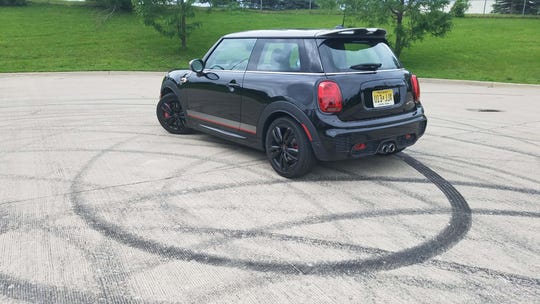
Count on the Brits for a bit of fun.
The comedy troupe Monty Python infected my family years ago with its humor. Call out a scene from “Monty Python and the Holy Grail” and we are suddenly diverted from the moment. Our accents transform, our faces contort into character, and we recite the lines from memory: The French Taunter. The Holy Hand Grenade of Antioch. The Knights Who Say “Ni!”
The 2019 Mini Cooper JCW Knights Edition is like that. It’s a hilarious diversion from the everyday five-door sea of utes on our byways.
Mini, of course, is not so mini anymore. Now a member of the BMW family, the hatchback is based on the similar front-wheel drive platform used for small Bimmers, giving it a 98-inch wheelbase that is big stretch from the wee 80-inch shoeboxes that made the Oxford-built Mini a ’60s legend.
But next to your average Ford Explorer, the Brit is a midget, and its signature bits haven’t changed: square shape, mirrors the size of bowling balls, goggle-eyed headlamps.
Add on the special JCW Knights trim and it’s like throwing the Killer Rabbit into the middle of King Arthur’s army. JCW stands for John Cooper Works, the hot-hatch edition of the Mini named after its English co-founder. He’d be proud. The JCW is stuffed with performance in the tradition of a car that has slayed many a larger competitor on track: 228 horsepower, taut suspension, Sport performance mode.
The Knights edition turns up the volume.
Its armor is as black as the suits of the Knights Who Say “Ni!”, giving it a comically sinister look. Its front bumper is smeared with red paint. It’s as if a goggle-eyed minion from the “Despicable Me” movies (another Payne favorite) threw on a black Ninja suit and tied a red bandana.
Add to the comic fierceness a body tattooed with faux performance accents like racing stripes, fake hood scoop, fake front gills, fake rear diffuser. Start it up and the Mini snorts to life through twin tailpipes.
“None shall pass!” growls the Black Knight.
Flick the drive-mode switch to Sport and the JCW swaggers down the street barking and farting obnoxiously like the French Taunter (uninitiated Pythonites can look it up on YouTube). Like the signature big peepers outside, the Mini sports a unique, Broadway kick-line of switches on the lower console. Off/on anchors the middle.
Like an airline pilot, I habitually flicked On, Sport and Stop/Start switches in sequence when jumping into the cockpit. It’s here that BMW’s stern German demeanor interrupts British levity.
Like its diesel-shamed countryman Volkswagen, BMW literature these days is full of sober sermons about a dying planet and endangered polar bears. That piety translates to the wee Brit in the form of the annoying Start/Stop button (making Mini cough at stoplights) and Green driving mode.
Yes, a Green driving mode in a JCW Knights edition. It makes as much sense as a pink bow on a Rottweiler and I suspect it will be the Cooper’s most ignored feature.
Happily, the BMW influence is felt in other, more meaningful areas. Like the drivetrain.
As an upscale front-engine hot-hatch, the JCW faces formidable competition from the VW Golf GTI, Mazda 3, Hyundai Veloster N and Honda Civic Type R. Its BMW-derived technology is worthy of the challenge.
BMW’s trusty 2.0-liter turbo-4 pumps out 228 horses and a healthy 236 pound-feet of torque. The driveline puts the power down beautifully without torque-steer. Outfitted with sturdy, six-speed manual shifter (auto optional) with the stalk rising out of the console like Excalibur from the lake (“You can’t expect to wield supreme power just ’cause some watery tart threw a sword at you!”), the Mini is a hoot to row through the gears.
German engineering also aids in the front-wheel driver’s rotation. Where most front-wheel drive cars struggle on turn-in, the autocross-focused Mini is outfitted with front torque-vectoring in which rotation into corners is aided by braking the inside front wheel. The result is sharp no-plow turn-in. I was tempted by vacant parking lots to do full-throttle tire-burning loops, normally something I would only try in, say, a rear-wheel drive Camaro.
But brake-induced torque-vectoring is not the same as the more sophisticated limited-slip differential found on the Golf GTI and Type-R (which will also carve a mean apex), and it begs my cloth-seat, $41,050 JCW’s value compared to these much more affordable five-door hot-hatches.
With just three doors (including the hatch), the Mini is space-challenged compared to its segment peers. Rear-seat room for giant knights like me (after I contorted myself behind the front seat) isn’t bad, but hatch cargo-space is virtually nonexistent. If you pick up four at the airport, expect to carry baggage in your lap.
Perhaps the short-wheelbase Mini doesn’t need limited-slip, but my Knight was shy on other technology as well. Like blind-spot assist. I count it as a safety essential and it’s standard on compacts costing thousands of dollars below the JCW. Then again, the JCW has irresistible touches like the British flag formed by criss-crossing LEDs in the taillights. Dude, cool.
In keeping with its quirky nature, the Brit offers the best navigation system this side of a smartphone — better than the $58,000 BMW 3-series I recently tested. Where the German couldn’t understand my American accent, the Mini and I conversed like old friends.
“Navigate to Kart-2-Kart in Sterling Heights,” I barked. No problem. The directions popped up instantly — complete with quickest route in rush hour traffic. Hmmm, maybe the wee Brit wanted to take some kart laps itself.
The screen was easy to negotiate on the Mini’s dinner-plate-sized center touch screen. Don’t like touchscreens? There’s a BMW-derived remote rotary-dial just like a 3-series. This Brit-German marriage shares some interesting DNA.
For the most part, the German bits are a plus. BMW doesn’t cut corners on the interior. From round console to round dial to round speakers, this is Mini funhouse all the way. Change drive-modes and the console screen changes colors — Red! Orange! Green! — like a carnival ride.
The Mini JCW Knight is an expensive ticket to fun. But for the initiated, it’s got a cute, maniacal character all its own.
“Run away! That rabbit’s dynamite!”,as King Arthur might yell.
2019 Mini Cooper JCW Knights Edition
Vehicle type: Front-engine, front-wheel drive, five-passenger compact hatchback
Powerplant: 2.0-liter, turbocharged inline 4-cylinder
Transmission: 6-speed manual
Weight: 2,860 pounds
Price: $32,750 base JCW including $850 destination fee ($41,065 Knights Edition as tested)
Power: 228 horsepower, 236 pound-feet torque
Performance: 0-60 mph, 6.1 seconds (mfr.); top speed: 153 mph
Fuel economy: EPA 25 mpg city/32 highway/28 combined
Report card
Highs: Mini fierce; nimble handling
Lows: Lacks standard safety-assist features; pricey
Overall: ★★★
Long-awaited mid-engine Corvette C8 debuts Thursday
Posted by Talbot Payne on July 15, 2019

The mid-engine Corvette tease is almost over.
Next Thursday, all will be revealed about the new Corvette C8, the first Corvette to place the engine behind the driver.
The premiere in Orange County, Calif., follows years of speculation as to when Chevrolet’s iconic sports car would finally go mid-engine. Prototypes of the mid-mounted ‘Vette date all the way back to the early 1960s. General Motors insiders say the program was green-lighted for production as early as 2007, but was shelved by the Great Recession.
The Detroit News confirmed plans for the mid-engine model as the eighth-generation Corvette (thus the C8 badge) in August 2016. GM finally admitted to the model’s existence in April when Corvette Chief Engineer Tadge Juechter and GM CEO Mary Barra dropped jaws by driving a camouflaged C8 through New York’s Times Square in the middle of rush hour.
Next week’s reveal of the C8 will take place in the historic Tustin Hangar No. 2 about 40 miles south of Los Angeles. At 17 stories tall and 1,000 feet long, the twin blimp hangars built in 1942 are among the largest wood structures ever made. The hangars were completed just over a decade before the first-generation, front-engine Chevy Corvette.
Not much — and a lot — has changed since the first Corvette was introduced in 1953.
The two-seater sold slowly in its early years until the program was handed over to Zora Arkus-Duntov, the “Father of the Corvette,” who turned the car into an American icon starting with the introduction of a V-8 engine in 1955.
The front-engine car would endure, but Arkus-Duntov was convinced that a mid-engine platform was preferable even in the early years.
“It came to him after Corvette had dropped out of the Sebring 12-hour race in 1957 … because driver John Fitch’s feet were being cooked by exhaust pipes” from the engine mounted in front of him, says writer Don Sherman who has reported on the Corvette for decades. “Pondering that, Zora told me … that he had concluded that the heat source had to be behind the driver.”
Dozens of prototypes were produced over the years, but none made it to the production line. Until now.
Heavily camouflaged C8’s were first caught by the lens of spy photographers at GM’s Milford Proving Grounds test facility in mid-2016. Sources told The Detroit News that GM was pouring some $800 million into Corvette’s Bowling Green assembly plant and paint facility to produce the new car.
“The program I got approved in ’07 was $900 million,” former GM product chief Bob Lutz told The Detroit News in 2016, “and included a Cadillac XLR with a supercharged Northstar engine. If the current program is $800 million, I’d bet it includes a different-bodied Cadillac again as well.”
Cadillac’s priorities have shifted to SUV production, but the mid-engine Corvette stayed on track.
As the C8’s development matured, pictures of it in the wild began to proliferate in the last year like grainy shots of Sasquatch. There was video of the car testing at the Nürburgring and Sebring race tracks, and on mountain roads outside San Diego. There was even footage of GM President Mark Reuss riding shotgun in a C8 on an Arizona highway.
Yet GM continued to deny the supercar’s existence.
Rumors ran rampant that the car would debut at this year’s Detroit auto show. The show came and went without a sighting. Sources said the car was suffering from issues ranging from chassis twist to, most convincingly, complications with a new electronics system to be introduced across GM’s lineup.
Then suddenly, the thinly camouflaged C8 appeared in Times Square this spring. Emblazoned on its side was the not so-cryptic 07.18.19, telegraphing the car’s official debut July 18.
Expect Chevy to reveal only the base model next Thursday, though the C8 should get multiple model options in coming years including a high-revving, flat-plane crank V-8 engine. There could even be a hybrid model with an electric motor up front that complements a ferocious twin-turbo V-8 in back. And then there’s the racing version set to debut at the Daytona 24-Hour race in January against other mid-engine weapons like the Ferrari 488.
Radical as its mid-engine layout is, the base C8 should still get the 6.2-liter, small-block pushrod V-8 that has reliably powered front-engine Corvettes for generations. Purists will surely grumble, however, at the lack of a manual transmission option; the C8 will be offered only with a dual-clutch 8-speed automatic.
In today’s supercar world, lighting-quick automatics are vastly superior to manuals, and Chevy didn’t need the added complication of designing a mid-engine transaxle with a manual option.
Pricing for the C8 has not been released, but the Corvette made its mark over the years by offering the same capabilities as Lamborghini and Porsche Turbos stickering for two to three times as much. Don’t expect that to change, although without a manual option, the base Corvette is expected to cost $4,000-$5,000 more than the current $57,000 front-engine model.
Payne: Honda Civic mutates into TCR track monster
Posted by Talbot Payne on July 15, 2019

Based on the Honda Civic Type R, right, the Honda Civic TCR race car weighs just over 2,700 pounds (including driver) and sports 340 horsepower and a quick-shifting, 6-speed sequential gearbox. (Photo: The Detroit News)
You’ve heard of Dr. Jekyll and Mr. Hyde. But what if Mr. Hyde also had a crazed alter ego? Call them Dr. Jekyll and Mr. Hyde and Mr. Hyper-Hyde.
Honda calls ’em Dr. Civic, Mr. Type-R and Mr. TCR.
The Honda Civic Type-R is the ultimate deranged Civic. With 306 horsepower and wings and air intakes sprouting from every body panel, Mr. Type-R is the 158-horse Honda Civic hatchback on steroids. But then Honda went out and made a 340-horse racer version called the TCR to compete in the Michelin Pilot Challenge race series.
I had a chance to flog the TCR around Pontiac’s Champion Speedway at M1 Concourse, and it has about as much in common with a Type R as I do with Michael Jordan. Sure, the TCR and Civic are both front-wheel drive and turbo-4 powered — just like Michael and I are both 6-foot-5 and shoot right-handed.
But what the TCR does show is that, when blessed with the right automotive DNA, a front-wheel drive race car can be remarkably athletic. It is also a window into entry-level professional motorsport and its steep entry costs.
When the latest 10th-generation Civic was introduced in 2016, it had the Type-R and TCR in mind.
The Japanese brand has been marinated in racing since its birth. Its logo has graced every level of motorsport from Formula One to IndyCar to sports car prototype. But it has been the compact Civic that has carried the production performance flag.
Like Mazda and its affordable Miata sports car, Honda’s performance halo is the small Civic. Ford has the $700,000 GT, Nissan the $100,000 GT-R and Chevy the $57,000 Corvette. But Honda asks that you merely put down $36,620 smackeroos on a Civic Type-R.
That’s R as in GRRRRRRRR.
The powerful Type R hot-hatch is the ultimate production expression of the $20,000 Civic. For another 16 grand it undergoes a Hyde-like transformation that sprouts a wing, Brembo brakes, air intakes and beefed-up suspension to become a fire-breathing, front-wheel track rat aimed squarely at more expensive weapons like the all-wheel drive Volkswagen Golf R and rear-wheel drive Chevy Camaro V-6.
With its garish aerofoil and scoops it looks like it was designed by a crayon-wielding 12-year-old, but it has the track instincts of a seasoned vet.
I took it out on Champion Raceway and immediately began to wring its neck, so intuitive are its handling and controls.
Concerned that Civic had grown domesticated, Honda baselines its sixth-generation car to the Audi A3, for goodness sake. This benefits every model in the Civic’s sprawling range, from Sport hatchback to Si Coupe to the insane Type R.
The R has been tweaked with suspension geometry wizardry like limited-slip front differential and bigger knuckles. Not only can I fling it around the track, but it looks wicked doing so, its rear wing poised like the tail of a scorpion (now, there’s a good name for a sports car). The manual gearbox is the tightest thing this side of a Porsche — no missed shifts here — but under the cane the front-wheel drive R will push.
Throw out all assumptions with the race-prepared, track-only Civic TCR race car
This is a weapon that competes against rockets like the Audi RS3 (so that explains the Audi baseline thing) and Alfa Giulietta in the Michelin Pilot Challenge TCR race class as well as compact competitors like the Hyundai Veloster entered by no less than IndyCar’s Bryan Herta race team.
Built to highly regulated racing specs, Honda takes Type Rs off its Swinden, England, assembly line and ships them to Italy where the R is hollowed out like a baked potato then stuffed with racy spices like a quick-shifting, 6-speed sequential gearbox, big front brake rotor and an even bigger rear wing.
It’s a beast. Squeezed into its bolstered NASCAR-like seat like a hot dog in a bun, my frame barely fit behind the button-infested race wheel.
I felt right at home. This is my happy place, where I have raced cars for 30 years like the Porsche 908 and Lola 90. But those are 1,300-pound rear-wheel drive sports racers. This was my first front-wheel race sedan.
I would have to rewire my brain to master it.
Todd Lamb — who owns and co-pilots the TCR out of his Atlanta Speedwerks race shop and has an impressive pro racing resume — warned me that the cold rear slicks would take some getting used to. Got that right.
Throwing the car into Turn 2 at M1 Concourse, the rear end kicked out like the boom on a sailboat. Whoa! Instinctively, I lifted off the throttle to prevent a spin as in a rear-wheel drive car. Wrong reaction.
The answer to a slippy rear end in the Civic is more throttle so that the front wheels can drag the rear along like a bulldog scrabbling for traction on a slippery kitchen floor. Anticipating the Type R’s inherent push on corner exit, Lamb has tweaked it with a neutral setup (not unlike the drifting rear-drive Toyota Supra I tested a few weeks back) to help rotate the car. The result? The little bulldog has traction to spare as I put the power down through the front wheels.
After learning the Civic’s cornering eccentricities, the rest was gravy. The sequential, paddle-shift operated box means no shift gate. No heel and toe. No clutch at all. Just bang-bang-bang through the gears on acceleration. Bang-bang-bang on downshifts.
Easy-peasy. Every gearbox should be this simple, allowing the driver to concentrate fully on cornering. I dialed in more speed with every turn, the tires heating up and the TCR sticking like glue.
Screwed to the ground and highlighted with blue and yellow paint scheme, Speedwerks’ Mr. TCR is even more insane looking than Mr. Type R production car. Its transformation will cost you.
I thought an upgraded, $68,000 Mazda MX-5 Cup racer — double that of a production Miata — was expensive. The Civic TCR is another ballgame.
A new, out-of-the-box TCR will set you back $172,000 before spares and options (like ABS). That’s six times the cost of a production R. Ouch.
But what you get in return is full immersion in the real world of motorsport. A real race car, racing against top drawer talent, with one of the world’s most respected performance brands behind you.
They know how to turn Dr. Jekyll into something special.
2019 Honda Civic
Vehicle type: Front-engine, front-wheel-drive, five-passenger compact sedan
Price: $20,370 including $920 destination charge
Power plant: 2.0-liter, inline-4 cylinder; 1.5-liter, turbocharged, inline 4-cylinder
Power: 158 horsepower, 138 pound-feet of torque (2.0-liter); 174 horsepower, 162 pound-feet of torque (1.5-liter)
Transmission: 6-speed manual; continuously variable automatic
Performance: 0-60 mph, 8.4 seconds (manufacturer)
Weight: 2,742 pounds
Fuel economy: EPA 25 city/36 mpg highway/29 mpg (manual, 2.0-liter gas); 30 city/38 mpg highway/33 mpg (CVT, 2.0-liter gas); 32 city/42 mpg highway/36 mpg (CVT, 1.5-liter turbo)
Report card
Highs: Diverse model lineup; roomy
Lows: Polarizing styling; AWD option, please
Overall:★★★★
2019 Honda Civic Type R
Vehicle type: Front-engine, front-wheel drive, five-passenger compact hatchback
Price: $36,620 including $920 destination fee
Powerplant: 2.0-liter turbocharged inline 4-cylinder
Power: 306 horsepower, 295 pound-feet torque
Transmission: 6-speed manual
Performance: 0-60 mph, 5.0 seconds (Car and Driver); 170 mph
Weight: 3,117 pounds
Fuel economy: EPA est. mpg: 22 city/28 highway/25 combined
Report card
Highs: Easy to drive fast; the bargain hot-hatch
Lows: Wing-bling may not be your thing; front end pushes at limit
Overall:★★★★
2019 Honda Civic TCR race car
Vehicle type: Front-engine, front-wheel drive, one-passenger race car
Powerplant: 2.0-liter, turbocharged inline 4-cylinder
Transmission: 6-speed sequential with paddle shifters
Weight: 2,789 pounds including driver (minimum, race-regulated spec)
Price: $172,238
Power: 340 horsepower, 420 pound-feet torque
Performance: 0-60 mph, NA
Fuel economy: NA
Report card
Highs: Neutral handling; sequential box
Lows: Oversteer until tires up to temp; pricey
Overall:★★★★
Before Trump, There Was Iacocca
Posted by Talbot Payne on July 9, 2019

After Chrysler, he pioneered the protectionist-plutocrat electoral lane.
Before Donald Trump, Lee Iacocca wanted to make America great again.
The ex-CEO of Chrysler died last week at the age of 94 after a career that transcended his industry and made him a pop-culture icon. Iacocca advocated the restoration of American manufacturing, championed punitive tariffs on Asian imports, and flirted with running for president in 1988.
After a successful Detroit career that spanned the launch of the 1960s Ford Mustang and the 1980s Chrysler minivan, Iacocca became a national figure when he persuaded a Democratic Congress in 1979 to help bail out Chrysler.
His turnaround of the automaker (paying back federally guaranteed loans ahead of schedule) vaulted him to a 1980s symbol of America on the rebound. Chrysler turned a $1.7 billion loss in 1980 into a $2.4 billion profit by 1984.
The first-generation Italian immigrant’s subsequent autobiography, Iacocca (1984), cemented his brand — reigning on the New York Times best-seller list for 88 weeks, 37 more than Trump’s own The Art of the Deal, published three years later.
“Unless we act soon, we’re going to lose both steel and autos to Japan by the year 2000,” wrote Iacocca. “And worst of all, we will have given them up without a fight.”
Colorful, profane, with an ego bigger than Lake Michigan, Iacocca captured the American imagination with his plainspoken style.
Doron Levin, a long-time Detroit columnist and currently host of Sirius XM’s “In the Driver’s Seat,” says that Iacocca, like Trump and Ross Perot, was a brand that cut across political parties.
“They’re populists,” says Levin. “They could run in either political party depending on the election year. Trump saw an opportunity as a Republican in 2016 against Hillary Clinton. Iacocca seriously considered running as a Democrat in 1988 against George H. W. Bush.”
In his book Behind the Wheel at Chrysler, Levin wrote:
The loan guarantee debate, Chrysler’s subsequent return to health, and the publication of [Iacocca’s] best-selling autobiography conferred mythic status on him as the nation’s economic Winston Churchill. At the peak of his popularity, many Americans believed not only that Iacocca held the answers to the nation’s economic ills but also that he should lead the country as president.
Iacocca’s Trumpian call for a national industrial policy in 1988 fit perfectly with that generation’s Democratic party — its power base rooted in the Midwest, with union mouthpieces such as House Commerce Committee chairman John Dingell (D., Mich.) and caucus chair and future majority leader Dick Gephardt (D., Mo.) wielding power.
TV newscasts and newspaper headlines in the early 1980s were filled with painful pictures of American steel mills and auto factories shuttering across the Midwest. Iacocca’s partnership with Washington to rescue Chrysler offered Democrats a white knight in the fight against Reagan Republicans’ policy of free-market economics.
Democrats and their media partisans embraced Iacocca’s call for a Beltway-led industrial policy.
If Trump’s bogeyman is China, Iacocca’s was Japan. He warned of the Asian nation’s threat to America’s industrial base and stumped for import quotas.
“I am called a protectionist, I am really a free trader,” Iacocca said at the Detroit Economic Club speech some years later. “The thing that I want to protect is free trade. And the way you do that is you retaliate against those who don’t believe in it.”
Despite favorable polling numbers, Iacocca never threw his hat in the presidential ring.
“For myself, I concluded long ago that to run for president you’ve got to be overambitious or just plain crazy,” he would write years later.
After retiring from Chrysler in the 1990s, he helped start an electric-vehicle company, EV Global Motors, that pioneered the electric bicycles and scooters that are commonplace today and hailed by Democrats for their low emissions. Yet Iacocca would probably have cringed at the takeover of the Democratic party by Californians such as Nancy Pelosi and recent Commerce Committee chair Henry Waxman and their Silicon Valley sponsors.
Today’s planet-saving Green New Deal industrial policy is a long way from Iacocca’s vision of saving the Rust Belt.
The lure of the celebrity executive endures, however. Trump is now president. And a recent Zogby 2020 campaign poll found Oprah Winfrey leading Trump by 53 to 47.
Ford GT Mk II unleashed: The ultimate $1.2-million track weapon
Posted by Talbot Payne on July 6, 2019
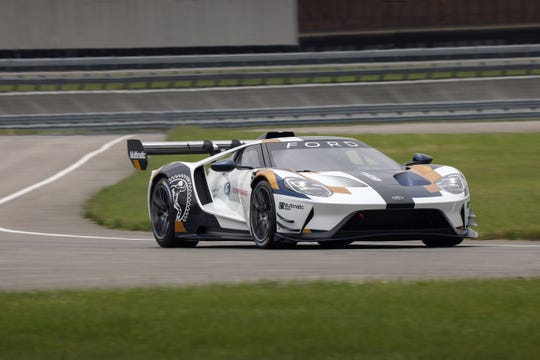
Beginning at a cool $1.2 million, the track-only Ford GT Mk II makes its public debut Thursday at the Goodwood Festival of Speed in England. Only 45 will be built. (Photo: Ford)
The Ford GT started as a race car, so it’s only reasonable that it would include a track-exclusive production version.
Beginning at a cool $1.2 million, the Ford GT Mk II makes its public debut Thursday at the Goodwood Festival of Speed in England. Only 45 will be built.
Essentially a Ford GTPro Le Mans race car with a passenger seat, the Mk II joins a rare breed of track-only hypercars like the McLaren P1 GTR and Ferrari FXX. The Mk II enables customers to explore the envelope of performance technology at their local raceway — a track day at Mid-Ohio race track, perhaps — without having to pay hundreds of thousands more to hire a team and enter a race series.
Named after the historic GT40 Mk II that beat Ferrari at Le Mans in 1966, the GT Mk II was developed free of the infamous, so-called “balance of performance” (BOP) racing regulations that cage the full capability of animals like the Ford GTPro race car to encourage even competition across a diverse field of cars.
For example, the GT Mk II will unleash the full 700-horsepower capability of the GT’s 3.5-liter, twin-turbo V-6; the GTPro LeMans car is limited to 495 horsepower.
“What could you do without BOP? This is the answer,” Multimatic chief technical officer Larry Holt said at the car’s unveiling to media at Ford’s Dearborn Performance Center last month. Multimatic is the Toronto race shop that birthed the sensational carbon-fiber, keel-chassis Ford GT back in 2016.
Designed to conquer Le Mans on the 50th anniversary of the original Mk II, the GT debuted as a race car. The first production version would not make an appearance for another year.
Priced at an eye-watering $500,000 (but in truth only available for about $700,000 after checking all the boxes), the production GT’s value was cemented by the race car’s historic, GTPro-class win at the 2016 Le Mans race.
Jaws dropped when the race car was introduced in 2016 with a sophisticated high-downforce keel chassis almost unheard of outside of the upper echelons of Formula One and LeMans prototype racing. Combined with its gorgeous “flying buttress” rear air ducts and signature GT nose (an homage to the 1966 original), the mid-engine supercar was an instant classic. After its LeMans success, 1,350 copies of the street-legal production GT followed.
Jaws will drop again when owners show up at the track with the GT Mk II.
Developed by mad-genius Holt (who, with his wild mane of white hair, looks like Doc Brown from “Back to the Future”) and his Multimatic team, the GT II is a hair away from full-blown LeMans racer.
“It is shockingly similar to the race car. There’s only about a 2-second a lap difference,” said Multimatic test driver Scott Maxwell who has helped develop each evolution of the modern GT.
Maxwell gave a brief demonstration of the GT Mk II at FPC for the news media. Dressed in Multimatic livery, it looked and sounded every bit like the GTPro race car that had just lapped the 24 Hours of Le Mans on June 16.
Whereas the street-legal production versions of the Ford GT sit 120 mm off the ground to properly negotiate public roads (a 70-mm track-mode height is available), the GT Mk II sits 59 mm off the ground for maximum downforce (the race car is just 56 mm).
Unbound from public laws like noise and safety restraints, the GT Mk II’s comes stripped of mufflers and air bags. Also gone is the tiny rear trunk, in lieu of a rear hatch scoop for better cooling of the 7-speed gearbox.
The goal here is max power, max downforce, max performance.
Toward that end, the GT Mk II comes equipped with a bigger front splitter and two-tier rear wing than the race car, as well as carbon-ceramic brakes for supreme stopping power. The race car is regulation-limited to steel rotors. Even the Mk II’s springs are a teeth-jarring 1,150 pounds, similar to the GT race car.
While not as spartan as the interior of the GTPro LeMans car (passenger comfort is encouraged when pulling upward of 2 G-loads), the cockpit is race-ready with a full roll-cage and detachable steering wheel like the race car.
A six-point, race-licensed belt harness makes the absent air bag redundant.
Stripped of unnecessary weight, the GT Mk II weights in at 3,084 pounds. That’s more than the 2,844 pounds of the GTPro race car, but 300 pounds lighter than the production model. Options above the $1.2 million starting price include paint colors and air jacks for quick tire changes at the track.
Ford says Multimatic’s Markham, Ontario, shop has capacity to produce about 15 of the Mk II supermodels a year.
“The Mk II embodies everything that we have learned at the track,” said Ford product chief Hau Thai-Tang at FPC. But he wouldn’t say if the track weapon is the GT’s last hurrah despite the car having run its Le Mans race this year.
“Never say never,” he smiled.
Payne: Living the Lamborghini Huracan dream
Posted by Talbot Payne on July 5, 2019
The Detroit News’ regular “Michigan Dream Home” feature showcases sprawling, multi-million-dollar estates with pools, walk-in closets, fountains and epic kitchens. We ogle from a distance, but without the means to live the dream.
Kind of like Lamborghinis.

The achingly beautiful Italian supercars have been our dream cars since we dreamed about cars. My teen dorm wall had a poster of the unattainable Lamborghini Countach, right alongside the unattainable Charlie’s Angels pin-up. Today’s generation of Lambo Aventadors and Huracans are regulars on my kids’ computer screensavers.
What’s it like to have one? I got a taste recently when I spent some quality time with a 2020 Huracan EVO at Willow Springs Raceway outside Los Angeles. Like a gorgeous, 20,000-square-foot home, it’s complicated.
Approaching a Lamborghini — those sultry headlamps, jet-engine air intakes, perfect shape — is no less intimidating than asking an Angel out for a date. But familiarity helps the conversation.
As the Italian brand’s entry-level sports coupe, the $261,274 Huracan is not alone in the market. Indeed, despite its nose-bleed price, it occupies a fiercely competitive segment along with the ageless Porsche 911 Turbo, Ferrari 488 and McLaren 570. I’ve driven all these cars (except the Ferrari, though I’ve driven its predecessor) at the limit, so the Huracan’s learning curve wasn’t steep.
But the Lambo is a puzzle of contradictions. It’s externally gorgeous yet internally uncomfortable. It’s V-10 engine soars like Lebron James, but its paddle shifters are as clumsy as Gerald Ford. Its all-wheel drive system is high-tech, but its handling sloppy.
Lamborghini North America CEO Alessandro Farmechi — an accomplished Italian cook in his spare time — likes to compare cars to food. Scaloppine di Huracan is certainly a unique Italian recipe.
Which is interesting because, at its core, the Huracan is German.
Owned by Audi, Lamborghini builds the Huracan on the same mid-engine architecture as the Audi R8, which benefits the smaller Italian brand in this age of high regulatory and R&D costs. But in truth, Audi bought Lamborghini in the late ‘90s because it wanted to learn the dark magic of mid-engine all-wheel drive cars and apply them to their halo R8.
Driving the Huracan is different than the more affordable Audi — and very different than its direct Porsche competitor. With 580 horsepower and all-wheel drive, the rear-engine 911 Turbo seems similar on paper. But not in character.
Did I mention the Huracan is gorgeous? You’d walk by the Porsche without giving it a second glance, its conservative lines familiar after 60 years of evolving the same soap-bar shape. In contrast, the Huracan stops traffic wherever it goes.
On track the Porsche has no peer. It’s a German symphony with every part moving in perfect coordination with the other to produce an exquisite, controlled experience. The Lambo is nervous from the get-go. As I got up to speed around Willow Springs’ undulating, high-speed circuit, the cutting-edge, four-wheel steering that makes the all-wheel drive sports car so easy to maneuver (a turning radius as tight as a scooter!) in urban areas became a liability.
The steering read every bump and turn as an opportunity to correct the car’s trajectory, resulting in a car that searched all over the place as I pointed it at a corner apex. Where the Porsche sticks like glue, the Lambo waggles. Complicated.
But like Chuck Yeager busting through the sound barrier, the Huracan gets more stable the faster you go. The rear-wheel steer evens out, the substantial aero tricks on the EVO performance model (front splitter, rear spoiler, outer front air ducts creating an air curtain through the front wheels) suck the car to the ground, and the Huracan tidies up.
Which allows me to enjoy the music behind my right ear.
The 630-horse V-10 is one of the world’s last normally aspirated engines as manufacturers employ turbos to balance efficiency with more power. At full wail — each upshift of the silky, dual-clutch transmission sending goosebumps up my spine — the Huracan is a rocket to complement the jet fighters with which it shares design cues (right down to the red, flip-up latch over the cockpit starter button).
Pity the shifter paddles are fixed to the steering column.
Seems to be an Italian thing — Alfa also does it, while Porsche and McLaren fix their paddles to the wheel so that they turn in synch. My long fingers grasped for the next gear as I stormed out of turns, banging the 8,000-rpm redline — GUH-GUH-GUH — and distracting me from the road (and glorious V-10 aria).
It makes for an unnecessarily busy cockpit already compromised by the Lambo’s famously difficult sightlines. To achieve that breathtaking exterior with raked windshield and squashed greenhouse, the interior is a pillbox of visibility.
At 6-foot 5 I need a shoehorn to get in and out of the car — and that was before I put a helmet on. Happily, Huracan has made big strides in modernizing its cabin technology. A sea of buttons has been replaced by a big, responsive touchscreen right out of Audi’s shop (see the new, haptic A-series touchscreens). It pairs nicely with Lambo’s signature digital instrument display which gives the car a video-game feel as you toggle through its mode settings — Normal, Sport, Corsa (track) and Mama Mia (kidding about that last one).
Trouble is, the McLaren 570/720 twins (depending in whether you want 570 or 620 ponies) do this better.
With show-stopping designs of their own, the McLarens sport a rear-wheel drive carbon-fiber chassis that is stiffer and lighter than the Huracan. With modern drivetrain electronics, the $288,000 McLaren 720 doesn’t miss the heavy, all-wheel drive system and rockets to 60 mph side-by-side with the Huracan.
And with more in reserve. With twin-turbos strapped to its 4.0-liter V-8, the McLaren’s linear acceleration is epic. With its unique, jaw-dropping face and innovative bod, the 720 takes on the Lambo at its own game. Let traditionalists buy Ferrari and Porsche heritage — McLaren and Lamborghini are cyborgs from the future.
McLaren does the fundamentals better — handling, turbo, acceleration — even sporting scissor doors like Huracan’s big-brother $400,000 Aventador. It’s the superior beast. But Lamborghini knows the game has changed. Not content to sit on its throne, it has descended to the track — winning back-to-back Daytona 24-Hour races — to hone its craft.
Take your pick — McLaren or Lambo? Either will look good in your dream home’s six-car garage.
2020 Lamborghini Huracan EVO
Vehicle type: Mid-engine, all-wheel drive, 2-passenger supercar
Price: $270,969, including $9,695 destination fee
Powerplant: 640 horsepower at 8,000 rpms, 442 pound-feet of torque, 5.2-liter V-10
Transmission: Dual-clutch, 8-speed automatic
Performance: 2.9 second zero-60 (mfr.); 202 mph top speed
Weight: 3,424 pounds (est.)
Fuel economy: NA
Highs: Movie-star looks; V-10 soundtrack
Lows: Cramped interior, sight-lines; column-based paddle shifters
Overall: 4 stars
Payne: New Ford Explorer reaches further — at a price
Posted by Talbot Payne on June 27, 2019
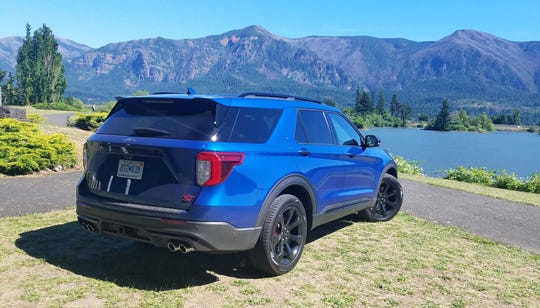
Ford Explorer, you had me at ST.
I’m a big believer in “halo” cars, those goosebump-inducing, chart-topping performance variants that speak volumes about a car model’s aspirations and engineering, and bring people into showrooms. Think Dodge Hellcat, Jeep Rubicon, BMW M3, GMC Denali, Volkswagen GTI.
For the first time ever, the familiar ol’ Explorer three-row SUV has adopted Ford’s hellion ST badge — and it’s like tossing Roger Federer an oversize graphite racket. It gives Explorer a better all-around game. It’s got 400 horsepower, more black makeup than Alice Cooper, and will land dad in jail if he takes it to a back road.
Henry Payne goes Zero-60 in the 2020 Ford Explorer, a vehicle that can park itself. The Detroit News
And that’s a good thing in the ferociously competitive three-row SUV rugby scrum, where you either stand out or get ground into the turf.
The Explorer, of course, is — along with the Jeep Grand Cherokee — one of the pioneers of the midsize SUV segment. They dominated the class for years, selling zillions and printing more money than Daddy Warbucks thanks to building on an existing pickup chassis.
Then Ford woke up a decade ago and realized that every other automaker had jumped into the segment.
There were unibody-based Toyota Highlanders and stonkin’ Dodge Durango R/Ts and spacious Chevy Traverses. Heck, even Jeep had sprouted a Trackhawk variant with something like 15,000 horsepower and a V-8 mating call that made every grown male howl at the moon.
So Dearborn got busy and the all-new 2020 Explorer is the result. It advances on Ford’s first 2011 unibody SUV in every conceivable way. It would take five columns to cover the highlights of this car, but let me sum the Explorer up this way: It’s a handsome, rear- and all-wheel drive, nice-handling 4,700-pound school bus. It’s off-road capable, roomy, high-tech, detail-rich and ergonomically smart.
(Pause to catch breath)
It’s a powerful, quiet, connected crossover with a one-touch autonomous self-parking feature that will have your neighbor who just bought an Audi for $20,000 more running over for a demo.
Even with all that, sales champ Explorer was going to be under pressure to hold off value plays like the Kia Telluride and Toyota Highlander.
So, like Federer watching tape between matches, Explorer went out and augmented its core design and technology strengths by adopting the competition’s best features.
For years Explorer has been the fashion plate of SUVs. Like the lovely Fusion sedan copying Aston’s face, Ford knows a beaut when it sees it one. Explorer cribbed SUV heartthrob Range Rover’s wardrobe, right down to the Brit’s stylish bonnet lettering, E-X-P-L-O-R-E-R.
Taking Rover’s lesson one step further, the 2020 Explorer adopts a luxury-class longitudinal engine architecture that pushes the wheels out to the front corners. That creates a dramatic silhouette with long snout, scalloped shoulders and big haunches.
Nice, but then the designers took the rest of the day off.
Where Range Rover’s design (check out the Velar, and bring a drool bucket) is lean and Apple-spare, the Ford is over-designed in the front, giving its face a jowly, heavy appearance compared to the last generation. Liposuction, please.
Explorer takes a back seat to the crisp Kia Telluride as class prom queen.
Kia then adds insult to injury by making its front wheel drive-based beauty a cheap date. Endowed with a long list of standard features like adaptive cruise-control and blind-spot assist, a $41,845 all-wheel drive Telluride EX with 20-inch wheels and moonroof undercuts Explorer’s similarly equipped, $47,405 Explorer XLT by a whopping $5,500.
Happily, Ford has put that rear-wheel drive based platform to other good uses.
Like Detroit rival Dodge Durango — another SUV in class with a rear wheel drive-based bod — the Explorer is engineered to be an athlete from the ground up.
Despite those jowls, the 2020 model is 200 pounds lighter than the 2019. Mated to Ford’s base 2.3-liter workhorse turbo-4 (also found in the speedy Mustang and European Focus RS), the volume XLT Explorer can cut some rug on the dance floor and does a pretty good imitation of a Jeep off-road.
Stomp the pedal and the Explorer thinks it’s a Focus ST in an SUV body. The secretary of state should require a racing license to operate this Frankenstein’s monster. Taut and responsive with the Explorer’s standard 10-speed tranny throwing off quick upshifts, the three-row ST gulped pavement at an alarming rate in the hills of Portland’s Columbia River valley.
What are you doing, Payne, this is a three-row ute!
And it’s a usable three rows. Yes, Grand Cherokee’s Hellcat-fueled, 707-horse Trackhawk has no peer. But you can only make three other adults sick in its two-row configuration. Thanks to that RWD-based architecture, Explorer has gained a healthy 4 inches of legroom behind the front seat, meaning you can put two 6-footers in the third row.
The Explorer isn’t all looks and muscle. It’s taken Ergonomics 101 from the Honda Pilot.
The three-row Pilot is homely compared to its glamorous classmates, but it geeks out on interior detail with its space-saving trigger shifter, console storage and one-button third-row access. Veteran Explorer chief engineer Bill Gubing and his team watched and learned.
The Explorer will win over the family with its attention to detail: Rotary shifter. Horizontal-or-vertical touchscreens. Single-button access to third row seats. Sub-cargo storage for muddy cleats. Rocker-panel foot-steps for Christmas tree-tying roof access …
(Pause to catch breath)
… standard automatic rear-hatch. Sports-car-like, 2X hood release to save you from fishing for the release under the bonnet.
Only with its first hybrid does Explorer shy from the competition. Despite years of hybrid development, Ford prices it way out of reach — at a nose-bleed $53,000 — from the excellent,$38,000 Highlander Hybrid.
Seems Ford would rather show off its pioneering electronics.
Like a luxury car, you’ll be showing it off to your friends. There’s the FordPass app that can remotely start your car, look in on tire pressures and vacuum Cheerios from under the seats (just kidding about that last part). And then there’s self-park assist, part of Ford’s must-have Co-Pilot360 driver-assist package. I spent an evening effortlessly parallel parking a giant, three-row SUV all over town by touching nothing but a button.
Which was relaxing after a day of wringing the Explorer ST’s neck all over Oregon.
2020 Ford Explorer
Vehicle type: Front-engine, rear- and all-wheel drive, seven- or eight-passenger, three-row SUV
Price: Base price $37,770 for XLT including $1,095 destination charge ($46,130 AWD XLT and $54,740 AWD ST as tested)
Powerplant: 2.3-liter, turbocharged 4-cylinder; hybrid 3.3-liter V-6 mated to AC electric motor (hybrid only); 3.0-liter, twin-turbo V-6 (ST and Platinum only)
Power: 300 horsepower, 310 pound-feet of torque; 318 horsepower, 322 torque combined (hybrid); 400 horsepower, 415 torque (ST); 365 horsepower, 380 torque (Platinum)
Transmission: 10-speed automatic
Performance: 0-60 mph, 5.5 sec. (ST, mfr.); maximum towing, 5,600 pounds
Weight: 4,345 pounds base RWD (4,701 AWD ST)
Fuel economy (all numbers with AWD): EPA: 20 city/27 highway/23 combined (2.3-L turbo-4); 18 city/24 highway/20 combined (3.0-L turbo-V6): N/A for hybrid model
Report card
Highs: ST hottie; one-button self-parking
Lows: Jowly face; gets pricey
Overall: 3 stars
Ultra-high-performance Ford GT will set off fireworks July 4
Posted by Talbot Payne on June 23, 2019
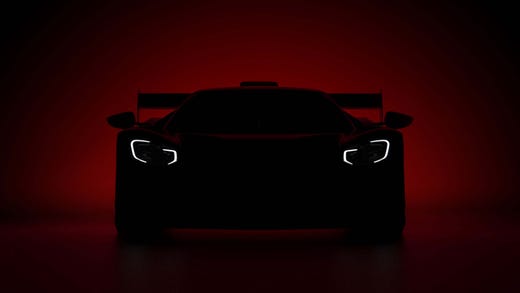
Ford’s performance division will try to leave behind a difficult month at Le Mans by setting off some fireworks July 4 at England’s Goodwood Festival of Speed.
The automaker will unveil an “ultra-high-performance” version of the Ford GT production car alongside the Mustang Shelby GT500, the most powerful Ford ever produced. The annual Goodwood show is one of Europe’s premier automotive events.
The mid-engine GT’s sister race car was off the pace at the June 15-16 Le Mans 24-hour endurance race. It was the last factory-backed appearance at the famous track that made Ford GT an international household name. To add insult to injury, the best-placing GT in the GTE Pro class was disqualified for violating fuel tank regulations. Worse, the winning Ford in the GTE Am category – a private entry – was stripped of its crown for the same fuel breach.
No use crying over spilled fuel. So Ford is bringing out its big guns next Thursday to blow bad memories away.
Ford is teasing the new GT with a single photograph, but expect the latest evolution of the $700,000-plus halo car Ford has limited to a 1,350 production run. All GTs are hand-built by Multimatic in Canada.
Ending months of suspense after the GT500’s debut at the Detroit Auto Show in January, Ford announced this week that the mega-Mustang’s supercharged 5.2-liter V-8 will make a ground-shaking 760 horsepower – the most of any Detroit muscle car this side of the 840-horsepower Dodge Demon.
Both Fords are expected to make quick runs up Goodwood’s narrow, haybale-lined, 1.16-mile hill-climb course for the assembled multitudes.
The 760-horse Mustang GT500 eclipses by far the Snake’s last model in 2014. That generation boasted 662 horsepower. The 2020 car will mate all that power to a 7-speed dual clutch transmission. Ford promises customers won’t miss the traditional manual.
Significantly, the GT500’s power figure exceeds the 650-horse Chevy Camaro ZL1 1LE – the track-focused, winged GT500’s chief rival.
The supercar halos will preside over a packed Goodwood paddock of Ford muscle. Other toys will include:
- The all-new Focus ST – alas, for European eyes only, because the pocket rocket has been discontinued on this side of the pond.
- Joey Logano’s 2018, championship-winning Team Penske Fusion NASCAR
- Gymkhana TEN star Ken Block’s Hoonitruck and Escort RS Cosworth
- A Euro-spec Ranger Raptor pickup which will show off its moves on an off-road course.
The No. 66 Chip Ganassi Racing Ford GT racer will also be on hand fresh from its sixth-place Le Mans finish. The car was one of four factory entries making one more bid to win the endurance race after taking the trophy in its maiden voyage in 2016. That win came 50 years after Ford famously beat Ferrari in 1966, stunning the European racing world.
Ford was stunned at this year’s race when its No. 68 car was disqualified from fourth place.
Officially, Le Mans stewards found the race car’s total fuel volume was “in excess of the permitted limit.” The maximum allowed is 97 liters, while post-race scrutiny found the GT a hair over the limit at 97.83 liters.
Payne: Can the rugged Jeep Gladiator pickup adapt to domestic life?
Posted by Talbot Payne on June 20, 2019
I first drove the 2020 Jeep Gladiator pickup on a bruising off-road course in rural California: Mud-caked trails. Rocky landscapes. You know, Jeep stuff. Marketers love to show this capability off to journalists. How about that, eh? Unbelievable, yes? Yes, yes. But rugged as the ladder-frame Gladiator (and brother Wrangler) may be, how many owners will ever take it to those extremes?
So I was eager to get a Gladiator in my driveway this spring to test it as a common commuter sled where I would have to live with the Jeep’s more, ahem, truck-like attributes.
Silly me. I forgot that driving Michigan roads is an off-road test in itself.
Michigan has some of the worst byways I’ve ever driven (and this is coming from a West Virginia boy, no stranger to bad roads). Especially during the spring thaw when potholes the size of the Mariana Trench open up. Close your eyes crossing from Ohio to Michigan and you’ll feel it. KUH-THUNK, KUH-THUNK, KUH-THUNK. Welcome to Pure Michigan.
Pure Michigan.

The rugged Jeep came as a relief. I’ve been testing the autonomous-driving capabilities of a few luxury cars this spring — Mercedes, BMW, Tesla — and it’s murder on the concentration. The vehicles are competent enough at seeing lanes and traffic, but they can’t see imperfections in the road, so I’m always poised to intervene for fear of — KUH-THUNK — losing a tire.
The Jeep, by contrast, has no self-driving pretensions, and its rugged tires and frame shrugged off potholes like Avengers bouncing off Thanos. Take I-75 north of Madison Heights, for example. Ruts have opened up between the concrete lanes like moats around medieval castles. Negotiating these in a sports sedan is nerve-wracking. The Gladiator thumps over them with ease.
“Kid stuff. Payne, take me to a real off-road park like the Mounds!”
The Jeep was begging me. But I resisted. I was determined to write about the Gladiator as a daily commuter.
It gave me peace of mind every day I left the house. No worries about rough roads shaking the car to dust. In fact, my Gladiator Overland tester almost floated over the road on its big Bridgestones. This truck is no sport truck like the stiff Chevy Silverado Trail Boss.
Road handling is not its forte. But personality it has in waves. I covet the spare aesthetic brilliance of a Porsche or a Mazda, but after a week with the Gladiator I get its brand magnetism: Iconic face. Raw, outdoorsy design with exposed hinges and lock-down hood. Tattooed graphics everywhere, including a Jeep crawling up the windshield and “♥419” carved in the bed to honor its Toledo-built area code. Signature interior touches like straps that adjust the seat backs and door nets that hold cargo.
I find mid-size truck interiors to be cold and uninspiring, but the Gladiator has an appealing wardrobe with luxury-like flair. You know when you are in a Mercedes — and when you’re in a Jeep. It is this personality that makes the Jeep coveted across mainstream and luxury buyers.
I took Mrs. Payne out for an evening on the town and she chose the Jeep pickup in the driveway over the BMW 3-series. She wanted the Jeep’s status: outdoorsy, unique, authentic. She had coveted the Jeep Wrangler at a young age.
Is there any other truck with that kind of cross-gender appeal?
Jeep knows it’s got game, and you pay for it. The Jeep is priced to be exclusive, eschewing the low-end, rear-wheel drive market occupied by Chevy and Ford to start at $35,000 with 4-wheel-drive only. My tester was pricey — Gladiators are generally $2,000-$3,000 more than comparable competitors — yet lacks handy tech like the Ford Ranger’s self-parking feature. At $53,000, my Overland still had cloth seats!
My wife pulled herself into the cab with the A-pillar handle and remarked about the cloth and the noisy cab (all the panels, including doors, are designed to come off). But the Jeep turned heads, dressed in silver with gray 18-inch wheels, when we pulled into an upscale parking lot full of BMWs and Lexuses.
Payne, I’m getting impatient here. When can I get dirty?!
The Jeep’s voice continued to nag at me. All that off-road capability — skid plates, plastic bumpers, signature second shift-knob for 4-wheel-low — and I was just going to drive it back and forth to work? Even my pickup bed forays to haul mulch and winter debris from the yard seemed soooo mundane.
I finally gave in. Like driving a Porsche for a week and never going to the track, it just wasn’t right to deny the Gladiator a trip to its natural habitat. We set course for the Mound ORV Park near Flint over the Memorial Day weekend.
Just an hour north of Metro Detroit in Mount Morris, the Mounds is a haven for off-roaders. Its swampy, hilly, mogul-infested terrain is choked with dirt bikers, ATVs and mega-tire trucks. And Jeeps.
Jeep Wranglers are everywhere. The new Gladiator was an instant rock star.
I floored the 285-horse V-6 across moguls and splashed through narrow bike trails, the Gladiator’s compact proportions allowing it to go where a full-size truck could never roam. That floaty, on-road handling is perfect for terrain like this as the chassis requires flexibility over undulating terrain.
A helmeted dirt biker sidled up to me. “Dude, that Gladiator is beautiful. How’s it feel out here?” Like a Wrangler with a bed, I replied, and he gave me the “hook ’em horns” sign.
I slopped through a series of muddy ruts, caking the Gladiator in mud. A female ATV-writer sidled up to my door. “How’s it doin’? My daughter wants one sooooo bad!”
Locked in four-wheel low, I fishtailed across a muddy trail. A herd of dirt bikers rode by — all pumping their arms and giving me “hook ’em horns” signs.
Does the Jeep Gladiator pass muster as a metro commuter vehicle? Yup. Its mid-size dimensions, easy Uconnect infotainment and signature interior make it an all-season ride. But don’t forget to heed the call of the off-road every once in a while.
2020 Jeep Gladiator
Vehicle type: Front-engine, four-wheel drive, five-passenger pickup
Price: Base price $35,040 including $1,495 destination charge ($53,045 Overland as tested)
Powerplant: 3.6-liter V-6
Power: 285 horsepower, 260 pound-feet of torque
Transmission: 8-speed automatic; 6-speed manual
Performance: 0-60 mph, 7.2 sec. (Car and Driver); maximum towing, 7,650 pounds; payload, 1,600 pounds
Weight: 4,450 pounds (5,072 Overland as tested)
Fuel economy: EPA: 17 city/22 highway/19 combined (automatic); 16 city/23 highway/19 combined (manual)
Report card
Highs: Jeep cred; off-road warrior
Lows: Pricey; numb handling on-road
Overall: 4 stars
Payne: BMW 3-series wants its crown back
Posted by Talbot Payne on June 13, 2019
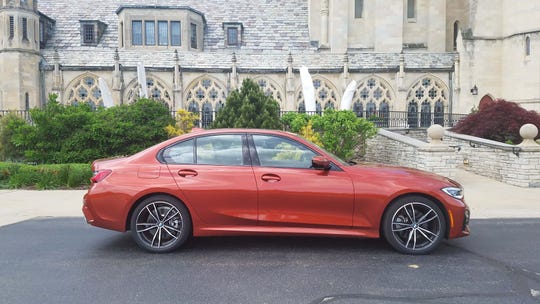
Socialism is all the rage these days among Washington elites, but lucky for them their new BMW 3-series was born in the boiling shark tank of capitalism.
Long the alpha shark in the compact-luxury segment, the last-generation 3 got a little, um, fat. And boy, did the product managers in Munich get an earful from the market.
New Coke never had it this hard.
Media outlets ripped BMW for going soft. Car and Driver dropped the 3-series from its Top 10 list for the first time in memory. Sales dropped. Enthusiasts started to talk openly of the Alfa Giulia and Cadillac ATS as the new standards for class-handling. The competitive pressures weren’t just athletic complaints, either.
Mercedes’ luscious interiors were turning heads away from BMW. Tesla’s sci-fi Model 3 was shaming the class with Silicon Valley technology. Mainstream upstarts like the Mazda 6 were offering athletic value for $20,000 cheaper. And then there’s the market flip to premium sport-utes.
Well. Market reaction duly noted.
The seventh-generation 2019 BMW 3-series bears a familiar silhouette and kidney grille but is otherwise a comprehensive remake to re-establish its iconic self as King of the Hill. It mostly succeeds.

Start with its reflexes. The new 3-series clearly spent a lot of time in the gym. My 330i X-Drive tester’s muscular intentions are felt right away through its thick steering wheel. Like wrapping my fingers around a bicep, the steering feels alive to my inputs.
When I nailed the throttle through Oakland County’s twisties, the Bimmer was ready — the 8-speed transmission snapping off shifts with buttery efficiency, the chassis tight, the car’s balance exquisite. Ahhh, that’s the 3 that I remember from the first BMW I owned — the beloved, fourth-generation, E46 model equipped with an inline-6.
But the competition hasn’t stood still, either.
Most customers will never take their 3-series to the track, and those who do will likely wait for the M3 hellion. But your intrepid tester was curious. After all, BMW proves the car at the famous 160-turn Nürburgring race track.
Flogging the 330i around M1 Concourse’s 10-turn Champion Raceway in Pontiac revealed subtle differences when tested against rear-wheel drive classmates Cadillac ATS and Tesla Model 3.
Like the ATS, the Bimmer rotated beautifully into corners, its gym-toned bod better-tuned than the Tesla. Exiting apexes, the electric Tesla has instant torque. The 330i suffers from turbo lag; blame the turbo-4 that has become ubiquitous in compact luxury.
My kingdom for the straight-6 cylinder of old (which BMW shares between the Z4 and Toyota Supra that I recently tested). Fortunately, my 330i came with paddle shifters so I could keep the revs up.
Speaking of shifting, the 330i continues BMW’s love affair with the monostable shifter. It takes some getting used to, and kindly explain it to befuddled valet drivers when you hand over the keys so they don’t have to spend a half hour reading the owner’s manual.
Once mastered, its space-saving simplicity is appreciated. Like Mazda’s 3 (oh, there’s that clever, affordable mainstream automaker sneaking into the conversation), BMW has ordered its console for maximum efficiency so that there’s room for cupholders and phone/French fries cubbies. Audi cramped consoles, pay attention.
Stop-start is the bane of drivers’ existence these days. It’s the most disliked feature in luxury (I hear from plenty of readers who shudder when their otherwise silky-smooth thoroughbred shudders to a stop at a stoplight). It’s like Secretariat coughing at the Kentucky Derby starting gate.
But I quickly adopted a two-step habit whenever I climbed into the Bimmer: Turn on car, turn off stop-start in one fluid motion.
Other operations are a snap. BMW has never been shy to introduce new gadgets (see monostable shifter) and its once-despised rotary infotainment controller is a thing of beauty, allowing effortless navigation of the console screen. My instincts are for touchscreen and BMW allows that, too. The screen was quick to the touch as I swept through menus. It’s illustrated with gorgeous graphics that would look nice framed on dealership walls.
That graphical interface is a reminder that German makers have had to catch up with Tesla’s new benchmark for electronic efficiency. It’s no longer acceptable to wade through navigation menus — luxury cars must be as responsive as “OK, Google” smartphones.
BMW calls its helper “Intelligent Personal Assistant,” and she’s at your service with a quick “Hey, BMW.” Setting off on a trip to my favorite Kart-2-Kart go-kart track in Sterling Heights at 5 p.m. on a Tuesday, I barked the location to 330i. I might as well have been speaking in Russian.
The system was clueless.
So I “OK, Google”-queried my phone, read the address to the car, and set off. Which immediately led to a second problem: the 330i couldn’t distinguish between the fastest route, and the fastest route during rush hour.
This is Navigation 101 for smartphones (and Tesla), and the phone saved me precious time by navigating away from clogged main arteries (like M-59). This is understandably a tall order for most carmakers given the massive cloud networks phone-makers possess. BMW allows drivers to plug in their Apple smartphones so that Apple CarPlay can take over the screen and do its thing. Alas, Android users like me are left in the cold.
Interestingly, BMW is content not to try to keep up with the Joneses on self-driving capabilities. Where Mercedes is chasing Tesla on self-driving ability with autonomous tricks like turn signal auto-lane-change, BMW is content with adaptive cruise-control and lane-keep assist. The latter is a generation behind its peers, ping-ponging between lane lines.
It’s as if the Bimmer is determined to let you know it’s serious about this driver’s car thing.
Hands on the wheel! Don’t you know that I am the ultimate driving machine?!
Good to have you back, 3-series. It’s survival of the fittest out there.
2019 BMW 3-series
Vehicle type: Front-engine, rear- and all-wheel drive, 5-passenger, compact luxury sedan
Price: $41,245 base including $995 destination fee ($58,770 330i AWD with M-package as tested)
Powerplant: 255 horsepower, 295 pound-feet of torque, 2.0-liter turbocharged inline-4 cylinder
Transmission: 7-speed automatic
Performance: 5.2 second zero-60 (Car and Driver); 156 mph top speed
Weight: 3,582 pounds (3,764 pounds as tested)
Fuel economy: 25 mpg city/34 mpg highway/28 mpg combined
Highs: BMW looks; nimble handling
Lows: Nostalgia for the inline-6; Android Auto, please
Overall: 4 stars
Payne: BMW-Jaguar want to make EV babies
Posted by Talbot Payne on June 8, 2019

The luxury auto icons will be developing the next generation of drive units for their electric cars, the latest collaboration between rival automakers as they move to Autos 2.0 — or ACES as the joint venture puts it, shorthand for Automated, Connected, Electric and Shared Vehicles.
“The transition to ACES represents the greatest technological shift in the automotive industry in a generation,” said Jaguar Land Rover engineering chief Nick Rogers. “The pace of change and consumer interest in electrified vehicles is gathering real momentum and it’s essential we work across industry to advance the technologies required.”
Automakers have a long history of collaborating on everything from gas engines (Toyota Supra and BMW Z4 share a 6-cylinder) to chassis (Ford and VW share commercial-truck platforms in global markets). On the ACES front, Honda and General Motors have joined forces on autonomous vehicles, and the recent merger talks between Renault SA and Fiat Chrysler Automobiles NV were in part driven by electric vehicle collaboration.
Hook-ups on ACES have become especially important given the uncertain development timeline of autonomous vehicles and the uncertain market for EVs. With hard government mandates looming, EV development is especially pressing.
For the first time governments are forcing automakers to make a particular drive-train — namely, battery-electric — even though customers have shown little desire for the technology. Automakers have no choice but to follow an expensive path of making vehicles desired by markets — and by governments.
BMW and Jaguar have made their mark as manufacturers of roaring, gas-powered hellions like the M3 sports sedan and F-Type sports car. But both companies have been bullish on EV tech.
Given EVs range and charging issues, luxury buyers have been targeted as early adopters with multiple cars in their garages. BMW has launched a separate, battery-powered, “i-line” of cars led by the i3 hatchback and i8 sports car. Jaguar, too, has been a pioneer with its i-Pace SUV.
But sales of these products have been tepid in a U.S. market where EV owners have been reluctant to buy anything not named Tesla. The Silicon Valley-based electric car-maker has dominated EV sales — for example, its $40,000 Model 3’s unit sales dwarfed the $45,000 i3 in May, 13,950 to 439. And Tesla’s $75,000 Model X SUV outsold the $70,000 Jaguar i-Pace SUV by 1,375 to 228.
Worse for the European duo, Tesla sales have dropped this year as the company has maxed out on selling cars with a $7,500 tax credit. Buyers of BMW and Jaguar EVs still get the full $7,500 credit — the eventual loss of which could be even more devastating as the automakers struggle to meet U.S. regulations. In Europe, a key market for BMW and Jaguar, demand is weak while government mandates are even more onerous.
Faced with these realities, BMW and Jaguar are pooling resources on a new electric-drive unit.
“We’ve proven we can build world-beating electric cars, but now we need to scale the technology to support the next generation of Jaguar and Land Rover products,” said Jaguar’s Rogers. “It was clear from discussions with BMW Group that both companies’ requirements for next-generation EDUs to support this transition have significant overlap making for a mutually beneficial collaboration.”
The agreement allows for efficiencies created from shared R&D — as well as from joint procurement across the industry supply chain.
BMW and Jaguar Land Rover engineers will then jointly develop the EDUs — then manufacture them in separate facilities to meet the needs of their product lines. The British brand says production will take place at two facilities in England: Wolverhampton and Birmingham.
Payne: Despite autonomous potential, automakers still hone their brands by racing
Posted by Talbot Payne on June 8, 2019

Driver Scott Dixon celebrates after winning the Dual II IndyCar Series Race at the Chevrolet Detroit Belle Isle Grand Prix on June 2. (Photo: Robin Buckson, The Detroit News)
Pontiac — Win on Sunday, sell on Monday.
That mantra guides nearly every major automaker today as brands from Chevrolet to Acura to Porsche pour extraordinary sums of money into the top echelons of motorsports to burnish their performance images and bring customers into showrooms. Despite the billions being invested in autonomous and electric vehicles today, motorsports is still a cornerstone of brand ID.
Where each automaker focuses that performance energy tells you a lot about where their brands are headed.
Honda Motor Co. wasted no time Monday after its win in Sunday’s Detroit Grand Prix as the engine supplier for Scott Dixon’s winning IndyCar. The Japanese manufacturer immediately pivoted to promoting … the Honda Civic compact car.
“In recent years we’ve really tried to push these production-based cars as an affordable entry point to get new (buyers) into the brand,” said Honda Performance Development engineer Justin Chiodo here. HPD manages Honda’s racing effort. “By … showing the performance of our cars it makes it a more desirable vehicle for people to purchase.”
The investment in the TCR racing program shows the importance that Honda places on the compact Civic as a brand halo and as an entry-point for first-time car buyers. Significantly, it is a segment that Detroit has abandoned completely in order to concentrate on compact SUVs.
Chevrolet, too, won at the Detroit Grand Prix last weekend as Penske’s Joseph Newgarden brought his Chevy-powered IndyCar into victory lane in the first of the weekend’s two open-wheel car races.
Chevy tries to translate such success into production cars. Its racing efforts include fielding racing versions of the Corvette and Camaro muscle cars to compete in IMSA just like Honda’s Civic — but in more powerful classes.
The Camaro, for example, competes in the Michelin Pilot Challenge GS class which includes other performance cars like the Ford Mustang, BMW M4, Mercedes AMG GT4, and Porsche Cayman GT4.R.
This effort dovetails with Chevrolet’s determination to make the Camaro the design halo for a new generation of SUVs, including the recently introduced Chevy Trailblazer and Blazer which share Camaro design cues. Chevy hopes the racy design — and Camaro/Corvette’s success at the track — will help elevate its SUVs over other, lookalike utes.
Honda’s TCR class, meanwhile, is dominated by foreign makes which still see the large (if shrinking) compact car class as key to conquering entry-level buyers. Other brands scrapping for attention in the class include the Hyundai Elantra, VW Golf GTI, and Audi RS3 race cars — all based on compact cars.
In addition to the wave of publicity that manufacturers receive from media coverage and trips to victory lane, they also value the tech transfer from racing. Racing cars at their track limits helps inform the next generation of production technology.
“There is a lot of feedback to Honda from all the teams about things we can improve on for the next race — or for the next generation of the car,” says Todd Lamb, owner of Atlanta Speedwerks, a racing team that fields two Civic TCR race cars in the IMSA series. “Everything we do adds up. Some of what we do on the track ends up back in the street car. It’s neat to see.”
Racing also fuels the aspirations of young people long before they get their driver’s license.
“Racing attracted me at an early age,” says Honda engineer Chiodo. “I’ve always had a strong respect for Honda. I grew up racing dirt bikes and I saw the quality and the products that this company builds. I always wanted to work for them.”
Honda and GM are partners in investing in the future of autonomous cars — a ride-sharing area that is uncharted new territory for these personal transportation brands. Until markets emerge for those products, however, both companies will continue to define themselves by racing.
After Detroit, Chevy and Honda will be watched by millions powering IndyCars at Road America in Wisconsin June 23. One week later, the IMSA sports car circus will travel to Watkins Glen, N.Y., where entries will include the Chevy Corvette in GT-LeMans class, Camaro and Civic Type-R TCR in Michelin Pilot Challenge, and Cadillac/Acura/Nissan/Mazda porotype racers in the IMSA Weathertech series.
Says Chiodo: “People see these cars racing on the track and maybe … that makes them interested in buying a Type-R, or a (Civic) Si, and even a Civic and enjoy our great engineering on the street.”
Payne: Hot-hatch Lexus UX F Sport vs. VW GTI, Mazda 3, Kia Soul GT
Posted by Talbot Payne on June 6, 2019

Is it worthy? I put it to the test with some iconic hot-hatchback cars: Volkswagen Golf GTI, Mazda 3 and Kia Soul GT.
Compact hot-hatches, as readers of this space know, are my favorite class of car. They’re fun, utilitarian and affordable. Pound per dollar, they are the best all-around cars on the market. But this sport-ute craze has me worried.
Sedans are falling under the SUV tidal wave, their high-performance variants getting swept away with them. With the Ford Focus sedan has gone the Focus ST and Focus RS. So long Ford Fiesta means adios to the 197-horse Fiesta ST, a mainstay on my Top 10 list of best cars.
Seeing the handwriting on the wall, Mazda deep-sixed its Mazdaspeed 3 a few years ago to concentrate on sport utilities. The only silver lining in the Chevy Cruze’s burial is it didn’t take a hot hatch with it. Because there never was one. Happily, foreign makes are bullish on five-door performance hatchbacks.
Now Lexus throws its all-new, alphanumeric-nightmare UX 250h F Sport SUV into the fray. Is it worthy? I put it to the test with its car peers.
First, some rules.
A hot hatch has five-doors. Jetta GLI, I love ya, but you’re a sedan. The Golf GTI meets the criteria. Qualifying as a pocket rocket isn’t just a wardrobe change, it’s a performance upgrade with a steroid boost that gets your right foot tingling and your eyes sweeping the landscape for twisty roads beyond the metro grid.
Hell, Michigan, here I come!
And it’s gotta be affordable. That means $40,000 or less. Sorry, Mercedes AMG GLA 45 with four-zillion horsepower and a $50,000-plus price tag to match. You’re out.
No worries. That leaves a lot of stuff like the Hyundai Veloster N, Hyundai Elantra GT N, Mini Cooper S, Fiat 500 Abarth, Honda Civic Type-R (oooooh, somebody open a window it’s getting hot in here) … and our competitive test set: Golf GTI, Mazda 3 and Soul GT ute.
The $40,910 Lexus — injected with hybrid torque — certainly makes a first impression: Darth Vader grille. Scalloped bodywork. Ultrasonic Blue. Pocket rocket-fans crave look-at-me styling. It’s also an all-wheel driver like the retired Ford RS — um, to a point.
Adopting the same philosophy as the Toyota Prius AWD-e, the rear wheels get their drive from an electric motor which only works up to 45 mph. Why 45? To maximize fuel efficiency, and … wait, what? This is where you begin to realize the F Sport may not have its heart in this hot-hatch thing.
Combined with a 1.4-kWh nickel-metal hydride battery, the 2.0-liter four-banger makes just 181 horsepower — which is well off the $36,890 (as tested) Golf GTI’s ferocious 228 ponies.
The Lexus is based on Toyota’s sporty TNGA platform, which is the most athletic Toyota-Lexus platform yet. With suspension bits upgraded from the standard UX, the F Sport is marvelously tossable through turns. But step on the gas and its kinship with its big-brother RC F Sport coupe suffers.
The UX 250h smothers its ambitions with a continuously variable transmission. Lexus tries to spice up the ol’ noodle with simulated gear steps and the (oddly inconsistent) rev match on upshifts and downshifts. The battery-tranny combo doesn’t provide the one-two punch of the GTI’s turbo-manual (6-speed auto optional).
The compact VW is the premium car here with more performance and room over the pricier-but-smaller subcompact UX. The GTI even shines in the style department where its timeless lines are complemented by signature, low-profile wheels.
Like the Lexus UX’s all-wheel drive for winter? Bring in the 2019 Mazda 3 hatch which features all-wheel drive for the first time. I bend the rules for the Mazda a bit since it no longer offers the MazdaSpeed performance upgrade. But the 3’s 186 horses make it one of the most powerful standard engines in segment and beats the Lexus to 60 by a whopping 1.7 seconds.
That, and the 3’s handling and looks are top shelf. Its aesthetics have no peer. Dress it in Soul Red and it will melt snow.
This funk-mobile has outlasted its boxy brethren — the Nissan Cube and Scion xB — with smart marketing and a fun-to-drive vibe. A subcompact ute, it mirrors Lexus in available features (save AWD) — blind-spot assist, adaptive cruise-control, smartphone-app compatibility, lane-keep assist — but for just $28,965.
I escaped with the Soul through the rural roads of east Virginia’s Northern Neck and had a ball.
The box is driven by a smooth dual-clutch transmission that the Lexus would die for. Nail the throttle and the 201-horse turbo 1.6-liter practically rips the front wheels out of their fenders. It’s a live one, this animal.
The last-generation Soul marketed itself with rapping hamsters, but this generation feels higher up the food chain. Soul’s more sophisticated wardrobe includes boomerang taillights and thin Camaro-like LED headlights. Gone are the goggle-eyed hamster peepers.
I found the Soul’s sci-fi look more premium than the Lexus but still with plenty of, well, soul. The feeling continues inside. Both the Soul (circles everywhere) and the Lexus (slashing lines like its exterior) are funkadelic. But the Soul’s console touchscreen outclasses the F Sport. Like other Lexi, the UX screen is controlled by a touchpad that will have you cursing like Yosemite Sam.
Consarn rassa-frassin’ racka-frackin’ varmint!
My biggest complaint about the Soul is its uncomfortable front seats — but in the roomy rear, your giraffe-legged reviewer could sit behind himself.
We in Club Hot Hatch are pleased to have new members, and the Lexus UX 250h F Sport is a welcome addition. But it has work to do to catch its mainstream brothers.
Vehicle type: Front-engine, all-wheel drive, 5-passenger, subcompact hot-hatch SUV
Price: $37,025 base including $1,025 destination fee ($40,910 as tested)
Powerplant: 181 horsepower, 2.0-liter inline-4 cylinder hybrid with electric-motor assist
Transmission: Continuously variable transmission
Performance: 8.6 second zero-60 (Car and Driver); 110 mph top speed
Weight: 3,605 pounds
Fuel economy: 41 mpg city/38 mpg highway/39 mpg combined
Highs: Dramatic style; good fuel economy
Lows: fussy infotainment controller; more muscle, please
Overall: 2 stars
Vehicle type: Front-engine, front-wheel-drive, 5 passenger, compact hot-hatch car
Price: $28,490 base including $895 destination fee ($36,890 Autobahn trim as tested)
Powerplant: 228 horsepower, 258 pound feet of torque, 2.0-liter, turbocharged inline-4 cylinder
Transmission: 6-speed manual; 7-speed automatic
Performance: 6.0 second zero-60 (Car and Driver); 125 top speed
Weight: 3,186 pounds (manual); 3,256 (automatic)
Fuel economy: 24 mpg city/32 mpg highway/27 mpg combined (manual); 25 mpg city/31 mpg highway/27 mpg combined (automatic)
Highs: Roomy hatch; torque-tastic
Lows: Stop/start system ruffles otherwise smooth drivetrain (happily, it’s not on the manual)
Overall: 4 stars
Vehicle type: Front-engine, all-wheel drive, 5-passenger, compact hot-hatch car
Price: $24,495 including $895 destination fee ($31,930 as tested)
Powerplant: 186 horsepower, 185 pound feet of torque, 2.6-liter inline-4 cylinder
Transmission: 6-speed automatic, 6-speed manual
Performance: 6.9 second zero-60 (Car and Driver, est.); 130 top speed
Weight: 3,255 pounds (AWD hatchback as tested)
Fuel economy: 25 city/35 highway/29 combined (FWD manual); 24 city/32 highway/27 combined (AWD auto, as tested)
Highs: Easy on the eyes; luxury-class interior design
Lows: Blind spot the size of New Hampshire; bring back high-horse MazdaSpeed, please?
Overall: 3 stars
Vehicle type: Front-engine, front-wheel drive, 5-passenger, compact hot-hatch SUV
Price: $28,495 base including $895 destination fee ($28,495 as tested)
Powerplant: 201 horsepower, 195 pound feet of torque, 1.6-liter, turbocharged inline-4 cylinder Transmission: 7-speed, dual-clutch automatic
Performance: 6.3 second zero-60 (Car and Driver); 130 top speed
Weight: 3,036 pounds
Fuel economy: 27 mpg city/32 mpg highway/29 mpg combined
Highs: A step up in sophistication from previous hamster-mobile; sci-fi look
Lows: Not as athletic as its peer group; hard front seats
Overall: 3 stars
‘Ford v Ferrari’ roars into theaters Nov. 15
Posted by Talbot Payne on June 6, 2019

Now here comes the heavyweight movie that Detroit has long been waiting for: “Ford v Ferrari.”
The story of Ford’s historic 1966 defeat of the famous Italian racing marque at the world’s most famous endurance race, LeMans, will be told on Nov. 15 when the movie is released to theaters. A trailer was dropped this week, and it promises scenes filled with speed, crashes and sexy cars.
But learning from the checkered history of racing movies, director James Mangold (“Logan,” “3:10 to Yuma”) has taken care to make this movie about more than two car companies. This is a movie about big personalities (Carroll Shelby, Ken Miles, Henry Ford II) played by big movie stars (respectively, Matt Damon, Christian Bale, Tracy Letts).
“Ford v Ferrari” tells the tale of Henry the Deuce’s quest – after being spurned by Enzo Ferrari in a cross-Atlantic merger – to embarrass the Italian in his own sandbox: LeMans, the 24-hour race that Ferrari had won 6 years running.
The stakes were big and so were the egos. The film goes behind the scenes as Ford hires Shelby to build one of Ford’s iconic cars – the GT40 – to pull off one of racing’s greatest upsets. Spoiler alert: Ford sweeps the podium.
“You’re gonna build a car to beat Ferrari… with a Ford,” says British race-driver Miles in the clip. “And how long did you tell them you needed? Two-three hundred years?”
“Ninety days,” snaps Shelby.
The focus on auto personalities follows Ron Howard’s successful formula in 2013’s “Rush,” which relived a Formula One title duel by casting Hollywood heart-throb Chris Hemsworth in the leading role. That movie seemed to give a second breath to racing movies (after disasters like Steve McQueen’s 1971 flop “LeMans”), “Ford v Ferrari” roars into theaters this year along with another highly anticipated car film, “The Art of Racing in the Rain.”
“Ford v Ferrari,” its source material derived from A.J. Baime’s critically acclaimed book, “Go Like Hell,” was ultimately based on an original screenplay. Initially cast with Tom Cruise and Brad Pitt in the leading roles, the movie has taken a circuitous course to the big screen.
Damon and Bale are already promoting the movie, appearing as honorary starters and waving the green flag for the Indy 500 Memorial Day weekend.
Despite Ford’s favorable outcome, the movie was made without the Blue Oval’s help. Indeed, the preview does not seem to cast Henry Ford II in a favorable light as he whimpers in the passenger seat after being taken by Shelby for a wild test ride in the GT40.
“Based on this trailer, I think I might miss opening night! I knew Henry Ford II and Tracy Letts is no Henry Ford II,” the Deuce’s son, Edsel Ford II, tweeted this week after seeing the trailer.
Hollywood hopes for more positive reviews this winter.
VW sees opening in Detroit-dominated pickup market
Posted by Talbot Payne on June 3, 2019

But Volkswagen thinks there might be an opening.
The German manufacturer has introduced two pickup concepts to the U.S. market in the last year, and it is particularly bullish on its most recent entry, the Tarok mini-pickup concept shown at this year’s New York Auto Show.
“As (midsize) pickups get bigger – to the stage where they are as big as full-size pickups were not so long ago – and more expensive and less fuel-efficient, we are trying to see if there is space for a vehicle with a smaller footprint that potentially is more affordable and gets better gas mileage,” says VW Senior Vice President for Product Marketing Hein Schafer.
With a 193 ½-inch wheelbase, the Tarok is much smaller than, say, the midsize Ford Ranger at nearly 211 inches. But VW innovates a neat party trick by expanding its 4-foot bed into a 6-foot bed by dropping the panel behind the rear bench seats and flattening the seat backs like an SUV. Like the Rabbit-based, simply named Volkswagen Pickup from the 1980s, the Tarok would sit on a compact-car chassis and be sold as a lifestyle, outdoor truck – in contrast to the ladder-frame bruisers that dominate larger segments.
VW’s transverse-engine MQB platform also has the advantage of being made in Mexico. Vehicles built in North America are not subject to the so-called “chicken tax,” a protectionist 25% tariff applied to pickups imported from abroad. VW currently imports the Jetta sedan and Tiguan SUV from Mexico.
Import tariffs are a concern for VW even as it enters into a global truck alliance with Ford. VW plans to make a truck-based midsize pickup called the Amarok. The problem? It’s made in Argentina for international markets and would be subject to the 25% tax, which is a dealbreaker.
“If we were to go into the pickup market, we would produce the vehicle in the USMCA area,” says Schafer, referencing the United States-Mexico-Canada Agreement — the proposed replacement for the North American Free Trade Agreement that governs the North American trade sphere and is exempt from the chicken tax.
VW wants in to the U.S. pickup market because it is a cash machine.
“The pickup market is huge, but we have seen that even the biggest of car companies have yet to make much of a dent in the domestic stranglehold on full-size trucks,” says Schafer. “So we wanted to show something a bit different — something that’s a bit more in line with what a potential VW customer might expect.”
Stung by the high costs of Dieselgate and electric car mandates in Europe, the German manufacturer is determined to grow in the profitable, less-regulated, SUV-crazed U.S. market.
With its three-row Atlas SUV and compact Tiguan ute, VW has shaken off its old, Beetle-car identity to become a full-line SUV and sedan maker with offerings in four of the five biggest vehicle segments.
VW is also wary of Honda’s experience with the midsize, SUV-based Ridgeline pickup. Despite glowing media reviews and a menu of unique features, the Ridgeline has failed to catch fire in a segment where trucks are defined by ladder-frame chassis and big tow numbers.
Autotrader senior auto analyst Michelle Krebs says that the smaller the pickup, the easier it is for foreign brands to gain market traction against the Detroit Three.
“Our research shows there is little brand loyalty in smaller trucks,” she says. “Full-size buyers are the most loyal in the industry; smaller-truck buyers are the least. So the newest player likely has a good chance of conquesting buyers.”
VW is not the first to look at a compact pickup. Fiat Chrysler sells the cute car-based Fiat Toro pickup in South America and has reportedly looked at bringing it to the U.S. to shore up the struggling Italian brand here.
“Obviously there is a market here for small pickups for young people who don’t want to spend $40,000 and want a lifestyle vehicle to haul their bikes or kayak,” says veteran auto analyst Joe Phillippi of AutoTrends Consulting. “But it’s a finite number of sales and manufacturers need to make sense of the numbers.”
While VW won’t talk price yet, Phillippi estimates a small pickup would start in the low-$20,000s — which is $5,000 under midsize pickups — and top out under $30,000 when fully loaded. Targeted at youth buyers on the U.S. coasts, it could also bring new customers to VW’s lineup.
“That’s why avoiding the tariffs and building it in North America is key,” she concludes.
On its website, Volkswagen takes a stroll down memory lane, recalling the Pennsylvania-manufactured VW Pickup that sold over 77,000 copies between 1979-84.
“Is America ready for a smaller pickup again?” the company asks. “Based on the reaction to the Tarok Concept in New York, Volkswagen has the potential to make one a reality — and bring another distinctive vehicle back to American roads.”
New Cadillac CT4 roars into subcompact luxury segment
Posted by Talbot Payne on June 3, 2019

The CT4-V infuses the brand’s racing DNA for a dynamic, responsive and exhilarating driving experience. (Photo: Cadillac)
Detroit —The all-new Cadillac CT4 is small but fierce.
General Motors’ luxury brand unveiled its entry-level subcompact sedan Thursday in V-series trim, signaling a revamped sedan strategy powered by familiar V-series muscle.
Ditching its old strategy of “tweener” sedans to fight German competitors by straddling segments, the CT4 is aimed squarely at the entry-level products from BMW (2-series), Audi (A3) and Mercedes (A-class). The CT4 comes just months after the New York Auto Show debut of the CT5 sedan which will compete head-on against the compact BMW 3-series, Audi A4 and Mercedes C-class.
Based on the same, athletic Alpha platform as the outgoing Cadillac ATS (and Chevrolet Camaro), the CT4 will likely be powered by a base 2.0-liter turbo-4 as Caddy enters the small sedan segment for the first time.
But first, the CT4 gets V-series muscle.
“This one is available from day one,” GM president Mark Reuss said the car’s premiere at Eastern Market. “We want to make the V-series more accessible to customers, and they will also be available with rear- or all-wheel drive.”
But wait, there’s more. Reuss said there will be a second, even more powerful V-series available at a later date. “How do you like the Blackwing name?” he asked reporters, referencing the monster, twin-turbo V-8 engine that is exclusive to the CT6-V.
Detroit Grand Prix player/coach: Racer Simpson’s star pupil is Michigan paraplegic Johnson
Posted by Talbot Payne on June 3, 2019
South African race driver Stephen Simpson comes to the Detroit Grand Prix this weekend with a couple of important Michigan connections. He will co-pilot the blazingly fast, No. 84 Cadillac DPi prototype for JDC Miller Motorsports in the IMSA WeatherTech SportsCar Challenge race.
And when he’s not trying to score points for Detroit’s most famous luxury brand, Simpson is coaching and co-driving in the Michelin Pilot Challenge with another notable local: Lansing’s Michael Johnson, the only paraplegic driver in IMSA pro sports car racing.

It’s a journey, says Johnson, that would not have been possible without the inspiration and coaching of Simpson.
“I wouldn’t be here without him,” says Johnson, who was born in Mt. Morris but now calls Lansing home. “He’s helped me tremendously throughout my career. He understands my body and where I’m coming from. He is a phenomenal person.”
The feeling is mutual.
“He’s a great role model and an ambassador (for the sport),” says Simpson, who started coaching Michael in 2011. “When we met we just clicked. He’s very quick behind the wheel and he’s still progressing. His goal is to win the Daytona 24-Hour” (America’s premier sports car race).
Unusually, the pair will not be racing together on Detroit this weekend. The sprawling IMSA race calendar usually pairs the Pilot Challenge and WeatherTech races together, but only the latter will be in Detroit. Johnson will be on his way to Watkins Glen for testing – prepping the Audi to race with Simpson the weekend of June 27. Simpson will also be piloting the Cadillac in Watkins Glen.
The co-drivers won their first race together last year at Lime Rock, which was also the first pro win for Johnson. Every accomplishment by the 26-year old is news as he is the rare race driver who competes without the use of his legs in sport that puts enormous G-loads on the human body.
Johnson has succeeded with relentless determination, raw talent … and a little help from his racing peers.
His life changed forever in 2005 when he was momentarily blinded by debris on his visor in a dirt-bike race.
“I’m not sure what happened,” says Johnson. “I ran out of (visor) tear-offs, hit a rut or another biker in front of me and … went through the wood fence. I hit my chest with the handle bars so hard it broke my back.”
He would never regain feeling below his rib cage. Undeterred, he focused on racing as he underwent rehabilitation in 2006.
He and his father traveled to Wisconsin in 2006 to buy a go-kart with hand controls that had been used by racing amputee Alex Zanardi – himself a victim of a horrific IndyCar racing accident that resulted in the loss of his legs.
“Zanardi pioneered a bunch of devices,” says Johnson. “He’s an inspiration that helps me strive to be like him – and perform to the best of my ability.”
Johnson began the long climb up pro racing’s farm league ladder, moving from go-karts to Formula 2000 cars to Pro Mazda. It was there that his life intersected with Stephen Simpson.
Simpson, who is nearly a decade older than Johnson at 35, had recently faced a turning point in his own racing career.
More: IndyCar champion Scott Dixon ‘always excited’ to race in Detroit Grand Prix
More: Detroit Grand Prix continues to build on impressive history
As a 16-year old racing in South Africa, Simpson served notice of his talent, as the youngest driver to win South Africa’s Formula Ford Championship. His skills attracted attention abroad and he graduated to the brutally competitive Formula Renault (Europe) and Indy Lights (U.S.) junior series with dreams of one day racing in Formula One and IndyCar.
Those hopes were dashed by the Great Recession of 2008 and Simpson found himself without a drive. Passionate about his craft, he turned to coaching to make a living.
He and Johnson crossed paths in Pro Mazda in 2011. A powerful bond was formed.
By 2016 they were also sharing a car together in the Continental Tire SportsCar Challenge (now Pilot Challenge) series, and last year they won their first race – at Lime Rock – in a thrilling pass last-lap pass by Simpson.
In addition to working well together, the pair have similar driving styles, which helps in quick pit stop driver exchanges.
Without use of his legs, Johnson drives with a special steering wheel equipped with thumb-operated accelerator buttons on the front and finger-operated brake buttons on the back. He also must negotiate gear changes with paddle shifters.
Though packed into the Audi RS3 with a six-point seatbelt harness and bucket seat, Johnson has only his upper body to brace against the substantial, 2-plus G-load side forces the race car generates in turns.
Credit his intense off-track training regimen with Lansing exercise guru Josh Gibbs.
When he swaps with Simpson at pit stops, Johnson is helped out of the car by Gibbs. He also takes a seat insert with him to allow for the longer body of Simpson. The South African uses the same steering wheel as Johnson – but uses the Audi’s foot pedals for acceleration and braking.
While the younger Johnson chases his racing dreams, Simpson has continued to build his resume in other areas of the sport. In addition to Michael, Simpson coaches Andretti Motorsports’ Indy Lights team of three drivers – as well as a Formula 4 team. And he was a spotter for JR Hildebrand at last weekend’s Indy 500 race.
His first year racing the Cadillac for JDC Miller is a work in progress. One of six Cadillacs in the IMSA field – Caddy has been the dominant car in IMSA prototype for years – Simpson’s team is striving to match the pace of competitors.
“We’re learning the car every race weekend,” says Simpson. “Our goal is to add to Cadillac’s win tally in the WeatherTech Sportscar Championship.”
Who knows, someday soon, one of his Cadillac co-drivers might be Michael Johnson.
Chevy brings back the Trailblazer as a small SUV
Posted by Talbot Payne on May 30, 2019

The Chevy Trailblazer is back. And like the sporty, all-new 2019 Chevy Blazer, the compact ute blazes a whole new trail compared to the truck-based, mid-size Trailblazer of old.
The 2021 Trailblazer will slot into Chevy’s lineup between the small Trax and compact Equinox as American continue to gobble up everything ute.
The Trailblazer is also an indication of the fundamental shift of Chevrolet to an SUV-focused lineup after discontinuing the Cruze compact sedan and shuttering its Lordstown assembly plant. Based on GM’s new VSS small-SUV platform (along with the Buick Encore GX that was also announced this Wednesday) the compact, unibody Trailblazer will be built in South Korea where it can also be exported to the Chinese market.
Where the Trailblazer of old (produced from 1999-2009) was made in conjunction with the mid-size Blazer, the new Trailblazer is much smaller than the new Blazer, which is built in Mexico.
The Trailblazer will share interior design with the Trax, but gets more standard features and likely more cargo space.
“This helps replace replace the Cruze in Chevy’s lineup as they continue to offer the SUVs that Americans want,” said Stephanie Brinley, senior auto analyst at IHS Market.
Payne: Old world Mercedes C300 vs. new age Tesla Model 3
Posted by Talbot Payne on May 30, 2019

The front of the 2019 Mercedes C300, right, is an ornate sculpture of three-star grille and diamond-studded grille. The electric Tesla Model 3 doesn’t even have a grille. (Photo: Henry Payne, The Detroit News)
There are different luxury tastes. Some shoppers like ornate things, others prefer it simple.
Think of a diamond-encrusted necklace compared to a simple stone. A Rolex or an Apple watch. A Tudor home or the horizontal elegance of a Frank Lloyd Wright prairie-style.
Add Mercedes C-class vs. Tesla Model 3 to the list.
These two rear-wheel-drive based icons offer styling that is as dramatically different as their gas-powered turbo-4 and electric powertrains. My $63,000 Mercedes-Benz C300 tester is the old-money classic. The $57,500 Tesla is the new-money rebel. Tuxedo or jacket casual. Grosse Pointe meets Ann Arbor.
Credit Tesla with not just pushing the envelope, but establishing new class aspirations. But look a little closer and both cars want to take you to the same digital future.
After some stodgy years at the turn of the century, Mercedes’ exterior design has emerged as the segment’s fashion plate. From its flowing lines to its diamond-studded grille, it’s palace sculpture.
The Model 3 is a different aesthetic. It’s iPhone simple from sleek shoulder lines to — well, it doesn’t even have a grille, much less one with diamond studs. It eschews badging. The Tesla announces itself from the front with a simple “T” logo. The Mercedes? An “M” would never do. This ship’s bow carries a giant three-pointed star.
Out back, the Mercedes provides more information with C300 and 4MATIC badging on the trunk announcing its unique class and drivetrain. The Tesla is naked. Not even a “3.”
Climb inside under their panoramic skylights and the differences are even more dramatic.
The Mercedes comes with a handsome, weighty doorknocker of a key. The Tesla’s key is a Visa-shaped card that fits in your wallet.
Push the start button and the dapper German’s turbo-4 shudders to life. Slide into the battery-powered Tesla and it’s already on, having recognized your key card (assuming you didn’t summon it from its parking space via Tesla’s phone app). Oh, these Silicon Valley engineers are clever.
The cabin of the Mercedes is like something out of Neuschwanstein Castle. The decoration is exquisite. Lush console wood, chromed oval vents, tanned leather. The steering wheel has more buttons than a Wurlitzer organ. The doors are laid out with so much silverware — seat controls, Burmester speakers — that it could be an ambassador’s dinner table. All that’s missing is a chandelier.
The Tesla is remarkably minimal. A polished plank of wood spans the dash with a giant 15-inch tablet hanging in the middle. The cabin is monochrome black. There are just two buttons on the steering wheel. No vent ornaments. No door-mounted controls. No ornate speakers.
It’s as if Rubens and Mondrian painted a car in the same year.
Behind the divergent designs, however, both automakers have labored to make high-tech, driver-centric products.
Those buttons on the Mercedes steering wheel mean you can thumb through multiple menus without taking your hands off the wheel. More information — navigation, speed limit — is available in a head-up display floating above the hood. Other commands are voice-operated — “Set the cabin temperature to 72 degrees.” Navigating to a destination requires only a direct command — “Navigate to Detroit Metro Airport” — rather than having to enter a full address.
The Mercedes’ commands can be hit-or-miss (this is not the latest MBUX system I recently experienced in the A220 sedan) and will get better with the next generation.
The Tesla is state of the art. Voice commands are as good as your phone. The big screen seems a distraction until you realize that almost everything is automatic — headlights, wipers, even music requests: “Play the Rolling Stones.”
Speaking of automatic, the C300 and Model 3 are desperate to drive themselves.
Don’t let them. These are Level 2 systems far removed from fully autonomous Level 4. But they are competent within limits.
The Mercedes is controlled via cockpit buttons in plain sight. Tesla settings are automatically configured in the screen. Engage the systems (C300 via the cruise-control button, Model 3 via a double pull on the shift stalk) and instrument icons light up letting you know the cars are in charge.
Both systems are true to the road with no ping-ponging between lines. Both can automatically change lanes with the pull of a turn signal (and both are smart enough not to if another car is present). Both will come to a stop behind another car — then start up again. Over time the Tesla’s system proves superior, in part because of over-the-air updates like the new Navigate on Autopilot.
Design is a powerful statement of self. But what will ultimately force your choice between these cars is their power source.
My friend Rick, an experienced luxury-car connoisseur, jumped into both cars and was instantly enamored with the 3’s performance. It’s a tiger. The steering is rooted to the ground, the 307 pound-feet of torque as instant as a lightning bolt. The hills of Oakland County were our playground.
“The Tesla is just so much fun to drive,” he said.
The Mercedes is tight enough, but handling has never been the brand’s forte. The steering is numb, the turbo-4 engine — smooth as it is with a dual-clutch, 9-speed automatic — seems coarse after the Tesla’s liquid torque.
But the Mercedes will go 574 miles (highway) on a fill-up. And when it runs out, it will fill up again at the nearest filling station in just five minutes.
The 325-mile range Tesla, by contrast, is a car for defined commutes. Install a 240-volt charger in your home and draw a driving radius as to where you need to drive. Lansing? OK. Pittsburgh? You’ll need to plan. Sure, the Tesla’s navigation is superb, telling you exactly where Tesla’s network of superchargers are along the way. But each stop requires at least half-hour to top up on electrons.
Speaking of planning, repairs to the Tesla will take a month via mobile service units, since Michigan bans Tesla dealers. There is no such ban on the German’s service centers.
Given the Tesla’s range and service limitations, its strong sales numbers are testament to how different its design is. After last year’s flood of orders (to curious folks like me), sales have steadied at about 6,000 a month — similar to the beautifully decorated Mercedes.
One last detail about these very different masters. The C300 and Model 3 use the same transmission stalk. Just like Rubens and Mondrian used the same sable paint brush.
2019 Mercedes-Benz C300
Vehicle type: Front-engine, rear- and all-wheel drive, 5-passenger sedan
Price: $42,395 base, including $995 destination fee ($63,325 AWD as tested)
Powerplant: 255 horsepower, 273 pound-feet of torque, 2.0-liter turbocharged, inline-4 cylinder
Transmission: 9-speed, dual-clutch automatic
Performance: 5.5 second zero-60 (Car and Driver); 131 mph top speed
Weight: 3,500-4,150 pounds
Fuel economy: EPA 22 city/33 highway/26 combined (AWD)
Highs: Supermodel looks; interior by the gods
Lows: Not a toned athlete; MBUX infotainment not in this model yet
Overall: 4 stars
2019 Tesla Model 3
Vehicle type: Battery-powered, rear- and all-wheel drive, 5-passenger sedan
Price: $36,200 base, including $1,200 destination fee ($57,500 RWD as tested)
Powerplant: 271 horsepower, 307 pound-feet of torque, 80.5-kWh lithium-ion battery with electric motor drive
Transmission: Single-speed automatic
Performance: 5.1 second zero-60 (Car and Driver); 141 mph top speed
Weight: 3,549-3,814 pounds (RWD, depending on battery size), 4,072 (AWD)
Fuel economy: 325-mile range (big battery as tested)
Highs: Unique driving experience; planted handling
Lows: Battery range; lack of Michigan service centers
Overall: 4 stars