- Search Cartoons
- Comic Archive
-
Payne
Store



 Henry Payne RSS

Articles Blog
Payne: Adorable Hyundai Venue mini-SUV is a bargain at under $20,000
Posted by Talbot Payne on February 6, 2020

Where are the headlights? In the middle. Framed by an LED tube, the headlights for the 2020 Hyundai Venue SUV sit under a running light “eyebrow” like the Chevy Blazer. (Photo: Henry Payne, The Detroit News)
The Hyundai Venue is a tasty little snack box. Loaded with standard features, a remote smartphone app and perky styling, it’s as Mini Cooper-cute as it is utilitarian.
And it’s also an increasingly rare dish: a new vehicle available for less than $20,000.
Finding an affordable vehicle these days is almost as hard as ordering a $3 hamburger in an airport. The average — average! — new car transaction price in the U.S. market in December was $38,948. Blame our mad rush for expensive trucks and SUVs as well as a laundry list of nanny-state regulations.
Small cars have struggled under the burden while sales — and profit margins — shrink. As readers of this column know, I am a hatchback fan, and I’ve shed a tear as wee appetizers have been crossed off the menu. For example, my favorite Ford Fiesta hatch has packed its bags for Europe, taking its mild fuel appetite and ST sportiness with it.
But I am also a part of the problem.
As entry-level car prices have risen, I’ve purchased used cars instead of new. In the last 15 years, I’ve bought four small cars — Dodge Neon, Ford Focus and two Honda Civics. All used. Why pay $25,000 for a new car when I can walk across the lot to the pre-owned salesman and buy a perfectly good used hatchback with 25,000 miles and extended warranty for just $15,000?
There are whispers among some manufacturers that this is the new business model: forget entry-segment vehicles and concentrate on $23,000-plus subcompact SUVs. What of the buyers who want a car for less? Let ’em buy used.
Don’t think automakers are happy about this trend. Ford and Fiat Chrysler are losing sleep over losing first-time buyers to Asian competitors. Happily, there’s the Ambien of fat profits from pickups to help them rest easier.
Foreign-makers don’t have the luxury of selling mega-trucks. They put bread on the table by moving new vehicles. As prices of new vehicles rise, entry-level buyers are fewer.
Hyundai thinks it has an answer. The Venue is a segment-buster.
Starting at just $18,470, it is the cheapest SUV on the market — and one of only three utes under $20,000 (along with the Nissan Kicks and the funk-tastic Kia Soul). That’s about $3,500 less than a subcompact Ford Ecosport or Mazda CX-3. Call the Venue a sub-subcompact. Call it a mini SUV. Just don’t call it a hatchback.
But Hyundai has cooked the Venue in its secret sauce. Not only does it conform to millennials’ SUV tastes, it’s peppered with the modern electronics they crave and that have only been available on more expensive Hyundais like the Elantra and Tucson: standard features like phone app, automatic emergency-braking, automatic high-beams, Apple CarPlay connectivity, 8-inch tablet infotainment display …
You had me at phone app.
One of my favorite luxury conveniences — courtesy of brands like BMW and Tesla (and always cutting-edge Ford) — is monitoring my car by app. Remotely. I run my life by phone, so why not my car, too?
Download Hyundai Blue Link from the Google Play store. Enter VIN number. Simple.
On a Venue media test on a toasty Miami day in January, I remote-cooled the interior to 65 degrees while at lunch. Try to do that in your old used car.
My wife would like preheated seats as well, but that would require adding the $1,750 premium package that include navigation and a sunroof — pushing an automatic, front-wheel drive Venuewell north of $20,000 and into the path of better-equipped, more powerful, all-wheel drive subcompact utes like the stylish $23,000 Mazda CX-3 (for some reason, a Chevy Trax doesn’t get these goodies until it hits $28,000).
With its upright proportions, Venue beats a similarly priced Toyota Yaris hatchback in nearly every metric. The Venue has three more cubic feet of cargo room and another inch of head- and rear legroom. That means more space for your music case, bandmates, golf clubs, bicycle or whatever your hustle.
All this and looks, too. My mini ute was so cute I was comparing it to the Mini Cooper Clubman ($30,000) and Audi Q3 ($40,000).
The jack o’ lantern grille is sandwiched by mid-fascia headlight cubes that are topped by “eyebrow” parking lights. The cube lights are echoed in the taillights. Choose the Denim trim and its Mini Cooper-like white roof, and — aw, what the heck — you may be willing to cough up $23,000 it’s so adorable. The interior is a pleasing dish of chunky climate dials, storage cubbies and 8-inch tablet screen.
Pleasing, too, is Venue’s willingness to play. Despite its boxy shape, this SUV is no high-riding porker. Weighing just 2,612 pounds, the Venue feels more hatchback than SUV with a 6.6-inch ground clearance, just an inch higher than the Yaris. Miami is hardly a twisty alpine playground, but the Hyundai eagerly attacked the odd 360-degree cloverleaf.
The driveline, however, will only create goosebumps on EPA bureaucrats.
To meet stringent emissions regs, the meek 121-horse, 1.6-liter 4-banger (at least it bests Yaris’ 103 ponies) has been designed with expensive dual-injectors for better fuel burn. It’s then matched to a continuously variable transmission that returned 37 mpg on my 100-mile hustle. I think I out-dragged a box turtle at a stoplight once.
For the budget-conscious buyer not shy of stick shifts, I’d suggest ditching the CVT for the more-fun $18,470 manual-transmission model. Or you could just buy a used low-mileage 2018 Hyundai Elantra GT hatchback with more power, room and same electronic features for $17,000.
Now I’m causing trouble again.
2020 Hyundai Venue
Vehicle type: Front-engine, front-wheel drive, 5-passenger compact SUV
Price: $17,350 including $1,120 destination charge ($23,280 SEL as tested)
Powerplant: 1.6-liter inline-4 cylinder
Power: 121 horsepower, 113 pound-feet torque
Transmission: 6-speed manual, 6-speed automatic continuously variable-transmission (CVT)
Performance: 0-60 mph, 9.9 seconds (Car and Driver est.); top speed, 115 mph
Weight: 2,612 (with CVT)
Fuel economy: EPA 32 city/37 highway/34 combined (automatic as tested)
Report card
Highs: Cute ute; standard features galore
Lows: Zero-60 mph in a while; fat $1,210 destination charge hurts value play
Overall: 3 stars
Premiere: New Cadillac Escalade aims to reclaim throne as King of Bling
Posted by Talbot Payne on February 6, 2020
Los Angeles – The fifth-generation 2021 Cadillac Escalade premiered Tuesday night in Hollywood.
The fourth sequel to the big SUV that debuted in 1998, the all-new Escalade is roomier and is packed with tech features. Long a favorite of Hollywood’s elite, the land yacht has been challenged lately at the box office by the Lincoln Navigator.
Determined to re-assert itself as the King of Bling, Cadillac kicked off Oscars week here with its Escalade premiere. Detroit’s celebrity SUV was introduced by director Spike Lee, who took the wraps off the big ute at Red Studios where TV shows like “I Love Lucy” and “Seinfeld” have been filmed.
“”The Escalade is a star like no other,” said the “She’s Gotta Have it” director who hails from Brooklyn. “It’s not just okey-doke. Art leads to innovation as we like to say in the People’s Republic of Brooklyn.”
Lee has had a relationship with Cadillac for about eight years, not unusual for celebrities in Hollywood where the Escalade is an icon. Indeed, Cadillac used the occasion to debut Lee’s short film about the Escalade titled “Anthem.”
Fittingly, a movie-screen sized instrument panel dominates the interior of the new ute with a single 38-inch curved pane of LED glass that contains three separate digital screens. And the optional Super Cruise self-driving system can perform tricks like changing lanes automatically.
“Our innovation, we feel, is redefining the boundaries and the limits of mobility,” said Cadillac President Steve Carlisle.
The latest Escalade dials back its chunky, vertical design cues for the more subtle look that integrates horizontal touches first seen on Cadillac’s Escala concept car. But the Escalade defiantly is still the only Cadillac without an alphanumeric badge.
The Escalade began life in 1998 as a rushed response to Lincoln’s segment-busting F-150 truck-based Navigator. With its cutting-edge-style and interior, the Cadillac lapped the Navigator as a cultural icon at the turn of the 21st century. It was big and flashy, and became a something of a hip-hop touchstone.
Sprawling interior landscape
Just as the Escalade’s assertive new exterior no longer slavishly follows vertical design cues (though the instantly recognizable tall taillights remain), the interior ditches the old vertical console for a sprawling, horizontal landscape.
The right-side infotainment screen of the 38-inch array is nearly 17 inches wide, while the driver has the option of four different screen layouts on the 14-inch screen behind the steering wheel: instrument-gauge view, night vision, navigation and augmented reality – the latter using live street views to indicate where the driver should turn.
The Escalade forfeits its old truck-like steering-column shifter for a modern console-based monostable shifter. Like other Cadillacs, Escalade’s touchscreen infotainment system can also be controlled by a remote console rotary-knob and voice commands.
Second-row passengers get their own twin 12.6-inch screens mounted in the rear seats. If 19 speakers aren’t enough, buyers can opt for a 36-speaker system with movie theater-quality surround-sound.
The rear compartment gains legroom (10 inches more, Cadillac says) and cargo space (68% more), thanks to an extended wheelbase and a sunken floor made possible by Escalade’s first independent rear suspension.
“This vehicle is longer than “The Irishman,”” laughed Carlisle in reference to the long Oscar-contending film.
Combined with standard magnetic ride and a lighter architecture, the big ocean liner promises smooth sailing even on Michigan’s choppy roads.
An Air Ride suspension will be available, just like its cousins the Chevrolet Tahoe and Suburban. Most notably, Air Ride suspension will allow the beast to kneel down 2 inches — like an elephant bowing before its king — to assist passengers getting in and out.
“The new Escalade will offer much more interior space with better driving dynamics, and that unmistakable Escalade presence is still there,” said Tim Herrick, Cadillac’s global product chief. “Our goal was a vehicle that was larger on the inside with driving dynamics of a smaller vehicle.”
The latest Escalade conforms to the marketing conventions of its SUV siblings: the compact XT4, midsize XT5 and three-row XT6. Like those members of Cadillac’s lineup, Escalade models will be offered in a simple “Y” model format starting with a base Luxury trim, then splitting into Sport or Premium Luxury options. As the name suggests, the black-detailed Sport offers a sportier look compared to the chrome-tastic Premium Luxury. Customers wanting more bling can opt for a Platinum version of both Sport or Premium Luxury.
Standard are 22-inch wheels and heated and cooled leatherette seats. Customers can slather on the goodies as they climb the Y-model tree.
Turbodiesel option
Under the hood, the rear- or all-wheel drive Escalade will be propelled by a new version of its familiar 6.2-liter V-8. It develops a claimed 420 horsepower and 460 pound-feet of torque. For those looking for more fuel efficiency, GM’s 3.0-liter turbodiesel will make its Escalade debut, developing the same torque as its gasoline counterpart.
Both engines will be mated to a 10-speed automatic transmission.
Like the Silverado truck that shares its ladder frame, Escalade is offered with a trailer package with nine camera views. Towing capacity was not released.
Although pricing will be announced closer to its introduction to showrooms later this year, the Escalade will likely start just under $80,000.
Mid-engine Corvette race car hits Daytona with mixed results
Posted by Talbot Payne on February 3, 2020

The Corvette C8.R #3 driven by Antonio Garcia, Jordan Taylor and Nicky Catsburg finished fourth at the Rolex 24 Hours of Daytona. (Photo: Chevrolet)
Opening a new era for Corvette, the mid-engine C8.R race car powered to fourth- and seventh-place in class at its Rolex 24 Hours of Daytona debut last weekend.
Developed in tandem with the C8 street car, the racing thoroughbred hit the track ahead of its $59,995 showroom sibling after a 40-day UAW strike delayed production at Corvette’s Bowling Green, Kentucky manufacturing facility until February.
The C8 is the first Corvette in seven decades to put its engine behind the driver. That fundamental physical change was made to make the Corvette more competitive both in the marketplace and on track. Corvette’s racing program is closely intertwined with its production ambitions. Hailed as the poor man’s supercar, Chevrolet’s sports car has long competed head-to-head on the international race circuit with supercar titans like Porsche and Ferrari.
In its fourth-place finish Sunday, the top-performing No. 3 Corvette trailed Porsche’s mid-engine entries and a first-place BMW, but outpunched its mid-engine Ferrari competitor.
“I’m very happy the Corvette C8.R went across the finish line for the first time,” said veteran Corvette driver Antonia Garcia, who raced the front-engine C7.R from 2014-2019. “It wasn’t a win, but I’m sure that knowing how it reacts and how much room there is for development, this Corvette will be a winning machine before long.”
The Rolex 24 Hours of Daytona is the first stop on the endurance racing circuit’s international tour with June’s 24 Hours of Le Mans the ultimate prize. Ford also made a much-ballyhooed run at Le Mans in 2016 in its new, mid-engine Ford GT, winning outright in its first attempt.
Endurance racing is not only a high-profile stage for auto brands to show off their state-of-the-art performance. It’s also a crucial test-bed for technology that ultimately trickles down to production cars.
Complementing the two C8.Rs on track during the Jan. 25-26 weekend, Chevy displayed seven production C8s around the famous Daytona Speedway grounds, most of them in GM’s Chevrolet Experience center located near Victory Lane. The race car and production car share 80 parts, compared to only two or three in past generations.
For under $70,000, the Corvette C8 will hit 60 mph in just 2.8 seconds compared to 3.0 seconds for a $245,000 Ferrari 488.
On track, the No. 3 car hammered along relentlessly for 24 hours, its driver team of Antonio Garcia, Jordan Taylor and Nicky Catsburg leading the class twice and covering 785 laps for 2,795 miles – a record distance for any Corvette entry in Rolex 24 history. But the No. 4 C8.R piloted by Oliver Gavin, Tommy Milner and Marcel Fässler encountered an oil leak that sidelined the car for eight hours while the crew removed the engine.
For all the many hours of computer simulation and on-track testing, nothing can prepare a race team for the stresses of a full-squawk 24-hour race.
“The Rolex 24 is a demanding race, so to even finish here with a brand-new car with a brand-new engine is a major accomplishment,” said Chevy Motorsports boss Mark Kent. “To have both of the new Corvette C8.Rs finish… is a tremendous reflection of the strength of this program.”
Despite the No. 4 car’s issues, it paled compared to the disaster that befell the Ford GT at its Daytona 24-hour debut in 2016 when transmission issues dropped both cars out of contention just hours into the race.
While the production car goes to media tests and customers in the next month, the C8.R moves on to twin Sebring endurance races March 18-21. One of the races will help qualify the car for the 2020 season’s biggest prize: Le Mans in June.
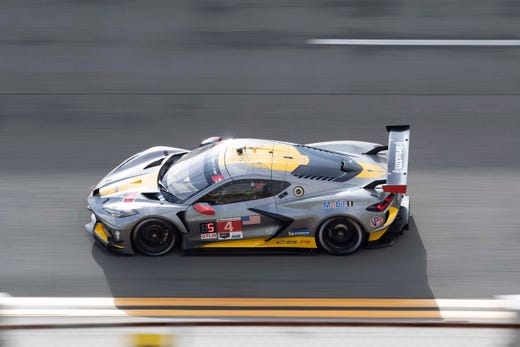
“The team can be proud of what the car has shown. The No. 3 guys were in the hunt for the win almost all race,” said veteran driver Milner of the Daytona debut. “For us and the Corvette fans, there is obviously a bright future for this new Corvette C8.R.”
Payne: To Hell and back in an insane BMW X4 M SUV
Posted by Talbot Payne on January 30, 2020

To Hell and back. Detroit News auto critic Henry Payne took the 2020 BMW X4 M to the devilishly twisty roads of Hell, Michigan to test the limits. At night. In the rain. (Photo: Henry Payne, The Detroit News)
I remember picking up my 2001 BMW M3 like it was yesterday. The sleek coupe hugged the ground with its front spoiler just inches off the asphalt. Its 330-horsepower, naturally aspirated inline-6 cylinder 3.2-liter engine put out a rare 100 horsepower-per-liter through the rear wheels at a screaming 8,000 rpm. Its six-speed manual transmission begged to be revved to redline.
My, how things have changed.
For 2020 BMW has introduced the X4 M, a bulbous five-door SUV with a coupe roofline riding high over the tarmac. Under the bonnet sits a 3.0-liter, forced-induction, twin-turbo inline-6; it feeds all four wheels via an eight-speed automatic gearbox. There’s not a manual transmission in sight.
What’s more in this Age of SUV, the BMW has favored this Franken-ute with its most-powerful inline-6 ever. It gets this engine even before the M4 (as the M3 coupe is now called). So the X4 M makes 503 horsepower and the M4 a mere 425. The nerve.
But before you deduce that everything at BMW has gone to hell … well, I went to Hell.
Hell, Michigan, that is — home of the most forbidding roads in all of our Great Lakes State. I picked a particularly hellish November night to go: pitch-black sky, roads slick with rain and leaves, air frosty as a witch’s nose. If a BMW sport-ute is to earn its performance stripes, then it had better be able to manage Michigan’s most devilish secondary roads.
That, and I loved telling the Bimmer’s navigation system to “Go to Hell.”
It’s not just the market’s taste for utes and turbos and automatic transmissions that have changed — the last two decades have transformed BMW interiors. With a big push from Silicon Valley’s Tesla, the X4’s console infotainment screen is a digital wonder. Heck, my ’01 had just a small radio display.
The X4 M’s screen is a comprehensive display with crisp graphics and endless pages that allow you to configure your vehicle’s drive modes, radio presets, head-up display and safety systems. Safety systems include adaptive cruise-control, lane-keep assist, automatic braking, 360-degree park-assist and automatic seat-eject at impact with parachute (just kidding about that last one).
All this doesn’t come cheap, of course, and a base X4 M lists a healthy $7,000 higher (inflation adjusted) than my 2001 M3. Consider $4,000 of that the SUV premium, courtesy of hatchback and all-wheel-drive.
The screen can be controlled via a dexterous iDrive rotary knob, direct touch or voice commands. With my hands wrapped around the meaty, heated steering wheel, I preferred voice commands which were as good as anything this side of Siri.
“Go to Hell!” I barked and the beautiful screen quickly sketched my path to the Michigan burg’s infernal roads.
Interstate 96 toward Hell was bliss in the BMW’s stuffed lounge chairs. Heavily bolstered for the g-loads to come, the 18-way seats are comfortable, never pinching my 6-foot-5 frame. The rear seats are another matter. Already cramped for long legs, the X4’s sloped roof — to give the ute a coupe-like look compared to its more-upright sister X3 M (yes, there’s another one!) — also cramped my neck. That’s not much different than my old M3.
Happily, BMW has made full use of the SUV’s cargo space. Not only do the rear seats fall flat to accommodate, say, a bicycle, but BMW has thoughtfully taken a page from family utes: It added a sub-layer of storage under the cargo floor to house muddy shoes or other loose ends that might otherwise clatter around in back.
Despite 173 more horsepower than my old M3, the X4 is noticeably quieter. And that’s not necessarily a good thing. I loved the raspy howl of the ol’ inline-6, but the X4 so swathes its passenger in quiet comfort — the better to hear the sweet nav voice tell me “You have arrived at your destination” — that it’s hard to hear the 503 turbocharged ponies pummeling the pavement. At least there’s an exhaust amplification button.
The same electronic magic that has transformed the car’s interior, of course, has also transformed this 4,500-pound rhino (1,000 pounds heavier than my old M3) into a blast to drive fast.
Staring through the rain-splashed gloom of Hell’s Glenbrook Road in the dead of night, I engaged launch control. I let loose the brake at full throttle, and the beast exploded forward as if on rails.
RAAAAAAWWWRRGH!
With state-of-art electronics managing grip to all four paws of this rear-biased machine, the X4 M shrugged at the damp pavement. The 60-mph mark blew by in under 4 seconds (3.3 seconds is the official Car and Driver count, an astonishing 1.5 second quicker than my M3), the eight-speed tranny flicking off millisecond upshifts.
Into Hell’s twisted curves I hurtled, the ginormous 15.6-inch brakes bringing the two-ton-plus beast to heel. The rhino danced through turns, the SUV’s all-wheel-drive proving much superior to a rear-wheel drive sports car’s grip in the clammy conditions. Too much throttle? I could feel the electronics quickly adjusting torque to all four wheels to maintain grip.
I could also feel the car’s turbo-lag off corners. No problem. With a leftward shove of the Bimmer’s monostable (which operates on an east-west axis instead of the usual north-south), I was in manual mode. I toggled shifts with the steering wheel-mounted paddles, maximizing torque by keeping the revs high.
A I learned the SUV’s moods, I could program (more digital refinement) my preferred chassis settings — Sport Plus for stiffened shocks and performance trannny response, Sport for steering, Traction Control for slick conditions — with buttons on the steering wheel.
As I left Hell, I was almost convinced that an M-badged SUV is a good idea. But as good as the X4 M is, its lighter, sleeker, lower M4 sibling is that much better. The M4’s athletic bod can change direction like Barry Sanders in the open field.
So at least basic physics haven’t changed. But the X4 M bends them to its will more than you could imagine.
2020 BMW X4 M
Vehicle type: Front-engine, all-wheel drive, 5-passenger compact SUV
Price: $74,395 including $995 destination charge($86,495 X4 M Competition as tested)
Powerplant: 3.0-liter twin-turbocharged inline-6
Power: 473 horsepower, 442 pound-feet torque (503 horsepower as tested)
Transmission: 8-speed automatic
Performance: 0-60 mph, 3.3 seconds (Car and Driver); top speed, 161 mph
Weight: 4,590 (as tested)
Fuel economy: EPA 14 city/19 highway/16 combined
Report card
Highs: All-season athlete; stupid power with AWD grip
Lows: Bulbous looks; the M4 coupe is quicker on track
Overall: 3 stars
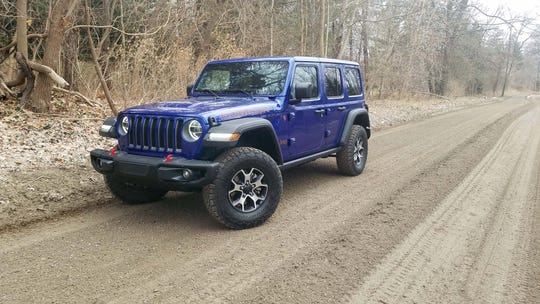
Payne: Jeep Wrangler gets an option for diesel grunt
Posted by Talbot Payne on January 22, 2020
Payne: Big Volkswagen Atlas shrugs off the snow
Posted by Talbot Payne on January 16, 2020
Once upon a time, Volkswagen (translation: people’s car) lived up to its name in America making Bugs and Rabbits and Jettas and other fun fare that appealed to average Americans.
One of them was me. My first car was a Rabbit GTI.
But over the years VW grew detached with odd menu-offerings like the pricey Touareg SUV and Phaeton luxury car.
Now that it’s producing vehicles in America’s Tennessee heartland, the German brand seems to have regained its footing with the Atlas and Tiguan SUVs — schnitzel-and-potatoes utes with a decidedly American accent. Which is good news, because the big, all-wheel drive Atlas arrived in my driveway just as Motown was being buried by a classic middle-America blizzard.
Driving Metro Detroit roads in a snowstorm is an adventure. There are four types of winter drivers: plodders, joggers, speeders and crazies. I saw them all in the course of my winter blizzard adventures.
Winter drivers are a lot easier to negotiate in the towering all-wheel drive Atlas than in the ground-hugging, rear-wheel drive BMW M3 that I arrived in here 20 years ago — a Southern boy (West Virginia, not Tennessee) at the mercy of a Michigan winter.
Where the M3 would beach itself on minor snowdrifts, the Atlas strode boldly out of my snow-socked neighborhood. Merging onto Inkster Road, a plodder inched across my bow at 15 mph — slow even for the snow-covered 45 mph zone.
Flashers on (a sure plodder giveaway), he poked along like an icebreaker in the Arctic — then abruptly decided to stop in the middle of the road. Traveling a safe distance behind, I squeezed the Atlas brakes, felt a hint of ABS assist, then steered nimbly around him. Not bad for a 5,000-pound brute.
In addition to ABS, its helpful safety systems included adaptive cruise-control, blind-spot assist and multiple drive modes like Snow. Surrounded by the safety cocoon of the Atlas, I trailed a few steady joggers driving down Inkster while familiarizing myself with VW’s mixed bag of infotainment options.
Mrs. Payne was pleased to learn the Atlas carries Apple CarPlay, because it is vastly superior to VW’s own navigation system in ever-changing traffic conditions. When traffic clotted at an accident site, CarPlay — using its vast cloud resources — rerouted me to another road.
Though VW voice commands and navigation can be lacking, interior ergonomics are first-rate with buttons where they should be, making for minimal distraction in challenging conditions like, well, blizzards. Only VW’s volume knob annoys — mute it and the whole screen goes black.
Transitioning onto the Lodge freeway, my blind-spot assist suddenly blinked. My first snow-speeder of the day! — a hulking Ram pickup knifing in and out of traffic, eager to show off its road-skiing abilities. I watched him fly past, hoping I didn’t see him upside-down against a guardrail.
The 330-horsepower V-6 in the Atlas is nicely mated to its eight-speed transmission. Not overly sensitive on throttle, it smoothly did its job of distributing power to all four wheels. In a family-hauler class where some automakers offer only turbo-4s (the base Atlas offering), the V-6’s low-end torque is welcome, sacrificing fuel economy for confidence-inducing grunt.
Chugging along on adaptive cruise-control at 10 miles per hour under the speed limit, I kept the Atlas in the left lane, avoiding schools of plodders and joggers in the right lanes.
Then I passed crazy, which appeared to wake the SUV driver from his slumber. Crazy sped up to keep pace with me. Was there a finish line he wanted us to cross together? Inspired by the Ford GT40s in “Ford v Ferrari”?
Traffic loomed in the right lane ahead, but crazy barreled ahead until … it was too late. I canceled adaptive cruise-control and dropped back just in time for him to swerve across my grille and into my lane to pass the jogger-drivers ahead.
Atta boy, Atlas, you modern brute.
While safety systems and a capable chassis allow the driver to deal with the idiosyncrasies of winter drivers outside, occupants can carry on in oblivious bliss. VW has done everything right inside, from comfortable captain’s chairs to tasteful brown leather to easy-access third-row seats.
With its chiseled exterior looks and digital instrumentation, it begs the question: Why would anyone would pay another $20,000 for a similar Audi Q7?
The Atlas isn’t the only looker in the three-row mainstream world. And despite aiming to please, it comes up short on value relative to the Kia Telluride or Hyundai Palisade (two transplants also made in America).
My biggest complaint is the Atlas — like little-brother Tiguan — begs for an injection of performance character from its sibling Golf GTI and Golf R hatchbacks to separate it in the dog-eat-SUV pack. Not that I want to be a winter speeder. But when the roads dried out, I yearned for the athleticism I felt in my old Rabbit GTI.
The three-row Mazda CX-9 has the DNA of its Mazda Miata sports-car sibling. The Atlas could use a GTI infusion.
We’ll hear a lot more about the Atlas. VW has smartly kept the smaller, more expensive Touraeg model at home in Europe. Americans want big, roomy, affordable three-row utes and the people’s car — er, people’s SUV — fits the bill.
New for 2020 also comes the Atlas Cross Sport, a two-row version of the Atlas with a more elegant horizontal grille and taillights complementing a coupe-like roof. You get the idea — Cross Sport plugs the hole between the Tiguan and Atlas to appeal to empty-nesters coveting the room of an Atlas — but with the smaller feel of a Tiguan. Priced competitively at $33,000 to start, the Cross Sport should match up well against competitors like the Honda Passport and Chevy Trailblazer.
But what I like best about it is the Atlas Cross Tour R. “R” as in a real, rough ‘n’ ready Baja racer. Dude, it looks rad. And maybe, just maybe, its racing DNA will rub off on the Atlas to give it a little more speed. For summertime, of course.
2019 Volkswagen Atlas
Vehicle type: Front-engine, front- and all-wheel drive, 5-passenger SUV
Price: $32,565 including $995 destination charge($50,320 AWD SEL as tested)
Powerplant: 2.0-liter turbo-4 cylinder, 3.6-liter V-6
Power: 235 horsepower, 258 pound-feet torque (turbo-4); 276 horsepower, 266 pound-feet torque (V-6)
Transmission: 8-speed automatic
Performance: 0-60 mph, 7.9 seconds (V-6, Car and Driver); towing, 2,000-5,000 pounds
Weight: 4,759 (as tested)
Fuel economy: EPA 18 city/ 23 highway/ 20 combined (AWD turbo-4); 17 city/ 23 highway/ 19 combined (AWD V-6)
Report card
Highs: Good value in competitive segment; handsome package
Lows: Lacks VW character; so-so voice commands
Overall: 3 stars
GMC super-sizes its high-tech Yukon
Posted by Talbot Payne on January 15, 2020
GMC introduced an all-new, three-row 2021 Yukon on Tuesday, and the premium brand’s biggest SUV is bigger and brasher than ever.
Based on the same ladder-frame platform as the GMC Sierra pickup, the Yukon wheelbase grows by five inches. As a result, GM says the big ute gains 41% more third-row legroom and 66% more cargo volume. And engineers have equipped the supersized interior with new tech features.
The popular, premium Denali trim will be available. A rugged, off-road AT4 trim also will be on option on the Yukon for the first time.
Topping the list of Yukon goodies is a power-sliding center console that automatically opens for storage.
A class-exclusive, adaptive air-ride suspension promises to deliver smooth sailing in the big land yacht. It also enables drivers to lift the chassis an additional two inches for extreme off-roading. That will be most useful in the AT4 trim, which has skid plates for rock protection. Once back on the road, the air-ride suspension will self-level for best aerodynamics.
The Yukon will be motivated by GM’s familiar 5.3-liter and 6.2-liter V-8 engines, also found in the Chevy Tahoe and Suburban that GM rolled out late last year. The 6.2-liter delivers a class-best 420 horsepower paired with a standard 10-speed transmission. For the first time, the Yukon will be available with a 3.0-liter, inline-6 cylinder turbodiesel that’s less thirsty.
The Yukon is distinguished by a huge, meaty grille sandwiched by signature LED C-clamp headlamps. The stylish Denali trim gets the most attention. The Yukon Denali gets an exclusive interior – including a completely new instrument panel, unique seats and a choice of four color themes – outfitted with premium and authentic materials.
The Yukon – including a stretched XL version – will roll off the line at Arlington, Texas this summer. Pricing has not been announced.
Why North American Car, Truck and Utility of the Year champs won big
Posted by Talbot Payne on January 15, 2020
The North American Car, Truck and Utility of the Year awards were announced Monday, on the same day as the Academy Awards nominees. Which is appropriate, because NACTOY is often referred to as the auto industry’s Oscars.
I’m one of 50 jurors for NACTOY, and I also thought the NACTOY/Oscar coincidence appropriate because they both got it right. Unlike last year.
“Green Book” won best picture last year over “A Star is Born” and “Black Panther”? Really? I was equally perplexed that the sensational Mazda 6 sedan and Jeep Wrangler didn’t get nominations for 2019 car and SUV of the year. The Wrangler (240,000 in sales) was passed over for the Jaguar i-Pace EV (2,500 sold)? Huh?
But this year, all is right with the world. “Ford v Ferrari” is nominated for Best Picture, and my fellow jurors and I are aligned on best car (Chevrolet Corvette), sport utility (Kia Telluride) and truck (Jeep Gladiator). In fact, each won their class comfortably.
The only thing that really stood between the Corvette and the trophy was whether it would be eligible in 2020. The first mid-engine Corvette – unlike its 2020 peers – won’t go on sale until late in the first quarter of this year due to a lengthy UAW strike that froze manufacturing at GM’s Bowling Green, Kentucky plant.
After a quick huddle, the jury agreed this was Corvette’s year.
No doubt, some of my fellow jurors were drugged by Supra’s addictive handling and goosebump-inducing, BMW-developed inline six-cylinder. The Hyundai, too, brought premium touches to $30,000 mid-size sedans — check out its Tesla-like summon feature and wicked wardrobe.
But there was no denying the eighth-generation Corvette.
Chevy took a huge risk by tearing up tradition and rendering its icon as a mid-engine sports car. The Corvette team nailed it. The C8 offers stunning styling, interior and performance for a quarter the cost of comparable European exotics.
For example, the rear-wheel-drive Corvette (when equipped with Z51 performance package for a sticker price of $65,000) will sprint from zero-60 in 2.9 seconds — the same time as a $270,000 AWD Lamborghini Huracan. I’ll wait while you pick up your jaw from the floor.
The SUV category was never really in doubt either, though the Telluride (240 points) got a good run from its sister Hyundai Palisade (147). The Koreans share architectures and clever features (USB ports in the seatbacks, third-row speaker for driver-to-rugrats communication). Indeed, I found the Palisade’s clever console superior to the Telluride for daily livability.
But jurors were blown away by the Telluride’s good looks and rugged vibe.
There was jury buzz that the Koreans might split the vote — allowing the luxurious Aviator to cruise by into first place. But that would have been a shame. The Telluride is a luxury-worthy, mainstream SUV that costs an incredible $20,000 less than the Lincoln.
Making up for the Wrangler snub of a year ago, the Jeep Gladiator walked away with Truck of the Year honors with 273 points. It was never in doubt.
The runner-up Ram Heavy Duty (122 points) — like 2019 truck champ Ram 1500 — has redefined heavy-duty luxury with its tablet screen and luscious interior materials. But HD’s are hardly mainstream tools. Ford’s Ranger made a jubilant return to the midsize pickup fray after taking an off-ramp in 2012.
But the Ranger’s common interior paled next to the Gladiator’s signature offering of aviator vents and off-road grab handle. Jurors were also impressed that the Jeep boys didn’t just mail in a Wrangler-with-a-bed offering. The Gladiator is all new from the B-pillar rearward, offering upgraded tricks like sub rear-seat storage and a sophisticated multi-link rear suspension adopted from cousin Ram.
Armed with a second transfer-case shifter, removable doors and rock-tested skid plates, the Jeep takes the middie-segment to places — off-roading in the Rubicon, anyone? — that pickup trucks haven’t dreamed of going before.
That armor will cost you a $2,500 premium over similarly equipped pickups, but the Gladiator’s hot sales are proof of the jury’s good taste.
And so we soldier on into the 2020s. Hotly anticipated trucks and utes will continue to roll. Look for the new Chevy Tahoe and Suburban, Ram Dakota, Ford Bronco, Land Rover Defender and Chevy Trailblazer.
But with the market due for a flood of electric vehicles including the Rivian R1T pickup/R1S SUV, and the Ford Mustang Mach-E and Tesla Model Y crossovers, I’ll go out on a limb and predict NACTOY will get its first-ever electric truck and SUV Oscar winners.
Corvette, Telluride and Gladiator take NACTOY honors
Posted by Talbot Payne on January 15, 2020
Detroit — The Chevrolet Corvette, Kia Telluride and Jeep Gladiator took home top honors in the 2020 North American Car, Utility and Truck of the Year awards on Monday. The prizes are popularly known as the auto industry’s Oscar awards.

The Corvette Stingray C8 accelerated past the Hyundai Sonata and Toyota Supra for best car. The $60,000 Chevy icon is the first ‘Vette to put the engine behind the driver. At just a third the cost of mid-engine Italian supercars, the Corvette puts up similar performance numbers, including a sub 3-second 0-60 mph time.
The highly anticipated sports car took a rollercoaster journey to market, originally getting approval before the Great Recession of 2008 threw GM into bankruptcy.
“Winning (this award) is important and a powerful validation for what we’ve been doing,” Corvette executive chief engineer Tadge Juechter said as he held up the trophy. “Our team has poured their passion into this car.”
So intense was competition for Car of the Year that icons like the BMW 3-series and Porsche 911 did not make the finalist list. Other notables left out in the cold were the Ford Mustang GT500, the most powerful Mustang ever, and the Mazda 3, an elegant and affordable compact car.
The Telluride edged the Hyundai Palisade and Lincoln Navigator for top SUV. The affordable Telluride’s suite of standard features and bold good looks wowed jurors as it has wowed consumers.
It was Kia’s first NACTOY win as the Korean brand has made a major move in the U.S. market with a fleet of stylish sedans and SUVs. The brand rode the popular Telluride to the biggest sales growth of any non-luxury brand in 2019. Kia nearly won NACTOY in 2018 with the Kia Stinger four-door sports sedan.
“This is a true accolade anyone would be proud to receive,” said an ecstatic Michael Cole, Kia North America president. “Since launching in a Super Bowl ad last year, demand has continued to outstrip supply. We got close with Stinger, but the Telluride is appropriate because it is designed and assembled in the U.S.”
The SUV showdown was NACTOY’s most intense as manufacturers continue to feed consumers’ insatiable appetite for all things ute. Entrants included such heralded German rookies as the Audi E-Tron — the brand’s first electric SUV — and the hulking three-row BMW X7. GM hopefuls included the return of the Chevrolet Blazer as a fashionable crossover, and Cadillac’s first three-row SUV not named Escalade, the XT6.
In the end, however, jurors found the Korean twins, Palisade and Telluride, and the stylish Aviator to be the most notable.
The truck category was an all-American affair with the Gladiator beating the Ford Ranger and Ram Heavy Duty.
Its rugged Wrangler-like qualities married to a useful pickup bed proved irresistible to jurors. Available only in all-wheel drive, the Gladiator starts in the mid-$30,000 price range.
“What’s not to like about a pickup truck with not only a soft-top removable roof but even removable doors?” said veteran NACTOY juror John Voelcker.
U.S. automakers usually dominate the truck category, and 2020 was no different. The Ram Heavy Duty was hoping to join its sibling Ram 1500 light-duty truck in the winners’ circle after the 1500 won NACTOY a year ago. The Ranger and Gladiator were evidence of the resurgence of the mid-size pickup market once left for dead. The Ranger had actually left the market in 2012, only to return this year, while the Gladiator is Jeep’s first pickup since the Comanche in 1992.
The awards were presented on stage at the TCF Center (formerly Cobo) in Detroit in partnership with the Detroit Auto Dealers Association and the North American International Auto Show. The NACTOY awards have in years past kicked off the North American International Auto Show – but the show has been moved to June this year for the first time.
The winners were the cream of a crop of 46 eligible nameplates this year. All vehicles are new to the market for the 2020 model year.
The list was winnowed to a field of semi-finalists in October: five trucks and 12 vehicles in the car and sport utility categories. Jurors then convened in Ann Arbor for an intensive week of testing and comparison to nominate the nine finalists — three in each category.
Considered the industry’s most prestigious independent award, NACTOY is presented by a jury of 50 journalists from print, online, radio and broadcast media across the U.S. and Canada, including the author of this article.
Car of the Year: Chevrolet Corvette Stingray
Other nominees: Hyundai Sonata, Toyota Supra
SUV of the Year: Kia Telluride
Other nominees: Hyundai Palisade, Lincoln Aviator
Truck of the Year: Jeep Gladiator
Other nominees: Ford Ranger, Ram Heavy Duty
Automakers tout electric future while building more diesels
Posted by Talbot Payne on January 13, 2020
As a commitment to a post-carbon future of “zero-emissions” electric vehicles, General Motors Co. is converting is its Detroit-Hamtramck Assembly plant to the manufacture of electric trucks. Auto analysts forecast the vehicles will not be obscure green compacts, but the meat of GM’s big-vehicle lineup: GMC Sierra, Cadillac Escalade and a return of the Hummer.
At the same time, it is introducing for the first time diesel versions of its Chevy Tahoe and Suburban SUVs, and the Silverado pickup.
The paradox of GM’s dual commitment to diesel and electrification indicates the staying power of diesel technology at a time when fuel is plentiful and prices at the pump are just $3 a gallon. It is especially dramatic in the face of the Dieselgate scandal that has led to the abandonment of diesels by European manufacturers like Volkswagen and Audi, which are investing billions in electric-charging infrastructure.
But so efficient is diesel at moving heavy loads for long distances, that its resilience is creating doubts about the electric future touted by governments and manufacturers alike.
“Diesels don’t get enough ink these days,” GM President Mark Reuss said ahead of the Tahoe/Suburban rollout in Detroit last month. “This is really in the wheelhouse of people who want it. They really don’t care about the car diesel (scandal) that went on.”
GM is not alone.
Indeed, because of the sheer volume of the sport utility and truck segment — the largest chunk of the U.S. market by far — diesel-powered vehicles outsell EVs by more than 2-to-1, according to the Diesel Technology Forum, an industry trade group.
As diesel-engine options hit dealer lots in the Tahoe, Suburban and Silverado — and the Ford F-150, Ram 1500, Jeep Gladiator and Jeep Wrangler — that growth may accelerate.
An all-wheel drive Chevy Silverado or GMC Sierra powered by the new 3.0-liter V-6 Duramax diesel gets 25 mpg, which is 30% more efficient that its gasoline kin. Their range on a full tank of diesel is 600 miles, which is 144 miles more than a comparable gasoline V-8 model. Range is a key attribute for large vehicles buyers who tow for work and family trips.
The diesel Tahoe and Suburban SUVs, based on the same chassis as the Silverado, are expected to post similar fuel economy when they debut later this year.
The Silverado diesel variant comes with about a $5,000 premium over the gasoline V-8. For example, an AWD Silverado LT costs $50,900 versus $45,590 for a V-8-powered Silverado in the same trim-level.
That compares to a typical $15,000-plus premium for electric vehicles over similar gas-engine vehicles. A battery-powered Chevy Bolt, for example, costs about $15,000 north of a comparable $21,000 Chevy Sonic hatch; a Subaru Crosstrek plug-in costs $36,000 vs. a $22,000 gas-fueled Crosstrek.
The premium gets even steeper in large SUVs and pickups. Plymouth-based Rivian will debut its 230-mile range electric R1T pickup and R1S SUV later this year starting at $70,000. Rivian promises a 400-mile range vehicle, but that is expected to list well over $100,000.
“Electrification may be the wave of the future,” says Diesel Technology Forum Executive Director Allen Schaeffer. “But so far it’s not bearing out in the market. GM recognizes that you have to have vehicles that customers can buy.”
GM also recognizes it won’t be able to sell in high-volume, so-called “zero-emission states” unless they make EVs available. The 10 states — including California, the biggest U.S. market — are forcing automakers to electrify 7-10% of their products by 2025. That’s within the current vehicle production cycle.
“There’s little natural demand for EVs because they’re not a better, more convenient solution to transportation than gas engines,” says veteran auto analyst Rebecca Lindland of RebeccaDrives.com. “Regulations are driving the move to EVs.”
Lindland says automakers — while investing short-term in proven diesel technology — are hoping there’s a demographic shift. They are betting that millennials will be interested in environmentally friendly trucks, especially buyers who aren’t utilizing their full capabilities as workhorses.
The generational shift is also a calculation of Tesla, which recognizes truck volume as key to its goal of flipping the industry to “sustainable transportation.” Currently, Tesla sedans and Model X SUV make up nearly 80% of U.S. EV sales — which are only 1.8% of the total market according to InsideEVs.com.
Unlike Rivian, Bollinger and other upcoming pickup offerings, Tesla promises that its pickup will start at a competitive $40,000. But it will have a range of 250 miles, just 40% of a Chevy truck.
Also complicating the electric-truck calculation is the stress of towing on battery range: Truck-testing authority TFLTruck.com, for example, has found that the Tesla Model X SUV only gets 30% of its range when towing 2,000 pounds.
The F-150 has been the biggest diesel seller among Detroit automakers, joining oil-burning service vehicles like the Ford Transit and Mercedes-Benz. But the addition of popular Chevrolet, Ram and Jeep models promises more diesel penetration.
“Customers have been asking for diesels in these vehicles for along time,” says Diesel Technology Forum’s Schaeffer, who says there are nearly 50 diesel offerings in the market. “It will be interesting to see how much the sales numbers grow as new vehicles come on line.”
Payne: Subcompact Mazda CX-30 rocks
Posted by Talbot Payne on January 13, 2020
Mazda shoppers might be understandably confused these days.
The charming ads — the ones where the kid whispered “ZOOM ZOOM” at the end — have been replaced by a generic “Feel Alive” lifestyle campaign that might as well be selling you tennis shoes.
And the brand’s latest, four-digit CX-30 SUV is an alphanumeric migraine that doesn’t fit in the brand’s simple, single-digit sedan lineup (Mazda 3,6) or the three-digit SUV silo (CX-3, CX-5, CX-9). Earth to marketing department.
But there’s nothing confusing about the way the CX-30 subcompact ute drives, looks and feels.
Simply put — and simple is a repeated, positive theme here — this is the best performance subcompact on the market today. Period. So good, in fact, that its comparison set is not the usual mainstream competitors, but luxury subcompacts costing at least $10,000 more.
Based on the same platform as the sensational Mazda 3 compact hatchback, you will know the CX-30 is different the moment you grip its fat steering wheel and fling it into a corner. Poised and balanced, it’s more hot-hatch compact than hatchback ute.
Now comes the subcompact CX-30 priced a whopping $15,000 under the premium BMW X1, and I suspect it’s the X1’s match through the twisties. This is the type of subcompact SUV that Volkswagen should make off its superb Golf platform — or that Ford should cook up from its Focus sedan. But they haven’t.
VW offers nothing in its class, while Ford’s cramped EcoSport entry is a boxy eggbeater. One of the hottest aisles in autodom, mainstream subcompacts boast a variety of toys like the off-roady Subaru Crosstrek, rugged Jeep Renegade, roomy Honda HR-V and funky Kia Soul.
Now it’s got a toned $23,000 athlete.
But the CX-30 is much more than a fun-to-drive ute (as refreshing as that is to say). Its simple, timeless design will wear well. It’s no Mazda 3 hatch (the most beautiful compact car ever penned), largely because designers felt compelled to lard the CX-30 with black body-cladding to give it SUV cred. That may protect its fenders from the rare off-road event, but it dulls Mazda’s knife-edge good looks next to full steel-body stallions like the BMW X1.
Still, it’s a looker in Soul Red, and if the cladding bugs you, match it with a darker color like Gunmetal Gray. The simple elegance continues inside with a sweeping horizontal design familiar to the Mazda 3 hatchback — and to BMW and Tesla.
Like Tesla, its broad dash lines are efficient and uncluttered. Like BMW, the instrument and infotainment screen are driver-focused — the result of fussy engineers obsessed with keeping drivers’ eyes glued to the road.
Over the spaghetti roads of southern California’s Cuyamaca Mountains, everything I needed was close. The screen navigation (Apple CarPlay and Android Auto standard) is high on the dash. The deft, multi-way remote rotary-controller (just like BMW) is at my elbow. The i-Activsense surround-view (like Tesla) is in the instrument cluster to monitor cars around me.
More awkward than the CX-30’s four-digit detour from Mazda’s naming convention (imagine if Audi built a crossover between the Q3 and Q5 called the Q30 — huh?) is its suggestion that it is a variant of Mazda’s entry-level subcompact SUV, the slow-selling CX-3.
Yet, the CX-30 is more CX-5 than CX-3. Marketing has its reasons for not calling it a CX-4 in the U.S. (because a different car is called CX-4 in the Chinese market), but they are unconvincing.
Based on a same platform as the Mazda 3 hatchback (not the CX-3), the CX-30 nevertheless gains some room over the 3 thanks to its taller SUV dimensions. Cargo room is a useful 20 cubic feet and swallows four carry-on suitcases. My 6-foot-5 frame fit in the second row thanks to clever scalloping in the front seatback and roof liner.
I conversed with my 4-foot-11 drive partner with ease from the back quarters thanks to better than BMW X1 interior quiet. And despite our Laurel and Hardy body differences, we both found the seating ergonomics excellent.
The CX-30 bristles with such clever human details, typical of those fussy Mazda engineers. Consider:
- The rear hatch opening punches a big hole in back for better loading.
- Engineers tuned the car’s ride to mimic the 5 mm head bob of a human walking.
- Owners can monitor their car via a phone app.
- Stereo subwoofers are packed in the car’s corners — just as you would in your house for better sound clarity.
- Take a corner too fast when in adaptive cruise-control, and the car will automatically sense the high G-loads and slow mid-corner.
- The exquisite sculpting of the side panels always reflects an S-curve. Zoom zoom.
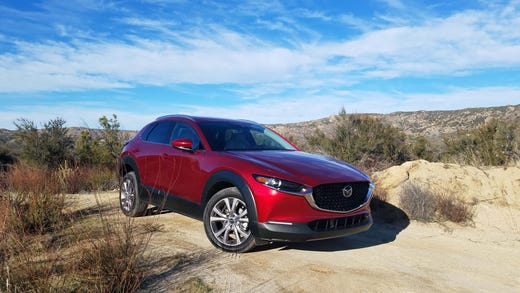
Standard features include adaptive cruise-control, automatic high beams and other items that you’ll have to pay extra for on a BMW X1.
Such standardization also aids simplicity. In an online-buying age when millennials expect efficiency, the Mazda CX-3 configuration page is blessedly easy with four trim options — each building on the last. My favorite Preferred trim (heated, power seats) can be had for $28,645.
Such obsession with detail exposes the odd flaw. A black wheel option would better complement the black cladding. Voice recognition is poor. The car’s athletic nature screams for a second engine option like Mazda’s 2.5-liter turbo.
What to do? The black wheels can be bought used off a Mazda 3. Voice recognition is excellent if you plug in Apple CarPlay/Android Auto. And that turbo-4 terror with 250 ponies and whopping 310 pound-feet of torque? I’m betting sales of the CX-30 will be so strong that will allow Mazda to offer another trim (just like they’ve done with the Mazda CX-5, which can be had for less than $40,000 with a BMW-beating turbo-4).
And when that day arrives, maybe they’ll have figured out how to call it CX-4.
2020 Mazda CX-30
Vehicle type: Front engine, front- and all-wheel drive, 5-passenger subcompact SUV
Price: $22,945 including $1,045 destination charge($31,240 AWD Premium as tested)
Powerplant: 2.5-liter inline 4-cylinder
Power: 186 horsepower, 186 pound-feet torque
Transmission: 6-speed automatic
Performance: 0-60 mph, 7.2 seconds (Car and Driver est.); top speed, 123 mph (est.)
Weight: 3,408 pounds (as tested)
Fuel economy: EPA est. 24 city/31 highway/26 combined (AWD)
Report card
Highs: Sharp handling; premium interior
Lows: Heavy black cladding; turbo-4 engine option, please
Overall: 4 stars
Payne: Mid-engine Corvette race car roars at Daytona debut
Posted by Talbot Payne on January 13, 2020
The world got its first look at a final-spec, mid-engine Corvette at full chat last weekend. But it was a race car, not a street-legal production car.
The Corvette C8.R impressed at its Daytona debut weekend, lapping within tenths of a second its Ferrari and Porsche rivals at the Roar Before the 24 — the full dress rehearsal for the IMSA Weathertech series’ Rolex 24 at Daytona endurance race coming later this month.
Like carefully choreographed Chevy product rollouts of the past, the race car should have followed the production C8’s production launch in December. The last-generation C7.R race car, for example, broke cover at Daytona in January, 2014 — four months after the production model rolled off the assembly line.
But a bitter, 40-day UAW strike has delayed production at Corvette’s Bowling Green, Kentucky, plant until February. Though some journalists have had a taste of pre-production cars, media test drives of the final product won’t happen until mid-February in Las Vegas — and paying customers won’t get their sweaty palms on the C8 until March.
So the racing debut of the Corvette C8.R (developed in parallel with the production car) at the Roar test trials took on even more significance. And the mid-engine missile put on a strong display around the 3.56-mile road course.
“I had heard a lot already about how good the Corvette C8.R is to drive, so I was very much looking forward to getting in it for the first time,” said Marcel Fassler, 2016 Daytona winner and three-time Le Mans champ. “The car is amazing to drive. There hasn’t been a lot of time to get used to the car, but you can see the potential. The car is very agile.”
Fassler’s teammate, Tommy Milner, topped the time charts for much of the three-day test weekend with a lap of 1.42.7 seconds — pushing 170 mph on Daytona’s steeply-banked oval turns for an average lap speed of nearly 125 mph. Eventually a Ferrari 488 and Porsche 911 pipped the ‘Vette for best time of weekend by a tenth of second.
Corvette is entering two cars, #3 shared by Antonio Garcia/Jordan Taylor/Nicky Catsburg and the #4 of Fassler/Milner/Oliver Gavin.
Like the last, front-engine C7 before it, the racing version of the mid-engine C8 was developed from the ground up alongside the production car. The C8 program got the green light six years ago as the first Corvette in 60 years to put the engine behind the driver. The C8 and C8.R share more parts than any generation production/race ‘Vette that has come before.
“It was important for us to develop the new race car alongside the production car, so that each product could properly take advantage of the new architecture,” said Corvette’s chief engineer, Ed Piatek. “The benefits of this mid-engine supercar, including its incredible balance, will be obvious on the street and the track.”
Their obvious similarities aside, the race car diverges in important ways from the $59,995 production steed — especially in the drivetrain, where the C8.R introduces Corvette’s first overhead-cam V-8: a 5.5-liter, high-revving, flat-plane crank mill (the production car debuts with an updated version of Chevy’s tried-and-true push-rod, 6.2-liter V-8).
Despite the race car’s revolutionary engine — flat-plane crank V-8s are rare outside exotics like Ferrari and the Mustang GT350 — Chevy has been understandably shy to discuss its details given that the engine will be reserved for a later model trim in C8’s life cycle — likely the Corvette Z06.
Racing the 5.5-liter 8-holer, however, gives Corvette precious experience at the ragged edge of endurance. The engine is mated to a new, more-compact six-speed sequential gearbox — different from the dual-clutch 8-speed automatic in the production model.
“The drive-train was a big challenge,” said a Chevy spokesperson. “We’ve been working on it quite a while.”
For all of its newness, the Corvette will still face the same ol’ IMSA Balance of Performance limitations in order to ensure it doesn’t run away from other cars in the GTLM class. The mid-engine Corvette must exist alongside, for example, a BMW M8 — a heavier, less-capable production coupe.
As a result, the Corvette — like the retired, mid-engine Ford GT before it — must achieve a minimum weight of 2,777 pounds, with power limited to 500 hp and 480 pound-feet of torque at 7,400 RPM.
Contrast that to the production version, which reportedly will make in excess of 650 horsepower at 8,600 RPM. Stripped of interior finery, sound deadening, and infotainment systems, however, the race car still tips the scales well below the 3,647-pound, production C8.
The C8.R has undergone extensive track testing around the world with its chassis 01 test mule. But the Roar Before the 24 debuted C8.R’s race-ready chassis 02 and 03. The two entries logged a combined 341 laps with no major issues.
“We’ve been very pleased with our time here simply because we haven’t had any durability issues. All in all, I couldn’t be more pleased with the progress that we’ve made,” veteran GM race program director Doug Fehan told Sportscar365.com. Corvette’s Pratt & Miller racet team builds the race car in Lyon Township.
The ultimate test will come when the green flag waves Saturday, Jan. 25, and the cars race a grueling 24 hours at full squawk.
The C8.R’s front-engine predecessor is already a legend, having won the Rolex 24 twice in 2015 and 2016. Notably, the C8.R is already 2.5 seconds a lap quicker than when that car debuted, hinting at its potential.
“We don’t have the knowledge base that we have had in the past,” said driver Milner. “So it’s been trying a lot of different things we’ve never tried before. It was fun to have that qualifying session . . . and see how we good we could do. Third is pretty good.”
Payne: 10 vehicles that defined the decade
Posted by Talbot Payne on January 2, 2020
Years from now, historians may rank the past decade as one of the auto industry’s most important.
The 2010s began with the United States crawling out of the worst recession since 1982. SUV sales fizzled as cash-starved consumers opted for cheap cars. Uber and Spotify didn’t exist. Tesla’s lone product, a Lotus-based sports car, was best known for a “Top Gear” episode showing it running out of juice.
But as the economy righted itself, the 21st century’s trends went into hyperdrive: sport-ute mania, digitization, horsepower, regulation, electrification.
These 10 vehicles defined the decade.

Ford F-150
The more things change, the more things stay the same. Nothing outsold the Ford F-150 in the last decade. Just like the previous three decades. But the pickup’s significance grew beyond sales numbers. With the enormous technological challenges facing automakers, F-150’s outsize profits became key to underwriting Ford Motor Co.’s investment in expensive, unproven autonomous and electric vehicles. The pickup itself became a change agent as turbocharged V-6s displaced V-8s as volume sellers, and lightweight aluminum replaced steel construction.
Google car
The “Skynet Marshmallow Bumper Bot” (as the Oatmeal.com website called it) announced Silicon Valley as a mobility leader. Self-driving cars suddenly seemed within reach. Without a steering wheel, the Livonia-built Google car felt like riding in a four-wheel subway car. The pioneering robot plied city streets in San Francisco and Austin for a time before giving way to more practical people-movers like Waymo (Google) minivans, Uber Volvos and Cruise Automation Chevy Bolts.
Chevy Volt
Before the battery-powered Chevrolet Bolt EV, there was the 2011 plug-in Volt. It was General Motors Co.’s answer to the Toyota Prius hybrid. With battery range of 50 miles, the Volt could cover most daily commutes — yet it eased range anxiety with a small gas engine that could kick in to get you home. Consumers didn’t understand it, and the Volt didn’t survive the decade. The 2012 Cadillac ELR, kind of a Volt-in-a-tux, should have held more promise — but GM priced it at a nose-bleed $80,000. If Cadillac had introduced it for $35,000 (beating the Model 3 to market by five years), history might have been different.
Tesla Model 3
Elon Musk introduced the $35,000 Model 3 at a 2016 news conference. An affordable alternative to Tesla’s $80,000 Model S sedan that had wowed luxury-buyers with its Ludicrous electric acceleration, the Model 3 was an instant sensation. Tesla Inc. was deluged by 400,000 pre-orders. In its first full year on the market in 2018, the made-in-USA sedan was the luxury market’s best-selling chariot, beating even the Lexus RX350 SUV. More than an EV, the Model 3 wowed buyers with such technology as a giant tablet screen, Autopilot driving and over-the-air software updates. Manufacturing consultant Sandy Munro declared its electronics “generations beyond what any other manufacturer is doing,” and the industry mobilized to catch up.
Toyota RAV4
No one could catch the RAV4 compact SUV, which became the best-selling non-pickup in America — dethroning perennial-champ Toyota Camry. In so doing, the RAV4 became the first SUV to reign at No. 1. Not only did the RAV4 displace Camry, it also felled cousin Prius as the best-selling hybrid in America as battery technology moved to mainstream vehicles.
Jeep Wrangler
If the RAV4 was the undisputed best-seller, then Jeep was the king of utes. The World War II-inspired Wrangler had long headlined the off-road niche brand, but all that changed with the Fiat-Chrysler merger of 2009. Call it Fiat-Jeep. Visionary execs Sergio Marchionne and Mike Manley saw the Jeep’s potential as a global brand on a planet embracing all things SUV. More capable, comfortable and high-tech, the 2018 Wrangler doubled its sales. Jeep sales overall? Tripled since 2010 to nearly a million units a year.
Dodge Charger Hellcat
While the Detroit Three ditched poor-selling car lines, one sedan defied gravity. The Charger proved the power of bold marketing. President Tim Kuniskis and his merry band of elves took an aging chassis, injected it with unheard-of horsepower and called it the Hellcat (along with sister coupe Challenger). The Hellcat showcased how modern electronics have benefited not just infotainment systems, but the ability of family sedans to safely put 707 horses to the road.
Ford GT
Fifty years after the legendary Ford GT40 won LeMans, the GT celebrated by winning the storied 24-hour race again. The 2016 GT is a state-of-the-art, carbon-fiber weapon. It demonstrated the important role motor racing plays in the industry. Nearly every major brand now races, from the exotic Cadillac IMSA prototype to the common Mazda Miata. Popular culture embraced Ford’s achievement, too, as “Ford v Ferrari” — a movie chronicling the 1966 GT40’s success — became a Hollywood blockbuster.
Ford Mustang
The Mustang was birthed alongside the GT40 in the 1960s, becoming a symbol of Dearborn’s commitment to affordable performance. Ford observed its 50th anniversary in 2015 by taking the pony to new heights. With its daring redesign, the ‘Stang went global with sales in 146 countries. The muscle car took back its sales crown from the Chevy Camaro, then looked toward the next half-century by expanding as a sub-brand with its first electric SUV — the Mustang Mach-E.
Volkswagen Golf
Diesel-engine tech, which began the 2010s as the globe’s answer to fuel efficiency, became a pariah. Cars like the Golf were found in 2015 to have systems that cheated on emissions tests in order to circumvent regulations. The so-call Dieselgate scandal inspired a historic transformation of the world’s largest automaker from a diesel-focused company to an electric-vehicle evangelist. Governments forced VW to build a national battery supercharger network as penance for its sins — and to power politicians’ pet drivetrain, electric motors. As the 2020s dawn, however, buyers of trucks and commercial vehicles still prefer the advantages of diesel range and infrastructure. Will EVs conquer the passenger car frontier? The next decade will tell the tale.
Henry Payne is auto critic for The Detroit News. Find him at hpayne@detroitnews.com or Twitter @HenryEPayne.
Driverless robots in Ann Arbor seek piece of food-delivery pie
Posted by Talbot Payne on December 27, 2019

Refraction’s REV 1 autonomous food delivery vehicle makes its way down Fourth Street in downtown Ann Arbor, bound for Miss Kim restaurant in Kerrytown to pick up a food order. (Photo: Lon Horwedel, Special to The Detroit News)
Ann Arbor — Self-driving autos hold enormous promise for ride-hailing services and commercial transportation.
But the first autonomous vehicle you see in practical use might bring you lunch.
The REV, an autonomous robot made by Refraction AI, will begin making meal deliveries from four restaurants to a test group of 300 customers in downtown Ann Arbor beginning Jan. 3. Five feet tall, with three wheels and a fuselage like an oversized bike helmet, the 100-pound REV promises food drops for half the cost of existing delivery services like Grubhub, EatStreet and DoorDash.
If successful, REV could begin the transformation of downtowns into “Blade Runner”-like metropolises populated by wee bots hustling meal, grocery and document deliveries along byways at 15 mph.
“We want to get autonomous vehicles on the road in a way that’s safe,” Refraction AI CEO Matthew Johnson-Roberson said at the company’s headquarters in downtown Ann Arbor. “Our biggest focus is dense, urban areas. At (these) speeds, it’s a safe proposition.”
The REV program slots in a growing ecosystem of robotic delivery vehicles. Small bots from San Francisco-based Starship can be found on about 15 college campuses making food deliveries, while California start-up Nuro employs car-sized, 2,500-pound grocery delivery vehicles in the Scottsdale and Houston suburbs.
These robot companies share business models that Uber and Lyft taxi services are ultimately predicated on: remove the driver and reduce transportation costs dramatically. In the case of REV, that means Refraction only charges restaurants 10-15% of an order, compared to the 30-35% that’s typical of its human-piloted delivery competition.
“Grubhub costs are unaffordable to us,” said Ji Hye Kim, proprietor of the Miss Kim restaurant Ann Arbor, one of the restaurants participating in Refraction’s rollout. “Such services are basically just for marketing.”
Says Johnson-Roberson, who co-founded the company with fellow University of Michigan faculty member Ram Vasudevan: “We want to build something that makes the economics work. We’re using affordable hardware. We’re not spending Bentley money to drive around your tacos.”
The Detroit News followed a demonstration run of REV-1 (shorthand for the first-model Refraction Electric Vehicle) around downtown Ann Arbor on a snowy, frigid day where a customer (a Refraction employee) ordered food from Miss Kim about a quarter-mile away.
Orders are made via phone app. Then REVs are dispatched from their “nest” at Refraction headquarters. Deliveries will be made in 30 minutes within a 2-mile radius from four restaurants including Miss Kim, Belly Deli, Tios Mexican Cafe and Chow Asian Street Food. Refraction’s service will debut with five vehicles making runs from 11 a.m. to 6 p.m., with a goal of saturating Ann Arbor with 35 bots.
Just 30 inches wide, the REV-1 navigated city streets as a bicyclist would — using bike lanes where possible, or hugging curbs and parked cars. Sidewalks are off-limits. Much of REV’s delivery model is built around the e-bike ecosystem that has become commonplace in U.S. cities.
“Eighty-ninety percent of our travel is not in a bike lane. We travel in the margin of the road,” said Johnson-Roberson, 36. “The biggest problem we face is a car door opening on us — just like a bicyclist. Small pets are a real tough problem — and squirrels.”
REV pulled up to Miss Kim to pick up its package. Kim emerged with two bags and entered a code on the REV keypad. A side-door popped open, exposing the pod’s 16-cubic-feet belly which can hold four or five delivery bags. Pausing for a crossing pedestrian, the REV pulled out of the parking lot and trundled down Fourth Avenue toward its destination.
The pod was not immune from road rage; one commuter yelled at it to get out of the way in Miss Kim’s narrow parking lot. Refraction AI teleoperators monitored it remotely, ready to take control should issues arise. Case in point: Ann Arbor’s busy transit center where heavy pedestrian traffic can stymie REV’s route.
But armed with two lidar laser sensors as well as a cloak of cameras, radar and ultrasound sensors, the robot is capable of negotiating streets in any climate — including this wintry, 19-degree Michigan day.
Upon arrival at its destination, REV alerted the customer via the app to come and extract their order.
Johnson-Roberson says that the challenges of Michigan roads are essential to training REV for national markets: “Our approach is the potholes are so bad — we are building a vehicle robust enough that it can hit them and keep moving. During the big (November snow) storm, we were out every day … because you’re not going to get scalability without dealing with winter.”
Refraction plans to expand to Boston in 2020 as well as Madison, Wisconsin and Palo Alto, California.
“We want to do Detroit as well. We’re thinking Corktown where Ford wants to have its mobility hub. That’s going to be a great place to operate,” Johnson-Roberson said.
While Google put autonomy on the map in 2015 with its marshmallow-shaped Google car, Refraction AI is evidence of the large role the Midwest plays in the autonomous industry.
REV is assembled by Roush Industries in Livonia at an affordable $4,000. Roush also built the Google car. The robot was designed — including a full-scale clay model — by a local auto designer. Refraction’s Ann Arbor team works on electronics and software.
“Between here and Detroit are a host of suppliers, part makers. We’ve had no problem sourcing frames, components, everything we need from the automotive supply chain,” said the CEO whose chief investors are eLab and Trucks Venture Capital.
Trained in marine robotics and computer science, Johnson-Roberson comes out of Pittsburgh’s heralded Carnegie-Mellon engineering ecosystem that has produced such industry talents as Google car pioneer Chris Urmson (now with Aurora Innovation) and John Bares who runs Uber’s huge autonomous tech center in Pittsburgh.
The autonomous ambitions of Google and Uber have come under fire from labor activists as a threat to jobs. Ride services employ thousands of “gig economy” drivers, from full-time employees to part-time students looking for extra income.
Johnson-Roberson is sensitive to the issue but sees autonomous companies as models for sustainable, higher-paying jobs.
“(Gig economy) drivers often wind up making less than minimum wage. They get paid per delivery. They are transient jobs, people don’t like them,” he said. “Everyone at Refraction is a full-time employee or part-time student. Our vision is to have employees get full benefits.”
The driverless REVs can go about their chores for up to 12 hours on a single charge and then return to their nest to juice up overnight.
As the REV program expands nationally to 60 vehicles over the next six to 12 months, Johnson-Roberson says Refraction will quickly grow out of its small, sparse Washington Street offices — not only to provide space for robots and maintenance but to house teleoperators who monitor REVs going about their business all over the country.
Restaurateur Kim is excited about the prospects.
“I think the idea is super-cool,” she said. “The robots are cute, but as business owners, their affordability offers us the chance to hire more employees devoted to delivery services because the cheap business model allows us more money to pay our employees.”
Payne: The Hyundai Sonata will open your eyes, not your wallet
Posted by Talbot Payne on December 26, 2019

New chassis. The 2020 Hyundai Sonata is tighter, lower and swifter than the previous generation. (Photo: Henry Payne, The Detroit News)
Well, it seems we enthusiasts weren’t the only folks who missed Hyundai’s curvaceous 2011 Sonata hottie.
Hyundai missed it, too.
Eight years after it scandalized the tired, mid-size appliance aisle with the sixth-generation Sonata “Fluidic Sculpture” design, the Korean maker is back with Hottie II — the 2020 Sonata.
Not only is the new Sonata a knockout, but it’s borrowed some high-tech tricks from Tesla. This Alabama-made model hit the catwalk at the New York Auto Show last spring and actually made us think about sedans again.
With its pouty mouth, wildly decorated peepers, streamlined hood, “dynamic lasso” greenhouse and rippled bod, the 2020 Sonata rekindles memories of the car that opened the decade — and our hearts. After the 2011 sedan’s wild success, Hyundai apparently got embarrassed by all the attention and retreated to a more conservative wardrobe for its 2015 model remake. Customers retreated, too.
The plain-Jane 2015 model was also ill-timed as the market was ignoring cars for SUVs. Other automakers like Honda, Mazda and Nissan realized that to make sedans more attractive, you had to make them more sedan-y. That is, emphasize coupe-like shapes (compared to boxy utes), athletic bods (compared to high-center-of-gravity utes), and lean fascias (compared to jowly, upright utes).
Sonata got the message for 2020. As Ken Miles says in “Ford v Ferrari”: “Ohhhhhh, yes! More of that, please!”
But it’s not just the exterior that gets more lovin’.
The chassis is all-new as well, compliments of that German-in-the-Korean henhouse, Albert Biermann. The ex-BMW M-brand wizard has whipped Sonata into shape. I pined for some sport-utility tricks like a hatchback or all-wheel drive, but Hyundai balanced its determination to make a more nimble sedan with the Korean brand’s well-earned reputation for value. Adding an expensive hatch (less rear rigidity) or all-wheel drive system (more weight) would compromise both.
I felt Sonata’s athletic aspirations as soon as I turned onto Arizona’s mountainous roads along Roosevelt Lake north of Phoenix.
The steering wheel, fat and rooted to the asphalt, encouraged me to have fun. Lighter, stiffer and lower by 1.4 inches, the Sonata wants to play. But just as you plant your foot out of a corner, you think … that’s all there is?
The mid-size Sonata offers two engines like its segment competitors, but Sonata’s 245-horse, 2.0-liter turbo-4 is gone. Instead, a standard 190-horse normally aspirated 2.5-liter and eco-friendly 180-horse turbocharged 1.6-liter are right on top of each other spec-wise. That is, they are compact hamster wheels inside a sleek, land shark’s body.
Spend over $30,000 and the Mazda 6 gains a 250-horse turbo-4, the Toyota Camry a 301-horse V-6, and the Honda Accord a 252-horse turbo-4. Not Sonata. Its top-line 1.6-liter turbo has pep at low revs, but so does the $22,000 Honda Civic 1.5-liter turbo-4 with the same horsepower and similar interior legroom. Heck, even the conservatively styled Subaru Legacy gets 260 horses for $28,000 along with all-wheel drive that Mrs. Payne covets and Sonata doesn’t offer.
But the Sonata has other things than my heavy lead-foot on its mind.
Slip into the $28,000 SEL or $34,000 Limited interiors and you think you’re sitting in a $50,000 luxury car. From the 12.3-inch digital instrument cluster to head-up display to the gorgeous 8-inch infotainment tablet, you might as well be staring at the horizontal dash of a BMW 3-series. The detail is that good.
The tablet infotainment screen even features swipe-able pages like the BMW, and the Apple CarPlay function won’t set you back $80 a year.
Below the raised the tablet is a roomy center console with an electronic push-button shifter out of a Hyundai Palisade — the eye-catching, three-row SUV that people are crowding around over in the SUV aisle.
Obsession with detail reaches into the most remote corners of the car: Rear seats are heated and cooled. Soft armrests have phone storage baked in. When I flick on the turn signal, cameras under the mirrors let me monitor the cars in my blind spot in the instrument panel. Clever.
Safety features like adaptive cruise-control, automatic emergency-braking and blind-spot assist — pricey options on luxury vehicles costing $20,000 more — all come standard on the Sonata’s high-volume $26,000 SEL trim just like they do on the Honda Accord, Subaru Legacy and Mazda 6.
I’d like to add the Ford Fusion and Chevy Malibu to that list, but Ford is abandoning sedans and Chevy has been slow to offer standard safety devices. You have to climb well north of $30,000 with the Malibu Premier trim to find tech goodies like adaptive cruise and blind-spot assist.
Separating itself from the competition, Sonata even dips into Tesla’s bag of tricks with a Summon-like feature and key card.
Boxed into a parking garage space? The Sonata will drive to you with the push of a button. Don’t like carrying a key in your pocket? Stash Sonata’s card key in your wallet or purse, and the car will recognize you upon approach.
But still my left foot twitches. An antidote is in the works.
Next fall Hyundai will unveil the Sonata N-line. Yes, N as in the crazed, three-door Veloster N. Inspired by their compact pocket rocket, Hyundai will extend its capability into the mid-size sedan segment.
Normally reserved for the compact class, high-horsepower sedan variants have been rare (the recent Ford Fusion Sport and VW Passat R-Line were limited entries). I got a taste of the Sonata N-line in full camouflage in Phoenix , and kept my lead foot buried the whole time.
Though specs are still preliminary, the N-line estimates a whopping 290 ponies from an all-new turbocharged, 2.5-liter engine four-cylinder. With a Sonata chassis developed from the ground up for this kind of adventure, the N-line gains significant suspension and brake upgrades while losing none of the high-tech goo-gaws.
Expect the Sonata N-line to start about $3,000 above the top-line, $33,500 Sonata Limited I cruised around in. That would make it competitive with upper trims like the Accord Touring and Camry Sport.
The N-line won’t be shy just like the rest of Sonata’s sexy lineup. Welcome back to the catwalk, Hyundai.
2020 Hyundai Sonata
Vehicle type: Front engine, front-wheel drive, 5-passenger sedan
Price: $24,330 including $930 destination charge($31,265 SEL Plus and $34,365 Limited as tested)
Powerplant: 2.5-liter inline 4-cylinder, 1.6-liter turbo 4-cylinder
Power: 191 horsepower, 181 pound-feet torque (inline-4); 180 horsepower, 195 pound-feet torque (turbo-4)
Transmission: 8-speed automatic
Performance: 0-60 mph, 7.3 seconds (Car and Driver); top speed, 135 mph
Weight: 3,230 pounds (SEL Plus)
Fuel economy: EPA est. 27 city/36 highway/31 combined
Report card
Highs: Head-turning bod; loaded with standard features
Lows: More power, please; no AWD option
Overall: 4 stars
Payne: Corvette C8 tops the 2019 Detroit News Vehicles of the Year
Posted by Talbot Payne on December 19, 2019
A decade that began with two Detroit automakers emerging from bankruptcy and doubt about the future is on course to end with a bang. Defying experts’ predictions, U.S. sales are on track for a fifth straight year over the 17 million sales mark with a flood of new products coming from an unprecedented diversity of segments: SUVs, sedans, sports cars, trucks, electric cars.
I tested 65 new cars this year, from the wee $25,000 Toyota Corolla hatchback to the epic $270,000 Lamborghini Huracan.

Two badges that began the decade in doubt — Corvette and Jeep — introduced the year’s most lusted-after products: the first-ever mid-engine ‘Vette and Jeep Gladiator pickup. I mourned over the last of two of my favorite small cars, the VW Beetle and Ford Fiesta — and with them concern for affordable cars under $20,000. Ford, for example, does not offer a new ride for less than 20 grand (the Ford Ecosport SUV starts at $21,095).
The SUV revolution rages on, but cars are not dead. Hyundai (Sonata), VW (Arteon), and Dodge (Charger Widebody) were among the brands that introduced sexy sedan cures for the common SUV. Sports cars like Toyota’s sassy Supra and Mustang High Performance Ecoboost make quick weekend getaway cars.
Nothing is unworthy in the market today, but three stood out: the Mazda 3, the Kia Telluride/Hyundai Palisade twins (I count them as one, because their closest competition is each other) and the Chevrolet Corvette C8.
All set new benchmarks for their respective segments, and are my 2019 Detroit News Vehicles of the Year.
Third place: Mazda 3
All hail the year’s most attractive car. At a cost of under $30,000.
With its deft handling, the Mazda 3 hatchback has always been a favorite of enthusiasts, along with the Volkswagen Golf and retired Ford Focus. But the 2019 version took the compact segment to a different level by setting standards for styling and affordable technology, while sacrificing none of its athletic ability.
Mazda has recognized that a select few will pay extra for stick shifts, so they’ve made it available at a premium rather than in throwaway base models. Enthusiasts will pay for pleasure. As will Michiganians who want all-wheel drive but not a sport utility (the Mazda 3 and Subaru Impreza are the only compact cars available with all-wheel drive).
All the Mazda 3 lacks is a 200-plus horsepower engine option like competitor Golf GTI. But among base engines, its 186-horse 2.5-liter is still tops.
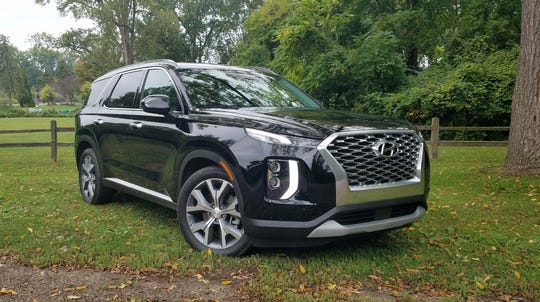
Second place: Kia Telluride/Hyundai Palisade
The Georgia-made Korean twins set a new bar for three-row family SUVs with their affordable, luxurious chariots.
The accomplishment gains added respect because longtime segment pioneers Ford Explorer and Toyota Highlander also debuted all-new three-rowers this year. The Telluride-Palisade upstarts showed the establishment how it’s done.
More: Payne: Hyundai Palisade and Kia Telluride twins battle for best 3-row SUV
Boasting exterior-interior designs that would befit the luxury class were they not fronted by Kia and Hyundai badges, the two SUVs also offered standard features like adaptive-cruise control and blind-spot assist — craved by safety-conscious families — for thousands of dollars less than their peers. The wardrobes made segment mainstays like the Honda Pilot look dowdy, but the ergonomic detail was Honda-esque as the Koreans introduced such innovations as seat-back mounted USB ports and driver-to-third-row communication.
Bottom line, the Telluride and Palisade closest competition is each other. The Telluride wins the beauty contest with its timeless, chiseled design. But if you can live with Palisade’s Mad Max grille, you’ll find its console easy to live with, from its careful attention to detail to thoughtful storage space.
First place: Chevy Corvette C8
You had me at mid-engine.
Despite its $59,995 starting price, the Corvette — like the Mazda 3 and Telluride/Palisade — is a remarkable value in its own right. The first ‘Vette to ever stick its V-8 behind the passenger seats, the C8 offers supercar value for a fraction of the price of comparable European exotics.
I could buy four Corvettes (outfitted with the performance Z51 package) for the price of the Lambo Huracan. The Corvette would match its 2.9-second 0-60 mph time while lounging in a digital interior that puts the Italian to shame. The Corvette’s price point means that — just five years from now — you’ll likely be able to find a C8 (just like a C7 today) in good condition with 50,000 miles for less than $35,000. That is, the average price of a new car.
On the road, the C8 manages to achieve the traction of the similarly sized, rear-engine, $100,000 Porsche 911 at the price of the smaller mid-engine Cayman. Like the Cayman, the Corvette rotates beautifully around the driver into turns.
The signature push-rod eight-cylinder is a carryover from the front-engine C7, as is the knife-edge body styling and luxurious cockpit. But the C8 refines them further: The well-proportioned exterior is complemented by an available hard-top convertible — again, jaw-dropping technology previously available only on $250,000 exotics – optioned for a mere $6,000. The interior also pushes the envelope — it’s a sci-fi sanctuary of digital screens, trigger shifter and over-the-air updatable software.
Mid-engine toys bring athletic gains, but packaging usually suffers. Somehow, Corvette’s elves managed to maintain ample interior space, room for two golf bags, plus a “frunk” for suitcase storage.
The C8 is the gift that will keep on giving with the C8.R race car debuting at Daytona in January; a Ferrari-like high-revving flat-plane crank engine is in the offing for the Z06 model; a planned hybrid configuration may push (gasp) 1,000 horsepower. With its new life, I expect the Corvette to spin off a front-engine SUV in the next few years.
Not bad for a badge that was on the bankruptcy chopping block at the decade’s dawn.
2020 Chevrolet Corvette C8
Vehicle type: Mid-engine, rear-wheel drive, two-passenger sports car
Price: Base price $59,995 including $1,095 destination charge
Powerplant: 6.2-liter V-8
Power: 495 horsepower, 470 pound-feet of torque (with $5,000 Z51 performance package)
Transmission: 8-speed dual-clutch automatic
Performance: 0-60 mph, 2.8 seconds (Motor Trend); top speed, 194 mph
Weight: 3,600 (est.)
Fuel economy: N/A
Report card
Highs: Sci-fi interior; improved handling, traction
Lows: Trigger-tranny learning curve; no adaptive cruise-control
Overall: 4 stars
2020 Hyundai Palisade/2020 Kia Telluride
Vehicle type: Front-engine, front- or all-wheel drive, seven-passenger SUV
Price: Base price Palisade $32,595, including $1,045 destination charge; base price Telluride $32,735, including $1,045 destination charge
Powerplant: 3.8-liter, V-6
Power: 291 horsepower, 262 pound-feet of torque
Transmission: 8-speed dual-clutch automatic
Performance: 0-60 mph, 6.8-7.0 seconds (Car and Driver); tow capacity, 5000 pounds
Weight: 4,387-4,255 pounds
Fuel economy: EPA mpg, 19 city/24 highway/21 combined
Report card
Highs: Palisade’s interior flexibility, Telluride’s exterior design
Lows: Palisade’s polarizing face
Overall: 4 stars
2019 Mazda 3
Vehicle type: Front-engine, front- and all-wheel drive, five-passenger sedan and hatchback
Price: $21,895 base sedan, $24,495 for hatchback, including $895 destination fee
Powerplant: 2.5-liter, inline-4 cylinder
Power: 186 horsepower; 185 pound-feet of torque
Transmission: 6-speed automatic, 6-speed manual
Performance: 0-60 mph, 6.9 seconds (Car and Driver est., AWD); top speed: 130 mph
Weight: 3,255 pounds (AWD hatchback as tested)
Fuel economy: EPA 26 city/35 highway/30 combined (FWD auto); 25 city/35 highway/29 combined (FWD manual); 24 city/32 highway/27 combined (AWD auto, as tested)
Report card
Highs: Best compact design yet; ditto interior design
Lows: Infotainment controller learning curve; 250-horse turbo-4, please?
Overall: 4 stars
Payne: Three-row SUV battle — Durango SRT, Cadillac XT6, BMW X7
Posted by Talbot Payne on December 12, 2019
What is the best sled to take over the hill and through the woods to grandma’s house this holiday season?
My family and I spent the Thanksgiving holiday putting three top-drawer utes to the test around Metro Detroit to determine what mattered most to five people stuffed into three-row transportation. Our sleds were a similarly equipped lot from three very different brands: a $73,040 Cadillac XT6, a $78,235 Dodge Durango SRT, and $112,245 BMW X750i.
All three have outsized personalities and wave their brand flags — from the sculpted Cadillac to the Hellcat-wannabe Durango to the ridiculously posh Bimmer. But all also satisfied my family’s basic needs: Three rows with second-row captain’s chairs, so everyone had their space. State-of-the-art technology for my 20-something sons and daughter-in-law. All-wheel drive, two-zone climate control and heated seats for my wife who fears a Michigan blizzard might attack at any moment. And finally, V-6/V-8 powerplants to scratch the itchy right feet of the Payne motorheads.
In this Age of Ute, we put these well-dressed hunks to the test across freezing tundra and cratered Michigan roads to determine what matters most in an SUV — personality or utility.
Dodge Durango SRT
I exploded out of our subdivision in the Durango SRT onto Telegraph Road. Shifts barked like an angry sports car. With the throttle wide open, the engine roared like a T. rex at a Texas Roadhouse buffet.
The SRT badge means Dodge’s glorious 6.4-liter hemi V-8 is under the hood. It’s the same engine that motivates the wicked Charger Scat Pack that I flogged around Sonoma Raceway last fall.
Matching its loud voice, our tester also came with an outrageous red and dual-striped-hood wardrobe with big red Brembo brake calipers and a hood scoop in front. All that was missing was a rear wing. With its rear-drive bias and stiff suspension, it was a rocketship to drive around town.
Passengers had a different impression.
“What? I can’t hear a word you’re saying,” my daughter-in-law yelled from the third row. Even after I had settled down to a civilized 55 mph on adaptive cruise-control, the interior of the Durango was loud. At least I could hear my wife’s reasoned advice in the second row: “Slow down!”
The Durango’s interior is beautifully wrapped in leather with cool details like a T-shifter, second-row infotainment screens, digital instrument display and acres of console room. But it hides an aging chassis that rode like a Conestoga wagon over Detroit’s bumpy trials.
The Durango SRT would be a party animal on a guy’s hunting trip. But it’s a tough sell for a daily driver.
BMW X7 50i
The BMW’s face was the most polarizing of our threesome, with signature twin-grille kidneys the size of Ndamukong Suh’s shoulder pads. Otherwise, this three-row Versailles Castle is a collection of the auto kingdom’s best stuff.
The 456-horse twin-turbo V-8 doesn’t have the visceral thrills of the Durango, but it is every bit as potent, hitting 60 mph in 4.6 seconds with buttery shifts from its eight-speed box. Floating on an air suspension, the X7 absorbed Detroit’s bumps with aplomb while its supple rear-wheel drive biased chassis is not averse to a spirited drive.
But cruising luxury is this yacht’s calling card. The interior is whisper-quiet, making for easy three-row conversation and musical enjoyment. Infotainment can be controlled via iDrive rotary controller or touchscreen. The luscious chocolate-leather seats begged to be licked, and the chrome-plated interior is decorated like a Christmas tree with LED lights that can be programmed to glow any color of the rainbow.
Not surprisingly, the X7 was always the family’s first choice to drive because it had it all — speed, comfort, class — plus, we knew that opportunities to cruise town in a six-figure chariot are rare. Who has that kind of money? The X7 spares no expense with third-row heated seats, three-zone climate control, a split rear hatch with a pickup-like drop-down tailgate, the biggest panoramic roof anyone had ever seen and a voice recognition system — “Hey, BMW, go to the Detroit Institute of Arts” — as good as a smartphone.
Like Versailles, the X7 also doesn’t know when enough is enough. Example: Automatic-folding second row-thrones that were so slow you wished for good ol’ manual-fold seats. And a tailored second-row console that no one used made it harder to get out of the third row.
Cadillac XT6
Not too fancy. Not too macho. Just right.
The Caddy was the only player in the group to feature a sub-400 horsepower, non-V-8 powerplant (310-horse V-6) and front-wheel drive bias. No one seemed to miss them. With a family of five, the consensus was that launch-control out of Woodward Avenue stoplights (my favorite Durango V-8 trick) in a three-row ute is low on the list of priorities.
What was appreciated was the Cadillac’s best-in-test exterior (the XT6 was introduced to the news media this year in an art museum) and quiet, easy-to-use interior. While not dressed to the nines inside like the BMW, the Cadillac nevertheless featured amenities like panoramic sunroof (let there be light for third-row passengers!) and head-up display — while offering extras like a rear-seat warning (if you left a baby seat back there) and easy third-row access.
The XT6 proved that utility is the priority in three-row utes. If you want personality, buy a sports car.
But that begs the question …
Why pay $73,000 for Cadillac when a stylish $51,000 Chevy Traverse or $48,000 Kia Telluride offer the same amenities for a whopping $20,000 less?
Technology has become the great equalizer between luxury and mainstream, and the roomy Traverse and Motor Trend SUV of the Year Telluride come with the same blind-spot assist, adaptive cruise and emergency braking as its pricier peers. Their voice-recognition is no BMW — but like the Cadillac and Dodge, simply connecting Apple CarPlay levels the playing field. Then the mainstream utes add panoramic sunroof, knock-out styling, head-up display (Telluride), one-button third-row access, 20-inch sport wheels and USB ports everywhere.
Yes, yes, brand matters and that’s the Chevy/Kia challenge. But with the tens of thousands you save on a big ute, you can buy an apex-carving, drop-top sports car with loads of personality for when the holidays are over and your better half wants a weekend escape to your favorite restaurant.
I’m thinking Mazda Miata.
2020 Cadillac XT6
Vehicle type: All-wheel drive, 6-passenger SUV
Price: $58,090, including $995 destination charge($73,040 as tested)
Powerplant: 3.6-liter V-6
Power: 310 horsepower, 271 pound-feet torque
Transmission: 9-speed automatic
Performance: 0-60 mph, 6.4 seconds (Car and Driver); towing capacity 4,000 pounds
Weight: 4,644 pounds
Fuel economy: EPA est. 17 city/24 highway/20 combined
Report card
Highs: Handsome looks; roomy, quiet interior
Lows: Lacks Cadillac “wow” factor; milquetoast drivetrain
Overall: 3 stars
2020 Dodge Durango SRT
Vehicle type: All-wheel drive, 6-passenger SUV
Price: $64,490, including $1,495 destination charge ($78,235 as tested)
Powerplant: 6.4-liter V-8
Power: 475 horsepower, 470 pound-feet torque
Transmission: 8-speed automatic
Performance: 0-60 mph, 4.7 seconds (Car and Driver); towing capacity 8,700 pounds
Weight: 5,510 pounds
Fuel economy: EPA est. 13 city/19 highway/15 combined
Report card
Highs: Challenger V-8 under the hood; wicked exterior
Lows: Aging chassis; loud interior
Overall: 3 stars
2020 BMW X7 50i
Vehicle type: All-wheel drive, 6-passenger SUV
Price: $93,595, including $995 destination charge($112,245 as tested)
Powerplant: 4.4-liter twin-turbocharged V-8
Power: 456 horsepower, 479 pound-feet torque
Transmission: 8-speed automatic
Performance: 0-60 mph, 5.5 seconds (Car and Driver); towing capacity 7,500.
Weight: 5,617 pounds
Fuel economy: EPA est. 15 city/21 highway/17 combined
Report card
Highs: Decadent interior; smartphone-like voice recognition
Lows: Sticker shock; oh, those kidneys!
Overall: 3 stars
Revealed: The all-new 2021 Chevy Suburban and Tahoe mega-utes
Posted by Talbot Payne on December 12, 2019
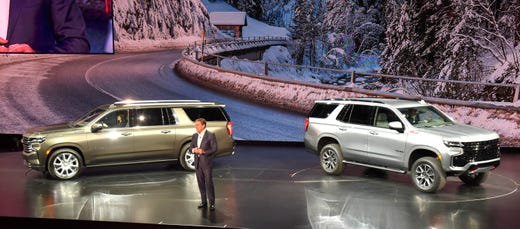
GM President Mark Reuss talks about the Chevy Suburban High Country, left, and Chevy Tahoe Z-71 as GM introduces the 2021 models at Little Caesars Arena, Tuesday night, December 10, 2019.
Chevrolet premiered the all-new 2021 Chevrolet Tahoe and Chevrolet Suburban on Tuesday evening. Appropriately, the mega-utes were unveiled in Little Caesars Arena, where giant Detroit Pistons basketball players roam the floorboards.
Based on the Silverado pickup, the twin SUVs have traditionally been the biggest in the land. So it’s not surprising the all-new models are the largest that General Motors has ever made, with the Tahoe increasing cargo room behind the third-row seats by a whopping 66% — and its stretched brother, the Suburban, increasing its total cargo space a healthy 19%.
“With the air suspension you can actually lower the truck for people to get in, or you can raise it to go off-road in the snow,” GM President Mark Reuss said in an interview. “But then at speed the truck will lower for better aerodynamics and fuel efficiency. We are were the only ones doing that with MagneRide and air suspension.”
Responding to the equally out-sized Ford Expedition (new in 2018), the Suburban and Tahoe have gone on a 300-pound diet from their predecessors. They will share an electrical “digital vehicle platform” with the Corvette so they can receive over-the-air software updates like a smartphone.
Based on platforms shared with GM’s high-volume Chevy and GMC pickups, the big SUVs are cash cows with prices starting in the low $50,000 range and ballooning to over $80,000 for upper-trim models. They pay tuition for a lot of the General’s nascent electric-vehicle education. The Suburban and Tahoe will go on sale in the middle of the 2020 season.
Tahoe led the way in large SUVs in last year in sales of more than 104,000. The Suburban followed at 60,633 and the Expedition was a distant third at 54,661. Among foreign brands, only Nissan (the Armada) and Toyota (the Sequoia) try to compete, but with much smaller sales numbers.
This year is a different story: Remade with a twin-turbo V-6 and upgraded technology, the Expedition – based on the F-150 pickup — has come roaring back through the first three quarters of 2019. It has leap-frogged the Suburban in sales, and trails the Tahoe by 62,155 to 80,103.
The big tanks will fight on a considerably lighter, stronger platforms courtesy of the Silverado which countered F-150’s move to aluminum with an athletic, lightweight, mixed-metal architecture. The new chassis allows for lower load floors for batter cargo and seating position. The second-row seats, for example, gain a whopping 10 inches in added legroom with segment-first sliding second-row seats for even more flexibility.
“With an increasing number of SUVs on the market, we knew the all-new Tahoe and Suburban needed to reach higher than ever,” said product chief Tim Herrick. “We transformed Tahoe and Suburban to offer all-new technologies and features.”
While both vehicles gain over 4 inches in wheelbase, the Tahoe’s overall length stretches a yawning 6.7 inches to claim 25% more cargo space than the Expedition.
The eight-cylinders will be joined for the first time by the class’s only turbodiesel: the same Duramax 3.0-liter inline 6-cylinder offered in the Silverado 1500. Chevy expects it will receive an EPA best-in-segment mpg rating (Silverado makes a best-in-full-size-pickup 33 mpg highway). The diesel’s stump-pulling 460 pound-feet of torque equal the 6.2-liter V-8.
The interior will bristle with technology, including a standard 10-inch console touchscreen with standard Apple CarPlay, Android Auto, WiFi hotspot connectivity and up to nine cameras for enhanced towing capability.
“The interior 10.8-inch screen is really nicely integrated from a design standpoint,” said Reuss. “Everyone assumed we’d have the same interiors of our pickup trucks, but we don’t. Between Chevy, GMC and Cadillac the interiors are all completely different. They are different and we spent the money to be different.”
Work through a record six trims — double the last generation — and a toy chest of goodies are available including a 15-inch color head-up display and dual 12.6-inch rear-seat LCD touchscreens.
All this brain and brawn is wrapped in an exterior that is a mild face-lift over the current version. Like the Silverado pickup, the Suburban fascia gets thinner LED headlights atop its massive split grille with signature LED running-light “cheeks” giving the big brute a cheery appearance.
In addition to the familiar volume LS and up-level LT trims, Tahoe and Suburban will be available in four more distinct personalities:
- RST: A sporty look like the RS grade found on the Chevy Blazer crossover with liberally applied black mascara on the grille and exterior highlights, 22-inch wheels and contrasting seat stitching.
- Z71: Chevy’s signature off-road package gets knobby tires wrapped around 20-inch wheels, standard all-wheel drive, skid plates and a higher approach-angle for the Outback.
- Premier: The premium package is a rolling Manhattan condo with magnetic-ride shocks, navigation, Bose 10-speaker audio system, 12-way vented front seat, and enough tech to fly an airliner.
- High Country: Borrowed from Silverado, the top trim gets the 6.2-liter V-8 standard, plus the segment’s first air suspension allowing for up to 4 inches of ride-height variability. Touches include expanded color choices and High Country badging, sill plates and seat embroidery.
“We’re offering multiple trims, like our pickups. No one else is doing it,” said Reuss. “RST, Z51, High Country. We’re looking to grow the segment.”
The Tahoe and Suburban will roll off the assembly line in Arlington, Texas, alongside the GMC Yukon and Cadillac Escalade. They are the product of a $1.4 billion plant investment that supports 4,800 employees, 1450 body-shop robots and daily production of 1200 vehicles.
As Ford, Chevy exit sedan market, Asian makers gain share
Posted by Talbot Payne on December 12, 2019

Joe Busch, sales consultant at LaFontaine Hyundai in Dearborn, wipes the ice off of a 2020 Elantra SEL Tuesday. Hyundai saw sales of its compact car increase 102% this November over last year. (Photo: Max Ortiz, The Detroit News)
Phoenix — A year after Ford and Chevrolet abandoned the compact-car segment to prioritize SUVs, buyers are abandoning those makes and shopping for cars made by Hyundai, Toyota and Honda.
Some 42% of Ford Focus and Chevy Cruze compact car owners have stayed in the compact car segment with a significant percentage buying competitors’ vehicles, according to an industry study by Edmunds that finds a deterioration of market share for the Detroit makes, and a decline in brand loyalty.
Hyundai, for example, saw sales of its Elantra compact car increase 102% this November over last year. The brand has also introduced an all-new 2020 mid-size Sonata that — like the all-new Toyota Camry and Honda Accord introduced in 2018 — the automaker hopes will capture buyers who still want sedans.
“There are 6.5 million car owners who do not have a successor sedan for them from their manufacturer. Forty-four percent of those say they want a sedan, so if you look at the raw numbers, there are still a lot of buyers out here,” Hyundai Vice President of Product Planning Mike O’Brien said at a media test of the new Sonata in Phoenix.
He noted that since Chrysler dropped its 200 sedan after the 2017 model year, there’s been an exodus of 20 nameplates from the sedan market.
The Edmunds study focused in particular on compact cars, which is the biggest car market – at 9.1% of share – in the United States today. The Ford Focus and Chevy Cruze have both left the segment in the last year as the Detroit makers concentrate on market demand for SUVs.
To be sure, a healthy share of former Focus and Cruze owners are acting as Ford and Chevy hoped: by moving into one of their SUVs. To date this year, 18% of Focus owners traded for a Ford SUV, while 21% of Cruze owners traded for a Chevy SUV.
But those buyers tend to have extra cash to spend as small SUVs can cost between $4,000-$8,000 more than a small car, reports Edmunds. As a result, those staying in the compact car segment are increasingly turning to the remaining foreign brands.
Dearborn is home to Ford’s headquarters. It also is home to Metro Detroit’s largest Hyundai dealer, LaFontaine Hyundai — a distinction driven, in part, by customers’ desire for a compact alternative to the discontinued Focus.
“We’ve seen a lot of interest in the Elantra since Ford left the compact market,” said Lafontaine sales manager Steve Hunsinger. The Elantra is prominently featured on the dealership’s website.
Determined to compete in the Detroit Three’s backyard, Hyundai matches Ford’s friends-and-family discount by offering Michigan buyers its own employees’ discount. Hunsinger says that, in addition to meeting demand for an affordable compact, the Elantra also benefits from Hyundai’s best-in-industry, 10-year/100,000-mile drivetrain warranty.
“Ford and GM made a strategic decision to prioritize profit at the expense of market share,” said Edmunds auto analyst Jessica Caldwell. “While this may set them up better in the long run so they have the cash they need to fund electrification and autonomy, there’s no question that decision is giving their competitors an edge now.”
Focus owners trading in their car to buy another Ford vehicle decreased from 40% in 2016, to 33% in 2019. The drop in brand loyalty has been steeper among Cruze owners — from 57% of owners trading in for a Chevy in 2016, to 45% this year.
Asian carmakers have benefited: the Honda Civic picked up 4% of former Focus buyers, the Toyota Corolla 3.5% and Hyundai Elantra 2.3%. Cruze trade-ins for Civics and Corollas nearly doubled from 2016 to 2019.
More: The racy Honda Civic Si just wants to have fun
More: Toyota Corolla Hatchback is wallflower no more
With the termination of the Ford Fusion and reported demise of the Chevy Malibu in a few years, foreign makers are hoping for the same playbook in midsize sedans.
That may be a tougher sell, given that midsize sedan sales have plummeted from 17% to 8% of market share.
But, says Hyundai’s O’Brien, “Not everyone hates their sedan. We see a healthy outlook for the future.” He points to the 6.6 million Honda Accords that are on the road, and the 7.2 million Toyota Camrys, 3.9 million Nissan Altimas and 2.2 million Hyundai Sonatas.
The Detroit Three have the profitable full-size pickup market virtually to themselves. But the midsize-pickup market can be seen as a test case for brands that abandon whole segments: Ford left the declining mid-size pickup market in 2012 only to return in 2019 with Toyota’s Tacoma dominant. Since re-entry, Ranger hasn’t been able to command the share it once did — but it boasts a 49% higher price that’s in line with the company’s profit-focused strategy.
Asian automakers are hardly sedan-dependent. Toyota, Honda and Nissan lead the compact SUV segment where most mid-size sedan buyers have fled. Hyundai is prolific in SUV markets as well, becoming one of the first automakers to introduce three entry-level models – the compact Tucson, subcompact-plus Kona and subcompact Venue coming next year.
Tucson sales are up 116% in November, the Kona up 106%.
But given the higher prices of SUVs over cars, Asian automakers see the compact-sedan market as crucial to attracting first-time, low-income buyers into their brands.
“The catch is, if Ford and GM don’t have affordable options for shoppers who are buying their first or second new car, it could be much harder to win them over later,” said Edmunds analyst Caldwell. “Catching consumers early and keeping them in the family has been a basic tenet of automotive brand strategy for decades. But it feels like we’re in the midst of a transformative time for the industry where automakers are being forced to rethink everything. Time will tell if it will end up the right call in the long run.”
Payne: Infiniti quickens the pulse with all-season Q60 looker
Posted by Talbot Payne on December 6, 2019
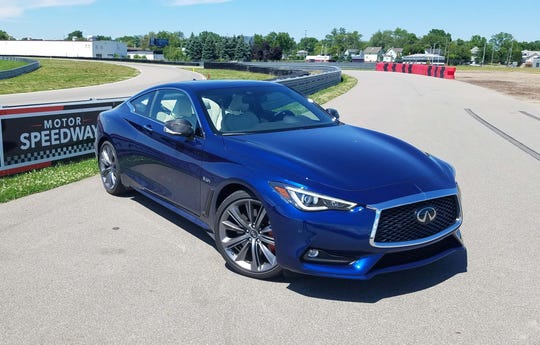
The Infiniti Q60 Red Sport 400 (as in 400 horsepower) is a fun drive on track with its all-wheel-drive power and slippery 0.28 drag-coefficient. At over 4,000 pounds, the all-wheel drive model is heavy. (Photo: Henry Payne, The Detroit News)
The Infiniti Q60 Red Sport 400 is another mouthful of luxury alphanumeric badging that will make your brain hurt.
Just remember that Q60 rhymes with “cue sexy.”
Infiniti has come a long way from the somnolent 1989 ads that introduced the brand — not with footage of sleek cars — but with quietly narrated commercials about water and geese. I’m not making this up. Thirty years later the growly, aggressive, shapely Q60 has no patience for water. Or geese.
Cresting the curvy hills of west Oakland county, I toggled the Q60’s drive mode to Sport Plus and put pedal to metal. Four-hundred horses under the hood roared in unison, the quick seven-speed transmission firing off shifts like a shotgun. Hustling into a tight bend, I flicked through downshifts as the exhaust barked loudly.
If a flock of geese was anywhere nearby, it would have scattered. Cue sexy.
How sexy? The Q60 Red Sport 400 (400 signals 400 horsepower) is now one of the official driving-school cars of the terrific M1 Concourse test track in Pontiac. Right alongside M1’s ferocious, 700-plus-horsepower Dodge Charger and Challenger Hellcats, and earth-pawing Viper ACR.
Red Sport, Hellcat, Viper. That’s a lot of underworld references. You get the point. This isn’t your father’s Infiniti.
It’s taken a long time, but Nissan’s luxury brand has finally produced a halo coupe with personality, style and twin-turbo V-6 power. All that sexiness still sits on top of Nissan’s aged rear-wheel drive FM platform which has been the bones of everything from the Nissan 370Z to the late Infiniti G35.
If the Japanese brand can stick with its nomenclature and update its platforms over time, it has a chance to bottle a credible formula of emotion and value.
Start with the fundamentals. The Red Sport’s powerful baritone comes from the same twin-turbo V-6 found in the base coupe that puts out a detuned 300 horses. Infiniti then wraps this playful mill in its updated, head-turning Infiniti design (also found in the compact QX30 ute of all things). The hood and flanks are deeply scalloped. The lines flow to all the right places over 20-inch wheels.
With its lower hood and grille, these new cars eschew the heavy, swollen-cheek appearance of other Infiniti models that reminded me of Eddie Murphy’s Nutty Professor. It wasn’t a memorable look. The Q’s pouty grille (essentially an inverted Jaguar mouth) is flanked by angry, LED running lights that glow with menace in your rearview mirror.
Sitting next to a hippy $90,000 Lexus LC500 coupe in the M1 Concourse paddock, the Infiniti holds its own.
Slip inside and the premium vibe dulls. The sculpted door handles continue the sinewy lines of the exterior, but the old Infiniti FM architecture shows its age in the console and instrument panels. If you cross-shop with state-of the-art digital interiors from BMW or Audi, you’ll be taken back in time. There’s an old-school truck brake for the emergency brake. Analog displays and screens are from another era, though they make up in utility what they lack in modernity.
The dual-stacked screens remind of old Honda Accords (the 2019 version of that mainstream sedan shames the Infiniti’s interior architecture), but they work together nicely — separating navigation and radio/vehicle information that now have to co-exist on state-of-the-art tablet displays of competitors.
The Q60 may lack the digital pizzazz of its class peers, but it’s up to date on the latest digital driver-assistance features like pedestrian emergency braking, blind-spot assist, and adaptive cruise-control (or Intelligent Cruise Control in Infiniti-speak). After I’d had my jollies at M1 Concourse and exhausted Oakland County’s twisties on my way home, I merged into clogged highways where the adaptive cruise system is useful in maintaining a distance from other cars — and from (ahem) state police speeding tickets.
Even the navigation system — usually a horror show in vehicles these days — was reasonably competent, and Nissan provides a remote control knob for zooming in or out depending on the destination. Still, the option of Apple CarPlay and Android Auto app compatibility for superior phone navigation is a must, and here Infiniti lags. Compatible systems aren’t due for another couple of years.
Mrs. Payne, my right-seat navigation expert, groaned at Apple CarPlay’s absence. But she didn’t groan at the price.
Loaded to the gills with all-wheel drive, digital goo-gaws and two-tone leather interior, my racy coupe stickered for $62,000 — a healthy $20,000 cheaper than a comparable BMW M4 coupe. For the M4’s stratospheric $80,000 you could walk out of the Nissan/Infiniti dealership with a Red Sport and a low mileage, pre-owned Nissan Rogue for off-the-grid hatchback adventures for which a sports coupe is ill-equipped.
What the Q60 is equipped for is getting your pulse racing.
The all-wheel drive Red Sport is nicely screwed to the road, meaning you can get into the throttle — and that glorious 7-speed box — confidently at corner exits. Corner entry is more a challenge given the all-wheel drive car’s 4,000-pound heft. If you enjoy track days, you’ll want the lighter (if still porky) 3,866-pound rear-drive car.
If you’re buying an all-season sports tourer, then the all-wheel driver is a must for Midwest snows.
Frankly, that’s where the Q60 Red Sport’s value lies.
If you have $60,000 to drop on a performance coupe, then lust after a rear-wheel drive, 405-horse BMW M2 or 500-horse Mustang GT350. They are quicker on track and carry epic brand histories.
But their fun ends with the first flakes of winter. If you want an all-season, all-wheel drive sports car that’s easy on the eyes — and the wallet — then the Infiniti is a solid choice. Compared to its AWD peer group — the 349-horsepower Audi S5 or 305-horse Lexus RC 350 F Sport AWD , the Infiniti is the only one to crest the magic 400-pony mark.
Most importantly, that means the Infiniti will walk away from its Japanese rivals. Pity that message didn’t shine through back in 1989 when Lexus advertised cars, not geese, and launched one of the America’s most coveted luxury brands.
Nice to have Infiniti finally in the game. Cue Sexy.
2019 Infiniti Q60 Red Sport 400
Vehicle type: Rear or all-wheel drive, 4-passenger sports coupe
Price: $55,895, including $995 destination charge ($64,130 AWD as tested)
Powerplant: 3.0-liter, twin-turbocharged V-6
Power: 400 horsepower, 350 pound-feet torque
Transmission: 7-speed automatic
Performance: 0-60 mph, 4.5 seconds (Car and Driver); top speed, 155 mph
Weight: 3,882 pounds (4,047 AWD as tested)
Fuel economy: EPA est. 19 city/27 highway/22 combined
Report card
Highs: Slinky looks; AWD, all-season athlete
Lows: Dated interior; porky on scales
Overall: 3 stars