- Search Cartoons
- Comic Archive
-
Payne
Store



 Henry Payne RSS

Articles
Payne: How different brands are navigating to an EV-mandated future
Posted by Talbot Payne on March 24, 2023
San Diego — From LED light bulbs and water-efficient washing machines to electric vehicles, government regulators are directing manufacturers on the products they must build.
In a U.S. auto market where more than 90% of new car sales are vehicles powered by an internal combustion engine, different legacy brands are taking different routes toward a government-mandated, all-electric future in 2035. Large automakers like General Motors Co. are all in on EVs — shifting its brands to a single, Ultium battery platform and charging Cadillac, for example, with selling only battery-powered models by 2030. Smaller brands like Honda, Subaru and Dodge, however, are taking more cautious, incremental approaches given the soft customer demand for EVs.

The price of not electrifying their fleets is steep as Dodge’s whopping $711 million fine for missing emissions targets in 2022 proved, though consumers are largely unaware of the pressures the industry is under. And in the world’s most diverse auto market, manufacturers must find the electrification strategy that best squares the circle between government demands and their customers’ needs.
“The pressure is on manufacturers as governments force them to electrification, but it’s a three-leg stool: governments, automakers, consumers,” said Matt DeLorenzo, a veteran industry analyst and author of “How to Buy an Affordable EV.” “And if the consumer isn’t there, then the stool isn’t going to stand.”
Honda and other automakers were the beneficiaries of the last of government fuel regulations in the 1970s that penalized Detroit Three automakers in particular for selling big cars. Japanese-made compact imports from Honda and Toyota gave those automakers a foothold in the market that has expanded ever since.
But new government mandates forcing EVs, insiders say, favor the Detroit Three, whose huge pickup truck fleets are often used in short-haul, high-torque situations where EVs excel.
“It’s going to be different because this time everyone is on the same footing. The question is: where is the market going to go next? Are people going to still want trucks? I think they are,” DeLorenzo said. “That favors the domestics.”

EVs make less sense to the single-car households and apartment dwellers that buy, say, Honda Accords and Civics and CR-V SUVs. So Honda sees hybridization as its bridge to electric cars.
The all-new Accord, for example, will offer only a hybrid, battery-gas powertrain option in addition to its base internal combustion engine — shelving a higher-horsepower, 2.0-liter turbo-4. The turbo-4 and hybrid each accounted for about 10% of Accord sales, but to avoid massive EPA fines in 2026, Honda is hoping that 50% of buyers will choose the hybrid option.
“It fits where we’re going to electrification. As great as the turbo-4 engine was — as far as managing restrictions and government regulations, it doesn’t fall in line to where we’re going,” Accord product manager Dan Calhoun said at the 2024 model’s media test here in southern California. “This is a bridge towards electrification. We see that coming, so we (offer) four hybrid trims: Sport, EX-L, Sport-L and Touring.”

Honda’s approach takes a step further as Calhoun and his team have engineered the hybrids to behave like pure EVs. They can run on battery power alone up to 25 mph and then drivers can use regen paddles to brake the car with the electric motor, just like a Tesla.
GM is putting all its electric eggs in the Ultium EV platform, but even the General is hedging its bets by committing to a new generation of V-8-powered vehicles.
“GM says they are going all-EV, but the fact that they are investing $1 billion in a new generation V-8 engine shows that trucks will be a big part of their sales plan,” said analyst DeLorenzo. “They need ICEs to deliver the money they need to stay in business.”
Trucks are key to the automaker’s EV transition as they account for the bulk of the company’s profits. Like crosstown rival Ford Motor Co., GM can also use EV sales credits to balance its popular ICE vehicles.
“GM is trying to appease the government. They need to generate EV credits in order to offset whatever fines they would get for not meeting 2026 (emissions targets),” DeLorenzo said. “I think that’s the thing that is often overlooked. If you generate credits from EVs, that can help you continue to sell trucks and Corvettes.”

Ford was first to benefit from EV versions of popular ICE nameplates. The company says sales of its electric Mustang Mach-E SUV and F-150 Lightning allowed it to introduce a new generation of V-8-powered Mustangs as well as a V8-powered F-150 Raptor that customers have been pining for.
By contrast, Stellantis NV’s Dodge performance brand was late to the EV credits game. Dodge’s V-8-powered Hellcat Challengers and Chargers may have broken the Internet, wowed buyers and displaced the iconic Mustang as America’s best-selling sports car — but they also cost the company millions in government fines.
In their place comes the 2023 Hornet, the brand’s first SUV since 2012 — and the first electrified Dodge.
Dodge threw in the towel on its popular Challenger/Charger line, which will cease production later this year. “It’s time for a transition,” Dodge sales chief Matt MacAleer said at the Hornet’s media debut in Asheville, North Carolina. “Our transition to electrification has begun.”

Dodge predicts the $41K plug-in hybrid R/T will split Hornet sales 50/50 with the standard $31K gas-powered GT model. Together with the brand’s upcoming first EV, the Charger Daytona SRT Banshee, Dodge hopes it will be able to meet government standards.
“Our customers want the flexibility of a battery and gas engine as we transition to electric vehicles,” said Hornet product manager Fernando Fernandez.
Says analyst DeLorenzo: “Dodge is buying time with EVs. They are pursuing technology that might improve fuel economy where they might be able to reintroduce a V-8 at some point. I think that what threw them for a loop is that, during the Trump administration, they got some breathing room on emissions and all that breathing room has been taken away.”

Where Dodge faces an uphill battle convincing its ICE enthusiasts to go electric, Subaru would seem to have the perfect customer base for EVs.
Environmentally conscious and active outdoors, the typical Subaru buyer fits the profile of an EV tree-hugger. Yet the brand has struggled to make sense of costly, range-challenged EVs — contrary to the brand’s reputation for affordable vehicles that can hike anywhere.
“We have a lot of customers who want 500 miles of range, which is why we give them a big (16.6-gallon) fuel tank,” Garrick Goh, car line manager for the subcompact SUV segment’s best-selling Crosstrek, said in Palm Springs. “They go places where there are not just no EV chargers, but no gas stations.”
Goh acknowledged the difficulty of meeting 2026 federal regs, but said Subaru’s larger concern is so-called Section 177 states that have adopted California’s draconian emissions mandates — states like Maine, Massachusetts, New York, Oregon, Vermont and Washington, where Subarus sell well.
The Japanese maker has one battery-powered vehicle in its lineup, the Solterra SUV, which starts at $45K, and one hybrid, the low-volume $38K Crosstrek plug-in, priced well above its $26K gas counterpart. When Crosstrek was remade this year, there were few changes to its four-cylinder ICE drivetrains.
Goh said the company sees the electrification opportunity not in hybrids, but in pure EVs that gain more credits for the brand.
“EVs gain six times more credits in 177 states than plug-in hybrids,” he said. “So we’re focusing on EVs like the Solterra. EV is the end game because eventually we’re all going EV.”
Henry Payne is auto critic for The Detroit News. Find him at hpayne@detroitnews.com or Twitter @HenryEPayne.
Payne: Affordable Hornet GT brings Dodge sting to compact SUVs
Posted by Talbot Payne on March 23, 2023
Asheville, N.C. — You know it as soon as you grip the steering wheel on the Dodge Hornet. This SUV wants to play.

Direct, weighted and rooted to the road, Hornet’s steering was a carving tool in my hands as I rushed the twisties up the Blue Ridge Parkway southeast of Asheville. The scenery was stunning, but the compact SUV offered no time to drink it in as I surged from corner to corner with 295-pound-feet of torque on offer to my lead right foot. Oh joy, another affordable hot hatch has joined the SUV segment.
As readers of this column know, the Mazda CX-5/CX-50 Turbo is my favorite mainstream compact SUV with its standard all-wheel drive, sharp handling, terrific torque and attainable pricing. It’s been a segment of one. Until now.

For just $31,590 — a whopping $6,500 less than the CX-5 Turbo — the AWD 295-torque, 2.0-liter turbo-4-powered Hornet GT (yes, GT is the entry-level model) nearly matches the Mazda’s 310-pound feet of torque while besting it in horsepower, 268 to 253. I’m not making this up.
Hornet marks the return of a storied badge that dates to the beloved 1951 Hudson Hornet — and of Dodge to the compact SUV segment for the first time since the unloved 2012 Caliber. But this is a different Dodge. Where Caliber was a cheap version of the Jeep Compass, Hornet shares a platform with the Alfa Romeo Tonale, for goodness’ sake. The new ute’s playfulness took some of the sadness away from the death-by-government-regulation this week of the Challenger — the Hornet’s performance godfather — as Dodge announced the V-8 era’s end with a 1,025-horsepower SRT Demon 170.
The Hornet GT and CX-5 Turbo play in the huge, multi-million-sales volume, compact-SUV segment, but what makes them special is they boast luxury-level performance at mainstream prices.
And if it’s luxury-level prices you want, the Hornet offers a top-trim 288-horse, 386-torque R/T monster for a BMW X1-like $41,590 sticker. Load the blood-red Hornet R/T I also tested with Blacktop, Tech and Track packages and it’ll cost you $52,405. That is (ahem) $9,000 more than a V8-powered Dodge Charger R/T, and over three grand more than the most expensive $49,195 BMW X1 offered. I’m still not making this up.

Welcome to the electrified era and its shocking price inflation.
And its cool new features. The 15.5-kWh battery under the rear seat is largely responsible for the R/T’s 10 grand premium over the standard GT. And largely responsible for the R/T’s expanded tool kit. Expect similar goodies from the Alfa Tonale, which comes out of the same Naples, Italy plant and will cost Lord knows what.
Buzzing through the spaghetti curves of Route 276 behind traffic, I get a brief dotted line along a straight stretch. Alert PowerShot, an over-boost feature like Grin Shift found on Hyundai N hellions. I armed the system with SPORT mode, pulled back on the steering-wheel-mounted shift paddles, then floored the throttle.
Accessing an extra 30 horsepower (for a total of 288), the Hornet R/T jumped into the left lane and obliterated the two cars in front of me. Impressive as that horsepower figure may sound, the R/T’s torque — 383, just 7 shy of the 5.7-liter hemi V-8 in big brother Durango — is the real story here. The 1.3-liter inline-4’s turbo provides the high-rpm horsepower, while the battery fills in low-end torque. The result is instant, electric vehicle-like grunt courtesy of the rear electric motor.

If that sounds familiar, it’s because I first experienced this front-engine/rear-motor arrangement in the 2020 Acura MDX Sport Hybrid, itself derived from the Acura NSX supercar. Dodge’s elves are having fun.
All this muscle is wrapped in a surprisingly stealthy package. Unlike the wicked-looking V8-powered Charger R/T that you can hear coming from a mile away, Hornet R/T makes only muffled, four-cylinder sounds when I give it the whip. Part of “the bridge to electrification,” no doubt, as government nannies force everything to be the same. But how does that square with Dodge’s rebel brand?
That rebel spirit is on display in the Hornet’s exterior styling: domed hood, twin-functional heat extractors, raccoon grille. Though it softens with a profile that could be any SUV (what, no Charger-like boomerang body stamping?) and a generic rear horizontal taillight, you’ll know the R/T by the dual tailpipes out the back, but otherwise R/T is little different from GT.
If you’ve got $52K burning a hole in your pocket, you might opt for the more visually distinctive Alfa. But oooooh, I like the affordable GT.

It’s not as elegant looking as the Mazda CX-5, but dress it in the Blacktop package ($1,995) and Acapulco Gold ($500) and it’s a bargain at $34,085. Especially since Dodge’s electronics leapfrog Mazda. In addition to standard adaptive cruise control, blind-spot-assist, auto headlights, auto braking and a partridge in a pear tree, the GT offers a big 12.3-inch configurable display behind the steering wheel. The console is anchored by a 10-inch touchscreen powered by the best-in-class Uconnect system.
We motorheads like to headline performance numbers, but a new generation of smartphone-raised buyers demand easy-to-use electronics. Tech ‘n’ ergonomics have always been a Dodge strength. With wireless Android Auto (also standard) at my disposal, I easily navigated Metro Asheville with voice commands. The console was rich in clever details like an upright storage cubby so I could see my phone’s screen, and a fat button on the steering wheel to access SPORT mode.

Hornet is at the smallish end of the compact segment with interior proportions closer to CX-5 than Nissan Rogue. But this tall guy had plenty of headroom in front and legroom in back. Clever details extend to sub-floor storage in back (except in R/T, where the space is consumed by the electric motor).
Around town in the R/T, I ran on battery power alone thanks to the e-SAVE feature, which stored 30 miles of range. The GT is easy ‘round town, too, and its AWD will be appreciated by Michiganians in March snowstorms. Put your boot in it, though, and GT’s nine-speed gearbox isn’t nearly as smooth as the Mazda’s velvety six-speed.
I’ll stick to sedan-based pocket rockets like the VW Golf GTI or AWD Mazda3 Turbo or Hyundai Elantra N — the latter with similar price/power to the Hornet GT. But for those who want an SUV hot hatch, the Dodge is a welcome segment addition.
And if you want more visceral thrills, you can always dive into Dodge’s Direct Connection bag of tricks to outfit your Hornet with, say, an exhaust sound enhancer. Hornets were meant to buzz.
Next week: 2024 Hummer SUV
2023 Dodge Hornet
Vehicle type: Front engine, all-wheel-drive five-passenger SUV
Price: $31,590, including $1,595 destination ($33,585 GT and $52,305 R/T as tested)
Powerplant: Turbocharged 2.0-liter Hurricane inline-4 cylinder; 1.3-liter turbo-4 cylinder mated to 15.5 kWh lithium ion battery and rear electric motor
Power: 268 horsepower, 295 pound-feet of torque (2.0L); 288 horsepower, 383 pound-feet of torque (hybrid)
Transmission: 9-speed automatic (2.0L); 6-speed automatic (hybrid)
Performance: 0-60 mph, 6.4 seconds (2.0L, mfr.) and 5.6 seconds (hybrid, mfr.); top speed, 140 mph (2.0L) and 125 mph (hybrid)
Weight: 3,715 pounds (2.0L) and 4,140 (hybrid)
Fuel economy: EPA 21 mpg city/29 highway/24 combined (GT); gas range, 324 miles; R/T electric-only range, 30 miles
Report card
Highs: GT is affordable, SUV hot hatch; state-of-the-art electronics
Lows: R/T gets pricey; lacks Dodge emotion
Overall: 3 stars
Henry Payne is auto critic for The Detroit News. Find him at hpayne@detroitnews.com or Twitter @HenryEPayne.
Chevy Camaro RIP, but a successor may be in the works
Posted by Talbot Payne on March 23, 2023
And then there was one.
Detroit’s muscle car lineup shrank to the Ford Mustang on Wednesday as Chevrolet announced the end of Camaro production after the 2024 model year. The Camaro’s demise follows the discontinuation of Dodge’s popular Challenger coupe at the end of this year. V8-powered cars like the Camaro are under intense regulatory pressure amid a government-led transition to electric vehicles, but — unlike the best-selling Challenger — Camaro had fallen on hard sales times since its sixth-generation remake in 2016.
“As we prepare to say goodbye to the current generation Camaro, it is difficult to overstate our gratitude to every Camaro customer, Camaro assembly line employee and race fan,” said Chevy Vice President Scott Bell. “While we are not announcing an immediate successor today, rest assured, this is not the end of Camaro’s story.”

The end may be a new beginning. Car and Driver reports that General Motors Co. is moving towards a sub-brand strategy focused on Camaro, Corvette and Escalade as the company remakes its portfolio. The enthusiast magazine reports that a Camaro SUV will be introduced in 2025 on GM’s Ultium battery platform just as a Corvette sub-brand unveils an Ultium-based SUV and sedan to complement its V8-powered sports car.
Ford pioneered the muscle-car sub-brand idea in 2021 with the electric Mustang Mach-E and Ford credits its success in racking up emissions credits for the continuation of the V8-powered Mustang.
“We’re not saying anything specific right now,” Chevrolet spokesman Trevor Thompkins told the Associated Press about Camaro’s future.
The Camaro debuted in 1967 in the wake of the wildly successful Mustang pony car. Though shy of Mustang’s massive 470,000-plus sales, the Camaro sold an impressive 220,906 units in its inaugural year and continued strong sales into the 1970s as the muscle car segment grew to include such Woodward Dream Cruise classics as its sister Pontiac Firebird, Dodge Challenger, AMC Javelin and Plymouth Barracuda. By its fourth generation in 2002, sales of the Camaro had dropped to just over 40,000 units a year and the model was discounted.

Camaro rose from the ashes in 2010 with a fifth-generation coupe that was part of a rebirth of the American muscle car segment. It outsold both the Mustang (which has been sold continuously since 1964) and the Challenger (reborn in 2008) for five straight years, hitting nearly 90,000 units annually on the strength of its edgy retro styling and RS, SS and Z/28 performance models.
A controversial sixth-generation redesign in 2016 ended the Camaro’s reign at No. 1. Sharing the same athletic platform as the Cadillac ATS, the Camaro won huzzahs for its performance — embodied by the 650-horsepower ZL1 1LE, the fastest Camaro ever around GM’s Milford Proving Grounds.
But buyers and media reviews complained the sports car was hard to see out of and was ergonomically inefficient inside. Sales sank to 24,652 last year — a distant third to its Mustang and Challenger competitors.
Challenger will also cease production after the 2024 model year as Dodge has racked up heavy federal emissions fines. Dodge has introduced an all-new, battery-powered Charger Daytona Banshee to replace it.
Camaro is synonymous with Chevy NASCAR racing and the badge will continue competing in the series as well as in IMSA, SRO, NHRA and the Supercars Championship.

“Chevrolet’s products and our relationship with our customers benefit from motorsports,” said Chevy Motorsports boss Jim Campbell. “Our plan is to continue to compete and win.”
As Camaro production draws to a close at GM’s Lansing Grand River Assembly Plant in January 2024, Chevrolet said it will honor its final run with a Collector’s Edition package on the RS, SS and ZL1 models. The Collector’s Edition pays homage to the first generation program’s initial code name: Panther.
Henry Payne is auto critic for The Detroit News. Find him at hpayne@detroitnews.com or Twitter @HenryEPayne.
Go Like Hell: Dodge unleashes loaded Hornet R/T GLH Concept
Posted by Talbot Payne on March 23, 2023
Asheville, North Carolina — The Dodge Challenger and Charger are being put out to pasture, but their muscle car DNA lives on.
With half the cylinders.
Dodge on Wednesday unveiled a lower, louder, and bolder R/T GLH Concept version of the plug-in hybrid Hornet compact SUV — GLH for “Go Like Hell.” Loaded to the gills with all of Dodge’s Direct Connection goodies — including lowered suspension, black hood, dual racing stripes, Track Pack, exhaust amplification, electronic control unit upgrades and more — the R/T GLH gives a glimpse at a fully-modified Hornet just like its gas-powered GT GLH Concept sibling, which was unveiled at M1 Concourse last August at the Hornet’s debut.
Similar to aftermarket parts but installed by approved Dodge Power Broker dealers, the Direct Connection features are covered by the factory’s three-year/36,000-mile vehicle warranty. Direct Connection offers the only factory-backed performance upgrades in the compact SUV segment.
The $41k Hornet R/T is already a hatchback hellion without the available Halloween wardrobe. Featuring Dodge’s first plug-in hybrid powertrain, R/T marries an electric motor turning the rear wheels with a turbocharged, 1.3-liter four-cylinder engine driving the fronts to produce a gob-smacking 383 pound feet of torque — just shy of the 5.7-liter, V8-fired Dodge Charger R/T’s 395 pound-feet of torque.
Starting at 10 grand below the R/T, the base Hornet GT is stuffed with a 295-torque turbo-4 producing 268 horsepower. That’s best-in-class for a gas engine. Best-in-class is just the starting point for the Brotherhood of Muscle brand. Dodge pioneered the concept of direct dealer parts to modify its vehicles in the 1970s, and Hornets can be upgraded feature-by-feature or in the Full Monty GLH package.

The GLH pays homage to the high-performance, mid-1980s Dodge Omni GLH developed with racing legend Caroll Shelby. Expect both GLH models to enter the lineup soon. Fully outfitted, the R/T and GT GLH Concepts boast:
1) A lowering kit for better handling that drops the Hornet to six inches off the ground with new front and rear springs.
2) Direction Connection-branded GLH 20-inch machine-faced wheels
3) Unique GLH stripes, logo and red Hornet badging
4) The GT gains a dual exhaust (already standard on the R/T), but both badges gain a black-chrome-tipped, less restrictive pipe with a more macho performance note.
The Hornet GT arrives in dealer lots this spring with the R/T due by early summer. Direct Connection parts are available for online purchase through dealers and at DCPerformance.com.
Henry Payne is auto critic for The Detroit News. Find him at hpayne@detroitnews.com or Twitter @HenryEPayne.
Payne: The N-spired Hyundai Elantra N is a tattooed terror
Posted by Talbot Payne on March 20, 2023
Hell, Michigan — Hell has frozen over, but the roads are clear.
So I took my 2023 Hyundai Elantra N tester out for exercise on my favorite Michigan curves. On summer tires. In the middle of February. Hyundai’s hellion is more proof that pocket rockets are the best all-around cars in autodom. Though I may, ahem, put all-seasons on the N were this my own car — and save the terrific soft-rubber, barely-treaded Michelin Pilot Sport 4S’s for summer autocrosses. February blue skies don’t last long.
The N is the latest tattooed terror from the Korean brand — replacing the gonzo three-door Veloster N. It brings big personality to the pocket rocket segment as well as a lot bigger backseat than Veloster offered.

Like a Corvette Z06 wannabe, the N’s steering wheel bristles with features to encourage performance bedlam: Drive Mode paddle, N-Mode paddle and a sort of nuclear red button for stick-shift rev-matching. Yes, unlike the ‘Vette, the Elantra N comes standard with a glorious short-throw, six-speed manual so you can row the sedan’s gearbox to your heart’s content.
After a pleasant, smooth ride west to Hell on I-96, I poked the N-mode paddle to awaken the beast within. The engine’s voice got deeper, the steering wheel firmed and the compact chassis noticeably stiffened, its suspension following the asphalt’s every contour.

C’mon , Payne, what are you waiting for?
The roads were empty on a college basketball Saturday afternoon, and the N was eager to show me its own open-court athleticism. Hustling west on Doyle Road, I flung the N into a 90-degree left onto Unadilla, the chassis flat as a pancake. The Michelin Pilot Sport 4S tires scrambled for grip across the cold asphalt, but grip they did. Visions came to mind of King Civic, Honda’s handling benchmark for the sedan segment. Unlike Elantra Sport pocket-rocket pretenders of the past, the N is fully engineered for back-roads mayhem with limited-slip differential and sticky tires.
And it has plenty of grunt to back it up. While Civic Si has resolutely stuck to its 200-horsepower formula for the last two decades, N comes with a major upgrade over Elantra’s standard equipment with a punchy 276-horse, 289-torque turbo-4. Where the Si leaves you yearning for more, N delivers with a wave of torque.

Heading south, Unadilla turns into Hadley Road, opening up into fast, undulating sweepers like the epic Nurburgring race track from which the N takes its name. Though the four-banger has half the cylinders of ferocious Corvettes and Mustang GT350s that I’ve tested in these hills, I still ran out of road before I ran out of power. Learning from those V-8 monsters, Elantra N-mode delivers a soundtrack for its action sequences (it’s not AC/DC’s “Hells Bells,” but it’s pretty good).
In N mode, the digital instrument display placed the tachometer at the center of my vision. The turbo-4 is free-revving, and the tac’s rim illuminated in orange — then red — as I approached redline so that I didn’t need to take my eye off the road. Like the dash of a modern race car, the colored lights — not a harder-to-read RPM number — told me it was time to shift. I recommend the stick, but buyers who prefer the dual-clutch automatic (a $1,500 upcharge) also get a cool toy: Hyundai’s Grin Shift feature, which, like a Porsche sports car, will give you 20 seconds of engine over-boost to, say, blow by slower traffic on Hadley Road.
All this swagger is wrapped in an equally outgoing wardrobe.

Unlike sleeper rockets Mazda3 Turbo and Civic Si, my Elantra wears an eye-searing dress right out of the Lamborghini catalog: knife-edge body stamping, shard-like headlights, low-profile 19-inch spider-web wheels, silver-tipped dual exhaust pipes the size of cannons. To add to the menace, the face is masked black and a 360-degree, blood-red line traces the body’s hem.
From the Ioniq 5 to the Sportage to the Elantra, Hyundai has some of the most distinctive designs in the market, and N is another standout in the portfolio.

But while the wardrobe can’t be turned off, N drivers don’t always have to drive in full N-uke mode. N offered a serene setting for the long highway ride back from Hell. Beyond the stylish N-badged black Alcantara sports seats, my $33,745 Elantra sported a similar digital interior as the $21,000 base car I raved about in the warmer temps of Naples, Florida, last year.

High-mounted dash screen, generous console room, intuitive control knobs. The Elantra N upgrades these features with a fully-digital instrument display (for that cool N Mode), a 10.3-inch infotainment screen (up from the standard 8-inch model) and one downgrade: the larger screen isn’t compatible with wireless Apple CarPlay and Android Auto. Weird.
This meant that, on my return journey home, my Dairy Queen onion rings container had to share the console cubby with my Android phone cord (whereas in the standard Elantra, I could just keep my phone in a pocket).

Also lacking is adaptive cruise control, which comes standard on N competitors like the Civic Si, Mazda3 Turbo and VW GTI. Again, it’s an odd oversight on a car equipped with state-of-the-art safety systems like lane-keep assist and redundant blind-spot assists in both the instrument display and mirror.
On I-96, I dialed the N’s drive mode to whisper-quiet ECO and made some phone calls over my Bluetooth-connected phone.
Readers of this column know I prize hot hatches, a body style with which Elantra N is not offered. Nor does it come equipped with all-wheel drive like the comparably-priced, 310-torque Mazda3 Turbo hot hatch.

But no warrior in the pocket rocket colosseum has everything. My favorite — and longtime-class-standard-bearer Volkswagen Golf GTI — comes at a premium $37K sticker price. The Mazda3 Turbo is a more reasonable $34K (loaded with tech and winter-taunting AWD) but has compromised rear seat room and doesn’t offer a manual. The Subaru WRX beast is a $32K bargain with AWD, a great manual and plenty of interior room — but is less engaging with no rev-match and no SPORT mode. King Civic? A $30K bargain with room, style, crisp handling, crisp manual — but noticeably down on power compared to its 250 horsepower-plus competitors.
So shop them all, then pick the one that makes your heart beat the fastest. The talented Elantra N is hard to miss with outsized styling, performance toys and power. Hell, yeah!
Next week: 2024 Dodge Hornet
2023 Hyundai Elantra N
Vehicle type: Front-wheel-drive, five-passenger performance sedan
Price: $33,745, including $1,095 destination charge (manual as tested)
Powerplant: Turbocharged 2.0-liter, inline-4 cylinder
Power: 276 horsepower, 289 pound-feet of torque
Transmission: 6-speed manual; 8-speed dual-clutch automatic
Performance: 0-60 mph, 4.8 seconds (Car and Driver est.); top speed, 155 mph
Weight: 3,186 pounds (as tested)
Fuel economy: EPA 22 mpg city/31 highway/25 combined (manual); 20 mpg city/30 highway/23 combined (automatic)
Report card
Highs: All-around talent; stick shift standard
Lows: Polarizing face; adaptive cruise control and wireless Android Auto, please
Overall: 4 stars
Henry Payne is auto critic for The Detroit News. Find him at hpayne@detroitnews.com or Twitter @HenryEPayne.
Payne: Flying low around Thermal Raceway in the winged Porsche 911 GT3 RS
Posted by Talbot Payne on March 9, 2023
Palm Springs, California — The quiet desert around this small, California resort town would seem an unlikely place to showcase the ferocious cutting edge of automotive performance. In early February, I was an hour north of Palm Springs at the King of the Hammers off-road festival testing something entirely novel: a competition-focused, sand-slinging Ford Bronco DR.
A week later, I was an hour southeast of Palm Springs on Thermal Raceway. But this time, I was testing a familiar formula: the latest Porsche 911 GT3 RS. While the Bronco DR is intent on conquering a new desert frontier, the GT3 RS is already the supercar standard for on-track performance.
With its 2023 model, Porsche has raised the bar again.
Incorporating state-of-the-art aerodynamics and digital wizardry, the GT3 RS is a significant leap from the last-gen car that I tested at Road America three years ago. While the $225K cyborg will be enjoyed by a few (some of whom came out to watch our test with mouths agape) at exclusive tracks like Thermal, its technology will ultimately trickle down to more affordable performance cars. Consider the 911-inspired, push-to-pass button on the steering wheel of the $33K Hyundai Elantra N that I tested recently.
For this generation, Porsche has innovated the ability for drivers to adjust suspension settings on the fly with four “satellite buttons” on the steering wheel. Kinda like my own Lola race car.

I dialed in shock rebound on my yellow GT3 RS tester to allow for more feedback on Thermal’s fast, flat North-Desert Circuit, and dove into a 19-turn lap.
The GT3 RS is instantly familiar as a 911. Neutral and easy to drive, its predictability allows you to focus on learning the track. I was up to speed quickly — chasing Porsche endurance ace and RS development driver Jorg Bergmeister lap after lap.

But where the ‘23 RS transcends its predecessor is in prodigious downforce. With a gobsmacking 1,897 pounds of maximum downforce — double that of the 2019 model and nearly 50% of what a modern IndyCar possesses — the GT3 offers neck-straining capability at high speeds. At 135 mph into a sharp 90-degree Turn 4, I left my braking waaaay later than in a standard 911 — my eyeballs bouncing off the front windshield — before rotating into the corner apex.
Credit massive 16-inch front brake rotors — and a dual-element, swan-neck rear wing the size of a Boeing 737 that snaps shut under braking, effectively throwing a parachute behind the car.
Through high-speed sections, the wing works in tandem with a rear diffuser, nose cavity, sub-nose winglets and an array of wheel-well barge boards — the RS looks like a 911 and a Formula One car had a baby — to suck the car to the pavement.
That’s where the massive 12-inch-side rear and 10.8-inch front Michelin Sport Cup 2 gummies can really do their work. Through the Turn 12-13 esses, the RS changes direction as if on rails. Yet all this fighter-jet tech doesn’t compromise the Porsche’s solidity, and I flatten curbs like balloons at 105 mph. It wasn’t long ago that I was on Thermal in the 2017 Ford GT, which sported the supercar segment’s most-advanced chassis with carbon-fiber tub and F1-inspired keel-wing nose. Yet that car generates just 450 pound-feet of downforce compared to the RS’s Herculean 1,897 pounds.
Between sessions, we rolled back into the pits to awestruck Thermal race club members who own prior-gen RSs that are already the alpha males of a club awash in McLarens and Lambos.

“These cars are really desirable out here,” said Don Cusick, 66, who tracks a pair of previous-gen RSs and covets the ‘23 model. “This generation’s changes are significant. The Porsches are fast, easy to maintain, bulletproof.”
A big part of that reliability is the tried-and-true 4.0-liter flat-6 out back that is little changed (518 horses) over the 503-horse GT3 that I tested at Road Atlanta in April. As I dealt with the relentless G-forces and curb-jumping heroics of the aero-package, the engine was almost an afterthought — even at a stratospheric 9,000 rpm redline — so instant is the throttle response, so quick is the 7-speed dual-clutch gearbox. Unlike the GT3, the GT3 RS is not offered in a manual since the latter would slow a beast optimized for lap times.

It’s still important to note that, unlike that Bronco DR I flogged in the desert, this thoroughbred is street-legal. Track it Sunday, drive it to work Monday.
In contrast to the 9,000-rpm Porsche sports cars I’ve raced, the 911 GT3 RS didn’t require I wear plugs (lest my ears be shattered), stuff my knees into the dash or brace my back for a washboard ride. The RS cockpit is equipped with interior sound-deadening, Alcantara-wrapped luxury seats and exhaust mufflers that isolate the shrieking flat-6 behind me.
And you don’t need a race track to feel its thrust. Porsche says it will go 0-60 mph out of a stoplight in just 3 seconds. Zero-100 blows by in 10.9 seconds.
Still, this is a track-focused car. Rear seats are deleted whether you opt for a rollbar or not, the frunk has been replaced by a huge radiator (replacing three units in the GT3 model) that sucks air through the nose then spits it out over the fenders and greenhouse for maximum downforce. Needless to say, there is no adaptive cruise control.

The stereo? I never touched it. Like the Bronco DR’s V-8, the best soundtrack is that glorious Porsche flat-6.
The 2023 GT3 RS’s dramatic evolution is necessary to stay in front of the supercar segment’s relentless competition. The aforementioned Ford GT got a Mk II upgrade in 2019 with similar swan-neck, big-wing aero improvements for 1,900 pounds of downforce. Cost? $1.3 million. The GT3 RS delivers the same capability for a quarter of the price.
For half the price of the Porsche, here comes the mid-engine, 670-horse, 8,700-rpm Chevy Corvette Z06 that just shredded the last-gen GT3 RS’s Car and Driver Lightning Lap record for a normally-aspirated car at Virginia International Raceway by, ahem, three seconds.

Your turn, RS. Bergmeister has already shattered the normally-aspirated record at Germany’s legendary Nurbugring race track with a 6:49 minute lap — seven seconds under the last-gen RS.
Said Bergmeister afterward: “In the fast sections in particular, the 911 GT3 RS is in a league of its own.”
High wing, high bar.

Next week: 2023 Hyundai Elantra N
2023 Porsche 911 GT3 RS
Vehicle type: Rear-wheel-drive, two-passenger supercar
Price: $225,250, including $1,450 destination charge ($274,890 as tested)
Powerplant: 4.0-liter flat-6 cylinder
Power: 518 horsepower, 342 pound-feet of torque
Transmission: 7-speed, dual-clutch automatic (PDK)
Performance: 0-60 mph, 3.0 seconds (mfr.); top speed, 184 mph
Weight: 3,268 pounds
Fuel economy: EPA 14 city/18 highway/16 combined
Report card
Highs: Tenacious handling, flat-6 from the gods
Lows: No backseat, no frunk; a track toy, mostly
Overall: 4 stars
Henry Payne is auto critic for The Detroit News. Find him at hpayne@detroitnews.com or Twitter @HenryEPayne.
Six-shooter: Mazda CX-90 goes upscale with silky inline-6 engine
Posted by Talbot Payne on March 3, 2023
Premium electric vehicles are all the rage these days as manufacturers rush to duplicate Tesla’s sales success as well as meet stringent government regulations. Audi, Cadillac, Chevrolet, Kia, Hyundai, Volkswagen, Genesis and others have introduced new, upscale EVs.
But Mazda has never been one to go with the flow.

Taking a page out of BMW’s book, the Zoom Zoom brand is upgrading its three-row Mazda SUV with a rear-wheel-drive-based, silky-smooth, turbocharged, inline-6 engine. The CX-90 expands on Mazda’s successful, turbo-4-powered CX-9 formula by adding extra width, length, features and two more cylinders. The result is a stylish three-row ute that is $25,000 less than a similarly-proportioned, inline-6-powered BMW X7 X-Drive while delivering similar performance dynamics.
In upper S trims beginning at $53,125, the Mazda’s 340-horsepower, inline-6 cylinder (the $78,845 BMW X7 makes 375 horses) offering is the headliner as the brand seeks to take its brand upscale with a new flagship. Also on offer is an entry-level, $40,970, 280-horse version of the turbo-6 plus Mazda’s first plug-in offering starting at $54,295.
Family SUVs demand gas engines for long road trips, yet the CX-90 is still “electrified” — to use that hip term — as the inline-6 offerings are paired with a 48-volt battery. The so-called mild-hybrid system — placed between the engine and transmission — complements the inline-6’s smooth power delivery while adding efficiency and helping power a cabin-full of electronic content. To optimize the new engine’s 369 pound-feet of torque for better grip and acceleration, all CX-90 models come standard with i-Activ all-wheel drive.

The CX-9 starts at a similar $40k, but does not have the range of models like the CX-90. The CX-9 comes with one powertrain and five trim levels, while the CX-90 has three engine options and 11 trim options — the top S Premium Plus model topping out above $60,000. It even expands on the CX-9’s six-passenger capacity with room for eight.
“CX-90 offers powerful and responsive performance, alluring design and intuitive technology,” said Mazda CEO of North American Operations Jeff Guyton. “We think this is a breakthrough vehicle in its segment.”
Mazda has also dabbled in EVs with the compact MX-30 SUV. But that vehicle offers just 100 miles of range and is only sold in California to help the brand meet emissions standards. The striking CX-90, on the other hand, is a statement that smooth, powerful inline-6 engines are not just the exclusive domain of German luxury cars.

Where elite luxury is synonymous with a la carte technology packages, the CX-90 maintains Mazda’s mass-market appeal with a laundry list of standard features including automatic braking, blind-spot assist and adaptive cruise control.
The CX-9, introduced in 2007, has gained a reputation as one of the best-handling three-row SUVs on the market, but the CX-90 is a more ambitious vehicle. Its nomenclature follows that of the mid-size Mazda CX-50, which brought more rugged looks and suspension to Mazda’s best-selling CX-5 crossover. But the CX-90 goes beyond cosmetic tweaks to the CX-9 by introducing an all-new large platform that adopts a longitudinal (not transverse) engine layout to increase rear-drive-based performance.
That CX-90 upgrade also reaches into the iconic MX-5 Miata sports car’s bag of tricks, using so-called Kinematic Posture Control to suppress body lift on tight corners while allowing occupants to maintain a natural posture. Also benefiting from the brand’s sports car DNA, the big CX-90 increases chassis rigidity for better maneuverability.
From the entry-level Mazda3 Turbo to the CX-50, the brand’s lineup has benefited from an optional, high-torque, 2.5-liter, 250-horsepower inline, turbocharged 4-cylinder mated to a silky 6-speed automatic transmission. The CX-90 flagship takes that know-how and applies it to the turbocharged inline-6 drivetrain mated to a new eight-speed gearbox.

The 3.3-liter six-cylinder boasts the highest horsepower and torque output of any mass production gas mill developed by Mazda.
While the CX-50 complements the CX-5, the CX-90 feels like it will ultimately replace the CX-9. The CX-90 eschews the CX-50’s off-road-inspired body cladding and maintains its CX-9 sibling’s elegant, spare design. Also introduced with CX-90 is a new Artisan Red paint option.

The simple elegance continues inside where the Mazda is trimmed with premium materials like Napa leather, wood and stitched fabrics. The horizontal cabin design gains a bigger, remote-dial-controlled, 12.3-inch dashboard display. Technology upgrades include a “see-through-view” monitor to help with parking and third-row USB-C charging ports. The Mazda can tow 5,000 pounds, which is in line with a class that includes the Kia Telluride and Ford Explorer.
In introducing its first plug-in hybrid model, the Mazda falls back on the familiar hybrid formula (used by other automakers from Ford to Honda to Toyota) of a 2.5-liter four-banger married to an electric motor and 17.8 kWh battery. Unlike other hybrid applications, the Mazda plug-in uses the same eight-speed automatic transmission that powers its gas engines.
Henry Payne is auto critic for The Detroit News. Find him at hpayne@detroitnews.com or Twitter @HenryEPayne.
Payne: Groovy, baby! Ford Bronco Sport Heritage is rockin’ retro Bronco wannabe
Posted by Talbot Payne on March 3, 2023
Johnson Valley, California — The Ford Bronco is awesome. It features retro-cool styling like a Mustang, useful two- and four-door variants, easy-to-use rotary controls, and doors that come off for when the sun shines. If you have the urge to go deeper into nature, it sits on a tough ladder frame and 37-inch Sasquatch tire package. And for the really ambitious, there’s the 418-horsepower Raptor that will bounce around Silver Lake’s sand dunes like a golden retriever off the leash.
But the best thing about this bad boy may be its Mini Me.

Mini Me, aka Son of Bronco, aka Ford Bronco Sport. Bronco Sport is the love child of Bronco and Ford Escape. The Sport is built on the same bones as Escape, but its spirit comes from Papa Bronco. The result is a handsome, affordable SUV starting at 30 grand but that still has an instinct for off-roading.
And while Mini Me — er, Bronco Sport — doesn’t have a Raptor variant (yet), it shares with Bronco a new Heritage model for 2023 celebrating the iconic look of original 1960s Broncs.
On a visit to the King of the Hammers races in Johnson Valley this February, I got a chance to test the full Bronco family, from the race-prepared, V8-powered Bronco DR (DR for Desert Racer) to the twin-turbo V-6 Bronco Raptor to the 2.0-liter turbo-4 Bronco Sport Heritage Limited. The DR and Raptor are some of the most ferocious SUVs the Blue Oval has ever made, but it was remarkable how naturally Bronco Sport fit in.

The Mojave Desert north of Palm Springs demands respect with its endless washboard terrain, deep sand dunes and rocky trails. Off-road driver Melissa Clark is a veteran of the Jeep Easter Safari in Moab and has raced the all-female Rebelle Rally since 2015. She has won the event twice in the X-Cross (unibody SUV) class in a Bronco Sport and has enormous respect for Junior’s capabilities.
“We raced a stock SUV across 1,500 miles of desert,” she said standing next to her 2022 class-winning Bronco Sport, “and this thing is amazing.”
To prove the point, we retraced some of Johnson Valley’s formidable terrain — some of the same terrain that she’d navigated in the ’22 rally. Her winning red-and-black Bronco Sport Badlands was still decked out in race livery complete with sponsor decals and #200 sign boards.
But my yellow ’23 Mini Me was a fashion plate.
Decked out in Oxford White steely wheels with Oxford White fascia and roof, the Heritage model looked like it had just stepped out of a 1966 Bronco catalog. Except … with its digital screens, Apple Car Play and Android Auto app compatibility, four doors, leather seats and eager 250-horse turbo-4 engine, this car is light years beyond the OG in amenities and comfort.

True to the original, my Sport could fling some sand. The steelies were wrapped in all-terrain tires, and I chased Clark across the desert, charged up sandy hills, crawled over rocks.
Most impressive was the Sport’s performance over the Mojave’s high dunes. Imitating Papa Bronco, I put Mini Me in SAND mode using the G.O.A.T. mode dial — a big, meaty Go-Over-Any-Terrain dial in the center of the console that adjusts for a variety of surfaces.
SAND mode increased throttle response, loosened traction control and threw more power to the rear wheels, which is where my model’s secret sauce was kept. The Heritage Limited’s 2.0-liter turbo-4 gets a twin-clutch pack out back capable of slinging torque to either rear wheel depending which needs it most. That is to say: real torque-vectoring. My favorite Ford Focus RS (alas, RIP in the U.S.) track rat used the same equipment for high-speed cornering.

The Bronco Sport uses it off-road and I slid Sport this way and that over the dunes with ease. Key to sand-driving is to, ahem, keep moving lest you sink, but that’s actually easier to do in the 3,700-pound Mini Me compared with the 5,700-pound Bronco Raptor.
The sand was also easier on the Bronco Sport than the stone-choked sand pits of Holly Oaks back home where I had learned (the hard way) that too much aggression can suck rocks into the wheels and pull the tire beads right off the rim (so that’s what bead locks are for). So I resisted the urge to get too aggressive in the middle of the Mojave.
I could not resist, however, the urge to pose the fashionable Sport on top of dunes like a Star Wars movie shoot. Most Heritage model owners won’t have the chance to take their four-wheeler to the top of a dune, but its timeless design will turn heads anywhere.

Also head-turning is the Heritage Limited model’s price. It’s a stiff $46,895.
That’s the same price as the standard Bronco Heritage, which boasts a 300-horsepower 2.4-liter turbo-4 and meaty, 37-inch Sasquatch all-terrain tire package. Oh. Mini Me at the same price as Bronco Sr.?
For those who want something more affordable, Bronco Sport comes in a base 181-horse, 1.5-liter three-banger Heritage edition that lacks the Heritage Limited model’s grunt, all-terrain tires, and twin-clutch rear clutch packs — but still comes loaded with standard features like AWD, upgraded suspension, blind-spot assist, and adaptive cruise control. All that, 3 mpg better fuel economy, and a more appropriate Mini Me $35,485 sticker price.

Melissa also helpfully pointed out that overlanding isn’t just about flinging sand in the sandbox. Under its fashionable wardrobe, the Sport features practical SUV goodies like rear floodlights to illuminate your campsite, spare tire, rear carabiner hooks to anchor gear and a square cargo roof so that you can store two bicycles — upright! — back there. The front quarters may be tech savvy but they are also equipped with lots of storage bins and cargo nets.
Take a bow, Mini Me. Papa Bronco would be proud.
Next week: 2023 Porsche 911 GT3 RS
2023 Ford Bronco Sport Heritage Edition
Vehicle type: All-wheel-drive, four-door, five-passenger SUV
Price: $34,890, including $1,595 destination charge ($46,895 Heritage Limited model as tested)
Powerplant: 1.5-liter turbocharged 3-cylinder; 2.0-liter turbo-4
Power: 181 horsepower, 190 pound-feet of torque (1.5 liter); 250 horsepower, 277 pound-feet of torque (2.0 liter)
Transmission: 8-speed automatic
Performance: 0-60 mph, 5.8 seconds (Car and Driver est. for 2.0 liter); towing, 2,200 pounds
Weight: 3,713 pounds (as tested)
Fuel economy: EPA 25 mpg city/28 highway/26 combined (1.5 liter); 21 mpg city/26 highway/23 combined (2.0 liter)
Report card
Highs: Retro good looks; off-road capability
Lows: Heritage Limited gets pricey
Overall: 4 stars
Henry Payne is auto critic for The Detroit News. Find him at hpayne@detroitnews.com or Twitter @HenryEPayne.
Payne: Cadillac, Corvette, Camaro bring V-8 thunder to 2023 Le Mans
Posted by Talbot Payne on March 1, 2023
France’s 24 Hours of Le Mans, the world’s most prestigious sportscar endurance race, will have a decided American accent this June.
Cadillac announced Monday that three of its thunderous, V-8-powered Cadillacs will join the largest prototype field at Le Mans in more than a decade.
The Caddy squadron, coming off a successful 3rd-4th-5th place finish at the Rolex 24 Hours of Daytona, will take on the world’s elite sports-car makers June 10-11 — including Ferrari and Porsche, the latter managed by Bloomfield Hills’ legendary Team Penske that will also field three cars. And that’s just the tip of the spear. The General Motors Co. juggernaut will include entries from Corvette (in the GT class) as well as a special Chevy Camaro ZL1 NASCAR in the special Garage 56 class.

When the flag drops on the 24-hour race at 3 p.m. local time June 10, the packed grandstands will shake with the bass of American V-8s mixed with the high-pitched tenor turbo-V-8s and V-6s from Europe and Japan.
“The European fans will just love to hear all that GM V-8 hardware echoing around the one of the world’s most famous road-racing venues,” said Charles Bradley, editor of Motorsport.com, a popular international racing publication.
The formidable entry is not just about raising goosebumps, but also about raising GM brand awareness. The General is undergoing a historic brand transition to all-electric cars in the next decade as well as extending its Cadillac-Corvette marketing to international markets as never before. The company sees motorsports as key to that effort, and Caddy even has its eyes on the world’s premier open-wheel series, Formula One, partnering with Indianapolis-based Andretti Autosport.

“Le Mans is another step towards GM’s globalization plan, which includes F1 down the line,” said Bradley. “It’s going to be a huge step.”
Leading the charge is sports car endurance racing.
“We are thrilled to return to the 24 Hours of Le Mans with the full Cadillac Racing team,” said Rory Harvey, global vice president of Cadillac. “Over the last 20 years, Cadillac Racing has built a legacy of winning on the track, and we feel very privileged to return to Le Mans during this exciting, new, electrified era in racing.”
That new era comes compliments of a historic agreement between race sanctioning bodies — International Motor Sports Association (IMSA) in North America and the World Endurance Championship (WEC) globally — to synchronize class regulations. The rule alignment has attracted manufacturers interested not only in racing before a wider audience, but also in developing battery-powered powertrain solutions that dovetail with the industry’s ambitious move toward production EVs. The result? The biggest prototype field at Le Mans in years.

“The lure of Le Mans is a powerful one for all manufacturers as it’s sports cars’ ultimate test of speed versus reliability around one of the world’s fastest racetracks,” said Bradley. “In this centenary edition, this is going to be one race victory you could boast about for a long time.”
But don’t be fooled by the electrification moniker. Endurance racing at 200 mph on the high banks of Daytona and the epic, 3.7-mile-long Le Mans Mulsanne straight requires state-of-the-art internal combustion engines. Batteries would quickly drain at such speeds, and so small battery packs are used to complement ICE powertrains with acceleration and better fuel economy.
An aerodynamic tour de force, the Cadillac prototype looks like a fighter jet on wheels — a sail even extends from cockpit to rear wing — yet manages to include distinctive Cadillac design elements like vertical lighting. At its heart is a 680-horsepower, 5.5-liter, dual-overhead-cam V-8 engine developed in Pontiac and mated to a common hybrid-electric unit used by all teams.
The only difference between the Cadillacs running in the IMSA and WEC series is cosmetic: The so-called Caddy V-LMDh competes in the GTP class here, while in France the Cadillac V-Series.R will compete in the Hypercar class.
The complex, new, GTP-class powertrain made its debut last month at IMSA’s Daytona and, though it encountered teething issues, the hybrid unit provided thrilling racing with the Cadillac, Penske Porsche and Acura entries fighting it out until the checkered flag.
Le Mans promises similar thrills, though significantly, the Daytona-winning Acura GTP racer will not be present in France. Even as star driver Helio Castroneves got down on one knee at the post-race press conference to beg team owner Michael Shank to go to Le Mans, manufacturer Acura/Honda has not committed to the June event.
That is an opening for Cadillac and Porsche Penske teams that lacked — respectively — speed and reliability against the Acuras that finished 1-2 in Florida. The #2 Cadillac V-Series.R, which finished fourth overall at Daytona, will get its first taste of international competition March 8 at the Mobil 1 Twelve Hours of Sebring in Florida. Entered by Ganassi Racing and piloted by Earl Bamber, Alex Lynn and Richard Westbrook, it will compete in the full WEC schedule, including stops in Portugal, Italy, Belgium, Japan and Bahrain in addition to Florida and Le Mans.

Toyota has dominated international sports car racing the last four seasons with its hybrid Hypercars.
“Going up against the Toyota, Ferrari and Peugeot at Le Mans will make it a far tougher test, and we’ll get a litmus test at Sebring next month when they all go toe-to-toe,” said Bradley. “But what you can expect from Cadillac is excellent reliability; it really outlasted Porsche at Daytona.”
Come June, the #2 car will be joined at Le Mans by its sister #3 Cadillac piloted by Sébastien Bourdais, Renger van der Zande and IndyCar superstar Scott Dixon from New Zealand. The Kiwi iron man will somehow compete in the June 10-11 marathon a week after the June 4th Detroit GP and the Indy 500 May 27th.
A third Le Mans entry, the #311 Cadillac (fifth at Daytona), will be entered by Whelen Engineering with Pipo Derani, Alexander Sims and Jack Aitken sharing driver duties.
“We’re proud to be representing the U.S., and the Cadillac V-Series.R is a great continuation of our racing heritage,” said GM sports car racing program manager Laura Wontrop Klauser, referencing previous Caddy Le Mans appearances in 1950 and in 2000-2002.

That GM racing heritage extends beyond Cadillac. Chevy’s Corvette has been a fixture in international GT racing for the last three decades, racking up 117 wins and eight Le Mans class victories. Corvette Racing will be back at Le Mans this June with its mid-engined C8.R competing in the GTE Am class against Porsche 911s, Ferrari 488s and Aston Martin Vantages.
The Corvette effort has its eye on 2024, when the badge will introduce for international racing its first, turn-key GT3 car for sale to consumer racing teams, an expansion of ‘Vette’s business model.
While the Cadillac and Corvette Le Mans entries feature GM’s latest dual-overhead-cam V-8 mills, they will be joined by a good ol’ small-block Chevy V-8 powering a NASCAR Camaro ZL1. Yes, NASCAR.

Entered in Le Mans’ special, so-called Garage 56 class that showcases a unique entry, the Hendrick Motorsports Camaro will be driven by an electric team of ex-Formula One great Jenson Button, ex-NASCAR champ Jimmie Johnson and European sports car racer Mike Rockenfeller, winner of the 2010 Le Mans for Audi.
“I can’t wait to see a souped-up NASCAR Camaro zooming along the Mulsanne straight!” said Moorsport.com’s Bradley.
Henry Payne is auto critic for The Detroit News. Find him at hpayne@detroitnews.com or Twitter @HenryEPayne.
Autorama: Kiwis, Rat Fink, Black Ghost, and hot rods galore
Posted by Talbot Payne on February 24, 2023
ny that built Army Jeeps during World War II — Willys pre-war coupes were popular dragsters for their light weight and affordable sticker price) barely got completed in time to make this weekend’s show. “My friends thought I was crazy,” he smiles. “But it was always my dream to enter a car in the Ridler.”
Celebrating its 70th year, Meguiar’s Detroit Autorama Presented by O’Reilly Auto Parts has brought Haliday, 15 more Ridler entries, the Batmobile, Black Ghost, Rat Fink, Flavor Flav and The Fonz under one roof Friday through Sunday. All told, the mega-show has stuffed the convention center with more than 800 insane, slammed, chopped, channeled, dumped, and decked cars and motorcycles.

The show debuted in 1953 at the University of Detroit Field House as a fundraiser for the Motor City Dragway. Over the years, it moved to the Michigan State Fairgrounds and then the Detroit Artillery Armory before taking up permanent residence at the convention center in 1961.
“We are thrilled to be celebrating the 70th Anniversary of Detroit Autorama this year,” said Autorama President Peter Toundas, whose Championship Auto Shows Inc. produces the three-day extravaganza. “Detroit’s Autorama was the first and most-revered hot rod show in the country. It attracts national attention and spotlights the important historic role Detroit has played in the world of custom cars.”

The Ridler is hot rodding’s Oscar and has been awarded for 60 years to the most outstanding new custom car (though never to a Kiwi). The field will be pared to the BASF Great 8 over the weekend, with the winner taking home the coveted trophy, $10,000 and Ridler jacket. The bauble honors Don Ridler, an early Autorama promotor.
Last year’s winner was a ’31 Chevrolet coupe — nicknamed ShoBir — that was screwed together by Pennsylvania-based Pro Comp Customs and built from a $300 car shell into a chopped, twin-turbocharged, 8.3-liter V-8 beauty.
But you don’t have to spend mega-bucks on a Ridler entry to win a prize. Summit Racing Equipment Show Car Series will award trophies to other custom builds in numerous classes. Like the 4100 Pre-1935 Alternate Street Class that Milford’s Jim Moule has entered with his 1930 Ford Model A.
“A friend of mine found it in the Upper Peninsula with a tree growing through it, said Moule. “I put $18,000 into it and rebuilt it with Firebird fenders, rear taillights from an ’87 Cadillac, a 350-cube Chevy V-8, and my own hand-crafted wood interior.”

Still fresh after 70 years, Autorama continues to innovate with new and outrageous displays that attract over 100,000 people to the three-day event. Other headliners for 2023’s mod-palooza include an homage to everyone’s favorite T-shirt hot rods, the Rat Fink cars. Five of legendary custom designer Ed “Big Daddy” Roth most iconic Rat Finks will be on display, restored by Galpin Motors in Los Angeles: Mysterion, Orbitron, Tweedy Pie, Fink Surfboard and Big Daddy’s unique Honda Civic.
The long-lost Obitron was rediscovered by Galpin after someone spotted it outside a Mexican brothel where it was being used as a dumpster. You can’t make this stuff up.
The famous Black Ghost makes an appearance. The black 1970s Dodge Challenger became legend in Detroit for showing up for street races, blowing away everything on the lot, then disappearing into the night. Turned out it was driven by a cop, Godfrey Qualls, whose son Gregory still exhibits the car.
Check out some of George “The King of the Kustomizers” Barris’s Hollywood collaborations, including the ‘60s Batmobile of TV fame. The show also celebrates the Alexander Brothers, local builders whose futuristic customs (including a 1965 Ridler winner) gained international recognition. Exclusive to the 70th anniversary show is a Sunday sneak preview of “Detroit, The City of Hot Rods and Muscle Cars,” a new documentary from Emmy-winning filmmaker Keith Famie.
But wait, there’s more.
Complimenting the chromed cars will be a coiffed celebrity lineup led by Henry Winkler reprising his role as The Fonz from TV’s “Happy Days.” Hip-hop star Flavor Flav will be in the house Saturday following the Friday appearance of Dave Kindig from TV’s “Bitchin’ Rides.”
Additional car exhibits include: Cavalcade of Customs, a 10-car exhibit of specially-invited customs; a re-creation of Connie Kalitta’s 1964 “Bounty Hunter” dragster which won the 2023 Preservation Award; and some 200 car-body pinstripers will do demonstrations, with all proceeds going to Leader Dogs for the Blind. In Huntington’s basement will be the 18th annual “Autorama Extreme” — a show within a show featuring regular sets from rockabilly bands — which brings 200 1950s-inspired customs, rods and bikes.
Admission for Autorama is $25 for adults and $10 for kids 6-12 years. Children under 5 are free.
Autorama schedule
Friday, Feb. 24, Noon-10 p.m.
Saturday, Feb. 25, 9 a.m.-10 p.m.
Sunday, Feb. 26, 10 a.m.-7 p.m.
Celebrity appearance schedule
Friday through Sunday: Henry Winkler, “The Fonz” from Happy Days
Friday: Dave Kindig, “Bitchin’ Rides” TV show, 6-9 p.m.
Saturday: Flavor Flav, 5-8 p.m.
Film screening
Sunday at 1 p.m: “Detroit, The City of Hot Rods and Muscle Cars.” The film will be introduced by “Counting Cars” TV host Danny Koker.
Henry Payne is auto critic for The Detroit News. Find him at hpayne@detroitnews.com or Twitter @HenryEPayne.
Payne: Genesis G80, you’ve come a long way, baby!
Posted by Talbot Payne on February 23, 2023
Oakland County — I’m old enough to remember the Hyundai Genesis.
Introduced in 2008, the first-generation sedan was the seedling for Hyundai’s eventual luxury brand. Like early Lexus models, the Genesis was a derivative value play. A Rolex knockoff. With midsize proportions at a compact luxe sedan price, the attractive 2015 model borrowed heavily from German styling (Audi and BMW) to gain market credibility. Stuffed with the latest tech — including then state-of-the-art adaptive cruise control — the sedan topped customer loyalty charts for its Lexus-like quality and handsome looks. A star was born, and in 2017, it was renamed the G80 as Hyundai launched Genesis as a separate premium brand.

Fast forward to 2023, and this week’s tester is a Genesis G80 Sport. You’ve come a long way, baby.
“Whoa, that is a good-looking car,” said businessman friend Mike after I parked the G80 in front of his restaurant.
No one mistakes the G80 for an Audi anymore. With the help of former Lamborghini designer Luc Donckervolke, the midsize Genesis is one of the most distinctive luxe designs on the road today with sleek lines, goatee grille and split head-and-taillights. My tester’s flat Makalu Grey paint scheme helps, too.

This sedan has swagger, a trait shared by its lookalike G90 and G70 siblings. “That GV80 SUV is a knockout, too,” said Mike of the brand’s best-seller. A longtime Jaguar owner, he likes the G80’s unique looks — and bargain price. While its sticker has inched up over the years — the base $50,595 G80 is still $5,000 shy of a BMW 5-Series.
And the G80 you want to get if you have $72,595 in the bank — my Sport model tester upgraded from the standard turbo-4 with a 375-horse, 3.5-liter twin-turbo V-6 — is a healthy 10 grand shy of a comparable, inline-6-powered BMW 540i.
You’ll love the Sport’s Dr. Jekyll and Mr. Hyde personality.
In COMFORT mode, the G8 is a sweetheart: quiet, smooth. Select SPORT or SPORT PLUS (an add-on with Sport Prestige package) and the sedan’s personality changes dramatically. I fingered SPORT and the seat bolsters tightened in anticipation of the fun ahead.
The adaptive shocks firmed, and the 8-speed transmission selected a lower gear for more torque. I four-wheel-drifted through a 90-degree right-hander onto Inkster Road and squeezed the gas. VROOOOOOM! The heretofore sleepy Genesis reared back its head and let out a roar.

The nannies are coming for multi-cylinder engines, and the V-8 that once motivated the top trim G80 has been put out to pasture, but the turbo-6 has plenty of emotion. The Genesis gulped asphalt, its firm steering instilling confidence.
The G80’s new chassis shed 163 pounds from the last-gen, but the sedan’s 4,495-pound girth must still be respected. It’s fun to drive fast, but not nearly as nimble as its smaller G70 sibling.
Most of the day, the G80’s duties are as a passenger car. As in commuting down the Southfield Freeway to pick up Mrs. Payne at the airport.

I toggled Adaptive Cruise Control on the steering wheel, set the speed to 75 mph, and the G80 virtually drove itself. A luxury feature? Hardly. When the Genesis debuted in 2015, this feature was state-of-the-art tech, but today it’s common on mainstream Hyundai models too. Indeed, it is standard on the $27,745 Hyundai Tucson SUV, the Korean brand’s best-seller.
I’ve tested the Tucson for miles on I-75 hands-free, and the G80 was just as effortless — centering in the lane, slowing for slower cars up ahead. The Genesis system is not completely hands-free like Cadillac’s Super Cruise, nor does it automatically change lanes like Tesla’s Autopilot. Determined to build a safety cocoon around me, G80 has multiple ways to let me know cars are sharing my space: red ripples in the head-up display indicating a vehicle in my blind spot; blind-spot indicator in my mirror; or a side-mirror camera that relays video of my blind spot in the instrument display when I activate the turn signal. Dude, you have no excuse if you cut someone off.
The blind-spot video innovation is so clever (first seen on the mainstream Hyundai Sonata) that my Tesla Model 3 received the feature via an over-the-air update last year.
With all this attention to tech, it’s curious when the Hyundai lags. For example, the G80 lacks wireless Apple CarPlay and Android Auto even as they are standard on a $21K Hyundai Elantra compact car. Or the G80’s voice command system that struggles with voice navigation (Android Auto is much superior).

Interior materials, however, are first-class. My Sport tester was dressed in stunning red leather with a handsome carbon-fiber weave on the console. At the airport, Mrs. Payne slipped into the rear seat and immediately adjusted the seat warmer. To stretch her legs, she toggled a switch on the side of the front seat that automatically moved the seat forward. Console design is elegant — witness the recessed infotainment screen or bejeweled rotary dial controller.
Alas, the controller’s looks are more inviting than its clunky operation.
Such shortcomings are not found in the German competition — think BMW’s exquisite iDrive. Happily, G80 gives you options just like its multi-way blind-spot features. Don’t like the rotary controller? Lean forward and use the touchscreen. A multi-page menu is easy to swipe through whether you need radio channels or system settings.

The G80 Sport, in other words, was never a dull date.
With its myriad control and safety options, it invited interaction as I learned what best suited my driving style. When traffic cleared out and I was alone in the twisties, G80 was an eager dance partner. And I never tire of the G80’s lean silhouette, long hood and unique eyes. Eight years after it wandered uncertainly into the luxury club, the Genesis is a timid newcomer no more.
The G80 belongs.
Next week: 2023 Ford Bronco Sport Heritage Edition
2023 Genesis G80 Sport
Vehicle type: All-wheel-drive, five-passenger luxury sedan
Price: $50,595, including $1,095 destination charge ($72,595 Sport Prestige as tested)
Powerplant: 3.5-liter, twin-turbocharged V-6
Power: 375 horsepower, 391 pound-feet of torque
Transmission: 8-speed automatic
Performance: 0-60 mph, 4.7 seconds (Car and Driver); top speed, 155 mph
Weight: 4,495 pounds (as tested)
Fuel economy: EPA 17 mpg city/26 highway/20 combined
Report card
Highs: Head-turning wardrobe, throaty V-6
Lows: Clunky rotary controller; wireless Android Auto, please
Overall: 3 stars
Henry Payne is auto critic for The Detroit News. Find him at hpayne@detroitnews.com or Twitter @HenryEPayne.
Detroit Grand Prix: With 100 days to go, downtown’s streets are alive
Posted by Talbot Payne on February 23, 2023
The 100-day countdown to the Detroit GP has begun.
The IndyCar race is returning to the streets of Detroit and the race’s presence is being felt all over downtown. Construction on the track’s pits/paddock area has consumed the waterfront north of the Renaissance Center. Scale-model IndyCar statues have begun sprouting up in the city’s seven districts, and public sightings of IndyCar superstars have become more common than Motown celebrities like Kid Rock and Eminem.
Penske teammates Josef Newgarden and Scott McLaughlin, who finished second and fourth, respectively, in last year’s IndyCar championship, dropped into Detroit on Fat Tuesday to make paczkis for local diners in Eastern Market’s Pietrzyk Pierogi. They also visited with kids and firefighters at Engine No. 9 Fire Station on Lafayette to talk about the integral role that safety plays in auto racing, and even dropped into Shinola to examine some watches.

“It’s hard to believe it’s just 100 days until we’ll be back in Detroit for the Grand Prix,” said New Zealand native McLaughlin, 29, who’ll have to fast for 40 days after tasting his first, calorie-packed paczek. “Making paczkis was fun and they’re very good. I think I may have had one too many, though.”
Two-time IndyCar champ Newgarden, 32, hadn’t even celebrated his first birthday when the last Detroit GP was run in the street. His native Nashville has embraced its own IndyCar street race — which celebrated its second year in 2022 — and he has been an enthusiastic backer of returning the Detroit race downtown.
“From meeting the firefighters at Engine No. 9 to visiting the Grand Prix partners at Lear to seeing how Shinola watches are made, it was great to experience so much in Detroit,” said Newgarden, who also teamed with McLaughlin last month for their first visit to the Rolex 24 Hours of Daytona sports car race . “You can feel the buzz and energy about the Grand Prix coming back to the downtown.”
The flurry of activity is a reminder that this year’s race will consume downtown Detroit June 2-4 as the event moves from Belle Isle to a 1.7-mile track encircling General Motors Co.’s headquarters. How big will the race be this year? The main straight will run right down Jefferson Avenue past The Fist statue with speeds of 180 mph before free-admission grandstands.
The Chevrolet Detroit Grand Prix presented by Lear will be the first time open-wheel wheel racing has been in downtown streets since 1991.

Like its years on Belle Isle, the event will bring substantial revenue — $77 million according to a University of Michigan study — to downtown as well as infrastructure upgrades like newly-paved streets and upgraded amenities.
To celebrate its new digs, IndyCar is strengthening its roots in the city with regular events and art activations. Ten colorful, scale-model IndyCars designed by Detroit public school students have begun popping up across the city’s seven districts.
Students from nine schools — East English Village Preparatory Academy at Finney, Osborn High School, Western International Academy, Martin Luther King Jr. Senior High School, Cody High School, Renaissance High School, Mumford High School, Cass Tech High School and Henry Ford High School — were tasked with decorating each 1/16th scale-model IndyCar that is mounted nose-up on a base.
The artistic themes are meant to represent school, neighborhoods, and city and are being installed in community gathering spots like businesses, rec centers and art galleries. The student-designed car models will ultimately be available for auction in May, with proceeds benefiting the City of Detroit Office of Arts, Culture and Entrepreneurship.

“The artworks are a great opportunity for our event to connect with our local communities and help build excitement for the Grand Prix,” said Detroit GP chairman Bud Denker.
The so-called IndyCar Art Installation includes a car designed by popular Detroit artist Phil Simpson — known for his “smile art” around town. Student contributions include a Mustang horse-themed design in District 2 by Mumford High School reflecting the school’s mascot, and a red, white and blue IndyCar statue by Osborn High School — its underbelly painted with a community map and Osborn’s signature 48205 zip code. In District 5, Martin Luther King Jr. Senior High School students decorated their statue in black and gold school colors complete with motto: “Enter to Learn, Exit to Serve.”
Tickets are on sale for the Detroit GP and have been running 80% ahead of previous years’ pace. The race weekend will also feature an IMSA Michelin Pilot Challenge, INDY NXT and Trans Am races.
Henry Payne is auto critic for The Detroit News. Find him at hpayne@detroitnews.com or Twitter @HenryEPayne.
Payne: How EVs fare in Michigan’s icebox
Posted by Talbot Payne on February 19, 2023
Novi — Electric vehicles are the new, new thing in the automotive market and they wow customers with their liquid acceleration and silent cabins. But these advantages come with challenges like range anxiety and charging issues — issues exacerbated by vehicle velocity and outside temperatures.
In particular, EVs suffer in extreme heat and cold. Cold like Michigan winters.
Where EV range is more predictable in moderate climates, it’s more problematic in Midwest states where temperatures can range from 90 degrees in August to single digits in January. Under 30 degrees, some EVs can lose 30-50% of range, which makes them a challenging sell here as opposed to always-70 California, which accounted for 40% of EV sales in 2022.

How challenging? California had 563,070 registered EVs as of December 2021, while Michigan had just 17,640, according to data compiled by National Renewable Energy Laboratory.
The experience can be off-putting to customers who are told their vehicles have 300-mile range, only to learn that, in reality, they have much less — adding anxiety and time to road trips. Such reliability issues may deter customer acceptance of EVs even as governments force automakers to make nothing else over the next decade.
This winter, I tested three all-wheel-drive, high-tech EVs — the 2023 Volkswagen ID.4, my own Tesla Model 3 Performance and the 2023 North American Car of the Year, the Kia EV6 — to gauge their consistency. I also spoke with a few EV customers about their experiences in our winter wonderland.
On Jan. 25, southeast Michigan got a blanket of snow and accompanying 32-degree temps. The $52,000 VW ID.4 Pro S tester in my driveway was well-equipped for the slippery conditions with AWD, and I was able to grunt around town for my daily rounds, including grocery shopping, lunch, and exercise.
Had I been heading out on a road trip up north, however, I might have struggled.

In my errand-running, I traveled 29 miles in total at speeds up to 60 mph and took 85 miles off the battery — getting just 34% of predicted range. That means the ID.4 would have gotten just 81 miles on a full charge instead of the advertised 240. Had I been heading north to, say, Boyne Mountain Resort to ski, I wouldn’t have been able to make it to the first Electrify America fast charger in Bay City which is 90 miles from my Oakland County home.
Even if you make it to chargers, their reliability is not guaranteed. I’ve had consistent trouble with charging stations, and when — on my Jan. 25 outing — I tried to recharge at EA’s Novi charger, two of the four chargers were being serviced and the other two didn’t work. I spent 20 minutes in frigid conditions on the phone with a remote EA agent trying to charge before finally giving up. Gas engines, too, suffer range degradation in cold conditions, but staffed, gas infrastructure is everywhere — and, crucially, gasoline’s energy density means vehicles can be filled outside in less than five minutes.
Such frustrations are why many owners just use their EVs locally.

“I (get) about 50% range in the winter in comparison to the spring and summer,” said Yasmin Ponce of Royal Oak, who charges her VW ID.4 to 80% of capacity (about 200 miles) at Meijer Royal Oak on long metro commutes with her young family. “I purchased an insulated window sunshade for my car to see if that makes a difference.”
Fifty percent of range is consistent with my experience in owning two Tesla Model 3s over the last four years. When temperatures drop below 30 degrees, my range varies from 50-70% of predicted range. On one typical 33-degree January day this year, I covered 15 miles on local errands and took 31 miles off the battery.

Batteries are affected by temperatures at both extremes. I set out in August 2019 in my $60K Model 3 with 310-mile charge for the 377-mile trip to visit family in Charleston, West Virginia. Using Tesla’s extensive charging network, my EV indicated that I could make the trip (with 16% of battery remaining) on a single stop in Grove City, Ohio, south of Columbus. But as I traveled south down I-75 into Buckeye country, temperatures soared from 75 degrees to 95. Battery range started to crumble, and the Tesla’s big screen told me to slow down — from 75 to 65, then to 55 mph — if I were to make it to Grove City.
Fearing I’d run out of juice (not to mention getting steamrolled by semis below 55 mph), I diverted to a Tesla charger north of Columbus for a 40-minute charge.

“Tesla’s Supercharger network gives me the confidence to go wherever I please,” says Dick Amacher of Rochester Hills, who’s owned a pair of Teslas and has more than 60,000 miles of EV road trips to his credit — including to Florida.
“My worst winter range was driving from Rochester to Detroit Metro Airport (at) Christmas in my Model Y. It was about 5 degrees and windy,” he recounted. “The roads were slushy and not plowed. I took Telegraph Road to intentionally drive slower to have more traction. I used about 70% of a charge for a 90-mile round trip.”
Under optimal conditions, such a trip would use about 30% of the Model Y’s roughly 300-mile range.
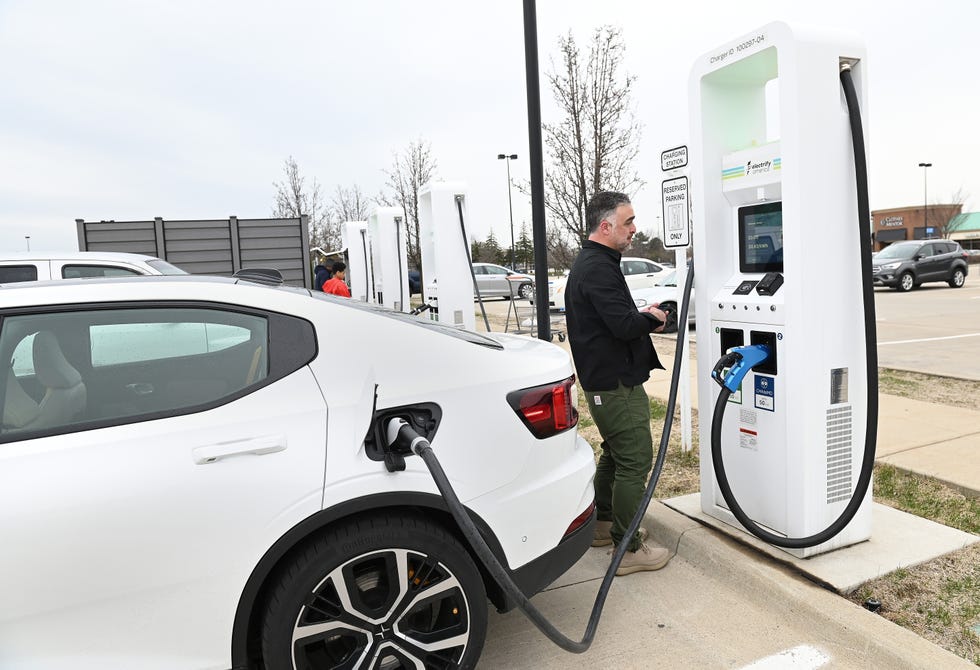
Owners who use their vehicles for local commutes, like Farmington Hills’ Alex Alexanian, have little to worry about.
“It’s been pretty good day-to-day, I’d estimate 10-15% drop. I haven’t been doing many long trips,” said Alexanian, who drives an AWD Polestar 2 locally and prefers a gas-hybrid Toyota Sienna hybrid for longer journeys. “On the really cold-snap days, I did watch my range drop more significantly, but that was near zero degrees.” An EV fan, he’s put in an order for a Rivian pickup.
I’ve found Kia models to be more accurate in terms of range no matter the temperature. The Kia EV6 won the 2023 North American Utility Vehicle of the Year (I’m a juror) due to its stylish design and quick-charging, 800-volt platform. The EV6 GT — the $63,000 performance model of the EV6 line — lost about 30% of battery during my cold February test.

Unfortunately, the EV6 GT has but 206 miles of range (compared to 276 miles for its sibling, EV6 AWD vehicle that I drove this summer), so it’s not built for long trips. But like many EVs coming on the market, it tries to adjust its range for temperature and driver style. And it offers clever features — an ECO drive mode and five regenerative modes — to help squeeze a few more miles out of the battery.
I charged the EV6 GT at my home overnight on a 240-volt wall charger to 100% capacity, but — anticipating the cold — the Kia indicated I’d get just 186 miles (90%).
Even that proved optimistic for my mixed driving (interstates, surface streets) over the next two days in temperatures that swung from 20-40 degrees. In 70 miles of travel, I took 100 miles off the battery.
Henry Payne is auto critic for The Detroit News. Find him at hpayne@detroitnews.com or Twitter @HenryEPayne.
Ford saddles up Bronco to ride in the Super Bowl of American off-road racing
Posted by Talbot Payne on February 19, 2023
Johnson Valley, California — Late January in Florida means the start of the sports-car racing season on the high banks of Daytona International Speedway. Some of the auto industry’s greatest brands — Acura, Audi, BMW, Cadillac, Chevrolet, Ferrari, Ford, Honda, Lamborghini, Lexus, Porsche — field 24 Hours of Daytona racers in a demonstration of cutting-edge technology and raw speed.

But on the other side of the continent another epic, late-January endurance race is emerging as a manufacturer test. Except this race features SUVs on the high dunes of the Mojave Desert.
King of the Hammers is America’s greatest off-road race and an emerging battlefield for brand supremacy as SUVs now dominate the vehicle marketplace. Ford Motor Co., which has made a name for itself in sports-car racing with Ford GTs and Mustang GT4s, is determined to make King of the Hammers its playground, too.

Just a week after a Mustang GT4 dominated the production-based Pilot Challenge race at Daytona, Ford swept the podium in the production-based 4600 Class here for the second year in a row. With 100,000 spectators in attendance (compared to 50,000 at the Daytona 24 Hour), three Broncos put their stamp on the week, beating out competitors in Jeeps and Toyotas.
“The style of racing is very different, and the vehicles that do the racing are very different, but what’s common is the passion of the fans,” Ford Performance chief Mark Rushbrook said here. “Whether we’re talking to a Mustang fan at Daytona or a Bronco fan out here, it’s great to be able to connect with (fans) and show them what we are doing for the future.”
In its 17th year, the Progressive King of the Hammers Powered by OPTIMA Batteries attracted record crowds over its two-week auto-palooza, with 2 million watching the races online. They saw a buffet of off-road racing from Can-Am all-terrain vehicles to motocross bikes to modified production utes to the 800-horsepower, all-wheel-drive monsters in the ultimate 4400 class. Some call it the Super Bowl of U.S. off-road racing. Others dub it Woodstock meets Thunderdome.
“It’s the Super Bowl if the Super Bowl had football, soccer — then throw in hockey and couple of other sports,” said Hammers board member and CEO of Detroit 4fest Tom Zielinski, who is working on a new, electric vehicle Hammers class. “It brings together everyone who is an off-road racer and puts them all in one place. Some of the classes are amazing — you got to give love to the 100 class, which is full of old desert buggies.”
Whatever the moniker, King of the Hammers is more than an off-road rally — it’s a cultural event.

Located an hour north of Palm Springs off the appropriately, quirkily-named Old Woman Springs Road, Johnson Valley’s 96,000 acres of Bureau of Land Management desert is transformed each January into a sprawling paddock of competition vehicles surrounded by an expanding ripple of mobile homes, trailers, camping tents and hospitality tents.
Think of Daytona’s sprawling, 180-acre infield, but without the boundaries of its 3.6-mile “roval” course. And without Lake Lloyd in the middle. Indeed, there is no water to be found, and Hammers founder Dave Cole and his team are essentially mayor and city council creating the infrastructure for a small metropolis to function.
Hammertown’s sands are a hive of activity as police cruisers and trucks carrying water, food and gas share the makeshift streets with fans. By event’s end, every person and vehicle wears a cloak of dust.

It’s America’s biggest desert auto show. Brand activations litter the paddock including Polaris, Can-Am, Yokohama, Nitto tires, Toyota and more. Ford found it an irresistible opportunity to both connect with customers and to develop off-road technology.
“(Hammers) became of interest to us about five years ago,” said Rushbrook. “The 4400 class is like Daytona prototype class — but the class we’ve spent a lot to time developing is the 4600 class, which is based on a stock Bronco, and you’re allowed to make some modifications to it. It’s like a Mustang GT4 or GT3 that begins with a production body. It gives us the opportunity to show how the foundation of the Bronco is suited for this kind of racing.”

If Wrangler has become synonymous with crawling over Moab, Utah’s red rocks at the annual Easter Jeep Safari, then Bronco is determined to be Hammers’ favorite tool. Ford is the official automaker for the event and the Bronco racing team’s success gets attention.
“I saw Bronco win 1-2-3 last year and I thought — wow! — that’s my car,” said Bronco owner Alberto Herrera, 35, a San Diego-based computer game designer who traveled to Johnson Valley with friends.
Herrera’s pals hooked him on off-road racing at which point Ford’s “cool new toy” got his attention. “I traded in my BMW X5 for the Bronco because I couldn’t take the BMW out here. I needed an off-road vehicle to go to the races.” Herrera’s Wildtrak model is equipped with a Fox shock package inspired by the race shocks on Ford’s 4600-class competitor.

Some of the vehicles that fans bring to Hammers are as colorful as the 1,000-plus, multi-class racing entries. Races start and finish in the valley, then fans jump into their side-by-sides, pickups, Wranglers, and Raptors and chase the action around Hammers’ 70-mile long course, which includes high-speed desert runs (the 4400 class will hit 150 mph) to tortuous rock ravines where even the toughest vehicles need winches to crawl over giant boulders.
In the feature NITTO Race of Kings 4400 Class race Feb. 11, only 33 of 104 competitors finished, so brutal is the terrain.
Unlike Daytona, where the race course is for competitors only, fans can put their own vehicles to the test when class racing ends each day. Indeed, when the sun sets behind the San Bernardino Mountains, the action is just beginning.

“It gets wild,” said Apple Valley, California, native Jaclyn Robbins, 27, from the seat of her 2021 Can-Am Maverick ATV. “People come out at night in their own cars and just break stuff.”
While some fans stay in Hammertown to watch fireworks, eat or head to the concert stage to listen to bands like Sublime and Mama Foxxy & The Whiskey Gypsy Rebels, others make for formidable boulder canyons with names like Chocolate Thunder and Backdoor to watch racer-wannabes climb the trails.
“We’re mostly here for the after-race. It’s controlled chaos,” said Robbins’ husband, Lance Robbins, 32. “We just love to come out here and hang out with our families.”

An endless line of off-road mods lines up to conquer Backdoor’s formidable rock wall. Engines roar, 40-inch tires spin, tube frames flex. Some make it up, other flip on their backs like turtles.
“Everyone thinks they have that special thing. And when the racing ends, you can find out how good you are and where your talent runs out,” Zielinski said with a laugh.
For Ford, it’s all business.
When the Ford team isn’t taking drivetrain and suspension learnings from the Hammers classroom, it’s entertaining customers in its paddock display booth and Bronco Nation paddock.

This year, the Blue Oval debuted a special King of the Hammers Bronco — complete with 4-inch lift and special Fox dampers — and showed off its first Bronco DR turn-key racer to customer teams. Ford brings a full feet of partners and drivers to communicate the brand.
“We have great drivers like two-time (4400 class) winner Loren Healy, 4600 class champion Jason Scherer, Vaughn Gittin Jr., Bailey Cole, Brad Lovell. Brad had been a great partner for us in developing the Branco Raptor, F-150 Raptor, Bronco 4600, Bronco DR — and he raced Ranger Raptor for us at (last year’s) Baja 1000. Everywhere we go racing, we need great partners, great people.”
Henry Payne is auto critic for The Detroit News. Find him at hpayne@detroitnews.com or Twitter @HenryEPayne.
Payne: Racing across the desert in the ferocious Ford Bronco DR
Posted by Talbot Payne on February 16, 2023
Johnson Valley, California — I swung my body over the door sill, strapped myself into the molded seat with a five-point safety belt and gripped the steering wheel with Nomex gloves. Exploding forward, I watched for the dashboard Christmas lights to blink red before upshifting, the engine’s controlled violence shaking the roll cage around me. Feels like a race car. Sounds like a race car.
Except I am sitting 12 inches off the ground and slinging sand with all four of my 37-inch BF Goodrich all-terrain tires.
Welcome to the cockpit of the Bronco DR, Ford’s first purpose-built racing SUV. DR for Desert Racer. Dearborn’s automaker was born on the race track — Henry Ford raised capital by impressing investors with his vehicles’ performance capabilities — and the company has consistently used competition to hone technology and showcase its brand.
But the DR is something new. Where Ford has long made purpose-built Mustang dragsters and GT sports cars for customer teams to conquer legendary American asphalt tracks like Pomona and Daytona International Speedway, Bronco DR is made for dirt trails. Epic dirt trails like the SCORE Baja 1000 or the King of the Hammers here in California, where I got a brief taste of what it’s like to go off-road desert racing.
“This is a ground-up build,” said Ford Performance boss Mark Rushbrook of the turn-key customer racer that follows the Bronco R prototype Ford raced in the 2019-20 Baja 1000s. “(We’ve created) a desert racer that is competition-ready coming out of the factory — something Ford has never done before.”

WAAARRGGH! WHUMP!
On an undulating desert trail, I powered over a large mogul — lifting off the throttle to reduce stress on the V8-powered drivetrain as I sailed 30 feet through the air. The DR stuck the four-point landing and I was on the gas before the next whoop. Unlike my native sports car racing, where the throttle is treated like an ON-OFF switch as I maintain max revs over billiard-smooth race tracks, off-roading is constant modulation to navigate the ever-changing terrain of Mother Nature.
It’s a different discipline than on-road racing.
Later in the day, I rode shotgun with Vaughn Gitten Jr., a Ford factory racer who pilots a similar-to-the-DR #2565 Bronco in the Hammer’s 4400 racing class. Like me, Gitten was raised on asphalt racing, and he’s a drift-racing legend as a two-time Formula Drift champion. He’s taken on a second career as an off-road pilot.
As we charged across the landscape, I remarked how desert racing seems to involve little drifting.

“Yeah, these cars have to navigate everything from sand to rocks to rough moguls, so ride-height and shock travel is key,” said Gittin through his helmet microphone. “It’s all about tire placement. But give me a steering wheel and four tires and I’ll figure it out.”
To help off-road racers figure it out, the Bronco DR is a completely different weapon than, say, the Mustang GT4 that I watched win the IMSA Pilot Challenge at Daytona two weeks before.
Like Mustang, Bronco is designed for production-based class racing, so it starts life as a “body-in-white” at Bronco’s Wayne Michigan Assembly plant. Then it gets the VIP treatment. The chassis (Ford Performance has made 50) is shipped to Multimatic in Toronto — the same race shop that screwed together Ford’s historic Le Mans-winning GT and now produces Mustang GT4 and GT3 race cars. DR is then assembled with a Frankenstein’s parts list to make it an off-road monster.

While aesthetically similar to the production SUV, the DR’s fiberglass body panels are new and wrapped around a steel roll cage to protect drivers like me and my co-pilot: off-road Hall-of-Famer Curt LeDuc. The all-wheel-drive chassis sits on big, sophisticated spool-valve Multimatic shocks and bead-locked 37-inch BF Goodrich Mud-Terrain T/A tires. The rear differential is taken from the F-150 pickup, the front from Bronco. Under the hood? A 5.0-liter Coyote V-8 out of a Mustang paired with a 10-speed F-150 transmission.
Gittin suggested leaving the transmission in automatic mode rather than use manual paddle shifters, so sophisticated is the 10-speed at managing torque. Given the severity of the terrain, the drivetrain prefers low revs for easier transitions — not the constant winding of the drivetrain to redline as in a sports car.

“Smoothness and reliability are rewarded on off-roading,” said my navigator LeDuc as we bounced across a desert washboard of moguls. “Easy throttle, off the brake.”
I preferred the automatic shifter, keeping revs low at 2,000-3,000 rpm. That was just fine by the Coyote V-8, which is built for low-end torque. The exception was deep sand. There, the V-8’s 400-plus horsepower came in handy — WAAAURRGH! — to keep from bogging down.

Notably, Ford chose not to go off-road racing with its first electric SUV, the Mustang Mach-E. EVs suffer in extreme environments like deserts where temperatures and constant throttle wreak havoc on battery range. There’s also a dearth of, um, charging stations.
The Bronco DR’s massive 65-gallon gas tank is key to getting it around Hammer’s 70-mile laps or 300-mile-long stages in the Baja 1000.

In time, I bonded with my bucking Bronco, learning its steering and braking habits. Unlike razor-sharp on-road racers, DR is designed for variable terrain with its shock absorbers and locking diffs. Oh, those shocks!
The Multimatics are remarkable in their ability to absorb off-road punishment (my spine says thank you) while also firming for high-speed, 100-mph dry lake-bed runs. “Spool-valve shocks are a game-changer,” said Gittin of a technology that originated in Formula One racing. Improving the production Bronco Raptor’s performance by over 50%, Bronco DR boasts ridiculous 15.8-inch front and 17.4-inch rear suspension travel.
The 6,200-pound beast also stands out with an approach angle of 47 degrees, departure angle of 37 degrees and 33-degree breakover angle while maintaining the production Raptor’s 74-inch front and 73-inch rear tracks for firm footing.

Johnson Valley is the natural habitat for Bronco Raptors and DRs, where engineers spent countless hours testing equipment.
My DR test complete, I headed back to Hammers base camp in an orange production Raptor. I rotated the drive mode dial to Baja and charged onto similar trails I had just run in the DR. True to its mission as an all-around beast, the Raptor was not sprung as stuffily as DR, so I couldn’t take moguls at the same speed lest I become a four-wheel pogo stick.
But the Raptor was still impressive and a lot more comfortable than the off-road racer. And when we arrived at Hammertown, I could simply open the door to exit.
Next week: 2022 Genesis G80
Ford Bronco DR
Vehicle type: Front engine, four-wheel-drive, two-passenger racing SUV
Price: $295,000
Powerplant: 5.0-liter V-8 engine
Power: 400-plus horsepower
Transmission: 10-speed automatic with shift paddles
Performance: 0-60 mph, NA; top speed, 105 mph
Weight: 6,200 pounds
Report card
Highs: Shocks from the gods; V-8 roar
Lows: As comfortable inside as a cement mixer
Overall: 4 stars
Henry Payne is auto critic for The Detroit News. Find him at hpayne@detroitnews.com or Twitter @HenryEPayne.
Payne: Handsome, hybrid Honda Accord accelerates toward electrification
Posted by Talbot Payne on February 9, 2023
San Diego — My 2023 Honda Accord is a looker. From its smoky headlights to its streamlined shoulders to its fastback roof, it is the most handsome sedan Honda has made.
But like the serene blue of the Pacific Ocean out my side window, the Accord’s smooth red surface belies the turmoil beneath.

In the U.S., state and federal governments are forcing automakers to go electric and Accord, America’s best-selling retail sedan, is on the bleeding edge of what that transition looks like. Now on dealer lots, the Accord has juggled its lineup in order to satisfy government rules, focusing its 11th-generation model on a hybrid-electric powertrain in order to encourage customer adoption.
The hybrid option has accounted for roughly 10% of Accord sales, but Honda is narrowing the choice of drivetrains to meet an ambitious goal of 50% hybrid adoption for its new model and avoid looming federal and California fines coming with 2026 regulations.
Gone is the 2.0-liter, 252-horsepower turbo-4 liter engine beloved by performance enthusiasts. While the sedan’s 1.5-liter turbo-4 did volume sales, the beefy 2.0-liter and hybrid offered a fork in the road: an option for performance buyers and one for green customers. Like the hybrid, the 2.0-liter served a passionate niche for about 10%-of-volume with Sport, Sport L, EX-L and Touring models. Now Honda will only offer its 204-horsepower hybrid in upper trims, hoping to keep enthusiasts in the fold with a combination of style, handling, torque and gobsmacking 44 mpg fuel economy.
My crimson, black-trimmed Sport L (L for leather interior) is one saucy sedan.
I was already smitten by the 10th-gen Accord that arrived in my driveway in 2017 like Taylor Swift’s “Midnights” album: A blockbuster. The car’s athletic stance, fastback and hot wheels — even the sculpted, horizontal interior — rivaled the BMW 3-series that I was also testing.

The last-gen Accord’s big black maw was the only dissonant note in the visual symphony. Honda designers have fixed that for the new model. The spare grille is now in sync with the rest of the sculpture, punctuating the thin headlights (different than the last-gen, jewel-like LED peepers). The Accord is a front-wheel-driver per tradition, but it looks like the rear-wheel-drive Bimmer with that long hood and fastback settled over its haunches.
At a time when the Lucid Air and Tesla Model S are setting industry style with spare, simple lines, the Accord fits right in. The rocker panels have been cleaned up, the door handles stripped of keyholes, the rear taillights integrated seamlessly into the bodywork. Body by Jake.
As readers of this column know, I’ve been writing about the shrinking gap between luxury and mainstream vehicles for some time. Why pay a premium price when a mainstream badge delivers the same style, tech and power for thousands less? Mazda CX-5, Kia Stinger and VW Arteon are vehicles that can compete on spec with luxury vehicles in their segment.
The 252-horse Accord was such a car, its performance on par with a turbo-4-powered Bimmer 5-series costing 20 grand more. No more. The Accord’s 204-horse hybrid and 181-horse turbo-4 are solid mainstream numbers similar to competitors Hyundai Sonata and Toyota Camry.

Honda’s customers are largely unaware of the extreme regulatory pressure automakers are under. So it’s up to Honda to make the regulations seem as unobtrusive as possible even as choices dry up for the internal combustion engines customers prefer.
In Honda’s favor: governments are forcing ALL brands into similar battery-powered drivetrains. So luxury makers are also fast losing what differentiates them: sophisticated, smooth, inline-6 cylinder and V-8 drivetrains.

Accord wants to use the hybrid as a bridge to electric propulsion, and it deploys some cool tech to hook you.
I exited my hotel parking lot north of San Diego on battery power just like my Tesla Model 3. Assuming moderate temperatures and light right-foot application, Accord will stay in EV mode until about 25 mph, at which point the 2.0-liter, inline-4-banger kicks in. EV MODE text lights up the lovely digital instrument display alongside a battery indicator to emphasize the point.
Honda has stuffed the Accord with insulation so it’s quieter than ever and the transition to gas power is smooth. There are still paddle shifters on my Accord Sport — but they are no longer for shifting gears. Instead, I used electric motor regeneration with the hybrid’s single-speed transmission.
That’s right, the Accord Sport Hybrid now has regen paddles like a Chevy Bolt. Cruising the San Diego ‘burbs, I managed one-pedal driving like a Bolt or Tesla (though the Honda won’t come to a full stop on regen like those pure EVs).

Entering Interstate 5, I matted the accelerator and the Hybrid squirted into traffic like an EV, using the electric motor’s substantial 247 pound-feet of low-end torque. The combination of no gearbox, electric torque, ECO mode and whisper-quiet cabin gave a distinctive EV feel.
Exiting I-5, I headed into the mountains toward two of my favorite places: Julian Pie Company (the Traverse City Pie Company of the left coast) and the California 78 twisties that get you there. I toggled SPORT mode — which firmed the steering and provoked a growl from the engine, and plunged in — leaving the REGEN paddle on full for initial brake assist as I charged into corners. GRRRRRR.
Like the artificial growl of a BMW i4 EV, but with one big difference: the Accord Hybrid has a massive, 560 miles of range with gas infrastructure that is the bane of electric vehicles. Like forcing Americans back to wired, landline phones from wireless cell phones, the EV transition will be difficult.
Driving the Accord is anything but. The sedan is typically intuitive, now aided by front-wheel torque-vectoring that makes turn-in even sharper. While sister CR-V SUV shares similar drivetrains, the Accord Sport is a reminder of why we love sedans.

The interior is a dead ringer for the CR-V with Honda’s beautiful — and ergonomically efficient — honeycomb-accented dash layout complete with wireless Apple CarPlay and Android Auto (the base, LX and EX models still require wires), crisp adaptive cruise controls, roomy console storage and multi-functional digital instrument and infotainment displays standard at an affordable $29K. Check out my favorite cloth-seat Sport model with wireless charger (so you don’t drain your battery with wireless navigation) and you’re out the door for $33,795.
Miss the 2.0-liter gas engine? It’s right next door on the showroom making a steroid-fed 315 horsepower in the roomy Civic Type R. It’s good to have choices.
2023 Honda Accord
Vehicle type: Front engine, front-wheel-drive five-passenger sedan
Price: $29,485, including $1,095 destination fee ($35,425 Sport L and $38,985 Touring as tested)
Powerplants: 1.5-liter, turbocharged inline-4 cylinder; gas-electric hybrid with 2.0-liter inline-4 cylinder and electric motor
Power: 181 horsepower, 192 pound-feet torque (turbo-4); 204 horsepower, 247 pound-feet torque (hybrid)
Transmission: Continuously-variable transmission (turbo-4); Single-speed transmission (hybrid)
Performance: 0-60 mph, 7.1 seconds (hybrid, Car and Driver); range, 563 miles (hybrid)
Weight: 3,488 pounds (Sport L Hybrid as tested)
Fuel economy: EPA est. mpg 46 city/41 highway/44 combined (Sport L Hybrid as tested)
Report card
Highs: Lovely inside and out; sharp handling
Lows: Wireless smartphone apps not offered on entry-level trims; fewer engine choices
Overall: 3 stars
Henry Payne is auto critic for The Detroit News. Find him at hpayne@detroitnews.com or Twitter @HenryEPayne.
Payne: What a Ford vs. GM F1 rivalry would look like
Posted by Talbot Payne on February 4, 2023
Ford Motor Co.’s blockbuster announcement Friday that it is re-entering Formula 1 racing after 20 years and partnering with the Red Bull team sets up an epic rivalry with crosstown rival General Motors Co. and Andretti Autosport on the world’s biggest, priciest motor racing stage.
Assuming GM and its partner get approval to enter the sport.
The two Detroit automakers are entering F1 at different levels — Andretti and Cadillac (GM’s designated brand for the series) is like an expansion team building from the ground up, while Ford is partnering with the reigning F1 champion Red Bull and its superstar driver, Max Verstappen.

Andretti Cadillac’s application to enter F1’s 10-team, 20-car field has been controversial as existing teams debate sharing profits with another franchise. “We expect to have a decision soon from Formula 1,” said Michael Andretti, CEO of Andretti Global, at the 24 Hours of Daytona last week.
Red Bull, on the other hand, is one of the sport’s titans, battling it out with Mercedes in recent years for F1 racing hegemony. If approved, Cadillac and Ford would go head-to-head — with other manufacturer-sponsored teams including Alfa Romeo, Renault and Ferrari — across 23 grand prix events on five continents trailing a train of private jets, shipping containers and semi-trucks in the world’s most exotic circus before a global television mega-audience of 445 million people.
“Ford-Red Bull and GM-Andretti is like comparing a tech giant like Apple with a startup,” said Charles Bradley, veteran Formula 1 authority and global editor-in-chief of Motorsport.com. “Ford will expect to be competing for race wins from the start, with proven multiple world champions, while GM will likely suffer all the pitfalls associated with a team that’s new to F1.”

Partnership aside, GM and Ford want into F1 for the same reasons: 1) because the sport’s fastest-growing audience is in the United States thanks to the ownership of U.S.-based Liberty Media, the hit Netflix series “Drive to Survive,” and three grand prix in Miami, Austin and Las Vegas, and 2) because F1 is an opportunity for manufacturers to develop state-of-the-art hybrid engines and synthetic fuel technology as the industry focuses on electrification.
The Red Bull-Ford announcement was made at a glitzy event in New York City where Red Bull unveiled the livery for its 2023 season car featuring title sponsor Oracle Corporation. Ford’s official partnership with Red Bull would not take place until the 2026 season as Red Bull is currently using a Honda powerplant. Honda’s decision not to renew its contract after 2025 set off a frenzied mating dance between Red Bull and other manufacturers.
The 2026 season brings significant regulatory changes to Formula 1 as the sport moves toward a fully-electric future. Teams will use complex hybrid units that drink synthetic fuels and split their ferocious, 1,000 horsepower 50-50 between a V-6 gas engine and 350kW electric motor. That dovetails with industry and government ambitions for more electrified production drivetrains. Among Red Bull’s suitors was Porsche, but Ford got the nod.
The announcement was made by Ford CEO Jim Farley, himself a passionate driver who competes in amateur racing. The players at the helm of Ford and GM are an important factor as the companies make financial commitments to a sport where over $1 billion is required to develop a powerplant and top teams consume $500 million annual budgets.

GM President Mark Reuss is also a passionate race fan — and competition-licensed driver — who conspicuously made Cadillac’s entry into F1 public last month.
Ford Executive Chairman Bill Ford is also a passionate race fan, in keeping with the racing culture that helped his great-grandfather, Henry Ford, attract investors a century ago.
“This is the start of a thrilling new chapter in Ford’s motorsports story that began when my great-grandfather won a race that helped launch our company,” the great-grandson said.
At last fall’s Detroit auto show introducing the new Mustang, Ford’s executive chairman took the mike to announce the pony car would go head-to-head against Corvette for world V-8 supremacy at the 24 Hours of Le Mans in France in 2024.
“Mustang will go back to Le Mans,” he cheered. “Once again, we will Go Like Hell.”
A committed environmentalist, Ford also sees his legacy as making the company a global leader in battery-powered tech just as his great-grandfather won the gas-powered battle with the Model T.

The pieces of Ford and GM investment in F1 technology are still coming together.
The shock of losing Honda, its engine supplier, focused Red Bull on building its own in-house unit like chief rival Mercedes. The race team is already well down the road to making a powerplant that conforms with ‘26 rules. That works with Ford’s desire for a strategic partnership — not a capital-sucking, multibillion-dollar engine development program. Ford abandoned its last partnership in Formula 1 — with Jaguar — when it couldn’t justify costs.
“Ford has taken a route that Porsche rejected, becoming a partner with Red Bull on the engine supply side but not the ownership of the entire engine project as the guys in Stuttgart insisted,” said Motorsport’s Bradley. Ford says it will provide technical assistance in all areas like “engine development … battery cell and electric motor technology, power unit control software and analytics.”
GM’s path is less certain, but it is not approved by the FIA (F1’s governing body) to develop a full-power unit. Instead, intriguingly, it may buys its engines from Honda, which will stay in Formula 1 as an independent engine contractor.
Andretti Cadillac is “taking a very brave approach, and it should be braced for pain, while Ford should have a far smoother entry,” said Bradley.

Honda, Red Bull, Mercedes and Audi are already on the list of FIA-approved engine suppliers for 2026. Given GM’s partnership with Honda in electric vehicle development, it would be a natural for Andretti Cadillac to badge a Honda powerplant.
“Honda will no longer be Red Bull’s partner from 2026. However, it has been approved by the FIA to produce its own 2026 power unit, so I assume this will be the motor that’s rebadged as GM — just as we’ve seen them partner in EVs,” said Bradley.
The good news for GM is that Ford’s entry makes it more likely that F1 will approve Andretti Cadillac’s application. With the exploding interest in the U.S. market, two American manufacturers would be icing on the cake.
“Having both American automotive powerhouses in F1 will really push its needle,” Bradley said. “The real resistance to Andretti-GM comes from the selfishness of rival F1 teams. I think everyone else sees it as a good thing.”
Henry Payne is auto critic for The Detroit News. Find him at hpayne@detroitnews.com or Twitter @HenryEPayne.
Payne: Darth Vader’s Lexus RX350h rolls out some interior hospitality
Posted by Talbot Payne on February 4, 2023
Southfield — The Lexus RX has been a standout SUV for better or worse. And its 2023 makeover is largely for the better.
Long the best-selling SUV in the midsize class, the vanilla RX went full sci-fi goth with its 2016 extreme makeover. What emerged from the changing room was the Bride of Darth Vader. Huuuuge spindle grille, broad shoulders, menacing headlights … what, no cape?
It was even more polarizing inside with a touchpad-operated center infotainment screen that had Mrs. Payne running from the cabin in frustration. It was nearly impossible to use on the road with your finger bouncing all over the interface, and the hearing-challenged voice-recognition command system wasn’t a viable alternative. I expected the Lexus faithful would reject this style ‘n’ ergonomic heresy en masse.

But like a patient spouse in a loving marriage, customers just shrugged off the inconvenience as a phase Lexus was going through.
“I love my dealership,” said a Chicago friend even as she admitted she didn’t bother to use the maddening screen controller. “They treat me like family.”
On such standout service is Lexus built, and it helps weather its designers’ more extreme urges. Sure enough, Lexus owners’ patience has been rewarded with Vader, Part 2.

The spindle grille is just as prominent as ever, but — like shoulder-length hair braids in the NFL or Jennifer Grey’s nose job — you get used to it over time. And Lexus designers have softened its look with a hood cap that better integrates the face with the rest of the RX’s sculpted bod.
When I emerged from Zoup! in Southfield with my favorite lobster bisque for lunch, RX stood out in a sea of dark and white SUVs. The blingtastic grille was right at home amidst Southfield’s shiny golden towers. The body has more surfaces than a Frank Gehry building (maybe Gehry is the secret designer?), yet somehow it all works together with a full-width taillight punctuating the sculpted rear tuchus.
Inside is where Lexus has really made strides over the previous-generation vehicle.

RX has flushed the misbegotten touchpad for a proper touchscreen — which has also made for a better organized console for cupholders, phone storage and driving mode buttons. My RX350h hybrid tester featured the optional 14-inch center screen and is an ergonomic standout with big climate controls, volume button and prominent STARTER button in the northwest corner.
It’s the rotary climate controls that grabbed me first. Concave and colorful, they are among my favorite dial designs in the industry. A single volume knob splits them under the infotainment screen.
The screen can’t match best-in-class graphic designs from the likes of BMW or Jeep’s Uconnect, but it is state-of-the-art with wireless Apple CarPlay and Android Auto. And state-of-the-art with voice commands. Where I might as well have been talking gibberish to the last-gen system, the new Lexus translated my southern drawl navigation commands every time.
Navigate to MJR Theater in Troy.Navigate to Uncle Joe’s Chicken in Southfield.Navigate to QuikPark in Romulus.
This being a Lexus, of course, the RX can’t be content with convention. Never mind the touchpad controller disaster, designers are determined to experiment with new toys.

The squeeze-open handles are beautifully done for entering the SUV. And the armrest push buttons upon exit are nearly as easy. More problematic is the automatic shifter that always demands a left notch to negotiate the gear you want. It’s fussy at first, but with time you can master it.
But, Lexus, I draw the line at the touchpad steering wheel controls. Yes, yes, I see what they are trying to do there. Designed in coordination with the head-up display so you never have to take your eye off the road, the touchpads nevertheless are distracting (Lexus isn’t alone. Mercedes has tried similar, quirky steering wheel touch-pads) as you try and coordinate their commands with what you see in the head-up display.
Simple rollers to adjust adaptive cruise control speed work perfectly, thank you very much.

Otherwise, the interior is comfortable and well executed with plenty of rear leg and cargo room. On an airport run, the RX350h swallowed a large suitcase, two carry-on bags, a tennis bag and commuter bag without infringing on the second row. Second-row passengers are encouraged to infringe on the cargo space with reclinable seats.
Oh, did you want to hear about the powertrain? I nearly forgot.
The RX offers three drivetrains — base RX turbo-4, RX350h hybrid (my tester) and RX500 hybrid. The latter boasts a range-topping 366 horsepower, but somehow I doubt you’ll notice. The Lexus is intent on getting you to your destination unruffled, not tempting you to carve apexes like a Bimmer X5 or Mazda CX-50.

The hybrid’s continuously-variable tranny can be mildly annoying as it operates the turbo-4, but the cabin is quiet enough and the acceleration competent enough. I was quickly disabused from trying to lean on the door handles through Oakland County’s rural twisties, but the Lexus won’t let you down if you need to merge with authority onto the I-696 drag strip. In all-electric mode at slow speed around the MJR parking lot, the RX350 was positively pleasant.

Which generally sums up the Lexus RX experience. When I last spent a week in an RX driving to West Virginia and back with Mrs. Payne, we had no interest in spending any more time in the luxury SUV than needed. My wife physically cringed whenever I tried using the touchpad. No more. With clever touches like the door handles and interior ergonomics, I looked forward to driving the RX.
Just as Lexus owners have looked forward to their dealership experience for years.
Next week: 2023 Honda Accord
2023 Lexus RX 350h
Vehicle type: Front engine, all-wheel-drive, five-passenger SUV
Price: $48,550, including $1,150 destination fee ($58,755 Premium + AWD as tested)
Powerplant: Gas-electric hybrid with 2.5-liter inline-4 cylinder and rear electric motor
Power: 246 horsepower, 233 pound-feet torque
Transmission: Continuously variable transmission (CVT)
Performance: 0-60 mph, 7.4 seconds (mnftr); towing, 5,300 pounds
Weight: 4,450 pounds (as tested)
Fuel economy: EPA est. mpg 37 city/34 highway/36 combined (est.)
Report card
Highs: Much improved touchscreen; good interior ergonomics
Lows: Polarizing exterior; confounding steering-wheel controls
Overall: 3 stars
Henry Payne is auto critic for The Detroit News. Find him at hpayne@detroitnews.com or Twitter @HenryEPayne.
Payne: In Daytona’s high-stakes, high-speed classroom, lessons learned for Penske, Porsche, and Cadillac
Posted by Talbot Payne on February 4, 2023
Daytona Beach, Florida — You’re never too old to learn.
At 85, Roger Penske is an auto racing legend. His Bloomfield Hills-based Team Penske has won a staggering 18 Indy 500s, 17 IndyCar championships and three NASCAR titles. This year, Motown’s winningest race team and Germany’s most successful performance brand, Porsche, have teamed up for an assault on the sportscar racing record books. Nothing short of world domination is the goal for Porsche Penske Motorsport. But experience matters, and Porsche Penske haven’t teamed up in endurance racing for 15 years.
In the first race of the gas-electric hybrid sportscar racing era last weekend, it was Acura and Cadillac — veteran endurance racing programs — that dominated the Rolex 24 Hours of Daytona over Porsche and BMW.

Backed by formidable engineering know-how, Acura and Cadillac have combined to win the IMSA Weathertech SportsCar Championship for the last seven years. Despite all-new cars for 2023 — and breakneck programs to develop them over 12 months — this year looked a lot like last as Acura and Caddy swept the podium. Acura and its Meyer Shank Racing team won for the second year running (Acura for the third year in a row), its ARX-06 dominating Daytona, taking pole and contesting the race lead throughout.
Like a thoroughbred pacing the field, the #60 Acura — with star jockey Tom Blomqvist at the wheel — pulled away down the home stretch over its sister Wayne Taylor/Andretti Autosport Racing car. A trio of thundering, V-8-hybrid Cadillac V-LMDh prototypes rounded out the Top Five, leaving Porsche and BMW in the dust.
“Massive respect to our competitors. They’re world class, we’re world class. These are the biggest companies in the world,” said Honda Performance Development President David Salters, whose California-based team makes the powertrains for Acura’s IMSA GTP racers and Honda-powered IndyCar teams. “Between us (and) General Motors, we’re game fit. Match fitness, I think, is the right word.”

That two of the world’s most revered performance brands struggled is a testament to the demands of race-car development. Teams expected attrition with the new, complex hybrids and Porsche and BMW took the brunt of it.
The BMW M Hybrid V-8, managed by Team Rahal Lanigan Letterman, suffered an early setback, going back to the paddock garage to replace its electric motor unit. Of the two Penske entries, the #6 Porsche 963, would soon follow — replacing its battery pack. Even the Acuras experienced difficulties as oil, gearbox, and electrical gremlins frayed nerves. In the end, the #7 Porsche finished 14th overall, 34 laps back while the #6 car — showing good pace relative to the Acuras — retired on Sunday morning with gearbox failure.
Porsche and Penske know experience breeds success, and they are in sportscar racing for the long game.

“We will learn quickly and we will have answers and results from all the issues we had,” said the director of Porsche’s GTP program Urs Kuratle. “There were a lot of firsts, issues we never had before … even though we did (18,000 miles of testing) before the actual race.”
The 2023 season has opened a new world to manufacturers and sportscar racing as international sanctioning bodies — IMSA in North America and FIA abroad — agreed on common rules enabling brands to fly their flags across multiple continents from Daytona’s high bankings to the 4-mile Mulsanne straight in Le Mans, France.
The emerging, common GTP and GT classes attracted an eye-opening 17 manufacturers to Daytona, with more to follow.

Of particular focus is the hybrid GTP category, which provides crucial development — and marketing opportunities — for automakers as governments force electrification and luxury buyers crave the new, new thing. In addition to the four brand entries at Daytona, 2024 brings new teams from Ferrari, Alpine, Toyota, and Lamborghini in the GTP class; Ford in GT.
Automakers have hired a who’s-who of racing teams, including Team Penske — its boss keen to add Le Mans to his trophy case. The stakes are high, the technical challenges higher.
“This car has been soul-sucking,” said Michael Shank, Meyer Shank team boss, in reference to the standard, electric-motor system that teams had to marry to unique, V-6 and V-8 manufacturer engines. “It’s been a lot of work.”

As the Rolex 24 demonstrated, electrification adds complexity. Intriguing as e-motors are, gas engines do the brunt of the work for punishing, long-distance runs.
“Racing has always been used as a test bed for manufacturers, and (electrification) is a new technology out there, so that’s why there’s all this interest from all the manufacturers to get involved,” said Michael Andretti, CEO of Andretti Autosport, who partnered with IMSA-vets Wayne Taylor Racing on the second-place Acura in order to learn the sportscar ropes.
It’s a big classroom.

Drivers from all over the world were in Daytona, too, including IndyCar stars like six-time champ Scott Dixon of New Zealand (Cadillac team), Brazilian and four-time Indy 500 winner Helio Castroneves (Acura), Colin Herta (BMW), and Josef Newgarden and Kiwi Scott McLaughlin.
The latter pair, who compete for Team Penske’s IndyCar team, didn’t have a manufacturer ride and raced with Tower Motorsports in the LMP2 class, one of two prototype classes in addition to the manufacturer-dominated GTP and GTD classes. They called Daytona a “race-cation” — an opportunity to keep their skills sharp in the long IndyCar off-season.
But these drivers were also determined to come to terms with hybrid systems, as IndyCar will soon go hybrid as well.
Meyer Shank is the king of sportscar racing for now, with Honda-Acura proving itself as one of the world’s premier powerplant makers (it has also won the open-wheel, Formula One championship with Red Bull two years running). The development process is relentless, and they see Porsche Penske, Cadillac, et al filling their rear-view mirrors.
“That just means the others are coming,” smiled HPD’s Salters. “It’s going to be amazing, isn’t it?”

With its first Indy 500 win in ‘21 to go with three IMSA championships, Meyer Shank is a team on the rise. Fittingly, Miichael Shank is competing against Penske and Chip Ganassi (five Indy 500 wins, 14 IndyCar titles), who inspired him as team owners.
“First of all, me sitting on this stage is out of world, out of body,” said Shank at the team owners’ press conference. “These are the folks that I grew up idolizing, and I run the team very much how they run their teams.”
Henry Payne is auto critic for The Detroit News. Find him at hpayne@detroitnews.com or Twitter @HenryEPayne.
Record crowds see Acura hybrid nip Porsche-Penske, Cadillac, BMW in 24 Hours of Daytona
Posted by Talbot Payne on February 4, 2023
Daytona Beach, Fla. — After an actioned-packed, 24 hours around Daytona International Speedway’s 3.8-mile road course, an Acura ASX-06 GTP prototype took the first win of the hybrid racing era at the Rolex 24 Hours at Daytona.
Acura beat legendary performance brands Porsche, Cadillac, and BMW to the flag and denied Bloomfield Hills-based Roger Penske a win in his return to Daytona with Porsche. Another Detroit favorite, Corvette, also came up short, finishing just seconds behind the GT class-winning, Mercedes AMG-GT.

But the biggest winner this weekend was sportscar racing.
From the shoulder-to-shoulder crowds packing the paddock to an infield jammed with motorhomes and car corrals to the 17 manufacturers represented on the capacity, 61-car grid, the buzz for auto-branded racing was everywhere. The historic presence of manufacturer-supported teams has provoked talk of a second Golden Era of motorsports after the 1960s when brands like Porsche and Ferrari first came to the fore as household names.
“This is a record crowd — 50,000 people — for the Daytona 24 Hour,” said General Motors President Mark Reuss, who was glued to the action in the pit lane with one of the three Cadillac teams GM was supporting.
Reuss wasn’t the only notable here. This new sports-car Golden Era has attracted a who’s who of race names. Ahead of the Saturday’s 1:40 p.m. start, team owners Roger Penske, Bobby Rahal, Michael Andretti, Chip Ganassi, Wayne Taylor, Bob Johnson, and Michael Shank assembled for a press conference — a combined 82 championships, 17 Daytona wins, and 31 Indy 500 wins between them.
They were competing in the new GTP class featuring wicked-looking, winged, gas-electric race cars at Daytona that were the class of the field.

“I just take my hat off looking at the people here on the dais,” said Penske, who was fielding the red-and-white, Nos. 6 and 7 Porsche 963 cars. “Certainly Chip and Wayne and Cadillac have done a terrific job, and I think that with Michael Andretti coming — and Bobby — we all see this seems to be a real platform for us to take sports car racing to the next level here in the United States, and . . . at Le Mans.”
The IMSA Weathertech series has been a test bed for manufacturers for years with manufactures like, for example, GM using endurance racing to make the Corvette a world-class, mid-engine supercar on par with exotics like Porsche and Ferrari that cut their teeth in motorsports.
But an aggressive push by the racing’s governing bodies — IMSA in North America and the FIA internationally — to coordinate vehicle eligibility rules, has suddenly put sportscar racing on an international playing field allowing teams to compete with the same car for championship across the globe. That means Penske will compete this year at the world’s greatest endurance race, the 24 Hours of Le Mans — one of the few trophies he has not won in his illustrious career — with Porsche, which also wants to add to its record 19 Le Mans victories.

It also has meant an explosion in interest from auto manufacturers who see racing as an opportunity to not only improve their product but to market their brands to a global audience at time when new technologies like electric motors are peaking customer interest.
Fans like Guy Arcuri, 62, and his son Vinny, 30, from Daytona Beach, who were part of the record crowd here.
“It’s really cool to see the new technology that is changing the industry in these race cars,” Vinny said. “We knew it was coming. The challenge will be to see if these prototypes can make it to the end.”

The complicated hybrid systems — pushed hard for 24 hours by superstar drivers like Helio Castroneves and Scott Dixon — drew reliability concerns, but, in the end, eight of the nine GTP entries finished even as the Porsch and BMW teams made multiple trips to the garage for electric repairs.
Both father and son have doubts as to whether automobiles will go all-electric as governments are mandating across the globe, but they were intrigued by the combination of gas and electric.

“I like the unique sounds of each of the manufacturer engines,” Vinny said. “But I also like the performance of electric motors.”
They were treated to a barn-burner of a race as the world’s best teams and manufacturers battled just inches from one another at one of the world’s greatest race tracks for hegemony in the new era. After 24 hours at speeds often in excess of 200 mph, only about 11 seconds separated the first four finishers.
The Rolex 24 features five classes — GTP prototype, LMP2, LMP3, and GTD Pro and GTD — but the GTP and twin GTD classes are where manufacturers have the most presence. Corvette has been competitive in GTD racing for a quarter century, and announced an all-new car for 2024 this weekend, but the current car is still plenty competitive.
It was in the hunt to win the GTD Pro class from the start.

“It’s exciting that they build a production car and then race it,” said Doug Cason, 59, a firefighter from Boca Raton who bought a 2021 C8 and then outfitted it with a big rear wing and performance Z51 package. He tracks the car at Palm Beach Raceway.
“Corvette proves that they are meant to be tracked,” he said. “I’m out on track with Porsches, Lamborghinis, and Ferraris. And those cars cost three times as much as my ‘Vette.”
Echoing other fans inside the sprawling Daytona complex, he was thrilled to see the new hybrid cars General Motors is producing — whether the Cadillac GTP hybrid that finished third, fourth, and fifth at Daytona, or the all-wheel-drive, hybrid Corvette E-Ray production car that Chevy just introduced for the 2024 model year.

“You have to keep up with the times. Let’s do it,” he said. “And I like that they are separating the brands on track and racing Cadillac as a hybrid.”
Daytona residents Jim Lloyd, 60, and Andrew Chubb, 46, work at the local Lloyd Cadillac dealership and were cheering on the Ganassi and Whelan Cadillac teams as they raced into the night. The Lloyd family helped make the speedway a reality — when NASCAR founder Bill France moved from the beaches of Daytona to the race track’s high bankings.
“The visibility of racing certainly helps Cadillac as a performance brand,” Lloyd said. “We have beautiful V-series like the CT-4 and CT-5 sedans. And the hybrid class is proof of concept that racing translates to a world with electric power.”
For all the big names on pit row, it was the upstart Acura Meyer Shank team that pulled away from the field in the closing hour of the 24-hour marathon. Michael Shank has been building a powerhouse team in the mold of Penske and Ganassi.
“Me sitting on this stage is out of world, out of body,” Shank said at the owners press conference. “These are the folks that I grew up watching and idolizing and running the team how they run their teams. We’re still earning our respect.”
He was aided by Honda Performance Development, the California-based race shop that produces Honda engines for IndyCar, and now Acura mills for IMSA. Acura seemed to have the perfect formula with standout sportscar driver Tom Blomqvist behind the wheel in the last stint and pulling away from some of the world’s most most storied brands.

“This is a landmark moment,” HPD President David Salters said after the race. “If this isn’t Precision Crafted Performance (Acura’s tagline) then I don’t know what is. It’s a new age. Acura is at the pinnacle of sportscar racing.”
Daytona is only beginning with the Sebring 12-Hour to follow in March and then June’s Le Mans in France. More manufacturers are on the way as well with Lamborghini, Ferrari, and Alpine all coming into the GTP class.
And for Ford fans looking in from the outside this weekend? The Ford Mustang joins the GTD field at Daytona next January.
Henry Payne is auto critic for The Detroit News. Find him at hpayne@detroitnews.com or Twitter @HenryEPayne.