As president of Bloomfield Hills-based Penske Corp., Bud Denker runs a $39 billion global transportation services company employing more than 70,000 people worldwide in 3,200 locations.
But of particular interest to Detroit, Denker also chairs the Detroit Grand Prix, and he and his boss, Roger Penske, have a soft spot for motor racing.
This weekend, they are bringing open-wheel racing back to the downtown streets of Motown after a 32-year hiatus.
“This will be the most inclusive event our city has seen — maybe any sports event has seen anywhere — because of how we’re bringing the fans in for free,” said Denker, 64, of the 1.7-mile street circuit that will encircle General Motors Co.’s Renaissance Center. “Fans will have access to Hart Plaza for free. And the riverfront for free. And entertainment for free. I don’t know if we’re going to have 50,000 people a day or 75,000 or 100,000. We’re making the site fully inclusive.”
Denker has run the Chevrolet Detroit Grand Prix presented by Lear on Belle Isle since 2007, two years after he came on board at Penske Corp. after leaving Kodak. The return of the GP to downtown streets has created a post-COVID buzz in the city and won praise from sponsors and community leaders alike.
Bud Denker has been instrumental in bringing the Detroit Grand Prix back downtown.TODD MCINTURF, THE DETROIT NEWS
“Bud’s vision and leadership have been a catalyst in bringing this iconic race back to the streets of Detroit,” said Jim Campbell, U.S. vice president of GM Performance and Motorsports. “A constant advocate for the city and race fans alike, the Detroit Grand Prix exists in large part because of the efforts of Bud and his team.”
A native of Hastings, Michigan, Denker got hooked on racing in elementary school when he and his father watched the Indy 500 on TV and cheered local Hastings hero Gordon Johncock, a two-time winner.“From there, I just became a gearhead,” Denker said with a smile. “To make some money in college at Lake Superior State up in Sault Ste. Marie, I worked in a garage and fixed mufflers, shocks, brakes, wheels. Who would know — so many years later — I’d be with Roger Penske and live my dream of racing and running a very, very large business.”
He and “The Captain” hit it off, and Penske gave him the assignment of bringing Indy racing back to the Motor City in 2007. Recalled Denker: “The question was asked to Roger: what legacy would you like to leave behind after the (2006) Super Bowl so the city isn’t forgotten about? He said: ‘We’re going to bring racing back to Belle Isle.’”From 1982-91, the original Detroit GP hosted Formula One and IndyCar (then called CART) races before moving from downtown to Belle Isle in 1992. The island was unpopular with drivers due to unsatisfactory facilities and an uninspired track layout, and the race was ultimately shelved in 2001. But Penske wouldn’t let go.
From 2007-22, Denker and his team put Belle Isle back on the IndyCar map (with sabbaticals during the Great Recession and the 2020 COVID year). Drivers enjoyed the remade, challenging 2.4-mile circuit, and the event poured millions into Belle Isle’s infrastructure.
But Team Penske got the itch to bring the race back downtown.“The importance of racing on Belle Isle was fantastic,” said Denker. “But as I look back now, it may as well have been 50 miles from Detroit: get in the bus, go to Belle Isle, take the bus back, get in the car, leave. The impact … wasn’t enough. Now we’re downtown, and we’re impacting everything.”
Bud Denker, chairman of the Detroit Grand Prix
The importance of racing on Belle Isle was fantastic. But as I look back now, it may as well have been 50 miles from Detroit: Get in the bus, go to Belle Isle, take the bus back, get in the car, leave. The impact … wasn’t enough.
Denker decided not to recreate the old F1 track. “It cut through areas that suffocated businesses and cut them off for literally a week or two,” he said.
Now, grandstands for the circuit’s signature 180-mph back straight on Jefferson Avenue give easy access to busy, restaurant-rich Campus Martius and Woodward Avenue. A 180-degree hairpin at the end of the straightaway funnels racers past The Fist to Atwater Street on the waterfront. Denker satisfied the 1,000-foot pit-lane requirement by building parallel, 500-foot lanes on Franklin Street — a first for IndyCar.
Much of the circuit will be free of charge, but the Grand Prix should make plenty of dough from grandstands and pit chalets — GM’s Renaissance Center towering above them.“What other world headquarters anywhere in the world has a racetrack surrounding it?” Denker said. “The Spirit of Detroit, The Fist, Renaissance Center, the riverfront. These are images that will come into play with every photographer’s shot, and people (will) find them very compelling when they watch from around the world.”
Detroit — When preparing for a race weekend, IndyCar drivers spend a lot of time on track simulators learning the line, reference points, best passing locations. But there’s no substitute for walking the course — especially a downtown Detroit street course that no one has raced before.
“She’s definitely bumpy,” Ganassi Racing team driver and rising star Marcus Armstrong said, as I walked the track with him and Detroit Grand Prix Chairman Bud Denker at twilight Tuesday night. “The circuit will separate the men from the boys because of the very abrasive layout, the corner characteristics and the unforgiving concrete walls. You just have to drive the wheels off it.”
Denker himself is a skilled driver and has spent extensive time driving the track at speed in sports cars, in order to help make it more hospitable to open-wheel, winged, 700-horsepower IndyCar missiles when they hit the streets Friday for the first practice sessions of the Chevrolet Detroit Grand Prix presented by Lear.
“It’s a new track that no one has raced before. Anybody can win this race this year,” Denker said, as he picked up clipped wire endings from track fencing that construction crews had installed just minutes before.
Anybody like American Josef Newgarden, last Sunday’s Indy 500 winner. Or IndyCar points leader Alex Palou of Spain. Or New Zealander Armstrong, a rookie phenom by way of Europe’s Formula 2 series. Armstrong placed eighth at the last street circuit race in Long Beach in his No. 11, Honda-powered steed — his best result so far — but the weather-scarred streets of Detroit are a long way from the sunbathed boulevards of southern California.
Turn 9 — a 90-degree right-hander that leads onto the short pit straight — is the intersection of St. Antoine and Franklin streets. It’s a crazy-quilt of concrete pavement surfaces — typical of heavily-traveled Detroit streets — and a long way from the billiard-smooth, asphalt, closed-circuit tracks like Barber Motorsports Park, Mid-Ohio, or Road America, where I race a Lola sports car in the North American Sports 2000 series.
Those tracks are also on the IndyCar schedule — part of a stew of street courses and 230-mph ovals that combine to make IndyCar the most challenging driver’s series in the world.
“I think Turn 9 might catch some drivers out, like Turn 13 at Belle Isle,” smiled Denker, recalling the diabolical corner that put many a driver into the wall as they exited onto the old track’s front straight.
A long, 0.7-mile-long straightway between Turns 2 and 3 will be a signature of the new downtown circuit. Three lanes wide, it runs east-to-west along Jefferson Avenue, past the Renaissance Center, and into a 180-degree, left-hand hairpin just past The Fist.
“That straight is very long. . . and is the best passing opportunity. So, there’s not going to be a lack of chaos there,” Armstrong said.
It presented challenges for Denker and his team. Armstrong, who has been racing the track on Honda’s simulator, expects speeds to exceed the 185 mph IndyCars hit at other fast venues like Long Beach and Road America. Lap times? Armstrong and Denker predict 1.04-minute laps on IndyCar’s harder-compound, Firestone Black tires. On the softer Firestone Reds, times may flirt with 1-minute flat.
“We’re going to have cars going 190 mph down Jefferson Avenue . . .legally,” Denker said, smiling.
Those speeds required that his team check — and secure — every one of the 185 manhole covers on the straightway.
“I hope they have those secured,” Armstrong said. “The bottom of our cars are essentially a vacuum with the rear (wing and) diffuser, which suck the car to the ground — and the concrete into the car.”
Bringing an IndyCar back to earth from 190 to 50 mph also meant repaving some 300 yards of Jefferson east of Griswold. “The braking zone had to be smoother,” Denker said.
His crew also has been paving and grinding other key sections of the nine-turn track, like the uphill Turn 6-7 esses (along the waterfront to the Renaissance Center’s west), where IndyCars build speed for another potential passing opportunity into the Turn 8 left-hander.
Turn 8 will also be tricky as drivers enter the pits there — the only dual-lane pit entrance in the sport. The dual lane was necessitated when Denker couldn’t locate a logical, 1,000-foot stretch for pit lane. So he split it into parallel, 500-foot lanes. With the RenCen as its backdrop, the pits will be another Detroit GP signature.
Armstrong said the pit lane is a wild card.
“Honestly, our simulation looked a bit different than what it is now,” the 22-year-old said, peering down the dual lanes. “It looks a bit tighter than I thought. It’s going to be interesting when there is a yellow — and there will be — when all 20-some cars come in at the same time. It’s going to be like rush hour (with) everyone funneling into that small area.”
Single-lane pits are already fraught with tension (see the chaos that altered Palou’s Indy 500 Sunday). Now imagine cars frantically merging into parallel lanes that then merge into a single lane heading back into Turn One.
“There are no traffic lights in motor racing,” Armstrong smiled nervously.
Re-entering the track, drivers must stay right of a white merge line until they get to Turn One. Meanwhile, on-track racers braking into Turn One must stay left of the merge line.
It’s going to be wild.
“It’s going to be fun,” Armstrong laughed.
Henry Payne is auto critic for The Detroit News. He races in the North American Sports 2000 series. Find him at hpayne@detroitnews.com or Twitter @HenryEPayne.
Auburn Hills — Amidst the sea of SUVs in today’s market there are a few rebels. With unusual designs, features, accessible pricing and different personalities, they defy convention.
Call them quirkboxes. Two new entries for the 2023 Quirky Qar Qlub are the plug-in hybrid Kia Niro and manual-transmission Volkswagen Golf GTI.
While aimed at different audiences, both hatches are fundamentally utilitarian while coming loaded with state-of-the-art technology, big screens and — most important for this comparo — off-beat features for those who want more from their transportation than a competent appliance.
With lamb chop sideburns right out of a ’70s crime movie, the Niro plug-in offers the duality of gas-or-battery power coupled with unique interior features. The Golf GTI, meanwhile, is that rare driver’s car that offers a manual transmission while modeling the coolest fog lights in Autoville.
I took the quirky qouple for a drive that warmed my soul on an otherwise hideously cold overcast April day.
Niro debuted six years ago in a 2017 Super Bowl ad as a granola-eating, Earth-saving hybrid with (plug in your cloying Hollywood celebrity here) Melissa McCarthy at the wheel saving the Earth for whales, trees, ice caps and rhinos (what, no polar bears?). Oh, please. The ads haven’t gotten any better for 2023 (see the Niro’s mawkish “The Sapling” spot saving more trees) — but Niro has.
Dude, the exterior’s D-pillar black lamb chops run from the roofline to the rear wheels! The sideburns alone separated it from the other SUVs in an Auburn Hills shopping center parking lot — but there is more. Quirky flower blossom wheels. Sci-fi front fascia right out of a Blade Runner matinee. Add Cadillac Lyriq-like rear taillights and the new Niro looks nothing like the cookie-cutter Niro of old.
Volkswagen designs are notoriously evolutionary, and no one will mistake the GTI for anything but a Golf. But the eighth generation is a major upgrade in interior tech (more on that later), and the exterior echoes that advance. Using modern LED technology, the upper light bar is considerably narrower — and more sinister — than past models. The tapered hood is punctuated by five-leaf-clover fog lights that I turned on as I hustled through traffic on this spray-soaked day. Out back, a signature quirk is the VW logo that doubles as a hatchback opener.
Both Golf and Niro are front-wheel drivers but Golf GTI showed off its performance focus in the rain with righteous grip from the Goodyear Sport all-season tires and sophisticated suspension electronics that allowed me to put its 273 pound-feet of torque to pavement with little wheelspin.
Niro’s handling is less-well engineered, and my throttle jabs generally led to wild spinning of the front tires on wet pavement. There was little reward in hustling the Kia into corners anyway as the chassis felt dull compared to the razor-sharp V-dub.
That sharpness is magnified by the six-speed manual’s crisp shifter.
I rowed the VW box through the gloom, maximizing the 2.0-liter tubo-4’s sizable 241-horsepower. In full control, I never missed a shift, never jerked the clutch. The drivetrain was a perfectly tuned instrument of speed. #SaveTheManual.
Niro’s 180 horses and 195 pound-feet of torque are plenty peppy — if well shy of the GTI’s 5.4-second 0-60 mph adventures. But like the Golf with its manual, Niro wants the driver to have some fun. In ECO mode, I used the steering column-paddles to bump up regenerative braking so I could one-pedal drive the Kia like a Tesla.
Switch to SPORT mode in Oakland County’s twisties and the paddles — voila! — became manual shifters, allowing me to row the 1.6-liter gas engine for all it was worth. Plug Niro in at night and you’ll wake up with 33 miles of electric-only range if you push the “EV” button next to the console’s rotary shifter. Lean into the accelerator, though — say, merging onto I-75 — and the gas engine would kick in to help the small 11.1 kWh battery turn the front wheels.
Settle in to a 75-mph commute on I-75, and you’ll find the most significant upgrades for these quirk qars in the dash displays.
Niro gets the same hoodless mono-screen across the dash found in its Sportage and Ioniq siblings. Behind the glass are twin digital displays with the infotainment display clocking in at 10.3 inches. Artfully designed and quick to the touch, the latter is easy to navigate — as were steering wheel-mounted controls. Niro sports excellent adaptive cruise control (like Sportage) so that I could drive virtually hands-free on the interstate.
True to its quirky mission, the climate and volume controls share the same button on the dash. Which means that — if you forget to choose the correct mode — you may be turning up cabin heat instead of turning up the Stones. Odd? Yes, that’s what we like in Qlub Quirk.
The GTI’s interior, too, is now dominated by a mono-pane housing twin digital screens. Digital goodies include a lap timer for when the weather clears and you want to take the hot hatch out to Gingerman Raceway for a track day. The simple infotainment system is aesthetically pleasing but completely knob-free — which takes time to figure out. One of the things VW has figured out is how to deliver an adaptive cruise system that works with a manual.
Though not quite as competent as Kia’s system, the GTI’s ACC was smooth even as I shifted between fifth and sixth gears on the interstate. That sophistication extended to the VW’s wireless Android Auto and Apple CarPlay — while the Kia still requires a wire to allow you to mirror your phone.
To prevent my battery from draining while the phone navigated me to Oakland University, VW thoughtfully places a charger at the fore of the console that held even my gigantic Galaxy S20.
Captain Quirk?
I’m a hot hatch guy and the VW brings the heat as one of the best driver’s cars in the market today. The manual may be a rare feature, but it’s prized by enthusiasts. In addition to its prodigious power, GTI also brings a nearly identical application of modern tech for five grand less than Niro. For its extra price, Niro offers more space for rear passengers and their cargo.
Whether your veins run green or hot-blooded red, Kia and VW have a little something different just for you.
2023 Kia Niro Plug-in
Vehicle type: Front-engine, front-wheel-drive five-passenger SUV
Price: $40,785, including $1,295 destination fee ($41,635 manual with SX Touring as tested)
Powerplant: 1.6-liter inline-4 cylinder mated to 11.1 kWh battery and electric motor
Power: 180 horsepower, 195 pound-feet of torque
Transmission: six-speed dual-clutch automatic
Performance: 0-60 mph, 7.3 seconds (Car and Driver)
Weight: 3,466 pounds
Fuel economy: EPA, 48 mpg city/44 highway/46 combined; 26 miles of battery-only range (mnftr.)
Report card
Highs: Fun with paddles; roomy interior
Lows: No wireless Apple CarPlay/Android Auto; gets pricey
Overall: 3 stars
2023 Volkswagen Golf GTI manual
Vehicle type: Front-engine, front-wheel-drive five-passenger hot hatch
Price: $35,330, including $1,095 destination fee ($36,840 SE manual as tested)
Powerplant: 2.0-liter turbo-4 cylinder
Power: 241 horsepower, 273 pound-feet of torque
Transmission: six-speed manual
Performance: 0-60 mph, 5.4 seconds (automatic, Motor Trend)
Detroit — Forget full-size trucks, the hottest pickup wars are in the midsize segment.
Chevrolet this week debuted the remade, second-generation Colorado ZR2 Bison — a steroid-jacked beast to take on similar hellions from Toyota, Ford, GMC and Jeep. With big tires, tech and power (Bison even has sports-car-like launch control), the performance pickups kick asphalt. They are the new, $50,00-plus battleground for vehicle performance, displacing the muscle car wars of old that included the doomed Camaro.
With bulging fenders, mod-parts and fearsome looks, these pickups take beefcake cues from their muscle car brethren — but apply it to the sizzling off-road space with sales volumes that muscle cars could only dream about.
“It’s the Golden Age of the pickup truck,” said Andre Smirnov, managing editor of TFLTrucks.com, which benchmarks industry truck performance. “This is the new muscle segment with multiple manufacturers competing across the board.”
Analysts credit the performance explosion to the Detroit Three’s exit from sedans in recent years to focus on popular, higher-riding SUVs and trucks. They also point to regulatory changes that have squeezed profit margins on high-performance cars.
“There is precedent for this in the 1970s when fuel economy rules killed off muscle cars,” said veteran auto analyst Karl Brauer of iSeeCars.com. “So automakers started putting effort into hot-rod trucks like the Dodge L’il Red Express, Dodge Warlock, Chevy Sport and Jeep Honcho that weren’t subject to the strictest government rules.”
Automakers are under similar pressure today to make electric vehicles — facing big fines for making high-horsepower V-8 engines. Dodge, for example, was fined $700 million in 2022 for emissions violations and subsequently canceled the iconic, V8-powered Charger and Challenger muscle cars. Chevrolet followed suit, axing its Camaro model.
Here come the muscle trucks.
With half the cylinders of a 5.0-liter Camaro SS, the Bison puts out nearly the same torque (430 pound-feet vs. 455 for the Camaro) thanks to slapping a turbocharger on its 2.7-liter mill. Despite the reduced displacement, the heavier Bison still gets lower fuel economy than the Camaro. The Bison’s price? An estimated $55,000 when it comes to market this fall, just above the $50k Camaro SS (and shy of the outgoing, top-dog $70k Camaro ZL1). Colorado sales dwarf the Camaro — 89,000 to 24,000 units in 2022 — meaning the ZR2 Bison (and its ZR2 sister) help generate big profit as halo vehicles for the Chevrolet truck line.
Combined with GMC (which is expanding its performance lineup with similar AT4X and AT4X AEV hell-raisers), the midsize trucks sold over 100,000 units last year. Even as Chevy commits to making electric cars to satisfy government mandates, the expanded Colorado lineup shows how the brand can still satisfy consumer demand by selling more gas-fired vehicles than ever.
It’s not alone. The Bison competes against a wave of midsize truck performance that even last decade’s Second Golden Age of the muscle car (as Dodge CEO Tim Kuniskis liked to call it) couldn’t match.
Ford — which made performance trucks fashionable in 2010 with its full-size, desert-mauling F-150 Raptor — is bringing a Ranger Raptor to market this year with a screaming V-6 engine and 33-inch off-road tires. The Toyota Tacoma, long the king of the middie segment, just dropped an all-new, gym-toned, hybrid TRD performance truck with a class-leading 482 pound-feet of torque and detachable sway bar for rock crawling. Detachable sway bars, of course, are the signature of the Jeep Gladiator Rubicon pickup with a growling V-6 engine that sounds great—especially with all four doors and the roof removed.
How does the Bison compete against these weapons?
Based on the already capable, high-spec ZR2 performance truck, Bison is the product of a GM partnership with after-market, Montana-based American Expedition Vehicles (AEV) — which has made off-road hot rods for 20 years — and of extensive off-road racing by driver Chad Hall in the Best of the Desert series.
For an estimated upcharge of $5,750, Bison wraps the ZR2 in Boron steel armor for off-road toughness — not unlike a Camaro ZR1 upgrading to light-weight carbon fiber for on-track speed. Indeed, some of the Colorado’s engineering team came from the Camaro program, where high-performance Multimatic shocks were first used. Multimatics are now standard on ZR2 — and Bison pairs them with bigger, 35-inch off-road tires, a one-inch wider track, 12.1-inch ground clearance, front-and-rear steel bumpers, and best-in-class 26.8-inch breakover angle.
“The ZR2 Bison is a racing truck coming to production without the roll cage and fuel cell,” said TFLTruck’s Smirnov. “This is essentially the same truck that Chad Hall has been racing.”
To emphasize its race roots, Bison boasts class-exclusive launch control in its Full-Monty, Baja drive mode. Flatten brake and accelerator pedals, wait for engine revs to plateau, then release the brake. ZR2 Bison will launch just like a Corvette — the eight-speed auto transmission firing off quick shifts.
For high-speed Baja runs, Bison boasts 9.9 inches front and 11.6 inches rear suspension travel — paired with hydraulic bump stops to soak up the punishment of off-road hooning. All this speed comes at a sacrifice to towing capacity, which declines to 5,500 pounds compared with 7,700 in the standard Colorado.
You’ll know the Bison by the AEV decal on the bed, AEV stitching on the seats and those enormous tires. The tires are so big that the spare no longer fits under the bed — it mounts in the bed instead.
In addition to its stump-pulling torque, the truck’s blown 4-banger puts out 310 horsepower versus the old V-6’s 308 horses (and measly 275 torque). This is enough to keep up with the formidable competition. Ranger Raptor leads the heard with 405 ponies from its turbo-V6 (and a Colorado-matching 430 torque). But the Taco TRD Pro takes the torque crown with 465 pound-feet.
For all its bulging biceps and deltoids, the 2024 Bison is refined inside. The interior gains twin, configurable, digital screens for the instrument and console displays. Wireless Apple CarPlay and Android Auto are standard — as is a four-door Crew Cab with (tight) rear seats and a 5.5-foot bed.
Safety features like auto high beams and emergency brake assist are standard, as is a nifty, 45-inch-wide lockable tailgate storage box. Just like the muscle car era, Chevy offers accessories like a winch, rock rails and snorkel for enthusiasts who really want to push the limits.
Henry Payne is auto critic for The Detroit News. Find him at hpayne@detroitnews.com or Twitter @HenryEPayne.
Carlsbad, California — Henry Ford wasn’t the only one who saw the potential of affordable transportation for the American masses. For the last half-century waves of affordable foreign vehicles have washed up on U.S. shores. Volkswagen Beetles. Toyota Corollas. Honda Civics. Hyundai Elantras. Millions of them, built to last and cheaper than anything we Yanks could hammer together.
These days electric vehicles are all the rage, and — right on cue — here comes a foreign manufacturer with a more affordable idea. Meet the Vietnamese-built VinFast VF 8. It features interior room, mono-screen, frunk and self-driving tech like the Tesla Model X — for half the price.
Just $56K. Wait, what?
It’s a commentary on today’s EV market that 56 grand (lease for $528 a month with $5,200 up front) is considered affordable. But that’s electrics for you. Governments are forcing an EV transition, and automakers have figured out the demand is among the swells. VinFast brand is targeting affordable luxury — as opposed to affordable mainstream like its predecessors.
If you crave a Model X but don’t have $100,000 (lease for $1,300 a month with $7,500 down) lying around, then come take a ride with me in the VF 8.
Open the door, touch the brake and it’s on. Just like a Tesla. To adjust the mirrors, go into the big 15.6-inch screen to the right of the steering wheel, poke the mirror icon, then use the button on the steering wheel to adjust the mirrors. Just like a Tesla. The steering wheel, too? Yup, son of Tesla.
In fact, my VinFast tester had a frunk, moonroof, two-mode regenerative braking, no AM radio and no instrument cluster behind the steering wheel. Just like a Tesla. Over the hills of Carlsbad north of San Diego, the big ute was whisper quiet but for the whine of the twin electric motors when I put my boot in it. The torque was instant, launching the beast into I-5 traffic like a shot despite its 5,700-pound girth.
Just like a Tesla.
Of course, for half the price you wouldn’t expect everything to be strawberries and cream, and it’s not. VinFast’s exterior design was contracted out to Paninfarina — yes, the Italian design house that has made eye-catching wardrobes for Ferrari and Cadillac and Alfa and Citroen. For its VF 8 fee, Paninfarina apparently took, um, a Citroen C5 design off the shelf.
The VF 8 fascia bears Citroen’s “heartbeat” logo — with an inverted V in the middle — giving the Vietnamese wagon a French accent. But the rest of the front is busy, clashing with the simplicity of the interior and elegant flanks that taper to muscular rear fenders. The big screen is waaaay too reflective.
The drivetrain isn’t fully baked. Press the DRIVE button (VinFast is controlled by four raised buttons on the console instead of a Tesla stalk) and VF 8 shudders like you just woke it up from a nap.
Wah-huh? Where we going?
Lift your foot off the throttle after a swift 5.5-second 0-60 mph launch out of a stoplight and the car lurches forward like a six-foot-tall 12-year old on a basketball court whose brain and legs aren’t yet communicating. Hey, it’s VinFast’s first big game, too. They’ll likely get better. Tesla is the world’s undisputed champ at making electric motors (Lucid is pretty good too) while VinFast gets its e-motors from a supplier to save money.
But there are thoughtful touches too that indicate VinFast has done its homework. Talk to Tesla owners and half of them wish their cars came with a head-up display to complement the center screen. VinFast does that and it’s standard on the VF 8.
And then there’s wireless Apple CarPlay and Android Auto. Yup, VinFast offers them, unlike Tesla — perhaps the biggest gripe of the Tesla tribe.
My VF 8 City Plus model upgrades over the base $414-a-month City Eco with a moonroof equipped with both a sun shade and glass opener (operated via the touchscreen, of course). Again, two features some Tesla owners crave.
Just as VinFast has maximized its skateboard, engine-less electric chassis to accommodate a frunk up front, so does it offer palatial legroom in back and good cargo space. VinFast has a flood of product coming in the year ahead, including the compact VF 6/7 and the three-row VF 9. But Vietnam’s biggest company clearly saw white space in the midsize segment. Most automakers have offered their first EVs as compacts — Mustang Mach-E, Hyundai Ioniq 5/6, Genesis GV60, Kia EV6 (pause for breath), Jaguar iPace, Audi Q5, Lexus RZ.
The midsize space is uncrowded: the much pricier Model X, Rivian R1S, BMW iX and Cadillac Lyriq.
But despite its value proposition (which includes a $7,500 tax credit when leased, best-in-the-industry, comprehensive, 10-year/125,000 mile warranty and free charger and installation for your home — wow!) the lease-only-for-now VinFast has its work cut out for it. EVs are a luxe buy, and customers with $50K to spend are going to look first at a $55K Tesla Model Y. Heck, they may also prefer a roomy $55K Kia V6, which is also a premium EV at an affordable price.
There’s also the matter of Tesla’s secret sauce — its charging network.
A student of Tesla in its design, operation and retail network, VinFast still couldn’t bring itself — like every other automaker — to invest in its own charging network. VinFast hopes the patchwork of Electrify America, EVGo, ChargePoint fast chargers (subsidized by billions from Uncle Sugar) will be just as good.
Using the VF 8 app, I routed a mock 293-mile journey from Raleigh, North Carolina to Washington, D.C., and the navigation dutifully routed via supercharger (for a 38-minute charge stop) just like my Model 3. Whether the, ahem, EA charger would be functioning, the app didn’t say.
Why did I route from Raleigh, you ask? Because that’s where VinFast is building its manufacturing plant. Like the foreign transplants that came before it, the Vietnamese company is not just banking on affordability, but on being close to its customers. And, of course, to qualify for $7,500 from Uncle Sugar.
Foreign automakers didn’t need subsidies to sell their wares in year’s past, and the $7,500 is evidence EVs are too expensive. Unless you’re a premium buyer.
For now, VinFast is only selling in California, which might as well be a foreign country compared to EV adoption in the Midwest. But Vietnam’s biggest automaker has its eyes on all 50 states, and it’s moving very VinFast.Next week: Quirkbox comparo: VW GTI manual vs. Kia Niro Plug-in
2023 VinFast VF 8
Vehicle type: Battery-powered, all-wheel-drive five-passenger SUV
Price: $51,000, including $1,200 destination charge ($56,000 City Plus model as tested)
Powerplant: 82 or 86-kWh lithium-ion battery with twin electric motors
Power: 260 horsepower, 368 pound-feet of torque (City Eco) 300 horsepower, 457 pound-feet of torque (City Plus)
Detroit — As the Detroit Grand Prix approaches, the NTT IndyCar Series has been turbocharged by a new, weekly TV show in the mold of Formula One’s successful “Drive to Survive.” Broadcast on the CW Network, the six-part series goes behind the scenes to give viewers an up-close look at the personalities behind the wheel.
“Drive to Survive” hooked millions of sports-starved American fans on the international open-wheel sport during the COVID pandemic. But while 10 “Drive” episodes document the previous F1 year, 100 Days episodes document the current racing season right up until the sport’s biggest event, the Indianapolis 500, on Memorial Day — a week before the Detroit Grand Prix.
The format’s inspiration came from the NFL’s Emmy-winning hit series, “Hard Knocks,” a five-part series that goes behind the scenes of teams like the Detroit Lions.
“Obviously, similarities to ‘Drive to Survive,’ but I find it more like ‘Hard Knocks’ because we are taking advantage of the story lines as they happen in real time,” said executive producer Bryan Terry, a Lake Orion native now working in New York with VICE Media. “The value of being in the moment is so real. We are magnifying — and participating in — those story lines.”
“100 Days” debuted on April 27 with an episode about the season’s first race in St. Petersburg, Florida, the series will run through June 1. The weekly episodes — which run every Thursday at 9 PM and are then available for streaming from CW and VICE apps — weave story lines about the sport’s superstars with race coverage.
One of those superstars is Rahal Letterman Lanigan team co-owner David Letterman. “This is no exaggeration,” said the former late-night host in opening the series. “If you win the Indianapolis 500, you’re going to be immortal.”
The series tracks some of the compelling mortals vying to win 500 — and season championship — in the fastest, American-based racing series.
“You see Josef Newgarden, who looks like Captain America, and you get to meet his wife — and find out she was a Disney princess at Disney World and that’s where they met. You think, this is too good to be true,” Terry said in an interview. “Or Pato O’Ward, who take his Cobra out on the air strip in Mexico. What a cool life.”
Terry said the series’ first priority was gaining drivers’ trust as “100 Days” embedded cameramen and cameras with teams and in homes. “A bad day at the office is a bad day — so on those days we are just a little more sensitive,” he said. “The last thing. . . you want is a camera in your face. We understand (if we) back off there will payoff down the road because we know these guys will have respect for us.”
That trust has allowed cameras to cover tense moments like six-time champion Scott Dixon’s confrontation with O’Ward after they crashed at Long Beach — to touching moments like Team Penske driver Will Power’s home treatment of his wife’s serious medical condition.
That drama complements high-speed, on-track drama such as last Sunday’s 230-mph Indianapolis qualifying shoot-out that left veteran Graham Rahal sobbing in the pits after he failed to make the 33-car field — only to have his chances resurrected the next day when Stefan Wilson suffered a spinal injury in practice, and his team came calling on Rahal as a substitute. Made-for-TV stuff.
“’100 Days’ does such a good job capturing the essence of (IndyCar), and the competitiveness of the drivers,” Detroit Grand Prix President Michael Montri said. “What we found is there is a good portion of people watching it who have never seen a race before.”
The series has averaged just under 200,000 viewers for its first four episodes. Montri said it’s performed particularly well with younger demographics with 15% of its audience in the 18-34 demographic — the ninth highest on the CW this year (out of 295 programs). Among women ages 18-34 audience the show is in the top 25th percentile.
“The drivers are calling us up and saying: You should go lobster fishing with me, or we’re going to go play tennis,” Terry said. “The willingness of the drivers goes a long way.”
The lobster fisherman is IndyCar sophomore racer Kyle Kirkwood, a fishing enthusiast who was featured in the series third episode diving for shellfish in Pompano Beach, Florida. Oh, yes, and he also win the Long Beach Grand Prix — his first IndyCar victory.
“We’re getting a good following,” Kirkwood said in an interview from Indianapolis where IndyCar spends the month of May ahead of the 500. “Viewers get to see what drivers do in their everyday lives. They get to see their family, and … who we are as athletes which I think people can relate to.”
Kirkwood said that the IndyCar reality show is also a natural extension of the outreach that drivers now do in promoting the sport — whether to sponsors or to their social media accounts.
“In most sports nowadays, being able to talk in front of a camera or on social media accounts and create content for people to follow is a part of racing,” he said. “At the end of the day going fast in a race car is what keeps you your job. But you having good skills in front of a camera is a huge asset to any race team.”
Producer Terry said drivers’ media and social skills have helped “100 Days” introduce IndyCar to a new audience as well as show existing fans a side of the sport they’ve never seen before.
“It used to be (drivers) would leave the field and then go home and shut the door,” he said. “But now that isn’t the way people behave, so I think there is a willingness to open the doors. These shows are nothing without the athletes and that access.”
The TV series’ final episode debuts Thursday, June 1 just four days after the Indy 500 and one day ahead of the June 2-4 Detroit Grand Prix downtown. “Drive to Survive” just completed its fifth season, and Hard Knocks just completed its 18th featring the Lions and Arizona Cadianals.
“Our initial order was to promote the 500, and take advance of something that’s already a huge part of US sports traditon,” said “100 Days” producer Terry. “There’s a good chance that more will happen. We would love to do more.”
Henry Payne is auto critic for The Detroit News. Find him at hpayne@detroitnews.com or Twitter @HenryEPayne.
Encinitas, California — The electric age has brought a flood of startups to the auto industry not seen for a century. Buoyed by the success of Tesla and the promise of government subsidies, small American companies like Rivian, Lucid, Lordstown, Fisker and others are vying to be the next big thing.
VinFast is a different sort of startup.
Like its startup contemporaries, VinFast — founded in 2017 — is young, hungry and determined to make its mark with electric SUVs. Unlike its U.S.-based rival, VinFast is headquartered in Hanoi and has access to the capital resources of the largest company in Vietnam: the $20.2 billion Vingroup.
Celebrating its 30th birthday this year, the company founded by Chairman Phạm Nhật Vượng has, like Hyundai and Toyota Asian multinationals before it, smelled the opportunity to offer an affordable auto alternative in the U.S. market. Like Chinese automakers GAC, Byton and Qiantu, which unveiled concepts for the U.S. market at major auto shows over the last five years, VinFast made a splash at the 2021 Los Angeles Auto Show with a stage-full of concept vehicles.
Unlike its Chinese competitors, however, VinFast has followed through on its promise. The VF 8 SUV is now on sale in California, America’s biggest EV market. VinFast says the midsize ute will be quickly followed by the large, three-row VF 9 — and then the VF 6 and VF 7 compact models later this year.
“Since Day One, we had a global strategy,” said VinFast CEO of North America Van Anh Nguyen in an interview at the VF 8’s media launch in California. “We want to become a global, fully-electric company and here we are. We’ve delivered vehicles to Vietnamese customers and now we are delivering the VF 8 to American customers.”
Nguyen emphasized a key to VinFast’s quick-strike strategy is working with partners to develop its vehicles rather than organically growing as an auto company from within. For example, it began in Vietnam in 2017 licensing chassis from BMW and building cars for its local market. VinFast completed its first manufacturing facility in 21 months in Haiphong and began producing its LUX A2.0 sedan and LUX SA2.0 SUV.
For its EVs, VinFast has designed its own skateboard chassis with a business model that follows in Tesla’s footsteps. Beginning in the California and Canadian markets, VinFast will operate through retail/service centers complimented by mobile units to service vehicles at customers’ homes.
“One of our models is connecting intelligence globally,” said Nguyen. “We chose to work with the best partners in styling, in engineering.”
Electric motors, batteries and exterior styling have been contracted to third parties. The VF 8’s designer? The legendary Italian design shop, Paninfarina. Like other startups, VinFast has poached talent from legacy manufacturers. Former General Motors Co. designer David Lyons, for example, has further refined the VF 8 design in-house.
“What sticks with me is how big Vingroup is,” said Paul Waatti, manager of industry analysis for AutoPacific, who visited the company’s headquarters last year. “They are 2.4% of Vietnam’s GDP. It’s a massive company with resources to back up VinFast. They are in this for the long haul.”
VinFast’s corporate parent that made its initial fortune selling ramen noodles in Ukraine before expanding into real estate, retail malls, hotels, energy services, and universities in Vietnam. Unlike European and Japanese automakers who forged their brands in highly competitive domestic markets before exporting to the United States, VinFast is Vietnam’s only car company — a symbol of national pride in an emerging economy were less than 10% of the population owns a vehicle.
“We get a lot of support from our parent company Vingroup, the largest company in Vietnam,” continued Nguyen. “We have a huge ecosystem in Vietnam where Vingroup has been in operation for 30 years.”
VinFast follows current corporate fashion in outlining a larger purpose to “create a better life for people” and “a sustainable future for everyone.” The VinFast premium product strategy has predecessors.
Toyota’s Lexus brand came to the U.S. market in the 1980s looking like a Mercedes knockoff — but for thousands less. So, too, the VF 8. Inside the model’s spare interior, Tesla’s influence is apparent as the SUV is run by a single, 15.8-inch screen. Basic functions like adjusting mirrors and the steering wheel column are controlled in the screen. And, like Lexus, the VF 8 can be had for thousands less than other market players.
“VinFast has set their sights on the toughest market in the world,” said AutoPacific’s Waatti. “They’ve got some issues to work through on the VF 8. The VF 7 looks gorgeous. It’s going to be about building brand equity and loyalty in a crowded market.”
The VF 8’s $46,000 sticker price is half that of a similarly-sized Tesla Model X. It’s $30k less than comparable Audi and Cadillac EVs. Its price is similar to a Kia EV6, which is also trying to compete for the EV market’s premium customer. The Vietnam-made VF 8 is initially offered only as a lease so that it can take advantage of a loophole in federal law that allows imported electrics to offer customers the full $7,500 tax credit.
To gain the $7,500 on purchase, an EV must be produced in the United States (ultimately, its battery must be produced here too). To that end VinFast is building a production facility in Chatham County, North Carolina, with production capacity of 150,000 vehicles. It would be the company’s second manufacturing facility after the Haiphong plant.
“We have looked at different states. We chose North Carolina,” said Nguyen, who has moved to Raleigh to oversee the facility’s construction on the 220-acre site. “Looking at the regulations, tax rebates, it makes so much sense to have manufacturing here so we can relate to our north America customers faster.”
VinFast has signed a memorandum of understanding with the state that includes an incentive package worth $1.2 billion.
As for building batteries, the company admits the challenges of contracting with Chinese manufacturers like CATL while at the same time promising a sustainable green model. CATL processes lithium in China, one of the world’s dirtiest manufacturing environments, while a majority of the world’s cobalt (a key ingredient of battery packs) comes from Congo, where child labor is often used in mining.
“It’s a challenge the whole industry is grappling with,” said Senor Director for Charging Sean Ackley.
Even before the $7,500 rebate, the midsize VF 8 will cost just $414 a month to lease — a figure more in line with a compact Audi A3 sedan than a midsize luxury EV from Tesla or BMW, which are generally north of $1,000 a month.
“There are three areas VinFast focuses on: 1) Quality, 2) Great styling and 3) service,” said Nguyen. The company backs up the latter with a best-in-industry, comprehensive, 10 year/125,000-mile warranty.
VinFast is the leading auto retailer in Vietnam, and sells electric buses and e-scooters in addition to its VF 8, VF 9 and VF e34 models. The latter was the first EV produced by VinFast (in 2021) but company marketing chief Robert Muller said the subcompact EV is too small for the U.S. market.
“We decided to start sales in California. The electric infrastructure and incentive program and EV adoption ratios are high here,” said Nguyen of a state that dangles HOV-lane privileges and another $7,500 for customers to purchase an EV. “From here, we will expand to other states as well.”
Henry Payne is auto critic for The Detroit News. Find him at hpayne@detroitnews.com or Twitter @HenryEPayne.
The Toyota Tacoma has long been King of the Hill in the midsize truck wars. But new, modern entries from Ford, Jeep, GMC and Chevy have challenged that hegemony.
For 2024, Toyota has responded with an all-new weapon.
Remade from the ground up, Tacoma features eight different trims, a suite of standard features, high-tech interior, multiple cab-and-box configurations, and the segment’s first hybrid drivetrain. Standard in the Taco’s dirt-kicking TRD Pro and new Trailhunter trims, the so-called i-Force Max turbo-4 hybrid powertrain pumps out a class-best 326 horsepower and 465 pound-feet of torque. The blizzard of choices includes a stick-shift transmission option, an industry rarity. Game on.
“With even more off-road capability, reliability, (and) a host of options for every owner, we’re confident that Tacoma will remain the top choice for midsize pickup buyers,” said Toyota group general manager Dave Christ.
Like the recently unveiled Chevy Colorado and GMC Canyon, Tacoma has ditched its V-6 drivetrain. Unlike those competitors, Tacoma still offers two varieties of cab (two and four-door options) and two bed sizes (5-foot and 6-foot) and that elusive manual gearbox.
Unlike other foreign automakers, Toyota has been determined to take on the Detroit Three in the pickup wars. But while the full-size Toyota Tundra has struggled to close the sales gap with the Ford, GM and Ram franchises, Taco has been the benchmark for the midsize segment for two decades.
For Toyota, Tacoma is THE off-road franchise.
It maintained its sales lead even as the Tacoma got long in the tooth and as its rivals — Colorado, Canyon, Nissan Frontier, Ford Ranger, Jeep Gladiator — stepped up with state-of-the-art dirt-kickers. With the fifth-gen Tacoma, Toyota appears determined to bring out all the stops to maintain its sales lead.
The Taco shares a lot with big brother Tundra, including the brand’s new TNGA-F global truck platform, digital displays and electrified powertrain option. Where Tundra downsized from a V-8 to a twin-turbo V-6 hybrid in its top-trim models, Tacoma has ditched its V-6 mill for a turbo-4 cylinder mated to an electric motor.
The brawny four leads a family of 2.4-liter turbo-4’s that begin with a 228 horsepower and 243 torque in the base trim SR. Step up to other models and the power increases to 278 horses and 317 torque. Manual transmission models produce 270 horsepower and 310 torque.
The engine is cradled in a remade, high-strength steel ladder-frame with a redesigned, multi-link coil rear suspension offered in top-trim Limited, Trailhunter and TRD Pro models — an upgrade over the truck’s traditional leaf springs for a better ride. Frame cross-members have been fortified to increase durability and carry Toyota-optioned gear like rooftop tents and camp fridges. Max towing clocks in at 6,500 pounds with a 1,709-pound payload. In a sign of how long in the tooth the old Taco was, the ‘24 model gets standard, four-wheel disc brakes. Other modern goodies include a low-speed, trail-assist cruise control feature and electronic power steering.
Tacoma’s calling card is its Baja-tuned, high-speed TRD Pro model — and its ruggedness now informs the entire lineup.
The top-trim Pro is fitted with the latest, greatest, three-way adjustable internal bypass Fox shocks. The TRD Sport trim gets red, sport-tuned shocks; TRD Off-Road gains Bilstein remote reservoir shocks; and Trailhunter introduces Old Man Emu (OME) 4×4 suspension for off-road misbehavior.
The cabin is remade with a tablet screen high on the console dash. A 14-inch touchscreen (shared with Tundra) and 12.3-inch digital gauge cluster are optioned. Other electronic goo-gaws like wireless Apple CarPlay and Android Auto come standard. Also standard is Toyota Safety Sense 3.0 that includes adaptive cruise control and auto high-beams. The rear seats join in the fun with more storage space underneath (gas models only, hybrid models need the space for the battery).
All these upgrades are wrapped in a muscular exterior design penned by Toyota’s North American design team based in California and Ann Arbor.
The new wardrobe is available in SR, SR5, TRD PreRunner, TRD Sport, TRD Off Road, Limited, TRD Pro and Trailhunter trims. Configurations include a two-door XtraCab mated to a 6-foot box, and a four-door Double Cab mated to 5-or-6-foot bed.
“We looked at our truck DNA and the Toyota Baja race trucks for inspiration to capture the extreme spirit of off-road adventure,” said design chief Kevin Hunter.
In that spirit, the Tacoma gains an off-road model, aimed at going off the grid for rock-crawling, stream-fording, and extended campsite journeys. You’ll know it by its bronze-colored “TOYOTA” grille and 20-inch LED light bar. Trailhunter gets an additional two-inch lift courtesy of 33-inch Goodyear Territory R/T tires and an A-pillar air intake.
Trailhunter still defers to TRD Pro as top dog, however.
Likely to list around $50,000 when it is introduced early next year (hybrid models are delayed).,the Fox shock-shod Pro has a ground clearance of 11 inches — two inches higher than the previous gen — front skid plate and wider stance for high-speed off-roading.
The TRD Pro also debuts a seat with its own suspension. Dubbed the IsoDynamic Performance Seat with and air-over-oil shock absorber system, it aims to stabilize the driver’s field of vision on rugged trails.
Assembled in Mexico and California, the new Tacoma goes on sale later this year with an estimated $28,000 starting price.
Henry Payne is auto critic for The Detroit News. Find him at hpayne@detroitnews.com or Twitter @HenryEPayne.
Milan, Italy — European governments have historically been more aggressive than the United States in regulating fuel consumption with high gas taxes, favorable diesel tax breaks and escalating penalties on non-electric automobiles.
That is about to change.
Automakers selling in the United States will face exorbitant federal fines from regulatory bodies by 2026 if they do not meet electric vehicle sales targets. Together with the goal of California — America’s largest auto market — to ban gas engine sales by 2035, that poses a significant challenge for automakers over the next decade in a market where customer prefer gas power.
“By 2026, the United States will have the most strict emissions regulations in the world along with the Netherlands and France,” said Alfa Romeo global product chief Daniel Guzzafame at the media launch of Alfa’s first electrified vehicle, the subcompact Tonale SUV. “The fines won’t be in the thousands, they will be in the millions on automakers in order to move them toward electrification.”
Unlike in Europe, however, U.S. customers are largely unaware of the costly EV transition as penalties are mostly born by automakers — not consumers. Across the pond, by contrast, auto buyers have for years paid penalties for owning less-efficient cars — to the point where gas-powered cars are forbidden in some urban areas. In the smaller land mass of Europe, customers have the option of ubiquitous public transportation when the price of owning a car gets too high.
Yet, European governments still struggle to get consumers into EVs without massive subsidies. Italy, for example, has seen EV adoption rates stall below 4% of sales with subsidies at $3,300 per car compared to a $10,000 continent average. That has led to a push for synthetic fuels in order to keep internal combustion engines viable.
“The challenge for EV adoption is consumer anxiety,” said Stephanie Brinley, senior auto analyst for IHS Markit. “People have to make changes in their lifestyle to drive an EV, and people like their gas cars and don’t want to change.”
Crucially, the European Union’s 2035 ban on internal combustion engines includes a loophole for vehicles to burn synthetic fuels that are under development — a loophole California (and other so-called zero-emission-vehicle states that have followed its lead) have resisted in their push to eliminate ICEs by ’35.
“Italy and Germany successfully won an exemption for e-fuels,” said Guzzafame, “though they will likely be very expensive.” Gasoline costs $7 a gallon in European cities like Milan.
Escalating automaker fines have already pushed brands like Dodge to eliminate such popular gas cars in the United States as the Challenger coupe and Charger sedan by the 2024 model year. Other performance models like Chevy’s Camaro are exiting the market because their thirsty V-8 engines make it hard for manufacturer fleets to satisfy government rules.
European governments also penalize automakers for emissions non-compliance (measured in carbon dioxide grams per kilometer), but consumer markets also penalize manufacturers for making thirsty vehicles. Buy a powerful 505-horsepower, 3.0-liter Alfa Romeo Giulia Quadrifoglio in Italy, for example, and you will pay a stiff 15,000-20,000 Euro fine (the Euro is comparable in price to the U.S. dollar) for its fuel consumption (271 g/km). Guzzafame said the Giulia would then be subject to another 3,000 Euro in annual fees.
By comparison, the plug-in hybrid Tonale — Alfa’s first electrified vehicle — emits only 26 g/km on the government test and is subject to a penalty of about 1,000 Euro on purchase.
“A full-sized American pickup truck would be unaffordable here,” said Guzzafame, who spent years as an engineer in the United States before assuming his current role at Alfa in Italy. “It would be a luxury vehicle.”
Older, inner-city European streets are also unhospitable to the large trucks and SUVs you see on U.S. roads. But in Europe’s suburbs and rural highways, SUVs like Tonale (and Volvo XC40 and BMW X1) are common — though the SUV mix tends to be a size smaller than in the United States (America’s best-selling SUV, the midsize Toyota RAV4 SUV, is a rare large vehicle here) due to the emissions penalties and $7-a-gallon gas.
America’s single-minded push toward battery-powered vehicles is one reason Alfa is exporting only its Tonale plug-in hybrid model to the United States as a bridge to full electrification. Like other small-volume luxury brands Cadillac and Jaguar, Alfa plans to go all-electric in the United States this decade.
“They have to go EV. It’s a demand coming from government, not consumers,” said analyst Brinley, a performance car fan herself. “Automakers recognize that enthusiasts like sound and dynamics, but it may take some time to develop EVs that people will get excited about.”
In Europe, however, Tonale will be offered in diesel and gas-hybrid versions as well as full electrics. Alfa expects the powertrain trifecta to carve the market pie in equal slices, with the hybrid leading the way.
In the 1990s, Europe’s regulatory regime favored diesel for its superior efficiency over gas (lower CO2 g/km), which led to a diesel stampede. A decade ago, some 80% of new European vehicles sold were oil-burners before Volkswagen AG’s Dieselgate scandal soured politicians and green fashion turned to battery power. Given the sheer quantity of diesel engines on the road, Europe maintains a love-hate relationship with the fuel and Italian diesel prices are typically a more affordable $6.70 a gallon compared to gasoline’s $7.30. In the United States, personal diesel transportation never took off.
Governments frown on diesels in European cities, and come 2025, diesel cars will be banned from Paris and Madrid. Other urban areas, including Milan, plan bans by 2030. Milan has a sliding Area A, B, C urban scale — with A prohibiting anything but electric cars.
Automakers like Alfa expect similar urban regulation will reach the United States, and the Tonale hybrid’s ability to run on battery power alone for 30 miles makes it compliant for highways and zero-emission cities.
Though EVs are best suited for short-range, urban environments, Italians share Americans’ cold feet for EVs. The Italian financial newspaper Il Sole 24 Ore found just 3.7% of vehicles sold in Italy in 2022 were electric — compared to 5.6% in the United States — despite Italy having the footprint of New Mexico and the population of California and New York combined.
Those EV sales proportions pale next to Norway’s EV new-car market share of 79%, the Netherlands’ 23% and Germany’s 18%. EVs are scarce here in Milan’s inner city, with a smattering of Tesla Model 3s and Ys and shoebox-sized Smart and Citroen Ami EVs. The generally high cost of vehicle ownership — and Italy’s dense cities — has driven many urban residents to public transit.
High EV adoption is being driven by state subsidies, say analysts, and Italy lags behind its neighbors. In Norway, government subsidies reach 50% of sticker price. The U.S. government subsidizes the purchase of EVs up to $7,500, but only 14 vehicles qualify under the complicated regulations of the Inflation Reduction Act passed last year.
“Internationally, EV incentives come in many forms, from outright subsidies to tax relief to carpool-lane access to the ability to drive into city centers,” said Anton Wahlman, an auto analyst with the financial publication Seeking Alpha. “If the consumer had to pay the real cost, EVs would be a 1% market share proposition.”
Meanwhile, America’s infatuation with hybrid Formula One racing might translate to sales as Alfa fields an F1 team with three U.S. Grand Prix on the calendar. Motorsport reflects the difference in U.S. and European approaches to zero-emissions transport.
Stefano Domenicali, CEO of Formula One — the top rung of global motorsport — has ruled out EV racing, pointing to synthetic fuels as the sport’s future. Beginning in 2026, all F1 team engines will be powered by e-fuels — one reason automakers like Ford, Audi and Cadillac have embraced F1 as a way to entertain customers while also meeting their net-zero goals.
Under F1’s new ‘26 engine package, the electric motor will produce nearly half of the hybrid race car’s power — or about the same percentage the electric motor will supply to the Alfa Tonale.
Henry Payne is auto critic for The Detroit News. Find him at hpayne@detroitnews.com or Twitter @HenryEPayne.
Balocco, Italy — Heading downhill on Route SP338 though the Italian countryside, the road narrows to a single lane on the way to Bollengo, a ribbon of fast curves and 180-degree hairpins ahead. I floored my Alfa Romeo tester’s throttle and the steel stallion surged through the tree-lined curves.
I admired the classic Italian scenery in the crib of Lombardy province where Alfa was born 113 years ago. But I am not driving a classic, low-slung Alfa sports car.
I’m piloting a high-riding Tonale SUV aimed squarely at the U.S. market.
Yes, SUV. When it entered the U.S. luxury market in 2015, Alfa Romeo merged into America’s post-Great Recession sales race with one of its great sports cars, the 4C. Nimble, sexy, and deliciously loud, the two-seater introduced Italian personality to a sub-$100,000 U.S. performance market loaded with Hellcats, Shelbys, and Z06s. In 4C’s wake came the whip-quick Giulia sedan and Stelvio SUV.
But the times they are a-changin’. SUVs have crushed premium sedan sales, high-tech Tesla electric cars dominate luxe sales, and governments have drawn a big red target around the internal combustion engine for elimination. So for its latest act, the revered Italian brand is leading with an electrified, all-wheel-drive, tech-tastic, subcompact Tonale SUV.
Previewing a stream of pure EVs that will make the brand all-electric by 2027, Tonale, interestingly, is not battery-only like the concept Tonale teased back at the 2018 Los Angeles Auto Show. Instead, this car is produced in Italy alongside the plug-in hybrid Dodge Hornet with which it shares a platform.
I suspect Alfa will make its big EV statement with an all-new, gorgeous Giulia sedan sometime soon (perhaps based on the same all-electric, 800-volt, STLA platform as the wicked Dodge Charger Daytona SRT Banshee). It may even be built in the United States in order to take advantage of generous federal subsidies.
But for now, Alfa needs to sell volume in multiple markets and earn electric tax credits to ward off nanny-state fines. So Tonale is aimed at the heart of a popular subcompact market that includes competitors like the BMW X1, Jaguar E-Pace, Volvo VC40, Mercedes GLA and Cadillac XT4.
Though half-electrified, the Tonale is hardly half-baked. This is a compelling entry.
It’s the best-looking SUV in segment. You had me at the five-hole, phone-dial wheels. Like BMW’s kidneys, Alfa’s Trilobo grille is recognizable but not garish. It’s graced everything from the 1955 Giulietta to the 4C, and Tonale gives it a 21st century interpretation with thin, triple-beam headlights framing the beak-like grille. It looks like a sparrow hawk cruising for prey.
Tonale flanks are toned, simple. Unlike the look-at-me Lexus NX, the Alfa (wrap it any of Italy’s national, red/white/green colors) knows it’s handsome. “It really looks good,” said Mrs. Payne at first sight.
The beauty is hardly skin deep.
Tonale is the only plug-in hybrid in segment along with NX. That means that, under a loophole in federal law, the $44,590 plug-in is eligible for $7,500 tax credit if leased, giving it a huge sticker price advantage over its competitors. And, ahem, Alfa expects 80% of Tonales will be leased.
The plug-in powertrain also means best-in-class power with horsepower and torque numbers that put big brother Stelvio to shame. Exiting Alfa’s Proving Grounds into SP230 (SP stands for Stada Provinciali, aka, provincial road) north to Candelo, Tonale gulped highway as if shot out of a cannon. Thank the 15.5 kWh hour battery that brings seamless torque before the turbo-4 engine spools up.
I first experienced this concept on the E-Ray Corvette. Chevy engineers call it “torque-fill” (as if the 6.2-liter V-8 needs more low-end torque). Tonale’s mere 1.3-liter mill, on the other hand, is transformed by the additional e-torque. Compared to Tonale, the non-hybrid, 2.0-liter turbo-4 in, say, the Giulia Competition, takes all morning before the turbo wakes up.
The Alfa ute’s torque comes on, like — NOW!
But it’s understandable why Alfa didn’t go all-electric on Tonale as, say, Cadillac, did with its Lyriq EV.
Cruising down SP143, I came across an electric Pininfarina Battista hypercar plugged into a roadside fast charger. I rolled up next to the $2.2 million rocket ship, its driver having a smoke while his steed recharged. Buongiorno! The sci-fi cyborg boasts other-worldly numbers: 1,880 horsepower; zero-60 mph in 1.76 seconds; 217 mph top speed. Incredible! But it wasn’t going anywhere until it charged its massive 120 kWh battery.
With a 13.5-gallon gas tank, Tonale can fill up (petrol costs a stiff $7-a-gallon in Italy) in five minutes and be on its way. But the Alfa can also go all-electric when needed.
Further north, I entered the village of Candelo, which began a stretch of urban road that also ran through the city of Biella. Tonale can travel 30 miles on electrons alone and I’d reserved all of it with the press of the E-Save button on the console. Entering Candelo, I engaged battery power by rotating the Drive Mode selector to A (for Advanced Efficiency).
Candelo/Biella are not EV-only zones — yet. But the ban on gas-powered cars in European cities is coming. Milan will ban diesel cars from the city by the end of this year. Milan, Rome, London, Munich and Paris are already penalizing non-EVs. Expect American cities like New York, San Francisco, LA to follow — cities in states crucial to Alfa sales.
I motored through the towns on battery power alone, using all but 9 miles by the time I hit the SP338 twisties.
I rotated the dial to D (Dynamic) and the Alfa noticeably stiffened. Dynamic mode puts all systems on full alert: turbo-4 driving the front wheels, e-motor driving the rears, six-speed transmission, shocks. Andiamo!
The steering column bears the brand’s trademark bat-wing paddle-shifters, but they went unused thanks to the silky transmission — and all that torque at the end of my right leg. Tonale is not tuned as aggressively as the Hornet (which rivals the Mazda CX-30 in aggression) and falls short of the best-in-class BMW X1.
Of more interest to daily users is the SUV’s usable rear seat (Tonale claims best-in-class interior room) and significantly upgraded electronics. A remote Alfa app and wireless Apple CarPlay/Android Auto are standard, as are twin digital displays, adaptive cruise control and blind-spot assist.
The latter pair are must-haves, and on Italy’s narrow streets they came in handy time and again. Alfa has taen pains to improve its quality — “I don’t want to make any trade-offs on any items related to quality,” emphasized CEO Jean-Philippe Imparato at Tonale’s media launch here. Time will tell if Alfa can shrug that monkey off its back. It’s crucial to the brand’s success. But Tonale is instantly recognizable inside as well as out when you press the steering-wheel-based ON button. Just like the 4C.
And like 4C, I took the Tonale on the test track at day’s end. It couldn’t hold a candle to the sports car’s electrifying handling around the Balocco Proving Ground. But with its electric motor, the SUV was more responsive than its stablemate exiting corners. Alfa hasn’t changed, and everything is changing.Next week:2023 VinFast VF 8
2024 Alfa Tonale
Vehicle type: Front engine/rear electric motor, all-wheel drive, five-passenger SUV
Price: $44,590 including $1,595 destination ($56,090 Veloce as tested)
Powerplant: 1.3-liter turbo-4 cylinder mated to 15.5 kWh lithium ion battery and rear electric motor
Power: 285 horsepower, 347 pound-feet of torque
Transmission: 6-speed automatic
Performance: 0-60 mph, 5.6 seconds; top speed, 125 mph
Weight: 4,140 pounds (est.)
Fuel economy: EPA est. NA (est. 26 mpg combined); 30 mile range on battery only
Report card
Highs: Alfa presence; waves of torque
Lows: Interior not on par with German competitors; handling lacks confidence of BMW X1
Overall: 3 stars
Henry Payne is auto critic for The Detroit News. Find him at hpayne@detroitnews.com or Twitter @HenryEPayne.
Arese, Italy — A walk back in time through Alfa Romeo’s museum here northwest of Milan reveals a company history as twisted as the country mountain roads on which its performance cars gained their reputation.
One of Europe’s most storied brands, Alfa was born in 1910. It achieved the pinnacle of motorsport in 1925 with its first world championship, and was taken over by the Italian government in 1933 to save its coach-building business and the jobs it represented. The company transitioned to building aircraft engines during World War II, then emerged from Italy’s ashes to produce compelling vehicles for sale around the world.
The 2020s bring another dramatic turn in Alfa’s business model: a switch to battery power. Under the ownership of the Italian-French-U.S. conglomerate Stellantis NV, the Italian brand is relaunching itself into the U.S. market for the third time — call it Alfa 3.0 — since its debut in the mid-1950s.
The brand gained notoriety in North America with the iconic Duetto Spider (made famous by the hit 1967 movie “The Graduate”) then again in 2014 with the introduction of a stable of athletic chariots including the 4C, Giulia and Stelvio. It’s racing now for a hat trick.
With sharp handling and soaring gas engines, they polished Alfa’s reputation for making emotionally-satisfying vehicles — however marred with nagging quality problems. Now, with the gas-electric, plug-in hybrid Tonale SUV — Alfa’s first new model in five years — the brand joins other legacy premium brands like Cadillac and Jaguar that are going all-electric to take on Tesla amid a government push for zero-emissions automobiles.
“I feel . . . big pressure on my shoulders as we go all-electric,” CEO Jean-Philippe Imparato said at Tonale’s media test-drive at Alfa’s Balocco Proving Grounds northeast of Turin. “We could have stayed in the internal-combustion engine space, but we decided to move to zero-emission by 2027. At the same time, we don’t want to lose our sportiness as a brand.”
Imparato and his team admit the challenges of meeting onerous government regulations in coming years — particularly in California and so-called ZEV (Zero Emission Vehicle) states where 50% of Alfas are sold in the United States — but he also said the consumer market has been fundamentally changed by Tesla.
“The premium consumer demands electric power,” he told a roundtable just feet away from the hybrid, winged Formula One car that Alfa sponsors in the international open-wheel series. “They see internal combustion engines as old-fashioned, as a thing of the past.”
The plug-in hybrid Tonale, which has been on sale in Europe for five months, goes head-to-head against the Audi Q3, BMW X1 and segment-leading Volvo XC40. It serves as a bridge to an Alfa lineup that will be fully electric by 2027.
It’s a move that gives Alfa, which has struggled to gain traction in the United States, a chance to reboot its image with American consumers, said veteran auto analyst Karl Brauer of iSeeCars.com.
“Large auto conglomerates like Stellantis have decided to commit a brand to go full EV that will help them meet their (regulatory) mandates,” he said. “Struggling legacy brands like Alfa, Cadillac, Jaguar and Mini have been quick to go all-EV as a way to tell a new story.”
Alfa plans a handful of new EVs in the next six years covering 85% of the luxury market, said Imparato. That plan includes a midsize, E-segment sedan later this decade to compete with the BMW 5-series and Mercedes E-class. Alfa plans a small “Mini Countryman killer, a perfect urban EV” — likely for the European market — in 2024, but the first EV out of the chute for the United States may be a battery-powered sedan carrying the iconic Giulia badge.
“Electrification means the sedan is back due to its aerodynamics and light weight. You will have an all-electric Giulia,” said Imparato, a speed freak who will pilot a ferocious, 330-horsepower Opel Astra TCR at the 24 Hours of Nürburgring race with Stellantis CEO Carlos Tavares later this month.
Imparato said the Giulia EV would gain a 1,000-horsepower variant (think Quadrifoglio performance model). He also indicated to U.S. media that “we want to build a car in your country” — following in the footsteps of European plants from BMW, Mercedes and Volkswagen that have sprung up across the South. That commitment has gained urgency as U.S. government subsidies for electrics favor models Made in the USA.
The Alfa team didn’t shy from the R-word — reliability. Issues with that have plagued Italian brands in the U.S. market.
Alfa North America chief Larry Dominique said the U.S. dealer body is “part of the family” and that quality is on the table. “We aren’t acting like a premium brand, and you aren’t acting like a premium brand,” Dominique said he told dealers when he took the helm two years ago.
The result has been marked improvement. Alfa jumped to the top of J.D. Power’s 2022 U.S. Sales Satisfaction Index (SSI) — a climb of eight places. And Alfa was the biggest brand mover in JD Power’s Consumer Satisfaction Index (CSI) this March — to 29th from 42nd.
Still, the brand’s U.S. sales went in the opposite direction in 2022, dropping 30%.
“That’s the kind of attitude they will need to have,” said analyst Brauer. “Alfa has delivered cool products with looks, dynamic, and power — but they got left behind in a crowded U.S. market. Part of that has always been a question of reliability. They’re tackling that head-on.”
As if to underscore the EV challenge ahead for all automakers, the CSI study also recorded the first year-over-year satisfaction decline in 28 years as electric models led a wave of recalls. EV service satisfaction was 42 points lower than for gas-engine owners.
“I don’t want to make any trade-offs on any items related to quality. In your country Alfa is Latin guys, emotional guys. . . you know what I mean . . . (who) are coming to our country with a (expletive) car,’” said the charismatic Imparato. “I want to demonstrate to the world that this brand is above that.”
Imparato says that his marching orders from Stellantis CEO Tavares are not to obsess over market share: “I am not interested in getting into a price war,” he said, alluding to Tesla EV price cuts that have lately roiled the electric segment. “My focus is on quality, value, margin.”
Still, as regulations forcing EVs drive up new-vehicle transaction costs (averaging nearly $50,000 this year) into luxury territory, premium brands like Alfa could be crucial to corporate parents’ profit plans.
Models stickering for more than $60,000 in the U.S. market leapt to 94 this year from 76 in 2021. Dominique said Stellantis projects the premium segment to grow by 34% in coming years compared to just 13% for mainstream models, with premium share growing from 17% to 20% of the pie.
Alfa awareness also has been helped by its Formula One team that has ridden the international sport’s wave of interest among U.S. fans. F1 now fields three Grand Prix in the United States — the most of any country — including the U.S. Grand Prix in Austin that was the most-attended F1 race in the world last year with 440,000 fans.
“Motorsports is the best return on investment in Stellantis,” said Imparato, reaching back to Alfa’s racing roots to help write the new chapter ahead.
Henry Payne is auto critic for The Detroit News. Find him at hpayne@detroitnews.com or Twitter @HenryEPayne.
Asheville, North Carolina — GMC just wants to have fun.
Like Hollywood beefcake, General Motors Co.’s premium truck brand is handsome, chiseled and irresistible in a black-and-chrome suit. Look for the Denali label inside the lapel. But the big fella also wants to get dirty like the Chevrolet boys. You know the Chevy hell-raisers — ripped, tattooed, riding around in their awesome spool-valve shock-stuffed ZR2 performance trim slingin’ mud and huntin’ bear.
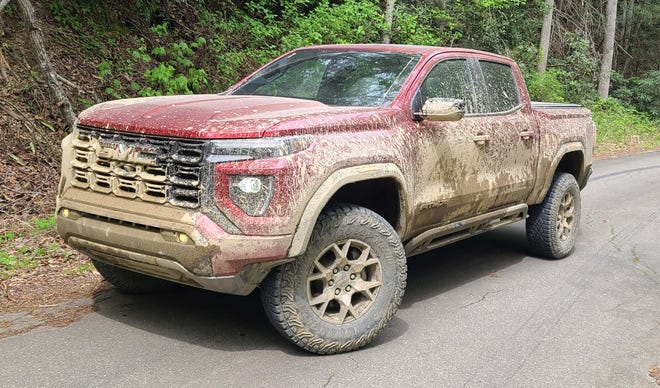
GMC wants a piece of that, so say hello to the 2023 Canyon AT4X pickup. Hot dang!
Miles from anywhere in North Carolina (“Find your nowhere!” is the new team tag), I pounded up a steep, rutted slope like Kong flattening a forest. Menacing grille, fenders out to here and outboard MultiMatic spool-valve shocks enabling absurd wheel articulation over rain-ravaged trails.
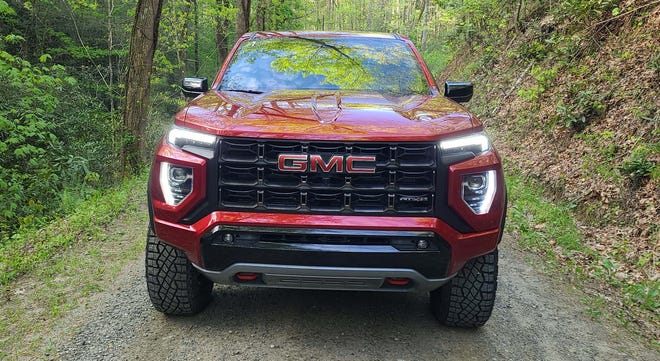
The AT4X is Canyon’s all-new off-road model, sharing performance tools with Chevy’s ZR2 off-road bruiser. In addition to the Multimatic assault weapons that allow Canyon to play hard in everything from low-speed rock crawling to high-speed trail runs, the AT4X gains tough underbody skid plates, 10.5-inch suspension lift, 33-inch Goodyear Wrangler all-terrain knobbies and front flamethrower (just kidding about that last one).
The grille is menacing enough without the flamethrower as the design team has warmed to the trend that pickups are replacing sports cars as the new hormone vehicles. Camaro is exiting the lineup, but not its design inspiration. Canyon’s grille is properly upright — GMC stamped in the middle — but it then flares around the mid-mounted headlights in a cool X-wing design.
Those mid-mounted headlights allow more center sculpting as the “eyebrow” LED running lights bend ‘round the corner into big swollen fenders. Designer Rob Hunwick says the resulting “Coke bottle” shape was inspired by the Camaro. Told ya’ these GMC guys are having fun.
I had so much fun off-road in the Blue Ridge Mountain that I painted my Canyon with mud — the universal color of truckers everywhere. Though most of our media testing was at low speed through narrow trails and trees (don’t try this in a full-size Sierra pickup), I can attest to the Canyon’s high-speed capabilities, having tested its twin Colorado ZR2 on a dirt race track a few years back.
That truck attacked the Outback with a growling 3.6-liter, 308-horsepower 275-torque V-6, which has been replaced this generation with a 4-banger to meet government nanny emissions requirements. Fear not, however; despite losing nearly a liter of displacement, engineers have managed to squeeze even more grunt from the four-holer by cramming hot turbocharged air down its throat. The result is a gobsmacking 430 pound-feet of torque — more than 50% over the six-holer. Crazy, yes?
I only ask that the turbo-4 would deliver a crazier bellow to match its formidable performance. To further encourage bad behavior, engineers have mounted the long-travel Multimatic shocks (crafted by the same Toronto-based Multimatic race shop that supplies Formula One, for goodness’ sake) on the outboard side of the ladder frame, clearing out the underbody (save the differential pig) for more confident mud-slinging.
Open the cabin door and owners may have second thoughts about mud-slinging, though. While GMC has weaponized its exterior, it spared nothing to provide passengers with a typically premium GMC interior experience. The ‘23 Canyon is a major upgrade over the last-gen pickup.
Interior designers call the dash the “hamburger,” and this pickup has a lot of meat between the lower and upper plastic dash buns. My tester featured handsome, crafted red air ports at the corners that bookended white leather dash inserts with red stitching. What if, after a day of slinging mud at the AT4’s exterior canvas, my muddy paws smeared these lovely materials? No problem, answered interior designer Brian Geiszler, running his own paw along the red stitching. Just wash it off.
Atop the hamburger is the garnish — a delicious state-of-the-art monoscreen that houses twin digital displays for driver instrumentation and infotainment. It is stuffed with off-road performance data and 10 cameras views to complement the rotary dial on the console (nicely packaged on the driver’s side of the shifter) with which you can select multiple modes — including low-speed 4WD for when the going gets really soupy.
The $56,995 AT4X’s capability sets the standard for the Canyon lineup, which starts at $38,395 with the superb Elevation model.
Elevation isn’t armed to the teeth with the AT4X’s off-road weaponry, but it has everything else, including the refined cabin, four-inch-wider stance for better handling and the whisper-quiet all-terrain tires.
Wait, what?
Yes, Canyon comes standard with the AT Wranglers, which would seem a recipe for noise, noise, noise. Hustling up the (paved) Blue Ridge highway, I had to jump out of the truck to remind myself these were all-terrains. The pickup is remarkably poised on its knobby 32-inch tires thanks to extensive sound-deadening around the wheel wells (in addition to its gym-toned chassis).
The front cabin is a nice place to be, but I was disappointed GMC didn’t do more with overall interior room — especially as the longitudinally-mounted V-6 engine is gone, which might have allowed for more space. Alas, rear-seat passengers will find legroom as tight as a subcompact SUV.
GMC found its customers prefer crew cabs and 5.5-foot beds, so those are the only options for 2023. I would’ve liked a truck at this price to offer more standard features like adaptive cruise control and blind-spot assist (standard items on many $30K compact SUVs), but customers will have to add packages to find them. A must is a bed convenience package that brings a soft-drop tailgate and a clever in-tailgate storage cubby for those who use their gate as a workbench.
Standard is GMC’s corner-step bumpers (why don’t all brands have these?) for easy bed access. The exception is a special rear bumper for AT4X to enable a better departure angle.
AT4X is for hardcore off-roaders, but if you prefer your off-road fun aboard a dirt bike or ATV, you might be better served by the Elevation model. It boasts best-in-class 7,700-pounds towing so you can take lotsa’ toys up north to your favorite hunting ground — or just up I-75 to Holly Oaks ORV Park.
The Canyon AT4X follows the insane crab-walking Hummer pickup in signaling a new era of GMC fun. But at half the price of Hummer, Canyon’s capabilities are much more accessible. Why let the Chevy boys have all the fun?
Next week: 2024 Alfa Tonale
2023 GMC Canyon
Vehicle type: Front-engine, rear- or four-wheel-drive four-door pickup
Price: $38,395, including $1,495 destination charge ($46,500 Elevation and $59,850 AT4X as tested)
Asheville, North Carolina — Chevrolet blazed the trail to subcompact SUVs a few years back with the wee Trax. It was an affordable, utilitarian breadbox.
You know, an appliance. Not any more.
For Act Two, Trax is still affordable, still utilitarian. But the breadbox has been transformed into a bronze sculpture. Call it a mini-Blazer. Ogle my loaded $27,080 Nitro Yellow Metallic Activ model trimmed in black with scalloped rocker panels, dual digital screens, wireless Android Auto and the face of a 2018 Camaro (the good lookin’ one).
Check that; Trax is better looking than a Blazer. Can we have an SS model, please? With its lower, leaner, wider stance, the small SUV better wears Blazer’s slinky lines. Think old hatchback favorites (oh, I miss them) like the Ford Focus and Chevy Cruze. Did I say small? Trax’s interior is palatial compared to the last model, with three more inches of rear legroom and a whopping seven more cubic-feet of cargo room thanks to a bod stretched 11 inches.
Electric vehicles are all the rage, but their biggest barrier to entry are the gas-powered vehicles across the showroom. The same week I tested Trax here in Asheville, Chevy announced it was pulling the plug on production of its $27,495 Bolt EV at Orion Assembly, to be replaced by $50K Chevy Silverado EV production. With their mega-frunks and neck-snapping acceleration, pricey EV pickups are country-club fashion.
Among small car buyers, not so much.
I liked the Bolt EV, but Trax is a better all-around vehicle. My favorite, the $25K front-wheel-drive Trax Activ, mirrors the FWD Bolt’s wireless connectivity, digital displays and roomy interior. Then it loads on gas-fired practicality. Drive from Lansing to Washington, D.C. (as Sen. Debbie Stabenow famously did last year) and the politically-preferred, 248-mile-range Bolt will take 13½ hours with a trifecta of long charging stops. Trax will make the trip in 9½ hours with one five-minute stop to fill its 400-mile tank.
Sure, Bolt bolts past gas stations, but electricity isn’t free. At 48 cents per kWh at public charging stations, the EV would cost $94 to fill for the 585-mile journey. At $3.50-a-gallon gas, the 30-mpg Trax would set you back $68.
Trax is hardly immune from the nanny state. As EPA forces the industry to go EV, it’s shrinking engine displacement by strangling internal-combustion engine emissions. Trax drops a cylinder — to three — from the previous-gen, yet somehow manages to squeeze out 167 pound-feet of torque for a better, 8.6-second 0-60 mph time.
Compared to the doggy four-banger in Honda’s competing HR-V, Chevy’s three-banger was a spry companion as we danced through the twisties of North Carolina. My journey took me to Chimney Rock, where my father set the sports-car hill-climb record 50 years ago.
The three-mile-long climb to the summit is diabolical, with tight switchback turns linked by undulating high-speed sweepers. This isn’t Trax territory, but it would be a riot in another three-banger: the 300-horse Toyota Corolla GR. Note to Chevy: a 300-horse Trax SS would be a nice addition to the lineup. But I repeat myself.
Not even my favorite-handling small SUV, the Mazda CX-30, would be comfortable at Chimney Rock — a reminder that subcompact segment buyers are looking for utility and tech first.
It’s in those attributes that the stylish Trax really makes its mark. Let the CX-30 compete with the BMW X2 for the SUV hill-climb record; Trax beats it in interior utility.
Generation Smartphone will be agog over the dual screens in my Activ tester that house big digital displays. This is tech you see in Silverado and Colorado pickups costing twice as much. I paired my ‘Droid and navigated the Blue Ridge Mountains wirelessly on Google Maps. The Activ model options a front-console wireless phone charger, so your phone battery doesn’t drain while navigating.
The overall interior experience is pleasant, from comfortable seats up front to leg-sprawling room in back to thoughtful ergonomic touches around the cabin. Round, colorful A-pillar vents are another nod to Blazer/Camaro, and the dash is nicely sculpted for an upscale appearance. In addition to GM’s usual useful knobs and controls, the cabin is littered with storage cubbies for those of us who live in our cars.
Small sub-$20K cars are increasingly unprofitable in this country, and Chevy has abandoned its Spark and Sonic models in recent years. Only have $15K to spend? Walk across the dealer lot and buy a pre-owned Trax.
Chevy is confident you’ll prefer the used model’s room and tech features over a brand-new Spark shoebox.
For those who still want that new-car shine but on a $20K budget (or $339 a month for 48 months), the base $21,495 Tax comes with an analog instrument display and standard safety stuff like lane-keep assist, rear-park assist and auto headlights. Unlike Mazda, which loads its entry CX-30 with blind-spot assist and adaptive cruise control (my essentials) for $24,325, Chevy figures budget-constrained buyers are price-conscious first, feature-conscious second.
Chevy’s ute makes an interesting bare-bones comparison with my favorite compact car, the stylish $21K Hyundai Elantra, which takes a similar approach to sedans with big dash screens, wireless Android Auto and (ahem) better looking wheels.
As you’ve figured out, my max Trax is the Trax Activ with BLIS and ACC — plus that must-have Camaro-like front end. Those looks might lure empty-nesters who like Blazer style but in a smaller, sippier package. The $27K price is competitive. Want all-wheel drive? Chevy has a subcompact Trailblazer across the showroom it wants you to check out.
What Trailblazer also — and Trax tossed aside for this generation — is a fold-flat front seat. That clever chair got me through two knee surgeries (Mrs. Payne would pick me up at the hospital, flatten the front seat, then load me in the back seat with my stiff leg slung over the front). Most Trax buyers likely won’t miss it given the ute’s longer cargo area with the rear seats down.
Trax is a modern marvel, showcasing technology that a decade ago could only be found on luxury chariots. It’s also a reminder that the sub-$20K entry-level car is largely a thing of the past as average new-car transactions crest $50,000.
In 2019, over 40% of new cars listed for under $30K, according to Chevrolet. Today that number is under 20%. The terrific Trax should add to that number.
Next week:2023 GMC Canyon
2024 Chevrolet Trax
Vehicle type: Front-engine, front-wheel-drive five-passenger SUV
Price: $21,494, including $1,095 destination fee ($27,080 Activ model as tested)
Asheville, North Carolina — The internal combustion engine is dead, long live the internal combustion engine.
As Chevrolet was nixing its first-generation electric Bolt EV hatchback last month, the brand was introducing media here to its updated, second-generation, gas-powered Trax SUV. Both front-wheel-drive vehicles were subcompact segment busters when they debuted last decade. But the fact that the internal-combustion-engine Trax has outlasted the much-ballyhooed Bolt — once touted as a game-changing, Tesla Model 3 slayer — underlines the difficulty of selling affordable EVs to U.S. customers even as General Motors Co. goes all-electric over the next 10 years.
Despite less publicity compared to Bolt, Trax has outsold the its EV sibling by 4-1 while providing superior range and utility. The all-new, bigger, more capable Trax is a big commitment by GM to customers that their preferred gas models are not going away — not yet, anyway.
The Bolt was launched with much fanfare in 2017, beating the Model 3 to market as the first sub-$40,000 EV. GM CEO Mary Barra hailed it as an “EV for everyone” and the wee hatch filled its trophy case with media baubles, including North American Car of the Year and Motor Trend Car of the Year. Reviews, including by this columnist, applauded its peppy, 200-horsepower acceleration and (first to market) 200-mile-plus range.
But sales never met expectations. As Model 3 soared to 145,846 sales in 2019 — eclipsing the Lexus RX as America’s best-selling luxury chariot — the Bolt languished at under 20,000 units.
Meanwhile, Trax was a significant launch as well. While not a halo for a battery-regulated market, it was key to Chevy’s transition to an SUV-focused brand as customers ditched sedans in the wake of the Great Recession for higher-riding, hatchback SUVs. Aiming to keep entry-level customers in the brand as they fled compact cars like the Spark, Sonic and Cruze, the affordable $21K Trax was cute, utilitarian and littered with clever features like a flat-folding front seat for extra cargo room.
Trax was a hit, hovering (along with its Buick Encore twin, a game-changing SUV for the octogenarian sedan brand) at the top of segment sales with the Jeep Renegade. By 2020, Trax hit peak sales at 120,000 units before splitting segment sales with its newer, sexier Trailblazer sibling.
With the hot subcompact SUV market gaining 32% in sales to become the fifth largest segment in the industry, Chevy has remade Trax from the ground up for the 2024 model year and thinks it could sell more than 100,000 units again. The 11-inch-longer, 137-horse, second-gen Trax (which advertises four trims for under $25,000) has been transformed in every dimension: more cargo room, more rear legroom, state-of-the-art technology like wireless Apple CarPlay, and more curb appeal. Its sculpted wardrobe has been taken right out of big brother Blazer’s closet.
Bolt, meanwhile, struggled to attract consumers beyond its green base with similar dimensions to the $21K Trax — but a stiff $37,500 price tag. A $7,500 federal tax credit (and favorable treatment in California’s high-occupancy lanes) helped reduce the premium, but sales remained small.
Its troubles were magnified by battery-related fires that led to a stoppage in sales in 2021 and a recall of all models produced up to that time.
When Bolt returned to the market, the brand held a fire sale to get back into customers’ good graces. Prices were slashed to $27,495 ($28,495 for a more contented EUV version) — meaning that, with the $7,500 tax credit (and state incentives like Massachusetts’ $3,500) — a new, nicely-equipped Bolt could be yours for less than a Trax.
As the remade Trax goes on sale with technology to match Bolt — and dimensions that exceed it — electric vehicle challenges in non-luxury segments are being magnified.
For one, Chevy is a volume brand. Its value to General Motors is bringing in new customers so they might eventually buy more profitable Chevy trucks and large SUVs, Cadillac EVs and GMC Hummers.
“In 2019, the percentage of vehicles priced under $30,000 was well north of 40% and today it is under 20%,” Chevy marketing chief Steve Majoros told media here.
Many factors contribute to that number, but one is the industry’s focus on high-priced EVs. The average new EV transaction in the United States is a pricey $61,000. A Hedges & Company marketing survey found the owner demographic for EVs — 60% of buyers earned over $100,000 a year — was the highest for any segment. EVs tend to be one of multiple vehicles in single-family homes.
Entry-level gas vehicles are more suitable to the lifestyle of apartment-dwelling, single-car owners. Tax breaks may make the Bolt more affordable than before, lifting it to a record 38,120 units in 2022, but it still trails Trax in range and convenience.
Drive 532 miles from Detroit to Washington, D.C., in the 259-mile range Bolt and the trip will take 12 hours with three charging stops — 3.45 hours of charge time, according to EV-trip app Chargeway. The 400-mile-gas-range, 2024 Trax would make the trip in 8.2 hours with a single, five-minute gas stop.
Cost? Bolt EV would set you back $85 to fill up with electrons at Electricify America fast-charge stations at 48 cents per kWh. The sippy, turbocharged, 30-mpg Trax would cost just $62 at $3.50 a gallon.
Only drive the Bolt EV locally and charge overnight, and off-peak electricity rates are a more affordable 15 cents per kWh in southeast Michigan. But the cost of installing a 240-volt charger can be $1,500-$2,000 for a home. And apartment dwellers may not have that option.
Chevrolet is expected to replace the Bolt later this year with a $30,000 Equinox EV boasting a roomier interior, new Ultium platform and faster charging speeds. But as the $21K Trax indicates, internal-combustion-fired vehicles aren’t standing still either.
Henry Payne is auto critic for The Detroit News. Find him at hpayne@detroitnews.com or Twitter @HenryEPayne.
Sponsored by Dodge, MotorTrend’s popular, tire-smoking, ear-shattering, legal drag racing event on Woodward Avenue in Pontiac is moving to a new venue this August. Since 2016, it has entertained muscle car fans at the corner of Woodward and South Boulevard and the adjoining M1 Concourse car club property. MotorTrend told M1 this month that the event is moving to a new location.
“There were apparently concerns with construction on the southbound lanes of Woodward to put in a U-turn lane and whether that might change the configuration of the drag strip,” said M1 CEO Tim McGrane. “Concerns included whether the construction could be done on schedule, and if the northbound lanes would be a suitable, safe alternative.”
The Michigan Department of Transportation is putting in a Michigan turn north of the busy Woodward-South Boulevard intersection and construction is scheduled to wrap up by Memorial Day. But for MotorTrend, the key issue was safety.
“M1 has been a tremendous partner. Changing our venue is the result of MDOT making road improvements for the businesses in the area,” said MotorTrend Chief Commercial Officer Eric Schwab who brainstormed the idea of Roadkill Nights with Dodge boss Tim Kuniskis nine years ago. “Putting in a Michigan turn there prevents the southbound lanes from being a straight shot.”
Launched seven years ago, MotorTrend Presents Roadkill Nights Powered by Dodge has become the unofficial kickoff of Dream Cruise week (the Cruise is scheduled for Saturday, Aug. 19 this year). Its legal, MDOT-sanctioned celebration of street racing has been embraced by the muscle car culture that rules Woodward in the summer.
The drag-palooza attracted a record 40,000-plus spectators in 2022 and inspired an expansion of the franchise to a similar event in Las Vegas. In addition to legal drag racing on Metro Detroit’s iconic main street, the event has been a showcase for the latest Dodge muscle cars, and the brand says its 2023 location will continue that tradition.
“Roadkill Nights Powered by Dodge will return to Metro Detroit later this summer. Now in its eighth year, we are excited that we will be able to announce a new venue for the Dodge brand’s horsepower festival, with additional information to be shared in the coming weeks,” said Dodge in a statement.
Stellantis’s performance brand is in transition as its signature, V8-powered Charger and Challenger sedans will be put out to pasture at the end of this year — replaced by a new generation of Dodge Hornet SUVs and Dodge’s first-ever electric hellion, the Charger Daytona SRT Banshee. Dodge says these vehicles are the new face of the “Brotherhood of Muscle” and that Roadkill’s horsepower circus is the perfect showcase for their abilities.
M1’s 87-acre facility with a 28,500 square-foot Event Center, skid pad, and 1.5-mile test track has been an ideal complement to Roadkill drag racing and hosted new car reveals, classic car clubs, hot laps, drifting in Dodge Hellcats — even an off-road course for public rides in the 702-horse Ram TRX pickup truck.
But the event’s centerpiece has always been drag racing on 1/8th mile of adjacent Woodward Avenue just north of St. John’s hospital. With construction and safety concerns about that stretch for 2023, M1’s McGrane thinks the new venue will likely be north of M1 — just below the “Pontiac loop” between East Huron and Orchard Lake roads.
“There’s a good straight stretch of Woodward south of downtown Pontiac,” he said. “There’s grass on the west side for grandstands and a large parking lot on the east side.”
The event could return to M1 in 2024, but in the meantime, M1 is looking to host a new event for Aug. 12 weekend — bookended by M1’s own Woodward Dream Show on Aug. 18-19 during Dream Cruise weekend. Dream Show is a showcase for classis hot rods that will be highlighted by Corvette’s 70th and Ramcharger’s 65th anniversaries.
Wherever Roadkill Nights lands, the dragway will shake with ferocious, 1,000-horsepower street-legal racers invited from across America. The event also attracts a Who’s Who of mod-car celebrities like MotorTrend TV’s David Freiburger and Mike Finnegan, Steve Dulcich, Lucky Costa, Cristy Lee, and more.
The headline class will be the Dodge Direct Connection Grudge Race. Competitors will bring unique drag monsters — each built around an all-new, Dodge, 3.0-liter Hurricane Twin Turbo engine — to the starting line. Grudge Race teams will pair an experienced drag racer and online automotive builder who will then compete to be top dog.
“Roadkill Nights just continues to evolve and get better each year,” said Dodge’s Kuniskis in announcing the event last fall. “Grudge Race competitors will have at the heart of their build projects new Direct Connection HurriCrate engines. We can’t wait to see the results.”
Expect the new Roadkill venue announcement to come in May.
Henry Payne is auto critic for The Detroit News. Find him at hpayne@detroitnews.com or Twitter @HenryEPayne.
Hell, Michigan — I first drove the electric Mustang Mach-E in Hell in late 2020. Lightning fast, liquid smooth, luridly styled, it was one of Tesla’s first serious competitors.
A lot has changed since. There are now dozens of e-SUVs on the market and Mach-E hasn’t stood still, either.
So this March I saddled up the latest Mach-E GT model and made another visit. Yes, like its sports-car namesake, Mach-E now sports a performance GT edition. How much performance? The GT packs a neck-snapping 600-pound feet of torque, which is good for 3.8 seconds zero-60 mph — identical to the two-door pony car despite carrying 25% more girth (an extra 1,000 pounds).
The new ‘Stang EV also sports Ford’s BlueCruise driver-assist software, which was not available at launch. BlueCruise became available for download in 2021 on vehicles equipped with companion hardware, and my 2023 tester had the latest, greatest Version 1.2.
I charged Mach-E to 100% (265 miles of range, which is shy of the standard AWD model’s 300) overnight and set a course for Hell the following afternoon. I quickly mirrored my Android phone to the big 15.5-inch vertical screen (wireless Android Auto standard) so I could monitor texts and calls. However, I let the native Ford navigation system guide me in order to monitor chargers along the route. While my planned round trip (including a lunch detour to Zingerman’s Deli in Ann Arbor for my favorite pastrami Reuben) was an estimated 150 miles, your mileage may vary.
Hell is not incorporated, which is perhaps why the ‘Stang didn’t respond to my directions to “Go to Hell” (the more sophisticated Google Maps does). So I was more specific: “Go to Hell Creek Ranch” — an establishment on the edge of town. On a wet 45-degree afternoon, we were off.
Unlike Tesla’s Autopilot, BlueCruise is restricted to divided highways. But I set adaptive cruise on the steering wheel, and the system did a competent job of lane centering on Oakland County’s secondary roads. When I crossed the invisible geofence line and merged onto I-96, however, a BlueCruise activation message lit up the instrument panel. We were hands-free.
BlueCruise has lagged both Autopilot and GM’s SuperCruise semi-autonomous systems, but Version 1.2 is keen to catch up. The system can’t yet self-drive to my destination like the others, but it automatically changed lanes at the flick of a stalk.
More impressively, it would sense the vehicle to the right as I eased by at 75 mph and moved a couple of feet off-center to create space. Clever, and very human-like. My Tesla Model 3, by contrast, will remain lane-centered even as it passes a semi looming next door. That’ll give you the willies.
I exited at Howell and BlueCruise handed the controls back to me.
Hell not only has the best driver’s roads in the state, but also features a dynamite general store, Go to Hell. I stopped to browse the latest merchandise and couldn’t resist a green “I Drive a Stick” T-shirt etched with a witch on a broomstick.
Unlike its GT sports-car kin, Mach-E GT doesn’t option a stick shift. But like the sports car, Mach-E achieves its 3.8 second, zero-60 dash with an automatic. Accompanied by an artificial Mustang growl.
With all-wheel drive, my GT didn’t much care if the asphalt was dry or damp. I buried the throttle on Doyle Road and the pony buried my back into the seat. The GT’s nearly 5,000-pound girth was evident, but the torque (just shy of the supercharged Mustang GT500 track king) overcame it. A right-hander onto Hadley Road rushed into view.
Ford tunes the steering and suspension magnificently in Unbridled performance mode, and the e-pony rotated competently onto Hadley. Weight became more of an issue over Hadley’s undulating, high-speed curves.
Easy, Payne, it’s an SUV.
But it’s also a Mustang, and Ford engineers have managed to make the best-handling e-ute I’ve tested. It also looks the part. While BMW and Mercedes have gambled with novel sci-fi designs for their new EVs, Ford evokes the design of its iconic sports car to compete against Tesla’s smartphone-simple lines. Smart.
The interior is a different story, and Mach-E is very Tesla-like. The minimalist interior and big touchscreen have worn well (the cloth dash inserts and awkward door handles, not so much). Unlike the knob-scrubbed Tesla, Mach-E’s melon-sized volume control and rotary shifter are welcome additions.
Going like a bat out of Hell along North Territorial Road, I made sure to stop (as I did in 2020) and snap a picture with a Model T displayed on a local farm. The 100-year difference in auto tech is irresistible.
The Model T doesn’t feature a frunk like Mach-E — but most of the EVs I’ve tested since my first Mach-E trip three years ago don’t either. That’s a missed opportunity, and Mustang takes full advantage. At Zingerman’s, I put my sandwich and groceries in the frunk so they wouldn’t get slung about the cabin when, say, I next used an interstate cloverleaf as a skid pad.
The combination of 45-degree weather, 75-mph interstates and Hell-acious fun had taken 180 miles off the battery over just 101 miles traveled. I had just 85 miles left for the 49-mile trip home. Since I have a 240-volt charger in my garage, that was enough. But if I had needed a fast charger, a quick check of the Ford’s database indicated the closest fast charger on my route was at Novi’s Walmart 30 miles away.
As I entered U.S. 23, BlueCruise recognized it as another geo-fenced divided highway and I went hands free again. Until I didn’t. Occasionally, BlueCruise encountered a stretch of road that hadn’t been mapped and the Ford would turn the steering back over to me. To make sure I was paying attention for such situations, BlueCruise watched me with a camera perched on the top of the steering column.
Keep your eyes on the road, Payne.
I arrived home in Oakland County with 30 miles left and a warning on the instrument display: “DRIVING RANGE LOW.” I immediately plugged into my garage charger. Because you never know when you gotta’ go to Hell and back.
Next week: 2023 Buick Encore GX
2023 Ford Mustang Mach-E GT
Vehicle type: Battery-powered, all-wheel-drive, four-door SUV
Price: $65,795, including $1,300 destination charge ($71,195 GT as tested)
Powerplant: 88-kWh lithium-ion battery with twin electric motors
Manufactured in Indiana for the U.S. market, the affordable, ubiquitous Honda Civic has been the best-selling retail passenger car here for the last six years.
It is also the new lap record holder at the world’s most formidable race track.
The Civic’s ferocious, winged, Type R performance variant just torched Nürburgring, Germany’s Nordschliefe race track with a 7:44.9-minute lap time, setting the lap record around the 13-mile, 154-turn circuit for front-wheel drive cars. The Nürburgring’s “Green Hell” is revered as the globe’s most difficult track and has become the standard for automakers to show off their vehicles’ capabilities.
The feat by the $44,390 Type R (made in Japan unlike other U.S.-market Civic models) is also a reflection of the enormous versatility of the compact car class, with multiple manufacturers offering variants ranging from $22,000 entry-level gas-sippers to $44,000 tire-smoking hellions. In the United States, the class has been abandoned by domestic manufacturers, but is still heavily populated by foreign carmakers offering familiar badges like the Civic, Toyota Corolla, Hyundai Elantra, Mazda3, Kia Forte, Nissan Sentra and Volkswagen Jetta.
Kia and Nissan aside, the aforementioned makers also offer segment-topping performance cars that not only can give a rear-wheel-drive Ford Mustang GT a run for its money but also compete in race series around the world.
The Civic now holds bragging rights at Nürburgring.
The second generation of the most-powerful Civic ever made for the U.S. market, Type R spits out 315 horsepower from its turbocharged 2.0-liter 4-cylinder engine — nearly doubling the output of the standard Civic’s 158-horse turbo-4. Key to mastering the multiple, 100-mph turns around the ’Ring, the Civic Type R was fitted with flypaper-sticky Michelin Pilot Sport Cup 2 Connect tires.
“The all-new Civic Type R strived for the ultimate front-wheel-drive sports car,” said Civic Type R Development Leader Hideki Kakinuma. “We had one more mission to fulfill, which was to claim the title as the world’s fastest FWD car with a record Nürburgring lap time.”
Nürburgring has long been the standard for performance, and — six years ago — the last-gen Type R set the track’s FWD mark. All times were recorded by manufacturers and considered unofficial. Beginning in 2019, the Nürburgring facility instituted official rules for time attacks, establishing an official track configuration of 12.9 miles (the old configuration was about 0.12 miles shorter).
The Civic Type R’s record eclipsed the time of 7:45.4 seconds set by a Renault Megane R.S. Trophy-R (a car not sold in the United States) that had stood for four years.
The lap times are instructive in showing the relative capabilities of different classes of cars. The Type R’s lap is not far shy of the fastest battery-powered vehicle lap, set by the $189,000, 750-horsepower Porsche Taycan Turbo S (7:33.4 minutes). Though featuring less than half the horsepower of the Porsche, the nimble Type R carries about 35% less weight.
The Honda is well off the fastest time for a rear-wheel-drive car — the BMW M4 CSL — at 7:20.2 minutes. The fastest production car, the Mercedes-AMG GT Black Series, got around the Nürburgring in under seven minutes at 6:48 flat.
The absolute lap record around the Green Hell? A ridiculous 5:19.5 minutes by the 1,160-horsepower, 1,870-pound, rear-wheel-drive Porsche 919 Hybrid Evo race car.
Henry Payne is auto critic for The Detroit News. Find him at hpayne@detroitnews.com or Twitter @HenryEPayne.
One of Michigan’s great charitable events revs up this weekend in Brighton.
The Lingenfelter Collection opens its doors — and wallet — from 9 a.m.-5 p.m. Saturday to the American Cancer Society. Admission is free and attendees are asked to give a donation in return for seeing one of the country’s most acclaimed car collections. This year, the 200-car-strong collection not only celebrates the past but gives a peek at future, electrified endeavors from Lingenfelter’s famed mod shop.
“General Motors chose us to pilot a program called the GM eCrate certification program,” Ken Lingenfelter, Lingenfelter Engineering CEO, said in an interview. “Electric motors are a lot different than gas engines. It’s not as easy as bringing home an electric motor and putting it in your car. It can be a dangerous thing to do and you’ll probably kill yourself because of the electric components. So (GM) certificated us for this program, and I bought a 1972 El Camino. We swapped out the gas engine for a GM electric motor and it’s getting a lot of attention.”
Lingenfelter’s core business is modifying GM sportscars and trucks. And as the General pushes electrification, the veteran businessman sees more customers wanting to take advantage of electric muscle.
The El Camino — complete with electric components stuffed under the hood where an engine used to be — sits cheek-to-jowl with gas-fired classics like the 1954 Chevrolet Corvette EX-87 “Duntov Mule” (the first V8-powered ‘Vette) and the latest addition to the collection: a 2023 Ferrari Roma.
“I’ve got a sweet tooth for Ferraris,” Lingenfelter said with a smile.
There are other exotics too, including Porsches, a Maserati and a Lamborghini. And some unusual creatures like a 1984 Bitter SC Coupe, 1974 AMC Gremlin, 1973 Opel GT, and ‘81 DeLorean. But GM muscle is the meat and potatoes of the collection: Red meat like a split-window 1963 Corvette.
“I saw the 1963 split window as a 10-year old at the GM Proving Grounds and fell in love,” said Lingenfelter, whose father was a GM executive. “So there is a full room of Corvettes. And some of the latest Lingenfelter productions — GM cars we’ve built for road racing, drag racing.”
Ken’s passion is shared by his wife, Kristen, who is the hot shoe in the family these days. She competes in SCCA in a mid-engine Corvette C8.
“We’re really focused on the new C8 Corvette,” said Lingenfelter. “We’re the only company that has successfully supercharged the C8 Corvette with over 700 horsepower. We’ll have one of those there and I’ll be starting that up for the group.”
The deafening sound of a small block V-8 shaking the walls of the 40,000-square-foot Collection is a highlight of the day.
“The C8 Corvette makes a great noise, and the whine of the supercharger further enhances that sound,” Lingenfelter said.
Corner him long enough and he’ll regale you with tales of his misspent youth terrorizing the streets of Detroit. While the split-window Corvette was his first love, a ‘69 Camaro was one of his first rides.
“That thing was just so fast. I was in high school at Dearborn High, and it was the only Chevy in the parking lot — probably because everyone worked for Ford,” he remembers. “There was a guy in a 302 Mustang who kept bugging me and bugging me, trying to trip me up in the hallways. We almost came to blows, so we were gonna solve all our issues with a drag race out on Outer Drive in front of school — which was terrible judgment.”
He continued: “Everybody knew we were gonna drag. Half the school was out there, and I smoked this guy so bad in the Camaro it was embarrassing. Got my self in a lot of trouble with the Dearborn Police at school so, as a result, I got expelled for awhile. Got back to school and used a lot better judgment from that day forward.”
That better judgment included a successful career in the real estate industry and then the purchase of Lingenfelter Performance Engineering, a company founded by cousin John Lingenfelter. The mission of the Lingenfelter Collection has always been charity fundraisers (the collection hosts about 60 throughout the year), of which the cancer society benefit is one of the biggest.
“I lost my mother, father, and sister to cancer, so I’m focused on making sure others don’t suffer like they did,” he said.
Henry Payne is auto critic for The Detroit News. Find him at hpayne@detroitnews.com or Twitter @HenryEPayne.
Joshua Tree National Park, California — I’ve been driving a lot of fancy shoes around lately. The $94,000 Mercedes EQE, $63K Kia EV6 GT, $86K Ford F-150 Lightning, $105K Hummer EV SUV. As average transaction prices hover around $50,000 and the industry moves toward a premium business model to pad margins that finance EV development, new vehicle prices are increasingly out of reach for many buyers.
So it was nice to slip into a sub-$30K running shoe this spring.
The 2024 Subaru Crosstrek’s unique design was inspired by athletic footwear and it looks the part. Frameless mesh grille, black cladding around the fender wells, diffuser running up the heel. I like it. And Crosstrek is also comfortable to run in.
I flogged it for hundreds of miles all over this stunning landscape east of California: Joshua Tree, Mojave Desert, Box Canyon, Salton Sea. This is Subie’s natural habitat and it’s built for the task. Like efficient Joshua Trees that need little water to survive in the arid desert, Crosstrek features the best MPG in the subcompact SUV segment. With a nearly 17-gallon fuel tank, my tennis shoe could run for 500 miles. No wonder Subie customers are shy to $50,000 EVs with limited, 200-mile range.
I left Palm Springs early in the morning with 2/3rd of a tank of gas, backpack and picnic lunch for a day of sightseeing. I could have brought a lot more.
My $27,490 Premium tester comes standard with a big rubber mat in back so you can throw in all kinds of equipment — and bring it back wet and muddy — without scarring the cloth floor beneath. The front doors have been carved out to handle tall 24-ounce bottles, and rear door sills have foot pads so you access the roof’s robust rails. The rails can be laced up (I’m milking this shoe analogy) to hold a pile of equipment on the roof.
Equipment like a kayak to explore the Salton Sea or camping gear or trail bikes to explore the desert where the asphalt ends. Or you can just keep driving the ‘Ru. Subaru just introduced a rugged Wilderness edition with all-terrain tires but the standard model is fine, thanks. Crosstrek comes standard with all-wheel drive and X-Mode so you can take on foreign elements like sand and snow.
In the Mojave, I explored some well-traveled ATV trails. I poked the X-Mode button at the top of the huge 11.6-inch vertical console screen and scrambled around the dusty paths, the drivetrain distributing grip to the tires most in need of traction. Most impressively, X-mode sensed extreme downhill sections and automatically set Hill Descent Control. This clever tool worked as a sort of low-speed, off-road adaptive cruise control so I could concentrate on the task of avoiding rocks. If I did place a wheel wrong, a full spare was ready under the rear deck.
This electronic wizardry is impressive on a sub-$30K vehicle and is another example of how the digital revolution has reduced the gap between luxury and mainstream chariots.
Another example is wireless Apple CarPlay/Android Auto smartphone integration, which comes standard with my Premium model’s big screen (the base $26K model has old-school wired smartphone apps), so you can set your destination on Google maps in your phone, jump into the car and Subie will recognize your phone and project it on the big screen.
I’d recommend the $1,200 step to the Premium trim over the base model (which doesn’t get the big screen/wireless CarPlay enhancement) for this reason, and because Premium gets roof rack rails.
Mrs. Payne — who owns an Impreza hatchback, Crosstrek’s hatchback sedan twin that receives a similar interior update for 2024 — will be thrilled by this. She’ll also be thrilled by the obsessive attention to detail throughout. Subaru is proud of its high customer loyalty, and product planners seem to have been living in our living room.
My wife and I have complained about Subaru’s adaptive cruise control. So — voila! — it’s been improved so I could toggle the steering-wheel button and increase my speed by 1 mph increments. Want to increase speed by 5 mph increments? Loooong button hold. A third, wide-angle camera has been added behind the rear-view mirror to better track cars at the periphery of the EyeSight system. If you accidentally turn into a car in your blind-spot, Subaru says sensors will avoid the imminent collision by steering you back into your lane.
The Mojave’s stunning scenery seems endless.
Through Box Canyon near the Salton Sea, I took the cane to the ‘Ru’s Boxer engine and rode it through the twisties. The Crosstrek is no Mazda CX-30 (my favorite-handling SUV in class), but the Subie has improved with a smoother drivetrain thanks to upgraded engine mounts and CVT transmission. Under hard throttle, the engine buzzes but the redesigned Crosstrek’s cabin is stuffed with more insulation so the noise doesn’t penetrate too much. With a paltry 142 pound-feet of torque in the base engine (a peppier 2.5-liter is available on upper Sport and Limited trims), the engineers concentrated on the chassis, which has been stiffened by 20%. The suspension has been upgraded, and the seat bolted directly to the frame for less driver toss.
Evidence of budget savings to maintain the Ru’s value (even as it loads up on state-of-the-art electronics) is visible.
Crosstrek doesn’t offer a heated steering wheel, or a digital instrument display, or fancy console materials. Seat heater controls and instrument display are little changed from the last-gen model. Nevertheless, soft materials are in the right places (think armrest covers for my pointy elbows) and the Subaru looks like nothing else.
Like the other adventure bot in class, the Jeep Renegade, Crosstrek will attract upscale, budget-conscious customers who appreciate the brand’s unique style while not having to drop another $15K for the badge. Crosstrek has added three stylish colors for 2024, including a cool clay-blue shade called Offshore Blue Metallic that’s less outgoing than my red tester.
Buy a hip, 2024 ‘Ru over a comparably-equipped BMW X1 and you’ll save 12 grand. You can spend the money you save elsewhere. Like the Indian Wells Masters tennis tournament here west of Coachella. It’s a perfect place to take your big sneaker on wheels.
You didn’t think I was going to end this column without another shoe analogy, did you?
Next week:2023 Ford Mustang Mach-E GT
2024 Subaru Crosstrek
Vehicle type: Front-engine, all-wheel-drive five-passenger SUV
Price: $26,290, including $1,295 destination fee ($27,490 Premium model as tested)
Mustang turns 59 young this week and it’s celebrating with new toys.
Ford’s iconic muscle car, born in 1964, is bringing to market its seventh-generation 2024 model that boasts the most horsepower ever from its 5.0-liter, normally-aspirated V-8 engine. The old dog is learning new tricks like a remote revving feature so owners can wake up the neighbors without ever leaving their house.
For the first time, Mustang gets its own Instagram account—@fordmustang—to keep fans abreast of the latest in ‘Stang culture and fashion. And Ford’s Performance division introduced a Mustang NASCAR pace car that will pace the field for seven races this year.
“We’re proud of the entire Mustang family, what it represents to Ford and especially our passionate Mustang owners and fans,” said Dave Bozeman, the automaker’s vice president of enthusiast vehicles. “It’s our commitment to serving Mustang’s global community, from Atlanta to Adelaide.”
Such relentless marketing and innovation — and an uninterrupted model run since its birth—has made the sleek coupe the best-selling sportscar in the world for the last 10 years according to S&P Global Mobility. Sold in more than 100 countries, Mustang is an American badge with global recognition like Coca-Cola, iPhone, and Jeep Wrangler.
Mustang’s home market boasts the car’s biggest sales volume, with 78% of global sales. That included a return to No. 1 in the U.S. muscle car wars in the first quarter of this year after being outsold by the Dodge Challenger the past two years. Mustang sales of 14,711 through March marked an increase of 5% year-over-year increase, with a significant demand bump expected for the new pony car when it hits showrooms this summer.
Other markets also saw sales growth in 2022, including a 17% increase in Germany, 14% in Britain and 7% in the Middle East.
Getting older also means losing some friends along the way and the Mustang will be the last V8-powered pony car left in the U.S. market come the 2025 model year. Under pressure from government emissions regulations, Dodge is canceling the successful Challenger coupe after the ‘24 model year and Chevrolet is nixing the Camaro.
The Mustang survives in part thanks to its electric stablemate, the Mach-E. The first SUV and battery-powered vehicle from the Mustang sub-brand, Mach-E helped Ford accumulate enough government emissions credits to enable the continued manufacture of the V8-powered hellion. The Mach-E, too, has gone international and is available in 39 countries.
With the segment to itself, the 2024 Mustang isn’t holding back.
The sixth-generation car was a huge success, taking the badge international and wrestling back the No. 1 sales spot from Camaro (before Challenger leapfrogged them both in 2021-22). Still, the outgoing ‘Stang was criticized for its soft lines and the 2024 aims to fix that with a more muscular, chiseled design.
To emphasize its macho personality, the new car adds a ferocious, 500-horsepower, V8-powered Dark Horse model to the lineup (the standard, V8-powered GT model will have 486 horses). It’s the first new Mustang model since the 2001 Bullitt was unveiled.
The Mustang will continue to offer electronics advancements unheard of six decades ago, including a drift mode and the aforementioned remote revving feature. That feature can be operated from a distance using the key fob so that owners can rev the eight-holer to as much as 5,000 rpm.
True to its roots as an affordable sportscar compared with European exotics like a six-figure Porsche 911, the 2024 Mustang will start at $32,515 with a 2.3-liter turbocharged 4-cylinder engine under the hood.
Since its inception, Mustang has been synonymous with racing. Mustang kicked off its birthday week by unwrapping a new pace car Sunday for NASCAR’s Martinsville, Virginia, stop. Dressed in Grabber Blue and light bar, the V8-powered Mustang GT brought the field of Mustang, Camaro and Toyota Camry NASCARs to the green flag.
“We’ve had great success racing Mustang globally, including winning last year’s NASCAR championship,” said Ford Performance Motorsports boss Mark Rushbrook. “Racing leads to better products, and seeing the Mustang GT setting the pace at NASCAR makes this connection even stronger.”
Henry Payne is auto critic for The Detroit News. Find him at hpayne@detroitnews.com or Twitter @HenryEPayne.



 Henry Payne RSS