- Search Cartoons
- Comic Archive
-
Payne
Store



 Henry Payne RSS

Articles
Auto show concept cars: Geekmobiles generate buzz
Posted by hpayne on January 13, 2017
The futuristic concepts are back — but this time as Jetsons-like geekmobiles promising an autonomous future. Some old-school designs are still on the floor — notably the sultry Cadillac Escala — but mobility is this show’s buzzword. And since SUVs are America’s vehicles of choice, there are plenty of concept utes floating around as well.
BMW X2
What it is: Determined to fill every niche of the popular luxury crossover market, the X2 slots between the front-wheel-drive X1 and rear-wheel-drive X3 as a coupe model. Unlike BMW’s X6 crossover coupe, however, the X2 will likely be a front-drive chassis based on the same architecture that frames the X1 and Mini Countryman (a BMW property).
Payne’s take: With its sleek greenhouse and aggressive snout, the X2 brings to mind sexy small utes like Merc’s GLA and the Infiniti QX30 — not the boxier shape that has defined the X3 and X1. And like the AMG GLA and (coming) BMW M X3, this sporty crossover could get a performance variant when it eventually comes to market.
Chrysler Portal
What it is: The Portal is, well, a portal into Chrysler’s thinking about autonomous cars. Designed as a Level 3 autonomous car, the Portal has a steering wheel so a driver can take control when desired (Level 4 autonomous vehicles lack a steering wheel). Based on the Chrysler Pacifica platform, the Portal has doors that slide open, removable seats, and a 100 kWh battery in the floor.

Payne’s take: Early autonomous vehicles will likely inhabit fleets and the Portal‘s roomy design is optimal for people-moving. Ride-sharing companies can save billions by removing the driver and insurance overhead. “We haven’t been shy to say that we see the Portal as what we view as the future of family transportation,” Chrysler boss Tim Kuniskis said at the auto show. “People ask me, ‘Is it a minivan? Is it a crossover? Is it a UV (utility vehicle)?’ We just say it’s the fifth generation of cars.”
GAC Trumpchi GS7
What it is: The GS7 debuted at the Detroit show alongside two other GAC concepts in the latest signal that Chinese automakers are inching closer to entering the U.S. market. The GS7 appears as a serious design exercise with a 198-horse turbo-4 and liveable interior. It’s sized to the compact SUV class — the most popular in the USA.

Payne’s take: With a design that trails the times and fit-and-finish judged Grade C by industry insiders, the GS7 shows China has a ways to go to be competitive here. But with a main floor display at the auto show, the GS7 craves attention.
Nissan Vmotion Concept
What it is: The dramatic Vmotion 2.0 Concept shows sculpted lines, cabinet doors and B-pillarless design as Nissan imagines a driverless world. But the Vmotion’s intentions are more immediate than just autonomy. The car debuts Nissan’s ProPilot automated driving system, which will appear on the next-gen Leaf EV and allow the car to take over accelerator, brakes and steering wheel at highway speeds. Engaging ProPilot causes the car’s grille and rear diffuser to glow, letting others on the road know that the car is driving, you are texting.

Payne’s take: The Vmotion’s proportions also telegraph the design direction of the Altima sedan. Given the Altima’s forgettable looks, that’s a good thing. I particularly like the deep-cut grille.
Volkswagen I.D. Buzz
What it is: If Chrysler has the Portal, then VW has the Buzz. But the I.D. is meant to be driven as well as self-driven. A monster 111 kWh hour battery sits in the floor, which promises not only 300-mile plus range and lots of interior room, but 369 neck-snapping horsepower. That translates to — not a ’60s retro-hippie mobile — but a 5-second zero-60.

Payne’s take: VW uses its warm-and-fuzzy microbus to announce its future as an electric (ahem, not diesel) carmaker. The Buzz is built on V-dub’s Modular Electric Drive Kit platform, which will be the bones of all its EVs in the near future.
All-new Toyota Camry aims to shed vanilla label
Posted by hpayne on January 10, 2017
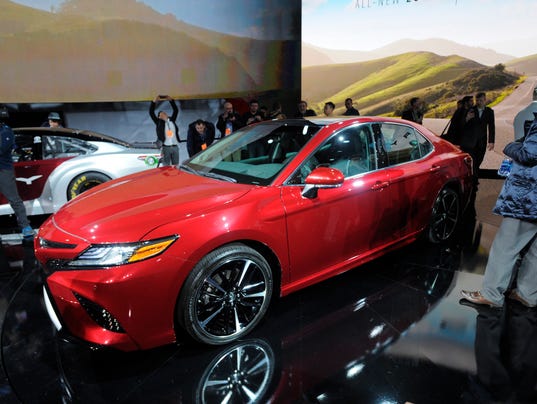
The auto market’s best-selling vanilla car is adding a little fudge ripple swirl.
Toyota introduced its 2018 Toyota Camry at the Detroit auto show Monday — made fresh with a new chassis, lower center of gravity and edgy look. The best-selling car in America for the last 15 years (the Ford F-series pickup is the best-selling vehicle), the Camry has won over generations of buyers with its bullet-proof reliability and IHS Top Safety pick status. But its design has grown tired in a segment that is losing ground to bigger, more utilitarian crossovers.
Under direction from President Akio Toyoda to make all its products more fun to drive, Toyota’s ol’ reliable Camry tried to stretch the envelope with cosmetic changes for the 2015 model year. But the 2018 car is remade from the ground up on the Toyota New Global Architecture, which first underpinned the (much sportier) Prius hybrid last year.
With a lower-by-an-inch driver seating position and roof, the Camry gains a more dynamic chassis stance.
Job One, however, was making the Camry more interesting to look at. To that end, Toyota has tailored its “Keen Look” design philosophy to lower the hood by almost two inches, while incorporating a “thin and thick” two-grille treatment.
“In order to create something that stirs people’s soul, we’ve laid out the concept of a new sedan that provides fun and excitement behind the wheel,” said Camry Chief Engineer Masato Katsumata in a statement. “In developing the next-generation Toyota Camry, we were able to start with a clean slate, which allowed us to create a true driver’s car.”
With buyers flocking to high-seating position SUVs, the Camry aims at more performance-minded driver who accepts a lowered seating position for better handling.
Work up through the Camry’s familiar four trims — LE, XLE, SE and XSE — and the mid-size sedan gets even more dramatic in appearance. The SE and XSE grades wear a noticeably different body style highlighted by a sculpted rocker panel, 19-inch black wheels, rear spoiler lip and diffuser, and aggressive front bumper.
Engine options – a 2.5-liter, inline 4-cylinder, 3.5-liter V6, and 2.5-liter hybrid with battery assist – do not change from the current generation. But Toyota says all three drivetrains have been reworked to provide more horsepower and torque. The base 4-banger is projected to get best-in-class fuel economy. The gas engine swill be mated to an all-new, 8-speed automatic (up from the current 6-speed) while the hybrid will get a familiar, continuously variable tranny.
Toyota also projects best-in-class fuel efficiency for the hybrid, a crown it had given up to the Ford Fusion after innovating hybrids in the mid-size segment.
Sitting on a two-inch longer wheelbase, the Camry promises an increase in interior room that was already near the top in class – and outward interior visibility thanks to better placement of the side mirrors relative to the A-pillar. The Camry features premium, soft interior materials and a new, more futuristic dash design with a character line extending from the instrument panel and bisecting the “waterfall” console. A heads-up-display unit – innovated years ago by Cadillac – is also available.
The console is run by a new, Entune 3.0 system that offers upgraded navigation and vehicle WiFi for up to five devices. Toyota has not yet adopted Apple Car Play and Android Auto connectivity apps popular in other vehicles in class. The Camry will have available a full suite of driver assist features that once separated mainstream from luxury cars. No more. Camry features include pre-collision assist with pedestrian detection and automatic high beams.
“The all-new 2018 Camry is, without a doubt, the most captivating mid-size sedan we’ve ever produced,” said Bob Carter, Toyota senior vice president of automotive operations, in a statement. “It delivers on everything Camry owners have come to expect from America’s best-selling car, and adds to it, jaw-dropping design, more advanced technology, cutting-edge safety systems, and stirring performance that raises it to an unparalleled level of excitement.”
Made in Georgetown, Kentucky, the 2018 Camry is scheduled to go on sale in late summer 2017.
Payne: How I went 3-for-3 on Car of the Year
Posted by hpayne on January 10, 2017
Predictably, the charming, retro-musical “La La Land” (that, and it’s got heartthrob Ryan Gosling) swept the Golden Globes this weekend — the first of an expected dominance of the awards circuit.
The Chevy Bolt electric vehicle is the “La La Land” of automobiles.
Bolt EV added to its bulging trophy case Monday morning by taking home North American Car of the Year to open the Detroit auto show. Judged by a flock of independent auto journalists from across the U.S. and Canada, the prestigious NACTOY is given to car, utility and truck of the year. I am one of those car-crazy judges, and like my colleagues I voted for the Bolt as car of the year. I don’t know a juror who didn’t.
The Bolt, the first battery-powered car to get over a 200-mile range for under $40,000, is that good. It beat out worthy competitors that would have won in any other year. The Genesis G90 is the flagship of Hyundai’s new luxury brand. I like everything about it. Its chiseled body cut from a block of marble. Its spacious interior. Its Saturn-like, simple pricing strategy. Third finalist Volvo S90 is a stunning sedan (though its sister XC90 SUV took away last year’s truck trophy so it seemed familiar).
But how do you say no to a mini-Tesla Model S?
With a similar 60 kWh battery as the base Tesla, the Bolt EV is a mini hot hatch. At our NACTOY test of the nominees in October, I flogged the stuffing out of the little beastie over Hell, Michigan’s twisties. Squalling tires, instant torque, regenerative paddle for braking. It was (almost) as much fun as my favorite, $40K VW Golf R hot hatch. And it will comfortably sit four.
“We set out to make, not only a great EV, but a great car,” said GM electrics guru Pam Fletcher. Mission accomplished.
The other categories were more competitive, though I thought both had obvious standouts.
For the first time, we separated utes because, well, they are the dominant vehicle sold. That and it was getting silly lumping small SUVs with ginormous trucks. Last year the subcompact Mazda CX3 crossover was matched against the Nissan Titan. We couldn’t let that happen again.
With the herds properly separated, the Chrysler Pacifica stood out as best utility (and got my vote). Chrysler may be struggling as a brand, but it still sets the bar in a minivan segment it created. Replacing the Town & Country, the Pacifica redefines the boxy segment with a sleek design any soccer mom (or dad) can embrace. Innovation abounds from the kick-open sliding doors to the 30-mile-on-one-charge hybrid variant. Inside, the Pacifica is a rolling IKEA store with Stow ‘n’ Go seats and drawers (yes, drawers) for front storage.
My vote wasn’t unanimous, however, as I gave points to Mazda’s CX-9. The Japanese maker’s largest SUV, it is more beautiful than anything made by a luxury manufacturer. Even the Jaguar F-Pace, the other ute finalist.
As for truck, it’s hard to vote against the Ford F-series pickup, and the Dearborn maker brought out its Super Duty F-250 to stomp the competition this year. It’s a better truck than the very good Nissan Titan entry, but the big boys were beaten out by a smaller fish.
I concur with my colleagues that the Honda Ridgeline, the only pickup built on a unibody chassis, breaks ground for pickup riding comfort. Let me grab a garbage can top as you Ford fans pelt me with rocks. Pickups should be able to pull ocean liners, you say. Pickups should be able to wade the English Channel. Yes, but smaller, midsize trucks appeal to a more urban customer, more concerned with drivability than payloads (for which the Ridgeline is still plenty capable).
The Honda may be the first of other unibody-based pickups as manufacturers save costs by consolidating platforms. Will the next Chevy Colorado be on the new Traverse SUV platform? Might a future Ford pickup share Escape architecture? Everyone’s keeping an eye on the Honda’s success.
In the meantime, I’m looking forward to the Chevy Bolt EV’s reception in the marketplace. Will America embrace a $40K electric hatchback? Or will it only appeal to Hollywood greens in La La land.
Kia Stinger shows sultry sedan coupe
Posted by hpayne on January 10, 2017

Like the publication of the annual Sports Illustrated Swimsuit edition in the dead of winter, Kia Motors warmed up the frigid Detroit auto show Sunday with the introduction of a gorgeous, four-door sedan coupe called the Stinger.
Realizing the promise of Kia’s acclaimed GT concept first shown in Geneva in 2011, the Stinger’s long wheelbase and fast back is modeled after $80,000 sedan coupes like the Audi A7 and Porsche Panamera – but priced much closer to the $40,000 Audi A4 compact sedan.
The sleek Stinger marks another bold move by the Korean automaker to expand beyond its mainstream, affordable roots to compete in the world of performance luxury. While sister automaker Hyundai has created a separate luxury automaker called Genesis, Kia is exploring luxury under its same nameplate – first with the K900 large luxury sedan and now with the Stinger coupe.
Not uncoincidentally, the Stinger’s design comes at the hand of Kia design chief Peter Schreyer, a former Audi draftsman. While Kia says that the Stinger aims to “redefine a segment currently populated by European automakers” – like the Audi A4, Infiniti Q50 and BMW 4 Gran Coupe – the car’s 114.4-inch long wheelbase is considerably bigger than those compact sedans. It’s similar to the midsize Audi A7 and Panamera.
The Kia takes its performance cues from those bigger sedans, sporting a rear-wheel architecture that underwent athletic training at the world-renowned Nurburgring race track in Germany. But performance does not come at the expense of comfort.
“A true gran turismo, a car for spirited long-distance driving, is not about outright power, hard-edged dynamics and brutal styling, all at the expense of luxury, comfort and grace,” said Gregory Guillaume, the European designer who penned the Stinger from the company’s Frankfurt studio. “The Stinger has nothing to do with being the first to arrive at the destination – this car is all about the journey. It’s about passion.”
That passion is evident in the Stinger’s dramatic styling, from Kia’s signature “Tiger Nose” grille to the front fender gills to the swept roofline to the dual exhaust pipes. The Stinger’s silhouette mimics the Audi A7 but features a unique, ovoid rear fascia.
The Stinger’s long wheelbase offers roomy interior quarters despite its low, swept roofline. The car comes loaded with the latest safety technology, including a driver alert system to combat drowsy driving, forward collision assistance, a heads-up display, rear-cross traffic alert, and so on. State-of-the-art audio systems are also available, including a Harmon/Kardon music hall with 15 speakers.
True to its performance DNA, bolstered Nappa leather seats with air-cell bladders are available along with a TFT screen between the instrument gauges that displays performance data such as cornering G-forces, oil temperature and even lap times for the truly adventurous.
Under the long front hood, engine choices are more in line with the compact luxury segment with 2.0-liter four and twin-turbo, 3.3-liter V-6 offerings. Both mules, however, will provide plenty of kick – most notably, the V-6 which puts out 365 horsepower; more than the six-cylinder engines in the BMW 4-series GT, Audi A7, or Porsche Panamera.
The engines will be mated to an eight-speed automatic familiar to drivers of the K900 sedan as well as Genesis luxury models like the G90. The Stinger will be offered with a sophisticated, torque-vectoring all-wheel drive system for wintry climates like Michigan. According to Kia’s press release, the system “automatically applies power and braking force to the appropriate wheels to maintain course in adverse conditions.”
The Stinger rides on 18- or 19-inch tires with 10 inches of rubber in the rear to accommodate the aggressive engine and chassis. With 55-percent, high-strength steel and MacPherson front and multi-link rear suspension, the sleek Kia is ready to rumble when the thermometer climbs above freezing.
For complete coverage of the Detroit auto show go to detroitnews.com/autos/auto-show
Bolt, Pacifica, Ridgeline win top NACTOY honors
Posted by hpayne on January 10, 2017

The envelopes, please. The winners for North American Car, Utility Vehicle and Truck of the Year are, respectively, the Chevy Bolt EV, Chrysler Pacifica and Honda Ridgeline.
The trio was announced this morning on the Cobo Center Atrium Stage before a packed house of auto executives and journalists to kick off press preview days at the Detroit auto show. The 23rd annual NACTOY award is one of the post prestigious in the auto industry.
The Chevy Bolt is the first electric vehicle under $40,000 to travel more than 200 miles on a single charge. The Bolt has dominated the auto awards season, taking Motor Trend Car of the Year and being named to Car and Driver’s Top Ten list. With its large 60 kWh of battery (the same size as a base Tesla Model S) in the floor of the vehicle, the Bolt EV gains interior room as well as a low center of gravity. The result is clever packaging that makes the Bolt EV both roomy for a compact car, yet still nimble in the corners.
“We set out to make, not only a great electric vehicle, but a great car,” said Bolt EV Chief Engineer Pam Fletcher, accepting the award.
Added Mark Reuss, GM’s head of global product development: “General Motors is committed to leading in mass-produced, attainable high-value and exciting vehicles. This is…our springboard into the future.”
Other car nominees were the Genesis G90, the flagship for Hyundai’s new Genesis luxury line, and the Volvo S90, which hoped to follow in the footsteps of its sibling XC90 which won 2016 truck of the year.
The utility prize made its NACTOY debut this year. The Pacifica, which reinvented the minivan with its sleek, multi-functional features, was the popular choice for the award. In addition to the V-6-powered van, Pacifica debuted the first-ever hybrid-electric minivan with a range of up to 30 miles on battery power alone.
“This is the perfect family car,” said Chrysler boss Tim Kuniskis, as he took the NACTOY trophy designed by ex-GM design chief Ed Welburn.
Other utes in the running were Jaguar’s F-Pace, which turned heads with the British marque’s first entry in the SUV space, and Mazda’s three-row CX-9 SUV, one of the prettiest utility in the land.
In the Big Three’s Detroit backyard any truck winner other than a F-series, Silverado, or RAM is a surprise. But the mid-size Honda Ridgeline is unique in the midsize truck class with its unibody chassis structure.
“The Ridgeline is re-imagining the pickup truck,” said John Mendel, Honda executive vice president for North America, to cheers from his Honda team.
The car-like structure gives the Ridgeline the best road manners in class. Truck finalists included the 2017 F-250 Super Duty, the latest, largest version of the F-series’ revolutionary, all-aluminum body construction. The Nissan Titan followed big brother XD — a finalist for 2016 truck — in trying to put a dent in Detroit Three dominance of the trucking arena.
The three finalists in each category were winnowed from a list of 44 semifinalists by some 60 automotive journalists who have tested, analyzed, and buggy-whipped the nominees over the past year.
NACTOY is the only independent auto award made up of journalists from a wide range of outlets. The award honors excellence in innovation, design, safety, performance, technology, driver satisfaction and value.
Ford takes wraps off updated F-150
Posted by hpayne on January 10, 2017

How do you celebrate 40 years of Ford F-series dominance with an enviable 820,000 pickups sold in 2016 alone? Roll out a new F-150.
To kick off the Detroit auto show this morning, Ford announced the first update to its ground-breaking, aluminum-body truck since it wowed the auto show as a 2015 model in 2014. With the 2018 pickup, the headlines just keep coming.
The new truck ditches the three-bar grille that has been Ford’s signature design for over a decade, and brings a diesel engine to the light-duty truck lineup (previously offered only in heavy duty) for the first time in its nearly 70-year history. Ford, the official truck of the NFL, will preview the F-150 on the Fox NFL Wildcard Pregame Show at 4 p.m. Sunday, and then unveil it at Ford’s news conference at the North American International Auto Show on Monday morning.
Ford crested the 800,000 sales bar for the first time since 2005, leading truck market sales with the F-150 and its new for 2016 F-250 Super Duty brother. The Ford beat out its biggest competitor — the Chevy Silverado by over 250,000 units sold, and it beat General Motors’ Silverado/GMC Sierra twins by about 24,000.
“It’s the best-selling truck since disco,” said Todd Eckert, Ford truck group marketing manager.
The 2017 Super Duty broke from the F-150 with a fresh, two-bar grille — dubbed “double I-beam” by Ford. Embraced by buyers, the F-250 grille style — with seven variations — is migrating to the F-150 along with a new bumper and headlamps. Changes to the rear fascia include new taillights and the letters “F150” tattooed on the tailgate.
The three-bar retires after a 14-year run that began with the Ford 427 Concept sedan that was rolled out at the 2003 Detroit Auto Show. The 427 inspired a “bolder, more American” design style that first graced the 2006 Ford Fusion sedan and was the echoed throughout the lineup from the Ford Focus compact to the Ford Edge. The F-150 fascia went three-bar in 2009.
“We took the grille and really stretched it to give it more width,” said Gordon Platto, F-series designer. “The Super Duty was liked so well with the double I-beam, we felt an obligation to create harmony between big brother and little brother.”
The 3.0-liter turbo-diesel leads a revamped engine lineup that includes a turbocharged Ecoboost 2.7-liter engine; twin-turbo V-6. 5.0-liter V-8; and a new base-model 3.3-liter V-6. Innovative port and direct fuel-injection systems increase fuel efficiency and durability.
“Direction injection engines have improved fuel efficiency, but the problem is they have come with carbon buildup,” says Dave Sullivan, manager of product analysis for research firm AutoPacific. “Adding port injection will solve that problem and increase engine longevity. Other manufacturers like Toyota are also moving toward this solution.”
The 2018 F-150 is due in showrooms in the fall 2017, but the diesel version won’t be available until the summer 2018. Built in England by Ford, the diesel will deliver impressive towing ability and is the same oil-burner found in Land Rover’s SUVs.
All engines but the 3.3-liter will be mated to a new 10-speed automatic transmission — co-developed with GM — that was first introduced on the 2017 Ford Raptor muscle pickup. The 3.3-liter V-6 (downsized from the current 3.5-liter) will be married to a 6-speed automatic. The F-150 will come standard with stop-start technology, which turns off the engine at stoplights to save fuel.
The F-150 will be the first light-duty truck to get pre-collision assist with pedestrian detection as well as adaptive cruise control which can come to a complete stop – then accelerate again. The 2018 model will also have an available Wi-Fi hot spot that can accommodate up to 10 devices. The F-150 will come with Apple CarPlay and Android Auto smartphone compatibility.
In addition to the seven new grille choices, the 2018 F-150 will sport six new wheel options (from 17- to-22 inch) and more interior color and material choices. All these options across five model trims – XL, XLT, Lariat, King Ranch and Platinum – make for hundreds of potential pick configurations.
“We like to offer our customers as much customization as possible,” says Platto.
While 2018 F-150 pricing won’t be released until later this year, it won’t differ much from the current model which starts at $28,025 for a base XL and tops out at over $64,000 in Platinum trim with all the goodies. The F-150 is built in Dearborn, Louisville, Kentucky, and Kansas City, Missouri.
For complete coverage of the Detroit auto show go to detroitnews.com/autos/auto-show
New models ready for their close-up at auto show
Posted by hpayne on January 6, 2017

The Detroit auto show rolls into town Sunday for a two-week stay that promises something for everyone: futuristic self-driving cars, Detroit classics, the latest sport utilities, state-of-the-art sports cars … even a life-size version of “Cars 3” star Lightning McQueen.
The McQueen racer will be a lighthearted kickoff to the high-tech AutoMobili-D — a showcase for speakers and startups on the cutting edge of autonomous and ride-sharing technologies, AutoMobili-D will commence Sunday on Cobo Center’s Atrium Stage.
Some 5,000 journalists from around the world will attend over 40 new-car reveals on Sunday and Monday. On Jan. 13, the show will roll out the red carpet for the glitzy Charity Preview ball, which has raised over $41 million for children’s charities in the last decade. While party-goers sleep off hangovers on Jan. 14, the show opens its doors to the general public until Jan. 22. Last year, the Detroit Show recorded its biggest gate since 2003 with 815,575 attendees.
Now in its 28th year, the North American International Auto Show has weathered industry cycles — including the devastating recession of 2008 — to remain one of three premier auto shows on the planet along with Geneva and Frankfurt/Paris.
“Because of the number of press here, this is a great show to launch things,” says Sam Slaughter, NAIAS chairman and CEO of Sellers Subaru and Sellers Buick and GMC dealerships in the metro area.
Now, as the industry faces an “inflection point” (in the words of AutoMobili-D speaker John Krafcik, CEO of Google autonomous car spinoff Waymo), Slaughter says NAIAS organizers recognized the need to make the show a display case for the technologies that are transforming the industry. Automakers this year have used the CES technology show in Las Vegas to introduce high-tech vehicles like Chrysler’s self-driving Portal EV concept and Toyota artificial-intelligence driven Concept-i. Those vehicles — and the creative talent behind them — will also be in Detroit.
“These are the brains behind the behind the autonomous future,” says Slaughter. “We have an amazing story to tell with over 50 startups in Cobo.”
Those startups will join establishment pillars in presenting their visons of a new auto mobility. . The startups , meanwhile, will be among 100 companies to populate nearby Hall E — aka “Cobo’s basement” — that in years past has been outfitted for everything from tree-lined, electric-car demonstration courses to displays for Chinese automakers.
This year, a Chinese company will graduate to the show’s main floor as Guangzhou Automobile Group looks to follow Japanese and Korean companies as a successful, Pacific Rim export to the U.S.
All eyes will be on Japanese giant Toyota as it reveals an all-new Camry sedan, the best-selling car in America. For all the talk of self-aware EVs, the bread-and-butter of American manufacturers remains gas-powered cars and SUVs.
The Camry is promising an extreme makeover as it tries to remain relevant in a market that’s crossed over to crossovers. Camry sales, echoing all sedans, were down 10 percent in 2016. Since the recession, ute sales have exploded to 60 percent of the market and NAIAS offerings continue the trend. SUV reveals from automakers as diverse as Chevrolet (Traverse), Ford (Expedition), Audi (Q8), Infiniti (QX50 concept), and BMW (Concept X2) will debut on the menu.
“This will be a meat and potatoes show,” IHS Automotive analyst Stephanie Brinley says of the core offerings coming from automakers including a new version of Honda’s best-selling Odyssey minivan.
“Auto product is still the most important part of NAIAS,” shrugs Brinley in reference to the tech buzz in the air. “We went through a phase when every show had to be green. Now every show has to be high-tech. Soon tech will just be part of the auto landscape.”
Showgoers will feel, however, the absence of several brands on the show floor. Past exhibitors Porsche, Tesla, Mini Cooper, Jaguar, Land Rover, Bentley, Ferrari and Maserati are AWOL this year.
The reasons are many.
Exclusive brands prefer more intimate venues where wealthy customers can be wooed one-on-one — like The Gallery event at the MGM Grand Casino that officially opens the show on Saturday and where beautiful Ferraris and Lamborghinis will be on display for $500 a ticket. In a multi-media age some automakers also aren’t as dependent on auto shows for attention.
But even some major exhibitors are turning away from press conferences to show new wares — brands like Buick, Cadillac, Dodge, Mazda and Acura.
Brinley blames this dearth of glitz on automakers taking a breath from frantic new car development.
“What we’ve seen since the recession is a big increase in new offerings to meet new product directions,” says Brinley. “A little slowdown in product cadence is natural.”
Show attendees will still be dazzled by auto displays worthy of a place in Times Square — part of a $200 million upgrade last year in which 80 percent of manufacturers remade their displays. The high-def, pixel-pallooza of giant LED screens is a high-tech marvel itself — with more stage tweaks this year from GMC, Subaru and Nissan.
For all the 21stcentury tech, though, the Detroit Show will also honor its roots. Before the reveals, before the speeches, before the champagne … three vintage cars from the American Car Museum will complete a six-state, 12-day, 2,150-mile winter journey from Boston to Detroit. Friday morning, winter Dream Cruisers can join a 1957 Chevrolet Nomad, 1961 Chrysler 300G and 1966 Ford Mustang as they travel down Woodward to christen the show.
“This is the second annual ‘Drive Home’ and I hope it becomes a tradition,” says NAIAS chairman Slaughter. “With all that’s going on in the industry, it’s a great way to connect to our history.”
Henry Payne is auto critic for The Detroit News. Find him at hpayne@detroitnews.com or Twitter @HenryEPayne.
Detroit auto show
Friday: “The Drive Home II: The Heritage Run” – final leg of drive from Boston to Detroit by 1957 Chevy Nomad, ’61 Chrysler 300G and ’66 Ford Mustang
■9-10 a.m.: Cars & Coffee at Lincoln of Troy
■10-11:30 a.m.: Drive down Woodward Avenue
■Noon: Press conference, Cadillac Square
Saturday: The Gallery of ultra-luxury cars, MGM Grand Detroit. Tickets: $500.
Sunday-Thursday: Press days/AutoMobili-D
Wednesday-Thursday: Industry preview
Jan. 13: Charity preview, 6-9 p.m. Tickets: $400
Jan. 14-22: Public days, Cobo Center. 9 a.m.-10 p.m. daily (no admittance after 9 p.m.), except Jan. 22, when hours are 9 a.m.-7 p.m. (no admittance after 6 p.m.). Tickets: $13 adults, $7 age 65 and older, $7 age 7-12, free for ages 6 and under
Payne’s 2016 Detroit Show Top 10: Where are they now?
Posted by hpayne on January 5, 2017

It’s almost show time in Detroit once again, but visions of last year still dance in our heads. The 2016 North American International Auto Show unveiled a little of everything from sleek sedans to pickups; from the electric Chevy Bolt EV hatchback to the 745-horsepower, V-8-powered VLF Force 1 sports car. With auto sales revving to over 17 million unites, there was a toy for everyone.
So before the new acts roll out for 2017, here’s an update on my 2016 Detroit Show Top 10. Are they as good as promised? Have they even turned a key? Let’s find out …
Chrysler Pacifica
Everyone knows minivans are the best family haulers out there, but they’ve been typecast as boxy mom-mobiles (remember the devastating Mitsubishi SUV ad: “Whoever owns the tan minivan, your lights are on.”). The handsome Pacifica aims to change all that — including a plug-in version so you never need visit a gas station if your daily routine covers less than 30 miles. Pacifica’s sculptural design echoes Mercedes’ R-Class wagon, and doesn’t skimp on inside amenities with a dresser-drawer console and stowable, foldable, removable middle seats.

BMW M2
BMW delivered its 365-horsepower M2 — a $56,000 gateway drug to BMW’s iconic performance badge that includes such highs as the $80,000 M4 and $115,000 X5 M SUV. A throwback to earlier, more compact generations of M-coupe — its dimensions the same as my own 2001 M3 — the ferocious M2 looks fast just parked at curbside. I found it more fun than any BMW I’ve driven — with a bottomless well of torque from its twin-turbo V-6. In a year that saw the sensational Alfa Romeo Giulia Quadrifoglio challenge the M’s performance crown, the M2 is a reminder that the German brand is still the benchmark for style and speed.

Lincoln Continental
If BMW’s M is all about performance, the Lincoln brand is about interior comfort. The brand’s flagship Continental is a rolling couch. Check that, it’s way more comfortable than your couch. The 30-way front throne is tops in class — including an auto-headrest that cradles your head like a mother’s arm. From the posh rear seat you have full interior control from radio to moon-roof to front passenger seat positioning. No wonder that’s where Lincoln-spokesman Matthew McConaughey hangs out in his latest ads.

Honda Ridgeline
Ridgeline 2.0 is back with the only crossover-like, unibody chassis in the hot, small-pickup segment. Though the Honda gives up some towing and hauling capability to its more traditional, body-on-frame competitors from Chevy and Toyota, its ride is unparalleled on-road. Which is where most of its metropolitan owners will drive it. With its Acura-shared, torque-vectoring AWD system it’s fun to get dirty off-road, too.

Lexus LC500 Coupe
I have yet to get my mitts on Lexus’ dramatic-looking, six-figure flagship, which is due in the States in the first quarter of 2017. The LC is a two-door sports car — but with its big, honking, front-mounted V-8 and porky 4,300 pounds, it’s aimed more at BMW 6-series customers than at the rubber-burning Porsche 911 crowd.

VLF Force 1
Based on the now-defunct Dodge Viper bones, the front-engine supercar is the second offering from VLF (the initials of partners Gilbert Villarreal, a successful manufacturer, ex-GM product guru “Maximum Bob” Lutz and legendary designer Henrik Fisker), a company that builds automotive Frankensteins for luxury customers. The first was the VLF Destino — a plug-in Fisker Karma retooled with a Corvette V-8 — which rolled out last year. In a nondescript building overlooking The Palace of Auburn Hills, the Force 1 is slowly taking shape. With a 513-cubic-inch Viper engine, you’ll feel the Hills shake when it’s ready.

Chevrolet Bolt
For those living under a rock for the last year, the Bolt EV is the first electric car under $40,000 to go over 200 miles on a charge (238 miles to be exact). That range is real (though expect to subtract 25 percent in Michigan’s frigid winter temps), but this is no green snore-wagon. With the same-sized battery (60 kWh) as a base Tesla model S, low center of gravity and no range anxiety, the five-door hot hatch is a blast to drive hard.

Ford Fusion
With Aston Martin-like good looks and the best-bod in class, the Fusion didn’t need to change much for its 2016 refresh. A nifty e-shifter here, sharpened grille there. The real changes came underneath where the mid-sizer adds Sport, battery-powered Energi, and luxe Platinum trims to its already diverse lineup. Powered by a throaty, 325-horsepower V-6, the Sport is a hot sedan with luxury performance at $20K less.

Acura Precision concept
The Precision debuted as an old-school, head-turning design concept. The sedan’s purpose was to inspire Acura’s tired lineup and its effect is already being felt. The 2017 Acura MDX crossover sports the Precision-inspired “Diamond Pentagon” grille (ditching the much-maligned bottle opener). A near-production ready Acura Precision Cockpit concept followed at the LA Auto Show which points the way toward a new, touchpad-controlled infotainment interface.

Buick Avista
If you didn’t remember Acura’s concept, it’s probably because Buick’s concept blew everyone’s socks off at last year’s show. The stunning coupe — based on the same Alpha platform that under-girds the athletic Cadillac ATS and Camaro — inspired hope for a production version. Don’t hold your breath. Like the Precision, Avista is more likely to inspire next-generation sedans – like the stunning Lacrosse and coming Regal.
Payne: Jeep Wrangler, swamp thing
Posted by hpayne on December 29, 2016

My 2017 Jeep Wrangler is covered in mud. We’re marooned in a gulch. Up to the footboards in water. A three-foot step from the nearest mud bank. All four wheels spinning in place.
I wouldn’t want to be anywhere else.
The Mounds Off-road Vehicle Park is in the middle of a swamp 12 miles northwest of Flint. It’s 230 acres of bogs, hills, mud, sand and forest. A web of trails cuts through this forbidding landscape booby-trapped with roots, rock and moguls that challenge the fortitude of any off-roader. This is Wrangler country.
Jeep sells its rugged image to over a million customers a year. From the posh Grand Cherokee Summit to the cute, subcompact Renegade, Jeep’s familiar seven-slot grille is everywhere. It’s the outdoorsman’s automaker. The original sport utility vehicle has drive modes for SAND, MUD and OCEAN BOTTOM (OK, made that last one up). Even if most owners never take their comfy crossover anyplace more adventurous than a county road.
It’s an image built on the iconic Wrangler, a direct descendent of the Army’s World War II Jeep.
I’d never driven the famed Wrangler. Like a tough kid from the other side of the tracks, Wrangler’s first impressions can be, um, uncomfortable. The front hood is held down by straps. A tire on the back hatch makes access difficult. The exterior styling is retro-World War with big bumpers and an upright windshield. It gets more Spartan inside.
My Wrangler Sahara costs a whopping $45,000, but its technology is stuck in the Stone Age: There’s no keyless entry. It has nets for storage on the doors, and a hard plastic dash and door rests. At least it has power windows. You need the strength of Hercules to pull the drive mode shifter from 2WD to 4WD.
With the Wrangler’s brawny, 32-inch tires and 3.6-liter V-6 roaring, I communicated with Mrs. Payne in the seat next to me by megaphone.
But like my favorite, trunk-challenged, apex-carving Alfa Romeo 4C sports car, the Wrangler is built for play. What other vehicle is engineered for easy door removal? When I jumped into the tall Jeep, I hit my head. I turned to find a huge, 21/4-inch roll bar spanning the cockpit. Now we’re talking.
Don’t buy a Wrangler unless you plan to go off-road. Like the Mounds. In, say, December.
Late fall might be the most challenging time of year at the park.
After a week of torrential rains the swamp-like terrain was even swampier than normal. The park gatekeeper warned me to stay away from watery gulches. You know, like when Mom used to tell you to stay away from mud puddles on your way home. So naturally I ignored the advice and charged right in.
On asphalt the Wrangler’s body-on-frame chassis and big Bridgestone tires give it the manners of a crude pickup without the bed. Off asphalt, it’s a terrain-shredding animal. But my Wrangler met its match in a deep, water-filled rut. Like losing adhesion on a race track, you got to explore the edge of the envelope.
“You aren’t off-roading unless you get stuck,” said Kelly Boerner of Newport, Michigan, who brought his cavalry of veteran off-roaders to rescue me.
Kelly and his mates had done Bundy Hill and Silver Lake, but it was their first visit to The Mounds. They looked like one of those vehicle trains from the “Mad Max” movies. Vehicles big and small. Chevy Trailblazers, RAM 1500 … and lots of Wranglers. Half the vehicles I saw at The Mounds (not counting ATVs and dirt bikes) were of the Jeep variety — and many had already been stuck. Indeed, the swamp was littered with marooned carcasses like a sort of present day La Brea Tar Pits. Difference is, dinosaurs didn’t have trucks to pull them out.
Our savior was a Ram 1500 pickup with five-inch suspension rider addition, hemi V-8, 38-inch tires and tow gear. Owner D.J. Floreskul threw a line around my tow tongue (just like my Lola 90 sports racer, oddly enough) and yanked me out of the bog back to terra firma. Well, at least terra mud.
There were other limits on the vast Flint playground. I learned to stay away from the rock quarries. The Sahara’s more refined features include cool 18-inch wheels with Granite Chrystal painted pockets and dent-prone steel fenders.
To further explore the limits (if not the watery bogs), I’d suggest the Wrangler Rubicon with a lift kit, plastic fenders and electronically detachable front sway bar. The latter basically gives the vehicle knees — allowing the front wheels to move independently of each other to crawl over rocks.
You might guess Wranglers are boy toys (like sports racers), but you’d be wrong. The Mounds was littered with Jeep women. And everywhere I went in Oakland County, I found females flogging Wranglers. An empty-nester friend had traded in her Town & Country minivan for a Wrangler. A retiree bombs around Arizona in her Jeep. Heck, even Mrs. Payne confided to me that she coveted a Wrangler as her first car as a 16-year-old.
Wrangler fan Lauren Stuart (she has two) fell hard for the brand while on a Pink Jeep tour in Sedona, Arizona. I know the Pink Jeeps. They’re the tour guides through Arizona’s impossible canyon trials. This summer, Lauren drove cross country to Sedona in her Rubicon (license plate “BE FIT”) to tackle the Pink Jeep trails themselves.
She must have used her smartphone’s Google Maps to get there. True to the Jeep’s stuck-in-WWII technology, my Wrangler’s navigation system couldn’t get us to The Mounds. Not because it couldn’t find it, but because its directions lagged about 5 miles behind us. It’s a rare glitch in Jeep’s usually excellent UConnect system.
Wrangler’s proven, torquey Pentastar V-6 mill had no issues. Its 285 ponies can easily outrun any bee nests you might disrupt in the wilderness. The Wrangler is unique: Loud, rugged, with a face that looks like it’s been to Normandy and back. It was built to run through a brick wall.
Just beware of the depth of the watery gulch on the other side.
Henry Payne is auto critic for The Detroit News. Find him at hpayne@detroitnews.com or Twitter @HenryEPayne.
2017 Jeep Wrangler Sahara Unlimited
specifications
| VEHICLE TYPE | FRONT-ENGINE, FOUR-WHEEL DRIVE, FIVE-PASSENGER SUV |
| Power plant | 3.6-liter V-6 |
| Transmission | 6-speed manual; 5-speed automatic (as tested) |
| Weight | 3,976 pounds (automatic as tested) |
| Price | $24,990 ($45,045 as tested) |
| Power | 285 horsepower, 260 pound-feet torque |
| Performance | Zero-60: 8.4 seconds (Car and Driver); towing: 3,500 pounds |
| Fuel economy | EPA 16 city/21 highway/18 combined |
report card
| HIGHS | FEARLESS OFF-ROADER; THAT WWII JEEP FACE |
| Lows | Loud interior; over $40,000 in upper trims |
Overall:★★★
Perfect Tens: Camaro, Raptor are transmission pioneers
Posted by hpayne on December 29, 2016

Los Angeles — Rocketing onto Willow Springs Raceway’s front straight at 100 mph in fourth gear, the 2017 Chevy Camaro ZL1 rifles off barely perceptible automatic upshifts — five-six-seven — at 100-millisecond intervals to reach 150 mph. Two hundred miles southeast in the Anza-Borrego desert, a Ford F-150 Raptor sport pickup goes airborne over a sand dune at 60 mph, its transmission holding the highest possible gear so its 35-inch tires maintain momentum when they hit the desert floor again.
The Camaro and Raptor may seem an odd couple. But they are the cutting edge of automotive technology: They represent the first application of automatic, 10-speed transmission technology in the industry.
Developed jointly by General Motors and Ford Motor Company, the 10-speed combines an unprecedented range of performance and fuel efficiency in one gearbox. They allow the ZL1 and Raptor to be on-course warriors one minute — and domesticated, on-road commuters the next. With government mandating increased fuel efficiency at the same time consumers expect increased performance, the 10-speed satisfies both goals.
“The 10-speed has a greater ratio spread, which enables fuel economy in the upper gears while providing more torque multiplication in the lower gears,” says Ford drivetrain engineer Seth Goslowski, who did extensive, extreme development on the Raptor in the formidable Borrego sands east of San Diego.
Ford was the lead engineering team on the rear-wheel-drive 10-speed, while GM leads development on a joint, 9-speed, front-wheel drive tranny.
The effect of an automotive 10-speed is not dissimilar in theory from an 18- or 27-speed bicycle, says Goslowski. Like a bike, multiple gears allow for better torque at low speeds, better cruising in high gear. For Raptor that translates to steep rock crawling where the big truck uses gears one-two. For the Camaro the closer low-end gear ratios enable it to better manage the pony car’s awesome 650 pound-feet of torque in order to go 0-60 in just 3.5 seconds.
But don’t expect 27-speed drivetrains from cars anytime soon.
“The 10-speed came about because its manufacturing complexity and weight makes sense,” says Goslowski. “A 12-speed does not have enough performance and fuel efficiency benefit to justify the added weight and complexity of adding more gears.”
Crucial to the joint program, dubbed 10-Speed Rear Drive (or 10R for short), was that the gearbox’s packaging would fit the same space as the base Camaro’s eight-speed transmission and the Ford F-150’s six-speed automatic.
“We spent a lot of time crafting a 10-speed that has minimum content— low losses, light weight, (economic) package — but also give us performance and efficiency improvements over our existing products,” says Chevy transmission engineer Jim Borgensen.
Camaro Chief Engineer Al Oppenhimer says the 10-speed was the perfect fit for the low-volume, high-performance ZL1. Tested on some off the world’s most challenging race tracks, the Camaro shares GM’s most capable V-8 — the 650-horsepower, 650-pound-feet LT4 — with the Corvette Z06.
“I wouldn’t say we did this match-up with the Camaro for (federal fuel-efficiency mandates),” says Oppenheiser. “We did it to match the powerband of the engine and track requirements because of the close-ratio of gear sets. It works perfectly with a 650-horsepower engine.”
The ZL1’s 100-millisecond upshifts put it in supercar territory; dual-clutch, $200,000 Porsche Turbo gearboxes shift in 500 milliseconds. Combined with turbo technology, the 10-speed allows the 5,518-pound Raptor to gain 16 percent fuel efficiency over the previous-generation six-speed gearbox.
Ford’s first application goes in its highest-volume vehicle: In addition to the Raptor, Ford has announced that all F-150’s with the Ecoboost V-6 engines will get the 10-speed. As a result, the automaker optimized the transmission for both power and gas mileage.
Although the F-150 and Camaro may appear to be an odd couple, Ford’s Goslowski says the performance benefits of the 10-speed to a nearly three-ton pickup and 3,944-pound sports coupe are similar.
“They both need to be sporty and aggressive in their shifting,” he says. “But towing at low speed in a truck and getting grip-torque off the line with a 6.2-liter V-8 also put similar demands on a transmission.”
Ford has not announced other applications beyond the F-150, but GM has said that it will put its so-called Hydra-matic 10R90 transmission in eight other GM products.
Ford and GM vehicles won’t be alone with 10-speed offerings in the market for long. Lexus is introducing a 10-speed in its LC 500 supercar due in May. Meanwhile, Honda has taken out a patent for an 11-speed box. Anyone for 12? Not yet in cars, but Volvo and Mercedes semi-trucks have been running 12-speed automatics for a few years now.
Whatever the speed, Goslowski thinks automatic transmissions will continue to be the technology of choice over performance-challenged single-speed CVT transmissions.
Jeff Troush was the lead calibrator on the ZL1’s transmission. He and his team of engineers programmed the box with “performance-shifting strategies” so that shifts adapt to lateral g-loads and pedal inputs by the driver.
Team Penske IndyCar racer Josef Newgarden took several hot laps in the Camaro at Willow Springs. He left it in automatic instead of using paddle shifters: “It was sensing what gear I wanted and at what moment.”
Self-driving firm moves fast: Waymo in talks with Honda
Posted by hpayne on December 22, 2016

Less than a week after Google’s self-driving technology company spun off as its own enterprise, Waymo is already in talks for a collaboration with a second major automaker. The Silicon Valley company’s latest proposed partnership — this time with Honda — suggests it is eager to press its advantage in autonomous technology and bring it to market, industry analysts say.
Honda Motor Co. announced Wednesday it is entering formal discussions with the Silicon Valley company to integrate Waymo’s self-driving technology with Honda vehicles. Honda R&D Co. Ltd. — the research and development subsidiary of Honda — will work directly with Waymo.
“The collaboration announced today between Honda researchers and Waymo’s self-driving technology team would allow both companies to learn about the integration of Waymo’s fully self-driving sensors, software and computing platform into Honda vehicles,” Honda said in a press release from its Tokyo headquarters.
The talks include discussion of Honda initially providing Waymo with vehicles modified to accommodate Waymo’s self-driving technology.
Fiat Chrysler Automobile NV’s announced Monday that it will test 100 Pacifica minivans outfitted with Waymo technology.
“Between Honda and Chrysler, Waymo is ready to aggressively integrate their technology in manufacturers’ cars,” says Kelley Blue Book auto analyst Karl Brauer. “Their self-driving technology is more refined than anyone else.”
Brauer notes that the Pacifica and the 2018 Honda Odyssey, which will be introduced at the Detroit auto show, are the most advanced minivans on the market.
“Because initial autonomous applications are likely to be business-to-business applications like campuses and public transportation,” says Brauer, “minivans are a great place to start because they haul the most people. If nothing else, Waymo seems to be looking for the most advanced minivans on the market. Then they could move on to other vehicles.”
Rebecca Lindland, also an analyst for KBB, says, “The dialogue between Waymo and Honda makes a lot of sense given that Honda is such a well-respected brand. It’s a tacit endorsement of the technology, and consumers won’t hesitate to buy a Honda. Honda is already well ahead of many automakers when it comes to artificial intelligence, evidenced by its ASIMO humanoid robot. With 100 of Chrysler’s minivans already outfitted with Waymo’s technology, it’s as if Waymo went to the dance with Chrysler, but they’re leaving with Honda.”
Honda’s vehicles could join Waymo’s fleet which includes the Pacifica minivans, 24 Lexus RX450h SUVs and 34 Google prototype cars. The vehicles combined have driven more than 2.3 million miles since 2009 across Mountain View, California; Austin, Texas; Kirkland, Washington; and Phoenix.
If both Honda and Waymo agree to enter into a formal partnership, Honda R&D engineers based in Silicon Valley and Japan would work closely with Waymo engineers in Novi and Mountain View, California.
Waymo and Fiat Chrysler co-located part of their engineering teams at a facility in Novi to accelerate the overall development process.
“It’s consistent with Waymo’s strategy that it would want to work with different manufacturers to make these vehicles,” says IHS Automotive auto analyst Stephanie Brinley. “And Honda wants to learn more about this technology, too. From their announcement, it feels like Honda may want to negotiate a deeper agreement.”
Honda previously announced its intention to put production vehicles with automated driving capabilities on highways around 2020 related to its goal of a collision-free society.
“We’re not in the business of making better cars, we’re in the business of making better drivers,” Waymo CEO John Krafcik, a former Hyundai exec, said in announcing the Waymo spinoff from Google parent Alphabet Inc. last week in San Francisco. “We’re a self-driving technology company — not a car company.”
Krafcik will speak Jan. 8 at the Detroit auto show about the future of autonomous mobility. Fiat Chrysler will show its specially outfitted Pacificas at that presentation.
Payne: Camaro ZL1, the four-seat ’Vette
Posted by hpayne on December 22, 2016

You’ve saved your pennies and now it’s time to buy yourself a Christmas present.
In particular, that track-eating Corvette Z06 you’ve eyed ever since it stomped the Porsche 911 GT3 (and everything else) at Car and Driver’s Lightning Lap competition around Virginia International Raceway. The one with 650 horsepower, magnetic shocks, T-Rex growl. The works.
But life is complicated. You’ve got a family, kids; a two-seat sports car seems so … selfish. Rear seats would be nice to ferry family — especially if you can find a sports coupe with similar, trackable dynamics.
Well, Merry Christmas. Chevy’s elves have a nice, red toy just for you.
With the same supercharged V-8 monster under the hood, magnetic dampers and Jurassic bellow, the 2017 Chevy Camaro ZL1 is a ’Vette with four seats.
Roaring down California’s Willow Springs front straightaway at 150 mph (is that sonic boom from the Camaro or Edwards Air Force base nearby?), I’m reminded of my first test of the Z06 last year at Spring Mountain Raceway in Nevada.
Like the ’Vette, the ’Maro’s lo-o-o-o-ong front hood seems to arrive at Turn One 10 seconds before I do. Enormous 15.35-inch front Brembo brakes (six-pot front, four rear like Z06) stop the 3,944-pound missile like a brick wall. Huge 11-inch front rubber claws the pavement. The car rotates effortlessly into the 90-degree left-hander, throttle flat across the apex, emerging with pavement to spare as I launch to Turn 2.
Like the Stingray, the ZL1 has more to give.
Josef Newgarden, one of “The Captain” Penske’s Indycar star drivers, finds more. Back in the pits, I join him, jumping in the passenger seat. He explores the ragged edge in Turn One, dancing the car from turn to turn. He obliterates my 1.33 second lap with his 1.28.5 — just seconds off the Z06 track best of 1.25. And it’s the first time either of us has been in the car.
The Camaro still has more.
To achieve this mind-melting performance, the ’Maro has more than any ZL1 before it.
Begin with the Alpha platform, the same bones that gird the sensational Cadillac ATS-V. As awesome as the new Mustang GT350R is on the track and as intimidating as the Dodge Hellcat is in a straight line, this Camaro is in its own league. This is a pony car with thoroughbred DNA.
Peer under the skin and the ZL1 gets the same bat-wing under-body brace and suspension bits as the ATS-V. Lighter than its predecessor by 237 pounds, the ZL1 weighs just 80 pounds more than ATS-V, despite its bigger wheelbase and V-8 boat anchor up front that requires 11 heat exchangers to keep cool. Alpha’s inherent goodness shines through as the ZL1 handles like a much smaller car.
GM’s 1st 10-speed gearbox
The Camaro even gets more than big brother Z06.
In a sign of just how serious the General is about making Camaro a premier sports coupe, the ZL1 is GM’s first application of the much-anticipated, lightning-quick 10-speed gearbox co-developed with Ford for rear-drive vehicles.
I imagine Camaro Chief Engineer Al Oppenheiser and Corvette Chief Engineer Tadge Juechter in a friendly arm wrestle to claim the rights to use the 10-speed. Oppenheiser, who has the torso of a grizzly bear, wins.
The 10-speed is a revelation, a single-clutch automatic that rivals — nay, surpasses — the sophisticated, more expensive, dual-clutch Porsche PDK transmission that GM used as a baseline. Nail the big V-8 out of a corner and shifts snap off in almost imperceptible, 300-milliseconds shots — quicker, GM, claims than a Porsche’s 500 milliseconds.
“I thought I was driving a PDK,” says Randy Pobst, Sports Car Club of America champ and a Motor Trend hot shoe who has driven everything from Porsches to McLarens around Willow.
Drew Cattell, a Camaro track jockey and ride and handling engineer for Chevy, says the 10-speed’s quickness gives it a slight advantage over the ZL1’s also available 6-speed manual (itself superior to the Corvette’s confusing, three-gate, 7-speed box). That efficiency helped propel ZL1 to a stunning, 7.26 lap across Nurburgring’s 14-mile course this year — that’s quicker than the Alfa Romeo Giulia Quadrifoglio.
Ready to perform
Want more? Cattell says the ZL1 should lap Willow in the 1.26-1.27 second range.
But the 10-speed’s benefits don’t have to be tracked to be realized. Chevy’s elves have been busy. This is a modern, computer-controlled box that sprinkles magic dust over the old automatic formula.
The transmission’s range of ratios allows the box to concentrate on gears 3-to-7 while on track (Cattell caught 8th gear at 180 mph on the ’Ring’s back straight), then rely on overdrive gears 8-10 on road to save fuel. Seized by the need for speed on a twisty road? Toggle to SPORT mode, hold the left paddle-shifter for one-Mississippi and the tranny will instantly downshift to the appropriate gear — no cycling required — for maximum torque. Cruising along in 10th gear when a Hellcat challenges you into a Hell, Michigan, corner? Hold. Bang! You’re in third gear, revs at 5 grand. Let’s play.
These electronic “Easter eggs” are found in PDKs as well and open a whole world of performance possibilities.
Speaking of Mustangs, the ZL1 adds a ’Stang-like, line-lock burnout feature to impress the crowds at Dream Cruise stoplights. It’s also in keeping with the ZL1’s history as the Camaro family’s dragster. The beast snaps off impressive 11.4- second quarter mile times with an easy-to-use launch control system.
But the supercharged ’Maro is wa-a-a-ay beyond its 1969 drag-racing origins when ZL1 was code for a secret batch of Camaro available to Pamona quarter-milers. Chevy correctly calls this car a triple threat: On dragstrip, on road, and on track.
Even before Camaro rolls out its track-king Z28, the athletic, 650-horse ZL1 joins the Mustang GT350 (still my pick for most fearsome fascia) as athletes that transcend their muscle roots and take on more exotic animals like the BMW M4 and Caddy ATS-V. With its thunderous V-8 and rock-hard abs, it’s a genuine competitor to these $70K cyborgs. But for 10-grand less.
That’s $30K south of a Z06, but admittedly a lot of coin. So, Camaro takes another page from ’Vette. Like the cheaper “Z06 Jr.” Grand Sport, the ZL1’s athleticism can be had in the 1LE package (sans 200 horsepower and 10-speed) for $49K. Still with a V-8. Still with room in back for the kiddies.
Merry Christmas.
Henry Payne is auto critic for The Detroit News. Find him at hpayne@detroitnews.com or Twitter @HenryEPayne.
2017 Chevrolet Camaro ZL1
specifications
| VEHICLE TYPE | FRONT-ENGINE, REAR-WHEEL DRIVE, FOUR-PASSENGER SPORTS COUPE |
| Power plant | 6.2-liter, supercharged V-8 |
| Transmission | 10-speed automatic or 6-speed manual |
| Weight | 3,887 pounds, manual (3,944 automatic as tested) |
| Price | $63,435 ($65,030 as tested) |
| Power | 650 horsepower, 650 pound-feet torque |
| Performance | Zero-60: 3.5 seconds (automatic), 3.7 seconds (manual) manufacturer); top speed: NA |
| Fuel economy | EPA 14 city/20 highway/16 combined (manual); automatic, NA |
report card
| POWER | CORVETTE Z06 PERFORMANCE WITH FOUR SEATS; QUICK, 10-SPEED BOX |
| Lows | Awkward interior storage; rear seats for wee folks |
Overall:★★★★
Payne: 10 best auto innovations of 2016
Posted by hpayne on December 19, 2016

The digital revolution continues to transform automobiles, with software affecting every corner of the vehicle (literally the corners, like sonar). Some innovations prove indispensable (rear-view cameras), others annoy (lane-keep assist). But the oily bits aren’t standing still either. A look at the Top 10 auto innovations from 2016.
10-speed transmission: With digital tech, cars are piling on the gear ratios. Will we soon see bicycle-like 21 speeds? Ford and GM have teamed up to make processor-controlled 10-speed (for rear-wheel drive) and 9-speed (front). Manufacturers can maximize the ratios for fuel economy or performance. First applications of the 10-speed went to the Ford F-150 Raptor off-road monster and Chevy Camaro ZL1 on-track weapon. Cracking off shifts in 300 milliseconds, the Camaro’s box beats dual-clutch transmissions found in cars three times more expensive.
Push-to-pass: Digital trannies are about more than quick shifts. Computer processors also enable neat tricks like push-to-pass (inspired by Formula 1). Option Porsche’s Sports Chrono package with its automatic, dual-clutch box, and a button will appear on the lower right quadrant of your steering wheel. Push it while you’re luffing along a two-lane road, and … look out. The tranny directly downshifts from 7-to-3, revs spike, you floor the throttle and get 20 seconds of instant power. By which time you’ll be halfway to the moon.
Brake-by-wire: To e-steering and e-throttle, add e-brakes. The playful 2017 Alfa Romeo is the first to market. Just don’t tell the trial lawyers. Remember the fake news stories about “ghosts in the machine” causing instant acceleration? Yeesh.
Virtual Cockpit: Audi debuted its Virtual Cockpit in the low-volume TT in 2015 – this year it went mainstream in the Audi A4, A3 and Q5 crossover. Using top-of-the-line Nvidia graphics processors (ask your videogame-playing kids), VC offers extraordinary Google map displays. And they’re heads-up in a 12.3-inch instrument panel so you never have to take your eyes off the road. Sexy and safe.
Apple Car Play/Android Auto: The must-have nav-app for cars. No car navigation system (Audi Virtual Cockpit is close) holds a candle to Google maps. Chevrolet and Hyundai led the way on this technology and most every manufacturer has followed. In a bow to the tide Chevy now offers its Bolt EV with no nav option at all – assuming its customers own smart phones.
GKN AWD: What do the Ford Focus RS Hoon-mobile and Buick Envision SUV have in common? GKN-supplied, dual-clutch, torque-vectoring all-wheel-drive. Like the 10-speed tranny, this digitally controlled hardware brings enormous versatility. With the ability to transfer torque to any wheel, the system helps RS carve up race tracks. The same tech rotates bigger-mass vehicles like the Envision to better negotiate tight turns and grueling winter weather.
Alpha platform: The new skeleton of the Cadillac ATS has made it the best-handling sedan in lux. But wait, there’s more. Alpha architecture also made Camaro Alpha dog in the muscle car segment – and on par with BMW’s M3 and Mercedes AMG E-63. Stiff and light, the platform also transfers loads to the vehicle’s spine allowing genius designers like Tom Peters to scult those wicked sheet metal curves in the Camaro’s rocker panels.
Payne: Ford Raptor is off-road king
Posted by hpayne on December 15, 2016

Buy a Ford Focus RS, Corvette Grand Sport or Porsche 911 Turbo, and you’ll want to take it to the nearest track playground to explore its capabilities. Probably something like Grattan Raceway’s 2-mile roller coaster, where you can test the limits of the RS’s torque-vectoring all-wheel-drive, or rocket the 911 to more than 130 mph on the long, main straight.
Buy a 2017 Ford F-150 Raptor sport pickup and you’ll need a bigger sandbox.
A good one is California’s 50-mile Anza Borrego Desert State Park course, where you can unleash the full potential of this Brobdingnagian vehicle. Nail the 5,500-pound Raptor’s fat throttle pedal (I wear narrow race shoes for sports cars, but I suggest steel-toed work boots to mash this sucker) and the Ford gulps landscape like an aluminum rhino. Rocks are pulverized in its wake, bushes tossed aside, sand dunes obliterated by 35-inch BFGoodrich rubber mallets. Roaring along at 100 mph on sandy flatland, this truck is king of the beasts.
Yes, truck. The Raptor is already a legend in its own time — the first production pickup to offer Baja-like, race-tuned performance. Introduced in 2010, the Raptor follows in the (much smaller) footsteps of the VW Golf GTI (the first hot-hatch compact) and BMW M3 (the iconic, steroid-fed, luxury sedan). Those pioneers created a cult of production Frankensteins — the Focus RS, Subaru WRX STI, Audi RS4, Cadillac CTS-V and so one. Daily commuters by week, track weapons by weekend.
While SUVs have attempted the formula — the 567-horsepower BMW X5 M and Jeep’s nuclear Grand Cherokee SRT8 — none translated the idea to off-road macho. Then along came Raptor.
With a growling, 409-horse, 6.2-liter V-8, steep front approach angle and gym-toned shocks and chassis, the first-gen Raptor wowed. As odd as an empty box seems on the back of any sports vehicle, the testosterone-fueled truck — with its rugged, body-on-frame construction — is a natural tool for off-road runs.
Curiously, other automakers haven’t rushed to follow in Raptor’s wake — though Ram teased a Hellcat concept of its 1500 pickup. The Raptor sells a healthy 15,000-plus units a year while further cementing Ford’s reputation for licking any kid on the block (see Fiesta ST, Mustang GT350, Ford GT).
At first glance I thought Raptor 2.0 was a mild evolution of the original. Wrong.
Sure, signature details are there: Wicked, intake-rippled hood. Blacked-out fascia boldly stamped “FORD” — which translates to “GETOUTTAMYWAY” when read in a rear-view mirror. Swollen fenders over a wider, six-inch track. You’ll know it by the details — twin, three-inch tailpipes snugged under the rear bumper (for better rear attack angle) and menacing, LED headlights that glow red at a full moon.
These minor cosmetic changes mask a major overhaul.
Like the F-Series, Raptor body panels are all-aluminum (plus exclusive lightweight composite front fenders to resist shrub scratches), which is particularly advantageous to lowering Raptor’s center of gravity. Dig deeper and you’ll find an all-new power-train with a 450-horse, twin-turbo V-6 mated to an industry-first 10-speed tranny. Custom Fox shocks, surrounded by a fortress of suspension upgrades, anchor the four corners. All this is attached to 17-inch forged wheels rolled up in rubber the size of The Rock’s biceps.
Bleed the big gummies to 20 pounds and you can go rock-crawling, thanks to a new, rear e-locker that turns Raptor into a mountain goat. A three-ton, seven-foot-wide mountain goat. Admittedly, not the best application of this truck. Chase a Jeep Wrangler Rubicon (or goat) into a narrow canyon and you might get stuck.
You’ll want the e-locker only to get over whatever mountain lies between you and a high-speed off-road course. Once there, Raptor’s terrain-chewing athleticism is breathtaking.
Like a sort of off-road Porsche Turbo supercar (at a third of the price), the Raptor comes weaponized with six drive modes ranging from NORMAL to MUD/SAND to BAJA/ROCK CRAWL. In BAJA mode with Ford drivetrain engineer Seth Goslowski playing right-seat rally spotter, I assaulted the landscape.
Pity the landscape.
Seth, an amateur racer, compares off-roading to speed-boat racing. Power is gold, brakes irrelevant, chassis stiffness paramount. On the flat stuff I rocketed along between 80-100 mph — the stiffened chassis enabling astonishing speeds for a projectile this size. Then the shocks — with 13-inches of travel — took over in a raging sea of moguls. Call them sand waves.
One moment I was hard in the turbos to power out of a wave trough, the next I was completely airborne over a crest. WHUMP! The beast would hit another trough, sand splashing its bow. Then — WAAUUUUGHH! — back in the throttle over the next mogul at 50 mph.
Try this in anything but a Raptor and your internal organs would turn to jelly. But the F-150’s cockpit is remarkably removed from the violence outside. Quiet. Superb SYNC 3 system — “Seth, tune to Wagner’s ‘Ride of Valkyries’ while I destroy Borrego” — leather-wrapped, orange-trimmed seats so comfortable I might have been racing in my living room Barcalounger.
Moguls turned to ess-curved, dry creek beds carved by seasonal monsoons. Light on the brakes to prevent plowing, I drifted the Raptor across a thorny apex — “Big dip here,” Seth warned — then hard on the throttle under opposite lock on exit. Four wheels churning like giant screws. A sand-cigarette boat.
The 10-speed’s agility also reminded of the Porsche and its effortless, dual-clutch 8-speed. Though not as lightning quick as the German’s box, the 10-speed never interfered in the truck’s high-stress maneuvering, always picking the right gear.
After my 11/2-hour drive, Seth and I simply rolled back on asphalt and headed back to Borrego Springs with the Ford as poised in domesticity as it is voracious in its natural habitat.
The only drawback to owning a Raptor in Michigan is finding a sandbox to play in. Silver Lake State Park below Traverse City is sandy fun, but hardly big enough to hold the beast. Logging trails in the UP are further afield. America’s West is Raptor habitat. California. Texas Raptor Run. Or my personal recommendation: Ford’s Raptor customer academy in Utah (coming in 2017).
Sure, Raptor looks awesome sitting in your company parking spot. But like keeping a 40-foot speedboat in your backyard, this truck won’t be happy unless you turn it loose in the open.
Henry Payne is auto critic for The Detroit News. Find him at hpayne@detroitnews.com or Twitter @HenryEPayne.
2017 Ford F-150 Raptor
specifications
| VEHICLE TYPE | FRONT-ENGINE, FOUR-WHEEL DRIVE, FIVE-PASSENGER PICKUP |
| Power plant | 3.5-liter, twin-turbocharged V-6 |
| Transmission | 10-speed automatic |
| Weight | 5,518 pounds (SuperCab as tested) |
| Price | $51,310 ($68,655 as tested) |
| Power | 450 horsepower, 510 pound-feet torque |
| Performance | Zero-60: 5.2 seconds (Car and Driver); top speed: 107 mph |
| Fuel economy | EPA 15 city/18 highway/16 combined |
report card
| POWER | OFF-ROAD WARRIOR, ON-ROAD GENTLEMAN; COMFORTABLE SEATS |
| Lows | Nearest playground is in, um, Utah |
Overall:★★★★
Why Subaru moved small car production stateside
Posted by hpayne on December 14, 2016

San Diego — Ford has come under withering criticism from President-elect Donald Trump for moving production of its slow-selling Ford Focus and plug-in Ford C-Max compact cars to Mexico. The small Fords follow other manufacturers that produce their compacts south of the border including Nissan, Volkswagen and Mazda.
In addition to labor costs — an estimated $600-per-car cheaper — shipping cars from Mexico to other markets can save thousands in tariff costs because Mexico has more foreign free trade agreements than the U.S.
Subaru is bucking that trend. The carmaker announced earlier this year it is expanding its Lafayette, Indiana, plant to produce its all-new, fifth-generation Impreza compact. The Impreza made its testing debut to media here this month and is now arriving in dealer showrooms.
While political necessity often reduces trade issues to bumper-sticker slogans, the Subaru vs. Ford situation reflects the complex factors that drive plant location in a global market.
Though Subaru won’t give precise figures on how many Imprezas will roll out of its huge, 3.4 million-square-foot facility, the Indiana plant is expected to meet U.S. demand for the popular, all-wheel-drive sedan and wagon. The non-union operation makes 380,000 vehicles a year (including Legacy sedans and Outback crossovers). The previous-generation Impreza was made in Japan.
“Subaru Indiana Automotive has a long history of building high quality vehicles,” says Senior Executive Vice President of SIA Tom Easterday. “Indiana has a very favorable business climate, many Subaru suppliers are located nearby, and we already have the administrative structure in place — so it made sense to expand SIA rather than build a plant somewhere else in North America.”
Though Subaru has operated in Lafayette since 1989, SIA was a joint venture with other manufacturers, including Toyota, which produced Camry sedans there. But since its fourth-generation, 2011 debut, Impreza has more than doubled sales from 41,000 a year to more than 100,000 in 2015. Combined with a tripling of overall U.S. Subaru sales since 2008, the company decided to focus more production resources in Indiana with a $1.3 billion investment.
“It made sense to use that plant capacity to make the Impreza here,” says Subaru car line product manager Todd Hill, who works at the company’s U.S. headquarters in New Jersey. “Other markets have been experiencing growth, too, so adding that capacity helps us produce more cars for this market.”
Ford, by contrast, has seen its Focus sales decline by more than 40,000 units since 2012 in a segment with razor-thin profit margins. Labor costs disproportionality impact small cars.
“Labor is just one variable in manufacturing a car,” says Bernard Swiecki, senior auto analyst with the Center for Automotive Research in Ann Arbor. “But it is a much higher variable cost in small cars, which is why their production has been moving to Mexico as their sales stagnate and consumers move to SUVs.”
Another variable, says Swiecki, is whether a vehicle is “due to leave NAFTA.”
NAFTA is the North American Free Trade Agreement, which eliminates tariffs between Canada, the U.S. and Mexico. But cars made in the United States still have to pay a tariff if they’re exported to Europe. So Audi chose to make its new, 2017 Q5 crossover in Mexico even though it’s a high-margin SUV. Why? Because it can ship to both the U.S. and Europe tariff-free courtesy of Mexican free trade agreements with 45 countries, compared with U.S. trade deals with only 19 countries.
That $5,000 tariff savings to Europe on a $40,000 luxury vehicle like the Audi is a huge incentive to locate a plant in Mexico. The same incentive drove Nissan south because Mexico trades tariff-free — unlike the U.S. — with South America. Contrary to U.S. political rhetoric, says Sweicki, fewer tariffs would benefit U.S. workers.
Geography also played a role in Subaru’s decision to locate in the U.S., since the small Japanese automaker operates just two plants: Gunma, Japan, and Lafayette. Ford, meanwhile, has multiple North America facilities that allow it to optimize plant capacity by playing musical chairs with a broad range of products. As Focus vacates the Wayne, Michigan, assembly plant for Mexico, it will be replaced by the new Ford Ranger pickup and Bronco SUV.
“If I were a Wayne worker, I would be glad that the Focus is going to Mexico and being replaced by trucks,” says CAR’s Sweicki. “With higher demand, they are more likely to stay in the U.S.”
Perhaps the biggest reason the Impreza can produce economically in the U.S. is its best-in-class economics. With the highest brand loyalty, highest resale value and highest-in-class safety rating, the AWD Impreza commands unusually high margins among compact cars.
“Subaru is a different beast,” says Swiecki. “It commands a premium price for the Impreza so it doesn’t have to put incentives on the hood like other automakers to move its vehicles.”
In addition to the Focus, other compact cars made in Mexico for U.S. export include the VW Golf, VW Jetta, Nissan Sentra and Mazda 3. The Chevy Cruze, Toyota Corolla, Honda Civic and Hyundai Elantra are all made in the U.S.
“I think people appreciate that the Impreza is now made in the U.S.,” says Subaru’s Hill. “We have workers here and their jobs are to build cars here.”
Payne Q&Auto: Chevy Bolt EV’s chief speed freak
Posted by hpayne on December 14, 2016

The 2017 Chevrolet Bolt EV just won Green Car of the Year. It’s the first green vehicle under $40,000 to travel 200 miles on a charge. It gets a $7,500 federal tax credit because the government wants us to live green.
But the all-electric Bolt EV is really more hot hatchthan tree hugger.
Like other five-door hot rods — Ford Focus ST, VW GTI, Honda Civic Type R — it’s lightning-quick off the line, a blast to drive through the twisties, and looks cool. Which makes sense once you’ve met its chief engineer, speed freak Josh Tavel.
Tavel grew up in a racing family. He began flogging dirt bikes in kindergarten. He was driving a 1978 Porsche Turbo at age 14. (“I had to cheat the rules a bit,” he says). He was autocrossing at 15.
A rising GM talent at 37, he is determined to bring performance to the green segment. Like Elon Musk, Tavel does not see battery power and performance as mutually exclusive. Tavel engineered the Bolt EV as a mini-Tesla Model S. Talk EVs and the planet isn’t in his vocabulary — he touts electrics’ inherit performance benefits: Instant torque and a low center of gravity.
I sat down with the Long Island native at Orion Assembly north of Detroit (where the first Bolt EVs are rolling off the line this month) to talk dirt bikes, Daytona and Bolt.
Q: Your first car?
Tavel: A Porsche 944. I started racing BMX in kindergarten. I’ve raced motocross. I’ve shattered both tibia so I can barely walk anymore. When I was 3 years old, my parents say I would sneak out the screen door into the garage and sleep under my Dad’s Trans Am. Cars are a a magnetic thing for me.
Q: Education?
Tavel: My parents got transferred out to Minnesota in high school. I went to college there. Minnesota State, mechanical engineering, Masters at Michigan in automotive systems. I went to work for Jim Derhaag — Trans Am race guy. I eventually went to Rolex 24 (at Daytona) — first wrenching, then engineering. My (team car) was on the pole at the Daytona 24 Hour. I’ve been there probably six years. Even after I started working for GM at 21 or 22, Derhaag would fly me to the track and I would support. Our drivers were Ron Fellows, Derek Bell, Justin Bell, Simon Gregg, Kenny Wildon. Ron Fellows is one of the coolest drivers I have ever worked with. Derek is the chattiest guy on the radio — nonstop. He had no filter whatsoever. He talked the entire race every turn — it didn’t matter if he was racing wheel-to-wheel.
Q: How’d you get your start at GM?
Tavel: I started in Wisconsin plant as a quality engineer. I’ve managed ride and handling, foundation, brakes, chassis controls. I’ve engineered steering gears, steering parts. I’ve managed steering, suspension, structure on trucks. Then advanced vehicle dynamics. Then I went to Brazil and ran integration for midsized truck in Latin America and Middle East.
Q: Your first project lead?
Tavel: I was lead development engineer on the Chevy Cruze diesel in Milford. Then I was the chief engineer for Cadillac ELR. Then I came to Bolt EV.
Q: What’s in your garage today?
Tavel: Chevy Bolt, Spark, Yukon. A Spec Racer Ford, and 1970 Datsun 240Z E-Production SCCA race car. I’m starting (to build) a Corvair — a highly modified Corvair. And I also have two Corvettes in the garage. Fixes top coupe and a Grand Sport C6 which is my Dad’s.
Ford F-Series on track to extend sales streak
Posted by hpayne on December 14, 2016

San Diego — Ford Motor Company and industry analysts say the Ford F-Series pickup is on track to sell more than 800,000 in 2016 for the first time since 2005. That staggering figure will mark a milestone 40th straight year that the F-Series has been the best-selling pickup in the U.S. market.
And it also affirms one of the biggest gambles any automaker has made in the U.S. marketplace: production of the first all-aluminum, full-size pickup.
Two years ago, Ford bet its franchise vehicle on the wholesale changeover to an aluminum skin. Facing a doubling of government fuel-economy standards by 2025, Ford wagered the lighter material would both improve EPA fuel numbers while also advancing performance.
“Question asked and answered,” said Truck Group Marketing Manager Doug Scott here at the media launch of the F-Series latest model, the terrain-chewing F-150 Raptor sport truck. “The answer was our light-weighting strategy has given the truck owner more of everything they wanted: more payload, more towing, better acceleration, better fuel economy, better vehicle dynamics.”
The F-Series success comes despite daunting manufacturing challenges and a fusillade of negative advertising from Ford competitors. Prior to Ford’s investment, Chevrolet’s steel Silverado pickup had been the class lightweight. With Ford’s aluminum diet making headlines, Chevy fired back in a series of high-profile TV ads suggesting that aluminum compromised the pickup’s core promise: strength.
Yet, despite months of Chevy ads showing bears stalking aluminum cages and concrete blocks puncturing F-150 beds, F-Series sales — which include the F-150 and F-250 trucks — are growing. With one month to go in 2016, F-Series sales are 733,287 to 213,000 more than nearest competitor Silverado, a 35 percent increase in the margin over 2015.
“There’s no doubt they’ll make 800,000 by the end of the year,” says Karl Brauer, a senior auto analyst with Kelley Blue Book. “The switch to aluminum hasn’t hurt them at all. Any concerns have been offset by a laundry list of advanced equipment on the F-Series.”
Indeed, the F-Series’ metal swap coincided with a wave of technical advancements including more fuel-efficient 2.7-liter and 3.5-liter turbocharged V-6 engines, 360-degree camera, mirror-mounted floodlights, LED box lighting, versatile box cleats and trailer back-up assist.
“Light-weighting is an enabler like no other material,” says John Thomas, global auto marketing manager for Ford’s aluminum supplier, Arconic, the once-parent company of Alcoa. “It helps engineers seek better solutions for towing and hauling — and make powertrain selections that advance fuel economy and power.”
Arconic’s challenge was formidable — up its production of military-grade aluminum to feed the best-selling vehicle in the American market. And deliver it on time to pickup factories in Dearborn and Kentucky being retooled for the new material.
Truck marketing chief Scott says the switch to aluminum has not sacrificed F-series’ bottom line. “Overall F-Series transaction price is highest in the industry and Super Duty is transacting $10,000 a unit higher than the 2016,” he says. “The F-150 transaction price is $1,500 to $3,000 higher than our competitors.”
Scott largely attributes the 2016 sales surge — up nearly 40,000 units over 2015 — to the introduction of the 2017 F-250 Super Duty which launched three months ago. It is, he says, “exceeding expectations.”
Ford hopes the second generation 2017 Raptor will continue to buff the Blue Oval’s shine. Shipping this week to dealers, the aluminum (with exclusive, plastic-composite front end) Raptor — the only full-size, off-road performance pickup in the market — loses 500 pounds over the previous generation while gaining 39 horsepower and an industry-first quick-shifting, 10-speed transmission (co-developed, ironically, with truck nemesis General Motors).
The Raptor will sell for between $50,000 and $68,000, part of an F-Series sales band that ranges from the $26,000 base model to $90,000-plus for upper trim Super Dutys — a price breadth rivaled only by high-end supercars like the Porsche 911.
To put the F-Series sales volumes in perspective, a TrueCar.com found study that — if you define luxury vehicles as $50,000-plus — the F-Series would be far and away the world’s biggest luxury automaker. Some 25 percent — more than 200,000 — of F-Series sales are over $50,000.
“This will be quite a year,” says Scott. “Our highest volume year since 2005 when we did 901,000. An amazing accomplishment 40 years as bestselling truck in America. It’s unmatched in the industry.”
Cadillac is back with Daytona racing entry
Posted by hpayne on December 2, 2016

For the first time since its LeMans effort in 2002, Cadillac will field a purpose-built race car in an endurance series. The Cadillac DPi-V.R will compete in the 2017 IMSA WeatherTech SportsCar Championship Daytona Prototype International series and will make its debut at the Rolex 24 Hours of Daytona on Jan. 28-29.
“Cadillac is proud to return to the pinnacle of prototype racing in North America after a 14-year absence,” said Cadillac President Johan de Nysschen in a statement. “The Cadillac DPi-V.R further strengthens our V-Performance portfolio, placing Cadillac into the highest series of sports car racing in North America.”
The V-performance brand – including high-octane beasts like the ATS-V and CTS-V – are a key part of Cadillac’s efforts to compete as a performance luxury brand against the Teutonic trio of BMW, Audi and Mercedes. None of those marques have announced an entry in the Daytona Prototype class next year.
Cadillac’s Northstar LMP prototype racing had disappointing results in its three years competing in the American LeMans Series and against Audi at the 24 Hours of LeMans, France from 2000-2002. Audi dominated the 2002 race with Cadillac finishing ninth.
The Daytona Prototype class will be the fastest cars in the Weathertech Series – lightweight thoroughbreds motivated by 600 horsepower. GM will continue to field its production-based Corvette C7-R in the GTLM class, which Corvette won in 2016.
Detroit automakers like Ford and GM have historically used racing as a performance halo to sell its productions vehicles. Ford celebrated the 50th anniversary of its 1966 LeMans win this year by entering – and winning – the GT class with its Ford GT racer.
Cadillac will compete in IMSA against manufacturer entries from Mazda and Nissan as well as private teams using approved chassis from Riley/Multimatic, Ligier, ORECA and Dallara, powered by single-specification Gibson V8 engines.
The Mazda effort was revealed at the Los Angeles Auto Show last month.
The 2,050-pound Caddy prototype will be managed by the Wayne Taylor Racing Team but was designed in-house. Based on the Dallara chassis but with unique Cadillac bodywork, the Dpi-V.R incorporates familiar brand design elements like a vertical lighting signature, chiseled features – even the rear-camera mirror first introduced on the full-size CT6 sedan. It will be powered by a 600-horsepower version of GM’s familiar, push-rod 6.2-liter V-8 engine found in everything from the CTS-V sedan to Corvette.
Toyota to reveal new Camry at Detroit auto show
Posted by hpayne on December 2, 2016

Detroit – The North American International Auto Show is still a month away, but Toyota is already teasing news of one of the show’s most anticipated products: the all-new, 2018 Toyota Camry sedan.
The midsize Camry has been the best-selling car in the U.S. market for 14 years running and is on course to be No. 1 in 2016 as well. But with sedan sales under assault from crossovers – including Toyota’s own RAV4 and Highlander – the eighth-generation Camry will be particularly important as one of the Japanese company’s franchise cars.
“This car has had a dominant image of quality, dependability, and reliability, but our styling has been conservative – some would call it boring,” said Toyota North America Chief Bob Carter in announcing the new Camry Thursday in Detroit. “So we’ve really been focusing on passionate emotional design and making it more fun-to-drive. This will car will be the most significant vehicle we have brought out in a long time.”
Toyota put out a teaser image of the new Camry’s rear quarter-panel. Sharper body lines and a long, thin vertical taillight graphic suggest the car continues styling cues from the newly released Toyota Prius and Prius Hybrid. The sharp body lines also echo Toyota’s Lexus luxury brand which has forged a more polarizing design direction in recent years.
Toyota announced no further details on powertrain or interior.
“That segment is under pressure from changing consumer taste, so this car really needs to make an emotional statement,” said IHS Automotive senior auto analyst Stephanie Brinley. “It’s unlikely it will change current trends, but does need to make sure the segment is solid. Exterior and interior design – and technology – are the keys to that.”
The Camry is made in Georgetown, Kentucky, alongside the Avalon and Lexus ES where it is manufactured for domestic consumption and export. The plant produces over 550,000 units a year total.
“This car is very significant for us in North America so we want to use Detroit as the platform to announce that we’re bringing to market,” said Carter.
Payne review: Chevy Bolt, the electric hot-hatch
Posted by hpayne on December 2, 2016

I’ve been trying to figure out who would buy the 2017 Chevrolet Bolt electric vehicle.
Greenies? Well, yes, except that priced at $37,495 before the $7,500 federal EV tax credit (which may run out as early as 2018) that’s a lotta dough compared with a $25,000 hybrid Prius.
Families? Sure, the cab-forward Volt is roomy for a subcompact because it has no engine up front — but it’s a shoebox next to a similarly priced Chrysler Pacifica Hybrid.
Empty nesters? No, either one of the much cheaper Chevy Cruze hatchback or Buick Encore small crossover makes more economic sense
And then it hit me: The kind of folks who’ll buy a Bolt are car enthusiasts like me.
Strip away the Green Car of the Year mumbo jumbo and Save the Polar Bear politics and the Bolt is a hot hatch. I looove hot hatchbacks. As my patient readers have been reminded ad infinitum, I think the V-dub Golf hot-hatch twins (GTI and Golf R) are, pound for pound, the best cars on the planet. They are practical commuters during the week, speedy autocrossers on the weekend.
Who would throw $40,000 at a hot hatch? Guilty as charged. After all, I put $1,000 down on the Bolt’s main competitor, the promised 5-door Tesla Model 3, sight unseen. And I would happily part with $40,000 to buy a Golf R even if it’s nearly double the price of a base Golf. We enthusiasts are crazy that way.
Now that I’ve figured out the target demographic is staring me in the mirror, how does the Bolt stack up to a Golf R, Ford Focus RS and Model 3?
I’ve driven the Bolt three times and on each occasion I couldn’t wait to stomp it out of a stop light. As proof of the Bolt’s hot hatch bona fides, Chief Engineer Josh Tavel is a hot shoe (in SCCA’s Spec Racer Ford class, a cousin of the Sports 2000 racing I do) and developed the Bolt with performance in mind. On my torrid test drive with Tavel outside Chevy’s Orion Assembly plant this summer, Tavel and I talked speed.
My latest spin came in Los Angeles, where my co-driver and I — Gary Witzenberg, another crazed, oil-blooded club racer — couldn’t wait to get out of town to flog the hatch through the seriously twisted canyon roads north of LA.
Our drive route alone tells you Bolt isn’t your average green machine. With a game-changing, 238-mile range (the 200-mile-plus Model 3 won’t be here for a couple of years), range anxiety wasn’t an issue. That’s peace of mind that you used to have to lay out $80,000 to experience in a Tesla Model S.
While you could call the Bolt “Tesla Jr.,” it does have charging issues (more on that later), but range isn’t a problem. On my 96-mile route, I had juice to spare.
Charging up (pun intended) up the canyon road, pedal to the metal, the Bolt squirted from turn to turn. The Chevy is nearly two seconds slower to 60 mpg (4.7 vs. 6.5 for Bolt) that the Golf R, but its monorail-quiet torque makes it feel faster. Regenerative braking prolongs battery life but the brakes are never mushy, always firm. With its short, 102.4-inch wheelbase, the Bolt feels nimble like any compact car, rotating quickly in tight switchbacks.
Over half-a-foot taller, the crossover-like Chevy has more roll than a Golf. But the gigantic 60kWh battery underneath lowers the center of gravity. That helps weight distribution, too, lessening the front-driver’s natural instinct to plow in corners (though the Bolt lacks the sensational, AWD torque-vectoring of the Golf R and Focus RS).
Its athleticism is compromised, however, by low-rolling resistance, eco-Michelin tires specially developed for the Bolt to swallow sharp objects. Run over road shrapnel and the rubber will stretch so as not to puncture. My tester didn’t ingest any nails, but the narrow tires squalled constantly through curves as if in pain. Enthusiasts will want to switch to something grippier.
If the Bolt can’t keep up with the V-dub in raw speed, it has a few performance tricks of its own. Snap the upscale monostable shifter (also found in a Buick Lacrosse and Caddy XT5) from drive to low and you can drive the Bolt for miles without touching the brake. Just let the regen brakes do the work.
On a long downhill grade back into LA, I gained 14 miles of range using low. Try that in a gas-powered car. Back in town, I used low to cruise into a stoplight without using any brake at all. Mistime the stop? Use the regenerative button on back of the steering wheel to assist.
Despite flogging the Bolt mercilessly for miles — including two hard acceleration runs to confirm the Bolt’s 93 mph top speed — my onboard computer still predicted a range of 207 miles. So I’d have plenty of juice left for the next day’s commute. This, however, is where Bolt EV gets complicated. Most of my hot-hatch friends are apartment dwellers without access to the 240-volt, Stage 2 plus equipment needed to recharge the Bolt in an estimated 9 hours (a 110-volt socket requires a lengthy 51 hours). This is also why Bolts seem an unlikely buy for Uber drivers — convenient and quick charging is a challenge.
For all its cabin space, the Bolt’s biggest liability next to its competitive hatch set is its interior decor. Outfitted in full leather with carbon fiber and chrome accents, my preferred manual Golf R funbox lists for $36K. The Bolt doesn’t wear leather until the top $42K Premium trim level, and the dash is marred by plastic-ey white trim that looks like it was designed by a toilet bowl company.
The down-market look takes away from a roomy interior and classy digital displays that offer my favorite Apple Carplay/Android Auto app — just like the Golf. Chevy’s interior will also dissuade Tesla Model S buyers, who will expect a more luxurious interior for their $40K. That’s what’s tricky about putting Chevy in a compact space inhabited by upscale brands such as Tesla and VW.
I like the sporty exterior much better (check out the cool, wavy LED taillights) except for the black plastic nose which, fortunately, can be remedied. In true enthusiast fashion I would outfit my Volt in Mosaic Black Metallic which comes with a silvery beak — giving the car a more menacing appearance.
Menacing. Now that’s a proper hot hatch.
Henry Payne is auto critic for The Detroit News. Find him at hpayne@detroitnews.com or Twitter @HenryEPayne.
2017 Chevrolet Bolt
specifications
| VEHICLE TYPE | BATTERY-POWERED, FRONT-WHEEL DRIVE, FIVE-PASSENGER HATCHBACK |
| Power plant | Single AC, continuous magnetic-drive motor powered by 60kWh lithium-ion battery |
| Transmission | 1-speed direct drive |
| Weight | 3,563 pounds |
| Price | $37,495 ($43,710 Premiere as tested) |
| Power | 200 horsepower, 266 pound-feet torque |
| Performance | Zero-60: 6.5 seconds (Car and Driver); top speed: 93 mph |
| Fuel economy | EPA 110 city/128 highway/119 combined MPGe; 238-mile range on full charge |
report card
| HIGHS | BEGONE RANGE ANXIETY; FUN TO DRIVE |
| Lows | How long to recharge?; toilet bowl interior trim |
Overall:★★★
Website Copyright © 2009 - 2021 Henry Payne