- Search Cartoons
- Comic Archive
-
Payne
Store



 Henry Payne RSS

Articles Blog
Payne: Infiniti QX70, the cure for the common ute
Posted by hpayne on March 6, 2017

I first encountered the Infiniti QX70 at a rental counter at Christmas in St. Louis. Normally $125, it was the daily special at just $30 a day — just $10 more a day than my usual Nissanfordyota Altimafusionry sedan. Best gift I could have given to myself.
The SUV arrived around the rental building like Jim Carrey’s limo in “The Mask” — headlights followed by five miles of hood. That’s a crossover?
The QX70 is Infiniti’s cure for the common midsize ute. Like BMW X6 or Maserati Levante, its rear-wheel drive platform and coupe-like roof defy SUV convention. Initial impressions are that Frankenstein tried to make a sports car out of SUV parts. Shark-like gills (for better brake ducting) aft of the front fenders and tapered C-pillar (who needs rear quarter visibility?) add to the effect.
Like a cat set to spring on its haunches, the ute draws you near. The “3.7” stamped on the front fender suggests the stance is backed up by engine-room muscle. I turn the key and the big, 325 horsepower V-6 jumped to life with a growl of the twin tailpipes.
QX70 was built to boogie.
Which is in keeping with the market positioning of Nissan’s luxury brand as the sporty Asian. Cruise the internet and you’ll find, say, Acura dealers comparing RDXs against the QX70s. Japanese luxe vs. Japanese luxe. Their 28 mpg RDX fuel economy vs. QX’s 24. Roomier RDX interior. Cheaper sticker. But you might as well be comparing Miso soup and fried ice cream.
The QX70 is a different meal meant for a spicier, more European appetite. The QX70 V-6 has a whopping 46 more ponies than the RDX V-6. Infiniti once referred to it as the “bionic cheetah.” This cat moves.
The $48,645 QX70 is best compared as a more affordable $60,650 Porsche Cayenne, which launched in the same year — 2003 — as the Infiniti. Yes, the Cayenne. You know the Porsche, but the Infiniti — first known as the FX45 — was also an early 2-st century pioneer of the sporty sport ute (since followed by BMW, Mercedes and Maserati with their own snarly utes).
The German and Asian even look alike from the side with their soap-smooth lines and fastback shapes. As the QX70’s cheaper sticker suggests, the Infiniti is less ambitious in the drivetrain (though it once optioned a V-8)) and chassis engineering departments.
Nissan/Infiniti makes for an interesting banquet table. Parent Nissan’s core offerings are standard-issue appliances — Sentra, Altima, Rogue, Pathfinder — that excel at utility if not at accelerating your heartbeat. For that duty the Nissan family has a fleet of bad boys: the Juke, 380Z and the earth-pawing GT-R beast (better known to motorheads as “Godzilla”).
These hellions would seem better suited to Infiniti’s sporty lineup with their growly exhaust notes and muscled haunches. Infiniti even shares its engine with the Z. It’s not hard to imagine a Godzilla version of my QX70 tester: All-wheel drive. Twin-turbo V-6. Rear wing on the roof. Call it QX70 GT-R and sic it on a BMW X6 M.
Infiniti has dabbled in racing over the years with IndyCars, sports racers (a racing pal stomps around the vintage circuit in an Infiniti-powered V-8 IMSA prototype) and Formula One. The experience is rubbing off on its production lineup: the sexy Q50 sedan, racy Q60 coupe and curvy QX30. The QX70 may be the most head-turning of the family.
It’s not just the long hood and big engine. Approach QX70 from the rear and it looks like something that rolled out of a spaceship. The round shape (are those Martians peering out of the rear window?) takes in swollen rear-wheel wells, giving the car a planted stance. Artistic, angled rear lights decorate the shoulders.
Inside, these visual effects demand compromise. With its long hood and huge front fenders, the Infiniti looks like it was inspired by a 1960s Jaguar. “That’s not a hood, it’s a bow,” commented Mrs. Payne, straining to see over the Q-ship.
With the QX70 sitting so far back on its haunches, the rear wells encroach on rear seat egress. A long-legged 6-foot-5, I had to turn sideways to get my legs out of the narrow door opening. The coupe-like roof does not sacrifice as much head space as you might think, but the rear blind spot (as already suggested) is as big as Alaska. Thankfully, the Infiniti comes with blind-spot detection as part of a safety package.
As far as drawbacks go, I found the QX70’s technology is lacking relative to similar-priced bionic cheetahs. Infiniti’s infotainment layout reminds me of the Ford Escape crossover. But the Escape’s screen is more responsive and its infotainment choices more robust, including Apple CarPlay and Android Auto.
I warmed quickly, however, to QX70’s seat-temperature controls — heating and cooling all on one rotary dial just like air-temperature controls.
For 2017, Infiniti has rolled out a Limited edition which introduces a new mesh grille, wicked black 21-inch wheels and a Vegas penthouse of interior materials including black quilted doors, white quilted seats and “aluminum flake” console trim. What, no mirror on the ceiling?
Under the skin, however, nothing changes, which will be the challenge for this sports ute in a midsize class that now features a pair of famous sports brands, Jaguar and Alfa Romeo, whose respective F-Pace and Stelvio are also rear-wheel-drive platforms with AWD capability.
I drove the F-Pace last year and its handling is superior even as its interior lacks inspiration compared to other luxury class leaders.
The Stelvio may be a tougher opponent. I have yet to drive Alfa’s crossover (first tests are later this year), but it is essentially the taller brother of the Giulia sedan, which is one of the best-handling chariots made. The Alfa’s interior is luxury-grade with sweeping lines and a superb BMW-like rotary dial. Add the Italian’s two engine choices, and suddenly the Infiniti’s $48,000 price tag (already north of Jaguar) is going to roll eyeballs.
Credit the Infiniti for being easy on the eyes, though. With its strong legs and Ashley Graham lines, it was an early indicator that plus-size SUVs can be sexy, too.
Henry Payne is auto critic for The Detroit News. Find him at hpayne@detroitnews.com or Twitter @HenryEPayne.
2017 Infiniti QX70
| VEHICLE TYPE | FRONT-ENGINE, REAR- AND ALL-WHEEL DRIVE, FIVE-PASSENGER
CROSSOVER |
| Power plant | 3.7-liter, port fuel-injection V-6 |
| Transmission | 7-speed automatic |
| Weight | 4,376 pounds |
| Price | $48,645 AWD base ($58,480 as tested) |
| Power | 325 horsepower, 267 pound-feet of torque |
| Performance | 0-60 mph, 6.0 seconds (Car and Driver) |
| Fuel economy | EPA 16 city/22 highway/18 combined |
Report card
| HIGHS | HEAD-TURNING, REAR-DRIVE PLATFORM; THROATY ENGINE |
| Lows | Pinched rear-seat ingress; sticker shock next to newer
rivals |
Overall:★★★
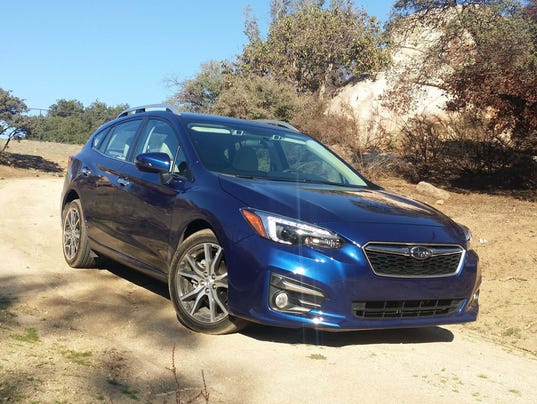
Payne: Subaru Impreza stakes claim for best AWD wagon
Posted by hpayne on February 27, 2017
Jack Sprat could eat no fat.
His wife could eat no lean.
And so between them both, you see,
They licked the platter clean.
Sprats, meet the Paynes. My wife likes her meat rare, I like it well done. She orders shellfish, I order fish. She prefers turf, I’d rather surf. When it comes to cars, I covet sportiness, she values utility.
Downsizing from a three-row crossover when our kids flew the nest in 2011, we went looking for a compact, all-wheel-drive station wagon. Five-door wagons satisfied her utilitarian needs, their low center of gravity my need for speed. We needed all-wheel drive so we could get up our driveway in Michigan blizzards.
Alas, wagon options are limited in crossover-crazy America. The menu consists mostly of foreign luxury makes: Mercedes E-class wagon, BMW 3-series, Audi All-Road. All are north of $40,000.
The exception was the Subaru Impreza wagon. At just $23,000, it had everything we needed for half the price of the premium competition: AWD, fuel economy, style, heated seats. Well, almost everything. Its 148-horse engine paired with a continuously variable transmission had all the excitement of a farm tractor. But marriage — and car-buying — is about compromise, yes? Besides, with Subaru’s bulletproof reliability reputation, Impreza promised relief after my wife’s four years with the multi-talented (but multi-glitch) Chrysler Pacifica. And with a BMW M3 on my side of the garage, I could get my speed fix elsewhere.
Five years on, we’ve never second-guessed the decision. Impreza has impressed.
As my wife and I contemplate a new ride, however, a Subaru sequel is not a cinch. Impreza wagon has a challenger in the mainstream aisle: the 2017 VW Golf.
Loyal readers of this column know I am a Golf disciple. The 2015 North American Car of the Year is the best-engineered, best-packaged, best-handling compact in its class. The hatchback architecture is the basis for the dynamic duo of Golf GTI and AWD Golf R, perhaps the best all-around cars built today. Would I like a Golf wagon? Does Mr. Sprat like lean?
I flipped for Golf’s AWD wagon (Alltrack or SportWagen variant) at its introduction this fall. Not to be outdone, Subaru also has a new Impreza. Not just new, but all-new with chassis and tech upgrades to match the German. Mrs. Payne and I put it to the test.
VW may be the biggest automaker on Planet Earth, but in this market it’s a junior player to Subaru. While VW has struggled, the Tokyo-based automaker has prospered: Its sales have tripled from 200,000 to 600,000 since 2008. The Tokyo-based carmaker credits a host of factors from its “love” ad campaign to its value to its appeal to active Gen Y-ers.
Maybe. But I think it’s about looks.
Subaru was once the ugly duckling of autodom. Talk AWD engineering all you want, but it had a face only “Shallow Hal” (a Jack Black movie classic, look it up) could love. That changed with the 2010 Impreza. Aerodynamic bod, Pentagon grille and wing-like logo accents turned Eliza Doolittle into a much comelier compact.
For 2017 Subaru has continued to refine its look. To complement a stiffer platform (more on that later), Impreza’s design has been trimmed to look thinner, more athletic. The grille “wings” have been trimmed, side wheel-humps liposuctioned, rear taillights widened. I miss the old Impreza’s unique, chunky accents but astute designers have taken a page from Golf by outfitting the (best-selling) Limited and Sport trims with standout wheels. The 18-inch pinwheels on our blood-red, Sport tester were knockouts. At a posh restaurant, the valet kept our Impreza parked at the curb along with a Maserati and Audi S4. You’ve come along way, ugly duckling.
But Mrs. Sprat barely noticed the changes.
The styling is pleasant enough to get her inside — because that’s where she lives. Once plasticky and subpar, interior materials are now soft and stitched. The ergonomic console layout is familiar (if it ain’t broke, don’t fix it), but the infotainment system is state-of-the-art with Android Auto and Apple CarPlay. CarPlay worked flawlessly. In an all-day drive through rural terrain, the app never lost signal and its audio commands never confused commands. Superior to Subaru’s own navigation system, it’s yet another reason why the gulf between luxury and mainstream cars has shrunk dramatically.
Impreza’s all-new platform has earned it a coveted, IHS Top Safety Pick trophy and will be the basis of every Subaru from here on — from Outback to coming, three-row ute. A marvel of clever packaging, the new bod allows for an inch more cabin width and rear seat room — even a wider hatch opening for your stuff. All-told Impreza is No. 1 in its class in interior room even as its overall dimensions are average.
Already blessed with a low center of gravity thanks to its four-cylinder boxer engine, the wider, lower chassis is now 70 percent stiffer via more high-strength steel. Under the cane through the twisties, the Impreza is a blast to drive — the stiff chassis and torque-vectoring all-wheel drive system (exclusive to Sport and Limited) rivaling the benchmark V-dub. Like the Honda Civic and Ford Focus compacts, Impreza and Golf have good reason to build athletic chassis — their bones must ultimately support performance cars. In the case of Subaru, it’s the WRX and STI hellions.
Only the engine and CVT tranny (replaced by turbo-4s and automatics in the WRX and STI) are noticeably outclassed by the Alltrack’s 170-horse turbo and superb, 7-speed, dual-clutch automatic. The old CVT’s drone was so depressing I had to take Prozac before driving. No more. Impreza’s four-banger gains just 4 horsepower over the last generation, but the CVT now mimics an automatic with “shift steps.”
Ask my wife if she cares.
Crucial to her is Subaru’s 30 mpg EPA rating (27 city/35 highway) which stomps the peppier Alltrack’s 25 (22/30). Fewer stops at the gas station are almost as valuable to her reliability — another metric where Subie is top drawer. And though the domestic makers have no dogs in the AWD wagon fight, the built-in-Indiana Subie does have a Midwest accent.
There’s one more metric for buyers to consider. Similarly equipped, the stylish $28,000 Alltrack costs about $2,000 more than Impreza.
With that kind of value for under $30,000, the Sprats — er, Paynes — won’t be looking in the luxury aisle for their next car.
Henry Payne is auto critic for The Detroit News. Find him at hpayne@detroitnews.com or Twitter @HenryEPayne.
2017 Subaru Impreza Wagon
| VEHICLE TYPE | FRONT-ENGINE, ALL-WHEEL DRIVE, FIVE-PASSENGER, 5-DOOR WAGON |
| Power plant | 2.0-liter, direct-injection, boxer 4-cylinder |
| Transmission | Continuously variable transmission |
| Weight | 3,183 pounds |
| Price | $24,015 base ($27,060 as tested) |
| Power | 152 horsepower, 148 pound-feet of torque |
| Performance | 0-60 mph, 8.5 seconds (est., Car and Driver) |
| Fuel economy | EPA 27 city/35 highway/30 combined |
Report card
| HIGHS | STANDARD, WINTER-READY AWD; ROOMY INTERIOR |
| Lows | Miss the Sport model’s practical roof rails; engine still underpowered |
Overall:★★★★
Payne: Sinking Smart ends gas car sales, turns to EVs
Posted by hpayne on February 27, 2017

In 2008, Germany’s Smart Automobile, the maker of the two-seat ForTwo microcar, opened the first of 85 U.S. dealerships in Bloomfield Hills. The company hoped to catch a wave of customer sentiment for small cars amid rising gas prices. That wave never came.
Mercedes-Benz, which owns Smart, last week announced it is discontinuing sales of gas-powered Smart cars in the United States. Only electric Smart cars, which have been available since 2011, will remain.
Smart was never a good fit from the beginning for the U.S. market – and that was before gas prices fell and Americans increasingly snapped up sport utility vehicles. After early adopters snatched up the first 25,000 ForTwos, sales of the Smart never exceeded 10,000 in a year. Only 6,211 were sold last year.
“Gas prices were heading higher at the time, and Mercedes thought that a small car would appeal to millennials as we become a more urban society,” says Kelley Blue Book Senior Auto Analyst Rebecca Lindland. “It didn’t happen at all.”
An all-new Smart electric car is due this summer. In an echo of its 2008 strategy, Mercedes hopes that Smart EVs will ride a new trend for electrics, despite equally daunting signs that Americans are no more enthusiastic for EVs than subcompacts. Despite over 50 new entries in the market since 2009, sales of battery-powered cars are less than 2 percent of the market.
“In 2008 gas prices were headed to $4 a gallon, now they’re half of that. The entire small car segment is down 35 percent,” says Bob Gabardy, General Manager of Suburban Mercedes/Smart of Ann Arbor, which took over Michigan’s Smart franchise last year. “But Mercedes always planned Smart to be a progressive brand and the EV is a step to a sustainable, zero emissions future.”
The new electric strategy, says KBB’s Lindland, “makes sense only as a way to help Mercedes meet California’s strict zero emissions mandates for 2025. The Smart gas cars also made sense to Mercedes as way to meet federal fuel economy standards.”
Skies looked brighter in January 2008 when Smart planted its flag on Telegraph Road just south of Pontiac. The eight-foot long Smart – a common sight in cramped European cities where it can legally park nose-first into curbs – was cute. It even had the blessing of Roger Penske, the Troy entrepreneur with the golden touch whose dealership network, Penske Automotive Group, was given exclusive rights to sell the microcar.
“Penske and Daimler AG could not have chosen a better time to launch Smart here,” The Detroit News wrote in late 2007. “The recent precipitous rise in fuel prices … have made a small, economical car more attractive to Americans than at any time since the 1970s oil crisis.”
Mercedes’ choice to launch Smart in Metro Detroit seemed bold, given that the sprawling freeway city is a long way from the dense streets of Europe where ForTwo had achieved moderate sales success since its 2001 launch. Smart offered two variations of the ForTwo: a coupe starting at $11,590 and a $16,590 cabriolet.
Dave Schembri, president of Smart USA, told The News in 2007 that Americans were attracted to Smart “because there are very few other vehicles outside the luxury segment that have emotional appeal.”
By 2011, Penske turned the franchise over to Mercedes after sales fell off a cliff to 5,927 units in 2010. Mercedes-Benz of Bloomfield Hills on Woodward was the sole Michigan seller of Smart cars before the franchise moved to Suburban Mercedes in Ann Arbor.
Despite its small size and three-cylinder engine, the ForTwo got just 40 mpg, not much payback for a car with the storage space of a grocery cart. And the automotive press reviews were brutal.
“The (Smart) is plagued by (a) slow-shifting transmission, a lack of power, excessive squat and dive, and sensitivity to gusts of wind,” wrote Car and Driver in one of the kinder write-ups.
Mercedes was not alone in its misreading of the market: Toyota’s Scion IQ, the Fiat 500 and the Mazda 2 also did bellyflops.
“It turned out the last thing millennials wanted was a microcar,” says auto analyst Lindland, who has been a Smart skeptic.”Gas prices came down to earth, crossovers became more fuel efficient, and it turns out millennials wanted functional crossovers just like everyone else.”
Smart even struggled in Mercedes’ ride-share service, Ride2Go. “If customers wanted a two-seat car in the city, they would just call a taxi,” says Lindland. “And they weren’t going to go to Ikea in it. Ride-share services have found that even their customers want four-doors with room.”
In January, Mercedes announced it was replacing Car2Go’s Smart cars with larger, gas-powered Mercedes GLA crossover and CLA sedans – a sign the writing was on the wall for Smart.
For all its setbacks, Mercedes Ann Arbor’s Gabardy is bullish on the electric ForTwo’s future in politically green Ann Arbor. Built on an all new platform, the EV will arrive this summer with an estimated $25,000 price tag (before government tax credits) and 80-mile battery range.
“Being familiar with the parking situation here in Ann Arbor, I can park three ForTwos in one parking space,” he says. “People are more progressive thinkers down here, and I think young folks are going to like the EVs.”
Historic Daytona win redefines Cadillac
Posted by hpayne on February 27, 2017

Since its founding 115 years ago, Cadillac has been synonymous with luxury, even frivolous opulence. High-end products were referred to as “Cadillac models.” Athletes are nicknamed “Cadillac” for their stylish play. Even Obamacare took on expensive insurance coverage it called “Cadillac plans.”
Now Cadillac is setting a new standard by which it wants to be judged: speed.
In winning the Rolex 24 Hours of Daytona last month, General Motors Co.’s luxury marque has joined an elite group — Porsche, Ferrari and Jaguar — of high-performance brands to have won America’s Super Bowl of endurance racing. Name-dropping in such company may be jarring to those who once dismissed Cadillac as a manufacturer of overstuffed land yachts. But the 21st-century Cadillac isn’t your grandfather’s Eldorado.
The Cadillac DPi-V.R’s dominating Daytona 1-2 win is an important marker in the transformation of GM’s luxury brand from a builder of boulevard cruisers to a sculptor of four-wheel athletes. While the media buzz for Cadillac’s transformation has largely centered on the edgy “Art and Science” design language that breaks with the bloated past, Cadillac’s commitment to racing at the sport’s highest level is also a key piece of the new DNA.
“Racing is beautifully connected to the passion at the center of Cadillac brand,” said Matt Russell, marketing manager for V-Series, Cadillac’s performance badge. “In the 21st century our high-performance cars and race cars have been the change agents for the brand. They have allowed us to capture the attention and the passion of … the car enthusiast and car-buying community.”
Cadillac dabbled with racing in the past, most notably its 1950 entry at LeMans with the legendary Briggs Cunningham racing team. But the sedan-maker’s commitment paled next to sports car companies like Ferrari and Porsche. In 1968 Porsche scored its first-ever endurance win at Daytona — the first of a record 22 overall wins that has helped make the Stuttgart, Germany-based carmaker a performance icon. Even mainstream manufacturers used Daytona to establish their speedy bonafides as Ford did 50 years ago when the storied GT40 won back-to-back trophies.
Cadillac’s pivot to performance with the new century has coincided with a major commitment to racing. From 2000-02 it flirted with prototype racing at Daytona and LeMans, then won five Pirelli World Challenge championships with a production-based CTS-V. This year’s Daytona program took it up a notch.
Caddy’s quest began just over a year ago with the IMSA racing series’ change of its so-called prototype format that governs the fastest cars in American sports car racing. General Motors had previously flown its Chevrolet Corvette flag in IMSA in both the prototype and GT classes.
“It was a strategic decision for Corvette to focus on its GT presence, sunset the Corvette prototype, and launch Cadillac,” said Russell.
For its assault on Daytona — and IMSA’s 11-race 2017 championship — Cadillac partnered with some of the premier names in motor sport. It went to Italy to have the DPi-V.R’s chassis made by Dallara. Three 600-horsepower, V-8 powered prototypes were entrusted to a pair of premier racing teams: one with Wayne Taylor Racing, two with Action Express Racing. Behind the wheel would be some of the top jockeys in the business, with the winning Taylor entry including teammates Jordan and Ricky Taylor, Max Angelelli and ex-NASCAR superstar Jeff Gordon.
“Cadillac really got behind the styling and the bodywork in the last year,” said Jordan Taylor. “It was cool to be there from the ground up, through the whole design and development process, to see the aggressive styling coming from Cadillac.”
Dillon Blanski, 33, an exterior designer in Cadillac’s Warren studio, racked up frequent-flier miles between Michigan and Italy for months as he worked with Dallara to craft a wicked-looking, world-class weapon.
“Our designer spent many, many hours alongside Dallara making sure the design was as productive as emotive,” said Russell. “The car is a wonderful ambassador for the Cadillac brand, because it almost serves as a concept car.”
It’s no coincidence that the prototype program blossomed under new Cadillac boss Johan de Nysschen. As head of Audi North America until 2012, De Nysschen was part of a brand that soared to global prominence in part on the shoulders of a race program that won the 24 Hours of LeMans 13 times. After a brief stint at Infiniti, De Nysschen came to Cadillac in 2014 and found a kindred spirit in GM product development czar and motorhead-in-chief Mark Reuss, a race-licensed driver. Reuss has made performance cars — from Corvette to Camaro to Cadillac — central to GM’s image.
With Cadillac in the winner’s circle, the race track is becoming an extension of the showroom. Customers want to be around a winner, and Cadillac hopes that will translate to sales. The brand is coming off its best global sales year since 1986.
“We have been enjoying increased participation from our dealer group in metro areas where we have IMSA races — Long Beach, Laguna Seca, Connecticut,” said marketing chief Russell. “Dealers see racing as an instrumental experience that they can bring their guests to for an immersion in what Cadillac is and where is it going.”
The Detroit Belle Isle Grand Prix on June 2-3 is one of those races.
“When you connect with most enthusiastic customers, you get a multiplying effect,” said Russell. “It helps when you have proven your engineering prowess on the race track; it goes a long way to convince enthusiasts that your car deserves consideration.”
He said Cadillac has not ruled out a return trip to LeMans — though the European and IMSA series currently run under different rules.
Russell said brands like Cadillac need to keep reinventing themselves.
“We can’t give up on our traditional values of making a comfortable, powerful car,” said Russell. “We have a good (racing) technology transfer story to tell that’s made it into our production cars. We have confidence in engineering that I think is unique to our brand in the 21st century.”
Payne: Ford F-250 Super Duty is huuuge
Posted by hpayne on February 27, 2017
You think politics is partisan these days? You ain’t see nuthin’. Big Three truck owners make the Senate floor sound like an afternoon tea social. Invite three in-laws who own a Ford, Chevy and Ram for dinner and ask them to debate pickups.
You’ll wish you had stuck to Trump vs. Hillary.
There will be broken furniture, gouged eyes and bruised feelings. Call 911, but then be very afraid the ambulance isn’t a Ford, Chevy or Ram, lest the war start all over again.
I don’t know where these loyalties come from. Maybe they start at birth like religion. I was born Presbyterian, will always be a Presbyterian. Once a Ford guy, always a Ford guy. My neighborhood truck expert, Pickup Bob, is a Ford F-series guy. Show him a Silverado or a Ram and he’ll circle it with interest, considering strengths and weaknesses like a New England fan comparing quarterback Brady to Ryan, Rogers and Stafford. But would he trade his for theirs? Dude, are you mad?
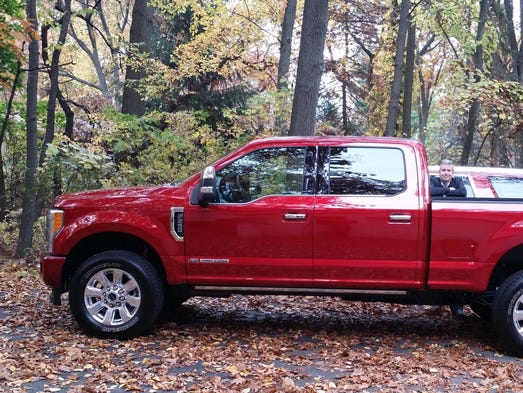
Which brings me to this week’s tester, the 2017 Ford F-250 Super Duty. The biggest, baddest heavy-duty truck that anyone has ever introduced.
This thing is, to quote The Donald, huuuge. I’m 6-foot-5 and can’t see over it. The truck lists at 6-foot-8 but feels taller. It dwarfed the Cadillac Escalade (which shares its steel frame with the Chevy Silverado pickup) that I was also testing at the time. When Mrs. Payne (who needed a full mountain-climbing harness just to get in) and I headed out to the movies, we chose the Escalade simply because I feared the F-250 might not make it into the theater parking garage (it would have barely cleared the 6-foot-10 entrance).
The F-250, of course, wasn’t built with movie night in mind. Based on the already supersized, all-new-for-2015 F-150 light-duty, the six-inch-taller Super Duty shares little brother’s revolutionary, all-aluminum skin and robust steel frame — but beefs it up to tackle the daily chores apparently expected of a heavy-duty these days. Like mulching The Henry Ford, fording Lake Michigan, towing the space shuttle.
The aluminum body shaves 350 pounds off the last-generation heavy-duty, but that’s well shy of the 700-pound savings in the F-150 due to extensive strengthening of the F-250’s steel skeleton. The fully boxed frame gets nine cross-beams and 95 percent high-strength steel. Sir, need help pulling your tank out of the mud?
When mated to the F-250’s preferred (60 percent of sales) 6.7-liter, V-8 turbodiesel — with a redonculus, class-leading 925 pound-feet of torque — the fortified F-chassis can pull 32,500 pounds in dually, F-350 trim. My single-rear wheel tester was rated at 18,000 pounds. That’ll do.
And like Superman, Super Duty has a handsome face to go with the buff bod. So well received has been F-250’s “double I-beam” grille that the F-150 has adopted it for its mid-cycle, 2017 refresh. Little brother has also adopted the heavy-duty’s letter stamping on its rear end.
Beauty is more than skin deep. My Platinum F-250’s interior won’t be mistaken for Donald Trump’s apartment, but its liberal use of fine materials make it a luxurious office for anyone. There was wood trim, silver accents and so much leather that I half expected a raucous, animal-rights protest. For all the fancy frocks, the interior’s blocky style is male butch with two-by-four arm rests and Lego-block console cut outs. There are no swoopy lines like that Escalade. It looks like Patriot tight end Gronk modeling Dior.
I’m a sports car guy, but I get why truck guys get all sweaty around heavy-duties. Like supercars, modern trucks boast eye-bulging performance numbers, yet are remarkably compliant daily drivers.
After adapting myself to the F-250’s ride height (Hey, I can see in the second floor of that office building!), I found colossus remarkably comfortable. The diesel clatter is a distant roar given extensive sound-proofing, the heated/cooled seats fit like BarcaLoungers — even the leaf-sprung, solid rear axle jounce was contained.
My friend Scott saw the F-250 and sank to his knees. A businessman, avid outdoorsman and Ford partisan, the diesel F-250 is his dream truck. The behemoth is a Brobdingnagian Swiss Army Knife for his every need. It’s a rolling office, family camper, fishing trip vehicle, farm implement. Given the cost of my Platinum F-250 — a cool $77,600 — he could use its palatial confines as a second home.
What has always distinguished Ford for truck guys like Scott is technology, and my F-250 Platinum doesn’t disappoint. Like its car and crossover cousins, Super Duty is available with everything shy of self-park assist (parallel parking still requires a tugboat). There’s adaptive steering, blind-spot assist, SYNC 3 infotainment system with Apple CarPlay and Android Auto smartphone capability, 360-degree camera, trailer-hookup guidance and dual-zone climate control. Innovation doesn’t need a chip, either — the pickup box comes with the F-series’ clever BoxLink Cleat tie-down feature.
What are the F-250’s shortcomings? I’m sure your friends driving competing brands could come up with something (“It rides like a washboard compared to my coil-sprung Ram!”), but flaws aren’t obvious.
I defer to my colleagues at the enthusiast mags who’ve done the towing tests — and they are in awe of F-250. Motor Trend named it their 2017 Truck of the Year. PickupTruck.com calls it “revolutionary (with a capital R).” You get the idea.
As docile a daily driver as the diesel F-250 has become, its super-size girth and price still mark it as an exotic. Most buyers will choose this truck as a business tool — a mechanical ox for tow and work.
There are still individuals who will covet the truck for its diesel chops — but that case is tougher now that the F-150 is offered with a diesel for the first time. Granted, little brother’s 3.0-liter oil burner is a shadow of big brother’s ship engine, but it still brings plenty of torque without Super Duty’s price tag. For those who don’t need the F-250’s extra towing bravado the light duty’s 10,000 pounds-plus of towing will do fine, thank you very much.
That’s a lot for F-series to boast about. But remember, be careful talking politics or pickups in polite company.
Henry Payne is auto critic for The Detroit News. Find him at hpayne@detroitnews.com or Twitter @HenryEPayne.
2017 Ford F-250 Super Duty
| VEHICLE TYPE | FRONT-ENGINE, REAR- AND FOUR-WHEEL DRIVE, FIVE-PASSENGER, HEAVY-DUTY PICKUP |
| Power plant | 6.2-liter V-8; 6.7-liter turbodiesel V-8 |
| Transmission | 6-speed automatic |
| Weight | 7,898 pounds (diesel as tested) |
| Price | $33,657 base ($77,600 as tested) |
| Power | 385 horsepower, 430 pound-feet of torque (V-8); 440 horsepower, 925 pound-feet of torque (diesel) |
| Performance | 0-60 mph, 6.9 seconds (diesel, Motor Trend) |
| Fuel economy | No EPA rating |
Report card
| HIGHS | LUXURIOUS INTERIOR, SUPER TECHY |
| Lows | Size of a pet dinosaur; tech options will cost you |
Overall:★★★★
Payne: Prodigy Genesis G80 vs. Master Audi A6
Posted by hpayne on February 9, 2017

These days, luxury titan Lexus sports the most radical design language in autodom. After 40 years of success in the U.S. market, Lexus feels confident in its own skin. So it’s hard to peer back through the mists of time and remember 1989 when neophyte Lexus debuted its very first LS sedan at the Detroit auto show. It was a shameless Mercedes knockoff — but for thousands of dollars less.
The lesson: If you want to beat ’em, first you have to join ’em.
It’s a lesson Hyundai took to heart when it introduced its own luxury bargain for model-year 2015. The mid-size sedan took its grille from the Audi A6, giving it instant respectability in the luxury world.
Wow, look at that new Audi!
It’s a Genesis.
Cool. What’s a Genesis?
Good question. Genesis didn’t stop there. A quick learner, it cribbed the best nuggets from other luxury manufacturers, too. From BMW it borrowed its rear-wheel drive and long hood profile. From Cadillac it took a heads-up display. The center console? Borrowed from Yankees and Europeans alike. You could access its infotainment system as a touchscreen — or from a center rotary dial.
For $10,000 less than Audi, the Genesis was a bargain. I loved it, voting the sleek barge one of The Detroit News’ 2014 Vehicle of the Year picks. Like Lexus four decades prior, customers loved the German-inspired Korean, too.
Hyundai now has spun off Genesis as its own luxury marque, added a flagship sedan called the G90 and rebadged the original midsize Genesis as the G80. With two more cars and two more SUVs due by 2020, Genesis is here to stay.
So when a G80 and an Audi A6 became available this winter, I took both for a comparison test to see how Genesis measures up to its teacher.
G80 makes a good first impression.
That big cow-catcher Audi grille gives it immediate presence, backed by a long hood and signature rear taillights. Hyundai badging has been removed entirely from the car, its Genesis wings proudly spread to signify its own brand. The other big change is price: the G80 is up $2,650 over its Hyundai days. Happily, that allows it to pack in even more standard safety features for its $42,350 base price. Goodies like automatic braking and lane-keep assist that even Audi (itself a notorious bargain compared to other Germans) doesn’t offer standard.
Add in a premium package for both Genesis and Audi and they arrived comparably equipped at $51,300 for the G80 versus $56,875 for the German beauty. Well, almost comparably equipped. The Genesis featured rear-wheel drive, the Audi AWD. Genesis’ “ultimate” package ices the cake with a full sunroof to let the day shine in on acres of leather, wood trim and silver-rimmed instruments that could have come right out of the Audi.
Nice. So can Genesis pass the taste test?
Before you are the leading ice creams with their labels removed. Take a bite of each.
Mmmmm. That’s good — but not as creamy as the other one.
That’s the Haagen-Dazs difference.
Slip the Genesis into drive, nail the throttle through a sweeper and no one will mistake it for an Audi. The 4,290-pound Genesis is a good daily driver. The much lighter (even with the added weight of AWD) 3,957-pound Audi is an athlete.
Built on Audi’s front-wheel drive, MLB platform shared with the A4 and A8, the A6 feels a class-size smaller with its laser-like handling. Like Genesis, the Audi is a comfortable tourer that you could drive Up North to Harbor Springs and emerge no worse for wear. But so inspiring is A6 to drive that you might just blow through town and keep on driving to M-119 (or as motor heads know it, the Tunnel of Trees) — that gloriously twisted piece of asphalt that’s Michigan’s best road north of Hell.
But luxe drivers don’t care about handling, you say. Luxury buyers will never do more than 40 mph on their way to the country club, you say. I beg to differ.
Drop 50-large on a car and you expect the best. My pal Dicran has never diverted his wife from a nice French vacation to watch 200-mph supercars tear down LeMans race track’s Mulsanne straight (I’m guilty as charged. Sorry again, hon) — yet Dicran knows the benefits that nine-time LeMans-winning Audi engineering brings to its production vehicles.
He can feel the difference between his A6 and the G80 instantly. It’s an inherent sharpness. It says he bought the best.
That sharpness informs every corner of the car. The crispness of the turn signal stalk. The lightning-quick upshifts of the 8-speed automatic. Audi’s base, 2.0-liter turbo-4 gives up 60 horsepower to the G80’s base, 311-horse, 3.8-liter V-6, yet beats it to 60 mph by a healthy half-second. The effort makes the G80 thirstier, too — getting just 22 mpg compared to the A6’s sippier 25.
So the student still has something to learn from the master. But, then, the new generation can teach lessons too.
Like a 100,000 mile/10-year power-train warranty — double that of Audi and just about everything else in luxury these days. For leasers like Dicran this is superfluous but the promise is added comfort for potential buyers like my pal Joe. A former Lexus client, he’s been blown away by Genesis’ service. That and they sent him a fancy invite to come try the new G90. At a private event. In New York City.
When you’re the new kid on the block, you try harder. Genesis doesn’t hide its interior Audi-envy — but it goes further with a bigger console screen and redundant controls. Touchscreen (for those who like an American feel) or rotary dial (for you Euro cats). And Genesis doesn’t slavishly adopt Audi’s clunky rotary, preferring the more dexterous, BMW-type dial and its nifty, bump-to-the-next-screen feature.
Neither does Genesis overindulge in technology as Audi does with its largely useless, center-console touch pad. Instead, it keeps its eye on practical details — like (ahem) better rear-seat cup holders.
That said, the A6 is at the end of its product cycle with a new thoroughbred due soon featuring updates like the Google map-driven Virtual Cockpit instrument display (drool) that makes everything else in class feel sooo 20th century. So the master still inspires.
With its bold looks, room and value, G80 is a tempting new dish. For those who want the best, Audi earns its four rings.
Henry Payne is auto critic for The Detroit News. Find him at hpayne@detroitnews.com or Twitter @HenryEPayne.
2017 Genesis G80
| VEHICLE TYPE | FRONT-ENGINE, REAR-WHEEL DRIVE, FIVE-PASSENGER PREMIUM SEDAN |
| Power plant | 3.8-liter V-6 |
| Transmission | 8-speed automatic |
| Weight | 4,290 pounds |
| Price | $42,350 base ($51,300 as tested) |
| Power | 311 horsepower, 293 pound-feet of torque |
| Performance | 0-60 mph, 6.6 seconds (manual, Car & Driver) |
| Fuel economy | EPA 18 mpg city/28 mpg highway/22 mpg combined |
Report card
| HIGHS | INFOTAINMENT CONTROLS WHICHEVER WAY YOU PLEASE; LUXURY BARGAIN |
| Lows | Delayed transmission response; Apple CarPlay and Android Auto with Ultimate package, please |
Overall:★★★
Grading scale
Excellent ★★★★
Good ★★★
Fair ★★
Poor ★
2017 Audi A6
| VEHICLE TYPE | FRONT-ENGINE, ALL-WHEEL DRIVE, FIVE-PASSENGER PREMIUM SEDAN |
| Power plant | Turbocharged 2.0-liter 4-cylinder |
| Transmission | 8-speed Tiptronic automatic |
| Weight | 3,957 pounds |
| Price | $48,550 base ($56,875 AWD as tested) |
| Power | 252 horsepower, 273 pound-feet of torque |
| Performance | 0-60 mph, 6.1 seconds (manual, Car & Driver) |
| Fuel economy | EPA 22 mpg city/31 mpg highway/25 mpg combined |
Report card
| HIGHS | FOUR-DOOR ATHLETE; RAGER DRIVERTRAIN |
| Lows | Rotary dial is balky distraction; cheap rear cupholders |
Overall:★★★★
Mitsubishi debuts Outlander Sport Limited Edition
Posted by hpayne on February 7, 2017

With a new owner in Renault-Nissan, new style language and a new crossover in the oven, Mitsubishi is a brand in transition. But while Japan’s oldest auto company prepares its new menu, it’s not ignoring its bread-and-butter products — the Outlander and Outlander Sport crossovers which make up 65 percent of the company’s U.S. sales.
Ahead of Chicago Auto Show media days this week, Mitsubishi is introducing a Limited Edition package for its best-selling Outlander Sport compact utility vehicle.
Though it shares a name with its bigger brother, the five-passenger Outlander Sport is a more athletic, shorter-wheelbase offering than the three-row, seven-passenger Outlander. The Sport Limited Edition will be positioned directly above the ES base model. While sharing a 148-horsepower, 2.0-liter, 4-cylinder engine and continuously variable transmission drivetrain with the ES, the Sport Limited will be distinguished by design and technology upgrades.
You’ll know it by its Limited Edition badge, alloy fuel door, black-painted mirrors, 18-inch alloy wheels, fog lamps and high-intensity discharge headlamps. Inside, the Limited Edition gets a custom design with black fabric and red stitching on the steering wheel, shift knob and brake lever. Other interior features include aluminum pedals, heated front seats, backup camera and Apple CarPlay and Android Auto smartphone connectivity.
Look for the Sport Limited Edition at dealers later this month starting at $21,995. True to its Limited badge, it will only be available through the end of the model year.
“As the brand sales leader, Outlander Sport does an exemplary job of offering consumers unmatched value at an attractive price,” Don Swearingen, Mitsubishi North America executive vice president, said in a statement. “We’ve now taken that approach one step further by integrating additional standard equipment and technology into the Limited Edition at a price point that is unprecedented within the broader CUV segment.”
Mitsubishi also sells the subcompact Mirage hatchback — boasting best-in-industry mpg for a non-hybrid vehicle — and the Lancer compact sedan. But the Lancer will end production this year as the company focuses on more sport utility offerings to slake Americans’ thirst for all things CUV.
To that end, Mitsubishi will show a new compact ute at the Geneva auto show in March. That vehicle will debut the brand’s new “Dynamic Shield” design as seen on the eX electric sport coupe and the GT plug-in hybrid concepts briefly shown before the Detroit auto show in January.
Mitsubishi, however, did not rent floor space in Cobo Center, choosing instead to attend auto shows in Chicago, Los Angeles and New York that are closer to its 360-dealer U.S. network. Mitsubishi hopes to celebrate its 100th year producing automobiles by going over the 100,000 U.S. sales mark for 2017.
Payne: Elantra Sport is Hyundai’s joy ride
Posted by hpayne on January 27, 2017

I’m a fan of fast-food joints that take burgers to a higher sizzle — places like Shake Shack, Five Guys, Culver’s, In-N-Out, Smashburger. Fast, flavorful and affordable, they each have their own twist on the meat (pun intended) of the American market.
Compact sport coupes and sedans are my favorite cars for the same reason.
They take the most common of auto appliances and turn them into treats for the average enthusiast: Ford Focus ST, Volkswagen Golf GTI, Volkswagen Jetta GLI, Hyundai Veloster. So I’m happy to announce a delicious new entry in this sedan-eat-sedan world: the Hyundai Elantra Sport.
My preference is for the hot-hatch versions of the breed. The ST and GTI are the best of a group that marry sport with sporty utility — that is to say, roomy storage in the rear without an SUV’s performance-killing ride height. I mourned when Subaru nixed the all-wheel-drive WRX hatch for the current generation.
But for those who prefer sleek coupe shapes to boxy backs, the sport sedan is more aesthetically pleasing while offering similar performance punch. My favorite sport sedan (actually the coupe version) of all time sits in my garage: the Honda Civic Si. Maybe “PR” is a better badge — for “pocket rocket.”
My mouth is watering over the next-generation Si revealed at the Los Angeles Auto Show. Based on Civic’s superb, all-new chassis, the racy-looking Si will be turbo-powered. Honda is being stingy with further details, but last-gen Si’s are a healthy baseline on which to measure Hyundai’s entry.
The Elantra Sport has been around, too. But like the Toyota Corolla S and Chevy Cruze Sport, it was a pretender — a frozen patty burger dressed up with onions, cheese, special sauce and pickles. With this sixth-generation Elantra, Hyundai has gotten some serious nutrition to keep up with King Civic.
Complementing this progressive decision is Elantra 6.0’s inherent goodness. With chassis stiffness improved 40 percent over 5.0 thanks to more high-strength steel and structural adhesives, the new compact is rock solid. And Hyundai knows it.
For the base Elantra test drive, Hyundai handed us the keys and unleashed us on the intimidating twisties of California’s Cuyamaga Mountains. In this sports car-friendly testing ground the front-wheel drive Elantra passed with flying colors. Only its solid-rear axle and huffing-puffing 2.0-liter, 147-horse four-banger were lacking
So for Elantra Sport, the engineers ripped out the four-banger and rear torsion beam and strapped in a 201-horse, 1-6-liter turbo-4 and multi-link suspension. Interestingly, this is the same drivetrain that outfits the Veloster, Hyundai’s scrappy, three-door hot hatch. Hyundai has high hopes for its uber-Elantra, so it handed media the keys and unleashed us on Tire Rack’s diabolical autocross course outside South Bend, Indiana. Our testers had a manual transmission, bolstered seats and flat-bottom steering wheel.
Now these Hyundai boys are really getting cocky. Maybe too cocky.
The one performance tweak the Elantra is missing is a limited-slip differential; autocross courses punish cars without them. I’ve autocrossed the front-wheel driven VW GTI and Civic SI and they are sensational — their limited-slip differentials distributing torque, mitigating front-wheel spin and launching their funboxes from corner to corner.
So good is the Honda that both my sons got their start in track-racing at Waterford Raceway at the wheel of an Si. But the GTI hatch is particularly noteworthy. Throw in torque-vectoring (to cancel out the inherent push in front-wheel drive), an Audi A3-based MQB chassis and a jaw-dropping 258-pound-feet of torque, and the unfair V-dub just isn’t even playing by the rules.
You gotta love the Elantra for competing. Sure, the open-diff Elantra is a tire-squealing mess out of corners with its front claws squirming to gain traction. But its turbocharged, 1.6-liter delivers a back-slapping 195-pound feet of torque compared to the Civic’s 174 to help make up some of the difference. More importantly, its specs stack up well against other class competition — the Mazda 3 (also with an open-diff) and the 210-horse Jetta GLI sedan.
So give the Sport a B for performance effort. Which ain’t bad since everything else about it is an A.
Where the SI and GLI’s narrow grilles telegraph their subcompact class, the Elantra’s fascia strives for more. The V-dub may share Audi bones, but the Elantra has stolen the Audi’s wardrobe.
The Sport’s big Audi grille comes at you with more war paint than the base model — darker lips, blood-red eyes and swollen gills channeling more air for the turbo within. The muscular flanks and coupe-like roof taper to sophisticated taillights and a duck tail. This Eliza Doolittle talks high class.
It’s classy inside, too. The $20,000 Elantra recently snagged a trophy for one of Ward’s 10 Best user experiences — the cheapest car to do so in a class with an average price of $60,000. Everything is intuitive, from the crisp German-like display gauges to the excellent knob-assisted touchscreen. Want clever touches? Hyundai goes the extra mile with Apple CarPlay and Android Auto connectivity (which not even its luxury brand Genesis yet offers) and an ample forward space to set your smartphone, change, snack, whatever.
Then Hyundai wraps all this goodness in the class’s quietest interior. Maybe it’s too quiet for the Sport.
Despite modifications that allow the exhaust system to growl, it’s still channeling a whispery turbo. This bad boy could use a little more personality — like my Si’s exhaust flap that opens over 6,000 rpm — BWAAAAGHHHH! Or maybe the Sport’s terrific double-clutch automatic tranny could bark on upshifts and rev-match on downshifts like the V-6 Camaro. Every burger should have some spicy sauce.
But these are small details in an otherwise impressive debut. The Sport is a well-rounded meal loaded with standard features: heated front seats, connectivity apps, 18-inch wheels, push-button start, leather seats, 7-inch touchscreen and rear-seat tables with tea set (not that last one, just seeing if you were paying attention).
With the Sport, Hyundai proves it’s more than an appliance maker. This is a burger with sizzle.
Henry Payne is auto critic for The Detroit News. Find him at hpayne@detroitnews.com or Twitter @HenryEPayne.
2017 Hyundai Elantra Sport
| VEHICLE TYPE | FRONT-ENGINE, FRONT-WHEEL DRIVE, FIVE-PASSENGER SPORTS SEDAN |
| Power plant | Turbocharged 1.6-liter 4-cylinder |
| Transmission | Six-speed manual, 7-speed, dual-clutch automatic |
| Weight | 3,042 pounds (manual) |
| Price | $22,485 base ($24,855 manual with Premium package as tested) |
| Power | 201 horsepower, 195 pound-feet of torque |
| Performance | 0-60 mph, 6.4 seconds (manual, Car & Driver) |
| Fuel economy | EPA 22 mpg city/30 mpg highway/25 mpg combined (manual); EPA 26 mpg city/33 mpg highway/29 mpg combined (auto) |
Report card
| HIGHS | PEPPY TURBO-4; EXCELLENT FEATURES |
| Lows | Limited-slip differential, please; pocket-rocket junior varsity |
Overall:★★★
Cadillac ready for racing’s Super Bowl in Daytona
Posted by hpayne on January 22, 2017

Detroit – The NFL’s Super Bowl will once again be played in February without a Detroit team. But next week the Super Bowl of US endurance racing will take place with three iconic Motown brands vying for glory.
For the first time since the turn of the century, Cadillac will join GM corporate sister Chevrolet’s Corvette on the grid for the Rolex 24 Hours at Daytona. Ford will also enter a formidable fleet of four GTs, the same car that placed first in class in last year’s 24 Hours of LeMans.
Corvette’s GTLM cars have been a fixture in Daytona’s victory lane for years, including a dominating 1-2 finish in last year’s race. But for Cadillac, the 2000 event – and three subsequent races at the 24 Hours of LeMans in France – were disappointments. Caddy’s return to prototype racing is a major commitment to perform at the very pinnacle of motorsport. It is also a further step in positioning the brand as an elite production brand on par with Audi, Porsche, and Mercedes.
After two years of developing its V8-powered DPi-V.R racer with chassis-maker Dallara and Wayne Taylor Racing, Cadillac is ready for kickoff after weeks of winter testing.
“We have a lot trust in the guys at Dallara and Cadillac, and we’ve done a great job building this car for Daytona and getting ready for the rest of the year,” said driver Jordan Taylor, who visited the Detroit Auto Show (along with brother and teammate, Ricky) Friday morning.
Including Daytona, the Cadillac team is entered in all 11 rounds of the IMSA Weathertech sports car series with a June stop in Detroit for the Chevrolet Sports Car Classic. Held on Belle Isle, the race is part of a weekend of racing that includes IndyCar.
In addition to the Taylor boys Cadillac has assembled an all-star team of drivers for its Daytona run. NASCAR legend Jeff Gordon and endurance Max Angelelli will also be in the lineup when the Cadillac takes the green flag at 2.30 PM, January 28.
Jordan Taylor, 26, says it’s been a blast testing with the 45-year old Gordon.
“He loves the car – it’s new to him. NASCARs are big and heavy,” said Jordan from the Cobo Center floor. “This car is way stiffer and more responsive to what he’s used to. The carbon brakes are night-and day-different. He said he hit the brakes the first time and felt light-headed they stopped so fast.”
The Cadillac program is part of a total reset of the IMSA prototype class – the quickest of four groups that includes a slower “Prototype C” class and two GT classes, GTLM and GTD. Dallara, Ligier, Riley, and Oreca all provide chassis. Cadillac added its own unique body to the Dallara platform and will run against other manufactures like Mazda and Nissan.
Taylor Racing is one of the most experienced teams in pit lane and had run a Corvette DP prototype (separate from the GTLM car) since 2012 before taking on the Cadillac program.
Jordan Taylor says the carbon-tub Cadillac is in another league from the old, tube-framed ‘Vette.
The new chassis, says, Jordan, is “very safe, very stiff. The Corvette DP car felt like a big GT car – it moved around. This car is much more aerodynamically driven. It’s incredibly fast.”
Purpose-built race car though it is, the DPi-V.R shares signature pieces with Cadillac production models – for example, the same 6.2-liter engine block found in the Escalade SUV, Brembo brakes, and a rear camera mirror first introduced on the CT6 sedan.
The race car is part of a larger Cadillac performance narrative. Team Taylor’s job doesn’t end trackside, but continues into the marketplace.
“It’s interesting how much Cadillac has redefined itself,” says Jordan’s brother Ricky, 27. “Cadillac is poised for growth. To be part of that now as it gets into sports car racing is very exciting.”
The Taylors commitment includes interacting with customers at Cadillac’s “V Academy” where owners get to track test V-series Cadillacs like the 464-horsepower ATS-V.
“The thing that Cadillac really hangs their hat on is that it’s the American luxury brand,” says Ricky. “Cadillac owns American optimism. For us as young American drivers that message really speaks to us.”
Of course the real message will be sent on track.
At the “Roar before the Rolex 24” test January 6-8, the Cadillac was eighth fastest of 12 entries, though only 1.3 seconds separated the field. Mazda and Dragonspeed (a private entry) were quickest.
“It’s hard to tell how we measure up because we were doing reliability testing,” said Jordan. “We didn’t’ seem that fast compared to Mazda and Dragonspeed but once we get to the race weekend we can work on that and we’ll be OK.”
The Corvette team will be defending its Super Bowl title in the GTLM class against Ford’s GT and BMW and Porsche competitors. The Chevy team is managed by Pratt and Miller Racing out of New Hudson, Michigan.
The Rolex 24 at Daytona runs Saturday-Sunday, January 28-29. Tickets for the Chevrolet Detroit Belle Isle Grand Prix, June 2-4, can be purchased at detroitgp.com.
Detroit auto show a tale of haves, have nots
Posted by hpayne on January 22, 2017

On a frigid Thursday before the Detroit auto show, Mitsubishi Motors hosted a media reception just up-river from Cobo Center at the Detroit Port Authority. Japan’s oldest automaker showed off two crossover concepts for the U.S. market, then packed them up and left town.
Like a child’s face pressed to a toy store window, the symbolism of Mitsubishi outsider status at the North American International Auto Show is undeniable.
While big manufacturers like General Motors, Nissan and Ford invest billions in battery-powered cars and the driverless transportation of the future, smaller manufacturers like Mitsubishi, Mazda and Fiat Chrysler are literally being left out in the cold.
Mitsubishi hasn’t had floor space in Cobo since 2006, much less had an executive sit on a panel speaking about robot cars. With U.S. sales under 100,000 last year, Mitsubishi is desperately trying to keep up with a market that has gone whole-hog for SUVs. But while it retools to make new utes, it must also keep up with exploding regulatory costs in the U.S. that it can’t absorb as easily as bigger manufacturers.
“Clearly in the U.S., emissions and safety rules are huge costs,” said Mitsubishi North America Executive Vice President Don Swearingen. “Those regulations are starting to grow and be as restrictive in the rest of the world. When we look at bringing a product into market with a smaller volume, it’s very difficult to make a strong business case.”
So Mitsubishi has sold a 34 percent ownership stake to Japanese giant Nissan. “Our partnership with Nissan makes life a lot easier,” adds Swearingen. “Being able to share a platform in the future (with Nissan) will help us better share costs.”
Other small automakers like Mazda and Fiat Chrysler can be found on Cobo’s floor this week. But they, too, are seeking partnerships to keep up with the rapidly changing environment that demands investment in new vehicles whose market viability is not yet proven.
“Chrysler did not have the funds” to invest in electric cars before its 2009 bankruptcy, says ex-GM and Chrysler product guru Bob Lutz: “Even now they can’t divert scarce capital and engineering money for these money-losing compliance vehicles.”
Chrysler CEO Sergio Marchionne has openly courted a partner.
In November, Mazda announced it would partner with Toyota, an established maker of hybrid-electric vehicles, to produce an electric car by 2019. Mazda is known for sporty small cars like the MX-5 Miata and CX-9 crossover. But Mazda CEO Masamichi Kogai said at a media roundtable that an EV is necessary to “accommodate the zero-emission vehicle regulations in North America.”
IHS Auto Analyst Stephanie Brinley says, “For a smaller automaker, a partnership or a supplier relationship to get the technology they need can be the most expedient and prudent way to reach the necessary technology. It can benefit the larger partner as well, in that the partner can spread costs out further.”
But it’s not just regulations that are widening the gap between haves and have-nots. Witness the voluptuous Vmotion concept that’s the centerpiece of Nissan’s sprawling Cobo floor display. With a configurable interior and “cabinet” doors, it is part of Nissan’s vision of a self-driving future.
Meanwhile, little Mitsubishi just needs Americans to notice its SUVs. Swearingen says the company has moved on from performance sedans like the Evo: “Everybody knows that the CUV market is continuing to grow and sedans are dropping off. Clearly, our focus in on the CUV market. We had an SUV on drawing board even before the Nissan alliance.”
Mitsubishi will show a compact SUV — based on the EX Concept shown in Detroit — in Geneva this year. Mitsubishi plans to bring it to the U.S. in early 2018 to complement the Outlander and Outlander Sport, its SUVs that account for 65 percent of sales
If successful, the automaker that’s been making cars since 1917 might have enough money to come in out of the cold.
“We reduced the number of auto shows as one cost-saving measure,” says Swearingen. “We’re hoping we’ll bring our presence back to Detroit auto show in the near future.”
Racing takes spotlight at Detroit auto show
Posted by hpayne on January 22, 2017
The Detroit Auto Show is a showcase for the future of autonomous transportation. With thousands of attendees and dozens of companies, Mobili-D continues a show trend in which automakers demonstrate the latest in hands-off driving.
But shows are also increasingly forums for the automobile’s most hands-on application: track racing.
IndyCar, which holds its “Chevrolet Dual in Detroit” on Belle Isle in June, staged a news conference in press week announcing its new car design for the 2018 season. The announcement, from IndyCar’s stand wedged between the Volvo and VW displays, followed Toyota’s unveiling of its new NASCAR racer just two months before Daytona’s 500.
At the Los Angeles show in November, journalists streamed from “Automobility LA” panels on autonomous cars to Porsche and Mazda press conferences announcing their new race cars for the Rolex 24 Hours of Daytona in late January. Acura announced its new NSX thoroughbred for the Rolex 24 in New York last spring.
With thousands of journalists on hand for auto reveals — and tens of thousands of public attendees to follow during public week — auto shows are perfect venues for race leagues and manufacturers to be heard. And with their state-of-the-art speed, race cars are brand halos not unlike autonomous vehicles at the other end of the driving spectrum.
In Cobo Center, IndyCar is at the intersection of media, a ticket-buying public and industry sponsors.
“The timing is perfect for us,” said Jay Frye, IndyCar President of Competition in Operations.
IndyCar’s new, clean aerodynamic design will debut next year and continue until 2021, offering both better racing and more certainty for team budgets. That business certainty, IndyCar believes, will attract more manufactures to the sport in addition to engine providers Chevrolet and Honda.
For manufacturers, racing and production vehicles are increasingly intertwined.
“Because our production vehicles are so closely tied to motorsports, auto shows are the ideal venue for us to show off our racing technology,” says Tom McDonald, a Mazda spokesman.
Mazda introduced its sleek, 600-horsepower RT24-P prototype in Los Angeles, part of a new race class that will be the front-runners at the Rolex 24 later this month. Cadillac and Nissan will also be competing with Mazda all year in the IMSA Weathertech Series. The RT24-P was shown in LA alongside the Mazda MX-5 Miata Cup car — the most raced production car in the world.
“Our identity is closely linked to racing,” says McDonald. “The RT24 porotype comes in the Soul Red that is Mazda’s feature color and it incorporates elements of our KODO design style found in our production cars. I think it’s the most beautiful race car out there.”
Toyota’s Camry racer — built to NASCAR’s V8-powered template — shares nothing with the new, inline-4 cylinder/V-6-powered production car except its sportier styling. But NASCAR dovetails perfectly with Akio Toyoda’s plan — the Toyota chairman personally introduced the new Camry and its NASCAR variant in Detroit — to reinvent the best-selling sedan as a sportier entry in the mid-size segment.
Competition is also important to Porsche (which sat out this year’s Detroit Show) and Acura in establishing their 911 and NSX supercars as premier performance vehicles. Chevrolet too, puts a heavy emphasis on racing, and the Rolex 24-entered Corvette C7.R was developed in unison with the production car.
“Ladies and gentlemen, the Corvette C7.R race car,” announced GM President Dan Ammann at the Detroit Show in 2014. “The relationship between the Corvette Stingray, Z06 and C7.R is instantly recognizable. The race drivers tell us they immediately noticed how the stiffer structure improved the C7.R’s handling, especially on rough tracks.”
A Chevy race driver was on hand for this year’s IndyCar announcement, as Josef Newgarden — of Roger Penske’s Chevy team — joined Honda Racing’s Alexander Rossi to extol the new design’s virtues.
“It’s what the drivers have been screaming about — we want more downforce under the car,” said Newgarden, 26, who lives in North Carolina.
The two star drivers then traded opinions on the best production cars on the floor. Rossi, the 2016 Indy winner, liked the Honda Ridgeline pickup Black Edition.
“It’s not as cool as the Chevy Traverse, but that’s OK,” smiled Newgarden.
Payne: 2016 Detroit News Vehicle of the Year
Posted by hpayne on January 22, 2017
‘Politics is the choice between a lesser of two evils,” said George Orwell, and 2016 seemed to illustrate his point. How refreshing to have politics’ antithesis in automobiles.
Today there is more choice than ever to satisfy your transportation needs. Walking the Detroit auto show floor on the first public day last Saturday I heard from more than one attendee that they were overwhelmed by the choices.
I tested 55 new cars last year, from the frugal Mitsubishi Mirage to the if-you-have-to-ask-you-can’t-afford-it Audi R8 — and I can recommend every single one. Even the ginormous, three-ton Ford F-250 — a truck so big I couldn’t see over it much less fit it in my garage. Stuffed with finer interior materials than my living room, I think it would make a great summer cottage up north. I could garage the Mirage in its pickup bed.
I sit on the North American Car of the Year jury and we limited our nominees to new-to-2017 vehicles. My Detroit News list is a little more expansive as I include variations on marques that have been previously introduced. Like the apex-carving Camaro ZL1 (another order of species above the very good Camaro SS) or the Ford Fusion Sport (beauty and the V-6 beast) or the VW Alltrack (the AWD Golf).
Add them to the list of much-anticipated, all-new vehicles like the Chevy Bolt EV, Alfa Giulia or Honda Ridgeline pickup, and it’s a challenge culling the herd to three nominees. But cull I did. Here are the best from the crossover, sedan and performance car categories.
The envelope please …
First runner-up: BMW M2
The last year was a showcase for iconic sports cars: Porsche 911 Turbo, Audi R8, Corvette Grand Sport and Porsche Boxster/Cayman. Incredible athletes. I tested them all. Hard.
The 911 carved up Thunderhill Raceway Park like a veteran, shrugging off 100-degree heat to lap effortlessly with its 8-speed dual-clutch tranny. At one-third the price of the Porsche, the Grand Sport humbled Atlanta Motorsport Park. On Woodward — or just off it at M1 Concourse’s Champion Motor Speedway — the mid-engine R8 stood out for its wailing, normally aspirated V-10 mill. It’s music to the ears. The Porsche Boxster/Cayman remains my favorite car to drive, even if its musical flat-6 has been replaced by a tone-deaf turbo-4.
But the revelations of the performance-car world this year have rear seats (so the kids can sit it on the fun): the Camaro ZL1 and BMW M2. The first (of many) Chevy vehicles to get GM’s dual clutch-like 10-speed gearbox, the ZL1 shares the Corvette Z06’s ferocious 650-horse engine. At Willow Springs Raceway in California, Motor Trend hot shoe Randy Pobst was just a second off his Z06 pace.
With its superior interior and rear legroom, the 365-horse, turbo-6 M2 is my pick of the litter. At $56,000 (as tested) it is the bargain of my sports picks, yet loses nothing in looks and agility. It is the perfect combination of raw, Camaro-like thrust and Porsche athleticism.
Runner-up:
Subaru Impreza wagon
The most decorated car of 2016 was the Chevrolet Bolt EV. Chevrolet out-Tesla’d Tesla by introducing the first, fun electric car that got more than 200 miles to a charge – and cost less than $40,000. I love it — it’s speedy, techy and roomy. But there’s a lot you can get for that much money — or much less: New crossovers like the Honda CR-V and Ford Escape. Hot hatches like the 2017 Ford Focus RS.
But for my money the best five-door bargains on the market are compact wagons. They are better-handling than compact utility vehicles, roomier than the Bolt EV and 15-grand cheaper. Good luck finding one. The best of the genre is the Subaru Impreza, especially as it’s the only wagon to match CUVs with the all-wheel drive that’s crucial to frigid Detroit winters.
Well, it was the only such wagon until this year. VW stepped up with the Alltrack (and sister SportWagen) that adds AWD to the superb dynamics of the Golf chassis. Subaru didn’t take the challenge lying down. It produced an all-new chassis for the Impreza, tightened up its droning CVT transmission and toned its bod.
The V-dub and Subie match each other feature-for-feature, pound-for-pound. Bravo VW. But with the Subaru’s best-in-class resale value and vaunted reliability, it holds the edge for now.
My pick for 2017 Detroit News Vehicle of the Year of the year, however, is in a class by itself.
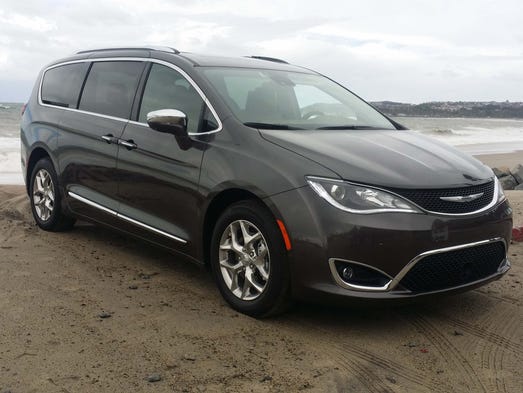
Winner: Chrysler Pacifica
We know that minivans have the most family-friendly interiors in autodom. But what to do about that uncool, boxy image? Pacifica blew away the stereotype by not only redefining the minivan, but making one of the most attractive, tech-savvy family haulers on the road today.
The Pacifica was a part of every conversation this year. What car reinvented the minivan segment? Pacifica. What vehicle did Waymo use to develop a spacious, self-driving family mule? Pacifica. What was the first family utility vehicle to go 30 miles on electrons? The same.
Based on the late (and underrated) Chrysler 200’s flowing design, Pacifica bears comparison to the Mercedes R-class wagon. That’s right, Mercedes — luxury’s style leader. That style continues inside — no accident, as the R’s former interior designer is also responsible for the Chrysler’s handsome, thoughtful interior that surrounds a superb UConnect infotainment system. The front compartment comes with a kitchen’s worth of clever storage, and the second row boasts Chrysler’s legendary Stow ’n Go seating.
Stow ’n Go not only provides added cargo options, but also makes the comfortable third row easily accessible.
All that is available on the base model for less than $30,000. Additional features turn minivan into a family fun mobile. Too bad Chevy Chase didn’t have one to drive to Wally World. There’s a full moon-roof. Kick-open side doors and rear hatch. Stowable vacuum cleaner. Oh, yeah, and that electric option so parents can keep plugging in at home at the end of the day in order to avoid gas stations.
I actually took the Pacifica to my nephew’s first-grade class for Stow ’n Go show ’n tell. The kids raved about it, eliciting one 6-year-old’s comment that should be on every Pacifica billboard: “Mister, this car is better than my dad’s Tesla.”
All the Pacifica lacks is all-wheel drive and Apple CarPlay and Android Auto connectivity. Even the best have room to improve.
Ford premieres refreshed 2018 Mustang
Posted by hpayne on January 22, 2017
Correction: The 2018 Ford Mustang is dropping the V-6 engine as an option for the first time since 1994. An earlier version of this story incorrectly stated the time frame.
Detroit – In a three-city simulcast anchored by Dwayne “The Rock” Johnson, Ford introduced an updated 2018 Mustang on Tuesday that gains performance and more advanced technology – but loses the option for a V-6 engine.
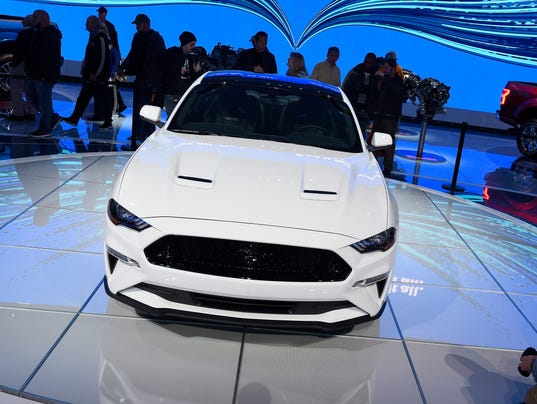
The pony car gets standard LED lights and new front and rear fascias, accentuating its aggressive looks with a lower, vented hood. Inside, the Mustang adds a gorgeous 12-inch digital instrument display that can be customized to the driver’s preference.
A mid-cycle refresh, the ’18 model makes no changes to the Mustang’s chassis that was all-new for the 2015 model year.
The Mustang was unveiled on Ford’s stand in the middle of public days at the Detroit Auto Show – and in New York City’s Hudson Mercantile and the Original Farmers Market in Los Angeles. The three press conferences simulcast a pre-recorded video featuring Johnson who surprised Purple Heart recipient Marlene Rodriguez with a 2018 Mustang and tickets to the premiere of his new “Baywatch” movie. Rodriguez, an Iraq War veteran and Johnson fan, was visibly overwhelmed.
Like the 2018 Ford F-150 pickup unveiled during the media preview at the North American International Auto Show last week, the Mustang’s engine lineup will now be mated to a quick-shifting, 10-speed automatic transmission. A 6-speed manual with twin-disc clutch is also available. For the first time since the 1994 model year, the coupe will not be offered with a V-6 engine option.
“I think a few people will miss the V-6,” says Mustang Engineering Manager Tom Barnes. “But the Ecoboost made the car quicker with better fuel economy, so there weren’t many advantages left in the V-6.”
The 310-horsepower, turbocharged Ecoboost 2.3-liter inline-4 — introduced in 2015 — now makes up 40 percent of Mustang’s global sales and will replace the outgoing 3.7-liter V-6 as the base engine. Ford says the V-6 has been the choice of 15-20 percent of customers. To help wean V-6 fans, the turbo-4’s sound will be electronically enhanced. The muscle car’s signature 5.0-liter V-8 will also be offered, its prehistoric growl enhanced by an active exhaust option.
Ford took the wraps off its refreshed Mustang with the help of Dwayne “The Rock” Johnson.
Mustang invented the pony car segment in 1965 and underwent major design and drivetrain upgrades to celebrate its 50th anniversary three years ago. The 2015 edition got an independent rear suspension, turbocharged engine option and underwent extreme plastic surgery to bring it in line with the Ford family’s car design theme.
The new pony flew out of showrooms, outselling its muscle-car rivals — Chevrolet Camaro and Dodge Challenger — by wide margins the last two years. With the 2018 car, Ford hopes to sustain the momentum.
“People loved the new car, but they wanted it louder. So we amped it up,” says Barnes. “They would say we want it to be more modern, more connected. So that’s where we did the digital cluster. We’re in the muscle-car segment but our customers are still changing.”
The 2018 model also gets digital novelties like auto high beams, Apple CarPlay and Android Auto smartphone connectivity, and pre-collision assist. While the base Mustang still features the traditional 4.2-inch analog instrument gauge, the available 12-inch digital cluster (shared with the Lincoln Continental) can be configured in NORMAL, SPORT or TRACK modes.
The high-tech cluster is part of a flurry of appearance upgrades that include smokier chrome finishes in the cockpit, new carbon-fiber trims, 10 new wheel choices and three new skin colors.
“Design is the No. 1 reason our customers purchase Mustang,” says exterior designer Melvin Betancourt.
But the oily bits get plenty of attention, too. The 10-speed transmission, co-developed with GM and capable of Porsche 911-like 300-millisecond shifts, will enhance performance as well as fuel economy.
Mating it to the 435-horse V-8 required updated half shafts in the rear. The big V-8 also pairs port fuel injection with direct injection for better efficiency. And the beast can ride on optional magnetic shocks for a smoother gallop.
“We always aim for a daily driver with the right balance,” says Barnes. “The looks have got to be great, the sounds have got to be great, the go has got to be great. It has to attainable, but it’s not one-dimensional.”
Mustang now carries the Ford flag to 146 countries with 40 percent of its buyers millennials. Ford says the turbo-4 has helped reach a new, younger generation of buyers — but the muscle-car attraction is the same as previous years.
“We’ve done a lot of market research in China, Austria and Europe. In essence, we see the common themes everywhere,” says Barnes. “Our customers want to have an emotional reaction when they are driving. A lot of people like the Ecoboost — it’s a fast car but it’s not a gas pig. They can have their cake and eat it, too.”
With sultry styling and drivetrain capabilities found in BMW and Audi coupes priced thousands of dollars higher, Ford has positioned the Mustang as an international athlete.
“The new Mustang is one of the iconic sports car in America, and now the world,” says Joe Hinrichs, Ford president of the Americas. The 2018 will go on sale this fall.
Henry Payne’s 10 best from the Detroit auto show
Posted by hpayne on January 13, 2017
I am tempted to name Lightning McQueen of “Cars 3” a Top 10 pick. One of the most-watched auto shows on the planet, Detroit tempts more than just car companies. Below Cobo’s show floor are 100 businesses showing off the next era of mobility, for example. And there’s IndyCar, displaying a next-gen racer to debut on Belle Isle in 2018. Or life-size Lightning flogging the latest installment in one of my favorite animation franchises, “Cars 3.” Ka-chow! But for all his Owen Wilson-infused personality, Lightning can’t hold a candle to other toys on the floor.
From the sleek Kia Stinger to the Ford F-150 skyscraper, the 2017 show is a delicious buffet. Here are my Top 10:
Kia Stinger

Good timing, Stinger. Big Three muscle mostly sat out this year’s show, giving the Nurburgring-tested, five-door Kia coupe the performance spotlight. First shown as the stunning Kia GT concept in Europe in 2011, the Stinger makes a statement of Kia’s intentions to be more than a builder of mainstream appliances. “This is a Kia brand that surprises and challenges,” says design boss Peter Schreyer. The same length as its doppelganger — the $70,000 Audi A7 — Kia says the Stinger will be targeted at the $40,000 BMW 3-series, Audi A4 and Mercedes C-class.
Audi Q8

Speaking of Audis, VW’s luxury brand unveiled the Q8 crossover as a sleek, two-row coupe version of its SUV flagship, the Q7. That’s a niche market, but the stylish Q8 previews the bold, six-lace rework of Audi’s famous large grille. Inside is the next-generation, best-in-luxury Virtual Cockpit instrument display — but more significant is the expanded heads-up display that accurately overlays information on the road ahead (an arrow indicating exact road turn-in, for example). Look for it in 2018.
Volvo V90

SUVs like the Audi Q8 have rendered station wagons all but extinct in the U.S. The gorgeous V90 wagon urges us to reconsider. The V90 provides plenty of utility with all-wheel drive and a roomy interior. That interior also shares “Thor’s hammer” headlights, posh materials and tablet console screen with the award-winning XC90 Volvo SUV. Just to be safe in ute-crazed USA, however, Volvo jacks up the V90 2.5 inches and badges it the V90 Cross Country.
Honda Odyssey

OK, enough about exteriors. Let’s talk interior innovation. The 2018 Utility of the Year Chrysler Pacifica sets a high bar with its Stow ’n’ Go middle seats and a dresser-drawer of console storage. But Honda thinks customers want better second-row communication. So the Magic Slide middle seat allows you to glide a car seat-bound child within reach — and a microphone system lets you talk directly to third-row occupants. As for the exterior, well … how about hiring a Volvo designer?
Volkswagen Tiguan

Rocked by Dieselgate, Volkswagen is eager to get back to the business of building vehicles. The new Tiguan aims for the meat of the U.S. market and checks all the boxes: longer wheelbase (by 10.4 inches), 57 percent bigger trunk, three rows of seats (very unusual for a compact ute), Apple CarPlay and Android Auto connectivity.
GMC Terrain

You had me at the C-clamp headlights. I protested bigger brother Acadia’s extreme makeover at last year’s show as too vanilla. The Terrain does it right in the dog-eat-ute compact segment (see the Tiguan above). The front peepers and Nissan Murano-like floating roof are elegant (though creating a blind spot bigger than Rhode Island). Shedding nearly 500 pounds, the turbo-4 powered Terrain should ride as good as it looks.
Ford F-150

The king of trucks just gets better. The grille ditches Ford’s signature three-bar for a wider, “double I-beam” take. Nice, except the base models get grille “nostrils.” Ugh. I’d jump straight to the handsome Lariat trim. Under the aluminum hood, Ford’s smorgasbord of engine choices gets the first diesel in the light duty’s long history. The hits keep on coming: Wi-Fi hot spot, pre-collision assist, smartphone connectivity, new wheels and … I could go on all day.
Toyota Camry

“Sexy and really sexy,” said Toyota Chairman Akio Toyoda, introducing the all-new Camry’s base and sport versions. A hilarious chairman? A sexy Camry? Together they stole the media show, and that was appropriate. Toyoda has pushed his designers hard to make their appliances more appealing. The racier sheet metal also telegraphs a more capable chassis as the Camry gets lower and stiffer. To emphasize the point, Toyoda also introduced the new NASCAR Camry. Va-vroom.
Nissan Vmotion concept

Vmotion echoes the Chrysler Portal concept in its roomy approach to ride-sharing autonomy. So why the saucy exterior? Because the Vmotion also explores future design for its family sedans. Carve these racy lines into an Altima and it’ll make the Camry look vanilla again.
Dodge Challenger GT

Dodge quietly sneaked its first all-wheel drive pony-car coupe into Cobo for its first show. Quietly, because the GT is not endowed with an earth-shaking V-8. The AWD system comes mated only to a 305-horsepower V-6, but that’ll do for motorheads pining to power-drift their Challengers through snow drifts. Finally, an all-season Woodward dragster.
Auto show consumer guide: Feast for all auto appetites
Posted by hpayne on January 13, 2017
Welcome to Times Square, Detroit-style.
Cobo Center this January has been transformed into a mind-blowing wonderland of jumbo LED screens, floor-to-ceiling videos and consumer goods stores. This being Motown, of course, all the stores contain cars. Here, you can find everything from pint-sized Smart ForTwo cars to ginormous Ford F-150 pickups. Heck, like Times Square, there’s even a Disney presence with a life-sized replica of Lightning McQueen, the star of “Cars 3.”
But for all the glitz, this year’s new reveals are for the bread-and-butter shopper.
The auto market is going through a major shift from sedans to trucks and every manufacturer is remaking its portfolio to accommodate the trend. In doing so, they need to balance the conflicting visions of a federal government that wants smaller, fuel-sipping cars and consumers who want more utility. Midsize utes and sedans are the core moneymakers that allow automakers to make fun toys like Camaros and M2s — so they got to get them right.
Chevy brand customers want more room so the all-new three-row Traverse SUV grows bigger, even as its chassis sheds weight for better fuel economy. Its more upscale sister brand, GMC, on the other hand, is downsizing its Terrain crossover to be more nimble in the compact SUV segment. Compact SUVs are fast replacing the midsize sedan as the dominant family vehicle.
Even the BMW stand is looking like ute-ville. The German maker graced Detroit with the global reveal of its 5-series sedan, but it’s the BMW X2 coupe concept crossover – which will be the sixth SUV in the performance brand’s lineup — that steals the show. Finally, a sexy SUV from Bimmer.
Grab your grocery bag and let’s go shopping. These are my show highlights:
Bread-and-butter giants
The best-selling car (Toyota Camry) and truck (Ford F-150) both debuted new looks at this year’s show. The Camry is the more dramatic.
The sedan is still the top dog in sedan sales (388,618 sold in 2016) but sales were down 10 percent. As families flee to SUVs like Toyota’s RAV4, customer priorities for sedans shift to style, performance and fuel economy. The new Camry offers all three. Determined to show the world that it’s shedding its vanilla image for more Chunky Monkey Double Chocolate Oreo swirl (well, at least chocolate), Toyota threw the kitchen sink at the new Camry.
Auto show compact, midsize sedans: Cars grab spotlight
Posted by hpayne on January 13, 2017

These days sedans make more headlines for irritating President-elect Donald Trump than for their sales numbers. With U.S. regulations and labor costs choking profits, sedans have been forced to low-cost Mexico. But in a crossover-crazed world, small sedans remain relevant as they attract young buyers to brands that can ultimately sell them higher-margin, family-size SUVs. Midsize sedans have it tougher as they compete more directly with red hot utes. Which is why the vanilla Toyota Camry is getting some fudge nut swirl.
Dodge Challenger GT
What it is: The muscle car coupe gets AWD. Buy the 305-horse Pentastar V-6 and you can get your Challenger with the same all-wheel-drive system found in the Charger sedan. While practical for all-season driving, the GT doesn’t ignore sportiness with 19-inch, Hyper Black aluminum wheels and a rear deck spoiler. The GT only comes with the V-6 engine option (sorry, Hellcat V-8 fans) but is loaded with all the goodies inside, including Nappa leather heated seats, heated steering wheel, and best-in-the business 8.4-inch Uconnect display with Apple CarPlay and Android Auto connectivity.
Payne’s take: For performance enthusiasts who have shied from RWD muscle cars as fair weather rides only, the GT is a real Detroit alternative to AWD hot hatches like the Subaru STI and Golf R. For less than an STI — and slightly more than a RWD ’Stang GT, the posh $35K AWD Challenger is an all-season star.
Smart ForTwo Electric
What it is: Almost ignored at this year’s electric-heavy show is the tiny Smart, now in full EV form. It’s no Chevy Bolt EV, but with a range of 70-100 miles at 10 grand less, the Smart is an affordable city EV that can park (literally) anywhere. Front or sideways at the curb. Between cars. Heck, you can probably take it up the elevator with you. With a roomier cabin than in the past and clever paint job, Smart is an EV with attitude.

Payne’s take: For city slickers only. Be sure you have a 240-volt outlet available. Try to charge the Smart on a standard, 120-volt outlet and you’re looking at (cough) 22 hours before full charge.
Subaru WRX and WRX STI
What it is: Subaru’s rockin,’ sockin’ all-wheel-drive performance twins get a mid-cycle cosmetic update. What they don’t get is a new chassis based on the Subaru Global Platform like the Impreza. The twins get new grilles, air intakes, LED headlights and 19-inch wheels for the STI. A quieter interior (thanks to door seals and thicker side glass) gets a raft of new toys, including Subaru’s EyeSight safety-assist features and bigger infotainment screens.

Payne’s take: The plastic surgery is nice, but fans of these rally-racing inspired hoon-mobiles will have to wait another couple years to the get the chassis upgrades promised by the Impreza’s stiffer chassis that has been received with raves from the auto press. That’s a shame since the WRX and STI are under attack from AWD competitors like the Golf R and Ford Focus RS that offer state-of-the-art everything.
Toyota Camry
What it is:America’s best-selling appliance gets a long-awaited overhaul. The result is a Camry that will actually get your heart racing. Are those quad tailpipes on the V-6 powered model? The interior is even more dramatic with a chrome S-curve running through the middle of the console. Of equal importance to the cosmetic changes is an all-new TNGA platform that tightens up the Camry’s somnolent chassis dynamics. The car has a lower roofline and center of gravity.

Payne’s take: Camry gone wild. In an effort to keep sedans relevant in a SUV world, the best-selling sedan gets dramatic. Heavily sculpted hood. Available red seats. A black body trim package. For all the drama, the Camry’s engine choices remain familiar, including a V-6. “Because our customers like V-6s,” says a spokesman.
Auto show big SUVs, trucks: Market keeps on truckin’
Posted by hpayne on January 13, 2017

The pickup market just keeps on truckin’ with Nissan joining the Big Three titans: F-series, Silverado/Sierra, and Ram, with its own Titan. Meanwhile, the midsize segment is exploding with Chevy, GMC, Toyota, Honda and even (aged) Nissan gaining sales. Ford was a one-company news storm during the auto show as it unveiled a refreshed F-150 and announced that two icons — the Ranger and Bronco — would be returning to the small pickup fray in short order.
Ford F-150
What it is: Ford’s landmark, all-aluminum pickup gets a mid-cycle refresh with a new fascia and even more engine options. The three-bar grille goes away, replaced by the “double I-beam” found on big brother F-250 Super Duty. Around back, the big pickup gets “F-150” tattooed on its arse. A diesel engine is available for the first time — as well as a new 3.3-liter base engine. Rounding out the lineup is a 2.7-liter turbo, 3.5-liter turbo, and honkin’ 5.0-liter V-8. All but the 3.3-liter are powered by Ford’s new 10-speed tranny.
Payne’s take: After selling more pickups than any other automaker for the 40th straight year in 2016, Ford rubs it in with a refreshed F-truck. The wider, two-bar grille spells the end of Ford’s 10-year, three-bar signature grille that started with the 2006 Ford Fusion. Tough outside, the F-150 is a rolling living room inside (in fact, I think it’s bigger than most living rooms).
GMC Terrain
What it is: Following in the footsteps of its bigger sibling, the GMC Acadia, the Terrain gets an extreme makeover for 2018. Ditching its chunky pickup looks for sleeker styling (check out that floating roof and C-clamp headlight signature), the Terrain sheds almost 500 pounds. With available diesel, 1-5-liter turbo and 2.0-liter turbo engines, the Terrain aims to translate its diet into increased fuel efficiency and driveability.

Payne’s take: Previously big for a compact ute, the Terrain right-sizes to go after the Honda CR-V and Ford Escape in the industry’s best-selling segment. With its good looks and nine-speed transmission, the GMC will be the more premium GM choice compared to its Chevy Equinox sibling.
Chevrolet Traverse
What it is: Chevy’s big midsize Traverse goes on a 350-pound diet without compromising its dimensions. Indeed, Chevy claims the three-row SUV gets more rear headroom and legroom. The Traverse gets a new fascia and new boxier sheet metal to match is sizable ambitions. A 3.6-liter V-6 is the volume engine and a 2.0-liter four-banger motivates the Traverse’s sportier, front-wheel drive RS trim. A premium High Country will also be offered for the first time to compete with the Ford Explorer Platinum.

Payne’s take: Size matters. While sister GMC Acadia downsized in this segment last year, the Chevy boasts more room than its Honda Pilot and Explorer competitors. The Traverse, which shares its AWD skeleton with the Cadillac XT5 and Acadia, promises surprisingly nimble handling for something so big.
Volkswagen Tiguan
What it is: VW’s compact ute gets a major redo, gaining over 10 inches in length and adding a third-row seat, rare in this class. Powered by a peppy 184-horse turbo-4, the Tiggy offers AWD and a suite of tech toys, including Apple CarPlay and Android Auto smartphone connectivity (U.S. market must-haves that many European manufacturers have been slow to adopt).

Payne’s take: The Tiguan is key to VW’s reboot in the U.S. market, where it has missed the SUV mark. If priced competitively, the Tiguan’s size, solid chassis and third-row seat option should get it noticed.
Auto show minivans, SUVs: Form beyond function
Posted by hpayne on January 13, 2017

Sport utility vehicles dominate the U.S. market, making up 60 percent of market share (together with trucks) for 2016. That’s up from 47 percent just six years ago. Driven by customer preference for better visibility and cargo space, utes now parallel sedans, available in every segment of the market. With the development of turbo engines and global platforms, SUVs are making giant strides in fuel efficiency and handling.
Audi Q8
What it is: Just say no to the box. Like the BMW X6 and Mercedes GLC Coupe, the Q8 is a crossover with curves — a coupe version of Audi’s biggest three-row crossover. Based on the same bones as the well-received three-row Q7, the Q8 will have only two rows of seats — so as not to give passengers neck cramps. With a grille larger than a locomotive and 443 horses from its hybrid powertrain, this SUV will fill up your rear-view mirror in a hurry.
Payne’s take: More proof that crossovers are threatening every corner of the car market. The Q8 concept is a near-market-ready concept that should hit dealer lots later this year. The grille and monobrow rear taillight are unique to the Q8 and, hopefully, will make the transition to the production vehicle. Gotta have it in Bombay Blue.
Honda Odyssey
What it is: The best-selling minivan in America remade to keep up with the new, innovative Pacifica and its Stow n’ Go second-row seats. Unlike the Pacifica, the Odyssey doesn’t break ground in styling (it refines its “lightning bolt” design theme), saving the changes for inside. Honda has addressed customer concerns for rug rats in the rear seats — introducing a middle-seat solution called Magic Slide. The seats can be moved laterally so the driver can reach back from the driver’s seat and keep tabs on a young ’un. By sliding the seats inboard, the Odyssey also allows easier third-row access.

Payne’s take: The Odyssey is a tech tour de force — or Big Brother depending on your point of view. In addition to Magic Slide, parents can monitor backseat occupants with CabinWatch, an infrared camera in the ceiling. The image is projected on the front console screen. Need to ask what the heck is going on back there? CabinTalk allows front seat-to-rear communication via speakers or headset.
Infiniti QX50
What it is: Billed as a concept, there’s no Q-uestion that this midsize SUV is heading for production. The QX50’s styling is attractive if not as cutting edge as its junior sibling QX30. The 50 saves the innovation for under the hood, where it debuts Infiniti’s variable compression 2.0-liter engine; it provides more power — 268 ponies — and up to 27 percent fuel economy. For you geeks out there, this is accomplished by varying the piston stroke and thus, the car’s compression depending on need.

Payne’s take: The current QX50 is older than the Pyramids but was Infiniti’s hottest-selling model in 2016, a testament to Americans’ thrust for family utes. Performance brand Infiniti made the current Q with rear-wheel drive, but look for the revamp to be a front-wheeler.
Mercedes GLA
What it is: The Mercedes GLA — which shares its platform with the Japanese automaker Infiniti — gets a mid-cycle refresh after burning up the sales charts. The GLA is more hot hatch than SUV, with a roofline that looks like it was squashed in a panini maker. Merc fans will know the 2018 model by its new front grille, rear fascia and wheels.

Payne’s take: Plop down another 17 grand and you can have the AMG version of the GLA which comes with a monster, 375-horse mill and a 155-mph top speed. Own this rocket ute and you can go out and pick on Dodge Chargers on Woodward.
Nissan Rogue Sport
What it is: Honey, I shrunk the Rogue. The Rogue Sport is a junior version of the compact Rogue marketed to the subcompact ute segment occupied by the Honda HR-V, Fiat 500X, Mazda, CX-3 and so on. The Sport gets a smaller four-banger than big brother but is otherwise outfitted in familiar trims. Available in FWD and Detroit winter-friendly AWD.

Payne’s take: Like Ford (Ecosport) and Honda (HR-V), the Rogue Sport shares looks with the rest of the family. Unlike those competitors, however, the Rogue Sport does not get its own name. Badged the “Qashqai” in other markets, it would have been fun to see that name here.
Auto show sports cars: Market diversity rules stage
Posted by hpayne on January 13, 2017

The sports car market today is wonderfully diverse, from affordable $20K-something Miatas and Subaru BRZs to $160K Acura NSX supercars. The Detroit show was quiet in new reveals this year, but the band is (almost) all here. Dodge Viper, Corvette Grand Sport, Audi R8 and Acura’s race-prepared NSX are ready to do battle in endurance racing. And speaking of, don’t miss the 2016 LeMans-winning Ford GT supercar — its skin still caked with 24-hours of grit — in the middle of the Ford stand.
Kia Stinger
What it is: Waaay back in 2011, the Kia GT concept drew the screams of adoring media in Frankfurt. Finally, Kia is putting it into production. Gone are the dashing, intake-bisected headlights in favor of more conventional peepers, but the Kia retains its defining Audi A7-like shape. Two engines are available with the 365-horse turbo V-6 the most mouthwatering.
Payne’s take: Not technically a sports car, the Stinger nevertheless was tested extensively at the Nurburgring race track. It sports a sophisticated multi-link suspension and a top-drawer, torque vectoring all-wheel-drive system. With its fast-back coupe styling, torquey turbo and rear-wheel drive platform, this is a performance car in sheep’s clothing.
Lightning McQueen
What it is: The star of Pixar’s “Cars 3” is a muscled, life-size cartoon brought to life in red and yellow sheet metal. Voice by Owen Wilson. Top speed: 200 mph. Chief competitor: Jack Storm. Rated: G.

Payne’s take: A Hollywood star on the Detroit auto set. Southern drawl and strong shoulders make all the SUV girls swoon.
Mercedes-AMG GT C Coupe
What it is: Flanked at the show by its GT and GT S sisters, the AMG GT C coupe looks like it was penned by Marvel comics as a Merc superhero. A front hood that reaches to the horizon. An angry, “Panamericana” grille. Huge front intakes. Muscular fast back. And under the hood, a 4.0-liter, twin-turbo V-8 with a gazillion horsepower. While the world whizzes by in 3.6 second zero-60 bursts, you can lounge inside in quilted leather seats.

Payne’s take: The AMG GT C (which also comes in a drop top) is actually not the most powerful of the six — count ’em, six — GT variants. The mighty AMG GT R version boasts 27 more ponies (577) and is capable of leaping tall buildings in a single bound. Look for it in late summer.
Auto show luxury cars: Eye candy sweet, less plentiful
Posted by hpayne on January 13, 2017
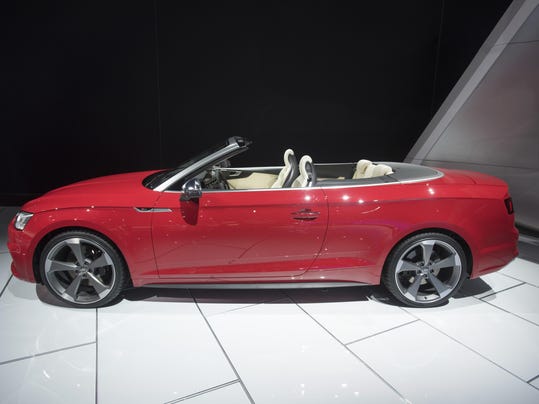
A lot of money can be made in luxury goods, so it’s no wonder more automakers are parking in the premium space. Genesis, Alfa Romeo and Tesla (not in Detroit this year) have all come to market recently, and now Kia is exploring luxe territory with its pretty Stinger sedan coupe. European luxury makers, however, have been scarce at the Detroit show in recent years, as the bulk of their customers are on the coasts. This year Porsche, Jaguar, Land Rover, Ferrari, Maserati, Bentley, Rolls-Royce and Lotus are no-shows. Still, showgoers will find plenty of eye candy with BMW and Audi unveiling world premieres at Cobo. None of the Detroit luxe-makers showed a new car this year, but the 30-way seat Lincoln Continental and the gorgeous Caddy Escala concept are worth second looks.
Audi A5/S5 Cabriolet
What it is: Audi’s lovely A5 coupe drops its top. With the pull of a button, the top will fold away in just 15 seconds at speeds up to 31 mph. With its bonnet in boot, the Cab still promises 13 cubic feet for storage. The A5 comes with a 255-horse turbo A5 for pleasant cruising. Or you can upgrade to an S5 convertible and set the hills on fire with a 364 horse-369 torques blown V-6.
Payne’s take: The A5 is a head turner, beautifully sculpted from stem to stern. Opt for the available Virtual Cockpit display, and you’ll be showing off the interior as much as the exterior. VC uses Google Earth to put your route right in the full color display before you. It’s tech-tastic.
BMW 5-series
What it is: Bimmer’s seventh-gen 5-series gets its debut in Detroit with the 540i. The new gen sports a lighter chassis using magnesium, aluminum and unobtranium (kidding about that last one) that saves 137 pounds. The AWD-base car gets a 3.0-liter, 335-horse inline-6; a BMW M550i xDrive runs on a V-8 belting out 456 horsepower and a hybrid-electric BMW 530e iPerformance delivers up to 15 miles in pure electric mode. Gesture control, voice recognition, self-parking and other toys are available.
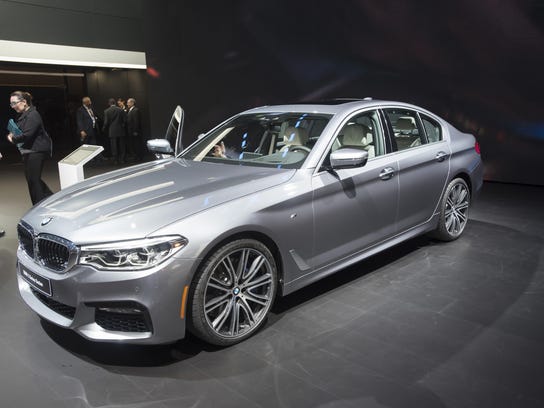
Payne’s take: The 5-series has long set the standard for midsize luxe style. Now, with a hybrid and M-trims, it satisfies every customer’s demand for drive-line capability.
BMW M760i Xdrive
What it is: No, this isn’t the long-awaited M7, but with a V-12 under the hood, it’s hard to imagine better performance than this. The Bavarian maker has been using the M trim to give its cars a sporty vibe while stopping short of going full-moon, werewolf track animal. But with the 601-horse, twin-turbo V-12 driving all four wheels, the AWD M760i is one special thoroughbred. Climb into the M-highlighted interior, bark a destination at the excellent voice recognition system and the road is yours.
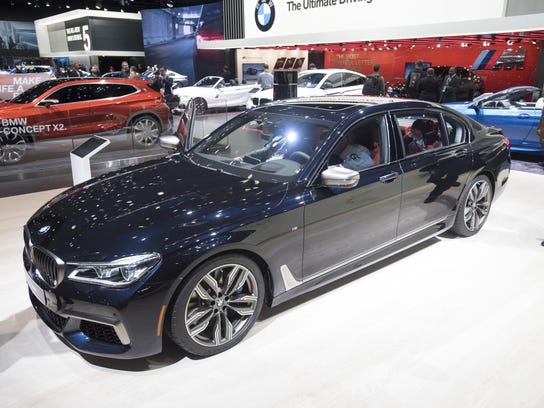
Payne’s take: Apparently the Alpina B7’s 600-horse, twin-turbo V-8 just isn’t enough. Plunk down 155-grand and the V-12 is the best aural symphony this side of a mighty Wurlitzer in the back seat. The M760i does beg the question of what will power the ultimate M7. A solid-fuel rocket perhaps?
Lexus LS
What it is: The fifth-generation Lexus flagship gets leaner, wider and lower. The chassis — shared with its sibling LC 500 sport coupe — sheds 200 pounds while the 386-horsepower V-8 boat anchor up front gets mothballed for a more powerful, blown 415-horse V-6 mated to a new 10-speed tranny.
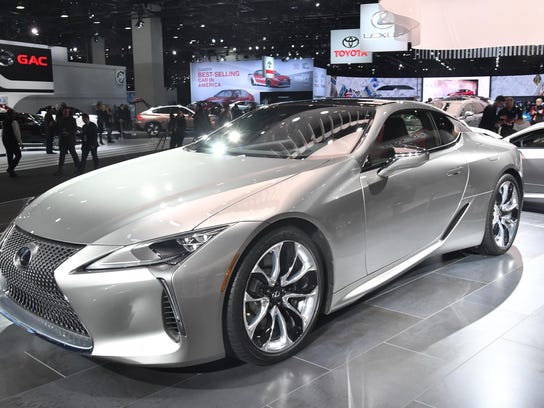
Payne’s take: Back in 1989, the Lexus brand debuted with the LS in Motown and the rest is history. It has since taken its place among the best-selling luxury brands in America, but the success of SUV sales (the RX is Lexus’ most popular model now) has pressured the LS to be more daring. With its Darth Vader-like grille and racy lines, Lexus is no vanilla wallflower.
Mercedes E-Class Coupe
What it is: The coupe is a reminder that the once conservative German brand is the sexiest stylist in luxury today. And with a 4.4-inch-longer wheelbase and more power under the hood, the pretty lady has even more to brag about. The coupe eschews the E-class sedan’s base 4-cylinder for a 329-horse, twin-turbo six. The two-door is offered in AWD and will ultimately get a V-8 option with its fire-breathing AMG performance trim..
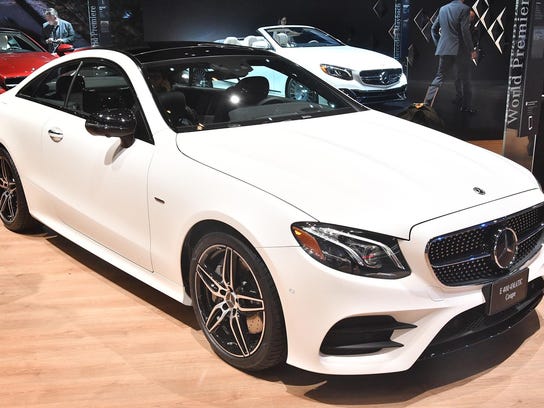
Payne’s take: In addition to its more youthful styling, the E-class coupe is a showcase for the latest in tech, too. A 12.3-inch COMMAND instrument screen headlines interior features that include Apple Carplay and Android Auto connectivity and an inductive pad for smartphone charging. This isn’t your granddad’s Merc.
Volvo V90
What it is: Volvo continues its China-financed product renewal with the elegant V90 wagon. Like the XC90 ute and S90 sedan before it, the V90 gets a signature interior of Scandinavian wood trim, large tablet-like infotainment screen, 4-cylinder engine option (including a powerful turbo-and-supercharged variant) and those distinctive “Thor’s hammer” headlights.
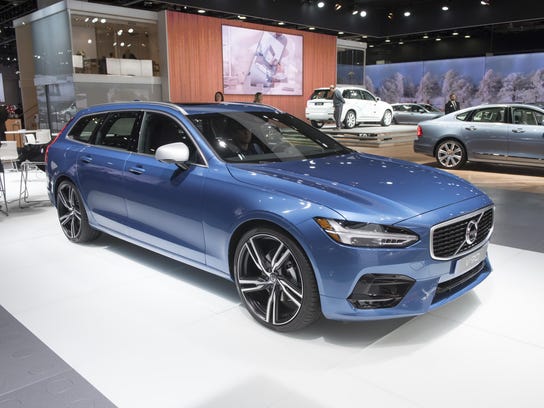
Payne’s take: The V90 is the most gorgeous wagon I’ve ever laid eyes on, but U.S. dealers will get only the raised (by 2.5 inches) Cross Country version. That’s in deference to Americans’ preference for riding high. If you covet the lower-slung wagon, you’ll need to special order it.