- Search Cartoons
- Comic Archive
-
Payne
Store



 Henry Payne RSS

Articles
U.S. in F1: GM and Andretti team up to go Formula One racing
Posted by Talbot Payne on January 6, 2023
Formula One is poised to get a dose of red, white and blue.
Two icons of U.S. auto sports, Andretti Global and General Motors Co.’s Cadillac, are teaming up to race in the world’s most prestigious, open-wheel motor-racing series. The bombshell news Thursday comes as Formula One and Cadillac are making major pushes into new markets — and dovetails with Andretti Global CEO Michael Andretti’s ambition to follow in the footsteps of his famous father, Mario Andretti, to conquer F1 with an American team.
The time seems ripe for both GM and Andretti. F1 has surged in interest in the United States in recent years with three Grand Prix on the schedule for 2023: Austin, Miami and Las Vegas. Furthermore, the hybrid-powered series has championed electrified racing with a promise for zero-emission racing by 2026 — an ambition that dovetails with GM’s Zero-Zero-Zero mantra (zero crashes, zero emissions, zero congestion) and with Cadillac taking the lead as GM’s first global, all-electric brand.

The partnership did not announce a date for entry into the sport but said it has begun the formal application process with Formula One’s FIA organizing body. If selected, Andretti Cadillac said it is seeking to compete as soon as practical with at least one American driver. The team would be based in the United States with a support facility in the United Kingdom.
“Today is the first step in what we hope to be the historic entry of General Motors into F1. Never happened in our history — it’s very, very exciting for us to be with Andretti,” GM President Mark Reuss said in a press briefing. “And if given the opportunity, GM and Cadillac will compete with the very best at the very highest levels with passion and integrity that will continue to elevate the sport for the FIA and race fans around the world.”

The Formula One partnership is separate from the Detroit Grand Prix, which will race downtown in June this year. The Grand Prix here is an open-wheel IndyCar series race with Chevrolet as a title sponsor. Formula One last raced in the streets of Detroit in 1988.
U.S. automaker involvement in Formula One in recent decades has been sporadic and fraught. Ford Motor Co. was the last American F1 competitor with its then-Jaguar brand from 2000-04 (under the management of American Bobby Rahal for 2001). And Mario Andretti was the last American to win an F1 championship in 1978. No U.S. driver currently races in the series. The lone U.S.-based team in F1, North Carolina-based Hass, uses Ferrari engines.
“I feel very strongly that we are suited to be a new team for Formula One and can bring value to the series and our partners, and excitement for the fans,” Indianapolis-based Andretti Global CEO Michael Andretti said in a statement. “I’m proud to have GM and Cadillac alongside us as we pursue this goal.”

It’s an investment Cadillac is determined to make as it recasts itself for a global, 21st-century market. The F1 announcement complements other recent brand moonshots including the introduction of a hand-built, $300,000-plus Celestiq sedan and all-electric lineup by 2030.
GM gives Andretti the crucial backing of a major manufacturer in a sport that demands brand prestige — Mercedes-Benz, Ferrari, Aston Martin and Honda all compete — as much as it demands their financial resources. Formula One budgets are notoriously stratospheric, and insiders suggest the Andretti Cadillac partnership will need to make a $1 billion investment to be competitive.
“If you’re going to be a true luxury brand, you need to appeal to a number of different customers,” said Rory Harvey, vice president of Global Cadillac, in an interview. “You need … to demonstrate the ability to be there with the best in the world. And I think this is a great addition in terms of the announcement of the expression of interest in Formula One.”
The series’ explosive growth in the United States also helps Cadillac in its backyard, added Harvey: “We’re now up to three races in the U.S., and F1 is certainly growing in popularity here. The U.S. market is massively important to Cadillac. There’s no doubt that (Andretti Cadillac is) complementary to some of the growing focus fans put on F1.”
The coming 2026 F1 rules are tailor-made for manufacturers eager to show off their electrification chops. Global government emissions rules are forcing manufacturers towards battery-powered drivetrains. Formula One’s ‘26 rules increase the battery component of the F1 drivetrain from 80-20 gas-electric to 50-50 at the same time reducing development costs.
Those sweeteners have unleashed rumors that rival Ford might partner with the Red Bull team in F1 as well. The move also comes as Cadillac’s parent, GM, is deepening its commitment to global motorsport. Cadillac is pursuing victory at the 24 Hours of Le Mans this year with a new, prototype sports car. And the Chevrolet brand’s Corvette Z06 GT3 race car will be available for private teams to race across the globe in 2024.
“Mark Reuss is on a mission for Cadillac,” said Steven Cole Smith, a veteran racing writer with Hagerty. “He wants to bring the Cadillac brand back to what it was. Successfully racing in Formula One would be Cadillac’s crowning glory.”
Still, Formula One is a major step as the world’s most expensive and technologically advanced form of motorsport. Annual budgets can soar to as much as $500 million a year for top teams, though F1’s new rules are intended to cap annual engine development costs at $100 million.
Andretti Global currently participates in six series across the globe including the FIA’s battery-powered Formula E series which is a distant cousin to Formula One. Andretti is best known in the United States as one of the open-wheel IndyCar series powerhouse teams. Since its founding in 2003, the team has won five Indy 500 races and four driver championships. The team fielded three cars in the 2022 season, winning twice with American drivers Colton Herta and Alexander Rossi.
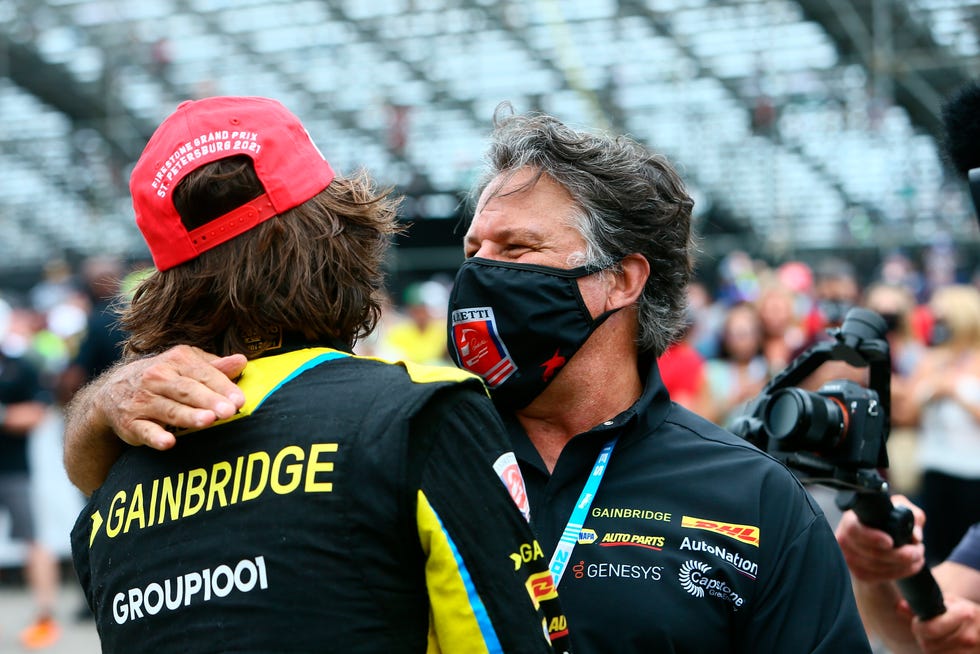
Andretti’s interest in Formula One has been a constant source of chatter in the IndyCar paddock in recent years with Herta’s name consistently in the conversation as a young, dynamic American driver that would increase American fan interest.
Andretti unsuccessfully tried to buy the Alfa Romeo-Saber team in 2021. A year ago, Andretti filed an application with the FIA with Renault as its engine supplier for the 2024 season, but the application stalled.
“Formula One has been very tightly controlled with 10 teams splitting the pie, so it’s been difficult for F1 to see how Andretti adds value,” Hagerty’s Smith said. “Now with Cadillac behind Andretti, I don’t see how Formula One says no.”
Andretti and GM last paired in the 2012 IndyCar season when the team was powered by Chevrolet engines. Andretti IndyCars currently uses Honda engines.

Cadillac’s push into Formula One comes on top of its ambitious plans to win the 24 Hours of Le Mans this year — the first time the brand has competed in the world’s most prestigious endurance race since 2002. Caddy has been a contender in the American IMSA WeatherTech SportsCar Championship series since 2017, and its all-new, earth-shaking hybrid-V-8 Cadillac V-LMDh, will take the fight global this year in IMSA and FIA World Endurance Championship.
“Our commitment to this program goes beyond the Cadillac livery,” Reuss said. “GM’s vast engineering resources will bring proven success and valuable contributions to this partnership. This includes all the talent and capabilities of GM racing staff and facilities in Michigan, at the Warren Tech Center and North Carolina.”
Henry Payne is auto critic for The Detroit News. Find him at hpayne@detroitnews.com or Twitter @HenryEPayne.
How Ken Block and Ford Motor Co. ruled the hooning world
Posted by Talbot Payne on January 6, 2023
Rally race driver and legendary Hoonigan Ken Block died tragically this week at 55. He likely entered the Pearly Gates sideways in a Ford Fiesta, smoke pouring from his tires.
Block had a successful racing career, but it was his antics off-track for which he will be most remembered. He took “hooning” — “the act of driving recklessly, racing, doing burnouts etc.” according to the Urban Dictionary — mainstream with his wildly successful Gymkhana videos.

At the height of his fame, he teamed with Ford Motor Co. for 11 years — a partnership that raced across the globe while also thrilling millions with videos of Fiestas, Hoonicorn Mustangs and F-150 Hoonitrucks doing breathtaking stunts through the streets of cities like San Francisco and Detroit.
Block lived large and on the edge and his death came suddenly on his Utah ranch after he lost control on a snowmobile. Though he and Ford had parted ways in 2021, the reaction from his old comrades was swift.
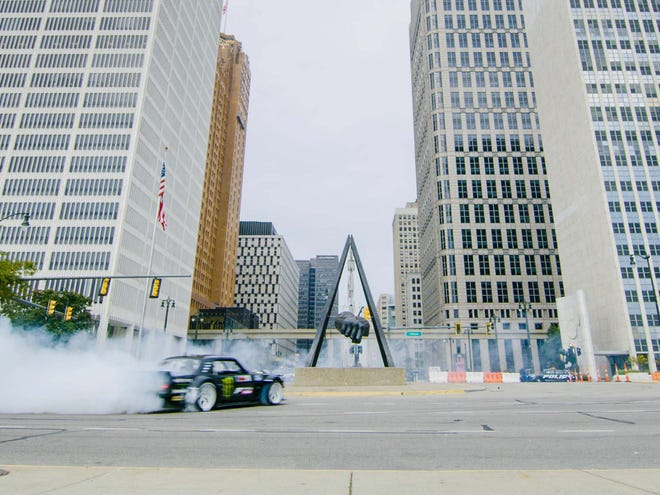
“We lost a legend today in Ken Block,” said Ford in a statement. “Ken inspired generations of auto enthusiasts, and in the process he came to inspire all of us at Ford as well. Ken personified the joy of driving, drifting and racing. He had a boundless imagination for creating special cars and special moments.”
Added CEO and amateur racer Jim Farley on his Twitter feed: “This is heartbreaking. I was lucky enough to call @kblock43 a friend. He was truly a legend and inspiration to all of us at @Ford.”
Block’s career reached beyond the automotive world. Born in Long Beach, California, his early fascination with skateboarding led him to co-found DC Shoes apparel in 1994 — a company he sold for a reported $87 million a decade later. With money in the bank, he turned to his new love, race cars.

Rally racing’s tail-out, extreme environment seemed to suit his swagger. Despite taking up the sport at 37 — many years older than his competitive set — Block instantly showed promise, winning Rookie of the Year in the 2006 Rally America National Championship driving a Subaru WRX STi. Two years later, his first Gymkhana video — showcasing his raw hooning skills on an open airfield — went viral, generating an healthy 14 million views (and counting), mostly in the coveted 17-to-25-year-old demographic.
A star was born. Two years later, he inked a contract with Ford.
“He was a heck of a driver. The videos speak for themselves,” said Ford Performance boss Mark Rushbrook, who worked with Block for years, in an interview. “I rode with him a couple of times . . . and it just blows your mind at the speed at which his brain was able to process going down this rally road.”
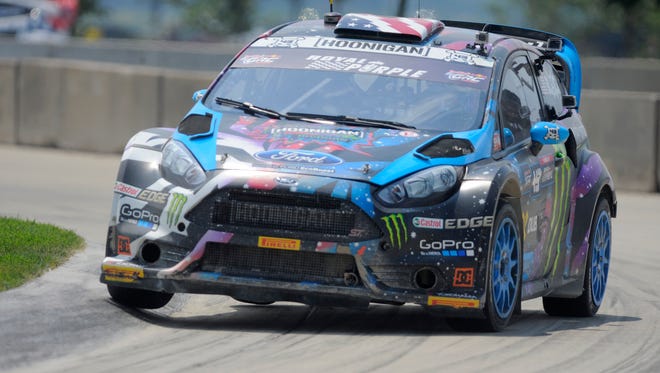
Rushbrook was just as impressed with Block’s marketing and business mind. “He was a marketing genius. He figured out how to not just be a driver, but also how to bring all his partners together — Ford or Toyo Tires or Monster Energy — in a way that lifted all of us. He was the hub.”
Block and Ford built synergies across a multitude of disciplines, whether winning races, creating driver schools in Utah and New Hampshire, or preparing insane, unbridled cars for the next Gymkhana video.
“(It was) a very natural relationship where we were able to find things that worked for both of us,” said Rushbrook. “We’re a performance car company and he had a passion for performance machines and putting them out in front of people in a very spectacular way. At the beginning of every year, we’d plan: what did he want to accomplish for Ken Block for Hoonigan? What did we want to accomplish for Ford?”
Block competed in multiple Fords. At the wheel of a Fiesta hatchback racer from 2011-15, he finished 2nd, 3rd, and 5th in the U.S.-based Global Rallycross Championship. In 2016 he set his sights on the world’s best, campaigning an all-new Focus RS in the international FIA World Rallycross Championship.
But his most memorable cars are the unlimited hellions he drove in his highly anticipated Gymkhana videos.
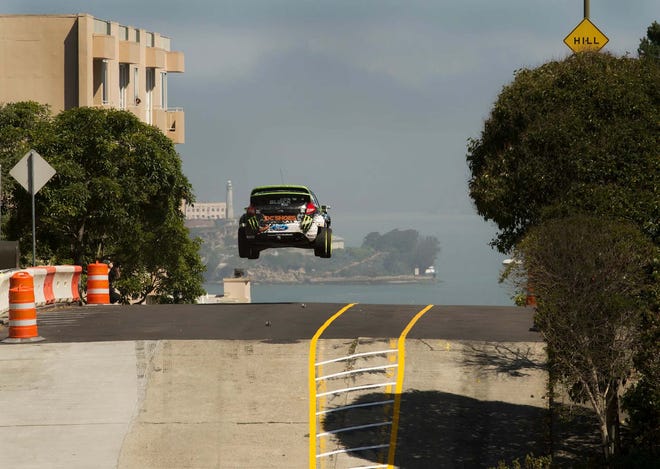
In his first video with Ford in 2010, “Gymkhana Three, Part 2: Ultimate Playground,” he tore apart the steep, 51-degree bankings of France’s Linas at l’Autodrome de Linas-Montlhery in a 650-horsepower, all-wheel-drive Fiesta hitting 60 mph in just 1.9 seconds. In 2015, he went to an urban environment — the streets of San Francisco — to perform astonishing Fiesta feats like doing donuts around trolleys and jumping the city’s vertical streets. Gymkhana Five has attracted a staggering 114 million views.
In 2018’s “Gymkhana Ten: The Ultimate Tire Slaying Tour,” Block took to the streets of Detroit in a 1,400-horsepower, all-wheel-drive Hoonicorn Mustang that smoked Michigan Central Station, then did donuts around The Fist.
Rushbrook’s favorite Block creation? The 914-horsepower Hoonitruck (based on a Ford F-150) that starred in the 2018 sequel to the Gymkhana series: “Climbkhana TWO: 914hp Hoonitruck on China’s Most Dangerous Road.”
“For the Hoonitruck, we wanted to do something different,” said Rushbrook of the beastly pickup that dashed up Tiananmen Mountain’s formidable 99 turns. “Let’s take the EcoBoost V-6 like we raced in the Ford GT. Working with Roush, we were able to really uncork that thing to make over 900 horsepower out of an engine that was only allowed to make 500 horsepower in the race car.”
Block’s legacy lives on in his videos, his 16-year-old, hooning daughter Lia, and at The Henry Ford’s “Driven to Win” exhibit.
There sits the #43 Ford Fiesta Block piloted in the Gymkhana San Francisco video — complete with the suit, helmet, sunglasses and shoes he wore during the shoot. In memory of Block, the museum has hung a black ribbon on the driver-side door.
Henry Payne is auto critic for The Detroit News. Find him at hpayne@detroitnews.com or Twitter @HenryEPayne.
Payne: Mercedes’ personality split, electric EQE and gas C300
Posted by Talbot Payne on January 6, 2023
Detroit — The luxury segment is in the midst of a massive identity crisis. Startup automakers Tesla and Rivian have done giant cannonballs into the country club pool, turning over the lawn chairs and turning the heads of swells from their establishment dates. Oh my, who are those handsome young hardbodies?
The establishment has responded with a rush to the wardrobe department. BMW has emerged with kidneys the size of the Fox Theatre marquee. Cadillac is going all-electric behind grilles with more lights than a Trans-Siberian Orchestra concert. GMC bench-pressed a 9,000-pound Hummer pickup. And Volvo birthed a whole new EV brand called Polestar. Phew.

The grand dame of them all, Mercedes, however, just doubled down on making more of its outrageously elegant jewelry.
For 2023 Mercedes has rolled out the electric EQE and the mild-hybrid, internal combustion engine-powered C300. They flaunt similar interiors that are best in luxe — lovely layouts updated for the electronics revolution sweeping the industry. But while the interiors remind that the German maker is autodom’s best tailor, the exoskeletons indicate the different drivetrains behind the signature three-star logo on each grille.
Mercedes envisions different customers for my EV and ICE testers. The EQE is a smartphone on wheels; the C300 bristles with animal aggression to match its engine’s growl.
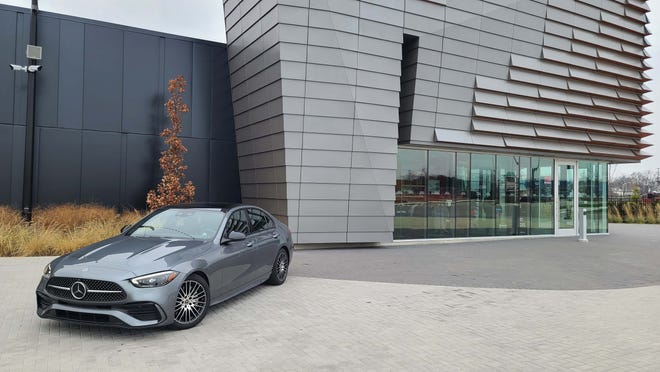
Following the Mercedes brand’s six-figure halo EQS, the EQE debuts Mercedes’ electric look in the mid-size sedan class for the eye-watering standard price of $75,950. That’s $20K north of the gas-fired E-class, and Merc doesn’t even pretend that the pair are competitors.
On its website, Mercedes separates EVs into a separate “Electrics” category, indicating the EQE’s desire to compete against vehicles like the Tesla Model 3 and BMW i4.
“I think this is the most compelling competitor to Tesla,” said my 30-year-old son Sam after negotiating a tight turning radius with the Merc’s four-wheel-steer feature.
Sure, Tesla wows with its “Summon” feature — but is it as practical as Merc’s steering function?

From 4WS to auto-lane-changing, EQE goes head-on against Tesla’s signature sci-fi tech while maintaining its reputation for elegance. The interior’s centerpiece is a gorgeous 12.3-inch console screen housed in a silver-framed tablet that rolls up the dash like a wave. A 17.7-inch-wide Hyperscreen — which dominates the dash with a separate 12.3-inch screen for the passenger — is also available, but the standard screen is plenty. The screen runs on Merc’s latest MBUX software and the graphics are mesmerizing, the response instant, its ergonomics superb (flipping through radio channels, for example).
“Hey, Mercedes” I barked and the vehicle intently took down directions. It’s good, if not on par with Tesla/Google Maps. Happily for customers who prefer their phone, Android or Apple phones can take over the screen via wireless, smartphone apps.
The benefit of Merc’s native navigation system is its use of EQE’s head-up display (a feature not available on Teslas) to full effect. The massive display projects detailed directions in the driver’s line of sight. Though Mercedes’ driver-assistance system is shy of Tesla’s Autopilot and GM’s Super Cruise in capability, it will entertain you on your journey with features like auto lane change. The interior is the anti-Tesla with lush materials, ambient lighting and beautifully detailed instruments throughout.

Heading downtown to the Fisher Theatre, I pulled the console stalk into DRIVE, then set adaptive cruise control on the steering wheel. EQE glided along like a magic carpet with whisper-quiet, buttery-smooth acceleration. My phone charged in the center console on a wireless pad.
I barely drove the car — just keeping my hand on the wheel to assure the system that I was awake. Occasionally, I flicked the turn signals for automatic passes when balked by slower traffic. Mercedes complements this laptop-on-wheels experience with an exterior design that looks like a giant computer mouse.
Though punctuated by a big three-star logo in front, the design feels generic — a contrast to the unique bling-tastic interior.
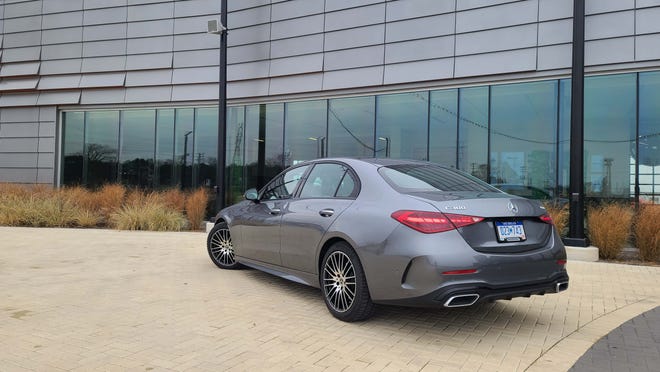
For those who ache for exterior drama, the C300 delivers.
The compact Merc sat on its rear-wheel-drive haunches in my driveway. Long snout sniffing the turf. Big grille, meaty jowls. A predator waiting to pounce. It’s a dramatically different statement than the Giant Mouse.
Enthusiasts will blanche at the turbo-4 drivetrain (a $60K jewel with a similar engine to a Volkswagen GTI? Really?) but at least Merc massages it with the latest goodies. A mild-hybrid, 48-volt battery provides low-end torque until the turbos kick in. Speaking of kicking in, I punched the Mode selector to SPORT + and the C300 did a credible launch control, complete with engine growl that warmed my heart. For all its instant electric torque, the EQE can’t inspire that emotion.
As with the EQE, allow me to recommend the C300’s all-wheel drive for Michigan winters.

The C300’s real revelation is an interior on par with the sci-fi EQE. Even the rear seats are reasonably roomy despite that long hood and gas-powered engine in front. The same MBUX infotainment system is here, and it’s just as impressive in a compact cabin as in a mid-sizer.
The Mercs suffer from that old German habit of over-engineering. Rather than put simple, efficient scroll wheels on the steering wheel for adaptive cruise (see the intuitive GMC Yukon Denali I was testing at the same time) and volume controls, Merc insists on smartphone-like swipe technology that is hit or miss — especially when you’re at speed.

You could spend weeks in the Mercedes exploring their electronic goo-gaws. But the bottom line of this review of siblings is the bottom line.
The E300 delivers a similar buttery-smooth drivetrain (including identical 5.3-second, 0-60 mph acceleration) and interior experience to the buttery-smooth EQE EV for $30,000 less. Not to mention all the inherent travel advantages of a gas car versus an EV. In sync with its impressive navigation software, EQE can identify charging stations on the way to your long-distance destination. But the E300 will get you there more quickly with America’s ubiquitous gasoline infrastructure.
Impressively, Mercedes doesn’t break stride in offering these two electrified gems. Compare them to, say, BMW electric-vehicle creations like the i3 hybrid and iX EV — polarizing vehicles that challenge customer loyalty. Whether you’re a new or longtime customer, Merc’s 2023 models display a brand very comfortable with its identity.
Next week: Taking the Ford F-150 Lightning off-road
2022 Mercedes C300 4MATIC
Vehicle type: Front-engine, all-wheel-drive five-passenger sedan
Price: $46,600, including $1,050 destination fee ($63,440 AMG Line as tested)
Powerplant: 2.0-liter turbo-4 cylinder with 48-volt mild-hybrid assist
Power: 255 horsepower, 295 pound-feet of torque
Transmission: 9-speed automatic
Performance: 0-60 mph, 5.3 seconds (Car and Driver). Top speed, 130 mph
Weight: 3,957 pounds
Fuel economy: EPA, 23 mpg city/33 highway/27 combined
Report card
Highs: Modern, lovely interior; sexy exterior
Lows: Over-engineered controls; 4-banger doesn’t match luxury wardrobe
Overall: 3 stars
2023 Mercedes EQE 350 4MATIC
Vehicle type: Battery-powered, all-wheel-drive five-passenger sedan
Price: $78,950, including $1,150 destination fee ($93,840 as tested)
Powerplant: 90.6 kWh lithium-ion battery with dual-electric motors
Power: 288 horsepower, 564 pound-feet torque
Transmission: Single-speed direct drive
Performance: 0-60 mph, 5.3 seconds (Car and Driver); top speed, 130 mph
Weight: 5,488 pounds
Fuel economy: EPA MPGe 97 (est.); range, 300 miles (est.)
Report card
Highs: Modern, lovely interior; all-wheel-steer maneuverability
Lows: Generic exterior; gets pricey
Overall: 3 stars
Henry Payne is auto critic for The Detroit News. Find him at hpayne@detroitnews.com or Twitter @HenryEPayne.
Payne: Tremor carries Ford Maverick pickup to higher ground
Posted by Talbot Payne on December 29, 2022
Holly Oaks — The base hybrid-electric Ford Maverick is one of the best bargains on the auto shelf. For just $23,670, you get pickup utility, SUV-like headroom, rad steely wheels, cool interior, digital screens and 42 mpg in town. How can you beat those specs?
Well, let’s start with 250 horsepower and all-wheel drive.
BWAAAAAHHHHH! I stomped the gas of the rugged Maverick Tremor and it slung dirt across Holly Oaks ORV Park’s 175 acres. Whump! Armed with a steel bash plate, the front chin bounced off a mogul and kept on truckin’.
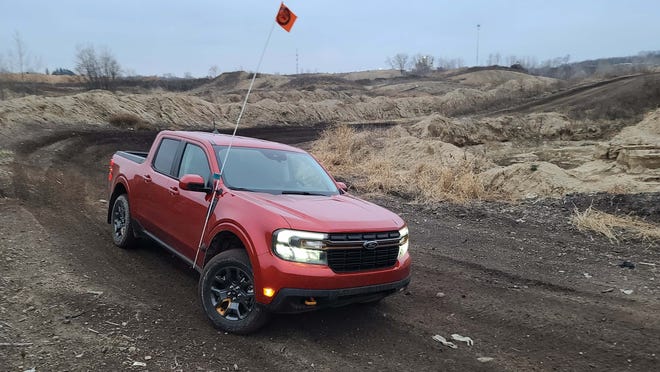
That’s right, the popular Maverick trucklet has a Tremor model for 2023 just like big brothers Ford F-150 and Ranger. Call it Maverick’s Top Gun — at least until they release a Raptor model (please?). It’s as compelling as the base model (the 2021 Detroit News Vehicle of the Year).
Where base Mav offers pickup utility with the gas mileage of a Prius, Tremor expands the truck’s playground with a growly, 2.0-liter turbocharged 4-banger mated to all-wheel drive that is not available in the standard trim.
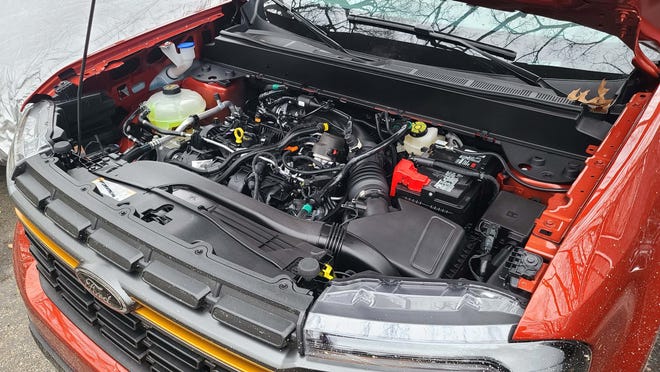
You’ll know it by its orange tattoos.
There are orange grille highlights, tow hooks and wheel cutouts. This isn’t your average Maverick. For an extra $2,995, Tremor comes armed with some serious hardware in addition to its upgraded drivetrain. There are all-terrain tires, front bash plate, upgraded shocks and twin rear clutch packs. Holly Oaks is a convenient metro detour to play with Maverick’s new weapons. This place is a treat.
Boy, how I wish I could just roll up to Waterford Hills Raceway off U.S. 24, hand over $30 and take hot laps in, say, the affordable Toyota GR sports car. That’s the opportunity Holly Oaks offers to anyone — not just those with purpose-built dirt chewers or $70,000 Bronco Raptors. Holly Oaks may be public, but like private M1 Concourse-like car clubs, it’s a community of enthusiasts. You can walk up to anyone to tell tales — or get pulled out of the swamp that just swallowed your 4-wheeler.
I picked up my favorite Uncle Joe’s chicken in Southfield and hoofed it 40 minutes up I-75 on a crisp December weekend. I attached an off-road flag, bought my $30 ticket and had a sprawling sandbox at my disposal. But first, lunch.
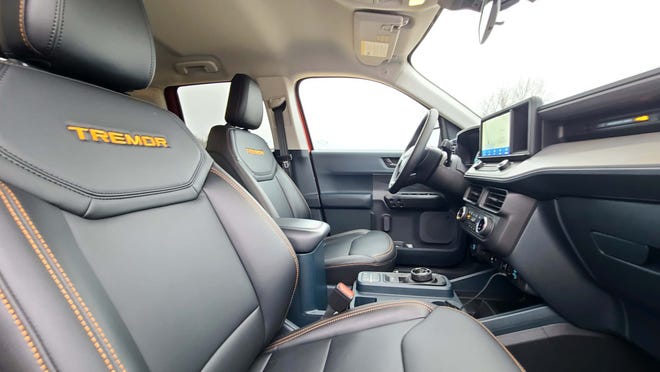
From Badger Head (one of Holly’s highest spots), I enjoyed my chicken and Texas toast while watching Jeeps, 4x4s and motorbikes crawl like ants over the trails below. I took in the nifty Tremor interior — this is no generic, plastic truck cabin.
Floating armrests are not just easy to grip for door closings, but they open space for tall Thermos storage. Heated seats and steering wheel? Check. The digital instrument and console display are right out of an iPhone store. Speaking of smartphones, I’d hooked up my Samsung on entry to the Android Auto app for navigation.
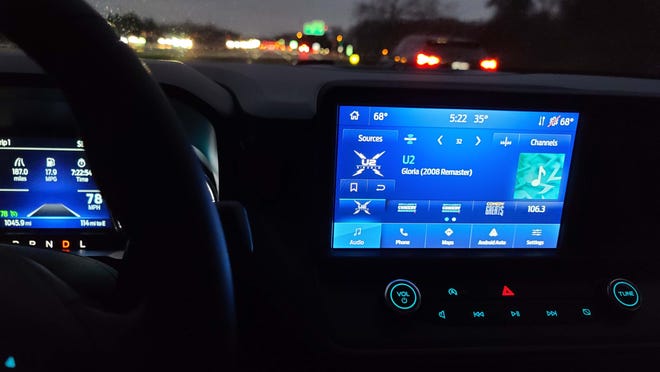
There are shortcomings. While Maverick’s only segment competitor, the unibody Hyundai Santa Cruz pickup, comes standard with wireless Android Auto (as does Ford’s state-of-the-art SYNC4 system), the ‘23 Tremor is a generation behind with wired SYNC3. And while Maverick offers a nifty Trail Control feature for off-roading, it doesn’t offer adaptive cruise for the highway, a standard item on compact cars like the $25K Nissan Sentra and Mazda3. Neither does its backup camera beep when approaching an object, a drawback when maneuvering in tight spots like parking garages or narrow ORV park trails.
On the hatchback side of the compact aisle, the Mazda3 Turbo is the enthusiasts’ choice of affordable, all-wheel-drive fun and comes loaded with similar 250-horsepower turbo-4 plus adaptive cruise control, head-up display and blind-spot assist standard for a whopping $5K less than my $39,000 Tremor Lariat tester. Back off the Lariat trim to XLT and the sticker is a more manageable $34.5K (though that’s still $11K north of the base Maverick).
So Maverick Tremor puts you in a different price class. But unlike the hybrid and its utilitarian bed/fuel economy combo, Tremor offers on-road/off-road dexterity.
I finished my meal and plunged into the Holly fray.
I came off my Badger Head spot using TRAIL ASSIST, a kind of low-speed cruise control that allowed me to focus on navigating the narrow trail. Once on the open flats, I prepared Tremor for battle.
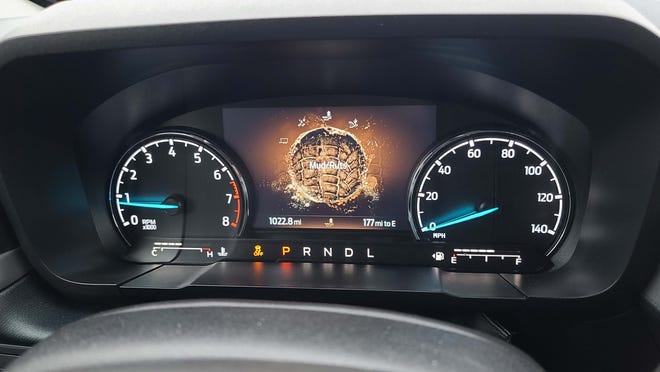
Off-road features are in a digital toolbox on the console. I punched the Mode key and the instrument screen illuminated with colorful drivetrain options. I selected MUD & RUTS. The engine note dropped an octave to a growl, and traction control turned off. I selected the AWD LOCK tool and we were in business. I attacked the Glen dirt track with a vengeance, using the throttle liberally while churning through deep soil.
For all its swagger, Maverick Tremor is no Bronco Raptor (the last Ford bruiser I took to Holly), so I approached trails more cautiously, mindful of Mav’s lesser breakover angle (19.9 degrees vs. 30.8 degrees for the Bronc), not to mention unibody construction, which can’t take the punishment of Bronc’s ladder frame. An extra inch of lift over the base Maverick helps.
I was braver in flat sections, where the turbo-4’s grunt and signature torque-vectoring rear clutch packs (capable of throwing grip to the rear wheel that needs it most) combine so Mav can really kick up its heels.
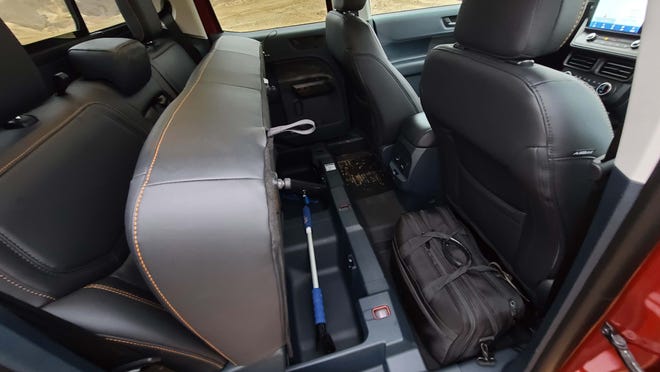
WHACKITY WHACK WHACK went something in the back seat. I stopped to collect a rogue snow scraper (handy for clearing fresh snow that morning). Tremor has useful storage under the flip-up rear seat (just like Big Brother F-150). I secured the scraper and went back to dirt-kicking.
Out back, the bed is a useful space for owners who want to bring along a motorbike to go deeper into Holly Oaks trails. With its smooth unibody chassis — the same bones that fortify the Escape and Bronco Sport SUVs — Tremor transitioned easily to the road. I returned my little warrior to NORMAL mode, set Google Maps to Home and purred home down I-75.
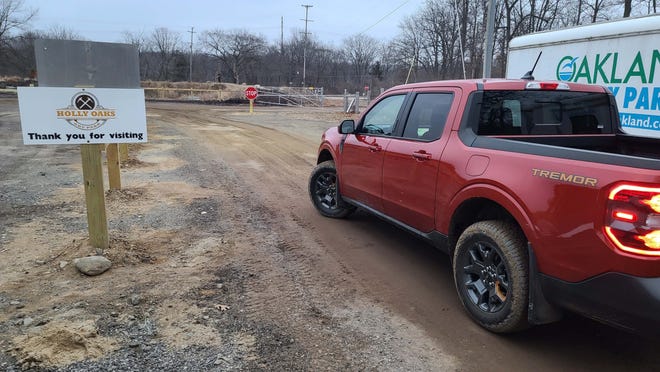
Is the premium-priced Tremor deserving of Maverick’s value label? It’s a tougher sell, especially as my Lariat’s $40K price tag is the same as the mid-size unibody Honda Ridgeline pickup. But price my Tremor with the cloth-seat XLT package and it’s a $34K bargain next to a ladder-frame Ranger Tremor asking $46,495, similarly equipped. It’s also the only game in town from the Detroit Three — in addition to the stylish unibody-based Santa Cruz Night model that is more sport oriented than off-grid bruiser.
Big Brother F-150 is king, but Maverick Tremor expands little brother’s appeal.
Next week: 2023 Mercedes EQE or Mercedes C300?
2023 Ford Maverick Tremor
Vehicle type: Front engine, all-wheel-drive five-passenger compact pickup
Price: $32,305, including $1,495 destination fee ($39,560 Lariat as tested)
Powerplant: 2.0-liter turbocharged 4-cylinder
Power: 250 horsepower, 277 pound-feet torque
Transmission: 8-speed automatic
Payload: 1,500 pounds; Towing capacity: 4,000 pounds with tow package
Weight: 3,731 pounds
Fuel economy: 22 city/29 highway/25 combined
Report card
Highs: Sophisticated drivetrain; cool interior
Lows: Adaptive cruise and blind-spot assist not standard; wireless Apple CarPlay, please
Overall: 4 stars
Henry Payne is auto critic for The Detroit News. Find him at hpayne@detroitnews.com or Twitter @HenryEPayne.
Auto New Year: EVs, muscle and SUVs galore on tap for 2023
Posted by Talbot Payne on December 29, 2022
Happy New Year, happy new wheels.
Automakers ring in 2023 with an array of fresh sleds from pickups to SUVs to electric vehicles. New offerings will come from startups and legacy automakers alike — including established brands looking to remake themselves with premium electric badges.

EVs have found the premium market the most fertile soil for growth as battery costs are high and heading higher. Ford’s base F-150 Lightning Pro, for example, started 2022 with a sticker price of $42,000 then ballooned to $59,000, a 40% price hike. Mainstream badges like Kia (the EV6 GT) and Chevy (Blazer SS) are going luxe with $60,000 EVs. The flood of new electrics is key to automaker plans to meet stringent government emissions rules so they don’t get tripped up with big fines like, say, Stellantis suffered in ‘22.
Automakers are hardly neglecting their bread-and-butter internal combustion engine-powered vehicles. They pay the bills for big EV investments and are aimed at the 80% of the market that is non-luxury. Familiar ICE badges coming in 2023 include hot-sellers like the Chevy Colorado, Ford Super Duty pickup, GMC Canyon, Honda Accord, and Ford Mustang.
Here are the new vehicles we expect from automakers in the next 12 months.
Acura
The ZDX, Acura’s first EV, will be built alongside the Cadillac Lyriq EV in Tennessee on GM’s Ultium battery platform. It joins a sporty brand that said goodbye to the Acura NSX supercar in 2022 and hello to the entry-level Integra hot hatch.
Alfa Romeo
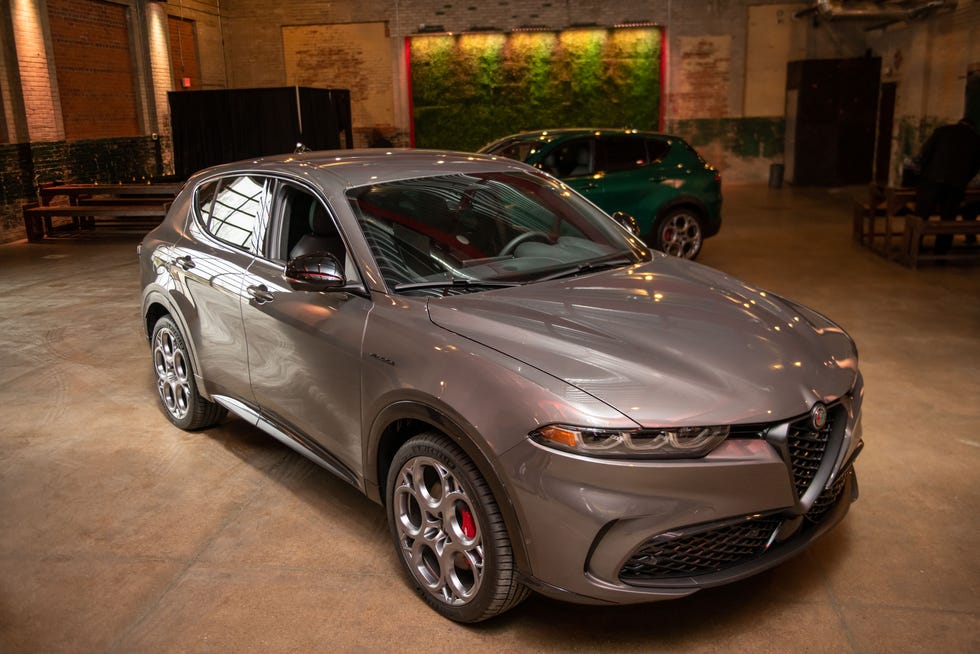
Alfa’s entry-level Tonale SUV takes on segment peers BMW X1 and Mercedes GLA with sexy styling, standard AWD, and a plugin drivetrain. The plug-in model boasts best-in-class, hybrid, 272-horsepower turbo-4 engine.
Audi
Audi’s vast lineup of sedans, SUVs, and e-trons will gain assorted upgrades for 2023. In a nod to Audi’s expanding EV lineup, the singular e-tron SUV will become the range-topping Q8 e-tron and Q8 e-tron Sportback — two body-style variants with the same AWD electric drivetrain underneath.
BMW
BMW’s most talented athlete, the redesigned M2 coupe squeezes another 48 horsepower from its high-revving, turbocharged, 3.0-liter, inline-6-cylinder engine. At the top of the Bimmer range, an all-new 7-series will debut an electric variant.
Cadillac
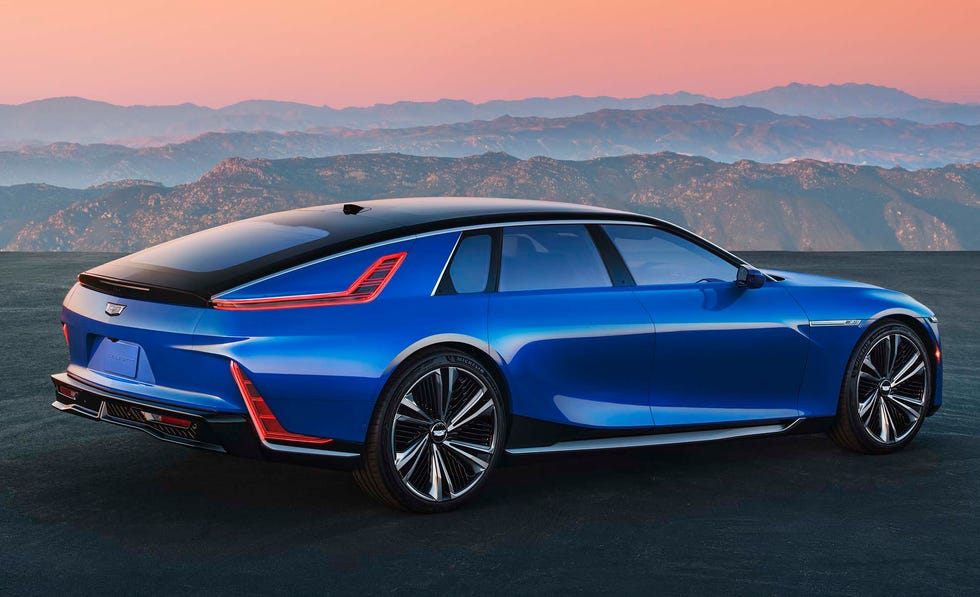
The brand reinvents itself with the $300,000-plus Celestiq halo sedan. Each model will be custom-built by craftsmen similar to bespoke Rolls-Royce production. Jaw-dropping inside and out, Celestiq dazzles with colored leather and 55-inch digital dashboard.

Chevrolet
It’s Chevy’s Year of the EV. The Silverado EV will (finally) launch in the first half of ‘23 with a Work Truck version. The retail RST (starting at a nosebleed $105,000) follows in the second half. Battery-powered Blazer and Equinox SUVs are also on tap — crucial steps in GM’s march to an all-electric future. On the internal combustion side, Chevy is offering a lower-priced Trax starting at just over $21,000 and a new, mid-size Colorado pickup.
Dodge
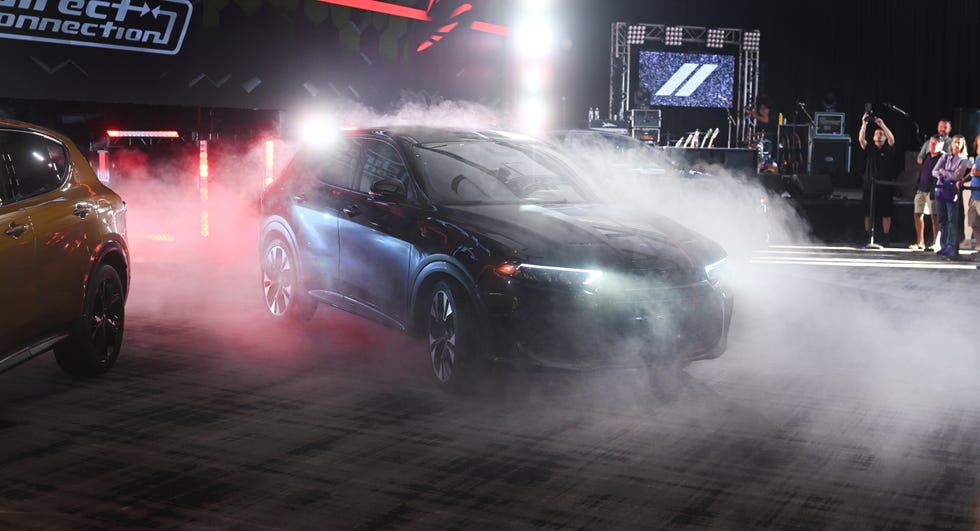
The 710-horsepower Durango SRT Hellcat (a family SUV!) is back!— but Dodge closes down the V-8-powered muscle-car era with the high-horsepower, special-edition Challenger Black Ghost and Charger King Daytona models. Fresh meat comes in the form of a compact, $30K-something Hornet SUV based on the same nimble platform as the Alfa Tonale. Hornet comes standard with AWD and options a plug-in, R/T-badged hellion with 285 ponies.

Fisker
An original Tesla competitor with its luxurious, 2012 Karma hybrid, Fisker has been reborn with the all-electric, 2023 Ocean. The compact ute is distinguished by a 17-inch screen that can rotate to landscape or vertical positions.
Ferrari
Ferrari’s Purosange, will drop jaws — and not just because it’s the Prancing Horse’s first SUV. You’ll hear it coming with a singing, 6.5-liter, 712-pony V-12 — the brand’s most powerful, naturally-aspirated engine. Purosange (English translation: thoroughbred) will boast unique attributes like scissor doors, dual cockpit screens, and electric motors at all four corners to control body roll — eliminating traditional sway-bars.
Ford
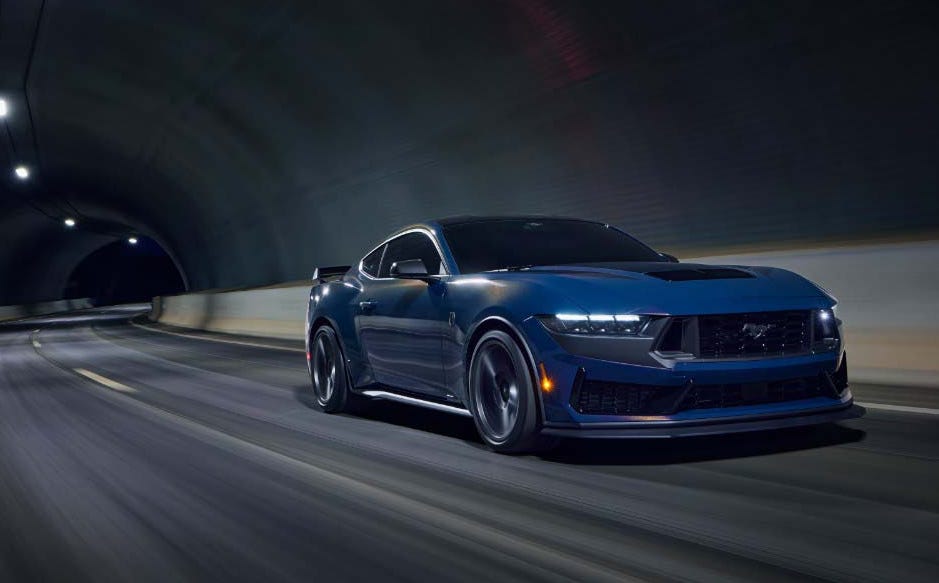
Iconic badges take center stage in ‘23. The ginormous F-series Super Duty gets a makeover with new exterior, interior, and powertrain options. Highlights include a 12-inch console screen and 1,200-pound-feet of diesel torque. Mustang is back with a new face, big screens, and more muscle. In addition to standard Ecoboost and GT models, ‘Stang will birth a track-focused Dark Horse badge with a 500-horsepower V-8 and optional rear wing. The GT supercar ends its six-year run with a track-only, 800-horsepower, $1.7 million, winged cyborg called the Mk IV.
Genesis
Hyundai’s luxe brand gets its third EV, the Electrified GV70 SUV. Nestled between the GV60 SUV and Electrified G80 sedan, the newbie converts the gas-powered GV70 chassis to electric with twin motors and a 77.5 kWh battery pack.

GMC
The Hummer EV SUV is in the house, as is the upgraded, mid-size Canyon pickup. The latter gets a butch AT4X trim with performance shocks and 33-inch tires to compete against segment dirt-kickers like the Toyota Tacoma TRD.
Honda
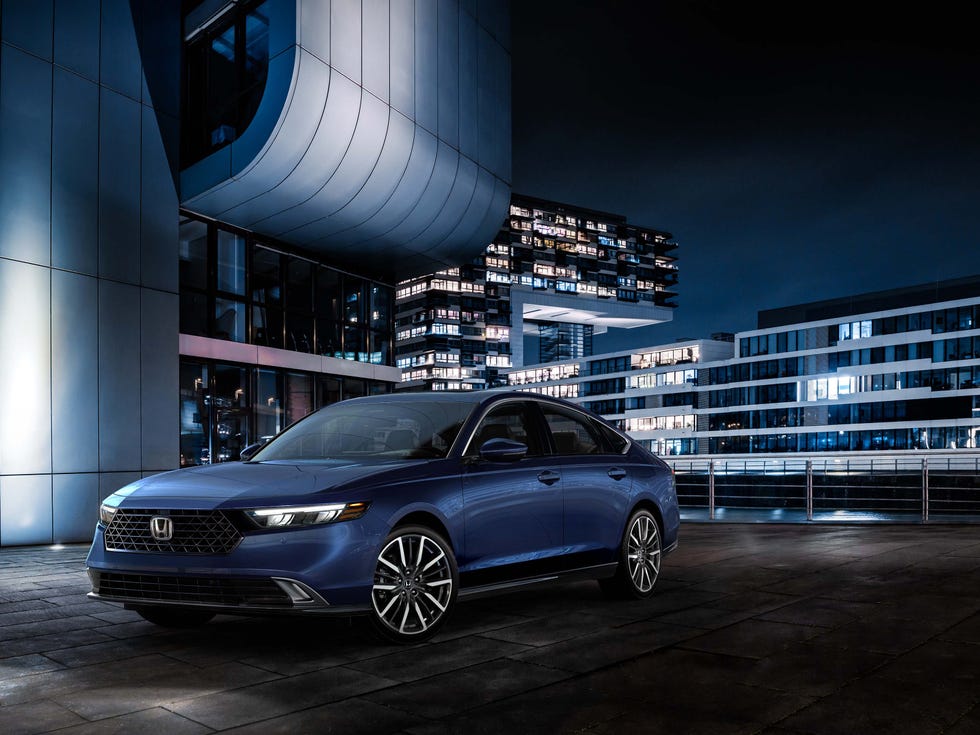
Honda’s relentless new product rollout continues with the mid-size Accord sedan and Pilot SUV following the 2022 Civic and 2023 CR-V and 2023 HR-V. The 11th generation Accord sports an elegant wardrobe and hybrid, 204-horsepower powertrain for its upper trims. The Pilot is boxier, more aggressive — which suits the macho, AWD Trailsport model and its all-terrain tires.
Hyundai
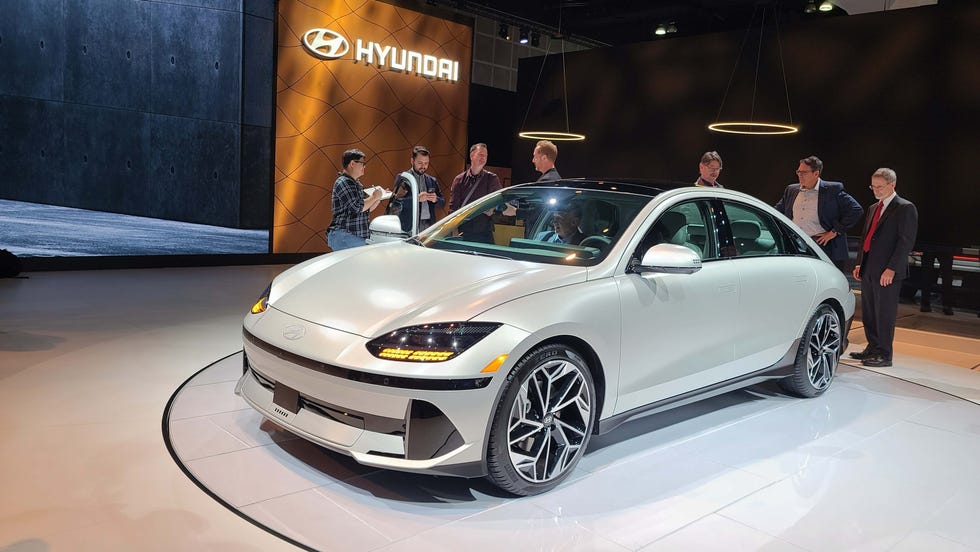
Hyundai adds two more EVs to its broad lineup. The kissing cousin of the angular Ioniq 5 EV, the Ioniq 6 gets a longer, more aerodynamic shape that should deliver better battery range. The Ioniq 7 goes big as a three-row EV option alongside the gas Palisade.
Kia
Hyundai’s sister brand also gets three-row, electric SUV: the EV9. The handsome, three-row, gas-powered Telluride has helped remake Kia as a premium brand and the $50,000-plus EV6 and EV9 SUVs want to solidify that image.
Lincoln
Ford’s luxury brand will release a refreshed Corsair in ‘23. The SUV will debut with available ActiveGlide 1.2 — Lincoln’s hands-free, driver-assistance system.
Lotus
Lotus follows other sportscar makers like Porsche and Lamborghini into the performance SUV space with the China-assembled, 600-horsepower Eletre “hyper-SUV.”
Lucid
The lovely Air sedan set new standards of EV envy, and Gravity hopes to do the same for the SUV market.
Mazda
The Zoom-Zoom brand isn’t giving up on its MX-5 Miata sportscar, but Americans want SUVs. So here come the mid-size CX-70 and three-row CX-90 built on the brand’s all-new, longitudinal-engine, rear-wheel-drive-based architecture. X-pect the CX siblings to offer hybrid powertrains.
Mercedes
EQE and EQS sedans debuted Merc’s sleek new EV lineup, and now come the utes. The EQE/EQS SUVs bring hatchback utility (and third-row seating in the case of the EQS ute), while sharing tech-tastic interiors with their sedan cousins. The gas-fired GLC follows its sedan stablemate with a new, 2023 design.
Polestar/Volvo
The Polestar 3 is the first SUV from Volvo’s EV brand. Like the Polestar 2 sedan before it, the 3 runs on a Google operating system. It may debut Volvo’s lidar technology — aimed at beating Tesla to full-self-drive capability. Not to be outdone, Volvo’s new flagship is an electric, three-row EX90 to be sold alongside the gas-powered XC90.
Subaru
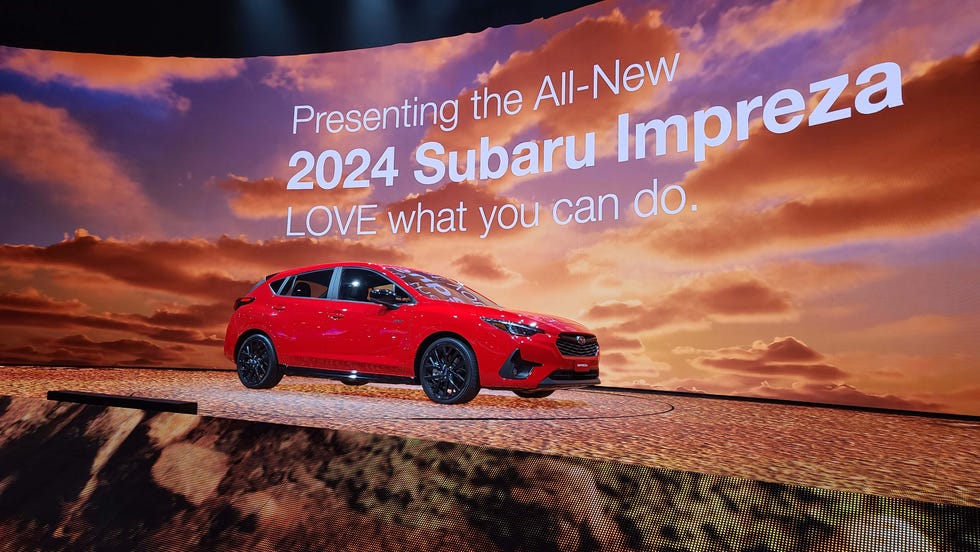
For its sixth generation, the entry-level Impreza comes in hatchback only. Impreza comes stuffed with the brand’s latest, big-screen infotainment and 182 horsepower for its new RS sport trim.
Toyota/Lexus
The popular Highlander SUV gets a stretched, three-row, Grand Highlander stablemate. Look for its debut at the Chicago Auto Show powered by a hybrid, AWD powertrain. Ugly duckling-turned-swan Prius hybrid extends to a plug-in model promising over 35 miles in electric-only mode. The long-awaited, hush-hush Tacoma pickup could steal the show as recently published spy shots have sent the faithful in a frenzy. The battery-powered Lexus RZ SUV is aimed at loyal, hybrid customers eager to try all-electric. Lexus’ first EV shares the same platform as the Toyota bZ4X.
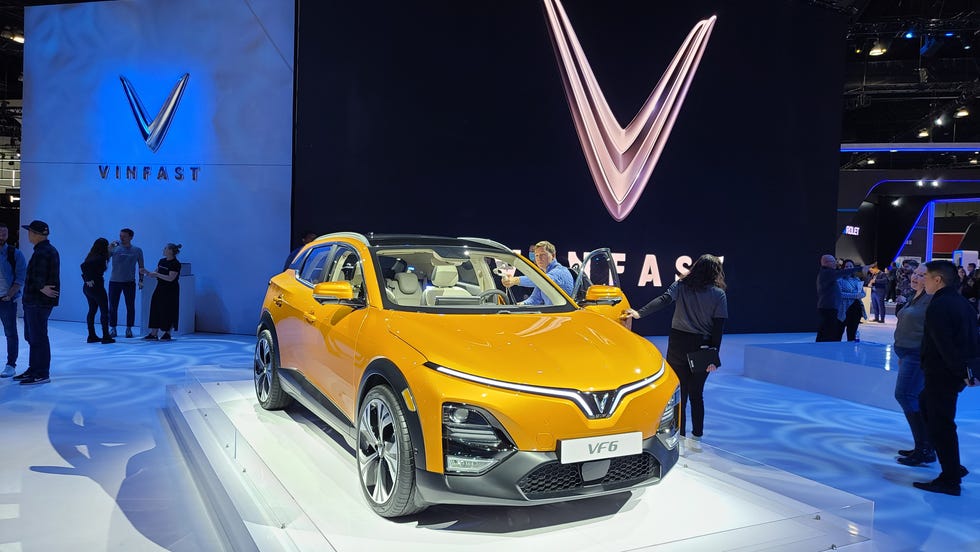
VinFast
The first Vietnamese manufacturer to sell here, VinFast aims to make a splash with the compact VF6 and mid-size VF7 SUVs. Both SUVs feature elegant, European (think Citroen) exterior styling while going full-Tesla inside with single-screen layouts.
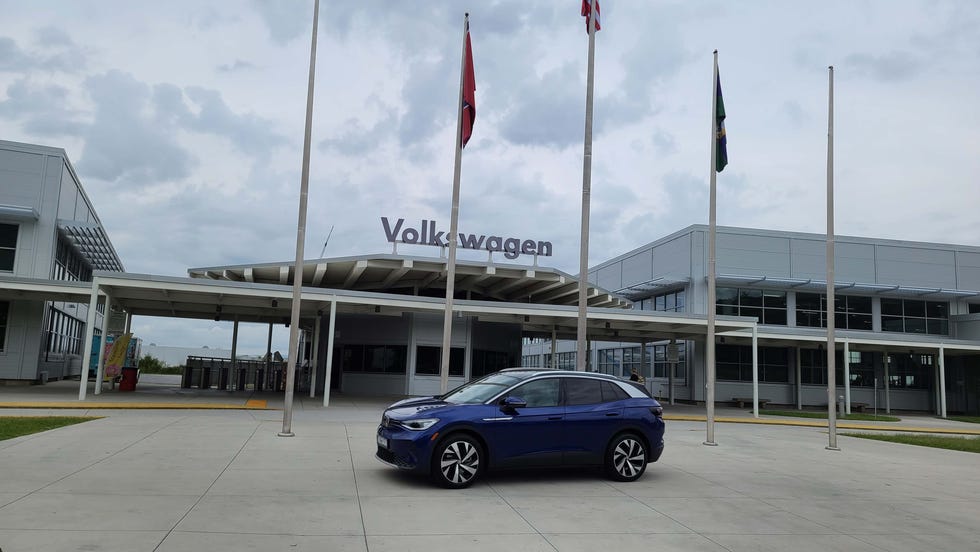
Volkswagen
V-dub’s ID.4 EV begins stateside production in Tennessee with its 208-mile-range, sub-$40K Standard model. Location, location, location — the ID.4 is now eligible for the $7,500 US EV tax credit.
Henry Payne is auto critic for The Detroit News. Find him at hpayne@detroitnews.com or Twitter @HenryEPayne. Kalea Hall can be reached at khall@detroitnews.com or Twitter: @bykaleahall
Payne: Kia EV6 GT, the discount Tesla dragster
Posted by Talbot Payne on December 29, 2022
Las Vegas — In 2015, videos appeared on YouTube of Tesla Model S sedans blowing away Corvettes and Mustang GT500s on drag strips. The videos remade electric vehicles’ image as objects for enthusiasts, not just tree huggers. The Tesla numbers were staggering. The all-wheel-drive Model S P90D was shredding the quarter mile in less than 12 seconds at 116 mph. Also staggering was the sticker price: $140,000 for the top line trim.
It’s 2022 and I just smoked the quarter-mile at Las Vegas Motor Speedway in an EV at 11.6 seconds at 117 mph. A Tesla? Nope, a $62,000 Kia EV6 GT.
Like Tesla before it, Korean automaker Kia is determined to make a brand statement with its first electric vehicle. Unlike the Silicon Valley startup which achieved meteoric success — not through advertising or media tests, but through a rabid fan base on social media — Kia invited a pack of journalists to Vegas to put its top-trim EV6 to a test.
Sin City suits the EV6 GT.
Dressed in red with wicked-looking 21-inch tires, the GT features a devilish 567 horsepower from front and rear motors. GT wants to boogie.
Echoing Tesla, the EV6 performance model’s appearance is not significantly altered from the $50,000 base SUV. Indeed, EV6 GT looks identical to the AWD 360-horsepower GT-line that I flogged up north this summer, and that was no slouch in the performance department with a 0-60 mph time of 5.1-seconds. Its price/footprint are in line with a Tesla Model 3 Performance, but with interior dimensions on par with a Model S — its deep 39 inches of rear legroom will comfortably fit two Las Vegas Raiders offensive linemen.
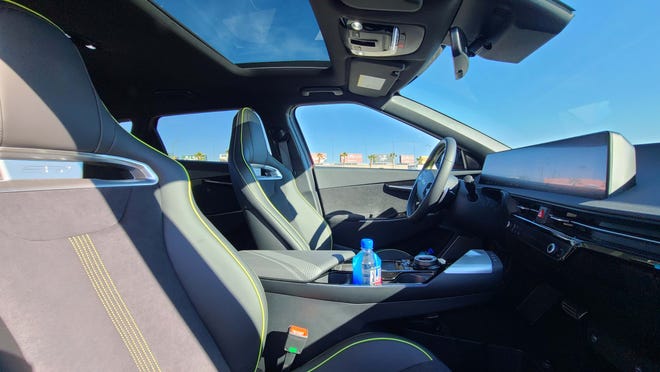
Unlike the iPhone-simple Tesla, EV6 is covered in bling, punctuated by a dramatic ducktail that is rimmed with red LED lighting. Inside, EV6 bears a close resemblance to the Cadillac Lyriq, the fanciest EV this side of the Mercedes EQE.
Vegas, take notice. Across the pin-striped dash, a single hoodless pane of glass houses twin 12.3-inch displays for the instrument console and infotainment. A floating console between the seats juts forward like a ship’s bow (underneath is open space for tablets, purses, maps) with a rotary shifter on its leading edge.
But what’s this? Manual seats?
With its focus on performance, the GT’s sporty thrones must be adjusted just like a Porsche 911 GT3. When you’re shooting for sub-12 seconds in the quarter mile, you save weight where you can.
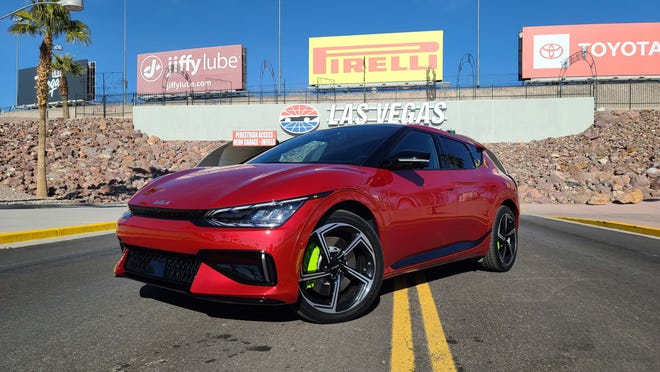
Still, this is a porky vehicle tipping the scales at 4,795 pounds. GT’s girth was palpable on the writhing curves of Route 167 to Lake Meade — one of many natural wonders to the east of Vegas’s desert mirage. The GT has been upgraded with massive, lime-green 15-inch brakes and suspension tuning to manage its power, and I pushed it hard thought the twisties. Just 30 miles away, Lake Meade was an easy EV commute even in cold 40-degree winter temps.
For trips further east to spectacular Zion National Park and Bryce Canyon, you’ll want to, um, take the gas-powered Kia Telluride SUV.
While the Model S P90D has an upgraded battery (90 means 90 kWh), EV6 GT sticks with the standard car’s 77 kWh lithium ion pack. Now you know why it costs so much less than the Tesla. Range drops from 274 miles for the AWD GT-line to just 204 miles in the electron-guzzling GT. You’ll be lucky to get to Zion on a full charge, and Electrify America fast chargers (free to Kia customers) are scarce.
So the GT — like many premium electrics in today’s market — is a second or third car best suited for metro duty. Especially metro areas like Vegas and Detroit with drag strips nearby.
Las Vegas Motor Speedway is a delightful campus just 18 miles outside Vegas (closer to home, southeast Michigan’s Milan Dragway is just 22 miles south of Ann Arbor). It houses a NASCAR oval road course, and ¼ mile dragstrip which occasionally opens for public racing.
This is GT’s natural playground.
I’ll never forget the first time I floored a 2015 Model S P90D. Its instant, 100% torque snapped my neck, crushing my back into the seat on its way to 60 mph in 3.1 seconds. EV GT is like that.
On the Vegas (drag) strip I slowly staged, watching the Christmas tree lights change blue to indicate the timer had me locked in. Then I released the Kraken. No launch control. Just toggle the GT button on the steering wheel for maximum response, floor it, go. As I blew though the quarter-mile lights at 117 mph, the GT wanted more. I repeated the run three times, the Kia never tiring or complaining of heat issues.
It has more tricks up its sleeves for the street. Its 800-volt system (compared to its Mustang Mach-E GT and Tesla Model Y Performance competitors’ 400 volts) means quicker charging. Kia-Hyundai have been aggressive in driver-assist systems, and EV6 boasts the same adaptive cruise system I’ve raved about on the Kia Sportage. Its lane-keep and auto-follow systems formed a safety cocoon around the car in Vegas traffic.
More toys? Kia has always experimented with sound (see its Sounds of Nature feature) and GT rocks three drivetrain audio options — STYLISH, DYNAMIC, CYBER — if you like a sound track with your stoplight launches.
The instrument display also changes depending on drive mode — ECO, NORMAL, SPORT, GT — and icons can be moved around the screen like a smartphone depending on your preference.
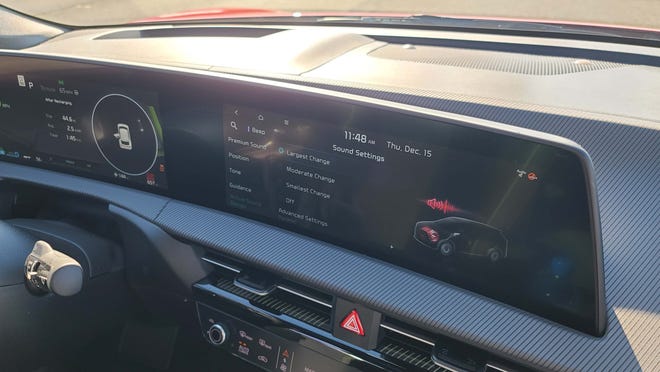
Looks, speed, tech, comfort. GT’s biggest challenge may be ID. Where Tesla was instantly recognizable as a new breed, Kia is trying to evolve from an economy brand to a premium brand. That includes a new logo on the hood that has left people scratching their heads.
“What is KN Motors?” asks many a Google query. Mistaking KN for KIA is so common that the company bought “KN” for Google search optimization.
Stomp the throttle and you’ll confuse it for a Tesla.
Next week: 2023 Ford Maverick Tremor unleashed
2023 Kia EV6 GT
Vehicle type: Battery-powered, all-wheel-drive five-passenger SUV
Price: $62,865, including $1,295 destination fee ($49,795 for base, RWD Wind model)
Powerplant: 77.4 kWh lithium-ion battery with dual electric-motors
Power: 576 horsepower, 545 pound-feet torque
Transmission: Single-speed direct drive
Performance: 0-60 mph, 3.4 seconds (mfr.); top speed, 161 mph
Weight: 4,795 pounds
Fuel economy: EPA 79 MPGe; range, 206 miles
Report card
Highs: Hard-core acceleration; high-tech, roomy interior
Lows: Looks fat; fat price for a Kia
Overall: 3 stars
Henry Payne is auto critic for The Detroit News. Find him at hpayne@detroitnews.com or Twitter @HenryEPayne
Ho-Ho-Horsepower: ’24 Mustang gets most powerful 5.0-liter V-8 yet
Posted by Talbot Payne on December 16, 2022
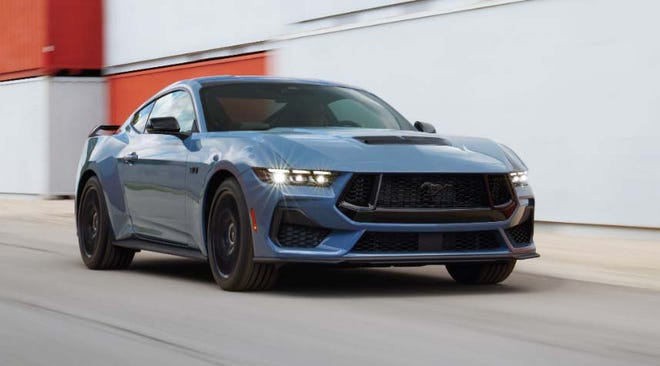
The new, 2024 Ford Mustang will deliver 500 horsepower, making it the most powerful, 5.0-liter V-8 engine in the muscle car’s 60-year history.
Merry Christmas and a Howling New Year.
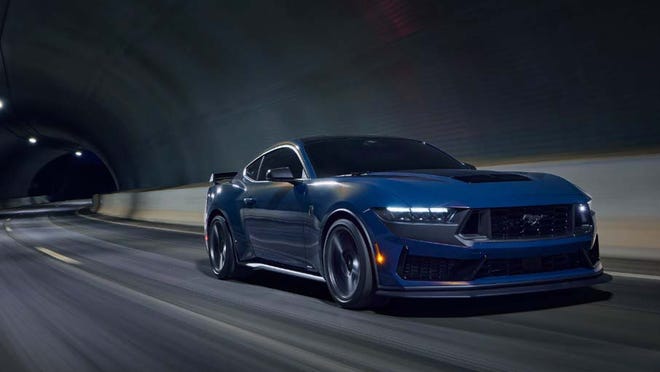
That power will come from the pony car’s track-inspired, 5.0-liter V8-powered Dark Horse, a new badge in the tradition of Mustang’s performance Mach 1, Bullitt and Shelby models that will debut next year alongside the standard EcoBoost and GT models. To put the 500 horsepower in perspective, that’s the same grunt that powered the legendary 1967 7.0-liter V8-powered Ford Mark IV (on display in the Henry Ford) to victory over Ferrari at Le Mans.
The Dark Horse’s achievement leads a horsepower boost across all three models.
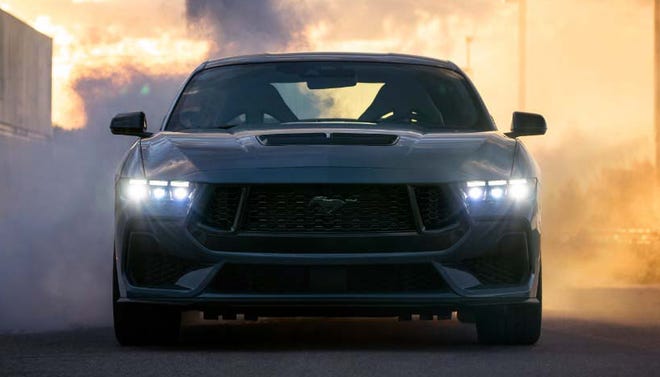
“Mustang has always pushed the envelope. From Mustang GT to Dark Horse, this is our best 5.0-liter V-8 yet. It’s naturally aspirated awesomeness,” said Ed Krenz, Mustang chief engineer. “EcoBoost fans are also getting a boost in power to make every Mustang more fun to drive.”
Credit the Dark Horse’s new-found power to modifications to Mustang’s fourth-generation Coyote engine: dual throttle bodies, twin air intakes and forged piston connecting rods out of the supercharged Shelby GT500. The V-8 will be mated to a six-speed manual transmission.
“With the increased responsiveness you get from the new dual throttle bodies, we’re wringing every ounce of performance we can out of our engine so Mustang enthusiasts can have that experience,” said Suzanne Robinson, Coyote engine program supervisor.
Dark Horse builds on the V8-powered GT coupe’s 480 horsepower (which can be amped up to 486 with an available active-valve exhaust) — up from 460 horses from the last-gen coupe. Torque is also at a new high of 415 pound-feet.
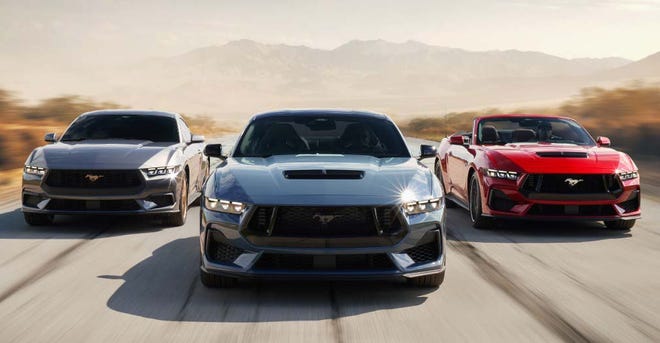
The entry-level, 2.3-liter, turbocharged 4-cylinder engine will make 315 horsepower —up five ponies from the last-gen model. Expect the Mustang to start around $30k when pricing is announced closer to production, with the Dark Horse likely pushing $60,000.
While the engines get upgraded, the interior has been overhauled with the latest in auto technology. The cockpit will feature a large screen across the dash housing two customizable digital displays — a 12.4-inch digital instrument cluster and 13.2-inch infotainment stack powered by Ford’s state-of-the-art SYNC 4 system with goodies like wireless Apple CarPlay and Android Auto. Other digital goo-gaws include a wireless phone charging pad and overhead USB ports.
That digital tech enhances the drivetrain, too. The Mustang can be revved remotely using the key fob, and drivers can access multiple drive modes, including Track, Drag and Custom. A so-called e-Brake option is also available so you drift the rear end.
All this will come wrapped in a new, more muscular body style including separate front fascias for the EcoBoost, GT and Dark Horse models. The latter will get plenty more mods as well, including smoked headlights and taillights, a fixed rear wing, rear diffuser, quad-tupped tailpipes, Brembo brakes, optional carbon-fiber wheels, distinctive Dark Horse badges on the front fenders and decklid, and exclusive Blue Ember metallic paint.
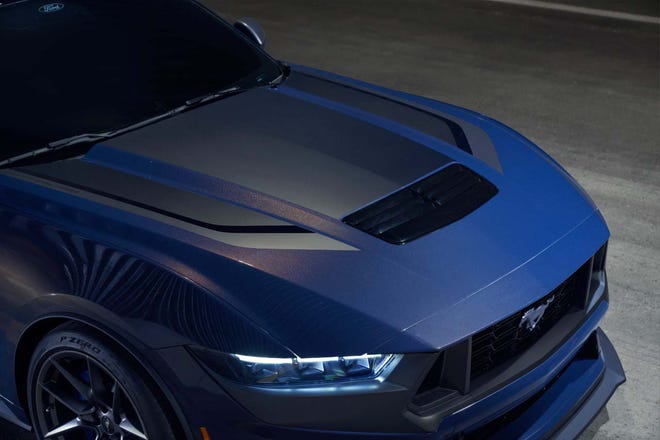
The Dark Horse is timed with Mustang’s entry into global GT3 racing alongside other powerhouses like the Chevy Corvette and Porsche 9l1.
Assembled in Flat Rock, the 2024 Mustang coupe and convertible go on sale in the U.S. next summer.
Henry Payne is auto critic for The Detroit News. Find him at hpayne@detroitnews.com or Twitter @HenryEPayne.
Payne: 2022 Detroit News Vehicle of the Year, Ford Maverick Tremor
Posted by Talbot Payne on December 16, 2022
This has been an unusual year at the auto box office.
There were a record number of premieres as the industry celebrated multiple trends: SUVs, EVs and OMG electronics. Consumers demand sport utes and automakers rolled out big-volume blockbusters to audiences, including all-new Honda CR-V, Honda HR-V, Kia Sportage, Jeep Wagoneer, Toyota Sequoia and Lexus RX models.
Electric vehicles are the new-new thing as legacy automakers test fresh recipes and a basket of startups hope to replicate Tesla’s success. But even as governments force EV production, electrics’ cost and charging limitations limit their appeal to a niche market. If I were a movie critic, EVs would be eclectic films debuting at, say, the Sundance Film Festival, where their qualities would appeal to elite audiences who live in single-family homes with multi-car garages.
There are some delicious autos here — Cadillac Lyriq, Ford F-150 Lightning, Mercedes EQE, Kia EV6, BMW iX, Genesis GV60 — but they are aimed at the 17% of Americans who buy luxury vehicles. Indeed, the average price of the new vehicles eligible for this year’s North American Car, Truck and Utility of the Year award (I’m a juror) was a whopping $65,000. Of those entries, 24 cost more than $50K. Only nine cost less than $40,000, and only three were under $30,000.
Value was hard to find. Among them were a couple of delicious, gas-fired remakes — the $37K Acura Integra and $40K Nissan Z, sequels that, like “Top Gun: Maverick,” updated beloved names for the modern world.
But three vehicles stood out for their affordability, all-around performance, and integration of the latest tech. Befitting the offbeat list of new models, we have an unusual winner. For the second year running, I picked a Maverick as the 2023 model year offered a very different riff on the wee pickup.

Third place: Toyota GR Corolla
The year’s biggest surprise was Toyota’s Corolla pocket rocket. I never thought I’d use those words in the same sentence. The Corolla, of course, is America’s perennially best-selling compact car with an obsession for reliability and the sex appeal of vanilla.
The GR (short for GRIN) rips the shirt off the unremarkable Corolla and reveals a tattooed Dwayne Johnson torso underneath. With hatchback utility, all-wheel-drive, and a sub-$40K sticker, the wicked-looking GR adds to my favorite car class: the multi-talented hot hatch. Sporting an innovative, King Kong-in-a-box, three-cylinder engine blown out of its mind with 300 horsepower, Corolla can pick up groceries in downtown Ann Arbor in the morning, then shred Hell’s twisties with a six-speed manual in the afternoon. #SaveTheManual.
At a time when bureaucrats want everyone to drive the same electric drivetrain, the turbo-3 Corolla is a glorious rebel’s yell.

Runner-up: Mazda CX-50
I have a short list of cars that are industry benchmarks. The Porsche 911 is the world’s sports car standard. The Tesla Model Y is the EV gold standard. The VW Golf R the best compact. Mazda’s CX-5 is my benchmark for best compact SUV, and with its Made-in-Alabama CX-50 stablemate, the brand has raised the bar even higher.
With fashionably rugged cladding (if the CX-50 were male, it would wear chin stubble) and more rear-seat room, CX-50 does everything well. It’s easy on the eyes, and when you slip inside, it fits like a glove. Though nearly 9 inches off the ground, the SUV has the DNA of brand halo Miata and is more fun to drive than any ute short of an Alfa Stelvio. Stuff it with the optional 256-horse turbo-4 engine, and it’s Stelvio’s match for power too — for 15 grand less.
The car’s real value is in the stylish cabin, where Mazda loads up standard features like adaptive cruise control, blind-spot assist, automatic headlights, wireless Apple CarPlay/Android Auto and more. This is a premium car with a mainstream price.

Winner: Ford Maverick Tremor
Maverick is the entry-level pickup that just keeps on giving.
Last year, I named the $23K Maverick hybrid The Detroit News 2021 Vehicle of the Year in appreciation for its 42-mpg city efficiency, stylish interior, steely wheels and pickup bed utility. For 2023, Maverick is back with a completely different model — the 2.0-liter turbo-4 powered, all-wheel-drive, all-terrain-tire Tremor that is just as enticing for off-road adventure-seekers.
I admit I began the year certain that Maverick’s big brother, the F-150 Lighting, was a shoo-in as Vehicle of the Year. And if I were judging EV of the Year, Ford’s first electric truck would win, taking its place alongside the Mustang Mach-E and Tesla Model Y/3 as one of the segment’s best. It’s frunky, powerful and a hoot to drive.
But a $54,000 pickup truck must be a Swiss Army knife and the Lightning is lacking in the towing department. TFLTruck.com found its tow range to be less than 100 miles, which isn’t enough to get it between fast chargers on I-75.

Little brother Maverick Tremor can tow up to 4,000 pounds all day long and has Swiss Army knife features no other $32,000 truck has. Indeed, Tremor has no real peer outside the more citified Hyundai Santa Cruz Night model. Riding on the same smooth unibody chassis as the Bronco Sport and Escape, Tremor is an easy daily driver. But if you’re looking for adventure, it is more than willing to take a detour off road.
Detour to, say, Holly Oaks ORV park up I-75 and the trucklet will show off its sophisticated twin-clutch rear differential, 31-inch approach angle, four-wheel-drive toolbox (locker, Trail Assist and more), all while offering a 4.5-foot bed that can do the dirty work around the yard. This utility is dressed in an orange-lined wardrobe that will turn the heads of even the hardcore off-road Bronco and Wrangler guys. Think tow hooks, 29-inch all-terrain tires and a Tremor tattoo — just below the Maverick tattoo on the tailgate, dudes.
It makes for an outgoing personality that complements the more metropolitan, front-wheel-drive, fuel-sipping base Maverick. In a year when inflation is hitting everything from groceries to autos, the Maverick Tremor is just the ticket.
Next week’s review: Off roadin’ in the 2023 Ford Maverick Tremor
Henry Payne is auto critic for The Detroit News. Find him at hpayne@detroitnews.com or Twitter @HenryEPayne.
Payne: Here are the best auto features of 2022
Posted by Talbot Payne on December 16, 2022
Like elves in Santa’s workshop, auto engineers are busy every year making new toys.
With a new digital toolbox to play with they have more opportunities than ever to make their elfin dreams come true. Electronics, electric motors and Wi-Fi are transforming the auto landscape. Increasingly integrated with smartphones, auto cabins are juiced with voice command features, wireless charging, graphic displays and more.

Heck, sometimes you don’t even need to drive the car at all. I tested dozens of new chariots this year from $170K EVs to $23K pickup trucks. They are engorged with new gizmos, but also some cool, old-school mechanical goodies.
Here are my favorite auto features of 2022.

Mega-frunk. Ford F-150 Raptor R owners will wow Woodward Dream Cruisers by propping open their hoods to show off the 700-horsepower V-8 underneath. F-150 Lightning owners will pop their hoods to reveal … lots of space. With no engine up front and its batteries under the floorboards, Ford’s first electric truck boasts the biggest frunk (front trunk) in the industry — dwarfing Tesla frunks that pioneered the feature. Customers that like having a pickup bed but miss an SUV’s hatchback utility have the best of both worlds. The Mega Power Frunk (Ford’s term) can hold 14.1 cubic feet of cargo — two golf bags, for instance — weighing up to 400 pounds.

Opaque sunroof. The BMW iX is a rolling science lab, including the electrochromic roof. The largest glass opening ever fitted on a Bimmer, the panoramic glass spans the cabin without any struts. Poke the ceiling button behind the rear-view mirror and the roof transforms from opaque to transparent. Park the car and it will automatically default to opaque to keep the cabin cool. Its secret? Polymer Dispersed Liquid Crystal tech, which applies voltage to a layer of film in the glass.
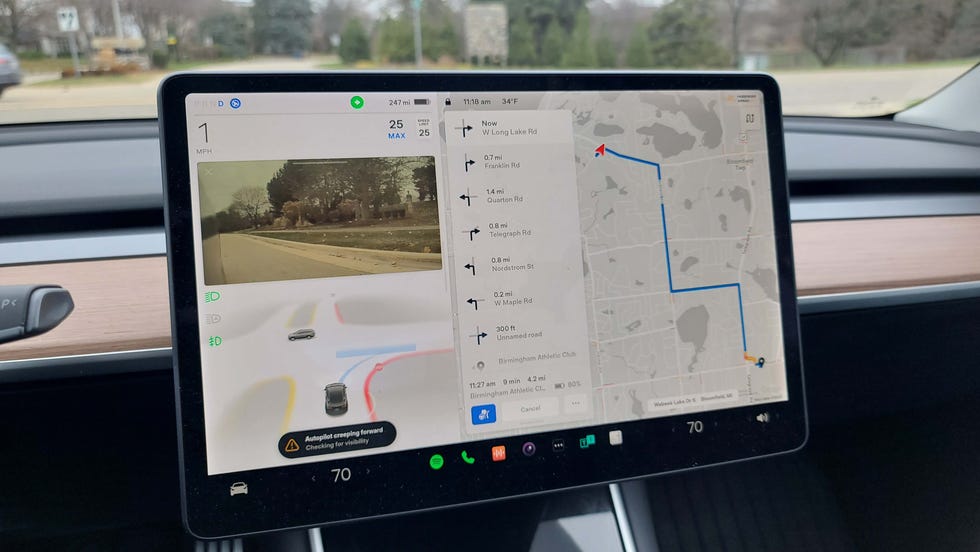
FSD. Tesla’s Full Self-Driving feature is finally available to any owner who wants to download it — assuming they have the hardware to support it (a $15,000 option). FSD has been available to select customers since 2020, and the company is now confident enough to make the technology widely available. The Level 2 system (Level 4 means the car can actually drive without human supervision) hardly lives up to its name, given that a driver must be engaged at all times. But the system is a fascinating glimpse at autonomous car progress as it takes turns on its own, navigates traffic and even turns right on red.
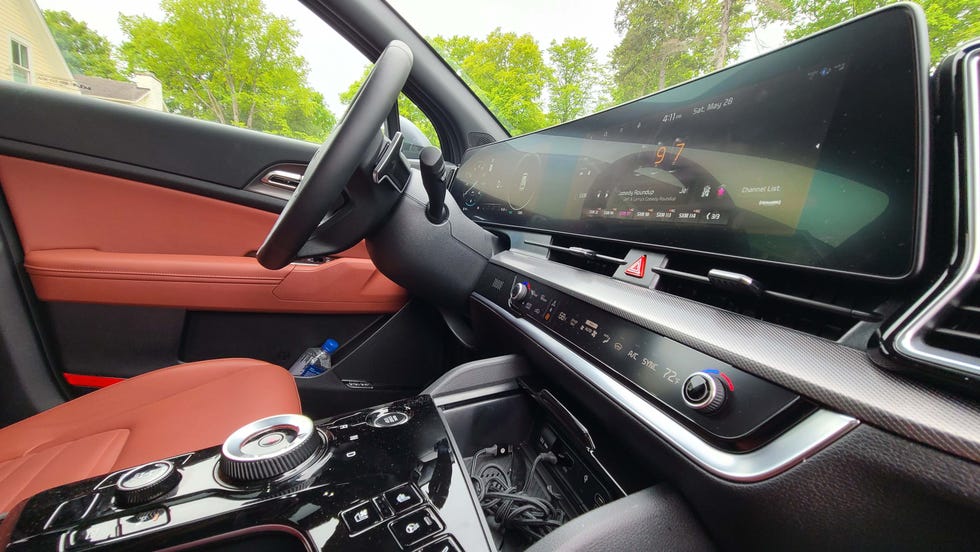
Hidden climate/radio controls. I love Easter eggs, and one of my favorites is in the handsome console of the Kia EV6 and Kia Sportage SUV. For aesthetic simplification, the infotainment and climate controls have been combined in a single black strip. Select the volume/fan button and the controls will change for the features you want to access. For those who prefer rotary dials, however, the feature may drive you mad.

Pullover blind. Honda invented this nifty shade in its 10th generation Civic hatchback and it returns for the 11th gen. It’s highlighted this year by the relentless Civic Type R that thrills with is sporty suspension and 315 horsepower. But the hatch shows off the car’s utilitarian side: You can store valuables in back — then just pull the blind across the cargo bay like a window shade. No cumbersome hooks or snaps required.

Four-wheel-steer. Once the domain of whip-quick Porsches, all-wheel-steer is found in other applications this year. The ginormous GMC Hummer EV got AWS to help negotiate tight trails off-road. The Mercedes EQE is hardly a Porsche when it comes to handling, but its AWS system makes U-turns and tight city parking garages easier to handle. AWS requires adding a steering rack in the rear, so it ain’t cheap, but I’m betting engineers will figure out how to make the feature more available to mainstream vehicles over time.

Third screen. Our vehicles are turning into moving theaters with screens everywhere, including the rear seats so kiddies can enjoy movies on endless road trips. The latest screen innovation comes from the Jeep Grand Wagoneer and Mercedes models that add a third screen for the right-seat front passenger. Integrated into the dash above the glove compartment, the screen allows the co-pilot to set navigation and radio stations (and, of course, watch videos).

Three-headed monster. Three-cylinder engines have generally been deployed to gain better fuel efficiency. Think my favorite ol’ Ford Fiesta 3-banger, which got 43 mpg highway and helped the brand meet fuel economy standards. The Toyota GR Corolla hellion begs to differ. Corolla’s pocket rocket model squeezes 300 horsepower from its 1.6-liter, 3-cylinder mill (that’s a gobsmacking 185 horses per liter). Fuel efficiency? A thirsty 20 mpg.
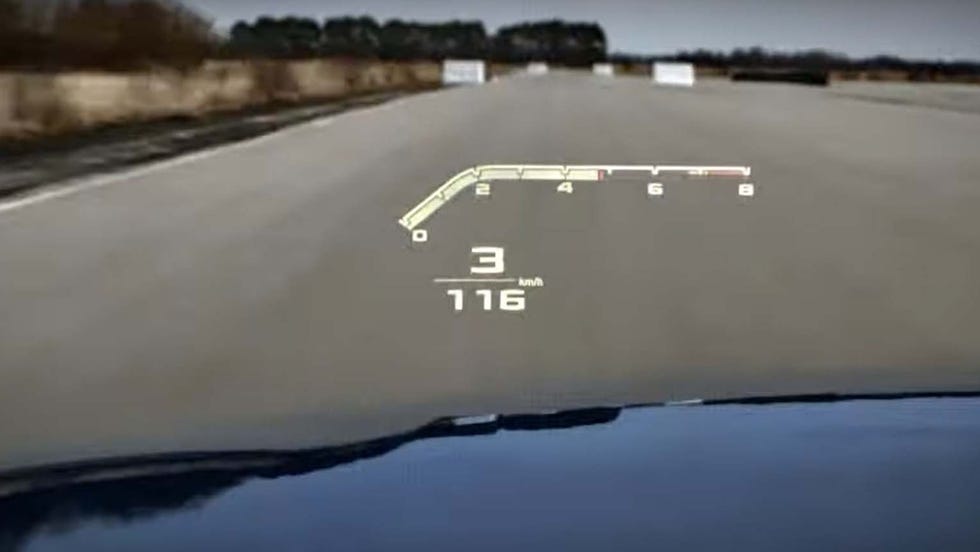
Tachometer head-up display. Speaking of screens, head-up displays are getting more common — and more innovative. You can now find HUDs — which project car information onto the windshield — on daily drivers like the common Mazda3. Higher on the food chain, models like the BMW M4 offer multiple HUD configurations, including a horizontal RPM display so enthusiasts never have to take their eyes off the track while paddle-shifting through the gears.

Remote parallel park. Tesla has been at the forefront of remote vehicle manipulation with its Summon feature so you can pull your car out of tight garage spaces using a phone app. The Genesis GV60 this year took the technology to its logical next step: allowing customers to self-park their car into perpendicular/parallel parking spaces using their key fob.
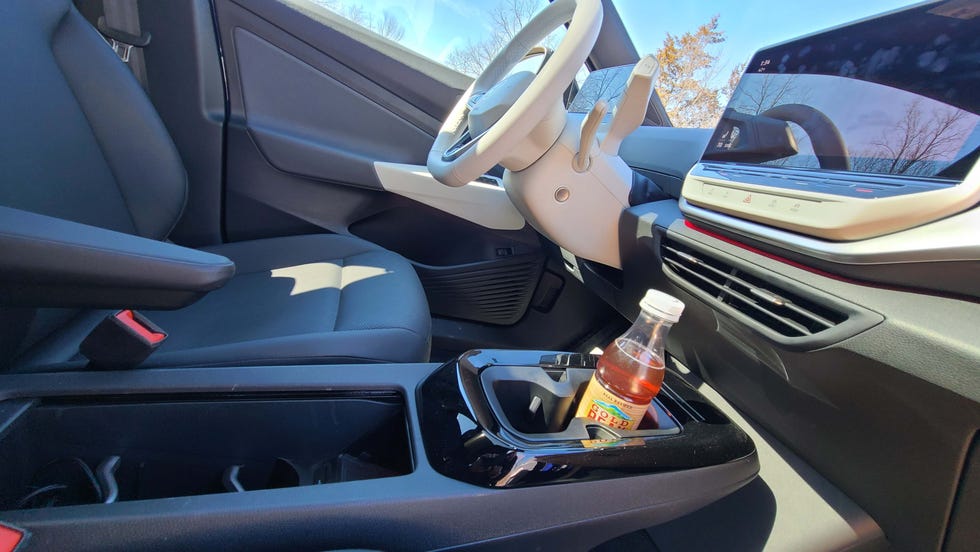
Wireless navigation and charging. Wireless Apple CarPlay and Android Auto are must-have features these days, but the drawback is they are a drain on the phone’s battery without a cord attached. Here comes wireless charging — an option on a growing list of vehicles — to save the day. Set your destination on your phone, throw it onto the charging pad and the car will wirelessly charge while navigating to your destination.
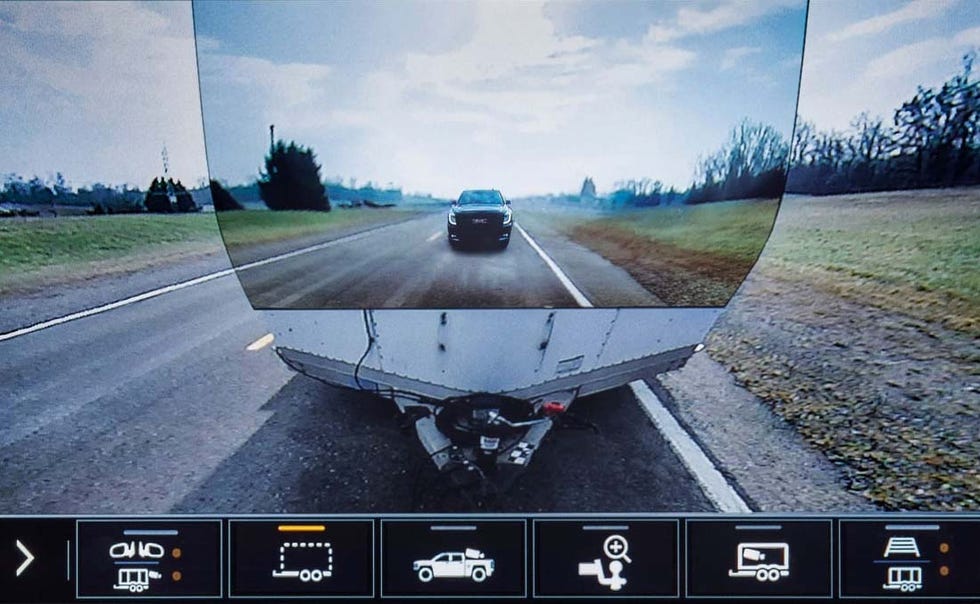
Transparent Trailer View. This bit of stage magic has been around for a couple of years, but it is becoming more common on light-duty trucks like the GMC Sierra. Though complicated to set up, the system uses multiple cameras on the vehicle to — poof! — make your trailer disappear on your center console screen so you can see the traffic behind you.
Henry Payne is auto critic for The Detroit News. Find him at hpayne@detroitnews.com or Twitter @HenryEPayne.
Payne: Riding along with my self-driving Tesla student driver
Posted by Talbot Payne on December 10, 2022
Detroit — I’ve put a STUDENT DRIVER sticker on my trunk. Not for me, it’s for the car.
My Tesla Model 3 has downloaded Full Self Driving, the Austin, Texas-based company’s ambitious beta software that enables its products to drive themselves on public roads. It’s a major upgrade over Autopilot, which pioneered self-driving features in production vehicles, but has been limited to driving in a linear direction and stopping at stoplights.
With FSD, my car makes all the decisions. Freaky, yes? Give it a destination (“Navigate to Eastern Market, Detroit”) and it will do the rest — a blue steering wheel graphic on the big console screen’s top left indicating it’s in control. It autonomously negotiates right-or-left turns at stoplights. Highway merges. Highway exits, cloverleafs, roundabouts, ess turns, traffic jams, Michigan turns. Oh, the Michigan turns are tough.
Because just like a 16-year old, my Tesla is a very cautious driver still learning the ways of the road.
Heading north on Telegraph Road, Tesla moves across two lanes — properly turning on its left turn signal — and enters a Michigan turn in order to U-turn south on Telegraph before taking an immediate right onto 12 Mile headed west toward my favorite Crispelli’s pizza joint on Orchard Lake. Like a hesitant student driver, it slows considerably into the designated Michigan turn lanes, trying to decide which of the two lanes to take. Cars behind us respectfully keep their distance as my student driver figures things out.
FSD chooses the left-hand lane and stops at the light. You know the drill: other cars come to a stop to our right, while others stack up behind me. When the light changes, the car rolls forward into southbound Telegraph with the intent of turning across all five lanes in order to reach 12 Mile. But the cars turning next to me impede my student’s route. The car slows to a crawl, the steering wheel twitching madly back and forth looking for an opening — and I take over so as not to impede traffic (or get rear-ended). Ah, never a dull moment.
For Tesla, autonomous driving is the Holy Grail and it has aggressively pursued that goal using owners like me as beta testers. “The overwhelming focus is on solving full self-driving,” CEO Elon Musk told the Tesla Owners of Silicon Valley club in June. “That’s essential. It’s really the difference between Tesla being worth a lot of money or worth basically zero.”
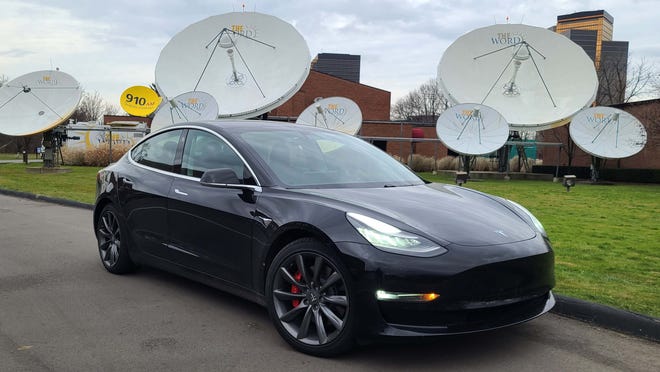
My student driver makes its decisions using data from eight external cameras, a forward radar and 12 ultrasonic sensors that is then crunched by a powerful onboard computer using software including neural networks, machine learning, artificial intelligence, and the global positioning system.
“Tesla could benefit from crowd-sourced mapping software as well,” observes Guidehouse Insights analyst and engineer Sam Abuelsamid, who came along for a ride with us one day. “That would help the GPS better locate and understand how to handle Michigan turns and complicated intersections.”
Like a training vehicle with two steering wheels, I can take over from my student any time.
The pattern repeats itself at other Michigan turns. In Pontiac on Telegraph Road, the car inches out into the lanes before speeding up into the middle lane. At another it turns into the immediate left lane. On Woodward, it slows for a Michigan turn — then reconsiders and moves on to another. Negotiate the Orchard Lake and M-10 roundabout? Fuhgettaboutit.
In such instances, I take control. As the adult in the room — er, cabin — Tesla demands certain things from me. No taking smartphone videos from the driver’s seat. And if I ignore the car’s pleas to take over more than five times, I will be locked out of FSD.
It’s fascinating to experience, but as a Level 2 system (a truly autonomous car is Level 4) it requires constant vigilance. When Google introduced its autonomous marshmallow robot car in 2015 in Silicon Valley, I asked engineers how it co-existed with human drivers. “The Google car is a good driver, but it gets rear-ended a lot,” was the reply.
Michigan turns aside, Tesla FSD is pretty good at intersections. It evens turns right on red.
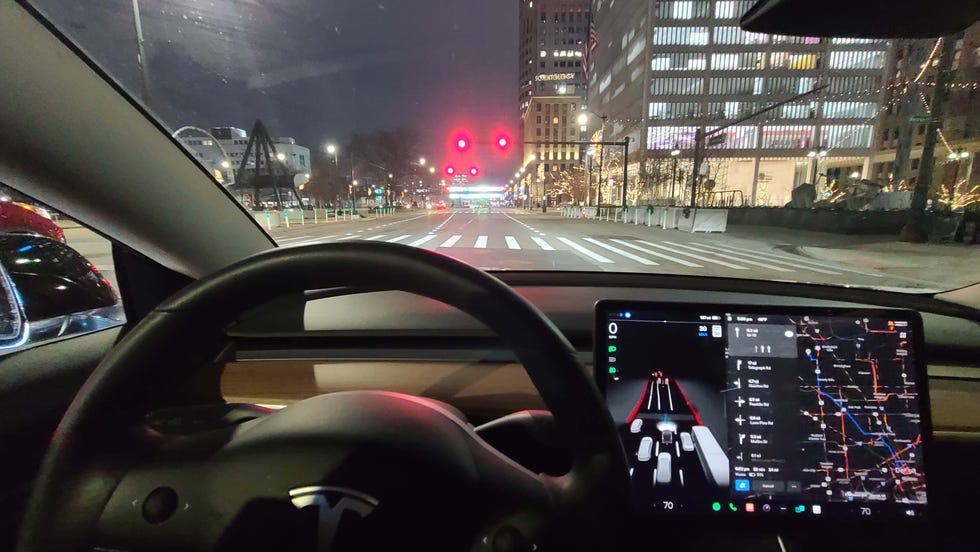
It negotiates interstates, highways and two-lane roads adeptly just as I’ve experienced in Autopilot for four years. What’s new is the Model 3 will continue driving when it exits a divided highway — rather than returning control to the driver.
FSD is a stickler for highway rules. It always defaults to the speed limit, always defers to the right (or middle) lane on a highway, always passes on the left, always stops a few feet before a stop sign before inching forward. Textbook.
But being on the road with humans means having to anticipate human behavior, something with which robots (like 16-year olds) must learn. On the Lodge south to Detroit, Tesla moved left to pass a slower car. In the rearview mirror I noticed a pickup driver approaching at a high rate of knots. My student was oblivious — but my reaction would have been to speed up in order to clear the lane.
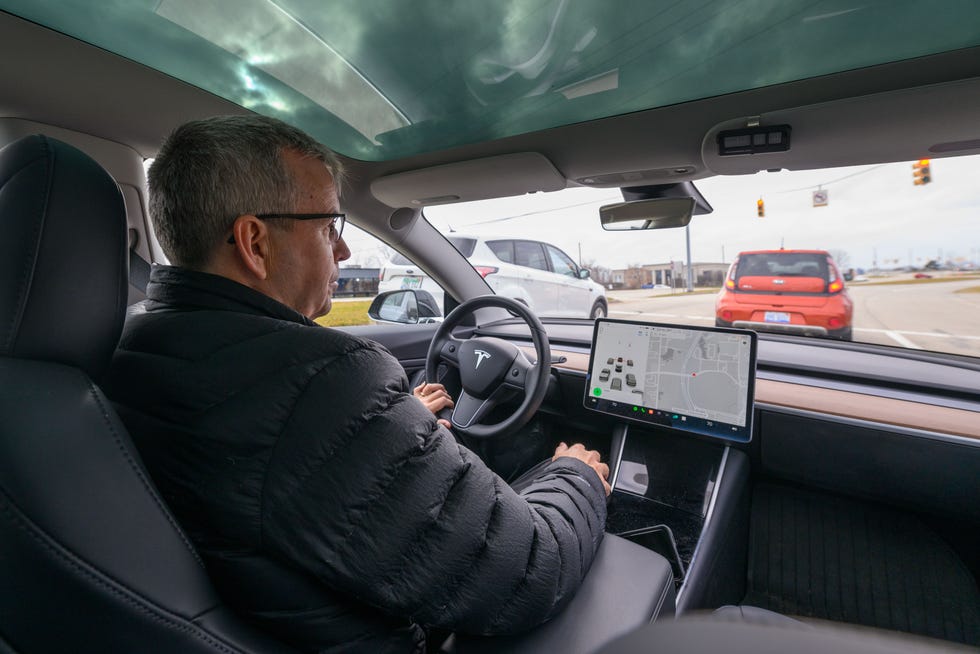
Encountering three cars abreast, the pickup driver refused to slow but instead veered right and took the right median to pass all three of us at once. Yeesh.
Tesla introduced FSD beta to select customers in 2020 — employees, Tesla club presidents, investors — before slowly rolling it out to the public. In November, the company decided to offer it to anyone.
“You can see gradual progression with over-the-air updates over two years,” said Joel Szirtes of Royal Oak, an early Tesla adopter, who downloaded FSD in October, 2020. “Initially, the visualization graphics (on screen) were crude, and the car would tend to clip curbs on turns. Al of that has improved considerably.”
And it will continue to improve as student testers like mine send streams of data back to HQ where engineers will feed it to its neural network. Competitors are also getting better too with General Motors Co., for example, using similar systems but with different tools — crowd-sourced map updates, camera-monitored drivers — as they expand their systems to secondary roads.
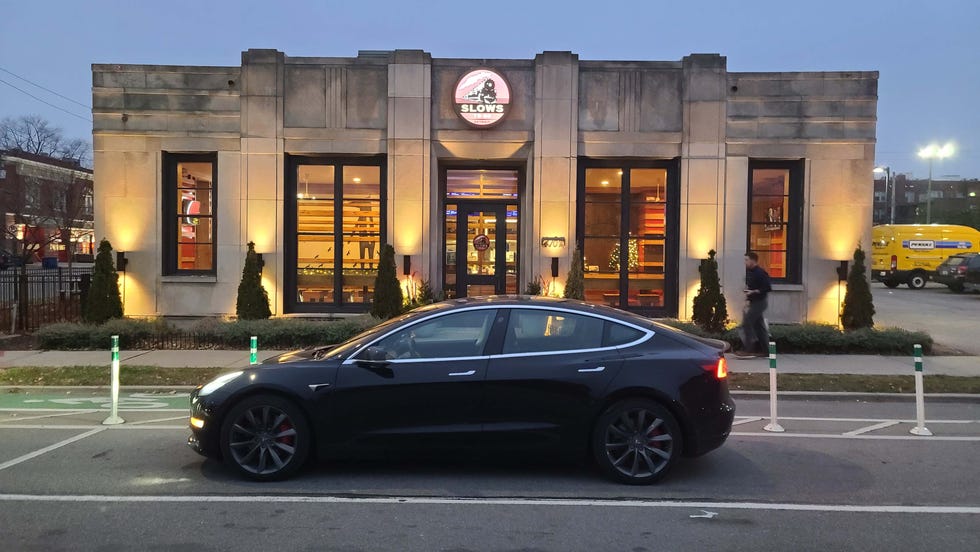
In addition to the original Google bot, I’ve ridden in Level 4 robotaxi services in Tempe (Waymo) and San Francisco (Cruise) which boast expensive, LIDAR and mapping tech that occupies the entire vehicle trunk. Tesla’s FSD does not compromise interior space with extra hardware, but neither its hardware as sophisticated.
On a trip to Eastern Market via M-10, Tesla negotiated the diabolical Lodge-to-I-94 exchange (crossing four lanes to exit onto I-75 South) with aplomb. The return route via Jefferson Avenue to M-10 back to Oakland County would not be as smooth.
Where Jefferson Avenue splits at Griswold — left into the tunnel under Huntington Place or right to stay on the surface towards the convention center entrance — my student driver chose the latter under the apparently mistaken impression it could drive straight through the convention center and continue to the Lodge freeway.
At Huntington Place’s front doors, Tesla realized its mistake and slowed to a stop at the sidewalk. It gave the steering wheel back to me, the blue wheel graphic disappearing from the screen. Intrigued by this miscalculation, I tried the exercise again — and the car correctly chose the tunnel in subsequent efforts.
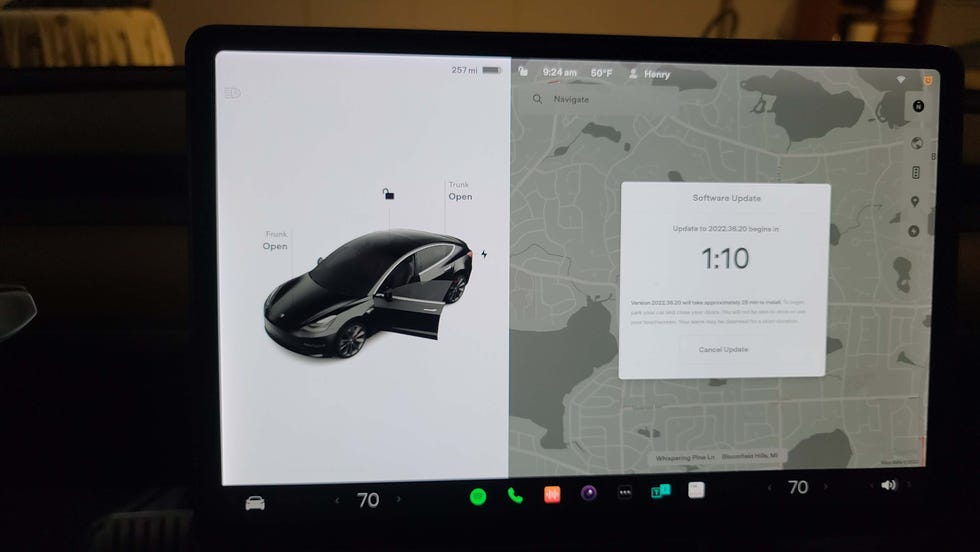
Is it learning in real time? No, says autonomous expert Abuelsamid. It’s likely just seeing the split more clearly due to better lighting, or even its relationship to other cars. Neural networks are complicated beings.
So I’m letting my student driver drive. Most of the time. I’ll, ahem, do the driving through roundabouts and Michigan turns. Maybe after a few more OTA updates, I’ll be able to remove the STUDENT DRIVER sticker.
Henry Payne is auto critic for The Detroit News. Find him at hpayne@detroitnews.com or Twitter @HenryEPayne.
Last Ford GT pays homage to ’67 Le Mans winner with 800 horsepower
Posted by Talbot Payne on December 10, 2022
Ford unveiled the last model of its third-generation GT supercar Friday and it’s a track-only, 800-pound predator that plays homage to the 1967 Le Mans-winning, Ferrari-stomping GT Mk IV.
Merry Christmas.
Act fast, though, because Santa will only deliver 67 of these toys in keeping with the 1967 heritage. The 2023 GT Mk IV is an appropriate bookend for the supercar that debuted in 2016 with the singular purpose of winning Le Mans on the 50th anniversary of Ford’s historic triumph at the famed French endurance race with the iconic GT40. That epic event was captured in the 2019 Hollywood hit “Ford v Ferrari.”
Fulfilling the script, the race-version of the GT won the GT-class title in 2016 and the production version has followed to universal acclaim beginning in 2017. The Mk IV model puts an exclamation point on the GT’s seven-year production run by celebrating the 1966 GT40’s 1967 successor, the Mk IV, which reinforced Ford’s Le Mans dominance with another win (Ford would win Le Mans four years running, 1966-69).

True to its innovative predecessor, the ‘23 Mk IV is a technical Tour de Force and the most capable Gen-3 car built. It will also deliver the car’s highest price tag: $1.7 million.
The 2023 car will likely share a lot of learning from the 2019 GT Mk II — also a limited-edition, purpose-built track car with just 45 copies delivered. The Mk II boasted 700 horsepower and a $1.2 million price tag, well above the $700,000 asking price of road-going GTs. Ford has built 250 GTs a year since 2017.

For its big price tag, the 2023 GT Mk IV will go beyond its Mk II sibling in performance. Mods include extensive front and rear aerodynamic work with a monster wing and diffuser, aero wheels, and large front spoiler. The Mk IV promises a uniquely-tuned twin-turbo V-6 engine, racing transmission, Multimatic race shock absorbers, and longer wheelbase.
“The original GT Mk IV held nothing back for max track performance, and the new Ford GT Mk IV brings it in the same way,” said Ford Performance Motorsports boss Mark Rushbrook. “With an even higher level of motorsport engineering and performance, plus a completely new carbon fiber body, the Mk IV is the ultimate sendoff.”

The 1967 racer was itself a significant advance over the GT40 Mk II that swept the Le Mans podium in 1966. The car was built for the high speeds of Daytona’s bankings and Le Mans’ long straights and was significantly more streamlined than the ‘66 race winner. The victorious red and white-striped 1967 car, driven by racing legends AJ Foyt and Dan Gurney, is on public display at the Henry Ford Museum’s “Driven to Win: Racing in America” exhibit.
With a lightweight, honeycomb-aluminum chassis, 7.0-liter V-8 engine (and steel roll cage to better protect drivers after the tragic death of driver Ken Miles in a testing accident), the 1967 race car won handily — hitting 212 mph on Le Mans’ 3.7-mile-long Mulsanne straight and averaging a record 135.48 mph over the 24-hour race.
Despite an engine displacement double that of the 3.5-liter mill in the 2023 GT Mk IV, the 1967 Le Mans car made just 500 horsepower compared to the new car’s 800. Such are the advances in technology and turbocharging in the last half century.
Interestingly, the 1967 car was the first Le Mans-winning car to be built entirely in the United States (the 1966 racer was built in England). The 2023 production GT will — like all current GTs — come from Canada, where it is assembled by Ford’s partner Multimatic.
“Multimatic’s brief was to create the most extreme final version of the Ford GT, and the Mk IV is the outcome,” said Multimatic executive vice president Larry Holt. “A unique larger displacement engine, proper racing gearbox, stretched wheelbase and truly radical body has resulted in an unprecedented level of performance.”
If you have $1.7 million in spare change lying around, you can apply for one of the 67 models at: https://www.ford.com/performance/gt/mk-iv/.
Deliveries will begin late next spring.
Henry Payne is auto critic for The Detroit News. Find him at hpayne@detroitnews.com or Twitter @HenryEPayne.
Payne: Hitching a sailboat to the Ford Explorer SUV for a trip north
Posted by Talbot Payne on December 8, 2022
Charlevoix — Pickups get all the headlines as vehicle workhorses. With ladder frames and rear beds, they can tow 10,000 pounds while hauling 2,500 pounds of payload and four workers the size of Detroit Lions middle linebackers. But what if you don’t need all that utility all the time? What if you just need a part-time workhorse? What if you could get by with a simple SUV?
It’s remarkable what your good ol’ Ford Explorer SUV can do.
When my young sons started racing go-karts in the early 2000s, we didn’t need a pickup to haul our wares. Racing on a budget, I would rent a U-Haul trailer on summer weekends, load it with our 100cc Birrel racing kart and spares — then hook it up to our midsize, three-row 2005 Chrysler Pacifica SUV (the original Pacifica was an SUV before being reborn as a minivan in in 2017). With a 3,500-pound towing capacity, brawny V-6 engine, roomy hatchback and second-row captain’s chairs, Pacifica was plenty of workhorse for our needs.

On weekdays, it was my wife’s daily driver; on weekends it was the Payne Racing rig. Though we sold it when our kiddies flew the coop for college, the Chrysler was the best family car we owned — handsome, smooth, with enough muscle for the occasional U-Haul.
So when a Charlevoix friend asked this fall if I would tow his sailboat from Ann Arbor, I jumped at the chance. Not because I wanted to test the latest macho pickup, but — with memories of my ol’ Pacifica — because I wanted to see what a modern SUV could do.
My tester, the latest 2022 Timberline trim of Ford’s popular midsize, three-row Explorer, is a state-of-the-art version of our old Pacifica: handsome, smooth ride, utilitarian, muscular. It’s even a shade of blue like my Pacifica.
Even as government nannies have forced automakers to abandon V-6s for turbo-4s, Ford engineers have managed to make a brawnier 4-banger. Tipping the scales at 4,565 pounds, the Explorer Timberline puts 300 horsepower and 310 pound-feet of torque to its four wheels compared to the 4,720-pound Pacifica’s 250 horses and 250 torque. The current-gen Explorer was also engineered to be rear-wheel-drive based, adding to its towing prowess.

The result is increased efficiency and performance of 21 mpg and 5,300 pound towing capability versus Pacifica’s 20 mpg and 3,500 pounds.
And the new Explorer is every bit the looker of the old Pacifica. Its rear-driver proportions, long hood and sculpted shoulders still turn heads three years after its Detroit auto show introduction. You can see them coming a mile away with their signature horizonal LED eyebrows.
Dressed in blue, my Timberline swaggered into Ann Arbor on a Saturday morning to pick up my cargo: an 18-foot fixed-keel Precision 185 sailboat strapped to a custom-made trailer to accommodate the boat’s 3.5-foot draft. Total weight? About 1,500 pounds.

I hooked up the trailer (the boat was already secured with straps and the mast neatly laid stem-to-stern so that it did not interfere with the Explorer’s hatch), crossed the chains, connected the lights and locked away the third wheel. Then I tackled the hard part: arranging luggage, a tennis bag, a Craftsman toolbox and multiple boat accessories (including an awkward spare wooden seat) in the rear cargo bay so that two people could still ride comfortably in the second row if necessary.
I needed to lay down the “40” seat in the 60-40 split in order to accommodate the long center bulkhead, but otherwise the Explorer hatch swallowed boat accessories, luggage and all. I recommend having someone familiar with boats (I’m a motorhead landlubber) — like my friend’s neighbor — check over things like strap tension and tires before departure.
I selected TOW/HAUL on the Explorer and eased out of Ann Arbor’s neighborhood streets. The Explorer towed the boat with ease. No swaying. No bouncing.

Timberline is fully armed with the latest safety assistance features like blindspot assist and adaptive cruise control. Ford calls its system CoPilot 360 Assist with lane-keep assist that mimics self-driving. When fully engaged, a green steering wheel appears on the dash. Entering U.S. 23 headed north, I turned on 360 Assist and used it for most of the four-hour trip at highway speeds of 75-80 mph. The SUV maintained its lane and kept its distance from vehicles.
That consistency allowed me time to explore the SYNC5 infotainment system. It’s one of the industry’s best (an electronic light year from the Pacifica) and I easily found my preferred SIRIUS XM stations. SYNC5 also features wireless smartphone technology (Pacifica existed B.S. — Before Smartphones) and I was able to make calls and check in with Mrs. Payne on my long drive north.
Towing a tall 1,500-pound rig was surprisingly easy, but the load did take its toll on fuel economy.
Rated at 21 mpg, my steed drank gas at a rate of 9.9 mpg on my trip — getting only 45% of predicted range. Ouch. Range anxiety just like an electric vehicle. Except, there are gas stations everywhere.

As it turned out, my two-stop fueling strategy was similar to what I used with EVs that I have driven north to Charlevoix — only much shorter. I filled up in Bay City and again in Gaylord with regular gas at $3.69 a gallon. Marathon fueling stations cater to truckers and trailers with big lots and lots of pump room, and I looked for them on my journey.
The Explorer took just three minutes to fill to 200 miles of range. Equivalent mileage requires half an hour in an EV.
The Explorer was smart. When I fired the Ford back up in TOW/HAUL mode, a screen message told me the trailer was connected, followed by another message that Blind-spot Assist and Rear Cross-Traffic Alert were deactivated due to the trailer.
By my second fueling stop in Gaylord, Ford’s computer had adapted to its hauling duties and predicted I would get just 167 miles on a tank of fuel as opposed to the usual 483 highway miles. Good to know. I arrived in Charlevoix four hours and 25 minutes after my departure with my package intact. After unloading the boat, I shoved the Explorer into SPORT mode and had some fun through the M-32 twisties on my way back home.
When relieved of its towing duties, a mid-size SUV can feel pretty sporty. And it’s lot easier to park around town than a pickup.
Next week: 2022 Detroit News Vehicle of the Year
2022 Ford Explorer Timberline
Vehicle type: Front engine, all-wheel-drive six-passenger SUV
Price: $47,540, including $1,295 destination fee ($48,035 as tested)
Powerplant: 2.3-liter, turbocharged, inline-4 cylinder
Power: 300 horsepower, 310 pound-feet torque
Transmission: 10-speed automatic
Performance: 0-60 mph, 6.0 seconds (Car and Driver); towing, 5,300 pounds
Weight: 5,827 pounds (as tested)
Fuel economy: EPA est. mpg 19 city/22 highway/21 combined
Report card
Highs: Smooth towing; useful highway and infotainment tech for long hauls
Lows: Bland interior compared to some rivals; miss the ol’ V-6 roar
Overall: 4 stars
Henry Payne is auto critic for The Detroit News. Find him at hpayne@detroitnews.com or Twitter @HenryEPayne.
Acura Integra gets Type S hellion with 300+ horsepower but no AWD
Posted by Talbot Payne on December 8, 2022
The 300-plus horsepower, performance-trim Acura Integra Type S is real — but it will not get all-wheel-drive as hoped for by many enthusiasts.
Acura confirmed the long-anticipated, 2024 Type S Monday with lightly camouflaged pictures of the compact hellion at its Toshigi, Japan, test track facility.
With the base, $37K Acura Integra — the first Integra model in the United States since 2001 — Honda’s premium brand returned to its heritage of producing premium sporty hatchbacks. The Integra Type S completes the transformation with a high-output, turbocharged 4-cylinder engine and tuned suspension similar to the raucous, $44K Honda Civic Type R.
A few journalists got brief rides in the camouflaged Type S in Toshigi and confirmed that, while the Type S will share many attributes with the top-spec Honda Civic Type R — including front-wheel-drive, 19-inch heels, limited slip differential, and 6-speed manual transmission — it will wrap the package in a more sophisticated wardrobe that may push $50K. The base Integra cost about $4,000 more than its sibling, Honda Civic Si.

“Because this is a Type S and not a Type R, the styling is less extroverted. The Integra lacks the Civic’s giant wing and aggressive-looking vents and scoops,” wrote Car and Driver from Japan. “With a dash more sophistication than the Honda, the Integra Type S could prove enticing.”
Acura has become synonymous with its sophisticated, torque-vectoring so-called SH-AWD all-wheel-drive system. Acura forums have buzzed with anticipation that the Type S would gain an AWD system over its mainstream, Honda Type R system to compete against AWD performance offerings from Cadillac and BMW as well as the Honda Type R’s closest competitor — the AWD, $45,835 VW Golf R which can spring to 0-60 mph a second quicker than the Honda with better traction and a dual-clutch automatic gearbox.
“I think for the sake of differentiating it from (Type R) I think AWD would be a great addition,” wrote “rRobbJK” in a typical post at IntegraForum.com.
Agreed Forum contributor “bullitt”: “I’d love if the Integra had SH-AWD and AWD steering in the Type-S.”
After the Type S reveal, critical reaction was swift.
“It is a little disappointing that Honda hasn’t opted to differentiate the Integra a bit more from the Type R. This car really should offer AWD,” commented “Bankerdanny” in Car and Driver’s reader forum.
Echoing the sentiment were other Integra fans like “dfelix,” who wrote: “Disappointed. Just like the Integra vs. Civic Si, not much distinction between the two models outside of amenities. I really wanted them to add SH-AWD to the Integra Type-S to give it the performance cred, especially for acceleration from 0.”
Acura fans however, will be heartened by the Type S’s huge, 100-horsepower gain over the standard Integra hatchback. The engine should match, maybe exceed, the Civic model’s 315 horsepower and 310 pound-feet of torque. It will also be shod in summer Michelin Pilot Sport 4S tires for much better grip than the Integra’s all-seasons. While test models of the Type S in Toshigi were heavily camouflaged inside, test drivers found the seats to be more heavily bolstered — and less red in coloring — than the Honda Type R. That would be in keeping with Integra’s more premium-focused mission.
Though the Type S and Type R play in the hot hatch segment occupied by the Golf R, the Acura will compete in the luxury space against AWD hot rods like the $50k Mercedes-AMG CLA35, $48K BMW M235i Gran Coupe and $48k Cadillac CT4-V.
The Type S is made in Japan, and Acura says that more details of the 2024 model will be disclosed closer to its arrival at dealers in the summer of 2023.
Henry Payne is auto critic for The Detroit News. Find him at hpayne@detroitnews.com or Twitter @HenryEPayne.
Prefix on M1: How a stealthy auto supplier got a Woodward showcase
Posted by Talbot Payne on December 3, 2022
Pontiac — They’re the most interesting company you’ve never heard of. But now they’ve getting a Woodward store front.
Prefix Corporation broke ground on its Performance Vehicle Service Center at M1 Concourse car club and race track this week in Pontiac. A successful Detroit auto supplier, Prefix is one of many companies with genius engineering capabilities that make stuff for household names like Dodge, Ford and Chevy — but are sworn by nondisclosure agreements to ensure you never know who they are.

You’ll recognize Prefix’s work — the Dodge Charger Daytona Banshee concept, the Rivian R1T concept that blew away the 2018 LA Auto Show, vehicles in Disneyland’s Pixar Cars Land in Anaheim, California — even if you don’t know the company’s name. But now Prefix’s logo will stand out at the intersection of Woodward Avenue and South Boulevard, where it will be seen by passing traffic — and by the companies and hordes of auto enthusiasts that come to M1 Concourse each year for private tests or public mega-events like Motor Trend’s Roadkill Nights, the Woodward Dream Show, American Speed Festival and regular Cars & Coffees.
“We’re really excited. M1 is doing a phenomenal job of making this a hub for all things automotive,” said Prefix Vice President for Business Development Jhan Dolphin in an interview. “We had an idea three years ago (about) a performance center on site to service the 255 garage owners here as well the companies and groups that attend the events or rent out the facility.”

It’s rare for suppliers to become household names in their respective industries. Consumer brands like auto companies and theme parks want the focus on their logos in a crowded marketplace. But some brands have broken through given their sheer necessity to product performance — think Brembo brakes or Intel computer chips. More typically, suppliers are known only to the industries they serve by opaque names like Munro & Associates, Dent Wizard, and Williams International.
Prefix has flirted with notoriety before by sponsoring the Dodge Challenger that won the Trans Am TA2 title in 2019 with Michigan racer Mark Miller behind the wheel (Prefix also provided the engines for the series), but it has generally flown below the radar per its clients’ wishes, crafting clever solutions on tight deadlines.
“A lot of work we do is extremely confidential,” said Dolphin. “There’s not much we can post or brag about. But that’s the way it is — whether working on the latest movie or a Disney or Universal attraction. M1 gives us the opportunity to put the brand front and center with people who have an interest in us.”
The company was founded in 1979 by Kim Zeile, a young General Motors mechanical engineer who saw opportunities to solve unique manufacturing problems. The engineering services company has grown over the past 40 years to 300 employees across two Michigan facilities, including a 25-acre headquarters campus in Rochester Hills. Its team of engineers problem-solve for a universe of challenges, including product design, surface modeling, fabrication, lighting, software development, engine performance and more. Prefix even pivoted to make personal protection equipment for hospitals when COVID shut down businesses.
But the company’s meat and potatoes is building the most tech-advanced concept prototypes in the automotive, aviation and theme-park industries.
In 2018, California-based EV-maker Rivian wowed the automotive world when it dropped its stunning, sophisticated R1T pickup and R1S SUV concepts on the Los Angeles Auto Show floor, setting off a chain of events that catapulted Rivian to the most anticipated auto startup since Tesla.

The protypes were built by Prefix.
They survived the scrutiny of journalists and the public crawling all over them. Just as Prefix-made vehicles at Disneyland’s 12-acre Pixar Car Land theme park have entertained thousands of visitors looking to escape to race day at Radiator Springs with Lightning McQueen. Its resume includes airborne prototypes as well for aircraft manufacturers like Embraer, Piper and Gulfstream.
Recent Prefix automotive prototype creations include Dodge’s first EV concept, the Charger Daytona Banshee, and Chevrolet’s Silverado and Equinox EVs, which have been making the auto show rounds.

Prefix has constructed a state-of-the-art paint facility where it’s been charged with coloring some of the industry’s most exotic vehicles, including the Ford GT supercar, Cadillac Celestiq EV and Mercedes Maybach.
“The Ford GT is an sexy, incredible car. We’re very proud to have been part of that,” said Dolphin. “It’s one of the most difficult cars to paint given all the shapes and contours that make that beautiful body. It presented its own list of challenges.”

The company’s automotive bandwidth attracted the attention of M1 Concourse, Metro Detroit’s premier playground for performance cars. The service center will provide exclusive maintenance for M1 vehicles that range from Porsche 911 GT3s to Dodge Hellcats. The facility will also be available to visitors who bring their cars to M1 track events like the fall American Speed Festival.
“We’re excited about the partnership with Prefix,” said M1 Concourse CEO Tim McGrane. “Their extensive list of amazing automotive capabilities will provide our garage owners and track customers with an extremely capable resource.”
M1’s Champion Motor Speedway gets extensive use from members, automakers and racers who flog their cars across the challenging 1.5-mile track a stone’s throw from Woodward. Prefix’s 3,000-square-foot facility will feature gas pumps with a variety of fuel grades and three bays for servicing vehicles; the company offers more extensive work at its Rochester Hills campus.
It’s been a big year for the company, from the new headquarters to the M1 ground-breaking, but it hasn’t been without its heartache. Prefix lost its 66-year-old founder, Zeile, to a tragic motorcycle accident this year. His son, company president Eric Zeile, and development director Dolphin say the company is well-positioned for the future.
“Woodward passersby will see the construction progress, and hopefully we will have a mild winter,” smiled Dolphin. “We hope to have the facility done by late summer so we can take advantage of the Dream Show in August and Speed Festival in September.”
Henry Payne is auto critic for The Detroit News. Find him at hpayne@detroitnews.com or Twitter @HenryEPayne.
Payne: Big ute in the big city, GMC Yukon Denali holidays in Chicago
Posted by Talbot Payne on December 3, 2022
Chicago — This is a big city. Big buildings. Big avenues. Big sports teams. Big shoulders. Big swagger.
The big, bling-tastic three-row 17½ foot-long 2023 GMC Yukon Denali fits right in.
Well, mostly. I drove GMC’s three-ton flagship to the Windy City for family Thanksgiving with the in-laws, where the big ute was as useful as 335-pound William “Refrigerator” Perry on Soldier Field’s goal line. And as awkward as the Fridge trying to squeeze into a booth at the Eleven City Diner on Wabash. There was never a dull moment.

Tell Mrs. Payne there is a family holiday gathering and she’ll start packing a week in advance. Good thing we had the Denali and its yawning 123 cubic feet of cargo room. We packed it with wrapped Christmas gifts, food, suitcases, computer bags, a cooler, tennis bag and a partridge in a pear tree.
I stepped on the Denali’s throaty 6.2-liter, 420 horsepower V-8 and we were in Chi-town in no time, cruising up State Street in our five-story-tall SUV — waving at people in their apartments — to our hotel on the Near North Side. You might think that we were an anomaly in the packed residential streets of Chicago, but you would be wrong.
Despite $4-a-gallon gas, a gridded street system laid out 100 years ago and parking spots the size of postage stamps, Chicago was bustling with giant SUVs and pickups. In our swanky North Side neighborhood I saw numerous Yukons, Chevy Tahoes, Ram 1500s, Ford F-150s and Expeditions — and just two Chevy Bolt EVs all weekend. As industry production fractures into government-forced electric vehicles — and the gas-guzzling utes to pay for them — it was a telling sight. Indeed, had I been driving an EV, I had few opportunities to charge it — downtown had but two fast-charger stalls.

My Denali Ultimate cost an eye-watering $97K, but its electronic gizmos are fast trickling down into more affordable vehicles — making huge utes more drivable in small places. Typical of GM vehicles, its ergonomics are superb with intuitive steering wheel scroll wheels to adjust cruise control, dials for climate control, buttons for self-parking. Yes, self-parking. On Walton Street west of the Magnificent Mile, I watched a white Yukon Denali Ultimate — the salt-colored opposite of my black-pepper model — parallel park itself. Then its mother hen clambered down from the cockpit, dragged a stroller from the back and hustled three kids into the nearby Lululemon.
She appeared a seasoned pro, and no doubt used GMC’s hands-free, Enhanced Automatic Parking Assist — one of my favorite urban features. GM also has one of the most advanced self-driving systems in the business (more on that later).
I didn’t bother to parallel park in Chicago; I tried something more difficult: parking in a garage.

My relatives live in a building built in 1925. The garage beneath it is a mouse maze designed for cars of that era, not the barges of today. The 6’5” tall Yukon barely cleared the entry door, but then its sensor system went to work to help me squeeze Denali into its designated spot.
So concerned is building management of damage to tenants’ cars that they’ve wrapped the garage’s thick pillars in rubberized bumpers. Denali customers needn’t worry. Thanks to a 360-degree camera view, I could see all four corners all the time. Come too close to a pillar and my seat would buzz. I had to saw back and forth numerous times to make it into my space — but make it I did.
I would ask only that GMC make the ute’s 10-inch infotainment screen bigger — think the massive 17-inch dash screen on the Cadillac Escalade — to better see multiple camera views. The bigger screen would also match the Denali’s fancy interior, which looks like a room in the Mar-a-Lago mansion.

The dash and doors were lined with open-pore Paldeo wood (laser-etched with a topographic map of Mount Denali, natch), panoramic sunroof and Alpine Umber-stitched massaging leather seats (what, no chandelier?). It’s gorgeous, though shy of the sumptuous Jeep Grand Wagoneer I recently tested.
My 20-something nephews were suitably impressed when they piled in to go to grandma’s house for turkey dinner. Yukon Denali might have been able to fit all 37 members of my wife’s extended family, but on this night we just needed to transport five, including my 6’5” and 6’3” nephews. They could have fit easily into any of Yukon’s three rows. Yes, even row No. 3, made comfortable thanks to an independent rear suspension for better foot room. Two levers on the second-row seat sides offer third-row access by either sliding the seats — or just flattening them.

After patiently extracting Denali from the garage, we plunged into the thick of holiday traffic on I-94 north for suburban Winnetka. Super Cruise time.
The ‘23 Yukon Denali Ultimate is equipped with the General’s latest, expanded Super Cruise hands-free driving system that maps 400,000 miles of U.S. roads and automatically changes into the fastest-moving lane. Though not as ambitious as Tesla’s Autopilot (it won’t automatically follow navigation direction and exit the highway), it’s always improving.

That includes anticipating slower cars in its path and aggressively moving into the left lane. — too aggressively in some cases, forcing me to take over the steering lest the car behind me have to apply brakes.
The system is ready for prime time — but how about humans? This was the first time my millennial relatives had been in a hands-free chariot, and they were noticeably uneasy. Ultimately, they trusted their motorhead uncle’s judgment but they wouldn’t use the system themselves.
Super Cruise is more natural on long, less-crowded rural stretches of highway like I-94 between Gary, Indiana, and Ann Arbor. I went autonomous for miles, relaxing my hands on my knees as if I were sitting in a leather chair at home.

Don’t get too comfortable, though. The system struggled as rain began to fall south of Lake Michigan. “Super Cruise Unavailable. Sensor Can’t Find Lane Lines,” read the screen as Denali handed control back to me — the green monitor light on the steering wheel changing to red.
Happily, we weren’t challenged by fuel range. Truck-based three-row GM SUVs may guzzle gas like Bears fans guzzle beer after a win — but they have big bellies to store it in, too. With 24 gallons on board and 16 mpg, I only had to make one five-minute stop for fuel on our 600-mile round trip.
2023 GMC Yukon
Vehicle type: Front engine, rear- and four-wheel-drive six-or-seven-passenger SUV
Price: $59,295, including $1,795 destination fee ($97,745 Yukon Denali Ultimate 4WD as tested)
Powerplant: 5.2-liter V-8 engine; 6.2-liter V-8; 3.0-liter inline-6 cylinder turbo-diesel
Power: 355 horsepower, 383 pound-feet torque (5.2-liter V-8); 420 horsepower, 460 pound-feet torque (6.2-liter V-8); 277 horsepower, 468 pound-feet torque (diesel)
Transmission: 10-speed automatic
Performance: 0-60 mph, 6.0 seconds (Car and Driver); towing, 7,500 pounds (as tested)
Weight: 5,827 pounds (as tested)
Fuel economy: EPA est. mpg 14 city/20 highway/16 combined (as tested)
Report card
Highs: Room for lots of family; tech-tastic for city maneuvers
Lows: Small screen relative to competitors; gets pricey
Overall: 4 stars
Henry Payne is auto critic for The Detroit News. Find him at hpayne@detroitnews.com or Twitter @HenryEPayne.
Holiday giving revs up: Lingenfelter Collection opens doors for Toys for Tots
Posted by Talbot Payne on December 3, 2022
The post-pandemic charity scene is revving up — and just in time for Christmas.
One of Metro Detroit’s most popular automotive charity venues, the Lingenfelter Collection in Brighton, is opening its doors for the Marines’ Toys for Tots charity from noon-3 p.m. Saturday. Directed by the commander of the Marine Forces Reserve and working through local businesses each December, Toys for Tots distributes toys to economically-disadvantaged children in some 800 communities across all 50 states.
The Lingenfelter Collection features more than 200 cars including Ferraris, Lamborghinis, a roomful of classic Corvettes and the latest cyborgs from Lingenfelter Performance Engineering, which takes GM cars and trucks and injects them with performance steroids.

CEO Ken Lingenfelter is one of the metro area’s most successful hot rod entrepreneurs, and his name has also been synonymous with charitable giving. Before the pandemic, Lingenfelter was doing 60 charity events a year out of his collection. That number decelerated from 60 to zero in 2020 and his team has been desperately trying to get the numbers back up over the past 18 months.
This year, the collection has hosted 20 events including fundraisers in the spring for the American Cancer Society and in the fall for the Pink Fund (breast cancer assistance), but none is dearer to Lingenfelter’s heart than Toys for Tots.
“For years, we have been doing the best we can to support this effort,” Lingenfelter said in an interview. “There is a lot of need for Toys for Tots right now, and we want to do everything we can to help kids.”

He’s getting help from other local auto outfits, including Vanguard, a Plymouth Township dealer in used muscle cars; Northville Concours d’Elegance, and Northville Cars & Coffee. Local Ford dealer Pat Milliken is donating a Ford vehicle that will compete with one of Lingenfelter’s ‘Vettes to see which can be filled with more toys.
To gain entry, visitors must bring a toy — or cash donation. In return they will get to ogle some of the best automotive collections in Metro Detroit.

Among the eye candy is a 2022 Ferrari Roma, Lingenfelter Engineering’s first supercharged, 700-horsepower version of the mid-engine Corvette C8, and a 1,200-horsepower Chevy Camaro ZL1.
Lingenfelter has always had a sweet tooth for the Prancing Horse, and Roma is the latest edition to his collection. Considered one of the most beautiful front-engine Ferraris made, the coupe boasts a 612-horsepower, turbocharged V-8 under its long hood.
For those with a sweet tooth for history, there are eclectic choices like a 1973 Opel GT and rare, 1987 Zimmer Quicksilver. The so-called “Duntov Mule” always draws a crowd. The 1954 ‘Vette was the test car for Zora Arkus-Duntov, the legendary engineer called the “Father of the Corvette.”

Chevrolet’s first V8-powered Corvette, the distinctive beast has a 5.0-liter V-8 under the hood and a tail fin for high speeds. The Mule hit 163 mph at GM’s Arizona Proving Grounds in 1955 in the hands of test ace Smokey Yunick.
One of Lingenfelter’s favorites is a ‘63 split-window Corvette coupe. “That’s the car that ignited my passion for cars,” smiles Lingenfelter, who bought his first ‘Vette in 1977 and took the helm of Lingenfelter Performance Engineering in 2008.
The ’63 Corvette was designed by Peter Brock — who would go on to become Carroll Shelby’s lead designer — and is stuffed with a 360-horse, 5.3-liter V-8, the car’s original engine.

Other youth charities back in the swing after the COVID hiatus include the Detroit Goodfellows, who are raising money in Campus Martius to distribute 30,0000 packages containing hats, gloves, scarves, underwear, books, and games to needy kids 4-13. And Moonbeams for Sweet Dreams is back at Corewell Health William Beaumont University Hospital. The event attracts hundreds of people with flashlights and glow sticks at 8 p.m. nightly Dec. 8-24 to brighten the spirits of hospitalized children.
U.S. News & World Report surveyed 163 national nonprofits that receive at least one foundation grant of $5 million or more annually and found that 58% of nonprofits reduced their services during the pandemic, 49% cut operational costs, and 31% laid off employees.
Lingenfelter Collection is at: 7819 Lochlin Drive, Brighton, Michigan, 48116.
Henry Payne is auto critic for The Detroit News. Find him at hpayne@detroitnews.com or Twitter @HenryEPayne.
Payne: How GT1 turns the iconic Ford GT into an insane, 1,400-horsepower hypercar
Posted by Talbot Payne on December 3, 2022
Pontiac — In the beginning there was the 1966 Le Mans-winning mid-engine Ford GT40 race car. Then came the 2005 GT production sports car. Then the second-generation 2016 GT supercar.
Say hello to the insane 2023 GT1 hypercar.
Riding shotgun in the GT1’s roomy right-hand seat at M1 Concourse’s Champion Motor Speedway, I secured my five-point seatbelt next to the 1,400-horsepower monster’s creator, Fred Calero. Showtime. As we rotated out of the Turn 5 hairpin onto the back straight, Calero put the hammer down. The landscape blurred. The six-speed sequential gearbox fired off rapid shifts — WHAP! WHAP! — like gunshots. The twin-turbo V-8 behind my ears roared and we exploded down the straightaway, cresting 130 mph on our way to the moon before big 15-inch brakes brought us back to earth into Turn 6.
Like injecting Superman with steroids, Calero and his engineers are taking the last 30 chassis of the first-generation 2005 GT into rare, million-dollar hypercar territory. It’s a space occupied by such hellions as the 1,160-horsepower V-12-powered Aston Martin Valkyrie, 1,300-horse V-8-driven Koenigsegg One, and 1,578-horsepower V-16 Bugatti Chiron.
Yet while boasting the latest tech tricks of these sci-fi cyborgs, the GT1 wraps its technology in the timeless, retro-design of one of the world’s most revered sports cars — powered by one of America’s most revered powerplants, the 427 cubic-inch, small-block V-8. Dressed in exposed carbon-fiber and the No. 2 decal of Bruce McLaren’s Le Mans-winning Ford GT40, the GT1 may be the most stunning hypercar on the planet.
“The Ford GT is one of America’s most iconic cars,” said Calero in the GT1 garage after our rocket ride. “And we think there is a particular passion for the more masculine lines of the 2005 GT. The GT1 is equipped with the best equipment from the best brands: Multimatic shocks, Roush NASCAR V-8, SADEV gearbox.”

GT1 is at the bleeding edge of one of the auto industry’s hottest trends: retro-fitting classic cars with state-of-the-art tech. Los Angeles-based Singer reskins 1989-94 Porsche 911s with carbon-fiber shells propelled by juiced flat-6 engines. Revology in Florida stuffs classic 1967 Shelby Mustang GT350 bodies with a modern V-8 drivetrain and interior electronics.
Born in 2005, the production Ford GT was no slouch in the performance department with a mid-mounted, supercharged 550-horsepower V-8. Its sleek body, penned by designer Camilo Pardo, reimagined the ‘66 GT40 as a production model complete with signature headlights, muscular hips, chopped tail.
GT1 takes Ford’s perfect 10 and dials it up to 11.

Its journey began as one of North America’s great “barn finds.” Calero, a successful Michigan entrepreneur and owner of a stable full of Ford performance stallions including 2005-06 Ford GTs, a Mustang GT4 race car and 2020 Ford GT, learned that Ford had retained 30 chassis of the 2005 sportscar.
They were kept out of obligation to Ford GT owners should a car be totaled or require an extensive rebuild. As the last decade drew to a close, Ford was determined to clear its decks of the old GT chassis — whether by sale or scrapyard crusher.
Calero and his partner investors bought them.
The aluminum frames look fresh from the factory, courtesy of Ford storing them in a climate-conditioned warehouse. Working out of a garage here in M1 Concourse, a private auto enthusiast club, Calero’s team hatched a plot to update the GT as a hypercar.

Thanks to Matech Concepts, a Geneva, Switzerland-based racing team, they had a blueprint. With Ford’s blessing, Matech had successfully raced six fully race-prepared 2005 GTs in Europe’s GT1 racing series from 2010-11 — with one win and three pole positions to their credit. Four cars survived and were in the hands of Carlisle Productions in Pennsylvania.
“Carlisle owner Lance Miller has been invaluable to us,” said Calero. “They’ve loaned us body panels, doors, anything we needed to make molds.”
Working from Matech’s playbook, GT1’s team went to work, led by chief engineer Jim Dunham, a retired 30-year Ford veteran who had worked on the gen-two 2016 GT supercar.
“Detroit is the best ecosystem to develop this project because of all the auto talent that exists here,” said Calero.

Dunham applied lessons from Matech’s racers and the current GT, including adding a huge front splitter, widening the GT1’s front track, improving the front clip and side rocker panels and updating the rear wing to a top-mounted configuration for better aerodynamics.
The biggest upgrade would come in the engine bay. Where the Matech GT1 race car used a 5.3-liter V-8, Calero’s team pays homage to the Le Mans-winning Ford GTs of the 1960s with a 7.0-liter V-8. Then they turbocharged it. Twice.
Blown out of its mind, the twin-turbo 427 cubic-inch beast will make upwards of 1,400 horsepower. Built by Roush Yates — the same shop that assembles Ford NASCAR engines — the aluminum-black, RY45 twin-turbo is arguably the most advanced high-displacement engine ever put in a Ford.
Its small-block, push-rod construction is crucial to accommodating the twin turbos under the Ford’s low rear deck. The engine’s racing pedigree — forged titanium intake valves, single-piece crankshaft — means it generates peak horsepower at a stratospheric 9,000 rpm and 900 pound-feet of torque from 3,700 rpm all the way to red line.

“My lead engineer said we should twin-turbo it, so we did,” smiled Calero. “When you look at really high-end exotic cars out there, we have a horsepower war and twin-turbo is a good option. We set the bar high.”
Sophisticated suspension tuning took the bar higher still. As we hurtled into Turn 6 at the end of M1’s back straight, GT1 turned into the apex like, well, a GT1 race car.
Armed with Multimatic shocks developed for the GT1, the chassis was flat, composed. A global leader in motorsports shock absorbers, Multimatic has helped teams bring home numerous Formula One, Le Mans and endurance race wins.
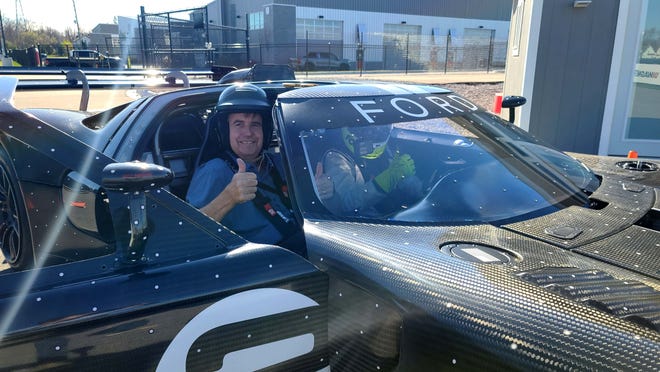
“We went to Multimatic in England and started developing bespoke 4-way adjustable dampers,” said Calero. “We formed a quick bond with them because of their history of developing dampers for the Matech GT1 efforts.”
On exit, the huge 13-inch rear Pirelli P-Zero rear tires — wrapped around lightweight Forgeline wheels — put the power to the road and we were off to the moon again. The interior is race-car spartan with carbon-fiber bucket seats, electronic displays and yoke steering wheel.
The GT1 prototype made its public debut at M1’s American Speed Festival in September. It will make an appearance at the Performance Racing Industry trade show Dec. 8-10 in Indianapolis. After winter track development down south, it will hit the ‘23 North American show circuit beginning with the Canadian International Auto Show in February, where it will be showcased alongside other exotics from Ferrari, Porsche, Shelby and Aston Martin. GT1 plans displays at the Amelia Island and Pebble Beach concours as well.
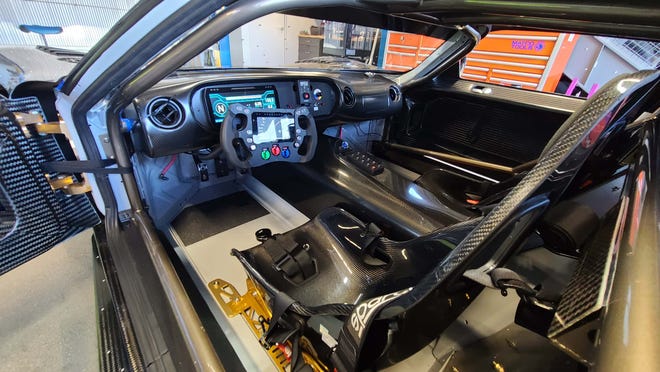
“We’ve got a lot of work ahead of us,” said Calero. “When GT1 goes into production next year, each model will be customized to the buyer’s desire.”
With each chassis authenticated by Ford Performance, customers can pick livery, wheel colors, dive planes, passenger seat and so on. They might choose slick tires, too — so they can really push the hyper-limits of this hypercar.
GT1
Vehicle type: Rear-wheel-drive, two-passenger hypercar
Price: Est. $1.2 million
Powerplant: 7.0-liter, twin-turbocharged Roush RY45 V-8
Power: 1,400-plus horsepower, 900 pound-feet of torque
Transmission: Six-speed sequential
Performance: 0-60 mph, sub-3.0 seconds (est.); top speed: 200 mph-plus
Weight: 2,750 pounds (prototype)
Fuel economy: Est. 4 mpg
Website: https://gt1cf.com
Henry Payne is auto critic for The Detroit News. Find him at hpayne@detroitnews.com or Twitter @HenryEPayne.
Payne: Give thanks, the Honda Civic Type R hot hatch gets hotter
Posted by Talbot Payne on November 27, 2022
Sonoma, California — Cresting Turn 3’s blind hill at Sonoma Raceway, I pressed to keep up with IMSA Pirelli Pilot Challenge champion Ryan Eversley. In chilly conditions my 2023 Honda Civic Type R skittered across the apex in a controlled slide. Like a cat landing on its feet it found grip on its Michelin Pilot 4 tires, and I floored the throttle downhill into Turn 4, snatching fourth gear at 7,000 RPM.
It will also fetch groceries and take three of your six-foot pals to the movies.
Long live the hot hatch, long live the Honda Civic Type R. “I want one,” smiled a smitten Eversley after a week in the car on track and public roads.
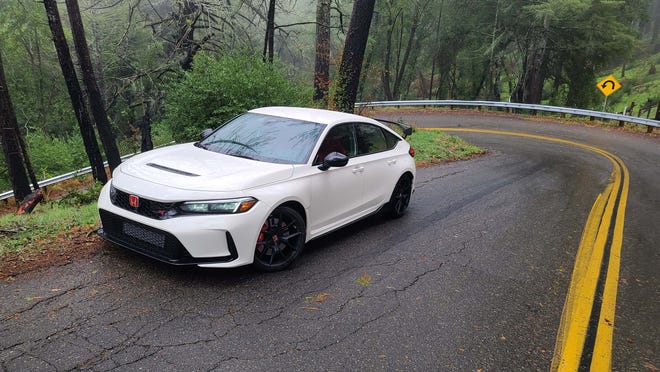
In only its first generation on American shores, Honda’s performance halo established itself as a serious contender in what I believe is America’s most versatile segment. Hot hatches bring performance, utility, and sex appeal to the affordable compact car. A legend overseas for its blinding performance, Type R invaded America in 2018 like a samurai superhero. With styling straight out of Batman comic book (one wag compared its design to a “disheveled knife drawer”), the Civic was impossible to ignore with its huge gills, scoops, and scorpion-inspired rear wing.
It also cost a mere $37,000, making it competitive with segment icons like the VW Golf GTI and Ford Focus ST. My motorhead sons fell in love with it — though trying to find one to buy was tricky. On a 2020 spring weekend, we hunted for nearby Type Rs for under $35,000 but came up empty. Even used models were selling at — or above — sticker.
For its second act, Honda has rewarded its fan base with a Type R that is more mature in every way — from digital gauges to upscale interior to improved horsepower to a more timeless design. Ahem, now that we got your attention with the 2017 model, America, we’ve designed the second-gen with a pen, not a crayon.
Regrettably, it gets a lot more expensive — pushing the upper reaches of a segment that promises affordability.
Recognizing its coveted status and more upscale design (oh, and that Honda’s most cross-shopped competitor, the $38K Subaru WRX STI, is out of production), the $43,990 Type R’s price is in the same ZIP code as the King of Hot Hatch: the stylish all-wheel-drive VW Golf R.
Not only does front-wheel-drive Civic Type R nearly match Golf R’s sticker, it equals its lofty performance numbers by squeezing out 315 horses and 310 pound feet of torque from its blown 2.0-liter engine.
I’m a VW Golf partisan going back to my first car, the 1984 GTI, and — with $45K in hand — I would still opt for the AWD uber-Golf or front-wheel-drive $40K GTI. But with its flawless execution and terrific durability, Civic Type R will be coveted.

Start with its insane drivetrain.
I’ve rowed a variety of vehicles over the swells and swirls of Sonoma’s glorious 2.0-mile circuit, but the last small-displacement car I drove here was the 2014 Alfa Romeo 4C — one of my favorite sports cars. I wouldn’t trade the Alfa’ sensational carbon-fiber tub for anything — but the 1.8-liter turbo-5 was a struggle to flog. The car’s lack of torque made it temperamental around Sonoma.
By contrast, I was up to speed in the Type R within a lap. As the track dried from morning rains, I accessed the car’s stiffest setting — +R mode — and the car quivered like a dog about to be let off its leash. Pounding up Sonoma’s Turn 1 hill, the pavement goes off-caber at the peak (IndyCar fans will remember cars spinning there), robbing momentum. No matter.

With its prodigious torque, Type R instantly picked up the beat as I downshifted to second and got back on throttle. The +R mode also change the tachometer to a racecar-like horizontal readout so it’s easier to see the 7,000 RPM before the Civic smacks it.
This sharp performance defines a car that is an ergonomic joy from A-pillar to hatchback.
On my way to Sonoma in spitting rain, Type R was as predictable on-road as on track. I could spin the front tires in three gears in the wet, but the car’s sophisticated suspension and limited-slip differential meant I needn’t worry about torque-steer diverting me from my path.
The manual gearbox — the best this side of a Porsche — was never confused. Even the pedal placement is excellent for old-school double-clutch downshifts, but modern electronics enable new school rev-matching. The Type R also benefits from the 11th generation Civic’s thinner A-pillar and door-mounted mirrors, which gave me better visibility in the soggy Bay Area.

The new Civic’s honeycomb dash has received rave reviews — and has trickled down to Honda kin like HR-V and CR-V. But fashion doesn’t come at the expense of ergonomics. Climate and volume knobs are where they should be. In keeping with its digital instrument and infotainment displays, Type R comes standard with Adaptive Cruise Control (yes, in a manual), blind-spot assist and wireless Android Auto/Apple CarPlay. The only oversight was my huge Samsung S20 smartphone couldn’t fit the charger space. First-world problems.
Following on the last gen — and other performance cars — Type R retains its blood-red seats, but they are more comfortable than ever despite the necessary bolsters to keep you centered while, say, diving through Sonoma’s high-G downhill Carousel turn.
With an additional 1.4-inches of rear legroom, Civic is also — like Golf R — a comfortable place for six-footers. More affordable competitors like the Mazda 3 Turbo (also with cool red seats) and new-kid-on-the-block Toyota GR Corolla are rear-seat-room-challenged.
The attention to detail even extends to the hatchback, where Honda Type R has revolutionized the rear window shade with a simple blind (why doesn’t everyone do this?) that can be pulled across the rear opening. No struggling with awkward snap-ins, no throwing the blind into your garage where it will only be forgotten the next time you need it to protect groceries from the sun.
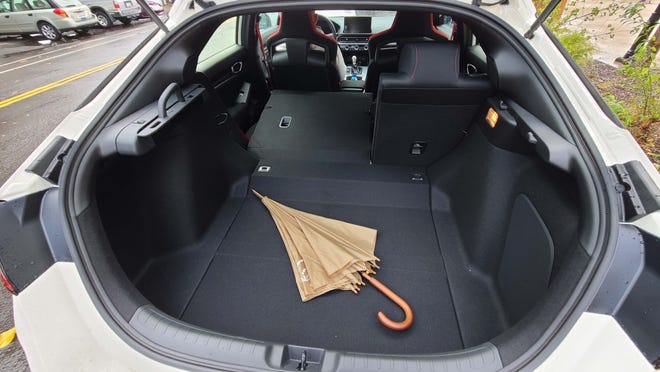
There wasn’t much sun during my test time in California, but there was enough daylight to appreciate Type R’s new design. It’s not as distinctive as Gen One, but it’s plenty muscular.
Roof and doors aside, Type R’s body panels are bespoke. The fenders bulge, contributing to the hatch’s 1.0-inch wider stance than last gen. The styling is more conservative, but body cuts are purposeful — a new hood scoop that pulls air through from the radiator for better cooling and downforce, for example. And below the more conservative wing is the Type R’s signature center-mounted tri-exhaust.
Access +R mode and the car barks — BLAT! — with more authority than last gen. That personality is key to a car that must compete with the visceral, clinical thrills of the Golf R, which has a few tricks up its sleeve like drift mode and rev matching.
Open the hatches of these twin hellions, stuff them with chairs, toolbox and Michelin Cup 2 tires, and go find a nearby track day.
Give thanks this Thanksgiving. The second-gen Type R is here.
Next week: Who needs a truck? Towing a boat with the Ford Explorer SUV
2023 Honda Civic Type R
Vehicle type: Front-wheel-drive, five-passenger hatchback
Price: $43,990, including $1,095 destination fee
Powerplant: 2.0-liter turbocharged inline-4 cylinder
Power: 315 horsepower, 310 pound-feet of torque
Transmission: Six-speed manual
Performance: 0-60 mph, 5.3 seconds (Motor Trend est.)
Weight: 3,188 pounds
Fuel economy: est. 22 city/28 highway/24 combined
Report cardHighs: Joy to drive on and off track; precise manual box
Lows: Getting pricey
Overall: 4 stars
Henry Payne is auto critic for The Detroit News. Find him at hpayne@detroitnews.com or Twitter @HenryEPayne.
Payne: The Best of the LA Auto Show
Posted by Talbot Payne on November 27, 2022
Los Angeles — Post-pandemic, Tinseltown is back in full swing and so is the LA Auto Show.
California is the biggest auto market in the U.S., and that, together with the state government’s goal of eliminating the internal combustion engine by 2035, has made it the most important show of the season. Automakers have flooded the LA Convention Center with their latest EVs in hopes of catching customers’ eye.

Significantly, some of the world’s most-ambitious EV makers — BMW, Audi and Mercedes — have bypassed LA, so there is lots of space for startups like Vietnam EV startup VinFast to fill. And though you don’t see mega-million-dollar displays of old, automakers’ new focus on activations is transforming the show floor with towering indoor tracks that you can assault with, say, a Jeep.
EVs are da bomb, but with a market this big — and EVs’ focus on luxury buyers — there is something here for everyone from trucks to supercars to affordable hatchbacks. Here are my top new cars in show.
Toyota Prius. Who knew a Prius could cause so much commotion? For its fifth generation, the ugly duckling hybrid has emerged a swan with media raves about its sculpted looks. But greens who made the Prius a hip icon have turned on their favorite son.

“This ‘hybrid reborn’ relies on a combustion engine, connected to a gas tank, further polluting our communities and atmosphere,” raged Consumer Reports when the sheets came off the new Toyota. “The climate crisis demands real actions to reduce our reliance on fossil fuels. Prius missed an opportunity to take a fully-electric step toward the future.”
Take a valium, Karen. Yes, the Prius is still a hybrid, but that’s what customers want. EVs are expensive with limited range and extra costs (tried installing a charger in your home?). So successful was the Prius in mainstreaming hybrid technology that it is no longer Toyota’s best-selling hybrid. The RAV4 SUV is. For the new gen, the Prius is not just better looking, but gets 220 horsepower and doubles EV-only range on the plug-in version.
Porsche 911 Dakar. The anti-Prius. The muscle-bound, gas-guzzling, ear-splitting 911 Dakar stole the show just as Mustang did at the Detroit auto show in September. Porsche has built its rep on the back of Le Mans race wins, but did you know they’ve won off road as well?

The 911 Dakar inherits its DNA from 1984 and 1986 racing 911s — the first all-wheel-drive Porsche — that won the famous Paris-Dakar Rallye. Today, all 911s are rear-wheel drive. So the 911 Dakar takes that formula, jacks the car up to 7.4 inches off the ground (same as a Cayenne SUV) arms it with a special steel plate underneath and tow hooks, and goes dirt kickin’.
With its 473-horse engine hanging over the rear, Pirelli Scorpion all-terrain tires, this beast should be a riot when the asphalt ends.
Charge Cars meets Ford Mustang. Speaking of the Mustang, it continues to inspire 57 years after its inception. As automakers try to inspire EV adoption, they are reaching back to the classics. Startup Charge Car — from England — brought its battery-powered ’67 model across the pond.

It’s a dead-ringer for a ’60s fastback Mustang. Except it’s built on a battery-powered chassis with two electric motors under the hood and two in the back. Slip into the modern, digital interior and it’ll silently hit 60 mph in just 3.9 seconds with 550 horsepower and 1,100 pound-feet of torque.
If Charge Cars is successful, expect more retro-EVs. “We want to take certain iconic vehicles and bring them back to life as full EVs,” said product chief Andy Wilby.
Not to be outdone, Ford is showcasing its all-new, digital-interior, gas-powered seventh-gen Mustang. The V8-powered GT looks wicked with quad pipes and sinister front headlights.
Fiat 500e. Speaking of retro, Fiat is bringing its ageless 500 badge back to the U.S., but this time as an EV-only model. When the 500 came to the U.S. a decade ago as part of Fiat’s Chrysler takeover, the wee subcompact split sales 60-40 between budget consumers and trendy lux buyers attracted to its expensive Abarth and EV variants.

This time, the 130-mile range Fiat is going all-lux as a 2024 model. “The EV market is a luxury market,” said Fiat President Olivier François in an interview. The 500e is already on sale in Europe as a premium product duking it out with Tesla. In the U.S. market, Fiat will debut with special editions wrapped by by fashion designers like Gorgio Armani.
Detroit Electric and Czinger 21C. This couple were adorable. To showcase the battery evolution in 100 years, the LA Show brought in a 1915 Detroit Electric car and state-of-the-art, mid-engine Czinger 21C supercar.
With 10 horsepower, the Detroit Electric was an electric gas-power alternative with its smooth power and easy-starter button. But its cost and lack of range got kicked to the curb by Henry Ford’s Model T. A century later, the same problems plague EVs.

Built by the father-son team of Kevin and Lukas Czinger, the 21C is state-of the-art in every respect with 280-mph top speed, 1,350-horsepower hybrid V-8 engine (solving range anxiety), 800-volt platform, and innovations like fighter-jet seats (passenger behind pilot) and extensive 3D-printed chassis pieces. It holds the production lap record at Laguna Sea Raceway, beating the McLaren Senna, for goodness’ sake.

Hyundai Ioniq 6. The sleek Ioniq 6 is Hyundai’s latest EV as the Korean brand seeks to dominate if governments outlaw ICE engines. The 6 complements the more angular 5 with the intention of improving range. The Ioniq 6 looks like the VW Beetle and a bar of soap had a baby. The result is sleek aerodynamics that achieve 340 miles of range, handily beating the Ioniq 5. Plug into a 350-kW fast charger, and Hyundai claims it will hit 80% of charge in 18 minutes.Subaru Impreza. Who says American don’t like hatchbacks? Over 70% of Subie’s reliable, affordable, entry-level Imprezas were sold as hatchbacks — so the brand decided to go hatchback-only for the 2024 model. In addition to its standard, 148-horse four-banger, the Impreza will also gain a performance RS model for the first time with 182 horses.

The interior gets a major upgrade as well with a 11-inch screen ripped from big brother Outback. And for a starting price around $24k, you can buy 10 Imprezas for the price of one 911 Dakar.Henry Payne is auto critic for The Detroit News. Find him at hpayne@detroitnews.com or Twitter @HenryEPayne.
Car, Truck, SUV of the Year: EVs dominate finalist nominations
Posted by Talbot Payne on November 17, 2022
Los Angeles — There’s electricity in the air.
Electric vehicles dominated the nine nominees for the North American Car, Truck and Utility of the Year announced Thursday. The finalists were announced at the Los Angeles Auto Show, which is showcasing EVs as the state’s government vows to ban the sale of new gas-powered cars by 2035. Winners will be announced n January in Detroit.
All three nominees for SUV of the year are battery-powered: the Cadillac Lyriq, Genesis GV60 and Kia EV6. Two of three trucks nominees, the Ford F-150 Lightning and Lordstown Endurance, are electric, while in the car category, the electric Genesis G80 EV will try to beat out two gas-powered performance icons: the Nissan Z and Acura Integra.
“Our finalists represent a diverse cross-section of the model year’s best new vehicles, ranging from sports cars to powerful pickups to three electric utility vehicles — the first time all three finalists in a category are battery-electric,” said NACTOY President Gary Witzenburg.
Lacking in that diverse rainbow is affordability. In keeping with skyrocketing auto prices, there is not a single nominee under $30,000 — and only one under $40,000, the Acura Integra — unlike years past that saw entry-level nominees like the $22k Nissan Sentra and Ford Maverick.
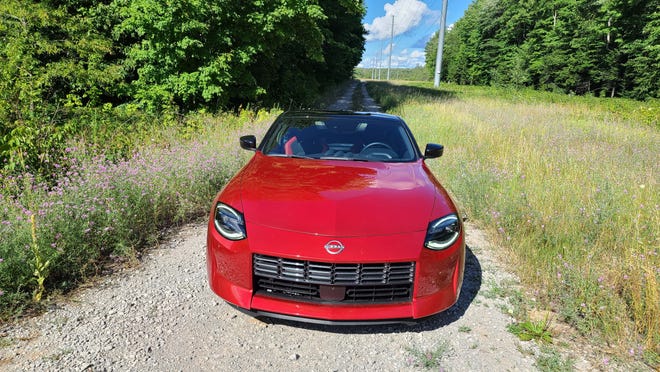
At $41,015, the Z will be the favorite for Car of the Year as it brings a blend of style and fun not seen since the fast-back coupe first turned heads as the Datsun 240Z in the early 1970s. The Acura has received muted reviews from enthusiasts with high expectations for the Integra’s return after the badge was shelved in 2006. But with a stylish interior to match its aggressive exterior and utilitarian hatchback design, the $31,895 Integra is the affordable choice. Notably, the Integra beat out the well-reviewed, $36,995 Toyota GR Corolla, a bandy-legged pit bull that squeezes 300 horsepower out of just three cylinders.
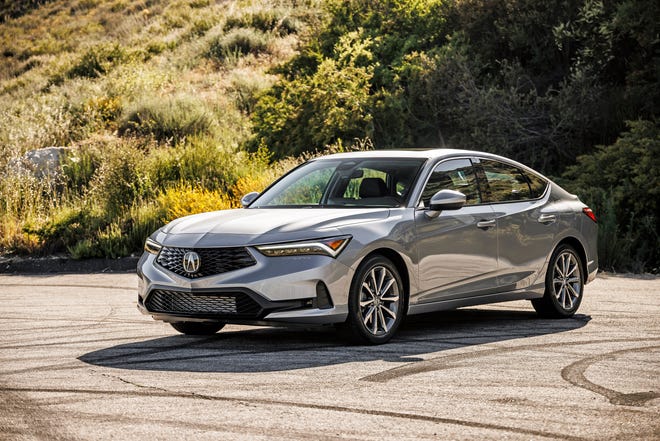
The lovely, $81k GV80 EV also scored an upset by not only beating out its gas-powered, $50k G80 twin — but also the stylish Mercedes EQE, the first electric E-Class.
The awards will be handed out by 50 journalists (including the author of this article) from print, online, radio and broadcast media across the U.S. and Canada, making NACTOY the industry’s most coveted independent award not judged by a single publication. Jurors test cars all year — 40% of the 47 eligible 2023 models were electric — then narrowed the field to 26 semifinalists before convening in October in Ann Arbor for a week’s test.
Stiff stickers are a theme this year as the average sales price hovers near $50,000. The three nominees for best SUV are above that, reflecting the $58k average price of EVs in the market today.
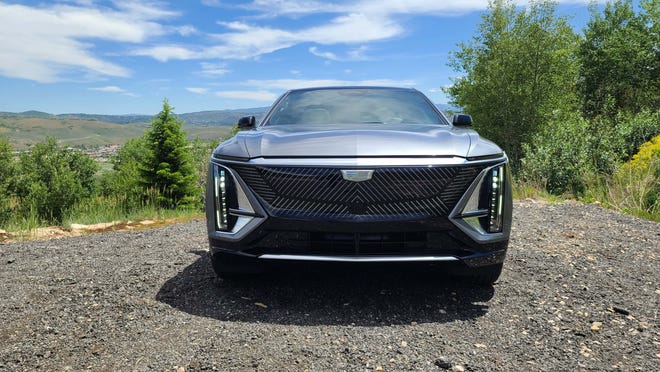
The $62,990 Cadillac Lyriq is the frontrunner as a well-executed first volley in the vaunted Detroit brand’s move to an all-electric future by decade’s end. Lyriq’s tailored interior and blingtastic grille are a return to the brand’s showy roots. It will get a stiff challenge from the Korean pair, which are built on the same skateboard battery platform.
Though a mainstream brand, the $50k Kia dresses above its social class, showing off similar luxury features to the Caddy, including a floating-island console and broad dash screen. The $60k Genesis one-ups its sibling with an array of electronic party tricks, including self-park and a Tesla-like summon feature. All three EVs will wow out of a stoplight.
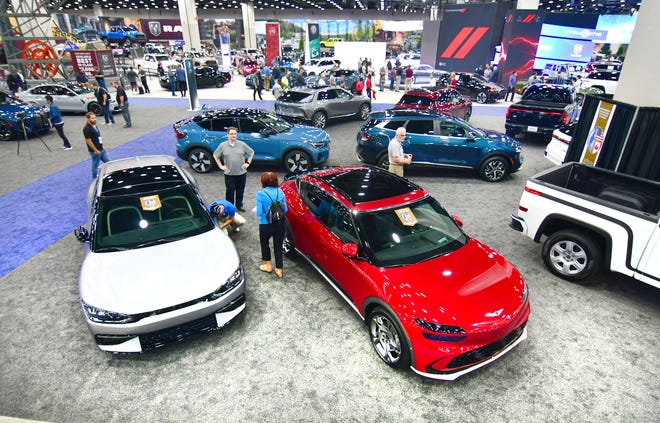
Interestingly, the pricey EVs beat out more affordable mainstream options: the Honda CR-V, Kia Sportage and Mazda CX-50. These internal combustion vehicles are popular with a public that has been skeptical of EVs with only 5% of buyers this year going electric — most of them Tesla buyers. The three ICE cars, like the EV nominees, are also showpieces for the electronics revolution that has swept the industry.
The Sportage, for example, features a stylish dash screen and Level 2 drive-assist capabilities to rival Lyriq in hands-free lane-entering and vehicle follow.
But jurors this year — tasked with evaluating vehicles based on automotive innovation, design, safety, performance, technology, driver satisfaction, user experience and value — appeared to put an emphasis on automotive innovation and user experience as EVs mature in the marketplace.
A juror poll at the October test predicted EVs will make up 10% of new vehicle sales by 2027, 25% of new vehicle sales by 2030, and 50% of new vehicle sales by 2035 as charging infrastructure grows and battery costs decline.
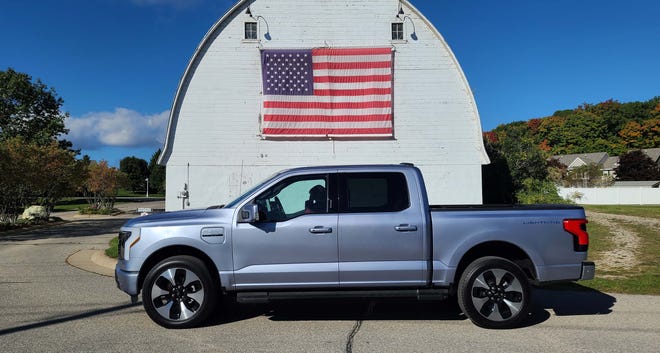
For Truck of the Year, the F150 Lightning appears a shoo-in, given its relative affordability ($54,000) next to other EV pickups like the $110k GMC Hummer and $70k Rivian R1T (a finalist in 2022). Like Rivian, Lordstown is a startup truck maker, but its Endurance is only offered in the commercial market. Nominee Chevy Silverado ZR2 is the best all-around vehicle of the three, with long-range towing ability and impressive off-road abilities thanks to state-of-the-art Multimatic shocks.
The selection of nine finalists is the next-to-last step in the year-long, NACTOY evaluation process. Final voting will take place in early January and 2023 NACTOY Car, Truck and Utility of the Year winners will be announced at a special event in Detroit on January 11, 2023.
For more information about NACTOY and its history: http://northamericancaroftheyear.org.
2023 NACTOY finalists
Car of the Year
– Acura Integra- Genesis G80 EV- Nissan Z
Truck of the Year
– Chevrolet Silverado ZR2- Ford F-150 Lightning- Lordstown Endurance
Utility Vehicle of the Year
– Cadillac Lyriq- Genesis GV60- Kia EV6
Henry Payne is auto critic for The Detroit News. Find him at hpayne@detroitnews.com or Twitter @HenryEPayne.