- Search Cartoons
- Comic Archive
-
Payne
Store



 Henry Payne RSS

Payne: How GT1 turns the iconic Ford GT into an insane, 1,400-horsepower hypercar
Posted by Talbot Payne on December 3, 2022
Pontiac — In the beginning there was the 1966 Le Mans-winning mid-engine Ford GT40 race car. Then came the 2005 GT production sports car. Then the second-generation 2016 GT supercar.
Say hello to the insane 2023 GT1 hypercar.
Riding shotgun in the GT1’s roomy right-hand seat at M1 Concourse’s Champion Motor Speedway, I secured my five-point seatbelt next to the 1,400-horsepower monster’s creator, Fred Calero. Showtime. As we rotated out of the Turn 5 hairpin onto the back straight, Calero put the hammer down. The landscape blurred. The six-speed sequential gearbox fired off rapid shifts — WHAP! WHAP! — like gunshots. The twin-turbo V-8 behind my ears roared and we exploded down the straightaway, cresting 130 mph on our way to the moon before big 15-inch brakes brought us back to earth into Turn 6.
Like injecting Superman with steroids, Calero and his engineers are taking the last 30 chassis of the first-generation 2005 GT into rare, million-dollar hypercar territory. It’s a space occupied by such hellions as the 1,160-horsepower V-12-powered Aston Martin Valkyrie, 1,300-horse V-8-driven Koenigsegg One, and 1,578-horsepower V-16 Bugatti Chiron.
Yet while boasting the latest tech tricks of these sci-fi cyborgs, the GT1 wraps its technology in the timeless, retro-design of one of the world’s most revered sports cars — powered by one of America’s most revered powerplants, the 427 cubic-inch, small-block V-8. Dressed in exposed carbon-fiber and the No. 2 decal of Bruce McLaren’s Le Mans-winning Ford GT40, the GT1 may be the most stunning hypercar on the planet.
“The Ford GT is one of America’s most iconic cars,” said Calero in the GT1 garage after our rocket ride. “And we think there is a particular passion for the more masculine lines of the 2005 GT. The GT1 is equipped with the best equipment from the best brands: Multimatic shocks, Roush NASCAR V-8, SADEV gearbox.”

GT1 is at the bleeding edge of one of the auto industry’s hottest trends: retro-fitting classic cars with state-of-the-art tech. Los Angeles-based Singer reskins 1989-94 Porsche 911s with carbon-fiber shells propelled by juiced flat-6 engines. Revology in Florida stuffs classic 1967 Shelby Mustang GT350 bodies with a modern V-8 drivetrain and interior electronics.
Born in 2005, the production Ford GT was no slouch in the performance department with a mid-mounted, supercharged 550-horsepower V-8. Its sleek body, penned by designer Camilo Pardo, reimagined the ‘66 GT40 as a production model complete with signature headlights, muscular hips, chopped tail.
GT1 takes Ford’s perfect 10 and dials it up to 11.

Its journey began as one of North America’s great “barn finds.” Calero, a successful Michigan entrepreneur and owner of a stable full of Ford performance stallions including 2005-06 Ford GTs, a Mustang GT4 race car and 2020 Ford GT, learned that Ford had retained 30 chassis of the 2005 sportscar.
They were kept out of obligation to Ford GT owners should a car be totaled or require an extensive rebuild. As the last decade drew to a close, Ford was determined to clear its decks of the old GT chassis — whether by sale or scrapyard crusher.
Calero and his partner investors bought them.
The aluminum frames look fresh from the factory, courtesy of Ford storing them in a climate-conditioned warehouse. Working out of a garage here in M1 Concourse, a private auto enthusiast club, Calero’s team hatched a plot to update the GT as a hypercar.

Thanks to Matech Concepts, a Geneva, Switzerland-based racing team, they had a blueprint. With Ford’s blessing, Matech had successfully raced six fully race-prepared 2005 GTs in Europe’s GT1 racing series from 2010-11 — with one win and three pole positions to their credit. Four cars survived and were in the hands of Carlisle Productions in Pennsylvania.
“Carlisle owner Lance Miller has been invaluable to us,” said Calero. “They’ve loaned us body panels, doors, anything we needed to make molds.”
Working from Matech’s playbook, GT1’s team went to work, led by chief engineer Jim Dunham, a retired 30-year Ford veteran who had worked on the gen-two 2016 GT supercar.
“Detroit is the best ecosystem to develop this project because of all the auto talent that exists here,” said Calero.

Dunham applied lessons from Matech’s racers and the current GT, including adding a huge front splitter, widening the GT1’s front track, improving the front clip and side rocker panels and updating the rear wing to a top-mounted configuration for better aerodynamics.
The biggest upgrade would come in the engine bay. Where the Matech GT1 race car used a 5.3-liter V-8, Calero’s team pays homage to the Le Mans-winning Ford GTs of the 1960s with a 7.0-liter V-8. Then they turbocharged it. Twice.
Blown out of its mind, the twin-turbo 427 cubic-inch beast will make upwards of 1,400 horsepower. Built by Roush Yates — the same shop that assembles Ford NASCAR engines — the aluminum-black, RY45 twin-turbo is arguably the most advanced high-displacement engine ever put in a Ford.
Its small-block, push-rod construction is crucial to accommodating the twin turbos under the Ford’s low rear deck. The engine’s racing pedigree — forged titanium intake valves, single-piece crankshaft — means it generates peak horsepower at a stratospheric 9,000 rpm and 900 pound-feet of torque from 3,700 rpm all the way to red line.

“My lead engineer said we should twin-turbo it, so we did,” smiled Calero. “When you look at really high-end exotic cars out there, we have a horsepower war and twin-turbo is a good option. We set the bar high.”
Sophisticated suspension tuning took the bar higher still. As we hurtled into Turn 6 at the end of M1’s back straight, GT1 turned into the apex like, well, a GT1 race car.
Armed with Multimatic shocks developed for the GT1, the chassis was flat, composed. A global leader in motorsports shock absorbers, Multimatic has helped teams bring home numerous Formula One, Le Mans and endurance race wins.

“We went to Multimatic in England and started developing bespoke 4-way adjustable dampers,” said Calero. “We formed a quick bond with them because of their history of developing dampers for the Matech GT1 efforts.”
On exit, the huge 13-inch rear Pirelli P-Zero rear tires — wrapped around lightweight Forgeline wheels — put the power to the road and we were off to the moon again. The interior is race-car spartan with carbon-fiber bucket seats, electronic displays and yoke steering wheel.
The GT1 prototype made its public debut at M1’s American Speed Festival in September. It will make an appearance at the Performance Racing Industry trade show Dec. 8-10 in Indianapolis. After winter track development down south, it will hit the ‘23 North American show circuit beginning with the Canadian International Auto Show in February, where it will be showcased alongside other exotics from Ferrari, Porsche, Shelby and Aston Martin. GT1 plans displays at the Amelia Island and Pebble Beach concours as well.
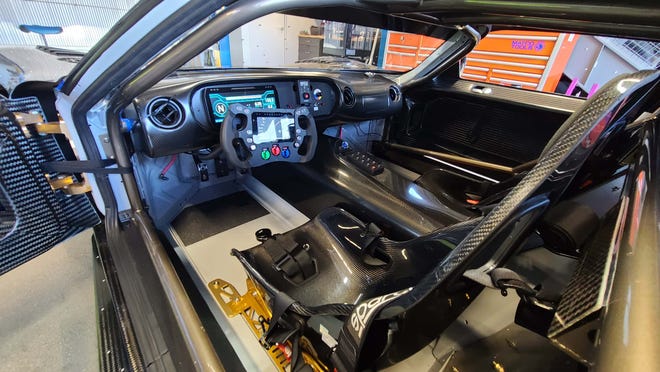
“We’ve got a lot of work ahead of us,” said Calero. “When GT1 goes into production next year, each model will be customized to the buyer’s desire.”
With each chassis authenticated by Ford Performance, customers can pick livery, wheel colors, dive planes, passenger seat and so on. They might choose slick tires, too — so they can really push the hyper-limits of this hypercar.
GT1
Vehicle type: Rear-wheel-drive, two-passenger hypercar
Price: Est. $1.2 million
Powerplant: 7.0-liter, twin-turbocharged Roush RY45 V-8
Power: 1,400-plus horsepower, 900 pound-feet of torque
Transmission: Six-speed sequential
Performance: 0-60 mph, sub-3.0 seconds (est.); top speed: 200 mph-plus
Weight: 2,750 pounds (prototype)
Fuel economy: Est. 4 mpg
Website: https://gt1cf.com
Henry Payne is auto critic for The Detroit News. Find him at hpayne@detroitnews.com or Twitter @HenryEPayne.