- Search Cartoons
- Comic Archive
-
Payne
Store



 Henry Payne RSS

Payne: 2023 Honda CR-V Hybrid gets leaner, dials up the fun
Posted by Talbot Payne on October 20, 2022
Sisquoc, California — Amidst the rolling fields of wineries, bean and corn is Martin Marietta’s massive Sisquoc Asphalt plant on a lonely stretch of Foxen Canyon Road here. Lonely except for a steady stream of semis pulling dual-trailer trucks. Like oversized ants, they scurry to-and-from the plant every day filling up on asphalt mined and processed from an estimated 11 billion tons of deposits hidden across 38,000 acres of Santa Barbara County. The asphalt has paved the ribbons of road that allow vehicles access to the region’s bucolic wineries and scenic views.
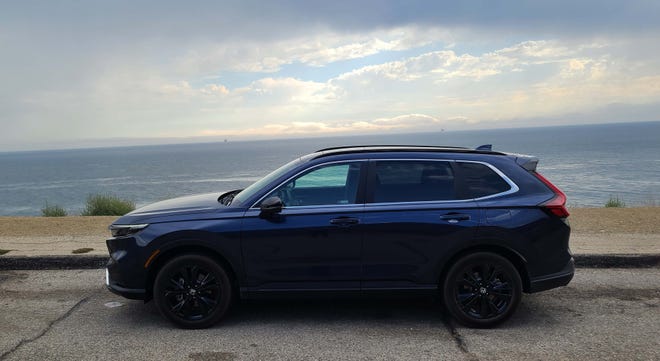
Vehicles like my 2023 Honda CR-V tester.
With its instant 247 pound-feet of torque, my CR-V made quick work of the occasional 75-foot double-semi — the length of a tennis court — as I hustled to lunch at the nearby Zaca Mesa Winery. Leave it to Honda to make hybrids fun.

In fact, Honda doesn’t even call its hybrids “hybrids” anymore. The CR-V debuted a gas-electric powertrain in 2019 in the EX-L Hybrid and Hybrid Touring trims. Taking a page from Ford (another pretty good performance brand) for 2023, the CR-V hybrids get macho black trims and wheels — and Sport and Sport Touring badges.
Sure, the hybrid claims typically sippy 37 mpg, but I didn’t come anywhere close to that on my 130-mile lunch commute from Santa Barbara, passing double-semis, carving canyon roads and merging into highway traffic with authority. My Sport Touring model registered a real-world 28.8 mpg.

With all of its 247 foot-pounds of twin-electric-motor torque on tap at 2,000 RPM, the hybrid with its 2.5-liter powerplant is quick out of the chute for merging and for passing zones. Credit, too, goes to a so-called e-CVT transmission, which responded to my Size 15 lead foot with smooth power — complete with electronically-programmed “steps” to mimic the shifts of a traditional, multi-speed cog transmission.
The CR-V was no Mazda CX-5/CX-50. Mazda’s terrific-handling SUV is my benchmark for the class with its massive 310-torque turbo-4 and milky-smooth 6-speed tranny, but the sixth-gen CR-V is a nice step up from the last-gen ute.
Whether the bigger engine its a step up from the CR-V’s standard 1.5-liter turbo-4 is another question.
The turbo-4, of course, is the same engine found in Honda’s halo King Civic — slayer of the compact car segment — and benefits from similar CVT magic as the hybrid. Over Route 101 toward twisted Aliso Canyon Road, I repeatedly stomped the accelerator, and was always met by a silky response — no jerks, no lags — of electronically programmed “shifts” propelling CR-V just like Civic.
With governments threatening massive fines if automakers don’t go all in on EVs over the next decade, Honda decorates the CR-V with EV toys like regenerative paddles to get you in the mood for the transition to full battery power. With sales volume of 400,000 a year, the CR-V certainly has room for EV models, but don’t expect mass adoption anytime soon.
The turbo-4 starts at $32,355, with the hybrid Sport model upping the ante by $1,300. Higher EX-L and Sport Touring models add goodies like leather seats, heated steering wheel and wireless Apple CarPlay/Android Auto. Weigh the Honda against a competitive set of CX-5/CX-50, Ford Escape Hybrid Sport and Kia Sportage, and you’ll find sub-$40K automobiles loaded with tech — adaptive cruise control, blind-spot assist, auto braking — found on luxe vehicles costing 15 grand more.
If you’re not willing to cough up $40K, then take a look at Honda’s HR-V and Mazda’s CX-30. They are similarly equipped for 10 grand less — but with less compelling drivetrains.

Crucially, CR-V earns its keep in this elite group with a major styling upgrade for 2023 both inside and out. Once again, credit King Civic for inspiration.
CR-V’s busy, blingy styling was eye-catching a decade ago, but it’s grown jowly with age. Gen 6 takes the stage with a leaner, more timeless appearance, while keeping signature touches like the batwing rear taillights. The powerful shoulders are right off the Civic. The bold grille? Think Accord.
Inside, CR-V adopts Honda’s modern, horizontal design language with digital screens, honeycomb dash accent — before tending to much-needed housekeeping.

That where-the-heck-is-the-steering-column adjuster that seemed halfway inside the engine compartment on the 5th gen? It’s now a proper switch on the left side of the column. The space-efficient-but-hand-cramping trigger shifter? Gone, replaced by a proper shifter stalk.
Other welcome details remain.
CR-V set the bar for second-row seating last generation with doors that opened 90 degrees to the body. That gave easy ingress to roomy rear seats that would swallow six-footers with ease. The 90-degree doors are back, and the rear seat room is expanded to boot.

After lunch, I folded my big frame into the backseat to catch up on email. If only Delta coach were this comfortable. The rear seat even reclined.
CR-V’s goal is to be competent in everything without pushing the envelope on one thing. The Mazda is a sports car in ute clothing. Kia’s Sportage is on the cutting edge of tech with a hoodless, curved screen and Level 2 self-driving nearly on par with Cadillac Super Cruise.
The Honda won’t let you self-drive with your hands on your knees for long spells like Kia, but it maintained the lane so that I could, say, manage Sirius XM stations and read text messages when they came in over the wireless Android auto system.

Honda still offers an in-house navigation system (perhaps because an EV version will need it to navigate to chargers), but its smartphone connectivity makes it easy to hook up your phone by wire with the standard 7-inch screen — or wirelessly via the 9-inch upgrade. Worried about your phone running out of juice when navigating wirelessly? The Sport Touring model offers a big charging pad to maintain charge that worked even with my massive Samsung Galaxy S20 (which didn’t fit in the last-gen CR-V).
A lot of Hondas have driven over Sisquoc Asphalt’s product in Santa Barbara County over the years. Civic is an American icon, Accord stole Ford Taurus’s crown as best-selling sedan in 1989, and now the CR-V has become Honda’s best-selling U.S. model — one of the three top-selling non-pickups in the land along with the Nissan Rogue and Toyota RAV4.
With similar Hybrid ambitions, RAV4 is CR-V’s closest competitor. But the chunky RAV-4 takes its design cues from the off-roady Tacoma pickup. With its sleek styling and stylish interior, CR-V is a Civic on stilts.
When another asphalt truck looms, its accelerator pedal is eager to please.
Next week: Road trip! Ford F-150 Lightning EV
2023 Honda CR-VVehicle type: Front-engine, front- and all-wheel-drive, five-passenger compact SUV
Price: $32,355, including $1,245 destination fee ($39,845 Sport Touring model as tested)
Powerplant: 1.5-liter turbocharged, inline 4-cylinder; Hybrid 2.5-liter inline-4 mated to twin electric motors
Power: 190 horsepower, 179 pound-feet of torque (turbo-4); 204 horsepower, 247 pound-feet of torque (hybrid)
Transmission: Continuously variable automatic (CVT) in turbo-4; electronic CVT in hybrid
Performance: 0-60 mph, 7.9 seconds (Car and Driver). Towing: 1,500 pounds (turbo-4), 1,000 pounds (hybrid)
Weight: 3,926 pounds (AWD hybrid as tested)
Fuel economy: EPA, 27 mpg city/32 highway/29 combined (AWD turbo-4); 40 mpg city/34 highway/37 combined (hybrid)
Report card
Highs: Crisp styling; roomy interior
Lows: Real-world hybrid fuel economy shy of specs; no more sub-$30K entry model
Overall: 4 stars
Henry Payne is auto critic for The Detroit News. Find him at hpayne@detroitnews.com or Twitter @HenryEPayne.