- Search Cartoons
- Comic Archive
-
Payne
Store



 Henry Payne RSS

Payne: Ford completes a radical remake for the Age of Ute
Posted by Talbot Payne on October 12, 2021
Nashville — Ford has made national headlines with billion-dollar battery investments in Tennessee and Kentucky as it explores future electric-vehicle markets. But the news has overshadowed a remarkably fast transformation of the Blue Oval brand from a car-and-truck maker to an SUV-and-truck maker.
With the Ford Maverick, Ford’s entry-level vehicle is now an SUV-based pickup truck — not a Focus or Fusion sedan. Indeed, a brand that just a generation ago made the country’s best-selling Taurus sedan doesn’t have a single four-door car in its lineup.

The Maverick headlines an appealing, gas-powered compact SUV lineup — Maverick/Bronco Sport/Escape — that is one of the most innovative in the industry’s highest volume, non-pickup segment.
“As we exit sedans, it’s an opportunity to bring value/affordability into the marketplace,” said Todd Eckert, marketing chief for Ford trucks, of the SUV triplets at the Maverick’s media test in Nashville. “At an entry price-point, (they) give customers a choice. We have options: traditional SUV with the Escape. Bronco Sport for a more rugged off-road environment. And with Maverick, the opportunity to combine affordability and the flexibility of a pickup box.”
Ford is making this value appeal with a shrewd strategy that leverages iconic sub-brands far beyond their traditional niches: Bronco, pickup trucks and Mustang sports car. The latter brand has been expanded far beyond its traditional muscle car segment to introduce a Tesla Model Y-fighting electric SUV.
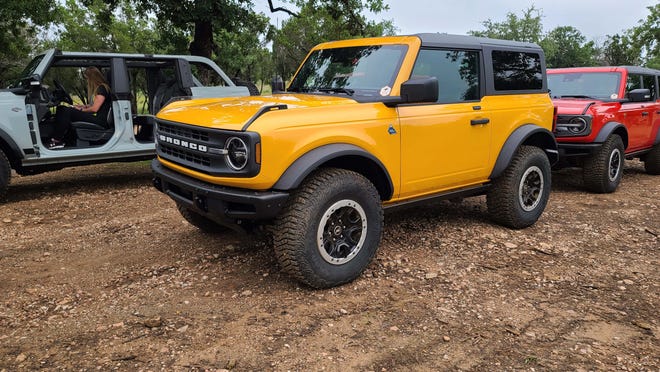
“They have figured out how to marry these sub-brands to a wider consumer for the 21st century,” said ISeeCars.com executive auto analyst Karl Brauer. “If you take an SUV and give them added capability, then you can appeal to customers who aren’t traditional Ford buyers.”
Buyers like Jeremy Ingram, 47, of Oakland Township. Ingram has bought both a Bronco and a Maverick, despite having never owned Fords in those vehicle segments before.
Ingram buys vehicles for fun. He and his wife sold their Roxor side-by-side off-roader and convertible VW Bug in order to buy the Bronco.
“I’ve been looking forward to this vehicle for a long time,” smiled the off-road fan, who has helped build the Holly Oaks ORV park. Ingram had resisted buying a Jeep Wrangler — long the king of the dirt — due to its cramped interior and rough on-road ride. The rugged Bronco is in his sweet spot with a roomier interior and smoother-riding, independent front suspension.
He has a Maverick on order as his daily driver for its maneuverability and 500-mile hybrid range — while still providing the bed utility he got with a big, thirsty F-150. If his Maverick works out, he plans to buy others for his contractor business. “I like the fuel economy, it keeps costs down,” he said.
For customers like Ingram, Maverick has instant credibility despite its smaller size due to brand cred Ford has earned over 40 years as America’s best-selling truck-maker.
“This is a breakthrough for us and the industry. We feel like it extends the Built Ford Tough lineup,” said Ford’s Eckert. “We’ve been watching customers in terms of affordability and maneuverability. Maverick is the first standard hybrid in a pickup. Forty mpg, 500 miles of range — giving a 1-2 punch of maneuverability and efficiency.”
It’s hard to understate the dramatic shift in the U.S. auto market in the last decade. In 2010, sedans made up 51% of non-pickup truck sales as the country flirted with $4-a-gallon gasoline and buyers cut back during the Great Recession. Today, SUVs make up more than 70% of such sales.
As recently as 1992, the Ford Taurus sedan was the best-selling car in America with more than 410,000 units. Today the Taurus (and its Fusion stablemate) have disappeared and the Toyota RAV4 SUV is the non-pickup sales king at more than 400,000 units.
Credit the fracking revolution and cheap gas as far as the eye can see — and car-like chassis designs that make, say, a unibody Ford Explorer SUV ride like a magic carpet compared with its truck-based ancestors.
“After a couple of decades making money-making SUVs and money-losing sedans, automakers figured out how to make SUVs drive more like cars,” said Brauer. “The Maverick is a truck that, in reality, is an SUV that feels as car-like as possible.”
The Maverick is built on the same compact unibody skeleton as the Escape and Bronco Sport. Ford says its future is electric, but for now customers want more affordable petrol power. The 2021 Bronco Sport is outselling the 2021 Mach-E by a ratio of 6-1.

Fiat Chrysler Automobiles was first to recognize the SUV revolution. The Stellantis predecessor ditched sedans and leveraged the iconic Jeep name to lead its own brand reinvention — the Wrangler SUV leading a Jeep sales parade that exploded from 231,701 units in 2009 to 923,291 in 2019.
Ford dusted off its own Bronco off-road icon and followed the Jeep model.
“Ford learned from Jeep,” said Brauer. “The unibody Grand Cherokee was the first no-compromise SUV with on-and-off-road capability. Ford is doing that with the unibody Bronco Sport that brings durability, capability — and looks cool.”
The Ford and FCA strategy makes an interesting contrast to that of cross-Motown rival General Motors.
The General has leveraged powerful luxury brands Hummer and Cadillac to compete against luxury automakers like Tesla and Audi in the $60,000-plus EV space. In so doing, the Detroit automaker aims to prove the efficacy of all-electric platforms for more mainstream EVs like the Chevy Bolt EUV.
GM, once a pioneer in hybrids, has abandoned the technology. But like Japan’s Toyota, Ford and Jeep have embraced it as a more affordable, fuel-efficient tech for mainstream buyers.
The Maverick (which shares its hybrid drivetrain with the pricier Escape) is the cheapest hybrid sold in the U.S. market — starting at an eye-opening $21,490.
“I’m disappointed in GM. They were ahead of their time with plug-in hybrids,” said Brauer. “But they walked away from them in order to pursue pure EVs. Toyota has stuck with hybrids and that is where the consumer seems to be.”
GM has receive rave media and environmentalist reviews for its zero-emissions strategy while Toyota has been widely shamed. But Ford and Jeep are following Toyota’s path with, respectively, the Escape Hybrid Sport and Wrangler 4xe Plugin Hybrid in high-volume, mainstream segments.
For the pure EV space, Ford is competing in the $40k-plus bracket against the Chevy Bolt by leveraging its sexy Mustang and F-150 sub-brands to make the Mach-E SUV and Lightning pickup EVs.
One hundred years after the tall Model T led a transportation transformation, Ford is betting the farm that its high-riding Bronco/F-150/Mustang brands can win SUV and electrification revolutions.
Henry Payne is auto critic for The Detroit News. Find him at hpayne@detroitnews.com or Twitter @HenryEPayne.