- Search Cartoons
- Comic Archive
-
Payne
Store



 Henry Payne RSS

Blog Editorial Cartoons
Cartoon: Court Tows Trump Trade War
Posted by Talbot Payne on June 2, 2025

Payne: Flat out on Circuit of the Americas in the 1,064-horsepower Corvette ZR1
Posted by Talbot Payne on May 31, 2025
Circuit of the Americas, Texas — RAAAAAWWWWWWRGH! At 155 mph, the glorious sound of my 2025 Chevy Corvette ZR1’s V-8 echoed off Circuit of the Americas’ pit straight grandstands before climbing 13 stories into the Formula One race track’s iconic Turn 1. At the 150-foot marker, I buried the left pedal, and massive brakes slowed my rocket ship to a crawl for the 90-degree hairpin — the automatic gearbox downshifting rapidly from 5th to 4th to 3rd to 2nd – WHAP! WHAP! WHAP!
At the turn’s 133-foot summit, the King of Corvettes seemed to pause, as if surveying its domain, before plunging down to Turn 2.
This is rare air.

With an astounding 1,064 horsepower, ZR1 is the most powerful ‘Vette ever and the latest member of an elite club of quadruple-digit-horsepower supercars. Down the slope through Turn 2, the ‘Vette’s acceleration was ballistic. With the V-8 howling behind my ears, I stormed towards the technical Turn 3-4-5-6 esses complex like a four-wheeled tsunami. Powerplant engineer Dustin Gardner says it “feels like you’re strapped to an aircraft carrier. You’re getting fired off in a jet plane.” I’ve never been launched off a carrier, but ZR1 feels like it must be close.
Credit the addition of the largest pair of turbochargers on the planet to the screaming, 5.5-liter, flat-plane crank engine out of the Corvette Z06/C8.R GT3 race car. But this is no stoplight drag queen.
At $174,995, King ZR1 goes toe-to-toe on the world’s greatest tracks (like COTA) with $1 million-plus cyborgs like the 1,063-horsepower, $2.7-million Mercedes-AMG One and 1,160-horse, $3.5 million Aston Martin Valkyrie.

Henry Payne, The Detroit News
The ‘Vette’s secret sauce? The same mid-engine chassis that undergirds the standard, $70,195, Corvette C8 — the first ‘Vette in eight generations to move the engine from front to rear. Then Corvette engineers weaponized it.
This thing has more artillery hanging off it than an F-15 fighter jet.
Sticky 10.8-inch wide front/13.6-inch rear Michelin Pilot Sport Cup 2 R tires (Pilot Sport 4S standard). 15.6-inch carbon-ceramic brakes (the largest in Corvette history). Towering rear wing, dive planes and a wing-shaped front splitter for sucking the beast to the ground. Then there’s the LT7 engine — turbos wrapped around its sides like a pair of pythons.
The result is the ‘Vette changes direction through COTA’s esses like Cade Cunningham doing a dribble cut down the lane for a slam dunk. This dexterity of power and nimbleness enables inane performance (not unlike 6’6” guard Cunningham).
The ZR1, driven by its own engineers, has clobbered production-car lap records from coast to coast.
Road America, Wisconsin: 2.08.6 minutes. That’s seven seconds quicker than the Sports 2000 SCCA race class I compete in with 1,350-pound, bespoke race cars that weigh nearly a third less than the 3,950-pound ‘Vette (but ZR1 has seven times the horsepower).

Henry Payne, The Detroit News
Watkins Glen, New York: 1:52.7 minutes
Virginia International Raceway: 1:47.7
Road Atlanta, Georgia: 1:22.8. To put that in perspective, Lead Development Engineer Chris Barber’s lap time was just shy of the fastest race lap of 1.22.1 recorded last October at the IMSA Weathertech Sportscar Series Petit Le Mans race by the 2,700-pound Corvette C8.R race car on racing slicks driven by pro factory drivers Alexander Sims and Antonio Garcia. I’m not making this up.
Want more numbers?
I hit 176 mph on the back straight at Circuit of the Americas. That is 40 mph faster than both my Lola S2000 racer and the standard, 495-horse ‘Vette Stingray.

Henry Payne, The Detroit News
It’s 20 mph faster than the Corvette Z06 equipped with similar tires and 670-horsepower V-8 engine revving to 8,600 RPM.
At Road America, the ZR1 hit 188 mph on the front straight, faster than an IndyCar’s 185 mph. Lucky the ZR1 pace car pulled off after its pace laps at this year’s Indy 500 — or it might have won the race.
Yet, thanks to its 1,200 pounds of downforce, magnetic ride shocks, electronic limited slip differential (eLSD for short) and other performance toys, the ZR1’s ballistic power was surprisingly easy to drive fast around this high-speed F1 circuit. It’s predictable and well balanced, with linear acceleration courtesy of no discernible turbo lag.
Just respect the 828 pound-feet of torque.
Unlike my, ahem, Lola’s normally-aspirated 2.0-liter engine, the beast behind your ear in the ZR1 must be let loose progressively, not all at once (or be prepared for lurid slides).
Take it to a track day, and ZR1 won’t wear you out. Neither will it wear out — a key competitive advantage of Corvette’s development by one of the world’s best manufacturers.

Henry Payne, The Detroit News
This is a point of pride to Porsche GT2 and GT3 owners as well. Those cars run like trains, which is why you find so many at race clubs. Porsche (and Corvette) put their cars through extensive, grueling 24-hour, high-speed durability tests. There’s nothing worse than buying your expensive, exotic dream car and taking it to the shop all the time.
After finishing a track day on America’s premier F1 circuit (or M1 Concourse in Pontiac), King Corvette is comfortable commuting home with the rest of the peasants.
The interior houses the same luxurious stitched leather and digital screens that you’ll find in the base Stingray. It’s a personal favorite (only to get better with a 2026 update) with its square steering wheel for better viewing of the instrument display, thoughtful ergonomics, and camera mirror to see out of the narrow greenhouse. Magnetic ride shocks come with a variety of drive modes for everything from track performance to comfort on the street.

Henry Payne, The Detroit News
That’s a contrast to Porsche GT3 cars — my benchmark for the best handling supercars — but that come with compromises like harsh suspensions, stiff rides, uncomfortable sets. Corvette engineers call them “20-minute cars”: they’re supreme for 20 minutes on track, but drive them any longer than that on street and you’ll be black and blue.
Corvettes are big cars made for big folks. Like me. The rear hatch will swallow my big tennis bag — or your golf bag. Need more storage? There’s a frunk like a Porsche 911.
Purchase a ZR1 and you gotta track it. Allow me some suggestions: 1) Buy the coupe for better headroom (over the convertible); 2) set aside money for tires (Cup 2 Rs don’t last long channeling 1,064 horses); and 3) sign up for the Corvette Racing school in Pahrump, Nevada (free for ZR1 buyers).
Because you’ll never know the envelope of quadruple-digit horsepower until you’re at triple-digit speed on a racetrack.

Henry Payne, The Detroit News
2025 Chevrolet Corvette ZR1
Vehicle type: Mid-engine, rear-wheel-drive, two-passenger supercar
Price: $174,995 base including $1,395 destination ($189,680 LT1 coupe and $200,180 convertible models with ZTK Package as tested)
Power plant: 5.5-liter, twin-turbo V-8
Power: 1,064 horsepower, 828 pound-feet of torque
Transmission: 8-speed automatic
Performance: 0-60 mph, 2.3 seconds (Car and Driver); top speed, 233 mph
Curb weight: 3,800 pounds (Coupe est.)
Fuel economy: EPA 12 mpg city/18 mpg highway/14 mpg combined
Report card
Highs: Ballistic acceleration; state-of-the-art interior
Lows: Will drink the Permian Basin oil field dry for a track day
Overall: 4 stars
Henry Payne is auto critic for The Detroit News. Find him at hpayne@detroitnews.com or @HenryEPayne.
Cartoon: Harvard Government Funding
Posted by Talbot Payne on May 30, 2025

Cartoon: California EV Mandate Lemon
Posted by Talbot Payne on May 30, 2025

Payne: Midwest-friendly Hyundai Ioniq 5 XRT sports all-terrain tires, NACS charging
Posted by Talbot Payne on May 30, 2025
Franklin — With its raccoon-like black details, the Hyundai Ioniq 5 XRT is instantly recognizable as a new, 2025 off-road trim for the brand’s electric hatchback. It sports a black mask, black wheels, black wheel arches etched with “digital camouflage” graphic, and black mirrors. XRT for Xtra Raccoon Trim.
But what Michiganians will really appreciate about the latest member of the I5 family is its Tesla-like NACS charging port and all-terrain tires.
“WHUMP! WHUMP! WHUMPA! WHUMP WHUMP!” we went across 14 Mile’s pothole-pocked dirt road, one of many across Metro Detroit. These dirt roads are bad enough in summer but come spring they are really fraught after a harsh winter, particularly in premium vehicles with low-profile tires like the standard 19-inch-wheel Ioniq 5.

Henry Payne, The Detroit News
Residents along these roads are best served by rugged mules like pickups, Jeeps, Broncos and other off-roaders. For EV fans, the I5 XRT allows them to pair battery and brawn. Just choose the ALL-TERRAIN button on the steering wheel spoke to soften the ride. “WHUMP! WHUMP! WHUMPA! WHUMP!” The high-profile Continental CrossContact ATR tires cushioned the blows as I weaved my way west …
… toward a Tesla Supercharger station.
Tesla, of course, has won the charging wars, defeating the industry-favored standard for bulky, five-prong CCS charging ports with its leaner, two-prong so-called North American Standard (NACS for short) plug. Combined with the Texas automaker’s ubiquitous reliable network of fast chargers, it has forced competitors to reluctantly succumb to consumer preference. NACS it is.
With customers screaming about fickle third-party DC chargers, EV makers have rushed to buy access to Tesla’s reliable network and Hyundai is one of the first automakers to — not just enable access to Superchargers for its clients — but also to equip their cars with NACS ports just like a Tesla.

Henry Payne, The Detroit News
Hyundai NACS has its hiccups, however. I was unable to connect to the 240-volt Tesla charger in my garage (I own a Model 3) because it was a 2018 NACS, which doesn’t sync with the Hyundai’s 2025 NACS plug. Something about software.
Neither could the Hyundai charge on my 240-volt, J1772 Juicebox garage charger that I use to charge non-Tesla EVs with CCS/J1772 ports. If this sounds complicated to folks used to simply stuffing a nozzle into a fuel filler, it is. And it is a reason EVs have proved to be niche vehicles in the U.S. market.
Stymied at home, I used I5’s native navigation system to locate the nearest Tesla Supercharger in Northville 12 miles away. I’d been before, the last time in June 2024 with a Ford Mustang Mach-E (Ford being the first automaker to gain access to Tesla’s network).
The Ioniq 5 was much easier to fill. And not just because it has a NACS port that the Tesla cable slipped into as easily as, well, a Tesla.
Hyundai also had the good sense to locate its NACS charging port on the rear corner of the vehicle like Tesla (right rear for I5, left rear for Tesla), meaning I simply backed the XRT up to the charger and connected the port. The Mach-E, like most EVs, locates its charging port behind the left front wheel, meaning I had to park the ‘Stang against the curb for the cord to reach. Combined with the bulky CCS/NACS adapter required for the Ford, it takes effort.

Henry Payne, The Detroit News
You don’t need an adapter to charge the 2025 Hyundai, but you need a Tesla app. Download it. Add the Hyundai to its vehicle list. Then locate the Supercharger where you want to charge. Not all Tesla chargers are available to non-Tesla customers, but the Northville charger was, happily.
I plugged in, and my steed slurped electrons.
Northville is one of the busiest chargers in Metro Detroit, evidence that Tesla’s open-charger policy is catching on. Eight of the nine stalls were occupied on a Tuesday afternoon, with EVs including a Mustang Mach-E and Rivian R1S as well as the usual assortment of Tesla Cybertrucks, Model 3s, Ys and Ss.
Hyundai has upped the range on AWD models for 2025 to 290 miles (XRT clocks in at 259 with its all-terrain tires). That’s plenty for metro travel, but having the option of more chargers (like more gas stations for an internal combustion-vehicle) makes road trips less stressful.

Henry Payne, The Detroit News
On a recent road trip to two-hours-from-anywhere — Sebring, Florida, for example — the only charging station in town was a Tesla Supercharger.
Hyundai, of course, does not have the cachet of the Tesla brand, and two friends recently opted to buy Model 3s as their first EVs. If you’re shelling out $50K for a car, brand matters.
But for those who want something different, my $56K XRT tester is a shockingly sophisticated (pun intended) EV. It’s roomy, utilitarian … and quick. (For $10K less, its I5 siblings begin at $46K and offer many of the same attributes.)
Merging onto I-696 on my way home, I dialed the steering wheel drive button (like a Porsche) to SPORT and buried my right foot. ZOT!

Henry Payne, The Detroit News
Acceleration is, well, bioniq. Car and Driver clocks its 0-60 mph sprint at 4 seconds. Settling into the drive, I told the Ioniq to detour to Popeyes for lunch, and directions quickly appeared on the big, hoodless 24.6-inch jumbotron in front of me.
Where Hyundai comes up short is in hands-free driving, where Tesla and General Motors lead the way. Set a destination on a Tesla and it will self-drive there. It’s a feature prized by my pals. A Caddy EV, too, will go hands-free on most divided highways. Not Ioniq 5.

Henry Payne, The Detroit News
My XRT’s adaptive cruise control system automatically changed lanes (like its EV competitors) when I tugged on the turn stalk — but otherwise required I keep a hand on the wheel. Worse, it nannied me constantly to watch the road even when my eyes had never left it. Sheesh, take a valium.
But that camera watching me suggests Hyundai plans over-the-air updates and Ioniq 5 should get more capable with time. High 5.
Next week: 2025 Nissan Murano and Titan
2025 Hyundai Ioniq 5
Vehicle type: Battery-powered, rear- and all-wheel-drive, five-passenger hatchback
Price: $44,075, including $1,495 destination fee ($56,875 XRT as tested)
Powerplant: 63 kWh or 84 kWh lithium-ion battery with single or dual-electric-motor drive
Power: 225 horsepower, 258 pound-feet of torque (RWD); 325 horsepower, 446 pound-feet of torque (AWD)
Transmission: Single-speed automatic
Performance: 0-60 mph, 4.5 seconds (Car and Driver, AWD as tested); top speed, 115 mph
Weight: 4,707 pounds (XRT as tested)
Fuel economy: EPA range: 245-318 miles (259 miles, XRT as tested)
Report card
Highs: NACS charge port; Michigan-friendly XRT trim
Lows: Pricey; hands-free driving, please
Overall: 3 stars
Henry Payne is auto critic for The Detroit News. Find him at hpayne@detroitnews.com or @HenryEPayne.
Cartoon: Senate Repeals California Emissions Exemption
Posted by Talbot Payne on May 28, 2025

Cartoon: Trump Mideast Trip
Posted by Talbot Payne on May 23, 2025

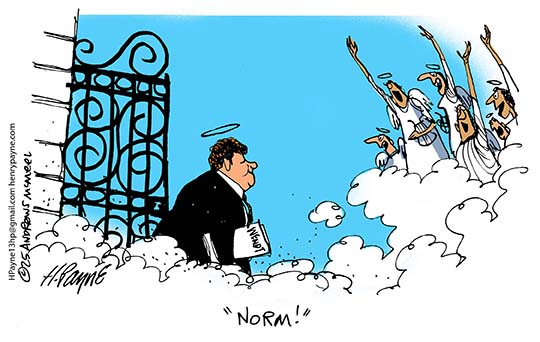
Cartoon: George Wendt RIP
Posted by Talbot Payne on May 23, 2025
Payne: Hands-free in the Caddy ‘Baby Escalade’ Vistiq
Posted by Talbot Payne on May 22, 2025
Chelsea — The Baby Escalade is Cadillac’s most mature electric vehicle.
The Vistiq is the fifth and final piece in the GM luxury brand’s EV squadron and, at $79,290, its combination of size, speed and tech make it the best value of the quintet. That value is relative as Caddy’s EV lineup makes a big move to the ultra-luxury EV market (led by its $340K Celestiq flagship) over its outgoing internal combustion models. Expect the EVs to cost $20,000-$40,000 more than their ICE peers.
My all-wheel-drive Luxury model asks a 30-grand premium over the comparable $50K gas-powered XT6 Luxury model, which is retiring after this year.

Henry Payne, The Detroit News
On Patterson Lake Road’s rollercoaster in Livingston County, I confidently leapt from turn to turn in the three-ton, three-row, three-story Vistiq despite its girth. Thanks to the 102-kWh battery’s location in the basement, my tester sported a low center of gravity to stay planted through the twisties.
That low CG is an EV trait — but in the smaller Optiq and Lyriq crossovers, it’s, um, outweighed by a lack of nimbleness compared to their 1,000-pound-lighter internal-combustion engine peers. In a three-row SUV class where everything tips the scales over two tons, however, the low CG stands out. Add rear-wheel steer in upper Premium Luxury and Platinum trims, and this is a rhinoceros in tennis shoes.
The rear-drive feature is shared with Papa Escalade IQ, but the electric family’s patron will set you back another (cough) 40 grand. ZOT! I buried my right foot and Vistiq hit 60 mph in a fantast-iq 3.9 seconds merging onto I-94 West. Baby Escalade coming through!
Vistiq is also a technology showpiece. Without taking my eyes off the road, I toggled the raised adaptive cruise switch on the steering wheel and set my speed at 75 mph, then fingered a nearby braille pad for Super Cruise. The steering wheel lit green for hands-free driving.

Henry Payne, The Detroit News
While Baby Escalade took over driving duties, I rearranged icons on the 33-inch curved dash screen as I would my phone. I dragged icons for DRIVE MODES, CHARGING and SELF PARK ASSIST (features I used frequently) to the left side of the screen.
GM pioneered hands-free driving in 2017, and has been neck-and-neck with Tesla ever since. Tesla’s Full-Self-Driving system leap-frogged GM cars last year when it went hands-free with navigation, enabling its cars to take you door-to-door across secondary roads and divided highways. Super Cruise is slowly adding secondary roads to its network of mapped, divided highways — but it won’t navigate.
What it will do, like Tesla, is automatically change lanes. At 75 mph, Vistiq sensed slower traffic, automatically applied its turn signal, moved into the fast lane and swept by a line of cars. Safely clear, it automatically pulled back into the slower lane. Terrif-iq.

Henry Payne, The Detroit News
Approaching my off ramp, Tesla FSD would automatically transition to the slower secondary road. The Caddy? It handed driving duties back to me, the steering wheel light turning red.
Super Cruise comes standard on Vistiq for three years, plenty of time for owners to learn the system. You won’t want to go back. Not standard is an augmented reality head-up display available on Premium Luxury and Platinum trims. Caddy’s been a HUD pioneer, and AR advances the game by placing directions over the road ahead. Alas, my standard Luxury version did not option even a regular head-up display. Neither did it have a frunk for storage like the Escalade IQ — or Rivian and Tesla models.
Baby Escalade doesn’t have big brother’s curved, A-pillar-to-A-pillar 55-inch jumbotron, but the 33-incher does just fine, thank you very much. Especially as the touchscreen is paired with the same console climate touchscreen found in Escalade. Like a scarf and mittens, they make a nice pair.

Henry Payne, The Detroit News
Not that I touched them much. Vistiq is powered by Google Built-in, so I could talk to the car for many of my needs.
Hey, Google, turn the driver’s side temperature to 68 degrees.
Hey, Google, tune to Sirius XM Comedy Greats.
Hey, Google, Tell, me a joke.
Google: How do trees access the Internet? They log in.
Hey, Google, what was the score of the Tigers game?
Google: The Tigers won on Wednesday, 6-5 against the Red Sox.

Henry Payne, The Detroit News
Pick up the kids from school in my Luxury tester and it will fit seven passengers across three rows including bench, second-row seats (captain’s chairs optional). Even the third row is comfortable, accommodating my long 6’5” frame. If the second row is empty, I encourage taking a seat in the third row. I dropped the second-row bench seat and used it like an ottoman — stretching my legs so I could work on my laptop.Longer trips, however, are three-row EVs’ kryptonite. The Escalade IQ is so expensive because it packs a mighty 202-kWh battery with 460 miles of range. Vistiq keeps its cost below $100K with a 102-kWh battery that makes similar range (302 miles) as little brothers Lyriq and Optiq.Navigate to your cottage up north (in perfect 70-degree weather) going 75 mph on I-75 and real range is 225 miles — or 75% of EPA estimates. In truth, your range will be 181 miles because charging to over 80% of battery range at a fast charger slows to a crawl.Are we there yet?

Henry Payne, The Detroit News
To prevent hearing those infamous words from your kids, a 250-mile trip north (to, say, Charlevoix) is best done with one charging stop in Bay City for 20 minutes so the kids can tinkle and stretch their legs. In less ideal temperatures, your range could crater to 50% as it did in a brutal three-stop, subfreezing December trip I took in one of Vistiq’s competitors, the $78K Kia EV9 GT-Line, a couple of years back.
If you have a second home, install a 240-volt charger to ease end-to-end range anxiety. Staying in a hotel? Find lodgings with 240-volt charger so you can charge your battery to 100% overnight for a fresh a.m. start.

Henry Payne, The Detroit News
Faced with these restrictions, GM buyers may prefer a comparably priced family-sized Chevy Tahoe with Google Built-in, 456 miles of range and more third-row seat and cargo room. Or (horrors) you might cross the road to a Lincoln dealer and pick up a $62K three-row Aviator ICE with Blue Cruise hands-free driving and 505 miles of range.But if you want a three-row EV that can drive you hands-free across Michigan, then Baby Escalade has a leg up on peers from Rivian, Volvo, Hyundai and Kia.
Next week: 2025 Nissan Murano and Nissan Titan
2026 Cadillac Vistiq
Vehicle type: Battery-powered, all-wheel-drive, six- or seven-passenger SUV
Price: $79,090, including $1,395 destination fee ($79,890 Luxury as tested)
Powerplant: 102 kWh lithium-ion battery with dual electric-motor drive
Power: 615 horsepower, 650 pound-feet of torque
Transmission: Single-speed direct drive
Performance: 0-60 mph, 3.7 seconds (mfr.); towing, 5,000 pounds
Weight: 6,326 pounds
Range: 302 miles
Report card
Highs: Livable interior; Super Cruise
Lows: No frunk; limited range for a family hauler
Overall: 3 stars
Henry Payne is auto critic for The Detroit News. Find him at hpayne@detroitnews.com or @HenryEPayne.
Payne: Stylish, techy VW Tiguan packs it all in
Posted by Talbot Payne on May 22, 2025
Clyde Park, Montana — In this small cattle town east of Bozeman between the Bridger and Crazy Mountains, I pulled up in my Cactus Green, 2025 Volkswagen Tiguan SUV tester in front of Glenn’s grocery. A grizzled dude in a cowboy hat and jeans strolled by and I nodded hello.
“Howdy,” he said.
“How do you like my Volkswagen?” I asked.
“It’s nice,” he said before turning into Glenn’s.
In this rural ‘burg in America’s Big Sky west, the VW Tiguan fits right in. Big screens, big back seats, big wheels, big hatchback, big mirrors, big panoramic roof, big massaging seats. It’s been a long time comin’.

Volkswagen came to America to build cars in Pennsylvania in 1978 but the plant closed less than a decade later. In the 2000s, as Japanese Toyota and Honda SUVs soared, VW lagged. In 2008 Dieselgate buried the brand’s signature, diesel-powered fuel economy calling card. In 2020, VW’s first ID.4 electric vehicle landed with a thud.
But behind these headlines, a rose has been blooming.
In 2024, Volkswagen’s SUV sales hit 77% of the automaker’s product portfolio as the entry-level Taos and yuuuuge Atlas three-row made friends with a new generation of American consumers. Like my sister, who (along with her two dogs) adores her Atlas Sport.
Now comes the third-generation Tiguan in America’s biggest-volume, midize SUV segment and Tiggy is Terrific. Three is the charm.

Henry Payne, The Detroit News
I cruised State Route 819’s two lane with its 70 mph speed limit (love these western states) with adaptive cruise set to 75 mph. Coming up on a truck burdened with cargo, I punched the 214-horsepower turbo-4 and the eight-speed automatic transmission smoothly selected a lower gear and I sped by my prey. Once past, I looked for a red blind-spot warning in the left mirror and — seeing none — merged back into the right lane.
Impressive. And all standard on this $30,920 SUV.
Compare that to the Honda CR-V, which at $31,495 offers 190 horsepower, no standard blind spot-assist and a continuously variable transmission. With its solid build, the Honda deserves its reliable reputation. But the V-dub seizes on its sporty reputation to offer a more stylish experience.
Credit Tiggy’s ID.4 and Golf R DNA. Though the electric ID.4 has struggled to keep pace with Tesla in the U.S. market, it forced VW to reinvent itself as a high-tech brand. Tiguan is refreshingly modern with clean exterior styling that echoes the ID.4’s lean lines — a design that is echoed inside with simple horizontal lines, tasteful dash materials and big digital displays that would make a Silicon Valley computer engineer proud.

Henry Payne, The Detroit News
Golf R would also be proud. The lean, digital look in Tiggy complements Brother R’s all-wheel-drive corner carving — so much so that the SUV has adopted a top-trim R-Line. That trim line will be further extended later this year by a 268-horse Tiguan Turbo model aimed squarely at the Mazda CX-5 Turbo — the best performance SUV in the segment (and a brand that also leans into its sporty, Miata-inspired DNA).
I look forward to flogging that beast — but, at the affordable end of the segment, the Tiguan also echoes the Mazda for value. Mazda wows with lush materials and standard features. So too, Tiggy. The standard, 12.9-inch touchscreen is easier to navigate than the Mazda’s remote-rotary controlled screen.
Not that the VW shies from rotary dials. Again cribbing from ID.4, Tiguan has moved its shifter to the steering wheel column to free up console storage for an optional phone charger and rotary dial. That dial enables the driver to quickly access drive modes as well as a palette of ambient lighting colors.
Also per its American training, the VW’s ergonomics are solid. Like GM and Ford, Tiggy has placed raised volume, radio and speed controls on the steering spokes so you can easily access these functions without taking your eyes off the road or hunting for them in the computer screen.

Henry Payne, The Detroit News
The V-dub does not follow GM’s lead on a Google Built-in operating system, which adds another clever voice recognition system to the cabin. Chevy’s elves have their act together these days.
But where Chevy’s Equinox takes its styling cues from big brother Silverado pickup, Tiguan looks to Golf R. In SPORT mode, I hit the gas and the playful two-liter engine awoke with a pleasing burble. Interested in towing a go-kart to the track for a weekend? The all-wheel-drive V-dub will tow 1,800 pounds, enough for a small trailer.
My kids go-karted at a young age and they would appreciate the roomy rear bench seat — optioned with heated seats for chilly winter months. VW says 60% of buyers option all-wheel drive, which will add $1,000 to a Michigan buyer’s bill. Volkswagen kept the price steady at just over $30K for the 2025 model year, and, with all the standard gear, AWD is all the upcharge you really need.
For consumers looking for a bit more pizzazz to match the Tiguan’s wardrobe, may I SE-ggest the SE model, which adds leatherette seats and 19-inch wheels to the equation. My SE tester struts out the door for $35,220.

Henry Payne, The Detroit News
Those with more coin in their pocket may look toward an Audi Q5. But like the Audi, Tiggy now brings a lot of character to the dance floor, thanks to its high-tech, ID.4 wardrobe. Outfit the VW in Monterrey Blue with black package, head-up display and 20-inch wheels (like my $39,230 R-Line Black Edition model), and I wouldn’t shy from parking next to a $50K Q5.
Heck, with $50K in my pocket, I’ll get the Golf R, which will outhustle most Audis on track.
Ahem.
Mrs. Payne is giving me the sharp elbow. Oh yes, we were talking midsize SUVs, not track cars. “How does it compare to a Subaru?” she asks. Quite well. Subie can’t match the VW’s performance with 184 horses and CVT — though the Crosstrek brings plenty of off-road character.
The Japanese brand has made itself at home in the United States by staying true to its formula and asking Americans what they want. The 2025 Tiguan does the same and I expect to see a lot more hanging out in front of Glenn’s grocery in the years to come.
2025 Volkswagen Tiguan
Vehicle type: Front-engine, front- and all-wheel-drive, five-passenger SUV
Price: $30,920, including $1,425 destination fee ($35,220 SE and $39,230 R-Line Black Edition as tested)
Powerplant: 2.0-liter turbo-4 cylinder
Power: 201 horsepower, 207 pound-feet of torque (FWD); 201 horsepower, 227 pound-feet of torque (AWD)
Transmission: Eight-speed automatic
Performance: 0-60 mph, 7.7-8.7 seconds (Car and Driver est.); towing, 1,500-1,800 pounds
Weight: 3,563 pounds (FWD); 3,801 pounds (AWD)
Fuel economy: EPA, 26 mpg city/34 highway/29 combined (FWD); 22 mpg city/30 highway/25 combined (AWD)
Report card
Highs: Upscale styling and tech; loaded with standard features
Lows: No mute button; slider volume controls take getting used to
Overall: 4 stars
Henry Payne is auto critic for The Detroit News. Find him at hpayne@detroitnews.com or @HenryEPayne.
Cartoon: Trump EPA Repairs Auto Mandates
Posted by Talbot Payne on May 20, 2025

Payne: Full steam ahead in the 2025 Ford Expedition land yacht
Posted by Talbot Payne on May 17, 2025
Louisville, Kentucky — I usually review cars from bow to stern. But since this sumptuous 2025 Ford Expedition is a rolling land yacht, let’s start with stern.
Like the rear deck of a ski boat, the Expedition’s stern is a cool place to hang out. New for ‘25, the Ford offers a rear split gate — the upper portion a hatchback for loading, the lower a tailgate. So you can lay out a picnic spread at a Kentucky Derby tailgate party here, or relax out back (complete with seatback) on the sidelines of your kid’s soccer game.
Speaking of kids, they’ll want dibs on the third-row seat.

Henry Payne, The Detroit News
Third row
On a morning journey into Indiana, I opted for the third row, which easily accommodated my 6’5” frame. I slipped my Pure Leaf iced tea into a cupholder (there are three back here). If I had been carrying an Egg McMuffin and hash browns, I could have popped them on a side tray. A yuge panoramic roof flooded the cabin with sunlight — and if it got too toasty on this May day; I could have removed my sweatshirt and hung it on one of four third-row coat hooks.
I had work to do, so I booted up my laptop, connected it to the boat’s — er, SUV’s — WiFi hotspot (it can support 10 devices), and plugged it into the 110-volt outlet behind me in the cargo bay. Speaking of cargo, the Expedition comes in a stretched Max version (for an extra $3,000) for more luggage space.
For a little extra comfort, I reclined my third-row seat, then depressed the latch on the side of the second-row chair (since no one was sitting in front of me) — collapsing it into an Ottoman for my legs. When I needed a break from work, I took a sip from my tea and chatted with my media colleague, Mike, driving up front (more on driving later) thanks to the quiet, insulated cabin.

Henry Payne, The Detroit News
Expedition rolls off the same Kentucky Truck Plant line as its luxury sibling Lincoln Navigator, which I tested earlier this year in San Diego. For another $30K, Navigator floats on smooth adaptive shocks, but you’d never know the Expedition was built on a ladder track frame either, thanks to its independent rear suspension.
Sit in the bed of a Ford F-250 truck and you’ll know — WHUMP! — that it sits on a leaf-frame suspension. But in the third row of the Expedition and Navigator, the giant SUV was smooth as silk. No wonder Detroit automakers dominate this mega-ute space and American families order them by the thousands.
Navigator is posh with second-row heated, cooled, massaging seats — but they can’t turtle into Ottomans like the ones in my Expedition tester. Score one for the $63K Ford.

Henry Payne, The Detroit News
Row two
Expedition options a second-row bench seat so you can sit a ridiculous eight people in the cruise liner if needed. Maybe Ford will offer a pool deck next. Our $72K Activ tester was equipped with second-row captain’s chairs that were roomier than Delta coach seats, with a center aisle wider than an airliner for easy access to the third row. I could comfortably sit behind myself sitting behind myself in the cabin.
The second row also had a 110 outlet strategically placed in the back of the center console for second- and first-row passengers. USB and USB-C ports are littered around all three rows, including a pair in the back of the front seats.

Henry Payne, The Detroit News
Why? Because, coming for the 2026 model year is a clever phone holder incorporated into the back of the headrests so you can watch movies or play games with your head in an upright position to prevent motion sickness (I felt a little woozy after working on my laptop in the third row).
The cockpit
Up front in the captain and co-captain’s quarters, Expedition has leaned into the Navigator’s cool digital experience. The last-gen Expedition deployed the F-series’ familiar digital screens, with the option of a vertical center console tablet.
The ‘25 model offers the Ford Digital Experience with a 24-inch jumbotron (the Lincoln gets an A-pillar-to-A-pillar, 48-inch display) sprawling across the base of the windshield — containing three screens for instruments, navigation and other information (your choice of tire pressures, radio info, fuel mileage and so on).

Henry Payne, The Detroit News
The jumbotron is controlled by a smaller console screen, which I rarely consulted. Instead, I operated the land yacht with the modern square steering wheel and Google Built-in voice commands.
Hey, Google, set driver temperature to 68 degrees.
Hey Google, navigate to Louisville Slugger Field.
Hey, Google, tell me a joke.
Google: “OK. Why was the student’s report card wet? Because it was below C level.”
Haw. The kids will love that feature. And families will enjoy the mega-digital displays as well as a sliding center console that can either open space for a large purse up front — or bring cupholders closer to rear passengers. Kids can play movies or download game apps, including one called Shuffleboard played by up to four players after scanning a QR code with their phones.

Henry Payne, The Detroit News
The square steering wheel will take some getting used to, however.
Shared with the Navigator, it’s right out of Tesla Cybertruck with its minimalist interface. Blue Cruise hands-free driving also takes getting used to, but once you’ve tried it there is no going back. Ford makes it easy to try with one-month subscriptions (or you can buy it outright). I drove for hours across Bluegrass interstates hands-free. It’s a great companion for checking email and eating meals on long trips.
Exterior
Wrap this rec room on wheels in any of the Expedition trims (Activ, Platinum, King Ranch and Tremor — my favorite with its 33-inch all-terrain tires and orange accents) and this is a good lookin’ yacht. Put your foot down and the mega-ute will create serious bow waves.

Henry Payne, The Detroit News
BWAAUUUUGH! The Tremor’s 440-horse (a jump of 40 horses over base Activ), twin-turbo V-6 roared as I punched it around a slower car on a two-lane road — the 10-speed transmission expertly choosing the right gear for smooth acceleration.
Drop the tailgate, throw out a rope, and I bet you can water ski behind it.
Next week: 2025 Volkswagen Tiguan
2025 Ford Expedition
Vehicle type: Front-engine, rear- and four-wheel-drive, six- to eight-passenger mega-ute
Price: $63,995, including $1,995 destination fee ($93,490 Platinum Max, $83,025 Tremor and $74,905 Activ Max as tested)
Powerplant: 3.5-liter twin-turbocharged V-6
Power: 400-440 horsepower, 480-510 pound-feet of torque
Transmission: 10-speed automatic
Performance: 0-60 mph, 4.9 seconds (Car and Driver); towing, 6,100-6,300 pounds (RWD) and 9,000-9,600 pounds (4×4)
Weight: 5,404-5,794 pounds
Fuel economy: EPA, 15 mpg city/22 highway/18 combined
Report card
Highs: Screen-tastic family yacht; three-row comfort
Lows: Steering wheel ergonomics take getting used to; gets pricey
Overall: 4 stars
Henry Payne is auto critic for The Detroit News. Find him at hpayne@detroitnews.com or @HenryEPayne.
Cartoon: Trumptraz Prison Coming Soon
Posted by Talbot Payne on May 13, 2025

Cartoon: Media TDS -FUBAR
Posted by Talbot Payne on May 11, 2025

Cartoon: Sanders Private Jet Oligarchy Tour
Posted by Talbot Payne on May 10, 2025

Cartoon: Pope Leo Chicago
Posted by Talbot Payne on May 9, 2025

Corvette update elevates C8 interior: More screens, grab handles, new colors
Posted by Talbot Payne on May 9, 2025
America’s mid-engine supercar is getting a mid-cycle refresh.
Since Chevrolet dropped the mic six years ago with the stunning, first-ever mid-engine Corvette Stingray, the eighth-generation rocket has maintained sales momentum with a series of performance models: the high-revving, 670-horsepower 2022 Corvette Z06; all-wheel-drive, gas-electric hybrid 2023 E-Ray; and 1,064-hp, 233-mph, twin-turbo-V8-powered 2025 ZR1.
For the 2026 model year, the focus moves from engine bay to cockpit.

Chevrolet, Chevrolet
Already one of the most luxurious supercars on the planet at a fraction of the price of its European peers, Corvette generation 8 1/2 introduces a refined interior that pushes the envelope of sports car comfort and technology. The driver-centric cockpit wraps the pilot in three screens with upgraded graphics and enhanced tech — drawing from a deep well of General Motors Co. engineering that smaller exotic brands can only dream about.
The ‘Vette’s signature center console gets reordered with climate control buttons moved from the signature center spine to sub-screen buttons like other Chevrolets. The spine is now a dedicated “Oh-Crap!” handle for passengers.
The console itself is more ordered with drive mode selector in line with the trigger shifter, while the cockpit’s wardrobe is expanded with a wealth of color options — including an asymmetrical seat option. The reimagined interior is applied to all Corvette models.
“The design team considered every element — from materials, to stitching, to layout of the interior — for the 2026 Corvette,” said Global Chevrolet Executive Design Director Phil Zak. “Paired with the new screens and technology, the refreshed interior enables a refined experience for the driver and the passenger.”

Chevrolet, Chevrolet
The three-screen layout includes a larger 12.7-inch diagonal center console display — a significant expansion over the last model’s 8-inch display that is now run by the same Google Built-in operating system as other GM products. When drivers aren’t gritting their teeth around high g-force corners, they can bark voice commands at the supercar to, say, navigate to a destination or change the cabin temp.
The digital instrument display also grows — from 12 to 14 inches behind the innovative, square-shaped steering wheel that allows for better viewing of the screen’s information. The instrument display’s hood can now be optioned in carbon fiber. To the driver’s left is an all-new, 6.6-inch diagonal touchscreen that houses goodies like traction management, trip mileage, and head-up display controls.
Ergonomically, Chevy has resisted the industry move away from control buttons, and the display volume knob is not only bigger than before but also lit for better visibility.
The console itself has been cleaned up to offer more room. The Drive Mode selector, for example, is now a simple toggle switch rather than a rotary dial. That opens space for a charging pad so you don’t drain your phone when navigating to Bowling Green, Kentucky on Google Maps — and the pad is thoughtfully equipped with a cover so that your phone doesn’t become a UFO when carving corners.

Chevrolet
In addition to the grab-handle, passengers gain a USB-C port in the console. Further amenities include fancy, exposed cupholders with ambient lighting and Corvette crossed -flag logos in the bottom.
Fancier graphics also light up the larger instrument display as drivers toggle though Drive Mode options.
“There’s an intentional balance of physical and virtual controls,” said Dusty Smith, performance driving product manager. “The technology in the new Corvette is as strong and capable as the engine behind you.”
More new digital toys include a Performance App (previously exclusive to the E-Ray model) — the app displays live horsepower and torque flow, acceleration timer, G-force gauge, tire pressure/temp, engine oil temperature/pressure and more.
Complementing the app is an available, enhanced Performance Data Recorder that, like a race car’s AIM system, records in-car performance data and video so drivers can analyze track laps for better performance.
In addition to its voice command capability, Google Built-in brings apps Google Chrome, GameSnacks, HBO Max, Prime Video and more so you can stream videos or play games when parked between track sessions.
All this tech is wrapped in the C8’s first-class seats that add four new color schemes: Sky Cool and Medium Ash Gray with Habanero accents; Santorini Blue; Very Dark Atmosphere, which pairs chocolate brown with Jet Black and Natural Tan accents; and Ultimate Suede, a Jet Black interior customizable with Adrenaline Red, Santorini Blue and Competition Yellow colors and matching seatbelts.
The latter is the headliner as Corvette’s first so-called asymmetrical interior. For example, customers can spec a mixed seating option with Asymmetrical Adrenaline Red on the driver’s side and Jet Black for the passenger side.

Chevrolet
The C8’s exterior gets some love too.
The top-drawer ZR1’s ZTK performance package options a new ceramic-disc brake package with 10-piston front and 6-piston rear calipers to bring it back to earth from 200-mph-plus speeds. Blue brake calipers, currently available only on ZR1, will be available on E-Ray and Z06 performance models too. The C8 coupe gets an electrochromic roof so customers can select a tint level. Two new skin colors are available across the lineup: Roswell Green Metallic and Blade Silver Metallic.
Pricing for 2026 models will be released closer to production, with the 2025 Stingray model’s $70,195 now over 10 grand higher than the 2020 model’s $59,995 debut.
“Corvette is the ultimate American sports car, which is why it has remained the luxury sport segment leader for more than 20 years — with the next competitor a distant second in terms of market share,” said Scott Bell, vice president of Global Chevrolet. “With these updates, the mid-engine Corvette will continue to cement its leadership for years to come.”

Chevrolet
The update should carry the eighth-gen model through the end of the decade with expectations that a fourth performance model called Zora is forthcoming. The hypercar is expected to combine the E-Ray’s electrified, AWD system and the ZR1’s twin-turbo V-8 for a 1,500-horsepower Ferrari-killing monster.
The C8’s run comes amid speculation that the ninth-gen Corvette will get an electric model with GM’s new London design studio recently showcasing an electric concept.
Henry Payne is auto critic for The Detroit News. Find him at hpayne@detroitnews.com or @HenryEPayne.
Cartoon: Beauty and the Belichick
Posted by Talbot Payne on May 8, 2025

Payne: Toyota Corolla FX is X-tra fun, until you put your boot into it
Posted by Talbot Payne on May 8, 2025
Romulus — The FX is back. And so is Toyota attitude.
The Toyota Corolla FX is low, dark and mean. I circled my Midnight Black Metallic tester like Hiccup assessing his Night Fury dragon. Chocolate mirror caps, wheels with machined accents crouched on shortened springs with a chocolate spoiler out back that would make a Corvette proud. This is a Corolla? The vanilla ice cream of compact cars?
The FX is a throwback to the Corolla FX16 hatchback of 1987, when hot hatches were the new, new thing (my first car was the hot-hatch, segment-busting, FX16 competitor, 1984 VW Rabbit GTI). The U.S. was in a trade war with Japan, and Toyota (in the words of enthusiast mag Car and Driver) was “run by a bunch of gonzo back-yard tinkerers.”
The ‘80s are back, baby.

Henry Payne, The Detroit News
The rowdy FX16 was assembled in California to avoid the threat of steep Washington tariffs (and get around the Reagan administration-negotiated Japanese import quotas), and Toyota was tinkering with fun toys like the FX16, Supra coupe and innovative engines like dual-overhead-cam hellions. Sound familiar?
Supra came back in 2019, and Toyota’s elves have introduced mills like the 100-plus-horsepower-per-liter, 1.6-liter turbo-three.
As for the FX16, it has actually been reborn as the GR Corolla hot hatch. Like the FX16 and its high-revving, innovative DOHC engine, the all-wheel-drive GR gets a different engine from the standard Corolla — that Godzilla-in-a-briefcase, 300-horse turbo-3. And, like the ‘80s FX, the GR is laugh-out-loud fun — one of the most entertaining cars introduced in the last decade. Period.
The FX is no GR, but it’s plenty OK.

Henry Payne, The Detroit News
At just $27,635 — a four-grand bump from the base vanilla model — FX is the bargain of the Corolla family. That crouched stance isn’t just for looks. Approaching a series of twisties in Oakland County, I gripped the heavy steering wheel in SPORT mode, which made FX feel rooted to the asphalt.
I flung my steed into a righthander, and it went right where FXpected. Minimal body roll, minimal push. Sharing an independent suspension with its more expensive GR and XSE siblings, the short-sprung FX rotated beautifully. In sedan form, FX has a roomier cabin than the GX hatch, so I could take three friends to the Sign of the Beefcarver for dinner after I was done carving corners.
Of course, at 10 grand cheaper than the stick-shift GR hot hatch, something is missing, and that’s the drivetrain.
Under the hood is the standard 169-horsepower, 4-cylinder gerbil wheel controlled by the dreaded CVT transmission. Sliding across a corner apex, I nailed the throttle. My Night Fury Dragon was toothless:
DROOOOOOOOOOOONE!
My ears bled. Make it stop. I reached for the stick shift, but that’s only available on GR. I reached for shift paddles on the back of the steering wheel. Same.
DROOOOOOOOOOOONE!

Henry Payne, The Detroit News
The CVT is why six-speed automatic transmissions in, say, the Mazda3, are prized in the compact performance segment. And why Honda and Hyundai worked hard to implement shift points in their, respectively, Civic Sport and Elantra CVTs. Toyota is content for the CVT to prioritize fuel efficiency.
Add 34 mpg to FX’s long list of standard features: Bullet-proof reliability, wireless Apple CarPlay and Android Auto, adaptive cruise control with lane-keep-assist, rear-cross traffic alert, blind-sport assist and 10.5-inch tablet touchscreen display.
The latter is new to Corolla and will be an option on other trims. Positioning is excellent — high on the dash like a Mazda for good visibility, but — unlike Mazda — a touchscreen for easy access. Upon entry, the infotainment system mirrored my smartphone on the screen. Google Maps popped up complete with my pre-loaded destination, and the Sirius XM app played Comedy Greats.
Alas, the new FX is plagued by Toyota’s ol’ ergonomics issues.

Henry Payne, The Detroit News
I reached for the volume knob to turn up the volume on a Brian Regan bit, and — um, volume knob?
Curiously, Toyota has chosen a volume slider at the base of the screen instead of a simple knob. Honda and Cadillac tried similar solutions and returned to knobs after owners judged them hard to operate when driving.
I ignored it for the volume controls on the steering wheel, but here too Toyota ergonomics come up short. Where competitors like Hyundai, Honda and Mazda use lifted buttons to select volume and adaptive cruise controls, Corolla’s wheel buttons are flat, necessitating that you take your eyes off the road to find them. The good news is the adaptive cruise features lane-keep assist, so I could afford to look away while adjusting volume on I-275.
Typical of Toyota, the nannies are always close by if you remove your hands from the wheel for too long (Hyundai, for example, will allow you about a minute hands-free) on long hauls.

Henry Payne, The Detroit News
It was short trips that I really enjoyed — made shorter by the fun-to-drive FX. For Corolla, GR and FX are a needed shot of adrenaline in a segment boiling with performance. In addition to VW’s Teutonic threesome of Jetta GLI sedan and Golf GTI/R hatchbacks, Toyota’s Asian competitors have also stepped up their game.
Most formidable is the roomier Honda Civic with its full range of sedans, hatches and hybrids, starting with the base Civic sedan all the way to the rowdy Type R hot hatch. Hyundai, too, sweetens the deal with a 100,000-mile drivetrain warranty — and is coming on strong with variations of the Elantra sedan, which include a compelling N-line performance line. N for Nürburgring, a nod to the legendary German race track.

Henry Payne, The Detroit News
Toyota Chairman Akio Toyoda is an auto enthusiast, has raced the ‘Ring several times, and has been on a mission to push the brand toward more performance. He’s established a Le Mans-winning Toyota racing team, Supra and GR86 sports cars, and GR Corolla. Now he is resurrecting the FX badge.
It’s affordable, stylish, nimble, with — ahem — droooooooning CVT. Keep pushing, Akio!
Next week: 2025 Ford Expedition
2025 Toyota Corolla FX
Vehicle type: Front-engine, front-wheel-drive, five-passenger sedan
Price: $27,635, including $1,335 destination fee ($28,144 as tested)
Powerplant: 2.0-liter inline-4 cylinder
Power: 169 horsepower, 151 pound-feet of torque
Transmission: Continuously-variable automatic
Performance: 0-60 mph, 8.1 seconds (Motor Trend)
Weight: 3,070 pounds
Fuel economy: EPA, 31 mpg city/40 highway/34 combined
Report card
Highs: Balanced, fun-to-drive chassis; new, big screen
Lows: The curse of the CVT; poor screen ergonomics
Overall: 3 stars
Henry Payne is auto critic for The Detroit News. Find him at hpayne@detroitnews.com or @HenryEPayne.
Cartoon: Democrat Statue of Liberty Gang
Posted by Talbot Payne on May 6, 2025
