- Search Cartoons
- Comic Archive
-
Payne
Store



 Henry Payne RSS

Blog Editorial Cartoons
Cartoon: Bolton Moustache FBI Investigation
Posted by Talbot Payne on August 25, 2025

Electric Ford SuperVan laps Nürburgring faster than Mustang GTD, Corvette ZR1X
Posted by Talbot Payne on August 25, 2025
Ford Motor Co.’s Transit van has sold over 13 million copies worldwide. Ten million of those sales have been in Europe, where 1 in 5 vans are Transits. They are used by utility companies, delivery shops, landscapers. So, naturally, Ford took it to Germany’s 12.9-mile, 154-turn Nürburgring, the world’s most demanding race track, to set a lap time.
Not just any Ford Transit van. The electric, 2,000-horsepower, winged, four-motor SuperVan 4.2 track monster.
Fresh off obliterating the famed Pikes Peak International Hill Climb in Colorado with the second-fastest time recorded, SuperVan set a blistering Nürburgring lap of 6.48.4 minutes. That’s faster than the Mustang GTD, Chevrolet Corvette ZR1X or Porsche 911 GT2 RS supercars. It’s the ninth fastest lap ever recorded at Nürburgring in any kind of vehicle.

EDGE Photographics/Mark Horsburgh
Though admittedly a winged race car with fat, slick tires, as much downforce as an IndyCar, and driven by pro racer Romain Dumas — the breadbox-shaped panel van is still a brick on wheels. With SuperVan 4.2, Ford has set out to prove that — when equipped with its state-of-the-art electric tech — even a Transit van can compete with Ford’s best gas-powered production supercars.
The carbon-fiber-body, tube-frame Frankenstein’s-chassis van shares its DNA with other so-called “electric demonstrators,” including the Ford F-150 Lightning SuperTruck and Super Mustang Mach-E prototypes. SuperTruck also made a Pikes Peak run last year clocking a lap time just shy of SuperVan’s achievement. EVs thrive up the 14,000-foot-high mountain where the lack of air starves internal combustion engines.
“Our electric vehicle demonstrator program has become an integral part of our broader Ford Performance racing portfolio,” Ford said in a press release. “It is here that we can give our engineers, designers and aerodynamicists a clean sheet of paper and tell them to dream big. Here, we can explore the boundaries of what is possible, all with the aim of bringing these learnings back in to both our race programs and our road programs.”

Mark Horsburgh/EDGE Photographics
What makes the SuperVan’s Nürburgring time impressive is that it was accomplished at normal altitudes. Though heavy for a race car at about 4,000 pounds, its weight is on par with the production Corvette ZR1X. SuperVan’s 2,950 pound-feet of torque translates into brutal, instant acceleration off corners.
As seen on a video of SuperVan’s lap, the EV racer is then able to maintain 163 miles an hour over long straightaway sections — though that speed is well shy of, say, the Corvette’s 200 mph or the Mustang GTD’s 187 mph. ICE cars grow stronger at high speeds as they breathe in more air and their sleek aerodynamics work better than square vans. Even a caped SuperVan.
The 1,250-horse Corvette ZR1X set the fastest American production car record around the ‘Ring this summer at 6:49.3 minutes just nipping the Mustang GTD at 6:52.1. A Porsche 911 GT2 RS set a 6:43.3-minute lap with the rare, $2.7 million Mercedes-AMG One (only 275 built) holding the production record at 6:29.1 minutes.
Ford isn’t the only manufacturer with track-focused EV demonstrator programs. China’s Xiaomi brand took a SU7 Ultra Prototype around the so-called Green Hell at 6:22.1 minutes, while the Volkswagen ID.R set a lap of 6:05.33 minute (the ID.R is also the only racer faster up Pikes Peak than SuperVan). The V-dub is the second fastest time behind the absolute record set by the hybrid Porsche 919 Hybrid Evo race car at 5:19.5.
SuperVan has also set a record at Bathurst Speedway in Australia, Southeast Asia’s most legendary track.

Ford, Ford
CEO Jim Farley, a skilled amateur race who competed in the Le Mans Mustang Challenge in France this summer, demonstrated the SuperVan’s track capabilities for media at Charlotte Motor Speedway in 2024.
The Ford Nürburgring achievement is a cheeky bookend to another famed Transit lap around the Green Hell.
In 2009, professional German race driver and ‘Ring specialist Sabine Schmitz took up a challenge from Top Gear’s Jeremey Clarkson that she could lap the Nürburgring in under 10 minutes in a regular, 136-horsepower Transit van. A sub-10 minute lap is an impressive feat in a performance sedan — much less an ungainly panel truck — and Clarkson had recently crowed on the popular TV show about lapping a Jaguar S-Type (Ford owned Jaguar in 2000, incidentally) just under the 10-minute mark.

Ford, Ford
“I can go faster than that in a Ford Transit,” Schmitz bet Clarkson and nearly succeeded with a mighty 10.08-second lap that was the Transit lap record.
Until the 2,000-horsepower SuperVan blew it away.
“It wasn’t until now that we had the right Transit, the right driver and the right conditions to see what might be possible,” Ford said in its release.
Henry Payne is auto critic for The Detroit News. Find him at hpayne@detroitnews.com or @HenryEPayne.
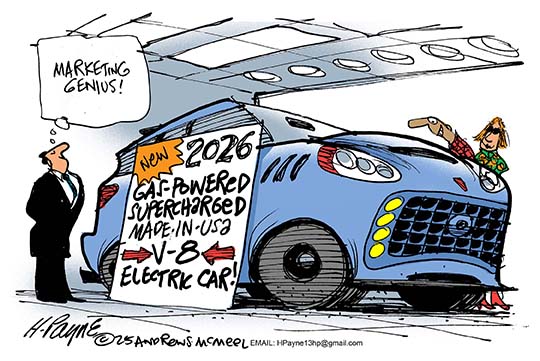
Cartoon: Auto Marketing Genius Government Consumer
Posted by Talbot Payne on August 22, 2025
Cartoon: 101 Dalmations Meat Eaters versus Greens
Posted by Talbot Payne on August 22, 2025

Payne: Cruisin’ with the amusin’ Ford Maverick Lobo pickup
Posted by Talbot Payne on August 22, 2025
Woodward Avenue — Lobo is Spanish for wolf, but the 2025 Ford Maverick Lobo is more like a puppy dog. It wants to play everywhere.
At an autocross course in California, I toggled LOBO mode and drifted the puppy — er, pickup — through pylons. At an offroad area in Charlevoix, I slung gravel across dirty trails. Taking Michigan turns on Woodward, I wagged its tail.
Say hello to Lobo, Dream Cruisers. A new classic is born.

Henry Payne, The Detroit News
Maverick, of course, is already a huge success as Ford’s entry-level vehicle (not just entry pickup). It sold over 157,000 units in just its third year in the market in 2024 and is on pace to beat that in ‘25 despite a 20% price increase. It’s already won two Detroit News Vehicle of the Year Awards and Americans can’t get enough of them.
Ford knows how to broaden a product’s demographic, and it already offers a 38-mpg Maverick hybrid (2021 News Vehicle of the Year) and dirt-kicking, all-terrain tire Tremor model (2022 winner). Now comes Lobo, a howl-at-the-moon treat.
From the West Coast to Western Michigan to a week at the Dream Cruise, this puppy is man’s best friend. Fun, utilitarian and high-tech, it has few equals. It’s the performance pickup you never saw coming, But then, Ford has experience at — not just trucks — but hot-hatch hellions as well.

Henry Payne, The Detroit News
Remember the Focus ST and RS? They left the U.S. market in 2018, but their DNA lives on in, of all things, a truck. Lobo is a hot hatch in pickup clothing.
Armed with a similar 250-horsepower, turbo-4 engine found in the ol’ Focus ST, Lobo also adopts the driftin’, misbehavin’, torque-slingin’ twin rear clutch packs from Focus RS. Press the starter button and you’ll want to hang on to the leash of this puppy!
ROOWWRRRRR! growled the 4-banger as I put my size 15 into it. With sport shocks, lowered suspension and a steering wheel that feels rooted to the ground, Lobo has legitimate street cred. Call it Lo’ boy. Over the roller-coaster twists and turns of M-32 east of Gaylord, the truck jumped from turn to turn with surprising agility. Yeah, it’s still an SUV-based pickup and the pup skitters around on its four paws more than the Focus twins ever did. But everything is responsive, including the engine growl which gets lower in SPORT and LOBO modes.

Henry Payne, The Detroit News
That playfulness is even more pronounced on an autocross where you can take advantage of all-wheel drive and let the front wheels pull you out of lurid slides in LOBO mode (which moves torque between the rear wheels for maximum drifting).
First rule of performance pickups: buy a tonneau cover ($600-$1,280) for the rear bed. Because you’ll wind up slinging dirt into the 4.5-foot box and ruining whatever you’ve stored back there — which, in the wee Maverick, is a lot given its small back seat (more on that later).
Maverick doesn’t have to drift to get attention. Check out those Turbofan wheels.
Cruising Woodward, my white tester got lots of looks.
“I thought that was the Lobo,” said Rob, a Mustang owner, in Royal Oak. “Love those wheels.”

Henry Payne, The Detroit News
Black, painted 19-inch Turbofan wheels are standard. A classic supercar wheel that has adorned such cyborgs as the Porsche 959 and Ford GT Mk IV, the black Turbofans are a bold statement on Lobo. Ford gives you the build option of black aluminum spoke wheels, but Turbofans signal it’s not your average pup.
That attitude extends inside with monogrammed seats and blue accents on the climate controls, console and door handles.
The latter highlights the thoughtful ergonomic features. Door handles are shortened to allow vertical space in the doors for tall bottles — perfect for Saturday’s 90-degree Dream Cruise scorcher.

Henry Payne, The Detroit News
The roomy console includes a wireless charging pad. The Ford relies on Apple CarPlay and Android Auto for navigation duties that can drain your phone. On my four-hour trip north, the phone stayed charged while navigating me through summer construction detours. Atop the giant 13.2-inch infotainment screen is a cubby — handy for suntan lotion bottles, sunglasses and other road-trip accessories.
Speaking of the screen, the $35K Maverick offers state-of-the art graphics that debuted on the $100K Lincoln Navigator not long ago. Colorful graphics introduce the variety of DRIVE modes — LOBO, SPORT, SLIPPERY, ECO, STANDARD, TOW — and a 360-degree camera is standard as well.
The compact size and 360-degree camera were a big help with Cruise coverage when I often had to fit in tight, off-Woodward parking spots and garages. Try that in your full-size F-150 pickup.

Henry Payne, The Detroit News
Yet the pup is also useful when it comes to fetching sticks — er, large cargo — thanks to its 2,000-pound towing capacity. Lobo is outfitted with Ford’s clever Pro Trailer Backup Assist knob and rear camera so you can maneuver a trailer.
All this, and Ford is just scratching the surface of Lobo potential.
The color palette is bland: White, Black, Gray, Velocity Blue. Seriously? Focus ST colors included Race Red, Tangerine Scream, Performance Blue, Kona Blue, Triple Yellow and Hot Pepper Red. That’s more like it.

Henry Payne, The Detroit News
Until those colors become available, make mine Velocity Blue to match interior trim.
And be sure you get the tonneau cover because if you take a road trip, there isn’t much room behind the front seats. At 6’5”, I had to take my legs off to sit behind myself. And, with heavy rains in the Charlevoix forecast — my son and I had to stuff all our gear into the back seat: two suitcases, tennis bag, cooler and other bags.
Were it a family trip for four, the bed would have been a cargo must.
After a day of hooliganism across Metro Detroit, I pulled into the driveway of friend Kevin. “I heard you coming,” he smiled. “That’s the new Lobo? Love it. Love the wheels.”
“I was doing some doughnuts up in Pontiac,” I said.
“Got video?” he asked.
Next week: 2025 McLaren 750S
2025 Ford Maverick Lobo
Vehicle type: Front engine, all-wheel-drive, five-passenger compact pickup
Price: $37,625, including $1,695 destination fee ($42,345 as tested)
Powerplant: 2.0-liter turbocharged four-cylinder
Power: 250 horsepower, 277 pound-feet torque
Transmission: Seven-speed automatic
Performance: 0-60 mph, 6.1 seconds (Motor Trend); towing capacity, 2,000 pounds
Weight: 3,814 pounds
Fuel economy: EPA est. 21 mpg city/30 highway/24 combined
Report card
Highs: Hot hatch in pickup clothing; fun + utility
Lows: Small back seat; more Skittle colors, please
Overall: 4 stars
Henry Payne is auto critic for The Detroit News. Find him at hpayne@detroitnews.com or @HenryEPayne.
Cartoon: Trumptastic 4 Ukraine VS Putin
Posted by Talbot Payne on August 20, 2025

Cartoon: Comey Taylor Swift TDS
Posted by Talbot Payne on August 19, 2025

Corvette CX concept: Get a peek at the supercar’s electrified future
Posted by Talbot Payne on August 16, 2025
Chevrolet unveiled a glimpse at its supercar future Friday with the electric Corvette CX and hybrid CX.R Vision Gran Turismo race car concepts.
The dynamic duo are the first Corvette concepts since 2009 and introduce both radical and evolutionary features to America’s longest-running supercar. The pair represent the continued close collaboration between Corvette’s production and motorsports arms in formulating next-generation cars. Like the current-gen C8 (In Chevy-speak, C8 marks the eighth-generation car), General Motors Co.’s Charlotte-based motorsports engineers were intimately involved in the CX’s development.
Also like C8, the sleek CX concept has a mid-engine design, though its layout is (like Stellantis’s STLA Large platform that underpins the Charger muscle car) flexible to accommodate both battery-powered and internal combustion engine designs. Penned by Corvette’s Warren design studio, the winged CX concept is the winner of a design competition between GM’s Detroit, England and California studios.

Nick Dimbleby, GM
“GM designers across the studios were asked to imagine where we could take Corvette. Now it’s time to reveal the ultimate concept in the series, the Corvette CX concept, a vision of what Corvette can be in the future,” said Executive Design Director for Chevrolet Phil Zak at a media preview ahead of Friday’s unveiling at the exclusive Quail Motorsports Gathering at Monterey Car Week in California. “The CX is the future of where we’re going with the car. The CX.R Vision … was designed exclusively for racetrack and is a look into the future of Corvette GT racing.”
The Quail event is an indication of the brand’s elevated direction. The CX follows the introduction of another X-factor vehicle — the all-wheel-drive, hybrid ZR1X, Corvette’s first $200,000-plus hypercar — that also appeared at Quail with a Quail Silver special edition production model. Both CX concepts will be available to drive on the Gran Turismo 7 gaming platform later this month.
Veteran auto analyst and supercar expert Karl Brauer of ISeeCars.com recently returned from the Longtail Rally, an exclusive, cross-country celebration of supercar performance, and applauded the CX concept’s upscale aspirations.

Nick Dimbleby, GM
“I’ve done the Longtail Rally for the last five years,” said Brauer, who has owned multiple supercars, including a Ford GT. “Every year there’s between 20 and 30 supercars — Porsches, Lamborghinis, McLarens, Ferraris. I’ve never seen a Corvette and I don’t think they ever will make the cut, as long as they keep putting two golf clubs in the trunk and making it heavy and over-styled.”
There is no mention of space for golf clubs in the CX press release. The concepts’ lofty ambition is apparent in their lightweight, carbon-fiber tub — an exotic construction common in race cars like the Cadillac V-Series.R and Chevrolet-powered IndyCars. While stiffening the chassis for better handling, the lightweight carbon tub should help offset the heavy electrified drivelines. The concepts continue the ZR1X’s hypercar direction with all-wheel-drive powertrains and over 2,000 horsepower.
They get there in different ways.

Nick Dimbleby, GM
The silver CX is all-electric with four motors, one powering each wheel for torque-vectoring all-wheel drive. A big 90-kWh battery is mounted low in the chassis. In a world where many Corvettes don’t drive further than the country club — or race track — battery range won’t be an issue. The CX dovetails with GM’s determination to be a zero-emission manufacturer in the not-too-distant future.
The race car concept, on the other hand, is a bow to the realities of endurance racing and the inherent drawbacks of a heavy, low-range battery. Powered by synthetic fuel, a high-revving V-8 engine drives the rear wheels through an 8-speed dual-clutch transmission. Three electric motors — one for each front wheel and the third incorporated into gearbox — assist the engine for low-end torque.
The CX.R hybrid system is an echo of the hybrid, gas-electric, V8-powered system in GM’s Cadillac V-Series.R Hypercar, which currently races in global sportscar series (the current Corvette C8.R is V-8 only). Synfuels are reportedly under consideration for Cadillac’s Formula One program. Currently under international political pressure to produce a heavy, 50-50 hybrid gas-electric powertrain, F1 could change the game with synfuels, allowing for a more visceral, V8-focused drivetrain like that in the Corvette.

Nick Dimbleby, GM
Analyst Brauer warned of going all-in on an electric drivetrain, however, pointing to the sales struggles of the Dodge Charger Daytona EV that kicked the brand’s traditional V-8 to the curb in favor of battery power.
“A pure electric Corvette production lineup will be a flop,” he said. “You’ll get some core electric fans (but) the rest of the performance world won’t be interested.”
Both concept cars have a glass window behind the cockpit to view their different drivetrains. The window also shows off the cars’ sophisticated suspension geometry with wing-shaped A-arms co-developed with GM’s Charlotte race shop.

GM
The CX’s futuristic red interior features seats fixed to the carbon tub and steering and pedal box controls that automatically conform to the driver presets. A racing-style steering wheel cups a digital control screen, but the big digital innovation is a next generation head-up display where the pixels are embedded into the entire windscreen.
More innovation below decks includes a so-called Vacuum Fan System with fans that draw air through the open-channel bodywork. The aerodynamic system produces downforce by directing airflow over a rear diffuser that works with a high rear wing.
This state-of-the-art tech is wrapped in a sleek, athletic exterior — complete with a fighter-jet-inspired canopy that lifts for easy access to the cockpit and front suspension. Radical as it is, the design still bears signature ‘Vette touches like a lunging nose, horizontal “chine” line delineating upper-and-lower bodywork, and dual-element taillights.

GM
“While the shape of a Corvette has always been expressive and forward-looking, it is the reason people want to come and work at Chevrolet,” said design chief Zak. “The CX and CX.R Vision Gran Turismo demonstrate our design teams stepping away from the constraints of production vehicles and unleashing their creativity. Through this exercise, we’ve added to Corvette and defined the design direction for Corvette moving forward.”
Concept does not always determine future, however.
The last 2009 Corvette concept, after all, was a front-engine design just two years after the first mid-engine Corvette had been approved internally for production (and then delayed due to GM’s 2009 bankruptcy), and a decade before the 2020 C8 would debut as Corvette’s first mid-engine supercar.
“Maybe GM and the Corvette are evolving in the right direction with the CX,” said Brauer. “Go upscale, go carbon-fiber, but make sure there’s a V-8 in there.”
Henry Payne is auto critic for The Detroit News. Find him at hpayne@detroitnews.com or @HenryEPayne.
Cartoon: Ford EV Pickup Breakthrough
Posted by Talbot Payne on August 16, 2025

Cartoon: Schiff Russiagate Leaks
Posted by Talbot Payne on August 16, 2025

Cartoon: Bat Trump Signal DC
Posted by Talbot Payne on August 15, 2025

The new Cruise classics: Class of 1999
Posted by Talbot Payne on August 14, 2025
All hail the great Class of 1999.
New auto models from 1999 will celebrate their 26th year at the Woodward Dream Cruise’s giant auto reunion this weekend — and their official coronation as antique cars under Michigan law. The Secretary of State bucks convention by declaring cars antiques after 26 years — not a quarter century — which makes them eligible for historic plates at a flat fee of $30 for 10 years and (likely) reduced insurance costs.
In ‘99 the Tigers played their last season at Michigan and Trumbull, the archrival Colorado Avalanche denied the Red Wings a shot at their third straight Stanley Cup, the post-Barry Sanders Lions made the playoffs, and the Pistons endured a season-shorting NBA lockout. The Dow crested 10,000 for the first time, the first Matrix movie thrilled, Legoland opened in California, Y2K doomsayers predicted Armageddon, and future NBA star Luka Doncic was born.

Thousands of classic cars roll down Woodward Avenue in Royal Oak during the Woodward Dream Cruise on Saturday, Aug. 17, 2024. Katy Kildee, The Detroit News
Automakers birthed their own future classics from mega-utes to sedans (remember them?) to wee sports cars. Here’s a look at the new antiques …
Mazda MX-5 Miata
They don’t get any more wee than Miata.
Mazda introduced the MX-5 in 1992 as a 2,200-pound, stick-shift throwback to 1960s European sportscars like the Lotus Elan and Fiat 124 Spider. MX-5 was an instant hit and became an enduring halo for Mazda’s performance brand. After skipping the ‘98 model year, 1999 brought Miata’s much-anticipated second-gen. Would it suffer a sophomore slump? Nope.
The new Mazda got a 24-horsepower bump over the original to 140 from its four-cylinder engine (while only gaining 100 pounds). Designers added more curves while removing the pop-up headlights. The rarest of the ‘99s are 10th Anniversary Edition models, which came equipped with unique wheels, a two-tone blue and black interior and Sapphire Blue Mica paint.
Ford SVT F-150 Lightning
Before there was an electron-guzzling F-150 Lightning pickup, there was a gas-guzzling SVT F-150 Lightning V-8.

For 1999, Ford introduced the fire-breathing SVT F-150 Lightning, powered by a supercharged V-8 that pumped out 360 horsepower. Ford Motor Company, Ford Motor Company
It was a beast with 348 cubes, 360 supercharged ponies and 139 mph top speed. And when it wasn’t towing 5,000 pounds, it could launch from 0-60 mph in 5.8 seconds. It stood out from its sibling F-150s with dual exhaust tailpipes and SVT-badged seats.
Along with late 20th-century pickups like the Dodge Lil’ Red Truck, Chevrolet 454 SS and GMC Syclone, SVT Lightning helped establish a niche of muscle-bound trucks that continues to this day.
Jeep Grand Cherokee
The OG SUV received major upgrades for its second-generation, including a 4.7-liter V-8 engine to complement the standard 4.0-liter V-6. Owners had fussed about the spare tire’s location in the cargo wall, so engineers hid it underneath.

The second-gen Jeep Grand Cherokee that bowed for 1999 offered a V-8 engine option. Stellantis, Stellantis
Unchanged was the Jeep’s signature off-road capability with standard all-wheel drive (Quadra-Drive full-time AWD optional) and Wrangler-like solid axles front and rear. The classic seven-slot grille and boxy shape signal Jeep from a mile away on Woodward.
BMW 3-Series (E46)
The fourth-gen Bimmer 3-series still ranks as a purist favorite for its sleek styling, high-revving M performance model (more on that come 2027 when it turns 26 years young), unflappable road manners and a multitude of body styles, including convertible and wagon.

1999 BMW 3-series Hardy Mutschler, BMW
The so-called E46 generation also debuted electronic bits foreshadowing innovations that have transformed today’s vehicles: satellite navigation, electronic brake-force display, rain-sensing wipers and LED taillights.
At its heart beat a signature 2.5-liter, inline six-cylinder engine that, while smooth, lacked the ponies of the Infiniti G35’s 260-horsepower 3.5 liter V-6 — and therefore finished second in a Car and Driver comparison test. The G35? Gone from the market, as are other competitors from 1999, including the Acura TL, Saab 9-3 and Jaguar X-Type 3.0.
Chrysler 300M
One of three sedans based on the LH platform (including the Dodge Intrepid and Chrysler Concorde), the 300M was a peach. It featured upscale styling, taut handling and easy power from its 254-horse V-6. Enthusiast publication Motor Trend crowned it Car of the Year.

1999 Chrysler 300M Stellantis, Stellantis
In naming the Chrysler to its annual Ten Best list alongside classics like the Porsche Boxster and BMW Z3, Car and Driver wrote: “the 300M can be hurled through sporting roads with a surety and enthusiasm that will make you forget you’re transporting three passengers and their luggage. We rarely encounter such capabilities in luxury sedans priced near $30,000. That value is perhaps the 300M’s greatest achievement.”
Alas, 300M had a short shelf life and production ended after the 2004 model year. The good news? It was succeeded by another future classic, the V8-powered 300 gangster-mobile in 2005. Huzzah.
Volkswagen Beetle
Sales of VW’s iconic, rear-engine Bug were discontinued in the United States after 1976, and the compact was replaced by the front-engine Rabbit/Golf.

Volkswagen AG Chairman Ferdinand Piech with the revived Beetle at the North American International Auto Show in Detroit on Jan. 4, 1999. The new-gen Bug enjoyed a 20-year run. CARLOS OSORIO, ASSOCIATED PRESS
Two decades later, boomers went ga-ga for retro, so V-dub brought Beetle back to life based on the Golf’s front-wheel-drive chassis. Complete with a built-in flower vase, the Beetle legend was rebooted for another 20 years.
Bug Part Two was awarded Motor Trend Import Car of Year and North American Car of the Year.
Cadillac Escalade
Have the words “humble” and “Escalade” ever been used in the same sentence?
In response to the popular pickup-based Lincoln Navigator, GM rushed the Escalade to market in 1999 as a humble, rebadged GMC Yukon Denali mega-ute. The exterior was little changed from the Yukon (wheel caps were changed to Cadillac from GMC), but the real difference was inside, where Escalade introduced real wood trim on the doors and the same leather found in Caddy cars.

The first Cadillac Escalade was sold in 1999 (right). It took 24 years to make the first V-series model – the 2023 Cadillac Escalade-V (left). Henry Payne, The Detroit News
Based on the Chevy Silverado and GMC Sierra ladder frame, the humble ’99 was only a two-row but capable of towing up to 6,500 pounds. Come 2001, the Caddy would be redesigned with three rows and its now-signature, bling-tastic crest grille and Fox Theatre-like vertical taillights so rappers, pro athletes and other celebs could party inside like it was 1999.
Lotus Exige
Not to be outdone by Michigan’s curious 26-year antique law, the feds have their own historic eccentricity: after 25 years you can import cars that weren’t legal on U.S. roads in 2000. My favorite not-legal-now-legal car for ‘25 is the track-focused 2000 Lotus Exige complete with rear wing, front splitter and wide bodywork. This race car for the street weighed a mere 1,750 pounds and was dynamite to drive with its four-banger making a healthy 177 horsepower.
More on its Class of 2000 peers next year.
Henry Payne is auto critic for The Detroit News. Find him at hpayne@detroitnews.com or @HenryEPayne.
Corvettes on Woodward: King ‘Vette fires up the Dream Cruise
Posted by Talbot Payne on August 14, 2025
Pontiac — It’s good to be king.
If the Woodward Dream Cruise were the Pride Lands, then Chevrolet Corvette would be its lion king. For eight generations and 72 years, America’s longest-running sportscar badge has ruled Woodward Avenue with its roaring V-8 engines and muscled bodywork. And for over 20 years, the Corvettes on Woodward event has been a focus of Woodward Dream Cruise week with its massive gathering of muscle.
This year’s Pride Rock is Michigan’s premier motorsports club, M1 Concourse in Pontiac, where over 500 Corvettes gathered Wednesday from 11 a.m.-6 p.m. for pictures, exhibits, panel discussions, camaraderie, and, of course, cruising.

M1 Concourse
“There’s nothing like a Corvette with the top down on Woodward,” said Andre Walker, 60, of Detroit as he rolled onto Woodward at Rapid Street, rowing the gearbox of his red, fifth-generation 2002 Corvette C5. “They only made 178 of this particular trim because the manual was rare for that model year.”
Passion for the Corvette runs deep and brought not only generations of cars but generations of owners here to celebrate the marque. Larry Courtney, 78, of Warren and his wife, Vern, started Corvettes on Woodward over 20 years ago to benefit the Open Hands Food Pantry in Royal Oak. It’s grown into the largest Corvette gathering in Michigan, attracting owners from all over the country — and spectators with a $20 gate charge.

Henry Payne, The Detroit News
“The urban legend is there were 40 of us hanging around with our Corvettes having ice cream, and someone said: ‘we can do a lot better than this,’ because we have Michigan’s largest Corvette Club,’” smiled Courtney, then a member of America Corvette Club who now runs Michigan Corvette Events.
Corvettes on Woodward first gathered at the Kingsley Hotel in Birmingham, where it eventually burst at the seams. Over 500 Corvettes were crammed into a hotel lot with 180 parking spaces. When the group spilled out on to Woodward for a lap of the Cruise route, the chain would run for seven miles.
“The police said we couldn’t all go out at the same time anymore,” said Courtney. “It was just too many cars.”

Henry Payne, The Detroit News
So Corvettes on Woodward has found a new home here in Pontiac on M1’s 87-acre campus where ‘Vettes can sprawl across two paddocks, a skid pad and 1.5-mile race track.
“It’s logical for Corvettes on Woodward to be here,” said M1 CEO Paul Zlotoff, who teased that Corvettes on Woodward will move to Thursday in 2026 as part of a three-day M1 Dream Festival. “We’re set up for this kind of event because we celebrate motorsports in an organized way. We could bring 2,000 Corvettes in here.”
On Wednesday, dozens of red, white and blue Corvettes gathered in front of M1’s event center to form an American flag for a drone-snapped photograph. Corvettes like a white, first-generation, front-V6-engine 1954 C1 convertible owned by Tom Gamache, 85, from Canton Township — and a red, eighth-generation, mid-V8-engine 2023 C8 Stingray owned by Aldrin Santiago, 53, of Sterling Heights.

Henry Payne, The Detroit News
“I was 12 years old in 1953 when General Motors showed the first Corvette at Motorama in New York,” said Gamache, who bought his car in 1999. “And I thought it was the most beautiful car I had seen and I would own it someday.”
How does he think the first-mid-engine Corvette C8 looks?

Henry Payne, The Detroit News
“It’s great. That’s the Corvette that Zora (Arkus-Duntov, Corvette’s influential first engineer) always wanted to do,” he said, standing next to his new friend Santiago, who he had just met at the flag photo. “The handling of those things is unbelievable.”
Corvettes on Woodward founder Courtney likes all generations but settled on a 1999 Corvette C5 for himself wrapped in an American flag color scheme. “I like the C5 because I can fit and we do a lot of road trips,” he said. “We travel all over the country doing events.”

Henry Payne, The Detroit News
Bobby Keyes, 69, of Lake Orion enjoys so many generations of Corvette (he owns a 1969 and 1982) that for his third Corvette he bought a rare custom model with a 1957-style, C1 coupe body on top of a C5 chassis.
“I liked it because it was different, custom, and they only built five of them,” he said of the Stewart, Florida-made ‘Vette built in 2017. Colored blue, his car formed the top left corner of the American flag photo.

Henry Payne, The Detroit News
M1’s Event Center offered relief from the day’s blazing sun — and activities like sim racing, a slot car track, and Corvette jewelry for sale. Cindy Pronze, 50, of Canton Township showed off a white bracelet she bought featuring the Corvette flag logo.
“It will go nicely with the 1976 Corvette that I’m restoring,” she said.
Henry Payne is auto critic for The Detroit News. Find him at hpayne@detroitnews.com or @HenryEPayne.
Cartoon: Lincoln Mugged DC Crime
Posted by Talbot Payne on August 13, 2025

Cartoon: Record NFL Field Goal Little
Posted by Talbot Payne on August 12, 2025

Dodge Charger gets a Sixpack — and V-8 muscle may not be far behind
Posted by Talbot Payne on August 12, 2025

Stellantis, © 2025 Stellantis
Detroit — The Charger muscle car is getting a Sixpack. Can an eight-pack be far behind?
Dodge celebrated the 10th annual Roadkill Nights on Woodward on Friday by rolling out the 2026, gas-powered Scat Pack and R/T performance models of its all-wheel-drive Charger. The sleek hot rods boast throaty, high-horsepower, twin-turbocharged, inline 6-cylinder engines built on the same versatile STLA Large platform as the 670-horsepower, electric Dodge Charger Daytona introduced last year.
The so-called “Sixpack” engine is more powerful than the last-generation Charger’s 485-horse 6.4-liter V-8. The Sixpack badge, connoting six cylinders, is a throwback reference to 1970 model engines’ three, two‑barrel carburetors (for a total of six barrels).
But Dodge’s visceral brand was built on legendary V-8s from the 1960s through the Hellcats of the 2020s. Staggered by hundreds of millions of dollars of federal emissions fines for making eight-holers, Charger and Challenger V-8 drivetrains were sunsetted in 2023, enraging Dodge’s passionate fan base, the Brotherhood of Muscle.
With a new EPA sheriff in Washington, D.C., the Brotherhood’s hopes for a V-8 resurgence are on the rise.
“No surprise if it would fit” in the STLA Large platform’s engine bay, Dodge CEO Matt McAlear said cryptically at the Sixpack Charger’s reveal. “With regulatory changes in the industry, we are flexing more into ICE long-term.”
Those ICE (Internal combustion engine) powerplants include the 710-horsepower, supercharged, 6.2-liter and 360-horse, 5.7-liter V-8s stuffed into the 2026 Durango three-row SUV that Dodge also announced Friday.
“Muscle moves our models,” McAlear said of the popular Durango SRT Hellcat, which led the SUV to a 36% sales gain for the first six months of 2025 over a year ago (a No. 7 ranking in JD Power’s Initial Quality test didn’t hurt either).

© 2025 Stellantis
Until a similar V-8 appears in the Charger, Dodge fans will have an expanded lineup of electric and Sixpack hot hatches to choose from.
Yes, hot hatch.
The new Chargers boast a hatchback boot like a Volkswagen Golf R or Honda Civic Type R, matching performance with utility. As a midsize coupe, the three-door Charger has big cargo space with 37.4 cubic feet under the hatch, though that’s shy of a five-door $87k Audi S7 hatchback’s 49 cubic feet.
“It’s a hidden hatch that delivers SUV-like cargo capacity,” said McAlear. “With the seats down, we’ve got 37% more cargo room than the outgoing vehicles. With all-wheel-drive standard and the SUV-like cargo, this is a daily driver.”
It also has more power than a 444-horse S7.

© 2025 Stellantis
The Sixpack will debut in Charger’s signature performance trims: Scat Pack and R/T. Customers will have a list of choices, including coupe or sedan (the Scat Pack coupe will debut first this fall) as well as two drivetrains: standard or high-output.
“This is a very accessible muscle car. We’re starting at the higher end with the R/T and the Scat Pack,” McAlear said. “We’re launching with the 550-horsepower, two-door Scat Pack, but very shortly after that, we’ll open for orders on the two-door R/T, and the four-door R/T.”
The R/T puts out 420 horsepower/468 pound feet of torque while the high-output Scat Pack mill ups the game to 550 horsepower/531 torque. The latter targets a 3.9-second 0-60 mph sprint, quarter-mile in 12.2 seconds, and a top speed of 177 mph.
All Chargers are all-wheel-drive to help put all that grunt to the ground and managed by an eight-speed transmission connected to a pistol-grip shifter. Step on the gas and the Sixpack makes a proper ICE growl from its 100-millimeter dual pipes out back.

© 2025 Stellantis
“The twin-turbo inline-6 is going to blow people’s minds when they hear the new exhaust. It sounds great,” said McAlear. He said visitors to Roadkill in Pontiac this weekend will have the first chance to experience the full Charger lineup.
“We’re going to have thrill rides — drifts, donuts, launch — in our all-new Dodge Charger Sixpack. It will be the first time consumers can sit in the right seat and see the excitement and the thrill with a professional driver by the wheel,” he said.
The electric Charger Daytona, introduced for the 2024 model year, replaced V8-powered Hellcat models and has struggled to make an emotional connection to the Brotherhood with its artificial, Fratzonic Chamber exhaust note. Sales have disappointed, even though its performance numbers did not.

© 2025 Stellantis
With the Charger Sixpack poised to be the volume leader, the Charger Daytona can settle into its role as a $61,490 halo product with 670 horsepower and a 3.3-second zero-60 mph sprint.
Like Ford and the Mustang Mach-E before it, Dodge introduced its electric product to show off the versatility of its ICE-or-EV STLA Large chassis — and gain government credits for future V-8 production. Ford used the Mach-E (and its Ford Lighting EV pickup) to acquire enough credits to keep its V-8-powered Mustang icon burning without paying emissions fines.
Expect similar muscle from Dodge — on an accelerated timeline now that the Trump administration has rolled back anti-ICE regulations and canceled California’s’ exemption to regulate carbon dioxide.
The Sixpacks delivers plenty of punch to justify their prices: $56,490 for the Scat Pack, $51,490 for the R/T. Add $2,000 for the sedan versions when they arrive next year.

© 2025 Stellantis
The STLA Large platform is 20% stiffer than the aging, last-gen platform, though it tips the scales at a porky 4,816 pounds (the electric Charger is 5,767 pounds). Standard Scat Pack goodies include six-piston Brembo brakes, active exhaust and five drive modes: Auto, Eco, Wet/Snow, Sport and Custom. Features include RWD-only traction, Launch Control and Line Lock (which locks the front tires so you can spin the rears in standing, smoky burnouts).
The roomy interior includes tech like a digital 10.25-inch instrument cluster (optional 16-inch), head-up display and 12.3-inch infotainment display (run by Dodge’s intuitive Uconnect 5 software) with wireless Apple CarPlay/Android Auto. Premium seat options include heated Black Nappa leather and Demonic Red Nappa leather seats, with high-backed, fixed headrest seats available on Scat Pack Plus trims.
All this is wrapped in a throwback design to the 1966 Dodge Charger race car that Dodge brought on stage. Eight paint schemes bear signature Dodge names like Green Machine, After Dark, Bludicrous, Diamond Black, Peel Out, Redeye, Triple Nickel and White Knuckle.

© 2025 Stellantis
The 2026 Charger bears a similar, hooded fascia, fastback and wide stance. While the electric Charger Daytona bears a unique R-wing for better aerodynamics, the Charger Sixpack gets a hood bulge — like the ‘66 Charger V-8 — stamped “SIXPACK” to indicate the power underneath.
Orders for the Scat Pack open Aug. 11 with vehicles rolling off the Brampton Assembly line in Ontario before year’s end.
Henry Payne is auto critic for The Detroit News. Find him at hpayne@detroitnews.com or @HenryEPayne.
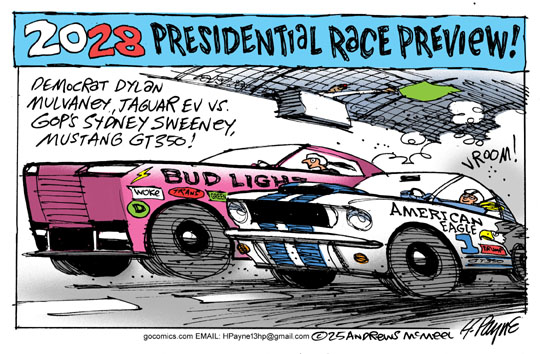
Cartoon: Prez Race 28 Sweeney VS Mulvaney
Posted by Talbot Payne on August 7, 2025
Payne: Tesla-fighting Volvo EX30 is cute, quick, and range-challenged
Posted by Talbot Payne on August 7, 2025

Henry Payne
Midland — Cubism in the 1910s, surrealism in the 1930s, pop art in the 1960s, installation art in the ‘80s. The art world has seen multiple movements over the last 100 years. So too has the art of the automobile. The post-WW2 jet-inspired tailfin era, muscle cars of the ‘60s, mid-engine ‘80s sportscars, 1990s jelly bean sedans.
Digital age electric vehicles have given designers a new canvas to paint on. One of my favorites is the 2025 Volvo EX30 that I recently piloted to Charlevoix and back.
Like its Tesla, Rivian and Cadillac peers, the EX30 has embraced the grille-less fascia and simple, screen-centric interior. And, just as installation art is limited to a specific place, so are EVs best admired as urban vehicles — as my trip’s charging follies demonstrate.
My two-tone yellow and black EX30 cutie welcomed me with a smile.
That is to say, the mouth-like diagonal line through the circular Volvo logo that anchors the fascia. No internal combustion engine, no grille. The fascia is anchored by signature “Thor’s hammer” headlights inside a black frame (a theme repeated on the rear facia). EX30 reminded me of one of the colorful characters from the 2005 flick “Robots.”
Sensing the card key in my pocket, the door unlocked. As its nomenclature implies, the subcompact EX30 is Volvo’s gateway to its EX40 and EX90 EVs lineup — though you’ll need to adjust your pricing expectations. Stylish subcompact, affordable, premium, internal-combustion-engine SUVs are a thing, including sub-$40K cuties like the Buick Envista, Mazda CX-30 and Acura ADX.
My all-wheel-drive, $48K EX30 Performance Ultra tester is priced more in line with premium EV compacts like the Tesla Model Y, Ford Mustang Mach-E and Lexus RZ450. All-wheel-drive, panoramic roof, 19-inch wheels, posh materials. Unlike those machines, however, the EX30 has little rear legroom (32 inches) compared to, say, the Tesla at 40 inches. A six-footer can’t sit behind himself. Starting at $54K, the EX40 will buy you four more inches of legroom.

Henry Payne, The Detroit News
Under the airy, panoramic roof, the cabin is beautifully spare. Like Scandinavian furniture.
Like a Tesla, the interior is anchored by a big screen. Doors are scrubbed of buttons, and essential controls (mirrors, glovebox) are accessed through the screen. Unlike a Tesla, the 12.3-ich display is vertical and the cabin trimmed with classic Volvo touches like silver vertical air vents and door handles — and a floating console that offers plenty of space underneath for a handbag.
Volvo (and sister Polestar EV performance brand) were first to market with the Google Built-in operating system (now ubiquitous on GM products and coming to Honda), which makes navigation easy — especially in a low-range electric car that needs to find chargers on trips. To keep costs down, EX30 has a small (69 kWh) battery with just 253 miles of range compared to, say, Model Y’s 311 miles of range.

Henry Payne, The Detroit News
Hey, Google, navigate to Charlevoix, Michigan.
The Swede scheduled two stops to make the 250-mile trip and still have 25% of charge left at destination (in case I have to make another trip on arrival). Why two stops for a 250-mile trip, you say? Because EPA estimate range numbers appear calculated for a perfect, 70-degree day traveling at 55 mph.
This July summer’s day, however, was running hot at 95 degrees with rain in the forecast on a 75 mph interstate. My range would be more like 200 miles. That, and you only charge to 80% at fast chargers because that last 80-100 % is (like filling a beer) sloooow. Actual range? 160 miles.
ZOT! The peppy 400-torque EX30 merged with authority onto I-75 North.

Henry Payne
Like its electric peers, the Volvo is smooth as silk. But for the price, it’s lacking hands-free driving like Model Y/Chevy Equinox. Volvo telegraphs the feature is coming, however, as a steering wheel-mounted camera watched me constantly. This being a Volvo, it nagged me incessantly to keep my eyes on the road, my hands on the steering wheel, and my teeth brushed (kidding about that last part).
EX30 navigated to the first fast charging stop in the parking lot of a Bay City Meijer store, an Electrify America station that … was shut down. Oh.
“OUT OF ORDER” read the charger screens, the stalls wrapped in yellow tape with a line of blue shopping carts blocking access just in case customers didn’t get the message. Unlike Tesla, which integrates its charging network with its car’s navi system, the Volvo is dependent on third-party companies. EX30 had no idea the EA charger was down.

Henry Payne
Plan B. Right next to the EA chargers was a bank of eight Tesla chargers, seven of them available. Volvo has signed an agreement to use Tesla chargers, so I plugged in and opened the Tesla app to connect.
“No chargers within range,” read the app. Huh?
According to Clean Technica, 150 kW Tesla V2 chargers like those at Bay City are un-accessible to non-Tesla users.
Plan C. I asked the Google navigation to find fast chargers nearby. Success: Blink and ChargePoint stations were available within two miles. I chose Blink because the map indicated all four stalls were available — and because it was in a Ford dealership and (presumably) well maintained.

Henry Payne, The Detroit News
At the Ford dealer, I plugged in at 56 cents per kWh and walked across the street for a Tim Horton’s doughnut while EX30’s battery charged for 20 minutes from 50-90%. Note to self: at 56 cents per kWh, the 500-mile round trip would cost $93 versus $73 for a comparable, gas-powered Volvo XC40 at $4.10-per-gallon premium fuel.
Back on the road, Volvo navigated me to a second Electrify America charging stop in Gaylord, but (fearing EA unreliability) I chose a ChargePoint in Waters instead and arrived in Charlevoix with 36% of charge left (72 miles). All told, the trip had taken 6.23 hours to complete — longer than the 4.37 hours Google Built-in promised (which was already longer than the 3.52 hours in a gas XC40).
No wonder EV sales have stalled.

Henry Payne, The Detroit News
Back in its natural habitat (that is, an urban environment) in Charlevoix, the Swede was happy as Bjorn Borg on a clay tennis court. On two-lane M-32, it squirted from 0-60 mph in a Porsche 911 Carrera GTS-like 3.3 seconds — quicker than an all-wheel-drive Model Y’s 4.8.
I’m a fan of Tesla and Rivian spare interiors, and EX30 was a pleasing place to spend time. Clever details abounded like a fashionable square steering wheel, storage cubbies and Google Built-in, which was always ready with a joke. “Hey, Google, tell me joke,” I said.
Why can’t a bicycle stand up on its own? Because it’s two tired.
You have to have a sense of humor to survive the charging follies. More were in store for the trip home.

Henry Payne, The Detroit News
After a Traverse City airport detour to drop off family, EX30 navigated to Midland to recharge at a “very fast 240-kW fast charger.” Wrong.
The charger was actually a very slow 240-volt charger in the parking lot of the H Hotel on Main Street. Sigh. Fortunately, Midland wasn’t far (20 miles) from the same Bay City Blink charger that saved me on the way up. Though this time, the first Blink charging stall I tried was out of order. Hey, Google, tell me a joke!

Henry Payne
I had 70 miles (33%) of charge left when I arrived home. Which is where EVs belong. Close to home.
With its peppy acceleration, cute looks and iPhone interior, EX30 is an artistic statement. Need a trip car? Allow me to suggest the midsize, gas-powered XC60 SUV with 38 inches of rear legroom and 564 miles of range. For the same price as a subcompact EX30.
2025 Volvo EX30
Vehicle type: All-wheel drive, five-passenger SUV
Price: Base $46,295, including $1,295 destination charge ($48,395 Performance Ultra as tested)
Powerplant: 64 kWh lithium-ion battery pack mated to dual electric motors
Power: 422 horsepower, 400 pound-feet torque
Transmission: Single-speed automatic
Performance: 0-60 mph, 3.3 seconds (Car and Driver); top speed, 114 mph
Weight: 4,189 pounds
Range: EPA est. 109 MPGe; 253 miles on full charge
Report card
Highs: Stylish Scandinavian design; sportscar acceleration
Lows: Small back seat; pricey
Overall: 3 stars
Henry Payne is auto critic for The Detroit News. Find him at hpayne@detroitnews.com or @HenryEPayne.
Cartoon: NYT Russiagate Lapdog Pulitzer
Posted by Talbot Payne on August 5, 2025

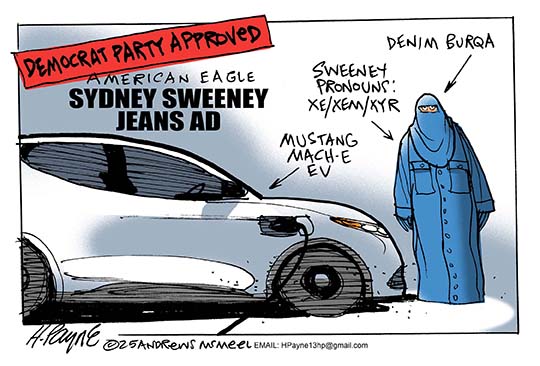
Cartoon: Sweeney Jeans Ad Democrat Approved
Posted by Talbot Payne on August 4, 2025