- Search Cartoons
- Comic Archive
-
Payne
Store



 Henry Payne RSS

Articles Blog
Payne: Q&Auto with the Shelby GT350’s guru
Posted by hpayne on September 5, 2015
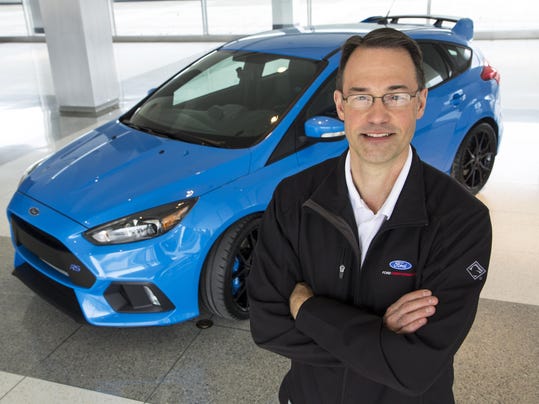
Interviewing Kerry Baldori, Ford’s chief functional engineer for Ford Performance, on Laguna Seca Raceway’s main straight during media testing of his team’s brand new, 2016 Shelby GT350 Mustang isn’t easy. Because with a track-full of 8250 RPM, 526 horsepower Mustangs going by every 30 seconds it gets. Really. Loud. So the conversation goes kind of like this.
Me: Kerry, when did Ford start work on ROOOOAAAAAARRRRRRRRRRR!
Baldori: Can you repeat the question?
Baldori is used to it. Because not only does he oversee the ferocious GT350, he is responsible for the entire stable of Ford performance thoroughbreds including the Focus ST, Fiesta ST, all-wheel-drive Focus RS, F-150 Raptor, and the alpha male of the herd: The Ford GT supercar which will debut in the 24 Hours of LeMans in France next year to rekindle Ford’s 50-year-old race rivalry with Ferrari.
It would also be a nice 50th birthday present for Baldori. The life-long motorhead grew up in Frankenmuth, Michigan where he flogged go-karts and mauled drag strips in his first racer, a ’69 Camaro. With degrees from Western Michigan and Wayne State, Baldori joined Ford 26 years ago where he built a resume on the cutting edge of vehicle performance.
Baldori’s team shocked the world with the stunning Ford GT at January’s Detroit Auto Show. But the 600-plus-horsepower supercar also signaled a new, more focused performance direction for Ford.
From its dominance of LeMans in the 1960s to NASCAR to its RS division in Europe to its stateside SVT hot rods, Ford has a long history of making quick cars. But the effort was never organized under one roof until now.
“Prior to Ford Performance organization it was kind of hit and miss,” says Baldori. “Then six-to-seven months ago we brought everything together under the Ford Performance umbrella. That has really been a huge change. It not only bring our products together globally, but also the motorsports organization (including) our technical organization that supports NASCAR and all the specific race organizations we’re involved in.”
Baldori credits Raj Nair, Ford’s chief technical officer for Ford Global Product Development, for the change. “He’s a huge supporter of our team and performance in general,” he says.
The Shelby GT350 was in the works well before the consolidation. Indeed – after being estranged for years – Ford and Shelby rekindled their ’60s flame after the new, retro-styled, fifth-generation Mustang was unveiled in 2005. A GT500 stoplight king followed in 2007, the first of a series of 500s that culminated with a 2013 model with a 5.8-liter V-8 putting out an insane 662 horsepower. It was a brute.
But with the more nimble, sixth-generation Mustang chassis, Baldori’s team was eager to go beyond face-flattening, straight-line performance.
“The GT500 was mainly about power but we always tried to make it as track capable as possible,” he reflects. “We always wanted to make a naturally-aspirated, well-balanced, lightweight car that would go back to that original GT350 that could live up to the Shelby name. There has been a GT350 done through Shelby America – but we had never done a GT350 before.”
The Performance team set a high bar. How high? They benchmarked the GT350 to Porsche’s best: The 911 GT3.
“We want to benchmark and try to improve ourselves,” says Baldori. “(The GT3) became an inspirational benchmark for us. We learned a lot from the car, it’s all part of the process.”
That benchmark meant taking the GT350 to the track this year against Porsches and BMW M3s where it has had a stellar rookie season winning at both Mosport and Watkins Glen. Multimatic, a racing team out of Toronto, prepares the Mustangs – as itwill the Ford GT for LeMans. Baldori knows a thing or two about pro racing himself having been embedded by Ford in Newman Haas Indy car racing team in the 1990s as a vehicle dynamacist.
ut developing a performance car today also means engineering for comfort. You wouldn’t know it by the nearby GT350s making our ears bleed in full-predator TRACK mode (one of five modes including Eco and Drag) – ROOAAAARRR! – but the muscle car was made for everyday driving comfort.
“It’s very easy to drive. It’s incredibly quiet,” says Baldori. “A lot of extreme performance cars have their little quirks. These cars are really good.”
In that great garage in the sky, Carroll Shelby must be smiling.
Payne: Muscular Mustang GT350 can dance
Posted by hpayne on September 3, 2015

I’ve wrestled the twin-striped snake before.
The 662-horsepower, Cobra-badged, 2013 Ford Shelby GT500 Mustang — distinguished by its supercharged, 5.8-liter V-8 — could strike quickly at a stoplight, hitting 60 mph in just 3.4 seconds. It could also bite you back. Based on the solid-rear axle, sixth-gen chassis, the Shelby was a reptile-by-the-tail in the twisties. In the rain it was downright diabolical. Give the big V-8 too much boot and you could take out a whole block of mailboxes.
The all-new, razor-sharp, curve-carving 2016 Shelby GT350 Mustang is not that car.
Indeed, I should check the wedding registry at The Henry Ford. I swear the GT350 married a Ferrari California and spawned a child. Despite the Hatfield and McCoy history of the two companies (cue the Ford GT supercar’s war on Ferrari at LeMans next year to commemorate the 50th anniversary of their last assault), Ford engineers went to Ferrari school.
Pay attention, class. There will be a quiz at the end. Under the football-field-long hoods of the Mustang and Ferrari beat flat plane-crank, V-8 engines. Until now the exclusive territory of Ferraris and race cars, the flat crank is a Ford first. It was worth the wait. The GT350 team chose the lightweight design for its inherent, high-revving character while engineering out its less desirable tendency to shake like a wet dog. The result is a smooth eight-holer that revs to (no kidding) 8,250 RPM with an endless torque band over 3,500 RPM that will have you begging for more.
But the Shelby’s handling is the revelation here — allowing this snake to transcend muscle car stereotype and compete with more expensive exotics.
I admit some trepidation before taking the big pony out on Laguna Seca, California’s legendary Mazda Raceway last week. The 2.3-mile rollercoaster is appropriately brought to you by the makers of the sprightly MX-5 Miata. This is a track that demands nimble handling. Even its lone straightaway has a blind kink in the middle that requires a deep breath in the smallest of cars.
I’ve flung 1,400-pound Barber School formula cars, 2,400-pound Alfa 4Cs, and 3,400-pound, AWD Subaru STIs around Mazda Raceway, but never a 3,800-pound muscle car. Forget Oakland County in the rain. A GT500 would be a challenge around Laguna in the most-experienced of hands in the dry.
The GT350 is a revelation from the first turn of its Cobra-tattooed steering wheel.
My striped steed crouches with astoundingly good corner manners for a big palooka. The clutch pedal is too long, but ceases to be an issue as I launch up the hill toward the famous Corkscrew turn, all 526 ponies straining at 8,000 RPM in third gear. I snatch fourth near the summit and imagine Pegasus sprouting wings and flying across San Francisco Bay — but as I slam on the huge, 15.5-inch front brakes, the Mustang crouches again, nailed to the pavement. No drama. No search for the eject button. Over the heart-in-your-mouth, straight-drop Corkscrew with throttle — with throttle! — my confidence soars. By the time I’ve reached final Turn 11, I am Hiccup in “How to Train Your Dragon.” We are one. I slide the rear end under throttle onto the pit straight and fearlessly attack the kink. Get thee behind me, trepidation.
Credit additions like “MagneRide shocks” and sticky, bespoke Michelin rubber. But more importantly, the stem-to-stern, comprehensive remake of the sixth-gen Mustang. With its independent rear suspension, revised double-knuckle MacPherson front, and lighter skeleton the ’15 expanded the playing field for Ford’s formidable performance team.
“We did the usual tricks to make the GT350 more suited to the track,” says Adam Wirth, the car’s chassis dynamics engineer. “But the new chassis gave us so much to work with.”
How much?
“Frankly, we didn’t see the need for a chassis brace,” he continues when pressed on why the Shelby doesn’t bear a bat-winged support like Cadillac ATS-V or BMW M4. “The basic chassis is that good.”
Perhaps. Or maybe Mustang is watching costs and holding something in reserve pending Camaro’s response to the GT350. Because respond it will. Talking Mustang vs. Camaro is like rehashing Balkan territorial disputes: after a few minutes you’re arguing about wars that happened centuries ago. In the case of Detroit’s muscle car rivals, the Battle of the Sixties.
This is the first GT350 since Carroll Shelby’s modified 1965-68 models started a Detroit arms race that by decade’s end had Roger Penske Camaros and Ford Boss Mustangs exchanging body blows in the Trans Am ring.
Ford has dusted off the Texas gunslinger’s badge for good reason: Chevy’s Camaro Z28. The 505-horsepower track weapon combines formidable power with track savvy and set a new benchmark for performance. Mustang’s new chassis gives the Shelby added versatility, from producing a base, $48K GT350 that is comfortable both on and off the track to the bonkers, $66K GT350 R which can not only arm-wrestle the Z28 but challenge Porsche GT3s too.
Speaking of GM’s finest, the R completes a murderer’s row of Detroit muscle. Got $70K? You have a choice between the ’Stang, Camaro Z28, Dodge Hellcat, or Corvette with Z51 track package.
Indeed, with its quicker, more cobra-like reflexes, the GT350 signals an evolution of the muscle car. This new generation deserves consideration as a discount competitor to the Cadillac ATS-V and M4 — if not on interior appointments (essentially unchanged from the Mustang GT), then in looks and good road manners.
The GT350 is confirmation that Ford hit the bulls-eye with its controversial, sixth-gen design.
The Mustang is burning up the sales charts because its styling is both retro and refreshingly modern. While some of my most partisan Mustang pals complain the pony’s snout had been Fusion-ized, it has a distinct presence on the road. The new Shelby (available in Competition Orange, Avalanche Gray, Shadow Black, Triple Yellow Tri-coat, Deep Impact Blue, Magnetic, Race Red and Oxford White) distinguishes itself from the base pony with all-new body panels from the doors forward. The lower, shark-like snout gets carbon fiber for stiffening, and the corner fog lamps have been replaced by air-sucking nostrils to cool the massive brake shoes.
Thus the Shelby’s most distinguishing feature: The vertical shark’s gills behind the front wheel which suck air from the brakes. It’s a subtle but effective touch — like gills exhausting the Corvette Z06’s similar, 15.5-inch front rotors.
But don’t think the GT350 is the last word. There’s an arms race on. Can a 700-horsepower, GT500 Hellcat-fighter be far behind?
2016 Ford Shelby GT350 Mustang and GT350 R
Vehicle type: Front-engine, rear-wheel-drive, four-passenger sports coupe
Price: $47,795 base ($57,970 GT350 as tested)
Power plant: Flat-plane crank, 5.2-liter V-8
Power: 526 horsepower, 429 pound-feet of torque
Transmission: Six-speed manual transmission
Performance: 0-60 mph, 3.7 seconds (Car & Driver estimate)
Weight: 3,791 pounds
Fuel economy: EPA 14 mpg city/21 mpg highway/16 mpg combined
Report card
Highs: Athletic handling; revs to the moon
Lows: You call those rear seats?; touchy clutch
Overall:★★★★
Payne: The legendary Shelby GT350 Mustang returns
Posted by hpayne on August 31, 2015

In the beginning there was the 1965 Ford Shelby GT350 Mustang. The first performance mule based on the wildly popular Dearborn coupe. The first Mustang developed between Ford and racing genius Carroll Shelby. The first, track-focused pony car.
Rejoice Mustang faithful. The legend has returned.
Just in time for its 50th birthday, the Shelby GT350 is here — the first Ford-engineered GT350 since the first generation went out of production in 1968. On Wednesday, I had a chance to put it the test on one of America’s most challenging race tracks, Mazda Raceway in Laguna Seca, California. Lookout Camaro Z28. The muscle car wars are going nuclear.
In that great racetrack in the sky Carroll Shelby is smiling. The GT350 not only lives up to his name, it promises a car as comfortable on the street as it is fearsome on the track. But let’s begin on the track, where the GT350 made its name collecting Sports Car Club of America trophies by the bag-full.
As part of its new performance division, Ford has developed a coven of assault vehicles from the Ford GT supercar to the Ford Focus RS. The GT350 is Mustang’s contribution, featuring the highest horsepower, normally-aspirated V-8, Ford has ever made. The 5.2-liter mill develops a stunning 526 horsepower, a number that dwarfs performance coupes like the BMW M4 and Cadillac ATS-V and approaches the lofty numbers of supercars like the Porsche Turbo S and Nissan GT-R.
Ford achieves this feat using lightweight, flat-crank engine, a technology rarely used except by Ferrari and purpose-built race cars — that allows the 317-cube V-8 to spin to stratospheric 8,250 RPM. Not even Ferrari’s flat-crank, $240,000 458 (which makes 570 horsepower if you’re wondering) tips the scales as light as the ‘Stang.
Yet the GT350 begins at just $49,995 — pocket change for a Ferrari owner. Even a loaded GT350 R will set you back just $66,495, well south of an air conditioning-less Camaro Z28.
With my foot buried at 8,000 RPM and 125 mpg over the crest into Laguna Seca’s blind Turn One, the sound is glorious. This is not the ground-shaking V-8 rumble I’m familiar with from classic 600-RPM V-8s, like the Shelby GT500 drag-racer that Ford has made since 2007. No, this is more like the high-pitched bellow I hear from NASCAR V-8s that belt out 850 horses at 9,000 RPM.
But the Mustang is more than a pony with an engine. Strapped to Mustang’s new, sixth-generation chassis featuring the badge’s first independent rear suspension and fitted with gummy, specially-made Michelin sport shoes the GT350 is remarkably nimble for a 3,700-pound beast.
As a result, the pony combines the finest attributes of the old, musclebound GT500 and the corner-carving Boss 302. This combination of high-revving power and handling inspired Ford to not only benchmark the car to Camaro’s ferocious Z28 track start, but to look beyond to Porsche’s 911 GT3.
A stretch, you say? Early testing shows the GT350 R — which saves another 100 pounds from the standard GT350 with tricks like carbon-fiber wheels and no backseats — lapping in the low 1.30s at Laguna alongside the Porsche.
Yet this track-focused thing is surprisingly docile on the street. The V-8 makes a pleasing rumble at ignition but quietly strode the boulevards of Southern California in under 3000 rpm. The interior is blessed with Recaro seats, but otherwise GT350 buyers can opt for all the amenities of a Mustang GT with the “tech” package — including the latest version of Ford’s communication system, SYNC 3.
Even owners of the wicked GT350 R — distinguished by its high rear spoiler and first-ever carbon-fiber wheels — can upgrade from the AC-less base to a “electronics” package with all the creature comforts.
Mustang has thrown down the gauntlet to Camaro with the GT350. And with its lightweight, Cadillac ATS-based chassis, the sixth-gen Camaro is sure to respond. Put in your ear plugs folks, the muscle car wars are just beginning.
Payne: Terrorizing Detroit in Nissan’s GT-R
Posted by hpayne on August 31, 2015

Godzilla.
We motorhead media types drool at the mention of the Nissan GT-R’s nickname. Yet few of us get a chance to experience it. The $101,000 machine is rarely found in press fleets. My chance to ride Godzilla came this summer. I was expecting tail-wagging aggression, window-rattling roars — a menace with fiery upshifts and a disturbed disposition.
I got none of that. Godzilla? Sure, Japan’s most powerful sports car deserves comparison to Japan’s most fearsome B-movie reptile. But in truth the Nissan GT-R is more cyborg than monster.
Call it the Terminator.
Like the original Terminator Model T-800 from 1984 (which is how long it seems the aging GT-R has been around) — not the sleek, advanced, liquid metal, “Mimetic polyalloy” Terminator T-1000 of later sequels. This beast is Schwarzenegger. Big, heavy, awkward at slow speeds. You can hear the gears meshing. Its feels analog, not digital.
As the auto tranny downshifts from 3rd to 2nd into a red light, the car lurches to a stop. But then, oh, what a launch.
With an electronic, torque-managing, all-wheel-drive system and twin-turbo power, the GT-R is a rocket off the line. The sensation resembles Cedar Point’s Top Thrill Dragster roller-coaster. No slip. No wheel spin. Just nail it and you’re pulled on invisible rails. The engine is a muted roar — an angry vacuum cleaner.
No tail-wagging drama like a Dodge SRT Hellcat. No thunderclap like a Z06 Corvette. No barking upshifts like a BMW M3. Just relentless, robotic power from the 3.8-liter V-6 mill. Godzilla meet Terminator.
The GT-R’s layout is more sports coupe than sports car. The lip doesn’t drag out of my driveway like a Corvette or Porsche Cayman. Indeed, the GT-R feels like an Audi RS 5and Corvette Z06 had a love child. At almost 4,000 pounds its chassis is Audi-solid, AWD, well-engineered.
Face-to-face the GT-R appears a big athlete with nice jewelry. Mike Tyson wearing earrings. My 2016 45th Anniversary Edition GT-R celebrates its first, early-’70s ancestor. The color is a gold-like hew called “Silica Brass” (for the 50th anniversary edition maybe GT-R will get actual gold). A big, Mitsubishi Evo-like goatee fills the face. Horizontal LED lights adorn the cheeks below elegant, LED-tubed headlights. Flush door handles flip outward, opening the car at your fingers’ command. The GT-R is 10 years old now, but the fashion details keep it hip.
Like an RS 5, the 2+2 interior will technically seat four. If the rear passengers are five-year-olds. Sitting on their knees. In the posh suede and leather driver’s bucket, my seat back hit the rear seat (at least rear passengers get the best concert seat in the house between two giant Bose speakers). Tidy rectangular modules organize the dash holding circular instruments and vents — all trimmed with carbon and stitched leather.
The console-mounted starter button is even Audi-like, except for one detail. It’s red. Like the button to launch a nuclear warhead. WARNING: TOUCH THIS BUTTON AT YOUR PERIL.
Let’s talk about that because I know what you’ve been thinking since the first paragraph: Why would I pay $101,000 for a Nissan??!!!
One hundred grand for a car with the same badge as the Sentra? Seriously? Heck, a nicely-equipped, 450-horse V-8, AWD RS 5 costs $70K and when I roll up to the country club, the valet will say: “Can I park your Audi for you, sir?”
I understand. And that’s why that red button matters. Because the GT-R is not an overpriced Nissan — it’s an underpriced supercar.
Like the aforementioned, 650-horsepower Z06, the Nissan is that rare mainstream breed that can do things supercars can — for half the price. Want a lively AWD coupe to cruise to work? Save $30K and buy the silky RS 5 or a base 450-horse Corvette Stingray. Want to terrorize Porsche Turbos and Ferraris at Waterford track days? Buy a GT-R.
Consider the numbers.
The GT-R packs 545 ponies. Like the Z06, it beats the Ferrari 458 Italia and Porsche 911 Turbo S and Lamborghini Gallardo to 60 MPH in 2.9 seconds. It laps with the supercars at even the epic, 4.1-mile Virginia International Raceway. Yet the Ferrari costs $240,000. The Porsche $183,000. The Gallardo $182,000. Oh.
Walk around the GT-R and it’s apparent this is a race car in drag.
Inside the gorgeous, 20-inch, 20-spoke rims loom massive, drilled 15.35-inch front and 15-inch rear rotors anchored with Brembo calipers that will pull out your fillings under hard braking. The gummy, Dunlop tires — 10-inch front and 11 in the rear — mimic the Z06’s sticky, Michelin 10 x 12s. Throw it into a corner and it rotates with ease. Credit Nissan’s location — ditto the Chevy — of the transmission in the rear (along with the GT-R’s AWD transfer case) giving it remarkably neutral handling despite its girth.
The car’s most distinctive angle is the spoiler-equipped rear end, which makes sense since it’s the view most folks will have of this 193-mph weapon. When’s the last time you saw a car with exhaust pipes as big around as its taillights? The Detroit Tigers could store baseball bats inside these things.
Like the ’Vette, the GT-R betrays its discount supercar price with little shortcomings. The ’Vette smells like an oil refinery inside. The GT-R props its hood with a stick. The Z06’s chassis twists and rattles. The GT-R’s drive-train whirrs and clunks.
Put your foot down and all is forgiven.
The traction is surreal. Stomp on the pedal with or without traction control and the car — 545 horses distributed to all four wheels — stays true as an arrow.
The GT-R’s tight, balanced chassis responded to little inputs as I barreled through tight Oakland County corners, tires chirping. Predictable. Predatory. On the street, the GT-R is a head-turner, but is otherwise docile in daily commuting. Yet, unlike Z-OMG-6, it won’t wake the police departments in three counties when you put your foot down. The angry vacuum cleaner stays stealthy.
Should you buy it? I thought the $81K BMW M3 was expensive until I met the GT-R. Now I’m not so sure. The twin-turbo V-6 M has more attractive lines. More seat room. More badge cache. But then the Terminator GT-R will pound it into the asphalt at a stoplight.
Or, if you prefer, call it Godzilla.
’16 Nissan GT-R
Vehicle type: Front-engine, all-wheel-drive, four-passenger sports car
Price: $101,770 base ($104,660 as tested)
Power plant: Twin-turbocharged, 3.8-liter V-6
Power: 545 horsepower, 463 pound-feet of torque
Transmission: Dual-clutch, six-speed automatic transmission
Performance: 0-60 mph, 2.9 seconds (Motor Trend)
Weight: 3,922 pounds
Fuel economy: EPA 16 mpg city/22 mpg highway/19 mpg combined
Report card
Highs: Race-car performance; rail-like traction
Lows: Clunky drive-train; those are backseats?
Overall:★★★
Payne: Cruisin’with the top down . . . in a 4-banger?
Posted by hpayne on August 23, 2015
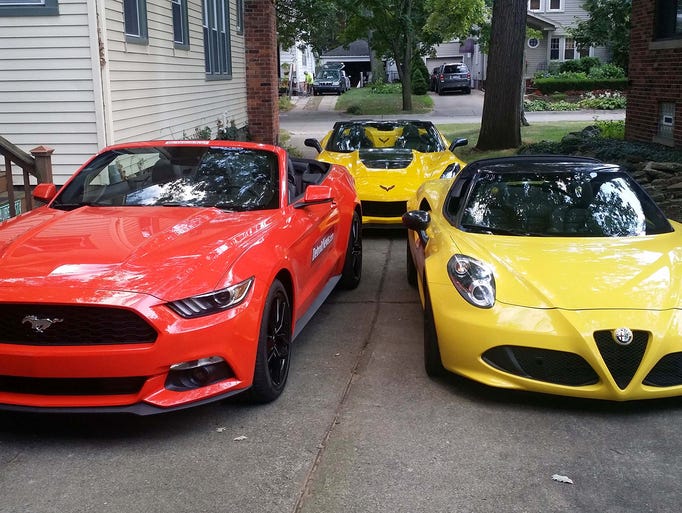
Courtesy of the fine folks at Chevy, Ford and Fiat-Chrysler, the official Detroit News Dream Cruisers this year were a 2015 Corvette Z06 convertible and a pair of topless turbo-4s: The Ford Mustang and Alfa Romeo Spider.
Which begged the question: Can a 4-banger find love at the Dream Cruise?
After all, the Cruise is V-8 country. Hellacious supercharged Hellcats. Earth-shaking ’67, 389-cube GTOs. And of course, ’Vettes, ’Vettes, ’Vettes. But in the early 21st Century, the Green Church rules and in our zeal to save the polar bear the V-8 is an endangered species. With 54.5 mpg-by-2025, the new fuel mileage standard automakers are turning to fewer cylinders and more turbochargers to both conserve gas and quench our thirst for speed.
Turbo-4 Mustangs, turbo-4 Camaros, twin-turbo BMW M3s … Rumors even swirl that a mid-engine, turbo-6 Corvette is in the works. Clearly, we’re going to have to get used to fewer V-8s. Six-bangers aren’t much of a stretch. But can a pony car be a classic with a 4? Can a $70,000 sports car?
My fellow News writer, Tom Greenwood, and I put the Alfa and Mustang to the test in a week of top-down driving along with the undisputed King of the Cruise, the Z-OMG-6.
That the ’Vette is king is not in dispute. The new C7 Stingray is an instant classic. A muscled Michelangelo sculpture. Its base 450-horsepower, 6.2-liter V-8 makes grown men weep. Supercharge it to 650 horses and they bow before it. Porsches inspire. The Z06 you’d follow into battle.
Even at 5 mph (the Official Average Speed of the Dream Cruise) the V-8 is authoritative. Between 11 and 12 Mile Saturday a kid holds up a sign: “REV IT UP!”
I pop the eight-speed auto tranny in neutral, stomp the gas, and the 389- cubes of pistons jackhammer the pavement. BRAAAAPPA! BRAAAPPA! Car alarms go off for blocks. All hail the king!
The Alfa pales by comparison. At 13 Mile I pass another kid. Another “REV IT” sign. Surprisingly, the turbo-four – which has a wonderful, obnoxious growl at speed – sounds bashful. The kid and I look at each other in mutual disappointment. How can such a wicked-looking schnauzer have such a weak bark?
The rev test aside, however, the Alfa is a Cruise star.
Begin with its supermodel looks. They don’t call it the “baby Ferrari” for nothing. Curved flanks, mid-engine layout. Our matching yellow Alfa and Z06 cruised Woodward together and the Italian got more attention. Maybe because only 500 4Cs have been sold in the U.S.
But good looks are just the beginning. The Alfa is simply the most fun car on the road today.
Put your foot in it and the turbo-4 barks on upshifts, snorts under power, and generally sounds like a Rottweiler with indigestion. But handling is what sets it apart. Driving the ferocious Z06 around Metro Detroit feels like having a nuclear war in your living room,
while the nimble Alfa is a much more precise weapon. Its stiff carbon fiber tub gives it an over-sized, go-kart feel as you fling it through Oakland County’s lake hills.
But the real payoff is the bottom line. The 4C is not just half the price of our $113,835 Z06, it is the only carbon sports car under $135,000. At a remarkably affordable $53,000, both the base Alfa and base C7 offer totally different performance experiences.
At $43,290, the Mustang was our bargain cruiser, but its 310-horsepower turbo-4 was the big question. After all, muscle cars have been defined by its throaty V8s back to the 1960s.
Greenwood cruised happily in our bright, “Competition Orange” pony all week. It’s striking, comfortable and powerful. Ford has worked wonders with its Ecoboost turbos which offer greater power than similar fours from BMW and Audi. It’s no slouch against V-8s either.
In Royal Oak Sunday night, I drag a recent vintage, 370-horse Dodge Charger R/T V-8out of a stoplight to a draw. Impressive.
But does the 4 feel out of place in the herd? North of Maple, I hook up with Andrew Fallon, 23, of Warren cruising in a gorgeous, red, fourth-gen Mustang GT. Hood scoop. Black center wheels. Rear spoiler. The works. He revs his 4.6-liter V-8 and the earth shakes. My turbo-4 responds with . . . was that a loud hum? Like I just plugged a vacuum cleaner into a 220-volt socket.
Ummmm.
“You need a 4 cylinder in the age of emission controls,” Fallon smiles. “But a muscle car’s gotta have a V-8.” Yes it does. Long love the eight-holer.
Henry Payne is auto critic for The Detroit News. Email him at hpayne@detroitnews.com. Follow him on Twitter @HenryEPayne. See all his work at HenryPayne.com
2015 Ford Mustang Turbo-4 Convertible
Vehicle type: Front-engine, rear-wheel-drive, four-passenger coupe
Price: $34,800 base ($43,290 as tested)
Power plant: 2.3-liter, twin-turbocharged, inline 4-cylinder
Power: 310 horsepower, 320 pound-feet of torque
Transmission: Six-speed automatic transmission
Performance: 0-60 mph, 5.2 seconds (Car & Driver)
Weight: 3,524 pounds
Fuel economy: EPA 21 mpg city/32 mpg highway/25 mpg combined
Report card
Highs: A dream cruiser; Torquey turbo power
Lows: Little room for backseat cruisers; Where’s the growl?
Overall:★★★
2015 Alfa Romeo Spider
Vehicle type: Mid-engine, rear-wheel-drive, two-passenger sports car
Price: $63,900 base ($76,495 as tested)
Power plant: 1.7-liter, turbocharged, inline 4-cylinder
Power: 237 horsepower, 258 pound-feet of torque
Transmission: Six-speed, dual-clutch, automatic transmission
Performance: 0-60 mph, 4.1 seconds (manufacturer)
Weight: 2,487 pounds
Fuel economy: EPA 24 mpg city/34 mpg highway/28 mpg combined
Report card
Highs: Body of Aphrodite; Go-kart-quick handling
Lows: Cramp-inducing passenger seat; No room for luggage
Overall:★★★★
2015 Corvette Z06 Convertible
Vehicle type: Front-engine, rear-wheel-drive, two-passenger sports car
Price: $83,000 base ($113,835 as tested)
Power plant: 6.2-liter, supercharged V-8
Power: 650 horsepower, 650 pound-feet of torque
Transmission: Eight-speed automatic transmission
Performance: 0-60 mph, 2.9 seconds (manufacturer)
Weight: 3,524 pounds
Fuel economy: EPA 13 mpg city/23 mpg highway/16 mpg combined
Report card
Highs: Awesome power; Thrones fit for king and queen
Lows: Chemical-like interior smell; Tire-squirm in tight turning radius
Overall:★★★★
Payne: The Toyota Tacoma off-road assault vehicle
Posted by hpayne on August 20, 2015
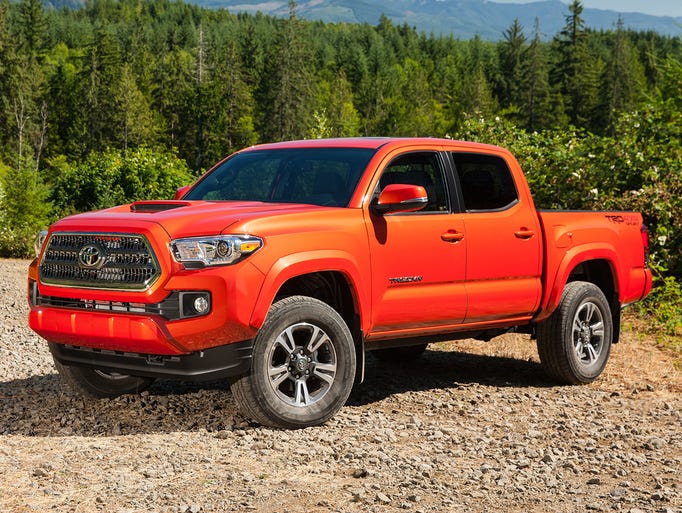
I’m confused. I just spent a day flogging a Toyota Tacoma pickup and I can’t wipe the grin off my face.
Yes, Toyota. That manufacturer of the best auto appliances — and cures for insomnia — in the business. Camry, Corolla, RAV4, Avalon. Reliable, competent, dependable. And as exciting as vanilla. There are exceptions to be sure — like the Scion FR-S sports car which I’d take over a lifetime free pass to Cedar Point.
But then the FR-S is a Scion because Toyota self-consciously created a youth brand to try to pep up its somnolent reputation. Toyota is very aware of its, um, personality deficiency. Like Al Gore cracking a joke, its efforts to appear fun can come across as strained. Take current ads suggesting that the new Camry is so spontaneous it’ll drive you to crash weddings and elope with the bride. Please.
So how to explain the Tacoma? A rock ’em, sock ’em, youthful, off-road toy that is to pickups what the Jeep is to sport utes.
When Baja 1000-veteran Chief Engineer Mike Sweers calls the Tacoma a “bad ass” truck no one snickers. Tacoma comes by its reputation the old-fashioned way: It earned it. Turn the clock back to the ’80s when off-road racing legend Ivan Stewart joined Toyota on his way to winning a record 17 Baja 500s and 3 Baja 1000s in the roughest, readiest tests of trucks. It continues today with Toyota segment innovations like crawl control and a 32-degree front attack angle.
If Jeep did a pickup it would be the Tacoma. Indeed, when Sweers & Co. invited the media to check out its newest creation they did it the Jeep way: They took us to a terrifying off-road course (near Tacoma, Washington, natch).
Black Diamond is an old mining town surrounded by steep hills and deep hollows. Like black diamond ski slopes, they’re not for the amateur truck. Forty-degree inclines, jagged rock quarries, snake-like gravel roads.
I started Toyota’s obstacle course on a 41-degree incline called Double-Drop Hill. If I had my druthers, your road-racing scribe would rather be racing at 170 mph across a 30-plus degree incline — say, Daytona’s 31-degree bankings — than off-roading straight up it at 5 mph. But it’s no less harrowing. So steep is Daytona’s banking that all you see out the front windshield is a wall of asphalt. To actually see where you’re going, you actually have to look out the side window.
Ascending at 41 degrees is a learning experience, too. Any truck with hill descent will help you brake down a slope, but going up is another matter. All you can see at that angle is the sky (and flags that you/your spotter have planted along the path). Leave the rest to Tacoma’s crawl control system which takes over the brakes and accelerator to get you to the top. I felt like Spiderman scaling the Empire State Building. Tacoma is that solid.
And that unique. No other mid-size pickup can accomplish such feats.
Which is a good thing for Toyota because its hold on midsize trucks is under assault from Detroit’s biggest truck armies. While the full-size segment has been a raging war between Ford, Chevy, GMC, Toyota, and Nissan, the midsize front has been strangely peaceful. Chevy’s Colorado and GMC’s Canyon got out in 2011 — as did Ford’s Ranger — leaving the spoils to Tacoma and a few scraps for Nissan’s Frontier. But as you may have noticed from the glassware tinkling in your cupboards, the GM makes have unleashed a full-scale artillery assault to retake the pickup segment. Call it P-Day.
The Colorado and Canyon are formidable players with tomb-quiet interiors, Olympic strength, and competitive pricing.
The Yanks have turned the tables on their Japanese competitor by offering the most cost-competitive vehicles at a $20,995 (for Colorado, $21,880 for Canyon) — significantly undercutting the Tacoma’s $24,200 base price — itself a $2,335 jump over the 2015 model. What’s more, the Detroit boys come at the homely Toyota with dazzling facias and best-in-class fuel economy and towing numbers.
This two-front war goes to the heart of the segment’s traditional demographics: Budget-conscious, 20-something male adventurers and comfort-minded 50-somethings who want to downsize from full-size pickups the size of Rhode Island.
Game on. GM’s challenge forced the aging, decade-old Tacoma back to the lab to produce its best truck ever. To counter the GM twins’ superior looks and performance numbers, Tacoma offers go-anywhere, run-forever endurance.
At the bottom of Double-Drop Hill, I toggled off crawl control which hands me back full control of the vehicle. I floor the 278-horsepower, 3.6-liter V6 — a smooth, gem of an engine — creating rooster tails of dust as I bomb along the gravel trials. The fun doesn’t diminish on public roads where the TRD Sport’s suspension checks body roll.
Gone is the old Tacoma’s noisy cabin. Responding to the Detroiters’ hushed interiors, Tacoma upped its game too, surrounding me in a cocoon of acoustic glass and sealed joints to record a claimed best noise/vibration/harshness spec (NVH) in class.
The build quality is superb. No squeaks, no rattles despite the off-road punishment. I bark at the navigation system and she understands every word. Nice. A truck that assaults the trails, then finds the quickest road home for dinner. Cabin amenities are familiar to Toyota owners — though again Tacoma dances to its own tune with bright, Jeep-like trim molds in the Sport model.
When you have the tools for the job, it breeds confidence. And confidence breeds personality. I like this Toyota.
Like Jeep, that personality brings swagger. At Black Diamond Toyota names its final obstacle the Devil’s Boneyard — a sinister rock quarry that the pickup’s 32-degree attack angle and extensive skid-plating tackles with ease. Try that in the handsome, 17-degree-attack-angle Canyon and it won’t be handsome for long.
Tacoma’s off-road obsession sacrifices looks. The 2016 is an improvement over its homely predecessor. But its blunt front end will win no beauty contests. It’s a bulldog compared to the GM’s golden retrievers.
The Detroiters’ are on-road work trucks. The Tacoma begs to go to oblivion and back. Throw your dirt bikes into the rugged, composite sheet-lined bed. Tie them down with sliding cleats. Bury the rear axles in mud and sand, the drum brakes won’t mind.
Which makes for a dilemma. Buy the GMC Canyon to tow your Scion FR-S to the race track? Or claim a Tacoma to have as much fun off-road as the FR-S gives you on-road?
2016 Toyota Tacoma
Vehicle type: Front-engine, rear and four-wheel-drive, five-passenger pickup
Price: $24,200 base (TRD Sport AWD model tested starts at base $33,850; Limited model starts at $38,720)
Power plant: 2.7-liter in-line 4-cylinder; 3.5-liter V-6
Power: 159 horsepower, 180 pound-feet of torque (4-cyl); 275 horsepower, 268 pound-feet of torque (V-6)
Transmission: Five-speed manual or six-speed automatic
Performance: Payload: 1,120 pounds; Towing capacity: 6,400 (with prep package)
Weight: 4,445 pounds (4WD double cab as tested)
Fuel economy: EPA 19 mpg city/22 mpg highway/20 mpg combined (4-cyl 4WD); EPA 18 mpg city/23 mpg highway/20 mpg combined (V-6 4WD)
Report card
Highs: Go anywhere attitude; hushed interior
Lows: Base price sticker shock; gas mileage barely better than full-size truck
Overall:★★★
Automakers: Desperation in Detroit
Posted by hpayne on August 20, 2015
The Obama administration gave with one hand but took away with the other.
Detroit — Just six years after the Obama administration bailed out Chrysler with $12.5 billion in federal loans and handed it to the Italian automaker Fiat, the company — now called Fiat Chrysler Automobiles (FCA) — is nervous about its future. CEO Sergio Marchionne has been knocking on doors this summer seeking a marriage with General Motors or another major automaker.
How did this happen? The reasons are many. The Chrysler division’s sales are strong, but mother ship Fiat is bleeding cash in Europe. The auto industry’s return on investment is notoriously poor these days compared with those of other industries.
But, perversely, perhaps the biggest threat to FCA is the same government that saved the company in 2009.
While the Obama administration was throwing a life preserver to Chrysler, it was also tying an anchor around its legs in the form of new standards to combat global warming that require automakers to more than double their average fuel-economy rating, from 25.5 mpg in 2010 to 54.5 mpg by 2025.
Yet in the last two decades, fuel economy gained by just 4 percent. According to Professor Michael Sivak of the University of Michigan Transportation Research Institute, average vehicle fuel economy is down to 25.4 mpg this year, “consistent with the increased market share” of sport utility vehicles (SUVs).
With 2025 less than two product cycles away, the government’s 54.5 number is a pipe dream. But as Marge Oge, the former director of the EPA’s Office of Transportation and Air Quality, discloses in her insider’s account of the 2009 mpg negotiations, Driving the Future: Combating Climate Change with Cleaner, Smarter Cars, the Obama administration wants to use the mandate to force a fundamental change in engine technology, in the same way that federal lighting standards were aimed at eliminating the incandescent bulb.
If automakers build alternative-fuel vehicles, the EPA will award credits to soften the mpg diktat. As a result, automakers are spending billions on electric-vehicle (EV) technologies to game the government rules — even though EVs have been met with a collective shrug by consumers.
Marchionne and his executive team are outspoken about the unsustainability of such spending.
“The entire industry is going more towards electrification,” says Reid Bigland, FCA’s North American vice president of sales. “It’s really the primary way to be compliant with the 2025 standards. That is consuming a significant amount of capital in this industry.” The global-warming rules have created a two-tier market.
Automakers are churning out money-making sport utility vehicles at a record pace to keep up with popular demand. SUVs (“utes,” as they’re known in the trade) now account for 54 percent of market share — a 15 percent increase in the last five years. Yet production of money-losing battery-powered vehicles has also soared — even as their market share has remained flat at 2.2 percent.
The numbers tell a perverse tale of government incentives. Manufacturers have introduced 31 all-new ute models to meet demand since 2009. Meanwhile, despite stalled sales of EVs, automakers have flooded the market with 50 new hybrid and electric models.
“The automakers are beholden to two masters,” says long-time auto investment analyst Joe Phillippi of Auto Trends Consulting. “The companies are responsible to their customers and shareholders, yet the government wants its own way but with responsibility to no one.”
The rules are particularly punishing for U.S. brands like FCA’s Jeep, GM’s Chevrolet, and Ford, which dominate the truck market and depend heavily on utes for their profits.
“FCA’s problem is compounded by the fact that their gas-guzzling Wranglers and Grand Cherokees are hugely successful,” says Bob Lutz, former product-development chief for both Chrysler and General Motors. “Normally a situation you like, but problematic in a market distorted by [mpg] regs.”
Since Chrysler sells few small cars, it makes little sense for it to invest billions in battery technology, which is most useful in those cars. “Chrysler did not have the funds” to invest in EVs before bankruptcy, continues Lutz. “And even now they can’t divert scarce capital and engineering money for these money-losing ‘compliance vehicles.’”
“What’s really driving the portfolio of American automakers is carbon-dioxide regulation,” Marchionne told the Detroit News earlier this year. “It’s the CO2 stuff that’s wagging the dog.”
The Detroit bailouts were a key part of President Obama’s 2012 election strategy, because they kept United Auto Worker funds flowing into Democratic-party coffers.
Yet the president’s global-warming rules are hurting UAW workers. Ford, for example, would be better off investing in profitable truck plants. Yet it must build “compliance” EVs like the C-Max Energi and Focus Electric, which aren’t selling. Last month Ford announced it is moving production of those vehicles to Mexico in order to save on costs — even though it received a $5.9 billion Energy Department loan in 2009 to build them in Michigan.
Democrats decry the outsourcing of manufacturing south of the border, yet their green policies only accelerate the trend. Worse, as automakers divert resources to unprofitable EVs, they will be ever more dependent on trucks for profits. But trucks too — which account for an estimated 80 percent of Ford’s profits — are under pressure from the EPA. Ford is light-weighting its trucks with aluminum skin to meet mpg standards — a move that has added $1,000 in variable costs to its popular F-150 pickup.
President Obama touts his love for America’s automakers, yet his lead mpg negotiator, Oge, lays bare her agency’s contempt for Detroit carmakers in Driving the Future.
“The weakened bargaining position of the now crippled automakers” in 2009, Oge writes, gave the administration the opportunity to impose the mpg mandates. Oblivious to consumer tastes, much less manufacturer profitability, the agency went for the jugular in demanding 5 percent a year increases in fuel economy to force, as Oge puts it, “game-changing full electric vehicles or fuel cells.” She mocks automaker complaints that the regulations are unworkable. “They will always estimate that any regulation will cost far more than it actually does,” she writes.
Six years later, we can all see that the costs are real. Marchionne’s desperate search for a partner foreshadows the long-term threat that EPA mandates pose to the industry.
Caged ‘Cats still thrill with safe, smoky burnouts
Posted by hpayne on August 18, 2015

I’m a little disappointed in our 2015 cruisers.
This is the first year that Ford’s “line-lock” burnout function – which allows drivers to smoke their tires without ever moving — is available in the 2015 Ford Mustang GT. The stunning ‘15s are everywhere. Yet in cruising the strip all week, I have yet to see a GT light up its tires in place.
Maybe folks aren’t sure of the parameters of the Cruise’s “no burnout” clause. Maybe they aren’t familiar with the line-lock feature.
But the Dodge boys have come to the rescue. Dodge loaded a Charger Hellcat and a vintage Challenger onto a semi-trailer and are towing it up and down Woodward today to do spontaneous burnouts. On the trailer. Behind a cage. Safe and smoky.
“We’re pretty sure it’s legal,” says Dodge CEO Tim Kuniskis. “And we think it’ll give the fans a thrill.”
Count me thrilled. Since line-lock is production tech exclusive to Ford, I figure that the Dodges have been specially equipped for their Cruise stunt. The Hellcat-mania semi pulled onto Woodward this morning with its two caged, stationary animals smoking their wheels like mad. I followed the rig for a mile this afternoon on Woodward in my Alfa and didn’t witness a burnout.
But if I were stuck in traffic this evening at 2 miles an hour, that’s where I would want to be.
Dodge Hellcat at full roar at Woodward Dream Cruise
Posted by hpayne on August 15, 2015

Royal Oak – “WAAUUUURRRGH!!” What better way to start Dream Cruise Saturday than at full opposite lock in a bellowing 707 hp Dodge Hellcat?
I climbed aboard the Detroit’s premier muscle car for the first-ever “Dodge Rock City Thrill Rides” in the middle of the Dodge display in the Kroger parking lot at 13 Mile and Woodward.
Then driver Chris Ferraro – an SCCA national Trans Am champion – unleashed the 707 ponies. Kroger parking lot will never be the same. Laying black tire marks for 100 feet, we torched the mini-autocross course that Dodge has set up behind a phalanx of police barriers. Ferraro and his “Driving Experience” buddies will be here all day giving rides.
Macomb County high school pals Chris Noel, 17, Joseph Pizzo, 18, and Dominic Gyn, 16, began waiting at 5 a.m. to be the first in line (after your Detroit News speed addict, of course) for the Hellcat ride.
Dodge Vipers are also available for a hot lap, but these boys wanted a taste of Hellcat. After his earth-shaking, tire-shrieking ride, Noel emerged with an ear-to-ear grin. He says he’s ready to trade in his 2011 Buick Regal Turbo.
“Though it’s a bit of a price gap,” to the $60K Hellcat, he says.
Wakin’ the dead at the Dream Cruise
Posted by hpayne on August 15, 2015
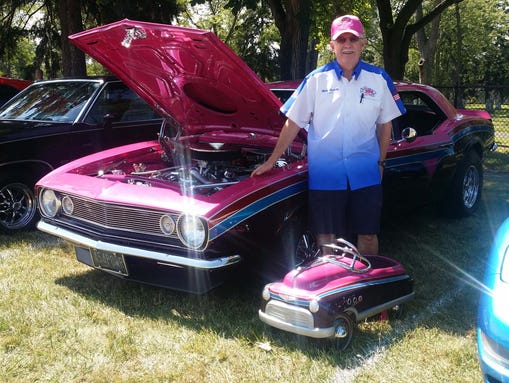
Call ’em the Wake Up the Dead Club.
For nearly the length of the Woodward between 12 Mile and 13 Mile, some of the Dream Cruiser’s loudest, prettiest muscle cars line up in reserved spots year after year. Right in front of Berkley’s Roseland Park Cemetery.
“Want to hear how she sounds?” Rob Metzger, 63, from Livonia asks me as he turns the key on his bright pink – yes, pink – 1969 Plymouth Barracuda. VROOOOOM! goes the 340 cid, six-pack under the hood, and I swear I hear the tops pop off a dozen caskets behind us.
I’ve decided Roseland is where I want to be buried.
Metzger drag-raced the big Barracuda back in its heyday to an 11-second quarter mile time. Or about what a Dodge Hellcat will do today. Not bad for an old stocker.
A few plots – er, parking spots – down from Metzger, the purple, red, blue and black paint job on Mike Oginsky’s 1967 Camaro is as loud as the 500-horsepower V-8 within. Oginsky knows his colors. He’s a retired paint engineer for General Motors. Next to his ’67 (you know the ’67s by the vented windows), is a tiny pedal car for his granddaughter. With the same paint scheme, natch.
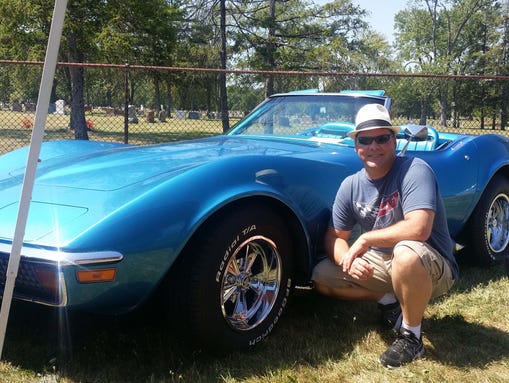
The symphony wouldn’t be complete without a Corvette. Greg Pelton’s bright blue, 1970 Stingray does the job. With its side pipes exhausting the 5.7-liter monster within, it makes beautiful music. The classic shape of the ’70 is a reminder of why Chevy waited another four generations – and 45 years – after the C3 chassis to give the latest, C7 model the name Stingray.
It takes a special kind of car.
Dream Cruisin’: I love the smell of burning gas
Posted by hpayne on August 15, 2015

3,500-pound beast – in pursuit. Sixty mph comes quickly and then we back her down as traffic looms.
West-side of Woodard is already filling with lawn chairs and we get cheers from the early birds. It’s a beautiful morning and the hoods of multiple muscle cars are already up and glinting in the sun.
I arrive at the epicenter of the Cruise – 13 Mile and Woodward – and there is no parking to be had. Lots are socked up, business spaces reserved. I roll slowly through the neighborhoods behind Beaumont hospital and fins parking on a leafy cul-de-sac.
Take a rest, little Alfa, we’ll cruise more later.
Watch for me and my cruising brother, Tom Greenwood, in his convertible Mustang on Woodward all day.
Emergency Vehicle Show brings lights, sirens … action
Posted by hpayne on August 14, 2015

Ferndale — More than 100 emergency responder vehicles — ranging from a 1923 Ford paddy wagon to a 1966 Hollywood Batmobile replica to a modern 2014 Ford Explorer — launched the Woodward Dream Cruise Friday night under gorgeous blue skies matching officers’ blue uniforms.
The 15th annual Ferndale Emergency Vehicle Show, aka the “Light & Sirens” cruise, was escorted (appropriately) by a fleet of Ferndale Police Department cruisers. The parade of vehicles followed the Dream Cruise’s opening ribbon-cutting for a cruise from 9 Mile to 11 Mile and back.
Leading the pack was a 2015 Jaguar F-Type convertible in full Hazel Park police colors. Its throaty V-8 roar honored this year’s fallen cop — Dep. Grant Whitaker, who died in a vehicle crash in December. Driver and Hazel Park reserve officer Joe Roeder, 48, was at the wheel for the 13th year.
“Thanks to Elder Jaguar-Land Rover, we honor the brave officers who fall in the line of duty every year,” he said.
The F-Type might be useful in chasing down Dream Cruise muscle car scofflaws too. But an ex-Michigan State Police Mustang GT and its powerful 5.0-liter V-8, now owned by Mike Patterson, should also be up for the task. Painted blue, the stealthy ’Stang is otherwise unidentified by lights so that it might sneak up on wayward hot shoes.
And if he catches anyone, they might be loaded in a 1923 Ford Model T paddy wagon from the Detroit Police Department.
Fully restored by Richard Baker, 70, the big, black, boxy paddy wagon was one of many employed by Detroit’s finest to round up the bad guys in the Roaring ’20s. Some of those officers might have been Bakers, as Richard comes from a long line of police officers.
Interrupting the sea of black and blue vehicles was a bright red 1928 fire engine based on a Ford Model A. From a small Indiana police department, the fire engine was one of a few vehicles driven in from out of state, including a 1969 Plymouth cruiser from the Los Angeles Police Department.
Lights & Sirens began in 2001 as a way for Ferndale to kick off the Dream Cruise and attract people downtown. The inaugural show featured nearly 60 vehicles and has grown ever since. The event proved so popular that it has been the official start of the Cruise every year since.
The brainchild of Ferndale Police Officer Ed Ungerman, the event is now run by Anthony Rzucidzio, a retired Ford security officer.
Highs and lows of the Dream Cruise
Posted by hpayne on August 14, 2015
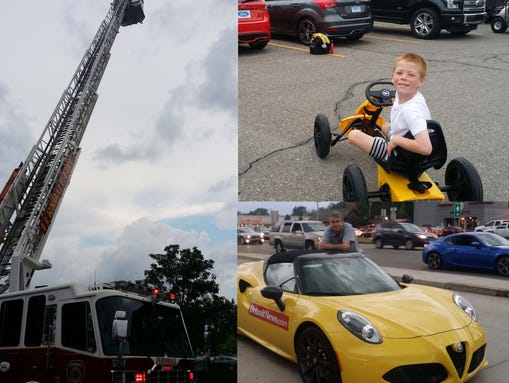
And if Mom and Dad want their own low view, they might want to try any of the low-slung sports cars on the route. Lingenfelter Performance Engineering is showing off some of its Chevy racers where Old Woodward and Woodward intersect in Birmingham. Or you can flag down my Detroit News Alfa 4C which will put you right on the ground. With its huge carbon-fiber door sills, it’s a struggle for anyone to get in and out.
NASCAR, Indy stars shine on Woodward
Posted by hpayne on August 14, 2015

Call it the Woodward Dream Cruise 500.
On Thursday afternoon (smack in the middle of rush hour, of course), 12 Indy car winners and a couple of NASCAR hot shoes jumped into Roger Penske’s historic collection of 16 Indy pace cars for a Woodward dream lap. Bobby Unser in a 1987 Chrysler LeBaron. Sam Hornish Jr. in a 2006 Corvette. Helio Castroneves in a 2009 Camaro SS. None of them smacked the wall, none of them dove into the pits for tires, none of them did doughnuts at the finish.
Though a few of them couldn’t help the occasional burnout. “Al Unser Jr. and I were having a little fun,” said NASCAR star Joey Logano sheepishly. Lucky for them, no tickets were written. Credit the good behavior to a police escort — and the pace car at the head of the field driven by the captain himself, Penske, the most successful Indy owner ever (who also calls Metro Detroit home).
Presidential motorcades don’t pack this much talent. On a day when the crowds began to descend on Woodward with cars, tents, and stacks of lawn chairs in anticipation of Saturday’s official Dream Cruise, the stars were out.
And not just the Penske armada. Just across the street from Penske Cruise HQ (between A.J. Desmond & Sons Funeral Home and Art Van furniture), Chevy was hosting 2014 NASCAR champion Kevin Harvick and his just-restored, ground-shaking, 575-cubic-inch, 1969 Camaro SS. That’s 575, as in 9.4 liters — a full 30 percent bigger than a Corvette Z06.
Did you feel an earthquake tremor about 2 p.m. today? That was Harvick firing up the SS as he took me out onto Woodward for a lap of his own.
“Been a long time since I’ve been at a car show, and I’ve never seen anything like this,” said Harvick with a grin as we rattled windows from 13 Mile to 11 Mile and back.
“This is a project I’ve had for years and I just thought it would be fun to have,” he said, sounding like any motorhead on Woodward. “A buddy of mine put on the exhaust because he wanted to see how it would sound on a 572 motor.
“I sold a ’55 Bel Air and that’s how I started my racing career,” said the 39-year old, who got his start in California as a high school racer. “I wanted a stock car and had to sell the ’55 to pay for it.” He’d like to get that car back someday — maybe for his next cruise. Along with Logano and Brad Keselowski across the street at Penske, Harvick dropped by the Cruise on his way to this weekend’s Michigan 400 in Brooklyn.
But like the thousands of fans who cheered Penske’s pace cars, he was star-struck by the Indy winners.
“Rick Mears was my idol growing up,” he says of four-time Indy 500 winner Mears, one of Penske’s pace car stars. “I have a signed picture from him in my office from the first year he sat on the front row at Indy. It says: ‘I hope to see you someday here at Indy.’”
Two hours later, I was sitting next to Mears in the Dodge Viper pace car that he and Penske won in 1991. More ground shaking. More great tales from yesteryear.
“My brother and Harvick’s dad used to work together when he was a kid,” says 63-year old Mears of young Harvick. “I remember going back to Bakersfield and seeing him when he was starting out in short track.”
Standing next to their pace car cruisers, the Indy car drivers talked about what they’d bring to the Cruise to drive. For a day, these pro hot shoes are Cruisers dreaming of what they might bring to Woodward.
“My 1959 Cadillac El Dorado,” says Logano standing next to the 1993 Chevy Camaro SS pace car.
“Probably the 2001 Oldsmobile I got for winning my first Indy 500,” says three-time Indy winner Castroneves.
“I have the first Corvette ZR1 ever made,” says Mears of the legendary 1989 ’Vette. “It’s painted yellow. I’d definitely bring that.”
And the captain? Whose endless car collection includes a Porsche 918 hybrid and a LaFerrari?
“I got a lot of nice toys, but this year, I brought my 16 Indy pace cars, which are probably my best cruisers,” says Penske. “And I’d have to say my factory is the ’72 Hurst Olds, which was the first car we won with Mark Donahue back in 1972. This is muscle car history.”
Payne: Welcome to Cruise reunion, Class of 1989
Posted by hpayne on August 13, 2015

In 1989, the Detroit Pistons were NBA champions. Bill Cosby was Americas’ most beloved Dad on “The Cosby Show.” Michael Keaton was “Batman.” George Michael had the album of the year. My hair was brown.
Different times. But some things never change like our lust for speed, sizzle, and sports cars.
Which is why we love the Woodward Dream Cruise, that annual automotive class reunion when we gather with 1.5 million of our closest friends to remember the cars we loved. This year we celebrate the Class of 1989 which has been officially knighted as “historic” by the Michigan Secretary of State’s office (inexplicably, the SOS grants antique status at 26 years, not 25. Does this mean I don’t retire until I’m 66?).
It was a memorable class to round out a memorable decade. The auto industry bloomed again after the twin ’70s shocks of suffocating oil prices and government mpg edicts. Times were a-changin’. Bailed-out Chrysler picked itself up and swallowed AMC’s Jeep. The Honda Accord eclipsed the Ford Taurus as the No. 1-selling car. I bought my first wheels, a VW Rabbit GTI, that had birthed a new segment of front-wheel-drive, affordable hot hatches to rival Detroit’s affordable rear-wheel-drive pony cars. After their success in sedans, Japanese makers aimed to transform the luxury aisle with chariots like the 1989 Lexus ES that combined Camry-like reliability with dealer service that included monthly visits from six geishas to clean your home and cook your meals.
So welcome to the reunion, folks. Bolt on your historic plates at the desk and grab your class yearbook. Here are the highlights:
Corvette ZR1
Choose your nickname: King of the Hill, Big Man on Campus, the Corvette from Hell. Jointly developed with Lotus engineering to be the fastest sports car on the road, the 375-horse ZR1 was a limited-edition sensation. Its 4.5-second zero-60 time made it the second fastest car on the planet — second only to Porsche’s immortal 959. “Its power just plain warps the mind,” wrote Car & Driver. The ZR1 was distinguished from the base, C4 ’Vette by its huge rear rubber, and even huger sticker price.
Mazda MX-5 Miata
Can a Japanese sports car cruise Woodward with Detroit muscle? You bet. The Miata’s nostalgic vibe is what the Dream Cruise is all about. What’s more, it was designed in L.A. with Yanks in mind. Its father was Motor Trend journalist-turned-Mazda-product-planner Bob Hall, who sold Mazda on a fun, affordable roadster. The most-raced car in America, the fourth-generation MX-5 was just launched for 2016.
Ford Taurus SHO
The performance variant of Ford’s revolutionary Taurus, the SHO turned the family grocery hauler into a lethal weapon. Bearing the Taurus’ radical “jelly bean” shape, the SHO (Super High Output) was stuffed with a 220-horse, 24-valve dual-overhead cam V-6 that could go zero-60 in just 6.6 seconds on its way to a top speed of 143 mph. Now that’s a sleeper car.
Cadillac DeVille/Fleetwood
A Caddy is a Caddy and the nameplate will always turn heads — even the compromised ’89 model. The plush DeVille was no Cimarron — a perennial on Top Ten Worst Cars of the ’80s lists — but the front-wheel driver was a far cry from the grand boulevard cruisers of Cadillac’s heyday. The DeVille had also been disastrously downsized in 1985 and the enlarged ’89 model was an attempt to mute customer howls. But the redesign didn’t stop slipping sales and the badge was retired altogether in 2011. Today Caddy is resurgent with rear-wheel-drive stallions that rival BMW. A pity it took 26 years to get back there.
BMW 5-series
If Caddy had lost its way, BMW was the new standard of American luxury. Rear-wheel drive (all-wheel drive optional). Powerful V-6 and V-8 engine options. Bullet-proof reliability. Bullet-fast performance. The ’89 is dated by two things: those ugly period black rubber bumpers and a standard manual transmission. Heck, these days even a carbon-fiber, 2,400-pound, Alfa sports car doesn’t come with a manual.
Ferrari 348
Hello, junior. Living in the shadow of Ferrari’s spectacular, 12-cylinder Testarossa, baby brother 348 was still a looker. Its sleek skin carried the same, signature side strakes as the Testarossa with a 300-horse V-8 screaming right behind the driver’s ear. Zero-60? A fast 5.4 seconds that was half-second behind “King of the Hill” ZR1’s four-point-five. Oooh, what I wouldn’t give to see those two boys pull up at a stoplight late Saturday night.
Ford Thunderbird
“The most perfect, dazzling creature I’ve ever seen,” said Richard Dreyfuss of the 1956 T-bird (and its blonde occupant) in “American Graffiti.” But by the ’80s the Bird’s glory days were a distant memory. Completely redesigned for ’89, the T-bird was more Taurus than ’50s cruiser. With a supercharged V-6 and RWD handling, the Bird could fly circles around GM’s FWD products — but its niche was shrinking fast.
Porsche 911 Carrera 4
Timeless in design, relentlessly modern in engineering, the ’89 Carrera 4 introduced all-wheel-drive performance to the 911. The drivetrain was inspired by the 1986 Porsche 959 — a 195-mph cyborg from a future, more-advanced civilization. The all-wheel grip off the line made the Carrera 4 one of the quickest cars made with a 4.8 zero-60 time.
Pontiac 20th Anniversary Trans Am
The Carrera 4 went zero-60 in 4.8, eh? That’s loafin’. This Detroiter did it in 4.6. And with a 6-holer just like the Porsche. Whaaaaat? In 1989 GM needed a pace car for the Indy 500 so GM took the insane, 3.8-liter, fuel-injected turbo V-6 out of the defunct, deviant Buick Regal GNX and stuffed it in the Pontiac. Only 1,555 Trans Ams were made — all painted pearl white with tan interiors. Looked just like a regular Firebird — ’til you hit the pedal and put tire tracks over the Porsche in front of you.
Ford Probe
Ford’s new sport coupe was controversial from its front-wheel drive powertrain to its rear trunk badge. But what were they thinking in marketing? “Ford Probe, hummm, how’d you like to get hit in the rear end by that?” cracked Jay Leno. Worse, the front-wheel-driver — co-developed with Mazda — drew the wrath of Ford faithful when it was proposed as a replacement for the iconic, rear-wheel-drive Mustang. Replace the ’Stang with a FWD Japanese car? Grab your pitchforks, boys, we’re marching on the glass house! In the end, both survived with the bullet-shaped Probe GT making Car & Driver’s 1989 Top Ten list for its deft handling and blown 2.2-liter mill.
Payne: Q&Auto: Australia’s Mustang maestro
Posted by hpayne on August 11, 2015

Australia’s Richard Petty he may be, but Moffat is an unassuming man. No sideburns. No wrap-around sunglasses. No cowboy hat. Not even a “Crocodile Dundee” Australian drawl. Moffat was born in Saskatchewan, Canada before migrating with his father to Australia. As a teen he became obsessed with racing.
“My dad thought I was wasting my time chasing wild women and fast cars,” he smiles. “He thought I was wasting my life.”
But after getting his start in motor racing Down Under, Moffat’s big break would come in the U.S. at the dawn of the pony car era.
In 1965 Ford’s Mustang had taken the States by storm. With Chevrolet (Camaro), Pontiac (Firebird), and AMC (Javelin) following in its wake, America had a full-blown muscle car war on its hands. When the Saturday Night cruisers weren’t challenging each other at Woodward stoplights, their owners were banging fenders on the race track. By 1966, the country’s largest amateur racing organization, the Sports Car Club of America, created Trans Am to give Detroit’s Big Three a playground for their ponies.
It was a monster hit. Some of America’s biggest racing names – Shelby, Penske – cut their teeth on the Trans Am series. Monday-through-Friday, the storied Mustang vs. Camaro rivalry played out in the showroom. On weekends, the titans took the bout to the track. From racing’s kiln were forged legendary badges like the Camaro Z28 and the Boss Mustang 302.
Driving a Ford Lotus Cortina in the Trans Am under-2 liter division, Moffat’s take-no-prisoners driving style caught the eye of Ford’s racing brass.
“I got a call to drive a Mustang at Watkins Glen,” remembers Moffat. “I led it from start to finish. And the media realized — ah, he’s not just a Cortina driver after all.”
In 1969 Moffat was hired by Ford race shop, Kar Kraft in Dearborn, for car development with Ford ultimately rewarding the young Aussie with a Coca-Cola sponsored Boss 302 to conquer Australia. The 470-horsepower V-8 was a track-tuned variation of the street Boss 302 with 280 ponies. “Detroit winters were getting to me a bit,” cracks Moffat.
The Outback would never be the same.
With its ferocious, shark-like maw, crouched stance and screaming V-8 engine, fans had never seen an earth-pawing beast like Moffat’s Boss. His nimble, aerodynamic steed was unstoppable in taking the Australian Touring Car Championship (ATCC) by storm — even though its 5-liter power plant had less grunt than big block Aussie competitors like 7.0 liter ZL-1 Camaros, 6.0-liter Holden Monaros and 5.8-liter Ford Super Falcons.
“Nobody knew what hit them,” says Moffat. “No one knew what a Trans Am car was. The opening race was in May, 1969. We walked all over everything.”
Moffat would go on to win four ATCC titles, then gain international acclaim with his victory at the 1975 Sebring 12-Hour in a BMW CSL, the 1982 24 Hours of Daytona GT class in a Mazda RX-7 and more.
But like Petty in the blue #43 Plymouth Superbird, Moffat will forever be associated with his the Coca-Cola Boss 302.
“That was my pride and joy,” he says wistfully.
The immortal car is now part of David Bowden’s Australian Touring Car Collection in Queensland, Australia. “The Moffat Mustang is the cornerstone of our muscle car collection,” says Bowden. “It’s just the best muscle car Australia has ever had.”
Sounds like a good car to headline for a Down Under Dream Cruise.
Payne: Teutonic sedan showdown, BMW M3 vs. Audi S4
Posted by hpayne on August 6, 2015

My biggest complaint with the latest “Mission: Impossible — Rogue Nation” action thriller is that the BMW M3 doesn’t get as much screen time as Tom Cruise.
In its memorable appearance the ferocious four-door rampages through the cramped streets of Morocco variously chasing BMW sport bikes, dodging bullets and vaulting staircases. It’s a fitting product placement for the ultimate driving machine. Like Cruise’s ripped Ethan Hunt character, life with the 2015 M3 is never dull. The exhaust growls. Rivals challenge you at stoplights. Police lurk around every high-G corner.
But is this any way to live? The Audi S4 offers a simpler, quieter life.
Since the dawn of the luxury small performance sedan, one question has been constant: How crazed do you want your four-door to look? Low-slung sports cars telegraph their intentions. Performance sedans can be more subtle. Practical transit one moment, howling heathen the next. Dr. Jekyll and Mr. Hyde.
Germany’s BMW birthed the segment in 1986 with the (E30 chassis) M3. Built to meet European touring car racing production rules, it was all Hyde hair and sharp teeth. Boy-toy wings and flared fenders. But with market success, the M division and its Mercedes AMG and Audi S German imitators smoothed the rough edges to expand the buyer demographic. Jekyll didn’t necessarily want the world to know he was Hyde.
I fit that demo. In 2001 I bought the third generation (E46), 333-horsepower M3, which had shed the Red Baron wing for a more cloak-and-dagger look. In the morning I was a respectable father dropping the kids at school; in the evening I mauled unsuspecting Porsches on the way home from work.
Fast forward to 2015 and the small sport sedan stable has never been more deviant — er, diverse. Options include the superb, metal-mouthed Cadillac ATS-V, the Darth Vader-masked Lexus IS-F, and the muscular Mercedes A63 AMG. But it is the Teutonic twosome of fifth-generation (F80) M3 and Audi S4 that offer the biggest contrast.
The BMW M3 is the big, bad wolf. The Audi S4 is a wolf in sheep’s clothing.
I spent a week with a matched pair. Both white. Both four-door. Both powered by sixes. Both manuals. Two albino predators cruising Michigan’s byways.
The twin-turbo, 425-horsepower M3 looked hungry just sitting in my driveway. I swear the critter population in my neighborhood declined while it was there. This is not my 2001 M3. This is a four-door Corvette.
The M3’s external accents aren’t subtle. The eyes are slanted, snake-like. A hood bulge betrays the muscle underneath (the engine is actually strapped down with a boomerang-shaped, carbon-fiber brace, as if it might escape and devour a passing Prius). The wheel wells are engorged with wide, hurricane wheels. Gold, six-pot calipers on 15.7-inch carbon-ceramic rotors lurk within. Huge front and side gills feed air to the massive mill. A shark-like fin (antennae housing) atop the black, carbon-fiber roof completes the menacing image.
Just a mile from my home, a Challenger R/T pulled alongside itching for a fight. So begins another day in the life of Ethan Hunt.
The Audi is less dramatic. Outside it’s a typically understated VW product. You wouldn’t know it from a base A4 but for the red S4 badge in the grille. No hood bulges or spoilers. No exposed carbon fiber.
Its quiet, 333-horsepower engine is civilized too — and not just because it has 92 fewer ponies than the M. Audi chose to supercharge its V-6 for instant pull right up to 6,500 RPM redline. It’s a predictability that complements Audi’s signature AWD system.
On track at Autobahn Raceway outside Chicago, I found the drivetrain combo a blast with the car rotating into corners with little understeer — then evenly putting down power to all four corners under acceleration. Typical of the Audi/VW/Porsche stable, the manual box is best in class. Foot pedals are nicely spaced for heel-and-toe (though rev matching is available).
Push the M3’s starter button, by contrast, and the four exhaust pipes awake like a poked bear. At low speeds, it burbles along impatiently. Hey, buddy, when can we play?
Punch the throttle and the straight-6 delivers nice pull — but when the turbos fully kick in just shy of 3,000 revs, well, hold on darlin’. The 406 pound-feet of torque is startling. Too much thrust and I overwhelm the rear gummies. Every interstate clover leaf is the Carousel at Road America Racetrack. Washboard stiff, the car plants, but you feel its 3,500 pounds move under the G-loads. Mommy, I want my old M3!
Enter the highway, and the car’s passing power is astounding. The upshifts bark and the car launches to 120 mpg effortlessly. Zero-60? Its 4.1 seconds leaves the S4 behind at 4.9.
True to the luxe performance sedan, both car’s feature sumptuously tailored inner sanctums. The Germans sport similar dashes with clean buttons and an eccentric, rotary-dial console controller. The M3’s racier pretentions are in evidence here too with carbon fiber accents (the S4 is brushed silver) and 200 mph speedo.
Rear leg room is a revelation at 35 inches — though the M3 felt bigger. I could sit behind myself with headroom to spare. At Autobahn I packed three friends into the rear of the S4 for multiple, nausea-inducing hot laps. But once on the road, the backseat is a comfortable lounge with climate control and plenty of quiet to enjoy the Bang & Olufsen sound system.
Truth be told, I never turned on the stereo in the M3. The roaring six-holer was all the music I needed. BMW actually pipes in engine sound in addition to the natural, four-flute symphony. Rev-match downshifts. Upshift barks. Glorious. I kept the car in Sport Plus mode for maximum volume.
Par for German makes, both cars upcharge for extras that are standard on lesser vehicles (rear view camera, for example, which is standard on a $22K Mazda 6). But like its plainer wrapping, the S4’s bottom line is less outrageous than the M. My loaded S4 topped out at $55,475 — nearly 7 grand under the M’s base price. Most will prefer the AWD A4’s all-season practicality.
Marrying a movie star is another matter with the M topping out at $81,425 (if you want those $8,100 carbon ceramic jewels). Mission impossible for many. Even the gas is premium. The hungry M3 demands 93 octane high test. Or you can feed it small rodents.
2015 BMW M3
Vehicle type: Front-engine, rear-wheel-drive, five-passenger sedan
Price: $62,950 base ($81,425 as tested)
Power plant: 3.0-liter, twin-turbocharged, inline 6-cylinder
Power: 425 horsepower, 406 pound-feet of torque
Transmission: Six-speed manual (as tested); seven-speed, dual clutch automatic transmission
Performance: 0-60 mph, 4.1 seconds, manual (manufacturer); 3.9 seconds, auto transmission
Weight: 3,540 pounds
Fuel economy: EPA 17 mpg city/26 mpg highway/20 mpg combined
Report card
Highs: Dressed to kill; breathless acceleration
Lows: Ticket magnet; stiff as a board over rough Michigan roads
Overall:★★★★
2015 Audi S4
Vehicle type: Front-engine, all-wheel-drive, five-passenger sedan
Price: $49,325 base ($55,475 as tested)
Power plant: 3.0-liter, supercharged V-6
Power: 333 horsepower, 325 pound-feet of torque
Transmission: Six-speed manual (as tested); seven-speed automatic transmission
Performance: 0-60 mph, 4.9 seconds, manual (manufacturer)
Weight: 3,869 pounds
Fuel economy: EPA 17 mpg city/26 mpg highway/20 mpg combined
Report card
Highs: Rail-like all-wheel-drive; notchy manual shifter
Lows: Distracting rotary console knob; shouldn’t a performance car have a manual parking brake?
Overall:★★★★
Payne: Volvo XC90 sensibly spiced
Posted by hpayne on July 30, 2015

When driving the old Volvo XC90 I had the urge to wear Izod, sip lattes, and drone on about Consumer Reports safety ratings. The Swedish ute was the stereotypical suburban Preppy-mobile with tank-like invulnerability and a yawn-inducing boxy design.
Not anymore. The all-new, 2016 XC90 is stylin’.
Featuring dramatic headlights shaped like Thor’s hammer, you might expect Chris Hemsworth himself to step from this bold SUV. Talk about your ugly duckling transformation. Credit new Chinese ownership. Or Volvo’s flagging market share. Whatever. The 2016 XC90 has X-panded its appeal to Yuppies who want the neighbors to know they’ve arrived — without sacrificing its core, conservative constituency.
Starting at $49,895, the three-row XC90 is price competitive with its German nemeses, the $55,000 BMW X5 and the $49,000 Audi Q7. Volvo offers this beauty in two trims – elegant “Inscription’ or “R-Design” for the sport-minded. Like Kim Kardashian after a shopping trip to Somerset Mall, my $66,705 XC90 Inscription was accessorized with all the latest luxury gear. Behold:
■ Tesla-like, iPad-like screen
■ Cadillac-like heads up display
■ BMW-like handling
■ Audi-like good looks
■ Acura MDX-like LED headlights
■ Lincoln-like moon roof
■ Cadillac-like rimless mirror
Call it the Volvteslaudibimmerllac MDX. The XC90 is a confection of flavors wrapped in a distinctive Volvo shell. The flagship SUV introduces a new, signature “iron grille” that will set the design tone for the line. It’s bolder than the old mouth, but is marred by Volvo’s logo. I still find the diagonal stripe off-putting — as if the Volvo is a rolling DO NOT ENTER traffic sign. At least the Swedish designers have the presence of mind not to paint it red.
But this face belongs to the peepers. Thor’s hammers are stunning. Elton John, you need glasses like these. If the original XC90’s dorky eyes looked like goggles stolen off a Minion, the second generation is the Light Runner from Tron. With split flog lights along the skirt, the front end is a perfect balance of grille and lights.
Distinctive coming and going, the Volvo boasts rear, trademark vertical taillights that rival the Fox Theater’s marquee. And like its smaller stablemate — the XC60 that I ogled last winter — the XC90 thinks outside the box with full, curvy hips.
Sexier. Bolder. Hold the bling. Hemsworth in a business suit.
But the sweet confection inside is what makes the XC90 stand out. Your nostrils are met by the sweet smell of Nappa leather seats and wood trim. Evoking its native land’s lush woods and crafted furniture, Volvo calls it a “Scandinavian Sanctuary.”
Ergonomically-shaped seats “that resemble the human spine.” Diamond-cut controls for the start/stop button and volume control. Crystal glass gear lever by Swedish glassmaker Orrefors (only available in the hybrid model).
On the functional side, I can tell you the infotainment display is the best vertical computer tablet this side of a Tesla Model S. The tablet screen responds instantly to the touch like your smartphone — a welcome change from sluggish auto displays. Unlike rival German consoles (or Cadillac’s fussy, haptic CUE display) that are festooned with buttons — the Volvo’s commands are buried in the iPad, making for an uncluttered, wood-trimmed console. Like simple-yet-elegant Scandinavian furniture, this Swede makes you want to stay awhile.
Then you stomp on the gas pedal and you get … a four-banger.
A supercharged, turbocharged, 316-horse four-banger to be sure. But still a four hauling around a 4,400-pound sled. This may satisfy the right foot of the traditional Volvo user — but what about the lead foot of the German performance crowd? Smoother 6-cylinder engines from Audi and BMW offer similar performance numbers as well as more efficient turbo-diesel options.
All these upgrades add 10 grand to the old XC90’s $39K sticker price, moving the ’16 out of the bargain basement to main floor jewelry case. And for the first time the thought creeps into your mind: Why am I paying $66,000 for a luxury 7-seater when I could have a $46,000 Ford Explorer Sport with a smoother, twin-turbo V-6 turbo and 365 horsepower?
Ah, but the center console is gorgeous with a rotary engine start knob and a sliding door that covers the cup holders. Just like a Honda Pilot, which sells for $20,000 less, and … the thoughts creep in again (indeed, the XC90’s sliding door is not nearly as versatile as the Pilot’s clever creation).
What about safety you ask? As expected the boron steel-reinforced Volvo is a fortress of safety systems including world-first “intersection auto brake” and “off-road crash spinal protection”. Happily I didn’t test either, but I did use the excellent 360-degree camera, blind-spot monitor, cross-traffic alert, and lane-departure warning – which (ahem) comes in handy when you’re distracted by the touch screen.
Yes, distracted. As attractive as the tablet is, it requires a lot of touching and swiping to get around, which is at odds with Volvo’s stated obsession with safety (though I should also note the voice recognition is superb). Maybe being sexy and practical isn’t so easy after all. Like running across the street in 5-inch heels.
And you see the problem with luxury SUVs these days. Mainstream brands offer many of the same safety systems for much less. No wonder Ford’s Explorer is sticking its neck into the premium category with its 2016 premium Platinum model. At 10 grand less than the XC90 it will blow it away in straight-line performance while offering similar tech options, AWD, entertainment, plus a wood steering wheel, plus quilted leather seats (that got your attention, yes?).
So Volvo called in Thor’s hammers.
After a week with the big, black Swede, my mpg was a practical 22 mpg and my “hey, that’s nice” factor was a 10. That’s what a luxe-owner wants to hear. The handling was superb, the heavily-weighted leather steering wheel a scalpel in my hands (don’t get carried away Payne, it’s still an SUV).
Admired as a segment buster when it debuted in 2003, the long-overdue second generation has finally arrived and does not disappoint. It’s a refreshingly different choice in a luxe segment dominated by German makes. If only that diagonal stripe didn’t bar the grille.
Volvo no longer means DO NOT DRIVE UNLESS WEARING IZOD.
2016 Volvo XC90
Vehicle type: Front-engine, all-wheel-drive, seven-passenger sport utility vehicle
Price: $49,895 base ($66,820 as tested)
Power plant: 2.0-liter, supercharged, turbo inline 4-cylinder; Twin-engine, plugin hybrid with 2.0-liter, supercharged, turbo 4-cylinder mated with electric motor and 65 kW lithium ion battery pack
Power: 316 horsepower, 295 pound-feet of torque (inline-4): 400 horsepower (plug-in hybrid)
Transmission: Eight-speed automatic
Performance: 0-60 mph: 6.1 seconds (2.0L 4-cyl as tested, manufacturer); top speed: 130 mph
Weight: 4,627 pounds
Fuel economy: EPA 20 mpg city/25 highway mpg/22 mpg combined
Report card
Highs: Gorgeous — that’s a Volvo?; tablet-sized touch screen
Lows: Tablet controls can be distracting; more engine options, please
Overall:★★★
Payne Q&Auto: Bigland’s big Alfa startup
Posted by hpayne on July 25, 2015
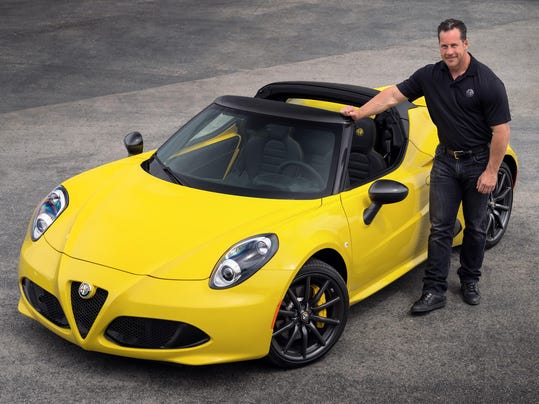
Suddenly, automotive startups are all the rage. Fresh luxury names like Tesla and Fisker have made headlines rekindling the century-old competition between battery and gas power. But an Old World, 105 year-old brand is also starting with a clean sheetagainst icons like Mercedes, BMW, and Cadillacusing the tried-and-true gas engine.
Say hello to Alfa Romeo, America’s newest luxury badge.
Like Tesla’s Roadster, Alfa begins with a tiny sports car, the sexy 4C. Now comes the hard part with last month’s Alfa Giulia unveil kicking off eight new products by 2018. Oh, is that all?
Fiat Chrysler has put this formidable task on the broad shoulders of Reid Bigland, 48, a straight-shooting Canuck with a physique right out of a Mr. Universe contest. At a June 4C introduction, I half expected him to come out with one under each arm. “You don’t want to mess with this guy,” laughs Fiat Chrysler Automobiles CEO Sergio Marchionne about Bigland.
Bigland’s swift rise at FCA – since 2006 he’s run Dodge, RAM trucks, and now juggles Alfa, North America sales and CEO of FCA Canada — has landed him on the short list of names to succeed Marchionne. I sat down with the ex-hockey player to talk Alfas, muscle cars, and Powerhouse Gym.
Q: You cut one of the most recognizable profiles in this business. You were an athlete?
Bigland: I grew up in Canada. I played a lot of junior hockey. I was lacking one necessary ingredient to play pro which was talent. Today I just try to keep fit by going to the gym.
Q: What gyms do you use in Detroit?
Bigland: Lifetime Fitness in Auburn Hills and . . . Powerhouse Gym in Detroit. That’s one of the old bodybuilder gyms left in this country and I usually hit that on the way to Canada.
Q: What was your first car?
Bigland: A 1979 Chevy Impala. I thought I was stylin’. It was up in the Toronto area . . . and the floorboards started to rust out and you could see the pavement.
Q: Do Canadians covet Detroit muscle cars?
Bigland: Absolutely. Growing up I had a soft spot for Corvettes. I’m very excited about our Hellcat with 707 horsepower. The question is who wants to drive a 707-horsepower car? Well, me.
Q: What’s in your garage?
Bigland: Jeep Grand Cherokee, Jeep Wrangler, and a Dodge Charger Hellcat.
Q: What excites you about FCA?
Bigland: It’s an honor to be working for Sergio Marchionne. I’ve learned a lot working for him the last six years. I’m a competitive guy – I like to compete in all things – and in the United States marketplace we’ve had 62 consecutive months of sales growth which is a significant source of pride, and in Canada . . . we’re the #1 selling vehicle manufacturer in the country. If I were to tell you that back in 2009 — which I did — you would have put me in a rubber room.
Q: Why the 4C to launch Alfa?
Bigland: The 4C represents what all of the great Alfas represented in the past and what all of the Alfas going forward will represent from a technological, style, and performance perspective. The car is truly unique: Carbon fiber chassis, aluminum sub-frame, mid-engine setup. There are only five other cars in the world like it – and most are north of a million dollars.
Q: The 4C comes out of FCA’s sports car toolbox. But Alfa has been a small, economy car brand in Europe. How do you make Alfa a global luxury brand?
Bigland: Alfa has been a lot of things over its 105 years. Some of the greats have been performance cars with outstanding style. We’re looking to re-recreate what the great Alfas were. We are currently in the process of investing over $6 billion to make sure these Alfa products . . . are consistent with those key attributes of technology, performance, and style. We have segregated a team of 1,000 people in Europe led by two senior engineers from Ferrari uncontaminated by the mass market.
Q: You’re starting from scratch?
Bigland: To be a credible, luxury player you cannot be tempted into dipping into the mass market parts bin. We’ve got great mass market cars, but to be true to the knitting in the luxury performance segment you’ve got to be authentic. As far as any leveraging of the FCA family it’s more along the lines of Ferrari and Maserati. Rebadging of a mass market car has shown time and time again that it doesn’t work.
Who’s the sexiest of them all? Ford Fusion vs. Mazda6
Posted by hpayne on July 23, 2015

Here’s an idea for “Punk’d,” MTV’s version of “Candid Camera.” Set up a fake Aston Martin auto dealership. Stock it with two dozen Ford Fusion Titaniums, strip off their “Ford” logos, and replace them with Aston’s winged badge. Then watch the buyers descend.
Whoa! When did Aston come out with a $38K midsize sedan? I’ll take two.
Yes, the 2016 Ford Fusion is that stunning. We’re jaded by now because there are 5 zillion of them on the road since Dearborn introduced its midsize beauty in 2013. It’s like a pill came out that could transform middle-aged men into Brad Pitt. Pitt’s looks would cease being remarkable. Ditto the Fusion. It lacks an Aston’s exclusivity, but it’s made midsize sedans stylish again.
Ford’s bold design has raised the bar for the segment, forcing everyone to play catch-up. The elegant Chrysler 200, handsome Hyundai Sonata, svelte Subaru Legacy. Heck, even the usually somnolent Chevy Malibu and Toyota Camry have gone back for extreme makeovers. The 2016 Malibu is stylish and the Camry’s look is improved — though when the Ford is better looking than your luxury Lexus entry, you know Toyota still has work to do.
Despite these efforts, however, only one other midsize sedan belongs on the same runway with Fusion. The Mazda6.
Call it the Mazda666. It’s devilish fun. Cruise through the country club in a Soul Red Metallic or Titanium Flash Mica (my tester’s color) wardrobe and this sexpot will embarrass richer makes. The 6 has more curves than Elizabeth Hurley in “Bedazzled.” And you only have to sell your soul — er, wallet — for $30,000 to afford it.
Ford and Mazda aren’t strangers to cutting-edge sedan fashion. The original, 1986 Ford Taurus revolutionized styling with its aerodynamic, “soap bar” shape and driver-centric interior (alas, Taurus’s looks couldn’t hide lousy transmissions with the reliability of Andre Drummond). I lusted after Mazda’s 1992 929 which was years ahead of its time in looks and handling. Recently both brands have taken detours down Ugly Alley — Ford with its three-bar grilles; Mazda with faces taken off Halloween jack o’ lanterns.
Goodbye to all that. Sexy is back. But which date to you take to the ball?
Fusion’s grille is unmistakable. But at $38,820 my loaded Titanium tester isn’t just a pretty face. Its trim flanks and arse are Son of Audi A8. The Ford only lacks 20-inch wheels to give it world-class luxe proportions.
Like Fusion, the Mazda’s curb appeal begins with an anthropomorphic, full-lipped face. If the Ford is slender, pout-mouthed English supermodel Kate Moss, the Mazda’s swollen front wheel arches and full lips recall the vivacious Sofia Vergara. Not a flaw in the lot.
From behind, these yoga-toned bodies are hard to tell apart. Curved hip lines sweep upward under coupe-like greenhouses — then taper into round, high-decked trunks. Only the exhausts differ as the Mazda goes for a twin-pipe sports car look while the Fusion wears elegant, flush chrome-tips.
Surprisingly, the coupe styling doesn’t sacrifice rear passengers to muscle cramps. I easily folded my 6-foot-5-inch frame into both cars — “sitting behind myself” with headroom to spare. These cars offer interior room that ranks with the best in class.
Inside, the Mazda gets Euro-envy. Push the starter and a Bimmer-like heads-up display rotates dramatically into place. Wrap-around interior. Pop-up nav screen. Even a console-mounted infotainment dial are oh-so-German — and oh-so-distracting in the case of the controller. So distracting that I went straight for the voice commands rather than fool with its rotary idiosyncrasies. I wasn’t disappointed. My every command was expertly followed — by a sexy female voice, natch — for radio and navigation. “760 AM” I’d bark, and she’d respond immediately.
Ford mimics Aston outside, but blazes its own trail inside. Detroit automakers boast autodom’s most intuitive interiors these days — reflecting a driving culture where Americans live in their vehicles. Touchscreen infotainment package. Space for XXL smart phones. Console storage with a toolbox-full of audio jacks, USB ports, and a 12V charger.
Fusion answers the question — why do modern automatics bother with a tac? — by locating the speedo front and center in a digital instrument display and shoving RPM off to the side with the fuel gauge. Only the rubberized button overlay seems dated — sure to be upgraded when the Fusion gets its mid-cycle refresh next year. Cupholders abound. Park assist, heated/cooled seats, heated steering wheel. All for $38K? Pinch me, I’m dreaming.
The quality and quantity of the safety and comfort systems — on par with luxury cars costing $10K more — in these mainstream beauties begs another question: What defines luxe anymore?
Oh, yeah. The drivetrain.
Washington’s nannies are determined to neuter mainstream sedan performance to save us from our carbon sins. Which means only the monied will be able to afford fun accessories like multiple cylinders, turbochargers, and battery-assist.
Credit Ford with bucking this trend despite a chairman who sounds like Green High Priest Al Gore. While Mazda6 surrenders to the scolds, the Fusion matches its looks with power.
To be sure the 6 is the best-handling car in segment while delivering an impressive 32 mpg. Sharing DNA with its Miata MX-5 sibling, it’s tight, even throwable — a word usually not in the same dictionary with “midsize sedan.” But stomp on it and the lone, four-banger option hesitates as if contemplating the plight of the polar bear. ZOOM ZOOM goes HUM DRUM.
The base $23,425 Fusion brings a similar four-holer, but also offers coach class first-class upgrades with two turbo fours (a 181-horsepower 1.5-liter and a 240-horse 2.0-liter) and a hybrid. Brand snobs eat your heart out. The 2.0L turbo cranks out 25 percent more power than the Mazda and is on par with a $50,000 all-wheel-drive, 2.0-liter turbo BMW 328i X-drive.
Speaking of all-wheel-drive (in Detroit winters, Mrs. Payne speaks of little else as in “The plow didn’t come again! Thank goodness my car has AWD!”), the Fusion offers it. The Mazda does not.
It’s a gift that keeps giving even after the snows have melted. Though the Fusion won’t bite in corners like the 6, its AWD gives a handy assist to the inevitable front-wheel-drive push.
So note the early 21st century for two related trends: As SUVs displace family sedans, so have midsize sedans like the sexy Fusion and 6 become the equal of pricier chariots. All they lack is the luxe badge. If it’s a big problem for you, just replace the Blue Oval with Aston wings.
2016 Ford Fusion
Vehicle type: Front-engine, front or all-wheel-drive, five-passenger sedan
Price: $23,425 base ($38,820 as tested)
Power plant: 2.5-liter, inline 4-cylinder; 1.5-liter, turbo 4-cylinder; 2.0-liter, turbo 4-cylinder; 2.0-liter Atkinson-cycle four-cylinder paired with AC electric motor and lithium-ion battery (hybrid)
Power: 175 horsepower, 170 pound-feet of torque (2.5L 4); 181 horsepower, 185 pound-feet of torque (1.5L 4); 240 horsepower, 270 pound-feet of torque (2.0-L 4); 188 horsepower (hybrid)
Transmission: Six-speed automatic (with steering-mounted paddle shifters as tested); Electronically-controlled continuously variable transmission (hybrid)
Performance: 0-60 mph: 7.3 seconds (Car & Driver); top speed: 124 mph (governed)
Weight: 3,461 pounds, base; (3,821 pounds AWD as tested)
Fuel economy: EPA 22 mpg city/34 highway mpg/26 mpg combined (2.5L 4); 24 mpg city/36 highway mpg/28 mpg combined (1.5L turbo-4); EPA 22 mpg city/31 highway mpg/25 mpg combined (2.0L turbo-4); 44 mpg city/41 mpg highway/42 mpg combined (hybrid)
Report card
Highs: Liveable interior; buffet of drivetrain choices
Lows: Options push price close to $40k; outdated rubberized buttons
Overall:★★★★
Mazda6
Vehicle type: Front-engine, front-wheel-drive, five-passenger sedan
Price: $22,315 base ($33,395 as tested)
Power plant: 2.5-liter 4-cylinder
Power: 184 horsepower, 185 pound-feet of torque
Transmission: Six-speed manual transmission (base); Six-speed automatic (with steering-mounted paddle shifters as tested)
Performance: 0-60 mph: 7.9 seconds (Car & Driver); top speed: 130 mph
Weight: 3,232 pounds
Fuel economy: EPA 28 mpg city/40 mpg highway/32 combined
Report card
Highs: Smorgasbord of standard features; quick handling
Lows: Rotary-dial infotainment controller; more engine options, please
Overall:★★★