- Search Cartoons
- Comic Archive
-
Payne
Store



 Henry Payne RSS

Articles Blog
Payne: State-of-the-art Cadillac CT6 sedan
Posted by hpayne on January 28, 2016

Let’s talk big sedans. Sleds, boats, land yachts. Leather-stuffed boulevard limousines popularized by the Big Three in the 1950s and later refined by the Teutonic trio of BMW, Mercedes and Audi. The flagships of luxury, they represent the rise of graceful European luxury and the decline of Detroit’s dinosaurs.
Which is why I am driving a 2016 Cadillac CT6 around the Cuyamaca Mountains east of San Diego. Not just driving it; wringing its neck.
The tires squall as I rotate the 203-inch-long sedan like a two-door coupe through a 110-degree right-hander. In “Sport” mode, the car’s computer keeps the twin-turbos spooled at 3,000 rpm in third gear. I floor it on exit from the turn, and the 3.0-liter six roars its approval, leaping like a big cat. Brembo brakes haul it to Earth before the next cliff-carved curve. I’d pity the passenger in the plush rear seat, but I’m joy-riding, not limo-commuting.
Joy-riding? Squalling tires? Time to reset all you know about Cadillac.
CT6 designer Taki Karras likes to say the chrome chin of the CT6 is a tip of the hat to the legendary, Corsair-fighter-inspired, 1956 Coupe Deville. Yeah, OK. If I squint a little. A lot, actually. Because the CT6 resembles nothing in Cadillac’s antiquated land-yacht past.
This hasn’t happened overnight. Cadillac telegraphed the CT6 like a Bugs Bunny windup haymaker. The Alpha platform that is the foundation for the compact ATS and midsize CTS (and exquisite Chevy Camaro) is widely admired as the best small platform around. Further stiffened with a batwing brace and motivated by one of Caddy’s new twin-turbo mills, the ATS-V performance sedan is the first competitor to make BMW’s M3 sweat.
Let’s talk big sedans. The CT6 is the state-of-the-art in four-door design today. It not only shames Cadillac’s outgoing front-wheel-drive XTS, it exceeds the Germans’ high bar.
Consider the specs on CT6’s clean-sheet Omega chassis: Mixed aluminum and steel frame. Single-cast A-pillars reducing 35 parts to a single, high-strength unit. There are 3,073 alloy spot-welds, 591 feet of structural adhesives, 13 high-pressure castings for a 20 percent parts reduction. The result is a stiff, 3,657-pound base car that is a staggering 600 pounds lighter than a comparable Mercedes S-Class. Call it Cadillac Lite. So lightweight is the full-size CT6 that it tips the scales 58 pounds shy of its midsized CTS sibling and 38 pounds lighter than a Camaro SS.
Wrap your head around that for a moment: Cadillac’s flagship sedan weighs less than the featherweight of the muscle car coupe class.
The general leading this big car revolution is Cadillac President Johann de Nysschen, a big man himself. At 6-foot-3, the commanding South African looks like he could have led elephant safaris in his native land. De Nysschen’s double-barreled CT6 exhaust is aimed right at the heart of German luxury dominance: S-Class, BMW 7-series, Audi A8.
“Why are we making a large sedan?” asks de Nysschen rhetorically at a time when Cadillac is investing billions in SUVs (along with Jaguar, Maserati, Bentley — even Lamborghini, for goodness sake) to slake consumers’ thirst for high-riding Conestoga wagons.
“Because our technology is leading the charge in taking on the world’s finest. We know that if we take them on in a segment there they are strong, that is the fastest way to build back our reputation.”
Those are bold words backed up by a bold car.
But not bold in the old tail-finned, chrome-encrusted Trump Tower sort of way. This Cadillac does more with less, starting with a sticker price $20,000 south of the Mercedes S-class. Where the Mercedes needs a big V-8 to motivate its 4,600 pounds, the CT6’s twin-turbo V-6 will do for 4,000 pounds, thank you very much. So light is the CT6 that the base rear-wheel drive model comes with the same 265 horsepower turbo 4 that is the most popular CTS engine because — ahem — the CT6 is lighter by 100 pounds.
Happily, the big Caddy’s inner sanctum is buffered against all this hard-core performance engineering. Sealed in silence, passengers ride on a flying carpet of leather seats and road-absorbing magnetic shocks. The rear seat acreage could easily fit a reclining giraffe, and are heated and adjustable.
The front thrones are predictably comfortable, but more importantly Cadillac has worked hard to address console issues that have haunted it for years. An upset CTS owner approached us at a pit stop along the route to complain of his decade-old Caddy’s cheap chassis construction and chipping paint icons. He brightened up when he learned of the CT6’s body-by-Jake exercise routine — and its upgraded graphics, digital displays and Apple Car Play and Android Auto compatibility. And if Cadillac stubbornly sticks with its CUE infotainment system, at least its touchscreen response now approximates a smartphone rather than an old ATM.
Not all upgrades are welcome, however. My media colleagues and I went cross-eyed trying CT6’s much-ballyhooed rear-camera mirror. Back to the drawing board, boys.
Pleasing, however, is the car’s conservative cut-and-sewn leather dash. That restraint is also evident on the car’s exterior where chief designer Karras refined Cadillac’s sharp edges. A CT6 grille looming in your mirrors commands respect.
The rear end, however, is so conservative as to be undistinguished. The signature vertical taillights have been neutered. Chrome detailing is microscopic. “Is that a Chevy or a Cadillac?” snickered a colleague as we gained on another CT6. This Cadillac could actually benefit from more chrome.
“There aren’t many Cadillac customers in Germany now, but our readers are buzzing about Cadillac’s technology,” said a European car-magazine colleague who had made the trip to California.
Sixty years after it defined automotive luxury, U.S. manufacturers are leading the way again.
And for just $72,000, the all-wheel drive Cadillac CT6 makes a $98,000 Mercedes S-Class 4MATIC feel like a land yacht.
’16 Cadillac CT6
Vehicle type: Front-engine, rear or all-wheel-drive, five-passenger sedan
Price: $54,490 base ($72,170 twin-turbo V-6 luxury; $59,590 turbo-4)
Powerplant: 2.0-liter, turbocharged 4-cylinder; 3.6-liter V6; 3.0-liter twin-turbo V-6
Power: 265 horsepower, 295 pound-feet of torque (turbo-4); 335 horsepower, 284 pound-feet of torque (V-6); 404 horsepower, 400 pound-feet of torque (twin-turbo V-6)
Transmission: Eight-speed automatic
Performance: 0-60 mph, 5.1 (twin-turbo V-6, Car & Driver est.)
Weight: 4,085 pounds (AWD twin-turbo V6); 3,657 pounds (RWD turbo-4)
Fuel economy: EPA 22 mpg city/31 mpg highway (turbo-4); EPA 19 mpg city/29 mpg highway (V-6); EPA 18 mpg city/26 mpg highway (twin-turbo V-6)
Report card
Highs: Handling of a car two sizes smaller; best Caddy face yet
Lows: Disorienting rear camera mirror; blah rear end
Overall:★★★★
Cadillac CT6 makes red carpet debut at Oscars
Posted by hpayne on January 27, 2016

Next month’s Academy Awards may be tense with questions about the diversity of actor nominees, but Hollywood’s TV spectacular will be a showcase for greater variety in the U.S. luxury automobile segment. The all-electric, American-made Tesla, not BMW or Mercedes, will be the vehicle of choice for many celebrities arriving on the red carpet.
And for the second year in a row, Cadillac will unveil a new ad for the Oscars featuring its most ambitious vehicle yet: the 2016 Cadillac CT6.
Billed as the flagship for Detroit’s remade luxury marque, the CT6 takes on the BMW 7-series, Mercedes S-Class and Audi A8 in the premium luxury sedan segment the Teutonic trio has long dominated.
Taking a pass on the Super Bowl, Cadillac’s focus on Hollywood’s big night is part of a strategy that confronts European makers where they are strongest – on the East and West coasts where 40 percent of luxury sales are made. That meant relocating Cadillac’s headquarters from Detroit to New York.
And it means a CT6 product that aims to out-engineer the German-makers with the most advanced, lightest, best-handling chassis in its class. Scheduled for vehicle delivery in early March shortly after the Oscars, the CT6 will start full production in mid-February in Hamtramck.
“If you are a resurgent luxury brand, then the premium luxury sedan market is where you make your bold statement,” said Cadillac President Johann de Nysschen at the Los Angeles media test debut of the CT6 last week. “It’s where our reputation was built. Cadillac is at the forefront of innovation again.”
The CT6 is as part of an ambitious, $12 billion product offensive that will bring eight new models to showrooms by 2020.
Boasting an all-new Omega platform, the CT6 is on the leading edge of automotive diet plans. Using a combination of steel and aluminum castings and sophisticated bonding techniques, the CT6 uses 20 percent fewer parts than previous Cadillacs.
“This is a living and breathing experiment processing techniques that haven’t been used before,” says auto analyst Dave Sullivan of AutoPacific. “It’s also an experiment in what’s coming from Cadillac.”
The result is a large sedan that weighs just 3,657 pounds. That’s not only 1,000 pounds less than a comparably sized S-Class, but it is even lighter than a midsize BMW 5-series or sibling Cadillac CTS. The CT6 will also be significantly lighter on the wallet, starting at $53,495, or some $30,000 south of a base 740i.
Kelley Blue Book auto analyst Karl Brauer said the latest effort by Cadillac to make a German-rivaling luxury sedan has succeeded. “The CT6 is more engaging to drive than the comparable 7 Series or S-Class sedans that cost tens of thousands more.”
The light weight enables Cadillac to install smaller, more efficient turbocharged engines in the CT6 than the big V8s found in German competitors – yet they promise similar power-to-weight rations. The CT6 will come with the same 265-horsepower turbo-4 that has proved popular in the 100 pounds-porkier, mid-size CTS – as well as an all-new, 3.0-liter twin-turbo V6 making 404 horsepower. To appeal to Hollywood greens – and Tesla customers – Cadillac also will premiere a plug-in hybrid version later this year.
Experts caution the Cadillac brand will have to be patient for blockbuster sales.
“Their coastal strategy is good – they’re going where the customers are,” says AutoPacific’s Sullivan. “They’ve been trying for 15 years and we’re looking at another 10 years for this to work. They need a good crossover lineup, and they need more ‘tweener’ models like the Germans.”
Payne, Q&Auto: ‘Good ol’ days right now for Porsche’
Posted by hpayne on January 23, 2016

“It’s the good ol’ days right now for Porsche enthusiasts,” says Joe Lawrence from the Detroit auto show floor, reflecting on Porsche’s record 51,756 in US sales in 201
5. “The Macan significantly expanded the model range and yet it was an amazing year for the sports car because we had the GT3 RS and the GT4 and the Boxster Spyder. And to top it off, we won LeMans.”
Lawrence should know. He’s living the enthusiast’s dream.
He grew up in his father’s Gemini Blue 1973 Porsche 911T. Car magazines were his bible. He drives his own kids to hockey games in a Porsche 911, and … oh yeah, he’s chief operating officer for Porsche North America.
Lawrence, 47, knows what all we Porsche fanatics should know: That the brand’s explosive sales growth (from 15,000 units just a decade ago) is being fueled by SUVs with the resulting revenue tsunami getting plowed back into what made the brand famous: racing. It’s a neat loop, but it also comes with a more complicated customer demographic as well as more exposure to green government regulations that are forcing automakers – even Porsche – to downsize engines. This year the Boxster and Cayman will add – hold on to your seat – four-bangers to their engine lineup.
Can Porsche maintain its momentum? I sat down with the Texas native in Cobo to talk turbos, geeks and California.
Q. How long have you had the car disease?
A. Oh, my god. From an early age. I had every issue of every U.S. car magazine – plus I was a British car mag enthusiast. I had boxes in my basement. My wife finally said: “When are you getting rid of all this?” I was really a German enthusiast – Porsches, BMWs, Mercedes. To prove my car geekdom: In my wallet in high school – instead of a girlfriend – I had a picture of a diamond-blue Porsche 944 Turbo.
Q. What do you drive now?
A. I’ve got a beautiful 2016 GTS 911. Stick shift. Ducktail. And what I have rediscovered living in Atlanta ( Porsche’s U.S .headquarters) is driving for fun again because there are amazing, twisty roads.
Q. Now that the base 911 is turbocharged, what distinguishes the new Turbo/Turbo S shown at the Detroit show?
A. We’ve already dealt with that issue in other models ranges – for instance, the Cayenne S. The Turbo has always been – not just a turbocharged 911 – but also the top of the range. We think they live in harmony (with the) 911 Carrera and Carrera S powered by 3.0-liter twin-turbos. You have the 3.8-liter twin-turbo – much larger engine, variable turbine technology, lots of different specifications and features – that make it the top-of-the-line 911.
Q. How much is turbo is driven by regulation? How much by your customer?
A. No question that, industrywide, there is a trend toward downsizing displacement of engines and we’re not immune to that. Our goal is always to bring out a new generation of product and always be able to talk about – not only enhanced performance, but also enhanced efficiency. Downsizing of petrol engines regulations have something to do with that. Intelligent performance is our motto – to find the most intelligent solutions. Our customers absolutely love (the new turbo, 3.0-liter flat 6) engine – it has fantastic sound and incredible responsiveness.
Q. California is now mandating technologies – electric and hydrogen vehicles. Does that apply to Porsche as well as parent Volkswagen?
A. We’re committed to meeting those regulations independently. That’s why you’re seeing the push in hybridization. We’re the first luxury maker with three plug-in hybrids on the market. Obviously, the Mission E which we look to by the end of the decade. California is a quarter of our U.S. sales. (In that) market it’s very important you have that powertrain not just from a regulatory perspective but for customer demand. We’re finding good success, especially with the Cayenne E-hybrid. If we look at the statistics we did nearly 1,600 hybrids across the country. That represents .7 percent of the total hybrid market in the U.S., whereas our total sales are .3 percent of market. We’re over-proportional in terms of hybrid advancement.
Q. Tesla is struggling to make money. Can you make money on EVs?
A. It’s got to happen. We have some time. I think there will be a lot of advancements and economies of scale. It’s a challenge, but ultimately it can be done.
Payne: Hatchback-in-disguise Mazda CX-3
Posted by hpayne on January 21, 2016

Stab the brakes. Two quick paddle-downshifts. Rotate the tight, neutral chassis. Hear the tires squeal with pleasure as I explore the limits of all-wheel-drive adhesion, feeding them more juice around the 180-degree cloverleaf.
Ain’t trucks fun?
Well, no. Not until now with the brand new Mazda CX-3 sport ute, which was on the short list for 2016 North American Truck of the Year. Right next to the Nissan Titan, Toyota Tacoma and (ultimate winner) Volvo XC90. Maybe it’s time we NACTOY jurors rethought our categories. Welcome to the subcompact sport-utility class, the hottest, newest, funnest segment on the planet.
Part ute, part crossover, part hot hatch, subcompact SUVs are manufacturers’ latest attempt to slake customers thirst for riding high while still offering them the performance and styling that they desire. A tall order. Or short order, in the case of the CX-3.
The little Mazda debuts alongside subcompact brethren like the Jeep Renegade and Honda HR-V (Both were also up for truck of the year. I’ll wait while you stop laughing.), but it is waaaaay at the other side of the segment, vibe-wise. I took the Renegade off-roading last year on California’s’ State Park on 15-degree inclines, while the Honda wants to be your grocery-hauling appliance.
Not the CX-3.
Haul groceries in this sporty cart and you’ll break a few eggs. Honestly, my M-10 cloverleaf adventure came in the midst of a routine ride back from Novi when I suddenly got the urge to go all Lewis Hamilton on the Telegraph Road cloverleaf. Twice. I heard my laptop bag hurtle across the backseat and slap against the side door under G-loads. Phew. Good thing that wasn’t a Kroger bag or Mrs. Payne would have had my head (you don’t like scrambled eggs, hon?).
The CX-3 is a compact hatchback in disguise. Its hip-point is higher than Mazda’s terrific Mazda 3 compact car even as its ride height — 6.1 inches — is the same. Indeed, why buy a CX-3 when its Mazda 3 hatchback cousin is roomier, quicker and cheaper by a grand? Because Americans don’t want five-door vehicles called hatchbacks; they want five-door vehicles called crossovers. Mazda doesn’t even import its Mazda 2 hatch made in Mexico. (It’s actually rebadged as a Scion iM — and folks are screaming at Scion asking why they don’t have a hatch.)
All-wheel-drive option
More significant than semantics, however, is the CX-3 crossover comes with the all-wheel-drive option (unlike the Mazda 3 hatchback), which is as welcome in Detroit’s long winter months as the Mazda’s handling is come summer.
The only thing truly comparable to CX-3 is the Mercedes GLA that I drove last spring. Both look like they started as proper upright crossovers before someone squashed them in a giant panini maker. Both stand out in the gym. Both grip like a Rottweiler on a postman’s pant leg. But the Mazda is $12,000 cheaper, packs just as much AWD fun, while lagging the Mercedes in horsepower — 146 to 208.
Mazda’s play for your hard-earned dollars goes well beyond sophisticated handling and a fuel-sipping engine.
Inside and out, the CX-3 is a European-looking sexpot. Call it the CRXXX-3. Pouty mouth. Come-hither headlights. Sculpted hips. Significantly, the CX-3 is even curvier — jagged belt-line, hippier hips — than its 3 and 6 sedan siblings, giving it a dynamic presence despite its more upright stature. Clever.
You remember when it debuted at the Detroit auto show a year ago? You couldn’t take your eyes off it. That’s a truck?
Welcoming interior
The interior is a surprisingly nice place to be. Mazda translates its ZOOM ZOOM European handling to interior decor with Audi-like aviator climate vents, a pop-up infotainment screen and an array of decidedly un-European standard features like push-button start and automatic lights.
Sure, the screen comes with the annoying European rotary dial control located down by your hip so you have to take your eyes off the road to locate it. Happily, Mazda tries to help by adding touch features to the screen — though they cease working when the car is moving. Best to just use voice recognition — with which I had excellent, coherent conversations. Never had to take my hand off the wheel. That’s the 21st century way.
My GT-trimmed Mazda is also equipped with convenient features like two front USB ports, a 12-volt plug, heads-up display, adaptive wipers and headlights that swivel where you steer.
The CX-3 is so delightful that its shortcomings stand out: Leave the lights on and the car doesn’t remind you on exit. The cup holders are under the armrest. The tach dominates the instrument cluster with the speedometer a digital afterthought. And the rear-quarter blind spots are as big as Texas thanks to the CX-3’s racy, tapered rear styling. (I’m happy to report that blind-spot assist is available to help — another in the remarkable buffet of luxury options on a 20-grand compact car.)
Unexpectedly roomy
Just as surprising, however, is the rear headroom. A 6-foot-5 roundball player like me may have to splay his knees to sit in the back, but he can do it sitting upright; try that in a compact sedan. Fold the rear seats flat; try that in a compact sedan. Of course, the hatchback Mazda 3 will give you that convenience plus 184 horsepower, but Americans don’t want … we’ve been over this.
After my cloverleaf adventures, Mazda’s ZOOM ZOOM disappoints a bit. Mazda has invested a lot in its SkyActiv gas engine technology which delivers superb fuel economy but can be wanting in the torque department. Zero to 60 yawns by in over eight seconds. I yearned for a Ford Ecoboost turbo or VW turbo-diesel to get me out of the corners. I recently drove a mid-size Passat 4-cylinder turbo-diesel in Europe which managed 38 mpg and plenty of torque. The Mazda scored 30 mpg in our brief date, but I often found myself in the manual paddles to move along.
In spite of that, the CX-3 delivers.
’16 Mazda CX-3
Vehicle type: Front-engine, front or all-wheel-drive, five-passenger sport utility
Price: $20,840 base ($27,670 AWD GT as tested)
Powerplant: 2-liter, dual overhead-cam 4-cylinder
Power: 146 horsepower, 146 pound-feet of torque
Transmission: Six-speed automatic
Performance: 0-60 mph, 8.1 seconds (Car & Driver)
Weight: 2,952 pounds (as tested)
Fuel economy: EPA 29 mpg city/35 mpg highway/31 mpg combined (FWD); EPA 27 mpg city/32 mpg highway/29 mpg combined (AWD)
Report card
Highs: Dynamic styling; Mazda car-like handling
Lows: Zero-60 in forever; why not a bigger, cheaper Mazda 3 hatch?
Overall:★★★
Detroit auto show: Times Square under a roof
Posted by hpayne on January 18, 2016
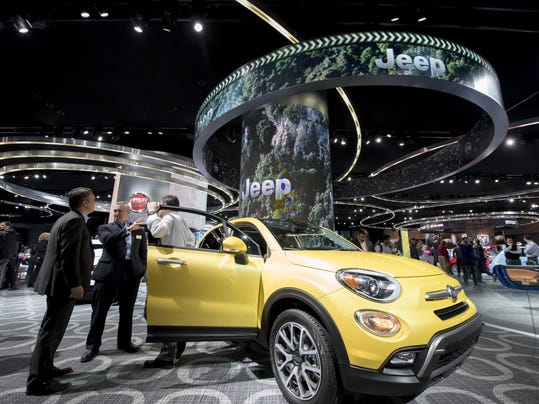
Call it Times Square under a roof.
When Cobo Center’s doors open to the public Saturday, Detroit auto show visitors will be treated to a mind-blowing, high-def video-palooza: floor-to-ceiling screens, digitally wrapped columns and 360-degree displays.
With an expected 800,000 visitors crowding into the 700,000-square-foot show through Jan. 24, the experience rivals a stroll down Broadway — if its forest of jumbotrons advertising plays, movies and perfume were all showing car ads instead.
“This is transformative. It supersedes anything at a major concert or the Super Bowl,” said John Tulloch, senior vice president and executive producer of Auburn Hills-based George P. Johnson, which helped Fiat Chrysler Automobiles set up its pixel-tacular stage. “Our display is at an Olympic level never seen at an auto show anywhere in the world.”
The razzle-dazzle is the product of new tech, a video arms race and the biggest shuffle in floor space in a decade after show regulars like Mini Cooper, Bentley, Jaguar, Land Rover and Tesla dropped out.
“Exhibitors spent $200 million on displays this year,” said Rod Alberts, executive director of the North American International Auto Show. “We changed up the floor plan, and 80 percent of the manufacturers came in with new displays.”
Leading the way are the Detroit Big Three automakers who want to show their hometown a wave of cutting-edge products from the versatile Chrysler Pacifica minivan to the stunning Buick Avista concept. But foreign manufacturers like Infiniti, VW and Mercedes also want to wow at the biggest auto show in the globe’s richest market.
The results are multimillion-dollar stages masterminded by the best entertainment talent on the planet.
Fiat Chrysler’s biggest-in-show stand is a global effort coordinating companies including: GPJ, which has organized displays at the Olympics, Times Square and London’s Piccadilly Square; Lite Structures, an English global aerial architecture company; Seibo, a Los Angeles video display shop; and New York’s James Klein Events, which has produced shows for music festivals, MTV and more.
The 60,000-square-foot showcase — more than an acre and a half — contains 30 million pixels of high-definition LED screens, 40 miles of cable and a backroom control panel that Fiat Chrysler show and events manager Bo Puffer said “looks like it came out of a 747 aircraft.”
In addition to floor-to-ceiling LED screens, Seibo wrapped columns with 3-D video that GPJ’s Tulloch says is “game-changing technology.”
Executing a theme brainstormed by Fiat Chrysler, the round pillars help connect LED circles above every brand display into a sort of “gear mechanism” that links all seven FCA brands.
Every hour their screens are synchronized into a single 18-minute LED “superstorm” showing 21/2 minutes of video from each brand. It was not uncommon during preview week to see visitors videotaping it with their smartphones.
According to Troy-based Foresight Research, 50 percent to 55 percent of visitors purchase or lease a car within a year of attending an auto show.
“The best way we can use these displays is to immerse our customers into it,” Puffer said.
Ford estimates attendees will spend an average of 45 minutes at its massive display, which was totally remade for the first time in 10 years.
Eighteen months in the making, its centerpiece is a 360-degree, ultra-high-def LED screen — flanked by two-story LED walls — that acts as an exhibit halo. Every hour, the front LED banks close like sliding doors, sealing off the 360-degree display for a “Fusion takeover moment” that highlights Ford’s updated midsize sedan.
Ford worked with London’s Imagination Group, which has also staged NFL games in Europe.
“This is by far the biggest structural build we’ve ever done,” said Garett Carr, Ford’s display coordinator.
Ford actually dug two escalator pits to whisk showgoers to a secon
d-floor balcony where kids can put together Ford GT snap kits in the shadow of the supercar and Ford F-150 Raptor.
Inside Hall C, luxury rivals Mercedes and Cadillac are engaged in a retina-searing LED arms race. Cadillac brought to this year’s fight a stunning, semicircular “oculus” LED wall, where it is showing off new toys like the Cadillac CT6 and XT5.
Infiniti, too, got the bends. To match the sexy curves of its new Q50 and Q60, Infiniti installed a sweeping, 112-foot-by-16-foot megascreen display. It features videos on a 3.9 mm pixel pitch — much tighter than the 20-40 mm-spaced displays typically used at rock concerts and Times Square. The display was coordinated by XL Video in Los Angeles.
“We use a much tighter pixel pitch because our customers are standing just inches from the screen,” said Joe Samfilippo, senior manager, Brand Engagement, at Infinity, who says it reflects the attention to detail in their products.
Drink it all in. While automakers say they will take elements of their displays on the road, Detroit, Frankfurt and Shanghai are the mothers of all auto exhibits. “Most other shows don’t allow us quite so much space and flexibility,” says Cadillac communications manager David Caldwell.
Detroit auto show
Public show: 9 a.m. to 10 p.m. (no admittance after 9 p.m.) Saturday through Jan. 23; 9 a.m. to 7 p.m. (no admittance after 6 p.m.) Jan. 24
Admission: $13 adults; $7 age 7-12, and age 65 and over; free age 6 and under
Location: Cobo Center, 1 Washington Blvd., Detroit
Payne: 10 Best at Detroit auto show
Posted by hpayne on January 15, 2016
You know this is a good show when the all-new Mercedes E-Class, Volvo S90, and Porsche 911 Turbo S don’t make the 10 Best cut. The Turbo S (S stands for “See ya”) looks like a 911, has five-zillion horsepower and goes 205 mph. Ho-hum. So what’s new?
Lots, as you stroll the wide boulevards of Cobo Center at the Detroit auto show, opening to the public on Saturday.
Those boulevards are broader this year since Mini, Jaguar, Land Rover and Tesla aren’t in the house. That leaves more more elbow room for everyone else. For those who did bring skin to the game, well, there’s a lot of nice skins out there. A healthy eight concepts are on display in addition to the usual Detroit menu of luxe coupes and red-meat trucks.
I put on a bib and sampled them all. Here’s my Top 10.

Chrysler Pacifica
Seriously, Payne? What happened to all that red meat you were just talking about? Ah, but this is no ordinary minivan. Forty years after it invented the segment, Chrysler has set out to redefine it with the sleek Pacifica. Inside, it adds even more tools to its Swiss Army knife versatility: a console drawer for iPads, video screens for kids, even a vacuum cleaner.

BMW M2
The long-awaited M performance-coupe version of the 2-series is the same size as big brother M4 10 years ago, yet packs 35 more horsepower. As the M4 (and sedan stable mate M3) has grown in size, power, and price, it has become more like a Corvette sedan than the nimble M3s of old. The throwback M2 has the performance of a Porsche Cayman — but with four seats so the kiddies can enjoy the thrill ride.

Lincoln Continental
While Cadillac has invested billions to go toe-to-toe against Germany’s athletes, Continental appeals to a customer who wants “quiet luxury.” Priced like a mid-sizer at under $50K, it has the room of an S-class big sedan. The new face of Lincoln has class-leading innovation inside with 30-way seats.

Honda Ridgeline
The unibody pickup is back. The only pickup not based on a truck rail frame, the Ridgeline shares a platform with the popular Honda Pilot. Ridgeline took a couple years off for an extreme makeover in order to present a more “trucky” appearance, yet retains unique features like a trunk under the pickup bed.

Lexus LC 500 Coupe
Lexus’s polarizing, Darth Vader-like face must be growing on people because I heard nary a word of criticism about this stunning V-8 coupe from my media colleagues.

VLF Force 1
When car guy “Maximum Bob” Lutz and legendary designer Henrik Fisker get together expect fireworks. The explosive Force 1 delivers. Sporting the biggest engine on the show floor at 8.4 liters, the Viper-based VLF also sports the industry’s tiniest headlights and taillights, thanks to special LED construction.

Chevrolet Bolt
The Bolt joins the Chevy Volt plug-in in GM’s quest to make battery-powered cars for the masses. Whether the masses jump for a $37,500 Chevy Sonic (the Bolt will be built on the subcompact $15,000 Sonic’s platform at GM’s Orion assembly) remains to be seen. But for green buyers the electric Bolt should be a hit with 200-mile range, raised crossover seating, and sporty looks.

Ford Fusion
Refreshed for 2016, the Fusion is the centerpiece of Ford’s display because it proves a family sedan can make pulses race. With its Aston Martin face and coupe-like roof, Fusion’s a looker. It should get more looks by adding three trims: a 325-horsepower Sport, battery-powered Energi and luxe Platinum.

Acura Precision concept
With its wide stance, chiseled bod and cabinet doors, the Precison is an old-school, wow-’em concept. Beginning with its “Diamond Pentagon” grille, Precision aims to ban the beak and redefine Acura.

Buick Avista
Hell must be freezing over. Lexus and Buick have two of the sexiest cars on the floor. “I saw it and thought: ‘That’s a Buick?!’ Just like the ads,” exclaimed three-time Indy winner Helio Castroneves who paid a visit to the floor while promoting the Belle Isle Grand Prix. Gorgeous from head to toe, the concept (you’re making it right, GM?) should also be fun to drive since it shares Camaro’s chassis.
Hybrids, minivans, concepts become show’s highlights
Posted by hpayne on January 15, 2016
 After slogging through the January winter to Cobo Center for the 2016 Detroit auto show (slogan: “We wish we were holding this in September when the weather’s perfect here”), I recommend you make a beeline for the Ford lobby display at Cobo’s north end. There sits the Le Mans-bound, 2016 Ford GT supercar and the Le Mans-winning, 1967 Ford GT Mark VI — bookends on 50 years of Ford ambition to grind Ferrari into the asphalt.
If that doesn’t warm you up, nothing will.
Inside the hall you’ll find fewer manufacturers — Mini, Jaguar, Land Rover, Bentley, Tesla all had other appointments — but you might not notice because you’ll be too busy ogling the spectacular manufacturers’ displays. I mean, this place has more neon and video screens than Times Square. Mind the short steps between displays because you’ll be looking up with your mouth open most of the time. Dazzling, floor-to-ceiling screens playing non-stop video of cars hurtling across the landscape. Massive overhead light cones that look like the spaceship descending in “Close Encounters of the Third Kind.” Sweeping, Gehry-like architectural accents dressed in all colors of the rainbow. Cars? There are cars, too?
The Chrysler display features video-screen-wrapped columns that are synchronized with the mega-screens. Ford’s all-new space looks like the world’s biggest Apple store with its rows of white table-top computer tablets. Or maybe it’s a Toys-R-Us with Lego play tables and make-your-own-lapel-buttons, and a computer camera where you can take 3-D pictures of yourself. Where’s the new Ford F-150 Raptor you ask? I swear it’s in there somewhere.
Other floor exhibitors will be new to show regulars. Suppliers like Denso and Brembo (“No, Johnny, that’s not Captain America’s’ shield. That’s a huge Corvette brake rotor”) filled the gaps left by AWOL original equipment manufacturers. The smallest automaker, Bob Lutz’s Auburn Hill-based VLF Automotive, is in the big hall after years in the lobby showing off its outrageous, $268,000, 745-horspower Force 1 (with champagne bottle holders, natch).
But for all the glitz and glamour, this is a meat and potatoes expo showing key products aimed squarely at consumers’ comfort zone: Chrysler’s most significant minivan since it invented the segment four decades ago; the Lincoln Continental reborn to redefine the brand; Honda’s Ridgeline pickup trying to catch up with the red-hot, midsize pickup segment.
Grab the family. Treat them to the greatest show on earth. My highlights:
Concept cars
To paraphrase Mark Twain, reports of the death of concept cars have been exaggerated. Once the grande dame of the show, concepts lost favor in recent years. They were a waste of money, some said. But concepts have roared back this year. I credit two trends: Underdogs and global warming. Underdogs like Buick and Acura have been uninspiring for so long they are desperate to prove to the world that they can still stir emotions. Thus the passionate Buick Avista sports car and Acura Precision sedan. On the global warming front, California — which I think is the world’s second largest economy — has decided to stop it by itself by mandating hydrogen and electric vehicles. Even though a handful of are asking for them. So Audi (the H-tron) and Lexus (LF-LC) showed hydrogen-powered cars and VW showed the Budd-e microbus and the Tiguan plugin. Okay, actually, VW just wants people to talk about anything but diesel.
Tesla vs. Bolt
Tesla isn’t at the auto how perhaps out of embarrassment that it was beaten in the moon shot to the 200 mpg EV by … a Chevy? Yes, the Bolt, sequel to Chevy’s battery-plugin Volt, is the first car to claim a 200-mile range on battery alone. The accomplishment is second only to GM defying marketers’ predictions after last year’s Bolt concept was shown that Chevy would never call it the “Bolt” because it was too hard to differentiate from the “Volt.” What’s next? The Jolt?
Name games aside, the Bolt is a sharp-looking crossover that GM probably wishes the Volt had been (so tired are car sales in SUV-nation these days that only two sedans were unveiled at this year’s show). But to catch on beyond the green crowd, it will have to prove it’s more than a $37,500 Sonic.
Horsepower arms race
Then there’s the other green. The color of money. Luxury sports cars are nearly as dazzling this year as the three-story video screens. There’s a horsepower war on, haven’t you heard? The 580-horse Porsche 911 Turbo S tops 200 mph for the first time. The Lexus LC500 weighs in at 468 ponies, the Alfa Romeo Giulia Quadrifoglio at 505, and the Mercedes-AMG S65 Cabriolet at 621. All of which inspired the Three Musketeers of Gilbert Villarreal, “Maxium Bob” Lutz and Henrik Fisker to produce the 8.4-liter VLF Force 1 with 745 horsepower that gets from zero-60 in less time that it takes you to say “Gilbert Villarreal.”
My pick of the litter is the BMW M2 which has more horsepower – 365 – than big brother M3 had just 10 years ago. That’s half the horsepower of the VLF coupe but twice the number of seats. So I can share the thrill with my kids.
Chrysler Pacifica
Horsepower-schmorsepower. Chrysler reinvented the minivan (and rehabilitates the crossover Pacifica name) to get my nod for Car of Show. This family hauler is a Swiss Army knife of versatility and it’s gorgeous to boot. Speaking of boots, soccer moms can kick both the rear and side doors to automatically open when their arms are full of kids and bags. The Pacifica is a rolling living room with a console drawer for iPads, two TVs screen amidships and a vacuum cleaner in back.
The chief engineer for this achievement deserves a medal. Just make sure you’ve taken the egg cartons out of the middle row seat before you fold it into the floor.
Minivans, concepts, and supercars, oh my. Win the Powerball and you can afford them all. See you at the show.
Best of the ’15 Detroit Auto Show: Where are they now?
Posted by hpayne on January 8, 2016

As we look forward to January’s annual auto class reunion at Cobo Center, our minds wander to last year’s graduates. The best of the best. North American International Auto Show, Summa Cum Laude. The Detroit News’ Top Ten.
Where are they now?
Is the hunky Acura NSX as fast as it looks? Did Chevy Bolt change its name to not be confused with the Volt? Are we sipping drinks in the back of that self-driving Mercedes yet? Here’s the skinny.
Henry Payne is auto critic for The Detroit News. Email him at hpayne@detroitnews.com.
1. Acura NSX
NSX cultists waited breathlessly for the second coming of the production supercar after the concept was unveiled at the 2012 Detroit show. They got it in 2015 … and are waiting again until the $150K-plus, 2017 model arrives for sale next spring. A fortunate few auto enthusiast mags got a taste of the all-wheel-drive hybrid at Sonoma Raceway this fall and the reviews were, well, electric. A few details to whet your appetite: mid-mounted twin-turbo V6 mated to electric motors producing 573 horsepower and 476 lb-feet of torque; 14.5 inch Brembo brakes; quicker zero-60 than the Ferrari 458, Porsche 911 Turbo, or Audi R8. Pant, pant.

2. Alfa Romeo 4C Spider
The topless 4C is the most fun you can have with your clothes on. Like an oversized go-kart, its stiff carbon-fiber chassis can be thrown through corners with abandon. Not to say it’s perfect. The blown 1.7-liter engine has serious turbo lag, and stowing the cloth-top in the boot takes up all your trunk space. The first Alfa to hit U.S. shores, the 4C will share the ’16 stand — and stares — with the new, 505-horsepower Alfa Giulia Quadrifoglio sedan.

3. Chevy Bolt
That’s Bolt with a “B.” Not to be confused with the Volt sedan, the all-electric crossover Bolt concept wowed the 2015 show and will be in production trim inside Cobo. Spy shots of the Bolt reveal shared design cues with the Volt. With Tesla’s Model 3 delayed — indeed, Tesla will be AWOL at the NAIAS — the Bolt can lay claim as the first 200-mile range electric under $40K.

4. Toyota Tacoma
After GM’s Chevy Colorado and GMC Canyon tried to take back the small pickup segment in 2014, Toyota unsheathed a thoroughly updated Tacoma last January. Where the GM twins offer city slickers something smaller than a Silverado aircraft carrier, the Tacoma is the off-roader’s pickup. With the Tacoma’s 32-degree approach angle, you can scale the face of Mount Rushmore. Toyota has maintained its 50 percent share of the hot segment — which is about to get more crowded with offerings from Ford and Nissan.

5. Ford GT
The sizzling GT blew the roof off Cobo in 2015. Where recent Ford icons like the Ford F-150 and Edge have emphasized green fuel efficiency, the GT sees only red. Ferrari red. It aims to devour the Italian stallion at LeMans to celebrate the 50th anniversary of its first conquest there. The racer will first compete in January at the 24 Hours of Daytona. Expect the $175K production version in late ’16.

6. Ford F-150 SVT Raptor
While the GT aims to be King of the Track, the Raptor will rule the dirt. Sporting the same lightweight aluminum skin as the F150 pickup, Raptor will otherwise bulk up on shocks and suspension steroids to better assault the Outback. Like GT, Raptor will come with a bonkers, twin-turbo V6.

7. Mini Superleggera
Mini Cooper will ignore the Detroit Auto Show in 2016. Fortunately, it won’t turn tail on the sexy Superleggera concept it showed in ’15. The two-seat sports car is a radical break from Mini’s traditional, rolling shoebox. If the British car press is to be believed, the Superleggera will arrive in 2019 with a hybrid drivetrain and all the cool features — shark fin and Union Jacks embedded in the tail-lights — that made our hearts thump.

8. Mercedes F015 autonomous vehicle
While Google’s marshmallow car hints at a practical, self-driving future, luxury makers are exploring more eccentric variations. Audi boasts a self-driving race car and Mercedes debuted an F015 concept in ’15 that looked like something out of Woody Allen’s “Sleeper.” A living room on wheels, the F is designed for relaxation around a table with floor-to-ceiling screens broadcasting your social media. Or something. No production plans yet.

9. Mazda CX-3
Americans don’t like compact hatchbacks. So automakers called them “subcompact SUVs” and now they sell like hotcakes. Buick Encore, Fiat 500X, Jeep Renegade. The Mazda CX-3 is the best-handling hatch — er, ute — of the lot. The same size as a Mazda 3 sedan, the stylin’ CX-3 has brought ZOOM ZOOM to SUVs. Just don’t try to tow your boat with it.

10. Cadillac ATS-V, CTS-V
V is for VROOM. The Cadillac ATS-V achieved what no one thought possible — parity with the best-handling sedans on the planet, the BMW M3 and M4. But it’s the CTS-V that will make your palms sweat. Ever wanted to try a four-door Corvette Z06? The CTS has the same supercharged, 6.2-liter V-8.
Disconnect grows over electric cars
Posted by hpayne on January 7, 2016
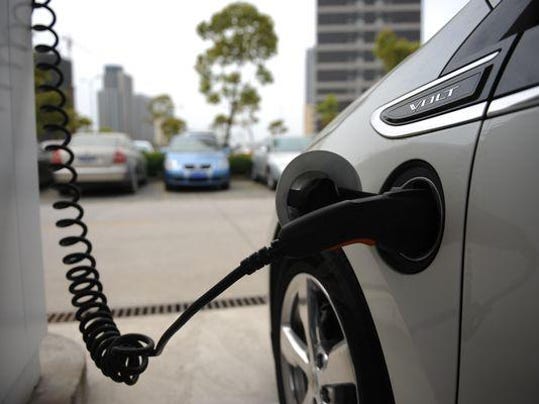
From the battery-powered Chevrolet Bolt crossover to the hydrogen fuel cell-powered Honda Clarity to a hybrid Chrysler minivan, automakers are expected to show a parade of electric vehicles at the 2016 Detroit auto show.
A rare sight a decade ago, they will join dozens of battery-powered entries in dealer showrooms as automakers try to dazzle consumers and meet government gas efficiency mandates.
But with national gas prices hovering at $2 a gallon and SUV sales booming, battery-powered vehicles’ share of the market last year dropped to just 2.4 percent, a 20 percent decline from 2014. The trend has sent ripples of concern through an industry that must meet escalating emissions goals to combat global warming by 2020 — that is, within the current product cycle.
“The regulators are what are driving electric car production,” said Karl Brauer, an industry analyst with Kelley Blue Book. “It’s not because consumers are demanding them.”
By 2020, California, the country’s largest auto market, will require roughly 10 percent of sales be zero-emission vehicles (either EVs or fuel cells). If they don’t meet that threshold, automakers will be fined $5,000 for each vehicle under their sales target. As part of its mission to combat global warming, the Environmental Protection Agency is not mandating such stringent targets nationwide, but it is requiring that carmakers’ fleets average 54.5 mpg by 2025.
As an interim step, 2016-model cars are supposed to meet a goal of 35.5 mpg this year, but according to the EPA’s “Fuel Economy Trends” report issued last month, automakers won’t be close. In reality, the fleet average is an estimated 24.7 mpg.
Detroit automakers, however, avoided government fines by making enough hybrids and EVs to gain credits under EPA’s complicated rules. Those credits will be key to meeting the looming California and EPA goals, but they will get much costlier. Only EVs and fuel-cell vehicles will get full credits, while gas-hybrids like the popular Toyota Prius will get less.
At the Los Angeles Auto Show, General Motors Vice President for Global Product Development Mark Reuss expressed confidence that his company is well-positioned to meet California’s mandates with the all-electric Bolt, plug-in Volt sedan and other offerings such as the hybrid Malibu.
Industry insiders refer to EVs like the Bolt as “compliance vehicles,” made not in response to market demand, but to comply with government regulations. But for smaller automakers like Fiat Chrysler, Mazda and Subaru — which haven’t been able to afford the massive R&D costs of EVs — the regulatory challenges are steep.
“The entire industry is going more toward electrification,” said Reid Bigland, FCA’s North American vice president of sales. “It’s really the primary way to be compliant with the 2025 (federal) standards. That is consuming a significant amount of capital in this industry.”
The result is a two-tier market.
To satisfy consumer hunger for SUVs, automakers are churning out crossovers and trucks at a record pace. Trucks and SUVs account for 55.7 percent of market share — an 11 percent increase in the last five years.
To meet demand, manufacturers have introduced 31 all-new SUVs since 2009, according to IHS Automotive. Yet battery-powered car production has soared even as their market share has shrunk. Automakers have flooded the market with 50 new hybrid and electric models, IHS says.
“The automakers are beholden to two masters,” said Auto Trends Consulting’s Joe Phillippi, an investment expert. “The companies are responsible to their customers and shareholders, yet the government wants its own way.”
Fiat Chrysler Automobiles CEO Sergio Marchionne has decried this two-tier market as unsustainable. The high cost of electrification has, in part, driven Marchionne on a quixotic venture to merge with GM. GM has been dismissive of the suggestion.
“Chrysler did not have the funds” to invest in EVs before its 2009 bankruptcy, said Bob Lutz, a former product executive for both Chrysler and GM. “And even now they can’t divert scarce capital and engineering money for these money-losing compliance vehicles.”
Lacking electric cars, Chrysler has taken the more affordable road of buying credits to meet federal rules. In 2015, reports Forbes, Chrysler paid the federal government some $600 million in credits, effectively a half-billion-dollar tax in order to stay on the right side of the law.
But buying credits will be less of an option as rules tighten to force automakers to sell electric and fuel-cell vehicles. This is by design.
In her new book, “Driving the Future: Combating Climate Change with Cleaner, Smarter Cars,” Margo Oge, the former director of the EPA’s Office of Transportation and Air Quality, gives an insider account of how the Obama administration used “the weakened bargaining position of the … crippled automakers” in 2009 to force a doubling of mpg standards to 54.5 by 2025.
The rule, she writes, effectively forces a fundamental shift in engine technology toward “game-changing full-electric vehicles or fuel cells” to fight global warming.
If the EPA numbers are a road map to reduced tailpipe emissions, California — where EVs and hybrids already make up 11 percent of market share — will specify what vehicles will get us there.
The California Air Resources Board expects combined sales of fuel-cell, EV and gas-hybrid vehicles to reach 137,000 by 2020, and 270,000 by 2025, explained spokesman David Clegern.
Fuel-cell vehicle sales are mandated to hit 10,600 annually by 2020 — a tall order for even big manufacturers given their expense and the fact that only two fuel-cell vehicles, the Hyundai Tucson and Toyota Mirai, were available in 2015, with combined sales of barely 100. Honda’s Clarity ($62,000 estimated price) is expected later this year, while a joint venture between Honda and GM aims to produce another FCV by 2020.
The landscape is more difficult for small manufacturers with no battery programs. Mazda, for example, has been on the cutting edge of gasoline fuel efficiency with its SkyActiv engines, yet will get no credit for that work in California.
“The only options they have are to buy credits or invest billions in batteries,” said KBB’s Brauer. “It’s pay up or else.”
IHS Automotive Senior Auto Analyst Stephanie Brinley speculated that “the capital investment is so high that there will likely be opportunity for joint investment. Partnering with other automakers on technology is probably how Mazda gets there.”
But experts agree the industry is fully committed to making electric cars, whether consumer demand materializes or not, in order to be compliant with rules.
“The regulators are not going to back down,” said Brinley. And EVs “are not a switch automakers can just flip in five years.”
CARB’s Clegern said California’s standards have been adopted by nine other states, which will mean a total industry commitment to 3.3 million zero-emission vehicles in showrooms by 2025. “We’ll hit a critical mass at some point,” he says, which may drive costs down.
A key test will be Chrysler’s expected introduction in Detroit of a hybrid model into the high-volume minivan segment despite “zero market demand for a hybrid minivan,” said KBB’s Brauer.
The Drive Home: Epic cruise opens Detroit auto show
Posted by hpayne on January 5, 2016

St. Louis — Imagine the Woodward Dream Cruise taking place in the middle of winter instead of summer. And stretching not 16 miles through nine Woodward Avenue communities, but 3,000 miles through nine states. And ending at the foot of Woodward in front of Cobo Center.
Welcome to “The Drive Home,” an epic classic car journey from Tacoma, Washington, to Detroit, kicking off the 2016 North American International Auto Show.
For the Kansas City-St. Louis leg, I joined the expedition featuring three red classics: a 1957 Chevy Nomad, 1961 Chrysler 300G, and a 1966 Ford Mustang. It was kind of like meeting your buddy at 13 Mile and Woodward for a cruise from Royal Oak to Ferndale in his favorite muscle car. Except my Drive Home leg covered 250 miles across America’s farm belt.

This glorious adventure is the brainchild of David Madeira, who runs the nation’s biggest (165,000 square feet) auto museum, LeMay America’s Car Museum, in Tacoma. A grizzled car-and-cycle globetrotter, Madeira last year traversed the Indian Himalayas’ fearsome Khardalungala Pass on a motorbike. In a hailstorm. With his wife on the back. So braving the Rockies in January in a ’66 Mustang must seem like a day at the beach.
Madeira is no ordinary guy; America’s Car Museum is no ordinary museum.
Founded on the sprawling collection of Tacoma refuse magnate Harold LeMay, Madeira believes in a living auto museum. That is, a collection with artifacts that continue to do what they were designed to do: be driven like mad.
“I argue that while driving vintage cars may put them at ‘risk,’ not driving them makes their ‘death’ certain,” writes Madeira in his Drive Home blog at AmericasCarMuseum.org. “Cars that don’t move are sad objects to look at. And driving them is the only way to give them a chance for a meaningful existence, giving pleasure to driver and passengers.”
Madiera would fit right in in Detroit’s cruise culture, where road warriors and their antique machines hit Woodard every August to rev their engines.
So it’s no surprise that the museum’s chief found kindred spirits in Detroit Auto Dealers Association Executive Director Rod Albert and their 2016 auto show. Madeira’s “Drive Home” means to showcase the museum’s classics and kick off the country’s biggest car circus with some of the showstoppers of yesteryear.
“The Drive Home is ‘driving home’ the point that ACM is an entity which promotes and celebrates America’s automotive heritage and is relevant to the car culture today,” says Madeira.
■1957 Chevy Nomad: The product of GM design legend “Hollywood Harley” Earl, the Nomad was inspired by Chevy’s 1954 Corvette Nomad station wagon concept (I’m not making this up). Sporting the same small-block V-8 architecture that powers ’Vettes today, the ’57 Nomad wagon is distinguished by cold air intakes above the headlights, which prevent the fenders from rusting out.
■1961 Chrysler 300G: The king of the “original muscle car” 300-series, the 413-cube, V-8-powered G was designed by airplane-obsessed Virgil Exner. With its rear fins, angled headlights and sloped trunk, the G is an early ’60s icon.
■1966 Ford Mustang: The pony that created pony cars. Powered by a 289-cubic inch V-8, this hardtop head-turner sports the long hood, grille and three-bar taillights that are still a Mustang signature today.
We were given a hearty send-off at Kansas City’s Roasterie coffee factory by area car clubs on a brisk, sunny Sunday morning. Locals met the America’s Car Museum threesome with an array of iron — modified 1930s Ford hardtops, a ground-shaking 1969 427-cubic-inch Chevy Corvette, various Porsches, a 1959 Aston M DB3 — even a 2014 Tesla P85D.
Fortunately we didn’t need oars in St. Louis — the Mississippi Valley’s flooding had subsided and all major highways were open. But the Chevy Suburban-length, 220-inch 300G still felt like a boat. As Cruisers know, the biggest advances in the last 60 years have come in handling, where numb steering (even in my 1966 Porsche 906 racer) have been replaced by modern links that feel rooted to the ground. The three classics cars also lack today’s electronic console infotainment systems, though I didn’t miss them what with the constant chatter over the caravan’s walkie-talkie system between “Giraffe” (my handle), “The Dude” Madeira, “The Kid” Bill Hall and the rest of the crew.
But the old-guard cars can still school the current generation with better rear visibility and dashboards that are works of art. The Chrysler’s delicious detailing deserves its own museum. And its button-controlled transmission and climate controls — even foot-button operated high beams — were ergonomically intuitive. After a stint in the 300G, I took the helm of the short-wheelbase Nomad which maneuvered like a jet-ski by comparison.
Only the Mustang eluded my grasp, because “The Dude” was nursing it through a carburetor issue. But like the cold bug that had swept through the crew, the cars had suffered only minor illnesses — a silent 300G radio, an unresponsive Nomad speedometer — that never slowed the Tacoma-Detroit safari as it clocked 2,225 miles under the St. Louis arch.
“David Madeira is like a preacher,” smiled Mark Hyman, CEO of Hyman Limited Classic Cars, at a barbecue feast welcoming us into St. Louis. “He’s out on the road spreading the gospel of the American automobile.”
Amen. That passion also fuels ACM’s mission, through its Hagerty Education Program, to baptize today’s youth as tomorrow’s car craftsmen. ACM’s generosity funds programs across the country like Wexford-Missaukee Tech in Cadillac.
I left Madeira’s missionaries in St. Louis as they steamed onward for stops in Bloomington, Illinois, and Chicago before they reach Detroit later this week. Follow their journey at the AmericanCarMuseum.org blog, and then bring out your hot rod to Lincoln of Troy Friday morning to escort them down Woodward.
You might want to keep the convertible top up, though. This is a winter cruise, after all.
Henry Payne is auto critic for The Detroit News. Email him at hpayne@detroitnews.com. Follow him on Twitter @HenryEPayne. See all his work at HenryPayne.com.
Join the parade
“The Drive Home” will complete its final leg Friday morning on the way to the Detroit auto show. Bring your car — classic or otherwise — to Lincoln of Troy, 1950 W. Maple, Troy, from 8-9 a.m. The all-red Drive Home trio — a 1957 Chevy Nomad, 1961 Chrysler 300G and 1966 Ford Mustang — will be there.
Then join them as they “drive home” down Woodward to Cadillac Square, where they will be greeted with a news conference and other festivities (after which they will get a good bath and dress up nice for the big Cobo show).
Payne: 2015 Vehicle of the Year: Chevy Camaro
Posted by hpayne on December 31, 2015
Were I a film reviewer, I might have gone mad by now. Consider some of the dogs that critics had tospend two hours watching in 2015 with nothing to comfort them but a bucket of popcorn. “Victor Frankenstein”? Dog. “Get Hard”? Woof woof. “Tomorrowland”? Lord, kill me now.
But I’m not a movie critic, I’m an auto critic. And that was a glorious thing to be in 2015. I drove 32 (of 40) new, 2016 model-year vehicles this year in daylight, on open roads, at full throttle. I never needed popcorn. There wasn’t a dog in the bunch. Audi TT, Cadillac ATS-V, Fiat 500X, Ford Edge, Honda Pilot, Mustang GT350 — even the new Chevy Malibu turned heads.
Sure, some were homely — the Scion iA, for example, looks like a bulldog that’s been punched in the face — but then not every movie starring Margot Robbie is an Oscar contender either (“Focus”? Woof). Like every new car this year, the affordable Scion is a complete player. Up in First Class I was admittedly seduced by the electric Tesla P90D’s “Ludicrous” acceleration, iPad console, and re-invention of the auto experience. But only 300 people can afford the thing.
No, the car of the year must be accessible as well as emotional. As in the movies, money isn’t everything. A $50 million rom-com can be just as stirring as a $500 sci-fi blockbuster. The $30,000 Mazda MX-5 Miata made me smile as wide as the dumb grin I wore emerging from the $130K Tesla.
Thus my finalists for The Detroit News 2015 Vehicle of the Year. If Miss Universe host Steve Harvey were to crown the wrong winner, no one would bat an eye. All three are deserving.
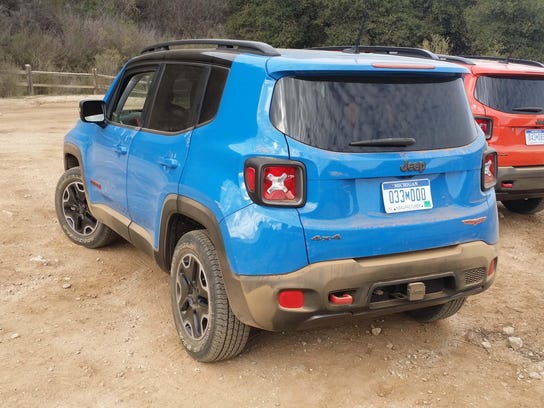
Second runner-up: Jeep Renegade
With none of the Big Three truck makers debuting a pickup, all eyes turned to SUVs where manufacturers are furiously offering new products to satisfy public demand for anything on stilts. Compact utes became the biggest non-pickup segment in Autodom (eclipsing midsize sedans) and the Honda Pilot and Kia Sorento launched formidable midsize products in the Battle for Soccer Moms. But the most intriguing new entries were in the newest market of them all: Subcompact utes.
All are rushing to put their stamp in the exploding marketplace that is luring young buyers and empty-nest oldsters alike. From the hot-hatch-in-disguise Mazda CX-3 to Fiat’s 500X cutie, the shelves are full of toys.
But the Renegade is the most intriguing with its off-road Jeep swagger and impish sense of fun.
I took it to a neighbor’s house and spent a half-hour with their kids finding the car’s 30-something hidden “Easter egg” details. Hidden gems include “X”s echoing the brand’s World War II Army gas cans, Jeep silhouettes crawling up the windshield, even an Italian-speaking spider (the Jeep is imported from Italy) hidden in the cobwebs behind the gas door. The kids bonded with the vehicle even before we had turned a wheel.
Exterior design is as cute as its details — eschewing the bigger Cherokee’s mod look for a youthful face and huge moon roof that can be removed to simulate an open-air Wrangler. On road, the Renegade is pleasant, if hardly the apex-diver the Mazda aspires to be. As the removable roof suggests, Renegade is about answering nature when she calls.
At an off-road park I experienced the 4×4’s full repertoire from shimmying down 30-degree sand dunes to roaring around unpaved roads. The Renegade is an all-season, all-wheel-drive, all-around athlete. All that personality is key to overcoming Jeep’s perpetual quality challenges that drive buyers to Hondas — including a nine-speed transmission that has haunted the brand. That tranny is key to good mileage numbers for the Renegade — an important factor in this budget-conscious class.
First runner-up: Honda Civic
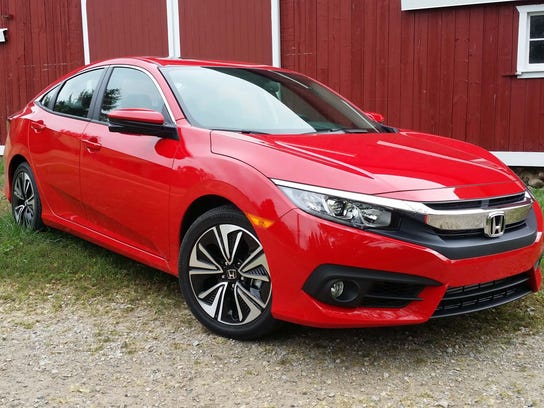
If the Renegade looks to put its stamp on a new segment, the new Civic is seeking to re-establish itself as the standard in an old one. Mission accomplished.
While Honda set its sights on dominating small crossovers with its CR-V, the Civic got flabby. The 10th generation Civic telegraphed its determination to get back in shape by benchmarking to the whip-quick Audi A3. Be like Mike.
Lowering its center of gravity by an inch and widening its stance, the Civic is nimble fun. Honda has plans for a Si sport version as well as a track-pawing Type R, so the base chassis bodes well for those offspring. But the ’16 Civic is more than an athlete — it’s a class valedictorian with class-leading fuel mileage (credit Honda’s first turbocharged engine and a nifty, un-CVT like CVT tranny), console apps, and rear leg room. Yes, this baby’s got back. A back seat into which I can fold easily my 6’5” frame.
With its good looks and utility, Civic should have the midsize Accord looking nervously in its mirrors.
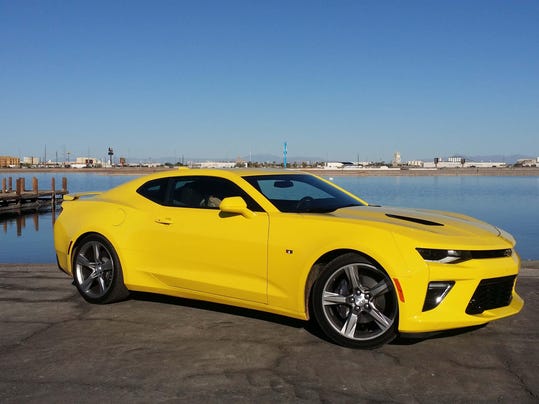
The winner: Chevy Camaro
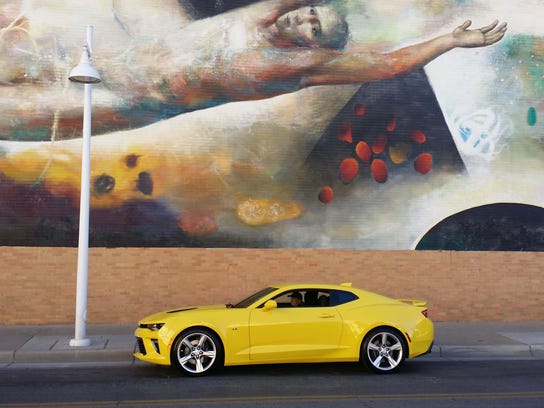
I can’t see out of it. Its front door storage is useless. And I am only comfortable in the back seat if I remove my legs first. But the 2016 Camaro is addictive.
In an age where mpg-optimized, soap-bar cars all look alike, the Camaro is proof you can still own a vehicle for pure fun.
The Chevy’s exterior is a minor evolution from the previous model, but its angular air intakes and sinister headlights evoke a front-engine Lamborghini. Or something that Kylo Ren might keep in his garage.
The Camaro’s real story is under the skin where it shares a platform with the Cadillac ATS — the best-handling luxury sports coupe. Dance like a butterfly, punch like Ali. GM is leveraging its global platforms to raise all boats. Pushed by the formidable Dodge Challenger and Ford Mustang, Camaro is taking the pony car segment to new heights.
So good is the Chevy that it deserves looks as a BMW coupe fighter with a powerful V-6, turbo-4, and Corvette V-8 — something not even the ATS can offer. The Camaro benefits not only from Cadillac but from the General’s huge tech investment as well. The Camaro’s brawn is matched by tech brains with excellent 4G Wi-Fi connectivity and Apple Car Play and Android Auto ability (the latter coming in early ’16).
So what if the Camaro’s last movie cameo was in a “Tranformers: Age of Extinction” bomb. The new pony is a genuine road star.
’15 Jeep Renegade
Vehicle type: Front-engine, front or four-wheel drive, five-passenger sport ute
Price: $18,990 base ($27,355 “Omaha Orange” Latitude 4×4 as tested)
Power plant: 1.4-liter, turbo, in-line 4-cylinder; 2.4-liter, in-line 4-cyl “Tigershark”
Power: 160 horsepower, 184 pound-feet of torque (turbo 4); 180 horsepower, 175 pound-feet of torque (2.4L)
Transmission: Six-speed manual (turbo 4-cyl engine only); nine-speed automatic
Performance: 0-60 mph, 8.6 seconds — turbo 4-cyl (Motor Trend est.); 0-60 mph, 8.0 seconds — 2.4-liter 4-cyl (Motor Trend)
Weight: 3,044 pounds (4×2 turbo 4-cyl); 3,573 pounds (4×4, 2.4-liter Trailhawk edition)
Fuel economy: EPA 24 mpg city/31 mpg highway/27 mpg combined (turbo 4); EPA 21 mpg city/29 mpg highway/24 mpg combined (2.4L)
Report card
Highs: Jeep styling; As happy in the outback as on the road
Lows: Upright front end and broad C-pillar create blindspots; lumbar support-challenged seats
Overall:★★★★
’16 Honda Civic
Vehicle type: Front-engine, front-wheel-drive, five-passenger compact sedan
Price: $19,125 ($25,535 as tested)
Power plant: 2.0-liter, inline-4 cylinder; 1.5-liter, turbocharged, inline 4-cylinder
Power: 158 horsepower, 138 pound-feet of torque (2.0-liter); 174 horsepower, 162 pound-feet of torque (2.0-liter)
Transmission: 6-speed manual; Continuously variable automatic
Performance: 0-60 mph, 8.4 seconds (manufacturer)
Weight: 2,742 pounds base (2,899 EX-T trim as tested)
Fuel economy: EPA 27 city/40 mpg highway/31 mpg (manual, 2.0-liter gas); 31 city/41 mpg highway/35 mpg (CVT, 2.0-liter gas); 31 city/42 mpg highway/35 mpg (CVT, 1.5-liter turbo)
Report card
Highs: Super-sized rear seat; Turbo-riffic
Lows: Those plasticky, rear-duct thingies; AWD option, please
Overall:★★★★
’16 Chevrolet Camaro
Vehicle type: Front-engine, rear-wheel-drive, four-passenger coupe
Price: $26,695($38,585 V-8 SS as tested)
Power plant: 275 horsepower, 295 pound-feet of torque (turbo-4); 335 horsepower, 284 pound-feet of torque (V-6); 455 horsepower, 455 pound-feet of torque (V-8)
Power: 158 horsepower, 138 pound-feet of torque (2.0-liter); 174 horsepower, 162 pound-feet of torque (2.0-liter)
Transmission: 6-speed manual; 8-speed automatic
Performance: 0-60 mph, 3.9 seconds (SS V-8, Car & Driver)
Weight: 3,685 pounds (as tested)
Fuel economy: EPA 19 city/28 mpg highway/23 mpg (V-6, automatic); 17 city/28 mpg highway/20 mpg (6.2L V-8, auto)
Report card
Highs: Precise handling; Corvette power
Lows: Blind spot the size of Rhode Island; useless door storage
Overall:★★★★
Payne: Which sports car for Christmas?
Posted by hpayne on December 28, 2015

Making my Christmas list was tough this year, Santa. I’m not asking for too much. No exotic, $300K Lambos or McLarens. Just the usual, humble request: The best two-seater sports car under six-figures.
But this year’s choice was more difficult.
To the perennial World War struggle between Germany’s Porsche Boxster/Cayman GTS and America’s Corvette Z06 for best sub-$100,000 sports car, add a Brit: The 2016 Jaguar F-Type S Coupe. Like the 1940s battle for aerial superiority between Messerschmitt, Mustang, and Spitfire, the threesome pits superior engineering from three distinct automotive cultures.
Yet while the Porsche (knife-edge handling) and the Corvette (shock-and-awe power) conform to national stereotypes, the Englishman is decidedly at odds with the proper London gentleman.
This is not the tea-and-crumpets Jag of recent decades, but a howling, ripping good ride worthy of a James Bond car chase.
We boys love our toys, but don’t put a Jaguar F-Type on your list if you be the shy type. Under new, Indian ownership, the cat is back as a world-class performance car and Jaguar wants the whole world to know it.
Push the starter button and the Jag explodes with a growl, its supercharged V-6 pulse racing. Back off after a prolonged sprint and the F will cackle and fart under deceleration. A farting Brit? Don’t tell the queen. Granted, this coupe is no window-rattling Corvette V-8 which will wake up the neighborhood if lit off in the early AM. But when the Jag clears its throat it does make you look around to apologize. It’s all very over the top, but that’s the intent. An announcement that Jaguar means business again. Like the obnoxious roar of the Porsche 911-fighting, $103,225 F-Type R’s 550-horsepower V-8, the $96,245 S wants to pick a fight.
Dollar-for-dollar, turn-for-turn, uppercut-for-uppercut, this cat goes toe-to-toe with the segment legends. The Jag’s calling card is slinky good looks.
Its behind will stop grown men in their tracks. Like its namesake, the F’s muscular haunches are crouched, ready to strike. A tapered greenhouse is its spine. Many before it have penned the look — Chrysler Crossfire, Stingray, Mustang — but none has done it better. Jags are by definition pretty, but this carnivore is more cut, more purposeful.
Like its American rival, the Jaguar’s headlights are slit, menacing and laced with glowing LEDs. The front-engine cars share tilt-forward hoods, big hinged rear decks that could hold Santa’s bag, center-mounted pipes the size of frigate cannons and shark-like mouths.
But from smiling muzzle to rounded haunches, the Brit is more feline — more organic — than Chevy’s sharp-edged Terminator. The Jaguar’s hips are rounded, muscular — uninterrupted by the ’Vette’s cyborg inlets. And the Detroit muscle car’s hood bulge betrays the 6.2-liter monster that lies beneath.
The Brit’s interior is also strikingly like the American. Unlike the Boxster/Cayman and its long console sleeve of buttons, the Jag/’Vette maximize console space with a balanced mix of shifter, buttons and storage. Both cabins are festooned with huge OH, CRAP! handles so that passengers can hang on when the demon red-mist seizes the pilot. The Porsche’s interior, by contrast, hints at no such drama. The lines are simple, functional. Emotion is for weak, English-speaking types.
As pleasing as they are ergonomically, the Jag and ’Vette gearshifts can be maddening. The Jaguar’s eight-speed automatic unit, like the Corvette’s seven-speed manual, is compact — no long shift gates here. But that requires always pressing a button to operate, meaning you are constantly looking at the shifter to make sure you snatch FORWARD and not REVERSE lest you vault backward through traffic at 60 mph.

At least the gearbox is an appropriately named “Quickshift” wonder so addictive I routinely selected sport mode to sprint up and down Telegraph Road, squeezing off upshifts like rifle shots. The ’Vette’s seven-speed box will make even the purest motorhead question manuals. It’s too-short gates mean routine mis-shifts or, worse, buckets of neutrals.
The Vette also betrays its working-class Chevy roots with an oily interior odor and floor mats that often snagged my brake-foot heel. Still, the Jaguar makes fauxpassurprising for its lineage. Like no voice recognition system, a head-scratching oversight when you consider even a Honda Civic compact — at one third the F-Type’s price — has one. And consider the Jaguar’s gorgeous, full-length moon roof, which can’t even be cracked open for air.
The most conservatively tailored of the three, the Boxster/Cayman GTS saves its emotion for the asphalt. On the Autobahn race track outside Chicago, this mid-engine athlete put on a handling clinic. Lighter than the ’Vette by 400 pounds and 700 pounds less than the Jaguar, the Cayman’s balance (though a convertible, the Boxster GTS is just 55 pounds heavier) allows for high grip in the corners and early throttle on exit, its flat-6 mill wailing with joy.
To be sure the Jaguar is no slouch in the handling department. Part of its porkiness is due to an AWD system that delivers planted handling (and winter-time capability that would put reindeer to shame). Despite its girth, the F-Type feels much smaller than it is. Like the 325-horse Cayman S I sampled, its 380 horsepower is plenty on tight, rural Michigan roads.
That cackling sound you hear is the Z06 laughing. Just 300-something ponies?

Jaguar’s coupe offers a ride worthy of a Bond film cameo. (Photo: Henry Payne)
The Corvette’s hood bulge betrays its 6.2-liter, 650 horsepower engine, a performance league the Jag and Porsche don’t play in. (Photo: Photos by Henry Payne / The Detroit News)
With 650 horsepower, 650 pound-feet of torque, and gargantuan grip from Michelin Super Sports, the Z06 plays in a different performance league. The ’Vette will eat the Cayman and Jaguar for lunch on track, then get back in the buffet line for a McLaren or Lamborghini. If you haven’t heard, the Z06 destroyed both Euro-exotics in Car & Driver’s 2015 Lightning Lap competition.
Yet, the Z06’s supercar performance at the raceway makes it feel like a tornado in a tea pot on the street. I could explore the envelope of the 6-cylinder Cayman and F-Type on Southeast Michigan’s curvier roads, while the Z06 never felt happy unless it was on a track. Like a lion in the Detroit Zoo, the Z06 is a caged creature — a predator that dreams of returning to GM’s vast Milford proving grounds where it was raised.
Three extraordinary predators for different tastes.
Corvette, the King of the Beasts. The Boxster/Cayman a cheetah cutting through a herd of sedans. And for those who tire of the more common American and German, there is the elegant Englishman.
My choice? The Boxster GTS. And in your favorite color, Santa: Red.
’15 Porsche Boxster/Cayman S or GTS
Vehicle type: Mid-engine, rear-wheel-drive, two-passenger sports car
Price: $74,495 ($79,855 Boxster GTS/$97,890 Cayman S as tested)
Power plant: 3.4-liter, boxer 6-cylinder
Power: 330 horsepower, 273 pound-feet of torque (Boxster GTS); 325 horsepower, 272 pound-feet of torque (Boxster GTS);
Transmission: 6-speed manual (Boxster GTS); 7-speed PDK automatic (Cayman S)
Performance: 0-60 mph, 4.7 seconds (manufacturer)
Weight: 2,965 pounds
Fuel economy: EPA 19 city/26 highway/22 combined (manual)
Report card
Highs: Precise handling; most affordable on the list
Lows: Won’t fit in my stocking; flimsy cup-holders for egg nog
Overall:★★★★
’16 Jaguar F-Type S AWD Coupe
Vehicle type: Front-engine, all-wheel-drive, two-passenger sports car
Price: $85,795 ($96,245 as tested)
Power plant: 3.0-liter, supercharged V-6
Power: 380 horsepower, 339 pound-feet of torque
Transmission: 8-speed automatic
Performance: 0-60 mph, 4.9 seconds (manufacturer)
Weight: 3,691 pounds
Fuel economy: EPA fuel economy 18 city/26 highway/21 combined
Report card
Highs: AWD grip; could stare at her all day
Lows: Voice recognition, please; won’t fit down the chimney
Overall: ★★★★
’15 Chevrolet Corvette Z06
Vehicle type: Front-engine, rear-wheel-drive, two-passenger sports car
Price: $78,000 base ($85,565 removable hardtop as tested)
Power plant: 6.2-liter, supercharged V-8
Power: 650 horsepower, 650 pound-feet of torque
Transmission: Seven-speed manual (as tested); Eight-speed automatic with steering-mounted paddle shifters
Performance: 0-60 mph: 2.95 seconds with automatic; 3.2 seconds with manual (manufacturer).
Weight: 3,524 pounds
Fuel economy: EPA 13 mpg city/23 mpg highway (automatic); 15 mpg city/22 mpg highway (manual as tested)
Report card
Highs: The torque of 650 reindeer; exotic supercar-slayer
Lows: Manual (shifter) labor; awesome power will get you arrested on Christmas
Overall:★★★★
Payne: Nissan Titan’s ‘ligheavy’-duty pickup
Posted by hpayne on December 19, 2015

What’s a pickup truck? F-150, RAM, or Silverado.
The three brands define that most American of segments. Together they make up over 90 percent of US pickup sales. Trying to break their grip is like trying to think of a tennis player who might win Wimbledon outside the Big Four of Djokavic, Federer, Nadal, and Murray.
Berdych? Yeah, right.
Only Toyota and Nissan have tried and the results have been as lopsided as, well, Nadal’s record on clay the last decade. Toyota’s Texas-produced Tundra sold 118,493 units in 2014. Nissan’s Mississippi-sourced Titan? Just 12,527. Or about the number the Ford F-150 produces in a week. At least Nadal will get old. But the Big 3 trucks just get better with each cycle with more engine/trim/bed combinations than a Swiss Army knife has tools.
How to compete against this juggernaut? Um, did you think about midsize pickups?
But the Japanese manufacturers have persisted in their quixotic adventure through specialization. Toyota has carved its niche as the segment’s quality leader. And now Nissan has defined a corner of the market that it thinks will give it a foothold on the Big 3’s Matterhorn: A combination light duty-heavy duty. Call it a “ligheavy.”
Nissan says it’s identified some 150,000 buyers in the massive, two-million-unit-sales segment who want either a light-duty pickup that can shoulder the chores of a heavy duty – or who own a heavy duty diesel but want a light-duty’s smaller size and maneuverability in metro areas. The Titan XD is marketed to these tweeners and its cleverness has earned it a place as finalist in the 2016 North American Truck of the Year competition (I am a juror).
The Titan backs up its beefy, light duty claims with an engine that will make truck lovers salivate: A 310-horsepower, 555 pound-feet-of-torque Cummins diesel V-8. Not a (ahem) Italian-built V-6 as in the segment’s only other diesel offering from RAM, but a V-8 like the big HD boys get. Dude.
Sitting in my driveway, the Titan XD – like any self-respecting pickup these days – looks taller than my house. And its 151-inch Crew Cab wheelbase – six inches longer than a similar F-150 – could land a small plane. It comes with nifty features like a standard sprayed bed, bed light, gooseneck trailer hitch, adjustable tie-down cleats, and the most bed storage in segment.
Will it work?
How would I know? Your speed-addled scribe needs to drag around a 20,000-pound trailer for my race cars, so a “ligheavy” tweener won’t work for me. So I brought in my pal and light-duty pickup expert – let’s call him Pickup Bob – to put the XD through its paces.
Pickup Bob was intrigued by the concept. The Titan’s diesel is not only a fuel-sipping stump-puller, but on the road, Pickup Bob was impressed by its quiet cabin. A construction boss, he spends a lot of time in his Ford F-150 and the Nissan’s ergonomics impressed him. But not as much as his Detroit metal.
The Nissan is much improved, but looks a generation behind the Detroit 3 in its looks and interior. The new F-150, for example, is a marvel of interior and exterior design from its integrated C-clamp headlights to its exquisite gauge cluster. The Titan even adopts the Ford’s clever mirror cutout for visibility but it feels like catch-up.
Given its heavy duty towing pretensions, the bed is a different story. The bed light and gooseneck are segment exclusive for those who need 12,000 towing capability. But not Pickup Bob. If he wants that kind of towing ability, the F-150’s 11,000-pound capability will do just fine, thank you very much.
He walked back to his Ford without a look back. I told you this is a merciless segment.
My female pickup pal — let’s call her Gooseneck Sally — is more promising. A weekend racer, she seems to be right out of a Nissan focus group. She wants a light duty for daily utility, but wants a heavy duty for her weekend escapes to the track. And she’s a diesel fanatic. With VW, Audi, and Porsche diesel products sidelined by Dieselgate, the Nissan is her kinda fix. You had her at “Cummins.”
With the Titan XD sticker snuggled nicely between, say, an F-150 and an F-250, the price is right. Nissan spokesman Dan Bedore says the base Titan XD Crew Cab 4×2 should start at above $40k when it hits stores late this month. A loaded 4×4 with all the toys should top out around $62k. .
Nissan has done its homework. Now it’s time to put the formula to work. I’m betting they’ll do OK. After all, Tomas Berdych may not beat any of the Big Four at Wimbledon next year. But he’ll take a set.
’16 Nissan Titan XD
Vehicle type: Front-engine, two and four-wheel drive, five-passenger pickup truck
Price: NA (est. $40,000-$62,000)
Power plant: 5.0-liter, turbocharged diesel V-8; 5.6-liter V-8 (gas)
Power: 310 horsepower, 555 pound-feet of torque (diesel); 390 horsepower, 401 pound-feet of torque (gas)
Transmission: 6-speed automatic
Performance: 0-60 mph, 9.3 seconds (diesel, Car & Driver); 12,000-plus pound towing capacity
Weight: 7,360 pounds
Fuel economy: NA
Report card<EL,3>
Highs: Heavy duty strength; Stump-pulling diesel
Lows: Ho-hum styling; 7,000-pound “light truck”
Overall:★★★
Payne Q&Auto: Chevy Malibu’s stylin’ design boss
Posted by hpayne on December 8, 2015
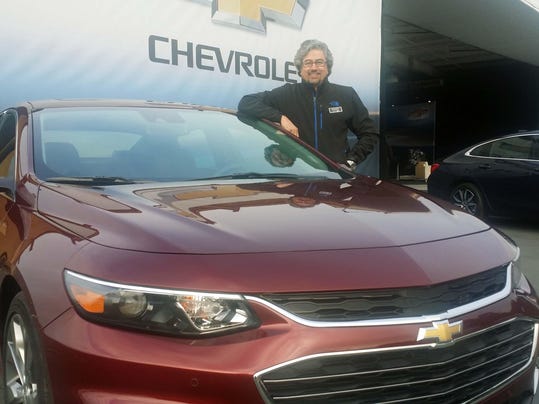
It was love at first sight.
Chevrolet design boss John Cafaro, 60, saw the original Stingray Corvette concept car at the 1964 New York Auto Show. He was nine years old. “I wanted to go wherever that car was created. I wanted to work with those people,” he remembers.
Fifty years later and he oversees Chevy design, including the ‘Vette. His latest baby is the fast-back, 2016 Chevrolet Malibu, the best-looking ‘Bu since, well, the fast-back ’68 classic. At a time when consumers are flocking to boxier SUVs, mid-size sedans must flaunt their sex appeal. Yet the tsunami of government safety and mpg regulations is shrinking the creative envelope, forcing design homogeneity and challenging designers and engineers alike.
“Don’t put Jesse and I in the backseat together,” laughed Cafaro with his friend and Malibu Chief Engineer Jesse Ortega at a media test in California. “We might strangle each other.”
In Jesse & John’s Excellent Adventure, Jesse must assure the Malibu conforms to pedestrian collision, rollover, frontal offset, efficiency standards, etc. – even as John makes sure it turns heads like Kate Upton on a catwalk.
Improbably, their team has produced a vehicle with the profile of an Audi A7 and the fuel economy of a compact. I sat down with Jersey-born Cafaro in Palo Alto to talk Malibu, Camaros, and Russian dolls.
Q: You went to work with GM right out of school?
Cafaro: We did an art design school project at Brooklyn’s Pratt Institute with GM. I got all my sketches together and they brought us out to GM to look around. I never thought I would have a shot.
I came in 1977 when GM was really changing their thinking from chrome-laden, rear-wheel drive cars to tighter, more European proportions. Cars like the Volkswagen Sirocco and guys like (Italian designer) Giorgetto Giugiaro were really recreating the car. The first car that captured that look was the 1984 Corvette that went from an exaggerated, shark-like style to a more European, cleaner car. The Cadillac Seville got it right too . . in the late ‘90s.
Q: What’s been the biggest change since you’ve been a designer?
Cafaro: The computer. I can still remember at GM when they were bringing in computers and getting the more modern, surface-development tools. But as far as the creative spirit it’s still done the same way. It’s a craft of clay, sketch, and an idea. Young designers coming out of school work on a (computer) pad and screen but they have their own style. The computer didn’t inhibit their expression, it just speeds up the process.
Q: Is car design more important than ever?
Cafaro: Design is a fashion statement. Everybody buys style whether it’s a cooking tool or a refrigerator. Cars and trucks are no different. Now the design is the differentiator because everybody’s pursuing safety and aero and rendering the same solutions. Audi, Mercedes, Cadillac all have their style. Chevrolet is starting to emerge with its own philosophy.
Q: Audis all look alike, yet each Chevy seem different. Why?
Cafaro: We don’t do a Russian doll mentality. We have a . . . family DNA, but every car has a different feel. It makes the business exciting. It inspires the designers who come to work every day trying to create something fresh and expressive and not fall into a formula.
Our basic DNA is surfacing that’s lean, yet muscular, athletic. Not excessive, not heavy. Very expressive. We look at our iconic cars like Camaro and Corvette as inspiration throughout our product line. There’s a passion that Corvette and Camaro have that our leadership expects in everything we do whether a Spark or Corvette. (Each car) in our product line is very unique. The way the Camaro engine takes in air, it requires massive amounts of cooling, so the front grille gets big, very aggressive. Whereas Malibu is more efficient so it’s sleeker, slimmer, more refined. Form follows function.
Q: You’re a collector?
Cafaro: I’ve been in and out of Corvettes. I have a 1965, right-hand drive Morgan. An old Ferrari 308 GT4. And I have an old street rod I’d been working on for 13-14 years. A ’33 roadster with a small block Chevy. That’s my Dream Cruiser. If it makes it down to Ferndale without overheating it’s a good day.
Q: And a racer?
Cafaro: I raced a Camaro Z28 in SCCA show-toon stock . . . from 1991-1994. Won the regional championship. Track record at Waterford. I got a lead foot – you got to get it out of your system somehow, not on the highway to work.
Payne: Cadillac CTS-V takes road to excess
Posted by hpayne on December 3, 2015
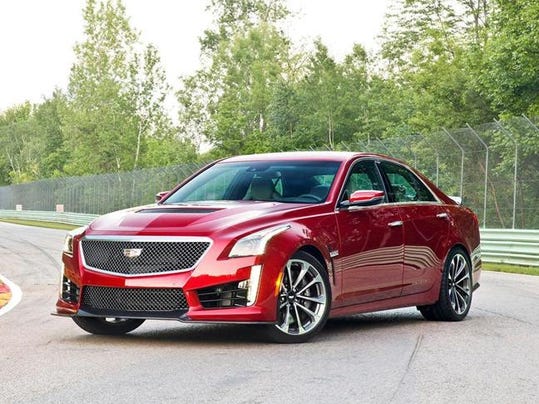
When I was a wee motorhead, my buddy Tommy Miller and I would draw pictures of freakish auto mutants: Formula 1 cars with eight wheels, sports car catamarans, sedans with jet engines.
You know, kind of what Cadillac has done with the Corvette-powered CTS-V.
The sterile, alphanumeric badge doesn’t convey the full insanity of this vehicle. Dodge calls its 707-horsepower Charger sedan the “Hellcat.” Shouldn’t Caddy get something appropriate like, say, “Nostradamus”? Or “Bonkers”? Or, if it must be alphanumeric, how about “ICBM”?
Chief Engineer Dave Leone and his merry band have created a track weapon that no one will ever take to the track. The V is an exercise in pure decadence. It’s a hot fudge, chocolate chip mousse cake aimed at other confections in the Decadent Café: BMW M5, Mercedes AMG S63, and the Tesla P85D. For 90 large, these sedans sport supercar performance with luxury legroom.
It’s an exercise in what’s possible, not practical. Ever wanted to find out what a four-door Corvette Z06 was like? V is your ride.
Think zero-60 in 3.6 seconds. A top speed of 200 mph. The Z06 — sharing the same LS4, pushrod, small-block V-8 — tops out at a mere 187 due to its prodigious downforce. Though in keeping with ’Vette’s Alpha Dog status, it maintains the horsepower mantle, 650 to 640.
Cough. 640 ponies in a two-ton sedan?
But this is no Charger Hellcat — Detroit’s other 200-mph rocket. The Hellcat is heaven in a straight line and hell in the twisties. V grips asphalt like a magnet. Credit a stretched version of the same Alpha platform that has made GM kin Camaro and ATS-V bona fide M3 predators: 19-inch Michelin Super Sports, magnetic shocks and extensive chassis stiffening.
My media colleagues got to take Big V out on Wisconsin’s Road America race track this July while I had knee surgery to put more lead into my accelerator leg. Over four miles of the serpentine course — including three 140-plus mph straights — you can explore the full, lurid firepower of the V.
Try this on city streets — tempting as it is — and you’ll quickly run out of real estate. Great Whites need open ocean. Cheetahs need vast grasslands. The V craves a track to stretch its legs. But if you’re thinking of tracking a Caddy, saner minds will choose the $70K ATS-V that I reviewed in May. It’s nimbler with plenty of power from the twin-turbo, 475-horsepower V6. The ATS is a scalpel, the CTS a hammer.
For all of its capability, Cadillac designers were remarkably restrained in their execution. Tommy and I might have gone further — a blower out the carbon-fiber hood, shuttered rear window shades, painted side flames.
Taking the shell of the lovely CTS, the V adds bigger front vents filled with metal mesh as if the V has escaped a maximum security prison by crashing the main gate. Shark-like gills — Z06-like — interrupt the side panels. At the business end things get more interesting. The rear fender wells look like Bruce Banner’s shirt after his Hulk transformation — too small for too big biceps. Out back four pipes warn of the beast within.
Press the detonation — er, dash — button and V awakens like it hasn’t eaten in weeks.
The Caddy cabin is familiar. Digital instrument display, stitched-leather-and-alcantara dash and interior, rimless mirror, carbon-fiber accents (not wood), heated steering wheel, hidden storage behind the CUE screen. Yes, the much-lamented CUE. The infotainment system insists on getting the job done sans dials and knobs — a driver distraction as I try to fund the right haptic touch point. Ironic since Caddy is on the cutting edge of heads-up displays so you don’t take your eyes off the road.
With steering wheel controls (check), heads up display (check) and voice recognition (check), the center console is becoming more peripheral. This is where cars are going.
The Caddy’s voice recognition system is especially noteworthy.
Driving around Hell, Michigan, to test North American Car of the Year candidates, I discovered most navigation systems couldn’t find Hell, much less navigate there. But the CUE not only recognized addresses like “Whispering Pine Lane” and “Whitewood Lake,” but also had the good sense to take me to Hell without my having to look up a specific address on my smartphone first. Thanks, V.
My tester was loaded to the gills with options including Apple Car Play (coming soon: Android Auto). The optional, adjustable Recaro seats are a marvel. Turn the side dial (thankfully, no haptic-touch here) and you can adjust lumbar, hip and side supports with the touch of a button so you’ll never be unsettled on track. Oh, right. You’re never going to take it to the track. Never mind.
This would be a great Up North summer car. Throw your luggage in the (considerable) boot and the kids in the backseat and you should arrive in Harbor Springs in, oh, about an hour averaging 120 mph. Drop the kids at the cottage and head for the tunnel of trees where you can really let the LS4 loose.
I’ll tell you what it will feel like. Yes, I was bad.
Throw it into a 90-degree right-hander and the 4,145-pound beast hunkers down, seat belt tightening in anticipation. With the shifter in SPORT or TRACK mode, the eight-speed tranny holds 2nd gear as you blast through a series of switchbacks. Just mind the torque, Bessy. The supercharged, 6.2-liter push-rod V-8 has the might of Thor’s hammer.
The engine won’t wake up every cop south of the bridge — unlike the Z06, which sounds like a B-52 bomber raid. Caddy keeps the war noises to a dull roar, the spinning supercharger always audible. It’s a luxury car, you know.
Despite its five-inch wheelbase growth over little brother ATS, CTS is surprisingly agile. Credit a huge, undercarriage bat-brace to help absorb the grip of the Michelin Pilot Super Sports — and another strap across the engine bay. For best handling I settled on SPORT mode with traction control on. As fun as it is to coax lurid slides under power, the engine’s torque will easily overwhelm the rear tires with TC turned off (frankly, I’d prefer an AWD option for a weapon this powerful — two-ton cars don’t snap back as quickly as 3,500-pound Z06s).
Like Tommy used to say, it’s fun to put jet engines in family cars. Just remember it’s still a sedan.
’16 Cadillac CTS-V
Vehicle type: Front-engine, rear-wheel-drive, five-passenger sedan
Price: $84,995 ($91,690 with Recaro seats as tested)
Power plant: 6.2-liter, supercharged V-8
Power: 640 horsepower, 630 pound-feet of torque
Transmission: 8-speed manual
Performance: 0-60 mph, 3.6 seconds (Car & Driver)
Weight: 4,145 pounds
Fuel economy: EPA fuel economy 14 city/21 highway/17 combined
Report card
Highs: Planted handling; Z06 with 4 doors — need I say more?
Lows: $90K chainmail grille?; saner minds will choose an ATS-V
Overall:★★★
Viper ACR’s record-shattering tour
Posted by hpayne on December 2, 2015

“Reports of my death have been greatly exaggerated,” Mark Twain famously said. Slap his words on a Dodge Viper bumper sticker.
As if to snuff reports from UAW contract negotiations that the Viper program was finished, the sports coupe’s 2016 ACR performance model completed a year-long journey across 13 American race tracks this fall by setting the production car lap record at each one.
“The new Viper ACR beat everything including supercars like the Porsche 918,” said Dodge boss Tim Kuniskis, leaning against a wall-sized mural of the menacing, 645-horsepower beast at the Los Angeles Auto Show last week. “The ACR holds more track records than any other car and it’s been certified by the SCCA, which is how it should be.”
SCCA is the Sports Car Club of America, the country’s largest amateur racing club.
The ACR’s epic tour put an exclamation point on a year in which Detroit-made sports cars proved themselves to be among the world’s performance elite. This month the ACR, Mustang GT350, and Corvette Z06 were nominated for Road & Track’s Performance Car of the Year alongside the Ferrari 488 GTB (Mustang took the gold). And in September the 2015 Z06 beat out all comers — including the latest cyborgs from Lamborghini and McLaren — to capture fast time at Car & Driver’s annual Lightning Lap of Virginia International Raceway.
The ACR’s records include a staggering 1.28.65 minute circuit of one of America’s most famous tracks, Laguna Seca in California. With accomplished racer Randy Pobst aboard, “The Snake” eclipsed the previous lap record by more than a second — set by Pobst in the $900,000 Porsche 918 hybrid which costs seven-fold more than the Viper. Most of the lap records were set by SRT vehicle development engineer Chris Winkler, an accomplished SCCA champion.
Developed as the “ultimate street legal race car,” the ACR first appeared in the Viper lineup in 1999. While shattering track records, Viper has struggled to eclipse 1,000 units in annual sales. Hand-built in Detroit’s Conner Avenue Assembly Plant, the Viper’s $90,390 base price is well above cross-town rival Corvette. The ’Vette starts at just $56,395 with annual sales in 2014 of over 34,000 units.
The 2016 ACR is powered by the same 8.4-liter, V10 engine as the base Viper with an industry-leading 600 pound-feet of torque for a normally-aspirated engine. But its track steroids come from an “Extreme Aero package,” which sucks the car to the ground with technical wizardry including a dual-element carbon fiber rear wing, rear diffuser, unique hood, front splitter, and dive planes. The resulting 2,000 pounds of downforce at a top speed of 177 mph is the most of any production car made.
Add carbon ceramic Brembo brakes and massive, Kumho 14-inch rear rubber and the ACR stickers for $122,490.
The ACR is developed by Dodge’s SRT performance program, which includes 200-mph Hellcat versions of the Dodge Challenger and Charger.
“If the Hellcat is the King of the Road, then the ACR is King of the Track,” says Kuniskis.
2016 Dodge Viper ACR lap records
Laguna Seca (Salinas, California), 10/28/15
Lap Time: 1:28.65 min.
Driver: R. Pobst
Road Atlanta (Braselton, Georgia), 10/11/15
Time: 1:26.54
Driver: C. Winkler
Waterford Hills (Waterford, Michigan), 9/30/15
Time: 1:10.89
Driver: C. Winkler
Nelson Ledges (Garrettsville, Ohio), 9/21/15
Time: 1:06.21
Driver: C. Winkler
Motown Mile (Detroit, Michigan), 8/28/15
Time: 51.17 sec.
Driver: C. Winkler
GingerMan Raceway (South Haven, Michigan), 8/27/15
Time: 1:31.91
Driver: C. Winkler
Pittsburgh International Race Complex (New Alexandria, Pennsylvania), 8/18/15
Time: 58.37 sec.
Driver: C. Winkler
Grattan Raceway (Belding, Michigan), 5/19/15
Time: 1:22.09
Driver: C. Winkler
Virginia International Raceway (Alton, Virginia, Grand Course), 4/23/15
Time: 2:40.02
Driver: C. Winkler
Willow Springs Raceway (Rosamond, California), 4/2/15
Time: 1:21.24
Driver: C. Winkler
MotorSport Ranch (Cresson, Texas), 2/25/15
Time: 1:16.98
Driver: T. Kendall
Buttonwillow Raceway Park (Buttonwillow, California), 1/21/15
Time: 1:47.70
Driver: C. Winkler
Inde Motorsports Ranch (Wilcox, Arizona), 11/19/14
Time: 1:33.75
Driver: C. Winkler
Payne: Toyota Prius shows a fun side
Posted by hpayne on December 2, 2015

I’ve been to some unusual places in automobiles, but none stranger than an autocross course in a Toyota Prius. The green Prius at a demonic place of carbon revelry? Where “hypermiling” is useless and “burning rubber” celebrated?
New Prius bumper-sticker: SAVING THE PLANET ONE CONE AT A TIME.
But this isn’t Larry David’s tree-hugging, rolling Prius speed bump. This is the all-new, Generation-4, 2016 Prius based on Toyota’s TNGA (Toyota New Global Architecture) global platform with 60 percent more torsional rigidity and — wait for it — independent rear suspension. Yes, IRS. Just like Mustang, Prius has evolved from the stagecoach wagon days.
You don’t think Toyota knows what people say about Prius? That its nickname is “Pious”? That it looks like a turtle with wheels? That Californians give them twice as much room because their drivers are more focused on “hypermiling” at 40 mph to maximize fuel efficiency than keeping their eyes on the road?
You don’t think Toyota has read Car & Driver’s scathing 2012 Prius review? I quote:
“We wonder why a Prius can’t be as interesting to drive as a Ford C-Max. The Prius stands still, this century’s version of a 1990s-era VW Type 1 Beetle.”
Ouch.
Toyota wants to change that image so they took a herd of journalists to Los Angeles’ El Toro Marine Air Station to drive the wheels off the Prius and prove it’s more than a hybrid drivetrain on a chassis of recycled hummus. Indeed, Toyota provided us with a Gen 3 model just to prove the point. I nailed the 2015 model out of the starting gates, and it immediately panicked as if allergic to pylons. Turn the wheel and the front tires plowed straight ahead, the mulish torsion-beam rear suspension as useless as wings on a penguin.
Jump in the new Gen 4 and all is well.
No, it doesn’t have Tesla’s Ludicrous mode. No battery upgrade. No improvement in its snail-like, 9.8-second 0-60 time. Stomp on the accelerator and you could read the morning paper before it gets up to highway speed. I never got the front tires to chirp off the line, much less torque steer. But the chassis has been transformed.
Steering input is direct, connected — not merely a suggestion. The car goes where you point it instead of plowing like a 19th-century farm implement. It still understeers through corners (no VW Golf torque-vectoring here!), but the multi-link rear suspension now eagerly rotates behind you so that you don’t leave a field of scattered pylons in your wake.
My Pious lapped with a look of determination on its face thanks to CEO Aki Toyoda’s demand that every Toyota look like it’s enraged that every model before it has the sex appeal of a grapefruit. Happily, Prius is not as polarizing as the Darth Vader-masked Lexus RX. Compacts should be cute, and Gen 4 looks like an angry Pokemon. Grrrr. Let’s attack some cones.
Your carbon-spewing scribe so enjoyed autocrossing the Toyota that I asked for seconds. It was fun. The f-word has been frowned upon in the Cult of Prius, but the faithful need not be concerned. As the lack of rubber marks at the start line suggest, the Prius doesn’t sacrifice green for its new fun factor. The Pious claims (EPA numbers aren’t out yet) to up its class-leading mpg number from 50-52 mpg combined — while maintaining its zero-60 acceleration with less horsepower than before (121 vs. 134). Despite my flogging the Pokemon mercilessly around El Toro then up Orange County’s breathtaking Ortega mountain highway and back, I managed an impressive 58.1 mpg over 78 miles.
Indeed, the Prius’ greenness actually complements performance by shoving its lithium ion batteries under the seat (from the trunk), thus helping reduce its center of gravity 1 inch for better handling.
But as the all-new (once-shunned) lithium ion batteries suggest this car is about more than looks and mpg. Toyota gambled on the hybrid Prius a decade ago. Its resulting hit, however, obscured the fact that the company invested in an expensive drivetrain on a cereal-box chassis and affordable nickel hydride batteries.
Five million Prii sales later, the car has earned its keep and now leads the parade into a global platform and battery pack that will be used on siblings like Corolla. It also means Prius may finally make money.
Prius is a model for other hybrid electric brands. Looking at you, Chevy Volt.
In a straight fight it is Volt that should be worshipped by greenies, not Prius. After all, Volt sports better technology from drivetrain to interior: A 53-mile range that will get you to work and back without ever visiting Big Oil, and a dashboard that is more user and tech-friendly (think Apple Car Play and Android Auto).
But what the Prius offers is a unique personality. At $25,025 the hybrid sports unique styling at a compact price point. I particularly like the sci-fi, tomahawk-shaped rear taillights that are an upscale touch. Volt, on the other hand, starts nearly $10K north of Prius in BMW 3-series territory — yet detunes its styling to look more like a Cruze compact. Moet champagne in a Budweiser bottle.
Prius has its own interior, too, which is not as successful. Take the center console made out of toilet bowl-white plastic. Please. The awkward material clashes with an otherwise tasteful, wrap-around interior of black plastic and vinyl trim — a dated attempt at being an iPod, perhaps?
At a time when instrument displays are more driver-centric (heck, even Mini moved its Speedo in front of the driver), Prius stubbornly insists on keeping its instrument panel in the center of the dash. Misses like these mean Prius still has room for improvement, but overall it’s not a niche car anymore but a credible competitor against any compact.
Do the math. Compared to Ford’s similarly-horsed, green-preening Focus 1.0-liter Ecoboost, Prius won’t earn its $2,500 premium back in $2-a-gallon gas savings for seven years — but Toyota’s dependability and higher retention value (54 percent vs. 48 percent) help close that gap.
And while the Prius can’t hold a candle to a $25K Golf GTI ’round the pylons, at least you’ll have fun trying to keep up while nearly doubling the V-dub’s mpg on the way home.
SAVING THE PLANET ONE CONE AT A TIME. Catchy. I think I’ll get a few printed up
2016 Toyota Prius
Vehicle type: Front-engine, front-wheel-drive, five-passenger hatchback
Price: $25,035 ($27,085 Prius Three and $30,000 Four Touring as tested)
Power plant: Hybrid drivetrain with 1.8-liter inline-4 cylinder and lithium-ion/or nickel-metal hydride battery-powered twin electric motors
Power: Combined 121 horsepower-95 horsepower, 105 pound-feet torque (gas engine); 1.2 kilowatt-hour nickel-metal-hydride/0.75 kWh lithium-ion battery pack
Transmission: Continuously variable transmission (CVT)
Performance: 0-60 mph, 9.8 seconds (manufacturer)
Weight: 3,915 pounds
Fuel economy: EPA estimated: 54 city/50 highway/52 combined; 58 city/53 highway/56 combines (Eco 2 model only)
Report card
Highs: More fun to drive; more fun to look at
Lows: White plastic console; distant instrument display
Overall:★★★
Payne, Q&Auto: Evert’s Tour de Civic
Posted by hpayne on November 23, 2015

“When I lived in Seattle I was a Category 3 racer,” says Gary Evert, chief engineer of the 2016 Honda Civic and an avid bicyclist who has competed in Tour de France-style American events. “One of my better races was Seattle-to-Portland, a 205-miler that I did in about 10 hours and finished well. That’s the thing about cycling — there is always someone better than you.”
There aren’t many manufacturers who do a better compact car than Honda.
Not only is the 10th generation Civic the best ever, it has set a new class benchmark with class-leading interior room, rear legroom, fuel economy. And it is the first car to offer both Apple Car Play and Android Auto — the much-anticipated apps that allow consumers to double their smart phones as in-car, console infotainment systems. Evert and his Redmond, Ohio team spent long hours benchmarking the Civic to Audi’s nimble A3 in order to re-establish their compact as a sporty badge.
When the 50-year-old University of Washington grad needed to get away, he had his bikes.
“Because I think about cars all the time, my escape is riding road bikes,” he says. “I have a collection of 11 or 12 the last time I counted.” At the Civic’s media test outside Ann Arbor this October I sat down with Evert to talk Civic, CVTs, and cycling.
Q: Who makes the best bike?
Evert: There are a lot of good ones right now. Some of the American bikes like Cannondale, Trek, Specialized.
Q: Ohio is flat as a board. Where’s an avid cyclist go?
Evert: There are a lot of good rural roads in Ohio. Raymond is beautiful — there’s actually a little ski area that makes great climbing right near work. I used to race competitively and am getting back into it.
Q: Is amateur racing as cut-throat as depicted in the classic cycling movie, “Breaking Away”?
Evert: No. I really enjoy being in that atmosphere. Everyone’s out there to enjoy themselves. I have a great group of guys I race with. Level 1 is pro, 2 is Olympic, 3 is top amateur. In the United States Cycling Federation … we’re similar to Tour de France pro racing where we get into tight packs because the aerodynamics are better. We’re doing a lot of drafting.
Q: The Civic has changed dramatically over 10 generations. What’s different this time?
Evert: One of the strengths of Honda is that for each new Civic we have a new team. For this Civic we wanted to get back to that sporty DNA we’ve been known for. Better dynamics, lower seating position, sporty styling. We completely redid the packaging beginning with the hip point. Then we lowered the engine, the floor, the suspension. Move the rear seat back. Gives it a more athletic stance, but at the same time increases head room.
Q: Has bringing the Honda Fit to market allowed you to grow the Civic?
Evert: Fit gave us the opportunity with the Civic to be a little bit more sporty — and a bit larger. It was an opportunity because we didn’t have to cover too much of the market with the Civic.
Q: Was it your goal that the Civic be roomiest in class?
Evert: Absolutely. The Europeans aren’t known for the most efficient packaging and that is something that Honda is known for. We are by far the best in class in interior and trunk volume. And best in class fuel economy and acceleration. We’re 1.5 seconds faster 0-60 than competitors like Corolla.
Q: The Civic sports Honda’s first production turbocharged engine. Why now?
Evert: We wanted to be sporty and also meet Honda’s philosophy of great fuel economy. So the turbo was out of necessity.
Q: You’re going to sell more variants of Civic than ever?
Evert: We’ve had two different Civics — one for North America, another for Europe. We wanted (the 10th generation) to be sold globally so we developed the coupe and four-door in North America, then a five-door variation in Japan — and sporty derivations like the Si and Type R. There are nine facilities around the world that will be able to make the Civic. Cars sold here will be made in either the U.S. or Canada.
Q: CVT trannies don’t have a sporty reputation. Why is yours so peppy, so smooth compared to competitors?
Evert: We develop our engines and transmissions in house. So we can develop our algorithms internally. We have the ability to tune the CVT to match it with the engine. The torque converter gets you into power train more quickly. We have the ability to tune it so it feels like you’re shifting.
Henry Payne picks the best of LA Auto Show
Posted by hpayne on November 23, 2015
Unlike the compact Cobo Center, LA’s convention center puts its displays in two halls on opposite ends of the planet, meaning I had to schlep miles to see all 26 debuts. My dogs are barking. California offers a driver’s bounty of stunning natural views and wide-open spaces (once you get out of LA’s 24/7 traffic jam), meaning customers want everything from green statements to speed skates. It’s not uncommon to see a Prius and a Porsche in the same garage.
Here are The Detroit News’ picks as the most significant vehicles in show.
Alfa Romeo Giulia Quadrifoglio
“If emotion were a car, it would be an Alfa Romeo,” Alfa CEO Reid Bigland said in his introduction of the compact sedan. You’d be dead not to feel a stirring in the loins when you see this blood red, twin-turbo, 505-horsepower sexpot. Quadrifoglio is not shy about its intentions. It’s determined to make you forget all about that BMW M-whatchamacallit. The all-wheel drive performance model is the most powerful thoroughbred in the compact luxury class and the fastest sedan ever around Germany’s legendary Nurburgring race track. Not just a little faster. Giulia obliterated the lap record held by a Porsche Panemera S, for goodness sake, a six-figure cyborg not even in its class. Priced around $70,000, however, the Q won’t exactly be price accessible to most buyers. Which is why the base model’s also-class leading 276-horsepower turbo four still makes us smile.
Ford Escape
The Escape is part of an SUV revolution reshaping the face of automobiles. Compact crossovers have overtaken midsize sedans as the autodom’s biggest-volume segment – and the hot-selling Escape, Honda CR-V and Toyota RAV-4 have led it there. Yet while the Honda and Toyota are reliable appliances in the Japanese mold, the technology-laden Escape is evidence of the blur between luxury and mainstream brands. Indeed, while Lincoln stunned L.A. with a gorgeous, new face on its MKZ, the Escape debuted its own chrome kisser. The makeover means Escape rivals cousin Lincoln MKC in looks while offering handling and a suite of engine choices that embarrasses Japanese rivals. With an improved, roomier console (the biggest knock against the old mule), the Blue Oval continues as a pioneer on the crossover frontier.
Mazda CX-9
Speaking of blurs, the Mazda’s zoom-zoom midsize crossover may be the most handsome sight in its segment. Luxury or mainstream. Audi Q5, the object in your mirror may be closer than it appears. The 9’s pleasing exterior sheet metal comes with European-like handling and interior layout. And despite a single engine offering, Mazda’s first turbo promises plenty of low-end torque to go with its typically impressive SKYACTIVE fuel efficiency. What’s more, the Mazda comes with three rows of seats – mandatory for the mainstream segment but scorned by similarly sized Audi and Bimmers. So, if it’s European flavor you want – but without having to sacrifice family practicalities and a year’s income, the Mazda is in your sweet spot.
Fiat 124 Spider
Oh, joy. Already spoiled by Mazda’s best-ever MX-5 Miata in 2015, we get a sequel with the 2017 “Fiata” – the MX-5-based return of the Fiat 124 Spider. Where the original Miata was a retro-homage to the Lotus Elan, the new Fiat is a throwback to the 1966 Spider that Yanks embraced – it sold 75 percent of the 200,000 models produced through 1985. The new model bears an uncanny resemblance to the original (a copy of which was nailed to the wall on the Fiat stand). Fiat’s heritage is more cruiser than Mazda track rat, so the 124 will be 100 pounds heavier and likely less stiff than MX-5. Still, Fiata will have more power than its Japanese partner thanks to the same 160-horsepower, 1.4-liter turbo found in the bratty Fiat 500 Abarth. And with Japanese engineering as its foundation, customers are assured that this Fiat stands for Fix-It-Again-Tokyo.
Cadillac XT5
Cadillac’s ferocious V-series sedans have served notice that GM’s luxury brand is serious about taking on the German titans at luxury’s pinnacle. Now the all-new XT5 (formerly SRX) brings the same commitment to SUVs where Caddy has been product-poor. The XT5 goes on a 300-pound diet making it the lightest entry in segment – a full 650 pounds below a Mercedes GLE – that will pay dividends in handling and fuel efficiency. Perhaps more important to frustrated soccer moms who have taken to banging the CUE infotainment system with both fists, the new system is reportedly three times faster — and with more emphasis on touchscreen functions than haptic sliders (Bang! Bang! Bang!).


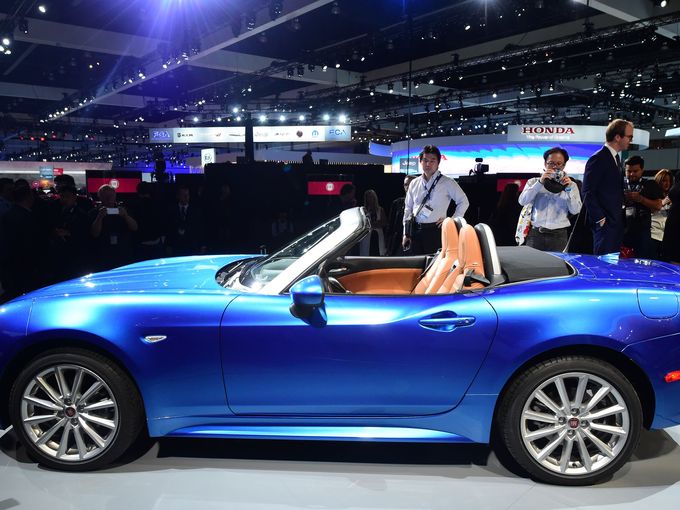


Payne: Camaro SS is new Alpha dog
Posted by hpayne on November 19, 2015
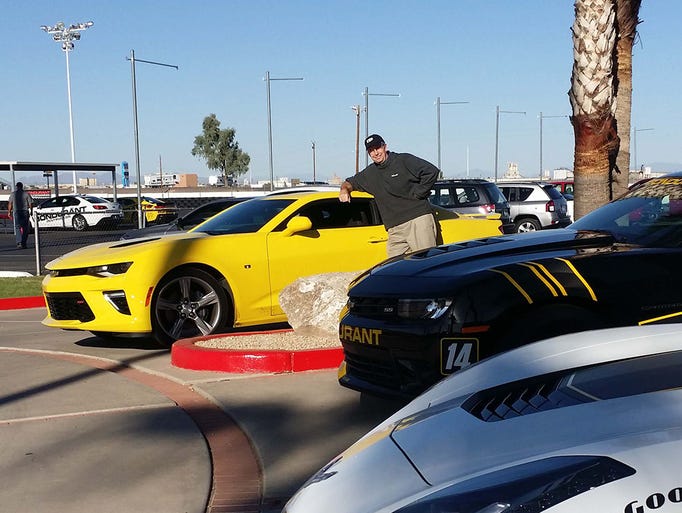
We’ve all been waiting for this one. I got my first, tantalizing taste of the all-new, 2016 Camaro at Belle Isle in May, Chevy’s counter to the all-new, 2015 Ford Mustang. It’s always been thus. Over the Muscle Car War’s five decades, Mustang has traditionally made the first move — just as it launched the first salvo in 1965. The latest Mustang is the best ever. Three engine choices, edgy styling, independent rear suspension. Now comes Camaro’s answer. Three engines, edgy styling, independent rear susp … oh. Camaro’s been there. Done that.
For its handling trick this time, Chevy has gone to DEFCON 4.
It’s brought in a platform from GM’s luxury performance division, Cadillac. Not just any platform, but the alpha-dog Alpha bones that gird the sublime Cadillac ATS — the best-handling weapon in luxury. Seems a bit unfair, really. Ford doesn’t have Cadillacs and Corvettes laying around the shop from which to borrow technology.
Driving Generation 5 and the much-lighter Gen 6 Camaros back-to-back on Belle Isle’s IndyCar course, the difference was instantly apparent. But that was a V-6. How goes the Chevy SS with the pony-car’s signature V-8? The big boat anchor up front? I talked with legendary Chevy mod-guru, Ken Lingenfelter before I went to test the SS from Albuquerque to Phoenix.
“Call me when it’s over,” he said anxiously. “I want to know how it goes.”
Well, Ken, Gen 6 doesn’t disappoint. Gen 5 was no slouch, but the Alpha platform was designed to compete with BMW and Mercedes, for goodness sake. You know this is the best-handling pony ever from the first turn of the wheel. The electronic steering feels connected to the asphalt as if by a magnet.
The twisted Arizona mountain roads to Payson east of Phoenix are a long way from Woodward Avenue’s drag strip — and the days when pony cars were just straight-line muscle. Whether rotating through 120-degree hairpins or blitzing rocky passes, the big coupe felt much smaller than its 3,685-pound girth.
My hands moved in small increments. No sawing at the wheel. No sudden corrections. The car goes right where you point it, and the result is a much quicker — and safer — car. Where the Mustang (and previous Camaros) are a ball to drive, you feel them working hard. The Camaro’s handling is effortless.
Don’t get me wrong, the Chevy is no ATS — but its DNA is there.
As is the Corvette’s. The SS’s LT1 engine is the same 455-horse stump-puller found in the C7 — complete with rowdy, dual-mode exhaust system (unfortunately, the bulky manual trannies feel the same too). Squeeze the throttle and it will effortlessly eclipse triple digits. Both cars are the work of gifted designer Tom Peters. Both are sculpted with hard edges as if cut with a chisel. Both share design elements: Roof “Mohawk,” deeply scalloped sides, horizontal LED daytime running lights.
Standard on my Bright Yellow, $38,585 SS, the LEDs are sinister. Coupled with the narrowed front grille and enlarged lower intakes, the Camaro has effectively evolved from the wildly successful, ’60s throwback of 2010 to a modern, halo design for downstream Chevy sedans. With its narrow greenhouse, huge blind spots, massive wheels, and brooding cowl, this is an uncompromised concept car brought to life.
“We’ve amplified its proportions,” says the soft-spoken Peters, mobbed by Camaro groupies at the Albuquerque intro. “Like the T-shirt on a muscular physique.”
Want to know what a front-engine Lamborghini would look like? This is it.
Much has been made of the Camaro’s gun turret-narrow windows. But the Peters’ team boldly emphasized art — letting the car’s digital, driver-assist technology handle the blind spots.
Want to see out the back? Buy a Mustang. Want to look like you hijacked a car from a sci-fi movie set? Buy the Camaro. That said, the Mustang’s extreme makeover has been flying off the shelves as existing owners traded in their old ponies for the fresher styling. The Mustang’s gorgeous, less-severe looks should wear better over time. If you want a V-6 cruiser, Mustang gets the nod. If it’s performance you want, the Camaro V-8 will walk all over the Ford — and kick sand in the face of the odd Bimmer as well.
Existing Camaro owners unmoved by Gen 6’s sports car handling (“Who pulls Gs in the Dream Cruise traffic jam, man?”) may not feel the urgency given its evolutionary, not revolutionary, styling (though blessedly, the fake side shark gills have disappeared).
They should think again.
Chassis aside, the most dramatic change to the new Camaro is its interior. This is one muscular smart phone. GM has been on the cutting edge of in-car technology and the Camaro is a digital leap over its rival. For our western journey, the SS came without a nav system. No sweat. My wife just mated her iPhone to Apple Car Play and we were in business. She also worked on her iPad thanks to the car’s standard 4G WiFi. In remote western New Mexico, we called OnStar ($300-a-year subscription) for directions and restaurants.
Muscle cars are just for guys? Mrs. Payne lounged comfortably in the quiet, connected passenger seat — only protesting when I explored the car’s .98 G-load capabilities with mountain cliffs just feet away.
The dashboard is a big leap over Gen 5 as well, though its spare design leaves little room for storing anything beyond two cups. The instrument cluster is a fully digital display stuffed with useful information, and the aviator-style climate controls anchoring the console are the coolest things this side of an Audi TT.
With its sophisticated chassis, Lambo styling (look up the Urus), and interior controls, the SS is a worthy alternative to rear-drive luxury coupes like the BMW M4 and ATS-V — but for $30K less. On my way into Phoenix I stopped by the famed Bundurant School of High Performance Driving where the boys informed me Bondurant is divorcing Chevy for Dodge school cars. A pity that. As much as students will enjoy Hellcat power, it can’t touch the Camaro’s nimbleness around the cones. And not just the SS. At over 30-mpg freeway and just 3,338 pounds – a staggering 390 pounds lighter than Gen-5 V-6 — a coming turbo-4 will make Gen 6 a serious autocross contender.
But that’s for another time. For now we revel in the battle of V-8s. Camaro has answered Mustang. Mustang has unleashed its 8,000-RPM Shelby GT350 monster.
What say you to that, Camaro Z28? The anticipation builds again.
2016 Chevy Camaro
Vehicle type: Front-engine, rear-wheel-drive, four-passenger coupe
Price: $26,695($38,585 SS as tested)
Power plant: 2.0-liter, turbocharged inline-4 cylinder; 3.6-liter V-6; 6.2-liter V-8
Power: 275 horsepower, 295 pound-feet of torque (turbo-4); 335 horsepower, 284 pound-feet of torque (V-6); 455 horsepower, 455 pound-feet of torque (V-8)
Transmission: 6-speed manual; 8-speed automatic
Performance: 0-60 mph, 3.9 seconds (SS V-8, Car & Driver)
Weight: 3,685 pounds
Fuel economy: NA
Report card
Highs: Precise handling; Corvette power
Lows: Blind spot the size of Rhode Island; useless door storage
Overall:★★★★