- Search Cartoons
- Comic Archive
-
Payne
Store



 Henry Payne RSS

Articles
Payne: The fun-tastic Fiat 124 Spider
Posted by hpayne on June 15, 2016
At a Google media test drive of its marshmallow-shaped, autonomous car last year, an Aussie colleague put it straight to CEO Sergey Brin: “Are you going to take away the fun of driving cars?”
The bearded, elfin tech billionaire didn’t miss a beat. On the contrary, he mused, after the drudgery of a week commuting in a self-driving pod on crowded freeways, drivers will want a sporty getaway car in the garage for weekend romps in the countryside.
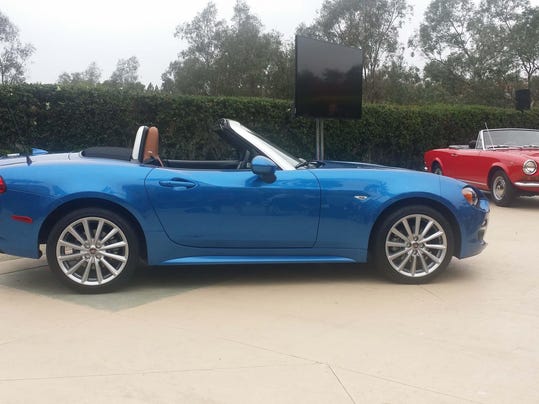
Brin might have something like the 2017 Fiat 124 Spider in mind.
Sharing the platform with the grin-inducing Mazda MX-5 Miata, the much-anticipated comeback of the ’60s Italian icon is the antithesis of the Google bot. This sensuous, topless, affordable video-game-on-wheels — call it a “Fiata” — demands to be driven. It’s more fun than a wet Disneyland log flume ride with Kate Upton.
In my own rendition of Brin’s transportation future I endured a traffic-choked, hour-long shuttle ride last week from San Diego airport to my hotel. Then I awoke next morning to drive the Spider across Southern California hills to an autocross course in the parking lot of the San Diego Chargers’ Qualcomm Stadium home. I imagine this is what every day in heaven is like.
Actually, it’s what my weekends were like as a West Virginia youth when I accompanied my father on drives across the mountains in his tiny Porsche to autocrosses in Columbus or Belle Fountain, Ohio. So endures our love affair with the automobile. The winds of time may blow, but the flame never goes out. That was the 1960s Golden Era of the Automobile when muscle cars roamed Woodward and European roller skates ruled parking lot autocrosses. Cars like Fiat 124s, Alfa Romeo Spiders, Lotus Elans, Triumph TR6s, MG MGBs.
It was an epoch that was all but wiped out by the oil crisis and Big Government mpg meteors that imposed huge costs on carmakers. As reduced fuel prices and increased technology have converged, “The Second Golden Era” — as Fiat-Chrysler motorhead exec Tim Kuniskis likes to call it — has bloomed and muscle and mirth once again fills today’s showrooms.
The Miata was the first throwback to the ’60s glory years and has spawned a wealth of imitators from the Honda S2000 to the Subaru BRZ and Toyota 86 (formerly the Scion FR-S). Affordable front-engine roller skates that are as much fun to drive to the autocross as they are between the pylons.
The Fiata fans the flame further.
It is a rich irony that the Miata now sustains one of the cars it was created to emulate. The days of small, niche sports car manufacturers are past. Mazda and Fiat need each other to build enough volume to make their fun-mobiles financially viable — just as Toyota and Subaru team to make the 86 and BRZ twins. Both Miatas and 124s roll off the same assembly line in Hiroshima, Japan.
Should you get a Miata or 124? I dunno. Whatever flips your switch. It’s like a choice between the Wrigley Doublemint twins. You can’t go wrong either way.
These rear-wheel-drive cuties are tossable fun, but drive them back-to-back and their subtle differences echo their different brands. Mazda caters to the edgier, ZOOM ZOOM crowd — the saucier Fiat will attract a more stylish customer.
Atop Mazda’s short 90.9-inch wheelbase, the 124’s driver’s seat is a happy place to be even for a 6’5” giant like myself. The passenger seat is another matter — with my knees pressed against the dash, it’s as cramped as Delta coach class.
When rain threatens? With a sweep of my arm, I covered the cabin with the soft-top as easily as pulling over a down blanket in bed. On road the familiar Miata steering, switchgear, short-throw gearbox (the best manual this side of a Porsche), and suspension make for hours of topless driving pleasure.
Fiat has mated that box to its own MultiAir, 1.4-liter, 160-horse, turbocharged engine (to accommodate the extra turbo torque, Fiat actually used the last-gen Miata tranny — but I defy you to tell the difference) also found in the more raucous Fiat 500 Abarth. Despite sporting one more tailpipe than Miata, the Fiat’s quieter tone is instantly apparent. The MX-5 wants to make noise. I am boy racer, hear me roar!The Fiat is more refined, less intrusive for long drives through the Italian — er, American — landscape.
The Miata’s suspension setup is a tad edgier too, as is its styling. With its angular headlights and sharper lines, this Japanese Rottweiler looks to be in permanent attack mode. The 124 is curvier, sultrier. Its long hood and flanks add five inches in length — like stilettos on an Italian model. The car’s thin mouth, sculpted hood, and curved hips faithfully trace the 1966 original’s lines — stirring older buyers’ nostalgia — while the modern headlamps and aggressive lower intake update the car for younger buyers.
Trim levels run from the base, $25,990 Classica to the $28,490, leather-upholstered Lusso to the spiciest meatball on the menu: The $29,190 Abarth.
I jumped in the latter — which gains Bilstein shocks and meatier anti-rollbars — for a few spins around the Qualcomm course and it was sizzling, mouth-watering fun. My preference is for the stiffer chassis of a Subaru BRZ, but the softer, shorter-wheelbase Fiat can be tossed around like a ragdoll.
Loaded up, however, my mouth-watering Abarth reached an eye-watering $37K. So I’m happy to report that the base model is just peachy. With the same engine — and only shy some non-essential style bling — the Classica is as raw and sporty as its pricier brothers. Even its wheels are sexy. The bane of base models (lookin’ at you, Chevy Cruze), wheels alone often force me to up-trim. Not the 124. Though an inch smaller than the Lusso, the Classica’s 16-inch discs are just as cool.
The boot will hold two bags more comfortably than the seats hold two basketball dudes, so weekend dates Up North are doable compared to other favorite, trunk-challenged Italian sports cars (lookin’ at you, Alfa 4C Spyder).
Maybe we’ll all be imprisoned in self-driving Google bots one day — but the Fiat 124 will offer an escape. Now if Mazda would agree to build Alfa Romeo Spiders, Lotus Elans, Triumph TR6s, and MGBs on that marvelous Miata platform …
2017 Fiat 124 Spider
Specifications
Vehicle type: Front-engine, rear-wheel-drive, two-passenger sports car
Price: $25,990 base ($33,635 Lusso as tested)
Power plant: 1.4-liter, turbocharged 4-cylinder
Power: 160 horsepower, 184 pound-feet of torque
Transmission: Six-speed manual or automatic
Performance: 0-60 mph, 6.8 seconds (manufacturer)
Weight: 2,436 pounds (manual); 2,476 pounds (auto)
Fuel economy: EPA 26 mpg city/35 mpg highway/30 mpg combined (manual); EPA 25 mpg city/36 mpg highway/29 mpg combined (automatic)
Report card
Highs: Nimble handling; attractive base model
Lows: Cramped passenger seat; sure those plasticky cupholders will hold up?
Overall:★★★★
Payne: Chevy Cruze geeks out
Posted by hpayne on June 8, 2016
I attended the 100th Indy 500 on Memorial Day weekend and it was a flag-waving, eardrum rattling spectacular. It was also a Chevrolet theme park.
Chevy sponsors the 500 and promotes its performance products in every corner of the event.
I took 140 mph hot laps in a Chevy SS driven by IndyCar star Sebastien Bourdais. Bourdais and his 32 co-competitors were each ferried by a blue Camaro convertible in the Indy 500 parade — which was anchored by a squadron of Corvettes. Roger Penske led the field to the green flag in a white Camaro SS. Chevy engines powered half the IndyCar field. Heck, even Honda-powered 500 winner Alexander Rossi did his victory lap in a Camaro. It was the most awesome display of Chevy chest-thumpin’ testosterone I have ever seen.
There wasn’t a Chevy Cruze sedan in sight — including the new, 2016 tester I had left behind at my hotel. It was like the scrawny kid with his nose pressed up against the glass looking in at all the cool kids at the car prom.
Tracks aren’t this brainy compact’s thing. High school has its jocks and geeks — and so does Chevy.
The Chevrolets have always taken pride in their gym-toned, V-8-muscled athletes — but these days there are geeked-out, tech-savvy sedans at the family reunion as well. You’ll find Car & Driver on the living room table — and Wired magazine. The Camaros and ’Vettes cut a dashing figure on the playing field, but the Cruzes, Volts, Malibus, Sonics and Sparks have an eye on Silicon Valley with their smart-phone apps, 4G WiFi and driver assist wizardry.
I’m happy to report that the nerds are taking fashion tips from their stylish siblings.
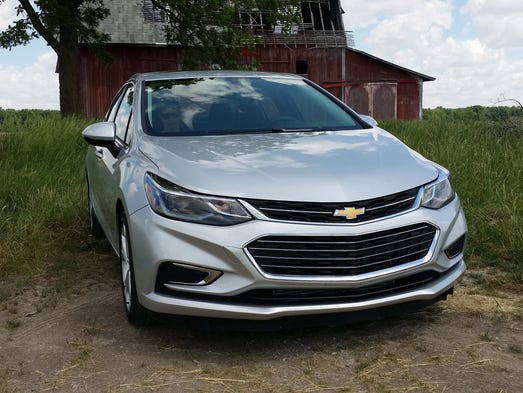
Cruze has borrowed tastefully from big brother Camaro’s fascia with its thin, wrap-around upper grille. (Could it borrow Camaro’s base wheels too? Those things on the Cruze just gotta go.) It’s a marked improvement over the mid-size Malibu sedan’s plastic surgery, which deserves an episode on “Botched.”
Japanese makes may dominate West Coast roads but the Midwest is still Big Three country and my trip to Indianapolis was full of last-generation Cruzes. With their boxier shape and plain, split grille, they looked tired next to my sleeker, coupe-like ’16.
Millennial-friendly interior
Like its Cadillac and Camaro siblings, Cruze lost 250 pounds at the gym. Inside, the instrument binnacle is straight out of a Camaro with ribbed cowl and racy gauges wedged between the RPM and MPH discs.
That’s as sporty as Cruze gets. This Chevy wears Dockers to work, not Air Jordans.
Compact sedan competitors Honda Civic, Ford Focus, VW Golf and Subaru Impreza offer wicked performance variants — but Chevy’s Super Sport cape has been hung in the closet. Motorheads have been buoyed by Chevy’s decision to make a five-door Cruze (coming this fall). Might there be a GTI-like hot hatch in the future? Not likely. Cruze wears a solid rear axle which pretty much telegraphs that it’s not interested in young rubber-burners. Cruise the Cruze over a harsh road dip and you’ll bounce like a basketball off your seat — unlike a more-poised, independent-rear-suspension Civic.
The youth that interests Cruze are millennial techies — for which Cruze is a rolling iGadget. The interior designers must have bunked with millennials for a year because the console fits ’em like a glove. The $20K LS and the $26K Premier editions I drove featured Apple Car Play, Android Auto and 4G WiFi. And to show that jocks think tech is cool, too — the Camaro, Corvette and SS get the same.
The connectivity feature is customer-friendly — and a nod to the reality — that Americans love their phones, their music and their nav systems.
Besides, Google maps blows away every car system I’ve ever used.
On my way back from Indy, I asked MyLink to find the Chick-Fil-A on Interstate 475 west of Toledo. After a multistep process through a variety of menus I … couldn’t find it. I plugged in my Android phone, awoke “Ask Google” and — presto! — found it. Oh, Google you’re good. And so are you, Chevy, for letting it take over your console.
My wife’s Apple Car Play was less impressive if only because the app defaults to Apple’s nav system — which is less capable than the Google app she’s downloaded. Another tech detail likely to rub some the wrong way is Cruze’s stop-start feature, which shuts down the engine at stoplights. Most manufacturers make this feature an option — but nerd Cruze puts fuel economy first.
Fuel efficiency paramount
Still, Cruze is hardly a slug. The straight roads between Detroit and Indy will barely get your heartbeat up, but when passing grunt was needed (like to get around Left Lane Lollygaggers) the 1.4-liter turbo proved impressively punchy. That punch made me pine for more engine options.
While Chevy performance is synonymous with V-8 pushrod power, GM has been birthing an impressive team of small-displacement turbos such as the 260 horse-plus, 2.0-liter mills found under the hood of the Camaro, Buick Regal GS and Cadillac ATS. These athletes have made each other better by sharing their skills — Camaro, for example, is king of the muscle car segment in part because it shares the ATS’s four-banger and taught Alpha platform.
But rather than bringing more muscle to the fight with segment-king Civic and its four, increasingly-capable engine options, Chevy takes the geek route in emphasizing fuel efficiency and alternative powertrains.
Like the Chevy Spark (electric option), Malibu (hybrid-electric) and Impala (natural gas), Cruze is expected to offer a sippy, 1.6-liter diesel … and, of course, the Chevy Volt — a Cruze with a silver beak, electrified powertrain and a high price tag.
In the crowded compact aisle, brands need identity to stand out. Subaru’s Impreza gets noticed with all-wheel drive (note to Chevy: Nerds love this, too). Mazda does its ZOOM ZOOM thing. Ford and Golf flex performance. Civic offers so much variety it can’t be ignored. Motorheads like me might pine for speed, but Cruze is carving its place as a techie superior to Toyota’s Corolla and on par with the Hyundai Elantra.
Let Camaros and Corvettes rule Indy and Belle Isle race tracks. Cruze is starring in “Revenge of the Nerds” — now playing at a dealer near you.
2016 Chevrolet Cruze
Specifications
Vehicle type: Front-engine, front-wheel-drive, five-passenger compact sedan
Price: $17,445 base ($19,995 LS and $26,855 Premier as tested)
Power plant: 1.4-liter, turbocharged 4-cylinder
Power: 153 horsepower, 177 pound-feet of torque
Transmission: Six-speed manual or automatic
Performance: 0-60 mph, 7.7 seconds (manufacturer)
Weight: 2,932 pounds
Fuel economy: EPA 30 mpg city/40 mpg highway/34 mpg combined (automatic Premier as tested)
Report card
Highs: Loaded with tech; functional, roomy interior
Lows: Cringe-worthy base wheels; a performance option, please?
Overall:★★★
Lutz’s delicious Destino delivered
Posted by hpayne on June 6, 2016

The hotly anticipated VLF Destino is being delivered to customers at last. One of its first stops: VLF founding partner and legendary octogenarian motorhead Bob Lutz.
Billed as one of the world’s fastest four-door sedans, the 200-mph Destino is the gorgeous offspring of the marriage of a Fisker Karma chassis and supercharged Corvette ZL1 V-8 engine. Stripped of its original hybrid powertrain, the low-slung, leather-lined four-door is now stuffed with a 6.2-liter, 638-horsepower V-8 hammer under its long front hood that will rocket the 4,300-pound GT from 0-60 in just 3.9 seconds.
The Destino — first seen as a concept at the 2013 Detroit auto show — is the opening product of a partnership between ex-General Motors product chief Lutz, former Aston Martin designer Henrik Fisker and entrepreneur Gilbert Villarreal. While the original Karma chassis was produced in Finland, the Destino is assembled in Auburn Hills.
“I’m over the moon with how the car turned out dynamically — steering, brakes and, of course, Corvette ZR-1 power, coupled with the convenience of a paddle-shifter automatic,” 84-year old “Maximum Bob” said of his new ride. “I’m really happy with color and trim, as well as the spectacular proportions.”
Lutz’s Destino joins his stable of cars, which includes such rarities as a 1971 Monteverdi and a 1952 Cunningham C4-R.
VLF says other customers for the Destino include a “well-known music celebrity” rumored to be Carlos Santana. The Destino carries a sticker price of $229,000, with production planned to be only a few dozen per year. VLF also is tooling its Auburn Hills shop for the ferocious VLF Force One that rocked this year’s Detroit auto show.
Also with a skin designed by Fisker, the Force One is based on a 745-horsepower Dodge Viper skeleton.
Payne: Civic Coupe’s a hoot
Posted by hpayne on June 3, 2016
Spectators usually come to race tracks to ogle race cars. But on a recent visit to South Haven, Michigan’s Gingerman Raceway to flog my Lola 90, the Honda Civic I parked in the paddock got plenty of eyeballs. Is that the new Honda Civic Coupe? When is it coming out? What’s it like?
The paparazzi are starved for the reborn Civic.
After years in the wilderness, Honda got its performance mojo back in 2015 with the introduction of a lower, wider, hotter, bigger, better compact Civic sedan benchmarked to the Audi A3. Civic’s retail sales may not have showed it, but even Honda admitted that they had betrayed the faithful. To make amends, Honda has promised not only the sedan – which has debuted to rave reviews – but a Coupe, five-door wagon, Si, and mouth-breathing, road-eating Type R. No compact lineup can touch King Civic.
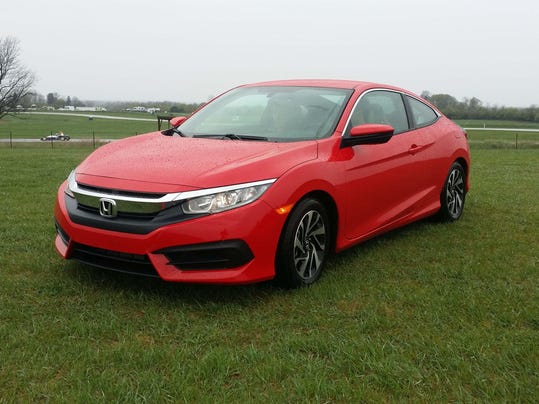
I can’t wait for the Type R, but the Coupe at least foreshadows its styling. If the reaction to my wicked looking, six-speed manual, blood-red tester is any indication, the tuners will be lined up 10 deep at Honda dealerships by the time the R arrives.
My Coupe date didn’t start well actually. Only because it arrived in my driveway the day after I returned from testing the new, immortal 2017 Porsche 911 in northern California. It’s like dancing with Beyonce followed by a dance with, well, anyone. Back to Planet Earth.
Among mere mortal compact cars, Civic is impressive even in base form. The manual feels crisp – even after the Porsche’s magic box – making the perky, 158-horse 2.0-liter engine fun to row.
My three-hour journey to Gingerman was pleasant in the quiet cabin, the Civic’s soft-seat and door-rest materials transporting me in comfort. The trip was marred, however, by details Chevy’s upstart Cruze does better: Cruze control (pun-intended) and Apple Car Play and Android Auto. Chevy offers the latter standard, meaning I could have used my Samsung to navigate the Michigan west side’s unfamiliar roads. Kudos to Honda, however, for the (typically) excellent console which gave me not only plenty of space to drop my phone – but a pass through space to charge below.
As for cruise control, the Honda’s steering wheel-mounted plastic buttons not only looked like they had come off a kids toy – the acted cheap as well. Press the PLUS button to increase speed and the car reacted slower than a sloth to an alarm clock.
Lunch hour at race events can be a wonderful time to show family around the track – and test a street vehicle’s envelope. At Gingerman the A3-baseline Coupe showed off its athletic prowess. One of four cars in class (Mazda 3, Subaru Impreza, and Ford Focus are the others) to feature an independent rear suspension, the Civic was noticeably more nimble through comers – even compared to my wife’s all-wheel drive Impreza.
Over an half-hour the Civic showed no signs of brake fade or upset, while the Subaru eventually panicked – hysterically flashing its engine light (an oxygen sensor failure) that led to it shutting off its traction control. Eek! Too many g-loads.
“Pshaw! Amateur!” You could almost hear Civic mocking its Japanese brother.
Point taken, but where the Coupe rally shines is in the paddock. Park it next to a last generation Civic and it is Cinderella transformed.
The new Coupe’s boomerang, arched taillights are a neon Times Square billboard. And while I still prefer the old Civic’s simpler, bullet-shaped profile, the 2016 Coupe’s designer jewelry and “Hot Wheels” rims make it the most dramatic car in class now that the Hyundai Elantra went all conservative on us.
My devil in a red dress, however, remains plenty practical on the inside. Your outsized 6-foot-5 car critic easily folded into the rear seat thanks to Coupe’s easy-slide front seat. Once in back, the Civic’s best-in-class rear leg room is as roomy as the sedan. Which means the Honda can have its dramatic fast back and also fit me. Try that in, say, a Hyundai Veloster.
All my thrashing about on track, of course, made for a less-than-advertised 27.1 mpg on my 400-mile, journey. But (ahem) assuming you don’t fling the Civic around tracks on a regular basis, the little car should be good for 31 mpg – a budget-friendly item for the Coupe’s twenty-something core audience.
I still don’t like the Coupe’s tack-on plastic wear, like the lower rear vents. But then, my styling preferences lie with stealthy Golfs, not (previous-gen) Elantra and Civic drama queens. For those who do, the Honda is your toy.
Wait another year, and that drama shape will come with 300 horsepower under the hood too. It’ll need security guards to keep the paparazzi away at the track.
2016 Honda Civic Coupe
Specifications
Vehicle type: Front-engine, front-wheel drive, 5-passenger compact coupe
Price: $19,895 base (Manual LX as tested)
Powerplant: 2.0-liter, 4-cylinder
Power: 159 horsepower, 138 pound-feet of torque
Transmission: 6-speed manual
Performance: Zero-60: 6.8 seconds (Car & Driver est.)
Weight: 2,739 pounds
Fuel economy: EPA 26 mpg city/38 mpg highway/31 combined
Report card
Highs: Head-turner; roomy back seat
Lows: Platicky controls; sleepy cruise control
Overall:★★★
Payne: Belle Isle course offers plenty of bang and buck
Posted by hpayne on June 3, 2016

Detroit — The back seat of an IndyCar is a spartan place to be. No cupholders, no climate controls, no legroom.
But the infotainment system is like none other.
Flying at 145 mph down the back straight at Belle Isle in a two-seat, demonstration open-wheel racer, I am struck by the violence of the experience. As a weekend racer of very quick Lola and Porsche sports cars, I am no stranger to racing. But on Belle Isle’s concrete street course bordered by high curbs and unyielding concrete walls, the IndyCar is a bucking, seething bull in a rodeo ring.
My chauffeur in this 2,000-pound, 500-horsepower beast — specially-built to give race fans a front, er, backseat taste of what it’s like to be in an IndyCar — is Gil de Ferran, 48, a retired IndyCar champion who won poles here twice between 1995-2001.
The Brazilian knows the course like the back of his hand. At the end of the straight he hits the brakes like a brick wall — the nearly 3 forward G-loads of braking force pulling the eyes from my sockets — then flings the car right then left through the brutal Turns 7-11 complex. Halfway through the lap, de Ferran and I would be bruised black-and-blue were we not lashed down with five-point seatbelts and our helmeted heads held in place by cockpit liners that resemble giant airline neck pillows.
From Indianapolis’ billiard smooth, 2.5-mile oval, IndyCar racers transition in less than a week to the Dual in Detroit — exhausting, back-to-back, Saturday-Sunday races on the demanding public roads of downtown’s Belle Isle park.
“It’s a street fight,” said IndyCar points leader Simon Pagenaud, who hopes to join a long line of Team Penske talents who have won the series championship, including de Ferran, Johnny Rutherford, Rick Mears, and Will Power.
Twister road
I lapped Indianapolis a week ago with IndyCar driver Sebastien Bourdais. In the front seat of a V8-powered Chevrolet SS sedan. With cupholders. But even though our lap speeds of 130 mph were a full 100 mph below the IndyCars’ breathtaking 230 mph pace, the all-left turn, smooth, banked oval is noticeably easier on the body than Belle Isle’s twisty, concrete road
“That’s what’s challenging about this series,” de Ferran said. “In order to be champion you have to be at a high level at all of these disciplines. It’s not easy to change the chip in your head from one week to the next.”
Coming through the last turn before the pit straight nearly flat out, the IndyCar really bucks over concrete undulations (the only asphalt on the track is the straightaway between Turns 2 and 3). This is one of de Ferran’s favorite two turns on the track — the other is Turn 1 — where he can explore the envelope of the state-of-the-art, carbon-fiber Dallara chassis.
The two-seater is based on the same bones as the IndyCars that will race this weekend. Only the chassis has been lengthened – to accommodate an extra seat — and the driveline changed to house a more durable, quieter, 500-horsepower, 2.8-liter twin turbo V-6 Honda engine with a redline at 7,500 RPM. The current IndyCar engine — a 2.2-liter twin-turbo V-6 — pumps out over 600 horses at a screaming 12,000 RPM.
Helio’s on board
At the Indianapolis 500, I watched on the grid as Lady Gaga slipped into the same two-seater for pace laps with Mario Andretti at the wheel. The car has become a staple at IndyCar events and a celebrity magnet.
Before my go with de Ferran on Thursday at Belle Isle, Red Wings rookie Dylan Larkin suited up for his own ride. With a TV camera shadowing his every move, he flashed a thumbs up before de Ferran lit up the tires and peeled away into Turn 1. Both Gaga and Larkin fit comfortably in the backseat, whereas my 6-foot-5, 220-pound frame is at the limit of the 6-5, 250-pound seat limit.
While the twin-seater is a neck-stretching simulation to what an IndyCar driver feels, the racing thoroughbreds take the game to another level. At 1,610 pounds the single-seat IndyCars are considerably lighter as well as more powerful than the demo. They will pull a neck-snapping 2.5 G-loads in corners — compared to my run’s 1.5 — and over 3 Gs in braking. Put a radar gun on them on the back straight and they will hit 175 mph.
“This track is exhausting,” said Penske driver Helio Castroneves, flashing his trademark smile as he walked by before my run. “But I love it.”
Payne: Escape shows off
Posted by hpayne on June 1, 2016
When I get a sports car to test, I want to give my motorhead friends a neck-wringing handling demo. When I get a pickup, I want to ford the Manistee and climb Sleeping Bear Dune. When I get a Ford SUV, I want to be in fifth grade again doing show-and-tell.
Check out the kick-open rear hatch. And the self-parking feature. And the hands-free calling. And rear traffic alert. Cool, right?
Well, Ford is back with its latest, 2017 Escape — and it’s time for more show-and-tell.
The Escape is where I always start in the compact crossover shopping department. Now the most popular aisle in the store, small SUVs have leapfrogged sedans as the vehicle of choice thanks to their high ride, roomy backseats and hatchback utility. Add to that Escape’s sporty platform, car-like styling, buffet of engine choices and toy store of tech-tosterone and you have the segment standard.
But in this constant crossover audition, you’ve got to scrap to stay on top as Honda, Hyundai, Kia and Toyota have all presented new products since Escape’s last act.
Does the new Ford keep its crown?
My little sister is all grown up and in the market for a family ute. I made the 400-mile road trip to Charleston, West Virginia, to get her opinion (mine too).
Escape show-and-tell actually begins with a smartphone — not the car. Everything runs on apps these days, including automobiles. Download FordPass from the Google Play store (simple) and you can fire the crossover right up. From anywhere. It’s a handy tool to have in winter when you land at, say, Metro Airport and your frigid vehicle is more suitable for freezing meat than hosting a human being.
A $30K car that remote-starts? Impressive first impression. It gets better.
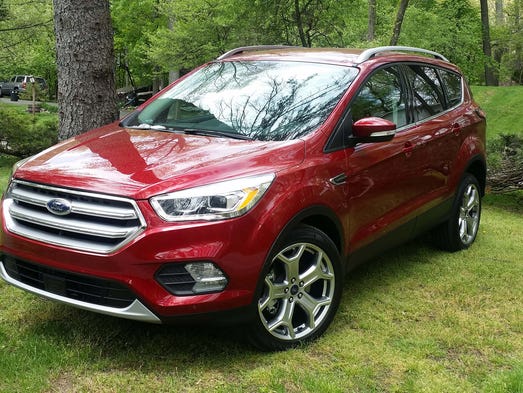
Okay, sis, let’s do the exterior walkaround. It’s a handsome little devil. The third-generation 2013 Escape was one of the first crossovers to think outside the boxy shape and adopt a more car-like, streamlined figure. But as others followed, the Escape’s mug — apparently inspired by a hotel air-conditioning unit — lacked character. Ford’s mid-cycle refresh has replaced all sheet model forward of the A-pillar to finally give it the handsome, happy grille it deserves.
We climbed in and hooked up Android Auto. Ford and Toyota have lagged rivals Chevy, Honda and Hyundai in introducing apps that let your familiar smartphone take over the console — a rare misstep for the tech-savvy Blue Oval. By introducing Android and Apple Car Play in its highest-volume vehicle, Ford goes a long way to catching up with the pack.
Ford’s whiz-bang cred was quickly redeemed with a self-park demo. Futurists are wowed these days with “self-driving” features like auto-lane changing, lane-keep assist, adaptive cruise control. But for my money there is no better demonstration of auto-ficial intelligence than self-park — a feature the Escape pioneered, and that has even luxury manufacturers playing catch up.
My sister tapped the self-park icon, cruised by an empty space, then sat back as the Ford detected the opening and, well, took over.
Steering wheel possessed by unseen hands, the CUV cut backward, slotting the car perfectly into place. So bewitched was sis that she almost forgot to brake before slamming into the parked car behind us. Self-park is only semi-autonomous after all.
Show-and-tell me more. Well, of course. Return to the vehicle and it will (semi-autonomously) extract itself, too. In the tight confines of cities from Charleston to Detroit, the feature is a ding-saver (if only every parking-challenged idiot had the same ability).
I can’t speak to the MyFord Touch infotainment issues that dogged previous Escapesand drove owners to blow shotgun holes in their center consoles. So infamous was the system that Ford has put MyFord Touch in the witness protection program, never to be heard from again. The Escape boasts a SYNC infotainment update called SYNC 3, which gave us no trouble.
It’s been 15 years since the iPod revolutionized gadget design — but I still enjoy the Escape’s Pod-like infotainment controls which power the console along with attractive climate control graphics. But if the old Escape console looked like an Apple device, it forgot that we need a place to put them. The new Escape happily lifts the control stack — opening up a needed cubby for phones, money, French fries (whatever flips your switch) to go with a bottomless center storage bin that will shame many larger, midsize crossovers.
Ford lives by more than tech alone.
This is a company full of race jocks who take pride in engine development — and the Escape is in a different class with more engines choices than I have socks
You can have any engine in a Honda CR-V as long as it’s a 185-horse, 2.4-liter inline-4. Ford offers a base 2.5-liter 4; a 1.5-liter turbo-4; a 2.0-liter turbo-4; and the 5.0-liter, flat-plane crank, 526-horsepower V-8 that comes in the Mustang GT350 (just kidding about that last one — but it doesn’t hurt to dream).
The new 2.0-liter turbo ups Escape’s already best-in-class horsepower rating to 245 — which, when bolted to Ford’s all-wheel drive system is a real stump-puller (and avoids the legendary torque steer found in the 252-horse Focus ST front-wheel driver). Despite the Ecoboost label, however, the two-oh drinks like a fish (my tester gulped 16.1 mpg under my lead foot). Fuel-conscious drivers will prefer the blown 1.5-liter which was plenty peppy scaling the West Virginia mountains — yet returned in a budget-friendly 25.1 mpg on my trip to Charley West and back.
Speaking of back, the Escape is also the rare SUV that makes the effort to fold its rear seats bone flat — making the interior configurable for a variety of objects. With your arms loaded with said objects, the Escape’s kick-gate feature is invaluable (and has been copied by exotic rides like the Audi A8 and Cadillac CT6). I’ll take issue with the new Escape’s taillights, however — formerly distinctive shards that have been squared off to make the rear look bigger.
Not big enough for my sis, though, who decided that she probably needs the space of … hey, how about that three-row Explorer over there? That’s what Escape show-and-tell innovation does: It gets shoppers into the store.
2017 Ford Escape
Vehicle type: Front-engine, front- or all-wheel drive, five-passenger SUV
Price: $29,995 base ($34,875 Titanium FWD and $37,515 Titanium AWD as tested)
Powerplant: 2.5-liter inline 4-cylinder; 1.5-liter turbocharged 4-cylinder; 2.0-liter turbo 4-cylinder
Power: 168 horsepower, 170 pound-feet of torque (2.5L): 179 horsepower, 177 pound-feet of torque (1.5L); 245 horsepower, 275 pound-feet of torque (2.0L)
Transmission: 6-speed automatic
Performance: Zero-60: 7.0-9.3 seconds (Car & Driver est.); 1,500-3,500-pound towing (manufacturer)
Weight: 3,552-3,765 pounds
Fuel economy: EPA 21 mpg city/28 mpg highway/24 combined (2.5L); EPA 22 mpg city/28 mpg highway/24 combined (1.5L); EPA 20 mpg city/27 mpg highway/23 combined (2.0L)
Report card
Highs: Nice nose job; tasty engine buffet
Lows: 2.0L can get thirsty; can we have the old taillights back?
Overall:★★★★
‘Captain’ Penske will set brisk pace at Indy 500
Posted by hpayne on May 28, 2016

Indianapolis – In celebration of Team Penske’s 50 years in motor sports, 79-year old team owner Roger Penske will bring the 100th running of the Indianapolis 500 field around to the green flag Sunday afternoon. Do his four drivers have any advice for him on how to pace the field?
“I told them I’m just going to do my best to keep it off the wall,” chuckled “The Captain,” as he’s affectionately known to his crew.
The Birmingham resident and winningest-ever Indy owner held forth at the traditional Saturday press conference for the pace car driver. Penske will be driving a 455-horsepower, 2017 Chevy Camaro SS. The car will wear an Abalone White livery developed exclusively for this weekend featuring “100th Running of the Indianapolis 500” graphics on the doors and the Indianapolis Motor Speedway wing-and-wheel logo on its quarter panels. The ’17 Camaro bears aerodynamic upgrades that make it capable of a staggering 184-mph top speed.
“The first thing I had to do was pass the physical,” laughed Penske, himself a former race driver, before he could get into the SS.
Penske said he will pace the field for four laps at gradually increasing lap speeds before cranking it up to 100-105 mph on the last lap.
“On the back straight I’ll take it up to maybe 130 to pull away from the field then come in the pits and turn the lights off,” he said. “To think that the drivers are competing at 100 mph faster than that is amazing. As you come down the straightaway it’s narrow. It’s not a big track like Daytona or Michigan or places like that.”
James Hinchcliffe set the pole this year at over 230 mph. After entering the pits, Penske will jump out of the Camaro then up into his pit box and try to help Helio Castroneves to a record fourth win – and extend his own record to 17 wins. A who’s-who of Indy racing talent – Will Power, Juan Pablo Montoya and IndyCar series points leader Simon Pagenaud also will be piloting Penske cars for their captain.
The ageless Penske spent race eve at a typically break-neck pace – attending multiple press conferences, preparing his team, and driving in the annual Indianapolis 500 Parade through downtown.
“Someone will be the winner and I hope it’s us,” said Penske when asked about the significance of the 100th running of one of the world’s most iconic sporting events. “To say you competed here, and you were one of the teams to beat on the 100th goes down in history for our company.”
1 Payne: Q&Auto with Indy elder Kanaan
Posted by hpayne on May 27, 2016

In its 100 years, the Indy 500 has changed lives. And arms.
When Tony Kanaan realized his “dream achievement” by winning the 500 in 2013, the Brazilian star had the Borg-Warner winner’s trophy tattooed on his right shoulder and bicep.
“It’s the race I always wanted to win. The most important race of my career,” says the diminutive, 5-foot-5 car jockey as we sat courtside at a Detroit Pistons game surrounded by basketball giants. Already an IndyCar series champion (in 2004), the win made him a legend in his native Brazil where he has joined a pantheon of racing greats including his childhood idol, Formula One superstar Ayrton Senna. Heck, next to the 500 win, meeting Senna might be his career highlight.
“I first met him at his farm in a go-kart race,” recalls Kanaan “He invited a bunch of guys, and I won and he finished second. I was 16. I beat Senna at 16 on his farm!”
He’s back in Indianapolis this year to vie for another win as part of an elite squadron of drivers racing at 230 mph for the Target Chip Ganassi team: Scott Dixon, Charlie Kimball and Max Chilton. After the 500, he’ll be back in Detroit for the 14th time at one of his favorite street tracks, the Belle Isle Grand Prix.
I talked with IndyCar’s 41-year old senior statesman about Detroit, Corvettes and what the future holds.
Q: Do you like Belle Isle’s “Duel in Detroit,” two-race format?
Kanaan: Double-headers are extremely stressful for the not just the drivers but for the (crew) guys. It’s possible to make a mistake really easy. Glad there is only one and that it’s here.
Q: Do you regret not going to Formula One?
Kanaan: If I had gone to F1, I might not have won a race because if you’re not on the right team it would have gotten old. Competing not to win is hard for me to understand. In Indy, any team can win.
Q: You’re the oldest in the sport at 41? Does that make you the dean of the college?
Kanaan: Me and Helio (Castroneves) are the oldest. I’m president of the drivers’ association – they try to pick the most experienced guy to run. I’ve become the guy young drivers look to for advice. I’m really approachable, not the type of guy who would hide anything from anybody. I looked to Mario Andretti, Bobby Rahal and Al Unser Jr. when I can in 20 years ago.
Q: Talk about Senna and your place in Brazil’s racing culture.
Kanaan: I was always a big Senna fan. My racing hero. I got a chance to meet him and become friends before he passed. He helped me out in the beginning of my career. We can’t replace him, but with the 500 win and my popularity down there, we do a lot of charity events trying to put kids into sports – not just go-karts. It’s good to give back. He built up a legacy there that we can’t afford to let die. You can’t forget your roots.
Q: Where do you live now?
Kanaan: I spend a lot of time in Indianapolis, but my home is Florida. My life is in America now, my kids are American. Although I love my home country, this is where I’ll live the rest of my days. The U.S. is a benchmark for us – we are much more advanced here than in Brazil – so I can take it back and forth.
Q: What’s changed in IndyCar in your 20 years?
Kanaan: We’re the benchmark on safety, which is good. That’s the price you pay to make it better. We’re one of the safest series in the world right now. We create lot of measurements that are used everywhere.
Q: Should IndyCar be competing against F1 globally?
Kanaan: IndyCar is a lot more popular here. We should stick to North America.
Q: What’s your future after IndyCar?
Kanaan: I haven’t thought about when. I’m still very committed to IndyCar. It would be interesting to do endurance racing.
Q: What’s in your garage?
Kanaan: I love every type of car. But one of my favorite cars right now is the new Corvette Z06. It’s yellow. And I have a Mercedes C63 AMG Black Series which is a fun car to drive. The 2013 pace car I won with Indy is the blue Stingray.
For 50 years, Penske has set the pace in auto racing
Posted by hpayne on May 27, 2016
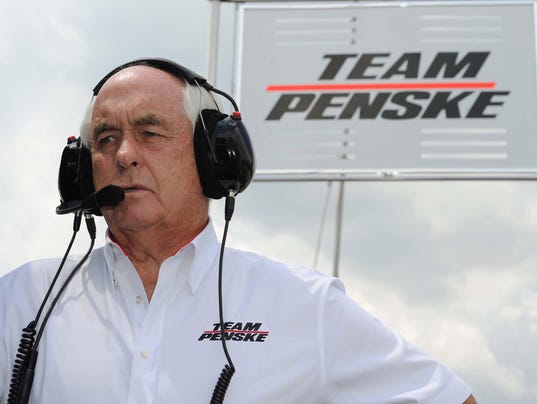
When the green flag falls on the 100th running of the Indianapolis 500 on Sunday, Roger Penske marks his team’s 50th year in racing.
“The Captain,” as the 79-year-old Birmingham resident is affectionately known, will celebrate the milestones where he always does: on the pit wall. Headset on. Helping manage race strategy for his four drivers — three-time winner Helio Castroneves, Will Power, defending champion Juan Pablo Montoya and Simon Pagenaud.
“I’m not a guy who sits in the suite having a cold beer,” said Penske, who calls the race for Castroneves (Team Penske president Tim Cindric calls the race for Power, Jon Bouslog for Montoya and Kyle Moyer for Pagenaud). “I want to be on the ground.”
Said Pagenaud, IndyCar points leader: “Roger knows everything about everything in the race team. It’s incredible knowing how busy he is. He’s got more passion than anyone I know.”
It’s fitting America’s most iconic track shares an anniversary with its most revered sportsman. A legend who has won at every level of motor sports, Penske also has built the second-largest auto dealer network in the world.
Ironically, the billionaire businessman — a successful amateur racer in his 20s — might have been an Indy driver had his business ambitions not intervened.
“I had a chance to go to Indy and take a rookie test in the early ’60s, but I was working for Alcoa and couldn’t get the time off,” he said. “Mario Andretti took my place. Then in ’65 I became a Chevy dealer in Philadelphia and one of the prerequisites was that I (couldn’t) be a race driver.”
The rest is history.
Penske entered his first, Sunoco-sponsored, car at the Brickyard in 1969, with his first win coming three years later.
“The decision to become a dealer … has really turned out to be the foundation of our company,” he says. “The racing has been a common piece through all our businesses, and has helped build our brand.”
When America’s Super Bowl of motor sports celebrates its anniversary, Penske will be at the helm. He will pace the 33-car field to the green flag in a 2017 Chevrolet Camaro SS — then scramble to the pit wall and try to help Castroneves navigate the grueling 500 miles to a record fourth victory — and give Penske, the winningest owner in Indianapolis 500 history, his 17th.
Adding the Camaro to his collection — Penske paraded all 16 honorary pace cars he’s won at the Woodward Dream Cruise last August — would be “pretty special,” he said. He will stake his claim with arguably the most talented group of drivers he has assembled.
“Juan Montoya is tougher than nails,” Penske said. “Will Power is a series champion. Castroneves with three wins going for his fourth — and now Pagenaud leading the series and has the hottest hand of anybody.”
His best Indianapolis 500 memory? True to his savvy business demeanor, Penske cites a teachable moment — not a triumph.
“In 1994 we took the pole and led every lap but two and won,” he said. “Then we came back in ’95 (and) didn’t make the race. That made us a much better organization. That taught us the lesson: It’s not what you did yesterday, it’s what you do today.”
It’s a lesson he carries with him.
After Jordan Spieth’s final round collapse at this year’s Masters, Penske — who befriended the 22-year-old golf phenom — sent him a letter.
“I wanted to tell him about the problem I had in a similar situation — Indy is the Masters of our sport — and we came back stronger than ever,” he said. “Those experiences in your life that are so public really makes you a better competitor and a better person.”
In a half-century at Indy, Penske has witnessed transformational changes.
“We were running lap times of 150 mph in the ’60s,” he said. “Qualifying was over 230 mph this year. The aerodynamics have changed, which give us downforce so that (cars are) like airplanes upside down. That gives us speeds of 225 through the corners.”
Yet, paradoxically, that speed has come with safety improvements that have made a race once synonymous with fiery crashes a model of safety.
“Soft walls, Hans devices, Nomex suits … the sport has become a technical exercise,” Penske said approvingly.
Though a native of Cleveland with business interests worldwide, Penske has adopted Detroit as his home. A week after the Indianapolis 500, he will be back in the Motor City preparing for a race perhaps even closer to his heart: the Belle Isle Grand Prix.
“In 2007 when we decided we wanted racing back in Detroit, we took on the role as promotor for the city,” he said. “Detroit is the heart of the auto industry in the U.S. and coming here right after Indy … we get two days of national TV, which showcases our city. It’s our ability to give something back.”
This weekend, however, it’s all about the 100th.
And the 50th.
Everyone in the Penske pit knows what it means to their “Captain.”
“It’s not something we talk about all the time because it would freeze you,” Pagenaud said. “Indy is special, but anytime you win for him it’s special.”
Said Penske: “If you can run at Indy — the greatest race in the world — it can change your life and your business.”
Getting to know … Roger Penske
Position: Chairman of the board and chief executive officer, Penske Automotive Group.
Birth date: Feb. 20, 1937 (Shaker Heights, Ohio)
College: Lehigh (BA, 1959)
Family: Wife Kathryn; five children
Career: Alcoa Aluminum (sales engineer), 1959-63; George McKean Chevrolet (general manager, owner), 1963-65; owner of several car dealerships, a truck-leasing operation, and two racing-tire distributors, 1965-69; Penske Corp. (chairman and CEO), 1969-present; United Auto Group (chairman and CEO), 1999-present
Awards: SCCA driver of the year (Sports Illustrated, 1961), driver of the year (New York Times, 1962)
Teams: NASCAR — Brad Keselowski and Joey Logano. IndyCar — Helio Castroneves, Juan Pablo Montoya, Simon Pagenaud and Will Power
Series titles: NASCAR — One (Brad Keselowski, 2012). IndyCar — Two (Sam Hornish Jr., 2006; Will Power, 2014). CART — Nine (Rick Mears, 1979, 1981, 1982; Al Unser Jr., 1983, 1985, 1994; Danny Sullivan, 1988; Gil de Ferran, 2000, 2001)
Indianapolis 500
Track: Indianapolis Motor Speedway (oval, 2.5 miles).
Schedule: Today, Carb Day (NBCSN, 11 a.m.); Sunday, race, noon, ABC
Distance: 500 miles (200 laps)
Pole: James Hincliffe
Defending champion: Juan Pablo Montoya
Payne: SUV Smackdown, Acadia vs. CX-9
Posted by hpayne on May 25, 2016

I’m on the country roads of northern Virginia horse farm country chasing an Audi S7. Through the twisties. Over fox-hunt hills. In a three-row GMC Acadia SUV.
Payne, have you gone mad?
Some background: I lived in northern Virginia for a good chunk of my young adult life. Its Blue Ridge Mountains and leafy forests sprawling west of the nation’s capital make for some of the East’s most beautiful vistas. I would take my first sports car — a little red Porsche 924S — to these roads to play like an unleashed pet liberated from Metro DC’s streets. There were two kinds of cars in the Virginia countryside: galloping sports cars and trucks that got in the way.
Not anymore. These days it is fashionable to write that we’re in the midst of an electrified auto revolution. Maybe. The Tesla Model S is a glorious car though challenged by the same physical realities that doomed EVs a century ago: cost and range anxiety. Meanwhile, a quieter revolution is transforming the light-truck world.
Twenty-five years ago SUVs were built on the same simple, body-on-frame platforms as pickups. Ford Explorers and Chevy Blazers offered utility but were moving roadblocks on back roads. As utes have displaced sedans as Americans’ chariots of choice, however, demand has grown for car-like handling. The 2003 Honda Pilotsparked a stampede to unibody, midsize construction.
Now comes the next generation of chassis. Behold the 2017 GMC Acadia and 2016 Mazda CX-9: They are wolves in sheep’s clothing, sporty midsize SUVs (that is not an oxymoron) on stiffened spines.
I came up fast on the Audi S7 near Hume, Virginia, the big GMC Denali grille filling his mirrors. When traffic cleared, the Audi took my bait. He leaped forward to shake my shadow. But this isn’t your average, hulking SUV. Or even the first-generation, hulking Acadia.
For its Gen-Two Extreme Makeover, Acadia shed an eye-popping 700 pounds through downsizing and chassis light-weighting. At about 4,250 pounds, a three-row, AWD, unibody Acadia is actually lighter than an all-wheel drive, 4,500-pound S7 cruise missile. Over rainy hill and dale, Audi and GMC danced an unlikely duet.
Did I stay with him? Are you kidding?
The $85,000 Audi has 500-gazillion horsepower, tires as wide as the Potomac River and a driver who knew these roads like the back of his hand. He gradually pulled away. But not without a fight. When he turned into the driveway of his multi-million-dollar horse ranch — its house bigger than the Pentagon — I tooted at him. He’d remember this $40K SUV.
That’s because his Audi and my Acadia share more than he knows. Sure, the GMC’s high saddle makes it look like a camel next to the S7 cheetah, but underneath the GMC is built on the same bones as the athletic Cadillac XT5, a midsize ute to rival Audi’s Q5. You’ll recall I flogged the featherweight XT5 — itself 650 pounds lighter than a comparable Mercedes GLE — across California’s curves earlier this year chasing Porsche Cayennes.
The GMC also shares the Caddy’s 310-horsepower, 3.5-liter V-6. I like these sibling hand-me-downs. Maybe Corvette will share its 6.2-liter V-8 (as it does with GMC’s hot-rod Sierra pickup) with the Acadia and the next time I’ll put tire tracks over that Audi’s hood. This chariot is a long way from the ox carts I used to see on Virginia roads.
Mazda’s impressive CX-9 is all the more remarkable because it has no luxury jock bro’ with which to share hand-me-downs.
Mazda bakes its ZOOM ZOOM DNA into everything it makes — even its biggest vehicle. The midsize ute goes through the same bonkers performance training as the wee MX-5 Miata sports car.
“Our suppliers look at us kind of funny,” says Dave Coleman, Mazda engineering manager and chief car flogger. “Other companies don’t put their crossovers through the things we do.”
At Mazda’s media demo in San Francisco — where the big ute tamed the challenging Pacific Coast Highway — Coleman showed off pictures of his CX-9 trailering his MX-5 race car. It’s the loveliest tow vehicle (again, no oxymoron) you’ll see. Though the turbo 4-powered Mazda’s tow rating is 3,500 pounds — compared to the V-6 Acadia’s 4,000 pounds — that’s enough for small racers and watercraft.
And when you unhook the trailer, you have a sexy ute to play with — not a big fridge like every other appliance on the road. I regret to say that includes the GMC Acadia, once one of the most distinctive-looking utes at the prom.
While CX-9 and Acadia are trim haulers (the front-wheel drive GMC edges Mazda for class lightweight at just 3,956 pounds), only the CX-9 looks the part.
In downsizing to a more class-competitive size Acadia understandably ditched its pickup-like exterior styling — keg grille, muscular wheel wells, slab sides. But designers also softened the hard edges that make a GMC a GMC. The lack of flair (what, no muscle shirt?) does no justice to the toned bod beneath. Sigh.
The sleek Mazda, meanwhile, is the sultriest three-row ute this side of a Volvo XC90 or Audi Q7. Long hood, shark-like nose, narrow, wrap-around headlamps. Are utes supposed to stir the loins? Its supple curves makes a BMW X5 look like a Bavarian housewife.
Not that mid-size ute customers will cross-shop a CX-9 and X5 — but at nearly half the price, the Mazda gives off a decided European vibe (including best-in-class fuel economy via that turbo-4). It continues inside the cabin where the CX-9 sports an Audi-like, horizontal dash with lush materials and the artful attention to detail of a Japanese artisan (the center console’s interplay of wood and aluminum is pure eye candy).
Nice, yes. But Euro-style has its drawbacks compared to Acadia’s familiar, superior GM interior ergonomics. Acadia’s intuitive touch screen is the tip of an iceberg of useful details: Apple Car Play and Android auto capability, rear-seat alert (if you left a laptop or — ahem — child), second-row captain’s chairs, and a full moon-roof so that third-row passengers don’t feel like they’ve been shoved into an airless basement.
Mazda decided against a full, “dual” sun roof because its top-heavy weight would have thrown off the car’s performance balance. Seriously. That’s how obsessive Mazda is in its commitment to ZOOM ZOOM. It’s not an obsession everyone will share. In which case there is the more livable, luxurious, plenty-athletic Acadia.
When you valet at the horse ranch, however, don’t expect her to turn heads like sweet CX-9’s 10.
2017 GMC Acadia
Vehicle type: Front-engine, front- or all-wheel drive, seven-passenger SUV
Price: $29,995 base ($35,375 SLE 4-cyl AWD and $47,845 Denali AWD as tested)
Powerplant: 2.5-liter inline-4 cylinder; 3.5-liter V-6
Power: 194 horsepower, 190 pound-feet of torque (4-cyl.): 310 horsepower, 271 pound-feet of torque
Transmission: 6-speed automatic
Performance: Zero-60: 6.8 seconds (V-6, Car & Driver est.); 4,000-pound towing (manufacturer)
Weight: 3,956 pounds (base, FWD 4-cyl.)
Fuel economy: EPA 21 mpg city/25 mpg highway/23 combined (AWD 4-cyl); EPA 18 mpg city/25 mpg highway/20 combined (AWD V-6)
Report card
Highs: Lightweight chassis; loaded interior
Lows: Muted styling compared to bold Acadia of old
Overall:★★★★
2016 Mazda CX-9
Vehicle type: Front-engine, front or all-wheel drive, seven-passenger SUV
Price: $32,420 base ($41,370 GT and $45,215 Signature AWD as tested)
Powerplant: 2.5-liter, turbocharged inline-4
Power: 227-250 horsepower (87 or 93 octane gas), 310 pound-feet of torque
Transmission: 6-speed automatic
Performance: Zero-60: 7.5 seconds (Car & Driver est.); 3,500-pound towing
Weight: 4,054 pounds (base FWD)
Fuel economy: EPA 21 mpg city/27 mpg highway/23 combined (AWD)
Report card
Highs: Easy on the eyes; nimble handling
Lows: No second-row captain’s chairs; glitchy infotainment usability
Overall:★★★★
Will your next pickup have a unibody?
Posted by hpayne on May 23, 2016

Once upon a time, midsize sport utility vehicles like the Ford Explorer meant truck-like, body-on-rail construction. Not anymore. Today, there isn’t a truck-based midsize ute to be found as SUVs dominate vehicle sales and consumers demand the same ride quality as the sedans they replaced.
Will midsize pickups follow suit?
The unibody 2017 Honda Ridgeline, now in its second generation, has reignited speculation among manufacturers and industry analysts that the next generation of midsize pickups won’t be based on traditional truck platforms, but on car-like unibodies like their SUV siblings.
“It’ll be a long trend, but it wouldn’t surprise me to see competitors with unibodies,” says James Jenkins, ex-Honda product planning manager and new Honda public relations chief. “Ten years ago, the Honda Pilot and Toyota Highlander were the only SUV unibodies, and now you can’t find a body-on-frame in that segment. The benefits of unibody far exceed body-on-frame for midsize pickups, too.”
Kelley Blue Book analyst Karl Brauer agrees.
“You once needed body-on-frame to get the stiffness you needed in a truck,” he says. “You now have the engineering and CAD/CAM (computer) capability to create a very stiff unibody that’s as capable as any body-on-frame. Yet it’s lighter and has better ride quality.”
The Ridgeline debuted to rave media tester reviews in San Antonio last week as it demonstrated best-in-class ride, cabin room, quietness and V-6 fuel efficiency while holding its own against class leaders Toyota Tacoma, Chevy Colorado and GMC Canyon in off-road ruggedness and towing capability.
But, industry insiders caution, it’s too soon to write off the body-on-frame truck. Its inherent benefits mean the unibody won’t be the slam dunk it was in SUVs.
Not coincidentally, Ridgeline is based on the Honda Pilot, which revolutionized three-row family SUVs in 2003. While the “original SUV” 1984 Jeep Cherokee wowed customers with its unibody chassis, most manufacturers used existing truck platforms as the backbone for popular SUVs like the Explorer, Chevy Blazer and Toyota 4Runner.
“A unibody pickup was born out of necessity for Honda,” says IHS Senior Analyst Stephanie Brinley, because Honda did not have a truck division. To meet growing sport ute demand, the Japanese company turned to the car-like technology it knew best.
By 2011 even the best-selling Explorer was forced to follow suit as customers flocked to the more spacious, smoother-riding unibody competitors.
Toyota and Detroit’s Big Three would not comment on whether they are developing unibody pickups, though GMC showed a Denali XT hybrid concept truck with unibody architecture at the Chicago auto show in 2008.
Brauer and other analysts say that the towing demands of the full-size truck market mean that Ford F-150s and Chevy Silverados will be body-on-frame for the foreseeable future. Yet, the capabilities of these rugged big trucks will make it hard to convince customers that smaller trucks can get the job done on a unibody chassis.
“Die-hard truck guys will say it isn’t a truck unless it’s body-on-frame,” says Jason Gonderman, editor-in-chief of Truck Trend magazine. Indeed, the first Ridgeline, introduced in 2006, was met with lukewarm sales.
“You have to change consumer perception that a truck that rides as good (as the Ridgeline) on the road is as capable in other things,” says Brauer. “Ninety-five percent of truck buyers will never come up with a situation that this truck can’t handle better. And when you’re not doing trucky stuff, this vehicle is far better.”
Yet even as it shows unibody promise, the new Ridgeline shows its limitations. Unlike its competitors, which can adapt body-on-frame to different cab and pickup box configurations, the Ridgeline will be offered only in a crew cab with a 5-foot box beginning at $27,000. In so doing it concedes 30 percent of the midsize pickup to the smaller, cheaper, “extended cab” offerings from GM and Toyota that start at $20,000.
“The retooling for a unibody is just too expensive to offer different cab alternatives,” says Honda’s Jim Loftus, Ridgeline performance manager.
Nevertheless, Honda is bullish on a segment it sees as part of the broader U.S. market transformation to SUVs.
“The truck segment is up to 60 percent of sales — mostly driven by crossovers,” says Honda’s Jenkins. “Midsize pickup demand is up to 350,000 in unit sales, and I see it growing. People look in their garage and say, ‘I don’t need a big pickup truck.’ ”
Who will be next to go unibody?
Analysts agree that a midsize unibody truck makes the most economic sense for GM — once its generation of Colorados and Canyons cycles out — because the company already makes so many SUVs on its midsize, Lambda and C1XX unibody platform.
But KBB’s Brauer thinks a Fiat Chrysler brand will be the first to jump, given its history of innovation — like Ram’s first-in-class coil-spring 1500 pickup. “I think we might have a unibody Jeep Comanche,” he says. “If you give (FCA’s Sergio) Marchionne a good business case, he’ll take it.”
“Hyundai really wants to get into this segment,” says IHS Automotive’s Brinley of another Asian manufacturer that does only unibody construction. “The Hyundai Santa Cruz concept [a pickup] is out there. Hyundai may be next.”
The answer is not whether, but when. “There is potential there. Trucks don’t need to be body-on-frame,” says Brinley. “You don’t get as beat up with the unibody. There’s space for both.”
Google revs up auto-based Android
Posted by hpayne on May 20, 2016

Mountain View, California – Google announced a blizzard of car-based Android operating system updates Wednesday as the Silicon Valley tech giant tries to accelerate the convergence of automobiles and computer networks.
Google’s Android Auto app — a sort of digital patch which helps integrate smartphones into more than 100 models of cars — will add the traffic and navigation app Waze. It also brings its Hotwording feature, similar to Apple’s popular Siri personal assistant. Hotwording triggers voice recognition with the words “OK Google.” Users can also utilize Android Auto features outside the car, including voice-enabled calling, messaging and navigation.
The company’s showcase at its annual Google I/O developers-palooza in Mountain View, California, is a Maserati Quattroporte with its infotainment system run by Android’s latest operating system, Android N.
The introduction of Android N, an open-source operating system — giving the car’s console the functionality of an Android phone or Chrome-operated computer tablet — provides a glimpse at a future in which manufacturers may be able to more affordably develop in-car technology, and where autonomous cars will be able to communicate with one another.
“Our open-source Android N system will lower the cost for carmakers to develop AM-FM radio, HVAC, Bluetooth calling, navigation and other features,” said Patrick Brady, director of Android Engineering.
Google’s gambit is not the first attempt by a tech titan to develop an in-car operating system. Microsoft hooked up with Ford to develop its Sync infotainment system in 2007, for example. But Google’s massive investment in automobiles — from the self-driving Google car to its partnership with Fiat Chrysler to test a self-driving Pacifica minivan — points to an effort to make Android the foundation of everything from phones to tablets to cars in order in order to provide a seamless experience from one platform to another.
“This is just the tip of a larger spear,” Kelley Blue Book auto analyst Karl Brauer of the Android N. “It’s an attempt to make Android the default system for vehicle development and lays the groundwork for the self-driving car features we all see coming — such as allowing cars to travel more safely together by talking to each other.”
Gone are the modular component days when consumers could just switch out their radio/CD module for the latest product. But automakers still must develop their own infotainment systems — Chrysler’s UConnect and Ford’s Sync, for example — and then pair them with outside operating systems like Google’s Android or Apple’s iOS. Android N would allow automakers to more affordably develop — and update — car technologies on a standardized platform.
“Automakers seem excited about it,” said Android’s Brady, who added that Google has not yet signed a contract with an automaker. “This will lower their development costs.”
As with its smartphone operating system, Android has partnered with Qualcomm — the dominant manufacturer of smartphone processors — to make its Maserati-based demo. Google’s infotainment system is displayed in a 15-inch screen in the car’s center console and features an Android user interface.
Anton Wahlman, an independent auto analyst who tracks vehicle technology, says automakers might be leery about hitching their horse to one operating system in an industry that has seen volatile change in the last two decades. But he also sees Google’s announcement as evidence of more integration between Android and manufacturers like Fiat Chrysler (which owns Maserati).
Egil Juliussen, an infotainment analyst with IHS Automotive, is more bullish on Google’s technology: “An Android OS for infotainment will have a significant impact on the auto industry. It will take an increasing market share after 2017 and could reach 35 percent sometime after 2020.”
Google also is showcasing a Honda Civic, Hyundai Elantra and Mercedes E-Class, which are three of 40 brands with Android Auto capability.
In addition to Waze and Hotwording, Google Android Auto app upgrades will allow automakers to use the platform to develop their own programs. Honda and Elantra will both display their own apps. Google has been slow to roll out apps for use with Android Auto out of concern for driver distraction, says Google’s Brady.
The Google I/O conference is held in Mountain View near the company’s California headquarters in order to update developers on the latest Google wizardry from virtual reality to transportation. Google has been active in the auto space since its marshmallow-shaped autonomous Google car made headlines.
KBB’s Brauer sees Google’s Android operating as a key step toward self-driving vehicles. Though fleets of operating system-sharing, autonomous cars are sci-fi stuff for now, industry insiders predict a future of dedicated lanes for autonomous cars that can safely travel at 100-plus miles per hour while networking with one another to travel just inches apart.
An Android N-equipped car could also communicate with surrounding businesses, allowing passengers to better locate restaurants, hotels and other points of interest.
Payne review: Buick’s sexy, topless Cascada
Posted by hpayne on May 19, 2016

If you’re a Southern boy (me) or a convertible (the 2016 Buick Cascada that I tested), May in Detroit can be the cruelest month. The calendar trumpets summer, but the weather gods blow winter. My first Memorial Day here in 2000, my Virginia-transplanted family and I packed swimsuits for the beaches of Charlevoix and wound up freezing under blankets in a 40-degree chill. Sheesh. Won’t make that mistake again.
But Mrs. Payne and I did have plans to cruise Woodward topless (the car, not us) when the Cascada arrived May 2. Right on cue, Mother Nature delivered a 45-degree blast. Fortunately, we were prepared.
Rolling up to Woodward at under 30 mph, I toggle the high-tech soft-top down and it disappears under its body-colored tonneau cover. Windows up. Turn on the heated steering wheel. Heated seats at three bars. Climate control dialed to 80 degrees.
Oh, yeah. We’re cruisin’ the boulevard in style.
Heads turn. Mouths gape. And not just because we’re topless in polar bear weather. Or because the 17-second roof stow is the coolest thing this side of a Porsche Boxster or Chevy Corvette convertible (which shares the Cascada system). But because this is one bodacious Buick. Short of the gorgeous Avista coupe which sashayed down the Detroit Auto Show runway last January, the Cascada is the sexiest Buick made.
I fell for it in February when I saw a fleet test car on the road. Attractive on a static show stand, Cascada has a more distinct presence on the road. With its raked windshield, sculpted sides and huge, standard 20-inch wheels, the Buick bears a resemblance to the stunning Cadillac ELR, the best-looking (and worst-marketed) compact car in the GM stable.
That said, my Toasted Coconut-colored Buick convertible is as out of place in Michigan in May as a Southerner in a bathing suit. Cascada’s tanned beach bod debuted to media test drives in Florida for a reason: GM wants the coasts to take notice.
Buick survived the Great Recession because it’s the darling of the Chinese. The brand has been reborn stateside as its Encore and Enclave SUVs dovetail perfectly with our ute love affair. But at its core, Buick is a luxury brand that sells style. And no one knows style like GM’s European Opel design shop, which cooked up the Cascada (Spanish for “waterfall”) in 2013.
With the U.S. market starved of mid-market convertibles, Buick saw an opening.
My Southern buddy, Robert, in West Virginia craves convertibles. His open-top Toyota Solara coupe (last made in 2008) is long in the tooth and his options for convertible replacements are Mustang and Camaro muscle cars. Not his style. The Buick is prettier than the Solara and the brand impresses Big Bob with its bulletproof quality. Buick has quietly been racking up Consumer Reports huzzahs.
His Solara has been trouble free for 10 years. Cascada, you had him on looks and reliability. So, Brother Withrow wants to know, how’s the Buick drive?
Europeans pride themselves on trim figures born of healthy diets. Obesity is so American! Not so our European Cascada beauty. Based on GM’s aging Delta II platform, Cascada is a porker next to newer chassis like the svelte Cadillac ATS and diet-conscious Chevy Cruze (I lost 250 pounds in one generation!).
The Cascada weighs in at a hefty 4,000 pounds — 1,000 pounds heavier than the similarly sized Cruze. That weight is partially explained by extensive bracing to make the convertible more athletic. Throw it around Oakland County’s rolling hills and the Cascada’s compact dimension are rewarding. Over Detroit’s signature rough roads, the big 20-inch wheels can jar loose a little cowl shake — but sunshine states’ smooth asphalt will be much kinder.
Bury the throttle out of a Long Lake ess curve and Cascada exposes another European trait: small engine-itis. With gas at $8 a gallon, the Europeans fitted Porky Pig with a torque-challenged, 200-horse 1.6-liter turbo engine. Put your boot in it, and the four-banger screams away to … a … lethargic … 8.3-second zero-60 time. Oh, how I pined for Solara’s 250-horse V6.
The aged platform also robs the Cascada of talking points like GM’s Android Auto and Apple Car Play apps — standard features on a Cruze, for example, that lists $15K cheaper. Not that I complained much about GM’s old interiors — it’s just that the new ones are so good. So Cascada’s blizzard of console buttons looks like an airline cockpit next to the newer, cleaner system. And the tiny touchscreen display is so recessed that even my orangutan arms have trouble reaching it.
I had to move my seat forward to comfortably fiddle with the controls. My 5-foot-5-inch wife had to use a broomstick. It would have been easy for Buick to shrug off such idiosyncrasies as the compromises necessary for a low-volume, convertible. But happily they added some sweet chunky bits to whet the appetite.
Consider the rear seats. In a Camaro these are leg-chewing benches suitable only for small children. But the Cascada invites rear passengers with an easy, single-pull handle on top of the front seats that automatically moves the seat forward. Climb in, toggle the handle again and the seat floats backward — seat sensors stopping short of your knees. Robert will be flattered by the service — even if the legroom can’t rival the bigger, Camry-based Solara.
Where the drop-top show shames the Solara, it also swallows most of Cascada’s trunk. Where will Floridians put their golf bags? GM caddies to the rescue: Flatten the rear seats and a cavernous pass-through opens to the trunk. Golf bags easily fit in the gaping space.
The beauty of the Cascada and ELR make them prime meat for the coastal sunbirds GM craves. They are also missed opportunities for the General’s excellent plug-in hybrid system that languishes in the non-luxe confines of the Chevrolet Volt. Offer a plug-in Cascada at $40K and it would instantly put dowdy Buick sedans on the hip coastal green list.
Until then, Buick’s crossover lineup will continue to wow — and the $33,990 Cascada will satisfy Southerners’ cravings for a coupe convertible. For those of you cruising Woodward topless in May, just keep the wick turned up to 80 degrees in the cabin — summer should be here around, ummmm, July or so.
016 Buick Cascada
Specifications
Vehicle type: Front-engine, front-wheel drive, 5-passenger convertible coupe
Price: $33,990 base ($37,385 as tested)
Powerplant: 1.6-liter, turbocharged 4-cylinder
Power: 200 horsepower, 221 pound-feet of torque
Transmission: 6-speed automatic
Performance: Zero-60: 8.3 seconds (Car & Driver)
Weight: 3,979 pounds
Fuel economy: EPA 20 mpg city/27 mpg highway/23
Report card
Highs: Beach beauty; high-tech drop top
Lows: Not enough engine for its girth; trunk challenged
Overall:★★★
Payne: Honda Ridgeline, the crossover pickup
Posted by hpayne on May 12, 2016

San Antonians love their basketball team almost as much as they love their pickups.
After the Spurs defeated the Oklahoma City Thunder in Game Three of the NBA Playoffs last week, the streets flooded with F-150s, Tundras, Silverados, Tacomas and Colorados full of fans wearing all-black team colors waving Spurs flags and standing on their horns — as is tradition — in unison. HOOOOOONK HONK BEEP BEEP HOOOOONK. This deafening racket went on for more than an hour.
I’ll wager the sounds of Honda Ridgeline horns will soon join the din (especially its striking Black Edition).
Honda invaded San Antonio with Ridgelines last week like Kawhi Leonard attacks a basketball court: with a superb all-around game. Like the Honda Civic, 2016 North American Car of the Year, Ridgeline racks up all-star numbers. Best-in-class acceleration, V-6 fuel economy, interior room, box width, cabin quiet and safety rating. Unique-to-class bed trunk, bed audio, swinging tailgate, sub-rear seat storage.
But the best-of feature that instantly impresses is Ridgeline’s smooth ride, because this truck aims to change the midsize pickup game with the only car-like unibody chassis in its class.
Like the silky, muscular Kawhi (31 points on Saturday to go with 11 rebounds and stifling defense), the Ridgeline (smooth ride, 5,000-pound towing capacity, automatic all-wheel drive) is as comfortable executing hard cuts as it is banging bodies with the big boys.
This isn’t Ridgeline’s first tryout in the big leagues. Back in ’05, the pickup debutedwith similar unibody ambitions. But after initially selling a respectable 40,000-50,000 units a year, Ridgeline abandoned the segment as sales hit a glass ceiling attributed to its polarizing, flying-buttress C-pillar design … oh, and the Great Recession. Honda was not alone — every manufacturer except Toyota and Nissan fled small pickups.
But while Honda packed its bags, it did not give up on its pickup dreams. Fundamentally, Honda (which, unlike its Detroit Three and Toyota rivals, makes unibody platforms exclusively) thinks autos are moving from cars to crossovers — and it doesn’t think small pickups are immune from the trend. If generation-one Ridgeline was ahead of its time, then Honda thinks body-on-rail small pickups are dinosaurs.
Truck guys scoff at such talk. Drinks with umbrellas ain’t drinks, and trucks with unibodies ain’t trucks.
Well, game on. Four years later, the midsize pickup league is healthier than ever. Like similarly-affordable performance cars, the $30,000-$40,000 pickup market offers enthusiasts multiple brands competing with distinct visions as to what a small pickup should be. Where full-size pickups — like six-figure sports cars — are all about blowing your mind with Olympian stats, small sports cars and pickups are loaded with character.
King of the Ranch is still the Toyota Tacoma. If Texans still herded cattle to market, they would do it in this rugged cowboy toy. Remade last year, the Baja 1000-bred Tacoma is an Outback assault weapon with a 30-degree approach angle and a four-wheel-drive system that can climb Gibraltar’s face or dig out of jungle quicksand. Commute to work over asphalt, however, and its traditional truck platform and rear leaf springs will turn your insides to jelly. GM has swaggered back into small pickups with its sculpted Chevy Colorado and GMC Canyon twins boasting mature interiors bolted to Detroit truck know-how.
Against such adversaries, Ridgeline nixed its soft styling — “customers told us a square box and high wheel arches mean pickup performance,” says Ridgeline Performance Chief Jim Loftus — and threw Honda Engineering’s kitchen sink at the segment.
Most notable is Ridgeline’s acclaimed, Acura-derived, torque-vectoring all-wheel drive. Like Camaro showing up on big brother Cadillac ATS’s Alpha platform, Ridgeline’s AWD is in another league.
Hey, Kawhi, want to challenge these college kids to a pickup game?
I flogged the front-wheel biased, independent rear-suspension Honda across Texas ranchlands next to its rear-biased, leaf-sprung rivals. Ridgeline was more balanced, more confident — its electronic, rear-diff clutches expertly distributing wheel turn to whichever corner was in need. The difference is most pronounced next to the Tacoma whose four-wheel drive, solid-rear axle system squirms and protests against changing terrain.
Torque-vectoring and beefy suspension aside, however, the Ridgeline is a Honda Pilot with a 4-foot-by-5-foot box.
Not as muscular-looking as its rivals (the Canyon’s gym-toned, sculpted torso will get the girls), Honda’s tasteful, understated styling will woo the crossover crowd Honda expects to cross over to pickups. Inside, the same Pilot interior that has wowed SUV buyers also makes it best-in-class for pickups. Unencumbered by space-stealing rails, the unibody chassis allows excellent rear-seat room — both for passengers and sub-seat cargo (behold a second, golf-bag sized trunk!). Arm rests are soft, the center-sliding console brilliant — only Honda’s ill-advised, buttonless infotainment system mars the ensemble. I was pining for GM’s ergonomically friendly unit.
But there are limits to Ridgeline’s versatility.
Like Lego blocks, rail frames make for interchangeable cab (extended and crew) and box (5-foot or 6-foot) configurations. Unibody’s tooling complexity means Ridgeline comes only in crew cab with 5-foot box, starting at $27,375. Honda says that’s the segment sweet spot where 70 percent of customers shop — but it concedes entry-level conquests where, for example, the Canyon advertises at just $20,975.
Honda’s unibody also shies from deeper dives into extreme terrain — Michigan’s off-road park, The Mounds, comes to mind — where the Baja-tough Tacoma thrives. In the back woods of a San Antonio ranch, Tacoma’s armored underbody taunted rocks, its 30-degree approach angle is fearless over moguls. My Ridgeline hardly cowered over such obstacles, but when I got too aggressive with the throttle the front end would do belly flops — THONK! — on undulating terrain.
Of course, with more front aero, the Honda’s belly won’t need as much feeding as Tacoma either. Like the similarly fuel-conscious GM twins, Ridgeline sells to those who want to tow muddy, all-terrain vehicles — not muddy their pickups in all terrain. Most folks will be content with the Honda’s 5,000-pound trailering capacity — but those robust GM rails can pull another 50 percent more.
On paper, Ridgeline’s all-around play should be a more attractive pickup for the whole family — not just the cowboy in the house. A military vet on my San Antonio drive concedes a Ridgeline makes more sense for his family than his tree-chewing Tacoma. Or will his wife just buy a Pilot?
Are pickups niche lifestyle indulgences like sports cars? Or do they have broader appeal like CUVs? Honda is betting the latter.
Honk if you agree.
2017 Honda Ridgeline
Vehicle type: Front-engine, front or all-wheel drive, five-passenger pickup
Price: $27,375 base ($42,270 RTL-E trim as tested)
Powerplant: 3.5-liter V-6
Power: 280 horsepower, 262 pound-feet of torque
Transmission: 6-speed automatic
Performance: Zero-60: 6.4-6.7 seconds (Car & Driver est.); 5,000-pound towing
Weight: 4,515 pounds (RTL-E as tested)
Fuel economy: EPA 19 mpg city/26 mpg highway/22 combined (FWD); EPA 18 mpg city/25 mpg highway/21 combined (AWD)
Report card
Highs: Smooth rider; roomy interior
Lows: Won’t win Baja; annoying infotainment touch controls
Overall:★★★
Payne: Porsche 911 still king
Posted by hpayne on May 8, 2016
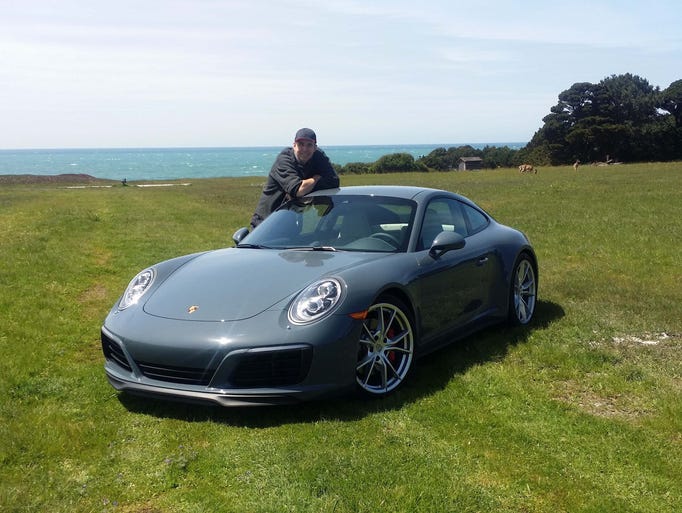
I’ve been club-racing mid-engine, vintage Porsches all my adult life: Porsche 904, Porsche 906, Porsche 908.
All are exquisitely-balanced, apex-carving knives. Their engines are in front of the rear axles where God intended them to be. They were the models that made the sports car marque’s reputation in the late 1960s as it amassed a trophy-case full of world championships. The Porsche 917, 956, 962 and 919 — all mid-engine masterpieces — continued the winning tradition into the 21st century.
And yet the brand’s celebrity icon is the aft-powered 911. An automotive artifact that shared ancestry with the original VW Beetle. Yet not even the Bug has a rear-mounted power plant anymore.
Mid-engine heroes have come and gone, but King 911 has carried the flag into battle for generation after generation of Porsche fans. It is the winningest-ever Porsche on Sunday, and the most-sold on Monday. Like its Yankee rival front-engine Chevy Corvette, it has defied convention for over half-a-century by resisting mid-mounted physics. And Porsche has laughed all the way to the bank.
Selling more than 30,000 vehicles apiece year after year, the volume of 911s andCorvettes produced is the envy of every other manufacturer even as we all know —we know! — that they are technical dinosaurs. But just as Coca-Cola’s secret formula has dominated taste buds for a century, so have Porsche and Corvette’s mastery of — respectively — rear-mounted boxer engines and push-rod, small-block V-8s. They have adapted to the ever-changing demands of the brutally competitive sports car market.
“Drive a 911 every once in a while to remember what a great car feels like,” my pal and ex-Detroit News colleague Scott Burgess likes to say. Last week, I drove the new 2017 911 (run, don’t walk, to your local showroom). The first 911 to feature a turbocharged, flat-six as its base mill, it is the most significant engine upgrade since Stuttgart changed its flagship from air-cooled to water-cooled power plants in 1998.
Brother Burgess would be proud. To drive the new 911 is to pilot greatness.
As a mid-engine disciple, I was skeptical. The new 911, known at Porsche as the 991.2 — that is, Version 2.0 of the all-new 991 platform introduced in 2012 — is the first 911 I have spent a full day with since my first racer’s school in 1980 as a fuzzy-faced 18-year-old. I was quick but raw. I successfully negotiated the pylon-choked race course in Ohio to the school’s satisfaction, though I melted the tail-happy car’s clutch in the process.
I’ve gotten better — as has the 911.
In between my 911 dates, I have danced with numerous Porsches — and not just the 1,400-pound, tube-frame track legends of yore. The mid-engine 914-6. The 50-50 weight-balanced, front-engine 944. And the peerless, tossable, mid-motor 2016 Cayman/Boxster, dollar-for-pound the best sports car on the planet. Surely, the 911 — 100 pounds heavier than the Boxster, its engine hanging out its keister like a four-wheeled Kim Kardashian — would be the lesser athlete.
Not. Bigger in every dimension than its mid-mill stablemate, my 911 tester — base model, $90,450, manual, fire engine red — seemed to shrink around me as I settled into its form-hugging, bolstered “Sport Plus” seats. Key on the left as always. The world’s best manual box to my right.
Its Boxster-like, firm chassis-and-suspension a scalpel in my hands, the 911 shredded Northern California’s twisty roads.
Chassis engineering aside, there is method to Porsche’s rear-mounted madness after all. With the engine in the stern, the Porsche has space for (small) rear seats so the kiddies can share in the fun. Rear-end heavy, the car dives deeper into bends with less weight transfer compared to its athletic peers, allowing for beautiful, throttle-induced rotation through corners instead of speed-scrubbing understeer.
“And with the engine’s weight over the rear wheels, the traction out of the corners is unmatched,” says Porsche powertrain engineer Bruno Kistner, who flew in from Stuttgart to take a bow.
Oh, yes, about that turbocharged engine.
I thought Porsche’s controversial switch to turbos — not just its high-price, high-horsepower Turbo — would dominate my review. Green theology obsesses governments today, especially in Europe, and automakers are under pressure to lead carbon-celibate lives even as their customers demand more performance. Porsche’s solution ingeniously satisfies both poles.
Maintaining its core boxer-six, the 911 only shaved piston displacement from 3.4 to 3.0-liters then upped the ’roids with twin, small turbochargers anchoring each cylinder bank. The result is an engine that pulls like an ox — full torque is reached at just, cough, 1,700 revs — all the way to 7,500 rpms, just 300 shy of the previous mill. No lag. No low-rpm hole.
Porsche had to widen the rear tires to 11.5 inches to help plant the prodigious, 331 pound-feet of torque (a 15 percent gain). Were it not for a faint turbo whine (more pronounced in the convertible), you wouldn’t know this was a forced-induction mill
All this plumbing added weight to the engine, but Porsche’s historical obsession with light-weighting — behold the drilled key on my 1,380-pound, 1969-vintage 908 racer — shaved pounds elsewhere so that the drivetrain gains just 44 pounds overall. Typical of the 911’s timeless, teardrop shape, small subtleties differentiate 991 Version 2.0 from 1.0. Most obvious are two vents immediately behind the rear wheels which exit air from the red-hot turbos. The rear grill strakes flip vertical. Rear taillights are more three-dimensional.
I love to man-handle sports cars, so I’d buy manual. But tack on a few grand, and the optional PDK gearbox on a 420-horsepower Carrera 4S (AWD for more grip, natch) is a delight with lightning-quick shifts and available mode selector on the steering wheel with an F1-like “push-to-pass” button.
Spying a dotted passing line on California’s Pacific Coast, I punch the button and the box jumps from seventh gear to third and hurtles the 911 past traffic.
Ninety-five grand has never seen such performance. So which icon to buy? Rear engine 911 or front-mounted ’Vette V8 Z06?
The two are as different as their national stereotypes. The Z06’s explosiveness is unmatched on an asphalt battlefield. The 911 lacks the Corvette’s nuclear firepower but gains in pinpoint accuracy.
Either will do, though I prefer the Porsche’s more controlled aggression. So much for assumptions. Greatness, thy name is the rear-engine 911.
2017 Porsche 911
Specifications
Vehicle type: Rear-engine, rear- or all-wheel drive, 4-passenger sports car
Price: $90,450 base ($97,010 Carrera; $138,550 Carrera 4S PDK as tested)
Powerplant: 3.0-liter, “Boxer” 6-cylinder
Power: 370 horsepower, 331 pound-feet of torque (base Carrera); 420 horsepower, 368 pound-feet of torque (Carrera S and Carrera 4S)
Transmission: 7-speed manual; 7-speed, dual-clutch PDK
Performance: Zero-60: 4.3 seconds (base, manual Carrera); 3.6 seconds (4S with PDK): 191 mph top speed (Carrera S) – manufacturer numbers
Weight: 3,153 pounds (base, manual Carrera as tested); 3,285 pounds (Carrera 4S PDK as tested)
Fuel economy: EPA 20 mpg city/29 mpg highway/23 combined (base, manual Carrera); EPA 20 mpg city/28 mpg highway/23 combined (4S PDK)
Report card
Highs: Classic shape; precise handling
Lows: Zero engine access; turbo takes edge off raspy six howl
Overall:★★★★
Payne: Subaru Impreza Jekyll vs. STI Hyde
Posted by hpayne on May 7, 2016

All cars come with WARNING stickers cautioning front-seat passengers about the dangers of air bags.
I’m thinking four-door sport sedans should have rear-seat WARNING labels, too. Then, when drivers are seized by their inner street-racer, they’d see something like: WARNING: THIS CAR MAY MAKE SUDDEN, VIOLENT, HIGH-G TURNS THAT COULD RESULT IN DIZZINESS, NECK SPRAINS OR KNOCKED NOGGINS.
I had such a moment recently in a 2016 Subaru WRX STI with my teenage nephew riding astern. I took a 90-degree right-hander off Telegraph Road like Turn 6 at Waterford Raceway and my cousin’s head thumped — WHACK! — the door window. He’s a good, hard-headed Payne male, so no harm done, but you get my point: He should have been warned.
After all, if you’re riding shotgun in, say, a $75,000 Corvette, you know violence might ensue at any moment. The thing looks like a Ferrari, sounds like the Kraken, and has two “OH, CRAP!” handles within easy reach. But how’s a compact sedan passenger in the back seat supposed to know?
Such are the risks of today’s most capable, under-$40,000 machines: VW Golf R, Ford Focus RS, and Subaru STI.
Yes, Subaru.
The STI is the unlikely, evil twin of arguably the nicest, most capable auto bargain on the lot, the Subaru Impreza. So adorable is Subaru that its ads talk incessantly about “love.” At an affordable $19,090, the Impreza is the only all-wheel-drive compact on the market. I particularly like the utilitarian, five-door Sport hatchback ( my wife loveshers) which starts at $23,990 — or half the price of a similarly-sized AWD Audi A4 All-Road. Half.
The Subaru ain’t bad looking, either. In 2012 Impreza received an extreme makeover to match its winsome personality. Raked headlights, trapezoidal grille with chrome winglets, swept-back windshield, athletic stance. No more boxy bods with clown noses that stuck out like pimpled nerds in too-short pants in high school.
The interior is a comfortable office as well — class-competitive rear head and legroom in the wagon, a console with cubbies in all the right places, big fat knobs for easy infotainment/climate navigation.
The Impreza is as handsome and as loyal as Lassie. Its AWD will rescue you in the worst stuff that Old Man Detroit Winter can throw at you. And its consistently-high reliability ratings will keep it out of the auto repair pound ( Consumer Reports lovesit).
The all-wheel-drive STI is a whole ’nother breed. It’s the Impreza with rabies. A Rottweiler in a collie suit. A snarling, misbehaving ticket to trouble.
Park the Hyper Blue STI (special ’16 edition) and Quartz Blue Pearl Impreza next to one another and they look as opposite as Schwarzenegger and DeVito in “Twins.” The STI doesn’t hide its aggressive intentions, featuring a big hood scoop and rear wing that looks like it was taken off Baron von Richthofen’s WW I triplane.
Slip into the familiar interior and the instruments’ blazing red graphics — like glowing wolf eyes — alert you that something is different. The bolstered seats grip like go-kart buckets, warning of the capabilities to come.
Driving the Impreza hatchback is like driving your washing machine — the 2.0-liter, 148-horse engine mated to a droning, automatic CVT transmission that methodically takes you on your way: START, WASH, RINSE, ARRIVE. The blown, 2.5-liter STI boxer mill more than doubles the Impreza’s output — to an Audi S4-challenging 305 ponies — and is controlled by a firm, 6-speed manual box that begs to be rowed.
Impreza is hardly a boat, but it’s a ’95 Buick Roadmaster compared with the STI’s washboard-hard suspension. When the STI debuted a couple of years back I rung its neck around Laguna Seca raceway, posting times that would make many sports cars blush. Its power and torque-vectoring AWD make it a sensational weekend track warrior. You might want to check house listings next to Waterford.
On road, though, it’s like a piranha in a goldfish bowl — it never seems happy unless it’s devouring other fish. Stomp the gas, bury the bravo Brembo brakes, throw it through corners (sorry, nephew), and STI pleases. But grunt around town and it’s loud and uncomfortable.
The 2016 Impreza and STI are built for different folks. And they are taking their last bows.
At last fall’s Los Angeles Auto Show Subaru showed Impreza 5.0 due later this year. The exterior was nicely evolved — crisp lines, tidy fascia — but the biggest change is within, where Subaru promises a quieter ride on an all-new, stronger global platform. This will benefit STI as well as it pales in daily drivability next to same-priced peers such as the Focus RS and Golf R. We can’t be boy racers all the time.
But when we are, my nephew would appreciate that WARNING sign in the back seat.
2016 Subaru Impreza
specifications
Vehicle type: Front-engine, all-wheel drive, five-passenger hatchback
Price: $19,090 base ($26,682 Sport Hatchback as tested)
Powerplant: 2.0-liter, Boxer 4-cylinder
Power: 148 horsepower, 145 pound-feet of torque
Transmission: 5-speed manual, CVT
Performance: Zero-60: 9.0 seconds (CVT, Car & Driver)
Weight: 3,131 pounds (as tested)
Fuel economy: EPA 28 mpg city/37 mpg highway/31 combined
Report card
Highs: All-wheel-drive; Roomy hatch
Lows: Droning CVT
Overall:★★★★
2016 Subaru WRX STI
specifications
Vehicle type: Front-engine, all-wheel drive, five-passenger sport sedan
Price: $35,290 base ($39,790 HyperBlue Series as tested)
Powerplant: 2.5-liter, Boxer 4-cylinder
Power: 305 horsepower, 290 pound-feet of torque
Transmission: 6-speed manual
Performance: Zero-60: 4.8 seconds (Car & Driver)
Weight: 3,411 pounds (as tested)
Fuel economy: EPA 17 mpg city/23 mpg highway/19 combined
Report card
Highs: Great seats; Torque-vectoring terror
Lows: Harsh ride; Pricey next to more refined competitors
Overall:★★★
Dude, Kia Sportage got game
Posted by hpayne on April 29, 2016

I’ve always chafed at the name Kia “Sportage.” Sportage sounds like something MTV’s star beach bum Pauly Shore would say. Like “After I do some sportage, I’m gonna get some foodage.” Or “Like, dude, I’m totally spent. That was some serious sportage.” Hip. Funky.
Not something you’d associate with a compact crossover appliance in the high-volume, mainstream segment. But after driving Kia’s new 2017 Sportage, maybe I was wrong.
This is no appliance. This dude is loaded with personality.
In its ambitious climb to social respectability, Kia and Korean-twin Hyundai have slavishly copied German brand wardrobes. Hyundai’s luxury Genesis has aped Audi’s big grille and taut lines, while Kia just hired VW-Audi designer Peter Schreyer himself. Schreyer wasted no time sculpting a sexier Kia. Leaner stance. Signature, “tiger-nose” grille. Personality.
For the new Sportage, Schreyer reached for exterior cues from the Alpha male of the VW family: Porsche. Stroll around the outside and Sportage has an unmistakable echo of Stuttgart’s bullet-shaped Macan. Rake, dual-eyed headlights. Rounded corners. A menacing mouth. The Porsche’s egg-crate grille screams mean while the Sportage has … cute-age? Yes, like an enraged Pokeman. GRRRRRR.
Stomp on the Kia’s turbocharged, 2.0-liter 4-cylinder engine and this box goes. It’s not the tire-squirming torque steer of Korean imports of yesteryear, but the refined pep of a German machine. This isn’t a quirky Kia Soul but a serious automobile with crisp handling and tailored interior to match its styling, right down to the alphabet-soup badge on my top-of-the-line turbo: SX-GDI.
The black instrument cluster behind the flat-bottomed steering wheel (sport-age!) is highlighted by white graphics and red dials. The dash is nicely appointed with matte-black row of buttons, air ducts, and horizontal lines. It’s right out of a VW-Audi parts bin.
The Sportage follows on the same platform as the handsome, 2016 Hyundai Tucson (big brother always gets the first wardrobe makeover). Last summer I tested the base, wonderfully-affordable, $23,720 Tucson, which goes about its business in a very, um, business-like way. My all-wheel-drive Sportage tester is a different animal. Not just because it was dressed to the nines at $34,895 (its base price just $300 more than the Tucson) — but because it cuts a more athletic stance.
The Kia feels less like the Tucson and more like Hyundai’s Sante Fe Sport — a sexier version of Hyundai’s larger, mid-sized Santa Fe aimed squarely at Ford’s Edge. Confusing, I know, but that’s how these Korean twins differentiate themselves.
Befitting their badges, Sportage and Santa Fe Sport get steroid-fed engines — 181 horsepower base 2.4-liter or powerful 240-horse turbo-fours. The Tucson is stuck with a 2.0-liter, 164-horse, 2.0-liter four or a 1.6-liter turbo-4 option with 175 ponies. In a 0-60 sprint, Sportage leaves Tucson in the dust.
If they were high school classmates, you’d recognize Sportage and Sport as the jocks — Tucson the nerd.
That said, Sportage’s safety and reliability numbers are class summa cum laude. The Kia is an Insurance Institute for Highway Safety top safety pick and its J.D. Power reliability and dependability numbers shame even Honda and Subaru.
Brains and looks. Like Jennifer Grey’s nose job, Sportage’s new face has born a thousand opinions. I like it. The AWD model also gets less chin for more ground clearance — in case you want to take it off-road. The Sportage turbo’s prominent side gills — more Porsche inspiration — are lit up with four, luxurious “ice-cubes” each. Dude, LED-age. The flanks continue the athletic, rounded theme with the rear sporting a tasteful combination of Audi lights (ribbed LED inlays) and a horizontal, Lincoln-esque signature connecting the corners.
Kia has done its homework. So how does Sportage stand up to my favorite compact crossover, Ford Escape?
Where the Escape and Hyundai Tucson appear separated at birth, the Kia’s dramatically different looks will stand out on Michigan highways choked with Escapes (the second-best selling small crossover). The Kia offers lots of nifty features like lane-keep assist (handy on late interstate drives back from the sticks when your eyes are getting sleepy, sleeeeeepy — BEEEEEPP! — the warning tells you you’ve crossed the line). Unlike some of its peers, the system is calibrated to detect steering wander — not every lane change — so it never feels like a nanny. Thanks, Kia.
Kia’s instruments feel more luxurious than the Ford — that Audi influence again — though I craved more personality (like the unique Chrysler Pacifica I just drove). But in certain crucial details the Ford still sets the standard. Like the kick-open rear hatch, which even Audi has copied. Lay-flat rear seats (Kia still has an annoying hump that would impede storage) assist Ford’s superior cargo room. Little things, but this segment is so competitive it comes down to the little things.
Still, for just $34K — the price of an Escape Titanium sans trimmings — a loaded Sportage matches Ford’s full moon-roof so you can stargaze while doing spoon-age with your date.
Ford’s SYNC system I found more responsive to voice commands — but in truth, no infotainment system these days (shy of Audi’s sensational 12-inch instrument display) is worth the price with superior smart phones at our finger tips. On this point, Hyundai and Kia (and Honda and GM) are a lap ahead of the competition. With Kia’s Android Auto taking over the dash, I can use my Samsung phone’s superior “Ask Google” app to navigate me to some far flung point of interest — say, “The Lingenfelter Car Collection” in Milford. Try that with your car’s nav system.
Kia’s nicely-sorted console space even provides a large cubby in front of the gearshift so your essential phone is never far away.
But where the Sportage rewards you day-in-and day-out is with its on-road charisma. This is not a boring SUV. Acceleration is rabbit quick — and the SX-GDI even offers a Sport mode for a few more revs in the twisties. In a world where (my favorite 220-horse) hot hatches are in the Sportage price point, this grunt is a welcome addition to the family ute. As is the handling. The AWD system rotates beautifully and I tore up Oakland County esses with the nicely appointed chassis. When the venom seized me Mrs. Payne reached for the door handles — which are right where they are supposed to be.
Yeah, the Sportage comes with lane-keep warning. But this little hipster will never make you drowsy.
017 Kia Sportage
specifications
Vehicle type: Front-engine, front or all-wheel drive, five-passenger sport utility vehicle
Price: $23,885 base ($34,895 SX as tested)
Powerplant: 2.4-liter, inline-4 cylinder; 2.0-liter, turbocharged 4-cylinder
Power: 181 horsepower, 175 pound-feet of torque (2.4-liter); 240 horsepower, 260 pound-feet of torque (turbo)
Transmission: 6-speed automatic
Performance: Zero-60: 7.5 seconds (AWD turbo, Car & Driver); 2,000-pound towing
Weight: 3,305 pounds (base, FWD); 3,997 (AWD turbo as tested)
Fuel economy: EPA 23 mpg city/30 mpg highway/26 combined (base FWD); EPA 21 mpg city/26 mpg highway/23 combined (AWD turbo)
Report card
Highs: Distinctive styling; peppy turbo
Lows: Polarizing styling; less cargo room than competitors
Overall:★★★★
Payne: What will race cars look like in 2030?
Posted by hpayne on April 26, 2016
What will race cars look like in 2030? Will they be remote-control driven drones? Will they drive upside down through super loops? Will they run on hydrogen?
The prestigious Michelin Challenge Design wants to know.
So at the Detroit Athletic Club this week, award organizers picked auto racing as its 2017 design theme. Not just any form of racing, but the world’s most famous race, the 24 Hours of LeMans in France. For nearly a century LeMans has been at the cutting edge of auto design thanks to its unique demands of speed, durability and efficiency. It’s attracted the world’s top automakers — Audi, Porsche, Ford, Chevrolet, Ferrari — testing the latest materials, power trains and aero tricks that give them a competitive edge, not just on the track but also in the showroom.
Challenge Design, now in its 15th year, promises thousands of breathtaking entries, pushing the envelope on everything from fuels to autonomy. But if history is any guide, 2030 race cars will look a lot like they do today.
For all its tech savvy, racing is still a commercially-driven, spectator sport. And spectators want to see the best man (or woman) win. That means design will continue to be dictated by rules that 1) promote competition 2) keep costs down and 3) prioritize entertainment.
Promote competition: “My favorite LeMans car is still the Porsche 917,” said Acura Creative Director Dave Marek at Michelin’s event — referring to the gorgeous, 12-cylinder missiles that dominated the 1971 race. With top speeds in excess of 220 mph, the 917 set records for distance traveled that would last for decades.
Its record stood because the car’s dominance forced rule changes for 1972. The fan’s thirst for competition must be slaked. The 4.9-liter 917 was banned — replaced by 3.0-liter, prototype-class cars that allowed more manufacturers a look in at the winner’s circle. Forty-four years (and more rule changes) later, and a hybrid gas-electric Porsche’s 919 won the 2015 LeMans. Yet despite its advanced drivetrain and carbon-fiber chassis, the 919 and 917 look similar — same narrow greenhouse, same long, aerodynamic shape, same rear wing. The laws of physics don’t change.
Keep costs down: Not just physics, but cost must be respected as well. Porsche’s 919 drivetrain is the competitive — and political — engine of choice in endurance racing. Ten years ago, it was diesel as LeMans-winner Audi made the euro tax-favored engines sexy as well as politically correct. But politics is a fickle mistress. “The regulations will define what happens in the race,” said race designer Ben Bowlby at the DAC.
Today, governments favor batteries over diesels. But electrics are expensive, which favors big spenders. Which squeezes competition. Witness Mercedes’ dominance (yawn) of hybridized Formula One.
Will alternative fuels dominate in 2030? Consider that Lemans’ most competitive class — production-based Grand Touring — forbids hybrids to reduce costs. Which means that when Marek’s hybrid supercar Acura NSX enters endurance racing next year it will do so with a gas engine.
Prioritize entertainment: Connectivity and autonomy are the buzzwords of the future.
“Warfare today is conducted with no people,” said Doug Fehan, Corvette’s legendary racing chief. “Does safety become such an element that a decision is made that it’s too dangerous to have humans involved?” Will it mean drones? Virtual racing?
Not likely. The trend in racing entertainment is toward more — not less — driver involvement. Case in point: Daytona. The world-famous race track — which hosts both the LeMans-like 24 Hours of Daytona and NASCAR’s 500 — debuted a $400 million main grandstand “sports megaplex.” Its design gives fans a better front row seat so they can see, hear and interact with their favorite drivers pounding around the track in deafening V-8s.
In a world of multiple sports fan experiences, auto racing offers a unique visceral experience. Like the NFL, the NBA and Major League Baseball, fans demand sportsmen and women over technology. Baseball still uses a wooden bat to level the playing field between pitcher and batter.
Michelin Challenge Design entrants (tune in this fall for winners) will be tempted to gorge on tech, but the truly futuristic entries will dumb-down technology to favor driver parity.
LeMans has its own innovation award called Garage 56, which has produced marvels like the Delta Wing. For 2017 its winning technology that will allow quadruple amputee Frederick Sausset to race. But the car he will pilot — a Morgan prototype — will feature a highly regulated, normally-aspirated, gas-powered V-8 to limit costs and encourage competition.
Because while we love cars — we really care about the human on the winner’s stand at the end.
Payne: GMC Sierra, the hot rod pickup
Posted by hpayne on April 25, 2016

I often hustle down northern Ohio’s rural roads late at night on my way to Columbus, Mid-Ohio Sports Car Course or my family home in West Virginia. The traffic is minimal. I can make good time. And the curvy roads — interrupted by long straightaways bordering flat farm fields — are a blast to drive. My motoring solitude is interrupted only by a paranoia of deer leaping in front of my car.
But not this night.
I’m flying along in a 5,559-pound, Corvette V8-powered GMC Sierra Denali pickup. If I hit a deer it would likely vaporize.
The Sierra Denali is a freak of nature. Like 6-foot-3, 250-pound Denver Broncos linebacker Von Miller who, despite his bulk, can explode through a line and take down Cam Newton before he has time to scan his receivers. We’re talking a 4.5-second, 40-yard dash. Maybe Miller should change his nickname from “Karate Kid” to “Sierra Denali.” This pickup will go zero-60 mph in just 5.8 ticks.
GMC likes to refer to the 6.2-liter, 420-horse Sierra as “the hot rod pickup.” It’s the only pickup available with General Motors’ magnetic-ride shock technology. A quick primer on MagneRide: Developed by GM supplier Delphi, it mixes flecks of metal in the shock liquid. Run current through it and you can stiffen the suspension. It makes for a ride so road-hugging that Ferrari has adopted the technology. (Detroit? Maranello here. Can we, um, borrow your shocks for our 599 GTB?).
MagneRide is available in a variety of GM products including the Corvette C7 and all-new Camaro, but it is transformative in big beasts like the Denali.
Combine it with the ferocious power of the ’Vette-derived, small-block V-8 and eight-speed tranny, and the pickup feels like a vehicle half its size.
Down Ohio’s rural Route 68, I hurtle into tight sweepers, the big truck planting nicely into apexes. The steering feels grounded — like a sport coupe — as the nearly 3-ton beast actually rotates through the corner carrying momentum on exit. At which point I deploy the hammer: 393 cubes of piston jack-hammering the asphalt with 460 pound-feet of torque. The roar is addictive and I mash the pedal to take advantage of the truck’s four-wheel-drive grip.
Don’t get me wrong. Three-ton, leaf-sprung trucks still demand respect. With an empty bed, the hindquarters still flutter down the highway. Go too hard into a corner and the heavy front end will plow like a farm implement. But respect the big bull’s physics and it’s actually fun to drive.
Launching out of sweepers, I gained confidence to test the big truck’s high-speed limits as I would push a 155-mph Camaro SS. Which is how I discovered that pickups are governed at 100 mph. Dang. Seems GM wants to keep 3-ton rhinos on a short leash.
Of course, for $60,765 you get a lot more than an engine on wheels. At more civilized speeds, the hunky Sierra will turn heads. GMC’s sculpted “Body by Jake” exterior is the envy of the truck world. GMC’s signature bold, square, wheel arches look like they were made in the Kronk Gym. This thing should have a weightlifter’s belt tied around the middle. Is that car wax or body oil that made my Sierra glisten?
New for 2016, the muscled GMC’s LED headlights glow with menace. The Denali’s unique chrome mouth is Mike Tyson with a gold tooth.
The spectacle continues inside where the Denali is more comfortable than Boeing first class — and as well stocked. Heated seats, heated steering wheel, infotainment screen, Apple CarPlay, voice recognition, USB ports, wireless phone charger, 110-volt plug. Materials like stitched leather, aluminum trim and handsome wood inlays abound. The Denali’s stalk shifter opens a console as big as a side table — and as useful, too, if you want to nibble on lunch on the way to an appointment. Store keys and change in the ribbed tray atop the console box — or an iPad inside it.
Back home in Detroit, I made the rounds with Pickup Bob, my neighborhood truck expert and construction company boss. Married to an F-150, he was nevertheless impressed with the GMC’s style and muscle — though he wondered how practical an executive’s truck this luxurious would be on a worksite where its club décor would quickly get muddied. Like the rugged, $100K Range Rover I recently reviewed, the Denali’s luxury seems at odds with its utilitarian capabilities.
Consider this a pickup hot rod for enjoying the open road and hunting trips Up North rather than a dirt-hauling, throw-the-shovels-in-the-back, pull-stumps-out-of-the-ground backyard bruiser.
I’m puzzled why motorhead mags don’t spend more time on pickups’ box capability. I mean, if a truck chooses not to put a roof over half its length, I want some detail on how good it is at carrying stuff. Big Three pickup interiors are similarly roomy, tech-savvy family rooms. But their beds are very different sandboxes.
Pickup Bob likes the GMC’s corner step-up (shared with sibling Chevy Silverado) making for class-best accessibility. The standard eight tie-down points are handy, too — especially if you’re strapping down an ATV (and loading ramps).
The F-150’s interchangeable box cleats go the Sierra one better for bolting in ramps so they don’t clatter about. And Ram’s fender-mounted “Rambox” storage is ingenious for storing toolboxes, coolers, even shovels. Whatever your favorite pickup box, you can fill in the gaps with aftermarket options galore.
There is little gap between the Sierra and the F-150 when it comes to weight. Ford’s new all-aluminum diet may have saved it 600 pounds over the previous generation, but that only means it finally weighs as little as its steel-boned GM rivals. Indeed, the Sierra tips the scales 18 pounds lighter than a comparably priced F-150 Platinum.
Which is another reason the Sierra deserves its hot rod reputation. At the end of your Up North family adventure, unload the ATV, tuck the kiddies in bed, then head out on a twisty road for a late-night dance. Rotate the drive mode to 4WD, find yourself an abandoned country road, then let the big, 6.2-liter hot rod roar.
The deer will want to be warned you’re coming.
2016 GMC Sierra Denali
Specifications
Vehicle type: Front-engine, rear or four-wheel drive, five-passenger pickup
Price: $28,910 Sierra base ($60,765 Denali as tested)
Powerplant: 6.2-liter V-8
Power: 420 horsepower, 460 pound-feet of torque
Transmission: 8-speed automatic
Performance: Zero-60: 5.8 seconds (Motor Trend); 2,010-pound payload capacity; 11,700-pound towing
Weight: 5,599 pounds
Fuel economy: EPA 15 mpg city/21 mpg highway/17 combined
Report card
Highs: Sporty truck ride; bodybuilder good looks
Lows: Too pretty to get dirty?; more box capability, please
Overall:★★★★
EPA retreats on racing regulation
Posted by hpayne on April 20, 2016
After a national uproar and months of insisting it had no intention of regulating auto racing, the Environmental Protection Agency has reversed course on plans to prohibit the modification of street cars for competition.
The issue came to a head last week after House Energy and Commerce Committee Chairman and Michigan Rep. Fred Upton, R-St. Joseph, sent a letter to EPA Administrator Gina McCarthydemanding clarification of the agency’s intentions. Upton’s letter followed a storm of protest from weekend racers, state attorneys general, the Global Automakers Alliance — even former presidential contender Marco Rubio. They said the EPA’s action would have chilled grassroots racing and threatened a $30 billion parts industry.
The EPA told Congress late Friday it was withdrawing its language.
Critics were quick to celebrate, although they said that congressional legislation to exempt racing from EPA’s emissions rules — first reported by the Detroit News — still was necessary to prevent future EPA meddling.
“We want to thank Congress for pushing EPA to withdraw an ill-conceived proposal,” said Chris Kersting, head of the Specialty Equipment Manufacturer’s Association, which represents racing parts manufacturers. “However, confusion reigns. Only clarifying legislation … will confirm that such activity is legal and beyond the reach of future EPA regulations.”
The so-called RPM Act (Recognizing the Protection of Motorsports), a bipartisan bill introduced last month, would put in law the decades-old intent of Congress to exclude off-road vehicles from federal emissions regulations.
The firestorm erupted early this year after the agency inserted new language in the Clean Air Act’s Heavy-Duty Greenhouse Gas rules. It said “certified motor vehicles and motor vehicle engines and their emission control devices must remain in their certified configuration even if they are used solely for competition.”
EPA claimed the new language was necessary to clarify the act’s regulation of vehicle greenhouse gas emissions. SEMA claimed the agency was rewriting 46 years of law that had exempted competition vehicles. A national petition to rescind the EPA’s rules gathered more than 168,000 signatures. Congressional hearings and grassroots protest ensued.
“The wording of the EPA rule would have destroyed the world of racing and the billions of dollars that go with it,” said Speed Sport chief Ralph Sheheen, who testified at the hearing and whose publications cover every form of motorsport. “From Saturday night short-track dirt racing to local drag strips, as far up the line as the Pirelli World Challenge which is based on production vehicles — it would have ripped the heart out of racing for thousands of people.”
On April 1, seven state attorneys general — including Michigan’s Bill Schuette — sent a letter to the EPA saying its “language (is) inconsistent with the federal Clean Air Act,” and that “any purported benefit from this change would pale in comparison to the economic damage caused by this regulation.”
In removing the language governing competition vehicles, the EPA last week said its attempt to clarify led to confusion. It said it would focus on “reducing pollution from the cars and trucks that travel along America’s roadways and through our neighborhoods.”
Michigan has refused to comply with the EPA’s Clean Power Plan targeting coal-fired utilities until the courts have decided on the issue. And rules mandating that automaker fleets average 54.5 mpg by 2025 have come under fire from Congress and the National Auto Dealers Association.
“The proposed race car provisions are just one of many attempts at regulatory overreach under the Obama administration, and we will continue to scrutinize all of them in a common-sense way,” said Upton.